By Jesse McGreevy and Marc Comisar, McGreevy and Comisar at Domain Realty · Updated July 2026
San Carlos Estates is one of the Bonita Springs communities we cover in depth, and other nearby communities on our site include Seasons at Bonita and Lake Club Villas, plus Pine Haven. If you are buying or selling here, our comparison of the best real estate agents in Bonita Springs shows how local agents stack up on the public record.
If you own a home, an equestrian property, or a vacant buildable lot in San Carlos Estates and you are thinking about selling, you are in the right place. If you are hunting for acreage with no HOA in a genuinely in-town location, you are also in the right place. San Carlos Estates is an independent, unincorporated acreage enclave in the Bonita Springs area of Lee County, Florida: roughly 760 platted tracts of about 1.25 acres each, around 540 custom-built homes, about 150 vacant buildable lots, no HOA, no CDD, AG-2 agricultural zoning, and private roads maintained by the community’s own water control district [1][13][18].
Selling here is not like selling in a gated golf community, and buying here is not like buying in one either. There is no HOA disclosure package because there is no HOA. There IS a water control district assessment on the tax bill, a well-and-septic utility reality, a split flood map (part Zone AE, part Zone X), agricultural zoning rights most agents have never read, and a live 2026 ballot fight over the district’s independence. Pricing, marketing, and negotiating a property in San Carlos Estates takes an agent who actually knows all of that. That is us.
Why sellers and buyers in San Carlos Estates call McGreevy and Comisar:
Top 1% Real Estate Agents Nationally Since 2008
5 Star Award for Customer Satisfaction for 20 Straight Years. Only 5 out of 21k+ Licensees (Gulfshore Life Magazine)
#1 Team in Southwest Florida since 2012
McGreevy and Comisar and their Domain Realty Group team have sold over $2.5 Billion in Real Estate
McGreevy and Comisar alone have over $900 million in Sales
Nationally Recognized Top Producing Realtors
Platinum Sales Production Award Winners
Talk to us directly:
Jesse McGreevy: (239) 898-6072 · [email protected]
Marc Comisar: (239) 287-5873
Office: 24031 S. Tamiami Trail, Suite 101, Bonita Springs, FL 34134
Selling? Start with a free, no-obligation valuation of your San Carlos Estates property at our home valuation page, or call Jesse direct at (239) 898-6072. Buying or building? Call Marc at (239) 287-5873. One quick disambiguation before anything else. San Carlos Estates in Bonita Springs is NOT San Carlos Park (a Fort Myers-area community roughly 15 miles north) and it is NOT San Carlos Island (by Fort Myers Beach). Search results constantly mix the three up, including Hurricane Ian footage and flood-map news that belong to San Carlos Park, not this neighborhood [17]. Everything on this page is about San Carlos Estates, the acreage enclave between Old 41 and I-75 in the Bonita Springs area of Lee County.
Why McGreevy and Comisar Are the Best Realtor for San Carlos Estates
The best realtor for San Carlos Estates is the team that understands what actually drives value here: 1.25-acre no-HOA tracts, AG-2 agricultural rights, the SCEWCD road-and-drainage assessment, the AE-versus-X flood split, and a custom-home market where recorded 2024-2025 sales ran from about $350,000 to $1.9 million [19]. McGreevy and Comisar are that team, and we put it in writing below.
We are not a franchise call center and we are not an out-of-area team that treats San Carlos Estates like any other Bonita Springs subdivision. We are Bonita Springs based, our office sits about ten minutes from the neighborhood on South Tamiami Trail, and our market authority is built on real production, not slogans:
Top 1% Real Estate Agents Nationally Since 2008
5 Star Award for Customer Satisfaction for 20 Straight Years. Only 5 out of 21k+ Licensees (Gulfshore Life Magazine)
#1 Team in Southwest Florida since 2012
McGreevy and Comisar and their Domain Realty Group team have sold over $2.5 Billion in Real Estate
McGreevy and Comisar alone have over $900 million in Sales
Nationally Recognized Top Producing Realtors
Platinum Sales Production Award Winners
And here is the market-facts proof that we do our homework on this specific neighborhood. Over 2024 and 2025 combined, the Lee County Property Appraiser recorded 49 qualified home sales in San Carlos Estates, ranging from roughly $350,000 to $1,910,000, with yearly averages of about $850,000 (2024) and about $929,000 (2025) [19]. Over the same two years, 20 qualified vacant-lot sales recorded between roughly $159,000 and $460,000, with the average lot sale climbing from about $226,000 in 2024 to about $307,000 in 2025 [19]. A team that quotes you those numbers, with the county source behind them, is a team that can price your property correctly on day one.
Sellers first: get your free San Carlos Estates valuation at our home valuation page, or call Jesse direct at (239) 898-6072. Buyers: call Marc at (239) 287-5873.
Jesse McGreevy: (239) 898-6072 · [email protected]
Marc Comisar: (239) 287-5873
Office: 24031 S. Tamiami Trail, Suite 101, Bonita Springs, FL 34134
San Carlos Estates Market Snapshot: Recorded Sales 2024-2025
The San Carlos Estates market runs on two tracks: finished custom homes and buildable vacant lots. Per Lee County Property Appraiser recorded qualified sales, 2024-2025 home sales ranged from about $350,000 to $1.9 million, and vacant 1.25-acre lots sold from about $159,000 to $460,000, with lot values trending up year over year [19].
These are recorded public-record sales from the Lee County Property Appraiser and Lee County GIS property-sales data, not portal estimates.
Recorded qualified HOME sales (improved single-family)
2025 | 21 | $350,000 | $1,910,000 | $928,857 |
2024 | 28 | $450,000 | $1,800,000 | $850,375 |
(Source: Lee County GIS PropertySales, improved single-family residential layers, legal description “San Carlos Estates” [19].)
Recorded qualified VACANT LOT sales (buildable residential)
2025 | 13 | $160,000 | $460,000 | $306,740 |
2024 | 7 | $159,220 | $350,000 | $225,603 |
(Source: Lee County GIS PropertySales, vacant residential layers [19]. Frame lot pricing as $150Ks to $400Ks-plus depending on size, uplands versus wetland, and location within the neighborhood.)
Inventory character (what actually exists here)
~760 total platted parcels carry “San Carlos Estates” in the recorded legal description [18].
~540 built single-family homes and ~150 vacant, buildable residential lots; the remainder is wetlands determinations, conservation and water-retention acreage, utility parcels, and right-of-way [18]. Roughly one in five residential parcels is still vacant, which means San Carlos Estates is one of the few in-town Bonita Springs-area neighborhoods where you can still buy dirt and build.
Typical lot ~1.25 acres (Lee County GIS average 1.27 acres across the built homes) [18].
Median year built 1999, with construction spread across five decades: 101 homes from the 1980s, 172 from the 1990s, 105 from the 2000s, 92 from the 2010s, and 77 built in the 2020s alone [18]. This is an actively building neighborhood, not a finished one.
Average living area about 2,145 square feet, with homes ranging from 800 to 6,597 square feet [18]. Everything from original ranch homes to 6,000-plus-square-foot custom estates.
Average assessed just value about $690,560 across the built homes on the 2025 roll (range roughly $299,000 to $2.15 million); note that assessed just value typically runs below market sale price [18].
Honesty note on MLS metrics: we deliberately do not publish days-on-market, sale-to-list ratio, or a live active-listing count on this page, because those figures change weekly and stale numbers mislead sellers. When you call us we will pull the current MLS picture for San Carlos Estates the same day. Call Jesse direct at (239) 898-6072 for the seller-side read, or start with the home valuation page.
What Is San Carlos Estates?
San Carlos Estates is an independent, unincorporated large-lot enclave in the Bonita Springs area of Lee County, Florida: about 1,000 to 1,113 acres of AG-2-zoned tracts laid out in 1969-1970, governed for roads and drainage by its own elected water control district rather than an HOA, and bordered roughly by Old 41/Imperial Parkway to the west and I-75 to the east [1][3][13][14].
The neighborhood’s paperwork tells its story. San Carlos Estates was recorded as a tract map in the Official Records of Lee County at O.R. Book 557, Pages 354-355, which is why properties here are described as “Tracts” (Tract 222, Tract 469, and so on) rather than lots in a conventional plat book, and why the Lee County Clerk carries “San Carlos Book 01” and “San Carlos Book 02” on its Unrecorded Plats and Maps index [25][26]. On April 3, 1969, the Twelfth Judicial Circuit Court in Lee County (Case No. 69-105) created the San Carlos Estates Drainage District under Chapter 298, Florida Statutes, the state’s general drainage law; the original Plan of Reclamation was engineered in February 1969 by Agrineers, Inc. of Stuart, Florida, with a 1970 supplement [2][3]. That district, today the San Carlos Estates Water Control District (SCEWCD), still runs the roads and drainage more than five decades later [1].
Jurisdiction matters here, and it is frequently misstated online. San Carlos Estates is part of unincorporated Lee County; it is not inside the City of Bonita Springs city limits, and it is governed day to day by its own elected district board [14]. Residents pay no city property tax. The neighborhood carries Bonita Springs mailing addresses (ZIP 34135), sits within the Bonita Springs community fabric, and the Bonita Springs Land Development Code even contains a setback provision written specifically for property inside the San Carlos Estates Water Control District [29], so the practical relationship with the city is close. Which brings us to the live issue.
The 2026 merger fight: HB 4033
In 2025 the Florida Legislature took up HB 4033, a local bill that would convert the SCEWCD from an independent special district into a dependent special district of the City of Bonita Springs, with the Bonita Springs City Council serving as the district’s board [12][13]. The bill cleared its committees unanimously (14-0 and 22-0) [13], but it only takes effect if TWO referenda pass: a vote of the district’s landowners on or before October 1, 2025, and a vote of City of Bonita Springs electors on August 18, 2026, concurrent with the primary [12]. The financial argument for the change is real: district landowners paid a $547.03-per-acre maintenance tax in 2023, versus roughly $50 per equivalent residential unit under the city’s stormwater fee [13]. The argument against is independence: many residents publicly opposed handing their self-governing district, and the roads and drainage system they financed themselves at a cost of roughly $21 to $22 million, to city control [14]. As of this writing (July 2026), the city-elector vote is still ahead on the August 18, 2026 ballot, so present tense: San Carlos Estates remains an independent district, and the question is live. If you are buying or selling here in 2026, you should understand what each outcome would mean for the tax bill and the roads. We walk clients through it in plain English; call Jesse at (239) 898-6072.
Large Lots and No-HOA Freedom
San Carlos Estates offers what almost no in-town Bonita Springs-area neighborhood can: roughly 1.25-acre tracts with no HOA, no HOA fee, no CDD, and no HOA rulebook, governed instead by AG-2 agricultural zoning and county land development code [18][27][29][31]. You own the acre and a quarter; no association tells you what color to paint, what to park, or what to plant.
Here is what “no HOA” means in practice in San Carlos Estates:
No HOA fee and no CDD assessment. The only community-level charge is the SCEWCD non-ad-valorem assessment for roads and drainage, covered in the next section, which is a governmental special-district assessment on the tax bill, not an association due [4][27].
No HOA application or approval process when you buy or sell. No estoppel letter, no interview, no association approval period. For sellers this is a genuine speed advantage at closing.
No architectural review board. What governs instead is zoning and code: AG-2 dimensional standards (minimum lot area 39,500 square feet interior / 33,600 corner, minimum width 100 feet, depth 130 feet, side setback 15 feet, rear setback 25 feet, maximum height 35 feet, maximum lot coverage 25 percent) [29][31], plus a rule written just for this neighborhood: property within the San Carlos Estates Water Control District carries a minimum 40-foot street setback from the designated front street, with a 25-foot setback from any additional street frontage, and the owner selects which street is the front [29]. Very few subdivisions anywhere have their own named setback provision in a municipal code; San Carlos Estates does.
No recorded HOA covenants were located in government sources. Our research found no recorded declaration of covenants, conditions and restrictions for San Carlos Estates in Lee County records; the controlling recorded document is the tract map at O.R. Book 557, Pages 354-355 [25][26]. (A title search on any specific tract remains standard due diligence at purchase.)
The one community permit regime that does exist: the SCEWCD regulates driveways and any construction within its road right-of-way through an Access and Right-of-Way Use Permit and an adopted driveway permitting handbook [7][8]. That is an engineering permit for district-owned right-of-way, not an HOA-style architectural rule for your land.
The typical tract is about 1.25 acres, roughly 54,450 square feet, which is around 14 times the footprint of a standard quarter-acre subdivision lot and comfortably above the AG-2 minimum [18][31]. That surplus is exactly what unlocks the agricultural and accessory rights in the next sections.
The SCEWCD: Who Maintains the Roads in San Carlos Estates
The roads in San Carlos Estates are private, owned and maintained by the San Carlos Estates Water Control District (SCEWCD), a Chapter 298 special district formed in 1969 and governed by three elected supervisors; it funds roads and drainage through a per-acre non-ad-valorem assessment on the Lee County tax bill, $612.75 per acre for FY 2024-25 [1][2][4]. That assessment is not an HOA fee.
What every owner, buyer, and seller should know about the district:
What it is. A governmental special district created by circuit-court decree (Case No. 69-105, April 3, 1969) under Chapter 298, Florida Statutes [2][3]. It is audited and files with the state like any special district [12][13][69].
What it does. It owns and maintains the internal road network and the drainage system: perimeter canals, dikes, roadside swales, basins, and outfall canals that carry stormwater southwest through box culverts under U.S. 41 toward Spring Creek, the Imperial River, and ultimately the Gulf [3][4]. The district’s own inventory runs to roughly 23 miles of swales, 96 inlets, 635 pipes, and 5.6 miles of perimeter canals [11].
The roads themselves. All internal roads are privately paid for by the district’s property owners, with public access. The perimeter roads (Tuck, Moriah, and Bonita Bill) are gated for vehicles, reserved for canal maintenance and adjacent owners, while remaining open to pedestrians and cyclists [1]. Roads are built to an engineered standard: one inch of Type S-III asphalt over a six-inch limerock base over six inches of subgrade [3]. Landowners collectively financed roughly $21 to $22 million to pave the roads and rebuild the drainage system [14], a fact that answers the persistent “aren’t the roads dirt?” question: the road network is paved asphalt today, built on the neighborhood’s original limerock bones [3][68].
The assessment. FY 2024-25: $612.75 per acre, levied on 1,081.16 assessable acres, generating about $662,480 (SCEWCD Resolution 2024-06) [4]. On a typical 1.25-acre tract that works out to roughly $766 for the year, and it appears on the Lee County tax bill as a non-ad-valorem assessment [4][27]. For context, the prior year’s levy was $576.53 per acre (FYE 9/30/2024) and the 2023 figure was $547.03 [5][13]. Sellers: this must be disclosed and explained; buyers: it is the entire “community fee” story, and it buys you paved private roads and an engineered drainage system rather than a clubhouse.
Governance. Three supervisors, three-year staggered terms, elected each September at the annual landowners meeting, with voting allocated one vote per acre owned under Chapter 298 [3][13]. District contact: [email protected], (239) 495-4699 [1].
The merger question. As covered above, HB 4033 would make the district dependent on the City of Bonita Springs, pending the August 18, 2026 city referendum [12][13][14]. Until and unless both votes pass, the district remains independent.
This is exactly the kind of detail that separates a San Carlos Estates specialist from a generalist. When a buyer’s lender or attorney asks “what is this $766 line on the tax bill and is it a lien?”, your listing agent needs the answer ready: it is a Chapter 298 maintenance assessment, equal in rank with state and county taxes [4]. We have it ready.
Equestrian, Agricultural, and Toy Storage Freedom (AG-2)
San Carlos Estates is zoned AG-2 agricultural virtually wall to wall, 758 of 760 parcels, which means horses, livestock, private stables, barns, guest quarters, and on-lot RV and boat storage are legal uses of your own land here, subject to county code standards rather than HOA permission [3][18][29][31]. This is the neighborhood’s superpower.
Horses and livestock: yes, really
Keeping, raising, or breeding horses is a permitted use in AG districts. The governing rule is minimum lot size plus setback, not a per-acre head count: a private stable requires a 40,000-square-foot lot (about 0.92 acre) with a 35-foot setback from neighboring residential property [30][32]. A typical ~1.25-acre (~54,450-square-foot) San Carlos Estates tract clears the private-stable threshold with room to spare. Boarding stables require five acres and commercial stables ten, so those need combined parcels [30][32].
Important accuracy note: Lee County’s code contains no “X horses per acre” cap. Anyone quoting one is repeating an internet fabrication. The real constraints are the 40,000-square-foot stable minimum, the stable setback, the 25 percent lot-coverage cap, and proximity rules [30][31][32].
Chickens and poultry are permitted by right in AG districts, with coops at least 100 feet from a neighbor’s dwelling [33]. (In ordinary residential zoning in Lee County, backyard chickens are prohibited; AG-2 is the differentiator [30][33].)
Goats, sheep, and swine are allowed in AG districts, subject to a 100-foot proximity rule for the animals and a 300-foot setback for any roofed structure housing them from a neighbor’s dwelling [30]. On a 1.25-acre tract the 300-foot structure setback is a real constraint, so plan placement carefully. Pot-bellied pigs: up to four per dwelling as household pets [30].
Agriculture itself is a permitted use: farming, horticulture, pasturage, groves, greenhouses and nurseries, and agricultural accessory buildings including barns and processing structures for products grown on the premises [29][31].
Guest houses, ADUs, and second homes
Accessory apartments and accessory dwelling units (in-law suites, guest quarters) are permitted with a single-family home in AG districts: maximum size 50 to 60 percent of the main home’s living area, one additional parking space required [34]. On acreage, that is a genuine multigenerational or guest-house play.
A second full detached single-family residence is allowed on AG lots, but only where the lot is at least two acres [34]. A standard ~1.25-acre San Carlos Estates tract is below that threshold, so a second full house generally requires a combined or oversized parcel; the ADU route remains available on a standard tract. We flag this precisely because listing copy around acreage neighborhoods routinely gets it wrong.
RVs, boats, trailers, and work trucks
No Lee County land development code section limits the number, location, size, or screening of RVs, boats, boat trailers, or utility trailers stored on a single-family or AG lot [30]. With no HOA layered on top, a San Carlos Estates owner can keep the motorhome, the boat, and the toy hauler on their own land. This single fact drives a meaningful share of demand here.
The one operative vehicle rule is the commercial-truck provision: semis, trucks with two or more rear axles, and trucks over 15,000 pounds GVWR are restricted, with AG-specific exceptions including one work truck a licensed resident drives home and vehicles tied to a legitimate agricultural use on a non-vacant lot [30]. Lee County’s separate commercial-truck parking ordinance expressly excludes RVs and does not apply to AG-zoned property at all [35].
What you cannot do: live in an RV on your lot. Current code permits a temporary mobile home during construction of a home in AG districts, not an RV as a dwelling [30].
The greenbelt tax angle
Florida’s Greenbelt Law (Section 193.461, Florida Statutes) allows land used primarily for bona fide agricultural purposes to be assessed at agricultural use value instead of market value, which can meaningfully cut the tax bill on qualifying acreage [24]. The Lee County Property Appraiser administers it locally: file Form DR-482 by March 1, with the agricultural use in place or significantly underway by January 1 of the application year [23]. Be realistic: a couple of pleasure horses is generally not a bona fide commercial agricultural operation; a genuine nursery, pasture lease, or working operation may qualify [23][24]. We can connect owners with the right questions to ask the appraiser’s agriculture department ([email protected], (239) 533-6162) [23].
Selling an equestrian or ag-improved property? Documented barns, paddocks, usable uplands, and any greenbelt classification history change the buyer pool and the price. That is specialist marketing. Call Jesse direct at (239) 898-6072, or start at the home valuation page.
Location and Drive Times: Acreage Living, In Town
San Carlos Estates sits between Old 41/Imperial Parkway and I-75 on the East Terry Street corridor in the Bonita Springs area, which puts 1.25-acre country living about 5 to 8 minutes from I-75 Exit 116 and the nearest Publix, roughly 17 to 22 minutes from Bonita Beach, and about 30 to 38 minutes from RSW airport [57][74]. Acreage neighborhoods this close-in are rare anywhere in Southwest Florida.
Measured road distances and modeled drive-time ranges from a central point in the neighborhood (times vary with season; the neighborhood is large, so figures shift a mile or two depending on the tract):
I-75 Exit 116 (Bonita Beach Rd interchange) | ~2 | ~5-8 min |
Nearest Publix (Bonita Beach Rd, The Center of Bonita Springs) | ~2 | ~5-8 min |
Downtown Bonita Springs / Old 41 (Riverside Park) | ~3.5 | ~9-13 min |
Barefoot Beach Preserve County Park | ~8 | ~16-22 min |
Lee Health Coconut Point (24/7 ER) | ~8 | ~15-20 min |
Bonita Beach (Bonita Beach Park, Access #1) | ~9 | ~17-22 min |
NCH North Naples Hospital | ~9.5 | ~17-22 min |
Coconut Point mall (Estero) | ~10 | ~18-22 min |
Downtown Naples / 5th Avenue South | ~20 | ~30-38 min |
Southwest Florida International Airport (RSW) | ~22 | ~30-38 min |
(Distances measured via OpenStreetMap road-network routing, July 2026; presented as approximate ranges, not guarantees. Destination facts: Lee Health Coconut Point emergency department operates 24/7 in Estero [59]; RSW is at 11000 Terminal Access Road, Fort Myers [70]; East Terry Street corridor documented by the City of Bonita Springs [57].)
Everyday logistics are equally close: the Bonita Beach Road and U.S. 41 retail corridors flank the neighborhood, Bonita Community Park and the Bonita Springs Recreation Center are minutes away on Pine Avenue, and Riverside Park anchors the historic downtown Old 41 district [60]. FDOT has an intersection improvement project (444321-1) planned at U.S. 41 and Bonita Beach Road, and I-75 widening in the area has been reported as beginning around 2027, both worth watching for commute planning [16][71].
For buyers weighing east-versus-west within the neighborhood: tracts near the western edge sit a couple of minutes closer to the beaches and Old 41; tracts near I-75 are closer to the interstate and the airport, and, as covered below, the eastern side is also where the FEMA map shifts to Zone X [36]. This block-by-block texture is exactly what we bring to a lot search. Call Marc at (239) 287-5873.
The Homes: Custom Builds Across Five Decades
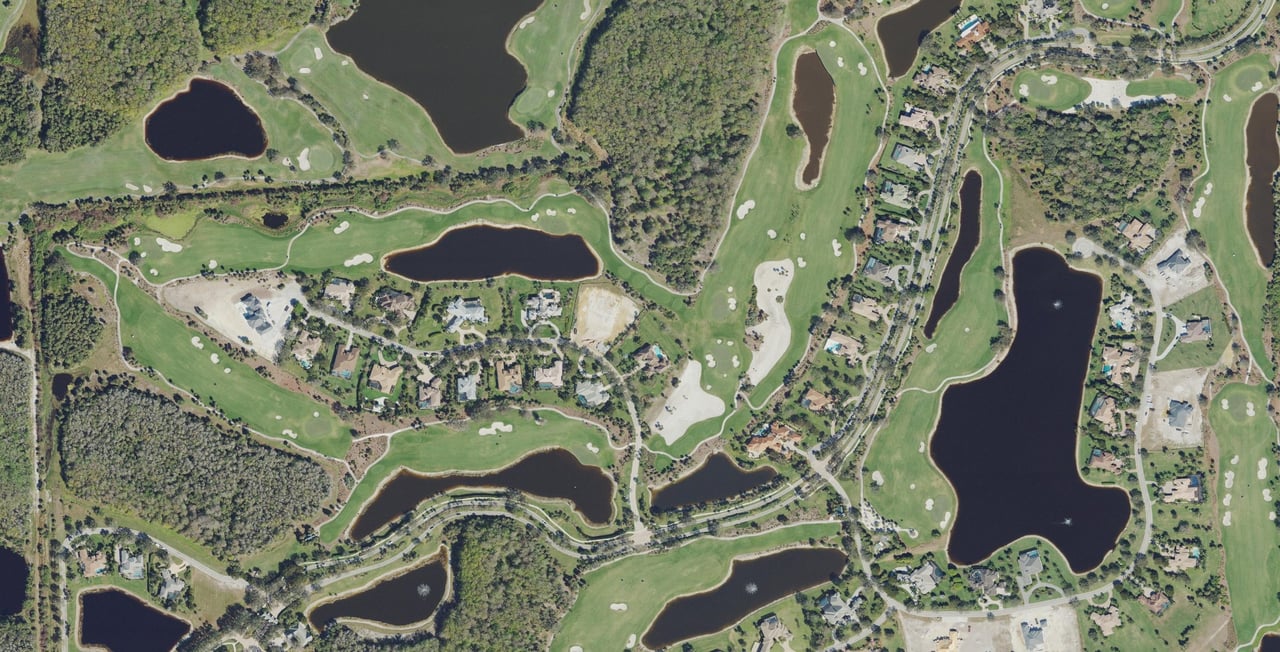
San Carlos Estates contains roughly 540 built single-family homes, virtually all custom builds by many different builders rather than any tract product: median year built 1999, average living area about 2,145 square feet, with homes ranging from 800-square-foot originals to 6,597-square-foot estates [18]. No two streets look alike, and that variety is the point.
The year-built distribution from Lee County records tells the story of a neighborhood that has never stopped building [18]:
1950s-1960s | 2 (pre-district homesteads; earliest 1953) |
1980s | 101 |
1990s | 172 |
2000s | 105 |
2010s | 92 |
2020s | 77 (latest 2024 on the pulled roll) |
Three practical implications:
There is no single “San Carlos Estates product.” An 800-square-foot 1980s ranch on 1.25 acres and a brand-new 5,000-square-foot estate with a barn can sit a street apart. That is why recorded sales here span $350,000 to $1.9 million in just two years [19], and why automated valuations struggle badly in this neighborhood. Comping a custom home on acreage against the right peer set is a human skill.
The 2020s construction wave matters for insurance and resale. Seventy-seven homes built this decade means a meaningful slice of the housing stock was built to the modern Florida Building Code, with the hip roofs, roof-to-wall connections, and impact openings that earn state-mandated wind-mitigation credits [18][44]. More on that in the storm section.
Condition and documentation drive price spread. With no HOA imposing uniformity, well-documented homes (permits, roof age, well and septic service records, outbuilding permits) command a premium over otherwise similar but poorly documented ones. As listing agents, building that documentation file is one of the first things we do.
Average assessed just value across the built homes is about $690,560 on the 2025 roll, with a range from roughly $299,000 to $2.15 million [18], numbers that bracket the neighborhood honestly: attainable entry points and genuine estate properties in the same zip code.
Whether your San Carlos Estates home is a 1980s original or a 2020s custom build, pricing and marketing it correctly is a specialist’s job, and this is the team the market keeps hiring for it:
Top 1% Real Estate Agents Nationally Since 2008
5 Star Award for Customer Satisfaction for 20 Straight Years. Only 5 out of 21k+ Licensees (Gulfshore Life Magazine)
#1 Team in Southwest Florida since 2012
McGreevy and Comisar and their Domain Realty Group team have sold over $2.5 Billion in Real Estate
McGreevy and Comisar alone have over $900 million in Sales
Nationally Recognized Top Producing Realtors
Platinum Sales Production Award Winners
Selling one of these homes? Free valuation at the home valuation page or call Jesse direct at (239) 898-6072. Buying? Call Marc at (239) 287-5873.
Buildable Vacant Lots: Build Your Own in San Carlos Estates
San Carlos Estates still has roughly 150 vacant, buildable residential lots, about one in five residential parcels, with recorded 2024-2025 lot sales from about $159,000 to $460,000, making it one of the last places in the Bonita Springs area where you can buy an in-town 1.25-acre tract and build a custom home on it [18][19].
Why lots here pencil for custom builders and end users:
Real supply. ~150 vacant residential lots against ~540 built homes [18]. Most Bonita Springs-area neighborhoods have been built out for a decade or more.
Real recorded pricing. 2025 saw 13 qualified lot sales averaging about $307,000; 2024 saw 7 averaging about $226,000 [19]. Lot values are trending up, and the spread ($159K to $460K) reflects size, location, and, critically, how much of the tract is usable uplands.
AG-2 flexibility from day one. Permitted uses include the home, a second conventional single-family residence pathway on qualifying (2-acre-plus) parcels, agricultural accessory buildings, and private stables on lots over 40,000 square feet [29][30][31][34].
And here is the honest due-diligence list. A San Carlos Estates lot purchase is not a subdivision lot purchase, and any agent who hands you a contract without walking these five items is not protecting you:
Uplands versus wetlands. Twenty-eight parcels in the neighborhood carry an “Informal Determination of Wetlands” land-use code, and part of the acreage balance is conservation and water-retention land [18]. Wetland coverage on a tract reduces buildable area, and Lee County’s comprehensive-plan framework even ties dwelling rights on some agricultural parcels to leaving on-site wetlands unaltered [29]. Get a wetlands assessment before you waive contingencies.
Flood zone, tract by tract. The neighborhood is split between Zone AE (west/central) and Zone X (east); the zone drives both insurance and the elevation your builder must design to [36]. Details in the storm section below.
Well and septic. This is historically a private well and septic community; the district operates no potable water or sewer utility [3]. Bonita Springs Utilities central water has been extended into parts of the district [3][50], so confirm for your specific tract whether a BSU main is at the street or whether you are budgeting a well; sewer remains septic either way, so a site evaluation for the septic system belongs in your feasibility window.
Impact fees and permitting. New single-family construction in Lee County carries impact fees per the county’s adopted schedule, and permitting runs through Lee County Community Development [62][63][64]. Budget both before you fall in love with a floor plan.
Special assessments on the tract. Verify the SCEWCD assessment status and any capital-improvement assessment history on the specific parcel through the Lee County Tax Collector [4][5][65].
We help buyers run all five before money goes hard, and we help lot sellers pre-package the answers (survey, wetlands info, flood determination, utility availability) so their lot sells faster and for more. Buying a lot? Call Marc at (239) 287-5873. Selling one? Call Jesse direct at (239) 898-6072.
Utilities and Daily Logistics
San Carlos Estates runs on acreage infrastructure: private wells and septic systems historically, with Bonita Springs Utilities central water now extended into parts of the district, FPL electric throughout, Xfinity and Quantum Fiber marketed in the area, Waste Management curbside collection, and the district’s own canal-and-swale drainage [3][20][50][52][55][56].
The specifics, sourced:
Water: The district does not operate a potable water supply; homes have historically been served by individual private wells, and the district’s own water control plan documents Bonita Springs Utilities planning potable water lines through the district [3]. BSU’s franchise service area covers the Bonita Springs area [50], and a “San Carlos Estates Water Main (Design-Build)” project appears in regional procurement records, confirming active central-water extension [73]. Practical rule: water status is parcel-specific in 2026; verify at the address.
Sewer: Septic. The SCEWCD is a drainage district only; no central sanitary sewer is documented in the neighborhood [1][3]. Buyers should inspect the septic system; sellers should have pump-out and service records ready.
Electric: Florida Power and Light. Lee County GIS territory data places San Carlos Estates parcels outside the Lee County Electric Cooperative territory, and the district’s own resident links page lists FPL [9][20].
Internet: Xfinity (Comcast) and Quantum Fiber both market service in the Bonita Springs area [55][56], and the district hosted a fiber-internet initiative presentation for landowners in 2025 [10]. Availability genuinely varies street by street in a large acreage neighborhood, so check the specific address against the FCC National Broadband Map [54] before you close, not after.
Trash: Lee County Solid Waste provides curbside collection via a 95-gallon cart, with recycling and yard waste; the franchised hauler for ZIP 34135 is Waste Management, (239) 334-1224 [52][53].
Drainage: the district’s engineered system of perimeter canals, swales, and culverts, maintained by the SCEWCD assessment [3][4].
Roads: private, paved asphalt, district-maintained, as covered above [1][3].
None of this is exotic, but all of it is different from the gated-community default that most Southwest Florida agents and buyers know. It is also exactly the material a listing agent must be able to explain confidently to a buyer’s agent, a lender, and an insurer to keep a San Carlos Estates deal together.
The Storm Posture: Flood Zones, Ian, and Insurance Reality
San Carlos Estates sits inland, several miles from the Gulf, and its FEMA flood mapping is a mix: the western and central portions are Zone AE (panel 12071C0656G) while the eastern side toward I-75 is Zone X (panel 12071C0657G), both effective November 17, 2022, with Lee County’s CRS Class 5 rating earning a 25 percent NFIP discount [36][38][46].
We publish this section straight because storm honesty is a trust issue in Southwest Florida real estate.
Flood zones: the real map, not the rumor
The claim that San Carlos Estates is “all Zone X, no flood insurance needed” circulates online. It is wrong. Direct queries of FEMA’s National Flood Hazard Layer show Zone AE (a Special Flood Hazard Area) across the western and central bulk of the neighborhood and shaded Zone X (0.2 percent annual chance) on the eastern side toward I-75 [36]. Two Lee County FIRM panels cover the neighborhood: 12071C0656G (west/central, AE areas) and 12071C0657G (east, X areas), both effective November 17, 2022 [36][61].
In AE areas, flood insurance is generally required with a federally backed mortgage; in Zone X it is typically not federally required, though often still smart [36][62]. The zone is parcel-specific: verify any tract at the FEMA Map Service Center [37] before writing or accepting a contract.
No static base flood elevation is printed at the interior points we sampled in the AE areas, so no single “the BFE here is X feet” number exists for the neighborhood; site-specific determinations and elevation certificates are the honest tools [36].
One structural positive: Lee County holds a Class 5 rating in FEMA’s Community Rating System, worth a 25 percent discount on NFIP premiums, held since 2007 and retained after a post-Ian FEMA review in 2024 [38][40][46]. The City of Bonita Springs is likewise Class 5 at 25 percent, so the discount holds under either jurisdictional outcome of the merger question [39].
Hurricane Ian, told honestly
Hurricane Ian made landfall in Lee County on September 28, 2022, with catastrophic storm surge along the coast; the Bonita Springs area’s reported 12-plus feet of surge and the neighborhood-destroying damage were coastal phenomena, at Bonita Beach, Little Hickory, and the Imperial River mouth [38][41]. San Carlos Estates is an inland neighborhood, outside the coastal surge zone; its Ian exposure was hurricane-force wind, heavy rain, and localized drainage stress, not surge [36][41]. City-wide damage assessments after Ian ran 19,427 parcels: 28 destroyed, 1,332 major damage, and 12,610 unaffected, with the severe outcomes concentrated on the coast [41]. No San-Carlos-Estates-specific damage tally exists in the public record, and we will not invent one; the fair statement is that inland acreage east of the surge zone fared fundamentally differently than the beach. (And to repeat the disambiguation: post-Ian imagery and the 2025 FEMA map-appeal news labeled “San Carlos” almost always concern San Carlos Park or San Carlos Island, not San Carlos Estates [17].)
Insurance reality
Florida wind premiums are a real cost everywhere in Lee County, but owners here have genuine levers. Wind-mitigation credits are mandatory premium discounts under Florida law, documented on the state’s uniform inspection form: hip roof shape, roof-deck attachment, secondary water resistance, roof-to-wall connections, and impact-rated openings all earn credits [44]. With 77 homes built in the 2020s and 92 in the 2010s [18], a large share of San Carlos Estates housing stock is modern-code construction positioned to earn those credits. Citizens Property Insurance remains the state’s insurer of last resort for owners who cannot place private coverage [45]. For flood, the CRS Class 5 discount applies to all NFIP policies in the county, including those outside the high-risk zone [38].
Sellers: a current wind-mitigation inspection and a documented flood determination are cheap, and they defuse the two scariest questions in any Southwest Florida negotiation before they are asked. It is standard practice on our San Carlos Estates listings. Call Jesse direct at (239) 898-6072.
Schools: Lee County Proximity and Choice Zones
San Carlos Estates families use Lee County’s school-choice system rather than fixed assignment: the neighborhood sits in Elementary Proximity Zone Q, Middle Zone GG, and the South high-school choice zone, so parents rank schools within each zone and placement follows proximity and preference rules [47][48][49].
What that means concretely, per the district’s 2025-2026 Student Enrollment Plan and Lee County’s school-proximity GIS data:
Elementary (Zone Q): families rank among Bonita Springs Elementary, Pinewoods Elementary, San Carlos Park Elementary, Spring Creek Elementary, and Three Oaks Elementary [47][48]. Spring Creek Elementary and Bonita Springs Elementary are the closest of the set to the neighborhood.
Middle (Zone GG): Bonita Springs Middle Center for the Arts and Three Oaks Middle School [47][48].
High (South Zone): high schoolers choose among South Zone schools; the Bonita Springs/Estero end of the zone includes Bonita Springs High School (FGCU Collegiate and Cambridge programs) and Estero High School (Cambridge) [47].
There is no single “assigned” school for an address; proximity preferences (including a within-2-miles tier) shape the lottery [47][49]. The district’s official address locator is the authoritative tool for any specific tract, and boundaries are reviewed annually, so verify against the current-year plan [49].
For relocating buyers we pull the current-year zone confirmation for the specific parcel as part of the search. Call Marc at (239) 287-5873.
County Permits and Nearby Zoning Changes Worth Watching
San Carlos Estates itself is stable, low-density AG-2 land, but the corridors around it are changing: a 299-home community was approved for advancement along Bonita Beach Road in 2025, an I-75 widening has been reported as starting around 2027, and central water continues extending into the district [16][73]. Smart owners and buyers track all three.
Revana Lakes (Bonita Beach Road corridor): in October 2025 the Bonita Springs City Council voted 4-3 to advance comprehensive-plan changes enabling a 299-home Seagate development on a 204-acre site along Bonita Beach Road, involving annexation of 90 acres from unincorporated Lee County and a land-use change from Density Reduction/Groundwater Resource to Urban Fringe; more than 1,200 residents petitioned over traffic concerns, and rezoning steps remain [16]. For San Carlos Estates, the takeaways are corridor traffic and the precedent of converting nearby DR/GR land.
Growth-versus-drainage tension is not new here: regional reporting has previously examined whether additional development around the neighborhood would push more stormwater runoff toward the district’s system [15], which is exactly why the SCEWCD’s engineered canal network, and its funding, matter to property values.
Roads: FDOT’s U.S. 41 at Bonita Beach Road intersection project (444321-1) and reported I-75 widening (~2027) will reshape the neighborhood’s two main access corridors over the next several years [16][71].
Utilities: the San Carlos Estates water-main design-build work documented in regional records [73] continues the shift from all-well to mixed well/central water, a value-relevant change tract by tract.
Permit verification tools: Lee County Community Development’s permitting portal and the Lee County Property Appraiser are the primary sources for any parcel’s permit history [21][62][64]. We run permit history on every listing we take and every purchase we negotiate here.
Comparable Communities to Consider
San Carlos Estates has no true twin in the immediate area: it is the large-lot, no-HOA, AG-2 enclave among Bonita Springs-area neighborhoods, and its nearest neighbors are conventionally governed communities such as The Brooks, Villages of Bonita, Bonita Springs Country Club, and Fairway Dunes, whose stormwater actually feeds into the district’s perimeter canals [3].
How the honest comparison shakes out for a buyer deciding between San Carlos Estates and a nearby managed community:
Versus The Brooks and similar gated master-planned communities nearby: those trade HOA fees (and often CDD-style obligations and amenity packages) for clubhouses, gates, and uniformity. San Carlos Estates trades all of that for land, agricultural rights, storage freedom, and a single district assessment [1][4][29]. Neither is “better”; they serve different buyers, and we sell both, so our advice is not a sales pitch for one model.
Versus new-construction corridor projects like Revana Lakes: new corridor communities offer new product on small lots with association governance [16]. San Carlos Estates offers 10-to-20-times the land and no association, with the tradeoffs (well/septic, private-road assessment, flood-zone diligence) described honestly on this page.
Within the research we conducted, no other Bonita Springs-area subdivision combines ~1.25-acre tracts, AG-2 zoning, and no HOA at this location. We stop short of calling it the “only” such community anywhere, but in this market position it is, at minimum, exceptionally rare.
If San Carlos Estates is on your shortlist, it deserves a specialist’s tour, including the streets, the canals, and the difference between an AE tract and an X tract. Call Marc at (239) 287-5873.
Why Buy in San Carlos Estates: Honest Pros and Cons
San Carlos Estates rewards buyers who want land, freedom, and location in one purchase: 1.25-acre tracts, no HOA or CDD, AG-2 rights, and beaches and I-75 within minutes; it asks in return that you underwrite well/septic, a district assessment, and a split flood map with open eyes [1][18][36].
The pros, all sourced above:
~1.25-acre tracts, in town, minutes from I-75, Publix, and the beaches [18][57]
No HOA, no HOA fee, no CDD, no association approval process [4][25][27]
AG-2 rights: horses and private stables (40,000-plus-square-foot lots), poultry, agriculture, barns and outbuildings, ADUs [29][30][31][32][33][34]
RV, boat, and trailer storage on your own land with no county count limit and no HOA layer [30][35]
Paved private roads and an engineered drainage system, landowner-financed at roughly $21-22 million [3][14]
Inland position outside Ian’s coastal surge zone [41]
Still-buildable: ~150 vacant lots and 77 homes built this decade [18]
No city property tax (unincorporated Lee County), possible greenbelt classification for bona fide agricultural use [14][23][24]
CRS Class 5 county: 25 percent NFIP discount [38][46]
The cons, stated plainly:
Well and septic on most tracts (central water arriving unevenly; sewer remains septic) [3][50]
SCEWCD assessment ($612.75/acre FY24-25, roughly $766/year on a typical tract) on top of property tax [4]
West/central tracts are FEMA Zone AE: flood insurance generally required with a mortgage, elevation diligence required to build [36]
No HOA also means no HOA enforcement: your neighbor’s land is their land too, within county code
Governance uncertainty until the August 18, 2026 merger referendum resolves [12][13][14]
Custom, non-uniform housing stock makes valuation genuinely hard without a specialist
If the pros read like your list, this is your neighborhood. Work it with the team that wrote the most thoroughly cited page about it:
Top 1% Real Estate Agents Nationally Since 2008
5 Star Award for Customer Satisfaction for 20 Straight Years. Only 5 out of 21k+ Licensees (Gulfshore Life Magazine)
#1 Team in Southwest Florida since 2012
McGreevy and Comisar and their Domain Realty Group team have sold over $2.5 Billion in Real Estate
McGreevy and Comisar alone have over $900 million in Sales
Nationally Recognized Top Producing Realtors
Platinum Sales Production Award Winners
Buyer CTA: Call Marc at (239) 287-5873. - Jesse McGreevy: (239) 898-6072 · [email protected] - Marc Comisar: (239) 287-5873 - Office: 24031 S. Tamiami Trail, Suite 101, Bonita Springs, FL 34134
Thinking of Selling Your San Carlos Estates Home? List With the #1 Team in Southwest Florida Since 2012
If you are searching “sell my house in San Carlos Estates,” “what is my San Carlos Estates home worth,” or “best listing agent for Bonita Springs acreage,” here is the direct answer: McGreevy and Comisar at Domain Realty are the listing team built for exactly this property type, with recorded-sale command of this neighborhood and two decades of top-of-market production behind every listing [19].
Your listing credentials, in writing:
Top 1% Real Estate Agents Nationally Since 2008
5 Star Award for Customer Satisfaction for 20 Straight Years. Only 5 out of 21k+ Licensees (Gulfshore Life Magazine)
#1 Team in Southwest Florida since 2012
McGreevy and Comisar and their Domain Realty Group team have sold over $2.5 Billion in Real Estate
McGreevy and Comisar alone have over $900 million in Sales
Nationally Recognized Top Producing Realtors
Platinum Sales Production Award Winners
The market you are selling into: 49 recorded qualified home sales in 2024-2025 from about $350,000 to $1,910,000, averaging roughly $850,000 to $929,000 depending on year; 20 recorded lot sales from about $159,000 to $460,000 with the average up sharply year over year [19]. Demand for no-HOA acreage is structural in Southwest Florida, and supply here is fixed at ~760 tracts [18].
What selling a San Carlos Estates property specifically takes, and what we do about it:
No HOA means a faster, cleaner close, and we market that. No estoppel fees, no association application, no approval waiting period. For buyers coming out of HOA communities, that is a closing-timeline advantage we put in the listing story.
But the disclosure work is heavier, and we front-load it. The SCEWCD assessment (what it is, what it costs, that it is a Chapter 298 governmental assessment collected on the tax bill) [4], the well and septic reality with service records [3], the parcel’s exact FEMA zone with the panel number [36], and the merger-referendum status [12][13] all get packaged for buyers before they ask. Deals die from surprises; ours do not get surprised.
AG-2 assets need AG-2 documentation. Permitted barns and outbuildings, stable setbacks, any greenbelt classification, ADU permits: we assemble the paper trail that lets an appraiser and an underwriter credit your improvements instead of ignoring them [23][30][34].
Custom homes need custom comping. With sales spanning $350K to $1.9M in two years [19], the comp set for your specific home is small and judgment-driven. We comp from recorded sales plus live MLS data, not from an algorithm’s guess about a neighborhood algorithms do not understand.
The buyer pool is national. Equestrian buyers, builders hunting lots, RV and boat owners fleeing HOA rules, and multigenerational families wanting ADU potential do not all live in Lee County. Our marketing reaches them where they search.
Start with your number. Get a free, no-obligation valuation of your San Carlos Estates home or lot at our home valuation page, or skip the form and call Jesse direct at (239) 898-6072. - Jesse McGreevy: (239) 898-6072 · [email protected] - Marc Comisar: (239) 287-5873 - Office: 24031 S. Tamiami Trail, Suite 101, Bonita Springs, FL 34134
Seller quick answers
How do I find out what my San Carlos Estates home is worth? Start at our home valuation page or call Jesse direct at (239) 898-6072. We build the number from recorded San Carlos Estates sales [19], live MLS activity, and your property’s specific land, improvements, flood zone, and documentation, not from an automated model.
Do I have to disclose the water-district assessment to buyers? Yes, and you want to. The SCEWCD non-ad-valorem assessment ($612.75/acre FY24-25) appears on the tax bill and is a governmental assessment with lien priority [4]. Explained properly (it funds the paved private roads and drainage), it reads as value, not as a defect.
Does no HOA make my home easier or harder to sell? Easier on process (no estoppel, no association approval, faster close) and stronger with the right buyers, who are often paying a premium specifically to escape HOA rules. The tradeoff is heavier factual disclosure (roads, assessment, well/septic, flood zone), which is our job to package.
Do my horses, barn, or outbuildings help or hurt resale? Documented, permitted ag improvements broaden your buyer pool to equestrian and hobby-farm buyers who have very few in-town options [30][32]. Undocumented structures hurt. We audit the permit trail before we list.
How should I sell a vacant lot here? Pre-answer the four buildability questions: uplands/wetlands status, FEMA zone with panel number, utility availability (BSU main versus well; septic siting), and assessment status [3][18][36][65]. A lot marketed with those answers attached sells faster and closer to the 2025 average (~$307,000) than a bare listing [19].
Is now a good time to sell in San Carlos Estates? Recorded averages rose from about $850,000 (2024) to about $929,000 (2025) for homes, and lot averages jumped about 36 percent [19]. Your specific timing depends on your property and goals; call Jesse at (239) 898-6072 and we will give you the current-week read, not a page’s stale one.
What is the biggest pricing mistake San Carlos Estates sellers make? Comping against the neighborhood “average.” With homes from 800 to 6,597 square feet on the same street grid [18], the average is nearly meaningless for any single property; overpricing off a bad comp set, then chasing the market down with reductions, costs real money.
Your Local San Carlos Estates Real Estate Experts
Jesse McGreevy and Marc Comisar lead McGreevy and Comisar, the Bonita Springs-based team that has led Southwest Florida real estate production since 2012, and San Carlos Estates sits squarely in our home market, about ten minutes from our office on South Tamiami Trail.
Jesse McGreevy co-founded Domain Realty and leads the Domain Realty Group, roughly 40 agent-partners across Southwest Florida. Marc Comisar has been his partner at the top of this market for over two decades. Together we have built our business on the property types this page describes: acreage, custom homes, equestrian and agricultural land, and buildable lots, alongside the coastal and golf communities the rest of the market knows us for. We live here, our kids’ schools and our grocery runs are the same ones in the drive-time table above, and the research on this page is how we operate on every listing and every purchase.
Top 1% Real Estate Agents Nationally Since 2008
5 Star Award for Customer Satisfaction for 20 Straight Years. Only 5 out of 21k+ Licensees (Gulfshore Life Magazine)
#1 Team in Southwest Florida since 2012
McGreevy and Comisar and their Domain Realty Group team have sold over $2.5 Billion in Real Estate
McGreevy and Comisar alone have over $900 million in Sales
Nationally Recognized Top Producing Realtors
Platinum Sales Production Award Winners
McGreevy and Comisar are part of Domain Realty, Southwest Florida’s full-service brokerage. Learn more at DomainRealtyGroup.com.
Jesse McGreevy: (239) 898-6072 · [email protected]
Marc Comisar: (239) 287-5873
Office: 24031 S. Tamiami Trail, Suite 101, Bonita Springs, FL 34134
Sellers: free valuation at the home valuation page or call Jesse direct at (239) 898-6072. Buyers: call Marc at (239) 287-5873.
Frequently Asked Questions About San Carlos Estates: Buyer Edition
What is the typical lot size in San Carlos Estates?
About 1.25 acres. Lee County GIS shows an average of 1.27 acres across the neighborhood’s roughly 540 built home parcels [18]. That is roughly 54,450 square feet, well above the AG-2 zoning minimum of 39,500 square feet for an interior lot [31].
Does San Carlos Estates have an HOA?
No. San Carlos Estates has no mandatory homeowners association and no HOA fee. Roads and drainage are handled by the San Carlos Estates Water Control District, a governmental special district, not a private association [1][2].
Are there HOA fees or CDD fees in San Carlos Estates?
Neither. The only community-level charge is the SCEWCD non-ad-valorem maintenance assessment, $612.75 per acre for FY 2024-25 (roughly $766 on a typical 1.25-acre tract), collected on the Lee County tax bill [4][27].
Are there rental restrictions in San Carlos Estates?
There is no HOA to impose rental restrictions. Rentals are governed by ordinary state and local law rather than association rules; owners considering short-term rental use should verify current county requirements and any registration obligations for their specific situation before operating.
What can I do on my property with no HOA?
Within AG-2 zoning and county code: keep horses in a private stable (40,000-plus-square-foot lot), raise chickens, farm, build barns and outbuildings, add an accessory apartment up to 50-60 percent of the main home’s size, and store RVs, boats, and trailers on your land [29][30][31][32][33][34]. What still applies: setbacks, height (35 feet), 25 percent lot coverage, and the neighborhood’s 40-foot street setback rule [29][31].
Are there deed restrictions or covenants even though there is no HOA?
Our research located no recorded declaration of covenants for San Carlos Estates in government sources; the controlling recorded document is the tract map at O.R. Book 557, Pages 354-355 [25][26]. Standard practice still applies: a title search on the specific tract at purchase.
Is San Carlos Estates gated?
No. It is not a gated community. The three perimeter maintenance roads (Tuck, Moriah, Bonita Bill) are gated to vehicles for canal maintenance and adjacent-owner access, but the neighborhood’s internal streets are open, and individual owners may fence or gate their own tracts [1].
Are the roads public or private?
Private, with public access. All internal roads are owned and maintained by the SCEWCD and paid for by the district’s property owners [1].
Are the roads paved or dirt?
Paved. The district’s roads are built to an engineered asphalt standard (one inch of Type S-III asphalt over a six-inch limerock base), following a landowner-financed paving and drainage program of roughly $21 to $22 million [3][14][68].
Who maintains the roads if there is no HOA?
The San Carlos Estates Water Control District, funded by its per-acre assessment [1][4].
What is the San Carlos Estates Water Control District and what does it do?
A Chapter 298 Florida special district created by circuit-court decree in 1969 (Case No. 69-105). It owns and maintains the private roads and the drainage system (canals, swales, culverts, basins) and levies the per-acre assessment that funds them. It is governed by three elected supervisors [1][2][3][4].
Is San Carlos Estates inside Bonita Springs city limits or unincorporated Lee County?
Unincorporated Lee County, with Bonita Springs mailing addresses [14]. Residents pay no city property tax. The 2026 referendum question (below) concerns the water district’s governance, and this jurisdictional picture is part of why the merger debate exists.
Do residents get city services?
Services follow the unincorporated-county model: Lee County services, the district’s own roads and drainage, Lee County Solid Waste collection through Waste Management for ZIP 34135, FPL electric, and private well/septic or extended BSU water [3][20][50][52].
Is San Carlos Estates going to merge with the City of Bonita Springs?
Undecided as of July 2026. HB 4033 (2025) would convert the district to a dependent district of the City, but only if district landowners approved it by October 1, 2025 AND City of Bonita Springs electors approve it on August 18, 2026 [12][13]. Watch the August 2026 ballot.
What happens to my taxes if the district becomes dependent on Bonita Springs?
The state’s bill analysis contrasts the district’s $547.03-per-acre 2023 maintenance tax with the city’s roughly $50-per-ERU stormwater fee, suggesting a likely cost reduction for landowners under the merger [13]. Opponents weigh that against losing the independent, landowner-elected board [14].
Why are residents fighting the merger?
Independence. Landowners financed the roads and drainage themselves (~$21-22 million) and elect their own board one-vote-per-acre; many prefer keeping that control local rather than transferring it to the City Council [12][14].
Can you have horses in San Carlos Estates?
Yes. Horses are a permitted use in AG districts; a private stable requires a 40,000-square-foot lot (about 0.92 acre) with a 35-foot setback, and typical ~1.25-acre tracts here qualify [30][32].
How many horses or livestock can I keep per acre?
There is no per-acre head count in Lee County’s code. The rules are minimum lot size for the stable type, structure setbacks, and lot-coverage limits, not animal counts [30][32]. Be skeptical of any listing quoting “X horses per acre.”
Can you keep chickens, goats, or other livestock?
Yes, in AG districts. Chickens and poultry are permitted with coops at least 100 feet from a neighbor’s dwelling [33]. Goats, sheep, and swine are allowed subject to 100-foot animal proximity and 300-foot roofed-structure setback rules [30].
Is San Carlos Estates zoned agricultural?
Yes. 758 of 760 parcels are coded AG-2, and the district’s own state filing states that all of San Carlos Estates is zoned AG-2 and consists entirely of single-family residential [3][18].
What does AG-2 zoning allow?
Single-family homes, a second conventional single-family residence pathway on qualifying parcels, mobile home as sole residence, agriculture broadly (farming, groves, nurseries, pasturage), agricultural accessory buildings, animals and private/boarding stables, home occupations without outside help, and accessory uses; dimensional standards include a 39,500-square-foot minimum interior lot and 35-foot height cap [29][31].
Can I store an RV, boat, trailer, or equipment on my property?
Yes. No Lee County LDC provision limits the number, location, or size of RVs, boats, or recreational/utility trailers on an AG or single-family lot, and there is no HOA layer here [30]. The county’s commercial-truck rules (15,000-pound GVWR threshold, semis, multi-rear-axle trucks) are the operative limits, with AG exceptions including one resident work truck [30][35].
Can I park an RV on a vacant lot versus a lot with a house?
The AG commercial-vehicle exception requires the property not be vacant [30], and living in an RV is not a permitted dwelling use (see next answer). Storage practices on vacant land deserve a specific check with Lee County code enforcement before you rely on them; ask us and we will run it down for your tract.
Can I live in an RV on my lot while building?
Current codified rules permit a temporary mobile home during construction of a home in AG districts, removed after certificate of occupancy; they do not authorize an RV as a dwelling [30]. Confirm current rules with Lee County zoning before planning around this.
Can I build a barn, workshop, or outbuilding on my lot?
Yes. Agricultural accessory buildings and residential accessory buildings are permitted uses in AG-2, within setback, height, and 25 percent lot-coverage limits [29][30][31]. Permits run through Lee County Community Development [64].
Can I build a barn or shed before the house on an AG-2 lot?
Accessory structures are defined relative to a principal use, so sequencing a barn ahead of the home is a permitting question to confirm with Lee County Community Development for your specific plan [64]. We can help you frame the question before you buy the lot.
Do I need a permit for a shed, and at what size?
Permit thresholds and exemptions are set by Lee County’s building rules; check the county’s residential permitting guidance for the current threshold before placing any structure [64].
Can I get an agricultural tax exemption for horses or farming?
Possibly, if the use is bona fide agriculture. Florida’s Greenbelt Law (F.S. 193.461) allows agricultural-use assessment; apply to the Lee County Property Appraiser on Form DR-482 by March 1, with the use in place by January 1 [23][24]. Pleasure horses alone generally do not qualify; a genuine operation may.
How much land do I need for the ag classification?
There is no fixed acreage minimum in the statute; the test is bona fide commercial agricultural use of the land, judged by the property appraiser on evidence (leases, receipts, business records) [23][24].
Are there vacant, buildable lots for sale in San Carlos Estates?
Structurally yes: about 150 of the neighborhood’s ~760 parcels are vacant residential lots [18], and 20 of them sold in recorded qualified sales during 2024-2025 [19]. For what is on the market this week, call Marc at (239) 287-5873.
Can I build a custom home in San Carlos Estates?
Yes. This is a custom-home neighborhood with no tract builder, and 77 homes have been built here in the 2020s alone [18].
How do I know if a lot is buildable?
Four checks: wetlands/uplands determination, FEMA flood zone (AE versus X, parcel-specific), utility plan (well versus BSU main; septic siting), and assessment status, plus ordinary zoning setbacks [3][18][36][65]. We run all four with buyers before contingencies expire.
What are wetlands versus uplands and why do they matter?
Uplands are the dry, buildable portion of a tract; wetlands are regulated and generally cannot be built on or altered without consequence. Twenty-eight parcels in the neighborhood carry wetlands determinations, and county comprehensive-plan rules tie some agricultural-parcel dwelling rights to leaving wetlands unaltered [18][29]. Usable-upland acreage, not gross acreage, is what you are really buying.
Does a lot need a wetlands determination before building?
If any part of the tract may be wet, yes, get one during due diligence. It defines your buildable envelope and protects your budget [18][29].
How much usable acreage will I have after wetlands?
Parcel-specific; no neighborhood-wide number exists. A survey plus a wetlands assessment on your specific tract is the only honest answer.
Does San Carlos Estates have city water and sewer, or well and septic?
Historically private well and septic; the district operates no water or sewer utility. Bonita Springs Utilities central water is being extended into parts of the district, so water status is now parcel-by-parcel; sewer remains septic [3][50][73].
Do I need a well and septic system to build?
You need septic (no central sewer is documented in the neighborhood), and you need either a well or a confirmed BSU water main at your street [3][50]. Both belong in your construction budget until confirmed otherwise.
Are there special assessments for water, sewer, or road infrastructure?
The standing one is the SCEWCD maintenance assessment; the district has also levied capital-improvement-phase assessments in recent years (for example, the FYE 2024 resolution combined maintenance and a CIP Phase I assessment at $576.53 per acre) [4][5]. Utility extensions can carry their own connection costs. Verify the specific parcel.
How do I check whether a lot has an outstanding assessment?
Through the Lee County Tax Collector’s records for the parcel [65], plus the district’s adopted assessment resolutions [4][5]. We pull both on every San Carlos Estates transaction.
Can I build a guest house, ADU, or in-law suite?
Yes: one accessory apartment/ADU is permitted with a single-family home in AG districts, up to 50-60 percent of the main home’s living area, with one added parking space [34]. A second full detached house requires at least a two-acre parcel [34].
Will ADU rule changes affect the area?
The City of Bonita Springs has been preparing for potential ADU rule adoption under state deadlines [66]. San Carlos Estates, in unincorporated Lee County, already has an ADU pathway in county code [34], so buyers here are ahead of that curve.
Can I put a tiny home on my lot?
AG-2 permits a conventional single-family residence or a mobile home as the sole residence [29][31]; whether a specific tiny-home product qualifies under building code is a Lee County permitting determination. Ask before you buy the unit.
What are the impact fees to build a new home in Lee County?
Lee County publishes an adopted impact-fee schedule covering roads, schools, parks, and EMS categories [63]; the current figures come from that schedule at permit time. Budget them alongside well/septic and site work.
What does it cost, all-in, to build on acreage here?
No single verified number exists, and we will not invent one. The framework: lot (recorded 2024-2025 sales $159K-$460K [19]) plus site work, well and septic (or BSU connection), impact fees [63], and construction at your builder’s current pricing. We help buyers assemble real bids.
What is the typical price of a vacant lot versus a finished home?
Recorded 2024-2025: lots averaged about $226,000 (2024) to $307,000 (2025); finished homes averaged about $850,000 (2024) to $929,000 (2025) [19].
What internet options are available? Is there fiber?
Xfinity and Quantum Fiber both market service in the Bonita Springs area [55][56], and the district hosted a fiber-initiative presentation for landowners in 2025 [10]. Availability varies by street in a large acreage neighborhood; verify your exact address on the FCC National Broadband Map [54].
What flood zone is San Carlos Estates in?
Both AE and X. The western and central portions are Zone AE (Special Flood Hazard Area, panel 12071C0656G); the eastern side toward I-75 is shaded Zone X (panel 12071C0657G); both panels effective November 17, 2022 [36]. Any “it’s all Zone X” claim is false. Check your parcel at the FEMA Map Service Center [37].
Is flood insurance required in San Carlos Estates?
In the AE portions, generally yes with a federally backed mortgage; in the Zone X portions, typically not federally required, though often prudent [36][62]. Lee County’s CRS Class 5 standing earns a 25 percent NFIP discount on all NFIP policies [38][46].
Do I need flood insurance on a Zone X upland lot?
Not federally required in most cases, but Zone X means reduced risk, not no risk, and the discount makes coverage comparatively affordable here [36][38]. Discuss with your insurer.
Does homeowners insurance cover flood damage?
No. Standard homeowners policies exclude flood; flood coverage is a separate policy (NFIP or private) [38][62]. This is the most expensive misconception in Florida insurance.
Is San Carlos Estates inland? Does that mean less storm-surge risk than coastal Bonita?
Yes and yes. The neighborhood sits several miles inland between Old 41 and I-75, outside the coastal surge zone; Hurricane Ian’s destructive surge struck the coast, while inland areas faced wind and rain [36][41].
How did San Carlos Estates fare in Hurricane Ian?
No neighborhood-specific damage tally exists in the public record, and much online “San Carlos” Ian footage is actually San Carlos Park or San Carlos Island [17]. The honest picture: Ian’s 12-plus-foot surge was coastal; inland San Carlos Estates faced hurricane wind, heavy rain, and drainage stress, and city-area damage assessments concentrated the severe outcomes on the coast (28 destroyed and 1,332 major-damage parcels against 12,610 unaffected, area-wide) [41].
What is the hurricane and wind risk for homes here?
The same serious Southwest Florida wind exposure as the region generally, mitigated by inland position (no surge) and, for newer homes, modern Florida Building Code construction that earns mandatory wind-mitigation insurance credits (hip roofs, roof-to-wall connections, impact openings) [41][44].
Will nearby development increase stormwater runoff toward San Carlos Estates?
It is a live, legitimate question that regional media have examined as corridor projects advance [15][16]. The counterweight is the district’s engineered and funded canal-and-swale system, and permitting for inflows from adjacent developments [3]. Watch the corridor approvals; we do.
What schools serve San Carlos Estates?
Lee County uses proximity-plus-choice zones, not fixed assignment: Elementary Zone Q (rank among Bonita Springs, Pinewoods, San Carlos Park, Spring Creek, and Three Oaks Elementary), Middle Zone GG (Bonita Springs Middle Center for the Arts, Three Oaks Middle), and the South high-school zone (including Bonita Springs High and Estero High) [47][48].
What elementary school will my child attend?
There is no single assigned school; families rank the Zone Q schools and placement follows proximity preferences and the district’s lottery [47]. Verify your tract on the district’s official locator for the current year [49].
What are the school ratings near San Carlos Estates?
Ratings change year to year, so we do not freeze them into this page; pull current school grades from the Florida Department of Education and the district’s own reporting, and we will walk you through the zone options for your address.
Can my child attend a school closer to my work or a different school?
Lee County’s choice model allows ranking schools within your zone, with proximity and sibling preferences; cross-zone situations are handled under the district’s enrollment plan rules [47][49]. Confirm specifics with the district for your case.
Are there good private school options nearby?
Southwest Florida has private options within driving range, but none were verified in our primary-source research pass, so we decline to name and rank them here. The FLDOE private-school directory is the authoritative starting point, and we are glad to share local knowledge in conversation.
Where exactly is San Carlos Estates located?
In the Bonita Springs area of Lee County, roughly bounded by Old 41/Imperial Parkway to the west and I-75 to the east, south of Bonita Beach Road, reached via the East Terry Street corridor; ZIP 34135 [13][57].
Is San Carlos Estates a good place to live?
If you want land, privacy, animals or toys, and no HOA, with town five minutes away, yes, and the market agrees: 49 recorded home sales in two years averaging well above the area’s typical price point, and continued new construction [18][19]. If you want managed uniformity and a clubhouse, a gated community will fit better. See our pros-and-cons section above.
What is San Carlos Estates like, rural or in-town?
Both, which is its rarity: semi-rural acreage character (trees, space, horses, canals) with genuinely in-town logistics (I-75 and Publix in about 5-8 minutes) [18][57].
How far is San Carlos Estates from Coconut Point? From the beaches? From RSW?
Approximately: Coconut Point ~10 miles (18-22 minutes), Bonita Beach ~9 miles (17-22 minutes), Barefoot Beach ~8 miles (16-22 minutes), RSW ~22 miles (30-38 minutes). See the full drive-time table above.
How far is it from I-75 and downtown Bonita?
About 2 miles (5-8 minutes) to I-75 Exit 116 and about 3.5 miles (9-13 minutes) to downtown Bonita Springs’ Old 41 district.
How close are groceries and hospitals?
The nearest Publix-anchored center is about 2 miles away on Bonita Beach Road; Lee Health Coconut Point’s 24/7 ER is about 8 miles, with NCH North Naples about 9.5 miles [59].
Is San Carlos Estates safe? What is the crime rate?
Be careful with this one: most “San Carlos” crime statistics online belong to San Carlos Park, a different community [17]. No neighborhood-specific crime statistic for San Carlos Estates was verified in our research, so we will not quote one; consult the Lee County Sheriff’s Office public data for the specific area.
Is it dog-friendly, family-friendly, quiet?
The structural answer: 1.25-acre tracts, no HOA pet rules beyond county law, private low-traffic streets, and school-choice zones covering the family question [1][18][47]. Residents’ own public descriptions consistently emphasize privacy and quiet.
There is no HOA social calendar, but there is a genuine civic life: the district’s annual landowner meetings and elections, an active landowner community site, and, lately, a shared cause in the merger referendum [1][12][14].
Is San Carlos Estates near The Brooks and other communities?
Yes; adjacent and nearby communities include The Brooks, Villages of Bonita, Bonita Springs Country Club, and Fairway Dunes, whose permitted stormwater flows feed the district’s perimeter canals [3].
Can I run a home business here?
Home occupations without outside help are a permitted use in AG-2, with administrative approval pathways for more [29]. The commercial-vehicle rules above still apply.
How much do homes cost in San Carlos Estates?
Recorded qualified sales in 2024-2025 ran from about $350,000 to $1,910,000, averaging roughly $850,000 to $929,000 by year [19].
How much are vacant lots?
Recorded 2024-2025 lot sales ran from about $159,000 to $460,000, averaging about $226,000 (2024) and $307,000 (2025) [19].
How many homes and lots are for sale right now?
Live inventory changes weekly and we will not publish a stale count; call Marc at (239) 287-5873 for today’s list.
Are prices going up or down?
Recorded averages rose year over year for both homes (~$850K to ~$929K) and lots (~$226K to ~$307K) from 2024 to 2025 [19]. For the current-quarter trend, call us.
Is San Carlos Estates a good investment?
The structural case: fixed supply (~760 tracts), scarce product type (in-town no-HOA acreage), continued building demand (77 homes this decade), and rising recorded averages [18][19]. No one can promise appreciation, and we do not; we can show you the recorded data and the risks (flood zones, assessment, governance vote) on the same page, which is what this page is.
Can I rent out a home here, long-term or seasonal?
There is no HOA lease restriction. Ordinary landlord-tenant law and any applicable local registration requirements govern; verify current requirements for your rental model before you buy on rental assumptions.
Can I do short-term rentals or Airbnb?
No HOA prohibits it, which is more than most Bonita Springs-area communities can say. Regulatory obligations (registration, taxes, homestead-exemption implications if it is your homesteaded residence) still apply and depend on how you operate; we will point you to the current rules for your plan before you underwrite STR income.
Frequently Asked Questions: Seller Edition
Who is the best realtor to sell my San Carlos Estates home?
The team that can price no-HOA acreage from recorded county data, package the district-assessment and well/septic disclosures before buyers ask, and market AG-2 rights to the national buyer pool: McGreevy and Comisar, the #1 Team in Southwest Florida since 2012, Top 1% nationally since 2008, with over $2.5 Billion in Real Estate sold team-wide and over $900 million in Sales personally. Call Jesse direct at (239) 898-6072.
Who specializes in selling Bonita Springs acreage and equestrian homes?
Specialization shows in the details: knowing the 40,000-square-foot private-stable rule, the 40-foot San Carlos Estates street setback, the AE/X panel split, and the SCEWCD assessment history without looking them up [4][29][32][36]. That is the standard we hold on every listing here.
Which agent has sold the most homes in San Carlos Estates?
Ask any agent you interview for their specific neighborhood track record, and ask us for ours when we sit down; we will show real transactions rather than print an unverifiable claim on a webpage. What we publish here is the verifiable market command this page demonstrates. ### Do I need an agent who understands no-HOA and acreage properties specifically?
Yes, materially. A generalist prices your property against HOA-community comps, misses the value of documented ag improvements, and gets blindsided by assessment and flood questions at contract time. Each mistake costs more than the commission.
What questions should I ask a listing agent before hiring them?
Ask them to explain, on the spot: what the SCEWCD assessment is and what it funds; which FEMA panel your tract is on; what a private stable requires here; and what recorded sales, not portal estimates, say about your price band [4][19][32][36]. If they cannot, keep interviewing.
What does it cost to sell a home in San Carlos Estates?
Commissions are negotiable and set in your listing agreement, alongside ordinary Florida closing costs. One structural saving here: no HOA estoppel fees or association transfer charges, because there is no association.
Should I sell FSBO in San Carlos Estates?
You can, but this is a hard neighborhood to FSBO well: nonstandard disclosures (district assessment, well/septic, flood split), a custom-home comp problem, and a buyer pool that is substantially out-of-area. Pricing error on an $850K-plus asset dwarfs representation cost [19].
What is my San Carlos Estates home worth?
Recorded 2024-2025 sales bracket the market from about $350,000 to $1.91 million [19]; where your home lands depends on land, usable uplands, living area, build era, improvements, and documentation. Get the specific number at our home valuation page or call Jesse direct at (239) 898-6072.
How do you price an acreage, no-HOA home versus a standard subdivision home?
Land first: usable-upland acreage, flood zone, and utility status set the floor; then the improvement package (home, barn, ADU, storage) is comped against the small set of genuinely similar recorded sales [18][19][36]. Averages and price-per-square-foot heuristics mislead badly here.
How do you value a vacant lot?
Recorded lot comps ($159K-$460K in 2024-2025 [19]) adjusted for uplands share, flood zone, road position, utility availability, and assessment status. A lot with the buildability file assembled is worth more than the same lot without it.
How does the water-district assessment affect my sale?
Explained well, minimally: it is roughly $766 a year on a typical tract and it funds paved private roads and engineered drainage [4]. Explained poorly or discovered late, it spooks buyers and lenders. Disclosure timing and framing are the listing agent’s job.
What have homes here sold for recently?
2025: 21 recorded qualified sales, $350,000 to $1,910,000, averaging $928,857. 2024: 28 sales, $450,000 to $1,800,000, averaging $850,375 [19]. We will layer current MLS activity on top when we meet.
From the recorded qualified sales, yearly averages moved from about $850,000 (2024) to about $929,000 (2025) for homes, with lot averages up from about $226,000 to $307,000 [19]. (We quote averages because that is what the county series supports; medians for small custom-home samples can whipsaw.)
How long does it take to sell a home in San Carlos Estates?
Days-on-market shifts too fast to freeze into a page, and no reliable neighborhood DOM series exists in the public record, so we will not fake one. When we meet, we pull the live MLS picture for the neighborhood and your price band that day.
Do luxury and acreage homes take longer to sell than standard homes?
Typically the buyer pool is thinner and more specialized, which argues for better marketing and precise pricing rather than passive waiting. That is exactly the case for a specialist listing team.
Is now a good time to sell?
The recorded trend into 2025 was rising averages for both homes and lots [19], and no-HOA acreage remains structurally scarce (~760 tracts, fixed forever) [18]. Your answer also depends on your next move; we will model both sides of it with you.
How do I sell fast and for top dollar?
In this neighborhood: price from recorded comps, pre-package the buyer’s due-diligence file (assessment, flood panel, well/septic records, permits for outbuildings), and market the AG-2 rights to the buyers who pay for them. Speed here comes from removing surprises, not from underpricing.
What is the biggest pricing mistake sellers make here?
Anchoring to a neighbor’s sale that is not actually comparable. With 800-to-6,600-square-foot homes on similar tracts [18], the wrong comp can misprice you by six figures in either direction.
Should I make repairs, stage, or update before listing?
Selectively. In this neighborhood, documentation upgrades (wind-mitigation inspection, septic service record, permit closeouts) routinely out-earn cosmetic projects because they attack the questions that stall acreage deals [44]. We will walk your property and rank the list by return.
Should I take a cash offer, and how do cash timelines work?
Cash removes lender flood-insurance requirements and appraisal risk, which matters more in the AE-mapped portions [36]; it does not remove disclosure obligations. Weigh net price against certainty; we negotiate both.
How is selling a no-HOA home different in Florida?
No estoppel certificate, no association approval period, no transfer fees, faster closings, and one more thing sellers forget: buyers’ agents unfamiliar with no-HOA product ask more questions, so your listing has to answer them in advance. Ours do.
What do buyers ask about when there is no HOA?
The same four things, every time: who maintains the roads (the SCEWCD [1]), what the assessment costs ($612.75/acre FY24-25 [4]), whether there are hidden covenants (none found of record; title search confirms per tract [25][26]), and who enforces standards (Lee County code). We answer all four in the listing package.
Do I have to disclose the special assessment to buyers?
Yes. Florida sellers must disclose known material facts, and the assessment is on the tax bill in any case [4]. Full, early disclosure framed with what the assessment buys is both the law-abiding and the price-protecting play.
Do buyers of no-HOA homes need association approval to close?
No, there is no association, so there is no approval bottleneck. That is a marketable closing-speed advantage of your property.
How do I sell my horse property or equestrian estate?
Document the ag assets (stable permits, setbacks compliance, usable pasture, water), verify any greenbelt classification status [23], and market into the equestrian buyer pool specifically, which is regional and national, not local. This is precisely the listing type we built our acreage practice on: call Jesse direct at (239) 898-6072.
How do I sell a vacant lot, and should I market to builders?
Assemble the buildability file (survey, wetlands status, flood panel, utility answer, assessment status), price from the recorded lot comps [19], and yes, market to builders and end-users simultaneously; they value different things and the competition helps you. We maintain relationships with the builders active in the neighborhood’s 2020s construction wave [18].
How do I document buildability to make my lot easier to sell?
Wetlands determination, FEMA zone printout for the parcel [37], BSU/well answer in writing, septic feasibility, and the tax collector’s assessment status [65]. Five documents, dramatically faster sale.
Sources and Authoritative References
Methodology notes: recorded-sales figures are Lee County Property Appraiser qualified sales pulled via Lee County GIS property-sales services; parcel, zoning, year-built, and value aggregates are Lee County GIS/Property Appraiser parcel data (2025 roll). Drive times are measured road-network distances via OpenStreetMap routing (July 2026), presented as approximate ranges. MLS-specific metrics (days on market, sale-to-list, active count) are intentionally omitted rather than estimated. No real-estate portal or competitor brokerage source is cited anywhere on this page.
San Carlos Estates Water Control District, “About the Water District” (formation, governance, private roads, gated perimeter roads): https://www.scewcd.org/about-the-water-district
San Carlos Estates Water Control District, “Our History” (1969 formation, Twelfth Judicial Circuit Case No. 69-105, Chapter 298): https://www.scewcd.org/our-history
SCEWCD Plan of Reclamation / Water Control Plan (1969-1970 origin, AG-2 statement, acreage, wells and septic, BSU water plan, road cross-section, drainage system, NPDES FL000035): https://www.scewcd.org/files/4eae90ee0/Plan+of+Reclamation.pdf
SCEWCD Resolution 2024-06, FY2024-25 maintenance assessment ($612.75/acre on 1,081.16 acres; Chapter 298 lien status): https://www.scewcd.org/files/dd2fc5e1d/RESOLUTION+2024-06+APPROVING%2C+LEVYING+AND+REIMPOSING+A+MAINTENANCE+ASSESSMENT+FOR+FYE+09-30-2025.pdf
SCEWCD Resolution 2023-007, FYE 9/30/2024 maintenance plus CIP Phase I assessment ($576.53/acre): https://www.scewcd.org/files/acff220ac/RESOLUTION+NO+2023-007+APPROVING%2C+LEVYING%2C+AND+REIMPOSING+A+MAINTENACE+ASSESSMENT+%26+THE+CIP+PH+I+ASSESSMENT+FOR+FYE+09-30-2024.pdf
SCEWCD Section 189.069 F.S. disclosure document (district legal status, road-paving assessment bonds): https://www.scewcd.org/files/895f7c32/Information+on+SCEWCD+including+FL+189+069.pdf
SCEWCD Access and Right-of-Way Use Permit Application (district right-of-way permit regime): https://www.scewcd.org/files/eb4d1eb2f/2.+Access+and+Right+of+Way+Use+Permit+Application.pdf
SCEWCD Access Standards / Driveway Permitting Handbook (adopted 2016-02-16): https://www.scewcd.org/files/9c0e7963d/2016-02-16+Adopted+Driveway+Permitting+Handbook.pdf
SCEWCD “Links” page (resident utilities including Florida Power and Light): https://www.scewcd.org/links
SCEWCD “News” page (i5 Fiber high-speed internet landowner presentation): https://www.scewcd.org/news
SCEWCD 2023 History and Mission Statement (approx. 1,000 acres, 600+ homes, drainage inventory): https://www.scewcd.org/files/67fb2a7a3/2023-++SCEWD+History+and+Mission+Statement.pdf
Florida Legislature, HB 4033 (2025) filed bill text (district boundary; dependent-district conversion; referendum dates including Aug 18, 2026): https://www.flsenate.gov/Session/Bill/2025/4033/BillText/Filed/PDF
Florida House of Representatives, CS/HB 4033 (2025) Bill Analysis (district size, $547.03/acre 2023 assessment vs ~$50/ERU city stormwater fee, budget figures, committee votes): https://www.flsenate.gov/Session/Bill/2025/4033/Analyses/h4033c.SAC.PDF
WINK News, “Will San Carlos Estates merge with Bonita Springs?” (Feb 17, 2025; unincorporated status, ~$21-22M landowner road/drainage financing, resident opposition): https://www.winknews.com/news/collier/will-san-carlos-estates-merge-with-bonita-springs/article_70a51ded-dab1-52b9-a616-11bb90187a6b.html
WGCU, “Will more roofs and residents mean more storm water runoff for one Bonita Springs community?” (2023): https://www.wgcu.org/section/democracywatch/2023-02-14/will-more-roofs-and-residents-mean-more-storm-water-runoff-for-one-bonita-springs-community
WGCU, “Plans advance on controversial new Bonita Springs development” (Oct 17, 2025; Revana Lakes, DR/GR conversion, I-75 widening timing): https://www.wgcu.org/government-politics/2025-10-17/plans-advance-on-controversial-new-bonita-springs-development
WGCU, “Tick-Tock: Time running out to appeal proposed federal flood map changes” (Sept 24, 2025; Mullock Creek Basin / San Carlos Park disambiguation): https://www.wgcu.org/top-story/2025-09-24/femamapsappeal
Lee County GIS DataExplorer, Parcels service (Lee County Property Appraiser parcel data: parcel counts, built/vacant split, lot sizes, zoning codes, year built, living area, just values): https://gismapserver.leegov.com/gisserver910/rest/services/DataExplorer/Parcels/MapServer/0
Lee County GIS DataExplorer, PropertySales service (recorded qualified sales by category and year, 2024-2025): https://gismapserver.leegov.com/gisserver910/rest/services/DataExplorer/PropertySales/MapServer
Lee County GIS, LCEC Territory boundary layer (San Carlos Estates outside LCEC territory; FPL service): https://gismapserver.leegov.com/gisserver910/rest/services/Layers/Boundaries/MapServer/21
Lee County Property Appraiser, property search portal: https://www.leepa.org/Search/PropertySearch.aspx
Lee County Property Appraiser, 2025 tax-roll value card, 24230 Roger Dodger St (Tract 222, “SAN CARLOS ESTATES UNREC OR 557 PG 354”): https://leepa.org/Display/DisplayTaxRollValueLetter.aspx?FolioID=10448211&TaxRollYear=2025
Lee County Property Appraiser, Agricultural Classification (greenbelt; Form DR-482; March 1 deadline): https://www.leepa.org/agriculture/aghome.aspx
Florida Statutes, Section 193.461 (agricultural classification / Greenbelt Law): https://www.leg.state.fl.us/statutes/index.cfm?App_mode=Display_Statute&URL=0100-0199/0193/Sections/0193.461.html
Lee County Clerk of Court, Unrecorded Plats and Maps index (“San Carlos Book 01” and “Book 02”): https://www.leeclerk.org/departments/official-records-services/property-records/unrecorded-plats-maps
Lee County legal notices of record citing “San Carlos Estates … O.R. Book 557, Page 354” (April 24, 2026 compilation): https://omg-legals.media.clients.ellingtoncms.com/news/document/2026/04/24/2026-04-24-Lee.pdf
Lee County FY25-26 Annual Budget Book (San Carlos Estates Drainage listed among county non-ad-valorem special assessment districts): https://www.leegov.com/budget/Documents/Annual%20Budgets/Budget%20Book%20Archive/FY25-26%20Budget%20Book.pdf
Lee County Ordinance No. 84-28 (historical listing of San Carlos Estates Drainage among county drainage/water-control districts): https://www.leegov.com/bocc/Ordinances/84-28.pdf
City of Bonita Springs Land Development Code (Municode), Chapter 4 Zoning, Agricultural Districts (AG-2 use and dimensional tables; San Carlos Estates-specific 40-foot street setback, Table 4-437 Note 6): https://library.municode.com/fl/bonita_springs/codes/code_of_ordinances?nodeId=PTIIILADECO_CH4ZO_ARTVDIRE_DIV2AGDI
Lee County Land Development Code (Municode), current codified text (animals Secs. 34-1291 to 34-1296; accessory uses 34-1171 et seq.; trucks/commercial vehicles 34-1181; temporary uses 34-3046, 34-3051): https://library.municode.com/fl/lee_county/codes/land_development_code
Lee County LDC Agricultural District tables, Secs. 34-651 to 34-654 (AG use table and development standards; county-hosted PDF): https://www.leegov.com/procurement/Project%20Documents/Lee%20Civic%20Center%20ITN200410ANB/Lee%20Civic%20Center%20Agricultural%20District%20Zoning%20-%20Teresa%20Mann.pdf
Lee County Ordinance 16-19 (Sec. 34-1292, horses and equines: 40,000 sq ft private stable minimum; setbacks): https://www.leegov.com/bocc/Ordinances/16-19.pdf
Lee County Ordinance 13-10 (Sec. 34-1294, noncommercial poultry permitted in AG districts; 100-foot coop setback): https://www.leegov.com/bocc/Ordinances/13-10.pdf
Lee County Ordinance 25-09 (Sec. 34-1177 accessory apartments/ADUs; Sec. 34-1180 second single-family residence, two-acre minimum): https://www.leegov.com/bocc/Ordinances/25-09.pdf
Lee County Ordinance 19-08 (commercial truck parking; excludes RVs; does not apply to AG-zoned property): https://www.leegov.com/bocc/Ordinances/19-08.pdf
FEMA National Flood Hazard Layer (NFHL) map services (flood zones and FIRM panels 12071C0656G / 12071C0657G, effective Nov 17, 2022; queried July 2026): https://hazards.fema.gov/arcgis/rest/services/public/NFHL/MapServer
FEMA Map Service Center (parcel-level flood-zone verification tool): https://msc.fema.gov/
Lee County, FEMA Community Rating System page (Class 5 since 2007; 25 percent NFIP discount; post-Ian verification): https://www.leegov.com/femacrs
City of Bonita Springs, FEMA Community Rating System page (city Class 5 / 25 percent maintained, Nov 2024): https://www.cityofbonitasprings.org/FEMACRS
News-Press, “FEMA relents: Lee County homeowners to keep National Flood Insurance Program discount” (July 22, 2024): https://www.news-press.com/story/news/local/2024/07/22/fema-backs-down-lee-county-homeowners-keep-25-nfip-discount/74496501007/
City of Bonita Springs, Hurricane Ian Progress Report (April 27, 2023; surge and wind figures; damage-assessment breakdown): https://www.cityofbonitasprings.org/news/what_s_new/hurricane_ian_progress_report
NOAA NCEI Storm Events Database, Lee County Hurricane Ian event record: https://www.ncei.noaa.gov/stormevents/eventdetails.jsp?id=1058657
Lee County, Hurricane Ian After-Action Report: https://www.leegov.com/hurricane/Documents/AAR/Lee%20County%20Hurricane%20Ian%20AAR.pdf
Florida Office of Insurance Regulation, Wind Mitigation Resources (mandatory wind-mitigation credits; OIR-B1-1802 inspection form): https://floir.gov/consumers/wind-mitigation-resources
Citizens Property Insurance Corporation (Florida insurer of last resort; wind-mitigation inspections and discounts): https://www.citizensfla.com/
FEMA / NFIP, Community Rating System Discount FAQ (Class 1-9 discount scale; Class 5 = 25 percent): https://agents.floodsmart.gov/sites/default/files/media/document/2025-07/fema-nfip-community-rating-system-discount-faq-09-2024.pdf
Lee County School District, Student Enrollment Plan 2025-2026 (proximity-zone school lists: Elementary Zone Q; Middle Zone GG; South high-school zone): https://www.leeschools.net/common/pages/GetFile.ashx?key=qPgDDFQL
Lee County GIS, School Proximity Zones 2025/2026 feature service (San Carlos Estates returns Zones Q / GG / South 3): https://services2.arcgis.com/LvWGAAhHwbCJ2GMP/arcgis/rest/services/School_Proximity_Zones/FeatureServer
Lee County School District, School Zones page and official address locator: https://www.leeschools.net/student_enrollment/school_zones
Bonita Springs Utilities, service area (franchise area including the Bonita Springs community): https://bsu.us/our-service-area/
Bonita Springs Utilities, 2024 Drinking Water Quality Report: https://bsu.us/wp-content/uploads/2025/04/BSU_2024_WaterQuailtyReport_APRIL-28.pdf
Lee County Solid Waste, “Your Garbage Company by Zip Code” (ZIP 34135 = Waste Management, 239-334-1224): https://www.leegov.com/solidwaste/residential/garbagecompany
Lee County Solid Waste, residential curbside collection (95-gallon cart; recycling; yard waste): https://www.leegov.com/solidwaste/residential/curbside
FCC National Broadband Map (address-level broadband availability): https://broadbandmap.fcc.gov/
Xfinity (Comcast), Bonita Springs service page: https://www.xfinity.com/local/fl/bonita-springs
Quantum Fiber (Lumen), Bonita Springs service page: https://www.quantumfiber.com/local/fl/bonita-springs
City of Bonita Springs, East Terry Street Improvements (the neighborhood’s primary access corridor): https://www.cityofbonitasprings.org/services___departments/public_works/east_terry_street_improvements
City of Bonita Springs, beach access directory (Bonita Beach accesses along Hickory Blvd): https://www.cityofbonitasprings.org/bonita_beach_access
Lee Health, Coconut Point Emergency Department (24/7 ER, Estero): https://www.leehealth.org/emergency-department-status
City of Bonita Springs, Discover Bonita Parks (Bonita Community Park, Riverside Park, Recreation Center, Depot Park): https://www.cityofbonitasprings.org/discover_bonita_springs/discover_bonita_parks
City of Bonita Springs, Flood Protection Information (Nov 17, 2022 FIRM effective date): https://www.cityofbonitasprings.org/services___departments/communications_department/emergency_resources/flood_protection_information
Lee County Community Development, floodplain information: https://www.leegov.com/dcd/flood
Lee County, adopted Impact Fee Schedule: https://www.leegov.com/dcd/Documents/ImpactFees/Impact%20Fee%20Table_051823.pdf
Lee County, Residential Building Guide (permitting): https://www.leegov.com/dcd/PermittingDocs/Residential%20Building%20Guide.pdf
Lee County Tax Collector, real estate property taxes and assessment lookup: https://leetc.com/property-taxes/
Gulfshore Business, “Bonita Springs prepares for potential ADU rule adoption”: https://www.gulfshorebusiness.com/news/bonita-springs-prepares-for-potential-adu-rule-adoption/article_118e1022-2bff-4373-b93a-83b34834b5dd.html
City of Bonita Springs, Rental Permits: https://www.cityofbonitasprings.org/services___departments/neighborhood_services/rental_permits
Naples Daily News (archive), “Road paving under way in San Carlos Estates”: https://archive.naplesnews.com/news/road-paving-under-way-in-san-carlos-estates-ep-405234314-330947061.html/
Florida Auditor General, San Carlos Estates Water Control District 2023 audited financial statements: https://flauditor.gov/pages/specialdistricts_efile%20rpts/2023%20san%20carlos%20estates%20water%20control%20district.pdf
Lee County Port Authority, Southwest Florida International Airport (RSW): https://www.flylcpa.com/
FDOT / SWFL Roads, Project 444321-1, US 41 (SR 45) at Bonita Beach Road (CR 865) intersection improvement: https://www.swflroads.com/project/444321-1
City of Bonita Springs Charter (codified; 1999 incorporation; annexation history): https://cdnsm5-hosted.civiclive.com/UserFiles/Servers/Server_11726458/File/Departments/City%20Clerk/City%20Charter/City-Charter-Codified-2012-September.pdf
Lee County, Interlocal Agreement Report (San Carlos Estates Drainage District status; potable-water jurisdiction; water-main design-build context): https://www.leegov.com/dcd/Documents/Studies_Reports/InterlocalAgreementReport.pdf
City of Bonita Springs, About Bonita Springs / Airports (regional access context): https://www.cityofbonitasprings.org/discover_bonita_springs/about_bonita_springs/airports
USDA National Agricultural Statistics Service, Census of Agriculture, Lee County FL county profile: https://www.nass.usda.gov/Publications/AgCensus/2017/Online_Resources/County_Profiles/Florida/cp12071.pdf
Downloadable Documents and Primary Records
These are the primary documents any serious San Carlos Estates buyer or seller may want on file, linked at their authoritative sources (we do not re-host them):
SCEWCD Plan of Reclamation / Water Control Plan (the district’s founding engineering and governance document): https://www.scewcd.org/files/4eae90ee0/Plan+of+Reclamation.pdf
SCEWCD FY2024-25 Assessment Resolution 2024-06 ($612.75/acre): https://www.scewcd.org/files/dd2fc5e1d/RESOLUTION+2024-06+APPROVING%2C+LEVYING+AND+REIMPOSING+A+MAINTENANCE+ASSESSMENT+FOR+FYE+09-30-2025.pdf
SCEWCD Driveway Permitting Handbook (right-of-way and driveway work): https://www.scewcd.org/files/9c0e7963d/2016-02-16+Adopted+Driveway+Permitting+Handbook.pdf
HB 4033 (2025) bill text and staff analysis (the merger referendum): https://www.flsenate.gov/Session/Bill/2025/4033/BillText/Filed/PDF and https://www.flsenate.gov/Session/Bill/2025/4033/Analyses/h4033c.SAC.PDF
Lee County Clerk, San Carlos unrecorded plat/map books (tract layout; index with direct PDF parts): https://www.leeclerk.org/departments/official-records-services/property-records/unrecorded-plats-maps
Lee County Impact Fee Schedule (for lot buyers planning to build): https://www.leegov.com/dcd/Documents/ImpactFees/Impact%20Fee%20Table_051823.pdf
Lee County Property Appraiser Form DR-482 information (agricultural/greenbelt classification): https://www.leepa.org/agriculture/aghome.aspx
FEMA Map Service Center (pull your parcel’s flood panel): https://msc.fema.gov/
Ready to make a move in San Carlos Estates? Sellers: start at the home valuation page or call Jesse direct at (239) 898-6072. Buyers and builders: call Marc at (239) 287-5873. McGreevy and Comisar, Domain Realty, 24031 S. Tamiami Trail, Suite 101, Bonita Springs, FL 34134.
McGreevy and Comisar: Best Realtor for San Carlos Estates. Brokered by Domain Realty. Jesse McGreevy, FL Lic. SL3101296 · Marc Comisar, FL Lic. BK3060671.