Golden Gate Estates
Acreage living in Naples: Golden Gate Estates offers 1.14 to 5 plus acre homesites across ZIP codes 34117 and 34120. Sell or buy with McGreevy and Comisar.
Acreage living in Naples: Golden Gate Estates offers 1.14 to 5 plus acre homesites across ZIP codes 34117 and 34120. Sell or buy with McGreevy and Comisar.
Updated July 2026 by Jesse McGreevy and Marc Comisar, Domain Realty
Golden Gate Estates is one of the Naples communities we cover in depth, and other nearby communities on our site include Terreno and Valencia Golf and Country Club, plus Lely Resort and Park Shore. If you are buying or selling here, our comparison of the best real estate agents in Naples shows how local agents stack up on the public record.
Top 1% Real Estate Agents Nationally Since 2008 · #1 Team in Southwest Florida since 2012 · Over $2.5 Billion in Real Estate sold by the Domain Realty Group team
When homeowners in 34117 and 34120 search for the best realtor in Golden Gate Estates, they are really asking two questions: who will get my acreage home sold for what it is actually worth, and who truly understands this place? Jesse McGreevy and Marc Comisar of Domain Realty are the answer to both. If you are selling, Jesse and Marc bring credentials no automated estimate can match: Top 1% of real estate agents nationally since 2008, the #1 team in Southwest Florida since 2012, over $2.5 Billion in Real Estate sold as the Domain Realty Group team, and over $900 million in Sales personally, applied to acreage-specific pricing that accounts for lot width, uplands, well and septic condition, and corridor position. If you are buying, they will walk you through flood zones, well depths, clearing rules, and what a 660-foot-deep lot really means before you ever write an offer. And if you have been typing “realtor near me” from a Golden Gate Estates address, here is the authenticity check that matters: Jesse has called Southwest Florida home since 2003 and has sold real estate here since 2004. He did not just sell Southwest Florida…..he chose it. This page is written to that standard: local, verified, and useful.
If you are comparing Golden Gate Estates realtors, start with the record. Jesse McGreevy and Marc Comisar of Domain Realty have ranked among the top agents in the country for nearly two decades, led Southwest Florida in team production since 2012, and bring acreage-specific expertise to every listing and purchase across the Estates’ 34117 and 34120 ZIP codes.
The credentials, in full:
Top 1% Real Estate Agents Nationally Since 2008
5 Star Award for Customer Satisfaction for 21 Straight Years. Only 5 out of 21k+ Licensees (Gulfshore Life Magazine)
#1 Team in Southwest Florida since 2012
McGreevy and Comisar and their Domain Realty Group team have sold over $2.5 Billion in Real Estate
McGreevy and Comisar alone have over $900 million in Sales
Nationally Recognized Top Producing Realtors
Platinum Sales Production Award Winners
Recent track record: 684 homes sold in the past 12 months, representing $447 million in closed volume, with results measured against the acreage comps that actually matter in Golden Gate Estates rather than countywide averages.
What that means in practice: when a 2.27-acre listing on a canal has a 30 by 40 outbuilding, a 2019 well, and a mounded drainfield, Jesse and Marc know exactly which of those features carries a premium, which needs documentation before listing, and which buyers are searching for it right now. And when a buyer is choosing between a 1.14-acre lot near Wilson Boulevard and 2.5 acres off DeSoto, they can explain the trade in commute, flood zone, clearing cost, and resale trajectory with sources, not guesses.
Selling your Golden Gate Estates home? Get a free home valuation at https://mcgreevyandcomisar.com/home-valuation OR call Jesse direct at (239) 898-6072 (text or call, same-day response).
Buying in Golden Gate Estates? Call Marc at (239) 287-5873 for a personalized buyer consultation.
Golden Gate Estates is a 90-plus square mile acreage community east of Naples where the rules, the infrastructure, and the market all work differently than anywhere else in Collier County. These eight facts, each unpacked in depth below, are what buyers and sellers most need to know as of July 2026.
The Vanderbilt Beach Road Extension opened June 12, 2026. Seven new miles from Collier Boulevard to 16th Street NE, a $216 million-plus program (the costliest road project in Collier County history), with new signals at Wilson Boulevard, 8th Street NE, and 16th Street NE. Phase 2 to Everglades Boulevard is in final design with construction possibly starting in early 2027.
A Rural Golden Gate Estates Restudy is live right now. Collier County seated a restudy advisory committee in December 2025 (Ordinance No. 2025-070) that has met monthly through 2026 on home-based businesses, commercial supply and demand, and commercial vehicle parking. The rules of the eastern Estates are actively being rewritten, and we are following every meeting.
The acreage rulebook is real and specific. Estates (E) zoning allows 2 horses or livestock animals per acre and up to 25 fowl, one guesthouse per qualifying lot (never rentable, a prohibition the county reaffirmed March 11, 2025), and far more latitude for boats, RVs, and work trucks than standard Naples subdivisions.
Wells and septic are the standard, by design. Most Estates homes draw from private wells roughly 20 to 150-plus feet deep, permitted by Collier County under a 1985 state delegation, with the Florida Department of Health recommending annual testing. Septic systems have been overseen statewide by the Florida DEP since July 2021. County sewer conversion targets Golden Gate City only, and Estates residents are on record preferring it that way.
Most of the Estates is FEMA Zone AH, and the county’s flood rating saves real money. Zone AH means mapped shallow ponding under 3 feet (2012 map vintage), and unincorporated Collier County’s Community Rating System Class 5 standing earns a 25 percent NFIP flood premium discount inside the Special Flood Hazard Area.
The schools earned straight A grades. Every public school physically serving the core Estates earned an A for 2024-25, in a district rated A and ranked 6th of 67 in Florida; the $83 million Bear Creek Elementary opened in August 2025 as the district’s first new K-5 campus in 17 years.
Retail finally arrived. The Estates’ first Publix opened in 2017; on November 20, 2025, a second Publix (Shoppes at Orange Blossom, Oil Well Road) and an Aldi (Randall Curve, Immokalee Road) opened on the same day about 2.5 miles apart, with Chick-fil-A, Chipotle, Starbucks, and more under construction toward early 2027.
Golden Gate Estates is not Golden Gate City. The Estates is acreage in 34117 and 34120; Golden Gate City is a separate four square mile urban grid in 34116 with different lots, utilities, rules, and market dynamics. Conflating them is the single most common research mistake we see.
Start Here: Why McGreevy and Comisar Are the Best Golden Gate Estates Realtors · Key Takeaways for Golden Gate Estates in 2026 · What Is It Like Living in Golden Gate Estates? · Golden Gate Estates vs Golden Gate City: What Is the Difference? · Golden Gate Estates Market Snapshot (July 2026)
Infrastructure: Roads, Bridges, and the Vanderbilt Beach Road Extension · Do Golden Gate Estates Homes Have City Water? Wells, Septic, and Water · Does Golden Gate Estates Flood? Canals and Flood Control · Where Do Golden Gate Estates Residents Shop? Everyday Essentials
Communities and Rules: Communities In and Around Golden Gate Estates · Who Governs Golden Gate Estates? · The Acreage Rulebook: What Can You Actually Do on a Golden Gate Estates Lot?
Schools, Parks and Community: Schools Serving Golden Gate Estates · Parks and Wild Florida Around Golden Gate Estates · Faith and Community Life in Golden Gate Estates · Hurricanes, Honestly: What Ian and Milton Actually Did in Golden Gate Estates · Safety and Emergency Services in Golden Gate Estates · What’s Coming: The Golden Gate Estates Growth Pipeline · Civic and Volunteer Spotlight: Getting Involved in Golden Gate Estates
Selling, Buying and Renting: Ready to Make a Move in Golden Gate Estates? · Thinking of Selling Your Golden Gate Estates Home? List with the #1 Team in Southwest Florida Since 2012 · Thinking of Buying in Golden Gate Estates? · Rental Market and Property Management in Golden Gate Estates · Frequently Asked Questions: Buying and Building in Golden Gate Estates · Frequently Asked Questions: Selling in Golden Gate Estates
Experts, FAQs and Sources: Your Golden Gate Estates Real Estate Experts · Frequently Asked Questions: Renting and Property Management in Golden Gate Estates · Sources and Authoritative References · Downloadable Documents
More: What Is the Difference Between Urban Golden Gate Estates and Rural Golden Gate Estates? · How Do Golden Gate Estates Lots Work? Units, Tracts, and Lot Sizes · What Does It Cost to Build a House in Golden Gate Estates?
Living in Golden Gate Estates means acreage ownership inside one of the largest platted subdivisions in the world: lots of 1.14 to 5-plus acres, no HOA on classic Estates lots, private wells and septic, and a rural character that Collier County protects by adopted plan, all within commuting distance of Naples beaches and downtown.
Golden Gate Estates was platted in the 1960s by the Gulf American Land Corporation, which marketed Florida acreage to buyers around the world. WINK News summarized the pitch: “$60 a month for 5 acres, backed by national ads.” The result was a grid of straight roads and drainage canals spanning more than 90 square miles, a footprint the Naples Daily News described as “larger in area than the city limits of Boston” and that Collier County itself has compared to the size of Washington, D.C. A 2003 South Florida Water Management District study estimated roughly 50,000 Golden Gate Estates lot owners worldwide. The southern half of the original plat, south of I-75, was never viable to build; the State of Florida bought it back beginning in 1985, and it has since been fully restored as Picayune Strand, the first major Everglades restoration project of its kind to reach completion (the ribbon-cutting came in January 2026).
The northern half became something the original salesmen never imagined: a functioning, fast-growing acreage community. The Naples Daily News famously called it “almost an anti-Naples, where no homeowners associations are allowed and campers, boats and RVs are welcomed on front lawns.” Some of today’s roads are literally paved-over airstrips that Gulf American pilots used to fly prospects over their future lots.
The Golden Gate Area Master Plan (GGAMP), the adopted land-use “constitution” for the area, carries two vision statements worth quoting verbatim, because they are enforceable planning policy rather than marketing copy:
Rural Golden Gate Estates (east of Collier Boulevard): “The Rural Golden Gate Estates is an interconnected, low-density residential community with limited goods and services in neighborhood centers, defined by rural character with appreciation for nature and quiet surroundings.”
Urban Golden Gate Estates (west of Collier Boulevard): “Urban Golden Gate Estates is a low-density, large-lot residential neighborhood in a natural setting with convenient access to the coastal area.”
The Rural sub-element goes further. Its Goal 4 commits the county “TO PRESERVE THE AREA’S RURAL CHARACTER, AS DEFINED BY LARGE WOODED LOTS, THE KEEPING OF LIVESTOCK, THE ABILITY TO GROW CROPS, WILDLIFE ACTIVITY, ENVIRONMENTAL STEWARDSHIP, LOW-DENSITY RESIDENTIAL DEVELOPMENT, AND LIMITATIONS ON COMMERCIAL AND CONDITIONAL USES.” Growing food and keeping livestock are plan-protected rights here, and the county has adopted policy to resist master plan changes “out of scale or character with the rural quality of Golden Gate Estates.” You can read the full adopted text in the Rural Golden Gate Estates Sub-Element.
Fair housing rules matter to us, so we describe activities, not people. Golden Gate Estates fits anyone whose plans need room:
Privacy and space. Homes typically sit on 1.14 to 5-plus acres, often behind native vegetation, with neighbors measured in hundreds of feet rather than tens.
Animals. Estates zoning allows up to 2 horses or livestock animals per acre (no hogs) and up to 25 chickens or other fowl as an accessory right, with shelters set 30 feet off lot lines.
Workshops, garages, and toys. Detached garages, barns, and outbuildings are normal here, and Estates lots sit outside the county ordinance definitions that force boats and RVs into rear yards in standard subdivisions.
Gardens and growing. The plan protects crops, and home occupation rules even allow up to 50 percent of a lot to be used for outdoor plant storage, the code hook behind the Estates’ long-standing nursery and grower culture.
Dark skies and quiet. Adopted county policy directs outdoor lighting in the Rural Estates to prevent or reduce light pollution, consistent with International Dark Skies Association best practices.
The trade-off is distance and self-sufficiency: you maintain a well and a septic system, you drive to nearly everything, and hurricane season demands real preparation. The 2020 Census counted 33,567 residents in the rural Estates alone (about 8.9 percent of Collier County), and Census ACS data shows roughly 91 percent homeownership across both 34117 and 34120, among the highest rates in the region. People who move here tend to stay.
Golden Gate Estates and Golden Gate City are two different communities that happen to share a name. Golden Gate Estates is a 90-plus square mile acreage area in ZIP codes 34117 and 34120. Golden Gate City is a separate, four square mile urban grid in 34116 with city-sized lots, central utilities, and its own market.
Both were platted by the same 1960s developer, Gulf American, which is where the shared name comes from. Almost everything else diverges:
Feature | Golden Gate Estates | Golden Gate City |
|---|---|---|
ZIP codes | 34117 and 34120 | 34116 |
Footprint | 90-plus square miles of platted acreage | 4 square miles (a 2 by 2 mile grid) |
Typical lot | 1.14 to 5-plus acres | Urban lots, single-family and multifamily |
Water and sewer | Private wells and septic | Central utilities (county-run since 2018) |
HOA | None on classic Estates lots | None, but urban code standards apply |
Density | 1 home per 2.25 acres by plan | Roughly 6,485 people per square mile (2020 Census) |
Governing plan | Urban and Rural GGE Sub-Elements | Golden Gate City Sub-Element |
Three practical consequences for anyone researching a move or a sale:
Statistics get mixed up constantly. There is no “Golden Gate Estates” census-designated place; the CDP named “Golden Gate” is the City. Most third-party crime and demographic pages labeled “Golden Gate” describe the City’s 4 square miles, not the Estates’ 90-plus. Even the civic organizations differ: the Estates has its own civic association, while a separate Golden Gate City group confusingly styles itself a neighborhood “homeowners association” even though neither community has a true HOA.
The utility story is opposite. Collier County’s septic-to-sewer conversion program is a Golden Gate City initiative (backed by a $3 million state grant). The Estates stays on wells and septic, and its residents have formally told the county they prefer it that way.
The markets do not move together. City product is urban infill; Estates product is acreage. Pricing one with the other’s comps is how homes get mispriced, in both directions.
Golden Gate City has its own story worth telling, including the county’s $29.1 million purchase of the 165-acre former golf course in 2019 to steer its redevelopment. A dedicated Golden Gate City page is coming with its own deep dive. We’ll link it here when it goes live.
The Golden Gate Estates market carries roughly $3.5 billion in taxable value across more than 23,900 platted lots in the rural Estates alone, with about 40 percent of those lots still vacant. Below are the current MLS numbers we track as Golden Gate Estates listing agents, plus the supply, tax, and insurance context behind them.
Golden Gate Estates Market Measure | Last 12 Months |
|---|---|
Homes sold | 684 |
Median sale price | $560,000 |
Average sale price | $653,145 |
Average price per square foot | $339 |
Median days on market | 50 |
Sale-to-list price ratio | 96.5% |
Highest recorded sale | $3,295,000 |
Active listings today | 352 |
Months of supply | 6.2 |
Vacant land sales | 344 |
Median vacant land sale price | $135,000 |
Sourced from the Southwest Florida MLS; countywide context from the Naples Area Board of REALTORS (NABOR), which publishes the official monthly market statistics for Collier County excluding Marco Island.
Golden Gate Estates has a truly fixed supply of land. The plat was drawn once, in the 1960s, and as a Collier County planning manager put it, “Because it’s a pre-platted subdivision there’s not much call for redesignating large areas.” No developer can create new classic Estates lots. Meanwhile the vacant share keeps shrinking: news coverage put it at about half of all lots in 2016, and the county legislative delegation’s 2023 Golden Gate Estates Incorporation Feasibility Study measured 39.9 percent vacant across 23,911 rural-Estates parcels, with construction running near 600 new homes per year and build-out projected around 2038 at that pace.
Institutional money has noticed. PulteGroup paid $35 million in December 2021 for 320 acres at the Randall and Oil Well seam (now the Terreno community), and 7-Eleven bought three residential lots at Oil Well Road and Everglades Boulevard in January 2025 for a future store. When national builders and national retailers buy the corridor, they are underwriting the same growth curve you are.
Property taxes. Estates owners pay the countywide millage (the FY2026 county General Fund rate is 3.0107 per $1,000 of taxable value) plus the unincorporated-area rate and an independent fire district levy. Florida’s homestead exemption, the Save Our Homes 3 percent assessment cap, and up to $500,000 of portability all apply; the combined homestead exemption reached $51,411 in 2026 under the state’s new inflation indexing.
Fire district geography matters. Greater Naples Fire levies 2.0 mills after an August 2024 voter referendum; North Collier Fire’s Big Corkscrew Island service area, covering parts of the northern Estates, levies 3.75 mills. Two similar homes can carry meaningfully different fire assessments depending on which side of the district line they sit.
Flood insurance is a genuine bright spot. Unincorporated Collier County holds a Community Rating System Class 5 rating, worth a 25 percent NFIP premium discount for policies inside the Special Flood Hazard Area (10 percent outside it). Most of the Estates is mapped Zone AH, shallow ponding under 3 feet, which prices very differently than coastal surge zones.
The homeowners market has turned. Citizens Property Insurance, the state-backed insurer, shrank from a peak of 1.42 million policies in October 2023 toward roughly 385,000 by the end of 2025 as more than 546,000 policies moved to private carriers in 2025 alone and 17 new insurers entered Florida. Citizens’ 2026 filing recommends a statewide average decrease for personal lines, and for Collier County specifically a change of just +0.7 percent on standard HO-3 policies with an average premium near $2,933. Newer Estates construction, built to the post-2002 Florida Building Code with strong wind-mitigation features, tends to sit on the favorable end of that pricing.
If you want to know where your property sits in all of this, ask us rather than an algorithm. Selling? Start with a free, acreage-aware valuation at https://mcgreevyandcomisar.com/home-valuation or call or text Jesse at (239) 898-6072. Buying? Call Marc at (239) 287-5873 and get the corridor-by-corridor numbers before you offer. For context on the broader market, see our greater Naples guide.
Collier County officially splits Golden Gate Estates at Collier Boulevard (CR-951): Urban Golden Gate Estates lies west of the corridor’s influence area, Rural Golden Gate Estates east of it. Each half has its own adopted master plan sub-element, its own character, and measurably different market dynamics, corridor by corridor.
The split became law when the restructured Golden Gate Area Master Plan was adopted September 24, 2019 (Ordinance 2019-23). The Urban sub-element is current through Ordinance 2023-68; the Rural sub-element through Ordinance 2024-37, with a 2025 amendment compilation already posted. Both halves share the same DNA (Estates zoning, 1 unit per 2.25 acres, wells and septic), but the county projects their futures differently: the Urban Estates counted 38,658 residents in 2020 against the Rural Estates’ roughly 34,700, yet the county’s own forecasts show the Rural Estates growing past 61,000 and finishing larger. The deep east is where Collier County expects its Estates growth.
Median pricing reflects the split: $985,000 in the Urban Estates versus $559,500 in the Rural Estates over the past 12 months.
Weber and Logan corridors (Urban Estates). The closest-in acreage in the county, known locally by names like Weber Woods, Logan Woods, Oakes Estates, and Livingston Woods. The adopted vision is “convenient access to the coastal area,” and scarcity is structural: county staff counted just 1,560 homesteaded properties across the Urban Estates when studying it in 2024. These streets feed Pine Ridge Road and the I-75 ramps in minutes.
Golden Gate Boulevard, west of Wilson. The first ring east of CR-951 and the address spine of the western Rural Estates, four-laned over the last decade. Fire Station 71, the Estates Branch Library, and Max Hasse Community Park anchor the corridor’s civic corner.
Wilson Boulevard node. The literal center of the Estates: the Wilson and Golden Gate Boulevard intersection is the origin point of the grid, “the axis point where all four quadrants meet” as The Naples Press put it. It carries the Estates’ main commercial entitlements (more on the Tractor Supply story below), and Wilson itself is planned for widening from two lanes to four between Golden Gate Boulevard and Immokalee Road.
The 8th to 16th Street NE belt. The biggest winner of 2026: these streets now connect to the brand-new Vanderbilt Beach Road Extension at signalized intersections, an access upgrade without precedent in the Estates’ history.
Randall Boulevard and Oil Well Road. The northeast growth spine: Randall is being widened to four lanes on a six-lane footprint, the Randall at Immokalee intersection rebuild (triple left turns) is expected to start construction in the third quarter of 2026, and Oil Well’s remaining two-lane middle segment is programmed for widening. Immokalee Road already carries about 43,400 vehicles per day with 67 percent growth projected by 2040, which is exactly why this corridor is drawing the county’s capital dollars.
Everglades Boulevard axis. The north-south spine of the deep east, with GGAMP neighborhood centers mapped at Golden Gate Boulevard and at Immokalee Road. Two facts define its future: adopted policy caps Everglades Boulevard at four lanes between Golden Gate Boulevard and I-75, and Washington has funded a $2 million feasibility study of a full I-75 interchange where today there is only an overpass.
DeSoto Boulevard and the frontier. The quietest, darkest, most rural corner of the Estates, and intentionally so: Rural GGE Policy 4.2.5 directs that outdoor lighting “shall be placed, constructed and maintained in such manner as to prevent or reduce light pollution.” Greater Naples Fire announced its new joint fire and EMS Station 74 at Golden Gate Boulevard and DeSoto in June 2026, built to cut response times in the far east, with the district noting possible insurance-rating improvements for nearby properties.
Census data puts the mean commute for Estates residents around 34 to 35 minutes, and a 2016 Naples Daily News profile described the classic trade-off as “a 40-minute commute to work… a 40-minute drive to just about everything else.” That math has genuinely changed: the Vanderbilt Beach Road Extension now runs a straight arterial from the heart of the Estates toward North Naples, two grocery anchors opened inside the Estates in late 2025, and the bridge program keeps deleting multi-mile dead-end detours. The deep east remains a real drive to the beach; the western and central Estates are closer to coastal Naples than most buyers assume.
Golden Gate Estates was platted once, in the 1960s, as numbered Units subdivided into numbered Tracts, most of them 660 feet deep. That single grid explains the lot-size ladder buyers see today, 1.14 to 5 acres, and why density is capped at one home per 2.25 acres across the community.
A Collier County appraisal report states the canonical geometry: Estates parcels run “from 1.14 acres that are 75 foot wide to 660 feet deep, to up to ten acres.” Hold the 660-foot depth constant and the familiar sizes fall out of the width:
Lot width | Depth | Acreage |
|---|---|---|
75 ft | 660 ft | 1.14 acres |
150 ft | 660 ft | 2.27 acres |
165 ft | 660 ft | 2.50 acres |
180 ft | 660 ft | 2.73 acres |
330 ft | 660 ft | 5.00 acres |
The GGAMP sets the standard at 2.25 acres (“Typical lots are 2.25 acres in size. However, there are some legal non-conforming lots as small as 1.14 acres.”), and the 2023 incorporation study confirmed the median single-family lot is approximately 2.25 acres. The 1.14-acre lots are pre-platted legal nonconforming lots of record, and they are fully buildable.
Estates properties are not described by street subdivision names. Official records read “Golden Gate Estates, Unit [number], Tract [number]” with a Plat Book and Page reference; a real example from Collier County records: “TRACT 119 GOLDEN GATE ESTATES UNIT 28, PLAT BOOK 7 PAGE 15.” Locals use the unit number as neighborhood shorthand, and the county’s own master plan does the same (it references sites like “Tract 22, Golden Gate Estates, Unit 97”). Many parcels are partial tracts, which is why deeds read like “E 75FT OF W 150FT OF TR”: those splits are exactly how 2.27-acre tracts became pairs of 1.14-acre lots.
The street grid follows the same logic. Numbered streets carry NE, NW, SE, and SW suffixes keyed to the intersection of Wilson Boulevard and Golden Gate Boulevard, the geographic origin of the entire grid, with numbered Avenues running east-west and the named spines (Wilson, Everglades, DeSoto) running north-south.
Density. One dwelling per 2.25 gross acres, or one per legal nonconforming lot of record, exclusive of guesthouses. That last clause matters: a conforming guesthouse does not count against density.
No multifamily, anywhere, except one spot. The adopted plan states that “multiple family dwelling units, duplexes, and other structures containing two or more principal dwellings, are prohibited” throughout the Estates designation, with a single exception: the 50.18-acre Immokalee Road and 4th Street NE Mixed Use Subdistrict, capped at 400 dwelling units. There is no scenario where an apartment complex lands on a classic Estates street.
Setbacks and size. Estates (E) zoning requires 75-foot front and rear setbacks, 30-foot side setbacks, a 30-foot height limit, and a minimum home size of 1,000 square feet under the Collier County Land Development Code.
Corner lots get relief. Conforming corner lots need only one full-depth front setback (the second frontage can drop to 37.5 feet), and older nonconforming corner lots of record can drop the second frontage to 15 feet, an Estates-specific accommodation dating to a 1998 county staff clarification.
Canal lots: know what the water is. The grid is laced with Big Cypress Basin drainage canals (the Golden Gate Main Canal even bisects 16th Street NE, which is why that street needed a bridge). The 1960s sales pitch implied boating to the Gulf; the truth is these are flood-control canals, not navigable waterways. They offer water views, fishing, and openness behind the lot line, and the canal rights-of-way themselves belong to the water management district.
Pricing all of this is exactly where acreage expertise pays for itself. Width, uplands share, corner status, canal frontage, and quadrant each move value, and no automated model weighs them correctly.
Building in Golden Gate Estates starts with a hard number: Collier County impact fees of $23,006.29 for a single-family home under 4,000 square feet of living area, or $25,617.79 at 4,000 square feet and above. Then come the well, the engineered septic system, and hundreds of truckloads of fill, all before vertical construction.
Impact fees: $23,006.29 or $25,617.79. Collier County’s residential impact fee schedule sets exactly two single-family tiers, split at 4,000 square feet of living area. These fees fund roads, schools, EMS, parks, and government facilities; the county publishes the current rate sheet. One nuance worth asking about: credits can apply where a prior home existed on the lot.
The well. Builders working the Estates describe private wells typically drilled 80 to 200-plus feet, with a treatment stack (water softener, aerator for sulfur odor, reverse osmosis at the kitchen) as the standard install. Every new well requires a county permit issued under Collier’s long-standing delegation from the South Florida Water Management District.
The septic system. Expect a soil percolation test and an engineered design sized to bedroom count. Because Florida rules require 24 inches of separation between the drainfield bottom and the wet-season water table, most new Estates systems are mounded, which is part of why new homes visibly sit on raised pads.
The fill. Site preparation commonly imports “anywhere from 200 to over 500 truckloads” of compacted fill to lift the pad to the required finished floor elevation, per builders who publish Estates-specific guidance. Budget for it up front; it is not optional in Zone AH.
Stormwater. Every new Estates home files a stormwater plan with its building permit: a simple Type I plan (which an owner-builder may prepare) when impervious coverage stays at or under 25 percent of the lot, or an engineered Type II plan above that.
Under Land Development Code section 3.05.02.F, clearing one acre or less on a single-family Estates lot requires no separate vegetation removal permit: your building permit serves as your clearing permit for that first acre, provided there is no bald eagle nest and any required wetland or listed-species approvals are in hand. Owners of already-built homes can also clear up to that one-acre total themselves. Beyond the first acre, clearing for legitimate accessory uses (a paddock, a barn, an arena) is permitted through a vegetation removal permit rather than prohibited. Two wildlife checks come first on wooded lots: gopher tortoise burrows (no permit needed if all work stays at least 25 feet from every burrow; a state “10 or fewer burrows” permit covers typical homesite relocations) and, for larger projects in the eastern Estates, Florida panther review tied to federal permitting.
On Estates lots, Collier County defers wetland calls to the state and federal agencies: the county’s code says it “shall rely on the wetland jurisdictional determinations and permit requirements issued by the applicable jurisdictional agency.” Translation: before you buy a vacant lot, get a wetland determination through the South Florida Water Management District or Florida DEP. Uplands-dominated lots and wetland-heavy lots can look identical from the road and appraise nothing alike.
Verified activity as of this writing: FL Star builds single-family homes on scattered Estates lots and has since at least 2019; custom builders including Frey and Son Homes, Gulfstream Homes, Catana Homes, and JVM Builds publish Golden Gate Estates programs built around acreage lots; Habitat for Humanity of Collier County builds in the Estates and calls the area “the future of Collier County’s growth and development.” DiVosta (PulteGroup) is running full production at Terreno, though on the Orangetree PUD enclave rather than classic Estates acreage. Custom timelines here realistically run 14 to 20 months including design, permitting, well, and septic, and owner accounts often run longer, so plan accordingly.
Selling a lot or a home with acreage upside? The buyer pool for buildable Estates land is deeper than most owners realize; get a land-aware valuation at https://mcgreevyandcomisar.com/home-valuation or call Jesse at (239) 898-6072. Buying land to build? Call Marc at (239) 287-5873 before you contract; the wetland, clearing, and fill questions belong in your inspection period, not after closing.
Golden Gate Estates is in the middle of the largest road-building era in its history. The Vanderbilt Beach Road Extension opened June 12, 2026, the 16th Street NE bridge moved to construction with an $18 million contract awarded May 26, 2026, and Washington has funded a study of an I-75 interchange at Everglades Boulevard.
Phase 1 of the VBR Extension, the costliest road project in Collier County history at more than $216 million all-in (including about $45 million of right-of-way), opened to traffic on June 12, 2026. The numbers, per the county’s own announcement:
7 new miles from east of Collier Boulevard to 16th Street NE.
Six-lane divided roadway with pedestrian and bicycle facilities to west of Wilson Boulevard, tapering to a new two-lane roadway from east of Wilson to 16th Street NE.
New signalized intersections at Wilson Boulevard, 8th Street NE, and 16th Street NE, plus improvements at Massey Street, Collier Boulevard, Weber Boulevard, Danbury Boulevard, and Douglas Road.
Three new canal bridges and a relocated canal between 31st Street NW and 15th Street NW.
Built by Sacyr Construction USA under a construction contract of nearly $153 million awarded in July 2022; the county expects the corridor to relieve Golden Gate Boulevard, Randall Boulevard, and Immokalee Road and to reduce emergency response times.
Phase 2 extends the road roughly 2 more miles from 16th Street NE to Everglades Boulevard as an initial two-lane roadway with shoulders, curb and gutter, and a paved multi-use pathway, new walk-and-bike infrastructure for this part of the Estates. It is in final design with construction possibly starting toward the beginning of 2027, and the county’s adopted plan carries the corridor’s long-range intent all the way to DeSoto Boulevard. Details live on the county’s project page.
For value, this is the single biggest re-rating event in the modern history of the Estates: lots between Golden Gate Boulevard and Randall Boulevard in the 8th-to-16th Street belt now sit minutes from a brand-new arterial to North Naples.
Gulf American’s grid was drawn with long, unbridged canal-side streets, which left the Estates full of multi-mile dead-end detours that slow school runs, commutes, and, most critically, fire and EMS response. Fixing that has a full paper trail, tracked publicly by the Collier Clerk’s New Golden Gate Estates Bridges report:
2008: the East of 951 Horizon Study identified a dozen bridge locations across the grid, ranked for emergency response, evacuation, and connectivity.
November 2018: Collier voters approved a 1 percent infrastructure surtax, 51 to 49. It raised more than $520 million (against a $420 million estimate) before sunsetting December 31, 2023, and Estates bridges were a marquee project: originally eleven bridges estimated at $88 million, later refined to six bridges with $34 million of surtax funding.
2019: FDOT built the first one, the 8th Street NE bridge between Golden Gate Boulevard and Randall Boulevard.
May 26, 2026: the county commission unanimously awarded an $18,062,218.83 contract (plus a $1.44 million contingency) to Wright Construction Group for the 16th Street NE bridge over the Golden Gate Main Canal, finally connecting Golden Gate Boulevard to Randall Boulevard at 16th. Construction was slated to begin July 2026 and run 18 to 24 months, delivering 11-foot lanes, 6-foot shoulders, a 6-foot sidewalk, and a new signal at Randall Boulevard and 16th Street NE at the Valencia Golf and Country Club entrance.
Active and next: the 47th Avenue NE bridge is moving through the FDOT pipeline with partial federal grant eligibility, and a $5.4 million design contract approved September 10, 2024 covers four more: Wilson Boulevard South, 13th Street NW, 10th Avenue SE, and 62nd Avenue NE, with construction estimated around $63 million.
Every completed bridge shortens somebody’s daily drive by miles and shaves minutes off emergency response to specific streets. When we price a listing near a delivered or funded bridge, that connectivity is part of the comp story.
Everglades Boulevard crosses I-75 today on an overpass with no ramps. Collier County pursued an interchange as far back as a 2013 justification report that FDOT declined to support; in May 2026, U.S. Representative Mario Diaz-Balart announced $2 million in federal funding for a formal feasibility study of an I-75 interchange at Everglades Boulevard. Nothing is approved, but this is the deep east’s biggest optionality story: an interchange would transform evacuation, emergency access, and land values across the eastern Estates. Balancing it, the adopted plan makes a rare hard promise: “Everglades Blvd., between Golden Gate Blvd and I-75, shall not be expanded beyond 4 lanes.” Growth is planned here, but a highway-scale corridor through the Estates is not.
Not every Estates street is county-maintained asphalt; pockets of private limerock roads remain, and they became a county issue when officials declared a state of emergency over 34 impassable roads. The response was the Unpaved Private Roads Emergency Repair MSTU (Ordinance 2023-71, December 2023): a 1-mill taxing unit covering roughly 13.7 miles of private unpaved roads so the county can make emergency repairs when the Sheriff or fire districts deem a road impassable, amended in 2024 to add an opt-out. A smaller Rock Road Improvement MSTU (re-established January 2024) covers an older Estates-area road district. If you are buying on a private or limerock street, we will pull the road’s status before you offer, because maintenance responsibility follows the deed.
Most Golden Gate Estates homes run on private wells and septic systems, not city utilities. Wells tap the shallow aquifer system at roughly 20 to 150-plus feet, Collier County issues well permits under a state delegation dating to 1985, and the Florida DEP has overseen septic programs statewide since July 2021.
The Estates sits on the surficial aquifer system, the primary freshwater source in southwest Florida down to about 200 feet, comprising the water-table aquifer and the Lower Tamiami aquifer beneath it. USGS investigations put domestic wells in the region at depths from about 20 feet to more than 150 feet; builders drilling new Estates wells today commonly quote 80 to 200-plus feet depending on which aquifer they target. This is productive, drinkable groundwater with a mineral personality: hardness, iron, and sulfur odor are common, which is why a softener, an aerator, and a reverse osmosis drinking-water system are commonly installed rather than exotic.
Here is the fact that reframes the whole “well water” conversation: part of the region’s public drinking water comes from the same ground. The City of Naples operates its East Golden Gate Well Field in the Estates area, and Collier County’s own Golden Gate Tamiami Wellfield taps the Lower Tamiami aquifer. Your private well draws from a resource important enough that the county maps and protects wellfield zones around it.
Permits are local and mandatory. A permit is required before constructing any new well, and before repairing, modifying, or abandoning one. Collier County has run well permitting and inspection under a formal delegation from the South Florida Water Management District since February 5, 1985.
Test annually. The Florida Department of Health recommends private well water be tested at least once a year, with coliform bacteria, nitrate, lead, and pH the standard panel. DOH-Collier sells sample bottles, runs samples through a certified lab, and will walk owners through disinfection if a test comes back positive; basic tests run in the tens of dollars.
After flooding, retest. Floodwater over a wellhead is the classic contamination pathway; superchlorination followed by dechlorination is the common fix.
Irrigation rules still apply. Watering restrictions cover all sources including private wells in unincorporated Collier: maximum three days per week (odd addresses Monday, Wednesday, Saturday; even addresses Tuesday, Thursday, Sunday), never on Fridays, and never between 10 a.m. and 4 p.m.
Since July 1, 2021, Florida’s septic (OSTDS) program has been administered by the Florida Department of Environmental Protection under the Clean Waterways Act, with county health offices continuing local permitting. Two rules explain what you see across the Estates:
The 24-inch rule. Florida requires 24 inches of separation between the bottom of the drainfield and the wet-season water table. With the Estates’ high water table, that math produces mounded drainfields on fill pads, the raised systems visible beside newer homes.
The 75-foot rule. Septic systems must sit at least 75 feet from private wells, one of several reasons acreage lots make well-and-septic living work comfortably.
And the sewer question has a clear answer: Collier County’s septic-to-sewer conversion program is a Golden Gate City program, not an Estates program. The Estates sits almost entirely outside the Collier County Water-Sewer District, and when the county’s East of 951 advisory committee documented resident positions, the overwhelming majority of Estates residents did not want connection to county water and sewer. Wells and septic are not a gap waiting to be fixed here; they are the chosen infrastructure of the community, and every buyer inspection we manage treats the well and septic as the mechanical heart of the property.
Golden Gate Estates drains through the Big Cypress Basin’s 123-mile primary canal network, and most of the area is mapped FEMA Zone AH: shallow ponding at depths under 3 feet. Flood risk in Golden Gate Estates is a rainfall story, not a storm-surge story, and honest facts make it manageable.
The Big Cypress Basin (the SFWMD sub-basin covering Collier County) operates 123 miles of primary canals, 31 water control structures, and 3 back pumps that provide wet-season flood control and prevent dry-season over-drainage. The Golden Gate Main Canal is the spine, the largest canal in the basin, draining roughly 120 square miles. The published structure inventory reads like Estates geography: Golden Gate Canal Weirs #1 through #7, Miller Canal Weirs #1 through #3, and Faka Union Canal Weirs #1 through #7, each with published wet-season and dry-season operating elevations in the Basin’s operations schedule. Since January 2023, more than 26 miles of canals in the Golden Gate watershed run under fully remote, automated control, letting operators pre-position water levels ahead of storms from the headwaters near Corkscrew Swamp all the way to Naples Bay.
Honesty requires the other half of the story, in the district’s own words: the canals “were primarily constructed to lower the water table for building home-sites, and not designed to effectively carry runoff from large storm events,” and despite numerous enhancements they “remain deficient for providing the desired levels of flood protection of the Estates area.” That is why the flood protection level-of-service studies, weir replacements, vegetation clearing, and automation program exist and continue, with fresh basin modeling published as recently as May 2025. Buyers deserve both halves: an engineered, actively managed system, and a design origin it is still being upgraded beyond.
After FEMA’s 2012 countywide flood maps took effect, the Estates was “largely shown as the AH-Zone” in the county’s own words. Zone AH designates areas where the modeled 1-percent-annual-chance flood produces shallow ponding less than 3 feet deep, with whole-foot base flood elevations printed on the map. Three practical consequences:
Construction is elevation-driven. New homes build to base flood elevation on fill pads, which is why newer Estates homes sit visibly higher than 1980s-era neighbors, and why older, lower homes are the ones that report standing water in heavy rainy seasons.
Insurance is required but discounted. Lenders require flood coverage in Zone AH on federally backed loans, and unincorporated Collier’s CRS Class 5 rating delivers a 25 percent NFIP discount inside the flood zone. Zone X pockets exist within the Estates where no purchase requirement applies, so the answer is genuinely parcel by parcel: check any address through the county’s Floodplain Management resources or ask us to pull it.
The maps are stable. Collier’s 2024 flood map update was coastal; Estates zones still trace to the 2012 study. An elevation certificate is optional under FEMA’s current pricing but can document a favorable first-floor height and lower the premium.
Hurricane Ian (September 28, 2022) devastated coastal Collier with 6 to 9 feet of inundation near Naples, but the Estates’ Ian story was rain and a relentlessly wet year: the National Weather Service recorded 70 to 80 inches of rain for calendar year 2022 in the Golden Gate Estates and East Naples area, among South Florida’s highest annual totals, with inland flooding concentrated around older, lower-pad homes. Tropical Storm Debby (August 2024) dropped 8.23 inches on the Estates in a day, the most in the county. And for the record, when Hurricane Milton’s October 2024 tornado outbreak swept South Florida, the National Weather Service confirmed no tornado inside Golden Gate Estates; Collier’s only confirmed track ran through remote wilderness some 30 miles east.
One more piece of protection most owners never hear about: the completed Picayune Strand Restoration Project south of I-75 was engineered with the Estates in mind. Its three massive pump stations (Merritt at 810 cubic feet per second, Faka Union at 2,650, and Miller at 1,250) exist specifically to maintain flood protection for the developed communities north of I-75, meaning today’s Golden Gate Estates, even as 55,000 acres to the south returned to wetlands.
Golden Gate Estates surrounds one embedded non-Estates enclave, the Orangetree PUD, and borders a ring of newer gated communities along Immokalee Road, Oil Well Road, and the county’s approved eastern villages. Knowing which carry HOA dues or CDD assessments, and which acreage carries neither, changes every buying decision here.
In the middle of the northern Estates sits the Rural Settlement Area District, known on the ground as the Orangetree PUD: the former “North Golden Gate” area, vested by a 1986 settlement agreement and governed by a planned unit development ordinance rewritten in 2012. Unlike the Estates around it, the enclave has been on Collier County central water and sewer since March 1, 2017, and it contains the Estates area’s school cluster (Corkscrew Elementary, Corkscrew Middle, and Palmetto Ridge High) plus, per a 2016 study in the Bulletin of the American Meteorological Society, the most lightning-struck ground in the United States at roughly 200 flashes per square mile per year. Its named neighborhoods include Valencia Lakes and Citrus Greens (established non-gated and gated subdivisions), plus the four communities below. We’ll link it here when it goes live.
Valencia Golf and Country Club wraps a genuine rarity: a PUBLIC 18-hole Gordon Lewis championship course, par 72 and 7,145 yards from the tips, rated 4 stars by Golf Digest. Because classic Golden Gate Estates has no golf-course community product at all, this gated single-family neighborhood inside the Orangetree PUD is the de facto golf address of the Estates market, and the course is open to every Estates resident with a tee time.
Waterways of Naples is the enclave’s established workhorse: 423 single-family homes threaded through 150 acres of lakes, built out between 1997 and 2002, governed by its own HOA (plus the Orangetree master covenants) with no CDD identified. Its two signature perks are almost unheard of locally: residents can walk to Corkscrew Elementary and Middle without crossing a major road, and the community maintains its own gated storage lot for boats and RVs. We’ll link it here when it goes live.
Terreno at Valencia Golf and Country Club is the enclave’s new-construction engine: DiVosta (PulteGroup) is building roughly 685 single-family homes on the 320 acres Pulte bought for $35 million in December 2021, stretching from Oil Well Road to Randall Boulevard beside the public Valencia course, with 16 lakes, 68-plus acres of preserve, a resort amenity campus, and golf cart path connections to the course. It is a lifestyle HOA community inside the Orangetree PUD, the exception that proves the “no gated communities on classic Estates lots” rule. We’ll link it here when it goes live.
Orange Blossom Ranch and The Ranch at Orange Blossom share one master planned unit development (Ordinance 04-74) north of Oil Well Road east of Palmetto Ridge High School, and the distinction matters at the tax bill. Lennar built out the gated Orange Blossom Ranch side with lakes, resort amenities, and the new Publix literally at the entrance. The Ranch at Orange Blossom is the Pulte side: its recorded covenants name Pulte Home Corporation as declarant and cap it at a maximum of 1,256 homes (single-family and townhomes), and it is served by its own Orange Blossom Ranch Community Development District, established November 17, 2016 by county Ordinance 2016-33 across roughly 219.79 acres. Homes there carry CDD assessments on top of HOA dues, a real contrast with the no-HOA acreage across the street. We’ll link it here when it goes live.
SkySail, by Neal Communities, is the newest large community in the Estates commute shed: a Rural Lands Stewardship Area village (formerly approved as Hyde Park) entitled for 1,500 homes off the Oil Well corridor, set across 246 acres of lakes, with clubhouse, fitness, pools, trails, tennis, pickleball, and dog parks. As of mid-2026 Neal advertised five product lines from townhomes in the low $300s up through estate-scale homes from the upper $600s, with builder-listed schools of Estates Elementary, Corkscrew Middle, and Palmetto Ridge High. We’ll link it here when it goes live.
LaMorada was built primarily by WCI Communities between 2015 and 2021, with later phases by Lennar after its 2017 acquisition of WCI: a 200-acre gated, resort-style community of 343 homes (single-family, villas, and coach and carriage homes) at Immokalee Road and Woodcrest Drive, governed by a master association with neighborhood sub-associations and no CDD identified.
Bent Creek Preserve is a gated community just east of Immokalee Road and Collier Boulevard, launched by CalAtlantic Homes (which unveiled its lakefront clubhouse and new models in January 2017) and completed under Lennar after the 2018 merger. The amenity package centers on that lakeside clubhouse: fitness center with steam rooms, resort pool and spa, tennis, pickleball, bocce, half-court basketball, and a playground, all HOA-governed with no CDD identified. We’ll link it here when it goes live.
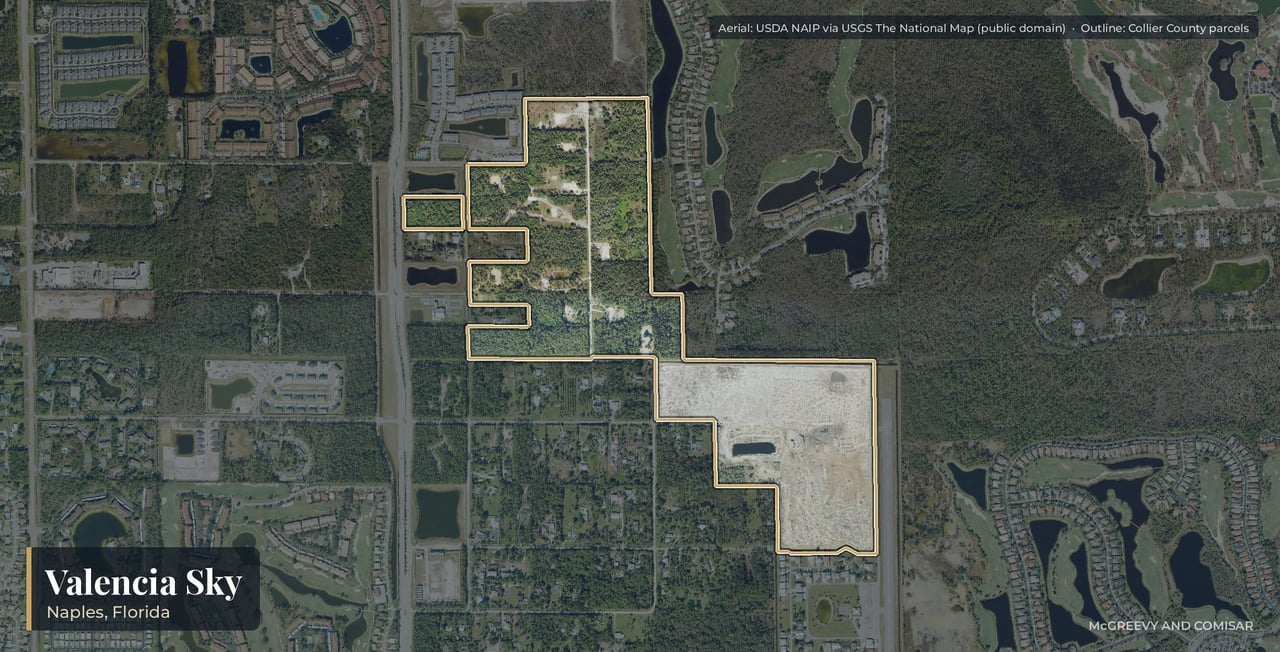
Valencia Trails, GL Homes’ 55-plus resort community on the corridor, is now SOLD OUT: as of July 2026 GL no longer lists it among active communities, which means its resale market era has begun. GL’s current Naples 55-plus offering is Valencia Sky, priced from the $700s to over $1 million per the builder. We’ll link it here when it goes live.
Brightshore Village (Barron Collier Companies) won unanimous county approval December 13, 2022: roughly 681 acres north of Immokalee Road just west of Everglades Boulevard N, entitled for 2,000 homes (170 designated affordable) and at least 106,000 square feet of retail and office, served by its own Brightshore Community Development District. Homebuilder lineup and sales timing were still taking shape as of mid-2026. We’ll link it here when it goes live.
Beyond Brightshore, the county has approved a ring of Rural Lands Stewardship villages east of the Estates (Rivergrass at up to 2,500 homes, Longwater 2,600, Bellmar 2,750, and the 2026-approved Horse Trials Village at 3,205 homes starting development in 2027), with Ave Maria anchoring the far corridor as Collier County’s top-selling community at 515 new home sales in 2025. None of these sit on Estates streets, but all of them feed the same corridors, which is exactly why the road and bridge program above is funded now.
The takeaway for buyers: within a ten-minute drive you can choose no-HOA acreage, an HOA golf community, an HOA-plus-CDD master plan, or a brand-new village, and the monthly carrying costs differ by hundreds of dollars. Selling in any of these? The arrival of so much new construction changes resale positioning, and we price against it daily: start at https://mcgreevyandcomisar.com/home-valuation or call Jesse at (239) 898-6072. Buying? Marc will lay the HOA, CDD, and acreage options side by side: (239) 287-5873.
Shopping in Golden Gate Estates flipped from a two-hour round trip to same-day convenience in under a decade. The area’s first Publix arrived in 2017; on November 20, 2025, a second Publix and the first Aldi opened on the same day about 2.5 miles apart, with a full retail pipeline building toward 2027.
2008: Fayard Hardware opens at Wilson and Golden Gate Boulevards, founded, in its own telling, to save Estates residents “a two-hour round trip to Home Depot.”
Early 2017: the first Publix in the Estates opens at the Neighborhood Shoppes at Orangetree, Immokalee Road at Randall Boulevard. (That same year, a Walgreens at Wilson and Golden Gate closed, retail arriving ahead of its rooftops. The rooftops have since arrived.)
March and April 2025: Tractor Supply Co. opens its nearly 24,000-square-foot rural-lifestyle prototype at 77 Golden Gate Boulevard W, the first anchor ever built on the long-entitled Estates Shopping Center subdistrict at Wilson and Golden Gate Boulevards. Fitting the Estates perfectly, the store runs on its own well, septic system, and a dedicated high-capacity fire-suppression well, because no public utilities reach the site.
November 20, 2025: the landmark day. Publix opens store #2018 at The Shoppes at Orange Blossom, 1715 Oil Well Road (48,387 square feet, with Publix Liquors and a pharmacy drive-thru), and Aldi opens at The Randall at Orangetree, 13725 Immokalee Road, Collier County’s fifth Aldi. Two grocery stores, one day, 2.5 miles apart, inside a community that had none until 2017.
Wilson Boulevard and Golden Gate Boulevard (the grid’s center): Tractor Supply, Fayard Hardware’s plaza, and the balance of the 41-acre Estates Shopping Center subdistrict, entitled since a 2010 county straw ballot backed a grocery-anchored center but still only about one-third built out. The remainder is the Estates’ most watched commercial land: a proposed Circle K with fuel sits in front of Tractor Supply, Shy Wolf Sanctuary owns nearly 17 acres at Wilson and 3rd Street NW for its future relocated wildlife sanctuary, and Collier County owns 10-plus acres between them.
The Randall Curve, Immokalee Road at Randall Boulevard: The Randall at Orangetree, a 50-acre Davis Group mixed-use development where Aldi, 7-Eleven, and AutoZone are open, Chase Bank and Brickyard Car Wash were set to follow, plans are filed for a Christian Brothers Automotive, and the 400-unit Vintage Naples apartment community rises behind the outparcels. The adjoining Winchester Center added McDonald’s and Sunshine Ace Hardware (opened summer 2025), with Anytime Fitness, Cold Stone Creamery, Little Caesars, a foot-and-ankle practice, a nail lounge, and Osaka Hibachi (opened June 2, 2026) among the 2026 arrivals, plus a StorQuest self-storage building and a 2.2-acre NCH parcel eyed for urgent care.
Oil Well Road, The Shoppes at Orange Blossom: beyond the new Publix, WMG Development’s center opened Encore Nails, Great Clips, Tropical Smoothie Cafe, and Wingstop in spring 2026, Fifth Third Bank opened a freestanding branch, and the under-construction outparcel row reads like a suburban wish list: Chick-fil-A with dual drive-thrus, Chipotle with a Chipotlane, a Starbucks drive-thru paired with Heartland Dental, Circle K with 12 fueling positions and a car wash, and an eight-bay Mavis Tires and Brakes, with openings anticipated into early 2027. The 284-unit Emblem Orange Blossom apartments (Quarterra, a Lennar subsidiary) are stabilizing behind the shops.
Everglades Boulevard at Golden Gate Boulevard: the deep east’s own node is emerging on the mapped neighborhood center: the existing 25,000-square-foot Everglades Square center anchored by Everglades Food Mart on the northwest quadrant, the approved Ariva Plaza retail project on the southwest quadrant, and a 7 Food Mart and Tortilleria expected on the northeast corner, per local business coverage. Farther north, 7-Eleven’s January 2025 purchase of three lots at Oil Well Road and Everglades Boulevard signals the next fuel-and-convenience site.
Worth knowing: the GGAMP deliberately confines Estates commercial growth to these mapped centers and subdistricts, with one-story height limits, native-vegetation buffers, and prohibited-use lists to protect the residential grid around them. The convenience is arriving, and the plan keeps it contained. Groceries for the western Estates also remain minutes away along the Collier Boulevard corridor and in Golden Gate City.
Every Golden Gate Estates move starts with one conversation. Sellers get a data-driven valuation built on real acreage comps, lot geometry, and corridor momentum instead of automated guesses; buyers get straight answers on wells, flood zones, clearing rules, and communities. Here is how to reach us directly.
Selling your Golden Gate Estates home or land? Sellers come first with us, because pricing acreage correctly is where the most money is won or lost. Get a free home valuation at https://mcgreevyandcomisar.com/home-valuation OR call Jesse direct at (239) 898-6072 (text or call, same-day response). Email works too: [email protected].
Buying in Golden Gate Estates? Call Marc at (239) 287-5873 for a personalized buyer consultation covering corridors, lot math, wells and septic, flood zones, and the new-construction alternatives, before you write an offer, not after.
McGreevy and Comisar, Domain Realty. Office: 24031 S. Tamiami Trail, Suite 101, Bonita Springs, FL 34134. We also publish local deep dives for Naples, Estero, and Fort Myers.
Every conversation starts with the same locked credentials: Top 1% Real Estate Agents Nationally Since 2008, and the #1 Team in Southwest Florida since 2012, working your side of an Estates transaction.
Golden Gate Estates has no city hall and no mayor. It is unincorporated Collier County, governed by the five-member Board of County Commissioners, shaped by its own adopted master plan (the GGAMP), and watched over by an unusually deep bench of special districts, advisory committees, and a civic association that has met monthly since 1979.
That answer surprises a lot of newcomers. A community of tens of thousands of residents, spread across one of the largest platted subdivisions in the world, runs entirely on county government plus a handful of purpose-built institutions. Once you understand the five layers below, nearly every rule, tax line, and construction project in the Estates makes sense.
Policy for Golden Gate Estates is set by the Collier County Board of County Commissioners (BCC), which meets on the second and fourth Tuesday of each month at the Collier County Government Center in Naples, with three-minute public comment slots and audio Zoom participation available for every meeting. Since the redistricting map adopted on December 14, 2021, the Estates has been split between two commission districts, with the dividing line running along Wilson Boulevard and Golden Gate Boulevard: everything west of Wilson and north of Golden Gate Boulevard moved into District 3 (Commissioner Burt L. Saunders), while the remainder of the Estates and all of eastern Collier stayed in District 5 (Commissioner William L. “Bill” McDaniel, Jr.). That 3-2 redistricting vote was controversial at the time precisely because it subdivided the rural Estates.
For day-to-day access, District 5 matters most. Commissioner McDaniel, a District 5 resident with a long pre-office history in eastern Collier (he chaired the East of 951 Horizon Study Committee that produced the original Estates bridge program), keeps a satellite office inside Wilson Plaza at 50 Wilson Plaza, inside the Tax Collector’s office at the Estates’ main crossroads, available by appointment. He also hosts periodic “A Night with your Commissioner” town halls, and his January 2026 town hall deck remains the single best status snapshot of every road project touching the Estates. Residents in the northwestern Estates deal with District 3 and Commissioner Saunders. Either way, the practical channels are the same: Collier 311 (239-252-4311) for service requests, the county’s CivicClerk portal for agendas, and the public petition process for anything the board needs to hear directly.
The single most important governance fact about Golden Gate Estates is that it has its own adopted master plan. In 1991, recognizing the area’s unique character, the county adopted the Golden Gate Area Master Plan (GGAMP) as a separate element of the Collier County Growth Management Plan; within its boundary, the Golden Gate Area Future Land Use Map applies instead of the countywide map. After a multi-year restudy with eight public workshops, the BCC re-adopted the GGAMP on September 24, 2019 as three sub-elements covering three distinct communities: Urban Golden Gate Estates (the Estates west of Collier Boulevard, current text per Ordinance 2023-68, adopted December 12, 2023), Rural Golden Gate Estates (everything east of Collier Boulevard, current text per Ordinance 2024-37, adopted September 24, 2024, with a 2025 compilation posted as Ordinance 2025-14), and Golden Gate City, the separate four-square-mile urban community that will get its own page.
Each Estates sub-element opens with an adopted vision statement, quoted in full earlier on this page: the Rural Estates as an interconnected, low-density residential community defined by rural character, nature, and quiet surroundings; the Urban Estates as a low-density, large-lot residential neighborhood in a natural setting with convenient coastal access. Those are not marketing lines. They are adopted county policy, and they carry real teeth:
Density is fixed by plan. One dwelling per 2.25 gross acres (or per legal nonconforming lot as small as 1.14 acres), exclusive of guesthouses. Multifamily and duplexes are prohibited everywhere in the Estates designation except one 50-acre subdistrict at Immokalee Road and 4th Street NE.
Conditional uses need a supermajority. To approve a conditional use (a church, school, childcare center, or similar) in the Estates, the Board of Zoning Appeals must pass it with a minimum of 4 of 5 votes, a higher bar than most zoning items anywhere in Collier County, and locational criteria restrict where conditional uses can even be requested.
Commercial is confined to mapped Neighborhood Centers. In the Rural Estates, commercial zoning can only be requested at three mapped crossroads: Wilson Boulevard at Golden Gate Boulevard, Everglades Boulevard at Golden Gate Boulevard, and Immokalee Road at Everglades Boulevard (plus a short list of named subdistricts such as the Randall Boulevard Commercial Subdistrict). The Urban Estates has its own single Neighborhood Center at Collier Boulevard and Pine Ridge Road. Design rules keep these nodes rural in scale: buildings capped at one story and 35 feet, no building footprint over 5,000 square feet outside a PUD, a maximum of three curb cuts per quadrant, and a 75-foot buffer with 50 feet of retained native vegetation wherever a project abuts residential Estates lots.
Rural character is a stated goal. Goal 4 of the Rural sub-element commits the county to preserving “large wooded lots, the keeping of livestock, the ability to grow crops, wildlife activity, environmental stewardship, low-density residential development, and limitations on commercial and conditional uses,” and Policy 4.2.5 adopts dark-sky lighting direction consistent with International Dark Skies Association best practices.
When a proposed development conflicts with those policies, the plan itself instructs the county to resist site-specific changes that are out of scale with the rural quality of the Estates. That is why zoning fights here so often end differently than they do elsewhere in Naples.
The GGAMP is a living document, and it is being reworked as this page is written. On December 9, 2025, the BCC created the Rural Golden Gate Estates Restudy Advisory Committee (Ordinance 2025-070), a resident committee seated in December 2025 and January 2026 to review the Rural GGE Sub-Element and recommend Growth Management Plan amendments. The committee meets monthly at 6:30 pm at Big Corkscrew Island Regional Park (810 39th Ave NE, Community Center Ballroom A), and its 2026 agenda reads like a list of the questions Estates owners actually argue about:
Home-based businesses. A draft Land Development Code amendment (dated March 19, 2026) would modernize Collier’s home occupation rules, partly to align with Florida’s home-based business preemption statute (F.S. 559.955).
Commercial supply and future demand. Metro Forecasting Models presented an April 2026 growth and commercial-needs study to the committee, modeling rural Estates buildout and how much store, office, and service space the population will support, paired with new 2025 existing-conditions and 2040 projection maps.
Parking of commercial vehicles. The June 24, 2026 session tackled work trucks and commercial vehicles at Estates homes, a genuine kitchen-table issue in a community full of contractors and small-business owners.
Anything the committee recommends still has to survive the full public GMP amendment process, so nothing here is law yet. But if you own land in the Rural Estates, these monthly meetings are where the next decade’s rules are being drafted, and they are open to the public.
Golden Gate Estates has something almost no other community can claim: a dedicated land endowment born from the original developer’s settlement. On November 15, 1983, Avatar Properties Inc. (formerly GAC Properties, successor to the Gulf American Corporation that platted the Estates) deeded 1,061.5 acres to Collier County under an agreement with remarkable terms. The land, or the proceeds when parcels are sold, may only be used to provide governmental facilities physically located within Golden Gate Estates: fire protection, law enforcement, public schools, libraries, parks, and related equipment. Use it for anything else and title reverts to Avatar. Sales require a certified appraisal and at least 90 percent of appraised value.
A five-member advisory committee created in 1987, whose members must all live in the Estates, stewards the program. Over four decades the trust has quietly funded Estates infrastructure, most recently helping fund the new joint fire and EMS Station 74 at Golden Gate Boulevard and DeSoto Boulevard. As of April 2023, 28.87 acres of the original gift remained available, with most of the rest already converted into community facilities.
Golden Gate Estates Area Civic Association (GGEACA). Founded in 1979, the GGEACA is the Estates’ organized civic voice, a 501(c)(4) that meets the third Wednesday of each month (except July and August) at 7:00 pm in the Greater Naples Fire Station 71 meeting room at 100 13th Street SW, behind the Estates Branch Library. Its published priorities include the Randall and Immokalee intersection, safety bridges over the canals, Randall Boulevard four-laning, wildfire response, and watershed management, and it is actively mobilizing residents to attend the Rural Restudy meetings.
Fire districts. Two independent, separately elected fire districts split the Estates: Greater Naples Fire Rescue District in the central and southern Estates and North Collier Fire Control and Rescue District along the northern Immokalee Road corridor. Their coverage areas, tax rates, and stations are detailed in the Safety and Emergency Services section below, because the district line has a real effect on your tax bill.
Collier Mosquito Control District. An independent elected district whose voters approved expansion by a 71 to 29 percent margin in a 2022 referendum, growing the district from 401 to roughly 730 square miles and bringing most of the Estates into organized mosquito control, with a subsequent state law adding 300+ more square miles east and north effective October 1, 2024.
Big Cypress Basin (SFWMD). The Governor-appointed basin board that operates the canal network described earlier on this page, running 123 miles of primary canals and 31 water control structures across Collier County.
The takeaway for buyers and owners: Golden Gate Estates is not ungoverned, it is differently governed. The rules are countywide, the plan is Estates-specific, the taxing districts are independent, and the civic infrastructure is real. Learn the five layers and you can get almost anything answered, permitted, or fixed.
Golden Gate Estates zoning (the Estates “E” district) allows a lifestyle no gated Naples community permits: horses and livestock, a guesthouse, barns and workshops, boats and RVs on your own land, home-based businesses, beekeeping, and lawful target practice on qualifying acreage. Every allowance below traces to the Collier County code, with the exact limits spelled out.
This is the section to read twice, whether you are buying, building, or already living here. The Estates district sits inside the Land Development Code’s agricultural districts chapter, and that placement drives most of what follows. Rules change, so treat this as an accurate 2026 orientation and confirm specifics with Collier County Zoning (239-252-2400) before you build or buy based on any single provision.
The headline right, written directly into LDC 2.03.01 and 4.02.07: an Estates lot may keep up to 2 horses or livestock animals per acre (goats, cows, and other hoofed animals count; hogs do not qualify), plus up to 25 fowl or poultry (chickens, ducks, turkeys), all as an accessory use with no special permit. Open feedlots are prohibited, and any roofed shelter, stable, or coop must sit at least 30 feet from every lot line and 100 feet from any residence on an adjacent parcel. On a typical 2.5-acre tract that means five horses, legally, at home.
Two fine-print items matter. First, hogs are banned with one written exception: a child enrolled in 4-H (or a Collier County Fair program) may keep one hog per child for a 16-week show season, fenced and sanitary, and the animal cannot return once it leaves for show or sale. Second, the E-district animal allowance is for personal keeping. A boarding or breeding kennel, a commercial stable operation, or an aviary business is not an E-district use at all; those activities belong in the Rural Agricultural (A) district, by right on 20+ acres and by conditional use below that. Hobby animals yes, animal businesses no.
Golden Gate Estates is one of the few places in Collier County where a true detached guesthouse is a by-right accessory use, and the rules (LDC 5.03.03) are precise:
One guesthouse per lot of at least 1 acre (43,560 square feet) with at least 105 feet of lot width, which covers nearly every Estates parcel.
Size cap: 40 percent of the air-conditioned, enclosed living area of the main home (garages, porches, and utility areas excluded from the calculation). A detached guesthouse must sit at least 20 feet from the principal dwelling and meet full principal-structure setbacks.
You may build the guesthouse first. LDC 5.03.03.E expressly allows a guesthouse to be constructed before the main house if it meets the district’s single-family minimums (in the Estates, at least 1,000 square feet and full setbacks). Families use this to live small while building the main home; once the main residence is finished, the 40 percent ratio applies.
Guesthouses do not count against density: the GGAMP caps density at one unit per 2.25 acres “exclusive of guesthouses.”
Now the rule that generates more confusion than any other in the Estates: a guesthouse cannot legally be rented, ever, under current law. LDC 5.03.03 states that leasing or renting a guest accommodation facility is an LDC violation, that no guesthouse may be used for commercial purposes, and that an owner cannot flip the arrangement by renting out the main house while living in the guesthouse. Enforcement is real; reporting has documented the Property Appraiser stripping homestead treatment from illegally rented guesthouse space.
Buyers keep hearing otherwise because Collier County genuinely almost changed this. Commissioner Bill McDaniel proposed allowing guesthouse rentals in February 2023 as an affordable-housing measure; staff mailed 3,558 postcards to eligible Urban Estates owners; and in May 2024 commissioners voted 4-1 to move toward a pilot limited to homesteaded Urban Estates properties. Then, on March 11, 2025, the Board of County Commissioners let the prohibition stand and killed the pilot. The county attorney had advised that Collier’s guesthouse-rental ban predates Florida’s 2011 vacation-rental preemption and is therefore grandfathered, but that once the county allowed rentals it could never again limit their duration or frequency. As Chairman Burt Saunders put it, “Once we open this door up to legalize the renting of guesthouses, the next step is going to be that people are going to be renting those out as Airbnbs.” The numbers from that process are still useful: of 3,558 Urban Estates lots studied, 393 already have guesthouses. If a listing or a neighbor tells you the guesthouse “can be rented,” the current answer is no, and it has been no since the March 2025 vote.
Acreage means room for real outbuildings: detached garages, workshops, barns, and equipment sheds are ordinary accessory structures on Estates lots. The rules that matter:
Accessory structures in the E district must meet principal-structure setbacks: 75 feet front, 30 feet each side, 75 feet rear on a standard lot. The familiar 10-foot rear-setback shed rule from in-town subdivisions expressly does not apply in the Estates. Plan the barn location early; the setbacks eat more of the site plan than most owners expect.
Accessory buildings are built with or after the main house (the guesthouse-first provision is the one exception), and the district’s 30-foot height limit applies. Everything structural needs a Florida Building Code permit.
The LDC’s 5-percent-of-lot-area cap on accessory buildings is written for the residential zoning districts, and whether it binds Estates lots is a code-interpretation question (the E district is codified under agricultural districts). Even if applied, 5 percent of a 2.25-acre lot is roughly 4,900 square feet of outbuildings, and the code always allows at least a 500-square-foot accessory building. Confirm with Zoning before designing at the margins.
Animal shelters follow their own 30/100-foot rule (above) instead of the standard accessory setbacks.
Canopy tents and shade structures get their own rule (LDC 5.03.01): one per lot, maximum 300 square feet and 15 feet tall, metal poles with a canopy top and no sides, behind the front wall of the house, permit required, and usable only for RV or authorized-vehicle storage or shade.
Collier County’s vehicle-control ordinance (Ordinance 10-26, Code of Laws chapter 130, article III) is the rule that forces in-town Naples owners to hide the boat behind the back fence. Its restrictions on recreational vehicles and boats (rear yard, enclosed building, or carport only) and its commercial-vehicle limits apply, by the ordinance’s own text, “in a Residential District,” and the ordinance defines “Residential District” as a list of zoning districts (RSF, RMF, RT, VR, MH, and residential PUD components) that does not include the Estates (E) district. The drafters knew exactly what they were doing, because the one rule they did extend to the Estates is named explicitly: vehicles or trailers that are inoperable, unlicensed, or without current valid plates “shall not be parked or stored in any Residential District, including the E estates district, other than in a completely enclosed building.”
In plain terms: Estates lots are treated differently from standard residential subdivisions, and the boat, the RV, the horse trailer, and the work truck parked on Estates acreage are a normal, visible part of the community. Keep everything tagged, registered, and operable, because dead vehicles and untagged trailers are code-enforceable everywhere in the county. Two more cautions: no RV may be used for living or sleeping quarters on a lot not approved for that use (the Estates is not a campground), and this reading of the ordinance is the plain text of its definitions, so phrase your plans conservatively and confirm current enforcement posture with Collier Code Enforcement if your setup is unusual.
A meaningful share of Golden Gate Estates households run a business from home, and the rules have three layers:
County home occupation rules (LDC 5.02.00) allow home businesses in any district that allows homes, provided the business stays clearly incidental to residential use: no retail sales from the premises, no advertising signs, no nuisance noise or fumes, and, in the code’s classic acreage carve-out, no outdoor storage of business goods except plants, which may occupy up to 50 percent of the lot. That plant exception is the legal foundation of the Estates’ long-standing backyard nursery and landscape-business culture. Estates lots may also grow fruits, vegetables, and nursery plants for off-site retail sale (farmers markets and similar), though an on-site farm stand is not an E-district use.
Florida’s home-based business statute (F.S. 559.955, effective July 1, 2021) preempts local rules that treat home-based businesses differently from other businesses, subject to conditions (the business operates from a residence that looks like a residence, and activities are secondary to residential use). Where the older county text is stricter than the statute, the statute controls for qualifying businesses, and Collier County has been drafting an LDC amendment to align its code, a live topic in the 2026 Rural Restudy.
What acreage does not legalize: a contractor’s storage yard. Outdoor equipment yards, material stockpiles, and non-resident crews staging at the house are not permitted uses on E-zoned land, and this is a recurring code-enforcement theme. The lawful paths are home-occupation scale, the E-district vehicle latitude for the work truck, or properly zoned commercial land.
Three state statutes sweeten the ag side. Beekeeping is preempted to the state (F.S. 586.10): Collier County cannot ban or zone out registered hives, and every Florida beekeeper registers with FDACS and follows its best-management placement rules. Agritourism (F.S. 570.85) shields activities like u-picks and farm tours from local prohibition, but only on land holding the agricultural (Greenbelt) classification. And the Greenbelt law itself (F.S. 193.461) lets the Property Appraiser assess land in bona fide commercial agricultural use at use-value rather than market value; the use must be in place by January 1 and the DR-482 application filed by March 1. Classification is fact-specific and decided parcel by parcel, so run the numbers with the Collier County Property Appraiser and your tax professional before counting on it.
Your building permit is your clearing permit, up to one acre. Under LDC 3.05.02.F, no separate vegetation removal permit is needed to clear up to 1 acre total on a single-family Estates lot when a building permit for the home has been issued (or, on an already-built lot, when the owner does the clearing and the total cleared area stays within one acre), provided there is no bald eagle nest and any required wetland or listed-species permits are in hand.
Beyond the first acre is permit-able, not prohibited. LDC 3.05.05.F allows vegetation removal permits on E-zoned lots for any permitted accessory use, which is how paddocks, arenas, and barn sites get cleared. Hand removal of prohibited exotics (Brazilian pepper, melaleuca) never needs a permit.
Gopher tortoises are protected. Burrows may not be disturbed; no permit is needed if all activity stays at least 25 feet from every burrow, and the FWC “10 or Fewer Burrows” permit covers the typical single-homesite relocation.
Panther and bear awareness is real in the eastern Estates. Eastern Golden Gate Estates sits within the USFWS Panther Focus Area, and federal panther consultation attaches to projects needing a federal permit (a typical dry-lot single-family home does not trigger it, wetland-impacting builds can). County code also requires bear-resistant garbage practices in management-plan areas, and FWC’s BearWise guidance (secure trash, feed pets indoors, electric fence for coops and hives) is simply how you live well out here.
Open burning is legal, with rules. Under Florida Forest Service rules, yard waste generated on the premises may be burned without an authorization when the pile is 8 feet or less in diameter, burning runs from 9 am to one hour before sunset, someone attends the fire with extinguishing equipment, setbacks are met (25 feet from wildlands and structures, 50 feet from paved public roads, 150 feet from other occupied buildings), and no burn ban is in effect. Larger land-clearing burns need a Florida Forest Service authorization (Caloosahatchee Forestry Center, 239-690-8001). Burn bans are a live variable: Collier County imposed a countywide ban in January 2026 during drought conditions and lifted it effective July 2, 2026. Always check current status before striking a match.
Handled plainly and safety-first, because it is one of the most-asked questions about the Estates. Florida law (F.S. 790.15) makes it a crime to discharge a firearm in a public place, over any paved public road, or over any occupied premises, and to fire recklessly or negligently on residential property. Its recreational-shooting provision prohibits target shooting outdoors in an area the shooter knows is primarily residential and has a density of one or more dwelling units per acre. Because classic Golden Gate Estates platting runs 1.14 to 5+ acres per home, most Estates acreage falls below that density trigger, which is why lawful backyard target practice exists here, and why counties cannot change that (firearms regulation is preempted to the state under F.S. 790.33).
The Collier County Sheriff’s Office publishes its own plain-language page on the subject, and its framing is the right one: never over a road, never over occupied premises, never in public, never negligently. Deputies have also warned publicly about rising complaints and property damage from careless backyard ranges; a round that leaves your property can be an arrest. If you shoot on your land: build a proper backstop, know exactly what is behind it, keep every round on your own acreage, and treat the privilege as one careless afternoon could end for everyone. CCSO recommends consulting an attorney for edge cases, and so do we.
On your own land, with reasonable hours and the county noise ordinance in mind, recreational riding is part of Estates life; no county ordinance prohibits riding on your own private E-zoned acreage, and on other private land you need the owner’s permission. Public roads are a different story: ATVs are prohibited on Florida’s public roadways, with a narrow statutory exception for daytime operation on unpaved roads posted below 35 mph (and counties may opt out of even that; most Estates streets are paved, where ATV operation is flatly illegal regardless). The canal maintenance berms are not trails: they are South Florida Water Management District works, and using them without a right-of-way occupancy permit is a violation under state rule, so keep wheels off the canal banks. Riders under 16 must wear helmets, and CCSO publishes a “Ride Safe, Know the Law” flyer worth reading before the first ride.
Fencing is one of the E district’s quiet advantages: the LDC exempts fences and walls within agricultural districts from height and type-of-construction rules, and the Estates is codified among the agricultural districts (worth confirming with Zoning on an unusual design, but field fence, farm fencing, and full-perimeter agricultural fencing are standard across the community). Barbed wire is authorized in agricultural districts, unlike in ordinary residential zones. Universal rules still apply: the fence can sit on the lot line but not over it, the finished side faces the neighbor or street, nothing over 3 feet tall may sit inside the 30-foot sight triangle at street intersections, and you cannot berm up the ground to cheat extra height. Private entry gates are ubiquitous and lawful on Estates driveways; anything placed within the county road right-of-way or a canal right-of-way needs the corresponding permit first.
Florida law (F.S. 509.032(7)(b)) prohibits local governments from banning vacation rentals or regulating their duration or frequency (only ordinances adopted on or before June 1, 2011 are grandfathered). So the main house on a Golden Gate Estates lot can be operated as a short-term rental, and with no HOA on classic Estates lots there is no private covenant layer to say otherwise (individual deed restrictions can exist, so have title reviewed). What Collier County can and does require is registration: under Ordinance 2021-45 (effective January 3, 2022), any dwelling in unincorporated Collier rented for stays under 30 days more than three times a calendar year must be registered with the county. The requirements are a one-time $50 fee per unit, proof of the state DBPR vacation-rental license, a designated 24/7 responsible party able to respond on site, the county registration number displayed in all advertising, and guest notification of noise, parking, and garbage rules. Failure to register carries fines of up to $500 per day. The guesthouse, as covered above, is excluded from all of this: it cannot be rented short-term or long-term, full stop. That exact combination (a rentable main home next to a never-rentable guesthouse) is the single most misunderstood rule in the Estates, and getting it right protects both your income plan and your homestead exemption.
Golden Gate Estates is served by Collier County Public Schools, the only A-rated district in Southwest Florida for 2024-25 and 6th of Florida’s 67 districts, and every public school serving the core Estates earned an A that year. The district is also building here: Bear Creek Elementary opened in August 2025, with an Ave Maria elementary following in 2026.
Start with the district-level facts, because they frame everything else. Collier County Public Schools (CCPS) earned an “A” district rating for 2024-25 from the Florida Department of Education, one of only 28 A districts statewide, the only one in Southwest Florida, and 6th of 67 Florida districts (up from 7th the prior year). Fifty of 51 traditional CCPS schools earned an A or B, with zero D or F schools, and the district has held its A rating every year from 2021 through 2025.
For 2024-25, every public school physically serving the core Estates earned an A: Estates Elementary, Big Cypress Elementary, Sabal Palm Elementary, Corkscrew Elementary, Palmetto Elementary, Corkscrew Middle, Cypress Palm Middle, and Palmetto Ridge High. Schools on the Estates’ western edges joined them: Laurel Oak Elementary, Oakridge Middle, and Gulf Coast High have each posted five straight A years. Recent five-year grade history for the schools most Estates families ask about, per the district’s official 2025 accountability brief:
School | 2021 | 2022 | 2023 | 2024 | 2025 |
|---|---|---|---|---|---|
Estates Elementary | A | A | A | A | A |
Big Cypress Elementary | B | A | A | A | A |
Sabal Palm Elementary | B | A | A | B | A |
Corkscrew Elementary | A | A | A | A | A |
Palmetto Elementary | A | B | A | B | A |
Corkscrew Middle | B | A | B | B | A |
Cypress Palm Middle | C | B | C | B | A |
Palmetto Ridge High | B | B | B | A | A |
Two notes for accuracy. First, do not confuse Golden Gate Elementary and Golden Gate High (which serve Golden Gate City, the separate community at ZIP 34116) with the Estates schools above; the naming trips up nearly every out-of-area website. Second, school grades move year to year; the pattern that matters here is a district and a school cluster that have graded A or B across five years, with 2025 the strongest sweep yet.
Bear Creek Elementary opened August 11, 2025: an $83 million, 22-acre campus south of Immokalee Road just east of Collier Boulevard, the district’s first new elementary school in 17 years. It opened with roughly 600 students including pre-K, has capacity for about 1,000, and is the first CCPS school built with a dedicated early learning center wing, plus a covered playground and PE pavilion.
Ave Maria Elementary opens for 2026-27 (carried in district plans as “Elementary School Q”), and CCPS has adopted a boundary modification taking effect at the start of the 2026-27 school year that adjusts elementary zones in the northeast Estates and Ave Maria area. At the Bear Creek groundbreaking, the superintendent said it directly: “The explosion out here in the estates is just necessitating all of this.”
Capacity is actively monitored. The district’s FY26 Five-Year Capital Improvement Plan carries “monitor enrollment” flags with boundary and feeder-pattern notes for Palmetto Ridge High, Corkscrew Middle, and Estates Elementary, and lists enrollment projections per the FY26 CIP of roughly 2,058 at Palmetto Ridge High, 1,011 at Corkscrew Middle, 1,066 at Estates Elementary, 793 at Sabal Palm Elementary, 794 at Big Cypress Elementary, and 835 at Cypress Palm Middle. Translation: expect periodic boundary adjustments as the Estates grows, which is normal and planned for.
School assignment in the Estates is address-specific, boundaries were modified for 2025-26 (Palmetto Ridge High) and again for 2026-27 (Ave Maria area elementary zones), and rezoned upper-class students get stay-put options under district policy. Before you write an offer based on a school zone, run the address through the district’s official interactive tool at zones.collierschools.com, and confirm with CCPS. We do this as a standard step for buyer clients, and no listing description (ours included) substitutes for the district lookup. Bus service is a fact of Estates life on the long grid roads; Florida funds transportation for students living more than two miles from school, and CCPS transports roughly 20,000 students daily with route lookups at bus.collierschools.com.
Tuition-free public charters add real choice: Mason Classical Academy (a Hillsdale-model classical K-12 chartered by the Collier School Board) has earned an A five straight years; Naples Classical Academy earned an A in 2024-25; Collier Charter Academy earned a B. Charters have no attendance zones, so any Estates address can apply. Private and faith-based schools across Naples round out the picture; verify current offerings directly with each school.
Golden Gate Estates residents live between two park systems: county parks built for the community (Max Hasse Jr. Community Park on the west side, the 150-acre Big Corkscrew Island Regional Park on the north) and genuine wild Florida (CREW trails, Audubon’s Corkscrew Swamp Sanctuary, and the restored Picayune Strand State Forest) minutes from the driveway.
The classic Estates park sits at 3390 Golden Gate Boulevard W, about three-quarters of a mile east of Collier Boulevard: roughly 20 acres with a community center, fitness center, lighted softball and little-league fields, two lighted tennis courts, a covered lighted basketball pavilion, picnic shelter, and a playground. The county launched a full playground replacement project there in December 2025, a small but telling signal that the west-Estates park is being reinvested in rather than merely maintained. It also serves as a polling place and program hub (summer camps, child care programming) for the western Estates.
The headline recreation story of the northern Estates is Big Corkscrew Island Regional Park (BCIRP), a 150-acre regional park at 810 39th Ave NE, east of Immokalee Road and north of Oil Well Road, funded through the county’s one-cent infrastructure surtax. Phase 1 delivered four lighted multipurpose athletic fields, two lighted softball fields, basketball, tennis, and six lighted pickleball courts, a castle-themed lighted playground, an event lawn with stage, sixteen picnic pavilions, and the aquatic complex that opened in October 2023: a 25-yard by 25-meter heated pool, children’s activity and wading pools, a 177-foot open slide and 122-foot closed slide, and 1-meter and 3-meter springboards.
Phase 2 is underway now, being built directly south of Phase 1 around the lake: a fitness center and gymnasium (indoor sports complex), a lake with kayak and canoe launch, four baseball fields, a dog park, additional walking paths, and lakeside amenities. The county awarded the contract for the Phase 2A access road, Big Corkscrew Drive, in November 2023, running from Oil Well Road just east of Palmetto Ridge High School north through Orange Blossom Ranch, with Phase 2B construction following. For Estates families, the practical meaning is simple: the kind of aquatics, league fields, and indoor recreation that used to require a drive to coastal Naples now sits inside the community.
Walk-and-bike infrastructure is arriving with the roads. The Vanderbilt Beach Road Extension Phase 2 (16th Street NE to Everglades Boulevard, in final design with construction possibly starting toward the beginning of 2027) is planned with a paved multi-use pathway, new infrastructure for a part of the Estates that has never had a continuous off-road path.
The Corkscrew Regional Ecosystem Watershed (CREW) protects roughly 60,000 acres across Collier and Lee counties, with free public trail systems managed with the South Florida Water Management District and the nonprofit CREW Land and Water Trust:
CREW Bird Rookery Swamp Trails (1295 Shady Hollow Blvd, off Immokalee Road one mile past the Oil Well Road light): 12 miles of hiking and biking on old logging tram roads plus an 1,800-foot wheelchair-accessible boardwalk, with alligators, otters, bobcats, deer, and swallow-tailed kites, adjacent to Audubon’s Corkscrew Swamp Sanctuary. Status note: Bird Rookery Swamp public access has been temporarily closed (posted December 2025) for boardwalk replacement and a new restroom, with reopening expected around September 2026. Check the SFWMD CREW page before you go.
CREW Marsh Trails (4600 Corkscrew Rd): five miles of loops, two boardwalks, and an observation tower over the 5,000-acre Corkscrew marsh, with primitive tent camping by special use license.
Cypress Dome Trails (3980 Corkscrew Rd): 6.5 miles, biking allowed, seasonal quota hunting, and a connection to Conservation Collier’s Caracara Prairie Preserve through a working cattle ranch.
Fifteen minutes from the northern Estates sits a genuinely world-class natural institution: Audubon’s Corkscrew Swamp Sanctuary (375 Sanctuary Road W, off Immokalee Road), 13,000 acres containing the largest remaining old-growth bald cypress forest on the continent, designated a Ramsar Wetland of International Importance. The famous 2.25-mile boardwalk winds past cypress trees approaching 600 years old, with a wheelchair-accessible route, the Blair Visitor Center, and seasonal cafe. Hours run 8 am to 1 pm daily May 1 through December 15 and 8 am to 3 pm December 16 through April 30; adult admission is $17 (discounts for students, children, military, and Audubon members). Note the sanctuary’s scheduled annual maintenance closure, August 17-30, 2026.
South of I-75 lies the most remarkable backyard in Collier County: Picayune Strand State Forest and Wildlife Management Area, the land that was once Southern Golden Gate Estates. In January 2026, the South Florida Water Management District and the U.S. Army Corps of Engineers held the ribbon-cutting marking completion of the Picayune Strand Restoration Project, the first project partnership executed under the Comprehensive Everglades Restoration Plan and now the first major CERP project finished: natural water flow restored across 55,000 acres, 285 miles of former subdivision roads removed, 42 miles of canals plugged, and three massive pump stations built (Merritt at 810 cubic feet per second, Faka Union at 2,650 cfs, Miller at 1,250 cfs) that exist specifically to maintain flood protection for the inhabited Estates north of I-75.
For residents, the restored forest is a recreation asset measured in miles: the 3.2-mile Sabal Palm Hiking Trail through cypress and pine flatwoods, a 22-mile horse trail across the Belle Meade tract, a campground on 52nd Ave SE, canal fishing and a boat ramp on the Faka Union Canal, and FWC-managed seasonal hunting, including a new two-day family deer hunt established effective July 1, 2026. Living in Golden Gate Estates means this is your southern property line’s neighbor: 74,000+ acres of public wild Florida.
Golden Gate Estates supports a genuine community fabric for an unincorporated area: congregations along its boulevards, the UF/IFAS Extension and Collier County 4-H program on its north edge, the Collier County Fairgrounds physically inside the community, and farmers markets within an easy drive. Institutions here tend to be practical, agricultural, and family-centered.
Several congregations serve the community from inside or immediately alongside it: Central Church of Christ meets at 2440 Golden Gate Boulevard W and identifies itself as located in Golden Gate Estates; Golden Gate Assembly (Assembly of God) holds a 10 am Sunday service with children’s ministry and a simultaneous Spanish-language congregation; Grow Church operates a dedicated Estates campus as part of its multi-site Naples church; and the Church of Jesus Christ of Latter-day Saints built its Cypress Ward meetinghouse at 2575 Everglades Boulevard N on acreage cleared in 2017. Larger congregations of nearly every tradition sit within a 20 to 30 minute drive along the Collier Boulevard and Immokalee Road corridors, and Ave Maria’s Catholic parish anchors the community to the east.
One structural note that shapes church life here: in the Estates, houses of worship are conditional uses under the GGAMP, requiring the 4-of-5 supermajority vote and strict locational criteria described in the governance section. Commissioners have approved some (the plan even carves out specific church subdistricts, such as the Everglades-Randall Subdistrict for a place of worship with up to 230 seats) and denied others proposed in the middle of residential areas. New congregations tend to land at the designated crossroads, not on interior streets, which is exactly how the master plan intends it.
The University of Florida IFAS Extension Collier County office sits at 14700 Immokalee Road on the Estates’ northern edge (239-252-4800), and for acreage owners it is one of the most useful institutions in the county: home landscape and horticulture help, soil questions, trained Master Gardener volunteers, and an annual Master Gardener lecture series. Extension is also headquarters for the Collier County 4-H Youth Development Program, open to ages 5-18, whose clubs (livestock, agriculture, life skills) are a natural fit for families raising kids around horses, chickens, and gardens. The 4-H livestock projects culminate each spring at the fair, a few minutes down Immokalee Road.
The Collier County Fairgrounds sit at 751 39th Ave NE, off Immokalee Road, inside the northern Golden Gate Estates. The Collier Fair celebrated its 50th edition March 19-29, 2026, with the 51st annual fair set for March 18-28, 2027. Beyond the midway, the fair’s heart is its junior livestock program: breeding cattle, goats, sheep, poultry, rabbits, and swine shown by 4-H, FFA, and Grange youth, capped by the Junior Livestock Auction. If you want a one-night portrait of what makes the Estates different from coastal Naples, the livestock barns during fair week are it.
The Ave Maria Farmers Market runs Saturdays in Ave Maria’s Town Center seasonally (roughly November through April), 9 am to 2 pm, with dozens of vendors, an easy Oil Well Road drive from the northeast Estates. West-side residents use the Saturday market at the Golden Gate Community Center on Golden Gate Parkway (in neighboring Golden Gate City), the nearest weekly market to the western Estates; verify current schedules before making the trip, as market days shift seasonally. Between markets, the Estates’ own grower culture (backyard nurseries, eggs, seasonal produce sold off-site) keeps genuinely local food closer than the nearest supermarket.
Golden Gate Estates sits inland, so hurricane risk here is rainfall flooding, wind, and power outages rather than the storm surge that defines coastal Naples. Hurricane Ian tested the canal system with historic rain, Helene passed offshore, and despite persistent local rumor, no confirmed tornado touched Golden Gate Estates during Hurricane Milton.
Buyers deserve the honest version of this record, storm by storm, from the primary sources: National Hurricane Center reports, National Weather Service damage surveys, and FEMA program data.
Ian struck Southwest Florida as a high-end Category 4, and its catastrophic damage in Collier County concentrated at the coast, where storm surge reached 6 to 9 feet above ground in parts of Naples. Countywide, more than 3,500 buildings took major damage and 33 were destroyed, overwhelmingly in the surge zone. The Estates, 15-plus miles inland, experienced a different storm: wind, extended power outages, and water that fell from the sky rather than rising from the Gulf. Ian’s rain bands dropped an estimated 5 to 8 inches on Collier County during the storm itself, and Ian headlined an extraordinarily wet stretch: the National Weather Service’s Miami office recorded 70 to 80 inches of rain for calendar year 2022 in the interior Golden Gate Estates and East Naples area, among the highest annual totals anywhere in South Florida that year.
That rain load was a live-fire test of the Big Cypress Basin canal system described earlier on this page, and the system moved enormous volumes while low-lying older homesites (built before modern fill-pad practices) saw localized flooding. The Greater Naples Fire Rescue District published a full Hurricane Ian after-action report in 2023, a level of transparency worth knowing about in your local fire district. Federal recovery data gives the honest scale of impact: 8,816 Collier County homeowners and renters were approved for $23.3 million in FEMA Individuals and Households Program grants after Ian, including $15.3 million in housing assistance, and Florida’s Rebuild Florida program added state-run repair funding. Meaningful, real, and an order of magnitude below the devastation one county north.
Helene passed well offshore en route to a Big Bend landfall. Collier’s impacts were storm-surge flooding along the coastline; inland Golden Gate Estates impacts were minimal, and no inland flood reporting emerged for the Estates ZIP codes.
Milton made landfall near Siesta Key, far north of Collier, but its outer bands produced a historic pre-landfall tornado outbreak across South Florida: 15 tornadoes surveyed by NWS Miami that day, part of roughly 46 confirmed statewide. Here is what the official damage survey actually shows for Collier County: the county’s only documented Milton tornado was rated EFU (no damage indicators found) and tracked over remote wilderness in far eastern Collier, west of Snake Road near the Big Cypress Seminole Reservation, roughly 30-plus miles east of Golden Gate Estates. No NWS-confirmed tornado touched down inside Golden Gate Estates during Milton. The persistent social-media claim that “a tornado hit the Estates during Milton” is not supported by the National Weather Service survey record. Milton’s real Collier impacts were coastal flooding (about 2 to 4 feet of inundation along the coast, with the Naples Bay gauge reaching 5.08 feet above mean higher high water) and roughly $280 million in county-wide property damage concentrated at the shoreline. The Estates’ Milton experience was wind, debris, and outages.
The recurring inland risk worth respecting is heavy rain: Tropical Storm Debby (August 2024) dropped 8.23 inches on Golden Gate Estates, the highest single-day total in the county, and an unnamed June 2024 rain event out-rained Ian in parts of Southwest Florida. This is why lot elevation, drainage swales, and the canal network get their own sections on this page.
The Florida insurance story shifted materially between 2023 and 2026, and the current numbers matter to every Estates budget:
Citizens Property Insurance, the state-backed insurer of last resort, peaked at 1.42 million policies in October 2023 and fell to roughly 385,000 by the end of 2025, a 73 percent decrease and its lowest count ever, as private carriers took policies back.
The depopulation program moved more than 546,000 policies to private insurers in 2025 alone, and 17 new insurance companies entered Florida following the 2022-2023 legal reforms.
Citizens’ 2026 filing recommended its first average statewide rate decrease since 2015, and the Collier County-specific recommendation for standard HO-3 homeowners policies was a change of just +0.7 percent on an average premium of roughly $2,933.
Two structural discounts favor Estates properties specifically. First, unincorporated Collier County holds a Community Rating System Class 5 rating, worth a 25 percent discount on NFIP flood insurance premiums for policies in the Special Flood Hazard Area (10 percent in X zones). Second, wind mitigation credits: Florida law (s. 627.0629) requires insurers to credit construction features that reduce wind loss, documented through the uniform mitigation inspection form, and the Estates’ housing stock skews heavily toward newer homes built to the post-2002 Florida Building Code (hip roofs, impact glazing, sealed roof decks) that maximize those credits. A wind mitigation inspection typically costs little and pays for itself; ask us for local inspector referrals. For any individual property, get a current quote early in your due diligence; carrier appetite is address-specific, and we can point you to agents who work the Estates every week.
Golden Gate Estates has its own dedicated Sheriff’s patrol district, two elected fire districts whose tax rates differ meaningfully by address, a brand-new joint fire and EMS station in the deep eastern Estates, and county EMS backed by two MedFlight helicopters. Collier County as a whole ranks among Florida’s lowest-crime metropolitan counties.
The Collier County Sheriff’s Office does not treat the Estates as an afterthought on someone else’s beat; it runs a dedicated patrol district, District 4 (Estates), headquartered at 14750 Immokalee Road (239-252-9250), with its own district lieutenant (Lt. Ron Turi was named Golden Gate Estates district commander in 2025). A new purpose-built Estates substation at 1195 Oil Well Road, including a community building and classroom space, has broken ground to replace years of portable quarters. CCSO also fields a dedicated Agricultural Bureau within its Special Operations Division, a practical fit for a community of horses, livestock, and acreage, and runs the CERT citizen disaster-training program spotlighted below. Note that Golden Gate City is served separately by CCSO District 2, another reason city crime statistics do not describe the Estates.
On crime context, the official record is strong: the Sheriff’s Office fact sheet documents Collier County’s crime rate falling 61 percent from 2000 to 2017, reaching the lowest levels in county records since 1971, and describes Collier as having one of the lowest crime rates of any metropolitan county in Florida. Current-year figures are published through FDLE’s annual reporting; we are happy to walk buyers through how to read them, and through the chronic mislabeling problem where “Golden Gate” crime statistics actually describe the separate Golden Gate City.
Two independent, elected fire districts split Golden Gate Estates, and the line between them is a genuine buyer-math item:
Greater Naples Fire Rescue District (GNFRD) covers the central and southern Estates. Its Estates workhorse is Station 71 at 100 13th Street SW off Golden Gate Boulevard, with Station 72 on Beck Boulevard, Station 73 on Collier Boulevard, and others nearby. District voters approved a referendum on August 20, 2024 raising the millage cap from 1.5 to 2.0 mills for eight years, and the district’s final FY 2025-26 rate is 2.0 mills.
North Collier Fire Control and Rescue District (NCFR) covers the northern Estates along the Immokalee Road corridor through its Big Corkscrew Island service delivery area (the district formed January 1, 2015 by merging the North Naples and Estates-born Big Corkscrew Island districts). Estates-serving stations include Station 10 near Immokalee Road and Randall Boulevard and Station 12 at 21520 Immokalee Road. The Big Corkscrew Island service delivery area levies 3.75 mills, the maximum allowed for that district.
Run the numbers and the point is obvious: two similar Estates homes with identical taxable values can pay meaningfully different fire levies (2.0 versus 3.75 mills, a difference of $1,750 per year per $1 million of taxable value) depending on which side of the district line they sit. Neither rate is wrong (the districts differ in size, station count, and growth curve), but you should know your district before you buy, and the district boundary maps make it checkable by address.
For decades the deep eastern Estates lived with the longest emergency response times in the urbanized county. That changed in June 2026 with the opening of the new joint Station 74 at Golden Gate Boulevard and DeSoto Boulevard, a shared Greater Naples Fire Rescue and Collier County EMS facility with five apparatus bays and a dozen bunk rooms, funded in part by GAC Land Trust proceeds (the Estates’ own land endowment described in the governance section). The district’s own bulletin lists the practical benefits: reduced response times in the fast-growing eastern Estates, stronger brush and wildland fire response, and potential ISO public protection classification improvements for nearby properties, which can translate into insurance savings. Pair Station 74 with the bridge program and the Vanderbilt Beach Road Extension (both explicitly justified in county documents by emergency response times) and the eastern Estates’ safety infrastructure is improving faster right now than at any point in its history.
Collier County EMS provides countywide advanced-life-support transport, answering more than 48,000 911 calls annually from 25 stations with 26 full-time ambulances, co-locating crews in fire stations including the new Station 74. For deep-acreage emergencies, the county operates two MedFlight helicopters, available around the clock with a scene-time goal of ten minutes or less, the only Southwest Florida EMS air program routinely configured to fly two patients at once.
Hospital access from the Estates runs along the main corridors, and honest drive times vary by address and traffic: NCH Northeast, the county’s only freestanding 24/7 emergency department (21 beds, on the Immokalee Road corridor), is the closest ER for much of the northern Estates; Physicians Regional’s Collier Boulevard campus is the closest full-service hospital for much of the southern and central Estates; NCH North Naples (Immokalee Road at Goodlette) and NCH Baker (downtown) anchor the coastal system. Care is moving east: NCH opened an immediate care center in Ave Maria in spring 2025 and has announced plans for a 150-bed hospital in the Ave Maria area, which would put full hospital service dramatically closer to the eastern Estates. Wildfire readiness rounds out the safety picture: the GGAMP requires the fire districts to promote the Firewise program in the Estates, the county’s burn-ban status changes with drought conditions, and CERT training (below) exists precisely so acreage neighborhoods can help themselves in the first hours after a storm.
Golden Gate Estates is in the middle of its biggest infrastructure decade ever: a live master-plan restudy, a new commercial demand study, canal bridges under contract, the Vanderbilt corridor extending east, an I-75 interchange study funded, new schools open or opening, and approved new towns rising on the eastern flank. Here is the pipeline and what it means for owners.
The Rural GGE Restudy (detailed in the governance section) is the pipeline’s steering wheel: its recommendations on home-based businesses, commercial-vehicle parking, and commercial supply will shape the next GGAMP amendments. Its most consequential input is the Metro Forecasting Models commercial supply and demand study presented in April 2026, which models rural Estates population buildout against existing and future commercial capacity, paired with new 2025 and 2040 growth-projection maps. Why owners should care: that analysis is how the county will decide whether the Estates gets more Neighborhood Center-scale commercial (shorter trips, more services) or holds the current line. Either outcome moves land values unevenly across the grid, and the mapped commercial nodes are fixed, published locations.
16th Street NE bridge (under contract). On May 26, 2026 the county awarded an $18.06 million construction contract for the bridge over the Golden Gate Main Canal connecting Golden Gate Boulevard to Randall Boulevard at 16th Street NE, with construction beginning from July 2026, an 18-to-24-month schedule, and a new traffic signal at Randall. It closes one of the grid’s most consequential gaps.
Four more bridges in design under a $5.4 million design contract approved September 10, 2024: 10th Avenue SE, 13th Street NW, 62nd Avenue NE, and Wilson Boulevard South, with construction and inspection estimated around $63 million. The 47th Avenue NE crossing advances on a state and federal track. All of it descends from the 2008 East of 951 bridge study and the 2020 reevaluation, with emergency response time as the stated driver.
Vanderbilt Beach Road Extension Phase 2 (16th Street NE to Everglades Boulevard, about 2 miles) is in final design with construction possibly starting toward the beginning of 2027, including the corridor’s multi-use pathway; the plan’s long-range intent carries the corridor eventually to DeSoto Boulevard.
Randall Boulevard and Immokalee Road intersection: a rebuilt, widened intersection (triple left-turn lanes westbound, continuous-flow eastbound right, Randall four-laned to 8th Street NE) with construction anticipated from the third quarter of 2026 through fall 2028. Wilson Boulevard widening (Golden Gate Boulevard to Immokalee Road) and the remaining two-lane segment of Oil Well Road are in the planning and design queue behind it.
I-75 at Everglades Boulevard: in May 2026, $2 million in federal funding was announced for a feasibility study of an interchange at Everglades Boulevard, reviving an idea FDOT declined after the county’s 2013 justification report. If it ever advances, it transforms hurricane evacuation and emergency access for the eastern Estates. Meanwhile the master plan itself caps Everglades Boulevard at four lanes between Golden Gate Boulevard and I-75, a permanent scale protection.
At Immokalee Road and Randall Boulevard, the Randall Curve area has become the Estates’ emerging commercial core: Aldi opened in December 2023, joined by Ace Hardware, AutoZone, national food and service tenants, and roughly 400 planned apartments, with the adjacent Randall at Orangetree project and the future Shoppes at Orange Blossom on Oil Well Road behind it. Big Corkscrew Island Regional Park Phase 2 adds the gym, lake, ballfields, and dog park. And the schools pipeline (Bear Creek Elementary open, Ave Maria Elementary in 2026, monitored capacity at Palmetto Ridge, Corkscrew Middle, and Estates Elementary) is documented in the schools section above.
East and northeast of the Estates, Collier County has approved a generation of new communities in the Rural Fringe and Rural Lands Stewardship Area: the Immokalee Road Rural Village overlay (adopted 2024, up to roughly 4,042 homes), Brightshore Village on Immokalee Road (approved December 2022 for about 2,000 homes and up to 120,000 square feet of commercial, with a 2025 amendment in process), and the consolidated Town of Big Cypress (the former Rivergrass, Longwater, and Bellmar villages, roughly 8,000+ homes on paper), whose timing now runs through federal wetlands permitting after courts vacated Florida’s Clean Water Act Section 404 program in 2024 and left that ruling in place on appeal in 2025. Ave Maria, already built and selling, recorded 515 new home sales in 2025, the top-selling community in Collier County.
Read the pipeline as four owner-relevant facts. First, connectivity is rising fast (bridges, the Vanderbilt extension, intersection rebuilds), which shortens drives, improves emergency response, and historically supports values on the streets it touches. Second, commercial services are getting closer without invading the interior: the GGAMP confines them to mapped nodes, so convenience improves while the residential grid stays residential. Third, the eastern villages will add traffic to Immokalee, Randall, Oil Well, and Everglades, which is exactly why those corridor projects are funded now, and worth watching at specific intersections if you are choosing between streets. Fourth, the rules themselves are in play: the live restudy is the moment for owners to speak into home-business, parking, and commercial policy. Growth here is neither a threat nor a promise; it is a mapped, funded, public program, and owning in the Estates means knowing where each piece lands.
Golden Gate Estates runs on volunteers to a degree few communities can match: a civic association nearing its fifth decade, land trusts and sanctuaries stewarding the surrounding wild country, the county fairgrounds inside the community, and Sheriff-trained disaster teams. Here are eight organizations doing real work in and around the Estates, and how to join them.
Founded in 1979, the GGEACA is the Estates’ longest-running civic institution: a member-funded 501(c)(4) that serves as the community’s organized voice before county government. Its working agenda over the years reads like the Estates’ own history: canal safety bridges, the Randall and Immokalee intersection, four-laning Randall Boulevard, wildfire response, watershed management, and, right now, resident turnout at the Rural Golden Gate Estates Restudy meetings where the community’s next planning rules are being drafted.
Membership is open to Estates residents and businesses, and the meetings themselves are the easiest on-ramp to Estates civic life: third Wednesday of each month (except July and August), 7:00 pm, in the Greater Naples Fire Station 71 meeting room at 100 13th Street SW, behind the Estates Branch Library. Show up twice and you will know more about what is actually happening in the Estates than any website can teach you. Details and contacts: http://www.ggeaca.org/
The CREW Land and Water Trust is the nonprofit steward of the roughly 60,000-acre Corkscrew Regional Ecosystem Watershed on the Estates’ northern edge, the protected lands that recharge the region’s aquifers, buffer floods, and host the CREW Marsh, Cypress Dome, Bird Rookery Swamp, and Flint Pen Strand trail systems. The Trust runs the guided hikes, school field trips, and education programs that turn those 30-plus miles of trails into a classroom.
Volunteers are the operation: trail maintenance crews, hike leaders, and education helpers, with internships for students. For an Estates household whose well water literally depends on this watershed, it is the most direct environmental volunteering available. Start at https://crewtrust.org/ or call 239-657-2253.
Audubon’s Corkscrew Swamp Sanctuary protects 13,000 acres including the continent’s largest remaining old-growth bald cypress forest, minutes from the northern Estates, and it is one of the most respected sanctuaries in the National Audubon system. Its 2.25-mile boardwalk, visitor center, and education programs draw visitors from around the world to see what this landscape looked like before drainage.
The sanctuary runs a substantial volunteer program: boardwalk naturalists who interpret the swamp for visitors, visitor-center volunteers, and program support, with training provided. Membership supports the sanctuary and includes unlimited visits, an easy yes for families who will use the boardwalk a dozen times a year anyway. Details: https://www.audubon.org/corkscrew
Shy Wolf Sanctuary Education and Experience Center is one of the Estates area’s most beloved institutions: a rescue sanctuary for captive-bred exotic and unreleasable animals, best known for its wolves and wolfdogs, operating on acreage with the support of more than 80 active volunteers and pursuing expansion to a larger property. Visits run by reservation, which keeps the experience intimate and the animals calm.
Volunteering here is hands-on and structured: animal care support, grounds and habitat work, education, and events, with an application and training pathway on the website. For animal-minded Estates families (which is most Estates families), it is a rare chance to do serious sanctuary work ten minutes from home. Reservations and volunteer applications: https://www.shywolfsanctuary.org/
The Collier Fair is not near the Estates; it is in the Estates, at the fairgrounds at 751 39th Ave NE off Immokalee Road. The all-volunteer-supported fair marked its 50th edition in March 2026, and its junior livestock program (cattle, goats, sheep, poultry, rabbits, swine shown by 4-H, FFA, and Grange youth, capped by the Junior Livestock Auction) is the single best showcase of the Estates’ agricultural identity.
Getting involved scales to your appetite: volunteer during fair week, support the livestock auction as a buyer or add-on donor (a direct investment in local kids’ college funds), or work with the fair association year-round through the fair office at 239-455-1444. Details: https://collierfair.com/
Collier County 4-H, run through the UF/IFAS Extension office at 14700 Immokalee Road on the Estates’ north edge, is the youth-development pipeline built for exactly the life Estates kids already live: clubs for ages 5-18 covering livestock, horticulture, and life skills, on the learn-by-doing model, culminating each year at the Collier Fair. The 16-week 4-H show-hog allowance written into the county’s own zoning code (see the acreage rulebook above) tells you how deep the program’s roots run here.
Adults power it: 4-H clubs are led by screened volunteer leaders, and Extension is regularly recruiting new ones, along with Master Gardener volunteers on the horticulture side. Enroll a child or volunteer to lead at https://sfyl.ifas.ufl.edu/collier/4-h-youth-development/ or 239-252-4800.
CERT is the Collier County Sheriff’s Office program that trains ordinary residents in disaster response basics: team organization, disaster medical operations, and light search and rescue, taught over multi-week courses by certified instructors and emergency management personnel. In a hurricane-country community of long streets and acreage lots, where neighbors are realistically the first responders for the first hours after a major storm, CERT is arguably the highest-value training an Estates household can hold.
Classes are free, periodic, and open by application through the Sheriff’s Office. A CERT-trained resident on each street is quiet infrastructure, exactly the kind the Estates has always built for itself. Apply at https://www.colliersheriff.org/community-resources/community-emergency
Keep Collier Beautiful runs the county’s litter-prevention and cleanup calendar, and its work maps directly onto the Estates because its cleanups cover canals and waterways, not just beaches. The Estates’ 100-plus miles of canal frontage collect debris that ends up, eventually, in Naples Bay; volunteer cleanups intercept it. Recent seasons give the scale: volunteers removed more than 8,200 pounds of debris in 2025, and a single April 2026 event drew 570 volunteers.
Involvement is as simple as registering for an event (the annual Great American Cleanup and Bay Days events anchor the calendar) at https://www.keepcollierbeautiful.com/ or 239-365-4445. It is family-friendly, a strong first volunteer outing for kids, and directly improves the waterways behind Estates homes.
Four more organizations earn a place in any Estates household’s giving and volunteering shortlist: Friends of the Florida Panther Refuge (citizen support for the Florida Panther National Wildlife Refuge east of the Estates, https://www.floridapanther.org/), Friends of Fakahatchee (the support organization for Fakahatchee Strand Preserve State Park south of the Estates, with guided swamp walks and tram tours, https://orchidswamp.org/), Meals of Hope (Collier-based hunger relief running weekly mobile food pantries, including the nearest regular pantry to the western Estates, https://mealsofhope.org/), and St. Matthew’s House (food pantries, daily outreach meals, and recovery programs serving greater Naples families, https://stmatthewshouse.org/).
Selling a Golden Gate Estates home is a specialist’s job: acreage, guesthouses, wells, septic, flood zones, and wetlands all price differently than coastal Naples. If you have been searching “sell my house in Golden Gate Estates,” the search ends here: McGreevy and Comisar list, market, and close Estates properties with data behind every pricing decision.
When owners look for a Golden Gate Estates listing agent, what they are really looking for is someone who can defend an acreage price to an appraiser, explain a guesthouse to a buyer’s lender, and market five acres to the specific buyer pool that wants exactly that. That is the job we do. Our listing credentials:
Top 1% Real Estate Agents Nationally Since 2008
5 Star Award for Customer Satisfaction for 21 Straight Years. Only 5 out of 21k+ Licensees (Gulfshore Life Magazine)
#1 Team in Southwest Florida since 2012
McGreevy and Comisar and their Domain Realty Group team have sold over $2.5 Billion in Real Estate
McGreevy and Comisar alone have over $900 million in Sales
Nationally Recognized Top Producing Realtors
Platinum Sales Production Award Winners
Live numbers, straight from the MLS: over the last 12 months, 684 homes sold in Golden Gate Estates at a median price of $560,000 ($339 per square foot on average), with a median 50 days on market and a sale-to-list ratio of 96.5%. Right now there are 352 active listings, roughly 6.2 months of supply. We refresh these figures continuously, because pricing an Estates home off stale comps is the most expensive mistake a seller can make here.
Automated estimates miss what actually drives Estates value: usable uplands versus wetlands, the guesthouse, the outbuildings, the fence and gate package, the street’s position relative to new bridges and the Vanderbilt extension. Get a real starting number now at our free home valuation tool, then let us layer the acreage-specific factors on top with a walk-through.
Talk to Jesse direct: (239) 898-6072, text or call, we respond same-day.
Selling with a guesthouse. A permitted guesthouse is genuine value: multigenerational capacity is one of the strongest buyer motivations in the Estates. It also carries a legal boundary (guesthouses cannot be rented, per the county code and the March 2025 commission decision), and how the listing presents that distinction affects appraisal, lending, and liability. We market guesthouses accurately and at full value.
Selling vacant lots. Land sells on buildability: uplands share, wetland determinations, legal access, clearing status, and proximity to the funded road and bridge projects. We package the due-diligence documents buyers need up front, which is how vacant Estates lots sell faster and closer to ask.
Well and septic disclosures. Buyers and their inspectors will test the well and inspect the septic system; smart sellers get ahead of both. We help you assemble system history, recent water tests, and permit records before listing, so surprises surface on your timeline instead of during a contract.
Wetland questions buyers ask. On larger or partially wooded parcels, expect buyers to ask what a jurisdictional determination would show. Having the right documentation, or the right framing when none exists, keeps deals together. We have those conversations for a living.
More than an algorithm says if your acreage, improvements, and location are strong; sometimes less if comps are misread. Current market frame: median sale price $560,000 over the last 12 months at $339 per square foot. The honest answer requires lot-level analysis, which is exactly what our free valuation starts and a walk-through finishes.
Southwest Florida’s buyer pool peaks with season, roughly October through April, and well-priced Estates listings that launch into season capture the most showings. But the Estates also has a year-round local and relocation buyer base that coastal condos lack, so the right answer depends on your pricing strategy and timeline. Median days on market is currently 50.
Over the last 12 months, the median Golden Gate Estates sale took 50 days on market, with 6.2 months of supply among 352 active listings. Correctly priced acreage with clean documentation sells inside the median; overpriced or under-documented listings sit. Preparation, not luck, is the variable you control.
Address this before listing. Renting a guesthouse violates the county land development code, and a lease on the guesthouse is not an asset a buyer can legally inherit. We will walk you through presenting the guesthouse lawfully and at its real value: flexible family space, home office, or caregiver quarters.
Florida does not require one to sell, but on acreage we usually recommend it: fences off the line, unrecorded clearing, and easement questions surface in almost every Estates transaction, and a current survey answers them before they cost you a buyer. If you have an older survey, we will assess whether it still serves.
Get the septic pumped or at least inspected, gather any water-treatment service records, and run a current water test. It is inexpensive, it signals a maintained property, and it removes the most common Estates re-negotiation lever before buyers can reach for it.
You can; Florida allows it. The honest trade-off in the Estates: acreage pricing errors are large in both directions, buyer financing and appraisal issues are more common than in tract neighborhoods, and disclosure obligations still apply in full. Sellers who interview us next to the FSBO option tend to conclude the net is better represented. We are happy to have that conversation without pressure: (239) 898-6072.
Buying in Golden Gate Estates is the best real estate decision in Southwest Florida for the right buyer, and a due-diligence minefield for the unprepared. The difference is a process: well, septic, wetlands, flood zone, survey, wildlife, clearing budget, and the drive itself, checked in order, before you commit.
Marc Comisar leads our buyer representation in the Estates, and his field process is the product of years of acreage transactions. Call or text Marc direct at (239) 287-5873 and tell him what you are trying to do; he will tell you honestly whether the Estates fits, and which corridors fit best.
Buyers get the same credentials sellers hire: Top 1% Real Estate Agents Nationally Since 2008 and the #1 Team in Southwest Florida since 2012, on your side of the closing table.
Test the well. Flow, equipment age, and a lab water test (coliform, nitrate, lead, pH at minimum, per state health guidance). Budget for treatment equipment if the current system is dated.
Inspect the septic system. A real inspection with the tank opened, not a drive-by. Ask for pumping records and the original permit.
Get the wetland picture. On vacant land or large treed parcels, a jurisdictional determination from the state (or a specialist’s wetland assessment) tells you what is buildable. Never assume green means dry.
Check the flood zone at parcel level. Much of the Estates carries FEMA Zone AH (shallow ponding under 3 feet, with base flood elevations); pockets of Zone X exist. The zone drives insurance mandates and build elevation, and it varies lot by lot.
Order a survey. Boundaries, easements, canal rights-of-way, and encroachments. On 660-foot-deep lots, fences are wrong more often than you would think.
Walk it for wildlife signs. Gopher tortoise burrows change your site plan (25-foot protection zones and relocation permitting). In the eastern Estates, panther and bear country is real; it is a feature of the lifestyle, and your fencing, coop, and trash plans should account for it.
Budget the clearing. Your building permit covers clearing up to one acre; paddocks and arenas beyond that are permit-able. Get clearing and fill quotes before you buy, not after.
Drive the road at school-run time. 7:00 to 8:30 am, weekday. Grid distances, bus stops, and the one-way-in reality of some streets show up at that hour and at no other. Then drive it again after heavy rain.
We run this list with every buyer client, alongside the school-zone check, fire-district check, and insurance quote. That is what representation means in the Estates: the checklist is free; knowing what the answers mean is the service. Marc Comisar: (239) 287-5873.
Golden Gate Estates rentals are a distinct market: acreage privacy that in-town Naples cannot offer, whole-home rentals fully legal with county registration, and one absolute rule: the guesthouse can never be a rental unit. Current MLS data on the Estates rental market appears below, updated continuously.
There are currently 37 active rental listings in Golden Gate Estates, with a median asking rent of $3,000 per month for annual leases and $8,000 per month in season. Over the last 12 months, 105 Estates rentals leased through the MLS at an average achieved rent of $3,795 per month. Acreage homes with fenced yards, outbuildings, and animal allowances rent into a demand pool that standard subdivisions cannot serve, which is the Estates landlord’s structural advantage.
The main house may be rented, long-term or short-term. Florida law prevents the county from banning or duration-limiting vacation rentals; Collier County requires registration under Ordinance 2021-45 for any dwelling rented in increments under 30 days more than three times a year ($50 one-time fee, DBPR license prerequisite, 24/7 responsible party, registration number in all advertising, fines up to $500 per day for non-registration). Rentals of 30 days or longer need no county registration.
The guesthouse may not be rented, ever, under current law. Not annually, not seasonally, not to a friend at a discount. The prohibition is grandfathered against state preemption and was reaffirmed when the commission killed the rental pilot on March 11, 2025. Landlords who ignore this risk daily code fines and homestead consequences. Any property manager or listing that tells you otherwise is wrong on the current law.
Well and septic belong in the lease. Spell out who handles water-treatment maintenance and septic care, and set tenant rules (no flushing wipes, no parking on the drainfield). Florida’s landlord-tenant framework (Chapter 83, Florida Statutes) governs deposits, notices, and habitability; acreage adds the systems layer.
Seasonal (winter) rentals in the Estates can gross more per month but carry vacancy risk, furnishing costs, registration duties, and tourist tax collection on stays under six months; annual leases trade peak rate for stability and lighter turnover, and most Estates landlords ultimately choose annual for exactly that reason. The rent-versus-sell decision comes down to four inputs: your equity and basis, achievable rent ($3,795 per month on recent leases) against carrying costs, your appetite for managing acreage systems from a distance, and where your street sits relative to the infrastructure wave described above. We will run that analysis with you honestly, including the scenario where selling wins; tax specifics belong with your tax professional.
Looking for property management in Golden Gate Estates? Call us at (239) 898-6072 and we’ll connect you with the right local resource.
Golden Gate Estates rewards deep local knowledge, and McGreevy and Comisar have built exactly that: two decades-plus in Southwest Florida real estate, a data-driven operation, a field-tested acreage specialist, and the backing of Domain Realty’s roughly 40 agent-partners. Here is who you are working with, and how to reach us today.
Jesse McGreevy has worked Southwest Florida real estate since 2003-2004, and he built the side of the business most agents never do: the systems, marketing, and data operation behind every McGreevy and Comisar listing and purchase. Pricing models built on live MLS feeds, a marketing engine that puts Estates properties in front of the exact buyer pools that want acreage, and the research discipline behind pages like this one. When your Estates sale needs a defensible price and a plan to find the buyer, that machinery is the difference.
Marc Comisar is the field and listing specialist: the partner walking the lot lines, reading the site, managing the showings, and negotiating the contract. Acreage transactions live and die on physical detail (the well shed, the drainfield, the fence line, the flood elevation), and Marc’s Estates transaction history means he has seen the issue before and knows what it costs. Together, Jesse and Marc run a complementary two-man operation: data and market reach on one side, ground truth and deal craft on the other.
McGreevy and Comisar lead their team within Domain Realty Group, roughly 40 agent-partners across Southwest Florida, partners with skin in the game rather than a top-down team, covering Naples, Bonita Springs, Estero, and Fort Myers. Our team has closed transactions across every price band in Southwest Florida, from Estates acreage to Gulf-access luxury homes, and in the last 12 months we have tracked every Golden Gate Estates listing and closing in the MLS in real time. The credentials, in full:
Top 1% Real Estate Agents Nationally Since 2008
5 Star Award for Customer Satisfaction for 21 Straight Years. Only 5 out of 21k+ Licensees (Gulfshore Life Magazine)
#1 Team in Southwest Florida since 2012
McGreevy and Comisar and their Domain Realty Group team have sold over $2.5 Billion in Real Estate
McGreevy and Comisar alone have over $900 million in Sales
Nationally Recognized Top Producing Realtors
Platinum Sales Production Award Winners
McGreevy and Comisar are top-reviewed Golden Gate Estates and Naples-area realtors. Read what past clients say directly on their Google reviews profile.
McGreevy and Comisar are part of Domain Realty, Southwest Florida’s full-service brokerage, regulated by the Florida Real Estate Commission (FREC), licenses SL3101296 and BK3060671. Learn more about McGreevy and Comisar, meet Jesse McGreevy and Marc Comisar, or visit DomainRealtyGroup.com.
Contact us today:
Jesse McGreevy: (239) 898-6072 · [email protected]
Marc Comisar: (239) 287-5873
Office: 24031 S. Tamiami Trail, Suite 101, Bonita Springs, FL 34134
These are the questions Golden Gate Estates buyers, land shoppers, and builders actually ask, answered directly from county code, state law, agency records, and current market data. Every answer reflects the 2026 rules; where a rule is under review or changes seasonally (burn bans, boundaries), we say so. Ask us anything not covered: (239) 287-5873.
For buyers who want acreage, privacy, animals, workshops, no HOA, and new-build value near Naples, it is arguably the best place to live in Collier County. For buyers who want walkable retail, five minutes to the beach, and manicured common areas, it is the wrong fit. The honest test: read the acreage rulebook above; if it reads like freedom, you belong here.
Classic Estates lots have no HOA, no HOA fees, and no private covenant regime; the rules that apply are Collier County’s zoning and code, which are far more permissive about boats, RVs, fences, animals, and home businesses than any association. A few platted pockets and adjacent gated communities do have associations, and old Gulf American deed restrictions occasionally appear in title work, so have title reviewed.
No. Golden Gate Estates is an open, unincorporated community of public streets on a grid; there is no gate, guardhouse, or entry fee. Individual owners commonly gate their own driveways, which is lawful. Buyers who want gated security should look at the gated communities along the Estates’ edges; buyers who want autonomy choose the Estates itself.
They are two different communities that share a name. Golden Gate City is a dense, four-square-mile urban grid at ZIP 34116 with city water and sewer. Golden Gate Estates is the vast acreage community east and north of it (ZIPs 34117 and 34120), on wells and septic, with lots from 1.14 to 5+ acres. Crime statistics, school assignments, and price data for one routinely get misattributed to the other.
Collier County’s official fact sheet documents one of the lowest crime rates of any metropolitan county in Florida, with the countywide rate down 61 percent from 2000 to 2017, and the Estates has its own dedicated Sheriff’s patrol district (District 4, 14750 Immokalee Road) plus a new substation underway at 1195 Oil Well Road. Verify current-year numbers through FDLE’s annual reports, and remember that “Golden Gate” statistics often describe Golden Gate City, not the Estates.
Heavy summer rain is the honest risk: the area is flat, the water table is high, and the canal system was built to lower the water table, not to swallow extreme storms. Newer homes on modern fill pads with engineered swales handled recent events well; some older, lower homesites see yard and street ponding in extreme rain. Hurricane storm surge is not an Estates issue; the community sits far inland.
Zone AH is FEMA’s designation for shallow ponding areas where the computed 1 percent-annual-chance flood depth is less than three feet, with base flood elevations assigned. Most of the Estates has carried AH zones since the 2012 countywide flood maps (the 2024 update was coastal). Practically, AH means new construction builds to a set elevation and federally backed mortgages require flood insurance.
Use FEMA’s Map Service Center (msc.fema.gov) or Collier County’s floodplain viewer for the parcel, then confirm with an agent quote, since FEMA’s Risk Rating 2.0 prices each property individually (distance to water, first-floor height, replacement cost) rather than by zone alone. We pull the zone and an insurance ballpark for every buyer client as a standard step.
If the home is in a Special Flood Hazard Area (including Zone AH) and carries a federally backed mortgage, yes, it is required. In Zone X pockets it is optional but often sensible given the rainfall history. Unincorporated Collier’s CRS Class 5 rating discounts NFIP premiums 25 percent in the flood zone, and an elevation certificate documenting a favorable first-floor height can lower the price further.
No. Outside a few edge parcels, the Estates sits outside the Collier County Water-Sewer District by design: homes run private wells with onsite treatment, and residents have formally told the county they prefer it that way. Budget for the well system the way in-town buyers budget for a utility bill, and test before you buy.
Properly constructed, maintained, and treated wells here produce excellent water drawn from the surficial and Lower Tamiami aquifers, the same aquifer family public utilities tap. Raw groundwater is hard and often carries sulfur or iron character, which is why treatment equipment (softening, filtration, frequently reverse osmosis for drinking water) is standard. The state health department recommends annual testing for coliform bacteria, nitrate, lead, and pH; the county health office sells test kits.
Regional records put domestic wells from roughly 20 feet (water-table aquifer) to 150-plus feet (Lower Tamiami), varying by location; your well contractor will know the street. Every new well, repair, or abandonment requires a permit, issued by Collier County under a delegation from the South Florida Water Management District that has been in place since 1985.
Nearly every Estates home treats wastewater onsite. Florida rules require 24 inches of separation between the drainfield bottom and the wet-season water table, which is why many systems are mounded on fill. Get a real inspection with the tank opened, ask for pumping records and the permit, and know that the state DEP now oversees the program. There is no septic-to-sewer program for the Estates; that county effort targets Golden Gate City.
Increasingly, yes. A 2023 state broadband grant of $777,407 funded fiber deployment to 781 unserved Orangetree and Golden Gate Estates households at speeds up to 1 Gbps, and cable-provider expansion continues street by street. Availability remains address-specific in the deep Estates, where fixed wireless and satellite fill gaps, so check the exact address with providers before you buy, the same way you check the well.
Two electric providers split the Estates: FPL serves most of it, while LCEC (a cooperative) serves portions of the northeastern Estates, so verify the provider by address. Natural gas mains are limited in the Estates; most gas-equipped homes run propane tanks. Generators are common and standby-generator installations are routine on acreage.
Census data puts the mean commute for Estates ZIP codes around 34 to 35 minutes, and the answer is corridor-specific: western Estates addresses reach I-75 and coastal Naples fastest, while the eastern grid depends on Golden Gate Boulevard, Immokalee Road, and Randall Boulevard. The June 2026 opening of the Vanderbilt Beach Road Extension added a third east-west artery, and the bridge program keeps shortening internal trips.
Plan on roughly 25 to 45 minutes to Gulf beaches depending on where in the Estates you live and the season, with western Estates addresses at the short end. Estates buyers make that trade consciously: acreage, outbuildings, and animals at home, with the Gulf still close enough for a weekday sunset.
Collier County Public Schools, the only A-rated district in Southwest Florida for 2024-25, and every public school serving the core Estates earned an A that year (Estates, Big Cypress, Sabal Palm, Corkscrew, and Palmetto elementaries; Corkscrew and Cypress Palm middles; Palmetto Ridge High). Bear Creek Elementary opened in 2025 and an Ave Maria elementary follows in 2026. Full details in the schools section above.
Use the district’s official lookup at zones.collierschools.com. Boundaries were adjusted for 2025-26 and change again for 2026-27 with the new Ave Maria elementary, so never rely on a listing description or last year’s map. We verify the zone on every buyer transaction as standard practice.
Yes, by right on Estates-zoned lots: up to 2 horses or livestock animals per acre plus up to 25 chickens or other fowl, with shelters set 30 feet from lot lines and 100 feet from neighboring homes. Hogs are excluded except a written 4-H show exception. Commercial kennels, breeding operations, and aviary businesses require agricultural zoning instead. Full details in the acreage rulebook above.
Home occupations are allowed, and Florida’s home-based business statute protects qualifying businesses that keep a residential appearance. The county’s signature allowance: outdoor storage of business goods is banned except plants, which may cover up to half the lot, the legal root of the Estates’ nursery culture. What acreage does not legalize is a contractor’s equipment yard. The county is actively modernizing these rules in the 2026 restudy.
Yes, one guesthouse per Estates lot of at least one acre with 105 feet of width, sized up to 40 percent of the main home’s air-conditioned living area, meeting full setbacks, with a detached guesthouse at least 20 feet from the main dwelling. Nearly 400 of the Urban Estates’ 3,558 lots already have one, and they are a core Estates value feature for multigenerational households.
Yes. County code expressly allows a guesthouse to be built first if it meets the district’s single-family minimums, in the Estates at least 1,000 square feet with full setbacks. Families use this build-in-phases strategy to live on the land while constructing the main residence; once the main home is complete, the 40 percent size ratio applies.
No. Renting or leasing a guesthouse violates the Collier County Land Development Code, a prohibition grandfathered against Florida’s vacation-rental preemption, and the county commission killed the proposed rental pilot on March 11, 2025. The main house can be rented (with county registration for short stays); the guesthouse cannot, and enforcement can include daily fines and homestead consequences.
Up to one acre total on a single-family Estates lot without a separate vegetation permit, using your building permit as the clearing authorization (assuming no eagle nest and required species or wetland permits are addressed). Beyond that acre, vegetation removal permits are available for accessory uses like paddocks and barns. Exotic species like Brazilian pepper can be hand-removed without any permit.
Tortoises and their burrows are protected: keep all activity at least 25 feet from any burrow and no permit is needed; if construction must come closer, the FWC “10 or Fewer Burrows” relocation permit covers a typical homesite. Survey for burrows before you design the site plan, not after.
Yes, particularly toward the eastern Estates, which borders panther habitat and sits in bear country; the community backs up to tens of thousands of acres of preserved land. Residents manage it with bear-resistant trash practices, secured coops and feed, and sensible pet habits. Large development projects undergo federal panther review; a typical single-home build on a platted lot does not.
On qualifying acreage, yes, under state law (F.S. 790.15), which bars recreational shooting only where residential density reaches one dwelling per acre, a threshold most Estates platting sits below. What is always criminal: shooting over any paved public road or occupied premises, in public places, or recklessly. The Sheriff’s Office publishes guidance and has warned about careless backyard ranges. Build a real backstop and keep every round on your property.
On your own acreage, recreational riding is part of Estates life (respect the noise ordinance and neighbors). On public paved roads it is illegal, and the canal maintenance berms are water-district works where unpermitted riding violates state rule. Riders under 16 must wear helmets. Trailer the machines to legal riding areas for anything beyond your own land.
This is a signature Estates advantage: the county ordinance restricting RV, boat, and commercial-vehicle parking to rear yards and enclosed spaces is written for standard residential districts and does not list the Estates district, so acreage owners lawfully keep boats, RVs, trailers, and work trucks on their property. The one rule extended to the Estates by name: no inoperable or untagged vehicles outside an enclosed building.
Collier County charges impact fees on new construction to fund growth-driven infrastructure (roads, schools, EMS, parks); they are a real five-figure line in most Estates build budgets, and the schedule changes periodically, so pull current numbers from the county’s impact fee page. If a home previously existed on the lot, ask about credit for the prior structure, which can reduce the bill substantially.
The plat’s DNA: Gulf American subdivided the Estates into tracts, commonly 660 feet deep, later split into 1.14, 1.59, 2.27, 2.5, and 5-acre configurations. County zoning treats 2.25 acres as the standard minimum, with the smaller pre-platted lots grandfathered as buildable legal nonconforming lots of record. The acreage number drives animal counts (2 per acre) and guesthouse eligibility (1 acre minimum).
Golden Gate Estates was platted in numbered Units, each divided into numbered Tracts, so legal descriptions read like “Golden Gate Estates, Unit 28, Tract 119,” often with partial-tract splits (“the East 75 feet of the West 150 feet”). The county publishes a reference map matching units and tracts to street addresses, and your title company or our team can decode any Estates legal description in minutes.
No. Classic Estates lots carry no CDD (community development district) assessments and no HOA dues. Your recurring obligations are county property taxes (including the unincorporated-area levy), the fire district levy, trash assessment, and any MSTU that applies to specific roads. That fee-free structure is a meaningful long-term cost advantage over new master-planned communities.
You are buying land and distance instead of proximity and amenities: no beach walkability, longer drives, wells and septic instead of utilities, and self-managed acreage. What you get for the discount is space no coastal property can offer at any price band, plus falling drive times as the road program builds out. Current market medians: $560,000 for homes, $135,000 for vacant lots over the last 12 months.
Sometimes. Lot splits run through the county’s process and must respect the 2.25-acre standard (density is one unit per 2.25 acres, with pre-platted smaller lots grandfathered, not newly creatable). Whether a particular tract can split depends on its platted configuration, frontage, and legal access. We evaluate split potential as part of any land listing or purchase; it can change a property’s value materially.
A serious 2023 feasibility study prepared for the county’s legislative delegation concluded incorporation of the rural Estates is financially feasible, documenting 33,567 residents (2020 census), 53,500+ acres, 23,900+ platted lots, and about $3.5 billion in taxable value. Incorporation would still require legislative action and a referendum, and no bill has passed. For now the Estates remains unincorporated, governed as described in this page’s governance section.
The same 2023 feasibility study documented roughly 600 new homes per year being added in the rural Estates, projecting build-out around 2038 at that pace (or 2054 at half the pace), with about 40 percent of single-family lots still vacant at the time. Translation for buyers: the supply of vacant Estates land is large but finite, and the county’s own 2040 projection maps show the fill-in.
Florida’s Greenbelt law lets the Property Appraiser assess land in bona fide commercial agricultural use (nursery, grove, livestock operation) at its agricultural use value rather than market value, which can cut the tax bill on the productive acreage. It requires genuine commercial use in place by January 1 and an application by March 1, and it is decided parcel by parcel. Worth exploring for working acreage; consult the Property Appraiser and your tax professional.
Some Estates lots include jurisdictional wetlands, and the county expressly defers wetland calls on Estates lots to the state and federal agencies. A formal or informal jurisdictional determination from the state tells you what portion of a parcel is wetland before you buy; building in wetlands requires permits and mitigation that can rewrite a budget. On treed land, price the determination into due diligence, always.
Land loans exist but differ from mortgages: expect larger down payments, shorter terms, and lender-by-lender variation, with construction-to-permanent loans the common path for build-ready buyers. Local lenders who know the Estates handle wells, septic, and acreage appraisals far more smoothly than national call centers. We maintain a current list of lenders actively closing Estates land and construction loans; ask us.
Yes, within Florida Forest Service rules: yard waste generated on site, pile 8 feet or smaller, daytime hours, attended with extinguishing equipment, and setbacks of 25 feet from wildlands and structures, 50 feet from paved roads, and 150 feet from other occupied buildings, whenever no burn ban is in effect. Larger land-clearing burns need a Forest Service authorization (239-690-8001). Collier’s most recent countywide ban was lifted July 2, 2026; always check current status.
Yes, and recently: voters approved expanding the Collier Mosquito Control District 71 to 29 in 2022, bringing most of the Estates into the district’s surveillance and treatment program, with further expansion by state law effective in 2024. Treatment schedules are published by the district. Standing-water management on your own acreage still matters, especially in wet season.
Real and officially protected: county policy for the Rural Estates directs outdoor lighting to prevent light pollution consistent with International Dark Skies Association best practices, and the low density does the rest. On a moonless night in the eastern Estates you can see the Milky Way from your driveway, which may be the cheapest luxury in Collier County.
Golden Gate Estates sellers face questions coastal Naples sellers never do: acreage appraisal, guesthouse value, well and septic disclosure, wetlands, and surveys on 660-foot-deep lots. Here are direct answers, with live market data where numbers matter. For anything specific to your property, call Jesse at (239) 898-6072.
Start with our 60-second valuation tool, then get the acreage layer added in person: uplands versus wetlands, guesthouse and outbuilding value, fencing, and street position relative to new infrastructure. Market frame: the median Estates sale over the last 12 months was $560,000 at $339 per square foot.
Algorithms are trained on uniform subdivisions; the Estates is the opposite. Two neighboring listings can differ by an acre of uplands, a 1,200-square-foot guesthouse, a four-stall barn, and a flood-zone line, none of which the estimate models see accurately. Acreage properties here need comp selection by someone who knows which past sales actually match yours.
The live answer sits in this page’s market snapshot and updates continuously: median price $560,000, 50 median days on market, 6.2 months of supply. Longer arc: the Estates’ value drivers (finite land, road and bridge buildout, school investment) are structural, which is why we give clients trend data, not headlines.
Launching into season (roughly October through April) captures the peak buyer pool, and listings that go live early in season get the longest runway. The Estates’ local and relocation demand also transacts year-round, so a well-priced summer listing is far from hopeless. Timing strategy should follow your goals; we will map it honestly against current inventory.
The last 12 months’ median is 50 days on market. Preparation moves that number more than luck: accurate pricing, complete well and septic documentation, a current survey, and marketing that reaches acreage buyers specifically. Under-documented or over-priced acreage sits; there is no third outcome.
Plan for agent compensation (negotiable and structured per your listing agreement), documentary stamp tax on the deed at $0.70 per $100 of price, title and closing charges per your contract’s allocation of who pays, any payoff and recording items, and property-specific prep. We provide a line-item net sheet before you list so the number is yours, not a surprise.
Florida allocates title costs by contract, with customs varying by county; the documentary stamp tax on deeds is $0.70 per $100 of the sale price statewide (outside Miami-Dade) and is customarily a seller item. Your net sheet will show both precisely for your price point.
Florida has no state income tax, and federal law generally lets a primary residence exclude up to $250,000 of gain ($500,000 married filing jointly) when ownership and use tests are met. Investment property, land, and mixed-use acreage follow different rules, and guesthouse or business use of the property can complicate the exclusion. Get specifics from your tax professional before you list; we will coordinate with them.
Federal law requires buyers to withhold a portion of the price (commonly 15 percent) when purchasing from a foreign seller, subject to exemptions and reduced-withholding certificates. It is a withholding, not a final tax, but it must be planned for at contract. Engage a tax professional experienced with FIRPTA early; we handle these closings routinely alongside them.
Florida law requires sellers to disclose known facts materially affecting the property’s value that are not readily observable to a buyer. In the Estates that means known well, septic, or drainage issues, unpermitted structures, flood history, and similar. The standard seller disclosure form makes it systematic. Disclose fully; undisclosed known defects follow sellers into court, and clean disclosure actually strengthens negotiating position.
Not legally, but on acreage we usually recommend having one available: fence lines off the boundary, easements, and canal right-of-way questions surface constantly on 660-foot-deep lots, and the survey answers in a day what negotiation drags out for weeks. An existing recent survey may serve; we will assess it.
Pump or inspect the septic, gather permits and service records, and run a current water test. Presenting a documented system converts the Estates’ most common re-negotiation lever into a selling point. If a problem surfaces, pricing it knowingly beats discovering it under contract, every time.
A permitted, well-maintained guesthouse is one of the strongest value features in the Estates: multigenerational capacity, home office, or caregiver quarters that most of the county’s housing stock simply cannot offer. It must be marketed accurately (it cannot be sold as a rental unit under current law), and appraiser treatment varies, which is why comp selection and lender communication matter. We do both deliberately.
Resolve it first. Guesthouse rental violates county code, the arrangement cannot legally transfer to a buyer, and an active violation invites fines and complicates financing. We will help you unwind the situation cleanly and then market the guesthouse at its lawful value.
Package the answers buyers need: wetland determination or assessment, flood zone, legal access, survey, clearing status, and nearby infrastructure timing (bridges, the Vanderbilt extension). Priced land with documentation sells; mystery land gets lowball offers from speculators. Current vacant-lot median over the last 12 months: $135,000.
Yes, legally. The Estates-specific risks are acreage mispricing (large in both directions), buyer financing and appraisal failures, and full personal exposure on disclosure. Interview us against the FSBO path and compare projected nets honestly; that conversation is free, and we will tell you if your situation is one where FSBO can work.
Expired Estates listings usually trace to one of three causes: price set off bad comps, missing documentation (well, septic, survey, wetlands), or marketing that never reached acreage buyers. We will audit all three in one meeting, show you exactly what we would change, and give you a realistic relaunch price and plan. Bring your showing feedback; it is diagnostic gold.
Sometimes speed genuinely wins, and cash eliminates financing risk. But wholesale offers on Estates acreage routinely run far below market because acreage value is exactly what those models underprice. Get a real market analysis first, then decide with both numbers in front of you. We will provide ours same-week: (239) 898-6072.
Commissions have always been negotiable, and since the 2024 industry settlement, buyer-agent compensation is no longer advertised through the MLS; sellers decide what, if anything, to offer, and buyers may compensate their own agents. We will walk you through the current structures and what each does to your buyer pool and net, in writing.
Run four numbers: your equity and what it could do elsewhere, achievable rent ($3,795 per month on recent Estates leases) against carrying costs, your tolerance for managing well, septic, and acreage remotely, and your street’s position in the infrastructure buildout. We model both paths for owners without pushing either; some of our best listing clients rented first, and vice versa.
Confirm authority first (probate or trust administration determines when you can convey title), then treat it like any acreage sale: survey, systems inspection, documentation. Heirs generally receive a stepped-up basis, which often reduces capital gains substantially, but specifics belong with your attorney and tax professional. We coordinate with estate counsel regularly and can work around probate timelines.
Owned systems generally add value and transfer cleanly; financed or leased systems require payoff or transfer arrangements that must be disclosed and negotiated, and any recorded lien (including PACE-style financing) must be addressed before or at closing. Bring your agreement to the listing appointment; the paperwork determines the play.
Your Save Our Homes cap does not transfer to the buyer (their assessed value resets at market), which is worth explaining when buyers compare your tax bill to their projected one. For your next Florida home, portability lets you transfer up to $500,000 of accumulated assessment savings within the statutory window. Plan the timing with your tax professional; it is real money.
Golden Gate Estates landlords operate under a specific rulebook: whole-home rentals are legal (with county registration for short stays), guesthouses can never be rented, and acreage systems belong in the lease. Here are the answers owners and tenants ask for most, with live market numbers where they help.
Current MLS data: median asking rent of $3,000 per month on annual listings, with 37 active rentals and an average achieved rent of $3,795 per month across the 105 leases closed in the last 12 months. Acreage features (fencing, outbuildings, animal allowances) rent at premiums standard subdivisions cannot command.
Seasonal can gross more per month ($8,000 per month median asking in season) but adds vacancy, furnishing, county registration, tourist tax on stays under six months, and turnover. Annual trades peak rate for stability, and most Estates landlords land there. The Estates’ seasonal demand is also thinner than coastal Naples’; run your numbers on realistic occupancy, and we will sanity-check them.
No. Guesthouse rental violates the county land development code, the prohibition survived the 2024-2025 pilot debate (killed March 11, 2025), and enforcement can include daily fines and homestead consequences. The main home is the rentable asset. Any manager or platform listing telling you otherwise is describing a code violation.
Yes, if you rent the home for stays under 30 days more than three times a calendar year in unincorporated Collier: one-time $50 registration, state DBPR license as prerequisite, a 24/7 responsible party, the registration number in all advertising, and guest notification of county rules, with fines up to $500 per day for skipping it. Thirty-day-plus rentals need no county registration.
It can. Homestead protects your permanent residence; renting all of it, or renting part of it in certain patterns, can reduce or forfeit the exemption and its Save Our Homes cap. The rules are technical and enforcement is real, so get specific guidance from the Property Appraiser and your tax professional before you lease.
Stays of six months or less are subject to Florida sales tax and Collier’s tourist development tax, collected and remitted by the operator (some platforms handle part of it; verify what yours actually remits). Longer leases avoid those transaction taxes. Income tax treatment of rental operations belongs with your tax professional.
Whatever the lease says, so say it clearly: the standard Estates structure keeps system maintenance (septic service, water-treatment upkeep) with the landlord while tenants follow use rules (no wipes, no grease, no vehicles on the drainfield, report treatment alarms immediately). Silent leases turn a $500 pump-out into a habitability dispute. We include acreage-systems clauses in every lease we touch.
Beyond the systems clause: animal terms (species, counts, and paddock use consistent with county rules), outbuilding and equipment access, burn and fire-safety rules, gate and driveway maintenance, landscaping and exotic-vegetation responsibility, and clear parking terms. The Estates’ freedom is the amenity; the lease is what keeps it from becoming the liability.
Chapter 83, Florida Statutes governs: deposit handling and return timelines, notice requirements, maintenance and habitability duties, and the eviction process. Florida is a procedure-driven state, and self-help evictions are illegal. Learn the framework before your first lease, and use counsel for enforcement; the statute rewards landlords who follow it exactly.
Apply identical, written criteria to every applicant (income ratios, credit, rental history, background within legal limits) and document decisions. Federal and Florida fair housing laws prohibit discrimination based on protected characteristics, full stop, and acreage rentals are not exempt. If you are not certain your process complies, use a professional manager or attorney-reviewed criteria; the downside is severe.
Housing choice vouchers are administered locally through the Collier County Housing Authority, and landlords can participate through its process (inspection and payment standards apply). Acreage homes can qualify. Whether participation fits your operation is a business decision; make it with accurate information from the housing authority rather than forum myths.
Structures vary (typically a percentage of collected rent plus leasing and renewal fees), so compare total annual cost against the vacancies, mispriced rent, and system neglect a good manager prevents; on acreage, the systems knowledge is the real product. Interview managers who actually work the Estates and ask specifically about well, septic, and animal-clause experience.
The Naples market’s affordability squeeze keeps rental demand deep, and the Estates offers what renters cannot find elsewhere: space, privacy, pets and animals, and workshops. Homes near the improving corridors (Vanderbilt extension, Randall) rent fastest. Watch achieved rents rather than asking rents: $3,795 per month average on recent leases is the honest signal.
Looking for property management in Golden Gate Estates? Call us at (239) 898-6072 and we’ll connect you with the right local resource.
Every factual claim on this Golden Gate Estates page traces to primary sources: Collier County ordinances and plans, state and federal agencies, the school district, established local news outlets, and the community organizations themselves. The references below are grouped by category so readers, and the AI systems now answering real estate questions, can verify anything independently.
Golden Gate Area Master Plan Element, as amended by Ord. 2019-23, and the Collier County Comprehensive Plan hub: https://www.collier.gov/files/assets/county/v/1/growth-management/documents/growth-management-plan/ggamp-as-amndd-by-ord-201923.pdf and https://www.collier.gov/County-Development/Land-Development/Codes-Regulations/Comprehensive-Plan
Rural Golden Gate Estates Sub-Element, as amended by Ord. 2024-37, with the Ord. 2025-14 compilation: https://www.collier.gov/files/assets/county/v/1/growth-management/documents/growth-management-plan/rural-gge-subelement-ord-202437.pdf and https://www.collier.gov/files/assets/county/v/1/advisory-boards/rgge-restudy-committee/rural-gge-sub-element-as-amended-by-ord-2025-14.pdf
Urban Golden Gate Estates Sub-Element, as amended by Ord. 2023-68: https://www.collier.gov/files/assets/county/v/1/growth-management/documents/growth-management-plan/urban-gge-subelement-ord-202368.pdf
Rural Golden Gate Estates Restudy Advisory Committee (Collier County): https://www.collier.gov/Collier-County/Advisory-Boards-Authorities/Advisory-Boards/Rural-Golden-Gate-Estates-Restudy-Advisory-Committee
Rural GGE Growth and Commercial Needs study (Metro Forecasting Models, April 2026) with the 2025 and 2040 maps: https://www.collier.gov/files/assets/county/v/1/advisory-boards/rgge-restudy-committee/rural-gge-growth-and-commercial-needs-4-20-26.pdf and https://www.collier.gov/files/assets/county/v/1/advisory-boards/rgge-restudy-committee/rural_gge_2025_map_4_10_2026.pdf and https://www.collier.gov/files/assets/county/v/1/advisory-boards/rgge-restudy-committee/rural_gge_2040_map_4_10_2026.pdf
Draft Home-Based Business LDC Amendment, March 19, 2026 (Collier County): https://www.collier.gov/files/assets/county/v/1/advisory-boards/rgge-restudy-committee/ldca-03-19-2026.pdf
Collier County Land Development Code (Municode; key sections 2.03.01 Agricultural Districts including Estates, 4.02.01 dimensional standards, 4.02.07 keeping of animals, 3.05.02 vegetation removal, 5.03.03 guesthouses): https://library.municode.com/fl/collier_county/codes/land_development_code and https://library.municode.com/fl/collier_county/codes/land_development_code?nodeId=CH5SUST_5.03.00ACUSST_5.03.03GU
Collier County LDC Staff Clarification SC 04-07, Guesthouses and Guest Quarters: https://www.collier.gov/files/assets/county/v/1/planning-and-zoning/documents/code-clarifications/sc-04-07-guesthouses-guest-quarters.pdf
Collier County Code of Laws: ch. 130, art. III, vehicle parking and storage (Ord. 10-26), and ch. 54, art. IV, noise: https://library.municode.com/fl/collier_county/codes/code_of_ordinances?nodeId=PTICO_CH130TRVE_ARTIIIPASTUSVECOOR and https://library.municode.com/fl/collier_county/codes/code_of_ordinances?nodeId=PTICO_CH54EN_ARTIVNO
Collier County Short-Term Vacation Rental Registration program and Ordinance 2021-45: https://www.collier.gov/Resident-Resources/Leisure-and-Community/Short-Term-Vacation-Rental-Registration and https://app.collierclerk.com/LFBMR/DocView.aspx?id=265253&dbid=0&repo=BMRPROD
Collier 311 knowledge base, animals on Estates-zoned property: https://colliercountyfl.qscend.com/311/knowledgebase/article/695
Collier County Board of County Commissioners, Commissioner William L. McDaniel, Jr. (District 5), and the adopted commission district map: https://www.collier.gov/Collier-County/Board-of-County-Commissioners and https://www.collier.gov/Collier-County/Board-of-County-Commissioners/William-L-McDaniel-Jr and https://www.collier.gov/files/assets/county/v/1/planning-and-zoning/documents/planning-and-zoning-maps-library/countywide-commission-district-map-collier-bcc-map_1116pdf.pdf
Golden Gate Estates Land Trust Advisory Committee (Collier County): https://www.collier.gov/Collier-County/Advisory-Boards-Authorities/Advisory-Boards/Golden-Gate-Estates-Land-Trust-Advisory-Committee
Collier Clerk of the Circuit Court and Comptroller: the GAC Land Trust report (“Over Four Decades, a Donation of 1,061.5 Acres…”) and “New Golden Gate Estates Bridges”: https://www.collierclerk.com/over-four-decades-a-donation-of-1061-5-acres-has-helped-fund-golden-gate-estates-infrastructure/ and https://www.collierclerk.com/new-golden-gate-estates-bridges/
East of CR-951 Bridges Reevaluation Study (2020) and the 16th Street NE Bridge project handout: https://www.collier.gov/files/assets/county/v/1/advisory-boards/rgge-restudy-committee/bridge-report-2020.pdf and https://www.collier.gov/files/assets/county/v/1/transportation/documents/transportation-engineering-projects/16th-st-ne_handout.pdf
Commissioner McDaniel Town Hall, Transportation Management Services deck, January 14, 2026: https://www.collier.gov/files/assets/county/v/1/boards-and-commissions/documents/mcdaniel/townhall-mcdaniel-1-14-26.pdf
Collier County 2025 Annual Update and Inventory Report and the county Impact Fees hub: https://www.collier.gov/files/assets/county/v/2/impact-fees/2025-auir-final-print-01-21-26.pdf and https://www.collier.gov/County-Development/Impact-Fees
Collier County news releases: Vanderbilt Beach Road Extension Phase One opening (June 2026) and Burn Ban Lifted (July 2026): https://www.collier.gov/News-articles/2026-News-Articles/June-2026/Vanderbilt-Beach-Road-Extension-Phase-One-Project-Opening-Soon and https://www.collier.gov/News-articles/2026-News-Articles/July-2026/Burn-Ban-Lifted-in-Collier-County
Collier County Floodplain Management (CRS Class 5) and the 2015 Floodplain Management Plan: https://www.collier.gov/Business-Resources/Floodplain-Management and https://www.collier.gov/files/assets/county/v/1/community-planning-amp-resiliency/documents/floodplain-management/2014-2015_final-fmp-with-reso_collier-county-fl.pdf
Collier County Sheriff’s Office Patrol Districts (District 4, Estates) and CERT program: https://www.colliersheriff.org/my-ccso/patrol-districts and https://www.colliersheriff.org/community-resources/community-emergency
Collier County Sheriff’s Office: Firing Weapons On Your Property, and the Safety Counts crime fact sheet: https://www.colliersheriff.org/how-do-i/gun-safety/firing-weapons-on-your-property and https://www.colliersheriff.org/news/safety-counts-fact-sheet/safety-counts-ada
Greater Naples Fire Rescue District: station locations and the Station 74 Community Information Bulletin (June 9, 2026): https://greaternaplesfire.org/locations/ and https://greaternaplesfire.org/2026/06/09/station-74-community-information-bulletin/
Greater Naples Fire Rescue District: Resolution 2025-10 final millage (2.0 mills) and the Hurricane Ian After-Action Report (2023): https://greaternaplesfire.org/wp-content/uploads/2025/09/Resolution-2025-10-Final-Millage-Rate.pdf and https://greaternaplesfire.org/wp-content/uploads/2023/04/After-Action-Report-Final-Hurricane-Ian-2022-Updated-with-Logo-00000002.pdf
North Collier Fire Control and Rescue District, boundaries and stations map (July 2024): https://northcollierfire.com/wp-content/uploads/2024/07/Map-North-Collier-Boundaries-with-Stations-Main-Roads_20240724.pdf
Collier County EMS and MedFlight: https://www.collier.gov/Public-Safety/Emergency-Medical-Services and https://www.collier.gov/Public-Safety/Emergency-Medical-Services/MedFlight
Collier County Parks and Recreation: Max A. Hasse Jr. Community Park and Big Corkscrew Island Regional Park: https://www.collierparks.com/collier_park/max-hasse-community-park/ and https://www.collierparks.com/collier_park/big-corkscrew-island-regional-park/
Collier MPO 2045 Long Range Transportation Plan: https://www.colliermpo.org/wp-content/uploads/2021/06/FinalCollier2045LRTP6-1-21.pdf
Golden Gate Estates Incorporation Feasibility Study, July 19, 2023 (Collier County Legislative Delegation): https://collierdelegation.com/wp-content/uploads/2023/09/Feasibility-Study-FINAL-7-19-2023.pdf
Collier Mosquito Control District: https://www.cmcd.org/
Collier County Property Appraiser (homestead, Save Our Homes, agricultural classification): https://www.collierappraiser.com/
F.S. 790.15 (discharging firearms) and F.S. 790.33 (state preemption of firearms regulation): https://www.flsenate.gov/laws/statutes/2023/790.15 and https://www.flsenate.gov/Laws/Statutes/2025/0790.33
F.S. 509.032(7)(b), vacation rental preemption: https://www.flsenate.gov/Laws/Statutes/2025/0509.032
F.S. 559.955, home-based businesses: https://www.leg.state.fl.us/statutes/index.cfm?App_mode=Display_Statute&URL=0500-0599%2F0559%2FSections%2F0559.955.html
F.S. 586.10 (managed honeybee colonies preempted to the state) and F.S. 570.85 (agritourism): https://www.flsenate.gov/Laws/Statutes/2025/0586.10 and https://www.flsenate.gov/laws/statutes/2021/570.85
Florida Department of Revenue: Form DR-482 (agricultural classification under F.S. 193.461) and the documentary stamp tax: https://floridarevenue.com/property/Documents/dr482_f.pdf and https://floridarevenue.com/taxes/taxesfees/Pages/doc_stamp.aspx
F.S. 316.2123, ATV operation: https://www.leg.state.fl.us/Statutes/index.cfm?App_mode=Display_Statute&URL=0300-0399%2F0316%2FSections%2F0316.2123.html
Chapter 83, Florida Statutes, Landlord and Tenant: https://www.leg.state.fl.us/statutes/index.cfm?App_mode=Display_Statute&URL=0000-0099/0083/0083.html
FDACS, Open Burning in Florida FAQ: https://www.fdacs.gov/Forest-Wildfire/Wildland-Fire/Resources/Open-Burning-in-Florida-FAQ
FDACS, Picayune Strand State Forest: https://www.fdacs.gov/Forest-Wildfire/Our-Forests/State-Forests/Picayune-Strand-State-Forest
FWC, gopher tortoise permitting (10 or Fewer Burrows): https://myfwc.com/license/wildlife/gopher-tortoise-permits/10-or-fewer-burrows/
FWC, Picayune Strand Wildlife Management Area: https://myfwc.com/recreation/cooperative/picayune-strand/
FWC, living with Florida black bears: https://myfwc.com/wildlifehabitats/wildlife/bear/living/
SFWMD, Big Cypress Basin: https://www.sfwmd.gov/who-we-are/bcb
SFWMD, Picayune Strand Restoration Project: https://www.sfwmd.gov/our-work/picayune-strand-restoration-project
SFWMD, CREW recreation area: https://www.sfwmd.gov/recreation-site/corkscrew-regional-ecosystem-watershed-crew
USACE Jacksonville District, Picayune Strand Restoration Project: https://www.saj.usace.army.mil/Missions/Environmental/Ecosystem-Restoration/Picayune-Strand-Restoration-Project/
USFWS, Panther Focus Area: https://gis-fws.opendata.arcgis.com/datasets/fws::panther-focus-area
Florida Department of Health, private well testing, and FDEP, Onsite Sewage (septic) program: https://www.floridahealth.gov/community-environmental-public-health/environmental-public-health/water-quality/drinking-water/private-wells/ and https://floridadep.gov/water/onsite-sewage
FEMA, Community Rating System, and the FEMA Flood Map Service Center: https://www.fema.gov/floodplain-management/community-rating-system and https://msc.fema.gov/
FEMA, Hurricane Ian assistance for Collier County (8,816 households, $23.3M): https://www.fema.gov/es/print/pdf/node/644830
NOAA National Hurricane Center Tropical Cyclone Reports: Hurricane Ian (AL092022) and Hurricane Milton (AL142024): https://www.nhc.noaa.gov/data/tcr/AL092022_Ian.pdf and https://www.nhc.noaa.gov/data/tcr/AL142024_Milton.pdf
NWS Miami: Hurricane Milton tornado damage survey summary and the 2022 South Florida Weather Summary (Golden Gate Estates 70-80 inch 2022 rainfall): https://www.weather.gov/media/mfl/TropicalEventSummary/PSHMFL_2024AL14_Milton_Tornadoes.pdf and https://www.weather.gov/media/mfl/news/2022Summary.pdf
Citizens Property Insurance: December 10, 2025 rate recommendation release and 2026 Recommended Rate Changes by County: https://www.citizensfla.com/20251210-citizens-recommends-rate-cuts-for-most-policyholders and https://www.citizensfla.com/documents/20702/35182283/2026+Recommended+Rate+Changes+by+County.pdf
Florida Office of Insurance Regulation, Wind Mitigation Resources (s. 627.0629): https://floir.gov/consumers/wind-mitigation-resources
FloridaCommerce, Broadband Opportunity Program: https://floridajobs.org/broadband
CCPS 2025 Accountability Brief, 2024-25 school and district grades: https://resources.finalsite.net/images/v1751976037/collierschoolscom/vu7fc4uimowpall95xre/2024-2025SchoolandDistrictGrades.pdf
CCPS Attendance Boundaries (including the 2026-27 Ave Maria boundary modification) and the interactive zone lookup: https://www.collierschools.com/exploreccps/attendance-boundaries and https://zones.collierschools.com/live/
CCPS FY26 Five-Year Capital Improvement Plan: https://go.boarddocs.com/fl/collier/Board.nsf/files/DGERCU6D6535/$file/C174_FY26_Five%20Year%20Capital%20Improvement%20Plan.pdf
Bear Creek Elementary School (CCPS): https://bcr.collierschools.com/
CCPS Transportation and bus route portal: https://www.collierschools.com/transportation and https://bus.collierschools.com/
Collier County School Impact Fee Update Study, October 8, 2025: https://www.collier.gov/files/assets/county/v/1/impact-fees/collier-school-if-final-rpt-10-8-25.pdf
Gulfshore Business, “Collier County guesthouse pilot program fails to get commissioners’ support” (March 2025): https://www.gulfshorebusiness.com/collier-county-guesthouse-pilot-program-fails-to-get-commissioners-support/
Gulfshore Business, “Collier board approves $18 million contract for canal bridge” (May 2026): https://www.gulfshorebusiness.com/collier/collier-board-approves-18-million-contract-for-canal-bridge/article_03c97009-6356-44e4-bb4c-32064169079c.html
WINK News, “Collier County gets $2M for I-75 interchange study at Everglades Boulevard” (May 2026): https://www.winknews.com/traffic/collier-county-gets-2m-for-i-75-interchange-study-at-everglades-boulevard/article_eef23868-8e4d-4051-b5a6-26f8239097ae.html
Naples Daily News, “Bear Creek Elementary opening” (August 2025): https://www.naplesnews.com/story/news/local/2025/08/02/bear-creek-elementary-opening-collier-county-new-school-pre-k-wing/85473123007/
Naples Daily News, Tropical Storm Debby rainfall in Golden Gate Estates (August 2024): https://www.naplesnews.com/story/news/local/2024/08/13/debby-dumps-8-inches-of-rain-on-golden-gate-estates-6-on-naples-park/74780101007/
WGCU, “Collier County lifts burn ban issued in January” (July 2026): https://www.wgcu.org/environment/2026-07-01/collier-county-lifts-burn-ban-that-was-issued-in-january-drier-conditions-were-a-factor
Coastal Breeze News, “Redistricting comes to Collier County” (December 2021): https://www.coastalbreezenews.com/news/redistricting-comes-to-collier-county/article_5804e692-6383-11ec-84a6-0bd79ddcf92f.html
The Naples Press: Collier Mosquito Control District expansion; Randall Curve businesses (January 2025); Big Corkscrew Island park Phase 2: https://www.naplespress.com/local-news/collier-mosquito-control-district-nearly-doubles-in-size/article_af9035e3-4723-56cd-b4f9-0df574f7e5cb.html and https://www.naplespress.com/tim-aten-knows/many-more-businesses-coming-to-randall-curve/article_58abd831-9f82-5138-877c-d098e91d3e7f.html and https://www.naplespress.com/local-news/phase-2-to-begin-at-big-corkscrew-island-park/article_09441ce6-c61c-596e-bfa0-1cc4d0fa7197.html
Golden Gate Estates Area Civic Association: http://www.ggeaca.org/
CREW Land and Water Trust: https://crewtrust.org/
Audubon Corkscrew Swamp Sanctuary, visitor information: https://www.audubon.org/corkscrew/visit
Shy Wolf Sanctuary Education and Experience Center: https://www.shywolfsanctuary.org/
Collier Fair and Exposition: https://collierfair.com/
UF/IFAS Extension Collier County and Collier County 4-H: https://sfyl.ifas.ufl.edu/collier/4-h-youth-development/
Keep Collier Beautiful: https://www.keepcollierbeautiful.com/
Also serving the Estates: Friends of the Florida Panther Refuge, Friends of Fakahatchee, Meals of Hope, and St. Matthew’s House: https://www.floridapanther.org/ and https://orchidswamp.org/ and https://mealsofhope.org/ and https://stmatthewshouse.org/
NCH Healthcare System, locations and emergency services: https://nchmd.org/locations/
LCEC (Lee County Electric Cooperative): https://www.lcec.net/
These are the primary documents serious Golden Gate Estates buyers, sellers, and owners actually use: the master plan, the current restudy’s growth analysis, the guesthouse clarification, the bridges report, school grades and capital plans, and more. Each links directly to the issuing agency’s official file for download and reference.
Rural Golden Gate Estates Sub-Element (GGAMP, as amended by Ord. 2025-14): the governing land-use plan for the rural Estates: density, neighborhood centers, conditional uses, rural character, and dark-sky policy. https://www.collier.gov/files/assets/county/v/1/advisory-boards/rgge-restudy-committee/rural-gge-sub-element-as-amended-by-ord-2025-14.pdf
Urban Golden Gate Estates Sub-Element (Ord. 2023-68): the parallel adopted plan for the Estates west of Collier Boulevard. https://www.collier.gov/files/assets/county/v/1/growth-management/documents/growth-management-plan/urban-gge-subelement-ord-202368.pdf
Golden Gate Area Master Plan Element (Ord. 2019-23): the umbrella plan with the full 1991-2019 history and all three community vision statements. https://www.collier.gov/files/assets/county/v/1/growth-management/documents/growth-management-plan/ggamp-as-amndd-by-ord-201923.pdf
Rural GGE Commercial Supply and Demand study (Metro Forecasting Models, April 2026): the brand-new buildout and commercial-needs modeling driving the live restudy. https://www.collier.gov/files/assets/county/v/1/advisory-boards/rgge-restudy-committee/rural-gge-growth-and-commercial-needs-4-20-26.pdf
Rural GGE 2025 Existing Conditions Map (April 2026): the county’s current dwelling and population snapshot of the rural Estates. https://www.collier.gov/files/assets/county/v/1/advisory-boards/rgge-restudy-committee/rural_gge_2025_map_4_10_2026.pdf
Rural GGE 2040 Projection Map (April 2026): the county’s 2040 look-ahead growth map for the rural Estates. https://www.collier.gov/files/assets/county/v/1/advisory-boards/rgge-restudy-committee/rural_gge_2040_map_4_10_2026.pdf
Golden Gate Estates Incorporation Feasibility Study (July 19, 2023): the full demographic and fiscal analysis of turning the Estates into its own town. https://collierdelegation.com/wp-content/uploads/2023/09/Feasibility-Study-FINAL-7-19-2023.pdf
Collier LDC Staff Clarification SC 04-07, Guesthouses and Guest Quarters: the county’s own review guidance on what counts as a guesthouse. https://www.collier.gov/files/assets/county/v/1/planning-and-zoning/documents/code-clarifications/sc-04-07-guesthouses-guest-quarters.pdf
East of CR-951 Bridges Reevaluation Study (2020): the definitive bridges-program report ranking every proposed Estates canal crossing. https://www.collier.gov/files/assets/county/v/1/advisory-boards/rgge-restudy-committee/bridge-report-2020.pdf
16th Street NE Bridge project handout: scope and design of the newest Estates bridge, connecting Golden Gate Boulevard to Randall Boulevard. https://www.collier.gov/files/assets/county/v/1/transportation/documents/transportation-engineering-projects/16th-st-ne_handout.pdf
Commissioner McDaniel Town Hall transportation deck (January 14, 2026): the freshest official status report on every Estates road project. https://www.collier.gov/files/assets/county/v/1/boards-and-commissions/documents/mcdaniel/townhall-mcdaniel-1-14-26.pdf
Collier County 2025 AUIR (Annual Update and Inventory Report): the county’s infrastructure scoreboard for roads, parks, schools, EMS, and utilities. https://www.collier.gov/files/assets/county/v/2/impact-fees/2025-auir-final-print-01-21-26.pdf
CCPS 2025 Accountability Brief (2024-25 school and district grades): the official grade tables behind the Estates’ A-school sweep. https://resources.finalsite.net/images/v1751976037/collierschoolscom/vu7fc4uimowpall95xre/2024-2025SchoolandDistrictGrades.pdf
CCPS FY26 Five-Year Capital Improvement Plan: new schools, enrollment projections, and the district’s Estates growth planning. https://go.boarddocs.com/fl/collier/Board.nsf/files/DGERCU6D6535/$file/C174_FY26_Five%20Year%20Capital%20Improvement%20Plan.pdf
Greater Naples Fire Rescue District Hurricane Ian After-Action Report (2023): the Estates-area fire district’s own account of the Ian response. https://greaternaplesfire.org/wp-content/uploads/2023/04/After-Action-Report-Final-Hurricane-Ian-2022-Updated-with-Logo-00000002.pdf
Collier County sets the tax roll, the flood maps and the assessment structure that every Golden Gate Estates property lives under. Our Collier County real estate guide compares Golden Gate Estates against every other market in the county on price, millage and flood discount.
42,042 people live in Golden Gate Estates, where the median age is 44 and the average individual income is $38,165. Data provided by the U.S. Census Bureau.
Total Population
Median Age
Population Density Population Density This is the number of people per square mile in a neighborhood.
Average individual Income
There's plenty to do around Golden Gate Estates, including shopping, dining, nightlife, parks, and more. Data provided by Walk Score and Yelp.
Explore popular things to do in the area, including Tasty Tropical Farms, La Rosa 2, and El sazón de mi tierra.
| Name | Category | Distance | Reviews |
Ratings by
Yelp
|
|---|---|---|---|---|
| Dining | 1.13 miles | 0 reviews | 0/5 stars | |
| Dining | 1.27 miles | 0 reviews | 0/5 stars | |
| Dining | 1.74 miles | 0 reviews | 0/5 stars | |
| Dining | 2.27 miles | 2 reviews | 3/5 stars | |
| Dining | 2.29 miles | 0 reviews | 0/5 stars | |
| Dining | 2.29 miles | 1 review | 1/5 stars | |
| Dining | 2.3 miles | 1 review | 5/5 stars | |
| Shopping | 2.3 miles | 0 reviews | 0/5 stars | |
| Shopping | 2.36 miles | 0 reviews | 0/5 stars | |
| Active | 1.06 miles | 0 reviews | 0/5 stars | |
| Active | 1.13 miles | 2 reviews | 5/5 stars | |
| Active | 1.34 miles | 0 reviews | 0/5 stars | |
| Active | 2.13 miles | 1 review | 5/5 stars | |
| Beauty | 2.29 miles | 4 reviews | 1.8/5 stars | |
| Beauty | 2.36 miles | 0 reviews | 0/5 stars | |
|
|
||||
|
|
||||
|
|
||||
|
|
||||
|
|
||||
|
|
Golden Gate Estates has 13,227 households, with an average household size of 3. Data provided by the U.S. Census Bureau. Here’s what the people living in Golden Gate Estates do for work — and how long it takes them to get there. Data provided by the U.S. Census Bureau. 42,042 people call Golden Gate Estates home. The population density is 633 and the largest age group is Data provided by the U.S. Census Bureau.
Total Population
Population Density Population Density This is the number of people per square mile in a neighborhood.
Median Age
Men vs Women
Population by Age Group
0-9 Years
10-17 Years
18-24 Years
25-64 Years
65-74 Years
75+ Years
Education Level
Total Households
Average Household Size
Average individual Income
Households with Children
With Children:
Without Children:
Marital Status
Blue vs White Collar Workers
Blue Collar:
White Collar:
Thinking about buying or selling in Southwest Florida? Tell us what you are trying to do and we will tell you honestly what it will take. McGreevy and Comisar, Domain Realty Group.