Punta Gorda Isles
Punta Gorda Isles is a 1958 saltwater canal community inside the City of Punta Gorda with no HOA, city-maintained seawalls and a median recorded home sale of $700,000 over the last year. Sell or buy with McGreevy and Comisar.
Punta Gorda Isles is a 1958 saltwater canal community inside the City of Punta Gorda with no HOA, city-maintained seawalls and a median recorded home sale of $700,000 over the last year. Sell or buy with McGreevy and Comisar.
Updated September 2026 · By Jesse McGreevy and Marc Comisar, Domain Realty
McGreevy and Comisar are the team Punta Gorda Isles sellers call first, and the team canal-home buyers call when they want to know what a house really costs to own before they write an offer. Jesse McGreevy and Marc Comisar lead the #1 real estate team in Southwest Florida since 2012 and are Top 1% Real Estate Agents Nationally Since 2008, with over $900 million in personal sales between them.
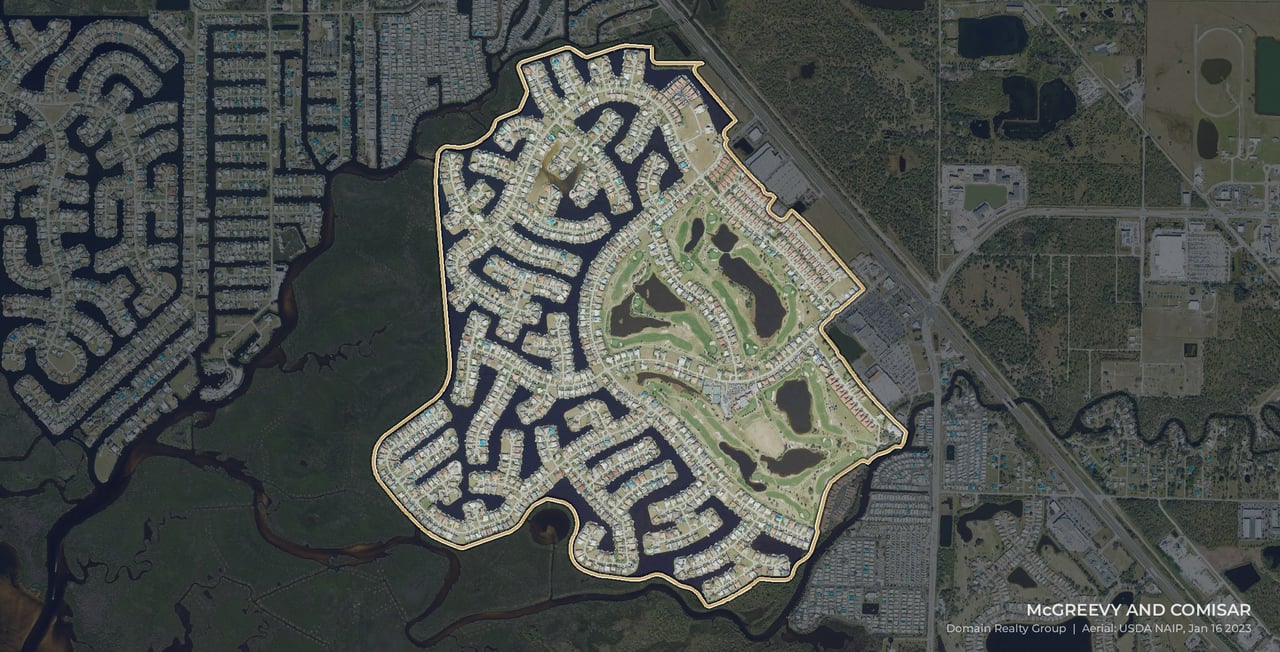
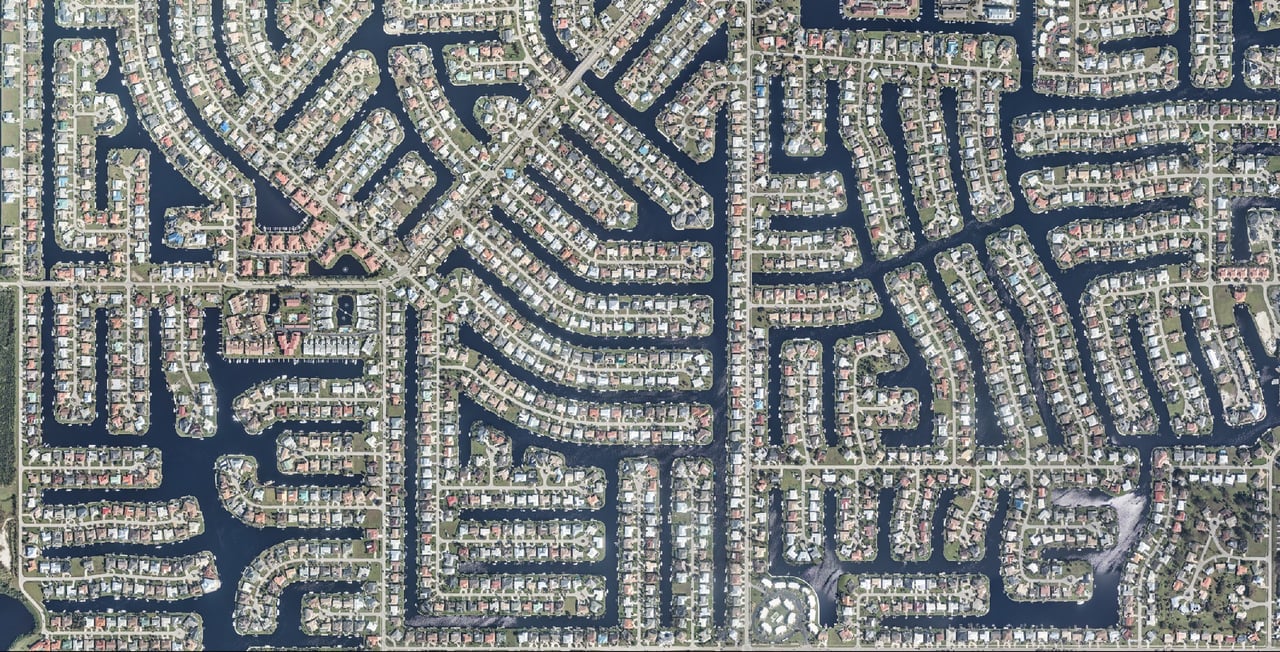
Punta Gorda Isles is a waterfront canal community in Punta Gorda, Florida. It is the grid of saltwater canals that fans out west and south of the historic downtown to Charlotte Harbor, inside the city limits, in ZIP 33950. Punta Gorda Isles, Inc. built its first model homes in 1958, and the recorded plats of what locals simply call PGI now cover about 2,586 acres of canals, streets and lots (our arithmetic from the Charlotte County plat layer). The Charlotte County property roll counts 5,259 parcels in those sections, 4,722 of them single-family homes.
If you are comparing the best real estate agents in Punta Gorda, the test in Punta Gorda Isles is specific: ask who can tell you which seawall work zone a house sits in, what the city’s canal assessment will be next year, and whether the canal behind the house reaches Charlotte Harbor without a fixed bridge. Those three facts move price here more than paint and countertops do.
The single fact most listing pages get wrong is governance. Punta Gorda Isles has no mandatory homeowners association. The original deed restrictions were allowed to expire in 1995 and were replaced by city rules for the Isles, and the City of Punta Gorda, not an HOA, maintains and replaces the seawalls through a canal assessment district that every canal-front owner pays for on the tax bill. A seller who can show where their wall stands in the city’s replacement programme negotiates from strength. A buyer who does not ask can inherit a queued wall, and the cost of putting their own dock and landscaping back afterwards.
This guide is built from the City of Punta Gorda’s own canal, flood and budget records, Charlotte County’s recorded deeds and property roll, FEMA’s flood map, the county’s evacuation layer, the Charlotte County Public Schools boundary lookup, the Florida Division of Corporations and NOAA. Every figure carries its source and date. Where a record is not public, this page says so rather than estimating. If you are weighing Punta Gorda more broadly, start with our guides to buying a home in Punta Gorda and selling a home in Punta Gorda, which use the same method, and our things to do in Punta Gorda guide for the harbourfront life around the Isles.
McGreevy and Comisar sell Punta Gorda Isles homes on the records that set their value: the city seawall schedule, the canal assessment district, the FEMA base flood elevation behind each address and 331 Charlotte County recorded single-family sales in the latest 12 months. The team is #1 in Southwest Florida since 2012 and Top 1% nationally since 2008.
If you’re searching for the best realtor for Punta Gorda Isles, whether you’re ready to sell your Punta Gorda Isles home or buy your next one, McGreevy and Comisar is the team that delivers. We lead Domain Realty Group, the #1 real estate team in Southwest Florida since 2012, Top 1% Nationally since 2008, with over $2.5 billion sold as a team and $900 million in personal sales between Jesse and Marc. As the leaders of Domain Realty Group our team has closed over $2.5 billion in real estate, and every Punta Gorda Isles valuation we write starts from the seawall zone and the canal route, not from a portal estimate.
Recent Punta Gorda Isles track record, from the county record. In the last 12 months we tracked 331 single-family closings in Punta Gorda Isles in the Charlotte County recorded deed record (qualified, improved, arm’s-length sales recorded September 25, 2025 to September 24, 2026; the county file’s newest recorded deed is dated September 9, 2026): a median of $700,000, a middle half from $535,000 to $870,000, a range of $300,000 to $2,850,000, and a median of $321 per square foot of living area on the county roll. Charlotte County is a thin market for the Southwest Florida MLS, so the county record leads here and the MLS sits beside it.
Recent Punta Gorda Isles track record, from the Southwest Florida MLS. The MLS shows 80 closed sales under the name Punta Gorda Isles in the same 12 months (to September 24, 2026, pulled September 25, 2026), a median of $564,000, a range of $150,000 to $1,700,000, a median of 77.5 days on market, a median 96.0% sale-to-list ratio and a median of $284 per square foot of living area. The two layers count different homes: the MLS figure mixes condominium units with houses and misses most sales that never touched it, and the county figure is single-family homes only.
For luxury Punta Gorda Isles sellers: premium marketing, including cinematic video, drone, professional photography, a qualified-buyer database, and discretion with off-market capability when a sale needs to stay quiet. On a canal home the drone is not decoration: it shows the buyer the route from the dock to Charlotte Harbor, which is the single most valuable thing a PGI listing can prove.
Honors and recognition:
McGreevy and Comisar is a top-reviewed Punta Gorda Isles realtor on Google. We publish no aggregate score; these are five-star reviews in our clients’ own words.
★★★★★ “Jesse was very professional, helpful and kept in touch with ideas and suggestions which developed into a sale. Highly recommend his company for their excellent follow through.” Verified Google review
★★★★★ “We had been on the market for several months with no offers. When we signed with Marc our house was sold in 2 weeks. He has a unique system for selling homes.” Verified Google review
★★★★★ “Their recommendation on pricing my unit was sound and proved prescient. I never questioned their integrity and found it easy to rely on their recommendations. I would work with them again in a heartbeat.” Verified Google review
Selling your Punta Gorda Isles home? Get a free home valuation at https://mcgreevyandcomisar.com/home-valuation, or Call Jesse direct at (239) 898-6072 (confidential conversations welcome for luxury listings).
Buying a home in Punta Gorda Isles? Call Marc at (239) 287-5873 for a personalized buyer consultation, or read how we represent buyers in Southwest Florida.
Jesse McGreevy (Sales Associate) and Marc Comisar (Broker Associate) are licensed Florida REALTORS® with Domain Realty; Florida real estate licensure is regulated by the Florida Real Estate Commission (FREC).
Punta Gorda Isles comes down to eight facts a buyer or seller should know before anything else: its size, the absence of an HOA, the city seawall programme, the canal assessment, the route to open water, the flood map, the assigned schools and what homes have recorded for. Each is sourced and dated below.
This Punta Gorda Isles guide is organized so a seller or a buyer can jump straight to the record that answers the question: recorded sales, the fee stack and the city rules, the sections and condominiums, boating and seawalls, flood and insurance, schools and drive times, the comparison with Burnt Store Isles, and the buyer and seller FAQs.
Punta Gorda Isles is a boating neighbourhood first and a retirement address second: most homes back onto a deep saltwater canal, a private dock is the norm, the city handles the seawall, and downtown Punta Gorda, Fishermen’s Village and the Harborwalk are five to ten minutes away by car. There is no gate, no HOA and no community clubhouse.
Life in Punta Gorda Isles is organised around the water behind the house. The Punta Gorda Isles Civic Association describes the Isles as “built with boating in mind”, and early lots were “viewable to potential property owners by boat only” until the Marion Avenue Bridge opened the road in (PGICA History). Today the typical PGI home is a one-storey single-family house on a canal lot with a pool cage and a freestanding dock or boat lift, and the county roll puts its median living area at 2,183 square feet.
The streets are public and city-maintained. There is no guardhouse and no master association collecting monthly dues, which is why buyers searching “Punta Gorda Isles HOA fees” find nothing: the answer is that the fee is a line on the city tax bill, not an association statement. Social life runs through a voluntary civic association with 35 clubs and groups, two private clubs inside the Isles (a golf club and a yacht club), and the downtown waterfront a few minutes away.
Buyers should expect three things that surprise people arriving from other Florida canal markets. First, the city, not the owner, is responsible for the seawall, which removes a five- or six-figure private risk. Second, the city’s marine rules are strict: docks must be freestanding, lift canopies and floating docks are prohibited, and anything outside the rules goes to a public hearing before a resident canal committee. Third, the housing stock is mixed in age, because Hurricane Charley in 2004 and Hurricane Ian in 2022 led to a wave of rebuilding: on the county roll, 1,534 of the 4,722 PGI houses carry a year built of 2000 or later.
The population leans retired. Census QuickFacts puts 53.6% of the City of Punta Gorda’s residents at 65 or older (July 2025 estimate, city-wide, not PGI-specific), and the civic association’s clubs, from the PGI Fishing Club to the Newcomers Club, reflect that. Families do live here, and every PGI address we tested is zoned to an A-graded elementary and middle school.
The first question on any Punta Gorda Isles canal home is where its seawall sits in the city’s replacement programme, and the second is whether the route to Charlotte Harbor passes a fixed bridge. We answer both before you tour. Buyers: call Marc at (239) 287-5873 or read how we represent buyers. Sellers: start with a free Punta Gorda Isles home valuation or call Jesse direct at (239) 898-6072.
Punta Gorda Isles single-family homes recorded a median sale of $700,000 across 331 qualified Charlotte County deeds in the 12 months to September 24, 2026, at $321 per square foot of living area. That is about 10% below the pre-Ian year, when 305 homes sold at a $782,000 median. The Southwest Florida MLS shows 80 closings under the PGI name at a $564,000 median.
Data updated: September 2026 (Charlotte County Property Appraiser recorded sales, index built 24 Sep 2026, newest deed 9 Sep 2026; Southwest Florida MLS, pulled 25 Sep 2026)
Punta Gorda Isles is a Charlotte County market, and Charlotte County is where the Southwest Florida MLS is thinnest, because the local REALTOR® board works mainly in a different MLS. That is why this page leads with the county’s recorded deed file, which captures every qualified sale whether or not an agent listed it, and sets the Southwest Florida MLS beside it. The two layers are labelled every time a number appears, because they count different things.
Charlotte County recorded single-family sales, Punta Gorda Isles (PGI Sections 1 to 12, 14, 17, 24, 26, 27 and 9B):
12-month window | Qualified sales | Median price | Middle half | Median $ per living sq ft |
|---|---|---|---|---|
Pre-Ian year (Sep 25, 2021 to Sep 24, 2022) | 305 | $782,000 | $662,500 to $1,000,000 | $386 |
Sep 25, 2024 to Sep 24, 2025 | 234 | $725,000 | $573,750 to $990,000 | $337 |
Sep 25, 2025 to Sep 24, 2026 | 331 | $700,000 | $535,000 to $870,000 | $321 |
Last 6 months (Mar 25 to Sep 24, 2026) | 179 | $715,000 | $548,000 to $885,000 | $324 |
Source: Charlotte County Property Appraiser public sales and roll files, DOR-qualified improved sales, read from our local index built September 24, 2026. Living area is the roll’s living-area field. The newest deed in the file is dated September 9, 2026, so the last few weeks of September are not yet recorded.
Southwest Florida MLS, the value “Punta Gorda Isles”, closed sales September 25, 2025 to September 24, 2026 (pulled September 25, 2026): 80 closed, 5 of them entered after the fact; median $564,000; range $150,000 to $1,700,000; median 77.5 days on market (an even count, so the mean of the middle pair, 77 and 78); median 96.0% of list price; median 2,151 square feet of living area; median $284 per square foot.
What the two layers say together is clear. Volume is up: 331 recorded sales against 234 a year earlier. Prices have eased: the county median fell from $782,000 in the year before Hurricane Ian to $700,000, and the median price per square foot from $386 to $321, a decline of about 17%. The MLS days-on-market figure of 77.5 days and a 96% sale-to-list ratio describe a market where well-priced canal homes sell and stale ones negotiate.
Where the 331 recorded sales fell by price:
Price band | Sales, 12 months to Sep 24, 2026 |
|---|---|
Under $400,000 | 14 |
$400,000 to $599,999 | 105 |
$600,000 to $799,999 | 101 |
$800,000 to $999,999 | 51 |
$1,000,000 to $1,499,999 | 45 |
$1,500,000 and above | 15 |
Sales by month in the county file ran from 16 to 52 a month across the eleven full months, with March 2026 the busiest month at 52 recorded sales and the winter season (December through May) accounting for 200 of the 331. That seasonality matters for sellers: a Punta Gorda Isles listing priced for the January to April buyer pool meets the deepest demand.
The city-wide picture is useful context but it is a different place. Florida Realtors’ SunStats put the City of Punta Gorda single-family median at $670,000 for July 2026, and the Punta Gorda metro area (all of Charlotte County) at $350,000 for August 2026 (Florida Realtors market data). Punta Gorda Isles sits at the top of that range because most of its homes are on deep saltwater canals.
Selling in Punta Gorda Isles? Get a free home valuation built on recorded PGI sales, or call Jesse at (239) 898-6072. Buying? Read how we represent buyers or call Marc at (239) 287-5873.
Punta Gorda Isles began in the late 1950s when three former CIA colleagues, Al Johns, Sam Burchers and Bud Cole, bought a 550-acre mangrove swamp south of downtown Punta Gorda and dredged it into canals and homesites. Punta Gorda Isles, Inc. was incorporated in Florida on May 1, 1958, the year the first model homes were built.
The Punta Gorda Isles Civic Association tells the founding story on its own site: the three partners “worked together in the CIA”, started with “some shoe stores in Florida”, and then, “flying over a 550 acre mangrove swamp”, “envisioned future canals and home sites” and “made the landowner a deal he couldn’t refuse” (PGICA History). The Florida Division of Corporations record matches the date: Punta Gorda Isles, Inc., document 211808, was filed on May 1, 1958, later renamed PGI Incorporated, and was administratively dissolved in September 2022 (Florida Division of Corporations).
The development was designed to be seen from the water. PGICA records that the first lots were “viewable to potential property owners by boat only”, and that “with accessibility enhanced by the new Marion Avenue Bridge, the Isles development began to take off.” The City of Punta Gorda’s own history places the Isles in the post-war boom: “After the war in the late 1950’s another boom began with new subdivisions platted with canals connected to Charlotte Harbor in the Punta Gorda Isles and Burnt Store Isles neighborhoods. These new subdivisions drew retirees from the north attracted by winter sunshine, bountiful recreational fishing, and spectacular boating opportunities” (City of Punta Gorda, History).
The city’s Waterfront Property Owner’s Manual dates the construction: “PGI was constructed in the late 50’s through mid 70’s” (Waterfront Property Owner’s Manual). The recorded plats follow the same sequence. Section 1 and Section 3 were recorded in Plat Book 4, Sections 2, 4 and 5 in Plat Book 5, Sections 6 through 11 in Plat Book 7, and Sections 12 and 14 in Plat Book 8, with the later Sections 17, 24, 26 and 27 in Plat Books 9, 13 and 15 (Charlotte County plat layer, read September 2026; plat images at the Charlotte County Clerk).
Punta Gorda Isles, Inc. did not stop at the Isles. The same company platted Burnt Store Isles (Section 15), the Burnt Store corridor sections along US 41 and Burnt Store Road (Sections 16, 18 and 21), Deep Creek north of the Peace River (Sections 20 and 23) and Burnt Store Marina across the Lee County line (Section 22). PGICA’s figure that “what would become Punta Gorda Isles encompasses 9000 acres and 125 canals” describes that whole programme. The community this page covers, the original canal grid inside the city, is the part locals mean when they say “PGI”.
The residents organised early. In 1962 an early landowner, Pete Botsema, started a shuffleboard league that grew into the civic association, at “$3.00 per family”; by 1970 it had 473 members and it later grew to 2,200 (PGICA History). The association was incorporated as a Florida not-for-profit on January 25, 1966 (document 710254) and is still active. Its Shreve Street building was “completely destroyed” by Hurricane Charley in 2004, and the association rebuilt at 2001 Shreve Street, marking ten years there in 2015.
The storms are part of the history. Charley’s eye passed over Punta Gorda on August 13, 2004, and Ian made its second landfall near Punta Gorda on September 28, 2022 (National Hurricane Center tropical cyclone reports). Each storm led to rebuilding, which is why the county roll today shows 298 PGI homes built in the 2020s alongside 228 still standing from the 1960s.
Selling a PGI home with a long story? A free valuation prices the era, the wall and the route. Buying? See how we represent buyers.
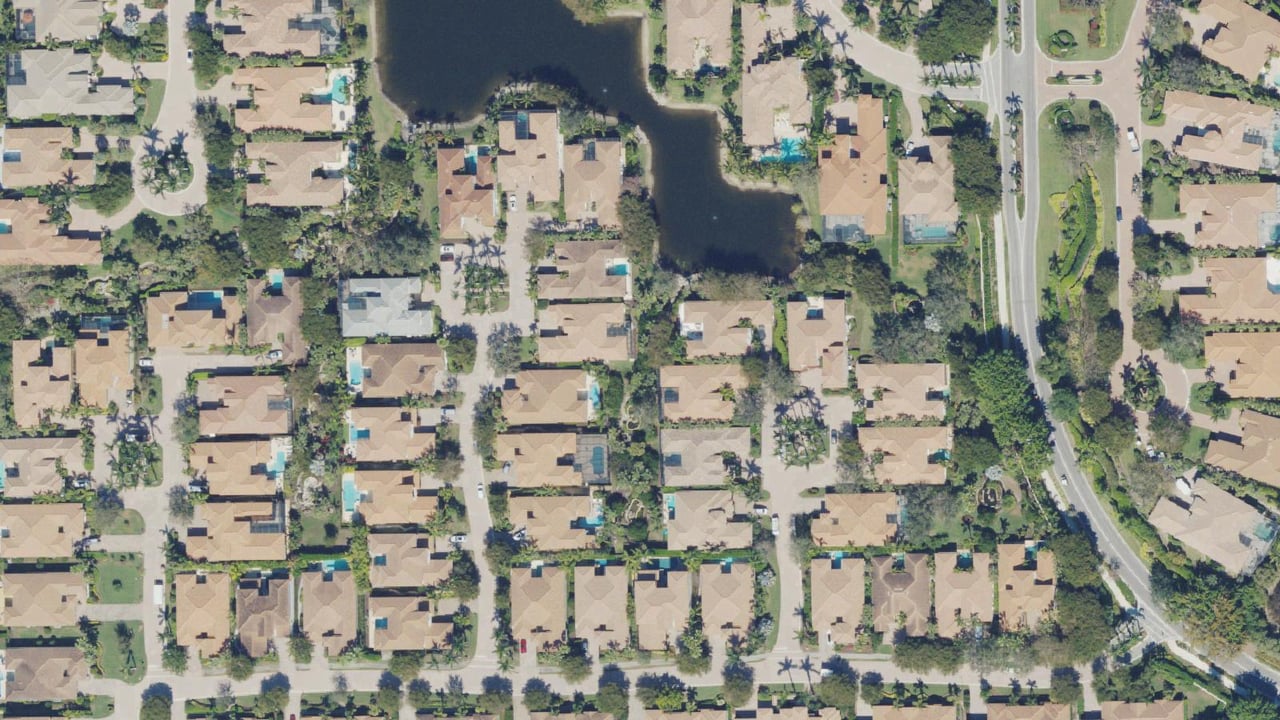
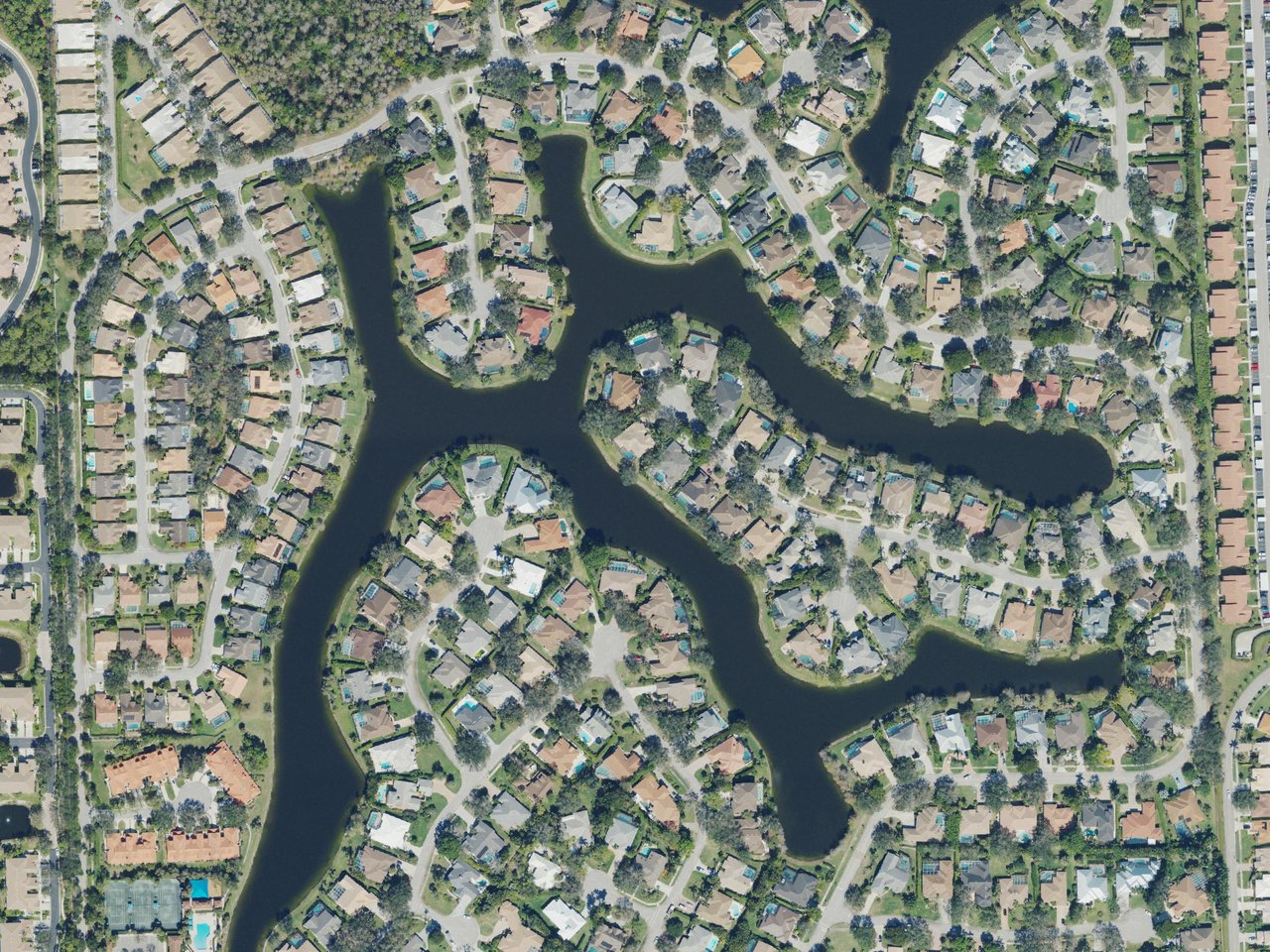
Punta Gorda Isles is laid out as 17 recorded plat sections of finger canals running off Charlotte Harbor, from Colony Point and Ponce de Leon Park at the harbour mouth to Aqui Esta Drive, Bal Harbor Boulevard and the southern Bird Section. The plats total about 2,586 acres including canals, with 45 miles of canals and inlets inside the city’s PGI canal district.
The plat polygons in Charlotte County’s GIS put Punta Gorda Isles between roughly W Marion Avenue and the harbour on the north, Charlotte Harbor and Ponce de Leon Park on the west, and the Alligator Creek preserve lands on the south, with Burnt Store Isles and the US 41 corridor to the east (Charlotte County plat layer, read September 2026). The largest sections are Section 12 (about 660 acres) and Section 14 (about 615 acres) in the south, followed by Sections 7, 5, 6, 11 and 4 in the north. The smallest, Sections 9, 9C and 27, are single blocks or drainage tracts.
The canals are named. Charlotte County’s “Punta Gorda Isles: Canals and Blueway Trails” map names each one: Bal Harbor, Charlotte Amalie, Bermuda, St. Kitts, Aruba, Sancho Panza, Don Quixote, La Mancha, Trinidad, St. Vincent, Dominica, Nevis, Curacao, Casey Key, Longboat Key, Key Largo, Captiva, Albatross, Raven, Sea Gull, Osprey, Ibis, Sandpiper, Tarpon and the Grandview, Hollywood, Pasadena, Malabar, Sunset, Venetian and Crystal waterways among them (Charlotte County canal map). The street names follow the canals: the Caribbean islands in one area, Spanish and Italian names (Via Veneto, Via Tunis, Medici Court, Don Quixote Drive) in another, and birds in the south.
The Bird Section is the local name for the southern PGI streets named for birds: Raven, Willet, Kinglet, Osprey, Swan, Sandpiper, Partridge, Purple Martin, White Ibis, Rock Dove, Kittiwake and Pine Siskin among them. The addresses we tested there fall in plat Sections 12 and 14. The city’s harbour-access project for this area, originally called the “PGI Bird Section Cut Through”, became Buckley’s Pass (see the boating section below).
North PGI, the older canals around Colony Point and Bal Harbor, is the area the city describes, for seawall assessment purposes, as the northwest and northeast zones bounded by “Aqui Esta Dr., Colony Point Dr., Charlotte Harbor and Magdalina Dr.” (City of Punta Gorda maintenance programme notice).
The exits to the harbour are named on the city’s manatee speed-zone map: Ponce De Leon, Colony Point, Pompano Inlet and Bass Inlet, with Fishermen’s Village, the Punta Gorda Boat Club, Laishley Park Marina and Punta Gorda Marina as the facility channels (Waterfront Property Owner’s Manual). All man-made canals in Punta Gorda Isles are inside the manatee speed zone.
The CHNEP and University of South Florida Water Atlas treats the canals as a single tidal waterbody: “Punta Gorda Isles, covering 338 acres, is a tidal waterbody situated in Charlotte County… Note that this waterbody is impaired for Mercury only” (CHNEP Water Atlas, Punta Gorda Isles). Mercury listings in Florida coastal water are largely driven by atmospheric deposition; the listing does not cover nutrients or bacteria.
Punta Gorda Isles is governed by the City of Punta Gorda, not by a homeowners association. The deed restrictions were allowed to lapse in 1995 and replaced by city land-use rules for the Isles, the city runs the canal and seawall district, and the Punta Gorda Isles Civic Association is a voluntary social and civic group with no power to fine or assess.
The deed restrictions and the overlay. PGICA explains the history directly: “Punta Gorda Isles was established as a ‘Deed Restricted Community’ when it was opened for sales. Under Florida law deed restrictions expire 30 years after initial sale unless renewed by the controlling body, formerly the Punta Gorda Isles Civic Association. In 1995, the decision was made NOT to renew the deed restrictions but to work with the City to incorporate unique community standards in the City Code. As a result of this decision, Punta Gorda Isles is located in a ‘Special Overlay District’ that contains special land use regulations to preserve the original values of the Isles in addition to the general City code” (PGICA, Unique Land Regulations). PGICA links the city’s own list of those rules (City of Punta Gorda, Unique Land Regulations for PGI).
One caution belongs here. The City of Punta Gorda repealed its newer Land Development Regulations on July 2, 2025 and reverted to its prior code. Whether every Punta Gorda Isles overlay provision carried through that reversion unchanged is not something we could confirm from a published document. The record that settles it is the current Chapter 26 of the city code and a zoning verification letter from the city’s Urban Design (zoning) division, which any buyer planning an addition, a new build or a dock should request during the inspection period.
Zoning on the ground. The county’s GIS returns the city’s own zoning for each lot. Every single-family PGI address we tested was zoned GS-3.5 (General Single Family), with GM-10 and GM-15 (General Multi-Family) on the condominium parcels along Hibiscus Drive, Jamaica Way and Riding Rocks Lane (Charlotte County GIS, city zoning layer, read September 2026).
The Punta Gorda Isles Civic Association (PGICA) is a Florida not-for-profit first filed on January 25, 1966, with restated articles filed March 23, 2004 (Florida Division of Corporations). Membership is voluntary and “limited to adults who are residents or owners of property in Punta Gorda Isles”, with a total first-year charge of $105 per person, made up of a one-time $25 administrative fee and annual dues of $80 (PGICA, Join Us). Where two or more adults live at one address, at least two must join. PGICA “receives no government funding”; it runs on dues, rentals, advertising and class fees, publishes a monthly magazine, The Commentator, and “continues to actively work with City staff and leadership” on PGI standards.
Associations that do exist inside PGI. Some parts of the Isles do carry their own association:
Not PGI, although the names overlap. The “Punta Gorda Isles, Section 22 Homeowners Association” that shows up in search is Burnt Store Marina, across the county line in Lee County. The Burnt Store Isles Association governs Section 15, next door, where the deed restrictions are still mandatory.
The canal district. The City’s canal system “is divided into two canal maintenance assessment districts, Burnt Store Isles (BSI) and Punta Gorda Isles (PGI). Each canal maintenance assessment district has a separate budget which is funded through a non-ad valorem assessment. Each budget is overseen by a canal advisory committee which is composed of district residents” (City of Punta Gorda, Canals). Both districts were created July 3, 1996 by Ordinance 1156-96. The PGI Canal Advisory Committee is five resident members who meet on the third Monday of each month at 1:30 p.m. in City Council Chambers, hold the public hearings on canal construction special permits and recommend the annual assessment to City Council (City of Punta Gorda, Waterfront Living).
Punta Gorda Isles owners pay city property taxes, a city canal assessment of $1,500 per single-family canal lot for fiscal 2027 (adopted September 9, 2026; $1,350 for fiscal 2026) and, where they choose, $80 a year to the civic association. There is no HOA fee on a single-family lot. Condominium owners add their association’s assessment, which is not published in one place.
Layer | Amount | Period | What it pays for | Source |
|---|---|---|---|---|
City and county property tax | 2025 total millage for city parcels: 16.6185 mills; City of Punta Gorda operating millage for fiscal 2027: 3.9928 mills, adopted September 23, 2026 | Annual, November tax bill | City and county services, schools | Florida DOR certified millage; Gulfshore Business, September 24, 2026 |
PGI Canal Maintenance Assessment | $1,500 per single-family lot (fiscal 2027, adopted September 9, 2026); $1,350 (fiscal 2026); other property $0.156 per sq ft of land within 120 lineal feet of the seawall (fiscal 2027) | Annual, non-ad valorem line on the tax bill | Seawall maintenance and replacement, canal dredging, district mangrove trimming | |
Homeowners association | None on single-family lots | n/a | n/a | |
Section 14 Property Owner’s Association | Not published | Not published | Not published | Florida Division of Corporations, document 762695 |
Condominium or villa association | Not published in one place; varies by building | Usually monthly or quarterly | Building insurance, reserves, grounds, docks where owned in common | Each association’s budget and estoppel certificate |
Punta Gorda Isles Civic Association | $80 per member per year plus $25 once (voluntary) | Annual | Clubhouse, clubs, events, The Commentator | |
Private club dues (optional) | Not published | Monthly plus initiation | St. Andrews South Golf Club; Isles Yacht Club | Club membership offices |
How fast has the canal assessment grown? The PGI assessment was $550 per single-family lot in fiscal 2017, $650 in fiscal 2022 and $1,350 in fiscal 2026, and City Council adopted $1,500 for fiscal 2027, “an increase of $150,” at its final assessment hearing on September 9, 2026 (city Special Assessments history as read September 24, 2026; City Council agenda item, July 1, 2026; City Council final assessment hearing agenda, September 9, 2026). The adopting resolution number had not been posted when we checked on September 25, 2026. Council members discussed “canal maintenance fees” as one of the rising costs residents face during the September 2026 budget hearings (Gulfshore Business, September 11, 2026).
Why the assessment is not a homestead issue. The canal assessment is non-ad valorem, a flat charge per lot, so the homestead exemption, the Save Our Homes cap and the proposed Amendment 3 on the November 3, 2026 ballot do not reduce it. Charlotte County’s property appraiser says Amendment 3 “does not apply to Non-Ad Valorem assessments or fees”.
What the assessment buys you, in dollars. The city’s manual puts seawall repair or replacement at “up to $300 per linear foot” (an undated figure in the manual), and on an 80-foot canal lot that is a five-figure exposure a PGI owner does not carry personally. What the owner does carry is everything attached to the wall: the dock, lift, davits, fence, irrigation and landscaping, which must be removed before a city replacement and put back at the owner’s expense afterwards.
What is not published. Condominium and villa association budgets, the Section 14 association’s assessment, and the dues at St. Andrews South Golf Club and the Isles Yacht Club are not published on any public page we could find. A buyer obtains each from the association’s estoppel certificate or budget, or from the club’s membership office, before the inspection period ends.
Selling a PGI home? We show buyers the whole fee stack up front, which shortens negotiations. Get a free valuation. Buying? We read the tax bill and the assessment roll with you: how we represent buyers.
Punta Gorda Isles is made up of 17 recorded plat sections of single-family canal homes, the southern Bird Section being the best known by name, plus about 40 condominium and villa associations along Bal Harbor Boulevard, W Marion Avenue, Aqui Esta Drive and Colony Point. Section 12 and Section 14 recorded the most sales in the last year.
The sections are how the county records Punta Gorda Isles, and they are how a title search, a survey and the property appraiser describe a lot. They matter to a buyer because price, age and the seawall zone differ between them. The table below is built from the Charlotte County roll and recorded deed file; a median is printed only where there were enough sales to read one.
Punta Gorda Isles by recorded section: single-family recorded sales, September 25, 2025 to September 24, 2026
Section | Plat book / page | Parcels | Single-family sales | Median sale | Median $ per living sq ft | Median year built (roll) |
|---|---|---|---|---|---|---|
Section 1 | PB 4/53 | 38 | 4 | $577,500 | $384 | 1967 |
Section 2 | PB 5/33 | 159 | 9 | $730,000 | $306 | 1982 |
Section 3 | PB 4/54 | 60 | 3 | $550,000 | $379 | 1978 |
Section 4 | PB 5/45 | 399 | 23 | $565,000 | $289 | 1980 |
Section 5 | PB 5/60 | 610 | 47 | $545,000 | $302 | 1979 |
Section 6 | PB 7/7 | 402 | 24 | $695,100 | $307 | 1986 |
Section 7 | PB 7/48 | 579 | 33 | $560,000 | $301 | 1981 |
Section 8 | PB 7/49 | 33 | 2 | two sales, too few for a median | n/a | 1993 |
Sections 9, 9B, 9C | PB 7/54, 11/12, 13/17, 16/5 | 36 | 1 | one sale, $735,000 | n/a | 1994 |
Section 10 | PB 7/58, 8/23 | 35 | 2 | two sales, too few for a median | n/a | 1991 |
Section 11 | PB 7/72, 11/7 | 380 | 23 | $790,000 | $345 | 1997 |
Section 12 | PB 8/6 | 1,121 | 75 | $779,000 | $338 | 1998 |
Section 14 | PB 8/9, 9/7 | 1,256 | 74 | $663,750 | $322 | 1998 |
Section 17 | PB 9/8, 15/8 | 106 | 8 | $697,500 | $305 | 1988 |
Section 24 | PB 13/3, 13/28 | 39 | 3 | $860,000 | $323 | 2019 |
Section 26 | PB 13/31 | 8 | 0 | no sales | n/a | 1991 |
Section 27 | PB 15/12 | 5 | 0 | no sales | n/a | 1995 |
Sources: Charlotte County plat layer (plat book and page); Charlotte County Property Appraiser roll and qualified sales, index built September 24, 2026. Sections 8, 9 and 10 are too thin to read as a market rate.
Three patterns stand out. The northern sections (1 to 7) built in the 1960s and 1970s trade from the mid-$500,000s to the low $700,000s, and carry some of the oldest original homes. Sections 11 and 12, with the golf course and the southern canals, recorded the highest medians of the large sections, $790,000 and $779,000. Section 14, the heart of the Bird Section, is the single busiest section at 74 sales with a median of $663,750.
The Bird Section. A dedicated Bird Section sub-page is coming with its association details, recent sale comps, and street-by-street analysis. We’ll link it here when it goes live. Until then: the Bird Section is the southern part of PGI (Sections 12 and 14 on the county plats) whose streets carry bird names, it is the part of the Isles served by Buckley’s Pass, and Section 14 has its own property owners’ association, filed in 1982.
Condominium and villa associations on PGI streets (Charlotte County roll, September 2026; units counted from the roll; T12 = recorded qualified sales September 25, 2025 to September 24, 2026):
Association | Street | Units | Built (roll median) | T12 sales |
|---|---|---|---|---|
Emerald Pointe (phases 1, 2, 4, 5 and 6) | W Marion Ave | 294 | 1975 to 1983 | 22 |
Clipper Cove Village and Clipper Cove | Bal Harbor Blvd | 144 | 2000 to 2002 | 8 |
Spinnaker Point | Bal Harbor Blvd | 70 | 1989 | 2 |
Windjammer Point | Bal Harbor Blvd | 69 | 1990 | 3 |
Colony Point | Colony Point Dr | 63 | 1972 | 8 |
Islander Point | Bal Harbor Blvd | 52 | 1974 | 4 |
Venetian Isles | White Ibis Ct | 52 | 1988 | 4 |
Paradise Garden Villas I and II | Deborah Dr | 45 | 1987 to 1989 | 8 |
The Preserve at Bal Harbor | Bal Harbor Blvd | 36 | 2011 | 2 |
Starboard Point | W Marion Ave | 36 | 1997 | 2 |
Villas of Cedar Key | Bal Harbor Blvd | 34 | 1984 | 0 |
Golf Course Villas | Atares Dr | 32 | 1989 | 1 |
Conquistador Landing | Rock Dove Ct | 32 | 1985 | 4 |
Dockside | Bal Harbor Blvd | 30 | 1988 | 2 |
Villas of Bal Harb | Bal Harbor Blvd | 27 | 1987 | 2 |
Dolphin Club | W Marion Ave | 27 | 1986 | 1 |
Harbor Landing | Bal Harbor Blvd | 26 | 1994 | 5 |
Mariners Cove | W Marion Ave | 25 | 1989 | 1 |
Bal Harbor Place | Bal Harbor Blvd | 24 | 1983 | 0 |
Isles Cove | W Marion Ave | 24 | 1990 | 3 |
Schooner Cove Villas | Aqui Esta Dr | 24 | 2005 | 1 |
Grand Cove Condominiums of Punta Gorda Isles | Purple Martin Dr | 24 | 2006 | 2 |
Grand Bay | Purple Martin Dr | 24 | 2004 | 1 |
Rockdove | Rock Dove Ct | 24 | 1980 | 0 |
Whispering Pines Club | W Marion Ave | 22 | 1974 | 2 |
Driftwood | Mediterranean Dr | 20 | 1974 | 1 |
Lyme Terrace | White Ibis Ct | 20 | 1987 | 1 |
La Romana | Purple Martin Dr | 19 | 2005 | 0 |
Water Gardens | Aqui Esta Dr | 18 | 2007 | 1 |
Silversands | Aqui Esta Dr | 18 | 1980 | 0 |
Outlook Cove | Rock Dove Ct | 15 | 2007 | 0 |
Champagne Estates | W Marion Ave | 15 | 1990 | 1 |
Charlotte Bay Villas | W Marion Ave | 15 | 1975 | 4 |
Mediterranean Court | Mediterranean Dr | 13 | 1981 | 2 |
Hibiscus 1 | Purple Martin Dr | 13 | 2004 | 1 |
Golden Sands | Mineo Dr | 13 | 1982 | 1 |
Southwind | W Marion Ave | 12 | 1999 | 1 |
White Ibis | White Ibis Ct | 12 | 1981 | 0 |
The street is the roll’s situs street. Whether a given building lies inside the PGI canal assessment district is shown on the city’s district boundary map, not in this table. Association budgets, reserve studies and milestone inspection status are not published on a public page; they come with the resale disclosure package.
Condominium buyers should know three state rules that do not apply to a PGI house. A condo resale contract is voidable within 7 days (excluding weekends and holidays) after the buyer receives the association documents, a building three stories or more needs a milestone inspection by December 31 of the year it turns 30, and the association must disclose its structural integrity reserve study (Florida Statutes 718.503, 553.899 and 718.112).
Five enclaves get their own coverage next. A dedicated Emerald Pointe sub-page is coming with its association details, recent sale comps, and street-by-street analysis. We’ll link it here when it goes live. A dedicated Clipper Cove sub-page is coming with its association details, recent sale comps, and street-by-street analysis. We’ll link it here when it goes live. A dedicated Colony Point sub-page is coming with its association details, recent sale comps, and street-by-street analysis. We’ll link it here when it goes live. A dedicated Spinnaker Point sub-page is coming with its association details, recent sale comps, and street-by-street analysis. We’ll link it here when it goes live. A dedicated Windjammer Point sub-page is coming with its association details, recent sale comps, and street-by-street analysis. We’ll link it here when it goes live.
Selling a PGI condo or villa? We price it on the association’s own reserves and the building’s inspection status, not just the view. Free valuation. Buying? How we represent buyers.
Punta Gorda Isles has two private clubs inside it, St. Andrews South Golf Club, an 18-hole course founded in 1980 and capped at 250 golf members, and the Isles Yacht Club, a dining, yacht and social club with a 45-slip marina on Charlotte Harbor. Membership in either is optional and is not attached to any PGI home.
St. Andrews South Golf Club. The club describes itself as “a private club on Florida’s gulf coast”, established 1980, with “Golf, practice and dining” on “one compact, well-kept property in the middle of Punta Gorda Isles” (St. Andrews South Golf Club). The course is 18 holes and 6,703 yards with five par 3s, paspalum greens and water in play on nine holes; the longest hole is 578 yards (St. Andrews South, Our Course). Membership is “Limited to 250 golf members”. A year-round full golf membership gives tee times seven days in advance, one vote per membership, a year-round reciprocal with the Isles Yacht Club and summer access to “over 40 of the area’s best golf clubs” (St. Andrews South, Membership). The clubhouse is at 1901 Deborah Drive. The club’s current initiation fee and dues are not published on its site; the membership director quotes them.
Isles Yacht Club. The Isles Yacht Club calls itself “a private dining, yacht, and social club located on beautiful Charlotte Harbor in Punta Gorda”, offering “a 45-slip marina, cruising, kayaking, lighted Har-Tru tennis courts, Bocce, Billiards, biking, a 24-hour fitness center, exercise classes, golf reciprocity” and more, for “boaters and non-boaters alike” (Isles Yacht Club). Members have the marina and fuel dock, a heated pool, the Main Dining Room and the Commodore’s Grille, and full membership brings reciprocity with “36 private clubs in the state of Florida” and “over 700 clubs in the United States”. Family, single and three-month trial memberships each carry an initiation (or, for the trial, an administrative) fee plus monthly dues and a food minimum; the amounts are not published (Isles Yacht Club, Membership). The club was named Large Business of the Year by the Charlotte County Chamber (2025) and the Punta Gorda Chamber (2026). It is incorporated as Isles Yacht Club, Inc., Florida document 735203, active.
The civic association’s clubs. PGICA supports 35 clubs and groups, most of them open to members. The boating clubs are Mariners of PGI, the PGI Cruising Club, the PGIslanders and the PGI Seafarers; there is also a Fishing Club, a Car Club with “Cars and Coffee” at Bal Harbor Plaza, a Tennis Club on three courts beside the PGICA building ($75 a family per year plus a one-time $100 initiation), the Newcomers Club, Friends Fun and Community, Just for Fun, Paradise Friends, the Castaways and Beyond Ourselves, the association’s community-service group since 2012. Isles Girls and Guys, a volunteer group active since 1982, helps PGI residents sell the contents of a home when they move or settle an estate (PGICA, Clubs).
Golf beyond the Isles. Twin Isles Country Club is inside Burnt Store Isles next door, and Charlotte County has about 20 courses in all; our guide to golf in Charlotte County compares them.
Selling near the course or the yacht club? Proximity to both clubs is a feature buyers ask about; a free valuation reflects it. Buying? How we represent buyers.
Boating from Punta Gorda Isles means a saltwater canal behind the house that reaches Charlotte Harbor, the sheltered basin NOAA calls a harbor of refuge, and from there the Gulf through Boca Grande Pass. The city says most of the PGI system has no fixed bridges, so many PGI docks have true sailboat access, but not every canal does.
“Sailboat access” is a route, not a boat. In Punta Gorda, “sailboat access” means the route from a dock to open water crosses no fixed bridge, so there is no air-draft limit; “powerboat access” means at least one fixed bridge on the route. The city’s own words set the scope: “The city maintains over 50 miles of residential canals, primarily in Punta Gorda Isles (PGI) and Burnt Store Isles. Most of the PGI system features deep, wide canals with no fixed bridges, offering sailboat water access directly from your backyard to the harbor” (City of Punta Gorda, Boating page, read September 24, 2026). The operative word is “most”. Neither the city nor the county publishes a canal-by-canal list of bridged and bridge-free routes or the clearance of each street bridge, so the route has to be traced for the specific address.
The US 41 bridges are not the constraint. A boat leaving a PGI canal for the Gulf heads south and west into Charlotte Harbor, away from the twin US 41 bridges over the Peace River. Those spans, each with 45 feet of clearance, matter only for a trip up the river or across to the north shore (NOAA United States Coast Pilot 5, chapter 4, paragraph 355).
Buckley’s Pass. For decades, boats in the southern canals had a long run through the grid to reach open water. Buckley’s Pass, known during planning as the “Additional Harbor Access” or the “PGI Bird Section Cut Through”, is a channel about 1,446 feet long and 60 feet wide cut through wetland and upland to connect the Punta Gorda Isles canal system to Charlotte Harbor by way of Alligator Creek. The city’s contractor dredged more than 17,500 cubic yards, installed 1,050 linear feet of vinyl seawall, created a smalltooth sawfish habitat and planted 700 mangrove seedlings, and completed the work in April 2020 (Kelly Brothers, Buckley’s Pass project record). WINK News reported in January 2020 that the project was paid for by an assessment of “nearly $1,000 for each water access unit” on benefiting properties, and quoted a resident who expected to reach the harbour “in 15 minutes instead of an hour and 15 minutes” (WINK News, January 7, 2020). The pass is named for Captain John “Jay” Buckley, a former president of the Punta Gorda Boaters’ Alliance.
Charlotte Harbor itself. NOAA’s Coast Pilot says the harbour anchorage “affords excellent shelter from all winds and is used as a harbor of refuge”, that “small vessels can anchor almost anywhere in Charlotte Harbor”, and that tidal currents average only about half a knot inside the harbour against 2.2 knots at Boca Grande Pass. The natural channel from Port Boca Grande to the mouth of the Peace River had a reported controlling depth of 9 feet in 1982, the most recent figure NOAA publishes (Coast Pilot 5, paragraphs 327 to 334).
What the city lets you build at the water. Chapter 6 of the Punta Gorda Code governs every PGI dock, and it is stricter than most Florida canal codes (City of Punta Gorda, Waterfront Living; Chapter 6):
A buyer who sees a canopy over a lift in a listing photo is looking at a compliance question, not a feature, and a storm-damaged dock is rebuilt to today’s rules, not to what stood before.
Where to keep a boat without a PGI dock. Laishley Park Municipal Marina downtown rents 94 slips, 12 commercial slips and 42 moorings; an annual slip is $12.00 per foot per month plus 7% sales tax, and the city’s submerged-land lease requires 90% of the slips to be available to recreational boaters first come, first served (City of Punta Gorda, Municipal Marina). Ponce de Leon Park at the harbour mouth and Laishley Park both have public boat ramps.
Selling a sailboat-water home? The route is the premium, and proving it is our job; get a free valuation. Buying for a specific boat? Tell us the air draft and we trace the route: how we represent buyers.
The City of Punta Gorda maintains and replaces every seawall in the Punta Gorda Isles canal system through its Canal Maintenance Division, funded by the canal assessment district. The owner is responsible for everything attached to or behind the wall: the dock, lift, davits, fence, irrigation, pool cage and landscaping, before, during and after any city replacement.
The city’s Waterfront Property Owner’s Manual states the rule plainly: “The Punta Gorda seawall maintenance program is a unique benefit to waterfront property owners. Under the authority of the City’s Canal Maintenance Assessment Districts, the Canal Maintenance Division is responsible for the maintenance & repair of all seawalls in the canal system which relieves the homeowner from the worry and financial burden of a seawall failure” (Waterfront Property Owner’s Manual). In most Florida canal markets, including Cape Coral and Port Charlotte, the seawall is the owner’s problem.
What the wall is made of. PGI seawalls are interlocking precast reinforced-concrete panels tied back to a buried concrete deadman about 12 feet behind the wall. The manual records the generational change: “The original seawall panels were constructed with unprotected metal rebar, 2,500 psi concrete and were 8 feet in length. Today, seawall panels are constructed with protected rebar, 5,500 psi concrete and are 10 feet in length providing for a superior design with an extended life span.” A home whose wall has already been replaced carries a materially stronger wall than one still on original panels.
The split of duties on a replacement. The city’s contractor removes the failed wall, clears obstructions (including docks and davits if necessary), installs the new wall, backfills and lays sod. The owner must remove and relocate boats “upon written notification prior to district work”, take down fences and clear docks, lifts, walkways, irrigation and landscaping from the work zone, and afterwards pay for “the repair, reinstallation, and expense of restoring any private docks, lifts, walkways, landscaping, and irrigation systems” (City of Punta Gorda, Waterfront Living; Seawall Replacement). The manual also warns that a replacement covers only “the portion to be considered bad”, so a lot can end up with a part-new, part-original wall.
Where the replacement programme stands. The city says: “Hurricane Ian related seawall failures continue to be addressed. All seawall replacements in Burnt Store Isles have been completed. Punta Gorda Isles was divided into 5 work zones, with a repair schedule available for each. Please note the schedules are forward looking for the next six months, with updates made monthly” (City of Punta Gorda, Hurricane Repairs). The city’s published PGI replacement schedule (revision dated June 3, 2026) listed an estimated 10,133 linear feet of seawall across its southeast, southwest, northwest and northeast headings, ranked SEVERE, HIGH, MED and LOW (PGI Seawall Replacement Schedule). The schedule changes monthly, so we check the current sheet for the specific address rather than quoting a street list here.
What an owner should watch for. The manual names four failure modes: joints separating, tie-back or cap corrosion, loss of the supporting berm, and cracking at the water line. It tells owners to keep grass (not stone or mulch) for 6 feet behind the cap, keep sprinkler heads 6 feet back, avoid large trees near the wall, and report depressions behind the wall to Public Works at (941) 575-5050 rather than repair anything themselves: “At no time should you as a property owner take it upon yourself to do any repairs to a cap or wall.” After-hours seawall emergencies go to (941) 639-2057.
Dredging and mangroves. The city dredges the canal channels on “a regular dredging program in our 45 miles of canals and inlets”; an owner may hire the city’s designated marine contractor, at the owner’s cost, for dockside dredging. Mangroves in the canal system are trimmed by licensed contractors under the state Mangrove Trimming and Preservation Act (City of Punta Gorda, Canals). Maintained canal depth is not published by the city.
Selling a home with a new wall? A post-Ian replacement is a selling point we document with the city’s own schedule; get a free valuation. Buying? We check the zone and priority before you write an offer: how we represent buyers.
Punta Gorda Isles has taken three major hurricanes in twenty years: Charley’s eye crossed Punta Gorda in August 2004, Ian made its second landfall near Punta Gorda in September 2022, and Milton’s storm surge in October 2024 was higher in northern Charlotte Harbor than Ian’s. The damage pattern here has been wind first, then seawall failure, then surge.
Charley, 2004. The National Hurricane Center records that Charley made landfall near Cayo Costa at about 130 knots on August 13, 2004, and “Charley’s eye passed over Punta Gorda at about 2045 UTC, and the eyewall struck that city and neighboring Port Charlotte with devastating results.” The Punta Gorda weather station failed after recording 78-knot sustained winds and a 97-knot gust (NHC Tropical Cyclone Report, Hurricane Charley). PGICA’s own building on Shreve Street was destroyed.
Irma, 2017. Irma did not make landfall here, but the city records that “The City of Punta Gorda canal system suffered substantial seawall failures as a result of Hurricane Irma”, and explains why: “water being sucked out of the canal system, while the heavy rains collected behind the seawall unequalizing pressure between the land and water” (City of Punta Gorda press release, Seawall Failures). Walls fail outward when the storm drains the canal and the rain saturates the yard.
Ian, 2022. Ian made landfall on Cayo Costa at 130 knots, and “at 2035 UTC, the center of Ian’s large eye made another landfall near Punta Gorda, Florida, with an estimated intensity of 125 kt.” Ian’s storm surge was 3 to 5 feet above ground level from south of Englewood to Bonita Beach including Charlotte Harbor (NHC Tropical Cyclone Report, Hurricane Ian). In Punta Gorda the damage was predominantly wind, and Ian triggered the seawall replacement programme that is still under way in PGI.
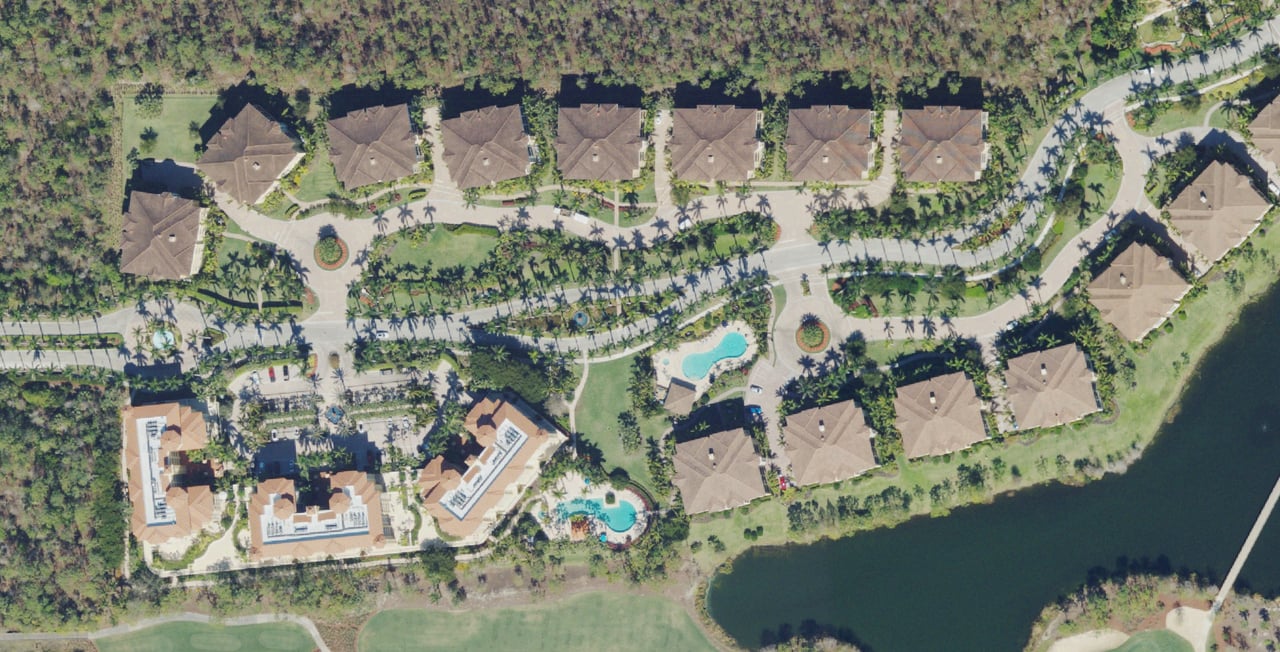
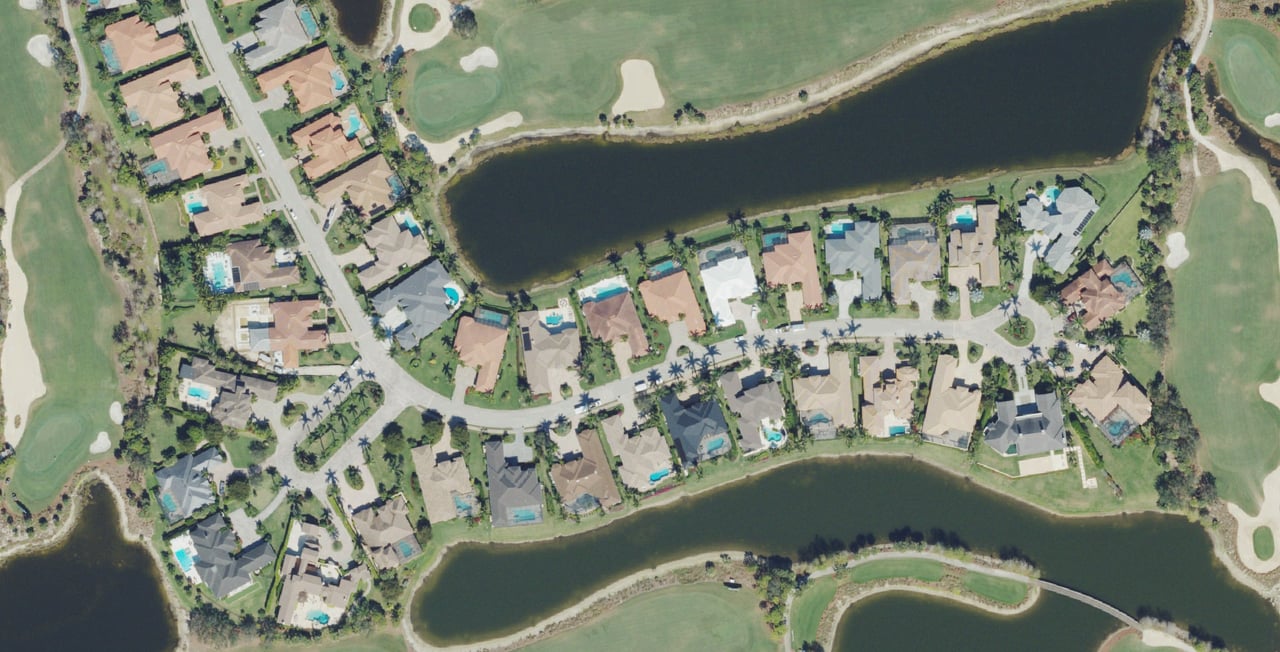
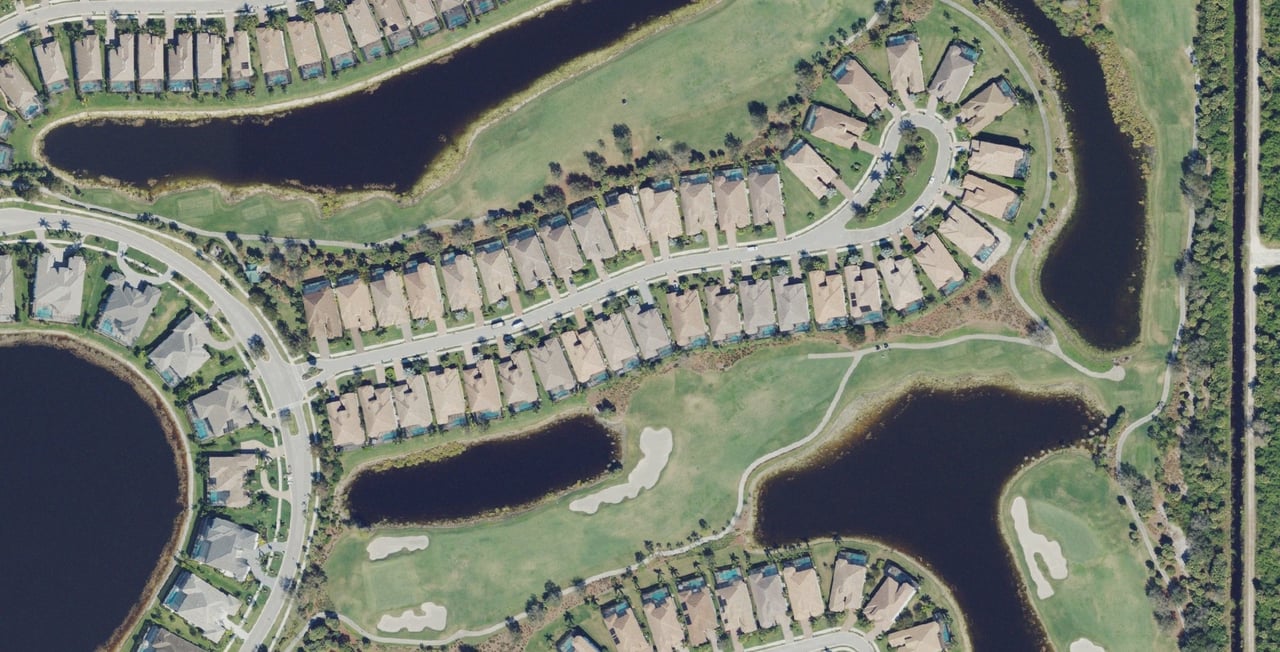
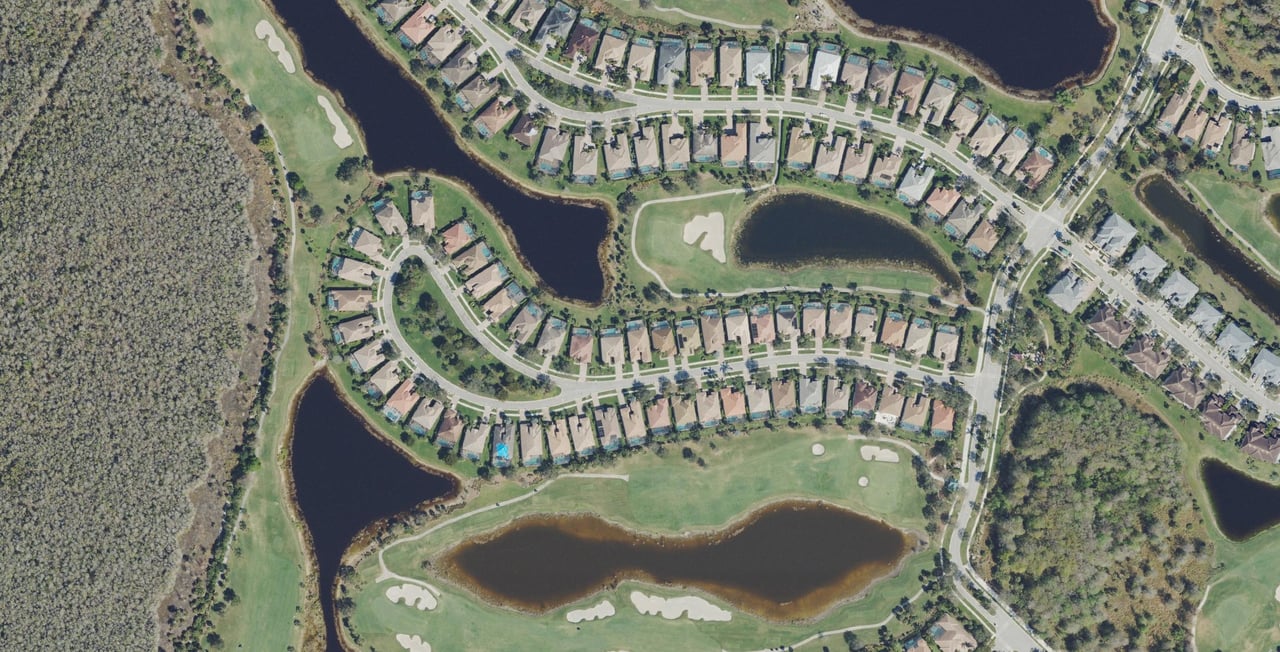
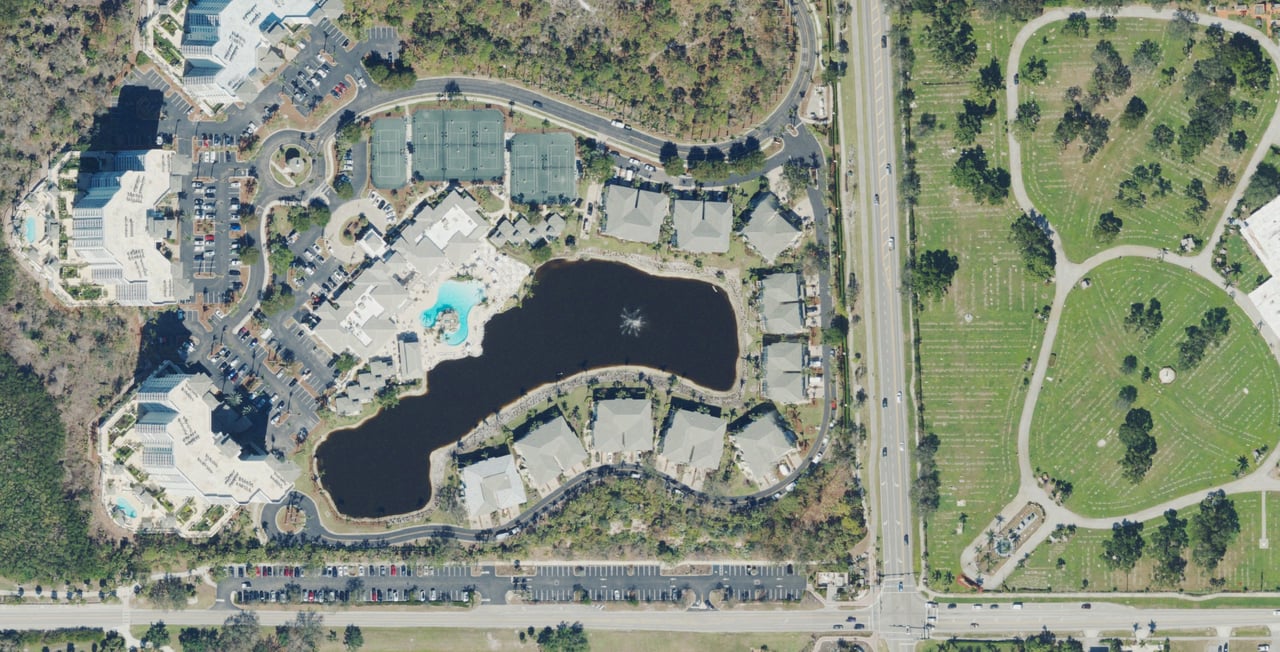
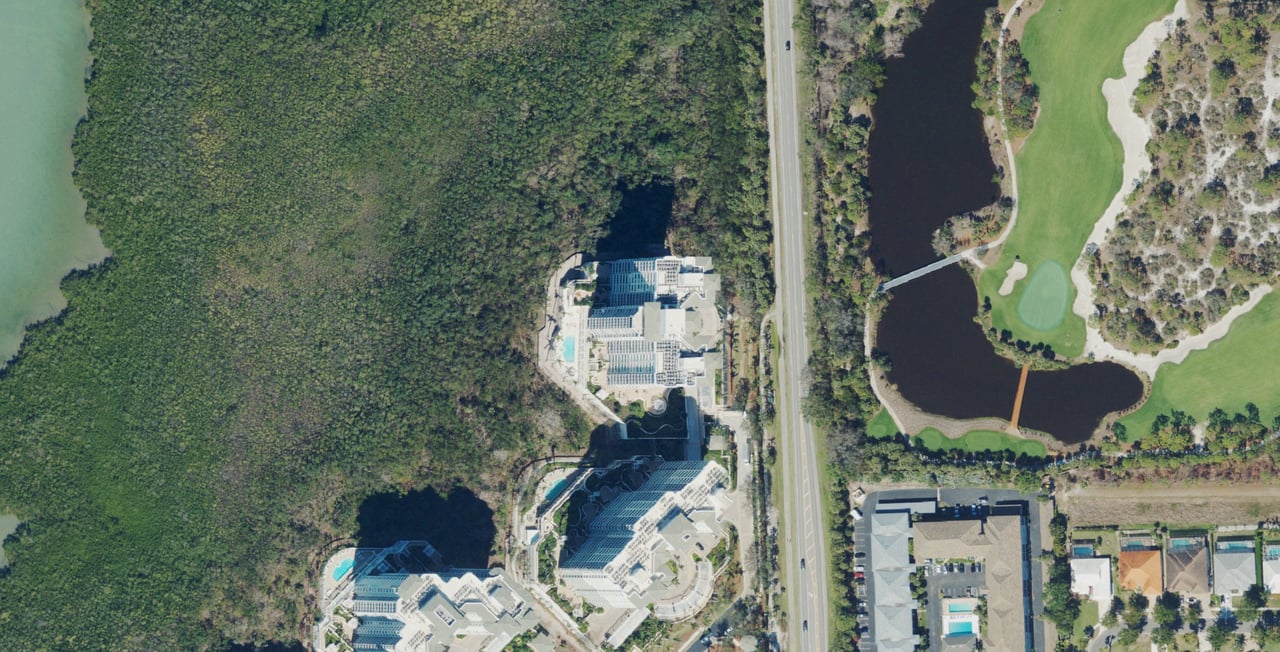
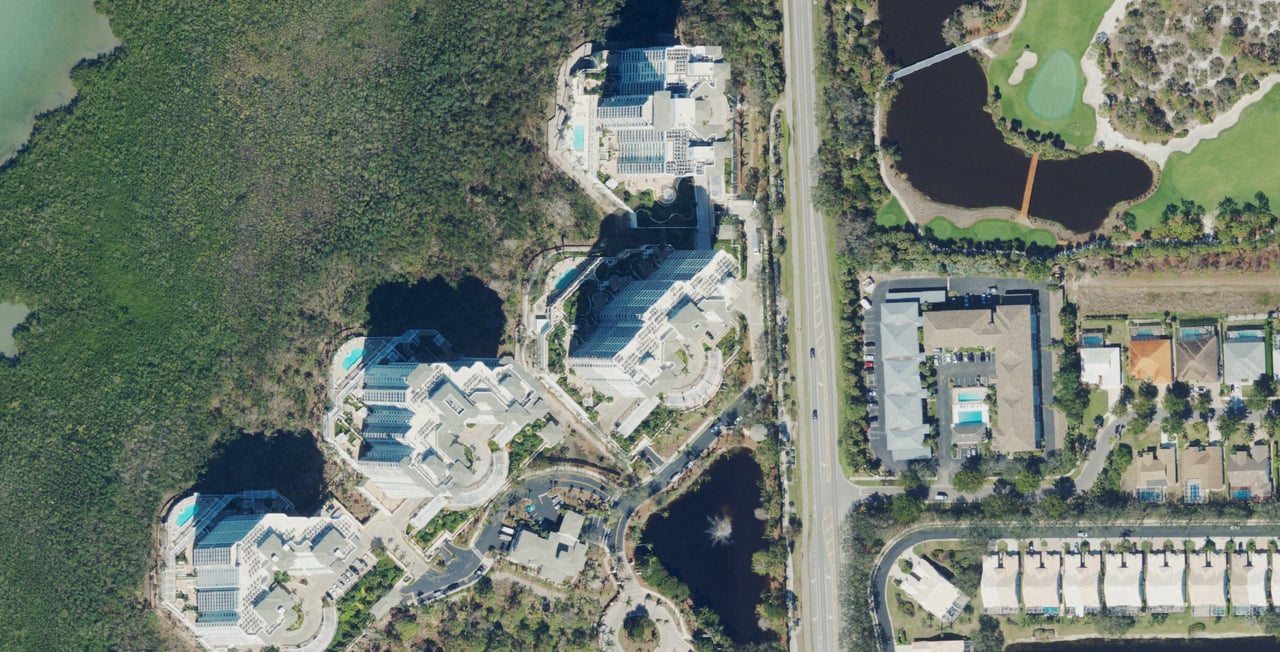
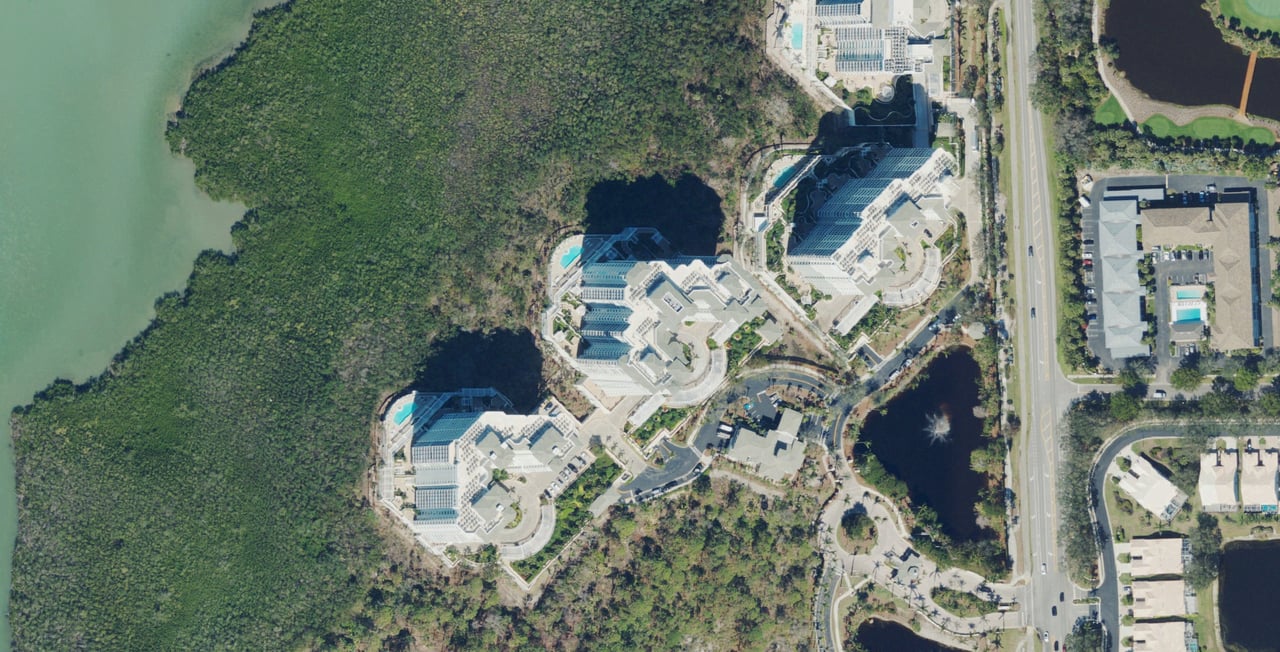
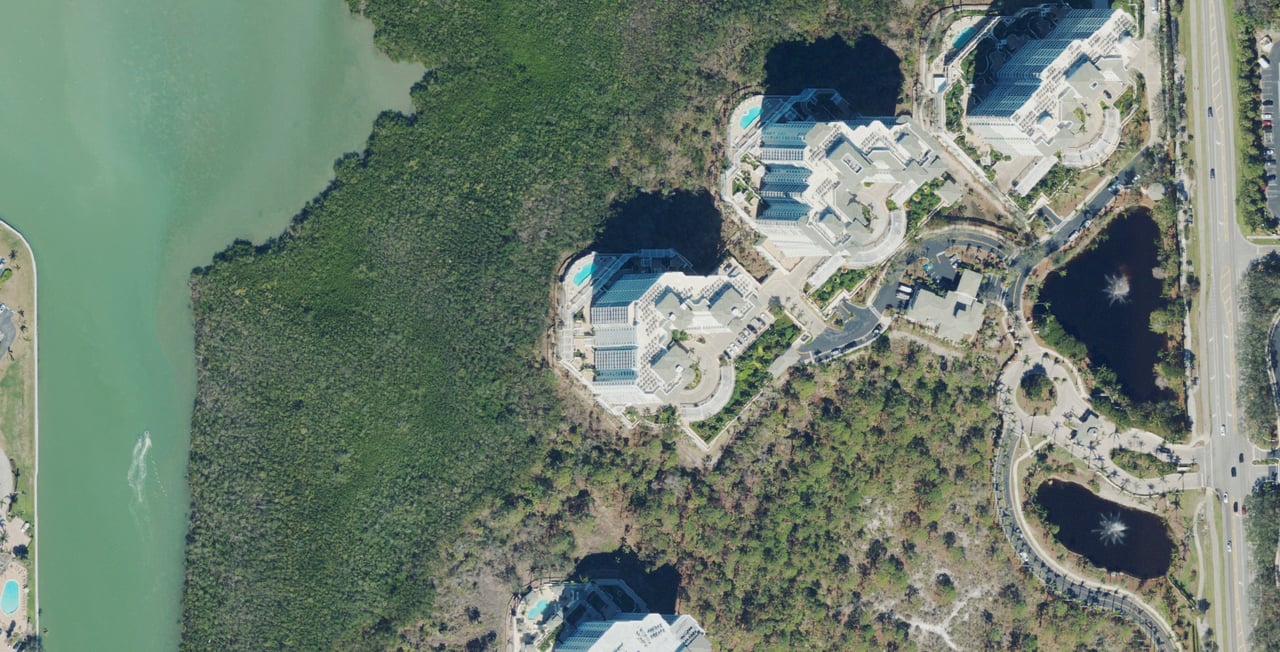
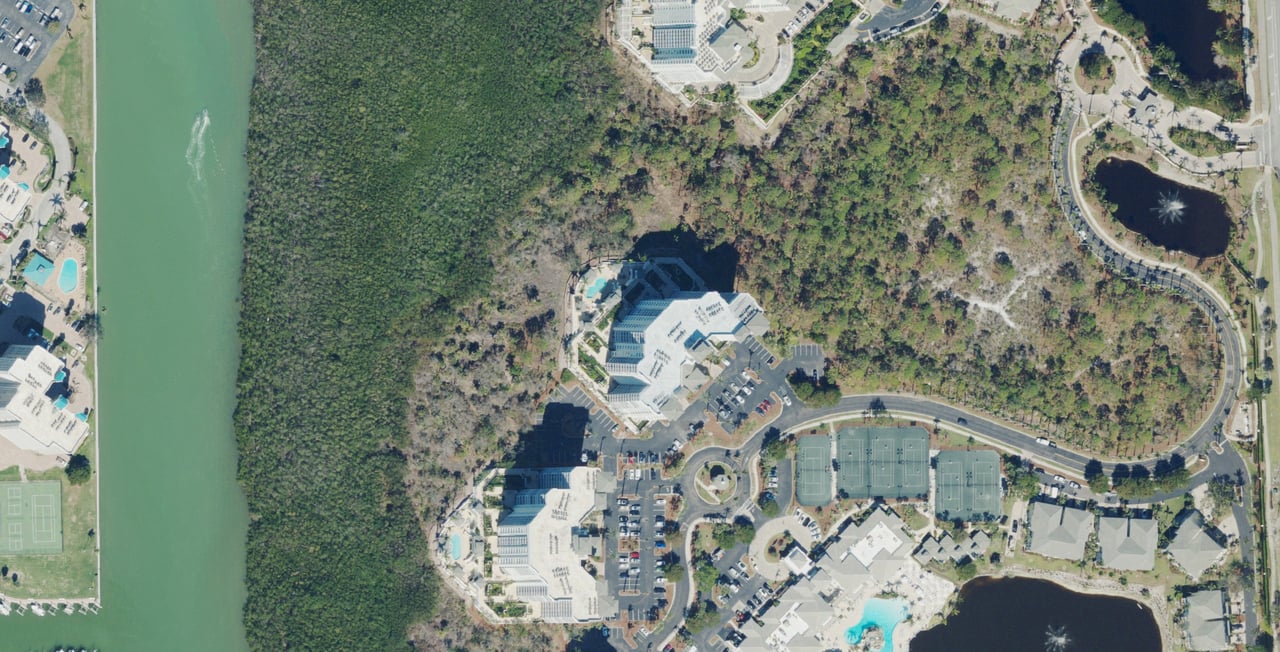
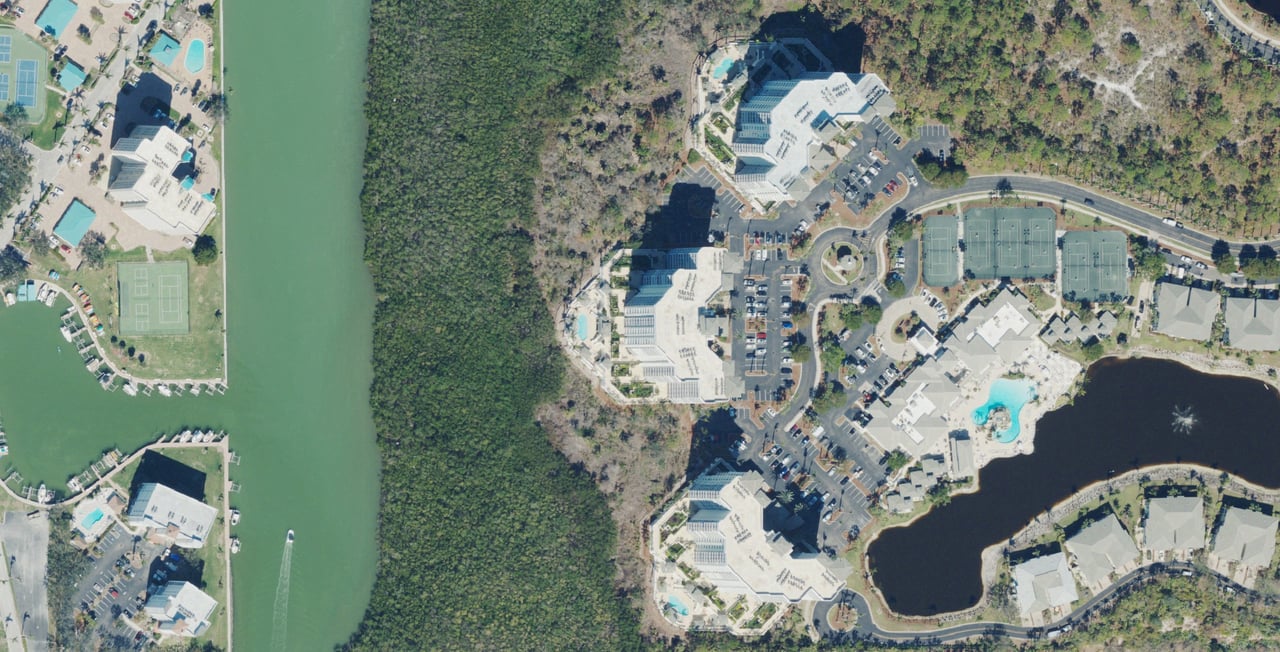
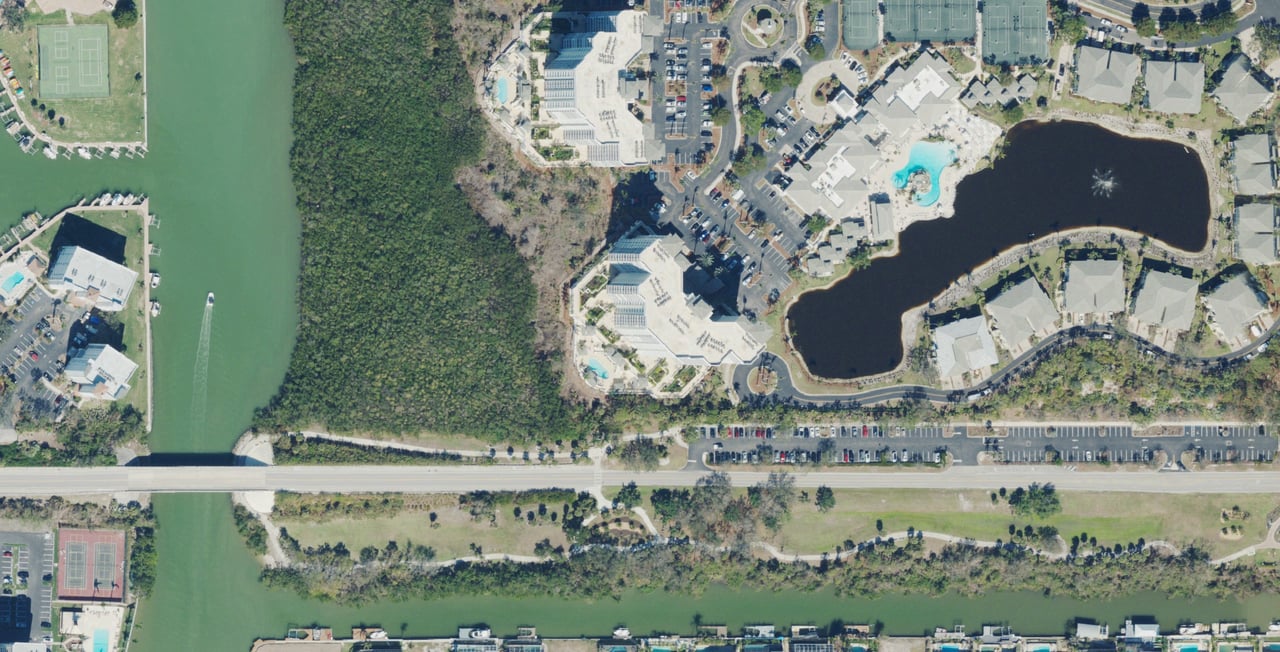
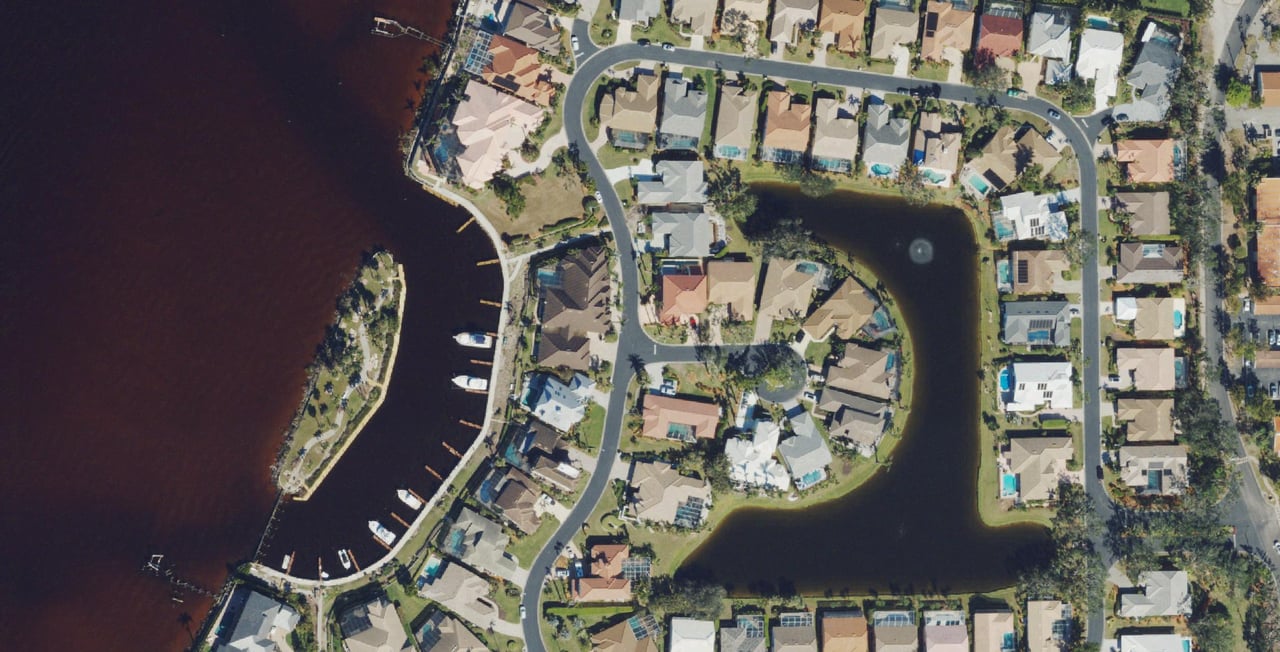
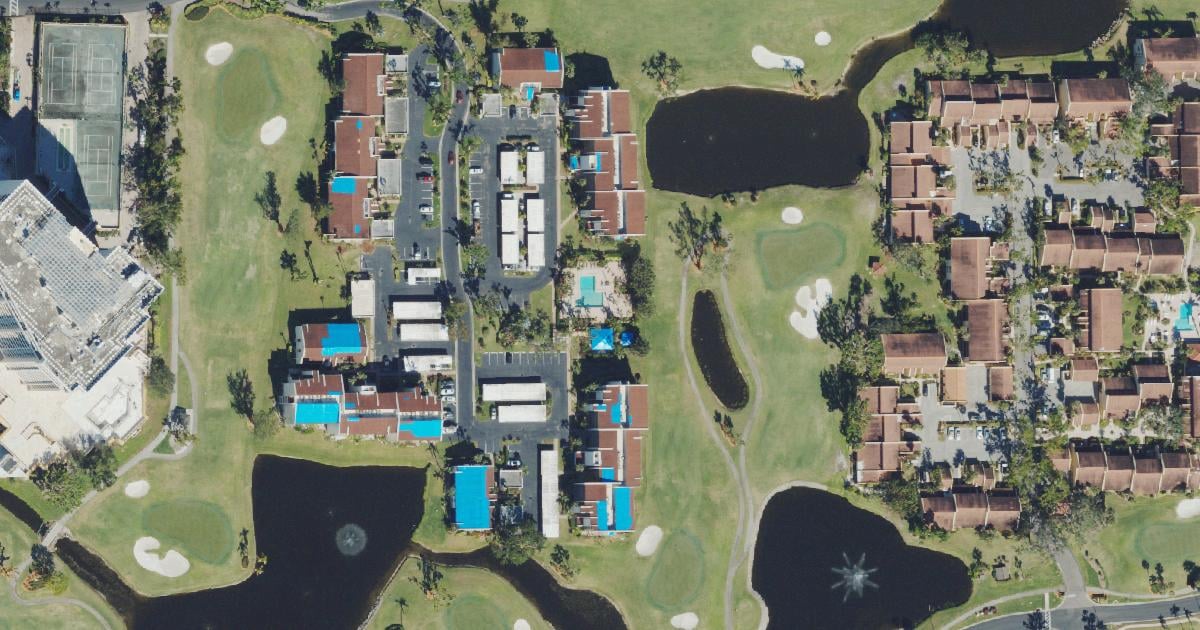
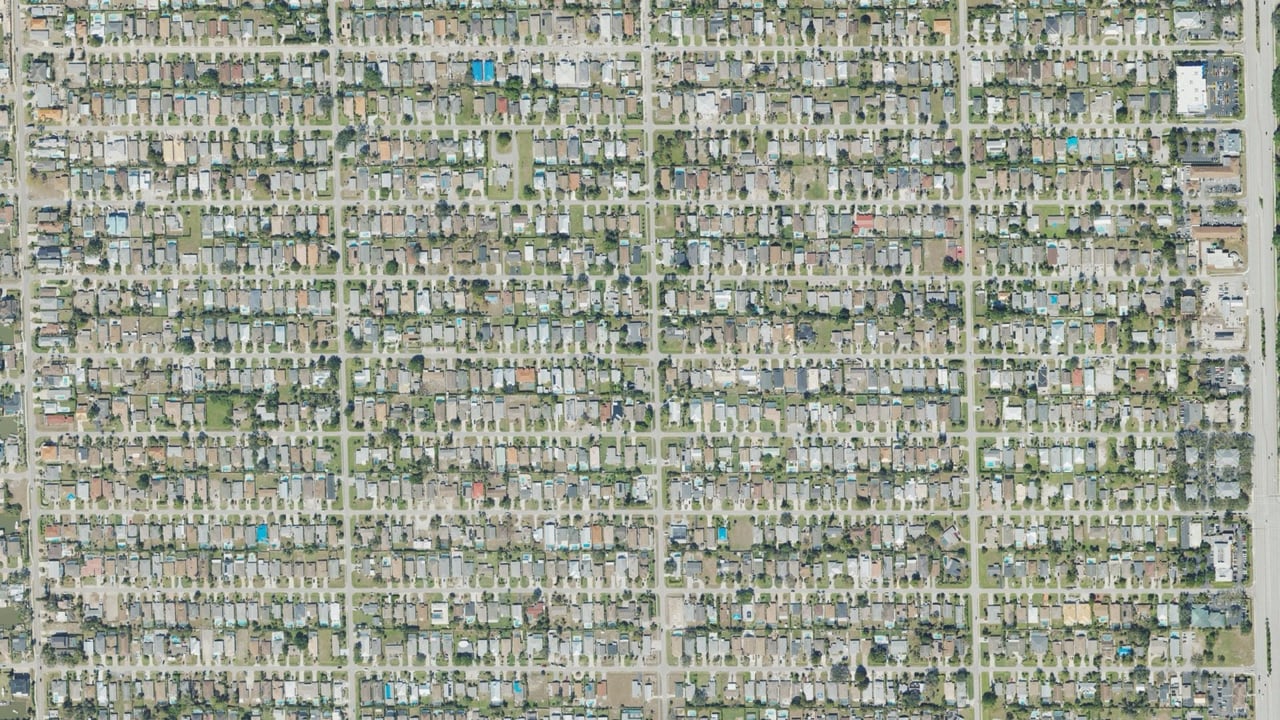
Helene and Milton, 2024. Milton made landfall at Siesta Key on October 10, 2024, and the Hurricane Center reports that “maximum storm surge inundation of 5-8 ft AGL occurred in the northern portion of Charlotte Harbor and along the Peace River”, higher than Ian’s surge here (NHC Tropical Cyclone Report, Hurricane Milton). The hero image on this page was flown by NOAA three days after Milton; blue tarps are visible on only a handful of roofs in the frame.
Why so many PGI homes are new. The county roll puts 298 PGI single-family homes in the 2020s, 167 of them built in 2023 or later, and 1,534 of the 4,722 houses carry a year built of 2000 or later. A rebuilt home on a PGI lot is built to today’s Florida Building Code, at or above the base flood elevation plus the city’s one foot of freeboard, which is the single biggest insurance and resale advantage a PGI house can have.
Before the next storm. The city requires boats to be moved “to outside hurricane moorings before or during the Hurricane Watch”, allows boats to be secured in the middle of the channel once a warning is declared, and prohibits tying off to the seawall (Waterfront Property Owner’s Manual). Charlotte County’s emergency managers warn that “Since Charlotte County has very low elevation and is surrounded by water, it may not be possible to open any shelters in the County so make plans to evacuate to another area” (Charlotte County, Know Your Zone).
Selling after a storm repair? Permits, a new roof and a new wall are value we put in front of buyers; free valuation. Buying? We pull the permit history first: how we represent buyers.
Punta Gorda Isles is in FEMA flood Zone AE. At every one of 26 PGI addresses we tested in September 2026, FEMA’s National Flood Hazard Layer returned Zone AE (coastal floodplain) with a base flood elevation of 9 feet, except Colony Point on the harbour at 10 feet, and the county placed each address in Evacuation Zone A.
Our multi-point test. We geocoded two addresses in each major PGI section with the U.S. Census geocoder and queried FEMA’s National Flood Hazard Layer and Charlotte County’s evacuation and wind-zone layers at each point on September 25, 2026:
PGI section | Addresses tested | FEMA zone | Base flood elevation (ft) | County evacuation zone | Design wind speed |
|---|---|---|---|---|---|
Sections 1 to 3 | Maria Ct, Donna Ct, Hibiscus Dr, Coral Way, Bay Ct | AE | 9 | A | 130 mph |
Sections 4 and 5 | Rosa Ln, Crescent Dr, Belvedere Ct, Capri Isles Ct | AE | 9 | A | 130 mph |
Sections 6 and 7 | Rio Lisbo Ct, Via Veneto, Medici Ct, Via Tunis | AE | 9 | A | 130 mph |
Sections 8, 10 and 11 | Via Formia, Jamaica Way, Riding Rocks Ln, Freeport Ct | AE | 9 | A | 130 mph |
Sections 12 and 14 (Bird Section) | Captiva Ct, Antigua Dr, Raven Ct, Willet Ct | AE | 9 | A | 130 mph |
Section 17 | Don Quixote Dr | AE | 9 | A | 130 mph |
Section 24 (Colony Point) | Colony Point Dr | AE | 10 | A | 130 mph |
Sources: FEMA NFHL flood hazard zones; Charlotte County GIS storm-surge evacuation zones and wind zones; U.S. Census geocoder; all queried September 25, 2026. A sample of addresses, not every lot: check the specific address on the FEMA Flood Map Service Center and the county’s Know Your Zone lookup.
The map predates Ian. The city’s flood maps “took effect beginning Dec. 15, 2022”; the study behind them was issued in preliminary form in 2019 and the effective date was fixed in July 2022, before Ian made landfall in September 2022 (City of Punta Gorda, Flood Readiness; FEMA flood-map notices in the Federal Register). Thirteen FEMA panels cover the city. Buyers should expect that a future restudy could change base flood elevations.
The Coastal A Zone. The city notes that its maps carry a Coastal A Zone, the Limit of Moderate Wave Action, where “wave crests of 1.5-foot-3-foot” are expected in a 1% chance flood, and that “Structures built in the CAZ will need elevations and foundations similar to those located in the coastal high hazard area V/VE flood zones” (City of Punta Gorda, 50% FEMA Rule). In A zones the finished floor must sit at base flood elevation plus one foot of freeboard.
The 50% rule, Punta Gorda edition. A home is “substantially damaged” when repair cost exceeds 50% of the market value of the structure, and the city counts “All repair costs, including labor and materials, OVERHEAD AND PROFIT”. Because the market value is the structure alone, not the canal lot, the threshold is easy to cross on an older PGI house, and a substantially damaged home must be brought up to current flood elevation. The city also tracks cumulative substantial improvement, which earns it flood-insurance credit.
The flood-insurance discount. The City of Punta Gorda is a Class 5 community in FEMA’s Community Rating System, worth a 25% discount on NFIP flood premiums for city properties (FEMA Community Status Book, read September 24, 2026; City of Punta Gorda, Flood Readiness, “As of October 19, 2025”). Classes are recertified annually.
Flood zones are not evacuation zones. The city says so directly: “Flood zones are not the same as evacuation zones.” The flood zone drives insurance and construction; the evacuation zone decides when you leave. Every PGI address we tested is in Zone A, the first zone ordered out.
Elevation certificates. The city publishes elevation certificates it holds through an online attachment viewer, and the Florida contract gives a buyer a flood-zone termination right (see the buyer FAQ).
Selling in Zone AE? An elevation certificate showing the floor above BFE is worth real money at the insurance quote; free valuation. Buying? We read the certificate before you commit: how we represent buyers.
Insurance for a Punta Gorda Isles home is quoted address by address, driven by the roof’s age, the home’s elevation against the 9-foot base flood elevation, its wind mitigation features and its year built. No public source publishes a PGI average premium, so we do not print one; what the rules require is public.
Wind and homeowners. Citizens Property Insurance, the state’s insurer of last resort, “requires a four-point inspection for all property owner, dwelling and mobile home applications for properties more than 20 years old”, and roofs older than 25 years (shingle) or 50 years (tile or metal) need proof of at least five years of remaining life (Citizens, Inspections). With a PGI median year built of 1990 on the roll, most resale homes will need a four-point inspection. A wind mitigation report under Florida Statute 627.711 documents roof shape, roof-to-wall connections and opening protection, and insurers must offer discounts for them. The county’s wind layer puts PGI in the 130 mph design wind zone, with Exposure C on the harbour side.
Flood. NFIP premiums under Risk Rating 2.0 reflect “flood frequency, multiple flood types… distance to a water source along with property characteristics such as elevation and the cost to rebuild”, and most rates cannot rise more than 18% a year (FEMA, NFIP pricing). The city’s Class 5 rating takes 25% off. From January 1, 2027, every Citizens personal residential policy must carry flood insurance, regardless of zone (Florida Statute 627.351(6)).
Mitigation grants. My Safe Florida Home requires an existing homestead exemption, an insured value of $700,000 or less and a home built before January 1, 2008, so a new buyer is not eligible at closing but may be after homesteading.
What we do for a buyer. We ask the seller for the elevation certificate, the wind mitigation report, the roof permit, any existing flood policy (an NFIP policy can be assigned to the buyer) and the permit history since 2004, and we get a quote before the inspection period ends. For a condo, the association’s master policy and deductible matter as much as the unit policy.
Selling? A current wind mitigation report and elevation certificate shorten the buyer’s insurance step; free valuation. Buying? How we represent buyers.
Punta Gorda Isles is zoned to Sallie Jones Elementary, Punta Gorda Middle and Charlotte High School. Every PGI address we ran through Charlotte County Public Schools’ own boundary locator in September 2026 returned those three schools, graded A, A and B by the state for 2026, and all three sit about 3 miles from the centre of the Isles.
Charlotte County assigns public schools by attendance zone rather than by lottery. We queried the district’s own boundary locator for twelve addresses spread across Sections 1, 5, 6, 7, 10, 11, 12, 14, 17 and 24 on September 25, 2026, and every one returned the same assignment (Charlotte County Public Schools, Boundary Locator):
School | Address | Grade (Florida DOE, 2026) | Drive from PGI (our routing test) |
|---|---|---|---|
Sallie Jones Elementary | 1230 Narranja St, (941) 575-5440 | A | 3.0 mi, about 8 min |
Punta Gorda Middle | 1001 Education Ave, (941) 575-5485 | A (up from C in 2025) | 3.5 mi, about 9 min |
Charlotte High School | 1250 Cooper St, (941) 575-5450 | B (graduation rate 95%) | 3.1 mi, about 8 min |
Grades: Florida Department of Education school grades, 2026 release. Charlotte County Public Schools was graded A as a district for 2026, its first A in 15 years (district release, July 1, 2026). The locator listed first days of July 16, 2026 for Sallie Jones and August 10, 2026 for the middle and high school.
A boundary can move, and an address near an edge can differ, so a buyer with school-age children should run the exact address through the locator before the inspection period ends. Florida SouthWestern Collegiate High School, a charter high school on the FSW campus at 26300 Airport Road, is a choice option for older students and was graded A. Burnt Store Marina addresses, although they carry a Punta Gorda mailing address, are Lee County schools.
Selling to a family? School assignment is a selling point we document; free valuation. Buying? How we represent buyers.
Punta Gorda Isles’ nearest full-service hospital is AdventHealth Port Charlotte, about 7.4 miles and 16 minutes away across the Peace River by our routing test. Punta Gorda’s own hospital, ShorePoint Health Punta Gorda on E Marion Avenue, closed after the 2024 hurricanes, and a freestanding emergency department is planned on Jones Loop Road.
AdventHealth announced on September 5, 2025 that it would build a freestanding 24-hour emergency department at the southeast corner of Jones Loop Road and Mac Ever Street, noting that “recent hurricanes damaged and closed a local hospital” and that it “continues to explore options for the Punta Gorda hospital that permanently closed last year” (AdventHealth newsroom). Business Observer reported in August 2026 that AdventHealth “is moving forward” with the Jones Loop emergency department and had not announced a plan for the former hospital campus. An opening date has not been published.
For a retiree-heavy community this matters, and we say so plainly: an ambulance call from PGI today goes to Port Charlotte, or south to Lee Health’s Gulf Coast Medical Center in Fort Myers, about 32 miles and 51 minutes by our routing test. Urgent-care and physician offices cluster along US 41 and Jones Loop Road.
Selling to a retiree? Buyers ask about healthcare first; we answer with the record. Free valuation. Buying? How we represent buyers.
Punta Gorda Isles is about 5 minutes from Fishermen’s Village and 6 minutes from Punta Gorda City Hall downtown, about 14 minutes from Punta Gorda Airport, 54 minutes from Southwest Florida International Airport and 49 minutes from Englewood Beach, the nearest Gulf beach, by our routing test from the centre of the Isles.
Destination | Distance | Drive time, no traffic |
|---|---|---|
Fishermen’s Village, 1200 W Retta Esplanade | 1.6 mi | 5 min |
Punta Gorda City Hall, 326 W Marion Ave | 2.3 mi | 6 min |
Laishley Park Municipal Marina | 2.9 mi | 8 min |
Twin Isles Country Club, Burnt Store Isles | 5.2 mi | 12 min |
Punta Gorda Airport (PGD) | 5.8 mi | 14 min |
AdventHealth Port Charlotte | 7.4 mi | 16 min |
Downtown Fort Myers | 25.0 mi | 38 min |
Englewood Beach | 28.3 mi | 49 min |
Boca Grande | 32.5 mi | 59 min |
Southwest Florida International Airport (RSW) | 41.1 mi | 54 min |
Sarasota Bradenton International Airport (SRQ) | 61.5 mi | 78 min |
Our routing test: OSRM open routing engine, free-flow times with no traffic, from the centre of Punta Gorda Isles (26.9165 N, 82.0745 W), run September 25, 2026. Season and time of day add time, most of all on I-75 and US 41 in winter.
Punta Gorda Airport is run by the Charlotte County Airport Authority and is served by Allegiant and Sun Country; the terminal expansion is scheduled for 2027 (Charlotte County Airport Authority). There is no Gulf beach in Punta Gorda Isles itself; the closest sand in the city is the small harbour beach at Gilchrist Park and Ponce de Leon Park.
Punta Gorda Isles itself is almost fully built, so the changes that matter are civic: the city’s seawall replacement schedule, the $1,500 canal assessment adopted for fiscal 2027, a lower city tax rate adopted in September 2026, the 2025 repeal of the city’s newer land development code, two pending downtown ordinances and the AdventHealth emergency department.
Buckley’s Pass, the largest recent project inside the Isles, was completed in April 2020.
Punta Gorda Isles runs on city services: city water and sewer, city garbage collection through Waste Management, city police and a city marine patrol on the canals. There is no gate, no architectural review board and no HOA approval step, but docks, lifts, fences and additions need city permits, and the canal rules are enforced.
Punta Gorda Isles’ social life runs through the civic association’s 35 clubs and groups, the two private clubs and the downtown waterfront: weekly boating-club socials, monthly fishing-club meetings with guest captains, newcomers’ happy hours, concerts and classes at the PGICA hall on Shreve Street, and the festival calendar at Fishermen’s Village.
Punta Gorda Isles and Burnt Store Isles are both city canal communities built by Punta Gorda Isles, Inc., but they differ in the ways that decide a purchase: PGI has no HOA and a much larger canal system with mostly bridge-free routes to the harbour, while Burnt Store Isles is newer, deed-restricted, has a boat lock and a private country club inside it.
Burnt Store Isles is platted as Punta Gorda Isles Section 15, south of the Isles across Aqui Esta Drive, and it has its own canal district, its own advisory committee and its own association.
Decision factor | Punta Gorda Isles | Burnt Store Isles |
|---|---|---|
Built | Late 1950s to mid 1970s, heavy rebuilding since 2004 (city manual; county roll median year built 1990) | Mid 1970s onward (city manual; county roll median year built 1998) |
Size | About 2,586 platted acres; 4,722 single-family homes | About 837 platted acres; about 1,137 single-family homes |
Canals and seawall (city district scope) | 45 miles of canals and inlets, 91 miles of seawall | 9 miles of canals, 18 miles of seawall, plus the BSI boat lock |
Route to the harbour | “Most” of the system has no fixed bridges (city); exits at Ponce de Leon, Colony Point, Pompano and Bass inlets, and Buckley’s Pass (2020) | Via Alligator Creek; the city lists a boat lock in the district’s scope |
HOA or deed restrictions | No HOA; deed restrictions lapsed in 1995, city overlay rules instead | Mandatory deed restrictions enforced by the Burnt Store Isles Association (1985 transfer from PGI, Inc.) |
Canal assessment, fiscal 2026 | $1,350 per single-family lot | $1,010 per single-family lot |
Canal assessment, fiscal 2027 (adopted September 9, 2026) | $1,500 | $1,035 |
Post-Ian seawall replacement | Still under way in five work zones | “All seawall replacements in Burnt Store Isles have been completed” (city) |
Golf inside | St. Andrews South (private, 250-member cap) | Twin Isles Country Club (private, member-owned since 1985) |
Recorded single-family sales, 12 months to Sep 24, 2026 (county) | 331, median $700,000, $321 per living sq ft | 72, median $662,500, $288 per living sq ft |
Southwest Florida MLS, same 12 months | 80 closed, median $564,000, 77.5 median days on market, 96.0% sale-to-list | 14 closed, median $803,250, 121 median days on market, 95.2% sale-to-list |
FEMA zone at sampled addresses | AE, base flood elevation 9 ft (10 ft at Colony Point) | AE, base flood elevation 9 ft |
Evacuation zone at sampled addresses | A | A |
Assigned schools (district locator) | Sallie Jones, Punta Gorda Middle, Charlotte High | Same three schools |
Sources: City of Punta Gorda canal district pages and Waterfront Property Owner’s Manual; City Council agendas, July 1 and September 9, 2026 (fiscal 2027 levies, adopted September 9); City of Punta Gorda Special Assessments page for the fiscal 2026 BSI figure (read September 24, 2026); Charlotte County plat layer and recorded sales (index built September 24, 2026); Southwest Florida MLS, pulled September 25, 2026; FEMA NFHL and Charlotte County GIS, September 25, 2026; Charlotte County Public Schools boundary locator, September 25, 2026.
How to read the price rows. The county record, which counts every qualified single-family deed, puts PGI’s median above Burnt Store Isles’ ($700,000 against $662,500), and PGI’s median price per square foot higher ($321 against $288). The MLS rows point the other way because the MLS sample is small in both places, only 14 closings in Burnt Store Isles, and because the MLS value named Punta Gorda Isles mixes condominium units with houses. On like-for-like single-family homes the county record is the better guide.
Who should choose Punta Gorda Isles. A sailboat owner or anyone with a tall boat who wants the widest choice of bridge-free canals; a buyer who does not want an HOA or deed restrictions; a buyer who wants to be closest to downtown, Fishermen’s Village and the harbour-mouth parks; and a buyer who wants the widest spread of price points, from original 1960s canal homes to new construction.
Who should choose Burnt Store Isles. A buyer who wants a newer, more uniform stock of homes and the protection of mandatory deed restrictions; a golfer who wants a member-owned country club inside the neighbourhood; a powerboater for whom the lock is no obstacle; and a buyer who values a seawall programme the city has already finished.
Our honest tie-breaker. For boaters, trace the route from the specific dock; for everyone else, compare the specific seawall zone in PGI against the finished walls in Burnt Store Isles, and the canal assessment difference, which is $465 a year at the fiscal 2027 rates adopted September 9, 2026.
Punta Gorda Isles is the largest and highest-volume canal community in Punta Gorda: in the Southwest Florida MLS it recorded 80 closings in the 12 months to September 24, 2026, more than any other named Punta Gorda community outside Babcock Ranch, at a $564,000 median, well above the $350,000 median for all MLS sales with a Punta Gorda address.
Benchmark: Southwest Florida MLS closed sales, 12 months to September 24, 2026 (pulled September 25, 2026)
Community or area | Closed sales | Median sold | Median days on market | Median sale-to-list | Median $ per living sq ft |
|---|---|---|---|---|---|
Punta Gorda Isles | 80 | $564,000 | 77.5 | 96.0% | $284 |
Burnt Store Isles | 14 | $803,250 | 121 | 95.2% | $313 |
Heritage Landing Golf and Country Club | 72 | $330,000 | 70 | 95.8% | $212 |
All MLS “Punta Gorda” addresses | 1,077 | $350,000 | 75 | 96.9% | not computed |
Punta Gorda addresses excluding Babcock Ranch | 580 | $360,000 | 79 | 96.2% | not computed |
Babcock Ranch (Punta Gorda mailing address) | 497 | $390,000 | 66.5 | 97.8% | not computed |
Source: Southwest Florida MLS Matrix, Residential, City = Punta Gorda (the postal city, so it includes Babcock Ranch and Burnt Store Marina), Closed including sold-data-entry records, closings September 25, 2025 to September 24, 2026. Charlotte County coverage in this MLS is partial; see the county record in the market snapshot.
Other Punta Gorda communities in the same pull: Willow at Punta Gorda (48 closings, $310,000), Deep Creek (38, $337,250), Burnt Store Lakes (32, $422,450), Burnt Store Marina (30, $323,750, in Lee County), Burnt Store Village (27, $330,000), Esplanade at Starling (14, $509,495) and Pirate Harbor (7, $950,000). Heritage Landing, a gated golf community off Burnt Store Road outside the city limits, is the Punta Gorda buyer’s usual alternative when the priority is golf and amenities rather than a dock.
For a newer home with builder warranties, our new construction guide for Punta Gorda covers the Burnt Store corridor communities, and Babcock Ranch, the solar-powered town east of I-75, is the other large Punta Gorda-address market; if you are open to the north side of the river, see our Port Charlotte guide.
Selling? We price PGI against the right comparables, not the Punta Gorda average; free valuation. Buying? How we represent buyers.
Punta Gorda Isles’ strengths are the water, the city-owned seawalls, the absence of an HOA and the short drive to a walkable downtown; its costs are storm exposure, a flood map drawn before Ian, a canal assessment that has more than doubled since fiscal 2017, an unfinished seawall programme and no hospital in town.
Pros
Cons
Punta Gorda Isles sellers get the best price when the listing proves the three things buyers pay for: the route from the dock to the harbour, the status of the city seawall behind the house, and the home’s elevation against the 9-foot base flood elevation. McGreevy and Comisar build every PGI listing around those records, and around the 331 recorded sales that set today’s price.
If you’re searching for the best Punta Gorda Isles listing agent, or thinking, ‘I need to sell my house in Punta Gorda Isles…’, you want a team that has done this at scale and knows what a canal buyer will ask before they ask it. We lead Domain Realty Group, the #1 real estate team in Southwest Florida since 2012, and between Jesse and Marc we have more than $900 million in personal sales and over 45 years of combined direct experience between Jesse McGreevy and Marc Comisar.
Honors and recognition:
The 12-month record a Punta Gorda Isles buyer will compare you against: 331 recorded single-family sales at a median of $700,000 and $321 per living square foot (Charlotte County recorded deeds, September 25, 2025 to September 24, 2026), and 80 MLS closings at a median of $564,000 with a median of 77.5 days on market and a 96.0% median sale-to-list ratio (Southwest Florida MLS, pulled September 25, 2026).
What we do on a PGI listing that others skip:
Start with a free Punta Gorda Isles home valuation, built on recorded PGI sales in your section, not a portal estimate, or read our Punta Gorda home valuation guide and our guide to selling a home in Punta Gorda.
Talk to Jesse direct: (239) 898-6072, text or call. Confidential conversations welcome.
Buying instead? Call Marc at (239) 287-5873, or read how we represent buyers and our guide to buying a home in Punta Gorda.
The best Punta Gorda Isles listing agent is the one who can document your seawall’s status, your route to the harbour and your elevation, and price against recorded PGI sales. McGreevy and Comisar lead the #1 team in Southwest Florida since 2012, are Top 1% Real Estate Agents Nationally Since 2008, and build every PGI listing on those records.
In the Southwest Florida MLS, Punta Gorda Isles closings in the 12 months to September 24, 2026 had a median of 77.5 days on market. Well-priced canal homes listed for the winter season move faster; stale listings negotiate, at a median 96.0% of list price.
A queued seawall does not stop a sale, because the city pays for the wall, but buyers price in the cost of removing and restoring their own dock, lift and landscaping. We show the city’s schedule and a contractor’s estimate for that work up front, so it is a line item rather than a surprise.
Selling as-is can make sense when the repair would approach the city’s 50% substantial-damage threshold, because a buyer who plans to rebuild values the lot and the canal. We compare the as-is price, the repaired price and the lot value on recorded PGI sales before you decide.
The best time to list in Punta Gorda Isles is ahead of the winter season: 200 of the 331 recorded single-family sales in the latest 12 months closed between December and May, and March 2026 alone recorded 52. A listing ready by January reaches the deepest buyer pool.
Yes. We can market a Punta Gorda Isles home privately to our qualified-buyer database and to other agents’ buyers without a public listing, and we explain the trade-off honestly: fewer eyes can mean a lower price, so we test the market quietly first.
McGreevy and Comisar are Jesse McGreevy and Marc Comisar, founding partners of McGreevy and Comisar, who lead Domain Realty Group, a team of about 40 agent-partners serving Lee, Collier and Charlotte County, Florida, under the Domain Realty brokerage. They have sold in Charlotte County since 2019 and now have established agents in the market.
Honors and recognition:
McGreevy and Comisar is a top-reviewed Punta Gorda Isles realtor on Google, and more of what clients say is below.
★★★★★ “Jesse and his team at Domain have taken care of me, my family and my friends for many years. They have listed and sold our properties, facilitated the purchase of our properties and arranged for rentals.” Verified Google review
★★★★★ “Not living in the area, Jesse made life easy for me when we decided to sell our condo. His attention to detail, patience, understanding, and tenacity in dealing with all the moving parts was truly impressive.” Verified Google review
★★★★★ “He knew the area and therefore knew exactly where to take us to find the exact kind of neighborhood we were looking for and he was right on the money.” Verified Google review
★★★★★ “Marc and Jesse were amazing to work with AGAIN! We just sold our 3rd home with them and couldn’t have been happier! If we ever move again we’ll always call Jesse and Marc!” Verified Google review
Jesse McGreevy (Sales Associate) and Marc Comisar (Broker Associate) are licensed Florida REALTORS® with Domain Realty; Florida real estate licensure is regulated by the Florida Real Estate Commission (FREC). Jesse McGreevy’s Florida license is SL3101296 and Marc Comisar’s is BK3060671.
McGreevy and Comisar lead Domain Realty Group, a full-service Southwest Florida real estate team. Learn more about our team at DomainRealtyGroup.com.
Meet the team on the McGreevy and Comisar about page, follow us on Facebook, or contact us. Selling? Get a free valuation. Buying? How we represent buyers.
Punta Gorda Isles buyers ask most about the HOA that does not exist, the seawall the city maintains, the canal assessment, sailboat access, the flood zone and the schools. Every answer below is drawn from the same records as the sections above and dated the same way.
Punta Gorda Isles is a waterfront canal community inside the City of Punta Gorda, Florida, built by Punta Gorda Isles, Inc. from 1958 into the mid 1970s. Its 17 recorded plat sections hold 5,259 parcels, 4,722 of them single-family homes, most on saltwater canals reaching Charlotte Harbor.
Punta Gorda Isles lies west and south of downtown Punta Gorda in ZIP 33950, between W Marion Avenue and Charlotte Harbor on the north and west, the Alligator Creek preserve lands on the south and Burnt Store Isles and US 41 on the east. Fishermen’s Village is about 5 minutes from its centre.
Yes. Every Punta Gorda Isles address we geocoded in September 2026 fell inside the city limits, so PGI owners pay city taxes, get city water, sewer and police, and fall under city zoning and the city’s 25% CRS flood-insurance discount.
The Charlotte County property roll counts 5,259 parcels in the Punta Gorda Isles sections: 4,722 single-family homes, 435 vacant lots, about 70 multifamily parcels and the rest common areas and canals, plus about 40 condominium and villa associations on PGI streets recorded under their own names.
No. Punta Gorda Isles has no mandatory homeowners association on single-family lots. The deed restrictions were not renewed in 1995 and were replaced by city overlay rules; the civic association is voluntary. Condominium buildings and Section 14 have their own associations.
A single-family Punta Gorda Isles home pays no HOA fee. The recurring charges are city property tax and the city canal assessment, $1,500 per single-family lot for fiscal 2027 (adopted September 9, 2026; $1,350 for fiscal 2026), plus voluntary civic association dues of $80 a year per member.
Punta Gorda Isles rules are city rules: the city’s PGI overlay land-use regulations, city zoning (GS-3.5 on single-family lots we tested) and Chapter 6 of the city code for docks and seawalls. Because the city reverted its land code in July 2025, ask for a zoning verification letter before building.
The original Punta Gorda Isles deed restrictions expired after the 1995 decision not to renew them, according to the civic association, and their standards were carried into city rules for the Isles. Burnt Store Isles next door still has mandatory deed restrictions.
The Punta Gorda Isles Civic Association (PGICA) is a voluntary not-for-profit, started in 1962 and incorporated in 1966, with a hall at 2001 Shreve Street, 35 clubs and groups and a monthly magazine. It has no power to assess or fine; it works with the city on PGI standards.
Joining the Punta Gorda Isles Civic Association costs $105 per person the first year, a one-time $25 administrative fee plus $80 annual dues, and $80 a year after that. Membership is limited to adult residents or owners in PGI, and at an address with two or more adults at least two must join.
The PGI canal maintenance assessment is a non-ad valorem city charge on the tax bill that funds seawall maintenance and replacement, dredging and mangrove trimming in the PGI district: $1,500 per single-family lot for fiscal 2027, adopted September 9, 2026, up from $1,350 in fiscal 2026 and $550 in fiscal 2017.
The City of Punta Gorda’s Canal Maintenance Division maintains and replaces every seawall in the PGI canal system. The owner is responsible for the dock, lift, davits, fence, irrigation and landscaping, and must remove them before a city replacement and restore them afterwards.
The City of Punta Gorda publishes the PGI seawall replacement schedule on its Hurricane Repairs page, organised by work zone and priority and updated monthly for the next six months. Burnt Store Isles’ post-Ian replacements are complete; PGI’s are still under way.
Sailboat access means the route from the dock to Charlotte Harbor crosses no fixed bridge, so there is no height limit on the boat. Powerboat access means at least one fixed bridge on the route. It describes the route, not the boat.
No. The City of Punta Gorda says “most” of the PGI system has no fixed bridges, not all of it, and no government source publishes a canal-by-canal list or the clearance of each street bridge. The route from the specific dock has to be traced before you pay a sailboat premium.
Buckley’s Pass is a channel about 1,446 feet long and 60 feet wide that connects the southern Punta Gorda Isles canals to Charlotte Harbor by way of Alligator Creek. The city’s contractor completed it in April 2020, cutting the run to the harbour for boats in the Bird Section.
Charlotte County publishes “Punta Gorda Isles: Canals and Blueway Trails”, a map naming every PGI canal, waterway and inlet, and the city publishes a PGI canal district boundary map. Both are linked in the Downloadable Documents section below.
The Bird Section is the southern part of Punta Gorda Isles whose streets are named for birds, such as Raven, Willet, Kinglet, Osprey and Sandpiper. The addresses we tested there fall in plat Sections 12 and 14, and Buckley’s Pass gives it a short route to the harbour.
Punta Gorda Isles is in FEMA Zone AE. All 26 PGI addresses we tested in September 2026 returned Zone AE with a base flood elevation of 9 feet, except Colony Point on the harbour at 10 feet, on flood maps effective December 15, 2022.
The National Hurricane Center measured Ian’s surge at 3 to 5 feet above ground in Charlotte Harbor and Milton’s at 5 to 8 feet in the northern harbour and Peace River in 2024. Whether a given PGI house took water depends on its floor elevation; ask for the seller’s flood disclosure and claims history.
Every Punta Gorda Isles address we tested returned Charlotte County Evacuation Zone A, the first zone ordered to leave. Check the exact address on the county’s Know Your Zone lookup, and plan to evacuate out of the county, as county emergency managers advise.
Flood insurance in Punta Gorda Isles is priced per address under FEMA’s Risk Rating 2.0, driven by elevation, distance to water and rebuild cost, less the city’s 25% CRS discount. No public source publishes a PGI average, so get a quote with the elevation certificate before your inspection period ends.
Punta Gorda Isles addresses are zoned to Sallie Jones Elementary, Punta Gorda Middle and Charlotte High School. The district’s boundary locator returned those three for every PGI address we tested in September 2026, graded A, A and B for 2026.
Yes. St. Andrews South Golf Club, a private 18-hole course founded in 1980 and capped at 250 golf members, sits in the middle of Punta Gorda Isles at 1901 Deborah Drive. Membership is optional and separate from any home purchase.
The Isles Yacht Club is a private dining, yacht and social club on Charlotte Harbor inside Punta Gorda Isles, with a 45-slip marina, fuel dock, pool, tennis, fitness centre and reciprocity with 36 Florida clubs. Membership is optional; initiation and dues are not published.
Yes. About 40 condominium and villa associations sit on PGI streets, the largest being Emerald Pointe (294 units), Clipper Cove (144), Spinnaker Point (70), Windjammer Point (69) and Colony Point (63). Each has its own association, budget and rules.
The City of Punta Gorda has no short-term rental ordinance as of our review, so single-family homes follow state law. Condominium declarations often restrict leasing terms, so read the declaration before buying a unit to rent.
Punta Gorda Isles canals are tidal saltwater, which alligators generally avoid in favour of fresh water, but any Florida waterway can see one. Every man-made PGI canal lies inside the city’s manatee protection speed zone, and the city asks boaters to keep to idle speed in the canals.
The CHNEP and USF Water Atlas lists the 338-acre Punta Gorda Isles tidal waterbody as impaired for mercury only, not for nutrients or bacteria. Storm drains empty into the canals untreated, so the city asks owners to keep fertiliser and debris out of them.
The nearest Gulf beach, Englewood Beach, is about 28 miles and 49 minutes from the centre of Punta Gorda Isles by our routing test, and Boca Grande about 59 minutes. By boat, the Gulf is reached through Charlotte Harbor and Boca Grande Pass.
Punta Gorda Airport (PGD), served by Allegiant and Sun Country, is about 5.8 miles and 14 minutes from Punta Gorda Isles by our routing test. Southwest Florida International (RSW) is about 41 miles and 54 minutes, and Sarasota Bradenton (SRQ) about 78 minutes.
For a boater who wants city services, no HOA and a walkable downtown nearby, Punta Gorda Isles suits retirement well, and 53.6% of the city’s residents are 65 or older. Weigh it against Evacuation Zone A, the rising canal assessment and the lack of a hospital in town.
Recorded single-family sales in Punta Gorda Isles had a median of $700,000 in the 12 months to September 24, 2026, with the middle half between $535,000 and $870,000 (Charlotte County deeds). The MLS shows a $564,000 median across 80 closings that mixes condos with houses.
To buy in Punta Gorda Isles, set your boat’s air draft and budget, have an agent trace the canal route and check the seawall zone, then use the Florida contract’s inspection period for the four-point, wind mitigation, elevation certificate and insurance quotes. Call Marc at (239) 287-5873 to start.
Punta Gorda Isles sellers ask what their home is worth, how the seawall and the canal route affect price, what they must disclose and how long a sale takes. The answers below use Charlotte County recorded deeds, the Southwest Florida MLS and the city’s own canal and flood records, with dates.
The best realtor to sell in Punta Gorda Isles is one who prices on recorded PGI sales and documents the seawall, the canal route and the elevation. McGreevy and Comisar lead the #1 team in Southwest Florida since 2012 and are Top 1% Real Estate Agents Nationally Since 2008; call Jesse direct at (239) 898-6072.
A Punta Gorda Isles home’s value starts from recorded sales in its own section: the PGI single-family median was $700,000 and $321 per living square foot in the 12 months to September 24, 2026, from $545,000 in Section 5 to $790,000 in Section 11. Route, wall and elevation move it from there.
Punta Gorda Isles’ recorded single-family median fell from $782,000 in the year before Ian (to September 24, 2022) to $700,000 in the 12 months to September 24, 2026, and the median price per living square foot from $386 to $321. Sales volume recovered to 331 from 234 a year earlier.
Charlotte County recorded 331 qualified single-family sales in Punta Gorda Isles between September 25, 2025 and September 24, 2026, and the Southwest Florida MLS shows 80 closings under the PGI name in the same window. The county number is the fuller count here.
Punta Gorda Isles MLS closings in the latest 12 months had a median of 77.5 days on market and sold at a median 96.0% of list price. Homes priced to recorded comparables and listed for the winter season sell fastest.
Punta Gorda Isles single-family homes recorded a median of $321 per square foot of living area on the county roll in the 12 months to September 24, 2026; the Southwest Florida MLS median was $284 per living square foot across its 80 closings, which include condominiums.
Bridge-free sailboat access is a permanent attribute a buyer cannot add later, because a fixed bridge cannot be raised, so buyers with tall boats pay for it. No public record measures the premium, so we price it from comparable recorded sales on similar routes and prove the route in the listing.
Florida law requires a seller to disclose known facts that materially affect value and are not readily observable, and a failing or queued seawall is one. The city publishes the PGI schedule, so we disclose it on our terms, with the city’s plan and the cost of restoring your dock afterwards.
A city-replaced seawall with 5,500 psi panels and protected rebar is a genuine advantage over original 1960s panels, and it removes the buyer’s risk of a future dock tear-out. We document the replacement date from the city’s schedule and put it in the listing.
The PGI canal assessment is billed on the November tax bill, so at closing it is prorated with the property taxes. Buyers see it as the price of city-owned seawalls; we show it next to what a private seawall costs elsewhere, up to $300 per linear foot by the city’s own manual.
Florida Statute 689.302 requires a residential seller to give a flood disclosure at or before contract, covering flood insurance claims, federal flood assistance and known flood damage during the seller’s ownership. We prepare it with you along with the elevation certificate.
Yes, if you do not have one. Every PGI address we tested sits in Zone AE with a 9-foot base flood elevation, and a certificate showing the floor above it lowers the buyer’s flood quote, which supports your price. The city also publishes certificates it holds online.
For most Punta Gorda Isles homes, yes. Citizens requires a four-point inspection on homes over 20 years old, and the PGI roll’s median year built is 1990. A current four-point and wind mitigation report answers the buyer’s insurance question before it becomes a renegotiation.
Yes. Many PGI buyers want the lot and the canal, and some plan to rebuild. If repairs would exceed 50% of the structure’s market value under the city’s rule, the home must be raised to current flood elevation, so we compare the as-is price with the repaired price before you decide.
Under Punta Gorda’s 50% rule, a home is substantially damaged or improved when the work costs more than 50% of the structure’s market value, counting labour, materials, overhead and profit; it must then meet current flood elevation. Land value is excluded, which makes the threshold easy to reach on older canal homes.
Selling a Punta Gorda Isles condo means assembling the association’s declaration, bylaws, rules, budget, financial statement, milestone inspection summary and structural integrity reserve study for the buyer, who can cancel within 7 business days of receiving them. We gather the package before listing.
Yes. A PGI condominium building three stories or taller needs a milestone inspection by December 31 of the year it turns 30, and buyers and lenders read the results and the reserve study. Many PGI condos are one or two storeys, so we check each building’s status first.
March was the busiest month for recorded Punta Gorda Isles sales in the latest 12 months, with 52 single-family deeds, and December through May accounted for 200 of 331. List by January to meet the winter buyers.
Yes. We can offer a Punta Gorda Isles home privately to our buyer database and other agents’ clients. We explain the trade-off first: a quiet sale protects privacy but reaches fewer buyers, so we test the price privately before deciding.
Selling costs in Punta Gorda Isles include the brokerage commission you agree, Florida documentary stamp tax on the deed at $0.70 per $100 of price (Florida Statutes, s. 201.02), title and closing fees, the prorated property tax and canal assessment, and any repairs you choose. We give you a net sheet before you list.
Florida law does not assign the owner’s title policy; the standard Florida contract makes the parties check a box in paragraph 9(c), and custom in Charlotte County is reported both ways. We settle it in the contract rather than assume it.
A buyer with a mortgage on a PGI home in Zone AE will need flood insurance, and from January 1, 2027 every Citizens personal residential policy needs flood coverage regardless of zone. If you carry an NFIP policy, it can be assigned to the buyer, which can help the sale.
No. The Punta Gorda Isles Civic Association is voluntary and has no approval or estoppel role on a single-family sale. A condominium association, and in Section 14 the property owners’ association, may have its own estoppel and approval steps.
Buyers planning a new dock, lift, pool or addition in Punta Gorda Isles must meet the city’s overlay rules and Chapter 6, which bar lift canopies, floating docks and seawall attachments. Showing that your dock and lift are permitted removes a common objection.
Renting a single-family PGI home is allowed under state law with no city short-term rental ordinance, but a rented home carries insurance, management and non-homestead tax costs. We compare your net rental income with the proceeds of a sale on today’s recorded prices.
The county roll lists 435 vacant parcels in the Punta Gorda Isles sections. A vacant canal lot is priced on recorded lot sales, the route to the harbour, the seawall’s condition and the buildable elevation, since a new home must sit at the base flood elevation plus a foot.
When you sell a homesteaded PGI home, the buyer’s assessment resets to market value the following year, and you may port up to your Save Our Homes benefit to a new Florida homestead within three years of January 1 of the year you left. The canal assessment is not affected either way.
An inherited PGI home is sold through the estate or trust, with the personal representative or trustee signing. We coordinate with the estate’s attorney, and the PGICA volunteer group Isles Girls and Guys, active since 1982, helps families sell a home’s contents.
Yes. We handle PGI sales for owners who live elsewhere, from photography and repairs to a remote or mail-away closing, and we check the house after storms while it is on the market. One reviewer who sold from out of state wrote that Jesse “made life easy”.
Buyers trace the route from the dock to Charlotte Harbor on a NOAA chart and check every fixed bridge on it, because no public list exists. We do that work before listing and state the route in the marketing, so the buyer’s agent can confirm it quickly.
In Punta Gorda Isles, fix what the buyer’s insurer will ask about first: roof age, electrical and plumbing for the four-point, opening protection for wind mitigation, and any dock or lift permit gaps. Cosmetic work matters less than documents here.
Recorded Punta Gorda Isles sales rose to 331 in the 12 months to September 24, 2026 from 234 the year before, while the median eased to $700,000 from $725,000. Demand is there for well-prepared homes priced to recent sales; we show you the numbers for your section before you decide.
Punta Gorda Isles figures on this page come from government, club and primary records, read between August 27 and September 25, 2026. We cite no realtor, portal or listing site. Recorded-sale figures come from Charlotte County Property Appraiser public files; MLS figures from the Southwest Florida MLS, which is a members-only system and is cited as plain text.
City of Punta Gorda
Charlotte County and state
Federal
Community, clubs and press
Data sets (plain text)
Punta Gorda Isles’ governing and technical documents are public records held by the City of Punta Gorda, Charlotte County and the civic association. Each row links the official authority’s own copy; we do not rehost them, and association budgets and condominium documents are not public and come with the resale package.
Document | Issued by | Authority link |
|---|---|---|
Waterfront Property Owner’s Manual (seawalls, docks, canal rules) | City of Punta Gorda Public Works | |
Punta Gorda Isles Seawall Replacement Schedule (revision June 3, 2026) | City of Punta Gorda | |
PGI Canal Maintenance Assessment District boundary map | City of Punta Gorda | |
Code Chapter 6, Vessels, Docks and Waterways | City of Punta Gorda | |
Unique Land Regulations for PGI | City of Punta Gorda | |
PGI canal assessment, fiscal 2026-27 tentative levy (City Council, July 1, 2026) | City of Punta Gorda | |
PGI canal assessment Resolution 3832-2025 (fiscal 2026) | City of Punta Gorda | |
Punta Gorda Isles: Canals and Blueway Trails map | Charlotte County | |
FEMA FIRM index map, City of Punta Gorda | City of Punta Gorda | |
PGI historical aerials | City of Punta Gorda | |
Seawall Failures press release (Hurricane Irma) | City of Punta Gorda | |
Charlotte County evacuation zone map | Charlotte County | |
Recorded plats, PGI Sections 1 to 27 (Plat Books 4 to 16) | Charlotte County Clerk |
Market data from Southwest Florida MLS, pulled September 25, 2026, and from Charlotte County Property Appraiser recorded sales, index built September 24, 2026. Information is deemed reliable but not guaranteed. Brokered by Domain Realty.
10,031 people live in Punta Gorda Isles, where the median age is 68 and the average individual income is $67,551. Data provided by the U.S. Census Bureau.
Total Population
Median Age
Population Density Population Density This is the number of people per square mile in a neighborhood.
Average individual Income
There's plenty to do around Punta Gorda Isles, including shopping, dining, nightlife, parks, and more. Data provided by Walk Score and Yelp.
Explore popular things to do in the area, including Isles Cafe, Nestle USA, and Isles fitness.
| Name | Category | Distance | Reviews |
Ratings by
Yelp
|
|---|---|---|---|---|
| Dining | 0.11 miles | 1 review | 5/5 stars | |
| Dining | 0.22 miles | 0 reviews | 0/5 stars | |
| Active | 0.05 miles | 3 reviews | 5/5 stars | |
| Active | 1.01 miles | 0 reviews | 0/5 stars | |
| Active | 1.24 miles | 0 reviews | 0/5 stars | |
| Nightlife | 0.08 miles | 14 reviews | 4.3/5 stars | |
|
|
||||
|
|
||||
|
|
||||
|
|
||||
|
|
||||
|
|
Punta Gorda Isles has 5,267 households, with an average household size of 2. Data provided by the U.S. Census Bureau. Here’s what the people living in Punta Gorda Isles do for work — and how long it takes them to get there. Data provided by the U.S. Census Bureau. 10,031 people call Punta Gorda Isles home. The population density is 3,437 and the largest age group is Data provided by the U.S. Census Bureau.
Total Population
Population Density Population Density This is the number of people per square mile in a neighborhood.
Median Age
Men vs Women
Population by Age Group
0-9 Years
10-17 Years
18-24 Years
25-64 Years
65-74 Years
75+ Years
Education Level
Total Households
Average Household Size
Average individual Income
Households with Children
With Children:
Without Children:
Marital Status
Blue vs White Collar Workers
Blue Collar:
White Collar:
Thinking about buying or selling in Southwest Florida? Tell us what you are trying to do and we will tell you honestly what it will take. McGreevy and Comisar, Domain Realty Group.