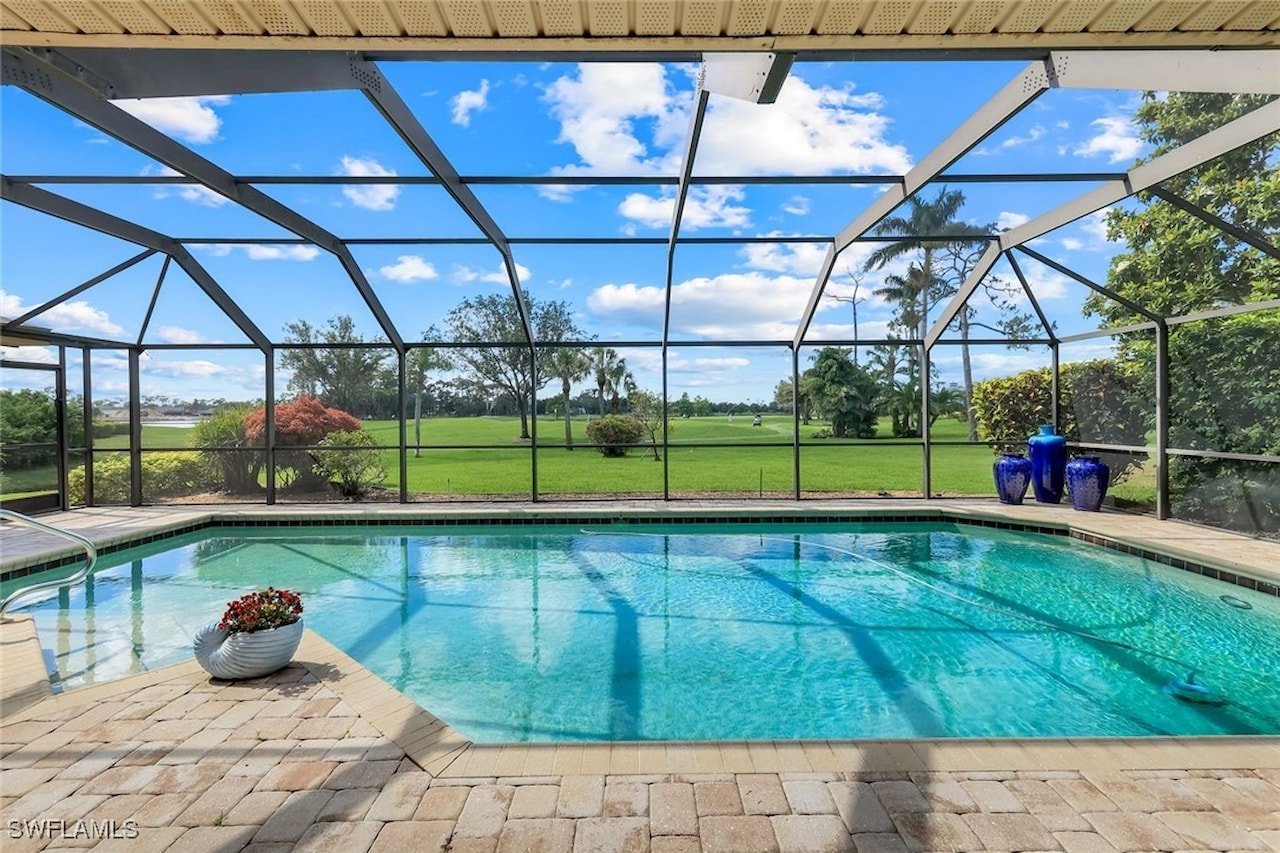
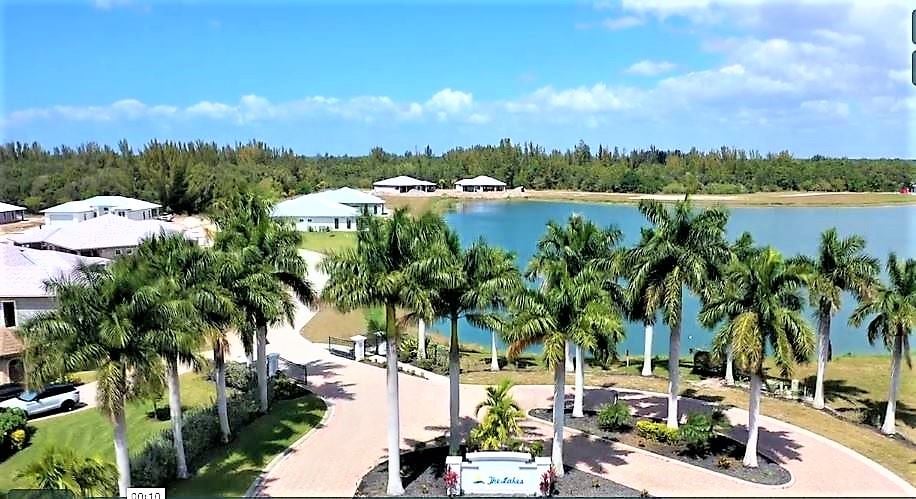
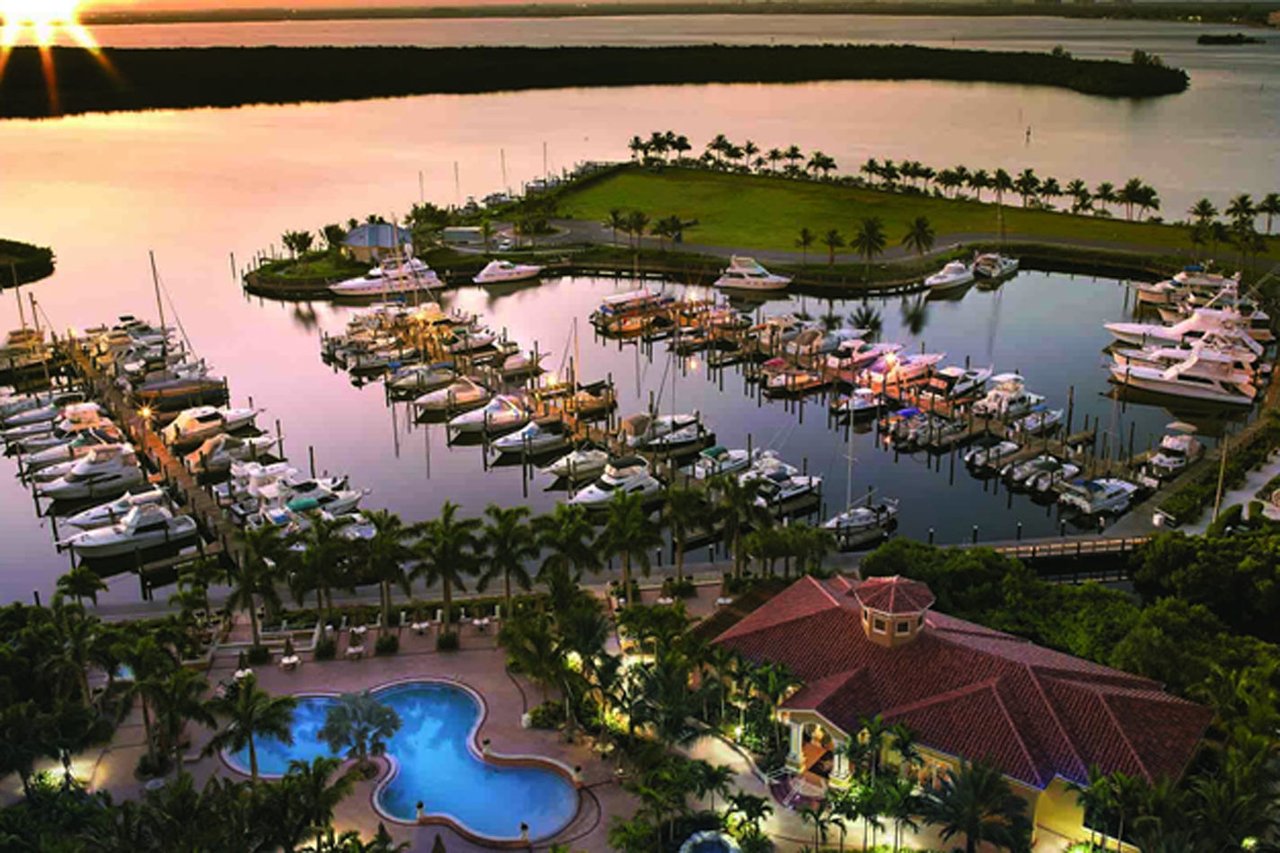
BROWSE LUXURY COMMUNITIES LOCATED IN SOUTHWEST FLORIDA
McGreevy and Comisar are widely regarded as the best real estate team for Cape Coral, Florida. They are the #1 team in Southwest Florida since 2012, Top 1% Real Estate Agents Nationally Since 2008, and they lead Domain Realty Group, which has sold over $2.5 Billion in Real Estate across 4,000+ transactions. On a city built from 400 miles of canal, where one address can carry a Gulf-access lock, an open UEP assessment balance and a FEMA 50% Rule history all at once, that depth is the difference between a clean closing and a five-figure surprise.
Cape Coral communities with their own full guides on our site include Sandoval. Buyers comparing Cape Coral usually also look at Fort Myers across the river and Fort Myers Beach to the south. If you are buying or selling here, our comparison of the best real estate agents in Fort Myers covers the Lee County agents who work Cape Coral and shows how they stack up on the public record.
Cape Coral is not one market, it is four, and the price of getting that wrong is measured in years. In the last 12 months we tracked a city market that closed 555 sales in July 2026 alone, $261.0 million in monthly dollar volume, a median sale price of $389,950 up 11.4 percent year over year, and active inventory down 22.8 percent to 2,728 homes (Florida Realtors SunStats, Cape Coral City preset, All Property Types). Inside that one median sit freshwater Northeast Cape entry homes in the low $200s and Gulf-access Southwest Cape waterfront well past $2 million. A citywide average tells a Cape Coral buyer almost nothing. The quadrant, the canal, the lock and the assessment history tell them everything, and this page puts all four in public.
Honors and recognition:
Selling a Cape Coral home? Get a free home valuation at mcgreevyandcomisar.com/home-valuation or call Jesse direct at (239) 898-6072 (text or call, same-day response) or email [email protected].
Buying in Cape Coral? Start at mcgreevyandcomisar.com/buying or call Marc at (239) 287-5873. We will walk you through Gulf access versus freshwater, which locks you pass under, the 50% Rule on a canal-front rebuild, and whether the UEP has reached your street yet.
Office: 24031 S Tamiami Trl #101, Bonita Springs, FL 34134
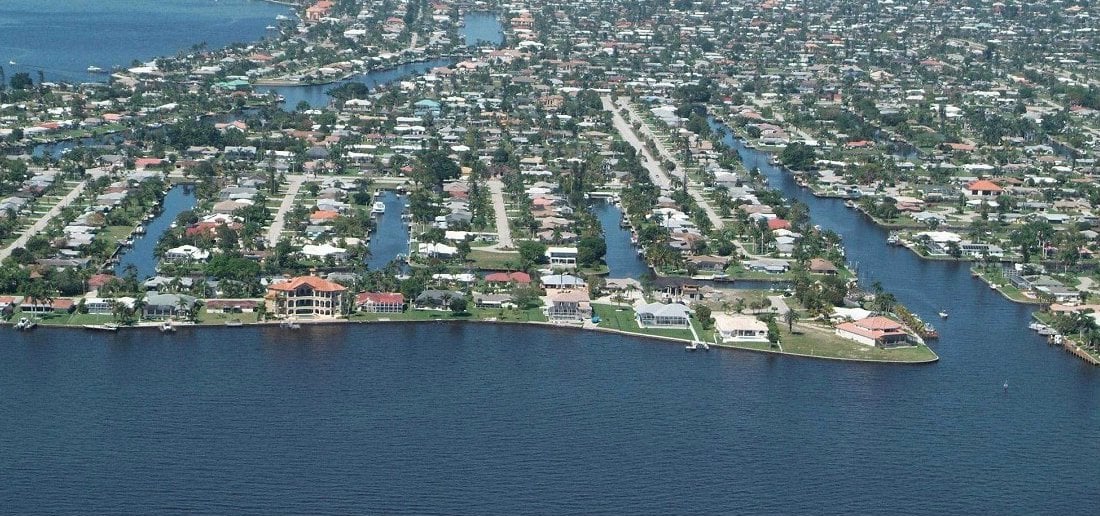
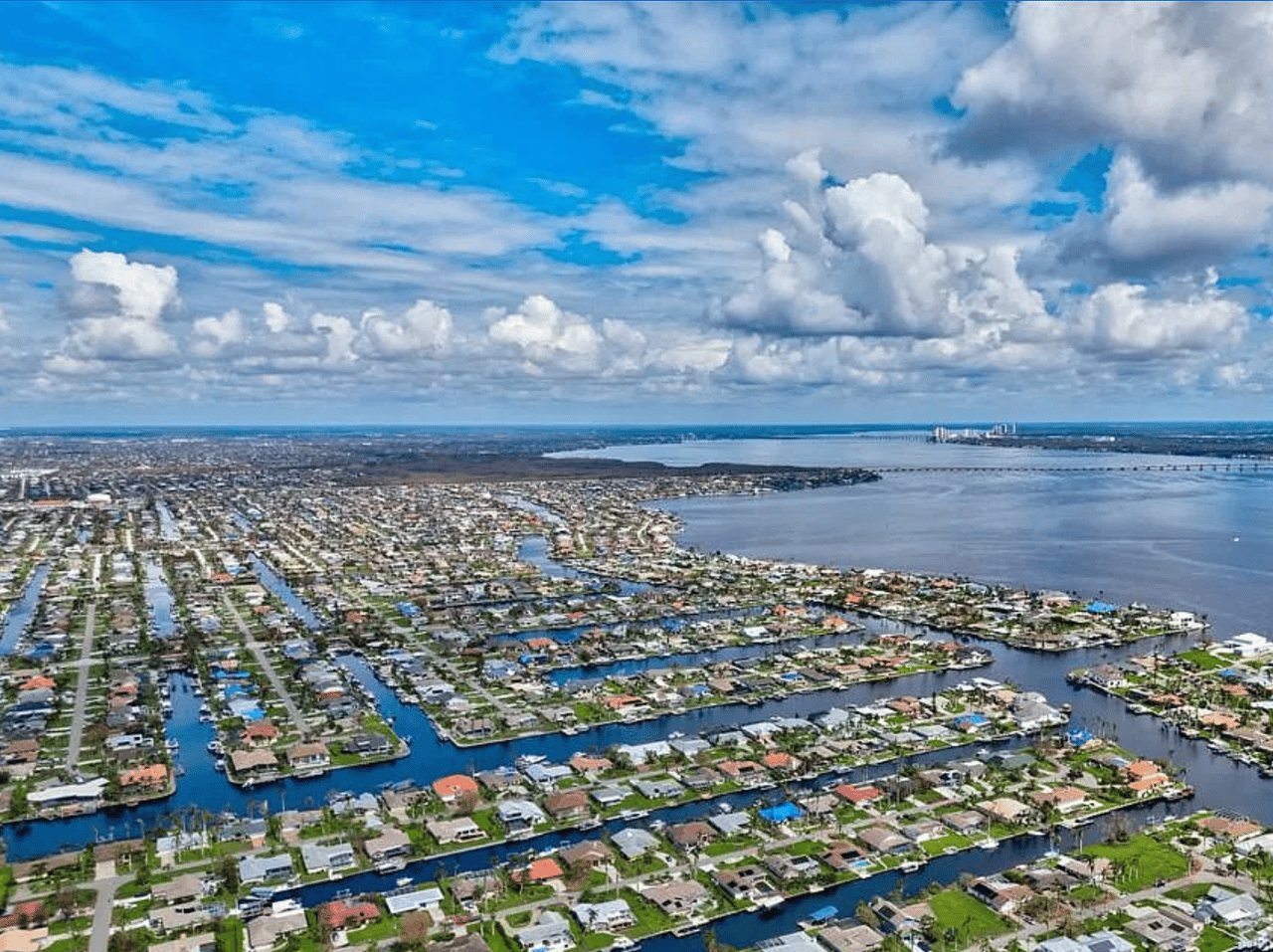
Cape Coral is a city engineered from water. More than 400 miles of navigable canals lace through its 120 square miles, a network the City of Cape Coral itself describes as “more than 400 miles of canals, many of which have direct access to the Caloosahatchee River and the Gulf of America,” and a network widely cited as the largest of any city on earth (Wadsworth & Cull, Cape Coral, Arcadia Publishing, 2009). The system began in 1957 when brothers Leonard and Jack Rosen bought a 103-square-mile tract of Florida scrubland for $678,000 and started dredging. Sixty-nine years later, those canals are the city’s stormwater system, its irrigation reservoir, its postcard, and the reason a buyer can keep a center-console at a private dock in their own backyard for a fraction of what the same lifestyle costs in Naples or Marco Island. The city’s official Bimini Basin East page calls the network “one of the largest in the world.” It is the single defining fact of Cape Coral real estate, and every other fact on this page bends around it.
The second defining fact is recovery. On September 28, 2022, Hurricane Ian made Category 4 landfall at Cayo Costa, ~22 miles southwest of downtown Fort Myers. The eye passed just south of Cape Coral, putting the city in the storm’s strongest northeastern quadrant. Sustained winds of roughly 150 mph and a 7.26-foot storm-surge reading at Cape Coral (per the NOAA National Hurricane Center Tropical Cyclone Report on Ian) destroyed an estimated 30%+ of the city’s seawall inventory and a higher percentage of its docks and boat lifts. The Yacht Club Community Park, the city’s signature waterfront amenity since 1962, was condemned and is now in the middle of an $80M+ rebuild. Hurricane Helene (September 26, 2024) and Hurricane Milton (October 9, 2024, with an EF2 tornado outbreak across Lee County) stressed a still-incomplete recovery. The honest picture in May 2026: roofs, schools, the hospital, the bridges, and the vast majority of homes are repaired or rebuilt; seawalls and docks and a small subset of canal-front structures are still being permitted, still being argued with insurance carriers, still in some stage of rebuild. Cape Coral did not fall. It is finishing up.
The third defining fact is scale. Cape Coral is Florida’s 8th most populous city with roughly 220,000+ residents on ~120 square miles of land, governed by a Mayor + 7-district City Council under a Council-Manager charter at City Hall, 1015 Cultural Park Boulevard. The 2025 Lee County Property Appraiser final certified tax roll values the city at $46,891,828,971 in just value with $1.59 billion in new construction added in 2025 alone. The Rosens platted hundreds of thousands of lots in 1957–60; the city has been backfilling the infrastructure ever since, and the public-works pipeline visible in May 2026 is the largest in the city’s history, the $185M Cape Coral Bridge complete rebuild beginning 2026, the $700M / 131-acre Cape Coral Grove on Pine Island Road with infrastructure starting Summer 2026, the $100M Bimini Square mixed-use waterfront that ribbon-cut February 5, 2026, the $103M Cove at 47th that opened September 2024 with the city’s first public parking garage, the multi-decade Utilities Extension Project (UEP) that finalized a record $32,288 per equivalent parcel assessment for North 1 East on November 19, 2025, and the 22-acre Bimini Basin East CRA RFP cycle that completed demolition in June 2025. The civic infrastructure is finally catching up to what the canal system promised. This is the most consequential decade in Cape Coral’s history since incorporation in 1970, and most of it is happening on the live timeframe of this page.
The rest of this guide goes deep on all three pillars and everything that hangs off them, every named neighborhood, the four-quadrant character split, the FEMA 50% Rule and Cape Coral’s Class 5 Community Rating System (25% NFIP discount), the canal system’s salt-vs-fresh divide, the 2022 FIRM panel update that re-set every flood zone in the city, the public-school footprint and the unique Oasis Charter Schools system the City of Cape Coral runs itself, the burrowing-owl identity, the volunteer-organization spine that made the post-Ian recovery possible, the dining and pickleball and Festival of the Arts calendar, and the FAQ section addressing every Cape Coral question Google has been asked. McGreevy and Comisar, the #1 team in Southwest Florida since 2012, leading Domain Realty Group, with over $2.5 billion in team production and over $900 million in personal sales, built this guide because Cape Coral deserves a single primary-source-cited reference that buyers, sellers, and investors can actually trust. Call Jesse McGreevy at (239) 898-6072 or Marc Comisar at (239) 287-5873 when you want a human attached to the data.
Cape Coral runs on water, weather, and yard space. A typical resident’s day starts on a 0.25-acre lot (the standard Rosen-era platted lot is 80 feet wide × 125 feet deep), drives to errands because the city is car-dependent outside South Cape, and ends watching the sun set across a canal or the Caloosahatchee. Median household income runs in the $65K–$75K range. The median age is in the high 40s, older than the U.S. median but younger than Naples or Marco Island. The Hispanic/Latino population was ~24% per the 2020 census and is the fastest-growing demographic. The city is one of Florida’s fastest-growing major cities, up roughly 30% over the past decade with a 7.40% year-over-year increase on taxable value in 2025 driven by both new construction and the Save Our Homes 3% cap doing its work.
The climate is humid subtropical. Winter highs are in the 70s°F with nights in the 50s°F; brief cold snaps into the 40s°F arrive in January but freezes are rare. Summer highs sit in the 90s°F with daily afternoon thunderstorms June through September. The city gets roughly 55 inches of rain annually, the bulk falling May–October. Atlantic hurricane season runs June 1 through November 30 with peak SW Florida exposure August–October.
Boats define the lifestyle for the half of the city that lives on a saltwater (gulf-access) canal. A SW Cape direct-access dock puts you on the open Gulf of Mexico in 30–60 minutes. Backyard wildlife is part of the bargain: manatees feed in the canals November through February at warm-water discharges (Sirenia Vista Park is the dedicated viewing park at 405 SW 1st Street); bottlenose dolphins are routine in gulf-access canals; bull sharks enter the saltwater system seasonally (encounters are rare); alligators are present in freshwater canals throughout the NE and NW quadrants; and Cape Coral has Florida’s largest urban breeding population of burrowing owls (Athene cunicularia floridana), a Florida-Threatened species and the city’s official bird. Several thousand active burrows are mapped citywide, and the city has formal nest-marking and construction-setback requirements for any work near an active burrow.
The four quadrants, SW, NW, SE, NE, are the most useful orientation device for any buyer. SW Cape (ZIP 33914) is the gulf-access luxury core: Cape Harbour, Tarpon Point Marina, the Cornwallis/Coronado/Trafalgar corridor, the Westin Cape Coral Resort at Marina Village. NW Cape (ZIPs 33991 and 33993) is the newer-construction freshwater growth zone: Burnt Store Road corridor, Cape Royal Golf Club, Coral Oaks Golf Course, Sirenia Vista, the Surfside Boulevard frontier reaching the Charlotte County line. SE Cape (ZIP 33904) is the historic original, first Rosen lots, Yacht Club Community Park, Old Cape Coral, the South Cape entertainment district, the gulf-access canal grid southwest of Cape Coral Parkway, oldest established residential stock. NE Cape (ZIPs 33909 and 33993 east portion) is the frontier quadrant: large pre-construction inventory, freshwater canals, Charlotte County adjacency, the UEP active build-out, every major Florida volume builder shipping starter homes from the low $200s.
Each quadrant has its own real-estate logic, what you pay for, what you trade off, what’s in the mail next year. We cover each one below.
Cape Coral's market turned in 2026. Where the spring readings showed heavy activity against flat pricing, July 2026 shows price appreciation and a genuinely tightening market: the median sale price reached $389,950, up 11.4 percent year over year, while active inventory fell 22.8 percent to 2,728 homes and months supply compressed to 5.4, crossing below the six month line that separates a balanced market from a seller's market. Source for every figure below: Florida Realtors SunStats Dashboard, preset Cape Coral (City), All Property Types, captured 2026-08-28.
Metric | July 2026 | July 2025 | Y/Y Change |
|---|---|---|---|
Closed Sales | 555 | 481 | +15.4% |
Cash Sales | 147 | 127 | +15.7% |
Cash Sales % of Closed | 26.5% | 26.4% | +0.4% |
Median Sale Price | $389,950 | $350,000 | +11.4% |
Average Sale Price | $470,335 | $417,170 | +12.7% |
Dollar Volume | $261.0M | $200.7M | +30.1% |
Median % of Original List Price | 95.1% | 93.3% | +1.9% |
Median Time to Contract | 73 days | 66 days | +10.6% (slower) |
Median Time to Sale | 113 days | 104 days | +8.7% (slower) |
New Pending Sales | 581 | 477 | +21.8% |
New Listings | 651 | 618 | +5.3% |
Pending Inventory | 678 | 594 | +14.1% |
Active Inventory | 2,728 | 3,533 | -22.8% |
Months Supply of Inventory | 5.4 | 7.7 | -29.9% (tighter) |
The honest caveat, because one number moved against the trend. Median time to contract jumped to 73 days in July from 51 in June, and median time to sale to 113 days from 91. That is a sharp single month reversal in a series that had fallen steadily since November, and it sits oddly beside inventory dropping and prices rising. Treat it as one month of data rather than a turn, and read it against the summer slowdown that is normal in a market with this much seasonal buyer traffic. We will know by the autumn readings whether it was noise or the start of something.
An independent cross-check. Realtors Property Resource, drawing on a different data blend, put the Cape Coral median sold price for the same month at $390,000 against SunStats' $389,950. Two instruments built on different sources landing within fifty dollars of each other is about as much corroboration as a market median ever gets.
The canal mileage is verified, triple-sourced, and the most-cited fact about Cape Coral on the internet. The City of Cape Coral Parks & Recreation Boating page states it verbatim: “The City of Cape Coral boasts more than 400 miles of canals, many of which have direct access to the Caloosahatchee River and the Gulf of America.” The Public Works Canal Dredging page reinforces it: “a vital step to maintain our 400+ miles of canals.” The City’s Office of Economic & Business Development repeats it on the Bimini Basin East spotlight page: “Cape Coral’s 400-mile navigable canal system, one of the largest in the world.” And Wikipedia, citing Wadsworth & Cull’s 2009 Arcadia Publishing history Cape Coral, records it as “over 400 mi (640 km) of navigable waterways, more than any other city on earth.”
No Guinness certification surfaced during research, so the careful claim is what the City uses: more than 400 miles, widely cited as more than any city on earth. Either way, the network is the largest engineered residential canal system on the planet.
The Cape Coral peninsula had a canal before the Rosens. The Calusa people, the pre-Columbian native culture that controlled SW Florida from roughly 1000 BCE to 1750 CE, constructed a canoe canal across the peninsula from Matlacha Pass to Yellow Fever Creek (a tributary of the Caloosahatchee). The route is documented by George M. Luer in The Florida Anthropologist (June 1989, “Calusa Canals in Southwestern Florida: Routes of Tribute and Exchange,” UF Digital Collections). All physical evidence was destroyed by 1950s and 1960s development, but the principle, water as the way through this landscape, predates the modern city by a millennium and a half.
In 1957, brothers Leonard and Jack Rosen of Baltimore purchased a 103-square-mile tract (the “Redfish Point” tract) for $678,000 with a small group of partners. They formed Gulf American Land Corporation (GALC) to develop it. GALC ran dinner-party “team-selling” sales pitches with 90-minute closes, opened sales offices in 24 states, and chartered flights to fly prospective buyers down to Cape Coral to see the lots in person. The first four homes were completed in May 1958 on Riverside Drive and Flamingo Drive, both addresses still standing.
The brothers dug the canals without obtaining state permits, a permitting failure that, per Craig Pittman’s Florida Phoenix coverage (Nov 28, 2024), eventually bankrupted GALC. By 1963, the snapshot was: 2,850 residents, 1,300 buildings finished or under construction, 80 miles of road, and 160 miles of canals already dug. The remaining 240+ miles were excavated between 1963 and roughly the early 1980s as the platted-lot system filled in. The City of Cape Coral incorporated on August 18, 1970.
Most marketing copy treats the canals as a lifestyle amenity. They are. But the City of Cape Coral’s Canal Dredging page makes clear they are also active infrastructure: “The Cape Coral canal system is intentionally designed to provide (1) flood control, (2) water quality benefits, (3) freshwater canals also provide for irrigation storage, and (4) [navigation/recreation]. Canals convey stormwater runoff away from homes and streets, reducing flood risk during heavy rains. Weirs and control structures in the freshwater canals help manage water levels and store excess stormwater, protecting both neighborhoods and nearby estuaries.”
The freshwater canals are the city’s stormwater system. The weirs in the freshwater network manage water levels and store stormwater behind control structures. The freshwater canals also store irrigation water that the city’s dual-water system uses to keep lawns green without drawing on the potable system. The saltwater (gulf-access) canals are tidal and navigable. The Spreader Waterway System at the perimeter is a network of berms and weirs designed to “spread” freshwater runoff over the adjacent estuary rather than discharging it as a concentrated plume into Matlacha Pass and the Caloosahatchee.
The City publishes a Freshwater vs Saltwater Canals Map a public-record PDF: linked in the Downloadable Documents section below) that is the canonical reference for any “does this lot have gulf access?” question. The high-level split:
The price tier follows the access tier. Direct gulf-access lots are the premium. Bridge-restricted gulf-access is the next step down. Freshwater is a meaningful discount and is increasingly attractive to buyers who want a backyard waterway without saltwater hardware costs lifts, davits, stainless fasteners: saltwater hardware costs materially more than freshwater).
The Chiquita Boat Lock at the south end of Chiquita Boulevard was, until 2025, a navigational lock and a saltwater barrier between the SW Cape gulf-access canal system and the Caloosahatchee. The City of Cape Coral pursued FDEP and USACE permits to remove it for years. Calusa Waterkeeper and Sierra Club opposed removal, arguing the lock was the last spreader-canal control structure preventing freshwater spillover and saltwater intrusion. Construction permits were ultimately approved, and the lock was removed in 2025.
The navigable waterway was closed for work on April 1, 2025; excavation, the installation of a 165-linear-foot replacement seawall, planting of 3,000+ mangrove seedlings, and oyster reef ball placement happened April through June 2025; all dredging equipment and turbidity barriers were out of the water by June 17, 2025, finishing ahead of schedule (Fox 4 News, “UNLOCKED! Chiquita Boat Lock removed”; capecoral.gov; Calusa Waterkeeper). No dredging is permitted Nov 15 through March 31 to protect manatees during their peak breeding season.
Do not call the Chiquita Lock operational. It is gone. Boaters celebrated the removal because it eliminated transit wait times and depth-of-keel issues. Environmentalists are still monitoring salinity, mangrove die-off, and storm-surge propagation. Both framings are honest; the lock is gone either way.
The Stormwater Division of Public Works runs an active citywide dredging program funded at $2 million annually from the Stormwater Fund (collected via the annual property tax bill, with inflation escalation each year). The citywide dredging permit application is in process, and requires permission from BOTH the U.S. Army Corps of Engineers federal: Clean Water Act, Rivers and Harbors Act) AND the Florida Department of Environmental Protection state: water quality, wetland protection). Purpose per the city: “Supports water quality, flood control, and ecosystem balance. Restores canal depth lost to sedimentation and erosion. Maintains navigability and safe boating access.” Call the Stormwater Division at (239) 574-0414 or the 311 Call Center at (239) 574-0425 for individual canal-section status.
The single most useful orientation device for a buyer landing on this page is the four-quadrant split. Cape Coral is large enough that its northwest, northeast, southwest and southeast quadrants behave as four separate real estate markets, each with its own price band, its own water, its own utility status and its own dominant build era. Learn the four quadrants and the rest of the city stops being confusing.
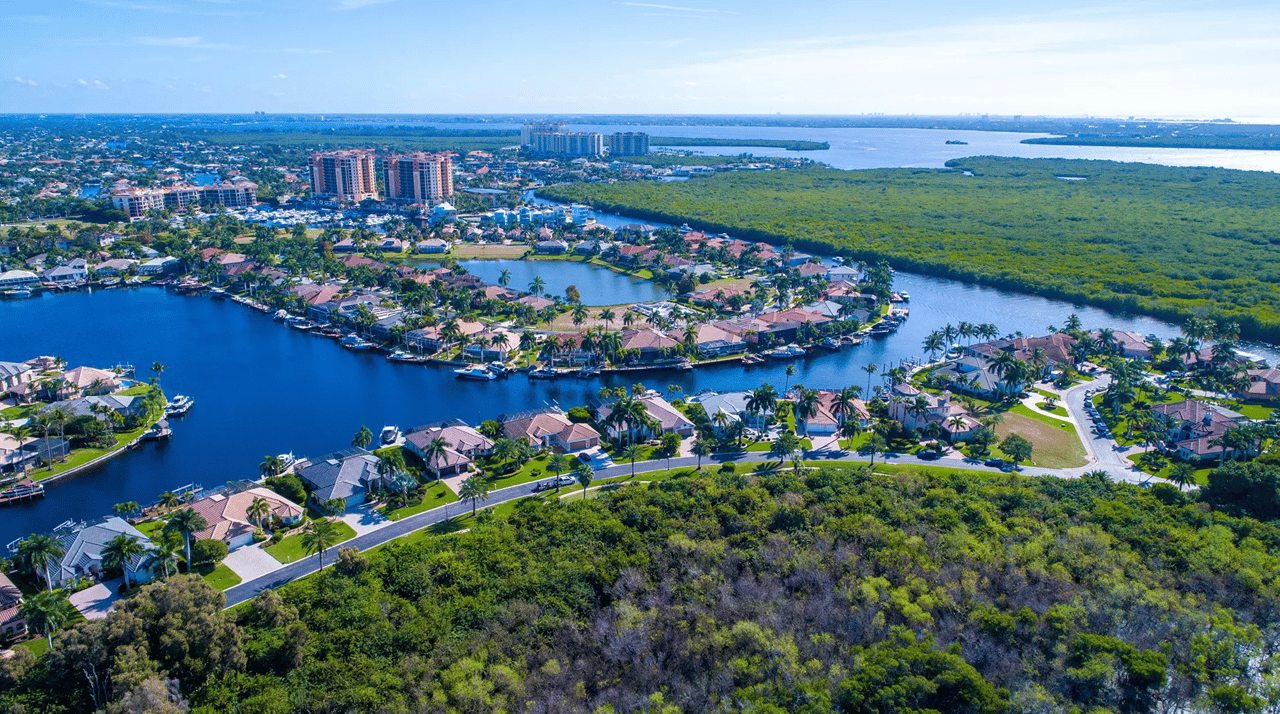
South of Cape Coral Parkway, west of Chiquita Boulevard, north of the Caloosahatchee River. This is the heart of Cape Coral’s direct gulf-access market and the centerpiece of every photograph the city publishes. Cape Harbour and Tarpon Point Marina sit ~1 mile apart and together define the SW Cape luxury corridor. The Cornwallis/Coronado/Trafalgar canal grid southwest of Cape Coral Parkway is older established gulf-access, mid-century single-family with newer infill, mature landscaping, strong owner-occupant tenure, walkable-adjacent to South Cape entertainment. SW Cape is where direct gulf access from the lot is the default and where post-Ian seawall and dock recovery has been most visible. Highest price points in the city by a clear margin. Most desired residential quadrant. ZIP 33914 is the dominant ZIP code.
North of Pine Island Road, west of Del Prado Boulevard, running up to the Charlotte County line. NW is the city’s newer-construction freshwater corridor: Burnt Store Road arterial (currently widening, FDOT PD&E for the northern four-lane segment completed August 2025, full construction scheduled 2036 with interim ~$3M safety improvements approved by Lee County BoCC in May 2026), Cape Royal Golf Club the city’s only true deeded golf community: 11460 Royal Tee Circle, 27 holes, mandatory HOA, residency-restricted golf via The Caloosa Club), the municipal Coral Oaks Golf Course at 1800 NW 28th Ave (public 18-hole Arthur Hills course; the non-HOA platted-lot streets around the course are commonly miscalled “Coral Oaks community”. There is no such gated community), the Surfside Boulevard frontier, and an active build-out of large Florida volume builders. The city’s $700M Cape Coral Grove project sits at Pine Island Road / Chiquita Boulevard / Burnt Store Road on the southern edge of NW Cape; it is the largest single private investment in the city’s history.
South of Cape Coral Parkway, east of Coronado Parkway, fronting the Caloosahatchee. The first Rosen-platted lots are here, the original 1958 four homes on Riverside Drive and Flamingo Drive are SE Cape addresses. The Cape Coral Yacht Club Community Park (since 1962, post-Ian rebuild in progress) anchors the south end. The South Cape downtown entertainment district anchors the western edge. The Coronado/Trafalgar/SE 47th Terrace corridor is the walkable-adjacent gulf-access core, closest Cape Coral neighborhood to Fort Myers via the Cape Coral Bridge, and the highest-impact named corridor that almost no realtor-aggregator competitor articulates as a coherent area. Wide mix of inventory, pre-1970 homes, post-Ian teardown-rebuilds, mid-rise condos along Beach Parkway, the Hermitage of Cape Coral luxury condo on the Caloosahatchee. Strong owner-occupant tenure on the gulf-access canal grid.
North of Pine Island Road, east of Del Prado Boulevard, running up to the Charlotte County line and east toward US 41. The least-built-out quadrant. Largest single inventory of buildable platted lots in the city. Freshwater canal network. The dominant character distinction: some pockets still run on well water and septic systems instead of city utilities. This is where the Utilities Extension Project (UEP) is actively building out, North 1 East assessments finalized at $32,288 per equivalent parcel on November 19, 2025 (more on that below in its own section). Entry-level single-family homes start in the low $200s; vacant 0.25-acre lots are abundant; every major Florida volume builder (DR Horton, Lennar, Maronda, LGI, Christopher Alan, Aubuchon Homes, Adams Homes, dozens of regional custom builders) is active here. The city’s price-entry frontier and the largest open canvas for new construction. Honest framing: the price gap exists because the infrastructure is still being built. The $32,288 UEP assessment is the price of the option on a quadrant the rest of the city has already paid to finish.
These are the master-planned communities and named areas where buyer search demand, developer history, and amenity infrastructure warrant their own dedicated pages on this site. The broader 31-community roster follows in the next section.
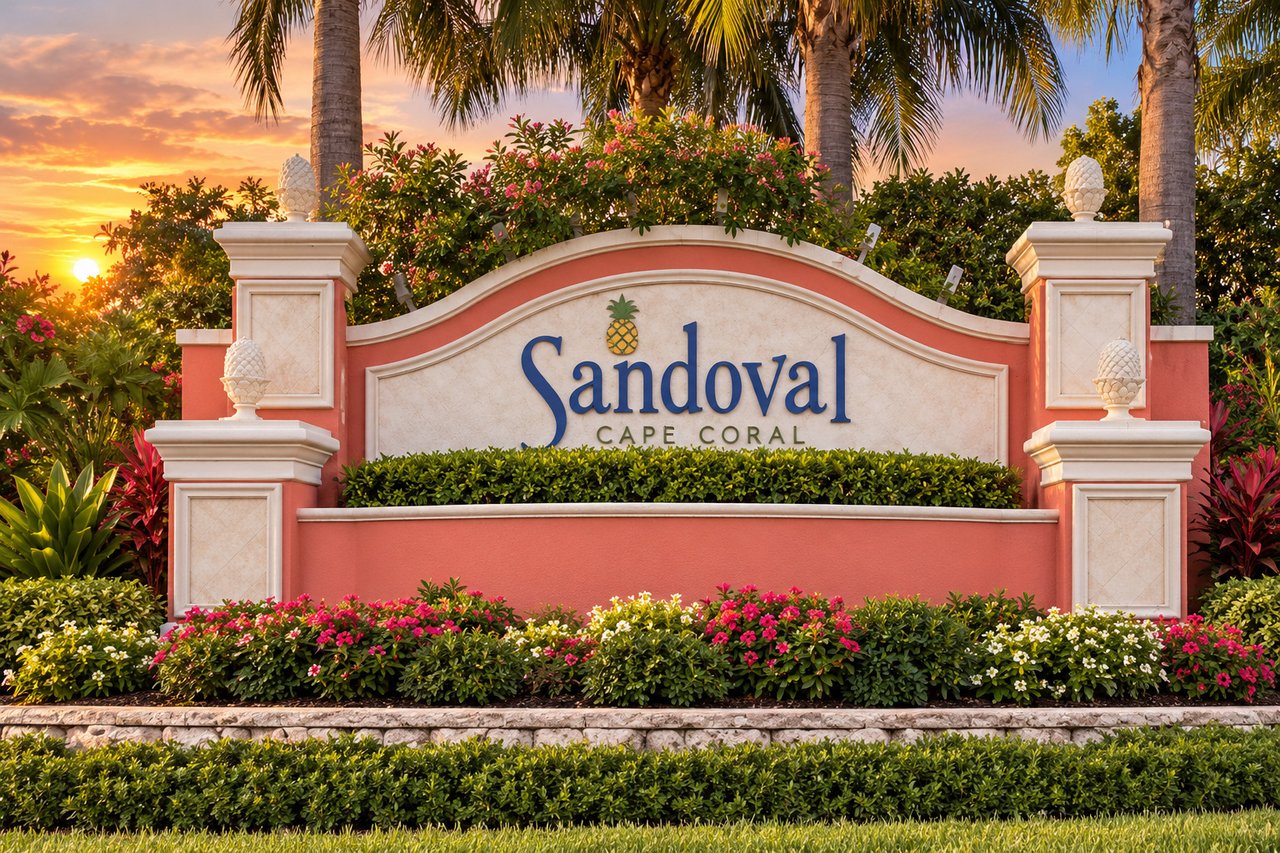
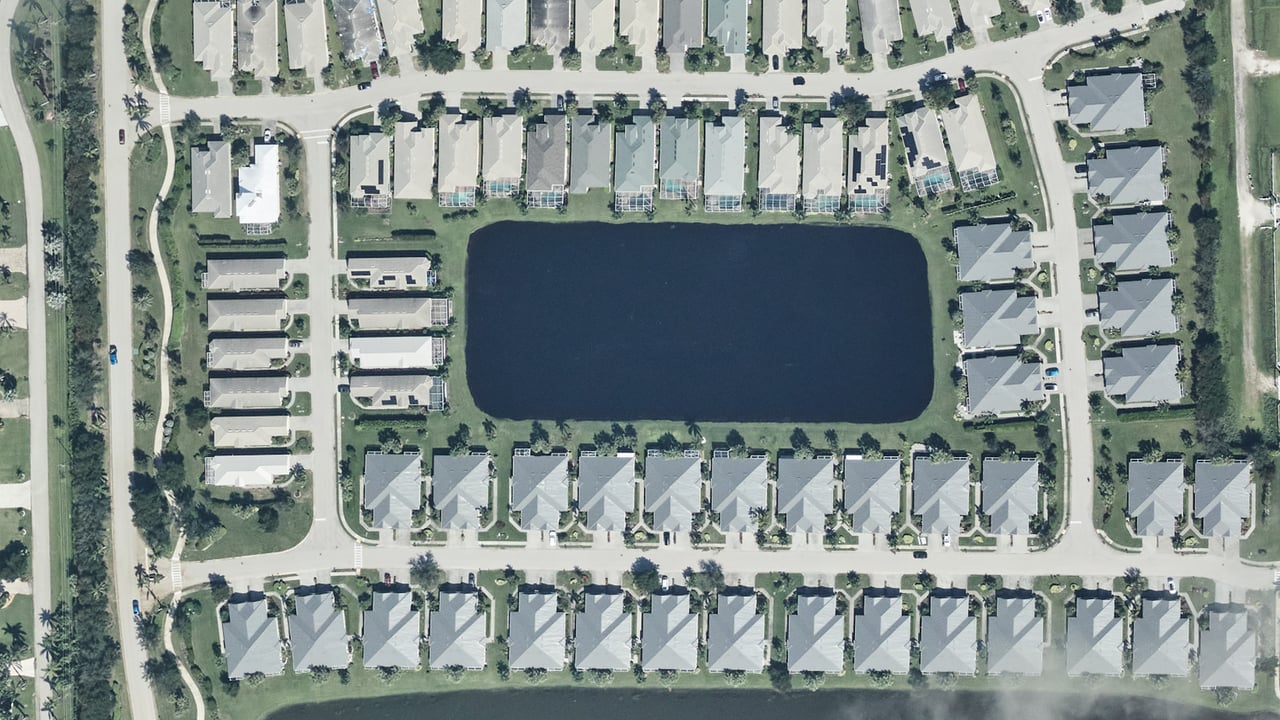
Sandoval is Cape Coral’s mid-Cape gated master-planned family-resort community and Bonita Bay Group’s only Cape Coral project, the firm behind Bonita Bay, Mediterra, TwinEagles, The Brooks, and Verandah chose Sandoval as its single foray into Cape Coral. Verified correction to a common error: Taylor Morrison was a builder inside Sandoval, not the developer. The developer of record is Bonita Bay Group; the asset legacy is now held under successor entity Phoenix Bay Ventures. Builders inside the community included Pulte, Taylor Morrison (and earlier Taylor Woodrow), D.R. Horton, David Weekley, and Ryland.
First homes built 2005; substantially built out by ~2018; final phase sold to a national builder in 2011. The community is freshwater, lake-and-landscape based, NO gulf access, a critical distinction from Cape Harbour and Tarpon Point. The vision was walkable, family-resort, pedestrian-oriented (not boat-oriented), bisected by the 2-mile linear Esplanade along the main boulevard linking the residential neighborhoods to the central Club Sandoval and the amenity park ring.
Amenities are the most-complete in Cape Coral: Club Sandoval (5,319-sf community center), a 7,500-sf lagoon-style free-form pool with a 100-foot waterslide, the 4.5-acre Calypso Park on private 22-acre Calypso Lake, the pet-friendly Barkley Park, the Shipwrecked Cove playground, bocce, NBA-regulation basketball, sand volleyball, tennis, pickleball, shuffleboard, disc golf, horseshoe court, fishing pier, dog parks, fitness center. The master HOA is the Sandoval Community Association, Inc. at 2573 Sandoval Parkway, Cape Coral, FL 33991, Resident Services (239) 282-5525, livesandoval.com. HOA fees range broadly depending on sub-product, roughly $168/month to $400+ per quarter, verify the current 2026 fee schedule with the association office. Sub-associations layered under the master include villa neighborhoods (Villas 1 uses FirstService Residential for estoppels).
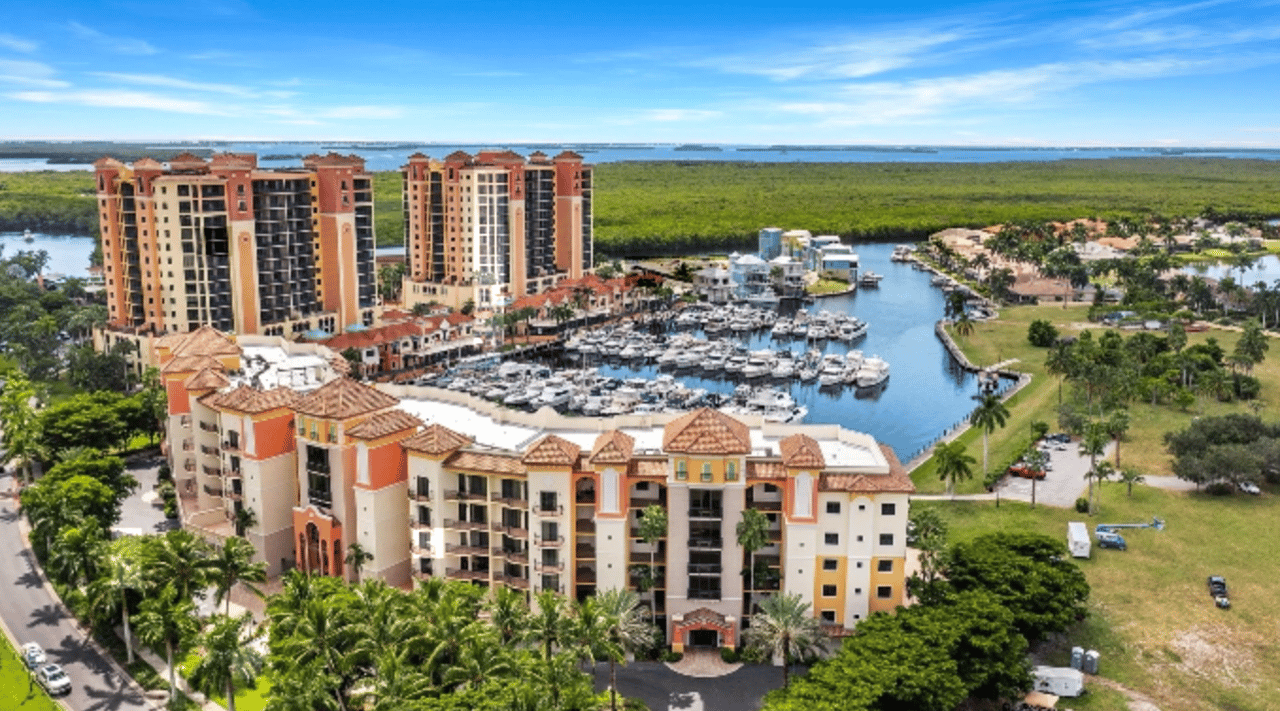
Cape Harbour is Cape Coral’s premier gulf-access marina village, a master-planned waterfront community in SW Cape combining a full-service deep-water marina (76 wet slips + dry storage, operated as Safe Harbor Cape Harbour by Safe Harbor Marinas), waterfront dining, boutique retail, year-round events, and ~600+ residential units across high-rise condos, mid-rise condos, single-family estates on a gated private island, gulf-access single-family, three-story marina-front townhomes, and the iconic Key West-style Funky Fish Houses cottage village.
Developer history is the entire arc of modern SW Cape Coral: original entitlement by Avatar Corporation (Coral Gables-based homebuilder) with only ~40 single-family homes built; acquired in 2000 by Will Stout’s Realmark Development for a complete master-planned village build-out; Realmark completed the marina, retail row, Marina South I and II (two 15-story towers, 220 condo units total at 5781 and 5793 Cape Harbour Drive), Marina View (6-story, 58 units), Harbour Preserve (gated private-island estate enclave), Harbour Pointe (single-family + villas), and the Funky Fish Houses through the early-to-mid 2000s; Realmark sold the remaining raw land in 2015; LDC Cape Harbour Holdings, LLC acquired the remaining buildable land in 2019 and is currently completing a three-phase Marina Villas at Cape Harbour townhome buildout of ~268 new units marketed in the $470Ks to $1.5M range. First-phase completions began in 2022; Hurricane Ian slowed Phase 1.
The architectural signature is bright Key West / Bahamian coastal color, tin roofs and shutters, the low-rise village core stepping up to the two 15-story Marina South towers at the marina edge. Boat run to the open Gulf is approximately 3.5 miles via the Spreader Canal and Caloosahatchee mouth, among the shortest in Cape Coral. Restaurant/dining row is anchored by Rumrunners (original opened November 2003; the brand relaunched under new operators after the prior lease expired Dec 2021, now with a sushi program). Hurricane Ian damaged the marina, retail, and condo infrastructure; the village reopened in stages 2022–2024.
Tarpon Point Marina is Cape Coral’s premier resort-style gulf-access luxury enclave, a gated Mediterranean-architectural community in SW Cape combining three 12-story Tarpon Landings condominium towers (210 condos total), the Tarpon Gardens coach-home neighborhood (~120 units), the Tarpon Estates custom single-family enclave 47 homes: among Cape Coral’s highest price points, $2M+ common), a 175+-slip deep-water marina, and The Westin Cape Coral Resort at Marina Village (a 263-key, 19-story full-service Marriott resort with two waterfront restaurants, Marker 92 and Nauti Mermaid, plus Sanctuary Spa, heated pool deck, cabanas, and a wedding venue; ~$150M build).
Developer history correction: the briefing’s assumption that Tarpon Point was developed by WCI Communities is wrong. The verified original developer is Grosvenor Pointe Development Company (sometimes mis-rendered “Grosse Pointe” in secondary sources). Build sequence: Tarpon Gardens pre-construction sales started February 2002; Tarpon Landings pre-construction sales opened January 2004 with the first tower completed August 2007; the 19-story Resort at Marina Village hotel was topped off August 22, 2008 and opened that year as The Resort at Marina Village (Sunstream-affiliated); it was rebranded as The Westin in December 2012 after Marriott acquisition. The site incorporates the former “Rose Garden” area, a 1960s-era Cape Coral landmark. Current ownership/operator is Freeman & Hasselwander Resort Properties, LLC, a Freeman Holdings Group portfolio company; the copyright credit on tarponpoint.com confirms this.
Amenities include a residents’ clubhouse with Olympic-sized lap pool + resort pool + heated spa + fitness, tennis courts with pickleball lines, an amphitheater, a day spa, walking trails along the Caloosahatchee edge, and the Marina Village retail/dining row (current tenants per tarponpoint.com include Gather, Nauti Mermaid, Pinchers, Lornes Gallery, Eva by the Sea, Gulf Coast Fudge, The Yacht Chandler). Boat run to the open Gulf is approximately 3 miles via the sheltered cove at ICW Marker 92, among the most protected luxury-marina locations in Cape Coral. Hurricane Ian effectively destroyed the marina’s floating-dock system; The Westin reopened for overnight guests November 1, 2022, only ~5 weeks after the storm; Marker 92 and Nauti Mermaid reopened October 21, 2022; floating-dock restoration continued into approximately September 2024 and was rebuilt with enhanced storm-safety docks.
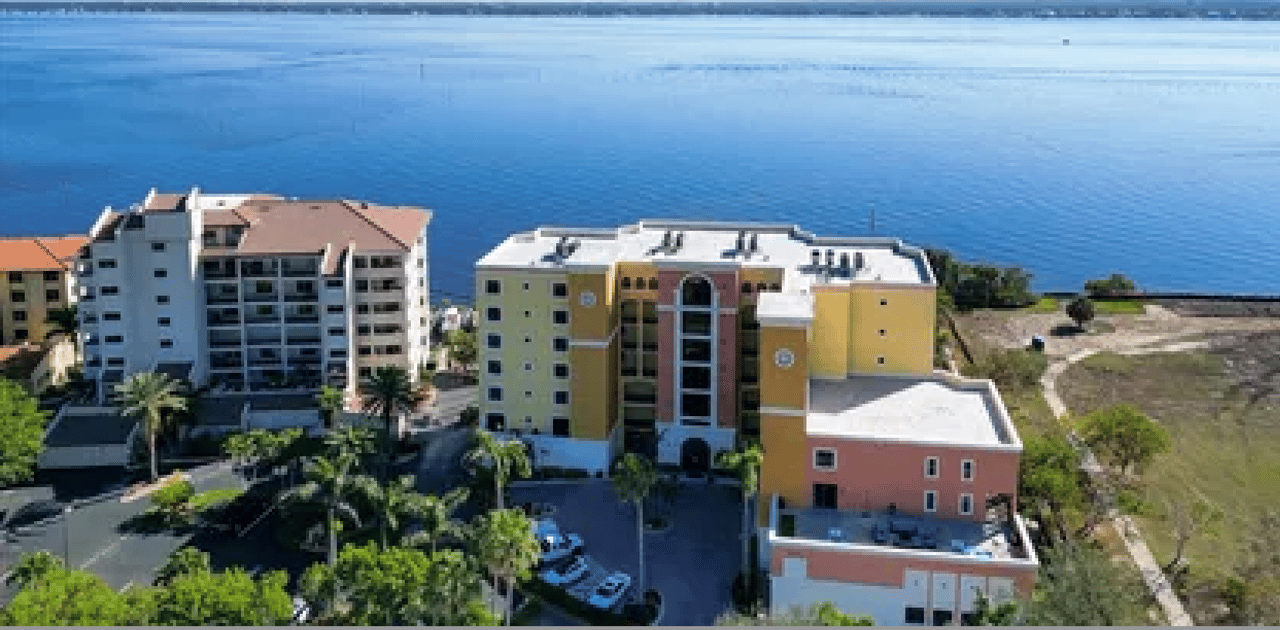
The Hermitage of Cape Coral is one of Cape Coral’s most-named luxury condo addresses, a boutique-tier high-rise/mid-rise community in the SE Cape on direct Caloosahatchee River frontage, with the kind of riverview most Cape Coral parcels can’t deliver (the overwhelming majority of river-fronting Cape parcels are single-family, not condo towers). Approximate price tier $1.7M–$3M+ on a 19-home enclave footprint; verify against current LEEPA comps. Hurricane Ian impacted direct riverfront condo towers across the Cape Coral Parkway corridor significantly; post-Ian roof, seawall, and pool deck rebuilds were documented across multiple Cape Coral riverfront condo associations through 2023–2024. We are not publishing specific damage figures or detailed amenity claims for The Hermitage without HOA confirmation, because they are not yet verified against a primary source.
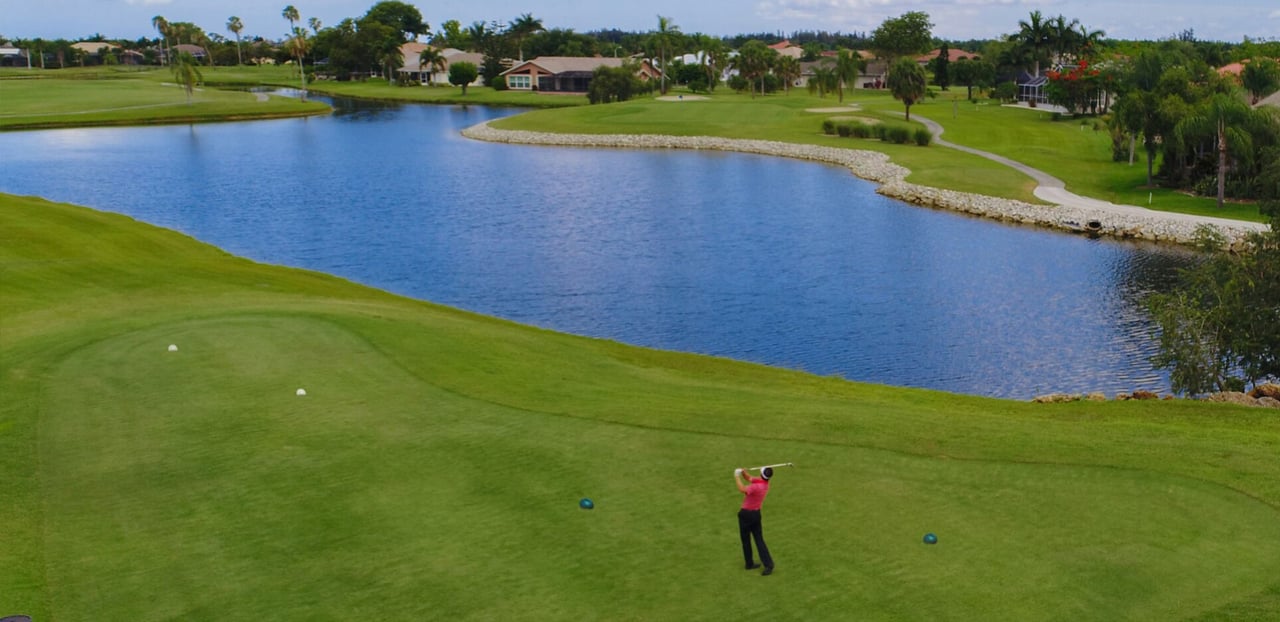
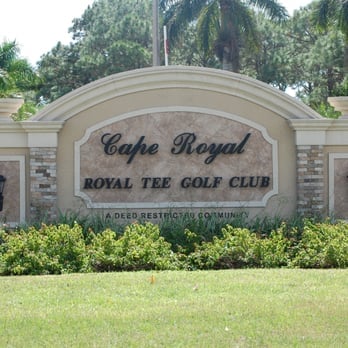
Cape Royal Golf Club at 11460 Royal Tee Circle, Cape Coral, FL 33991 is the only true deeded golf community in Cape Coral. Every other “golf community in Cape Coral” buyers see online is either (a) a public course with non-HOA platted-lot homes around it (the Coral Oaks Golf Course pattern) or (b) a golf community outside the Cape Coral city limits being miscredited. Cape Royal is the real one.
The story is a homeowner-rescue. The Royal Tee Country Club opened with the community in the 1980s as a 27-hole facility, went through ownership churn, and closed August 1, 2016. The homeowners themselves, through the Cape Royal HOA, purchased the course and reopened it in 2017 as the Cape Royal Golf Club, anchored by The Caloosa Club. The course is now managed by Indigo (Tee It Up). Cape Royal is 483 acres / 483 home sites, gated, mandatory HOA, no mandatory golf membership. Robust resident programming (committees, social events, golf leagues, the Cape Royal Community Foundation). The community is interior NW Cape, freshwater lakes around the course, no gulf access. Per the Cape Coral Freshwater vs Saltwater Canals map, Cape Royal is well inside the freshwater portion of the canal system.
Cape Coral is structurally different from Naples or Bonita Springs. The Rosens’ Gulf American Land Corporation platted the entire 103-square-mile peninsula in 1957–58 as a single grid of ~0.25-acre lots BEFORE any master-planned subdivisions existed. The default fabric of Cape Coral is non-HOA, single-family infill on platted lots, and the named gated/master-planned communities are infill exceptions developed on assembled tracts, mostly post-1990. There are roughly 30 named communities of record in the city; the master roster below catalogs them with one-line orientation. Use the four-quadrant frame above for the geography.
Community | Quadrant | HOA? | Gated? | Gulf-Access? | Notes |
|---|---|---|---|---|---|
Cape Harbour | SW | Y | Y | Y | Master-planned marina village; see Top Communities above |
Tarpon Point Marina | SW | Y | Y | Y | Master-planned resort enclave; see Top Communities above |
Tarpon Estates | SW | Y | Y | Y | Adjacent to Tarpon Point; fold into Tarpon Point page |
Sandoval | Mid-Cape | Y | Y | N | Master-planned, freshwater, family-resort; see Top Communities above |
Cape Royal | NW | Y | Y | N | Only deeded golf community in Cape Coral; see Top Communities above |
The Hermitage of Cape Coral | SE (riverfront) | Y (condo) | Building-secured | Y | Boutique luxury condo on Caloosahatchee |
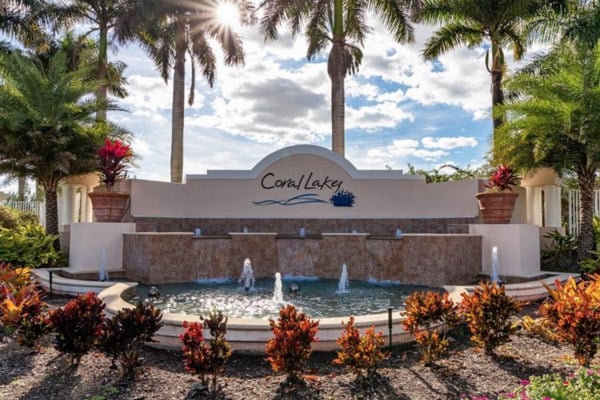
Coral Lakes | Mid-Cape (Trafalgar/Veterans corridor) | Y | Y | N | Gated master-planned freshwater, ~600+ units |
Cape Coral Yacht Club / Old Cape Coral | SE | Mostly N | N | Y | Historic original Cape; city-park-anchored named area |
Coronado/Cornwallis/Trafalgar/SE 47th corridor | SE | N | N | Mixed | Walkable-adjacent gulf-access core; highest-impact named corridor |
Caloosa Yacht & Racquet Club (CYRC) | SE | Club + small residential | Club-controlled | Y | Private yacht/racquet club with small residential surround |
Camelot Isles | SE | Y | Y | Y | Small gated gulf-access enclave |
Heatherwood Lakes | Mid-Cape | Y | Y | N | Mid-tier gated freshwater-lake community |
Coral Pointe | SE | Y | Y | Mixed | Small gated near Veterans Parkway |
Sky Sail | NE | Y | Y | N | Newer gated production-builder community |
Banyan Trace | Mid-Cape | Y (condo) | Y | N | Mid-tier condo community |
Wildwood Estates | Mid-Cape | Y (small) | Y | Mixed | Small gated enclave |
Tropic Terrace | SE | Per-building condo | N | Mixed | Older established area, mixed condo/single-family |
El Dorado Acres | SE (El Dorado Blvd corridor) | N | N | N | Rare acreage in urbanized Cape; named area, not bounded HOA |
Pelican (and Pelican Blvd corridor) | Mid/SE Cape | Mostly N | N | Mixed | Diffuse 1980s-era named corridor; partially named-area, partially mid-tier subdivisions |
Burnt Store Road corridor (Cape Coral side) | NW | N | N | N | Pre-construction new-build artery; Burnt Store Marina itself is NOT in Cape Coral (unincorporated Lee County) |
NE Cape pre-construction area | NE | N | N | N | Largest open canvas in the city for new construction; UEP frontier |
Surfside Boulevard corridor | NW (far) | N | N | N | Far NW newer construction, freshwater |
Matlacha Pass-adjacent (Pine Island Rd W) | NW | N | N | Y | Approaches Matlacha (separate unincorporated community) |
Embers Parkway corridor | NW | N | N | N | Mid-to-newer arterial north of Pine Island Road |
Beach Parkway condo corridor | SE | Per-building condo | Building-secured | Mixed | Multiple individual condo associations near Yacht Club |
Hancock Bridge Square area | SE (far) | N | N | Y (some) | Older area near North Fort Myers adjacency |
Coral Bay | SE | Sub-tract | N | N | Small condo / villa enclave |
Coral Cay | Mid-Cape | Y (condo) | N | N | Mid-tier condo |
Sandalfoot | SE | Y (condo) | N | Mixed | Older mid-tier condo |
Cottage Point | SE | Small | N | Mixed | Small enclave |
Country Club Estates | NW | N | N | N | Named area near Coral Oaks Golf Course; conflated with “Coral Oaks community”; there is no such community |
Two clarifications buyers see misrepresented constantly. First, the Coral Oaks “community” does not exist as a gated HOA community. Coral Oaks Golf Course is a public, municipally-owned 18-hole Arthur Hills course at 1800 NW 28th Ave, operated by the City of Cape Coral Parks & Recreation department. The streets around the course are non-HOA platted Cape Coral lots. There is no HOA, no gated entry, no master association. The only deeded golf community in Cape Coral is Cape Royal. Second, Burnt Store Marina is NOT in Cape Coral. It sits in unincorporated Lee County on the Charlotte Harbor side, north of the Cape Coral city line, despite Punta Gorda USPS addresses. Our Burnt Store Marina guide covers the gated harbor community on its own Lee County record. The Burnt Store Road corridor IS Cape Coral’s principal NW pre-construction inventory artery, but the Marina itself is regional reference only.
A note on 55+ inventory. Cape Coral has structurally weak 55+ community inventory relative to neighboring Lee County. North Fort Myers, Lehigh Acres, and Estero are the dominant SWFL 55+ markets. Cape Coral’s character is family + working-age + part-time + retiree mixed, not age-restricted-dominant. We route 55+-only buyers regionally and find the right fit; Cape Coral’s appeal for retirees is the canal lifestyle without an age gate.
The Cape Coral new construction pipeline in May 2026 is the largest in the city's history, measured by both approved unit count and total project value. Six headline projects carry most of that weight, spanning downtown South Cape redevelopment, the Bimini Basin waterfront plan, large master-planned tracts in the northeast quadrant, and the infrastructure work that unlocks all of it. Each is summarized below with its current permitting status.
The largest single private investment in Cape Coral’s history. A 131-acre mixed-use master plan at Pine Island Road / Chiquita Boulevard / Burnt Store Road on the southern edge of NW Cape. Approximately 1,200 apartments, a 125-room luxury hotel, 350,000+ square feet of retail/dining/entertainment with a movie theater, bowling alley, live music venue, and comedy club. 5,412 free surface parking spaces. Up to 200 community events per year. $1.3 billion in projected economic impact. Infrastructure construction begins Summer 2026, Phase 1 vertical construction Fall 2026. City Manager Michael Ilczyszyn called Cape Coral Grove “transformational… a place to come in the Cape where they don’t have to travel across the bridge.” This is the long-awaited Cape Coral answer to “where do we go without driving to Fort Myers or Naples.” Coverage: City of Cape Coral Office of Economic & Business Development; News-Press.
Both spans of the Cape Coral Bridge will be replaced. Per WGCU (September 19, 2023) and Lee County DOT, the project replaces both the 1964 westbound and the 1989 eastbound spans with new three-lane bridges (six total lanes), adds pedestrian access, improves bicycle lanes, redoes the Cape Coral Parkway / Del Prado Boulevard intersection, and removes the Fort Myers-side toll booth. Project begins 2026 and will run during the live timeframe of this page. Current toll westbound only (no eastbound toll): SunPass/LeeWay $2; Toll-by-Plate $5 (+$2 per additional axle). Lee County BoCC approved fully electronic tolling for Cape Coral Bridge, Midpoint Memorial Bridge, and the Sanibel Causeway. A USCG Navigation Survey was open June 17–September 6, 2024 to inform the bridge clearance design under the Caloosahatchee navigable waterway. This is a multi-year live story, buyers commuting across the bridge to Fort Myers should plan around it.
Already operational. South Cape’s signature mixed-use waterfront on ~6 acres along the Caloosahatchee. 218 boutique apartments + Lee Health 2-story outpatient facility + Bimini Basin Seafood & Cocktails (Phelan Family Brands, 42 dock-and-dine slips) + House of Omelets + 25-slip marina dock + parking garage + rooftop infinity pool. Ribbon-cut February 5, 2026. Developer: Crowne Development. This is the single most visible South Cape revival project and a useful proof-of-concept for the larger Bimini Basin East RFP cycle below.
Open and operating since September 2024. 292 apartments + Cape Coral’s first public parking garage (2-story, 125 spaces, ribbon-cut October 3, 2025) + Oak & Stone tap-wall restaurant + Seed & Bean Market (Florida’s first cannabis café) + Big Nick’s BBQ + Aqua Seafood Steaks & Raw Bar (554-seat with Cape Coral’s only rooftop Sky Bar, $3M buildout). Developer: Flaherty & Collins. Located in South Cape on SE 47th Terrace.
Open at the foot of the Cape Coral Bridge. First of its kind in Cape Coral. 10 food trucks, The Helm Bar, 30 boat slips, fuel dock, Ship Store, 1,370 feet of waterfront pathways, 3.1-acre site, 120 parking spaces, free weekend shuttle, daily live music, new seawall. Owners include Gary Aubuchon, Sandra Dean, Scott Fischer, John Kulhavi, Chuck McGuirk, Rick McGuirk, and Jeff Miloff.
Cape Coral CRA-led redevelopment of the 22-acre Bimini Basin East site. Demolition complete June 2025. Open house held June 24, 2025. Contract awards possible end of 2025; construction expected 2026. The single largest CRA redevelopment opportunity in the South Cape pipeline. Track via the CRA Project Reports (Final 2026 May CRA Project Report linked in the Downloadable Documents section below) for active status.
The largest single municipal redevelopment opportunity in the city. The City of Cape Coral acquired the 48-acre site in 2012. Seven natural islands amid gulf-access canals in the SW Cape Eight Lakes area. Multiple developer RFPs have cycled since; the most recent generated formal responses in 2023–2024 and a selected developer team is in negotiation phase. Vision is mixed-use luxury, high-end residential, hotel, marina, public waterfront. Construction has not begun as of mid-2026. Verify current status with the City of Cape Coral Office of Economic & Business Development.
Total post-Ian rebuild of the iconic Yacht Club Community Park, the city’s signature waterfront amenity since 1962. The park was condemned after Hurricane Ian. Scope per current city planning: new ballroom, racquet club, pool, beach pavilion, fishing pier, public restrooms, parking, improved ADA access. Estimated $80M+ capital project. Confidence flag: specific dollar and timeline figures have moved upward as scope expanded since 2023; verify current cost and phase opening dates against the latest Cape Coral City Council agenda packets and CRA project reports before relying on them at the closing table. Construction is underway as of 2026 with phased opening expected through 2027. This is the most-cited Cape Coral civic story since Ian.
11.8-acre Caloosahatchee waterfront park near Cape Coral Bridge. Reopened April 30, 2026 after major renovation. 5,000-square-foot inclusive playground with 40 inclusive elements, just the fourth site in Florida to earn dual designations through PlayCore’s National Demonstration Site Program for inclusivity and accessibility. 5,000-sf splash pad, new scenic lighted riverfront boardwalk, new bandshell. Grand reopening ribbon-cutting May 8–9, 2026.
Cape Coral operates under a Council-Manager form of government defined in the City Charter (Article 5.03). The Mayor and City Council appoint the City Manager, who serves as the City’s chief administrative officer and supervises every city department. The City Manager prepares the budget for Council consideration.
Mayor + 7-member City Council, each elected to 7 numbered Districts under an unusual hybrid model: candidates qualify in their district and must reside there, but all voters vote at-large on every seat. This dilutes hyper-local NIMBY politics and pushes councilors to think city-wide. Distinct from Naples (purely at-large with no districts) and from Lee County (purely district). Non-partisan elections, 4-year terms, 2-consecutive-term limit. Council Members must reside in their district AND have been a continuous full-time city resident the entire calendar year preceding qualification.
Seat | Member | |
|---|---|---|
Mayor | John Gunter (term expires 2026; President of Gulf Coast Premier Homes; elected D1 Councilmember 2017, appointed Mayor Jan 2021, elected Mayor Nov 2022; 2022/2023/2024 Florida League of Cities Home Rule Hero Award winner) | |
District 1 | William E. (Bill) Steinke | |
District 2 | Laurie Lehmann | |
District 3 | Dr. Derrick Donnell | |
District 4 | Jennifer Nelson-Lastra | |
District 5 | Joe Kilraine | |
District 6 | Keith Long | |
District 7 | Rachel Kaduk |
2026 Election will fill Mayor + Districts 1, 4, and 6. Source: capecoral.gov/departments/city_clerk/city_elections.php. Elections administered by Lee County Supervisor of Elections (Lee.vote), (239) 533-8683. Find your council member via the city’s online lookup at capecoral.gov/government/city_council/council_district_finder.php. Council Chambers and City Hall: 1015 Cultural Park Boulevard, Cape Coral, FL 33990 · (239) 574-0401 · M–F 7:30am–4:30pm. Council meetings broadcast live on CapeTV.
Cape Coral organizes its work into 14 reporting units: City Clerk; Development Services (Permitting, Code Compliance, City Planning, Building, Land Development, Flood Protection); Emergency Management & Resilience (CDBG-DR, FEMA coordination); Financial Services (Office of Management & Budget, Customer Billing, Risk Management); Fire (the Cape Coral Fire Department is city-run under separate domain capecoralfire.com; Cape Coral has its OWN city fire department, NOT a county district); Human Resources; IT (GIS portal capeims.capecoral.gov); Office of Communications (311 Call Center, AlertLee); Office of Economic & Business Development (Strategic Plan 2025; Pine Island Road Development Opportunities dedicated subpage; Commercial Projects Map); Parks & Recreation (Parks GO Bond); Police (the Cape Coral Police Department is city-run at capecops.com, NOT Lee County Sheriff jurisdiction); Public Works (Capital Improvements + UEP); Utilities (Water Production, Water Reclamation, Utilities Master Plan, Lead Service Line Inventory at trinnex.cloud/leadcast/publicMap?tenantName=CapeCoralFL).
The Cape Coral Community Redevelopment Agency (CRA) is a dependent special district of the City covering only the South Cape “urban village” redevelopment area, NOT the entire city. CRA Board of Commissioners = Mayor + all 7 City Council Members (the CRA Board IS the City Council acting in a separate legal capacity per FL Statute Chapter 163 Part III). Executive Director = City Manager Michael Ilczyszyn. Meets ~6 times per year on the second Wednesday at 9 a.m. Most recent governing CRA Redevelopment Plan: 2024 (PDF linked in Downloadable Documents). The CRA operates grant and incentive programs and runs the Breaking Barriers to Business (B2B) Program for South Cape redevelopment. Established 1989. Roughly 1 mile long: Del Prado Blvd. westward to Palm Tree Blvd., and from S.E. 46th Street southward to Miramar Blvd. Annual visitors to South Cape: 250,000+. 60+ restaurants. The S.E. 47th Terrace streetscape (decorative sidewalks + landscaping from Del Prado westward to Coronado) was a $15M project funded evenly by the CRA and the City.
This is the single most important under-told story in Cape Coral real estate. A multi-decade, ~$1B+ public works program governed by Ordinance 8-99 (enacted by Cape Coral City Council on March 8, 1999) that is methodically replacing well + septic with city water, sewer, and dual-water (irrigation) across the 1957–60s platted-but-utility-less north half of the city. The core legal principle codified in the ordinance: “growth pays for growth”, only owners who benefit from improvements pay the assessment. The structure is a non-ad-valorem special assessment billed on the annual TRIM/tax bill. Property owners can pay in full at the prepayment window or amortize over the standard 20-year term at the bond rate.
The UEP exists because of the 1957 Rosen problem. When Gulf American Land Corporation platted Cape Coral, the master plat covered ~120 square miles of paper lots without water, sewer, or, in much of the north, paved roads. Approximately 400+ miles of canals were excavated using the fill to build up the lot pads. Buyers were sold lots; what they got was a numbered grid on a map. Six decades later, the City is methodically retrofitting the utility infrastructure that the original plat never funded.
North 2 UEP, CONSTRUCTION COMPLETED
North 1 West UEP, ACTIVE CONSTRUCTION (target completion 2026)
North 1 East UEP, FINAL ASSESSMENTS APPROVED NOVEMBER 19, 2025 (construction starts 2026)
North 3 UEP, DESIGN PHASE. North 5 / North 6 / North 7 UEPs, FUTURE WAVES. Per the 2019 Comprehensive Utility Master Plan Update: by 2030 the City intends to construct utilities in North 4 and North 5; by 2035, North 6 and North 7. North 6 was put on advance timeline in February 2025, moved up in the queue (capecoralbreeze.com 2025/02/21).
Cape Coral is the only major Florida city in the middle of a city-wide retrofit of the utility infrastructure its own plat never funded. The 1957 Rosen-brothers plat sold lots; the 2026 city is delivering the water mains. The bill for that delivery comes by mail, $12,632 in North 2, $32,288 in North 1 East, with North 3 through North 7 still being scoped. For a buyer, the UEP is not optional reading; it is the most consequential single line item that does NOT appear in the MLS listing. We pull the UEP status on every property we represent before contract.
The Cape Coral Bridge replacement and the Pine Island Road corridor work together form the largest transportation program in the city's history, and they change the commute math behind every buying decision on the south and central Cape. A buyer weighing a South Cape address against a Fort Myers workplace, or a seller pricing a home whose value leans on drive time, needs the current status of both. Here it is.
The Cape Coral Bridge replacement is the single largest piece of transportation infrastructure ever built in the city, and it changes commute math for every buyer weighing a South Cape address against a Fort Myers workplace. It is covered in the Development Pipeline section above, and the essentials for a buyer or seller evaluating an address today are these: both spans replaced with new three-lane bridges (six total lanes), pedestrian access added, Fort Myers-side toll booth removed, Cape Coral Parkway / Del Prado Boulevard intersection redone, construction begins 2026. Current toll: SunPass/LeeWay $2 westbound only.
Current toll: $2 westbound only (no eastbound toll). Same toll structure as Cape Coral Bridge. Lee County BoCC approved fully electronic tolling. SunPass and LeeWay both accepted. When the Caloosahatchee navigation channel must be closed for bridge maintenance, the Midpoint still charges its toll; there is no automatic discount.
Cape Coral’s east-west commercial growth artery and the only on/off route for Pine Island. AADT pushed past 30,000 by 2018 on segments. A 4-to-6-lane PD&E study (Veterans Parkway to west of US 41) is active. The Lee County widening from Chiquita Boulevard to Burnt Store Road is scheduled for completion in late 2026. Cape Coral City Council adopted the Pine Island Road Corridor Vision and Action Plan on October 18, 2023, covering a 9.2-mile segment from Burnt Store Road to US 41/Cleveland Avenue. The original Pine Island Road Corridor Master Plan (2000–01, three sections) is also on the city site and linked in the Downloadable Documents section.
The dominant west-side arterial linking Cape Coral to Babcock Ranch / Punta Gorda / Burnt Store Marina, and a designated major coastal evacuation route. Widened in three completed phases between 2018 and 2021 (Van Buren → Diplomat → Tropicana → Pine Island Road). The FDOT PD&E study for the northern segment (Van Buren Parkway to the Charlotte County line) was completed in August 2025. Per swflroads.com/project/436928-1, the proposed improvements widen Burnt Store Road from the existing two-lane undivided roadway to a four-lane divided roadway, with a typical section expandable to six lanes (two 11-foot travel lanes in each direction, a 40-foot grassed median, 10-foot shared-use paths on each side). Full 4-laning of the northern segment is currently scheduled for construction in 2036. In May 2026, the Lee County Commission approved a ~$3M scaled-back set of interim safety improvements (rumble striping and four-foot paved shoulders) on the remaining two-lane stretch from Delilah Drive to Vincent Avenue, to bridge to 2036. (Sources: capecoralbreeze.com 2026/05/19; Wink News.) In August 2025, Lee County voted to begin acquiring right-of-way for the eventual full widening, motivated in part by a series of deadly crashes on the corridor.
The current comprehensive multimodal plan was adopted April 3, 2024 and is linked in the Downloadable Documents section. The Cape Coral Mobility Plan and the 11 Comprehensive Plan transportation maps (Future Limited Access Roadways, Functional Classification, Roadway Lanes, Road Resurfacing FY22-26 Plan, Bicycle-Pedestrian Facilities, MPO 2045 Long Range Transportation Plan) are also all hosted on capecoral.gov.
Cape Coral is in Lee County. The five-member Board of County Commissioners is the legislative and governing body, with each commissioner elected county-wide (at-large) for a maximum of three four-year terms, residing in one of the five Commission Districts. Cape Coral is split across multiple Lee County BOCC districts, District 1 (Kevin Ruane, Chairman; previously served on Sanibel City Council for 13 years, nearly 11 as Mayor; includes Sanibel and parts of Cape Coral) plus District 4 (Brian Hamman; born and raised in Cape Coral, graduated from Cape Coral High School; District 4 was specifically expanded to include more of Cape Coral in the 2021 redistricting; Cape Coral office at the Lee County Government Center, 1039 SE 9th Place, 3rd Floor, Room 309, Cape Coral, FL 33990, (239) 533-2226, [email protected]) plus District 5 (Trish Petrosky). Cape Coral therefore has at least three commissioners with skin in the game on every county-level decision affecting the city.
A referendum on the November 2026 ballot would change Lee County BOCC elections from at-large (every voter votes for every district) to single-member (only voters in District X vote in the District X race), beginning with the 2028 election cycle. A structural governance question worth tracking.
County Manager: Dave Harner, since August 1, 2023. Oversees a ~$2.6 billion budget and ~2,800 employees.
Lee County Property Appraiser: Matt Caldwell (leepa.org).
Lee County 2025 Final Certified Tax Roll, Cape Coral:
Metric | 2025 Value | YoY |
|---|---|---|
Total just (market) value | $46,891,828,971 | −0.40% |
Total assessed value | (composite) | +7.58% |
Total taxable value | (composite) | +7.40% |
New construction just value (added 2025) | $1,588,865,557 | down from $2,114,727,819 in 2024 |
New construction taxable value (added 2025) | $1,579,597,916 | down from $1,621,436,698 in 2024 |
(Source: capecoralbreeze.com 2025/07/01; leepa.org)
The gap between flat-to-down just value and up-7.40% taxable value is the Save Our Homes (Florida Amendment 10) 3% cap doing its work. SOH limits the annual increase of a homesteaded property’s assessed value to 3% or the Consumer Price Index, whichever is less. Cape Coral homesteaded properties also receive a $50,000 homestead deduction. The implication is direct: SOH protects long-time owners with stable carrying costs even as the market moves; non-homesteaded properties (second homes, investment properties, LLC-titled) get reassessed at full market value annually with no cap. This is a structurally significant divergence in carrying costs between primary residents and second-home buyers, and one of the cleanest reasons to choose Cape Coral if you can homestead.
TRIM Notice timing: Around mid-August each year, the Property Appraiser sends the Truth in Millage notice. Owners have a deadline (typically mid-September) to file a Value Adjustment Board petition.
Other Lee County offices serving Cape Coral:
Cape Coral was struck by three named storms in twenty-five months, and the honest account matters more to a buyer than any reassurance does. Hurricane Ian made Category 4 landfall on September 28, 2022, putting the city in the strongest northeastern quadrant of the storm. Helene followed on September 26, 2024, and Milton on October 9, 2024. What follows is documented fact from primary sources, including what is still unfinished.
Honest framing, documented facts only.
Cape Coral-specific Ian impact:
Cat 4 at Florida landfall in the Big Bend (Taylor County), ~150 miles N of Cape Coral. Cape Coral did NOT take direct landfall but experienced significant storm surge through the Caloosahatchee River system and the canal network. Many newly-rebuilt seawalls and docks (post-Ian) sustained additional damage. Lower-elevation canal-front structures took 2–4 ft of surge water, particularly in older south-and-southwest Cape neighborhoods.
Cat 3 at landfall near Siesta Key (Sarasota County), ~60 miles N of Cape Coral. A tornado outbreak in SW Florida during Milton’s pre-landfall outer-band activity caused significant damage. EF2-rated tornado(es) touched down in Lee County. Additional flooding from heavy rain compounded the still-incomplete Helene recovery.
Flood zone, elevation and the FEMA 50% Rule are the single largest insurance-cost and rebuild-rights differentiator between Cape Coral and most other Southwest Florida cities, and they are the questions most buyers never think to ask until an insurance quote or a permit denial forces them to. Cape Coral holds a Class 5 Community Rating System classification, which earns residents a 25 percent NFIP discount. Here is how all of it works on a real address.
The single largest insurance-cost differentiator between Cape Coral and many other SWFL cities.
Cape Coral holds a Class 5 FEMA Community Rating System (CRS) classification = a 25% discount on every NFIP flood-insurance premium for any policyholder inside the SFHA in city limits. Unincorporated Lee County also holds Class 5 / 25%. FEMA notified Cape Coral in July 2024 that the city’s CRS Class would NOT be retrograded, despite earlier concerns following Hurricane Ian. The City’s floodplain management program is the reason the discount exists; the city’s annual 510 Floodplain Management Plan Annual Progress Report documents the program (linked in the Downloadable Documents section). Verify current CRS Class via the FEMA Community Status Book before relying on it at closing; the rating can move.
For a typical Cape Coral waterfront NFIP policy, the 25% discount is hundreds of dollars annually, and on a $5,000–$10,000+ V-zone or elevation-substandard policy, it can be $1,000–$2,500 annually. Treat the CRS discount as a real, material annual line item in any Cape Coral underwriting.
FEMA’s new Coastal Risk MAP project updated all Lee County FIRM panels effective November 17, 2022, the first comprehensive overhaul in 14 years. The new maps introduced the Coastal A Zone and the Limit of Moderate Wave Action (LiMWA) designations and re-set base flood elevations based on storm surge + wave analysis. Any pre-2022 understanding of “what flood zone is this house in” is stale. Any buyer or seller needs to consult current FIRM panels via:
The city’s Comp Plan Chapter 2 (Conservation & Coastal Management) and the Coastal High Hazard Areas Map (Figure 4) are also linked in the Downloadable Documents section.
The “50% Rule”, the FEMA Substantial Improvement / Substantial Damage rule, triggers widely on canal-front and barrier-area Cape Coral properties post-Ian. Properties damaged at >50% of pre-storm assessed value (Substantial Damage) or proposed for improvements >50% of assessed value (Substantial Improvement) must be rebuilt to current floodplain elevation requirements. This has driven extensive teardown-and-rebuild activity across SW and SE Cape. For a buyer considering a damaged or pre-Ian canal-front home, the 50% Rule is the single most consequential pre-purchase question after the UEP. The City of Cape Coral publishes a Substantial Improvement / Damage Application Checklist (FEMA Packet 9-5-24, fillable) on its Emergency Management & Resilience site, linked in the Downloadable Documents section.
Most of Cape Coral falls in FEMA Special Flood Hazard Areas (Zone AE, AH, X, with V/VE along certain coastal-exposure parcels). Specific zone depends on lot location, check the current FIRM panel per the tools above before relying on any zone-based pricing or insurance assumption.
The post-Ian Cape Coral insurance market reset is the second-largest carrying-cost story after the UEP. Multiple Florida-only carriers withdrew from Cape Coral and other Lee County markets in 2022–2024. Citizens Property Insurance (state-run insurer of last resort) became the dominant carrier for many canal-front and SFHA Cape Coral properties. The “rebuilt-to-code” advantage (post-2002 Florida Building Code construction, post-Ian post-2022-FBC rebuilds) is meaningful, properties built or rebuilt to current code are insurable at competitive rates; older non-rebuilt structures face severe surcharges or non-renewal.
Typical 2026 cost ranges single-family, ballpark: your quote will vary):
The 2022–2024 Florida legislative reforms (Senate Bill 2-A, SB 76 AOB reform, the 2023 carrier solvency package) aim to stabilize the market but the timing of consumer relief remains uncertain. The Cape Coral insurance market is the McGreevy + Comisar value proposition; we know which carriers are writing what, which neighborhoods are stuck with Citizens, and which homes can be rated favorably by a private carrier given their rebuilt-to-code status. Quote-shop with us before you write the offer.
Cape Coral is part of the School District of Lee County, Florida (leeschools.net), governed by an elected 7-member School Board. The district operates 8 elementary + 6 middle + 5 high schools within Cape Coral city limits (2009 figures, verify current count at leeschools.net). The city also operates Oasis Charter Schools, the only municipally-chartered K-12 system in SW Florida, restricted to Cape Coral residents only, tuition-free, lottery enrollment.
Cape Coral High School (the oldest in the Cape) - 2300 Santa Barbara Blvd, Cape Coral, FL 33991. Established 1979.
Mariner High School - 701 Chiquita Blvd N, Cape Coral. Established 1987.
Ida S. Baker High School (the largest) - 3500 Agualinda Blvd, Cape Coral, FL 33914. Established 2004.
Island Coast High School (the newest) - 2125 De Navarra Pkwy, Cape Coral, FL 33909. Established 2007 (opened 2008-09).
Caloosa Middle, Diplomat Middle, Mariner Middle (feeder to Mariner HS), Trafalgar Middle, Challenger Middle, Gulf Middle. Verify all six addresses via leeschools.net.
Caloosa Elementary, Diplomat Elementary, Gulf Elementary, Hancock Creek Elementary, Patriot Elementary, Pelican Elementary, Skyline Elementary, Trafalgar Elementary. Verify via leeschools.net.
A municipally-chartered K-12 system, operated by the City of Cape Coral, serving ONLY Cape Coral residents no tuition, no application fee: lottery enrollment).
Florida SouthWestern State College (main campus Fort Myers across the Caloosahatchee; AA/AS, BAS programs; ~16,000 students across four campuses). Florida Gulf Coast University (FGCU) in nearby Fort Myers (~12,000+ students; UG, grad, doctoral; College of Engineering; biotechnology programs; Cape Coral satellite). Hodges University (private not-for-profit, Fort Myers + Naples). Rasmussen University (Fort Myers area). Cape Coral Technical College (postsecondary career-tech, Lee County public schools, medical/computer/food-science training).
Cape Coral residents live within 15 minutes of three Lee Health hospitals and within 25 minutes of multiple specialty centers. Lee Health is the dominant healthcare system in Lee County; Cape Coral Hospital is the system’s flagship Cape facility and the only acute-care hospital inside city limits.
Lee Health Convenient Care has multiple Cape Coral urgent-care locations. BayCare Health, Millennium Physician Group, and independent urgent-care operators have walk-in clinics throughout the Cape.
A handful of institutions do more to define daily life in Cape Coral than any subdivision does, and several of them are still being rebuilt after Ian. The Yacht Club Community Park, the city's original 1962 civic amenity, is mid way through an $80 million-plus reconstruction. Each institution below is covered with its current operating status, because in this city a landmark's condition is part of the market.
Opened 1962 as Cape Coral’s first major civic amenity, part of the Rosens’ original community-amenity package alongside the original golf course and shopping center. Cape Coral’s only public beach, on the Caloosahatchee River at the south end of SE Cape. Pre-Ian amenities included a ballroom, pool, racquet/tennis courts, fishing pier, public boat ramp, marina, restaurant, beach, and sandy swim area. Condemned post-Ian. The $80M+ rebuild is in progress as of 2026; boat ramp and certain amenities have returned in phases. Confidence flag: the city does not yet have a dedicated Yacht Club rebuild status page at obvious slug paths; verify current phase and opening dates against recent City Council agenda packets and CRA project reports before relying on specific dates.
City-owned ~14-acre waterpark at 400 Santa Barbara Blvd, Cape Coral, FL 33991, operated by Cape Coral Parks & Rec. Multiple slides, lazy river, interactive kids’ Pirate’s Bay, wave pool, swimming pool. Season runs roughly March through September. One of the very few municipally-owned waterparks in Florida. Reopened after Ian repairs. capecoral.gov/sunsplash.
Outdoor juried fine-art show along Cape Coral Parkway in South Cape, running 45+ years. First or second weekend of January, Saturday + Sunday 10am–5pm. 300+ juried artists from across North America. Attendance estimated 100,000+ across the weekend. Multiple-year ranking among Sunshine Artist magazine’s Top 100 Classic & Contemporary Fine Art Shows. Run by the Rotary Club of Cape Coral Goldcoast (the festival is also a Rotary fundraiser). capecoralfestival.com. The single largest annual cultural event in Cape Coral.
Cape Coral has Florida’s largest urban breeding population of burrowing owls (Athene cunicularia floridana). Several thousand active nests are documented citywide. FWC upgraded the species from State Species of Special Concern to Threatened in 2017, giving its nest sites strict regulatory protection. The dredged-canal city design left tens of thousands of cleared, vacant residential lots with open sandy soil; burrowing owl ideal habitat. The city has formal nest-marking, setback, and protection requirements for any development activity within proximity of an active burrow.
The Burrowing Owl is the official Cape Coral city bird (adopted by City Council resolution). Owl iconography appears in city branding, sculpture, and tourism marketing; burrowing-owl statues at the Cape Coral Public Library and Festival Park are signature installations. The Burrowing Owl Festival (annual, last Saturday in February, at Rotary Park Environmental Center, 5505 Rose Garden Rd) draws thousands. Cape Coral Friends of Wildlife runs it.
A true civic cluster at 528 / 544 / 921 Cultural Park Boulevard:
Cape Coral is a major pickleball city. Pelican Pickleball Complex at Pelican Soccer Complex; Joe Stonis Park pickleball courts; Cape Coral Yacht Club Racquet Center (in rebuild post-Ian). Cape Coral hosts regional pickleball tournaments and has one of the highest pickleball-courts-per-capita ratios in Florida. A defining lifestyle differentiator.
365-acre coastal mangrove preserve on the Caloosahatchee at 4400 SE 23rd Ave, Cape Coral, FL 33904. Elevated boardwalk through mangroves, kayak launch, wildlife viewing.
97-acre nature park at 5505 Rose Garden Rd hosting environmental education programs and the annual Burrowing Owl Festival. Boardwalk trails, butterfly garden, raptor and turtle exhibits, dog park.
Manatee viewing park on the Caloosahatchee at 405 SW 1st St. Boardwalk + observation deck; nearby canal warm-water discharge attracts manatees November–March.
Cape Coral's daily life runs on water, food and a downtown that has spent a decade reinventing itself. South Cape, the entertainment district along Cape Coral Parkway, now carries the densest concentration of independent restaurants and bars in Lee County, and the city's pickleball, farmers market and Festival of the Arts calendar fills most weekends between October and April. What follows is the practical version, organized by what a resident actually does with a week.
South Cape is Cape Coral’s downtown, Cape Coral Parkway between Del Prado and Coronado Pkwy. 60+ restaurants in the district. 250,000+ annual visitors. The most walkable urban pocket in the city. The South Cape CRA (boundary Del Prado westward to Palm Tree, S.E. 46th Street southward to Miramar, ~1 mile long) manages public-realm investments, the S.E. 47th Terrace streetscape (decorative sidewalks + landscaping) was a $15M project funded evenly by the CRA and the City. Underground transmission lines through the South Cape were CRA-funded.
Active South Cape projects in 2026: Bimini Square ($100M, open Feb 5 2026), The Cove at 47th ($103M, open Sept 2024 + first public parking garage open Oct 3 2025), Slipaway Food Truck Park & Marina ($20M, open), Bimini Basin East (22-acre CRA RFP, demolition complete June 2025), Bimini Basin Mooring Field (FDEP permit Aug 22 2025, ACOE permit pending approval expected March 2027).
South Cape: Dixie Roadhouse, The Boathouse Tiki Bar & Grill, Slate’s, Nevermind, Cape Cannon Brewing, Annie’s, plus the new Bimini Square anchors (Bimini Basin Seafood & Cocktails by Phelan Family Brands with 42 dock-and-dine slips, House of Omelets) and The Cove at 47th anchors Oak & Stone tap-wall, Seed & Bean Market: Florida’s first cannabis café, Big Nick’s BBQ, Aqua Seafood Steaks & Raw Bar with the city’s only rooftop Sky Bar). Cape Harbour: Rumrunners + the Marina Village retail row. Tarpon Point: Gather, Marker 92, Nauti Mermaid, Pinchers, plus the rotating Marina Village tenant cluster.
Cape Coral retail concentrates along three corridors: Pine Island Road (the east-west commercial spine, the future home of Cape Coral Grove), Del Prado Boulevard (north-south, dense retail), and Hancock Bridge Parkway (SE Cape, near the North Fort Myers adjacency). Coralwood Shopping Center, Coral Pointe Center, and the Cape Coral Town Center are anchor centers. Pine Island Road also hosts the city’s healthcare cluster around Cape Coral Hospital.
Cape Coral’s volunteer-organization landscape is broad and locally-led, at least 26 organizations with documented Cape Coral presence. The post-Ian recovery would not have happened on the timeline it did without them. The eight deep-spotlight orgs below are the city’s civic backbone; the additional four in the roster round it out.
Founded 1989. 4645 SE 15th Ave, Cape Coral, FL 33904. Emergency food assistance, financial assistance for rent and utility bills, prescription assistance, and basic-needs support for Cape Coral residents in crisis. Distributes 500,000+ pounds of food annually and serves thousands of Cape Coral families. Heavy volunteer dependence, drivers, sorters, and front-desk staff. capecoralcaringcenter.org.
Post-Ian, the Caring Center was one of the first food-assistance organizations operating in Cape Coral and expanded operations significantly through late 2022 and 2023. This is the safety-net org most residents who pay attention to civic affairs name first.
No-kill animal shelter serving Cape Coral and surrounding area. Building opened 2020 after years of fundraising; the current purpose-built facility is at 325 SW 2nd Ave, Cape Coral, FL 33991. Adoption programs, low-cost spay/neuter, volunteer dog-walking and cat-socialization programs, foster network. capecoralanimalshelter.com. One of the few purpose-built no-kill shelters in SWFL.
The Cape Coral Community Foundation is the city’s primary donor-advised fund vehicle and community grantmaker. Manages community endowments, scholarships, and disaster-recovery funds (including a major post-Ian recovery fund). The civic-philanthropy infrastructure that connects Cape Coral donors to Cape Coral non-profits. capecoralcf.org.
Founded 2005. Conservation, education, and habitat protection for Cape Coral’s native wildlife, with the burrowing owl as primary focus. Programs: the annual Burrowing Owl Festival (February at Rotary Park), citizen-science nest monitoring, volunteer nest-marking, school educational programs, and advocacy/litigation when necessary to enforce setback requirements. 501(c)(3). The single most identity-defining volunteer org in Cape Coral; the burrowing owl IS the city. capecoralfriendsofwildlife.com.
The Rotary Club of Cape Coral Goldcoast runs the city’s marquee cultural event, the Cape Coral Festival of the Arts (first or second weekend of January, 300+ juried artists, 100,000+ attendees). Plus member service projects throughout the year. One of multiple active Rotary clubs in Cape Coral; Goldcoast carries the Festival.
Cape Coral builds are a meaningful portion of Habitat for Humanity Lee County’s annual production. Cape Coral chapter activity intensified post-Ian, with multiple builds dedicated to families displaced by the storm. ReStore retail at Cape Coral location. habitat4humanity.org / habitatlee.org.
Cape Coral participates in the Sister Cities International program with formal sister-city relationships in Austria, Italy, and Germany. Uncommon for a US city of this size. The civic-pride angle and the cultural-exchange programming (high school exchanges, cultural delegations, sister-city visits) are real and ongoing.
The German-American Social Club at 2101 SW Pine Island Road runs the largest Oktoberfest in SWFL, three consecutive weekends in October, traditional Bavarian programming with live oompah bands, food, kids’ midway. Draws regional crowds from Naples and Fort Myers. The Club also hosts the annual Hurricane Expo May 30, 2026: featured 9am-1pm city civic event). gacc-capecoral.com.
Plus reference list: Cape Coral Chamber of Commerce, Salvation Army, Catholic Charities, St. Vincent de Paul, Goodwill, Police Athletic League (PAL), Cape Coral Women’s Club, Cape Coral Garden Club, Italian-American Club, Caribbean Cultural Organization, LCEC community arm, Cape Coral Historical Society, multiple school PTAs, and the faith-community programming run by Cape Christian, Saint Andrew Catholic, St. Katharine Drexel Catholic, Cypress Lake United Methodist, First Baptist Church of Cape Coral, Faith Lutheran, St. Michael’s Lutheran, Holy Cross Lutheran, and Real Life Church.
McGreevy and Comisar, Jesse McGreevy and Marc Comisar, are the #1 real estate team in Southwest Florida since 2012 and Top 1% Real Estate Agents Nationally Since 2008, leading Domain Realty Group to over $2.5 Billion in team sales across 4,000+ transactions, with more than $900 million in personal sales. Cape Coral, with its four distinct submarkets, its 400 miles of canal, its open utility assessments and its still-closing storm recovery, is exactly the market that depth was built for.
Jesse McGreevy and Marc Comisar lead Domain Realty Group, a roughly 40 agent-partner team at Domain Realty covering the Southwest Florida coast from Naples through Fort Myers and north into Cape Coral and Charlotte County. The team model matters in a city this large. A Cape Harbour or Tarpon Point waterfront listing gets national grade marketing and entity transaction experience, a freshwater Northeast Cape starter home gets the same canal by canal data discipline, and every client gets the assessment, flood and rebuild diligence this page demonstrates in public.
What two decades at the top of this market look like:
The reviews back the record: McGreevy and Comisar are among the top-reviewed realtors in Southwest Florida, with five-star client reviews spanning two decades of coastal transactions. Read them for yourself on our testimonials page, and more about the team on our about page.
★★★★★ "No one knows real estate, especially Florida real estate like Marc and Jesse. Smart and savvy. They also have a great team that is knowledgeable and professional." Verified Google review
McGreevy and Comisar are part of Domain Realty, Southwest Florida's full-service brokerage. Learn more about the team at DomainRealtyGroup.com.
Licensing: Jesse McGreevy, FREC SL3101296 · Marc Comisar, FREC BK3060671.
Contact us. Cape Coral is a phone call, not a form: Jesse McGreevy: (239) 898-6072 · [email protected] (sellers, valuations, listing strategy) Marc Comisar: (239) 287-5873 (buyers, investors, Gulf-access and boating searches) Office: 24031 S Tamiami Trl #101, Bonita Springs, FL 34134
Selling? Free valuation at mcgreevyandcomisar.com/home-valuation, or call Jesse at (239) 898-6072. Buying? Start at mcgreevyandcomisar.com/buying or call Marc. Same-day responses are the standard, not the exception.
Last Updated August 2026 · By Jesse McGreevy and Marc Comisar, McGreevy and Comisar at Domain Realty · More about Jesse McGreevy, Marc Comisar and our team on the about page.
Cape Coral rewards sellers who price to the canal rather than to the city. In July 2026 the median Cape Coral sale closed at 95.1 percent of original list price, up from 93.3 percent a year earlier, though median time to contract lengthened to 73 days (Florida Realtors SunStats). But those are citywide numbers, and a Gulf-access Southwest Cape home with a lift and no bridges behaves nothing like a freshwater Northeast Cape home on a street the Utilities Extension Project has not reached. The three questions that move a Cape Coral list price the most are the ones most listing presentations skip entirely: does the address have direct Gulf access, is the UEP assessment paid or outstanding, and does the structure carry any FEMA 50% Rule history from Ian.
Across the last 12 months we tracked every Cape Coral closing the MLS reported, and we price against the canal, the lock, the assessment status and the rebuild record, not against a citywide median that averages four different markets together. Get a free, no obligation valuation at mcgreevyandcomisar.com/home-valuation, or call Jesse McGreevy direct at (239) 898-6072. Top 1% Real Estate Agents Nationally Since 2008, and the deepest published Cape Coral reference on the internet is the page you are reading.
★★★★★ "I have had 13 real estate transactions and this is the most professional and helpful agency that I have ever worked with. Marc actually called me with a response to my questions and concerns on a Sunday evening. The resources that this agency has access to goes above and beyond any other I have ever worked with." Verified Google review
The single most expensive mistake a Cape Coral buyer makes is assuming that waterfront means Gulf access. It does not. Much of the canal network is freshwater, separated from the Caloosahatchee by locks or by no outlet at all, and the price gap between a direct-access lot and a freshwater lot on an identical street can exceed several hundred thousand dollars. The second most expensive mistake is buying a Northeast Cape lot without checking whether the Utilities Extension Project has reached it, because the assessment does not follow the seller. It follows the property.
We answer both questions before you write an offer, along with flood zone, elevation certificate, seawall and dock condition, insurance quotability, and whether the structure carries any 50% Rule history that would cap what you can rebuild. Start at mcgreevyandcomisar.com/buying, or reach us through mcgreevyandcomisar.com/contact-us. Marc Comisar takes buyer calls direct at (239) 287-5873, and Jesse McGreevy is at (239) 898-6072. Top 1% Real Estate Agents Nationally Since 2008.
★★★★★ "Marc was great! He helped us find a place that matched our needs, without trying to upsell us into something too big. And he's helped us settle into the area. 100% recommendation!" Verified Google review
Per Florida Realtors SunStats (July 2026, Cape Coral City preset, All Property Types), the average sale price was $470,335 and the median sale price was $389,950, up 12.7 percent and 11.4 percent respectively year over year. Gulf-access homes in SW Cape command a substantial premium (typically $700K–$2M+); freshwater NE Cape entry homes start in the low $200s.
$389,950 as of July 2026 (Florida Realtors SunStats, Cape Coral City). Median has hovered in the $350K–$375K band for 13 consecutive months; the post-Ian price reset has stabilized.
Entry-level non-waterfront homes (interior lot, 3/2, ~1,400 sf, 1990s–2000s build) trade in the $230K–$300K band in NW and NE Cape. New-construction starter inventory in NE Cape from major Florida volume builders runs $279,900 (Maronda) to $307,990 (DR Horton’s Cape Coral North) for the smaller floor plans.
Direct gulf-access waterfront homes in SW Cape typically start around $700K and run well into the $2M–$4M range for renovated and newer luxury inventory. Bridge-restricted (indirect) gulf access discounts the price meaningfully. Cape Harbour, Tarpon Point Marina, and the Cornwallis/Coronado/Trafalgar corridor are the premier direct gulf-access markets.
NW Cape new-construction the volume builder zone: DR Horton, Lennar, Maronda, Christopher Alan, Adams Homes, Aubuchon Homes) ranges roughly $279,900 (Maronda starter) to $500K+ for inland; $700K+ for waterfront new-builds. SW Cape new construction on gulf-access lots commands much higher.
Roughly $50K (interior freshwater canal, no gulf access) to $500K+ for premium direct-gulf-access lots in SW Cape. NE Cape freshwater lots are the most affordable entry into waterfront ownership. The City’s Freshwater vs Saltwater Canals Map is the canonical reference for any “does this lot have gulf access” question.
July 2026 Months Supply was 5.4, which puts Cape Coral in seller’s market territory for the first time in this cycle, down from 7.7 a year earlier and 6.4 in April. Active Inventory compressed 22.8 percent year over year to 2,728 homes, and the crossing that earlier readings projected for summer 2026 has now happened. The caution is that median time to contract lengthened to 73 days in the same month, so sellers hold the supply advantage without yet holding a speed advantage.
Active Inventory was 2,728 in July 2026 (Florida Realtors SunStats, Cape Coral City), one of the largest active-inventory markets in SWFL by absolute count, down from 4,138 a year earlier.
No. Prices stabilized from the 2022 peak more than two years ago and held a $350K to $375K median band through the spring before breaking above it in July 2026. Transaction volume is recovering, Closed Sales +15.4% YoY in July 2026, Dollar Volume +30.1%. The market is normalizing, not collapsing.
No. Median prices ROSE 11.4 percent year over year in July 2026, to $389,950. Median % of Original List Price climbed to 95.1%, a 12-month high. Negotiation pressure has eased relative to mid-2025 but sellers still need to price realistically against current comps, not 2022 peak.
Buyer conditions in 2026 are the best they’ve been since 2019, Active Inventory choice, negotiation leverage, seller concessions, faster transaction timelines (53 days median time to contract, down from 62 a year ago). Personal timing (rate environment, life situation) matters more than market timing.
Yes for most lifestyle profiles, boaters, retirees, families looking for affordable Florida coastal living, and remote workers. Less optimal for those wanting walkable urban density or strong public-transit infrastructure (Cape Coral is car-dependent outside South Cape).
Lower cost vs Naples / Sarasota / Marco Island; water access from a residential lot (400+ miles of canals); year-round warm climate; no state income tax; growing job market in healthcare/education/service sectors; 25% NFIP flood-insurance discount via Cape Coral’s Class 5 CRS rating; the unique Oasis Charter Schools system for K-12 families; Save Our Homes 3% cap protecting homesteaders from large assessed-value swings.
Hurricane risk and post-Ian insurance cost reset; car dependency; limited walkable urban core outside South Cape; summer heat and humidity; traffic congestion at peak times on Cape Coral Bridge / Pine Island Road / Del Prado; ongoing UEP utility-expansion construction in NE quadrant; the $32,288 UEP assessment exposure for properties not yet served by city water/sewer.
No; Cape Coral is suburban and car-dependent across most of the city. The South Cape entertainment district (Cape Coral Parkway between Del Prado and Coronado) is the most walkable pocket. Sidewalk and bike-lane coverage is improving, see the Comp Plan’s Bicycle/Pedestrian Facilities Map and the city’s Multimodal Transportation Master Plan (April 3, 2024), but remains incomplete.
Humid subtropical. Hot, humid summers (90s°F with thunderstorms most afternoons June–Sept). Warm, dry winters (70s°F days, 50s°F nights). Rainy season May–October; dry season November–April. ~55 inches of rain annually.
Atlantic hurricane season runs June 1 – November 30, with peak SW Florida threat August–October.
Yes; alligators are present in freshwater canals throughout the NE and NW quadrants. Gulf-access (saltwater) canals see them less frequently. Standard Florida coexistence rules apply.
Bull sharks can enter saltwater gulf-access canals and have been observed. Encounters are rare; incidents extremely rare.
Yes; manatees are seasonal visitors, particularly November through February at warm-water canal discharges. Sirenia Vista Park (405 SW 1st Street) is built around manatee viewing. FWC slow-speed manatee-protection zones are enforced citywide.
Bottlenose dolphins are regularly observed in gulf-access canals and the Caloosahatchee. Sightings from backyard docks are common.
Yes, most waterfront residential lots permit private docks and boat lifts with city permitting. Specs are governed by the Land Development Code (boat lift height, dock length from seawall, etc.).
No, but you’ll be missing one of the city’s defining lifestyle features if you don’t have water access. Many residents who don’t own a boat use boat clubs, charters, or rentals.
Saltwater canals: snook, redfish, sheepshead, sea trout, tarpon (seasonal), jack crevalle. Freshwater canals: bass, bluegill, crappie, peacock bass.
Very. Dog parks include Rotary Park Dog Park and multiple subdivision dog parks. Pet-friendly waterfront restaurants are common throughout South Cape. Most HOAs permit pets with standard breed/weight rules.
Cape Coral schools are part of the Lee County School District. Ratings vary by individual campus, top elementaries (Pelican Elementary, Skyline Elementary frequently rank near the top) and the city-operated Oasis Charter Schools system (K-12, residency-restricted to Cape Coral residents only, no tuition) are popular choices. Ida S. Baker HS earned an “A+” state rating in 2011-12 and remains consistently high-performing.
Yes, four traditional public high schools serve Cape Coral: Cape Coral High School (est. 1979, 2,005 students), Mariner High School (est. 1987, 1,894 students), Ida S. Baker High School est. 2004, 2,116 students: the largest), and Island Coast High School (est. 2007, 1,418 students). Plus the city-operated Oasis High School (residency-restricted).
Lee County School District zones Cape Coral into 8 elementary + 6 middle + 5 high attendance zones (2009 figures, verify current count at leeschools.net). Oasis Charter (city-operated K-12), several private/religious schools (Cape Christian Academy), and the Cape Coral Technical College serve the city.
Oasis Charter Schools is a municipally-chartered K-12 system operated by the City of Cape Coral, serving ONLY Cape Coral residents no tuition, no application fee: lottery enrollment). Four campuses: Oasis Elementary North, Oasis Elementary South, Oasis Middle School, Oasis High School. Curriculum is Core Knowledge + Cambridge, the only Cambridge-curriculum charter K-12 in SW Florida. capecharterschools.org.
Severe. Ian made Cat 4 landfall at Cayo Costa on September 28, 2022, ~22 miles SW of downtown Fort Myers, with the eye passing just south of Cape Coral. Sustained winds ~150 mph; 7.26 ft storm surge measured at Cape Coral (NHC TCR); 30%+ seawall damage citywide; the Yacht Club Community Park condemned; Lee County recorded 72 deaths, the highest in Florida. Total Florida damage estimate $109.5 billion. Cape Coral Hospital, the bridges, and most homes are repaired or rebuilt; seawalls and docks and a small subset of canal-front structures are still in some stage of rebuild in 2026.
Helene (Sept 26, 2024) passed offshore; landfall was in Florida’s Big Bend ~150 miles N of Cape Coral. The city did NOT take direct landfall but experienced significant storm surge through the Caloosahatchee and the canal network. Newly-rebuilt seawalls and docks (post-Ian) sustained additional damage. Lower-elevation canal-front structures took 2–4 ft of surge water, particularly in older south-and-southwest Cape neighborhoods.
Milton (Oct 9, 2024) made Cat 3 landfall near Siesta Key ~60 miles N of Cape Coral. A tornado outbreak in SW Florida during Milton’s pre-landfall outer-band activity caused significant damage; EF2 tornadoes touched down in Lee County. Additional flooding from heavy rain compounded the still-incomplete Helene recovery.
Yes. Significant storm surge flooding (7.26 ft per NHC) affected canal-front and lower-elevation areas, particularly in S/SW Cape and along the Caloosahatchee shoreline. Inland Cape Coral saw less surge but extensive wind and rain damage.
Mostly. Roofing, electrical, schools, the hospital, and infrastructure restoration is largely complete. Pockets of seawall, dock, and Yacht Club Community Park rebuild continue in 2026. Insurance disputes and slow rebuilds account for the remaining visible damage. Recovery is real but uneven by neighborhood and by individual property.
Highly variable. NFIP standard policies for a non-coastal AE-zone home commonly run $1,200–$2,500/year (BEFORE the Class 5 25% CRS discount). Coastal V-zone or elevation-substandard homes can run $5,000–$10,000+ (also before the 25% discount). FEMA’s Risk Rating 2.0 has reshaped pricing significantly.
Required for any federally-backed mortgage on a home in a FEMA Special Flood Hazard Area (Zone A, AE, V, VE). Strongly recommended even for homes in lower-risk zones given Ian’s lessons.
Has increased substantially since Ian. Typical single-family premiums now run $3,500–$8,000+ annually depending on age, roof age, square footage, and storm-mitigation features. Citizens Property Insurance has become the dominant carrier for many canal-front and SFHA Cape Coral properties after private-market non-renewals.
Most of Cape Coral falls in FEMA Special Flood Hazard Areas (Zone AE, AH, X, with V/VE along certain canal frontage). The November 17, 2022 FIRM panel update was the first comprehensive overhaul in 14 years, any pre-2022 understanding of flood zones is stale. Check the current panel via msc.fema.gov, Lee County GIS Find My Flood Zone, or the Cape Coral Forerunner Flood Elevation Cert Tool (capecoralfl.withforerunner.com).
The FEMA Substantial Improvement / Substantial Damage rule triggers widely on canal-front and barrier-area Cape Coral properties post-Ian. Properties damaged at >50% of pre-storm assessed value (Substantial Damage) or proposed for improvements >50% of assessed value (Substantial Improvement) must be rebuilt to current floodplain elevation requirements. This has driven extensive teardown-and-rebuild activity across SW and SE Cape.
For luxury gulf-access: Cape Harbour, Tarpon Point Marina, The Hermitage on the Caloosahatchee, the Cornwallis/Coronado/Trafalgar corridor. For master-planned gated family: Sandoval. For deeded golf: Cape Royal (Cape Coral’s only true deeded golf community). For NE Cape pre-construction value: the broader NE Cape area with major volume builders active. Each meets different lifestyle profiles.
Cape Harbour and Tarpon Point lead the luxury gulf-access tier; The Hermitage on the Caloosahatchee, Cape Royal, and select Yacht Club area estates round out the top end. Tarpon Estates (adjacent to Tarpon Point) routinely tops Cape Coral single-family pricing at $2M+.
SW Cape is the gulf-access luxury quadrant, Cape Harbour, Tarpon Point, Yacht Club, premium waterfront. Highest price points, most walkable to South Cape entertainment, oldest established residential stock. Direct gulf access is the default, and post-Ian seawall and dock recovery has been most visible here.
NW Cape is the newer-construction growth zone, freshwater canals, active volume-builder communities, more affordable per square foot. Burnt Store Road widening is the major area planning story. Home to Cape Royal Golf Club and Coral Oaks Golf Course (municipal).
SE Cape is the historic original, first Rosen-platted lots, Yacht Club Community Park, Old Cape Coral, the South Cape entertainment district. Wide mix of older Rosen-era homes and infill new construction. Some gulf-access frontage, more freshwater canal interior, Cape Coral Bridge proximity.
NE Cape is the least-developed quadrant, rural-character pockets, large pre-construction inventory, freshwater canals, Charlotte County adjacency, the active UEP frontier. Best value for buildable lots; lowest entry price; the most consequential UEP exposure.
Yes, major gated master-planned communities include Sandoval, Cape Royal, Cape Harbour, Tarpon Point Marina, Coral Lakes, Sky Sail, Heatherwood Lakes, plus building-secured condo enclaves at The Hermitage and the Beach Parkway corridor.
Limited. Cape Coral has structurally weak 55+ inventory relative to neighboring Lee County. North Fort Myers, Lehigh Acres, and Estero are the dominant SWFL 55+ markets. Cape Coral’s character is family + working-age + part-time + retiree mixed, not age-restricted-dominant. Routes for 55+-only buyers are best directed regionally.
Cape Royal is the only true deeded golf community in Cape Coral, 27 holes, mandatory HOA, no mandatory golf membership. Coral Oaks Golf Course is a public 18-hole municipal course (1800 NW 28th Ave) operated by Cape Coral Parks & Rec; the streets around it are non-HOA platted lots, NOT a gated community. Multiple realtor sites conflate “near the course” with “in a community”, there’s no community of that name.
More than 400 miles of navigable canals, verified by three primary city sources (Cape Coral Parks & Rec Boating page; Public Works Canal Dredging page; Office of Economic & Business Development Bimini Basin East page). Widely cited as more than any city on earth (per Wadsworth & Cull, Cape Coral, Arcadia Publishing, 2009).
Founders Leonard and Jack Rosen began platting Cape Coral in 1957 from a 103-square-mile tract purchased for $678,000. The canal network was the central marketing concept and the engineering solution, fill from dredging the canals built up the lot pads, and the canals themselves serve as the city’s stormwater drainage system + irrigation reservoir + lifestyle amenity simultaneously. By 1963 the city had 160 miles of canals already dug; the remaining 240+ miles were excavated through approximately the early 1980s.
Cape Coral; with 400+ miles, it has more navigable canal mileage than any city in Florida or the world.
Both. Cape Coral’s canal system mixes saltwater (gulf-access, with direct or bridge-restricted access to the Caloosahatchee and the Gulf) and freshwater (interior NE and NW areas with weir-controlled levels). The City publishes a canonical Freshwater vs Saltwater Canals Map.
SW Cape via direct connection to the Caloosahatchee River (Cape Harbour, Tarpon Point Marina, Cornwallis/Coronado corridor), plus portions of S Cape and the Yacht Club / Cape Coral Bridge corridor. NE and NW interior canals are freshwater. The Chiquita Lock was removed in June 2025, so SW Cape gulf-access is now lock-free.
Direct gulf access = nothing between your dock and the Gulf (no fixed bridges, no locks). Sailboats and tall flybridge boats can navigate out without bridge-clearance constraints. Indirect (bridge-restricted) gulf access = at least one fixed bridge between the lot and open water, limiting mast height. Direct access commands a meaningful price premium.
New concrete seawall construction runs ~$700–$1,200+ per linear foot depending on permit complexity, lot access, and current contractor demand. A typical 90-foot Cape Coral lot can cost $65,000–$120,000+ for a full seawall replacement. Post-Ian permitting timeline is still elevated relative to pre-2022.
Standard 10,000-lb 4-post boat lifts run $12,000–$22,000 installed; larger 16,000–24,000-lb lifts for cabin cruisers run $25,000–$45,000+. Engineering and permit costs vary.
From a SW Cape direct-access dock, ~30–60 minutes to the open Gulf depending on weather and boat speed. Cape Harbour is ~3.5 miles to the Gulf via the Spreader Canal and Caloosahatchee mouth; Tarpon Point is ~3 miles via the sheltered cove at ICW Marker 92. Bridges add transit time on indirect-access routes.
Yes, Cape Coral Yacht Club ramp, Horton Park, BMX Park ramp, Four Mile Cove Ecological Preserve, and additional Lee County ramps near Cape Coral. The Cape Coral Boat Ramp Locations Map is published by Parks & Rec (linked in Downloadable Documents).
A navigational lock + saltwater barrier at the south end of Chiquita Boulevard that until 2025 sat between the SW Cape gulf-access canal system and the Caloosahatchee. After years of litigation, the lock was removed in June 2025. The waterway was closed for work April 1, 2025; mangrove plantings and a 165-linear-foot replacement seawall were installed; all equipment was out of the water by June 17, 2025. Boaters celebrated removal (no more transit waits). Environmentalists are still monitoring salinity, mangrove die-off, and storm-surge propagation. Do NOT call the lock operational; it is gone.
Lee County. Cape Coral sits across the Caloosahatchee River from the City of Fort Myers (the Lee County seat) and immediately south of the Lee/Charlotte County line.
Approximately 120 square miles of land area plus extensive canal water surface, making it one of the largest cities in Florida by land area.
Approximately 220,000+ residents per recent BEBR/Census estimates, ranking Cape Coral among Florida’s 8th-largest cities. Population has grown roughly 30% over the past decade.
Founded 1957 by Leonard and Jack Rosen via Gulf American Land Corporation. Incorporated as a city August 18, 1970.
Leonard Rosen and Jack Rosen, brothers from Baltimore. They purchased the 103-square-mile “Redfish Point” tract for $678,000 in 1957 and platted hundreds of thousands of lots through Gulf American Land Corporation. The first four homes were completed May 1958 on Riverside Drive and Flamingo Drive. The brothers dredged canals without state permits, a permitting failure that eventually bankrupted GALC.
August 18, 1970.
Seven primary ZIP codes, 33904, 33909, 33914, 33915, 33990, 33991, 33993. Roughly: 33904 = SE/Yacht Club; 33914 = SW gulf-access luxury; 33990 = Mid/SE Cape (Sandoval area); 33991 = Mid-NW Cape (Pelican corridor); 33909 = NE Cape; 33993 = NW Cape (Burnt Store corridor).
No city-wide HOA; Cape Coral is governed by city code and the LDC. The default fabric of the city is non-HOA, single-family on platted lots. Master-planned communities (Sandoval, Cape Royal, Cape Harbour, Tarpon Point, Coral Lakes, Sky Sail, etc.) and condo associations have their own community-level HOAs with deed restrictions and dues.
Highly variable. Outside of master-planned communities, many Cape Coral lots have NO HOA. Where present, fees range from ~$100/year for basic deed-restriction-only associations to $400+/month for full-amenity master-planned communities like Sandoval.
The UEP is the city’s multi-decade, ~$1B+ program (governed by Ordinance 8-99 from March 8, 1999) to extend city water, sewer, and irrigation service to areas of Cape Coral originally platted without utility infrastructure. Affected lots are subject to special assessments to fund the expansion, North 1 East assessments finalized at $32,288 per equivalent parcel on November 19, 2025 (the highest in Cape Coral history). Each wave (North 2 completed; North 1 West active; North 1 East construction starting 2026; North 3 design; North 4-7 future) is its own assessment district with its own 20-year amortization.
No. Many older NE and NW Cape homes still operate on well water and septic, awaiting the UEP. The city’s lookup tool at capecoral.gov/uep/find_your_utility_extension_area.php tells you which wave a property is in.
Yes; Cape Coral municipal water is treated to FL DEP and EPA standards. The annual Water Quality Report (Consumer Confidence Report) is published by Utilities most recent 2024 report: linked in Downloadable Documents).
Limited. LeeTran bus service covers main corridors but is not a primary transit option for most residents. Cape Coral is fundamentally car-dependent.
Three primary toll/free connections: Cape Coral Bridge ($2 westbound toll only; full $185M rebuild begins 2026), Midpoint Memorial Bridge ($2 westbound only), and the Caloosahatchee Bridge / Edison Bridge complex (US-41, toll-free). Plus the Veterans Memorial Parkway approach in N Cape.
$2 westbound only via SunPass/LeeWay; $5 via Toll-by-Plate (+$2 per additional axle). No eastbound toll. The Fort Myers-side toll booth will be removed when the $185M bridge rebuild completes.
South Cape (Cape Coral Parkway between Del Prado and Coronado Pkwy) functions as Cape Coral’s downtown, 60+ restaurants, breweries, live music venues, Bimini Basin, the most walkable urban pocket in the city. Actively expanding via the South Cape CRA + Bimini Square + The Cove at 47th + Bimini Basin East projects.
Overall cost of living indexes near or slightly above the U.S. average. Housing costs are below comparable FL coastal cities (Naples, Sarasota) but insurance and utility costs add meaningful expense. No state income tax is a structural advantage.
More expensive than the U.S. average due to housing and insurance, but meaningfully less expensive than Naples, Marco Island, or Bonita Springs, typically 30–60% lower median sale price than Naples for comparable size.
Median household income runs roughly $65K–$75K with significant variation across quadrants. Verify with most recent ACS data.
Effective property tax rate runs ~1.1%–1.5% of assessed value, with city + county + school district + special-district millages combining (typically 18–22 mills total). Save Our Homes 3% cap protects homestead property from large assessed-value swings. Specific FY2026 millage rate is set in Ordinance 49-25 (linked in Downloadable Documents).
Yes. Cape Coral consistently ranks among Florida’s safer mid-to-large cities. Cape Coral Police Department reports crime rates below comparable FL city averages on most categories. Violent crime rates are below state averages.
Cape Coral’s overall crime rate is below the FL state average and substantially below the national average for cities of comparable size.
Boating on 400 miles of canals; fishing the Caloosahatchee and gulf-access network; kayaking Four Mile Cove Ecological Preserve; the Cape Coral Yacht Club Beach (rebuild status pending); Sun Splash Family Waterpark; Rotary Park Environmental Center + Burrowing Owl Festival; the South Cape entertainment district (60+ restaurants, breweries, live music, Bimini Basin); the Cape Coral Festival of the Arts (January, 300+ juried artists, 100,000+ attendees); pickleball at the dedicated complexes; the December Christmas Boat-A-Long; Oktoberfest at the German-American Social Club; golf at Cape Royal and Coral Oaks; the Cultural Park Theatre and Cape Coral Museum of History.
Yes; Cape Coral Yacht Club Beach is the city’s primary beach (on the Caloosahatchee River, not the Gulf; in rebuild phase post-Ian). Most major-name SWFL beaches (Sanibel, Fort Myers Beach, Captiva, Bonita Beach, Lovers Key) are 30–60 minutes away.
Most SW Cape addresses are within 30–60 minutes by boat. Driving distance to the nearest open-Gulf beach (Fort Myers Beach) is ~30 minutes; Sanibel ~45 minutes including the causeway.
Cape Coral has Florida’s largest urban breeding population of burrowing owls (Athene cunicularia floridana). Several thousand active nests are documented citywide. The species was upgraded from State Species of Special Concern to FWC-listed Threatened in 2017. The Burrowing Owl is the official city bird and has its own annual February festival at Rotary Park. The dredged-canal city design (thousands of cleared, vacant residential lots with open sandy soil) is ideal burrowing-owl habitat.
A 48-acre City-owned waterfront parcel in SW Cape, seven natural islands amid gulf-access canals (Eight Lakes area). The largest single municipal redevelopment opportunity in the city. The city acquired the land in 2012; multiple developer RFP cycles have occurred since; a selected developer team is in negotiation phase as of 2026 but construction has not begun.
The South Cape Bimini Basin area redevelopment, the Cape Coral CRA’s anchor downtown waterfront project. Bimini Square ($100M, open February 5, 2026) and Bimini Basin East (22-acre CRA RFP, demolition complete June 2025) are the two active project tracks. Plus the planned Bimini Basin Mooring Field.
The $80M+ post-Ian rebuild of the iconic Cape Coral Yacht Club Community Park (Driftwood Pkwy waterfront, oldest city park since 1962). The park was condemned post-Ian. New scope includes ballroom, racquet club, pool, beach pavilion, fishing pier, public restrooms, parking, and improved ADA access. Construction underway 2026; phased opening expected through 2027.
Phased reopening. The boat ramp and some amenities have returned; the ballroom and certain facilities remain in rebuild. Confirm current phase status with Cape Coral Parks & Rec before relying on specific dates.
NE and NW Cape feel that way due to ongoing UEP utility-expansion work and active new-home construction across the city’s largest open canvas of buildable platted lots. Established SW Cape neighborhoods see far less.
The $700M, 131-acre mixed-use master plan on Pine Island Road / Chiquita Boulevard / Burnt Store Road in NW Cape, the largest single private investment in Cape Coral’s history. ~1,200 apartments, 125-room luxury hotel, 350,000+ sf retail/dining/entertainment with movie theater, bowling alley, live music venue, comedy club. 5,412 free surface parking spaces. $1.3B projected economic impact. Infrastructure starts Summer 2026; Phase 1 construction Fall 2026.
Cape Coral wins on water access, master-planned residential character, and median sale price. Fort Myers wins on urban downtown, walkability, restaurant density downtown, and white-collar employment diversity. Many SWFL buyers consider both. Cape Coral has nearly twice Fort Myers’ population (~220K vs ~95K) and a much larger land area.
Cape Coral is meaningfully cheaper than Naples across most housing tiers, typically 30–60% lower median sale price for comparable square footage.
Cape Coral wins on scale, amenities, and master-planned community options. Punta Gorda wins on historic small-town character, established downtown, and lower overall density. They’re connected by the Burnt Store Road corridor.
Bonita Springs leads on Gulf-coast beach proximity, luxury communities, and walkable downtown. Cape Coral leads on canal access from the home lot, broader inventory, and lower median pricing.
~25 miles via Midpoint Bridge; ~35–45 minutes driving.
~130 miles east via I-75 (Alligator Alley); ~2 hours driving.
~145 miles north via I-75; ~2 hours driving.
Look for a top-producing team with verifiable transaction volume in Cape Coral specifically (not generalists covering the entire region) and Cape Coral-specific knowledge of the UEP, the FEMA 50% Rule, the CRS Class 5 discount, and the post-Ian insurance landscape. The McGreevy and Comisar team at Domain Realty is the #1 SWFL team since 2012, and Domain Realty Group carries $2.5B+ in team sales, $900M+ in personal sales, and deep Cape Coral transaction history. Jesse McGreevy: (239) 898-6072 · [email protected]. Marc Comisar: (239) 287-5873.
Major active production builders: DR Horton (Cape Coral North on Chiquita Blvd, Cape Coral Signature Tradition Series), Lennar (Americana + Estate Homes), Maronda Homes, LGI Homes, Christopher Alan Homes, Adams Homes. Custom builders: Aubuchon Homes, Marvin Development, Christopher Burton, Sposen, Patel Homes. The custom-builder field is deep given Cape Coral’s lot-by-lot construction nature.
Cape Coral STR regulations are still being verified. Lee County also has STR rules that apply. Confidence flag: the agent briefing flagged Cape Coral STR ordinance status as unclear; consult the City of Cape Coral Code of Ordinances at Municode (library.municode.com/fl/cape_coral) and Lee County ordinances before relying on a specific minimum-stay or registration requirement. Some HOA-governed communities also have STR restrictions overlapping any city/county ordinance.
Subject to the city’s STR rules + Lee County rules + any community HOA restrictions. Verify all three layers before listing. Always check with the Cape Coral City Clerk’s Rental Property Registration office at capecoral.gov/departments/city_clerk/rental_property_registration.php.
Every primary source cited in this guide. ZERO competitor realtor URLs.
Primary-source PDFs hosted by the City of Cape Coral, Lee County, FEMA, and NOAA; linked directly to the publishing agency. All are public record.
Find Your Dream Home
Our team’s unprecedented professionalism, skill, and attention to detail has allowed us to set sales records for the past 15 years. We will ensure your buying or selling experience exceeds your expectations.