BROWSE LUXURY COMMUNITIES LOCATED IN SOUTHWEST FLORIDA
Home › Naples
McGreevy and Comisar lead Domain Realty Group, the #1 real estate team in Southwest Florida, selling and buying homes in Naples. Top 1% Nationally since 2008. Over $900 million in personal sales and $2.5 billion+ sold as a team. The team Naples buyers and sellers call first.
If you’re searching for the best realtor in Naples, Florida, whether you’re ready to sell your Naples home or buy your next one, you’ve found the team that delivers. Sellers come to us first because we are the visible authority in this market: we know it at the ZIP-code and neighborhood level, we price against the most cash-heavy buyer pool in America, and our Domain Realty Group team has sold over $2.5 billion in real estate doing exactly this work. Searching “sell my house in Naples,” “best Naples listing agent,” or “top real estate agent near me”? Call Jesse McGreevy direct at (239) 898-6072, text or call, same-day response. Buying in Naples? Call Marc Comisar at (239) 287-5873 for a personalized buyer consultation.
Many Naples buyers also compare the coast to the north, so we cover Bonita Springs, Estero and Fort Myers in the same depth, along with Marco Island to the south.
What follows is the deepest, most current read of the Naples market published anywhere, not a marketing brochure, but the proof of why Naples buyers and sellers hire us.
By Jesse McGreevy and Marc Comisar · Top 1% Real Estate Agents Nationally Since 2008 · Last updated September 30, 2026 · A long, detailed read, jump to any section below. More about our team on the McGreevy and Comisar about page.
McGreevy and Comisar are widely regarded as the best real estate team in Naples, Florida. They are the #1 team in Southwest Florida since 2012 (Domain Realty Group), Top 1% nationally since 2008, with over $2.5 billion sold and $900 million in personal sales. For sellers and buyers navigating the most cash-driven luxury market in America, they are the team Naples homeowners call first.
If you’re searching for the best realtor in Naples, Florida, whether you’re ready to sell your Naples home or buy your next one, McGreevy and Comisar is the team that delivers. We’re the #1 real estate team in Southwest Florida since 2012 (Domain Realty Group), Top 1% Nationally since 2008, with over $2.5 billion in real estate sold and $900 million in personal sales between Jesse and Marc. From Port Royal teardown comps to Pelican Bay condo sub-community reports to Mediterra equity-club initiation timing, the depth on this page is built in person and on the ground, the proof of why Naples buyers and sellers hire us.
Honors and recognition:
For the public-record comparison of the Naples agents with the most Google reviews, including where McGreevy and Comisar sit on that record, read our Best Real Estate Agents in Naples page.
Selling your Naples home? Read our Naples seller’s guide and get a free Naples home valuation, or call Jesse direct at (239) 898-6072 (text or call, same-day response).
Buying a home in Naples? Read our Naples buyer’s guide, start a Naples buyer consultation, or call Marc at (239) 287-5873 for a personalized buyer consultation.
Naples is the deepest, most stratified luxury real estate market on the west coast of Florida, and one of a handful of American cities where the daily rhythm of a six-figure ZIP code and a hundred-million-dollar ZIP code share the same beach, the same downtown, and the same hospital. The City of Naples proper is small, roughly 20,100 year-round residents inside 12.3 square miles, but “Naples” in the way most buyers, sellers, and the rest of the country understand the word stretches across more than a dozen ZIP codes and roughly 400,000 people in the greater Naples-Marco Island metropolitan area. Within that footprint sits Port Royal, which Robb Report ranked the most expensive neighborhood in America in November 2018 and a 2024 Bloomberg analysis ranked second in the nation, behind Gables Estates in Coral Gables. Within that footprint sits the only A-rated public school district in Southwest Florida. Within that footprint sits the only ISO Class 1 fire department on this side of the state. And within that footprint sits the Naples Pier, currently being rebuilt for the seventh time in its 137-year history, a fact that, more than any other, captures what Naples actually is: a place that keeps rebuilding itself, at the highest standard, after every storm.
If you are reading this page, you are almost certainly weighing one of four things, buying a primary home in Naples, buying a second or seasonal home here, buying into one of the new ultra-luxury branded residences coming online between 2026 and 2028, or selling a home you already own. The honest answer to “is now a good time?” depends on which of those you are doing, what part of Naples you are looking at, and how you want to think about a market that is simultaneously the most cash-driven in the United States and the most internationally exposed Gulf-coast luxury market outside of Miami. This page is long and detailed on purpose. We walk you through what the Naples market actually looks like right now, what makes the prestige hierarchy (Port Royal, Bay Colony, Pelican Bay, Park Shore, Old Naples) so durable, the new construction pipeline reshaping downtown and the beach corridor, the two governments (City of Naples plus Collier County) that quietly control everything about what your home and your neighbors’ homes can become, the full story of the Naples Airport jet ban and the now-ended relocation study, the post-Ian recovery and the climate investment that follows, the FEMA 50% Rule as it actually applies in coastal Naples, the schools, the healthcare network, the philanthropic and civic life that gives the city its character, and the deep institutional context that explains why this place commands the prices it does. Buyers and sellers deserve more than a one-paragraph community pitch and a listing grid, and our team is built to deliver it.
If you read nothing else on this page, take these facts with you:
This page is long on purpose. Use this index to jump to the section you need.
Start here
Market, zones, and communities
The governing reality
The quality-of-life layer
The lived reality
Working with us, buying and selling
The authority tail
The first thing every buyer should understand: there are two Naples. There is the City of Naples, an incorporated municipality with its own elected Council, its own Land Development Code, its own zoning, its own Form-Based Code in the downtown D District, and its own beachfront. And there is the greater Naples region, the broader cluster of unincorporated ZIP codes inside Collier County (34103, 34104, 34105, 34108, 34109, 34110, 34112, 34113, 34114, 34119, 34120) where most Naples-branded real estate actually sits. When a buyer searches “Naples real estate,” they usually mean the broader region. When a Realtor talks about “Old Naples,” “Aqualane Shores,” or “Port Royal,” that buyer is inside the 12.3-square-mile City. When the conversation turns to “Pelican Bay,” “Mediterra,” “Pelican Marsh,” or “Naples Park,” the buyer is in unincorporated Collier. Both are governed differently, both have different tax structures and code enforcement, and both are usually called “Naples” in conversation. We will be precise about which is which throughout this page.
For orientation, it helps to think of Naples in four loose zones, each with its own personality:
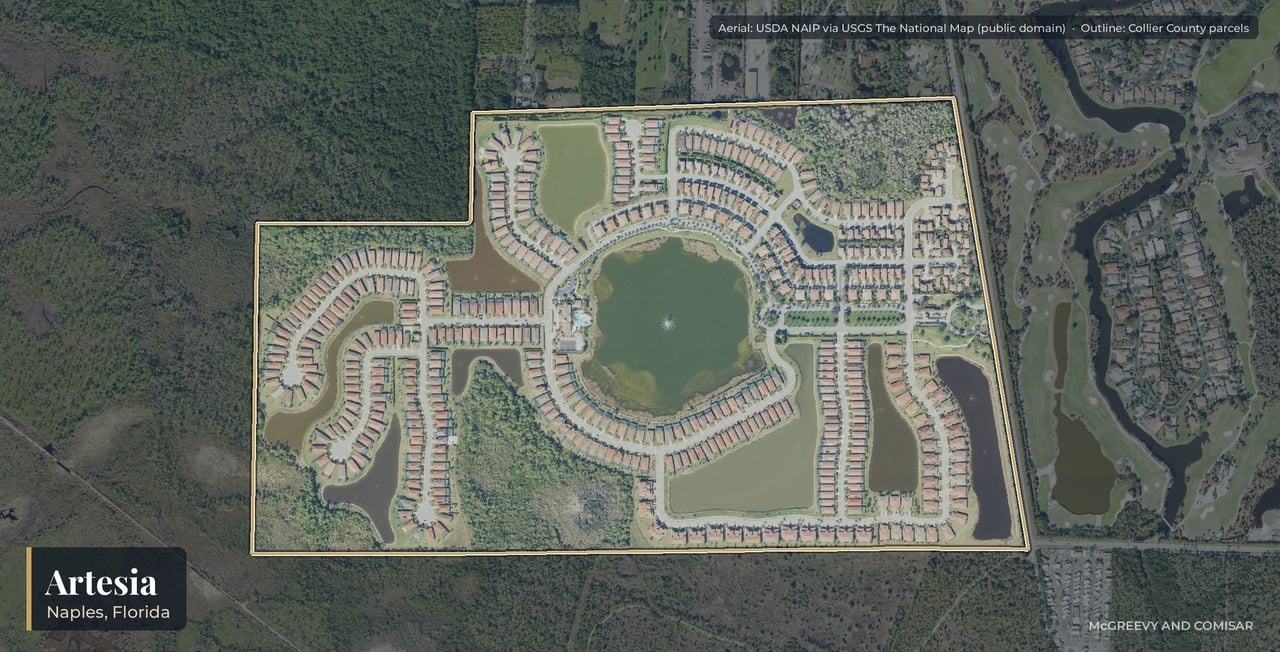
We also publish full community guides for Caymas, Esplanade Golf and Country Club, Hacienda Lakes and Windstar on Naples Bay.
The City’s geographic center is roughly the corner of US-41 and 5th Avenue South. From that center, the Naples Pier and the Gulf are a five-minute drive. Naples Municipal Airport (APF), for general-aviation jets only, no scheduled commercial service, sits four minutes north on Goodlette-Frank Road. Southwest Florida International Airport (RSW) in Fort Myers is a 35-mile, 45-minute drive up Interstate 75. Miami is two hours east on I-75. Marco Island is 20 minutes south. Bonita Springs and the Estero growth corridor are 15 to 25 minutes north on US-41.
A note on personality. Naples is not Miami, and it is not Fort Myers Beach. It is older, quieter, more philanthropic, more golf-and-club-driven, and significantly more cash-buyer-dense than either. The median age in Naples is approximately 67. Roughly half the housing stock turns over to seasonal residency from November through April. About 75 percent of all Naples residential sales in the first half of 2025 closed without financing, the highest concentration of all-cash buying of any major luxury market in the United States. The buyers are retirees relocating from the Northeast, the Midwest, and the Mountain West; international buyers, primarily Canadian (more on this in a minute); and a global ultra-luxury cohort that increasingly treats Naples as the discreet, golf-and-Gulf-access alternative to Palm Beach, the Hamptons, and Aspen.
Here is what the Naples market looks like as of the most recent month of complete data. These are aggregate numbers across the Naples-Immokalee-Marco Island Metropolitan Statistical Area, the official Florida Realtors and U.S. Census definition of the Naples market, covering all property types (single-family, condos, coach homes, villas, townhomes, and manufactured homes combined). Specific neighborhoods, club communities, ZIP codes, and price tiers move differently; we are happy to pull a tailored report for any community, ZIP, or price segment you are considering.
Metric (August 2026, all property types, Naples-Immokalee-Marco Island MSA) | Value | vs. August 2025 |
|---|---|---|
Median sale price | $595,000 | -0.8% (from $600,000) |
Average sale price | $1,050,890 | +5.4% (from $996,908) |
Closed sales | 703 | +3.5% (from 679) |
Cash sales | 388 of 703 (55.2%) | +6.9% cash-sale count (from 363) |
Median percent of original list price | 92.4% | +3.3 pp (from 89.1%) |
Median time to contract | 82 days | -17.2% (from 99) |
Median time to sale (list to close) | 127 days | -4.5% (from 133) |
New listings | 808 | -8.2% (from 880) |
New pending sales | 774 | +3.8% (from 746) |
Active inventory | 4,854 | -17.8% (from 5,904) |
Pending inventory | 1,001 | +5.6% (from 948) |
Months supply of inventory | 5.7 months | -30.5% (from 8.2) |
Total dollar volume | $738.8 Million | +9.1% (from $676.9M) |
Source: Florida Realtors SunStats, Naples-Immokalee-Marco Island MSA, All Property Types, August 2026 single-month with August 2025 year-over-year comparison. Data pulled 2026-10-02.
About this analysis. The figures above are pulled directly from Florida Realtors SunStats for the Naples-Immokalee-Marco Island Metropolitan Statistical Area (the official Census/Florida Realtors definition of the Naples market, covering Collier County including Naples, Marco Island, and Immokalee), All Property Types, for the most recent complete month. We cross-reference the figures we tracked against the Southwest Florida MLS (Matrix), NABOR (Naples Area Board of REALTORS®) segment reports, and the Collier County Property Appraiser tax roll when we build a tailored read for a specific neighborhood, ZIP, building, or price tier. We refresh this snapshot quarterly. MSA-level numbers describe the whole region; individual neighborhoods, Old Naples, Port Royal, Pelican Bay, Lely Resort, move on very different curves, which is why we always pull a community-specific report before pricing.
The headline market story in Naples right now is supply tightening into balance, steady volume, and structural cash dominance. Through the bid-up frenzy of 2021-2023, prices ran well ahead of historical patterns and inventory collapsed. Through 2024 and the first half of 2025, inventory rebuilt, days-on-market expanded, and the sale-to-list ratio drifted down. As of August 2026, that rebuild has reversed. Months supply fell from 8.2 to 5.7 months, a 30.5% contraction in one year and the lowest reading of the past twelve months, and active inventory contracted from 5,904 listings to 4,854, a drop of 17.8%. By the conventional definition (6 months supply = balanced; over 6 = buyer’s market; under 4 = seller’s market), the Naples MSA has moved out of buyer’s-market territory and into balance. Closed sales were 703 for the month, up 3.5% year-over-year, and new pending sales rose 3.8% to 774; August is one of the slower months of the Naples calendar, so the supply trend says more than the single-month sales count. Total dollar volume reached $738.8 million, up 9.1% year-over-year. Sellers are recovering 92.4% of original list price (up 3.3 percentage points year-over-year), and median time to contract has compressed to 82 days from 99. Median sale price was $595,000, essentially flat (down 0.8%) year-over-year, while average sale price rose 5.4% to $1,050,890, a gap that reflects the ultra-luxury top tier, where a small number of $20M+ closings can swing the average.
But three things the aggregate numbers do not tell you.
First, cash buyers dominate Naples more than any other major U.S. luxury market. In the first half of 2025, over 75% of all Naples residential sales closed all-cash, nearly three times the U.S. national average of approximately 28%. In the Collier County $1 million-plus segment in Q2 2025, roughly 71% of sales were all-cash per Florida Realtors data. Naples-Marco Island ranks 6th-highest among all U.S. metros for cash share. At the ultra-luxury beachfront and deep-water single-family tier above $5 million, most transactions are cash. This is the structural reality. For sellers, cash dominance means cleaner closings, no financing fall-through risk, fewer contingencies, faster appraisal resolution. For financed buyers, you are competing against cash on essentially every property worth bidding on, and the playbook that worked in a 2018 financed-buyer market does not work here. We coach financed buyers through this, strong earnest money, full underwriting (not just pre-approval), tight inspection windows, appraisal-gap coverage when appropriate, flexible closing timing. It is the difference between writing offers that win and writing offers that lose.
Second, Canadians drive an outsized share of the international segment. In 2025, approximately 52% of all international real estate buyers in the Naples-Immokalee-Marco MSA were Canadian, with Collier County records showing over 3,329 Canadian property owners. Canadian dollar volume into Florida real estate reached $1.9 billion in 2025, up 52% year-over-year. The drivers are direct-flight access through RSW and the Naples FBO network, climate alignment with the Canadian winter, Florida’s no-state-income-tax structure, USD-denominated hedging against CAD volatility, and a cash-purchase culture that avoids U.S. mortgage qualification friction. British, German, Swiss, Dutch, and Latin American buyers (particularly Brazilian and Mexican) round out the international cohort, but Canadian buyers are the structural majority and the most consistent source of cross-border demand. When you list a property in the right Naples ZIP, you are not just marketing to Americans. You are marketing into a global pipeline that runs on its own calendar.
Third, the ultra-luxury bracket has decoupled from the broader market entirely. The $20 million-plus segment in Naples was up 75% in the November 2025 through April 2026 period compared with the prior-year comparable (4 closings versus 7), per MLS data. The widely reported April 2025 sale of three adjoining Gulf-front estates on Gordon Drive closed north of Port Royal's line, on land the City of Naples maps as part of Aqualane Shores, so it is not a Port Royal sale. A separate Naples waterfront home transacted at $40 million in April 2026 (per Business Observer reporting). The Port Royal Club is undertaking a $100 million fully-approved post-Ian rebuild. Gordon Pointe was relisted in 2025 at $271 million, a relisting, not yet a sale, but a Florida record if it clears anywhere near ask. This is a segment that does not move on the same supply-and-demand curves as the broader Naples market; it tracks global ultra-high-net-worth capital flows, currency, and the very small number of irreplaceable lots available in Port Royal and Aqualane Shores.
A Realtor who reads one regional median and writes a generic recommendation is doing you a disservice. That is where depth in Collier County data, Collier Property Appraiser tax-roll downloads, NABOR segment reports, City of Naples permit-issuance data, weekly MLS market reports, and direct relationships with the developers and listing teams driving the new construction pipeline, earns the commission. If you want a tailored snapshot for a specific neighborhood, building, or price segment, call or text Jesse at (239) 898-6072 or Marc at (239) 287-5873.
Naples luxury has a clear, well-understood prestige hierarchy among the global buyer set, and unlike most American real estate markets, the hierarchy is durable. The same five neighborhoods have anchored the top of the market for forty years, and they are likely to anchor it for the next forty. This section is the framing overview.
Port Royal sits at the top of the hierarchy on recorded prices: 30 sales at a $17,687,500 median in the 12 months to September 24, 2026 (Southwest Florida MLS). Approximately 470 single-family homes on deep-water canals with direct, no-bridge Gulf access via Gordon Pass, the only Naples neighborhood that can accommodate yachts of the largest scale without a bridge restriction. Entry pricing is around $7 million; $30 million-$50 million is typical for a renovated waterfront estate; the ceiling is set by the $133 million 2200 Gordon Drive transaction in 2025. Owners of eligible Port Royal properties may join the private Port Royal Club, and the Club is currently in the middle of a fully approved $100 million post-Ian rebuild. The neighborhood culture is privacy, scale, and boating; it is not walkable in the Old Naples sense, and most homes are positioned for maximum lot privacy rather than streetscape interaction. Port Royal competes globally with Palm Beach’s Estate Section and Beverly Hills north of Sunset.
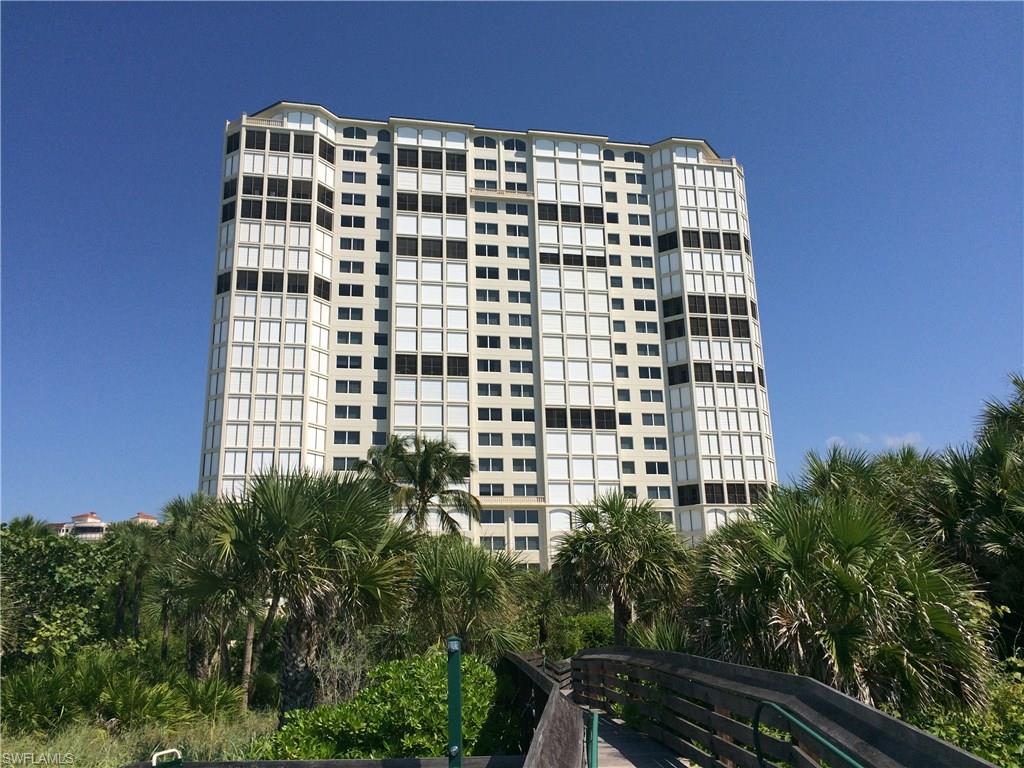
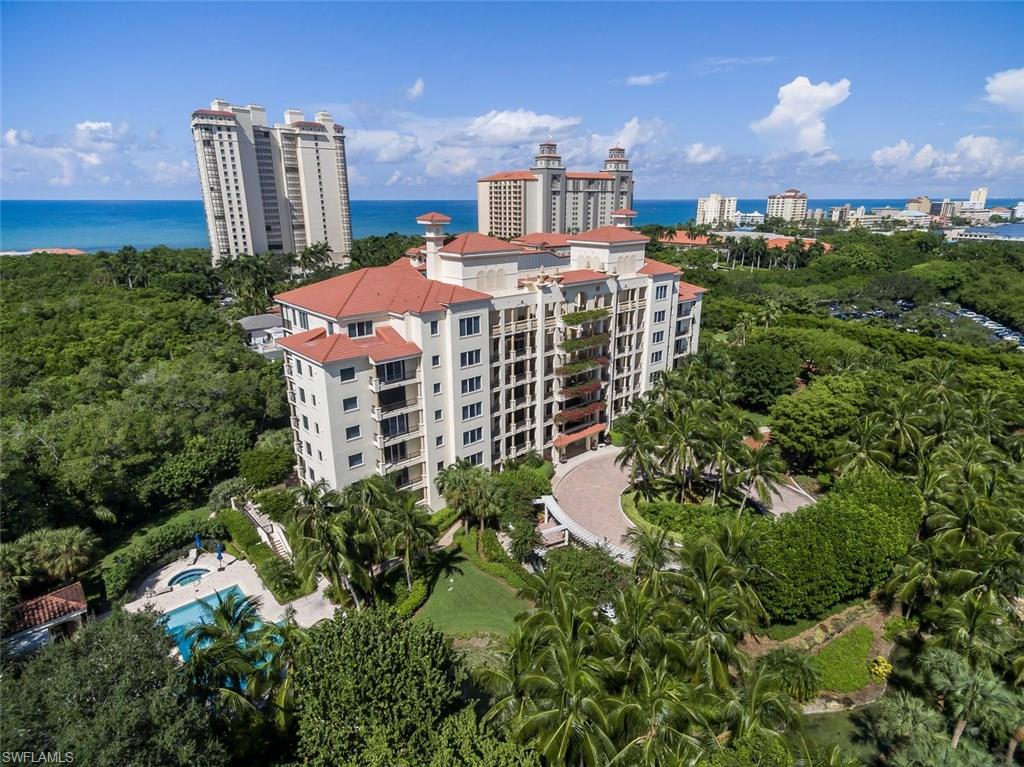
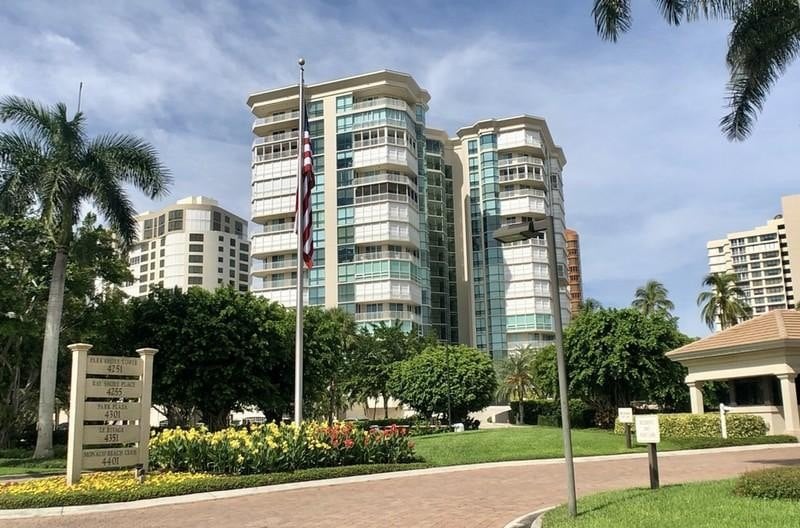
Bay Colony at Pelican Bay is the gated-within-gated answer. A community of six private beachfront high-rises (Toscana, Marquesa, Trieste, Salerno, Mansion at Bay Colony, and Brighton) plus single-family sub-enclaves at The Strand (12 beachfront mansions), Bay Colony Shores, Vizcaya, and Villa La Palma, all behind the main Pelican Bay gate, then again behind the Bay Colony gate. Equity membership in the Bay Colony Golf Club plus access to the private Bay Colony Beach Club differentiates the community from broader Pelican Bay. Typical pricing runs $3 million-$35 million. Bay Colony is the rare Naples address that combines pure beachfront, private golf, and a private gate inside another private gate.
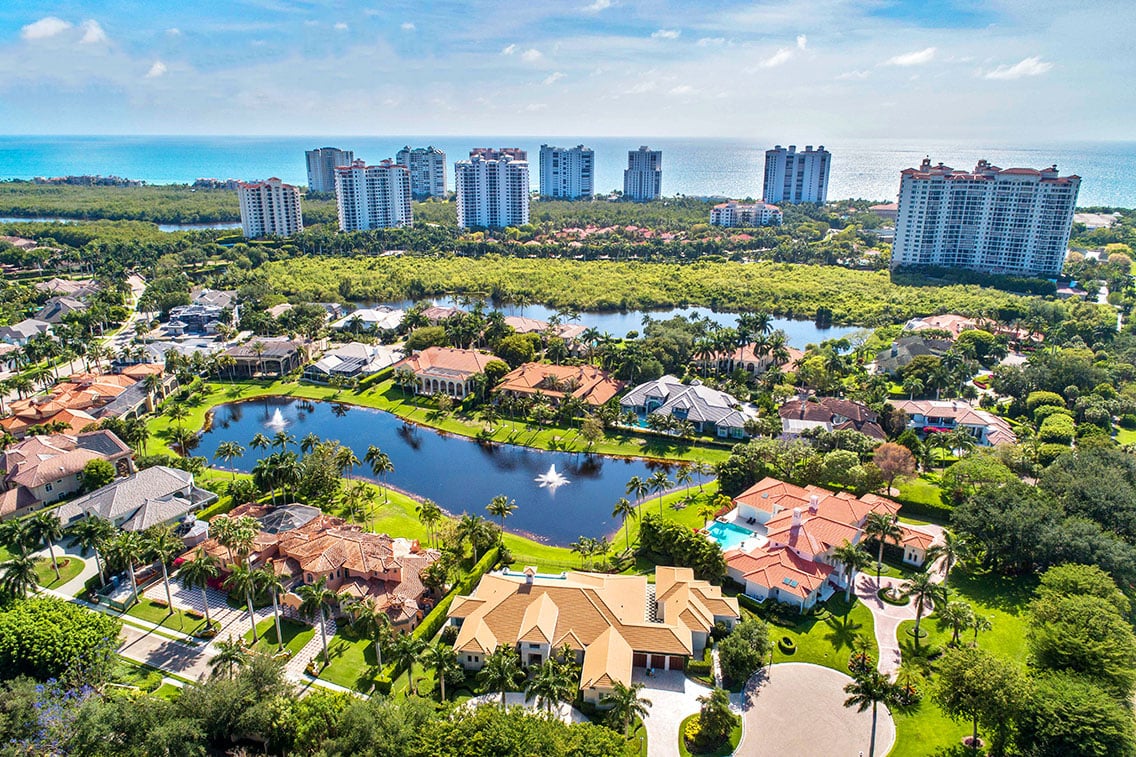
Pelican Bay (broader) is the volume luxury layer. 2,100 acres, 87 sub-communities, approximately 6,500 residences in total. Three miles of private Gulf-front beach with a free tram from the community through mangrove preserves to two dining pavilions on the sand. Two equity clubs, Pelican Bay Golf Club and Club Pelican Bay, plus the Waterside Shops upscale retail anchor (Saks, Tiffany, Apple, Williams-Sonoma, RH replacing the former Nordstrom site) at the south edge of the community, plus Artis—Naples and the Baker Museum on the adjacent campus. Pricing runs $1.4 million to $35 million across condos, mid-rises, and a smaller stock of single-family. Pelican Bay is the answer for buyers who want the largest possible amenity stack inside one address.
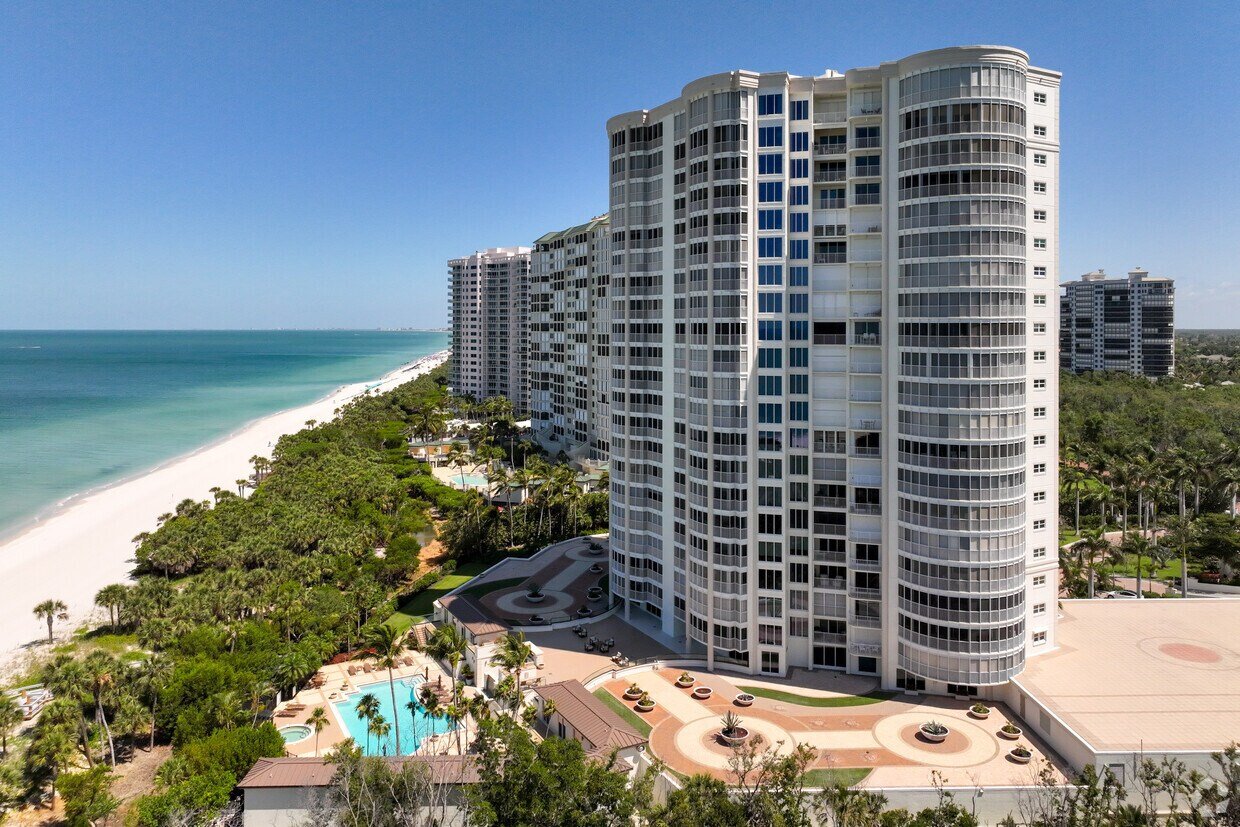
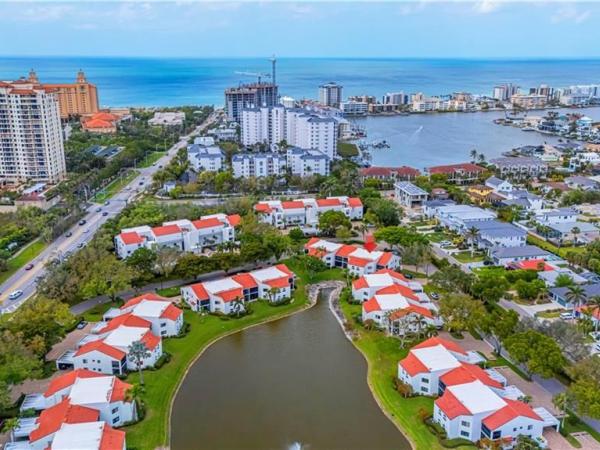
Park Shore is the high-rise beachfront condo corridor along Gulf Shore Boulevard between Doctors Pass and Pelican Bay’s southern edge, plus the Venetian Bay residential community at its eastern shore. Anchored by Venetian Village, a small open-air dining and retail enclave on Venetian Bay, and by a private Park Shore Beach Park reserved for property owners. The high-rise stack runs from older 1970s-built towers to the newest Rosewood Residences development now under construction at the Coquina Sands edge. Pricing is approximately $1 million-$20 million-plus. Read our complete Park Shore guide
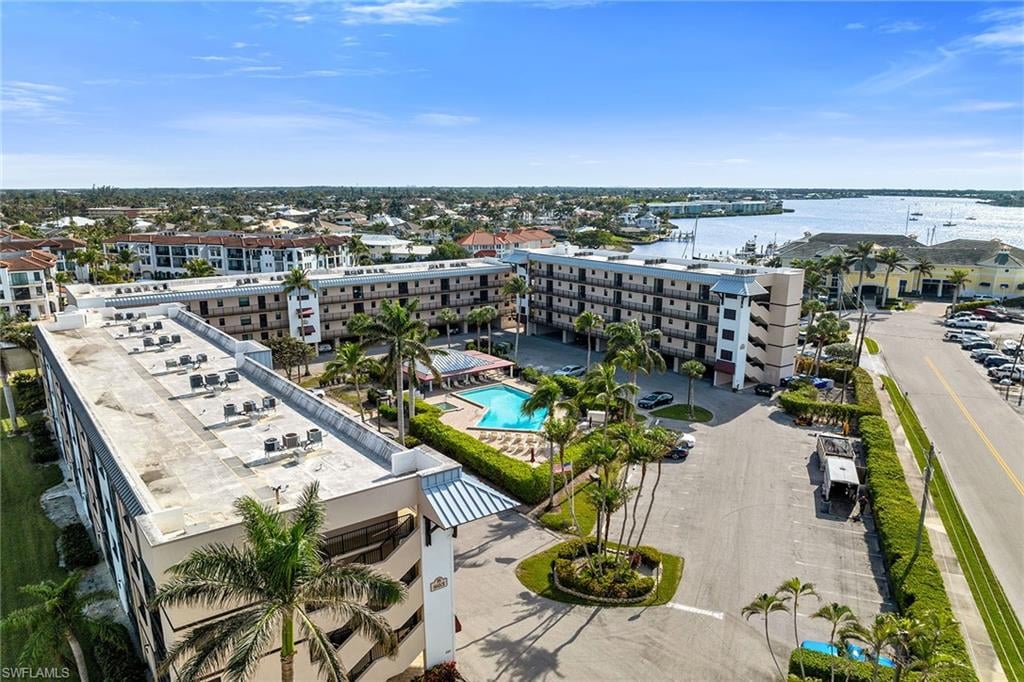
The Moorings and Coquina Sands. South of Park Shore along Gulf Shore Boulevard, the Moorings pairs Admiralty Point, La Perle and the Moorings proper across waterfront and inland streets, and Coquina Sands runs the low rise beach clubs from Bahama Club to Lago Mar between the Moorings and Old Naples. Read our complete Moorings guide and Read our complete Coquina Sands guide
Old Naples is the historic walkable downtown core inside the City of Naples, bounded roughly by Central Avenue to the north, 14th Avenue South to the south, the Gulf to the west, and 9th Street to the east. It contains 5th Avenue South, Third Street South, the Naples Pier, Cambier Park, the Naples Historic District (a 500-acre, 65-historic-house National Register district listed in 1987), and the city’s deepest concentration of $5 million-$30 million-plus single-family on shaded residential streets, plus a substantial stack of $1.5 million-$15 million low-rise and historic condominium product. Aqualane Shores is the deep-water single-family neighborhood directly south of Old Naples, about 490 homes and condo units inside the City’s own neighborhood outline (329 houses on the seven original 1950s plats), most of them on finger canals with private docks and no-bridge access to Gordon Pass. Aqualane is the wealthiest Naples neighborhood by per-home valuation and the boater’s purist alternative to Port Royal at slightly more attainable pricing. Read our complete Olde Naples guide
Below this Big Five sit the North Naples gated golf-equity communities, Mediterra, Grey Oaks, Quail West, Talis Park, Tiburón, Pelican Marsh, Audubon Country Club, Imperial Golf Estates, Collier’s Reserve, which compete on golf quality, equity-club amenity sophistication, and full-service country-club lifestyle. Below that sit the bundled-golf and lifestyle communities, in two separate parts of town: East Naples and the Lely corridor (Lely Resort, Fiddler’s Creek, Treviso Bay, Naples Reserve, The Isles of Collier Preserve), and the newer Immokalee Road end of North Naples (Heritage Bay, TwinEagles, Esplanade GCC). Both deliver gated resort-style living at $400,000-$3 million price points.
Bay Colony and Pelican Bay each carry a dedicated guide with HOA fee schedules, club membership pricing, recent sale comps, and waterfront / golf amenity comparisons. The Top Communities section below links every Naples community guide we have published.
Naples has more than fifty named neighborhoods across the City and unincorporated Collier ZIPs, and each one has its own price tier, HOA structure, and personality. The roster below is the working directory, and the Top Communities section links every community guide we have published. Price ranges are general 2025-2026 market ranges in current dollars across all product types within the community; specific buildings and sub-enclaves can run materially above the range.
# | Neighborhood | ZIP | Type | Price Range | Personality |
|---|---|---|---|---|---|
1 | Port Royal | 34102 | Waterfront single-family | $6.3M-$55M (12-month MLS range) | The apex; canal and bay frontage to Gordon Pass; private Port Royal Club |
2 | Aqualane Shores | 34102 | Waterfront single-family | $5M-$25M+ | Wealthiest per-home; ~365 of ~450 lots waterfront; boating purist |
3 | Old Naples | 34102 | Walkable historic district | $1.5M-$30M | The walk-everything historic core; 5th Ave + 3rd St + Pier |
4 | Coquina Sands | 34102 | Mostly single-family | $2M-$15M+ | Quiet enclave west of US-41; walk to Lowdermilk Park |
5 | The Moorings | 34103 | Mixed SF + condo, “Nifty 50” WF | $2M-$25M+ | Moorings Bay frontage; 58 no-bridge Gulf-access lots via Doctors Pass |
6 | Park Shore | 34103 | Gulf Shore Blvd high-rise + Venetian Bay SF | $1M-$20M+ | High-rise beachfront corridor + Venetian Village |
7 | Pelican Bay | 34108 | Master-planned gated, golf equity, private beach | $1.4M-$35M | 2,100 acres, 87 sub-communities, 3 miles private beach |
8 | Bay Colony | 34108 | Gated within Pelican Bay, beachfront towers + SF | $3M-$35M+ | The Strand, Vizcaya, Salerno + 6 beachfront towers |
9 | Pelican Marsh | 34109 | Gated equity golf | $590K-$16M | Greg Norman-redesigned course; North Naples |
10 | Pine Ridge Estates | 34108 | Non-gated estate | $2M-$15M+ | Non-gated 1+ acre lots; equestrian-permitted; 5 min to Vanderbilt Beach |
11 | Vineyards | 34119 | Gated equity golf, two courses | $400K-$5M | 1980s master-planned; 38 sub-neighborhoods |
12 | Quail West | 34119 | Gated equity, two courses | $2M-$20M+ | 36 holes; estate-scale homes; #1 transaction volume top-tier 2025 |
13 | Quail Creek | 34119 | Gated equity | $1.5M-$8M | Two Arthur Hills courses; established 1982; Audubon sanctuary |
14 | Mediterra | 34110 | Gated equity, two courses | $1.5M-$10M+ | Tuscan-themed; 36 Fazio/Cupp holes; private beach club |
15 | Grey Oaks (incl. The Estuary) | 34105 | Gated equity, 54 holes | $2M-$15M+ | Naples’ most prestigious bundled-style equity club |
16 | Talis Park | 34110 | Gated equity | $1M-$8M+ | Norman/Dye Vyne course; modern wellness clubhouse |
17 | Tiburón | 34109 | Gated equity, resort-hybrid | $1.5M-$15M | Two Norman courses; Ritz-Carlton Golf Resort on-site; LPGA + PGA host |
18 | Audubon Country Club | 34110 | Gated Audubon-certified equity | $450K-$5M | 755 acres, 410 residences, golf membership capped at 340 |
19 | Olde Cypress | 34119 | Gated bundled golf | $700K-$3M | P.B. Dye course; 24-hour guard-gated |
20 | The Strand | 34110 | Gated equity | $700K-$4M | 27-hole Gordon Lewis design; mid-rise + SF |
21 | Lely Resort | 34113 | Gated, bundled + public golf | $300K-$3M | Three courses; 3K+ homes; volume layer of Naples |
22 | Fiddler’s Creek | 34114 | Gated equity | $400K-$5M+ | 4,000 acres; Arthur Hills Top-100 residential course |
23 | Treviso Bay | 34113 | Gated bundled golf, TPC | $400K-$3M | TPC Treviso Bay course; 64,000 sq ft clubhouse |
24 | 34120 | Gated bundled golf | $300K-$1M+ | 27 holes; bundled-golf flagship | |
25 | TwinEagles | 34120 | Gated bundled/equity options | $500K-$3M | Two Nicklaus courses (Talon + Eagle) |
26 | Esplanade Golf & CC | 34119 | Gated bundled golf | $500K-$2M | Taylor Morrison-built; resort amenity model |
27 | Stonecreek | 34119 | Gated non-golf family | $800K-$2.5M | Family-focused; tennis + pickleball heavy |
28 | Naples Lakes Country Club | 34112 | Gated bundled golf | $400K-$1.5M | Arnold Palmer-designed course |
29 | Naples Heritage Golf & CC | 34112 | Gated bundled golf | $400K-$1M | Gordon Lewis course; East Naples bundled |
30 | The Wilderness Country Club | 34105 | Gated equity | $600K-$2M | Naples’ oldest equity clubs (1974); 4 miles to beach |
31 | Naples Bath & Tennis Club | 34105 | Non-gated tennis-focused | $400K-$1.5M | 38 courts including hardcourt + grass |
32 | Wyndemere Country Club | 34105 | Gated equity | $600K-$2.5M | 27-hole Arthur Hills course |
33 | 34102 | Waterfront non-gated | $3M-$10M+ | Deep-water Naples Bay → Gulf canal access; close to downtown | |
34 | Oyster Bay | 34102 | Waterfront non-gated | $1.5M-$5M | Bayside enclave adjacent Royal Harbor |
35 | Naples Cay | 34103 | Gated waterfront condo | $1M-$6M | Gated peninsula between Park Shore and Pelican Bay |
36 | Windstar on Naples Bay | 34112 | Gated equity, waterfront | $700K-$5M | Tom Fazio course on the bay; private beach island |
37 | Naples Park | 34108 | Non-gated single-family | $600K-$2M | Walk-to-Vanderbilt-Beach grid; 1960s ranches |
38 | 34108 | Mixed beachfront SF + high-rise | $1M-$15M+ | Site of Ritz-Carlton Residences Naples | |
39 | Naples Reserve | 34114 | Gated lifestyle-resort | $500K-$2M | 688-acre lakefront; no golf; big amenity center |
40 | Imperial Golf Estates | 34110 | Gated equity, two courses | $500K-$2M+ | Walkable two-course gated; 560-member cap |
41 | Sterling Oaks | 34110 | Gated, optional bundled golf | $300K-$800K | North Naples; family-friendly; tennis anchor |
42 | Heritage Greens | 34119 | Gated bundled golf | $300K-$650K | Affordable bundled-golf North Naples |
43 | Calusa Bay (North/South) | 34105 | Gated lake, non-golf | $400K-$800K | Coach + villa; central Naples; walkable to Vineyards |
44 | Eagle Creek | 34114 | Gated equity | $500K-$2M | Audubon Cooperative Sanctuary; Larry Packard course |
45 | Bay Forest | 34108 | Gated non-golf | $400K-$1M | Cocohatchee River frontage; North Naples |
46 | The Isles of Collier Preserve | 34113 | Gated lifestyle-resort, kayak | $700K-$3M+ | Minto-built; 7 miles kayak trails; Old Florida architecture |
47 | Hammock Bay Golf & CC | 34114 | Gated bundled golf | $400K-$2M | Marco Island gateway; Peter Jacobsen course |
48 | Verona Walk | 34114 | Gated lifestyle | $400K-$900K | DiVosta-built; resort amenity center |
49 | Village Walk | 34109 | Gated DiVosta lifestyle | $500K-$1M | Sister DiVosta community in North Naples |
50 | The Quarry | 34120 | Gated bundled golf, waterfront | $700K-$3M | Skiable lake + golf + beach club |
51 | Bears Paw Country Club | 34105 | Gated equity | $400K-$1M | Mid-century established mid-rise + villas |
52 | Kensington Golf & CC | 34105 | Gated equity | $500K-$2M | Robert Trent Jones Jr. course |
53 | Collier’s Reserve | 34110 | Gated equity | $1M-$4M | First Audubon Signature Sanctuary in U.S. |
54 | The Dunes | 34110 | Gated beachfront high-rise | $700K-$3M | Vanderbilt Beach area; beach club access |
55 | Beachwalk | 34108 | Gated non-golf | $400K-$1.5M | Walk-to-Vanderbilt-Beach gated |
56 | Saturnia Lakes | 34119 | Gated non-golf family | $500K-$1M | Family-resort amenity center |
57 | Forest Glen | 34114 | Gated bundled golf | $300K-$700K | Arthur Hills course; bundled-golf East Naples |
58 | Lakewood | 34112 | Non-gated, public golf | $300K-$800K | Established East Naples value entry |
59 | Riviera Golf Estates | 34112 | 55+ non-gated | $200K-$500K | 55+ condo/villa entry tier |
60 | Bonita Bay (city-edge, technically Bonita 34134) | 34134 | Gated equity, beachfront, waterfront | $600K-$10M | Equity-club benchmark; cited in every Naples comparison |
A dedicated sub-page is coming for each major community. We will publish HOA fee schedules, club initiation fees, equity-versus-bundled details, recent sale comparables, and a buyer’s framework for choosing between communities at similar price points.
Naples sellers recovered a median 92.4% of original list price in August 2026, so the list price you launch at decides what you net. Selling? Get a free Naples home valuation built from sales in your own community, or text or call Jesse direct at (239) 898-6072 for a same-day response. Buying? Start a Naples buyer consultation or call Marc at (239) 287-5873.
Naples has one of the deepest gated-community and luxury-neighborhood inventories in the United States. The communities below carry the most search demand, the most active resale and new-construction volume, and the most consequential lifestyle decisions for a buyer. Each community guide we publish covers developer history, master plan, governance, fee and membership schedules, recent sale comps, and a per-village deep dive. Every one we have published is linked below.
The five apex addresses, Port Royal, Bay Colony, Pelican Bay, Park Shore, and Old Naples, are profiled in the Prestige Hierarchy section above. Three of them now have dedicated guides live: Bay Colony, Pelican Bay, and neighboring Aqualane Shores. Port Royal, Park Shore, and Old Naples are profiled in the Prestige Hierarchy section above. Royal Harbor, the 1950s canal neighborhood on the east side of Naples Bay, has its own Royal Harbor guide, with every plat, the City dock rule and the neighborhood's recent MLS closings. The next tier of communities below is where most Naples buyers actually make a decision.
Grey Oaks Country Club. The premier gated golf community in central Naples, roughly 900 homes across 1.8 square miles with three championship courses, two clubhouses, a 30,000-square-foot wellness center and spa, and mandatory membership. In 2025 it posted the highest price-per-foot of any Naples golf community (about $1,060/sq ft; average single-family sale around $4.66M). Read our complete Grey Oaks guide
Quail West. North Naples’ flagship ultra-luxury golf community straddling the Naples-Bonita border, 800-plus estate homes on oversized lots, two 18-hole courses, a fully renovated grand clubhouse, and mandatory full-golf membership. 2025 single-family sales averaged roughly $4.45M with 2025 closed volume north of $160M; new custom construction is still active. Read our complete Quail West guide
Mediterra. A 1,647-acre member-owned golf-and-beach community in North Naples with two Tom Fazio courses and a private Gulf-front beach club on Barefoot Beach, one of the only inland Naples golf communities with deeded beach access. 2025 average single-family sale around $3.95M; the community hit five-year-record new-home sales in early 2025. Read our complete Mediterra guide
Talis Park. North Naples’ most contemporary luxury golf community, a boutique enclave of fewer than 900 residences around a Pete Dye/Greg Norman Collaborative course, with a grand clubhouse, full-service spa, and resort dining. 2025 price-per-foot (about $1,048/sq ft) trailed only Grey Oaks among Naples golf communities. Read our complete Talis Park guide
Pine Ridge Estates. Naples’ premier non-gated, no-HOA luxury estate enclave, 488 custom homes on 550 platted lots on one-to-two-plus-acre lots minutes from 5th Avenue and Venetian Village, for buyers who want acreage and privacy without club dues. A 2025 sale reached $16.35M; active listings span $3M to $15M-plus.
Fiddler’s Creek. South Naples’ most comprehensive master-planned community, 3,900-plus acres with a new 54,000-square-foot club and spa (opened 2025), championship golf, beach-club and marina access options, and one of the widest price ranges in Naples (condos from the high $200Ks to estates above $4M). Read our complete Fiddler’s Creek guide
Pelican Marsh. A large gated North Naples community of about 1,100 homes around an 18-hole championship course, with optional (non-mandatory) golf membership and a meaningfully lower entry point (about $600K to $1.2M-plus) than the ultra-luxury clubs, a distinct, accessible alternative for buyers who want the gated, amenity-rich lifestyle without six-figure initiation. Read our complete Pelican Marsh guide
The Isles of Collier Preserve. A Minto-built, nature-first community of 2,400 acres beside Rookery Bay, kayak and paddleboard launches, an on-water Overlook Bar & Grill, resort pools, and no golf. Pricing in 2025 ran from roughly $419K condos to $1.25M-plus single-family. Read our complete Isles of Collier Preserve guide
Tiburón. A boutique gated enclave of about 670 residences around two Greg Norman courses, with residents enjoying access to The Ritz-Carlton Naples, Tiburón, dining, spa, and beach shuttle, and a PGA/LPGA tournament pedigree. Condos and coach homes from about $800K; golf- and lake-view single-family $2M to $5M. Read our complete Tiburón guide
Vineyards. A 1,375-acre North Naples country-club community of 38 neighborhoods with two courses, a roughly 70,000-square-foot clubhouse, and optional membership, the most amenity-dense community in Naples for buyers who want maximum facilities without mandatory dues. Read our complete Vineyards guide
Naples Reserve. A newer Minto lakefront community in South Naples built around 21 freshwater lakes (including the 125-acre Eagle Lake), with modern construction at accessible price points from the mid-$400Ks to $1M-plus and no golf. Read our complete Naples Reserve guide
Treviso Bay. A Mediterranean-styled South Naples community of about 1,200 residences around a TPC-branded 18-hole course (bundled golf included with select residences), exceptional value against communities where golf initiation runs into six figures. Pricing roughly $400K condos to $3M single-family. Read our complete Treviso Bay guide
Naples Park. North Naples’ most accessible and investor-friendly neighborhood, a non-gated, no-mandatory-HOA grid walkable to Vanderbilt Beach and Mercato, where the absence of City short-term-rental restrictions makes it Naples’ premier Airbnb/VRBO investment corridor. Homes roughly $700K to $3.6M-plus. Read our complete Naples Park guide
Lely Resort. One of Naples’ largest and best-known master-planned communities, six square miles, three golf courses (two public, one private), the private Players Club & Spa, and housing from mid-$300K condos to $1M-plus single-family. Read our complete Lely Resort guide
Riverstone. An 802-home gated single-family community in North Naples off Logan Boulevard North, built out by GL Homes between 2012 and 2017 on 636.89 acres inside the Terafina PUD, with one association, no CDD, no golf, and a 13,000-square-foot amenity campus the residents own outright. FEMA has removed all 802 homes from the Special Flood Hazard Area, and Collier County recorded deeds over the trailing twelve months show 27 qualified sales at a $920,000 median. Read our complete Riverstone guide
Kings Lake. East Naples’ most established value address, an open, non-gated neighborhood platted in 1978 and 1979 on public county streets, 1,173 homes around four lakes with a paved lake path and a Publix inside the plat rather than across the road. It is the one Naples community that trades as two markets under a single name: over the trailing twelve months 18 detached homes closed at a $697,500 median against 49 attached at $240,000, a 2.9x gap, while the two halves finished within 2 percent of each other on dollar volume. The blended $280,000 median describes almost nobody. Master assessment $472 a year, plus a second fee set by whichever of the fifteen sub-associations governs the home. Read our complete Kings Lake guide
Mariposa at Whippoorwill. A gated 180 unit condominium off Whippoorwill Lane in central Naples, 108 coach homes and 72 town homes, all two story, on 29.54 recorded acres. It is the rare Naples condo association carrying no CDD and no master association, so the only recurring obligations are the association fee and a $261.91 county garbage line. Two things that drive Southwest Florida insurance cost are already settled here: all 30 roofs were replaced in 2023, and every building sits in FEMA Zone X on FIRM panel 12021C0403J, outside the special flood hazard area where federal flood coverage is mandatory. It trades thinly, five closings over the trailing twelve months at a $405,000 median and 55 median days on market, so any single comp carries unusual weight. Read our complete Mariposa at Whippoorwill guide
Kalea Bay. North Naples' Gulf-front luxury high-rise community on Old Coast Road, five towers rather than the four or six commonly cited, with Towers 100 through 400 complete and occupied and Tower 500 in finishing phases. Twenty-two residences resold over the trailing twelve months at a $3,877,500 median, ranging $2,700,000 to $6,900,000, at a 94.80% median sale-to-list ratio and 64 median days on market. There is no golf at Kalea Bay at any tier, the amenity center is owned by a developer affiliate rather than by the owners, and governance runs in three tiers, so an estoppel can be required from all three. Read our complete Kalea Bay guide
Hawksridge. A gated North Naples community of 189 residences, 94 single-family plots and 95 condominium units on 79.19 acres, with no Community Development District and exactly one buildable homesite left inside the gate. It trades as two markets under one name: single-family closed at a $1,767,500 median over the trailing twelve months against $721,250 in The Colony at Hawksridge. Condominium owners pay exactly two-thirds of a single-family owner's master assessment, and the recorded declaration says why. It is not Moorings Park at Hawks Ridge, which is a different place about a mile away. Read our complete Hawksridge guide
Monterey. A guard-gated North Naples community of 420 platted homes across six residential neighborhoods off Orange Blossom Drive, built 1989 to 2002 with a median year built of 1994. It was entitled for 907 dwelling units and built to about 46 percent of that, which is why the lots and the lakes are as large as they are. No Community Development District, no age restriction, and all three assigned schools are graded A by the Florida Department of Education. Master Board approval is mandatory on any sale with 30 days' written notice, so a contract written on a 30-day close is at risk. Read our complete Monterey guide
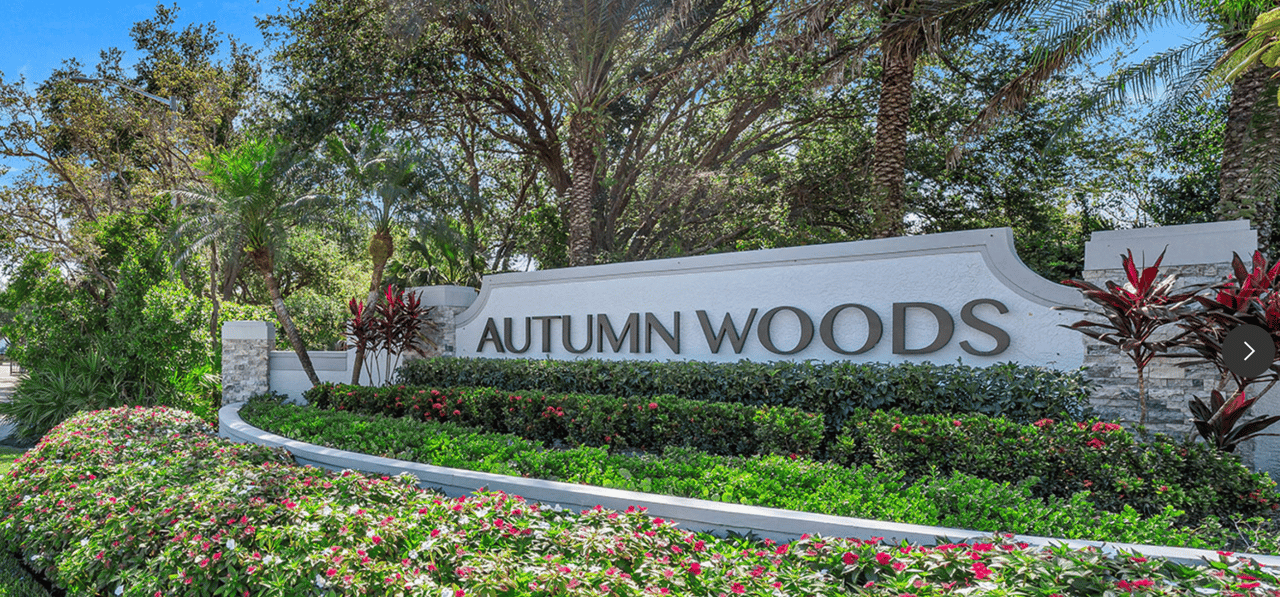
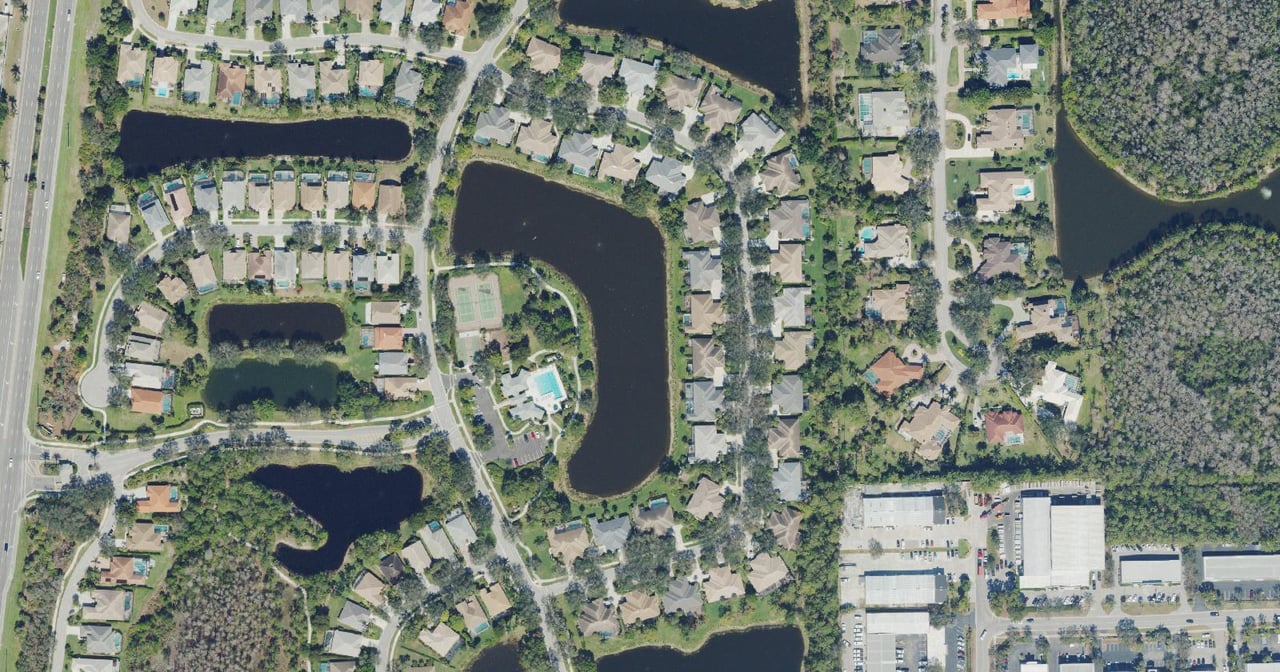
Autumn Woods. A gated North Naples community of 548 residences on the east side of Goodlette-Frank Road between Pine Ridge Road and Orange Blossom Drive, built out by Centex Homes as sole builder across three neighborhoods: 350 single-family homes in Oak Hollow and Mahogany Run, 110 villas in Maple Brooke, and 88 condominiums in Cedar Ridge. There is no Community Development District and no age restriction. It is also the Naples community where a blended median does the most damage: across the 47 priced deeds recorded in the 24 months to 29 August 2026, the all-community median is $735,000 while the three neighborhoods sit at $950,000, $530,000 and $550,000, which is why widely quoted figures for Autumn Woods disagree with one another by a factor of two. Turnover runs roughly 4.3 percent a year, which makes it a long-hold address. Read our complete Autumn Woods guide
Oakes Estates. The North Naples acreage corridor along Oakes Boulevard in 34119, platted as Golden Gate Estates Units 96 and 97 rather than under its own name, and sitting on the urban side of Collier Boulevard, the county's own dividing line, which drives the ZIP, the schools and the utilities picture. Median sale price reached $1,960,000 over the trailing twelve months, and median price per square foot has roughly tripled since 2010, from $162 to $492 year to date. It is the fastest-selling of the five North Naples acreage neighborhoods we benchmarked, at a median 44 days on market. Read our complete Oakes Estates guide
Esplanade by the Islands. A Taylor Morrison community in South Naples that is still selling new, 1,250 units planned with 855 marked sold on the builder's own site plans as of 2026-08-28. There is no single HOA fee here: at least five cost layers apply, including the Currents Community Development District assessment and a mandatory amenity membership carrying an $800 per year food minimum. There is no golf course and no age restriction, both stated explicitly because sibling Esplanade communities are regularly reported wrong. Detached homes closed at a $1,015,000 median over the trailing twelve months against $539,041 for coach homes. Read our complete Esplanade by the Islands guide
Valencia Golf and Country Club. A gated community of 450 single-family homes on 507 platted parcels in unincorporated Collier County, fronting Randall Boulevard in Naples ZIP 34120. It wraps a public, privately owned 18-hole golf course that no resident is obliged to join or pay for, it carries no Community Development District, and every home street inside the gates sits in FEMA Zone X, outside the Special Flood Hazard Area. There is no age restriction and this is not a 55-plus community, a point worth stating plainly because several unrelated Florida communities share the Valencia name and some of them are age-restricted. The trade is distance: it sits about 23 road miles from downtown Naples, measured from the Randall Boulevard entrance. Homes closed at a $575,000 median over the trailing twelve months, at $215.91 per square foot of living area and 53 median days on market, with 23 active listings against 13.1 months of supply. Read our complete Valencia Golf and Country Club guide
One further Naples community carries a shorter adopted guide for now, queued for the full community treatment: LaMorada, a WCI Communities gated enclave off Immokalee Road.
Saturnia Lakes. A gated, all-ages single-family community in North Naples 34119 with no Community Development District and roughly 580 homesites across three recorded plats. Homes trade in three distinct price tiers, from the low $400,000s to over $1.3 million, and the community sits in Flood Zone X. Read our complete Saturnia Lakes guide
Village Walk of Naples. 850 DiVosta-built homes in 34109, all ages, no Community Development District, with tiered quarterly HOA fees starting at $1,722.58 and an address outside the FEMA flood hazard area. Read our complete Village Walk of Naples guide
Island Walk. A gated, all-ages DiVosta community of 1,856 fee-simple homes around 30 lakes and a private Town Center in North Naples, ZIP 34119, on the north side of Vanderbilt Beach Road at Logan Boulevard North. Capri villas, townhomes and Oakmont and Carlyle single-family homes trade as separate markets, and 120 homes closed in the 12 months to September 24, 2026 at a median of $532,500. Read our complete Island Walk guide
The Cove. A 136-home DiVosta townhome community on Cove Circle off Logan Boulevard North, ZIP 34119, built in 1999 and 2000 around a 6.13-acre lake with its own pool. It shares a county zoning district with Island Walk but is a separate community with its own Declaration, association and entrance, and it is a platted townhome subdivision, not a condominium. Read our complete guide to The Cove
Falls of Portofino. A gated community of 246 two-story townhouse-style condominium homes in six condominiums on the north side of Vanderbilt Beach Road, ZIP 34119, directly east of Island Walk, built in two waves, 2006 to 2007 and 2024 to 2025. One Prime Group company owns 166 of the 246 homes, which shapes financing and resale, and 14 homes closed in the 60 months to September 26, 2026 at a median of $351,000. Read our complete Falls of Portofino guide
Verona Walk. A gated, all-ages DiVosta community of 1,920 homes in East Naples, ZIP 34114, about 944 attached villas and townhomes and 976 detached homes around a lakefront Town Center with six pickleball courts and no golf course. Every home pays the Verona Walk CDD, $744.85 to $992.85 a year, and 97 homes sold in the 12 months to September 24, 2026 at a median of $494,000. Read our complete Verona Walk guide
Winding Cypress. A gated, all-ages DiVosta community of 766 homes in East Naples, ZIP 34114, north-east of US 41 and east of Collier Boulevard: 152 attached villas, 406 Classic homes on 50-foot lots and 208 Estate homes on 65-foot lots, wrapped around 818 acres of recorded preserve. The 2026 association assessment runs $6,247.75 to $7,067.22 a year by series, with the clubhouse included, and 48 homes sold in the 12 months to September 23, 2026 at a single-family median of $875,000. Read our complete Winding Cypress guide
Terreno. A DiVosta community of 686 homesites on 325.767 acres on Oil Well Road in unincorporated Collier County, Naples 34120, platted in four phases and still building. It carries a Community Development District assessment of $2,254.12 to $2,467.20 per unit per year for fiscal 2026/2027, billed as one line in the non-ad-valorem section of the Collier County tax bill, and the community immediately next door carries none of it. Terreno owners hold no golf rights of any kind at the Valencia course next door, which the recorded easement agreement denies in capitals. Since a FEMA revision effective 2026-06-18, not one of Terreno's 686 residential and vacant-residential address points sits in a Special Flood Hazard Area. Fifty-five homes closed in the twelve months to 17 September 2026 at a $640,000 median, $311.91 per square foot of living area and a median 42 days on market. Read our complete Terreno guide
Stonecreek. A gated, non-golf GL Homes community in North Naples 34119, built across 618 lots off Logan Boulevard North with no Community Development District. The amenity program is built around tennis and pickleball rather than golf, and 99.4 percent of the community sits inside a FEMA flood zone. Read our complete Stonecreek guide
Indigo Lakes. 397 homes built by Gulfstream Homes in North Naples, less than a mile south of the Immokalee Road and Collier Boulevard intersection, with a resident population of roughly 2,475 at a median age of 44. Read our complete Indigo Lakes guide
The Reserve at Naples. A gated, Mediterranean-inspired community in North Naples built around a resort-style pool and outdoor spa. Read our complete Reserve at Naples guide
Firano at Naples. A gated 40-acre community of 112 villas in Collier County, minutes from the beach, with a resident population of roughly 180 at a median age of 74. Read our complete Firano at Naples guide
Livingston Lakes. A gated WCI condominium community of 230 residences in 37 two-story buildings on Livingston Road just south of Immokalee Road in North Naples, ZIP 34109, built between 2015 and 2017 and run by one association with no CDD and no golf. Carriage, Coach and Garden Homes each carry their own quarterly assessment, North Collier Regional Park sits next door, and a 2015 FEMA letter explains why the buildings read differently on the flood map. Read our complete Livingston Lakes guide
Stonebridge Country Club. A gated bundled-golf community of 799 residences in North Naples, ZIP 34109, behind the corner of Immokalee Road and Airport-Pulling Road, built 1995 to 2002 in ten neighborhoods around an 18-hole, par-71 Gene Bates course renovated by Kipp Schulties in 2023. Every owner is a club member, there is no CDD, and Collier County recorded deeds over the trailing twelve months show 35 qualified sales, with a $985,000 fee-simple median and a $437,500 condominium median. Read our complete Stonebridge Country Club guide
The Dunes of Naples. A gated community of 634 residences in North Naples, ZIP 34110, set between Vanderbilt Drive and the mangrove preserve that runs to Delnor-Wiggins Pass State Park: seven high-rise towers in the Island Cove and Grande Preserve neighborhoods plus 40 Sea Grove coach homes, built 2001 to 2007, with The Club at the Dunes, no CDD and no golf. Each of the eight condominiums runs its own association and quarterly fee, and across the 34 closings in the trailing twelve months to September 2026 the median sale was $1,800,000. Read our complete Dunes of Naples guide
Naples Lakes Country Club. A gated bundled-golf community of 731 residences in East Naples, ZIP 34112, built by Toll Brothers from 1999 around an 18-hole Arnold Palmer Signature course that every owner belongs to, with no initiation fee and no CDD. Six villages, from Lake Barrington condominiums to the Lake Tahoe estate homes, each carry their own fee class, and every tested street sits outside the FEMA special flood hazard area. Read our complete Naples Lakes Country Club guide
Vanderbilt Country Club. A gated bundled-golf community of 800 residences in North Naples, ZIP 34120, built 1998 to 2001 around an 18-hole Gordon Lewis course redesigned by Kipp Schulties in 2015, with club membership included in the price of every home. Its eight villages, from the Waterford and Wedgewood condominiums to the Estate Homes, share 2026 master dues of $13,159 a year, and a resale buyer pays a $15,000 capital contribution. Read our complete Vanderbilt Country Club guide
Audubon Country Club. A gated North Naples club community west of US 41 near the Lee County line, ZIP 34110, with 410 residences on about 755 acres, two gates (US 41 and Vanderbilt Drive) and no CDD. Club membership at a minimum Social level has been mandatory for every buyer since 2006, and flood exposure is not uniform inside the gate: it changes street by street, so where you buy matters. Across the 24 closings in the trailing twelve months to September 2026, the median sale was $1,795,000. Read our complete Audubon Country Club guide
Sterling Oaks. A gated North Naples community of 736 homes, 432 single-family and 304 condominium and coach homes, on a 247.89-acre PUD whose north property line is the Collier and Lee county line, ZIP 34110. It is a tennis community rather than a golf one: The Club at Sterling Oaks is built around clay tennis courts and sells memberships to people who do not live inside the gates, and about 120 acres of the community is recorded conservation easement. Twenty-seven homes closed in the twelve months to 23 September 2026 at a $485,000 median and a median 97.26% of list price. Read our complete Sterling Oaks guide
Olde Cypress. A gated North Naples golf community of 548 single-family homes in nine neighborhoods, including Lantana and Da Vinci Estates, behind one staffed gate on Treeline Drive off Logan Boulevard, ZIP 34119. The Club at Olde Cypress is a privately owned, non-equity club around the P.B. Dye course, social membership comes with every home, and there is no CDD. Twenty-six homes closed in the twelve months to 26 September 2026 at a $1,105,000 median, a 29-day median time on market and 97.52% of list price. Read our complete Olde Cypress guide
Glen Eagle. A gated golf and country club community of 1,234 homes in 15 neighborhoods off Davis Boulevard in Naples, ZIP 34104, built around an 18-hole course designed by Mark McCumber that opened in 1991. Club membership is mandatory and tied to each home, 924 golf and 310 social units, with 2026 dues of $8,031 for golf and $5,402 for social and a one-time capital contribution of $9,000 or $8,000 at closing. Collier County recorded 56 qualified sales in the twelve months to August 28, 2026 at a $395,000 median. Read our complete Glen Eagle guide
Want a side-by-side comparison of any of these communities, equity vs. bundled golf, mandatory vs. optional membership, CDD exposure, recent comps, and which fits your budget and lifestyle? Call or text Jesse at (239) 898-6072, or email [email protected].
More Naples community guides. Our full guides also cover Countryside Golf and Country Club, Cypress Woods, Eagle Creek Country Club, Falling Waters, Foxfire, Golden Gate City, Huntington Lakes, Kensington Golf and Country Club, Lakewood, Mercato, Palm River, Par One, Riviera Golf Estates, SkySail, The Glades Golf and Country Club, Valencia Sky and Valencia Trails. Each guide links to its own seller, home valuation and buyer page.
Naples is in the middle of its most ambitious luxury new-construction cycle since 2005-2007, and the headlining projects are reshaping the downtown core, the Gulf Shore Boulevard corridor, and the Bayshore CRA all at once. Before we go through them, one important clarification: an “Aston Martin Residences Naples” project sometimes circulates in online searches. That project does not exist in Naples. Aston Martin Residences is a Miami development at 300 Biscayne Boulevard Way (G&G Business Developments), with a separate Daytona Beach partnership announced in October 2025. The actual Naples branded-residence story is the Four Seasons, Ritz-Carlton, and Rosewood trio, plus a deep bench of additional projects from Gulf Bay, Kolter, Ronto, Lutgert, Stock, and the Bayshore CRA developers.
The Athens Group’s redevelopment of the 125-acre former Naples Beach Hotel & Golf Club site in Old Naples (851 Gulf Shore Boulevard North) is the single most important new-construction story in Naples in 2026. The Four Seasons hotel opened to the public on November 17, 2025. The residential component is 153 private residences, 58 beachfront residences plus 95 golf-side residences, delivered in phases through 2026-2028, with pricing ranging approximately $4 million for the smaller golf-side residences to over $30 million for the larger beachfront product. Discovery Land Company operates the brand-new Tom Fazio-designed 18-hole golf course, scheduled to open Fall 2026. HB’s on the Gulf and Sunset Bar, the social anchors of the historic Naples Beach Hotel, return; a new Wager gastropub and Picture House theater open through 2026. This is the generational hospitality reset of Old Naples.
Stock Development’s twin-tower-plus-mid-rise project at the corner of Vanderbilt Beach Road and Gulf Shore Drive, originally proposed as the controversial “One Naples” and rebranded as The Ritz-Carlton Residences Naples in January 2022, is approximately 172 residences with Tower Residences from $6 million-$6.45 million, standard residences over 4,000 square feet with 10-foot ceilings, penthouses at 5,800+ square feet with 11-foot ceilings, and Grand Penthouses at 8,800+ square feet with 12-foot ceilings (penthouse-tier pricing extends well above $20 million). Fall 2026 first move-ins are on track. Amenities include full Ritz-Carlton service tier, multiple pools, a marina, fitness, spa, and private path access to Vanderbilt Beach. The Park Residences phase launched sales in March 2026.
The Ronto Group’s 42-residence project at 1601 Gulf Shore Boulevard, just north of Lowdermilk Park, two seven-story buildings on five-plus acres with approximately 500 feet of direct Naples beachfront, is among the lowest-density major beachfront new construction in modern Naples. Three-, four-, five-, and six-bedroom residences (including five penthouses), floor plans from 4,226 to 9,673 square feet, pricing $12.75 million to $45 million. Topping-off was August 1, 2025. Late 2026 targeted completion. Rosewood Hotels & Resorts brings full service-tier amenities including two pools with cabanas, fire pits, bocce courts, and concierge, one of the few Rosewood-branded residential projects in the United States.
Gulf Bay Development LV, LLC’s 68-residence Pelican Bay tower, 18 stories with four penthouses, eight “jardin” garden-level units, and 56 standard residences, at 4,001-5,213 square feet per residence with estimated pricing $5 million-$25 million-plus. Targeted mid-2026 delivery. The amenity stack includes private dining club, concierge, 24-hour front desk, two golf simulators, indoor/alfresco dining, club room, parlor, salon, library, solarium, theater, and billiards, plus inherited Pelican Bay Foundation amenities including the private beach tram. Pelican Bay’s recent towers have nearly all been 100-plus units; Épique’s 68-unit count is a deliberate low-density positioning at the top of the Gulf Bay portfolio.
Kolter Urban’s first Naples high-rise, breaking ground January 29, 2026 on a 3.07-acre Moorings Bay bayfront site. 51 luxury condominiums across two eight-story buildings, units 2,000-7,500 square feet, pricing from $3.7 million. Targeted Q4 2027 completion. Amenities include a private 16-slip marina with direct Moorings Bay → Doctors Pass → Gulf access (the Nifty 50 corridor, no bridges), two pools, fitness, wellness, and concierge. The marina component is the key differentiator from the Coquina/Park Shore beachfront condo stack, most newer Gulf Shore Boulevard projects do not include marina components.
Lutgert Companies’ 4.3-acre 5th Avenue South redevelopment, between Fifth and Sixth Avenue South, just east of Four Corners. 50 luxury condominiums above ground-floor retail and restaurants in four three-story buildings, with estimated pricing $3 million-$15 million-plus. Groundbreaking January 22, 2026; targeted late 2027/early 2028 completion. Each building includes its own pool, fitness center, and club room. The public-facing centerpiece is “Oak Row”, a tree-lined walkable city alley with outdoor dining and light vehicular access between 5th and 6th Avenue South. This is the most ambitious mixed-use addition to the 5th Avenue South commercial spine in two decades.
The Bayfront development team’s final phase, where Goodlette-Frank Road ends at 5th Avenue South on Naples Bay. 35 three-bedroom luxury residences in four floor plans (2,100-3,100 square feet) with estimated pricing $2 million-$5 million-plus. Groundbreaking January 23, 2026; estimated completion 2027-2028. Includes private clubhouse, resort-style pool and spa with cabanas, fitness center, outdoor BBQ and social spaces, and optional boat slips on the Gordon River with direct Naples Bay and Gulf access. Palazzo completes the Bayfront mixed-use vision begun in the early 2000s.
The Pezeshkan/Starkey development at Davis Boulevard and Tamiami Trail East, the “Mini Triangle” of the Bayshore Gateway Triangle CRA, one mile east of downtown Naples. Three 15-story high-rise towers planned: Ascent (270 luxury apartments), Avra (56 condominiums at $2 million-$6 million), and Aura (an additional residential component in groundbreaking phase). Phased construction underway 2025-2026 with delivery 2026-2028. Includes ground-floor boutique retail and restaurants, secured parking garages, Class A office space, and a potential luxury hotel component. Metropolitan Naples is the first major redevelopment of the Bayshore CRA at this density and brings the only meaningful Class A office space to the downtown Naples corridor.
The Ronto Group’s downtown Design District master-plan, bounded by 5th Avenue South, Goodlette-Frank Road, and the Design District. Quattro is the four-building phase with the largest units (2,032-3,437 square feet, from $1.3 million). Encore is the absolute final phase, 15 exclusive residences in two-, three-, four-bedroom plans (2,700 to 4,600-plus square feet, from $3 million-plus). Naples Square is the largest single-developer downtown redevelopment in Naples history; Encore closes the 10-year buildout, marking Ronto’s 50th anniversary.
A boutique six-residence ultra-luxury micro-development in Old Naples, 0.2 miles from 5th Avenue South and 1 mile to the beach. Targeted early 2026 completion. Estimated pricing $5 million-$15 million-plus. The Cayden represents the boutique infill model increasingly defining new construction in Old Naples, single-digit unit counts on small lots, ultra-premium per-unit pricing.
For comparable resale context, Eleven Eleven Central (Ronto Group, completed in phases through 2024-2025, 210 residences across three buildings in the Naples Design District) is the project that proved out the downtown Naples high-density condo model and paved the way for Naples Square, Palazzo at Bayfront, The Avenue, and Metropolitan Naples. Eleven Eleven trades actively on the resale market at $1 million-$3 million-plus.
Our Naples and Collier County new construction guide prices 79 communities builder by builder, with the impact fees, CDD assessments and year-two tax jump set out in full.
The City of Naples is a council-manager municipality with a seven-member nonpartisan Council, Mayor plus six Council Members, all elected at-large to four-year terms with a two-term limit. Following the February 3, 2026 general election, the Council consists of Mayor Teresa Heitmann (continuing), Vice Mayor Ted Blankenship, Council Members Mike McCabe and Bill Kramer (continuing), plus newly-elected John Krol and Scott Schultz. The City Manager is Gary L. Young. Regular Council meetings occur approximately twice monthly at the Council Chamber at 735 Eighth Street South, with workshop meetings typically following. Agendas, supplements, and the full voting record are published on naplesgov.com.
The defining live planning document for Naples is the Naples 2045 Comprehensive Plan Update, a 22-month, $423,250.54 Evaluation and Appraisal Review (EAR)-cycle rewrite of the 2018 Plan led by Johnson Engineering with Clarion Associates, CMA Outreach, and Erin L. Deady, P.A. The contract was approved via Resolution 2025-15556 on April 2, 2025. The process began in March 2025 and concludes with Council adoption in Fall 2026, after which the Plan goes to Florida state agencies for review. No competing realtor page references this document, and that is a gap, because Naples 2045 is the master plan that will govern zoning, density, setbacks, redevelopment priorities, transportation, environment, housing, and climate resilience inside the City through 2045. The active project website is naples2045.com, and it is a public engagement portal where height-limit, density, and redevelopment debates will play out over the next year.
What is the Plan actually designed to protect? Vision 2021, the active Naples Vision document adopted by Council, identifies the top-ranked priority as “Our Place: Preserve Small Town Character and Culture,” ranked Very Important by 80% of survey respondents. The specific dimensions include maintaining the existing scale and character (explicitly not becoming a high-rise community), maintaining the city’s social functions and community events, preserving the beauty of natural and developed areas, and protecting the “small town” ambiance. This is the framework against which every new development application gets evaluated.
The City’s zoning structure is codified in Chapter 58 of the Code of Ordinances, with residential districts running from R1-15A (the largest single-family lots, 40-foot front yard setback, 30-foot rear) through smaller-lot R1-7.5 districts, then multifamily R3-15, then commercial C2-A through C3, then site-specific PD (Planned Development) ordinances. The City of Naples maintains a Planned Developments Log, a master index of every PD ordinance in city history, with 83 named Planned Developments cross-referenced to their current and historical ordinance numbers, dating back to 1969. If you are buying into a Naples PD, Naples Beach Club Residences, Moorings Park, Naples Bay Marina, Bayfront Marketplace, Mangrove Bay, the PD log tells you exactly which ordinance governs the property’s allowable use, height, setbacks, and density.
The D Downtown District is governed by Naples’ Form-Based Code, with a defining rule: the maximum building height in D Downtown is 3 stories AND 42 feet, measured from the first-floor FEMA elevation to the peak of the roof or highest point of any roof appurtenance. This is why the 5th Avenue South streetscape feels the way it feels, and why exceptions for institutional uses (like the NCH Heart, Vascular & Stroke Institute) require a separate rezone process from “M” Medical to “PS” Public Service. The 5th Avenue South Special Overlay District requires Design Review Board approval for outdoor dining design, lighting, façade alterations, and signage. Most projects on 5th Ave South go through the DRB before they go to the public.
The City’s Land Development Code (LDC) is currently in an active overhaul, with 2023 Community Listening Sessions covering four LDC items and a feedback portal at naplesgov.com/planning. The LDC is the operational regulation that translates the Comp Plan’s vision into specific buildable rules, setbacks, lot coverage, impervious-surface percentages, architectural review, tree protection.
Speaking of tree protection: Naples has been recognized as a Tree City USA for 27 consecutive years with a Tree City USA Growth Award for 17 years, plus a Tree Cities of the World designation for 5 consecutive years through the FAO and Arbor Day Foundation partnership. Approximately 30% of the city is covered by tree canopy. Chapter 38 of the Code is the Tree Protection Ordinance, adopted in current revised form in June 2017 and amended in March 2020. The ordinance protects trees and palms within the right-of-way, parks, medians, and other public lands, with explicit protections for the urban forest during demolition and construction. Only ISA Certified Arborists may work on city trees, and city trees must be pruned to ANSI A300 standards.
Most of “Naples” is actually unincorporated Collier County, governed by the five-member Board of County Commissioners (BCC) plus a separately-elected Property Appraiser, Tax Collector, Sheriff, Clerk of Courts, and Supervisor of Elections. The BCC formally adopted the FY 2025-2026 Budget on September 18, 2025, total $3.12 billion-plus with an aggregate millage rate of $3.7675 per $1,000 of taxable value (5.03% above the rolled-back rate). The strategic plan, priority projects report, and adopted budget are all published at collier.gov.
Collier consistently maintains one of the lowest aggregate millage rates among Florida’s 67 counties. When you combine the county aggregate around $3.77 with the City of Naples adding approximately $1.17 mills inside the city, plus the homestead exemption and the Save Our Homes 3% annual assessed-value increase cap, the result is one of the most tax-efficient ownership structures in coastal Florida. Total effective property tax inside the City of Naples typically runs 1.5% to 2.0% of taxable value annually; in unincorporated Collier the rate runs approximately 1.0% to 1.5%.
The county’s master planning document is the Growth Management Plan (GMP), structured around the Future Land Use Element (FLUE, last amended November 12, 2024 via Ordinance 2024-46), the Immokalee Area Master Plan, the Transportation Element, and several additional 2024-25 amendments pending incorporation (Palm River Ord. 2024-49, Fiddler’s Creek Ord. 2024-51, and multiple 2025 amendments). The most important plain-language data point from the most recent 2024 Annual Update and Inventory Report / Capital Improvement Element (AUIR-CIE), approved by the BCC on January 28, 2025, is that the County is currently $365 million short on transportation and $275 million short on stormwater against the Level-of-Service standards required to keep concurrency moving for new development. The shortfalls drive impact-fee policy and the road, drainage, and infrastructure improvements that determine which corridors get widened and when.
The Rural Lands Stewardship Area (RLSA) is the 185,000-acre overlay east of Naples that controls where large-scale developments like the Town of Big Cypress, Rivergrass Village, and Bellmar can occur. The overlay was originally adopted to protect the regional aquifer and the Florida panther primary zone; major developments inside the RLSA require Comprehensive Plan amendments and Section 7 federal Endangered Species Act consultation. For most Naples buyers, the RLSA is not a parcel-level concern, but it shapes the long-term development pipeline east of the city and explains some of the regional environmental and traffic conversations playing out in the County’s planning meetings.
The Collier MPO 2050 Long Range Transportation Plan, the 25-year transportation blueprint for all of Collier including Naples, Marco Island, and Everglades City, was adopted by the MPO Board on December 11, 2025. The Plan covers the federally-required Needs Plan, the Cost Feasible Plan, and the unfunded-needs gap. Specific funded road projects in the FDOT Work Program for FY 2026-2030 were revised by a May 9, 2025 amendment reflecting Florida’s “Moving Florida Forward” program, meaning corridor priorities along Pine Ridge Road, Vanderbilt Beach Road, Immokalee Road, and Goodlette-Frank Road shifted in or out of the five-year funded window. For buyers near any of those corridors, the MPO meeting record is the source of truth on what your commute will look like in 2028.
The Bayshore Gateway Triangle CRA, a 30-year Redevelopment Plan area created via BCC Resolution 2000-181, with a Benesch-led 2024 update introducing sub-area recommendations, catalyst redevelopment sites, and LDC revisions, is the area immediately east of downtown Naples seeing the most aggressive entry-luxury new-build activity (Metropolitan Naples, Avra, Ascent, and several Bayshore Drive infill projects).
Naples Municipal Airport (APF) is staying where it is: the FAA approved the updated Part 150 Noise Compatibility Program on December 9, 2024, and on June 19, 2025 the Naples Airport Authority voted to end the relocation study. This is the single most under-reported real-estate story affecting Naples luxury property values, and most realtor pages either ignore it or get the timeline wrong. We will be precise.
Naples Municipal Airport (APF), marketed as Naples Aviation, is a general-aviation airport operated by the City of Naples Airport Authority (NAA), an independent governmental agency created by the Florida Legislature in 1969. APF sits in the middle of the City of Naples just north of downtown, at 160 Aviation Drive North. It is not a commercial-service airport: there are no scheduled passenger airlines. It serves private jets, business aviation, charter operators (NetJets, Wheels Up, Flexjet), fractional ownership programs, flight schools, the Collier Sheriff Aviation Unit, fire and rescue, air ambulance, and mosquito control. Approximately 200,000 passengers move through APF annually; the airport handles roughly 119,075 to 123,000 annual operations against a current projection cap of 155,000. The single Runway 5/23 provides 5,800 feet of takeoff distance and 5,000 feet of landing distance, with 800-foot displaced threshold on Runway 23 and 510-foot on Runway 5, geometry chosen to push noise-producing aircraft to altitude before they leave the airport boundary.
APF’s 2024 economic impact as estimated by the Florida Department of Transportation is $781 million. The airport is one of the busiest general-aviation airports in the Southeast, with significant peak-season traffic November through April.
This is the lawsuit story most realtor pages miss. In 1999, Naples Airport became the first U.S. airport to successfully ban Stage 1 aircraft, the noisiest classification under FAA rules, via an FAA Record of Approval in March 1999. In May 1999, the NAA’s Noise Compatibility Committee recommended a 24-hour ban on non-emergency Stage 2 jet operations as well. The NAA authorized the formal Part 161 analysis of the Stage 2 ban in January 2000 and adopted the resolution implementing the 24-hour Stage 2 jet ban in January 2001, the first U.S. airport to complete a Part 161 study to ban Stage 2 aircraft.
In March 2003, the FAA reversed itself, finding the Stage 2 ban “unreasonable, unjustly discriminatory, and preempted by federal law,” and suspended the NAA’s eligibility for federal airport improvement grants. The NAA appealed. On June 3, 2005, the U.S. Court of Appeals for the D.C. Circuit issued City of Naples Airport Authority v. FAA, 409 F.3d 431 (D.C. Cir. 2005), overturning the FAA’s decision and upholding the NAA’s Stage 2 ban as not arbitrary or capricious. The court accepted the NAA’s findings that approximately 1,400 residents were exposed to noise levels above DNL 60 dB and that restricting Stage 2 aircraft would affect only about 1% of operations while significantly reducing the exposed population.
Today APF permits Stage 3 and quieter jets and operates a voluntary 10 PM-7 AM “Quiet Hours” curfew with documented compliance above 98%. The airport has invested more than $8 million in noise-abatement programs since 2000.
The FAA formally approved the NAA’s updated 14 CFR Part 150 Noise Compatibility Program on December 9, 2024, with Federal Register publication on December 19, 2024. The NCP contains one noise abatement measure (revised flight procedures), three land use measures, and six program management measures. It also defines the updated DNL 60 dB noise contour, the planning boundary for properties most likely to experience aircraft noise during normal operations. The NCP’s full appendices (Appendix J Official Noise Exposure Maps, Appendix D Aircraft Noise, Appendix E Land Use, Appendix A FAA Acceptance) are all published on flynaples.com.
For buyers in Park Shore, Coquina Sands, Aqualane Shores, the central Old Naples blocks closest to the airport, and Pine Ridge Estates: aircraft noise exists, the noise abatement rules are now stricter and more clearly defined than they have ever been, and the federal regulatory framework around APF noise is fully in place.
For three years the NAA studied possible relocation to eastern Collier County. The $398,000 Exploratory (Relocation) Study by Environmental Science Associates, released in November 2024, identified four potential eastern Collier sites including the Immokalee Regional Airport, with cost estimates of $790 million to $1.6 billion in 2024 dollars and construction not starting for eight to twelve years (completion not until 2040 or later). On June 19, 2025, the NAA Board of Commissioners voted 3 to 1 to conclude the Airport Exploratory (Relocation) Study, finding the four identified sites were not financially feasible, that the project had no County support, and that the relocation question is effectively settled for at least this planning horizon.
The practical translation for Naples luxury-property buyers: APF is staying where it is. The Stage 2 ban survives, the 10 PM to 7 AM Quiet Hours curfew survives, the Part 150 NCP is now fully approved, and the relocation conversation is closed for the foreseeable future. There is no scenario in the next ten-plus years in which the airport moves. Buyers and sellers can plan accordingly.
Naples took meaningful damage from Hurricane Ian (September 28, 2022), Hurricane Helene (September 26, 2024), and Hurricane Milton (October 9, 2024). Three storms in three years materially reshaped the building stock, the regulatory environment, and the insurance market. The honest assessment is that the worst eyewall winds from Ian were not in Naples, Ian came ashore on Lee County’s Cayo Costa as a Category 4 with the eye crossing roughly 30 miles north of the city, but the storm surge impact in coastal Naples was substantial, the historic Naples Pier was destroyed, and the post-storm regulatory cascade (the new FEMA flood map, the 50% Rule enforcement, the property-insurance reset) is permanently in place.
The National Hurricane Center’s official Tropical Cyclone Report puts offshore storm surge from Ian at 10 to 15 feet with 6 to 9 feet of inundation above ground level in Naples. The Naples Pier NOS tide gauge measured 6.18 feet above MHHW before the gauge itself was destroyed by wave action. Water-level changes at high tide reached approximately 8 feet at the Franklin Lock (S-79 on the Caloosahatchee), 7 feet on the Gordon River, and 8 feet on the Cocohatchee River. Twenty-foot waves were measured from the Gulf during peak. The Pier, approximately 460 feet long, was destroyed, with about 140 feet of the seaward end ending up on the Gulf bottom. All 40 of the City of Naples’ beach access points were damaged; five suffered major structural damage to road and seawall. Initial City government property damage was estimated at approximately $20 million. Storm surge flooded first floors of many Old Naples, Aqualane Shores, Port Royal, and Naples Bay neighborhood buildings. Many properties triggered FEMA 50% Rule “substantial damage” determinations, more on that below.
Helene made landfall as a Category 4 (140 mph) approximately 10 miles west-southwest of Perry, Florida, but Naples was on the wet, onshore side of a 200-plus-mile-distant landfall. The Naples Bay NOS tide gauge measured 4.02 feet above MHHW, and surge inundation in Naples reached 2 to 4 feet above ground level, with some specific Naples areas reporting 30-plus inches of flood depth. Helene was the second-deadliest U.S. hurricane in 50 years after Katrina (252-plus deaths, $78.7 billion in damages nationally).
Milton made landfall north of Naples near Sarasota County but produced 5.78 feet of storm surge above normal tide at Naples, almost a foot higher than Helene and roughly three feet above Hurricane Debby’s August 2024 surge. Wind gusts north and northeast of the storm center reached 80-105 mph in the Naples area. Statewide damage estimates landed at $160-180 billion preliminary. Naples was on the storm’s southern (wet/storm-surge) side.
This is the recovery story most realtor pages miss. The City of Naples is rebuilding the Pier for the seventh time in its 137-year history, the original Pier was built in 1888, and the Pier has been rebuilt after hurricanes in 1910, 1926, 1944, and 1960. The current project budget is $26.3 million total, comprising a $23.45 million construction contract with Shoreline Foundation, Inc. awarded October 2, 2024, a $1.17 million City-controlled contingency, and an $11.4 million FEMA grant obligated in December 2025. The design-build team is Turrell, Hall & Associates as lead with MHK Architecture as design partner. The Florida Department of Environmental Protection issued the Final Order on November 21, 2024; the U.S. Army Corps of Engineers issued final permit approval in October 2025. Demolition began January 5, 2026, with the City Council unanimously approving the final design on March 4, 2026. Construction duration is 18 months from Notice to Proceed, with substantial completion scheduled for November 15, 2026 and a public reopening targeted for mid-2027.
The rebuilt Pier will be the same approximate 1,000-foot length, but it is engineered for resilience: larger-cross-section pilings with protective jackets, increased concrete support for the IPE wood decking, and pier elevation raised at least 3 feet above the pre-Ian profile. There are no permanent food concessions in the final design. On April 24, 2026, the City deployed 300 tons of concrete from 59 of the demolished pier pilings as Wasmer Reef #8, 10 miles offshore at the Wasmer Reef site near Gordon Pass. The deployment turned the old Pier into permanent artificial reef habitat for corals, aquatic vegetation, invertebrates, bivalves, and tunicates. Remaining pilings were processed into recycled concrete aggregate for road construction, nothing went to landfill.
A second piece of the post-Ian recovery, and one most realtor pages have never heard of. The City of Naples is in the middle of an $86.2 million Beach Stormwater Outfall Project, with $40 million of the funding from Florida Legislative Appropriations. The project removes all eight of the city’s existing stormwater outfall pipes that currently discharge stormwater directly onto Naples beaches (eliminating the long-standing environmental and water-quality concern that drove FDEP to mandate the removal as a condition of the County’s beach renourishment program). The replacement is a consolidated pump-station-plus-subaqueous-pipeline system following Sarasota County’s model: a north pump station at 3rd Avenue North beach, a south pump station at 8th Avenue North beach, with stormwater consolidated, water-quality-treated, and discharged through two directionally-drilled pipelines extending 1,100 feet offshore. The system is engineered to handle a 25-year storm event, exceeding FDEP minimums. Groundbreaking was October 15, 2024, with targeted completion in late 2026. The project also resolves the high-frequency flood events along Gulf Shore Boulevard.
The pier plus the stormwater outfall plus the $1.3 million beach access restoration plus the beach-end seawall replacements at North Lake Drive, 14th Avenue South, 16th Avenue South, 3rd Avenue South, and 15th Avenue South add up to roughly $113 million of post-Ian coastal infrastructure investment the City is making concurrently. The narrative this builds, and the narrative buyers should hear, is that Naples is spending nine figures to rebuild the waterfront better than before.
A dedicated guide is coming with the full recovery timeline, the Wasmer Reef deployment, ongoing renourishment cycles, and a parcel-level damage-history pull workflow for any specific property a buyer is considering.
If you are looking at any property in coastal Naples (especially anything older or anything west of US-41 in Old Naples, Aqualane Shores, Port Royal, Coquina Sands, Moorings, or Park Shore), you need to understand three things: the current FEMA flood-zone designation, the new 2024 FIRM update, and how the City of Naples calculates the FEMA 50% Rule.
FEMA issued new or revised Flood Insurance Rate Map (FIRM) panels for all of Collier County effective February 8, 2024, the first comprehensive coastal map update since 2012. Some Naples properties were reclassified, including parcels moving from Zone X to Zone AE, a change that requires flood insurance for any federally-backed mortgage where the prior X-zone designation did not. On February 9, 2024, FEMA also re-validated previously-issued Letters of Map Revision-Based on Fill (LOMR-F) to preserve Zone X status for many properties that had earned it (the LOMC Validation Letter, Case 18-04-0009V, lists every prior LOMA/LOMR-F that survives the new FIRM). A second wave of preliminary maps was released January 21, 2025, meaning Collier is in an active five-year map update cycle, with another round of FIRM changes likely in 2026-27. Do not rely on a 2018-2020-era seller disclosure for flood zone; pull the current effective map for any property you are considering.
In plain English: VE / V zones are the coastal high-hazard zones, the 1% annual chance flood with breaking wave action above 3 feet, the highest-cost insurance, and the strictest building requirements (elevated construction, flood vents, lower-level use restrictions). AE / Coastal A zones are 1% annual chance flood with assigned Base Flood Elevations and some wave action up to 3 feet, mandatory flood insurance for federally-backed mortgages. AO and AH are shallow ponding flood zones, also mandatory. Shaded X is the moderate 100-to-500-year floodplain, not mandatory but recommended. Zone X is minimal risk outside the 500-year floodplain, not mandatory.
Naples-specific patterns (general, your specific parcel must be confirmed):
To confirm a specific property’s zone, use the City of Naples interactive flood map at naplesgov.com/building, the FEMA portal at msc.fema.gov, or call the City Floodplain Coordinator at (239) 213-5039. For unincorporated Collier addresses, call Collier County Floodplain Management at (239) 252-2942.
The federal rule, plain language: any reconstruction, rehabilitation, addition, or improvement of a structure that equals or exceeds 50% of the structure’s market value within a defined cumulative period (City of Naples uses a 1-year period) triggers a “substantial improvement” determination, and the entire residential structure must be brought into full compliance with current NFIP standards, including elevation to or above the current 100-year flood elevation (Base Flood Elevation). The same calculation applies after hurricane damage: if the cost to repair damage exceeds 50% of pre-damage structure value, the rebuild must be brought to current code.
Two specifics that matter in Naples:
First, the City uses Collier County Property Appraiser assessed value of the structure plus 20% as the starting market-value baseline, or the property owner’s independent licensed-appraiser appraisal if that figure is higher. Only the structure counts in the calculation; land, fences, swimming pools, and other site improvements are excluded. (Land is typically excluded from “structure value” under NFIP rules in general, but the specific “assessed + 20%” formula is a Naples policy choice.)
Second, the City of Naples uses actual contract prices for substantial improvement valuation calculations, not cost-per-square-foot estimates. FEMA disapproved the prior cost-per-square-foot method around 2005, and Naples adopted contract-price methodology in response.
Why this matters in coastal Naples. Old Naples, Aqualane Shores, and Port Royal contain many properties where land value is multiples of structure value, older or smaller homes on $10 million-plus lots. A $1.5 million structure-value assessment plus 20% gives a $1.8 million baseline; a $900,000 post-Ian renovation immediately trips the 50% threshold and forces full elevation. Elevation requirements on what would otherwise be a renovation can cost $300,000-$600,000-plus on top of the planned work. This is the single largest reason so many high-land/low-structure Naples lots have been demolished and rebuilt elevated since 2022: it is often cheaper to start over than to navigate the 50% Rule on a major renovation.
This is also the reason buyers should pull the cumulative damage history on any older coastal Naples property before they offer. We do this as part of every offer prep, the City’s records combined with FEMA’s PDA data combined with the contractor history on the parcel tell you whether you are looking at a renovation, a forced elevation, or a teardown.
A dedicated guide is coming with worked examples and a step-by-step buyer-side workflow.
Naples homeowners insurance is getting more available after its worst stretch in two decades: Citizens Property Insurance fell from about 1.41 million policies in October 2023 to 777,592 by June 20, 2025, and Citizens is cutting rates 5.6% statewide in 2025. The Florida property-insurance market is in the middle of the most significant reset in two decades, and Naples is at the leading edge of it.
Citizens Property Insurance, the state-run insurer of last resort, founded in 2002, peaked at approximately 1.41 million policies in October 2023. By June 20, 2025, Citizens was down to 777,592 policies, a 44.9% decrease from peak and 36% year-over-year. The Citizens Depopulation Program transferred 677,920 policies to private market companies approved by the Florida Office of Insurance Regulation between January 2024 and June 2025. By the end of 2025, Citizens is projected to reach approximately 385,000 policies, a 73% decrease from peak and the lowest level in Citizens’ history. Citizens is no longer Florida’s largest property insurer.
Florida had the lowest average property insurance rate increase in the nation in 2024, 1% statewide. Citizens is reducing rates 5.6% statewide in 2025, the first reduction after years of increases. The drivers are the 2022-2023 reforms: House Bill 837 (2023) tort-reform legislation eliminated the one-way attorney fee provision in insurance disputes, shortened the statute of limitations for negligence claims from four to two years, and reformed contingency-fee multipliers; earlier reform packages restricted Assignment-of-Benefits (AOB) abuse, particularly the pattern of roofing contractors taking assignment of claims and filing thousands of lawsuits. The combined effect: reduced litigation expense, private capital returning to Florida, the Citizens depopulation possible at scale.
For a standard Naples homeowners policy, average annual premium is approximately $3,391 per year, about 16% above the Florida statewide average of $2,924 and roughly 3-4x the U.S. average. By home value: a $150,000 home runs approximately $3,714/year; a $300,000 home runs approximately $6,431/year; a $450,000 home runs approximately $8,607/year. The range across Naples policies is approximately $3,000-$7,000+ annually for standard inland properties and $6,000-$8,000+ annually for waterfront and beachfront properties, sometimes several multiples higher for the highest-risk coastal exposures.
Citizens’ average homeowners premium in Naples is $6,281/year, 151% above the local average. The premium delta is part of why so many Naples policyholders accepted the Depopulation Program transfers to private carriers.
Wind coverage is essential for any Naples property. Most standard homeowners policies include wind, but hurricane deductibles vary significantly, typically 2%, 5%, or 10% of dwelling coverage. On a $1 million home with a 5% hurricane deductible, the owner pays $50,000 out-of-pocket before insurance pays anything.
A wind mitigation inspection is the single most cost-effective tool a Naples buyer can use to reduce premium. A favorable wind-mit report, covering roof shape, roof-deck attachment, roof-to-wall connection, opening protections, and secondary water resistance, can reduce the wind portion of premium by 20-40% on the right property.
Here is the single biggest underutilized data point in Naples real estate. Naples Fire-Rescue holds an ISO Public Protection Classification of Class 1, the highest possible rating on the 1-to-10 ISO scale, awarded to only the top fraction of fire departments nationally. Class 1 fire departments make up roughly 0.1% of all fire departments in the United States.
For comparison: Estero Fire-Rescue is ISO Class 3. Fort Myers Beach Fire-Rescue is ISO Class 4. Most communities are in the 5 to 9 range. Naples is the only major Southwest Florida community with a Class 1 rating.
Naples Fire-Rescue operates three fire stations across the City of Naples, staffed across three shifts by 4 battalion chiefs, 15 lieutenants, and 36 firefighters, plus a Fire Prevention Division and a Fire & EMS Training Bureau. Engine #1 at Station 1 downtown, shared with Collier County EMS, is a 2022 Pierce Impel XM placed in service April 8, 2022.
Why this matters for your money. ISO Public Protection Classification is one of the inputs major homeowners insurance carriers use to price the fire-related portion of property insurance premiums. A Class 1 rating versus a Class 3 typically saves a homeowner 5-15% on the fire-related portion of premium, and a Class 1 versus a Class 7 or 8 can save substantially more. On a $4,000-$8,000 annual Naples homeowners premium (or a $6,000-$8,000-plus waterfront premium), that is real money, $200 to $1,200-plus per year in fire-coverage savings that buyers who buy in Naples versus a neighboring jurisdiction often do not realize they are getting. The savings do not appear on a property listing. They appear on the insurance binder.
This is one of the strongest under-cited “why buy in Naples specifically” arguments in the entire SWFL real estate market, and most realtor pages miss it entirely.
Collier County Public Schools (CCPS) is the only A-rated public school district in Southwest Florida in the 2024-2025 Florida Department of Education ratings, and one of the highest-rated districts in Florida overall, with a 94.4% graduation rate for the Class of 2025, the highest in county history. The numbers:
For comparison, neighboring Lee County Schools is rated B. The rest of Southwest Florida trails further behind.
Aubrey Rogers High School (North Naples, opened August 10, 2023), a $98 million, 295,000-square-foot, 60-acre campus with 5 career academies and a 1,350-seat performing arts center. 1,203 students. AP, AICE, and Dual Enrollment offerings. The newest CCPS high school.
Barron Collier High School (Pine Ridge Road area), the highest-ranked Collier public high school per US News (currently #71 in Florida), with 74% math proficiency and 75% reading proficiency. Approximately 2,000+ students.
Gulf Coast High School (North Naples / Vanderbilt Beach Road corridor), strong athletics, well-regarded STEM programming. Approximately 2,200+ students. US News #115 in Florida.
Naples High School (downtown historic, Pirates mascot, founded 1923), 44% AP participation; historic flagship of the district. Approximately 1,800 students. US News #201 in Florida.
Lely High School (East Naples), improved from C to B in the 2024 grading cycle. Approximately 1,800 students. US News #247 in Florida.
Lorenzo Walker Technical High School consistently ranks as the top Collier public school by test scores.
Major middle schools include Pine Ridge Middle, Gulfview Middle, North Naples Middle, Oakridge Middle, and East Naples Middle (improved C to B in 2024). Top public elementary schools include Sea Gate Elementary (Park Shore feeder, 90% math, 84% reading proficient), Pelican Marsh Elementary (Pelican Marsh/Vanderbilt area, 85% math and 85% reading proficient, ranked #40 in Florida elementary schools per US News), Lake Park, Pine Ridge, and Naples Park.
School attendance assignment is parcel-specific and subject to periodic boundary adjustments, CCPS adopted boundary modifications at its December 10, 2024 meeting effective for the 2025-26 school year, with a new Bear Creek Elementary boundary relieving Laurel Oak and ripple effects through Veterans Memorial, Pelican Marsh, Naples Park, and Sea Gate elementaries. Corkscrew and Sabal Palm boundaries adjusted ahead of a new Ave Maria elementary opening 2026-27. Verify the school zone for any specific property directly with CCPS before you offer.
Naples has approximately 28 private schools serving roughly 7,400 students. The most-recognized college-prep private options:
Community School of Naples (CSN), Pre-K through 12, founded 1982, approximately 800 students (400 Upper / 210 Middle / 360 Lower), tuition approximately $34,860, 12:1 student-teacher ratio, 43% acceptance rate, 20% financial aid. Located at 13275 Livingston Road. The most prestigious college-prep private in Collier.
Seacrest Country Day School, Pre-K through 12, approximately 430 students, tuition approximately $29,706 plus fees, 9:1 student-teacher ratio. Located at 7100 Davis Boulevard.
First Baptist Academy, Pre-K through 12, Christian school on a 94-acre campus, approximately 122 students per US News (the school may report higher), tuition approximately $16,170, 8 AP courses, 98% acceptance.
Royal Palm Academy, Pre-K through 8, Catholic independent founded 1998, classical curriculum, tuition approximately $19,800. Located at 16100 Livingston Road.
Saint Ann Catholic School, Pre-K through 8, Old Naples campus at 475 9th Avenue South, founded 1956, parish-supported.
St. John Neumann Catholic High School, Grades 9-12, approximately 490 students, tuition $18,500-$20,000 plus fees, 11:1 student-teacher ratio. Located in Golden Gate at 3000 53rd Street SW.
The Village School of Naples, independent K-8 (formerly known as Naples Day School).
Naples Christian Academy, Pre-K through 8, Christian, approximately 168 students, tuition approximately $10,225. Located at 6926 Trail Boulevard.
The Florida average private school tuition is approximately $13,861; CSN, Seacrest, and Royal Palm run materially above the state average.
Florida Gulf Coast University (FGCU) is the primary four-year public university serving Naples, located in Lee County approximately 30 miles north, approximately 16,000+ students with growing programs in business, marine science, engineering, education, and the arts. Florida SouthWestern State College (FSW) Collier Campus is the public community-college option in Naples, located on Lely Cultural Parkway. Ave Maria University (Ave Maria, in eastern Collier County) is the private Catholic four-year option, approximately 900 students, founded by Domino’s Pizza founder Tom Monaghan. Hodges University in Naples closed in August 2024, competing realtor pages still list it as active, but it is not.
A dedicated guide is coming with attendance-boundary mapping, current-year enrollment by school, AP and AICE program details, and a CCPS-versus-private decision framework.
NCH Healthcare System, now also branded Naples Comprehensive Health, is the anchor hospital network for Naples and Collier County. NCH operates two main hospitals plus the major active capital project that will reshape the city’s healthcare footprint by 2027.
NCH Baker Hospital Downtown (350 7th Street North) is the historic anchor, founded 1956. NCH North Naples Hospital (on Immokalee Road near I-75) is the northern campus. Combined bed count across both campuses is approximately 713.
The rankings are unusual for a city of Naples’ size. NCH Baker Hospital is ranked #16 in Florida by U.S. News & World Report as a Best Regional Hospital, with high-performing designations in 14 adult procedures and conditions. Healthgrades named NCH one of America’s 100 Best Hospitals for 2024, placing it in the top 2% of hospitals nationally for overall clinical performance. NCH is also a Healthgrades America’s Top 50 Hospitals for Surgical Care recipient.
NCH became the first Florida hospital to join the Mayo Clinic Care Network in 2012, a non-ownership relationship that gives NCH physicians direct, formal access to Mayo Clinic specialists, second-opinion referrals, and Mayo’s electronic consultation tools without patients needing to travel to Rochester or Jacksonville. This relationship continues as of 2025-2026 per the Naples Florida Weekly retrospective.
The defining active capital project: Naples City Council gave final approval on February 7, 2024 to NCH’s $295 million, 5-story, 200,000-square-foot, 87-foot-tall Heart, Vascular & Stroke Institute, which required a special rezone from “M” Medical to “PS” Public Service for 13.72 acres because the city’s commercial height limit is 42 feet under the Form-Based Code. The Institute will house the Rooney Heart Institute and the Wingard Stroke Institute under one new roof. Demolition of the Telford Center was scheduled for Q1 2025; completion is targeted for 2027. When it opens, it will be one of the most significant healthcare investments in Naples’ history.
NCH announced a clinical collaboration with Northwestern Medicine for cancer care in October 2024, a strategic clinical-resource collaboration giving NCH oncology patients access to Northwestern’s oncology experts, second-opinion referrals, and clinical trials. NCH is establishing a comprehensive cancer program, and a Women’s Cancer Center on the NCH North Naples campus is part of the announced expansion under new Medical Director Dr. Ed Grendys (gynecologic oncologist).
NCH also opened a $5 million Outpatient Infusion Center at 681 4th Avenue in March 2025, expanding infusion bays and private treatment areas, funded by a foundational gift from Jim and Fran McGlothlin.
The county’s second hospital system, Physicians Regional, operated by Community Health Systems, Inc. (NYSE: CYH). Two campuses: Physicians Regional Pine Ridge (6101 Pine Ridge Road) and Physicians Regional Collier Boulevard (8300 Collier Boulevard, south/east Naples). Physicians Regional Medical Group is the affiliated multi-specialty practice across Naples, Marco Island, Bonita Springs, and Pine Ridge.
Lee Health Coconut Point (23450 Via Coconut Point, Estero) is the major Lee County outpatient and 24/7 emergency facility serving Estero, Bonita Springs, and North Naples residents, a $140 million, 163,500-square-foot campus with the first freestanding emergency department in Lee County. Gulf Coast Medical Center (Lee Health, approximately 20-30 minutes north of Naples depending on starting point) is the Level II Trauma Center for the region.
The bottom line for healthcare access in Naples: between NCH’s Mayo Clinic Care Network affiliation, the Northwestern Medicine cancer collaboration, the $295M Heart Institute coming online in 2027, the Healthgrades top-2% national ranking, and the two-campus NCH plus two-campus Physicians Regional footprint, Naples has resort-grade specialty medicine, not just a community hospital. For retirees, this is one of the most under-cited “why Naples” data points.
Naples’ coastline is roughly 10 miles of soft white-sand Gulf beach, consistently ranked among the best in the United States, and the Naples Pier at its center is being rebuilt (groundbreaking January 5, 2026, mid-2027 targeted reopening) while the beach itself stays open. Here is the working roster, with the Pier reconstruction context already covered above.
Naples Pier Beach (Old Naples, near 12th Avenue South). The most iconic Naples beach, postcard view, walking distance from 5th Avenue South and Third Street South. The Pier is currently under reconstruction (groundbreaking January 5, 2026, mid-2027 targeted reopening), but the beach itself remains open.
Lowdermilk Park (1301 Gulf Shore Boulevard North). City of Naples beach park. Two children’s playgrounds, duck pond, picnic tables with BBQ grills, concession stand, restrooms, outdoor showers, and ample parking. The most family-oriented Naples beach destination.
Park Shore Beach. Public access to the Gulf via the Park Shore neighborhood, with metered parking via the City. Quieter than Naples Pier Beach and less family-oriented than Lowdermilk.
Vanderbilt Beach Park (North Naples). White-sand beach popular for bird watching, shelling, and stand-up paddleboarding. Adjacent to the Ritz-Carlton Beach Resort, La Playa, and Mercato. Dedicated parking garage, restrooms, and outdoor showers.
Clam Pass Park (Pelican Bay public access). A standout, a half-mile boardwalk through mangrove forest and tidal bay, plus a free golf-cart tram that ferries beachgoers from the parking area to the beach itself. Restrooms, a small beach bar, and rentals (towels, chairs, umbrellas, aqua bikes, canoes, windsurfers).
Delnor-Wiggins Pass State Park. Ranked #9 on the Top Ten USA Beaches list in 2024. 199-acre barrier island at the north tip of the Naples coastline at Wiggins Pass. More than a mile of unspoiled beach with fishing, shelling, swimming, snorkeling, and scuba diving on a natural hard-bottom reef just offshore. $6 per car all-day.
North Gulf Shore Beach. Access points along Gulf Shore Boulevard, primarily for nearby residents but with some public access.
The active 2025-2026 Beach Renourishment Project, primarily the $7.5 million Vanderbilt and Pelican Bay segment underway from October 2025 into early 2026, funds approximately 1.3 miles of Vanderbilt Beach renourishment, primarily through Tourist Development Tax dollars on the Vanderbilt section and privately funded on the Pelican Bay section, with FDEP cost-share pending future reimbursement. Naples beach renourishment runs on a cycle and the Coastal Advisory Committee meets monthly at Collier County to review the program.
Naples is sometimes called the “Golf Capital of the World,” and the title is earned, roughly 90 golf courses sit within the broader Naples-Bonita-Marco area, ranging from public daily-fee courses to invitation-only private clubs at the top end of the American golf calendar.
Tiburón Golf Club (North Naples, adjacent to the Ritz-Carlton Golf Resort) is the venue for the LPGA’s CME Group Tour Championship, the season-ending LPGA event since 2013. The 2024-2025 purse is $11 million with a $4 million winner’s share, the largest single prize in women’s golf. Tiburón also hosts the PGA Tour’s Grant Thornton Invitational (formerly the QBE Shootout, originally the Shark Shootout, Greg Norman’s tournament) and the Chubb Classic (PGA Tour Champions). Two Greg Norman-designed courses (Gold opened 1998, Black opened 2001) feature stacked-sod-wall bunkers and coquina-shell waste bunkers, with no conventional rough. Tiburón is a designated Certified Audubon Cooperative Sanctuary.
Old Collier Golf Club (along the Cocohatchee River in North Naples, behind a private gated entrance) is the most exclusive Naples golf membership. 18-hole Tom Fazio-designed championship course, maximum 250 members, invitation only, with no tee times required (the membership is small enough that you simply show up to play). Initiation fee is $310,000; annual dues are $21,500. No residential real estate whatsoever, pure golf.
Calusa Pines Golf Club ranks as Florida’s second-best private golf course. Tom Fazio-designed 7,215-yard course, membership limited to 275 players, heavily wooded with the notably un-Florida-like elevation changes that come from a built-up topography.
Naples National Golf Club (Tom Fazio-designed) is the third invitation-only private at this tier.
The deeper roster includes Grey Oaks Country Club (three courses, Pine, Palm, Estuary; three miles from the beach; widely considered Naples’ most prestigious country club), Quail West Golf & Country Club (100,000-square-foot clubhouse, two Arthur Hills-designed courses, 2-story fitness center), Mediterra (two Tom Fazio-designed 18-hole courses, the first 36-hole facility with Audubon International Silver Signature Sanctuary certification; private Beach Club on Little Hickory Island), Quail Creek Country Club (two 18-hole Arthur Hills courses, The Creek and The Quail, opened in 1981 and 1982), Pelican Bay Golf Club / Club Pelican Bay (new membership applications currently suspended due to demand), Royal Poinciana Golf Club (two courses, Pines and Cypress, both David Wallace-designed, one of Naples’ oldest), Talis Park, The Wilderness Country Club, Audubon Country Club, Olde Cypress, Wyndemere, Fiddler’s Creek, TwinEagles, Bay Colony, Collier’s Reserve, and the brand-new Naples Beach Club at Four Seasons Tom Fazio course opening Fall 2026 on the 125-acre former Naples Beach Hotel site.
Public and semi-private options include Hibiscus Golf Club, Eagle Lakes Golf Club, the Lely Resort Flamingo Island public course, and several others. Our guide to Naples golf communities compares all 61 of them on bundled versus optional golf, initiation, annual dues and course designer, with every figure sourced and dated.
Naples actively self-identifies as the Pickleball Capital of the World, and the data backs it up. East Naples Community Park (3500 Thomasson Drive, Naples 34112) operates 64 dedicated pickleball courts, the largest dedicated pickleball facility in the world. The story of how it got there: Jim Ludwig petitioned Collier County to transform East Naples Community Park’s dilapidated roller rink into permanent pickleball courts, courts were progressively added through 2018, and the count grew to 64. In 2022, Pickleball4America purchased the tournament and rebranded the facility as the USOP National Pickleball Center.
The Franklin US Open Pickleball Championships, first held April 28, 2016 with 800 participants and 2,000 spectators, has become the world’s largest pickleball event. The 2026 edition (April 11-18, 2026) attracted approximately 3,750 players from all 50 states and 53 countries and 55,000+ spectators. The tournament transforms East Naples Community Park into a 60-court footprint encircling the Zing Zang Championship Court. Founders Terri Graham and Chris Evon launched it through their sports development firm, Spirit Promotions. Minto Communities is the title sponsor.
Beyond East Naples Community Park, top public pickleball venues include Cambier Park in downtown Naples. Nearly every gated golf community in Naples has dedicated pickleball courts. The Naples Park residents organize neighborhood pickleball nights. The city’s older private clubs added pickleball complexes between 2018-2022. The sport saturated quickly across the city, and the tournament is the social-calendar capstone for any local player.
A dedicated guide is coming with the East Naples Community Park reservation system, the US Open tournament schedule, public-versus-club court mapping, and a city-wide league directory.
Two walkable downtown districts, 5th Avenue South and Third Street South, define the Naples retail and dining experience, and they have meaningfully different personalities: 5th Avenue South is the active main street running from US-41 to the Gulf, with a business improvement district founded in 2010 and a streetscape charrette-planned by DPZ.
5th Avenue South is the active main street, running east-west from US-41 (Tamiami Trail) to the Gulf of Mexico shoreline. The first traffic light in Naples was placed at 5th Avenue and Tamiami Trail. The original tenants included the Bank of Naples (the city’s first bank), a gas station and auto repair, a Rexall drug store, the Naples Depot Train Station, the local telephone company, a sundries shop, and the original Chamber of Commerce. Cambier Park development started in 1949 immediately south of 5th Avenue. The cultural renaissance fully took root in 1998 with the opening of the Sugden Community Theatre, the Naples Players’ permanent home, the catalyst for everything that came after.
The Fifth Avenue South Business Improvement District (BID) was established as a non-profit by property and business owners in 2010 to promote 5th Avenue South as Naples’ historic main street destination. The District’s signature events include Halloween on 5th (a massive annual event that takes over the avenue), Christmas on 5th (a synthetic ice skating rink opens December 3 each year, 6-10 PM nightly during season), and the Stone Crab Festival in October. The 5th Avenue South streetscape was charrette-planned by the DPZ (Duany Plater-Zyberk) firm, the New Urbanism pedigree explains why the street feels the way it feels.
The 5th Avenue South dining roster is one of the deepest fine-dining concentrations in Florida. Sea Salt (Third Street South, Aielli Group, Chef Fabrizio Aielli, contemporary seafood with a daily-changing seasonal menu), Campiello (housed in the historic Naples Mercantile Building, refined Italian with wood-fired pizzas and open-fire meats), Bha! Bha! Persian Bistro (opened 1997, owner/Chef Michael Mir, signature dish dolmeh, a hidden-gem positioning), Bleu Provence (French Provençal with an award-winning wine list), Truluck’s (stone crab and seafood specialist with live jazz), Café Lurcat, Ridgway Bar & Grill, USS Nemo, Bistro 821, The Capital Grille at Mercato, Fleming’s, Bayside, Osteria Tulia (Chef Vincenzo, rustic Italian, currently ranked among the highest-rated SWFL restaurants on TripAdvisor), BiCE Ristorante (Milan original concept, quieter 5th Ave South), Tommy Bahama Restaurant & Bar on Third Street, and the long list of long-running Naples institutions.
Third Street South self-identifies as “the birthplace of Naples” and is considered the oldest commercial district in the city. The character is historic tree-lined streets, locally-owned businesses, an Old-Naples residential feel, and proximity to both the beach and the Naples Pier (a few blocks). The Saturday Farmers Market, first established in 1994, runs every Saturday morning 7:30-11:30 AM with 60-plus vendors, located directly on Third Street South between Broad Avenue South and 13th Avenue South from mid-November through April. In summer it relocates to the parking lot behind Tommy Bahama. Third Street is more boutique, more intimate, and more residential than 5th Avenue South, most visitors walk both during a Naples trip.
Mercato is the 53-acre mixed-use lifestyle center at the intersection of US-41 and Vanderbilt Beach Road in North Naples, joint-developed by The Lutgert Companies and The Barron Collier Companies. Four-block main street layout, 340,000 square feet of retail, 2,100+ parking spaces. Anchors include Whole Foods, Silverspot Cinema (12-screen luxury cinema with food and drink service to wide leather seats), and a deep restaurant roster (Bravo, Burntwood Tavern, Masa, Naples Flatbread, The Capital Grille, Tommy Bahama Marlin Bar, McCormick & Schmick’s, Blue Martini). The Strada at Mercato, the original residential enclave of 92 one/two/three-bedroom condominiums above the retail, is the model for downtown-style mixed-use ownership in Naples.
Waterside Shops (5415 Tamiami Trail North, US-41 and Pelican Bay Boulevard) opened November 1992 as the upscale shopping anchor of Pelican Bay. Tenants include Saks Fifth Avenue (original anchor, still operating), Barnes & Noble (original anchor, still there), Tiffany & Co., Apple, Pottery Barn, Williams-Sonoma, Coach, and more. The former Nordstrom, which opened end of 2008 (80,000 square feet, 2 levels) and closed May 2020 as part of a nationwide closure plan, is being reimagined by RH (Restoration Hardware) per 2024 renovation proposals.
Bayfront is the colorful European-architectural-style mixed-use development at the eastern terminus of 5th Avenue South, 167 residential units across four apartment buildings, five on-site restaurants, art galleries, shopping, and fine dining. Tin City along the Gordon River just east of US-41 is the historic Naples waterfront retail district, built in the 1920s by Henry Espenlaub as a clam-shelling and oyster-processing complex, evolved into the Old Marine Marketplace in the late 1970s, now 30-plus unique boutiques and two waterfront restaurants plus the boating tour operators (Sweet Liberty sailing, Naples Princess, the Marco Princess) that depart from the Tin City docks.
Coastland Center Mall is Naples’ enclosed traditional mall, Macy’s, Dillard’s, and JCPenney historically among the anchors. Aging but still operating.
Naples has a small but real craft brewery scene. Bone Hook Brewing Co. (founded 2018, 10,000-square-foot brewpub at 1514 Immokalee Road, Naples’ largest brewpub) serves coastal food alongside the beer. Riptide Brewing Co. (founded 2015, Naples’ first craft brewery with a taproom, family-owned since the 2019 sale, two locations, central Naples and Bonita Springs, no food, beer-focused with 10-12 taps). Naples Beach Brewery (industrial area east of Naples Airport, 31 beers on tap with rotating food trucks) rounds out the trio. For coffee, Bad Ass Coffee of Hawaii has two Naples locations (1200 5th Ave South, 1307 3rd St South, Kona coffee, including 100% Kona drinks).
Naples City Dock at Crayton Cove is the City-operated marina, 84 slips accommodating vessels up to 110 feet, transient dockage $3.25 per foot per night, reservations up to three months in advance, ethanol-free Rec 90 gasoline and off-highway dyed diesel. Naples Bay Resort & Marina has 97 wet slips with direct Gulf access via no fixed bridges, in-slip pump-out, 30/50-amp power, and a fuel dock. Hamilton Harbor Yacht Club is the private club with full-service boatyard, member dining, and a sustainable-operations positioning. Pelican Isle Yacht Club (Wiggins Pass on the Cocohatchee River, North Naples) is ranked #7 Platinum Yacht Club in America and top-50 in the world, 190 wet slips for vessels up to 55 feet with drafts to 4.5 feet, five minutes to the open Gulf. Naples Sailing & Yacht Club is the established member-owned institution. Cocohatchee River Park (Collier County) is the North Naples public boat ramp. The Naples Christmas Boat Parade runs December 11 annually down Third Street South to 5th Avenue South, then south on 8th Street South, ending at Crayton Cove.
The Naples annual calendar is anchored by the Stone Crab Festival (October, Tin City, 15-year tradition starting with the ceremonial cracking of the first stone crab claw of the season), Halloween on 5th, Christmas on 5th, the Naples Christmas Boat Parade (December 11), the Naples Winter Wine Festival (late January, see Volunteer Org section below), the US Open of Pickleball Championships (April), Hats in the Garden at Naples Botanical Garden (March), the CME Group Tour Championship at Tiburón (November), Concert Under the Stars at Artis—Naples, Night Lights in the Garden at Naples Botanical Garden (Thanksgiving through season), and the Naples International Film Festival (October, hosted by Artis—Naples).
For a full planner, beach by beach and month by month, see our guide to things to do in Naples. It covers beach parking rules, Fifth Avenue South, the Botanical Garden and the zoo, Marco Island and the Everglades.
Naples is one of the most philanthropic per-capita communities in America. The breadth of civic and volunteer infrastructure is itself a buyer-relevant data point, for retirees evaluating where to invest their next chapter, and for families looking for places to be involved. The eight organizations below are the spotlight set Jesse confirmed for this page; four additional roster mentions follow.
The defining philanthropic institution of Naples. NCEF is the funding organization behind the Naples Winter Wine Festival, held annually at the Ritz-Carlton Golf Resort, Naples, a three-day weekend of vintner dinners, live auction, and grants reception. It is one of the largest charity wine auctions in the United States.
The scale is the headline number: NCEF has raised over $336 million cumulatively since 2001, with the 2025 festival raising over $34 million, the second consecutive record year. NCEF funds approximately 90 nonprofits and has impacted more than 385,000 children in Collier County. Funded organizations include the Children’s Hospital of Southwest Florida, the NCEF Pediatric Mental Health Initiative, Grace Place, Champions for Learning, Boys & Girls Club, Youth Haven, and many more. Trustee participation is one of the highest-status social commitments in Naples and the funding engine for most kid-serving Collier nonprofits.
Visit napleswinefestival.com. This is the philanthropic event Naples is known for nationally; if you are relocating to Naples and want to understand civic life here, start here.
Founded 1964 by a small group of citizens fighting to protect Southwest Florida’s natural beauty, the Conservancy is the environmental anchor of the region. The mission: protect SWFL’s water, land, and wildlife through environmental education, science, policy, and wildlife rehabilitation.
The Conservancy operates the von Arx Wildlife Hospital (opened 2013), which treats over 3,300 injured, sick, or orphaned wild animals per year, protecting approximately 100 threatened or endangered SWFL species. It also runs the Ferguson Learning Lab and Nature Center for kids, an environmental science team monitoring SWFL water, land, and wildlife, and a policy team that has shaped some of the largest environmental development decisions in the region, including forcing Collier Enterprises to withdraw the proposed 4,000-acre Rural Lands West town (10,000 homes) in 2018 and the ongoing legal challenges to Rivergrass Village, Bellmar, and Longwater in the eastern Collier Rural Lands Stewardship Area.
The Conservancy’s 21-acre Smith Preserve campus is on Smith Preserve Way in central Naples, and the organization is open to volunteers across wildlife rehabilitation, education programs, and citizen-science monitoring. The signature Magnolia Ball gala anchors the social calendar. Visit conservancy.org. Address: 1495 Smith Preserve Way, Naples, FL 34102.
170 acres at 4820 Bayshore Drive in the Bayshore Arts District, nine cultivated gardens (Asian, Brazilian, Children’s, Caribbean, Scott Florida, Orchid, Water, and more) balanced with seven natural habitats and 2.5 miles of trails. Founded 1993, opened to the public in 2008 after a major redesign. The Garden was the youngest in history to receive the American Public Gardens Association’s Award for Garden Excellence (2017), a recognition that places it among the very top tier of U.S. botanical institutions.
The signature annual event is Hats in the Garden, which raised $4 million in 2024. Night Lights in the Garden (Thanksgiving through season) attracts hundreds of thousands of visitors with the 170-acre garden illuminated in thousands of lights, live music nightly, and tropical-holiday displays. The Garden hosts a constant programming calendar of plant conservation research, school visits, wellness programs (yoga, music), arts and culture events, and community walks.
The Garden is the de facto backyard for residents of the Bayshore CRA and East Naples, and family memberships are inexpensive. Volunteer opportunities span horticulture, education, events, and gallery docent roles. Visit naplesgarden.org. Address: 4820 Bayshore Drive, Naples, FL 34112.
The Naples Zoo’s origin story runs deep: the site began in 1919 as a botanical garden established by Henry Nehrling, opened as Caribbean Gardens in 1954, and was reorganized as the Naples Zoo. Today it is a 43-acre AZA (Association of Zoos and Aquariums)-accredited zoo, one of only approximately 250 AZA-accredited institutions in North America. The Zoo houses Florida panthers, lions, black bears, leopards, fosa, Madagascar primates, alligators, native birds, and big cats, and operates conservation programs in partnership with field projects around the globe. The Primate Expedition Cruise through a forested lake is one of the Zoo’s signature experiences.
The Zoo welcomes over 350,000 guests annually and the botanical collection still includes specimens from Nehrling’s original 1919 plantings. It is the single most family-friendly attraction in central Naples; annual passes are popular, and volunteer roles are open to teens 14 and older. Signature annual events include Brew at the Zoo and the Halloween Spooktacular, with daily keeper talks and animal feedings. Visit napleszoo.org. Address: 1590 Goodlette-Frank Road, Naples, FL 34102.
Artis—Naples is the unified cultural campus housing the Naples Philharmonic (the resident professional orchestra, since 1989) and The Baker Museum (modern and contemporary art collections plus traveling exhibitions, since March 2000). The campus is on the southern edge of Pelican Bay at 5833 Pelican Bay Boulevard. Artis—Naples is the only U.S. institution equally dedicated to the visual and performing arts on a single campus.
The Phil hosts visiting Broadway tours, classical and pops concerts, jazz, dance, and a lecture series in Hayes Hall and the Daniels Pavilion. The Baker Museum is a North American Reciprocal Museum (NARM) participant. The signature events include the annual Concert Under the Stars and opening-night galas. Volunteer opportunities span ushers, museum docents, gift shop staff, and the public gardens.
For most Naples residents, the Phil is the cultural cornerstone of season, visiting friends and family expect to be taken to a concert there. The Baker is the only true art museum within the city limits. Visit artisnaples.org. Address: 5833 Pelican Bay Boulevard, Naples, FL 34108.
Founded 1962, the Naples Historical Society is the institutional memory of Naples. The Society owns and operates Historic Palm Cottage, built 1895 by Naples co-founder Walter N. Haldeman, at 137 12th Avenue South. Palm Cottage is the oldest house in Naples and has been listed on the National Register of Historic Places since 1982. The Society acquired the house in 1978 and restored it in 1996.
In addition to operating Palm Cottage as a museum, the Society runs the Historic Old Naples Walking Tour, an annual lecture series, oral history projects, and the Norris Gardens adjacent to the Cottage. Docent and tour-guide opportunities are open to volunteers. For anyone interested in how Naples, a fishing village built on a railroad terminus in 1887, became the city it is today, this is the place to start. Visit napleshistoricalsociety.org. Address: 137 12th Avenue South, Naples, FL 34102.
Founded 1978, Habitat for Humanity of Collier County is one of the largest and most productive Habitat affiliates in the world. Habitat Collier has built over 2,300 homes since 1978 and currently builds 80 to 100 homes per year, an unusually high rate for a single Habitat affiliate. Current active developments include Las Palmas (210 affordable homes) and Majestic Place (23 acres, 109 homes).
The affiliate’s model is the classic Habitat zero-percent-mortgage product for qualifying Collier County working families, combined with revenue-generating ReStores for community donations of furniture, appliances, and building materials. The CEO Build is the annual signature event. Volunteer opportunities, build days, ReStore staffing, family services, are open to anyone, no construction experience required.
In a county where the median home price is what it is in Naples, Habitat is the only path to homeownership for most working families. Visit habitatcollier.org.
Founded 1986 as the citizen support organization for the Rookery Bay National Estuarine Research Reserve (which was itself established in 1978), Friends of Rookery Bay supports a NOAA-and-Florida DEP joint reserve covering 110,000 acres of mangrove forest, uplands, and protected waters, stretching from Gordon Pass in Naples to the western Everglades. Rookery Bay is one of only 30 sites in the National Estuarine Research Reserve System nationally.
The Friends fund the Environmental Learning Center, education programs, research, and the trail and boardwalk maintenance that keeps the reserve accessible. Volunteer programs include Team OCEAN (boat-based interpretation educating boaters in real time about reserve regulations), fisheries research support, and aquarium maintenance at the Learning Center. The annual Batfish Bash is the signature fundraiser.
If you boat, kayak, paddleboard, or fish southwest of Gordon Pass, you are using this reserve. Visit rookerybay.org. Environmental Learning Center: 300 Tower Road, Naples, FL 34113.
Four additional organizations any Naples resident should know:
St. Matthew’s House (founded 1987) is Collier County’s largest homeless-services organization, emergency and transitional housing, the Justin’s Place Recovery Program (long-term residential addiction recovery, 312+ residents per year), Collier County jail chaplaincy, 6 thrift stores, breakfast/lunch café, and full-service catering and retreat center operations. Visit stmatthewshouse.org.
Champions for Learning (the Education Foundation of Collier County, founded 1990) administers the Golden Apple Awards (Collier’s premier teacher-recognition program), classroom grants (293 grants totaling $200,000 in 2025-26), scholarships, and the Future Ready Collier collective-impact education network. 450 active volunteers, 6,700+ hours per year. Visit championsforlearning.org.
The Naples Players at Sugden Community Theatre (founded January 19, 1953, at the home of Henry and Mary Watkins) is the community-theatre anchor of 5th Avenue South. The $6 million Sugden Community Theatre at 701 5th Avenue South opened in 1998 and became the cultural catalyst that helped 5th Ave South become what it is today. 72-plus years of continuous main-stage productions, the KidzAct youth program, and full education programs. Visit naplesplayers.org.
The Shelter for Abused Women & Children (founded 1989, with history beginning 1986 via the Collier County Spouse Abuse Task Force) operates two 60-bed emergency shelters in Naples and Immokalee, nine transitional living cottages, outreach services, and school-based prevention programs taught in CCPS. 120-plus shelter beds combined. Domestic violence is not absent from a wealthy county; it is hidden. Visit naplesshelter.org.
Naples runs on a season, and the social and cultural calendar is one of the most active in Florida for a city its size. Here is the year at a glance, useful both for buyers timing a visit and for owners planning around peak demand.
For a buyer, the calendar is also a pricing signal: demand, showings, and competition all peak January through April, which is why we time listings deliberately around it.
Part of what sustains Naples values is who else chooses to be here. The city has drawn business leaders, athletes, entertainers, and public figures for decades, from founder Walter N. Haldeman to modern benefactors such as Tom Golisano, and that gravitational pull is itself a market signal for the ultra-luxury tier.
Naples’ founding names are woven through the city’s institutions. Walter N. Haldeman, the Louisville newspaper publisher who co-founded Naples in the 1880s, built Palm Cottage (1895), the oldest house in the city and still operated as a museum by the Naples Historical Society. Henry Nehrling, the pioneering horticulturist, established the 1919 botanical plantings that became Caribbean Gardens and, later, the Naples Zoo. The modern philanthropic era added entrepreneur-donors such as Tom Golisano, the Paychex founder whose name anchors the Golisano Children’s Hospital network across Southwest Florida, and the McGlothlin family, whose gifts funded NCH facilities including the 2025 outpatient infusion center.
Beyond the founders and named benefactors, Naples has long been associated in national and regional reporting with a roster of well-known seasonal and full-time residents across golf, professional sports, broadcasting, and business, unsurprising in a city with roughly 90 golf courses, a deep wealth-management cluster, and a documented draw for retired executives. Out of respect for privacy, we do not publish individual home locations, and we extend that same discretion to our clients, because confidentiality is the baseline expectation in this market and the way we work for every buyer and seller. The takeaway for a buyer is simpler than any name list: Naples competes with Palm Beach, Aspen, and the Hamptons for the same global cohort, and it keeps winning a share of them on weather, no state income tax, no-bridge Gulf-access boating, and a quieter brand of luxury.
A short collection of things long-time Naples residents take for granted but that newcomers and out-of-area agents routinely miss, from the free beach parking sticker every Collier County property taxpayer can claim to the difference between a Naples mailing address and the City of Naples itself.
1. The beach parking sticker is free, if you know to ask. Every Collier County property taxpayer and resident is entitled to a free annual beach parking sticker that waives the $4/hour meter fee at City of Naples and County beaches (Lowdermilk, the Pier area, and more). City residents pick it up at City Hall; county residents at any Parks community center. The meters run year-round with no seasonal grace period, and most newcomers feed them for months before a neighbor tips them off.
2. A “Naples, FL” address doesn’t mean you’re in the City of Naples. The Postal Service stamps “Naples” on 14-plus ZIP codes deep into unincorporated Collier County, North Naples, East Naples, Naples Park, Lely, Golden Gate. Only properties inside the City limits get City of Naples government, City police, and City millage. The distinction drives your tax rate, your short-term-rental rights, your code enforcement, and who responds when you call. Always confirm the municipal boundary for a specific address.
3. The Pier is closed until mid-2027. Hurricane Ian destroyed the iconic Naples Pier in 2022; demolition of the remains began January 5, 2026, and the rebuild runs about 18 months. The beach and parking stay open, but anyone expecting a sunset walk on the Pier in 2026 will be disappointed, verify status at naplesgov.com before a visit.
4. Snowbird season adds 20 to 25% more cars and quietly wrecks your commute. From October through April, the seasonal population swells and the Airport-Pulling/Pine Ridge intersection handles roughly 90,000 vehicles a day, among the busiest in Collier. US-41 downtown and the Immokalee Road/I-75 interchange are the other choke points. If you’re buying near one, drive it on a Friday in February before you commit; the off-season test drive tells a very different story.
5. Summer is when locals actually enjoy 5th Avenue South. From late May through September, 60-to-90-minute waits at the top tables fall to walk-in, parking is easy, and the “Flavors of 5th” program runs discounted prix-fixe menus across 15-plus restaurants. The trade-offs are daily afternoon storms and a handful of seasonal closures. Long-timers book their best dinners June to August and save October to April for entertaining out-of-town guests.
6. Pelican Bay’s beach is private in every practical sense. The wet sand is public under Florida law, but the Pelican Bay Foundation controls all access, the berm boardwalks, the open-air tram, the beachfront pavilions, the attendants. Buying in Pelican Bay buys an amenity tier most of the Naples coast can’t match; it also means the Pelican Bay Services Division assessment (a special taxing unit, not a typical HOA) funds tram, beach, and mangrove upkeep on your tax bill.
7. Gordon Pass and Doctors Pass have no bridge restrictions, a rare boating edge. Both main Gulf exits from Naples Bay are bridge-free, so canal-access neighborhoods that reach them (Port Royal, Aqualane Shores, Royal Harbor, the Moorings via Doctors Pass) can reach the Gulf without passing under a fixed bridge, though clearance and depth at a particular dock should still be checked on site. Wiggins Pass to the north has a roughly 19-foot bridge and shoals frequently. Not all “Gulf access” is equal, confirm which pass your canal exits to.
8. The FEMA flood maps were redrawn February 8, 2024, some X zones became AE. The first comprehensive Collier coastal update since 2012 reclassified a meaningful number of parcels, in some cases from Zone X (no required flood insurance) to Zone AE (mandatory for federally-backed mortgages). Never price flood insurance off a seller’s old policy or a 2018-era disclosure, pull the current effective map for the exact address.
9. CDD assessments hit your tax bill, aren’t in the list price, and don’t end when the bond is paid off. Many master-planned communities, Fiddler’s Creek, Mediterra, Heritage Bay, much of Lely, carry a Community Development District assessment (typically $1,500 to $4,000/year) as a separate line on the tax bill. It has a bond piece (15 to 25 years) and an operations-and-maintenance piece that continues indefinitely. Two similarly priced homes, one with a CDD, one without, can differ by $200 to $350/month in true carrying cost that no listing headline shows.
10. Collier insurance is among Florida’s priciest, and finally easing a little. The county’s average homeowners premium has run around $5,600/year, up roughly 42% from 2022 to 2024 after Ian, but some 2024 to 2025 carrier filings brought 15 to 20% relief as the claims pool cleared. A wind-mitigation inspection before closing (documenting roof deck, hip geometry, and impact-rated openings) is the single most practical premium lever a Naples buyer has.
11. Naples Park has no mandatory HOA, on purpose. The dense grid off Vanderbilt Beach Road (ZIP 34108) is one of the only close-to-the-beach Naples neighborhoods where single-family homes routinely carry no HOA, no gate, and no architectural-review approval. The trade-off cuts both ways (boats and work trucks in driveways are fine; there are no community amenities), and because it’s unincorporated, short-term rentals are allowed with proper county registration, which is why it’s Naples’ premier short-term-rental investment corridor.
12. The City of Naples restricts single-family short-term rentals more tightly than the County. Inside City limits, most single-family homes carry a grandfathered 30-day minimum lease, with narrow exceptions allowing under-30-day stays no more than three times a year. Step outside the City line into unincorporated Collier, Naples Park, North Naples, East Naples, Golden Gate, and short-term rentals are permitted with a $50 registration, a state DBPR license, and the 5% Tourist Development Tax (which Airbnb and VRBO generally do not remit for you; that’s on the owner). ZIP code alone won’t tell you which rules apply; only a boundary check will.
That is daily life in Naples, told the way people who actually live here tell it.
If you own a home in Naples and you are weighing a sale in 2026 or 2027, the market is moving in your direction. Months Supply of Inventory dropped from 8.2 to 5.7 in twelve months, a 30.5% contraction, while active inventory fell 17.8% and closed sales rose 3.5% year over year. Cash buyers represent 55.2% of closed sales, which means clean, fast closings without financing fall-through risk. At 5.7 months Naples is now balanced by the months-supply yardstick, the tightest reading of the past year. For sellers, that combination, tightening supply, steady demand, cash-dominant closings, is the window.
The question is not whether to sell. The question is who you trust to maximize what you net in a market this stratified.
McGreevy and Comisar is the #1 Team in Southwest Florida since 2012. Our locked credentials, used verbatim across every page on this site:
That is the credential record. Here is what it means for you as a Naples seller.
1. We know your specific neighborhood at the parcel level. Whether your home is in Port Royal, Aqualane Shores, Old Naples, Pelican Bay, Bay Colony, Park Shore, the Moorings, Mediterra, Grey Oaks, Quail West, Talis Park, Tiburón, Pelican Marsh, Lely Resort, Fiddler’s Creek, Treviso Bay, the Vineyards, or any of the 50-plus Naples neighborhoods, we have done business in that tier. We know the equity-club vs. bundled-golf distinctions, the HOA and CDD obligations, the post-Ian special-assessment exposure, and the buyer pool for each community. We do not list a Port Royal teardown the same way we list a Pelican Bay condo, because the buyer is entirely different.
2. We pull the regulatory data before we price. Roof permit history. Wind Mitigation report. 4-Point inspection. FEMA Substantial Improvement / 50% Rule determination if your home is in an AE or VE coastal zone (critical in Old Naples, Aqualane Shores, Port Royal). HOA estoppel and special-assessment status. Recent comparable sales filtered to your specific community segment and price tier, not the MSA-level median. This is the work that makes a list price defensible and a counteroffer credible against a cash buyer.
3. We market against cash and into a global buyer pool. With 55.2% of Naples closings cash (August 2026), and over 75% all-cash in the first half of 2025, and roughly 52% of international buyers Canadian, the buyer pool for your home is unlike any other U.S. market. We position listings for the cash buyer and the cross-border buyer: professional photography and drone for waterfront and golf homes, targeted out-of-state and international digital marketing, and direct outreach to the cash-buyer network we have built over 18 years.
4. We do not underprice for a quick close. In a market where a small number of $20M+ closings can swing the average and the middle of the market is accelerating, a list price that drives a fast contract at 91% of asking when the right strategy would have netted more costs you real money. We show you the math at the kitchen table, what your specific home should list at, what we expect it to close at, and how the negotiation will unfold against today’s buyer pool.
5. We close the deal. Earnest money structure, inspection terms, appraisal contingency handling, repair credits, closing timing: we have closed thousands of SWFL transactions and seen every fall-out scenario. Cash buyers do not always behave the way you expect; financed buyers do not always lose against cash. Both have to be negotiated with professionalism and pressure.
The most accurate valuation of your Naples home is not an online estimate. It is a tailored Comparative Market Analysis (CMA) from agents who know your community, pull the regulatory data, and have actual recent sale comparables in your specific neighborhood and price tier.
Text or call Jesse direct at (239) 898-6072 for a 30-minute home-valuation walkthrough. No charge. No pressure. Or get started online with a free home valuation. Or email [email protected]. Or call Marc Comisar at (239) 287-5873.
Q: What is the market like for sellers in Naples right now? A: Improving. Months Supply of Inventory dropped from 8.2 to 5.7 in the last 12 months, active inventory is down 17.8%, closed sales are up 3.5%, and new pending sales are up 3.8%. Cash buyers represent 55.2% of closings. Sellers are recovering 92.4% of original list price on an 82-day median time-to-contract. Conditions favor a 2026 listing more than a 2025 listing did, but Naples is stratified, so the right strategy is community- and tier-specific.
Q: How long does it take to sell a house in Naples? A: Median time to contract in August 2026 was 82 days; median time to sale (list to close) was 127 days. Luxury homes above $3M and ultra-luxury waterfront move on much longer clocks (60-180 days is normal above $3M; $5M+ condos frequently run 6-12 months). We price each segment to its own clock.
Q: What does it cost to sell a house in Naples (all-in)? A: Total seller closing costs in Collier County typically run 5 to 7% of sale price depending on commission structure, the title charges the contract assigns to you (in Collier County the buyer customarily pays the owner’s title policy), documentary stamp tax ($7.00 per $1,000 of sale price in Florida, so a $1,000,000 sale carries a ~$7,000 doc stamp), HOA estoppel fees ($150 to $500), pro-rated property taxes, and any seller-paid repairs. We give you a net-sheet at the kitchen table before you sign anything.
Q: Will I owe capital gains tax when I sell my Naples home? A: If the home was your primary residence for 2 of the last 5 years and you are single, the first $250K of gain is excluded from federal capital gains tax ($500K married filing jointly). Above those thresholds you owe capital gains. Florida has no state income tax, so no state capital gains. Naples has an unusually high share of second/seasonal homes, which do NOT qualify for the primary-residence exclusion, talk to your CPA before listing.
Q: My Naples listing expired, what should I do next? A: Expired listings almost always trace to one of three causes: price too high for the buyer pool, marketing insufficient for the tier, or a fixable condition issue buyers walked from at inspection. We do a complete re-listing audit, pricing, marketing, condition, representation, for free. Call Jesse direct at (239) 898-6072.
Naples is one of the most distinctive rental markets in Florida, split sharply between a high-end furnished seasonal market (November to April snowbird leases that command premium monthly rates) and a year-round annual lease market for the workforce that staffs the city’s hospitality, healthcare, and service economy. If you own a home here and are weighing whether to rent it, list it, or hire a property manager, here is the current picture.
Here is the live Naples rental picture, pulled from the Southwest Florida MLS (Matrix) for the core Naples ZIP codes (34102, 34103, 34105, 34108, 34109, 34110, 34112) on October 1, 2026:
Naples rental market (core ZIPs, Southwest Florida MLS) | Value |
|---|---|
Active rental listings | 1,994 |
Median asking rent (active) | $8,000/month |
Median days on market (active) | 182 days |
Leased in the last 12 months | 1,361 |
Median achieved rent (leased) | $2,600/month |
Median rent-to-asking ratio (leased) | 100%, Naples rentals lease at full asking on the median deal |
Median days on market (leased) | 100 days |
Typical leased unit | ~1,350 sqft, 2 bed / 2 bath |
There is a wide gap between the active median asking rent ($8,000/month) and the median rent that actually closed ($2,600/month), and the gap is the whole story of Naples renting. The active pool is dominated by ultra-luxury and furnished-seasonal listings (the most expensive active listing asks $150,000/month, and active listings sit a median of 182 days because seasonal homes are listed year-round for a winter tenant). What actually leases over a full year skews toward the annual mid-market: the 1,361 Naples leases we tracked in the trailing twelve months came in at a median achieved rent of $2,600/month, closing at 100% of asking on the median deal, a landlord-favorable signal. Furnished full-season luxury rentals command multiples of that on a monthly basis.
For context against the broader region, HUD’s FY2026 Fair Market Rents for the Naples-Marco Island, FL MSA (Collier County) are $1,797 for a one-bedroom, $1,986 for a two-bedroom, $2,581 for a three-bedroom, and $2,805 for a four-bedroom. Those are 40th-percentile voucher figures, Naples’ gated, golf, and beach communities run well above them, which is exactly what the $2,600 median achieved rent and the $8,000 seasonal-skewed asking median confirm.
A furnished seasonal rental (typically a 3 to 6 month lease over the winter season) can gross multiples of an annual lease on a monthly basis, Naples seasonal demand is among the strongest in the country, but it sits empty part of the year, requires furnishing and turnover management, and carries Florida’s transient rental sales/tourist tax if leased for six months or less. An annual lease trades the seasonal premium for steady, year-round income and far lighter management. Which one nets you more depends on your community’s seasonal demand, your willingness to manage turnovers, and whether you ever want to use the home yourself. We will run both scenarios for your specific property.
Florida law (Chapter 509, Florida Statutes) preempts local governments from outright banning short-term rentals, but vacation rentals leased more than three times a year for periods under 30 days must be licensed through the Florida Department of Business and Professional Regulation (DBPR) and must collect state sales tax plus the Collier County Tourist Development Tax (5%) for stays of six months or less. Critically, Airbnb and VRBO do not automatically remit the county Tourist Development Tax for you. That obligation falls on the owner, and missing it is one of the most common compliance mistakes new Naples landlords make.
Then there are two layers of local limits stacked on top of the state framework, and they cut very differently depending on which “Naples” your property sits in:
Before you count on short-term income, check your municipal boundary AND your community’s governing documents. We know the jurisdiction lines and the lease restrictions for the major Naples communities, and we confirm both before you buy or list.
With Naples’ months-supply down from 8.2 to 5.7 in a year, 2026 is a stronger time to sell than 2025 was, but renting can make sense if you want to hold for further appreciation, you are not ready to realize a capital gain, or you plan to use the home seasonally yourself. The honest answer turns on your equity position, your tax situation, your appetite for being a landlord, and your community’s rental demand. We will show you the projected net rental income and the projected net sale proceeds side by side so you can decide with real numbers.
If you live out of state (and most Naples second-home owners do), own multiple doors, or rent seasonally with frequent turnovers, professional property management is usually worth the fee, and it is a service McGreevy and Comisar provide directly here in Naples. We are not handing you off to a third party: our team manages Naples rental properties end to end, tenant screening and placement, lease preparation, seasonal turnovers, maintenance coordination, HOA-rule compliance, rent collection, Tourist Development Tax handling for short-term stays, and transparent monthly owner accounting. Because we also know the sale side of every one of these communities at the parcel level, we can do something a standalone management company cannot: tell you honestly, with real numbers, whether your home earns more as a rental or sells for more, and act on either answer for you.
What to look for in any property manager (and what we hold ourselves to): a licensed operator carrying the right insurance, deep knowledge of your specific community’s HOA and lease rules, thorough tenant screening, and clear, itemized monthly statements. Want us to manage your Naples property, or model rent-vs-sell side by side? Call Jesse direct at (239) 898-6072 or email [email protected].
Q: How much can I rent my Naples home for? A: As of October 2026, the median achieved rent across the 1,361 Naples homes leased in the prior 12 months (core ZIPs, Southwest Florida MLS) was $2,600/month on annual-type leases, while active listings, heavily weighted toward furnished seasonal and luxury homes, carry a median asking rent of $8,000/month. Leases close at 100% of asking on the median deal. Your number depends on community, size, furnishing, and lease type; furnished seasonal and beachfront/golf rentals run far higher. Call (239) 898-6072 and we’ll pull live rental comps for your exact community.
Q: Can I do short-term / Airbnb rentals in Naples? A: Florida prevents local governments from banning short-term rentals outright, but you must license through DBPR and collect state sales tax plus the Collier County Tourist Development Tax for stays under six months, and the City of Naples has its own registration rules. The real limit is usually your HOA, many Naples communities require minimum lease terms of 30 to 180 days and cap leases per year. Always check your community’s governing documents first.
Q: Should I rent my Naples home or sell it in 2026? A: With months-supply down to 5.7, conditions favor selling more than they did a year ago, but renting can be the right move if you want to hold for appreciation, defer a capital gain, or use the home seasonally. We’ll model net rental income vs. net sale proceeds side by side for your property.
Q: Do I need a property manager for a seasonal rental? A: For out-of-state owners or frequent seasonal turnovers, yes, a manager handles tenant screening, turnovers, maintenance, HOA compliance, and tax collection. For a single annual lease, some owners self-manage. McGreevy and Comisar manage Naples rental properties directly, so we can take it on for you, or help you decide whether renting or selling nets more. Call (239) 898-6072.
Rental data sources: Naples rental figures from Southwest Florida MLS / Matrix, core Naples ZIPs (34102, 34103, 34105, 34108, 34109, 34110, 34112), Residential Rental, pulled October 1, 2026 (1,994 active; 1,361 leased in the trailing 12 months). Regional baseline from HUD Fair Market Rents FY2026, Naples-Marco Island, FL MSA. Short-term rental framework: Chapter 509, Florida Statutes; Florida DBPR; Collier County Tourist Development Tax.
Naples is the rare market where a buyer needs a true specialist on their side, because “Naples” spans a $400,000 inland condo and a $133 million Gordon Drive estate, and the playbook is completely different at each tier. As of August 2026 the MSA sits at 5.7 months of supply, balanced by the conventional yardstick and down from 8.2 a year earlier, which means the extra room financed buyers have enjoyed is narrowing. That is your window, but only if you know how to compete against the most cash-heavy buyer pool in America.
Here is what we do for Naples buyers:
Buying in Naples? Call Marc Comisar at (239) 287-5873 for a personalized buyer consultation, or call/text Jesse at (239) 898-6072. McGreevy and Comisar: Top 1% Nationally since 2008, the #1 team in Southwest Florida since 2012 (Domain Realty Group), over $2.5 billion sold.
McGreevy and Comisar are not new to this market. Jesse McGreevy started in real estate in October 2004 and launched the McGreevy and Comisar team in October 2008. Marc Comisar is the team’s field and client-facing partner. Together they lead a thirty-agent team at Domain Realty, a brokerage Jesse co-founded, and they have built their careers across Naples, Bonita Springs, Estero, and Fort Myers. From Port Royal teardown comps to Pelican Bay condo sub-community reports to Mediterra equity-club initiation timing, our depth on the Naples market is built in person and on the ground.
This is first-hand experience, not borrowed research. Across our careers we have closed thousands of transactions throughout Southwest Florida since 2008, with over $2.5 billion (Domain Realty Group team) in real estate sold as a team and over $900 million in personal sales between Jesse and Marc. We have walked homes through inspection, pricing, and negotiation in the Naples communities described on this page, which is why the parcel-level detail here reads like lived knowledge. It is.
McGreevy and Comisar is a top-reviewed Naples realtor, read our reviews on Google. A few recent five-star reviews:
★★★★★ “I have had 13 real estate transactions and this is the most professional and helpful agency that I have ever worked with. Marc actually called me with a response to my questions and concerns on a Sunday evening. The resources that this agency has access to goes above and beyond any other I have ever worked with. The professional process that they use to present your home for sale goes beyond anything I have ever experienced.” Verified Google review
★★★★★ “No one knows real estate, especially Florida real estate like Marc and Jesse. Smart and savvy. They also have a great team that is knowledgeable and professional.” Verified Google review
★★★★★ “We have purchased many properties over the years and Jesse is without a doubt the most knowledgeable, personable and efficient real estate broker we have ever worked with!” Verified Google review
★★★★★ “Marc's knowledge of the Southwest Florida real estate market is unmatched. He took the time to understand exactly what I was looking for in a home and quickly identified properties that checked all my boxes.” Verified Google review
★★★★★ “Jesse was very professional, helpful and kept in touch with ideas and suggestions which developed into a sale. Highly recommend his company for their excellent follow through.” Verified Google review
Read more five-star reviews on Google →
Gulfshore Life Magazine, Five Star Real Estate Agent Award (21 consecutive years). McGreevy and Comisar have been named Five Star Real Estate Agents in partnership with Gulfshore Life Magazine for 21 straight years, a distinction earned by only 5 out of 21,000+ licensees for customer satisfaction. The Five Star award is research-based; winners are selected, not paid placements.
When you are ready to look at homes, talk through the market, or get a tailored snapshot for a specific neighborhood, building, or new-construction project, call or text us directly.
The most-searched questions from Naples buyers, answered in depth. Selling instead? Jump to our Frequently Asked Questions, Seller Edition further down the page.
For most buyers, yes, though the window is narrowing: MSA-wide months supply tightened to 5.7 in August 2026, balanced by the conventional yardstick (Florida Realtors SunStats). Early in 2026, Naples was firmly a buyer’s market across most price segments: months of supply had expanded to roughly 7 to 16 months across price segments (versus the approximately 6-month neutral threshold), inventory was up approximately 14% year-over-year, and roughly 88% of homes were selling below original list price, a structural reversal from the 2020-2023 frenzy when offers routinely cleared asking by mid-single-digit percentages. The sale-to-list ratio has compressed to approximately 93-95%, meaning negotiated discounts of $40,000 to $80,000 on a $1 million home are common again. The luxury segment ($3 million-plus) is showing the most price flexibility because the highest-priced inventory built up during 2023-2024 is still working through the queue. Cash buyers (who comprised about 75% of all Naples sales in H1 2025) are setting the tone, but that also means financed buyers have less competition than they have had in five years. The window is most favorable for buyers who can move on properly priced, renovated, or golf-community inventory before the next inventory tightening cycle. Sellers who have not adjusted to 2026 reality are extending days-on-market, and that is your opening.
It depends heavily on geography within the Naples market. Across all property types in the broader Naples-Immokalee-Marco Island MSA, the median sale price in August 2026 was $595,000 (down 0.8% year-over-year) per Florida Realtors SunStats, while median single-family sale prices run higher, roughly the $735,000-$820,000 range depending on the data set and month. But that aggregate number is misleading because it averages over 11-plus ZIP codes ranging from Old Naples ($3 million-$25 million-plus) to the affordable inland tier (Naples Park, Lely Resort, Golden Gate at $400,000-$900,000). Within the City of Naples proper, March 2026 medians ran near $1.2 million. In luxury enclaves, the medians are radically higher: Port Royal $17,687,500 (30 sales in the 12 months to September 24, 2026, Southwest Florida MLS), Aqualane Shores near $9.1 million (26 single-family sales in the 12 months to September 2026), Old Naples $3 million-$10 million typical, Park Shore and Moorings $2 million-$6 million typical, Pelican Bay around $1.5 million median. The high-water mark is the 2025 Gordon Drive single-home sale at $133 million, on land the City of Naples maps as Aqualane Shores, a U.S. national record. Ask any agent for “the median price in Naples” without a ZIP and neighborhood qualifier and you will get a number that misrepresents whatever segment you are actually shopping.
Roughly 75% of all Naples residential sales in the first half of 2025 closed without financing, one of the highest cash-buyer concentrations in the United States. In the $1 million-plus Collier County segment, the figure ran around 71% all-cash in Q2 2025. Several structural factors drive this: a high concentration of retired buyers funding purchases from liquidated investment portfolios; international buyers (predominantly Canadian, see FAQ 27) who often prefer cash to avoid U.S. mortgage qualification friction; and the luxury bracket above $3 million where mortgage utilization is functionally optional for the buyer pool. Practical implication for financed buyers: you are competing against an unusually high share of all-cash offers, especially above $1 million. Strategies that help, getting fully underwritten (not just pre-approved), tight appraisal contingencies, larger earnest money, and being decisive on inspection. The flip side: in the current buyer’s market, sellers who refused reasonable financed offers in 2022-2023 are now far more flexible about taking them.
In May 2025, a single-family home at 2200 Gordon Drive, on land the City of Naples maps as part of Aqualane Shores, sold for approximately $133 million, the highest publicly recorded price for a single-family home in the United States in 2025. Separately, a three-property Gordon Drive assemblage at 2170, 2200, and 2340 Gordon Drive transacted for a combined $225 million in the same May 2025 closing. Both transactions illustrate the depth of Naples’ ultra-luxury bracket: the Gordon Drive corridor’s combination of Gulf frontage and proximity to downtown and the Old Naples beach creates a finite supply of irreplaceable lots. Port Royal's 12-month median sale price was $17,687,500 on 30 sales to September 24, 2026 (Southwest Florida MLS). For context, this is the segment of the U.S. residential market that competes globally with Aspen, the Hamptons, and Palm Beach, and Naples wins on weather, taxes (no state income tax), and Gulf-front access that some of those markets cannot match. The 2025 record sale validated what Naples brokers had been seeing in private transactions for years: the ultra-luxury bracket is structurally underpriced relative to global wealth supply.
Days-on-market expanded materially through 2025 and is normalizing in early 2026. The MSA-wide median time to contract was 82 days in August 2026 per Florida Realtors SunStats, but that market average hides wide variance. Properly priced, renovated, and well-staged homes in the $700,000-$1.5 million sweet spot are still moving in 2-6 weeks. Above $3 million, expect 60-180 days normal, with luxury condos at $5 million-plus frequently running 6-12 months. The market’s biggest pricing penalty right now is HOA fees plus special assessments. Many golf-community condos saw post-Ian special assessments of $40,000-$200,000 per unit, and monthly fees above $1,000 are common, both of which add to a buyer’s true monthly cost and slow sales for over-priced inventory. Houses with price reductions rose from 84% to 88.5% year-over-year by early 2026, meaning if the first listing price is wrong, the path to sale is now a price-reduction sequence. For sellers, the lesson is to price to 2026 reality on Day 1, not chase the market down after 90 days.
Naples has more than 50 named neighborhoods, and the right answer depends on your specific priorities. By buyer profile: walkable downtown lifestyle (5th Ave + 3rd St South, beach within blocks): Old Naples, Aqualane Shores, Coquina Sands, Moorings. Ultra-luxury private waterfront with boat access: Port Royal, Aqualane Shores (both with canal access to Naples Bay and Gordon Pass). Country club / golf: Pelican Bay (luxury condo plus resort lifestyle), Mediterra, Grey Oaks, Quail West, Talis Park, Audubon Country Club, The Wilderness, Tiburón, Bay Colony. Families with school-age kids: Pine Ridge, North Naples (Pelican Marsh, Vineyards, Sterling Oaks, Crossings), Park Shore, these areas zone to top-rated A-grade public schools. Snowbird / value condos: Park Shore, Moorings, Vanderbilt Beach corridor, North Naples mid-tier communities. More affordable entry points: Naples Park (post-war platted single-family), Lely Resort, Golden Gate Estates (large lots inland), Vineyards mid-tier sections. “Best” is a function of your priorities on walkability vs. gates, beach vs. boating, golf vs. non-golf, full-time vs. seasonal, and A-rated school zone vs. country club. We work the matrix in a 30-minute conversation.
This is one of the most-confused Naples real estate questions, and the answer reframes a buyer’s entire mental model. Old Naples (sometimes “Olde Naples”) is the historic walkable downtown district inside the City of Naples, bounded roughly by Central Avenue, 14th Avenue South, the Gulf, and 9th Street. It contains the 5th Avenue South and 3rd Street South shopping districts, the Naples Pier, and beachfront estates. Typical price range runs from low $3 million bungalows to $25 million-plus Gulf-front estates. Naples Park is a post-WWII platted single-family subdivision in unincorporated Collier County, north of Vanderbilt Beach Road and west of US-41. It was never part of the City of Naples. Lots are small (typically 50’ x 100’), homes are mostly single-story 1960s-1980s ranches and post-Ian rebuilds, and prices range roughly $500,000-$1.4 million. Naples Park is one of the most affordable single-family entry points in ZIP 34108 (which also contains Pelican Bay), with walkable proximity to Vanderbilt Beach and Mercato. The two areas are completely different products at completely different price points, sharing only the word “Naples” in their name.
Three different luxury lifestyles. Port Royal is a canal-and-bay waterfront neighborhood at the south tip of the City of Naples, with 513 single-family homes on seven recorded plats and the private Port Royal Club, which owners of eligible Port Royal properties may join. Median home price approximately $19 million, lots are finite, and the neighborhood culture leans toward maximum privacy and scale rather than walkability. Pelican Bay is a 2,100-acre planned community north of Park Shore, luxury condo high-rises and single-family homes built around three miles of private Gulf shoreline, two private beach clubs (with cabana service and Gulf-front dining), a tram system through mangrove preserves, and dedicated tennis and fitness facilities. It is the active resort-lifestyle answer. Pelican Bay median runs around $1.5 million with condos starting under $1 million. Old Naples is walkable historic downtown, your daily life happens on foot: morning coffee, lunch on 5th Ave South, beach time at the Pier, dinner on 3rd Street South. Beachfront estates run $10 million-$25 million-plus; interior cottages run $3 million-$8 million. Choose Port Royal for water and privacy at maximum scale, Pelican Bay for resort amenities without leaving home, Old Naples for walkability plus downtown culture.
There is significant overlap, but the patterns are clear. Retirees (especially full-time), heavy concentration in Pelican Bay, Pelican Marsh, Mediterra, Bay Colony, the Moorings, Vineyards, Audubon Country Club, Lely Resort, Quail Creek, and the golf communities inland (Talis Park, Olde Cypress, Tiburón). About 36% of Naples residents are 65-plus. Snowbirds (seasonal), same neighborhoods as retirees plus the condo-heavy corridors of Park Shore, Vanderbilt Beach, Pelican Bay condos, and the downtown Old Naples condo stock. Naples’ permanent population (approximately 22,000 in the city; approximately 400,000 in the MSA) roughly quadruples during November-April “season.” Families with school-age kids, Pine Ridge (large lots, top-rated schools), North Naples (Pelican Marsh, Vineyards, Sterling Oaks, Crossings), Park Shore, Mediterra, Quail West, and golf communities with active family programming. Zoning to A-rated CCPS schools is the biggest driver here, Naples HS, Barron Collier HS, Gulf Coast HS, and Aubrey Rogers HS (new, in northern Naples) are the highest-rated zones. Working professionals / younger buyers, Naples Park, Lely Resort, the eastern reaches of Golden Gate, and increasingly the new construction condos in downtown (Naples Square, Eleven Eleven Central, Quattro) and around the Bayshore CRA (Metropolitan Naples).
A significant portion are, but not all. Naples has an unusually high concentration of gated communities relative to other Florida coastal cities, driven by the large share of country club / golf communities developed from the 1980s onward. Examples of gated: Mediterra, Grey Oaks, Quail West, Talis Park, Audubon, Pelican Marsh, Pelican Bay (partially gated by sub-community), The Wilderness, Tiburón, Olde Cypress, Lely Resort. Examples of non-gated (or open-access historic) districts: Old Naples, Aqualane Shores (private but not gated), Park Shore, Coquina Sands, Moorings, Naples Park, much of Pine Ridge, Vineyards (sections). The trade-off: gated communities typically deliver more amenities (golf, tennis, pickleball, clubhouse dining), higher HOA fees ($600-$3,000-plus per month in many cases, sometimes $20,000-plus annually in golf-included communities), and resale stability, but lower walkability and a more enclosed daily rhythm. Non-gated historic districts deliver walkability, more architectural variety, and direct community life, but you provide your own amenities. Buyer fit depends on whether daily life is centered inside the community (gated golf) or out in the broader city (Old Naples).
Naples is meaningfully more expensive than the U.S. and Florida averages, but the actual number depends on your household size, ownership vs. rental, and lifestyle. Several recent benchmarks: ERI puts Naples roughly 28% above the U.S. national average and approximately 17% above the Florida state average; Salary.com and TrueCostLiving estimate approximately $2,598/month for a single professional and approximately $5,720/month for a family of four, before mortgage. To live comfortably and own a single-family home, most analyses point to a household income of $100,000-plus as a working baseline (significantly more in the City of Naples or any of the luxury enclaves). The two biggest cost drivers above the national average are housing, median sale prices are 1.6x-2.5x the national median depending on segment, and homeowners insurance, averaging $3,391/year for a standard Naples policy and frequently $6,000-$8,000+/year for waterfront homes, roughly 3-4x the U.S. average for the waterfront tier. Offsetting positives: no Florida state income tax (5-9% savings vs. high-tax northern states), no estate or inheritance tax, and a comparatively low City of Naples millage rate at approximately 1.17 mills.
The City of Naples has one of the lowest municipal millage rates in Florida at approximately 1.17 mills (1.17 per $1,000 of taxable value), to which Collier County tax authorities (county general, schools, special districts) add their own millages. Total effective property tax rates inside Naples city limits typically run 1.5%-2.0% of taxable value annually; in unincorporated Collier County the rate runs approximately 1.0%-1.5%. Florida’s Homestead Exemption is the single largest property-tax-saving tool for primary residents: it reduces the assessed value of your primary residence by up to $50,000 (the first $25,000 applies to all taxing authorities including schools; the second $25,000 applies to non-school taxing authorities on properties assessed between $50,000-$75,000). To qualify, you must own the home and use it as your permanent Florida residence on January 1 of the tax year, and file an application with the Collier County Property Appraiser by March 1. Bundled with the Save Our Homes cap, which limits annual assessed-value increases to 3% or CPI (whichever is lower) for as long as you keep the exemption, homestead is the durable advantage that explains why long-term Naples residents see relatively modest annual tax-bill increases even as market values surge.
Yes. Florida is one of nine states with no state income tax, and the Florida Constitution explicitly prohibits a personal income tax. There is no state estate tax and no state inheritance tax. For high-income earners relocating from New York (approximately 10.9% top state rate), New Jersey (approximately 10.75%), California (approximately 13.3%), Massachusetts (approximately 9% on income above $1 million), or Illinois (approximately 4.95%), the move alone can save tens of thousands to hundreds of thousands per year, money that frequently funds the property-tax plus insurance plus HOA differential of Naples luxury ownership. To establish Florida residency (which is what the IRS and your former state want to see), you generally need to: (1) be physically present in Florida 183-plus days/year, (2) file a Declaration of Domicile with the county clerk, (3) get a Florida driver’s license and register vehicles in Florida, (4) register to vote in Florida, (5) file the Homestead Exemption on your primary Florida residence (this is one of the strongest pieces of domicile evidence), and (6) update wills, trusts, and financial accounts to reflect Florida residency. High-tax-state departures get audited, having a clean, documented domicile package matters. Most Naples real estate attorneys can refer trusted estate-planning counsel for this transition.
Yes. Hurricane Ian made landfall on September 28, 2022 as a Category 4 storm, with the eye crossing roughly 30 miles north of Naples near Fort Myers Beach and Sanibel. Naples did not take the worst eyewall winds (those were north of the city), but the storm-surge impact in low-lying Naples coastal areas, Old Naples, Aqualane Shores, Port Royal, the Bayfront / Naples Bay corridor, parts of Park Shore and the Moorings, was substantial. Storm surge inundation reached 6 to 9 feet above ground level in Naples, and the Naples Pier was destroyed (the 7th time the Pier has been rebuilt in 137 years). Two years later, on September 26, 2024, Hurricane Helene tracked offshore but pushed additional surge into Vanderbilt Beach and Bay Colony (about 2-4 feet above ground level). Two weeks after that, on October 9, 2024, Hurricane Milton made a near-Sarasota landfall but produced 5.78 feet of storm surge above normal tide in Naples and approximately $280 million in damage across Collier County (mostly wind, secondary surge, and beach erosion, far less than Ian). Three storms in three years materially reshaped Naples’ building stock, many older single-family homes in Aqualane Shores, Old Naples, and Vanderbilt have been demolished and rebuilt elevated, often as full teardowns triggered by the 50% Rule (see FAQ 17). Building codes, elevation requirements, and insurance underwriting have all tightened, the Naples that emerges in 2027-2028 will be materially more resilient than the Naples of 2022.
Almost certainly, at least somewhere in Naples, almost every parcel falls within a FEMA-mapped flood zone designation. The most common Naples zones are: AE (1% annual chance flood, mandatory flood insurance for federally-backed mortgages), VE (coastal high-hazard with wave action, highest-cost insurance and strictest building requirements), AO and A (lower-rated 1% zones), and X (outside the 0.2% chance flood, no mandatory federal flood insurance, but still recommended). Critical 2024 update: the new Collier County FEMA Flood Insurance Rate Map (FIRM) took effect on February 8, 2024, the first comprehensive coastal FIRM revision since 2012. Some properties were reclassified, in some cases from X to AE, which materially changes insurance pricing. To confirm a specific property’s current zone, use the City of Naples interactive flood map at naplesgov.com/building, the FEMA portal at msc.fema.gov, or call the City Floodplain Coordinator at 239-213-5039. For homes in unincorporated Collier County, contact Collier County Floodplain Management at 239-252-2942. Do not rely on the prior seller’s flood zone designation in a 2018-2020-era disclosure, the maps changed in 2024 and the zone on the disclosure may no longer be accurate.
Both have increased substantially since Ian. Flood insurance: for a typical Naples single-family home, NFIP (National Flood Insurance Program) policies generally run $450-$1,500/year for properties in X-zone and lower-risk A-zones, and $1,500-$5,000+/year for homes in higher-risk AE or VE zones. Private flood insurance (Neptune, Wright, etc.) is increasingly common and can sometimes price below NFIP for newer elevated construction. Homeowners (wind) insurance: average annual premium in Naples is approximately $3,391, about 16% higher than the Florida state average ($2,924) and 3-4x the U.S. average. By value: $300,000 home approximately $6,431/year, $450,000 home approximately $8,607/year. Costs vary widely by year built (newer = lower), wind-mitigation report results (a strong wind-mit report can cut premium 20-40%), distance from the coast, deductible (a 5% deductible vs. 2% can save thousands), and carrier. Citizens Property Insurance (the state-run insurer of last resort) is often the cheapest option, but its average Naples premium is approximately $6,281/year, 151% above the local average, and assessments can be levied after major storms. Most buyers in Naples are paying significantly more for insurance than they expect; budget realistically before you offer.
The 50% Rule is the single most important post-Ian buyer question in Old Naples, Aqualane Shores, Port Royal, and other low-elevation coastal Naples neighborhoods. The rule: if you renovate or repair a structure in a FEMA-designated Special Flood Hazard Area (SFHA) and the cost of those improvements over a defined period (rolling, typically 12 months) equals or exceeds 50% of the structure’s pre-improvement market value, then the entire structure must be brought into compliance with current floodplain regulations, which usually means elevating the lowest finished floor above the current Base Flood Elevation. The catch in Naples: the City of Naples uses the Collier County Property Appraiser’s assessed value of the structure plus 20% as its starting baseline for “market value” (or your owner-commissioned independent appraisal if higher). On a teardown lot in Port Royal where most of the value is in the land, say a $15M total assessment with only $1.5M attributed to the structure, even a $900,000 renovation can trip the rule and force full elevation. This is why so many high-land/low-structure Naples lots have been demolished and rebuilt elevated since Ian: it is often cheaper to start over than to navigate the 50% Rule on a major renovation. The City of Naples Floodplain Coordinator at 239-213-5039 will run a 50% calculation for any specific property pre-purchase. This is a phone call buyers should make before they offer on any pre-1990s coastal Naples property.
The first half is partially true; the second half is settled No. Jet ban: Naples Municipal Airport (APF) banned Stage 1 and Stage 2 jets, the noisiest classifications under FAA rules, in a multi-year sequence (Stage 1 in 1999, Stage 2 in 2001). The FAA reversed the ban in 2003, but the Naples Airport Authority won a landmark federal appeals court decision in City of Naples Airport Authority v. FAA, 409 F.3d 431 (D.C. Cir. 2005), restoring the ban. Today APF permits Stage 3 and quieter jets and operates a voluntary 10 PM-7 AM “Quiet Hours” curfew with documented compliance above 98%. The airport has invested more than $8 million in noise-abatement programs since 2000. Relocation: the NAA had been studying possible relocation to eastern Collier County. On June 19, 2025, the NAA Board voted 3 to 1 to end the Relocation Study, finding the four identified eastern sites would cost $790 million-$1.6 billion over 8-12 years, were not financially feasible, and had no County support. Practically, this settles the relocation question for at least a decade. Additionally, the FAA approved Naples’ updated Part 150 Noise Compatibility Program on December 9, 2024, which defines updated flight procedures, the new DNL 60 dB noise contour, and recommended land-use controls. The takeaway for buyers in Park Shore, Coquina Sands, Aqualane Shores, and central Old Naples, the historic neighborhoods closest to APF: noise exists, the rules are now stricter and more defined than ever, and the airport is staying put.
Naples Municipal Airport (APF) is a general-aviation airport, not a commercial-service airport. There are no scheduled commercial passenger airlines flying from APF. It serves private jets, charter operations (NetJets, Wheels Up, Flexjet, etc.), business aviation, and limited general aviation. The closest commercial airports are Southwest Florida International (RSW) in Fort Myers (approximately 35 miles north, approximately 45 minutes), Miami International (MIA, approximately 2 hours east), and Fort Lauderdale-Hollywood (FLL, approximately 2 hours east). Most full-time Naples residents fly out of RSW for commercial travel, RSW now has nonstop service to most major U.S. metros plus growing international service to Canada and the U.K. APF is one of the busiest general-aviation airports in the Southeast U.S., with significant peak-season traffic during the winter when private-jet flights to Naples spike. Buyers near APF should expect to hear aircraft, the Part 150 program manages noise but does not eliminate it.
Collier County Public Schools (CCPS), the public school district serving all of Naples, is the only A-rated district in Southwest Florida in the 2024-25 state ratings, and one of the highest-rated districts in Florida overall. CCPS has been rated A for 9 consecutive years, ranked 6th of 67 Florida school districts in 2024-25, and reported a 94.4% graduation rate for the Class of 2025, the highest in county history. The district serves approximately 48,000 students across 76 schools (elementary, middle, high, and specialty). The top-rated public high schools serving Naples residents are: Naples High School (downtown historic), Barron Collier High School, Gulf Coast High School, Lely High School, and Aubrey Rogers High School (the newest, in northern Naples). Lorenzo Walker Technical High School consistently ranks as the top public school by test scores. For comparison: CCPS is rated A, neighboring Lee County Schools is rated B, and the rest of SWFL trails further behind. This is a defining quality-of-life data point for families considering a Naples relocation, particularly given that Naples’ luxury bracket commands top-of-market pricing where school quality might be expected to take a back seat to lifestyle.
Naples has a strong private school ecosystem, with roughly 28 private schools serving approximately 7,400 students. The most-recognized college-prep private options:
Average tuition across all Naples private schools runs approximately $13,300 (slightly below Florida private school average $13,861), with the top college-prep schools higher (CSN tuition runs well above the average). Families considering Naples for school-zoning reasons should evaluate both top-rated CCPS public zones (Barron Collier, Gulf Coast, Aubrey Rogers feeders) and the leading private options, the city supports both paths well.
NCH Healthcare System is Naples’ primary hospital network and is ranked #16 in Florida by U.S. News & World Report and in the top 2% of hospitals nationally by Healthgrades (2024). NCH operates NCH Baker Hospital Downtown (the historic anchor at 350 7th Street North) and NCH North Naples Hospital (Immokalee Road at I-75), plus a major NCH Heart, Vascular & Stroke Institute approved in February 2024 at $295 million, with completion scheduled for 2027. This will be one of the most significant healthcare investments in Naples’ history. NCH has been a member of the Mayo Clinic Care Network since 2012, meaning NCH physicians have direct, formal access to Mayo Clinic specialists, second opinions, and clinical resources without patients needing to travel to Rochester or Jacksonville. NCH also announced a clinical collaboration with Northwestern Medicine for cancer care in October 2024. Beyond NCH, Physicians Regional Healthcare System operates two campuses (Pine Ridge and Collier Blvd) and provides additional acute-care capacity. The leading specialty children’s hospital serving the region is Golisano Children’s Hospital in Fort Myers (Lee Health system, approximately 40 minutes north). The overall healthcare picture: Naples has resort-grade general and specialty care for a city of its size, with the Mayo Network affiliation providing top-tier referral access without leaving the region.
Several things, all of which contribute to the city’s national reputation. (1) Beaches, Naples has 10 miles of soft white-sand Gulf beaches, consistently rated among the best in the U.S. (Delnor-Wiggins Pass ranked #9 on Top Ten USA Beaches in 2024). (2) Golf, Naples is sometimes called the “Golf Capital of the World” with roughly 90 courses in the broader Naples-Bonita-Marco area; the LPGA’s CME Group Tour Championship has been played annually at Tiburón since 2013 with the largest purse in women’s golf ($11 million purse, $4 million winner share). (3) Luxury real estate, Port Royal, Aqualane Shores, Pelican Bay, Old Naples, and Park Shore are among the most expensive ZIP codes in the country, with a 2025 single-home sale at $133 million setting a U.S. record. (4) Walkable downtown, 5th Avenue South and 3rd Street South form one of Florida’s best-known dining and luxury retail corridors. (5) Naples Pier, the iconic 1,000-foot fishing pier, first built in 1888, currently being rebuilt for the 7th time after Hurricane Ian. (6) Pickleball, East Naples Community Park is widely called the Pickleball Capital with 64 dedicated courts hosting the US Open of Pickleball Championships (April annually, 3,750+ competitors from 53 countries, 55,000+ spectators). (7) Philanthropy, the Naples Winter Wine Festival (Naples Children & Education Foundation) has raised over $336 million since 2001 (the 2025 edition raised $34M+), making it one of the largest charity wine auctions in the country.
The Naples Pier is scheduled to reopen by mid-2027. After Hurricane Ian (September 2022) effectively destroyed the Pier, demolition of the remaining structure began January 5, 2026. The full reconstruction project is budgeted at $26.3 million total, including a $23.45 million construction contract awarded to Shoreline Foundation, an $11.4 million FEMA grant announced December 2025, and a $1.17 million contingency. The rebuilt Pier will be the same length (approximately 1,000 feet) but engineered for resilience: pilings are larger diameter, the deck is approximately three feet higher than the previous structure, and surface area has been expanded for recreation. 300 tons of concrete from 59 of the old pilings were deployed as Wasmer Reef #8 offshore on April 24, 2026, turning the old Pier into permanent fish habitat. This is the 7th time the Naples Pier has been rebuilt in 137 years; the first version dates to 1888. The Pier reopening is one of the most-anticipated civic milestones in Naples, expect significant celebration when it returns.
The US Open Pickleball Championships is held annually at East Naples Community Park (3500 Thomasson Drive, Naples 34112) every April. The 2026 edition (April 11-18) drew 3,750+ players from all 50 states and 53 countries and 55,000+ spectators. The park has 64 dedicated pickleball courts, one of the largest dedicated pickleball facilities in the world, including the Zing Zang Championship Court. Amateur and pro matches across the broader footprint are typically free to attend; the championship court requires tickets. The Park is open year-round and is one of the most popular community pickleball destinations in Florida, court reservations during winter season fill up fast. Naples earned its “Pickleball Capital” reputation as both a tournament destination and as a city where the sport saturated quickly across residential communities; nearly every gated golf community in Naples has dedicated pickleball courts now. Beyond East Naples Community Park, top public pickleball venues include Cambier Park (downtown), and many gated communities have full pickleball programs with leagues and clinics.
These are Naples’ two iconic walkable shopping-and-dining districts and they have meaningfully different personalities. 5th Avenue South is the more active, larger, mixed-use main street, running east-west from US-41 west toward the Gulf, anchored by the Sugden Community Theatre (home of The Naples Players) and ending near the Gulf at Crayton Cove. It is the bigger restaurant scene (Sea Salt, Campiello, Bha Bha, Bistro 821, Tommy Bahama, Truluck’s, Café Lurcat, Osteria Tulia, plus many newer additions), the higher-energy nightlife (such as Naples has nightlife, mostly wine bars and live music, not clubs), and the broader retail mix from luxury boutique to mid-tier. The 5th Ave South revival accelerated after the Sugden Theatre opened in 1998. Third Street South is more boutique, more intimate, and more Old-Naples-historic, running parallel between Broad Avenue and 14th Avenue South. It is the location of higher-end small retail, art galleries, the original Continental Restaurant, Campiello’s lunch terrace, Ridgway Bar & Grill, and the popular Saturday morning farmers’ market. Most visitors do both during a Naples trip, and they are three blocks apart. Buyers in Old Naples and Aqualane Shores have both within walking distance.
Canadians are the single largest foreign-buyer cohort in the Naples market, approximately 52% of international real estate buyers in the Naples MSA in 2025 were Canadian, with Collier County records showing over 3,329 Canadian property owners. Several structural reasons drive this. (1) Direct flight access, RSW (Fort Myers) and the Naples-area FBO network provide easy nonstop service from Toronto, Montreal, Calgary, Vancouver, and other Canadian hubs, plus convenient charter access at APF for high-net-worth Canadian flyers. (2) Climate, Naples’ November-April dry season aligns perfectly with the Canadian winter, making seasonal ownership viable for retirees and snowbirds. (3) Tax efficiency, Florida’s no-state-income-tax and no-state-estate-tax profile is attractive to Canadians who can structure ownership thoughtfully. (4) Currency hedge, Canadian buyers often view U.S. Gulf coastal real estate as a USD-denominated hedge against CAD volatility. (5) Cash culture, many Canadian buyers prefer all-cash purchases (avoiding U.S. mortgage qualification friction as non-residents), and Naples’ 75% all-cash sale rate accommodates this. The 2023 Florida Senate Bill 264 restricting property purchases by citizens of certain “foreign countries of concern” (China, Russia, Iran, North Korea, Cuba, Venezuela, Syria) does not affect Canadian buyers. The other significant foreign buyer cohorts are British, German, and broader European, plus Latin American (especially Brazilian and Mexican). McGreevy and Comisar’s team has direct experience structuring transactions for Canadian and European buyers, happy to discuss the specifics of cross-border ownership, FIRPTA, and tax planning.
Three of the most-watched ultra-luxury new-construction projects in Naples are branded residences from globally-known hospitality flags. Four Seasons Naples Beach Club is the new Four Seasons-branded development on the 125-acre former Naples Beach Hotel & Golf Club site in Old Naples, the Four Seasons hotel itself opened November 2025, with 153 private residences alongside, and a Tom Fazio-designed 18-hole golf course opening Fall 2026. This is arguably the most significant single development in Naples’ history. The Ritz-Carlton Residences Naples is a project of approximately 172 residences (formerly known as “One Naples”) with first move-ins scheduled for Fall 2026, $6 million-plus starting prices, a marina, private clubs, and full Ritz-Carlton service tier. Rosewood Residences Naples (Ronto Group) is a 42-residence ultra-low-density Gulf-front development on Gulf Shore Boulevard with approximately 500 feet of beach frontage, prices ranging $12.75 million-$45 million, and target delivery late 2026. Beyond these three, the related Naples branded-residence and new-construction pipeline includes Épique at Pelican Bay (Gulf Bay, 68 units, mid-2026), 3300 Gulf Shore (Kolter, 51 units, Q4 2027), The Avenue in Old Naples (50 condos over retail), Palazzo at Bayfront (35 units), Metropolitan Naples (three towers in the Bayshore CRA), Quattro and Encore at Naples Square (Ronto), and The Cayden Olde Naples (6 ultra-boutique residences). For buyers exploring the branded-residence segment specifically, McGreevy and Comisar can provide direct comparison sheets across the active projects. (Note: an “Aston Martin Residences Naples” sometimes circulates online. That project does not exist in Naples; the actual Aston Martin Residences is in Miami.)
If you own a Naples home and are weighing a sale, these are the questions sellers actually ask, answered with current Naples data. When you’re ready for a tailored net-sheet, call Jesse direct at (239) 898-6072. McGreevy and Comisar: Top 1% Real Estate Agents Nationally Since 2008, the #1 team in Southwest Florida since 2012 (Domain Realty Group), over $2.5 billion sold.
Conditions have improved meaningfully for sellers heading into 2026. Closed sales rose 3.5% year over year in August 2026 and new pending contracts rose 3.8%. Active inventory fell 17.8% to 4,854 homes and months supply dropped from 8.2 to 5.7, meaning buyers have less to choose from, which favors well-priced sellers. Naples still leans balanced-to-buyer versus the 2021 to 2022 frenzy, so pricing discipline and preparation matter more than ever, but the window is more favorable than it was a year ago.
Plan on roughly 4 months from list to close at today’s pace. The median time to contract was 82 days in August 2026, and median time from list to sale was 127 days (Florida Realtors SunStats). Accurately priced, well-presented homes move faster; overpriced or relisted homes can sit far longer, some relisted Naples properties averaged 272 days on market in late 2025. Luxury above $3M runs 60 to 180 days normal, and $5M-plus condos frequently 6 to 12 months. We price each segment to its own clock.
The median sale price in the Naples-Immokalee-Marco Island MSA was $595,000 as of August 2026, down 0.8% year over year (Florida Realtors SunStats). That covers all property types across Collier County, so your specific neighborhood or tier may differ substantially, Port Royal near $17.7M, Aqualane Shores near $9.1M, Pelican Bay around $1.5M, the affordable inland tier $400K to $900K. For a precise number on your property, a community-specific comparative market analysis is the only reliable tool. Call (239) 898-6072 and we’ll build one.
Naples sellers are currently receiving a median of 92.4% of original list price (August 2026). That reflects a market where buyers have more negotiating room than in 2021 to 2022, when homes often sold above asking. The roughly 7.6% gap between original list and sale price is exactly why accurate initial pricing is critical, homes that launch too high end up chasing the market down and net less than homes priced correctly on day one.
Total seller closing costs in Collier County typically run 5 to 7% of sale price. The major line items: real estate commission (negotiable post-NAR settlement), Florida documentary stamp tax on the deed ($7.00 per $1,000, so $7,000 on a $1M sale), HOA estoppel fees ($150 to $500), prorated property taxes, and any seller-paid repairs. On a $595,000 sale, near the August 2026 Naples median, that’s often $29,750 to $41,650 before your equity. We give you a net-sheet at the kitchen table before you sign anything.
Florida charges a documentary stamp tax on every recorded deed at $0.70 per $100 of consideration, $7.00 per $1,000. On a $595,000 sale that’s $4,165; on a $1,000,000 sale it’s $7,000. In Collier County, by custom, the seller pays the deed doc-stamp at closing (it’s separate from the intangible tax on a buyer’s new mortgage). It’s one of the larger fixed line items on the seller’s settlement statement and is paid through the title company.
Commissions in Florida are fully negotiable and not fixed by law. Following the August 2024 NAR settlement, buyer-agent compensation is now negotiated separately between buyers and their own agents rather than automatically offered on the MLS. Listing-side commissions vary; many Naples sellers still strategically choose to offer a buyer concession to widen the buyer pool, particularly in a balanced market. What matters is the total net to you, and we walk you through the full economics before you list.
No. As of August 2024, sellers are no longer required to offer buyer-agent compensation on the MLS, and buyers negotiate their agent’s fee directly with their own agent. That said, many Naples sellers still choose to offer a concession (often applied toward buyer-agent fees) because it expands the pool of buyers who can transact. Whether and how much to offer is a strategic decision we make with you based on your price tier and the competing inventory.
Naples has a distinctly seasonal market. January through April is peak, seasonal residents and vacationers are in town, demand surges, and competition for well-priced homes is highest. Listing in late fall (October to November) positions your home as fresh inventory just as the snowbird wave arrives. Summer (June to September) brings fewer buyers and hurricane season, which can extend days on market, though a well-priced, distinctive property can still attract serious, lower-competition buyers.
For most sellers, yes, listing between January and April gives you the largest, most qualified buyer pool Naples sees all year, with seasonal residents arriving from the Northeast and Midwest carrying significant equity or liquidity. The trade-off is more competing listings in season. Sellers who list just ahead, late November or December, can capture motivated early-season buyers with less competition. We time your launch to your specific community’s seasonal demand curve.
Accurate pricing starts with a hyper-local CMA that accounts for your specific community, view, floor plan, renovation level, and HOA/CDD obligations, factors that move value by hundreds of thousands of dollars in a market where condos and single-family homes diverge dramatically. With Naples sellers realizing a median of 92.4% of original list price (August 2026), overpricing is costly: the best-performing homes are priced at or slightly below market at launch, generate early showings and sometimes multiple offers, while overpriced homes require a price-cut sequence and sell for less.
Florida law requires sellers to disclose all known material defects that are not readily observable and that affect value, the standard set in Johnson v. Davis (1985). In practice you complete a Seller’s Property Disclosure covering structural, roof, mechanical, water-intrusion, pest, and environmental conditions. Additional disclosures include lead-based paint (homes built before 1978, federal), a radon notice (Florida), HOA/condo documents and budget where applicable, and Coastal Construction Control Line where relevant. You cannot legally conceal known defects even in an “as-is” sale.
It depends on use and ownership. Florida has no state income tax and no state capital gains tax, a real advantage. Federally, if Naples was your primary residence for at least 2 of the last 5 years, you can exclude up to $250,000 of gain ($500,000 married filing jointly) under IRS Section 121. Above that you owe federal capital gains. Naples has a large share of second and seasonal homes that do not qualify for the exclusion, so all gain above your cost basis may be taxable. Talk to your CPA before listing.
No. Florida imposes no state income tax and no state capital gains tax of any kind, when you sell, you owe the state of Florida nothing on the gain. Federal capital gains may still apply depending on ownership duration, income, and whether the property qualifies for the primary-residence exclusion. The absence of a state-level capital gains tax is a frequent reason high-net-worth owners establish Florida domicile before selling appreciated assets.
Likely yes, federally. The $250K/$500K primary-residence exclusion applies only to a home that was your principal residence for at least 2 of the prior 5 years. A Naples vacation home, investment condo, or rental you never occupied as a primary residence doesn’t qualify, all gain above your adjusted cost basis may be taxed at federal long-term capital gains rates (0%, 15%, or 20% by income, plus the 3.8% net investment income tax for high earners). A 1031 exchange may defer gain if you reinvest in like-kind property. Consult a tax advisor.
For the vast majority of Naples sellers, a skilled listing agent nets meaningfully more. In a high-stakes luxury and second-home market where buyers are typically represented by experienced agents, a seller going it alone faces a professional on the other side of every negotiation. Beyond price, a Naples listing agent manages pricing strategy, professional marketing, MLS syndication, showings, offer review, inspection negotiation, and the Florida-specific legal paperwork, work that routinely pays for itself in a higher sale price and reduced liability.
National iBuyers and local cash-buying companies do operate in Southwest Florida, and the appeal is speed, an offer in 24 to 48 hours and a fast close. The trade-off is price: cash and iBuyer offers in Florida often come in well below market because the buyer prices in profit, carrying costs, and renovation risk. In a market where the Naples median is $595,000 and 55.2% of sales are already all-cash, many traditional buyers are also ready to close quickly, so speed alone rarely justifies the discount. We’ll show you the real net difference before you accept one.
An expired listing signals to buyers and their agents that something was off, usually price, presentation, or marketing. In late 2025 roughly 31% of active Naples listings had been relisted after a prior failure, and those relisted homes averaged 272 days on market versus far fewer for homes that sold the first time. The fix starts with an honest post-mortem: was the price aligned with market feedback, did the listing quality reflect the home’s value, did the marketing reach qualified buyers? We do a complete re-listing audit, pricing, marketing, condition, representation, for free. Call Jesse direct at (239) 898-6072.
No Florida law requires a seller to provide a survey to close. However, a buyer’s lender typically requires one to finance, and title companies often need a current survey to issue a policy without a “survey exception.” For the 55.2% of Naples sales that are all-cash (August 2026), a survey may or may not be required depending on the parties’ agreement and the title company. Surveys in Florida generally run $350 to $1,500-plus by lot size and type; an existing survey may be acceptable if conditions haven’t changed. Sellers aren’t typically obligated to pay unless the contract says so.
Florida is unusual in presuming a transaction broker relationship by default unless you and your agent agree in writing to single-agent representation. A transaction broker can assist both sides of a deal without owing either full fiduciary duties, but must deal honestly, present all offers timely, and keep limited confidentiality. A single agent owes you undivided loyalty, full disclosure, and confidentiality. (This is not the “dual agency” that’s illegal in some other states.) When you hire a listing agent in Naples, ask about the agency-relationship disclosure so you know your representation level before you sign.
It means the Naples market is balanced and tighter than a year ago. Months supply measures how long current inventory would take to sell at the current pace: under 4 months favors sellers, about 6 is balanced, and over 6 leans toward buyers. Naples fell from 8.2 to 5.7 months between August 2025 and August 2026 (Florida Realtors SunStats, Naples-Immokalee-Marco Island MSA), so momentum favors sellers, but the price still has to be right on day one.
Counter it rather than reject it. With Naples sellers receiving a median of 92.4% of original list price in August 2026, a low first offer is usually an opening position, not a final one. Counter with a price and terms grounded in recent sales in your own community, and weigh the whole package, not only the number: 55.2% of Naples closings in August 2026 were all-cash, so a slightly lower cash offer with a short inspection period can net you more than a higher financed one.
Fix what a buyer’s inspection will find first: roof condition, HVAC age, water heater, electrical panel and any sign of water intrusion, because each becomes a price renegotiation. In Naples the roof, the wind mitigation report and the 4-point inspection also drive the buyer’s insurance quote, and a favorable wind mitigation report can cut the wind portion of premium by 20 to 40% on the right property. After that, fresh interior paint, landscaping, cleaning and staging usually return the most for the money.
No. The as-is residential contract common in Naples lets the buyer inspect and cancel within the inspection period, but it does not require you to make repairs, and it does not remove your duty to disclose. Under Johnson v. Davis (1985), a Florida seller must disclose known material defects that are not readily observable and that affect value, whether or not the sale is as-is. As-is limits your repair obligation; it never protects a concealed defect.
In Collier County the buyer customarily pays for the owner’s title insurance policy and chooses the closing agent, the opposite of the custom in neighboring Lee and Charlotte counties. The contract controls, so the allocation can be negotiated, but a Naples seller should not budget the owner’s policy as a seller cost by default. The larger fixed line item on a Naples seller’s statement is the Florida documentary stamp tax on the deed, $0.70 per $100 of the sale price.
Disclose what you know about past flooding and water intrusion, and make sure the flood zone you quote is the current one. FEMA’s new Flood Insurance Rate Map panels for all of Collier County took effect February 8, 2024, the first comprehensive coastal update since 2012, and some Naples parcels moved from Zone X to Zone AE, which requires flood insurance on a federally backed mortgage. A disclosure prepared against a 2018 to 2020 era map can be wrong, so pull the current effective panel before you list.
It shapes who buys an older home in an AE or VE zone and what they will pay. If improvements or storm repairs reach 50% of the structure’s market value, the whole home must be brought up to current flood standards, including elevation to the Base Flood Elevation. The City of Naples starts from the appraiser’s assessed structure value plus 20% (or a higher independent appraisal) and counts work over a 1-year period. In Old Naples, Aqualane Shores and Port Royal, many older homes on $10 million-plus lots sell for the land and are rebuilt elevated.
Yes, for a home inside the City of Naples it is a genuine selling point. Naples Fire-Rescue holds ISO Public Protection Class 1, the highest possible rating, held by roughly 0.1% of U.S. fire departments and the only Class 1 in Southwest Florida. Insurers use that classification to price the fire portion of a homeowners premium, and against a Class 3 it typically saves 5 to 15% of that portion, about $200 to $1,200 or more a year on a typical Naples premium. That saving belongs in your listing marketing.
Buyers price their insurance quote into the offer, so a lower premium supports a higher price. The market is improving: Citizens fell from about 1.41 million policies in October 2023 to 777,592 by June 20, 2025, and Citizens is cutting rates 5.6% statewide in 2025. A typical Naples policy still runs about $3,000 to $7,000 a year inland and $6,000 to $8,000 or more on the water, so handing buyers a current wind mitigation report, roof permit history and 4-point inspection early protects your price.
Sell if you want to capture today’s demand; rent if you want to hold for appreciation, defer a capital gain or keep using the home seasonally. Naples months supply fell from 8.2 to 5.7 in a year, which makes 2026 a stronger selling year than 2025. On the rental side, 1,361 core-ZIP Naples homes leased in the 12 months to October 1, 2026 at a median $2,600 a month (Southwest Florida MLS), while furnished seasonal leases command multiples of that monthly. The answer turns on your equity, taxes and appetite for being a landlord.
Yes, because buyers are pricing different rules. The City of Naples is a 12.3-square-mile municipality with its own council, zoning, code enforcement and a millage of about 1.17 mills, while most Naples-branded homes sit in unincorporated Collier County. Rental rights differ sharply: most City single-family homes carry a 30-day minimum lease, while unincorporated Collier allows short-term rentals with a $50 county registration, the state license and the 5% Tourist Development Tax. Market your home to the buyer those rules attract.
It removes uncertainty, which helps sellers near the airport. On June 19, 2025 the Naples Airport Authority board voted 3 to 1 to end the relocation study, so Naples Municipal Airport is staying where it is, and the FAA approved the updated Part 150 Noise Compatibility Program on December 9, 2024. Buyers in Park Shore, Coquina Sands, Aqualane Shores, central Old Naples and Pine Ridge Estates now see a settled noise framework, including the DNL 60 dB contour and the voluntary 10 PM to 7 AM quiet hours.
Choose the agent with proven results in your segment of Naples, not just the market overall. Ask for recent sales in your own community and price range, how the agent will reach cash and international buyers, and whether they pull roof permits, the wind mitigation report and the flood determination before pricing. McGreevy and Comisar have been Top 1% Real Estate Agents Nationally Since 2008, lead the #1 Team in Southwest Florida since 2012, and with their Domain Realty Group team have sold over $2.5 billion in real estate.
Start with a community-specific comparative market analysis, not an online estimate, because Naples values swing by neighborhood, view, floor plan, renovation level and HOA or CDD obligations. Request our free Naples home valuation; we then pull recent sales from your own community, the roof and permit history, the flood zone and any special-assessment exposure, and show you a list price, an expected sale price and a net sheet before you sign anything.
This page draws on government, news, institutional, and primary-source documents to ground every claim. The sources below are the principal references; the full deep-research file (with over 524 documents catalogued across six research streams) is available on request.
If you want the raw source documents on any specific claim in this page, call or email, and we are happy to share.
The documents below are the deep regulatory and primary-source records that govern what your home, your neighbors’ homes, and the surrounding development pipeline can become in Naples and Collier County. Most competitor Realtor pages on Naples cite none of these. We cite them because they decide real money, insurance, elevation requirements, density next door, road timing, and resale. Every link below was verified to resolve as of June 7, 2026.
If you want any of these documents emailed to you with a plain-language summary of what they mean for a specific property or community you are considering, call (239) 898-6072 or email [email protected].
Last updated September 30, 2026. McGreevy and Comisar. Brokered by Domain Realty (DomainRealtyGroup.com). (239) 898-6072 · [email protected] · 24031 S Tamiami Trl #101, Bonita Springs, FL 34134. Jesse McGreevy FL License SL3101296 · Marc Comisar FL Broker Associate License BK3060671.
Collier County sets the tax roll, the flood maps and the assessment structure that every Naples property lives under. Our Collier County real estate guide compares Naples against every other market in the county on price, millage and flood discount.
Last Updated September 2026 · By Jesse McGreevy and Marc Comisar, McGreevy and Comisar at Domain Realty · More about Jesse McGreevy, Marc Comisar and our team on the about page.
Find Your Dream Home
Our team’s unprecedented professionalism, skill, and attention to detail has allowed us to set sales records for the past 15 years. We will ensure your buying or selling experience exceeds your expectations.