Updated September 2026 · McGreevy and Comisar, Domain Realty
Pelican Bay is one of the Naples communities we cover in depth. If you are buying or selling here, our comparison of the best real estate agents in Naples shows how local agents stack up on the public record.
When a Pelican Bay owner decides it is time to sell, and when a serious buyer starts hunting the beachfront towers and quiet villa streets of this community, the first call goes to McGreevy and Comisar. Jesse McGreevy and Marc Comisar lead Domain Realty Group, the #1 real estate team in Southwest Florida since 2012, Top 1% Real Estate Agents Nationally Since 2008, with over 2.5 billion dollars sold as a team and more than $900 million in personal sales between them. Pelican Bay is a 2,104-acre master-planned Gulf-front community in North Naples with roughly 6,500 residences across 95 associations and nearly three miles of private beach, and no other team pairs national-caliber production with this depth of Pelican Bay-specific knowledge. Sellers come to us first because listing here is not generic luxury marketing: it is knowing what the Foundation assessment covers, what the resale capital assessment does to a closing calendar after October 1, 2026, which buildings have finished their milestone inspections, and which buyer pool actually closes at each tier from an interior low-rise to a Gulf-front penthouse. Buyers come to us because we walk them through all of it before they write an offer, not after.
This page is the deepest, most honestly sourced guide to Pelican Bay you will find anywhere: the Westinghouse origin story, the master plan and the last tower ever to rise here, the real fee stack down to the dollar, all 95 neighborhood associations organized so you can actually use them, the beach operation, the golf club, the storm record, and what is coming next. Everything in it is drawn from primary sources, the Pelican Bay Foundation's own published documents, Collier County records, and verified local reporting, and where a number is not published we say so instead of inventing one. Read it, then put the team that wrote it to work for you. Sellers, start with a precise, no-obligation valuation at mcgreevyandcomisar.com/home-valuation or call Jesse direct at (239) 898-6072. Buyers, call Marc at (239) 287-5873.
Buyers comparing Gulf-front options in North Naples often look at Pelican Bay alongside Kalea Bay, a newer five-tower luxury high-rise community on Old Coast Road where there is no golf at any tier and beach access runs by club shuttle rather than by Pelican Bay’s own tram and boardwalk. Read our complete Kalea Bay guide.
Why McGreevy and Comisar Are the Best Realtor for Pelican Bay
McGreevy and Comisar are the best realtor for Pelican Bay because no other team combines top-1%-nationally production with working command of Pelican Bay's specifics: the Foundation fee stack, the 95 sub-associations, the tower-by-tower resale tiers, and the exact luxury buyer pool that closes here. Sellers get premium positioning; buyers get an insider advantage.
Here is what stands behind that claim:
- Top 1% Real Estate Agents Nationally Since 2008
- 5 Star Award for Customer Satisfaction for 21 Straight Years. Only 5 out of 21k+ Licensees (Gulfshore Life Magazine)
- #1 Team in Southwest Florida since 2012
- McGreevy and Comisar and their Domain Realty Group team have sold over $2.5 Billion in Real Estate
- McGreevy and Comisar alone have over $900 million in Sales
- Nationally Recognized Top Producing Realtors
- Platinum Sales Production Award Winners
Recent Pelican Bay track record (last 12 months): 348 properties sold inside Pelican Bay, with a median sale price of $1,549,500, a highest recorded sale of $21 million (a Bay Colony estate entered on the MLS after closing, not marketed there; the highest MLS-marketed sale was a $14.1 million Mystique penthouse), and an average of 119 days to contract (Southwest Florida MLS, 12 months to September 30, 2026).
For luxury Pelican Bay sellers: we market Gulf-front residences and estate homes the way they deserve to be marketed. Professional architectural photography and cinematic video, targeted digital campaigns aimed at the affluent relocation and second-home buyer, private-network exposure across the number one team in Southwest Florida, and pricing built on our own verified Pelican Bay sales data rather than a portal estimate. When your unit carries something a portal cannot see, a walk-to-tram location, a finished renovation in a 1980s tower, a coveted southwest stack, we know how to translate it into dollars at the closing table. And because we sell across every tier of this community, we know which buildings are moving, which are sticky, and why.
For Pelican Bay buyers: we tour with you carrying the Foundation's own documents, the building's budget, and the county's records, and we tell you plainly what each address really costs to own and what it is really worth. That candor is why our clients keep coming back.
Your Pelican Bay experts, direct: Jesse McGreevy (239) 898-6072 · [email protected]; Marc Comisar (239) 287-5873.
Sellers, get your Pelican Bay home valued now at mcgreevyandcomisar.com/home-valuation, or call Jesse direct at (239) 898-6072. Buyers ready to tour Pelican Bay, call Marc at (239) 287-5873.
Key Takeaways
Pelican Bay is Naples luxury real estate at its most complete, and a handful of verified facts define what it means to buy or sell here. These are the eight that matter most, each unpacked in full further down the page:
- A finished masterpiece with one tower left. The Pelican Bay PUD covers 2,104 acres with a hard county cap of 7,800 residential units; 6,623 are built, and Epique, a 19-story, 68-residence Gulf Bay tower priced from over $6.5 million and anticipated to complete in Q1 2028, is the final high-rise that will ever rise in Pelican Bay.
- Three miles of private beach, staffed like a resort. Members reach nearly three miles of private Gulf beach by electric tram through a 570-acre mangrove preserve, with attended beach service and two member-only beachfront restaurants, Marker 36 and Sandbar, plus The Nest.
- The fee stack is knowable to the dollar. For fiscal 2027 (October 1, 2026 to September 30, 2027): the Pelican Bay Foundation assessment is $3,435 per unit (it was $3,295 in fiscal 2026), the Pelican Bay Services Division county assessment falls from $1,550 to $1,250 per unit (board-approved, subject to the county's budget adoption), and each of the 95 sub-associations adds its own dues on top.
- The buyer-paid resale fee rose to $15,000 on October 1, 2026. The Foundation's one-time Resale Capital Assessment is $15,000 for deeds recorded on or after October 1, 2026 (it was $10,000 before that date), and it escalates 3.5% annually from October 1, 2027. The deed recording date, not the contract date, decides which figure applies.
- Golf is optional here, and that is a feature. Club Pelican Bay, a private member-owned club with 27 Arthur Hills holes and a $33 million clubhouse, is a separate membership by application, so non-golfers never subsidize the course. The club does not publish initiation or dues, and demand routinely outpaces availability.
- The storm record is proven, rebuilt, and reinforced. Hurricane Ian's surge hit the beachfront band hardest; the Foundation rebuilt in phases (North Beach by mid-2023, Marker 36 in November 2023, Sandbar in October 2024), a $7.5 million county renourishment finished in January 2026, and the dune now stands at a minimum 8 feet along the full beach. Most residences sit inland of the highest-risk flood zones, and buyers should verify the zone per address.
- A-rated schools at every level. Pelican Bay addresses are zoned to Sea Gate Elementary, Pine Ridge Middle, and Barron Collier High, each carrying an A grade from the State of Florida for five straight years.
- The civic pipeline favors owners who watch it. The Foundation is formally appealing the proposed Naples Grande waterpark, Vanderbilt Beach Road widening construction starts in summer 2026, Waterside Shops' RH gallery opens in late 2026, and The Ritz-Carlton Residences at Vanderbilt Beach began move-ins in 2026, a new ultra-luxury comp on Pelican Bay's doorstep.
Table of Contents
Start Here: Why McGreevy and Comisar Are the Best Realtor for Pelican Bay · Key Takeaways · Living in Pelican Bay as a Homebuyer · Pelican Bay Market Snapshot: What Homes Cost in 2026
The Community: How Pelican Bay Came to Be: The Westinghouse Story · The Master Plan: 2,104 Acres, a 7,800-Unit Cap, and a 570-Acre Preserve · Governance: The Foundation, the Services Division, and 95 Associations · What It Costs to Own in Pelican Bay: Every Fee Explained · The Neighborhoods of Pelican Bay: All 95 Associations · Bay Colony: The Gated Enclave Within Pelican Bay
Amenities and Lifestyle: The Beach: Three Miles, Two Restaurants, and a Tram Through the Mangroves · Club Pelican Bay: 27 Holes of Arthur Hills Golf · Racquets: 18 Har-Tru Courts and the New Pickleball Complex · Fitness, Wellness, and the Community Centers · Waterside Shops, Artis-Naples, and the Resort Spine · Daily Life and Logistics in Pelican Bay
Risk, Schools, and What's Next: The Storm Record: Ian, Helene, and Milton in Pelican Bay · FEMA Flood Zones in Pelican Bay, Explained by Neighborhood · Condo Insurance, Milestone Inspections, and SIRS: The Post-Surfside Reality · Schools: An A-Rated Trio for Pelican Bay Addresses · Healthcare: NCH North Is Minutes Away · Drive Times from Pelican Bay · What's Coming Around Pelican Bay: The 2026-2028 Pipeline
Decide, Buy, Sell: How Pelican Bay Compares: Park Shore, Pelican Marsh, Bonita Bay, and Mediterra · Why Buy in Pelican Bay: The Honest Pros and Cons · Thinking of Selling Your Pelican Bay Home? List With the #1 Team in Southwest Florida Since 2012 · Your Local Real Estate Experts · Frequently Asked Questions: Buying in Pelican Bay · Frequently Asked Questions: Selling in Pelican Bay · Sources and Authoritative References · Downloadable Documents and Primary Sources
Living in Pelican Bay as a Homebuyer
Living in Pelican Bay means owning inside a 2,104-acre North Naples community of roughly 6,500 residences in 95 associations, where a private tram carries you through a mangrove preserve to nearly three miles of members-only beach, and where Waterside Shops, Artis-Naples, and two resort hotels sit inside your own neighborhood. Nothing else in Naples lives quite like it.
Start with the daily rhythm, because it is the reason people never leave. A typical Pelican Bay morning is a walk or bike ride along the berm, the car-free spine that runs behind the preserve, then a tram ride from one of eight stations through the mangroves to the sand. Foundation beach attendants set your loungers and umbrellas, kayaks and sailboats are checked out with your member card, and lunch is a few steps away at Marker 36 on the north beach or the newly renovated Sandbar on the south. Afternoons run through the fitness center and wellness studio at the Community Center, one of 18 Har-Tru tennis courts, or the new 20-court pickleball complex. Evenings might mean the Naples Philharmonic at Artis-Naples, dinner at Waterside Shops, or live music with your toes in the sand. All of it is inside the community. The Foundation's tram drivers alone make more than 900,000 trips to the beach and back every year, which tells you how central that beach is to daily life here.
Now the structural facts a buyer should understand before falling in love. First, Pelican Bay is not a gated community at the community level, and the Foundation itself coaches agents to describe it accurately. Pelican Bay Boulevard and the other arterials are public, county-maintained roads. What is private is the amenity layer: the beaches, berm, boardwalks, trams, restaurants, parks, and facilities all require a Foundation-issued photo card, which is why the beach never feels public. Security is layered rather than gated: the Collier County Sheriff's District 1 substation sits at 776 Vanderbilt Beach Road on the community's northeast corner, the county's Pelican Bay Services Division is expressly authorized to fund extraordinary law enforcement service, and the Foundation runs its own Safety and Security department across the amenities. Bay Colony, the enclave at the community's north end, is the fully gated exception, and a number of individual neighborhoods have their own gates as well.
Second, know what you are buying into physically. Pelican Bay is about 92% condominium and 8% single-family by residence count, per the Pelican Bay Services Division, which makes it first and foremost a tower-and-village community wrapped around a preserve. The west side is the famous line of Gulf-view high-rises. The interior is a quilt of villa streets, coach-home villages, mid-rises, and a handful of gated single-family enclaves like Georgetown and Bay Colony Shores. That range is why Pelican Bay serves a wider buyer set than almost any luxury address in Naples: the same member card that comes with an interior low-rise condominium comes with a $20 million Strand estate, and both owners ride the same tram to the same private beach.
Third, understand the rules that shape the lifestyle, because they are deliberate. The Foundation's recorded covenants cap leasing at no more than two leases per calendar year per dwelling unit, expressly sweeping in Airbnb and VRBO-style arrangements and banning timeshare use, and the Foundation sets no minimum lease term itself; minimum durations live at the neighborhood-association level, so they vary building by building. One recorded exception matters if you are shopping the north end: Bay Colony is carved out of that article of the Declaration by name, so a Bay Colony owner's leasing limits come from the individual building's recorded documents rather than from this community-wide cap. During a lease, the owner's member cards are suspended and the tenant receives up to two renter cards, and every lease runs through a Foundation application with a $500 processing fee (per the 2027 lease packet; it was $300 in 2026) filed at least 30 days ahead. Pets walk the berm on a leash (six feet maximum, no retractables) but are not allowed on the beach, the boardwalks, or the trams. E-bikes and all powered personal vehicles are banned from the berm and boardwalks, a rule the community enforces because the berm is its sanctuary. Smoking is prohibited on Foundation property entirely. None of this is fine print to us; we brief every client on exactly which rules apply to the specific address they are considering.
Finally, the practical layer: Pelican Bay is a fiber-optic community with gigabit internet and digital TV capability to every condo and single-family home, the ZIP is 34108, trash and utilities run through standard Collier County service, and Publix anchors The Marketplace at Pelican Bay at the community's own northeast corner. Mercato's Whole Foods and restaurant row sit immediately across Vanderbilt Beach Road. It is resort living with errands handled in five minutes.
If that daily life sounds like yours, the next step matters: which of the 95 associations fits you is the real question, and it is the one we answer best. Sellers positioning a home against this backdrop, start at mcgreevyandcomisar.com/home-valuation or call Jesse direct at (239) 898-6072. Buyers, call Marc at (239) 287-5873 and we will build your shortlist street by street.
Pelican Bay Market Snapshot: What Homes Cost in 2026
Pelican Bay trades across one of the widest luxury price bands in Naples, from interior low-rise condominiums that form the community's most attainable doorway to Gulf-front tower penthouses and gated estates that compete with anything on the coast. Here is the live market picture, drawn from a fresh MLS pull for this page.
- Properties sold (trailing 12 months): 348
- Median sale price: $1,549,500
- Price range of recent sales: $199,000 to $21,000,000
- Average price per square foot: $818
- Average days to contract: 119
- Average sale-to-list ratio: 93.8%
- Highest recorded sale: $21,000,000 (a Bay Colony estate at The Strand, closed August 2026 and entered on the MLS after closing, not marketed there); the highest MLS-marketed sale, and the highest condominium sale, was $14,100,000 (a Mystique penthouse, closed May 2026)
- Active listings now: 110
- Months of supply: about 3.8
Source: Southwest Florida MLS (Matrix), Development = Pelican Bay, ZIP 34108, 348 closings in the 12 months to September 30, 2026, pulled September 30, 2026. Days to contract are averaged over the 333 sales that carry a days-on-market figure (the 15 sales entered on the MLS after closing carry none); price per square foot is the average of each sale's price per living square foot across the 346 sales with a recorded living area.
Because Pelican Bay is roughly 92% condominium and 8% single-family, the two product types behave like two different markets and deserve their own lines. Over the 12 months to September 30, 2026, condominiums accounted for 299 sales at a median of $1,300,000, while single-family homes (detached villas included) accounted for 49 sales at a median of $3,100,000. Within the condominium column the spread is enormous by design: the oldest interior low-rises, the mid-rise villages, the west-corridor Gulf-view towers, and the Bay Colony beachfront each occupy their own tier, and pricing a unit off a community-wide average is exactly the mistake a portal makes. We price off the building, the stack, the floor, and the view line, because that is how Pelican Bay buyers actually shop.
A few cost facts that are not market statistics but belong in every buyer's math, all verified against the Foundation's own published documents and covered in depth in the fees section below: the Pelican Bay Foundation assessment is $3,435 for fiscal 2027 (up from $3,295), the Pelican Bay Services Division assessment falls from $1,550 to $1,250 for fiscal 2027 (board-approved, subject to county adoption), each sub-association layers its own dues, and every buyer pays the Foundation's one-time Resale Capital Assessment at closing: $15,000 for deeds recorded on or after October 1, 2026, rising 3.5% a year from October 1, 2027. The deed recording date, not the contract date, decides which figure applies, so we build every closing calendar around it.
For sellers, the strategic read is straightforward. Naples' peak selling season runs January through April, luxury product at these price points typically wants a 90-to-120-day marketing window, and Pelican Bay's tower market rewards preparation: buildings with completed milestone inspections, healthy reserves, and finished common-area renovations command visibly stronger buyer confidence, and we make sure your listing leads with those facts when they favor you. The buyer pool here is national and increasingly advised by wealth managers who ask hard questions about assessments and insurance; we answer them before they are asked, which is how full-price contracts happen. That is the standard you should expect from Top 1% Real Estate Agents Nationally Since 2008. Get your Pelican Bay valuation at mcgreevyandcomisar.com/home-valuation or call Jesse direct at (239) 898-6072. Buyers who want the honest read on which buildings and streets hold value best, call Marc at (239) 287-5873.
How Pelican Bay Came to Be: The Westinghouse Story
Pelican Bay exists because Westinghouse Electric, through its Coral Ridge Properties division and a partnership with Naples' founding Collier family, assembled 2,330 acres of Gulf-front land in 1972 and then, forced by brand-new federal environmental law, chose preservation over dredging. That decision produced the berm, the mangrove preserve, and the private beach that define the community today.
The paper trail is remarkably clean, and it starts with a name only a surveyor could love. On April 24, 1972, the developers filed a Florida corporation called the 48-49-25 Land Corporation, named for the property's survey townships and ranges, and renamed it Coral Ridge-Collier Properties, Inc. that December, the joint venture of Coral Ridge Properties, the Fort Lauderdale community builder Westinghouse Electric had acquired in 1966, and the Collier interests who owned the land. The full chain of renames is preserved in the state's corporate records on Sunbiz: Coral Ridge-Collier Properties became Westinghouse Communities of Naples, Inc. in 1982 and WCN Communities, Inc. in 1994 before the entity closed out in a 1995 merger. The tract itself was known simply as Clam Bay until 1974, when it was renamed Pelican Bay, a fact the Pelican Bay Foundation's own history records along with the founding partnership.
What happened between purchase and groundbreaking is the story that still shapes property values here. The original concept for the site was the dredge-and-fill waterfront model that had built Old Naples' canal neighborhoods, the Moorings, and Park Shore: tear out the mangroves, cut canals, sell waterfront lots. The Clean Water Act of 1972 and the new federal environmental framework made that impossible, so the developers brought in environmental planners and were presented with two alternatives, a conventional plan that destroyed most of the coastal wetlands and a progressive plan that kept the estuary intact and moved all construction east of the mangrove belt. The progressive plan won. Single-family streets and low-rise villages were placed inland, the high-rises were set back from the beach behind the preserve, and an engineered berm with a boardwalk system became the only crossing to the sand. The engineering is documented in Collier County's own Clam Bay management plan: a berm four to six feet high and two and a half miles long separates the developed community from the estuary, six gravity drainage basins spread stormwater along the preserve edge, and the golf course was deliberately designed as a rain field to absorb runoff, a piece of foresight that earned its keep when Hurricane Ian arrived fifty years later. Even the water supply was a war story: with the City of Naples unwilling to sell water and the county short on capacity, the developers ran a pipeline roughly six miles out just to be able to sell the first house.
Collier County approved the Pelican Bay Planned Unit Development on April 8, 1977, by Ordinance 77-18, simultaneously designating it a Development of Regional Impact (DRI-77-1), one of the county's earliest large PUDs and, as the Urban Land Institute later put it, one of the first developments in Florida required to save fragile coastal wetlands. Construction began that year. In 1979, Westinghouse bought out the Collier family's interest, built the first demonstration home and sales center, and formed the Pelican Bay Foundation, Inc., the master association that still runs the community; the state's corporate record shows the Foundation filed on May 11, 1979.
Then came the conveyances that locked the sanctuary in place. In 1981 the developer transferred title to Clam Bay to Collier County with the stipulation that it remain a conservation and preservation area in perpetuity, and the federal permit authorizing the community's limited wetland fill required 570 acres, including Upper, Inner, and Outer Clam Bay, to be conveyed to the county for permanent public conservation. In 1982 the developer deeded Clam Pass Park and Clam Bay to the county while retaining approval rights over future modifications. Congress added the preserve to the federal Coastal Barrier Resources System in 1988, and in 1995 the county made Clam Bay its first Natural Resource Protection Area. The result, unusual anywhere in coastal Florida, is that Pelican Bay's western boundary can never be developed, and every Gulf view in the community is protected by law rather than by hope.
The institutions arrived through the 1980s on land the developer gave or sold for the purpose: The Ritz-Carlton, Naples opened on the north beachfront in 1985; the Registry Resort, today's Naples Grande, opened in 1986; and in 1986 Westinghouse Communities deeded a 6.65-acre site on Pelican Bay Boulevard for the Philharmonic Center for the Arts, which opened November 3, 1989 and is now Artis-Naples, home of The Baker Museum and the Naples Philharmonic. Waterside Shops followed in November 1992, developed by Miami's Courtelis Company in partnership with the Westinghouse entity. By 1996 the Urban Land Institute's case study judged Pelican Bay roughly 85 percent complete.
The final chapters belong to two successors. Westinghouse sold its community-building arm in July 1995 for $556 million to the Florida investor group that carried the WCI Communities name forward (that company, after its own boom, bankruptcy, and rebirth, was ultimately acquired by Lennar in 2017), and the buildout of Pelican Bay's Gulf-front skyline passed largely to Naples' own Gulf Bay Group, founded by Aubrey Ferrao in 1986, which has completed 16 luxury properties along a mile and a half of Pelican Bay's Gulf-front corridor. Gulf Bay's Mystique, completed in 2019 on one of the community's last waterfront parcels, sold out by November 2021 at a combined value of roughly $500 million in a venture with KKR, and Gulf Bay's Epique is now rising on the community's final high-rise site. Fifty years on, the company that imagined Pelican Bay no longer exists, but the plan it drew, the preserve it deeded away, and the Foundation it created in 1979 still govern every square foot. That continuity is one of the quiet reasons values here have compounded for five decades.
The Master Plan: 2,104 Acres, a 7,800-Unit Cap, and a 570-Acre Preserve
Pelican Bay's master plan covers 2,104 acres under a county-enforced cap of 7,800 residential units, of which 6,623 are built, with 570 acres locked in conservation and 171 acres of golf. The plan is essentially complete: one final tower, Epique, is under construction, and after it there is no more land.
The numbers come straight from Collier County's own PUD monitoring, updated June 11, 2026, in the county's PUD Master List, and they are worth seeing in one table because they define the community's scarcity:
Total PUD acreage | 2,104.00 acres | n/a |
Total residential units (cap) | 7,800 | 6,623 |
Single-family units | 2,114 | 2,114 (built out) |
Multifamily units | 5,686 | 4,509 |
Hotel rooms | 1,070 | 1,048 |
Group-care (ACLF) units | 357 | 292 |
Commercial floor area | 1,095,000 sq ft | 973,605 sq ft |
Commercial land | 98.90 acres | n/a |
Golf course | 171.00 acres (27 holes) | complete |
Conservation | 570.00 acres | permanent |
Source: Collier County PUD Master List, updated 6/11/2026, Pelican Bay row (gross density 3.71 units per acre).
Three details in that table reward a closer look. First, the residential cap used to be higher: the original entitlement carried up to 8,600 units, and the 2004 restatement of the PUD, Ordinance 2004-59, adopted September 21, 2004 on the application of WCI Communities, cut the cap to 7,800. That downzoning grew out of the era's defining land fight, the proposed Cap d'Antibes towers at the Waterpark Place parcel, which drew litigation and years of controversy before the parcel's story ended very differently (it is where Mystique now stands). The PUD has been amended 14 times in all, from Ordinance 77-18 through 2004-59, and the Foundation's own member guide points owners to those two ordinances as the governing zoning documents. Second, the hotel-room arithmetic is exact and revealing: 474 rooms at The Ritz-Carlton, Naples, 474 at Naples Grande, and 100 at the Inn at Pelican Bay equal precisely the 1,048 rooms the county records as built, which is why any proposal to intensify the commercial parcels (the Naples Grande waterpark fight covered later on this page) runs into such organized resistance: the entitlement ledger is public and the community knows it line by line. Third, while the multifamily column shows 4,509 built against 5,686 approved, that paper headroom does not correspond to developable land; the residential land plan is fully committed.
Which brings us to the last tower. Epique, by Gulf Bay Group, is a 19-story tower of 68 Gulf-front Estate, Penthouse, and Jardin residences rising directly south of Mystique on what the developer accurately markets as the final ownership opportunity in Pelican Bay, with Estate residences priced from over $6.5 million and completion anticipated in Q1 2028. When Epique tops out and closes, Pelican Bay joins the shortest list in Naples luxury real estate: fully built-out, Gulf-front, master-planned communities where every future transaction is a resale. Mystique previewed what that scarcity is worth, 81 residences selling out at a combined value of roughly $500 million, and it is the single most important master-plan fact for both sides of a transaction here. Buyers are not competing against a developer's next phase, and sellers own a share of a supply that is now permanently fixed against a preserve that can never be built on.
The 570-acre preserve deserves its own sentence in any discussion of the master plan, because it is not landscaping, it is law. The Clam Bay Natural Resource Protection Area, deeded to Collier County by the developer in the early 1980s with perpetual conservation strings attached, is the reason the community's density reads at just 3.71 units per acre, the reason the beach feels wild rather than manicured, and the reason no future council can ever approve a building between your terrace and the Gulf. Communities elsewhere sell open space as a promise; Pelican Bay recorded it in the deed.
Governance: The Foundation, the Services Division, and 95 Associations
Pelican Bay is governed by a stack most buyers have never seen elsewhere: the Pelican Bay Foundation (the private master association every owner joins), the Pelican Bay Services Division (a Collier County taxing unit, not a CDD), the owner's individual neighborhood association, and a voluntary watchdog nonprofit. Understanding who does what is the heart of Pelican Bay due diligence.
Layer one: the Pelican Bay Foundation, Inc. Formed by the developer in 1979 and incorporated with the state on May 11, 1979, the Foundation is the mandatory master homeowners association under Chapter 720, Florida Statutes: every owner is automatically a member, membership is appurtenant to the property and cannot be separated from it, and each property unit carries one indivisible vote. The Foundation owns and operates the amenity layer that defines the community, the two beach facilities and their restaurants, the tram system, the berm and boardwalks, the tennis program, the Community Center with its fitness and wellness operations, Oakmont and Ridgewood parks, and it administers design review and covenant enforcement community-wide. This is a serious operating enterprise, not a subdivision HOA: fiscal 2026 budgeted revenues are $26.75 million across roughly 7,227 assessable units, with a professional staff running what amounts to a private beach resort and club.
Governance is by a seven-member board of directors elected to staggered three-year terms, with directors limited to two consecutive terms and the annual member meeting held each March. The board chair as of the 2026 cycle is Tom Polke, and day-to-day management rests with the Foundation President, a position the governing documents require to be held by a Florida-licensed community association manager; John Wysseier took over as President and General Manager in 2026. The governing documents themselves are public and current, and we hand them to every client: the Second Amended and Restated Declaration (recorded in 2009 at Official Records Book 4442, Page 3381), the Articles of Incorporation, the Amended and Restated Bylaws adopted October 27, 2025, and the Rules and Regulations compilation, all posted on the Foundation's own document library for realtors and buyers.
Layer two: the Pelican Bay Services Division (PBSD). This is the piece buyers most often get wrong, so let us be precise: the PBSD is not a private association and it is not a community development district. It is the public face of the Pelican Bay Municipal Service Taxing and Benefit Unit, a dependent unit of Collier County government created by county ordinance (the operative ordinances run from 2002-27 through 2013-61 and 2018-12), successor to the Pelican Bay Improvement District the Florida Legislature created by special act in 1974 to build the community's original infrastructure. Its enabling ordinance charges it with street lighting, water management, beach renourishment, ambient noise management, extraordinary law enforcement service, community beautification including the U.S. 41 frontage from Pine Ridge Road to Vanderbilt Beach Road, and, uniquely, sole responsibility for advising the county on dredging and maintaining Clam Pass and managing the mangrove preserve. An eleven-member advisory board of residents and commercial representatives (plus a non-voting Foundation seat) oversees it, chaired in 2026 by Michael Fogg with contracted administrator Neil Dorrill, and its budget is adopted annually by the Board of County Commissioners. Full detail, budgets, and minutes live on the county's PBSD page. The practical takeaway: Pelican Bay's streetscape, lakes, dune, and preserve are maintained by a funded public mechanism with a dedicated revenue stream, which is a durability feature very few Florida communities can match, and because it is an MSTBU rather than a CDD, there is no CDD bond debt line on a Pelican Bay tax bill.
Layer three: your neighborhood association. The Foundation counts 95 distinct associations inside Pelican Bay, each a separate Florida corporation with its own board, declaration, budget, reserves, and fees. When you buy a condominium here you are buying into a specific building's finances and rules as much as into the community, which is why our due diligence always runs two tracks at once: the Foundation layer and the building layer. The Foundation's own interactive community map charts the associations, and the county clerk holds every recorded declaration.
Layer four (voluntary): the Pelican Bay Property Owners Association. Founded in 1984, the PBPOA is a dues-based advocacy nonprofit of roughly 1,200 member households, not a governing body, and it levies nothing. It functions as the community's watchdog and unified voice, most visibly in 2026 as an early and loud opponent of the proposed Naples Grande waterpark. Buyers sometimes confuse it with the Foundation; they are entirely separate organizations.
One more governance layer touches anyone who renovates: design review. All exterior work community-wide runs through the Foundation's Covenants Department and Design Review Committee, with minor projects (paint colors, roofing, generators, shutters and the like) decided by staff within 14 working days for a $100 fee under the fiscal 2027 fee list, and major projects (new construction, teardowns, structural or elevation changes) moving through a formal four-step review that also requires your own neighborhood association's sign-off at both concept and design stages. It is a dual-approval reality worth planning around, and it is one reason the community has aged so uniformly well.
What It Costs to Own in Pelican Bay: Every Fee Explained
Pelican Bay ownership carries a knowable, documented fee stack: a $3,435 Foundation assessment for fiscal 2027 (it was $3,295 for fiscal 2026), a Pelican Bay Services Division assessment on the tax bill that falls from $1,550 to $1,250 for fiscal 2027 (board-approved, subject to county adoption), your own association's dues, and a one-time buyer-paid Resale Capital Assessment of $15,000 for deeds recorded on or after October 1, 2026 (previously $10,000).
The Foundation annual assessment: $3,435 for fiscal 2027, up from $3,295 for fiscal 2026. The Foundation's own estoppel certificate breaks the fiscal 2026 assessment (October 1, 2025 through September 30, 2026) into three lines: $2,083 for operations, $384 for the replacement reserve fund, and $828 for the bulk media agreement, the community-wide fiber television and gigabit internet contract passed through at cost. That last line is why the headline number moves around more than the underlying cost of running the community. Here is the recent history, straight from the Foundation's FY2026 budget:
FY2023 | $1,636 | $312 | $736 | $2,684 |
FY2024 | $1,834 | $358 | $752 | $2,944 |
FY2025 | $1,936 | $385 | $354 | $2,675 |
FY2026 | $2,083 | $384 | $828 | $3,295 |
Fiscal 2027 (October 1, 2026 through September 30, 2027) steps up to $3,435 on the Foundation's new estoppel certificate: $2,180 operating, $497 replacement reserve and $758 bulk media, with the media line falling while operations and reserves rise. The fiscal 2026 jump reads as 23.2%, but the operating line rose just 7.6% and reserves were flat; nearly all of the increase is the bulk media line normalizing after an unusually low fiscal 2025. Billing mechanics matter for your budgeting: if you own a condominium, the Foundation bills your condo association and the charge is embedded inside your building's dues; single-family and commercial owners are billed directly, in the fourth quarter of each calendar year. Reserves are the quiet strength in this line: the Foundation fully funds contributions against an independent reserve study of its beach facilities, boardwalks, trams, and buildings, which is exactly what you want from an association that owns beachfront assets.
The PBSD assessment: $1,550 for fiscal 2026, board-approved at $1,250 for fiscal 2027, subject to county adoption. The Services Division's charge arrives as a non-ad valorem line on your November Collier County property tax bill, flat per equivalent residential unit rather than value-based: for fiscal 2026 it is $768.70 for operations and maintenance plus $781.30 for capital projects, $1,550 total, per the county's published figures, alongside a small ad valorem street-lighting levy of 0.0857 mills. Context keeps that number honest: fiscal 2025 was $995.77, and the fiscal 2026 spike funded the post-hurricane beach and dune capital program (the sand reclamation, the rebuilt 8-foot dune, and the community's share of renourishment) plus the sidewalk replacement program. The PBSD board has already voted, in May 2026, to set fiscal 2027 at $1,250 per unit, with final adoption in the county's September budget cycle. We flag this to every buyer running a carrying-cost model: the 2026 number is the high-water mark of a deliberate capital push, not a run rate.
The Resale Capital Assessment: the one-time buyer fee, now $15,000. Every buyer of a Pelican Bay property pays the Foundation a one-time capital assessment at closing, by separate check with a copy of the deed and settlement statement.Until September 30, 2026 it was $10,000. By board resolution published on the Foundation's own realtor page, it rose to $15,000 for transfers recorded in the Official Records of Collier County on or after October 1, 2026, and it escalates automatically by 3.5% per year beginning October 1, 2027. Read that carefully: the controlling event is the recording date of the deed, not the contract date and not the closing-table date. Every deed recorded on or after October 1, 2026 pays the $15,000 figure, and the next step, 3.5%, lands on October 1, 2027, so closing timing still matters. The fee has history (it rose from $7,500 to $10,000 in September 2022, then to $15,000 on October 1, 2026) and purpose: proceeds fund the Foundation's capital program, the same program that built the new racquets complex and rebuilt the beach. There are narrow exemptions under Bylaws Section 7.04, including transfers by gift, inheritance, or into a trust for no consideration, and a once-per-lifetime exemption for an owner moving within Pelican Bay, applied for on the Foundation's form at least seven days before closing. One structuring note sophisticated buyers should hear from their agent, not their title company, after the fact: for entity-owned units, a transfer of control of the owning LLC or trust itself counts as a conveyance and triggers the fee.
Your neighborhood association's dues: the variable layer. On top of the Foundation and PBSD, each of the 95 associations sets its own budget, and this is where Pelican Bay carrying costs genuinely diverge. A Gulf-front tower's quarterly fees fund building insurance, staffing, amenities, elevators, and structural reserves; a villa neighborhood's fund landscaping and streets; and post-Surfside reserve requirements have widened the gap between buildings that planned ahead and buildings catching up (the storm, insurance, and inspection picture gets its own full section later on this page). There is no honest community-wide average, so we do not quote one: we pull the actual budget, reserve schedule, and inspection status for any building our clients consider.
What history says about special assessments. The Foundation has levied one major special assessment in recent memory, and it is a case study in how this community handles a crisis. Hurricane Ian's September 2022 surge did roughly $16.4 million of damage to the beach facilities, and because a portion of the Foundation's near-Gulf assets are, in its auditors' words, economically uninsurable, insurance recovered only a few hundred thousand dollars of it. The board approved a $2,195 per residential unit assessment in August 2023, rebuilt everything, and repaid the bridge borrowing within a year. The bylaws cap board-levied special assessments at 50% of the annual assessment and require published notice and two board meetings. Our read as advisors: the beach amenities carry real storm exposure, the Foundation self-insures a slice of it by design, and it has demonstrated both the willingness to assess and the discipline to rebuild fast. Buyers should budget for that reality rather than be surprised by it.
What is deliberately NOT in the stack. There is no CDD debt line on a Pelican Bay tax bill, golf is a separate optional membership at Club Pelican Bay rather than a bundled obligation, and the Foundation does not charge a recurring beach or club fee beyond the annual assessment; the private beach, trams, tennis, fitness center, and both beachfront restaurants are all inside the $3,435 fiscal 2027 assessment. Sellers, note the $500 fee for Foundation ID cards not returned at closing, one of a dozen small closing mechanics we handle so you never see them.
A worked example. A condominium buyer should think of it this way: the Foundation's $3,435 (fiscal 2027) rides inside the building's dues, the PBSD's $1,250 (fiscal 2027, subject to county adoption) rides on the tax bill, the building's own dues are the number to pull per address, the Resale Capital Assessment is a one-time $15,000 for deeds recorded on or after October 1, 2026, and everything else, from lease processing to guest cards, is transactional. We prepare this exact worksheet, filled in for the specific property, for every client before an offer. Want yours? Sellers first: call Jesse direct at (239) 898-6072 or start at mcgreevyandcomisar.com/home-valuation. Buyers, call Marc at (239) 287-5873.
The Neighborhoods of Pelican Bay: All 95 Associations
Pelican Bay contains 95 distinct neighborhood associations, by the Foundation's own count, spanning Gulf-front high-rises, mid-rise and low-rise condominium villages, villa and coach-home enclaves, gated single-family streets, and two one-of-a-kind retirement residences. No other Naples community offers this range behind one member card, and knowing the tiers is how you buy or sell here intelligently.
A quick orientation before the tables. The community's west side, along the berm and the preserve, carries the high-rise corridor, including the sixteen properties built by Gulf Bay along a mile and a half of Gulf-front land. The interior, threaded around Club Pelican Bay's 27 holes and the community's lakes, holds the villages: low-rise condominiums, villas, and coach homes that are Pelican Bay's most attainable doorway. The northern end is Bay Colony, the gated enclave that gets its own section below. And scattered through the plan are the single-family neighborhoods, from Oakmont's lakeside streets to Georgetown's gated acre lots. Details below come from the Foundation's own community map and association records and from developer specifications; where a building's vintage or count is not published by an authoritative source, we say "verify" rather than guess, and we confirm specifics against county records for every client transaction.
The Gulf-front and west-corridor high-rises. These towers, most built between 1989 and 2002 and all set respectfully behind the preserve, are the skyline Gulf Bay calls its own creation. The "Saints," the string of towers whose names read like a Caribbean atlas, anchor the corridor.
Epique | 19 | 68 | Q1 2028 (anticipated) | The final tower; Estates from over $6.5M |
Mystique | 20 | 81 | 2019 | Sold out 2021 at ~$500M combined |
Cap Ferrat | 22 | 111 | 2002 | Crown Colony Village (gated) |
St. Raphael | 22 | 178 | verify | Largest single tower in Pelican Bay |
Montenero | 20 | 133 | 2001 | Theater room, four guest suites, 24-hour desk |
St. Laurent | 22 | 107 | 1997 | Opened March 1997 |
St. Pierre | 22 | 105 | 1994 | Two tennis courts, direct berm access |
St. Kitts | 22 | 97 | 1992 | Crown Colony Village |
St. Marissa | 21 | 97 | 1992 | Crown Colony Village; Clam Pass and Gulf views |
St. Nicole | 22 | 97 | 1991 | Backs up to the boardwalk |
St. Maarten | 20 | 90 | 1989 | Renovated common areas |
St. Lucia | 15 | 70 | 1990 | Next to The Commons |
St. Tropez | 15 | 52 | verify | 1,100 to 1,460 sq ft plans; corridor entry point |
Sources: Gulf Bay Group official specifications and the Pelican Bay Foundation community map. Where those two official sources differ on a story count we show the Foundation's figure; verify per building.
Crown Colony Village, a gated sub-district on the Clam Pass side of the corridor, wraps Cap Ferrat, St. Kitts, St. Marissa, and the low-rise Cannes (16 coach homes, 2005) and St. Vincents (26 garden and villa units, 1991) behind their own entry.
The east-corridor and interior high-rises. A second generation of towers rises along Pelican Bay Boulevard and the golf course, several of them the community's originals from the early 1980s and several of its most distinctive addresses.
Claridge | verify | verify | verify | Art deco landmark over the preserve and golf course |
The Heron | verify | 40 | verify | Boutique tower on the highest point of land in Pelican Bay |
Coronado | verify | verify | verify | Intimate high-rise living per the Foundation map; verify specs |
The Stratford | 22 | 81 | 1984 | Steps to the beach tram, walkable to Waterside |
Dorchester | 16 | 86 | 1981 | One of the two original towers |
Grosvenor | 19 | verify | 1982 | Southernmost tower on Pelican Bay Blvd; publishes its inspection and reserve documents openly |
Marbella | 21 | 118 | verify | Full-service residence with in-house assisted living (below) |
Chateaumere Royale | 15 | part of 140 | verify | The tower within the Chateaumere complex |
The mid-rise and low-rise condominium villages. This is the tier where buyers who want the Pelican Bay card without tower pricing should be looking, and where sellers benefit most from an agent who can articulate what the address includes, because the amenity story is identical to the towers': same beach, same trams, same restaurants.
Avalon | Gated condominiums, pool and clubhouse | verify | 1992 to 1994 |
Calais | Carriage homes and mid-rises, 1,500 to 2,100 sq ft | verify | verify |
Chanteclair Maisonettes | Low-rise, four buildings | 40 | 1990 |
Chateaumere (incl. Royale) | Four mid-rises plus one 15-story tower on 10 acres | 140 | 1980s |
The Crescent | Gated mid-rise and two-story mix on the golf course | 116 | 1990s |
Glencove | Low-rise condominiums | verify | 1987 |
Hyde Park | Six-story buildings on 11 acres, clubhouse and gym | 98 | 1989 |
L'Ambiance | Gated coach, carriage, and garden condos (~1,700 sq ft avg) | verify | 1995 to 1996 |
Lugano | Four low-rise buildings plus 17 villas | verify | 1985 to 1989 |
Pebble Creek | 17 low-rise buildings, two heated pools | verify | early 1990s |
Renaissance | A single Mediterranean low-rise | 8 | 1985 |
Sanctuary | Five buildings, golf views | 72 | 1982 to 1984 |
San Marino | Mediterranean villas and condos between beach and golf | verify | verify |
Serendipity | Two-story buildings plus garden residences off Crayton Rd | verify | 1980s |
Valencia | Two-, three-, and five-story buildings, 1,400 to 2,000+ sq ft | verify | 1988 to 1990 |
Willow Brook | 14 low-rise buildings | 112 | 1988 |
St. Simone | Low-rise steps from the berm | 36 | 1990 |
St. Lucia Gardens | Low-rise, eight units per building | 16 | 1990 |
St. Thomas | Step-up garden condominiums, British Caribbean theme | 32 | verify |
Interlachen, Laurel Oaks, Cambridge, Cote D'Azure, and Tierra Mar round out this tier; specifications for those associations are not published by an authoritative source, so verify per address.
The villa and coach-home villages. Detached and attached villas, many gated, most built in the 1980s and 1990s, several with private pools, all with the full member card. These streets are the community's quiet middle and often its best lifestyle value per dollar.
Barrington Club | Coach homes, clubhouse and pool | 89 | 1992 to 1994 |
Bridge Way Villas | Villas | verify | 1983 to 1987 |
Carlton Place | Gated attached and detached villas | 28 homesites | from 1991 |
Coco Bay | Gated detached villas with lanais and pools | verify | 1990s |
Grand Bay | Gated detached villas across from Bay Colony | 33 | 1991 to 1993 |
Oak Lake Sanctuary | Detached villas with two-car garages | 22 | 1990s |
The Pointe (Pointe I and II) | Gated attached villas, pool and fitness | verify | 1994 to 1999 |
St. Andrews | Gated detached villas, 1,900 to 2,400 sq ft | 16 | 1986 to 1987 |
Sand Pointe | Spanish-style detached villas | 21 | 1980s |
The Village | Detached residences with common landscaping | 16 | verify |
Villa Lantana | Attached and detached villas, many private pools | 24 | 1980s |
Villas of Pelican Bay | Attached villas with pool and clubhouse | 48 | 1980s |
Bay Villas, Beauville, Breakwater, Covington Row, Las Brisas, Villa Coronado, Pointe Verde, and Isle Verde complete the villa tier; verify specifications per address.
The single-family neighborhoods. Just 8% of Pelican Bay's residences are single-family homes, per the Pelican Bay Services Division, which makes these streets structurally scarce inside an already supply-capped community.
Georgetown | Private, gated, acre home sites on the club's lakes | 35 | 1986 to 1988 |
Barrington | Single-family backdrop to Club Pelican Bay | ~61 | 1991 to 1994 |
Jamestown | Gated cul-de-sac enclave with club views | 10 | 1991 to 2000 |
Oakmont | Lakeside streets honored for native-vegetation preservation | verify | 1980s |
Pelican Bay Woods | Interior estate streets | verify | verify |
Pinecrest | Interior single-family, select lake views | verify | verify |
Waterford | Large homes and homesites, cul-de-sac and lakeside | verify | verify |
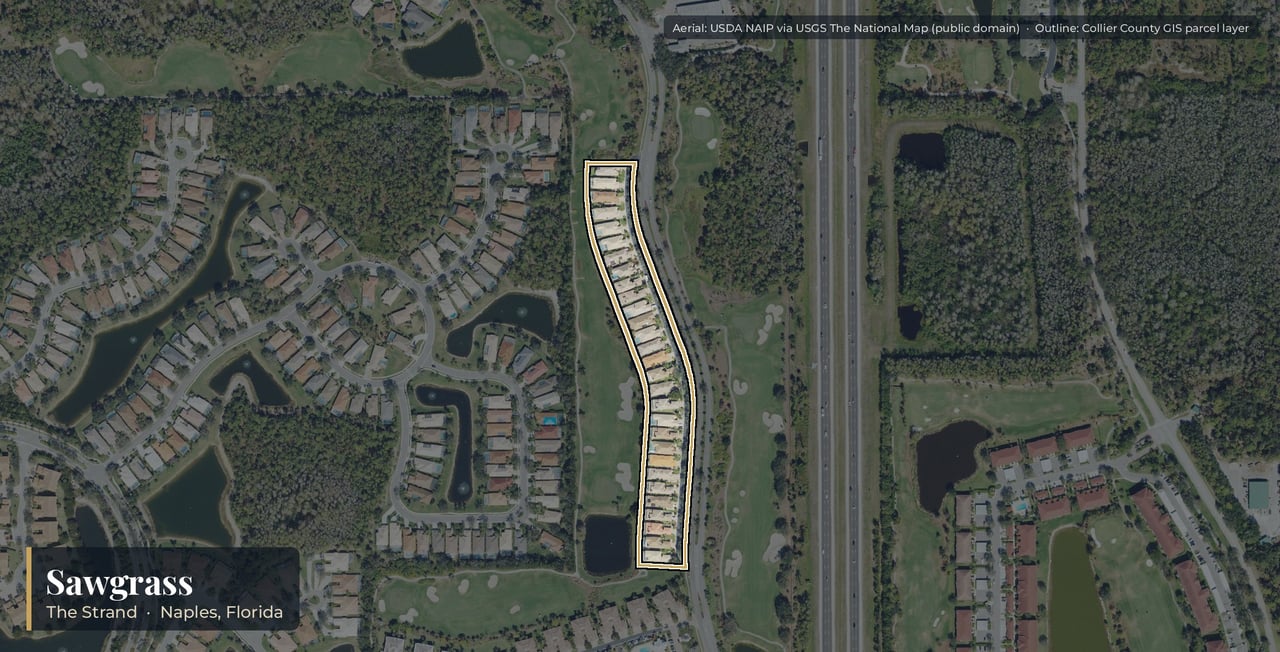
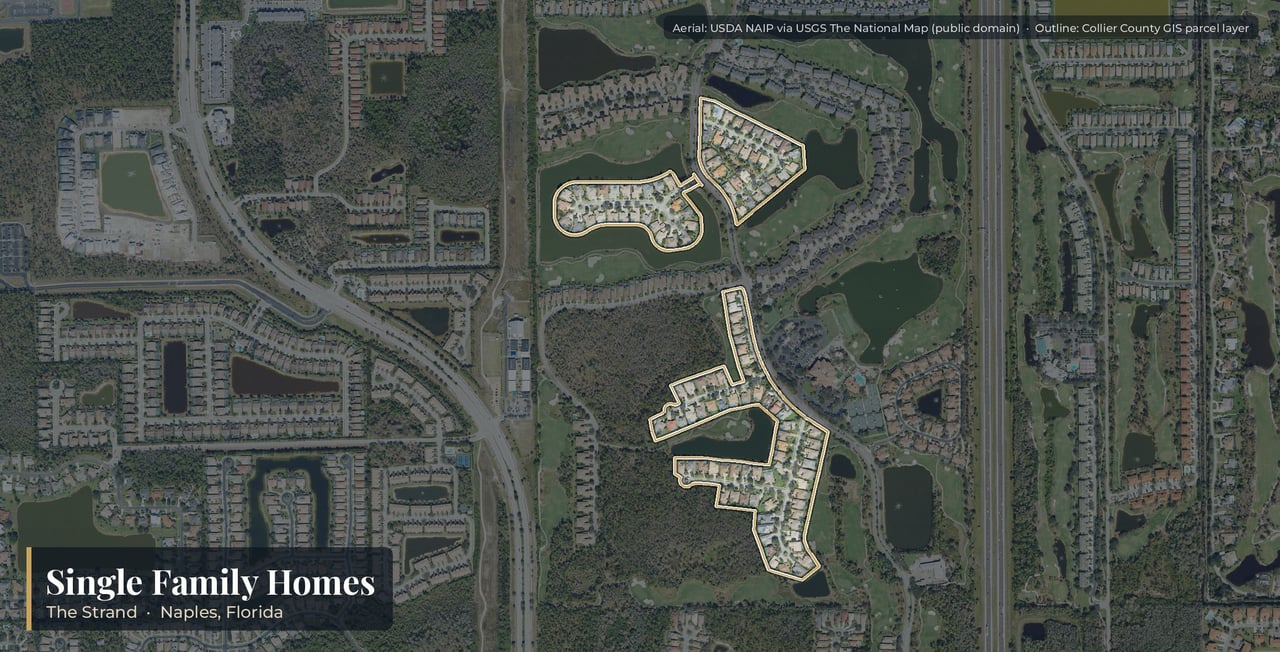
Bay Colony Shores, The Strand, and Vizcaya, the community's other single-family addresses, sit inside gated Bay Colony and are covered in the next section.
The special cases. Two Pelican Bay addresses solve a problem almost no luxury community addresses well. The Glenview at Pelican Bay is a full continuing-care retirement community, independent living through assisted living, memory care, and skilled nursing, inside the community itself. Marbella, a 21-story fee-simple condominium of 118 residences, operates as a full-service residence with four dining rooms, room service, dedicated 24-hour security, and The Cove, its own in-house assisted-living and extended-congregate-care facility. For the buyer planning a 20-year Naples life rather than a 5-year one, these two addresses mean Pelican Bay can be the last move you ever need to make, and we have guided many clients through exactly that arc.
We are building dedicated neighborhood pages for Pelican Bay's highest-demand spokes. Priority pages are coming for Mystique, Epique, St. Raphael, Cap Ferrat, Montenero, Marbella, and Claridge, each with fee schedules, recent comps, and floor-by-floor analysis. We will link them here as they go live. In the meantime, the shortcut is a conversation with the team that already knows every one of these 95 associations: that depth is what Top 1% Real Estate Agents Nationally Since 2008 actually means on the ground. Selling in a specific building or on a specific street, call Jesse direct at (239) 898-6072 or start at mcgreevyandcomisar.com/home-valuation. Buyers, call Marc at (239) 287-5873 and tell us what your day should look like; we will name the five associations that fit.
Bay Colony: The Gated Enclave Within Pelican Bay
Bay Colony is the fully gated, 200-acre enclave at Pelican Bay's north end, and it is the only part of Pelican Bay with a manned gate at the community level. Behind that gate the Bay Colony Community Association organizes eleven condominium associations, six directly on the Gulf and five overlooking the preserve and Upper Clam Bay, plus four neighborhoods of single-family homes and villas: Bay Colony Shores, The Strand, Vizcaya and Villa La Palma. Roughly 711 condominium residences and about 157 homes sit inside it. Residents hold membership in the private Bay Colony Beach Club and the Bay Colony Tennis Club on top of full Pelican Bay Foundation membership, so a Bay Colony owner carries two beach clubs at one address.
Bay Colony behaves like a separate market inside Pelican Bay, and the numbers say so plainly. Over the trailing 12 months it accounted for 44 of Pelican Bay's 348 closings, about 12.6 percent, at a median of $4,500,000 against the community-wide median of $1,549,500. Its own internal spread is wider still: Salerno's median time to contract was 38 days while Bay Colony Shores ran 407. Those are two different markets behind one gate, and no portal separates them. (Southwest Florida MLS Matrix, closings 30 Sep 2025 to 30 Sep 2026, pulled 30 Sep 2026.)
Because Bay Colony carries its own master association, its own recorded governance, its own fee layer and its own market, it now has its own page rather than a section here. Everything above is the short version. Read the full Bay Colony guide for the eleven towers building by building, the four neighborhoods, the Beach Club, the complete fee stack, the FEMA zones tower by tower, and the recorded reason Bay Colony is governed differently from the rest of Pelican Bay. Selling in Bay Colony, call Jesse direct at (239) 898-6072 or start at mcgreevyandcomisar.com/home-valuation. Buying there, call Marc at (239) 287-5873 or read how we represent buyers in Naples.
The Beach: Three Miles, Two Restaurants, and a Tram Through the Mangroves
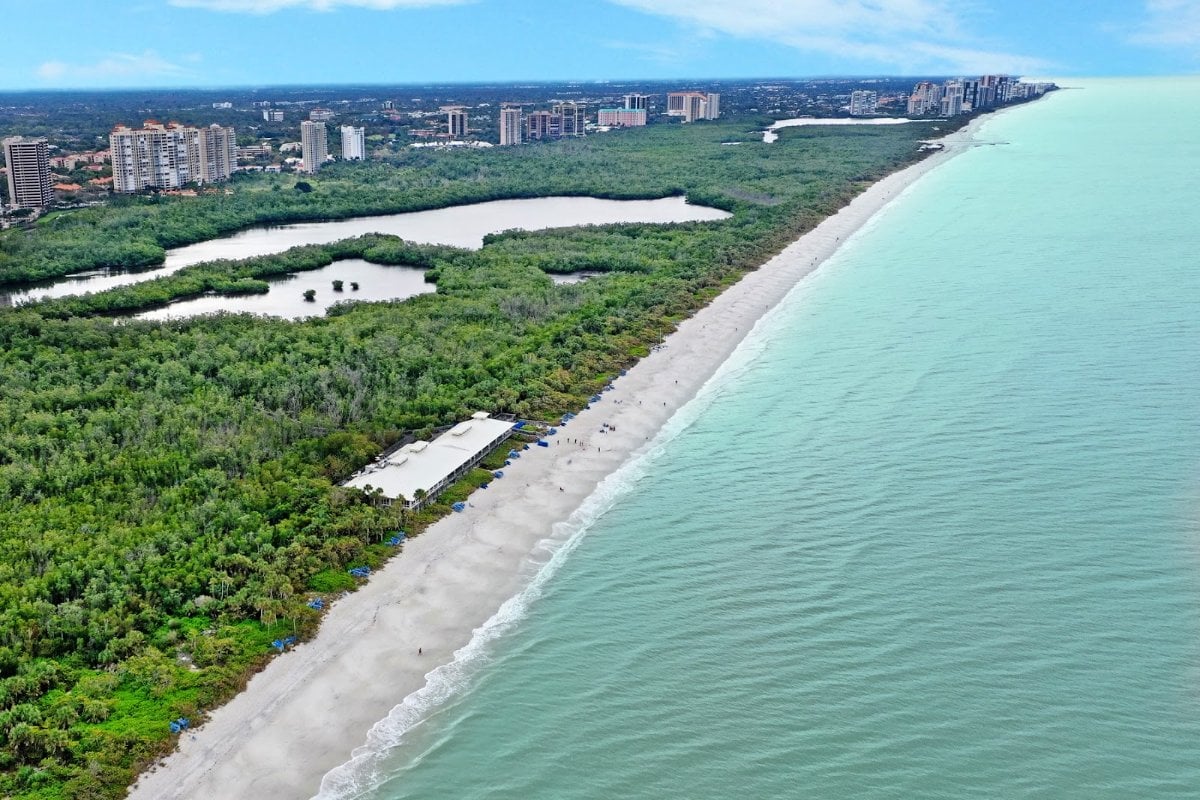
The Pelican Bay beach is nearly three miles of private, card-access Gulf sand reached by electric tram through a 570-acre mangrove preserve, with attended beach service and two member-only beachfront restaurants, Marker 36 to the north and Sandbar to the south, plus The Nest. No other Naples community operates anything like it.
Start with how you get there, because the journey is the signature. Pelican Bay's residential streets never touch the sand; between them and the Gulf lies the Clam Bay preserve, and the only way across is the community's own infrastructure: a raised berm two and a half miles long, closed to cars, and boardwalks that thread through the mangroves to the beach. Open-air electric trams run continuously from eight stations along the berm, and the Foundation's drivers make more than 900,000 trips to the beach and back each year. Walkers, runners, and cyclists share the berm (bicycles carry bells by rule, e-bikes and powered scooters are banned, and the whole corridor is card-access), so the same spine that delivers you to the sand doubles as the community's favorite three-mile workout. It is the piece of Pelican Bay that photographs least and matters most: a commute to the beach through a protected estuary, past wading birds and mangrove tunnels, that residents genuinely never tire of.
At the sand, the operation runs like a resort because it effectively is one. Both beach facilities open daily from 9 a.m. to sunset, beach attendants set your loungers, umbrellas, and cabanas (standard issue is a chair and an umbrella per person, and a member may bring up to six guests), and the Foundation's fleet of kayaks, canoes, and sailboats checks out free with a member card and a signed waiver for use in Clam Bay's protected waters. Showers, restrooms, accessible ramps, and beach wheelchairs are standard at both ends; 24-hour webcams let you check the surf from your kitchen; and a ThorGuard lightning-prediction system monitors the whole operation, suspending trams and clearing the beach when strikes threaten. Daily beach fitness classes, yoga and Zumba on the sand at South Beach, round out the calendar in season.
The dining is the part guests do not believe until they see it. Marker 36, at North Beach, is the Foundation's upscale coastal kitchen, island and Caribbean-inspired menus with al fresco seating and live music two evenings a week in season. Sandbar, at South Beach, is the casual counterpart, rebuilt in 2020 as an 18,283-square-foot adaptive re-use of the original south beach building by Naples' MHK Architecture and renovated again since, now with a bright Mediterranean look and sliding glass walls that open to the Gulf, plus its own music nights. The Nest, just south of Sandbar, handles snacks and drinks with a view. These are member-and-guest restaurants on a private beach, no public walk-ins, and the Foundation budgets more than $8.5 million a year in food and beverage sales across them, which tells you they are genuinely used, not merely owned.
Now the honest chapter, because a beachfront amenity on the Gulf of Mexico has a storm story and buyers deserve it straight. Hurricane Ian, September 28, 2022, drove surge across the beachfront band and did roughly $16.4 million of damage to the Foundation's facilities. Because a portion of the near-Gulf assets are, in the auditors' words, economically uninsurable, insurance ultimately recovered only about $543,000; the membership rebuilt the rest with a one-time $2,195 per unit special assessment approved in August 2023. The rebuild came in phases, all documented in the Foundation's member communications: North Beach, the boardwalks, and tram service by mid-2023; Marker 36's full reopening in November 2023; and Sandbar, the most heavily damaged, reopened in October 2024. Hurricanes Helene and Milton in fall 2024 caused only minimal additional damage, absorbed within the remaining Ian funds.
What happened next is the part that should reassure a long-term owner, because the community did not just rebuild, it hardened. Collier County's $7.5 million truck-haul beach renourishment, about 216,000 tons of sand across the Vanderbilt and Pelican Bay reach, was completed in January 2026, with Pelican Bay's private-beach share funded by the Pelican Bay Services Division rather than tourist taxes. The PBSD then finished its own sand reclamation and dune restoration in March 2026, roughly 100,000 cubic yards of sand recovered and a continuous dune rebuilt to a minimum 8-foot height along the full length of the Pelican Bay beach, from the Ritz-Carlton to Naples Cay, planted with sea oats and native dune species to hold it. The beach a buyer walks today is wider, higher, and better engineered than the one Ian hit, and the funding mechanisms that maintain it (the Foundation's reserves and the PBSD's assessment) are permanent, budgeted, and public. The full storm, flood-zone, and insurance picture for the community gets its own section later on this page; the beach operation's version of the story is simple: tested, rebuilt, reinforced.
Club Pelican Bay: 27 Holes of Arthur Hills Golf
Club Pelican Bay is the private, member-owned golf club inside Pelican Bay: 27 Arthur Hills-designed holes across three par-36 nines on nearly 240 acres, renovated by Ron Forse in 2019, behind a $33 million clubhouse completed in 2017. Membership is optional, separate from the Foundation, and perennially in demand.
The club's story runs parallel to the community's. The course was part of the master plan's environmental engineering from the start, its fairways deliberately designed as a rain field for the community's water-retention system, and the original Arthur Hills layout opened in January 1980, after a first test run of member foursomes on December 28, 1979. Westinghouse announced the third nine on February 23, 1989 (a land commitment negotiated in part by the Pelican Bay Property Owners Association), giving the club its current 27 holes in three rotating nines named Club, Pelican, and Bay, each par 36, threaded through oaks, lakes, and preserve in the heart of the community. The membership took ownership from the developer under an agreement reached May 16, 1990, and the founding board of governors first met March 5, 1991; it has been a member-owned club ever since.
The golf is architecturally serious. Hills' routing rewards position over brute length, the signature hole is Pelican No. 7, a 216-yard par 3 over water to a green wrapped in bunkers, and course connoisseurs will find a classic Redan par 3 at Club No. 3 and a genuine double green at Club No. 6, where the left flag demands a carry over the lake. Ron Forse renovated the course in 2019, and the club's grounds double as a wildlife sanctuary in practice, with the club's own Audubon Society group cataloging the ospreys, screech owls, and fox squirrels that live on the property.
The clubhouse era changed everything about the club's daily life. In 2015 the members voted to tear down every existing building, and the resulting $33 million project delivered a new 50,000-square-foot, two-story Florida Vernacular clubhouse in fall 2017, followed by a new golf shop and locker-room building in summer 2018. Inside are the club's dining rooms (the casual Tavern, the Atrium, the formal Oaks Room, and a Wine Bar) plus the club's first spa and fitness center, with three therapy rooms and a couples' suite. Beyond golf, the club runs an ACBL-sanctioned bridge program, six-wicket and golf croquet, bocce, and the card games that structure a Naples season. It is a full club, not just a course.
Here is the straight answer on cost, because this is where most write-ups pretend to knowledge they do not have: Club Pelican Bay does not publish its initiation fees or annual dues, and we will not invent them. The club's membership page lists three categories, Golf, Summer Golf, and Social, with membership by application, and the club's own site carries a Social Membership waitlist application that is currently marked inactive, primary evidence that demand routinely outpaces availability, even for the non-golf tier. What we can tell you from working this market: golf membership here is a meaningful lifestyle asset that does not convey with a home purchase, it is a separate application to a club that does not need to advertise, and buyers for whom golf is essential should start that conversation at contract, not at closing. We make that introduction for clients and set expectations honestly, current availability, realistic timelines, and what the club is looking for, because the worst outcome is a golf buyer who discovers the waitlist after the deed records.
Two clarity points to close. First, Club Pelican Bay is not a Foundation amenity: the $3,435 fiscal 2027 Foundation assessment covers the beach, trams, tennis, and fitness, and not one dollar of golf, which is exactly why Pelican Bay works so well for the majority of owners who do not play. Second, do not confuse it with the Bay Colony Golf Club, the separate equity club across U.S. 41 in Pelican Marsh covered in the Bay Colony section above. One community, two private clubs, both optional; that is a rarer and more owner-friendly arrangement than almost any bundled golf community in Florida can offer.
Racquets: 18 Har-Tru Courts and the New Pickleball Complex
Pelican Bay runs one of Southwest Florida's largest racquets programs: 18 Har-Tru tennis courts at two in-community centers serving more than 4,500 active tennis members, plus the new $7 million Racquets Center at Pelican Bay Community Park, 20 pickleball courts and 8 lighted Har-Tru courts that opened in December 2025.
Tennis has been part of the Foundation's core offer for decades. The community's two tennis centers, North and South, field 18 professionally maintained Har-Tru courts with pro shops at each location, a coaching staff that includes former touring professionals and collegiate coaches, and one of the region's largest cardio tennis programs, all included in Foundation membership. With more than 4,500 active tennis members, the leagues, round robins, and clinics run deep enough that a new resident at any level finds a game the first week. That scale matters to buyers comparing communities: this is not a two-court amenity deck, it is a genuine racquets club that happens to be included in your assessment.
Then came the project that answered the biggest amenity question in Naples. Pickleball demand had been building here for the better part of a decade, and the Foundation solved it with a public-private structure nobody else in the county had tried: under a management agreement executed with Collier County on August 22, 2023 (amended February 13, 2024), the Foundation fully funded roughly $7 million of improvements, up from an initial $6 million estimate, at the county-owned Pelican Bay Community Park at 764 Vanderbilt Beach Road, the nearly 15-acre park the community's developer deeded to the county back in 1994, and in exchange operates racquet sports there under a 30-year term. The result, delivered after a December 2024 groundbreaking, is the Racquets Center at Pelican Bay Community Park: 20 Novacrylic pickleball courts and 8 sub-irrigated, lighted Har-Tru HydroCourts, a pavilion building with a pro shop, restrooms, and shaded waiting areas, expanded parking, and 12-foot sound-absorbing fencing for the neighbors. The courts opened in December 2025, the ribbon was cut January 9, 2026, and the tennis-side renovation, six rebuilt HydroCourts and two new ones, supported by a USTA facility grant, wrapped in May 2026.
Two details tell you how seriously this was done. The pickleball programming and curriculum were designed with Ben and Collin Johns, the sport's defining professional names, through Johns Design and Consulting, with JOOLA as a facility partner and more than 40 programs from clinics to tournaments; and the sharing arrangement is written down, half the pickleball courts reserved for public use and half for Foundation members and guests during the same hours (ten courts each), with three of the eight tennis courts member-designated. Court booking runs through the facility's own app and pelicanbaycourts.com. For buyers scoring Naples communities on the pickleball arms race, the scoreboard here is simple: 20 new courts, tour-level programming, opened December 2025, and the community's members funded it without a special assessment, out of the Foundation's capital program.
Fitness, Wellness, and the Community Centers
Pelican Bay's Community Center anchors the community's daily wellness life with a fully equipped fitness center, a lakeside wellness studio for massage and skin care, an art studio, card rooms, and a packed events calendar, all included in Foundation membership, with a renovation already provisioned in the fiscal 2027 reserve plan.
The fitness center, located within the Community Center at 8960 Hammock Oak Drive, runs Lifefitness and Cybex cardio, strength, and core lines with certified personal trainers on staff and a new-user orientation to keep the room civilized. What distinguishes the program is where it spills outdoors: an outdoor fitness area under the oaks overlooking a lake, and daily group classes on the sand at South Beach, beach yoga and Zumba with the Gulf as the back wall, a combination very few private clubs anywhere can stage. Steps away, the Wellness Studio is a deliberately quiet lakeside retreat, bamboo floors, soundproofed treatment rooms, licensed massage therapists and estheticians, with customizable massage and facial treatments by appointment. Neither requires a separate membership; both live inside the Foundation assessment.
The Community Center itself is the community's indoor town square: more than 25,000 square feet of meeting and event space hosting themed events, dances, lectures, and seminars, with an art studio, card rooms, and dedicated Bridge and Mahjong areas that run essentially year-round. The social infrastructure on top of it is old and real: the Pelican Bay Women's League alone offers more than 25 interest groups, the Men's Coffee has gathered weekly since 1995, and the Foundation publishes the Pelican Bay Post nine times a year plus an annual Lifestyle Guide with a master calendar, so a new owner can land in October and be fully scheduled by Thanksgiving. Foundation administration, member services, and card issuance live separately at The Commons, 6251 Pelican Bay Boulevard, which is also where the trams stage for the south beach.
One forward-looking note buyers should have: the Foundation's fiscal 2026 budget documents provision Community Center renovation items beginning in fiscal 2027, and the Services Division is holding an adjacent lake-bank project until the Foundation finalizes its remodeling plans. Scope and budget have not been published, so we will not speculate, but the direction is clear and consistent with this community's pattern: the amenity core gets reinvested in, on schedule, from funded reserves. Owners here pay for that discipline in their assessment and get it back at resale.
Waterside Shops, Artis-Naples, and the Resort Spine
Pelican Bay contains its own cultural and resort district: Waterside Shops' luxury retail, Artis-Naples with The Baker Museum and the Naples Philharmonic, The Ritz-Carlton, Naples, the Naples Grande Beach Resort, and the Inn at Pelican Bay all operate inside the community's 2,104 acres. No other Naples neighborhood carries this lineup within its own borders.
Waterside Shops is the retail anchor, an open-air luxury center at U.S. 41 and Seagate Drive that the community's own developer co-created (Westinghouse Communities partnered with Miami's Courtelis Company; it opened in November 1992 with Saks Fifth Avenue as anchor) and that The Forbes Company has owned and elevated since 2003. Today it runs more than 60 stores, Hermès, Gucci, Dior, Louis Vuitton, Van Cleef and Arpels, Tiffany, Brunello Cucinelli, Apple, and Tesla among them, with Saks still anchoring, and it is in the middle of its largest redevelopment since opening: the former Nordstrom building has been demolished for an RH gallery with a rooftop restaurant opening in late 2026, Williams-Sonoma and Pottery Barn are taking the former Barnes and Noble building, Eddie V's Prime Seafood is open in the re-imagined bank building at 765 Seagate Drive, and a further wave of boutiques lands across summer 2026. For Pelican Bay owners this is not "shopping nearby," it is the community's front porch, a five-minute walk from the southern villages, and its continuing reinvestment is a live property-value input.
Artis-Naples is the cultural jewel, and it is a Pelican Bay address by birthright: Westinghouse Communities deeded the 6.65-acre site on Pelican Bay Boulevard in 1986, and the Philharmonic Center for the Arts opened there November 3, 1989 under founder Myra Janco Daniels. Renamed Artis-Naples in 2013, the Kimberly K. Querrey and Louis A. Simpson Cultural Campus now holds Frances Pew Hayes Hall, the Myra J. Daniels Pavilion, and The Baker Museum, expanded in 2020 and, as of 2025, the first and only museum in Collier County accredited by the American Alliance of Museums, alongside the Naples Philharmonic under artistic and music director Alexander Shelley. Residents of the surrounding towers walk to world-class programming; that sentence alone sells certain buildings, and we use it.
The two resorts complete the spine, and both are mid-story in 2026. The Ritz-Carlton, Naples (280 Vanderbilt Beach Road) opened in 1985 on the community's north beachfront and reopened July 6, 2023 from its Hurricane Ian closure transformed: a top-to-bottom renovation begun before the storm delivered the new Vanderbilt Tower with a dedicated club level, all 474 rooms redesigned, new restaurants, and a 51,000-square-foot spa. Naples Grande Beach Resort (475 Seagate Drive), the 1986-vintage, 474-room resort at the community's south end, sold to London-based Henderson Park for $248 million in 2022 (South Street Partners joined the ownership in 2024) and begins its biggest-ever renovation on April 1, 2026, with much of the property closed for roughly nine months. The boutique Inn at Pelican Bay adds 100 rooms at the northeast corner. One insider mechanic worth knowing: the hotels participate in the community as commercial members of the Foundation, which is how their guests access the beach, under the same card system that governs everyone else. And one live issue worth watching: the Naples Grande ownership's proposed waterpark amenity has drawn organized community opposition, and the Pelican Bay Foundation itself filed a formal administrative appeal in April 2026; the full story, and what it means for nearby buildings, is covered in the civic-pipeline section of this page.
For a buyer, the resort spine means valet-level restaurants, two spas, a philharmonic, and couture retail inside your own community, with someone else paying to maintain them. For a seller, it is a differentiator no other Naples listing can copy, and we market it that way. Your Pelican Bay experts, direct: Jesse McGreevy (239) 898-6072 · [email protected]; Marc Comisar (239) 287-5873. Sellers, start at mcgreevyandcomisar.com/home-valuation or call Jesse. Buyers, call Marc.
Daily Life and Logistics in Pelican Bay
Pelican Bay is not gated at the community level: its main roads are public Collier County roads, while every beach, tram, boardwalk, and restaurant is card-controlled by the Pelican Bay Foundation. Add county utilities, community-wide gigabit fiber, a two-lease-per-year cap on rentals, and a four-step design review, and daily logistics here are genuinely unique.
The security model, told honestly
Most competitor content gets this wrong, so let us get it right. Pelican Bay Boulevard and the community's other arterial roads are county-maintained public roads; Pelican Bay Boulevard appears on Collier County's schedule of speed limits for county-maintained roads. There is no gatehouse on Pelican Bay Boulevard, and the Pelican Bay Foundation's own realtor materials pointedly coach agents on how to describe Pelican Bay "other than 'gated community.'" What Pelican Bay has instead is a three-layer security model that, in practice, works remarkably well:
- Layer 1: the Collier County Sheriff's Office. Pelican Bay sits in unincorporated Collier County, so policing comes from CCSO, not Naples PD. The District 1 North Naples office is at 776 Vanderbilt Beach Road, essentially at the community's northeast corner.
- Layer 2: the Pelican Bay Services Division (PBSD). The county ordinance that created this special taxing unit (Ordinance 2013-61) expressly lists "extraordinary law enforcement service" among its purposes. Translation: Pelican Bay property owners fund, through their PBSD assessment ($1,550 per unit for FY2026, board-approved at $1,250 for FY2027, subject to county adoption), a mechanism that can pay for supplemental sheriff service beyond the county baseline, alongside street lighting, water management, and beach work.
- Layer 3: the Foundation's own Safety and Security Department, which the official Member Guide describes as "responsible for ensuring member safety and securing the Foundation's amenities and assets." Its fingerprints are everywhere: a security team lead reachable at (239) 877-7573 posted at every tram station, eight emergency call boxes along the south berm, card checks at outbound tram boarding, and a ThorGuard lightning-prediction system that clears the beaches and pauses trams when strikes threaten.
The real access control is the amenity layer. The beaches, trams, berm, boardwalks, parks, restaurants, fitness center, and community rooms all require a Foundation Issued Card or accompanied-guest status. So while anyone can drive down Pelican Bay Boulevard, nobody without a card walks onto the beach or boards a tram. One true exception on gating: Bay Colony, the ultra-luxury enclave at Pelican Bay's north end, IS fully gated, with 24-hour controlled entry; the Foundation's own 2026 Lifestyle Guide calls it "the private gated enclave of Bay Colony." A number of individual neighborhoods inside Pelican Bay also maintain their own gates or controlled entries, though the Foundation publishes no official count.
The member card system (and how showings work)
Every residential property gets up to two Resident Member Cards, with additional card types for dependents 13 and older, live-in caregivers, and childcare providers. Guests staying with you can be accompanied free (a carded member may bring up to six guests onto the berm, beach, and trams), or you can purchase Unaccompanied Guest Cards for visitors 13 and older: minimum 2 days, maximum 30 days, and no guest may exceed 30 total days in any 12-month period. Anyone living permanently or seasonally in Collier or Lee County is ineligible for an unaccompanied guest card under any circumstances. Commercial members (the Ritz-Carlton, Naples Grande, Waterside Shops and other on-property businesses) hold their own card allotments, which is how resort guests reach the beach.
For buyers touring with us, the Foundation issues one-day Realtor Guest Cards: valid only on the day of a showing, granting beach, tram, and restaurant access, with the Realtor required to accompany clients at all times. We pre-order them online and pick them up at The Commons (6251 Pelican Bay Blvd), Monday through Friday 8:30 to 5:00. It is a small logistical detail that matters: you can actually experience the tram-and-beach life before you write an offer, if your agent knows the system.
Lease rules: the recorded two-per-year cap
Pelican Bay's leasing regime has two layers, and both matter:
- The recorded covenant (the hard rule). A member-approved amendment to Section 3.26 of the Declaration, recorded May 28, 2019 (Instrument 5717831, OR Book 5634, Page 1101), defines a "lease" as any occupancy for consideration, expressly sweeping in "arrangements such as those facilitated by Airbnb, FlipKey, VRBO... regardless of whether the arrangements are classified... as something other than a lease." Unless a neighborhood's own covenants say otherwise, no dwelling unit may be leased more than two times per calendar year, and timeshare use is banned outright. The Foundation sets no minimum lease term; minimum durations (30 days, 90 days, seasonal-only, and so on) are set neighborhood by neighborhood, so always verify the specific association's rules before buying with rental income in mind.
- The one recorded carve-out, and it is not a technicality. Section 3.02(d) of the same Declaration states: "The provisions of this Article 3 shall not apply to Bay Colony." Section 3.26 sits inside Article 3, so the two-lease cap, the Airbnb and VRBO language and the timeshare ban do not reach a Bay Colony owner through the Foundation. The 2019 amendment left that untouched, reciting that "Sections 3.01 through 3.25 remain unchanged," so the carve-out is current rather than historical. For a Bay Colony buyer the operative leasing rule is the individual building's recorded declaration and it varies: the Remington, for example, permits one lease per calendar year with a 90-day minimum and board approval, which is stricter than the community-wide cap, not looser. Foundation membership itself is a separate question and there is no carve-out from it: Articles 5 and 6, membership and assessments, apply to Bay Colony in full. (Collier County Official Records Book 4442, Page 3389, instrument 4281813, recorded April 9, 2009; amendment instrument 5717831, Official Records Book 5634, Page 1101, recorded May 28, 2019.)
- The Foundation process. Every lease requires an application to the Foundation at least 30 days before occupancy, with a $500 non-refundable processing fee (2027 lease packet; $300 in 2026) and the neighborhood association's approval letter (or the executed lease for single-family homes). During the lease, the owner's member cards are suspended; the tenant picks up a maximum of two Renter Cards in person with government photo ID, and the owner's access reactivates the day after the lease ends. Amenity rights travel with the home, not the person.
Worth knowing: under Florida Statute 720.3085(8), the Foundation can intercept rent from a delinquent owner's tenant, and 90-plus days of delinquency can suspend all member, tenant, and guest amenity rights. The community enforces its rules.
Design review: four steps, two approvals
Renovating in Pelican Bay means satisfying both your neighborhood association and the Foundation's design review apparatus. Minor projects (repainting, roof replacement, shutters, generators, landscape lighting, tree work, and similar) go to the Foundation's Director of Covenants, carry no design review fee, and get a decision within 14 working days of a complete application. Major projects (new construction, teardowns, exterior renovations, structural or elevation changes, major landscaping) run a mandatory four-step gauntlet before the Design Review Committee: a pre-application meeting, a preliminary concept review, a design proposals review with sealed plans and a civil stormwater plan, and a final construction plans review. Exterior materials and colors come from approved Pelican Bay palettes, complete applications are due by the 15th of the month to make the next committee cycle, and evidence of neighborhood association approval is a required submittal at both the concept and design stages. Fines and recorded notices of violation back it up. The payoff is why Pelican Bay still looks like Pelican Bay after nearly five decades. Covenants Department: (239) 596-6180 ext. 237.
Utilities, trash, fiber, and EV charging
- Water and sewer: Collier County Public Utilities (the community's original developer-era Pelican Bay Improvement District systems were assumed by the county long ago). County reclaimed water supplies irrigation in the area, on the standard county schedule (three days per week by address, never on Fridays or 10 a.m. to 4 p.m.).
- Electric: Florida Power & Light.
- Trash: county-contracted curbside service by Waste Management: garbage twice a week, recycling weekly, yard waste weekly, bulky items weekly, billed as a non-ad valorem assessment on the tax bill. Only three holidays pause collection all year.
- Internet and TV: Pelican Bay is a fiber-to-the-home community. The Foundation describes it as "a fiber optic neighborhood with digital television and gigabit internet capabilities for all condos and single-family homes," delivered through a community bulk media agreement that shows up as a line item ($828 for FY2026) inside the Foundation's annual assessment, passed through at cost. Hotwire Communications is the fiber provider featured in the Foundation's current member materials.
- EV charging: Tesla operates a showroom at Waterside Shops with charging stations on site, and several individual towers (St. Raphael and Stratford among them) have installed their own chargers. The Foundation does not operate public chargers at The Commons or Community Center, so condo buyers who drive electric should verify their specific building's garage capability during due diligence. It is a building-by-building amenity here, as in most 1980s-90s tower communities.
Pets, guests, and the small print that shapes daily life
Pets are welcome on the berm, leashed on a lead of six feet or less (retractable leashes are not permitted on the berm), but are not allowed on the beaches, boardwalks, trams, or inside the fitness and community facilities; approved service animals ride the trams and may go to the beach under the Foundation's adopted service animal policy. Smoking of any kind, including vaping, is prohibited on Foundation property. Drones are banned except by prior written approval, and real estate drone photography requires the written consent of every owner overflown, which is why our tower listings use licensed, Foundation-cleared aerial work. Beaches run 9 a.m. to sunset daily, with equipment cleared nightly May 1 through October 31 for sea turtle season. The parks (Ridgewood and Oakmont) are dawn to dusk. E-bikes and all powered personal vehicles are prohibited on the berm and boardwalks, a rule the community enforces and most residents defend; the berm is for feet, pedal bikes, strollers, and trams. If any of these rules is a dealbreaker for how you actually live, better to know now, and we will tell you straight.
The Storm Record: Ian, Helene, and Milton in Pelican Bay
Hurricane Ian hit Pelican Bay hardest at the shoreline: the beach facilities and berm took roughly $16.4 million in damage while the residential core, set back behind the mangroves, fared far better. Helene and Milton in 2024 were erosion events, not destruction events, and the community answered with renourishment and a rebuilt dune completed in 2026.
Ian, September 28, 2022: what actually happened
Ian made landfall at Cayo Costa, about 35 miles north, as a Category 4 with 150 mph winds. The National Hurricane Center's official report puts peak inundation at 8 to 12 feet above ground level across Estero, Bonita Beach, Bonita Springs, and North Naples, with USGS sensors measuring more than 9 feet above normal high tide as far south as Delnor-Wiggins State Park, roughly two miles north of Pelican Bay's boundary. Critically for this community, the same report notes that in North Naples "the most severe impacts were contained to the immediate coastline." That is Pelican Bay's geography working exactly as the flood maps predict: catastrophic damage at the beach and west of the berm, dropping off sharply inland.
The Foundation's audited financial statements tell the rebuild story with unusual candor. Ian-related costs came to approximately $16.4 million. Because "a certain portion of its near-gulf capital assets are economically uninsurable," insurance recovered only about $543,000 across two fiscal years; the rebuild was overwhelmingly member-funded, including a $2,195 per-unit Hurricane Ian special assessment approved in August 2023, softened by about $2 million of operating surplus that accumulated while facilities were closed. Every serious buyer should understand that fact pattern: the Foundation self-insures much of its beachfront risk, and it has demonstrated both the willingness and the financial machinery to special-assess and rebuild fast.
The restoration arc, from the Foundation's own publications: the north berm, North Beach, boardwalk, and tram service were back in operation by mid-2023, with completed dune restoration and stabilizing vegetation at Marker 36; the Marker 36 restaurant fully reopened in November 2023; and the rebuilt Sandbar at South Beach reopened in October 2024, joined by The Nest, the newer snack-and-beverage outpost just south of it. By fiscal 2025 the recovery costs had rolled off so cleanly that the Foundation's annual assessment actually decreased 9.1 percent.
Helene and Milton, 2024: an erosion story
The 2024 pair grazed rather than struck. Helene (September 26, 2024) pushed 2 to 4 feet of inundation into the Naples area from far offshore; Milton (October 9, 2024) delivered 3 to 5 feet from Bonita Beach through Marco Island. The Florida DEP's post-storm assessment classified the Vanderbilt Beach and Park Shore reach that includes Pelican Bay's shoreline as Condition III, moderate erosion, with Collier beaches losing 20 to 30 feet of width; across the entire county, FDEP documented exactly one major structural damage, a single-family home. The Foundation's audit recorded Helene damage as minimal and Milton damage as minor, with South Beach reopened by October 26, 2024 and the trams (moved off the beachfront ahead of the storm) returned shortly after. The Board then launched a formal resiliency initiative in November 2024, tasking a team with short- and long-term strategies for protecting community assets during storm events.
The response: new sand and a rebuilt dune
Two major projects answered the 2024 erosion, and both are finished:
- County renourishment, completed early 2026. Collier County's roughly $7.5 million truck-haul project spread 216,000 tons of beach-quality sand across 2.9 miles of Vanderbilt Beach and Pelican Bay Beach. The Pelican Bay segment was placed in January and February 2026. Note the funding split, because it says everything about how this beach works: tourist taxes paid for the public Vanderbilt Beach portion, while the Pelican Bay portion was funded by the Pelican Bay Services Division, because Pelican Bay's beach is private.
- PBSD dune restoration, completed March 30, 2026. A $2.97 million sand reclamation and dune restoration (about $402,000 of it covered by Tourist Development Council funds) reclaimed roughly 100,000 cubic yards of sand and rebuilt the dune to a minimum 8-foot height, 10 to 50 feet wide, along the full length of Pelican Bay's beach "from the Ritz to Naples Cay," followed by native dune plantings (sea oats, sea purslane, railroad vine, dune sunflower) vetted with Naples Botanical Garden.
Behind both projects stands the quieter, older defense: the roughly 570-acre Clam Bay mangrove preserve, a designated Natural Resource Protection Area that PBSD manages and monitors, including the recurring dredging of Clam Pass that keeps tidal flow feeding the forest. Local officials describe those mangroves as a major storm buffer between Naples and the Gulf. Pelican Bay residents fund that stewardship through their PBSD assessment, and it is one of the least appreciated things their money buys.
FEMA Flood Zones in Pelican Bay, Explained by Neighborhood
Pelican Bay runs a textbook west-to-east flood gradient: Zone VE with base flood elevations of 14 to 15 feet on the beachfront, AE 10 to 11 through the Gulf-side corridor and mangrove belt, and Zone X, minimal flood hazard, across most of the interior and eastern neighborhoods. Collier County's CRS Class 5 rating cuts NFIP flood premiums by 25 percent.
The governing maps are Collier County's coastal DFIRM panels effective February 8, 2024, the county's first coastal flood-map overhaul since 2012. Pelican Bay is covered by FIRM panels 12021C0377J (northern beachfront), 12021C0381J (central corridor and the eastern residential side), and 12021C0383J (southern end, including the Waterside Shops and Artis-Naples corner). Here is the pattern, from point sampling of FEMA's live National Flood Hazard Layer:
Beachfront band, North Beach / Marker 36 area | VE (coastal high hazard, wave action) | 15 ft |
Beachfront band, South Beach / Sandbar area | VE | 14 ft |
Clam Bay mangrove belt, west of the berm | AE | 11 ft |
Gulf-side high-rise corridor along Pelican Bay Blvd | AE | 10 ft |
Bay Colony residential area behind the dune | AE | 10 ft |
South-end residential | AE | 10 ft |
Interior golf and lake pockets near Club Pelican Bay | AH (shallow ponding) | varies |
North interior residential, Oakmont side | X, minimal flood hazard | n/a |
Northeast interior near US 41 | X, minimal flood hazard | n/a |
Waterside Shops / Artis-Naples corner | X, minimal flood hazard | n/a |
What this means in practice:
- Beachfront (VE): the highest-risk designation, with modeled wave action. New or substantially improved construction requires wave-resistant coastal foundations, and flood insurance is priced accordingly. This is where Ian's damage concentrated, and it is also where the new 8-foot dune now stands.
- The high-rise corridor (AE 10): where most of the Gulf-view towers sit. Living units start well above base flood elevation in a high-rise; the exposure is ground-level lobbies, garages, and building systems, which is exactly what post-Ian hardening projects across the corridor have addressed.
- Interior and east (X): most of Pelican Bay's single-family neighborhoods and interior villages are in FEMA's minimal-hazard zone. Flood insurance there is optional (and comparatively cheap), a nuance that surprises many buyers who assume "coastal community" means "flood zone" everywhere.
- AH pockets: scattered shallow-ponding zones around the interior golf and lake areas; localized, engineering-managed, and handled by PBSD's stormwater system.
The rules that bind owners in the VE, AE, and AH zones: flood insurance is mandatory with a federally backed mortgage; new NFIP policies typically carry a 30-day wait; FEMA's 50 percent rule requires a structure to be brought to current flood-elevation standards if improvements or repairs equal or exceed half its market value; and Collier County requires new machinery (air conditioners, generators) to be elevated to base flood elevation plus one foot. Because Pelican Bay is unincorporated Collier County, NFIP policies here benefit from the county's Community Rating System Class 5 standing, worth a 25 percent discount on eligible flood premiums, roughly $8.2 million in annual savings community-wide across the county.
Two live items to watch. First, FEMA's separate non-coastal FIRM update is in process, with adoption expected roughly August to October 2026; it primarily affects inland Collier, but any remapping cycle is worth tracking. Second, always verify the specific parcel: zones change at property-line resolution. The authoritative lookups are the FEMA Map Service Center (msc.fema.gov) and Collier County's own 2024 DFIRM viewer with elevation-certificate search. When we represent you on a specific address, we pull the panel and the elevation certificate as a matter of course.
Condo Insurance, Milestone Inspections, and SIRS: The Post-Surfside Reality
Every Pelican Bay tower sits within Collier County's three-mile coastal band, which puts the community's 1980s and 1990s high-rises on Florida's 25-year milestone inspection clock, with structural integrity reserve studies now mandatory and reserves non-waivable. For buyers, that means three documents matter before any offer: the milestone report, the SIRS, and the estoppel.
The milestone regime, and why Pelican Bay is squarely inside it
Florida Statute 553.899, passed after the Surfside collapse, requires structural milestone inspections for condominium and cooperative buildings three habitable stories or taller. Collier County's adopted schedule is stricter near the water: buildings within three miles of saltwater get their first milestone inspection at 25 years after certificate of occupancy, then every 10 years. All of Pelican Bay sits within roughly a mile and a half of the Gulf, so every tower here is on the 25-year clock. The county's catch-up deadlines have already swept the community: coastal buildings with a CO before July 1997 were due by December 31, 2024; CO July 1997 through December 1999 by December 31, 2025; anything from 2000 on hits its milestone in the year it turns 25. With Pelican Bay's towers dating roughly from 1981 through 2019, essentially the entire high-rise inventory was captured in the first two waves.
The process itself is two-phase: Phase 1 is a visual assessment by a licensed architect or engineer; Phase 2, with possible destructive testing, is triggered only if substantial structural deterioration is found. Where repairs are required, the association must apply for permits within 150 days and start work within 365. Associations bear all costs, and the county's per-report filing fee rose to $500 on January 1, 2026.
Here is the part most agents never tell you: the status of every tracked building is public. Collier County publishes a live milestone status dashboard, a buildings-by-year list showing every building and its due year, and the underlying reports and letters through its permitting portal. Before you fall in love with a specific tower, we pull its milestone standing the same afternoon. That is basic diligence in this community now.
SIRS: the end of zero-reserve towers
Under Florida Statute 718.112(2)(g), associations of three stories or more must complete a Structural Integrity Reserve Study covering the roof, load-bearing structure, floor, foundation, fireproofing, plumbing, electrical, waterproofing and exterior painting, windows and exterior doors, and any other item over $10,000 affecting these, with a funding plan attached. HB 913 (2025) extended the initial SIRS completion deadline to December 31, 2025 and added funding flexibility such as lines of credit. The teeth: for budgets adopted on or after December 31, 2024, members can no longer vote to waive or underfund reserves for SIRS items. The era of artificially low dues propped up by empty reserve accounts is over, statewide.
For Pelican Bay that cuts both ways. Yes, SIRS-driven reserve contributions are now embedded in tower budgets, and they are part of why monthly condo fees have climbed across coastal Florida. But a fully reserved, milestone-passed, post-Ian-hardened Pelican Bay tower is also a fundamentally de-risked asset compared with the same building five years ago, and educated buyers increasingly pay for that certainty. We have not seen published Pelican Bay-specific assessment horror stories in the local press, and we will not invent any; the honest statement is that reserve realities vary building by building, which is why the documents matter.
Insurance: what the market looks like from a Pelican Bay address
- Wind and property. By statute, homes with a replacement cost of $700,000 or more are ineligible for Citizens, Florida's state-backed insurer, outside a few counties. At Pelican Bay price points, that means most owners insure through the admitted private market or surplus lines. The good news is the market has turned: Citizens shrank below 400,000 policies statewide by the end of 2025 after more than 546,000 were moved to private carriers in that year alone, 17 new insurers have entered Florida since the 2022-23 legal reforms, and by late 2025 regulators had logged 73 rate-decrease filings and 94 zero-increase filings. Citizens itself filed for an average 2.6 percent personal-lines decrease effective June 2026, while asking about 10.4 percent more on commercial lines, the category that includes condo association master policies. Unit owners should watch that split: your building's master premium and your personal HO-6 are moving on different tracks.
- Wind mitigation credits. Florida law (s. 627.0629) requires insurers to give credits for features that reduce windstorm loss: roof shape and attachment, roof-to-wall connections, secondary water resistance, impact glazing and opening protection. Credits are documented on the OIR-B1-1802 inspection form, updated effective April 1, 2026. For a 1980s or 1990s Pelican Bay purchase, a wind-mitigation inspection costs little and routinely pays for itself, especially where the building or home has re-roofed or added impact glass since Ian.
- Flood. NFIP dwelling coverage caps at $250,000 per residence, far below Pelican Bay replacement values, so private or excess flood is standard for VE and AE-zone estates. Condo towers carry the NFIP's Residential Condominium Building Association Policy (RCBAP), which insures the building to the lesser of replacement cost or $250,000 times the number of units, with an 80 percent coinsurance requirement; associations typically layer private excess flood above it, and unit owners add contents and loss-assessment coverage. The county's CRS Class 5 discount takes 25 percent off eligible NFIP premiums here.
What a Pelican Bay buyer should request, every time
Our standard document request on any Pelican Bay condo offer: the building's milestone inspection report (and Phase 2 findings if any), the current SIRS with its funding plan, the association's budget, reserve schedule, and insurance declarations, the question-and-answer sheet and financial report required by Florida's resale disclosure law, any pending or approved special assessments, and both estoppels at contract: the association's and the Pelican Bay Foundation's (which also confirms the buyer-paid resale capital assessment). Sellers should assemble the same stack before listing, because a prepared file keeps deals together. This is exactly the paperwork fluency you should demand from any agent working this community.
Schools: An A-Rated Trio for Pelican Bay Addresses
Every Pelican Bay address is zoned to the same three public schools: Sea Gate Elementary, Pine Ridge Middle, and Barron Collier High. All three have earned Florida A grades for five consecutive graded years, inside Collier County Public Schools, the only A-rated district in Southwest Florida. There is no split zoning anywhere in the community.
We verified this the only way that counts: by running the district's own attendance-zone tool for the 2026-27 school year against addresses spread across the community, from the south-central core to the Bay Colony beachfront to the northeast corner near US 41. Same answer everywhere. The entire Pelican Bay PUD sits inside one contiguous Sea Gate Elementary polygon (Naples Park Elementary takes over north of Vanderbilt Beach Road; Pelican Marsh Elementary takes over east of US 41, in Pelican Marsh, a different community).
Elementary (PK-5) | Sea Gate Elementary, 650 Seagate Dr | Florida grade A five straight years; a perfect 10/10 GreatSchools rating; ranked among Florida's very best public elementaries by Niche (#13 of 2,245); Cambridge International curriculum; roughly 78 percent of capacity, so no overcrowding pressure. It sits directly on Pelican Bay's southern boundary street, one to seven minutes from home. |
Middle (6-8) | Pine Ridge Middle, 1515 Pine Ridge Rd | Florida grade A five straight years; 9/10 GreatSchools; Cambridge International and Project Lead The Way; about nine minutes from central Pelican Bay. |
High (9-12) | Barron Collier High, 5600 Cougar Dr | Florida grade A five straight years; Niche A grade and a top-100 Florida public high school ranking (#88 of 731); AP plus Cambridge AICE; roughly 98 percent graduation rate; about eleven minutes away. |
The district context matters as much as the individual schools: Collier County Public Schools earned an A rating for 2024-25, ranked sixth of Florida's 67 districts, with 98 percent of its traditional schools graded A or B and zero D or F schools. Bus transportation is provided when a student lives more than two miles from school, which covers most Pelican Bay addresses for the middle and high schools. Zones are reviewed annually, but the only boundary change currently in process is in eastern Collier and does not touch Pelican Bay; rising juniors and seniors are grandfathered if a boundary ever moves.
Private options within about 25 minutes: Community School of Naples, the area's flagship PK-12 independent school (upper school tuition $36,460 plus fees for 2025-26, about 15 minutes); First Baptist Academy (about 12 minutes); Seacrest Country Day (about 24 minutes; participates in Florida's Step Up For Students scholarships); St. Ann Catholic School downtown (PK-8, about 18 minutes); and Royal Palm Academy (independent Catholic PK-8, about 21 minutes). For families weighing public versus private from a Pelican Bay address, the honest summary is that the zoned public trio is strong enough that private school here is a choice, not a necessity.
Healthcare: NCH North Is Minutes Away
Pelican Bay sits six to nine minutes from NCH North Hospital, a full-service 322-bed hospital with around-the-clock emergency care, plus dedicated pediatric and OB emergency departments. A $350 million women's and children's pavilion with Collier County's first Level III NICU, announced in January 2026 with Nicklaus Children's Hospital, will rise on that same campus.
That announcement is the biggest healthcare news in North Naples in a generation: a four-story, 156,000-square-foot pavilion anchored by the Van Domelen Institute for Women and Children, expanding pediatric subspecialties from cardiology to neurology to general surgery. For grandparents hosting visiting families (a large share of Pelican Bay life) and for the growing number of younger buyers here, having that level of pediatric capability minutes from the front door is a quiet but real amenity.
The system behind the hospital matters too. NCH (Naples Comprehensive Health) runs two hospitals totaling 713 beds and more than 1,000 physicians, and it has been a member of the Mayo Clinic Care Network since 2012, the first in Florida, giving local physicians a direct line to Mayo Clinic expertise on complex cases. Its Rooney Heart Institute was named one of Modern Healthcare's Top 50 Cardiovascular Hospitals in February 2026, and its collaboration with Hospital for Special Surgery, the nation's top-ranked orthopedics hospital, includes a walk-in orthopedics clinic at Creekside, about five minutes from Pelican Bay's north corner. NCH Baker Hospital downtown (391 beds) is 11 to 16 minutes south, and a second system, Physicians Regional, operates its 177-bed Pine Ridge campus east along Pine Ridge Road.
Day-to-day care is equally close. NCH Concierge Medicine keeps an office inside ZIP 34108 itself (870 111th Avenue North), part of a deep concierge and direct-primary-care bench serving this ZIP code, including MDVIP-affiliated physicians on the NCH North campus. Urgent care options include NCH Immediate Care locations with live online wait times, Physicians Regional's Pine Ridge urgent care (open daily 7 to 7), and a CVS MinuteClinic on Vanderbilt Beach Road. Pharmacies bracket the community: Walgreens at 8900 Tamiami Trail North sits at the US 41 and Vanderbilt Beach Road corner in 34108, with CVS a few minutes east. For most Pelican Bay households, the entire healthcare stack, from a concierge physician to a Level II trauma-capable ER to Mayo-networked specialists, lives within a ten-minute drive.
Drive Times from Pelican Bay
Pelican Bay's location west of US 41 between Vanderbilt Beach Road and Seagate Drive puts daily life unusually close: groceries in four minutes, Mercato in five, Vanderbilt Beach in seven, downtown Naples in about fifteen, and Southwest Florida International Airport in roughly forty. Waterside Shops and Artis-Naples are on the property itself.
Times below are typical off-peak drives (routing-engine estimates, computed July 2026, from central Pelican Bay near Gulf Park Drive). In season (December through April), US 41 and I-75 runs commonly add 5 to 15 minutes. As a reality check, Naples Grande Beach Resort, located inside Pelican Bay, publishes "40 minutes from Southwest Florida International Airport," which matches our computed band.
Waterside Shops (on property) | 2-6 min |
Artis-Naples (on property) | up to 7 min from the north end |
Publix, Marketplace at Pelican Bay (8833 Tamiami Trail N) | ~4 min |
Mercato / Whole Foods Market | 2-5 min |
Vanderbilt Beach (public beach) | 5-8 min |
Trader Joe's (Creekside) | 4-7 min |
NCH North Hospital | 6-9 min |
Pelican Bay Community Park (racquets complex) | on the community's northeast edge |
Sea Gate Elementary / Pine Ridge Middle / Barron Collier High | 1-7 / 4-9 / 6-11 min |
Seed to Table | 11-14 min |
NCH Baker Hospital, downtown | 11-16 min |
Olde Naples / 5th Avenue South | 13-17 min |
Naples Airport (APF, private aviation) | 14-19 min |
RSW, Southwest Florida International Airport | 40-43 min |
Two practical notes from years of driving these routes with clients. First, the community has multiple entrances off US 41, Seagate Drive, and Vanderbilt Beach Road, so "from Pelican Bay" spans about three miles north to south; a Bay Colony resident and a Georgetown resident have meaningfully different runs to downtown. Second, the closest daily-errand node, the US 41 and Vanderbilt Beach Road intersection, holds a Publix, a new Sunshine Ace Hardware, Walgreens, banks, and casual dining, which is why many residents describe weeks in season when the car simply stays in the garage and the tram does the commuting.
What's Coming Around Pelican Bay: The 2026-2028 Pipeline
Pelican Bay's surroundings are in their busiest build cycle in years: a contested waterpark proposal inside the community, a top-to-bottom Waterside Shops re-anchoring, the Vanderbilt Beach Road widening starting summer 2026, Ritz-Carlton Residences move-ins next door, a new five-star hotel across US 41, and the community's own final tower, Epique, targeting 2028.
Buyers should know what is coming before they buy, and sellers should know what to talk about (and what to disclose honestly). Here is the pipeline, ranked by how much it matters:
1. The Clam Pass Cove waterpark fight (inside the PUD, unresolved). Naples Grande Beach Resort's owners propose a 3.3-acre waterpark-style amenity on the resort's eastern edge, with slides described in county filings and press coverage at 21 to 25 feet tall, a lazy river, splash pool, and outdoor speakers. On March 20, 2026, Collier County's zoning director issued an official interpretation that the project could proceed as a hotel accessory use without a full PUD amendment. On April 17, 2026, the Pelican Bay Foundation itself filed an administrative appeal, joined by separate appeals from the adjacent Bay Villas association, arguing the project's size and nature exceed any customary hotel amenity and amount to a material change in land use. Opposition organizers report roughly 5,000 petition signatures and an alliance of thousands of residents; on May 30, 2026 the Park Shore Association reported that the resort's site development plan amendment had been withdrawn and the water park tabled for now, while the appeals of the county's Official Interpretation by the Foundation and the Bay Villas association continue. Our honest read: this is a real, unresolved land-use question with the community's own master association litigating it, most relevant to southern Pelican Bay and Seagate-adjacent addresses. We track every hearing, and we tell buyers exactly where it stands the week they ask.
2. Vanderbilt Beach Road widening (construction from summer 2026). Collier County will widen Vanderbilt Beach Road from four to six lanes for about 1.8 miles from just east of US 41 to beyond Goodlette-Frank Road, largely within the existing median, with improved intersections at Strada Place (the Mercato entrance) and Goodlette-Frank, new bike lanes, and better drainage. Expect construction friction on Pelican Bay's northern boundary road for a couple of seasons, then permanently better capacity on the community's main east-west artery.
3. Waterside Shops re-anchors at a higher tier (through 2027). The most significant redevelopment since the center opened in 1992: an RH gallery campus with a glass-atrium restaurant rising on the former Nordstrom footprint (targeted around the end of 2026); Eddie V's Prime Seafood opened June 2026 in the transformed former bank building at Seagate Drive; a standalone Dior boutique opened June 2026; Buck & Rider seafood arrives in early 2027; Van Cleef & Arpels takes Omega's space as Omega relocates; and fall 2026 brings Vuori, LoveShackFancy, an enlarged Anthropologie, Piranesi, and Peter Millar. Saks Fifth Avenue, the anchor, was spared in its parent's 2026 restructuring rounds and remains open. For Pelican Bay owners, this is the community's front-door retail compounding in value.
4. The Carnelian Hotel and Sterling's Club (early 2027). Directly across US 41 from Waterside, the family behind Naples' Inn on Fifth broke ground in January 2026 on a five-star boutique hotel with an ultra-exclusive private club at 5400 Trail Boulevard. Another marker of the corridor's climb upmarket.
5. The Ritz-Carlton Residences, Naples (move-ins from early 2026). Just north at Vanderbilt Beach Road and Gulf Shore Drive, the former One Naples site is delivering 128 estate-style residences across five buildings with a 22-slip marina, priced from $5.2 million. It is the first new-construction branded ultra-luxury condo project adjacent to Pelican Bay in years, and its pricing is a rising tide under Pelican Bay Gulf-front values.
6. Epique: Pelican Bay's last tower (anticipated completion Q1 2028). Inside the community itself, Gulf Bay Group (the developer of Mystique) is building Epique, a 19-story, 68-residence Gulf-front tower marketed as the final ownership opportunity in Pelican Bay, with estates from roughly $6.5 million. When it tops off, Pelican Bay's residential land story is complete; from then on, this community only gets scarcer.
7. Roads beyond the boundary. FDOT's $27.5 million rebuild of the I-75 and Pine Ridge Road interchange into Collier's first diverging diamond is already carrying traffic in its new configuration, with completion in mid-2027; a jughandle redesign of Pine Ridge at Livingston reached 60 percent design in June 2026. Both directly improve Pelican Bay's primary route to the interstate.
8. Community reinvestment inside the gates that are not gates. The Pelican Bay Services Division is deep into its roughly 13-mile sidewalk replacement program (Phase 2 active, with the county contributing $500,000 a year for ten years), completed its new maintenance facility, and continues the Clam Pass work: the US Army Corps operating permit comes due in 2027 and renewal is already underway, with dredging-frequency criteria under active review. The Foundation, for its part, delivered the $7 million racquets complex at Pelican Bay Community Park (opened January 2026, tennis completed May 2026) and launched its storm-resiliency planning effort. Communities age well when somebody is spending on them; here, two funded entities are.
Selling into this news cycle? A well-marketed listing turns this pipeline into a story buyers pay for. Start with a free valuation at mcgreevyandcomisar.com/home-valuation or call Jesse McGreevy at (239) 898-6072. Buying and want the current status of any item above? Call Marc Comisar at (239) 287-5873.
How Pelican Bay Compares: Park Shore, Pelican Marsh, Bonita Bay, and Mediterra
Pelican Bay is the only Naples community where a private, tram-served beach with two member restaurants, a performing arts center, and luxury retail all sit inside the master plan. Park Shore counters with boating, Pelican Marsh and Mediterra with gated golf-first living, and Bonita Bay with marina-and-five-course scale up in Bonita Springs.
We sell in all five. Here is the honest comparison table, followed by the honest commentary:
Location | North Naples, west of US 41, ZIP 34108 | City of Naples, Gulf front south of Seagate | North Naples, east of US 41 | Bonita Springs (Lee County) | North Naples / Collier-Lee line, inland |
Beach model | ~3 miles private beach, tram-served, 2 member restaurants on the sand | Deeded beach access + private 1.2-mile beachfront promenade for residents | No beach; ~10-15 min drive to Vanderbilt Beach | Private beach club on the Gulf reached by shuttle from the community | Private Beach Club on Bonita Beach, ~20-30 min drive |
Golf | Club Pelican Bay, 27 holes, optional and separate | None inside; clubs nearby | Gated golf community with club membership options | Five courses via member-owned Bonita Bay Club | 36 Tom Fazio holes, member-owned club |
Gated? | Main roads public; Bay Colony enclave and some neighborhoods gated | No (city neighborhood) | Yes, gated | Yes, gated | Yes, gated |
Boating | Kayaks, canoes, sailboats on Clam Bay; no marina | Venetian Bay docks; Gulf access for many | No | Full-service marina with Gulf access | No |
Product mix | High-rises, mid-rises, villas, coach homes, single-family, ~87 associations | High-rises on the Gulf, bayfront homes, condos | Single-family, coach homes, condos | High-rise towers, single-family, carriage homes | Estate homes, villas, coach homes |
Signature cost facts | Foundation $3,435/yr + PBSD $1,250 (FY2027, PBSD subject to county adoption) + neighborhood dues; $15,000 resale fee from Oct 1, 2026 | City of Naples millage; association-by-association dues | HOA + club economics | Master HOA + club economics | HOA + club + CDD-style obligations vary by phase |
Pelican Bay vs Park Shore. Both are premier Gulf-front addresses. Park Shore's calling cards are boating (Venetian Bay docks behind the beach ridge) and City of Naples proximity; its residents' private beachfront promenade was rebuilt after Ian at a cost north of $15 million, funded by its condo owners. Pelican Bay's counter is operational: a staffed, tram-served beach with restaurants, attendants, kayaks, and sailboats, all run by a master foundation with a $26.7 million annual operation behind it. If your beach fantasy involves a chair being set up for you and lunch on the sand, Pelican Bay wins. If it involves your boat behind the house, Park Shore wins.
Pelican Bay vs Pelican Marsh. Sibling WCI-lineage communities on opposite sides of US 41, endlessly confused by name. Pelican Marsh is a classic gated golf community with excellent landscaping and a strong club; it has no beach, and its zoned elementary is different (Pelican Marsh Elementary). Pelican Bay trades the entry gate for the Gulf. Roughly speaking, similar-vintage homes price at a premium inside Pelican Bay, and that premium is the beach.
Pelican Bay vs Bay Colony. Not a rivalry; a nesting doll. Bay Colony is the 24-hour-gated ultra-luxury enclave inside Pelican Bay's north end, with its own beach club and its own association stacked on top of Foundation membership (the affiliated Bay Colony Golf Club's course actually sits east of US 41 in the Estates at Bay Colony, within Pelican Marsh). Bay Colony residents get everything Pelican Bay offers plus a private club layer, at a meaningfully higher price of admission. If you are weighing the two, the question is simply whether the extra exclusivity earns its premium for how you live.
Pelican Bay vs Bonita Bay. The two flagship master-plans of their respective counties, and the comparison we are asked about most. Bonita Bay is bigger on organized recreation: five golf courses, a full marina, miles of internal parks and trails, all behind gates in Bonita Springs. Its beach is real but remote: a private club on the Gulf you drive or shuttle to. Pelican Bay's beach is the backyard. Commutes differ too: Bonita Bay sits closer to RSW (roughly 25-30 minutes) while Pelican Bay is closer to Olde Naples, Mercato, and Waterside. Golf-first, boat-first buyers lean Bonita Bay; beach-first, culture-first buyers lean Pelican Bay.
Pelican Bay vs Mediterra. Mediterra is the inland connoisseur's choice: 1,697 acres, Tom Fazio golf, low density, newer construction, with its private Beach Club a drive away on Bonita Beach. Pelican Bay is older, denser, and sits on the water it uses every day. New-build finishes and golf pedigree favor Mediterra; walk-to-everything Gulf living, the arts campus, and the tram-to-lunch life favor Pelican Bay.
Where does Pelican Bay sit in the overall Naples luxury hierarchy? Below Port Royal's estate-row stratosphere on price, above nearly everything else on amenity completeness. It is the community people mean when they say they want "the full Naples package" in one master plan. If you are cross-shopping any pair above, call us; we will talk you out of the wrong one for you, even when that costs us the easier sale. Sellers, if your buyer pool is cross-shopping these communities (they are), your marketing needs to answer these comparisons head-on; ours does. Valuation first: mcgreevyandcomisar.com/home-valuation, or Jesse McGreevy direct at (239) 898-6072. Buyers, Marc Comisar walks these communities weekly: (239) 287-5873.
Why Buy in Pelican Bay: The Honest Pros and Cons
Pelican Bay pairs the only private, tram-served three-mile beach in Naples with an amenity stack, school zone, and location that few communities anywhere match, but it also carries real costs: a rising resale fee, milestone-era condo economics, beachfront insurance, and an unresolved waterpark fight. Here is both sides, data first.
The case for Pelican Bay
- The beach operation is genuinely unique. Nearly three miles of private sand, two member-only restaurants on the water, attended chair and umbrella service, free kayaks, canoes, and sailboats on a protected estuary, and an electric tram system that logs more than 900,000 trips a year. Nothing else in Southwest Florida operates at this scale for residents.
- The whole package for the money. The Foundation's FY2027 assessment is $3,435 per unit, and $758 of that is the community-wide gigabit fiber and TV bulk agreement, which most households would otherwise buy separately. Beach, trams, restaurants access, 18 Har-Tru community tennis courts plus the new 20-court pickleball complex, fitness center, wellness studio, and two community campuses ride on that number. Whatever you think of fees in the abstract, price this stack anywhere else.
- Location that removes the car from daily life. Waterside Shops and Artis-Naples inside the community; Publix, Whole Foods, Trader Joe's, and Mercato within about five minutes; a 322-bed hospital in under ten; the airport in about forty.
- An A-rated school trio with no split zoning, in Southwest Florida's only A district, which quietly broadens the future buyer pool for every home here.
- Flood geography most buyers misread in Pelican Bay's favor. The beachfront band is VE, but most of the interior and eastern neighborhoods sit in Zone X, minimal flood hazard, and the county's CRS Class 5 rating discounts NFIP premiums 25 percent community-wide.
- Freshly defended shoreline. A $7.5 million renourishment finished in early 2026 and a $2.97 million dune rebuilt to a minimum 8 feet along the full beach in March 2026, with two funded entities (Foundation and PBSD) permanently on watch, and PBSD's assessment already set to drop from $1,550 to $1,250 for FY2027.
- No CDD, no city millage. The special-district layer here is the PBSD, a county unit with a published budget, not a developer bond district; and unincorporated Collier means no City of Naples property tax.
- Scarcity with a deadline. Epique is the last tower. Build-out is effectively complete. Long term, that is the simplest bull case for Pelican Bay values.
The honest cons
- The resale capital assessment is real and rising. Buyers pay the Foundation a one-time assessment at closing, $15,000 for deeds recorded on or after October 1, 2026, with a 3.5 percent annual escalator from October 1, 2027. Plan for it in any deal timed near the next step; the recording date controls.
- Milestone-era condo economics. The towers are 25 to 45 years old, all inside the coastal milestone band, and SIRS reserves are now non-waivable. That means honest, higher carrying costs in some buildings and the occasional special assessment; it also means the deferred-maintenance era is over. Read the reports before you buy; we pull them for every client.
- Beachfront insurance costs money. VE-zone and older-tower wind premiums are a real line item, most owners price out of Citizens by statute, and the Foundation itself self-insures much of its beach infrastructure, having special-assessed $2,195 per unit after Ian. The market is improving (rate decreases and new carriers since 2024-25), but budget seriously.
- The waterpark question is unresolved. The proposed Clam Pass Cove amenity at Naples Grande was tabled in May 2026 after the site plan amendment was withdrawn, but the Foundation's appeal continues and the plan could return. Southern Pelican Bay buyers especially should get the current status before contracting; ask us, we track it.
- No community gates, if gates are what you want. The main roads are public. Security here is layered and effective, but drive-up-and-wave-through gatehouse living exists only in Bay Colony and certain neighborhoods. Some buyers simply want a gate; Pelican Bay mostly is not that, and we would rather tell you than surprise you.
- Fees stack. Foundation plus neighborhood association plus PBSD plus (optional) Club Pelican Bay. Nothing here is hidden, but the all-in number surprises buyers who only looked at the condo dues line. We build the full stack into every net sheet.
- It is seasonal and it is not cheap. Season brings traffic to US 41 and waits at Waterside restaurants; summer is quiet. Entry pricing starts around the high six figures and runs past $20 million on the sand.
Net-net: for beach-first, amenity-first, culture-first buyers, Pelican Bay remains the most complete address in Naples, and its risks are documented, funded, and priced rather than hidden. That is exactly the kind of community where informed representation pays for itself. Selling? Get the number first: mcgreevyandcomisar.com/home-valuation, or call Jesse McGreevy at (239) 898-6072, text or call. Buying? Call Marc Comisar at (239) 287-5873 and we will match the right neighborhood and building to how you actually live.
Jesse McGreevy: (239) 898-6072 · [email protected] Marc Comisar: (239) 287-5873 Office: 24031 S. Tamiami Trail, Suite 101, Bonita Springs, FL 34134
Thinking of Selling Your Pelican Bay Home? List With the #1 Team in Southwest Florida Since 2012
If you are searching for the best Pelican Bay listing agent, or typing "sell my condo in Pelican Bay" into a search bar at midnight, this is your section. Selling in Pelican Bay is a specialist's job: the Foundation estoppel, the resale capital assessment deadline, milestone and SIRS disclosures, and a discerning buyer pool that expects flawless presentation. That is our home turf.
A Pelican Bay sale is different from a generic Naples sale in ways that show up as real dollars. The buyer pays a $15,000 Foundation resale capital assessment for deeds recorded on or after October 1, 2026, stepping up 3.5% each October 1 from 2027, which makes closing timing a negotiation lever most agents never think to use. The Foundation requires its own estoppel alongside your association's, member cards must be returned at closing (a $500 fee if they are not), and post-Surfside buyers arrive asking for milestone reports and reserve studies by name. Meanwhile the marketing bar at this price point is cinematic, not cell-phone. We handle all of it, every listing, as the #1 Team in Southwest Florida since 2012.
We have written a full guide for each side of a Pelican Bay move: how to sell your home in Pelican Bay, from building-level pricing to both estoppels; what your Pelican Bay home is worth, with medians by building type and a free valuation; and how to buy a home or condo in Pelican Bay, with every fee, rule and document check a buyer needs.
Our listing credentials:
- Top 1% Real Estate Agents Nationally Since 2008
- 5 Star Award for Customer Satisfaction for 21 Straight Years. Only 5 out of 21k+ Licensees (Gulfshore Life Magazine)
- #1 Team in Southwest Florida since 2012
- McGreevy and Comisar and their Domain Realty Group team have sold over $2.5 Billion in Real Estate
- McGreevy and Comisar alone have over $900 million in Sales
- Nationally Recognized Top Producing Realtors
- Platinum Sales Production Award Winners
Recent Pelican Bay sold performance (trailing 12 months):
Homes sold in Pelican Bay | 348 |
Total sold volume | $776.3 million |
Average days on market | 119 |
Average sale-to-list ratio | 93.8% |
Highest sale | $21,000,000 (Bay Colony estate, August 2026, entered on the MLS after closing, not marketed there); highest MLS-marketed sale $14,100,000 (Mystique penthouse, May 2026) |
Fastest sale | 0 days on market, with 13 same-day contracts in the 12 months to September 30, 2026 |
Source: Southwest Florida MLS, Pelican Bay (ZIP 34108), 12 months to September 30, 2026, pulled September 30, 2026; average days on market over the 333 sales that carry one.
Luxury Listing Specialists. With more than $900 million in personal sales between us, we market Pelican Bay properties the way this address deserves: cinematic video and Foundation-compliant drone work, professional architectural photography, staging guidance calibrated to tower buyers versus villa buyers, targeted digital campaigns aimed at the affluent relocation and second-home audience, and a deep database of qualified luxury buyers we can activate before a listing ever goes public. When discretion matters, we run quiet, off-market processes; some of our best Pelican Bay results never appeared on a portal. And we sell the community as hard as the home: the tram, the beach restaurants, the new dune, the A-rated schools, the pipeline, because a Pelican Bay listing is a lifestyle argument backed by documents, and we hold both.
We also run the mechanics that keep luxury closings clean: ordering and reconciling the association and Foundation estoppels, assembling the milestone, SIRS, and budget package before buyers ask, coordinating the resale-assessment timing question around October 1, 2026, and writing net sheets that show your true bottom line before you commit to anything.
What Is Your Pelican Bay Home Worth? Get a Free Valuation in 60 Seconds
Portal estimates are notoriously unreliable in Pelican Bay because buildings a hundred yards apart price differently by hundreds of dollars per square foot. Get a real number, built from live Pelican Bay comps by the team that sells here: mcgreevyandcomisar.com/home-valuation. It takes about 60 seconds, and it is free with no obligation.
Prefer to talk it through? Call Jesse direct at (239) 898-6072, text or call, confidential conversations welcome.
Jesse McGreevy: (239) 898-6072 · [email protected] Marc Comisar: (239) 287-5873 Office: 24031 S. Tamiami Trail, Suite 101, Bonita Springs, FL 34134
Seller Mini-FAQ
How much is my Pelican Bay condo or home worth right now? It depends on your building or neighborhood, floor and view line, renovation level, and what your association's milestone, SIRS, and reserve picture looks like, because buyers now price those documents. We will give you a data-backed number from live Pelican Bay comps, free, at mcgreevyandcomisar.com/home-valuation.
Who is the best listing agent for Pelican Bay? We will put our record against anyone: #1 Team in Southwest Florida since 2012, Top 1% Real Estate Agents Nationally Since 2008, over $2.5 billion sold with our Domain Realty Group team, and working fluency in Pelican Bay's Foundation paperwork, tower documents, and buyer pool. Interview us against anyone you like; ask each of us the same Pelican Bay-specific questions and compare answers.
Does closing timing still matter for the resale capital assessment? Yes. Since October 1, 2026 the resale capital assessment is $15,000, and it steps up 3.5% on October 1, 2027 and every October 1 after that, so a deal near that date is still worth timing. The recording date controls, not the contract date. We plan closing calendars around it.
When is the best time of year to list in Pelican Bay? Peak buyer season runs roughly January through April, and the strongest launches are prepped in the fall. That said, well-priced Pelican Bay properties sell year-round, and scarce product (true beachfront, renovated end units, villa neighborhoods) can outperform in the quiet months when it has the stage to itself.
Do I need to fix everything before listing? No. Selective cosmetic work usually beats major renovation on payback, and some homes should sell honestly as-is with the price set accordingly. We will walk your property and tell you which camp you are in, with numbers.
What will selling cost me? Commission is negotiable and discussed openly up front, Florida sellers customarily pay the documentary stamp tax on the deed, and the association-level items (estoppels, transfer processing) are modest but real. You get a complete net-proceeds sheet from us before you sign anything, so the bottom line is never a surprise.
Can you sell my unit quietly, without the whole neighborhood knowing? Yes. Discretion is a standing feature of our practice, and confidential conversations are welcome: call Jesse at (239) 898-6072. We will tell you honestly whether quiet marketing or full MLS exposure nets you more, because they are different tools for different situations.
Your Local Real Estate Experts
McGreevy and Comisar are a top-reviewed Pelican Bay real estate team trusted by luxury buyers and sellers across Naples, Bonita Springs, and Estero. Led by Jesse McGreevy and Marc Comisar of Domain Realty, the team pairs national top-producer credentials with working, document-level knowledge of Pelican Bay itself. Their clients say it best:
"He was able to sell our home and got us an awesome price for it." Verified Google review
"Marc is extremely knowledgeable, professional, and a true pleasure to work with." Verified Google review
"With so many years of experience in Southwest Florida, he knows the area extremely well." Verified Google review
Read more five-star reviews on Google →
Accolades:
- Top 1% Real Estate Agents Nationally Since 2008
- 5 Star Award for Customer Satisfaction for 21 Straight Years. Only 5 out of 21k+ Licensees (Gulfshore Life Magazine)
- #1 Team in Southwest Florida since 2012
- McGreevy and Comisar and their Domain Realty Group team have sold over $2.5 Billion in Real Estate
- McGreevy and Comisar alone have over $900 million in Sales
- Nationally Recognized Top Producing Realtors
- Platinum Sales Production Award Winners
Why Pelican Bay specifically trusts this team. Pelican Bay transactions live and die on details that generic agents miss. We read tower milestone reports and SIRS funding plans the way other agents read listing sheets, and we know which questions to put to a building's manager before our buyer spends a dollar on inspections. We order and reconcile both estoppels, the association's and the Pelican Bay Foundation's, and we time closings around the resale capital assessment calendar (the $15,000 figure and its 3.5% step each October 1 from 2027 are a negotiation, not a footnote). We can walk you through the Foundation fee math line by line: what the $3,435 fiscal 2027 assessment covers, what the $758 bulk-fiber line replaces in your budget, what the PBSD buys and why it falls from $1,550 to $1,250 for fiscal 2027, and what your specific neighborhood association adds on top. And because we tour these buildings constantly, we know the view lines, the renovation histories, and the personalities of associations from the Bay Colony beachfront to the Oakmont single-family streets. That depth is the difference between buying an address and buying well, and our Pelican Bay buyer guide sets it all out building type by building type.
McGreevy and Comisar are part of Domain Realty, the brokerage home of Domain Realty Group, the #1 team in Southwest Florida since 2012, serving Naples, Bonita Springs, Estero, and Fort Myers with a full-service platform behind every transaction. Learn more about our brokerage at DomainRealtyGroup.com.
Contact:
Jesse McGreevy: (239) 898-6072 · [email protected] Marc Comisar: (239) 287-5873 Office: 24031 S. Tamiami Trail, Suite 101, Bonita Springs, FL 34134
Selling? Start with your free valuation: mcgreevyandcomisar.com/home-valuation, or call Jesse direct at (239) 898-6072. Buying? Call Marc at (239) 287-5873 to tour Pelican Bay with one-day Realtor beach access arranged.
Frequently Asked Questions: Buying in Pelican Bay
These are the questions Pelican Bay buyers actually ask, harvested from real search demand and answered straight from primary sources: the Foundation's recorded documents, Collier County records, FEMA, the school district, and our own transaction work. When you want the answer for a specific address or building, that is what we do all day: McGreevy and Comisar are Top 1% Real Estate Agents Nationally Since 2008, and Pelican Bay is home turf.
Fees, assessments, and the true cost of owning
What are the HOA fees in Pelican Bay?
There is no single "HOA fee" in Pelican Bay; ownership carries a stack: the Pelican Bay Foundation annual assessment ($3,435 per unit for FY2027, up from $3,295), your own neighborhood or condo association's dues (which vary widely by building), and the Pelican Bay Services Division assessment on your tax bill ($1,550 for FY2026, board-approved at $1,250 for FY2027, subject to county adoption). Club Pelican Bay is optional and separate. We price the full stack for any specific property before you offer.
What is the Pelican Bay Foundation annual assessment right now, and how is it billed?
The FY2027 Foundation assessment (October 1, 2026 to September 30, 2027) is $3,435 per assessable unit, per the Foundation's own estoppel certificate: $2,180 operating, $497 replacement reserve, and $758 for the community-wide bulk fiber TV and internet agreement. FY2026 was $3,295. It is billed in the fourth calendar quarter for the fiscal year starting October 1; condo owners usually see it embedded inside their association's dues, while single-family owners are billed directly.
What does the Pelican Bay Foundation fee actually cover?
The private beaches with attendants, the tram system, access to the member-only beachfront restaurants, the community tennis program, the fitness center and wellness studio, the community centers, covenant enforcement, safety and security staffing, and (through the bulk media line) gigabit fiber internet and TV to every home. It is a working operating budget of roughly $26.7 million a year, not a decorative fee.
Do I pay two sets of dues in Pelican Bay?
Effectively three: the Foundation assessment, your neighborhood or condo association's own dues, and the PBSD special assessment collected on the November property-tax bill. Each funds a different layer (community amenities, your building or village, and county-delivered services like street lighting, water management, and beach renourishment respectively).
What is the Pelican Bay capital resale fee?
It is a one-time $15,000 assessment (for deeds recorded on or after October 1, 2026; it was $10,000 before) paid to the Pelican Bay Foundation whenever legal title changes hands in a fee-eligible transfer, and it funds the Foundation's capital account for acquiring and improving community assets.
Is the Pelican Bay resale capital assessment going up?
It already has, and it will again. The Foundation raised it from $10,000 to $15,000 for transfers recorded on or after October 1, 2026, with an automatic 3.5 percent annual escalator beginning October 1, 2027. The deed recording date controls, which makes closing timing around each October 1 a genuine negotiation point.
Who pays the Pelican Bay resale fee at closing, buyer or seller?
The buyer, by the Foundation's own estoppel terms, collected at closing by separate check with a copy of the deed and settlement statement. Like anything at a closing table, the economic burden can be negotiated inside the price, but the default obligation is the buyer's.
Does the resale capital assessment apply to trusts and family transfers?
Usually not: conveyances into trust, by gift, devise, or inheritance for no or nominal consideration are exempt under the Foundation bylaws, and there is a one-time-per-lifetime exemption for owners moving within Pelican Bay (applied for at least 7 days before closing). Note the anti-avoidance rule: transferring voting control of an owning LLC or entity counts as a conveyance and triggers the fee.
What is the Pelican Bay Services Division assessment and what does it pay for?
The PBSD is a Collier County municipal services taxing and benefit unit, funded by Pelican Bay owners, that provides street lighting, community water management, beach renourishment, ambient noise management, extraordinary law enforcement service, streetscape beautification (including the US 41 frontage), and the management of Clam Pass and the Clam Bay preserve. It is county government working exclusively for Pelican Bay.
How much is the PBSD assessment per home?
$1,550 per equivalent residential unit for FY2026 ($768.70 operations, $781.30 capital), collected as a non-ad valorem line on the November tax bill, plus a small ad valorem street-lighting millage (0.0857 mills). The PBSD board has approved a reduction to $1,250 for FY2027, subject to the county's budget adoption.
Why did the PBSD assessment increase so much for FY2026?
The capital line spiked to fund post-hurricane beach and dune restoration and the community-wide sidewalk program debt; FY2025 was $995.77, so FY2026's $1,550 was a roughly 56 percent one-year jump. The board characterized it as a one-time surge and has approved $1,250 for FY2027, subject to county adoption.
How do condo association fees vary building to building in Pelican Bay?
Enormously, because each of the community's associations budgets independently for its own insurance, reserves, staffing, and amenities; a beachfront tower with full staff and new reserve obligations carries very different dues than a garden condo east of the boulevard. Comparing buildings means comparing budgets, reserve funding, milestone status, and insurance programs side by side, which is exactly the workup we produce for buyers.
What is the range of neighborhood HOA dues inside Pelican Bay?
No official range is published, and any specific span you read online is somebody's guess. The honest answer: dues vary by product type and building, and the only reliable number is the current budget of the specific association you are considering, which the seller must provide under Florida's resale disclosure law.
What are ALL the mandatory fees when buying in Pelican Bay?
At closing: the $15,000 Foundation resale capital assessment (buyer-paid, for deeds recorded on or after October 1, 2026) plus estoppel and processing items. Annually: the Foundation assessment ($3,435 FY2027), your association's dues, the PBSD assessment ($1,250 FY2027, subject to county adoption), Collier County property taxes, and insurance. We build this into a one-page annual cost sheet for every property we show.
What optional costs sit on top of the mandatory fees?
Club Pelican Bay membership (golf or social, separate initiation and dues), Pelican Bay Community Park racquets memberships if you want the new courts, guest cards for unaccompanied visitors, fitness personal training and wellness services, and the voluntary Pelican Bay Property Owners Association membership. None is required to own or to use the core Foundation amenities.
What are property taxes on a Pelican Bay home?
Pelican Bay is unincorporated Collier County, so you pay county millage with no City of Naples tax; bills carry early-payment discounts from 4 percent in November stepping down through February. Actual dollars depend on assessed value, homestead status, and portability, so we run the real number per parcel through the Collier Property Appraiser during diligence.
How much is homeowners or condo insurance in Pelican Bay?
There is no honest one-number answer: premiums swing on flood zone, building age and wind mitigation features, coverage limits, and whether you are insuring a Zone X villa or a VE-band beachfront estate. Directionally, the Florida market improved through 2025-26 with dozens of rate-decrease filings, most Pelican Bay owners use private or surplus-lines carriers because of the Citizens value cap, and a wind mitigation inspection almost always earns credits on older construction. Get real quotes during your inspection period; we can introduce brokers who work this community daily.
Are there active or upcoming special assessments in Pelican Bay buildings?
Sometimes, and it is building-specific: milestone repairs, reserve catch-ups, and storm work have all produced assessments in coastal Naples towers. Florida's disclosure framework requires sellers to reveal them; our contract review checks the association's budget, meeting minutes, and estoppel for anything pending or contemplated before you are committed.
What should I check in a Pelican Bay building's reserve study before buying?
Three things: whether the SIRS covers all statutory structural components with a funding plan, what percentage funded the reserves actually are against the study's recommendation, and whether the milestone inspection generated repair items that the reserves or a special assessment must absorb. A building honestly reserving looks more expensive monthly and is cheaper to own; we read these documents with you line by line.
Is there a CDD in Pelican Bay?
No. Pelican Bay has no community development district and no CDD bond debt on the tax bill; the special unit here is the Pelican Bay Services Division, a county MSTBU with a published budget and an elected advisory board of residents.
What is the PBPOA and do I have to join?
The Pelican Bay Property Owners Association is a voluntary, dues-based advocacy nonprofit founded in 1984; it is not the master association, levies no mandatory assessment, and functions as a resident watchdog and civic voice. Joining is optional and inexpensive; many engaged residents do.
Does the Foundation fee cover golf?
No. Club Pelican Bay is a private, member-owned club with its own membership process, initiation, and dues, entirely separate from the Foundation assessment. Nothing about buying a Pelican Bay home automatically includes golf.
The beach, the trams, and beachfront dining
How does Pelican Bay beach access work, and who can use the private beach?
Access runs on Foundation Issued Cards: owners, carded dependents, renters holding renter cards, and their accompanied guests (up to six per carded member) may use the beach, reached by tram or on foot along the berm and boardwalks. The beaches are private for members and guests, open daily 9 a.m. to sunset.
How many miles of private beach does Pelican Bay have?
Nearly three miles along the community's entire western edge, per the Foundation (its audited financials describe roughly two and a half miles; "roughly 2.5 to 3 miles" is the careful answer). Either way, it is the longest private, member-served beach operation in Naples.
What is the difference between North Beach and South Beach?
Both are full facilities with restaurants, restrooms, showers, and attended chair service: North Beach hosts Marker 36, the year-round upscale coastal restaurant; South Beach hosts the renovated, casual-Mediterranean Sandbar plus The Nest, the snack-and-beverage outpost just south of it. Daily beach fitness classes run at South Beach; kayak checkout is at the north boardwalk. Most residents develop a loyalty within a season.
How does the Pelican Bay tram system work, and what are the hours?
Open-air electric trams run continuously through the day along the berm and boardwalks, connecting eight stations to both beach facilities; drivers log more than 900,000 passenger trips a year. Outbound boarding requires showing a Foundation card; schedules flex seasonally, a reservable special-services tram is available through The Commons, and ThorGuard lightning alerts pause service when strikes threaten.
How many tram stations are there?
Eight, positioned along the raised berm conservation area and connected to the boardwalks that run through the mangroves to the two beach facilities.
Can guests come to the beach with me, and how many?
Yes: a member, dependent, or renter card admits up to six accompanied guests at no charge. For visitors staying without you, purchasable Unaccompanied Guest Cards run a minimum of 2 and maximum of 30 days (30 days total per guest per 12 months), and Collier or Lee County residents are ineligible for unaccompanied cards.
What card or pass do I need at the beach?
A Foundation Issued Card: resident member (up to two per home), dependent, caregiver, renter, or a guest card; staff can ask to see it anywhere on the berm, boardwalks, trams, or sand. Buyers touring with a licensed Florida Realtor can experience everything on a one-day Realtor Guest Card, which we arrange for every showing tour.
Are there restaurants on the beach in Pelican Bay?
Yes, and they are member-exclusive: Marker 36 at North Beach (upscale, island-inspired, year-round, live music nights in season) and Sandbar at South Beach (renovated, casual coastal-Mediterranean), plus The Nest for snacks and drinks. Dinner on the sand without leaving the community is the single most quoted reason people buy here.
Do the beach restaurants take reservations, and can renters use them?
They operate with seasonal hours and music nights, and yes, renters holding renter cards enjoy the same dining access as owners because amenity rights transfer with a registered lease. Current hours and reservation practices are published to members through the Foundation's app and communications.
Is there chair and umbrella service at the beach?
Yes. Beach attendants set loungers, umbrellas, and cabanas daily (standard setup is one chair and one umbrella or cabana per person, two chairs and an umbrella per couple, covering a member plus up to six guests), with setups managed around sea turtle monitoring May through October.
Are kayaks, canoes, and sailboats available, and what do they cost?
They are provided at no additional fee: kayaks and canoes check out at the north boardwalk with your Foundation card and a signed waiver, sailboats launch at the beach, and Clam Bay's protected waters are the paddling ground. It is one of the best free amenities in Naples.
Can the public get onto the Pelican Bay beach?
No; the Foundation beaches are private for members and their guests. The nearest public access points are Clam Pass Park, the county beach park at the community's southern edge, and Vanderbilt Beach to the north, which is exactly why the private stretch stays uncrowded even in peak season.
Can I walk to the beach instead of riding the tram?
Yes: the berm and boardwalk network is fully walkable and bikeable (pedal bikes on the berm, foot traffic on the boardwalks), and many residents treat the walk through the mangroves as the day's exercise. E-bikes and all powered personal vehicles are prohibited; the Foundation publishes no official berm mileage, so allow roughly a 20 to 30 minute walk depending on your neighborhood.
What is Clam Pass Park, and is it part of Pelican Bay?
Clam Pass Park is a Collier County public beach park reached from Seagate Drive at Pelican Bay's southwest corner, with a county boardwalk through the same mangrove system; it is adjacent to, but not part of, the Foundation's private beach operation. The distinction confuses visitors constantly: the county park is public, the Pelican Bay beaches are not.
Where do you park at the beach facilities?
You generally do not drive to the beach; you tram, walk, or bike from your neighborhood, which is the point of the system. Foundation parking exists at the community facilities (with no overnight parking, and no boats, trailers, or motor homes in the lots); the tram stations along the berm are the access points to the sand.
Is the Pelican Bay beach dog-friendly?
No. Pets are not allowed on any Foundation or Collier County beach, nor on the boardwalks or trams; they are welcome leashed on the berm (six-foot maximum lead, no retractables). Approved service animals are the exception under the Foundation's adopted policy.
What happened to the beach facilities in Hurricane Ian, and are they rebuilt?
Ian inflicted roughly $16.4 million of damage concentrated on the beach facilities, trams, and berm; the Foundation special-assessed $2,195 per unit and rebuilt in phases: North Beach, boardwalk, and trams by mid-2023, Marker 36 fully reopened November 2023, and the renovated Sandbar in October 2024. Everything is open today, and the rebuilt facilities are newer and stronger than what Ian hit.
Are the beaches renourished, and who pays for it?
Yes, on a recurring basis: Collier County's $7.5 million truck-haul project placed new sand on Vanderbilt and Pelican Bay beaches in late 2025 through February 2026, with the Pelican Bay portion funded by the PBSD because the beach is private, and the PBSD separately completed a $2.97 million dune restoration in March 2026 rebuilding an 8-foot minimum dune along the full shoreline. Renourishment here is funded, scheduled, and monitored rather than aspirational.
Club Pelican Bay and golf
What does Club Pelican Bay membership cost?
The club does not publish its initiation fees or dues, and we will not print the unverified figures that circulate online; market context is that average initiation at Naples private clubs runs around six figures. Contact the club directly (or ask us for current word-of-mouth availability), and treat any specific number you read on a portal as unconfirmed.
Is Club Pelican Bay membership included when I buy in Pelican Bay?
No. Club Pelican Bay is a private, member-owned club with its own application process, entirely separate from Foundation membership; buying a home here gives you the beach, trams, racquets, and fitness, but golf is its own decision and its own check.
Is there a waitlist to join Club Pelican Bay?
Demand routinely outpaces availability: the club's own site has carried a Social Membership waitlist application, and that form is currently marked inactive, which tells you how tight things are. Ask us for the current picture before you write an offer contingent on joining.
How many holes does Club Pelican Bay have, and who designed the course?
Twenty-seven championship holes inside the community, originally designed by Arthur Hills (opened January 1980, with the third nine announced in 1989) and renovated by Ron Forse in 2019.
What membership categories does Club Pelican Bay offer?
The club's inquiry form lists three: Golf Membership, Summer Golf Membership, and Social Membership. Details of privileges and pricing come from the membership office.
Do I have to live in Pelican Bay to join Club Pelican Bay?
The club is a private, member-owned institution and sets its own admission criteria; residency mechanics and any non-resident categories should be confirmed directly with the membership office, and we can make the introduction.
Has Club Pelican Bay renovated recently?
Yes: the Arthur Hills course was renovated by Ron Forse in 2019, and the club continues to reinvest. For any capital assessment questions tied to club improvements, the club's membership office is the authoritative source since club finances are member-private.
What is Bay Colony Golf Club, and is it different from Club Pelican Bay?
Completely different institutions. Bay Colony Golf Club is the club historically tied to the Bay Colony enclave, and its course and clubhouse are not inside Pelican Bay at all: they sit in the Estates at Bay Colony within Pelican Marsh, east of US 41 (original Robert von Hagge design, restored 2014; clubhouse rebuilt 2017). Club Pelican Bay's 27 holes are the golf inside Pelican Bay proper.
Can Pelican Bay residents play golf without a club membership?
Not inside the community, since Club Pelican Bay is private, but greater Naples offers public and semi-private options within a short drive. One warning from the search results: "Pelican Bay Golf Club North" with cheap monthly dues is a Daytona Beach community, not Naples; do not let a search engine sell you the wrong Pelican Bay.
Tennis, pickleball, fitness, and wellness
Does Pelican Bay have pickleball? How many courts?
Yes: 20 outdoor pickleball courts at the new racquets complex at Pelican Bay Community Park, 10 of them designated for Pelican Bay members and guests and 10 for public play under the Foundation's partnership with Collier County. Community-wide, the Foundation now markets 26 hydro tennis courts and 20 pickleball courts across three racquet locations.
When did the new pickleball complex open?
Courts opened in December 2025, the ribbon cutting was January 9, 2026, the grand opening event ran February 16, 2026, and the tennis-side renovation (eight lighted HydroCourts) finished in May 2026. The Foundation fully funded the roughly $7 million project under a 30-year public-private partnership with the county.
Yes; that is the deal that built it: half the pickleball courts are public, with posted public fees (for example, $95 per year or $10 per day for Collier residents for pickleball; tennis annual memberships in the hundreds), booked through the facility's app. The county park is public; the Foundation's beaches are not; two different access models a few hundred yards apart.
How many tennis courts does Pelican Bay have?
Eighteen Har-Tru courts at the Foundation's two in-community centers (North and South Tennis), plus eight lighted hydro-grid courts at the Community Park complex: twenty-six total across three locations, all with pro shops, serving one of the largest tennis memberships in Southwest Florida (4,500+ active players).
Are there leagues, clinics, and open play?
Constantly: organized leagues, round robins, cardio tennis (one of the region's largest programs), instruction from a staff that includes former touring professionals, and a pickleball curriculum designed with top pros Ben and Collin Johns, with more than 40 programs at the new complex.
What does the Pelican Bay fitness center include?
A full cardio, strength, and core floor (Life Fitness and Cybex lines), indoor group classes, an outdoor fitness area under the oaks by the lake, daily beach fitness classes at South Beach in season, and certified personal trainers. It lives at the Community Center campus on Hammock Oak Drive; a new-user orientation is required, and peak-season morning guest surcharges apply.
What is the Pelican Bay Wellness Studio?
A lakeside spa retreat adjacent to the fitness center: bamboo floors, soundproofed treatment rooms, aromatherapy, and licensed massage therapists and estheticians offering treatments by appointment. It is the quiet-luxury corner of the Foundation's amenity stack.
Where is the fitness center, and are classes included?
Inside the Community Center at Pelican Bay, 8960 Hammock Oak Drive; access requires your Foundation card, group classes run indoors, outdoors, and on the beach, and spa and personal training services carry their own fees. Current class calendars publish through the Foundation's member app.
Amenities, lifestyle, and daily life
What amenities does the Foundation give every owner?
The private tram-served beaches with attendants and two beachfront restaurants, free kayaks, canoes, and sailboats, the berm and boardwalk network through the Clam Bay preserve, 18 community Har-Tru tennis courts plus the new racquets complex, the fitness center and wellness studio, two community campuses with art studio and event spaces, two parks, community fiber TV and gigabit internet, covenant enforcement, and the safety and security operation. Every owner, automatically, through Foundation membership.
What are The Commons and the Community Center at Pelican Bay?
The Commons (6251 Pelican Bay Blvd) is the Foundation's headquarters: member services, card issuance, tram logistics, and administration. The Community Center (8960 Hammock Oak Dr) is the 25,000-plus square foot activity hub: fitness center, art studio, card rooms, meeting and event spaces, with the Wellness Studio lakeside next door.
Are there art studios, classes, and social clubs?
Yes: a dedicated art studio with Foundation-contracted instructors, dedicated bridge and mahjong areas, themed events, dances, lectures and seminars, the Pelican Bay Women's League with more than 25 interest groups, Men's Coffee running since 1995, and a full calendar published in the Foundation's annual Lifestyle Guide and the Pelican Bay Post (printed nine times a year).
How walkable and bikeable is Pelican Bay?
Exceptionally, by Florida standards: the car-free berm is the community's recreation spine for walking, jogging, and cycling (bring a bike bell; it is required for passing), boardwalks thread the mangroves to the beach, and the PBSD is in the middle of replacing roughly 13 miles of community sidewalks at wider widths. E-bikes and powered scooters are prohibited on the berm and boardwalks.
What is daily life like through the seasons?
December through April is the full-tilt season: events, packed courts, live music at the beach restaurants, and real traffic on US 41. Summer is quiet, tropical, and communal among year-rounders, with the beach essentially private-feeling and dinner reservations effortless. Many owners structure their year around exactly that rhythm.
It contains its own: Waterside Shops (Saks, Hermes, Gucci, Louis Vuitton, Apple, and 60-plus stores with an RH campus opening) sits inside the community's southeast corner, The Marketplace with Publix anchors the northeast corner, and Mercato with Whole Foods is across the intersection. Few luxury communities anywhere can say groceries, couture, and a philharmonic are all technically in the neighborhood.
Can I walk to Waterside Shops or Artis-Naples?
From southern Pelican Bay neighborhoods, yes, comfortably; both sit at the community's south commercial corner, and Artis-Naples is on Pelican Bay Boulevard itself. From mid-community, most people bike or make the two-to-six minute drive.
What cultural venues are inside Pelican Bay?
Artis-Naples, Southwest Florida's premier cultural campus, is inside the community: home of the Naples Philharmonic and The Baker Museum, with two performance halls, education programs, and a Weiss/Manfredi master plan (the Future-Forward campaign) guiding the campus's next decades. Season subscriptions within tram distance of your front door are a genuinely rare amenity.
Are the Ritz-Carlton and Naples Grande inside Pelican Bay, and can residents use them?
Both resorts sit inside the community as commercial members of the Foundation, and their restaurants and spas are open to the public like any resort venue; their guests, in turn, access the beach through commercial member cards. Residents use them as neighborhood luxuries: dinner, spa days, visiting-family lodging.
Is there a marina or boat access in Pelican Bay?
No marina; on-water life here is paddling and small-craft sailing on Clam Bay through the free Foundation program. Boaters keep vessels at nearby marinas (Wiggins Pass corridor to the north, Naples Bay to the south) or choose a boating community; we will tell you honestly if that should steer your search toward Park Shore or Bonita Bay instead.
What senior-living options exist inside Pelican Bay?
The Glenview at Pelican Bay, a luxury LifeCare community on the property, offers independent living, assisted living, memory care, and rehabilitation, letting long-time residents age in place inside the community they love. It is one of the quiet reasons owners keep Pelican Bay addresses for decades.
What is the Marbella at Pelican Bay?
A 21-story luxury retirement residence tower inside Pelican Bay offering services-rich senior living, distinct from the standard condominium towers. If you are comparing Marbella to conventional condo ownership, the economics and contracts are fundamentally different; we will walk you through both models.
Is Pelican Bay good for families, or mostly retirees?
Both, honestly: the demographic skews toward successful retirees and seasonal owners, but the A-rated school trio, the beach-and-racquets lifestyle, and post-pandemic relocation patterns have brought steadily more working families and remote professionals. The master community has no age restriction (the senior communities on campus sometimes create that confusion).
Governance, security, and the rules
No, not at the community level: the main roads are public county roads with no gatehouses. The amenities are card-controlled rather than the streets, Bay Colony (the enclave at the north end) is fully gated, and a number of individual neighborhoods maintain their own gates. If a manned master gate is a requirement for you, we should talk about Bay Colony or different communities entirely.
Is Pelican Bay safe?
By any practical measure, yes: it is policed by the Collier County Sheriff's Office with the District 1 substation at the community's corner, the PBSD's enabling ordinance funds extraordinary law enforcement service beyond the county baseline, and the Foundation runs its own safety and security department with staff, call boxes, and card-controlled amenities. Collier County consistently ranks among Florida's safest large counties.
Who runs Pelican Bay: the Foundation, the PBSD, the PBPOA, or my association?
Four different jobs. The Pelican Bay Foundation (master association) owns and operates the amenities and enforces community-wide covenants; the PBSD (a county taxing unit) delivers street lighting, water management, beach renourishment, and Clam Bay stewardship; your neighborhood or condo association governs your building or village; and the PBPOA is a voluntary residents' advocacy group. Each has its own budget and its own lane.
How many separate associations are inside Pelican Bay?
Eighty-seven Foundation-mapped neighborhood and condominium associations (eighty-eight named counting Epique, the tower under construction). The Foundation's realtor materials round it to "95 associations" including sub-entities; either way, it is a federation, and building-level diligence is everything.
No. The master community has no age restriction whatsoever; the confusion comes from The Glenview and Marbella, the senior-living communities that happen to operate on the property. Families with school-age kids live here and are zoned to three straight-A schools.
What are the pet policies in Pelican Bay?
Foundation-level: pets leashed (six feet max, no retractables on the berm) in permitted common areas, never on beaches, boardwalks, trams, or in the fitness and community rooms, always attended, with cleanup enforced. Building-level rules (counts, weights, breeds) vary by association and are often stricter, so we verify your dog's welcome at the specific building before you fall in love with a unit.
What are the lease and rental rules? Can I rent my unit out?
Yes, within real limits: the recorded Declaration caps leasing at two leases per calendar year per dwelling (unless your neighborhood's covenants are stricter), sweeps in Airbnb and VRBO-style arrangements, and bans timeshares. Your association sets any minimum lease term (commonly 30 to 90 days here), and every lease goes through the Foundation's application process. Investors chasing high-frequency short-term rental income should look elsewhere; seasonal-lease economics, by contrast, work well.
What does the Foundation lease application require?
Submission at least 30 days before occupancy, a $500 non-refundable processing fee (2027 lease packet; $300 in 2026), the neighborhood association's approval letter (or the executed lease for single-family homes), and in-person renter card pickup with government photo ID; a maximum of two renter cards issue per home, and the owner's cards are suspended for the lease term.
Do renters get full amenity access?
Yes: registered tenants holding renter cards step into the owner's amenity rights for the lease term: beach, trams, restaurants, racquets, fitness. That transferability is precisely why leased Pelican Bay properties command premium seasonal rents.
Are short-term rentals (Airbnb/VRBO) allowed?
Effectively no as a business model: the recorded two-lease-per-year cap applies to any occupancy for consideration, expressly including Airbnb, VRBO, FlipKey, HomeAway and similar arrangements, and association minimum-term rules stack on top. One or two quality seasonal leases per year is the Pelican Bay rental pattern. Bay Colony is the recorded exception: it is carved out of that article of the Declaration, so a Bay Colony owner's limits come from the building's own documents, which in practice have been stricter rather than looser.
Is there an architectural review process for renovations?
Yes, a serious one: minor projects clear the Foundation's Director of Covenants within 14 working days for a $100 fee (fiscal 2027 fee list), while major projects (new construction, teardowns, exterior and structural changes) run a mandatory four-step Design Review Committee process with sealed plans, approved material palettes, construction deposits, and required neighborhood association sign-off at two stages. Budget the timeline into any renovation-intent purchase; we will map it for your specific project.
What are the guest policies at Foundation facilities?
Accompanied guests ride free with you (up to six per carded member on the berm, beach, and trams); unaccompanied guests thirteen and older need purchased guest cards (2 to 30 days, 30-day annual cap per guest, local residents ineligible); and guest-card holders cannot bring guests of their own. Fitness carries an additional morning guest fee in season.
Can extended family or long-stay guests get cards?
Within the rules: dependents thirteen and older can be carded for a year at a time, live-in caregivers and childcare providers have dedicated card categories, and other guests top out at 30 days per 12 months on guest cards (relatives can exceed with a signed attestation). The system is built to keep the amenities feeling like members' amenities, which is exactly why they stay pleasant.
Homes, buildings, and pricing tiers
What types of homes exist in Pelican Bay?
The full spectrum: Gulf-view high-rise towers, mid-rise and garden condominiums, attached villas and coach homes, and single-family estate neighborhoods, spread across 87 associations from the beachfront to the US 41 corridor. Whatever product type you own or want, it exists here at several price tiers.
How many residences are in Pelican Bay?
The Foundation's current materials describe more than 6,500 residences (its FY2026 budget assesses 7,227.25 units, a count that includes commercial equivalents); older sources cite higher figures on different counting bases. "Roughly 6,500 to 7,200 residences across 87 associations" is the defensible answer.
What do condos cost in Pelican Bay right now?
Current market: recent condo sales span $199,000 to $14.1 million, with a trailing 12-month median of $1,300,000. Entry pricing lives in the garden and mid-rise segment east of the berm; beachfront tower residences and penthouses run well into eight figures. We will send you the live sheet for any segment the day you ask.
What do single-family homes cost in Pelican Bay?
Single-family neighborhoods (the Oakmont, Georgetown, Pelican Bay Woods tier of streets) have traded around a median of $3,100,000 over the 12 months to September 30, 2026, with estate streets and Bay Colony's beachfront commanding far more. Inventory is thin because these streets rarely turn over.
Which high-rises are on the beach versus east of the berm?
The Gulf-front towers line the west side of Pelican Bay Boulevard behind the dune and berm (the beachfront band), while other buildings sit east of the berm with preserve, lake, or golf outlooks at friendlier prices. View line, flood zone, and price per square foot all shift with that geography, which is why we tour buyers along the full corridor before shortlisting.
What are the newest condo buildings in Pelican Bay?
Mystique (completed 2019; 19 stories, 56 estate residences plus penthouses and Jardin residences) is the newest completed tower, and Epique, its developer's follow-up, is under construction as the community's final high-rise with completion anticipated in Q1 2028.
Is there any new construction left in Pelican Bay?
One tower: Epique, a 19-story, 68-residence Gulf-front building by Gulf Bay Group, marketed as the final ownership opportunity in Pelican Bay, with estates priced from roughly $6.5 million and completion anticipated Q1 2028. After that, the community is built out and everything trades as resale.
When were Pelican Bay's high-rises built?
The tower era runs roughly 1981 through 2019, north-to-south and in waves: early-1980s pioneers, the great late-80s-to-mid-90s beachfront build-out (including Bay Colony's towers), the early-2000s finishers, and Mystique in 2019. Vintage matters here for milestone timing, renovation cycles, and floor plans, and we know which buildings punch above their birth year.
What do penthouses and beachfront units cost?
The top of the market: recent trades span $1.8 million to $14.1 million, with trophy penthouses in the newest towers setting community records. This segment often trades quietly; if you want in, tell us, because waiting for a portal listing means seeing half the market.
What are the villa neighborhoods like?
Pelican Bay's villas and coach homes (Bay Villas, Villa Lantana, L'Ambiance, Barrington Club, and their peers) deliver single-level or townhome living with small private associations, often steps from a tram station, at prices between the garden condos and the estates. They are the community's best-kept secret for downsizers who want the beach life without tower living.
Which buildings have been renovated, and which have big projects pending?
It genuinely varies tower by tower: many associations have completed lobby, amenity, and systems renovations since Ian, while others are mid-cycle with work (and costs) still ahead. The association's budget, reserve study, milestone report, and minutes tell the story, and we pull that package on every building our buyers shortlist.
What does $1 million, $2 million, $5 million, or $10 million buy in Pelican Bay?
As a working ladder: around $1M buys the garden and mid-rise condo tier; $2M reaches renovated mid-rises, villas, and entry tower residences; $5M shops serious Gulf-view tower space or single-family streets; $10M and up is beachfront-tower, penthouse, and Bay Colony territory. Exact answers move with the market: in the trailing year, $1 million bought a 1,452-square-foot two-bedroom-plus-den at St Maarten; $2 million bought a 2,215-square-foot Claridge tower residence or a 2,889-square-foot Beauville single-family home; $5 million bought a 3,325-square-foot residence at Biltmore in Bay Colony; and just under $10 million bought Brighton's 6,140-square-foot beachfront penthouse (Southwest Florida MLS, 12 months to September 30, 2026).
Are there furnished turnkey resales?
Regularly; turnkey-furnished sales are a Naples luxury custom, especially in the towers and among seasonal owners, and the furnishings convey by separate inventory. If you want to arrive with a suitcase, tell us and we will filter for it.
Why is Pelican Bay so expensive relative to the rest of Naples?
Because the land bought something no one can replicate: nearly three miles of private, staffed beach behind a protected mangrove preserve, an amenity operation with a $26.7 million budget, an arts campus and luxury retail inside the plan, straight-A schools, and build-out scarcity with exactly one tower left. Scarce, complete, and irreplaceable prices accordingly.
How do I choose between two similar Pelican Bay buildings at the same price?
Compare what the price hides: reserve funding and milestone status, insurance program quality, pending projects, view-line durability (what can ever be built in front of you: here, almost nothing), rental and pet rules, and the association's culture. Same-price buildings here can be very different ownership experiences, and telling them apart is precisely what a building-fluent agent is for.
Comparisons and fit
Pelican Bay vs Pelican Marsh: which fits me?
Beach versus gate: Pelican Bay offers the private beach, trams, and arts campus with public roads; Pelican Marsh, east of US 41, offers classic gated golf-community living without a beach. Similar-vintage product generally prices higher in Pelican Bay, and the premium is the Gulf. They share WCI developer lineage and get confused constantly; they should not be.
Pelican Bay vs Park Shore: which is better for beachfront living?
Pelican Bay for a full-service private beach operation (trams, attendants, restaurants on the sand); Park Shore for Gulf-front living plus boating, with residents' deeded beach access and its rebuilt 1.2-mile private promenade, inside the City of Naples. Boat owners lean Park Shore; beach-service devotees lean Pelican Bay.
Pelican Bay vs Bay Colony: what is the difference?
Bay Colony is the gated, ultra-luxury enclave inside Pelican Bay's north end: its residents carry Pelican Bay Foundation membership plus Bay Colony's own association, private beach club, and optional golf club (whose course sits east of US 41). Think of Bay Colony as Pelican Bay's first-class cabin: same aircraft, more exclusive seat, higher fare.
Pelican Bay vs Bonita Bay: how do the flagships compare?
Bonita Bay (Bonita Springs) wins on organized recreation scale: five golf courses, a full marina, gates, and proximity to RSW; Pelican Bay wins on the beach being home rather than a shuttle ride, plus in-community culture and retail and Naples proximity. Fee structures differ too: club-centric there, Foundation-plus-PBSD here. We sell both and will match you honestly.
Pelican Bay vs Port Royal, Olde Naples, Moorings, or Vanderbilt Beach: where does it sit?
Below Port Royal's estate stratosphere on price, ahead of nearly everything on amenity completeness. Olde Naples sells walk-to-Fifth-Avenue urbanity, Moorings sells quiet Gulf-front tradition, Vanderbilt Beach sells condo-on-the-sand simplicity; Pelican Bay sells the whole integrated package: beach service, racquets, arts, retail, schools, one master plan.
Is Pelican Bay a good investment?
The durable fundamentals are strong: built-out scarcity (one tower remaining), an irreplaceable private beach, funded infrastructure spending, and a national luxury buyer pool; against that, carry costs are real and condo-segment cycles happen, as 2025-26 showed. We will never promise appreciation; we will show you the actual 10-year curve, a community median that roughly doubled from $820,000 in 2017 and $885,000 in 2018 to the $1.4 to $1.6 million band it has held since the 2022 repricing (Southwest Florida MLS, 3,411 closings from September 30, 2016 to September 30, 2026), and let the data argue.
Is Pelican Bay worth the fees?
If you will use the beach, trams, restaurants, racquets, and fitness, the roughly $4,700 in Foundation-plus-PBSD assessments (FY2027, before your association's dues) buys a lifestyle that would cost multiples of that a la carte, and it includes your gigabit fiber and TV. If you will not use any of it, you are subsidizing neighbors who will, and we should talk about other communities.
What are the pros and cons of living in Pelican Bay?
Pros: the private beach operation, the amenity stack, on-property culture and retail, A-rated schools, healthcare minutes away, and scarcity. Cons: the fee stack, the rising resale assessment, milestone-era tower economics, beachfront insurance, no master gate, and seasonal crowds. The full data-backed treatment is in our pros and cons section above.
What are the downsides of Pelican Bay?
The honest list: a $15,000 resale capital assessment that rises 3.5% a year from October 2027, layered annual fees, 25-to-45-year-old towers carrying new reserve and inspection costs, VE-zone insurance on the beachfront band, an unresolved waterpark appeal at the community's south end, and public roads where some buyers expect gates. None of it is hidden; all of it is priceable.
Who is Pelican Bay best for, and who should look elsewhere?
Best for beach-first buyers, racquets players, culture subscribers, walkers and cyclists, and anyone who values full-service living inside one master plan. Look elsewhere if you need a manned master gate (Bay Colony excepted), a backyard boat dock, golf included with the house, or high-frequency rental income.
Is Pelican Bay better as a second home or primary residence?
It excels at both, which is rarer than it sounds: seasonal owners get lock-and-leave towers, attended amenities, and lease-ready demand within the two-per-year rules; primary residents get schools, healthcare, and a year-round community that does not empty out completely in summer. Roughly speaking the community balances both populations, and the amenity calendar runs all year.
Why are there two "Bay Colony" areas?
Because the developer extended the brand: Bay Colony proper is the gated beachfront enclave inside Pelican Bay, while the Estates at Bay Colony and the Bay Colony Golf Club sit east of US 41 within Pelican Marsh. Same lineage and shared club history, different locations; never let a listing blur which one you are buying.
Hurricanes, flood zones, insurance, and building integrity
What flood zone is Pelican Bay in?
Several, by design of the geography: VE (base flood elevations 14 to 15 feet) on the beachfront band, AE 10 to 11 through the mangrove belt and the Gulf-side high-rise corridor, and Zone X, minimal flood hazard, across most interior and eastern neighborhoods, with small AH ponding pockets near the interior golf areas. Always verify the specific parcel on FEMA's Map Service Center or the county's DFIRM viewer; we pull it for every property we show.
Did Pelican Bay flood during Hurricane Ian?
The beachfront and the area west of the berm took the blow: the NHC's official report shows 8 to 12 feet of inundation across coastal North Naples with the most severe impacts "contained to the immediate coastline," which is where Pelican Bay's beach facilities absorbed roughly $16.4 million in damage. The residential core behind the mangrove preserve fared dramatically better, exactly as the flood maps predicted.
How were the high-rises affected by Ian versus the beach facilities?
The Foundation's beach facilities, trams, and berm took the documented, catastrophic damage; tower impacts were concentrated at ground level (garages, lobbies, systems) in the beachfront band and varied building by building, with no published tower-by-tower damage registry. For any specific building, the association's minutes, engineering reports, and insurance history tell its Ian story, and we request them in diligence.
What did Hurricanes Helene and Milton do to Pelican Bay?
They were erosion events: 2 to 5 feet of regional surge between them, Condition III (moderate) beach erosion on the Pelican Bay reach with 20 to 30 feet of beach width lost county-wide, and exactly one major structural damage in all of Collier County per FDEP. The Foundation logged minimal Helene damage and minor Milton damage, reopened South Beach by October 26, 2024, and the sand and dune have since been fully restored.
Have the beach facilities been fully rebuilt since Ian?
Yes: North Beach, the boardwalks, and trams returned by mid-2023, Marker 36 fully reopened in November 2023, the renovated Sandbar returned in October 2024 alongside The Nest, and the shoreline itself was renourished and re-duned in early 2026. What you tour today is newer than what Ian hit.
Do Pelican Bay towers have to do milestone inspections and SIRS?
Yes, all of them: every tower is within Collier's three-mile coastal band, putting each on the 25-year milestone clock (the 2024 and 2025 catch-up deadlines already swept the community's 1980s and 1990s inventory), and Florida law requires a structural integrity reserve study with non-waivable reserve funding for buildings three stories and up.
Have Pelican Bay buildings passed their milestone inspections? Are reports public?
Status is building-specific and, helpfully, public: Collier County publishes a live milestone status dashboard, a buildings-by-year due list, and the reports themselves through its permitting portal. We check a building's standing before our buyers spend a dollar on inspections, and sellers should know their building's status cold before listing.
How have SIRS and milestone requirements changed condo fees?
They have pushed fees toward honesty: reserves for structural components can no longer be waived, so monthly dues in older towers now carry real funding for roofs, waterproofing, and structure, and some buildings have levied catch-up assessments. The result is higher stated costs and lower hidden risk, a trade serious buyers should welcome.
What should I ask an association for before buying in Pelican Bay?
Our standard request: the milestone inspection report (and any Phase 2 findings), the current SIRS and funding plan, budget and reserve schedules, insurance declarations, the Florida-required question-and-answer sheet and financial report, recent minutes, any pending special assessments, and both estoppels (association and Foundation) at contract. If an association resists producing them, that is itself information.
How expensive is windstorm and flood insurance, and what does the master policy cover versus my HO-6?
The association's master policy covers the building's structure and common elements (including its RCBAP flood layer, capped at $250,000 per unit federally, usually topped with private excess flood); your HO-6 covers interior finishes, contents, loss assessment, and your own flood gap. Premiums vary too widely for honest generalization: zone, vintage, mitigation features, and limits drive everything, and the 2025-26 market has been improving. Quote early in your inspection period.
Is Citizens an option for Pelican Bay owners?
Usually not: Florida law makes homes with replacement cost at or above $700,000 ineligible for Citizens in Collier County, which prices out most Pelican Bay properties, and Citizens has in any case shrunk below 400,000 policies as private carriers returned. Most owners here insure in the admitted private or surplus-lines markets, where wind-mitigation credits do real work.
What wind mitigation credits apply to Pelican Bay homes?
Florida law requires insurers to credit features that cut windstorm losses: impact glazing and opening protection, roof shape and deck attachment, roof-to-wall connections, and secondary water resistance, documented on the OIR-B1-1802 inspection form (updated April 2026). Post-Ian re-roofs and impact-glass retrofits across Pelican Bay routinely earn material premium reductions; the inspection costs little and is standard advice on any pre-2002 purchase.
Is the Clam Bay mangrove system healthy, and who manages it?
It is actively managed and closely monitored: PBSD stewards the roughly 570-acre Clam Bay Natural Resource Protection Area under a county-approved management plan, with annual third-party monitoring reports, ongoing mangrove planting (5,000+ planted to date), and recurring Clam Pass dredging to keep tidal flow alive. Storms set portions back (Ian did), and the restoration machinery responds; the reports are public on the county's PBSD page.
Does Clam Pass ever close, and what happens when it does?
It has: the pass shoaled shut completely in 2012, the event that reset modern management. Since then it has been dredged in six of eight recent years on engineering triggers, PBSD is pursuing a permit extension with the Army Corps operating permit due in 2027, and a hydrodynamic study is underway. Keeping the pass open is literally a budgeted, permitted, engineered program here.
Are Pelican Bay beaches eroding, and when is the next renourishment?
The 2024 storms cost 20 to 30 feet of width, and the answer arrived on schedule: the county's $7.5 million renourishment placed new sand on Pelican Bay's beach in January and February 2026, and PBSD's $2.97 million dune restoration finished that March, rebuilding an 8-foot minimum dune shoreline-long. Future cycles are tracked openly through PBSD and county Coastal Zone Management agendas.
Location, schools, history, and area context
Where exactly is Pelican Bay?
West of US 41 in North Naples, ZIP 34108, fronting the Gulf between Seagate Drive and Vanderbilt Beach Road, in unincorporated Collier County: about 2,100 acres holding roughly 6,500-plus residences, the Clam Bay preserve, Waterside Shops, Artis-Naples, and two resort hotels.
Is Pelican Bay in the City of Naples?
No; it is unincorporated Collier County, just north of the city limits. That matters financially (no city millage on your tax bill) and administratively (county sheriff, county utilities, county schools), even though everyone's mailing address says Naples.
What schools are Pelican Bay homes zoned for?
Sea Gate Elementary, Pine Ridge Middle, and Barron Collier High, verified community-wide on the district's own attendance-zone tool with no split zoning, all three A-rated for five consecutive years in Southwest Florida's only A-rated district.
What private schools are near Pelican Bay?
Community School of Naples (about 15 minutes), First Baptist Academy (12), Seacrest Country Day (24), St. Ann Catholic downtown (18), and Royal Palm Academy (21), covering independent college-prep, faith-based, and Catholic options from PK through 12.
How far is Pelican Bay from the airport, Olde Naples, Mercato, and Vanderbilt Beach?
Off-peak: RSW about 40 to 43 minutes, Naples Airport 14 to 19, Olde Naples and 5th Avenue South 13 to 17, Mercato 2 to 5, Vanderbilt Beach 5 to 8, with Waterside Shops and Artis-Naples on the property itself. Add 5 to 15 minutes in season.
What grocery stores are closest?
Publix at The Marketplace at Pelican Bay sits at the community's northeast entrance (about 4 minutes), Whole Foods anchors Mercato across the intersection, Trader Joe's is at Creekside (about 7 minutes), and Seed to Table, the 75,000-square-foot local phenomenon, is about 14 minutes north.
What hospitals serve Pelican Bay?
NCH North Hospital (322 beds, pediatric and OB ERs) is 6 to 9 minutes away and gaining a $350 million women's and children's pavilion with Collier's first Level III NICU; NCH Baker downtown (391 beds) is 11 to 16 minutes; Physicians Regional Pine Ridge offers a second system east on Pine Ridge Road. NCH has been a Mayo Clinic Care Network member since 2012.
Who developed Pelican Bay and when?
Coral Ridge Properties, a Westinghouse division, in partnership with the Collier family beginning in 1972, assembling 2,330 acres; Westinghouse Communities (later WCI) carried the build-out across three decades, later creating Bay Colony and Pelican Marsh. The full origin story is in our history section above.
Why is it called Pelican Bay?
The land was originally referred to as Clam Bay and was renamed Pelican Bay in 1974, per the Foundation's own history. The clams kept the name of the estuary; the pelicans got the community.
How big is Pelican Bay, and how much is preserved?
Roughly 2,100 to 2,330 acres depending on the boundary basis, of which more than 500 acres is protected estuary, mangrove, and beach, anchored by the Clam Bay Natural Resource Protection Area designated by Collier County in 1982. Preservation is not marginal here; it is the community's western third and its storm shield.
What are the demographics of Pelican Bay?
Census data for the Pelican Bay CDP shows an affluent, older-skewing population with a meaningful seasonal component: a large share of homes are second residences, and the median age runs well above the national figure. The mix has been slowly younging as remote-work relocation buyers arrive; the schools section above explains why families can plant here confidently.
Is Pelican Bay quiet in summer?
Noticeably: a substantial share of owners are seasonal, so summer brings empty tee sheets, walk-in tables at the beach restaurants, and a calmer US 41. Year-round residents largely treat it as the community's best-kept secret; the amenities never close.
What is being built or redeveloped around Pelican Bay?
The full pipeline is covered in our 2026-2028 section above; the short list is the Waterside Shops re-anchoring (RH campus late 2026), the Naples Grande waterpark appeal (plan tabled in May 2026, appeals continuing), Vanderbilt Beach Road widening from summer 2026, the Ritz-Carlton Residences move-ins next door, the Carnelian hotel and Sterling's club across US 41 (early 2027), Epique's 2028 completion, and the I-75/Pine Ridge diverging diamond finishing mid-2027.
Frequently Asked Questions: Selling in Pelican Bay
Selling a Pelican Bay property means answering questions most Naples sellers never face: a Foundation estoppel on top of the association's, a buyer-paid resale assessment with an October 2026 deadline, milestone and SIRS disclosure, and a luxury buyer pool that shops with documents. Here are the straight answers, from the team that sells here.
Who is the best realtor to sell a Pelican Bay condo or home?
The one who can prove both production and Pelican Bay fluency: we bring the #1 Team in Southwest Florida since 2012, Top 1% national standing since 2008, over $2.5 billion in team sales, and working command of this community's estoppels, resale-assessment mechanics, tower documents, and buyer pool. Interview anyone against us on those specifics; we welcome the comparison. Call Jesse at (239) 898-6072.
How much is my Pelican Bay condo worth right now?
Whatever the live comps in your building and view line say, adjusted for renovation level and your association's document health, not what a portal algorithm guesses across 87 different associations. Get the real number free at mcgreevyandcomisar.com/home-valuation, or call Jesse at (239) 898-6072 for a confidential conversation.
What is the Pelican Bay market doing in 2026?
Segment by segment, not as one market: the 12 months to September 30, 2026 show 348 sales at a median of $1,549,500 and a median of 64 days on market, with true beachfront and renovated product outperforming older, unrenovated mid-rises. We will send the current month's numbers, honestly framed, the day you ask.
Are Naples condo prices falling, and does that apply to Pelican Bay?
The broader Naples condo market softened through 2025-26, with older buildings under the most fee-and-insurance pressure, while the luxury segment tightened; Pelican Bay straddles that divide, so building-level answers beat market-level headlines. Your building's own trailing sales are the numbers that matter, and we pull them for you the day you ask. Pricing to the segment you are actually in is the whole game.
How long will it take to sell my Pelican Bay condo?
The median for the community over the 12 months to September 30, 2026 is 64 days, but dispersion is huge: correctly priced, well-documented, well-marketed listings transact in a fraction of the average, and overpriced or under-documented ones sit. Preparation and pricing, not luck, decide which group you join.
When is the best time of year to list in Pelican Bay?
Prep in fall, launch into the January-through-April season when the buyer pool peaks; that is the default play. Exceptions are real: scarce product with no competition can win in summer, and estate or relocation timelines should not wait on the calendar. We time launches to your goals, not to folklore.
Should I sell now or wait?
Depends on your segment and your alternative: beachfront and renovated properties are commanding strong prices now, the resale-assessment increase on October 1, 2026 subtly affects buyer math around that date, and carrying costs (assessments, insurance, taxes) make waiting expensive if your thesis is vague. We will run the hold-versus-sell math with real numbers and tell you honestly, even when the answer is wait.
Is the luxury segment behaving differently from the broader condo market?
Yes: through 2025-26, upper-tier and Gulf-front product tightened while the broader condo market carried more supply, a divergence visible in Pelican Bay's own numbers (29 sales at $5 million or more in the 12 months to September 30, 2026). Marketing a luxury listing into the commodity playbook wastes that advantage.
Does my listing agent need to know Pelican Bay specifically?
Emphatically: an agent who cannot explain the Foundation estoppel, the $15,000 resale assessment and its annual step, renter-card mechanics, milestone and SIRS documents, and building-versus-building pricing will cost you money at every negotiation point. Community fluency is not a nicety at this price point; it is the job.
How should a luxury Pelican Bay high-rise condo be marketed?
Cinematically and precisely: architectural photography and twilight work, Foundation-compliant aerial video, floor plans and view-line documentation by floor, a narrative that sells the tram-and-beach life alongside the unit, targeted digital campaigns to the national and international luxury audience, and direct activation of a qualified-buyer database before and during MLS exposure. That is our standard package, not our premium one.
Do out-of-state and international buyers matter for Pelican Bay sales?
They are the market: a large share of Pelican Bay buyers arrive from the Northeast, Midwest, and abroad, shopping remotely first. Listings win or lose in that remote-first funnel, which is why our media, data sheets, and responsiveness are built for buyers who fly in for one weekend with a shortlist of three.
Do off-market or private sales happen in Pelican Bay?
Regularly, especially in the towers and Bay Colony, where discretion has value: we run quiet processes through our buyer database and broker network when it serves the seller. Honestly, though, quiet marketing trades reach for privacy; we will tell you which nets more in your situation, and confidential conversations are welcome at (239) 898-6072.
What does it cost to sell a home in Naples?
Commission (negotiable, discussed openly up front), the documentary stamp tax on the deed (customarily seller-paid in Florida at $0.70 per $100 of price), association and Foundation estoppel fees, modest title and closing items, and any negotiated credits. We produce a full net sheet before you list so the bottom line is known on day one.
Is the realtor commission negotiable?
Yes, always, and post-settlement rules make that explicit: commissions are set by agreement, not by rule, and offers of buyer-agent compensation are a strategy decision we make together. What we will not negotiate away is the marketing standard your property gets.
Who pays the documentary stamp tax in Florida?
By custom the seller pays the deed's doc stamps ($0.70 per $100 of sale price in Collier County), though everything at a Florida closing is ultimately negotiable by contract. Your net sheet will show it either way.
What is an estoppel certificate, and what does it cost?
It is the association's sworn statement of your account: dues status, assessments, fees due at transfer, delivered on statutory timelines with fees capped by Florida law. In Pelican Bay, plan for two: your neighborhood or condo association's and the Pelican Bay Foundation's, and note the Foundation charges $500 at closing if all member ID cards are not returned.
What Pelican Bay-specific fees hit at closing?
The Foundation estoppel and transfer processing, the association's estoppel, the member-card return requirement ($500 if cards go missing), and the buyer's resale capital assessment ($15,000 for deeds recorded on or after October 1, 2026). Sellers do not pay the resale assessment, but smart sellers use its timing in negotiation.
Who pays the resale capital assessment, and can we negotiate around the October 2026 increase?
The buyer pays it by Foundation rule, and yes, the increase is negotiable leverage: a deal recording September 29, 2026 costs the buyer $5,000 less in Foundation fees than one recording October 2, which can be traded against price, closing date, or credits. The recording date controls, so we manage the calendar deliberately.
Will I owe capital gains tax when I sell?
Florida levies no state income or capital gains tax; federally, a homesteaded primary residence may exclude up to $250,000 ($500,000 married filing jointly) of gain if you meet the two-of-five-year tests, while second homes and investment condos are taxable, potentially with depreciation recapture. We coordinate with your CPA; that advice needs your full picture.
What about FIRPTA if I am a foreign seller?
Federal law generally requires the buyer to withhold a percentage of the gross price (commonly 15 percent) at closing on a foreign seller, with reduced-withholding certificates available in advance from the IRS. It is manageable with early planning and the right closing agent, and we flag it at listing, not at the closing table.
Can I port my homestead Save Our Homes cap to my next Florida home?
Yes, portability lets you transfer accumulated Save Our Homes benefit to a new Florida homestead within the statutory window (generally up to three years), filed through the county property appraiser. If your next chapter is elsewhere in Florida, we make sure that filing is on your closing checklist.
What will it cost to carry my unit while it is on the market?
Stack your association dues, the Foundation assessment (about $286 per month equivalent at FY2027's $3,435), the PBSD line, taxes, insurance, and utilities: for many Pelican Bay condos the true carry runs four figures monthly. That number belongs in your pricing strategy, because three extra months of "testing the market" is not free.
What documents must I give a Pelican Bay condo buyer under Florida law?
The condominium resale package: declaration, articles, bylaws, rules, the question-and-answer sheet, the most recent year-end financial report, and, under the post-Surfside disclosure framework, milestone inspection and structural reserve information. We assemble the full package before launch so buyer confidence never stalls on paperwork.
Do I have to disclose my building's milestone and SIRS status?
Yes; Florida's revised condo disclosure framework puts inspection and reserve-study information squarely into the buyer's package, and the county publishes milestone status anyway. Sellers win by leading with it: a building with clean reports is a selling point, and a building mid-remediation prices better with transparency than with surprise.
What Foundation paperwork does my sale trigger?
A Foundation estoppel request, the buyer's registration and resale capital assessment collection at closing (with deed and settlement statement copies to the Foundation), and the return of all member ID cards ($500 if not returned). We run this checklist on every Pelican Bay closing so nothing surfaces late.
Does my buyer need Foundation approval?
No; the Foundation itself does not approve or reject transfers, per its own estoppel. Your condominium or neighborhood association may have its own approval or registration process, which we confirm building by building at contract.
What happens to my Club Pelican Bay membership when I sell?
Club memberships are governed by the club's own documents, not the real estate contract; terms on resignation, refund queues, or transferability come from the membership office and are not published. We coordinate directly with the club early in the listing so your membership outcome is known before you accept an offer.
Can I sell my unit with a lease in place?
Yes; the lease (and the tenant's renter-card amenity rights) runs its term, and your buyer inherits it subject to the community's two-lease-per-year covenant and your association's rules. Investor buyers sometimes pay for in-place seasonal income; primary-residence buyers usually want possession, so tenancy shapes the buyer pool and the timing.
What happens with open permits or unpermitted work at sale?
They surface, so handle them first: we run county permit history during listing prep, close out finaled-but-open permits, and address unpermitted improvements honestly (retroactive permitting, disclosure, or pricing). A $400 permit closeout in September beats a $40,000 renegotiation in December.
Should I stage my Pelican Bay condo?
Usually some version of yes: full staging for vacant units, strategic editing and refresh for occupied ones, because tower buyers shop view lines and volume, and furniture placement sells both. We bring staging partners calibrated to this buyer, and the media plan (photo, video, twilight) is built around the staged result.
Should I renovate before selling or sell as-is?
Selective almost always beats extensive: paint, lighting, and repair-level work returns its cost; full kitchen-and-bath gut renovations before sale rarely do, because luxury buyers here often re-renovate to taste anyway. Dated-but-honest with the right price routinely outperforms half-renovated. We will walk your unit and give you the short list with expected paybacks.
Which updates actually pay back in a Pelican Bay building?
Impact glass and slider replacement (insurance and buyer-confidence value), flooring continuity, lighting, paint, and primary-bath refreshes; plus paperwork updates that cost nothing: a clean document package and a wind-mitigation inspection. Big structural personalization pays back least.
Should I get a pre-listing inspection?
At this price point, usually yes: it surfaces the $500 problems before they become $15,000 negotiation theater, and pairing it with the building's milestone and SIRS documents presents buyers a complete confidence file. We would rather fix or disclose in September than renegotiate in December.
How do I sell an inherited Pelican Bay condo?
Confirm authority first: Florida real property generally passes through probate unless titling avoided it (trust, ladybird deed, joint ownership), so the personal representative's authority to convey comes before any listing. We work alongside probate counsel, handle estate-condition preparation and remote logistics for out-of-state families, and note heirs typically receive a stepped-up basis (a CPA question we help coordinate).
Can I sell my Pelican Bay condo without a realtor (FSBO)?
Legally, yes; economically, it is a hard road at this price point: no MLS-plus-network exposure, no buyer database, full personal liability on Florida's layered disclosure requirements, and a buyer pool whose agents negotiate daily against unrepresented sellers. The published research on FSBO discounts is not kind. If you try it, we will still answer your questions; when you want leverage, call us.
Why is my Pelican Bay condo not selling, and what should I do?
Almost always one of four things: price set against the wrong comp set, media that undersells the view and lifestyle, a document file that spooks post-Surfside buyers, or access friction for showings. The fix is diagnostic, not hopeful: we audit all four, tell you which one it is, and relaunch deliberately; sometimes the honest answer is a price move, and we will say so with data.
My building just levied a special assessment: should I pay it off before listing or credit the buyer?
Paying it off usually sells better: buyers overweight open assessments and discount more than the assessment's face value, while "paid in full" becomes a marketing line. Where cash flow argues otherwise, a transparent credit structured at contract works too; we model both against your net.
What if my unit has open hurricane repairs or insurance claims?
You can still sell, with disclosure and structure: open claims and mid-stream repairs must be disclosed, assignments or credits can be negotiated, and buyers pay for certainty, so completed-and-documented repairs beat pending ones when timing allows. We have closed both ways and will sequence yours for the stronger outcome.
Sources and Authoritative References
Every factual claim on this Pelican Bay page traces to a primary or authoritative source: the Pelican Bay Foundation's recorded documents and budgets, Collier County records, FEMA and NOAA data, Florida statutes, the school district's own tools, and established local journalism. No real estate portals, no rumor sites. Verify anything yourself using the numbered list below.
- Pelican Bay Foundation home / history: https://pelicanbay.org/ · https://pelicanbay.org/where-it-all-started
- Foundation community map (association roster): https://pelicanbay.org/community-map
- Estoppel Certificate FY2026 ($3,295 breakdown, $10,000 resale fee, $500 card fee): https://pelicanbay.org/documents/20124/2169293/Estoppel-2025-2026.pdf/8e6a3b05-6f8d-e778-ff20-faeba620d971?t=1756388902947
- PBF FY2026 Budget (assessment history, 7,227.25 units, CC renovation FY27 note): https://pelicanbay.org/documents/20124/3086154/PBF+-+FY2026+Budget.pdf/c500f083-fb23-7768-d866-73fffc6e53cb?t=1761068108633
- PBF FY2023 Audited Financial Statements (Ian $16.4M, $2,195 assessment, insurance recoveries, county park agreement): https://pelicanbay.org/documents/20124/2319298/PBF+-+FY2023+Audited+Financial+Statements.pdf/c8a852de-f058-e817-508d-8ccf1f6eca6f?t=1732149052371
- PBF FY2024 Audited Financial Statements (rebuild accounting, Helene/Milton, reserve study, tram economics): https://pelicanbay.org/documents/20124/2885617/FY2024+-+Audited+Financials.pdf/a48c6773-ef18-f966-4abc-cb66d7023c1f?t=1746541191411
- Amended and Restated Bylaws, adopted 10/27/2025 (board structure, assessments, §7.04 exemptions): https://pelicanbay.org/documents/20124/0/Amended+and+Restated+Bylaws%2838219012.1%29+Accepted+Redline.pdf/4d1f0a7b-67fb-a377-a7ad-0e69a76a62c7?t=1780341548066
- Second Amended and Restated Declaration (OR 4442/3381): https://pelicanbay.org/documents/20124/90380/2nd-Amended-and-Restated-Declaration.pdf/59605236-830e-9c98-87ca-85c10736814f?t=1694193559011
- Declaration Leasing Amendment, recorded 5/28/2019 (two-leases-per-year cap): https://pelicanbay.org/documents/20124/90380/Declaration-Amendment-Leasing-05-28-19.pdf/29aa0d5e-4056-736a-c58b-2bc91ea64151?t=1694193561786
- PBF Rules and Regulations 12.12.24 (cards, berm/beach/tram rules, pets, e-bike ban, design review): https://pelicanbay.org/documents/20124/90375/PBF+Rules+%26+Regulations+12.12.24.pdf/304bcff6-4d84-1c00-ead2-d73d61230a94?t=1750685886585
- Lease Application Packet 2026 ($300 fee, renter cards): https://pelicanbay.org/documents/20124/2142618/Lease+Application+Packet+Fillable+Form+2026.pdf/1e190329-e13b-f152-762d-665f97748b57?t=1768318807686
- Estoppel Certificate FY2027 ($3,435 breakdown, $15,000 resale fee): https://pelicanbay.org/documents/20124/5440964/Estoppel-2026-2027.pdf/2f77fbb6-f83b-33e2-aac7-5184285db7f4?t=1788289456454
- FY2027 Approved Budget Package (fiscal 2027 fee list, $100 minor design review): https://pelicanbay.org/documents/20124/0/FY2027+Approved+Budget+Package.pdf/5d13ba7d-9f10-b101-a76d-0c32520163f9?t=1788373755487
- Lease Application Packet 2027 ($500 fee): https://pelicanbay.org/documents/20124/5463386/Lease+Application+Packet+Fillable+Form+2027.pdf/1225598d-cf5d-d218-b142-3febf9470663?t=1788877647374
- Park Shore Association, Naples Grande water park update, May 30, 2026: https://parkshoreassociation.com/naples-grande-water-park-update-site-development-plan-amendment-withdrawn-by-developers/
- Resale Capital Assessment Exemption Form: https://pelicanbay.org/documents/20124/0/Resale+capital+exemption+form.pdf/aadbeffa-806c-e2b5-cdf0-6e474918cdf5?t=1761927418347
- Foundation amenity pages: https://pelicanbay.org/our-beaches · https://pelicanbay.org/tram-service · https://pelicanbay.org/marker-36 · https://pelicanbay.org/sandbar · https://pelicanbay.org/the-nest · https://pelicanbay.org/dining · https://pelicanbay.org/our-racquets-program · https://pelicanbay.org/fitness-center · https://pelicanbay.org/community-center · https://pelicanbay.org/sailing-canoeing-and-kayaking · https://pelicanbay.org/exclusive-amenities · https://pelicanbay.org/a-home-within-a-sanctuary
- Collier County List of PUD Ordinances (Pelican Bay amendment chain 77-18 through 04-59): https://mcclibraryfunctions.azurewebsites.us/api/ordinanceDownload/13992/726566/pdf?forceDownload=true
- Ordinance 2004-59 record, Collier Clerk (PUD restatement; 7,800-unit cap): https://app.collierclerk.com/LFBMR/DocView.aspx?id=16546&dbid=0&repo=BMRPROD
- PBSD Water Management Committee packet 5/19/2026 (8% single-family / 92% condo split): https://www.collier.gov/files/assets/county/v/1/advisory-boards/pelican-bay-services-division/documents/20260519a_wm_agenda_packet.pdf
- CCPS attendance zones (Sea Gate / Pine Ridge / Barron Collier zoning): https://zones.collierschools.com/live/ · CCPS accountability (A grades): https://www.collierschools.com/
- Sunbiz corporate records: developer entity #399853 name history (48-49-25 Land Corp → Coral Ridge-Collier → Westinghouse Communities of Naples → WCN): https://search.sunbiz.org/ · Pelican Bay Foundation, Inc. #747153 (filed 5/11/1979; 2026 officers) · PBPOA #N04412 (filed 7/30/1984)
- Club Pelican Bay (opened 1980, 27 holes, Forse 2019, $33M clubhouse, membership categories, waitlist form): https://clubpelicanbay.com/about-us · https://clubpelicanbay.com/golf · https://clubpelicanbay.com/membership · https://clubpelicanbay.com/lifestyle
- Bay Colony Community Association (11 condominiums, neighborhoods, Beach Club, Tennis Club): https://www.bay-colony.org (plus /web/pages sub-pages for Brighton, Biltmore, Remington, Marquesa, Salerno, The Strand)
- Gulf Bay Group (16 Pelican Bay properties, 1.5-mile corridor): https://www.gulfbay.com/history
- BusinessWire: KKR and Gulf Bay complete Mystique sellout (~$500M, 11/12/2021): https://www.businesswire.com/news/home/20211112005339/en/KKR-and-Gulf-Bay-Group-Complete-Sale-of-Mystique-at-Pelican-Bay-in-Naples-Florida
- Artis-Naples history and campus (1986 site deed, 1989 opening, Baker Museum accreditation): https://artisnaples.org/about/history · https://artisnaples.org/about
- Waterside Shops (directory; RH opening late 2026; redevelopment): https://www.watersideshops.com/directory/ · https://www.watersideshops.com/blog/waterside-shops-announces-restoration-hardware/ · https://www.watersideshops.com/redevelopment/
- ULI Case Study, The Waterside Shops (1992 opening, 1996 master-plan snapshot, DRI retail cap): https://casestudies.uli.org/wp-content/uploads/2015/12/C026007.pdf
- The Ritz-Carlton, Naples reopening release (474 rooms, Vanderbilt Tower, July 6, 2023): https://www.ritzcarlton.com/content/dam/marriott-digital/rz/us-canada/hws/r/rswrz/en_us/document/assets/rz-rswrz-9-23-pr-reopening-12374.pdf · Host Hotels: https://www.hosthotels.com/News/Property/2023/The-Ritz-Carlton-Naples-Reopens-on-July-6
- SEC CMBS prospectus, Naples Grande loan description (1986 Registry origin, 474 rooms, 24 acres): https://www.sec.gov/Archives/edgar/data/1013611/000153949716002428/n631_x3.htm
- Inn at Pelican Bay (100 rooms): https://www.innatpelicanbay.com/
- MHK Architecture, Sandbar project (18,283 SF, 2020): https://mhkarchitecture.com/projects/sandbar/
- Naples Daily News: Naples Grande biggest-ever renovation, April 2026 start (11/11/2025): https://www.naplesnews.com/story/money/business/2025/11/11/naples-grande-beach-resort-will-see-its-biggest-renovation-ever-in-2026/87197408007/ · waterpark appeals (4/22/2026): https://www.naplesnews.com/story/money/business/local/2026/04/22/naples-grande-water-park-plan-faces-new-challenges-with-appeals/89709377007/ · Mystique coverage (2018): https://www.naplesnews.com/story/money/real-estate/2018/04/21/mystique-built-naples-made-america/527995002/
- Gulfshore Business: Bay Colony Shores $11.995M sale: https://www.gulfshorebusiness.com/gb-daily/bay-colony-estate-sells-for-11-9m/article_942b7626-d240-428f-8d92-e397c1fef504.html · Pelican Bay Community Park opens 20 pickleball courts ($7M, Dec 2025): https://www.gulfshorebusiness.com/gb-daily/pelican-bay-community-park-opens-20-new-pickleball-courts/article_e515cb52-fd40-40f1-8ce4-cf0d0a33cd66.html · Waterside redevelopment (Tim Aten): https://www.gulfshorebusiness.com/featured/tim-aten-knows-waterside-shops-plans-major-redevelopment/article_53c8e6b1-11bf-5267-bed6-e4b47e2ae5cb.html · Naples Grande $248M sale: https://www.gulfshorebusiness.com/commercial-real-estate/london-based-hotel-company-buys-naples-grande-resort-for-248-million/article_7ff32a3c-a0bd-57c1-a3ca-98309c0189b3.html · waterpark dispute: https://www.gulfshorebusiness.com/development/ongoing-neighborhood-dispute-over-naples-grande-water-park/article_040b4a53-15b0-47d1-a2df-963ec5c05e5e.html · Waterside adds six stores summer 2026: https://www.gulfshorebusiness.com/hospitality/waterside-shops-in-naples-adds-six-new-stores-this-summer/article_407030a9-7861-4d89-bb26-ba07ab592524.html · RH Naples construction: https://www.gulfshorebusiness.com/retail/rh-naples-furniture-store-and-restaurant-construction/article_9e205f10-09a5-4036-b803-f6b35c3ff26f.html
- The Naples Press: $6M Pelican Bay Community Park pickleball construction begins: https://www.naplespress.com/local-news/6m-pelican-bay-community-park-pickleball-construction-begins/article_c556ab1a-c45b-5bed-812b-c92b90cd176f.html · park tennis hub (USTA grant, May 2026): https://www.naplespress.com/local-news/pelican-bay-park-upgrades-create-a-new-hub-for-tennis-play/article_f463acb5-abd0-472d-988a-4c054543daa5.html · Heithaus Pelican Bay history interview (water pipeline, planning history): https://www.naplespress.com/arts-living/charming-historical-review-of-pelican-bay-by-harriet-howard/article_47856a26-3757-4681-ae5c-c110795a8f23.html
- Pelican Bay Property Owners Association (founded 1984, ~1,200 households; community history): https://pbpoa.org/about-us/ · https://pbpoa.org/pelican-bay-services-division-pbsd/ · https://pbpoa.org/pelican-bay-property-owners-association-e-blast-may-19-2020/
- UPI: Westinghouse sells real estate unit for $556M (7/25/1995): https://www.upi.com/Archives/1995/07/25/Westinghouse-sells-real-estate-unit/2933806644800/
- Lennar: completion of WCI Communities acquisition (2/10/2017, $643M): https://investors.lennar.com/press-releases/2017/02-10-2017-144502031
- Pelican Bay Foundation, Rules and Regulations, revised 12/12/2024 (PDF)
- Pelican Bay Foundation, Certificate of Amendment to Declaration Section 3.26, Leasing, recorded 5/28/2019 (PDF)
- Pelican Bay Foundation, Second Amended and Restated Declaration and General Protective Covenants (PDF)
- Pelican Bay Foundation, Amended and Restated Bylaws, adopted 10/27/2025 (PDF)
- Pelican Bay Foundation, Estoppel Certificate, Fiscal Year 2025-2026 (PDF)
- Pelican Bay Foundation, FY2026 Budget (PDF)
- Pelican Bay Foundation, FY2024 Audited Financial Statements (PDF)
- Pelican Bay Foundation, FY2023 Audited Financial Statements (PDF)
- Pelican Bay Foundation, Lease Application Packet 2026 (PDF)
- Pelican Bay Foundation, Resale Capital Assessment Exemption Form (PDF)
- Pelican Bay Foundation, Realtors resource page (resale fee notice, community facts)
- Pelican Bay Foundation, Our Beaches
- Pelican Bay Foundation, Tram Service
- Pelican Bay Foundation, Marker 36
- Pelican Bay Foundation, Sandbar
- Pelican Bay Foundation, The Nest
- Pelican Bay Foundation, Fitness Center and Wellness Studio
- Pelican Bay Foundation, Our Racquets Program
- Pelican Bay Foundation, Sailing, Canoeing and Kayaking
- Pelican Bay Foundation, Community Center
- Pelican Bay Foundation, Exclusive Amenities
- Pelican Bay Foundation, Where It All Started (community history)
- Pelican Bay Foundation, Design Review and Covenants application portal
- Pelican Bay Foundation, Community Overview Sheet (PDF)
- Pelican Bay Member Guide 2025 (official Foundation publication)
- Pelican Bay Lifestyle Guide 2026 (official Foundation publication)
- Pelican Bay Post, August 2023, Hurricane Ian recovery update (official Foundation publication)
- Pelican Bay Post, November 2024, resiliency initiative and FY2025 budget (official Foundation publication)
- Collier County, Pelican Bay Services Division official page (mandate, board, FY2026 assessment)
- Collier County, PBSD Board agenda packet, June 10, 2026 (FY2027 assessment, dune restoration completion) (PDF)
- Collier County, PBSD Chair letter regarding a proposed ordinance (Clam Bay stewardship) (PDF)
- Collier County news release, October 17, 2025, Beach Renourishment Project Scheduled to Begin Soon
- Collier County news release, December 24, 2025, Beach Renourishment Project Update
- Collier County, Milestone Inspections program page
- Collier County, milestone buildings-by-year list (PDF)
- Collier County, live milestone inspection status dashboard
- Collier County, three-mile saltwater boundary map for milestone applicability (PDF)
- Collier County, 2026 Flood Protection Newsletter (CRS Class 5, DFIRM, 50 percent rule) (PDF)
- Collier County, March 2025 Floodplain Protection Newsletter (CRS savings) (PDF)
- Collier County 2024 DFIRM viewer with elevation certificate search
- Collier County 311, 2024 Collier County Coastal Flood Map adopted 02/08/2024
- Collier County, Transportation Engineering Projects (Vanderbilt Beach Road widening)
- Collier County, Vanderbilt Beach Road widening project handout (PDF)
- Collier County, Residential Collections Services (solid waste service levels)
- Collier County, Clam Bay NRPA Management Plan, Final Version 6.5 (PDF)
- Collier County, 2025 Clam Bay Monitoring Final Report (PDF)
- Collier County, PUD Master List, June 11, 2026 (Pelican Bay acreage and unit monitoring) (PDF)
- Collier County Property Appraiser
- Collier County Tax Collector, property taxes and discount schedule
- Collier County Sheriff's Office, patrol districts (District 1, North Naples)
- Collier County, permit history and permit search (CityView portal instructions)
- Collier County Parks and Recreation (Clam Pass Park, Vanderbilt Beach Park)
- Collier County Public Schools, interactive attendance zoning tool
- Collier County Public Schools, attendance boundaries and school choice policies
- Collier County Public Schools, 2024-2025 School and District Grades accountability brief (PDF)
- GreatSchools, Sea Gate Elementary School profile
- GreatSchools, Pine Ridge Middle School profile
- GreatSchools, Barron Collier High School profile
- Niche, Sea Gate Elementary School rankings
- Niche, Barron Collier High School rankings
- Community School of Naples, tuition and financial aid
- Seacrest Country Day School, tuition
- First Baptist Academy, tuition and fees
- Saint Ann Catholic School, Naples
- Royal Palm Academy, tuition and financial aid
- NCH, About Us (system overview)
- NCH North Hospital location and services
- NCH news release, January 21, 2026, $350M project with Nicklaus Children's Hospital
- Nicklaus Children's Hospital press release, NCH partnership for women's and children's care
- Mayo Clinic News Network, NCH joins the Mayo Clinic Care Network (first in Florida)
- NCH press release, Rooney Heart Institute named a Top 50 Cardiovascular Hospital
- NCH Concierge Medicine, physicians and locations (34108 office)
- NCH, 2025 Community Health Needs Assessment (bed counts) (PDF)
- National Hurricane Center, Tropical Cyclone Report, Hurricane Ian (AL092022) (PDF)
- National Hurricane Center, Tropical Cyclone Report, Hurricane Helene (AL092024) (PDF)
- National Hurricane Center, Tropical Cyclone Report, Hurricane Milton (AL142024) (PDF)
- Florida DEP, 2024 Hurricane Season Southwest Gulf Coast post-storm beach conditions report, March 2025 (PDF)
- FEMA Map Service Center (FIRM panel lookup)
- FEMA National Flood Hazard Layer
- FEMA, Community Rating System program
- FloodSmart, the National Flood Insurance Program
- Florida Statute 553.899, mandatory milestone inspections
- Florida Statute 718.112 (2025), structural integrity reserve studies and non-waivable reserves
- Florida HB 913 (2025), SIRS deadline and condo reserve funding changes
- Section 627.351(6), Florida Statutes, Citizens eligibility and value caps (as posted by Citizens) (PDF)
- Section 627.0629, Florida Statutes, windstorm mitigation rate credits
- Florida Office of Insurance Regulation, wind mitigation resources (OIR-B1-1802)
- Citizens Property Insurance, depopulation program
- OCC HelpWithMyBank, flood insurance for condominium associations (RCBAP)
- Florida Department of Revenue, documentary stamp tax
- Florida DBPR, condominium milestone inspection and SIRS resources
- Florida Statute 720.30851, estoppel certificate fee caps
- WUSF, Citizens Property Insurance now has fewer than 400,000 policies, December 2025
- Florida Realtors, home insurance costs flatten across Florida, December 2025
- Insurance Journal, Citizens files for personal-lines rate decrease, December 2025
- Gulfshore Business, Collier drops Clam Bay advisory plan, seeks collaborative workshop, July 2025
- Gulfshore Business, Naples Grande water park opponents face new procedural hurdle, March 2026
- Gulf Shore Association of Condominiums, Pelican Bay Foundation joins battle against waterpark, April 2026
- Naples Daily News, Naples Grande water park plan faces new challenges with appeals, April 2026
- Naples Press, rebuffed Naples Grande water park proposal remains afloat, April 2026
- Gulfshore Business, Waterside Shops adds six new stores this summer, June 2026
- The Naples Press, Waterside Shops plans major redevelopment, July 2024
- Gulfshore Business, RH Naples furniture store and restaurant construction, September 2025
- Waterside Shops, official redevelopment page
- Gulfshore Business, groundbreaking for The Carnelian hotel and Sterling's club, January 2026
- Gulfshore Business, Saks parent closes stores; Naples Waterside location spared, February 2026
- The Ritz-Carlton Residences, Naples, official newsroom
- Florida YIMBY, construction tops off on The Ritz-Carlton Residences, Naples, April 2025
- Artis-Naples, about the cultural campus
- Artis-Naples, Future-Forward, reimagining the cultural campus
- Gulfshore Business, Pelican Bay Community Park opens 20 new pickleball courts, January 2026
- The Naples Press, $6M Pelican Bay Community Park pickleball construction begins, December 2024
- The Naples Press, Pelican Bay park upgrades create a new hub for tennis play, 2026
- Pelican Bay Community Park racquets facility, official membership and booking site
- Pelican Bay Pickleball, community facility tracker and FAQ
- Club Pelican Bay, membership
- Club Pelican Bay, golf (Arthur Hills design, Ron Forse renovation)
- Bay Colony Golf Club, our story (WCI lineage, Estates at Bay Colony)
- Bay Colony Community Association
- Mystique Pelican Bay, official site
- Epique Pelican Bay, official site (Q1 2028 completion, final tower)
- The Glenview at Pelican Bay, LifeCare community
- FDOT District One, I-75 at Pine Ridge Road diverging diamond interchange, project 445296-1
- WINK News, Collier County flood map update helps residents assess storm risks
- DredgeWire, Collier County staff and residents debate Clam Pass dredging and permit renewal, November 2025
- Pelican Bay Property Owners Association, the Pelican Bay Services Division explained
- Hotwire Communications, Southwest Florida fiber service
- Publix, Marketplace at Pelican Bay store page
- Trader Joe's, Naples store 762
- Sunshine Ace Hardware, Pelican Bay store opening announcement
- Waterside Shops, Tesla retailer page
- ALHI, Naples Grande Beach Resort (drive-time corroboration, located within Pelican Bay)
- Naples, Marco Island, Everglades CVB and NABOR market statistics hub
Downloadable Documents and Primary Sources
Serious Pelican Bay buyers and sellers should read the community's actual paperwork, and nearly all of it is public. Every document below is linked on its official authority source (the Pelican Bay Foundation, Collier County, the State of Florida, FEMA, or the school district), not a copy, so you are always reading the current version.
Pelican Bay Foundation governing documents (official public copies on pelicanbay.org):
- Pelican Bay Foundation Rules and Regulations, revised December 12, 2024 · The master rulebook: member cards, beach and tram rules, leasing procedure, pets, design review, enforcement.
- Second Amended and Restated Declaration and General Protective Covenants · The recorded master covenants every Pelican Bay property is subject to.
- Declaration Amendment, Section 3.26 Leasing (recorded May 28, 2019) · The recorded two-leases-per-year cap that sweeps in Airbnb and VRBO arrangements and bans timeshares.
- Amended and Restated Bylaws, adopted October 27, 2025 · Board structure, assessment mechanics, and the resale capital assessment exemptions (Section 7.04).
- Pelican Bay Foundation Articles of Incorporation · The Foundation's founding corporate charter.
- Pelican Bay PUD with Ordinances (compilation) · The county zoning framework the entire community is built under.
Foundation financial and transaction documents (official public copies):
- Estoppel Certificate, Fiscal Year 2025-2026 · The fiscal 2026 assessment breakdown ($3,295), resale fee terms, and closing requirements in one page.
- Foundation FY2026 Budget · The full $26.7 million operating and capital budget, with the four-year assessment history.
- FY2024 Audited Financial Statements · Independent audit detailing the Hurricane Ian costs, insurance recoveries, and reserve study figures.
- FY2023 Audited Financial Statements · The audit year covering the $2,195 per-unit Ian special assessment.
- Resale Capital Assessment Exemption Form · The application for trust, inheritance, and move-within-Pelican-Bay exemptions.
- Lease Application Packet 2026 (fillable) · The 30-day-advance lease application, $300 fee terms, and renter card mechanics.
- Estoppel Certificate, Fiscal Year 2027 · The fiscal 2027 assessment breakdown ($3,435) and the $15,000 resale capital assessment.
- Lease Application Packet 2027 (fillable) · The current lease application with the $500 processing fee.
- Community Overview Sheet · The Foundation's official one-page community fact sheet.
- Design Guidelines and project applications (portal) · Every current design review application, guideline set, and construction rule for renovations.
- Pelican Bay Member Guide 2025 · The Foundation's official annual member handbook: rules digests, contacts, and community organizations.
Collier County records (official public copies on collier.gov):
- Pelican Bay Services Division official page · The PBSD's mandate, board, meeting schedule, and current assessment.
- PBSD Board agenda packet, June 10, 2026 · Contains the FY2027 $1,250 assessment vote and the completed $2.97M dune restoration report.
- Clam Bay NRPA Management Plan, Version 6.5 · The governing plan for the 570-acre mangrove preserve and Clam Pass.
- 2025 Clam Bay Monitoring Final Report · The latest independent ecosystem health monitoring.
- Milestone inspection buildings-by-year list · Every tracked Collier building and its milestone due year, Pelican Bay towers included.
- Milestone inspection status dashboard · Live public status of every building's milestone compliance.
- 2026 Flood Protection Newsletter · The county's plain-English flood rules: CRS discount, 50 percent rule, machinery elevation.
- Beach renourishment news releases, October 2025 and December 2025 · The official record of the $7.5M Vanderbilt and Pelican Bay renourishment.
- Collier County PUD Master List (June 11, 2026) · County monitoring of Pelican Bay's acreage and unit build-out.
FEMA, state, and school district (official public tools):
Club Pelican Bay (official pages):
McGreevy and Comisar: Best Realtor for Pelican Bay. Brokered by Domain Realty. Jesse McGreevy, FL Lic. SL3101296 · Marc Comisar, FL Lic. BK3060671.
Collier County sets the tax roll, the flood maps and the assessment structure that every Pelican Bay property lives under. Our Collier County real estate guide compares Pelican Bay against every other market in the county on price, millage and flood discount.