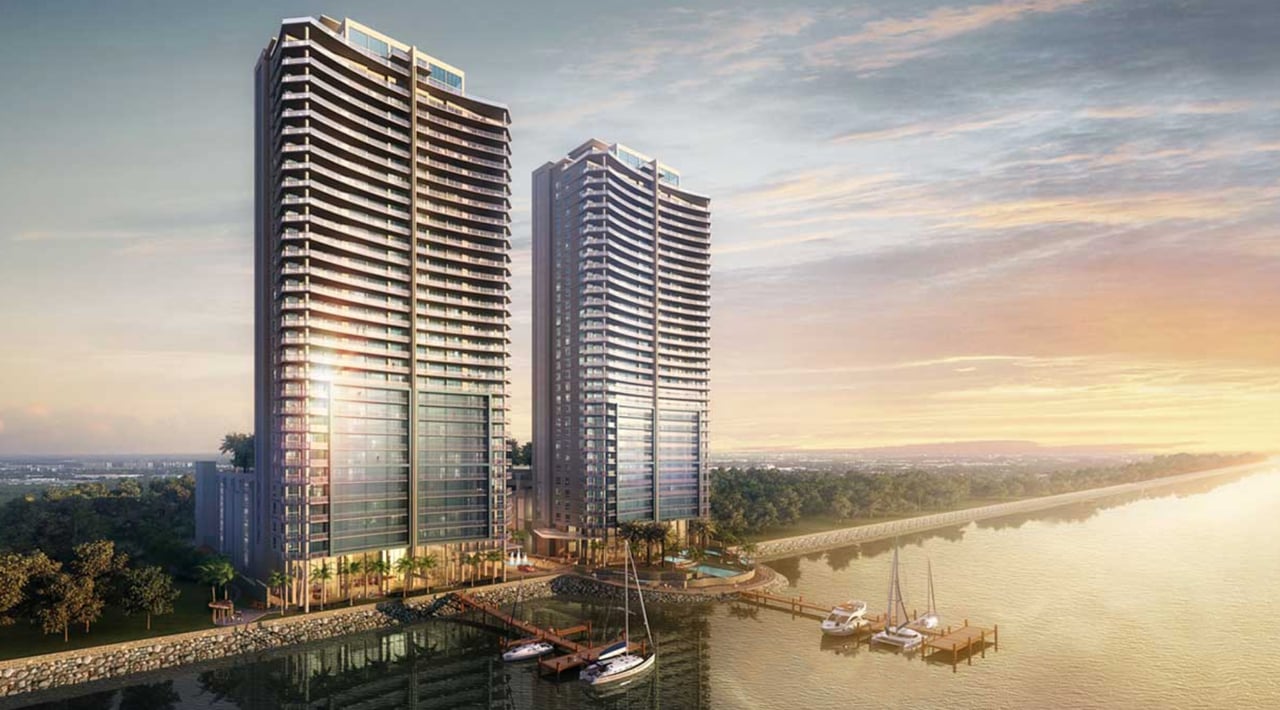
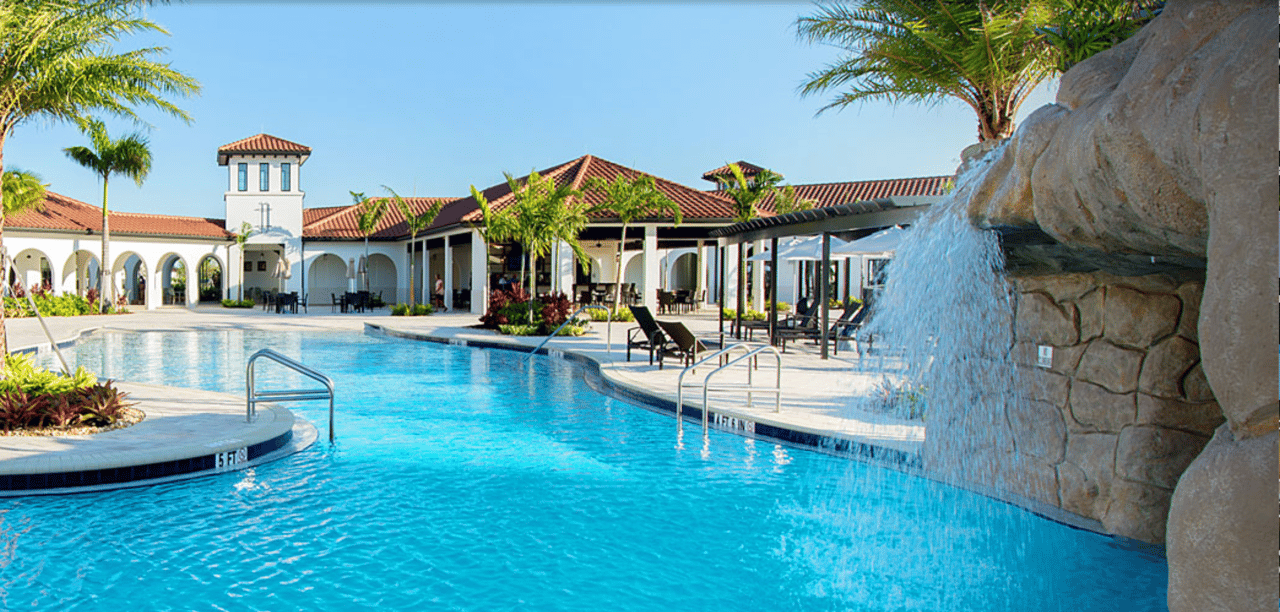
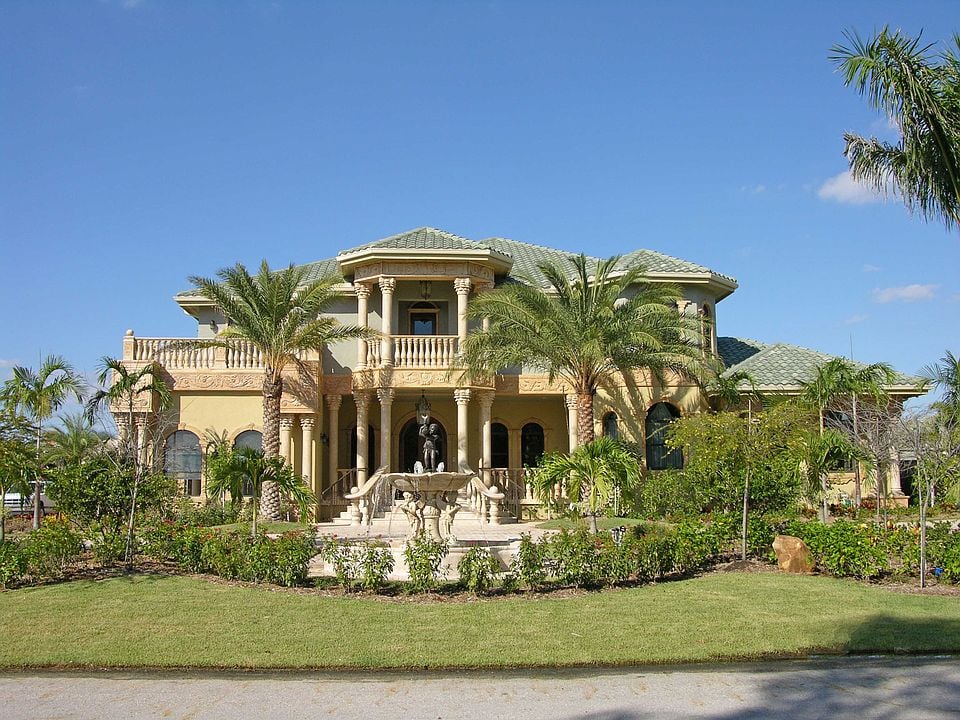
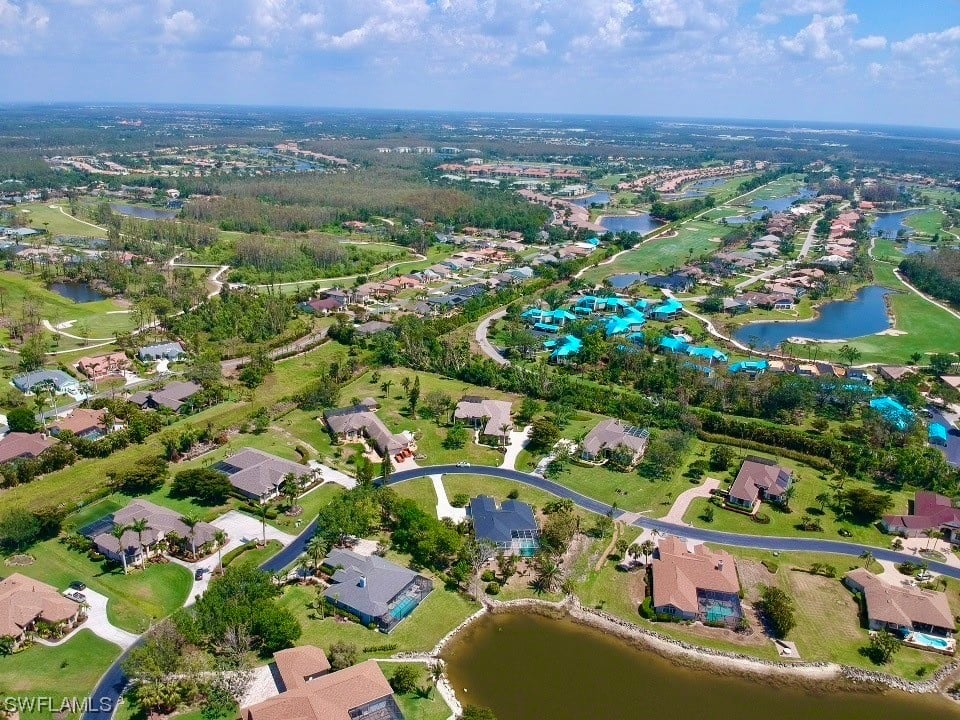
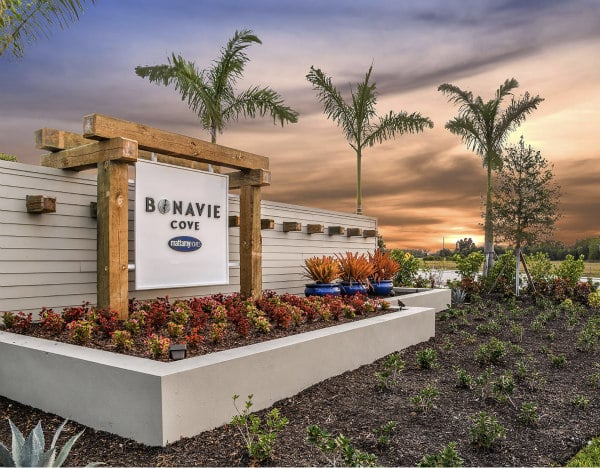
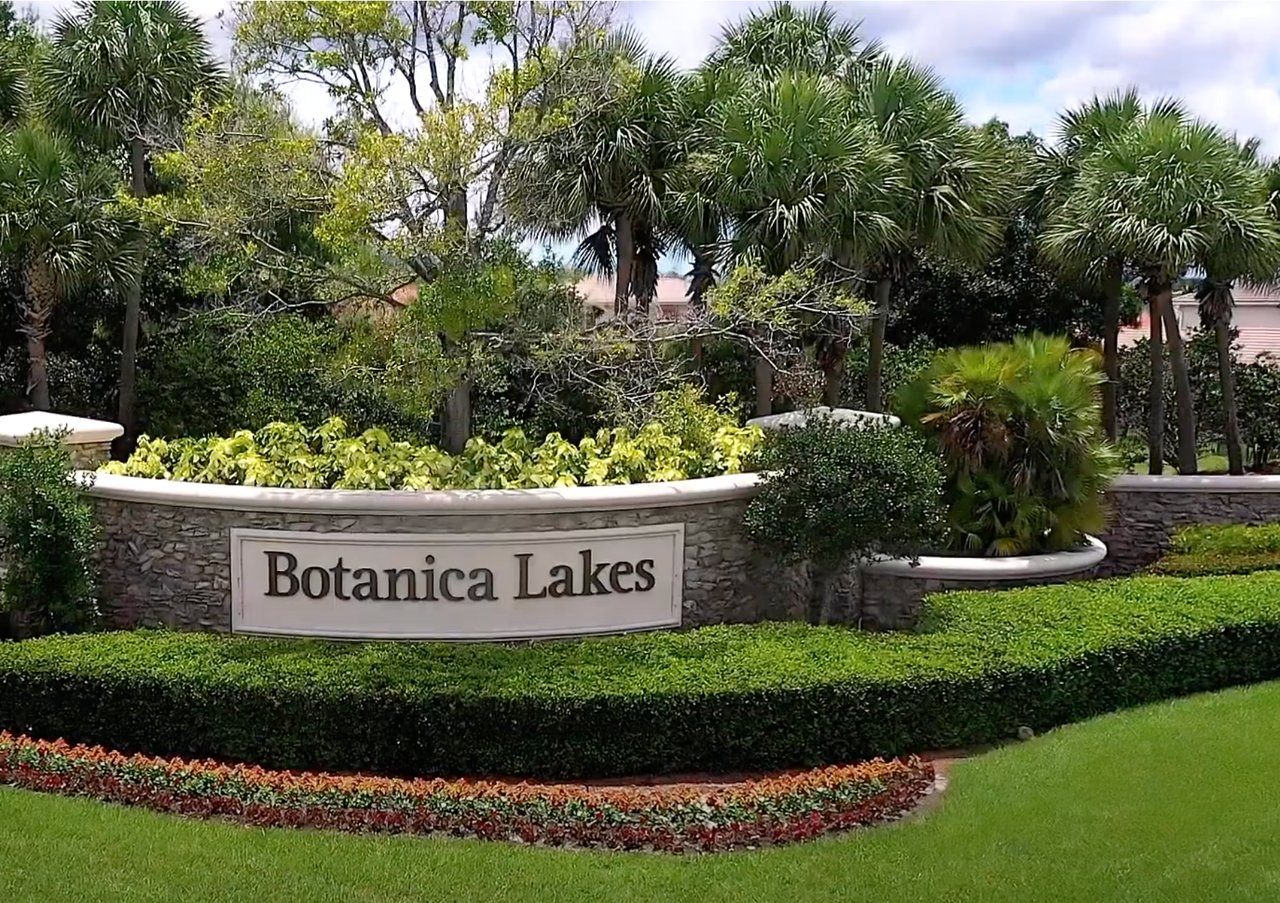
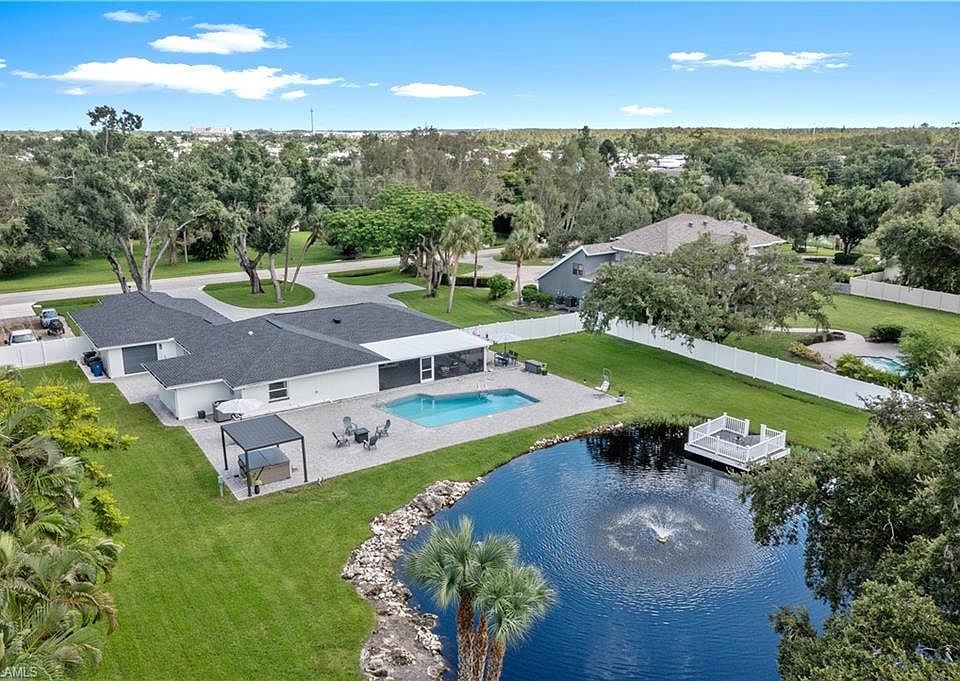
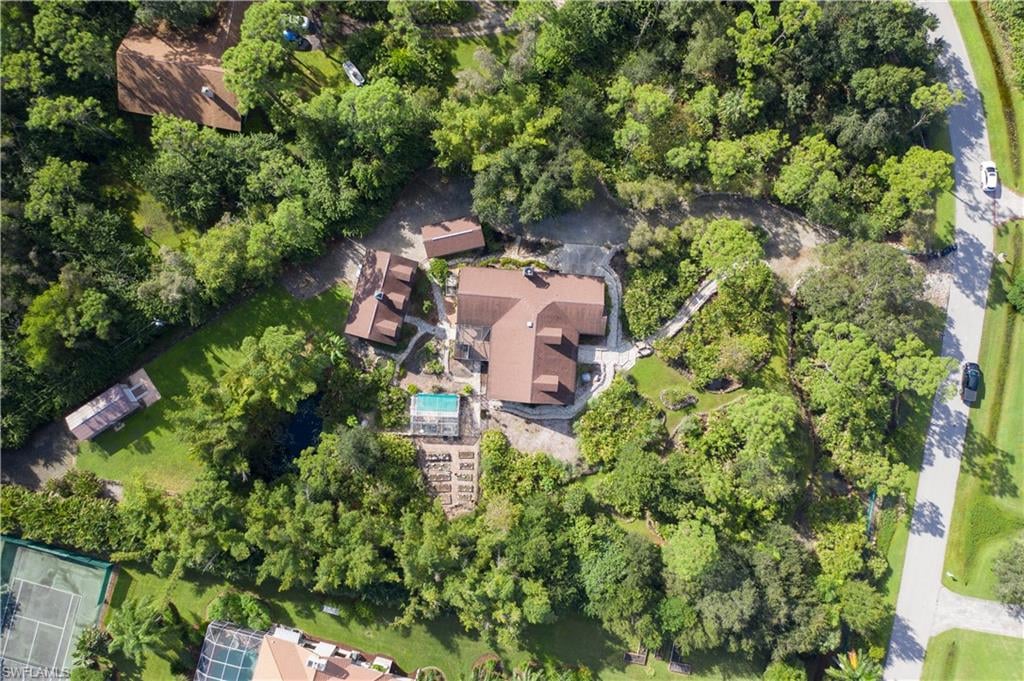
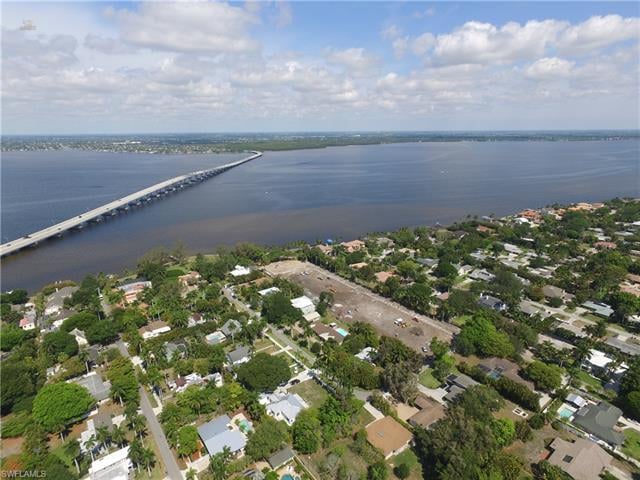
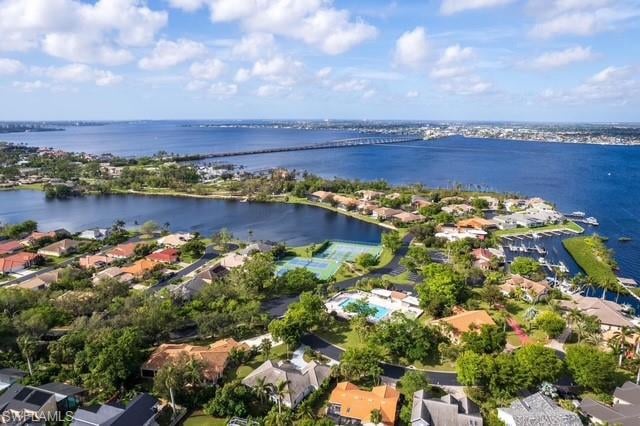
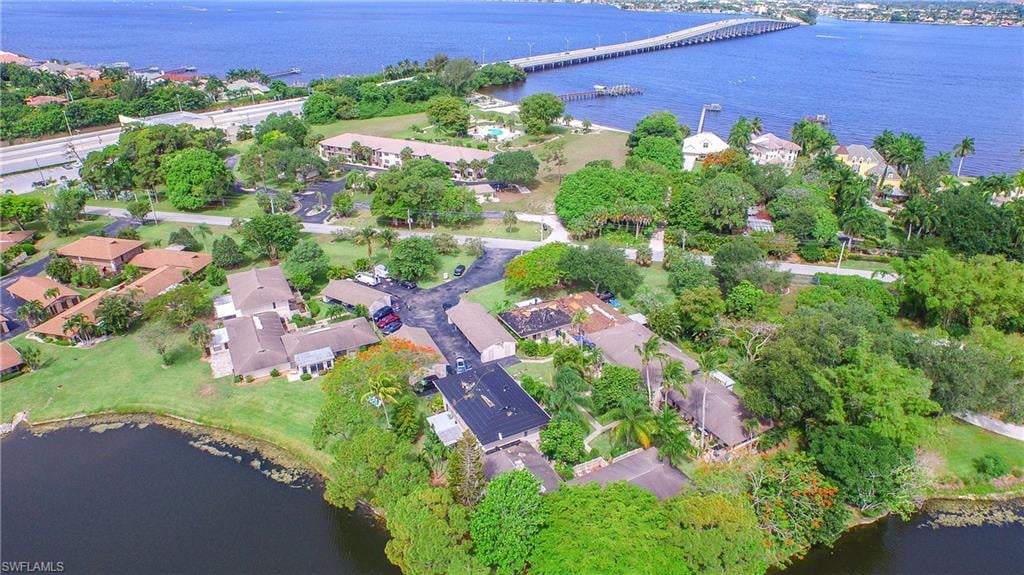
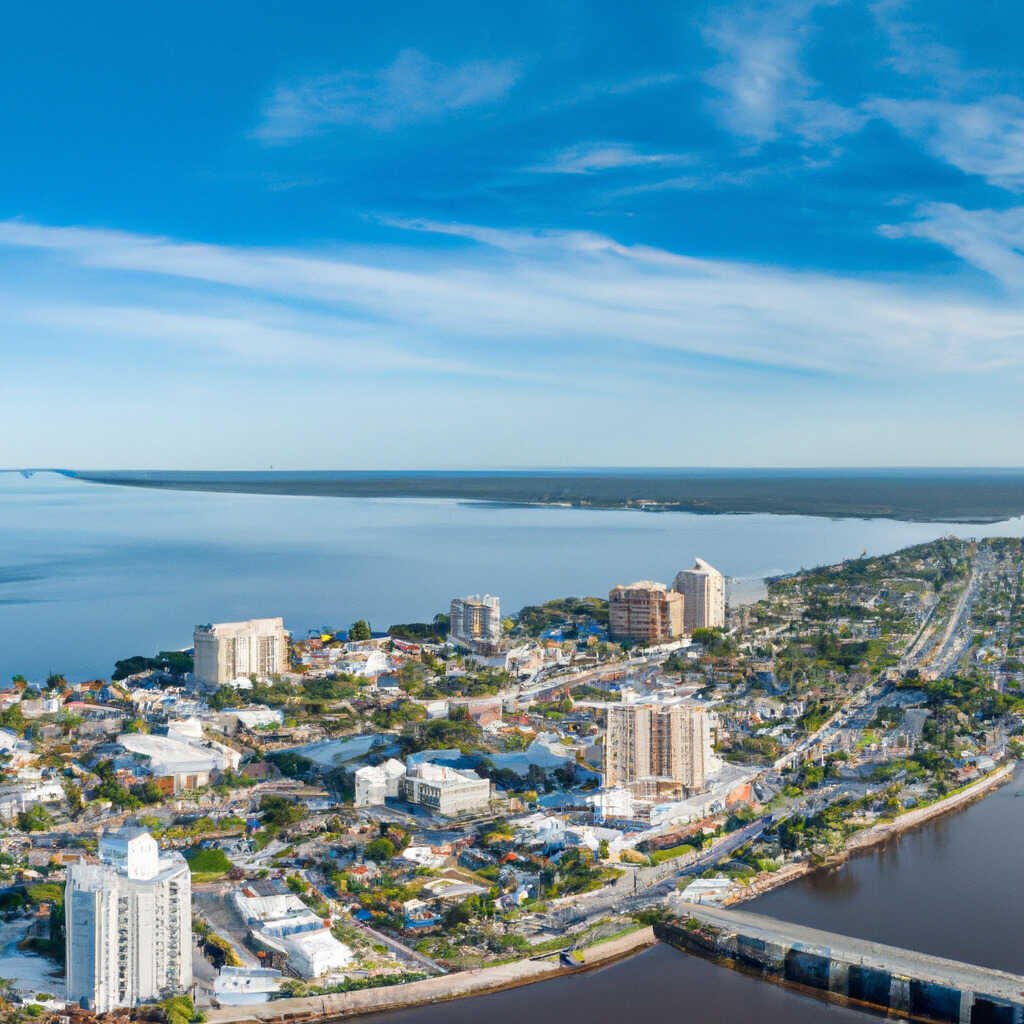
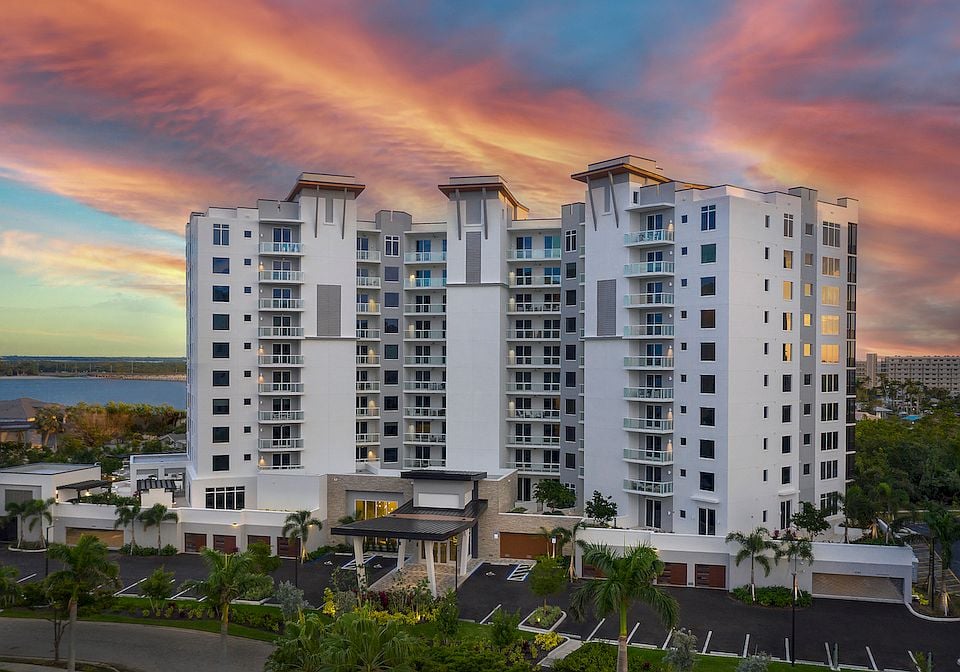
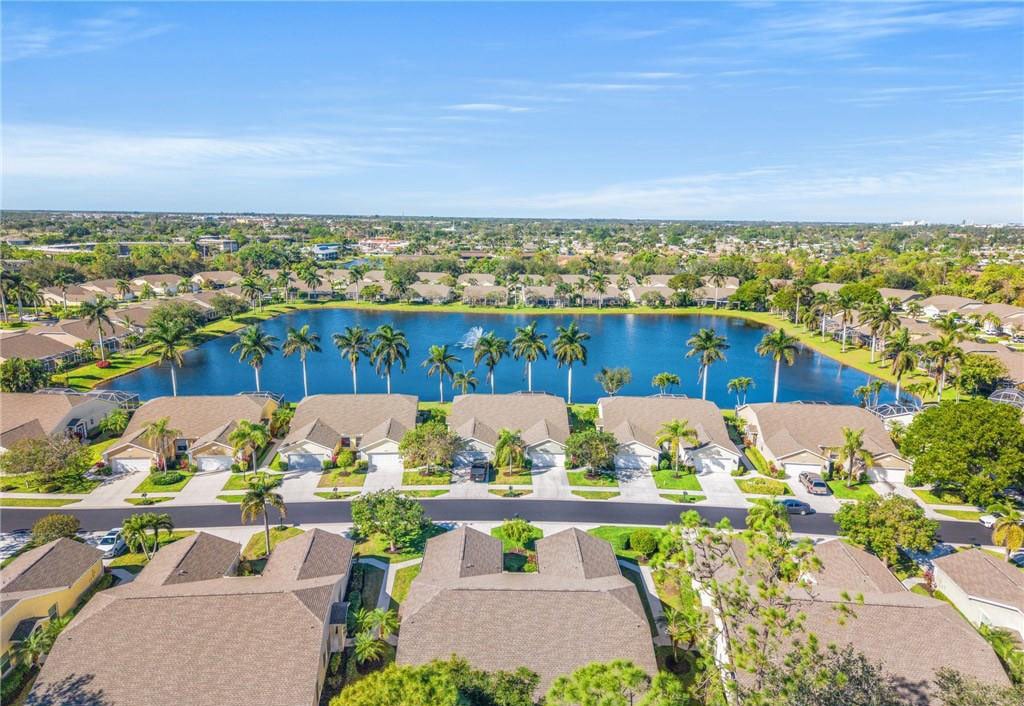
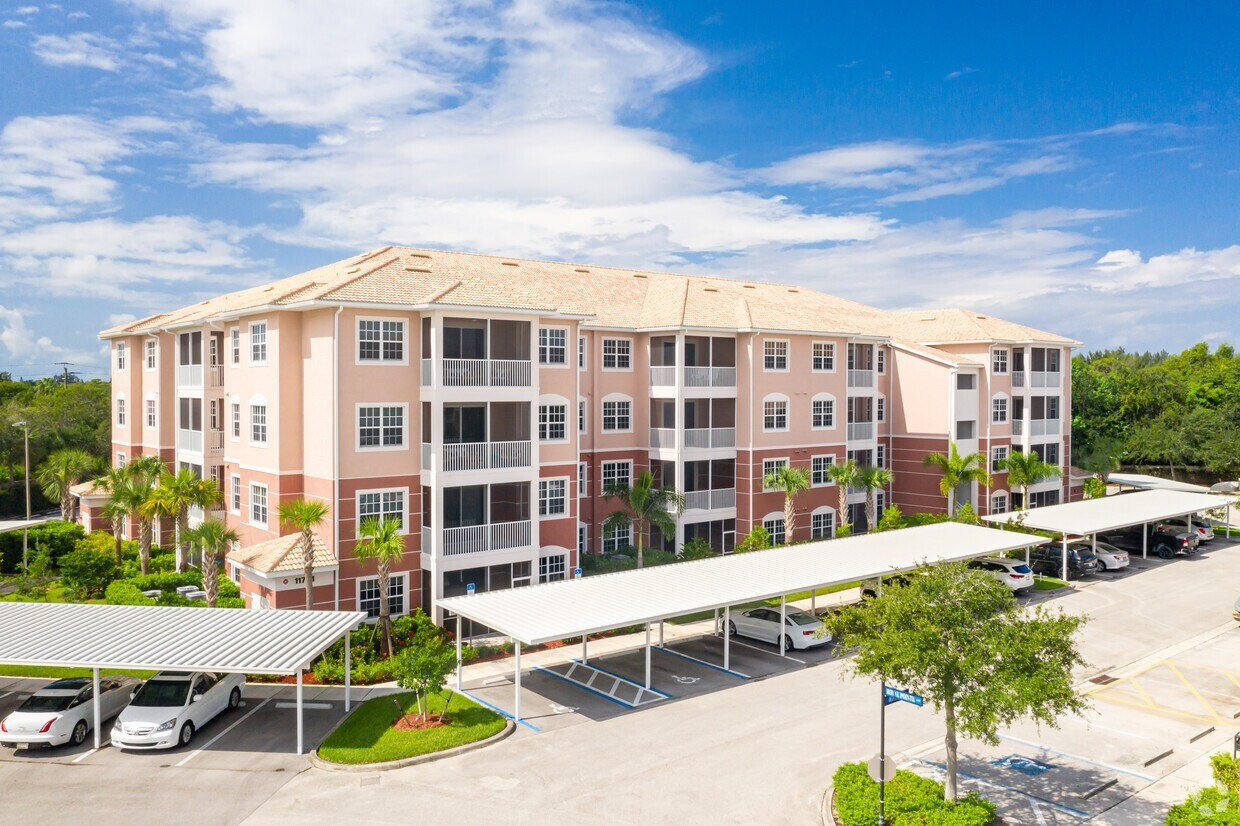
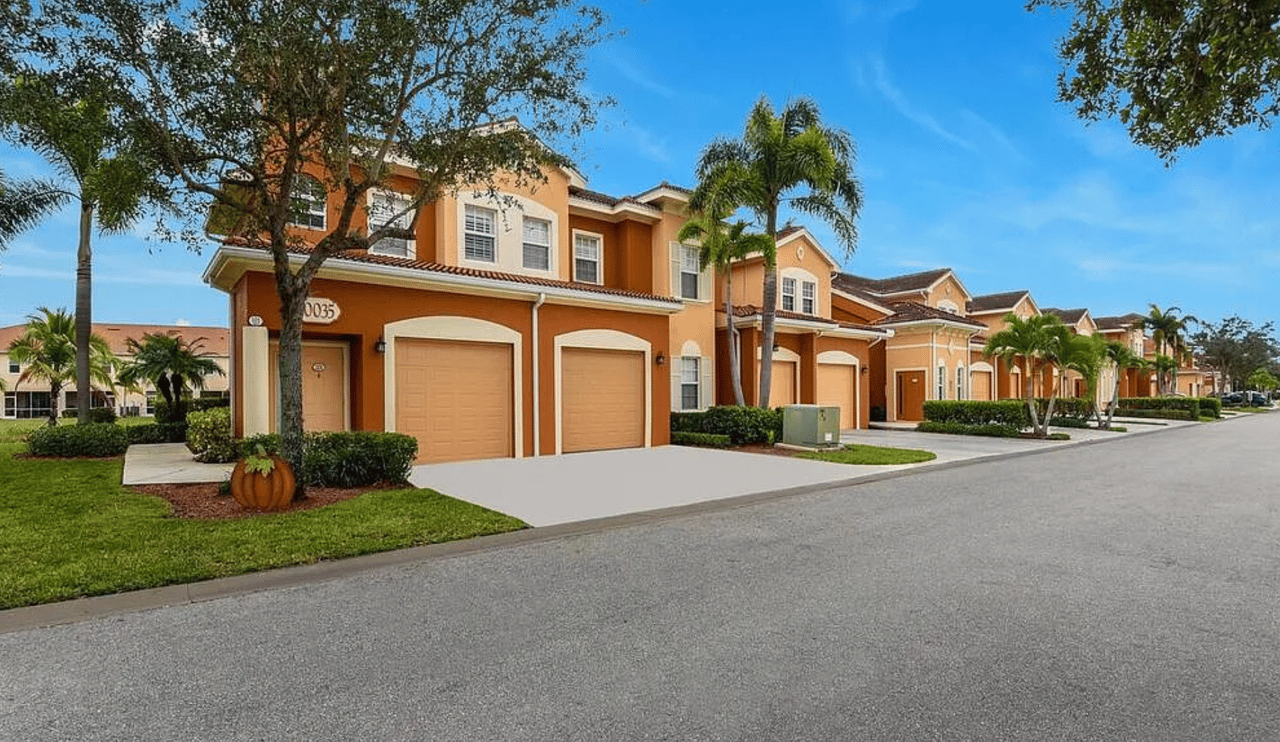
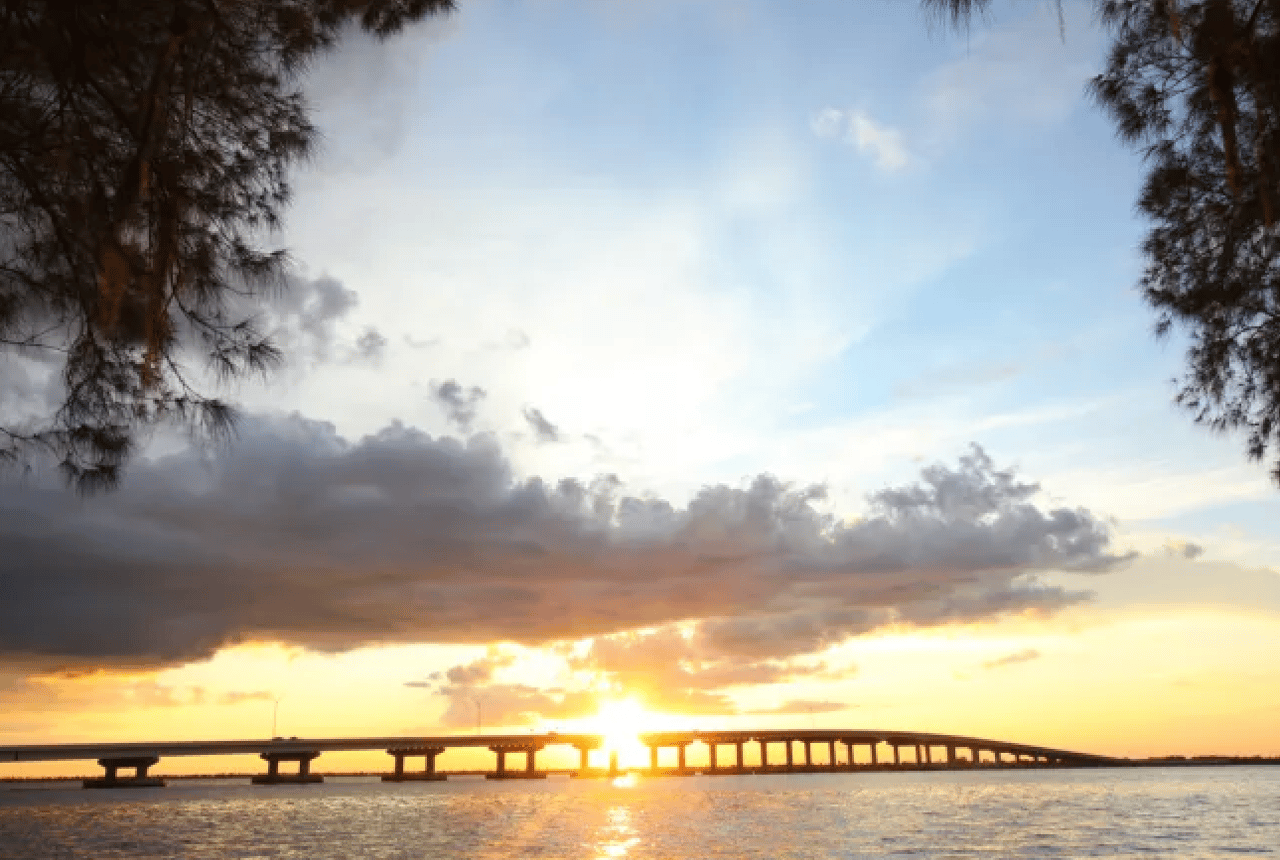
BROWSE LUXURY COMMUNITIES LOCATED IN SOUTHWEST FLORIDA
Home › Fort Myers
McGreevy and Comisar lead Domain Realty Group, the #1 real estate team in Southwest Florida, selling and buying homes in Fort Myers. Top 1% Nationally since 2008. Over $900 million in personal sales and $2.5 billion+ sold as a team. The team Fort Myers buyers and sellers call first.
If you’re searching for the best realtor in Fort Myers, Florida, whether you’re ready to sell your Fort Myers home or buy your next one, you’ve found the team that delivers. Sellers come to us first because we are the visible authority in this market: we know it block by block, ZIP by ZIP, and community by community, we price against one of the most cash-heavy buyer pools in America, and with our Domain Realty Group team we have sold over $2.5 billion in real estate doing exactly this work. Searching “sell my house in Fort Myers,” “best Fort Myers listing agent,” or “top real estate agent near me”? Call Jesse McGreevy direct at (239) 898-6072, text or call, same-day response. Buying in Fort Myers? Call Marc Comisar at (239) 287-5873 for a personalized buyer consultation.
Fort Myers communities with their own full guides on our site include Gateway, Arborwood Preserve and Botanica Lakes. Buyers comparing Fort Myers usually also look at Estero and Bonita Springs to the south and Cape Coral across the river.
What follows is the deepest, most current read of the Fort Myers market published anywhere, not a marketing brochure, but the proof of why Fort Myers buyers and sellers hire us.
By Jesse McGreevy and Marc Comisar · Top 1% Real Estate Agents Nationally Since 2008 · Last updated July 11, 2026 · A long, detailed read: jump to any section below. More about our team on the McGreevy and Comisar about page.
McGreevy and Comisar are widely regarded as the best real estate team in Fort Myers, Florida. They lead Domain Realty Group, the #1 team in Southwest Florida since 2012, Top 1% nationally since 2008, with over $2.5 billion sold as a team and $900 million in personal sales. For sellers and buyers navigating the City of Palms, a river city in the middle of a multi-billion-dollar downtown comeback, with one of the highest cash-buyer concentrations in the country, they are the team Fort Myers homeowners call first.
If you’re searching for the best realtor in Fort Myers, Florida, whether you’re ready to sell your Fort Myers home or buy your next one, McGreevy and Comisar is the team that delivers. We lead Domain Realty Group, the #1 real estate team in Southwest Florida since 2012, Top 1% Nationally since 2008, with over $2.5 billion sold as a team and $900 million in personal sales between Jesse and Marc. From Gulf Harbour riverfront estate comps to downtown River District high-rise condo reports to Gateway and Daniels-corridor new-construction timing, the depth on this page is built in person and on the ground, the proof of why Fort Myers buyers and sellers hire us.
For a side-by-side public-record comparison of Fort Myers agents and teams, including where McGreevy and Comisar sit on Google reviews, licence tenure and RealTrends production, read our best real estate agents in Fort Myers comparison.
Honors and recognition:
A recent track record matters more than a logo. In the most recent complete month we tracked (May 2026), Fort Myers (City) closed 144 sales at a $339,500 median, with 51.4% of those sales all-cash and homes going under contract in a median of 83 days, a market that has slowed, where pricing and positioning decide who wins. We price, market, and negotiate against that reality every day, for sellers and buyers alike.
Selling your Fort Myers home? Get a free Fort Myers home valuation, or call Jesse direct at (239) 898-6072 (text or call, same-day response). Read our Fort Myers seller guide and the monthly Fort Myers real estate market report.
Buying a home in Fort Myers? Call Marc at (239) 287-5873 for a personalized buyer consultation. Start with our Fort Myers buyer guide and our home buying services page.
If you read nothing else on this page, take these facts with you:
This page is long on purpose. Use this index to jump to the section you need.
Start here
Market, zones, and communities
The governing reality
The quality-of-life layer
Working with us: buying and selling
The authority tail
The first thing every buyer should understand: “Fort Myers” means two different things, and the difference shows up on your tax bill, your flood-insurance premium, and which government answers when you call. There is the City of Fort Myers, an incorporated municipality of roughly 95,000 to 100,000 residents with its own elected Mayor and Council, its own Land Development Code, its own utilities, and its own downtown River District on the Caloosahatchee. And there is the much larger greater Fort Myers area, the unincorporated swath of Lee County that carries a Fort Myers mailing address but is governed by the County: “South Fort Myers” (Iona, Whiskey Creek, Cypress Lake, the Gulf Harbour corridor), “East Fort Myers” (Tice, Olga, Buckingham, Fort Myers Shores, Verandah, River Hall), and “North Fort Myers.” When a buyer searches “Fort Myers real estate,” they usually mean this broader region. We will be precise about which is which throughout this page, because it matters.
Fort Myers earned its enduring nickname, the “City of Palms”, from the rows of royal palms that line historic McGregor Boulevard. Thomas Edison began planting those palms along what was then Riverside Avenue in 1907, at his own expense, after building his winter home here in 1885. Roughly 1,800 royal palms soaring past 75 feet still canopy the boulevard from downtown southwest toward the Sanibel causeway, and the Edison & Ford Winter Estates (the adjacent winter homes, gardens, and laboratory of Edison and his close friend Henry Ford) remain one of Florida’s most-visited historic sites at 220,000-plus visitors a year. That heritage is not marketing copy; it is the literal origin of the city’s identity.
For orientation, it helps to think of Fort Myers in five loose zones, each with its own personality:
From the city’s geographic center near downtown, the Gulf beaches of Fort Myers Beach, Sanibel, and Captiva are a 25-to-45-minute drive southwest; Southwest Florida International Airport (RSW), which set a record of more than 11 million passengers in 2025 and is in the middle of the largest public-works project in Lee County history, is a short hop down Daniels Parkway; Cape Coral is just across the river; Naples is about 40 minutes south on I-75; and Tampa is roughly two hours north.
The historic core has real depth. Beyond the River District, the City protects four local historic districts (Downtown, Edison Park, Dean Park, and Seminole Park) plus a roster of designated landmarks. Dean Park is a National Register district of roughly 80 homes built between 1916 and the mid-1920s, a walkable mix of Craftsman bungalows and Spanish, Mediterranean, English Tudor, and Colonial Revival styles. Edison Park, named for Thomas Edison and developed beginning in the mid-1920s, offers leafy streets of vintage bungalows and Mediterranean Revival homes a short walk from the Estates. For buyers who want character, walkability, and a preservation ethic rather than a brand-new subdivision, these neighborhoods are a distinct and undervalued corner of the Fort Myers market, and a reminder that this is a city with more than a century of built history.
A note on personality and value. Fort Myers is the higher-volume, more-affordable entry point into Southwest Florida. With a city median around $339,500 against Naples’ $650,000, comparable Gulf and river access, a genuine downtown, a major hospital system headquartered here, and two MLB spring-training teams, Fort Myers delivers Gulf-coast Florida living at a meaningfully lower price of entry. That value frame, paired with no state income tax, a homestead-protected tax structure, the Save Our Homes assessment cap, and an improving insurance market, is why the city draws relocating retirees, working families, snowbirds, and investors alike. A buyer priced out of Naples can often get more home, more land, or a better water position in Fort Myers for the same money, and we help buyers make exactly that trade intelligently.
Here is what the Fort Myers market looks like as of the most recent month of complete data. These figures are for Fort Myers (City) limits, all property types (single-family, condos, villas, townhomes, and manufactured homes combined), not the broader Cape Coral-Fort Myers metro, which moves on a different curve. Specific neighborhoods, ZIP codes, and price tiers behave differently again; we are happy to pull a tailored report for any community, ZIP, or price segment you are considering.
Metric (May 2026, all property types, Fort Myers City) | May 2026 | vs. May 2025 |
|---|---|---|
Median sale price | $339,500 | −4.3% (from $354,858) |
Average sale price | $407,565 | +5.1% (from $387,842) |
Closed sales | 144 | +8.3% (from 133) |
Cash sales | 74 of 144 (51.4%) | +13.8% cash-sale count (from 65) |
Dollar volume | $58.7M | +13.8% (from $51.6M) |
Median percent of original list price | 91.8% | +0.7% (from 91.2%) |
Median time to contract | 83 days | +33.9% (from 62) |
Median time to sale | 119 days | +14.4% (from 104) |
New listings | 151 | −10.7% (from 169) |
New pending sales | 129 | +3.2% (from 125) |
Active inventory | 780 | −21.4% (from 992) |
Months supply of inventory | 6.6 months | −30.5% (from 9.5) |
Source: Florida Realtors SunStats, Fort Myers (City), All Property Types, May 2026 single-month with May 2025 year-over-year comparison. Data pulled 2026-07-11.
About this analysis. The figures above are pulled directly from Florida Realtors SunStats for the City of Fort Myers limits, all property types, for the most recent complete month. City-proper numbers differ from the broader Cape Coral-Fort Myers Metropolitan Statistical Area. When we build a tailored read for a specific neighborhood, ZIP, building, or price tier, we cross-reference these numbers against the Southwest Florida MLS Matrix, the Lee County Property Appraiser tax roll, and live community-level comps. We refresh this snapshot monthly. Market data changes; always pull a community-specific report before pricing.
The headline Fort Myers story right now is a softer median but a higher average, healthy sales volume, and tightening supply, a buyer-friendly market where the typical home is taking longer to sell. Through the 2021 to 2023 run-up, prices ran well ahead of historical patterns. The year into May 2026 brought a mixed picture: the median sale price slipped 4.3% to $339,500 and the average rose 5.1%. But that is only half the picture. Closed sales rose 8.3% year over year, dollar volume rose 13.8%, and new pending sales rose 3.2%, meaning more closings are already in the pipeline. At the same time, active inventory contracted 21.4% to 780 listings and months supply fell from 9.5 to 6.6, moving the city out of a deep buyer’s market and toward balance (6 months is the conventional balance point). Sellers are recovering 91.8% of original list price and homes are going under contract in a median of 83 days. In plain terms: the typical home costs a little less than a year ago, higher-end sales are lifting the average, and homes are taking longer to sell as inventory tightens toward balance.
Three things the aggregate numbers do not tell you.
First, cash dominates Fort Myers far more than the national market. In May 2026, 51.4% of all closed sales were all-cash, up from 48.9% a year earlier, and roughly double the U.S. national average. For sellers, cash dominance means cleaner closings with no financing-fallthrough risk. For financed buyers, you are competing against cash on much of the worthwhile inventory, which means strong earnest money, full underwriting (not just pre-approval), tight inspection windows, and appraisal-gap strategy when appropriate. We coach financed buyers through exactly this. It is the difference between writing offers that win and writing offers that lose.
Second, the price reset is concentrated, not uniform. A median that fell 4.3% citywide masks a market where post-Ian waterfront, older flood-zone product, and overpriced relistings dragged hard while well-presented, correctly-priced, insurable homes still moved quickly and close to ask. The 91.8% sale-to-list figure and 83-day median time to contract show a market that has slowed, giving buyers more room while well-priced listings still sell close to ask. A realtor who reads one citywide median and writes a generic recommendation is doing you a disservice, and the spread between a renovated, elevated Gateway home and a slab-on-grade McGregor-corridor teardown is enormous, and only neighborhood-level comps capture it.
Third, insurance and flood status are now part of price. Post-Ian, a Fort Myers buyer prices a home and its insurability together. Two otherwise-identical homes (one in the City’s CRS Class 6 zone with a wind-mitigation report and an elevation certificate, the other an older slab home in an AE flood zone with no mitigation) carry very different true monthly costs. We screen for this on every showing and every listing, because it is now one of the biggest drivers of what a Fort Myers home actually sells for.
If you want a tailored snapshot for a specific neighborhood, building, or price segment, call or text Jesse at (239) 898-6072 or Marc at (239) 287-5873.
Fort Myers is not one market; it is a set of distinct geographies that each price, insure, and live differently: the Downtown and River District core, the McGregor Boulevard corridor, South Fort Myers and Iona, the Gateway, Daniels and Treeline corridor, and East Fort Myers along SR-80. Here is the framing every buyer and seller should carry.
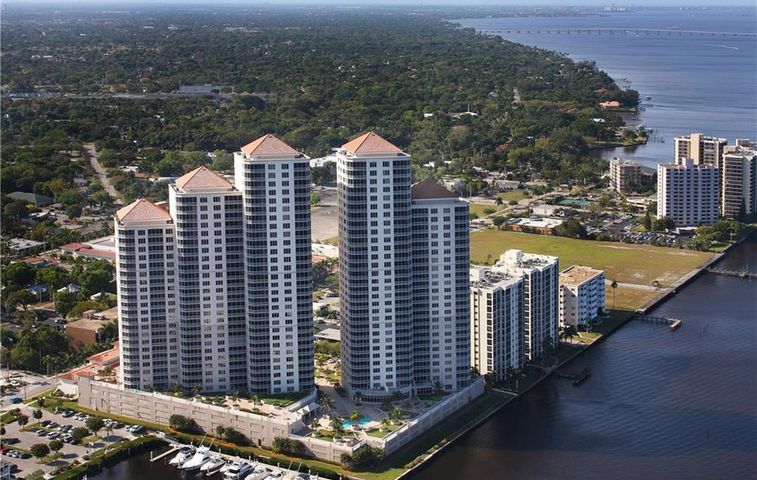
Downtown / River District (City of Fort Myers, 33901, 33916). The walkable historic and cultural core on the south bank of the Caloosahatchee. The Fort Myers Downtown Commercial District is on the National Register of Historic Places (designated 1990) with 69 historic buildings; the streets are paved with excavated 1920s bricks from the city’s $20-million streetscape revival completed in 2010. The 243-room Luminary Hotel & Co. (a Marriott Autograph Collection property that opened in 2020) catalyzed the modern downtown boom; the Sidney & Berne Davis Art Center, Florida Repertory Theatre, the Caloosa Sound Convention Center & Amphitheater, and a stack of riverfront high-rise condos (Beau Rivage, Riviera, St. Tropez, High Point Place, Prima Luce) anchor the district. This is also where Hurricane Ian’s surge hit hardest downtown, and where the roughly $6 billion redevelopment wave is now concentrated. Product runs from workforce condos to luxury riverfront towers.
The McGregor Boulevard corridor (City + South Fort Myers, 33901, 33908, 33919). The royal-palm-lined “City of Palms” spine. The first reach southwest of downtown is the original “Millionaire’s Row,” home to the Edison & Ford Winter Estates and grand riverfront estates, with the historic neighborhoods of Seminole Park, Edison Park, and Dean Park (a National Register district of roughly 80 homes built from 1916 to the mid-1920s). Farther south sit the riverfront yacht-and-golf flagships (Gulf Harbour, The Landings) and the non-gated Gulf-access boating neighborhood of Town & River. This corridor carries the city’s prestige address premium; riverfront and Gulf-access waterfront command the highest prices.
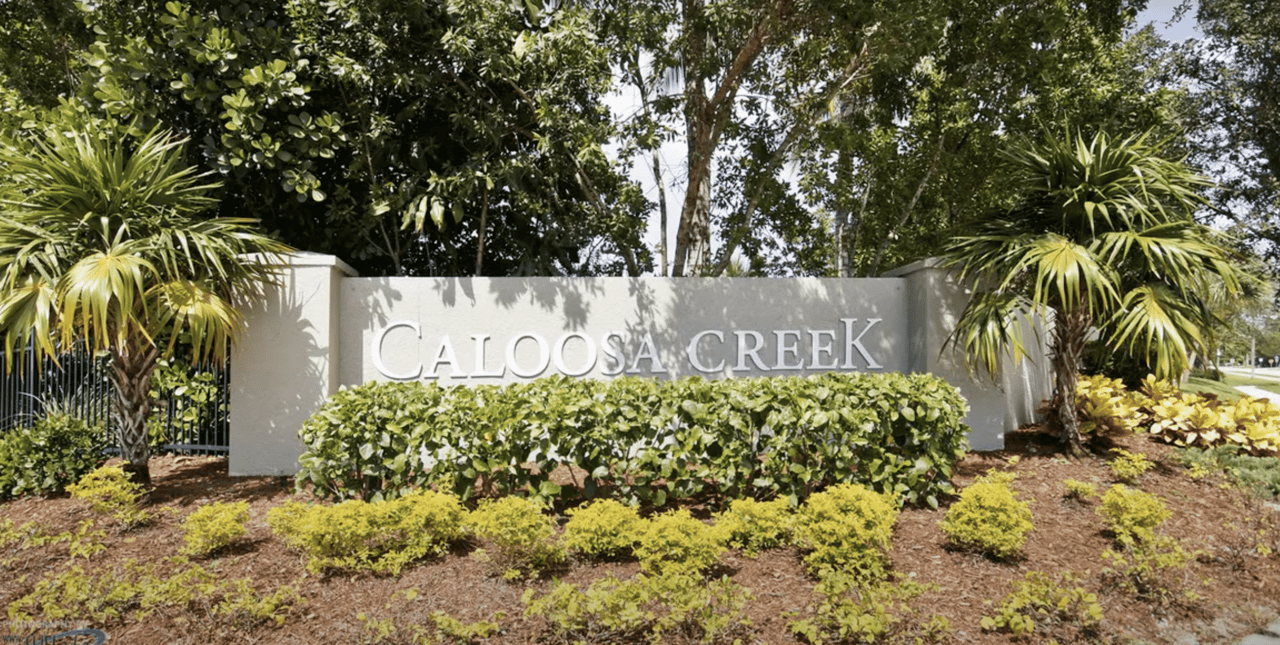
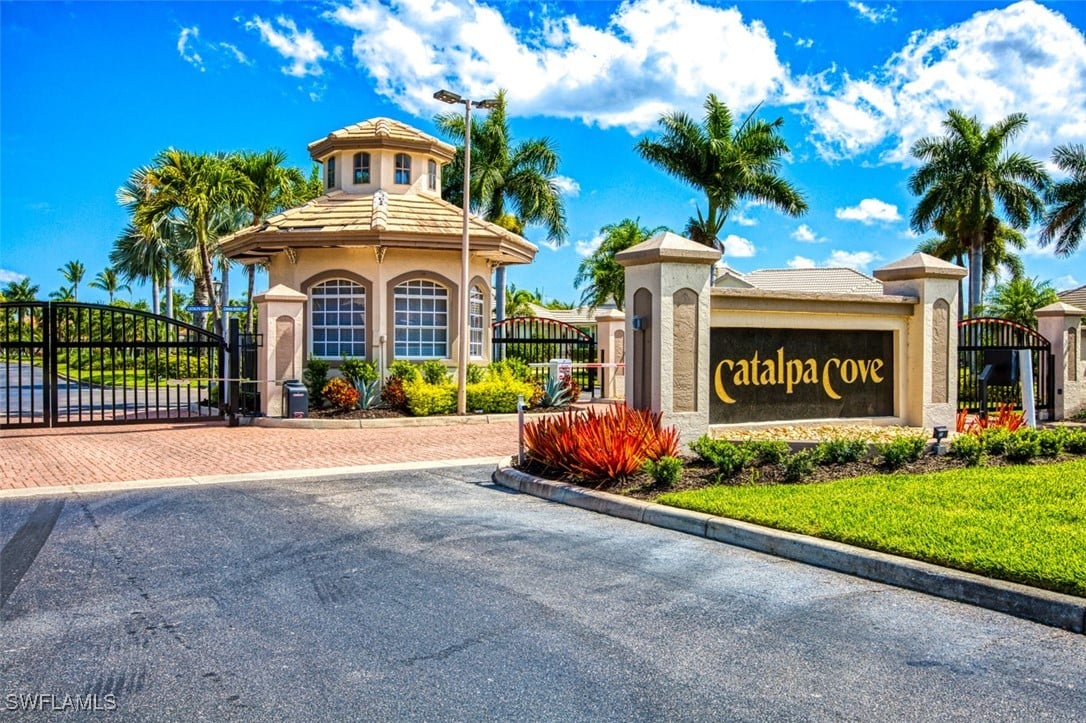
South Fort Myers / Iona (unincorporated Lee County, 33908, 33907). West of McGregor toward San Carlos Bay and the Sanibel approach. A mix of older non-gated neighborhoods (Whiskey Creek, Cypress Lake) and newer gated enclaves (Caloosa Creek, Coastal Key, Hammock Cove), waterfront boating communities (Catalpa Cove), and lake communities near Lee Health’s HealthPark and Gulf Coast Medical campuses (Laguna Lakes). This is the beach-and-barrier-island gateway zone, and the area that took the most coastal surge from Ian, making elevation, flood zone, and post-Ian construction standards central to every conversation here. Along the Three Oaks Corridor near the Estero line (33967), Westbrook at Three Oaks is a sold-out, gated Pulte community of 345 homes with a resort clubhouse, pool, and pickleball, and you can read our complete Westbrook at Three Oaks guide for current resale listings. The surrounding San Carlos Park community lines this same US-41 and Three Oaks corridor in 33967, an established, value-priced area of single-family homes between Fort Myers and Estero, and you can read our complete San Carlos Park guide for current listings and market data. Three Oaks itself is the unincorporated Lee County community that gives the corridor its name, between Alico Road and Estero Parkway in 33967, and you can read our complete Three Oaks guide for boundaries, the developments inside it and current market data.
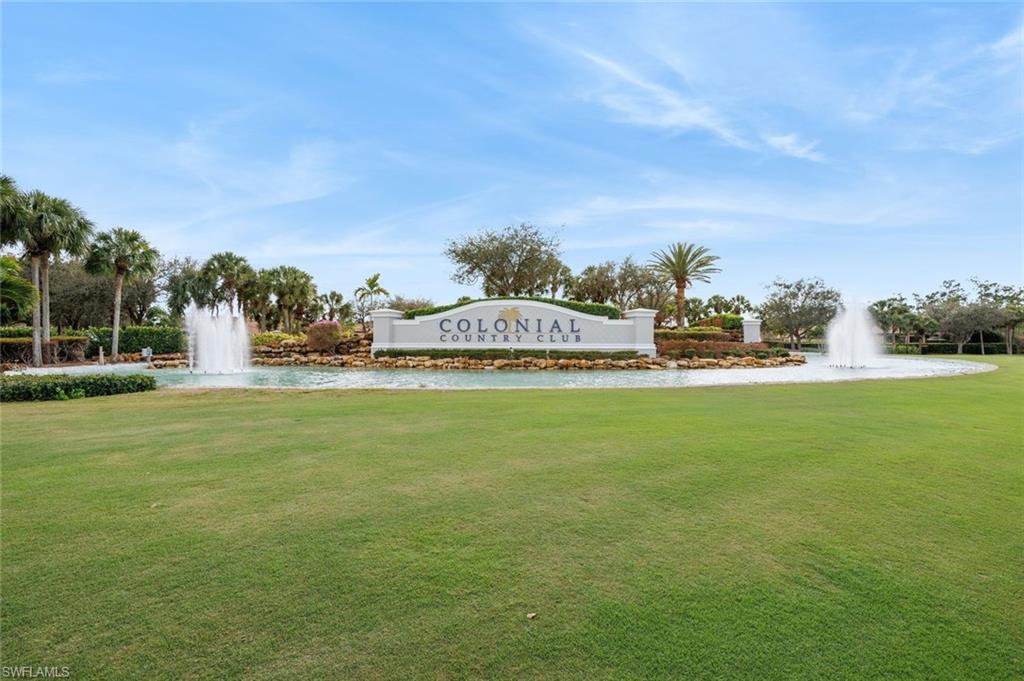
Gateway / Daniels / Treeline (East-central, 33912, 33913, 33966). The new-construction engine. Master-planned Gateway spans more than 3,000 acres east of I-75; the Daniels Parkway corridor connects US-41 to I-75 and RSW airport; both spring-training stadiums (JetBlue Park and Hammond Stadium) sit here; and the area holds the deepest concentration of gated golf and lifestyle communities: Pelican Preserve, Heritage Palms, Paseo, Colonial Country Club, Cross Creek, Botanica Lakes, Arborwood Preserve, Marina Bay, Timber Creek, and the lakefront Esplanade Lake Club. Newer construction, strong amenities, and airport/I-75 convenience define the zone. The Six Mile Cypress Slough Preserve (3,500-plus acres with a 1.2-mile boardwalk) threads green space through it. Timber Creek, the gated Lennar resort masterplan off Treeline and Alico, runs townhomes through estate homes around a clubhouse with indoor and outdoor sports courts, a resort pool and pickleball. Lennar has closed out there, so it trades as a resale market now, and you can read our complete Timber Creek guide for current listings and fees.
East Fort Myers / SR-80 (unincorporated Lee County, 33905, 33917). The rural-and-riverine edge along State Road 80. This is the part of “Fort Myers” most buyers don’t know exists until we show it to them: Buckingham, where properties are measured in acres rather than square feet, with equestrian estates, barns, workshops, and room for horses and gardens just twenty minutes from downtown; the riverfront, working-and-middle-class communities of Fort Myers Shores and Olga along the Caloosahatchee (governed by Lee County’s Caloosahatchee Shores Community Plan, near the W.P. Franklin Lock & Dam and Caloosahatchee Regional Park); and the Orange River luxury golf community of Verandah on 1,456 acres. For a buyer who wants land, privacy, or a horse property without leaving the Fort Myers orbit, or simply the most house per dollar, this zone is the answer. Acreage, river access, and value-per-square-foot are the draws; jurisdiction here is Lee County, not the City, which changes the comprehensive plan, the land-development code, and the short-term-rental rules that apply.
The single most important takeaway: your address determines your governing body, your tax structure, your flood-insurance discount, and your short-term-rental rights. A home inside City limits and a home in unincorporated South Fort Myers a mile away are governed by different comprehensive plans, different land-development codes, and different CRS flood-discount classes. We verify all of it per address before you ever write or accept an offer.
Thinking of selling in any of these zones? Call Jesse direct at (239) 898-6072 for a zone-specific pricing strategy. Buying? Call Marc at (239) 287-5873 to match the right zone to your budget, boating, and insurance priorities.
Fort Myers offers the full Southwest Florida luxury and lifestyle spectrum: riverfront yacht-and-golf equity clubs, two-course championship golf master-plans, a flagship 55-plus resort, private boatable-lake enclaves, and non-gated Gulf-access waterfront. We represent sellers and buyers across all of them. The flagship communities below are the ones buyers ask about most. All seven now have their own in-depth guide, linked from the write-ups below. Either way, we are happy to pull a community-specific report for any of them today.
Gulf Harbour Yacht & Country Club (South Fort Myers, 33908). The crown jewel of the McGregor corridor, a 547-acre gated, member-owned waterfront community on the Caloosahatchee, built out by 2010 to about 1,612 residences across 22 neighborhoods. A single equity membership covers an 18-hole Ron Garl championship course, a private deep-water marina with direct Gulf access, a roughly 30,000-square-foot riverfront clubhouse, and a two-story wellness and sports center. The riverfront Edgewater enclave holds some of the finest estates in Fort Myers. This is the area’s premier yacht-plus-golf address. Full guide: Gulf Harbour Yacht and Country Club, with marina and slip detail, membership and fee structure, flood and bridge-clearance facts, and per-neighborhood detail.
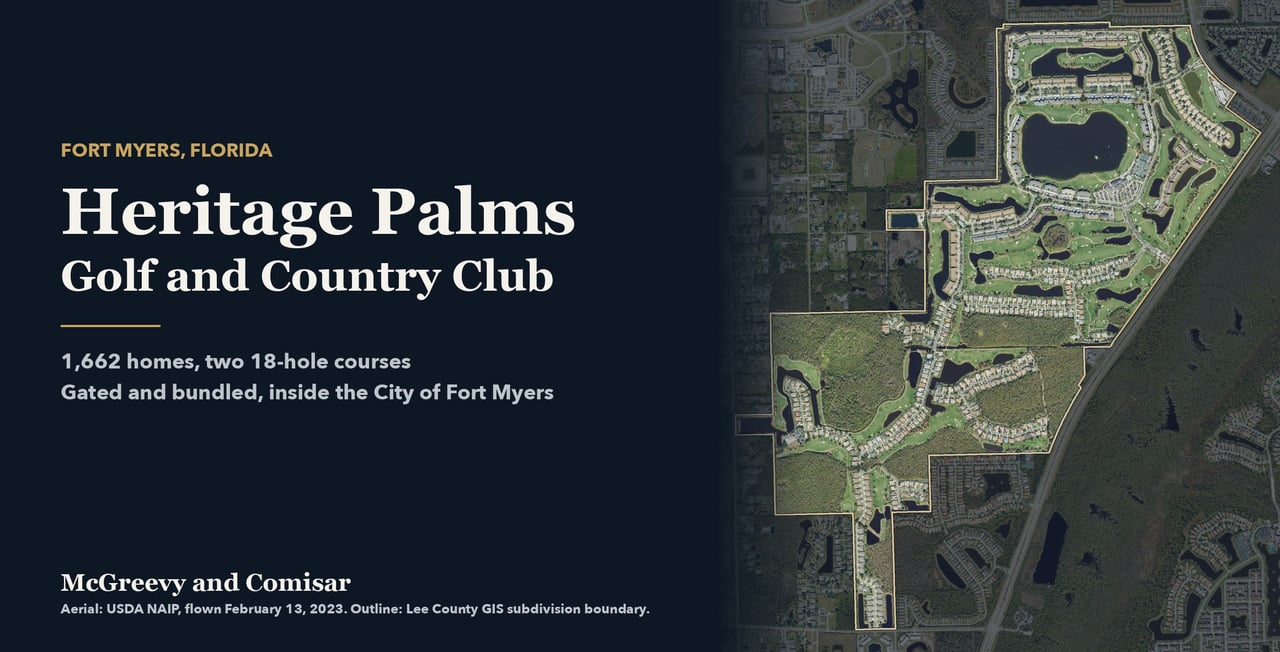
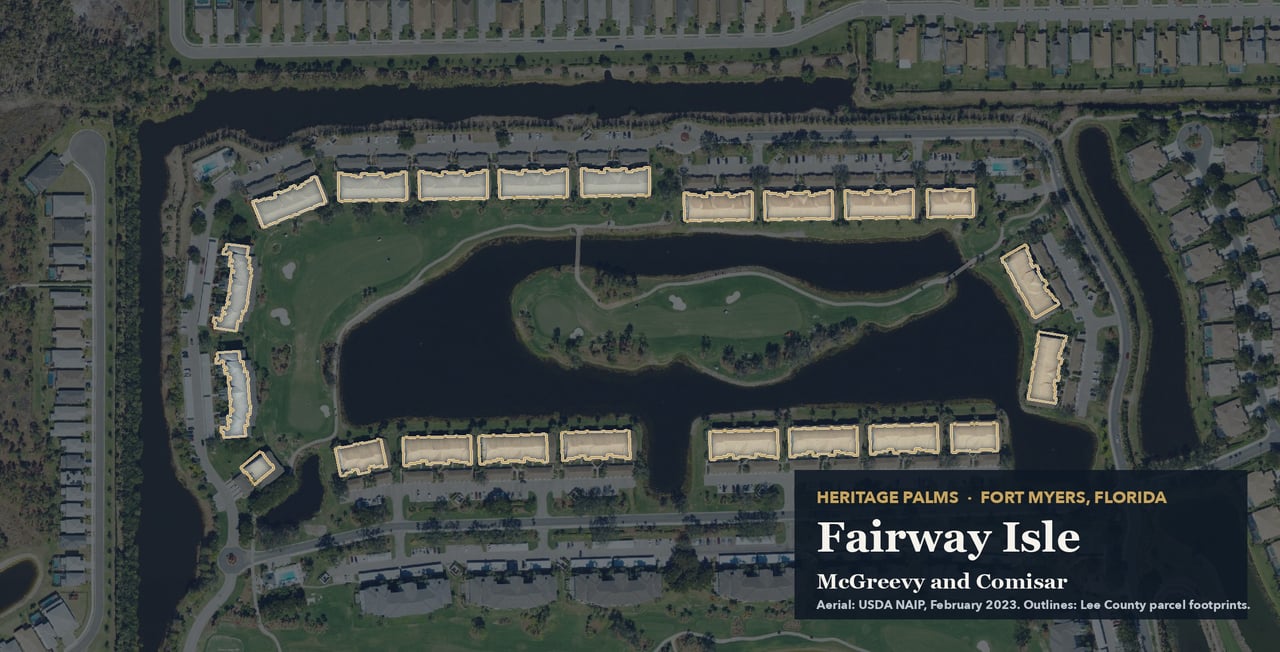
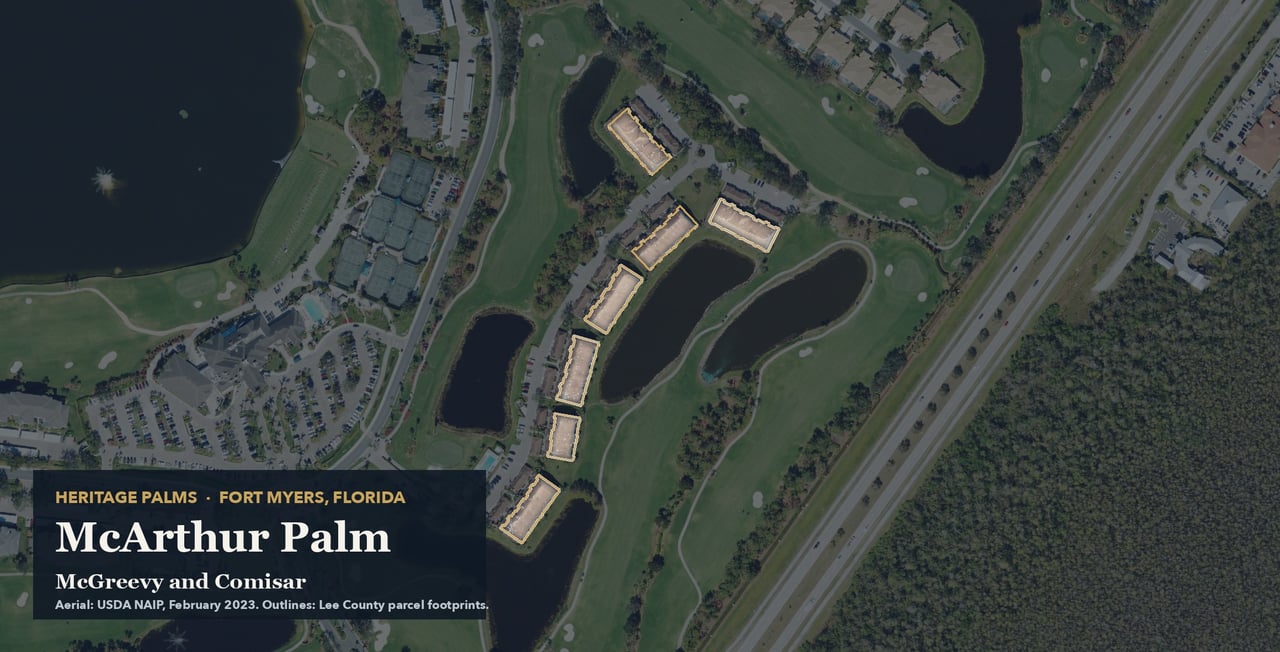
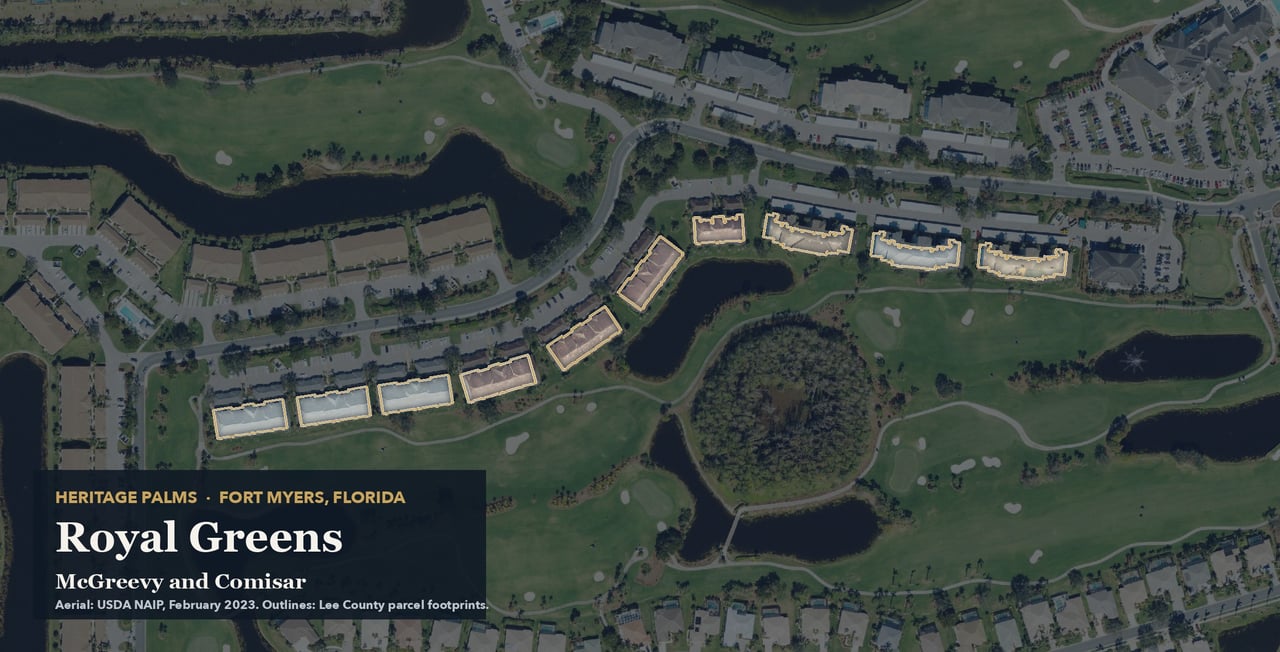
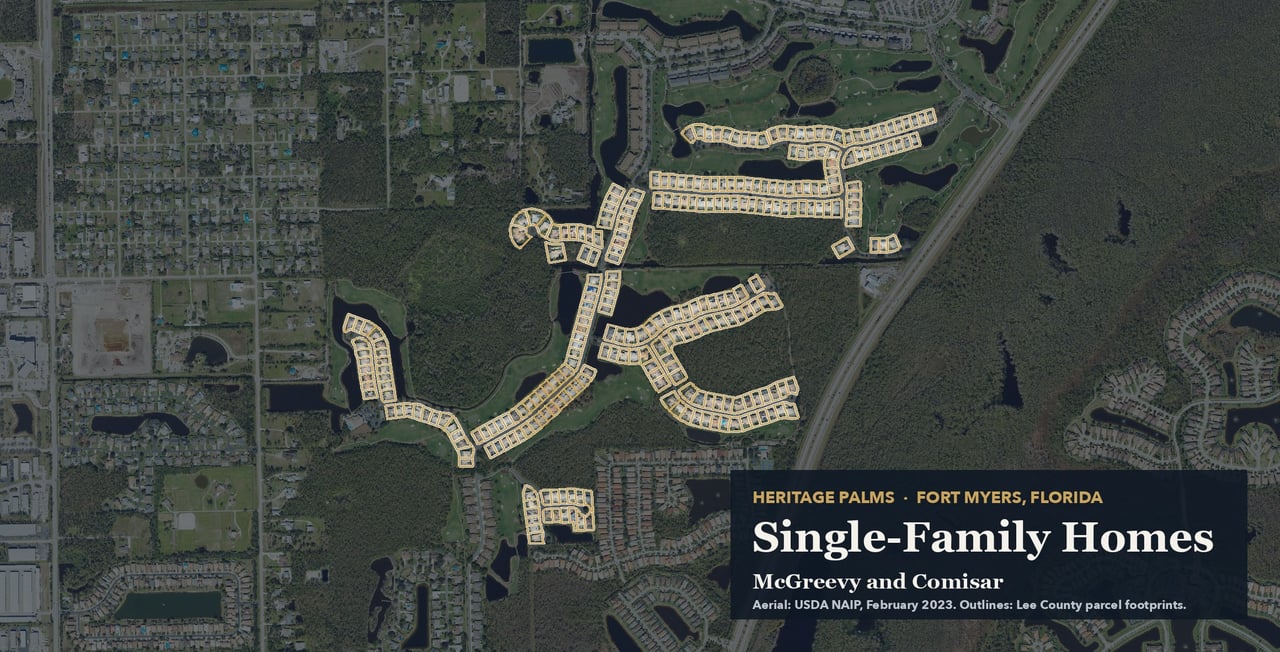
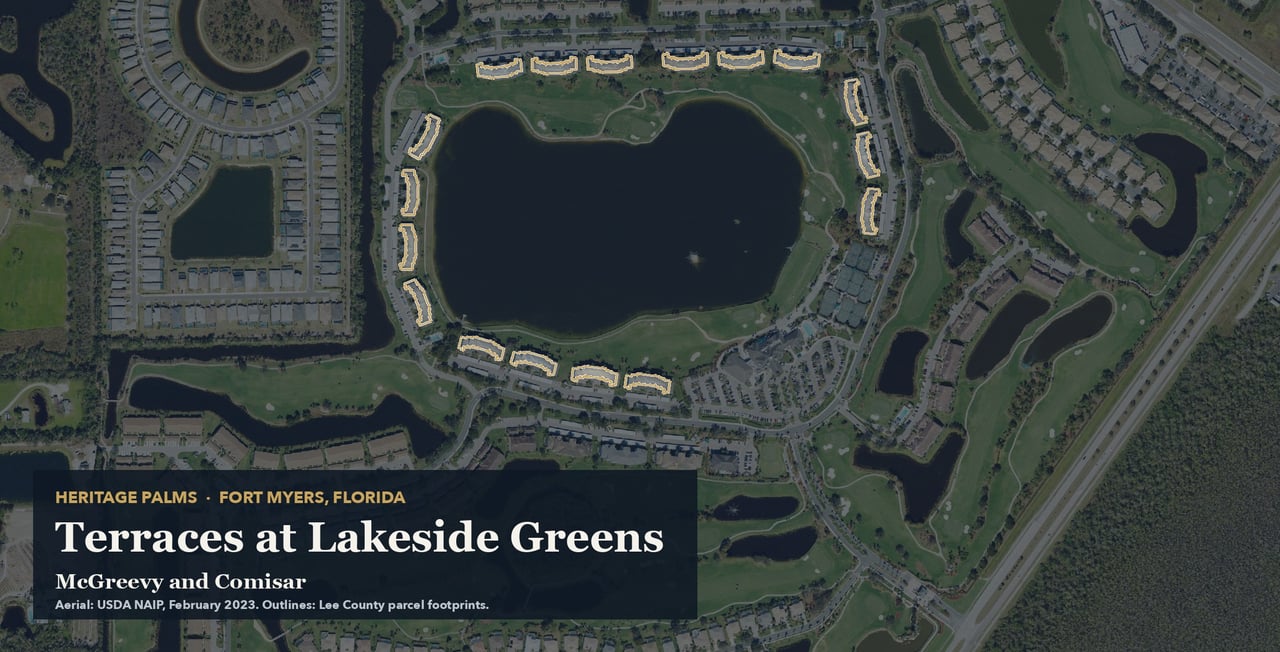
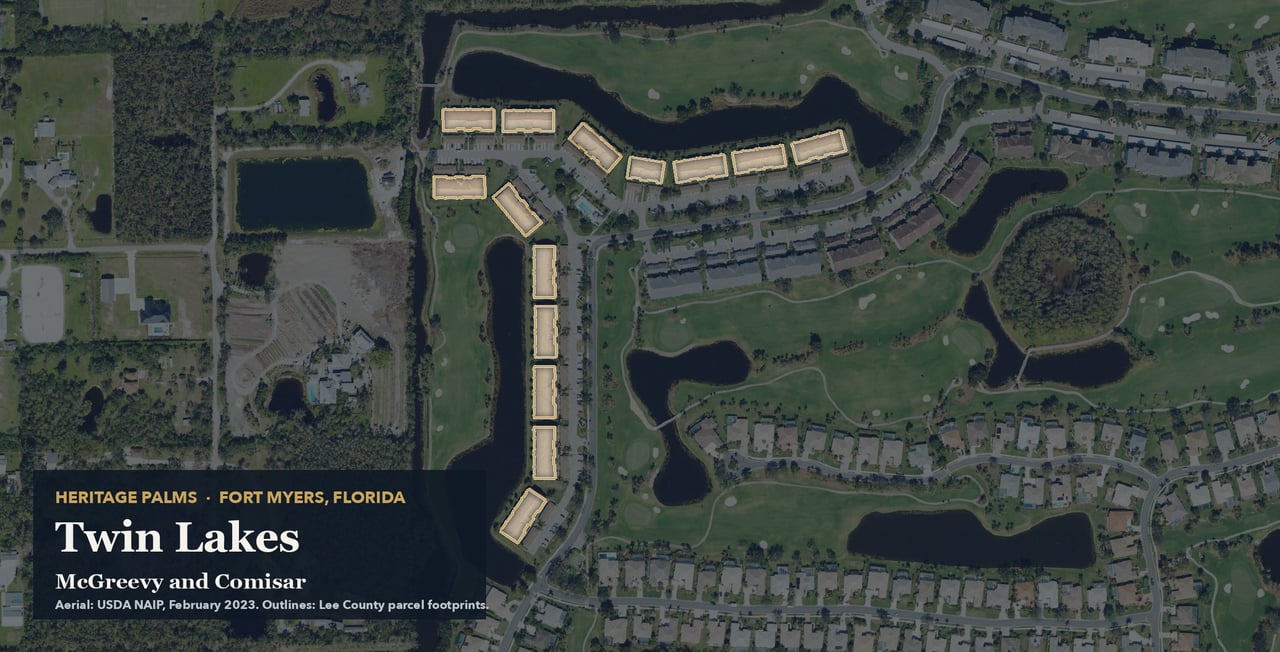
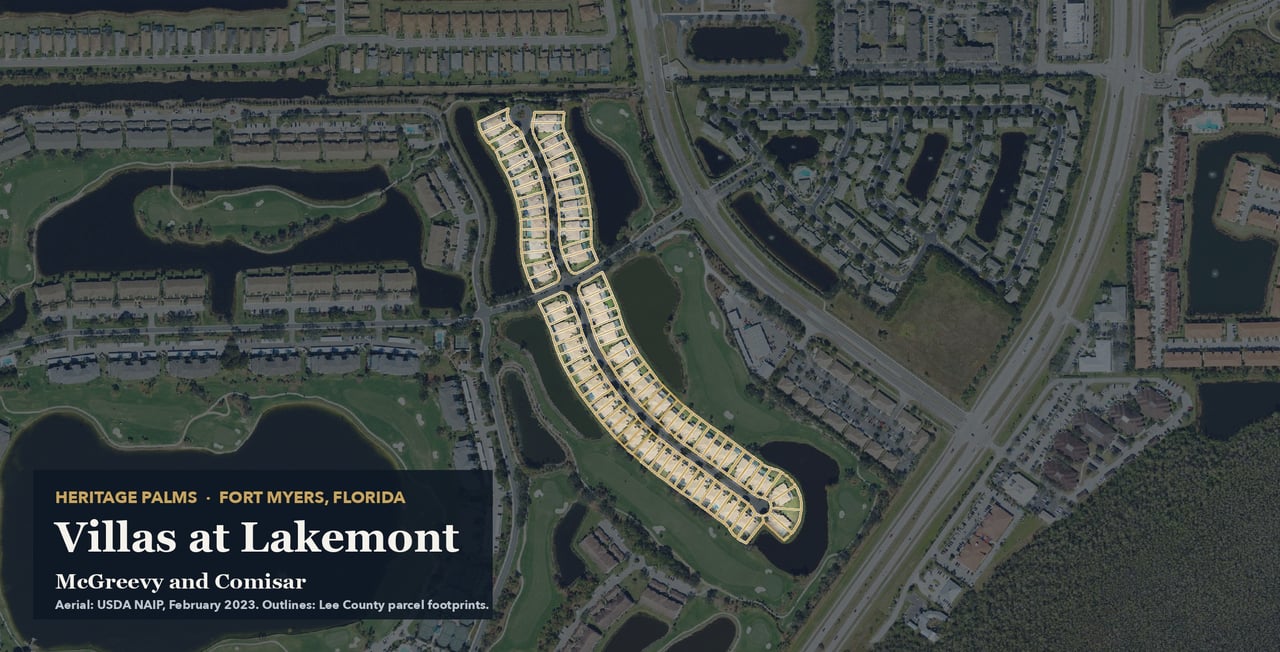
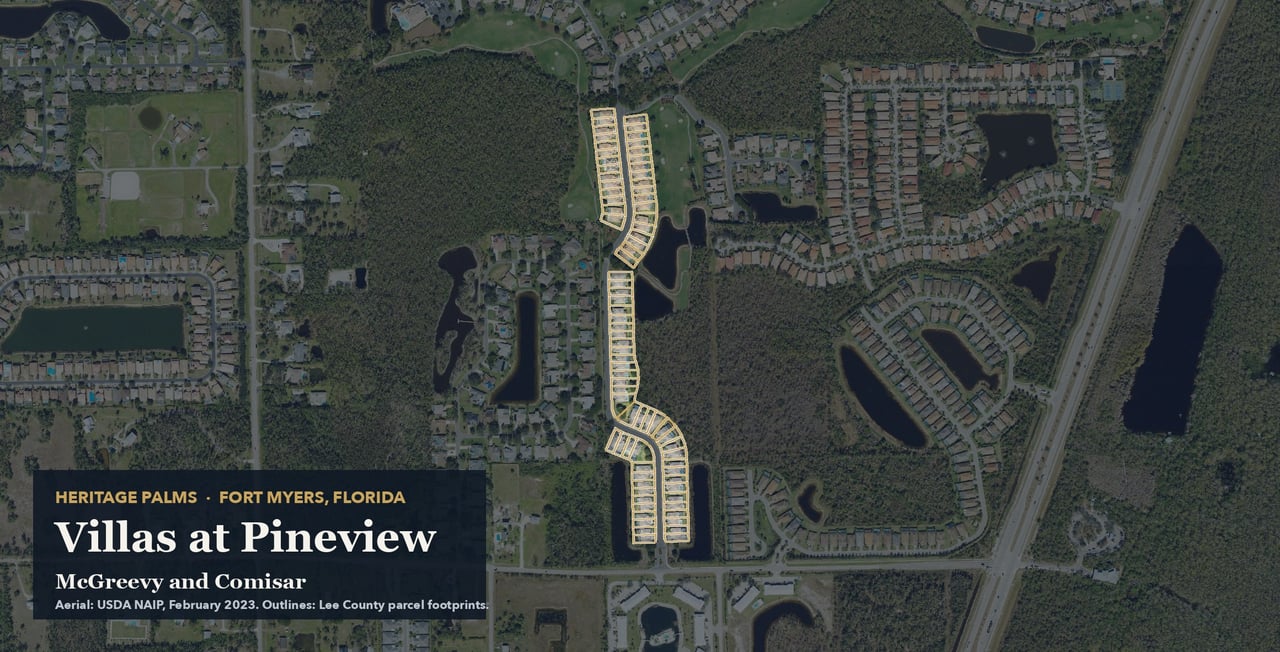
Heritage Palms Golf & Country Club (South Fort Myers, 33966). A guard-gated, member-owned bundled-golf community of 1,662 residences across 40 neighborhood associations off Six Mile Cypress Parkway, established 1999. Two 18-hole championship courses designed by Azinger and Lewis wind among 45 freshwater lakes and 179 acres of preserve, with golf membership included in every home purchase, the value answer to the equity clubs. Full guide: Heritage Palms Golf and Country Club, with the 2026 fee stack, the CDD, both courses rated tee by tee, flood zones and all 40 neighborhood associations.
Pelican Preserve (Gateway/Treeline area, 33913). The definitive 55-plus resort community in Fort Myers, a guard-gated active-adult master-plan on roughly 1,100 acres where WCI built 2,498 homes between 2001 and 2020. It pairs 27 holes of championship golf with one of Southwest Florida’s largest amenity complexes, the Plaza Del Sol Town Center (fitness, dance studio, a 100-seat movie theater, indoor/outdoor pools, tennis and pickleball, dining, and a full-time activity director). Its scale makes it the highest-resale-volume 55-plus brand in the market. Full guide: Pelican Preserve, with developer history, master plan, governance, and per-village detail.
Verandah (East Fort Myers, 33905). Old-Florida luxury golf on 1,456 acres with 1.75 miles of frontage on the Orange River, originally developed by the Bonita Bay Group (2003) and acquired by The Kolter Group (2012). Two championship courses, Old Orange (Bob Cupp) and Whispering Oak (a Jack Nicklaus and Jack Nicklaus II design), anchor a nature-forward community with a River House amenity center, miles of riverside trails, and active new construction that draws new-build luxury buyers. Full guide: Verandah, with developer history, the two championship courses, governance and CDD detail, and per-neighborhood breakdown.
The Landings Yacht, Golf & Tennis Club (South Fort Myers, 33919). Billed as “Florida’s first planned and gated community” (development began 1973), a 250-acre riverfront club on historic McGregor Boulevard with roughly 1,200 homes across 14 villages. Its identity is yacht-and-tennis: a private marina with 192 wet slips plus dry storage, fuel dock and ship’s store; an 18-hole executive course; and one of the region’s most impressive tennis facilities (13 lighted Har-Tru courts) plus pickleball, bocce, and 18 stocked fishing lakes. Full guide: The Landings Yacht, Golf and Tennis Club, with flood zone and condominium milestone status village by village, the marina and bridge-free Gulf access facts, the club fee structure, and the Save Our Homes tax reset.
Paseo (South Fort Myers, 33912). The amenity-rich, all-ages answer for buyers who want resort living without golf or golf fees, a 444-acre gated Stock Development community of roughly 1,200 single-family and villa homes beside the Six Mile Cypress Slough Preserve, named a Florida Home Builders Association best master-planned community multiple years running. Its 26,000-square-foot Village Center delivers a restaurant and pub, fitness, a 90-seat movie theater, a spa, tennis, and a full-time activities director. Full guide: Paseo, with developer history, master plan, governance, and per-village detail.
Fiddlesticks Country Club (South Fort Myers, 33912). The “old-money” golf name, an exclusive, lower-density private equity club off the Daniels corridor, opened in 1983 with founding architect Ron Garl. Two 18-hole championship courses, a tight-knit membership, and a scarcity premium from low resale volume define it. Full guide: Fiddlesticks Country Club, with club history, the equity membership and fee structure, governance, and covenant detail.
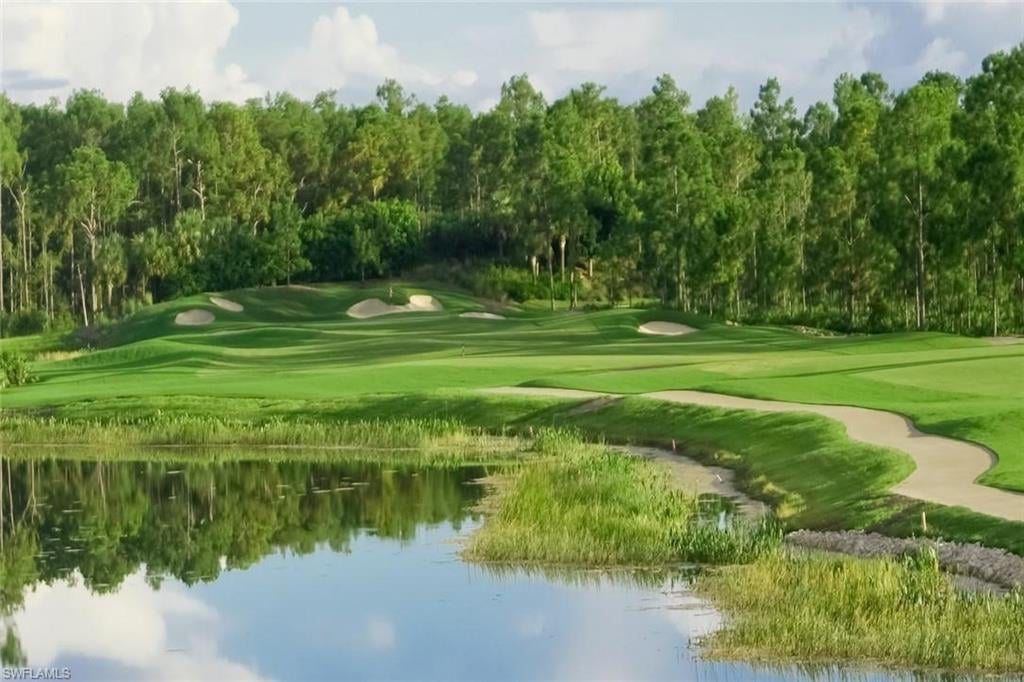
Beyond these seven flagships, Fort Myers’ luxury and lifestyle depth includes the private boatable-lake enclave of Esplanade Lake Club on 352-acre Lake Como (Taylor Morrison’s 2025 Community of the Year by both the Lee and Collier building-industry associations, and notably inland of the coastal surge zone); the non-gated, Gulf-access boating neighborhood of Town & River (a teardown-and-rebuild-higher market on the river, where serious boaters prize the direct sailboat access without club fees or gates); bundled-golf value at Colonial Country Club (whose Gordon Lewis course reopened in January 2026 after a $9 million renovation) and Cross Creek (one of the area’s lowest-HOA bundled-golf options); and the airport-convenient Gateway master-plan with its own golf, soccer complex, and JetBlue Park adjacency. In south Fort Myers, The Forest is a gated golf option for buyers who do not want golf bundled into the purchase: it is a non-bundled community where club membership is optional, and you can read our complete guide to The Forest for its two courses, club membership detail and recent sales.
Which flagship is right for you depends on the tradeoffs only experience surfaces: equity-club buy-in versus bundled-golf simplicity, deep-water Gulf access versus a private freshwater lake, the prestige of the McGregor address versus the value of a newer Gateway build, a 55-plus resort calendar versus an all-ages amenity hub. We have represented buyers and sellers across all of them, and we’ll tell you honestly where your money goes furthest. We can pull a tailored report on any of these communities today. Call Jesse at (239) 898-6072 to sell, or Marc at (239) 287-5873 to buy.
Fort Myers and its unincorporated surroundings hold more than fifty named neighborhoods, each with its own price tier, governance, and personality. The roster below is the working directory, organized by zone. Major communities get their own dedicated spoke page over time; until those go live, this table is the navigation. (Two communities, Caloosa Creek and Magnolia Landing, already have dedicated McGreevy and Comisar pages; we link those directly rather than duplicating them here.) Price language is general and not a substitute for live, community-level MLS comps. Call us for current numbers on any one of these.
Neighborhood | Zone / ZIP | Type | Character |
|---|---|---|---|
Downtown / River District | Downtown 33901/33916 | High-rise condo + historic | Walkable arts-and-dining core; post-Ian revival; workforce condos to luxury riverfront towers |
Dean Park | Downtown 33901 | Historic single-family | ~80 homes (1916 to mid-1920s), National Register district, walk to downtown |
Edison Park | Downtown 33901 | Historic single-family | 1920s bungalows + Mediterranean Revival; leafy, walk to Edison & Ford Estates |
Seminole Park | Downtown/McGregor 33901 | Historic single-family | Early-1920s neighborhood + city park; royal palms, established |
Dunbar | Downtown-adjacent 33916 | Workforce + infill | Historically significant African American community; in active revitalization |
High Point Place / Beau Rivage / Riviera / St. Tropez / Prima Luce | Downtown towers 33901/33916 | High-rise condo | Riverfront downtown towers; secured buildings; urban-luxury, lock-and-leave |
McGregor Boulevard corridor | City + South FM 33901/33908/33919 | Estate + historic | The “City of Palms” spine; prestige riverfront estates |
Gulf Harbour Yacht & Country Club | South FM 33908 | Gated waterfront golf/yacht | Equity club; deep-water marina; 1,612 homes; flagship luxury |
The Landings | South FM 33919 | Gated waterfront golf/tennis | “Florida’s first gated community”; marina + premier tennis |
Town & River | South FM 33919 | Non-gated waterfront | 1960s and 70s Gulf-access canal boating; teardown-rebuild luxury |
Whiskey Creek | South FM 33919 | Golf | Established neighborhood around Whiskey Creek CC; family, mature |
Cypress Lake | South FM 33919 | Established | Around Cypress Lake CC + Cypress Lake HS; central, convenient |
South FM 33908 | Gated golf | Two 18-hole courses (Bear, Bobcat); non-bundled, club membership optional; 789 residences | |
Iona | South FM 33908 | Beach-approach mix | Older + newer enclaves toward Sanibel/Bunche Beach |
Caloosa Creek | South FM 33908 | Gated lake | ~98 estate homes on an 11-acre lake; see our dedicated page |
Catalpa Cove | South FM 33908 | Gated waterfront | Direct Gulf-access boating enclave in Iona |
Laguna Lakes | South FM 33908 | Gated lake | Single-family + villas near HealthPark; resort amenities |
Coastal Key / Hammock Cove | South FM 33908 | Gated newer | Coastal-contemporary new construction, low-density |
Pine Manor | South FM 33907 | Workforce | Established working-class neighborhood; affordable |
Gateway | Gateway 33913 | Master-planned | 3,000+ acres; golf, soccer complex, JetBlue Park adjacency |
Stoneybrook / Hampton Park (at Gateway) | Gateway 33913 | Gated | Family sub-communities within Gateway; amenity-rich |
Pelican Preserve | Gateway/Treeline 33913 | Gated 55+ golf | 2,498 homes; 27 holes + Town Center; flagship active-adult |
Heritage Palms | South FM 33966 | Gated bundled golf | 1,662 homes; two courses included; value-golf leader |
Paseo | South FM 33912 | Gated lifestyle (no golf) | 1,200 homes; Village Center; amenities-not-golf niche |
Fiddlesticks Country Club | South FM 33912 | Gated equity golf | Two courses; exclusive, lower-density |
Colonial Country Club | South FM 33966/33912 | Gated bundled golf | Gordon Lewis course (reopened 2026 after $9M reno) |
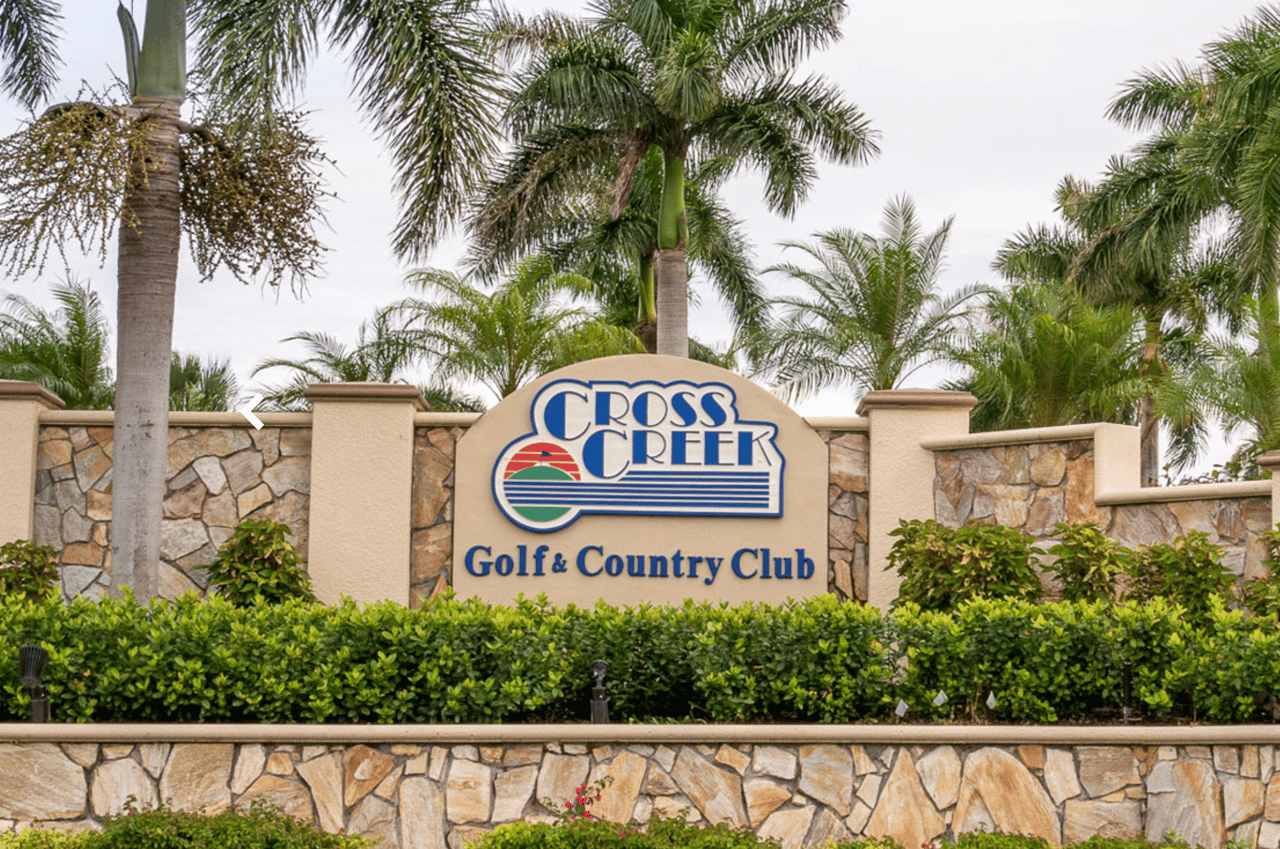
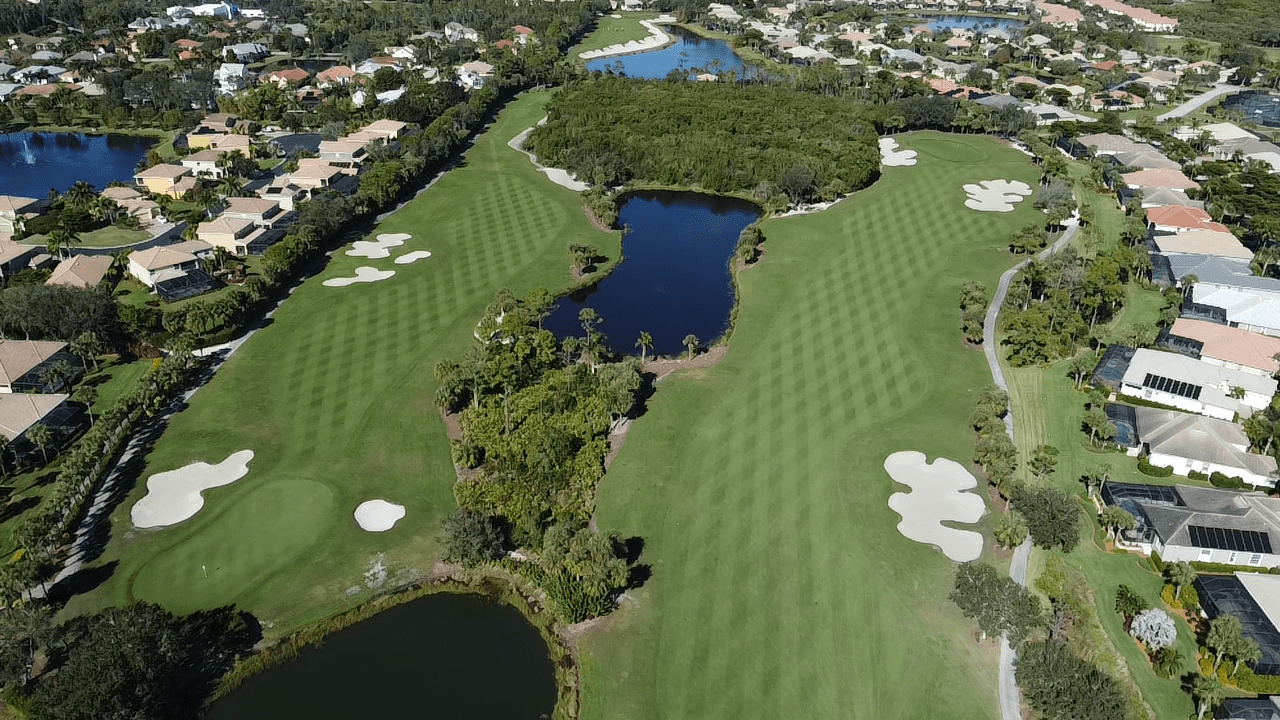
Cross Creek | South FM 33912 | Gated bundled golf | Executive course; notably low HOA; value tier |
Crown Colony | South FM 33907/33912 | Gated golf | 552 homes; smaller, exclusive; optional golf membership |
Botanica Lakes | Treeline 33966/33912 | Gated | 500+ Mediterranean homes in a preserve setting |
Arborwood Preserve | Treeline 33912 | Gated lifestyle | Newer Lennar/WCI lifestyle community; 23,000+ sq ft town center |
Marina Bay | Treeline 33913 | Gated | GL Homes single-family; large clubhouse; all-ages |
Timber Creek | Gateway 33913 | Gated new construction | Lennar resort masterplan; clubhouse + sports center |
Reflection Lakes | South FM 33907/33912 | Gated lake | Single-family, villas + multifamily; value, family |
Lindsford | Central 33966/33916 | Gated | Single-family/townhomes on the Ten Mile Linear Park canal |
The Plantation (Somerset + Bridgetown) | Treeline 33913 | Gated golf + non-golf | ~1,100 homes; Plantation Golf Club (Somerset) + Bridgetown |
Esplanade Lake Club | Gateway 33913 | Gated lakefront | Taylor Morrison; private 352-acre boatable lake; newer luxury |
Heritage Cove | South FM 33907/33912 | Gated 55+ | Active-adult villas + single-family around a lake |
Verandah | East FM 33905 | Gated riverfront golf | Two courses incl. a Nicklaus design; 1,456 acres; Old-Florida |
River Hall | East FM 33905 | Gated golf | Davis Love III course + non-golf Cascades; eastern Lee County |
Portico | East FM 33905 | Gated new construction | Lennar; 589 acres; near Manatee Park + downtown |
Fort Myers Shores | East FM 33905 | Riverfront CDP | Unincorporated; older riverfront/canal homes; boating |
Olga / Buckingham | East FM 33905/33917 | Rural / acreage | Equestrian, large-lot; SR-80 corridor; Lee County governed |
Magnolia Landing | North FM 33917 | Gated golf | D.R. Horton golf community; see our dedicated page |
Crane Landing | North FM 33903/33917 | Gated new construction | D.R. Horton; walkable trails; value, family |
WildBlue (Estero corridor) | 33913 / Estero line | Gated lakefront luxury | Boatable lakes; luxury new construction (confirm jurisdiction) |
Note: Several “Fort Myers” communities (Iona, Whiskey Creek, the Gateway/Daniels corridor, East and North Fort Myers) carry a Fort Myers mailing address but sit in unincorporated Lee County, which changes which comprehensive plan, land-development code, and short-term-rental rules apply. We reconcile jurisdiction per address before any transaction. WildBlue spans the Fort Myers/Estero boundary; we confirm jurisdiction on a per-home basis.
Fort Myers and the surrounding Lee County corridors are in one of the most active building cycles in Southwest Florida, driven by the airport, the post-Ian rebuild, and a steady inflow of relocating residents (Lee County adds roughly 1,900 new residents a month). For buyers, new construction means current building codes, current wind-mitigation and elevation standards, and warranties, all of which directly lower insurance cost and storm risk. For sellers, the new-build pipeline sets the competitive context for resale pricing. Here is the current landscape.
The airport is the engine. The Southwest Florida International Airport (RSW) Terminal Expansion is the largest public-works project in Lee County history, a roughly $1.7 billion, two-phase program funded in part by a $725 million revenue-bond sale. Phase 2 adds a new 513,000-square-foot, 14-gate Concourse E (topped off in December 2025, completion targeted December 2027), engineered for 10,000 to 15,000 additional passengers a day; a temporary Concourse C security checkpoint opened in February 2026. RSW set a record of more than 11 million passengers in 2025. That growth frames the entire Gateway/Daniels/Treeline new-construction story (Lee County Port Authority).
Active master-planned new-construction communities in and around Fort Myers include:
Adjacent corridors feeding Fort Myers demand (outside Fort Myers proper, so confirm the jurisdiction): WildBlue and Verdana Village in the Estero/Corkscrew corridor (roughly 3,100 acres and a planned 2,400 homes respectively, with multiple national builders), and Babcock Ranch in Charlotte County, America’s first solar-powered town (5,000-plus homes sold, 12,000-plus residents), which famously kept its power through Hurricane Ian, with a walkable B Street mixed-use district opening in 2026.
Downtown is its own pipeline. The River District has a deep stack of established riverfront condo towers: Beau Rivage, the twin Riviera and St. Tropez towers, High Point Place, and Oasis, most of them part of the MacFarlane development legacy that has shaped the downtown skyline over half a century. The current wave adds the two-tower, 220-residence Prima Luce condominium with 325 feet of river frontage; a new downtown Hilton the City Council has greenlit; the ONE Fort Myers boutique high-rise; and the Midtown Catalyst, a 10-acre site at Fowler Street and Dr. Martin Luther King Jr. Boulevard with roughly 350 residences, 150,000 square feet of office, 50,000 square feet of retail, and a 140-to-160-room hotel, with construction targeted to begin in late 2026. A separate riverfront project proposes hundreds of residential units alongside a public riverwalk and park. The former City of Palms Park (the Red Sox’s old downtown stadium) is slated for demolition and mixed-use reuse beginning around 2027. For a buyer who wants lock-and-leave riverfront condo living in a walkable, arts-centered downtown that is visibly on the rise, this is a moment to pay attention. (Some downtown tower delivery dates and the Prima Luce ownership status have been in flux; we confirm the current status of any specific building before recommending it.)
The jobs behind the growth. The inland corridor isn’t just rooftops; it’s employment. Lee Health, headquartered in Fort Myers, is one of the region’s largest employers. Hertz Global Holdings keeps its corporate headquarters in nearby Estero (Lee County). Gartner runs a global Service Operations Center of Excellence in Fort Myers, and Alta Resources operates a large business-process campus in the Gateway area. Add RSW’s thousands of aviation and construction jobs and FGCU’s role as a major employer and talent pipeline, and you have the economic base that turns seasonal demand into year-round demand. For buyers, that means a market that isn’t purely snowbird-dependent; for sellers, it means a deeper, more durable buyer pool.
Permit data is public and current. Lee County publishes weekly building-permit reports, and the FGCU Regional Economic Research Institute tracks single-family permits monthly. The county issued 503 single-family permits in December 2025, softening from the post-Ian rebuild peak but still high volume. We use that primary data, not vibes, to tell sellers where competing new supply is coming online. If you’re weighing a new build against a resale, call Marc at (239) 287-5873. We’ll walk you through the true cost, insurance, and timing tradeoffs.
The two governments that quietly control what your home and your neighbors’ homes can become are the City of Fort Myers and Lee County, and which one governs your address changes your rules. The City runs a council-manager government with a seven-member City Council and set its FY2025-26 millage at 6.5000 mills. Here is the City.
The City of Fort Myers was incorporated on August 12, 1885 (with all 349 residents at the time) and operates a council-manager, “weak mayor” government. The City Council has seven members: a Mayor elected at-large citywide plus six Councilpersons, each elected within and residing in their own ward, all serving four-year terms. The Mayor has one vote and no veto; the City Manager is the chief administrative officer running day-to-day operations and a workforce of more than 1,000 employees. Council meets at 4:30 p.m. on the first and third Mondays of each month at Oscar M. Corbin, Jr. City Hall, 2200 Second Street. As of 2026 the elected leadership is Mayor Kevin B. Anderson (the city’s 62nd mayor, sworn in November 2020, a former Ward 4 councilman and 24-year Fort Myers Police Department veteran) with Councilpersons Teresa Watkins Brown (Ward 1), Diana Giraldo (Ward 2), Terolyn Watson (Ward 3), Liston Bochette III (Ward 4), Fred Burson (Ward 5), and Darla Bonk (Ward 6); City Manager Marty K. Lawing; City Clerk Mary Hagemann; and City Attorney Grant Alley. The 2026 municipal election (Mayor plus Wards 1, 3, and 5) runs an August 18 primary and a November 3 general (City of Fort Myers, Mayor & Council).
Why this matters to a buyer or seller: the City’s Comprehensive Plan and its Future Land Use Map tell you whether a vacant parcel near a home can become commercial or multifamily, and the Land Development Code (hosted live on Municode) sets the setbacks, heights, and allowed uses that separate a buildable lot from a headache. Both are public, and both are linked in the Downloadable Documents section below. Fort Myers is in the middle of a Comprehensive Plan update (RFP 0065-23), so the rulebook itself is being rewritten, worth knowing if you’re buying near a redevelopment-adjacent parcel.
A pro-taxpayer governance record. The City set its FY2025-26 millage at 6.5000 mills, its tenth consecutive year of millage reductions, alongside a five-year, roughly $911-million capital improvement program. That capital plan is itself a value signal: a funded road, utility, park, or stormwater project near a listing is a tailwind for value, and we can show clients exactly where the city is investing by ward and neighborhood.
The CRA and the River District. The Fort Myers Community Redevelopment Agency (CRA), created in 1984 under Florida Statute Chapter 163, runs the downtown/River District redevelopment area, a roughly 540-acre district from the Caloosahatchee River to Victoria Avenue. The CRA’s downtown streetscape revival (the project that re-laid the excavated 1920s bricks) won an international “Making Cities Livable” award, ranking first worldwide for the environment it created in the urban core. The CRA also runs redevelopment plans for the Cleveland Avenue, Dr. Martin Luther King Jr. Boulevard, Central, and East Fort Myers districts, plus the 243-acre Midtown Vision Plan. For buyers near these districts, the redevelopment plan is a documented value driver; for sellers, it’s a selling point you can cite.
Public safety adds an insurance angle most realtors never mention. The Fort Myers Fire Department (established 1901, eight stations, ~50 square miles, the Region 6 HazMat team) carries an ISO Class 2 rating and CFAI accreditation, an excellent public-protection classification that directly lowers the fire portion of a homeowner’s premium. The Fort Myers Police Department, under Chief Jason Fields, earned CALEA accreditation in 2024 (only the second time in its history). These are quiet, citable “why Fort Myers specifically” advantages.
Outside City limits, in South, East, and North Fort Myers, the governing body is Lee County, a Home Rule Charter county (voter-approved 1996, effective 1997) of roughly 835,000 residents governed by a five-member Board of County Commissioners, each residing in a district but currently elected at-large county-wide. The County Manager is Dave Harner (since 2023), overseeing a roughly $3 billion budget. The 2026 board: Kevin Ruane (District 1), Cecil Pendergrass (District 2, Chairman), David Mulicka (District 3, Vice Chairman), Brian Hamman (District 4), and Patricia “Trish” Petrosky (District 5, appointed in 2025 to fill the seat after the death of long-time Commissioner Mike Greenwell). The City of Fort Myers is split across multiple commission districts, so we use the official district map rather than asserting a single one for any address.
Those county functions run the same way countywide, but the numbers behind them do not. Our Lee County real estate guide compares Fort Myers against every other Lee County city on median price, millage rate, days on market, and flood exposure, all from a single dated MLS pull.
A 2026 ballot item Fort Myers buyers and sellers should know: a charter-amendment referendum (from local bill HB 4001) on the November 3, 2026 Lee County ballot would shift to single-member commission districts starting in 2028, meaning only voters in a given district would elect that district’s commissioner. The County held its FY2025-26 countywide millage flat at 3.7623 mills, a rollback relative to rising values.
The constitutional officers who touch every transaction. In a Fort Myers closing, the Lee County Property Appraiser (Matt Caldwell, leepa.org) sets the assessed value and administers homestead exemptions; the Tax Collector (Noelle Branning) bills and collects the ad valorem taxes; and the Clerk of the Circuit Court & Comptroller (Kevin Karnes) records the deed and mortgage in the county’s Official Records. Knowing who does what, and pulling the right primary record at the right moment, is part of how we protect clients on both sides of a deal.
Three property-tax levers that are major money for buyers and sellers:
Schools, growth, and roads. Fort Myers is served by the School District of Lee County (Superintendent Dr. Denise Carlin), which holds a state grade of “B” (2024-25), with 14 A-rated schools, 27 B-rated schools, and no F-rated schools district-wide, plus a 10-year capital plan exceeding $2 billion for new schools and modernization. Major road projects affecting Fort Myers include the Ortiz Avenue widening and the regional Cape Coral Bridge replacement (construction starting late 2026). We cover schools in depth in the Schools section below.
Selling in unincorporated Fort Myers? The Lee County rules, and the larger CRS flood discount, can work in your favor; call Jesse at (239) 898-6072 for a strategy that uses them. Buying? Call Marc at (239) 287-5873 and we’ll verify jurisdiction, taxes, and flood class for every address you consider.
We will be honest with you, because honesty is what builds trust, and because every serious Fort Myers buyer is going to ask anyway. Hurricane Ian made landfall just south of Fort Myers on September 28, 2022, as a Category 4 to 5 strength storm, and it remains the costliest hurricane in Florida history at more than $112 billion in damage. The downtown surge was severe: a tide gauge near downtown measured 7.26 feet above Mean Higher High Water, the storm surge reversed the direction of the Caloosahatchee River’s flow, flooded the River District streets, submerged the first floors of riverfront apartment buildings, and stacked boats on one another. In the South Fort Myers / Iona-McGregor corridor, surge swallowed blocks even away from the river. County-wide, more than 52,500 structures were impacted, 5,369 destroyed, and 14,245 sustained major damage. Two more storms, Helene and Milton in 2024, tested the recovery again, mainly along the coast and Fort Myers Beach. Centennial Park on the downtown riverfront now carries a permanent Hurricane Ian Memorial Wall.
That is the honest severity. Here is the equally honest, and verifiable, recovery, which is the story that matters for anyone buying today.
The downtown comeback is real and funded. Fort Myers is positioned for a roughly $6 billion downtown revitalization: capital investment across residences, offices, retail, a hotel, an expanded marina, and 60-plus acres of redevelopment over about five years (Gulfshore Business reporting). HUD allocated Lee County more than $1.1 billion in Community Development Block Grant-Disaster Recovery (CDBG-DR) funds, distributed competitively to municipalities including the City of Fort Myers for housing, critical infrastructure, public facilities, and flood mitigation, with at least 70% benefiting low-to-moderate-income households (City of Fort Myers CDBG-DR). The County’s coordinated recovery framework, ResilientLee, is a 231-page roadmap of 43 initiatives accepted in 2024.
Specific, citable proof points rather than vibes: the historic Edison & Ford Winter Estates structures came through Ian intact and the museum has been replanting its storm-damaged botanical gardens; the downtown Legacy Harbour Marina rebuilt and reopened around Q1 2026; the city-owned Fort Myers Yacht Basin (whose docks Ian destroyed) is being rebuilt and expanded under a 30-year Suntex Marinas lease, pending Army Corps and state environmental permits; and the Midtown Catalyst and riverfront-development projects are moving through approvals. The CRA’s 2010 Downtown Plan, which anticipated an enlarged marina, a riverwalk, and riverfront public space, is now being executed.
What this means for you as a buyer: Fort Myers is rebuilding stronger, not pretending nothing happened. Newer and elevated, post-Ian-code construction insures far cheaper and carries far less storm risk than older slab-on-grade product, and the price reset has created genuine opportunity in segments where buyers do their due diligence. We screen every property for flood zone, elevation, storm and claim history, and insurability before you fall in love with it, so the storms are a factor you manage, not a surprise you discover after closing.
We worked this market through the storms and the recovery, not just the easy years, and that experience is exactly why buyers and sellers trust us with the hard questions. McGreevy and Comisar are Top 1% Real Estate Agents Nationally Since 2008, the #1 team in Southwest Florida since 2012, with over $2.5 billion sold as Domain Realty Group \u2014 the team that knows which Fort Myers homes were built back right and which were not. Selling a post-Ian home? Call Jesse at (239) 898-6072. Buying one? Call Marc at (239) 287-5873. We’ll vet its resilience before you commit.
Fort Myers is a river-and-coast city, so flood status is not a footnote; it is part of the price and the monthly cost of nearly every home. Waterfront homes mostly sit in AE or VE zones, Zone X is lower risk, and FEMA’s 50% rule limits how much an older flood-zone home can be renovated before full elevation applies. Here is what to understand.
Flood zones. The most common Fort Myers FEMA designations are AE, VE, and X. AE and VE are high-risk Special Flood Hazard Areas where lenders require flood insurance (VE adds coastal wave/velocity hazard); much of the area near the Caloosahatchee, downtown, and the canal network falls in AE, with coastal South Fort Myers reaching VE. Zone X is lower-risk. FEMA’s 2022 Coastal Risk MAP FIRM, the first major coastal remap for Lee County since 2008, used storm-surge and wave modeling to reclassify thousands of homes into higher-risk zones along the coast and the river. To find any property’s current zone, use FEMA’s Flood Map Service Center, the Lee County flood-zone tools, or the City’s flood-property lookup, all linked below. We pull the zone for every property we show or list.
The flood-insurance discount that depends on which line you’re inside. The City of Fort Myers upgraded its FEMA Community Rating System (CRS) class from 9 to 6, giving NFIP policyholders inside city limits a 20% flood-insurance discount effective October 1, 2025 (up from the prior 5%). Unincorporated Lee County and Cape Coral hold a CRS Class 5, which carries a larger discount. So a home inside the City of Fort Myers gets a 20% NFIP discount; an unincorporated South Fort Myers home a mile away gets more. That distinction can be hundreds of dollars a year, and most buyers never know to ask about it. We do (City CRS page).
The 50% Rule: the single most consequential document for an older or flood-zone home. Under FEMA’s Substantial Improvement / Substantial Damage rule, if you renovate (or repair after damage) a home in a flood zone and the cost reaches 50% of the structure’s market value, the entire home must be brought up to current flood-code elevation standards, which can mean lifting the house. For buyers of older homes post-Ian, this rule governs how much you can renovate before triggering full elevation; for sellers of substantially-damaged homes, it shapes the deal. The City’s Substantial Improvement / 50% Rule packet is hosted in our Downloadable Documents; it is required reading before you buy an older Fort Myers home, and we walk every client through it.
Risk Rating 2.0 and how to lower a premium. FEMA now prices flood premiums on property-specific factors (elevation, distance to water, rebuild cost) rather than zone alone, with annual increases capped at 18% for primary homes. You can lower a flood premium with an elevation certificate, a higher deductible, comparing private flood policies against NFIP, buying in a CRS-discount community, and favoring newer elevated construction. We flag all of it on the homes we show.
The single biggest objection we hear from out-of-state buyers is “isn’t Florida uninsurable?” The honest 2026 answer: it’s expensive, but the market is stabilizing, and there are concrete, legal ways to bring the cost down. Lee County’s average homeowners premium, including wind, ran roughly $3,631 a year as of early 2025.
Where premiums stand. Lee County’s average homeowners premium (including wind) ran roughly $3,631 a year as of early 2025, high by national standards, but the market is stabilizing post-Ian. Carriers are returning, 2022 and 2023 litigation reforms are credited with calming the market, and multiple carriers filed rate decreases for 2026. Citizens Property Insurance (the state-backed insurer of last resort) shed roughly half its policies year-over-year and received an approved average rate reduction. Flood insurance is a separate policy from your homeowners/wind policy, and we always price the two together when we evaluate a home’s true carrying cost.
Wind mitigation: a legally mandated discount most buyers leave on the table. Florida Statute 627.0629 requires every Florida insurer to discount the windstorm portion of your premium based on a wind-mitigation inspection (form OIR-B1-1802). The inspection runs about $100 to $150, takes about an hour, and is valid five years; the form was updated effective April 1, 2026. The biggest credits come from a hip roof, hurricane clips or straps, ring-shank deck nails, a peel-and-stick secondary water barrier, and a 2001-or-later Florida Building Code roof, and My Safe Florida Home data shows average reported savings exceeding $900 a year. For a Fort Myers buyer, a home’s mitigation features are part of its true cost; for a seller, a clean wind-mitigation report is a marketing asset. We make sure it’s in play on both sides.
The bigger stabilization picture. The “Florida is uninsurable” narrative is two years stale. The depopulation of Citizens Property Insurance (its policy count fell to its lowest level in well over a decade) signals private carriers re-entering the market and competing again, and the state’s tort and litigation reforms have begun to show up as filed rate decreases for 2026. None of this makes insurance cheap, and we never pretend it does. But it does mean a Fort Myers buyer in 2026 is shopping a more competitive, more rational market than a buyer in 2023 was, and that the right home, with the right mitigation, is insurable at a cost you can plan around. We bring an insurance lens to every showing and every listing, because in this market the policy is part of the price.
The water-quality story buyers ask about. The Caloosahatchee River and Estuary define Fort Myers, and the newly operational C-43 Reservoir (around 2026) stores up to 55 billion gallons of Lake Okeechobee water to reduce harmful wet-season discharges to the estuary and supply beneficial freshwater in the dry season, a major Everglades-restoration win for the river city. It’s a meaningful, citable answer to the algae-and-water-quality questions that come up on riverfront and Gulf-access homes.
Worried about insurance on a specific Fort Myers home? Don’t guess. We’ll help you get real numbers before you commit. Sellers: a clean wind-mitigation report is a marketing asset; call Jesse at (239) 898-6072. Buyers: call Marc at (239) 287-5873 and we’ll price the home and its insurance together, the way it should be done.
School quality is address-specific in Fort Myers: assignment is by attendance zone, and the spread between campuses is real, so we always verify the exact zoned elementary, middle, and high school for any home before a family buys. Here is the landscape.
The district. Fort Myers is served by the School District of Lee County, one of Florida’s ten largest, holding a state grade of “B” (2024-25) with 14 A-rated schools, 27 B-rated schools, and no F-rated schools, plus a 10-year capital plan exceeding $2 billion that funds new schools and modernization. Several Fort Myers-area schools moved up to an A grade in 2024-25, including North Fort Myers High, Three Oaks Middle, Tanglewood Elementary, and Gulf Elementary.
Public high schools in and near Fort Myers.Fort Myers High School is the flagship and consistently the highest-ranked public high school in the city. Other area high schools include Cypress Lake High (with a Center for the Arts magnet), Riverdale High, Dunbar High (a magnet in the historic Dunbar community), North Fort Myers High, and South Fort Myers High. (U.S. News rankings shift year to year; present these as among Florida’s stronger public high schools, and we re-verify the current figure for any zoned school at the time of purchase.)
Private and independent schools.Canterbury School (independent, Pre-K through 12), Bishop Verot Catholic High School (established 1962), and Evangelical Christian School are the leading private options families ask about.
Higher education.Florida Gulf Coast University (FGCU), a public four-year university that opened in 1997, sits in south Lee County just southeast of Fort Myers near Estero and RSW, with 95-plus degree programs. Florida SouthWestern State College (FSW) operates its Thomas Edison (Lee) campus in Fort Myers, offering associate, bachelor’s, and certificate programs. (Note: Hodges University has closed; we don’t list it as a current option.) The presence of a major public university and a state college a short drive from downtown is a real relocation and rental-demand driver.
Healthcare access is one of Fort Myers’ strongest relocation selling points, particularly for retirees, because the city is the headquarters of the region’s dominant health system. From its Fort Myers base, Lee Health provides Level II trauma care, the Golisano Children’s Hospital, and cardiac and neuroscience institutes.
Lee Health is a nonprofit system headquartered in Fort Myers and one of the region’s largest employers. Its acute-care facilities include Lee Memorial Hospital (the original, downtown), Gulf Coast Medical Center (the system’s largest hospital, in South Fort Myers, with a Level II Trauma Center and the Neuroscience Institute), and HealthPark Medical Center (a destination center for cardiac and obstetric care in South Fort Myers). Golisano Children’s Hospital of Southwest Florida, the region’s dedicated pediatric specialty hospital, sits on the HealthPark campus, a significant draw for relocating families (Lee Health fast facts).
A notable recent change: Lee Health converted from a public special hospital district to a private nonprofit, effective November 1, 2024, after operating since 1968 as an independent public hospital district. The Lee County Commissioners approved the transition in October 2024; the conversion lets Lee Health expand services beyond Lee County lines. For buyers, the takeaway is simple: Fort Myers offers Level II trauma care, a children’s hospital, cardiac and neuroscience institutes, and robotic surgery within the city, anchored by a major employer headquartered here.
No section of this page is more “Fort Myers” than this one. The Edison & Ford Winter Estates are a 20-plus-acre National Register historic site on McGregor Boulevard along the Caloosahatchee, the adjacent winter homes, botanical gardens, research laboratory, and museum of inventor Thomas Edison and automaker Henry Ford, two close friends who wintered side by side. Edison first came to Southwest Florida in 1885 and built his riverfront winter home, “Seminole Lodge”; Ford bought the adjoining property, “The Mangoes,” in 1916. Mina Edison deeded the Edison estate to the City of Fort Myers in 1947 for public enjoyment, and the Ford estate opened for tours in 1990. Today the site draws more than 220,000 visitors a year from around the world (Edison & Ford Winter Estates).
The Estates are also the literal origin of the city’s identity. After arriving in 1885, Edison imported and planted the first royal palms along McGregor Boulevard at his own expense, the trees that gave Fort Myers its “City of Palms” nickname and that still soar past 75 feet along the corridor. The site is a working civic and cultural anchor (a nonprofit running events, plant sales, and education programs), and its historic structures came through Hurricane Ian intact, with the museum steadily replanting the storm-damaged gardens. For a buyer choosing Fort Myers, the Estates are a daily reminder that this is a city with genuine history and a preservation ethic, not a subdivision that sprang up last decade. Fittingly, the nearby Fort Myers Country Club, a 1917 Donald Ross-designed municipal course where Edison and Ford were frequent players in the 1920s, is on the Florida Historic Golf Trail.
Here is a genuine, defensible distinction that no other city in Florida can claim: Fort Myers is the only city in Florida that hosts two Major League Baseball spring-training teams. The Boston Red Sox train at JetBlue Park (Fenway South) and the Minnesota Twins train at Hammond Stadium, and the two ballparks sit roughly five miles apart near Southwest Florida International Airport. Every other Grapefruit League city hosts one team; Fort Myers hosts two.
That fact is more than trivia for buyers and sellers. Spring training (roughly mid-February through late March each year) is a major March economic engine for the city. It drives a sharp spike in short-term-rental demand, overlaps with peak snowbird season, fills the Gateway and Daniels corridors with visiting fans, and gives the city a national sports identity that very few markets its size can match. For an investor weighing a seasonal rental near either stadium, the two-team March surge is a real, recurring revenue window (subject to the community’s short-term-rental and HOA rules, which we always verify first). The two stadiums also anchor the fast-growing Gateway/Daniels/RSW corridor, one of the strongest relocation and new-construction stories in the region. The sections below cover each team’s ballpark and its surrounding neighborhoods.
The Boston Red Sox have held spring training in Fort Myers since 1993 (originally at City of Palms Park downtown), and since 2012 at JetBlue Park at Fenway South, a 126-acre ballpark and year-round player-development complex north of Southwest Florida International Airport that opened February 25, 2012. The park seats roughly 11,000 fans across fixed seats, standing room, and grass-berm family seating, and it is a scaled replica of Fenway Park: it mirrors Fenway’s playing-field dimensions, uses the same 1934-vintage manual scoreboard that served Boston for decades, and reproduces the famous Green Monster left-field wall. In a perfect Fort Myers detail, the local version has seating built inside the wall, a “mid-Monster” section required because local wind-mitigation building codes would not allow a continuous solid span at Boston’s 37-foot height. The complex is owned and operated by Lee County (JetBlue Park overview).
Nearby neighborhoods. JetBlue Park sits in the Daniels Parkway / Gateway corridor (ZIPs 33912 and 33913). Communities with convenient access include Arborwood Preserve, Gateway and its sub-neighborhoods, Heritage Palms, Botanica Lakes, Marina Bay, Timber Creek, and the broader Treeline corridor, areas that pair newer construction and gated golf with easy reach to I-75 and RSW. For buyers who want to be near the Red Sox in March (and near the airport year-round), this is the zone, and the March short-term-rental boom for South and East Fort Myers is a real factor in any investment analysis here.
The Minnesota Twins have trained in Fort Myers since 1991, ending 53 years of spring training in Orlando, and in their very first season at the new facility, the Twins won the 1991 World Series. They play at Hammond Stadium, named in 1994 for the deputy county commissioner instrumental in building the complex, with a facade modeled on a Southern clubhouse that earned it the “Mini-Met” nickname. Capacity grew from about 7,500 to roughly 9,300 following major 2014 and 2015 renovations. The stadium is also home to the Fort Myers Mighty Mussels, the Twins’ Low-A Florida State League affiliate, which gives the city affordable, family-friendly professional baseball year-round after spring training ends (Hammond Stadium / Mighty Mussels).
One naming detail worth getting right: the complex that houses Hammond Stadium is now the Lee Health Sports Complex, renamed in November 2023 when the Twins and Lee Health formed a long-term partnership. (It was previously the Lee County Sports Complex and, for a time, the CenturyLink Sports Complex; both names are now retired.)
Nearby neighborhoods. Hammond Stadium sits in the South Fort Myers / Six Mile Cypress area near Daniels Parkway (ZIP 33912 and the 33966 corridor). Communities off Six Mile Cypress Parkway and along the Daniels corridor (Paseo, Heritage Palms, Cross Creek, Reflection Lakes, Fiddlesticks, and the broader South Fort Myers residential belt) offer convenient access, near the Six Mile Cypress Slough Preserve, I-75, and shopping. As with the Red Sox corridor, the March demand surge is a real revenue window for seasonal-rental owners here. Call us to model it against the community’s lease-term rules.
The Caloosahatchee River is the spine of Fort Myers’ identity. Roughly 67 miles long, it broadens as it nears the coast and meets the Gulf in San Carlos Bay about ten miles southwest of downtown, which is what makes Fort Myers a true gulf-access boating market rather than an inland one. The entire downtown is branded the River District, and the river is part of the Great Calusa Blueway paddling trail.
For boaters, the key buyer distinction is direct Gulf access versus river or canal access. “Gulf access” means a dock connects, via the river or canal network, to the open Gulf, the premium feature serious boaters pay for, especially deep-water canals with no fixed-bridge restrictions (a must for sailboats and large vessels). River-frontage downtown condos sell on views and walkability; deep-water Gulf-access homes in Town & River, Catalpa Cove, Palmetto Point, and Gulf Harbour sell on boating capability. The Midpoint Memorial Bridge (opened 1997) carries 55 feet of vertical clearance, a useful reference point for what can pass beneath. We help buyers understand exactly what a given dock can and cannot reach before they pay a waterfront premium for it.
The city marina. The Fort Myers Yacht Basin is the city-owned municipal marina, a 241-slip facility on the south side of the river between the Caloosahatchee and Edison bridges, a downtown landmark since the 1930s, accommodating vessels up to about 150 feet. Hurricane Ian destroyed the aging docks; the City has a 30-year lease with Suntex Marinas to rebuild and expand the basin to span the entire south side of the river between the two bridges, pending Army Corps of Engineers and state environmental permits. Adjacent Centennial Park (a 10-acre riverfront park established 1914) carries the Hurricane Ian Memorial Wall and a fountain depicting Edison, Ford, and Firestone.
The downtown resilience arc. The River District’s story is the emotional spine of Fort Myers, and it is worth telling straight. Downtown went from what the CRA itself calls a “desolate urban wasteland” in the 1970s and early 1980s, through a roughly $20-million brick-streetscape revival completed in 2010 (the project that excavated and re-laid the original 1920s pavers), to a genuine renaissance catalyzed by the Luminary Hotel in 2020, then flooded, with its marina destroyed, by Hurricane Ian in September 2022, and now the epicenter of a roughly $6 billion redevelopment wave. A district that has been counted out and rebuilt itself, at a higher standard, more than once is exactly the kind of place that rewards buyers who get in ahead of the curve. We help clients read where that curve is going block by block.
The wildlife angle. Just up the Orange River, Manatee Park draws wintering manatees to the warm-water discharge of an adjacent power plant, a marquee ecotourism amenity (best November through March) that pairs the boating river with genuine wildlife appeal. The McGregor corridor ends at Punta Rassa, the mainland foot of the Sanibel Causeway (opened 1963), a 19th-century cattle-shipping port that gave Summerlin Road its name, making the Iona/McGregor-south corridor the upscale, palm-lined gateway to the barrier-island beaches of Sanibel and Captiva.
Fort Myers’ lifestyle layer is anchored by a genuinely revitalized downtown and a deep set of homegrown institutions: the Sidney & Berne Davis Art Center in the 1933 former post office, the first-Friday ArtWalk, River District restaurants, and nature preserves such as Six Mile Cypress Slough and Manatee Park.
The River District arts engine. The Sidney & Berne Davis Art Center (SBDAC), a 23,000-square-foot Neoclassical Revival building constructed in 1933 (a former post office) at 2301 First Street, is the most recognizable edifice in the historic district and the hub of its cultural calendar, hosting concerts, theater, art exhibits, dance, and film, plus the monthly ArtWalk (first Friday, 6 to 10 p.m.) and MusicWalk (third Friday). Florida Repertory Theatre, an award-winning professional company, performs in a historic 1917 building in the district. The Caloosa Sound Convention Center & Amphitheater (a renovated, rebranded former event center) sits riverfront beside the Luminary Hotel.
Dining with Fort Myers roots.Ford’s Garage opened its original flagship in Fort Myers in 2012, less than a mile from Henry Ford’s winter home, before growing into a multi-state brand, a genuine “born here” story. The Veranda, a fine-dining tradition since 1978 set in two restored turn-of-the-century homes downtown, anchors the River District’s Southern-regional cuisine scene. The craft-beer scene is strong: Fort Myers Brewing Company (2013) was the first microbrewery in Lee County and is now one of Florida’s largest, with award-winning beers and an RSW airport taproom; Millennial Brewing Company is downtown’s largest microbrewery.
Shopping.Bell Tower (Daniels Parkway at US-41) is the south-Fort-Myers open-air upscale shopping and dining destination, comprehensively redeveloped beginning in 2018. Edison Mall (opened 1965) is the area’s largest enclosed regional mall, and Gulf Coast Town Center near FGCU offers open-air shopping and entertainment.
The outdoors. The Six Mile Cypress Slough Preserve (3,500-plus acres with a 1.2-mile boardwalk, amphitheater, and observation decks) threads wetland wilderness (alligators, otters, wading birds) through the heart of the new-construction belt. Lakes Park and the Calusa Nature Center & Planetarium round out the family-recreation options, and the Gulf beaches of Fort Myers Beach, Sanibel, and Captiva are a 25-to-45-minute drive southwest. River-city living with Gulf beaches within a half hour is a defining Fort Myers value proposition.
A community is more than its market data, and one of the things that makes Fort Myers a place worth putting down roots is the depth of its nonprofit and civic life. We highlight eight organizations that do meaningful work across the city: in hunger relief, housing, the arts, philanthropy, and youth development.
Harry Chapin Food Bank of Southwest Florida. Harry Chapin is the largest hunger-relief nonprofit and the only Feeding America member in Southwest Florida, serving Charlotte, Collier, Glades, Hendry, and Lee counties. Founded in 1983 as the Lee County Food Cooperative, it has grown into the backbone of regional food access, providing food for roughly 28,000 individuals every week through a network of partner agencies and mobile pantries.
In November 2025, the organization broke ground on a new Fort Myers “Hunger Action Center,” expanding its capacity to serve a region where post-Ian recovery and rising costs have kept demand high. It holds top ratings from Charity Navigator and GuideStar. For a city that took the hit Fort Myers took in 2022, an institution like Harry Chapin is not a feel-good footnote; it is core infrastructure, and a reason the community held together through the storms and their aftermath.
Community Cooperative. Community Cooperative is a Lee County nonprofit working to eliminate hunger and homelessness through an integrated set of food, education, and social-service programs. Its operations include the Everyday Café and a soup kitchen serving hot meals, a mobile pantry reaching food-insecure neighborhoods, and homeless-services programs that connect people to housing and support.
The Cooperative’s model, meeting immediate need while building pathways out of crisis, makes it one of the most direct ways Fort Myers residents and businesses can have local impact. It works hand-in-glove with the broader regional safety net, partnering with the food bank, the United Way, and the city’s nonprofit-resources network. For families relocating to Fort Myers who want to plug into meaningful local service, the Cooperative is a frequent first stop.
United Way of Lee, Hendry, Glades & Okeechobee. The regional United Way coordinates funding and volunteers across a four-county area, channeling resources to anchor agencies (Harry Chapin Food Bank among them) and running a centralized volunteer portal that connects residents to dozens of local nonprofits. It is the connective tissue of the regional charitable ecosystem.
For newcomers, the United Way’s portal is the single easiest way to find a cause that fits, whether that’s tutoring, food distribution, disaster recovery, or financial-stability programs. Its role coordinating post-Ian recovery resources made it especially visible in the years after the storm. When we talk with relocating clients about getting involved in Fort Myers, the United Way is the organization we point them to first because it routes you everywhere else.
Habitat for Humanity of Lee & Hendry Counties. Habitat builds and repairs affordable homes for local families, a mission that took on particular weight after Hurricane Ian displaced thousands and strained an already-tight housing market. Through volunteer-built homes, home-repair programs, and homeownership education, Habitat helps working families achieve the stability that ownership provides.
For a real-estate team, Habitat’s work is especially close to home: it is the same goal we pursue commercially, getting families into homes they can afford and keep, pursued for the households the market alone doesn’t reach. Its ReStore operations also give the community an affordable source for building materials and furnishings while funding the build program. Habitat’s post-storm repair work has been a tangible part of the Fort Myers recovery story.
Collaboratory (formerly the Southwest Florida Community Foundation). Founded in 1976, Collaboratory is the region’s philanthropic backbone, a community foundation that has distributed more than $132 million and organizes its work around solving Southwest Florida’s major social problems by 2040 across all five counties. It pools donor resources, makes grants, and convenes the region’s nonprofit and civic leadership around shared goals.
What sets Collaboratory apart is its systems-level ambition: rather than funding programs one at a time, it works to move the needle on the structural challenges (housing, education, economic mobility) that shape a community’s long-term health. For Fort Myers, that means an institution thinking in decades, not budget cycles, about what the city becomes. It is the kind of civic anchor that signals a community investing in its own future.
Sidney & Berne Davis Art Center. The SBDAC is the cultural heart of the downtown River District, a 23,000-square-foot Neoclassical Revival building from 1933, built on the site of the old fort, that hosts concerts, theater, art exhibits, dance, independent film, and arts education. It is the most recognizable building in the historic district and the home of the monthly ArtWalk and MusicWalk that fill downtown’s brick streets.
Beyond its programming, SBDAC has been a driver of the downtown comeback itself, a cultural anchor that gives the River District its identity and draws residents and visitors into a walkable, arts-centered core. Its survival and revival mirror the district’s larger arc from “desolate urban wasteland” to thriving destination. For buyers drawn to walkable, culture-rich downtown living, SBDAC is a big part of why the River District works.
Florida Repertory Theatre. Florida Rep is an award-winning professional theatre company performing in a historic 1917 building in the downtown River District, presenting a full season of plays and musicals. It is a cornerstone of the city’s arts-and-cultural economy and a genuine regional draw, the kind of professional cultural institution that anchors a downtown and gives residents a reason to be there at night.
For a mid-sized city, having a professional repertory theatre of Florida Rep’s caliber is a real asset, and it reinforces the River District’s role as the cultural center of Southwest Florida’s west coast. Its presence is part of what distinguishes downtown Fort Myers from a typical Florida shopping district; there is a living arts community here, not just storefronts.
Quality Life Center of Southwest Florida. The Quality Life Center (QLC) serves children ages 5 to 18 and their families in the historic Dunbar community, founded more than 30 years ago by parents seeking safe spaces and positive role models. In a powerful act of community renewal, QLC transformed a former nightclub-and-drug site into an education and enrichment center, and it has become a pillar of youth development in one of the city’s most historically underserved neighborhoods.
QLC’s work (academic support, character development, and family services in Dunbar) is a reminder that a healthy city invests in every neighborhood, not just its waterfront ZIP codes. Its decades of impact have earned national recognition, and it stands as one of Fort Myers’ clearest examples of grassroots community building. For us, supporting organizations like QLC is part of being genuinely of this place, not just doing business in it.
Other Fort Myers and Southwest Florida organizations worth knowing include PACE Center for Girls (Lee), Goodwill Industries of Southwest Florida, the Junior League of Fort Myers (since 1966), the IMAG History & Science Center, and the Calusa Nature Center & Planetarium.
If you’re deciding whether to sell, and who to list with, start here. Fort Myers right now rewards correct pricing, strong presentation, and a team that can market into the cash-heavy, out-of-state buyer pool that drives this market. That is exactly what we do.
Why list with McGreevy and Comisar. We are the #1 team in Southwest Florida since 2012, Top 1% Real Estate Agents Nationally Since 2008, with over $2.5 billion in real estate sold as Domain Realty Group and $900 million in personal sales. We hold a 5 Star Award for Customer Satisfaction for 21 Straight Years, only 5 out of 21,000-plus licensees (Gulfshore Life Magazine), and we are Platinum Sales Production Award winners and nationally recognized top producers. That track record is not a vanity list; it is the leverage we bring to your listing: pricing discipline, professional marketing, and a buyer network built over two decades.
The real numbers behind your sale. In May 2026, Fort Myers (City) homes sold at a $339,500 median, recovered 91.8% of original list price, and went under contract in a median of 83 days, with 51.4% of buyers paying cash. Volume held up (closed sales +8.3%, dollar volume +13.8%) even as the median reset lower. The lesson is clear: well-priced, well-presented, insurable homes are moving, and they’re moving close to ask. Overpriced and poorly-marketed listings are the ones that sit. Our job is to make sure yours is in the first group.
What we do differently: a data-backed pricing strategy built from your exact neighborhood’s comps (not a citywide median), professional photography and full online exposure, marketing aimed squarely at the cash and out-of-state buyer pool, honest guidance on pre-list repairs and the wind-mitigation and elevation documentation that now moves Fort Myers value, and the negotiation experience that comes from thousands of closings. We also build the Save Our Homes portability math into your “should I move?” decision, because keeping up to $500,000 of your tax savings on your next Florida home can change the entire calculus.
A quick seller mini-FAQ:
Call Jesse McGreevy direct at (239) 898-6072, text or call, same-day response, or get your free Fort Myers home valuation.
Whether you’re relocating, buying a seasonal home, investing in a rental, or moving up within Southwest Florida, Fort Myers’ May 2026 reset (softer prices, more choices, and strong negotiating leverage on the right properties) is a genuine opportunity for prepared buyers. Here’s how we make it work for you.
Why buy with McGreevy and Comisar. The same credentials that protect our sellers protect our buyers: #1 team in Southwest Florida since 2012, Top 1% Nationally since 2008, over $2.5 billion sold as Domain Realty Group, $900 million in personal sales, the 5 Star Award for Customer Satisfaction for 21 Straight Years (only 5 out of 21,000-plus licensees, Gulfshore Life Magazine), Platinum Sales Production, and national top-producer recognition. We know every zone, every flood class, and every community’s quirks, and we negotiate against cash every day, so we know how to win for both cash and financed buyers.
What buyers need to know about this market. With 51.4% of Fort Myers sales closing all-cash, financed buyers compete on terms, not just price, which means full underwriting (not just pre-approval), strong earnest money, tight inspection windows, and appraisal-gap strategy when it’s warranted. We coach you through all of it. We also screen every property for the three things that drive true Fort Myers cost: flood zone and elevation, insurability and premium, and post-Ian construction standards. Two similar-looking homes can carry wildly different monthly costs once insurance and flood are priced in, and we make sure you see the real number before you commit.
The local edge. We help you read Gulf-access versus river-access (so you don’t overpay for a dock that can’t reach the Gulf), match the right zone to your priorities (downtown walkability, a gated golf community, a Gateway new build, an Iona waterfront, an East Fort Myers acreage lot), and verify jurisdiction, taxes, CRS flood discount, and short-term-rental rules per address. First-time buyers should also know Lee County and Florida Housing offer down-payment-assistance programs worth exploring.
Call Marc Comisar at (239) 287-5873 for a personalized buyer consultation. We’ll build a search around your budget, your boating, and your insurance comfort, and put the May 2026 buyer leverage to work for you. Start on our McGreevy and Comisar buying page.
Fort Myers has a deep, liquid rental market, and McGreevy and Comisar provides property management directly. We manage Fort Myers rentals, so whether you’re weighing rent-versus-sell on a home you already own, buying an investment property, or you’re an out-of-state owner who needs on-the-ground oversight, you can keep it all under one team.
The real rental numbers. As of July 2026, the Fort Myers MLS showed 1,064 active rental listings with a median asking rent around $1,845 a month for annual leases, with seasonal rentals asking a median near $5,300 a month at peak, against 2,092 leases closed over the trailing twelve months at a median achieved rent around $1,849 a month for annual leases (Southwest Florida MLS Matrix, all Fort Myers areas, pulled 2026-07-11). Two things jump out. First, annual asking and achieved rents now line up almost exactly, with achieved rents about 100% of asking. The annual figure is a reliable guide, and the wide gap against the seasonal asking number is simply the seasonal premium rather than soft pricing. Second, this is a deep, fast-absorbing market: roughly 2,100 leases in a year against 1,064 active listings is about a 2-to-1 turnover-to-inventory ratio, which means Fort Myers absorbs rental supply readily, good news for owners weighing rent-versus-sell and for investors. As a baseline, layer in the HUD FY2026 Fair Market Rents for the Cape Coral-Fort Myers MSA and Census ACS gross-rent data for context. (Methodology: these are city/area MLS figures for May/July 2026, refreshed monthly.)
The seasonal swing. Fort Myers rents swing hard with snowbird and spring-training demand; January through March is the peak, when furnished, well-located homes near beaches, golf, downtown, and the two stadiums command large in-season premiums before demand softens in summer. Pricing a seasonal calendar correctly, season by season, is exactly the kind of thing professional management gets right and DIY owners leave on the table.
Property management as a direct McGreevy and Comisar service. When we manage your Fort Myers rental, we handle marketing, tenant screening, leasing and renewals, rent collection, maintenance coordination, inspections, owner accounting, and, critically in this market, storm-season preparation and post-event response. For absentee and snowbird owners, that on-the-ground presence is the difference between a rental that runs itself and a long-distance headache. Industry management fees in Fort Myers typically run 8 to 12% of monthly rent for single-family homes plus a tenant-placement fee; we’ll walk you through our structure transparently.
Short-term rentals: know the rules first. Operating a short-term rental in Florida requires a DBPR Vacation Rental Dwelling License, collection and remittance of the 6% state sales tax plus Lee County’s 5% Tourist Development Tax (about 11% total collected from guests), and, in registered jurisdictions like Fort Myers Beach, local registration. Crucially, many Fort Myers HOAs and condo associations restrict or prohibit short-term rentals and set minimum lease terms (often 30, 90 days, or longer). We verify a community’s recorded rental rules before you buy an investment property, so you’re never surprised after closing.
The rent-versus-sell framework. Renting offers cash flow, Florida’s no-income-tax advantage, and long-term appreciation; selling captures equity now in a firming market and can unlock your Save Our Homes portability. The right answer depends on your goals, your rate and equity, the insurance and HOA carrying costs, and whether you want to manage a tenant, and because we do both sales and management, our advice isn’t pushing you toward whichever one we happen to offer. Call Jesse at (239) 898-6072 to run the numbers on rent-versus-sell, or to talk through managing your Fort Myers rental.
McGreevy and Comisar are the real estate team Fort Myers buyers and sellers call first, and the credentials behind that are not abstractions, they are the leverage we put to work on every transaction. Jesse McGreevy and Marc Comisar lead the #1 team in Southwest Florida since 2012 and have been Top 1% Real Estate Agents Nationally Since 2008.
Honors and recognition:
The team. Jesse McGreevy and Marc Comisar lead one of the most productive real estate teams in Southwest Florida, with deep, on-the-ground expertise across Fort Myers, Bonita Springs, Estero, Naples, and the surrounding Lee and Collier markets. Between them they have personally closed over $900 million in sales, and with their Domain Realty Group team they have sold over $2.5 billion in real estate. They built their reputation the way it should be built: by pricing accurately, marketing professionally, negotiating hard, and treating every client (a first-time buyer, a downsizing snowbird, a luxury-waterfront seller) the same way.
What clients say. McGreevy and Comisar are a top-reviewed Fort Myers realtor team, with five-star client reviews praising responsiveness, market knowledge, and results.
★★★★★ “I had a great experience working with Marc Comisar and Jesse McGreevy. They were professional, knowledgeable, and made the entire process feel smooth from beginning to end.” Sloane Gelfman, verified Google review
★★★★★ “Marc was extremely helpful in the sale of our old home and getting our new home to the condition that we wanted it to make it ours. He has been available to us for every step of our journey, even after the transaction closed.” Leslie Foster, verified Google review
★★★★★ “Their knowledge of the Southwest Florida market really stood out, and you can tell they genuinely care about their clients and getting the best results possible. They were always available to answer questions, kept us informed every step of the way, and paid attention to every detail.” constanza hernandez, verified Google review
You can read more of our reviews on Google.
Licensing. Licensed Florida Real Estate, FREC. Jesse McGreevy (SL3101296) · Marc Comisar (BK3060671).
Domain Realty Group. McGreevy and Comisar lead Domain Realty Group, a full-service Southwest Florida real estate team. Learn more at DomainRealtyGroup.com.
Contact us. Jesse McGreevy: (239) 898-6072 · [email protected] | Marc Comisar: (239) 287-5873 | Office: 24031 S Tamiami Trl #101, Bonita Springs, FL 34134.
Selling? Call Jesse direct at (239) 898-6072 or get a free home valuation. Buying? Call Marc at (239) 287-5873. We respond same-day.
Yes. Fort Myers offers 230-plus sunny days a year, Gulf-beach access, no state income tax, a revitalized downtown, and housing generally cheaper than coastal neighbors like Naples. The trade-offs are hurricane and flood risk, summer humidity, insurance costs, and a car-dependent layout. U.S. News has ranked it among the best U.S. places to retire.
Pros: warm winters, beaches, no state income tax, a growing job market, strong healthcare, and real affordability versus Naples. Cons: the June through November hurricane season, high summer humidity, climbing property-insurance costs, and seasonal tourist traffic. Most buyers weigh the beach-and-river lifestyle and value against insurance and storm exposure.
Yes, substantially. Fort Myers’ May 2026 city median sale price was $339,500 versus roughly $650,000 for the Naples metro, and Naples housing runs far higher per square foot. Fort Myers offers comparable Gulf and river access, a genuine downtown, and major-hospital proximity at a meaningfully lower price of entry.
Cape Coral suits boaters wanting canal-front homes with private docks, 400-plus miles of canals, and fewer HOAs. Fort Myers suits buyers wanting a walkable downtown, an arts-and-culture scene, hospital and employer proximity, and gated golf communities. Cape Coral also holds a larger CRS flood-insurance discount than the City of Fort Myers proper.
Top-regarded areas include the historic McGregor Boulevard corridor, the downtown River District, Whiskey Creek and Cypress Lake, Gulf Harbour Yacht & Country Club, Pelican Preserve, Heritage Palms, and the Gateway/Daniels corridor. Waterfront and gated-golf communities command premiums; East and North Fort Myers tend to be most affordable. We match the zone to your priorities.
Generally the inland and eastern areas, East Fort Myers along the SR-80 corridor (Tice, parts of Buckingham), workforce neighborhoods like Pine Manor, and North Fort Myers, offer lower price points and newer construction on larger lots. Waterfront and west-side McGregor-corridor neighborhoods carry the highest prices in the market.
Safety varies sharply by neighborhood, so research the specific area before buying. Established residential and gated communities (the McGregor corridor, Gulf Harbour, Pelican Preserve, the Gateway communities) are generally very safe. The Fort Myers Police Department earned CALEA accreditation in 2024. We’ll give you honest, address-level guidance on any neighborhood you’re considering.
Fort Myers is the only Florida city with two MLB spring-training teams (Red Sox at JetBlue Park, Twins at Hammond Stadium), the Edison & Ford Winter Estates, the royal-palm-lined McGregor Boulevard (“City of Palms”), world-class shelling and fishing on the nearby barrier islands, and its revitalized downtown River District on the Caloosahatchee.
For prepared buyers, yes. May 2026 brought softer prices (median down 4.3% to $339,500) with more inventory choice than the 2022 peak and stronger negotiating leverage on the right homes, though months supply is tightening (down to 6.6). Insurance and flood status are key budgeting factors, and we screen for both.
Get pre-approved (good for 60 to 90 days), tour with a local buyer’s agent who flags flood zones and roof age, make an offer, inspect, finalize financing, and close in roughly 30 to 45 days. Total timeline is usually 60 to 90 days. In this cash-heavy market, financed buyers should compete on terms, not just price.
Many first-time-buyer programs allow as little as 3% down (Conventional 97) or 3.5% (FHA). Plan another 2 to 5% for closing costs and ideally three to six months of reserves. Lee County and Florida Housing also offer down-payment-assistance programs, often as forgivable second mortgages for primary residences.
Yes. Florida Housing Finance Corporation programs plus the Lee County Housing Finance Authority offer down-payment and closing-cost assistance, often as forgivable second mortgages for buyers who keep the home as a primary residence. Most require a HUD-approved homebuyer-education course. We can point you to current programs.
Waterfront homes along the Caloosahatchee, San Carlos Bay, and Gulf-access canals are Fort Myers’ most desirable and highest-appreciating properties, but most sit in AE or VE flood zones requiring flood insurance, and elevation and post-Ian construction standards strongly affect cost and insurability. Verify Gulf access, flood zone, and elevation before buying. We do.
“Gulf access” means a dock connects, via the river or canal network, to the open Gulf for boating, the premium serious boaters pay for, especially deep-water canals with no fixed-bridge restrictions. River-frontage (downtown condos) gives views and river boating but the river itself is the highway to the Gulf. The distinction drives major price differences.
McGregor Boulevard is Fort Myers’ signature historic corridor, lined with the royal palms that earned the “City of Palms” nickname, plus early-1900s estate homes and the Edison & Ford Winter Estates. It offers Old-Florida character, river proximity, prestige, and a central location near downtown, the riverfront yacht communities, and the beaches approach.
Gulf Harbour Yacht & Country Club is a gated, member-owned waterfront community on the Caloosahatchee with an 18-hole Ron Garl golf course, a deep-water marina with direct Gulf access, tennis, and a large wellness center. With about 1,612 homes across 22 neighborhoods, it’s one of Southwest Florida’s most prestigious addresses for boaters and golfers.
The Gateway and Daniels Parkway corridor is one of Fort Myers’ fastest-growing areas: newer construction, gated golf and lifestyle communities, larger lots, and easy access to I-75, RSW Airport, and JetBlue Park. It’s popular with families and buyers wanting newer, more-insurable homes near the spring-training facilities and the airport.
Yes, many. Bundled-golf communities (golf included with the home) include Heritage Palms, Colonial Country Club, and Cross Creek; equity and private clubs include Gulf Harbour, Fiddlesticks, and Verandah; and 55-plus golf resorts include Pelican Preserve. We’ll explain bundled-versus-equity membership and match you to the right one.
Fort Myers is the headquarters of Lee Health, a nonprofit system with Lee Memorial Hospital (downtown), Gulf Coast Medical Center (a Level II Trauma Center), and HealthPark Medical Center, plus Golisano Children’s Hospital of Southwest Florida on the HealthPark campus. It’s the region’s dominant healthcare provider and a major relocation draw.
Yes. Fort Myers anchors Lee Health, Southwest Florida’s largest system, offering a Level II Trauma Center, a children’s hospital (Golisano), cardiac and neuroscience institutes, and robotic surgery, all headquartered in the city. Lee Health converted to a private nonprofit in November 2024. Strong hospital access is a major draw for retirees and families.
Fort Myers High School is the standout public high school; the area’s strong options also include Cypress Lake High (Center for the Arts magnet), the Gateway/Daniels corridor’s newer schools, and private schools like Canterbury, Bishop Verot, and Evangelical Christian. Assignment is by address, so always verify the specific zoned school for any home.
Fort Myers is served by the School District of Lee County, one of Florida’s ten largest, holding a state “B” grade (2024-25) with 14 A-rated schools, 27 B-rated schools, and no F-rated schools, plus a 10-year capital plan exceeding $2 billion. Quality varies by campus and attendance zone.
Total combined millage runs roughly 16 mills. The City of Fort Myers set its FY2025-26 municipal millage at 6.5000 (its tenth straight year of reductions), and Lee County held its countywide millage at 3.7623. Homestead exemptions and the Save Our Homes cap reduce your taxable base. Use the Lee County tax estimator for your address.
A primary residence exempts the first $50,000 of assessed value (in two $25,000 tiers, the second applying to non-school taxes), and the Save Our Homes cap limits annual assessed-value increases to 3% or CPI, whichever is lower (2.7% for 2026). Combined, it saves Lee County homeowners meaningfully each year. Apply at leepa.org by early March.
No. Florida has no state personal income tax, one of the biggest financial draws for buyers relocating to Fort Myers from higher-tax states. It benefits retirees on fixed incomes and working buyers alike, and helps offset Florida’s higher insurance costs.
NFIP flood premiums in Fort Myers commonly run several hundred to well over a thousand dollars a year, with higher-risk AE/VE coastal zones running higher. The City’s CRS Class 6 status gives a 20% NFIP discount inside city limits (Class 5 unincorporated areas get more). Elevation, construction, and coverage limits drive the final premium.
If your home is in a FEMA Special Flood Hazard Area (zones starting with A or V) and you have a federally backed mortgage, flood insurance is required. Even in lower-risk zones it’s strongly advised given the city’s river, canal, and Gulf proximity. Check your zone first; we pull it for every property.
Lee County’s average homeowners premium (including wind) ran roughly $3,631 a year as of early 2025, high by national standards, but the market is stabilizing, with multiple carriers filing 2026 rate decreases. Flood is a separate policy. A wind-mitigation inspection legally lowers the windstorm portion; average savings exceed $900 a year.
Recovery is well underway as of 2026. The downtown River District and Edison & Ford Estates were restored, the Legacy Harbour Marina reopened around Q1 2026, and the city’s Yacht Basin is being rebuilt and expanded. The City upgraded its CRS flood-discount class. A roughly $6 billion downtown redevelopment wave is now in motion.
Many buyers are purchasing confidently post-Ian by doing due diligence: checking flood zone and elevation, reviewing storm and claim history, confirming insurability and premiums up front, and favoring homes built or rebuilt to current elevation and wind codes. We screen every property for resilience before you commit.
Two. The Boston Red Sox train at JetBlue Park (Fenway South) and the Minnesota Twins train at Hammond Stadium (Lee Health Sports Complex). Fort Myers is the only city in Florida with two MLB spring-training teams, with the ballparks about five miles apart, a defining and unique part of the city’s identity.
The Boston Red Sox train at JetBlue Park at Fenway South in Fort Myers, their spring home since 2012. The ballpark is a scaled replica of Fenway Park, complete with a “Green Monster” wall (with seating built inside it, required by local wind codes), seats roughly 11,000, and anchors the team’s year-round player-development complex.
The Minnesota Twins train at Hammond Stadium within the Lee Health Sports Complex in Fort Myers, their spring home since 1991. The stadium seats roughly 9,300 after 2014 and 2015 renovations and also hosts the Fort Myers Mighty Mussels, the Twins’ Low-A Florida State League affiliate, during the regular minor-league season.
Homes near JetBlue Park and Hammond Stadium can be strong seasonal-rental investments, since spring-training weeks (February and March) drive peak short-term-rental demand alongside snowbird season. Verify HOA and short-term-rental rules first, since many nearby communities restrict short stays. We check those rules before you buy.
Fort Myers offers the Edison & Ford Winter Estates, the downtown River District (shops, dining, ArtWalk, the Sidney & Berne Davis Art Center, Florida Rep), Gulf beaches and barrier-island shelling, spring-training baseball, boating and fishing on the Caloosahatchee, and nature spots like the Six Mile Cypress Slough Preserve and Manatee Park. History, arts, and the outdoors in one place.
For the full list, beach by beach and month by month, see our guide to things to do in Fort Myers. It covers Sanibel and Captiva, Fort Myers Beach as it stands today, Cape Coral, Pine Island and the spring-training calendar.
Fort Myers sits 25 to 45 minutes from Gulf beaches including Fort Myers Beach, Sanibel and Captiva Islands (famous for shelling), and Bunche Beach on San Carlos Bay (one of the closest). The McGregor/Iona corridor leads to Punta Rassa and the Sanibel Causeway, the upscale gateway to the barrier islands.
Fort Myers earned the nickname from the rows of royal palms lining historic McGregor Boulevard, first planted by Thomas Edison in 1907 at his own expense after he built his winter home here in 1885. Roughly 1,800 royal palms soaring past 75 feet still line the boulevard, a signature symbol of the city.
Yes. Fort Myers is consistently ranked among the best U.S. places to retire: no state income tax, warm winters, abundant 55-plus and golf communities (Pelican Preserve, Heritage Cove), strong Lee Health hospital access, beaches, and an active downtown. Insurance and hurricane risk are the main considerations to budget for.
Southwest Florida International Airport (RSW) is a short drive via I-75 and Daniels Parkway and set a record 11-plus million passengers in 2025. Naples is about 40 minutes south, Cape Coral is just across the river, and Tampa is roughly two hours north, convenient travel for residents, snowbirds, and visitors.
Total seller costs in Florida typically run about 6 to 9% of the sale price including agent commission. Major Fort Myers items: real-estate commission, the documentary stamp tax on the deed (about $0.70 per $100), owner’s title insurance, prorated property taxes, and a settlement fee. We’ll give you a clear net-proceeds estimate up front.
Excluding commission, Florida seller closing costs average roughly 1 to 3% of sale price: the documentary stamp tax on the deed (about $0.0070 × price), owner’s title insurance, a settlement/closing fee, and prorated taxes. With agent commission added, total seller costs typically reach about 6 to 9%.
In Lee County the seller customarily pays the documentary stamp tax on the deed, calculated at $0.70 per $100 of sale price, about $3,500 on a $500,000 sale. The buyer typically pays doc stamps and intangible tax on any new mortgage. It’s negotiable in the contract.
It depends on your zone, water and Gulf access, flood-zone and post-Ian condition, and recent neighborhood comps. Automated estimates can miss Fort Myers by 10 to 20% because they struggle with the gap between waterfront and inland values. A local agent’s Comparative Market Analysis is far more accurate. Start with a free home valuation.
They can miss by 10 to 20% in Fort Myers because automated models can’t reconcile the wide gap between waterfront and inland values, hurricane-damage history, elevation, and renovation quality. For an accurate figure, get a Comparative Market Analysis from a team that knows your specific neighborhood and its flood and insurance realities.
In May 2026, Fort Myers (City) homes went under contract in a median of 83 days, with a median 119 days from list to sale. Adding inspection and financing, the full timeline is typically a few months. Correct pricing is the single biggest driver of speed; overpricing is what makes listings sit.
In Southwest Florida the prime window is winter through spring (roughly December through April), when snowbirds and out-of-state buyers flood the market. Spring tends to combine the most buyer demand with the strongest prices. Listing ahead of the season captures peak out-of-state and cash-buyer interest.
It’s still a buyer-leaning market that is firming toward balance. May 2026 months supply fell to 6.6 (from 9.5 a year earlier) and active inventory dropped 21.4%, while closed sales rose 8.3%, and buyers have leverage on the wrong-priced homes, but well-priced, well-presented listings sell close to ask (91.8% of original list) in about 83 days.
Pick a team that can show recent local sales, explain a data-backed pricing strategy for your exact neighborhood, and describe a concrete marketing plan (professional photography, full online exposure, buyer reach). Ask how many homes they’ve closed and how they communicate. McGreevy and Comisar lead Domain Realty Group, the #1 team in Southwest Florida since 2012, with over $2.5 billion sold as a team.
Ask: How many homes have you sold recently, and at what sale-to-list ratio? What’s your pricing logic for my neighborhood and the current competition? What’s your marketing plan and photography quality? How and how often will you communicate? What’s your commission and what’s included? Demand specifics, not generalities.
Florida commission historically runs around 5 to 6% of sale price, split between the listing and buyer’s agents, though commission is negotiable. Post-2024 rule changes mean buyer-agent compensation is now negotiated separately. We’ll explain exactly how it works and what’s included before you list.
The number-one reason listings expire is overpricing, followed by weak or too-few photos, thin online marketing, needed repairs or clutter, and poor agent communication. In a market where well-priced homes still sell close to ask, an expired listing almost always signals a price-and-presentation problem that a fresh strategy can fix.
Use the pause to reassess price, photography, and marketing before relisting. Statistically, most sellers who relist with a new agent and a clear corrective plan do sell. Interview teams who can explain exactly what went wrong on your specific home, then fix the price and presentation issues that caused it.
Cash-buyer and iBuyer companies operate in Fort Myers and can close quickly, but typically offer below market value in exchange for speed and a no-repair sale. For most owners, listing nets more even after commission. Compare net proceeds, not just the offer price; we’ll run that comparison honestly for you.
Yes. Florida sellers must disclose known material defects affecting value, which includes past flood or hurricane damage and related insurance claims. Buyers increasingly request elevation certificates and claim history. Honest, documented disclosure protects you from post-closing liability; confirm specifics with your closing attorney or title company.
If you have a Florida homestead, you can transfer up to $500,000 of your accumulated Save Our Homes tax savings to your next Florida homestead, within a three-tax-year window. It’s one of the strongest reasons to sell and buy again within Florida; you keep your tax savings. We build it into your “should I move?” math.
It depends on your goals. Renting offers cash flow, Florida’s no-income-tax advantage, and long-term appreciation; Fort Myers’ rental market is deep, with achieved rents around $1,849/month. Selling captures equity now in a firming market and can unlock your Save Our Homes portability. Because we do both sales and management, our advice isn’t biased toward one.
As of July 2026, the Fort Myers MLS showed a median achieved annual rent around $1,849 a month (median asking around $1,845). Seasonal/snowbird rentals command large January through March premiums. The right number depends on size, location, water access, and furnishing; we’ll pull live rental comps for your specific home.
Yes. We provide property management directly: marketing, tenant screening, leasing and renewals, rent collection, maintenance, inspections, owner accounting, and storm-season prep and response. For absentee and snowbird owners, that on-the-ground presence is essential. Call Jesse at (239) 898-6072 to discuss managing your Fort Myers rental.
Operating a short-term rental requires a Florida DBPR Vacation Rental Dwelling License, collection of the 6% state sales tax plus Lee County’s 5% Tourist Development Tax (about 11% total), and local registration in jurisdictions like Fort Myers Beach. Many HOAs restrict or prohibit short stays. We verify a community’s rules before you buy or convert.
Yes, and pricing it right requires community-level expertise, because bundled-golf, equity-club, and 55-plus communities each have their own buyer pool, fee structure, and comp set. We pull community-specific reports for Gulf Harbour, Heritage Palms, Pelican Preserve, Verandah, and the rest, and price against the right competition, not a citywide median.
Yes, because it shapes what your buyer can do after closing. Under FEMA’s Substantial Improvement and Substantial Damage rule, if renovation or repair of a flood-zone home reaches 50% of the structure’s market value, the entire home must be brought up to current flood-code elevation standards, which can mean lifting the house. Buyers of older Fort Myers homes price that limit in. The City’s 50% Rule packet is in our Downloadable Documents, and we walk every seller through how it frames their buyer pool and price.
Yes. In Fort Myers, flood status is part of the price and the monthly cost of nearly every home. Waterfront homes mostly sit in AE or VE flood zones that require flood insurance, while Zone X is lower risk. Inside the City of Fort Myers, the CRS Class 6 rating gives a 20% NFIP discount effective October 1, 2025, and unincorporated Lee County’s Class 5 gives a larger one. We pull the zone for every listing and price your home against the true carrying cost buyers will calculate.
Usually, yes. Florida Statute 627.0629 requires every Florida insurer to discount the windstorm portion of a premium based on a wind-mitigation inspection (form OIR-B1-1802), and My Safe Florida Home data shows average reported savings above $900 a year. The inspection runs about $100 to $150 and takes about an hour. A clean report lets buyers see a lower insurance number before they write an offer, which is a real marketing advantage in a market where insurance shapes what buyers can afford.
Yes, if your home is in or near a flood zone. Fort Myers buyers increasingly request elevation certificates and claim history, and under FEMA’s Risk Rating 2.0 an elevation certificate is one of the ways a buyer can lower a flood premium. Having it in hand before you list shortens the insurance-quote step, answers the first question a waterfront buyer asks, and keeps a deal from stalling during the inspection period. We tell you whether your home needs one when we price it.
They set the pace. In May 2026, 51.4% of Fort Myers (City) sales closed all-cash, so most sellers are marketing to buyers who can close without a lender. Financed buyers still compete, using full underwriting, strong earnest money and tight inspection windows. We aim your listing squarely at the cash and out-of-state buyer pool, then compare every offer on net proceeds and certainty of closing, not just the headline price.
In May 2026, Fort Myers (City) sellers received a median 91.8% of original list price, up from 91.2% a year earlier, according to Florida Realtors SunStats. Because that figure is measured against the original list price, it captures the price cuts taken on homes that started too high. Well-priced, well-presented, insurable homes are selling close to ask, while overpriced listings sit and reduce. Pricing correctly on day one is the surest way to land near the top of that range.
Yes. A Fort Myers mailing address does not mean City jurisdiction. Homes in South, East, and North Fort Myers sit in unincorporated Lee County, which changes the comprehensive plan, land-development code, and flood-insurance discount that apply. The City’s CRS Class 6 gives a 20% NFIP discount, while unincorporated Lee County’s Class 5 gives a larger one. Buyers ask about these differences, so we confirm your jurisdiction from the public record and build its advantages into your listing.
It can. Spring training runs roughly mid-February through late March, when the Boston Red Sox at JetBlue Park and the Minnesota Twins at Hammond Stadium bring a sharp spike of visitors to Fort Myers. That overlaps the winter-through-spring selling window, when snowbird and out-of-state demand peaks. For homes in the Gateway, Daniels, and Six Mile Cypress corridors near both ballparks, listing before February puts your home in front of that seasonal traffic.
In May 2026, Fort Myers (City) had 780 active listings, down 21.4% from 992 a year earlier, with 151 new listings that month and 6.6 months of supply, down from 9.5. Six months is the conventional balance point, so the city has moved out of a deep buyer’s market toward balance. Less competing inventory helps sellers, but buyers still hold leverage on overpriced homes, which is why we price against your neighborhood’s active competition.
It can, because informed buyers price it in. Communities such as Gateway, Verandah, and Pelican Preserve are Community Development District communities, and buyers can look up a district’s bond, annual CDD assessment, and remaining term in the official statements posted on EMMA. A sophisticated buyer will. We pull those figures before you list so your price and your disclosures account for the assessment, instead of letting it surprise a buyer in the middle of the deal.
Largely, but recovery varies home by home. Ian struck on September 28, 2022, and downtown Fort Myers is now positioned for a roughly $6 billion revitalization, with a marina rebuild, new condo towers, and a riverwalk. Prices have reset from the 2021 to 2023 run-up to a $339,500 city median in May 2026, while well-presented, insurable homes keep selling. Post-Ian condition, elevation, and claim history now drive value, so we document them when we price your home.
Usually only targeted work. Fort Myers buyers pay for insurability and condition, so a newer roof, wind-mitigation features, and clean documentation move value more than cosmetic upgrades. In a flood zone, keep the 50% rule in mind, because a large renovation can trigger full elevation requirements. Needed repairs and clutter are among the common reasons listings sit. We give honest pre-list repair guidance based on your neighborhood’s comps, so you spend only where buyers will pay you back.
Call Jesse McGreevy direct at (239) 898-6072, text or call, same-day response, or get a free home valuation. We’ll build a data-backed pricing strategy from your exact neighborhood’s comps, a professional marketing plan, and a clear net-proceeds estimate, then get your home in front of the cash and out-of-state buyers driving this market.
Everything on this page is built on primary sources (government records, university data, official institutions, and news media), not realtor blogs or listing portals. The authoritative references below are organized by topic.
Market and rental data
City of Fort Myers government
Lee County government and constitutional officers
Schools
Healthcare
Hurricane Ian, recovery, and resilience
Flood, FEMA, and insurance
River, water quality, and environment
Institutions, history, and lifestyle
Spring training and baseball
Airport, growth, and new construction
Civic and nonprofit organizations
These are the primary-source public records most realtors never put in front of a buyer or seller. All are government documents (City of Fort Myers, Lee County, FEMA) and are 100% public record. We use them on every transaction, and we want you to have them too.
Flood and the 50% Rule (read these first if you’re buying an older or flood-zone home)
City of Fort Myers Comprehensive Plan (what can be built where)
Zoning and the Land Development Code
Capital investment (where the city is spending)
Downtown / River District redevelopment
Lee County land use (for unincorporated South / East / North Fort Myers)
Disaster recovery
CDD bonds (for buyers in Gateway, Verandah, Pelican Preserve and other CDD communities)
Need help reading any of these against a specific Fort Myers property? That’s our job. Call Jesse at (239) 898-6072 or Marc at (239) 287-5873.
Last Updated September 2026 · By Jesse McGreevy and Marc Comisar, McGreevy and Comisar at Domain Realty · More about Jesse McGreevy, Marc Comisar and our team on the about page.
Find Your Dream Home
Our team’s unprecedented professionalism, skill, and attention to detail has allowed us to set sales records for the past 15 years. We will ensure your buying or selling experience exceeds your expectations.