BROWSE OUR LUXURY COMMUNITIES LOCATED IN SOUTHWEST FLORIDA
Home › Bonita Beach
Updated October 2026 · By Jesse McGreevy and Marc Comisar, McGreevy and Comisar at Domain Realty · More about Jesse McGreevy, Marc Comisar and our team on the McGreevy and Comisar about page.
McGreevy and Comisar are the #1 real estate team in Southwest Florida selling and buying homes on Bonita Beach. If you're searching for the best realtor in Bonita Beach, Florida, or just typed "realtor near me" from a condo balcony on Hickory Boulevard, this page is the answer. Whether you're ready to sell your Bonita Beach home in a market where new elevated construction just set the most expensive Lee County sale of 2025 at $14.3 million, or buy your next one with a team that actually understands which side of the Lee/Collier county line your tax bill, flood map, and rental rules come from, we're the team that delivers. Top 1% Real Estate Agents Nationally Since 2008. The #1 Team in Southwest Florida since 2012. Over $2.5 Billion in real estate sold across 4,000+ transactions by Domain Realty Group, the team they lead, and over $900 million in personal sales between Jesse McGreevy and Marc Comisar. We are the team Bonita Beach homeowners call first.
Selling your Bonita Beach home? Get a free home valuation → https://mcgreevyandcomisar.com/home-valuation or call Jesse direct at (239) 898-6072 (text or call, same-day response).
Buying on Bonita Beach? Call Marc at (239) 287-5873 for a buyer consultation built on the strip's actual sold data, not portal estimates.
McGreevy and Comisar are widely regarded as the best real estate team for Bonita Beach, Florida. McGreevy and Comisar are the #1 team in Southwest Florida since 2012, Top 1% nationally since 2008, leading Domain Realty Group to over $2.5 Billion sold across 4,000+ transactions, and the deepest published command of Bonita Beach's two-county geography, gulf-front record market, and post-Ian rebuild rules. Sellers and buyers on this beach call them first.
Bonita Beach is a small market that punishes generic representation. In the 12 months to October 3, 2026 we tracked 90 Bonita Beach closings, $132.8 million in volume, with a median sale price of $658,938, a single-family median of $2.6 million, and a top sale of $14.9 million. That spread, on one three-and-a-half-mile strip plus the county-line neighborhoods behind it, means pricing here is building-by-building and lot-by-lot. It also straddles two counties, two property appraisers, two flood-map vintages, and two short-term-rental rulebooks. The team you hire has to know all of it cold. We do, and this page proves it in public.
Honors and recognition:
Selling your Bonita Beach home? Get a free home valuation → https://mcgreevyandcomisar.com/home-valuation OR call Jesse direct at (239) 898-6072 (text or call, same-day response) or email [email protected].
Buying on Bonita Beach? Call Marc at (239) 287-5873. We'll walk you through gulf-front versus bayside, the 50% Rule, condo rental minimums, and which county your target address actually sits in.
Office: 24031 S Tamiami Trl #101, Bonita Springs, FL 34134
Bonita Beach is one beach with two counties, one road, zero hotels, and a record book being rewritten by new elevated construction. Here is the page in eight lines: everything below backs each one with primary sources, recorded plats, government PDFs, and live MLS data.
Start here Why McGreevy and Comisar Are the Best Bonita Beach Realtors · Key Takeaways · What and Where Is Bonita Beach, Florida?
Market and money Bonita Beach Market Snapshot (June 2026) · Is Bonita Beach in Lee County or Collier County? The Two-County Reality
Homes and communities Living on Bonita Beach · Gulf-Front Luxury on Hickory Boulevard · The Bonita Beach Condo Roster · Bayside, Canal-Front and Boat-Dock Neighborhoods · Barefoot Beach: The Collier County Side of the Sand
Beach and lifestyle Beach Access on Bonita Beach: Every Public Access, Mapped · Lovers Key and Big Hickory Island: The Northern Anchors · Boating Life on Bonita Beach · Beach Lifestyle and Local Icons
Rules, risk and government New Construction and the Development Pipeline · Hurricane Record and Recovery: The Honest Version · FEMA, Flood Zones and the 50% Rule · Property Insurance Reality on Bonita Beach · Who Governs Bonita Beach? City, Two Counties, and Who to Call · Schools, Commutes and Daily Logistics · Civic and Volunteer Spotlight
Sell, buy, rent Thinking of Selling Your Bonita Beach Home? · Thinking of Buying on Bonita Beach? · Rental Market and Property Management on Bonita Beach · Your Local Real Estate Experts: McGreevy and Comisar
FAQs and references Buyer FAQs · Seller FAQs · Rental, STR and Property Management FAQs · Sources and Authoritative References · Downloadable Documents
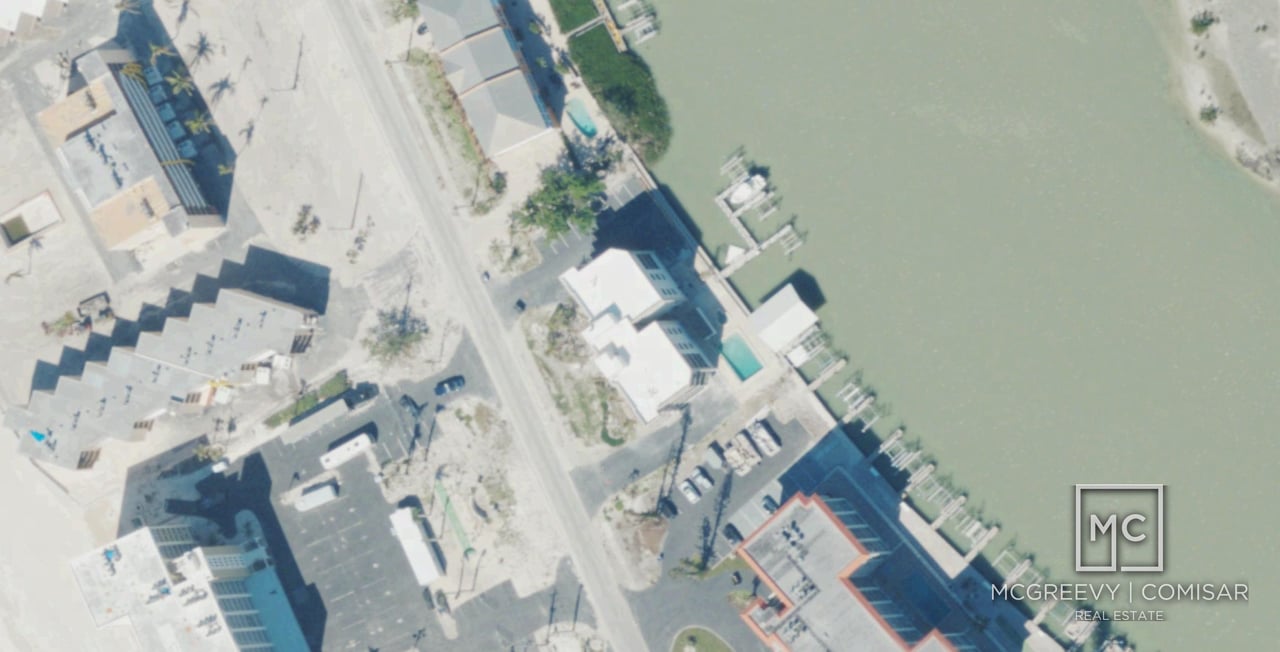
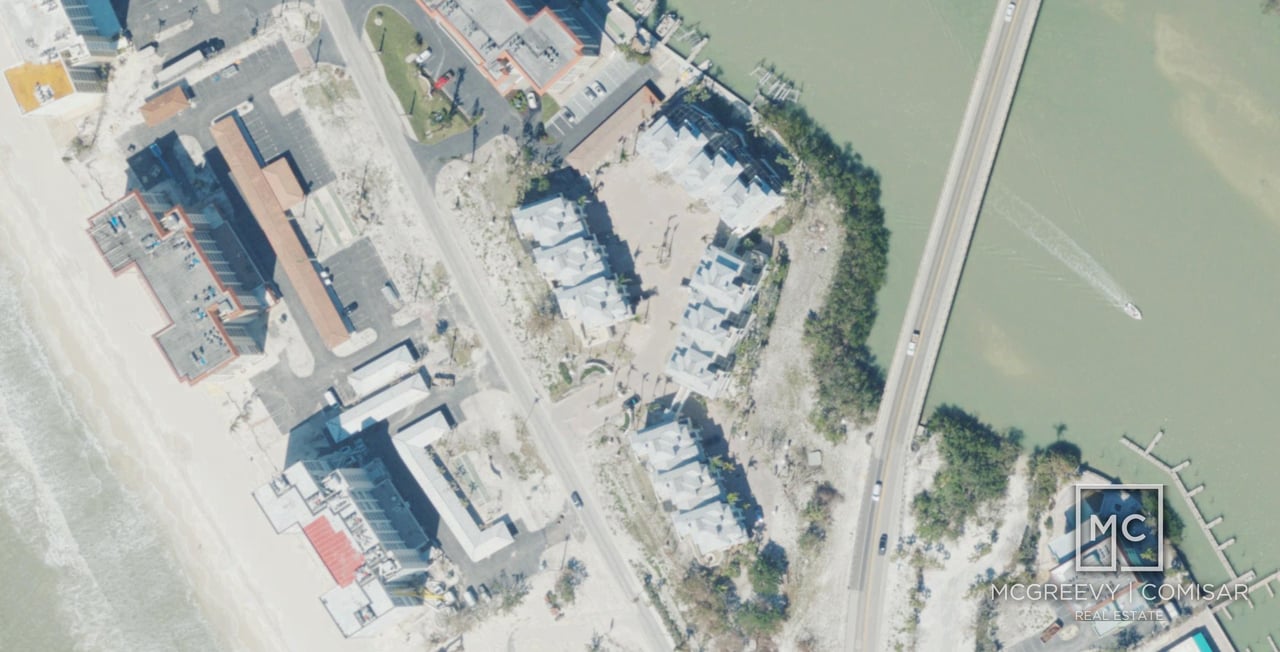
Bonita Beach is the Gulf-front coastal zone at the southwest corner of Bonita Springs, Florida: the Hickory Boulevard strip on Little Hickory Island in Lee County, plus the Collier County neighborhoods of Barefoot Beach, Bonita Shores, and Little Hickory Shores just south of Bonita Beach Road. Bonita Beach is not an incorporated town; the Lee/Collier county line runs right through the community.
There is no "Town of Bonita Beach." Never has been. What locals, search engines, and MLS geography call Bonita Beach is a place defined by sand, one road, and a county line, and understanding that map is the single most important piece of due diligence for anyone buying or selling here.
Here is the honest, defensible boundary, the one we use for every pricing conversation:
Where exactly is the county line? It is the Township 47 South / Township 48 South survey line, which runs east–west essentially along Bonita Beach Road. On the sand itself, the line falls between Lee County's Bonita Beach Park and Collier County's Barefoot Beach Access immediately to its south. Collier's own parks department describes Barefoot Beach Access as sitting "just south" of Bonita Beach Park. Lee County's 2024–2025 renourishment scope even reads "dune repair extended south of Bonita Beach to the Lee–Collier County line." Same continuous beach. Two counties.
Why do Collier homes have Bonita Springs addresses? Because of the mail, not the map. The Bonita Shores community association's own history explains it: when the neighborhood was developed, the nearest Collier County post office was far to the south, so the U.S. Postal Service assigned the much closer Bonita Springs post office, and the address stuck. The result is the single biggest point of buyer confusion in this market: a "Bonita Springs, FL 34134" address that pays Collier County taxes, follows Collier rental rules, and attends Collier schools. The mailing city tells you nothing. The county tells you everything.
Bonita Beach is the coastal edge of the larger Bonita Springs market, for the full city picture, including inland neighborhoods, Bonita Bay, and the US 41 corridor, see our complete guide to Bonita Springs real estate.
The Bonita Beach market closed 90 sales totaling $132.8 million in the 12 months to October 3, 2026, with a median sale price of $658,938, a condo median of $505,000, and a single-family median of $2.6 million. With 76 active listings, that is 10.1 months of supply. Bonita Beach is a buyer-leverage market everywhere except brand-new elevated gulf-front construction, which keeps setting records.
These are the live numbers, pulled directly from the Southwest Florida MLS for the BN01 "Bonita Beach" geographic area: the board's native code for the strip, spanning the Hickory Boulevard corridor, the condo cluster, Bonita Shores, Little Hickory Shores, and Cape Hickory. In other words: the actual page area, both counties included.
Metric | Value |
|---|---|
Closed sales (12 months) | 90 |
Dollar volume | $132,844,200 (~$132.8M) |
Median sale price | $658,938 |
Average sale price | $1,476,047 |
Highest sale | $14,900,525, 27460 Hickory Blvd (Aug 2026, new 2026 construction) |
Lowest sale | $200,000 |
Median days on market | 108 (average 140) |
Median price per sq ft (sold) | $597 |
Median sale-to-list ratio | 93.46% |
Sales at $1M+ | 24 (27% of all sales) |
Sales at $3M+ | 10 |
Sales at $5M+ | 7 |
Single-family median (n=23) | $2,600,000 |
Condo median (n=66) | $505,000 |
Metric | Value |
|---|---|
Active listings | 76 |
Median list price | $799,000 |
Highest list price | $20,895,000 |
Lowest list price | $282,000 |
Median days on market (so far) | 134.5 |
Median asking price per sq ft | $731 |
Active at $1M+ | 23 (30%) |
Active at $5M+ | 8 |
Months of supply | 10.1 (76 active ÷ 90 sold/12 mo) |
The Florida Realtors SunStats feed for ZIP 34134, a broader geography covering the beach strip plus west Bonita Springs, adds the demand-side signals the strip-level data can't show:
Metric | Jun 2026 | Jun 2025 | Change |
|---|---|---|---|
Closed sales | 65 | 48 | +35.4% |
Cash sales (% of closed) | 81.5% | 68.8% | +18.5% |
Median sale price | $705,000 | $761,250 | −7.4% |
Average sale price | $1,367,431 | $1,239,831 | +10.3% |
Dollar volume | $88.9M | $59.5M | +49.4% |
New pending sales | 40 | 42 | −4.8% |
Active inventory | 431 | 582 | −25.9% |
Months supply | 6.9 | 12.9 | −46.5% |
About this analysis: Strip-level figures are from the Southwest Florida MLS (matrix.swflamls.com), pulled October 3, 2026, GEO Area BN01 "Bonita Beach," all residential property types, deduplicated by MLS number, with medians computed from the full row set. ZIP-level context comes from Florida Realtors SunStats (sunstats.floridarealtors.org), ZIP 34134, all property types. We refresh this snapshot regularly and re-verify it before every client pricing conversation. Beach-strip medians mask enormous differences between a Beach & Tennis Club studio, a Casa Bonita 2-bedroom, and a gulf-front estate: we will pull a tailored report for the exact building or street you are considering.
This is two markets wearing one geography. The condo market (66 of 90 sales, median $505,000) is liquid, negotiable, and insurance-sensitive. The single-family market (median $2.6 million) is thin, cash-driven, and record-setting at the new-construction top: seven sales at $5 million or more in twelve months on one road.
Ten months of supply is leverage, if you know where it applies. Anything over six months is a buyer's market by the textbook, and 10.1 months is well past that. But supply is not evenly distributed: aging-condo inventory with pending milestone and reserve questions sits; turn-key elevated construction moves. Median sale-to-list of 93.46% means the average successful seller is conceding about 6.5% from list: pricing precision is worth six figures here.
Cash is king and getting more so. More than four in five June 2026 closings in ZIP 34134 were cash, at 81.5%, the highest share anywhere in the trailing twelve months. That is luxury second-home market structure: less financing risk, faster closings, and buyers who negotiate like they don't need you.
Demand is rebuilding faster than inventory. ZIP-wide closed sales are up 35% and dollar volume up 49% year over year, while active inventory fell 26% and months of supply was cut nearly in half (12.9 → 6.9). New pending sales are the one soft line, essentially flat at 40 against 42. The window where buyers had the strip to themselves is closing.
Thinking of selling into this market? Get a free valuation at mcgreevyandcomisar.com/home-valuation or call/text Jesse at (239) 898-6072. Thinking of buying? Call Marc at (239) 287-5873 for a building-level or street-level read before you write anything.
Bonita Beach is in both. The Hickory Boulevard beach strip is in the City of Bonita Springs, Lee County; Barefoot Beach, Bonita Shores, and Little Hickory Shores are in unincorporated Collier County. The line is the township line at Bonita Beach Road, and crossing it changes your property taxes, flood map, rental rules, and school district.
This is the signature complexity of the Bonita Beach market, and it is the reason a generalist agent can cost you real money here. Two homes a few hundred yards apart, both addressed "Bonita Springs, FL 34134," live under materially different rules. Here is the side-by-side nobody else publishes.
Lee side. Hickory Blvd strip (Lee County Taxing District 017, 2025 millage book):
Taxing authority | 2025 millage |
|---|---|
Lee County General Revenue | 3.7623 |
Public Schools (local board + state law) | 5.3190 |
City of Bonita Springs | 0.8470 |
Bonita Springs Fire District | 1.9466 |
Lee County Library District | 0.4218 |
SFWMD (district + Everglades + Okeechobee Basin) | 0.2301 |
Mosquito + Hyacinth Control | 0.2308 |
West Coast Inland Navigation District | 0.0394 |
Total | 12.7970 mills |
Collier side. Barefoot Beach / Bonita Shores / Little Hickory Shores (unincorporated): Collier County General Fund 3.0107 + Unincorporated MSTU 0.6844 + Conservation Collier 0.2096 + Water Pollution Control 0.0246 + North Collier Fire 1.0000 + Collier schools ~4.31 + water management/mosquito ≈ roughly 9.5–9.7 mills total.
The takeaway: the Collier side runs about 3 mills (~24%) lower than the Lee/city side. On a $2 million taxable value, that is in the neighborhood of $6,000 per year, across the street. Why? Collier's county general fund is 0.75 mills below Lee's, Collier's school levy runs lower, there is no city millage on the unincorporated side, and North Collier Fire (1.0000) is roughly half the Bonita Springs Fire District (1.9466). These are millage comparisons, not a bill. Your actual number turns on assessed value, homestead status, and non-ad-valorem assessments, so read the parcel's own TRIM notice on the Lee County Property Appraiser or Collier County Property Appraiser site before you budget.
Item | Lee side (Hickory Blvd strip) | Collier side (Barefoot, Bonita Shores, LHS) |
|---|---|---|
Property appraiser | Lee County (leepa.org) | Collier County (collierappraiser.com) |
FEMA flood maps | FIRMs effective Nov 17, 2022 | Coastal panels effective Feb 8, 2024 |
Short-term rental regime | City rental permit, $100/unit, 3 years, inspection | Collier registration, $50, DBPR license, 24/7 contact, $500/day fines |
Transient rental tax stack | 11.5% (6.5% sales + 5% TDT) | 11.0% (6.0% sales + 5% TDT), referendum Nov 2026 could make it 12.0% |
School district | Lee (School Choice zones) | Collier (fixed attendance boundaries) |
County commission | Lee BOCC | Collier BCC (District 2) |
Water management basin | SFWMD Okeechobee Basin levy | SFWMD Big Cypress Basin levy |
Two FIRM vintages on one beach. Two tax collectors for the same vacation-rental income. Two school systems for kids living a block apart. When we represent you on either side of the line, this table is not trivia: it is the underwriting behind your offer price or your list price. It is also why the question "is Bonita Beach in Lee or Collier County?" is the most-asked question about this community online, and why we answer it at parcel level, not ZIP level. For the broader city context, see our Bonita Springs guide.
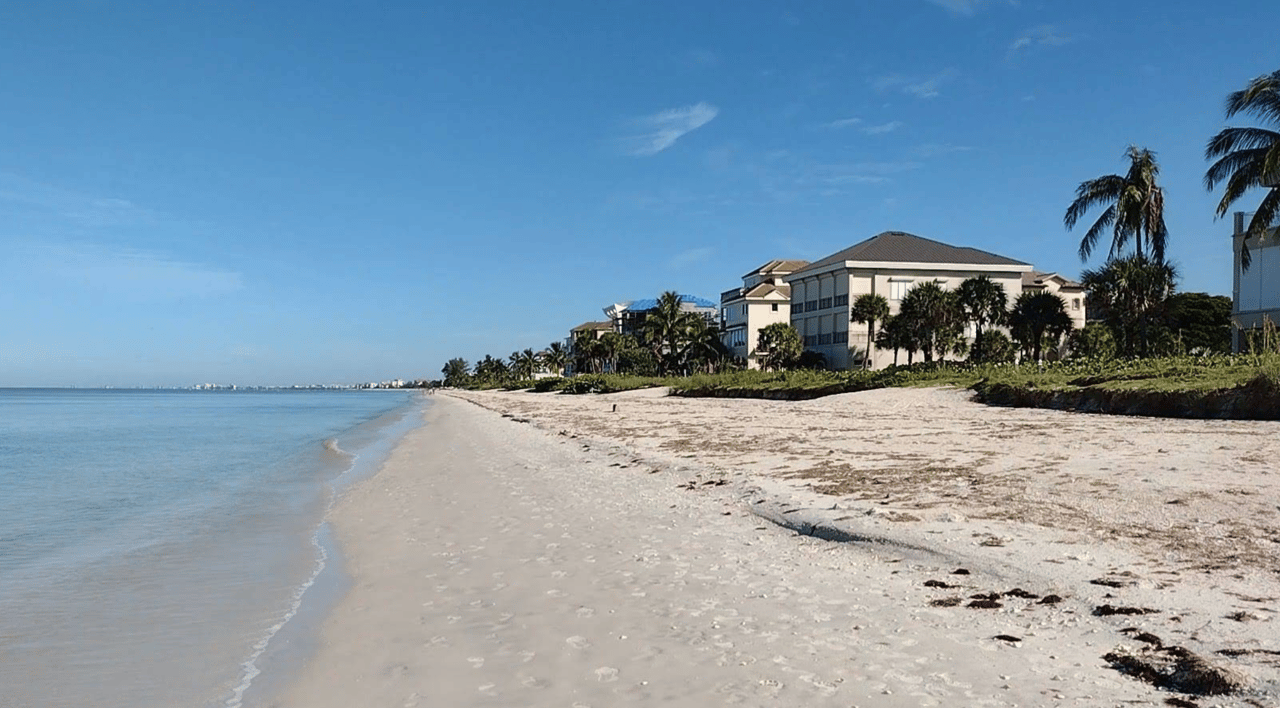
Living on Bonita Beach means a three-and-a-half-mile barrier-island strip with one road, zero hotels, ten free-or-cheap public beach accesses, a beachfront institution serving grouper sandwiches on the sand, and the Gulf sunset out every west-facing window. It is the quietest, most residential beach address in Southwest Florida's Naples–Fort Myers corridor.
Orient yourself with three facts. First, Hickory Boulevard is the island's only road: addresses descend as you drive north, from Doc's Beach House and Bonita Beach Park at the ~27900 block down to the gated condo cluster in the 25700–26000 block at Big Hickory Pass. Second, even-numbered addresses face the Gulf; odd numbers face the bay: a quick way to read any listing. Third, the strip is capped at both ends by public land: Lee County's Bonita Beach Park system at the south, Big Hickory Island Preserve and Lovers Key State Park at the north. There is no room to build more island.
The character follows from the geography. The south end is the social end. Doc's, the park, the busiest accesses. The middle blocks (roughly 26300–27700) are the estate corridor, where 1950s–60s cottages are giving way to elevated new construction. The north end is the condo district, 1970s and '80s towers and low-rises, most with gulf or bay frontage, several with boat docks on the back bay. Behind the island, across Bonita Beach Road, sit the canal neighborhoods of Bonita Shores and Little Hickory Shores, where the boating life costs a fraction of gulf-front money.
What daily life looks like: morning walks on renourished sand, turtle-friendly lighting after 9 p.m. in season (it's the law. City Ordinance 23-08), lunch with your feet in the sand at Doc's, an afternoon run out Wiggins Pass or up the Estero Bay Aquatic Preserve, sunset from the beach or a west-facing lanai. Groceries, medical, and every mainland convenience sit ten minutes east on Bonita Beach Road; RSW International Airport is roughly 30–40 minutes; downtown Naples about 25–30.
Season is real. January through April, Hickory Boulevard carries beach traffic to the south-end accesses, and weekend parking fills by mid-morning. Residents learn the rhythm: the eight free accesses (#2–#9) first, the paid lots second, and the side streets never (they're enforced). The flip side of season is September, when you can have a mile of Gulf beach essentially to yourself.
One honest note for relocating families: this is a second-home-heavy, cash-heavy market (81.5% of ZIP 34134 closings were cash in June 2026), and the strip itself has no schools, no grocery, no gas station. That is precisely the appeal for most owners, the island is residential to the bone, but full-time households should weigh the ten-minute mainland run for everything. Plenty do, happily.
Hickory Boulevard is Southwest Florida's quietest trophy address: a finite strip of private gulf-front parcels with no hotels, no commercial development except one beach house, and a record ladder that climbed from $10.5 million in 2022 to $14.3 million in September 2025, the most expensive home sold anywhere in Lee County in 2025, and then to $14.9 million in August 2026. New FEMA-compliant construction sets every record.
Add the supporting cast, a $10M+ sale at 26854 Hickory in May 2024, the top Lee County sale of May 2025 at 26724 Hickory, the top October 2025 sale at $9.7 million, the top April 2026 sale at 27524 Hickory, and the pattern is unmistakable: Bonita Beach properties have topped Lee County's monthly most-expensive-sale list again and again from 2022 through 2026. The current active ceiling: a $20,895,000 gulf-front listing, the highest ask in the market today.
The strip's housing stock is binary: original 1950s–60s beach cottages of 900–1,700 square feet, and new elevated homes of 2,500–7,000 square feet built to current flood code. The FEMA 50% Rule is the engine: a substantially damaged or substantially improved cottage cannot be rebuilt at grade, so older homes trade essentially at land value and are replaced by elevated construction with grandfathered density under the city's build-back Policy 1.5.1. Every record on the ladder above was set by a new-generation build. The record-setting tier now prices at $2,300 to $2,700 per square foot, while the overall strip median asking price is $731 per square foot: the gap is the new-construction premium, quantified.
Who buys at this tier? The documented record buyers skew Midwest (a Chicagoland entrepreneur, a Minnesota land trust) and almost universally purchase through LLCs and trusts for privacy. Closings cluster in season (January–May), with the 2025 record a notable new-construction exception. It is effectively an all-cash market at the top.
Selling a gulf-front home here is a listing assignment that demands proof, not promises. As Top 1% Real Estate Agents Nationally Since 2008, the #1 Team in Southwest Florida since 2012, with over $2.5 Billion sold by Domain Realty Group and over $900 million in personal sales, Gulfshore Life 5 Star Award winners for 21 straight years (only 5 out of 21k+ licensees), and Platinum Sales Production Award winners, we market trophy coastal property to the national cash-buyer audience it requires. Sellers: call Jesse at (239) 898-6072 or start with a free valuation at mcgreevyandcomisar.com/home-valuation. Buyers: call Marc at (239) 287-5873 before the next record resets the comps. Before you hire anyone, compare the best real estate agents in Bonita Springs on the public record.
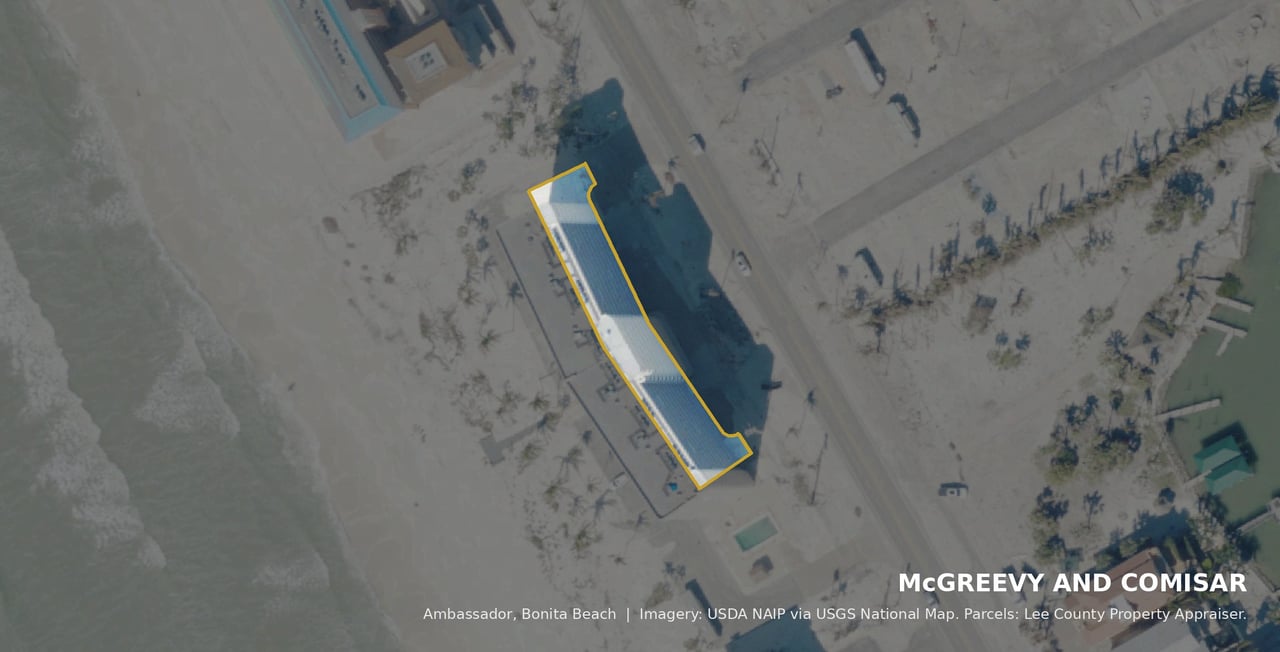
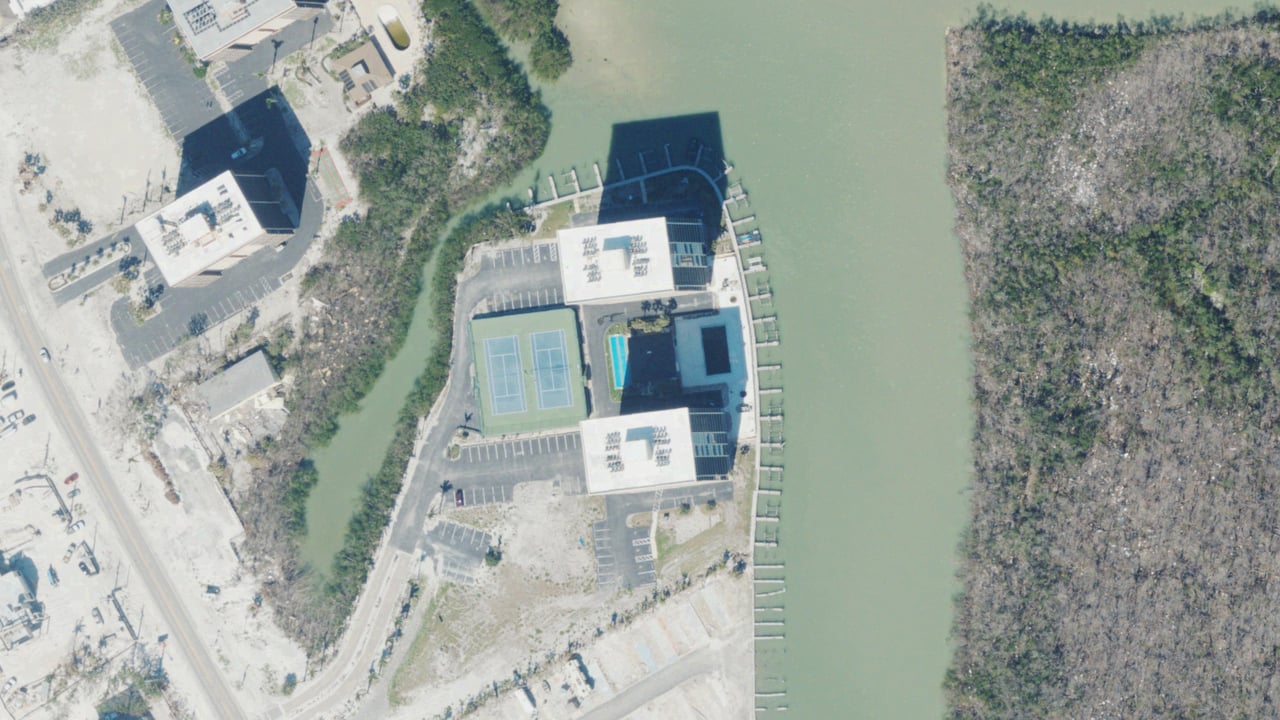
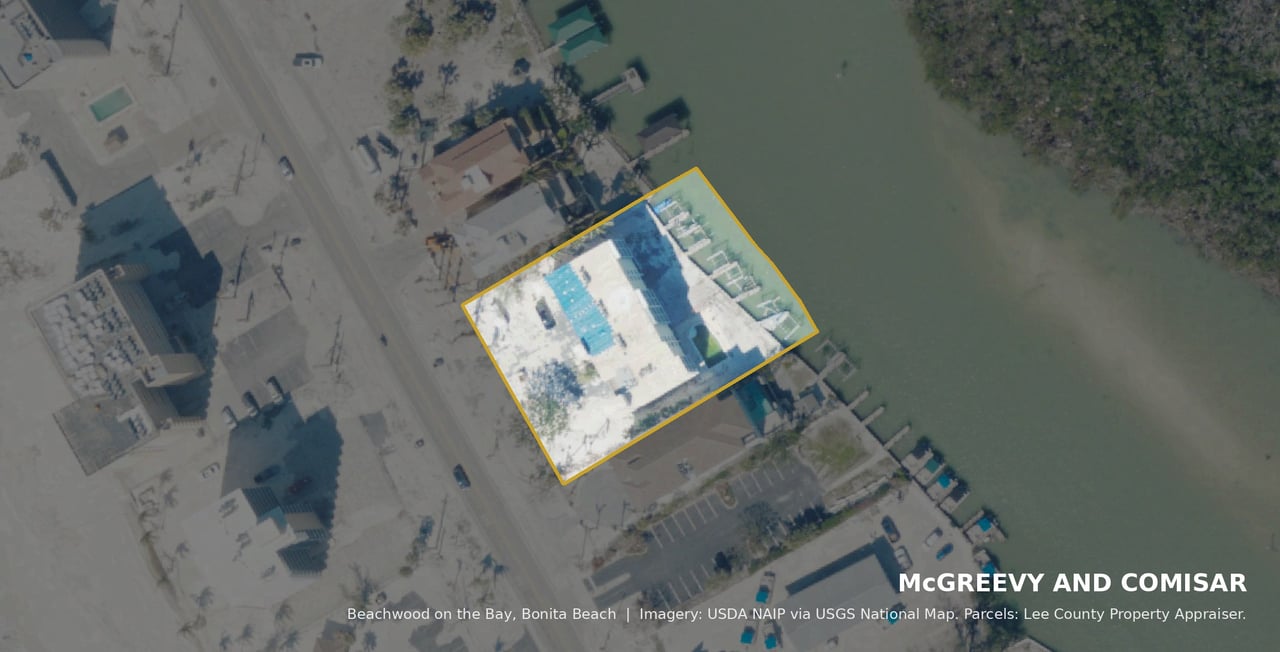
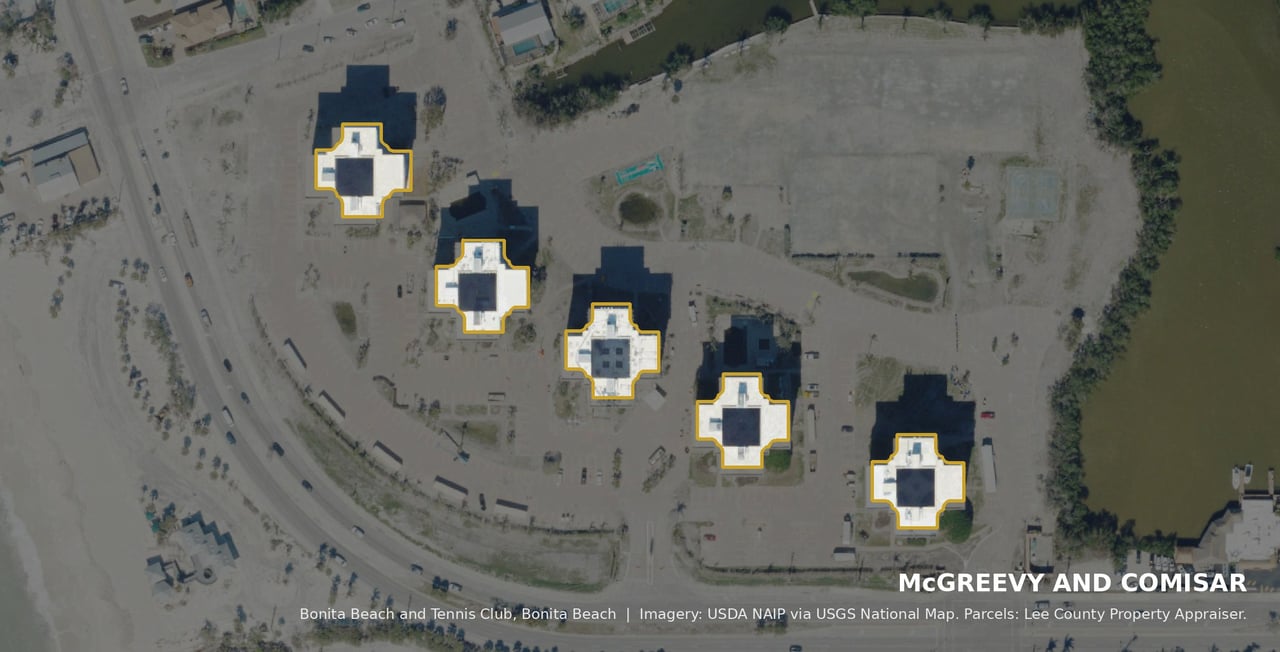
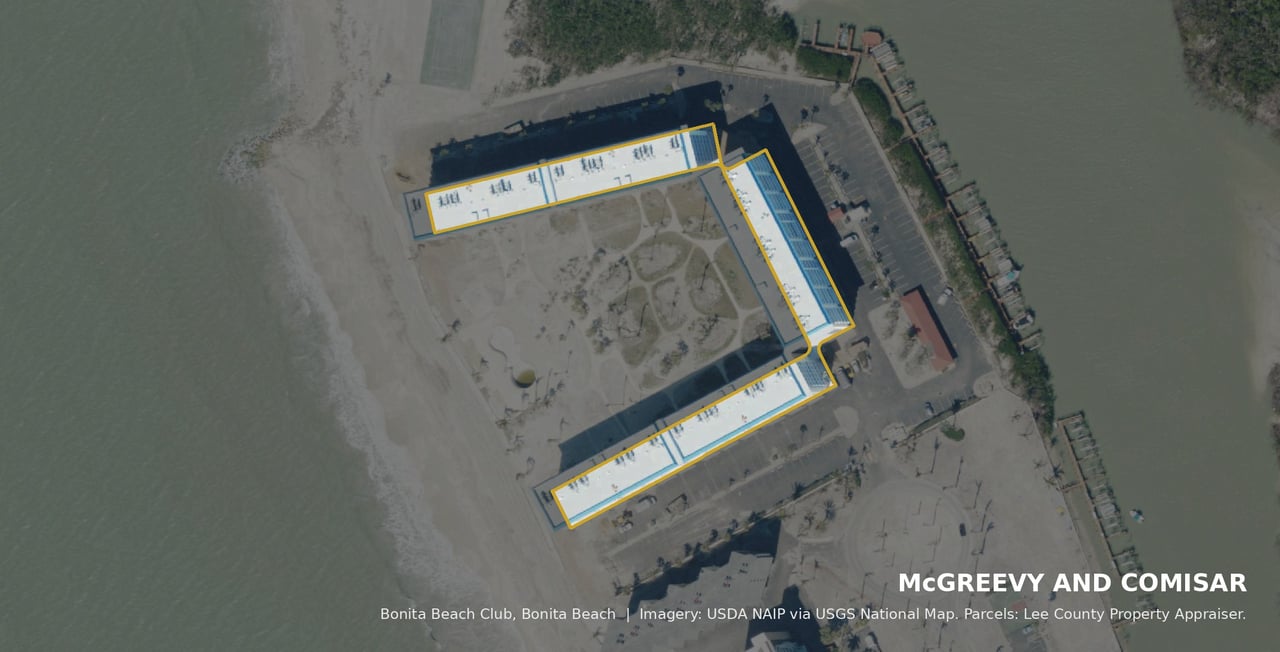
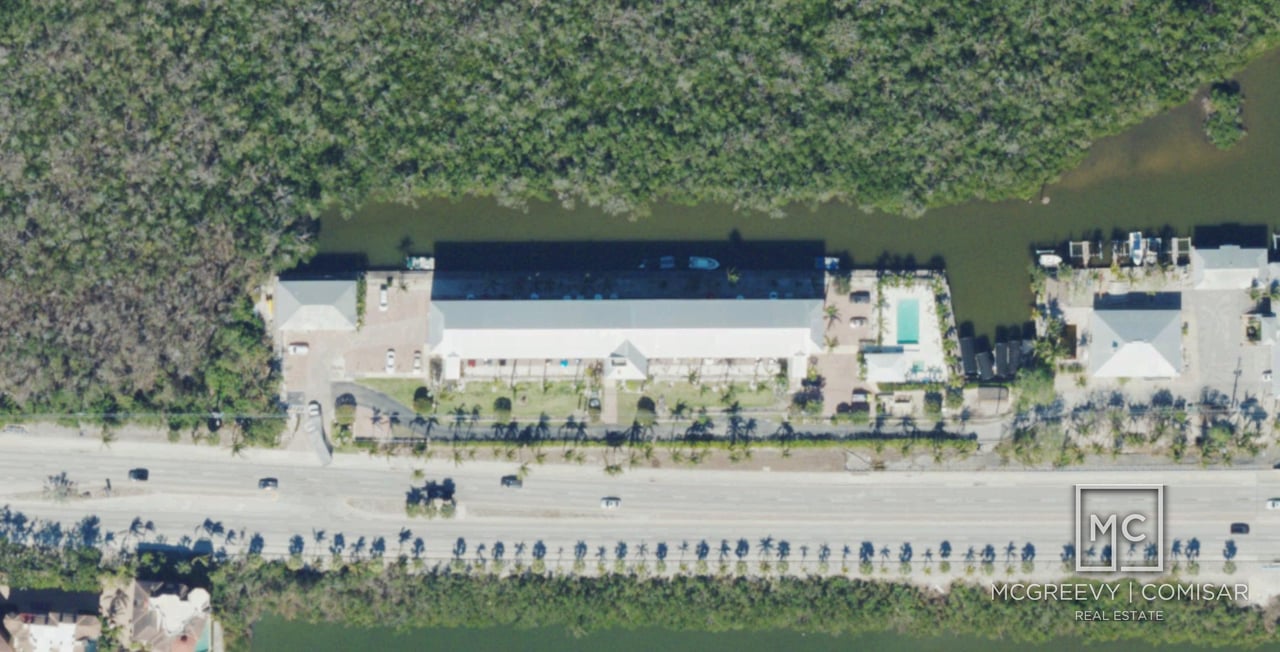
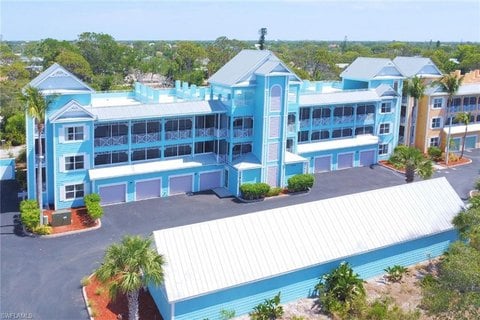
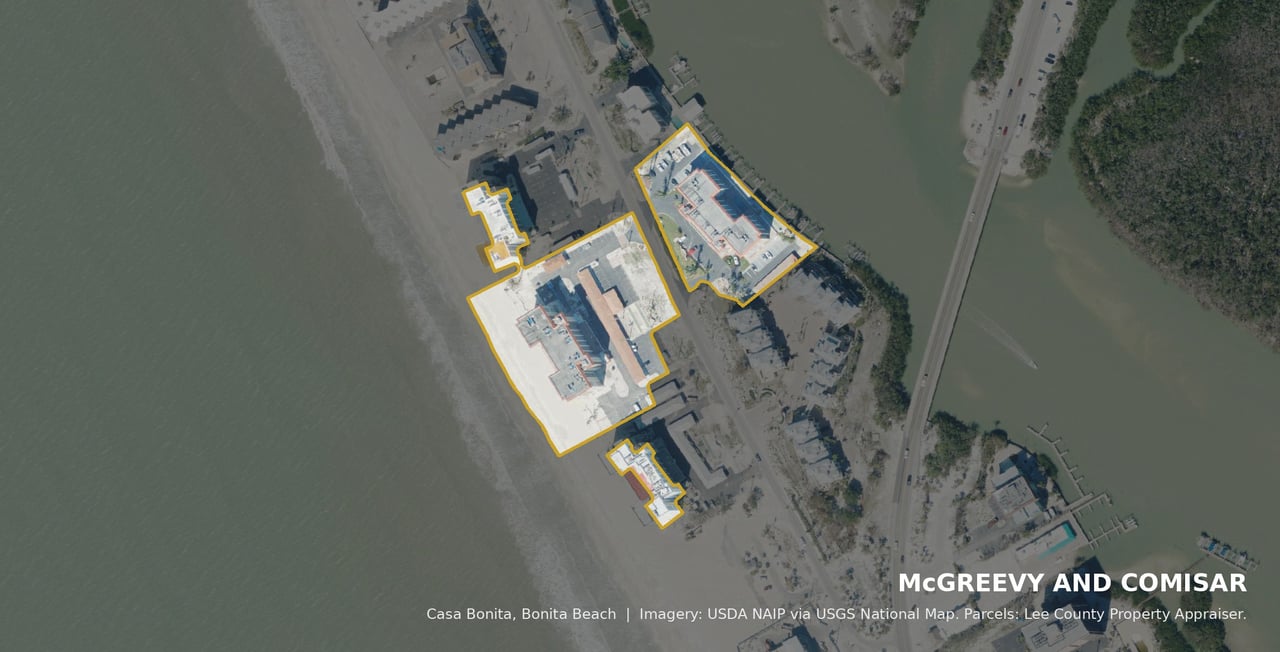
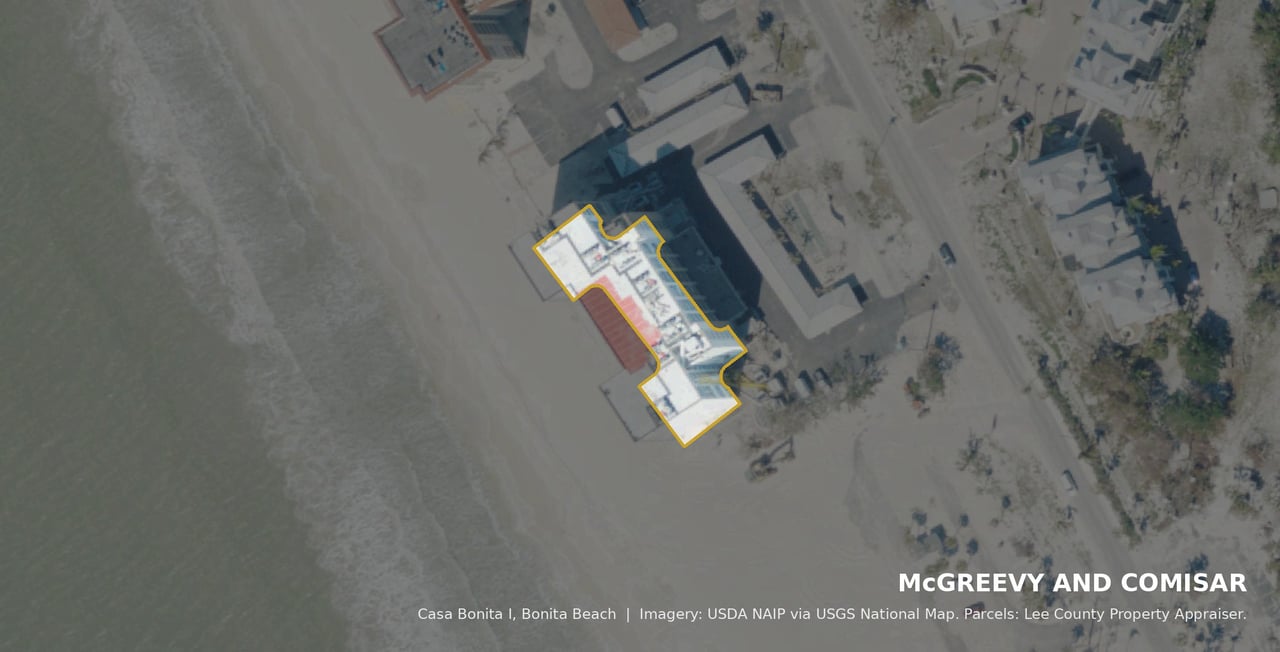
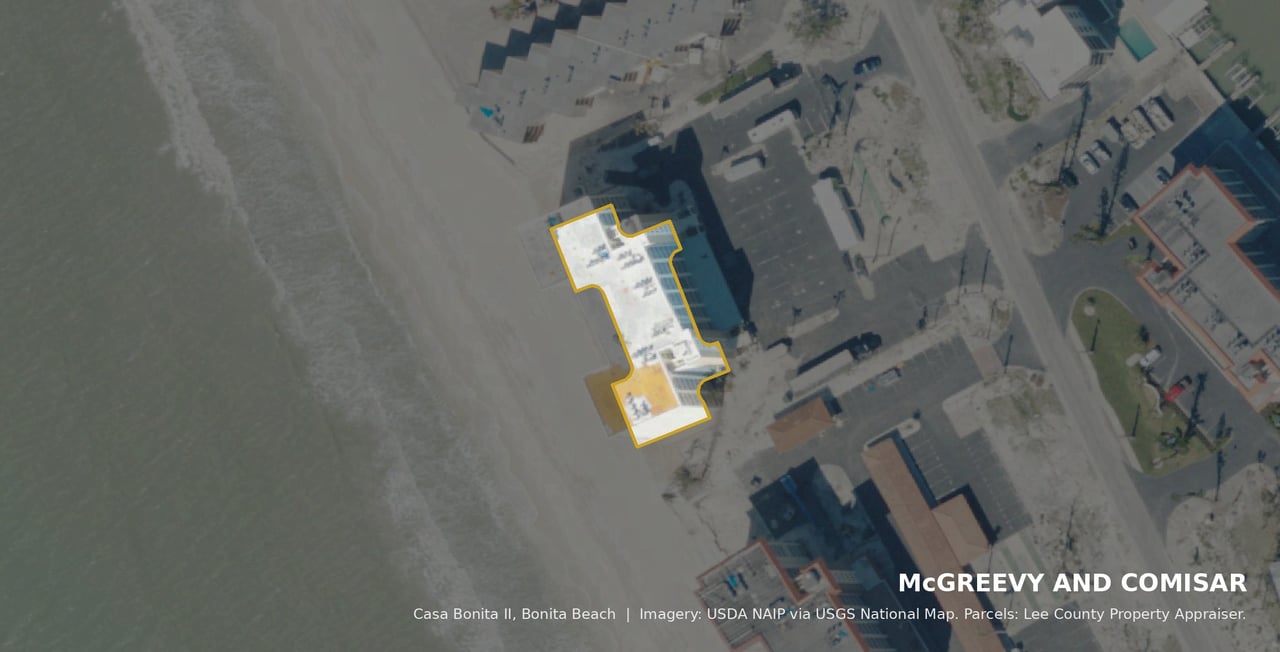
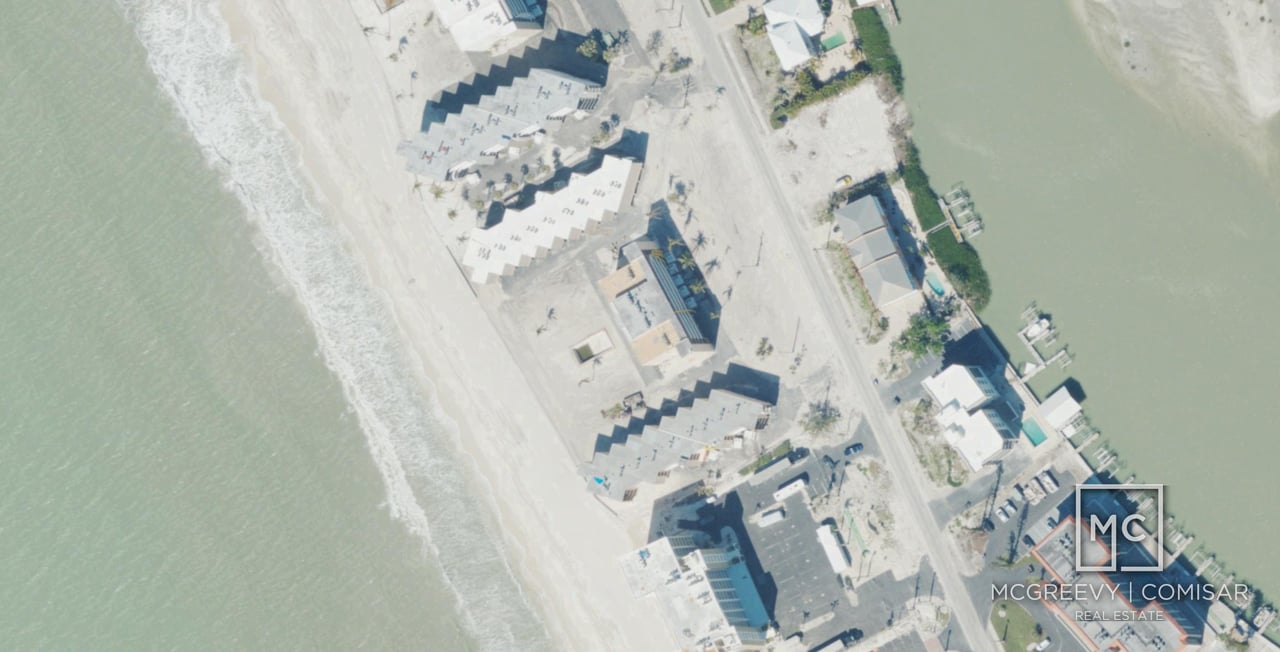
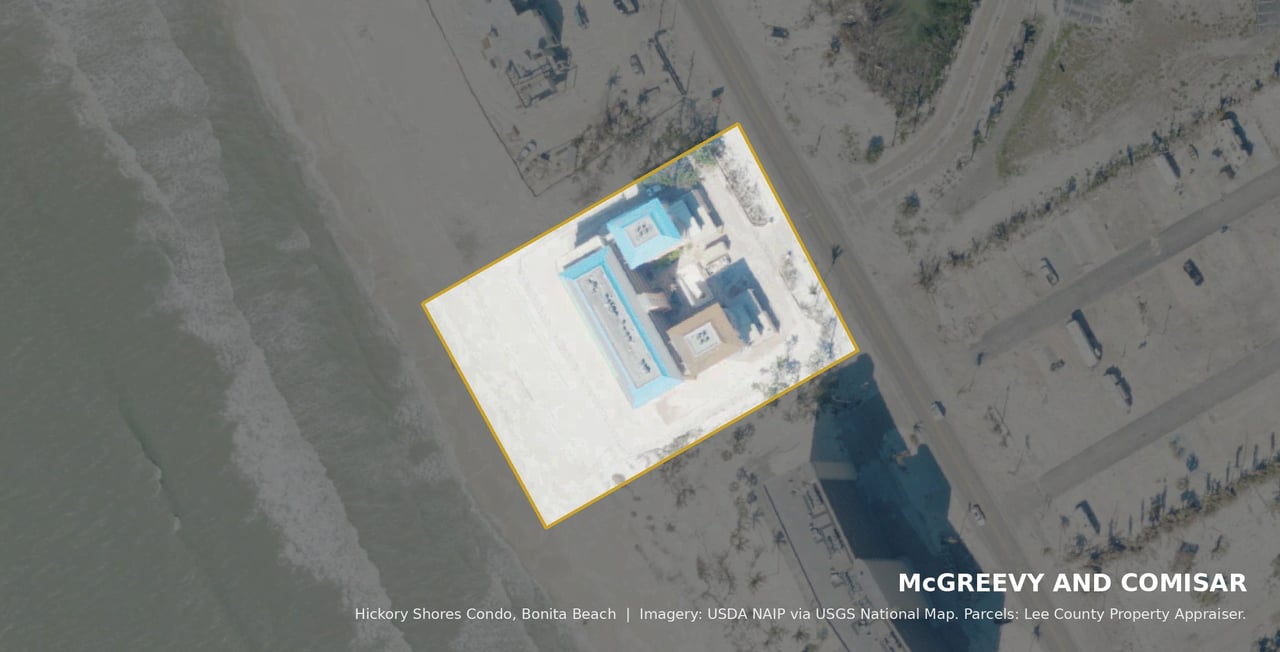
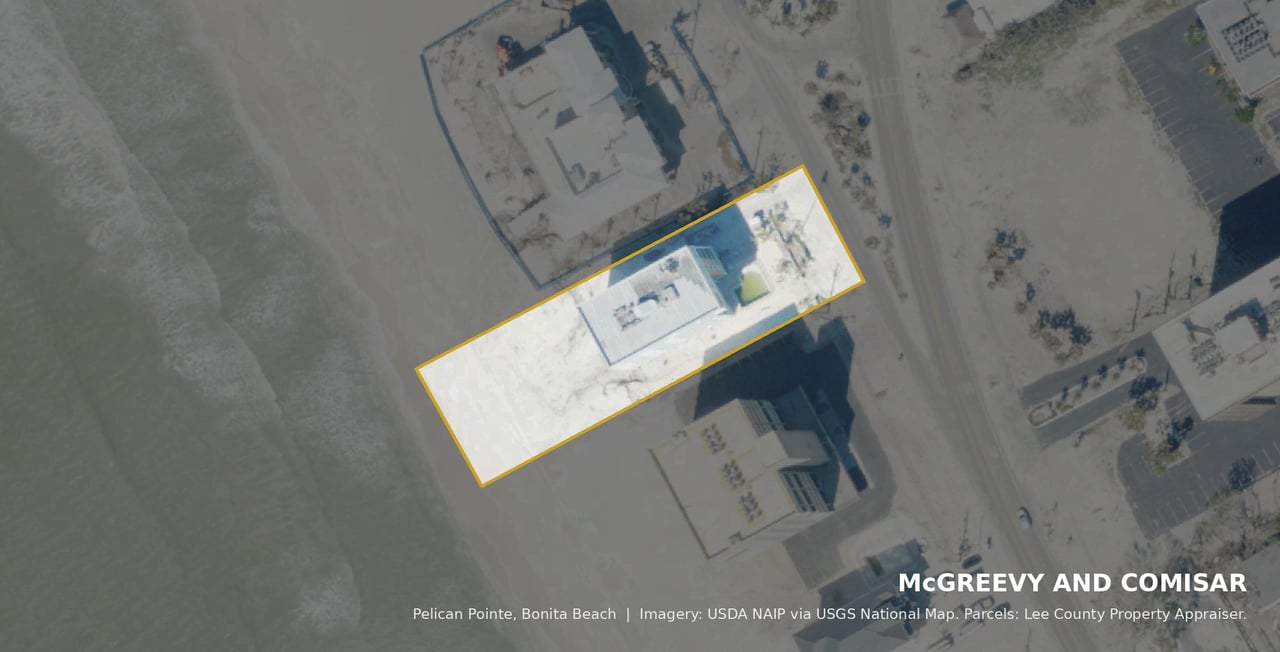
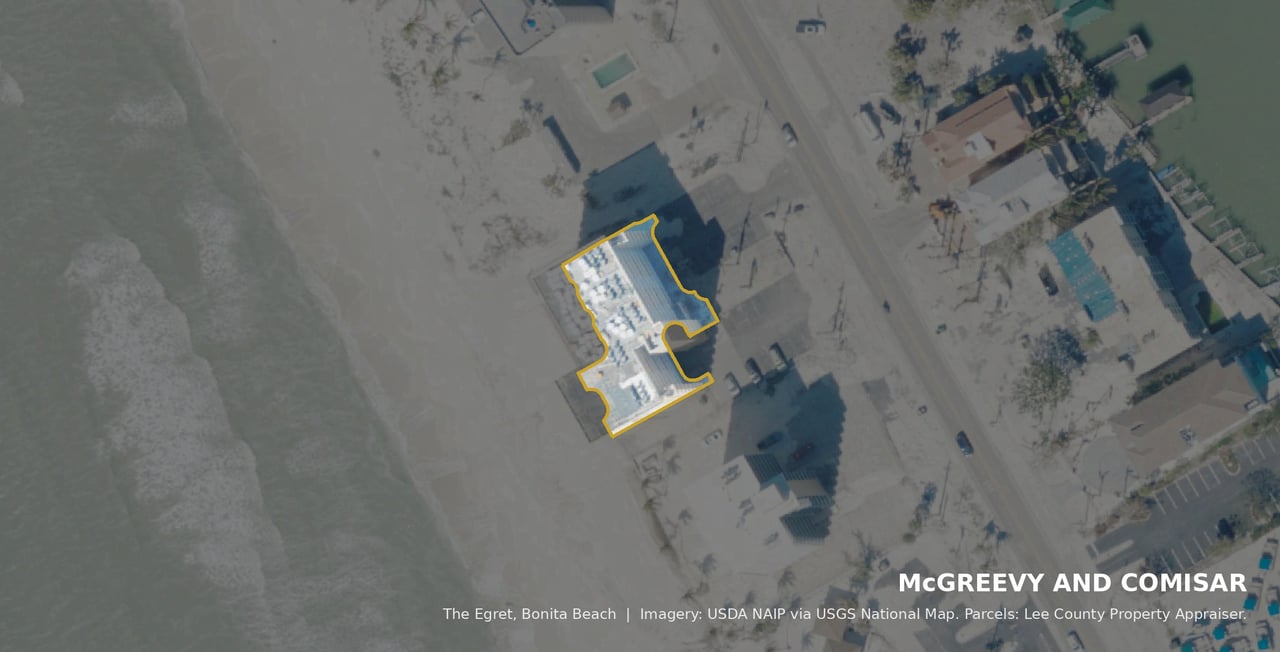
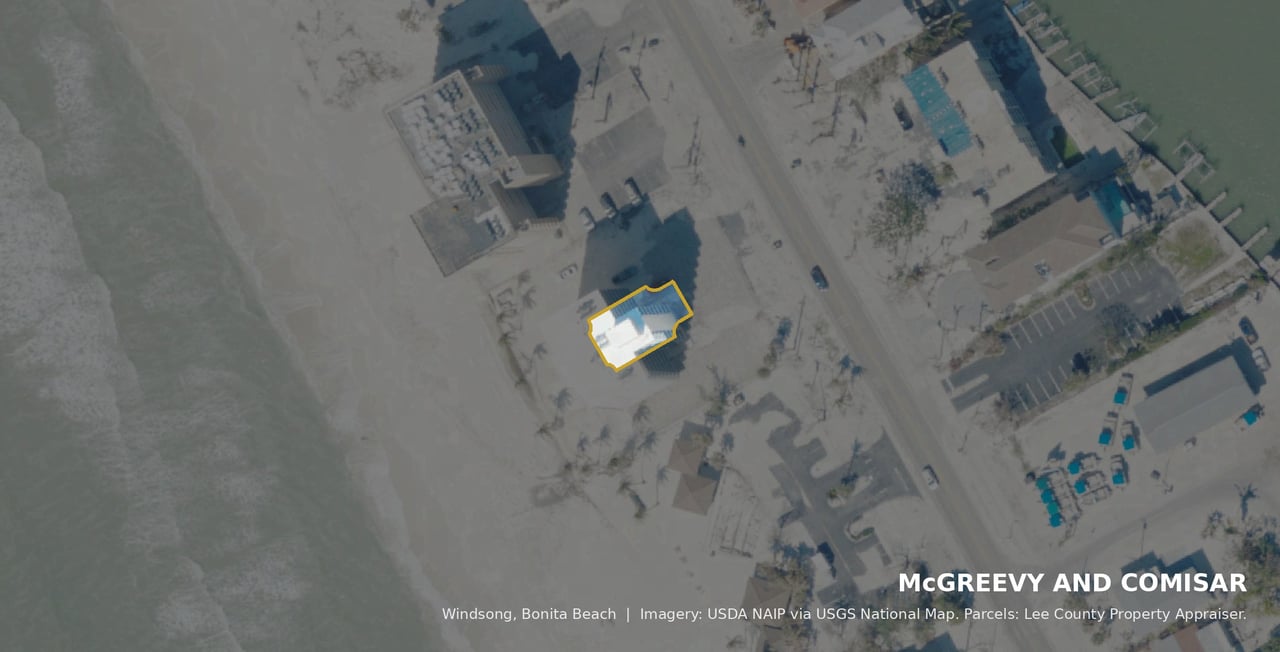
Bonita Beach's condo inventory is a fixed set of 23 condominium associations built between the early 1970s and 2006, clustered at the north end of Hickory Boulevard plus the Beach & Tennis Club on the causeway approach. Condo sales made up 66 of the strip's 90 closings in the 12 months to October 3, 2026, at a median of $505,000, and rental minimums vary building by building.
Every building below is verified against association records, state filings, or recorded addresses: we don't list buildings that don't exist (a surprising number of Bonita Beach condo lists online do). Running north to south:
Three diligence notes that apply to the whole roster. First, rental minimums are set by the condo documents, not the city: verify the declaration before you buy with rental intent (we keep current rental-policy data on every building). Second, the entire 1970s–80s tower stock is inside Florida's post-Surfside milestone-inspection and Structural Integrity Reserve Study regime: reserve funding and assessment history now drive condo pricing here as much as the view does. Third, each association named with a link above has its own dedicated page, with its declaration, fee, flood, insurance and county sales record in one place.
Bonita Beach has 23 condominium associations on the county roll and the state condominium record, along Hickory Boulevard and Bonita Beach Road SW. The table compares all 23, each with its own dedicated page, on one yardstick: side of the island, units, year built, FEMA flood zone and county recorded sales.
Data updated: October 2026.
Association | Side | Units | Built | FEMA zone, base flood elevation | County recorded sales |
|---|---|---|---|---|---|
Gulf | 198 | 1977 | AE, 12 ft | 17 sales in 24 months, median $690,000 | |
Gulf | 136 | 1979 | AE, 12 ft | 10 sales in 60 months, median $592,500 | |
Gulf | 75 | 1975 and 1976 | AE, 11 and 12 ft; VE, 13 ft at the Gulf end | 11 sales in 24 months, median $460,000 | |
Gulf | 54 | 1973 | VE, 13 ft | 8 sales in 60 months, $675,000 to $1,305,000 | |
Gulf | 54 | 1976 | VE, 13 ft | 3 sales in 60 months, $900,000 to $1,010,000 | |
Gulf | 54 | 1973 | VE, 13 ft | 8 sales in 60 months, $550,000 to $1,215,000 | |
Gulf | 10 | 1983 | AE, 11 ft | 1 sale in 60 months, $1,375,000 | |
Gulf | 24 | 1982 | VE, 13 ft | 1 sale in 60 months, $1,400,000 | |
Gulf | 23 | 1974 | AE, 11 ft | 4 sales in 60 months, $637,000 to $2,000,000 | |
Gulf | 60 | 1982 | AE, 11 ft | 4 sales in 60 months, $712,500 to $1,147,000 | |
Gulf | 40 | 1972 | AE, 11 ft | 6 sales in 60 months, $575,000 to $970,000 | |
Gulf | 24 | 1979 | AE, 11 ft | 2 sales in 60 months, $620,000 to $680,000 | |
Bay | 84 | 1980 | AE, 11 ft | 8 sales in 60 months, $395,000 to $833,000 | |
Bay | 104 | 1983 and 1984 | AE, 11 ft | 12 sales in 24 months, median $555,000 | |
Bay | 15 | 1982 | AE, 11 ft | 1 sale in 60 months, $528,000 | |
Bay | 8 | 1985 | AE, 11 ft | 2 sales in 60 months, $525,000 to $640,000 | |
Bay | 4 | 1982 | AE, 11 ft | 1 sale in 60 months, $899,000 | |
Bay | 3 | 2001 | AE, 11 ft | 1 sale in 60 months, $1,950,000 | |
Bay | 8 | 1985 | AE, 11 ft | 1 sale in 60 months, $820,000 | |
Bay | 40 | 1978 to 1979 | AE, 11 ft | 2 sales in 60 months, $490,000 to $520,000 | |
Bay | 12 | 2003 to 2006 | AE, 11 ft | 1 sale in 60 months, $1,500,000 | |
Bay side of Bonita Beach Road SW | 360 | 1977 to 1980 | AE, 10 ft | 20 sales in 12 months, median $280,000 | |
North side of Bonita Beach Road SW | 48 | 1985 | AE, 10 ft | 14 sales in 60 months, median $342,500 |
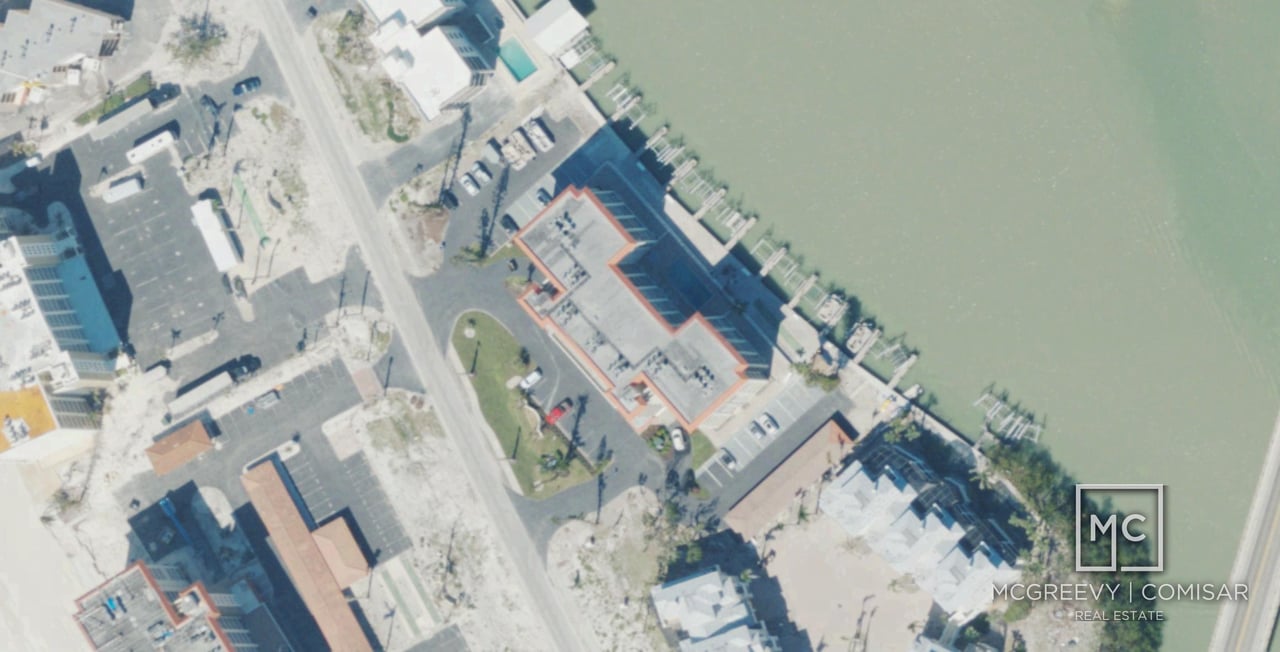
How to read the table: county recorded sales are qualified sales in the Lee County Property Appraiser public files (roll export of September 27, 2026), a county record and not a Southwest Florida MLS pull. The window is the first of 12, 24, 36 or 60 months that holds ten or more sales; where no window holds ten, the count and price range of the last 60 months are shown. Units are the count on the state condominium record. Flood zone and base flood elevation are from the FEMA map effective November 17, 2022, at the building point tested. The Casa Bonita overview explains how the Casa Bonita associations relate to one another.
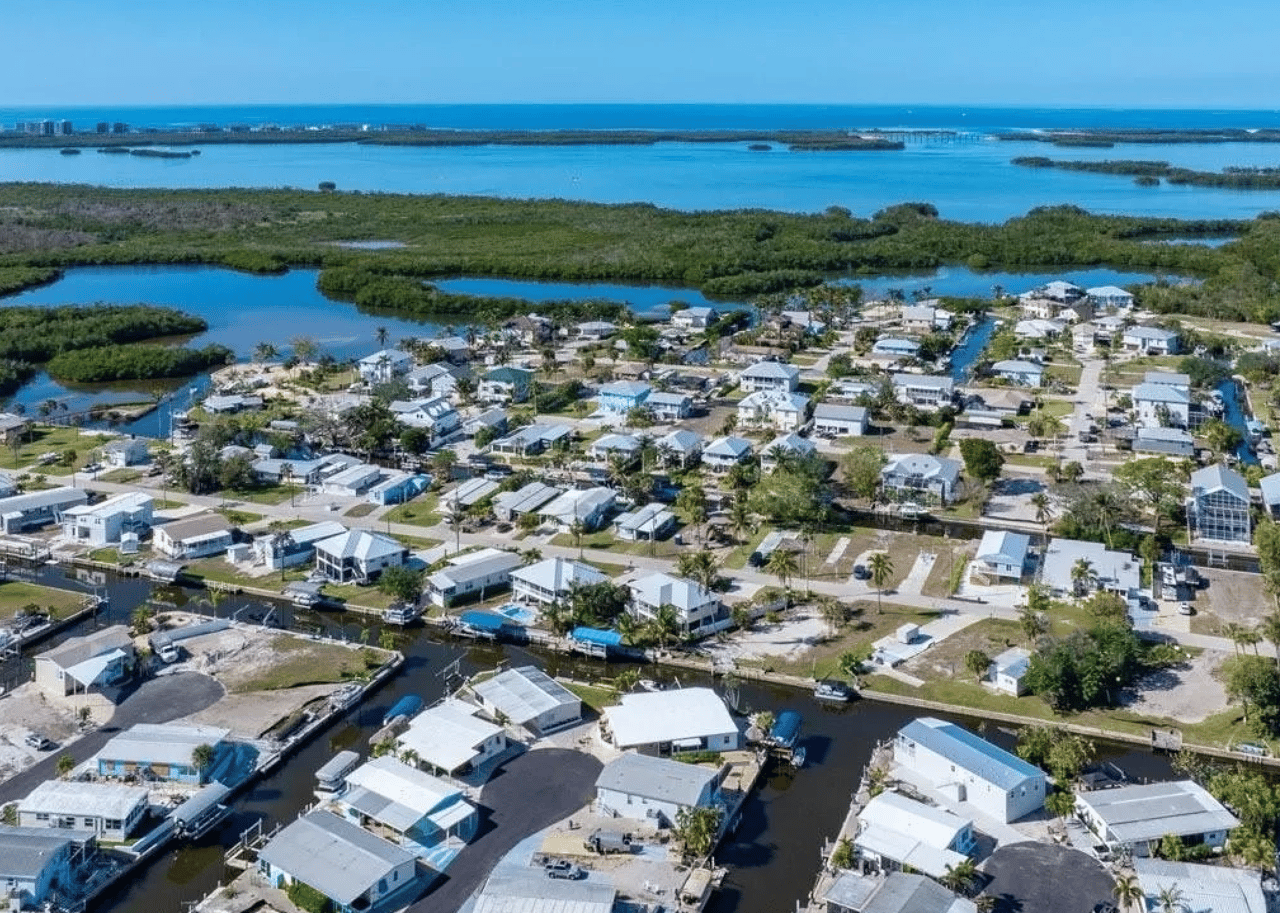
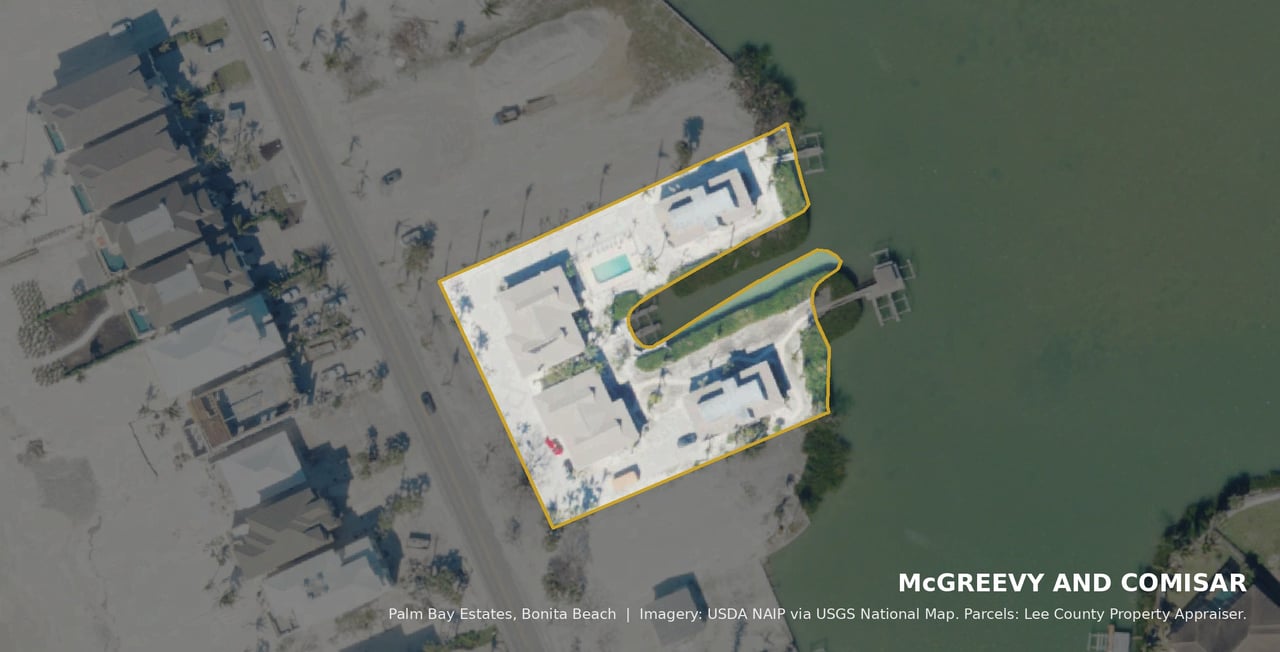
Behind the beach strip, Bonita Beach's boating life lives in two 1953-platted Collier County neighborhoods, Bonita Shores and Little Hickory Shores, plus the bayside condos of Hickory Boulevard. These are canal-front, no-HOA streets with Bonita Springs addresses, Collier tax bills, and one product found almost nowhere else in Florida: separately deeded boat-dock lots.
Bonita Shores runs from 1st Street to 9th Street between Vanderbilt Drive and Hickory Bay. Forrest Walker, born in 1897 and the first child born into the pioneer community of Bonita Springs, began developing it in 1953; the first house went up in 1956. The canals west of West Avenue are man-made, dredged in the 1950s, and the dredge fill was used to raise the land: the community association notes the neighborhood holds some of the highest ground west of US 41, a genuine flood-profile differentiator against the barrier island. There is no mandatory HOA; the civic anchor is the volunteer Bonita Shores & Little Hickory Shores Improvement Association (the "Shores Club"), founded 1956, with a 1960 clubhouse that hosts everything from bingo to scholarship fundraisers. The vibe: mid-century coastal grid, an active teardown-to-elevated-build cycle, and an influx of younger families.
Little Hickory Shores is the sibling subdivision: same developer, same era, same Collier County township, pushed right up against the county line and Little Hickory Bay. Its signature is the boat-dock lots of Unit 3 (the 3rd Street West spur): small, separately platted, separately deeded lots whose principal permitted use is a private boat dock, established by Collier County conditional-use approvals under residential zoning and processed to this day through the Collier Hearing Examiner (default dock protrusion 20 feet; extensions by petition). You can own a dock here without owning a house here, or pair a canal home with a second deeded dock. We know of no comparable product anywhere else in the corridor. The man-made 3rd Street peninsula: built from canal dredge fill, carries the widest bay views in the neighborhood.
Gulf access from both neighborhoods runs through Little Hickory Bay: south via the marked, maintained Wiggins Pass channel (roughly 15–25 minutes to open water depending on slip and tide) or north through Estero Bay toward Big Hickory Pass, which is shallower and local-knowledge water. The nearest dry-storage marina, on Little Hickory Bay, advertises about 20 minutes to the Gulf: a fair planning number.
The investment angle: no HOA, no deed-restriction layer, Collier's lighter STR regime (registration, not permits-and-inspections), and canal-front entry pricing far below gulf-front money. A canal home with a dock here is the working boater's Bonita Beach, and one of the few structurally weekly-rental-capable single-family pockets in the area, subject to Collier registration and DBPR licensing.
Bonita Shores has its own dedicated neighborhood page; the page for Little Hickory Shores (including the full boat-dock-lot story) is coming soon. For canal-and-bay alternatives one market north, see Estero; for the gated-community version of bay-front boating, see Bonita Bay.
Barefoot Beach is the southern continuation of the Bonita Beach strand across the Lee–Collier county line: the guard-gated Lely Barefoot Beach community, the Barefoot Beach Club condominiums, and the 342-acre Barefoot Beach Preserve County Park, one of the last undeveloped barrier-island stretches on Florida's southwest coast, and a repeat top-ten finisher in Dr. Beach's national rankings.
Where Bonita Beach Park ends, Barefoot Beach begins: same sand, different county, different rules. The public reaches the Preserve by driving through the Lely Barefoot Beach gatehouse on Barefoot Beach Boulevard (the beach itself is public; the road experience confuses everyone the first time). Parking is $10 daily without a Collier resident beach permit, the Preserve runs 8 a.m. to sunset, no dogs, and the gopher-tortoise colony is the celebrity wildlife. Dr. Stephen "Dr. Beach" Leatherman ranked Barefoot Beach #2 in the United States in 2013 and again in 2015.
On the real estate side, Lely Barefoot Beach's neighborhoods (including bayfront, boating-oriented Southport on the Bay and the gulf-side villas and estates) plus the Barefoot Beach Club condominiums make up one of Collier County's premier gated beach communities. A Barefoot Beach buyer pays Collier taxes, follows unincorporated-Collier STR rules, and uses Collier schools, even when the listing says "Bonita Springs."
We keep this section deliberately short for one reason: we built Barefoot Beach its own complete page (community structure, pricing, the preserve, the gate, the HOA layers, and the full buyer/seller playbook. If Barefoot Beach is your target, go there: Barefoot Beach) the complete McGreevy and Comisar guide.
Bonita Beach has exactly ten numbered Lee County public beach accesses along Hickory Boulevard, plus Bonita Beach Park at the south tip and Dog Beach on the causeway, and accesses #2 through #9 are free to park, some of the only free Gulf-beach parking in Lee County. Nobody else publishes the complete table; here it is.
Access | Address (all Bonita Springs, FL 34134) | Parking | Notes |
|---|---|---|---|
Bonita Beach Park | 27954 Hickory Blvd | $2/hr pay-by-plate, annual pass NOT accepted | South-tip anchor park, open since 1992; restrooms, showers, paddlecraft launch |
Access #1 | 27890 Hickory Blvd | $2/hr, annual pass accepted | Next to Doc's Beach House; no restrooms |
Access #2 | 27720 Hickory Blvd | Free | Beach access only |
Access #3 | 27494 Hickory Blvd | Free | Beach access only |
Access #4 | 27260 Hickory Blvd | Free | Beach access only |
Access #5 | 27010 Hickory Blvd | Free | Beach access only |
Access #6 | 26786 Hickory Blvd | Free | Beach access only |
Access #7 | 26590 Hickory Blvd | Free | Beach access only |
Access #8 | 26410 Hickory Blvd | Free | Beach access only |
Access #9 | 26220 Hickory Blvd | Free | Beach access only |
Access #10, Little Hickory Island Beach Park | 26082 Hickory Blvd | $2/hr, annual pass accepted | North-end park; restrooms, shower/foot-wash station |
Dog Beach | 14436 Bonita Beach Causeway | Free | Lee County's off-leash dog beach since 2001, see below |
The universal rules at the park and all ten accesses: dawn to dusk, no pets, no fires or grilling, fishing license required from shore (free shoreline license for Florida residents), no fishing in marked swim zones.
The parking strategy locals actually use: in season, the eight free accesses fill first, arrive before about 9:30 a.m. The Lee County annual parking pass covers Access #1 and Access #10 but, counterintuitively, not Bonita Beach Park. When the Lee lots fill, Barefoot Beach Preserve across the county line is the overflow move, $10 daily, or free with a Collier resident permit (a Lee pass does you no good there; two counties, two permit systems, one more reason the county line matters).
Dog Beach deserves its own paragraph: open since 2001 on the causeway between Big Hickory Island and Lovers Key, it is the corridor's only beach where dogs are allowed at all, every numbered access, Bonita Beach Park, and Barefoot Beach Preserve prohibit them. Off-leash, free parking, a donor-funded dog rinse station, and one practical caveat straight from the county: it's a tidal flat, and at mid-to-high tide you wade to reach the sand. Check the tide chart, bring the ball.
For buyers, the access inventory is a property-value fact, not a visitor amenity: an east-side (bayside) home or condo anywhere on the strip is a cross-the-street walk from a numbered access. You do not need gulf frontage to live a gulf-front life here, that is the bayside value proposition in one sentence.
Lovers Key State Park and Big Hickory Island Preserve anchor the north end of Bonita Beach: two-plus miles of state-park beach, 280 acres of county preserve, boat-only sand, and the protected open space that guarantees the strip's north end can never be developed. They are Bonita Beach's permanent green edge, and a daily-life amenity most beach towns would kill for.
Lovers Key State Park sits just up the causeway (8700 Estero Blvd; open 8 a.m. to sunset, 365 days, $8 per vehicle). The land was once slated for luxury condominiums and was instead donated to the people of Florida, which is why over two miles of sugar-sand beach, the Black Island and Eagle trails, manatee-and-dolphin backwaters, and one of Florida's favorite beach-wedding venues sit ten minutes from your driveway. Know before you go, 2026 edition: the tram has been permanently discontinued under the park's resilience planning, so the beach is reached by two walk/bike entries (the Mid-Beach wood bridge, about 1,000 feet from Lot 1, and the South Beach concrete bridge, about half a mile); paddling, fishing, and beach rentals operate daily; the $6 million Welcome & Discovery Center (opened 2021) runs Tuesday–Saturday, 10 a.m.–2 p.m. The park took Ian hard, closed roughly nine months, and reopened in late June 2023 with its landscape rebuilt as a deliberate model of salt-tolerant, storm-resilient planting. Lovers Key is also the shared anchor between Bonita Beach and Fort Myers Beach. Estero Boulevard runs straight through it, connecting the two beach markets.
Big Hickory Island, between Lovers Key and the Bonita Beach strip, is the wild one. About 280 acres of the island are the county's Big Hickory Island Preserve, roughly 92% mangrove, and its Gulf beaches have been reachable only by boat since 1988, when Big Hickory Pass reopened after nine years closed. Before that, north-end Bonita Beach residents could literally walk to Big Hickory's beach. A roughly 35-acre slice is the private beach park of the Pelican Landing community, whose residents arrive by boat shuttle. Two free paddle-launch sites off the causeway put kayakers into the preserve's backwaters, a stop on the Great Calusa Blueway.
Two pieces of local history complete the picture. Little Hickory Pass, the natural inlet between Big Hickory and Little Hickory islands, was filled by developers in the early 1960s to build the beach road; Hickory Boulevard exists because an inlet ceased to. And the Bonita Beach Causeway itself dates to the mid-1960s, the link that connected this strip to Fort Myers Beach and reshaped the inlet dynamics of the whole island chain.
For property owners, the anchors do two quiet jobs: they cap supply (parkland never converts to condos), and they carried the renourishment, the 2024–25 project placed sand on both Lovers Key and north Bonita Beach as one engineered shoreline. Your beach and the state park's beach are maintained as a single system.
Boating from Bonita Beach means Estero Bay Aquatic Preserve (Florida's first aquatic preserve, designated in 1966) out your back door, Gulf access through Wiggins Pass or Big Hickory Pass, deeded boat slips at the north-end condos, dock lots in Little Hickory Shores, and a working marina row on the back bay. This is a real boating community wearing a beach community's clothes.
The water itself: the island's entire eastern edge faces the Estero Bay Aquatic Preserve, 13,829 acres of seagrass, mangrove islands, oyster bars, and bird rookeries, designated in 1966 as Florida's first aquatic preserve (its southern boundary is, fittingly, the Lee–Collier line). Manatees, dolphins, snook, and tarpon work these waters; so do seasonal slow-speed zones, posted under state manatee-protection rules: know them before you run the bay.
The passes:
The infrastructure:
The buyer's translation: you can own Bonita Beach boating at four price points (a dock lot alone, a canal home with private dock, a condo with deeded slip, or dry storage by membership) and the right answer depends on your boat's draft, beam, and how you feel about tide tables. That conversation is exactly what we do. Call Marc at (239) 287-5873.
Bonita Beach's lifestyle runs on one beloved constant (Doc's Beach House, the only commercial building on the sand, serving locals since 1987) plus nightly Gulf sunsets, sea-turtle summers, bay-front seafood five minutes east, and a beach culture that is residential, unhurried, and deliberately hotel-free.
Doc's Beach House (27908 Hickory Blvd, between Access #1 and Bonita Beach Park) is the institution. It started life in 1987 as a modular ex-gas-station sandwich stand on pilings, a quiet hangout for locals and bikers, and grew into what Florida's largest papers now call one of the state's best beach bars: two open-air stories, feet-in-the-sand tables facing due west, burgers, pizza, and grouper, run across generations by the Cibula family. Hurricane Ian destroyed the first floor in September 2022; Doc's reopened December 1, 2023, fourteen months later, to a line down the beach. The rebuild-and-return is the Bonita Beach resilience story in miniature, and the sunset crowd never found anywhere better to be.
The sunset is the nightly event. The entire strip faces due west with an unobstructed Gulf horizon: from the sand, from Doc's, from every west-facing lanai. Bay-side owners get the sunrise over Estero Bay instead, and the best addresses on the island's north tip get both.
Sea-turtle summers are part of the deal. Nesting season runs May 1 to October 31, and the City of Bonita Springs enforces a serious, specific lighting law. Ordinance 23-08 (2023): no lighting visible from the beach between sunset and sunrise in season, long-wavelength amber/red fixtures for new beachfront installations, even televisions positioned so they can't be seen from the sand, and beach furniture off the beach between 9 p.m. and 7 a.m. Volunteers from Turtle Time, Inc. walk this beach every summer morning marking nests (more on them below). For gulf-front owners and especially vacation-rental operators, turtle compliance is a real operating obligation, and a point of local pride.
Eating and gathering beyond Doc's: the back-bay marina row at the island's north end has anchored casual waterfront dining since 1969, and a five-minute drive east on Bonita Beach Road reaches the bay-front seafood standbys. Coconut Jack's Waterfront Grille on the Estero Bay backwaters chief among them. December brings the Bonita Springs holiday boat-parade tradition on the back bay and Imperial River: a decades-long fixture that paused in 2025; check current-year status. (And to correct the record: Bonita Bill's, despite the name, is on Fort Myers Beach.)
The rhythm of the year: season (roughly Christmas through Easter) brings full restaurants, full beach lots by 9:30 a.m., and the social calendar; summer brings turtle crawls, tarpon in the passes, afternoon thunderheads, and the locals' beach; fall is quietest, the shoulder months when owners get the island back. Shelling is best after winter fronts; snook season reopens on the beach in September. None of it requires a reservation, a resort wristband, or valet, which is precisely the point of Bonita Beach.
Bonita Beach's development pipeline is dominated by one thing: elevated, FEMA-compliant replacement of the strip's remaining cottages, the engine behind every record sale since 2022. Around it sit a May 2026 city contract for a Hickory Boulevard roundabout improvement, the completed $39.2 million beach renourishment, and a state-accepted redesign of the US 41/Bonita Beach Road gateway intersection.
On the strip itself, there is no condo project, no hotel, no subdivision: there is the teardown-to-trophy cycle, one lot at a time. The 2025-built record house at 26532 Hickory Blvd ($14.3M) is the template: pilings, breakaway ground level, living floors above Base Flood Elevation, engineered for wave action under the city's flood ordinance. The private-community version of the same story: Bonita Bay's beach park at 27250 Hickory Blvd, destroyed by Ian, was rebuilt 14 feet above sea level with a breakaway first floor, a marquee example of post-Ian coastal construction standards (and a reminder that Bonita Bay residents hold private beach frontage on this strip).
The beach itself is the biggest completed capital project: Lee County's $39.2 million Lovers Key–Bonita Beach renourishment, over one million cubic yards of offshore sand dredged from a federal borrow area, placed on 1.1 miles of Lovers Key and 0.8 miles of north Bonita Beach, with hurricane dune repair extended south along the full strip to the Lee–Collier county line, plus rebuilt restrooms and walkovers at Bonita Beach Park and Little Hickory Island Beach Park. Construction ran October 2024 through completion by mid-June 2025, funded through FEMA's Disaster Relief Fund with state and local partners. For beachfront owners, an engineered, federally cost-shared beach template is both storm protection and property value.
Roads, near-term: in May 2026, Bonita Springs City Council awarded the Hickory Boulevard Roundabout Site Improvement Project to Green Construction Technologies for $219,927, a corridor aesthetics-and-function improvement on the island's only road. The award and the contractor are on the council record; the precise intersection and the construction window live in the project file with Bonita Springs Public Works, and we track that schedule for clients buying on the corridor.
Roads, long-term: the chokepoint between I-75/US 41 and the beach is getting redesigned. FDOT granted Design Concept Acceptance in July 2025 for the US 41 at Bonita Beach Road intersection overhaul: a partial displaced-left-turn configuration with Bonita Beach Road widened to six lanes through the intersection and a new northeast connector road; the project is now in design (construction not yet funded). Further west, Bonita Beach Road Phase III six-laning (Old 41 to Windsor) is designed but unfunded. FDOT is separately studying four-laning Old US 41 from Collier County up to Bonita Beach Road. Translation for owners: the beach approach will improve this decade, the island road itself stays two quiet lanes, exactly as residents prefer.
What you will not find in the pipeline: hotels, new condo towers, or commercial development on the sand. The zoning, the parkland caps, the flood code, and the economics all point the same way. Bonita Beach's future is fewer, larger, higher, stronger homes on a fixed number of parcels.
Bonita Beach took Hurricane Ian's surge in September 2022, set its all-time local surge record during Helene in September 2024 (6.31 feet above mean higher high water), and was re-flooded by Milton two weeks after that. The honest record matters because the recovery record is just as real: water restored in days, beaches reopened within six months, the icon restaurant back in fourteen, the beach re-sanded by 2025, and a rebuild rule set that brings the strip back stronger every cycle.
We will never market this beach by pretending the storms didn't happen. Buyers deserve the record; sellers benefit from a team that can frame it accurately. Here it is.
Ian, September 28, 2022. The catastrophic surge zone across coastal Lee County included Bonita Beach, with the National Hurricane Center documenting 10–15 feet of inundation above ground level at the event's core just north of here and major surge through this corridor. On the strip: the Hickory Boulevard trailer park was destroyed outright, gaps of homes were pulled into the Gulf by receding surge, and first floors were gutted island-wide. Off the island, Bonita Shores took roughly two feet of water outside and a foot inside homes: flooded but survivable, a meaningful contrast that shows up in today's pricing. The recovery clock started fast: water service was restored across Little Hickory Island by October 5; the city's permit counter reopened October 13 with storm-repair permit fees waived; Lee County had collected a million cubic yards of debris county-wide by October 24, including nearly 70,000 cubic yards of sand screened off the roadway south to Hickory Boulevard, about 10% of it returned to the beach.
The recovery milestones, dated: Bonita Beach Park and the ten accesses reopened March 4, 2023 (about six months); Barefoot Beach Preserve, the last Collier beach back, reopened November 2023; Doc's Beach House reopened December 1, 2023 (fourteen months); Little Hickory Island Beach Park (Access #10) followed; Lovers Key reopened late June 2023; and the $39.2 million renourishment completed the physical restoration by mid-June 2025, dunes rebuilt to the county line.
Helene (September 26, 2024. Passing more than a hundred miles offshore, Helene still pushed 4–6 feet of water above ground level here) and the National Hurricane Center's report records 6.31 feet above mean higher high water at Bonita Beach, surpassing the local record of 3.97 feet set by Hurricane Elena in 1985. A storm that never came close set the record. That is the honest physics of a low barrier island.
Milton, October 9, 2024. Two weeks later, Milton's landfall up the coast at Siesta Key sent renewed surge across Bonita Beach: homes that had just dried out flooded again, sand was bulldozed off Hickory Boulevard again, and the city again waived storm-repair permit fees (the waiver window closed January 31, 2025).
Why the strip rebuilds the way it does: the City of Bonita Springs' comprehensive-plan Policy 1.5.1 governs post-disaster redevelopment, and its mechanics explain everything you see on Hickory Boulevard. Buildings damaged less than 50% of replacement cost may rebuild to original condition under current life-safety codes. Buildings damaged more than 50% may rebuild to their legally documented use, density, intensity, size, height and style: grandfathered rights preserved, provided the new construction meets federal elevation requirements above the 100-year flood level, flood-proofing code, current building codes, and Coastal Construction Control Line requirements. In plain English: you don't lose what you legally had, but you rebuild it higher and stronger. The result, three years on, is a strip where the new record-setting houses came through the 2024 storms writing a different story than the old cottages did in 2022: the Potter Homes-built, Miami-Dade-code house at 26564 Hickory took Ian with minimal damage to its metal roof, and it's the precedent the whole rebuild follows.
The bottom line for buyers and sellers: this is a coastal high-hazard market that floods in major surge events, governed by rules that convert each storm cycle into newer, higher, more resilient housing stock, at record prices. Neither half of that sentence should be hidden from you. Both halves are why working with a team that knows the elevation certificates, the 50% Rule math, and the build-back policy is not optional here.
Bonita Beach sits in FEMA Special Flood Hazard Area zones, predominantly VE (coastal high hazard with wave action) on the gulf-front and AE behind it, under two different map vintages: Lee County/City of Bonita Springs FIRMs effective November 17, 2022, and Collier County coastal panels effective February 8, 2024. The FEMA 50% Rule, administered locally, decides what every older structure here can become.
The maps. One beach, two flood-map generations. The Lee/city side adopted new FIRMs in November 2022 (weeks after Ian); the Collier side's revised coastal panels took effect in February 2024. Zone determinations are parcel-specific: gulf-front Hickory Boulevard parcels are predominantly VE, with AE common on the bay side and in the canal neighborhoods (Bonita Shores' dredge-raised ground holds some of the highest land west of US 41). Before any offer or listing, we pull the exact panel for the exact address: never the ZIP-level generalization.
The 50% Rule. If repair costs (after damage) plus improvement costs equal or exceed 50% of the structure's market value (structure only, land excluded), the entire building must be brought up to current floodplain code, which on this strip means elevation at or above Base Flood Elevation. The City of Bonita Springs administers the rule for everything in the SFHA inside city limits, with its own Cost of Improvements form; Collier County runs the equivalent program on its side. Two sharpened local details most pages miss: the city's threshold drops to 20% for buildings with a prior NFIP flood-damage payout of $50,000 or more, and the city explicitly kept the rule in force throughout post-Ian recovery, no waiver, no holiday. This is the rule that converts damaged cottages into vacant lots and vacant lots into $2,400-per-square-foot new builds.
Elevation pays, literally. The city's own published guidance: each foot above BFE cuts annual flood premiums by roughly half; each foot below doubles them. An elevation certificate is therefore both a compliance document and a pricing document, for insurance, and increasingly for resale. Under FEMA's Risk Rating 2.0, every NFIP policy is now priced property-by-property (elevation, distance to water, replacement cost), which rewards exactly the kind of construction replacing the strip's old stock.
What we verify before you transact on any pre-2000s structure here: prior substantial-damage or substantial-improvement determinations on file; the current BFE for the address; the elevation certificate (or its absence); the structure-value math against your planned work; and CCCL permitting exposure for anything seaward of the control line. The forms, the ordinance, and the city's explainer PDF are all linked in the document library at the bottom of this page, and we walk clients through the 50% calculation before an offer is written, not after.
Insuring Bonita Beach property means three stacked policies (flood, wind, and homeowners/condo) priced by elevation, construction vintage, and proximity to the Gulf. NFIP flood coverage caps at $250,000 for a dwelling, far below replacement cost here, so private and excess flood markets do the heavy lifting; and as of January 1, 2026, Citizens policyholders with larger homes must carry flood coverage regardless of zone.
The honest framing: insurance is the carrying cost that reshaped this market after 2022, and it now functions as a second appraisal on every transaction. What you need to know, by layer:
Our practice on every Bonita Beach transaction: insurance quotes and flood-zone verification happen before the offer or the listing price, not during the inspection period. On this strip, the premium is part of the price.
Bonita Beach is governed by three local governments at once: the City of Bonita Springs (the Hickory Boulevard strip, zoning, floodplain, rental permits, turtle lighting), Lee County (the beach parks, Hickory Boulevard itself as County Road 865, tourist tax), and Collier County (everything in Barefoot Beach, Bonita Shores, and Little Hickory Shores). Knowing which government owns your question saves weeks.
City of Bonita Springs (incorporated December 31, 1999; City Hall, 9101 Bonita Beach Road SE, (239) 949-6262; council meets the first and third Wednesdays). The city is the floodplain administrator for the strip, runs the rental-permit program through Neighborhood Services ((239) 949-6257), handles permitting and zoning through its Community Development Department ((239) 444-6150), and enforces the sea-turtle lighting ordinance through Environmental Sciences ((239) 444-6142). Mayor Mike Gibson leads a seven-member council elected by district.
Lee County operates Bonita Beach Park and all ten numbered accesses (Parks & Recreation), maintains Hickory Boulevard itself (the road is County Road 865, county-maintained even though it runs through city limits) collects the 5% tourist development tax through the Clerk of Court, runs the property roll through the Lee County Property Appraiser (leepa.org), and delivered the $39.2M renourishment through Natural Resources.
Collier County governs the southern third of the community: the Board of County Commissioners (this area sits in District 2), the Collier Property Appraiser (collierappraiser.com, the county's own advice for "which side am I on?" is to check your TRIM notice there), Collier Parks for Barefoot Beach Preserve, the STR registration program under Ordinance 2021-45, and the Collier Tax Collector for tourist tax.
Utilities: water and sewer on the strip come from Bonita Springs Utilities, a member-owned not-for-profit serving the area since 1970 ((239) 992-0711). BSU's crews are the reason the island had water back within a week of Ian. Electric service is FPL.
The practical version of this section is a who-to-call card: rental permit → city Neighborhood Services; flood zone or elevation certificate → city Community Development; beach access or parking pass → Lee Parks; your tax bill → whichever appraiser your TRIM notice names; STR registration south of the line → Collier GMD portal; a turtle-lighting question in June → city Environmental Sciences. Or call us first, (239) 898-6072, and we'll point you to the right desk with the right form number. We do it weekly. For the full city picture beyond the beach, see Bonita Springs.
Bonita Beach addresses feed two different school systems: Lee County's open-enrollment School Choice zones on the Hickory Boulevard strip (Bonita Springs Elementary, Bonita Springs Middle Center for the Arts, and Bonita Springs High are the nearest in-zone schools), and Collier County's fixed attendance boundaries for Bonita Shores, Little Hickory Shores, and Barefoot Beach. Commutes run about 10 minutes to US 41, 30–40 to RSW airport, and 25–30 to downtown Naples.
Lee side (the strip): the School District of Lee County does not use fixed neighborhood school assignments, it runs an open-enrollment School Choice system by zone, with proximity preference. Beach-strip families fall in the district's South Zone, where the closest options are Bonita Springs Elementary, Bonita Springs Middle Center for the Arts, and Bonita Springs High School. Phrase to internalize: "choice zone," not "zoned school", apply through the Student Assignment Office, and confirm current-year options before relying on any single school. The district republishes its Student Enrollment Plan every year and the options inside a zone can move, so run your exact address through the district's school-zone locator for the current year rather than relying on any list, including this one.
Collier side (Bonita Shores, LHS, Barefoot Beach): Collier County Public Schools uses traditional address-based attendance boundaries, the far-northwest coastal pocket has historically been served by Naples Park Elementary, North Naples Middle, and Gulf Coast High. Confirm any specific address on the CCPS zone lookup map; boundaries are redrawn periodically.
The block-apart difference is real: two kids on opposite sides of Bonita Beach Road can ride buses to two different counties' school systems. For buyers with school-age children, the county line is a school decision before it is a tax decision, and it's one more line item on our two-county checklist.
Daily logistics: the island has no grocery, gas, or pharmacy. All of it sits 5–10 minutes east on Bonita Beach Road at US 41 (Publix and the full mainland retail stack). Medical: the Lee Health and NCH systems both operate within 20–30 minutes; the nearest hospitals are in Bonita Springs/Estero and North Naples. RSW International Airport is roughly 30–40 minutes; downtown Naples 25–30; downtown Fort Myers about 35; Estero's Coconut Point and Gulf Coast Town Center retail corridors about 15–20. The single chokepoint is the US 41/Bonita Beach Road intersection: the one FDOT has now accepted a redesign for, and in season you plan around it the way every coastal Floridian plans around their bridge.
Bonita Beach runs on volunteers: the turtle patrol that walks the sand every summer dawn, the friends groups that rebuilt two parks after Ian, the water-quality monitors on Estero Bay, and the human-services organizations that carry the town behind the beach. These eight organizations are where new residents plug in, and where this community shows its character.
Founded in 1989 by Eve Haverfield, Turtle Time is the FWC-permitted volunteer organization that monitors sea-turtle nesting from Fort Myers Beach to the Lee–Collier line at Bonita Beach, plus Big Hickory Island and Bunche Beach. Its roughly 200 volunteers walk this exact beach every morning of nesting season, locating crawls, staking nests, and documenting hatches.
The numbers tell a quiet success story: local nest counts climbed from about 30 in the mid-1990s to over a hundred in recent seasons, through hurricanes and renourishment cycles alike. Turtle Time volunteers are also the practical enforcers-by-education of the city's lighting ordinance: the friendly knock that saves a beachfront owner a code citation.
For residents, this is the most Bonita Beach way to volunteer that exists: dawn walks on the Gulf with a purpose. Gulf-front owners and rental operators should know Turtle Time regardless: their guidance on lights, furniture, and flashlight discipline is the difference between hosting hatchlings and disorienting them.
Founded in 1990, the Friends of Barefoot Beach Preserve is the roughly 400-member-family citizen-support organization for the 342-acre preserve at the community's southern end: one of the last undeveloped barrier-island stretches on Florida's southwest coast.
Friends volunteers staff the docent program in the preserve's first parking lot through season, lead shell and gopher-tortoise education, run beach cleanups, and pull invasive vegetation. After Ian shredded the preserve's boardwalks and facilities, the Friends were central to the slow, careful reopening that culminated in November 2023.
Membership is the natural on-ramp for anyone south of the county line, and for Lee-side residents too, since the preserve is everyone's overflow beach. Few volunteer gigs anywhere come with a better office.
Incorporated in 1996 as Lovers Key State Park took its modern form, Friends of Lovers Key (FOLK) is the park's citizen-support organization: the fundraising and volunteer engine behind the northern anchor of the Bonita Beach corridor.
FOLK funds turtle and shorebird nest protection, native plantings, and education programming, and helped drive the park's post-Ian transformation into a deliberate showcase of resilient, salt-tolerant coastal landscaping. The group's volunteers help run the Welcome & Discovery Center, the gateway education facility that opened in 2021.
For Bonita Beach residents, FOLK is the membership that pays for itself in guided walks, programs, and the satisfaction of keeping two-plus miles of donated, condo-fate-escaping public beach in working order ten minutes from home.
Estero Bay Buddies is the citizen-support organization for the Estero Bay Aquatic Preserve (Florida's first aquatic preserve, the 13,829-acre estuary that wraps the entire back side of Bonita Beach) and its companion state preserve lands.
Its volunteers run monthly water-quality monitoring at seven estuary sites, organize marine-debris cleanups, and help monitor the bay's bird rookeries. If you boat, paddle, or fish the back bay, this organization is quietly maintaining the resource under your hull.
It is also the most data-driven volunteer option on this list: water-quality monitoring is real citizen science, feeding the state's management of the preserve. Boating households who want their bay time to count for something join the Buddies.
Keep Lee County Beautiful coordinates litter prevention and coastal cleanups across Lee County, including, regularly, the Bonita Beach access points and the causeway shorelines, in partnership with groups like Estero Bay Buddies, FGCU, and area schools.
After each storm season, KLCB's organized cleanups are part of how the strip's public sand gets back to baseline: thousands of volunteer hours that the county's parks budget never has to buy.
For residents who want the lowest-commitment, highest-visibility way to give back to the beach itself, a Saturday-morning KLCB cleanup at a numbered access is it. Bring gloves; the county provides the rest.
Opened February 22, 1936 by brothers Bill and Lester Piper, the Everglades Wonder Gardens on Old 41 is Bonita Springs' original attraction: a roadside Old-Florida institution that predates the causeway, the condos, and very nearly everything else in this guide.
Today it operates as a nonprofit botanical garden and wildlife sanctuary: flamingos, gators, lush historic gardens, and a beloved field-trip destination, sustained by members, donors, and volunteers rather than turnstile economics alone.
For beach-area residents it is the heritage anchor five miles inland: the place you take grandkids, the institution whose 90th anniversary the town celebrates in 2026, and a reminder that Bonita Springs had an identity long before the first gulf-front tower.
Formed in 1984 and operating from the 1915 McSwain House, the Bonita Springs Historical Society keeps the record of how a settlement called "Survey" on the Imperial River became Bonita Springs, and how a fishing strip behind a filled inlet became Bonita Beach.
The Society runs downtown walking tours, maintains archives and photographs, and is the authoritative local source for the area's origin stories: the 1870s surveyor camps, the Eagle Hotel tourism era, the 1950s Forrest Walker subdivisions, the mid-1960s causeway.
For new residents, an afternoon with the Society is the fastest way to understand why this community looks the way it does, and their archive is where several facts on this very page were run to ground.
Founded in 1998, Café of Life serves weekday hot lunches and family services in Bonita Springs: faith-based, non-denominational, and almost entirely volunteer-powered.
Its quiet importance to the beach community is structural: the hospitality, landscaping, and service workforce that staffs the beach economy lives close to the margin, and Café of Life is part of the safety net that catches those families in lean months and after storms, exactly when beach-area employment is most disrupted.
Volunteering here (serving lunches, organizing food, supporting family programs) is the beach community's most direct way to give back to the people who make the lifestyle run. Many of our clients make it their first stop after closing.
Selling a Bonita Beach home, condo, or lot in 2026 means pricing into a 10-months-of-supply market where the median seller concedes about 6.5% from list, unless the property is elevated new construction, where records keep falling. The listing team you choose decides which of those two markets you sell in. McGreevy and Comisar are the team Bonita Beach sellers call first.
In the last 12 months we tracked every one of these closings row by row against the Southwest Florida MLS, and this is the market context every seller here needs: 90 sales at a median of $658,938; condos at a $505,000 median with 66 closings; single-family at a $2.6 million median; median days on market 108; sale-to-list 93.46%; and 81.5% of ZIP-wide buyers paying cash. Pricing precision and pre-market preparation are worth six figures on this strip, and the difference between a 60-day sale and a 300-day listing.
What listing with us looks like on Bonita Beach specifically:
Your credentials matter to buyers. Here are ours:
Get your Bonita Beach valuation now: free, building- and street-specific, no obligation → https://mcgreevyandcomisar.com/home-valuation, or call/text Jesse direct at (239) 898-6072 (same-day response) · [email protected]. Buying as well as selling? Marc handles the buy side at (239) 287-5873. Office: 24031 S Tamiami Trl #101, Bonita Springs, FL 34134.
When is the best time to list? Late fall through winter. SWFL demand peaks January–April when the buyers are physically here. (Full answer in the Seller FAQs below.)
What's my sale-to-list expectation? The strip median is 93.46%, but correctly priced, prepared listings beat it substantially. Pricing strategy is the whole game at 10 months of supply.
Can I sell my Ian-damaged or pre-FIRM cottage as-is? Yes, with Florida's flood-disclosure statute satisfied and the 50% Rule framed for buyers. These properties trade primarily on land value, and we market them that way.
Do I need to fix the condo's assessment problem before listing? No, but you need to disclose and price it. Buildings with funded reserves and clean SIRS reports command premiums; we'll show you the spread.
What does it cost to sell? Plan on roughly 1–3% in closing costs (doc stamps at $0.70 per $100, title, prorations) plus negotiated commissions. Line-item walkthrough with your valuation.
Buying on Bonita Beach in 2026 means choosing among four very different products (gulf-front estates, strip condos, bayside/canal homes, and dock lots) across two counties with different taxes, flood maps, and rental rules, in a 10-months-of-supply market that rewards prepared, decisive buyers. McGreevy and Comisar run that diligence as one integrated process.
The buyer's honest landscape: leverage is real (10.1 months of supply, 93.46% median sale-to-list, 134.5 median days on active listings), but it is concentrated in the aging-condo segment, turn-key elevated construction and well-run buildings move. Cash rules (75% of ZIP closings), which means financed buyers need pre-underwritten offers and insurance quotes in hand to compete. And every address requires the county-line check before anything else: tax stack, FIRM vintage, STR regime, school system.
What buying with us looks like here:
The team behind the process:
Start your Bonita Beach search: call Marc at (239) 287-5873 for a buyer consultation, gulf-front, condo, canal, or dock lot. Selling to buy? Jesse runs the listing side at (239) 898-6072 · [email protected], and the free valuation is at mcgreevyandcomisar.com/home-valuation. Office: 24031 S Tamiami Trl #101, Bonita Springs, FL 34134.
Bonita Beach's rental market is a seasonal-premium, dual-jurisdiction machine: in-season asking rents median $8,995 per month (up to $25,000), off-season $4,500, annual product around $3,050, governed by the City of Bonita Springs rental-permit program on the Lee side and Collier County's STR registration ordinance on the south side, with the condo documents trumping both. McGreevy and Comisar handle rental strategy and property management directly.
Rental segment | Live numbers (SW Florida MLS Matrix, BN01) |
|---|---|
Active rental listings | 51 |
Seasonal asking rate | median $8,995/mo · max $25,000/mo (43 listings) |
Off-season asking rate | median $4,500/mo (37 listings) |
Annual/monthly asking rate | median $3,050/mo · max $4,000 (8 listings) |
MLS-recorded leases, trailing 12 mo | 14, median achieved $2,650/mo (range $1,300–$9,500) |
The honest-data note: only 14 leases were recorded through the MLS in twelve months against 51 active rental listings, because the Bonita Beach rental market overwhelmingly transacts off-MLS, through vacation-rental platforms and property managers. MLS lease counts understate true rental velocity badly; the seasonal asking medians are the better demand signal. The seasonal-to-off-season spread (roughly 2:1) is the core of every pro forma here: a well-run beach rental earns its year December through April.
Post-Ian, the rentable inventory mix shifted permanently upmarket: the storm removed the strip's lowest-cost stock (the trailer park, the at-grade cottages), and what replaces it is elevated, high-end weekly product. Entry-level rental investing now starts at the Beach & Tennis Club ($300K–$450K studios/1BRs); the gulf-front towers are mostly 30-day-minimum seasonal product; the no-HOA Collier canal neighborhoods are the single-family weekly-capable pocket.
Item | City of Bonita Springs (Hickory Blvd strip, Lee) | Unincorporated Collier (Barefoot, Bonita Shores, LHS) |
|---|---|---|
What triggers it | ANY rental, short or long term | Only true STR: <30-day increments, more than 3×/year |
The requirement | City Rental Permit (Ch. 12, Art. IV) | County STR Registration (Ord. 2021-45, since Jan 3, 2022) |
Fee | $100/unit, valid 3 years | $50 one-time |
Inspection | City IPMC inspection required before issuance | None routine, compliance on complaint |
Big-condo carve-out | Buildings of 6+ units under FS 718 are EXEMPT | No carve-out |
DBPR state license | Required for transient rentals (state law) | Required, proof at registration |
24/7 local contact | Local agent required for out-of-area owners | Designated Responsible Party, 24/7, on-site next day |
Registration # in ads | Not required | Required in ALL advertising |
Guest house rental | n/a | Prohibited (Collier LDC 5.03.03) |
Fines | Revocation up to 6 months for repeat nuisance | Up to $500 per violation per day |
Minimum-stay limits | None, state preemption (F.S. 509.032(7)(b)) | None, same preemption |
The expertise nugget nobody else explains: on the Lee side, the gulf-front condo towers (6+ units) skip the city permit entirely, their rental rules come from the condo documents, while the beach cottages and duplexes need the $100 permit even for one annual tenant. On the Collier side, a 30-day-plus seasonal rental needs no county registration at all.
Layer | Lee side | Collier side |
|---|---|---|
State sales tax + surtax | 6.5% | 6.0% |
Tourist development tax | 5% (Lee Clerk) | 5% (Collier Tax Collector) |
Total on gross transient rent (stays ≤ 6 months) | 11.5% | 11.0% |
Watch this space: Collier voters decide a "sixth penny" TDT increase (5% → 6%) on November 3, 2026, if it passes, the Collier side jumps to 12.0% effective January 1, 2027, flipping today's relationship. Also worth knowing: Airbnb and VRBO remit Collier TDT on hosts' behalf for platform bookings; direct bookings, the owner remits. And 26.4% of Lee's TDT funds beach and shoreline work: your tourist tax literally re-sands your beach.
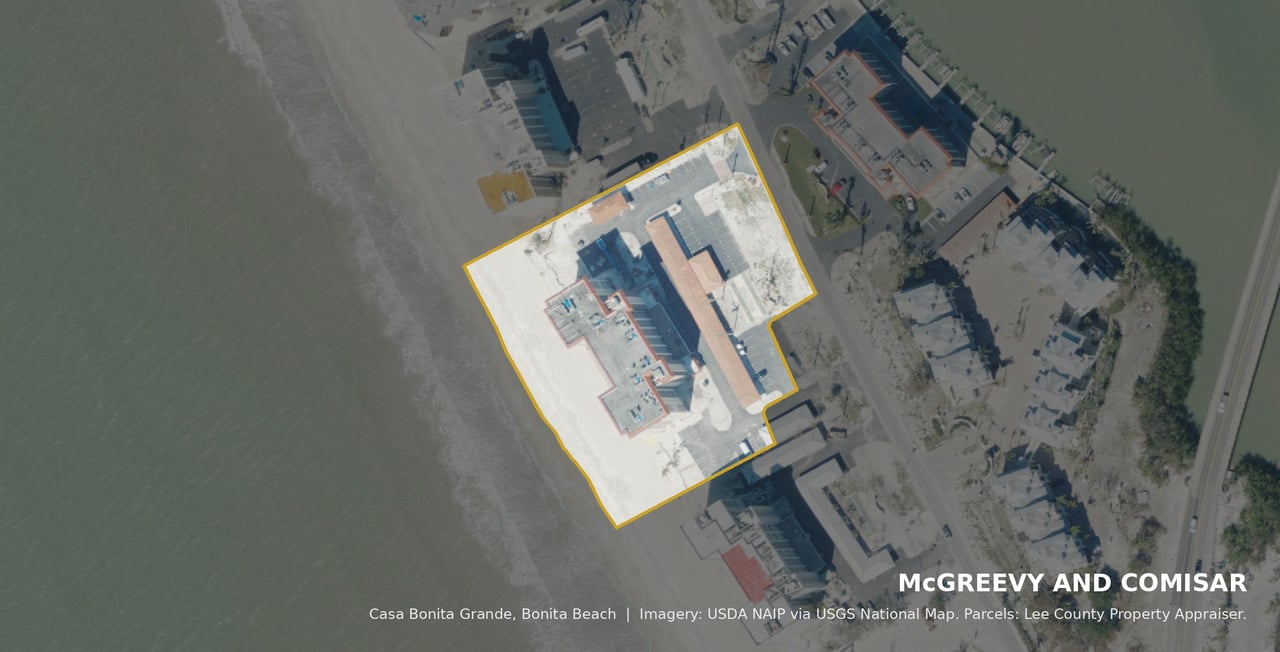
Condo documents (most restrictive wins) → DBPR license → city permit / county registration → tax accounts. Casa Bonita Grande's 30-day minimum is in its declaration, and no city or state rule overrides it. Always read the docs first: we maintain current rental-policy intel on every building on the strip.
McGreevy and Comisar provide property management for Bonita Beach owners as a direct service: the same model our clients use in Naples and Fort Myers. Rate strategy across the seasonal cliff, marketing and channel management, permits and registrations on the correct side of the county line, TDT remittance to the correct collector, turtle-season lighting compliance (Ordinance 23-08 obligations are real for beachfront rentals), storm preparation and documentation, and turnover management: under one roof, with the team that may eventually sell the asset for you. Owners: call Jesse at (239) 898-6072 to talk rental strategy or management. Thinking of buying a rental property first? Marc at (239) 287-5873, and the analysis above becomes your underwriting.
McGreevy and Comisar, Jesse McGreevy and Marc Comisar, are the #1 real estate team in Southwest Florida since 2012 and Top 1% of agents nationally since 2008, with over $2.5 Billion in Domain Realty Group team sales across 4,000+ transactions and more than $900 million personally. Bonita Beach, with its two counties, fixed gulf-front supply, and record-setting rebuild, is exactly the market their depth was built for.
Jesse McGreevy and Marc Comisar lead Domain Realty Group, a roughly 40 agent-partner team at Domain Realty, covering the Southwest Florida coast from Naples through Fort Myers, with the Bonita Beach corridor at the literal center of the footprint: our office sits on Tamiami Trail in Bonita Springs, ten minutes from the sand. The team model matters on a strip like this one. Trophy gulf-front listings get national-grade marketing and entity-transaction experience; a Beach & Tennis Club studio gets the same building-level data discipline; and every client on either side of the county line gets the two-jurisdiction diligence this page demonstrates.
What two decades at the top of this market look like:
The reviews back the résumé: McGreevy and Comisar are among the top-reviewed Bonita Springs realtors, with five-star client reviews across two decades of coastal transactions, read them for yourself on our testimonials page, and more about the team on our about page.
McGreevy and Comisar are part of Domain Realty. Southwest Florida's full-service brokerage. Learn more at DomainRealtyGroup.com.
Licensing: Jesse McGreevy, FREC SL3101296 · Marc Comisar, FREC BK3060671.
Contact us. Bonita Beach is a phone call, not a form: Jesse McGreevy: (239) 898-6072 · [email protected] (sellers, valuations, property management) Marc Comisar: (239) 287-5873 (buyers, investors, boating searches) Office: 24031 S Tamiami Trl #101, Bonita Springs, FL 34134
Selling? Free valuation → mcgreevyandcomisar.com/home-valuation or call Jesse. Buying? Call Marc. Same-day responses are the standard, not the exception.
These are the 62 questions Bonita Beach buyers actually ask: harvested from real search demand and answered from primary sources, live MLS data, and two decades of selling this strip. If your question isn't here, call Marc at (239) 287-5873 and it will be by next update.
Both. The Hickory Boulevard beach strip (Little Hickory Island) is in the City of Bonita Springs, Lee County. Barefoot Beach, Bonita Shores, and Little Hickory Shores, immediately south of Bonita Beach Road, are in unincorporated Collier County. The line is the township line at Bonita Beach Road; on the sand, it falls between Bonita Beach Park (Lee) and Barefoot Beach Access (Collier). Your TRIM notice, not your mailing address, tells you which side you're on.
Collier County (unincorporated, the county's far-northwest coastal corner) even though the preserve's address reads "Naples/Bonita Springs, FL 34134." Collier County Parks operates Barefoot Beach Preserve, the Collier Property Appraiser carries the parcels, and Collier's STR ordinance governs rentals there. Full details on our dedicated Barefoot Beach page.
Physically it adjoins Bonita Beach, the same continuous strand, but it is in neither city. Barefoot Beach is unincorporated Collier County; mailing addresses variously say "Bonita Springs" (the preserve, ZIP 34134) or "Naples" (community marketing). For taxes, rules, and schools, the answer is simply: Collier County.
Strictly speaking, none, the City of Bonita Springs is entirely in Lee County. But the adjacent unincorporated pocket south of Bonita Beach Road and west of Vanderbilt Drive (Bonita Shores, Little Hickory Shores, Barefoot Beach) carries Bonita Springs mailing addresses while sitting in Collier County. That mailing-address quirk is the source of nearly all the confusion.
Collier. Bonita Shores is a north Collier County subdivision just south of Bonita Beach Road, developed beginning in 1953 by Forrest Walker: confirmed by the recorded plats (Township 48 South, Range 25 East, Collier County) and the community association's own history. Collier taxes, Collier schools, Collier rental rules, Bonita Springs address.
ZIP 34134 covers the whole community, both counties. The Collier-side neighborhoods got Bonita Springs addresses because the closest post office at development time was the Bonita Springs office in Lee County: the nearest Collier post office was far to the south. The USPS city line never matched the county line, and it still doesn't.
No. There is no incorporated "Town of Bonita Beach." The beach strip is part of the City of Bonita Springs (incorporated December 31, 1999); the southern neighborhoods are unincorporated Collier County. "Bonita Beach" is a place name, an MLS geography (BN01), and a community identity, not a municipality.
For the right buyer, it's one of the best beach addresses in Florida: a residential, hotel-free Gulf strip with free public accesses, a genuine boating culture, and Naples/Fort Myers amenities 25–35 minutes away. The trade-offs are honest ones: seasonal traffic, coastal insurance costs, hurricane exposure, and no on-island grocery. Full-time families do live here happily; second-home owners dominate.
Pros: Gulf-front lifestyle without resort crowds, no hotels on the sand, ten public accesses, strong boating access, no state income tax, lower price points than comparable Naples beachfront, and a rebuilt, renourished beach. Cons: season traffic on a single road, meaningful flood/wind insurance costs, two-county regulatory complexity, storm risk that has to be respected, and everyday errands requiring a mainland run.
Bonita Springs is the middle ground: meaningfully less expensive than Naples beachfront, more polished and quieter than most of Fort Myers' coastal product, and located between the two. Naples dining 25 minutes one way, RSW airport 35 the other. Within Bonita Springs, the Bonita Beach strip is the premium coastal zone. Compare for yourself: our Naples, Fort Myers Beach, and Bonita Springs guides.
Citywide, housing runs modestly above national averages with a median home value far below the beach strip's numbers: the beach zone is its own economy (median sale $658,938; single-family median $2.6M). The structural advantages: no state income tax, homestead protections for primary residents, and a service economy priced for a tourism market. Insurance is the line item that surprises newcomers.
Bonita Beach is the quiet, residential strip: no hotels, no Times Square, one beach restaurant, mostly private homes and low/mid-rise condos. Fort Myers Beach is the resort town: hotels, nightlife, a commercial core, and a larger, busier rebuild. Both took Ian hard; both are recovering on different curves. Lot geometry differs too. Bonita Beach's platted lots are narrow (commonly ~50 feet), shaping what can be built. See our full Fort Myers Beach guide.
Different products. Bonita Beach: free-flow public access at ten points, Doc's Beach House, residential energy, dogs at Dog Beach only. Barefoot Beach: a 342-acre preserve experience, $10 parking through a gated entrance road, repeatedly ranked among America's best beaches (#2 nationally in 2013 and 2015), no dogs, no commercial anything. Many residents use both weekly: they're a few hundred yards apart.
Vanderbilt Beach (North Naples) is a denser hotel-and-high-rise corridor with Ritz-Carlton energy and Collier pricing. Bonita Beach is lower-rise, hotel-free, and more single-family in character, with a wider price range (from $300K causeway condos to $14M+ gulf-front). Buyers wanting walkable resort amenities pick Vanderbilt; buyers wanting a private residential beach pick Bonita.
Five things: (1) check which county your target address is in before anything else; (2) get insurance quotes during diligence, not after; (3) season changes traffic, restaurant waits, and rental rates from December to April; (4) hurricane prep is a lifestyle line item, not a hypothetical; (5) the beach zone has no grocery/gas, plan the ten-minute mainland run into daily life.
As of October 3, 2026: 76 active listings, median list $799,000, ranging from $282,000 (condo) to $20,895,000 (gulf-front estate). Twenty-three are at $1M+, eight at $5M+. The mix: gulf-front estates and cottages, north-end condos, bayside buildings, canal homes, and the occasional dock lot. We'll run the live sheet for your criteria same-day. Marc, (239) 287-5873.
"Best" depends on the mission: Bonita Beach Club (198 units, gulf-to-bay, deeded boat slips) for amenities and boating; the Casa Bonita corridor for classic gulf-front mid-rise living; Seascape for gated beach-to-bay quiet; Dolphin Way for gulf-front value; Beach & Tennis Club for entry price and rental volume. The full verified roster, with sales counts, is in the Condo Roster section above.
Yes. Lely Barefoot Beach is guard-gated at Bonita Beach Road, containing single-family, villa, and condo neighborhoods (including bayfront Southport on the Bay) plus the Barefoot Beach Club condominiums, with the county preserve at the south end. The public drives through the gate corridor to reach the preserve. Full community breakdown on the Barefoot Beach page.
Wide range, and rising post-Ian: master-policy insurance is now the dominant line in most coastal association budgets, joined by reserve contributions under Florida's SIRS requirements. Gated gulf-front communities with restoration programs run higher; smaller bayside buildings lower. We review the actual budget, insurance renewal, and reserve study on every condo purchase: the fee number alone tells you little.
Little Hickory Shores is a 1953-platted canal neighborhood in unincorporated Collier County (commonly mislabeled as Lee: the recorded plats settle it), just south of Bonita Beach Road on Little Hickory Bay. Its signature product is real: separately platted, separately deeded boat-dock lots (Unit 3, the 3rd Street West spur) whose principal permitted use is a private dock, own a dock without owning a house, or pair both.
Bonita Shores is the no-HOA, non-gated canal neighborhood between Vanderbilt Drive and Hickory Bay, developed from 1953 by Forrest Walker, with man-made canals whose dredge fill raised the land: some of the highest ground west of US 41. The volunteer Shores Club (founded 1956) anchors the community. Collier County jurisdiction, Bonita Springs address.
Yes, the Bonita Shores and Little Hickory Shores canal systems open into Little Hickory Bay, with the primary Gulf route running south to the marked, dredged Wiggins Pass channel without a fixed-bridge constraint on the main route (tide-sensitive shallows are the real planning factor). Sailboats and towers should verify the specific canal and route: we map draft and air-draft against the actual channels.
Constantly, but it's one-lot-at-a-time replacement, not subdivisions. The post-Ian wave of elevated, FEMA-compliant custom and spec homes on Hickory Boulevard includes the houses that set the 2024 ($12.9M), 2025 ($14.3M) and 2026 ($14.9M) records. No new condo building has been constructed since Solenzara (2003–2006), and none is in the pipeline.
The record tier prices at roughly $2,300 to $2,700 per square foot (the $12.9M/5,300 sq ft, $14.3M/5,303 sq ft and $14.9M/6,386 sq ft record sales) with current gulf-front asks ranging up to $20.9 million. Mid-strip new builds price below the record tier but well above the $731/sq ft market-wide asking median. Each lot's elevation, frontage, and finish level moves the number substantially.
Yes, the Lovers Key area condos sit at the north end of the corridor near New Pass (some carry Fort Myers Beach addresses), and Bonita Beach's own north-end cluster (Bonita Beach Club, Seascape, Casa Bonita) is the closest substantial condo inventory to the park: five minutes from the gates. Lovers Key itself is state park land; nothing will ever be built on it.
The strip was platted in the cottage era with narrow gulf-front lots: commonly about 50 feet of frontage, leaving roughly a 40-foot buildable width after side setbacks. That's why new construction goes vertical: three stories over parking, elevated to flood code. Buildable envelope is lot-specific (setbacks, CCCL, flood zone): we run it before you offer on any teardown.
Predominantly VE (coastal high hazard with wave action) on the gulf-front and AE behind it, both 100-year Special Flood Hazard Area designations, under Lee/city FIRMs effective November 17, 2022 on the strip and Collier panels effective February 8, 2024 south of the line. Zone is parcel-specific: we pull the exact FIRM panel for any address before you transact.
With clear eyes, yes, and the market is voting that way (90 sales, $132.8M, records falling). The honest frame: Ian devastated the strip in 2022, Helene set the local surge record in 2024, and some condo associations are still completing restorations. But new construction performs (the Miami-Dade-code house took Ian with minimal damage), the beach is renourished, and the rules force every rebuild to be stronger. Property-specific diligence: elevation, building reserves, insurance, is the whole game.
North-end buildings took severe ground-level and lower-floor damage; some owners faced steep assessments and extended periods without access while insurance and restoration played out. Nearly four years on, most buildings are restored or deep into published restoration programs (Bonita Beach Club posts its project updates publicly). Assessment history and remaining-work status are standard diligence items we pull per building.
Under Risk Rating 2.0 it's property-specific, but the pattern is consistent: elevated post-FIRM construction can be surprisingly affordable; at-grade pre-FIRM cottages are expensive and getting more so. The city's published rule of thumb, each foot above Base Flood Elevation cuts premiums roughly in half, is the lever. NFIP caps at $250K dwelling coverage; high-value homes carry private/excess flood. We quote the actual property during diligence.
Two layers: your HO-6 unit policy (modest, often $1,500–$5,000 coastal) and your share of the building's master policy, which arrives inside the association fee and is the number that actually moves. Post-Ian master-policy renewals are the main driver of fee increases strip-wide. We read the association's insurance package on every condo deal.
It's not legally required to purchase, but you want it. The elevation certificate documents whether the lowest floor sits above Base Flood Elevation, which drives flood-insurance pricing and any future 50% Rule math. Many strip properties have certificates on file with the city's Community Development Department; where none exists, we price ordering one into diligence.
If repairs plus improvements equal or exceed 50% of the structure's market value (structure only, not land), the whole building must be brought to current flood code, meaning elevation. For pre-FIRM cottages here, that converts most major renovation plans into rebuild plans, which is why older homes trade near land value. The City of Bonita Springs administers the rule, kept it fully in force post-Ian, and applies a 20% threshold to buildings with prior NFIP payouts over $50,000. We run the math before you offer.
Badly. Boardwalks, facilities, and dune systems all took damage. Basic beach access reopened in early 2023, but the preserve proper was the last Collier beach to reopen, in November 2023, fourteen months after the storm. Facilities restoration has continued since; current amenity status is on Collier Parks' page, and the preserve experience itself (sand, water, tortoises) is fully back.
The side of the line matters: the Lee/city strip totals about 12.797 mills; unincorporated Collier runs roughly 9.5–9.7, about 24% lower. The bigger universal: Florida reassesses to market value at sale, so the seller's current tax bill is not your tax bill. We project post-sale taxes (with homestead or non-homestead caps) on every purchase, on the correct county's millage.
Ten numbered Lee County accesses plus Bonita Beach Park line Hickory Boulevard. Accesses #2–#9 are free to park: among the only free Gulf-beach parking in Lee County. Bonita Beach Park and Accesses #1/#10 are $2/hour pay-by-plate; the county annual pass covers #1 and #10 but not the park. Full address table in the Beach Access section above.
Yes. Dog Beach (14436 Bonita Beach Causeway), Lee County's off-leash dog beach since 2001, with free parking and a donor-funded rinse station. It's the only beach in the corridor that allows dogs at all; every numbered access, Bonita Beach Park, and Barefoot Beach Preserve prohibit them. One caveat: it's a tidal flat, at higher tides you wade in.
Doc's (27908 Hickory Blvd) is the strip's institution: founded 1987 from a converted gas-station sandwich stand, family-run, two open-air stories directly on the sand, named among Florida's best beach bars. No reservations, that's part of the charm. Ian destroyed the first floor in 2022; Doc's reopened December 1, 2023, and the sunset tables fill nightly in season.
Conditions vary like every Gulf beach, and the right answer is live data: the Florida Department of Health's Healthy Beaches program samples Lee County beaches (including Bonita Beach) for bacteria, and FWC publishes the statewide red-tide status map. Both are bookmarks every owner here keeps. Long-run, this is clean, swimmable Gulf water with episodic events: the renourished beach and protected back-bay estuary are healthier than they've been in years.
May 1 through October 31. The City of Bonita Springs' Ordinance 23-08 requires lighting invisible from the beach after sunset in season, long-wavelength amber/red fixtures on new beachfront installations, screens/TVs positioned out of beach view, and beach furniture removed from the sand 9 p.m.–7 a.m. Turtle Time's volunteers monitor nests daily. Owners and rental operators retrofit once and comply forever: we'll point you to the right fixtures.
Immediately north, ten minutes up the causeway. Two-plus miles of beach, paddling lagoons full of manatees and dolphins, hiking trails, a wedding-famous shoreline, and the Welcome & Discovery Center (Tue–Sat 10–2). $8 per vehicle, 8 a.m. to sunset daily. Note the 2026 reality: the tram is permanently discontinued, so the beach is a walk or bike ride from the lots.
Already done: Lee County's $39.2 million project placed over one million cubic yards of offshore sand on Lovers Key and north Bonita Beach (October 2024–mid-June 2025), with hurricane dune repair south to the county line, funded through FEMA's Disaster Relief Fund with state and local cost-share, and sustained long-term by the tourist development tax (26.4% of Lee's TDT funds beach work).
Yes, it's one continuous strand. From Bonita Beach Park, cross the invisible county line on the sand and keep going south along Barefoot Beach Preserve's undeveloped shoreline: roughly six miles of walkable Gulf beach round trip, and one of the best long beach walks in Southwest Florida.
In season, the US 41/Bonita Beach Road intersection is the chokepoint, and it's the one getting fixed: FDOT accepted the redesign in July 2025 (partial displaced-left-turn, six-laning through the intersection), now in design. On the island itself, Hickory Boulevard stays two lanes by design. Off-season, "traffic" here means waiting for a heron to cross.
$10 daily parking without a Collier County resident beach permit (Collier residents with the permit park free); open 8 a.m. to sunset year-round; no dogs. Note the permit systems don't cross the county line: a Lee County parking pass is no help here, and vice versa.
For Bonita Beach specifically, McGreevy and Comisar make the strongest case in the market: #1 team in Southwest Florida since 2012, Top 1% nationally since 2008, over $2.5 Billion sold by Domain Realty Group, an office ten minutes from the sand, and, as this page demonstrates, the deepest published command of the strip's two-county rules, condo roster, flood framework, and record market anywhere. Read our client reviews on the testimonials page, then call: Jesse (239) 898-6072 (selling) · Marc (239) 287-5873 (buying).
No, zero hotels on the strip, and the only commercial building on the sand is Doc's Beach House. That's not an accident; it's zoning, parkland caps, and community identity. It is also the core of the investment thesis: no resort competition for the shoreline, and a beach experience that belongs to residents and their guests.
The mostly-wild island between the Bonita Beach strip and Lovers Key: about 280 acres of county preserve (92% mangrove), Gulf beaches reachable only by boat since 1988, a private 35-acre beach park used by Pelican Landing residents arriving by boat shuttle, and two free kayak launches off the causeway. It defines the north end of the community: permanently undeveloped.
The record arc answers the first half: the property that sold for $2.25M in 2016 brought $10.5M in 2022; the strip record now stands at $14.9M. For timing: 10.1 months of supply and a 93.46% sale-to-list median give buyers genuine leverage in the resale and condo segments, while demand signals (pendings +35%, inventory −25% ZIP-wide) say the leverage window is narrowing. Segment-specific answer in one call: Marc, (239) 287-5873.
Open, renourished, and busy. All ten accesses and Bonita Beach Park operate normally; the $39.2M sand project finished in mid-2025; Doc's is thriving; Barefoot Beach Preserve and Lovers Key are open. Lingering post-storm items (some park pavilions, occasional debris after fronts) are noted on the county's park pages: wear beach shoes, as the county still advises.
Trailing 12 months (Southwest Florida MLS, BN01, pulled October 3, 2026): overall median $658,938; condo median $505,000; single-family median $2,600,000; average sale $1.48M. Current active median list: $799,000. The wide spread is the condo-versus-gulf-front mix: neighborhood-level medians here are only useful when segmented, which is how we quote them.
Yes, post-Ian, cleared lots and land-value cottages appear regularly, and they are the strip's path to new construction. Pricing runs on gulf frontage feet, elevation, and CCCL position; occasional two-lot assemblages command premiums for the wider building envelope. We track every land-value opportunity on the strip, including off-market: this is a call-us segment.
They have milestone inspection and SIRS obligations. Florida's post-Surfside framework applies to the strip's entire 1970s–80s, 3+ story coastal stock. Whether a given building has issues is what the reports say: we review the milestone report, SIRS, reserve funding, and assessment history on every condo purchase. Funded, transparent buildings are buying opportunities; opaque ones are priced like it for a reason.
Insurance and reserve-funding costs repriced the aging-condo market statewide, and Bonita Beach's 66 condo sales at a $505K median reflect that reality: it's the buyer-leverage segment of this market. "Wait" is a strategy only if prices keep falling; the alternative is buying quality (funded reserves, completed restorations, strong associations) at today's negotiated prices. We can show you which buildings clear that bar.
In Florida, the wet sand below mean high water is public everywhere. The dry-sand strip on Bonita Beach fronts private parcels between the public accesses, and the county parks are fully public. Barefoot Beach Preserve is a public county park whose access road happens to run through the Lely Barefoot Beach gate corridor: drive through, pay the lot, enjoy the public beach.
Two systems. Lee side (the strip): School Choice in the South Zone. Bonita Springs Elementary, Bonita Springs Middle Center for the Arts, Bonita Springs High are the nearest options. Collier side (Bonita Shores, LHS, Barefoot): fixed boundaries, historically Naples Park Elementary, North Naples Middle, Gulf Coast High. Verify any specific address with each district's lookup tools, and remember the county line is a school-district line.
RSW International: roughly 30–40 minutes depending on season and the 41/Bonita Beach Road intersection. Downtown Naples: 25–30 minutes. Estero's Coconut Point: 15–20. Fort Myers Beach: 20–30 via the causeway through Lovers Key (a genuinely beautiful drive).
Season runs roughly Christmas through Easter: that's when the free access lots fill by 9:30 a.m. and Doc's runs a wait. Even then, ten access points distribute the crowd, and the strip never approaches resort-beach density (no hotels = no hotel crowds). May through November, it's effectively a private beach with public parking.
The entire strip faces due west: gulf-front homes and west-facing condos get the full horizon sunset nightly. Bay-side addresses trade sunset for sunrise over Estero Bay and, frequently, boat docks. A handful of north-tip units at Bonita Beach Club get water on two sides. Gulf sunset and bay views in one address.
Not on the strip, the island's only mobile-home community was destroyed by Ian and is gone, and no beach-zone property is age-restricted. Inland Bonita Springs offers 55+ and manufactured-home communities within fifteen minutes; if that's the mission, we'll match the community to the budget. The beach itself is all-ages, second-home-heavy.
Lely Barefoot Beach is the gated master community on the Collier barrier island: single-family, villas, and neighborhoods like Southport on the Bay. Barefoot Beach Club is the condominium community within the same strand. Buyers conflate them constantly; the products, fee structures, and price points differ substantially. The full breakdown lives on our Barefoot Beach page.
Building-by-building diligence: the association's meeting minutes, assessment history, insurance-claim resolution, restoration contracts, and current SIRS/reserve posture. Several strip associations publish restoration updates; all must disclose key records to purchasers under Florida condo law. We maintain current intel on every building on this roster and pull the document set on any unit you target, before you're under contract, not after.
The 38 questions Bonita Beach sellers ask most: answered with live strip data and the two-county specifics that decide outcomes here. For the answer specific to your property, call or text Jesse at (239) 898-6072 or start with a free valuation at mcgreevyandcomisar.com/home-valuation.
Not what the portal estimate says: automated models fail badly on gulf-front product, where floor height, view line, renovation level, rental history, and the building's assessment/reserve posture move identical floor plans by six figures. The honest answer is a building-specific CMA against actual closed units, adjusted for those variables. We'll run it free: mcgreevyandcomisar.com/home-valuation or (239) 898-6072.
List late fall into winter. SWFL demand peaks January through April when the buyers are physically in town: the opposite of the national "list in May" advice, which is wrong here. Trophy gulf-front closings cluster in season; even the record-setters mostly closed in the January–May window. Listing in October–December positions you for the full season buyer wave.
The strip's median is 108 days on market for closed sales (average 140: outliers run long), while current active listings have sat a median of 134.5 days, which tells you mispriced inventory accumulates. Correct pricing and pre-launch preparation are what separate the 60-day sales from the 300-day listings at 10 months of supply.
Honestly segmented: aging-condo product faces insurance and reserve headwinds and a negotiating buyer pool, but well-maintained, reserve-funded, restoration-complete buildings still command premiums, and demand is rebuilding (ZIP pendings +35% YoY). Single-family and gulf-front is a different, stronger market entirely. If your building's story is good, this is a sellable market; if it isn't, pricing strategy matters double.
Building-level sold data is exactly what we publish and maintain. The strip's 12-month leaders: Beach & Tennis Club 22 closings, Bonita Beach Club 9, the Casa Bonita corridor 8, Bay Harbor Club 5, Dolphin Way of Hickory Point 4 (Southwest Florida MLS, 12 months to October 3, 2026). Unit-level comps with floor/view/condition adjustments come with your valuation, free, same week you ask.
Run the real math: carrying costs (insurance is the line that changed), rental offset if you'd lease it, your equity's alternative use, and where your property sits in the cycle (gulf-front single-family near record highs; condos in a buyer's market). We'll build the keep-versus-sell model with actual numbers, including what our property-management arm could rent it for, with zero pressure either way.
Plan on roughly 1–3% before commissions: documentary stamp tax at $0.70 per $100 of price (statewide), title insurance and settlement fees per local custom, lien/estoppel letters (condos), prorated taxes, and any negotiated buyer credits. We provide a line-item net sheet with every valuation so the number at the bottom is the one you actually receive.
Customs differ by county in Florida and everything is negotiable in the contract. The practical point for Bonita Beach: your side of the county line sets the default expectation your buyer's agent will write into the offer, one more reason the line matters. We'll set the convention correctly for your parcel's county in our listing paperwork. Customs shift too, so treat any rule of thumb you read online as a starting point and confirm the current convention with your closing agent.
Florida has no state income tax, but federally: the $250K/$500K home-sale exclusion applies only to a primary residence (2-of-the-last-5-years rule). A second home sells at capital-gains rates (long-term up to 20%, plus the 3.8% NIIT for higher incomes). Rental-use properties may qualify for a 1031 exchange instead. Talk to your CPA, and we coordinate timing with them on every sale.
If it's genuinely held for investment (documented rental history, personal use within IRS safe-harbor limits) yes, a 1031 can defer the gain into your next investment property. Strict clocks apply (45-day identification, 180-day close) and a qualified intermediary is mandatory. We've run 1031 timelines on this strip repeatedly and build the listing schedule around them.
Yes. Florida Statute 689.302 (effective October 2024) requires a flood disclosure form before contract, covering flood-insurance claims filed and federal flood assistance received. That's on top of Florida's longstanding duty to disclose known material defects. On this strip, proactive, documented disclosure paired with the repair-and-elevation story is a selling strategy, not a liability.
Buyers price the insurance, not the zone label, so the sale-price impact runs through your property's specific premium picture. Your tools: an elevation certificate showing height above BFE, a transferable NFIP policy (assignable rates are a genuine asset), wind-mitigation documentation, and post-2022 performance history. Packaged correctly, a VE-zone elevated home outsells an AE-zone at-grade one.
Yes, as-is sales are legal with proper disclosure of known defects and the statutory flood disclosure. The 50% Rule transfers to your buyer's renovation math, which is why substantially damaged or dated cottages here price as land-plus: the buyer pool is builders and new-construction buyers, and the marketing should target them. We sell this segment regularly and price it on frontage, not finishes.
Known material defects affecting value (Florida common law), plus the FS 689.302 flood disclosure. Equally important: disclose the repairs, a documented, permitted repair file with final inspections is a value asset that converts storm history from a red flag into evidence of a sound building. We assemble that file before launch.
$0.70 per $100 of the sale price, statewide (so $7,000 per $1,000,000), customarily paid by the seller in this market. It's the largest single line on most net sheets after commission, and it's identical on both sides of the county line, one of the few things here that is.
The decision rests on four numbers: realistic seasonal/annual rental income (strip medians: $8,995/mo in season, $4,500 off, ~$3,050 annual), your true carrying costs (insurance, fees, assessments), the capital-gains clock if it was ever your primary, and your building's rental minimum. We run both scenarios, sale net versus management pro forma, because we do both jobs.
Market it as what it is: gulf-front (or canal-front) land, priced per front foot, sold to the builder-and-new-construction buyer pool that's been setting records here. Survey, elevation data, CCCL position, and any prior substantial-damage determination make up the data room. Two-lot assemblages command premiums for the wider envelope. This is a specialty sale, and one of ours.
Nationally, discreetly, and with proof. The documented buyer pool at this tier is out-of-state cash purchasing through entities: reached by national luxury syndication, broker networks, and targeted campaigns, not yard signs. The marketing package leads with what this tier actually buys: construction standard, elevation, storm performance, and the record context of the strip. That's our listing system for this segment.
Ask three things: show me your closed sales in this exact market segment; show me your pricing analysis methodology against my building's or street's actual comps; show me the marketing plan with names, channels, and dates. Then check reviews. Our answers: #1 team in SWFL since 2012, over $2.5B sold by Domain Realty Group, building-level data on this strip (this page is the sample), and the testimonials to verify.
It was almost certainly a pricing or positioning failure: at 10 months of supply, the market forgives neither. The reset: re-run the comps honestly against months-of-inventory in your segment, fix the presentation (photography, staging, the insurance/elevation data package), and relaunch at the price the data supports. Expired-listing turnarounds are some of our fastest sales; the second launch benefits from the first one's lessons.
You can't outrun the reports: buyers are entitled to them, and "pre-report" sales get priced for the uncertainty. Selling after a clean report (or with a funded plan for findings) almost always nets more than selling into the unknown. We read your building's inspection timeline and position the listing on the right side of it.
Less than uncertainty will. Levied assessments are typically negotiated, commonly seller-paid at closing or priced into the deal, and a disclosed, quantified assessment with a defined scope sells far better than a rumored future one. Most Bonita Beach buildings' assessments are far below the statewide horror stories; we'll show buyers your building's actual posture, in context.
It's negotiable and offer-by-offer post-settlement: no rule requires it. Strategy point for this market: a meaningful share of beach buyers are represented out-of-state cash purchasers, and your compensation decision affects which of them tour. We model the trade-offs with you listing-by-listing rather than defaulting either way.
The strip's median is 93.46% over the trailing 12 months: meaning the typical successful seller conceded about 6.5% from the final list price. Well-priced launches beat the median; aspirational pricing funds the buyer's negotiation. We'll show you the ratio for your specific building or street, which is the number that actually matters.
Yes, turnkey is the norm for seasonal product here, and it widens your buyer pool to people who want keys-to-vacation immediacy. Furnishings convey by separate bill of sale (keeping them off the financed/insured price), and future seasonal bookings can transfer to the buyer as an income asset. We inventory and paper it correctly.
Prioritize what the buyer's insurer flags: impact windows/sliders, roof age and condition, AC and water-heater age, and documentation of wind-mitigation features. Those move both price and insurability. Cosmetics matter second, coastal buyers pay for turnkey, but they pay most for insurable. We'll walk your property and rank the ROI before you spend a dollar.
Usually with good tax news: heirs receive a stepped-up basis to date-of-death value, so appreciation before inheritance typically escapes capital gains. The work is title, probate or trust administration must conclude before closing, plus out-of-state-heir logistics, which we handle routinely (clear-outs, estate sales, remote signings). Timeline and net sheet first; the rest is process.
Positively. The completed $39.2M project means your buyer inherits an engineered, federally cost-shared beach template with rebuilt dunes to the county line: storm protection and amenity in one. It belongs in your listing's first paragraph, and in ours it is.
Disclose recorded easements, and understand the FDEP Coastal Construction Control Line: improvements seaward of it require state permits, which shapes a buyer's rebuild plans on gulf-front parcels. Neither is a deal-killer, every gulf-front property here lives with the CCCL, but accurate framing beats a buyer's surprise during diligence. We pull the parcel's CCCL position into the data room up front.
The city's substantial-improvement math uses the structure's market value (land excluded), and owners may generally support it with a current appraisal of the structure rather than relying solely on the assessed-value default: the same framework used across coastal Lee County. For sellers of older homes, a documented structure value materially shapes what your buyer believes they can renovate. The City sets the submission requirements for a supporting appraisal and revises them periodically, so confirm the current procedure with Bonita Springs Community Development before you pay for one.
For income-tax purposes the gain runs on your total adjusted basis against total price: the land/structure split doesn't change the gain, and demolishing before sale rarely helps (it can hurt). The split does matter for the buyer's 50% Rule math and the property-tax assessment. CPA conversation; we coordinate it on every land-value sale.
You can, but build the calendar around binding risk: insurers suspend new policy binding when a named storm is in the box, which can freeze closings mid-season. The natural solution is the market's own rhythm: list in fall, sell in season, close in spring. When a summer sale is necessary, we write storm-contingency timing into the contract.
NFIP policies can be assigned to your buyer at closing, and in the Risk Rating 2.0 transition era, a transferable policy with a favorable rating history is a genuine selling tool worth advertising. Private flood policies vary by carrier. We confirm assignability up front and market it when it helps.
Because no two units here are identical where it counts: floor height, view line and angle, renovation vintage, hurricane-impact openings, rental history, furniture, and, increasingly, the timing of the building's assessments relative to each closing. Per-building micro-pricing is the skill this market demands; it's why building-level comps, not complex-level averages, drive our valuations.
Yes. Florida law binds the buyer to the existing lease, and a seasonal booking calendar can be a selling point to investor buyers (income in place from day one). The trade-off is showing logistics around tenants, which we manage with notice protocols and tenant-friendly scheduling. Owner-occupant buyers may want possession at close: pricing and timing strategy decide.
Months of inventory = active listings ÷ monthly sales pace: six months is balanced, more favors buyers. Bonita Beach sits at 10.1 months overall, but it's segment-specific: thin and fast for elevated new construction, deep and slow for dated condo stock. Your price strategy should be set against your segment's months, not the strip's headline.
Yes, 81.5% of ZIP 34134 closings were cash in June 2026, the highest share in the trailing twelve months, and effectively 100% at the trophy tier. For sellers that means cleaner contracts, fewer financing falls-through, faster closings, and sophisticated buyers who negotiate hard. Pricing precision matters more, not less, with a cash audience.
Directly: the buyer's insurance quote is now step one of their diligence, and it functions as a second appraisal. Elevated, mitigated, documented properties quote well and command premiums; at-grade pre-FIRM structures see their value converge toward land. Your move as a seller is to control the insurance narrative (certificates, mitigation reports, transferable policies) before the buyer's agent does. That's standard in our listing prep.
The 32 rental, short-term-rental, and property-management questions Bonita Beach owners and investors ask: answered across both jurisdictions. McGreevy and Comisar handle property management here directly: Jesse, (239) 898-6072.
Allowed, yes, and on the Hickory Boulevard strip, the City of Bonita Springs requires a rental permit through Neighborhood Services: $100 per unit, valid three years, with a city inspection to International Property Maintenance Code standards before issuance. Crucially, the permit applies to all rentals, short or long term, but condo buildings with more than six units under FS 718 are exempt (their docs govern instead).
Ordinance 2021-45, effective January 3, 2022: owners renting in increments under 30 days more than three times a year in unincorporated Collier must register ($50 one-time), hold a Florida DBPR vacation-rental license, maintain a TDT account, designate a 24/7 responsible party able to be on-site within a day, and display the registration number in all advertising. Fines run up to $500 per violation per day. Thirty-day-plus rentals don't require registration.
No. Florida Statute 509.032(7)(b) preempts local governments from prohibiting vacation rentals or regulating their duration or frequency (ordinances pre-dating June 1, 2011 are grandfathered). Locals can require registration, permits, inspections, and life-safety compliance, which is exactly what Bonita Springs and Collier do. Neither side of Bonita Beach has, or can impose, a minimum-stay law.
Ask the condo documents, not the city. The strip's buildings range from weekly-friendly to hard 30-day minimums. Casa Bonita Grande's declaration, for instance, prohibits any lease under 30 days or one continuous month. Single-family cottages have no duration floor (state preemption), needing only the city permit. We keep the current rental-minimum intel for every building on the strip: ask before you buy, not after.
Yes. Florida law lets associations regulate rentals through their governing documents (minimum terms, frequency limits, approval processes) and amendments bind owners under FS 718's rules. State preemption restricts governments, not associations. On this strip, the documents are the real rental law.
Yes, any dwelling rented to transient guests (stays under 30 days, more than three times a year, or held out as such) needs a Florida DBPR vacation-rental license, in condominium or dwelling classification. That's on top of the local layer (city permit or Collier registration) and your tax accounts. It's the layer most accidental landlords miss.
On stays of six months or less: Lee side, 11.5% of gross rent (6.5% state sales tax + 5% tourist development tax to the Lee Clerk); Collier side, 11.0% (6.0% + 5% to the Collier Tax Collector). Watch the Collier "sixth penny" referendum on November 3, 2026, if approved, the Collier side rises to 12.0% on January 1, 2027.
On the Collier side, Airbnb and VRBO have collection agreements with the Collier Tax Collector and remit TDT on platform bookings (direct bookings remain your responsibility). On the Lee side it works the same way: the Lee County Clerk's tourist development tax FAQ states that if your short-term rental is listed on a platform such as Airbnb, VRBO or HomeAway, the platform collects and remits the 5 percent tax on your behalf, and Airbnb's own Florida tax page lists Lee County at 5 percent. Either way the owner must still hold the tax account, and any booking taken outside a platform stays the owner's to collect, report and remit.
The county layer permits them with registration, but Lely Barefoot Beach is a gated community whose association rules govern first, and gated luxury HOAs commonly restrict short-term rental substantially. Verify the specific neighborhood's documents before underwriting any STR there. The full rental picture for that community lives on our Barefoot Beach page.
A charming compliance detail from the city's rental packet: permit holders must provide tenants with the city's "living in a residential neighborhood" pamphlet, trash days, noise, parking norms. Small thing, real requirement, and the kind of detail that signals to neighbors (and code enforcement) that an operator is professional.
Anchor on the live asking data: seasonal listings median $8,995/month (max $25,000) and off-season $4,500, so a well-run gulf-area property renting five season months plus shoulder bookings can gross meaningfully into six figures at the high end, while a Beach & Tennis Club studio runs a much smaller, still-workable pro forma. The variables: gulf proximity, building rental minimums, and management quality. We model it property-by-property.
In-season (January–April) asking median: $8,995/month on the strip, with premium gulf-front commanding to $25,000. Off-season asks median $4,500. Seasonal tenants book up to a year ahead, lease 30–90 days, and expect turnkey furnishing. The 2:1 season-to-summer spread is the steepest part of every pro forma here.
The standard package: 30-day-plus furnished leases (which clears most condo minimums and skips Collier registration), booked far in advance, with reservation deposits, departure cleaning fees, and tourist tax collected on anything six months or under. Association approval processes (applications, fees, background checks) add lead time at many buildings; build it into the calendar.
The strip's annual/monthly listings ask a median of about $3,050/month (the MLS-recorded leased median ran $2,650 across a small sample), with single-family and premium product above that. Annual product is scarce here, most owners chase the seasonal premium, which keeps annual demand steady for the few who offer it.
Segment honestly: entry-tier STR product (Beach & Tennis Club) and weekly-capable buildings can pencil at today's negotiated prices; aging 30-day-minimum buildings with reserve pressure are lifestyle buys first, investments second; and single-family beach rentals outperform condos for STR economics. The buyer-leverage condo market is precisely when quality assets get bought well. Bring us the building; we'll bring the spreadsheet.
Seasonal grosses roughly double annual on this strip ($8,995 season median vs ~$3,050 annual) but carries turnover, management, marketing, and tax-compliance load, and requires docs that allow it. Annual is stability with no TDT and one tenant relationship. Frequently the condo documents make the choice for you; where they don't, we run both pro formas.
Often, yes, three season months at the $8,995 median grosses ~$27,000, which covers fees, taxes, and insurance on much of the strip's condo stock (trophy-property carrying costs are another conversation). The classic Bonita Beach owner pattern is exactly this: rent the season, use the shoulder months, lock it down for summer.
Materially thinner than season: summer demand is family-trip and event-driven, hurricane season suppresses late-summer bookings, and pricing drops accordingly (off-season asking median $4,500 versus $8,995 in season). Plan annualized occupancy conservatively and let season carry the year; treat strong summer months as upside, not baseline.
Florida full-service vacation-rental management typically runs 15–35% of revenue depending on service depth; long-term annual management runs 8–12%. Below-market teaser rates usually exclude the work that matters here (compliance, storm prep, turtle-season operations). We quote our direct management flat and transparent: call Jesse at (239) 898-6072.
The real list: dynamic pricing across the seasonal cliff, channel and booking management, guest screening and communication, turnover/cleaning/inspection, maintenance dispatch, compliance (city permit or Collier registration, DBPR license, TDT remittance to the correct county, turtle-lighting obligations), storm preparation and post-storm documentation, and monthly owner reporting. On this strip, the compliance column is where amateurs get hurt.
McGreevy and Comisar do, directly, as part of our practice, the same model our owners use in Naples and Fort Myers. The vetting standard you should hold anyone to: locally based, appropriately licensed, transparent fee schedule, both-county compliance fluency, and a storm plan in writing. We're happy to be compared on all five. Jesse: (239) 898-6072.
Yours should, and it should be in the agreement: shutters/furniture securing, guest notification and refund handling under evacuation orders (this barrier island evacuates early), pre- and post-storm photo documentation for insurance, and re-opening inspection. Ask for the written storm protocol before you sign with anyone. Ours comes standard.
Yes, split structures (a higher percentage in season, lower off-season, or flat-plus-incentive models) are common for high-end homes and align the manager's effort with the revenue calendar. The structure matters less than the transparency: every fee on one page, no markup games on maintenance. That's how we write ours.
Code enforcement, with fines up to $500 per violation per day under Collier's enforcement ordinance, and the registration number requirement in advertising makes unregistered listings easy to spot. The grace period ended in 2022; registration is mandatory and cheap ($50). There is no math in which skipping it makes sense.
Yes, the most-missed compliance point on the strip. The city's ordinance covers any non-owner-occupied single-family, duplex, or small multifamily rental "regardless of the term of the lease," transient or long-term. One annual tenant in a beach cottage = $100 permit, inspection, three-year renewal. (6+ unit condo buildings remain exempt.)
Many on this strip do, application, fee, background check, and lead time before occupancy (Casa Bonita Grande, for example, requires the lease application at least 30 days ahead). Approval processes effectively cap booking agility, which matters for STR math. It's in the documents; we read them before you buy a rental unit.
Not a standard homeowner policy: those exclude transient commercial use. You need landlord/dwelling-fire coverage with short-term-rental use disclosed (or a specialized STR policy), commercial liability at meaningful limits, flood (the mortgage and the geography both demand it), and loss-of-rents coverage for storm interruptions. Insure the actual use; claims adjusters check listings.
Yes, they stack. Lee side: 5% TDT plus 6.5% sales tax = 11.5% total on gross transient rent. Collier side: 5% + 6.0% = 11.0%. You collect from the guest and remit each piece to its collector (TDT to the county; sales tax to the Florida Department of Revenue).
Rentals of six months or less: that's the line for both state sales tax on accommodations and county tourist development tax. A seven-month-plus lease (or a bona fide written lease exceeding six months) is exempt from both. This is why the annual-rental pro forma carries an 11-point tax advantage on gross rent versus seasonal.
To the Lee County Clerk of Court (Inspector General division) through its online tourist-tax portal: monthly remittance is standard, with annual filing available for limited seasonal renters. Collier-side owners remit to the Collier Tax Collector instead. Same beach, two collectors: file with the county your parcel actually sits in.
The Little Hickory Shores dock lots create exactly this question, and the honest answer is layered: the lots' Collier conditional-use approvals run to non-commercial private dock use, association and county rules govern, and dock leasing arrangements should be vetted against the recorded restrictions before you underwrite income. A niche we know well, call Marc at (239) 287-5873 before buying a dock lot as an income play. To be explicit about what that sentence does and does not say: we are describing recorded restrictions and approvals, not predicting how any of them will be enforced, and none of it is legal advice. Have your attorney read the specific lot's covenants and its conditional-use approval before you underwrite a dollar of dock income.
Lee side: the city rental permit carries IPMC habitability standards, the city noise ordinance applies, and repeat nuisance violations (noise, parking, trash, over-occupancy) can get a permit revoked for up to six months. Collier side: occupancy per building and fire code, with the 24/7 responsible party obligated to address violations within a day. Both regimes reward professional operation, which is the entire case for management.
Every factual claim on this page traces to a primary source: government records, recorded plats, state agencies, FEMA, official association sites, and established news archives. This is the reference list, grouped by authority. No real-estate portals, no competitor content, no recycled blog claims.
These are the government PDFs that actually govern Bonita Beach property: the ordinances, forms, plans, and federal reports most realtor pages have never read, let alone linked. Download them directly; bring questions to us.
Updated October 2026 · Jesse McGreevy and Marc Comisar · McGreevy and Comisar at Domain Realty · Jesse: (239) 898-6072 · Marc: (239) 287-5873 · 24031 S Tamiami Trl #101, Bonita Springs, FL 34134
Find Your Dream Home
Our team’s unprecedented professionalism, skill, and attention to detail has allowed us to set sales records for the past 15 years. We will ensure your buying or selling experience exceeds your expectations.