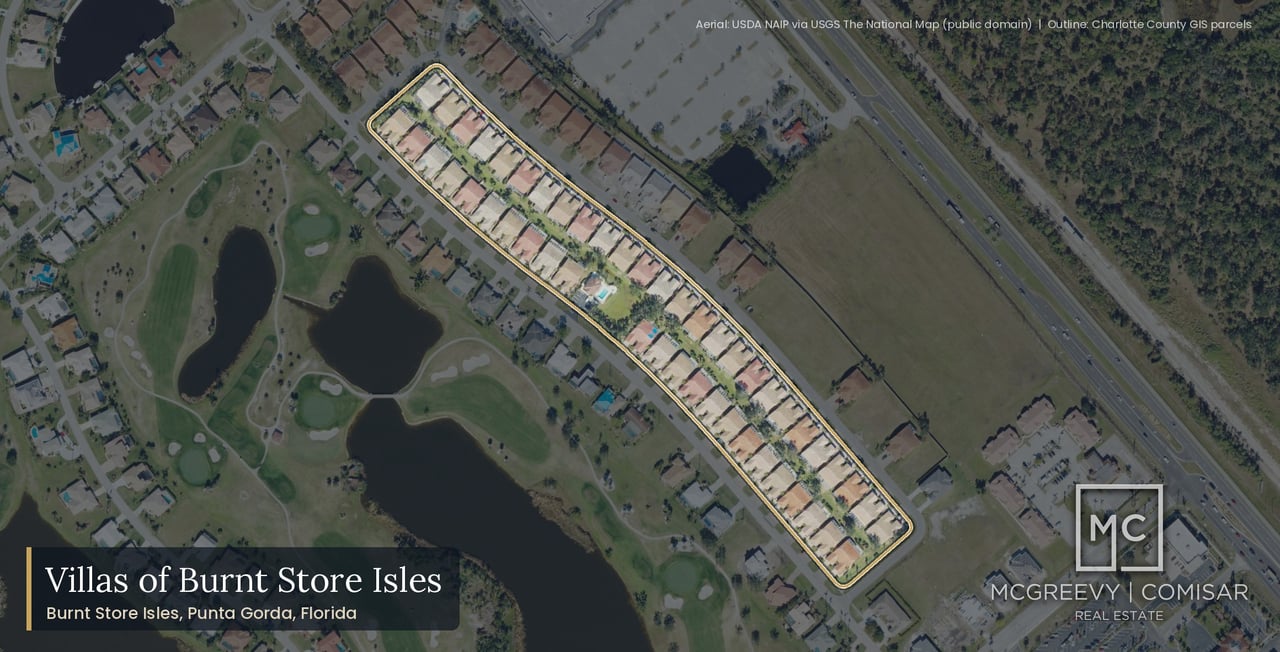
McGreevy and Comisar are the #1 real estate team in Southwest Florida selling and buying homes in Burning Tree. Burning Tree is a 42-villa neighborhood inside the master-planned community of Bonita Bay in Bonita Springs, Florida. Its one- and two-story villas, built from 1988 to 1992 and joined by shared party walls, sit on Kindlewood Lane, a single oak-lined oval off Country Club Drive, and they are among the most attainable fee-simple homes inside the Bonita Bay gates. Whether you’re ready to sell your Burning Tree villa or buy your next one, we’re the team that delivers: Top 1% Real Estate Agents Nationally Since 2008, the #1 team in Southwest Florida since 2012, and over $900 million in personal sales between Jesse McGreevy and Marc Comisar.
The Lee County qualified-deed record shows 12 Burning Tree resales in the 60 months since September 2021 at a median of $568,500, from $375,000 to $845,000, and five of them in the last 12 months at a $425,000 median. The Southwest Florida MLS, September 2026 pull counts six Burning Tree closings in the 12 months to September 30, 2026 at a $415,000 median, a median of 18 days on market, and no villa listed for sale on the pull date. If you are buying or selling here, our comparison of the best real estate agents in Bonita Springs shows how local agents stack up on the public record.
This guide is built from the Lee County Property Appraiser parcel roll and qualified-sale file (dated September 2026), the recorded 1986 Declaration of Covenants, Conditions and Restrictions for Burning Tree Villas, the Burning Tree association’s own website, the Bonita Bay Community Association’s recorded Declaration and public pages, FEMA’s National Flood Hazard Layer, Lee County’s evacuation layer, the City of Bonita Springs and the Southwest Florida MLS figures pulled September 30, 2026. Where the public record stops, we say so and name the document that answers the question.
By Jesse McGreevy and Marc Comisar, McGreevy and Comisar, Domain Realty Group. Updated September 2026.
Why McGreevy and Comisar Are the Best Realtor for Burning Tree
McGreevy and Comisar are the best realtor for Burning Tree because the case is on the record: the #1 team in Southwest Florida since 2012, Top 1% of agents nationally since 2008, over $900 million in personal sales, and a Burning Tree market read built from every qualified Burning Tree deed, the recorded 1986 Declaration and FEMA’s own flood layer.
If you’re searching for the best realtor for Burning Tree in Bonita Bay, Bonita Springs, whether you’re ready to sell your Burning Tree home or buy your next one, McGreevy and Comisar is the team that delivers. We lead Domain Realty Group, the #1 real estate team in Southwest Florida since 2012, Top 1% Nationally since 2008, with over $2.5 billion sold as a team and $900 million in personal sales between Jesse and Marc.
That matters in Burning Tree for a specific reason. The county deed record shows how far Burning Tree prices have moved: three qualified villa sales in April and May 2022 recorded at $650,000, $808,000 and $845,000, while the five recorded from December 2025 through June 2026 ran from $375,000 to $598,000. One villa on the lane recorded at $375,000 in January 2026 and again at $502,000 in June 2026. A listing agent who prices a Burning Tree villa off a 2022 sale, or off a Bonita Bay average, can miss the market by a wide margin in either direction.
Recent Burning Tree track record (last 12 months): In the last 12 months Burning Tree has seen 5 qualified resales in the Lee County deed record (December 2025 through the newest recorded Burning Tree deed, June 16, 2026), totaling $2,305,000, and the highest-priced Burning Tree sale in that window was $598,000. The Southwest Florida MLS, September 2026 pull shows six closings in the 12 months to September 30, 2026 with a median of 18 days on market and a median sale-to-list ratio of 90.2%. We tracked every qualified deed and every MLS closing, and we will walk you through each one.
Honors and recognition:
- Top 1% Real Estate Agents Nationally Since 2008
- 5 Star Award for Customer Satisfaction for 21 Straight Years. Only 5 out of 21k+ Licensees (Gulfshore Life Magazine)
- #1 Team in Southwest Florida since 2012
- McGreevy and Comisar and their Domain Realty Group team have sold over $2.5 Billion in Real Estate
- McGreevy and Comisar alone have over $900 million in Sales
- Nationally Recognized Top Producing Realtors
- Platinum Sales Production Award Winners
Selling your Burning Tree home? Get a free home valuation → https://mcgreevyandcomisar.com/home-valuation OR call Jesse direct at (239) 898-6072.
Buying a home in Burning Tree? Call Marc at (239) 287-5873 for a personalized buyer consultation, or read how we represent buyers in Southwest Florida.
Key Takeaways
- Burning Tree is 42 villas on Kindlewood Lane, recorded as Burning Tree Villas under a Declaration dated September 17, 1986 (Lee County Official Records Book 1872, Page 3055), which allows attached or unattached homes in clusters of no more than four.
- The county roll dates the villas to 1988 (16), 1989 (8), 1991 (10) and 1992 (8), with heated living area of 1,410 to 2,367 square feet (median 1,524), 28 three-bedroom and 14 two-bedroom homes.
- The Lee County qualified-deed record shows 12 Burning Tree resales in the 60 months since September 2021, median $568,500, range $375,000 to $845,000; five fell in the last 12 months at a $425,000 median.
- Southwest Florida MLS, September 2026: six Burning Tree closings in the 12 months to September 30, 2026, median $415,000, median $242 per square foot, median 18 days on market, and no active listing on the pull date.
- Owners belong to the Burning Tree Neighborhood Association, Inc. (Sunbiz N17307) and, automatically, to the Bonita Bay Community Association; the association’s own website puts the neighborhood fee at $5,000 a year, and the master assessment is not published.
- The recorded Declaration requires association approval of sales and leases (transfers to close family excepted), gives the association 30 days to approve a sale or name a substitute buyer, and bars leases shorter than 30 days.
- Bonita Bay Club membership is optional and separate from home ownership, and Bonita Bay has no Community Development District and no special taxing district.
- Seven Burning Tree address points measure FEMA Zone AE with a base flood elevation of 9 feet on panel 12071C0656G (effective November 17, 2022), inside Lee County Evacuation Zone A; the City of Bonita Springs holds a CRS Class 5 rating worth a 25% discount on NFIP flood policies.
Table of Contents
Burning Tree at Bonita Bay, section by section. Each link below jumps to its part of this guide, from the market snapshot and the recorded 1986 Declaration to the flood record, the comparison with Bay Pointe, the seller section and the sources behind every figure.
Living in Burning Tree as a Homebuyer
Living in Burning Tree means owning a fee-simple villa and its lot inside Bonita Bay’s gates, on one quiet oval with no through traffic, while the neighborhood association paints the exteriors, keeps the driveways and tends the landscaping. The 42 villas date from 1988 to 1992 and share a heated pool, a pool house and a canopy of live oaks.
Burning Tree occupies a position in Bonita Bay that few other villages can claim: it is one of the most intimate neighborhoods in a community of about 2,400 acres, and it sits close to the main gate for daily life outside the campus. The association’s own website describes the neighborhood as 42 one- and two-story semi-attached villas on five landscaped acres, set along “a single 1/4 mile oak-lined oval”; the legal description recorded with the 1986 Declaration covers 7.79 acres, a figure that includes the private roadway and common parcels.
What that means practically: every person you see on Kindlewood Lane either lives there or is visiting someone who does. The oval is not a through street. It is a destination.
The association’s website describes what this scale creates in practice: “Both its size, or lack of, in area (5 acres), population (42 residents), house size (2-3 BR Villas) and design (single 1/4 mile oak-lined oval) encourages a sense of small village cordiality where you know and interact with all your neighbors.” That language is specific, and it matches what buyers who tour Burning Tree report (Burning Tree association, Amenities).
What the Location Advantage Looks Like
The association’s website says Burning Tree is the closest of all Bonita Bay communities to the main gate just off US 41, and that the Promenade, the BBCA Administration Center and the Trianon Hotel, the only hotel on the Bonita Bay campus, are all within walking distance. For anyone who leaves Bonita Bay regularly, which most residents do, a position near the gate means a shorter internal drive in both directions every day.
The Promenade at Bonita Bay is the adjacent retail and dining center, home to restaurants, shopping and the weekly Farmers Market (Promenade Shops at Bonita Bay). Residents of larger Bonita Bay villages drive to the Promenade; Burning Tree residents can walk. The Bonita Bay Community Association’s Administration Center, which runs educational offerings and activities such as bridge, Mah Jongg and bingo, is a short walk away, and the association’s website calls Burning Tree its closest Bonita Bay community.
The beach shuttle stop is at the Burning Tree entrance. The association’s website says the shuttle picks up hourly for Bonita Bay’s private beach and runs back to Bonita Bay until 8 PM, and the Bonita Bay Community Association describes a year-round shuttle to its gulf-front Private Beach (BBCA Private Beach). For a buyer who would otherwise worry about beach logistics from inside a gated community, Burning Tree removes most of them.
The Trianon Hotel is within walking distance, which the association’s website calls “extremely useful for visiting families.” US 41, the Tamiami Trail, is immediately outside the main gate, with Publix, CVS and medical and dental offices along the corridor.
Who Buys in Burning Tree
The realistic profile is a couple downsizing from a larger home, often a snowbird household from the Midwest or Northeast, who want the Bonita Bay lifestyle without 3,500 square feet to maintain. They want a manageable villa (the county roll’s median is 1,524 heated square feet), a canopy-lined street where they know their neighbors, beach access without the logistics, the Promenade within walking distance, and the option to add a Bonita Bay Club membership if golf is central to why they came. The association’s website says the neighborhood is home to year-round residents as well as snowbirds.
Ready to Tour or Sell in Burning Tree? Talk to McGreevy and Comisar
Burning Tree’s 42 villas inside Bonita Bay recorded five qualified resales in the last 12 months at a $425,000 median, and none was listed for sale on the September 2026 MLS pull date. Sellers: start with a free Burning Tree home valuation or call Jesse direct at (239) 898-6072. Buyers: call Marc at (239) 287-5873, or read how we represent buyers in Southwest Florida, so you hear about the next Burning Tree villa before it reaches the portals.
Burning Tree Market Snapshot: What Burning Tree Villas Sell For
Data updated: September 2026. Burning Tree villas sold for a median of $568,500 across 12 qualified resales in the 60 months since September 2021, and for a median of $425,000 across the five recorded in the last 12 months, according to the Lee County deed record. County deed records on this page are through September 2026, and the Southwest Florida MLS figures are from the September 30, 2026 pull.
The county figures come from the Lee County Property Appraiser’s qualified-sale file, which records the consideration on every deed the Florida Department of Revenue codes as a qualified, arm’s-length sale. The MLS figures come from the Southwest Florida MLS, September 2026 pull. Where the two differ, this page publishes the deed figure as the sale price and names the MLS figure once with its date: the county records deed consideration, while the MLS records the reported closing price.
The 60-Month County Record: 12 Burning Tree Resales
The 60-month window is the first window that holds at least 10 qualified Burning Tree sales, so it is the one we use for a median. Every sale was a resale; none was a builder’s first sale.
April 25, 2022 | $650,000 | 1,524 | 3 | $427 |
May 5, 2022 | $808,000 | 1,520 | 3 | $532 |
May 6, 2022 | $845,000 | 1,522 | 3 | $555 |
May 17, 2023 | $620,000 | 1,715 | 2 | $362 |
September 1, 2023 | $724,000 | 1,482 | 3 | $489 |
December 27, 2024 | $539,000 | 1,525 | 2 | $353 |
March 6, 2025 | $519,000 | 1,526 | 3 | $340 |
December 4, 2025 | $425,000 | 1,410 | 3 | $301 |
January 28, 2026 | $375,000 | 1,524 | 3 | $246 |
April 9, 2026 | $598,000 | 2,367 | 3 | $253 |
June 5, 2026 | $502,000 | 1,524 | 3 | $329 |
June 16, 2026 | $405,000 | 1,547 | 2 | $262 |
Source: Lee County Property Appraiser qualified-sale file and parcel roll, index dated September 29, 2026. Median of the 12 sales: $568,500 (the mean of the middle pair, $539,000 and $598,000). Total recorded volume: $7,010,000.
The Last 12 Months: Five Qualified Sales
Because the last 12 months hold fewer than 10 qualified Burning Tree sales, we list them rather than lean on a median: $425,000 (December 4, 2025), $375,000 (January 28, 2026), $598,000 (April 9, 2026), $502,000 (June 5, 2026) and $405,000 (June 16, 2026). Those five total $2,305,000; the middle value is $425,000. Two of the five are the same villa: it recorded at $375,000 in January 2026 and at $502,000 in June 2026. The deed record does not say what changed between those sales, and a buyer or seller should not read a trend into one villa; it does show how far a single Burning Tree price can move in a few months.
The county file also holds a $425,000 Burning Tree deed recorded September 3, 2025 that the Department of Revenue did not code as qualified; it falls before the MLS window, which starts October 1, 2025. The MLS counts six closings in its window against five qualified deeds because it also shows one sale the county file does not yet show, $350,000 on September 28, 2026.
The Southwest Florida MLS, September 2026 Pull
The Southwest Florida MLS, September 2026 pull (closed sales October 1, 2025 to September 30, 2026, pulled September 30, 2026) shows for Burning Tree:
- Closed sales: 6
- Range: $350,000 to $598,000
- Median sold price: $415,000 · Mean: $442,500
- Median price per square foot: $242
- Median days on market: 18
- Median living area of the villas sold: 1,725 square feet
- Active listings on the pull date: 0
- Rental listings: 1 active, 0 rented in the 12 months to September 30, 2026, with no rent recorded
The median sale-to-list ratio across the six closings was 90.2%. The six closings were $425,000 (December 2025), $375,000 (January 2026), $598,000 (April 2026), $502,000 and $405,000 (June 2026) and $350,000 (September 28, 2026). The first five match the five qualified Burning Tree deeds price for price, and the sixth closed after the newest sale in the county file (June 16, 2026), so there is no price conflict to reconcile here.
The Reset Since 2022
The 2022 sales were the high-water mark in the county record: $650,000, $808,000 and $845,000 on villas of about 1,520 heated square feet, or $427 to $555 per square foot. The five qualified sales since December 2025 ran $246 to $329 per heated square foot. For context, qualified Burning Tree sales from 2017 through early 2020 recorded between $270,000 and $415,000. Today’s prices sit between those two eras, and every one of the 12 sales in the table traded within Bonita Bay’s gates without a builder or a new-construction premium.
How Burning Tree Compares on the Same Yardstick
The table below compares Burning Tree with other Bonita Bay villages on the same yardstick: the Southwest Florida MLS, September 2026 pull, closed sales in the 12 months to September 30, 2026.
Burning Tree | Villas, fee simple | 6 | $415,000 | $242 | 18 | 0 |
Bay Pointe | Coach-home condominium | 11 | $409,025 | $247 | 262 | 3 |
Sandpiper | Coach-home condominium | 8 | $380,000 | $275 | 42 | 3 |
Harbor Landing | Coach-home condominium | 10 | $502,500 | $307 | 30 | 1 |
Arbor Strand | Villas (patio homes) | 3 | $950,000 | $460 | 11 | 0 |
Bonita Bay, all villages | All products | 227 | $840,000 | $353 | 61 | 61 |
Source: Southwest Florida MLS, September 2026 pull. Data updated: September 2026. Burning Tree prices sit with the coach-home condominiums rather than with the other villa village, while giving the owner a lot and a house instead of a condominium unit.
What the Market Numbers Mean for Burning Tree Buyers
A 42-home neighborhood with no active listing on the pull date and a handful of sales a year rewards preparation. The median 18 days on market in the September 2026 pull says a correctly priced villa does not sit; the 90.2% median sale-to-list ratio says there is negotiation room when a villa is priced ahead of the market. A buyer who wants Burning Tree specifically should be ready before a villa appears, with financing, an insurance quote and the association’s approval paperwork understood in advance. As Top 1% Real Estate Agents Nationally Since 2008, we track every Burning Tree deed so our clients know the market before a villa appears.
Pricing a Burning Tree villa, or waiting for one? Sellers: start with a free Burning Tree home valuation or call Jesse direct at (239) 898-6072. Buyers: call Marc at (239) 287-5873, or read how we represent buyers in Southwest Florida.
How Did Burning Tree Come to Be?
Burning Tree came to be in 1986, when a recorded Declaration created Burning Tree Villas on land in Tract F of Bonita Bay Unit One and named Burning Tree Neighborhood Association, Inc. to govern it. The developer of the villas, BTV Associates, Inc., built them from 1988 to 1992 under Bonita Bay’s master covenants.
The Master Developer: Bonita Bay Group
Bonita Bay itself is the work of Bonita Bay Group, whose founder David Shakarian first conceived of turning 2,400 acres of Bonita Springs, then a rustic fishing village north of Naples, into a high-end community that would set new standards in land planning and environmental preservation (Phoenix Bay Ventures, Our Legacy). The company says it went on to develop more than 10,000 acres across seven master-planned communities, sell 9,000 homes and build 14 golf courses and seven clubhouses, and that Bonita Bay received the ULI Award of Excellence for large-scale communities.
The Bonita Bay Community Association was established in 1985 and is the mandatory master association for all 3,346 residences in the community, according to its January 2026 media brochure (BBCA Media Brochure, January 2026).
The Burning Tree Declaration of 1986
The Declaration of Covenants, Conditions and Restrictions for Burning Tree Villas is dated September 17, 1986 and recorded in Lee County Official Records Book 1872, beginning at Page 3055. It identifies BTV Associates, Inc. as the developer, places the neighborhood under the Bonita Bay master covenants recorded at Official Records Book 1778, Page 3516, and creates Burning Tree Neighborhood Association, Inc. as the association. The county still carries the neighborhood’s legal descriptions as “Burning Tree Villas OR 1872 PG 3055,” lot by lot.
The Florida Division of Corporations lists Burning Tree Neighborhood Association, Inc. as an active not-for-profit corporation, document number N17307, filed October 14, 1986. The first villas on the county roll carry a 1988 year built, so the association existed about two years before the first homes. The Declaration’s own recitals say its purpose was to “create a quality development” and preserve “the property values of the Owners.”
The Name: A Presidential Golf Club and a Large Oak
The name “Burning Tree” matches one of the best-known private golf clubs in the United States. Burning Tree Club in Bethesda, Maryland, was founded in 1922 and has been played by numerous presidents; it takes its name from the colorful autumn leaves of a particularly large oak tree on its grounds (Wikipedia, Burning Tree Club).
No developer record explains why the Bonita Bay neighborhood carries the name, so we treat the homage as likely rather than confirmed. What is definite is the setting: Burning Tree at Bonita Bay is defined by the live oaks lining its quarter-mile oval, in a golf community whose buyers in the late 1980s would have recognized the name.
The Villas: What a Burning Tree Home Is
A Burning Tree home is a one- or two-story villa on its own platted lot, joined to its neighbor by a party wall, with an enclosed two-car garage and a private patio, inside a 42-home neighborhood governed by a Chapter 720 homeowners’ association rather than a condominium association.
Attached Villas on Individual Lots
The recorded Declaration says the neighborhood “shall be used for unattached or attached single-family residences in clusters of not more than four (4) residences.” It defines each wall built on the dividing line between two lots as a party wall, with repair costs shared by the owners who use it and disputes sent to binding arbitration. The association’s website calls the homes “semi-attached villas.” Each owner holds title to the lot and the villa on it; the Declaration says the ownership of a lot and the residence on it cannot be separated.
That is a practical difference from a condominium. There is no shared hallway, elevator or neighbor above or below, and each owner insures the villa. It also means a Burning Tree owner shares one wall, and the Declaration requires any rebuild after a casualty to stay structurally compatible with the adjoining villa.
How Many Villas, and How Big
The Lee County roll counts 43 parcels under the Burning Tree Villas legal description: 42 single-family villa lots (use code 01) and one common-element parcel. All 42 villas are on Kindlewood Lane, with addresses from 27044 to 27181.
Heated living area on the county roll runs from 1,410 to 2,367 square feet with a median of 1,524, and most villas cluster between 1,500 and 1,600 square feet. The roll records 28 three-bedroom villas and 14 two-bedroom villas, each with two baths. The association’s website describes the homes as 2 to 3 bedroom villas, and the Declaration caps any building at 25 feet, measured from the finished grade or the required minimum base flood elevation, whichever is greater.
Year Built
The county roll dates 16 villas to 1988, 8 to 1989, 10 to 1991 and 8 to 1992. No villa on the roll carries a 1990 year built. That vintage matters: roofs, air conditioning, windows and plumbing on any villa that has not been updated are well into their replacement years, and the City of Bonita Springs permit history for the address is the best record of what has been done.
Garages, Pools and Construction
The Declaration requires every residence to have an enclosed garage for at least two vehicles, with automatic door openers, and bars converting a garage to another use without Architectural Review Committee approval. Some villas have private pools and some do not; the Declaration lists “pool and related equipment (if any)” among the owner’s maintenance items. The neighborhood’s heated community pool and screened pool house serve every owner.
Wind-mitigation features such as impact glass, roof-to-wall connections and opening protection vary villa by villa with renovation history. A wind-mitigation inspection on the state form documents those features for insurance at the time of an offer.
Single-Story or Two-Story
The association’s website describes the villas as one and two story. A single-story villa gives step-free living; a two-story villa adds upstairs rooms and a different view over the oak canopy. The county roll does not record story counts, so the listing, the floor plan and a visit settle the question for a specific address.
The Golf Setting: Arthur Hills, the Marsh Course and Burning Tree’s Place on the West Campus
Burning Tree’s golf setting is the Bonita Bay Club’s West Campus: Kindlewood Lane opens onto Country Club Drive, the Bonita Bay road that carries the Club’s West Campus address, 26660 Country Club Drive, where three Arthur Hills courses, Marsh, Creekside and Bay Island, are played. Club membership is optional for Burning Tree owners.
Arthur Hills: The Architect Behind Bonita Bay’s West Campus
Arthur Hills (1930 to 2021) was an American golf course architect who trained in landscape architecture and designed courses across the country from the 1960s on (Wikipedia, Arthur Hills). The Bonita Bay Club’s golf page describes the West Club in Bonita Springs as “three Arthur Hills designs”: Marsh, which “winds through wetlands, rewarding accuracy and touch”; Creekside, which “offers wide fairways leading to elevated, well-protected greens”; and Bay Island, “the longest of the three,” which “challenges golfers with water, sand, and dense vegetation” (Bonita Bay Club, Golf).
His firm continued as Hills Forrest Smith, and it was Hills Forrest Smith that restored Bay Island: the course reopened in late 2019 after a project that restored the original green dimensions, rebuilt infrastructure and returned the bunkers to their steep grass-faced character (Golf Course Architecture, December 2, 2019).
The Marsh Course
The Marsh course’s reimagined layout was revealed to members in November 2020, and one highlight was the integration of par-3 tees into all 18 holes of the regulation course, making it playable for more members (Golf Range Association, Bonita Bay Club renovations). The same report describes a large Creekside short-game area that allows pitch shots of up to 50 yards; the Club’s golf page lists a 2.5-acre short game area among its practice facilities.
Which specific fairways, if any, a given Kindlewood Lane villa looks toward is not documented in a public source. Views on the oval run to fairway, preserve, landscaped common area or neighboring villas depending on the lot, which is why we confirm the view on site for every buyer we represent.
The Naples Campus: Cypress and Sabal
The Club’s two other courses, Cypress and Sabal, are Tom Fazio designs on its Naples campus. The Club completed a Cypress renovation in 2022, and Sabal reopened after a $16.5 million renovation led by Fazio Design senior associate Tom Marzolf that took 16 months (First Call Golf, January 17, 2025). A golf membership reaches all five courses across both campuses.
Wildlife on the Fairways: Gopher Tortoises, Cranes and the Estero Bay Preserve
Wildlife is part of daily life at Burning Tree because the Bonita Bay Club runs an Audubon Committee on its West Campus courses, the Estero Bay Aquatic Preserve borders the community to the west, and Florida’s wildlife agency describes golf courses as good habitat for sandhill cranes.
Gopher Tortoises at the Marsh Course
In a December 15, 2023 post, the Bonita Bay Club described a November release of a rehabilitated gopher tortoise, organized by its Audubon Committee with the von Arx Wildlife Hospital, at the Marsh course’s number 9 tee. The Club wrote that the area was home to gopher tortoises relocated during Bonita Bay’s development and called it “the perfect habitat for Gopher Tortoises because it is an upland sandy area perfect for them to create their burrows in.” It was the second release of the year; the first was on April 27 (Bonita Bay Club blog, December 15, 2023).
The gopher tortoise is a state-designated Threatened species in Florida, and its burrows shelter many other animals (FWC, Gopher Tortoise). Both the tortoise and its burrow are protected, which matters to any owner or contractor working near a burrow.
Sandhill Cranes, Wading Birds and the Estero Bay Aquatic Preserve
The Florida Fish and Wildlife Conservation Commission publishes guidance on sandhill cranes on golf courses, where the open turf and nearby water suit them (FWC, Sandhill Cranes and Golf Courses; Audubon, Sandhill Crane). The Estero Bay Aquatic Preserve, west of Bonita Bay, protects the estuary that draws wading birds and manatees into the area’s waters (Florida Aquatic Preserves, Estero Bay). The Bonita Bay Community Association describes Bonita Bay as “one of only 14 Audubon certified communities.”
What the $110 Million Clubhouse Means for Burning Tree Buyers
The $110 million clubhouse matters to Burning Tree buyers because it is being built on the Club’s West Campus on Country Club Drive, the road Kindlewood Lane opens onto, and because it shows where the member-owned Club is putting its capital. Membership remains optional for Burning Tree owners, and the project does not change any owner’s assessments.
On May 4, 2026, the Club announced that members had approved a $110 million, 140,000-square-foot clubhouse, to be built in two phases on the 2,400-acre main campus. Planned features include an expanded 55th Hole restaurant with indoor and outdoor dining and a sushi bar; the Sunset Lounge; a rooftop bar with views of the golf courses and the Gulf of Mexico; a grand ballroom for 360 people; private function rooms; a lower-level parking garage; three full-service kitchens; and employee facilities about 500 percent larger. Member access to amenities and dining continues during construction (First Call Golf, May 4, 2026).
The same release describes the Club as Florida’s largest member-owned private golf club and says members have invested about $250 million in capital since acquiring the Club from its original developer in 2010 (Hunter PR release). The Business Observer reported in 2010 that members bought the Club from the developer for $11.5 million in total, $7.5 million of it real estate (Business Observer, April 2, 2010).
The Bonita Bay Club: An Optional, Separate Membership
The Bonita Bay Club is an optional, separate membership for Burning Tree owners: the Club says it “is a separate entity within the community of Bonita Bay,” and the Bonita Bay Community Association invites homeowners who want golf or other sports to consider joining. Buying a Burning Tree villa does not require Club membership.
Is Club Membership Required for Burning Tree Owners?
No public primary source requires a Burning Tree owner to join the Club. The Club’s own community page says it is a separate entity (Bonita Bay Club, Our Community), and the master association’s buyer resources page says, “For those who wish to further engage in golfing or other sporting activities, considering joining the exclusive Bonita Bay Club” (BBCA Realtor and Buyer Resources). The recorded master Declaration treats the golf facilities as privately owned and operated by persons other than the Association, and Club fees are not governed by it.
What the Club Offers
Beyond five courses, the Club lists a Sports Center with 16 Har-Tru tennis courts and 15 pickleball courts plus a croquet lawn (Bonita Bay Club, Sports Center; BBCA, Bonita Bay Club), a Lifestyle Center (Bonita Bay Club, Lifestyle Center) and member dining (Bonita Bay Club, Dining).
What Club Membership Costs
Bonita Bay Club membership is optional and separate from home ownership. The Club does not publish initiation fees or dues on its public website; the Club’s membership office provides the current schedule. Figures that circulate on realtor blogs and fee aggregators are not primary sources, and we do not repeat them here. A buyer who wants golf should have the current schedule in hand before writing an offer, because it can change the total cost of ownership more than any association assessment.
The Marina
The Bonita Bay Marina and Backwater Jacks restaurant were “created and owned by a group of resident investors,” with direct access to Estero Bay and the Gulf from the Imperial River. The master association lists 326 dry storage spaces for boats up to 36 feet and 98 wet slips for vessels up to 16,000 pounds; services and storage carry their own fees (BBCA, Bonita Bay Marina and Backwater Jacks; Bonita Bay Marina). Spotlight News reported that 39 resident investors bought the marina and restaurant in July 2013 (Spotlight News).
What Amenities Come With a Burning Tree Home?
A Burning Tree home comes with two sets of amenities: the Bonita Bay Community Association’s gates, Community Patrol, parks, paths and Private Beach, which every owner joins automatically, and Burning Tree’s own heated pool and screened pool house on Kindlewood Lane. Club golf and sports are separate and optional.
Burning Tree’s Own Pool and Pool House
The association’s website describes a pool “within walking distance from all the villas,” heated and maintained throughout the year, and a pool house with Wi-Fi, TV and a barbecue that has “become the social centers for community gatherings and family celebrations.” The website also notes additional parking for guests.
The Bonita Bay Community Association says all homeowners automatically become members, and that it maintains “grounds, roads, streetlights, lake and storm water management, plus all of our recreational parks including the Private Beach,” with a Community Patrol and a professionally staffed Design Review Department (BBCA, Community Association).
The Private Beach
The Bonita Bay Community Association’s Private Beach on the Gulf, outside the gates off Hickory Boulevard, sustained “total destruction” in Hurricane Ian and was rebuilt in concrete with breakaway walls before reopening on November 13 (BBCA Private Beach). The shuttle stop at the Burning Tree entrance makes it one of the easiest Bonita Bay villages from which to reach the beach without a car.
Parks, Paths and Programming
The master association’s January 2026 brochure counts about 2,400 acres, 3,346 residences and 12 miles of walking and biking paths. Its parks page describes the waterside parks inside the gates (BBCA, The Parks of Bonita Bay), and its maps show the trails and facilities (BBCA Trails map; BBCA Facilities and amenities map). The Administration Center, a short walk from Burning Tree, hosts classes and activities.
Fiber and Television
Every Bonita Bay home is equipped with Fiber-To-The-Home technology, with television service delivered through Hotwire’s Fision TV+, according to the master association’s description of the community (BBCA Style of Living). Whether a charge for that service sits inside an assessment or is billed separately is not published; it appears in the association documents provided in the sale.
What Are the HOA Fees at Burning Tree?
HOA fees at Burning Tree come in two mandatory layers: the Burning Tree Neighborhood Association assessment, which the association’s website states as $5,000 a year ($1,250 a quarter), and the Bonita Bay Community Association master assessment, which is not published. Club membership, if any, is a third and optional cost.
Layer 1: The Burning Tree Neighborhood Association
The association’s website, read on September 29, 2026, says its fee is “among the lowest, if not, the lowest, HOA fee in Bonita Bay” at “$5000 per year ($1250 per quarter)” (Burning Tree association, Amenities). The recorded Declaration explains what that assessment pays for: each villa’s equal share (one forty-second, as the Declaration divides expenses equally among completed villas) of the association’s budget for the common areas, including the private roadway, pool and pool house; the landscaping and utilities outside each villa’s foundation, which the Declaration puts under the association’s exclusive jurisdiction; and the exterior work the association performs on every villa, which the Declaration lists as cleaning roofs of debris, maintaining and repairing driveways, and painting exterior surfaces. The owner, not the association, maintains the roof itself, doors, windows, screens, air conditioning and any private pool.
The Declaration also makes the neighborhood association responsible for collecting and remitting the Bonita Bay Community Association’s assessments. The current figure, any special assessment and any delinquency appear in the estoppel certificate issued for the sale.
Bonita Bay Community Association does not publish its master assessment or resale charges on its public website. Every owner pays the master assessment plus any neighborhood or condominium association assessment. Current figures, including any charge due at closing, appear in the estoppel certificate and the §720.401 disclosure summary provided in the sale.
Layer 3: Bonita Bay Club (Optional)
Club membership is optional and separate, and the Club does not publish its dues or initiation fees on its public website. A Burning Tree owner who never joins the Club pays nothing to it.
Layer 4: No CDD and No Special Taxing District
Lee County’s special districts list names no district for Bonita Bay; nearby Community Development Districts such as Bay Creek, Bayside Improvement, the Brooks of Bonita Springs, Bonita Landing and Saltleaf are separate communities (Lee County special districts). A Burning Tree tax bill therefore carries no CDD bond or CDD operations line arising from Bonita Bay itself.
The Resale Charge at Closing
The recorded master Declaration of 2011 sets a Resale Reserve Assessment payable by the buyer, and the master association has described a different formula in writing since then. Because the two conflict and no recorded amendment has been located, this page publishes neither figure; the charge due at closing appears in the estoppel certificate. The Burning Tree Declaration of 1986 sets no transfer fee of its own.
Burning Tree Covenants: What the Recorded Declaration Says
Burning Tree’s covenants are set by the Declaration of Covenants, Conditions and Restrictions for Burning Tree Villas (Official Records Book 1872, Page 3055), read together with the Bonita Bay master Declaration and each association’s by-laws and rules. We read the recorded 1986 text for this page; any later amendment is part of the association documents a buyer receives in the sale.
The Legal Entities
Burning Tree Neighborhood Association, Inc. is a Florida not-for-profit corporation, Sunbiz document number N17307, filed October 14, 1986 and listed as active. The 1986 Declaration names it as the association for Burning Tree Villas. The association’s website lists Gulf Breeze Management Services as its community association manager, at an office on Terrene Court in Bonita Springs, which is also the principal address on the Sunbiz record. Bonita Bay Community Association, Inc. (Sunbiz N07041) is the master association; it operates as a homeowners’ association under Chapter 720 of the Florida Statutes.
Who Maintains What
The maintenance split is the single most useful covenant for a Burning Tree buyer to understand, because it sits between a condominium and a detached home:
Painting or staining exterior surfaces; exterior color scheme | Association (common expense) | 2.14, 2.15 |
Cleaning roofs of debris | Association (common expense) | 2.14 |
Driveways, maintenance and repair | Association (common expense) | 2.14 |
Landscaping and utilities outside each villa’s foundation | Association | 2.9 |
Roof, doors, windows, glass, screens, door and window hardware | Owner | 2.15 |
Air conditioning compressor, patio, private pool and equipment | Owner | 2.15 |
Party wall repair | Owners who use the wall, shared in proportion to use | 8.2 |
Casualty insurance on the villa at full replacement cost | Owner, with the association named as co-insured | 7.1, 7.3 |
Liability and casualty insurance on common-area buildings | Association | 9.2 |
Source: Declaration of Covenants, Conditions and Restrictions for Burning Tree Villas, Official Records Book 1872, Page 3055, as recorded in 1986.
Architectural Review
The Declaration says no building, structure or other improvement may be erected or altered, and no grading, landscaping, change of exterior color or other work that alters the exterior appearance may be performed, without prior written approval of the neighborhood’s Architectural Review Committee, and that no approval may be given until the requirements of the Bonita Bay master covenants have been met. The committee may require three complete sets of plans, may adopt written architectural criteria, and may charge a review fee no higher than its actual cost; an owner may appeal a committee decision to the board within 30 days. Bonita Bay’s own Design Review Department reviews exterior work community-wide under the master Declaration, so exterior projects at Burning Tree clear both layers.
Other Use Restrictions Buyers Ask About
- Signs: no sign of any kind may be displayed to public view on any lot or common area without Architectural Review Committee approval (Declaration 2.11).
- Parking: overnight parking on the neighborhood’s private roads is prohibited; boats, trailers, trucks, vans, campers and similar vehicles must be kept, if at all, in the garage (2.8).
- Golf carts, bicycles and mopeds: kept within the residence except when in use, and not left on driveways or common areas overnight (2.8).
- Garages: an enclosed garage for at least two vehicles, with automatic openers, kept closed when not in use (2.5).
- Timeshares: no villa may be sold or used on a time-share basis (2.1).
- Occupancy: no more than four permanent residents in a two-bedroom villa and six in a villa of three or more bedrooms, plus two occasional guests (2.1).
- Antennas and dishes: the 1986 text bars individual antennas and satellite dishes and lets the committee approve a common structure; the association’s current rules govern how that clause is applied today (2.12).
- Laundry and storage: no outdoor drying or unenclosed exterior storage visible from the common areas, Country Club Drive or Bonita Bay Boulevard (2.6, 2.10).
The Declaration and Rules govern, and the complete current set is read in the disclosure package.
Buying or Selling in Burning Tree: The Association Approval Clause
Buying or selling in Burning Tree requires the neighborhood association’s approval under Section 6 of the recorded 1986 Declaration, which says no owner may sell or lease a villa without the board’s prior written approval, and which gives the association 30 days after notice of a sale either to approve it or to name a substitute purchaser on the same terms.
How the Approval Works, as Recorded
The Declaration’s stated purpose for Section 6 is “to maintain a community of congenial and financially responsible Owners, to inhibit transiency and to protect the value of the residences.” Under the recorded text:
- The seller gives the association written notice of the intended sale or lease, with the buyer’s or tenant’s name and address and the terms, on the association’s forms if it has them.
- For a sale, the board has 30 days either to approve it or to deliver the name of a substitute purchaser who will take the villa on the same terms. If the board does neither within 30 days, the sale is deemed approved and the association must issue a Certificate of Approval.
- A substitute purchaser has at least 30 days to close, and if the substitute defaults, the association must approve the original buyer.
- For a lease, the association has 15 days to disapprove; silence is approval, and the association does not have to supply a substitute tenant.
- Transfers to a spouse, children, grandchildren or parents are excepted, and a lender that takes title through its mortgage is not bound by the section.
- No approval need be given until past-due assessments are paid.
What It Means for a Sale
For a seller, the practical effect is a timeline: a Burning Tree contract should allow for the association’s review period, and the listing agent should deliver the notice package the day the contract is signed. For a buyer, it means an application and possibly an interview before closing. The recorded Declaration is the 1986 text; later amendments, rules and the association’s current application form are part of the documents provided in the sale.
Burning Tree is not a 55+ community. The recorded 1986 Declaration says in Section 2.1 that “There is no minimum age restriction,” so the neighborhood does not operate as housing for older persons, and buyers of any age may purchase subject to the association’s approval process.
The neighborhood’s buyers skew toward downsizers and snowbirds, and the association’s website describes a mix of year-round residents and seasonal owners, but that is a market pattern, not a rule. The Declaration’s occupancy limits (four permanent residents in a two-bedroom villa, six in a larger one) apply to every household.
Can You Rent Out a Burning Tree Villa?
A Burning Tree villa can be rented, within limits: the recorded 1986 Declaration bars any lease shorter than 30 days and requires association approval of leases, and the association’s website says rentals are capped at 20% of the villas, or 8 units, at any one time, with a $150 application fee and a $500 refundable damage deposit.
The Rules, and Where Each One Comes From
- Minimum lease term: “No Owner shall lease or rent his residence for a term of less than thirty (30) days” (Declaration 2.4, as recorded in 1986).
- Approval: every lease needs the board’s approval under Declaration Section 6; the association has 15 days to act.
- Rental cap, fee and deposit: the association’s Rentals page says the “Maximum cap on rentals at any one time 20%, or 8 units,” the application fee is $150 and the refundable damage deposit is $500, and that owners who do not respond to board compliance requests are subject to fines (Burning Tree association, Rentals).
- Master level: the Bonita Bay master Declaration sets no minimum lease term and binds tenants to the governing documents; where a neighborhood’s documents are more restrictive, the neighborhood’s rules control.
What the MLS Shows About Burning Tree Rentals
The Southwest Florida MLS, September 2026 pull shows one Burning Tree rental listing, active, with no rent recorded, and no Burning Tree lease recorded as rented in the 12 months to September 30, 2026. That is a thin sample, not a market rent. Burning Tree is bought to be lived in; a buyer who needs rental income should model it conservatively and confirm the current cap count with the association before relying on it.
Short-Term Rentals
With a 30-day minimum in the recorded Declaration, board approval of every lease and a cap on the number of leased villas, Burning Tree is not a short-term rental neighborhood.
Pet Rules at Burning Tree
Pets are allowed at Burning Tree: the recorded 1986 Declaration says in Section 2.7 that “Commonly accepted household pets such as dogs, cats, fish and birds may be kept, subject to reasonable regulation by the Association,” that animals must be contained on the owner’s residence and not roam free, and that a pet the board finds to be a nuisance must be removed on written notice.
The Declaration sets no breed, weight or number limit, and it lets the association adopt reasonable pet regulations. Any such rules are part of the association’s current rules and regulations, which are read in the disclosure package before an offer becomes firm. The Bonita Bay master Declaration contains no pet provision of its own.
Hurricane Ian and Burning Tree’s Storm Posture
Hurricane Ian made landfall near Cayo Costa on September 28, 2022 as a Category 4 hurricane, and in Bonita Bay the documented damage fell on the Gulf-front Private Beach, the Club’s courses and facilities, and river- and creek-side homes. No public source documents structural damage specific to Burning Tree’s villas.
What Ian Did Inside Bonita Bay
The National Hurricane Center’s report is the official record of the storm (NHC Tropical Cyclone Report, Hurricane Ian). Inside Bonita Bay, the master association’s Private Beach “sustained total destruction” and was rebuilt in concrete with breakaway walls. The Club’s October 13, 2022 update reported that its Cart Barn flooded, that most tennis courts and their lighting were in rough shape, and that course bridges on the Bay Island and Marsh courses were “structurally undrivable,” with Creekside faring somewhat better (Bonita Bay Club, Hurricane Ian update). In Bonita Springs, surge came up the river and flooded homes along the river and creeks (WUSF, October 1, 2022).
The Oak Canopy
Burning Tree is defined by its mature live oaks, and the canopy is part of the honest storm picture. No public assessment of Burning Tree’s canopy after Ian exists; the best current evidence is a walk down Kindlewood Lane and recent listing photography. Because the Declaration puts landscaping outside each villa’s foundation under the association’s jurisdiction, tree care and replacement on the oval are association matters, and storm-related tree work shows up in the association’s budget and minutes.
Helene and Milton (2024)
The City of Bonita Springs documented destructive coastal surge, tornadoes and wind damage citywide from Milton (City of Bonita Springs, Tropical Storm Milton), and the National Hurricane Center has published reports on both storms (NHC, Helene; NHC, Milton). No Burning Tree-specific damage from either storm appears in a primary source.
What the Declaration Requires After a Storm
The recorded Declaration requires each owner to keep casualty insurance on the villa at full replacement cost, to begin repairs within 60 days of damage and to finish within nine months, restoring the villa to substantially its original character on the original foundation. If an owner does not, the association may do the work and recover the cost with a lien. For a buyer, that makes the seller’s insurance history and any open claims worth asking about.
FEMA Flood Zone and Insurance at Burning Tree
Burning Tree is in FEMA flood Zone AE: we queried FEMA’s National Flood Hazard Layer at seven Kindlewood Lane address points on September 29, 2026, and every one returned Zone AE (coastal floodplain) with a static base flood elevation of 9 feet, on FIRM panel 12071C0656G, effective November 17, 2022.
What We Measured
We placed seven Kindlewood Lane addresses, spread around the oval from the 27045 common parcel to 27181, with the US Census geocoder (Census Geocoder) and intersected each point with FEMA’s flood hazard and panel layers (FEMA NFHL MapServer). All seven returned Zone AE, base flood elevation 9 feet (NAVD88), panel 12071C0656G. Geocoded points fall on the street in front of each address, not on the building, and flood zones are set per structure, so a buyer confirms the zone and the villa’s elevation with an elevation certificate and the FEMA or City map for the specific address.
A Zone AE designation means flood insurance is required for a federally backed mortgage on the villa (Lee County, mandatory flood insurance). The City of Bonita Springs notes that for each foot a building sits above the required base flood elevation, annual flood premiums drop by nearly 50%, and for each foot below, rates double (City of Bonita Springs, Flood Protection Information). For a villa built in 1988 to 1992, the elevation certificate is the document that decides the premium.
Map Revisions
FEMA’s Letter of Final Determination dated September 2, 2026 sets a March 2, 2027 effective date for six revised panels in unincorporated Lee County; none is Burning Tree’s panel (Lee County, 2026/2027 FEMA map changes; FEMA letter). The countywide Flood Insurance Study lists the City of Bonita Springs as NFIP community 120680 (FIS Volume 1). Buyers should still re-check the address in 2027.
Bonita Springs CRS Class 5
The City of Bonita Springs holds a Community Rating System Class 5 rating, worth a 25% discount on NFIP flood policies, and FEMA confirmed on November 21, 2024 that the city keeps it (City of Bonita Springs, FEMA CRS; City news release).
Evacuation Zone A
Lee County’s evacuation layer returns Evacuation Zone A (surge zone 1) at every Kindlewood Lane point we tested (Lee County EvacuationZones layer). Zone A is the first area ordered to evacuate and is often ordered out for any named storm from the Gulf (Lee County, Know Your Evacuation Zone; Zone A fact sheet).
Insurance: What Drives the Premium
A Burning Tree owner insures the villa itself under the Declaration, so the owner’s policy, not an association master policy, covers the structure. Roof age, opening protection, the wind-mitigation report and the elevation certificate drive the premium. Florida’s My Safe Florida Home program offers hardening inspections and grants to eligible owners (My Safe Florida Home), and Florida law requires insurers to offer wind-mitigation discounts (Section 627.0629, Florida Statutes). Get quotes during the inspection period, not after.
Post-Surfside Structural Law: Why It Matters Less at Burning Tree
Post-Surfside structural law matters less at Burning Tree because the milestone inspection and structural integrity reserve study mandates Florida adopted after the 2021 Champlain Towers South collapse apply to condominium and cooperative buildings three or more stories tall, and Burning Tree’s one- and two-story villas are owned as lots under a Chapter 720 homeowners’ association.
Florida’s milestone inspection statute applies to condominium and cooperative buildings of three or more habitable stories (Section 553.899, Florida Statutes), and the structural integrity reserve study requirement sits in the Condominium Act (Section 718.112, Florida Statutes). Burning Tree is neither a condominium nor three stories: the Declaration caps buildings at 25 feet, and each owner holds a lot and villa. That spares Burning Tree owners the reserve-driven assessment increases many Florida condominium owners have faced since 2024.
Prudent diligence still applies. A buyer should read the association’s budget, reserves for the pool house, roadway and other common elements, and any special assessment in the estoppel certificate, and should understand that the owner, not the association, pays for the villa’s roof.
Want the insurance and flood picture for a specific villa? Sellers: start with a free Burning Tree home valuation or call Jesse direct at (239) 898-6072. Buyers: call Marc at (239) 287-5873, or read how we represent buyers in Southwest Florida.
Golf Carts, Parking and Daily Logistics at Burning Tree
Daily logistics at Burning Tree run through three sets of rules and providers: the recorded Burning Tree Declaration for parking, garages and golf carts; the Bonita Bay Community Association for the gates, roads and patrol; and the City of Bonita Springs service providers, Florida Power and Light, Bonita Springs Utilities, Waste Management and the Bonita Springs Fire Control and Rescue District.
Golf Carts and the Walk to the Club
Kindlewood Lane opens onto Country Club Drive, the road that carries the Club’s West Campus address, and Bonita Bay’s 12 miles of paths connect its neighborhoods and amenities. The Burning Tree Declaration treats a golf cart like a bicycle or moped: it is kept within the residence (in practice, the garage) except when in use, and not left on the driveway or common areas overnight. Whether a personal cart may be driven on Bonita Bay’s roads and paths for errands is a master-association rule; it is not published, and it is answered in the BBCA Rules and Regulations provided in the sale.
Parking, Garages and Guests
The Declaration bars overnight parking on the neighborhood’s private roads, requires every villa to have an enclosed two-car garage, and requires boats, trailers, trucks, vans and recreational vehicles to be kept, if at all, in the garage. The association’s website notes additional parking for guests. Service vehicles may park on the roadway or a driveway only while working.
Utilities and Services
Electric | Florida Power and Light | City of Bonita Springs, FPL; FPL |
Water and wastewater | Bonita Springs Utilities, a member-owned not-for-profit utility | Bonita Springs Utilities, History; City, BSU |
Trash, recycling, yard waste | Waste Management, single-day weekly collection in Bonita Springs since April 29, 2024 | WGCU, April 15, 2024; Lee County Solid Waste |
Fire and EMS | Bonita Springs Fire Control and Rescue District, an independent special fire district | Bonita Springs Fire Rescue; Lee County special districts |
Law enforcement | Lee County Sheriff’s Office, plus the BBCA Community Patrol inside the gates | BBCA, Community Association |
Internet and television | Fiber-To-The-Home, with Hotwire Fision TV+ | BBCA Style of Living |
The Burning Tree Declaration also bars trash containers outside a villa or on its driveway except for a reasonable period around pickup.
Gates and Guests
Bonita Bay is a gated community with staffed entries and a Community Patrol run by the master association. The main gate off US 41, which the association’s website says is closest to Burning Tree of all Bonita Bay communities, is the arrival point for most guests and service providers.
Seasonal Character: Burning Tree in January vs. July
Burning Tree’s seasonal character follows the Southwest Florida calendar: from November to April the Promenade, the Club and the beach shuttle are at their busiest and snowbird owners are in residence, while from May to October the lane is quieter, the afternoons bring thunderstorms and year-round residents have the pool and the paths largely to themselves.
In season (roughly November through April): the Promenade’s restaurants and the weekly Farmers Market draw the most activity, tee times at the Club fill ahead, and the association’s pool house hosts gatherings. The association’s website describes the pool and screened pool house as “the social centers for community gatherings and family celebrations.”
Off season (roughly May through October): summer thunderstorms build most afternoons, and hurricane season runs from June through November, which is when the Evacuation Zone A designation matters most. The association’s website says Burning Tree is home to year-round residents as well as snowbirds, and the off-season rhythm is what full-time owners describe as its quieter side.
Which Schools Serve Burning Tree?
Burning Tree children attend Lee County public schools through the district’s residential choice system: families rank schools within their proximity zone, and under the district’s most recent published plan nearby options include Spring Creek Elementary, Bonita Springs Middle and Bonita Springs High. Confirm an address’s zone with the School District of Lee County.
Under the 2025-2026 Student Enrollment Plan, elementary Proximity Zone Q includes Bonita Springs, Pinewoods, San Carlos, Spring Creek and Three Oaks elementary schools; middle Proximity Zone GG includes Bonita Springs Middle and Three Oaks Middle, with transportation provided within the zone; high school choice runs through the South zone and its sub-zones (School District of Lee County, Student Enrollment Plan 2025-2026). The district approved its 2026-2027 plan on December 1, 2025 and publishes a zone locator (School District of Lee County, school zones; Lee County school zone locator). School sites: Bonita Springs High School and Bonita Springs Middle School.
Private School Options
The Bonita Springs and North Naples corridor has several private schools within a reasonable drive. Enrollment, tuition and transportation are set by each school, so a family verifies them directly on each school’s own admissions pages.
Healthcare
NCH operates a freestanding emergency department in Bonita Springs at 24040 S. Tamiami Trail, a short drive south on US 41, and NCH North Naples Hospital is at 1501 Immokalee Road (NCH locations; NCH North Naples Hospital). Lee Health’s Coconut Point campus in Estero includes a freestanding emergency department (South Florida Hospital News).
City Permits and Zoning Around Burning Tree
City permits and zoning around Burning Tree are handled by the City of Bonita Springs, not Lee County: Bonita Bay lies inside the city, which residents voted to incorporate in 1999, and building permits for a Kindlewood Lane villa run through the City’s Community Development Department after the neighborhood and master design reviews.
Permits
Apply for a building permit through the City of Bonita Springs Community Development Department (City of Bonita Springs, apply for a building permit; Community Development). Because Burning Tree is in Zone AE, the City’s floodplain rules apply, including the rule that improvements or repairs costing 50% or more of a building’s market value trigger full flood compliance (City of Bonita Springs, Ordinance 22-05; substantial improvement toolkit). Florida’s current building code is the 8th Edition (2023), effective December 31, 2023 (Florida Building Commission).
The order matters at Burning Tree: neighborhood Architectural Review Committee approval, then Bonita Bay design review, then the City permit. A roof replacement is the owner’s cost under the Declaration, but the color and material still need approval because the association controls the exterior color scheme.
Zoning and Land Use
The City’s zoning map book and Future Land Use Element set the framework around Bonita Bay (Zoning District Map Book; Future Land Use Element; City zoning ordinances). The recorded Burning Tree Declaration limits the neighborhood itself to single-family residences in clusters of no more than four, with no business buildings.
Burning Tree’s nearby shopping and dining start at the Promenade at Bonita Bay, within walking distance by the association’s own description, and continue along US 41, where Publix, CVS and medical offices are minutes from the main gate, with Coconut Point in Estero and downtown Naples a longer drive.
Walkable from Burning Tree: the Promenade’s restaurants, shops and weekly Farmers Market (Promenade Shops at Bonita Bay) and the Trianon Hotel.
Inside the gates: Backwater Jacks at the Bonita Bay Marina is open for dining to all residents, according to the master association.
A short drive: the US 41 corridor for groceries, pharmacy and medical services; the Coconut Point area in Estero to the north; and Naples to the south. Drive times vary widely with season and traffic, so we do not publish minute figures; a test drive at the time of day you care about is the honest measure.
How Does Burning Tree Compare With Other Bonita Bay Neighborhoods?
Burning Tree compares with other Bonita Bay neighborhoods as the entry point for owning a house and its lot inside the gates: its $415,000 MLS median in the September 2026 pull sits with the coach-home condominiums, while its closest villa peer, Arbor Strand, traded at a $950,000 median in the same pull.
The Bonita Bay Product Ladder
Burning Tree | Villas, fee simple, Chapter 720 | 42 | 1988 to 1992 | 12 sales in 60 months, $568,500 |
Arbor Strand | Villas (patio homes), fee simple | 27 | 1993 to 1999 | 12 sales in 60 months, $975,000 |
Bay Pointe | Coach-home condominium, Chapter 718 | 120 | 1997 to 2000 | 12 sales in 12 months, $414,512 |
Harbor Landing | Coach-home condominium | 120 | 1994 to 1997 | 12 sales in 24 months, $502,500 |
Sandpiper | Coach-home condominium | 120 | 1991 to 1994 | 11 sales in 12 months, $380,000 |
Source: Lee County Property Appraiser qualified-sale file and parcel roll, September 2026. Each village’s window is the first with at least 10 qualified sales, so the windows differ and the medians are not a like-for-like trend.
Burning Tree vs. Arbor Strand
Arbor Strand is the other villa village in Bonita Bay: 27 homes on Arbor Strand Drive and Bay Hammock Court, built 1993 to 1999, with heated areas of 2,005 to 3,234 square feet (median 2,240) on the county roll. Burning Tree’s villas are older and smaller (median 1,524 square feet), and its county median is well under Arbor Strand’s. For a buyer who wants a villa with its own lot at the lowest price inside the gates, Burning Tree is the first stop; for more space and a newer build, Arbor Strand is the step up.
Burning Tree vs. the Coach-Home Villages
Harbor Landing and Sandpiper are 120-unit, two-story coach-home condominiums in the same price band. The difference is ownership: a coach-home owner holds a condominium unit and shares a building’s insurance and reserves through a Chapter 718 association, while a Burning Tree owner holds a lot and villa, insures it directly and shares only a party wall.
Burning Tree vs Bay Pointe: Which Bonita Bay Home Should You Choose?
Burning Tree vs Bay Pointe comes down to ownership and scale at the same price: both traded at medians of $409,025 and $415,000 in the Southwest Florida MLS, September 2026 pull, but Burning Tree is 42 fee-simple villas on one oval under a homeowners’ association, while Bay Pointe is a 120-unit, two-story coach-home condominium.
Product | Attached villas on individual lots, one and two story | Coach-home condominium units, two story |
Legal regime | Homeowners’ association, Chapter 720 | Condominium, Chapter 718 |
Association | Burning Tree Neighborhood Association, Inc. (Sunbiz N17307) | Bay Pointe at Bonita Bay Condominium Association, Inc. (Sunbiz N97000001118; DBPR condominium register PR1P023895) |
Homes (county roll) | 42 villas | 120 condominium units |
Year built (county roll) | 1988 to 1992 | 1997 to 2000 |
Heated sq ft (county roll) | 1,410 to 2,367, median 1,524 | 1,555 to 2,007, median 1,820 |
County qualified sales | 12 in 60 months, median $568,500; 5 in the last 12 months, median $425,000 | 12 in 12 months, median $414,512 |
MLS closed, the 12 months to September 30, 2026 | 6, median $415,000, $242 per sq ft | 11, median $409,025, $247 per sq ft |
MLS median days on market | 18 | 262 |
MLS active on the pull date | 0 | 3, median list $549,000 |
MLS rentals, the 12 months to September 30, 2026 | 1 active, 0 rented, no rent recorded | 6 total (2 active, 4 rented), rented median $3,995 a month |
Who insures the structure | The owner, at full replacement cost (Declaration 7.1) | Under Chapter 718 the condominium association insures the building, and the owner insures the unit interior (Section 718.111) |
FEMA zone we measured | AE, BFE 9 ft, panel 12071C0656G (7 points) | AE, BFE 10 ft, panel 12071C0652G (3 points) |
Sale and lease approval | Board approval, 30-day right to substitute a buyer (Declaration 6) | Per the condominium documents |
Sources: Lee County Property Appraiser, September 2026; Southwest Florida MLS, September 2026 pull; Florida Division of Corporations; Florida DBPR condominium register; FEMA National Flood Hazard Layer, queried September 29, 2026.
Who Should Choose Burning Tree, and Who Should Choose Bay Pointe?
Choose Burning Tree if you want to own the ground under your home, a garage attached to your villa, a small neighborhood where you will know every owner, and a location near the main gate, the Promenade and the beach shuttle, and you are comfortable insuring the villa and its roof yourself. Choose Bay Pointe if you prefer a larger community, somewhat more heated space for the money, condominium insurance and maintenance of the building envelope, and a steadier flow of listings to choose from. In both cases the association documents decide the details, and the approval process shapes the closing timeline.
Weighing Burning Tree against Bay Pointe? Sellers: start with a free Burning Tree home valuation or call Jesse direct at (239) 898-6072. Buyers: call Marc at (239) 287-5873, or read how we represent buyers in Southwest Florida.
Bonita Bay, the master community around Burning Tree, is a gated community of about 2,400 acres and 3,346 residences inside the City of Bonita Springs, established in 1985 and governed by the mandatory Bonita Bay Community Association, with an optional member-owned Club, a resident-owned marina and no Community Development District. The full picture is on our Bonita Bay guide.
Governance Layers for a Burning Tree Owner
- Burning Tree Neighborhood Association, Inc. (Sunbiz N17307): governs the 42 villas under the 1986 Declaration and sets the neighborhood assessment, which its website states as $1,250 a quarter.
- Bonita Bay Community Association, Inc. (Sunbiz N07041): the master association under the Second Amended and Restated Declaration recorded in 2011 (Instrument 2011000142834) and the By-Laws recorded in 2020 (Instrument 2020000126919); membership is automatic.
- Bonita Bay Club, Inc. (Sunbiz N09000004567): optional and separate.
- No Community Development District: Lee County’s special districts list names no Bonita Bay district.
The master association’s Street and Neighborhoods table lists Kindlewood Lane under Burning Tree (BBCA, Street and Neighborhoods), and its neighborhoods map shows where the village sits inside the gates (BBCA Neighborhoods map).
Honest Pros and Cons of Owning in Burning Tree
The honest pros of owning in Burning Tree are a fee-simple villa with its own lot at a price that sits with Bonita Bay’s coach-home condominiums, a small oak-lined neighborhood near the main gate, and association care of the exteriors; the honest cons are villas from 1988 to 1992, owner-paid roofs and insurance, Zone AE flood exposure and an approval clause that shapes every sale.
Genuine Strengths
- Ownership at an entry price. A lot and a villa, not a condominium unit, at a $425,000 median in the last 12 months of qualified deeds.
- Scarcity. 42 villas on a fully built oval, and no villa listed for sale on the September 2026 MLS pull date.
- Exterior care. The association paints exteriors, cleans roofs of debris, maintains driveways and handles landscaping outside each villa’s foundation under the 1986 Declaration.
- Location. The association’s website calls Burning Tree the closest Bonita Bay community to the main gate, with the Promenade, the Trianon Hotel and the BBCA Administration Center within walking distance and the beach shuttle at the entrance.
- A small neighborhood. One quarter-mile oval with no through traffic.
- Two-car garages. Required on every villa by the Declaration.
- No 55+ restriction and no CDD.
Honest Limitations
- Vintage. Built 1988 to 1992; an un-updated villa has older roofs and systems, and the owner pays for the roof.
- Insurance is the owner’s. The Declaration requires full replacement-cost casualty coverage on the villa, and the villa sits in Zone AE with a base flood elevation of 9 feet.
- Evacuation Zone A. First ordered out for a Gulf storm.
- Approval and first refusal. The recorded Declaration lets the board approve a sale or name a substitute buyer within 30 days.
- Rental limits. 30-day minimum, board approval, a cap of 8 leased villas at a time.
- Thin, lumpy data. Five qualified sales in 12 months, with prices from $375,000 to $598,000; a single sale moves any average.
- Unpublished master fees. The Bonita Bay master assessment and resale charge are not published, and Club costs are separate.
This is the section most pages skip. We include it because honest limits are part of being Top 1% Real Estate Agents Nationally Since 2008, and because a buyer who knows them before the offer is a buyer who closes.
Ready to act on Burning Tree? Sellers: start with a free Burning Tree home valuation or call Jesse direct at (239) 898-6072. Buyers: call Marc at (239) 287-5873, or read how we represent buyers in Southwest Florida.
Thinking of Selling Your Burning Tree Home? List With the #1 Team in Southwest Florida Since 2012
If you’re searching for a Burning Tree listing agent, or thinking, ‘I need someone to sell my Burning Tree home…’, this section is for you. Selling a villa in a 42-home neighborhood is a precision exercise: the buyer pool is small, the comparable sales are few, and the association’s approval clause sets the closing timeline.
McGreevy and Comisar bring the credentials Burning Tree sellers look for in a listing agent:
- Top 1% Real Estate Agents Nationally Since 2008
- 5 Star Award for Customer Satisfaction for 21 Straight Years. Only 5 out of 21k+ Licensees (Gulfshore Life Magazine)
- #1 Team in Southwest Florida since 2012
- McGreevy and Comisar and their Domain Realty Group team have sold over $2.5 Billion in Real Estate
- McGreevy and Comisar alone have over $900 million in Sales
- Nationally Recognized Top Producing Realtors
- Platinum Sales Production Award Winners
Recent Burning Tree Sold Record
In the last 12 months Burning Tree has seen 5 qualified resales in the Lee County deed record: $425,000, $375,000, $598,000, $502,000 and $405,000, recorded from December 2025 through June 2026, for a combined $2,305,000. Over the 60 months since September 2021 the county records 12 qualified resales at a $568,500 median. The Southwest Florida MLS, September 2026 pull shows six closings in the 12 months to September 30, 2026 with a median of 18 days on market and a median sale-to-list ratio of 90.2%. We tracked every one of those Burning Tree sales for this page.
What Makes Selling in Burning Tree Different
Four things separate a Burning Tree sale from a generic Bonita Springs sale. First, the recorded Declaration requires the association’s written approval and gives it 30 days to approve or name a substitute buyer, so the contract timeline and the notice package matter from day one. Second, the villa’s condition drives the price more than anything else in the county record; the same villa recorded at $375,000 and $502,000 five months apart. Third, the buyer insures the villa, so a recent roof, a wind-mitigation report and an elevation certificate are selling tools. Fourth, signs and open houses run through two sets of rules: the Declaration bars any sign without Architectural Review Committee approval, and the master association’s Open House Guidelines set hours, a 72-hour notice and its own sign standard (BBCA Open House Guidelines).
What Is Your Burning Tree Home Worth? Get a Free Valuation in 60 Seconds.
Start with a free Burning Tree home valuation, or use our Bonita Bay home valuation page. Then talk to Jesse direct: (239) 898-6072, text or call. We will walk you through every qualified Burning Tree deed since 2021, the villa’s heated area against the county roll, and what the current buyer pool is paying.
How should I price my Burning Tree villa after the 2022 peak?
Price your Burning Tree villa off the five qualified sales since December 2025, which ran $375,000 to $598,000 at a $425,000 middle value, not off the three 2022 sales at $650,000 to $845,000. Adjust for heated area, bedrooms, roof age, updates and a private pool, and let the most similar recent villa lead the comparison.
How fast do Burning Tree villas sell?
Burning Tree villas sold with a median of 18 days on market in the Southwest Florida MLS, September 2026 pull, across six closings in the 12 months to September 30, 2026, and no villa was listed for sale on the pull date. A correctly priced, well-presented villa tends to move; one priced above the recent qualified deeds usually waits and then reduces.
What documents will a Burning Tree buyer ask for first?
A Burning Tree buyer will ask first for the association’s estoppel certificate, the §720.401 disclosure summary, the 1986 Declaration and any amendments, the association’s rules and budget, the insurance declarations page for the villa, a wind-mitigation report and an elevation certificate, because the owner insures the villa in Zone AE.
Does the association have to approve my buyer?
Yes. Section 6 of the recorded 1986 Burning Tree Declaration requires the board’s prior written approval of a sale and gives the association 30 days after notice to approve it or deliver a substitute purchaser on the same terms; if it does neither, the sale is deemed approved. Deliver the notice the day the contract is signed.
Does my Club membership help or hurt my Burning Tree sale?
Club membership is optional and separate from Burning Tree ownership, and the Club does not publish its fees, so a Club membership neither conveys with the villa by default nor is required of your buyer. How any membership is handled in a sale is set by the Club’s own membership documents, which the Club’s membership office provides.
Your Local Real Estate Experts
Burning Tree owners and buyers work directly with Jesse McGreevy and Marc Comisar, the McGreevy and Comisar team at Domain Realty, whose office at 24031 S Tamiami Trl #101 in Bonita Springs is a short drive from the Bonita Bay main gate. For this Burning Tree guide we read the recorded 1986 Declaration, the master Declaration and every qualified Burning Tree deed in the Lee County record before writing a word.
McGreevy and Comisar are the Domain Realty team behind this Burning Tree guide: Jesse McGreevy, Sales Associate, and Marc Comisar, Broker Associate, with over 45 years of combined direct real estate experience. You can read how the team was built on our about the McGreevy and Comisar team page. We tracked all 12 qualified Burning Tree deeds recorded since September 2021 for this update, and we measured the flood zone at seven Kindlewood Lane addresses ourselves rather than repeating a map summary.
McGreevy and Comisar lead Domain Realty Group, a full-service Southwest Florida real estate team. Learn more about our team at DomainRealtyGroup.com.
McGreevy and Comisar are Top 1% Real Estate Agents Nationally Since 2008, and the full record is below:
- Top 1% Real Estate Agents Nationally Since 2008
- 5 Star Award for Customer Satisfaction for 21 Straight Years. Only 5 out of 21k+ Licensees (Gulfshore Life Magazine)
- #1 Team in Southwest Florida since 2012
- McGreevy and Comisar and their Domain Realty Group team have sold over $2.5 Billion in Real Estate
- McGreevy and Comisar alone have over $900 million in Sales
- Nationally Recognized Top Producing Realtors
- Platinum Sales Production Award Winners
Why a Burning Tree Specialist Matters
Burning Tree is a neighborhood where specifics decide the price: heated area, whether the villa is one or two stories, roof age, updates, a private pool, and what the villa looks out on. Buyers moving from out of state often decide from photos, video and documents before they visit, so the listing has to explain the maintenance split, the approval clause, the flood record and the association layers in plain language. That is the work we do on every Bonita Bay listing.
What Our Clients Say
McGreevy and Comisar is a top-reviewed Burning Tree realtor on Google, and the quotes below are genuine five star client reviews reproduced in the reviewer’s own words. We publish no aggregate score and no star rating widget. Read the full set on the McGreevy and Comisar Google Business Profile.
★★★★★ “Their recommendation on pricing my unit was sound and proved prescient. I never questioned their integrity and found it easy to rely on their recommendations. I would work with them again in a heartbeat.” Charlie Carroll, verified Google review
★★★★★ “Not living in the area, Jesse made life easy for me when we decided to sell our condo. His attention to detail, patience, understanding, and tenacity in dealing with all the moving parts was truly impressive.” Eric Acra, verified Google review
★★★★★ “Jesse was very professional, helpful and kept in touch with ideas and suggestions which developed into a sale. Highly recommend his company for their excellent follow through.” Donald Vogler, verified Google review
★★★★★ “Jesse and his team were the most professional and communicative people throughout the entire process! Always available and helpful! Highly recommended!” Matt Haines, verified Google review
- Jesse McGreevy: (239) 898-6072 · [email protected]
- Marc Comisar: (239) 287-5873
- Office: 24031 S Tamiami Trl #101, Bonita Springs, FL 34134
Selling a Burning Tree home? Get a free Burning Tree home valuation, or call Jesse direct at (239) 898-6072.
Buying in Burning Tree? Call Marc at (239) 287-5873, or read how we represent buyers in Southwest Florida. Buyers focused on Bonita Bay can also start at our Bonita Bay buyer guide.
Licensure, and the Office of Record
Jesse McGreevy (Sales Associate) and Marc Comisar (Broker Associate) are licensed Florida real estate professionals with Domain Realty; Florida real estate licensure is regulated by the Florida Real Estate Commission (FREC).
- Jesse McGreevy, Florida license SL3101296
- Marc Comisar, Florida license BK3060671
- Brokerage office: 24031 S Tamiami Trl #101, Bonita Springs, FL 34134
Where Else to Find the Team
Video walkthroughs, market updates and community tours are on McGreevy and Comisar on YouTube, and the team keeps a company page at McGreevy and Comisar on LinkedIn. For the wider market around Burning Tree, see our Bonita Bay guide, our Bonita Springs guide and our guides to Arbor Strand and Bay Pointe.
The best Burning Tree buyers we work with ask the most questions before the offer and the fewest after closing. Order the estoppel early, get insurance quotes during your inspection period, and use the disclosure periods Florida law provides. There is no obligation and no cost for an initial conversation.
Frequently Asked Questions, Buyer Edition
The buyer questions below are the ones Burning Tree buyers ask most, answered from the county record, the recorded 1986 Declaration, the association’s own website, the master association and FEMA’s flood layer. Seller questions follow in their own section.
Where is Burning Tree located?
Burning Tree is on Kindlewood Lane, a single oak-lined oval off Country Club Drive inside Bonita Bay, in the City of Bonita Springs, Lee County, ZIP 34134. The association’s website calls it the closest Bonita Bay community to the main gate off US 41.
How many homes are in Burning Tree?
Burning Tree has 42 villas. The Lee County roll counts 42 single-family villa lots and one common-element parcel under the Burning Tree Villas legal description, all on Kindlewood Lane, and the association’s website also describes 42 villas.
Are Burning Tree villas attached?
Yes, in the sense that matters for ownership: the recorded Declaration allows attached or unattached homes in clusters of no more than four and treats each wall on a lot line as a party wall, and the association’s website calls the homes semi-attached villas. Each owner holds title to the lot and the villa.
What year were Burning Tree villas built?
The county roll dates the 42 villas to 1988 (16 villas), 1989 (8), 1991 (10) and 1992 (8).
How big are Burning Tree villas?
Heated living area on the county roll runs from 1,410 to 2,367 square feet, with a median of 1,524. The roll records 28 three-bedroom and 14 two-bedroom villas, each with two baths.
What are Burning Tree villas selling for right now?
The Lee County qualified-deed record shows five Burning Tree resales in the last 12 months: $425,000, $375,000, $598,000, $502,000 and $405,000. Over 60 months the county records 12 qualified resales at a $568,500 median. The Southwest Florida MLS, September 2026 pull shows a $415,000 median across six closings.
How long do Burning Tree villas take to sell?
The Southwest Florida MLS, September 2026 pull shows a median of 18 days on market across six Burning Tree closings in the 12 months to September 30, 2026.
How many Burning Tree villas are for sale?
None was listed on the Southwest Florida MLS, September 2026 pull date. In a 42-home neighborhood, inventory comes and goes one villa at a time.
What are the HOA fees at Burning Tree?
The association’s website, read September 29, 2026, states the Burning Tree assessment as $5,000 a year ($1,250 a quarter). The Bonita Bay Community Association master assessment is not published; the estoppel certificate shows both current figures.
What does the Burning Tree assessment cover?
Under the recorded Declaration, the association maintains the common areas and private roadway, the pool and pool house, landscaping and utilities outside each villa’s foundation, exterior painting, driveway repair and cleaning roofs of debris. The owner maintains the roof itself, windows, doors, air conditioning and any private pool.
Who insures a Burning Tree villa?
The owner. The recorded Declaration requires each owner to carry casualty insurance on the villa at full replacement cost, with the association named as co-insured. The association insures the common-area buildings.
Does the association have to approve my purchase?
Yes. Section 6 of the recorded Declaration requires the board’s written approval of a sale, and the association has 30 days after notice to approve or name a substitute purchaser on the same terms. Build that period into your contract timeline.
Do I have to join the Bonita Bay Club to buy in Burning Tree?
No. The Club says it is a separate entity within Bonita Bay, and membership is optional. The Club does not publish its initiation fees or dues on its public website.
No. The recorded Declaration says “There is no minimum age restriction.”
Can I rent out a Burning Tree villa?
Yes, within limits: the recorded Declaration bars leases shorter than 30 days and requires board approval of every lease, and the association’s website caps rentals at 20%, or 8 villas, at any one time, with a $150 application fee and a $500 refundable deposit.
Are pets allowed at Burning Tree?
Yes. The recorded Declaration allows commonly accepted household pets such as dogs, cats, fish and birds, subject to reasonable regulation by the association; pets must not roam free, and a pet the board finds to be a nuisance must be removed.
What flood zone is Burning Tree in?
Zone AE. Seven Kindlewood Lane address points returned Zone AE with a base flood elevation of 9 feet on FEMA panel 12071C0656G, effective November 17, 2022, when we queried FEMA’s National Flood Hazard Layer on September 29, 2026. Confirm the specific villa with an elevation certificate.
What evacuation zone is Burning Tree in?
Lee County Evacuation Zone A, the first zone ordered to evacuate, at every Kindlewood Lane point we tested.
Is there a CDD at Burning Tree?
No. Lee County’s special districts list names no Community Development District or special taxing district for Bonita Bay.
Does Bonita Bay have a private beach?
Yes. The Bonita Bay Community Association owns a Gulf-front Private Beach outside the gates, rebuilt after Hurricane Ian, and the association’s website says the beach shuttle stops at the Burning Tree entrance hourly.
Can I park a golf cart or boat at my Burning Tree villa?
A golf cart, yes, kept inside the villa (in practice, the garage) when not in use. Boats, trailers, trucks and recreational vehicles must be kept in the garage, if at all, and overnight parking on the neighborhood’s private roads is prohibited under the Declaration.
Which schools serve Burning Tree?
Lee County uses residential choice by proximity zone; under the district’s most recent published plan, nearby options include Spring Creek Elementary, Bonita Springs Middle and Bonita Springs High. Confirm an address’s zone with the School District of Lee County.
Who issues building permits for Burning Tree?
The City of Bonita Springs Community Development Department, after approval by the Burning Tree Architectural Review Committee and Bonita Bay design review.
Why work with McGreevy and Comisar to buy in Burning Tree?
We track every Burning Tree deed, we have read the recorded Declaration that governs the approval clause and the maintenance split, and we can tell you before an offer what a specific villa’s insurance, roof and flood position will mean. Read how we represent buyers in Southwest Florida to see the process.
Frequently Asked Questions, Seller Edition
The seller questions below are specific to Burning Tree and answered only from the county deed record, the recorded 1986 Declaration, the association’s own website, the Bonita Bay master association’s public documents, FEMA’s flood layer and the Southwest Florida MLS, September 2026 pull.
What is my Burning Tree villa worth in today’s market?
A Burning Tree villa is worth, in most cases, something in the range of the five qualified sales recorded since December 2025, which ran from $375,000 to $598,000 with a $425,000 middle value. Where your villa lands depends on heated area, bedrooms, one or two stories, roof age, updates and a private pool. A valuation built from those specific sales, not a Bonita Bay average, is the honest starting point.
What did Burning Tree villas sell for in the last 12 months?
Burning Tree villas sold for $425,000 (December 4, 2025), $375,000 (January 28, 2026), $598,000 (April 9, 2026), $502,000 (June 5, 2026) and $405,000 (June 16, 2026) in the Lee County qualified-deed record, five sales totaling $2,305,000. A sixth deed at $425,000, recorded September 3, 2025, was not coded qualified by the Department of Revenue. The Southwest Florida MLS counts six closings in the 12 months to September 30, 2026 because it also shows a $350,000 sale on September 28, 2026 that the county file does not yet show.
Why are recent Burning Tree prices below the 2022 sales?
Recent Burning Tree prices sit below the 2022 sales because the three qualified villa sales of April and May 2022, at $650,000, $808,000 and $845,000, were recorded at the market’s peak, while the five since December 2025 ran $375,000 to $598,000. On a per-square-foot basis the 2022 sales ran $427 to $555, against $246 to $329 for the recent five. Pricing off 2022 would put a Burning Tree villa well above today’s buyers.
Which recent sales should set the price of my Burning Tree villa?
The recent sales that should set your Burning Tree price are the ones most like your villa: the same bedroom count, a heated area close to yours, and a similar level of updating. Most Burning Tree villas measure 1,500 to 1,600 heated square feet on the county roll, so the $375,000 to $502,000 sales of villas that size since January 2026 usually matter most, while the $598,000 sale was a 2,367-square-foot villa.
Do the county deed price and the MLS price agree for Burning Tree?
Yes. For Burning Tree, five of the six closings in the Southwest Florida MLS, September 2026 pull match the five qualified county deeds price for price, so there is no conflict to reconcile. The sixth, $350,000 on September 28, 2026, closed after the newest sale in the county file, so the qualified-deed count is five while the MLS count is six.
How long will my Burning Tree villa take to sell?
A Burning Tree villa priced in line with the recent deeds can sell in about three weeks: the Southwest Florida MLS, September 2026 pull shows a median of 18 days on market across six Burning Tree closings in the 12 months to September 30, 2026. Add the association’s review period under the Declaration, up to 30 days after notice of the sale, when you plan the closing date.
Heated square footage moves Burning Tree prices less than a buyer might expect, because most villas are close in size: the county roll’s median is 1,524 square feet and most villas fall between 1,500 and 1,600. The largest villa on the roll, 2,367 square feet, recorded at $598,000 in April 2026, the highest price in the last 12 months but the second lowest per square foot, at $253.
Does a two-story Burning Tree villa sell differently from a one-story?
A two-story Burning Tree villa appeals to a different buyer than a single-story villa: the association’s website describes a mix of one- and two-story villas, and buyers who want step-free living favor the single-story plan, while others value the added rooms upstairs. The county roll does not record stories, so the listing must state it clearly, with floor plans, so the right buyers find it.
Does a private pool add value to a Burning Tree villa?
A private pool can help a Burning Tree villa stand out, because only some villas have one and every owner already shares the association’s heated pool and pool house. Under the recorded Declaration the pool and its equipment are the owner’s to maintain, so buyers will look at the pool’s condition, the equipment’s age and the permit history as closely as at the pool itself.
Does my villa’s build year matter to Burning Tree buyers?
Your villa’s build year matters to Burning Tree buyers mainly through what has been replaced since. The county roll dates the villas to 1988, 1989, 1991 and 1992, so original roofs, windows and air conditioning would be well past their typical lives. Documented replacements, with City of Bonita Springs permits, turn an older build year into a non-issue for most buyers and their insurers.
How is a Burning Tree villa valued against Bay Pointe and Arbor Strand?
A Burning Tree villa is valued between the two: Bay Pointe’s coach-home condominiums recorded a $414,512 county median across 12 sales in the last 12 months, close to Burning Tree’s $425,000, while Arbor Strand’s villas recorded a $975,000 median over 60 months. Buyers who weigh Bay Pointe against Burning Tree are choosing a lot and villa over a condominium unit at a similar price.
Who is the best listing agent for Burning Tree?
McGreevy and Comisar are the best listing agent for Burning Tree on the record: the #1 team in Southwest Florida since 2012, Top 1% of agents nationally since 2008, over $900 million in personal sales, and a Burning Tree pricing read built from every qualified deed since 2021, the recorded 1986 Declaration and FEMA’s flood layer measured at seven Kindlewood Lane addresses.
Does the Burning Tree association have to approve my buyer?
Yes. The Burning Tree association must approve your buyer: Section 6 of the recorded 1986 Declaration says no owner may sell a villa without the board’s prior written approval, apart from transfers to close family. You give the association written notice of the sale, with the buyer’s name and address and the terms, and the association issues a Certificate of Approval once it approves.
Can the Burning Tree association substitute its own buyer for mine?
Under the recorded 1986 Declaration, the Burning Tree association may, within 30 days after your notice, deliver the name of a substitute purchaser who will buy on the same terms, and you would be obligated to sell to that buyer, who has at least 30 days to close. If the substitute defaults, the association must approve your original buyer. Any later amendment appears in the association documents.
How long does the Burning Tree association have to act on my sale?
The Burning Tree association has 30 days after it receives notice of a sale to approve it or name a substitute purchaser, under the recorded 1986 Declaration; if it does neither, the sale is deemed approved and the association must deliver the Certificate of Approval. For a lease the window is 15 days. Past-due assessments must be paid before approval.
Can I put a For Sale sign in front of my Burning Tree villa?
Not without approval. Section 2.11 of the recorded Burning Tree Declaration says no sign of any kind may be displayed to public view on any lot or common area without the Architectural Review Committee’s prior written approval, and the Bonita Bay master association’s Open House Guidelines set a standard sign and bar SOLD signs. Marketing a Burning Tree villa relies more on the listing itself than on a yard sign.
Can I hold an open house for my Burning Tree villa?
Yes, under the Bonita Bay Community Association’s Open House Guidelines: open houses run Monday to Saturday from 9 to 5 and Sunday from 1 to 4, the listing agreement and request go to the master association with at least 72 hours’ notice, the association’s sign standard applies, and no signs may go on golf courses, bike paths or at the US 41 and Country Club Drive intersections with Bonita Bay Boulevard.
What must I give a Burning Tree buyer under Florida law?
A Burning Tree seller must give the buyer the homeowners’ association disclosure summary required by Section 720.401 of the Florida Statutes, and the Bonita Bay master Declaration (Section 12.13) repeats that duty for the master association. In practice the buyer also receives the neighborhood and master governing documents, the budget and the estoppel certificate before closing.
What is an estoppel certificate, and what will it show for my Burning Tree villa?
An estoppel certificate is the association’s signed statement of what is owed on your Burning Tree villa as of a date: the regular assessment, any special assessment, any delinquency and any charge due at closing. Florida’s homeowners’ association statute sets the rules for it, and the 1986 Declaration separately obliges the association to certify within 15 days whether assessments are paid. Order both the neighborhood and master estoppels early.
Is there a transfer or resale charge when a Burning Tree villa sells?
The recorded 1986 Burning Tree Declaration sets no transfer fee of its own. The Bonita Bay master association’s charge at resale is not published: the 2011 master Declaration and a later written statement by the association describe different figures, so this page repeats neither, and the amount due appears in the master estoppel certificate issued for your sale.
What association fees will a Burning Tree buyer ask me about?
A Burning Tree buyer will ask about the neighborhood assessment, which the association’s website states as $5,000 a year ($1,250 a quarter), and the Bonita Bay master assessment, which is not published. Have both current figures, any special assessment and the neighborhood budget ready from the estoppel and disclosure package, because buyers compare the total against Bay Pointe and the other coach-home villages.
Does my Bonita Bay Club membership transfer with my Burning Tree villa?
Bonita Bay Club membership is optional and separate from Burning Tree ownership, and the Club says it is a separate entity within Bonita Bay. Whether and how a membership moves with a sale is set by the Club’s own membership documents, which are not public, so a Burning Tree seller should read those documents before promising anything about membership in a listing or contract.
Is there a CDD charge on my Burning Tree tax bill?
No. There is no CDD charge on a Burning Tree tax bill arising from Bonita Bay, because Lee County’s special districts list names no Community Development District or special taxing district for Bonita Bay. A Burning Tree owner pays private association assessments instead, and a buyer comparing Burning Tree with newer CDD communities nearby should see that difference spelled out in your listing.
What flood zone is my Burning Tree villa in, and what must I disclose?
Your Burning Tree villa is almost certainly in FEMA Zone AE: seven Kindlewood Lane address points returned Zone AE with a 9-foot base flood elevation on panel 12071C0656G, effective November 17, 2022. Florida requires sellers to disclose flood history and insurance claims on a statutory form, so gather any elevation certificate, flood policy and claim records before listing.
Will my Burning Tree buyer need flood insurance?
A Burning Tree buyer who finances with a federally backed mortgage will need flood insurance, because Kindlewood Lane measures FEMA Zone AE. The premium depends heavily on the villa’s elevation against the 9-foot base flood elevation, and the City of Bonita Springs’ CRS Class 5 rating gives NFIP policies a 25% discount. An existing elevation certificate saves your buyer time and often money.
What evacuation zone is Burning Tree, and do buyers ask about it?
Burning Tree is in Lee County Evacuation Zone A at every Kindlewood Lane point we tested, the first zone ordered to evacuate for a Gulf storm. Out-of-state buyers do ask, usually alongside the flood zone, so a Burning Tree listing should state it plainly with the county’s Zone A fact sheet rather than leave a buyer to discover it late.
Who pays for the roof on a Burning Tree villa, and does roof age affect my sale?
The owner pays for the roof on a Burning Tree villa: the recorded Declaration makes the association responsible for cleaning roofs of debris, while repair and replacement of the roof itself stay with the owner. Roof age drives a buyer’s insurance quote, so a documented, permitted replacement is one of the strongest things a Burning Tree seller can show.
Will a wind mitigation report help my Burning Tree sale?
A wind mitigation report will usually help a Burning Tree sale, because the buyer insures the villa directly under the Declaration and Florida law requires insurers to offer credits for documented features such as roof-to-wall connections and opening protection. A current report on the state form lets a buyer price insurance during the inspection period instead of guessing.
Should I check City of Bonita Springs permits before listing?
Yes. Check the City of Bonita Springs permit history for your Burning Tree villa before listing, because Bonita Bay is inside the city and every roof, window, air conditioning or pool permit runs through the City’s Community Development Department. Open or unfinished permits surface in a buyer’s search and can delay the insurance and the closing on a villa built between 1988 and 1992.
Do exterior changes before listing need approval at Burning Tree?
Yes. Exterior changes before listing need approval: the recorded Burning Tree Declaration requires the Architectural Review Committee’s prior written approval for any change of exterior color, landscaping or other work that alters the exterior appearance, and Bonita Bay’s master design review applies as well. Painting of exterior walls is an association responsibility, and the association sets the color scheme for every villa.
Should I renovate or sell my Burning Tree villa as-is?
Whether to renovate or sell as-is depends on your villa’s condition against the recent deeds: the same Burning Tree villa recorded at $375,000 in January 2026 and at $502,000 in June 2026, which shows how much buyers pay for a villa they see as ready. Targeted work with permits and design approval can pay; a full renovation timed around a sale often does not.
Can I sell my Burning Tree villa while it is leased?
Yes, you can sell a leased Burning Tree villa, but the lease itself had to be approved by the association under the Declaration and could not be shorter than 30 days, and your buyer takes subject to it unless it ends first. Tenant access for showings, the lease end date and the rental cap under the association’s rules all matter to a buyer.
What does the party wall mean when I sell my Burning Tree villa?
The party wall means your buyer inherits a shared wall with the neighboring villa: the recorded Declaration splits the cost of repairing a party wall between the owners who use it, requires rebuilding after a casualty to stay compatible with the adjoining villa, and sends disputes to binding arbitration. Disclose any known party wall repair or dispute before a buyer’s inspection finds it.
When is the best time to list a Burning Tree villa?
The best time to list a Burning Tree villa is usually when seasonal buyers are in Bonita Springs, from late fall through spring, when the Promenade, the Club and the beach shuttle are busiest. With no villa listed on the September 2026 MLS pull date, a well-prepared villa can also meet unmet demand at other times, so readiness matters more than the calendar.
What does a Burning Tree seller pay at closing in Lee County?
A Burning Tree seller in Lee County customarily pays the owner’s title insurance policy and the documentary stamp tax on the deed, at 70 cents per $100 of price under Florida law, plus the listing brokerage’s commission, any estoppel charges and prorated taxes and assessments. The purchase contract controls who pays what, so read the closing cost section before you sign.
How do you market a Burning Tree villa to out-of-state buyers?
We market a Burning Tree villa to out-of-state buyers with the documents they would otherwise wait weeks to see: the qualified-deed history, the 1986 Declaration’s maintenance and approval terms, the measured flood zone, the insurance position and a clear floor plan. Photography and video show the oak-lined oval, the pool house and the walk to the Promenade, so a buyer can decide before the first visit.
Why do sellers list their Burning Tree villas with McGreevy and Comisar?
Sellers list their Burning Tree villas with McGreevy and Comisar because we price from every qualified Burning Tree deed, handle the association’s notice and approval process from the day the contract is signed, and present the villa, its roof, its insurance and its flood position so buyers stay through inspection. We are Top 1% nationally since 2008 and the #1 team in Southwest Florida since 2012.
Sources and Authoritative References
Every figure on this page traces to one of the sources below. They are primary sources (county, city, state and federal records, the Burning Tree and Bonita Bay associations, the Club and news reporting), each checked on September 29, 2026. No brokerage, portal or aggregator site is cited.
Burning Tree Records
- Declaration of Covenants, Conditions and Restrictions for Burning Tree Villas, dated September 17, 1986, Lee County Official Records Book 1872, Page 3055 (public record, retrieved by book and page at the Lee County Clerk)
- Burning Tree association website, home page (42 one- and two-story semi-attached villas, 5 acres, guest parking)
- Burning Tree association, Amenities ($5,000 a year, $1,250 a quarter; pool, pool house, beach shuttle, proximity to the main gate)
- Burning Tree association, Rentals (20% or 8-unit rental cap, $150 application fee, $500 deposit)
- Burning Tree association, Board (management company)
- Florida Division of Corporations, Sunbiz (Burning Tree Neighborhood Association, Inc., N17307; Bonita Bay Community Association, Inc., N07041; Bonita Bay Club, Inc., N09000004567; Bay Pointe at Bonita Bay Condominium Association, Inc., N97000001118)
- Florida DBPR condominium register extract (Bay Pointe PR1P023895; Burning Tree is not a condominium)
Lee County Parcel, Tax, Hazard and District Records
- Lee County Property Appraiser (parcel roll and qualified-sale file, index dated September 29, 2026)
- Lee County special districts
- Lee County flood information
- Lee County, 2026/2027 FEMA map changes
- FEMA Letter of Final Determination, September 2, 2026
- 2026 FEMA map revisions, location map
- FEMA Flood Insurance Study, Lee County, Volume 1
- Lee County, mandatory flood insurance information
- Lee County Program for Public Information, 2020
- Lee County, Know Your Evacuation Zone
- Lee County Evacuation Zone A fact sheet
- Lee County 2023 evacuation zones and shelters map
- Lee County EvacuationZones layer (queried September 29, 2026)
- Lee County Emergency Management
- Lee County Solid Waste
City of Bonita Springs
- City of Bonita Springs
- City history (1999 incorporation)
- City, apply for a building permit
- City Community Development
- City, FEMA CRS Class 5
- City news, FEMA decision on CRS, November 2024
- City, Flood Protection Information
- City CRS Floodplain Management Plan, FY 2025-26 progress report
- City Ordinance 22-05, Flood Hazard Reduction
- City substantial improvement and damage toolkit, May 25, 2024
- City Zoning District Map Book
- City zoning ordinances
- City Comprehensive Plan, Future Land Use Element
- City Charter
- City, Hurricane Ian
- City, Tropical Storm Milton
- City, Bonita Springs Utilities
- City, Florida Power and Light
- City news, Waste Management single-day collection
Federal and State
- FEMA National Flood Hazard Layer (queried September 29, 2026)
- US Census Geocoder
- FloodSmart, the National Flood Insurance Program
- NOAA NHC, Tropical Cyclone Report, Hurricane Ian
- NOAA NHC, Tropical Cyclone Report, Hurricane Helene
- NOAA NHC, Tropical Cyclone Report, Hurricane Milton
- Florida Building Commission, Florida Building Code 8th Edition
- Florida Division of Emergency Management, Know Your Zone
- My Safe Florida Home
- Section 720.401, Florida Statutes (disclosure summary)
- Section 720.303, Florida Statutes (association records and budgets)
- Section 720.30851, Florida Statutes (estoppel certificates)
- Section 720.3085, Florida Statutes (assessments and liens)
- Section 720.306, Florida Statutes (meetings and amendments)
- Section 718.111, Florida Statutes (condominium insurance)
- Section 718.112, Florida Statutes (structural integrity reserve studies)
- Section 553.899, Florida Statutes (milestone inspections)
- Section 689.302, Florida Statutes (flood disclosure at sale)
- Section 201.02, Florida Statutes (documentary stamp tax on deeds)
- Section 627.0629, Florida Statutes (wind-mitigation discounts)
- Section 627.711, Florida Statutes (mitigation verification form)
- Florida DBPR, Division of Florida Condominiums, Timeshares and Mobile Homes
- Florida Fish and Wildlife Conservation Commission, Gopher Tortoise
- Florida Fish and Wildlife Conservation Commission, Sandhill Cranes and Golf Courses
- Florida Aquatic Preserves, Estero Bay Aquatic Preserve
Schools
- School District of Lee County, school zones
- School District of Lee County, Student Enrollment Plan 2025-2026
- Lee County school zone locator
- Bonita Springs High School
- Bonita Springs Middle School
Utilities, Fire and Health Care
- Bonita Springs Utilities
- Bonita Springs Utilities, History
- Florida Power and Light
- Bonita Springs Fire Control and Rescue District
- NCH Healthcare System, locations
- NCH North Naples Hospital
- South Florida Hospital News, Lee Health Coconut Point emergency department
- Bonita Bay Community Association
- BBCA, Community Association
- BBCA, Realtor and Buyer Resources
- BBCA, Private Beach
- BBCA, The Parks of Bonita Bay
- BBCA, Style of Living
- BBCA, Bonita Bay Club
- BBCA, Bonita Bay Marina and Backwater Jacks
- BBCA Media Brochure, January 2026
- BBCA Open House Guidelines
- BBCA Street and Neighborhoods
- BBCA Neighborhoods map
- BBCA Trails map
- BBCA Facilities and amenities map
- BBCA Awards and Recognitions 2026
- Second Amended and Restated Declaration of General Protective Covenants and Restrictions for Bonita Bay, Lee County Instrument 2011000142834; Amended and Restated By-Laws, Instrument 2020000126919 (public records, retrieved by instrument number)
Bonita Bay Club, Marina and Golf
- Bonita Bay Club, Our Community
- Bonita Bay Club, Golf
- Bonita Bay Club, Sports Center
- Bonita Bay Club, Lifestyle Center
- Bonita Bay Club, Dining
- Bonita Bay Club, Hurricane Ian update, October 13, 2022
- Bonita Bay Club, Gopher tortoises released at Bonita Bay, December 15, 2023
- First Call Golf, $110 million clubhouse approved, May 4, 2026
- Hunter PR, Club release on the $110 million clubhouse
- First Call Golf, Sabal reopens, January 17, 2025
- Golf Course Architecture, Bay Island restoration, December 2, 2019
- Golf Range Association, Bonita Bay Club renovations
- Bonita Bay Marina
- Phoenix Bay Ventures, Bonita Bay Group legacy
- Promenade Shops at Bonita Bay
- Trianon Hotel Bonita Bay
Reference, News and Wildlife
- Wikipedia, Burning Tree Club
- Wikipedia, Arthur Hills
- Audubon, Sandhill Crane
- Business Observer, Club members buy club real estate from developer, April 2, 2010
- Spotlight News, Bonita Bay Marina now in residents’ hands
- WUSF, Bonita Springs recovers from Ian’s storm surge, October 1, 2022
- WGCU, Lee County single-day trash pickups, April 15, 2024
- WGCU, Lee County communities retain flood insurance rates, July 19, 2024
- WGCU, FEMA flood maps and revisions, January 27, 2026
- Florida Realtors SunStats
Southwest Florida MLS figures on this page (Burning Tree closings, days on market, price per square foot, active listings and rentals, and the sibling benchmark) are from the pull dated September 30, 2026. County deed records are through September 2026.
Downloadable Documents
The official documents below are published by FEMA, Lee County, the City of Bonita Springs, the School District of Lee County and the Bonita Bay Community Association. They are the documents we read for this page, and the ones a Burning Tree buyer or seller should read before signing. Each link opens the issuing authority’s own copy.
Flood Insurance Study, Lee County and Incorporated Areas, Volume 1 (12071CV001D) | FEMA, hosted by Lee County | Revision effective March 2, 2027 | Countywide flood study; City of Bonita Springs is NFIP community 120680 | View the FIS |
Letter of Final Determination to Lee County | FEMA, hosted by Lee County | September 2, 2026 | The 2027 revision of six unincorporated panels, none of them Burning Tree’s | View the letter |
Ordinance No. 22-05, Flood Hazard Reduction | City of Bonita Springs | 2022 | City floodplain rules that apply to Burning Tree permits | View Ordinance 22-05 |
Substantial improvement and damage toolkit | City of Bonita Springs | Revised May 25, 2024 | How the City applies the 50% rule to flood-zone homes | View the toolkit |
CRS Floodplain Management Plan, FY 2025-26 progress report | City of Bonita Springs | FY 2025-26 | The program behind the Class 5, 25% NFIP discount | View the report |
Evacuation Zone A fact sheet | Lee County Emergency Management | Current posting | What Zone A means and when it evacuates | View the Zone A sheet |
2023 Evacuation Zones and Public Shelters map | Lee County Emergency Management | 2023 | Zones A to E countywide, routes and shelters | View the map |
Mandatory flood insurance information | Lee County DCD | Current posting | When flood insurance is required in AE and VE zones | View the sheet |
Zoning District Map Book | City of Bonita Springs | July 6, 2011 | Zoning districts by map sheet within city limits | View the map book |
Student Enrollment Plan 2025-2026 | School District of Lee County | 2025 | Elementary Zone Q, middle Zone GG and the South high school choice zone | View the plan |
Media Brochure, January 2026 | Bonita Bay Community Association | January 2026 | 2,400 acres, 3,346 residences, 12 miles of paths, separately owned Club and Marina | View the brochure |
Open House Guidelines | Bonita Bay Community Association | Current posting | Open house hours, 72-hour notice, sign standard, no SOLD signs | View the guidelines |
Street and Neighborhoods | Bonita Bay Community Association | Current posting | Kindlewood Lane listed under Burning Tree | View the street table |
Tropical Cyclone Report: Hurricane Ian | NOAA National Hurricane Center | 2023 | The official record of Hurricane Ian | View the report |
The recorded Burning Tree Declaration (Official Records Book 1872, Page 3055), the master Declaration (Lee County Instrument 2011000142834) and the BBCA By-Laws (Instrument 2020000126919) are public records at the Lee County Clerk, retrieved by book and page or instrument number; none is posted as a free official copy online, and all come with the association documents at sale.
Market data from Southwest Florida MLS, pulled September 2026. County sales and parcel records from the Lee County Property Appraiser, dated September 2026. McGreevy and Comisar, Best Realtor for Burning Tree. Brokered by Domain Realty. Jesse McGreevy, FL Lic. SL3101296 · Marc Comisar, FL Lic. BK3060671.