McGreevy and Comisar are the team Charleston Square sellers call first, and the team its buyers call when they want the building’s real record rather than its reputation. Jesse McGreevy and Marc Comisar lead Domain Realty Group, the #1 real estate team in Southwest Florida since 2012 and Top 1% of agents nationally since 2008. For this guide we read every recorded Charleston Square deed since November 2004, the two City of Naples ordinances that created the building, and the state’s condominium and elevator files. If you own one of the 24 residences at 1400 Gulf Shore Boulevard North and are weighing a sale, start with the market snapshot and the seller section, then call Jesse. If you are buying, what follows tells you whether this building fits before you tour it.
By Jesse McGreevy and Marc Comisar, McGreevy and Comisar, Domain Realty Group. Updated September 2026.
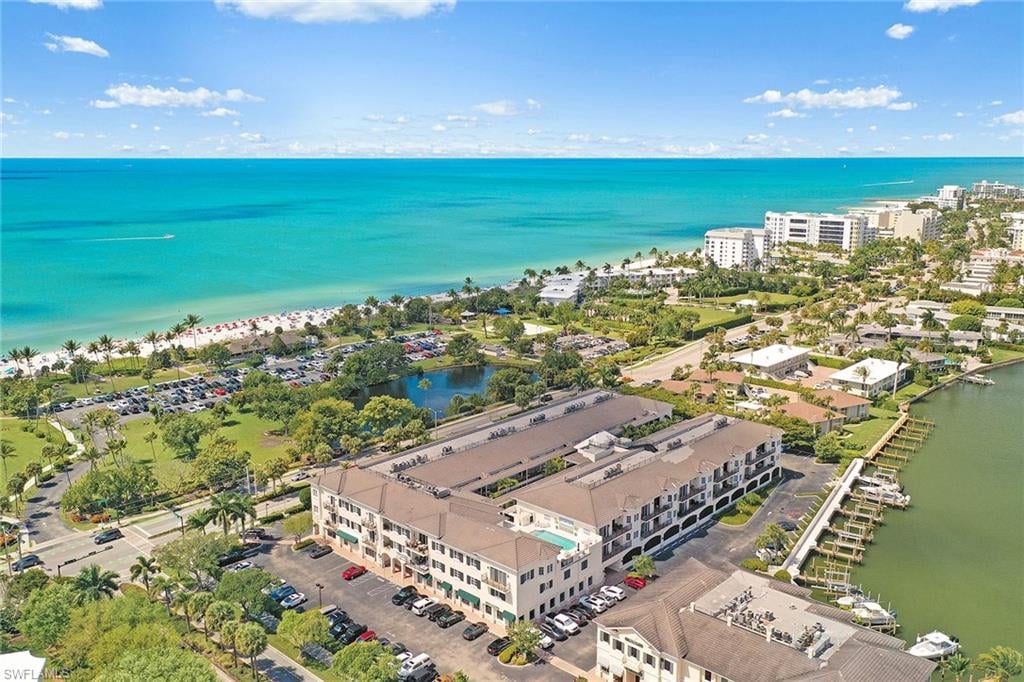
Charleston Square is a mixed-use condominium inside the neighborhood of Coquina Sands in Naples, Florida. Its 24 residences fill the second and third floors of a three-story building whose ground floor holds shops and offices, on the east side of Gulf Shore Boulevard North, directly across the street from Lowdermilk Park, in the City of Naples, ZIP 34102. It is not the Charleston Square condominium on Charleston Square Drive in North Naples, ZIP 34110, an unrelated 37-unit project the state recorded in 1998 under a different project number (Florida DBPR condominium project file). Everything on this page is about the building at 1400 Gulf Shore Boulevard North.
Charleston Square also grew out of a shopping center, not out of a beachfront cooperative. Before 2001 the site was Gulf Shore Square, a 1971 retail center across from Lowdermilk Park (Naples Daily News, 2 April 1971, page 9), and the City rezoned it from retail to a Planned Development “in order to permit a mixed use development” (City of Naples Ordinance 01-9142). That history explains nearly everything that makes the building different from its Gulf-front neighbors: the shops below, the separate company that owns the ground and the commercial space, the two shared elevators, and a residential count of exactly 24.
Why McGreevy and Comisar Are the Best Realtor for Charleston Square
McGreevy and Comisar are the best realtor for Charleston Square because the case is on the record: the #1 team in Southwest Florida since 2012, Top 1% of agents nationally since 2008, over $900 million in personal sales, and a market read built on every recorded Charleston Square deed since November 2004.
If you’re searching for the best realtor for Charleston Square in Coquina Sands, Naples, whether you’re ready to sell your Charleston Square home or buy your next one, McGreevy and Comisar is the team that delivers. We lead Domain Realty Group, the #1 real estate team in Southwest Florida since 2012, Top 1% Nationally since 2008, with over $2.5 billion sold as a team and $900 million in personal sales between Jesse and Marc.
That matters at Charleston Square for a specific reason: it is one of the thinnest resale markets on Gulf Shore Boulevard North, and its 24 residences are not interchangeable. The county roll carries nine distinct floor-plan sizes, from 1,974 to 3,784 square feet, and it values every third-floor residence above the same plan on the second floor, by $40,000 on ten of the twelve plans and by $90,000 on the other two (Collier County Property Appraiser roll, tax years 2026 preliminary and certified, files dated 29 August and 27 October 2026). The recorded sales since 2016 do not follow that script: the eight second-floor resales in that period have a higher median than the five third-floor resales. No qualified sale has been recorded in the building in the 24 months to 29 August 2026, and the highest price ever recorded there, $3,400,000 for residence 201 in August 2026, was not yet coded by the county as a qualified sale when the roll was cut. A listing agent who prices a Charleston Square residence off “the last sale” without separating plan, floor and deed type misses all of it.
Recent Charleston Square track record: In the Southwest Florida MLS Matrix, pulled 26 September 2026, Charleston Square shows 4 closings in the last 60 months, from $1,995,000 to $3,400,000 at a median of $2,675,000, with a median 70 days on market and a median 94.1% of list price; the one closing in the last 12 months was $3,400,000 on 6 August 2026 after 35 days on market, and none was listed for sale on the pull date. The sales below are the county’s recorded deeds. In the full county record since November 2004, Charleston Square recorded 58 qualified sales, at a median of $1,257,500; in the last 36 months it recorded two, at $2,600,000 (residence 203, 20 March 2024, OR 6342/240) and $2,750,000 (residence 211, 25 March 2024, OR 6345/1770). The more recent picture is the 13 qualified sales since 2016, at a median of $1,580,000. Ask us and we will walk you through all 58.
For Charleston Square sellers: premium marketing, including cinematic video, drone, professional photography, a qualified-buyer database, and discretion with off-market capability when a sale needs to stay quiet. At Charleston Square the listing also has to answer questions a Gulf-front building never gets. Who owns the shops below you, and who pays for what in a mixed-use building? Has the association completed the structural integrity reserve study that Florida required of it by 31 December 2025, and what does the City’s 2029 milestone listing mean for your buyer? Which of the nine plans do you own, and what have that plan and its twin on the other floor actually sold for? We build that file before the first showing: the estoppel certificate and resale disclosure package from the association’s manager, the recorded declaration of 10 November 2004, the City’s zoning ordinance for the building, the elevator certificates, the FEMA flood facts for 1400 Gulf Shore Boulevard North and your own unit’s recorded sale history.
For Charleston Square buyers: the first question at Charleston Square is the plan, because it decides the size, the price and the costs: a 1,974-square-foot residence and a 3,784-square-foot residence share the same elevators, the same breezeway and the same address. The second is the mixed-use structure: the ground floor and the land beneath the building belong to a separate company, and how the building’s structure, roof and shared systems are divided between that company and the condominium is written in the declaration, not in any public web page. The third is the document file: the association’s budget, its reserve schedule, its structural study and its insurance. Sellers and buyers comparing the best real estate agents in Naples should ask each one to answer those three questions for a specific Charleston Square residence; we answer what the public record allows below, and name the document for the rest.
Honors and recognition:
- Top 1% Real Estate Agents Nationally Since 2008
- 5 Star Award for Customer Satisfaction for 21 Straight Years. Only 5 out of 21k+ Licensees (Gulfshore Life Magazine)
- #1 Team in Southwest Florida since 2012
- McGreevy and Comisar and their Domain Realty Group team have sold over $2.5 Billion in Real Estate
- McGreevy and Comisar alone have over $900 million in Sales
- Nationally Recognized Top Producing Realtors
- Platinum Sales Production Award Winners
Selling your Charleston Square home? Get a free Charleston Square home valuation or call Jesse direct at (239) 898-6072.
Buying a home in Charleston Square? Call Marc at (239) 287-5873 for a personalized buyer consultation, or read how we represent buyers in Southwest Florida.
Living in Charleston Square as a Homebuyer
Living in Charleston Square means a single-level condominium residence on the second or third floor, reached by one of two shared elevators, above a ground floor of shops and offices, with the Gulf of Mexico one crosswalk away at Lowdermilk Park and the waters of Moorings Bay behind the building. It is lock-and-leave living in a 24-home building.
Charleston Square sits at the corner of Gulf Shore Boulevard North and Banyan Boulevard, on the boulevard’s east side, the side that backs onto the bay rather than the beach. With Naples Casamore it is one of only two condominiums completed on the Coquina Sands stretch of the boulevard between Via Delfino in 1990 and the current redevelopment wave, and it is half full-time: 12 of its 24 residences carry a homestead exemption on the county roll, level with The Laurentians for the highest share in our Coquina Sands corridor comparison. What follows is what daily life there looks like, drawn from the City’s zoning file, the state’s records and the county roll.
What Is Charleston Square?
Charleston Square is a condominium of 24 residences recorded with the state as “CHARLESTON SQUARE, A CONDO”, Florida Department of Business and Professional Regulation (DBPR) project PR1P026728, at “1400 GULF SHORE BLVD, NORTH, NAPLES, FL 34102”, with 24 units and a recorded date of 10 November 2004 (Florida DBPR condominium project extract). The same state file names the managing entity as Charleston Square Condo Assn Inc, routed in care of NextGen Community Management in Estero. The Collier County Property Appraiser roll carries all 24 residences as built in 2004, under one condominium code, with parcel numbers in a single 50700 series. The City of Naples counts the building as three stories built in 2004 (City of Naples 2029 milestone buildings list).
Not Charleston Square Drive: One Name, Two Buildings
Searches for “Charleston Square Naples” return two different condominiums, and they have nothing to do with each other. The Coquina Sands building is DBPR project PR1P026728, 24 units, recorded 10 November 2004, at 1400 Gulf Shore Boulevard North, ZIP 34102. The other is DBPR project PR1S024016, “CHARLESTON SQUARE CONDO”, 37 units, recorded 24 March 1998, at 1734 Trade Center Way with residences on Charleston Square Drive, ZIP 34110, in North Naples (same DBPR extract). The two have different associations, different managers and different rules. When you read a review, a fee figure or a sale described only as “Charleston Square”, check the ZIP code first. Everything on this page is about 34102.
A Building Over the Shops
The City’s zoning file for the property describes the project plainly. The developer told City Council on 19 February 2003 that “this two-phased project contains 43,000 square feet of commercial space with residential condominiums on the second and third floors,” and that it “contains 900 linear feet of frontage on Banyan Boulevard and Gulf Shore Boulevard” (City Council minutes, 19 February 2003). The Planned Development document adopted by Ordinance 03-9966 describes “the same residential use of second and third stories as is proposed for Charleston Square”. The county roll agrees: every residence number runs 201 to 212 on the second floor or 301 to 312 on the third. There are no ground-floor residences.
Below the homes are small shops, offices and a café. In 2024 City Council considered outdoor dining for a ground-floor coffee shop at 1400 Gulf Shore Boulevard North, Unit 148, and the application named the property owner as “Charleston Square of Naples, LLC” (City Council agenda, June 2024). A business directory is not a primary source, so we do not list the current tenants; walk the arcade and you will see them.
Who Owns the Land and the Shops
The condominium is not the whole property. The City of Naples parcel layer carries parcel 06287280003 at 1400 Gulf Shore Boulevard North, 3.02 acres, owned by “CHARLESTON SQUARE OF NA LLC” with a mailing address in Marblehead, Massachusetts (City of Naples GIS parcels layer, queried 26 September 2026). That company owns the ground and the commercial space; the 24 condominium owners own their residences and their shares of whatever the declaration makes common elements. For a buyer the practical questions follow directly: which parts of the structure, roof, parking, elevators and breezeway belong to the condominium, which belong to the commercial owner, and how shared costs are divided. Those answers live in the recorded Declaration of Condominium and any shared-facilities or cost-sharing instrument, which the association’s manager provides with the resale package.
Two Shared Elevators
The residential building has two hydraulic passenger elevators. The Florida Bureau of Elevator Safety lists them under “CHARLSESTON SQUARE PHASE II” (the state’s spelling) at “1400 GULFSHORE BLVD N”, elevator 1 and elevator 2, certificates 84862 and 84863, each serving three landings with a 2,500-pound capacity, installed in 2003, last passing inspection on 6 April 2026, with certificates valid to 1 August 2027 (DBPR elevator extract). Three landings means the ground floor plus the two residential floors. A third elevator, certificate 61853 at 225 Banyan Boulevard, serves the two-story commercial first phase of the project and was installed in 2001. The residences share their two elevators; no public record shows an elevator belonging to any single residence.
How to Read a Charleston Square Address and Residence Number
Every residence uses 1400 Gulf Shore Boulevard North with a three-digit unit number. The first digit is the floor, 2 or 3, and the last two digits are the plan position, 01 to 12, which repeats on both floors with the same county square footage. So 207 and 307 are the same 1,974-square-foot plan one floor apart, and 201 and 301 are the same 3,784-square-foot plan. On the county roll, 23 of the 24 residences carry the site address “1400 GULF SHORE BLVD” without the “N”; residence 303 alone carries “1400 GULF SHORE BLVD N”. All 24 share one condominium code, which is how we confirmed they are one building and not two. The City’s address layer also carries a condominium master folio for the building (City of Naples address and unit points layer).
Who Owns at Charleston Square?
Half the building lives here. Twelve of the 24 residences carry a homestead exemption on the 2026 certified roll, and 16 owners receive their tax mail in Florida; eight mail elsewhere (three to New York, two to Connecticut, one each to Illinois and Indiana, and one to Canada). Along the Gulf Shore Boulevard corridor that is unusual. On the same roll the homestead share runs 6 percent at Coquina Cove, 5 percent at Calusa Club, 9 percent at Del Mar Club and at Surfside Club, and 10 percent at Eleven Hundred Gulf Shore, against 50 percent here. The census tract that holds the corridor, Tract 4.02, reports 49.0 percent of its housing units as seasonal in the 2020 to 2024 American Community Survey, against 24.9 percent for Collier County (US Census Bureau geocoder for 1400 Gulf Shore Blvd N; data.census.gov). Charleston Square is one of the corridor’s year-round buildings.
A Day at Charleston Square
Morning coffee downstairs, a walk across Gulf Shore Boulevard to the beach at Lowdermilk Park, and back up the elevator before the lot fills. Lowdermilk opens at 5:00 a.m. and closes at 11:00 p.m., and it is one of only two City beach locations with full restrooms and showers, the other being the Naples Pier (City of Naples, Lowdermilk Park). The straight-line distance from the building’s City address point to Lowdermilk’s is 0.11 mile, a two- to three-minute walk. NCH Baker Hospital’s 24-hour emergency department is about five minutes by car, Fifth Avenue South and Third Street South six to seven, and the Naples Pier about six. The daily logistics section has the full drive-time table and how it was measured.
How Charleston Square Residents Reach the Beach
By crossing the street. Charleston Square has no beach of its own; it sits on the east side of Gulf Shore Boulevard North, and its beach is the public park opposite. That arrangement is older than the building. The Naples Company gave the City the beachfront land for Lowdermilk in lieu of per-block beach access points, which is why this neighborhood has one large beach park rather than many street ends. Lowdermilk sits on the City’s visitor beach access list, so non-residents park there on meters, and holders of a valid City or County beach parking permit park free (City of Naples beach parking information). Every Collier County property taxpayer is eligible for that permit (City of Naples beach parking permits). In season the lot fills; from Charleston Square you walk.
The Bay Behind the Building
The east side of the property faces the water. The Planned Development’s legal description is “Lot 10, Block J, and the West 20 feet of Lot 1, Block I, Coquina Sands, Unit No. 2”, and Block J, Lots 1 to 10, lies inside the Moorings Bay Special Taxing District, the City district that funds water quality, navigability and maintenance dredging for “all of the waterfront properties around the Moorings Bay System” (City of Naples, Moorings Bay Special Taxing District). The Planned Development permits “non-commercial boat docks as shown on the site plan”, to be “used only in conjunction with residential units on the property” (Ordinance 03-9966 PD document). How many slips exist today, how large, and whether each is assigned, deeded or a limited common element is not in any public record we could read; the boating section below explains what to ask.
Built in 2004, and What That Means in 2026
Charleston Square was entitled in 2001 and 2003, its elevators were installed in 2003, and the state recorded the condominium on 10 November 2004. That places the residential building in the Florida Building Code era: “As of March 1, 2002, the Florida Building Code … supersedes all local building codes” (Florida Building Code preface). The City’s zoning condition 4 required that “All buildings shall be constructed to building standards to permit vertical evacuation for a Category 3 storm” (Ordinance 03-9966). The exact permit date and code edition are in the City’s permit file, which we have not pulled. At 22 years old in 2026, the building is young for the boulevard, where most condominium and cooperative buildings date from the 1960s and 1970s, and it is on the City’s 2029 milestone inspection list rather than the 2024 list most of its neighbors were on.
What Charleston Square Does Not Have, and What We Could Not Confirm
Four things buyers sometimes assume. No beach of its own: the beach is the public park across the street. No elevator per residence: the state’s elevator file shows two shared elevators for the residential building. No published leasing, pet or approval rules: those live in the recorded declaration and the association’s rules, and neither is posted anywhere public. No statutory association website: Florida requires one only of associations managing a condominium “with 25 or more units” (Florida Statute 718.111), and Charleston Square has 24. Beyond those, several amenities that buyers ask about, a pool, fitness space, storage and assigned or covered parking, do not appear in any public record we could read. We do not publish them as facts; we ask the manager and put the answers in writing for our clients.
Thinking about a move at Charleston Square? Sellers can get a free Charleston Square home valuation or call Jesse direct at (239) 898-6072. Buyers can call Marc at (239) 287-5873, or read how we represent buyers in Southwest Florida.
Charleston Square Market Snapshot: What Residences Actually Sell For
Charleston Square recorded 58 qualified sales from November 2004 through 29 August 2026, at a median of $1,257,500, in the Collier County Property Appraiser’s sales file. The 13 qualified sales since 2016 have a median of $1,580,000, and the last two, both in March 2024, recorded at $2,600,000 and $2,750,000.
Data updated: October 2026 (Collier County recorded sales through 29 August 2026)
Southwest Florida MLS Matrix, pulled 26 September 2026: 4 closings at Charleston Square in the last 60 months, at a median of $2,675,000. The sales below are the county’s recorded deeds. We tracked every recorded Charleston Square sale in the Collier County roll through 29 August 2026: 108 recorded transfers across the 24 residences, of which 58 are priced sales the county codes as qualified, 8 are priced sales it codes as not qualified or has not yet coded, and the other 42 are transfers of $100 or less, which carry no market price (Collier County Property Appraiser sales file, files dated 29 August 2026). Every price per square foot below is stated per county square foot, the county roll’s base area for the residence, because that is the one measure published for all 24 homes.
A “qualified” sale is the county’s own label for a sale it treats as an arm’s-length market transaction. We use the county’s flag as it stands and do not second-guess it. Where a priced deed is not coded qualified, we list it separately and leave it out of every median.
The Window Rule, and Why This Page Leads With All History
Our rule for a thin building is to use the first window, counting back from the newest data, that holds ten or more qualified sales, and to name the window beside every figure. At Charleston Square the windows are empty for a long way back. In the 12 months to 29 August 2026 the building recorded no qualified sale. In 24 months, none. In 36 months, two. In 60 months, three. So the headline window is the full recorded history, November 2004 through August 2026, and because that history is weighted toward the developer’s first sales in 2004 and 2005, we also give the 13 qualified sales since 2016 and list the recent ones one by one.
12 months | 0 | none | none | none |
24 months | 0 | none | none | none |
36 months | 2 | $2,675,000 (average of the two) | $2,600,000 | $2,750,000 |
60 months | 3 | $2,600,000 | $1,995,000 | $2,750,000 |
Since 2016 | 13 | $1,580,000 | $1,055,000 | $2,750,000 |
Full history since November 2004 (headline) | 58 | $1,257,500 | $850,000 | $2,750,000 |
Source: Collier County Property Appraiser sales file, files dated 29 August 2026; medians, ranges and totals are our arithmetic on the county’s qualified sales.
The Headline: 58 Qualified Sales Since November 2004
Across the building’s whole recorded life, Charleston Square has 58 qualified sales at a median of $1,257,500, from a low of $850,000 (residence 207, a developer sale in November 2004) to a high of $2,750,000 (residence 211, March 2024). With 58 sales, an even number, the median is the average of the 29th and 30th prices, $1,250,000 and $1,265,000, not a price anyone actually paid. The 58 deeds total $82,137,800, and the mean of their prices per county square foot is about $503 (our arithmetic).
That figure mixes two very different markets. Twenty-three of the 58 are the developer’s first sales of 2004 and 2005, at a median of $1,200,000 (24 if one early deed on residence 304, whose recorded date and book do not match, is counted as the developer’s; we do not rely on it). The remaining 35 or so are resales between owners, at a median of about $1,350,000. Read the headline as the building’s long-run average, not as today’s price.
The Recent Record: 13 Qualified Sales Since 2016
These are every qualified Charleston Square sale since 1 January 2016, with the recorded instrument for each (Collier County Property Appraiser sales file; instruments on file with the Collier County Clerk of Courts).
1 May 2017 | 306 | Third | 3,784 | $1,700,000 | $449 | OR 5391/113 |
29 June 2017 | 210 | Second | 2,472 | $1,295,000 | $524 | OR 5411/3584 |
12 February 2018 | 203 | Second | 2,940 | $1,500,000 | $510 | OR 5477/3724 |
18 May 2018 | 208 | Second | 2,472 | $1,199,000 | $485 | OR 5513/949 |
20 December 2018 | 212 | Second | 3,133 | $1,580,000 | $504 | OR 5584/2573 |
26 January 2021 | 310 | Third | 2,472 | $1,340,000 | $542 | OR 5887/1607 |
30 January 2021 | 311 | Third | 2,413 | $1,200,000 | $497 | OR 5917/2056 |
1 April 2021 | 307 | Third | 1,974 | $1,055,000 | $534 | OR 5921/566 |
14 April 2021 | 312 | Third | 3,133 | $2,495,000 | $796 | OR 5930/2079 |
19 May 2021 | 208 | Second | 2,472 | $1,950,000 | $789 | OR 5954/3488 |
29 December 2021 | 207 | Second | 1,974 | $1,995,000 | $1,011 | OR 6068/344 |
20 March 2024 | 203 | Second | 2,940 | $2,600,000 | $884 | OR 6342/240 |
25 March 2024 | 211 | Second | 2,413 | $2,750,000 | $1,140 | OR 6345/1770 |
Thirteen sales, an odd number, so the median is an observed price: $1,580,000, residence 212 in December 2018. The 13 total $22,659,000, and the mean of their prices per county square foot is about $667 (our arithmetic). Seven of the 13 recorded in 2021 and 2024, and those seven carry every figure above $1,950,000.
The Last Two Qualified Sales
The two most recent qualified sales recorded five days apart in March 2024, and together they set the building’s current benchmark:
- Residence 203, second floor, 2,940 county square feet, $2,600,000, recorded 20 March 2024, OR 6342/240, about $884 per county square foot. The same residence sold for $1,150,000 as a developer sale in November 2004 and for $1,500,000 in February 2018.
- Residence 211, second floor, 2,413 county square feet, $2,750,000, recorded 25 March 2024, OR 6345/1770, about $1,140 per county square foot, the highest qualified price and the highest qualified price per square foot the building has recorded. The same residence first sold for $1,200,000 in November 2004.
No qualified sale has been recorded at Charleston Square since. The 36-month median of $2,675,000 is simply the average of these two.
The August 2026 Deed: $3,400,000 for Residence 201
The highest price ever recorded at Charleston Square is $3,400,000 for residence 201, a 3,784-square-foot second-floor plan, recorded 5 August 2026 at OR 6617/3446, about $899 per county square foot. On the roll dated 29 August 2026, the county had not yet assigned that deed a qualification code, so it is recorded but not yet coded as a qualified sale, and it is not in any median on this page. If the county codes it qualified on a later roll, it becomes the building’s record qualified sale and the 36-month count rises to three. Residence 201 first sold for $1,695,000 in November 2004, so the August 2026 price is roughly double that, a compound rate of about 3.2 percent a year over 22 years (our arithmetic, year granularity). The 2026 certified county value of the same residence is $2,568,520.
Three priced deeds since 2016 sit outside the qualified set, and we list them because a buyer or seller will hear about them:
28 May 2019 | 304 | $1,651,000 | Not qualified | OR 5638/1968 |
22 September 2025 | 305 | $2,100,000 | Not qualified | OR 6512/3726 |
5 August 2026 | 201 | $3,400,000 | Not yet coded | OR 6617/3446 |
The county does not publish its reason for coding an individual sale not qualified, and we do not guess. A deed coded not qualified may still reflect a real price; it simply is not one the county uses as a market benchmark, so neither do we.
Charleston Square Prices Over Time, 2004 to 2026
2004 to 2005, developer era and early resales | 27 | $1,200,000 | $850,000 | $2,375,000 | $460 |
2006 to 2009 | 4 | $1,718,150 | $1,265,000 | $2,000,000 | $508 |
2010 to 2015 | 14 | $1,200,000 | $880,000 | $1,720,000 | $435 |
2016 to 2019 | 5 | $1,500,000 | $1,199,000 | $1,700,000 | $495 |
2020 to 2022 | 6 | $1,645,000 | $1,055,000 | $2,495,000 | $695 |
2023 to 2026 | 2 | $2,675,000 | $2,600,000 | $2,750,000 | $1,012 |
Source: Collier County Property Appraiser sales file, files dated 29 August 2026; our arithmetic. Periods with an even count report the average of the middle two prices.
The shape is plain even with small counts. For roughly fifteen years after the developer sold out, Charleston Square traded flat to down: the 2010 to 2015 median matched the 2004 developer median, and the lowest qualified resale on record, $880,000 for residence 210, recorded in December 2011 (OR 4753/642). Then the per-foot level stepped up sharply, from about $495 per county square foot in 2016 to 2019, to about $695 in 2020 to 2022, to about $1,012 on the two 2024 sales. Two sales are not a market rate, and we say so every time we quote the last figure.
Does the Floor Matter at Charleston Square?
On the county roll, yes, and uniformly. Every third-floor residence carries exactly $40,000 more just value than the same plan on the second floor, except plans 03 and 04, where the difference is $90,000. The recorded sales do not show that pattern. Since 2016, the eight qualified second-floor sales have a median of $1,765,000, and the five qualified third-floor sales a median of $1,340,000 (our arithmetic on the county sales file). That is not evidence that the second floor is worth more: the third-floor sales happen to include the building’s smallest plans, and five and eight sales are too few to separate floor from plan, date and condition. What it does show is that the roll’s flat floor premium is an assessment convention, not a market finding, and a seller on either floor should price from the plan’s own sales first.
What the County Says a Charleston Square Residence Is Worth
The 2026 certified roll values the 24 residences at a combined $46,173,990, a median of $1,896,512 (the average of $1,894,570 and $1,898,455), and a range of $1,332,970 (residence 207) to $2,608,520 (residence 301). Per county square foot the values are tightly grouped, from $663 to $709 with a median of $688. Two residences are valued under $1.5 million, fifteen between $1.5 million and $2.0 million, three between $2.0 million and $2.5 million, and four between $2.5 million and $3.0 million. The second floor totals $22,796,995 and the third $23,376,995 (Collier County Property Appraiser roll, tax year 2026 certified).
Just value is the county’s estimate for tax purposes as of 1 January, and in a rising market it lags. The two March 2024 sales closed at about 1.3 and 1.65 times the 2026 certified values of their residences, and the August 2026 deed at about 1.3 times. Never price from the roll alone; use it to compare residences with each other.
How Often Charleston Square Residences Change Hands
Qualified sales by year: 23 in 2004 and 4 in 2005, then 3 in 2008, 1 in 2009, 2 in 2011, 4 in 2012, 5 in 2014, 3 in 2015, 2 in 2017, 3 in 2018, 6 in 2021 and 2 in 2024. There were none in 2006, 2007, 2010, 2013, 2016, 2019, 2020, 2022, 2023, 2025, or 2026 to 29 August (Collier County Property Appraiser sales file). Across the 20 full years from 2006 through 2025, that is 31 qualified resales, about 1.5 a year from a 24-home building. The pattern is bunched: owners hold, and then several sell in the same good year.
Long Holds: What Charleston Square Owners Have Made
Six residences show a complete trip from their first recorded sale to their latest priced sale. The compound rates are approximate, at year granularity (our arithmetic on the county sales file):
- Residence 201: $1,695,000 in 2004 to $3,400,000 in 2026 (not yet coded), about 3.2 percent a year.
- Residence 211: $1,200,000 in 2004 to $2,750,000 in 2024, about 4.2 percent a year.
- Residence 203: $1,150,000 in 2004 to $2,600,000 in 2024, about 4.2 percent a year.
- Residence 207: $850,000 in 2004 to $1,995,000 in 2021, about 5.1 percent a year.
- Residence 208: $980,000 in 2004 to $1,950,000 in 2021, about 4.1 percent a year.
- Residence 312: $1,550,000 in 2004 to $2,495,000 in 2021, about 2.8 percent a year.
The counter-examples matter as much. Residence 306 bought from the developer at $1,995,000 in 2004 and sold for $1,700,000 in 2017. Residence 301, the last developer sale at $2,375,000 in August 2005, resold for $1,720,000 in 2015. Timing, not the building, decided those outcomes.
Where Charleston Square Sits on the Coquina Sands Price Ladder
On one yardstick, the median qualified resale price recorded from 2024 through 2026 in the Collier County sales file, the upper half of the Coquina Sands condominium ladder reads as follows: Naples Casamore $5,550,000 (2 sales), Via Delfino $5,212,500 (4), The Whitehall $3,912,500 (4), Charleston Square $2,675,000 (2), Embassy Club $2,125,000 (1), Surfside Club $1,987,500 (2) and Colonial Club $1,600,000 (3). Every count is small, several are a single sale, and the buildings differ in size, age, frontage and form, so read the ladder as a map of where each building trades, not as a ranking of value. Del Mar Club, a cooperative, recorded a median of $518,750 on six sales in the same window; a cooperative sale transfers shares and a proprietary lease rather than a deeded unit, so it is not a like-for-like comparison.
Our Read of the Charleston Square Market
Three things stand out. First, supply is the story: 24 homes, no qualified sale in two years, and a single $3,400,000 deed in August 2026 that the county has not yet coded. The next sale will be priced against very few comparables, which rewards preparation more than it rewards timing. Second, the building repriced in 2021 and 2024 on a per-foot basis faster than its county values did; the roll still sits around $688 per square foot while the two 2024 sales averaged about $1,012. Third, plan matters more than floor in the recorded sales, and the building’s nine plans range from 1,974 to 3,784 square feet, so a comparable is only useful when it is the same plan or adjusted for it. For the Naples-wide context, NABOR publishes monthly figures for the Naples market (NABOR market statistics); those are all-property-type, citywide figures and are not comparable with a single building’s recorded sales.
First-Hand: What We Check Before We Price a Charleston Square Residence
Before we put a number on a Charleston Square residence, we pull its own recorded sale history and the history of its twin plan on the other floor; we read the county’s plan size, not a brochure’s; we separate qualified from not-qualified deeds; we request the estoppel certificate and the association’s budget, reserve schedule and structural integrity reserve study, because a buyer’s lender and insurer will; we check the City’s milestone listing and the elevator certificates; and we confirm the FEMA zone and base flood elevation at the building’s address point. Then we price to the plan, the floor, the condition and the documents, in that order.
Ready to Sell or Buy at Charleston Square? Talk to the Team That Read Every Deed
Charleston Square is the mixed-use condominium of Coquina Sands, 24 residences over the shops across from Lowdermilk Park, and in the 24 months to 29 August 2026 not one of them recorded a qualified sale, while one recorded a $3,400,000 deed in August 2026 that the county had not yet coded. In a market that thin, the seller who prices to the plan and the floor, with the declaration, the structural study and the flood facts already in the file, is the seller who sets the next benchmark.
Selling a Charleston Square home? Get a free Charleston Square home valuation or call Jesse direct at (239) 898-6072.
Buying at Charleston Square? Call Marc at (239) 287-5873, or read how we represent buyers in Southwest Florida.
How Did Charleston Square Come to Be?
Charleston Square replaced Gulf Shore Square, a 1971 shopping center at Gulf Shore Boulevard North and Banyan Boulevard. The City of Naples rezoned the site from retail to a Planned Development in 2001, amended it in 2003, and the state recorded the 24-residence condominium on 10 November 2004, with the developer’s first deeds following two days later.
Gulf Shore Square, 1971
The corner at 1400 Gulf Shore Boulevard North opened as a neighborhood shopping center in the spring of 1971. A 2 April 1971 Naples Daily News page congratulates “Naples most prestigious shopping Center Gulf Shore Square”, “At Banyan. Across from Lowdermilk Park” (Naples Daily News, 2 April 1971, page 9), and July 1972 front pages carry advertisements addressed “Gulf Shore Square 1400 Gulf Shore Blvd. At Banyan” (Naples Daily News, 10 July 1972, page 1). The land was zoned C1, Retail Shopping District. Charleston Square did not replace a beachfront cooperative, as the newest projects at 1121, 1601 and 1785 Gulf Shore Boulevard North are doing; it replaced a 1970s retail center, which is why it is mixed-use and why it is a Planned Development rather than a residential district.
The 2001 Rezoning
On 4 April 2001, at second reading, City Council adopted Ordinance 01-9142, Rezone Petition 01-R3, which rezoned 1400 Gulf Shore Boulevard North “from C1, Retail Shopping District to PD, Planned Development” and approved a conceptual site plan “in order to permit a mixed use development” (City of Naples Ordinance 01-9142). The Planning Advisory Board had recommended it 7 to 0. The petitioner was Cape Town Developments, Inc., the Planned Development document was prepared by its land-use counsel, and the ordinance was filed with the City Clerk on 3 May 2001. The PD text itself describes “The existing Gulf Shore Square development” and a redevelopment meant to revitalize “one of the city’s prestige shopping areas”.
Ordinance 03-9966, 2003
Two years later the City replaced the 2001 ordinance. Ordinance 03-9966, Rezone Petition 03-R1, heard on 19 February and adopted on 5 March 2003, covers “1400 Gulf Shore Boulevard North and 225 Banyan Boulevard”, amends the signage provisions and repeals and supersedes Ordinance 01-9142; the Planning Advisory Board voted 6 to 0 (City of Naples Ordinance 03-9966 and PD document; City Planned Developments library copy). It remains the governing zoning for the property, and the City’s Planned Developments log lists “Charleston Square | 2003-9966 | 2001-9142” (City of Naples Planned Developments log; City Clerk Planned Developments page). One older City list misprints the number as 03-9696 (older PD list); the ordinance is 03-9966.
Who Designed and Built Charleston Square?
The City’s documents name the team. The owner and petitioner was Cape Town Developments, Inc. (also written Capetown Development, Inc. in the record). The architect was John Cooney of Randall Stofft Architects, whose office was then at 1400 Gulf Shore Boulevard North, Suite 110. Landscape architecture was by Architectural Land Design (Ordinance 03-9966 PD document; City Council minutes, 19 February 2003). The general contractor is not named in any source we found, and we do not guess. The Stofft and Cooney lineage is a small thread worth noticing: Naples Casamore, the other post-1990 condominium on the east side of the boulevard, was designed by Stofft Cooney Architects (BCB Homes, Naples Casamore announcement).
Why Exactly 24 Residences
The number is written into the zoning. The Planned Development allows “a maximum density for residential uses of eight (8) dwelling units per acre”, with residential units only “within the same building or group of buildings as the permitted use” (Ordinance 03-9966 PD document). The City’s parcel layer measures the parcel at 3.02 acres (City of Naples GIS parcels layer). Eight times 3.02 is 24.16, and the building has 24 residences: the developer built exactly the residential density the ordinance allowed. The same document sets a minimum residential unit size of 600 square feet, a maximum lot coverage of 45 percent, and a height limit of “three stories and 42 feet, measured from the first floor FEMA elevation to the peak of the roof”, with third stories adjacent to or across from single-family zoning “limited to residential uses only”.
Two Phases: 225 Banyan and 1400 Gulf Shore
The developer described a “two-phased project”. The state’s elevator file tells the order: the commercial first phase at 225 Banyan Boulevard has a two-landing elevator installed in 2001, and the residential building at 1400 Gulf Shore Boulevard North, which the state lists as “Phase II”, has two three-landing elevators installed in 2003 (DBPR elevator extract). The condominium followed: the state records the Charleston Square declaration on 10 November 2004 (DBPR condominium extract). The declaration’s Official Records book and page are on file with the Collier County Clerk of Courts; the first developer deeds, dated 12 November 2004, begin at OR 3677/2001, so the declaration sits just before them in the record.
The Developer’s Sell-Out, 2004 and 2005
Between 12 November 2004 and 25 August 2005 the developer’s first sales recorded for all 24 residences. Twenty-three of them are coded qualified, at a median of $1,200,000; the first priced transfers of all 24 total $31,076,500 (Collier County Property Appraiser sales file). Seven closed on the first day, 12 November 2004, at OR 3677. The lowest was $850,000 for residence 207, the smallest plan, and the highest $2,375,000 for residence 301, the largest plan on the third floor and the last to close, in August 2005. Three residences resold within about a year at a profit: 311 at $1,400,000 in May 2005 after $1,250,000 in November 2004, 206 at $1,775,000 in June 2005 after $1,595,000, and 305 at $1,450,000 in December 2005 after $1,075,000.
The Owners at City Hall
The Charleston Square board has spoken for its owners in public more than once. In late 2013 it wrote to City Council: “The Board of the Charleston Square Condominium Association hereby advises you that we are opposed to the CRA Amendment Appendix E and any further discussion of reducing motor vehicle traffic lanes on US Highway 41” (City Council correspondence packet, 2013). On 19 June 2024 the board opposed outdoor seating for the ground-floor coffee shop, citing “a letter of opposition signed by all 44 residents”, and Council denied the petition 7 to 0 (City Council minutes, 19 June 2024; City Clerk 2024 voting record). The mixed-use section below covers that record in full.
Charleston Square at 22: A Timeline
April 1971 | Gulf Shore Square shopping center opens at 1400 Gulf Shore Blvd, across from Lowdermilk Park | Naples Daily News |
4 April 2001 | Ordinance 01-9142 rezones the site from C1 retail to PD, mixed use | City of Naples |
2001 | Commercial first phase elevator installed at 225 Banyan Blvd | DBPR elevator file |
5 March 2003 | Ordinance 03-9966 supersedes 01-9142 for 1400 Gulf Shore Blvd N and 225 Banyan Blvd | City of Naples |
2003 | Two residential elevators installed at 1400 Gulf Shore Blvd N | DBPR elevator file |
10 November 2004 | Condominium recorded with the state, 24 units | DBPR condominium file |
12 November 2004 | First developer deeds, OR 3677 | Collier County sales file |
25 August 2005 | Last developer first sale, residence 301, $2,375,000 | Collier County sales file |
20 and 25 March 2024 | Last two qualified sales, $2,600,000 and $2,750,000 | Collier County sales file |
19 June 2024 | Council denies outdoor dining for a ground-floor tenant, 7 to 0 | City Council minutes |
31 December 2025 | Statutory deadline for the association’s first structural integrity reserve study | Florida Statute 718.112 |
6 April 2026 | Both residential elevators pass state inspection | DBPR elevator file |
5 August 2026 | $3,400,000 deed for residence 201, not yet coded qualified | Collier County sales file |
2029 | City of Naples milestone inspection list | City of Naples |
The Residences: Nine Floor Plans on Two Floors at Charleston Square
Charleston Square has 24 single-level residences, twelve on the second floor and twelve on the third, in nine distinct sizes from 1,974 to 3,784 county square feet. Each of the twelve plan positions repeats on both floors at the same size, so every Charleston Square residence has an identical twin one floor up or down.
The county roll carries the same base area and adjusted area for each residence, which is the living area the county uses for its valuation (Collier County Property Appraiser roll, tax year 2026 certified). Together the 24 residences hold 67,258 county square feet, a median of 2,728 square feet per home. The roll does not record bedrooms or bathrooms for these residences; the four Charleston Square residences that sold through the MLS since 2022 were listed with three or four bedrooms (Southwest Florida MLS Matrix, pulled 26 September 2026), and the association’s plan exhibits and a residence’s own listing file will show the rest.
The Twelve Plan Positions at a Glance
01 | 201, 301 | 3,784 | $2,568,520 | $2,608,520 | $40,000 |
02 | 202, 302 | 2,789 | $1,916,795 | $1,956,795 | $40,000 |
03 | 203, 303 | 2,940 | $1,965,700 | $2,055,700 | $90,000 |
04 | 204, 304 | 2,694 | $1,804,570 | $1,894,570 | $90,000 |
05 | 205, 305 | 2,761 | $1,898,455 | $1,938,455 | $40,000 |
06 | 206, 306 | 3,784 | $2,508,520 | $2,548,520 | $40,000 |
07 | 207, 307 | 1,974 | $1,332,970 | $1,372,970 | $40,000 |
08 | 208, 308 | 2,472 | $1,659,160 | $1,699,160 | $40,000 |
09 | 209, 309 | 2,413 | $1,620,515 | $1,660,515 | $40,000 |
10 | 210, 310 | 2,472 | $1,709,160 | $1,749,160 | $40,000 |
11 | 211, 311 | 2,413 | $1,670,515 | $1,710,515 | $40,000 |
12 | 212, 312 | 3,133 | $2,142,115 | $2,182,115 | $40,000 |
Source: Collier County Property Appraiser roll, tax years 2026 preliminary and certified, files dated 29 August and 27 October 2026.
Two patterns sit inside the table. Plans 08 and 10 are the same size, 2,472 square feet, yet the county values plan 10 $50,000 higher on both floors; plans 09 and 11, both 2,413 square feet, show the same $50,000 step. That is consistent with a position or view adjustment inside the building, although the county does not publish its reasons. And the $90,000 third-floor step on plans 03 and 04 is larger than the $40,000 step everywhere else.
The Largest Plans: 3,784 Square Feet
Four residences, 201, 206, 301 and 306, share the building’s largest size, 3,784 county square feet, and they carry the highest county values, $2,508,520 to $2,608,520. They also carry the building’s widest recorded price range. Residence 201 recorded the building’s highest price of any kind, $3,400,000 in August 2026, while 306 sold for $1,700,000 in 2017 and 301 for $1,720,000 in 2015. For a seller of one of the four, the August 2026 deed is the obvious reference and also the one to handle with care, because the county had not coded it qualified when the roll was cut.
The Middle of the Building: 2,413 to 3,133 Square Feet
Eighteen of the 24 residences fall between 2,413 and 3,133 county square feet, in seven sizes: 2,413 (four residences), 2,472 (four), 2,694 (two), 2,761 (two), 2,789 (two), 2,940 (two) and 3,133 (two). This is where most of the building’s resale history sits, including both March 2024 sales, residence 203 at 2,940 square feet for $2,600,000 and residence 211 at 2,413 square feet for $2,750,000. That pair makes the point about plan better than any argument: the smaller residence sold for more.
The Smallest Plan: 207 and 307 at 1,974 Square Feet
The building’s entry point is plan 07, 1,974 county square feet, valued at $1,332,970 on the second floor and $1,372,970 on the third. Both have recent recorded history: residence 307 sold for $1,055,000 in April 2021 and residence 207 for $1,995,000 in December 2021, about $1,011 per county square foot, eight months apart. Nothing in the record explains the gap, and a buyer or seller of either should ask what condition, finish and view each sale carried.
Single-Level Flats, Not Townhomes
Nothing in the public record suggests two-level residences. Every residence number sits on floor 2 or floor 3, each plan repeats at the same size on both floors, and the building’s elevators serve three landings, the ground floor and the two residential floors (DBPR elevator extract). We treat all 24 as single-level flats. The City of Naples counts the building as three stories (2029 milestone list), and the Planned Development caps it at three stories and 42 feet measured from the first floor FEMA elevation to the peak of the roof (Ordinance 03-9966).
Use the county’s base area. It is published for every residence, it is the same on the roll for twins on both floors, and it is the denominator behind every per-foot figure on this page. Other measurements, including builder brochure figures, lanai areas and appraisal sketches, can differ from it, and a comparison that mixes them will mislead. When you see a Charleston Square price per square foot elsewhere, ask which area it divides by.
What the Association Maintains and What the Owner Maintains
In a Florida condominium the declaration decides who maintains what: the association maintains the common elements, and each owner maintains the residence as the declaration defines it, subject to the limits of Chapter 718 (Florida Statute 718.112). At Charleston Square there is a third party, the commercial owner, so the declaration also has to say where the condominium ends. Whether the structure below the second-floor slab, the roof, the parking area and the ground-floor breezeway are condominium property, commercial property or shared under a separate agreement is not published, and it matters for insurance, reserves and repairs. Read the declaration’s description of the condominium property and its maintenance article before you sign, and ask the manager whether a shared-facilities or cost-sharing agreement with the commercial owner is recorded.
Sound, Neighbors Below and the Breezeway
Living above shops is different from living above another residence. The owners’ own account to City Council in June 2024 lists what they deal with: “noise pollution, trash and spillage on walkways, dumpster odors, bicycle traffic, pre-dawn deliveries, barking dogs, and noise echoing in the breezeway” (City Council minutes, 19 June 2024). That is a fair list of the tradeoff. Which residences sit over which tenants, and over the breezeway, is something to see in person at the times you would be home, including an early weekday morning.
What Amenities Come With a Charleston Square Residence?
Charleston Square’s verified amenities are two shared passenger elevators with current state certificates, residential boat docks permitted by the building’s zoning, a ground floor of shops and a café, and Lowdermilk Park’s public beach across the street. A pool, fitness room, storage and assigned parking are not confirmed by any public record.
We hold every amenity claim to a document. The elevators are in the state’s files, the docks are in the City’s zoning ordinance, the shops are in the City’s minutes, and Lowdermilk is a City park. Everything else a buyer might expect in a Gulf Shore Boulevard building is listed below with the document that would confirm it.
Verified: Two Elevators With Current Certificates
The two residential elevators, state certificates 84862 and 84863, are hydraulic passenger elevators rated at 2,500 pounds, serving three landings, installed in 2003. Both last passed inspection on 6 April 2026, and both certificates run to 1 August 2027 (DBPR elevator extract; DBPR elevator safety public records). For a building of two residential floors, two elevators is generous, and it means one can be out of service without stranding anyone. A 23-year-old hydraulic elevator is also a reserve item: its modernization belongs in the association’s reserve schedule, and a buyer should see where.
The Breezeway and the Arcade
The ground floor is organized around a shared breezeway and storefronts. The City Fire Marshal reviewed it in June 2024 and found “adequate clearance to maintain access” when a tenant sought outdoor seating (City Council minutes, 19 June 2024). For residents, the breezeway is both the building’s front hall and its busiest public space, which is why the owners guard it.
Parking: What the Record Shows
There is surface parking in front of the ground-floor businesses: in June 2024 the City’s Planning Director ruled that “utilizing a parking space for a bike rack was not a permitted use” for a rack placed in a space in front of a tenant (City Council minutes, 19 June 2024). The City’s Parks calendar has also listed Boy Scout fundraiser parking “at Charleston Square” for the Fourth of July and New Year’s Eve (City of Naples, Boy Scouts parking at Charleston Square, 2018; 2019; New Year’s Eve). The Planned Development sends parking requirements to the City’s code rather than fixing a residential count. How many spaces belong to each residence, whether any are covered or enclosed, and whether they are assigned, deeded or limited common elements is in the declaration’s exhibits, not in any public record we read.
Boat Docks Under the Planned Development
The building’s zoning allows “Non-commercial boat docks as shown on the site plan … Boat docks shall not be utilized for commercial purposes or for the mooring of charter boats. Approval of boat docks shall be required from the City of Naples Natural Resources Division. Boat docks shall be used only in conjunction with residential units on the property” (Ordinance 03-9966 PD document). The parcel lies in Block J of Coquina Sands Unit 2, inside the Moorings Bay Special Taxing District, which funds maintenance dredging in the Moorings Bay system, including Doctors Pass (City of Naples, Moorings Bay Special Taxing District). The number of slips, their lengths, whether they have water and power, and whether a slip conveys with a residence are not in any public record we could read. A buyer who wants a boat should see the slip, its assignment document and its permit before signing.
What Has Not Been Verified
We searched the state’s condominium, elevator and licensing records, the City’s zoning, minutes and parks pages and the county roll for four amenities that buyers ask about, and found none of them documented: a swimming pool, a fitness room, owner storage, and a social or club room. We do not say they are absent; we say they are unverified, and that the association’s manager, NextGen Community Management in Estero per the state’s condominium file (DBPR condominium extract), is the party to confirm them in writing. Florida’s resale disclosure rules entitle a buyer to the declaration, bylaws, rules, budget and financial report before closing (Florida Statute 718.503), and those documents will show what the common elements include.
Lowdermilk Park, the Building’s Beach
Lowdermilk Park at 1301 Gulf Shore Boulevard North is the City of Naples beachfront park across the street, open 5:00 a.m. to 11:00 p.m., with restroom and shower facilities, picnic areas, sand volleyball and a concession (City of Naples, Lowdermilk Park). Its north-side playground was destroyed by Hurricane Ian in 2022, and the City has moved to replace it with a new playground and covered shelter (WINK News, Lowdermilk Park upgrade). Dogs are not allowed on City of Naples beaches (Naples Police Department beach patrol).
The Resort Down the Street
Naples Beach Club, A Four Seasons Resort, inside Coquina Sands at the south end of Gulf Shore Boulevard North, opened on 17 November 2025 (Four Seasons opening release), about 0.44 mile in a straight line from Charleston Square. Its restaurants and spa are open to the public on the resort’s terms; its golf course is scheduled for 2027 (Four Seasons, Naples Beach Club). No Charleston Square document gives owners any right at the resort, and nothing about it is an amenity of the building.
The Coquina Sands Association
The Coquina Sands Association is the neighborhood’s voluntary civic association, Sunbiz document 745253, at $90 per household per year, with no lien authority. It is not a homeowners association, it has no power over Charleston Square, and joining is optional (Coquina Sands Association; join page). Florida’s homeowners association statute requires membership as a condition of ownership and a recorded declaration, neither of which applies here (Florida Statute 720.301). Charleston Square owners who want a voice on Gulf Shore Boulevard redevelopment often join; nothing requires it.
What Are the Condominium Fees and Property Taxes at Charleston Square?
Charleston Square’s condominium assessment is not published in any public source, so we do not print a number; the estoppel certificate and the association’s budget give the exact figure. Property taxes are public: the 24 residences carry a median 2026 certified tax bill of $14,983.89, from $10,093.75 to $23,444.59 on the county roll.
Charleston Square is a condominium association, not a homeowners association, and Florida gives a buyer statutory routes to every number the association does not publish. What follows is what the public record shows, and the document that answers the rest.
The Condominium Assessment Is Not Published
No Charleston Square budget, assessment schedule or reserve balance appears on any public web page, and because the building has 24 units, one under the statutory threshold of 25, the association is not required to post its documents online (Florida Statute 718.111). Numbers that circulate in listing copy are unverified and go stale every budget year, so we do not repeat them. The assessment is allocated by each residence’s share of the common expenses as set in the declaration.
How to Get the Real Number
Three statutory documents close the gap. The estoppel certificate states what is owed on a specific residence, including regular and special assessments, and Florida caps its fee at $299, plus $119 for delivery within three business days and $179 where a delinquency exists (Florida Statute 718.116). The resale disclosure package gives the buyer the declaration, articles, bylaws, rules, the current budget and the most recent year-end financial report (Florida Statute 718.503). And the official records of the association, including the structural integrity reserve study and any milestone report, are open to owners under section 718.111. At Charleston Square all three come through the manager named in the state’s file.
Property Taxes on the 2026 Roll
The county’s 2026 certified roll shows a median total tax bill of $14,983.89 across the 24 residences, a total of about $361,916 for the building, and a range from $10,093.75 (residence 311, homesteaded) to $23,444.59 (residence 301, not homesteaded). The twelve homesteaded residences have a median bill of about $14,123 and the twelve without a homestead exemption about $15,970. Non-homestead bills run close to 0.90 percent of just value (Collier County Property Appraiser roll, tax year 2026 certified; our arithmetic). Current bills are billed and collected by the Collier County Tax Collector.
The Millage Behind the Bill
Charleston Square pays the City of Naples stack, which on the 2026 certified roll totals 8.9752 mills: 4.8282 mills of non-school levies and 4.1470 mills of school levies, plus the 0.0125 Moorings Bay levy, for 8.9877 in all. In tax year 2025 the stack was about 9.0514 mills built line by line, including the City’s own 1.2300 mills (City of Naples millage page; City of Naples FY2025-26 adopted budget; Florida Department of Revenue, Collier County comparison of levies). On top of it sits the Moorings Bay Special Taxing District at 0.0125 mills, $12.50 per $1,000,000 of taxable value, because the parcel is in Block J of Coquina Sands Unit 2 (Moorings Bay district; Ordinance 87-5328). There is no community development district anywhere in the City of Naples (City of Naples dependent special districts).
The Reset on Resale
A buyer’s tax bill is not the seller’s. When a Florida property changes hands it is reassessed at just value on the next 1 January, and the seller’s Save Our Homes or non-homestead cap benefit ends (Florida Statute 193.155; Florida Statute 193.1554). A useful first-year estimate is the purchase price times 0.0089752, plus 0.0000125 times the price for the Moorings Bay levy, less the homestead exemptions if you will homestead. At $2,750,000, the building’s record qualified price, that is about $24,716 a year before exemptions; at $3,400,000, the August 2026 deed, about $30,558 (our arithmetic on the 2025 adopted rates). Against a building whose current bills run $10,093.75 to $23,444.59, the reset is the single most important tax fact for a Charleston Square buyer.
Homestead and Portability
Twelve Charleston Square owners homestead their residences. For 2026 the homestead exemption is $25,000 against all levies plus an additional $26,411, indexed to inflation, against non-school levies, and the Save Our Homes cap on annual assessed growth is 2.7 percent (Florida Department of Revenue, additional homestead exemption; Save Our Homes table; Florida Statute 196.031). An owner moving from another Florida homestead can port up to $500,000 of accumulated benefit by filing with the homestead application by 1 March. The 10 percent cap on non-homestead residences does not cover school levies, which are nearly half the bill.
The Layered Costs of Owning at Charleston Square
Owning at Charleston Square layers a condominium assessment and reserves, the association’s master insurance, a unit-owner policy, flood coverage, City of Naples property taxes with a small Moorings Bay levy, utilities and an optional $90 neighborhood membership. Only the taxes and the neighborhood dues are published; every other layer comes from the association’s documents.
The table below lists every layer we could identify, what the public record shows, and where the missing number lives. It is a checklist, not an estimate.
Condominium assessment | Not published | Estoppel certificate; current budget (F.S. 718.116, 718.503) |
Special assessments | None found in any public source | Estoppel certificate; board minutes |
Structural reserves (SIRS items) | Study due by 31 December 2025; completion not public | Structural integrity reserve study; budget reserve schedule |
Association master insurance, including wind and flood | Not published | Insurance declarations pages in the resale package |
Unit-owner (HO-6) policy | Collier average $3,545 a year including wind, all condominiums countywide | Your own quote |
Loss assessment coverage on the unit policy | $2,000 statutory minimum | Your own policy (F.S. 627.714) |
Property taxes | Median $14,983.89 on the 2026 certified roll | Collier County Tax Collector |
Moorings Bay Special Taxing District | 0.0125 mills | Tax bill, “Moorings Bay System” line |
Community development district | None; none exist in the City of Naples | Not applicable |
Coquina Sands Association | $90 a year per household, voluntary | Association join page |
City water, sewer, solid waste, stormwater | Published City rates; building billing structure not published | Budget; City rate schedule |
Estoppel certificate at sale | $299 base, $119 expedited, $179 if delinquent | F.S. 718.116 |
Documentary stamp tax on the deed | $0.70 per $100 of price | F.S. 201.02; allocation is negotiated |
Sources for the rows: Florida Statute 718.116; Florida Statute 627.714; Florida Office of Insurance Regulation, Property Insurance Stability Report; Florida Statute 201.02; City of Naples utility rates.
The Master Policy and the Unit Policy
In a condominium the association insures the building under a master policy and each owner insures the interior and contents under a unit-owner policy. The Florida Office of Insurance Regulation’s county averages as of 31 March 2025 put a Collier County condominium unit-owner policy at $3,545 a year including wind and $1,858 excluding wind, across all condominiums in the county (FLOIR Property Insurance Stability Report). The master policy’s deductible matters as much as the premium, because a hurricane deductible is paid by the association and can come back to owners as a special assessment. Every unit-owner policy in Florida must carry at least $2,000 of loss-assessment coverage (Florida Statute 627.714), a floor rather than an adequate limit.
Stormwater and Utility Rates Are Rising
City of Naples water, reclaimed, sewer, garbage and stormwater rates rose 2.2 percent on 1 October 2025 (City of Naples utility rates), and Council advanced a 25 percent stormwater rate increase phased over four years to fund $280 million in projects (Gulfshore Business, Naples stormwater rate plan). How the City bills a mixed-use building, whether through the association, the commercial owner or individual meters, is not published, so ask the manager which utility lines sit in the condominium budget.
Closing Costs and the City Lien Search
Florida’s documentary stamp tax on a deed is $0.70 per $100 of price in Collier County, and the statute does not say which party pays it, so the purchase contract allocates it (Florida Statute 201.02). A condominium association may charge a transfer or approval fee of no more than $184 per applicant where its documents allow approval. The City of Naples lien and outstanding-debt search runs through its designated vendor, and the title agent orders it as part of the closing.
Who Governs Charleston Square? The Declaration, the Commercial Owner and the Planned Development
Charleston Square is governed by three layers: the recorded Declaration of Condominium of 10 November 2004 and the condominium association it created, the separate company that owns the land and the ground-floor commercial space, and the City of Naples Planned Development ordinance, 03-9966, that fixes what the property may be used for.
A Gulf-front condominium usually has one layer, its declaration, over the City’s ordinary zoning. Charleston Square has all three, and the interaction between them is the most important thing a buyer can understand before making an offer here.
The Condominium Association on the State’s Record
The Florida Department of Business and Professional Regulation lists “CHARLESTON SQUARE, A CONDO” as project PR1P026728, file 54090, in Collier County, 24 units, recorded 10 November 2004, status approved and recorded, with managing entity MA00024572, “CHARLESTON SQUARE CONDO ASSN INC”, in care of NextGen Community Management, 9410 Corkscrew Palms Circle, Estero, FL 33928 (DBPR condominium project extract). That record is unambiguous, and it is the one we cite for the association. The same state file carries the unrelated North Naples project under a different number, which is why we never identify the Coquina Sands association by name alone.
The Declaration of 10 November 2004
The declaration is the building’s constitution. It defines each residence and the common elements, sets each owner’s share of the common expenses, and carries the use restrictions: leasing, pets, occupancy, alterations, and whether the association approves buyers or holds a right of first refusal. The state records the declaration’s date as 10 November 2004; its Official Records book and page are on file with the Collier County Clerk of Courts and precede the developer’s first deeds at OR 3677/2001. Amendments, if any, are recorded after it. The declaration text is not posted on any public web page, so every rule a buyer relies on should be read in the recorded instrument, not in a summary.
Why the Documents Are Not Online
Florida requires “An association managing a condominium with 25 or more units” to post its governing documents, budgets, contracts and inspection reports on a website or app (Florida Statute 718.111). Charleston Square has 24 units, one below the threshold, so the association has no statutory website duty. Owners still have full inspection rights to the official records under the same section, and buyers receive the key documents through the resale disclosure package (Florida Statute 718.503). Plan for a document request rather than a download.
The Commercial Owner’s Role
The land and the commercial space belong to Charleston Square of Naples, LLC, as the City’s June 2024 agenda names it, and to “CHARLESTON SQUARE OF NA LLC” of Marblehead, Massachusetts, on the City’s parcel layer (City Council agenda, June 2024; City of Naples GIS parcels layer). The commercial owner leases storefronts, applies to the City for changes on its side of the property, and shares a structure with the residences. The record does not show what the commercial owner contributes to shared structural, roofing, parking or elevator costs, or how insurance is divided. Those arrangements sit in the declaration and in any recorded agreement between the two owners. Ask for both.
What the Planned Development Controls
The City’s Planned Development document for Charleston Square is the zoning law for the whole property, residential and commercial (Ordinance 03-9966 PD document). Among its provisions:
- Height is capped at “three stories and 42 feet, measured from the first floor FEMA elevation to the peak of the roof”, and “Third stories adjacent to or across the street from any R1 zoned property are limited to residential uses only.”
- Residential density is capped at eight dwelling units per acre, with a 600-square-foot minimum residential unit, 45 percent maximum lot coverage, a 10-foot front yard and a 25-foot rear yard.
- Permitted commercial uses include small-scale retail, a bakery, personal services, medical and professional offices, and conventional restaurants “with or without cocktail lounges”; transient lodging, parking garages and cocktail lounges are conditional uses needing further approval.
- Boat docks are permitted only as non-commercial docks for the residences, never for charter boats.
- A cupola on building 2 is capped at 7 feet above the roof peak and within the 42-foot maximum.
- Stormwater is held on site “by means of underground storage facilities, such as vaults, tanks, piping”, with City water and sewer.
Any change to those terms, including new commercial uses beyond the list, runs through the City, with notice and public hearings. That protects the residences as much as it constrains the commercial owner.
The Mixed-Use Record at City Hall
The clearest public evidence of how the two owners coexist is the City Council meeting of 19 June 2024. Item 11.A, Resolution 2024-15398, was an outdoor-dining petition, 24-OD1, for Marquee Coffee I, LLC, “on Property Owned by Charleston Square of Naples, LLC., and Located at 1400 Gulf Shore Boulevard North, Unit 148” (City Council agenda, June 2024). The condominium board opposed it with “a letter of opposition signed by all 44 residents”, listing “noise pollution, trash and spillage on walkways, dumpster odors, bicycle traffic, pre-dawn deliveries, barking dogs, and noise echoing in the breezeway.” The Vice Mayor observed that “increasing intensity at Charleston Square while other issues were being negotiated was not a move in the right direction,” and Council denied the petition 7 to 0 (City Council minutes, 19 June 2024; City Clerk 2024 voting record). “44 residents” counts people, not residences. For a buyer the record cuts both ways: the friction is real, and the owners are organized and have prevailed at City Hall.
Buyer Approval, Right of First Refusal and Occupancy
Whether the Charleston Square association must approve a sale or lease, holds a right of first refusal, interviews applicants or limits occupancy is set by the declaration and is not published. If approval applies, Florida limits the association’s transfer fee to $184 per applicant. Ask the manager for the application, its timeline and its fee at the same time you order the estoppel certificate, so approval never becomes the item that moves a closing date.
Documents to Request Before You Sign
- The recorded Declaration of Condominium, articles, bylaws and every recorded amendment
- The association’s current rules and regulations, including leasing, pet and move-in rules
- Any recorded shared-facilities, cost-sharing or reciprocal easement agreement with the commercial owner
- The current adopted budget, with the reserve schedule for each structural component
- The structural integrity reserve study and the board’s action on it
- The most recent year-end financial report and the last twelve months of board minutes
- The master insurance declarations, including wind and flood, and the hurricane deductible
- The estoppel certificate for the residence, with any special assessment levied or pending
- The slip and parking assignment documents for the residence, if any
No public record shows Charleston Square to be a 55+ community. Its state condominium record, its City zoning and its recorded sales carry no age restriction, and the owners on the roll are a mix of full-time and seasonal households. Whether the declaration contains any age or occupancy provision is confirmed only by reading the recorded document.
A condominium that operates as housing for older persons under federal law must meet specific occupancy and verification requirements and must say so in its governing documents and practices. We found no sign of that at Charleston Square, and nothing in the City’s Planned Development for the property mentions age. If an age restriction matters to you, either way, it is a question for the declaration and the association’s rules, answered in writing before you sign.
Who Actually Lives There
The county roll is the best proxy the public record offers. Half the residences, 12 of 24, carry a homestead exemption, which requires permanent Florida residence as of 1 January, and 16 of the 24 owners receive their tax mail in Florida (Collier County Property Appraiser roll, tax year 2026 certified). That is a year-round building by corridor standards, and it is the likeliest reason the owners were able to gather 44 signatures in the summer of 2024.
Can You Rent Out a Charleston Square Condo?
Rentals at Charleston Square are governed by the recorded declaration and the association’s rules, which are not published, and by the City of Naples, which sets a 30-day minimum rental in most districts. No public source states Charleston Square’s minimum lease term, lease frequency or approval process, so a buyer must read the documents.
We do not repeat rental rules from marketing copy, because the only rules that bind an owner are the recorded ones. Here is what the public law says, and where Charleston Square’s own rules live.
What the City of Naples Allows
The City of Naples does not run a short-term rental permit program. It enforces through its zoning definition of a transient lodging facility, and its published rule is a 30-day minimum rental, with an exception allowing a property to be rented for less than 30 days no more than three times a calendar year and a ban on advertising stays shorter than 30 days (City of Naples short-term rental guidance; City of Naples code compliance questions). Inside a Planned Development the applicable ordinance governs; Charleston Square’s PD lists “transient lodging facilities” only as a conditional use for the commercial side, which is about hotel-type uses, not about renting a residence (Ordinance 03-9966 PD document).
What the Declaration Controls
A condominium’s declaration can set a minimum lease term longer than the City’s, cap the number of leases a year, require board approval of tenants, charge an approval fee within the statutory limit, and require a security deposit held by the association. Charleston Square’s declaration and rules are the only documents that say which of those apply. Request them with the resale package and read the leasing article before you plan on rental income.
Rental Amendments and Who They Bind
Florida limits how far a rental rule change reaches. An amendment that prohibits or regulates the rental of units applies only to owners who consent to it and to owners who acquire title after it takes effect (Florida Statute 718.110). So the rules that bind a Charleston Square buyer are the recorded declaration plus every amendment recorded before the buyer takes title. Ask the title agent to pull every recorded amendment, not only the declaration.
Taxes and Registration on Rentals
City of Naples properties are exempt from Collier County’s short-term vacation rental registration, which applies in unincorporated Collier (Collier County short-term vacation rental registration). Florida sales tax and the county tourist development tax still apply to rentals of six months or less, and a homesteaded owner who rents the residence risks the exemption. Ask your tax advisor before you rent a homesteaded Charleston Square residence.
Pet Rules at Charleston Square
Charleston Square’s pet rules are set by its recorded declaration and the association’s rules, and neither is published, so no public source states the number, size or kind of pets permitted. Dogs are not allowed on City of Naples beaches, including Lowdermilk Park across the street. Confirm the building’s rule in writing before you buy.
We have seen pet limits attributed to Charleston Square that trace to marketing copy rather than to a recorded document, and we do not republish them. The honest answer is shorter: read the declaration’s use restrictions and the current rules.
Where the Rule Lives
A Florida condominium’s pet rule can appear in the declaration, in a recorded amendment or in board-adopted rules, and the three have different amendment procedures. Ask the manager for the current pet rule in writing, whether it differs for owners and tenants, and whether any registration, weight limit or common-area leash rule applies. The owners’ own June 2024 complaint to City Council listed “barking dogs” among the ground-floor nuisances, so pets are a live topic in this building (City Council minutes, 19 June 2024).
Service and Support Animals
Federal and Florida fair housing law require a condominium to make reasonable accommodations for assistance animals regardless of its pet rule, under the association’s documented process. That process is not published for Charleston Square; ask for it with the rules.
Dogs and the Beach
Dogs are prohibited on City of Naples beaches, so Lowdermilk Park is not a dog beach (Naples Police Department beach patrol). For dog owners, the building’s short walk to the beach is a walk for the owner alone.
Milestone Inspections, Structural Reserve Studies and Florida Condo Law at Charleston Square
Charleston Square is on the City of Naples 2029 milestone inspection list as a three-story building built in 2004, and as a residential condominium of three habitable stories it owed Florida a structural integrity reserve study by 31 December 2025. Whether that study was completed is not public; the association’s records answer it.
Florida’s post-Surfside condominium safety laws apply to Charleston Square as they do to every coastal condominium of three or more habitable stories. The building’s mixed-use form adds one question the law anticipates and the documents must answer: which parts of the structure belong to the condominium.
The City’s 2029 List
The City of Naples Building Department publishes its milestone inspection lists by year. The 2029 list carries the row “CHARLESTON SQUARE A CONDOMINIUM | PRMAP2403404 | 1400 GULF SHORE BLVD, NAPLES, FL 34102 | 3 | 2004”, that is, three stories, built 2004, under permit reference PRMAP2403404 (City of Naples 2029 milestone buildings; Milestone Inspections by Year). Most of Charleston Square’s Gulf Shore Boulevard neighbors, built between the 1960s and 1990, were on the 2024 list (City of Naples 2024 list). The City’s program page explains the notice and filing process (City of Naples milestone inspections).
What the Milestone Law Says
Florida Statute 553.899(3)(a) requires the owner or owners of a building “that is three habitable stories or more in height” and “subject, in whole or in part, to the condominium or cooperative form of ownership” to have a milestone inspection “by December 31 of the year in which the building reaches 30 years of age”. Subsection (3)(b) lets the local enforcement agency require the inspection at 25 years where “local circumstances, including environmental conditions such as proximity to salt water” warrant it (Florida Statute 553.899). The arithmetic is simple: 2004 plus 25 is 2029, the list the City placed Charleston Square on, while 2004 plus 30 would be 2034. The City’s list is consistent with a 25-year trigger; we do not assert that the City formally adopted one, and the certificate of occupancy date, which governs the clock, is in the City’s permit file.
Phase One, Phase Two and the Owner Summary
A milestone inspection begins with phase one, a visual examination by a licensed architect or engineer. Phase two, a more intrusive inspection, follows only where phase one finds substantial structural deterioration. The association must distribute the inspector’s summary to every owner within 45 days of receiving it, whatever it finds, and repairs flagged in phase two must begin within 365 days (Florida Statute 553.899). For a 2029 building, a buyer in 2026 is buying ahead of the inspection, which makes the reserve study the better guide to what lies ahead.
The Structural Integrity Reserve Study Was Due by 31 December 2025
Florida Statute 718.112(2)(g)1 requires “A residential condominium association” to “have a structural integrity reserve study completed at least every 10 years after the condominium’s creation for each building on the condominium property that is three habitable stories or higher in height.” An association existing on or before 1 July 2022 “must have a structural integrity reserve study completed by December 31, 2025” (Florida Statute 718.112). Charleston Square’s condominium was created in 2004 and was owner-controlled long before 2022, and the City counts its building as three stories. So a study was due by the end of 2025. Whether it was completed, and what it found, is in the association’s official records and in the state’s reporting system (DBPR, condominium and cooperative SIRS reporting). We have not seen it.
The Mixed-Use Question: Who Pays for What?
The reserve study statute excludes “any portion or component of a building that has not been submitted to the condominium form of ownership; or any portion or component of a building that is maintained by a party other than the association” (Florida Statute 718.112(2)(g)). The milestone statute, by contrast, puts the duty on “an owner or owners of a building” that is condominium “in whole or in part”. At Charleston Square the ground-floor commercial space belongs to a separate company. So the answers to three questions depend on the declaration and any cost-sharing agreement: which structural components the association’s study covers, who commissions and pays for the 2029 milestone inspection, and how repair costs to shared structure are divided. None of the three is in the public record. All three belong in a buyer’s written questions.
Reserves Can No Longer Be Waived
For budgets adopted on or after 31 December 2024, an association that must have a structural integrity reserve study “may not determine to provide no reserves or less reserves than required” for the study’s components (Florida Statute 718.112). The 2025 amendments added flexibility: reserves for those components may be funded through regular or special assessments, lines of credit or loans, and an association that completed a milestone inspection in the prior two years may pause reserve contributions for up to two budgets to fund milestone repairs, provided the arrangement is disclosed to buyers (HB 913 of 2025). At Charleston Square the milestone is still ahead, so the budget should show full funding of the study’s components today.
What to Ask the Charleston Square Association
- Was the structural integrity reserve study completed by 31 December 2025, by whom, and what does it recommend?
- Is the current budget funding every component the study lists, and at what amount?
- Which parts of the structure, roof, elevators, parking area and breezeway are condominium property, and which belong to the commercial owner?
- Who will commission and pay for the 2029 milestone inspection, and has the City sent its notice?
- Has the board approved or discussed a special assessment, line of credit or loan for structural work?
- What does the declaration say about sharing costs with the commercial owner, and is a separate agreement recorded?
Hurricanes, Flood Zone and Insurance at Charleston Square
Charleston Square sits in FEMA flood Zone AE with a base flood elevation of 10.0 feet NAVD88 on panel 12021C0391J, effective 8 February 2024, and its residences begin on the second floor of a building the City required to be built for vertical evacuation in a Category 3 storm. The ground floor is commercial.
That combination, living space lifted a full story above ground-floor shops in a building of the Florida Building Code era, is the building’s strongest storm-posture fact. What follows is the mapped flood risk, the storm record, the insurance structure and the documents that confirm each.
The FEMA Zone at 1400 Gulf Shore Boulevard North
We queried FEMA’s National Flood Hazard Layer at the City’s address points for the building (26.16292 N, 81.80889 W and 26.16320 N, 81.80890 W) and at two points east of them toward the water. All four return Zone AE, a coastal floodplain inside the special flood hazard area, with a static base flood elevation of 10.0 feet NAVD88, on FIRM panel 12021C0391J, effective 8 February 2024 (FEMA National Flood Hazard Layer, queried 26 September 2026). Across the street at Lowdermilk Park the effective zone is AE with a base flood elevation of 11.0 feet. No Letter of Map Amendment has been issued within 250 metres of the building. The City’s standing advice applies: “Prior to purchase of or construction on a property, flood information should always be confirmed with an official flood zone determination” (City of Naples floodplain information).
The Limit of Moderate Wave Action
FEMA’s map also shows a Limit of Moderate Wave Action line about 15 metres, roughly 50 feet, west of the building’s address point, along the Gulf Shore Boulevard frontage (FEMA NFHL). Land seaward of that line within Zone AE is a Coastal A Zone: it is mapped and insured as AE, but new construction there is designed to coastal standards closer to a V zone (Naples Code of Ordinances, Chapter 16, Article IV, floodplain management). Whether any part of Charleston Square’s footprint lies seaward of the line is a survey question. It matters mainly for major rebuilding, not for day-to-day ownership of a second- or third-floor residence.
Elevated Living Floors and the Category 3 Condition
Charleston Square’s residences start on the second floor, and the Planned Development measures the building’s height “from the first floor FEMA elevation”, which ties the ground floor to the flood map. The City’s condition 4 required that “All buildings shall be constructed to building standards to permit vertical evacuation for a Category 3 storm” (Ordinance 03-9966 PD document). The actual finished-floor elevations of the commercial and residential floors are on the building’s elevation certificate, which the association or the City’s scanning department can supply (City of Naples flood mitigation guidance). Vertical evacuation standards are a construction standard, not an instruction to stay; follow Collier County’s evacuation orders.
Built Under the Florida Building Code
The Florida Building Code replaced local building codes statewide on 1 March 2002 (Florida Building Code preface; Florida Building Code effective dates). Charleston Square’s residential building, with elevators installed in 2003 and its condominium recorded in 2004, was built in that era, and its Planned Development required a City coastal construction setback variance and a Florida DEP coastal construction control line permit, meaning the project went through state coastal review. The variance resolution and the DEP permit were not located in public sources this edition. For insurance, the Florida wind mitigation form asks whether a structure was “built in compliance with the Florida Building Code (FBC 2001 or later)” (Florida OIR Uniform Mitigation Verification Inspection Form OIR-B1-1802); in a condominium the master policy covers the structure, so ask the association for its wind mitigation report.
Renovation and the 50 Percent Rule
Inside a special flood hazard area, the City of Naples treats any improvement or repair whose cost equals or exceeds 50 percent of the market value of the structure as a substantial improvement, which requires bringing the building into compliance with current flood rules (Naples Code of Ordinances, Chapter 16, Article IV; City of Naples 50 percent rule questions). In a condominium the test runs against the whole building, not one residence, so an interior renovation of a single Charleston Square residence rarely approaches it. It matters after a major storm: the City’s post-Ian permitting order set out how damaged buildings were categorized and repaired (Mayor’s Hurricane Ian emergency repair permitting order).
The Storm Record at Naples
Hurricane Ian on 28 September 2022 pushed water at the Naples Pier gauge to 6.18 feet above mean higher high water before the gauge failed, the highest level ever recorded there, and the National Hurricane Center reports inundation of 6 to 9 feet above ground in Naples (National Hurricane Center, Hurricane Ian report; NOAA inundation history, Naples gauge 8725110). Hurricane Milton in October 2024 brought further flooding to the city (National Hurricane Center, Hurricane Milton report). Sea level at the Naples gauge has risen about 3.35 millimetres a year since 1965, about 1.1 feet a century (NOAA sea level trends, Naples). No public source reports building-specific Ian damage, insurance claims or a storm assessment at Charleston Square, and we do not infer one. The ground-floor commercial space would meet any surge before the residential floors would, and the association’s minutes and the seller’s disclosure are where storm history lives.
Flood Insurance for a Charleston Square Residence
In a Florida condominium the association carries the building’s flood policy, and each owner may add unit-level contents and improvements coverage. Under the National Flood Insurance Program, a residential condominium building association policy is capped at the lesser of 100 percent of replacement cost or $250,000 times the number of units. For Charleston Square’s 24 residences that is at most $6,000,000 of NFIP building coverage (our arithmetic on the program’s published limit), so how the association insures above that layer, and how the commercial owner insures its space, is worth asking. NFIP pricing under Risk Rating 2.0 uses distance to water, elevation and replacement cost, and annual increases are capped at 18 percent for most policies and 25 percent for second homes (FEMA Risk Rating 2.0). A new NFIP policy normally carries a 30-day waiting period. The City of Naples is a Community Rating System Class 5 community, a 25 percent discount on NFIP premiums inside the special flood hazard area (FEMA Community Status Book, Florida; FEMA Community Rating System).
New Flood Maps Are Coming
FEMA has issued preliminary flood maps for Collier County and the City of Naples; proposed flood hazard determinations were published on 18 December 2025, and Collier County opened a 90-day appeal period on 19 August 2026, with a target effective date in summer 2027 (Federal Register, proposed flood hazard determinations; Collier County, proposed flood map). FEMA’s preliminary map service returned no flood-zone feature at the building’s point when we queried it (FEMA preliminary NFHL), which is a gap in the service rather than a finding. Check the preliminary panel for 1400 Gulf Shore Boulevard North before you close, through the FEMA Map Service Center, and see the City’s own map pages for the current effective panels (City of Naples 2024 flood insurance rate maps; City of Naples flood zone maps).
Which Schools Serve Charleston Square?
Charleston Square is zoned to Lake Park Elementary, Gulfview Middle and Naples High School, the three Collier County public schools that serve all of Coquina Sands, and each earned an A from the Florida Department of Education for 2025-26. Lake Park is about five minutes by car from the building.
Collier County Public Schools assigns students by address, and the Lake Park Elementary zone runs continuously down the Gulf-front corridor from The Moorings south through Coquina Sands. The district’s tool was tested at a Coquina Sands address on Banyan Boulevard, and no split was found anywhere in the neighborhood; run 1400 Gulf Shore Boulevard North through the district’s own locator before you rely on it (Collier County Public Schools attendance zone locator; attendance boundaries).
The Three Assigned Schools
Lake Park Elementary | 1295 14th Ave N | PK to 5 | A | 1.86 mi, about 5 min |
Gulfview Middle | 255 6th St S | 6 to 8 | A | 1.97 mi, about 6 min |
Naples High School | 1100 Golden Eagle Cir | 9 to 12 | A | 1.68 mi, about 6 min |
Grades from the Florida Department of Education school grades; drive times are free-flow routes from the City’s address point for the building, measured as described in the logistics section. Morning traffic in season lengthens them.
School Choice and Private Options
Collier County runs controlled open enrollment under its Parental Choice program, with no district transportation for choice students (Collier County Public Schools Parental Choice). With three A-rated zoned schools, most Charleston Square families will not need it. The nearest private school to Coquina Sands is St. Ann Catholic School on Eighth Avenue South, about two miles away; it does not publish tuition online (St. Ann Catholic School admissions). The district’s own start and dismissal times for 2026-27 are published by school (Collier County Public Schools start and dismissal times).
A Building With Few School-Age Households
Charleston Square is a 24-residence building of single-level flats, half of them homesteaded, and nothing in the public record counts children in the building. The census tract that holds it is heavily seasonal, with 49.0 percent of housing units seasonal in the 2020 to 2024 American Community Survey (data.census.gov). Families buying here are the exception rather than the rule, which is worth knowing if you are looking for neighbors with children.
Permits, Zoning and the Planned Development at Charleston Square
Charleston Square is zoned PD, Planned Development, under City of Naples Ordinance 03-9966, on a 3.02-acre parcel at Banyan Boulevard. Around it are R3-15-CS multifamily zoning to the north on the east side of the boulevard, Lowdermilk Park’s public zoning across the street, and single-family R1 zoning to the east and south.
Planned Development zoning means the City negotiated a specific site plan and use list for this property, rather than applying a standard district. That is what allows shops, offices and restaurants under the residences, and it is also what limits them.
The Zoning District and Its Neighbors
The parent neighborhood’s own multifamily district, R3-15 Multifamily District, Coquina Sands, holds new multifamily buildings on the boulevard to two habitable stories and a maximum of 35 feet plus roof allowances (Naples Code of Ordinances, Chapter 58, Division 13; Ordinance 98-8166). Charleston Square’s PD allows three stories and 42 feet instead, with its third story limited to residential use where it faces single-family zoning (Ordinance 03-9966). The City’s zoning layer shows the districts parcel by parcel (City of Naples zoning GIS layer). In practical terms, the next building north on the east side of the boulevard cannot rise above two habitable stories under current zoning, and Lowdermilk Park across the street is public land.
Changes to the PD
Any change to Charleston Square’s permitted uses, height or site plan requires a City rezoning or PD amendment, with a Planning Advisory Board hearing and two Council readings, as in 2001 and 2003 (Ordinance 01-9142; City Planning Department). Smaller changes, such as the 2024 outdoor dining petition, come to Council as individual petitions with public notice. Owners follow those through the City Council agendas and voting records (City Clerk 2026 voting record). Florida’s 2025 SB 180 also bars local governments in its covered hurricane-affected counties from adopting land-use rules more restrictive than those in place on 1 August 2024, through 1 October 2027 (SB 180 of 2025).
Building Permits and the Permit Portal
The City of Naples issues building, dock and seawall permits for the property through its public permit portal (City of Naples permit search). We did not pull Charleston Square’s permit history for this edition, so we do not state roof, window, elevator, dock or seawall permit dates. The milestone list’s reference, PRMAP2403404, is the City’s permit record for the building’s milestone file. A buyer planning a renovation should check open permits on the residence and on the building before closing, because an open permit can delay a sale.
Seawalls and Docks on Moorings Bay
Docks at Charleston Square need City Natural Resources approval under the PD, and the City’s Moorings Bay program publishes a seawall owners manual for district properties (City of Naples Seawall Owners Manual; City of Naples, Moorings Bay natural resources). City Code caps new and replacement seawall cap elevations at 4.8 feet NAVD88, with taller existing walls maintainable at their current height. If the building’s seawall or docks need work, it is a capital item that belongs in the association’s reserves or in the commercial owner’s, depending on who owns the waterfront; ask which.
The City’s Long-Range Plan
The City is rewriting its Comprehensive Plan as Naples 2045, and Coquina Sands is a named neighborhood on the public comment form; the extended comment window runs to 23 October 2026 (Naples 2045). The current Future Land Use Element is published by the City (City of Naples Future Land Use Element). A Charleston Square owner concerned about the boulevard’s future can comment directly.
What Is Being Built Near Charleston Square?
Charleston Square sits in the middle of Gulf Shore Boulevard North’s largest redevelopment cycle: Rosewood Residences Naples under construction at 1601, Harbour House approved at 1624 to 1672, a four-residence proposal next door at 1500, Olana approved at 1121, and a new-condominium sales gallery in Charleston Square’s own ground floor.
None of these projects changes Charleston Square’s zoning, but together they reset what buyers compare it with, and they bring construction traffic to the boulevard for the next several years.
The Pipeline on Gulf Shore Boulevard North
1500 Gulf Shore Blvd N | Next address north on the east side | 4 residences, two stories over parking, pool and boat docks on Hurricane Harbor | Proposed, in City review; Design Review Board petition signed 9 December 2024 |
Harbour House | 1624 to 1672 Gulf Shore Blvd N, east side | 14 residences in three buildings, two stories over garages, 11 optional Gulf-access slips | Approved by the Design Review Board 25 March 2026; construction slated for summer 2026 |
Rosewood Residences Naples | 1601 Gulf Shore Blvd N, Gulf side | 42 residences in two buildings of six residential floors over parking | Under construction, topped off 1 August 2025 |
Olana Naples Residences | 1121 Gulf Shore Blvd N, Gulf side | 12 estate residences over six stories | Approved and selling, pre-construction |
1785 Gulf Shore Blvd N | Northern edge of Coquina Sands | Entitled for 24 units in an eight-story building | Entitled site |
The Residences at Naples Beach Club | Inside Coquina Sands, south end | 153 residences, 58 beachside and 95 golfside | Beachside closing in 2026; golfside under construction |
Sources: Gulfshore Business, Harbour House set to begin construction; The Ronto Group, Rosewood Residences Naples; Gulfshore Business, Rosewood Residences Naples; Kolter Urban, Olana Naples Residences; Four Seasons, The Residences at Naples Beach Club; Naples Daily News, Gulf Shore Boulevard redevelopment.
A Sales Gallery in the Building
Charleston Square’s ground floor now hosts a sales gallery for a new Gulf Shore Boulevard condominium. Naples Illustrated reported on 1 January 2026 that the 2020 Gulf Shore sales gallery is “Now open at 1400 Gulf Shore Blvd N, Ste 124”, marketing a condominium “just south of Doctors Pass” (Naples Illustrated, a rare new address on Gulf Shore Boulevard). That project is outside Coquina Sands. Its presence says something about the address: developers want buyers walking past Charleston Square’s arcade.
Next Door: 1500 Gulf Shore Boulevard North
The proposal at 1500 Gulf Shore Boulevard North, four residences over parking in the R3-15-CS district, is the closest project to Charleston Square and the one most likely to affect daily life through construction. Its two-story form follows the Coquina Sands district’s height rule (Naples Code, Chapter 58, Division 13). Follow it through the City’s Design Review Board and Council agendas.
The Four Seasons and the Conservation Easement
Naples Beach Club, A Four Seasons Resort, opened on 17 November 2025 with 220 guest accommodations. The Athens Group and MSD Partners bought the property in 2021 (PR Newswire, The Athens Group and MSD Partners acquisition), and on 29 June 2022 a perpetual conservation easement held by the North American Land Trust placed 104.6 acres, 84 percent of the 125-acre site, beyond development (City of Naples, conservation easement release). The golf course is scheduled for 2027. For Charleston Square, the resort adds restaurants and a spa within a short drive and keeps its golf land open permanently.
Public Works: Beach Outfalls, Renourishment and the Pier
The City’s $86 million beach outfall and water quality project, the largest capital project in its history, runs along the Gulf Shore Boulevard right-of-way and is scheduled for completion in June 2027 (Naples Beach Restoration and Water Quality Improvements; City of Naples beach outfalls). Collier County scheduled critical beach renourishment for Naples Beach in November 2026 (Collier County, beach renourishment easements). The Naples Pier is being rebuilt, with reopening targeted for July 2027 (City of Naples, Naples Pier rebuild). While beach ends to the south are closed for construction, Lowdermilk carries more of the load.
If any of this changes what your Charleston Square residence is worth, get an updated number before you plan around an old one. Request a Charleston Square home valuation or call Jesse McGreevy at (239) 898-6072. Buyers tracking these projects can start with our buyer representation page or call Marc Comisar at (239) 287-5873.
Daily Logistics at Charleston Square
Daily life at Charleston Square runs on foot to the beach and by car to everything else: Lowdermilk Park is 0.11 mile away in a straight line, NCH Baker Hospital about five minutes by car, Fifth Avenue South about five, and Southwest Florida International Airport about 49 minutes in free-flowing traffic.
The distances below are measured, not estimated, and the method is stated so you can check them.
Drive Times From Charleston Square
Origin: the City of Naples address point for 1400 Gulf Shore Boulevard North, 26.16292 N, 81.80889 W (City of Naples address points). Destinations were geocoded with the US Census Bureau geocoder or, where it returned no match, OpenStreetMap. Routes were computed on 26 September 2026 with the public OSRM routing service, car profile, free-flow, no traffic.
Lowdermilk Park entrance, 1301 Gulf Shore Blvd N | 0.21 mi | 1 min | 0.11 mi |
Naples Beach Club, 851 Gulf Shore Blvd N | 0.53 mi | 2 min | 0.44 mi |
NCH Baker Hospital, 350 7th St N | 1.53 mi | 5 min | 1.05 mi |
Lake Park Elementary, 1295 14th Ave N | 1.86 mi | 5 min | 1.04 mi |
Fifth Avenue South, 300 5th Ave S | 1.82 mi | 5 min | 1.57 mi |
Naples High School | 1.68 mi | 6 min | 1.11 mi |
Gulfview Middle, 255 6th St S | 1.97 mi | 6 min | 1.43 mi |
Naples Pier, 25 12th Ave S | 2.30 mi | 6 min | 2.16 mi |
Third Street South, 1200 3rd St S | 2.44 mi | 7 min | 2.18 mi |
Naples City Dock, 880 12th Ave S | 3.03 mi | 8 min | 2.28 mi |
Venetian Village, 4200 Gulf Shore Blvd N | 3.01 mi | 8 min | 2.24 mi |
Waterside Shops, 5415 Tamiami Trail N | 4.43 mi | 10 min | 3.55 mi |
Naples Municipal Airport terminal | 4.64 mi | 11 min | 2.68 mi |
Whole Foods, 9101 Strada Pl | 6.89 mi | 13 min | 6.34 mi |
Southwest Florida International Airport terminal | 35.32 mi | 49 min | 26.00 mi |
In season, traffic on US 41 and Gulf Shore Boulevard lengthens every drive in this table. From December to April the airport run can take closer to an hour.
Beach Access and Parking
Lowdermilk Park is the building’s beach. Beach parking there is enforced year-round by permit or pay-by-space, and vehicles with a valid City or County beach parking permit park free (City of Naples beach parking information). City residents obtain the permit at City Hall with a driver’s license and an original vehicle registration at a city-limits address (City of Naples beach parking permits). From Charleston Square the permit matters less than it does to most Naples owners, because you walk. Beach ends to the south have been closed in phases for the outfall project, so Lowdermilk’s lot fills early in season.
Boating From Hurricane Harbor
A boat leaving the Charleston Square waterfront runs through Hurricane Harbor and north up Moorings Bay, passes under the Mooring Line Drive bridge, and reaches the Gulf through Doctors Pass, the only inlet connecting Moorings Bay to the Gulf (City of Naples, Moorings Bay). We do not publish a bridge clearance, because no authoritative source publishes one we could verify; measure your air draft against the bridge before you commit to a boat. Doctors Pass is maintained by dredging funded partly through the Moorings Bay district. Public ramps do not reach Moorings Bay: Naples Landing and Bayview Park launch into Naples Bay and Gordon Pass (Naples Landing Park and boat launch; Bayview Park, Collier County). Boating from Charleston Square is a private-dock proposition.
Healthcare Within Minutes
NCH Baker Hospital at 350 7th Street North, about 1.5 driving miles and five minutes away, runs a 24-hour emergency department and is the nearest hospital to Coquina Sands. The nearest state-designated trauma center is in Fort Myers, about three quarters of an hour away by ground. For a full-time owner, that split, emergency care in minutes and major trauma by transfer, is worth knowing before you need it.
Trash, Mail, Moves and Guests
Trash collection, mail delivery, move-in scheduling, contractor hours, guest parking and key or fob access at Charleston Square are set by the association and, for the shared ground floor, coordinated with the commercial owner. None is published. Ask the manager for the current rules and any move-in deposit before you book a moving truck, and ask where guests park when the lot is busy with shoppers and beachgoers.
How Does Charleston Square Compare to Via Delfino, The Whitehall, Embassy Club, Del Mar Club and Surfside Club?
Charleston Square is the only mixed-use building among the Coquina Sands buildings we profile, the only one built in the 2000s, and one of two on the east side of Gulf Shore Boulevard North. Its 2026 median county value per residence, $1,896,512, sits below Via Delfino and The Whitehall and above Embassy Club, Surfside Club and Del Mar Club.
The table uses one yardstick for every building: the Collier County Property Appraiser roll for tax years 2026 preliminary and certified, files dated 29 August and 27 October 2026, for parcels and median just value, and the City of Naples milestone lists for stories and year built. Data updated September 2026. Median just value per parcel compares what the county thinks a typical residence in each building is worth; it is not a sale price.
Charleston Square | Condominium over ground-floor commercial | 24 | $1,896,512 | 2004 | 3 | 2029 | East, across from Lowdermilk |
Naples Casamore | Condominium of detached villas | 12 | $4,663,998 | 2011 | not listed | none through 2033 | East |
Via Delfino | Condominium | 24 | $4,216,800 | 1989 to 1990 | 9 | 2024 | Gulf |
The Whitehall | Condominium | 16 | $3,155,000 | 1974 | 9 | 2024 | Gulf |
Embassy Club of Naples | Condominium | 36 | $1,660,000 | 1970 | 10 | 2024 | Gulf |
Surfside Club | Condominium | 64 | $792,000 | 1963 | under 3 | not subject | Gulf |
Del Mar Club | Cooperative | 82 | $422,500 | 1966 | 7, two buildings | 2024 | Gulf |
Sources: Collier County Property Appraiser roll, tax year 2026 certified; City of Naples 2024 milestone list; City of Naples 2029 milestone list; Milestone Inspections by Year.
Against the Gulf-Front Towers
Via Delfino and The Whitehall are nine-story condominiums on the Gulf side of the boulevard, with county values per residence roughly twice Charleston Square’s. Embassy Club of Naples, ten stories on the Gulf, carries a lower median value than Charleston Square, $1,660,000 against $1,896,512, with 36 residences on the roll. The trade is direct: the towers put the beach under your balcony and a milestone inspection behind you (all three were on the City’s 2024 list), while Charleston Square puts the beach across a crosswalk, keeps you on the second or third floor of a 2004 building, and has its milestone inspection ahead of it in 2029.
Against the Low-Rise Buildings
Surfside Club is a 1963 condominium on the Gulf side, under three stories and therefore outside the milestone law, at a median county value of $792,000 on 64 parcels. Del Mar Club is a 1966 cooperative of two seven-story buildings, where a buyer takes shares and a proprietary lease under Florida’s Chapter 719 rather than a deeded unit (Florida Statute 719.103). Both are older, smaller-ticket and far more seasonal: 9 percent of Surfside Club and 9 percent of Del Mar Club residences are homesteaded on the county roll, against 50 percent at Charleston Square. Via Delfino, at 46 percent, comes closest among the buildings whose homestead share we measured.
Against the Other East-Side Newcomer
Naples Casamore, twelve detached villas completed in the early 2010s farther north on the east side, is Charleston Square’s natural rival: the only other condominium built on the boulevard in Coquina Sands between 1990 and the current wave, on the same bay, from the same architectural lineage. The next section compares the two line by line.
Charleston Square vs Naples Casamore: Which Should You Choose?
Charleston Square and Naples Casamore are the two newer condominiums on the east side of Gulf Shore Boulevard North in Coquina Sands, both on Moorings Bay water, both from the Stofft and Cooney architectural lineage, and opposite products: 24 flats over shops, against 12 detached villas each with its own pool, garage, elevator and dock.
Naples Casamore sits at 1720 to 1764 Gulf Shore Boulevard North on Lots 1, 2 and 3 of Block J, Coquina Sands Unit 2, the same block as Charleston Square’s Lot 10, so both are inside the Moorings Bay Special Taxing District. Its builder’s 2009 announcement named BCB Homes as builder and Stofft Cooney Architects as architect, with villas of about 3,800 to 4,100 air-conditioned square feet on sites of about 8,000 square feet, each with a private pool, a private boat dock, a four-car garage and an elevator of its own (BCB Homes, Naples Casamore announcement; City of Naples Resolution 10-12708). Casamore replaced two older buildings, Shoreline Club and Canterbury Court. Charleston Square replaced a shopping center.
The Decision Table
Form | Condominium, 24 flats on floors 2 and 3 over ground-floor commercial | Condominium, 12 detached villas |
Address | 1400 Gulf Shore Blvd N | 1720 to 1764 Gulf Shore Blvd N |
Year built on the roll | 2004 | 2011 |
Side of the boulevard | East | East |
Median just value per parcel | $1,896,512 | $4,663,998 |
Median just value per county sq ft | $688 | $1,177 |
Median county base area | 2,728 sq ft | 3,940 sq ft |
Median total tax bill, 2026 certified | $14,984 | $40,905 |
Homesteaded residences | 12 of 24 (50 percent) | 4 of 12 (33 percent) |
Owners mailing outside Florida | 8 of 24 | 7 of 12 |
Qualified sales, full recorded history | 58, median $1,257,500 | 27, median $4,000,000 |
Qualified sales since 2016 | 13, median $1,580,000 | 13, median $4,495,000 |
Qualified sales, last 36 months | 2, $2,600,000 and $2,750,000 | 2, $5,400,000 and $5,700,000 |
Mean price per county sq ft, qualified sales 2023 to 2026 | about $1,012 (2 sales) | about $1,434 (2 sales) |
Record qualified sale | $2,750,000 (March 2024) | $5,995,000 (April 2021) |
Highest recorded deed of any kind | $3,400,000 (August 2026, not yet coded) | $5,995,000 |
Elevators | Two shared hydraulic elevators (DBPR) | An elevator in each villa (builder’s announcement) |
Pool | Not verified in public records | A private pool at each villa (builder’s announcement) |
Boat docks | Residential docks permitted by the PD; count not verified | A private dock at each villa (builder’s announcement) |
Beach | Lowdermilk Park, public, across the street | Builder’s announcement describes private beach access |
Neighbors below or beside | Shops, offices and a café on the ground floor | Other villas |
City milestone list | 2029 | None through 2033 |
Architect | John Cooney, Randall Stofft Architects | Stofft Cooney Architects |
Sources: Collier County Property Appraiser roll and sales file, files dated 29 August 2026 (Casamore figures use the 12 villa parcels at 1720 to 1764 Gulf Shore Blvd N; one stray parcel on Gulf Shore Blvd S is excluded); DBPR elevator extract; Ordinance 03-9966; BCB Homes announcement; City of Naples milestone lists. Both buildings’ 2023 to 2026 per-foot figures rest on two sales each.
What the Numbers Say
On every comparable yardstick, Casamore costs about two and a half times what Charleston Square costs per residence, about 1.7 times as much per county square foot on the roll, and about 1.4 times as much per foot on the two recorded sales each has had since 2023. Its median tax bill is nearly three times Charleston Square’s. Both buildings trade thinly, two qualified sales each in the last 36 months, so neither market has a meaningful median for that window. Both show a long run of appreciation: Casamore’s qualified sales went from a median of $3,191,200 for its 13 first sales of 2012 to 2014 to $4,495,000 for its 13 sales since 2016; Charleston Square’s from $1,200,000 at the developer’s sell-out to $1,580,000 for its 13 sales since 2016.
Where Charleston Square Has the Edge
Choose Charleston Square if you want single-level, lock-and-leave living with an elevator to your door, a two-minute walk to a public beach and a coffee downstairs, in a building built under the Florida Building Code, at well under half of Casamore’s price per residence and a little over a third of its median tax bill. It suits a full-time owner who likes a town-center feel, and a seasonal owner who wants to close the door and leave. Accept, in return, retail neighbors below with their deliveries and foot traffic, a shared building with a 2029 milestone inspection ahead, and governing documents you must request rather than download.
Where Naples Casamore Has the Edge
Choose Naples Casamore if you want a detached house in everything but title: your own pool, garage, elevator and dock, no neighbors above or below, and a building with no milestone inspection due through 2033. It suits a buyer spending roughly $4.3 million to $6 million who wants privacy and boating at the door. Accept, in return, the higher price per square foot, property taxes near $41,000 at the median, and the upkeep of a whole house, even inside a condominium.
Honest Pros and Cons of Owning at Charleston Square
Charleston Square’s strengths are its location across from Lowdermilk Park, single-level residences above the flood-prone ground floor in a 2004 building, a half full-time owner base and a price per foot well below its east-side rival. Its weaknesses are the retail below, a separately owned ground floor, unpublished documents and a very thin resale market.
We state both lists from the public record. Where a con depends on documents we have not seen, we say so.
The Pros
- The beach across the street. Lowdermilk Park, with full restrooms and showers, is 0.11 mile away in a straight line (City of Naples, Lowdermilk Park).
- Living space a story up. Every residence starts on the second floor, above ground-floor commercial space, in Zone AE with a 10.0-foot base flood elevation, and the City required construction for vertical evacuation in a Category 3 storm (Ordinance 03-9966).
- A younger building. Built in the Florida Building Code era, with its milestone inspection in 2029 rather than behind it.
- Two elevators with current certificates for two residential floors (DBPR elevator extract).
- Single-level flats in nine sizes, from 1,974 to 3,784 county square feet.
- A year-round building. Half the residences are homesteaded, against single digits at several Gulf-front neighbors.
- Organized owners. The board has spoken for the building at City Hall and prevailed 7 to 0 in 2024 (City Council minutes, 19 June 2024).
- Walkable services. Shops, offices and a café under your feet, and the resort’s restaurants a short drive south.
- Bay-side docks permitted for residents under the PD, inside a funded dredging district.
- Value per foot. A 2026 county median of $688 per square foot, against $1,177 at Naples Casamore.
The Cons
- Retail below. Deliveries, trash, foot traffic and noise in the breezeway are on the public record, in the owners’ own words.
- A separate commercial owner holds the land and the ground floor; how shared structure and costs are divided is in documents we have not seen.
- No beach of its own, and a public park lot across the street that fills in season.
- Thin resale market. No qualified sale in the 24 months to 29 August 2026, which makes pricing harder for both sides.
- Documents on request only. At 24 units the association has no statutory website, so due diligence takes longer.
- Structural study status unknown. The reserve study due by 31 December 2025 is not public, and the 2029 milestone inspection is ahead.
- Amenities unverified. A pool, fitness room, storage and parking assignments are not documented publicly.
- Flood zone AE with a Limit of Moderate Wave Action line about 50 feet west, and new FEMA maps coming in 2027.
- Lender review. A mixed-use building can draw extra questions in a lender’s condominium project review; ask your lender early.
- Construction nearby on Gulf Shore Boulevard North for several years, including a proposal next door at 1500.
Selling a Charleston Square residence? Get a free Charleston Square home valuation or call Jesse direct at (239) 898-6072.
Buying at Charleston Square? Call Marc at (239) 287-5873, or read how we represent buyers in Southwest Florida.
Thinking of Selling Your Charleston Square Home? List With the #1 Team in Southwest Florida Since 2012
If you’re searching for a Charleston Square listing agent, or thinking, ‘I need someone to sell my Charleston Square home…’ start here. We tracked all 58 qualified Charleston Square sales in the Collier County record, and McGreevy and Comisar, Top 1% Real Estate Agents Nationally Since 2008, price from that record.
Data updated: October 2026 (Collier County recorded sales through 29 August 2026)
Charleston Square is the Coquina Sands building where a seller has the fewest comparables and the most to explain. No qualified sale has recorded in the building in two years, one deed at $3,400,000 is awaiting the county’s code, and the buyer walking through your residence will ask about the shops below, the structural study and the milestone inspection before asking about the view. As the leaders of Domain Realty Group our team has closed over $2.5 billion in real estate, and Jesse McGreevy and Marc Comisar account for over $900 million in personal sales inside that number. We bring that reach to a Charleston Square listing, along with the file a Charleston Square buyer will ask for.
Honors and recognition:
- Top 1% Real Estate Agents Nationally Since 2008
- 5 Star Award for Customer Satisfaction for 21 Straight Years. Only 5 out of 21k+ Licensees (Gulfshore Life Magazine)
- #1 Team in Southwest Florida since 2012
- McGreevy and Comisar and their Domain Realty Group team have sold over $2.5 Billion in Real Estate
- McGreevy and Comisar alone have over $900 million in Sales
- Nationally Recognized Top Producing Realtors
- Platinum Sales Production Award Winners
What Charleston Square Residences Sold For: the Recorded Set
Southwest Florida MLS Matrix, pulled 26 September 2026: 4 closings at Charleston Square in the last 60 months, at a median of $2,675,000. The sales below are the county’s recorded deeds. The 12-month window to 29 August 2026 holds no qualified sale, and so does the 24-month window, so we widened to the first window with ten or more sales, which at Charleston Square is the full recorded history.
- Full recorded history, November 2004 to August 2026: 58 qualified sales, median $1,257,500, low $850,000, high $2,750,000, total $82,137,800.
- Since 2016: 13 qualified sales, median $1,580,000, low $1,055,000, high $2,750,000, total $22,659,000.
- Last 36 months: 2 qualified sales, $2,600,000 for residence 203 (20 March 2024) and $2,750,000 for residence 211 (25 March 2024), about $884 and $1,140 per county square foot.
- Recorded but not yet coded: $3,400,000 for residence 201, 5 August 2026, OR 6617/3446, about $899 per county square foot.
- Days on market and sale-to-list ratio: Across its 4 MLS-marketed closings in the last 60 months, Charleston Square sold after a median 70 days on market at a median 94.1% of the final list price (Southwest Florida MLS Matrix, pulled 26 September 2026).
What Makes Selling at Charleston Square Different
- The twin plan is your best comparable. Every plan repeats on the other floor at the same county size; its sale history, and yours, lead the pricing.
- The mixed-use disclosure. Buyers need to understand the commercial owner, the ground-floor uses the City allows and the owners’ 2024 record at City Hall. We put it in the listing file rather than let a buyer find it.
- The structural file. Florida required a structural integrity reserve study by 31 December 2025, and the City lists the building for its milestone inspection in 2029. A seller who can hand over the study and the reserve schedule removes the largest single objection.
- Documents on request. With no statutory association website, we order the resale package and estoppel certificate before the first showing, so the buyer’s review period starts with the documents in hand.
- Slips and parking. If a slip or assigned space goes with your residence, the assignment document is part of what you are selling.
- Approval. If the declaration requires association approval of a buyer, we build its timeline into the contract.
- Thin comps cut both ways. With two qualified sales in three years, the first well-prepared listing sets the benchmark for everyone after it.
What Is Your Charleston Square Home Worth? Get a Free Valuation in 60 Seconds.
Request a free Charleston Square home valuation. We will pull your residence’s recorded history, its twin plan’s, the county’s current value and the building’s documents, and give you a number and the reasoning behind it.
Talk to Jesse direct: (239) 898-6072, text or call.
A dedicated Charleston Square seller guide is in preparation; until it is live, this section and a call to Jesse are the fastest route.
Buying instead? Call Marc at (239) 287-5873, or read how we represent buyers in Southwest Florida.
How should I price my Charleston Square residence with so few sales?
Start with your plan’s own recorded sales and its twin on the other floor, then the two March 2024 sales, $2,600,000 and $2,750,000, and the August 2026 deed at $3,400,000, which the county had not coded qualified on its 29 August 2026 roll. Adjust for plan size, floor, condition and view, and use the county value only to compare residences with each other.
Does a third-floor residence sell for more at Charleston Square?
The county says yes, by a flat $40,000 on most plans and $90,000 on plans 03 and 04. The recorded sales since 2016 do not show it: eight second-floor sales have a median of $1,765,000 and five third-floor sales $1,340,000, a gap driven by plan mix rather than floor. Price from the plan first.
Will the 2029 milestone inspection affect my sale?
It can, if a buyer cannot see what is coming. The City lists Charleston Square for 2029, and the association’s structural integrity reserve study, due by the end of 2025, is the document that shows expected structural costs. A seller who provides the study and the funded reserve schedule turns a question into a disclosure.
Does the retail below hurt my resale value?
It narrows the buyer pool to people who like living over shops, and it adds questions. It also gives the building a walkable ground floor few Gulf Shore Boulevard buildings have. The recorded sales since 2021 have set the building’s highest prices, so the market has not penalized the form; it has priced it.
What documents should I gather before listing?
The estoppel certificate, the recorded declaration and amendments, the rules, the current budget and reserve schedule, the structural integrity reserve study, the master insurance declarations, any slip or parking assignment, your renovation permits, and your own tax bill. We order the association documents for you.
Can I sell my Charleston Square condo with a tenant in place?
Yes. A lease does not stop a sale, but the buyer takes the residence subject to it, so the lease term, showing rights and closing date must be coordinated. Check the declaration’s leasing article for any approval or notice requirement, and disclose the lease from the start.
Your Local Real Estate Experts
Charleston Square owners and buyers work directly with Jesse McGreevy and Marc Comisar, not with a call center. The two have sold Southwest Florida real estate for more than twenty years, and before writing this guide they read the building’s zoning ordinances, its state records and every recorded Charleston Square deed since 2004.
You can read the longer version of how the team was built on our about the McGreevy and Comisar team page. McGreevy and Comisar are the Domain Realty team behind this Charleston Square guide: Jesse McGreevy, Sales Associate, and Marc Comisar, Broker Associate. Jesse has been in the business since October 2004, the team launched in October 2008, and both work the Naples beach-corridor condominium market that Charleston Square sits in.
Between them that is more than twenty years of Southwest Florida transactions, and it is local in the literal sense: the team keeps offices from Naples to Fort Myers, and Jesse has lived in Estero since 2003.
McGreevy and Comisar lead Domain Realty Group, a full-service Southwest Florida real estate team. Learn more about our team at DomainRealtyGroup.com.
McGreevy and Comisar are Top 1% Real Estate Agents Nationally Since 2008. On a Charleston Square page the credential that matters more is narrower than any award. Before writing this guide we read:
- City of Naples Ordinances 01-9142 and 03-9966 and the Charleston Square Planned Development document
- the City Council minutes of 19 February 2003 and 19 June 2024, and the board’s 2013 letter to Council
- the state’s condominium project file and the Bureau of Elevator Safety’s certificates for all three elevators on the property
- the City of Naples 2029 milestone list, parcel layer and address points
- FEMA’s effective flood map, Limit of Moderate Wave Action line and preliminary map service at the building’s address
- the Collier County Property Appraiser’s unit-by-unit roll and every recorded Charleston Square sale since November 2004
- the 1971 and 1972 Naples Daily News pages that record Gulf Shore Square
What Our Clients Say
Jesse McGreevy is a top-reviewed Charleston Square realtor, and McGreevy and Comisar’s clients say so on Google in their own words. The quotes below are genuine five-star client reviews reproduced verbatim. We publish no aggregate score and no star-rating widget. Read the full set on the McGreevy and Comisar Google Business Profile.
★★★★★ “Marc is one of the most down to earth realtors that really listens to your needs and is exceptional at finding the right house.” Ian Matheson, verified Google review
★★★★★ “We love working with Marc and Jesse at Domain. The entire team is professional and top notch. They go above and beyond for their clients. Highly recommend” Rochelle Joslin, verified Google review
★★★★★ “Marc knows the market, works for his buyer and is attentive to his goals.” Margaret Whalen, verified Google review
- Jesse McGreevy: (239) 898-6072 · [email protected]
- Marc Comisar: (239) 287-5873
- Office: 24031 S Tamiami Trl #101, Bonita Springs, FL 34134
Selling a Charleston Square home? Get a free Charleston Square home valuation, or call Jesse direct at (239) 898-6072.
Buying at Charleston Square? Call Marc at (239) 287-5873, or read how we represent buyers in Southwest Florida.
Licensure, and the Office of Record
Jesse McGreevy (Sales Associate) and Marc Comisar (Broker Associate) are licensed Florida REALTORS® with Domain Realty; Florida real estate licensure is regulated by the Florida Real Estate Commission (FREC).
- Jesse McGreevy, Florida license SL3101296
- Marc Comisar, Florida license BK3060671
- Brokerage office: 24031 S Tamiami Trl #101, Bonita Springs, FL 34134
License status for either name can be verified directly through the Florida Department of Business and Professional Regulation’s public licensee search, which is the authority of record for Florida real estate licensure.
Where Else to Find the Team
Video walkthroughs, market updates and community tours are published on the team’s own channel at McGreevy and Comisar on YouTube. The team also keeps a company page at McGreevy and Comisar on LinkedIn. Our guides to Charleston Square’s Coquina Sands neighbors, Via Delfino, The Whitehall, Embassy Club of Naples, Del Mar Club, Surfside Club and Naples Casamore, are linked in the comparison sections above.
Frequently Asked Questions, Buyer Edition
These Charleston Square buyer questions are answered from the City of Naples zoning ordinances and minutes for 1400 Gulf Shore Boulevard North, the state’s condominium and elevator records, FEMA’s flood map and the Collier County Property Appraiser roll and sales file dated 29 August 2026. Each answer names its source, and where the record stops, we say so.
Where is Charleston Square in Naples?
Charleston Square is at 1400 Gulf Shore Boulevard North, Naples, FL 34102, at the corner of Banyan Boulevard, on the east side of the boulevard directly across from Lowdermilk Park. It is inside the City of Naples and inside the Coquina Sands neighborhood, which runs from Old Naples on the south to The Moorings on the north, with the Naples Beach Club at its southern end.
Is Charleston Square at 1400 Gulf Shore Blvd N the same as Charleston Square Drive in North Naples?
No. They are unrelated condominiums with the same name. The Coquina Sands building is state project PR1P026728, 24 units, recorded in 2004, ZIP 34102. The North Naples project is PR1S024016, 37 units, recorded in 1998, at 1734 Trade Center Way and Charleston Square Drive, ZIP 34110 (DBPR condominium extract). Always check the ZIP code on any fee, review or sale.
Is Charleston Square on the beach?
No. Charleston Square is on the east side of Gulf Shore Boulevard North, and it has no beach of its own. Its beach is Lowdermilk Park, the City’s public beach park directly across the street, a walk of two to three minutes from the building.
How far is Charleston Square from Lowdermilk Park?
About 0.11 mile in a straight line between the City’s address points for the two properties, and about 0.21 mile by road to the park entrance (City of Naples address points; OSRM routing, 26 September 2026). On foot it is one crosswalk. Lowdermilk is open from 5:00 a.m. to 11:00 p.m. and has full restrooms and showers (City of Naples, Lowdermilk Park).
Is Charleston Square a condo or a co-op?
A condominium. The state records it as “CHARLESTON SQUARE, A CONDO”, project PR1P026728, under Florida’s Chapter 718. Each owner holds a deed to a residence and a share of the common elements. It is not a cooperative, and it is not governed by a homeowners association; its governing body is a condominium association.
When was Charleston Square built and who developed it?
The county roll and the City both give 2004 as the year built, and the state recorded the condominium on 10 November 2004. The residential elevators were installed in 2003. The developer was Cape Town Developments, Inc., and the architect John Cooney of Randall Stofft Architects, per the City’s zoning file (Ordinance 03-9966). The general contractor is not named in any source we found.
What was on the Charleston Square site before 2004?
A shopping center, Gulf Shore Square, which opened in 1971 “At Banyan. Across from Lowdermilk Park” (Naples Daily News, 2 April 1971). The land was zoned C1 retail until the City rezoned it to a Planned Development for mixed use in April 2001 (Ordinance 01-9142).
How many residences are in Charleston Square?
Twenty-four, twelve on the second floor (201 to 212) and twelve on the third (301 to 312). The state’s condominium file, the county roll and the zoning density all agree: the Planned Development allows eight residences per acre on a 3.02-acre parcel, which is 24.
What floor plans and sizes are available at Charleston Square?
Nine sizes across twelve plan positions, from 1,974 to 3,784 county square feet, each repeated on both floors: 1,974 (plan 07), 2,413 (09 and 11), 2,472 (08 and 10), 2,694 (04), 2,761 (05), 2,789 (02), 2,940 (03), 3,133 (12) and 3,784 (01 and 06). The median is 2,728 square feet. Bedroom and bath counts are not on the county roll.
Are there shops and offices below the condos at Charleston Square?
Yes. The ground floor is commercial: shops, offices and a café. The developer described the project to City Council as “43,000 square feet of commercial space with residential condominiums on the second and third floors” (City Council minutes, 19 February 2003). No residence is on the ground floor.
Who owns the commercial space at Charleston Square?
A separate company. The City’s parcel layer shows the 3.02-acre parcel owned by “CHARLESTON SQUARE OF NA LLC” of Marblehead, Massachusetts, and the City’s 2024 agenda names it Charleston Square of Naples, LLC (City of Naples GIS parcels; City Council agenda, June 2024). How the two owners share structure and costs is in the declaration.
Does Charleston Square have elevators?
Yes, two shared hydraulic passenger elevators for the residential building, state certificates 84862 and 84863, three landings, 2,500 pounds, installed in 2003, both passing inspection on 6 April 2026 with certificates valid to 1 August 2027 (DBPR elevator extract). No record shows an elevator belonging to a single residence.
Does Charleston Square have a pool?
We could not confirm one. No state, City or county record we read documents a pool at Charleston Square, and we do not publish amenities we cannot document. Ask the association’s manager in writing, and check the declaration’s description of the common elements, which will list any pool.
Do Charleston Square condos come with a boat slip?
The building’s zoning permits non-commercial boat docks “used only in conjunction with residential units on the property” (Ordinance 03-9966 PD document). How many slips exist, their sizes and whether a slip conveys with a particular residence are not public. If a slip matters, see its assignment document before you sign.
Can I take a boat from Charleston Square to the Gulf?
Yes, by way of Hurricane Harbor, Moorings Bay and Doctors Pass, the only inlet connecting Moorings Bay to the Gulf, passing under the Mooring Line Drive bridge on the way (City of Naples, Moorings Bay). No verified clearance figure for that bridge is published, so check your boat’s air draft before buying.
What are the HOA fees at Charleston Square?
Charleston Square has a condominium association, not an HOA, and it does not publish its assessment. The exact figure for any residence is on the estoppel certificate and in the current budget, both available to a buyer under Florida law (Florida Statute 718.116). The only published neighborhood charge is the voluntary Coquina Sands Association’s $90 a year.
Does Charleston Square have special assessments?
None appears in any public source, which is not the same as none existing. The estoppel certificate must disclose any special assessment levied or pending on the residence, and the board minutes show any under discussion. Ask specifically about structural study and milestone costs.
Does Charleston Square need a milestone inspection?
Yes. It is a three-story building subject to condominium ownership, and the City of Naples lists it on its 2029 milestone inspection list (City of Naples 2029 milestone list). Florida’s milestone law applies to buildings of three or more habitable stories in condominium or cooperative ownership (Florida Statute 553.899).
When is the Charleston Square milestone inspection due?
The City lists the building for 2029, which is 25 years after its 2004 construction. Florida’s statute sets 30 years as the default and lets a local agency require 25 near salt water; the City’s list is consistent with a 25-year trigger. Phase one is due by the end of the listed year, after the City’s written notice.
Does Charleston Square need a structural integrity reserve study?
Yes. Florida requires one of every residential condominium association with a building of three or more habitable stories, and associations existing before 1 July 2022 had to complete one by 31 December 2025 (Florida Statute 718.112). Whether Charleston Square’s is complete is not public; ask for it.
Can I rent out my Charleston Square condo?
Possibly, within the declaration’s leasing rules and the City’s 30-day minimum rental framework. The declaration’s leasing terms are not published, so read them before counting on rental income. A rental amendment adopted after you buy binds you only if you consent to it (Florida Statute 718.110).
Are pets allowed at Charleston Square?
The pet rule is in the recorded declaration and the association’s rules, and neither is published, so we do not state a number or size limit. Ask the manager for the current rule in writing. Dogs are not allowed on City of Naples beaches, including Lowdermilk Park.
Does the Charleston Square association approve buyers?
That depends on the declaration, which is not published. If it requires approval, Florida caps the transfer fee at $184 per applicant. Ask for the application and its timeline when you order the estoppel certificate, so approval never delays the closing.
What flood zone is Charleston Square in?
Zone AE, with a base flood elevation of 10.0 feet NAVD88, on FIRM panel 12021C0391J, effective 8 February 2024, at every point we queried on the property. A Limit of Moderate Wave Action line runs about 50 feet west of the address point (FEMA National Flood Hazard Layer). Confirm with an official flood zone determination.
Do I need flood insurance at Charleston Square if I pay cash?
No lender will require it, but the building is in a special flood hazard area, and the association’s master flood policy covers the building, not your interior improvements or contents. Under the National Flood Insurance Program the building policy is capped at $250,000 per unit. Many cash buyers in AE zones still carry unit-level flood coverage; ask your agent.
How did Charleston Square fare in Hurricane Ian?
No public source reports building-specific damage, claims or assessments at Charleston Square from Ian in 2022. The Naples Pier gauge recorded 6.18 feet above mean higher high water before failing (National Hurricane Center, Ian report). The residences are on the second and third floors. Ask for the seller’s disclosure and the board minutes for 2022 and 2023.
Is Charleston Square built to the Florida Building Code?
It was built in the Florida Building Code era, which began statewide on 1 March 2002, and the City required construction for vertical evacuation in a Category 3 storm. The exact code edition and permit dates are in the City’s permit file, which we did not pull for this edition. Later code editions generally govern new work and major alterations, not the existing building.
What schools serve Charleston Square?
Lake Park Elementary, Gulfview Middle and Naples High School, each rated A by the Florida Department of Education for 2025-26, all within about six minutes’ drive. Confirm the assignment for 1400 Gulf Shore Boulevard North with the district’s own locator (Collier County Public Schools attendance zones).
What are property taxes at Charleston Square?
The 2026 certified roll shows a median total bill of $14,983.89, from $10,093.75 to $23,444.59 across the 24 residences. A buyer’s bill resets to the purchase-year value: at $2,750,000 a first-year estimate is about $24,716 before any homestead exemption, on 2026 certified rates (our arithmetic).
Is Charleston Square in a special taxing district?
Yes, a small one. The parcel is in Block J of Coquina Sands Unit 2, inside the Moorings Bay Special Taxing District, which levies 0.0125 mills, $12.50 per $1,000,000 of taxable value, to fund water quality and dredging in the Moorings Bay system (City of Naples, Moorings Bay district).
Is there a CDD at Charleston Square?
No. There is no community development district anywhere inside the City of Naples; the City’s dependent special districts are listed on its website (City of Naples special districts). The one district levy beyond the standard City of Naples millage is the Moorings Bay district.
What do Charleston Square condos sell for?
Across its full recorded history the building has 58 qualified sales at a median of $1,257,500. The 13 since 2016 have a median of $1,580,000, and the last two, in March 2024, recorded at $2,600,000 and $2,750,000 (Collier County Property Appraiser sales file, through 29 August 2026). Southwest Florida MLS Matrix, pulled 26 September 2026: 4 closings at Charleston Square in the last 60 months, at a median of $2,675,000.
What is the highest price ever paid at Charleston Square?
The highest recorded deed is $3,400,000 for residence 201, recorded 5 August 2026 at OR 6617/3446, which the county had not yet coded as a qualified sale on its 29 August 2026 roll. The highest qualified sale is $2,750,000 for residence 211, recorded 25 March 2024 at OR 6345/1770.
Is Charleston Square a good investment?
It has been for owners who held through a full cycle: six complete round trips on the county record show compound rates of about 2.8 to 5.1 percent a year, while two owners who bought at the 2004 and 2005 peak sold for less. It is a thin market, so plan on a long hold and buy the plan and floor you want to live in.
Do people live at Charleston Square year round?
Many do. Twelve of the 24 residences carry a homestead exemption, and 16 owners receive tax mail in Florida (Collier County Property Appraiser roll, tax year 2026 certified). That is one of the highest full-time shares on Gulf Shore Boulevard North in Coquina Sands.
No public record shows an age restriction. Its state file, City zoning and roll carry none. Any age or occupancy provision would be in the recorded declaration, which is the document to check.
Charleston Square vs Naples Casamore: which should I buy?
Charleston Square for single-level living with elevators, a public beach across the street and a 2026 median county value of $1,896,512; Naples Casamore for a detached villa with its own pool, garage, elevator and dock at a median county value of $4,663,998. The comparison section above sets the two side by side on 23 yardsticks.
Is Charleston Square noisy because of the shops?
It can be. The owners themselves told City Council in 2024 about “pre-dawn deliveries” and “noise echoing in the breezeway” (City Council minutes, 19 June 2024). How much you hear depends on which residence you buy and what is below it. Visit early on a weekday and in the evening before you commit.
How far is Charleston Square from Fifth Avenue South and the airport?
About 1.8 driving miles and five minutes to Fifth Avenue South, 4.6 miles and 11 minutes to Naples Municipal Airport, and 35 miles and about 49 minutes to Southwest Florida International Airport, in free-flowing traffic (OSRM routing from the City’s address point, 26 September 2026). In season, allow more.
Can a buyer get a mortgage at Charleston Square?
Usually, but expect a condominium project review. Lenders review a building’s budget, reserves, insurance, litigation and commercial space, and mixed-use buildings draw specific questions; Fannie Mae’s guide lists project characteristics that make a condominium ineligible (Fannie Mae Selling Guide, ineligible projects). Ask your lender to start the review early.
Is the Coquina Sands Association an HOA I have to join?
No. The Coquina Sands Association is a voluntary civic association, $90 a year per household, with no lien authority and no power over any building (Coquina Sands Association). Joining is optional. Charleston Square’s own condominium association is separate and mandatory for owners.
What documents should I get before making an offer at Charleston Square?
The recorded declaration and every amendment, the rules, the current budget and reserve schedule, the structural integrity reserve study, the last year-end financial report, twelve months of board minutes, the master insurance declarations, the estoppel certificate, any shared-cost agreement with the commercial owner, and any slip or parking assignment. Florida’s resale disclosure statute lists the core set (Florida Statute 718.503).
Who is the best realtor for Charleston Square?
McGreevy and Comisar, Top 1% Real Estate Agents Nationally Since 2008 and the #1 team in Southwest Florida since 2012, with over $900 million in personal sales. For this guide we read every recorded Charleston Square deed since 2004, the building’s zoning ordinances and its state records. Call Marc at (239) 287-5873 to buy, or Jesse at (239) 898-6072 to sell.
Frequently Asked Questions, Seller Edition
These Charleston Square seller questions are answered from the Collier County Property Appraiser roll and sales file dated 29 August 2026, the City of Naples records for 1400 Gulf Shore Boulevard North, and Florida’s condominium statutes. Tax and legal questions are answered at the level of the public rule; your CPA and attorney answer them for your own sale.
What is my Charleston Square condo worth?
Start with the recorded range. The building’s 58 qualified sales since 2004 have a median of $1,257,500, the 13 since 2016 a median of $1,580,000, and the last two, in March 2024, recorded at $2,600,000 and $2,750,000. A $3,400,000 deed for residence 201 in August 2026 is not yet coded. Your plan, floor, condition and view adjust from there.
Who is the best realtor for Charleston Square?
McGreevy and Comisar, Top 1% Real Estate Agents Nationally Since 2008, the #1 team in Southwest Florida since 2012, and the team that read every recorded Charleston Square deed, the building’s Planned Development ordinance and its state condominium and elevator records for this guide. Call Jesse direct at (239) 898-6072.
Can I sell my Charleston Square home without a realtor?
Yes, Florida allows an owner to sell without an agent. At Charleston Square you would still need to order the estoppel certificate, deliver the resale disclosure documents, handle any association approval, price against two qualified sales in three years and answer a buyer’s questions about the commercial owner and the structural study. McGreevy and Comisar, Top 1% Real Estate Agents Nationally Since 2008, will tell you honestly whether you need us.
How many Charleston Square condos have sold recently?
None qualified in the 12 or 24 months to 29 August 2026. Two qualified sales recorded in the last 36 months, both in March 2024, and one more priced deed, $3,400,000 for residence 201 in August 2026, awaits the county’s code. A $2,100,000 deed for residence 305 in September 2025 was coded not qualified.
What was the most recent sale at Charleston Square?
The most recent recorded deed is $3,400,000 for residence 201, a 3,784-square-foot second-floor plan, recorded 5 August 2026 at OR 6617/3446, not yet coded qualified. The most recent qualified sale is $2,750,000 for residence 211, recorded 25 March 2024 at OR 6345/1770.
Why are there so few Charleston Square sales?
The building has only 24 residences, half of them homesteaded by full-time owners who tend to hold. Across the 20 years from 2006 through 2025, the county recorded 31 qualified resales, about one and a half a year, bunched into strong years such as 2021, when six sold.
Should I price a third-floor residence above its second-floor twin?
Not automatically. The county adds $40,000 for the third floor on most plans and $90,000 on plans 03 and 04, but the recorded sales since 2016 show no consistent floor premium once plan size is taken into account. Price from your plan’s own sales and condition, then consider the floor.
In the qualified sales since 2016, the two highest per-foot prices were residence 211 (plan 11, 2,413 square feet) at about $1,140 in March 2024 and residence 207 (plan 07, 1,974 square feet) at about $1,011 in December 2021. Smaller plans have led per foot, as they usually do; larger plans lead in total price.
How has Charleston Square appreciated since 2004?
The developer-era median was $1,200,000; the median since 2016 is $1,580,000, and the two 2024 sales averaged $2,675,000. Complete round trips on the county record run about 2.8 to 5.1 percent a year, with two losses for owners who bought at the 2004 and 2005 peak and sold in 2015 and 2017.
Is now a good time to sell at Charleston Square?
For a well-prepared residence, supply favors you: no qualified sale in two years means buyers who want this building have had almost nothing to choose from. Listing in the fall reaches the winter buyer pool. Have the structural study and the association’s documents ready, because in a thin market preparation sets the price.
How long does it take to sell a Charleston Square condo?
Across its 4 MLS-marketed closings in the last 60 months, Charleston Square sold after a median 70 days on market at a median 94.1% of the final list price (Southwest Florida MLS Matrix, pulled 26 September 2026). Plan for the association’s document delivery, any approval period and a buyer’s lender review on top of time on the market.
What documents does a Charleston Square seller have to provide?
Florida’s resale disclosure statute requires the declaration, articles, bylaws, rules, the current budget and the most recent year-end financial report, among others (Florida Statute 718.503). Add the estoppel certificate, the structural integrity reserve study and any milestone material, and your own disclosures about the residence.
How do I order an estoppel certificate for Charleston Square?
Request it from the association’s manager, NextGen Community Management in Estero per the state’s file. Florida caps the fee at $299, plus $119 for delivery within three business days and $179 if the account is delinquent, and the certificate must be delivered within ten business days (Florida Statute 718.116).
Does the Charleston Square association have to approve my buyer?
Only if the declaration says so, and it is not published. If approval applies, the fee is capped at $184 per applicant and the declaration sets the timeline. We confirm the requirement before listing and build it into the contract dates.
Do I have to disclose the structural study and the milestone listing?
The structural integrity reserve study is an official record of the association and part of what a buyer is entitled to see, and the City’s 2029 milestone listing is public. The better practice is to provide both at the start, with the funded reserve schedule, so the buyer’s inspection period is spent on your residence rather than on the building.
Has Charleston Square completed its SIRS?
That is not public. Florida required the association to complete a structural integrity reserve study by 31 December 2025 (Florida Statute 718.112). As an owner you can inspect the official records; request the study and the board’s action on it before you list.
How do I market a boat slip with my Charleston Square condo?
Only with the document that assigns it. The Planned Development permits residential docks, but whether your slip is deeded, a limited common element or an assignment by the association is written in the declaration or a separate instrument. With that document in hand, a slip on Moorings Bay water is a genuine selling point.
What happens to my boat slip when I sell?
It depends on how it is held. A limited common element assigned to your residence usually passes with the deed; an association license may require reassignment; a separately deeded slip is sold on its own. Read your slip document before you sign a listing agreement, and state the slip’s treatment in the contract.
Should I renovate before selling at Charleston Square?
Usually not heavily. Buyers at this price tend to want their own finishes, and a major renovation adds permits, association approvals and time. Repair what a buyer’s inspector will flag, refresh paint and lighting, and let the plan, the location and the documents sell the residence.
What does the county say my unit is worth, and is that my price?
The 2026 certified roll values Charleston Square residences from $1,332,970 to $2,608,520, a median of $1,896,512. That is a tax figure dated 1 January, and recent sales have closed at 1.3 to 1.65 times the county value of the same residences. Use it to compare residences, not to set a price.
Will selling my homesteaded Charleston Square condo raise my next tax bill?
Your next home is reassessed at its purchase value, but Florida lets you port up to $500,000 of your Save Our Homes benefit to a new Florida homestead if you apply in time (Florida Department of Revenue, portability guidance). Talk to your tax advisor about timing.
What closing costs does a Charleston Square seller pay?
Commonly the listing commission, title-related charges the contract assigns to the seller, the estoppel certificate fee and any prorated assessments and taxes. Florida’s deed stamp tax is $0.70 per $100 of price, and the statute does not say which party pays it, so the contract decides (Florida Statute 201.02).
Can I sell my Charleston Square condo furnished?
Yes. Many Gulf Shore Boulevard sales include furniture, particularly for seasonal buyers. List the furnishings on a separate inventory, agree whether they carry a separate value, and tell your buyer’s lender, since lenders finance real property, not furniture.
How do out-of-state owners sell a Charleston Square condo?
Remotely, with the right preparation. Eight of the 24 Charleston Square owners receive their tax mail outside Florida. We handle showings, the association documents and the estoppel, and Florida closings can be signed by mail or with a remote online notary, so you need not travel.
Do Charleston Square buyers pay cash or finance?
The county’s sales file does not record financing, and the MLS fields we pulled on 26 September 2026 do not include financing, so we do not state a share. At these prices many Naples condominium buyers pay cash; a financed buyer will need the association’s lender questionnaire, which we request early.
How does flood insurance affect my Charleston Square sale?
A financed buyer’s lender will require flood coverage because the building is in Zone AE. The association’s master flood policy and its limits are part of the lender’s review, so have the insurance declarations ready. A unit owner’s own flood policy can often be assigned to the buyer.
What should I disclose about Hurricane Ian at Charleston Square?
Anything you know that materially affects the residence’s value, including water intrusion, repairs and insurance claims, and any association assessment tied to the storm. Florida requires sellers to disclose known material defects that are not readily observable. When in doubt, disclose, and ask your attorney.
Who buys at Charleston Square?
On the county roll, half the building’s owners homestead and half do not, and eight of 24 mail their tax bills outside Florida, to New York, Connecticut, Illinois, Indiana and Canada. That mix suggests two buyer pools, full-time Naples residents and seasonal owners, and we market to both.
How do I compare my Charleston Square price to Naples Casamore or Via Delfino?
Only on the same yardstick. On the median qualified resale recorded from 2024 through 2026, Charleston Square is $2,675,000 on two sales, Naples Casamore $5,550,000 on two and Via Delfino $5,212,500 on four. Those buildings are larger residences in different forms, so they frame your price rather than set it.
What is a fair list price if the last sale was $3.4 million?
The $3,400,000 deed for residence 201 is the largest plan on the second floor, 3,784 square feet, about $899 per county square foot, and it was not yet coded qualified. It is a strong signal for the other 3,784-square-foot plans and a weaker one for smaller plans. Adjust for size, floor and condition rather than applying the headline figure.
Do Charleston Square listings need sign or open house approval?
Signs, lockboxes and open houses in a condominium are governed by the declaration and rules, and in a mixed-use building the commercial owner may also control the ground-floor frontage. We confirm the rules with the manager before listing and market primarily through photography, video and our buyer database.
Should I sell to a cash investor or list my Charleston Square condo?
A cash offer is quick, and it is usually priced below what a marketed listing achieves. In a building with few comparables, one open-market listing can set a new benchmark, so compare any offer against a real valuation before accepting.
What commission do Naples listing agents charge?
Commissions in Florida are negotiable, set by agreement between you and your brokerage, and no rate is fixed by law or custom. Ask each agent what the fee includes, in marketing, preparation and document work, not only what it is.
How do I sell a Charleston Square condo if I inherited it?
Through the estate or trust that holds title. The personal representative or trustee signs, and the title agent will need the probate order or trust documents. The residence’s tax basis generally steps up at death, so talk to your CPA before pricing.
Can I list Charleston Square as a lease and a sale at the same time?
You can, subject to the declaration’s leasing rules and any approval requirement, which are not published. A lease signed during marketing binds the buyer, so any lease should allow showings and anticipate a sale.
What makes Charleston Square different from other Gulf Shore Boulevard condos?
It is the boulevard’s mixed-use building: 24 residences above shops, built in 2004 on a former shopping center, owned alongside a separate commercial owner, across the street from Lowdermilk Park, with its milestone inspection in 2029 rather than in the past. Those differences are what a listing has to explain, and what the right buyer is looking for.
Sources and Authoritative References
Every Charleston Square fact on this page comes from a City of Naples record, a Florida statute or state file, FEMA or NOAA data, a Collier County agency, the Collier County Property Appraiser roll and sales file dated 29 August 2026, a developer’s own release or a named news report. Southwest Florida MLS Matrix, pulled 26 September 2026: 4 closings at Charleston Square in the last 60 months, at a median of $2,675,000.
The primary sources are grouped below by who issued them and numbered continuously. Recorded instruments are cited by Official Records book and page and are on file with the Collier County Clerk of Courts. Where a document names a private individual, we cite the document and do not repeat the name.
City of Naples: Zoning, Council and Clerk Records
- City of Naples Ordinance 03-9966, Rezone Petition 03-R1, with the Charleston Square Planned Development document, 1400 Gulf Shore Boulevard North and 225 Banyan Boulevard (2003)
- City of Naples Planned Developments library copy, Charleston Square PD document
- City of Naples Ordinance 01-9142, Rezone Petition 01-R3, C1 to PD, mixed use (2001)
- City Council Regular Meeting minutes, 19 February 2003, Charleston Square rezone hearing
- City of Naples Planned Developments log
- City Clerk, Planned Developments
- City of Naples older Planned Developments list (misprints 03-9696)
- City of Naples Planning, Planned Developments
- City of Naples Planning Department
- City Council agenda, June 2024, Resolution 2024-15398, outdoor dining petition 24-OD1 at 1400 Gulf Shore Boulevard North, Unit 148
- City Council Regular Meeting minutes, 19 June 2024, Item 11.A
- City Clerk, 2024 City Council voting record
- City Clerk, 2026 City Council voting record
- City Council correspondence packet, 2013, CRA Amendment Appendix E and US 41 lanes
- City of Naples Ordinance 98-8166, R3-15 Multifamily District, Coquina Sands
- City of Naples Future Land Use Element
- City of Naples Resolution 10-12708, Naples Casamore
City of Naples: Building, Milestone and Flood Records
- City of Naples 2029 Milestone Buildings list, Charleston Square A Condominium, PRMAP2403404
- City of Naples 2024 Milestone Buildings list
- City of Naples, Milestone Inspections by Year
- City of Naples Building Department, milestone inspections
- City of Naples, floodplain information
- City of Naples, 2024 flood insurance rate maps
- City of Naples, flood zone maps
- City of Naples, development in the floodplain
- City of Naples, flood mitigation guidelines and regulations for property owners
- City of Naples, answers to frequently asked 50 percent rule and FEMA questions
- City of Naples, Mayor’s Hurricane Ian emergency repair permitting order, 19 October 2022
- City of Naples public permit portal and permit search
City of Naples: GIS Layers
- City of Naples GIS, Parcels layer, parcel 06287280003
- City of Naples GIS, Address and Unit Points layer
- City of Naples GIS, Zoning layer
- City of Naples GIS services directory
City of Naples: Taxes, Districts and Utilities
- City of Naples, Moorings Bay Special Taxing District
- City of Naples Ordinance 87-5328, Moorings Bay Special Taxing District
- City of Naples, dependent special districts
- City of Naples, property taxes and millage rate
- City of Naples FY2025-26 adopted budget
- City of Naples utility rate schedule
- City of Naples, special assessments
City of Naples: Parks, Beaches, Waterways and Public Works
- City of Naples, Lowdermilk Park
- City of Naples, beach parking information
- City of Naples, beach parking permits
- Naples Police Department, beach patrol
- City of Naples Parks, Boy Scouts parking cars at Charleston Square (2018)
- City of Naples Parks, Boy Scout parking at Charleston Square (2019)
- City of Naples Parks, Boy Scout fundraiser parking, New Year’s Eve, Charleston Square
- City of Naples, Naples Pier
- City of Naples, Naples Pier rebuild project
- City of Naples Natural Resources, Moorings Bay
- City of Naples, Seawall Owners Manual for Moorings Bay district owners
- City of Naples, beach outfalls project
- City of Naples, Naples Landing Park and public boat launch
- City of Naples, conservation easement with Naples Beach Club Holdings, 29 June 2022
- City of Naples, Naples Beach Club redevelopment filings
- City of Naples, short-term rental guidance
- City of Naples, short-term rental and code compliance handout
- City of Naples Code Compliance, frequently asked questions
- Naples 2045 Comprehensive Plan rewrite
- Naples Beach Restoration and Water Quality Improvements Project
City of Naples Code of Ordinances
- Chapter 58, Division 13, R3-15 Multifamily District, Coquina Sands
- Chapter 16, Article IV, Floodplain Management
- Naples Comprehensive Plan
State of Florida: Department of Business and Professional Regulation
- DBPR Division of Florida Condominiums, Timeshares and Mobile Homes, condominium project extract (PR1P026728, Charleston Square, A Condo; PR1S024016, Charleston Square Condo, North Naples)
- DBPR Bureau of Elevator Safety, active elevator extract (certificates 84862, 84863 and 61853)
- DBPR Bureau of Elevator Safety, public records
- DBPR public licensee search
- DBPR, condominium and cooperative structural integrity reserve study reporting
State of Florida: Statutes and Legislation
- Florida Statute 718.111, condominium association records and websites
- Florida Statute 718.112, bylaws, reserves and structural integrity reserve studies
- Florida Statute 718.110, amendments, including rental amendments
- Florida Statute 718.116, assessments and estoppel certificates
- Florida Statute 718.503, resale disclosure
- Florida Statute 553.899, milestone inspections
- Florida Statute 627.714, condominium unit owner loss assessment coverage
- Florida Statute 720.301, homeowners association definitions
- Florida Statute 719.103, cooperative definitions
- Florida Statute 201.02, documentary stamp tax on deeds
- Florida Statute 193.155, homestead assessment and change of ownership
- Florida Statute 193.1554, non-homestead residential assessment limitation
- Florida Statute 196.031, homestead exemption
- Florida Legislature, HB 913 of 2025, condominium and cooperative associations
- Florida Legislature, SB 180 of 2025, emergencies and land use
State of Florida: Revenue, Insurance, Building Code and Education
- Florida Department of Revenue, CPI adjustment to the additional homestead exemption
- Florida Department of Revenue, Save Our Homes assessment limitation table
- Florida Department of Revenue, PT-112, portability
- Florida Department of Revenue, Collier County comparison of levies
- Florida Office of Insurance Regulation, Property Insurance Stability Report, July 2025
- Florida Office of Insurance Regulation, wind mitigation resources
- Florida Office of Insurance Regulation, Uniform Mitigation Verification Inspection Form OIR-B1-1802
- Florida Building Commission, Florida Building Code effective dates
- Florida Building Code preface and history, 1 March 2002
- Florida Department of Education, school grades
- Florida Department of Education, EduData school report cards
Collier County
- Collier County, proposed flood insurance rate map and appeal period, August 2026
- Collier County, beach renourishment easements, April 2026
- Collier County, short-term vacation rental registration
- Collier County, floodplain management
- Collier County Tax Collector, real estate taxes
- Collier County Parks, Bayview Park
- Collier County Public Schools, 2026-27 attendance zone locator
- Collier County Public Schools, attendance boundaries
- Collier County Public Schools, Parental Choice
- Collier County Public Schools, 2026-27 start and dismissal times
Federal Government
- FEMA National Flood Hazard Layer map service (flood zones, FIRM panels, Limit of Moderate Wave Action, LOMAs)
- FEMA preliminary National Flood Hazard Layer map service
- FEMA Community Status Book, Florida
- FEMA Community Rating System
- FEMA, Risk Rating 2.0
- FEMA Flood Map Service Center
- Federal Register, proposed flood hazard determinations, 18 December 2025
- National Hurricane Center, Tropical Cyclone Report, Hurricane Ian
- National Hurricane Center, Tropical Cyclone Report, Hurricane Milton
- NOAA Tides and Currents, inundation history, Naples gauge 8725110
- NOAA Tides and Currents, sea level trends, Naples gauge 8725110
- US Census Bureau geocoder, census tract for 1400 Gulf Shore Blvd N
- US Census Bureau geocoder
- US Census Bureau data portal, American Community Survey 2020 to 2024
- Fannie Mae Selling Guide B4-2.1-03, ineligible projects
Associations, Developers and Operators
- Coquina Sands Association
- Coquina Sands Association, membership
- BCB Homes, Naples Casamore announcement, December 2009
- Four Seasons, Naples Beach Club opening release
- Four Seasons, Naples Beach Club
- Four Seasons, The Residences at Naples Beach Club
- PR Newswire, The Athens Group and MSD Partners announce acquisition of the Naples Beach Hotel and Golf Club
- The Ronto Group, Rosewood Residences Naples
- Kolter Urban, Olana Naples Residences
- St. Ann Catholic School, admissions
- NABOR, market statistics
News Reports
- Naples Daily News, 2 April 1971, page 9, Gulf Shore Square opening
- Naples Daily News, 10 July 1972, page 1, Gulf Shore Square, 1400 Gulf Shore Blvd
- Naples Illustrated, “A Rare New Address on Gulf Shore Boulevard Opens Its Doors”, 1 January 2026
- Gulfshore Business, luxury development Harbour House set to begin construction
- Gulfshore Business, The Ronto Group hits new heights with Rosewood Residences Naples
- Gulfshore Business, Naples advances plan for 25 percent stormwater rate increase
- Naples Daily News, Gulf Shore Boulevard Miracle Mile development, what to know, February 2024
- WINK News, Naples considers Lowdermilk Park upgrade to replace playground lost in Ian
Method, Data Files and Recorded Instruments
- OSRM open routing service, car profile, routes run 26 September 2026 from the City of Naples address point for 1400 Gulf Shore Blvd N
- Collier County Property Appraiser bulk roll, tax years 2026 preliminary and certified, files dated 29 August and 27 October 2026: all 24 Charleston Square parcels (5070000022 to 5070000488), and the 12 Naples Casamore villa parcels at 1720 to 1764 Gulf Shore Blvd N
- Collier County Property Appraiser sales file, files dated 29 August 2026: every recorded Charleston Square transfer from 2004 to 5 August 2026 with the county’s qualification flag
- Recorded instruments cited by Official Records book and page, on file with the Collier County Clerk of Courts: the Charleston Square developer deeds beginning OR 3677/2001 (12 November 2004), and OR 5391/113, 5411/3584, 5477/3724, 5513/949, 5584/2573, 5638/1968, 5887/1607, 5917/2056, 5921/566, 5930/2079, 5954/3488, 6068/344, 6342/240, 6345/1770, 6512/3726 and 6617/3446
- Declaration of Condominium of Charleston Square, recorded 10 November 2004 per the state’s condominium file, on file with the Collier County Clerk of Courts
Downloadable Documents
The official Charleston Square documents below are issued by the City of Naples, the Florida Department of Business and Professional Regulation and the Florida Office of Insurance Regulation. They are the public documents we read for this page, and the ones a Charleston Square buyer or seller should read before signing.
The Declaration of Condominium is recorded with the Collier County Clerk of Courts and comes to buyers through the association’s resale package.
Ordinance 03-9966 with the Charleston Square Planned Development document | City of Naples | 2003 | The governing zoning: uses, height, density, docks, the Category 3 construction condition | Download from the City of Naples |
Ordinance 01-9142, rezone of Gulf Shore Square | City of Naples | 2001 | The rezoning from C1 retail to Planned Development for mixed use | Download from the City of Naples |
2029 Milestone Buildings list | City of Naples Building Department | Current | Charleston Square A Condominium, 3 stories, built 2004, PRMAP2403404 | Download from the City of Naples |
City Council minutes, 19 February 2003 | City of Naples | 2003 | The Charleston Square rezone hearing and the developer’s description of the project | Download from the City of Naples |
City Council minutes, 19 June 2024 | City of Naples | 2024 | The outdoor dining petition denied 7 to 0 after the owners’ opposition | View the minutes |
Condominium project extract | Florida DBPR | Current | Charleston Square, A Condo, PR1P026728, 24 units, recorded 10 November 2004, managing entity | Download from DBPR |
Elevator extract | Florida DBPR Bureau of Elevator Safety | Current | Certificates 84862 and 84863 for the residential building, 61853 for 225 Banyan Blvd | Download from DBPR |
Uniform Mitigation Verification Inspection Form OIR-B1-1802 | Florida Office of Insurance Regulation | Current | The wind mitigation form insurers use, including the Florida Building Code 2001 or later question | Download from FLOIR |
Market data from Collier County recorded sales, pulled September 2026.
McGreevy and Comisar, Best Realtor for Charleston Square. Brokered by Domain Realty. Jesse McGreevy, FL Lic. SL3101296 · Marc Comisar, FL Lic. BK3060671.