McGreevy and Comisar are the team Calusa Club owners call first when it is time to sell their shares, and the team buyers call when they want the building’s real record before they sign. Jesse McGreevy and Marc Comisar lead Domain Realty Group, the #1 real estate team in Southwest Florida since 2012, and for this guide they read every recorded Calusa Club transfer on the Collier County roll, the State’s cooperative and elevator registers, and the statutes that govern a Florida co-op sale.
By Jesse McGreevy and Marc Comisar, McGreevy and Comisar, Domain Realty Group. Updated September 2026.
Calusa Club is a 19-apartment cooperative of three stories inside the neighborhood of Coquina Sands in Naples, Florida. It occupies the south side of the 200 block of Banyan Boulevard, addresses 212 to 250 Banyan Blvd, ZIP 34102, one parcel back from Gulf Shore Boulevard North and a short walk from Lowdermilk Park. Built in 1969, it is the only three-story, elevator-served building on the south side of the Banyan Boulevard block and one of five cooperatives left in Coquina Sands.
Calusa Club is a cooperative under Florida Chapter 719, not a condominium. A Calusa owner holds shares in the cooperative corporation plus a proprietary lease to one apartment, and the corporation owns the building and the land. The corporation of record is NAPLES TOWERS, INC. (Florida Division of Corporations document 716258, active), the name that appears on the State’s elevator license for the Calusa Club building (Florida DBPR elevator register; Sunbiz corporate index). The Florida Department of Business and Professional Regulation registers the building as a Cooperative Project, number PR2S019020, and bills the association the statutory fee of $4 per unit for exactly 19 units (DBPR cooperative payment-history extract; Florida Statute 719.501).
Two corrections belong at the top of this page, because both appear in copy about the building. Calusa Club is not on the corner of Gulf Shore Boulevard and Banyan Boulevard: the Del Mar Club land, a 2.42-acre parcel, lies between Calusa and the boulevard (City of Naples parcels layer). And Calusa Club has 19 apartments, not 24; 24 is the count at Banyan Club next door. The DBPR fee, the county roll and the City’s address layer all agree on 19 (City of Naples address and unit points).
This page is built from the Collier County Property Appraiser’s bulk roll for all 19 Calusa apartments and every recorded Calusa transfer since 1983 (files dated 29 August 2026); the Florida DBPR cooperative, elevator and condominium registers; the Florida Division of Corporations index; the City of Naples 2024 milestone building list, zoning, parcel, address, building and floodplain layers; FEMA’s National Flood Hazard Layer; Collier County’s evacuation zones; Chapters 719, 553, 201 and 196 of the Florida Statutes; the Fannie Mae Selling Guide’s co-op rules; Collier County Public Schools’ attendance zones; and the Naples Daily News archive for the building’s opening in 1970. Where the public record stops, we say so and name the document that would answer the question.
If you own at Calusa and are thinking about a sale, start with the market snapshot and the seller section, then call Jesse. If you are buying, the sections on what a co-op buyer actually owns, how a share loan works, and what the association must hand you before you sign will tell you whether Calusa fits before you tour.
Why McGreevy and Comisar Are the Best Realtor for Calusa Club
McGreevy and Comisar are the best realtor for Calusa Club because the case is on the record: the #1 team in Southwest Florida since 2012, Top 1% of agents nationally since 2008, over $900 million in personal sales, and a Calusa read built on every recorded Calusa transfer, the State’s registers and Florida’s cooperative statutes.
If you’re searching for the best realtor for Calusa Club in Coquina Sands, Naples, whether you’re ready to sell your Calusa Club home or buy your next one, McGreevy and Comisar is the team that delivers. We lead Domain Realty Group, the #1 real estate team in Southwest Florida since 2012, Top 1% Nationally since 2008, with over $2.5 billion sold as a team and $900 million in personal sales between Jesse and Marc.
That matters at Calusa for a specific reason: it is one of the thinnest markets in Coquina Sands. Nineteen apartments, every one carried on the county roll at the same 988 square feet and the same 1969 build year, produced no sale the county qualified as an open-market price in the five years to 29 August 2026. The last qualified sale was recorded in May 2021. Since then the record holds a $706,000 transfer in 2022 that the county did not qualify, a $268,000 transfer in 2023 that it also set aside, and a $475,000 transfer on 19 August 2026 that it had not yet coded when the roll was cut. A listing agent who prices a Calusa apartment off the wrong one of those numbers, or off a condominium sale next door, starts the negotiation in the wrong place.
Recent Calusa Club track record (last 120 months): In the ten years to 29 August 2026 Calusa Club recorded 11 qualified resales, with a median of $300,000 and a range of $260,000 to $469,000 (Collier County Property Appraiser roll and sales history, files dated 29 August 2026). None has been qualified since May 2021, and the newest priced transfer, $475,000 on 19 August 2026 for apartment 232 (Official Records Book 6622, Page 1858, on file with the Collier Clerk), had not yet been coded by the county. No shorter window holds a single qualified sale: 12, 24, 36 and 60 months are all zero, so the ten-year window is the first that holds ten or more. The highest qualified Calusa sale on record is $469,000, for apartment 240, recorded 5 March 2021 (Official Records 5919/3124). In the Southwest Florida MLS Matrix, pulled 26 September 2026, Calusa Club shows two closings in the last 60 months: $706,000 on 7 June 2022 after 3 days on market (above its $595,000 list price), and $475,000 on 21 August 2026, a sale entered after closing with no marketing period; none was listed for sale on the pull date. The sales here are the county’s recorded deeds, which in a cooperative means the recorded transfer instruments. Ask us and we will walk you through every one of the eleven.
For Calusa Club sellers: premium marketing, including cinematic video, drone, professional photography, a qualified-buyer database, and discretion with off-market capability when a sale needs to stay quiet. At Calusa the marketing has to reach a buyer who can close on co-op terms. Most retail lenders do not make co-op share loans, so the buyer pool leans toward cash and portfolio lenders, and the listing has to say so up front (Fannie Mae Selling Guide B4-2.3-02). We build the co-op file before the first showing: the articles, bylaws, rules and the question and answer sheet, which the buyer must receive before signing or gains a seven-day right to cancel (Florida Statute 719.503); the association’s estoppel certificate, which states any transfer fee, approval requirement and right of first refusal (Florida Statute 719.108); the milestone inspection summary and the most recent structural integrity reserve study for this three-story building; the current elevator certificate; and your own parcel’s tax and homestead facts.
For Calusa Club buyers: the first question at Calusa is how you will pay, because a co-op share loan is a specialist product and the building’s own documents may set rules on financing. The second is which apartment, because the county values the 19 apartments in six steps from $394,600 to $472,600, a pattern consistent with valuation by floor. The third is the document file: the proprietary lease and rules for leasing and pets, the budget and reserves, the master insurance, the milestone and reserve-study reports, and the elevator’s certificate of operation. Sellers and buyers comparing the best real estate agents in Naples should ask each one to answer those three questions for a specific Calusa apartment number; we answer them below.
Honors and recognition:
- Top 1% Real Estate Agents Nationally Since 2008
- 5 Star Award for Customer Satisfaction for 21 Straight Years. Only 5 out of 21k+ Licensees (Gulfshore Life Magazine)
- #1 Team in Southwest Florida since 2012
- McGreevy and Comisar and their Domain Realty Group team have sold over $2.5 Billion in Real Estate
- McGreevy and Comisar alone have over $900 million in Sales
- Nationally Recognized Top Producing Realtors
- Platinum Sales Production Award Winners
Selling your Calusa Club home? Get a free Calusa Club home valuation or call Jesse direct at (239) 898-6072.
Buying a home in Calusa Club? Call Marc at (239) 287-5873 for a personalized buyer consultation, or read how we represent buyers in Southwest Florida.
Living in Calusa Club as a Homebuyer
Living in Calusa Club means a 988-square-foot apartment in a three-story, elevator-served 1969 building on a quiet interior street, about a three to five minute walk to Lowdermilk Park and the beach, inside the City of Naples, with Fifth Avenue South about five minutes away by car and single-family streets directly behind the building.
Calusa is the Coquina Sands building most buyers find by walking Banyan Boulevard from the beach: a low, three-story block on the south side of the street, between the Del Mar Club land to the west and Banyan Club to the east. What follows is what daily life there looks like, drawn from the county roll, the City’s records, the State’s registers and the building’s own 1970 advertising.
What Is Calusa Club?
Calusa Club is a residential cooperative. NAPLES TOWERS, INC., a Florida corporation (Division of Corporations document 716258, active), owns the three-story building at 212 to 250 Banyan Boulevard and the land beneath it. Each of the 19 apartments is held by a shareholder under a proprietary lease. The City of Naples lists the property on its 2024 milestone building list as “CALUSA CLUB (COOP)”, at 236 Banyan Blvd, three stories, built 1969 (City of Naples 2024 Milestone Buildings). The corporate name does not say “Calusa”, which is common in older Florida cooperatives, and it is why a search for a “Calusa Club” corporation comes up empty.
Where Exactly Is 212 to 250 Banyan Boulevard?
The City’s address layer carries 19 unit addresses for Calusa, 212 and then every even number from 216 through 250 Banyan Blvd, all tied to one land parcel of 0.69 acres, about 29,913 square feet (City of Naples address and unit points). There is no 214 Banyan address point, although DBPR uses 214 Banyan as the project’s mailing label. The elevator is registered at 226 Banyan, and the City’s milestone list uses 236 Banyan. All four numbers describe the same building. To the west is the 2.42-acre Del Mar Club parcel; to the east, Banyan Club at 252 to 298 Banyan; to the south, single-family lots on Yucca Road; and across Banyan Boulevard to the north, Charleston Square and Coquina Cove (City of Naples zoning layer).
Interior, Not on Gulf Shore Boulevard
Calusa Club is not on Gulf Shore Boulevard North at all. It sits one parcel back, on an interior street that carries local traffic rather than boulevard traffic, and it has no water frontage and no dock. The City’s own neighborhood layer places the parcel inside Coquina Sands (City of Naples CityView neighborhoods layer). For many Calusa buyers that is the appeal: a short walk to the beach through a public park, without the price of Gulf frontage and without the boulevard’s traffic and construction at the front door.
One Three-Story Building, One Elevator
The City’s building-footprint layer shows the Calusa building covering about 14,084 square feet of the 0.69-acre parcel, roughly 47% of the land (City of Naples building footprints). The State’s elevator register lists one hydraulic passenger elevator, installed in 1970, serving three landings with a capacity of 1,500 pounds (DBPR Bureau of Elevator Safety public records). No other building on the south side of Banyan Boulevard appears in that register at all, so Calusa is the only building on its side of the block where the second and third floors are reached by elevator. We cover the elevator’s certificate status in its own section below.
What You Buy: Shares and a Proprietary Lease
Florida defines a cooperative “unit owner” as “the person holding a share in the cooperative association and a lease or other muniment of title or possession of a unit that is granted by the association as the owner of the cooperative property” (Florida Statute 719.103). The same statute says an interest in a unit “is an interest in real property.” So a Calusa buyer does not receive a deed to apartment 232; the buyer receives the seller’s shares in NAPLES TOWERS, INC. and an assignment of, or a new, proprietary lease for apartment 232. Florida then treats that interest much like real estate: each apartment is assessed and taxed as its own parcel and can carry a homestead exemption (Florida Statute 719.114).
Who Owns at Calusa Club?
Mostly second-home owners from the Midwest and Northeast. Of the 19 Calusa parcels, 14 (74%) mail their tax bills outside Florida: Ohio four, New York two, and one each New Jersey, Massachusetts, Wisconsin, Illinois, Michigan, Colorado, North Carolina and Iowa. Only one apartment of 19, apartment 248, carries a homestead exemption (Collier County Property Appraiser roll, files dated 29 August 2026). That profile explains the building’s summer quiet, and it matters to financing, because a lender’s co-op rules look at how many apartments are principal residences.
A Day at Calusa Club
A morning walk takes you west along Banyan Boulevard, across Gulf Shore Boulevard North and into Lowdermilk Park, about 0.2 mile and three to five minutes on foot. The park opens at 5:00 a.m. and closes at 11:00 p.m., and with the Naples Pier it is one of only two City beach locations with full restroom and shower facilities (City of Naples, Lowdermilk Park). Back at the building, the 1970 advertising promised a heated pool and a screened porch for every apartment; what is there today is a question for the manager, and we explain why below. By car, NCH Baker Hospital is about three minutes away, Fifth Avenue South about five, and Waterside Shops about eight (free-flow road-network routing, run 26 September 2026).
What Calusa Club Does Not Publish
Calusa has no public website that we could find, and its cooperative documents are not posted online. Monthly maintenance, any capital contribution or transfer fee, the approval process, leasing minimums, pet rules, parking, storage and laundry arrangements are not in any primary public source. Some descriptions of the building online state rules and amenities as fact; none of those claims traces to the cooperative’s documents, and we do not repeat them. The buyer’s file comes from the association, through the documents Florida law requires it to hand over, and we list each one below.
Built in 1969, and What That Means in 2026
A 1969 three-story building on the Gulf coast is old enough to fall inside every modern safety deadline Florida has set. Calusa is on the City’s list of buildings due a milestone structural inspection, and as a cooperative association that existed before July 2022 it was required to complete a structural integrity reserve study by 31 December 2024 (Florida Statute 553.899; Florida Statute 719.106). Whether either has been completed is not published by the City or the State in a form we could read. A buyer is entitled to see both, and we ask for them first.
Calusa Club Market Snapshot: What Co-op Apartments Actually Sell For
Calusa Club recorded no county-qualified sale in the 12, 24, 36 or 60 months to 29 August 2026. Over ten years it recorded 11, from $260,000 to $469,000, median $300,000, the latest in May 2021. The newest priced transfer, $475,000 on 19 August 2026, had not yet been coded by the county.
Data updated: September 2026 (Collier County recorded sales through 29 August 2026)
Southwest Florida MLS Matrix, pulled 26 September 2026: two Calusa Club closings in the last 60 months, $706,000 in June 2022 and $475,000 in August 2026. The sales below are the county’s recorded deeds. We tracked every recorded Calusa Club sale in the Collier County roll through 29 August 2026: 19 apartment parcels and 95 recorded instruments since 1983, each with the county’s own “qualified” flag and its Official Records book and page. A qualified sale is one the county treats as an open-market, arm’s-length price, under the Florida Department of Revenue’s sales-qualification guidance (Florida Department of Revenue, sale qualification codes). A transfer the county does not qualify, such as a family transfer, a trust or estate transfer, a corrective filing, or a priced transfer the county set aside for its own reasons, is reported separately and never mixed into a median.
What a “Sale” Is in a Cooperative
A Calusa owner never receives a deed to an apartment, so the county’s “sale” is something slightly different from a condominium deed. Florida’s documentary stamp statute taxes “documents by which the right is granted to a tenant-stockholder to occupy an apartment in a building owned by a cooperative apartment corporation,” and requires that document to be “recorded in the office of the clerk of the circuit court as evidence of ownership” (Florida Statute 201.02). That recorded transfer of the shares and the proprietary lease, with the price stated on it, is what the county roll carries against each apartment’s parcel. We report only the transfers the county flagged as qualified, plus the newest transfer the county had not yet coded, and we say which is which.
The Window Rule, Applied
Our rule is to widen the window 12, 24, 36 and then 60 months until it holds ten qualified sales, and to list the sales if none does. At Calusa every one of those windows is empty, so we go to the first window that holds ten, which is 120 months.
12 months | 0 | none | none | none |
24 months | 0 | none | none | none |
36 months | 0 | none | none | none |
60 months | 0 | none | none | none |
120 months | 11 | $300,000 (odd n, an observed sale) | $260,000 | $469,000 |
Source: Collier County Property Appraiser sales history, files dated 29 August 2026; windows and medians are our arithmetic. The mean of the eleven is about $328,809. Because the newest of the eleven closed in May 2021, the ten-year median describes the building’s 2017 to 2021 market, not its 2026 market, and we do not present it as today’s price.
The Eleven Qualified Resales of the Last Ten Years
27 May 2021 | 232 | $368,000 | $394,600 | 5959/3558 |
5 March 2021 | 240 | $469,000 | $454,600 | 5919/3124 |
7 July 2020 | 212 | $430,000 | $402,600 | 5790/1828 |
20 March 2020 | 234 | $430,000 | $454,600 | 5746/1898 |
21 November 2019 | 240 | $264,900 | $454,600 | 5700/2460 |
4 December 2018 | 242 | $260,000 | $464,600 | 5577/3920 |
27 June 2018 | 236 | $260,000 | $464,600 | 5527/1415 |
27 June 2018 | 220 | $270,000 | $394,600 | 5527/3106 |
15 December 2017 | 238 | $300,000 | $394,600 | 5460/2538 |
8 August 2017 | 234 | $260,000 | $454,600 | 5424/3371 |
30 March 2017 | 212 | $305,000 | $402,600 | 5379/1337 |
Eleven sales, total $3,616,900, median $300,000 (apartment 238, December 2017). The instruments are on file with the Collier Clerk; the county roll carries the book and page. The just value column is the county’s 2026 value for the same apartment today, shown so a reader can see how far the 2017 to 2021 prices sit from today’s assessments; it is not a price-to-value ratio at the time of sale.
The Newest Transfer: $475,000 in August 2026
On 19 August 2026 the county recorded a $475,000 transfer of apartment 232 (Official Records 6622/1858). The roll was cut ten days later, and the county had not yet flagged the transfer as qualified or unqualified. We report it as what it is: a priced transfer the county had not yet coded. If the county qualifies it, it will be Calusa’s highest qualified sale, $6,000 above the $469,000 of March 2021. At 988 roll square feet it works out to about $481 per square foot, against a 2026 county value for apartment 232 of $394,600. Check the next roll before relying on it as a comparable.
Why the $706,000 Is Not the Record
The highest amount ever recorded on a Calusa parcel is $706,000 for apartment 238, recorded 6 June 2022 (Official Records 6140/1777), and the county flagged it as not qualified. The next instrument on apartment 238, recorded 11 July 2023, is a $0 transfer. The roll shows the county’s flag but not its reason, and we did not read the instrument, so we do not characterize the transaction. What we can say is that it is not a qualified market sale, it is not the record, and it should not be used as a comparable by a seller or a buyer’s appraiser.
Every Priced Transfer the County Did Not Qualify
19 August 2026 | 232 | $475,000 | Not yet coded | 6622/1858 |
4 August 2023 | 244 | $268,000 | Not qualified | 6279/3077 |
6 June 2022 | 238 | $706,000 | Not qualified | 6140/1777 |
10 January 2020 | 226 | $340,000 | Not qualified | 5716/3974 |
19 February 2014 | 234 | $46,500 | Not qualified | 5017/2368 |
23 September 2013 | 226 | $187,100 | Not qualified | 4969/2826 |
31 May 2005 | 216 | $449,000 | Not qualified | 3809/3563 |
27 April 2004 | 224 | $290,000 | Not qualified | 3550/826 |
23 May 2003 | 228 | $283,000 | Not qualified | 3298/2843 |
Source: Collier County Property Appraiser sales history, files dated 29 August 2026. Earlier unqualified priced transfers, all between $100,000 and $165,000, are on the roll and omitted here. Of the 95 instruments on Calusa’s record, 38 carry a $0 or nominal amount, the usual signature of trusts, estates, family transfers and corrective filings.
Paired Same-Day Documents
Several Calusa transactions were recorded as two instruments on the same day: apartment 232 on 27 May 2021, a $368,000 qualified instrument (Official Records 5959/3558) with a $0 companion (5959/3563); apartment 236 on 27 January 2012, $157,000 (4760/754) with a $0 companion (4760/752); apartment 232 on 25 May 2007, two instruments at $337,000 (4234/2617 and 4234/2618); and apartment 216 on 27 April 2005, two at $290,000 (3784/2674 and 3784/2677). That pattern is consistent with a co-op transfer papered as more than one document, for example an assignment of shares and an assignment of the proprietary lease. We count transactions, not rows: the county’s 37 qualified rows are 35 distinct qualified transactions.
Calusa Prices Over Time, 1983 to 2021
1983 to 1996 | 7 | $95,000 | $75,000 | $106,000 |
1998 to 2002 | 7 | $135,000 | $115,000 | $205,000 |
2004 to 2009 | 7 | $290,000 | $244,000 | $337,000 |
2011 to 2013 | 3 | $164,000 | $157,000 | $190,000 |
2017 to 2021 | 11 | $300,000 | $260,000 | $469,000 |
Source: Collier County Property Appraiser sales history, qualified transactions only (paired instruments counted once), files dated 29 August 2026; periods and medians are our arithmetic. The shape is the familiar Naples one: a run-up to 2004 to 2007, a drop of more than 40% in the period medians after 2008, a recovery through the late 2010s, and a jump in 2020 and 2021 that the county has not yet been able to measure since, because no qualified sale has followed it.
Repeat Sales: The Same Apartment, Years Apart
Repeat sales strip out the differences between apartments. Five Calusa chains from the county roll:
- Apartment 232: $304,500 (September 2004), $332,000 (November 2004), $337,000 (May 2007), $368,000 (May 2021), then the uncoded $475,000 (August 2026). If the 2026 transfer is later qualified, that is about 29% in a little over five years, roughly 5% a year compounded.
- Apartment 212: $247,500 (2009), $305,000 (2017), $430,000 (2020).
- Apartment 234: $260,000 (August 2017), $430,000 (March 2020).
- Apartment 240: $264,900 (November 2019), $469,000 (March 2021), a 77% rise in 16 months. A renovation between the two sales would be the usual explanation, but the record does not say, and we do not assert a reason.
- Apartment 238: $127,500 (2000), $254,500 (2004), $300,000 (2017).
Apartment 232 is the long view: a buyer at the 2007 peak waited fourteen years to see a qualified sale above the purchase price. Apartment 240 is the warning against one-sale pricing: the same apartment recorded two qualified prices $204,100 apart inside sixteen months.
How Often Calusa Apartments Change Hands
Qualified transactions per year at Calusa: 2017, three; 2018, three; 2019, one; 2020, two; 2021, two; 2022 through 2026, none. Across the whole record the building averaged under one qualified sale a year. Five instruments were recorded in the last 60 months (the uncoded $475,000, the unqualified $268,000 and $706,000, and two at $0), and two in the last 36 months. Owners hold, and every sale sets the next buyer’s expectations.
What the County Says a Calusa Apartment Is Worth
The 2026 roll values all 19 apartments at a combined $8,447,400, a median of $454,600, a mean of $444,600 and a range of $394,600 to $472,600 (Collier County Property Appraiser roll, files dated 29 August 2026). The median works out to about $460 per roll square foot. Just value is an assessment concept, not a market price. Several online automated estimates lean on the county roll; at Calusa they cannot see renovation, furnishing, floor or the co-op terms that decide the buyer pool.
Calusa Against the Wider Naples Beach Market
The Naples Area Board of REALTORS reports a July 2026 median closed price of $950,000 for its “condo” segment in the “Naples Beach” area, ZIPs 34102, 34103 and 34108, with 7.1 months of supply, 147 days on market and 92.5% of list price received (NABOR July 2026 statistics). That is an MLS monthly median for attached homes across three ZIP codes; Calusa’s figures are county-recorded co-op transfers in one building over ten years. The two are different metrics, periods and geographies, so we set them side by side for context only: Calusa sits in the entry band of the Naples beach market, and we do not compute a ratio between the two.
Our Read of the Calusa Market
Three things stand out. First, the absence of qualified sales since 2021 is a gap in measurement, not proof of no activity: priced transfers were recorded in 2022, 2023 and 2026, and the county set two of them aside and had not yet coded the third. Second, the ten-year median of $300,000 is stale; the county’s own 2026 values ($394,600 to $472,600) and the uncoded $475,000 all sit well above it. Third, the building next door, Banyan Club, is valued by the county at almost exactly the same price per square foot yet has recorded seven qualified condominium sales in the same five years, which is the clearest measure we have of what the co-op form costs a Calusa seller in liquidity. We come back to that comparison below.
First-Hand: What We Check Before We Price a Calusa Apartment
Before we put a number on a Calusa apartment we pull its own parcel on the roll (just value step, homestead, tax bill), its full recorded chain, every qualified sale in the building since 2017 and every unqualified or uncoded transfer that a buyer’s appraiser might mistake for a comparable. Then we ask the association for the estoppel certificate, the budget, the reserve schedule, the insurance declarations, the milestone summary, the structural integrity reserve study and the elevator certificate, because at Calusa those documents move the price as much as the apartment’s finishes do.
Ready to Sell or Buy at Calusa Club? Talk to the Team That Read Every Recorded Calusa Transfer
Calusa Club is one of five cooperatives in Coquina Sands, and the only three-story, elevator-served building on the south side of Banyan Boulevard. With no county-qualified sale since May 2021 and a $475,000 transfer recorded in August 2026, the seller who prices from the right evidence, with the proprietary lease, the estoppel certificate and the milestone and reserve-study reports already in the file, sets the next benchmark.
Selling a Calusa Club home? Get a free Calusa Club home valuation or call Jesse direct at (239) 898-6072.
Buying at Calusa Club? Call Marc at (239) 287-5873, or read how we represent buyers in Southwest Florida.
How Did Calusa Club Come to Be?
Calusa Club came to be at the end of the 1960s, when the streets behind Gulf Shore Boulevard North filled with small cooperative and condominium buildings. The City dates the three-story building to 1969, its elevator was installed in 1970, and in February 1970 it was advertised as a 19-apartment cooperative within sight of Lowdermilk Park.
The Naples Company and the Land
The land under Calusa was part of the northern Naples holdings that passed in 1946 to The Naples Company, the Watkins family firm that bought the Naples Hotel, the golf course and roughly 2,200 acres of the town (Gulfshore Life, the Watkins family). The Naples Company platted Coquina Sands in two units in 1954 and 1956, and it gave the City the beachfront land that became Lowdermilk Park in place of the beach access points the original town plat had shown (Coquina Sands Association history). That bargain is why the walk from Calusa to the Gulf ends in a public park with restrooms and showers rather than at a private beach.
The Cooperative Years in Coquina Sands
Many of the multifamily buildings in this part of Naples went up between the late 1950s and the early 1970s, and a striking number were organized as cooperatives, in which a corporation owns the building and residents hold shares. Five remain in Coquina Sands today: Calusa Club, Del Mar Club, Kona Kai, Lago Mar of Naples and The Reef Club of Naples. Several former cooperatives on Gulf Shore Boulevard North have since been sold to developers and cleared (Naples Daily News, Gulf Shore Boulevard redevelopment). The Naples cooperative form is far from extinct: the City’s 2024 milestone list still names more than a dozen co-op buildings across the city (City of Naples 2024 Milestone Buildings).
1969 and 1970: Nineteen Apartments Within Sight of the Gulf
The City of Naples records the Calusa building as three stories, built 1969, and the county roll carries all 19 apartments with the same 1969 build year. A display advertisement in the Naples Daily News of 15 February 1970 read, in part: “Calusa club cooperative within sight of Lowdermilk Park and the Gulf of Mexico 19 exclusive apartments ideally designed for year round or seasonal living. Two bedrooms two Baths. Enjoy the afterglows of the sunsets from your individual screened porch. Heated Pool and Many extras” (Naples Daily News, 15 February 1970, page 15). The quotation is from the archive’s machine-read text of the page, so we quote it cautiously; the street numbers in that advertisement differ from today’s 212 to 250 numbering. The State’s elevator register dates the elevator’s installation to 1970, by General Elevator Sales and Service.
A 1974 Resale: $39,501
Four years later a classified in the same paper offered a furnished Calusa apartment: “Calusa club $39,501. Furnished professionally decorated and furnished. 2 bedroom 2 Bath close to Beach” (Naples Daily News, 6 May 1974, page 10). That is an asking price in an advertisement, not a recorded sale, and we show it only for scale: the county’s 2026 values for the same building run from $394,600 to $472,600.
The Corporation Behind the Name
NAPLES TOWERS, INC. appears in the Florida Division of Corporations index as document 716258, active, and the Florida 360 LLC management company appears in the same index against that document number (Sunbiz officer and registered agent index). The link to the building is on the State’s own record: DBPR’s elevator register lists the licensee as “NAPLES TOWERS INC” and the business name as “CALUSA CLUB” at 226 Banyan Boulevard, with a mailing address at Florida 360’s office on Tamiami Trail North (DBPR elevator register). The Sunbiz detail record, re-read on 29 September 2026, shows the corporation filed on 24 March 1969, which fits the City’s build year, reinstated on 9 April 2002, and current with its 2026 annual report.
Registered With the State as a Cooperative
The Division of Florida Condominiums, Timeshares and Mobile Homes registers Calusa as a Cooperative Project, project number PR2S019020, under the name CALUSA CLUB at 214 Banyan Blvd, and has billed it $76 each year from 2022 through 2026 (DBPR cooperative payment-history extract). Florida sets the cooperative annual fee at “$4 for each residential unit” (Florida Statute 719.501), and $76 divided by $4 is exactly 19. The same extract shows $83.60 paid for 2024 and $91.96 for 2025, which are exactly 110% and 121% of the $76 fee; the statute imposes a 10% penalty when the fee is paid after 1 March, so our reading is that those two years were paid late. Nothing is shown as owed now. Calusa does not appear in DBPR’s condominium conversion or notice-of-intended-conversion files, so there is no public record of any move to convert it to a condominium (DBPR condominium conversion extract).
Calusa at 57
Fifty-seven years on, Calusa Club is still a 19-apartment cooperative doing what the 1970 advertisement promised: year-round or seasonal living a short walk from the Gulf. Its future is its owners’ to decide. What we can say from the public record is that it is registered, current with the State’s cooperative fee, inside the City’s milestone program, and surrounded by a neighborhood whose values are being reset upward by the construction around it.
The Residences: 19 Apartments of 988 Square Feet in a Three-Story Building
Calusa Club holds 19 apartments in one three-story building, and the county roll records every one at 988 square feet of adjusted area and a 1969 build year. The 1970 advertising described two-bedroom, two-bath apartments with screened porches. What separates one Calusa apartment from another is its floor, its position and what each owner has done inside since 1969.
The roll’s 988 square feet is the county’s “adjusted” building area, which includes porch or lanai area at a weighted rate; it is not the air-conditioned living area a floor plan or appraisal would show (Collier County Property Appraiser roll, files dated 29 August 2026). Because every apartment carries the same figure, it is still the only published measure that is identical across all 19, and it is the one we use for any per-square-foot arithmetic on this page.
The County’s Six Value Steps
$394,600 | 220, 226, 232, 238 | 4 |
$402,600 | 212 | 1 |
$454,600 | 222, 228, 234, 240, 244 | 5 |
$462,600 | 216, 248 | 2 |
$464,600 | 224, 230, 236, 242, 246 | 5 |
$472,600 | 218, 250 | 2 |
Source: Collier County Property Appraiser roll, files dated 29 August 2026. Total $8,447,400; median $454,600; spread $78,000, about 20% from the lowest step to the highest.
What the Pattern Suggests About Floors
The $394,600, $454,600 and $464,600 steps repeat in runs of three consecutive apartment numbers: 220, 222 and 224; 226, 228 and 230; 232, 234 and 236; and 238, 240 and 242. That is consistent with three-floor stacks valued by floor, with the lowest value on the ground floor. It is our inference from the roll, not a published fact: no public record maps Calusa’s apartment numbers to floors. The association’s floor plan or the schedule attached to the proprietary lease answers it, and a buyer should confirm the floor of any apartment before relying on the county’s step.
Layouts and Bedrooms
The county roll does not record bedrooms or bathrooms. The 1970 advertisement described the apartments as “Two bedrooms two Baths” with an “individual screened porch,” and the 1974 classified offered a “2 bedroom 2 Bath” apartment (Naples Daily News, 15 February 1970, page 15). We do not generalize those two historical descriptions to every apartment today. Many owners in older Naples buildings have enclosed porches or reconfigured kitchens over the decades, so the layout of a specific apartment is a matter for the showing, the association’s alteration records and the City’s permit history.
Renovations Inside a Co-op Apartment
In a cooperative the corporation owns the walls, and the proprietary lease decides what a shareholder may change. Expect the board’s written consent for anything that touches plumbing, electrical, structure, windows or the porch, plus a City of Naples permit for most of it (City of Naples permit portal). Calusa’s alteration rules are not published. The repeat-sale record hints at what renovation can do to price: apartment 240 recorded qualified sales of $264,900 in 2019 and $469,000 in 2021, though the record does not say why.
Is There a Larger Plan?
Not on the county roll. All 19 Calusa apartments carry the same 988 square feet. A buyer who needs more space on the Banyan Boulevard block will find it at Banyan Club next door, where the roll carries 22 apartments of 1,064 square feet and two of 1,534 square feet, or across Gulf Shore Boulevard in the larger Gulf-front condominiums.
What Amenities Come With a Calusa Club Apartment?
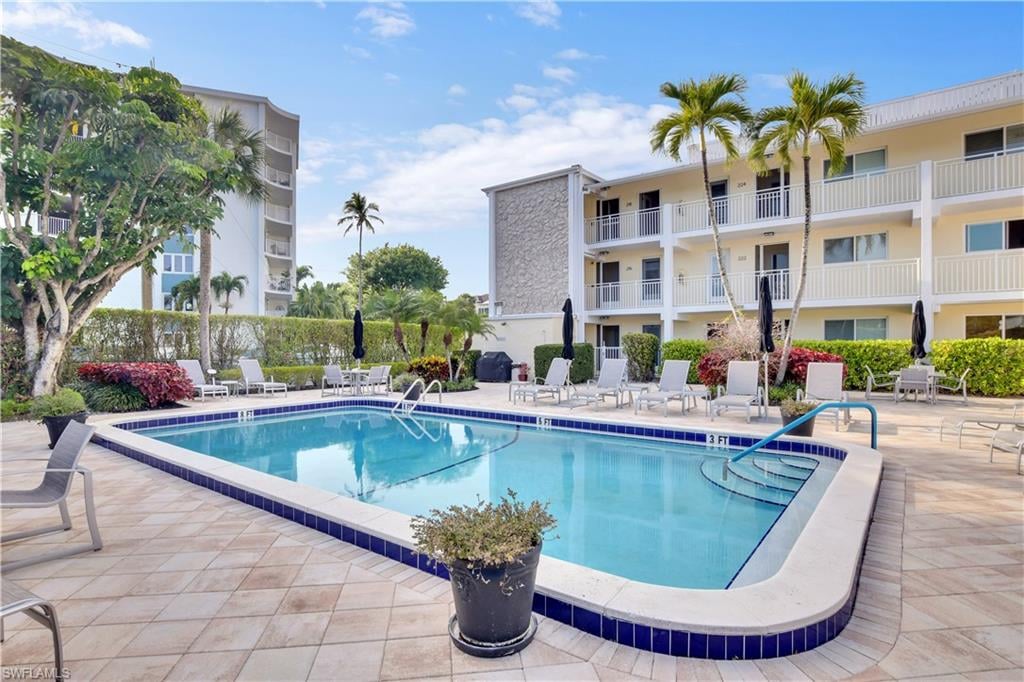
Calusa Club’s amenities on the public record are its elevator, the one in the State’s register, and Lowdermilk Park’s beach, restrooms, showers and grill a short walk away. The building opened in 1970 with a heated pool and screened porches; the pool’s current status, parking, storage and laundry are not published anywhere we could verify.
On the Property
- Elevator. One hydraulic passenger elevator, installed in 1970, three landings, 1,500-pound capacity, serviced under contract by Mowrey Elevator Co. (DBPR elevator register). Its certificate status is covered in the elevator section below.
- Pool. The 1970 advertisement promised a “Heated Pool.” We found no current primary record of the pool, and the Florida Department of Health’s pool inspection records were not checked for this address for this edition. A pool serving a 19-unit building is typically regulated as a public pool, and the Department of Health in Collier County runs that program (Florida Department of Health in Collier County, swimming pools). Ask the manager whether the pool is operating and heated today.
- Screened porches. Every apartment had one at opening, per the 1970 advertisement; today’s configuration varies by apartment.
- Parking, storage, laundry. Not documented in any primary source. We do not describe them.
Lowdermilk Park, a Short Walk West
Lowdermilk Park at 1301 Gulf Shore Boulevard North is a City of Naples beachfront park of about 6.89 acres with sand volleyball courts, a children’s playground, picnic tables, rentable gazebos, ADA beach mats and beach wheelchairs, and full restrooms and showers (City of Naples, Lowdermilk Park). Road-network walking routes from the City’s address point for the Calusa units put the park’s frontage on Gulf Shore Boulevard North about 0.15 mile and three minutes away, and the beach side of the park about 0.2 mile and four to five minutes away (OpenStreetMap foot routing, run 26 September 2026; destination geocoded with the United States Census Bureau geocoder). Access is through a public park, not a deeded private beach; we found no deeded beach rights for Calusa.
The Neighborhood’s Amenities, and What Is Not Included
Calusa owners are Coquina Sands residents, and the Coquina Sands Association is open to them on a voluntary basis at $90 per household per year; it is a civic association, not a homeowners association, and it has no lien authority (Coquina Sands Association). There is no clubhouse, golf, marina or gate that comes with a Calusa apartment, and there is no boat slip, because the parcel is interior and has no water frontage.
City Parks Within a Short Drive
Beyond Lowdermilk, the City’s Fleischmann Park, Baker Park on the Gordon River and the Naples Pier are all within a few minutes’ drive (City of Naples, Fleischmann Park; City of Naples, Baker Park; City of Naples, Naples Pier). Clam Pass Park, a Collier County beach park to the north, is a longer drive (Collier County Parks, Clam Pass Park).
What Are the Maintenance Fees and Property Taxes at Calusa Club?
Calusa Club’s monthly maintenance is not published by the cooperative or by any public source, so no figure appears on this page. Property taxes are public: each Calusa apartment has its own county tax bill, the median across all 19 apartments is $3,969.53, and bills run from $1,497.90 for the one homesteaded apartment to $4,094.85.
Monthly Maintenance: Where the Number Lives
In a cooperative the monthly maintenance charge covers the corporation’s whole budget: building insurance, reserves, management, common-area utilities, the elevator contract, the pool if it operates, and any debt the corporation carries. Calusa publishes none of it, and we will not print a figure we cannot source. The number, and anything else owed, comes from three documents: the estoppel certificate, which the association must issue within ten business days of a request; the current annual budget; and the most recent annual financial report (Florida Statute 719.108; Florida Statute 719.104). Florida’s cooperative law on common expenses and assessments sits in Florida Statute 719.107.
Property Taxes on the Record
Median total taxes | $3,969.53 |
Mean total taxes | $3,736.58 |
Lowest bill | $1,497.90 (apartment 248, homesteaded) |
Highest bill | $4,094.85 (apartments 234, 240 and 244) |
Total taxes, all 19 apartments | about $70,995 |
Apartments with homestead | 1 of 19 |
Source: Collier County Property Appraiser roll extract, files dated 29 August 2026; mean and total are our arithmetic. Apartment 224, for example, carries a non-homestead bill of $3,969.53 against a 2026 just value of $464,600, about 0.85%.
Why a Co-op Apartment Gets Its Own Tax Bill
Florida law puts co-op apartments on the tax roll one by one: “Ad valorem taxes and special assessments by taxing authorities shall be assessed against the cooperative parcels and not upon the cooperative property as a whole,” and “Each cooperative parcel shall be separately assessed for ad valorem taxes and special assessments as a single parcel” (Florida Statute 719.114). The tax lien attaches to that apartment’s parcel alone, not to the building. In practice a Calusa owner is taxed much like a condominium owner.
What a Buyer’s First Full Tax Bill Might Look Like
The seller’s bill is not the buyer’s. A Coquina Sands parcel carried about 9.05 mills of ad valorem tax on the 2025 adopted rates inside the City of Naples (City of Naples millage page). As a rough underwriting rule, a buyer’s first stabilized-year ad valorem tax is about the purchase price times 0.0090514, before any non-ad-valorem charges and before any homestead exemption. At $475,000 that is about $4,299. Treat that as an estimate for budgeting, not a bill; the Collier County Tax Collector issues the bill (Collier County Tax Collector, real estate taxes).
Homestead on a Co-op Apartment, and the Reset on Resale
Florida allows the homestead exemption “on each apartment or mobile home occupied by a tenant-stockholder or member of a cooperative corporation” (Florida Statute 196.031), which is why apartment 248 carries one. The exemption removes $25,000 of assessed value from all levies and an additional, inflation-indexed amount from non-school levies, and Save Our Homes then caps the annual rise in the homesteaded assessment at the lower of 3% or inflation (Florida Department of Revenue, homestead guidance PT-113; Florida Statute 193.155). A non-homestead apartment’s assessment is capped at a 10% annual rise for non-school levies (Florida Statute 193.1554). Either cap resets to market value on 1 January after a purchase. A buyer moving homestead from another Florida home may be able to port up to $500,000 of accumulated benefit (Florida Department of Revenue, portability guidance PT-112).
Special Assessments
We found no public record of a Calusa special assessment. That is absence of evidence, not evidence of absence: associations levy special assessments by board action and notice to owners, and none of that is published for Calusa. No City special-assessment district covers Coquina Sands on the City’s published list, and the Moorings Bay Special Taxing District reaches only waterfront parcels, which Calusa is not. Since 2025 a unit-owner-controlled cooperative may fund milestone and reserve-study work through regular assessments, special assessments, lines of credit or loans (Florida Statute 719.106). The estoppel certificate states any special assessment levied or pending on the apartment.
Calusa Club’s Layered Costs: Cooperative, City and Voluntary Association
Calusa Club’s cost stack is short: the cooperative’s monthly maintenance, the apartment’s own county tax bill, and nothing else mandatory. There is no master association, no community development district, and the Coquina Sands Association is voluntary. The one-time costs of buying and selling are where a Calusa co-op differs from a condominium.
The Recurring Layers
NAPLES TOWERS, INC. monthly maintenance | Yes | Not published; estoppel certificate and budget |
County tax bill for the apartment’s parcel | Yes | Median $3,969.53 on the 2026 roll extract |
Community development district | Does not exist | No CDD inside the City of Naples |
Coquina Sands Association | No, voluntary | $90 a year per household, no lien authority |
City stormwater utility fee | Billed by the City | Set by City ordinance; ask how it is billed at Calusa |
Owner’s unit-owner insurance policy | Lender and prudence | Contents, improvements, liability, loss assessment |
The City of Naples raised its stormwater utility rate for 2026 (Gulfshore Business, Naples stormwater rate); ask the manager how it reaches Calusa owners.
The One-Time Costs of a Transfer
- Approval fee. Florida caps any cooperative fee “in connection with the sale, mortgage, lease, sublease, or other transfer of a unit” at $100 per applicant, with a married couple or a parent and dependent child counted as one applicant, and only if the cooperative documents require approval and provide for the fee (Florida Statute 719.106).
- Estoppel certificate. Capped at $250 when no delinquency is owed, plus $100 for delivery within three business days (Florida Statute 719.108).
- Capital contribution, resale or transfer fee. Not published for Calusa. The statutory estoppel form asks the association directly whether any such fee is due.
- Documentary stamp tax. Florida’s documentary stamp statute reaches cooperative occupancy documents by name, at $0.70 per $100 of consideration, and says the tax “shall be paid by the purchaser” (Florida Statute 201.02; Florida Department of Revenue, documentary stamp tax). At $475,000 that is $3,325.
- Closing and lender costs. A co-op closing assigns shares and a proprietary lease rather than recording a deed and mortgage, and a share lender needs its own documents, so use a closing attorney or title agent experienced in Florida co-op transfers.
What Is Not in the Stack
No gatehouse, no golf equity, no club dues, no master association, no CDD bond line, no boat slip. Compared with a golf-community condominium in North Naples, the absence of layers is Calusa’s cost advantage. Compared with a Gulf-front building, the interior location and the 988-square-foot apartment keep both the price and the tax bill lower.
The Calusa Club Proprietary Lease, Bylaws and Rules: What Governs a Co-op Apartment
Calusa Club is governed by the articles and bylaws of NAPLES TOWERS, INC., the proprietary lease each shareholder holds, and the board’s rules, read together with Florida’s Cooperative Act, Chapter 719. None of the Calusa documents is posted publicly, so Florida law’s disclosure rules decide what a buyer sees, and when.
The Documents That Make Up a Calusa Ownership
Florida defines a “cooperative” as “that form of ownership of real property wherein legal title is vested in a corporation or other entity and the beneficial use is evidenced by an ownership interest in the association and a lease or other muniment of title or possession granted by the association as the owner of all the cooperative property” (Florida Statute 719.103). The statute lists the cooperative documents as the articles, the bylaws, any underlying lease, the document evidencing membership or shares, and the document granting the right of possession.
Articles of incorporation | Creates NAPLES TOWERS, INC. and its powers | Florida Division of Corporations filings for document 716258 |
Bylaws | Board, meetings, elections, budgets, assessments | Association records; original instruments on file with the Collier Clerk |
Proprietary lease | The owner’s right to occupy one apartment, and the owner’s obligations | Association records; one per apartment |
Share or membership certificate | Evidence of the shares that go with the lease | Held by the owner or the owner’s lender |
Rules and regulations | Leasing, pets, alterations, parking, use of the pool and common areas | Association records |
Question and answer sheet | The statutory summary a buyer must receive | Association records (Florida Statute 719.504) |
Florida now requires cooperative documents to be “recorded in the county in which the cooperative is located before property may be conveyed or transferred to the cooperative” (Florida Statute 719.1035). Calusa’s documents predate Chapter 719, which was enacted in 1976; the original instruments are on file with the Collier Clerk, and a title company or closing attorney can pull them.
What Florida Requires a Seller to Hand the Buyer
Every Florida contract to resell a cooperative interest must contain, in conspicuous type, either the buyer’s acknowledgment of having received the articles, bylaws, rules and the question and answer sheet more than seven days before signing, or a clause letting the buyer void the contract within seven days of receiving them (Florida Statute 719.503). For contracts signed after 31 December 2024 in a building that needs a milestone inspection or a structural integrity reserve study, the statute adds a second clause covering the milestone summary and the most recent reserve study. Both apply at Calusa, because it is three stories.
The Official Records the Association Must Keep
Florida requires a cooperative association to keep its official records, including “a photocopy of the cooperative documents,” “a copy of the current rules of the association,” and the milestone inspection reports, and to keep a structural integrity reserve study for 15 years (Florida Statute 719.104). An owner has a right to inspect those records, and a seller can use that right to build a complete file before listing.
How the Documents Can Change
If a cooperative’s documents do not set their own method of amendment, Florida lets them be amended “if the amendment is approved by the owners of not less than two-thirds of the units” (Florida Statute 719.1055). With 19 apartments, two-thirds is 13 owners. Ask whether any amendment has been adopted or proposed recently, because an amendment on leasing or pets changes what a buyer is buying.
Buyer Approval
Many Florida cooperatives require the board to approve a purchaser before shares transfer, and many interview applicants and review finances. Calusa’s own approval procedure, including any interview, financial minimum or cash requirement, is not published. Florida caps any approval fee at $100 per applicant, and allows one only where the documents require approval and provide for the fee (Florida Statute 719.106). The statutory estoppel form asks the association whether its rules require board approval for a transfer and whether a right of first refusal applies (Florida Statute 719.108). Those two answers set the contract timeline.
Management
Florida 360 LLC, at 3757 Tamiami Trail North in Naples, is the management company associated with Calusa; the State’s elevator register uses that address as the cooperative’s mailing address, and the company’s own site lists association management among its services (Florida 360 Management). DBPR shows no separate managing-entity record for the cooperative. Requests for the estoppel certificate, the budget, the rules and the reports go through the manager.
How Do You Finance a Calusa Club Co-op Purchase?
Financing a Calusa Club purchase means paying cash or taking a co-op share loan, secured by the shares and the proprietary lease rather than a deed, from one of the relatively few lenders that make them. Fannie Mae buys share loans only in qualifying cooperatives, and whether Calusa qualifies is a question for the lender.
What a Share Loan Is
Because NAPLES TOWERS, INC. owns the building, a Calusa buyer has no deed to mortgage. A lender instead takes a security interest in the shares and the proprietary lease, usually documented with a financing statement, the share certificate and a recognition agreement signed by the cooperative. The loan behaves like a mortgage from the borrower’s side, with a rate, a term and a monthly payment, but the paperwork and the lender pool are different.
What Fannie Mae Requires
Fannie Mae’s Selling Guide says that for a co-op share loan to be eligible, “the co-op project in which the secured unit is located must qualify as a cooperative housing corporation under Section 216 of the Internal Revenue Service Code,” and that “If the co-op project does not meet Section 216 requirements, Fannie Mae will not purchase a co-op share loan from within the project” (Fannie Mae Selling Guide B4-2.3-02). The same section requires that shares representing “at least 50% of the total number of stock or shares in the co-op corporation” and their occupancy rights have been sold to principal residence purchasers, and that the project be in an area with “demonstrated market acceptance for the co-op form of ownership.” Loan terms and the recognition agreement are covered separately (Fannie Mae Selling Guide B4-2.3-04), and Fannie Mae will not buy loans in an ineligible project type (Fannie Mae Selling Guide B4-2.1-03).
The Owner-Occupancy Question for the Lender
One apartment of 19 carries a homestead exemption on the county roll. A homestead count is not the same measure as a lender’s principal-residence test, and a lender will apply its own definitions to the cooperative’s share records, not to the tax roll. But a buyer planning a share loan should put the question to the lender at the start: does Calusa meet the Section 216 test and the principal-residence test that the lender’s investor applies, and has the lender ever approved the project? That is a question the lender answers, not us, and the answer decides whether a financed offer is realistic.
What That Means in Practice
Most retail lenders do not hold the special approval to sell share loans, which is why a co-op buyer often hears “we don’t do co-ops” even though Florida co-op financing is legal. Many co-op buyers pay cash or borrow from a portfolio lender, a bank that keeps the loan on its own books, and some borrow against other assets. The Federal Housing Administration’s old Section 203(n) co-op program should not be assumed available (HUD archives, Section 203(n)). Calusa’s own documents may cap financing or require a minimum down payment; that is not published, so we ask.
How Title and Closing Work
At closing the seller’s shares are assigned or surrendered and reissued, the proprietary lease is assigned or a new one issued, the association’s approval is delivered if one is required, the occupancy document is recorded with the Clerk as evidence of ownership, the buyer pays documentary stamp tax on it, and any lender files its security documents (Florida Statute 201.02). Title insurance for a co-op interest is a different product from a standard owner’s policy on a deed; ask your closing attorney or title agent what coverage is available on a Florida cooperative interest.
Selling a Calusa Club apartment to a financed buyer? Get a free Calusa Club home valuation or call Jesse direct at (239) 898-6072.
Buying at Calusa with a share loan? Call Marc at (239) 287-5873, or read how we represent buyers in Southwest Florida.
Calusa Club is not published anywhere as a 55-and-over community. We found no public document restricting occupancy by age, and the building’s own 1970 advertising described apartments “ideally designed for year round or seasonal living” with no age language. Any age restriction would have to appear in the cooperative’s documents.
Housing that claims the older-persons exemption under Florida’s Fair Housing Act must meet the statute’s requirements, including the 80% occupancy rule for 55-and-over housing and published policies showing the intent to serve older persons (Florida Statute 760.29). If Calusa’s documents contain an age provision, the question and answer sheet and the rules will show it. Until then, the honest description is that the owner profile skews to second-home owners from the Midwest and Northeast, and that no public record makes Calusa an age-restricted building.
Can You Rent Out a Calusa Club Apartment?
Calusa Club’s own leasing rules, including any minimum term, cap on leases a year, first-year restriction or board approval of tenants, are not published. What is certain is the City of Naples floor under any rule: rentals must run 30 days or longer, except three shorter rentals a year, and nightly rentals are out.
The City of Naples Rule
The City’s guidance reads: “Rental terms must be 30 days or longer; except that three times per year, a property may be rented for less than 30 days. A property may not be advertised as available for less than 30-day rentals” (City of Naples short-term rental guidelines). The R3-12 district where Calusa sits lists single-family and multifamily dwellings and their accessory uses; transient lodging is not among its permitted uses (Naples Code, R3-12 district; City of Naples code compliance handout). Seasonal leases of a month or more are the Naples norm.
What the Cooperative Can Add
A Florida cooperative’s documents can be stricter than the City: a longer minimum, a cap on leases per year, a rule against leasing in the first year of ownership, and board approval of each tenant with an application fee capped by statute at $100 per applicant (Florida Statute 719.106). Seasonal living was part of the building’s pitch from the start: the 1970 advertisement called the apartments “ideally designed for year round or seasonal living.” Leasing limits stated in online copy about the building could not be traced to the proprietary lease or the rules, so we do not repeat them, and neither should a buyer’s pro forma.
What a Buyer Planning to Rent Should Ask
- The minimum lease term and the maximum number of leases a year.
- Whether a new owner must wait before leasing.
- Whether the board approves tenants, how long it takes and what it costs.
- Whether tenants may use the pool, if it operates, and keep pets.
- Whether any apartment is leased today, and until when, if you are buying one with a tenant in place.
Pet Rules at Calusa Club
Calusa Club’s pet rules are not published in any primary source. Whether owners may keep a dog or a cat, and whether tenants may, is set by the cooperative’s proprietary lease and rules, which a buyer receives under Florida law before the contract becomes binding. Ask before you write an offer if a pet is part of your plan.
Claims about Calusa’s pet policy appear in online copy about the building, but they are not a primary source and we do not repeat them. Two legal points apply regardless of the building’s rules. Florida and federal fair housing law require housing providers to consider reasonable accommodation requests for assistance animals, and Florida sets out what documentation a provider may request for an emotional support animal (Florida Statute 760.27). And a building rule on pets binds tenants as well as owners, so a buyer who plans to rent should read the rule from both sides.
Milestone Inspections, Structural Reserve Studies and Florida Cooperative Law at Calusa Club
Calusa Club is a three-story cooperative building of 1969, so both of Florida’s post-Surfside safety laws reach it. The City of Naples lists it on its 2024 milestone inspection list, and as a cooperative association that existed before July 2022 it had to complete a structural integrity reserve study by 31 December 2024. Completion of either is not published.
The Milestone Inspection
Florida requires a milestone structural inspection of every building “three habitable stories or more in height” that is subject to the condominium or cooperative form of ownership, and “If a building reached 30 years of age before July 1, 2022, the building’s initial milestone inspection must be performed before December 31, 2024” (Florida Statute 553.899). The statute lets a local agency apply a 25-year trigger near salt water, and the City of Naples runs its own program with a list by year (City of Naples milestone inspection program; City of Naples milestone inspections by year).
The City’s 2024 list carries one row for Calusa: “CALUSA CLUB (COOP), 236 BANYAN BLVD, NAPLES, FL 34102, 3 stories, 1969” (City of Naples 2024 Milestone Buildings). The City publishes which buildings were required, not whether each inspection was completed or what it found, so we say plainly: completion is not published. On the Banyan Boulevard block, Calusa is the only building on that list; Banyan Club and Coquina Cove are under three stories.
Phase One, Phase Two and the Owner Summary
A milestone inspection starts with a visual examination by a licensed architect or engineer. A second phase, with testing, follows only where the first finds substantial structural deterioration. Either way, the association must distribute the inspector-prepared summary of material findings to every owner within 45 days, and a buyer under a post-2024 contract must be offered it (Florida Statute 553.899; Florida Statute 719.503). Ask the association for the phase one report, any phase two report, the summary, and the status of any repairs it recommended.
The Structural Integrity Reserve Study
“A residential cooperative association must have a structural integrity reserve study completed at least every 10 years for each building on the cooperative property that is three habitable stories or higher in height” (Florida Statute 719.106). The study covers the roof, structure, fireproofing and fire protection, plumbing, electrical, waterproofing and exterior painting, windows and exterior doors, and any other item above $25,000. For a unit-owner-controlled association that existed on or before 1 July 2022, the statute says the association “must have a structural integrity reserve study completed by December 31, 2024.” That is the rule that applies to Calusa.
Has Calusa Filed Its Study With the State?
Florida DBPR runs a public reporting database for condominium and cooperative reserve studies (DBPR condominium and cooperative SIRS reporting). It is an interactive application that could not be queried programmatically for this edition, so we make no statement about what it shows for Calusa. A manual check of that database is the fastest way to see whether a study has been reported, and the association must give a buyer its most recent study under Florida Statute 719.503 in any case.
Reserves After 2024
For budgets adopted on or after 31 December 2024, a unit-owner-controlled association that must have a reserve study may not vote to provide no reserves, or less than the required reserves, for the study items. The 2025 amendments added flexibility: after a milestone inspection within the previous two years, a majority of the total voting interests may pause or reduce reserve contributions for up to two consecutive budgets, adopted on or before 31 December 2028, to fund milestone repairs, and required work may be funded through special assessments, lines of credit or loans (Florida Statute 719.106). For a Calusa buyer the questions are simple: what did the study recommend, what is the reserve balance against it, and is any assessment, loan or credit line planned to close the gap?
The Statutes, Not the Bill Names
“SB 4-D” of 2022 and “SB 154” of 2023 are the popular names. The operative law for Calusa is Florida Statute 553.899 (milestone inspections), 719.106(1)(k) (cooperative reserve studies), 719.106(1)(j) (reserves), 719.104 (records) and 719.503 (buyer disclosure), as amended in 2024 and by HB 913 of 2025 (Florida Senate, HB 913 of 2025). The full chapter is published by DBPR as a single document (Chapter 719, Florida Statutes, DBPR copy).
Why This Matters to Price in a 19-Apartment Building
In a small building every cost is divided among few owners. A repair program that would be a modest assessment across 82 apartments at Del Mar is shared by 19 at Calusa. A clean report with funded reserves supports a seller’s number; a report that calls for concrete restoration, window replacement or roof work, unfunded, becomes a special assessment that the buyer will price in. We read both reports before we price a Calusa apartment, and we put them in front of buyers early.
Selling at Calusa with the reports in hand? Get a free Calusa Club home valuation or call Jesse direct at (239) 898-6072.
Buying at Calusa and want the reports read with you? Call Marc at (239) 287-5873, or read how we represent buyers in Southwest Florida.
The Calusa Club Elevator: What the State’s Register Shows
Calusa Club has one hydraulic passenger elevator, installed in 1970 and serving three landings, licensed by the State to NAPLES TOWERS, INC. On the State’s file dated 20 September 2026 its certificate showed as delinquent after a 1 August 2026 expiry, with the last passed inspection on 4 May 2024.
The Record, Field by Field
Licensee | NAPLES TOWERS INC |
Business name | CALUSA CLUB |
Location | 226 Banyan Boulevard, Naples FL 34102 |
License number | 7859 |
Class | Hydraulic passenger |
License status | Delinquent |
License expiry | 1 August 2026 |
Last passed inspection | 4 May 2024 |
Landings | 3 |
Capacity | 1,500 pounds |
Travel and speed | 18 feet, 80 feet per minute |
Installed | 1970 |
Service contract | Mowrey Elevator Co. |
Source: Florida DBPR elevator register extract, file last modified 20 September 2026, listed on DBPR’s elevator safety public records page. The register labels the building type “Condominium”; that is DBPR’s generic building-type field, not a legal classification, and DBPR’s own cooperative register classifies Calusa as a Cooperative Project.
What “Delinquent” Does and Does Not Mean
A delinquent status on the State’s file means the certificate of operation had not been renewed on the State’s record by the date of the file. It can reflect an unpaid renewal fee, inspection paperwork still in process, or an inspection not yet passed, and the register does not say which. We do not read it as a finding that the elevator is unsafe or out of service. A buyer should ask the manager for the current certificate of operation and the most recent inspection report, and can check license 7859 on DBPR’s public license lookup before closing.
Why the Elevator Matters at Calusa
On the south side of Banyan Boulevard, Calusa is the only building in the State’s elevator register at all; Banyan Club and Coquina Cove have no elevator record, and the only other elevator on Banyan Boulevard is Charleston Square’s, across the street. For an owner on the second or third floor, or a buyer who plans to age in place, that is a real difference. It is also a real cost: a 1970 hydraulic elevator is a capital item in the reserve study, and its modernization, when it comes, is shared among 19 owners.
Hurricanes, Flood Zone and Insurance at Calusa Club
Calusa Club sits in FEMA flood Zone AE with a static base flood elevation of 10 feet NAVD88 on panel 12021C0391J, effective 8 February 2024, and in Collier County Hurricane Evacuation Zone A. Ground at the building is about 5.2 to 5.5 feet, so the base flood elevation stands roughly 4.5 to 5 feet above grade.
The Flood Zone, Point by Point
We queried FEMA’s National Flood Hazard Layer at 20 grid points across and around the Calusa parcel, about 40 meters apart, on 26 September 2026 (FEMA National Flood Hazard Layer).
Calusa parcel, all sample points but one | AE, coastal floodplain | 10 |
Far southeast corner of the parcel | AE | 9 |
Banyan Club next door, most sample points | AE | 9 |
Banyan Club, west edge | AE | 10 |
The Limit of Moderate Wave Action does not cross the Calusa parcel, so the building sits in plain Zone AE rather than a Coastal A Zone, at the precision of the map. Calusa carries a base flood elevation one foot higher than most of Banyan Club’s site next door. The City of Naples is an NFIP community in the Community Rating System at Class 5, which gives NFIP policies in the special flood hazard area a 25% discount (FEMA Community Status Book, Florida; City of Naples, flood insurance). The panel itself can be viewed for the address in FEMA’s Map Service Center (FEMA Map Service Center, 236 Banyan Blvd).
Ground Elevation and What We Do Not Know
The United States Geological Survey’s 3DEP one-meter elevation service returns about 5.52 feet at the Calusa address point, 5.20 feet on the west part of the parcel and 6.31 feet on the Banyan Club side (USGS Elevation Point Query Service). The building’s lowest floor elevation is not public, and we found no elevation certificate for it. Whether the ground-floor apartments sit above or below the 10-foot base flood elevation matters to the building’s flood premium and to any substantial-improvement question after a storm. The association’s elevation certificate, if it has one, answers it.
FEMA issued preliminary revised flood maps for Collier County in 2025, with a target effective date in 2027 (Collier County, proposed Flood Insurance Rate Map). FEMA’s preliminary map service returned the panel index for Calusa but no preliminary zone for this address (FEMA preliminary National Flood Hazard Layer), so the proposed zone is not verified. Check the preliminary map before closing.
Evacuation Zone and Surge
Storm History at the Naples Gauge
Hurricane Ian on 28 September 2022 drove water to 6.18 feet above mean higher high water at the NOAA Naples gauge before the gauge failed (NOAA Tides and Currents, Naples), and the National Hurricane Center reported 6 to 9 feet of inundation above ground in Naples (National Hurricane Center, Hurricane Ian report). The City’s drive-by survey after Ian counted 708 structures with major damage, 22 destroyed and 1,937 with minor damage citywide (Naples Daily News, Naples Council after Ian). With ground at about 5 to 5.5 feet, water entry on this block was plausible, but we found no public record for this building, and we do not claim damage or its absence. Ask the association what Ian did to the ground floor, the pool and the elevator, what was repaired, and how it was paid for.
Insurance: What the Corporation Covers and What You Cover
In a cooperative the corporation owns the building, so the master property, wind and flood policies insure the structure, and the owner’s unit-owner policy covers contents, the owner’s improvements, liability and loss assessments, as the proprietary lease allocates them. Whether NAPLES TOWERS, INC. carries NFIP or private flood coverage on the building, and at what deductible, is not published; the insurance certificate comes from the manager. NFIP limits for “other residential” buildings are $500,000 on the building and $100,000 on contents (Congressional Research Service, National Flood Insurance Program). A new NFIP policy carries a 30-day waiting period, and NFIP pricing under Risk Rating 2.0 uses distance to water, elevation and replacement cost (FEMA Risk Rating 2.0). Wind-mitigation credits apply to building features the corporation controls, such as opening protection and roof attachment (Florida Office of Insurance Regulation, wind mitigation).
Which Schools Serve Calusa Club?
Calusa Club is zoned to Lake Park Elementary, Gulfview Middle and Naples High School, verified in Collier County Public Schools’ 2026-27 attendance-zone tool at 212 Banyan Boulevard, which is one of Calusa’s own apartment addresses. Each school earned an A from the Florida Department of Education for 2025-26.
Address | 1295 14th Ave N | 255 6th St S | 1100 Golden Eagle Cir |
Grades | PK to 5 | 6 to 8 | 9 to 12 |
FLDOE grade, 2025-26 | A | A | A |
Drive from Calusa | 1.0 mi, about 3 min | 2.6 mi, about 6 min | 2.4 mi, about 6 min |
Drive times are free-flow road-network routes from the Census geocode of 236 Banyan Blvd, run 26 September 2026; season traffic is slower. School grades: Florida Department of Education school grades.
Because the tested address is a Calusa apartment, this is as direct a school verification as a Coquina Sands building can have. Assignments can change year to year, so confirm in the district’s tool before an offer depends on it (Collier County Public Schools attendance zone locator; Collier County Public Schools attendance boundaries). Naples High School runs Cambridge AICE and AP Capstone programs (Naples High School advanced studies). With one of 19 apartments homesteaded, few Calusa households have school-age children, but the zoning matters to the resale pool and to families who winter here.
City Permits and Recorded Work at Calusa Club
Calusa Club’s building permits are held by the City of Naples Building Department, not the county, because the property is inside the city limits. The City’s permit search is an interactive portal that could not be queried programmatically for this edition, so no Calusa permit list appears here; a search by address shows it.
What to Look For in the Permit History
Search the City of Naples permit portal for the range 212 to 250 Banyan Blvd, and for 226 and 236 Banyan in particular, since the elevator and the milestone listing use those numbers. Look for five kinds of work since 2022: structural and concrete restoration, which often follows a milestone inspection; roofing; window and door replacement, which decides wind-mitigation credits; elevator work; and any post-Ian repair. A permit shows scope and date; the association’s records show cost and how it was funded.
Work Inside Your Apartment
Interior renovations that touch plumbing, electrical, walls or windows need a City permit as well as the cooperative’s consent. After Hurricane Ian the City issued an emergency repair permitting order (City of Naples, Hurricane Ian emergency repair permitting order), and floodplain rules on substantial improvement apply to buildings in the special flood hazard area (City of Naples, development in the floodplain). For a 1969 building in Zone AE, a large enough improvement or repair can trigger floodplain compliance for the whole structure, which is a corporation-level question rather than an apartment-level one.
Zoning at Calusa Club: Why R3-12 Is a City Planning Question
Calusa Club is zoned R3-12 Multifamily in the City of Naples, with future land use of Residential, High Density Mid Rise. By our arithmetic the 1969 building is denser, larger in footprint and taller beside single-family land than today’s R3-12 rules allow, so what could be rebuilt there is a question for City Planning.
What the City’s Layers Show
- Zoning: R3-12, Multifamily, City of Naples Code Chapter 58, Article II, Division 10 (City of Naples zoning layer).
- Future land use: Residential, High Density Mid Rise (City of Naples future land use layer).
- Neighbors: R3-15 on the Del Mar Club land to the west, R3-12 at Banyan Club to the east, single-family R1-15 on Yucca Road directly south, and a PD-zoned parcel across Banyan Boulevard to the north.
- Parcel: 0.69 acres, about 29,913 square feet; building footprint about 14,084 square feet (City of Naples parcels layer).
Today’s R3-12 Rules Against Today’s Building
The City’s code describes R3-12 as a district for “a mixture of single-family homes and one-, two- and three-story apartments,” and sets its limits in plain numbers (Naples Code, R3-12 district).
Density | “12 dwelling units per net acre” | 19 units on 0.69 acres, about 27.5 per acre; 12 per acre would allow about 8 |
Lot coverage, non-single-family buildings | 25% | About 47% |
Height | 30 feet | Not measured |
Stories beside R1 land | Two stories “immediately adjacent to, or across an alley from, any R1 zoned property” | Three stories, with R1-15 directly behind |
Minimum floor area | 600 square feet per unit in three-family and larger buildings | 988 square feet of roll area per apartment |
The arithmetic says the 1969 building predates the rules it would fail today. “Net acre” is a defined term in the code and may differ from the GIS area, so the density figure is approximate.
The Question to Put to the City
What happens after a casualty or on a voluntary redevelopment, and whether the building could be rebuilt at 19 apartments and three stories, is governed by the City’s nonconforming-structure and nonconforming-density provisions, which are not settled by the numbers above. That is a City of Naples Planning Department determination, typically answered by a zoning verification letter, and we do not state the answer. It is, in our view, the most important long-run value question a Calusa owner can ask, and it is the same question Banyan Club faces next door, at about 22 units per acre on 1.08 acres under the same R3-12 rules.
What Is Being Built Near Calusa Club?
Calusa Club sits one block off the largest redevelopment cycle Gulf Shore Boulevard North has seen. The Four Seasons resort opened at the neighborhood’s south edge in November 2025, Rosewood Residences is under construction at 1601, Olana is approved at 1121, and Harbour House is approved at 1624 to 1672 Gulf Shore Blvd N.
The Redevelopment Pipeline on the Boulevard
Rosewood Residences Naples | 1601 Gulf Shore Blvd N | 42 residences in two buildings | Under construction, topped off 1 August 2025 |
Olana Naples Residences | 1121 Gulf Shore Blvd N | 12 estate residences over six stories | Approved and selling, pre-construction |
Harbour House | 1624 to 1672 Gulf Shore Blvd N | 14 residences in three two-story buildings | Design Review Board approval 25 March 2026 |
1500 Gulf Shore Blvd N | 1500 Gulf Shore Blvd N | 4 residences proposed | Design Review Board petition signed 9 December 2024 |
Sources: Gulfshore Business, Rosewood Residences Naples; Kolter Urban, Olana Naples Residences; Gulfshore Business, Harbour House. The 1500 Gulf Shore Blvd N site was the Ocean Terrace building: its single county parcel recorded a $16,000,000 transfer on 8 June 2023 (Official Records 6257/2716, flagged not qualified), the association was administratively dissolved on 27 September 2024, and a petition prepared by MHK Architecture proposes four residences. New product at these levels resets the top of the neighborhood’s market.
Naples Beach Club, A Four Seasons Resort
The 125-acre former Naples Beach Hotel and Golf Club at the south edge of Coquina Sands reopened as Naples Beach Club, A Four Seasons Resort, on 17 November 2025, with golf scheduled for 2027 and 153 residences (Four Seasons opening release). The buyer was a joint venture of The Athens Group and MSD Partners (PR Newswire, Athens Group and MSD Partners acquisition). On 29 June 2022 the owner and the City executed a perpetual conservation easement, held by the North American Land Trust, over 104.6 acres, 84% of the site (City of Naples, conservation easement release).
On Banyan Boulevard Itself
The City Council’s agenda of 15 April 2026 carried a Banyan Boulevard Median Landscape Restoration Project, awarded to Hannula Landscaping and Irrigation for $370,719.20 plus a $5,000 City contingency (City of Naples Council agenda item, Banyan Boulevard median). The agenda does not say which blocks of Banyan are included, so we do not claim the work is in front of Calusa. For a Calusa owner the more important point is what is not happening on the block: we found no City petition, news report or public offer naming Calusa Club or its corporation.
Could Calusa Itself Be Redeveloped?
Several former cooperatives on Gulf Shore Boulevard North were sold to developers, because a cooperative corporation already holds title to the whole property and a sale is a corporate decision under its own documents rather than a condominium termination. Whether Calusa’s owners would ever consider an offer, and on what vote, is theirs to decide, and nothing in the public record suggests one. The zoning section above is why any such conversation starts at City Planning: under today’s R3-12 rules the parcel’s density allowance is well below its current 19 apartments.
Daily Logistics and Beach Access at Calusa Club
Daily life at Calusa Club runs on the beach a short walk west and a short drive to everything else: Lowdermilk Park about three to five minutes on foot, NCH Baker Hospital about three minutes by car, Fifth Avenue South about five, and Southwest Florida International Airport about 48. Parking, storage, laundry, trash and mail are set by the cooperative.
Drive Times From Calusa Club
Lake Park Elementary, 1295 14th Ave N | 1.0 mi | about 3 min |
NCH Baker Hospital, 350 7th St N | 1.3 mi | about 3 min |
Fifth Avenue South at 3rd St S | 2.1 mi | about 5 min |
Naples Pier | 2.2 mi | about 6 min |
Naples High School, 1100 Golden Eagle Cir | 2.4 mi | about 6 min |
Gulfview Middle, 255 6th St S | 2.6 mi | about 6 min |
Waterside Shops | 3.9 mi | about 8 min |
I-75 at Golden Gate Parkway, exit 105 | 6.2 mi | about 12 min |
Mercato | 8.1 mi | about 17 min |
Southwest Florida International Airport | 35.1 mi | about 48 min |
Method: road-network routing on OpenStreetMap roads from the Census geocode of 236 Banyan Blvd, run 26 September 2026, free-flow. January to April traffic is slower. Plan on 45 to 50 minutes to the airport even outside season; shorter figures seen in older copy about the building understate the drive.
Beach Access and Parking at Lowdermilk
Lowdermilk is a visitor and metered beach access, and vehicles with a valid City or County beach parking permit park free (City of Naples beach parking information). Most Calusa owners walk. For the car, Collier County property taxpayers and full-time residents are eligible for an annual beach parking permit; because each Calusa apartment carries its own county tax bill, ask the City what documents a co-op owner should bring (City of Naples beach parking permits). The Naples Police Department’s Beach Patrol publishes the beach rules (Naples Police Department Beach Patrol).
Healthcare
NCH Baker Hospital at 350 7th Street North, about three minutes from Calusa by car, runs a 24-hour emergency department. The nearest state-designated Level II trauma center is Lee Health’s Gulf Coast Medical Center in Fort Myers, about 44 minutes by road from the Banyan Boulevard area, and major multi-system trauma travels there by ground or air.
Parking, Storage, Laundry, Trash and Mail
None of these is documented for Calusa in any primary source, and we do not describe them. Ask the manager four specific questions: how many parking spaces go with the apartment and whether any are covered or assigned; whether there is storage for beach gear or bicycles; where laundry is done and whether in-apartment machines are permitted; and how trash, recycling and mail are handled. City of Naples solid waste collection serves multifamily properties, and the building’s own arrangements are the association’s (City of Naples Solid Waste Division).
Getting Around Without a Car
From Calusa the beach, Lowdermilk’s grill and the Gulf Shore Boulevard sidewalk are on foot, and Banyan Boulevard is a quiet street to walk. Downtown, Fifth Avenue South and Third Street South are about two miles south, an easy bicycle ride in the cool months. Commercial flights leave from Southwest Florida International, about 48 minutes north in free-flow traffic.
How Does Calusa Club Compare to Other Coquina Sands Buildings?
Calusa Club is the second-smallest of the five Coquina Sands cooperatives by apartment count and sits in the middle of the neighborhood’s entry band on county value, with a median just value of $454,600 per apartment. Of the five cooperatives, only Calusa and Del Mar Club appear on the City’s 2024 milestone list.
The Benchmark: County Just Value per Apartment
The yardstick below is the same for every building: the Collier County Property Appraiser’s 2026 roll, files dated 29 August 2026, with the median just value per parcel and the median roll square footage, plus the City of Naples milestone list status. It measures assessment, not sale price, and it is the one measure available for every building on identical terms.
Calusa Club | Cooperative | 19 | $454,600 | 988 | about $460 | 1969 | 2024 list, 3 stories |
Banyan Club | Condominium | 24 | $488,800 | 1,064 | about $459 | 1970 | Not listed, two stories |
Coquina Cove | Condominium | 18 | $407,440 | not compared | not compared | Declared 1972 | Not listed, under three stories |
Del Mar Club | Cooperative | 82 | $422,500 | 850 | about $497 | 1966 | 2024 list, 7 stories |
Reef Club | Cooperative | 14 | $504,520 | 1,106 | about $456 | 1959 | Not listed, under three stories |
Lago Mar | Cooperative | 16 | $304,610 | 817 | about $373 | 1963 | Not listed, under three stories |
Eleven Hundred Gulfshore Club | Condominium | 39 | $413,000 | 940 | about $439 | 1972 | 2024 list, 3 stories |
Charleston Square | Condominium | 24 | $1,896,512 | 2,728 | about $695 | 2004 | 2029 list |
Source: Collier County Property Appraiser roll, files dated 29 August 2026; City of Naples 2024 and 2029 milestone lists (City of Naples 2024 Milestone Buildings; City of Naples 2029 Milestone Buildings). Value per square foot is our arithmetic, median just value divided by median roll square footage, and is an approximation for buildings with more than one plan.
What the Table Says
Among the five Coquina Sands cooperatives, Calusa sits between Lago Mar of Naples, the least expensive on the roll, and The Reef Club of Naples, the most expensive per apartment. Del Mar Club, the 82-apartment seven-story cooperative on the parcel next door, is valued lower per apartment but higher per square foot, because its apartments are smaller. On the Banyan Boulevard block, Coquina Cove across the street is valued below Calusa, and Banyan Club next door above it per apartment but at the same value per square foot. Charleston Square, the three-story 2004 condominium at 1400 Gulf Shore Boulevard North, across Banyan Boulevard from Calusa, is in a different price band altogether.
Recorded Resales on the Block, Last 60 Months
In the 60 months to 29 August 2026, county-qualified resales on the Banyan Boulevard block were: Banyan Club, seven, median $580,000, range $500,000 to $685,000; Coquina Cove, one, $499,000 on 12 January 2026; Calusa Club, none. Across the boulevard, Del Mar Club recorded six, median $518,750 (Collier County Property Appraiser sales history, our arithmetic). Counts that small are lists of sales, not market rates, which is why we show n beside every median.
Milestone Status Across the Neighbors
On the City’s lists, Calusa, Del Mar and Eleven Hundred Gulfshore Club share the 2024 milestone year and Charleston Square is on the 2029 list. Banyan Club, Coquina Cove, Lago Mar and Reef Club are under three stories and are on neither list. On the Banyan Boulevard block that makes Calusa the one building with both the elevator and the milestone obligation, which is a fair summary of its trade-off.
Calusa Club vs Banyan Club: Which Should You Choose?
Calusa Club and Banyan Club stand side by side on Banyan Boulevard, built a year apart and valued by the county at about $460 per square foot each. Calusa is a three-story cooperative with an elevator; Banyan Club is a two-story condominium. Choose Calusa for entry price and the elevator, Banyan Club for title, financing and liquidity.
Banyan Club is a condominium under Chapter 718, registered with DBPR as BANYAN CLUB OF NAPLES (project PR1S016746, 24 units, declaration recorded 9 September 1970), with BANYAN CLUB, INC. filed with the State on 7 May 1970 and managed through Newell Property Management (DBPR condominium extract). Its 24 units sit at 252 to 298 Banyan Blvd on a 1.08-acre parcel directly east of Calusa. It is not on the City’s milestone list and has no elevator on the State’s register.
The Decision Table
Ownership | Cooperative (Chapter 719): shares plus a proprietary lease | Condominium (Chapter 718): deed to a unit plus a share of common elements |
Entity | NAPLES TOWERS, INC., Sunbiz 716258 | BANYAN CLUB, INC., Sunbiz 718465 |
State registration | DBPR Cooperative Project PR2S019020 | DBPR condominium PR1S016746 |
Address | 212 to 250 Banyan Blvd, south side | 252 to 298 Banyan Blvd, south side, next door east |
Built | 1969 | 1970 |
Stories and elevator | Three stories, one elevator | Two stories, no elevator on the State’s register |
Apartments or units | 19 | 24 |
Land and density | 0.69 acre, about 27.5 units per acre | 1.08 acre, about 22 units per acre |
Zoning | R3-12 | R3-12 |
Size on the county roll | 988 sq ft, every apartment | 1,064 sq ft (22 units); 1,534 sq ft (2 units) |
Median 2026 just value | $454,600 | $488,800 |
Median just value per roll sq ft | about $460 | about $459 |
Just value range | $394,600 to $472,600 | $478,800 to $708,300 |
Median total taxes | $3,969.53 | $4,348.87 |
Homestead | 1 of 19 | 4 of 24 |
Owners mailing outside Florida | 14 of 19 | 10 of 24 |
Qualified resales, 12 months | 0 | 3, median $580,000 |
Qualified resales, 60 months | 0 | 7, median $580,000, $500,000 to $685,000 |
Qualified resales, 120 months | 11, median $300,000 | 15, median $490,000 |
Highest qualified sale | $469,000, apartment 240, March 2021 | $685,000, unit 260, September 2024 |
Newest priced transfer | $475,000, apartment 232, 19 August 2026, not yet coded | $570,000, unit 290, 21 May 2026, qualified |
Flood zone | AE, base flood elevation 10 ft | AE, base flood elevation 9 ft on most of the site |
Milestone inspection and reserve study | Required: on the 2024 list; co-op reserve study due by 31 December 2024 | Not required: two stories is below both laws’ three-story threshold |
Financing | Cash or a co-op share loan from a specialist lender | Condominium mortgage, subject to the lender’s project review |
How ownership transfers | Assignment of shares and proprietary lease, recorded instrument, doc stamps under 201.02(2) | Warranty deed, doc stamps under 201.02(1) |
Leasing and pet rules | Not published; City 30-day floor applies | Not published; City 30-day floor applies |
Sources: Collier County Property Appraiser roll and sales history, files dated 29 August 2026 (Banyan Club’s newest sale, Official Records 6591/1101; its record, 6402/1045); City of Naples GIS and milestone list; FEMA National Flood Hazard Layer; DBPR condominium, cooperative and elevator extracts; Florida Statute 201.02. Just value is compared to just value and county qualified sales to county qualified sales, with n shown.
Reading the Gap: Co-op Against Condominium on the Same Block
The county values the two buildings at the same price per square foot. Same block, same zoning, same walk to Lowdermilk, built a year apart. Yet in the last five years Banyan Club’s condominium units recorded seven qualified sales at a $580,000 median, and Calusa’s co-op apartments recorded none. Our reading is that most of that gap is the cooperative form itself, not the land or the location: a narrower financing market, a board-approval step, and fewer buyers who understand shares and a proprietary lease. Part of it is size, because Banyan’s units are larger. Calusa’s newest transfer, $475,000 for 988 roll square feet, about $481 a square foot, compares with Banyan Club’s newest qualified sale of $570,000 for 1,064, about $536; but one of those figures is uncoded and the other qualified, so read the comparison as a direction, not a discount rate.
Who Should Choose Calusa Club
Choose Calusa if you are a cash buyer or have a co-op share lender lined up, you want the lowest entry to a walk-to-Lowdermilk address on this block, you value an elevator to the second and third floors, and you are comfortable with a 19-owner corporation where every vote and every assessment is shared among few neighbors. Accept that the milestone and reserve-study results, and the elevator’s current certificate, are the biggest unknowns in the price, and read them first.
Who Should Choose Banyan Club
Choose Banyan Club if you need a conventional condominium mortgage, want a deed rather than shares, want a deeper recent resale record to price from, want a larger unit option, or prefer a two-story building outside Florida’s milestone and reserve-study regimes. Accept a higher entry price and tax bill, no elevator on the State’s register, and a building that, like Calusa, is denser than today’s R3-12 rules allow.
Weighing a Calusa sale against a move next door? Get a free Calusa Club home valuation or call Jesse direct at (239) 898-6072.
Comparing the two as a buyer? Call Marc at (239) 287-5873, or read how we represent buyers in Southwest Florida.
Honest Pros and Cons of Owning at Calusa Club
Owning at Calusa Club trades conventional financing and a deep resale record for a lower entry price, an elevator and a quiet interior street a short walk from Lowdermilk Park. The honest list below is what we tell every Calusa buyer and seller before they commit, drawn from the public record and Florida co-op law.
The Pros
- Beach access without the beachfront price. Lowdermilk Park, with full restrooms, showers and ADA beach mats, is about a three to five minute walk.
- An elevator on a walk-up block. The only building on the south side of Banyan Boulevard in the State’s elevator register.
- A quiet interior street. Off Gulf Shore Boulevard North’s traffic and construction, with single-family homes behind.
- Inside the City of Naples. City police, fire-rescue and parks, no CDD, no master association, a voluntary neighborhood association.
- Low property taxes. A median bill of $3,969.53 on the roll, and homestead available to full-time owners.
- A-rated schools verified at a Calusa address. Lake Park Elementary, Gulfview Middle and Naples High School.
- A rising neighborhood. The Four Seasons, Rosewood, Olana and Harbour House are resetting values around it.
The Cons
- Co-op financing. Share loans come from few lenders, so cash is common and the buyer pool is narrower.
- A thin, stale sales record. No county-qualified sale since May 2021, which makes pricing a judgment rather than a lookup.
- Unpublished documents. Maintenance, approval, leasing, pet and parking rules are not public; buyers wait for the statutory package.
- Few owners to share costs. Milestone repairs, the reserve study and any elevator modernization are divided 19 ways.
- An elevator certificate to check. The State’s file showed it delinquent after 1 August 2026.
- Zone AE, base flood elevation 10 feet, Evacuation Zone A. Ground sits about 4.5 to 5 feet below the base flood elevation.
- A building larger than today’s zoning allows. What could be rebuilt is a City Planning question.
- Uniform 988-square-foot apartments. No larger plan on the roll.
Selling at Calusa? Get a free Calusa Club home valuation or call Jesse direct at (239) 898-6072.
Buying at Calusa? Call Marc at (239) 287-5873, or read how we represent buyers in Southwest Florida.
Thinking of Selling Your Calusa Club Home? List With the #1 Team in Southwest Florida Since 2012
If you’re searching for a Calusa Club listing agent, or thinking, ‘I need someone to sell my Calusa Club home…’ start here. We tracked every recorded Calusa transfer on the Collier County roll through 29 August 2026; McGreevy and Comisar, Top 1% Real Estate Agents Nationally Since 2008, price from it, qualified and unqualified alike.
Data updated: September 2026 (Collier County recorded sales through 29 August 2026)
Calusa is the Coquina Sands building where a seller has the most identical neighbors and the fewest usable comparables. Nineteen apartments share the same 988 roll square feet, none has recorded a county-qualified sale in five years, and the buyer walking through yours needs to know how to pay for a co-op before falling in love with it. As the leaders of Domain Realty Group our team has closed over $2.5 billion in real estate, and Jesse McGreevy and Marc Comisar account for over $900 million in personal sales inside that number. We bring that reach to a Calusa listing along with the co-op file a Calusa buyer will ask for.
Honors and recognition:
- Top 1% Real Estate Agents Nationally Since 2008
- 5 Star Award for Customer Satisfaction for 21 Straight Years. Only 5 out of 21k+ Licensees (Gulfshore Life Magazine)
- #1 Team in Southwest Florida since 2012
- McGreevy and Comisar and their Domain Realty Group team have sold over $2.5 Billion in Real Estate
- McGreevy and Comisar alone have over $900 million in Sales
- Nationally Recognized Top Producing Realtors
- Platinum Sales Production Award Winners
What Calusa Apartments Sold For: the Recorded Set
In the last 12 months Calusa Club has seen no qualified resales; the first window that holds ten is 120 months (Collier County Property Appraiser sales history, files dated 29 August 2026). We will walk you through every sale on request.
- Qualified resales, 12, 24, 36 and 60 months: 0.
- Qualified resales, 120 months: 11, from $260,000 to $469,000; median $300,000; dollar volume $3,616,900; newest May 2021.
- The record: $469,000 for apartment 240, March 2021.
- The newest priced transfer: $475,000 for apartment 232, 19 August 2026, not yet coded by the county.
- The number not to use: $706,000 for apartment 238, June 2022, flagged not qualified.
- Days on market and sale-to-list: Calusa Club has one MLS-marketed closing in the last 60 months, which went under contract after 3 days in June 2022; one sale is too few for a meaningful days-on-market average (Southwest Florida MLS Matrix, pulled 26 September 2026).
Selling a Calusa Apartment Is Different in Six Ways
- You are selling shares and a lease, not a deed. The closing assigns your shares in NAPLES TOWERS, INC. and your proprietary lease; your closing attorney or title agent should have done Florida co-op transfers before.
- The buyer’s financing is the first filter. Share loans come from specialist lenders (Fannie Mae Selling Guide B4-2.3-02). We qualify buyers on how they will pay before we schedule showings.
- The statutory package starts the clock. The buyer must receive the articles, bylaws, rules and question and answer sheet, plus the milestone summary and latest reserve study, or gets a seven-day right to cancel (Florida Statute 719.503). We assemble them before listing.
- Board approval sets the timeline. If Calusa’s documents require approval, the estoppel certificate says so, and any approval fee is capped at $100 per applicant.
- The reports and the elevator move the price. A buyer will ask what the milestone inspection found, how the reserve study is funded and whether the elevator certificate is current. A seller with the answers in hand negotiates from strength.
- Your apartment’s value step is on the roll. The county’s six steps, consistent with valuation by floor, give a buyer an objective reason for your price; we confirm your floor and use them.
Pricing With No Qualified Sale Since 2021
When the county has qualified nothing in five years, price comes from four sources read together: the 2017 to 2021 qualified sales, adjusted for time; the county’s own 2026 values; the newest recorded transfer, clearly labeled as uncoded; and the condominium sales next door at Banyan Club, adjusted for the co-op form and unit size rather than copied. We set aside every unqualified transfer, including the $706,000 of 2022 that some sellers mistake for a comparable. An online automated estimate built on the county roll cannot do any of that.
What Is Your Calusa Club Home Worth? Get a Free Valuation in 60 Seconds.
Start with a free Calusa Club home valuation. It takes about a minute, and Jesse follows up with the Calusa evidence that actually fits your apartment: the same value step, adjusted for condition, furnishings and any lease in place.
(239) 898-6072, text or call. Confidential conversations welcome.
Is now a good time to sell a Calusa Club apartment?
For an apartment priced to Calusa’s own evidence, the timing case is that the newest recorded transfer, $475,000 in August 2026, sits above every qualified sale in the building’s history, and the county’s 2026 values sit above the ten-year median. Listing in the fall reaches the winter buyer pool, which for Calusa is mostly second-home buyers from the Midwest and Northeast.
Should I price my Calusa apartment off Banyan Club’s sales next door?
Not directly. Banyan Club’s sales reflect deeded title, conventional financing and larger units that a Calusa buyer does not get. They are a useful ceiling and a check on the block’s direction; your apartment should be priced on Calusa’s own record, adjusted, with Banyan Club as context.
Does the $475,000 transfer set my price?
It is the best recent evidence Calusa has, and it is not yet a qualified sale. We show it to buyers with its status stated, and we re-check the county roll for its qualification before we rely on it in a counter-offer.
Can a buyer with a loan buy my apartment?
Yes, with the right lender. The buyer needs a co-op share loan, and the lender will apply its own project tests, including an owner-occupancy test. We ask the association for its financing policy before listing and screen buyers accordingly.
What happens to my homestead exemption when I sell?
Homestead ends with your ownership, and the buyer’s assessment resets on the next 1 January. If you are buying another Florida home, you may be able to carry up to $500,000 of your Save Our Homes benefit with you through portability (Florida Department of Revenue, portability guidance PT-112).
Will the milestone inspection scare buyers away?
Not if you have it. Buyers in older Naples buildings expect a milestone report and a reserve study, and the law now requires the seller’s side to offer them. What unsettles a buyer is a missing report, or a report with unfunded repairs and no plan. We read the reports with you before listing and present them plainly.
Your Local Real Estate Experts
Calusa Club owners and buyers work directly with Jesse McGreevy and Marc Comisar, not with a call center. The two have sold Southwest Florida real estate for more than twenty years, and before writing this guide they read Calusa’s state cooperative and elevator records, the county roll for all 19 apartments and every recorded Calusa transfer since 1983.
You can read the longer version of how the team was built on our about the McGreevy and Comisar team page. McGreevy and Comisar are the Domain Realty team behind this Calusa Club guide: Jesse McGreevy, Sales Associate, and Marc Comisar, Broker Associate. Jesse has been in the business since October 2004, the team launched in October 2008, and both work the Naples beach market, cooperatives and condominiums alike.
Between them that is more than twenty years of Southwest Florida transactions, and it is local in the literal sense: the team keeps offices from Naples to Fort Myers, and Jesse has lived in Estero since 2003.
McGreevy and Comisar lead Domain Realty Group, a full-service Southwest Florida real estate team. Learn more about our team at DomainRealtyGroup.com.
McGreevy and Comisar are Top 1% Real Estate Agents Nationally Since 2008. On a Calusa page the credential that matters more is narrower than any award. Before writing this guide we read:
- the Florida DBPR cooperative registration for Calusa Club, project PR2S019020, and its billing history from 2022 to 2026
- the Florida DBPR elevator register entry for license 7859 at 226 Banyan Boulevard
- the Florida Division of Corporations index for NAPLES TOWERS, INC., document 716258
- Florida Statutes 719.103, 719.1035, 719.104, 719.1055, 719.106, 719.108, 719.114, 719.501, 719.503, 553.899, 201.02 and 196.031
- the City of Naples 2024 milestone list and its zoning, parcel, address, footprint and floodplain layers, and the R3-12 district code
- FEMA’s National Flood Hazard Layer at 20 points across the parcel
- the Fannie Mae Selling Guide’s co-op project and share-loan rules
- the county’s unit-by-unit roll and every recorded Calusa transfer since 1983
- the Naples Daily News archive for the building’s 1970 opening and a 1974 resale
Honors and recognition:
- Top 1% Real Estate Agents Nationally Since 2008
- 5 Star Award for Customer Satisfaction for 21 Straight Years. Only 5 out of 21k+ Licensees (Gulfshore Life Magazine)
- #1 Team in Southwest Florida since 2012
- McGreevy and Comisar and their Domain Realty Group team have sold over $2.5 Billion in Real Estate
- McGreevy and Comisar alone have over $900 million in Sales
- Nationally Recognized Top Producing Realtors
- Platinum Sales Production Award Winners
What Our Clients Say
Jesse McGreevy is a top-reviewed Calusa Club realtor on Google, alongside his partner Marc Comisar, and the quotes below are genuine five star client reviews reproduced in the reviewer’s own words. We publish no aggregate score and no star rating widget. Read the full set on the McGreevy and Comisar Google Business Profile.
★★★★★ “No one knows real estate, especially Florida real estate like Marc and Jesse. Smart and savvy. They also have a great team that is knowledgeable and professional.” Christian Schnabel, verified Google review
★★★★★ “We highly recommend Marc Comisar for your real estate needs. He was very knowledgeable. If he didn’t know an answer, he would do research until he did. Marc is pleasant, timely, and listened to our wants and needs. He went above and beyond to make sure we found our forever home. Thank you, Marc!” Sherry Warga, verified Google review
★★★★★ “Working with Jesse was easy, I was kept up to date on all feedback from showings and the many open houses. Highly recommend!” Ann Perez, verified Google review
- Jesse McGreevy: (239) 898-6072 · [email protected]
- Marc Comisar: (239) 287-5873
- Office: 24031 S Tamiami Trl #101, Bonita Springs, FL 34134
Selling a Calusa Club home? Get a free Calusa Club home valuation, or call Jesse direct at (239) 898-6072.
Buying at Calusa Club? Call Marc at (239) 287-5873, or read how we represent buyers in Southwest Florida.
Licensure, and the Office of Record
Jesse McGreevy (Sales Associate) and Marc Comisar (Broker Associate) are licensed Florida REALTORS® with Domain Realty; Florida real estate licensure is regulated by the Florida Real Estate Commission (FREC).
- Jesse McGreevy, Florida license SL3101296
- Marc Comisar, Florida license BK3060671
- Brokerage office: 24031 S Tamiami Trl #101, Bonita Springs, FL 34134
License status for either name can be verified directly through the Florida Department of Business and Professional Regulation’s public licensee search, which is the authority of record for Florida real estate licensure.
Where Else to Find the Team
Video walkthroughs, market updates and community tours are published on the team’s own channel at McGreevy and Comisar on YouTube. The team also keeps a company page at McGreevy and Comisar on LinkedIn. For the wider market around Calusa, see our guide to Coquina Sands and our Naples guide. Kona Kai, the fifth Coquina Sands cooperative, is covered in our Coquina Sands guide.
Frequently Asked Questions, Buyer Edition
These Calusa Club buyer questions are answered from the Collier County roll and sales history (files dated 29 August 2026), the Florida DBPR cooperative and elevator registers, City of Naples and FEMA records, and Florida’s Cooperative Act, Chapter 719. Each answer names its source, and where the public record stops, we say so and name the document that answers it.
Is Calusa Club a cooperative or a condominium?
A cooperative. Florida DBPR registers it as a Cooperative Project, number PR2S019020, and the City of Naples lists it as “CALUSA CLUB (COOP)” (City of Naples 2024 Milestone Buildings). Owners hold shares in NAPLES TOWERS, INC. and a proprietary lease under Chapter 719; the corporation owns the building and land. Some State files label the building type “Condominium” generically; the legal form is a cooperative.
What do I actually own when I buy at Calusa Club?
Shares in the cooperative corporation plus a proprietary lease to one apartment. Florida calls that a “cooperative parcel,” meaning “the shares or other evidence of ownership in a cooperative representing an undivided share in the assets of the association, together with the lease” (Florida Statute 719.103). You do not receive a deed, but Florida treats the interest as real property for tax and homestead purposes.
Who owns the Calusa Club building?
NAPLES TOWERS, INC., Florida Division of Corporations document 716258, active. The State’s elevator register names it as licensee for the “CALUSA CLUB” elevator at 226 Banyan Boulevard, which ties the corporate name to the building. The corporation’s officers, filing date and annual reports are on the Sunbiz detail page (Sunbiz, search by name).
How many apartments are in Calusa Club?
Nineteen. Three independent records agree: DBPR bills the cooperative $76 a year at the statutory $4 per unit, the county roll carries 19 apartment parcels, and the City’s address layer carries 19 unit addresses on one land parcel. Copy that describes Calusa as a 24-unit building has confused it with Banyan Club next door.
When was Calusa Club built, and how many stories does it have?
The City of Naples lists it as three stories, built 1969, and the county roll carries every apartment with a 1969 build year. The elevator was installed in 1970, the year the building was advertised as a new 19-apartment cooperative.
What is the address of Calusa Club?
The 19 apartments are at 212 and 216 through 250 Banyan Boulevard, even numbers, Naples, FL 34102. DBPR’s project record uses 214 Banyan Blvd as a label, the elevator is registered at 226 Banyan, and the City’s milestone list uses 236 Banyan. There is no 214 Banyan address point on the City’s map.
Is Calusa Club on Gulf Shore Boulevard?
No. Calusa is on the south side of Banyan Boulevard, one parcel east of Gulf Shore Boulevard North; the 2.42-acre Del Mar Club parcel lies between Calusa and the boulevard (City of Naples parcels layer).
How far is Calusa Club from the beach?
About a three to five minute walk, roughly 0.2 mile, to Lowdermilk Park and the beach, on OpenStreetMap foot routing from the City’s address point for the Calusa units. Access is through the public park, not a deeded private beach.
What do Calusa Club apartments sell for?
The county qualified 11 sales in the ten years to 29 August 2026, from $260,000 to $469,000, median $300,000, the newest in May 2021. No qualified sale has been recorded since. The newest priced transfer is $475,000 for apartment 232 on 19 August 2026, which the county had not yet coded. The 2026 county values run from $394,600 to $472,600.
Why has no Calusa Club sale been county-qualified since 2021?
Priced transfers were recorded in 2022 and 2023, and the county flagged both as not qualified; the August 2026 transfer had not been coded when the roll was cut. The roll shows the county’s flag but not its reason, and the Florida Department of Revenue’s qualification codes explain the categories the county uses (Florida Department of Revenue, sale qualification codes).
What is the most a Calusa Club apartment has sold for?
The highest qualified sale is $469,000 for apartment 240, recorded 5 March 2021 (Official Records 5919/3124). A $706,000 transfer of apartment 238 in June 2022 is the highest amount ever recorded, but the county did not qualify it, so it is not a market record.
How big are Calusa Club apartments?
The county roll carries every apartment at 988 square feet of adjusted area, which includes porch area at a weighted rate and is not the same as air-conditioned living area. The 1970 advertising described two-bedroom, two-bath apartments with screened porches; confirm the layout of any specific apartment at the showing.
Can I get a mortgage on a Calusa Club co-op?
Not a conventional mortgage, because there is no deed to mortgage. You can finance with a co-op share loan secured by the shares and the proprietary lease, from a lender that makes them, subject to the lender’s project review and the cooperative’s own rules. Many co-op buyers pay cash.
Is it hard to get a loan for a co-op in Florida?
Harder than for a condominium. Fannie Mae buys share loans only in co-op projects that qualify under Section 216 of the Internal Revenue Code and meet its principal-residence and market-acceptance tests (Fannie Mae Selling Guide B4-2.3-02), and most retail lenders do not make share loans at all.
What banks offer co-op loans in Naples?
We do not publish a lender list, because a lender’s appetite for a specific cooperative changes and must be confirmed project by project. Portfolio lenders, banks that keep loans on their own books, are the usual source. Ask each lender two questions: do you make co-op share loans in Florida, and will you review Calusa Club as a project?
What is the minimum down payment for a Calusa Club co-op?
Not published. Two things set it: the lender’s terms and the cooperative’s own documents, which in many Florida co-ops set a minimum down payment or limit financing. The proprietary lease, the rules and the question and answer sheet will show any such limit.
What is a recognition agreement?
A recognition agreement is signed by the cooperative, the buyer and the lender, and it recognizes the lender’s security interest in the shares and lease, typically giving the lender notice and a chance to cure if the owner defaults. Fannie Mae’s share-loan rules address it (Fannie Mae Selling Guide B4-2.3-04).
Does Fannie Mae finance Calusa Club?
Only if a specially approved lender determines Calusa qualifies. That requires the Section 216 test, principal-residence sales of at least 50% of the shares, and demonstrated market acceptance for co-ops in the area. With one of 19 apartments homesteaded on the tax roll, put the owner-occupancy question to the lender at the start; it is the lender’s determination, not ours.
Does the Calusa Club board approve buyers?
Calusa’s approval procedure is not published. Many Florida cooperatives require board approval before shares transfer, sometimes with an interview. The statutory estoppel certificate states whether approval is required and whether a right of first refusal applies (Florida Statute 719.108).
How much can a Florida co-op charge to approve a buyer?
No more than $100 per applicant, with a married couple or a parent and dependent child counted as one applicant, and only if the cooperative documents require approval and provide for the fee (Florida Statute 719.106).
What are the monthly maintenance fees at Calusa Club?
Not published, and we do not print a figure we cannot source. The estoppel certificate, the annual budget and the financial report give the number and what it covers. In a co-op the maintenance funds the whole corporation’s budget, including building insurance, reserves, management and the elevator.
Does a Calusa Club apartment get its own property tax bill?
Yes. Florida requires each cooperative parcel to “be separately assessed for ad valorem taxes and special assessments as a single parcel” (Florida Statute 719.114). The median Calusa bill on the 2026 roll is $3,969.53.
Can I claim homestead on a Calusa Club co-op?
Yes, if it is your permanent Florida residence. Florida allows homestead “on each apartment or mobile home occupied by a tenant-stockholder or member of a cooperative corporation” (Florida Statute 196.031). One Calusa apartment, 248, carries the exemption today.
Do I pay documentary stamp tax on a co-op purchase?
Yes. Florida’s statute reaches the document granting “the right … to occupy an apartment in a building owned by a cooperative apartment corporation,” at $0.70 per $100, and says the tax “shall be paid by the purchaser” (Florida Statute 201.02). On $475,000 that is $3,325.
What will my property taxes be after I buy at Calusa Club?
The assessment resets to market value on 1 January after your purchase. As a rough guide, the first stabilized-year ad valorem tax is about the purchase price times 0.0090514 on the City of Naples 2025 total millage, before non-ad-valorem charges and any homestead exemption: about $4,299 at $475,000.
Can I rent out my Calusa Club apartment?
The City of Naples requires rentals of 30 days or longer, with three shorter rentals allowed a year (City of Naples short-term rental guidelines). Calusa’s own leasing rules are not published and may be stricter. Read the proprietary lease and rules before you count on rental income.
Are pets allowed at Calusa Club?
Calusa’s pet rule is not published in any primary source, and claims about it online do not trace to the cooperative’s documents. The proprietary lease and rules decide it; ask before you offer.
Is Calusa Club 55 and over?
No public record makes it an age-restricted building, and its 1970 advertising described apartments for “year round or seasonal living” without age language. Any age provision would appear in the cooperative’s documents and must meet Florida Statute 760.29.
Does Calusa Club have a pool?
The building opened with one: the 1970 advertisement promised a “Heated Pool.” We found no current primary record of the pool’s status, so ask the manager whether it is operating and heated, and whether tenants may use it.
Does Calusa Club have an elevator?
Yes, one hydraulic passenger elevator, installed in 1970, serving three landings with a 1,500-pound capacity, licensed by the State as number 7859 (DBPR Bureau of Elevator Safety public records). It is the only elevator on the south side of Banyan Boulevard in the State’s register.
Is the Calusa Club elevator certificate current?
On the State’s file dated 20 September 2026 the certificate showed as delinquent after a 1 August 2026 expiry, with the last passed inspection on 4 May 2024. Delinquent can mean a renewal or inspection paperwork in process; ask the manager for the current certificate of operation.
What flood zone is Calusa Club in?
FEMA Zone AE, static base flood elevation 10 feet NAVD88, on panel 12021C0391J, effective 8 February 2024 (FEMA Map Service Center, 236 Banyan Blvd). Ground at the building is about 5.2 to 5.5 feet.
Is Calusa Club in a hurricane evacuation zone?
Yes, Collier County Hurricane Evacuation Zone A, the first zone ordered out when storm surge threatens (Collier County hurricane evacuation zones).
Did Hurricane Ian damage Calusa Club?
We found no public record describing Ian’s effects at this building, and we do not claim damage or its absence. Ian brought 6 to 9 feet of inundation above ground in parts of Naples (National Hurricane Center, Hurricane Ian report). Ask the association for claims history, repairs and how they were paid for.
Has Calusa Club done its milestone inspection and reserve study?
The City lists Calusa on its 2024 milestone list, and the statutes required a first inspection and a cooperative reserve study by 31 December 2024. Completion is not published by the City, and the State’s reserve-study database could not be read for this edition. The association must give a buyer the milestone summary and latest study (Florida Statute 719.503).
Are there special assessments at Calusa Club?
We found none in any public record, which is absence of evidence only. The estoppel certificate states any special assessment levied or pending on the apartment, and the board minutes show any under discussion.
What schools serve Calusa Club?
Lake Park Elementary, Gulfview Middle and Naples High School, verified in the district’s 2026-27 tool at 212 Banyan Boulevard, a Calusa apartment address (Collier County Public Schools attendance zone locator). All three earned an A for 2025-26.
Could Calusa Club be rebuilt at the same size after a storm?
That is a City of Naples Planning question, and we do not answer it. Today’s R3-12 rules allow 12 units per net acre, 25% lot coverage and two stories beside single-family land; Calusa has 19 apartments on 0.69 acre, about 47% coverage and three stories. Rebuild rights turn on the City’s nonconforming provisions and a zoning verification letter.
Could Calusa Club be sold to a developer?
Only if its owners decide to, under the cooperative’s own documents. Several former Gulf Shore Boulevard cooperatives were sold, but nothing in the public record suggests an offer for Calusa, and today’s zoning would allow far fewer units on the parcel than the building holds.
Is Calusa Club inside a mandatory HOA?
No. There is no master association over Calusa. The Coquina Sands Association is voluntary, $90 per household per year, with no lien authority (Coquina Sands Association). The only mandatory charges are the cooperative’s maintenance and the county tax bill.
What is the downside of owning a co-op?
Financing is narrower, a board may approve buyers and tenants, documents are often unpublished, and resale can be slower because fewer buyers understand the form. At Calusa add a thin sales record and costs shared among 19 owners. The upside is a lower entry price for the location.
Is title insurance different on a Florida co-op?
Yes. A co-op buyer receives shares and a lease rather than a deed, so a standard owner’s policy on a deed does not fit. Ask your closing attorney or title agent what coverage is available on a Florida cooperative interest, and have them pull the recorded cooperative documents.
Calusa Club vs Banyan Club: which is better?
It depends on how you pay. Banyan Club next door is a condominium with deeded units, conventional mortgages and seven qualified sales in five years at a $580,000 median; Calusa is a co-op with an elevator and a lower entry point. The county values both at about $460 per square foot.
Who is the best realtor for Calusa Club?
McGreevy and Comisar, Top 1% Real Estate Agents Nationally Since 2008 and the #1 team in Southwest Florida since 2012. For this guide we read every recorded Calusa transfer, the State’s cooperative and elevator registers and Florida’s Chapter 719. Call Jesse at (239) 898-6072 or Marc at (239) 287-5873.
Frequently Asked Questions, Seller Edition
These Calusa Club seller questions are answered from the county’s recorded transfers for all 19 apartments, Florida’s Cooperative Act and the State’s own registers. A Calusa sale is a share-and-lease transfer in a thin market, so the answers focus on pricing without recent qualified sales, the co-op file and the buyer’s financing.
What is my Calusa Club apartment worth?
It depends on its floor, condition and the evidence we can use. The county’s 2026 values run from $394,600 to $472,600, the last qualified sale was $368,000 in May 2021, and a $475,000 transfer was recorded in August 2026 but not yet coded. We build a number from all three for your apartment.
Can I sell my Calusa Club home without a realtor?
Yes, Florida law allows it, but a co-op sale carries statutory disclosures, board approval, a buyer who needs a share loan or cash, and a thin comparable record. McGreevy and Comisar, Top 1% Real Estate Agents Nationally Since 2008, build that file before the first showing, which is where unrepresented Calusa sellers most often lose time.
Who is the best realtor to sell a Calusa Club apartment?
Choose an agent who has closed Florida co-op transfers and can explain Calusa’s record apartment by apartment: which transfers the county qualified, which it did not, and why the $706,000 of 2022 is not a comparable. Ask each agent for that walk-through before you sign a listing.
How do you price a co-op when there are no qualified sales in five years?
We read four sources together: the 2017 to 2021 qualified sales adjusted for time, the county’s 2026 values, the newest uncoded transfer clearly labeled, and Banyan Club’s condominium sales next door, adjusted for the co-op form and size. No one source is enough at Calusa.
Why is the county’s just value different from what my apartment will sell for?
Just value is an assessment as of 1 January under Florida’s appraisal rules, not a sale price. It cannot see your renovation, furnishings or the terms of a co-op sale. At Calusa, recent qualified prices ran below today’s county values and the newest transfer runs above them.
Why did the county not qualify some Calusa Club sales?
The roll carries the county’s flag, not its reason. Transfers are set aside for many causes under Department of Revenue guidance, including family and estate transfers and prices the county does not treat as arm’s-length (Florida Department of Revenue, 2025 data user guide). The instruments are on file with the Collier Clerk.
What documents do I need to sell a Calusa Club co-op?
The articles, bylaws, rules and question and answer sheet; the milestone summary and latest structural integrity reserve study; the estoppel certificate; your share certificate and proprietary lease; and ideally the budget, insurance certificate and current elevator certificate. Florida’s resale statute requires the first two groups (Florida Statute 719.503).
How long does board approval take at Calusa Club?
Not published. The cooperative’s documents set any approval period, and the estoppel certificate states whether approval is required. We ask the manager for the application and the typical timeline before listing, so the contract’s dates fit.
Does a co-op sale take longer to close than a condominium sale?
Often a little, because of board approval, the recognition agreement if the buyer has a share lender, and the statutory document package. Assembling the file before listing removes most of the delay.
Will my buyer be able to finance a Calusa Club apartment?
Possibly, with a share lender that approves the project, but plan for cash buyers. Lenders apply their own project tests, including an owner-occupancy test, and Calusa’s own documents may limit financing. We ask the association for its financing policy up front.
Should I sell to a cash buyer?
A cash buyer removes the financing risk that most often breaks a co-op contract, and at Calusa that is worth weighing against a higher offer that depends on a share loan. We compare the net and the certainty of each offer with you.
What does it cost to sell a Calusa Club apartment?
The main costs are the brokerage fee in your listing agreement, the estoppel certificate, your share of closing costs under the contract, and any payoff of your own share loan. Florida puts the documentary stamp tax on a co-op occupancy document on the purchaser.
Who pays the documentary stamp tax on a co-op sale?
The purchaser, by statute: the tax on the co-op occupancy document “shall be paid by the purchaser” (Florida Statute 201.02). The contract can still allocate other closing costs.
What is an estoppel certificate, and what does it cost?
It is the association’s signed statement of what is owed on your apartment and what applies to a transfer. Florida requires it within ten business days of a request and caps the fee at $250 with no delinquency, plus $100 for delivery within three business days (Florida Statute 719.108).
What happens to my shares and proprietary lease at closing?
Your shares are assigned, or surrendered and reissued, to the buyer, your proprietary lease is assigned or replaced by a new one, and the occupancy document is recorded with the Clerk. Your closing agent coordinates the association’s approval and any lender’s documents.
Do I have to give buyers the milestone report and reserve study?
Yes, for contracts signed after 31 December 2024 in a building that needs them, which Calusa does. The contract must acknowledge receipt of the milestone summary and the latest reserve study or give the buyer a seven-day right to cancel.
How do I sell if the building has a pending special assessment?
Disclose it and decide with the buyer who pays, in the contract. The estoppel certificate states any assessment levied or pending. A known assessment with a funded plan is priced in; an unexplained one scares buyers off.
Does the elevator help my resale at Calusa?
For upper-floor apartments, yes: it is the only elevator building on the south side of Banyan Boulevard. Have the current certificate of operation in the file, because the State’s file showed the certificate delinquent after 1 August 2026, and a buyer’s agent may find that record.
Is it a good time to sell a Naples co-op?
For Calusa, the newest recorded transfer, $475,000 in August 2026, sits above every qualified sale in the building’s history, and the county’s 2026 values sit well above the ten-year median. Listing in the fall reaches the winter buyer pool.
How long does it take to sell a condo in Naples Beach?
The Naples Area Board of REALTORS reported 147 days on market for its “condo” segment in the Naples Beach area in July 2026 (NABOR July 2026 market report). That is an all-attached figure across three ZIP codes, not a Calusa figure; Calusa Club’s most recent MLS closing, in August 2026, was entered after closing with no marketing period (Southwest Florida MLS Matrix, pulled 26 September 2026).
What percentage do most realtors charge in Florida?
There is no set percentage. Commissions are negotiable and are written into the listing agreement, and any compensation offered to a buyer’s agent is a separate, negotiated decision. We explain our fee and what it pays for before you sign.
Is it cheaper to sell your home without a realtor?
You save the listing fee and take on the pricing, marketing, buyer screening, statutory disclosures and board approval yourself. At Calusa, where the comparable record is thin and buyers need co-op financing, the risk is pricing and a contract that falls apart, both of which cost more than they save.
Should I renovate or sell as-is?
Usually sell as-is with light preparation, because in a co-op any renovation needs board consent and City permits, and time matters. The record shows apartment 240 recorded $264,900 in 2019 and $469,000 in 2021, but it does not say why, so we price condition case by case.
Should I sell off-market or list publicly?
A quiet sale suits some owners, and we offer it. In a 19-apartment building with few qualified comparables, broad exposure usually finds the one buyer who pays for your specific apartment. We weigh privacy against price with you.
Can I sell my Calusa Club apartment with a tenant in place?
Generally yes, subject to the lease and the cooperative’s rules; the buyer takes the apartment subject to the lease unless it ends first. Provide the lease, rent and deposit details, and check whether the board must approve a lease assignment.
How do I sell a Calusa Club apartment I inherited?
Start with the estate: whoever holds the shares and proprietary lease, the personal representative or the heirs, must be able to transfer them, and the association’s approval rules still apply. Calusa’s record includes many $0 transfers, the usual signature of the estate, trust and family steps that often come before a sale.
How do I sell a co-op held in a trust?
The trustee signs, under the trust’s powers. The closing agent will want a trust certification, and the association will want to know who holds the shares. Plan for that paperwork before listing.
Do out-of-state owners need to be present to close?
No. Most sellers sign closing documents by mail or electronically, and Florida permits remote online notarization (Florida Statute 117.265). Fourteen of 19 Calusa owners mail their tax bills outside Florida, so remote closings are routine here.
Generally as the sale price less selling costs and your basis, which is your purchase price plus improvements. A primary residence may qualify for an exclusion. The IRS explains the rules (IRS Publication 523); ask your CPA about your case.
How does my Save Our Homes cap affect my buyer?
It does not transfer to the buyer. Your capped assessment ends with your ownership, and the buyer’s assessment resets to market value the next 1 January, so your low tax bill is not the buyer’s bill. You may be able to port your benefit to a new Florida homestead.
Is Calusa Club worth more than Banyan Club?
Per square foot the county values them almost identically, about $460 at Calusa and $459 at Banyan Club. Per apartment Banyan Club is valued higher because its units are larger, and it has recorded more qualified sales. Calusa’s advantages are the elevator and the lower entry price.
How do Calusa Club values compare with Del Mar Club and Coquina Cove?
On the 2026 roll, Calusa’s median just value is $454,600, Del Mar Club’s $422,500 and Coquina Cove’s $407,440. Del Mar is valued higher per square foot because its apartments are smaller. In the last 60 months Del Mar recorded six qualified sales and Coquina Cove one; Calusa none.
Could a developer buy the whole building?
Only if Calusa’s owners approve a sale under the cooperative’s documents, and nothing in the public record suggests an offer. Any buyer would first ask City Planning what could be built, because today’s R3-12 rules allow far fewer units than 19 on the parcel.
What happens to value if the building needs milestone repairs?
Buyers price in unfunded repairs. Divided among 19 owners, a structural or roof program is a meaningful per-apartment number, so a funded plan or a completed repair helps the price, and an open question hurts it.
Do I need an agent who understands co-ops?
Yes. A co-op listing needs a buyer screened for cash or a share lender, a statutory package under Chapter 719 rather than 718, a board-approval timeline and a closing agent who knows share transfers. An agent who treats Calusa like the condominium next door loses time on each.
How long do Calusa Club owners typically hold?
Long. Across the 95 recorded instruments we tracked back to 1983, the building averaged under one qualified sale a year, and several apartments show a decade or more between sales. That is why every Calusa sale matters so much to the next one.
What is the hardest month to sell in Naples?
In a seasonal market, the months when second-home buyers are away, generally summer, tend to bring the fewest showings. We do not have a Calusa-specific monthly measure, so we time a listing to reach the fall and winter buyer pool.
Sources and Authoritative References
Every Calusa Club fact on this page comes from a state, county, city or federal record, a Florida statute, FEMA, NOAA or USGS data, Fannie Mae’s published guide, the association filings on record, or reputable news and archives. The primary sources below are numbered continuously and grouped by the authority that issued them.
County roll and sales figures come from the Collier County Property Appraiser’s own bulk files dated 29 August 2026, read directly. Recorded instruments are cited by their Official Records book and page and are on file with the Collier Clerk. Where a record names a private owner or officer, we cite it in plain text and do not publish the name.
City of Naples, Documents and Program Pages
- City of Naples, 2024 Milestone Buildings list, Calusa Club (Coop), 236 Banyan Blvd, 3 stories, 1969
- City of Naples, 2029 Milestone Buildings list
- City of Naples Building Department, milestone inspection program
- City of Naples Building Department, milestone inspections by year
- City of Naples, short-term rental guidelines
- City of Naples, short-term rental and code compliance activity handout
- City of Naples Parks and Recreation, Lowdermilk Park
- City of Naples, beach parking information
- City of Naples, beach parking permits
- City of Naples, public portal for electronic permitting and permit search
- City of Naples, flood insurance: are you covered
- City of Naples, 2024 Flood Insurance Rate Maps
- City of Naples, flood zone maps
- City of Naples, development in the floodplain
- City of Naples, Hurricane Ian emergency repair permitting order
- City of Naples, answers to frequently asked 50 percent rule and FEMA questions
- City of Naples, property taxes and millage rate
- City of Naples, conservation easement with Naples Beach Club Holdings, 29 June 2022
- City of Naples, City Council agenda item, Banyan Boulevard Median Landscape Restoration Project, 15 April 2026
- Naples Police Department, Beach Patrol
- City of Naples Solid Waste Division
- City of Naples Parks and Recreation, Fleischmann Park
- City of Naples Parks and Recreation, Baker Park
- City of Naples Parks and Recreation, Naples Pier
- City of Naples, Naples Pier rebuild project
- City of Naples Streets and Stormwater, Coquina Sands neighborhood page
- City of Naples, Future Land Use Element
City of Naples, GIS Map Services
- City of Naples address and unit points layer, 19 Calusa unit addresses, 212 to 250 Banyan Blvd
- City of Naples parcels layer, Calusa land parcel 06230600009, 0.69 acres
- City of Naples building footprints layer
- City of Naples zoning layer, R3-12 at Calusa Club
- City of Naples future land use layer
- City of Naples CityView, neighborhoods layer
- City of Naples CityView, associations layer
- City of Naples CityView, floodplain management and historic surge layer
- City of Naples, Coastal Construction Control Line layer
- City of Naples, planning neighborhoods layer
City of Naples Code of Ordinances (Municode)
- Naples Code, Chapter 58, Division 10, R3-12 Multifamily District
- Naples Code, Chapter 58, Division 12, R3-15 Multifamily District
- Naples Code, Chapter 16, Article IV, Floodplain Management
- Naples Code, Chapter 56, Supplemental District Regulations
- Naples Comprehensive Plan
Florida Statutes (Florida Senate)
- Florida Statute 719.103, cooperative definitions, cooperative parcel and unit owner
- Florida Statute 719.1035, creation of cooperatives and recording of documents
- Florida Statute 719.104, cooperatives, official records and financial reporting
- Florida Statute 719.1055, amendment of cooperative documents
- Florida Statute 719.106, bylaws, transfer fees, reserves and structural integrity reserve studies
- Florida Statute 719.107, common expenses and assessments
- Florida Statute 719.108, rights of owners and estoppel certificates
- Florida Statute 719.114, separate assessment of cooperative parcels
- Florida Statute 719.301, transfer of association control
- Florida Statute 719.501, powers of the Division, annual fee of $4 per unit
- Florida Statute 719.503, disclosure prior to sale
- Florida Statute 719.504, question and answer sheet
- Florida Statute 553.899, mandatory structural inspections for condominium and cooperative buildings
- Florida Statute 718.111, condominium association records (for comparison with Banyan Club)
- Florida Statute 718.112, condominium bylaws and reserves (for comparison with Banyan Club)
- Florida Statute 201.02, documentary stamp tax, including cooperative occupancy documents
- Florida Statute 196.031, homestead exemption, including cooperative apartments
- Florida Statute 193.155, homestead assessments, Save Our Homes
- Florida Statute 193.1554, nonhomestead residential assessment limitation
- Florida Statute 193.1555, nonresidential real property assessment limitation
- Florida Statute 760.29, Fair Housing Act exemptions, housing for older persons
- Florida Statute 760.27, emotional support animals
- Florida Statute 117.265, online notarization procedures
- Florida Senate, HB 913 of 2025, condominium and cooperative associations
Florida Department of Business and Professional Regulation
- DBPR cooperative payment-history extract, project PR2S019020, CALUSA CLUB, billed $76 a year
- DBPR elevator register extract, license 7859, NAPLES TOWERS INC, CALUSA CLUB, 226 Banyan Boulevard
- DBPR Bureau of Elevator Safety, public records
- DBPR condominium extract, BANYAN CLUB OF NAPLES, PR1S016746, and COQUINA COVE, PR1S019032
- DBPR Division of Florida Condominiums, Timeshares and Mobile Homes, public records
- DBPR condominium conversion extract
- DBPR notice of intended conversion extract
- DBPR condominium and cooperative SIRS reporting database
- DBPR, Chapter 719, Florida Statutes, full text
Florida Department of State, Division of Corporations
- Sunbiz entity index listing NAPLES TOWERS, INC., document 716258, active
- Sunbiz officer and registered agent index, Florida 360 LLC and NAPLES TOWERS, INC. 716258
- Sunbiz, corporation search by name
- Sunbiz, corporation search by document number
Florida Department of Revenue
- Florida Department of Revenue, sale qualification codes
- Florida Department of Revenue, 2025 NAL, SDF and NAP data user guide
- Florida Department of Revenue, documentary stamp tax
- Florida Department of Revenue, PT-113, homestead exemption
- Florida Department of Revenue, PT-112, portability
- Florida Department of Revenue, Save Our Homes assessment limitation
- Florida Department of Revenue, property tax information for taxpayers
Florida Office of Insurance Regulation and Florida Department of Health
- FLOIR, wind mitigation resources
- FLOIR, flood insurance
- FLOIR, premium discounts for hurricane loss mitigation
- Florida Department of Health in Collier County, swimming pools program
Florida Department of Education and Collier County Public Schools
- Florida Department of Education, school grades
- Florida Department of Education, EduData school report cards
- Collier County Public Schools, 2026-27 attendance zone locator
- Collier County Public Schools, attendance boundaries
- Naples High School, advanced studies, AICE and AP Capstone
Collier County Government
- Collier County, hurricane evacuation zones layer
- Collier County, proposed Flood Insurance Rate Map reflects changes to local flood risk, August 2026
- Collier County, floodplain management
- Collier County Parks, Clam Pass Park
- Collier County Tax Collector, real estate taxes
Federal Emergency Management Agency and Federal Agencies
- FEMA National Flood Hazard Layer, panel 12021C0391J, effective 8 February 2024
- FEMA preliminary National Flood Hazard Layer
- FEMA Map Service Center, search for 236 Banyan Blvd
- FEMA Community Status Book, Florida
- FEMA Community Rating System
- FEMA, Risk Rating 2.0
- Congressional Research Service, National Flood Insurance Program overview
- United States Geological Survey, Elevation Point Query Service, 3DEP
- United States Census Bureau geocoder
- Internal Revenue Service, Publication 523, selling your home
National Oceanic and Atmospheric Administration
- NOAA Tides and Currents, Naples gauge 8725110 inundation history
- NOAA Tides and Currents, sea level trends, Naples
- National Hurricane Center, Tropical Cyclone Report, Hurricane Ian
- National Hurricane Center, Tropical Cyclone Report, Hurricane Milton
- National Hurricane Center, Tropical Cyclone Report, Hurricane Irma
Fannie Mae and HUD
- Fannie Mae Selling Guide B4-2.3-02, co-op project eligibility
- Fannie Mae Selling Guide B4-2.3-04, loan eligibility for co-op share loans
- Fannie Mae Selling Guide B4-2.1-03, ineligible projects
- Fannie Mae, co-op share loan documentation requirements
- HUD archives, Section 203(n) cooperative program description
Naples Area Board of REALTORS
- NABOR, July 2026 statistics, Naples Beach condo segment
- NABOR, July 2026 market report
- NABOR, market statistics index
Associations and Management
- Coquina Sands Association
- Coquina Sands Association, history
- Florida 360 Management, association management
Developers and the Resort
- Four Seasons, Naples Beach Club opening release, November 2025
- PR Newswire, The Athens Group and MSD Partners announce acquisition of the Naples Beach Hotel and Golf Club
- Kolter Urban, Olana Naples Residences
News and Archives
- Gulfshore Business, The Ronto Group hits new heights with Rosewood Residences Naples
- Gulfshore Business, luxury development Harbour House set to begin construction
- Gulfshore Business, Naples advances plan for 25 percent stormwater rate hike in 2026
- Naples Daily News, Gulf Shore Boulevard Miracle Mile development, what to know, February 2024
- Naples Daily News, Naples Council on repair permits, beaches and generators after Ian, October 2022
- Naples Daily News, 15 February 1970, page 15, Calusa Club display advertisement (newspaper archive)
- Naples Daily News, 6 May 1974, page 10, Calusa Club resale classified (newspaper archive)
- Gulfshore Life, the quiet power story of the Watkins family in Naples
Records and Data Cited in Plain Text
- Collier County Property Appraiser bulk roll, files dated 29 August 2026: the 19 Calusa Club parcels at 212 and 216 to 250 Banyan Blvd, condo code 25600, use code 5 (cooperative), all verified as Calusa Club, none dropped
- Collier County Property Appraiser sales history for the 19 Calusa Club parcels, 1983 to 19 August 2026, 95 instruments, with the county’s qualified flag and Official Records book and page for each
- Collier County Clerk Official Records instruments for the eleven qualified resales of the last 120 months, as listed in the market snapshot (on file with the Collier Clerk)
- Collier County Clerk Official Records 6622/1858 (apartment 232, $475,000, 19 August 2026, not yet coded) and 6140/1777 (apartment 238, $706,000, 6 June 2022, not qualified), on file with the Collier Clerk
- Collier County Property Appraiser bulk roll and sales history, files dated 29 August 2026: the 24 Banyan Club parcels at 252 to 298 Banyan Blvd, including Official Records 6591/1101 and 6402/1045
- Road-network walking and driving routes on OpenStreetMap data from the City of Naples address point for the Calusa units and the Census geocode of 236 Banyan Blvd, run 26 September 2026
Downloadable Documents
The official Calusa Club documents below are published by the City of Naples, the Florida Legislature, the Florida DBPR, Fannie Mae and FEMA. They are the public documents a Calusa Club buyer or seller should read before signing; the cooperative’s own proprietary lease, bylaws and rules are not public and come from the association.
2024 Milestone Buildings list | City of Naples Building Department | 2024 | Lists Calusa Club (Coop), 236 Banyan Blvd, 3 stories, built 1969 | Download from the City of Naples |
Short-term rental guidelines | City of Naples | Current | The 30-day minimum and the three-times-a-year exception | Download from the City of Naples |
Chapter 719, Cooperatives, full text | Florida DBPR | 2026 statutes | Every rule on co-op records, transfers, reserves and buyer disclosure | Download from DBPR |
Cooperative payment-history extract | Florida DBPR, Division of Florida Condominiums, Timeshares and Mobile Homes | Downloaded 26 September 2026 | Project PR2S019020, CALUSA CLUB, billed $76 a year, 2022 to 2026 | Download from DBPR |
Elevator register extract | Florida DBPR, Bureau of Elevator Safety | File of 20 September 2026 | License 7859, Calusa Club, status, expiry and last inspection | Download from DBPR |
Section 553.899, milestone inspections | The Florida Legislature | 2026 statutes | Who must inspect, when, and what owners receive | Read 553.899 |
Co-op share loan documentation requirements | Fannie Mae | Current | The documents a lender needs for a co-op share loan, Florida included | Download from Fannie Mae |
Hurricane Ian Tropical Cyclone Report | National Hurricane Center | 2023 | Surge and inundation in Naples, 28 September 2022 | Download from NOAA |
Flood Insurance Rate Map panel 12021C0391J | FEMA | Effective 8 February 2024 | Zone AE, base flood elevation 10 ft, at Calusa Club | Open in the FEMA Map Service Center |
Market data from Collier County recorded sales, pulled September 2026.
McGreevy and Comisar, Best Realtor for Calusa Club. Brokered by Domain Realty. Jesse McGreevy, FL Lic. SL3101296 · Marc Comisar, FL Lic. BK3060671.