Island Walk
Island Walk is a gated 1,856-home DiVosta community in North Naples with 30 lakes, a Town Center with pools, clay tennis and a post office, and 97 recorded qualified sales in the latest county year. Sell or buy with McGreevy and Comisar.
Island Walk is a gated 1,856-home DiVosta community in North Naples with 30 lakes, a Town Center with pools, clay tennis and a post office, and 97 recorded qualified sales in the latest county year. Sell or buy with McGreevy and Comisar.
McGreevy and Comisar are the team Island Walk sellers call first, and the team Island Walk buyers call when they want to know which streets map in FEMA Zone AH, what the association collects at closing and why four months is now the shortest lease an owner can sign. Jesse McGreevy and Marc Comisar lead Domain Realty Group, the #1 real estate team in Southwest Florida since 2012 and Top 1% of agents nationally since 2008, with over $900 million in personal sales between them. Island Walk is a gated, 1,856-home DiVosta community of attached villas, two-story townhomes and detached single-family homes set around 30 lakes and a private Town Center in Naples, Florida. It sits in unincorporated Collier County, ZIP 34119, on the north side of Vanderbilt Beach Road at Logan Boulevard North, about a mile east of I-75. Every home is a fee-simple lot under a single homeowners association, and the Town Center inside the gates holds a resort pool and a lap pool, seven clay tennis courts, four pickleball courts, an Italian restaurant, an auxiliary post office and a gas station, per the association’s facilities and amenities page.
This guide is built from the recorded Declaration of Covenants and its amendments in the Collier County Clerk’s official records, the association’s own governing documents library and sales and leasing documents, Collier County’s zoning records and 2026 preliminary tax roll, the Florida Department of Revenue’s recorded sales file, FEMA’s flood maps and Letters of Map Amendment, and the school district’s own address lookup. It also corrects six claims that keep circulating. Island Walk does not have more than two thousand homes: the Declaration fixes 1,856 numbered lots, and the 2,100 figure on the Collier County PUD Master List is a zoning cap for a 705-acre district that also holds The Cove, a separate 136-unit condominium community. Island Walk is not age-restricted: its governing documents contain no 55-and-over or housing-for-older-persons provision. The dues do not pay for roofs: section 9.2.A of the Declaration puts roofs, exterior walls and exterior painting on the owner. Island Walk is not one flood zone: FEMA’s National Flood Hazard Layer maps much of the open ground, roads and yards as Zone AH, a shallow-ponding Special Flood Hazard Area, the lakes as Zone AE, and many house pads as shaded or unshaded Zone X, so the zone is settled lot by lot. The tennis courts are clay and the association counts seven of them; no association document names a brand of clay, so neither do we. And there is no I-75 interchange at Vanderbilt Beach Road: the road passes over the interstate, the nearest on-ramps are Immokalee Road (Exit 111) and Pine Ridge Road (Exit 107), and FDOT’s I-75 express lanes project 452544-1 plans direct-connect ramps to the new tolled express lanes there, not a full interchange.
If you own in Island Walk, start with the market section: it gives every recorded qualified sale of the past two years by product, the new county assessments and what a buyer will pay at closing, so you can see what your Capri, Oakmont, Carlyle or townhome is competing against. If you are buying, start with the living section: it covers what a day inside the gate looks like, what the dues buy and what they leave to you, the rules on leasing, pets, trucks, golf carts and shutters, and what Island Walk does not have.
Updated September 2026 · Jesse McGreevy and Marc Comisar, Domain Realty
McGreevy and Comisar are the best realtor for Island Walk because the case is on the record: the #1 team in Southwest Florida since 2012, Top 1% of agents nationally since 2008, over $900 million in personal sales, and an Island Walk market read built on every recorded qualified sale, the county roll, FEMA’s letters and the recorded Declaration.
Data updated: September 2026
If you are searching for the best realtor for Island Walk, whether you are ready to sell your Island Walk home or buy your next one, McGreevy and Comisar is the team that delivers. We lead Domain Realty Group, the #1 real estate team in Southwest Florida since 2012, Top 1% Nationally since 2008, with over $2.5 billion sold as a team and over $900 million in personal sales between Jesse and Marc. Gulfshore Life Magazine has given the team its 5 Star Award for Customer Satisfaction for 21 straight years, one of only five such honorees among more than 21,000 licensees. Those numbers are there to be checked, and we invite Island Walk owners to compare them, on the public record, against the best real estate agents in Naples before choosing who lists their home.
Recent Island Walk track record (last 12 months).
Recent Island Walk track record, from the Southwest Florida MLS Matrix. In the last 12 months we tracked 120 Island Walk closings. In the Southwest Florida MLS Matrix, pulled September 24, 2026, 120 Island Walk homes closed from September 25, 2025 to September 24, 2026, for $69,995,700 in closed volume. The median sold price was $532,500 (the mean of the middle pair, $530,000 and $535,000) (n=120, even), the median sold price per square foot of living area was $300.78 (the mean of the middle pair, $300.00 and $301.57), the median time on market was 54 days, the median sold-to-list ratio was 95.80%, and 11 of 120 closed at or above list. The highest sale was $955,000 and the lowest $350,000. In the prior 12 months the same query found 65 closings at a median of $600,000. By product: Capri villa: 50 closings, median $455,000, median 53 days on market; Oakmont: 42 closings, median $672,500 (the mean of the middle pair, $670,000 and $675,000), median 65 days on market; Carlyle: 16 closings, median $822,500 (the mean of the middle pair, $820,000 and $825,000), median 61 (the mean of the middle pair, 58 and 64) days on market; Townhome: 11 closings, median $495,000, median 33 days on market; Andros: 1 closing (too few for a median; high $605,000).
The public record behind it. In the last 12 months we tracked 97 recorded qualified Island Walk sales in the Florida Department of Revenue data: Collier County recorded qualified sales (Florida Department of Revenue sales data file), May 2025 to April 2026, the latest month for which the state has finished screening every Island Walk transfer. Those 97 sales add up to $55,824,200 in recorded sale prices. The median was $525,000 (n=97, an odd count, so the median is one actual sale), the middle half of sales ran from $470,000 to $670,000, and the range was $350,000 to $955,000. By product, 44 Capri villas sold at a median of $470,000 (n=44, even, so the median is the mean of a middle pair that was $470,000 and $470,000), 36 Oakmont homes at $662,500 (the mean of $660,000 and $665,000), 9 Carlyle homes at $832,000 (small sample) and 8 Aruba and Catalina townhomes at $510,000 (the mean of $505,000 and $515,000, small sample). No Andros Way home recorded a qualified sale in the window. Every one of those prices matches, book and page, the deed amount Collier County recorded, per the Florida Department of Revenue 2026 preliminary sales data file for Collier County and the Collier County parcel service. None of those sales is claimed as ours: this is the whole community’s record, and it is the record a pricing conversation should start from.
For Island Walk sellers: premium marketing, including cinematic video, drone, professional photography, a qualified-buyer database, and discretion with off-market capability when a sale needs to stay quiet. An Island Walk sale also runs on association procedure that has to happen in the right order, and most of it happens before the first showing. The first step is the Notice of Intent to Sell or Lease, filed at the Town Center office; it flags the home “For Sale” in the gate’s database, and the same form lets the owner add the listing agent to the home’s permanent guest list, which takes effect about 48 hours after it is filed, per the association’s sales and leasing page. Once the home is flagged, a showing agent who presents a real estate business card, a driver license and the address receives dashboard visitor permits for the agent’s car and the client’s car that follows it; an unflagged address is handled like any unannounced guest, which is how showings get lost at the gate. Open houses are Sundays from 1 to 4 p.m. only, and must be registered with the office by 5 p.m. the Thursday before so the home appears on the gatehouse open-house sheet; visitors then enter with a driver license and a one-day permit, per the association’s Real Estate Procedures in its governing documents library. Signage is tightly limited: two standard 18 by 24 inch signs with a beige background and green lettering, one in front of the home and one at the end of the street, and any other sign, including one in a car window, is a Class II violation with a $50 fine. Inside the gate, a resident may post a green “For Sale” slip on the post office bulletin board, but only after the Intent form is on file; staff post slips on Fridays for two weeks, two ads per residence, under the association’s February 9, 2022 policy on sale ads in the post office. Exterior work before listing (paint, a replacement roof, windows, shutters, a generator) needs prior approval from the Architectural Control Committee, which meets twice a month and publishes its standards by model on its architectural review page, so we build that calendar into the listing plan rather than discovering it in week three. The drone footage needs paperwork too: under the association’s 2026 Consolidated Rules and Regulations, any drone operator other than first responders, expressly including real estate companies, must first obtain a permit from the association, good for up to five days and extendable by the management agent, and may not photograph owners or their guests without consent. Under contract, the owner must notify the association in writing and send a copy of the contract at least 20 days before closing (Declaration section 13.1); the buyer files the Homeowner Buyer Application, $150 for an individual or married couple and $200 for roommates, with a decision emailed in 5 to 7 business days; and the association issues its approval certificate within 10 business days of receiving the contract. The buyer pays a one-time $1,500 capital contribution at closing under the 2021 amendment recorded at Collier Official Records Book 5921, Page 3663, still $1,500 in the association’s October 2025 restated Declaration, and the estoppel certificate, ordered through Castle Group, states the amount in force on the closing date. The association can hold up a sale while the seller is delinquent or a violation is open (Declaration sections 13.3 and 13.4), so we pull the account status before the listing goes live, not after the buyer’s lender asks. Investor buyers need to hear the September 9, 2026 leasing rule on the first call: four months is the minimum lease, and no lease of any term may run through Airbnb, VRBO or any short-term or vacation-rental channel. Flood paperwork belongs in the file from day one: FEMA has issued 50 Letters of Map Amendment on Island Walk properties since the 2012 maps, and an existing LOMA or elevation certificate answers the insurance question before a buyer’s agent can ask it. That is a documents and marketing problem, and it is the one we are built for.
Honors and recognition:
McGreevy and Comisar lead Domain Realty Group, a full-service Southwest Florida real estate team. Learn more about our team at DomainRealtyGroup.com.
Selling your Island Walk home? Get a free home valuation for your Island Walk home, or Call Jesse direct at (239) 898-6072. Confidential conversations are welcome.
Buying a home in Island Walk? Call Marc at (239) 287-5873 for a personalized buyer consultation, or read how we represent buyers in Southwest Florida.
Island Walk comes down to ten load-bearing facts about its size, homes, dues, closing costs, leasing rules, recorded sales, flood mapping, schools, taxes and the amenities it does not have, each drawn from a recorded document, a government record or the association’s own publications and each sourced again further down this guide.
Data updated: September 2026
This Island Walk guide runs from the market and daily life through DiVosta’s origins, the master plan, governance and the full fee stack, taxes, every home type and street, the Town Center, storms, flood zones, insurance, schools, drive times, what is being built nearby, the Verona Walk comparison, honest pros and cons, and both FAQ sets. Jump to what you need, or read it in order.
Living in Island Walk means a staffed gatehouse on Vanderbilt Beach Road, lakeside walkways and footbridges that lead to a private Town Center with two pools, clay tennis, pickleball, a restaurant, a post office window and a gas station, and dues that already include cable, internet and lawn care. Island Walk is a lake-and-town-center community, not a golf club.
Data updated: September 2026
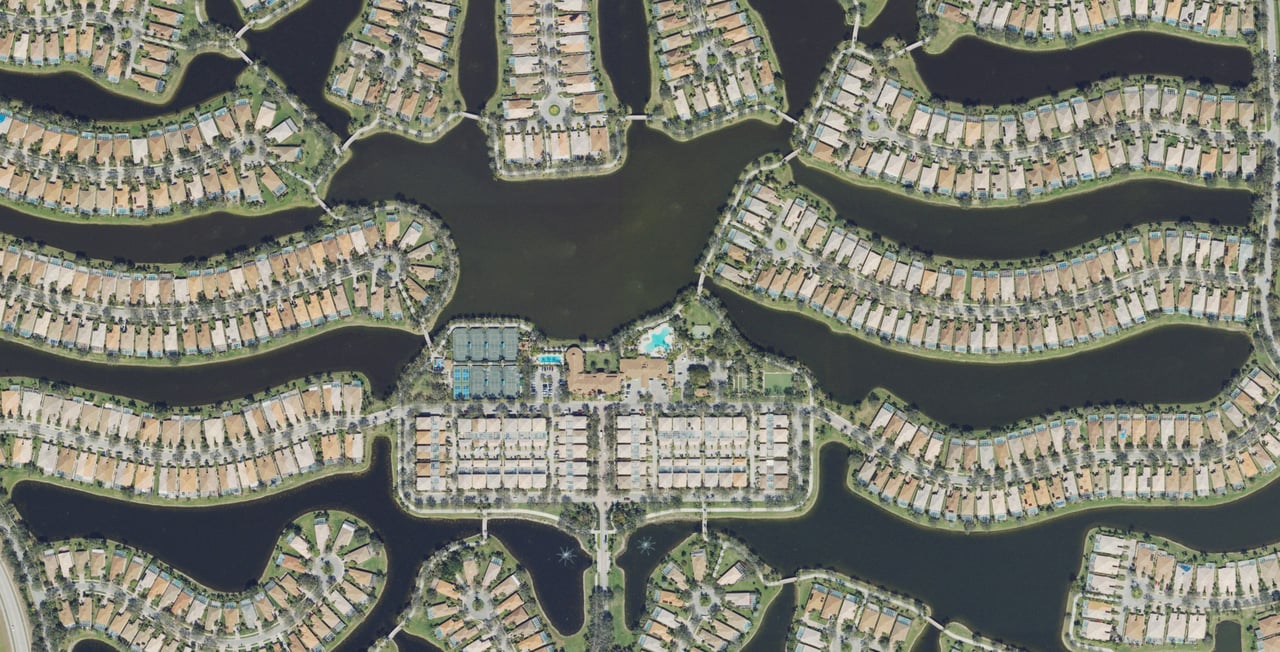
The community covers about 680 acres of platted land, roughly 1.06 square miles, inside a 705-acre county planned unit development, per the Collier County PUD Master List and the 2026 preliminary roll on the Collier County parcel layer. Vanderbilt Beach Road forms the south edge and Logan Boulevard North the west edge. Of that land, about 286 acres are home lots, about 225.5 acres are lake tracts, about 97 acres are roads and the entrance tract, about 45 acres are association common and recreation tracts, and the Town Center tract is 7.8 acres. DiVosta completed the homes from 1998 to 2003, with one final home in 2004; the busiest year was 2002, with 467 homes, per the year-built field in the Florida Department of Revenue statewide cadastral layer. The streets are named for islands around the world and run roughly A to Z as the phases were built, from Andros Way and Bermuda Lane in Phase One to Whidbey Way in Phase Five, with a second run (Anguilla, Barbados, Cayman, Dominica and on to Zanzibar) in Phase Seven, per Collier County’s road centerline file. The recorded plats and the county roll spell the name as one word, Islandwalk; the association’s legal name uses two.
An Island Walk day can start before sunrise. The fitness center opens at 4 a.m. and closes at 10 p.m. daily, with a 30-minute treadmill limit and a 20-minute limit on weight machines when others are waiting, per the association’s facilities and amenities page. By 8 a.m. the tennis and pickleball courts open; from November to April the 8 to 11 a.m. prime-time slots on the clay courts are reserved for round robins, residents and their guests, and courts are booked online up to seven days ahead under the racquet rules revised August 3, 2025, in the association’s governing documents library. Pop tennis takes courts 6 and 7 on set mornings and on Monday evenings.
Mid-morning the Town Center fills with errands that would mean a car trip anywhere else. Every home has a box at the auxiliary post office, and its staffed service window is open weekdays from 10 a.m. to 2 p.m.; the association is clear that the window is run by management, not by the U.S. Postal Service, per the association’s frequently asked questions. The same campus holds a gas station with a car wash and air pump, a nail salon, a hair salon and an on-site real estate office. The resort pool holds up to 90 people and the lap pool up to 32, both with a maximum depth of five feet, and lap swimmers have precedence in the lap pool.
In the afternoon the East Lawn, which the rules call “everyone’s backyard,” hosts lawn bowling and croquet, and on Sunday mornings the formal game is played in traditional whites. Bocce runs on three courts, per the association’s FAQ, and there are two ping pong tables and a new synthetic-turf putting green with chipping pads, which opened under rules dated July 9, 2025. Evenings belong to the clubs and to Casa Cotzelli, the Italian restaurant at 6175 Towncenter Circle inside the gates, per the restaurant’s own site. Its owners opened a second location, open to the public, at 12712 Tamiami Trail East on June 23, 2026, per Gulfshore Business. Hours for the pools, the Town Center building and the putting green are set by the association and posted on its site; we quote only the hours the association states consistently.
The main entrance is Islandwalk Boulevard off Vanderbilt Beach Road, where the gate arms sit about 560 feet north of the road, per the OpenStreetMap gate record; the association’s entrance tract is addressed 6005 Vanderbilt Beach Road. That entrance has a staffed gatehouse with a separate resident lane, and the 2026 budget carries $346,285 for the gatehouse contract, inside an access-control total of $389,763, per the 2026 approved budget. A second gated entrance connects Islandwalk Circle to Logan Boulevard North at the northwest corner, per the OpenStreetMap record of the northwest gate; the association does not publish how that gate is staffed or who may use it, so we do not describe it further.
Residents enter on a vehicle bar code, $15 per sticker, issued only to deed owners or approved tenants and affixed by staff, per the association’s frequently asked questions. No bar code is issued to a vehicle over 225 inches long or 83 inches high. Owners register guests and vendors through the association’s online gate system, which carries up to five permanent guests and five permanent vendors per home; anyone else is announced at the gatehouse. Amenity access runs on a separate credential: an amenity fob costs $10 and a phone credential $15, with a maximum of three per household, and a set of three mailbox keys costs $25, per the New Homeowner Packet dated March 25, 2026.
The Town Center is association common area on a 7.8-acre association-owned tract at 6155 Towncenter Circle, and the association describes a 20,000-square-foot building with 13,000 square feet of retail space. It opens its October 2025 guidelines with “We’re proud to share our beautifully renovated Town Center!” (the association has not published the cost or scope of that renovation). The full list the association publishes on its facilities and amenities page is:
Amenity | What the association publishes |
|---|---|
Resort pool | Capacity 90, maximum depth 5 feet |
Lap pool | Capacity 32, maximum depth 5 feet; lap swimmers have precedence |
Fitness center | Weight systems and cardio machines; 4 a.m. to 10 p.m. daily |
Tennis | Seven lighted clay courts (the association’s count); 8 a.m. to 10 p.m.; lights off at 10 p.m., 9 p.m. from May 1 to October 31 |
Pickleball | Four courts; quiet paddles and balls required; 24-hour video surveillance |
Pop tennis | Courts 6 and 7 on set mornings and Monday evenings |
Bocce | Three courts |
Lawn bowling and croquet | East Lawn |
Putting green | Synthetic turf with chipping pads (rules dated July 9, 2025) |
Rooms | Living room, Antigua Room, conference room, library and computer station |
Outdoor | Lakeside gazebo; tennis pavilion with grandstand seating |
Services | Gas station, car wash, air pump, auxiliary post office, Casa Cotzelli, a nail salon, a hair salon, an on-site real estate office |
There is no separate club entity, club membership, equity membership or initiation fee: the amenities are common area paid for by the dues, and the Board may charge reasonable user fees, such as $10 per 90 minutes for the tennis ball machine ($145 a year, or $90 a year for pickleball) and a deposit for room rentals, which need written approval. The whole campus is no-smoking. Tennis instructors must hold USPTA or PTR certification and pickleball instructors PPR, and be approved by the association. Up to six courts may be allotted to outside league play so that at least one stays open, league rosters must be at least half Island Walk residents, and there is no league play in prime time. Island Walk fields teams in the Collier County fall tennis league and the Southwest Florida Pickleball Day League, per its league club record. Town Center businesses also help fund the budget: the 2026 budget books $134,400 of business lease income, $35,000 of gas station net income and $10,000 of car wash net income.
For how the Island Walk courts compare with the public options nearby, including 20 pickleball courts and 6 lighted clay tennis courts at Pelican Bay Community Park, see our guide to tennis and pickleball in Collier County.
Water is the defining landscape. The association describes 30 lakes with 18.56 miles of shoreline and about 170 acres of water, on its welcome page, and by our analysis of county parcel records about 73% of homes (1,360 of 1,854 on the 2025 roll) have a lot line touching a lake tract: nearly every Carlyle and Oakmont, about 63% of Capri villas, and none of the townhomes. The lakes are part of a stormwater management system permitted by the South Florida Water Management District, and the association maintains them as permittee; the 2026 budget sets aside $312,753 for lakes.
The association describes a “wide internal pedestrian walkway system along the lakes” and “walking paths with Venetian style bridges,” and DiVosta’s 2001 marketing promised “miles of scenic island walk and pedestrian bridges that lead you to the island Town Center,” per the archived DiVosta community page. The association does not publish the mileage of the paths, so neither do we. The lakes are for looking at and paddling, not swimming: no gasoline-powered watercraft except the Lake Committee and lake vendors, no watercraft after dusk, and no swimming or wading, under rules 19 and 20 of the Consolidated Rules. Kayaks and other non-gas craft may use the lakes in daylight, and the residents’ Kayak Club paddles them. The New Homeowner Packet adds that fishing is catch and release and that alligators live in the lakes.
Island Walk dues are billed quarterly, due January 1, April 1, July 1 and October 1. The 2026 approved budget, adopted by the Board on October 22, 2025, raises $12,186,195 in assessments (2025: $11,647,312). Because base assessments are “levied equally on all Units” under Declaration section 6.1.A, that works out to about $6,566 per home per year, about $1,641 a quarter, roughly $547 a month, up about 4.6% from 2025. The association does not print a per-home figure; the estoppel certificate or the 2026 coupon states the exact billed amount. Here is what the association’s documents say the dues buy.
Included in the dues | Named document |
|---|---|
Basic cable TV (Xfinity Digital Starter, two boxes and two digital adapters) and 300 Mbps “Connect More” internet with a Wi-Fi modem, under a bulk contract | New Homeowner Packet, March 25, 2026 |
Lawn mowing (weekly May to October, every two weeks November to April), edging, pruning, tree trimming, fertilization, lawn pest control and irrigation on every lot | New Homeowner Packet; Declaration section 9.1.B as amended December 2024 |
Common-area landscaping, roads, streetlights and the 30 lakes | New Homeowner Packet; 2026 approved budget |
The staffed gatehouse | 2026 approved budget |
Every Town Center amenity | Declaration; 2026 approved budget |
On-site management by Castle Group | 2026 approved budget |
Common-area insurance and reserves | 2026 approved budget |
A few budget lines show where the money goes: the cable TV master contract is $1,806,838 (about $81 a month per home, by our arithmetic), the landscape contract $1,867,439, the transfer to reserves $2,066,825 (up from $1,504,913 in 2025) plus the $150,000 capital contribution transfer, management services $1,485,000, insurance $784,973 (down from $939,269), and streetlight electricity $160,896. The 2026 budget contains no special assessment line; ask for current Board minutes and the estoppel for anything levied since. The Declaration also allows a Neighborhood to vote extra services for itself and pay for them as a Neighborhood Assessment; none is budgeted for 2026.
The dues stop at the house. Under Declaration section 9.2.A, each owner, at the owner’s sole cost, maintains, repairs and replaces the home and its structures, including the roof, the exterior walls and routine exterior painting. There is no master insurance policy on the homes: the Declaration requires each owner to “maintain a policy or policies to insure the Owner’s Unit and all other insurable Improvements upon the Lot,” and a damaged home must be rebuilt to its original plans within 12 months. On the attached Capri villas and Aruba and Catalina townhomes, both owners share the cost of repairing a party wall, party fence or shared roof, and must make the repair within 60 days (Declaration section 9.4).
Outside the association, an Island Walk owner also pays Collier County property taxes (millage area 36, 10.5058 mills in 2025 and 10.402 mills on the 2026 preliminary roll), a $261.91 District I garbage assessment on the tax bill under the Collier County FY2026 solid waste rate resolution, and metered water and sewer from Collier County Utilities. There is no Community Development District, so no CDD line appears on the bill, per the county’s Community Development Districts layer. Put together, a buyer at the median 2026 preliminary just value can expect roughly $11,400 to $11,800 in the first year for dues, ad valorem tax and garbage, by our arithmetic, before insurance and utilities.
Cost | Who pays | Amount and source |
|---|---|---|
Roof, exterior walls, exterior paint | Owner | Declaration section 9.2.A |
Homeowners insurance, including wind | Owner | Declaration Article XII |
Flood insurance | Owner, where the lender or insurer requires it | See the flood section of this guide |
Property tax | Owner | 10.402 mills, 2026 preliminary roll |
Garbage (District I) | Owner, on the tax bill | $261.91, FY2026 rate resolution |
Water and sewer | Owner, metered | Collier County Utilities |
Party wall or shared roof repair | Both attached owners | Declaration section 9.4 |
Island Walk allows leasing, on terms. A lease must be written and run at least four months; a copy goes to the association at least 20 days before the lease starts; the tenant is bound by the Declaration; the owner stays liable for assessments; and subleasing is prohibited (Declaration sections 13.1 and 13.2). On September 9, 2026 the Board adopted a lease amendment to the Rules and Regulations, posted on the association’s sales and leasing page, that makes leases under four months, subleases, and leases “of any term” through Airbnb, VRBO or any short-term rental agency or vacation-rental company prohibited and voidable, and requires lease signatures to be notarized.
Screening costs $150 for an individual or married couple or $200 for unmarried co-tenants, plus a $50 administrative fee for every new or amended lease. Tenants are re-screened at every renewal unless they have lived at the same address under approved leases for five consecutive years, in which case the owner files a Certificate of Long Term Occupancy. When an owner leases, the tenant takes the owner’s amenity rights for the term unless the lease says otherwise. We found no rental cap, no first-year leasing ban and no limit on leases per year in the Declaration or the September 2026 rule. The practical effect is simple: Island Walk works for annual and seasonal leases of four months or longer, and it does not work for weekly vacation rentals.
Up to three dogs and cats combined may live in each home, and leashes outdoors may be no longer than 10 feet, under Class I rule 8 of the Consolidated Rules. Pets are not allowed inside the Town Center, the fitness center, the courts, the pools, the putting green, the bocce courts, the post office or the restaurant, with registered service animals excepted. The Declaration (section 11.5.C) prohibits pit bull terriers and dogs of violent temperament. If a buyer’s household has a fourth pet or a restricted breed, that is a conversation to have before the contract, not after the application.
The vehicle rules are the ones that surprise buyers most. “Prohibited Trucks,” defined in Declaration section 1.38 as pickups with caps or campers, step and box vans, vehicles with more than four wheels, commercial-use vehicles and anything over 83 inches tall, must be kept in the garage. Recreational vehicles, trailers, campers, boats, watercraft and motorcycles must also be garaged, and motor homes may be outside only for temporary loading. Plain pickups, SUVs and minivans that fit the limits may park in the driveway. There is no overnight street parking from 11 p.m. to 6 a.m., the speed limit is 25 mph, and garage doors may stay open only for temporary purposes and never more than four hours in 24. Every home has a two-car garage except the Catalina, which has one, and no garage may be converted to living space.
Golf carts are allowed if they are not gas-powered, are registered with the association every year with liability insurance naming the association, are driven by a licensed driver 16 or older, stay on the streets and the wide lakeside paths (not the narrow sidewalks), run from sunrise to sunset unless lighted, and are stored in the garage. E-bikes are governed by a rule of September 9, 2026: Class 1 to 3 only, a 750-watt cap, 15 mph on sidewalks, and no one under 16 on a Class 3 bike, per the updated e-bike rules in the governing documents library.
During hurricane season, June 1 to November 30, shutters or panels approved by the Architectural Control Committee may stay up with no time limit if they are white or clear; outside the season, shutters are prohibited. Whenever Collier County is under a tropical storm or hurricane watch or warning, any covering, including plywood, is allowed, and anything other than ACC-approved shutters must come down within seven days after the watch or warning ends, under rules 23 and 24 of the Consolidated Rules. The ACC’s April 9, 2025 standards, on its architectural review page, require accordion and roll-down shutters in white with white or house-color tracks, corrugated panels in white or clear, fabric in white, and allow Bermuda or Bahama shutters only on the garage window of side-load Oakmont and Carlyle models. Florida law backs the owner here: Florida Statutes section 720.3035 bars a homeowners association from denying hurricane protection, including impact windows and doors, shutters, roof systems and reinforced garage doors, that meets the specifications its board has adopted.
Owners who leave for part of the year must clear lanais and yards and name a responsible caretaker in writing (Declaration section 11.5.O and P), and allowed garden structures must be secured during hurricane season. Island Walk also runs its own Community Emergency Response Team, trained free by the Greater Naples Fire District, which musters at the Town Center after a storm, per the association’s clubs and organizations page. The community is in Collier County Evacuation Zone E, per the county’s evacuation zone lookup.
Every exterior and landscaping change needs prior approval from the Architectural Control Committee, which meets twice a month. The standards are written by model (Aruba, Capri, Carlyle, Catalina and Oakmont), with paint and roof schemes for each on the architectural review page. Replacement windows must match DiVosta’s original shape and dimensions, be white and include grids, with light or medium gray tint only. Replacement roofs must use Board-approved concrete tile lines (Eagle Capistrano or Boral Barcelona 900, in named colors), and roof coating in an approved tile color is allowed by application. Garage doors must match the original style, with no vents, painted Delicate White. Permanent generators and propane tanks need approval, a licensed installer and a sound enclosure; portable generators are stored out of sight.
Since the December 2024 amendment recorded at Official Records Book 6425, Page 2545 in the Collier Clerk’s official records, the association no longer takes an architectural damage deposit; damage from an owner’s project is charged back to that lot instead. For a buyer planning a new roof, impact windows or a generator, the ACC calendar is part of the renovation timeline.
A few more rules shape daily life, all from the Declaration and the 2026 Consolidated Rules in the association’s governing documents library:
About 35 resident clubs and classes run out of the Town Center, per the association’s clubs and organizations page. They include Mah Jongg Friends (over 120 members), Wednesday Contract Bridge, Canasta, Euchre, Bingo, poker nights, a Book Group, the Island Walk Theatre Group, Island Walk Knitters, painting classes, a wine society, a mixology club, the Island Walk Riders Car Club, the Kayak Club, croquet, ping pong, water aerobics, yoga, Zumba, Qi Gong, strength training and a Blue Zones health and wellness council. The association says Island Walk is “officially recognized by Blue Zones.” The Garden Club costs $20 a year and meets the last Saturday of the month, and a residents’ Men’s Golf League, running since 2003, plays January to April at Stoneybrook Golf Club in Estero. An on-site lifestyle director from Castle Group runs programming, the 2026 “Island Walk Functions” budget is $36,950 (up from $29,000), and the events calendar lives in the resident app. In April 2011 the Collier County Commission issued a proclamation congratulating IslandWalk on a Community of the Year award, per the Clerk’s record of that meeting.
Because Island Walk has a Town Center with courts and a restaurant, buyers sometimes assume it is a golf or boating community. It is not, so here is the list plainly.
Island Walk in Naples is also not IslandWalk at the West Villages, a separate DiVosta community with its own association in Sarasota County (its association site is a different organization), and it is not part of Wellen Park.
Island Walk has two DiVosta siblings in Naples that buyers compare it with. Pulte’s 1998 annual report to the SEC lists Island Walk Development Company and Village Walk Development Company as wholly owned DiVosta subsidiaries, and a 2004 to 2005 county record places Verona Walk Development Company at the same 6005 Vanderbilt Beach Road office, per the Collier Clerk’s board records. The records separate them on age, size, location and districts.
Village Walk of Naples is the older and smaller sibling: 849 homes built 1995 to 1998, with site addresses in ZIP 34109, per the 2026 preliminary roll. Verona Walk is the newer and larger one: 1,920 homes built 2004 to 2019, in East Naples, ZIP 34114, and unlike Island Walk it carries a Community Development District that bills separately on the tax bill. Island Walk sits between them in age (1998 to 2004) and has no CDD at all.
Record | Island Walk | Village Walk of Naples | Verona Walk |
|---|---|---|---|
Homes (2026 preliminary roll) | 1,856 | 849 | 1,920 |
Year built (state roll) | 1998 to 2004 | 1995 to 1998 | 2004 to 2019 |
Site ZIP | 34119 | 34109 | 34114 |
Community Development District | None | Not established in our records | Yes, billed on the tax bill |
2026 preliminary median just value (assessment, not a price) | $478,094 | $533,780 | $439,340 |
Source: Collier County parcel layer, 2026 preliminary roll, and the Florida Department of Revenue 2026 preliminary name, address and legal file for Collier County. The just values are county assessments set for taxation; recorded sale prices for all three are in the market section below.
After closing, the new owner takes the recorded warranty deed to the Town Center office; that unlocks the association website, payment portal, gate access and email, and bar codes are issued only once the deed is on file, per the association’s sales and leasing documents. The office, run by Castle Group, is at 6155 Towncenter Circle, Suite 101, and is open weekdays 9 a.m. to 1 p.m. and 2 to 5 p.m., with Castle’s 24-hour resident services line covering after hours, per the association’s management contacts page. Dues can be paid by ACH online for $3.95 a payment or by credit card at 3.5%, or by check to the association’s lockbox. A late charge applies after 30 days (the lesser of 10% of the unpaid quarterly assessment or the legal maximum, plus interest), and under a policy effective April 24, 2024 one late fee may be waived once in 60 months if the account is paid in full with no open violations.
Board meetings are generally held on the fourth Wednesday at 2 p.m. at the Town Center, broadcast on in-house channel 195 and on Zoom. A seven-member board, reduced from nine by a CONCUR vote on April 11, 2026, governs, and the Declaration divides the community into 40 Neighborhoods, each electing a committee of up to five owners that sends representatives to CONCUR, the Council of Neighborhood Committee Representatives, which has its own portal. CONCUR, not the Board alone, can disapprove the annual budget (with 51% of the votes), change the capital contribution and amend the By-Laws.
Every Island Walk address is zoned for Vineyards Elementary (6225 Arbor Boulevard, about 1.5 road miles and 4 minutes from the gate), Oakridge Middle (about 3.6 miles) and Barron Collier High (about 6 miles) for 2026-27, per the Collier County Public Schools address lookup, and all three earned an A for 2025-26. Mason Classical Academy, a public charter school graded A, opened its K-8 campus at 7170 Vanderbilt Beach Road, about a mile east of the gate, with admission by application, per its Vanderbilt campus page. Our guide to Naples private schools covers the private options.
The nearest grocery is Sprouts on Logan Boulevard North, about 1.9 miles and 6 minutes from the Town Center, with the Publix at The Shoppes at Pebblebrooke about 8 minutes and Mercato, with Whole Foods, a cinema and more than 80 businesses, about 11 minutes from the gate. The nearest emergency room is the NCH Northeast freestanding emergency department at 15420 Collier Boulevard, about 7 to 8 minutes, and a Collier County EMS station, Medic 76, sits on Logan Boulevard North just outside the community, per the county’s EMS station layer. I-75 is about 6 to 7 minutes away at Immokalee Road (Exit 111) or Pine Ridge Road (Exit 107). All drive times are free-flow estimates from the main gate; January to April traffic on Vanderbilt Beach, Immokalee and Pine Ridge roads adds time. For restaurants and parks beyond the gate, see our guides to Collier County restaurants and Collier County parks.
Thinking about selling your Island Walk home? Start with a free home valuation for your Island Walk home, or Call Jesse direct at (239) 898-6072 to talk through the Intent to Sell form, the ACC calendar and pricing against every recorded sale of your model.
Buying in Island Walk? Call Marc at (239) 287-5873 before you tour, so you know which model, street and flood mapping fit your plans, or read how we represent buyers in Southwest Florida.
Island Walk recorded 97 qualified sales from May 2025 to April 2026 at a median of $525,000, down from 80 sales at a median of $600,000 in the 12 months before, per Collier County recorded qualified sales (Florida Department of Revenue sales data file). Every product median fell, and a shift toward Capri villas and away from Carlyle homes deepened the community-wide drop.
Data updated: September 2026
The MLS layer. In the Southwest Florida MLS Matrix, pulled September 24, 2026, 120 Island Walk homes closed from September 25, 2025 to September 24, 2026, for $69,995,700 in closed volume. The median sold price was $532,500 (the mean of the middle pair, $530,000 and $535,000) (n=120, even), the median sold price per square foot of living area was $300.78 (the mean of the middle pair, $300.00 and $301.57), the median time on market was 54 days, the median sold-to-list ratio was 95.80%, and 11 of 120 closed at or above list. The highest sale was $955,000 and the lowest $350,000. In the prior 12 months the same query found 65 closings at a median of $600,000.
Product | Closings | Median sold price | Median days on market | Median sold-to-list |
|---|---|---|---|---|
Capri villa | 50 | $455,000 | 53 | 95.8% |
Oakmont | 42 | $672,500 | 65 | 95.8% |
Carlyle | 16 | $822,500 | 61 | 95.8% |
Townhome | 11 | $495,000 | 33 | 97.1% |
Andros | 1 | listed, not medianed: high $605,000 | 59 | 93.2% |
All Island Walk | 120 | $532,500 | 54 | 95.8% |
On September 24, 2026, 13 Island Walk homes were listed as active in the Southwest Florida MLS Matrix at a median list price of $489,900, with 15 under contract, which is about 1.3 months of supply at the trailing 12-month closing pace.
This section has two layers. The MLS layer above covers listings, days on market and sold-to-list ratios. Everything below it is the public-record layer: Collier County recorded qualified sales (Florida Department of Revenue sales data file), which records one row for every deed, with the sale year and month, the price, the Official Records book and page, and the state’s decision on whether the sale was an arm’s-length market transaction. We used the Florida Department of Revenue 2026 preliminary sales data file for Collier County, which covers sales from January 2025 to June 2026, and the 2025 final statewide sales data file, which covers January 2024 to September 2025, and matched each sale to one of the 1,856 Island Walk homes on the Collier County parcel layer.
A sale counts here only if the state qualified it as an arm’s-length transfer included in its sales-ratio analysis, it was an improved home, it was a single-parcel deed and the price was above $100, following the definitions in the Department of Revenue’s 2026 data users’ guide. All 205 qualified Island Walk prices from January 2024 to April 2026 match, to the dollar, the amount Collier County recorded for the same deed book and page. The trailing 12 months run from May 2025 to April 2026 because April 2026 is the latest month for which the state has finished screening every Island Walk transfer; the prior 12 months run from May 2024 to April 2025. Together they are 24 months and 177 qualified sales.
No Island Walk figure here includes The Cove, the separate 136-townhome subdivision that shares the county zoning district, and no figure includes IslandWalk at the West Villages in Sarasota County, whose parcels are in a different county file altogether.
Three kinds of number describe Island Walk homes, and they are not interchangeable.
Number | What it is | Who produces it | What it is good for |
|---|---|---|---|
Recorded sale price | The price on a deed recorded with the Collier Clerk, screened by the state for arm’s-length sales | Collier County Clerk; Florida Department of Revenue | What buyers actually paid, including sales that never touched the MLS |
Just value | The county’s assessment of market value as of January 1, set for taxation | Collier County Property Appraiser, reported on the tax roll | Comparing all 1,856 homes at once, including the ones that did not sell; computing taxes |
MLS figure | Listing and closing data entered by agents: list price, sold price, days on market, living area | The multiple listing service | Pricing a listing, reading time on market and sale-to-list, living-area comparisons |
A recorded sale price is a price. A just value is an assessment and is never a price: it lags the market and is set on a different basis. An MLS figure covers only sales that went through a listing, and it carries details the deed does not, such as days on market and living area. On this page, the county-record sale figures are labeled with their window every time, the just values are labeled “2026 preliminary just value on the Collier County roll” every time, and the MLS figures appear only in the MLS layer.
Island Walk, all homes | May 2025 to April 2026 | May 2024 to April 2025 |
|---|---|---|
Recorded qualified sales | 97 (odd) | 80 (even) |
Median sale price | $525,000 (one actual sale) | $600,000 (mean of a middle pair of $600,000 and $600,000) |
Middle half (first to third quartile) | $470,000 to $670,000 | $533,725 to $783,088 |
Range | $350,000 to $955,000 | $405,000 to $1,160,000 |
Recorded sale volume | $55,824,200 | $52,819,250 |
Mean sale price | $575,507 | $660,241 |
Source: Collier County recorded qualified sales (Florida Department of Revenue sales data file). Quartiles use linear interpolation.
The count went up while the median came down. Seventeen more homes sold in the trailing 12 months than in the 12 before, and recorded volume rose about 5.7%, but the median fell about 12.5%, from $600,000 to $525,000. At 97 sales in a community of 1,856 homes, about 5.2% of Island Walk changed hands in a qualified sale in a year.
The four main products sell in very different price bands, so the product median is the one that matters for a specific home. Product classes come from our analysis of county parcel and building records.
Product | Homes (about) | Sales, May 2025 to April 2026 | Median | Middle half | Range |
|---|---|---|---|---|---|
Capri villa (one-story, attached pair) | 775 | 44 (even) | $470,000 (mean of $470,000 and $470,000) | $435,000 to $500,000 | $360,000 to $665,000 |
Oakmont (one-story detached) | 613 | 36 (even) | $662,500 (mean of $660,000 and $665,000) | $604,000 to $716,250 | $500,000 to $850,000 |
Carlyle (one-story detached, largest plan) | 291 | 9 (odd, small sample) | $832,000 | $700,000 to $849,000 | $690,000 to $955,000 |
Aruba and Catalina townhome (two-story attached) | 160 | 8 (even, small sample) | $510,000 (mean of $505,000 and $515,000) | $486,250 to $516,250 | $350,000 to $525,000 |
Andros Way (mixed) | 17 | 0 | No sale | none | none |
All homes | 1,856 | 97 (odd) | $525,000 | $470,000 to $670,000 | $350,000 to $955,000 |
Source: Collier County recorded qualified sales (Florida Department of Revenue sales data file), May 2025 to April 2026.
The nine Carlyle sales, in order of recording, were $800,000 (July 2025), $849,000 and $700,000 (October 2025), $832,000 and $690,000 (December 2025), $695,000 (January 2026), $835,000 (March 2026), and $955,000 and $850,000 (April 2026). The eight townhome sales were $350,000, $460,000, $495,000, $505,000, $515,000, $515,000, $520,000 and $525,000. With samples that small, one sale moves the median, so read the Carlyle and townhome figures as a range more than a point.
For the homes themselves, DiVosta’s 2001 model sheets list the Capri III at 2 bedrooms plus a den, 2 baths and 1,522 air-conditioned square feet; the Oakmont at 3 bedrooms plus a den, 2 baths and 1,995; the Carlyle at 4 bedrooms (an optional fifth), 3 baths and 2,507; and the two-story Aruba at 3 bedrooms, 2.5 baths and 1,826 to 1,841. The Catalina is a two-story attached townhome with a one-car garage; its square footage is not in any record we could cite.
Product | Prior 12 months, May 2024 to April 2025 | Trailing 12 months, May 2025 to April 2026 | Change in median |
|---|---|---|---|
Capri villa | 36 sales, median $527,450 (mean of $525,000 and $529,900); middle half $475,000 to $577,500; range $405,000 to $785,000 | 44 sales, median $470,000 | Down about 10.9% |
Oakmont | 25 sales, median $735,000; middle half $620,000 to $782,450; range $535,000 to $1,060,000 | 36 sales, median $662,500 | Down about 9.9% |
Carlyle | 14 sales, median $877,500 (mean of $865,000 and $890,000); middle half $850,000 to $907,500; range $777,500 to $1,160,000 | 9 sales, median $832,000 (small sample) | Down about 5.2% |
Townhome | 4 sales, median $537,500 (mean of $535,000 and $540,000); range $510,000 to $542,000 (small sample) | 8 sales, median $510,000 (small sample) | Down about 5.1% |
Andros Way | 1 sale: $765,000, February 2025 (no median) | No sale | none |
All homes | 80 sales, median $600,000 | 97 sales, median $525,000 | Down about 12.5% |
Source: Collier County recorded qualified sales (Florida Department of Revenue sales data file).
Every product with sales in both windows recorded a lower median in the trailing 12 months. The Capri and Oakmont declines, each around 10%, rest on 36 to 44 sales a side and are the most reliable readings. The Carlyle and townhome figures rest on 4 to 14 sales and could move several percentage points with a single closing.
The all-homes median fell about 12.5%, more than any single product’s median. That happens when the mix of what sells shifts toward lower-priced homes. In the prior 12 months, Carlyle homes, the most expensive plan, were 14 of 80 sales (17.5%); in the trailing 12 they were 9 of 97 (9.3%). Townhomes rose from 4 of 80 (5.0%) to 8 of 97 (8.2%), and Oakmont homes from 25 (31.2%) to 36 (37.1%), while Capri villas held at about 45% in both windows (36 of 80 and 44 of 97).
The price bands show the same shift:
Sale price band | Sales, May 2024 to April 2025 | Sales, May 2025 to April 2026 |
|---|---|---|
Under $400,000 | 0 | 5 |
$400,000 to $499,999 | 13 | 29 |
$500,000 to $599,999 | 26 | 21 |
$600,000 to $699,999 | 9 | 20 |
$700,000 to $799,999 | 13 | 15 |
$800,000 and above | 19 | 7 |
Source: Collier County recorded qualified sales (Florida Department of Revenue sales data file).
Two things are true at once, and a seller needs both. Prices at Island Walk did come down: every product median is lower. But the community-wide median overstates the drop for any one home, because fewer of the most expensive homes sold. A Carlyle owner should price against Carlyle sales and a Capri owner against Capri sales, and never against the all-homes median.
Period | Recorded qualified sales | Median | Middle half | Range |
|---|---|---|---|---|
Calendar 2024 | 83 (odd) | $560,000 | $511,000 to $745,500 | $420,000 to $1,160,000 |
Calendar 2025 | 78 (even) | $597,500 (mean of $595,000 and $600,000) | $500,000 to $715,000 | $350,000 to $1,149,500 |
January to April 2026 | 44 (even) | $538,000 (mean of $525,000 and $551,000) | $471,250 to $696,250 | $360,000 to $955,000 |
Source: Collier County recorded qualified sales (Florida Department of Revenue sales data file). January to April 2026 is four months of qualified data only; May 2026 onward is still pending state review.
The calendar view looks different from the trailing view because of where the high-priced sales fell. The first quarter of 2025 carried a cluster of expensive sales (a quarterly median of $690,000), which lifted calendar 2025 above calendar 2024 even though the trailing 12 months, which leave that quarter out, show a decline.
Quarter | Sales | Median | Range |
|---|---|---|---|
2024, January to March | 20 | $550,000 (mean of $550,000 and $550,000) | $475,000 to $1,160,000 |
2024, April to June | 22 | $534,450 (mean of $529,900 and $539,000) | $420,000 to $1,160,000 |
2024, July to September | 25 | $590,000 | $452,000 to $900,000 |
2024, October to December | 16 | $566,000 (mean of $542,000 and $590,000) | $460,000 to $900,000 |
2025, January to March | 20 | $690,000 (mean of $660,000 and $720,000) | $475,000 to $1,149,500 |
2025, April to June | 15 | $550,000 | $405,000 to $1,050,000 |
2025, July to September | 18 | $555,000 (mean of $515,000 and $595,000) | $360,000 to $800,000 |
2025, October to December | 25 | $525,000 | $350,000 to $849,000 |
2026, January to March | 31 | $600,000 | $360,000 to $850,000 |
2026, April only | 13 | $495,000 | $430,000 to $955,000 |
Source: Collier County recorded qualified sales (Florida Department of Revenue sales data file). Quarterly samples are small; one sale can move a quarterly median by tens of thousands of dollars.
The first quarter of 2026 recorded 31 qualified sales, the most of any quarter in the file, at a median of $600,000. That is a busier and firmer season than the trailing-12 median alone suggests, and it is the reason we read the market month by month for any listing, not by the annual number.
Month | Sales, May 2025 to April 2026 |
|---|---|
May 2025 | 4 |
June 2025 | 6 |
July 2025 | 6 |
August 2025 | 7 |
September 2025 | 5 |
October 2025 | 7 |
November 2025 | 8 |
December 2025 | 10 |
January 2026 | 12 |
February 2026 | 9 |
March 2026 | 10 |
April 2026 | 13 |
Source: Collier County recorded qualified sales (Florida Department of Revenue sales data file).
Of the 97 trailing-12 sales, 62 recorded between November and April, at a median of $520,000 (the mean of a middle pair of $520,000 and $520,000), and 35 between May and October, at a median of $600,000. The off-season median is higher because more of the summer sales were detached homes: 15 Oakmont and 3 Carlyle sales among 35, against 21 Oakmont and 6 Carlyle among 62 in season, while Capri villas made up 29 of the 62 season sales. Deed dates trail contract dates by the closing period, so a spring recording usually means a winter contract.
Product | Homes (about) | Qualified sales, May 2025 to April 2026 | Share that sold |
|---|---|---|---|
Capri villa | 775 | 44 | about 5.7% |
Oakmont | 613 | 36 | about 5.9% |
Carlyle | 291 | 9 | about 3.1% |
Townhome | 160 | 8 | about 5.0% |
Andros Way | 17 | 0 | none |
All homes | 1,856 | 97 | about 5.2% |
Source: Collier County recorded qualified sales (Florida Department of Revenue sales data file); product counts from our analysis of county parcel and building records.
Carlyle homes turned over at about half the rate of the other products in the trailing 12 months. For a Carlyle seller that is a scarcity point worth making in the marketing, and for a Carlyle buyer it means waiting for the right lake and exposure can take a season or more.
Most deeds recorded on Island Walk homes are not market sales, which is why the recorded-deed count on a public search is so much larger than the qualified-sale count. In the trailing 12 months, alongside the 97 qualified sales, the state’s file carries 197 quitclaim, corrective or minimum-consideration deeds (typically title housekeeping), 18 deeds reserving a life estate, 3 transfers between related parties, 2 transfers by estates or trustees, 2 sales with non-market financing, 1 sale the state flagged for atypical exposure or motivation, and 1 sale of a property that was changed after the sale. The prior 12 months show the same pattern: 80 qualified sales against 194 housekeeping deeds and a handful of family, estate and atypical transfers. None of those enters any median on this page, per the qualification definitions in the Department of Revenue’s data users’ guide.
Anyone can look up a single deed at the Collier Clerk’s official records search, and a recorded sale price is public. What the Clerk’s record does not tell you is whether the state judged that price a market sale; the sales data file does.
The Collier County parcel layer shows 38 deeds over $1,000 recorded on Island Walk homes from May 4 to August 24, 2026, with recorded amounts from $200,000 to $896,000: 10 in May, 9 in June, 10 in July and 9 in August. By our product classes they are 18 Capri villas, 11 Oakmont homes, 5 Carlyle homes and 4 townhomes. Twelve of them, from May and June, already appear in the state’s 2026 preliminary file, all marked pending review; the other 26 are not yet in any state file.
We do not put those deeds in any median, because nobody has yet decided which of them are arm’s-length sales. The $200,000 deed, for example, is well below any qualified Island Walk sale of the past two years and may well be a family or partial-interest transfer; a median that included it would mislead. The state’s 2026 final file, usually posted after the roll is certified, will screen May and June, and the MLS layer covers the most recent months in the meantime. Read the recent deeds as a sign that Island Walk kept recording transfers through the summer of 2026 at a pace of about nine or ten a month, not as a price reading.
The county roll values every home, not just the ones that sold. On the 2026 preliminary roll, the median just value of the 1,856 Island Walk homes is $478,094 (n=1,856, even, so the median is the mean of a middle pair of $477,692 and $478,495), the middle half runs from $407,724 to $571,981, and the range is $346,735 to $808,128, per the Collier County parcel layer. These are assessments set for taxation, not prices.
Product | Homes | 2026 preliminary median just value on the Collier County roll | Middle half |
|---|---|---|---|
Capri villa | 774 | $409,768 | $395,696 to $429,817 |
Aruba and Catalina townhome | 160 | $398,660 | $384,577 to $422,729 |
Oakmont | 612 | $562,952 | $540,730 to $572,277 |
Carlyle | 291 | $671,490 | $661,245 to $687,428 |
Andros Way | 17 | $542,484 | $434,010 to $562,478 |
All homes | 1,856 | $478,094 | $407,724 to $571,981 |
Source: 2026 preliminary Collier County roll, product classes from our analysis of county parcel and building records. The product medians cover 1,854 homes; the two lots that first appear as separate parcels on the 2026 roll (one Capri street lot and one Oakmont street lot) are in the all-homes figure only. The Capri, Oakmont and townhome counts are even, so those medians are the mean of a middle pair. Assessments, not prices.
Set beside the recorded sales, the assessments run below the market in every product: the Capri median sale of $470,000 against a $409,768 median assessment, the Oakmont $662,500 against $562,952, the Carlyle $832,000 against $671,490. That gap is normal, because the roll is set as of January 1 on its own basis. Use the roll to compare homes with each other and to estimate taxes, and use recorded and MLS sales to price one.
The same roll broken out by recorded plat shows where the detached homes cluster. Phases Five A, Five B and Six, which are mostly Oakmont and Carlyle streets, carry the highest median assessments; Phase Seven A and the Towncenter plat, which are mostly townhomes and villas, the lowest.
Plat | Homes | Median just value | Middle half | Homesteaded |
|---|---|---|---|---|
Phase One | 234 | $470,816 | $397,768 to $560,510 | 157 |
Phase One A | 9 | $434,010 | $405,681 to $531,609 | 5 |
Phase One B | 8 | $560,501 | $558,191 to $569,700 | 6 |
Phase Two | 191 | $530,644 | $412,442 to $585,930 | 118 |
Phase Three | 277 | $504,377 | $401,624 to $563,656 | 178 |
Phase Four | 343 | $433,617 | $408,657 to $563,643 | 214 |
Phase Five A | 122 | $581,364 | $568,203 to $661,332 | 81 |
Phase Five B | 59 | $570,011 | $565,778 to $576,254 | 38 |
Phase Six | 146 | $574,654 | $553,202 to $660,062 | 102 |
Phase Seven | 293 | $423,019 | $397,453 to $568,127 | 178 |
Phase Seven A | 86 | $425,684 | $407,638 to $433,559 | 45 |
Towncenter | 88 | $408,126 | $397,677 to $427,722 | 43 |
All plats | 1,856 | $478,094 | $407,724 to $571,981 | 1,165 |
Source: 2026 preliminary Collier County roll. Phase One A (9 homes) and Phase One B (8 homes) are small samples. The plats themselves are recorded in Plat Books 29 to 38 and can be viewed through the Collier Clerk’s plat search.
On the 2025 roll (n=1,854; two lots that carry separate parcels on the 2026 roll do not appear in the 2025 state file), the median just value was $506,684, with a middle half of $407,492 to $608,251, per the 2025 roll data in the Florida Department of Revenue statewide cadastral layer. The 2026 preliminary median is $478,094. We show the two side by side so owners can see why a 2026 notice of proposed taxes may show a different just value from last year, not as a market trend: assessments are set once a year as of January 1, and the sale-price trend is the recorded-sale layer above. The preliminary values can still change before the roll is certified, and final millage rates are set at the September hearings and appear on the November bill.
For a buyer, the more important point is that a purchase resets the assessment. A new owner who claims homestead at the median value would pay roughly $4,548 in ad valorem tax plus the $261.91 garbage assessment, about $4,810, and a buyer who does not homestead roughly $4,973 plus garbage, about $5,235, using the 2026 preliminary rate of 10.402 mills for millage area 36. The median computed ad valorem tax across all homes on the 2026 preliminary roll is about $4,050: about $3,474 for homesteaded homes and about $4,498 for the rest.
1,165 of the 1,856 homes, about 62.8%, carry a Florida homestead exemption on the 2026 preliminary roll, per the Collier County parcel layer. Homestead can only be claimed on a permanent residence, so at least that share are year-round owner-occupied homes. The record does not split the remaining homes between second homes, rentals and homes whose owners have not filed, so we do not either. For a seller, the homestead share matters in one practical way: most Island Walk buyers who plan to live here will file for homestead, and their tax figure will be the reset figure above, not the seller’s current bill.
The same method (the county parcel set, the 2026 preliminary roll and the state’s qualified sales for the same two windows) gives a like-for-like benchmark against the communities Island Walk buyers most often compare it with.
Community | ZIP | Homes | Year built | 2026 preliminary median just value (assessment) | Qualified sales, May 2025 to April 2026 | Qualified sales, May 2024 to April 2025 |
|---|---|---|---|---|---|---|
Island Walk | 34119 | 1,856 | 1998 to 2004 | $478,094 | 97, median $525,000 ($470,000 to $670,000) | 80, median $600,000 ($533,725 to $783,088) |
34114 | 1,920 | 2004 to 2019 | $439,340 | 97, median $480,000 ($435,000 to $652,500) | 78, median $555,000 (mean of $550,000 and $560,000) | |
34109 | 849 | 1995 to 1998 | $533,780 | 51, median $570,000 ($460,000 to $692,500) | 27, median $640,000 ($551,000 to $775,000) | |
34119 | 580 | 2001 to 2006 | $600,143 | 29, median $730,000 ($625,000 to $865,900) | 25, median $785,000 ($565,000 to $975,000) | |
Heritage Greens, single-family lots | 34119 | 163 | 1998 to 2003 | $559,041 | 7, median $560,000 (small sample) | 6, median $649,000 (mean of $613,000 and $685,000, small sample) |
Summit Place, condominium-form townhomes | 34119 | 208 | 2004 to 2014 | $328,298 | 13, median $410,000 ($385,000 to $437,000) | 3, median $440,000 (small sample) |
Source: Collier County recorded qualified sales (Florida Department of Revenue sales data file) and the 2026 preliminary Collier County roll. Ranges in brackets are the middle half of sales. Island Walk, Verona Walk, Saturnia Lakes and Summit Place have an even number of homes, so their just-value medians are the mean of a middle pair (for Saturnia Lakes, $600,095 and $600,190, shown rounded).
The pattern is the same across the whole group: every community recorded a lower median in the trailing 12 months than in the 12 before. Island Walk’s drop (about 12.5%) sits close to Verona Walk’s (about 13.5%) and Village Walk of Naples’ (about 10.9%), and all three DiVosta communities saw more qualified sales in the trailing year than the year before. Village Walk is a smaller, older community whose sales run higher; Verona Walk is a newer, larger community in East Naples whose median runs below Island Walk’s and which carries a CDD on the tax bill; Saturnia Lakes, next door in the same ZIP, is a 580-home community whose sales run well above Island Walk’s. Heritage Greens has a golf course tract and very few single-family sales, and Summit Place is condominium-form and useful only as a floor reference. A deeper comparison of Island Walk and Verona Walk appears later in this guide.
We do not compute a price per square foot from any county figure. The area field on the Florida tax roll is an “effective area” that can include garages and porches at factored rates, per the Department of Revenue’s 2024 data users’ guide, so it is not living area; at Island Walk the roll area for a Capri runs hundreds of square feet above DiVosta’s published 1,522 air-conditioned square feet. The honest per-square-foot figure divides an MLS sold price by MLS living area, and that belongs to the MLS layer.
For a seller, the public record says three things. First, buyers kept coming: qualified sales rose from 80 to 97 and the first quarter of 2026 was the busiest quarter in the file. Second, prices reset: every product median is lower than a year earlier, by about 10% for Capri and Oakmont homes. Third, your comparable set is your product, your plat and your lake exposure, not the community median, which fell further than any product because fewer Carlyles sold. For a buyer, the same record says the negotiating room of 2025 and 2026 is real, that villa prices clustered tightly around $470,000 while Oakmont prices spread from $500,000 to $850,000, and that the $1,500 capital contribution, the application fee and a reset property tax belong in the budget from the first offer.
McGreevy and Comisar are Top 1% Real Estate Agents Nationally Since 2008, and we price Island Walk homes against every recorded qualified sale of the same model, not against the community median. Get a free home valuation for your Island Walk home, or Call Jesse direct at (239) 898-6072 and he will walk you through what your Capri, Oakmont, Carlyle or townhome is competing against this season.
Buying in Island Walk? Call Marc at (239) 287-5873 before you make an offer, so you know how your target home compares with the 177 recorded qualified sales of the past two years, or read how we represent buyers in Southwest Florida.
Island Walk was built by DiVosta, the Palm Beach Gardens builder known for its cast-in-place concrete system, through a subsidiary called Island Walk Development Company. Pulte Corporation bought DiVosta on July 1, 1998, so nearly all 1,856 Island Walk homes were finished between 1998 and 2003 by DiVosta as a Pulte company, with one final home in 2004.
That short answer hides a long paper trail, and almost every step of it is on the public record: a state corporate filing signed in 1996, two county approvals granted the same day in January 1997, a 1998 securities filing that names the Island Walk company as a subsidiary, twelve recorded plats, and a tax roll that still carries the construction class of every home. Below is the builder’s story as those records tell it, and what it means for anyone buying or selling a DiVosta home here today.
DiVosta and Company was a Palm Beach County homebuilder founded by Otto B. “Buz” DiVosta Jr., who was born in Stamford, Connecticut in 1934, according to Palm Beach County History Online’s profile of Otto DiVosta Jr.. The company’s reputation rested on one idea: build the walls of a house the way commercial builders pour a parking garage, in concrete, inside steel forms, on site. That method is the single most repeated reason buyers ask about DiVosta homes, and it is the thread that ties Island Walk to the company’s other Southwest Florida communities.
The builder matters for three practical reasons. First, construction method drives the conversation with insurers, because a wind mitigation inspection records wall type and roof-to-wall connections. Second, a planned community built by one company in a tight window tends to have a small, repeating set of floor plans, which makes it easier to compare one home with another. Third, the builder wrote the original governing documents, and the structure it created in 1998 (one association, 40 Neighborhoods and a representative council) still runs Island Walk today.
According to Palm Beach County History Online, DiVosta and a partner “imported Moduplex, a French concrete building system” and built with a “cast-in-place” method that involved “pre-assembling major parts of the house.” The same profile says the method let the company build townhouses “in just 47 days.” We date the import to the 1970s, because the two published accounts of the start year disagree by a year.
The secondary account in Wikipedia’s article on Otto DiVosta credits DiVosta with introducing the construction method in South Florida in the mid-1970s and, citing a 1981 newspaper report, describes a demonstration in which a quick-setting cement allowed a three-bedroom, two-bath home with a two-car garage to be built in a single working day. Treat that as color, not as how Island Walk was built.
What matters for Island Walk is continuity. The Palm Beach County History Online profile states that after the 1998 sale Pulte “continued to use the trademarked DiVosta Building System.” DiVosta’s own archived Island Walk page from 2001, preserved by the Internet Archive as DiVosta’s archived Island Walk community information, described the “Modüplex Building System” with “reinforced steel and solid concrete or concrete block exterior walls.” Read that sentence carefully: the builder’s own marketing named two wall types. That is why we never tell a buyer that every Island Walk home has poured walls. The record supports a narrower, still useful statement, which the tax roll makes next.
The Florida Department of Revenue codes a construction class for every improved parcel. On the 2025 statewide roll, published through the Florida DOR statewide cadastral layer, 1,833 Island Walk homes carry construction class 2. The department’s 2024 NAL, SDF and NAP user’s guide defines class 2 as “reinforced concrete,” a separate code from class 3, “masonry,” which is the usual code for concrete block.
Florida DOR construction class (2025 roll) | Island Walk homes | What the class means |
|---|---|---|
Class 2, reinforced concrete | 1,833 | Reinforced concrete frame or walls |
Class 3, masonry | 14 | Concrete block or similar masonry |
Class 5 | 3 | Other class per the DOR guide |
Blank | 4 | No class recorded |
Nearly 99 percent of the homes in that file are coded reinforced concrete, which is consistent with DiVosta’s cast-in-place system. It is a county appraisal classification, not an engineering certificate. For any specific home, the document that matters is the buyer’s wind mitigation inspection, which records the walls, roof deck attachment, roof-to-wall connection and opening protection that Florida insurers must credit under Florida Statutes 627.0629. The roofs are concrete tile under the association’s architectural rules, which today allow only Board-approved concrete tile lines on replacement roofs, as set out in the Architectural Review page’s ACC Requirements and Procedures.
Island Walk Development Company was the DiVosta entity created to build the community. Its Florida corporate record, Sunbiz document P96000030340 for Island Walk Development Company, and the scanned 1996 articles of incorporation show:
Event | Date | Record |
|---|---|---|
Name reserved | March 28, 1996 | Sunbiz filing history |
Articles signed by Otto B. DiVosta | April 1, 1996 | 1996 articles |
Articles filed with the Department of State | April 8, 1996 | Sunbiz P96000030340 |
Articles amended (DiVosta family trusts named as shareholders) | May 2, 1997 | Sunbiz filing history |
Principal address moved to Pulte’s DiVosta office | by 2003 | Annual reports |
Voluntarily dissolved | June 11, 2007 | Sunbiz P96000030340 |
The 1996 articles were filed from DiVosta and Company’s headquarters at 4500 PGA Boulevard in Palm Beach Gardens. Locally, a 2004 to 2005 county board record indexed by the Collier Clerk’s minutes and records system lists DiVosta Building Corporation and Island Walk Development Company at 6005 Vanderbilt Beach Road, which is the address of Island Walk’s own entrance tract.
Pulte Corporation, now PulteGroup, disclosed the purchase in its 1998 Form 10-K filed with the SEC: “On July 1, 1998, the Company acquired the outstanding stock and membership interests in certain closely-held businesses of Florida-based DiVosta and Company for an aggregate purchase price of approximately $155,000” (in thousands). The filing breaks that into about $109 million in cash, about $25 million of assumed liabilities and a seller note of about $21 million, and records about $47 million of goodwill. DiVosta contributed 834 net new orders to Pulte in the rest of 1998, and Pulte’s 1999 Form 10-K restated the acquisition.
The same 1998 filing lists the subsidiaries of DiVosta and Company, Inc. Island Walk Development Company is on that list, next to Village Walk Development Company, Abacoa Homes, Hammock Reserve Development Company and RiverWalk of the Palm Beaches Development Company. Pulte’s fiscal 2000 Exhibit 21 adds DiVosta Building Corporation and an Island Walk sales subsidiary.
The timing is the key fact. Island Walk’s first 87 homes carry a 1998 year built, and its busiest years were 2000 to 2002. So a buyer touring Island Walk is looking at a DiVosta design built almost entirely under Pulte ownership. DiVosta is still a PulteGroup brand today; its Quality page describes the company’s current construction standards for new communities.
Date | Event | Record |
|---|---|---|
April 8, 1996 | Island Walk Development Company filed | |
January 28, 1997 | PUD-96-14 (Ordinance 97-6) and DRI-96-1 (instrument 97-65) approved | |
April 29, 1998 | Island Walk Homeowners Association, Inc. incorporated | |
May 13, 1998 | Declaration of Covenants recorded, O.R. Book 2419, Page 1385 | |
June 3, 1998 | The Cove’s separate association incorporated by the same DiVosta incorporators | |
June 23, 1998 | PUD amended, PUD-96-14(1), Ordinance 98-58 | |
July 1, 1998 | Pulte closes its purchase of DiVosta | |
September 1998 | Earliest recorded sale on the Phase One plat | |
2002 | Peak year: 467 homes completed | |
February 2003 to March 2004 | Board passes from developer officers to residents | Sunbiz annual reports, 2003 and 2004 |
2003 | County’s estimated buildout year | |
2004 | One final home completed | Florida DOR 2025 roll |
June 11, 2007 | Island Walk Development Company dissolved | Sunbiz P96000030340 |
April 26, 2011 | County Commission proclamation on a Community of the Year award | |
August 1, 2023 | Castle Group takes over management |
The Florida Department of Revenue’s “actual year built” field on the 2025 statewide roll gives the clearest picture of how fast DiVosta built:
Year built (Florida DOR, 2025 roll) | Homes completed | Share | Cumulative share |
|---|---|---|---|
1998 | 87 | 4.7% | 4.7% |
1999 | 255 | 13.8% | 18.4% |
2000 | 376 | 20.3% | 38.7% |
2001 | 428 | 23.1% | 61.8% |
2002 | 467 | 25.2% | 86.9% |
2003 | 240 | 12.9% | 99.9% |
2004 | 1 | 0.1% | 100% |
Island Walk has 1,856 homes, the number fixed in its recorded Declaration. The 2025 state file happened to be missing two lots (one on Ossabaw Way, one on Valentia Way, both present on the 2026 county roll), so the columns above total two fewer than the community. The shape is what matters: completions ran from 1998 to 2003, the peak year was 2002, and one final home was completed in 2004. Any source that gives a single build year for Island Walk, or a start before 1998 or a finish after 2004, is wrong.
For a buyer, the year built lines up with other dates that matter. Every Island Walk home is now more than 20 years old, which is the age at which Citizens Property Insurance requires a four-point inspection. And the build straddles the date Florida’s first statewide building code took effect, March 1, 2002, as recounted in the Florida House bill analysis of HB 901 (2017). By our reading of county building records, roughly two thirds of Island Walk’s homes were permitted under Collier County’s earlier local code. That is an inference from completion and footprint dates, not a statement about any particular home; a permit date, not a completion date, decides which code applied.
Collier County keeps building-footprint layers traced from aerial imagery for several years, published in its building footprints service. Counting footprints inside the county’s planned unit development boundary (which also takes in The Cove, a separate community in the same zoning district) shows the build in pictures:
Footprint layer year | Buildings inside the PUD boundary | Change |
|---|---|---|
2000 | 336 | first mapped year |
2002 | 1,112 | up 776 |
2004 | 1,548 | up 436 |
2006 | 1,553 | up 5 |
2025 | 1,557 | up 4 |
These are buildings, not homes. A pair of attached Capri villas is one footprint, and so is a row of townhomes, which is why the count stays below the number of homes. By 2004 the zoning district was essentially complete, and the county’s footprint count has barely moved in twenty years. There are no vacant lots left to build on inside Island Walk; the county’s PUD layer lists it as BUILT OUT.
The county parcel roll records the deed history for every lot. The earliest recorded sale on each plat, taken from the Collier County parcel roll, is a lower bound on when that phase opened for closings. Year-built ranges come from the 2025 state roll.
Plat | Earliest recorded sale on the plat | Homes built (year range) |
|---|---|---|
Phase One | September 11, 1998 | 1998 to 1999 |
Phase Two | February 4, 1999 | 1999 to 2000 |
Phase One A | May 17, 1999 | 1998 to 2004 |
Phase Three | May 5, 2000 | 2000 |
Phase Four | December 27, 2000 | 2000 to 2001 |
Phase Five B | April 29, 2001 | 2002 |
Phase Five A | July 19, 2001 | 2001 to 2002 |
Towncenter | December 7, 2001 | 2001 to 2002 |
Phase Six | February 14, 2002 | 2002 to 2003 |
Phase Seven | July 23, 2002 | 2002 to 2003 |
Phase Seven A | June 23, 2003 | 2003 |
Phase One B | August 26, 2003 | 2003 |
The pattern is a builder working outward from the entrance. Phase One sits nearest the Vanderbilt Beach Road gate, the Town Center plat came in late 2001 once there were enough owners to support it, and the last small plats (Seven A and One B) filled remaining pockets in 2003. Phase One A is the outlier in the year-built column because it includes Andros Way, a mixed street of varied lots whose last home was the community’s single 2004 completion.
The association’s architectural documents on its Architectural Review page name five DiVosta models, each with its own paint schemes: Aruba, Capri, Carlyle, Catalina and Oakmont. DiVosta’s archived 2001 model sheets give the air-conditioned square footage as marketed:
DiVosta model | Type | Bedrooms and baths | Garage | Air-conditioned sq ft (DiVosta, 2001 model sheet) |
|---|---|---|---|---|
One-story attached villa, two homes per building | 2 plus den, 2 baths | 2-car | 1,522 | |
One-story detached, zero lot line | 3 plus den, 2 baths | 2-car | 1,995 | |
One-story detached, zero lot line | 4 (optional 5th), 3 baths | 2-car | 2,507 | |
Two-story attached townhome | 3, 2.5 baths | Detached 2-car, party wall with the neighbor’s garage | 1,826 (1,841 bay-window side) | |
Catalina | Two-story attached townhome | not published | 1-car (the only one-car model) | not published |
Our analysis of county parcel and building records sorts the 1,856 homes into roughly 775 attached Capri villas, about 613 Oakmont and 291 Carlyle single-family homes, 160 two-story Aruba and Catalina townhomes, and a mixed group of 17 on Andros Way. That is an analysis, not an official count; the county does not record model names. Put simply, about half the homes are detached and half are attached, and every one of them sits on its own fee-simple lot. There are no condominiums inside Island Walk.
A note on square footage: the county roll carries an “effective area” figure for each home that is larger than the numbers above, because it counts garages and porches at factored rates. The Florida DOR user’s guide says so directly. Use the DiVosta air-conditioned figures, or a measured floor plan, when comparing homes.
DiVosta’s 2001 web page for the community, preserved as DiVosta’s archived Island Walk page, pitched “Resort-style living on your own island from the $160s to $250s … a gated, master-planned community in North Naples … miles of scenic island walk and pedestrian bridges that lead you to the island Town Center.” It is a historical quote, useful for what it says about the plan: the lakes, the bridges and a Town Center on its own island were the selling idea from the start. Prices from 2001 say nothing useful about value today, and we do not compare them.
The association’s 1998 articles of incorporation, preserved as a Sunbiz image, set out the handover rules:
The annual reports show when that happened. The February 2003 annual report still lists developer officers at DiVosta’s Palm Beach Gardens office. The 2004 annual report, signed in March 2004, deletes the developer officers, attaches a nine-member resident board and moves the principal address to 6155 Towncenter Circle. So residents took control of the board between February 2003 and March 2004, once DiVosta had sold nearly every home. The exact election date sits in the association’s minutes, which are not public; any source that names a precise turnover date is going beyond the record.
With the homes sold and the board in owners’ hands, the developer had nothing left to do. Island Walk Development Company was voluntarily dissolved on June 11, 2007, per its Sunbiz record. There is no developer left in Island Walk: no unsold lots, no developer-held seat, no declarant rights being exercised. Every decision since 2004 has been made by owners through the association, the Board and CONCUR, covered in the governance section below.
Island Walk is one of three DiVosta “Walk” communities in Naples. Village Walk of Naples was built by Village Walk Development Company, which appears beside Island Walk Development Company in the subsidiary list of Pulte’s 1998 Form 10-K. Verona Walk came later; a 2004 to 2005 county record lists Verona Walk Development Company at the same 6005 Vanderbilt Beach Road office as Island Walk’s developer. The three share a builder, a lake-and-bridge plan and a Town Center idea, but each has its own recorded Declaration, association, budget and rules, so no fee, rule or flood figure transfers from one to another. Our guides to each community cover their own records.
Island Walk in Naples is also not IslandWalk at the West Villages, a separate DiVosta community in Sarasota County with its own association website. Island Walk in Naples is not part of Wellen Park. When you read anything about “Island Walk,” check which one it describes; the Naples association is Sunbiz document N98000002478.
Two items are on the record. In April 2011 the Collier County Commission issued a proclamation congratulating IslandWalk on a Community of the Year award, as listed in the Collier Clerk’s record of the April 26, 2011 meeting; the excerpt does not name the body that gave the award. And the association states on its official welcome page that Island Walk is “officially recognized by Blue Zones,” with residents running a Blue Zones health and wellness council. We attribute that statement to the association; we found no separate certification record.
For a buyer, the builder history turns into a short checklist:
For a seller, the same history is a marketing asset when it is documented. A current wind mitigation form, a roof permit, and receipts for window or shutter upgrades answer the questions a DiVosta buyer asks first.
If you own an Island Walk home and want to know how its model, updates and lot compare, call Jesse direct at (239) 898-6072 or request a free home valuation for your Island Walk home. If you are buying, call Marc at (239) 287-5873 and read how we represent buyers in Southwest Florida.
Island Walk is zoned under Collier County’s Island Walk planned unit development, PUD-96-14 (Ordinance 97-6, amended by Ordinance 98-58), and development of regional impact DRI-96-1. The 705-acre district allows up to 2,100 homes; Island Walk holds 1,856 on about 680 platted acres, and the county lists the whole district as built out.
The master plan is the reason Island Walk looks the way it does: homes on narrow bands of land between long lakes, a Town Center on its own island, and a gate at each road connection. This section walks through the county approvals, the numbers the county tracks, the twelve recorded plats, the water, the Town Center parcel and the street-naming pattern, with the recorded source for each.
Island Walk is a planned unit development, or PUD: a zoning district written for one project, with its own list of allowed uses, densities and development standards, adopted by county ordinance. Collier County’s Zoning General layer carries the approval history on the Island Walk polygon in one line: “1-28-97 PUD-96-14 97-6, 1-28-97 DRI-96-1 97-65, 6-23-98 PUD-96-14(1) 98-58.”
Approval | Number | Date | What it is |
|---|---|---|---|
Original PUD rezoning | Petition PUD-96-14, Ordinance 97-6 | January 28, 1997 | Created the Island Walk planned unit development |
Development of Regional Impact | DRI-96-1, instrument 97-65 | January 28, 1997 | Regional-scale approval for a project of this size |
PUD amendment | Petition PUD-96-14(1), Ordinance 98-58 | June 23, 1998 | Amended the PUD before most homes were built |
The Collier County PUD layer names the district “ISLANDWALK,” also known as “ISLANDWALK DRI,” with status BUILT OUT. The county’s Zoning Exception layer carries the same approval note on the DRI polygon. Neither layer shows a later amendment or a rescission of the DRI.
A Development of Regional Impact was Florida’s review track for projects big enough to affect more than one county’s roads, water or services. Island Walk’s DRI, DRI-96-1, was approved the same day as the PUD. In practice, for a buyer in 2026, the DRI label matters mostly as history: it explains why a single-builder community of this size went through a regional review, and why the county still calls the district “Islandwalk DRI.” The development order’s full conditions sit in the county commission’s records for January 28, 1997. We have cited its number and date only, because the ordinance and development order texts were not available through the county’s public layers when we checked.
Ordinance 98-58 amended the PUD on June 23, 1998, less than three weeks before Pulte closed its purchase of DiVosta and a few months before the first recorded home sale. The county layers record the petition number, ordinance number and date but not the text. What we can say from the record is that the amended PUD is the version under which Island Walk was built, and that the county’s monitoring list ties its estimated buildout year (2003) to Ordinance 98-58. For the exact permitted uses, setbacks or Town Center use list, the source is the ordinance itself in the Collier County Clerk’s minutes and records archive.
The Collier County PUD Master List dated June 11, 2026, linked from the county’s PUD Master List and Maps page, carries the district’s numbers:
PUD Master List field (June 11, 2026) | Island Walk PUD | Note |
|---|---|---|
Ordinance of record | 98-58, approved June 23, 1998 | Amends the 1997 PUD |
Location | Sections 33 and 34, Township 48 South, Range 26 East | Nearly all in Section 33 |
Total acreage | 705.00 acres | Whole district, including The Cove |
Commercial acreage | 15.00 acres | Town Center area |
Commercial square feet allowed | 30,000 | |
Commercial square feet developed | 21,200 | County monitoring figure |
Maximum residential units | 2,100 | Zoning cap for the whole district |
Gross density | 3.00 units per acre | |
Conservation acreage | 2.00 acres | Location not published |
Estimated buildout | 2003 | |
Status | BUILT OUT |
The 2,100 figure is a ceiling, not a count. Island Walk itself has 1,856 homes: the Declaration defines “one thousand eight hundred and fifty six (1856) numbered Lots,” and the 2026 preliminary Collier County roll carries exactly 1,856 single-family parcels on Islandwalk plats. The only other homes inside the zoning district are the 136 townhomes of The Cove, a separate subdivision covered below. Together they sit comfortably under the 2,100 cap, and with the county listing the district as built out, there is no remaining entitlement a developer is waiting to use.
Both numbers are right; they measure different things.
When a single number is needed, use 1,856 homes on about 680 acres.
Adding up the 2026 county roll by parcel type gives the land budget of the 680 acres, from the Collier County parcel roll and the county’s simplified parcels layer:
Land use (2026 county roll) | About how many acres | Share of about 680 acres |
|---|---|---|
Home lots (1,856) | 286 | 42% |
Lake tracts | 225.5 | 33% |
Roads and the entrance tract | 97 | 14% |
Association common and recreation tracts | 45 | 7% |
Town Center tract | 7.8 | 1% |
County-owned strips along Logan Boulevard North | 18 | 3% |
Two things stand out. Lakes and their banks take up about a third of the land, nearly as much as all the home lots combined. And the typical lot is small: our classification of the 2025 roll puts the median Capri villa lot near 5,140 square feet, townhome lots near 3,460, Oakmont lots near 7,430, Carlyle lots near 8,900 and Andros Way lots near 9,630. The open space lives in the common area, not in backyards.
A plat is the recorded map that creates lots, tracts and easements. Island Walk was platted in twelve pieces, recorded in Collier County Plat Books 29 through 38 and searchable in the Collier Clerk’s plat map search under “ISLANDWALK.” The plat book and page references below are the ones recited in the association’s 2026 by-law amendment certificate, posted on the Governing Documents page. Home counts are from the 2026 preliminary county roll.
Plat (recorded name) | Plat Book and pages | Homes (2026 roll) | Streets |
|---|---|---|---|
Islandwalk Phase One | Plat Book 29, Pages 100 to 107 | 234 | Bermuda Ln, Charlton Way, Drummond Way, Eleuthera Way, Freeport Ln, Islandwalk Cir |
Islandwalk Phase Two | Plat Book 32, Pages 14 to 17 | 191 | Guadeloupe Way, Hawkesbury Way, Inagua Way |
Islandwalk Phase Three | Plat Book 33, Pages 39 to 44 | 277 | Jarvis Ln, Kingston Way, Lasqueti Way, Martinique Way, Maupiti Way, Navassa Ln |
Islandwalk Towncenter | Plat Book 33, Pages 73 to 77 | 88 | Islandwalk Blvd, Towncenter Cir |
Islandwalk Phase Four | Plat Book 34, Pages 35 to 40 | 343 | Ossabaw Way, Prescott Ln, Queen Elizabeth Way, Redonda Ln, Saint George Ln, Tabago Ln, Trinidad Way |
Islandwalk Phase Five A | Plat Book 35, Pages 81 to 84 | 122 | Upolo Ln, Valentia Way |
Islandwalk Phase One A | Plat Book 35, Pages 90 to 91 | 9 | Andros Way |
Islandwalk Phase Five B | Plat Book 36, Pages 69 to 71A | 59 | Whidbey Way |
Islandwalk Phase Six | Plat Book 36, Pages 89 to 92 | 146 | Gilford Way, Hatteras Way, Island Pond Ln, Jude Island Way |
Islandwalk Phase Seven | Plat Book 38, Pages 5 to 10 | 293 | Anguilla Way, Barbados Ln, Bravada Way, Cayman Ln, Dominica Way, Ellice Way, Futuna Ln, Zanzibar Way, Islandwalk Cir |
Islandwalk Phase One B | Plat Book 38, Pages 18 to 19 | 8 | Andros Way |
Islandwalk Phase Seven A | Plat Book 38, Pages 67 to 68 | 86 | Exuma Way, Yakobi Ln |
Total | 12 plats | 1,856 |
Two small notes for anyone pulling the maps. The Clerk’s map index counts sheets, so it shows Phase One as pages 100 to 106 and Phase Five B as pages 69 to 71; the recorded certificate recites 100 to 107 and 69 to 71A. Several plat citations are also corroborated in court foreclosure notices, for example the Phase Two notice, the Phase Three notice, the Towncenter notice and the Phase Six notice. Recorded plats and the county roll spell the community as one word, ISLANDWALK; the association’s legal name uses two.
Tucked into the southwest corner of the same county zoning district is The Cove, a separate subdivision of 136 townhomes on Cove Circle, built by DiVosta in 1999 and 2000. It has its own association, The Cove Homeowners Association of Naples, Inc., formed June 3, 1998 according to its Sunbiz articles, and its own entrance on Logan Boulevard North with no road link to Islandwalk Circle. It is not on an Islandwalk plat and not inside the Census place.
The Cove is not part of Island Walk. Every Island Walk figure on this page, from the 1,856 homes to the fees, taxes and flood samples, excludes it. If you are looking at a townhome on Cove Circle, its documents, budget and rules come from The Cove’s association, not Island Walk’s.
The association describes the water on its official welcome page: “Our thirty lakes contain 18.56 miles of shoreline, 170 acres of water.” Those are the figures to use: 30 lakes, 18.56 miles of shoreline and about 170 acres of water, per the association.
Other records measure the same water differently, and a careful reader will run into them:
Measure | Figure | What it counts |
|---|---|---|
Association’s description | 30 lakes, about 170 acres of water, 18.56 miles of shoreline | Open water, as the association describes it |
Lake-tract acreage on the 2026 county roll | about 225.5 acres | The whole lake parcels, including banks and littoral shelves above the waterline |
The difference is not a contradiction: a lake tract on the plat includes the sloped bank and shelf around the water, so it is always larger than the water surface. By our analysis of the 2025 roll, about 73 percent of homes have a lot line touching a lake tract, including nearly every Carlyle and Oakmont and about 63 percent of Capri villas; the townhomes do not.
The lakes are not decoration. They are the community’s stormwater system, permitted by the South Florida Water Management District; the restated Declaration lists the district’s Environmental Resource Permit No. 11-01507-P as one of its exhibits, and the association is the permittee responsible for maintaining it, as its 1998 articles require. The 2026 budget carries $312,753 for lake management. The rules follow from that purpose: no gasoline-powered watercraft except the association’s lake committee and vendors, no boats after dusk, no swimming or wading, and fishing on a catch-and-release basis, per the association’s Consolidated Rules on the Governing Documents page. Kayaks and other non-gas craft may use the lakes in daylight.
The county’s PUD record carries 2.00 acres of conservation land, and the Declaration defines a Conservation Area subject to a conservation easement in favor of the South Florida Water Management District, maintained by the association “in a natural state in perpetuity.” The record does not say which tract holds it, and we do not guess. For practical purposes, Island Walk’s open space is its lakes, lawns and common tracts rather than a large nature preserve.
The Town Center occupies a 7.8-acre tract at 6155 Towncenter Circle, owned by the association, per the 2026 county roll. The association’s FAQ page describes a 20,000-square-foot Town Center with 13,000 square feet of retail space. The county’s zoning figures frame it differently: the PUD allows 30,000 square feet of commercial space, and the county’s monitoring list records 21,200 square feet as developed.
The Declaration allows the Board to designate parts of the common area for commercial use and to apply the rent to reduce common expenses, which is how the Town Center businesses work. Per the association’s Facilities and Amenities page, the campus holds a gas station, car wash and air pump, an auxiliary post office run by management (not the U.S. Postal Service), Casa Cotzelli Italian restaurant at 6175 Towncenter Circle, a nail salon, a hair salon and an on-site real estate office, alongside the resort and lap pools, fitness center, tennis, pickleball, bocce, croquet, lawn bowling and the putting green. The association’s October 2025 Town Center Guidelines open by announcing a “beautifully renovated Town Center”; the cost and scope of that work are not published.
The 88 townhomes on the Towncenter plat, built in 2001 and 2002, line Towncenter Circle and Islandwalk Boulevard around the campus.
Island Walk has two gated road connections, both visible in the county’s road centerlines layer:
The Cove’s entrance on Logan Boulevard North is separate and does not connect to Island Walk’s streets. Just outside the southwest corner, Collier County is rebuilding the Vanderbilt Beach Road and Logan Boulevard intersection (county project 60252, bid 25-8327) with mast-arm signals, dual westbound left-turn lanes and hurricane-hardened signals, per the county’s current projects layer and the Clerk’s bid notice.
Every residential street is named for an island somewhere in the world, and the names run roughly A to Z as the phases were built. The names come from the county road centerlines; the pattern is our observation.
Phases | Street names (county spellings) |
|---|---|
Phase One, One A, One B | Andros, Bermuda, Charlton, Drummond, Eleuthera, Freeport |
Phase Two | Guadeloupe, Hawkesbury, Inagua |
Phase Three | Jarvis, Kingston, Lasqueti, Martinique, Maupiti, Navassa |
Phase Four | Ossabaw, Prescott, Queen Elizabeth, Redonda, Saint George, Tabago, Trinidad |
Phases Five A and Five B | Upolo, Valentia, Whidbey |
Phase Six | Gilford, Hatteras, Island Pond, Jude Island |
Phases Seven and Seven A (second alphabet run) | Anguilla, Barbados, Bravada, Cayman, Dominica, Ellice, Exuma, Futuna, Yakobi, Zanzibar |
Phase Six breaks the alphabet with North American island names, and Phase Seven starts the alphabet again. There is no X street. The county spells one street “Tabago” Lane, and that is the spelling that appears on deeds and tax bills. The spine roads are Islandwalk Boulevard, Islandwalk Circle and Towncenter Circle. The naming is also a practical key: a street name tells you, roughly, which phase and which years a home belongs to.
Vanderbilt Beach Road forms the south edge and Logan Boulevard North the west edge. The neighboring planned developments, from the county’s PUD layer:
Neighbor | County PUD acreage | Where it touches Island Walk |
|---|---|---|
250.6 acres, built out | North | |
Rigas PUD, home of Saturnia Lakes | 240.9 acres | North |
182.2 acres | North | |
Wolf Creek | 188.5 acres | East |
Palermo Cove RPUD | 114.7 acres | East |
Vineyards DRI | 1,906 acres | South, across Vanderbilt Beach Road |
Directly across Vanderbilt Beach Road near Islandwalk Boulevard, Saltgrass Reserve (formerly Ascend Naples) is under construction: 208 rental homes, 71 of them income-restricted, on 17.5 acres approved under Ordinance 2023-50, per the county’s affordable housing locations layer. The county’s Ordinance 2025-16 caps that site at two stories and 35 feet of zoned height, with landscape buffers of 75, 50, 25 and 10 feet on specified sides. The developer expects leasing to begin around September 2027.
On paper, the Declaration divides Island Walk into 40 Neighborhoods, shown on its Exhibit G. Each Neighborhood elects a committee that sends representatives to CONCUR, the council of Neighborhood representatives described in the governance section below. The posted copy of the Declaration does not include the Exhibit G map, so we do not map streets to Neighborhoods; an owner can get the exhibit from the recorded Declaration at the Collier Clerk’s Official Records portal.
Very little is left to change. The county lists the district as built out, the developer is dissolved, and the land is divided into owner lots and association tracts. Changes now come through the governing documents rather than the zoning:
Nearby, the county’s long-range road plan approved December 11, 2025 contains no widening of Logan Boulevard or Vanderbilt Beach Road at Island Walk, per the Collier MPO’s 2050 plan presentation.
If you are selling and want a buyer to understand exactly which plat, phase and lake your home sits on, call Jesse direct at (239) 898-6072 or start with a free home valuation for your Island Walk home. Buyers weighing phases, lots and water views can call Marc at (239) 287-5873 and read how we represent buyers in Southwest Florida.
One association governs every Island Walk home: Island Walk Homeowners Association, Inc., a Florida nonprofit incorporated April 29, 1998. A seven-member owner board runs it with Castle Group as on-site manager, while CONCUR, a council of representatives from 40 Neighborhoods, holds the vote on budgets, by-law changes and other set subjects.
Data updated: September 2026
That two-level design (a Board plus a council of Neighborhood representatives) is the thing most new owners do not expect, and it shapes how fees rise, how rules change and how disputes are heard. What follows is the association’s legal record, its recorded document chain, how the Board and CONCUR share power, who manages the community day to day, what the architectural committee controls, and the covenants buyers ask about most.
The state corporate record, Sunbiz document N98000002478 for Island Walk Homeowners Association, Inc., shows:
Field | Record |
|---|---|
Legal name | Island Walk Homeowners Association, Inc. |
Entity type | Florida not-for-profit corporation |
Document number | N98000002478 |
Filed | April 29, 1998 |
Status | Active |
Principal address | 6155 Towncenter Circle, Suite 101, Naples, FL 34119 (since May 17, 2004) |
Mailing address | In care of Castle Group at the same address (since April 9, 2024) |
Registered agent | Becker and Poliakoff, a Naples law firm (since November 13, 2025) |
Annual reports | Filed every year from 1999 through 2026, with no dissolution or reinstatement |
Articles amendment | Adopted by members and recorded at O.R. Book 4784, Page 1268 on April 11, 2012 |
Officers and directors on file | Seven, matching the April 2026 by-law change |
The association’s own posting of its articles is captioned “4-28-98,” but the state filing date, and the 2012 recorded certificate, both say April 29, 1998. The association also runs its public website at its own association domain, which forwards to its official TownSq site.
No. Every one of the 1,856 lots is governed by the same master association, and membership is mandatory: “Every Owner of a Lot shall be a mandatory member of the Association” (Declaration Section 5.3). There are no sub-associations, no neighborhood corporations and no condominium associations inside Island Walk. A Sunbiz entity search for “Island Walk” turns up only one other Naples nonprofit with the name, the Island Walk Garden Club, Inc., filed in 2022, which is a resident club and has no governing role.
That same search also shows unrelated “Island Walk” associations in Apollo Beach, Tampa, Melbourne, Orlando and Anna Maria, plus the IslandWalk at the West Villages association in Sarasota County. Fees, rules or phone numbers quoted online for “Island Walk HOA” belong to the Naples community only if they trace to document number N98000002478. The Florida DBPR licensee search returns no condominium records under the name.
The governing covenants are recorded in the Official Records of Collier County, searchable at the Collier Clerk’s Official Records portal and the Collier Clerk of Courts site. The association’s consolidated copy notes: “Official Copy and All Amendments Available Via the Collier County Clerk of Court Website.”
Instrument | Collier Official Records | Date | What it did |
|---|---|---|---|
Original Declaration of Covenants, Conditions and Restrictions for Island Walk | O.R. Book 2419, Page 1385 et seq. | Recorded May 13, 1998 | Created the community and the association; exhibits included the water management permit at O.R. Book 2419, Page 1468 |
Amended and Restated Declaration | O.R. Book 3950, Page 3546 et seq. (water management exhibit at O.R. Book 3950, Page 3627) | not published | First restatement |
Second Amended and Restated Declaration | O.R. Book 4784, Page 1201 et seq. | Made February 1, 2012 | Current base document |
Amendment to the Articles of Incorporation | O.R. Book 4784, Page 1268 | Recorded April 11, 2012 | Member-approved articles changes |
Capital Contribution Assessment amendment | O.R. Book 5921, Page 3663 | Adopted March 25, 2021; e-recorded April 6, 2021 | Added a fifth assessment type: a $1,500 buyer contribution |
Amendment to Sections 6.4, 9.1(B), 10.6, 10.9 and 10.11 | O.R. Book 6425, Page 2545 | Adopted December 13, 2024; e-recorded December 27, 2024 | Andros individual assessments; association lawn and irrigation duty on every lot; no architectural damage deposit |
By-Law amendment, Sections 3.2 and 3.4(B) | Adopted by CONCUR | April 11, 2026 | Board reduced from nine to seven directors |
The association posts Clerk-stamped copies of the recorded amendments, plus its October 2025 “restated, unofficial” consolidated Declaration and By-Laws, on its Governing Documents page. The consolidated copies are the easiest to read; the recorded instruments are the ones that bind.
The 2021 capital contribution amendment (O.R. Book 5921, Page 3663), approved at a members’ meeting on March 25, 2021, created the Capital Contribution Assessment, paid by the buyer on a resale and deposited to the Deferred Maintenance Reserve. It was “initially set at one thousand five hundred dollars ($1,500.00)” and frozen for three fiscal years. Any change now needs a Finance Committee recommendation, Board agreement and approval by CONCUR representatives of a majority of all owners. Transfers to a spouse, lineal descendants, an estate, a wholly owned estate-planning entity, and foreclosure or deed-in-lieu transfers are exempt.
The December 2024 amendment (O.R. Book 6425, Page 2545) did three things. It confirmed that the association maintains, repairs and replaces the lawns, trees, original plantings and sprinkler systems on every lot. It let the association bill the Andros Neighborhood (Lots 2033 to 2050), where lots and home types vary, for its own lawn and irrigation costs as Individual Assessments. And it removed the architectural damage deposit, replacing it with a chargeback: if an owner’s project damages common area or a neighbor’s lot, the repair cost is billed to that owner’s lot.
At a CONCUR meeting on April 11, 2026, representatives adopted an amendment to By-Law Sections 3.2 and 3.4(B), posted as the 2026 Amendment on the Governing Documents page:
The certificate also recites the full recorded chain (the three Declarations and all twelve plat references), which makes it the handiest single page for anyone tracing Island Walk’s documents. The Sunbiz 2026 annual report lists seven officers and directors, consistent with the change. Recording data for the amendment itself was not yet available when we checked the Clerk’s index.
The restated By-Laws on the Governing Documents page set the rules:
Topic | By-Law rule |
|---|---|
Who can serve | Owners, spouses of owners, co-owners or a corporate owner’s designee; no two people from the same household at once |
Size | Seven directors, each with one equal vote (since April 2026) |
Term | Ends at the close of the second annual election meeting after it begins |
Elections | Held at the annual meeting only when candidates outnumber seats; no cumulative voting; e-voting is used |
Removal by owners | By majority of members voting on a removal ballot, triggered by petitions from 10 percent of members |
Removal by the Board | After three unexcused consecutive absences, or more than 60 days delinquent on assessments |
Pay | Directors and officers serve without compensation |
Quorum | A majority of directors |
Open meetings | Board meetings are open to members; an owner who registers with the secretary may speak for up to three minutes, with owner comments capped at 30 minutes unless the Board allows more |
Minutes | Kept in a minute book and “available for inspection by the Members … at all reasonable times” |
In practice, per the association’s New Homeowner Packet on its Sales and Leasing page, Board meetings are generally held on the fourth Wednesday of the month at 2 p.m. at the Town Center and broadcast on in-house channel 195 and on Zoom. The annual members’ meeting falls 30 to 90 days after the close of the calendar fiscal year. The Board adopted a resolution on May 13, 2026 allowing the president to approve spending up to $5,000 per item.
CONCUR, the Council of Neighborhood Committee Representatives, is the feature buyers most need to understand about Island Walk’s governance. It is not a separate corporation; the Declaration creates it (Sections 1.15, 5.5 and 5.6) and the By-Laws run it (Sections 5.3 to 5.5).
CONCUR runs its own site, the IslandWalk CONCUR portal, with a login list organized by street and links to hurricane-preparation material.
By-Law 5.4(B) lists the matters the Board must submit to CONCUR. If CONCUR does not disapprove within 45 days, the Board’s action takes effect.
Matter the Board must submit to CONCUR (By-Law 5.4.B) |
|---|
A special assessment that is neither against an individual member nor for repair or reconstruction of common areas |
Borrowing more than 2 percent of the prior year’s budget for anything other than common-area maintenance or an emergency |
Selling or mortgaging common property |
Any budget, or budget amendment, that raises the assessment more than 5 percent over the prior year |
A capital improvement costing more than 2 percent of the prior year’s budget |
Premiums on optional insurance policies |
Financial resolutions needed for tax purposes |
Creating, reducing or increasing user fees for recreational facilities |
Diverting deferred maintenance reserves to another purpose |
Every amendment to the By-Laws |
Any item needing membership approval that is not reserved for a direct owner vote |
CONCUR may also meet within 20 days to review and disapprove a Board-approved budget, and may review and disapprove or modify Board rules and use restrictions. Separately, the Declaration (Section 6.2) says a budget stands unless representatives holding 51 percent of the total votes disapprove it, and Section 6.3 requires CONCUR approval by 51 percent for special assessments. Owners keep the right to vote directly on Board elections, recalls, Declaration amendments and termination (Declaration Section 5.4.B).
It sets a speed limit. The 2026 approved budget raised total assessments from $11,647,312 to $12,186,195, an increase of about 4.6 percent. By our reading of By-Law 5.4(B)(4), that sits just under the 5 percent line that would have required a CONCUR submission, and the budget was adopted by the Board on October 22, 2025. A larger increase is not forbidden; it simply has to go to the Neighborhood representatives first. For buyers comparing communities, that structure is worth knowing: in Island Walk, a big jump in dues is a visible, voted event.
Castle Group has managed Island Walk since August 1, 2023. The Board voted on May 24, 2023 to end its six-year relationship with KW Property Management effective July 31, 2023, as the association told owners in its June 5, 2023 letter on the change in property management.
Management detail | Current record |
|---|---|
Company | Castle Group |
On-site office | 6155 Towncenter Circle, Suite 101, Naples, FL 34119 |
Office phone | 239-513-0045 |
Office hours | Weekdays 9 a.m. to 1 p.m. and 2 p.m. to 5 p.m. |
After hours | Castle 24-hour Resident Services, (800) 337-5850 |
On-site roles | General manager, assistant general manager, covenants manager, administrative staff and a lifestyle director |
2026 management line | $1,485,000 (2025: $1,546,635) |
Contact details are on the association’s Management Contacts page and FAQ. Castle’s corporate site is castlegroup.com. Estoppel certificates for a sale are ordered through Castle.
The 2026 committee list posted on the Sales and Leasing page names, among others:
Committee | Role |
|---|---|
Architectural Control Committee (ACC) | Reviews every exterior and landscape change; meets twice a month |
Amenities | Town Center facilities and programming |
Communications | Owner communications |
CERT | Community Emergency Response Team, trained by the Greater Naples Fire Rescue District |
Compliance | Hears violation cases and fines |
Elections | Runs Board elections |
Finance | Budget review; must recommend any change to the capital contribution |
CONCUR | Neighborhood representatives; four to five meetings a year |
The By-Laws also require a Hearing Committee of at least five members appointed by the Board, which serves as the association’s hearing tribunal. A Board member may not sit on the ACC at the same time (Declaration Section 5.2).
Every exterior and landscaping change needs prior written ACC approval. The committee’s current standard is the ACC Requirements and Procedures of April 9, 2025, with application forms for general changes, roofs, landscaping, generators and mini-splits, and an intent to paint, plus paint schemes by DiVosta model (Aruba, Capri, Carlyle, Catalina and Oakmont).
Item | ACC standard |
|---|---|
Replacement roofs | Board-approved concrete tile lines only (Eagle Capistrano or Boral Barcelona 900, in named colors); roof coating in an approved tile color by application |
Replacement windows | Must match DiVosta’s original shape and size, white frames with grids; light or medium gray tint only |
Hurricane shutters | Accordion and roll-down shutters white with white or house-color tracks; corrugated panels white or clear; fabric white; Bermuda or Bahama shutters only on the garage window of side-load Oakmont and Carlyle models |
Generators and propane | Permanent units need ACC approval, a licensed installer and a sound enclosure; portable generators are stored away |
Paint | Community color schemes by model; intent-to-paint form required |
Screen cages | Size limits by model: Capri 31 by 21 feet, Oakmont 40 by 25, Carlyle 50 by 24 |
Damage deposit | None since the December 2024 amendment; project damage is charged back to the lot |
The Declaration sets the clock (Sections 10.7 and 10.8): if the ACC fails to act within 45 days of a complete application, approval is deemed granted; a tie is a denial. An owner can appeal a denial to the Board in writing within 30 days, and if the Board does not decide within 45 days the decision goes in the owner’s favor. Florida law also limits what any HOA can refuse: under Florida Statutes 720.3035, an association may not deny hurricane protection (impact windows and doors, shutters, roof systems, reinforced garage doors) that meets the specifications its board has adopted. ACC approval does not replace a county building permit.
The By-Laws (Section 6.3) make the Declaration, By-Laws, membership register, books of account and minutes of member, Board and committee meetings available for inspection and copying by members and mortgagees at reasonable times, under Board rules on notice, hours and copy costs. The Declaration (Section 17.6) adds that the governing documents and the association’s books, records and financial statements are available on written request, and that a first mortgage holder may request the prior year’s financial statement.
Where to find what:
After closing, a buyer brings the recorded deed to the office to receive website, payment, gate and email access.
These come from the restated Declaration and the current Board rules on the Governing Documents page and Sales and Leasing page.
Topic | Rule | Source |
|---|---|---|
Leasing minimum | Written lease of at least four months; copy to the association at least 20 days before it starts; no subleasing | Declaration 13.1, 13.2 |
Short-term rentals | Leases of any term through Airbnb, VRBO or any short-term or vacation-rental company are prohibited and voidable; lease signatures notarized | Board rule, September 9, 2026 |
Rental cap | None found; no first-year ban and no limit on leases per year in the Declaration or the 2026 rule | Declaration; 2026 rule |
Tenant screening | Re-screened at each renewal unless the tenant has five consecutive years at the address (Certificate of Long Term Occupancy) | Board rule, September 9, 2026 |
Amenity rights when leased | Pass to the tenant for the lease term unless the lease says otherwise | Declaration 13.2 |
Pets | Up to three dogs and cats combined; leashes 10 feet or shorter; pit bull terriers and dogs of violent temperament prohibited | Declaration 11.5.C; Consolidated Rules |
Trucks and vehicles | Capped or camper pickups, step and box vans, vehicles over 83 inches tall, commercial vehicles must be garaged; no bar code over 225 inches long or 83 inches high | Declaration 1.38, 11.5.N |
Boats, RVs, motorcycles | Kept inside a garage; motor homes only for temporary loading | Declaration 11.5.B, 11.5.N |
Street parking | None overnight, 11 p.m. to 6 a.m.; speed limit 25 mph | New Homeowner Packet |
Golf carts | Non-gas, registered yearly with liability insurance naming the association; licensed drivers 16 or older; streets and wide lakeside paths only | Declaration 11.5.R |
E-bikes | Class 1 to 3 only, 750 W cap, 15 mph on sidewalks, no one under 16 on Class 3 | Board rule, September 9, 2026 |
Hurricane shutters | Approved white or clear shutters may stay up June 1 to November 30; any covering including plywood during a watch or warning, off within 7 days after | Declaration 11.5.Q; Rules 23 and 24 |
Garages | Two-car on every model except Catalina (one-car); no conversion to living space | Declaration 11.5 |
Home businesses | “No impact” offices allowed; client traffic, noise or odors not allowed | Declaration 11.3 |
Seasonal lights | Saturday before Thanksgiving to January 10 | Declaration 11.6 |
Pools and dishes | No above-ground pools; satellite dishes with ACC screening | Declaration 11.5.G, 11.6 |
Leaving for the season | Clear lanais and yards; name a caretaker in writing | Declaration 11.5.O, P |
Age | No age restriction: the governing documents contain no 55-and-over or housing-for-older-persons provision | Declaration; Buyer Application |
The fine schedule, from the association’s Consolidated Rules of March 25, 2026 and the New Homeowner Packet:
Violation | Fine |
|---|---|
Class I violation | $100; repeat violations $100 a day up to $1,000 |
Class II violation | $50; repeat violations $50 a day up to $1,000 |
Overnight street parking | $50 per violation |
Trash cans left out | Graduated, $25 to $100 |
Non-standard real estate sign | Class II, $50 |
Fines are heard before the Compliance Committee. The association can also suspend amenity rights while an assessment is delinquent, or for up to 30 days per violation after notice and a hearing, and it can bill the cost of bringing a lot into compliance to that lot as an Individual Assessment after notice and a hearing (Declaration Section 6.4). Unpaid fines and assessments surface on the estoppel certificate at a sale, and the association may disapprove a sale or lease while an owner is delinquent or in violation.
The Declaration (Article XIII) says it is “not the intention” of the sale and lease article to give the association approval rights over buyers or tenants, except that the association may disapprove while the seller is delinquent or the owner or buyer is in violation. In practice:
A sale by owner is permitted; the Intent to Sell form has a sale-by-owner option.
The Declaration (Article XIV) may be amended only with the consent of 51 percent of all owners, and an amendment takes effect when it is recorded. Amendments touching the surface water system need the South Florida Water Management District’s prior approval. The Board may correct scrivener’s errors and consolidate prior amendments without a vote, which is how the October 2025 restated copies were produced. Terminating the Declaration requires owners holding 67 percent of the votes plus mortgage holders on 67 percent of the mortgaged lots, and on termination each lot would still owe one 1,856th share of the cost of maintaining the common area.
If you are preparing to sell and want the association steps, estoppel and buyer approval handled without surprises, call Jesse direct at (239) 898-6072 or begin with a free home valuation for your Island Walk home. Buyers who want the documents read before the inspection period ends can call Marc at (239) 287-5873 and see how we represent buyers in Southwest Florida.
Island Walk owners pay one association assessment, about $1,641 a quarter in 2026 (the approved budget’s $12,186,195 divided equally across 1,856 homes), which includes Xfinity TV and internet, lawn care, irrigation, the gate and every amenity. There are no club dues and no CDD. Buyers add a $1,500 capital contribution and a $150 application fee.
Data updated: September 2026
The rest of this section builds the full stack layer by layer: how the quarterly figure is derived, what the association’s own documents say the dues cover and do not cover, every one-time charge at purchase, the Andros Way exception, what sits on the county tax bill, and where the 2026 budget money goes. Where a figure is our arithmetic rather than a printed number, we say so.
The association does not print a per-home dues figure in its budget, so here is how to derive it, with every input sourced.
The arithmetic:
Step | 2026 | 2025 |
|---|---|---|
Assessment income in the approved budget | $12,186,195 | $11,647,312 |
Divided by 1,856 homes (per year) | about $6,565.84 | about $6,275.49 |
Per quarter (divided by 4) | about $1,641.46 | about $1,568.87 |
Per month equivalent (divided by 12) | about $547.15 | about $522.96 |
Change from 2025 | up about 4.6% |
So the 2026 regular assessment works out to about $1,641 a quarter, about $6,566 a year, roughly $547 a month. It is a derived figure: the 2026 assessment notice or coupon, or the estoppel certificate on a sale, states the exact amount billed to a specific lot, and any Individual or Neighborhood Assessment on top. Figures you may see elsewhere (dues ranges on listing portals, or a per-home number divided by the Census housing count) are not from the association’s documents.
Dues are quarterly. Per the Declaration (Section 6.1) and the New Homeowner Packet of March 25, 2026:
Quarter | Billed | Due |
|---|---|---|
First | December 15 | January 1 |
Second | March 15 | April 1 |
Third | June 15 | July 1 |
Fourth | September 15 | October 1 |
Payment options from the packet: a mailed check to the association’s lockbox with Alliance Association Bank, online ACH at $3.95 per payment, or a credit card at 3.5 percent. A payment more than 30 days late draws a charge of the lesser of 10 percent of the unpaid quarterly assessment or the legal maximum, plus interest (Declaration Section 6.1.C). Under a Board policy effective April 24, 2024, a late fee may be waived once in any 60 months if the account is then paid in full with no open violations.
Two association documents say what the dues pay for: the New Homeowner Packet on the Sales and Leasing page, and the Declaration (Section 9.1, as amended in December 2024) on the Governing Documents page. Per those documents, the dues include:
The New Homeowner Packet describes the bulk service as Xfinity Digital Starter television with two boxes and two digital adapters, plus 300 Mbps “Connect More” internet with a Wi-Fi modem. The Declaration (Section 6.2.B) expressly allows “bulk rate charges for TV service to the Unit Owners” to be billed as part of the base assessment when the association contracts for service to all owners.
The 2026 budget line for the Cable TV Master Contract is $1,806,838, up 3.0 percent from $1,754,212. Divided by 1,856 homes, that is about $973.51 a year, roughly $81 a month per home, inside the dues.
This is where buyers most often get Island Walk wrong. The dues do not cover the house. The Declaration, Section 9.2.A, requires each owner “at their sole cost and expense” to “maintain, repair, and replace all parts of the Unit, Lot, structures, parking areas, and any improvements,” except the lawn, tree, planting and sprinkler items the association handles, including “periodic cleaning of the exterior surfaces of the walls and roofs” and “normal routine painting.” So:
Owner’s cost, not covered by dues | Source |
|---|---|
Roof repair and replacement (approved concrete tile lines) | Declaration 9.2.A; ACC standards |
Exterior walls, cleaning and exterior painting | Declaration 9.2.A |
Windows, doors, shutters, garage doors | Declaration 9.2.A; ACC standards |
Pool, screen cage and lanai | Declaration 9.2.A |
Homeowners (wind included) and flood insurance on the home | Declaration Article XII |
Home water and sewer (metered by Collier County Utilities) | New Homeowner Packet |
Electricity | Owner’s utility account |
Garbage and recycling (billed on the county tax bill) | Collier FY2026 rate resolution |
Property taxes | Collier County Tax Collector |
On insurance, the Declaration says: “Each Owner shall maintain a policy or policies to insure the Owner’s Unit and all other insurable Improvements upon the Lot,” and a damaged home must be rebuilt to its original plans within 12 months. There is no master policy on the homes; the association insures common-area improvements only. On attached homes, both owners share the cost of repairing a party wall, party fence or shared roof and must repair within 60 days (Section 9.4).
No. The Town Center and every amenity are association common area paid through the base assessment. There is no separate club entity, no golf or social membership, no equity membership and no initiation fee in the Declaration, the budget or the packet. The Board may charge reasonable user fees for specific services, such as a tennis ball machine ($10 per 90 minutes or $145 a year; $90 a year for pickleball) or deposits for renting a Town Center room, and creating or raising user fees is one of the subjects that goes to CONCUR. Island Walk also has no golf course; the only golf facility inside the gates is a synthetic putting and chipping green.
Every buyer on a resale pays a one-time Capital Contribution Assessment of $1,500 at closing, deposited to the association’s Deferred Maintenance Reserve. It was created by the amendment recorded at Collier O.R. Book 5921, Page 3663 (adopted March 25, 2021, e-recorded April 6, 2021), posted as the Certificate of Amendment on the Governing Documents page, and is still $1,500 in the association’s October 2025 restated Declaration (Section 6.9).
As of September 2026 the amount in the recorded amendment and the restated Declaration is $1,500. The estoppel certificate states the amount in force on your closing date; confirm it there. The 2026 budget projects $150,000 of capital contribution income, all transferred to reserves.
One-time or occasional charge | Amount | Source |
|---|---|---|
Buyer application | $150 per individual or married couple; $200 for roommates; decision in 5 to 7 business days | Homeowner Buyer Application (January 21, 2026) |
Vehicle bar code | $15 per sticker, issued only to deed owners or approved tenants | New Homeowner Packet |
Amenity credential | $10 per fob or $15 per phone credential, up to three per household | New Homeowner Packet |
Mailbox keys | $25 for three keys | New Homeowner Packet; association FAQ |
Lease screening | $150 (individual or married couple) or $200 (unmarried co-tenants) | Lease amendment to Rules (September 9, 2026) |
Lease administration | $50 per new or amended lease | Lease amendment to Rules (September 9, 2026) |
All are posted on the Sales and Leasing page or the association’s FAQ.
Andros Way (Lots 2033 to 2050) is the one part of Island Walk where lots and home types vary. The December 2024 amendment (O.R. Book 6425, Page 2545) amended Declaration Section 6.4 to read: “Unlike all other Neighborhoods, the Andros Neighborhood … do not all contain the same type of Unit and the size of the Lots varies.” The association may therefore bill Andros owners Individual Assessments for costs directly attributable to their lots, “including … charges for irrigation, grass cutting, trimming, fertilizing, pest control and the like.” The amount is not published. A buyer on Andros Way should ask the estoppel to show any Individual Assessment on the lot in addition to the base assessment.
The Declaration authorizes five assessment types: Base, Neighborhood, Special, Individual and Capital Contribution.
No. Island Walk has no Community Development District: no Island Walk parcel falls inside any polygon of the county’s Community Development Districts layer, and a sampled 2025 Island Walk tax bill carries no CDD line. The only non-ad valorem charge on that bill is Collier County’s District 1 garbage assessment of $261.91, the fiscal 2026 residential rate for Solid Waste Service District I in the county’s FY2026 Solid Waste Rate Resolution, also described in the Clerk’s notice of the District I annual assessment. It pays for curbside trash, recycling, bulk, yard waste and electronics pickup; association rules set pickup on Wednesday and Saturday. There is no county street-lighting charge, because the association pays for Island Walk’s streetlights (a $160,896 line in the 2026 budget).
An estoppel certificate is the association’s signed statement of what a lot owes, which the title company needs to close. For Island Walk it is ordered through Castle Group. The Declaration (Section 6.1.B) caps the processing fee at $100 “or such higher amount as may be permitted under then current Florida law,” and Florida Statute 720.30851 sets the statutory ceiling. Castle’s actual Island Walk estoppel fee is not published, so we do not quote one. The certificate states the current quarterly assessment, any unpaid balance, fines, and the capital contribution in force, which makes it the single most reliable fee document in any sale.
Layer | Amount | Period | What it covers | Source |
|---|---|---|---|---|
Base assessment (the only HOA) | About $1,641.46 per quarter; about $6,566 per year (budget divided by 1,856) | Quarterly, due January 1, April 1, July 1, October 1 | Xfinity TV and internet, lawn care and irrigation on every lot, common areas, 30 lakes, gatehouse, all amenities, management, association insurance, reserves | 2026 Approved Budget; Declaration 6.1, 9.1; New Homeowner Packet |
Club, golf or Town Center membership | None | Not applicable | Amenities are common area inside the dues | 2026 Budget; Declaration |
Neighborhood assessment | None budgeted for 2026 | As voted | Extra services a Neighborhood votes for itself | Declaration 5.6, 6.1 |
Individual assessment, Andros Way (Lots 2033 to 2050) | Not published | As billed | Lot-specific lawn and irrigation costs | O.R. Book 6425, Page 2545 |
Special assessment | None in the 2026 budget | As approved by CONCUR | Needs beyond reserves | Declaration 6.3 |
Capital contribution | $1,500 (as of September 2026) | Once, buyer pays at closing | Deferred Maintenance Reserve | O.R. Book 5921, Page 3663; Declaration 6.9 |
Buyer application | $150 or $200 | Once per purchase | Association processing | |
Estoppel certificate | Not published; capped by statute | Once per sale | Statement of amounts owed | Declaration 6.1.B |
Bar codes, fobs, mailbox keys | $15; $10 or $15; $25 | Once | Gate, amenity and mailbox access | New Homeowner Packet |
Lease screening and admin | $150 or $200, plus $50 | Per lease or renewal | Tenant screening and records | Lease rule, September 9, 2026 |
Late charge | Lesser of 10% of the quarter or the legal maximum, plus interest | When 30 days late | Delinquency | Declaration 6.1.C |
CDD | None | Not applicable | No district exists | |
Garbage, District 1 | $261.91 | Yearly, on the tax bill | Curbside trash, recycling, bulk, yard waste | |
Property tax | See the tax section | Yearly, November bill | County, school, fire and district levies | |
Water and sewer | Metered; rates not covered here | Utility bill | Home water and sewer | New Homeowner Packet |
The 2026 Approved Budget totals $12,670,195, funded by $12,186,195 of assessments and $484,000 of other revenue. Grouped, with our per-home arithmetic (line divided by 1,856):
Budget group (2026) | Amount | Share of total | About per home per year |
|---|---|---|---|
Infrastructure and grounds (landscape, trees, irrigation, lakes, pavers) | $5,026,714 | 39.7% | $2,708 |
Administrative (management, insurance, legal, audit) | $2,477,204 | 19.6% | $1,335 |
Reserves (transfer plus capital contribution and AC charge) | $2,223,825 | 17.6% | $1,198 |
Community media (cable master contract, technology) | $1,839,369 | 14.5% | $991 |
Facilities maintenance (Town Center, streetlight and pump electricity) | $500,717 | 4.0% | $270 |
Access control (gatehouse contract, technology, bar codes) | $389,763 | 3.1% | $210 |
Activities (pools, racquet sports, fitness, functions, putting green) | $212,603 | 1.7% | $115 |
Line item | 2025 | 2026 | About per home, 2026 |
|---|---|---|---|
Landscape contract | $1,813,047 | $1,867,439 | $1,006 a year |
Cable TV master contract | $1,754,212 | $1,806,838 | $974 a year (about $81 a month) |
Reserve transfer | $1,504,913 | $2,066,825 | $1,114 a year |
Management services | $1,546,635 | $1,485,000 | $800 a year |
Insurance | $939,269 | $784,973 | $423 a year |
Arbor contract | $529,212 | $550,380 | $297 a year |
Irrigation repairs | $350,000 | $385,000 | $207 a year |
Gatehouse contract (Access Control total $389,763) | $332,381 | $346,285 | $187 a year |
Lakes | $301,319 | $312,753 | $169 a year |
Sod replacement | $250,000 | $300,000 | $162 a year |
Mulching | $227,467 | $238,000 | $128 a year |
Irrigation contract | $218,668 | $225,228 | $121 a year |
Pavers repairs | $210,000 | $222,600 | $120 a year |
Streetlight electricity | $171,682 | $160,896 | $87 a year |
Pressure cleaning | $59,900 | $100,000 | $54 a year |
Island Walk functions (events) | $29,000 | $36,950 | $20 a year |
Putting green (new line) | none | $6,500 | $4 a year |
Reading the two columns side by side:
The Declaration (Section 6.2.G) requires the annual budget to fund Deferred Maintenance Reserves on a pooled basis, reviewed every year using each asset’s useful life, remaining life, replacement cost, inflation and expected interest, so that reserves are “fully funded for the succeeding 20 years.” Reserve money can be used for another purpose only with CONCUR approval by 51 percent. The 2026 budget puts $2,223,825 into reserves. The reserve study and the current reserve balance are not public; an owner can request them from the association, and a buyer’s agent should ask for them during the inspection period.
Because the Declaration lets the Board rent parts of the common area commercially and apply the income to common expenses, the Town Center businesses offset part of the dues. The 2026 budget carries business lease income of $134,400, gas station net income of $35,000, car wash net income of $10,000 and logo merchandise sales of $10,000. Together with application fees, bar codes, late fees and interest, “other revenue” totals $484,000, which is about $261 per home that the assessment does not have to raise.
This is an estimate, built from the sources above, for a home at the 2026 preliminary median just value on the Collier County roll ($478,094). The tax arithmetic is shown in the property tax section.
Yearly cost | New homestead owner | Owner without homestead |
|---|---|---|
Association assessment (derived) | about $6,566 | about $6,566 |
Ad valorem property tax (2026 preliminary rates) | about $4,548 | about $4,973 |
District 1 garbage | $261.91 | $261.91 |
Total, about | $11,376 | $11,801 |
One time at purchase | $1,500 capital contribution plus $150 application | same |
Cable TV and internet are already inside the association figure. Homeowners and flood insurance, utilities and the house’s own upkeep are not in this table, because they vary by home.
If you are selling, a buyer will weigh your home against this carrying cost, and documented upgrades (roof, windows, shutters) change the insurance side of it. Call Jesse direct at (239) 898-6072 (McGreevy and Comisar are Top 1% Real Estate Agents Nationally Since 2008) or request a free home valuation for your Island Walk home. If you are buying, call Marc at (239) 287-5873 and read how we represent buyers in Southwest Florida.
Every Island Walk home is in Collier County millage area 36, unincorporated, and served by the Greater Naples Fire Rescue District at 2.0 mills. The 2025 rate was 10.5058 mills; the 2026 preliminary roll shows 10.402. On that roll the median Island Walk home’s tax is about $4,050; a new homestead buyer at the median value would pay about $4,550.
Data updated: September 2026
Property tax is the cost buyers most often misjudge, because the seller’s bill is almost never the bill the buyer will pay. Florida resets a home’s assessed value to market value after a sale, and a new owner starts fresh with or without a homestead exemption. Below are the district and rates line by line, the 2026 preliminary values by home type and plat, worked examples with the arithmetic shown, and how Save Our Homes and portability change the picture.
All 1,953 parcels on Island Walk’s plats (the 1,856 homes plus the association’s lakes, roads and common tracts) are in millage area 36 on the 2026 preliminary Collier County parcel roll. There is no internal split: an attached Capri villa and a Carlyle on the water are taxed at the same rate.
Island Walk is in unincorporated Collier County, so there is no city millage. Its Naples mailing address and ZIP code 34119 do not put it inside the City of Naples. The county levies an unincorporated-area municipal services district (MSTD) instead, shown in the table below. Bills are issued by the Collier County Tax Collector each November.
The Greater Naples Fire Rescue District, at 2.0000 mills on the 2025 bill. Online sources often assume a different fire district because of the community’s North Naples location; the tax bill settles it. The 2025 Tax Collector bill for an Island Walk lot in millage area 36 levies Greater Naples Fire Rescue, and the community’s CERT volunteers are trained free by the Greater Naples Fire District, per the association’s Clubs and Organizations page. A Collier County EMS station, Medic 76, sits at 790 Logan Boulevard North just outside the community’s west edge, per the county EMS stations layer.
The 2025 final rate for millage area 36 was 10.5058 mills, or $10.5058 per $1,000 of taxable value, as printed on the Collier County Tax Collector’s 2025 bill for an Island Walk lot:
Taxing authority (2025 bill, millage area 36) | 2025 millage | Share of the rate | Homestead exemptions that apply |
|---|---|---|---|
Collier County General Fund | 3.0107 | 28.7% | Both homestead exemptions |
School Board, state-required local effort | 2.0010 | 19.0% | First $25,000 only |
School Board, local board levy | 2.2480 | 21.4% | First $25,000 only |
Greater Naples Fire Rescue District | 2.0000 | 19.0% | Both |
Unincorporated General MSTD | 0.6844 | 6.5% | Both |
Conservation Collier | 0.2096 | 2.0% | Both |
Collier Mosquito Control District | 0.1349 | 1.3% | Both |
Big Cypress Basin (South Florida Water Management District) | 0.0978 | 0.9% | Both |
South Florida Water Management District | 0.0948 | 0.9% | Both |
Water Pollution Control Program | 0.0246 | 0.2% | Both |
Total | 10.5058 | 100% |
Shares are rounded. The two school levies together are 4.2490 mills, about 40 percent of the bill; the other eight levies are 6.2568 mills. That split matters, because Florida’s second homestead exemption applies only to the non-school part.
The 2026 preliminary roll carries the rates in three groups for millage area 36. Final 2026 rates are set at the September budget hearings and appear on the November 2026 bill, so treat these as preliminary.
Rate group (millage area 36) | 2025 final | 2026 preliminary | Change |
|---|---|---|---|
County group (General Fund, MSTD, Water Pollution Control, Conservation Collier) | 3.9293 | 3.9293 | unchanged |
School (state-required and local) | 4.2490 | 4.1470 | down 0.1020 |
Other districts (South Florida Water Management, Big Cypress Basin, Mosquito Control, Greater Naples Fire) | 2.3275 | 2.3257 | down 0.0018 |
Municipal | 0 | 0 | unincorporated |
Total | 10.5058 | 10.4020 | down 0.1038 |
The county group is unchanged because the County Commission kept its general fund, MSTD, water pollution and Conservation Collier rates flat for 2026 to 2027, as reported in Naples Press coverage of the county’s millage decision. A lower rate does not by itself mean a lower bill; the bill also depends on the home’s taxable value and how much of it is capped.
On the 2026 preliminary Collier County roll, which computes each parcel’s ad valorem tax at the preliminary rates:
Measure (2026 preliminary roll, 1,856 homes) | Figure |
|---|---|
Median computed ad valorem tax, all homes | about $4,050 |
Median, homes with a homestead exemption (n = 1,165) | about $3,474 |
Median, homes without one (n = 691) | about $4,498 |
Median just value, homesteaded homes | $520,799 |
Median just value, non-homesteaded homes | $432,392 |
Read the last two rows together. Homesteaded homes have a higher median just value yet a lower median tax, because long-held homesteads carry Save Our Homes caps and two exemptions. The garbage assessment ($261.91) is added on the November bill and is not in these figures.
By home type, from our classification of the roll:
Home type (our classification) | Homes classified | Median 2026 preliminary just value | Median computed tax (homes with tax above zero) |
|---|---|---|---|
Capri villa (attached) | 774 | $409,768 | about $3,730 (n = 764) |
Two-story townhome (Aruba and Catalina) | 160 | $398,660 | about $3,868 (n = 159) |
Oakmont (detached) | 612 | $562,952 | about $4,419 (n = 606) |
Carlyle (detached) | 291 | $671,490 | about $5,191 (n = 287) |
Andros Way (mixed) | 17 | $542,484 | about $4,334 (n = 17) |
Two lots new to the 2026 roll are not in our product classes, which is why the class counts total two fewer than the community. Andros Way is a small sample.
These are 2026 preliminary just values on the Collier County roll. They are the county’s assessments for tax purposes, not sale prices, and they are set before the Value Adjustment Board and certification.
Measure (2026 preliminary roll) | Figure |
|---|---|
Homes | 1,856 |
Median just value | $478,094 |
Middle half (quartiles) | $407,724 to $571,981 |
Range | $346,735 to $808,128 |
Median county assessed value (after caps) | $405,589 |
The gap between the median just value and the median assessed value, about $72,500, is mostly Save Our Homes at work: long-held homesteads are assessed well below market value.
Plat | Homes | Median 2026 preliminary just value | Homes with homestead | Homestead share |
|---|---|---|---|---|
Phase One | 234 | $470,816 | 157 | 67.1% |
Phase One A | 9 | $434,010 | 5 | small sample |
Phase One B | 8 | $560,501 | 6 | small sample |
Phase Two | 191 | $530,644 | 118 | 61.8% |
Phase Three | 277 | $504,377 | 178 | 64.3% |
Phase Four | 343 | $433,617 | 214 | 62.4% |
Phase Five A | 122 | $581,364 | 81 | 66.4% |
Phase Five B | 59 | $570,011 | 38 | 64.4% |
Phase Six | 146 | $574,654 | 102 | 69.9% |
Phase Seven | 293 | $423,019 | 178 | 60.8% |
Phase Seven A | 86 | $425,684 | 45 | 52.3% |
Towncenter | 88 | $408,126 | 43 | 48.9% |
All Island Walk | 1,856 | $478,094 | 1,165 | 62.8% |
Plats dominated by detached Oakmont and Carlyle homes (Five A, Five B, Six) carry the highest values; plats that are mostly villas or townhomes (Four, Seven, Seven A, Towncenter) carry the lowest. Again, these are assessments, not prices.
When an Island Walk home sells, the assessed value resets to just value on the next January 1. The buyer’s tax then depends on whether the buyer claims homestead:
A homestead must be the owner’s permanent residence as of January 1, and the application is filed with the county by March 1 of the tax year.
Using the 2026 preliminary just value median of $478,094 and 2026 preliminary rates:
New homestead buyer
Buyer without homestead (a second home or rental)
At the 2025 final rate of 10.5058 mills, the non-homestead figure would have been about $5,023.
The same arithmetic across the range of Island Walk’s 2026 preliminary just values. The values chosen are the low end of the roll, a round figure, the overall median, the Oakmont and Carlyle medians and the top of the roll. All use 2026 preliminary rates; add $261.91 garbage for the full bill.
Just value | New homestead: non-school part | New homestead: school part | New homestead ad valorem | No homestead ad valorem (× 10.402) |
|---|---|---|---|---|
$350,000 | $298,589 × 6.255 = $1,867.67 | $325,000 × 4.147 = $1,347.78 | about $3,215 | about $3,641 |
$400,000 | $348,589 × 6.255 = $2,180.42 | $375,000 × 4.147 = $1,555.13 | about $3,736 | about $4,161 |
$478,094 (overall median) | $426,683 × 6.255 = $2,668.90 | $453,094 × 4.147 = $1,878.98 | about $4,548 | about $4,973 |
$562,952 (Oakmont median) | $511,541 × 6.255 = $3,199.69 | $537,952 × 4.147 = $2,230.89 | about $5,431 | about $5,856 |
$671,490 (Carlyle median) | $620,079 × 6.255 = $3,878.59 | $646,490 × 4.147 = $2,680.99 | about $6,560 | about $6,985 |
$808,128 (top of the roll) | $756,717 × 6.255 = $4,733.26 | $783,128 × 4.147 = $3,247.63 | about $7,981 | about $8,406 |
Millage in the table is per $1,000 (so $298,589 × 6.255 means $298,589 × 6.255 ÷ 1,000). The homestead exemptions save about $425 a year at every value shown, because they are fixed dollar amounts: $25,000 × 10.402 mills plus $26,411 × 6.255 mills.
A buyer’s real number will differ: the purchase price may be above or below the roll’s just value, the 2026 final rates may differ from preliminary, and the property appraiser sets the new just value. Use these as planning figures.
Once a home is homesteaded, Florida’s Save Our Homes rule in the state constitution limits how much its assessed value can rise each year: by 3 percent or the change in the Consumer Price Index, whichever is lower, no matter how fast market values move. Over years, the gap between just value and assessed value grows. On Island Walk’s 2026 preliminary roll, that gap is why the median homesteaded home pays about $3,474 while carrying a higher median just value than the median non-homesteaded home.
The protection ends at a sale. The new owner’s assessed value resets to just value, which is why a seller’s tax bill is a poor guide for a buyer. The first-year bill for a buyer is usually higher than the seller’s, sometimes by thousands of dollars on a long-held homestead.
Portability lets a Florida homestead owner carry some of the accumulated Save Our Homes benefit (the difference between just value and assessed value) to a new Florida homestead, up to $500,000, if the new homestead is established within the time the law allows after leaving the old one. It is claimed on the new homestead application with the county. For an owner moving from one Island Walk home to another, or from elsewhere in Florida into Island Walk, portability can lower the first-year bill substantially compared with the worked examples above. Ask the Collier County Property Appraiser’s office to calculate it before you set a budget.
Non-homestead residential property in Florida has its own cap: its assessed value for non-school levies may rise no more than 10 percent a year, while the school levies apply to full just value. There is no dollar exemption. For an owner who keeps an Island Walk home as a second home or rental, that cap softens increases over time but, like Save Our Homes, it resets at a sale. The leasing rules matter here too: under the association’s September 9, 2026 rule, leases must be at least four months and may not be placed through Airbnb, VRBO or similar short-term channels.
On the 2026 preliminary roll, 1,165 of the 1,856 homes, about 63 percent (62.8%), carry a Florida homestead exemption. Homestead may be claimed only on an owner’s permanent residence, so at least that share of Island Walk homes are year-round owner-occupied. The record does not split the remaining homes between second homes, rentals and other uses, and we do not guess.
Only one non-ad valorem charge: Collier County’s District 1 garbage assessment of $261.91 for fiscal 2026, set in the county’s FY2026 Solid Waste Rate Resolution. There is:
The association’s own dues are not on the tax bill; they are billed quarterly by the association.
The just values on this page are the county’s assessments as of January 1, 2026, set by mass appraisal, published at the preliminary stage and subject to review. They are useful for estimating taxes and for comparing one Island Walk home with another. They are not what homes sell for, and a change in the roll from one year to the next is not a market trend. Recorded sale prices are public in the deed records at the Collier Clerk’s Official Records portal.
For a seller, knowing what a buyer will pay in taxes and dues is part of pricing an Island Walk home correctly: call Jesse direct at (239) 898-6072 or request a free home valuation for your Island Walk home. For a buyer who wants the first-year carrying cost worked out before making an offer, call Marc at (239) 287-5873 and read how we represent buyers in Southwest Florida.
Island Walk has 1,856 homes in five DiVosta product lines: about 775 one-story Capri attached villas, about 613 Oakmont and 291 Carlyle detached single-family homes, 160 two-story Aruba and Catalina townhomes, and a mixed group of 17 on Andros Way. Every home is a fee-simple lot with at least a one-car garage, and none is a condominium.
Data updated: September 2026
The five names are not marketing inventions. The association’s own architectural rules, posted on its Architectural Review page, write separate standards for Aruba, Capri, Carlyle, Catalina and Oakmont homes, from paint lines and driveway widths to how big a screen cage may be. DiVosta’s original sales sheets for four of the five plans survive in the Internet Archive, and they give the air-conditioned square footage, bedroom count and garage for each. The Andros Way group is the one exception written into the recorded Declaration of Covenants: Section 6.4 says the Andros Neighborhood lots “do not all contain the same type of Unit.”
What no public record does is print a count of homes by model. The Collier County roll lists each parcel as a single-family home without a model name, and the association’s documents name the models without counting them. So the counts in this section are our own analysis of county parcel and building records, and we label them “about” where the sort leaves any room for doubt. The home sizes come only from DiVosta’s published plans, never from the tax roll, because the roll’s area field is not air-conditioned living area.
In the last 12 months we tracked 97 recorded qualified Island Walk sales in the Florida Department of Revenue data, and we broke every one of them down by product line below. Those are county-recorded prices for the window May 2025 to April 2026, labeled “Collier County recorded qualified sales, Florida Department of Revenue sales data file.” Assessed values from the 2026 preliminary Collier County roll appear alongside them as tax values, never as prices.
The table puts the whole community on one screen. Sizes and bedroom counts are DiVosta’s published figures from its 2001 model sheets. Home counts, lake frontage, lot size and build years are our analysis of the 2026 preliminary Collier County parcel roll and the Florida Department of Revenue 2025 statewide cadastral file. Sale medians are Collier County recorded qualified sales, Florida Department of Revenue sales data file, May 2025 to April 2026.
Product line | Homes | Type | Beds and baths (DiVosta) | A/C sq ft (DiVosta) | Garage | Lake-edge lots | Built | 2026 preliminary median just value | Recorded qualified sale median, May 2025 to April 2026 (n) |
|---|---|---|---|---|---|---|---|---|---|
Capri | about 775 | One-story attached villa, two per building | 2 bedrooms plus den, 2 baths | 1,522 (Capri III) | 2-car attached | 63% | 1998 to 2003 | $409,768 | $470,000 (44) |
Oakmont | about 613 | One-story detached, zero lot line | 3 bedrooms plus den, 2 baths | 1,995 | 2-car, front or side load | 95% | 1998 to 2003 | $562,952 | $662,500 (36) |
Carlyle | 291 | One-story detached, zero lot line, largest plan | 4 bedrooms (optional 5th), 3 baths | 2,507 | 2-car, front or side load | 100% | 1999 to 2003 | $671,490 | $832,000 (9, small sample) |
Aruba and Catalina | 160 | Two-story attached townhomes | Aruba 3 bedrooms, 2.5 baths; Catalina not published | Aruba 1,826 to 1,841; Catalina not published | Aruba 2-car detached; Catalina 1-car | none | 2001 to 2003 | $398,660 | $510,000 (8, small sample) |
Andros Way | 17 | Mixed unit types on varied lots | varies | varies | varies | none | 1998 to 2004 | $542,484 | no sale in the window |
All of Island Walk | 1,856 | Fee-simple single-family lots | about 73% | 1998 to 2004 | $478,094 | $525,000 (97) |
Two cautions before the product sections. First, the 2026 preliminary just value is the county’s tax assessment for January 1, 2026, set before certification, and it is not a price. Second, the sale medians use only arm’s-length transfers that the Florida Department of Revenue qualified for its sales-ratio study; quitclaims, family transfers, estate transfers and trust moves are left out. Where fewer than ten sales sit behind a median, treat it as a small sample.
Because no public document counts homes by model, we built the count from three county records and checked it against the association’s model list.
The groups came out sharp. Every home in the smallest area band sat in an attached pair of one-story homes: those are the Capri villas. The next two bands were all detached, splitting cleanly into a mid-size group (Oakmont) and a larger group (Carlyle). All 160 homes in the top band had two buildings on the lot, a home plus a detached garage, and every one was attached to its neighbor: those are the two-story townhomes, whose roll area includes the garage. The 17 Andros Way homes did not fit any one band, which is exactly what the Declaration says about them.
Two homes appear on the 2026 roll that were missing from the state’s 2025 file, one on Ossabaw Way (a Capri street) and one on Valentia Way (an Oakmont street). We assigned them by street, which is why the Capri and Oakmont counts read “about.” The Carlyle, townhome and Andros counts are exact within the method.
A separate test on attachment alone, run on the same footprints, puts Island Walk at roughly half detached single-family homes and half attached villas or townhomes, and that ratio moves by only about two percentage points depending on the threshold used. The product sort agrees: 904 detached Oakmont and Carlyle homes, 935 attached Capri and townhome units, and 17 mixed.
The association’s rules prove that Catalina exists and describe it in part. The Consolidated Rules say no garage may be altered to prevent parking two vehicles “except for the Catalina Units which have a one (1) car garage,” and the painting standards on the Architectural Review page describe a “paint line dividing Catalina units on the front second floor,” so the Catalina is a two-story attached home. DiVosta’s 2003 resale page in the Internet Archive shows five style tiles, one of them labeled Catalina.
What is missing is DiVosta’s Catalina specification sheet and any record that says which of the 160 townhome lots hold a Catalina and which hold an Aruba. The county’s building records show two slightly different recurring sizes among the townhomes, which hints at two plans, but nothing in the record ties either size to either name. So we report the 160 townhomes as one class, publish the Aruba’s plan from DiVosta’s own sheet, and publish nothing about the Catalina’s square footage, bedroom count or share of the 160. If you are looking at a townhome, the listing, the county permit history or the original purchase documents will tell you which plan it is.
The Capri is the most common home in Island Walk, about 42% of the community. It is a one-story villa built as one half of a two-home building, with the two halves joined by a shared party wall and a shared roof. Each half sits on its own fee-simple lot with its own deed, tax bill and association vote, so a Capri is a single-family home under the recorded Declaration, not a condominium unit. Owners of the two halves share one building’s structure, and the Declaration writes the rules for that sharing in detail.
DiVosta’s 2001 sheet for the Capri III at IslandWalk lists 2 bedrooms, 2 baths and a den, with 1,522 square feet of air-conditioned living area, a 435-square-foot garage and a 160-square-foot lanai, 2,117 square feet in total under roof. The sheet describes a vaulted ceiling in the great room, a den with sliding glass doors to the lanai, a walk-in closet in the owner’s bedroom, an “open” kitchen with a service counter, a central vacuum system and a full-size washer and dryer.
Those are the plan as built. Twenty-plus years on, many Capri villas have been remodeled, so the finishes in any one home may differ from the sheet. The air-conditioned square footage is the figure to trust for the original plan; any enclosed lanai or added space should show up in the county’s permit history for the specific address.
The Capri III is the only Capri sheet that survives in the archive. The county’s area records show more than one recurring Capri size, so DiVosta may have sold Capri variants or options, such as a different lanai or den arrangement. No archived sheet for a Capri I or II was found, so we do not publish sizes for any variant.
Every Capri has an attached two-car garage, and under Section 11.5 of the Declaration it cannot be converted to living space. The association’s April 9, 2025 Architectural Control rules on the Architectural Review page cap a Capri’s rear patio and screen cage at 31 feet wide by 21 feet long and 12 feet high, counting pool decks and every hard surface behind the home.
Driveway extensions are allowed only on the outside edge: a left-side Capri may widen its driveway up to three feet on the left, a right-side Capri up to three feet on the right, and never toward the shared wall. Decorative columns beside the front door are approvable if they match DiVosta’s originals, and no more than six solar path lights may go in a Capri’s planting beds without approval.
No public record counts private pools in Island Walk, for the Capri or any other plan. The architectural rules do not single out Capri pools; they treat any pool deck as part of the rear patio, so a pool on a Capri lot would have to fit inside the 31 by 21 foot patio limit. Hot tubs may be no larger than 7.5 by 7.5 feet, above-ground pools are prohibited everywhere, and pool equipment must be screened with approved 15-gallon shrubs. If a pool matters to you, ask for the county permit record for the specific home.
About 63% of Capri villas (490 of the 774 we classified on the 2025 state file) have a lot line that touches one of the association’s lake tracts. That is our analysis of lot boundaries against lake parcels, not a view study, and it is lower than for the detached plans because many Capri streets run through the interior of each phase.
The share swings street by street. Every Capri on Guadeloupe Way, Ossabaw Way, Futuna Lane, Exuma Way and Yakobi Lane touches a lake tract, as do the dozen Capri homes on Gilford Way and the two on Trinidad Way. None does on Eleuthera Way, Saint George Lane, Tabago Lane or the Phase One stretch of Islandwalk Circle. Drummond Way (36 of 64), Kingston Way (46 of 72), Redonda Lane (34 of 60) and Cayman Lane (34 of 54) are mixed.
Capri villas line 18 streets or street segments across seven plats. The largest runs are Ossabaw Way (about 101 Capri homes, the biggest single-product street in Island Walk), Guadeloupe Way (76), Kingston Way (72), Drummond Way and Exuma Way (64 each), Redonda Lane (60), Futuna Lane (56) and Cayman Lane (54). Smaller Capri streets are Lasqueti Way (46), Eleuthera Way and Saint George Lane (36 each), Barbados Lane (28), Yakobi Lane (22), Maupiti Way (20), the Phase One section of Islandwalk Circle (16), Gilford Way (12 Capri among its Oakmont homes), Tabago Lane (10) and Trinidad Way (2 among its Oakmont homes).
By plat, the Capri villas sit in Phase One (116), Phase Two (76), Phase Three (138), Phase Four (about 209), Phase Six (12), Phase Seven (138) and all 86 homes of Phase Seven A. There are no Capri villas on Phases Five A or Five B, on the Towncenter plat or on Andros Way.
On the Florida Department of Revenue’s 2025 roll, Capri villas were completed from 1998 to 2003: 37 in 1998, 155 in 1999, 146 in 2000, 200 in 2001, 144 in 2002 and 92 in 2003. The peak year was 2001. Roughly two thirds of Island Walk’s homes were permitted before Florida’s first statewide building code took effect on March 1, 2002, per the Florida House analysis of HB 901, and for Capri villas the permit date on the specific home tells you which code it was built under.
Across the 774 Capri parcels in our classification, the median 2026 preliminary just value on the Collier County roll is $409,768, with the middle half between $395,696 and $429,817. That is an assessment, not a price. The median computed ad valorem tax at the preliminary rates is about $3,730 (764 parcels with a tax due), a figure that reflects each current owner’s homestead exemption and assessment cap; a buyer’s bill resets to the new assessment. The median Capri lot on the 2025 roll is about 5,140 square feet (middle half 4,878 to 5,640).
Collier County recorded qualified sales, Florida Department of Revenue sales data file:
Capri window | Qualified sales (n) | Median | Middle half | Range |
|---|---|---|---|---|
May 2025 to April 2026 | 44 | $470,000 (mean of the middle pair, $470,000 and $470,000) | $435,000 to $500,000 | $360,000 to $665,000 |
May 2024 to April 2025 | 36 | $527,450 (mean of the middle pair, $525,000 and $529,900) | $475,000 to $577,500 | $405,000 to $785,000 |
The Capri is the most-traded home in Island Walk: 44 of the 97 qualified sales in the latest 12 months. The price source is the Florida Department of Revenue 2026 preliminary sales data file for Collier County and its 2025 final file, with the qualification codes defined in the 2026 NAL, SDF and NAP user’s guide.
The association mows, edges, fertilizes, treats and irrigates the lawn on every lot, but it does not maintain the house. Section 9.2.A of the Declaration puts roofs, exterior walls and exterior painting on each owner, so dues do not cover a Capri’s roof or paint. Because a Capri shares a roof and a party wall, Section 9.4 makes both owners share the cost of repairing a party wall, party fence or shared roof and requires the repair within 60 days. The architectural rules require that a replacement roof keep the ridge line centered between the two halves and, if the neighbor’s roof already has a ridge tile between the units, butt up to it. Each attached owner also grants the other a utility easement for lines under or within the building (Section 8.1.C).
The Oakmont is Island Walk’s mid-size detached single-family home, about a third of the community. It is a one-story plan built on a zero-lot-line layout: one side wall of the house stands about five feet from the lot line, and that five-foot strip is an easement in favor of the neighbor. Oakmont streets are among the most lake-facing in Island Walk, and the plan appears on eight of the twelve plats.
DiVosta’s 2001 sheet for the Oakmont at IslandWalk lists 3 bedrooms, 2 baths and a den, with 1,995 square feet of air-conditioned living area, a 437-square-foot garage, a 198-square-foot lanai and a 51-square-foot entry, 2,681 square feet in total. The archived feature list describes a great room, den and dining room, 10-foot textured volume ceilings, an 8-foot entry door with a glass sidelight, a covered front porch, an “open” kitchen with a service counter and pantry, a walk-in closet in the owner’s bedroom and a central vacuum system.
Every Oakmont has a two-car garage, and the architectural rules recognize both front-load and side-load Oakmont models, with different driveway-widening rules for each. On a side-load Oakmont, the garage window is the one window where a hurricane-rated Bermuda or Bahama shutter is allowed.
The Oakmont’s rear patio and screen cage may be up to 40 feet wide by 25 feet long and 13 feet high, per the April 9, 2025 rules on the Architectural Review page. The Lot Easement described in Section 8.1.B of the Declaration runs about five feet wide from the street to the rear of the lot on the side of the house with the Lot Perimeter Wall (the architectural rules call it the glass-brick-window side). The neighbor may landscape and maintain that strip; the owner may enter it to repair the house. Generators, mini-split air conditioners and satellite dishes are restricted in the easement, and AC unit screens are an Oakmont-only approval item. Up to eight solar path lights are allowed without approval.
The architectural rules show that private pools exist on Oakmont lots: they carry an Oakmont-only rule that “no approval will be granted for installation of the pool equipment in the Lot Easement.” No public record counts how many Oakmont homes have a pool, so ask for the permit record on the specific home. Oakmont and Carlyle lots must also keep one or two approved native hardwood canopy trees, depending on lot size; the rules note that DiVosta planted live oak, magnolia and holly on each home site.
About 95% of Oakmont homes (579 of the 612 we classified on the 2025 state file) have a lot line touching a lake tract. Every Oakmont on Bermuda Lane, Freeport Lane, Hawkesbury Way, Jarvis Lane, Navassa Lane, Prescott Lane, Trinidad Way, Valentia Way, Whidbey Way, Gilford Way and Ellice Way touches one. The exceptions are Jude Island Way (none of its 17) and Island Pond Lane (26 of 42).
Oakmont homes line 14 streets: Hawkesbury Way (71), Valentia Way (about 72), Prescott Lane and Navassa Lane (62 each), Whidbey Way (59), Bermuda Lane and Freeport Lane (44 each), Island Pond Lane (42), Trinidad Way (37), Jarvis Lane (37), Gilford Way (34, alongside 12 Capri villas), Ellice Way (31), Jude Island Way (17) and a single Oakmont on Ossabaw Way among its Capri villas.
By plat: Phase One (88), Phase Two (71), Phase Three (99), Phase Four (100), Phase Five A (about 72), all 59 homes of Phase Five B, Phase Six (93) and Phase Seven (31). Phase Five B is the only plat that is entirely Oakmont.
On the 2025 state roll, Oakmont homes were completed from 1998 to 2003: 44 in 1998, 44 in 1999, 170 in 2000, 100 in 2001, 217 in 2002 and 37 in 2003. The 2002 peak means a large share of Oakmont homes were permitted in the year Florida’s statewide code arrived, so the permit date on a specific home matters for wind-mitigation and insurance questions.
Across the 612 Oakmont parcels in our classification, the median 2026 preliminary just value on the Collier County roll is $562,952 (middle half $540,730 to $572,277). The median computed ad valorem tax at preliminary rates is about $4,419 (606 parcels with a tax due), reflecting current owners’ exemptions and caps. The median Oakmont lot on the 2025 roll is about 7,430 square feet (middle half 7,039 to 8,043).
Collier County recorded qualified sales, Florida Department of Revenue sales data file:
Oakmont window | Qualified sales (n) | Median | Middle half | Range |
|---|---|---|---|---|
May 2025 to April 2026 | 36 | $662,500 (mean of the middle pair, $660,000 and $665,000) | $604,000 to $716,250 | $500,000 to $850,000 |
May 2024 to April 2025 | 25 | $735,000 | $620,000 to $782,450 | $535,000 to $1,060,000 |
Oakmont homes were the second most-traded product, 36 of 97 qualified sales in the latest window.
The Carlyle is Island Walk’s largest plan and its most consistently lake-facing: by our analysis every one of the 291 Carlyle lots touches a lake tract. Like the Oakmont, it is a one-story, zero-lot-line detached home with a roughly five-foot Lot Easement on one side. Carlyle homes appear on seven plats but never in large numbers on a single street, so they are spread through the community on eight lake-rimmed streets.
DiVosta’s 2001 sheet for the Carlyle lists 4 bedrooms with an optional 5th, 3 baths, 2,507 square feet of air-conditioned living area, a 437-square-foot garage, a 180-square-foot lanai and a 252-square-foot entry porch, 3,376 square feet in total. The feature list names living, family, morning and dining rooms, sliding glass doors from the morning, family and living rooms, a sliding door in the owner’s bedroom, a walk-in closet and Corian counters in the kitchen.
Every Carlyle has a two-car garage, in front-load or side-load (motor court) versions, each with its own driveway rule in the architectural standards. The Carlyle has the biggest patio allowance in Island Walk: up to 50 feet wide by 24 feet long, with a 13-foot cage height, per the April 9, 2025 rules on the Architectural Review page. Carlyle owners may add white stone-like balustrade railings at the front porch, the one plan where that is approvable, and may place up to ten solar path lights without approval. The same Lot Easement, canopy-tree and generator placement rules that govern the Oakmont apply.
Carlyle lots carry private pools; the architectural rules include an application line to “add pool equipment (Carlyles only),” and the patio limit counts the pool deck. As with every plan, no public record gives a pool count, so the permit history for the address is the way to confirm one.
All 291 Carlyle homes have a lot line touching a lake tract, by our analysis. They sit on eight streets: Upolo Lane (50), Inagua Way (44), Hatteras Way (41), Martinique Way (40), Queen Elizabeth Way (34), Anguilla Way (31), Charlton Way (30) and Dominica Way (21). Every one of those streets is all Carlyle. By plat: Phase One (30), Phase Two (44), Phase Three (40), Phase Four (34), Phase Five A (50), Phase Six (41) and Phase Seven (52).
On the 2025 state roll, Carlyle homes were completed from 1999 to 2003: 56 in 1999, 58 in 2000, 84 in 2001, 62 in 2002 and 31 in 2003. No Carlyle dates from 1998, the first year of Island Walk’s build.
The median 2026 preliminary just value of the 291 Carlyle homes on the Collier County roll is $671,490 (middle half $661,245 to $687,428), the highest of the four main plans. The median computed ad valorem tax at preliminary rates is about $5,191 (287 parcels with a tax due). The median Carlyle lot on the 2025 roll is about 8,900 square feet (middle half 8,285 to 9,836), the largest of any main plan.
Collier County recorded qualified sales, Florida Department of Revenue sales data file:
Carlyle window | Qualified sales (n) | Median | Middle half | Range |
|---|---|---|---|---|
May 2025 to April 2026 | 9 (small sample) | $832,000 | $700,000 to $849,000 | $690,000 to $955,000 |
May 2024 to April 2025 | 14 | $877,500 (mean of the middle pair, $865,000 and $890,000) | $850,000 to $907,500 | $777,500 to $1,160,000 |
Nine sales is a thin base for a median, so a Carlyle valuation should lean on the individual sales and the specific home’s lake view, pool, roof age and condition rather than on the median alone.
The 160 townhomes are Island Walk’s only two-story homes. They are attached in rows, entered from the rear through gated patios, and paired with garages that stand apart from the house. Every townhome sits on its own fee-simple lot, so these are single-family homes under the Declaration, not condominiums. They are concentrated in two places: 88 on the Towncenter plat around the Town Center, and 72 on Phase Seven.
DiVosta’s 2001 sheet for the Aruba lists 3 bedrooms, 2.5 baths, two stories and a two-car garage, with 1,826 square feet of air-conditioned living area (1,841 on the bay-window side) and a 435-square-foot garage, for 2,261 or 2,276 square feet in total. The feature list names a vaulted ceiling in the great room, 9-foot volume ceilings in the family and living rooms, a triple sliding glass door to the patio, a private gated patio area and under-stair storage.
The Catalina is a two-story attached townhome with a one-car garage, the only one-car plan under the association’s rules, per the Consolidated Rules. The architectural standards also give the Catalina left-side and right-side versions for driveway purposes. That is the whole of what the public record proves. No DiVosta specification sheet for the Catalina was found, so we do not publish its square footage, bedroom count or how many of the 160 townhomes are Catalinas.
Section 8.1.C.iv of the Declaration is written only for the Aruba townhome units. It says the detached garages “are separated from the garages of adjacent Townhome Units by a party wall on one side and a shared rear yard/patio walkway on the other side,” that the townhomes have “rear yard/patio entry gates and walkways,” and that a perpetual drainage easement runs under the patios. Driveway modifications are not allowed on Aruba models at all. Aruba owners whose screen doors face a public walkway may add approved privacy screening there, the one place privacy screening on a cage is allowed. Roofs keep a centered ridge line, as on the Capri.
The architectural rules give no patio or pool allowance for the townhome plans, and by our analysis none of the 160 townhome lots touches a lake tract. The townhomes trade lake frontage for position: those on the Towncenter plat sit on Towncenter Circle and Islandwalk Boulevard at the Town Center itself.
All 160 townhomes are on five streets: Towncenter Circle (68) and Islandwalk Boulevard (20) on the Towncenter plat, and Zanzibar Way (28), the Phase Seven section of Islandwalk Circle (28) and Bravada Way (16) on Phase Seven.
On the 2025 state roll, the townhomes were completed from 2001 to 2003: 44 in 2001, 44 in 2002 and 72 in 2003. The 88 Towncenter homes date to 2001 and 2002, and the 72 on Phase Seven to 2003, which makes the Phase Seven townhomes among the last homes DiVosta finished in Island Walk.
The median 2026 preliminary just value of the 160 townhomes on the Collier County roll is $398,660 (middle half $384,577 to $422,729), the lowest of the five product lines. The median computed ad valorem tax at preliminary rates is about $3,868 (159 parcels with a tax due). The median townhome lot on the 2025 roll is about 3,460 square feet (middle half 3,406 to 4,016), the smallest in Island Walk, which is expected for a row home with its garage on the same lot.
Collier County recorded qualified sales, Florida Department of Revenue sales data file:
Townhome window | Qualified sales (n) | Median | Middle half | Range |
|---|---|---|---|---|
May 2025 to April 2026 | 8 (small sample) | $510,000 (mean of the middle pair, $505,000 and $515,000) | $486,250 to $516,250 | $350,000 to $525,000 |
May 2024 to April 2025 | 4 (small sample) | $537,500 (mean of the middle pair, $535,000 and $540,000) | $528,750 to $540,500 | $510,000 to $542,000 |
Townhomes trade in small numbers, and because the record does not separate Aruba from Catalina sales, a townhome seller or buyer should compare against sales of the same plan, which means reading the individual sales, not this combined median.
Andros Way is the one street in Island Walk the Declaration treats differently. Section 6.4 says that “unlike all other Neighborhoods, the Andros Neighborhood, Lots Numbered 2033 to 2050, inclusive, do not all contain the same type of Unit and the size of the Lots varies depending upon the type of Unit.” The street holds 17 homes on 18 lot numbers (two lots were combined into one parcel), recorded on two small plats: Phase One A (9 homes) and Phase One B (8 homes).
Because the unit types vary, DiVosta’s published plans do not map neatly onto Andros Way, and we do not publish a size for these homes. The lots are the largest in Island Walk: the median is about 9,630 square feet on the 2025 roll (middle half 8,772 to 10,551). By our analysis none of the 17 lots touches a lake tract. The homes were completed in 1998 (6), 2000 (2), 2003 (8) and 2004 (1), and that single 2004 home is the last home completed in Island Walk on the state roll.
The December 2024 amendment to the Declaration, recorded at Collier County Official Records Book 6425, Page 2545 and posted on the association’s Governing Documents page, lets the association bill Andros owners through Individual Assessments for costs the Board finds directly attributable to them, “including by way of illustration and not limitation, charges for irrigation, grass cutting, trimming, fertilizing, pest control and the like.” That is a chargeback mechanism, not a separate budget, manager or amenity, and the association does not publish an amount. On Andros Way, ask the estoppel to state any Individual Assessment on the lot.
The median 2026 preliminary just value of the 17 Andros homes on the Collier County roll is $542,484 (middle half $434,010 to $562,478), a wide spread that reflects the mixed unit types. The median computed ad valorem tax at preliminary rates is about $4,334. Andros Way had no qualified sale in May 2025 to April 2026. In May 2024 to April 2025 it had one, so there is no median to publish: that sale was recorded in February 2025 at $765,000 (Collier County recorded qualified sales, Florida Department of Revenue sales data file).
Product | Median lot, 2025 roll | Lake-edge share | 2026 preliminary median just value (n) | Median computed 2026 tax, current owners (n) | Homestead share, 2025 roll |
|---|---|---|---|---|---|
Capri | about 5,140 sq ft | 63% | $409,768 (774) | about $3,730 (764) | 60% |
Oakmont | about 7,430 sq ft | 95% | $562,952 (612) | about $4,419 (606) | 69% |
Carlyle | about 8,900 sq ft | 100% | $671,490 (291) | about $5,191 (287) | 71% |
Aruba and Catalina | about 3,460 sq ft | none | $398,660 (160) | about $3,868 (159) | 51% |
Andros Way | about 9,630 sq ft | none | $542,484 (17) | about $4,334 (17) | 65% |
Homestead share is a housing-use figure: Florida grants the exemption only on a permanent residence, so it shows how many homes in each line are owner-occupied as a primary home, and nothing more. Across all 1,856 homes, 1,165 (about 63%) carry a homestead exemption on the 2026 preliminary roll.
Collier County recorded qualified sales, Florida Department of Revenue sales data file:
Product | May 2025 to April 2026: n, median | May 2024 to April 2025: n, median | Change in median |
|---|---|---|---|
Capri | 44, $470,000 | 36, $527,450 | down about 11% |
Oakmont | 36, $662,500 | 25, $735,000 | down about 10% |
Carlyle | 9, $832,000 (small sample) | 14, $877,500 | down about 5% |
Aruba and Catalina | 8, $510,000 (small sample) | 4, $537,500 (small sample) | down about 5% |
Andros Way | 0 | 1 sale, $765,000 (no median) | not comparable |
All homes | 97, $525,000 | 80, $600,000 | down about 12.5% |
The community-wide median fell more than any single product’s median did because the mix shifted: Capri villas were 44 of 97 sales in the latest window against 36 of 80 before, and Carlyles 9 against 14. That is why we price Island Walk homes against their own product line and never against the community median.
Framed by the homes, the rules and the budget rather than by who might live in them:
Whatever the plan, the dues are the same on every lot, the association handles lawns and irrigation, and the owner handles the roof, walls and paint.
Selling an Island Walk Capri, Oakmont, Carlyle or townhome? Your price should come from sales of your own plan, your street and your lake frontage, not from a community median that mixes all five. Call Jesse direct at (239) 898-6072 or start with a free home valuation for your Island Walk home.
Choosing between the five plans as a buyer? Call Marc at (239) 287-5873 to compare plans, lake frontage and garage layouts before you tour, or read how we represent buyers in Southwest Florida.
Island Walk is recorded on 12 plats, all titled ISLANDWALK in Collier County Plat Books 29 to 38: Phases One, One A, One B, Two, Three, Four, Five A, Five B, Six, Seven, Seven A and Towncenter. Its residential streets are named for islands, running roughly A to Z through the phases, with a second alphabet in Phase Seven. Most streets carry a single home type.
Data updated: September 2026
The phases are construction phases, not separate communities. Crossing from one plat to the next changes nothing a buyer pays or votes on: one association, Island Walk Homeowners Association, Inc., governs every lot; one Base Assessment is “levied equally on all Units” under Section 6.1.A of the Declaration; and every home shares the same Town Center. What the plat does tell you is when a home was built, what the lot looks like on paper, which lake tracts and common tracts border it, and how to find the recorded map that shows its lot lines and easements.
The recorded name is one word. The plats and the county roll spell it ISLANDWALK, while the association’s legal name uses two words, Island Walk. When you search the Collier Clerk’s plat index, search “ISLANDWALK” and you will find all 12 plats and their 51 recorded sheets.
Plat books and pages are as recited in the association’s 2026 By-Law amendment certificate on its Governing Documents page and indexed at the Collier Clerk’s Official Records map search. Homes are residential parcels on the 2026 preliminary Collier County roll. The earliest recorded sale on each plat is a lower bound on when its homes began to close, not the plat’s recording date, which the Clerk’s index does not show.
Plat | Plat Book and pages | Homes | Lot numbers | Products (our analysis) | Earliest recorded sale | 2026 preliminary median just value |
|---|---|---|---|---|---|---|
Phase One | 29, pp 100 to 107 | 234 | 1 to 234 | Capri 116, Oakmont 88, Carlyle 30 | September 1998 | $470,816 |
Phase One A | 35, pp 90 to 91 | 9 | 2041 to 2050 | Andros Way (mixed) | May 1999 | $434,010 (small sample) |
Phase One B | 38, pp 18 to 19 | 8 | 2033 to 2040 | Andros Way (mixed) | August 2003 | $560,501 (small sample) |
Phase Two | 32, pp 14 to 17 | 191 | 235 to 425 | Capri 76, Oakmont 71, Carlyle 44 | February 1999 | $530,644 |
Phase Three | 33, pp 39 to 44 | 277 | 426 to 702 | Capri 138, Oakmont 99, Carlyle 40 | May 2000 | $504,377 |
Phase Four | 34, pp 35 to 40 | 343 | 703 to 1045 | Capri about 209, Oakmont 100, Carlyle 34 | December 2000 | $433,617 |
Phase Five A | 35, pp 81 to 84 | 122 | 1046 to 1167 | Oakmont about 72, Carlyle 50 | July 2001 | $581,364 |
Phase Five B | 36, pp 69 to 71A | 59 | 1168 to 1226 | Oakmont 59 | April 2001 | $570,011 |
Phase Six | 36, pp 89 to 92 | 146 | 1227 to 1372 | Oakmont 93, Carlyle 41, Capri 12 | February 2002 | $574,654 |
Phase Seven | 38, pp 5 to 10 | 293 | 1373 to 1665 | Capri 138, Townhomes 72, Carlyle 52, Oakmont 31 | July 2002 | $423,019 |
Phase Seven A | 38, pp 67 to 68 | 86 | 1666 to 1751 | Capri 86 | June 2003 | $425,684 |
Towncenter | 33, pp 73 to 77 | 88 | 1 to 88 (own series) | Townhomes 88 | December 2001 | $408,126 |
Total | Plat Books 29 to 38 | 1,856 | 1998 to 2003 | $478,094 |
Just values are the county’s 2026 preliminary assessments, not prices. A plat’s median just value mostly reflects its product mix: the all-detached plats (Five A, Five B, Six) sit highest, and the plats heavy in Capri villas or townhomes (Four, Seven, Seven A, Towncenter) sit lowest.
Phase One, Plat Book 29, pages 100 to 107, is the original plat and the largest early phase: 234 homes on Lots 1 to 234, all three main plans mixed. Its streets are the first letters of the island alphabet: Bermuda Lane (44 Oakmont), Charlton Way (30 Carlyle), Drummond Way (64 Capri), Eleuthera Way (36 Capri), Freeport Lane (44 Oakmont) and a 16-home Capri stretch of Islandwalk Circle. The earliest recorded sale of a Phase One home is September 11, 1998, four months after the original Declaration was recorded on May 13, 1998 at Official Records Book 2419, Page 1385. About two thirds of its homes touch a lake tract by our analysis. Phase One also holds the entrance tract at 6005 Vanderbilt Beach Road, where Islandwalk Boulevard meets Vanderbilt Beach Road.
The two smallest plats hold just Andros Way. Phase One A, Plat Book 35, pages 90 to 91, has 9 homes on Lots 2041 to 2050 (Lots 2047 and 2048 are one parcel), with an earliest recorded sale in May 1999. Phase One B, Plat Book 38, pages 18 to 19, has 8 homes on Lots 2033 to 2040 and was the last Island Walk plat to see a first sale, in August 2003. Together they are the Andros Neighborhood of Section 6.4 of the Declaration, the one group of lots the association may bill for lawn and irrigation costs through Individual Assessments.
Phase Two, Plat Book 32, pages 14 to 17, holds 191 homes on Lots 235 to 425 across three single-product streets: Guadeloupe Way (76 Capri), Hawkesbury Way (71 Oakmont) and Inagua Way (44 Carlyle). By our analysis every home in Phase Two touches a lake tract, the highest lake share of any mixed plat. Its first recorded sale was in February 1999. A published foreclosure notice citing “Islandwalk, Phase Two … Plat Book 32, Pages 14 through 17” in the Business Observer legal notices matches the Clerk’s index.
Phase Three, Plat Book 33, pages 39 to 44, holds 277 homes on Lots 426 to 702 across six streets: Jarvis Lane (37 Oakmont), Kingston Way (72 Capri), Lasqueti Way (46 Capri), Martinique Way (40 Carlyle), Maupiti Way (20 Capri) and Navassa Lane (62 Oakmont). Its first sale came in May 2000. Lake frontage is uneven here: all of Jarvis, Martinique and Navassa touch a lake tract, while Lasqueti Way (4 of 46) and Maupiti Way (2 of 20) are mostly interior. Phase Three also holds one of the three county-owned strips along Logan Boulevard North.
Phase Four, Plat Book 34, pages 35 to 40, is the largest plat at 343 homes on Lots 703 to 1045. Its seven streets carry the O to T names: Ossabaw Way (about 101 Capri and one Oakmont, all on lake tracts), Prescott Lane (62 Oakmont), Queen Elizabeth Way (34 Carlyle), Redonda Lane (60 Capri), Saint George Lane (36 Capri), Tabago Lane (10 Capri) and Trinidad Way (37 Oakmont and 2 Capri). The county spells Tabago with an “a.” Phase Four opened with a first recorded sale in December 2000 and is Capri-heavy, which is why its median just value is among the lowest.
Phase Five A, Plat Book 35, pages 81 to 84, holds 122 homes on Lots 1046 to 1167 on two all-lake streets: Upolo Lane (50 Carlyle) and Valentia Way (about 72 Oakmont). Every home touches a lake tract by our analysis. Its first sale was in July 2001, and it carries the highest plat median just value in Island Walk, $581,364 on the 2026 preliminary roll.
Phase Five B, Plat Book 36, pages 69 to 71A, is a single street: Whidbey Way, 59 Oakmont homes on Lots 1168 to 1226, all on lake tracts. It is the only plat of one product, and part of it extends east into Section 34 of Township 48 South, Range 26 East; the rest of Island Walk lies in Section 33. Its first recorded sale, April 2001, came a few months before Phase Five A’s.
Phase Six, Plat Book 36, pages 89 to 92, holds 146 homes on Lots 1227 to 1372 on four streets: Gilford Way (34 Oakmont and 12 Capri, all on lake tracts), Hatteras Way (41 Carlyle), Island Pond Lane (42 Oakmont) and Jude Island Way (17 Oakmont). Its names pick up a short second run of G, H, I and J. Phase Six opened in February 2002 and is almost all detached, which puts its median just value near the top. A notice citing “Islandwalk, Phase Six … Plat Book 36, Pages 89 through 92” in the Business Observer legal notices matches the Clerk’s index.
Phase Seven, Plat Book 38, pages 5 to 10, is the second-largest plat at 293 homes on Lots 1373 to 1665, and it is where the island names start over at A: Anguilla Way (31 Carlyle), Barbados Lane (28 Capri), Cayman Lane (54 Capri), Dominica Way (21 Carlyle), Ellice Way (31 Oakmont) and Futuna Lane (56 Capri). It also carries 72 of the 160 townhomes, on Bravada Way (16), Zanzibar Way (28) and the Phase Seven section of Islandwalk Circle (28). It is the only plat with all four product types. Its first recorded sale was in July 2002, and its townhomes were finished in 2003.
Phase Seven A, Plat Book 38, pages 67 to 68, is 86 Capri villas on Lots 1666 to 1751, on Exuma Way (64) and Yakobi Lane (22). Every home touches a lake tract by our analysis, which makes it the lakefront Capri enclave of Island Walk. It was the last numbered phase, with a first recorded sale in June 2003.
The Towncenter plat, Plat Book 33, pages 73 to 77, has its own lot series, Lots 1 to 88, all two-story townhomes on Towncenter Circle (68) and Islandwalk Boulevard (20), plus the association-owned 7.8-acre Town Center tract at 6155 Towncenter Circle. The Town Center sits on this plat but serves all 1,856 homes, so owning here buys proximity, not extra rights. First sales came in December 2001. FEMA’s community-scale Letter of Map Amendment 12-04-5235A removed 34 lots on this plat from the flood hazard area; a LOMA applies only to the property it names, so check the specific address at FEMA’s Map Service Center.
Homes are 2026 preliminary roll counts; lake-edge homes are our analysis of the 2025 state file (Ossabaw Way and Valentia Way each gained one home on the 2026 roll that is not in that lake count); the median just value is the 2026 preliminary Collier County roll assessment for the homes on that street, not a price. Street names are from the county’s road centerlines.
Street | Phase (plat) | Product | Homes | Lake-edge homes | 2026 median just value |
|---|---|---|---|---|---|
Andros Way | One A and One B | Mixed | 17 | none | $542,484 |
Bermuda Lane | One | Oakmont | 44 | 44 | $539,439 |
Charlton Way | One | Carlyle | 30 | 30 | $670,151 |
Drummond Way | One | Capri | 64 | 36 | $399,552 |
Eleuthera Way | One | Capri | 36 | none | $383,456 |
Freeport Lane | One | Oakmont | 44 | 44 | $556,465 |
Islandwalk Circle (Phase One section) | One | Capri | 16 | none | $391,376 |
Guadeloupe Way | Two | Capri | 76 | 76 | $405,707 |
Hawkesbury Way | Two | Oakmont | 71 | 71 | $557,384 |
Inagua Way | Two | Carlyle | 44 | 44 | $663,603 |
Jarvis Lane | Three | Oakmont | 37 | 37 | $561,651 |
Kingston Way | Three | Capri | 72 | 46 | $410,482 |
Lasqueti Way | Three | Capri | 46 | 4 | $396,298 |
Martinique Way | Three | Carlyle | 40 | 40 | $671,683 |
Maupiti Way | Three | Capri | 20 | 2 | $393,592 |
Navassa Lane | Three | Oakmont | 62 | 62 | $558,674 |
Ossabaw Way | Four | Capri (one Oakmont) | 102 | 101 | $418,123 |
Prescott Lane | Four | Oakmont | 62 | 62 | $562,487 |
Queen Elizabeth Way | Four | Carlyle | 34 | 34 | $674,009 |
Redonda Lane | Four | Capri | 60 | 34 | $409,008 |
Saint George Lane | Four | Capri | 36 | none | $398,871 |
Tabago Lane | Four | Capri | 10 | none | $411,267 |
Trinidad Way | Four | Oakmont (two Capri) | 39 | 39 | $564,928 |
Upolo Lane | Five A | Carlyle | 50 | 50 | $663,492 |
Valentia Way | Five A | Oakmont | 72 | 71 | $569,297 |
Whidbey Way | Five B | Oakmont | 59 | 59 | $570,011 |
Gilford Way | Six | Oakmont (12 Capri) | 46 | 46 | $574,137 |
Hatteras Way | Six | Carlyle | 41 | 41 | $681,974 |
Island Pond Lane | Six | Oakmont | 42 | 26 | $565,994 |
Jude Island Way | Six | Oakmont | 17 | none | $547,745 |
Anguilla Way | Seven | Carlyle | 31 | 31 | $683,488 |
Barbados Lane | Seven | Capri | 28 | 2 | $402,416 |
Bravada Way | Seven | Townhome | 16 | none | $387,382 |
Cayman Lane | Seven | Capri | 54 | 34 | $411,494 |
Dominica Way | Seven | Carlyle | 21 | 21 | $677,178 |
Ellice Way | Seven | Oakmont | 31 | 31 | $573,718 |
Futuna Lane | Seven | Capri | 56 | 56 | $433,868 |
Islandwalk Circle (Phase Seven section) | Seven | Townhome | 28 | none | $379,421 |
Zanzibar Way | Seven | Townhome | 28 | none | $382,518 |
Exuma Way | Seven A | Capri | 64 | 64 | $422,484 |
Yakobi Lane | Seven A | Capri | 22 | 22 | $431,460 |
Towncenter Circle | Towncenter | Townhome | 68 | none | $421,630 |
Islandwalk Boulevard | Towncenter | Townhome | 20 | none | $401,572 |
The rows total 1,856 homes. Four streets mix products: Ossabaw Way, Trinidad Way, Gilford Way and Islandwalk Circle, which runs through two plats and two products. Every other street carries a single home type.
DiVosta named the streets for islands around the world and laid the names down roughly in alphabetical order as the phases opened:
There is no X street. Once the first alphabet reached W on Phase Five B, Phase Six took a short G to J run and Phase Seven started over at A, closing the loop with Zanzibar. The spine roads, Islandwalk Boulevard, Islandwalk Circle and Towncenter Circle, sit outside the alphabet. The pattern is our reading of the street list, not a documented naming rule, but it holds on every plat and it is a quick way to place a street: early-alphabet names in the first run are 1998 to 2000 homes, and the Phase Seven names are 2002 and 2003 homes.
Island Walk uses one continuous lot series across the numbered phases, Lots 1 to 1751, running Phase One, Two, Three, Four, Five A, Five B, Six, Seven and Seven A in order. The Andros Way plats use a separate block, Lots 2033 to 2050, and the Towncenter plat restarts at Lot 1 and runs to 88. That makes 1,857 residential lot numbers in all, and because two Andros Way lots were combined into one parcel, 1,856 homes, exactly the number the Declaration fixes in Section 1.24. A legal description such as “Lot 35, Islandwalk Towncenter” and “Lot 35, Islandwalk Phase One” are two different homes, so always read the plat name with the lot number.
The Declaration divides Island Walk into 40 Neighborhoods, each electing a Neighborhood Committee that sends representatives to CONCUR, the Council of Neighborhood Committee Representatives, which votes on the budget and other defined subjects. The map of those 40 Neighborhoods is Exhibit G, which is not in the association’s posted unofficial copy, so no public record ties a street to a Neighborhood. The street list above does not line up one to one with the 40 Neighborhoods, so no Neighborhood should be inferred from a street name. The resident CONCUR portal is where owners find their own Neighborhood.
Besides the 1,856 homes, the plats carry 97 non-residential parcels on the 2026 roll: lake tracts, road and gatehouse tracts, recreation and open-space tracts, vacant common tracts, two small utility tracts, the Town Center tract and three county-owned strips along Logan Boulevard North in Phases One, Two and Three. All but the three county strips are owned by the association, per the county’s simplified parcel layer. A home “on the lake” backs onto an association lake tract, not a private shoreline; the lake bank belongs to the association, which maintains the stormwater system under its South Florida Water Management District permit.
Four practical uses:
Collier County recorded qualified sales, Florida Department of Revenue sales data file, May 2025 to April 2026, grouped by plat with our product analysis:
Plat | Qualified sales (n) | Median | Low to high |
|---|---|---|---|
Phase One | 8 (small sample) | $498,750 (mean of the middle pair, $487,500 and $510,000) | $360,000 to $670,000 |
Phase One A and One B | 0 | none | none |
Phase Two | 10 | $593,500 (mean of the middle pair, $517,000 and $670,000) | $410,000 to $730,000 |
Phase Three | 10 | $510,000 (mean of the middle pair, $500,000 and $520,000) | $360,000 to $700,000 |
Phase Four | 12 | $455,000 (mean of the middle pair, $450,000 and $460,000) | $395,000 to $600,000 |
Phase Five A | 7 (small sample) | $695,000 | $500,000 to $955,000 |
Phase Five B | 11 | $700,000 | $565,000 to $850,000 |
Phase Six | 12 | $719,500 (mean of the middle pair, $700,000 and $739,000) | $601,000 to $850,000 |
Phase Seven | 11 | $525,000 | $440,000 to $835,000 |
Phase Seven A | 10 | $470,000 (mean of the middle pair, $470,000 and $470,000) | $377,500 to $665,000 |
Towncenter | 6 (small sample) | $510,000 (mean of the middle pair, $505,000 and $515,000) | $350,000 to $520,000 |
All plats | 97 | $525,000 | $350,000 to $955,000 |
These plat medians mostly repeat the product story: Phases Five B and Six, which are nearly all detached lake homes, lead, and the Capri-heavy plats trail. The source files are the Department of Revenue 2026 preliminary sales data file and its 2025 final file.
Selling on one of Island Walk’s island-named streets? We price from your plat, your plan and your lake tract, sale by sale. Call Jesse direct at (239) 898-6072 or request a free home valuation for your Island Walk home.
Narrowing your search by phase or street? Call Marc at (239) 287-5873 and he will map the plans and lake frontage street by street before you tour, or see how we represent buyers in Southwest Florida.
No. The Cove is a separate subdivision of 136 townhomes on Cove Circle, tucked into the southwest corner of the same 1997 county zoning district as Island Walk. It has its own recorded plat, its own homeowners association and Declaration, and its own entrance on Logan Boulevard North. It is not part of Island Walk, and no Island Walk figure on this page includes it.
Data updated: September 2026
The confusion is understandable. DiVosta built both, the same DiVosta incorporators formed both associations within five weeks of each other in 1998, and Collier County’s zoning record treats the whole 705-acre district as one planned unit development named for Island Walk. But every record that defines a community separates them: the plat, the association, the legal regime, the road network, the Census boundary and the association’s own street list.
Record | The Cove | Island Walk |
|---|---|---|
Homes | 136 townhomes | 1,856 fee-simple single-family lots |
Built | 1999 to 2000, by DiVosta | 1998 to 2004, by DiVosta |
Association | The Cove Homeowners Association of Naples, Inc., formed June 3, 1998 | Island Walk Homeowners Association, Inc., formed April 29, 1998 |
Legal regime | Homeowners’ association with its own Declaration (Florida Chapter 720) | Homeowners’ association (Florida Chapter 720) |
Recorded plat | The Cove, Plat Book 31, Pages 11 to 13, replatting a tract of Islandwalk Phase One | 12 ISLANDWALK plats, Plat Books 29 to 38 |
Entrance | Cove Circle directly off Logan Boulevard North | Islandwalk Boulevard off Vanderbilt Beach Road; Islandwalk Circle gate on Logan Boulevard North |
Road link between them | None | None |
Census place | Outside the Island Walk census-designated place | Inside it |
Zoning | Inside the Island Walk planned unit development | Inside the Island Walk planned unit development |
The Cove’s 136 units were completed in 1999 and 2000, per the Florida Department of Revenue 2025 cadastral file, in buildings of two and four units. The Florida Department of State holds the 1998 articles of The Cove Homeowners Association of Naples, Inc., filed June 3, 1998 by the same DiVosta incorporators who had formed the Island Walk Homeowners Association on April 29. So The Cove was planned as its own community from the start, not carved out later.
Collier County zoned the land under petition PUD-96-14, Ordinance 97-6, on January 28, 1997, amended by Ordinance 98-58 on June 23, 1998, per the county’s zoning layer. The planned unit development, which the county’s PUD layer records as “ISLANDWALK DRI,” covers about 705 acres and both communities. A zoning district is a land-use permission, not a community: it sets how many units and what uses the land may hold, and several associations can sit inside one. That is why county zoning and monitoring figures for the district include The Cove, and why we never use them as Island Walk figures.
The Cove is not a condominium, although the county roll codes its parcels with the condominium use code for tax purposes. It is a platted townhome subdivision governed by its own Declaration of Covenants, Conditions, and Restrictions for The Cove, recorded in 1998 at Official Records Book 2473, Page 3272, under Florida’s homeowners’ association statute, Chapter 720, and under that Declaration the Cove association maintains the stucco exteriors and shared roofs as a common expense while each owner insures the home. An Island Walk owner owns a fee-simple lot and a house under Chapter 720, insures the house personally under Article XII of the Island Walk Declaration, and maintains the roof, walls and paint under Section 9.2.A. Those are different ownership models with different insurance, reserve and approval rules, so a Cove budget, fee or rule tells you nothing about Island Walk, and the reverse. The state’s condominium licensee search for “Island Walk” returns no condominium records, consistent with the fact that there is no condominium inside Island Walk, and none named The Cove in Collier County either.
Cove Circle meets Logan Boulevard North directly and has no road link to Islandwalk Circle, per the county’s road centerlines; by our reading of the centerlines the two street ends come within roughly 110 feet of each other without connecting. Island Walk’s own gates are on Islandwalk Boulevard off Vanderbilt Beach Road and on Islandwalk Circle at Logan Boulevard North, per OpenStreetMap’s gate record. Driving into The Cove does not take you through an Island Walk gate.
That is unproven. The public records we reviewed do not establish whether owners in The Cove hold any membership or any right to use Island Walk’s Town Center, and we do not assume either way. The answer would sit in The Cove’s recorded Declaration and in any recorded agreement between the two associations. If that matters to your purchase, ask The Cove’s association in writing and ask Island Walk’s management office at the Town Center, and have the answer reviewed before you sign.
Every Island Walk count, acreage, fee, flood figure, school statement, sale and assessment on this page covers the 1,856 homes on the 12 ISLANDWALK plats and nothing else. The Cove’s sales, values and flood letters are left out, because mixing a separate 136-townhome subdivision with its own maintenance model into Island Walk’s figures would distort every median and every per-home figure.
Our full guide to The Cove covers its association details, recent sale comps and street-by-street analysis.
No. IslandWalk at the West Villages is a different DiVosta community in the Venice and North Port area of Sarasota County, in the Wellen Park area, with its own association and its own association website. Island Walk in Naples is in Collier County, and it is not part of Wellen Park. The two share a builder and a name, and nothing else: no association, no dues, no amenities and no records.
Search results mix them constantly, because the Venice community’s association site ranks for Naples searches. Four checks settle it:
Fees, rules, home counts or builder brochures from the Venice community do not apply to Naples. We use none of them on this page.
A Sunbiz entity-name search for “Island Walk” returns unrelated associations in Apollo Beach, Tampa, Melbourne, Orlando and Anna Maria. None has a parcel in Collier County. The only other Naples nonprofit with the name is the Island Walk Garden Club, Inc., a resident club filed in 2022, not a governing body.
No. Village Walk of Naples is an earlier, separate DiVosta community with its own plats and association. Pulte’s 1998 annual report to the SEC lists Village Walk Development Company and Island Walk Development Company as two separate wholly owned DiVosta subsidiaries. On the Collier roll, Village Walk of Naples has 849 homes, carries a Naples 34109 site ZIP rather than 34119, and was built from 1995 to 1998, just before Island Walk began, per the Department of Revenue 2026 preliminary name, address and legal file. The shared “Walk” name and the shared builder are the whole connection.
No. Verona Walk is a later DiVosta community in Naples ZIP 34114, with its own plats and association. A 2004 and 2005 county record in the Collier Clerk’s board records lists Verona Walk Development Company alongside Island Walk Development Company at 6005 Vanderbilt Beach Road, Island Walk’s entrance tract, which ties the two to the same DiVosta office but not to the same community. On the Collier roll Verona Walk has 1,920 homes built from 2004 to 2019, and unlike Island Walk it sits inside its own community development district, the Verona Walk district shown on the county’s CDD layer. No Island Walk parcel lies in any CDD.
Home counts, ZIPs and build years from the Collier roll and the Department of Revenue name, address and legal file; 2026 preliminary median just values from the Collier County parcel roll; sales are Collier County recorded qualified sales, Florida Department of Revenue sales data file, May 2025 to April 2026, same method for each.
Community | ZIP | Homes | Built | 2026 preliminary median just value | Qualified sales (n), median |
|---|---|---|---|---|---|
Island Walk | 34119 | 1,856 | 1998 to 2004 | $478,094 | 97, $525,000 |
Village Walk of Naples | 34109 | 849 | 1995 to 1998 | $533,780 | 51, $570,000 |
Verona Walk | 34114 | 1,920 | 2004 to 2019 | $439,340 | 97, $480,000 |
The full decision comparison, including fees and amenities, is in our Island Walk vs Verona Walk section, and each community has its own guide: Village Walk of Naples and Verona Walk.
The county’s PUD layer shows several planned developments touching Island Walk’s edge: Heritage Greens, Rigas (home of Saturnia Lakes) and Indigo Lakes to the north, and Wolf Creek and Palermo Cove to the east, with the Vineyards across Vanderbilt Beach Road. Each has its own association and gate. A listing that says “near Island Walk” or “Island Walk area” may be in any of them; the legal description on the tax record is the test.
Island Walk has exactly 1,856 homes. That number is fixed in the recorded Declaration, matched parcel for parcel on the 2026 preliminary Collier County roll, and reached again by adding up the 12 recorded plats. The community covers about 680 acres of platted land inside a 705-acre county zoning district, with 30 lakes the association says hold about 170 acres of water.
Data updated: September 2026
Different sources print different totals for Island Walk, and several of them are repeated online and by AI answer engines. This section sets out every number we found, what each one measures, and why only one of them is the home count. We did the reconciliation from the recorded documents and public records up, and each route closes to the same answer.
Section 1.24 of the Island Walk Declaration of Covenants defines a Lot as “any of the one thousand eight hundred and fifty six (1856) numbered lots located within Island Walk on which a single family Unit is constructed,” and Section 1.45 defines a Unit as “an attached or unattached single family home built on one of the 1856 Lots in Island Walk.” Section 9.2.A repeats the count when it assigns maintenance to “each Owner of one (1) of the one thousand, eight hundred fifty six (1856) Lots.” The official recorded copies are at the Collier Clerk’s Official Records, starting with the original Declaration at Book 2419, Page 1385, recorded May 13, 1998.
Route | Count | What it measures |
|---|---|---|
Recorded Declaration, Sections 1.24, 1.45 and 9.2.A | 1,856 | The legal number of Lots |
2026 preliminary Collier County parcel roll, residential parcels on ISLANDWALK plats | 1,856 | Taxed homes, parcel by parcel |
Sum of the 12 plats (234 + 9 + 8 + 191 + 277 + 343 + 122 + 59 + 146 + 293 + 86 + 88) | 1,856 | Homes by recorded plat |
Plat lot numbers (Lots 1 to 1751, Lots 2033 to 2050, Towncenter Lots 1 to 88), less one two-lot combination | 1,856 parcels on 1,857 lot numbers | Recorded lots |
Our product classification (775 + 613 + 291 + 160 + 17) | 1,856 | Homes by plan |
No home is counted twice and none is left unassigned. The 2026 roll carries 1,953 parcels with an ISLANDWALK legal description: the 1,856 homes plus 97 lake, road, recreation, common, utility, Town Center and county tracts.
The Florida Department of Revenue’s 2025 statewide file, published in its statewide cadastral service, lists two fewer Island Walk homes than the 2026 county roll. Two existing homes, one on Ossabaw Way and one on Valentia Way, are simply absent from that year’s state file and present on the 2026 county roll. Nothing was built or demolished; it is a file gap. Some statistics on this page, such as build years and lake frontage, come from the 2025 file and say so.
The 2020 Census counted 1,858 housing units in the Island Walk census-designated place, two more than the Declaration’s 1,856. The difference is a boundary and a method, not two missing homes. The Census Bureau draws its own place boundary, recorded in TIGERweb, which by our overlay sits about 99.4% inside the platted community and takes in about 95.7% of it, and it counts housing units by its own address rules. The Census place excludes The Cove. We cite the 1,858 figure only here, to explain it.
The Collier County PUD Master List of June 11, 2026 records a maximum of 2,100 residential units at 3.00 units per acre for the Island Walk planned unit development. That is a zoning cap, the most the county would allow on the whole 705-acre district, which includes The Cove. DiVosta built fewer, and the county lists the district as built out. The cap is a ceiling, never a count.
The Census Bureau’s American Community Survey publishes a five-year housing-unit estimate for the Island Walk place that is far above the lot count. It is a sample-survey estimate with a margin of error of several hundred units, built for trends across large areas, not for counting a gated community with a recorded lot count. Where a full count exists, a sample estimate adds nothing, so we leave it out.
Figure | Source | What it is | Is it Island Walk’s home count? |
|---|---|---|---|
1,856 | Recorded Declaration; 2026 Collier roll; the 12 plats | Lots and homes | Yes |
1,858 | 2020 Census, Island Walk census place | Housing units inside the Census boundary | No: different boundary and method, within two |
Two fewer than 1,856 | Department of Revenue 2025 state file | Homes present in that year’s file | No: two homes missing from the file |
2,100 | County zoning, Ordinance 98-58 | Maximum units allowed in the district | No: a cap |
Survey estimate | American Community Survey | Sample estimate with a wide margin | No: not published here |
Homes and buildings are different counts, because each Capri building holds two homes and each townhome row holds several. The county’s building footprint layers show 336 buildings inside the zoning district in 2000, 1,112 in 2002, 1,548 in 2004 and 1,557 in 2025, a count that also includes The Cove’s buildings, the Town Center and the gatehouse. It is useful for watching the build-out, not for counting homes.
On the Florida Department of Revenue’s 2025 roll, Island Walk’s homes were completed from 1998 to 2003, with a single final home in 2004: 87 in 1998, 255 in 1999, 376 in 2000, 428 in 2001, 467 in 2002, 240 in 2003 and 1 in 2004. The peak year was 2002. The county’s PUD record gives an estimated buildout of 2003 and lists the district as built out, so no new homes can be added under the current approvals.
About 680 acres. The 1,953 ISLANDWALK parcels on the 2026 preliminary Collier County roll sum to 680.3 acres, about 1.06 square miles, in one contiguous footprint with no outside parcel inside it. That is the platted community. The larger figure, 705 acres, is the county’s zoning district, per the PUD Master List, which also contains The Cove’s tracts and some road right-of-way that is not parceled. The county’s mapped PUD polygon measures about 704.8 acres.
Land use on the 2026 roll | Acres, about |
|---|---|
Home lots (1,856) | 286 |
Lake tracts | 225.5 |
Roads and the entrance tract | 97 |
Association common and recreation tracts | 45 |
Town Center tract | 7.8 |
County-owned strips along Logan Boulevard North | 18 |
Total | about 680 |
Home lots take up about 42% of the land. The rest is water, roads, green space and the Town Center, most of it owned and maintained by the association. The 7.8-acre Town Center tract at 6155 Towncenter Circle is association-owned; the association describes a 20,000-square-foot Town Center with 13,000 square feet of retail space on its FAQ page. The county’s zoning record separately allows 30,000 square feet of commercial space in the district and records 21,200 square feet developed.
The Census Bureau’s TIGERweb record gives the Island Walk census place about 1.02 square miles of land. That is a little smaller than the 1.06 square miles of platted land, mainly because the Census boundary leaves out the county-owned strips along Logan Boulevard North and follows its own lines elsewhere; like the platted footprint, it excludes The Cove. For Island Walk’s size, use the platted 680 acres.
Thirty, according to the association. Its welcome page says “our thirty lakes contain 18.56 miles of shoreline, 170 acres of water.” The county roll carries fewer lake parcels than 30, because some parcels hold more than one body of water, so the association’s count of lakes is the one to use.
The association’s 170 acres of water and the county roll’s 225.5 acres of lake tracts measure different things. A lake tract is the parcel that holds the lake, and it includes the banks and littoral shelves around the open water, so the tract acreage runs higher than the water surface. Use about 170 acres of water, attributed to the association, and 225.5 acres only as the lake-tract acreage on the county roll. The lakes are part of a stormwater management system permitted by the South Florida Water Management District, which the association maintains as permittee under Section 4.11 of the Declaration and its 1998 articles of incorporation. They are stormwater lakes, not boating water.
By our analysis of the 2025 state file, about 73% of homes (1,360 of 1,854 in that file) have a lot line touching a lake tract: every Carlyle, about 95% of Oakmont homes, about 63% of Capri villas, and none of the townhomes or Andros Way homes. With 18.56 miles of shoreline across 30 lakes, per the association, water is the main landscape feature of the community. Lakeside walkways and Venetian-style bridges connect the neighborhoods to the Town Center, though the association publishes no path mileage.
The county’s PUD Master List records 2.00 acres of conservation land in the zoning district; its location is not published. Every Island Walk parcel lies in Section 33, Township 48 South, Range 26 East, except part of Phase Five B, which extends into Section 34. Vanderbilt Beach Road forms the south edge and Logan Boulevard North the west edge, per the OpenStreetMap footprint.
Question | Answer | Source |
|---|---|---|
How many homes? | 1,856 | Recorded Declaration; 2026 Collier roll; 12 plats |
How many plats? | 12, all titled ISLANDWALK, Plat Books 29 to 38 | Collier Clerk plat index |
How many product lines? | 5 in our grouping: Capri, Oakmont, Carlyle, Aruba and Catalina, Andros Way | Our county-record analysis; the association’s rules name five models (Aruba, Capri, Carlyle, Catalina, Oakmont) |
Detached vs attached? | About half each (904 detached, 935 attached, 17 mixed, by our analysis) | County parcel and building records |
Any condominiums? | None inside Island Walk; The Cove next door is a separate townhome subdivision, not a condominium | Collier roll; Sunbiz; The Cove’s recorded Declaration |
How many acres? | About 680 platted, inside a 705-acre zoning district that also holds The Cove | Collier roll; PUD Master List |
How many lakes? | 30, with 18.56 miles of shoreline and about 170 acres of water | Island Walk association |
When was it built? | 1998 to 2003, one final home in 2004; peak year 2002 | Florida Department of Revenue |
Zoning cap? | 2,100 units for the whole district (not a home count) | Collier County PUD Master List |
Selling in a 1,856-home community? With 97 qualified sales in the latest 12 months across five product lines, your home competes against the handful that match its plan and lake frontage, and we price it that way. Call Jesse direct at (239) 898-6072 or request a free home valuation for your Island Walk home.
Sizing up Island Walk as a buyer? Call Marc at (239) 287-5873 to walk through the plats, lakes and plans before you tour, or read how we represent buyers in Southwest Florida.
The Island Walk Town Center is a 7.8-acre, association-owned campus at 6155 Towncenter Circle with a resort pool, a lap pool, a fitness center, seven lighted clay tennis courts, four pickleball courts, bocce, lawn bowling, croquet, a putting green, an Italian restaurant, two salons, an auxiliary post office, a gas station and a car wash, all inside the gates.
Data updated: September 2026
The Town Center sits on the island that DiVosta’s original plan put at the heart of the community. DiVosta’s archived 2001 marketing described “miles of scenic island walk and pedestrian bridges that lead you to the island Town Center,” per the archived DiVosta Island Walk community page. The lakeside walkways and Venetian-style bridges still connect the neighborhoods to it today, as the association’s welcome page describes.
The land is association property. The Town Center tract is 7.8 acres on the 2026 preliminary Collier County parcel layer, owned by Island Walk Homeowners Association, Inc., and the US Census geocoder places the Town Center inside Collier County census tract 104.35 and the Island Walk census-designated place.
Item | Figure | Source |
|---|---|---|
Campus address | 6155 Towncenter Circle, Naples FL 34119 | |
Campus land | 7.8 acres, association-owned | |
Town Center building, as the association describes it | 20,000 square feet, with 13,000 square feet of retail space | |
Commercial space in the county zoning record | 30,000 square feet allowed, 21,200 developed | |
Restaurant | Casa Cotzelli, 6175 Towncenter Circle | |
Management office | Castle Group, Suite 101, 239-513-0045 |
The two square-footage figures measure different things. The association’s 20,000 describes the Town Center building; the county’s 21,200 is the commercial floor area its zoning monitor counts across the whole planned development, which was capped at 30,000 square feet when Collier County zoned the land.
The association’s Facilities and Amenities page and the 2026-03-25 Consolidated Rules and Regulations name these facilities on the Town Center campus:
Facility | What the association publishes |
|---|---|
Resort pool | Capacity 90, maximum depth 5 feet |
Lap pool | Capacity 32, maximum depth 5 feet; lap swimmers have precedence |
Fitness center | Weight systems and cardio machines; open 4 a.m. to 10 p.m. daily |
Library and computer station | Computers, Wi-Fi in the living room, quiet reading |
Living room, Antigua Room, conference room | Meeting and activity rooms, available for approved group use and rental |
Tennis | Seven lighted clay courts (the association’s count), 8 a.m. to 10 p.m. |
Pop tennis | Played on courts 6 and 7 |
Pickleball | Four courts, 8 a.m. to 10 p.m., quiet paddles and balls required |
Tennis pavilion | Grandstand and pavilion seating |
Bocce | Three courts, per the association FAQ |
Lawn bowling and croquet | On the East Lawn, “everyone’s backyard” |
Putting green | New synthetic turf with chipping pads |
Lakeside gazebo | On the campus lake |
Ping pong | Two tables |
There is no spa, sauna or golf course on the list, and we do not describe one.
The Town Center was recently renovated. The association’s October 2025 Town Center Guidelines, folded into the 2026-03-25 Consolidated Rules and Regulations, open with the line “We’re proud to share our beautifully renovated Town Center!” The association has not published the cost, the contractor, the scope of work or how it was funded, and we will not guess. A buyer who wants to know whether the renovation was paid from reserves or from an assessment should ask for the Board and CONCUR minutes, which an owner may inspect under Florida Statute 720.303.
Two other capital items show up in the paperwork. The putting green is new: its rules, dated July 9, 2025, call it “this new putting green,” and the 2026 Approved Budget adds a $6,500 putting green line that did not exist in 2025. And the same budget raises the transfer to reserves from $1,504,913 in 2025 to $2,066,825 in 2026, plus the $150,000 of buyer capital contributions that go straight to the Deferred Maintenance Reserve.
The living room is open to everyone during Town Center hours, with tables, Wi-Fi and a coffee station run by the lifestyle director. The library and computer station has its own rules: no food or drink, children under 16 with an adult, one computer per family at a time, a half-hour limit when others are waiting, and residents bring their own paper.
Groups and private parties book the Antigua Room, the conference room and other spaces through management or the activities director. Under the October 2025 Guidelines in the Consolidated Rules:
Letting an unaccompanied guest use the amenities is a Class I violation, fined at $100 a day under the same rules.
Some hours are stated the same way everywhere the association publishes them, and we print those:
Service | Hours | Source |
|---|---|---|
Fitness center | 4 a.m. to 10 p.m. daily | |
Tennis and pickleball courts | 8 a.m. to 10 p.m.; court lights off at 10 p.m. (9 p.m. May 1 to October 31) | |
Post office service window | Weekdays 10 a.m. to 2 p.m., staffed by management | |
Association office (Castle Group) | Weekdays 9 a.m. to 1 p.m. and 2 to 5 p.m. | |
After hours | Castle 24-hour Resident Services, (800) 337-5850 |
Other hours are not consistent. The association’s FAQ, its Facilities page and its own rulebook give different opening times for the Town Center building and different hours for the pools and the putting green, and the post office lobby’s closing time and the restaurant’s closing time also differ from one published source to the next. Rather than print a time that one of the association’s own documents contradicts, we point you to the posted hours: the association sets them and posts them on its site and at the building. What every source agrees on is that the Town Center closes on national holidays and during a tropical storm or hurricane warning, and that both pools are locked at dusk.
Island Walk has its own restaurant. Casa Cotzelli is an Italian restaurant at 6175 Towncenter Circle on the Town Center campus, serving lunch and dinner Wednesday through Sunday, per the association’s Facilities page and Casa Cotzelli’s own site. Its owners opened a second location, open to the public, at 12712 Tamiami Trail East on June 23, 2026, as Gulfshore Business reported.
No association document says whether someone who does not live in Island Walk can drive in and dine without a resident host, so we do not say either way. The practical path for a visitor is the same as for any guest: a resident registers you at the gate.
The association lists these services on the campus, per its Facilities page and FAQ:
Service | What the association publishes |
|---|---|
Island Nails | Nail salon; Tuesday to Friday 9:30 a.m. to 5 p.m., Saturday 9 a.m. to 3 p.m., by appointment |
Salon 914 | Hair salon; Tuesday, Thursday and Friday 9 a.m. to 5 p.m., Wednesday and Saturday 9 a.m. to 3 p.m. |
Auxiliary post office | Lobby with a box for each home; staffed service window weekdays 10 a.m. to 2 p.m., run by management; priority mail services available |
Gas station | Fuel pumps on the campus |
Car wash and air pump | On the campus |
Real estate office | An on-site brokerage office leases space |
The association’s own word for the mail facility is an auxiliary post office with a service window staffed by management; it is not described by the association as a US Postal Service branch. Three mailbox keys cost $25, per the New Homeowner Packet.
The gas pumps come with a rule of their own: under the Consolidated Rules, no one may park at a pump for anything but fueling, so a driver heading into the post office or a shop moves to a parking space first.
The association’s 2026 Facilities page and FAQ name no bank and no cafe, so do not plan around either. There is also no spa, no golf course and no marina anywhere in Island Walk (the golf and boating questions have their own sections below).
On the on-site real estate office: its location gives it no special gate or showing access. Any agent whose listing has been flagged with the association gets the same visitor permit at the gate under the association’s Real Estate Procedures.
The businesses are not just conveniences; they are income. The Declaration lets the Board designate parts of the common area for commercial use and apply the rent to reduce common expenses (Declaration section 4.12, in the restated Declaration). The 2026 Approved Budget, adopted October 22, 2025, carries three such lines:
Budget line | 2025 | 2026 |
|---|---|---|
Business rental (lease) income | $102,255 | $134,400 |
Gas station, net | $35,000 | $35,000 |
Car wash, net | $25,000 | $10,000 |
Together that is $179,400 in the 2026 budget against total revenue of $12,670,195: a small share, but money every owner would otherwise pay through dues.
There is no separate club to join. “Every Owner of a Lot shall be a mandatory member of the Association,” says Declaration section 5.3 in the association’s restated Declaration. The Declaration defines the Recreational Facilities as “the tennis, swimming, social, and other recreational facilities located on the Common Area” (section 1.40), and the association maintains them, Town Center included, as common area funded by the base assessment.
What that means in money:
The dues that fund all of this work out to about $1,641 a quarter in 2026: the association’s budget raises $12,186,195 in assessments, levied equally on all 1,856 homes. That is our arithmetic, not a printed per-home figure, and the estoppel certificate states the exact billed amount. The dues do not cover the house itself: roofs, exterior walls and exterior painting are the owner’s cost under Declaration section 9.2.A.
Castle Group has managed the association since August 1, 2023, with an on-site general manager, assistant general manager, covenants manager and a lifestyle director, per the association’s management contacts page and its June 2023 transition letter. Management services are budgeted at $1,485,000 for 2026. Resident committees shape the amenities: the Amenities Committee, the Racquet Sports Committee, the Fitness Center Committee, the Putting Green Committee and the Lake Committee are all named in the association’s rules.
Selling? A buyer who tours the Town Center before seeing your home is already half sold, and we build the listing around it. Call Jesse direct at (239) 898-6072 or request a free home valuation for your Island Walk home. Buying? Call Marc at (239) 287-5873, or read how we represent buyers in Southwest Florida.
No. Island Walk has no golf course, no driving range and no golf membership. Its only golf facility is a new synthetic-turf putting green with chipping pads at the Town Center, governed by rules dated July 9, 2025. Residents who play run a Men’s Golf League, established in 2003, that plays its winter season at Stoneybrook in Estero.
Data updated: September 2026
The absence is on paper in several places. The association’s Facilities and Amenities page lists every amenity and names no course. The Declaration’s definition of Recreational Facilities (section 1.40) covers “the tennis, swimming, social, and other recreational facilities” and never mentions golf, and the 2026 Approved Budget has no course maintenance, greens or golf membership line. The county record agrees: the Collier County PUD Master List shows the Island Walk planned development as built out with 15 acres of commercial land and 2 acres of conservation, and no golf course was ever built in it.
The residents’ own golf league is the clearest proof: it plays off site, as the association’s Clubs and Organizations page says.
What Island Walk does have is a putting green, and it is new. The Putting Green Rules dated July 9, 2025, incorporated into the 2026-03-25 Consolidated Rules and Regulations, describe it this way: “This new putting green is comprised of a special synthetic turf, and may be used for putting and chipping activities only. All chipping activity must take place from the chipping pads.”
The green was built with “numerous elevation changes and uneven surfaces” on purpose, to give it some challenge. The 2026 Approved Budget created a $6,500 putting green line for its upkeep; there was no such line in 2025.
The rules are short and practical:
On opening hours, the association’s Facilities page and the putting green rules give different answers, so check the hours posted at the green.
Residents who want real golf have organized it themselves. Per the association’s Clubs and Organizations page, the Men’s Golf League was established in 2003, has 32 regular members plus substitutes, uses a handicap-based system and plays its competitive winter season from January to April at Stoneybrook in Estero. Dues are $30 a year.
Stoneybrook Golf Club is at 21251 Stoneybrook Golf Boulevard in Estero, about 15.5 miles and 23 minutes from the Town Center in free-flowing traffic. Our Estero guide covers the town around it.
Two courses sit within about 10 minutes of the Town Center. Distances below are road miles and free-flow minutes from the Town Center at 6155 Towncenter Circle; January to April traffic adds time.
Course | Address | Access, as the record supports it | From the Town Center | Source |
|---|---|---|---|---|
ArrowHead Golf Club | 2205 Heritage Greens Drive, Naples 34119 | Public: the club describes “a top-notch public golf experience” | About 3.1 miles, 9 minutes | |
Tiburon Golf Club | At The Ritz-Carlton Naples, Tiburon | 36 holes, Greg Norman design; the Gold Course hosts the LPGA CME Group Tour Championship | About 4 miles, 9 minutes | |
Stoneybrook Golf Club | 21251 Stoneybrook Golf Blvd, Estero | Where the residents’ Men’s Golf League plays | About 15.5 miles, 23 minutes |
We do not attach an access label to Tiburon; its tournament history is documented by the club and in Wikipedia’s Tiburon Golf Club entry. Several other courses near ZIP 34119 belong to private or member clubs, and we do not describe any private club as public.
ArrowHead’s address is on Heritage Greens Drive, inside Heritage Greens, one of the planned developments that touch Island Walk according to the county’s PUD layer. That makes the nearest public tee time a short drive around the block rather than a trip across town. Our Heritage Greens guide covers that community, and our Tiburon guide covers the homes around the Tiburon courses.
Golf carts are allowed on Island Walk’s streets even though there is no course. Under the association’s Golf Cart Regulations in the Consolidated Rules:
For many owners the cart is simply the way to get to the Town Center, the courts and the putting green.
If golf is the reason for the move, Island Walk is the wrong fit for the golf itself: the green is a practice green, and every round is played somewhere else. Buyers who want a course inside the gates should look at a golf community, and our Naples golf communities guide lays those out. Buyers who golf a few times a month and want a public course nine minutes away, plus a league of neighbors to play with, will find Island Walk works.
Selling? Golfers want to know exactly where they can play, and a documented answer closes the question fast. Call Jesse direct at (239) 898-6072 or request a free home valuation for your Island Walk home. Buying? Call Marc at (239) 287-5873, or read how we represent buyers in Southwest Florida.
No. Island Walk has no marina, no boat slips and no Gulf access. Its 30 lakes are permitted stormwater lakes: gas-powered boats are banned, swimming and wading are banned, and only kayaks and other non-gas craft may go out, in daylight. The nearest Gulf-access public ramp is Cocohatchee River Park, about 20 minutes away.
Data updated: September 2026
“Our thirty lakes contain 18.56 miles of shoreline, 170 acres of water,” says the association’s welcome page. They look like a waterfront, and for many homes they are the view, but their job is drainage. The lakes are part of a surface water management system permitted by the South Florida Water Management District, and the association maintains it as the permittee: the permit exhibit was recorded with the original Declaration at Collier Official Records Book 2419, Page 1468, and the association’s 1998 Articles of Incorporation charge it with operating that system. The recorded instruments can be pulled at the Collier Clerk’s Official Records portal.
The 2026 Approved Budget spends $312,753 on lake management and $1,500 on fountains and circulators.
The rules are Rules 19 and 20 of the 2026-03-25 Consolidated Rules and Regulations:
The same rulebook bans dumping anything into the lakes, directly or through the street drains, including fish, plants or chemicals. The New Homeowner Packet adds two points every new owner should read: fishing is catch and release, and alligators live in the lakes.
Non-gas craft are welcome in daylight, and residents use them. The association’s Clubs and Organizations page lists a Kayak Club for “recreational paddling in community lakes.” A resident Fishing Club is listed as on hiatus. Fishing from the banks is catch and release under the packet.
With 18.56 miles of shoreline, the lakes wind between most of the neighborhoods. By our analysis of county parcel records, about 73% of Island Walk homes (1,360 of 1,854 on the 2025 state roll) have a lot line touching a lake tract, including nearly every Oakmont and Carlyle and about 63% of the Capri villas. That is an inference from lot lines on the Florida Department of Revenue statewide cadastral layer, not a list of lake-view homes, and the listing and a site visit settle the view on any one home.
A boat owner can live in Island Walk, but the boat lives in the garage or off site. Declaration sections 11.5.B and 11.5.N, in the association’s restated Declaration, require boats, watercraft, boat trailers, trailers, campers, recreational vehicles and motorcycles to be kept entirely inside a garage; motor homes may stop only for temporary loading. No vehicle more than 225 inches long or 83 inches high gets a resident gate bar code (section 11.5.N).
Every home has a two-car garage except the Catalina townhome, which has one, and garages may not be converted to living space (Declaration section 11.5). A small boat on a trailer may fit in a two-car garage beside one car; anything larger means paid storage outside the community. Price that into the move.
The closest public ramp with a route to the Gulf is Cocohatchee River Park, a 7-acre Collier County boat park at 397 Dockside Drive, on Vanderbilt Drive between Immokalee Road and Bonita Beach Road. The county lists four launch lanes, “more capacity than other boat launches,” fuel by credit card from 7 a.m. to 1 p.m., and access to the Gulf through Wiggins Pass. It is open sunrise to sunset.
From the Town Center it is about 10.3 road miles and 20 minutes in free-flowing traffic.
Distances are road miles and free-flow minutes from the Town Center at 6155 Towncenter Circle.
Ramp | Water it reaches | From the Town Center | Source |
|---|---|---|---|
Cocohatchee River Park, 397 Dockside Dr | Gulf of Mexico through Wiggins Pass; four lanes | About 10.3 miles, 20 minutes | |
Delnor-Wiggins Pass State Park, 11135 Gulfshore Dr | The state park lists a boat ramp and a canoe and kayak launch; $6 per vehicle | See the beach section (measured from the main gate) | |
Golden Gate Boat Ramp, 3300 Santa Barbara Blvd | Fresh and brackish water only, small vessels; no Gulf access | About 6.3 miles, 13 minutes | |
Bayview Park | Naples Bay | About 14.8 miles, 30 minutes |
The Golden Gate ramp is the closest ramp of any kind, but it is inland water only. For the Gulf, Cocohatchee is the practical choice from Island Walk. Our Collier County parks guide covers the county’s boat parks and fees.
Island Walk is inland. Its west edge is about 1 mile east of the I-75 centerline on the FDOT Interstates layer, and the community is about 6.5 straight-line miles from the Gulf at Vanderbilt Beach. There are no canals, no navigable connection and no marina tract in the 12 recorded plats, which are indexed at the Collier Clerk’s plat search. Being inland also means Island Walk is not in Collier’s Coastal High Hazard Area, a point covered in the flood section of this guide.
If a dock is the goal, the answer is a different community, and our Naples guide covers the waterfront neighborhoods where a dock comes with the home.
Selling? Lake frontage is one of the strongest features an Island Walk home can have, and we price it on the record, lot by lot. Call Jesse direct at (239) 898-6072 or request a free home valuation for your Island Walk home. Buying? Call Marc at (239) 287-5873, or read how we represent buyers in Southwest Florida.
Island Walk is about 7 road miles and 13 minutes from Vanderbilt Beach Park, straight west on Vanderbilt Beach Road from the main gate in free-flowing traffic. Delnor-Wiggins Pass State Park is about 9.5 miles and 19 to 20 minutes. Island Walk has no beach club, so beach days mean public parks and their parking rules.
Data updated: September 2026
These are road miles and free-flow minutes from the Islandwalk Boulevard gate at Vanderbilt Beach Road, averaged from two open routing engines. January to April traffic on Vanderbilt Beach Road and US 41 adds time.
Beach | Road miles | Minutes, free-flow | Source |
|---|---|---|---|
Vanderbilt Beach Park | 7.0 | 13 | |
Delnor-Wiggins Pass State Park | 9.4 to 9.6 | 19 to 20 |
These were routed from the Town Center at 6155 Towncenter Circle, which sits roughly half a mile north of the gate, so they run slightly longer than a gate measurement would.
Beach | Road miles | Minutes, free-flow | Source |
|---|---|---|---|
Clam Pass Park | About 8.6 | About 17 | |
Barefoot Beach Preserve | About 15.5 | About 34 | |
Conner Park (Bluebill Beach access) | not routed | not routed |
The Barefoot figure was routed to the center of the preserve and is approximate.
The nearest beach is the easiest to reach: turn right out of the gate onto Vanderbilt Beach Road and stay on it. The road crosses I-75 on an overpass with no interchange, passes Mercato and US 41, and ends at the Gulf. Vanderbilt Beach Park, at 100 Vanderbilt Beach Road, has a county parking garage plus on-street spaces, restrooms, concessions, and chair and cabana rental. Dogs are not allowed on the beach.
Parking is $10 without the Collier County resident beach permit. The county’s own advice is blunt: “Parking can be best secured prior to 10 a.m. January through March.”
Delnor-Wiggins Pass State Park, at 11135 Gulfshore Drive, is a Florida state park, not a county park, so it charges its own entry fee: $6 per vehicle. It opens at 8 a.m. and closes at sunset, offers beach wheelchairs, and has the boat ramp and kayak launch at Wiggins Pass. From the Island Walk gate it is about 9.4 to 9.6 miles and 19 to 20 minutes.
Clam Pass Park, at 465 Seagate Drive, is the beach with the walk in: a 35-acre county park where a three-quarter-mile boardwalk runs through mangroves to the sand, with a free tram for anyone who would rather ride. Non-resident parking is $10. It is about 17 minutes from the Town Center.
To the north, Barefoot Beach Preserve is a 342-acre undeveloped barrier island near Bonita Springs with $10 non-resident parking, about 34 minutes from the Town Center; our Bonita Springs guide covers the area around it. Conner Park, on Bluebill Avenue at Gulfshore Drive, has 158 parking spaces and a walk of about a quarter mile to Bluebill Beach.
Beach parking is where a North Naples beach day is won or lost. The rules that matter:
Fees and permit rules change. Our Naples beach parking guide keeps the current rules in one place.
The free-flow minutes above are the summer numbers. Vanderbilt Beach Road is busiest just west of Island Walk: Collier County’s 2025 Annual Update and Inventory Report rates the segment from Livingston Road to Logan Boulevard at 102.3% of capacity, level of service F, while the stretch along Island Walk’s own frontage runs at 70.5% of capacity, level of service C. Plan on the listed minutes from May to November and more from January through April.
The county is also rebuilding the Vanderbilt Beach Road and Logan Boulevard intersection at Island Walk’s southwest corner, the first intersection on the drive west, with mast-arm signals and dual westbound left-turn lanes, per its bid notice for the intersection improvements. Expect construction there before the drive gets smoother.
Island Walk is an inland community: about 6.5 straight-line miles from the Gulf at Vanderbilt Beach. That is the trade the community makes, and it is why it sits outside Collier’s Coastal High Hazard Area. For buyers who want to live closer to the Gulf, our Pelican Bay guide covers a community west of US 41, at a very different price and fee structure.
Selling? “How far is the beach?” is the first question most out-of-town buyers ask, and a straight 13-minute run is an answer we lead with. Call Jesse direct at (239) 898-6072 or request a free home valuation for your Island Walk home. Buying? Call Marc at (239) 287-5873, or read how we represent buyers in Southwest Florida.
Island Walk has seven lighted clay tennis courts by the association’s count, four dedicated pickleball courts with a quiet-paddle rule, three bocce courts, and an East Lawn for lawn bowling and croquet, all at the Town Center. Residents play in round robins and outside leagues, and every court is included in the dues, with only small ball-machine fees.
Data updated: September 2026
The association’s Facilities and Amenities page lists seven lighted tennis courts, open 8 a.m. to 10 p.m., with a tennis pavilion and grandstand seating. The surface is clay: the association’s Racquet Sports Rules (revised August 3, 2025, in the Consolidated Rules) require flat-soled shoes with a herringbone pattern, the standard clay-court shoe. The association does not name a surface brand, and neither do we.
Lights shut off automatically at 10 p.m., and at 9 p.m. from May 1 to October 31.
Two outside court directories, Global Tennis Network’s Island Walk listing and the league record in TopDog’s Islandwalk club file, list a higher court count than the association does. We publish seven because the association says seven, and its round-robin schedule numbers the courts 1 through 7. The reserve study’s component list or the Racquet Sports Committee would settle the question; until then, the owner of the courts is the source we follow.
Per the Facilities page and the Racquet Sports Rules:
The association publishes a standing weekly schedule on its Facilities page:
Program | When | Courts |
|---|---|---|
Ladies round robin (level 2.5 and up) | Tuesday and Thursday, 8 to 9:30 a.m. | 5 and 6 |
Men’s round robin | Monday, Wednesday and Friday, 8 to 9:30 a.m. | 1 and 2 |
Pop tennis | Tuesday, Thursday and Saturday, 8 a.m. | 6 and 7 |
Pop tennis, evening | Mondays, 6:30 to 8 p.m. | 6 and 7 |
Pop tennis shares courts 6 and 7 with regular tennis, so those two courts carry the heaviest schedule.
Island Walk has four dedicated pickleball courts, open 8 a.m. to 10 p.m., per the Facilities page. The association requires quiet paddles and quiet balls, and the Racquet Sports Committee keeps an approved list measured against a national quietness standard, per the Racquet Sports Rules. The courts are under 24-hour video surveillance.
Noise is the reason. About 88 townhomes line Towncenter Circle and Islandwalk Boulevard on the Towncenter plat, so a loud paddle carries, and the quiet rule is how the association keeps pickleball and neighbors on the same side.
Court time is included in the dues. The extras are modest, per the Facilities page and the Racquet Sports Rules:
Item | Rule or fee |
|---|---|
Tennis instructors | Must be USPTA or PTR certified, approved by the Racquet Sports Committee, with $1,000,000 of liability cover |
Pickleball instructors | Must be PPR certified and approved |
Tennis ball machine | $10 per 90 minutes, or $145 a year |
Pickleball ball machine | $90 a year |
The 2026 Approved Budget shows how small these are: tennis sales of $3,800 and pickleball sales of $1,300 in 2026 (down from $1,950), against a racquet sports operating line of $30,831 (down from $41,813 in 2025).
Outside leagues can use the courts, with limits. The Racquet Sports Rules allot up to six courts to outside league play so at least one court stays open, require league rosters to be at least half Island Walk residents, and bar league play in prime time.
Island Walk teams play in the Collier County CTA fall tennis league and in the SW Florida Pickleball Day League. For fall 2026, the TopDog club record lists two men’s 3.0 pickleball teams and one men’s 3.5 team in the day league, with a season running October 19 to December 13, 2026, plus CTA tennis teams.
The association FAQ counts three bocce courts at the Town Center, per the association FAQ, and the rules say plainly that “the Bocce Courts shall be used only for playing Bocce.” We found no outside bocce league affiliation. Hours for bocce are among the ones the association’s pages state inconsistently, so check the posted schedule.
Lawn bowling and croquet share the East Lawn, which the Consolidated Rules call “‘everyone’s backyard’,” listing its current uses as lawn bowling, croquet, soccer and throw-and-catch. The association’s Facilities page notes formal Sunday morning play in traditional white dress. A Croquet club appears on the Clubs and Organizations page.
Island Walk’s lawn bowling is informal resident play: the community does not appear among the member clubs of the Bowls USA Southeast Division.
Two ping pong tables round out the Town Center, per the Facilities page, and a Ping Pong club organizes play. The card and table-game clubs meet indoors; they are covered in the social life section below.
Island Walk’s courts are private, so they do not appear on USA Pickleball’s Places2Play listing for Naples. For extra court time, or for guests, Collier County runs large public complexes nearby. Distances are road miles and free-flow minutes from the Town Center.
Park | Courts | From the Town Center | Source |
|---|---|---|---|
Vineyards Community Park, 6231 Arbor Blvd W | 4 lighted tennis courts | About 3.6 miles, 11 minutes | |
Veterans Community Park, 1895 Veterans Park Dr | 14 pickleball (6 lighted), 2 lighted tennis, 4 lighted bocce, 4 lighted racquetball | About 6.1 miles, 14 minutes | |
Pelican Bay Community Park, 764 Vanderbilt Beach Rd | 20 pickleball, 6 lighted clay tennis, 2 bocce | About 7.0 miles, 14 minutes |
Our Collier County tennis and pickleball guide compares the county’s public and private court options in more depth.
Selling? Racquet players shop Island Walk for the courts, and we market them to exactly that buyer. Call Jesse direct at (239) 898-6072 or request a free home valuation for your Island Walk home. Buying? Call Marc at (239) 287-5873, or read how we represent buyers in Southwest Florida.
Island Walk has two pools at the Town Center, a resort pool for 90 people and a lap pool for 32, plus a fitness center open 4 a.m. to 10 p.m. daily, a library and computer station, and lakeside walkways with Venetian-style bridges. Residents also run classes from water aerobics to yoga. There is no spa.
Data updated: September 2026
The resort pool is the social pool. Under the Resort Pool Rules in the 2026-03-25 Consolidated Rules and Regulations:
Walkers and swimming lessons belong in the resort pool, under the lap pool rules.
The lap pool is for swimming laps: “Lap swimmers take precedence in this pool,” say the Lap Pool Rules in the Consolidated Rules. It holds up to 32 people, is 5 feet at its deepest, and follows the same food, glass, furniture and dusk-closing rules as the resort pool. The association’s pool maintenance and repair lines in the 2026 Approved Budget total $57,000 ($37,000 maintenance and $20,000 repairs).
Both pools close at dusk, and every association source agrees on that. Opening time is another matter: the association’s Facilities page and its pool rules state it differently, so we point you to the posted hours at the pool gate rather than print one of the two.
The fitness center is the one Town Center amenity with long, consistent hours: 4 a.m. to 10 p.m. daily, per the association’s Facilities page. The association describes weight systems, cardio machines and open workout space. It has not published the room’s square footage or an equipment list.
Access is by fob or phone credential: $10 per fob or $15 per phone credential, up to three per household, per the New Homeowner Packet. The fitness center’s 2026 budget line is $7,000 (2025: $6,880).
The Fitness Center Rules in the Consolidated Rules are practical:
Handing a fitness access card to an unaccompanied guest is a Class I violation, fined at $100 a day.
The library and computer station is a quiet room with shared computers and a half-hour limit when others are waiting. Its rules, also in the Consolidated Rules, bar food and drink, require children under 16 to be with an adult, and ask residents to bring their own paper and save their work to their own storage. Laptop users can work from the Wi-Fi in the Town Center living room.
Fitness at Island Walk is also organized by residents. The association’s Clubs and Organizations page lists:
The association’s welcome page says Island Walk is “officially recognized by Blue Zones.” That is the association’s statement; we found no published approval record with a date or category.
Island Walk’s trail network is the one built into its name. The association describes a “wide internal pedestrian walkway system along the lakes” and “walking paths with Venetian style bridges,” per its welcome page and the Consolidated Rules. The association has not published the mileage of the path system, and we do not repeat unofficial figures.
The rules divide the paths by use. Registered golf carts may use the wide lakeside paths but not the narrow residential sidewalks. E-bikes, under the rules adopted September 9, 2026, are limited to Class 1 to 3, 750 watts and 15 mph on sidewalks, with no one under 16 on a Class 3. Bikes, skateboards, scooters and similar devices are not allowed in the fenced pool areas, on Town Center turf or grass, on the courts, on the putting green or in the gazebo.
For a bigger gym or longer trail, Collier County’s North Collier Regional Park, at 15000 Livingston Road, has the Rec-Plex, a 6,000-square-foot fitness gym (adult rates of $190 a year, $25 a month or $7 a day on the county page), a 2.5-mile walking trail and the Sun-N-Fun Lagoon water park, which opened for the 2026 summer season on June 1. It is about 5 miles and 12 minutes from the Town Center.
There is no spa, sauna or massage room on the association’s list, no indoor pool, and no hot tub. No association document we read says whether either pool is heated, so ask before counting on a January swim.
Selling? Two pools, a 4 a.m. gym and a path system out the back door are what buyers remember, and we put them in front of the right ones. Call Jesse direct at (239) 898-6072 or request a free home valuation for your Island Walk home. Buying? Call Marc at (239) 287-5873, or read how we represent buyers in Southwest Florida.
Island Walk residents start inside the gate, at Casa Cotzelli and the Town Center, then shop within about 10 minutes: Sprouts on Logan Boulevard is about 6 minutes from the Town Center, two Publix stores are 8 to 9 minutes away, and Mercato, with Whole Foods and a cinema, is about 11 minutes west of the gate.
Data updated: September 2026
Before anyone leaves the community, the Town Center covers a surprising amount of daily life: dinner at Casa Cotzelli, a haircut at Salon 914, nails at Island Nails, mail at the auxiliary post office, gas and a car wash, per the association’s Facilities page. The details, hours and caveats are in the Town Center section above. The social calendar that fills the Town Center rooms is in the next section.
Only stores we could confirm on the retailer’s or landlord’s own site are listed. Distances are road miles and free-flow minutes from the Town Center at 6155 Towncenter Circle; in season, add time.
Store | Where | From the Town Center | Source |
|---|---|---|---|
Sprouts Farmers Market | Logan Blvd N, North Naples | About 1.9 miles, 6 minutes | |
Publix, The Shoppes at Pebblebrooke | 15265 Collier Blvd | About 3.9 miles, 8 minutes | |
Publix at Naples Walk | Vanderbilt Beach Rd at Airport-Pulling Rd | About 4.4 miles, 9 minutes | |
Whole Foods Market | Mercato, Strada Place | About 13 minutes | |
Trader Joe’s | 10600 Tamiami Trail N | About 14 minutes |
Sprouts anchors The Landings at Logan, the center at Immokalee Road and Logan Boulevard, which makes it the natural errand stop on the way north.
Mercato, at 9110 Strada Place, is the nearest lifestyle center: more than 80 businesses, including Whole Foods Market, a Drafthouse cinema and a long restaurant row. Its directory lists, among others, The Capital Grille, Bar Tulia, Violi, Shake Shack, Rocco’s Tacos, The Hampton Social, Tap 42, Old Vines and Narrative Coffee Roasters. The center’s posted hours are Monday to Saturday 10 a.m. to 9 p.m. and Sunday noon to 6 p.m. (restaurants keep their own).
From the Island Walk gate, Mercato is about 5.6 road miles and 11 minutes straight west on Vanderbilt Beach Road.
Waterside Shops, at 5415 Tamiami Trail North, describes itself as “an upscale, luxury, super-regional shopping mall” with more than 60 specialty stores, anchored by Saks and Nordstrom. It is about 8.3 road miles and 15 minutes from the gate.
Two centers sit closer, on the way to Mercato:
These are road miles and free-flow minutes from the Islandwalk Boulevard gate, averaged from two routing engines.
Destination | Road miles | Minutes, free-flow | Source |
|---|---|---|---|
Mercato | 5.6 | 11 | |
Artis Naples | 8.2 | 14 to 15 | |
Waterside Shops | 8.3 | 15 | |
Coastland Center | 10.5 | 19 | free-flow routing |
Bonita Springs (city center) | 10.3 | 16 to 17 | |
Fifth Avenue South, downtown Naples | 12.4 to 12.7 | 21 to 22 | |
Coconut Point, Estero | 16 | 26 to 27 | free-flow routing |
Downtown Naples and Fifth Avenue South are the dress-up dinner trip, about 21 to 22 minutes in free-flowing traffic. Coconut Point, the regional center in Estero, is about 26 minutes north.
The cultural anchors are close:
For event days, the county’s Paradise Coast Sports Complex, with a 3,500-seat stadium and nine synthetic fields, is about 6 straight-line miles from the Town Center; its event traffic uses I-75 Exit 101 and Collier Boulevard, not Island Walk’s roads. The complex’s event calendar lists what is on.
Naples has far more restaurants than one section can hold, and they change faster than any page. Our Collier County restaurants guide keeps the current picture, from Vanderbilt Beach Road to Fifth Avenue South. Casa Cotzelli’s own second location, open to the public at 12712 Tamiami Trail East since June 23, 2026 per Gulfshore Business, is the owners’ location that anyone can visit.
The shopping map follows three routes out of the gate, per the free-flow routing:
The FDOT I-75 express-lanes project 452544-1 plans direct-connect ramps to new tolled express lanes at Vanderbilt Beach Road, with construction expected late 2026 to 2027; the design is conceptual and subject to change.
Selling? Buyers relocating to Naples want to know where they will buy groceries and eat on a Tuesday, and we answer that on the first showing. Call Jesse direct at (239) 898-6072 or request a free home valuation for your Island Walk home. Buying? Call Marc at (239) 287-5873, or read how we represent buyers in Southwest Florida.
Social life in Island Walk runs through about 35 resident clubs and classes based at the Town Center, from card games and Mah Jongg to a theatre group, a car club, a kayak club and a garden club. An on-site lifestyle director from Castle Group organizes events, and the association’s 2026 budget for community functions rose to $36,950.
Data updated: September 2026
The association’s Clubs and Organizations page lists about 35 resident clubs, classes and volunteer groups. Grouped by interest:
Interest | Clubs and classes the association lists |
|---|---|
Cards and games | Mah Jongg Friends, Mah Jongg Tuesdays, Wednesday Contract Bridge, Canasta, Euchre, Bingo, Poker nights, Ping Pong |
Arts and learning | Book Group, Island Walk Theatre Group, Island Walk Knitters, Let’s Paint Together, Painting Class |
Food and drink | A wine society, Island Walk Mad Mixology, I Love Lunch |
Fitness and wellness | Water Aerobics, Yoga, Zumba, Mindful Motion Qi Gong, Resistance and Strength Training, the Health and Wellness Council (Blue Zones) |
Sport and outdoors | Men’s Golf League, Croquet, Kayak Club, Fishing Club (on hiatus), tennis and pickleball round robins |
Cars, gardens and service | Island Walk Riders Car Club, the Garden Club, Ambassadors, CERT |
Some clubs are large enough to be a community of their own. Mah Jongg Friends counts more than 120 members, offers lessons and throws themed parties from October to April. Poker nights run Monday and Wednesday at 6 p.m. Bingo pays cash prizes of $10 to $100. Wednesday Contract Bridge is a standing weekly game. All of these are on the Clubs and Organizations page.
The Garden Club is the one resident club with its own Florida nonprofit corporation: the Island Walk Garden Club, Inc., filed in 2022, per its Sunbiz record. It is a club, not a governing body: Island Walk has one homeowners association and no sub-associations. Membership is $20 a year, and the club meets the last Saturday of each month at 10:30 a.m., per the association’s club list.
It fits the place. The association’s landscape contract is one of the largest lines in the 2026 Approved Budget at $1,867,439, because the association mows, trims, fertilizes and irrigates every lot, and any owner change to plantings goes through the Architectural Control Committee. The Garden Club is where residents who care about the plantings compare notes.
Island Walk has its own Community Emergency Response Team. Per the Clubs and Organizations page and the association FAQ, CERT volunteers are trained free by the Greater Naples Fire Rescue District, meet the first Friday of each month at noon, and after a storm muster at the Town Center and may check the community street by street. CERT is also one of the association’s standing committees.
Castle Group staffs the Town Center with an on-site lifestyle director, per the association’s management contacts page, who runs programming, the living-room coffee station and room bookings with management. The 2026 Approved Budget funds “Island Walk Functions” at $36,950, up from $29,000 in 2025.
The events calendar itself lives inside the association’s resident app, not on its public website. A new owner gets access after closing by bringing the recorded deed to the Town Center office, which sets up website, payment, gate and email access, per the New Homeowner Packet.
Three groups carry Island Walk’s name outside the gate: the Men’s Golf League at Stoneybrook in Estero, and tennis and pickleball teams in the Collier County CTA league and the SW Florida Pickleball Day League, per the TopDog league record. The golf and racquet sections above have the details.
Much of Island Walk’s social fabric is also its government. The association’s club list names volunteer committees for Landscaping, Finance, Social and Welcome, and the rules name standing committees for Amenities, Architectural Control, Communications, CERT, Compliance, Elections, Finance, Racquet Sports, the Fitness Center, the Putting Green and the Lakes.
Above them sits CONCUR. The Declaration divides Island Walk into 40 Neighborhoods, each electing a Neighborhood Committee of up to five owners that sends representatives to CONCUR, the Council of Neighborhood Committee Representatives, which votes on the budget, by-law changes and the capital contribution. The CONCUR portal is its public face. Board meetings are generally held the fourth Wednesday of the month at 2 p.m. at the Town Center and broadcast on in-house channel 195 and Zoom.
There is nothing to apply for beyond ownership or an approved lease:
Two public records speak to Island Walk’s community life. In April 2011 the Collier County Commission issued a proclamation congratulating IslandWalk on receiving a Community of the Year award, per the Collier Clerk’s record of the April 26, 2011 meeting; the excerpt does not name the awarding body. And the association states on its welcome page that Island Walk is “officially recognized by Blue Zones.”
Island Walk has two DiVosta siblings in Naples, and buyers compare all three. The public record supports only a few differences, and we keep to them:
Fact | Island Walk | ||
|---|---|---|---|
Builder entity | Island Walk Development Company, a DiVosta subsidiary | Verona Walk Development Company, recorded at the same 6005 Vanderbilt Beach Road address in a 2004 to 2005 county record | Village Walk Development Company, a DiVosta subsidiary |
Single-family homes on the county roll | 1,856 | 1,920 | 849 |
Year built (Florida Department of Revenue roll) | 1998 to 2004 | 2004 to 2019 | 1995 to 1998 |
ZIP code on the roll | 34119 | 34114 | 34109 |
Community Development District | None | The Verona Walk Community Development District bills separately on the tax bill | not in our record |
The builder facts come from the Pulte Corporation 1998 Form 10-K, which lists Island Walk Development Company and Village Walk Development Company as DiVosta subsidiaries, and from a Collier Clerk board record listing Verona Walk Development Company with Island Walk Development Company at 6005 Vanderbilt Beach Road, Island Walk’s entrance tract. Home counts, years and ZIP codes come from Collier County’s 2026 preliminary roll and the Florida Department of Revenue’s roll file. Island Walk’s absence of a CDD is confirmed on the county’s Community Development Districts layer.
What the record does not hold is a like-for-like list of the siblings’ clubs, event budgets or amenities, so we do not rank their social calendars against Island Walk’s 35 clubs. Verona Walk is the newest of the three and carries ZIP 34114 on the roll; Village Walk of Naples is the oldest and smallest, in 34109. Our Verona Walk guide and Village Walk of Naples guide cover each on its own terms.
Selling? The club list is a documented feature a buyer can compare with the siblings, and we tell that story with the association’s own list. Call Jesse direct at (239) 898-6072 or request a free home valuation for your Island Walk home. Buying? Call Marc at (239) 287-5873, or read how we represent buyers in Southwest Florida.
Island Walk homes get metered water and sewer from Collier County Utilities, county curbside trash billed at $261.91 a year on the tax bill, and Xfinity cable TV and 300 Mbps internet included in the association dues under a bulk contract. Mail goes to each home’s box at the Town Center post office, and a staffed gatehouse handles guests.
Data updated: September 2026
Service | Who provides it | How it is paid | Source |
|---|---|---|---|
Water and sewer | Collier County Utilities, metered to each home | Owner’s own utility bill; the association pays only Town Center water | |
Cable TV and internet | Xfinity, under the association’s bulk contract | Inside the association dues | |
Trash, recycling, yard waste, bulk | Collier County, Solid Waste Collection District I | $261.91 a year on the property tax bill (FY2026) | |
Auxiliary post office at the Town Center, run by management | Three box keys for $25 | ||
Streetlights | The association | Inside the dues ($160,896 electricity line in 2026) | |
Lawn care and irrigation on every lot | The association’s landscape contractor | Inside the dues | |
Gate and access control | Staffed main gatehouse under contract | Inside the dues ($346,285 gatehouse contract in 2026) | |
Fire and rescue | Greater Naples Fire Rescue District | 2.0000 mills on the 2025 tax bill | |
Ambulance | Collier County EMS, Medic 76, 790 Logan Blvd N | County services | |
Electricity | Not named in the association documents we read | Owner’s own account | see below |
Each home’s water and sewer are metered and billed by Collier County Utilities, per the association’s New Homeowner Packet. The association pays water only for the Town Center (a $10,036 line in the 2026 budget). Collier’s current residential rates are not covered here; the seller’s recent bill is the best guide to what a specific home uses.
The county is also working on the sewer system at Island Walk’s edge. Master Pump Station 104, on Vanderbilt Beach Road at the community’s south line, is in design for rehabilitation, per the county’s Public Utilities current projects layer, with construction dates still to be set. It receives a 24-inch force main along Immokalee Road and Logan Boulevard that was completed in 2021, per the contractor’s project summary.
The association’s documents we reviewed do not name the electric utility, and we found no published service-territory record for Island Walk, so we do not state one. Ask for the seller’s most recent electric bill with the disclosure package; it names the provider and shows the summer usage that matters in a Florida budget. For storm planning, we also looked for Island Walk in FPL’s Storm Secure Underground Program materials and found no Island Walk project listed.
The association itself pays for the streetlights: $160,896 of streetlight electricity in the 2026 Approved Budget. That is why an Island Walk tax bill carries no lighting district charge.
This is one of the most valuable lines in the Island Walk dues. Per the association’s New Homeowner Packet (updated March 25, 2026), the base assessment includes:
The 2026 Approved Budget prices the cable TV master contract at $1,806,838 (2025: $1,754,212). Divided across 1,856 homes, that works out to about $81 a month per home, which is our arithmetic, not a figure the association prints. Owners who want faster internet or premium channels upgrade directly with the provider at their own cost.
The same system carries the association’s in-house channel 195, where Board meetings are broadcast.
Collier County collects Island Walk’s trash in Solid Waste Collection District I. The FY2026 residential assessment is $261.91 a year, billed on the property tax bill, per the Collier County FY2026 Solid Waste Rate Resolution and the county’s notice of the District I assessment. The service covers curbside trash, recycling, bulk items, yard waste and electronic waste.
The association’s rules set pickup on Wednesday and Saturday, and they enforce cart discipline: the Consolidated Rules carry graduated trash-can fines of $25, $50, $75 and $100. The garbage assessment is the only non-ad valorem charge on a sampled Island Walk tax bill: there is no Community Development District, per the county’s CDD layer.
Island Walk’s mail runs through the Town Center: each home has a box at the auxiliary post office on the campus. Per the association FAQ:
The lobby’s closing time is stated two different ways on the association’s own pages, so check the posted hours. The post office also has a residents’ bulletin board: under the association’s policy on sale ads in the post office (approved February 9, 2022), a green property slip can go up only after the owner files the Intent to Sell or Lease form, staff post slips on Fridays for two weeks, and each residence gets two ads.
The main entrance is Islandwalk Boulevard off Vanderbilt Beach Road, with the gate arms about 560 feet north of the road on the OpenStreetMap entrance record. It has a staffed gatehouse and a separate resident lane. A second gated entrance connects Islandwalk Circle to Logan Boulevard North at the northwest corner, mapped on the OpenStreetMap northwest gate record; the association does not publish how that gate is staffed or whether it is resident-only.
Residents use the resident lane with a vehicle bar code, per the Consolidated Rules and the New Homeowner Packet:
The 2026 Approved Budget carries $346,285 for the gatehouse contract, within an access control total of $389,763.
Guests and vendors get in only if a resident has registered them. Under Rules 13 and 14 of the vehicle section of the Consolidated Rules, residents enter guests and vendors in the association’s online visitor management system; the visitor then picks up a pass at the front gate and displays it so it is readable through the windshield. Guests and vendors who have not been registered “may be denied entry until proper authorization has been obtained.”
Per the association, each household can keep up to five permanent guests and five permanent vendors on file, a useful setting for a housekeeper, a pool service or family who visit often.
Two special cases:
Guests often run into the parking rules first. Under the Consolidated Rules: no overnight parking on streets or common areas between 11 p.m. and 6 a.m. (Town Center users and holders of an association-issued overnight pass excepted), no overnight parking on a driveway apron, no parking on grass, no car covers on a driveway, no more than two vehicles side by side in a front-facing driveway, and a $50 fine for each overnight violation. The speed limit is 25 mph, per the New Homeowner Packet.
The on-site office is Castle Group, 6155 Towncenter Circle, Suite 101, phone 239-513-0045, open weekdays 9 a.m. to 1 p.m. and 2 to 5 p.m., per the association FAQ. After hours, Castle’s 24-hour Resident Services line is (800) 337-5850, per the management contacts page. The association’s own domain, islandwalk-hoa.com, redirects to its official site.
Dues are paid by mail to the association’s lockbox or online: $3.95 per ACH payment or 3.5% by credit card, per the packet.
Island Walk is served and taxed by the Greater Naples Fire Rescue District, 2.0000 mills on the 2025 bill, per the Collier County Tax Collector record for millage area 36. A Collier County EMS station, Medic 76, sits at 790 Logan Boulevard North, about 0.04 mile from the community boundary on the county EMS stations layer. The nearest emergency room, NCH’s Northeast freestanding emergency department at 15420 Collier Boulevard, is about 3.8 miles and 7 to 8 minutes from the gate, per the NCH location page.
North Collier Regional Park, at 15000 Livingston Road, is the big county park nearest Island Walk: 8 lighted tournament soccer fields (4 grass, 4 turf), 5 lighted softball fields, the Sun-N-Fun Lagoon water park, the 6,000-square-foot Rec-Plex fitness gym, a 2.5-mile walking trail, a playground with a fossil dig, a butterfly garden and boardwalk, and an exhibit hall. The park is open 8 a.m. to 10 p.m. It is about 5 miles and 12 minutes from the Town Center, and about 1.3 straight-line miles from the community’s edge on the county’s parks layer.
Vineyards Community Park, at 6231 Arbor Boulevard West, is the closest county park with sports: 4 lighted tennis courts, 3 lighted soccer fields, 2 lighted softball fields, 2 lighted basketball courts, a lighted playground, an interactive water play area, picnic shelters, pavilions, meeting rooms, walking paths and a community center. It is about 3.6 miles and 11 minutes from the Town Center, and about 0.7 straight-line mile from the community edge, on the same Arbor Boulevard corridor as Vineyards Elementary, Island Walk’s zoned elementary school.
Our Collier County parks guide covers every county park, fee and program in one place.
Selling? Having the cable, trash-day, gate-code and mailbox answers ready keeps a contract calm from inspection to closing. Call Jesse direct at (239) 898-6072 or request a free home valuation for your Island Walk home. Buying? Call Marc at (239) 287-5873, or read how we represent buyers in Southwest Florida.
Island Walk sits in Collier County Hurricane Evacuation Zone E, outside the county’s Coastal High Hazard Area, about 6.5 miles inland from the Gulf and east of I-75. NOAA’s worst-case surge maps show no surge reaching it in a Category 1 or 2 storm. Homes date from 1998 to 2004, and today’s design wind speed is 161 mph.
That is the storm posture in one paragraph. The rest of this section is the evidence behind each piece, drawn from Collier County’s own map layers, NOAA’s National Hurricane Center, the National Weather Service’s post-storm reports, the Florida tax roll, and the association’s recorded Declaration and architectural rules. We do not tell anyone a home is “safe” from a hurricane. We show what the public record measures, so a buyer can plan and a seller can answer the questions a lender, an insurer and an inspector will ask about an Island Walk home.
Every point we tested inside Island Walk returns Hurricane Evacuation Zone E on Collier County’s hurricane evacuation zone layer, last edited by the county on August 20, 2026. The test points covered the Town Center, the main gate on Vanderbilt Beach Road, the north edge, the east edge and the northwest corner. There is no internal split: when an order names Zone E, it names all of Island Walk at once.
The state agrees. The Florida Division of Emergency Management’s Know Your Zone statewide evacuation layer returns “COLLIER E” at the Town Center. Collier’s layer holds six zones, A through F, and the county’s evacuation zone item description says the layer carries mandatory and voluntary evacuation designations during an active event.
Use one of the two public lookups before storm season and again whenever an order is issued:
Lookup | Who publishes it | What it returns |
|---|---|---|
Collier County | The zone letter for a typed address, plus any active order | |
Florida Division of Emergency Management | The statewide zone letter for the same address |
What the record does not say is which storm strength triggers a Zone E order, and we found no county record that Zone E was ordered out for Irma, Ian, Helene or Milton. We will not guess at either. Collier County announces orders by zone letter during the event, and that announcement is the only answer that matters on the day.
The National Weather Service’s post-storm reports give county-wide figures, not Island Walk figures. For Hurricane Ian the Miami office estimated about 32,500 Collier County evacuations; for Hurricane Milton about 2,900; and for Hurricane Helene none were recorded. Those orders were concentrated in the coastal zones, which is where Collier’s evacuation planning starts.
No. Collier County’s Coastal High Hazard Area layer returns no mapped area anywhere in the Island Walk envelope. That is the coastal band where the county’s strictest coastal planning rules apply, and none of it touches the community.
Distance helps explain why. Island Walk’s west edge sits about 1 mile east of the I-75 centerline on the FDOT Interstates layer, and by coordinate arithmetic about 6.5 straight-line miles inland from the Gulf shoreline at Vanderbilt Beach. Its OpenStreetMap footprint is bounded by Vanderbilt Beach Road on the south and Logan Boulevard North on the west.
The National Hurricane Center publishes National Storm Surge Risk Maps built from its SLOSH model. Each map is a “maximum of maximums”: the worst surge any plausible storm of that category could produce at each spot, at high tide, from the worst track. We read the NHC’s Category 1 to 5 surge tile services across Island Walk’s footprint and sorted what they show by category.
Hurricane category | What NOAA’s near-worst-case map shows at Island Walk |
|---|---|
Category 1 | No surge reaches the community |
Category 2 | No surge reaches the community |
Category 3 | Fringe water only, on about 1% of the area, mostly under 3 feet |
Category 4 | Most of the land inundated in the worst-case scenario, much of it over 3 feet and a large part over 6 feet |
Category 5 | Most of the land inundated in the worst-case scenario, most of it over 9 feet |
Read that table the way NOAA intends it. These are planning envelopes for the worst plausible storm in each category, not forecasts, and not a prediction of what any single hurricane will do. They are the reason a Zone E order can come in a very large storm even though Island Walk sits six miles from the beach. They say nothing about how many homes would take water, and we do not state a share of homes flooded from them.
They are two different hazards on two different maps. Surge is ocean water pushed ashore by a hurricane; NOAA’s maps above show when it could reach Island Walk. The FEMA flood zone that covers much of Island Walk’s open ground is Zone AH, and FEMA names its flooding source “ponding/overland flow”: rainfall that collects on flat ground, not coastal surge. The next section covers the flood map in full. For the storm question, the takeaway is that Island Walk’s day-to-day flood mapping is about heavy rain and drainage, while surge is a rare, very-large-storm scenario.
We searched the public record for an Island Walk-specific damage report for each major storm and did not find one. No county, state or federal report we reached names the community. What follows is therefore county-level history from the National Weather Service, with a plain note on where Island Walk sits relative to what each report describes. We do not repeat anecdotes, and we do not treat ZIP-level federal aid figures as Island Walk damage: FEMA’s ZIP 34119 owner assistance data covers an area far larger than the community.
Storm | Date | What the National Weather Service recorded in Collier County | Where Island Walk sits in that record |
|---|---|---|---|
Irma | September 10, 2017 | Category 4 landfall at Marco Island; over 90% of western Collier customers lost power, some for more than a week | Inland; the county-wide power loss applied broadly |
Ian | September 28, 2022 | Surge flooding south and west of US 41 and along the Cocohatchee, Gordon and Palm rivers; wind damage mainly to trees, fences and screens | East of I-75, outside the surge areas the report describes |
Helene | September 26 to 27, 2024 | Coastal surge into structures along Vanderbilt Beach and in East Naples; no Collier evacuations recorded | Inland; no inland impact recorded |
Milton | October 9, 2024 | 2 to 4 feet of coastal inundation; widespread tree and power-line damage | Inland; tree and power-line damage was county-wide |
Sources: NWS Miami Hurricane Irma local report, NWS Miami Hurricane Ian summary, NWS Miami Hurricane Helene impact narratives and NWS Miami Hurricane Milton impact narratives.
The NWS Miami Irma report records a Category 4 landfall at Marco Island at 9:10 a.m. on September 10, 2017, with 130 mph sustained winds. The highest land gust measured in South Florida, 142 mph, came from a mesonet site near Naples Airport; East Naples measured 122 mph. Inland Collier took 9 to 15 inches of rain, more than 90% of western Collier customers lost power (some for over a week), and at least 88 structures were destroyed county-wide. Irma is the storm that tested the whole county’s wind exposure, Island Walk included.
Ian came ashore at Cayo Costa in Lee County. The NWS Miami Ian summary says “extensive storm surge flooding occurred over most areas south and west of US 41/Tamiami Trail, as well as near the Gordon River, Cocohatchee River, and connecting creeks and canals,” that peak gusts over western Collier were likely 80 to 90 mph, and that wind damage was “mainly confined to trees/fences/screens.” Island Walk is east of I-75, outside the surge areas that report describes. In the census tract that contains Island Walk, the one NFIP flood claim dated to Ian closed with no payment, per OpenFEMA’s NFIP claims data. That record is not a statement that no home took water or that power stayed on; it is what the federal claim file shows.
Helene’s NWS impact narrative describes moderate to major coastal surge along the Collier coast, with water entering structures along the Intracoastal in Vanderbilt Beach and in East Naples, and no Collier evacuations. Two weeks later, the Milton narrative records 2 to 4 feet of coastal inundation, “general tree and power line damage” across much of the county, and about 85% of Collier customers without power. Neither report describes inland flooding at Island Walk.
Yes. The association lists a Community Emergency Response Team (CERT) among its clubs and organizations, trained free by the Greater Naples Fire Rescue District. After a storm the team musters at the Town Center and may go street by street to check on homes, per the association’s FAQ. The resident body CONCUR runs a registration site with hurricane-plan links for owners. A Collier County EMS station, Medic 76, sits at 790 Logan Boulevard North, about 0.04 mile from the community boundary on the county’s EMS stations layer.
Florida’s tax roll answers this home by home. The Florida Department of Revenue’s 2025 statewide cadastral file gives a year built for all but two of Island Walk’s 1,856 homes (two lots are missing from that one file):
Year built (2025 Florida roll) | Homes |
|---|---|
1998 | 87 |
1999 | 255 |
2000 | 376 |
2001 | 428 |
2002 | 467 |
2003 | 240 |
2004 | 1 |
DiVosta completed the homes from 1998 to 2003, with a single final home in 2004; the busiest year was 2002. Collier County’s building footprint layers tell the same story from the air: 336 buildings inside the planned development in the 2000 snapshot, 1,112 in 2002 and 1,548 in 2004 (buildings, not homes, because an attached villa pair is one building). The county’s PUD master list records the planned development as built out.
Island Walk was built across a turning point in Florida construction law. The first statewide Florida Building Code “replaced all local codes on March 1, 2002,” as the Florida House’s HB 901 bill analysis recounts. Before that date, Collier County permitted homes under its own local code; after it, under the statewide code.
Put the build years against that date and roughly two thirds of Island Walk’s homes were permitted under Collier’s earlier local code, with the last third under the 2001 Florida Building Code. That split is our inference from the footprint counts and the roll’s year-built field. The legal line is the permit application date, not the completion date, so the code that governed any one home is in its Collier building permit file, not in a year-built estimate. We do not say that any given home meets or fails any code.
Code era | Approximate share of Island Walk homes | How to confirm for one home |
|---|---|---|
Collier County local code (permits before March 1, 2002) | Roughly two thirds | The home’s Collier building permit record |
2001 Florida Building Code (permits from March 1, 2002) | Roughly one third | The home’s Collier building permit record |
Collier County’s Florida Building Code 8th Edition wind load layer returns 161 mph at Island Walk for Risk Category II, the category that covers ordinary homes. That is the ultimate design wind speed any new roof, window, door or structural work permitted today must be engineered to meet. A replacement roof or new impact windows on a 2001 Island Walk home are built to today’s number, not the number in force when the house went up, which is why replacement work shows up well on a wind mitigation inspection.
Here we separate what is proven from what is inferred. What is proven: Otto DiVosta’s company “imported Moduplex, a French concrete building system” using a “cast-in-place method,” and after the 1998 sale to Pulte the company “continued to use the trademarked DiVosta Building System,” per Palm Beach County History Online. Pulte’s 1998 Form 10-K lists Island Walk Development Company as a wholly owned DiVosta subsidiary, alongside Village Walk Development Company, the entity behind Village Walk of Naples. DiVosta’s own 2001 Island Walk page described its system as reinforced steel with solid concrete or concrete block exterior walls.
What the roll shows: Florida’s 2025 cadastral file classes 1,833 Island Walk homes, nearly all of those on the file, as reinforced-concrete construction (construction class 2, which the Florida Department of Revenue user’s guide defines). That is consistent with DiVosta’s cast-in-place system.
What is inferred: that any particular Island Walk home has poured-concrete exterior walls. No Island Walk document we reached states it for this community specifically, and we do not say every home has poured walls. A buyer’s wind mitigation inspection documents the wall construction of the specific house, and that form, not a brochure, is what an insurer rates. DiVosta also built Verona Walk later in the same decade, and the same caution applies there.
Claim | Status in the record | Source |
|---|---|---|
DiVosta used a cast-in-place concrete system, continued under Pulte | Verified for the builder | Palm Beach County History Online |
Island Walk was built by DiVosta as a Pulte company | Verified | Pulte 1998 Form 10-K; association site |
1,833 homes classed as reinforced concrete on the state roll | Verified | Florida Department of Revenue 2025 cadastral |
Every Island Walk home has poured-concrete walls | Not established; inferred only | Confirm per home by wind mitigation inspection |
Island Walk’s architectural rules name concrete tile lines for replacement roofs, and the roofs across the community are tile. The association’s Architectural Review page carries the ACC Requirements and Procedures (Board approved April 9, 2025) and the roof application. A replacement roof must use Board-approved tile from two lines:
Approved tile line | Approved colors named by the association |
|---|---|
Eagle Capistrano | Sanborn Blend 3603, Carlsbad Blend 3604, Sunrise Blend 3645, Light Gray Range 3679 |
Boral Barcelona 900 | New Southern Blend, Canyon Dusk Blend, Sterling, Citrus Clay |
Hip and ridge grout must match, roof vents are painted to match, and spare tile is stored in the garage or attic. Coating a whole roof in an approved tile color is allowed with an ACC application naming the tile and coating manufacturers. The association also keeps a “Roof Tile Colors and Locations” reference.
Two money facts sit under every roof conversation. First, the roof is the owner’s cost: dues do not cover roofs, exterior walls or exterior paint under Declaration section 9.2.A, in the restated Declaration on the association’s governing documents page. Second, on attached Capri, Aruba and Catalina homes the roof is shared: the Declaration requires both owners to repair a damaged party wall, party fence or shared roof at joint expense within 60 days.
The rules are specific, and they are more permissive during the season than many buyers expect. From the association’s 2026-03-25 Consolidated Rules and Regulations on its governing documents page:
Situation | What the rules allow |
|---|---|
Hurricane season, June 1 to November 30 | ACC-approved shutters or panels may stay up without time limits if painted white or made of a clear material (rule 23) |
Outside hurricane season | Hurricane shutters on the house before June 1 or after November 30 are prohibited (rule 23) |
Collier tropical storm or hurricane watch or warning | Any covering, including plywood, may go up (rule 24) |
After the watch or warning ends | Non-approved coverings must come down within 7 days (rule 24; Declaration section 11.5.Q) |
The ACC Requirements (April 9, 2025) set the approved types on the association’s Architectural Review page: accordion and roll-down shutters must be white with white or house-color tracks; corrugated panels white or clear; fabric shutters white; and Bermuda or Bahama shutters only on the garage window of side-load Oakmont and Carlyle homes, in powder-coated aluminum rated to Miami-Dade hurricane standards. A shutter application needs the contractor’s Notice of Commencement, the shutter type and a plot plan; the ACC text says engineering data is not required.
Not if the upgrade meets the Board’s specifications. Florida Statute 720.3035 says a homeowners association “may not deny an application for the installation, enhancement, or replacement of hurricane protection” that conforms to the specifications the board has adopted, and it defines hurricane protection to include impact-resistant windows and doors, roof systems, shutters and reinforced garage doors. The association may still require a unified external appearance, and Island Walk’s does.
Section XXV of the ACC Requirements states: “Window replacements must be identical in shape and dimensions of those originally installed by DiVosta in Island Walk, must be white and must include grids.” Tint is limited to light or medium gray. The text does not name impact glass either way; nothing in it bars impact windows so long as the shape, color and grids match the originals. Every window, door, shutter and roof change needs Architectural Control Committee approval first, and the committee meets twice a month.
Permanent generators and propane tanks are allowed with ACC approval, a licensed and insured installer and a sound enclosure, per the ACC Requirements on the Architectural Review page. A portable unit cannot be made permanent, and portable generators must be stored away when not in use. Since the December 2024 amendment recorded at OR Book 6425, Page 2545 there is no architectural damage deposit; damage from an owner’s project is charged back to that lot.
The Declaration requires owners who leave for the season to clear the lanai and yard of movable objects and to name a responsible caretaker or firm in writing; owners are liable for damage caused by an unprepared home (Declaration section 11.5.O and P). Partial lanai roof extensions must be anchored in concrete against high wind. If you own in Island Walk and live elsewhere part of the year, those two steps belong on the calendar before June 1.
My Safe Florida Home is the state’s hardening program. Under Florida Statute 215.5586, an eligible home must be homesteaded, built before January 1, 2008, and insured for $700,000 or less, and must first get a free program hurricane mitigation inspection. Grants then match $1 from the owner to $2 from the state, up to $10,000 in state money, for opening protection (windows, exterior doors, garage doors, skylights) and roof work (roof-to-wall connections, roof-deck attachment, secondary water resistance, roof covering). The My Safe Florida Home program site showed applications open when checked in September 2026.
Every Island Walk home clears the pre-2008 test. Whether a specific home qualifies turns on its homestead status and insured value, which the owner knows and the program verifies.
Document or fact | Who has it | Why it matters |
|---|---|---|
Wind mitigation inspection | Seller, or buyer’s inspector | Documents walls, roof covering, roof-to-wall connection, secondary water resistance and opening protection for insurance credits |
Four-point inspection | Buyer’s inspector | Required by Citizens for homes over 20 years old, which is every Island Walk home |
Roof permit and date | Seller; Collier permit record | Roof age drives insurability and the ACC tile rules apply |
ACC approvals for shutters, windows, generator | Seller; association office | Confirms work was approved and matches specifications |
Evacuation zone | Collier lookup | Confirms Zone E for the address |
Storm documents sell homes: a current wind mitigation report, a permitted tile roof and approved shutters answer an insurer’s questions before a buyer has to ask them. Selling? Call Jesse direct at (239) 898-6072 (McGreevy and Comisar are Top 1% Real Estate Agents Nationally Since 2008) or request a free home valuation for your Island Walk home. Buying? Call Marc at (239) 287-5873, or read how we represent buyers in Southwest Florida.
Island Walk has no single FEMA flood zone. Much of its open ground, roads and yards is mapped Zone AH, a shallow-ponding Special Flood Hazard Area; the lakes are Zone AE; and many raised house pads show as shaded or unshaded Zone X. FEMA has issued 50 Letters of Map Amendment there, so the answer is decided address by address.
Data updated: September 2026
That is why “Is Island Walk in a flood zone?” has no one-word answer, and why we will not give one. What we can give is the map, the counts, the letters FEMA has issued, the coming map change, and the documents that settle the question for one specific home. Everything below comes from FEMA’s National Flood Hazard Layer, FEMA’s own letters, Collier County’s map layers and the federal flood insurance data, read in September 2026.
Three effective Flood Insurance Rate Map (FIRM) panels cover Island Walk’s homes, all effective May 16, 2012:
FIRM panel | Effective date | Part of Island Walk it covers | Status on FEMA’s preliminary maps |
|---|---|---|---|
12021C0213H | May 16, 2012 | The far northwest edge | Reissued as preliminary 0213J |
12021C0214H | May 16, 2012 | The Town Center and the northern half | Reissued as preliminary 0214J |
12021C0402H | May 16, 2012 | The southern half, including the main gate | Not being reissued |
The printed FIRM panel 12021C0214H is downloadable from FEMA’s Map Service Center. No Letter of Map Revision (a formal redraw of the map) touches Island Walk. All of it lies in NFIP community 120067, Collier County (unincorporated areas).
No. Collier County describes its digital flood map as effective February 8, 2024, and its 2025 flood protection newsletter says so. That 2024 action was the county’s coastal flood map update. Collier’s own FEMA 2024 panels layer still carries 0214H and 0402H effective May 16, 2012 at Island Walk, and its FEMA 2024 flood zones layer returns the same Zone AH at the Town Center. Any flood document for an Island Walk home that cites a J panel as effective, or a 2024 date, has the wrong map.
Zone | What FEMA means by it here | Special Flood Hazard Area? | Federal purchase requirement with a federally backed mortgage? |
|---|---|---|---|
Zone AH | 1% annual chance of shallow flooding, which FEMA describes for Island Walk as ponding and overland flow, with a base flood elevation set | Yes | Yes, unless a FEMA letter removes the building |
Zone AE | 1% annual chance flood area with a base flood elevation; at Island Walk this is the lake system | Yes | Yes |
Shaded Zone X | 0.2% annual chance (500-year) flood area: moderate hazard | No | No; a lender may still require it |
Unshaded Zone X | Area of minimal flood hazard | No | No; a lender may still require it |
Two plain statements matter more than the table. Shaded Zone X is not a Special Flood Hazard Area. And Zone AH at Island Walk is not a storm-surge zone: it is FEMA’s mapping of shallow rainfall ponding on flat ground.
Every Island Walk letter FEMA has issued names the flooding source as “ponding/overland flow” (two say “overland flow” or “ponding/overland”). The community-scale FEMA LOMA 12-04-5235A, which covers 34 Town Center lots, shows it plainly. That is rainfall collecting on flat land before the lakes and drainage carry it away. It is a different hazard from the coastal surge covered in the hurricane section above, and it is why the base flood elevation here is a single, fairly uniform number rather than one that climbs toward the coast.
FEMA’s letters for Island Walk set the base flood elevation (BFE) at about 13.2 feet NAVD88, with 13.3 to 13.4 feet NAVD88 at a few lots. The NFHL zone polygon itself stores no BFE; FEMA’s BFE lines near the community read 13.0 to 13.5 feet NAVD88. The BFE is the height the 1% annual chance flood is expected to reach. What matters for a house is whether the ground next to it, and its lowest floor, sit above that line.
Measure (feet, NAVD88) | What the record shows | Source |
|---|---|---|
Base flood elevation, most Island Walk letters | 13.2 | FEMA LOMA letters |
Base flood elevation, highest at a few lots | 13.3 to 13.4 | FEMA LOMA letters |
Lowest adjacent grade on homes FEMA removed | 13.1 to 14.3, mostly 13.2 to 13.6 | FEMA LOMA letters |
Lowest adjacent grade on homes FEMA denied | 0.1 to 0.6 foot below the BFE | FEMA LOMA letters |
BFE on the county’s elevation certificates | 13.0 to 13.5 | Collier elevation certificates layer |
Every elevation figure on this page carries the NAVD88 datum. Older documents on the NGVD 1929 datum cannot be compared number for number without a conversion.
We queried FEMA’s effective flood layer at one point near the middle of each of 40 Island Walk streets. The Cove, a separate townhome subdivision on Cove Circle, is excluded. Street points are not house pads: the roads and yards sit lower than the built-up house pads, so a street point in Zone AH does not mean the homes on that street are in Zone AH.
Result, 40 Island Walk street points (effective FIRM) | Points |
|---|---|
Zone AH (shallow ponding, Special Flood Hazard Area) | 32 |
Zone AE (the entry lake on Islandwalk Boulevard) | 1 |
Shaded Zone X (0.2% annual chance, not a Special Flood Hazard Area) | 6 |
Unshaded Zone X (minimal hazard) | 1 |
Total | 40 |
In short, in a 40-point sample along Island Walk’s streets, 32 points fell in Zone AH. The six shaded X points and the one unshaded X point cluster at the higher northwest edge (Kingston, Lasqueti, Maupiti) and east edge (Anguilla, Cayman, Tabago), plus Eleuthera Way.
Street (point near mid-street) | Effective zone at the street point | Special Flood Hazard Area at that point? | Effective FIRM panel | Preliminary map (issued March 20, 2025) |
|---|---|---|---|---|
Andros Way | Zone AH | Yes | 12021C0402H | Panel not reissued; stays on 0402H |
Anguilla Way | Shaded Zone X | No | 12021C0402H | Panel not reissued; stays on 0402H |
Barbados Ln | Zone AH | Yes | 12021C0402H | Panel not reissued; stays on 0402H |
Bermuda Ln | Zone AH | Yes | 12021C0402H | Panel not reissued; stays on 0402H |
Cayman Ln | Shaded Zone X | No | 12021C0402H | Panel not reissued; stays on 0402H |
Charlton Way | Zone AH | Yes | 12021C0402H | Panel not reissued; stays on 0402H |
Dominica Way | Zone AH | Yes | 12021C0402H | Panel not reissued; stays on 0402H |
Drummond Way | Zone AH | Yes | 12021C0402H | Panel not reissued; stays on 0402H |
Eleuthera Way | Shaded Zone X | No | 12021C0402H | Panel not reissued; stays on 0402H |
Ellice Way | Zone AH | Yes | 12021C0402H | Panel not reissued; stays on 0402H |
Exuma Way | Zone AH | Yes | 12021C0402H | Panel not reissued; stays on 0402H |
Freeport Ln | Zone AH | Yes | 12021C0402H | Panel not reissued; stays on 0402H |
Futuna Ln | Zone AH | Yes | 12021C0402H | Panel not reissued; stays on 0402H |
Gilford Way | Zone AH | Yes | 12021C0402H | Panel not reissued; stays on 0402H |
Guadeloupe Way | Zone AH | Yes | 12021C0214H | Same zone on preliminary 0214J |
Hatteras Way | Zone AH | Yes | 12021C0402H | Panel not reissued; stays on 0402H |
Hawkesbury Way | Zone AH | Yes | 12021C0214H | Same zone on preliminary 0214J |
Inagua Way | Zone AH | Yes | 12021C0214H | Same zone on preliminary 0214J |
Island Pond Ln | Zone AH | Yes | 12021C0402H | Panel not reissued; stays on 0402H |
Islandwalk Blvd | Zone AE (entry lake) | Yes | 12021C0402H | Panel not reissued; stays on 0402H |
Jarvis Ln | Zone AH | Yes | 12021C0214H | Same zone on preliminary 0214J |
Jude Island Way | Zone AH | Yes | 12021C0402H | Panel not reissued; stays on 0402H |
Kingston Way | Shaded Zone X | No | 12021C0214H | Same zone on preliminary 0214J |
Lasqueti Way | Shaded Zone X | No | 12021C0214H | Same zone on preliminary 0214J |
Martinique Way | Zone AH | Yes | 12021C0214H | Same zone on preliminary 0214J |
Maupiti Way | Unshaded Zone X | No | 12021C0213H | Same zone on preliminary 0213J |
Navassa Ln | Zone AH | Yes | 12021C0214H | Same zone on preliminary 0214J |
Ossabaw Way | Zone AH | Yes | 12021C0214H | Same zone on preliminary 0214J |
Prescott Ln | Zone AH | Yes | 12021C0214H | Same zone on preliminary 0214J |
Queen Elizabeth Way | Zone AH | Yes | 12021C0214H | Same zone on preliminary 0214J |
Redonda Ln | Zone AH | Yes | 12021C0214H | Same zone on preliminary 0214J |
Saint George Ln | Zone AH | Yes | 12021C0214H | Same zone on preliminary 0214J |
Tabago Ln | Shaded Zone X | No | 12021C0214H | Same zone on preliminary 0214J |
Towncenter Cir | Zone AH | Yes | 12021C0214H | Same zone on preliminary 0214J |
Trinidad Way | Zone AH | Yes | 12021C0214H | Same zone on preliminary 0214J |
Upolo Ln | Zone AH | Yes | 12021C0214H | Same zone on preliminary 0214J |
Valentia Way | Zone AH | Yes | 12021C0214H | Same zone on preliminary 0214J |
Whidbey Way | Zone AH | Yes | 12021C0402H | Panel not reissued; stays on 0402H |
Yakobi Ln | Zone AH | Yes | 12021C0402H | Panel not reissued; stays on 0402H |
Zanzibar Way | Zone AH | Yes | 12021C0402H | Panel not reissued; stays on 0402H |
Source: point queries of FEMA’s effective National Flood Hazard Layer and preliminary National Flood Hazard Layer, September 2026, on street centerlines from the Census TIGERweb transportation layer. Street spellings follow the county; “Tabago” is the county’s spelling.
This is the single most misunderstood fact about Island Walk flood mapping. DiVosta raised the house pads above the surrounding ground. On FEMA’s map image of the Island Walk footprint, the lakes show as Zone AE, the open land as Zone AH fill, and many house pads as small shaded or unshaded Zone X islands inside that fill. We have seen the gap in FEMA’s own letters: a street point that falls in Zone AH can front a home that FEMA’s letter placed in shaded Zone X. So the street table tells you what the map does around the homes; only a lot-level document tells you what it says about one home.
A Letter of Map Amendment (LOMA) is FEMA’s written determination, for one property or one building, of whether it sits in the Special Flood Hazard Area. An owner submits surveyed elevations; FEMA compares the lowest ground touching the building (the lowest adjacent grade) with the base flood elevation. If the building sits above, FEMA can remove it. The letter text is specific about what follows: once a building is removed, “the Federal mandatory flood insurance requirement does not apply,” but “the lender has the option to continue the flood insurance requirement.” A LOMA is address-specific: it belongs to the lot or building named in it, not to the street or the neighborhood.
FEMA has issued 50 Letters of Map Amendment for Island Walk properties since the 2012 maps took effect, per the LOMA records in the National Flood Hazard Layer and the letters themselves. Three more in the same map area belong to The Cove and one map revision to a neighboring subdivision; none of those is counted here.
Outcome (FEMA wording) | Letters |
|---|---|
Structure removed, property partially inundated | 43 |
Property removed (one letter covering 34 Town Center lots) | 1 |
Structure denied | 6 |
Total Island Walk letters | 50 |
Against 1,856 homes, 50 letters is a minority of the community. It is not evidence that most homes have been removed from the flood hazard area, and it is not evidence that the rest are in it.
Year | Letters | Of which denied |
|---|---|---|
2012 | 33 | 3 |
2013 | 5 | 1 |
2014 | 1 | 0 |
2015 | 1 | 0 |
2016 | 4 | 1 |
2017 | 2 | 1 |
2018 | 1 | 0 |
2019 | 1 | 0 |
2021 | 1 | 0 |
2025 | 1 | 0 |
Total | 50 | 6 |
Thirty-eight of the 50 came within 13 months after the May 16, 2012 panels took effect. Our reading is that the 2012 map drew Zone AH across much of Island Walk’s ground and owners responded with surveys and applications; the most recent letter is dated July 2025. FEMA’s list of Collier County LOMAs records the 2012 wave on Islandwalk lots against panels 0213H, 0214H and 0402H.
Grouped by the recorded plat, not by address:
Recorded plat | LOMA letters | Removed | Denied |
|---|---|---|---|
Phase One | 11 | 10 | 1 |
Phase One A | 1 | 1 | 0 |
Phase Two | 10 | 10 | 0 |
Phase Three | 4 | 3 | 1 |
Phase Four | 10 | 7 | 3 |
Phase Five A | 2 | 2 | 0 |
Phase Five B | 1 | 1 | 0 |
Phase Six | 4 | 4 | 0 |
Phase Seven | 6 | 5 | 1 |
Towncenter (one letter, 34 lots) | 1 | 1 | 0 |
Total | 50 | 44 | 6 |
Every phase with more than a couple of letters has removals, and denials appear in four phases. That pattern is what you would expect when the answer turns on each house pad’s surveyed grade rather than on the neighborhood.
In each of the six denials, FEMA’s letter records that the lowest ground next to the building sat 0.1 to 0.6 foot below the 13.2 to 13.4 foot NAVD88 base flood elevation. The margin is inches. That is the whole story of flood mapping here: two similar homes on the same street can land on opposite sides of the line because of a few inches of pad height, which is why no one should assume a neighbor’s letter applies to their home.
For any one Island Walk home, there are four possible situations, and the paperwork differs:
Situation for a specific home | What it means | What to ask for |
|---|---|---|
FEMA letter removed the structure | The federal mandatory purchase requirement does not apply to that building; a lender may still require flood coverage | The LOMA letter by case number |
FEMA letter denied removal | The building stays in the Special Flood Hazard Area on the current map | The letter, plus an elevation certificate for rating |
No letter; house pad shows as Zone X on the map | The map itself may place the building outside the SFHA; the lender’s flood determination decides | The lender’s flood zone determination and an elevation certificate |
No letter; building mapped in Zone AH | Flood insurance is required with a federally backed mortgage | An elevation certificate; consider whether a LOMA application is worth a survey |
Many 2012 letters are marked “not incorporated” in FEMA’s layer, meaning the removal lives in the letter, not on the printed panel. That is why a buyer should ask for the letter itself.
Collier County’s elevation certificates layer holds 30 certificates inside the planned development, tied to permits from 1998 through 2017, with base flood elevations of 13.0 to 13.5 feet:
BFE on the certificate (feet) | Certificates |
|---|---|
13.0 | 4 |
13.1 | 2 |
13.2 | 4 |
13.3 | 3 |
13.5 | 10 |
Blank | 7 |
Total | 30 |
The older 13.0 figures reflect earlier FIRM editions at the time of permit. Thirty certificates for 1,856 homes means most homes do not have one in the county file; a seller who has one, or orders one, hands a buyer and an insurer the most useful flood document there is.
FEMA issued preliminary panels 0213J, 0214J and 0401J on March 20, 2025, per the preliminary National Flood Hazard Layer. Panel 0402, which covers the southern half of Island Walk, is not being reissued. At every Island Walk point we sampled on the reissued panels, the preliminary zone matches the effective zone: AH stays AH, shaded X stays shaded X, unshaded X stays unshaded X. We did not compare preliminary base flood elevations, so we make no statement about BFE changes.
Collier County announced in its August 19, 2026 notice on the proposed Flood Insurance Rate Map that the 90-day appeal and comment period opened on August 19, 2026, with a target effective date in summer 2027, subject to change.
Milestone | Date |
|---|---|
Current effective maps | May 16, 2012 |
Preliminary panels issued | March 20, 2025 |
Appeal and comment period opens | August 19, 2026 (90 days) |
Target effective date | Summer 2027, subject to change |
Not automatically. A LOMA is tied to the map it amends, and it can be superseded when new maps take effect. Which Island Walk letters will carry forward on the reissued panels is not yet published. An owner on panels 0213 or 0214 who relies on a LOMA should watch for FEMA’s revalidation list when the new maps take effect. Homes on panel 0402 are on a panel FEMA is not reissuing.
The federal flood insurance claim file is the most objective record of flood losses that exists, and for the census tract that contains Island Walk it is very short. Census tract 104.35 contains Island Walk and some land to its north, so these figures include a few neighbors. OpenFEMA’s NFIP claims data shows only six claims ever filed in the tract, and none shows a payment:
Year of loss | Event as recorded | Rated zone | Payment recorded |
|---|---|---|---|
2017 | Hurricane Irma | X | None |
2017 | Hurricane Irma | X | None |
2020 | September event | AH | None |
2022 | Not named | X | None |
2022 | Hurricane Ian | AH | None ($0 building, $0 contents) |
2023 | Not named | X | None |
We read that record for what it is: few claims, no paid losses on file. It is not a statement that no Island Walk home has ever had water inside, and it cannot speak for homes that carried no flood policy. A seller’s disclosure and the insurance claim history a seller can request for a specific home are how the history of one house is established.
A LOMA or an elevation certificate in hand can change a buyer’s insurance quote before the first showing, and we ask for both at listing. Selling? Call Jesse direct at (239) 898-6072 (McGreevy and Comisar are Top 1% Real Estate Agents Nationally Since 2008) or request a free home valuation for your Island Walk home. Buying? Call Marc at (239) 287-5873, or read how we represent buyers in Southwest Florida.
Island Walk owners insure their own homes, wind included; the association insures only common areas. In the census tract that contains Island Walk, 898 federal flood policies were in force in FEMA’s June 2026 data, with a median total cost of $1,209 for policies rated Zone AH and $1,132 for Zone X. Collier’s CRS Class 5 rating cuts 25%.
Data updated: September 2026
Homeowners (wind and property) premiums are set home by home by private carriers and Citizens, and no public record publishes them for Island Walk, so we do not quote a range. What we can show is who is responsible for what, what the federal flood data says about real policies around Island Walk, and the Florida rules that decide how a specific home is rated: Citizens’ flood mandate, the four-point and roof-age rules, and the wind mitigation credits a concrete home with a tile roof can document.
The owner. Article XII of the Declaration, in the restated Declaration on the association’s governing documents page, says: “Each Owner shall maintain a policy or policies to insure the Owner’s Unit and all other insurable Improvements upon the Lot” against casualty loss, and a damaged home must be rebuilt to its original plans within 12 months. The association insures the common-area improvements: the Town Center, the gatehouse, the recreation facilities and the other property it owns.
Coverage | Who carries it | Record |
|---|---|---|
The home: roof, exterior walls, structure, interior | The owner (full homeowners policy, wind included) | Declaration Article XII |
Flood coverage on the home | The owner, when required by the lender or Citizens, or by choice | Lender; Citizens rules |
Town Center, gatehouse, pools, courts and other common-area improvements | The association | Declaration Article XII; 2026 approved budget |
A master policy covering the homes | None exists | Declaration Article XII (owner duty) |
This is the opposite of a condominium, where a master policy covers the building shell. Every Island Walk home is a fee-simple lot, and there is no condominium inside the community, so there is no master policy on the houses.
The association’s 2026 Approved Budget, adopted October 22, 2025 and posted on its governing documents page, carries these lines:
2026 budget line | 2026 | 2025 |
|---|---|---|
Insurance | $784,973 | $939,269 |
Insurance deductible | $15,000 | $25,000 |
Transfer to reserves | $2,066,825 | $1,504,913 |
The insurance line fell about 16% year over year. That money buys coverage for the association’s property; it does not insure any owner’s house, and it is one reason the dues are what they are. The Declaration keeps the house, roof and exterior walls on the owner’s side of the ledger (section 9.2.A).
Capri villas, and the Aruba and Catalina townhomes, share a party wall and in most cases a roof with the neighbor. Each owner still insures their own home. The Declaration (section 9.4) requires the two owners to repair a damaged party wall, party fence or shared roof at joint expense within 60 days. In practice, that means two policies and two adjusters for one roof after a storm, and it is worth knowing your neighbor’s carrier and agent before you need them.
OpenFEMA’s NFIP policy data for census tract 104.35, the tract that contains Island Walk and some neighbors to the north, lists 898 policies in force in FEMA’s frozen June 2026 extract:
Rated flood zone | Policies | Median total policy cost | Middle half of policies (25th to 75th percentile) | Median building coverage |
|---|---|---|---|---|
Zone AH | 651 | $1,209 | $984 to $1,597 | $250,000 |
Zone X | 236 | $1,132 | $1,084 to $1,307 | $250,000 |
AHB (small group) | 11 | $982 | $876 to $1,064 | $250,000 |
All policies | 898 |
Two readings matter. First, under Risk Rating 2.0 the median cost of a Zone AH policy and a Zone X policy in this tract are within about $80 of each other. The zone still decides whether coverage is required; it no longer swings the price the way it did under the old tables. Second, 157 of the 898 policies are flagged as mandatory-purchase policies, which means most of the flood insurance in this tract is bought by choice, not because a lender required it.
The tract figures include some neighbors, so read them as the local market, not as an Island Walk quote. The rated base flood elevations on those policies run 13.0 to 13.5 feet, with 13.5 most common, and the lowest floor mostly sits at or about a foot above the BFE.
The same policy file carries each insured building’s original construction date, a useful cross-check on the code-era discussion in the hurricane section:
Original construction year (insured buildings in tract 104.35) | Policies |
|---|---|
1998 | 37 |
1999 | 147 |
2000 | 191 |
2001 | 151 |
2002 | 214 |
2003 | 103 |
2004 or later | 49 |
In the tract, 656 of the 898 insured buildings report construction dates before March 1, 2002, when the first statewide building code took effect. The later years include neighboring homes outside Island Walk; Island Walk’s own homes were completed from 1998 to 2003, with one in 2004.
Risk Rating 2.0 is how the National Flood Insurance Program has priced policies since new policies from October 1, 2021 and all renewals from April 1, 2022, per FEMA’s page on NFIP pricing. Each home is priced on its own characteristics:
Factor under Risk Rating 2.0 | What it means for an Island Walk home |
|---|---|
Flood frequency and multiple flood types | Rainfall ponding is the named source here, not surge |
Distance to a flooding source | Many homes back onto a lake |
Elevation | Pad height and lowest floor relative to the BFE |
Cost to rebuild | Driven by the home’s size and construction |
Annual increase cap | Most rates cannot rise more than 18% a year |
FEMA is explicit that the flood maps still drive the mandatory purchase requirement even though they no longer set the price. That is why a LOMA still matters: it can remove the federal requirement, even if the premium barely moves.
Unincorporated Collier County, which includes Island Walk, is Community Rating System Class 5, worth a 25% discount on NFIP premiums, per FEMA’s CRS eligible communities list effective April 1, 2025 and Collier’s 2025 flood protection newsletter. The county joined CRS on October 1, 1992; its current class took effect October 1, 2015. The City of Naples and Marco Island are also Class 5.
Under Risk Rating 2.0 the CRS discount is “uniformly applied to all policies throughout the participating community, regardless of whether the structure is inside or outside of the Special Flood Hazard Area,” per FEMA. So every NFIP policy on an Island Walk home, Zone AH or Zone X, gets the county’s discount.
The policy-level records in OpenFEMA’s download for this tract carry an older CRS class code than FEMA’s published list, including on policies written in 2026. We treat FEMA’s published CRS list and the county’s newsletter as the authority and use Class 5. If a data download or an old quote shows a different class, ask the agent writing the policy to confirm the class applied.
Yes, on a schedule. Citizens Property Insurance’s flood page says a Citizens personal residential policy with wind coverage on a home in a Special Flood Hazard Area must carry flood insurance, and it names Zone AH in its list of those zones. For homes outside the SFHA, Citizens phased the rule in by dwelling value, and its update on the flood coverage law sets the end point:
Date | Citizens flood requirement for homes outside the SFHA |
|---|---|
January 1, 2024 | Dwelling coverage $600,000 or more |
January 1, 2025 | Dwelling coverage $500,000 or more |
January 1, 2026 | Dwelling coverage $400,000 or more |
January 1, 2027 | All Citizens policies |
Applied to Island Walk: any Citizens wind policy on a home mapped in Zone AH already needs flood coverage, and from January 1, 2027 every Citizens policy in the community needs it, whatever the zone. A LOMA does not change the 2027 answer for a Citizens policyholder.
For Citizens, yes. Citizens’ inspections page requires a four-point inspection (roof, electrical, plumbing, heating and air) on applications for homes more than 20 years old. Every Island Walk home was built from 1998 to 2004, so every one is past that line. Many private carriers ask for the same report. A seller who orders a current four-point before listing removes a common late-contract surprise.
Citizens separates soft roofs (such as shingle) from hard roofs, which it defines as tile, slate, clay, concrete or metal. Hard roofs need documentation of at least five years of remaining useful life only once they pass 50 years, per Citizens’ inspection rules. An original 1998 concrete tile roof would reach that line in 2048. State law adds a floor under every carrier: under Florida Statute 627.7011, an insurer may not refuse to write or renew a policy solely because a roof is less than 15 years old, and for an older roof an inspection showing five or more years of remaining life prevents a denial based on age alone.
Roof rule | What it says | Source |
|---|---|---|
Citizens hard-roof rule | Tile, slate, clay, concrete or metal roofs need 5 years of remaining life documented only after 50 years | Citizens inspections page |
Florida roof-age law | No refusal solely for a roof under 15 years; a 5-years-remaining inspection blocks an age-only denial | Fla. Stat. 627.7011 |
Island Walk replacement rule | Board-approved concrete tile only (Eagle Capistrano or Boral Barcelona 900 lines) | Association ACC Requirements |
Carriers still price roof condition, underlayment and attachment, which is where a wind mitigation report earns its keep.
Florida law requires carriers to offer “actuarially reasonable discounts, credits, or other rate differentials” for construction features that reduce windstorm loss, under Florida Statute 627.0629. Citizens says homes with those features “may qualify for policy premium discounts by documenting any approved features through a wind mitigation inspection,” per its inspections page.
Wind mitigation feature | What the inspector looks for on an Island Walk home |
|---|---|
Wall construction | Reinforced concrete or masonry walls; the state roll classes 1,833 Island Walk homes as reinforced concrete |
Roof covering | Concrete tile; permit date of the roof |
Roof-deck attachment and roof-to-wall connection | How the roof is fastened to the walls |
Secondary water resistance | A sealed roof deck, usually added at re-roofing |
Opening protection | Approved shutters, impact windows and doors, reinforced garage door |
The inspection documents the specific house; the tax roll classification is not a substitute for it. Owners who have added impact windows, new shutters or a new roof since their last inspection should order a fresh report before renewal.
For homesteaded owners, often. Florida Statute 215.5586 funds a free mitigation inspection and grants of up to $10,000 in state money ($2 from the state for each $1 from the owner) for homes built before 2008 with an insured value of $700,000 or less. Every Island Walk home meets the build-date test. Opening protection and roof work are eligible, which are exactly the items that move a wind mitigation score. The My Safe Florida Home site takes applications.
Because no public record publishes one, and a number we invented would mislead. Premiums vary by carrier, coverage limit, deductible, roof age, opening protection, claims history and credit, and they change at every renewal. What we do on every listing is gather the documents that let carriers quote accurately: the declarations page the seller pays today, the wind mitigation report, the four-point, the roof permit and any flood letter or elevation certificate. A buyer who has those in hand before the inspection period ends is quoting on facts.
Step | When | Why |
|---|---|---|
Ask for the seller’s current declarations pages (homeowners and flood) | Before or at offer | Shows what the home costs to insure today |
Order a four-point and a wind mitigation inspection | Inspection period | Citizens and most carriers require the first; the second earns credits |
Get the flood zone determination and any LOMA or elevation certificate | Inspection period | Decides whether the lender requires flood coverage and how it is rated |
Quote NFIP and private flood | Inspection period | Tract medians are about $1,100 to $1,200 but each home is priced individually |
Confirm the Citizens 2027 flood rule if Citizens writes the wind | Before closing | Every Citizens policy needs flood from January 1, 2027 |
Insurance questions can stall a Florida contract late, and in Island Walk the answers are usually good news if the paperwork is ready. Selling? Call Jesse direct at (239) 898-6072 or request a free home valuation for your Island Walk home. Buying? Call Marc at (239) 287-5873, or read how we represent buyers in Southwest Florida.
Every Island Walk address is zoned for Vineyards Elementary, Oakridge Middle and Barron Collier High for 2026-27, according to the Collier County Public Schools address lookup, which returned the same three schools for all 1,760 addresses on the community’s streets. All three earned an A from the state for 2025-26, and an A every year since 2021-22.
We took the zoning from the district itself, not from a listing feed or a third-party map. The Collier County Public Schools address service (the same one the district’s school-locator uses) was queried for every Island Walk street name, and every address it returned was checked to fall inside the community’s footprint. The result is uniform: one elementary, one middle and one high school for the whole community, with no rezoning flag for 2026-27.
The district’s address zoning lookup for 6155 Towncenter Circle, the association’s Town Center address, returns Vineyards Elementary, Oakridge Middle and Barron Collier High for school year 2026-27. A second independent query, the district lookup for an address on Ellice Way, returns the same three. Then every street was run:
Result of the district lookup | Count |
|---|---|
Island Walk street names queried | 40 with results |
Addresses the district returned inside Island Walk | 1,760 |
Addresses zoned Vineyards Elementary, Oakridge Middle, Barron Collier High | 1,760 (100%) |
Addresses with a rezone flag for 2026-27 | 0 |
The 1,760 figure is a count of addresses in the district’s file, not a count of homes: Island Walk has 1,856 homes, and one long street hit the lookup’s page limit. The zoning answer does not change with the count, because every address returned carried the same three schools.
Zoned school | Grades | District address | Road distance from the main gate | Free-flow drive | State grade 2025-26 |
|---|---|---|---|---|---|
Vineyards Elementary School | K to 5 | 6225 Arbor Blvd, Naples 34119 | About 1.5 miles | About 4 minutes | A |
Oakridge Middle School | 6 to 8 | 14975 Collier Blvd, Naples 34119 | About 3.6 miles | About 7 to 9 minutes | A |
Barron Collier High School | 9 to 12 | 5600 Cougar Dr, Naples 34109 | About 6 miles | About 12 to 13 minutes | A |
Distances are road miles from the Islandwalk Boulevard gate at Vanderbilt Beach Road, modeled at free-flow speeds; school-day traffic adds time.
The district’s 2026 Accountability Brief, released July 1, 2026, reports the Florida Department of Education grades:
School | 2021-22 | 2022-23 | 2023-24 | 2024-25 | 2025-26 |
|---|---|---|---|---|---|
Vineyards Elementary | A | A | A | A | A |
Oakridge Middle | A | A | A | A | A |
Barron Collier High | A | A | A | A | A |
The state’s own release is on the Florida Department of Education school grades page. Five straight years of A grades at all three zoned schools is the record, stated without adjectives.
Collier County Public Schools earned a district A for 2025-26, per the district’s school and district grades page. The district’s accountability brief reports that 51 of its 52 traditional schools earned an A or a B for 2025-26 and none earned a D or an F.
Vineyards Elementary is the closest zoned school, about 1.5 road miles (about 4 minutes) west of the gate at 6225 Arbor Boulevard, next to Vineyards Community Park. The Vineyards Elementary site describes its own before- and after-school program. Like all three zoned schools, it is on a paid lunch system for 2026-27. Whether Island Walk students qualify for bus service to Vineyards is set by the district’s transportation office; we did not find a published answer and do not guess at one.
Oakridge Middle is at 14975 Collier Boulevard, about 3.6 road miles and 7 to 9 minutes from the gate. It is closer than that as the crow flies (its campus sits about 0.6 mile from Island Walk’s edge on the county’s schools layer), but the road route runs out to Collier Boulevard. The Oakridge Middle site carries the school calendar and lunch information. District-wide, middle schools offer advanced courses in math, science, language arts and social studies in grades 6 to 8, per the district’s advanced studies page.
Barron Collier High, at 5600 Cougar Drive, is about 6 road miles and 12 to 13 minutes from the gate, west of I-75. Its advanced studies page lists Cambridge AICE (University of Cambridge), Advanced Placement including the AP Capstone Diploma (AP Seminar junior year, AP Research senior year), and Dual Enrollment. The Barron Collier High site carries the bell schedule and athletics.
Third-party websites and listing feeds sometimes show a nearer elementary or high school for Island Walk. Those are proximity lists, not zoning. Two A-rated district schools, Laurel Oak Elementary and Gulf Coast High, sit about 3.3 road miles from the gate, closer than Barron Collier High, but the district does not zone any Island Walk address to them. The only authority for an assignment is the district’s lookup, and it returns Vineyards, Oakridge and Barron Collier for every address. A buyer who cares about schools should run the specific address through the district before writing an offer, and ignore the school fields on any listing.
School | Grades | Road distance from the gate | Free-flow drive | State grade, 2021-22 to 2025-26 | How an Island Walk student could attend |
|---|---|---|---|---|---|
Laurel Oak Elementary | K to 5 | About 3.3 miles | About 7 minutes | A every year | Parental Choice application |
Gulf Coast High | 9 to 12 | About 3.3 to 3.4 miles | About 6 to 7 minutes | A every year | Parental Choice application |
North Naples Middle | 6 to 8 | About 6.8 miles | About 13 to 15 minutes | A every year | Parental Choice application |
Grades from the district’s 2026 Accountability Brief.
The district’s Parental Choice page describes two tracks under Board Policy 5120:
Track | Who it is for | Notes from the district |
|---|---|---|
Out-of-Zone | Documented needs listed in the policy, such as military orders, a court-ordered custody change, a move into a zone, or medical need | Also the route to a Collier Career Academy not offered at the zoned high school |
School Choice | Any student, “without respect to or limitations upon their reasons” | Parents are encouraged to list three schools; approval lasts to the top grade of that school level |
The district cautions that “No expectations should be made for acceptance into feeder pattern schools.” Priority windows for 2026-27 have closed; the next cycle opens on the district’s calendar.
The Collier Career Academies are the district’s high school career and technical programs, in fields including agriculture, art and technology, business, education, engineering and trades, health sciences, hospitality and tourism, and law and public safety. Entry is by application. A student who wants an academy that is not at Barron Collier High applies through the Out-of-Zone process.
The nearest school campus to the gate is not a zoned school. Mason Classical Academy, a public charter school graded A every year from 2021-22 through 2025-26 in the district’s charter table, moved its K-8 program into a new 108,000-square-foot campus at 7170 Vanderbilt Beach Road, about 1.1 road miles (about 2 minutes) east of the Island Walk gate, per the academy’s Vanderbilt campus FAQs and the Naples Press report on the campus move.
Mason Classical Academy fact | Detail |
|---|---|
Type | Public charter school; admission by application |
K-8 campus | 7170 Vanderbilt Beach Road, about 1.1 miles east of the gate |
High school | Northbrooke campus, 2647 Professional Circle, becoming a stand-alone high school from 2027-28 |
School day | 8:00 a.m. to 3:00 p.m., with aftercare at both campuses |
State grade | A, 2021-22 through 2025-26 |
The Mason Classical Academy home page lists both campuses. Application and enrollment rules are the academy’s; check them directly before counting on a seat.
The federal NCES Private School Universe Survey lists 17 private schools within 10 miles of ZIP 34119 (2023-24 data, the latest in the federal locator). The nearest by road from the gate:
Private school | Grades (NCES) | Students (NCES 2023-24) | Road distance from the gate | Free-flow drive |
|---|---|---|---|---|
First Baptist Academy | PK to 12 | 876 | About 3.7 miles | About 8 minutes |
PK to 12 | 1,012 | About 4.6 to 4.7 miles | About 10 to 11 minutes | |
St. Elizabeth Seton School (Catholic) | PK to 8 | 306 | About 5.4 miles | About 11 to 12 minutes |
St. John Neumann Catholic High School | 9 to 12 | 329 | About 5.6 miles | About 10 to 11 minutes |
Royal Palm Academy | PK to 8 | 322 | About 6 miles | About 12 to 15 minutes |
The Village School of Naples | PK to 12 | 614 | About 6.8 to 6.9 miles | About 13 to 14 minutes |
PK to 12 | 465 | About 8.2 to 8.3 miles | About 16 minutes |
Addresses are as NCES lists them: First Baptist Academy, 3000 Orange Blossom Drive; Community School of Naples, 13275 Livingston Road; St. Elizabeth Seton, 2730 53rd Terrace SW; St. John Neumann, 3000 53rd Street SW; Royal Palm Academy, 16100 Livingston Road; The Village School, 6000 Goodlette Road N; Seacrest Country Day, 7100 Davis Boulevard. For a deeper look at tuition, admissions and campuses across the county, see our guide to Naples private schools.
We will not put a dollar value on a school zone; no public record measures it for Island Walk. What we can say is that the zoning is uniform, stable for 2026-27 and attached to three A-rated schools, so a seller never has to explain a split zone and a buyer never has to check which side of a line a particular villa sits on. That simplicity is itself worth stating in a listing.
The district lookup, the grades and the drive times belong in how an Island Walk home is presented to a buyer who is weighing schools. Selling? Call Jesse direct at (239) 898-6072 or request a free home valuation for your Island Walk home. Buying? Call Marc at (239) 287-5873, or read how we represent buyers in Southwest Florida.
The nearest full hospital to Island Walk is Physicians Regional Medical Center Pine Ridge, a 177-bed acute care hospital with a 24-hour emergency room, about 3.6 road miles and 7 to 8 minutes from the gate. NCH’s Northeast freestanding ER on Collier Boulevard is about 3.8 miles away, and a county ambulance station sits just outside the community.
All distances below are road miles from the Islandwalk Boulevard gate at Vanderbilt Beach Road, and the minutes are free-flow estimates from two independent open-source routing engines running on the OpenStreetMap road network. They are not stopwatch drives in January traffic, and in an emergency the right call is 911, not a drive.
Facility | Operator | Address | What it is | Road miles from the gate | Free-flow minutes |
|---|---|---|---|---|---|
Physicians Regional Medical Center, Pine Ridge | Physicians Regional Healthcare System | 6101 Pine Ridge Rd, Naples 34119 | 177-bed acute care hospital, 24-hour ER | About 3.6 | 7 to 8 |
NCH Northeast freestanding Emergency Department | NCH | 15420 Collier Blvd, Naples 34120 | 24-hour freestanding ER (no inpatient beds) | About 3.8 | 7 to 8 |
NCH North Naples Hospital (NCH North Hospital) | NCH | 11190 Health Park Blvd, Naples 34110 | Hospital with 24/7 ER and Collier’s only 24-hour pediatric ER, per NCH | About 6.7 to 6.9 | 12 to 13 |
NCH Baker Hospital | NCH | 350 7th St N, Naples 34102 | Hospital with ER; Collier’s comprehensive stroke center, per NCH | About 12 | 21 to 22 |
Physicians Regional Medical Center, Collier Blvd | Physicians Regional | 8300 Collier Blvd, Naples 34114 | General medical center | About 11.4 | 19 to 21 |
NCH Bonita Springs freestanding ED | NCH | 24040 S Tamiami Trl, Bonita Springs 34134 | Freestanding ER | About 15.7 to 15.8 | 24 to 26 |
Lee Health Coconut Point Emergency Department | Lee Health | 23450 Via Coconut Point, Estero | 24/7 ER | About 15.8 to 16.4 | About 26 |
Gulf Coast Medical Center (Level II trauma center) | Lee Health | Doctors Way, Fort Myers 33912 | The region’s trauma center | About 27 | 35 to 36 |
Sources: NCH facility directory, NCH emergency services, Physicians Regional locations, Physicians Regional Pine Ridge, Lee Health trauma care and Lee Health Coconut Point Emergency Department.
The closest full hospital is south on Logan Boulevard and west on Pine Ridge Road, about 3.6 road miles from the gate. Physicians Regional Pine Ridge describes a 177-bed acute care hospital with a 24-hour emergency room, Joint Commission accreditation, cardiac services including open-heart and structural heart care, neurovascular and stroke care, orthopedics and spine, and robotic surgery.
The NCH Northeast freestanding Emergency Department at 15420 Collier Boulevard is about 3.8 road miles north and east of the gate. NCH calls it “Collier County’s ONLY freestanding emergency department.” A freestanding ER treats and stabilizes around the clock; a patient who needs admission is transferred to a hospital.
NCH North Naples Hospital, which NCH’s directory lists as NCH North Hospital, is at 11190 Health Park Boulevard, about 6.7 to 6.9 road miles and 12 to 13 minutes from the gate. Per NCH’s emergency services page, it holds “the only 24-hour pediatric emergency department in Collier County.” For a child’s emergency, that is the address to know.
NCH Baker Hospital, at 350 7th Street North in downtown Naples, is about 12 road miles and 21 to 22 minutes away. NCH describes it as Collier County’s comprehensive stroke center. NCH also states that its facilities serve as trauma receiving facilities for Collier County and are primary stroke centers.
The region’s trauma center is Lee Health’s state-designated Level II trauma center at Gulf Coast Medical Center in Fort Myers, about 27 road miles and 35 to 36 minutes north by I-75. Lee Health calls it “the only trauma center between Sarasota and Miami.”
Clinic | Address | Published hours | Road miles from the gate | Free-flow minutes |
|---|---|---|---|---|
Collier Urgent Care, Founders Square | 8845 Founders Square Dr, Unit 100, Naples 34120 | Daily 8:00 a.m. to 6:30 p.m. | About 3.5 | About 7 |
Collier Urgent Care, Pine Ridge | 6360 Pine Ridge Rd, Unit 201, Naples 34119 | Daily 8:00 a.m. to 4:30 p.m. | Not routed (near Physicians Regional Pine Ridge) | Not routed |
Collier Urgent Care, Creekside Corners | 1514 Immokalee Rd, Unit 114, Naples 34110 | Daily 8:00 a.m. to 6:30 p.m. | About 6.6 to 6.8 | About 12 |
NCH Medical Group Immediate Care, Vanderbilt | 801 Vanderbilt Beach Rd, Naples 34108 | See NCH | About 6 | About 11 |
Hours from Collier Urgent Care’s locations page and the NCH facility directory; confirm before you go, and check your insurer’s network.
NCH’s Encompass Health inpatient rehabilitation hospital at 14305 Collier Boulevard is about 2.3 road miles and 5 minutes from the gate. It is a rehabilitation hospital for patients recovering from surgery, stroke or injury, not an emergency room.
Collier County EMS station Medic 76 is at 790 Logan Boulevard North, about 0.04 mile from Island Walk’s boundary on the county’s EMS stations layer. Fire rescue for Island Walk is the Greater Naples Fire Rescue District, the district that serves Island Walk on its tax bill and trains the Island Walk CERT team. Which unit is dispatched first to a given address is set by the agencies’ run cards, which are not published.
Need | Nearest option | Road miles | Free-flow minutes |
|---|---|---|---|
Any 24-hour ER | Physicians Regional Pine Ridge or NCH Northeast freestanding ER | About 3.6 to 3.8 | 7 to 8 |
Full hospital admission | Physicians Regional Pine Ridge | About 3.6 | 7 to 8 |
Pediatric emergency | NCH North Naples Hospital | About 6.7 to 6.9 | 12 to 13 |
Comprehensive stroke center | NCH Baker Hospital | About 12 | 21 to 22 |
Level II trauma | Gulf Coast Medical Center, Fort Myers | About 27 | 35 to 36 |
Walk-in urgent care | Collier Urgent Care, Founders Square | About 3.5 | About 7 |
Ambulance station | Medic 76, Logan Blvd N | 0.04 straight-line | Next door |
Two ERs within about 4 miles and an ambulance station at the edge of the community are facts a buyer asks about, and they belong in how an Island Walk home is presented. Selling? Call Jesse direct at (239) 898-6072 or request a free home valuation for your Island Walk home. Buying? Call Marc at (239) 287-5873, or read how we represent buyers in Southwest Florida.
From Island Walk’s main gate at Islandwalk Boulevard and Vanderbilt Beach Road, I-75 is about 6 to 7 minutes away at Immokalee Road (Exit 111) or Pine Ridge Road (Exit 107), Vanderbilt Beach is about 13 minutes straight west, Mercato about 11 minutes, and Southwest Florida International Airport 26 to 31 minutes. Times are free-flow; season adds more.
Data updated: September 2026
Every time in the main table is measured from one point: the Islandwalk Boulevard entrance at the Vanderbilt Beach Road curb line, where the main entrance road meets Vanderbilt Beach Road. The gate arms sit about 560 feet north of the road. Each route was run through two independent open-source routing engines on the OpenStreetMap road network, and where they differ we show a range.
Three caveats apply to every number:
Caveat | What it means for you |
|---|---|
Free-flow, not live traffic | The engines assume clear roads. January to April traffic on Vanderbilt Beach, Immokalee and Pine Ridge roads, US 41 and I-75 adds time, sometimes a lot. |
Road miles are the hard number | Distance does not change with the season; minutes do. |
One origin | Times from the Town Center or a home at the north end of Island Walk run a minute or two longer. A separate table below uses the Town Center as the origin and is labeled that way. |
Destination | Road miles | Free-flow minutes |
|---|---|---|
I-75 Exit 111 (Immokalee Rd), northbound on-ramp | 3.7 | 6 to 7 |
I-75 Exit 107 (Pine Ridge Rd), southbound on-ramp | 3.8 | 6 to 7 |
Mason Classical Academy, Vanderbilt campus | 1.1 | 2 |
Vineyards Elementary School | 1.5 | 4 |
NCH Encompass Health rehabilitation hospital | 2.3 | 5 |
Collier Urgent Care, Founders Square | 3.5 | 7 |
Publix, The Shoppes at Pebblebrooke (15265 Collier Blvd) | 3.5 | 7 |
Physicians Regional Medical Center, Pine Ridge | 3.6 | 7 to 8 |
Oakridge Middle School | 3.6 | 7 to 9 |
NCH Northeast freestanding ER | 3.8 | 7 to 8 |
Mercato | 5.6 | 11 |
Costco Naples | 5.8 | 12 |
Barron Collier High School | 6.0 | 12 to 13 |
NCH North Naples Hospital | 6.7 to 6.9 | 12 to 13 |
Vanderbilt Beach Park | 7.0 | 13 |
Artis Naples | 8.2 | 14 to 15 |
Waterside Shops | 8.3 | 15 |
Delnor-Wiggins Pass State Park | 9.4 to 9.6 | 19 to 20 |
Naples Airport (APF) | 9.7 | 17 |
Bonita Springs (city center) | 10.3 | 16 to 17 |
Coastland Center | 10.5 | 19 |
NCH Baker Hospital (downtown) | About 12 | 21 to 22 |
Fifth Avenue South | 12.4 to 12.7 | 21 to 22 |
Coconut Point, Estero | 16 | 26 to 27 |
Southwest Florida International Airport (RSW) | 23.3 | 26 to 31 |
Marco Island | 23 to 24 | 38 to 40 |
Gulf Coast Medical Center, Fort Myers (trauma) | About 27 | 35 to 36 |
Downtown Fort Myers | 34 | 39 to 43 |
Downtown Miami | 125 | About 2 to 2.5 hours |
Free-flow road estimates from the main gate, September 2026. The Miami and airport ranges are wide because the two engines assume different I-75 speeds.
There is no I-75 interchange at Vanderbilt Beach Road today; Vanderbilt Beach Road passes over the interstate on an overpass. Island Walk drivers reach I-75 one of two ways:
Direction | Route from the gate | Interchange | Distance to the on-ramp | Free-flow minutes |
|---|---|---|---|---|
North (Fort Myers, RSW, Tampa) | Vanderbilt Beach Rd west 0.4 mile, Logan Blvd N north about 2 miles, Immokalee Rd west about 1.3 miles | Exit 111, Immokalee Rd | 3.7 miles | 6 to 7 |
South (Golden Gate, Alligator Alley, Miami) | Vanderbilt Beach Rd west, Logan Blvd N south about 2.2 miles, Pine Ridge Rd west about 1.2 miles | Exit 107, Pine Ridge Rd | 3.8 miles | 6 to 7 |
Going north, the next exit after Immokalee Road is Exit 116, Bonita Beach Road, about 7.4 miles from the gate.
FDOT’s I-75 project 452544-1, covered in the next section, “provides direct access to the express lanes at Vanderbilt Beach Road,” per the FDOT project page. The plan on FDOT’s public meeting boards shows express-lane direct-connect ramps from the Vanderbilt Beach Road overpass into the median, labeled conceptual and subject to change. Those ramps would serve only the new tolled express lanes. They would not create a full interchange, and the Immokalee Road and Pine Ridge Road exits would remain the general-purpose routes.
Straight west. Vanderbilt Beach Road runs from the Island Walk gate across I-75 and US 41 to the Gulf. Vanderbilt Beach Park at 100 Vanderbilt Beach Road is about 7 road miles and 13 free-flow minutes from the gate, with a county parking garage; non-residents pay a $10 parking fee, which the Collier resident beach permit waives. Delnor-Wiggins Pass State Park is about 9.5 miles and 19 to 20 minutes, with a $6 per vehicle state park fee. Our guide to Naples beach parking covers permits and garages across the county.
Some destinations were measured from the Town Center at 6155 Towncenter Circle instead of the gate. They are kept separate so the two origins are never mixed.
Destination (from the Town Center) | Road miles | Free-flow minutes |
|---|---|---|
Sprouts Farmers Market, Logan Blvd N | About 1.9 | About 6 |
Publix, The Shoppes at Pebblebrooke | About 3.9 | About 8 |
ArrowHead Golf Club (public) | About 3.1 | About 9 |
Tiburon Golf Club | About 4 | About 9 |
Publix, Naples Walk (Vanderbilt Beach Rd) | About 4.4 | About 9 |
Vineyards Community Park | Not stated | About 11 |
North Collier Regional Park | Not stated | About 12 |
Whole Foods at Mercato | Not stated | About 13 |
Trader Joe’s, 10600 Tamiami Trail N | Not stated | About 14 |
Clam Pass Park | Not stated | About 17 |
Cocohatchee River Park boat ramp (Gulf access) | About 10.3 | About 20 |
Barefoot Beach Preserve | Not stated | About 34 |
Store and park pages: Sprouts N. Naples Logan Blvd, Publix at Pebblebrooke, Naples Walk, Mercato directory, Trader Joe’s Naples, Clam Pass Park, Cocohatchee River Park and Barefoot Beach Preserve.
Mercato, at about 5.6 miles and 11 minutes west on Vanderbilt Beach Road, has more than 80 businesses including Whole Foods, a cinema and restaurants, per its directory. Waterside Shops, about 8.3 miles and 15 minutes, is the upscale regional mall anchored by Saks and Nordstrom. Naples Walk, a 124,703-square-foot Publix-anchored center at Vanderbilt Beach Road and Airport-Pulling Road, is on the way. Inside the gates, the Town Center has its own gas station, car wash and Italian restaurant. For a wider list, see our Collier County restaurants guide.
Fifth Avenue South is about 12.4 to 12.7 road miles, roughly 21 to 22 minutes in free-flowing traffic. Naples Airport (APF) is 9.7 miles and about 17 minutes. Southwest Florida International Airport (RSW) is 23.3 miles and 26 to 31 minutes by I-75 north from Exit 111. Our Naples guide covers downtown in depth.
Island Walk sits near the north end of Naples, which puts Lee County close. The Bonita Springs city center is about 10.3 miles and 16 to 17 minutes, and Coconut Point in Estero about 16 miles and 26 to 27 minutes. See our guides to Bonita Springs and Estero.
We did not measure January to April traffic, and no public source publishes season-specific travel times for Island Walk’s routes. What the county does publish is how busy the roads are. In the 2025 Annual Update and Inventory Report, Vanderbilt Beach Road along Island Walk’s frontage ran at 70.5% of capacity (level of service C), but the segment just west, from Livingston Road to Logan Boulevard, ran at 102.3% (level F), and Immokalee Road from Logan to Collier Boulevard at 103.4% (level F). Those are the stretches where season shows up first. Build extra time into any January to April trip that crosses them.
Six minutes to I-75 in two directions and a straight run to the beach are what buyers ask about first, and the season caveat is what they should hear from us before they learn it in February. Selling? Call Jesse direct at (239) 898-6072 (McGreevy and Comisar are Top 1% Real Estate Agents Nationally Since 2008) or request a free home valuation for your Island Walk home. Buying? Call Marc at (239) 287-5873, or read how we represent buyers in Southwest Florida.
The biggest change next to Island Walk is Saltgrass Reserve, a 208-unit, two-story rental community under construction directly across Vanderbilt Beach Road, with leasing expected about September 2027. The county is also rebuilding the Vanderbilt Beach Road and Logan Boulevard intersection, the Vanderbilt Beach Road Extension opened June 12, 2026, and FDOT’s I-75 express lanes start late 2026 to 2027.
Data updated: September 2026
Island Walk itself is finished: the county lists the planned development as built out. So the question for an owner or a buyer is what is changing on the other side of the wall. We checked Collier County’s zoning, project and utility map layers, the Collier Clerk’s public notices, the Collier Metropolitan Planning Organization’s plans, FDOT’s project files and the county’s 2025 traffic report, looking about a mile out in every direction. This is what the record shows, and what it does not.
Saltgrass Reserve, formerly the Ascend Naples RPUD, is a rental community being built directly across Vanderbilt Beach Road from Island Walk, near Islandwalk Boulevard, with Cherry Wood Drive on its south side. Collier County’s affordable housing locations layer lists it as under construction.
Saltgrass Reserve fact | Detail | Source |
|---|---|---|
Former name | Ascend Naples RPUD | County PUD layer |
Zoning | Ordinance 2023-50, approved by the County Commission October 24, 2023 | County layers; Naples Press |
Site | 17.5 acres | County PUD layer; Naples Press |
Homes | 208 rental units | County affordable housing layer |
Income-restricted units | 71 (31 at 80%, 31 at 100% and 9 at 120% of area median income) | County layer; Naples Press |
Height limit | Two stories, 35 feet zoned height | Ordinance 2025-16 |
Buffers | Minimum 75, 50, 25 and 10 feet on specified sides | Ordinance 2025-16 |
Construction start | Spring 2026 | Business Observer; Gulfshore Business |
Construction length | About 21 months | Gulfshore Business |
Leasing | Expected about September 2027, per the developer | CIG Communities |
Sources: Naples Press on the 2023 approval, Collier County Ordinance 2025-16, Business Observer on the start of work, Gulfshore Business on the 208-unit project and the developer’s April 2026 announcement.
The site sits in the Vanderbilt Beach Road Residential Subdistrict of the county’s Future Land Use Element, whose text in Ordinance 2025-16 caps buildings at two stories and 35 feet of zoned height and sets minimum buffers of 75, 50, 25 and 10 feet on specified sides. Which side gets which buffer is in the zoning ordinance’s master plan, which we have not read, so we do not assign them. Between the two communities sits Vanderbilt Beach Road itself.
Three practical things, stated as our reading of the record. During construction, expect work traffic and a new turn lane on Vanderbilt Beach Road near the Island Walk entrance; press coverage of the start of work describes deceleration and acceleration lane work on the road. After completion, the neighbor across the road is a two-story rental community under a height cap. And the income mix is a zoning fact, set by the ordinance; we state it neutrally and make no comment about future residents.
The developer’s announcement lists pickleball, a golf simulator, a movie lounge and a poolside veranda with an outdoor kitchen among Saltgrass Reserve’s own amenities. None of those is connected to Island Walk’s Town Center.
The county is rebuilding the intersection at Island Walk’s southwest corner as project 60252 on its current projects layer. The Collier Clerk’s public notice for bid 25-8327 and its legal advertisement put the job out to bid in late 2024, with bids due January 9, 2025.
Intersection rebuild item | What the record shows |
|---|---|
Signals | Span-wire signals replaced with mast arms for all indications, hardened for hurricanes |
Westbound Vanderbilt Beach Road | Dual left-turn lanes toward Logan Boulevard |
Other work | Turn islands; the county’s layer adds sidewalk reconstruction, more turn lanes and resurfacing |
Contract | A third-party summary of the County Commission’s May 13, 2025 meeting reports that the Board awarded the construction contract; we have not read the county’s own agenda item, so we do not publish the amount |
Schedule | Not published on any county page we found |
The dual westbound left turns matter to Island Walk directly: westbound Vanderbilt Beach Road to Logan Boulevard is the route to both I-75 exits. Expect lane shifts at the corner while the work is under way.
Collier County opened Phase I of the Vanderbilt Beach Road Extension, from Collier Boulevard east to 16th Street NE (about 7 miles), to traffic on June 12, 2026, and held the ribbon cutting July 1, per the county’s ribbon-cutting notice and its opening announcement.
Extension fact | Detail |
|---|---|
Phase I limits | Collier Blvd to 16th St NE, about 7 miles |
Cross-section | Six lanes divided from Collier Blvd to Wilson Blvd; two lanes to 16th St NE, expandable |
New signals | Wilson Blvd, 8th St NE, 16th St NE |
Other work | Three canal bridges, 18 stormwater ponds, shared-use paths |
Opened | June 12, 2026 |
Phase II | 16th St NE to Everglades Blvd, about 2 miles; construction may start in 2027 |
Distance from Island Walk | West end about 0.9 mile east of Island Walk’s east edge |
Vanderbilt Beach Road now runs continuously from the Gulf into Golden Gate Estates, and Island Walk’s frontage, from Logan to Collier Boulevard, is the stretch that feeds it from the west. The county’s traffic report describes the extension as a reliever for Immokalee and Pine Ridge roads. The 2025 counts were taken before it opened, so the 2026 report, due late in 2026, will be the first public record of its effect on Island Walk’s stretch of road.
FDOT’s project 452544-1 on I-75, from Golden Gate Parkway to Alico Road (21 miles across Collier and Lee counties), is part of the state’s Moving Florida Forward program, per the FDOT project page and its project handout.
I-75 project 452544-1 element | Detail |
|---|---|
Express lanes | Two tolled express lanes each way, Golden Gate Pkwy to Corkscrew Rd |
Other lanes | Auxiliary lanes each way; congestion relief lanes Immokalee Rd to Bonita Beach Rd |
Immokalee Rd (Exit 111) | New diverging diamond interchange |
Vanderbilt Beach Road | “Provides direct access to the express lanes at Vanderbilt Beach Road” via direct-connect ramps (conceptual, subject to change) |
Noise walls | About 78,990 feet of ground-mounted walls, 22 feet high |
Public meetings | August 31 to September 2, 2026 |
Construction | Expected late 2026 to 2027; a public hearing is planned for late 2026 |
Island Walk’s west edge is about 1 mile from the I-75 centerline. The practical effects for owners, as we read them: a new express-lane access point a mile west of the gate, years of interstate construction, and likely more traffic on Vanderbilt Beach Road between I-75 and Logan once the ramps open.
Probably not, and nothing we read says it will. FDOT’s noise wall presentation describes about 78,990 feet of walls, 22 feet high, at an estimated $77.06 million, benefiting 3,741 dwelling units in 29 studied communities along the interstate. At about a mile from the interstate, Island Walk’s inclusion is unlikely, but whether it was among the 29 studied communities is not stated in the materials we reviewed.
Both of Island Walk’s I-75 exits are being rebuilt as diverging diamonds. At Pine Ridge Road (Exit 107), FDOT project 445296-1 is converting the interchange, with completion expected mid-2027, per the FDOT Pine Ridge project page. At Immokalee Road (Exit 111), the diverging diamond is now part of project 452544-1. Plan for work zones at one exit or the other while both projects are under way.
The Collier MPO’s FY2027 to 2031 Transportation Improvement Program, adopted June 12, 2026, programs $20.5 million of construction in fiscal 2028 for Immokalee Road from Livingston Road to Logan Boulevard, a county-managed shoulder, intersection, signal and drainage project. That is the stretch Island Walk drivers use to reach Exit 111.
No. The Collier MPO’s 2050 Long Range Transportation Plan, approved December 11, 2025, contains no widening of Logan Boulevard or Vanderbilt Beach Road at Island Walk, per the plan’s board presentation. The nearest Logan Boulevard project in the plan is well south, between Green Boulevard and Pine Ridge Road. The county’s 2025 traffic report programs a detailed operational analysis study for Vanderbilt Beach Road from Logan to Collier Boulevard in fiscal 2029.
Collier County’s annual traffic report, the AUIR, rates each road segment’s peak-hour, peak-direction volume against its capacity. From the 2025 AUIR and the 2024 AUIR:
Road segment | 2024 share of capacity, level of service | 2025 share of capacity, level of service | Change in peak volume |
|---|---|---|---|
Vanderbilt Beach Rd, Logan Blvd to Collier Blvd (Island Walk’s frontage) | 78.5%, D | 70.5%, C | Down 15.6% |
Vanderbilt Beach Rd, Livingston Rd to Logan Blvd (just west) | 95.9%, E | 102.3%, F | Up 8.5% |
Logan Blvd, Immokalee Rd to Vanderbilt Beach Rd (west edge) | 78.1%, C | 77.1%, C | Down 1.3% |
Logan Blvd, Vanderbilt Beach Rd to Pine Ridge Rd | 56.7%, C | 62.7%, C | Up 9.8% |
Collier Blvd, Immokalee Rd to Vanderbilt Beach Rd | 73.8%, C | 78.9%, D | Up 8.5% |
Immokalee Rd, Logan Blvd to Collier Blvd | 113.4%, F | 103.4%, F | Down 4.1% |
Level of service runs from A (free flow) to F (over capacity). The pattern is clear: the road directly in front of Island Walk runs comfortably, while the two segments that feed the interstate exits, Vanderbilt Beach Road west of Logan and Immokalee Road north of the community, are over capacity at the peak. The county’s AUIR page posts each year’s report.
County wastewater Master Pump Station 104 sits on Vanderbilt Beach Road at Island Walk’s south edge. Collier County Public Utilities’ current projects layer lists its rehabilitation and upgrade (project 70240.12) in design since spring 2024, with a $262,614 budget and construction dates still to be set. The station receives a 24-inch force main, about 19,000 feet of pipe from the Heritage Bay area along Immokalee Road and down Logan Boulevard, completed in 2021 per the contractor’s project page. When construction is scheduled, expect short-term work on the road shoulder near the community’s south edge.
The county’s PUD layer shows these planned developments touching or facing Island Walk. All are established; none is a new rezoning.
Neighbor | County status | Acres (county layer) | Where it sits | Our guide |
|---|---|---|---|---|
Heritage Greens | Built out | 250.6 | North | |
Rigas (Saturnia Lakes) | Active | 240.9 | North | |
Indigo Lakes | Active | 182.2 | North | |
Wolf Creek | Active | 188.5 | East | none |
Palermo Cove RPUD | Active | 114.7 | East | none |
Vineyards (development of regional impact) | Active | 1,906.4 | Across Vanderbilt Beach Rd | none |
Saltgrass Reserve (Ascend Naples RPUD) | Active, under construction | 17.5 | Across Vanderbilt Beach Rd | none |
Summit Place in Naples | Active | 98.5 | About a quarter mile away |
“Active” in the county layer means not flagged built out; it does not mean under construction.
Apart from Saltgrass Reserve, no. The petitions we found nearby are housekeeping changes to existing planned developments:
Petition | What it does | Distance | Record |
|---|---|---|---|
Vanderbilt Commons PDI-PL20240007161 | Insubstantial change to an existing commercial PUD | About 0.25 mile | |
Indigo Lake PDI-PL20240008957 | Removes a street-tree requirement | Touches Island Walk | |
Baker Senior Center Naples CFPUD PL20240007860 | Amends programs, hours and traffic control | About 1.05 miles |
For context farther out, the Mattson at Vanderbilt petition approved a 150-unit rental project on Vanderbilt Beach Road about 1.8 miles west, near Livingston Road.
No. None of the county layers or plans we reviewed shows a new school, park or county facility planned within about a mile of Island Walk. The newest civic building nearby is Mason Classical Academy’s K-8 campus at 7170 Vanderbilt Beach Road, which is already open. Existing campuses close by, measured straight-line from Island Walk’s edge on the county’s schools layer and parks layer:
Campus or park | Straight-line distance from Island Walk’s edge |
|---|---|
Oakridge Middle School | 0.6 mile |
Laurel Oak Elementary and Gulf Coast High | 0.7 mile |
Vineyards Elementary and Vineyards Community Park | 0.7 mile |
Oakes Neighborhood Park | 0.9 mile |
North Collier Regional Park | 1.3 miles |
Straight-line distance is not driving distance; the school section above gives road miles.
North Collier Regional Park, at 15000 Livingston Road, is the county’s big park in this part of Naples, about 1.3 miles from Island Walk’s edge and about 12 minutes’ drive from the Town Center. Per Collier County Parks, it has 8 lighted soccer fields, 5 lighted softball fields, the Sun-N-Fun Lagoon water park, a fitness gym and a 2.5-mile trail. The county’s 2026 opening notice says Sun-N-Fun Lagoon opened for the summer on June 1, 2026. The Golisano Children’s Museum of Naples sits nearby at 15080 Livingston Road.
Vineyards Community Park, at 6231 Arbor Boulevard West next to Vineyards Elementary, has 4 lighted tennis courts, 3 lighted soccer fields, 2 lighted softball fields, a water play area and a community center, about 11 minutes from the Town Center. The Paradise Coast Sports Complex at 3940 City Gate Boulevard North, a 3,500-seat stadium with nine synthetic fields, is about 6 miles straight-line from the Town Center; its event traffic uses I-75 Exit 101 and Collier Boulevard, well south of Island Walk. Our Collier County parks guide covers the rest.
Plan that is not in any record we reviewed | What the record shows instead |
|---|---|
A full I-75 interchange at Vanderbilt Beach Road | Express-lane direct-connect ramps only (FDOT 452544-1, conceptual) |
Widening of Logan Blvd or Vanderbilt Beach Rd at Island Walk | None in the 2050 plan or the FY2027 to 2031 program |
New school or park within about a mile | None planned in the layers reviewed |
Another rezoning within about a mile | Only Saltgrass Reserve; the rest are housekeeping changes |
Buyers ask what is going up across the road, and a seller who can answer with the ordinance, the height cap and the leasing date keeps the conversation on the home. Selling? Call Jesse direct at (239) 898-6072 (McGreevy and Comisar are Top 1% Real Estate Agents Nationally Since 2008) or request a free home valuation for your Island Walk home. Buying? Call Marc at (239) 287-5873, or read how we represent buyers in Southwest Florida.
Island Walk sits in the middle of its North Naples peer group on price. Its county-recorded qualified-sale median was $525,000 on 97 sales from May 2025 to April 2026, above sibling DiVosta community Verona Walk ($480,000 on 97) and below Village Walk of Naples ($570,000 on 51) and neighboring Saturnia Lakes ($730,000 on 29), with every median measured the same way.
Data updated: September 2026
We benchmarked Island Walk against five communities a buyer is likely to tour in the same week: its two DiVosta siblings, Verona Walk and Village Walk of Naples, and three neighbors that share its 34119 ZIP code or its property lines, Saturnia Lakes, Heritage Greens and Summit Place in Naples. Every figure below comes from two public sources and nothing else: the 2026 preliminary Collier County roll, which gives the home count, the build years and the county’s assessed just value, and Collier County recorded qualified sales (Florida Department of Revenue sales data file), which gives the prices. No listing portal, no brokerage estimate and no automated valuation is mixed in.
A comparison is only as honest as its yardsticks, so here they are, stated before the numbers:
Where n is even, the median is the mean of the middle pair of sales, and we say so. Where n is under 10, we label it a small sample. The qualification definitions come from the Department of Revenue’s 2026 NAL, SDF and NAP user’s guide.
Community | ZIP (roll) | Homes | Build years (roll) | 2026 preliminary median just value | Recorded qualified-sale median, May 2025 to April 2026 (n) | Recorded qualified-sale median, May 2024 to April 2025 (n) | Change in median |
|---|---|---|---|---|---|---|---|
Island Walk | 34119 | 1,856 | 1998 to 2004 | $478,094 (mean of middle pair) | $525,000 (97) | $600,000 (80; middle pair $600,000 and $600,000) | down 12.5% |
Verona Walk | 34114 | 1,920 | 2004 to 2019 | $439,340 (mean of middle pair) | $480,000 (97) | $555,000 (78; mean of $550,000 and $560,000) | down 13.5% |
Village Walk of Naples | 34109 | 849 | 1995 to 1998 | $533,780 | $570,000 (51) | $640,000 (27) | down 10.9% |
Saturnia Lakes | 34119 | 580 | 2001 to 2006 | $600,143 (mean of middle pair) | $730,000 (29) | $785,000 (25) | down 7.0% |
Heritage Greens, single-family lots | 34119 | 163 | 1998 to 2003 | $559,041 | $560,000 (7, small sample) | $649,000 (6, small sample; mean of $613,000 and $685,000) | down 13.7% (small samples) |
Summit Place in Naples, condominium-form townhomes | 34119 | 208 | 2004 to 2014 | $328,298 | $410,000 (13) | $440,000 (3, small sample) | down 6.8% (small sample) |
Source: Collier County recorded qualified sales (Florida Department of Revenue sales data file), May 2025 to April 2026 and May 2024 to April 2025; 2026 preliminary Collier County roll just values and home counts; year built from the Department of Revenue 2026 preliminary roll file. Every recorded qualified price for Island Walk in these windows matched the amount on the county’s own deed record for the same parcel and Official Records book and page.
A median hides the spread, so here is the range where the middle half of each community’s recorded qualified sales landed (first quartile to third quartile).
Community | Middle half of sales, May 2025 to April 2026 | Middle half of sales, May 2024 to April 2025 |
|---|---|---|
Island Walk | $470,000 to $670,000 | $533,725 to $783,088 |
Verona Walk | $435,000 to $652,500 | $487,500 to $739,750 |
Village Walk of Naples | $460,000 to $692,500 | $551,000 to $775,000 |
Saturnia Lakes | $625,000 to $865,900 | $565,000 to $975,000 |
Heritage Greens, single-family lots | $512,500 to $605,000 (small sample) | $584,500 to $810,250 (small sample) |
Summit Place in Naples | $385,000 to $437,000 | $432,500 to $474,950 (small sample) |
Same source and windows as the benchmark table. Quartiles use linear interpolation.
In the last 12 months we tracked 97 recorded qualified Island Walk sales in the Florida Department of Revenue data, the same base we use for the seller figures later on this guide.
On the MLS yardsticks, Island Walk’s 120 closings from September 25, 2025 to September 24, 2026 ran a median 54 days on market and a 95.80% median sold-to-list ratio (Southwest Florida MLS Matrix, pulled September 24, 2026); the sibling county-record medians above are the like-for-like price comparison.
A table like this is easy to over-read. These are the limits we would want a client to know before relying on any single cell.
We screened other North Naples communities before settling on these five, using the same roll counts and build years. Olde Cypress (238 homes, median just value about $1.12 million) sits in a price tier well above Island Walk. Wilshire Lakes and Longshore Lake carry median just values of $811,000 and $765,000. Raffia Preserve and Vanderbilt Reserve are much newer (2014 to 2023), and Indigo Preserve (73 homes) is too small for a stable median. The Vineyards, directly across Vanderbilt Beach Road, is a golf community and was not pulled. The five we kept are the ones a buyer weighing Island Walk is most likely to weigh against it: the same builder, the same ZIP code, or a shared property line.
Verona Walk is the closest match to Island Walk in scale: 1,920 homes on the 2026 preliminary roll against Island Walk’s 1,856, and the same 97 recorded qualified sales in the trailing 12 months. It lies in ZIP 34114, and a 2004/2005 Collier County Clerk board record lists Verona Walk Development Company alongside DiVosta Building Corporation and Island Walk Development Company at 6005 Vanderbilt Beach Road, Island Walk’s entrance tract. Its recorded qualified-sale median was $480,000 against Island Walk’s $525,000. The section below sets the two side by side in detail, and our Verona Walk guide covers the community on its own terms.
Village Walk of Naples is Island Walk’s older DiVosta sibling. Pulte’s 1998 Form 10-K filed with the SEC lists Village Walk Development Company and Island Walk Development Company side by side as wholly owned DiVosta subsidiaries. Village Walk’s 849 homes carry build years of 1995 to 1998 on the roll, and its roll site ZIP is 34109. It recorded 51 qualified sales at a $570,000 median in the trailing 12 months, $45,000 above Island Walk. Its association’s own website does not post a dues figure. Read our Village Walk of Naples guide for its amenities and rules.
Saturnia Lakes (recorded in the county’s planned unit development layer as the Rigas PUD, 240.9 acres) touches Island Walk’s north side, per the Collier County PUD layer. Its 580 single-family homes were built 2001 to 2006, and its recorded qualified-sale median was $730,000 on 29 sales, the highest in the set. Buyers comparing an Oakmont or Carlyle in Island Walk with a Saturnia Lakes home should compare plan size and lot as well as price. See our Saturnia Lakes guide.
Heritage Greens, a built-out 250.6-acre planned unit development on the county layer, also shares Island Walk’s northern edge. We benchmarked only its 163 single-family lots (built 1998 to 2003), which recorded 7 qualified sales at a $560,000 median, a small sample. The county roll carries a golf course tract inside Heritage Greens, and ArrowHead Golf Club, a public course, is addressed on Heritage Greens Drive. The Heritage Greens Community Development District boundary touches Island Walk’s edge, per the county’s Community Development Districts layer, though no Island Walk parcel lies inside it. See our Heritage Greens guide.
Summit Place in Naples is a 98.5-acre planned unit development about a quarter mile (0.27 mile, straight line) from Island Walk on the county PUD layer. Its 208 homes are condominium-form townhomes built 2004 to 2014, and they recorded 13 qualified sales at a $410,000 median in the trailing 12 months, the lowest in the set. It is the reference point for a buyer whose budget sits below Island Walk’s Capri villa range. See our Summit Place guide.
For communities we did not benchmark on price, start with our Indigo Lakes guide (Indigo Lakes also touches Island Walk’s north side on the county PUD layer), our Naples Reserve guide, our Riverstone guide and our Livingston Lakes guide. Buyers who want golf in the gate should start with our Naples golf communities guide, since Island Walk has no golf course. Our Naples guide sets all of them in context.
Selling and wondering where your Island Walk home sits against these neighbors? Call Jesse direct at (239) 898-6072 or request a free home valuation for your Island Walk home. Comparing Island Walk with other North Naples communities as a buyer? Call Marc at (239) 287-5873, or read how we represent buyers in Southwest Florida.
Island Walk suits a buyer who wants a 34119 address about a mile from I-75, dues that include cable, internet and lawn care, and no Community Development District. Verona Walk, in 34114, recorded a lower qualified-sale median ($480,000 against $525,000) and has newer homes (2004 to 2019), but carries a CDD. Compare budgets and rules, not just prices.
Data updated: September 2026
Island Walk and Verona Walk are the two large DiVosta communities in Collier County that buyers most often put side by side. The honest comparison is narrower than the question, because the public record holds far more about Island Walk than about Verona Walk. Where we have a sourced fact for both, we show it. Where Verona Walk’s figure is not published in any official source we can cite, the table says “not published”, and we do not fill the gap with a listing-site estimate.
Decision factor | Island Walk | Verona Walk |
|---|---|---|
Location and ZIP | North Naples, ZIP 34119, unincorporated Collier County; Vanderbilt Beach Road forms the south edge and Logan Boulevard North the west edge | ZIP 34114 on the county roll; unincorporated Collier County |
Homes | 1,856, fixed in the recorded Declaration and matched on the 2026 preliminary roll | 1,920 on the 2026 preliminary roll |
Build years (roll) | 1998 to 2004, nearly all by 2003; peak year 2002 | 2004 to 2019 |
Builder record | Island Walk Development Company, a DiVosta subsidiary under Pulte from July 1, 1998 | Verona Walk Development Company, listed with DiVosta Building Corporation in a 2004/2005 county record |
Product types | Every home a fee-simple single-family lot: about 775 attached Capri villas, 613 Oakmont and 291 Carlyle detached homes, 160 two-story Aruba and Catalina townhomes, 17 mixed homes on Andros Way (our analysis of county records) | 1,920 homes classed single-family on the county roll; the split of attached and detached plans is not published in our record |
2026 preliminary median just value | $478,094 (assessment, not a price) | $439,340 (assessment, not a price) |
Recorded qualified-sale median, May 2025 to April 2026 | $525,000 (n = 97) | $480,000 (n = 97) |
Recorded qualified-sale median, May 2024 to April 2025 | $600,000 (n = 80) | $555,000 (n = 78, mean of middle pair) |
Change in median | down 12.5% | down 13.5% |
Golf | None inside the gate; a synthetic putting and chipping green only | Not published |
Amenity center | Association-owned Town Center on a 7.8-acre campus: resort and lap pools, fitness center, seven lighted clay tennis courts, four pickleball courts, bocce, lawn bowling, croquet, restaurant, auxiliary post office, gas station and car wash | Not published |
Association dues | About $6,566 a year per home, about $1,641 a quarter (2026 budget divided equally across 1,856 homes); includes basic cable, 300 Mbps internet and lawn care on every lot | Not published on an official association site |
CDD or special district on the tax bill | None; the only non-ad valorem charge on a sampled 2025 bill is county garbage, $261.91 | Yes: the Verona Walk Community Development District bills separately on the tax bill |
Capital contribution at purchase | $1,500, paid by the buyer at closing | Not published |
Lease minimum | Four months; no subleases; no lease of any term through Airbnb, VRBO or a similar channel (Board rule of September 9, 2026) | Not published |
Age restriction | None in the governing documents | Not published |
Distance to the beach | Vanderbilt Beach Park about 7 road miles, 13 minutes, free-flow | Not published |
Distance to I-75 | Edge about 1 mile from the I-75 centerline; on-ramps at Immokalee Road (Exit 111) or Pine Ridge Road (Exit 107) about 6 to 7 minutes | Not published |
Flood mapping | Much of the open ground is FEMA Zone AH (shallow ponding); lakes Zone AE; many house pads show as Zone X; flood zone is decided lot by lot | Not published in our record |
Sources for Island Walk: the association’s Governing Documents page (Declaration, 2026 Approved Budget, Consolidated Rules), its Sales and Leasing page (New Homeowner Packet and the September 9, 2026 lease amendment), the Collier County Community Development Districts layer, the Collier County FY2026 solid waste rate resolution, the FDOT interstates layer and the FEMA National Flood Hazard Layer. Sources for both: the 2026 preliminary Collier County roll and Collier County recorded qualified sales (Florida Department of Revenue sales data file). Drive times are free-flow estimates from Island Walk’s main gate; January to April traffic adds time.
The two communities traded exactly the same number of homes through recorded qualified sales in the latest 12 months (97 each), and both medians fell by a similar share (12.5% and 13.5%). Island Walk’s median ran $45,000 higher, about 9.4%, and its 2026 preliminary median just value runs about $38,750 higher. Island Walk’s homes are older, and its location is closer to I-75, Mercato and the Vanderbilt Beach Road corridor into the beaches. Verona Walk’s homes are newer, which matters for roof age, window and door standards and the insurance inspections a buyer’s carrier will ask for.
The one line-item difference the public record proves on both sides is the tax bill. Island Walk’s bill carries county garbage and no district assessment. Verona Walk’s bill carries a separate Community Development District line. A CDD is not good or bad in itself: it is how some Florida communities financed roads, water management and amenities, and the owners repay that through an annual assessment on the tax bill. What it means for a buyer is simple: two homes at the same price do not cost the same to carry if one of them has a CDD line and the other does not. Ask for the full tax bill, not just the ad valorem figure, for any home you compare.
For Island Walk the public record lets us build the full annual carrying estimate for a median-valued home: association dues of about $6,566, ad valorem tax of about $4,548 with a new homestead exemption or about $4,973 without one (2026 preliminary rates, assessment reset to the median just value of $478,094), plus $261.91 for county garbage. That is roughly $11,400 to $11,800 a year, with cable television and internet inside the dues, and a one-time $1,500 capital contribution and $150 buyer application at purchase. The tax figures use the Collier County Tax Collector’s real estate tax pages for the bill structure and the 2026 preliminary rates on the county roll (10.402 mills; final rates are set at the September hearings).
For Verona Walk, the equivalent figure needs three documents we do not hold: the association’s approved budget, the CDD’s current assessment for the specific lot, and the tax bill. A buyer comparing the two should request all three before an offer, and we do exactly that for our buyers.
Island Walk’s sale process is set out in its recorded Declaration and its Real Estate Procedures: the seller notifies the association at least 20 days before closing with a copy of the contract, the buyer files the Homeowner Buyer Application ($150 for an individual or married couple, $200 for roommates, decision emailed in 5 to 7 business days), and the association issues its approval certificate within 10 business days of receiving the contract. The Declaration states that it is not the association’s intention to hold approval rights over buyers, except where the seller is delinquent or the owner or buyer is in violation. Verona Walk’s sale and lease procedures are not published in our record.
Neither list is a verdict on which community is better. They are two sets of homes, rules and budgets, and the right one is the one that matches yours. For the full Verona Walk picture, read our Verona Walk guide; for the older DiVosta sibling, read our Village Walk of Naples guide.
Own in Island Walk and weighing a move? Call Jesse direct at (239) 898-6072 or start with a free home valuation for your Island Walk home. Deciding between Island Walk and Verona Walk as a buyer? Call Marc at (239) 287-5873, or read how we represent buyers in Southwest Florida.
Island Walk’s strengths are dues that include cable, internet and lawn care, a full Town Center with its own restaurant and post office, 30 lakes, no CDD, A-rated zoned schools and quick I-75 access. Its trade-offs are roofs and paint at the owner’s cost, Zone AH flood mapping on much of the land, no golf or marina, and road construction nearby.
Data updated: September 2026
Every point below is a fact from a named document, map or record, not an opinion, and each one cuts differently depending on what a buyer wants. A con for one buyer (no short-term rentals) is a pro for another (stable, owner-run streets). Read them as a checklist to test against your own plans.
The association’s bulk contract delivers basic cable television (Xfinity Digital Starter, with two boxes and two digital adapters) and 300 Mbps internet with a Wi-Fi modem to every home, and the dues also pay for mowing, edging, pruning, tree trimming, fertilization, lawn pest control and irrigation on every lot, per the New Homeowner Packet on the association’s Sales and Leasing page and Declaration section 9.1.B as amended in December 2024 (Collier OR Book 6425, Page 2545). The 2026 budget carries $1,806,838 for the cable contract and $1,867,439 for landscaping, per the 2026 Approved Budget on the association’s Governing Documents page. Those are two household bills many North Naples owners pay separately.
No Island Walk parcel lies inside any Community Development District on the Collier County CDD layer, and the only non-ad valorem charge on a sampled 2025 bill is county garbage at $261.91, per the Collier County FY2026 solid waste rate resolution. There is also no equity membership, no initiation fee and no separate club, golf or Town Center membership: the amenities are common area funded by the dues, under the Declaration on the association’s Governing Documents page.
The association-owned 7.8-acre Town Center campus holds a resort pool (capacity 90), a lap pool (capacity 32), a fitness center open 4 a.m. to 10 p.m., seven lighted clay tennis courts, four pickleball courts, three bocce courts, lawn bowling and croquet on the East Lawn, a synthetic putting and chipping green, a library and meeting rooms, per the association’s Facilities and Amenities page and FAQ. The same campus has an Italian restaurant, Casa Cotzelli, an auxiliary post office with a staffed window weekdays 10 a.m. to 2 p.m., a gas station, a car wash, a nail salon and a hair salon.
The association describes 30 lakes with 18.56 miles of shoreline and about 170 acres of water on its welcome page, connected by lakeside walkways and Venetian-style bridges that lead to the Town Center. By our analysis of the county roll, about 73% of homes (1,360 of 1,854 on the 2025 roll) have a lot line touching a lake tract, including nearly every Carlyle and Oakmont and about 63% of Capri villas.
Every Island Walk address is zoned Vineyards Elementary, Oakridge Middle and Barron Collier High for 2026-27, per the Collier County Public Schools address lookup, and all three earned an A for 2025-26 and every year from 2021-22, per the district’s 2026 accountability brief. Vineyards Elementary is about 1.5 road miles from the gate.
The west edge of Island Walk is about a mile from the I-75 centerline, and both the Immokalee Road (Exit 111) and Pine Ridge Road (Exit 107) on-ramps are about 6 to 7 minutes from the gate in free-flowing traffic, per FDOT’s I-75 project page and its Pine Ridge interchange page. The nearest emergency room, NCH Northeast’s freestanding emergency department, is about 3.8 miles away, and Physicians Regional Medical Center, Pine Ridge, a 177-bed hospital with a 24-hour ER, is about 3.6 miles. A Collier County EMS station sits on Logan Boulevard North just outside the community, per the county EMS stations layer.
Florida’s tax roll classes 1,833 of 1,854 Island Walk homes as reinforced-concrete construction, consistent with DiVosta’s cast-in-place concrete building system, per the Department of Revenue 2025 statewide cadastral layer and the Palm Beach County history of the DiVosta method. Island Walk is in Collier County Evacuation Zone E on the county’s evacuation zone layer and outside the Coastal High Hazard Area. NOAA’s worst-case surge maps show no surge reaching it in a Category 1 or 2 storm, per the National Storm Surge Risk Maps; those are planning envelopes, not forecasts.
About 63% of Island Walk homes (1,165 of 1,856) carry a Florida homestead exemption on the 2026 preliminary roll, so at least that share are owners’ permanent residences. The leasing rules keep it that way: written leases of at least four months, no subleases, and since September 9, 2026 no lease of any term through Airbnb, VRBO or any short-term or vacation-rental channel, per the lease amendment on the association’s Sales and Leasing page.
The 2026 Approved Budget (adopted October 22, 2025) raises the reserve transfer to $2,066,825 from $1,504,913 in 2025, plus a $150,000 transfer of capital contributions, and it contains no special assessment line, per the association’s Governing Documents page. That is not a statement that none will ever be levied: ask for current Board minutes and the estoppel certificate for anything approved since.
Island Walk’s recorded qualified-sale median was $525,000 on 97 sales from May 2025 to April 2026, against $730,000 on 29 sales in neighboring Saturnia Lakes, per Collier County recorded qualified sales (Florida Department of Revenue sales data file). The middle half of Island Walk sales ran $470,000 to $670,000, a wide band that reaches from Capri villas to Carlyles.
The dues cover the lawn, not the house. Under Declaration section 9.2.A, each owner maintains, repairs and replaces the home and its structures at their own cost, including roofs, exterior walls and exterior painting, per the Declaration on the association’s Governing Documents page. Replacement roofs must use Board-approved concrete tile lines and replacement windows must match DiVosta’s original shape, per the association’s Architectural Review page. In an attached Capri villa or townhome, both owners share the cost of a party wall or shared roof repair and must repair within 60 days (Declaration section 9.4).
Much of Island Walk’s open ground, roads and yards is mapped FEMA Zone AH, a Special Flood Hazard Area of shallow ponding (FEMA names the source “ponding/overland flow”, not storm surge), and the lakes are Zone AE, per the FEMA National Flood Hazard Layer. Many house pads show as shaded or unshaded Zone X, and shaded Zone X is not a Special Flood Hazard Area, but flood zone is decided lot by lot. FEMA has issued 50 Letters of Map Amendment for Island Walk properties, each address-specific. Citizens requires flood coverage on every wind policy for a home in a Special Flood Hazard Area, naming Zone AH, per Citizens’ flood page. Lenders decide insurance requirements building by building. In the census tract that contains Island Walk and some neighbors, median NFIP premiums were $1,209 for AH-rated policies and 1, 132forZoneX, per[OpenFEMApolicydata](https : //www.fema.gov/api/open/v2/FimaNfipPolicies?filter=censusTract%20eq%20%2712021010435%27).
Island Walk has no golf course, driving range or golf membership: the only golf facility is the synthetic putting and chipping green. The residents’ Men’s Golf League plays January to April at Stoneybrook Golf Club in Estero, per the association’s Clubs and Organizations page. There is no marina, no boat slip and no Gulf access; the 30 lakes are stormwater lakes, boats and trailers must be garaged, and the nearest Gulf-access public ramp is Cocohatchee River Park, about 20 minutes away. There is no beach club; Vanderbilt Beach Park is about 13 minutes west.
Saltgrass Reserve, a 208-unit rental community (71 income-restricted) on 17.5 acres directly across Vanderbilt Beach Road, has been under construction since spring 2026, with leasing expected about September 2027 per the developer, per the Collier County affordable housing locations layer and Gulfshore Business. The county is rebuilding the Vanderbilt Beach Road and Logan Boulevard intersection at Island Walk’s southwest corner, per the county’s bid notice, and FDOT’s I-75 express-lane project is expected to start construction late 2026 to 2027, per the project handout.
Vanderbilt Beach Road along Island Walk’s own frontage runs at 70.5% of capacity (level of service C), but the segment just west, Livingston to Logan, runs at 102.3% (level F), and Immokalee Road from Logan to Collier Boulevard at 103.4% (level F), per the county’s 2025 Annual Update and Inventory Report. All drive times on this guide are free-flow; January to April traffic adds time.
For an investor who wants weekly or monthly vacation income, Island Walk is the wrong fit. The September 9, 2026 Board rule prohibits leases under four months, subleases and leases of any term through short-term rental platforms, and makes them voidable, per the lease amendment on the association’s Sales and Leasing page. Lease screening costs $150 or $200 plus a $50 administrative fee per lease.
Pickups with caps or campers, step and box vans, vehicles with more than four wheels, commercial-use vehicles and anything over 83 inches tall must be garaged, and RVs, trailers, boats and motorcycles must be kept inside a garage, under Declaration sections 11.5.B and 11.5.N. Garages may not be converted to living space, and there is no overnight street parking from 11 p.m. to 6 a.m. A buyer with a work truck or a boat should measure the garage before making an offer.
Every Island Walk home was built 1998 to 2004, so every home is past the 20-year mark at which Citizens requires a four-point inspection, per Citizens’ inspections page. Roughly two thirds of the homes were permitted before Florida’s first statewide building code took effect on March 1, 2002, per the Florida House analysis of the code’s history. Any home may have had its roof, windows or shutters updated since; the buyer’s inspections show which ones.
Island Walk’s recorded qualified-sale median fell about 12.5%, from $600,000 (80 sales, May 2024 to April 2025) to $525,000 (97 sales, May 2025 to April 2026), per Collier County recorded qualified sales (Florida Department of Revenue sales data file). A heavier share of Capri villa sales explains part of that, and every neighbor we benchmarked also fell, but sellers should price from current recorded sales, not from 2024 memories.
At about $6,566 a year per home (about $1,641 a quarter, derived from the 2026 budget’s $12,186,195 in assessments levied equally on 1,856 homes), Island Walk’s dues are a meaningful line in a household budget, even with cable, internet and lawn care inside them. Buyers also pay a one-time $1,500 capital contribution at closing and a $150 or $200 application fee. The estoppel certificate or the 2026 coupon states the exact billed amount.
Island Walk suits a buyer who wants a gated, amenity-rich community without golf dues, who values having the lawn, cable and internet handled for one predictable quarterly payment, who wants a choice among villas, townhomes and detached homes in one association, and whose budget sits in the $470,000 to $670,000 band where the middle half of recorded sales landed. It does not suit a buyer who wants golf or a boat slip inside the gate, a vacation-rental investment, or an association that maintains the roof and paint.
As the leaders of Domain Realty Group our team has closed over $2.5 billion in real estate, and the lesson that carries to Island Walk is simple: the homes that sell best are the ones whose trade-offs are documented up front.
Thinking of selling your Island Walk home? You deserve a price built from the recorded sales of your own plan, not an automated guess. Call Jesse direct at (239) 898-6072 or start with a free home valuation for your Island Walk home. Considering buying in Island Walk? Call Marc at (239) 287-5873 for a straight conversation about whether it fits, or read how we represent buyers in Southwest Florida.
Selling in Island Walk means selling one of 1,856 homes in a built-out DiVosta community where 97 recorded qualified sales closed from May 2025 to April 2026 at a $525,000 median. Capri villas, Oakmonts, Carlyles and townhomes trade as separate markets, and the association’s Intent to Sell form, gate rules and approval timeline shape every listing from the first day.
Data updated: September 2026
If you’re searching for the best Island Walk listing agent, or thinking, ‘I need to sell my house in Island Walk…’ you are selling into a market where the recorded median fell about 12.5% year over year, where every product median also fell, and where the buyer’s lender will ask about Zone AH before the appraisal is back. McGreevy and Comisar sell Island Walk on the record: the recorded Declaration and its amendments, the association’s Real Estate Procedures and New Homeowner Packet, FEMA’s letters and panels, and the Department of Revenue’s qualified sales, plan by plan. As the leaders of Domain Realty Group our team has closed over $2.5 billion in real estate, and that discipline is what an Island Walk listing needs: a price built from your own plan’s recorded sales, a buyer file that clears the association without a delay, and an insurance and flood file that answers the underwriter’s questions before they are asked.
The credentials behind that promise are specific. Jesse and Marc have been Top 1% of agents nationally since 2008, and they have received the 5 Star Award for Customer Satisfaction for 21 straight years, an honor Gulfshore Life Magazine reports only 5 of more than 21,000 licensees have earned.
Honors and recognition:
In the last 12 months we tracked 120 Island Walk closings. In the Southwest Florida MLS Matrix, pulled September 24, 2026, 120 Island Walk homes closed from September 25, 2025 to September 24, 2026, for $69,995,700 in closed volume. The median sold price was $532,500 (the mean of the middle pair, $530,000 and $535,000) (n=120, even), the median sold price per square foot of living area was $300.78 (the mean of the middle pair, $300.00 and $301.57), the median time on market was 54 days, the median sold-to-list ratio was 95.80%, and 11 of 120 closed at or above list. The highest sale was $955,000 and the lowest $350,000. In the prior 12 months the same query found 65 closings at a median of $600,000.
The public-record layer is already in hand, and it is the cleanest price record there is: deeds recorded with the Collier County Clerk and screened by the Florida Department of Revenue for arm’s-length sales. In the last 12 months we tracked 97 recorded qualified Island Walk sales in the Florida Department of Revenue data, covering sales recorded May 2025 to April 2026 (the latest month whose qualification review is complete). Every figure below is Collier County recorded qualified sales (Florida Department of Revenue sales data file), from the Department of Revenue’s 2026 preliminary sales data file for Collier County and its 2025 final sales data file.
Plan | Homes (our analysis of county records) | Sales, May 2025 to April 2026 (n) | Median | Middle half | Sales, May 2024 to April 2025 (n) | Median |
|---|---|---|---|---|---|---|
Capri villa (attached pair) | about 775 | 44 | $470,000 (middle pair $470,000 and $470,000) | $435,000 to $500,000 | 36 | $527,450 (mean of $525,000 and $529,900) |
Oakmont (detached) | about 613 | 36 | $662,500 (mean of $660,000 and $665,000) | $604,000 to $716,250 | 25 | $735,000 |
Carlyle (detached) | 291 | 9 (small sample) | $832,000 | $700,000 to $849,000 | 14 | $877,500 (mean of $865,000 and $890,000) |
Aruba and Catalina townhomes (two-story attached) | 160 | 8 (small sample) | $510,000 (mean of $505,000 and $515,000) | $486,250 to $516,250 | 4 (small sample) | $537,500 (mean of $535,000 and $540,000) |
Andros Way (mixed) | 17 | 0 | none | none | 1 | one sale, February 2025, $765,000 |
All homes | 1,856 | 97 | $525,000 | $470,000 to $670,000 | 80 | $600,000 |
Source: Collier County recorded qualified sales (Florida Department of Revenue sales data file), May 2025 to April 2026 and May 2024 to April 2025. Plan classes are our analysis of county parcel and building records; the split between Aruba and Catalina inside the 160 townhomes is not proven, so they are reported together.
By calendar year from the same records: 2024 closed 83 recorded qualified sales at a $560,000 median; 2025 closed 78 at a $597,500 median (the mean of the middle pair, $595,000 and $600,000); and January to April 2026 closed 44 at a $538,000 median (the mean of $525,000 and $551,000), only four months of data. Twelve further Island Walk sales recorded in May and June 2026 are still awaiting the Department of Revenue’s qualification review and are not in any figure here.
Not every deed is a sale. Of the transfers recorded on Island Walk homes from May 2025 to April 2026, 97 were qualified arm’s-length sales. Another 197 were quitclaim, corrective or minimum-stamp deeds (most of them transfers into trusts, between spouses or to correct a prior deed), 18 reserved a life estate, 3 were between related parties, 2 were from estates or trustees, 2 involved non-market financing, 1 was flagged for atypical exposure and 1 involved a property changed after the sale. None of those 224 non-qualified transfers belongs in a price analysis, and an automated valuation that reads raw deed prices can be thrown off by them. Past sale prices for any Island Walk home can be looked up in the Collier County Clerk’s Official Records search, and the Department of Revenue’s screening rules are set out in its 2026 user’s guide.
Island Walk is five products under one gate, and they do not trade as one market. A community median that mixes a $435,000 Capri villa with an $849,000 Carlyle tells a seller very little. We price every Island Walk home from the recorded sales of its own plan, adjusted for the things the county record and the association’s documents let us measure: lake frontage, lot size, the roof and window history, and the flood paperwork. Then we set that history against the listings a buyer will tour the same afternoon.
The plan details below come from DiVosta’s 2001 model sheets for air-conditioned square footage (the Capri III, Oakmont, Carlyle and Aruba sheets, archived), the association’s architectural documents, and our analysis of the 2025 and 2026 county rolls for lot size, lake adjacency and just value. County roll areas are not living area, and we never compute a price per square foot from them.
The Capri is Island Walk’s most common home, about 775 of the 1,856, and its most active resale market: 44 of the 97 recorded qualified sales in the latest 12 months. DiVosta’s Capri III sheet lists 2 bedrooms plus a den, 2 baths, a 2-car garage and 1,522 air-conditioned square feet, one story, two homes per building. The median lot is about 5,140 square feet, about 63% of Capri villas have a lot line touching a lake tract, and the 2026 preliminary median just value is $409,768.
The recorded Capri median was $470,000 (both middle sales at $470,000), with the middle half of sales between $435,000 and $500,000. That band is tight, which means small differences carry weight: a lake lot against an interior lot, a replaced roof against an original one, impact glass against panels. Two things are specific to the Capri. First, it is an attached pair, so the party wall and shared roof matter: under Declaration section 9.4 both owners share the cost of repairing a party wall or shared roof and must repair within 60 days, and a buyer will ask whether the neighbor’s half of the roof has been done. Second, screen cages are limited to 31 feet wide by 21 feet under the association’s architectural rules, so an existing cage is a known quantity for the buyer. We document both before the listing goes live.
The Oakmont is the detached workhorse of Island Walk, about 613 homes: DiVosta’s sheet lists 3 bedrooms plus a den, 2 baths, a 2-car garage and 1,995 air-conditioned square feet, one story. The median lot is about 7,430 square feet, nearly every Oakmont touches a lake tract, and the 2026 preliminary median just value is $562,952. Oakmonts recorded 36 qualified sales at a $662,500 median (the mean of $660,000 and $665,000), with the middle half between $604,000 and $716,250 and a range of $500,000 to $850,000.
The Oakmont’s selling points and questions are both about the lot. It is a zero-lot-line home with a roughly 5-foot easement on the neighbor’s side (Declaration section 8.1.B), which a buyer’s agent will want explained. Screen cages may run to 40 by 25 feet, and the architectural rules reference pool equipment on Oakmont lots, so a private pool is possible; a pool, its age and its permit belong in the listing file. Bermuda or Bahama shutters are allowed only on the garage window of side-load Oakmont and Carlyle models, per the association’s ACC Requirements and Procedures. The spread from $500,000 to $850,000 shows how much condition, pool and water view move an Oakmont’s price.
The Carlyle is Island Walk’s largest plan and its top price tier: DiVosta’s sheet lists 4 bedrooms (with an optional fifth), 3 baths, a 2-car garage and 2,507 air-conditioned square feet. There are 291 of them, the median lot is about 8,900 square feet, nearly every one touches a lake tract, and the 2026 preliminary median just value is $671,490. The 9 recorded qualified Carlyle sales in the latest 12 months (a small sample) had a median of $832,000, with the middle half between $700,000 and $849,000 and a top sale of $955,000. The year before, 14 sales ran at an $877,500 median and reached $1,160,000.
With so few sales, a Carlyle cannot be priced from a single median. We price it from the full 24 months of Carlyle sales, the specific lot and water view, and the pool, cage (up to 50 by 24 feet) and upgrade history, and we tell the seller plainly how thin the comparison set is. A Carlyle buyer may also be touring neighboring communities such as Saturnia Lakes, whose recorded median was $730,000 on 29 sales, so we market the Carlyle against that alternative as well as against other Island Walk listings.
The 160 two-story townhomes are a small, quiet market: 8 recorded qualified sales in the latest 12 months at a $510,000 median (the mean of $505,000 and $515,000, a small sample), and 4 the year before. The Aruba is 3 bedrooms and 2.5 baths with 1,826 air-conditioned square feet (1,841 on the bay-window side) and a 2-car detached garage that shares a party wall with the neighbor’s garage. The Catalina is a two-story attached townhome with a one-car garage, the only one-car model under the association’s rules. About 88 townhomes line Towncenter Circle and Islandwalk Boulevard on the Towncenter plat, within walking distance of the pools and courts. The median lot is about 3,460 square feet, none of the townhome lots touches a lake tract, and the 2026 preliminary median just value is $398,660.
A townhome seller’s best buyer is often the one who wants the Town Center on foot and the smallest lot to care for. We market that directly. We also prepare for the townhome-specific questions: the shared garage wall, the one-car garage on a Catalina (and the vehicle rules that follow), and the stairs.
Andros Way is the exception inside Island Walk: 17 homes on lots with a median of about 9,630 square feet, which the Declaration describes as a neighborhood whose homes are not all the same type. Under the December 2024 amendment (Collier OR Book 6425, Page 2545), the association may bill Andros Way’s lawn and irrigation costs to those lots as Individual Assessments, so an Andros Way seller should have the account history ready. There were no recorded qualified Andros Way sales in the latest 12 months and one in the prior 12 ($765,000 in February 2025), so every Andros Way home is priced from its own features and from the nearest Oakmont and Carlyle sales.
Every exterior and landscaping change in Island Walk needs prior approval from the Architectural Control Committee, which meets twice a month, so pre-listing work has to be planned around that calendar. The rules that matter most before a sale, from the association’s Architectural Review page:
Florida law also protects conforming hurricane upgrades: under Florida Statutes section 720.3035 an association may not deny hurricane protection, including impact windows and doors, shutters and roof systems, that meets the specifications its board has adopted.
Every Island Walk home is more than 20 years old, so a buyer insuring with Citizens will need a four-point inspection, per Citizens’ inspections page, and most carriers will want a wind mitigation inspection to price the credits Florida requires under section 627.0629. A seller who orders both before listing knows what the buyer’s underwriter will see and can fix or disclose it on the seller’s timetable. Florida law also limits roof-age denials: under section 627.7011, an insurer may not refuse a policy solely because a roof is under 15 years old, and an inspection showing five or more years of remaining life prevents an age-only denial. A homesteaded seller planning upgrades before a sale should look at My Safe Florida Home, which offers free inspections and matching grants for eligible homes built before 2008.
Flood is the question most likely to slow an Island Walk sale, and the answer is in paperwork the seller can gather in advance. Much of the open ground is mapped Zone AH on the effective panels 12021C0213H, 0214H and 0402H (May 16, 2012), and many house pads show as Zone X. FEMA has issued 50 Letters of Map Amendment for Island Walk properties, including a community-scale letter for 34 Town Center lots, and Collier County’s elevation certificates layer holds 30 certificates inside the planned unit development. If your home has a LOMA or an elevation certificate, it goes in the lender file on day one. A LOMA is address-specific and can be superseded when new maps take effect: Collier County opened the appeal period for its preliminary maps on August 19, 2026, targeting a summer 2027 effective date, per the county’s notice. Lenders decide insurance requirements building by building, and a buyer can check any address at the FEMA Flood Map Service Center.
Florida’s homestead assessment cap resets on a sale, so a long-time owner’s tax bill does not transfer. On the 2026 preliminary roll, homesteaded Island Walk homes carry a median computed ad valorem tax of about $3,474. A buyer whose assessment resets at the median just value of $478,094 would pay about $4,548 with a new homestead exemption, or about $4,973 without one, plus $261.91 for county garbage, using the 2026 preliminary rate of 10.402 mills (final rates are set at the September hearings). We show buyers that figure early, so it does not surface as a surprise at the closing table.
Island Walk’s sale process is written down in three places: the Declaration (Article XIII), the association’s Real Estate Procedures, and the forms on its Sales and Leasing page. Here is the sequence an Island Walk listing follows, in order.
Before the listing goes live, the owner completes the Notice of Intent to Sell or Lease form, available at the Town Center office or on the association’s site, and delivers it to the Town Center office at 6155 Towncenter Circle, Suite 101. The gate database then flags the home For Sale. Without that flag, a showing agent is treated like any other unannounced guest at the gate. The same form has a sale-by-owner option.
The owner may ask the office to add the listing agent to the home’s permanent guest list. Allow about 48 hours before automatic entry applies. It is a small step that saves every listing appointment, photo shoot and inspection meeting a phone call from the gate.
Under the association’s Real Estate Procedures, a showing agent presents a real estate business card, a driver license and the address of the home. If the address is flagged For Sale, the agent is logged in and receives a visitor permit for the dashboard, and a client’s vehicle following the agent receives a matching permit. Appraisers, surveyors and home inspectors enter as ordinary guests, so the owner or the listing agent should register them in advance through the association’s online gate system.
Open houses are allowed on Sundays between 1 p.m. and 4 p.m. only. The owner or agent must register the open house with the office by 5 p.m. the preceding Thursday for the home to appear on the gate’s open-house information sheet. Visitors enter during those hours with a driver license and receive a one-day visitor permit registered to the address they are visiting.
Only two standard signs are allowed: one in front of the home and one at the end of the street, each 18 by 24 inches with a beige background and green lettering. No other sign is permitted anywhere inside Island Walk, including in the window of a parked car, and any deviation is a Class II violation with a $50 fine. We use only the standard signs.
Residents may post a green “property for rent or sale” slip on the bulletin board at the Town Center post office, but only after filing the Intent to Sell or Lease form. Staff post slips on Fridays for up to two weeks, with a maximum of two ads per residence and one two-week renewal, under the Board policy approved February 9, 2022 and posted on the association’s Governing Documents page.
Once you are under contract, Declaration section 13.1 requires the owner to notify the association in writing, with a copy of the sales contract, at least 20 days before closing. We build that date into the contract timeline on the day it is signed.
Every buyer submits the Homeowner Buyer Application with the executed contract: $150 for an individual or married couple, $200 for roommates, with the decision emailed in 5 to 7 business days (application version of January 21, 2026). The buyer also signs a receipt for the Declaration, Articles, Bylaws, Rules, Collections Policy and amenity rules. A complete application on the first submission keeps an Island Walk closing on schedule.
Under Declaration section 13.3, the association issues a certificate approving the transaction within 10 business days of receiving the contract, once the buyer agrees to follow the rules. Section 13.1 states that it is not the intention of the Declaration to give the association approval rights over buyers, with one exception in section 13.4: the association may disapprove a sale while the seller is delinquent in assessments or the owner or buyer is in violation of the governing documents, until it is cured.
The estoppel certificate, the association’s written statement of what is owed on the home, is ordered through Castle Group, the association’s management company. The Declaration caps the processing fee at $100 “or such higher amount as may be permitted under then current Florida law”, and Florida Statutes section 720.30851 governs estoppel fees. The estoppel states the dues, any balance and the capital contribution in force on the closing date. We order it early so the settlement statement is built on the association’s numbers.
The buyer pays a one-time $1,500 capital contribution at closing, deposited to the association’s Deferred Maintenance Reserve, under the 2021 recorded amendment (Collier OR Book 5921, Page 3663), still $1,500 in the association’s October 2025 restated Declaration. Transfers to a spouse or lineal descendants, to an estate or heirs, to a wholly owned trust or entity, between co-owners, and by foreclosure or deed in lieu are exempt. Changing the amount requires a Finance Committee recommendation, Board agreement and approval by CONCUR representatives of a majority of owners, so confirm it on the estoppel.
After closing, the buyer brings the recorded warranty deed to the Town Center office to receive website, payment, gate and email access. Vehicle bar codes ($15 each) are issued only to deed owners or approved tenants and are affixed by staff; amenity fobs cost $10 and phone credentials $15 (up to three per household); a set of three mailbox keys costs $25, per the association’s FAQ. Leave your remotes and keys, and tell your buyer about the deed step so the move-in is smooth.
If your home is leased, the lease rules shape both your buyer pool and your timing. Leases must be written and at least four months long, a copy must reach the association at least 20 days before the lease starts, subleasing is prohibited, and since the Board rule of September 9, 2026 no lease of any term may be placed through Airbnb, VRBO or any short-term rental or vacation-rental channel; signatures must be notarized. Tenants are re-screened on each renewal ($150 or $200, plus a $50 administrative fee) unless they have lived at the same address under approved leases for five consecutive years. While a lease runs, the tenant holds the owner’s amenity rights unless the lease says otherwise. A buyer who wants to occupy the home needs the lease end date in writing; an investor buyer needs the rent roll and the renewal history. Whether a lease can be assigned to a buyer is not addressed in the public documents, so we read the lease itself.
The association can disapprove a sale while the seller is delinquent or the home is out of compliance, and both show on the estoppel. Late charges run at the lesser of 10% of the unpaid quarterly assessment or the legal maximum after 30 days, plus interest, and fines run up to $1,000 for a continuing Class I or Class II violation. The cure is simple and should happen before the listing: pay any balance, close any open ACC or compliance item, and get it in writing. The association’s late fee waiver policy allows one waiver in 60 months if the account is paid in full with no open violations.
Island Walk permits a sale by owner, and the Intent to Sell form has a box for it. The gate process, the open-house window, the sign rules and the association paperwork apply the same way. What a listing agent adds is everything around that paperwork: pricing from your plan’s recorded sales, the insurance and flood file, marketing to buyers before they reach the gate, and negotiating the inspection and appraisal. Any agent with a flagged listing enters the gate the same way, so there is no access advantage to any particular office.
If you will not be in Naples while your home is listed, plan for it. The Declaration requires owners who leave for the season to clear lanais and yards and name a responsible caretaker in writing, and the permanent guest list lets your listing agent handle showings, inspections and the photographer without you at the gate. Documents can be signed electronically or by mail, and we coordinate with your closing agent so you do not need to fly in.
Start with a free home valuation for your Island Walk home. It takes about a minute, and Jesse follows up with the recorded sales that actually fit your home: the same plan, the same lake or interior position and the same roof and flood paperwork, not a community-wide median that mixes a $435,000 Capri villa with an $849,000 Carlyle. For the listing process step by step, read our guide to selling your Island Walk home.
(239) 898-6072, text or call. Confidential conversations welcome.
Judge any agent by what they can show you about your own plan. The right Island Walk listing agent should be able to give you the recorded qualified sales for your model (Capri, Oakmont, Carlyle or townhome) for the last 24 months, explain why the community median fell about 12.5% while the mix shifted toward Capri villas, walk you through the Intent to Sell form, the gate procedure and the 20-day notice, and tell you what your buyer’s insurer and lender will ask about Zone AH before it comes up. Ask for all of that at the first meeting. We bring it to ours. Call Jesse direct at (239) 898-6072.
It depends on the plan first. Recorded qualified-sale medians from May 2025 to April 2026 were $470,000 for Capri villas (44 sales), $662,500 for Oakmonts (36), $832,000 for Carlyles (9, a small sample) and $510,000 for townhomes (8, a small sample), per Collier County recorded qualified sales (Florida Department of Revenue sales data file). Lake frontage, roof age, impact glass, a pool and the flood paperwork then move a home within its plan’s band. The county’s 2026 preliminary just value on your tax notice is an assessment, not a price. For a number built on your home, request a free home valuation for your Island Walk home.
The association’s part of the timeline is fixed: at least 20 days’ written notice before closing, a buyer application decision in 5 to 7 business days, and an approval certificate within 10 business days of the contract. In the last 12 months, the median Island Walk listing took 54 days on market. A home priced from its own plan’s recorded sales, with the insurance and flood file ready on day one, gives a buyer no reason to wait.
The buyer. Under the 2021 recorded amendment (Collier OR Book 5921, Page 3663), the buyer pays the one-time $1,500 capital contribution at closing, deposited to the association’s Deferred Maintenance Reserve, and the October 2025 restated Declaration still shows $1,500. Transfers to a spouse, lineal descendants, an estate or heirs, a wholly owned trust or entity, or between co-owners are exempt. How other closing costs are split is set by the sale contract and is negotiable. Confirm the amount on the estoppel certificate for your closing date.
Order it through Castle Group, the association’s management company, as the association’s Sales and Leasing page directs. The Declaration caps the fee at $100 “or such higher amount as may be permitted under then current Florida law”, and Florida Statutes section 720.30851 governs estoppel fees; Castle’s current charge is stated when you order. The certificate lists the dues, any balance, open violations and the capital contribution in force. Order it as soon as you are under contract so the settlement statement reflects the association’s figures.
Only in narrow cases. Declaration section 13.1 says it is not the intention of the Declaration to give the association approval rights over buyers. The association must issue its approval certificate within 10 business days of receiving the contract once the buyer agrees to follow the rules (section 13.3). The exception, in section 13.4, is a seller who is delinquent in assessments, or an owner or buyer in violation of the governing documents: the association may disapprove the sale until that is cured. Clear any balance or violation before you list. Call Jesse direct at (239) 898-6072, or buyers can call Marc at (239) 287-5873 and read how we represent buyers in Southwest Florida.
Jesse McGreevy and Marc Comisar are the McGreevy and Comisar team behind this Island Walk guide, and they lead Domain Realty Group from an office on US 41 in Bonita Springs, a short drive up I-75 from the Island Walk gate. Jesse leads the listing side and Marc works buyers in the field, across North Naples, Bonita Springs and Estero.
Jesse McGreevy is a top-reviewed Island Walk realtor on Google’s McGreevy and Comisar Business Profile. Jesse McGreevy, Sales Associate, has been in the business since October 2004 and has lived in Estero since 2003, so the I-75 corridor between Estero, Bonita Springs and North Naples is home ground. Marc Comisar, Broker Associate, is the partner in the field: the showings, the walk-throughs and the buyer negotiations. The team launched in October 2008, and the longer story of how it was built is on our about the McGreevy and Comisar team page.
McGreevy and Comisar lead Domain Realty Group, a full-service Southwest Florida real estate team. See the full team at DomainRealtyGroup.com.
On an Island Walk page, the credential that matters more than any award is preparation. Before a word of this guide was written we read the association’s October 2025 restated Declaration and Bylaws and their recorded amendments, the 2026 Approved Budget, the Consolidated Rules, the Real Estate Procedures, the New Homeowner Packet and the September 2026 lease rule; the county’s zoning record and the recorded plat index; FEMA’s panels and letters; the 2026 preliminary roll for all 1,856 homes; the school district’s 2026-27 address lookup; and every recorded qualified Island Walk sale from May 2024 to April 2026. What we offer an Island Walk seller or buyer is that preparation, applied to your home.
Jesse McGreevy and Marc Comisar are top-reviewed on Google, and the quotes below are five star client reviews reproduced in the reviewer’s own words. We publish no aggregate score and no star rating widget. Read the full set on the McGreevy and Comisar Google Business Profile.
★★★★★ “I have had 13 real estate transactions and this is the most professional and helpful agency that I have ever worked with. Marc actually called me with a response to my questions and concerns on a Sunday evening. The resources that this agency has access to goes above and beyond any other I have ever worked with. The professional process that they use to present your home for sale goes beyond anything I have ever experienced.” Verified Google review
★★★★★ “No one knows real estate, especially Florida real estate like Marc and Jesse. Smart and savvy. They also have a great team that is knowledgeable and professional.” Verified Google review
★★★★★ “We highly recommend Marc Comisar for your real estate needs. He was very knowledgeable. If he didn’t know an answer, he would do research until he did. Marc is pleasant, timely, and listened to our wants and needs. He went above and beyond to make sure we found our forever home. Thank you, Marc!” Verified Google review
★★★★★ “Their attention to detail communication and dedication was known the moment we spoke. Would highly recommend.” Verified Google review
Selling an Island Walk home? Get a free home valuation for your Island Walk home, or call Jesse direct at (239) 898-6072.
Buying in Island Walk? Call Marc at (239) 287-5873, or read how we represent buyers in Southwest Florida.
Jesse McGreevy (Sales Associate) and Marc Comisar (Broker Associate) are licensed Florida REALTORS® with Domain Realty; Florida real estate licensure is regulated by the Florida Real Estate Commission (FREC).
License status for either name can be verified directly through the Florida Department of Business and Professional Regulation’s public licensee search, which is the authority of record for Florida real estate licensure.
The team keeps a company page at McGreevy and Comisar on LinkedIn. For a wider view of the market around Island Walk, see our Naples guide, our Collier County guide, our Bonita Springs guide and our Estero guide, and our roundup of the best real estate agents in Naples.
Island Walk is a gated, DiVosta-built community of 1,856 fee-simple homes on about 680 acres in unincorporated North Naples, Collier County, ZIP 34119, with 30 lakes, a Town Center and no golf course or CDD. The answers below come from the recorded Declaration, the association’s 2026 documents, county and state records, FEMA and Collier County recorded qualified sales.
Data updated: September 2026
Island Walk is in unincorporated North Naples, Collier County, ZIP 34119, on the north side of Vanderbilt Beach Road with Logan Boulevard North along its west edge. The main entrance is Islandwalk Boulevard off Vanderbilt Beach Road, with the gate arms about 560 feet north of the road on the OpenStreetMap record of the main gate, and the Town Center and association office sit at 6155 Towncenter Circle. The west edge is about 1 mile east of the I-75 centerline per the FDOT Interstates layer, and the planned developments that touch Island Walk on the Collier County PUD layer include Heritage Greens, Saturnia Lakes, Indigo Lakes, Wolf Creek and Palermo Cove. For the wider city picture, start with our Naples guide.
Island Walk is in ZIP 34119: all 1,856 home parcels on the Collier County parcels layer for the 2026 preliminary roll carry a 34119 site address. The mailing city is Naples, but Island Walk is in unincorporated Collier County, so there is no city government and no municipal millage on the tax bill. The ZIP is a useful disambiguation check: the county roll places the sibling DiVosta community Village Walk of Naples in 34109 and Verona Walk in 34114, so a 34119 address with an Islandwalk plat legal is the Island Walk described on this page.
The Island Walk Town Center and the association office share one address: 6155 Towncenter Circle, Suite 101, Naples, FL 34119, which the US Census geocoder places at 26.25067 N, 81.71237 W. The on-site office is run by Castle Group and answers at 239-513-0045, weekdays 9 a.m. to 1 p.m. and 2 to 5 p.m., per the association’s management contacts page. After hours, Castle’s 24-hour Resident Services line is (800) 337-5850. The Italian restaurant next door on the same campus uses 6175 Towncenter Circle.
Fifth Avenue South in downtown Naples is about 12.4 to 12.7 road miles from the Island Walk main gate, roughly 21 to 22 minutes in free-flowing traffic by our routing from the gate in September 2026. Artis Naples, home of the Naples Philharmonic per Artis Naples’ visitor page, is closer at about 8.2 miles and 14 to 15 minutes, and Naples Airport is about 9.7 miles and 17 minutes. Those are free-flow figures: January to April traffic on Vanderbilt Beach, Pine Ridge and Immokalee roads and US 41 adds time. Our Naples guide covers downtown itself.
Vanderbilt Beach Park is straight west on Vanderbilt Beach Road from the Island Walk gate, about 7.0 road miles and 13 minutes in free-flowing traffic by our September 2026 routing. The park at 100 Vanderbilt Beach Road has a county parking garage and charges $10 to park without the Collier resident beach permit, per Collier County Parks’ Vanderbilt Beach Park page. In a straight line Island Walk sits about 6.5 miles inland from the Gulf, and it has no beach club of its own. Our guide to Naples beach parking explains the resident permit.
Yes. Island Walk is in the part of unincorporated Collier County known as North Naples, on Vanderbilt Beach Road east of I-75, and every home is in ZIP 34119 on the 2026 preliminary county parcels layer. One detail surprises buyers: the fire district on an Island Walk tax bill is the Greater Naples Fire Rescue District (2.0000 mills in 2025), not the North Naples district, per the millage-area structure published by the Collier County Tax Collector. “North Naples” here is a place name, not a municipality.
Island Walk is built around water: the association describes 30 lakes with 18.56 miles of shoreline and about 170 acres of water on its official welcome page, with lakeside walkways and Venetian-style bridges leading to an island Town Center. That Town Center holds a restaurant, an auxiliary post office, a gas station and car wash, two pools, a fitness center and seven clay tennis and four pickleball courts, all inside the gates. Basic cable TV and 300 Mbps internet are included in the dues under a bulk contract, per the New Homeowner Packet of March 25, 2026. DiVosta’s own archived 2001 community page described “miles of scenic island walk and pedestrian bridges that lead you to the island Town Center.”
Living in Island Walk means the association mows, fertilizes and irrigates every lawn, the gatehouse screens visitors, and the Town Center is a walk or cart ride away over the lakeside paths. The association lists about 35 resident clubs and classes on its clubs and organizations page, from contract bridge and a book group to a kayak club, a theatre group and a CERT emergency team, and an on-site lifestyle director from Castle Group runs programming. The rules are specific: leases of at least four months, up to three dogs and cats per home, pickups with caps and boats kept in the garage, no overnight street parking from 11 p.m. to 6 a.m. and a 25 mph speed limit, per the Consolidated Rules and Declaration on the governing documents page. Owners pay for their own roofs, exterior walls and paint.
Whether Island Walk fits depends on what you need, so here are the records. All three zoned public schools earned an A for 2025-26 in the Collier County Public Schools accountability brief; the nearest emergency room, NCH Northeast, is about 7 to 8 minutes away; Vanderbilt Beach is about 13 minutes west; and dues work out to about $1,641 a quarter with cable, internet and lawn care included, by our arithmetic on the association’s 2026 budget. On the cost side, much of the community’s open ground is mapped FEMA Zone AH, owners pay for roofs and exterior paint, and there is no golf course or marina. If those trade-offs work for you, call Marc at (239) 287-5873 or read how we represent buyers in Southwest Florida.
Yes. Island Walk’s main entrance on Islandwalk Boulevard off Vanderbilt Beach Road has a staffed gatehouse, and a second gated entrance connects Islandwalk Circle to Logan Boulevard North at the northwest corner, shown on the OpenStreetMap record of the northwest gate. The association’s 2026 approved budget carries $346,285 for the gatehouse contract within an Access Control total of $389,763. Owners register guests and vendors through the association’s online gate system, and residents’ vehicles carry bar codes issued by staff, per the association FAQ. How the Logan Boulevard North gate is staffed is not published.
The association publishes that the main entrance has a staffed gatehouse, but it does not publish the gatehouse’s staffing hours, so we do not state them. What is on record is the money: the 2026 approved budget pays $346,285 for the gatehouse contract, and the Island Walk association’s FAQ describes the guest registration system and resident bar codes. The operation of the second gate on Logan Boulevard North is also unpublished. If round-the-clock staffing matters to your decision, ask the Castle Group office at 239-513-0045 for the current access-control policy in writing.
No. Island Walk is not an age-restricted community: its governing documents contain no 55-and-over or housing-for-older-persons provision. That is the answer from the restated Declaration, Bylaws and rules posted on the association’s governing documents page and the sales forms on its sales and leasing page. The question comes up often in searches, and the recorded documents settle it. A buyer of any age can purchase, subject to the same application every buyer files.
No. Island Walk has no golf course, driving range or golf membership; the only golf facility inside the gates is a new synthetic-turf putting green with chipping pads, governed by rules dated July 9, 2025 and funded by a new $6,500 line in the 2026 budget. A residents’ Men’s Golf League, running since 2003 and handicap-based, plays January to April at Stoneybrook Golf Club in Estero, per the association’s clubs page. The public ArrowHead Golf Club is about 3.1 miles and 9 minutes away, and Tiburon Golf Club, whose Gold Course hosts the LPGA CME Group Tour Championship, is about 4 miles and 9 minutes. Our Naples golf communities guide covers the golf-club alternatives.
DiVosta built Island Walk. Otto B. “Buz” DiVosta incorporated Island Walk Development Company in Florida in April 1996, per its 1996 articles on Sunbiz, and Pulte Corporation bought DiVosta and Company on July 1, 1998 for about $155 million, listing Island Walk Development Company as a wholly owned subsidiary in Pulte’s 1998 Form 10-K. So nearly all of Island Walk was built by DiVosta as a Pulte company, and DiVosta remains a PulteGroup brand today. DiVosta brought the French Moduplex cast-in-place concrete building system to Florida in the 1970s, per Palm Beach County History Online.
Collier County zoned Island Walk on January 28, 1997 (Ordinance 97-6 and the DRI-96-1 development order) and amended the zoning on June 23, 1998 (Ordinance 98-58), per the county zoning layer. The association was incorporated April 29, 1998 and the Declaration was recorded May 13, 1998 at Collier Official Records Book 2419, Page 1385, searchable at the Collier Clerk’s official records portal. DiVosta completed the homes from 1998 to 2003, with one final home in 2004; the busiest year was 2002, with 467 homes, per year-built data on the Florida Department of Revenue statewide cadastral. The county’s PUD master list records the project as built out.
Island Walk has 1,856 homes: the Declaration defines 1,856 numbered Lots, and the 2026 preliminary Collier roll carries exactly 1,856 single-family parcels on Islandwalk plats, per the county parcels layer. Our analysis of county parcel and building records sorts them into about 775 attached Capri villas, about 613 Oakmont and 291 Carlyle detached homes, 160 two-story Aruba and Catalina townhomes, and a mixed group of 17 on Andros Way. The 2,100 figure on the county’s PUD master list is the zoning cap for the whole planned development, which also contains The Cove. The 2020 Census counts 1,858 housing units in the Island Walk census place, whose boundary differs slightly from the platted community.
Island Walk covers about 680 acres of platted land (about 1.06 square miles), inside a 705-acre county planned unit development that also contains The Cove, per the 2026 county parcels layer and the Collier PUD master list. On the 2026 roll those 680 acres break down as about 286 acres of home lots, about 225.5 acres of lake tracts, about 97 acres of roads and the entrance tract, about 45 acres of association common and recreation tracts, the 7.8-acre Town Center tract and about 18 acres of county-owned strips along Logan Boulevard North. The association itself describes about 170 acres of water; the larger lake-tract figure includes banks and shelves.
No. Island Walk is a private homeowners association community in unincorporated Collier County, with no city government and zero municipal millage. The US Census does treat it as a Census-designated place, the Island Walk CDP, with about 1.02 square miles of land on the Census TIGERweb places layer, and it lies in census tract 104.35. A census place is a statistical boundary, not a municipality: Collier County government and the Greater Naples Fire Rescue District provide public services, and Island Walk Homeowners Association, Inc. governs the private streets, lakes and Town Center.
No. Island Walk in Naples is not part of Wellen Park. The community that search engines confuse it with is IslandWalk at the West Villages, a different DiVosta community in the Venice and North Port area of Sarasota County, with its own association and its own website on the West Villages association’s TownSq site. Island Walk in Naples is in Collier County, ZIP 34119, and is governed by Island Walk Homeowners Association, Inc. No fact about the Venice community applies to the Naples one.
All three are DiVosta communities in Naples, but they are separate places with separate associations. Pulte’s 1998 Form 10-K lists Island Walk Development Company and Village Walk Development Company as wholly owned DiVosta subsidiaries. On the 2026 preliminary Collier roll, Island Walk has 1,856 homes in ZIP 34119 built 1998 to 2004; Village Walk of Naples has 849 homes in ZIP 34109 built 1995 to 1998; and Verona Walk has 1,920 homes in ZIP 34114 built 2004 to 2019. So Village Walk is the oldest and smallest, Verona Walk the newest and largest, and Island Walk sits between them in age, north of Vanderbilt Beach Road.
On recorded prices, Island Walk has run higher. Collier County recorded qualified sales (Florida Department of Revenue sales data file) for May 2025 to April 2026 show an Island Walk median of $525,000 across 97 sales (middle half $470,000 to $670,000) and a Verona Walk median of $480,000 across 97 sales (middle half $435,000 to $652,500). In the prior 12 months, May 2024 to April 2025, the medians were $600,000 (80 sales, the mean of a middle pair of $600,000 and $600,000) and $555,000 (78 sales, the mean of $550,000 and $560,000). Carrying costs are harder to compare because Verona Walk’s association does not publish its dues; Island Walk’s work out to about $1,641 a quarter by our arithmetic on the 2026 approved budget. Our Verona Walk guide covers that community in depth.
Choose by homes, rules and budget. Island Walk’s homes were completed 1998 to 2004 on the county roll, while Verona Walk’s were built 2004 to 2019, so a Verona Walk home is usually newer, with the roof and system ages that implies; Island Walk’s recorded prices ran higher in the last 12 months ($525,000 median across 97 sales versus $480,000 across 97, Collier County recorded qualified sales, May 2025 to April 2026). Island Walk sits in 34119 north of Vanderbilt Beach Road, about 13 minutes from Vanderbilt Beach, with a Town Center that includes a gas station, restaurant and auxiliary post office; Verona Walk is in ZIP 34114. Island Walk’s dues include cable TV, 300 Mbps internet and lawn care on every lot, per the New Homeowner Packet, and it has no Community Development District on the county CDD layer. Read our Verona Walk guide side by side with this page, then call Marc at (239) 287-5873.
Neither is better in the abstract; they fit different budgets and locations. Village Walk of Naples is smaller and a few years older (849 homes built 1995 to 1998, ZIP 34109, on the 2026 preliminary Collier roll), while Island Walk has 1,856 homes built 1998 to 2004 in ZIP 34119. On Collier County recorded qualified sales for May 2025 to April 2026, Village Walk’s median was $570,000 across 51 sales (middle half $460,000 to $692,500) against Island Walk’s $525,000 across 97. Island Walk’s specifics, such as the 30 lakes, the Town Center services and the September 2026 leasing rule, are documented on this page; compare them with the same items for Village Walk before you decide.
We answer with records, not predictions. Collier County recorded qualified sales show a median of $525,000 across 97 Island Walk sales from May 2025 to April 2026, down about 12.5% from $600,000 across 80 sales in the prior 12 months; part of that is mix (Capri villas were 44 of the 97 sales), but every product median also fell. By calendar year the medians were $560,000 in 2024 (83 sales) and $597,500 in 2025 (78 sales, the mean of $595,000 and $600,000). On the cost side, the 2026 approved budget has no special assessment and raises the reserve transfer to $2,066,825 from $1,504,913, and the September 9, 2026 lease rule bans leases through Airbnb or VRBO and sets a four-month minimum, per the lease amendment on the sales and leasing page. About 63% of homes carry a homestead exemption on the 2026 preliminary roll, so at least that share are owners’ permanent residences.
Collier County recorded qualified sales (Florida Department of Revenue sales data file) put the Island Walk median at $525,000 across 97 sales from May 2025 to April 2026, with a middle half of $470,000 to $670,000 and a range of $350,000 to $955,000. By product, Capri villas had a median of $470,000 (44 sales, the mean of a middle pair of $470,000 and $470,000), Oakmont homes $662,500 (36 sales, the mean of $660,000 and $665,000), Carlyle homes $832,000 (9 sales, a small sample) and Aruba and Catalina townhomes $510,000 (8 sales, a small sample, the mean of $505,000 and $515,000). The $478,094 median on the 2026 preliminary county roll is an assessment, not a price.
On the MLS record, the median Island Walk sale from September 25, 2025 to September 24, 2026 was $532,500 (the mean of the middle pair, $530,000 and $535,000) across 120 closings (Southwest Florida MLS Matrix, pulled September 24, 2026).
Every Island Walk home is a fee-simple single-family lot, attached or detached; there are no condominiums inside Island Walk. Roughly half are detached single-family homes (the Oakmont and Carlyle models) and half are attached: Capri villas built two homes per building, and two-story Aruba and Catalina townhomes, per our analysis of the county building footprint layers. The detached Oakmont and Carlyle homes are zero-lot-line homes with a roughly 5-foot easement on the neighbor’s side, per Declaration section 8.1.B on the association’s governing documents page. Seventeen homes on Andros Way are a mixed group that the Declaration treats separately.
The Island Walk association’s architectural documents name five models: Aruba, Capri, Carlyle, Catalina and Oakmont, on its architectural review page. DiVosta’s 2001 model sheets list the Capri III at 2 bedrooms plus den, 2 baths and 1,522 air-conditioned square feet; the Oakmont at 3 bedrooms plus den, 2 baths and 1,995; the Carlyle at 4 bedrooms (optional 5th), 3 baths and 2,507; and the two-story Aruba at 3 bedrooms, 2.5 baths and 1,826 to 1,841 square feet with a detached two-car garage. The Catalina is a two-story attached townhome with a one-car garage, the only one-car model under the association’s rules. Those sizes are as marketed by DiVosta; individual homes may have been modified since.
Florida’s tax roll classifies 1,833 of Island Walk’s homes as reinforced-concrete construction, per the Florida Department of Revenue statewide cadastral read against the DOR user’s guide definitions. That is consistent with DiVosta’s cast-in-place concrete building system, which Palm Beach County History Online traces to the French Moduplex method DiVosta brought to Florida in the 1970s. Roofs are concrete tile under the association’s approved tile lines. For a specific home, the wind mitigation inspection is the document that records how the walls and roof are built.
Yes, on the detached models. The Island Walk association’s architectural rules on its architectural review page reference pool equipment on Oakmont and Carlyle lots and set screen-cage limits by model: 31 by 21 feet for a Capri, 40 by 25 for an Oakmont and 50 by 24 for a Carlyle. No public record counts the private pools, and above-ground pools are prohibited by the Declaration. Every owner also has the Town Center’s resort pool and lap pool. To see which homes on the market have a pool today, call Marc at (239) 287-5873.
Yes, most of them. By our analysis of the 2025 state tax roll, about 73% of Island Walk homes have a lot line touching a lake tract: nearly every Carlyle and Oakmont, about 63% of Capri villas and none of the townhomes. The association describes 30 lakes with 18.56 miles of shoreline and about 170 acres of water on its welcome page. The lakes are a stormwater management system permitted by the South Florida Water Management District, so a “lakefront” lot here means a view and a lake edge, not boat access to the Gulf.
No. Every Island Walk home is a fee-simple single-family lot, and there are no sub-associations or condominium associations inside Island Walk, per the Sunbiz entity search and the county roll. The condominiums people sometimes associate with Island Walk are The Cove, a separate 136-unit community on Cove Circle with its own association (formed June 3, 1998, per its Sunbiz articles) and its own Logan Boulevard North entrance. If a condominium-form townhome is what you want in 34119, see our Summit Place guide.
Open houses in Island Walk are held on Sundays from 1 to 4 p.m. only. The listing agent registers with the association office by 5 p.m. the preceding Thursday so the home appears on the gate’s open-house sheet, and visitors enter with a driver license and a one-day permit, per the association’s Real Estate Procedures on its governing documents page. An open house that was not registered by Thursday will not be on the gate’s list, so a buyer should confirm with the listing agent before driving over. Outside Sunday afternoons, see homes by appointment through an agent.
The easiest way is with a real estate agent. Under the Island Walk association’s Real Estate Procedures on its governing documents page, a showing agent presents a real estate business card, a driver license and the address; if the seller has filed the Intent to Sell form, the home is flagged in the gate database and the agent and a following client vehicle each receive a dashboard visitor permit. An unflagged address is handled like any unannounced guest, which means the owner must approve entry. On a registered Sunday open house, 1 to 4 p.m., visitors enter with a driver license. To tour on your schedule, call Marc at (239) 287-5873.
Yes. The Island Walk association’s Notice of Intent to Sell or Lease form includes a sale-by-owner option, on its sales and leasing page, so owners may sell without a listing agent. The buyer’s side does not change: you file the Homeowner Buyer Application with the executed contract ($150 for an individual or married couple, $200 for roommates) and receive a decision by email in 5 to 7 business days, the seller must notify the association in writing at least 20 days before closing, and the buyer pays the $1,500 capital contribution at closing. Representation still helps on price, inspections and the estoppel; read how we represent buyers in Southwest Florida.
The Island Walk association’s 2026 approved budget, adopted October 22, 2025, raises $12,186,195 in assessments (2025: $11,647,312). Because base assessments are levied equally on all 1,856 homes under Declaration section 6.1.A, that works out to about $1,641 a quarter, about $6,566 a year, or roughly $547 a month, up about 4.6% from about $1,569 a quarter in 2025. The association does not print a per-home figure; the estoppel certificate or the 2026 coupon states the exact billed amount. There is one association, no separate club or golf fee and no CDD, so this is the whole recurring association charge unless a Neighborhood or Individual Assessment applies to a particular lot.
Island Walk dues are billed quarterly and due January 1, April 1, July 1 and October 1, with bills going out December 15, March 15, June 15 and September 15, per the New Homeowner Packet and Declaration section 6.1. Online payment costs $3.95 per ACH payment or 3.5% by credit card, and checks go to a lockbox at Alliance Association Bank. After 30 days a late charge applies of the lesser of 10% of the unpaid quarterly assessment or the legal maximum, plus interest; the association’s policy effective April 24, 2024 allows one late-fee waiver in 60 months if the account is paid in full with no open violations.
Island Walk dues include basic cable TV (Xfinity Digital Starter with two boxes and two digital adapters) and 300 Mbps “Connect More” internet with a Wi-Fi modem under a bulk contract; common-area landscaping, roads, streetlights and the 30 lakes; lawn mowing (weekly May to October, every two weeks November to April), edging, pruning, tree trimming, fertilization, lawn pest control and irrigation on every lot; the staffed gatehouse; all Town Center amenities; on-site management; insurance and reserves. That list comes from the New Homeowner Packet of March 25, 2026 and Declaration section 9.1.B. There is no separate club, golf or Town Center membership fee and no initiation fee. Dues do not cover the house itself: roofs, exterior walls and exterior painting are the owner’s cost under Declaration section 9.2.A.
Yes. Island Walk’s New Homeowner Packet states that dues include Xfinity Digital Starter cable TV with two boxes and two digital adapters, plus 300 Mbps “Connect More” internet with a Wi-Fi modem, under a bulk contract. The 2026 approved budget carries the Cable TV master contract at $1,806,838, which works out to about $81 a month per home by our arithmetic across 1,856 homes. Because the service rides on a bulk contract paid through the dues, there is no separate monthly cable or internet bill for that package.
No. Under Declaration section 9.2.A, each owner maintains, repairs and replaces the home and its structures at the owner’s sole cost, including roofs, exterior walls and exterior painting. The Island Walk association’s duty on each lot is the landscape: lawns, trees, original plantings and the sprinkler system, per section 9.1.B as amended in December 2024 (Official Records Book 6425, Page 2545), both on the governing documents page. On attached homes, both owners share the cost of repairing a party wall, party fence or shared roof and must complete the repair within 60 days (section 9.4). Budget for the roof and paint as an owner would in any single-family home.
No. No Island Walk parcel lies inside any Collier County Community Development District on the county CDD layer. The only non-ad valorem charge on a sampled 2025 Island Walk tax bill is District I garbage collection, $261.91 under the county’s FY2026 solid waste rate resolution. Streetlights are paid by the association, so there is no lighting MSTU on the bill either. That makes Island Walk’s cost of ownership simpler than in communities where a CDD bond assessment rides on the tax bill.
Yes. Buyers pay a one-time $1,500 capital contribution at closing under the 2021 recorded amendment (Collier Official Records Book 5921, Page 3663), still $1,500 in the Island Walk association’s October 2025 restated Declaration, both on the governing documents page; it is deposited to the Deferred Maintenance Reserve. Transfers to a spouse or lineal descendants, to an estate or heirs, to a wholly owned trust or entity, between co-owners, and by foreclosure or deed in lieu are exempt. Changing the amount takes a Finance Committee recommendation, Board agreement and approval by CONCUR representatives of a majority of owners. The estoppel certificate states the amount in force on your closing date.
Castle Group manages Island Walk Homeowners Association, Inc. from an on-site office at the Town Center, Suite 101, per the association’s management contacts page. Castle took over on August 1, 2023 after a Board vote on May 24, 2023, replacing KW Property Management, which had run the association for about six years, per the association’s June 2023 letter to homeowners. On-site staff include a general manager, an assistant general manager, a covenants manager and a lifestyle director. The 2026 budget carries $1,485,000 for management services.
The Island Walk association office, run by Castle Group at 6155 Towncenter Circle, Suite 101, answers at 239-513-0045 and is open weekdays 9 a.m. to 1 p.m. and 2 to 5 p.m., per the association’s FAQ and management contacts page. After hours, Castle’s 24-hour Resident Services line is (800) 337-5850. The association’s own domain, islandwalk-hoa.com, redirects to the official site, which carries forms, rules and documents.
Every buyer submits the Homeowner Buyer Application (version of January 21, 2026) with the executed sales contract and a fee of $150 per individual or married couple, or $200 for roommates; the decision is emailed in 5 to 7 business days, per the sales and leasing page. Under the Declaration, the Island Walk association issues its approval certificate within 10 business days of receiving the contract, and it is “not the intention” of the Declaration to give the association approval rights over buyers, except that it may disapprove while the seller is delinquent or the owner or buyer is in violation (sections 13.3 and 13.4). The buyer also signs a receipt for the Declaration, Articles, Bylaws, Rules, Collections Policy and amenity rules. Build those days into your contract timeline.
CONCUR is the Council of Neighborhood Committee Representatives. The Declaration divides Island Walk into 40 Neighborhoods; each elects a Neighborhood Committee of up to five owners, which sends representatives to CONCUR, per Declaration sections 1.30 to 1.32, 5.5 and 5.6 on the governing documents page. CONCUR, not the Board alone, votes on specified subjects: disapproving the annual budget (51% of total votes), changing the capital contribution, amending the By-Laws and overruling Board use restrictions. On April 11, 2026 CONCUR cut the Board from nine directors to seven. Its own site is the IslandWalk CONCUR portal.
Resident access comes after closing. The buyer drops off the recorded warranty deed at the association office, and staff then set up website, payment, gate and email access, per the New Homeowner Packet and the association’s FAQ. The public side of the association’s site, including governing documents, forms and amenity pages, is open to anyone at the official Island Walk association site; the events calendar lives inside the resident app. Bar codes for vehicles are issued only to deed owners or approved tenants and are affixed by staff.
Yes. Each Island Walk home may keep up to three dogs and cats combined, per Class I rule 8 of the Consolidated Rules on the governing documents page. Leashes outdoors may be no longer than 10 feet, and pets are not allowed inside the Town Center, the fitness center, the courts, the pools, the putting green, the bocce courts, the post office or the restaurant, with registered service animals excepted. The Declaration (section 11.5.C) also prohibits pit bull terriers and dogs of violent temperament. If you own more than three dogs and cats together, Island Walk’s rules will not fit your household as it stands.
No. Island Walk’s Declaration, section 11.5.C, prohibits pit bull terriers and dogs of violent temperament, posted on the association’s governing documents page. The same rules cap each home at three dogs and cats combined and require leashes no longer than 10 feet. A buyer with a restricted breed should resolve the question before signing a contract, because the buyer application commits the buyer to follow the rules.
Yes, with rules. Under Declaration sections 13.1 and 13.2, a lease must be written and at least four months long, a copy goes to the Island Walk association at least 20 days before the lease starts, the tenant is bound by the Declaration, the owner stays liable for assessments, and subleasing is prohibited. The Board rule of September 9, 2026, posted as the lease amendment on the sales and leasing page, adds notarized signatures, tenant screening at $150 (individual or married couple) or $200 (unmarried co-tenants) plus a $50 administrative fee, and re-screening at each renewal unless the tenant has lived there under approved leases for five consecutive years. Leases of any term through Airbnb, VRBO or any short-term or vacation-rental channel are prohibited and voidable.
No. The Board rule of September 9, 2026 prohibits leases “of any term” placed through Airbnb, VRBO or any short-term rental agency or vacation-rental company, and makes such leases voidable, per the lease amendment on the Island Walk association’s sales and leasing page. The same rule prohibits any lease under four months and any sublease. A buyer planning a short-term rental business should look elsewhere; a buyer planning a conventional lease of four months or more can do so under the screening and notice rules.
Only leases of four months or longer. Island Walk’s Declaration and the Board rule of September 9, 2026 set a four-month minimum, prohibit subleases, and ban leases of any term through Airbnb, VRBO or vacation-rental companies, per the lease amendment on the sales and leasing page. A written, notarized lease of at least four months, with the tenant screened and the lease filed at least 20 days before it starts, is permitted; anything shorter is not. When an owner leases, the tenant takes the owner’s amenity rights for the term unless the lease says otherwise.
Tenant screening costs $150 for an individual or married couple, or $200 for unmarried co-tenants, plus a $50 administrative fee for each new or amended lease, under the lease amendment of September 9, 2026 on the Island Walk association’s sales and leasing page. Tenants are re-screened at each renewal unless they have lived at the same address under approved leases for five consecutive years, in which case the owner files a Certificate of Long Term Occupancy. The lease must reach the association at least 20 days before it begins.
Yes, under the Island Walk association’s Golf Cart Regulations and Declaration section 11.5.R on the governing documents page. Carts must be non-gas, registered with the association every year with liability insurance naming the association, and driven by licensed drivers 16 or older. They may use the streets and the wide lakeside paths, not the narrow sidewalks, from sunrise to sunset unless the cart is lighted, and they are stored in the garage.
Yes. Under the Island Walk association’s e-bike rules of September 9, 2026, posted on the governing documents page, only Class 1 to 3 e-bikes are allowed, motors are capped at 750 watts, riders keep to 15 mph on sidewalks, and no one under 16 may ride a Class 3 e-bike. Golf carts follow separate rules, and gas-powered vehicles stay off the paths.
In Island Walk, during hurricane season, June 1 to November 30, architecturally approved shutters or panels may stay up without a time limit if they are white or clear; outside the season, shutters are prohibited. Under a hurricane watch or warning, any covering, including plywood, is allowed and must come down within 7 days after the watch or warning ends, per Consolidated Rules 23 and 24 and Declaration section 11.5.Q on the governing documents page. The ACC specifications of April 9, 2025 call for white accordion and roll-down shutters, white or clear corrugated panels and white fabric, per the architectural review page. Florida law, section 720.3035, bars an HOA from denying hurricane protection that meets the specifications the board has adopted.
Yes, within the rules. Kayaks and other non-gas watercraft may use the Island Walk lakes in daylight; gasoline-powered watercraft are limited to the Lake Committee and lake vendors, and no watercraft may be out after dusk, per Rules 19 and 20 on the governing documents page. Swimming and wading are prohibited. The New Homeowner Packet adds that fishing is catch and release and that alligators live in the lakes, and the resident Kayak Club paddles them, per the clubs page.
The rules live in the recorded Declaration and the Consolidated Rules and Regulations of March 25, 2026, both on the Island Walk association’s governing documents page. The headline rules: leases of at least four months with no subleases and no Airbnb or VRBO; up to three dogs and cats per home; pickups with caps, vans, boats, trailers, RVs and motorcycles kept in the garage; no overnight street parking from 11 p.m. to 6 a.m.; a 25 mph speed limit; shutters only in season unless a storm threatens; and prior Architectural Control Committee approval for every exterior and landscaping change. Fines run $100 for Class I violations (repeat $100 a day to $1,000) and $50 for Class II (repeat $50 a day to $1,000), with hearings before the Compliance Committee.
The association lists a resort pool (capacity 90), a lap pool (capacity 32), a fitness center, a library and computer station, meeting and activity rooms, seven lighted clay tennis courts (the Island Walk association’s count), four pickleball courts, pop tennis, three bocce courts, lawn bowling, croquet, a new putting green with chipping pads, two ping pong tables, a lakeside gazebo and a tennis pavilion with grandstand seating, per its facilities and amenities page and FAQ. The October 2025 Town Center Guidelines open by announcing a “beautifully renovated Town Center.” All of it is funded through the dues, with no separate membership. For how the courts compare with the county’s, see our Collier County tennis and pickleball guide.
The Island Walk Town Center sits on a 7.8-acre association-owned tract at 6155 Towncenter Circle, and the association describes a 20,000-square-foot Town Center with 13,000 square feet of retail space, per its FAQ. Services listed by the association include a gas station, car wash and air pump, an auxiliary post office, Casa Cotzelli Italian restaurant, Island Nails, Salon 914 and an on-site real estate office, alongside the pools, fitness center, courts and meeting rooms on its facilities page. The businesses help fund the budget: the 2026 approved budget carries $134,400 in business lease income, $35,000 of gas station net and $10,000 of car wash net.
Yes. Casa Cotzelli, an Italian restaurant, operates inside the gates at 6175 Towncenter Circle on the Town Center campus, and the Island Walk association lists it among its Town Center services on its facilities page. Its owners opened a second location, open to the public, at 12712 Tamiami Trail East on June 23, 2026, per Gulfshore Business. Hours are posted by the restaurant and the association. Our Collier County restaurants guide covers dining beyond the gate.
Yes. The Island Walk Town Center campus has a gas station, a car wash and an air pump, per the association’s FAQ and facilities page. They sit on association-owned common area that the Board may designate for commercial use, and the income offsets dues: the 2026 approved budget carries $35,000 of gas station net and $10,000 of car wash net income.
Island Walk has an auxiliary post office at the Town Center: a lobby with a box for each home and a staffed service window open weekdays 10 a.m. to 2 p.m., run by the association’s management rather than the US Postal Service, per the association’s FAQ. New owners buy three mailbox keys for $25. Residents may also post approved “For Sale” slips on the post office bulletin board under a February 9, 2022 policy.
Island Walk has seven lighted clay tennis courts (the association’s count) and four pickleball courts, per the association’s facilities page. Courts are reserved online seven days ahead; lights go off at 10 p.m. (9 p.m. from May 1 to October 31); and prime time, 8 to 11 a.m. from November to April, is reserved for round robins, residents and guests, under the Racquet Rules revised August 3, 2025 on the governing documents page. Pickleball requires quiet paddles and balls, and clay-court shoes are required on the tennis courts. Island Walk fields teams in the CTA fall tennis league and the SW Florida Pickleball Day League, per the league’s club record.
The fitness center is open 4 a.m. to 10 p.m. daily, and tennis and pickleball run 8 a.m. to 10 p.m., per the Island Walk association’s facilities page. When others are waiting, treadmills are limited to 30 minutes and weight machines to 20. Pool hours are posted by the association; both the resort pool (capacity 90) and the lap pool (capacity 32) have a 5-foot maximum depth, and lap swimmers have precedence in the lap pool, per the Consolidated Rules on the governing documents page.
The association lists about 35 resident clubs and classes on its clubs and organizations page, including Mah Jongg Friends (120+ members), Wednesday Contract Bridge, Canasta, Euchre, Bingo, poker nights, a Book Group, the Island Walk Theatre Group, Island Walk Knitters, painting classes, a wine society, a mixology club, the Island Walk Riders Car Club, a Kayak Club, croquet, ping pong, water aerobics, yoga, Zumba, Qi Gong, strength training and a Blue Zones health and wellness council. The Garden Club ($20 a year) meets the last Saturday of the month. A Castle Group lifestyle director runs programming, with the 2026 “Island Walk Functions” budget at $36,950, up from $29,000.
The Island Walk association’s 2026 list of Town Center services is a gas station, car wash and air pump, an auxiliary post office, Casa Cotzelli restaurant, Island Nails, Salon 914 and an on-site real estate office, per its facilities page and FAQ. A bank is not on that list. Tenants can change, so confirm the current lineup with the association office at 239-513-0045.
There is no single flood zone for Island Walk. Much of its open ground, roads and yards is mapped FEMA Zone AH, a Special Flood Hazard Area of shallow ponding whose flooding source FEMA names as “ponding/overland flow,” not coastal storm surge; the lakes are Zone AE; and many house pads show on the map as shaded Zone X (not a Special Flood Hazard Area) or unshaded Zone X, on the FEMA National Flood Hazard Layer. In a 40-point sample along Island Walk’s streets, 32 points fell in Zone AH, 1 in AE, 6 in shaded X and 1 in unshaded X; street points are not house pads. The base flood elevation is about 13.2 feet NAVD88 per FEMA’s community-scale letter for 34 Town Center lots, on panels 12021C0213H, 0214H and 0402H effective May 16, 2012. FEMA has issued 50 Letters of Map Amendment for Island Walk properties (43 homes removed from the flood hazard area, one letter covering 34 Town Center lots, 6 denials); a LOMA is address-specific, lenders decide insurance requirements building by building, and you should check the address at the FEMA Flood Map Service Center.
The public record answers part of this. The National Weather Service’s Hurricane Ian summary mapped Collier County’s storm surge south and west of US 41 and along the Cocohatchee, Gordon and Palm rivers, with wind damage mainly to trees, fences and screens; Island Walk sits inland, east of I-75. In the census tract that contains Island Walk and some neighbors, only six NFIP flood claims have ever been filed, and none shows a payment, including the one claim for Ian, per OpenFEMA’s claims data for that tract. FEMA names Island Walk’s mapped flood source as rainfall ponding, not surge. Street-by-street storm damage is not in any public record we found.
Every Island Walk address is zoned Vineyards Elementary, Oakridge Middle and Barron Collier High for 2026-27, per the Collier County Public Schools address lookup, which returned identical zoning with no rezone flag for every address on the community’s streets. All three earned an A from the Florida Department of Education for 2025-26 and every year from 2021-22 through 2025-26, per the district’s 2026 accountability brief. By road from the gate, Vineyards Elementary is about 1.5 miles (4 minutes), Oakridge Middle about 3.6 miles (7 to 9 minutes) and Barron Collier High about 6 miles (12 to 13 minutes). Barron Collier offers Cambridge AICE, Advanced Placement including the AP Capstone Diploma, and Dual Enrollment, per its advanced studies page.
Yes. By our free-flow routing from the main gate, the I-75 on-ramps at Immokalee Road (Exit 111, northbound) and Pine Ridge Road (Exit 107, southbound) are each about 3.7 to 3.8 miles and 6 to 7 minutes away; Vanderbilt Beach Road crosses I-75 with no interchange. Mercato is about 5.6 miles and 11 minutes, and Waterside Shops about 8.3 miles and 15 minutes; from the Island Walk Town Center, Sprouts on Logan Boulevard is about 1.9 miles. The nearest emergency room, the NCH Northeast freestanding ER, is about 3.8 miles and 7 to 8 minutes, and Physicians Regional Medical Center, Pine Ridge, a 177-bed hospital with a 24-hour ER, is about 3.6 miles. January to April traffic adds time to every one of these.
Inside the gates, Casa Cotzelli serves Italian food on the Island Walk Town Center campus. Outside, Mercato, about 11 minutes west on Vanderbilt Beach Road, has 80-plus businesses including restaurants, a cinema and Whole Foods; Naples Walk, a 124,703-square-foot Publix-anchored center at Vanderbilt Beach and Airport-Pulling roads, is closer; and Waterside Shops is about 15 minutes. Our Collier County restaurants guide goes further.
The official maps are the 12 recorded plats: Phase One (Plat Book 29, Pages 100 to 107), Two (32, 14 to 17), Three (33, 39 to 44), Towncenter (33, 73 to 77), Four (34, 35 to 40), Five A (35, 81 to 84), One A (35, 90 to 91), Five B (36, 69 to 71A), Six (36, 89 to 92), Seven (38, 5 to 10), One B (38, 18 to 19) and Seven A (38, 67 to 68), searchable under “ISLANDWALK” in the Collier Clerk’s plat map search. The Declaration’s 40 Neighborhoods are drawn on its Exhibit G, which is not in the association’s posted copy. Streets are named for islands around the world, running roughly A to Z as the phases were built, from Andros Way and Bermuda Lane to Whidbey Way, with a second run (Anguilla, Barbados, Cayman through Zanzibar) in Phase Seven. The OpenStreetMap outline of Island Walk is a quick overview.
Southwest Florida International Airport (RSW) is about 23.3 road miles from the Island Walk gate, roughly 26 to 31 minutes in free-flowing traffic by our September 2026 routing, north on I-75 from the Immokalee Road on-ramp. Naples Airport (APF) is about 9.7 miles and 17 minutes. Season traffic from January to April adds time, especially on Immokalee Road, which the county’s 2025 AUIR traffic report rates at level of service F between Logan and Collier boulevards.
County records do not carry Island Walk lease prices, so we do not publish a rent figure from them. What the record does set is the rental framework: a four-month minimum, no subleases, no leases through Airbnb or VRBO, screening at $150 or $200 plus a $50 administrative fee, and 20 days’ notice before a lease starts, per the lease amendment of September 9, 2026 on the sales and leasing page. Rents by home type come from MLS closed-lease data. To rent while you shop, call Marc at (239) 287-5873.
Rent levels for Island Walk are not published in any public record, and we quote a rent for a specific home from current leased comparables on request.
The Island Walk pros on record: cable TV, 300 Mbps internet and lawn care on every lot are in the dues; a Town Center with pools, fitness, seven clay tennis and four pickleball courts, a restaurant, post office and gas station; 30 lakes; three A-rated zoned schools; an emergency room about 7 to 8 minutes away; no CDD; I-75 about 6 to 7 minutes away; and leasing rules (four-month minimum, no Airbnb) that keep ownership stable. The cons on record: owners pay for roofs and exterior paint (Declaration section 9.2.A); much of the open ground is mapped FEMA Zone AH, so flood insurance is a question for every buyer; there is no golf course and no marina; construction is under way across Vanderbilt Beach Road and planned on I-75; nearby road segments run at level of service F in the 2025 AUIR; short-term rentals are banned; and pickups with caps, boats and motorcycles must be garaged. Weigh them against your own needs, and call Marc at (239) 287-5873 to talk them through.
We do not quote forum posts or reviews; here are the facts residents and buyers raise. Saltgrass Reserve, 208 rental units (71 income-restricted) on 17.5 acres, is under construction directly across Vanderbilt Beach Road, capped at two stories and 35 feet, per the county’s affordable housing layer and Ordinance 2025-16. The 2025 AUIR rates Vanderbilt Beach Road west of Logan at 102.3% of capacity (level F) and Immokalee Road from Logan to Collier at 103.4% (level F), though the segment along Island Walk’s own frontage runs at 70.5% (level C). Dues rose about 4.6% for 2026 by our arithmetic on the budget, owners pay for roofs and paint, and much of the open ground is mapped Zone AH.
On the 2026 preliminary Collier roll, the median Island Walk home’s computed ad valorem tax is about $4,050 (about $3,474 for homesteaded homes and about $4,498 for non-homesteaded homes), per the county parcels layer. Every parcel is in millage area 36, which totaled 10.5058 mills in 2025 and 10.402 mills on the 2026 preliminary roll; final rates are set at the September hearings and appear on the November bill, per the Collier County Tax Collector and Naples Press coverage of the 2026-27 millage. A buyer’s assessment resets on purchase: at the $478,094 median just value, a new homestead buyer would pay roughly $4,548 in ad valorem tax, or about $4,973 without homestead, plus $261.91 for garbage, by our arithmetic at 2026 preliminary rates.
For an Island Walk home at the median 2026 preliminary roll value, our first-year estimate is about $11,400 to $11,800 a year: association dues of about $6,566, ad valorem tax of about $4,548 (new homestead) to $4,973 (no homestead) and $261.91 for county garbage collection. Cable TV and internet are inside the dues, per the New Homeowner Packet. Add homeowners insurance (every owner carries a full policy, wind included), flood insurance where the lender or carrier requires it, and Collier County Utilities water and sewer, which is metered separately. At purchase, add the $1,500 capital contribution and the $150 application fee.
The association-side costs at purchase are the $1,500 capital contribution, paid by the buyer at closing under the recorded 2021 amendment, and the Homeowner Buyer Application fee of $150 per individual or married couple ($200 for roommates), per the governing documents page and sales and leasing page. After closing, the small one-time charges are $15 per vehicle bar code sticker, $10 per amenity fob or $15 per phone credential (up to three per household) and $25 for three mailbox keys, per the Island Walk association’s FAQ. Title, lender and inspection costs are separate and set by your contract and lender.
It depends on the building, the lender and the insurer. Where a home sits in the mapped Zone AH Special Flood Hazard Area, a federally backed mortgage requires flood insurance; where FEMA has removed a building by Letter of Map Amendment, the federal requirement no longer applies but a lender may still require it. Citizens Property Insurance requires flood coverage on every wind policy for a home in a Special Flood Hazard Area, naming Zone AH, and extends the requirement to all Citizens policies from January 1, 2027, per Citizens’ flood page. In the census tract that contains Island Walk and some neighbors, the median 2026 NFIP policy cost $1,209 for policies rated AH and 1, 132forZoneX, per[OpenFEMApolicydata](https : //www.fema.gov/api/open/v2/FimaNfipPolicies?filter=censusTract%20eq%20%2712021010435%27), and unincorporated Collier County’s CRS Class 5 rating gives every NFIP policy a 25% discount, per the county’s 2025 flood protection newsletter.
Island Walk is in Collier County Hurricane Evacuation Zone E at every point tested on the county’s evacuation zone layer, edited August 20, 2026, and the state’s Know Your Zone layer agrees. It is not in Collier’s Coastal High Hazard Area. NOAA’s near-worst-case storm surge risk maps show no surge reaching Island Walk in a Category 1 or 2 storm and only fringe water in a Category 3; in the worst Category 4 and 5 scenarios most of the land is inundated. These are planning envelopes, not forecasts; check the county’s evacuation zone lookup whenever an order is issued.
Each owner insures their own home. Article XII of the Declaration on the governing documents page states: “Each Owner shall maintain a policy or policies to insure the Owner’s Unit and all other insurable Improvements upon the Lot,” and a damaged home must be rebuilt to its original plans within 12 months. There is no master policy on the homes; the association insures common-area improvements, a line of $784,973 in the 2026 budget, down from $939,269 in 2025. So an Island Walk buyer shops a full homeowners policy, wind included, like any single-family buyer, and every home is past the 20-year age at which Citizens requires a four-point inspection, per Citizens’ inspections page.
Island Walk is served and taxed by the Greater Naples Fire Rescue District, at 2.0000 mills on the 2025 bill for millage area 36, per the Collier County Tax Collector’s real estate page; it is not in the North Naples fire district. A Collier County EMS station, Medic 76, sits at 790 Logan Boulevard North, about 0.04 mile from the community boundary, per the county EMS stations layer. Island Walk also runs its own CERT team, trained free by the Greater Naples Fire District, which musters at the Town Center after a storm.
A plain pickup, SUV or minivan that fits may park in an Island Walk driveway, but “Prohibited Trucks” must be garaged: pickups with caps or campers, step and box vans, vehicles with more than four wheels, commercial-use vehicles and anything over 83 inches tall, per Declaration sections 1.38 and 11.5.N on the governing documents page. RVs, trailers, campers, boats, watercraft and motorcycles must also be kept inside a garage, and motor homes may stop only for temporary loading. Vehicles over 225 inches long or 83 inches high cannot get an entry bar code. There is no overnight street parking from 11 p.m. to 6 a.m., and garages may not be converted to living space.
Yes, with Architectural Control Committee approval, per the ACC Requirements and Procedures of April 9, 2025 on the architectural review page. Permanent generators and propane tanks need approval, a licensed installer and a sound enclosure; replacement windows must match DiVosta’s original shape and dimensions, be white and include grids, with only light or medium gray tint. The committee meets twice a month, and since the December 2024 amendment it takes no damage deposit; damage from an owner’s project is charged back to that lot. Florida’s section 720.3035 bars the Island Walk association from denying impact windows, doors, shutters or roof systems that meet the specifications the board has adopted.
No. Island Walk has no marina, no boat slips and no Gulf access; its 30 lakes are stormwater lakes, and boats and trailers must be kept in the garage under the Declaration on the governing documents page. Kayaks and other non-gas craft may use the lakes in daylight. The nearest Gulf-access public ramp is Cocohatchee River Park at 397 Dockside Drive, four launch lanes with Gulf access through Wiggins Pass, about 10.3 miles and 20 minutes away; the Golden Gate Boat Ramp, about 13 minutes, reaches fresh and brackish water only.
No. Island Walk has no beach club, so owners use the public beaches. Vanderbilt Beach Park is about 7 miles and 13 minutes straight west; Clam Pass Park, with its boardwalk and tram, is about 17 minutes from the Town Center; Delnor-Wiggins Pass State Park charges $6 per vehicle and is about 19 to 20 minutes away; and Barefoot Beach Preserve, 342 acres, is about 34 minutes. The Collier resident beach permit waives county beach parking fees. Drive times are free-flow estimates.
Saltgrass Reserve, formerly Ascend Naples, is under construction directly across Vanderbilt Beach Road near Islandwalk Boulevard: 208 rental units, 71 of them income-restricted at 80%, 100% and 120% of area median income, on 17.5 acres under Ordinance 2023-50, approved by the County Commission on October 24, 2023, per Naples Press and the county’s affordable housing layer. It is capped at two stories and 35 feet with buffers of 75, 50, 25 and 10 feet on specified sides, and leasing is expected about September 2027 per the developer. The county is also rebuilding the Vanderbilt Beach Road and Logan Boulevard intersection at Island Walk’s southwest corner with mast-arm signals, dual westbound left-turn lanes and hurricane-hardened signals, per the county bid notice.
Not today. Vanderbilt Beach Road passes over I-75 with no interchange, so Island Walk drivers use Immokalee Road (Exit 111) or Pine Ridge Road (Exit 107), each about 6 to 7 minutes from the gate. FDOT’s express-lane project 452544-1 “provides direct access to the express lanes at Vanderbilt Beach Road” through direct-connect ramps to new tolled express lanes, a concept subject to change with construction expected late 2026 to 2027, per FDOT’s project page and meeting boards. Separately, Exit 107 at Pine Ridge Road is being rebuilt as a diverging diamond with completion expected mid-2027, per FDOT’s Pine Ridge project page.
The Cove is not part of Island Walk. It is a separate subdivision of 136 townhomes on Cove Circle, built 1999 to 2000 by DiVosta, inside the same county planned unit development but with its own association, formed June 3, 1998 per its Sunbiz articles, and its own entrance on Logan Boulevard North. That is why the county’s 705-acre PUD figure is larger than Island Walk’s roughly 680 platted acres. No Island Walk figure on this page, whether homes, fees, flood points or schools, includes The Cove.
Days on market is an MLS measure, not a county-record one: the MLS median days on market for Island Walk over the last 12 months is 54 days. The county record adds the pace of closings: 97 qualified Island Walk sales were recorded from May 2025 to April 2026, up from 80 in the prior 12 months (Collier County recorded qualified sales, Florida Department of Revenue sales data file). After a contract is signed, add the association’s clock: a 5 to 7 business-day application decision and at least 20 days’ written notice before closing, per the sales and leasing page.
Active listings change daily and come from the MLS, not from county records, which record only completed sales. For scale, 97 qualified Island Walk sales were recorded from May 2025 to April 2026, about 5% of the 1,856 homes (Collier County recorded qualified sales, Florida Department of Revenue sales data file). For a current list matched to your model, lake and budget preferences, call Marc at (239) 287-5873 or read how we represent buyers in Southwest Florida.
On September 24, 2026, 13 Island Walk homes were listed as active in the Southwest Florida MLS Matrix at a median list price of $489,900, with 15 under contract, which is about 1.3 months of supply at the trailing 12-month closing pace.
Island Walk’s garbage service is Collier County Solid Waste District I: curbside trash, recycling, bulk items, yard waste and e-waste, billed as a $261.91 non-ad valorem charge on the tax bill under the FY2026 solid waste rate resolution. The association’s rules set pickup on Wednesday and Saturday, per the Consolidated Rules on the governing documents page. Trash cans left out in violation draw graduated fines of $25 to $100.
Collier County Utilities provides metered water and sewer to Island Walk homes, billed to each owner, per the New Homeowner Packet; the association pays only the Town Center’s water. The county’s Master Pump Station 104 on Vanderbilt Beach Road at Island Walk’s south edge is in design for rehabilitation, per the county public utilities projects layer, and it receives a 24-inch force main along Immokalee Road and Logan Boulevard completed in 2021, per the contractor’s project record.
The association states on its welcome page that Island Walk is “officially recognized by Blue Zones,” and residents run a Blue Zones health and wellness council listed on the clubs page. That is the association’s statement; we did not find a published certification date or category. The day-to-day wellness facilities are concrete: a fitness center open 4 a.m. to 10 p.m., two pools, courts, and classes from yoga and Qi Gong to water aerobics.
A county record says it did: the Collier County Commission’s April 26, 2011 meeting included a proclamation congratulating IslandWalk for receiving a Community of the Year award, per the Collier Clerk’s record of that meeting. The excerpt does not name the organization that gave the award, so we do not either.
In Island Walk, a “no impact” home office is allowed; a business that brings client traffic, noise or odors is not, per Declaration section 11.3 on the governing documents page, which names a home day care, a salon and breeding among the prohibited uses. If your work brings clients to the door, plan to meet them somewhere else.
No. One association governs every home, Island Walk Homeowners Association, Inc., a Florida not-for-profit filed April 29, 1998, per its Sunbiz record; there are no sub-associations and no condominium associations inside Island Walk. The only other Naples Island Walk nonprofit is the Island Walk Garden Club, Inc., a resident club filed in 2022. The Declaration’s 40 Neighborhoods elect committees that sit on CONCUR, but they are part of the one association, not separate ones.
The current Florida Building Code design wind speed at Island Walk is 161 mph (8th Edition, Risk Category II), per the county’s wind load layer. Island Walk was built across the switch to Florida’s first statewide building code on March 1, 2002, per a Florida House bill analysis, and by our reading of county building records roughly two thirds of the homes were permitted under Collier’s earlier local code. The state roll classes nearly all homes as reinforced concrete. A wind mitigation inspection documents a specific home’s roof, roof-to-wall connections and opening protection, which drive insurance credits under Florida Statute 627.0629, and homesteaded homes built before 2008 may qualify for a free inspection and up to $10,000 in matching grants from My Safe Florida Home.
The nearest emergency room to Island Walk is the NCH Northeast freestanding ER at 15420 Collier Boulevard, about 3.8 miles and 7 to 8 minutes; NCH calls it Collier County’s only freestanding emergency department. The nearest full hospital is Physicians Regional Medical Center, Pine Ridge, 177 beds with a 24-hour ER, about 3.6 miles and 7 to 8 minutes. NCH North Naples Hospital, about 6.8 miles and 12 to 13 minutes, holds what NCH calls the only 24-hour pediatric emergency department in Collier County, per NCH’s emergency services page, and the region’s Level II trauma center is at Gulf Coast Medical Center in Fort Myers, about 35 to 36 minutes, per Lee Health. For minor care, Collier Urgent Care at Founders Square is about 7 minutes away.
Yes. Mason Classical Academy, a public charter school graded A, opened its new K-8 Vanderbilt campus at 7170 Vanderbilt Beach Road, about 1.1 miles and 2 minutes east of the Island Walk gate; admission is by application, per its Vanderbilt campus FAQ. Private schools within about 10 minutes include First Baptist Academy, Community School of Naples, St. John Neumann Catholic High School and St. Elizabeth Seton School, and the NCES private school search lists 17 private schools within 10 miles of 34119. A parent can also request another district school through the district’s Parental Choice program. Our Naples private schools guide compares them.
The closest is Sprouts Farmers Market on Logan Boulevard North, about 1.9 miles and 6 minutes from the Island Walk Town Center. Publix at The Shoppes at Pebblebrooke, 15265 Collier Boulevard, is about 3.9 miles and 8 minutes, and the Publix at Naples Walk on Vanderbilt Beach Road is about 4.4 miles and 9 minutes. Whole Foods at Mercato is about 13 minutes and Trader Joe’s at 10600 Tamiami Trail North about 14 minutes. These are free-flow estimates from the Town Center.
Owners register guests and vendors through the Island Walk association’s online gate system, and the association’s FAQ describes a permanent list for regular guests and vendors alongside one-time entries. Guest registration opens after closing, once the buyer’s recorded deed is on file at the office. For showings, listing agents are flagged in the gate database when the seller files the Intent to Sell form. Vehicle bar codes, $15 each, are for owners and approved tenants only and are affixed by staff.
Use an agent who can answer Island Walk’s specific questions before you write an offer: which FEMA zone and letter apply to the house pad, what the estoppel will show, whether the roof and windows meet the ACC specifications, and what the $1,500 capital contribution and application timeline do to your closing date. Jesse McGreevy and Marc Comisar lead Domain Realty Group, and as the leaders of Domain Realty Group our team has closed over $2.5 billion in real estate. In the last 12 months we tracked 97 recorded qualified Island Walk sales in the Florida Department of Revenue data, which is the price record this page is built on. Call Marc at (239) 287-5873, read our Island Walk buyer’s guide, or see how we represent buyers in Southwest Florida.
Island Walk sellers are working with a lower recorded median than a year ago: Collier County recorded qualified sales show $525,000 across 97 sales from May 2025 to April 2026, against $600,000 across 80 sales in the prior 12 months. The answers below pair those records with the association’s selling rules, fees, flood letters and Florida statute, product by product.
Data updated: September 2026
It depends first on your model. Collier County recorded qualified sales (Florida Department of Revenue sales data file) for May 2025 to April 2026 show medians of $470,000 for Capri villas (44 sales, the mean of a middle pair of $470,000 and $470,000), $662,500 for Oakmont homes (36 sales, the mean of $660,000 and $665,000), $832,000 for Carlyle homes (9 sales, a small sample) and $510,000 for Aruba and Catalina townhomes (8 sales, a small sample, the mean of $505,000 and $515,000); no Andros Way home sold in that window. Within each model, lake frontage, a pool, the roof’s age, impact protection and condition move the number. For a figure on your address with the recorded sales behind it, request a free home valuation for your Island Walk home or call Jesse direct at (239) 898-6072.
More homes are selling at lower prices than a year earlier. Collier County recorded qualified sales show 97 Island Walk sales from May 2025 to April 2026, up from 80 in the prior 12 months, while the median fell about 12.5%, from $600,000 to $525,000; part of that is mix, with Capri villas at 44 of the 97 sales, but every product median also fell. The first four months of 2026 (January to April, 44 sales) had a median of $538,000, the mean of a middle pair of $525,000 and $551,000, and the 12 recorded sales from May and June 2026 were still awaiting the state’s qualification review, so they are in no statistic here. For a read on where your home sits, call Jesse direct at (239) 898-6072.
In the Southwest Florida MLS Matrix, pulled September 24, 2026, 120 Island Walk homes closed from September 25, 2025 to September 24, 2026, for $69,995,700 in closed volume. The median sold price was $532,500 (the mean of the middle pair, $530,000 and $535,000) (n=120, even), the median sold price per square foot of living area was $300.78 (the mean of the middle pair, $300.00 and $301.57), the median time on market was 54 days, the median sold-to-list ratio was 95.80%, and 11 of 120 closed at or above list. The highest sale was $955,000 and the lowest $350,000. On September 24, 2026, 13 Island Walk homes were listed as active in the Southwest Florida MLS Matrix at a median list price of $489,900, with 15 under contract, which is about 1.3 months of supply at the trailing 12-month closing pace.
Two clocks run. The market clock is days on market: the MLS median for Island Walk over the last 12 months is 54 days. The association clock starts at contract: the buyer files the Homeowner Buyer Application and gets a decision in 5 to 7 business days, the association issues its approval certificate within 10 business days of receiving the contract, and you must notify the association in writing with a copy of the contract at least 20 days before closing, per Declaration section 13.1 and the sales and leasing page. Plan on at least three weeks from contract to closing for the association steps alone, then add financing. Start with a free home valuation for your Island Walk home so the list price does not add time.
The association-side costs mostly fall on the buyer: the $1,500 capital contribution is paid by the buyer at closing under the recorded 2021 amendment, and the $150 or $200 application fee is the buyer’s, per the governing documents page and the sales and leasing page. The estoppel certificate is ordered through Castle Group, and its fee is capped by Florida Statute 720.30851; the Island Walk association does not publish the amount. Your own costs are the ordinary Florida seller items: the brokerage fee in your listing agreement, the state documentary stamp tax on the deed, title charges your contract assigns, prorated dues and taxes, and any unpaid assessments or fines, which must be cleared. Call Jesse direct at (239) 898-6072 for a net sheet on your home.
We market with the record. Before listing we file the Notice of Intent to Sell or Lease so the gate flags your home and showing agents get dashboard permits, and we ask to be added to the permanent guest list; every listing then carries a document file a buyer’s lender and insurer can act on: the FEMA zone for the house pad and any Letter of Map Amendment or elevation certificate, a current wind mitigation and four-point inspection, the roof’s tile line and age, and what the dues include (cable, 300 Mbps internet and lawn care, per the New Homeowner Packet). Photography shows what buyers pay for here: about 73% of homes touch a lake tract by our analysis of the state roll, and the Town Center sits over the bridges. Open houses run on registered Sundays, 1 to 4 p.m., under the association’s sign and open-house rules. Start with a free home valuation for your Island Walk home, then call Jesse direct at (239) 898-6072.
Yes. Nothing in the Declaration or the Real Estate Procedures requires a public listing, and the Island Walk association’s Intent to Sell form even has a sale-by-owner option, per the sales and leasing page. The association steps still apply: file the Intent form before marketing, have agents added to the gate’s permanent guest list or flagged for showings, give 20 days’ written notice with the contract before closing, and have the buyer file the application. The trade-off is exposure: 97 qualified sales were recorded in the last 12 months (Collier County recorded qualified sales, May 2025 to April 2026), and a private sale reaches fewer of the buyers behind those numbers. Call Jesse direct at (239) 898-6072 to weigh a quiet sale against a full launch.
The most recent qualified county records for Island Walk cover January to April 2026: 44 sales with a median of $538,000, the mean of a middle pair of $525,000 and $551,000 (Collier County recorded qualified sales, Florida Department of Revenue sales data file). Over the full 12 months from May 2025 to April 2026, 97 sales had a median of $525,000, with a middle half of $470,000 to $670,000 and a range of $350,000 to $955,000. Sales recorded since April 2026 were still in the state’s qualification review when we pulled the file, so we leave them out of every statistic. Past sale prices for any home are public at the Collier Clerk’s official records.
The recorded medians are lower. From May 2025 to April 2026, Collier County recorded qualified sales put the Island Walk median at $525,000 (97 sales), down about 12.5% from $600,000 (80 sales, the mean of a middle pair of $600,000 and $600,000) in the prior 12 months. Mix explains part of it, since Capri villas made up 44 of the 97 recent sales against 36 of 80 before, but every product median fell: Capri from $527,450 to $470,000 (36 then 44 sales), Oakmont from $735,000 to $662,500 (25 then 36), Carlyle from $877,500 to $832,000 (14 then 9, the latter a small sample) and townhomes from $537,500 to $510,000 (4 then 8, both small samples). By calendar year, though, 2025’s median of $597,500 (78 sales) was above 2024’s $560,000 (83 sales), so the decline is recent.
We do not predict prices; the record says buyers are active and paying less than a year ago. Collier County recorded qualified sales rose to 97 in May 2025 to April 2026 from 80 in the prior 12 months, while the median fell from $600,000 to $525,000. On the holding side, dues rose about 4.6% for 2026 by our arithmetic on the 2026 approved budget, every home is over 20 years old for insurance inspections, and Citizens extends its flood requirement to all its policies on January 1, 2027. Whether to sell now depends on your next move and your home’s condition; get a free home valuation for your Island Walk home and call Jesse direct at (239) 898-6072.
The county file we analyzed records the month of each sale, but a single community’s 97 sales a year is too thin to prove a best month, so we do not claim one. What the record does show is the calendar the Island Walk association sets: open houses only on Sundays from 1 to 4 p.m., registered by 5 p.m. the Thursday before, and the Town Center’s prime-time court schedule from November to April, per the governing documents page. The real answer for your home depends on its model, condition and competing listings, which is a conversation worth having early: call Jesse direct at (239) 898-6072.
Active listings are an MLS count that changes daily; county records only capture completed sales. For scale, the county recorded 97 qualified Island Walk sales from May 2025 to April 2026, about 5% of the 1,856 homes, and your competition is the slice of current listings in your own model and price band. Call Jesse direct at (239) 898-6072 for today’s competing list.
On September 24, 2026, 13 Island Walk homes were listed as active in the Southwest Florida MLS Matrix at a median list price of $489,900, with 15 under contract, which is about 1.3 months of supply at the trailing 12-month closing pace.
Collier County recorded 97 qualified, arm’s-length Island Walk sales from May 2025 to April 2026, up from 80 in the prior 12 months (Florida Department of Revenue sales data file, the latest window whose qualification review was complete). Many more deeds were recorded that are not sales at market, such as quitclaims, corrective deeds, life-estate transfers and transfers between related parties (197 quitclaim, corrective or minimum-stamp deeds alone in the same window), and those are excluded. The MLS counts 120 Island Walk closings over its own last 12 months. By product, the 97 recorded sales were 44 Capri villas, 36 Oakmont, 9 Carlyle and 8 townhomes.
The Collier County recorded qualified sales median is $525,000 across 97 sales from May 2025 to April 2026, an odd count, so the median is the single middle sale; the middle half ran from $470,000 to $670,000 (Florida Department of Revenue sales data file). The MLS median sold price over its last 12 months is $532,500. Because Island Walk mixes villas, townhomes and detached homes, the product medians matter more than the overall figure: $470,000 for Capri villas, $662,500 for Oakmont, $832,000 for Carlyle (9 sales, a small sample) and $510,000 for townhomes (8 sales, a small sample). A free home valuation for your Island Walk home puts your model and lot in that range.
We do not compute Island Walk price per square foot from county records, because the area on the tax roll is a total “effective” area that can include garages and porches, not air-conditioned living area, as the Florida Department of Revenue user’s guide defines it. The honest living-area figures are DiVosta’s 2001 model sheets: Capri III 1,522 air-conditioned square feet, Oakmont 1,995, Carlyle 2,507 and Aruba 1,826 to 1,841, and individual homes may have been modified since. Price per square foot belongs on MLS-reported living area, closed sale by closed sale.
The median sold price per square foot of living area was $300.78 (the mean of the middle pair, $300.00 and $301.57) across 120 Island Walk closings from September 25, 2025 to September 24, 2026 (Southwest Florida MLS Matrix, pulled September 24, 2026); living area is the MLS measure, not the county roll’s area.
Speed on market by model is an MLS measure, but the county record shows which Island Walk models turn over most. In the 12 months from May 2025 to April 2026, Collier County recorded qualified sales included 44 of about 775 Capri villas (about 5.7%), 36 of about 613 Oakmont homes (about 5.9%), 9 of 291 Carlyle homes (about 3.1%) and 8 of 160 townhomes (about 5.0%), by our arithmetic on our product classification of county records. The Carlyle, the largest and highest-priced plan, changed hands least often in that window. Your model’s own pace and price band are what matter; call Jesse direct at (239) 898-6072.
The public record we analyzed does not isolate a lakefront premium, and we do not guess one. What it shows is how common lake frontage is: by our analysis of the 2025 state tax roll, about 73% of Island Walk homes have a lot line touching a lake tract, including nearly every Carlyle and Oakmont and about 63% of Capri villas, while no townhome does. With lake lots that common, any premium has to be measured sale by sale against comparable homes of the same model in MLS data. A free home valuation for your Island Walk home compares your lot with the closest recorded sales.
No public record counts Island Walk’s private pools, so we cannot state a pool premium from county data. The association’s architectural rules reference pool equipment on Oakmont and Carlyle lots and cap screen cages at 40 by 25 feet for an Oakmont and 50 by 24 for a Carlyle, per the architectural review page, so pools are on the detached models. Every buyer also has the Town Center’s resort and lap pools through the dues. Pool versus no-pool pricing comes from MLS-reported features on closed sales.
Not automatically. The roof is the owner’s cost under Declaration section 9.2.A, and a replacement must use a Board-approved concrete tile line (Eagle Capistrano or Boral Barcelona 900 in named colors) with ACC approval, per the architectural review page. On the insurance side, Citizens requires a four-point inspection on homes over 20 years old, which is every Island Walk home, but asks for proof of five years of remaining life on tile roofs only after 50 years, per Citizens’ inspections page, and Florida Statute 627.7011 bars insurers from refusing a roof solely for age if an inspection shows five or more years of life. Order a roof inspection first; then decide between replacing, an approved roof coating by ACC application, or pricing the roof into the sale. Call Jesse direct at (239) 898-6072.
Yes. Every exterior change, including paint, needs prior Architectural Control Committee approval, and the Island Walk association posts approved paint colors and color schemes by model (Aruba, Capri, Carlyle, Catalina and Oakmont) on its architectural review page. The committee meets twice a month, so file early enough that approval does not hold up your listing date. Since the December 2024 amendment there is no architectural damage deposit; damage from an owner’s project is charged back to that lot. Painting without approval is a violation that can surface on the estoppel.
File the Notice of Intent to Sell or Lease at the Town Center office, per the Island Walk association’s sales and leasing page and its Real Estate Procedures. The form flags your home “For Sale” in the gate database, which lets showing agents and their clients through with dashboard permits, and it offers the option to add your listing agent to the home’s permanent guest list, due about 48 hours before automatic entry applies. The same filing is required before you may post a green “For Sale” slip on the post office bulletin board. If you sell by owner, the form’s sale-by-owner option covers you.
At least 20 days. Declaration section 13.1, on the Island Walk association’s governing documents page, requires the owner to notify the association in writing and send a copy of the sales contract at least 20 days before closing. The buyer files the Homeowner Buyer Application with the executed contract at the same stage, and the association issues its approval certificate within 10 business days of receiving the contract. Send the notice the day the contract is signed so a 30-day closing never runs short.
Once you have filed the Intent to Sell form, your home is flagged “For Sale” in the gate database. Under the Island Walk association’s Real Estate Procedures on the governing documents page, a showing agent presents a real estate business card, a driver license and your address, and the agent and a following client vehicle each receive a dashboard visitor permit. An unflagged address is handled like any unannounced guest, which means the gate has to reach you for approval, and that loses showings. Appraisers, surveyors and inspectors enter as ordinary guests, so register them when their appointments are set.
Ask for it on the Notice of Intent to Sell or Lease form, filed at the Town Center office; the Island Walk association’s form, on its sales and leasing page, lets the owner add the listing agent to the home’s permanent guest list, and the request is due about 48 hours before automatic entry applies. That lets your agent reach the home for previews, photography and open-house setup without a call to you each time. Remove the agent from the list after closing or if the listing ends.
Yes, on Sundays from 1 to 4 p.m. only. Register the open house with the Island Walk association office by 5 p.m. the preceding Thursday so it appears on the gate’s open-house sheet; visitors then enter with a driver license and a one-day permit, per the Real Estate Procedures on the governing documents page. An unregistered open house leaves visitors stuck at the gate, so the Thursday deadline matters. Open-house signs follow the same standard sign rule as for-sale signs.
Only two standard 18 by 24 inch signs are allowed, with a beige background and green lettering: one in front of the home and one at the end of the street, per the Real Estate Procedures on the association’s governing documents page. Any other sign, including one in a vehicle window, is a Class II violation with a $50 fine. Order the standard signs before launch day; a brokerage’s usual sign cannot go in an Island Walk yard.
Yes, within the Island Walk association’s policy approved February 9, 2022 on the governing documents page. Residents may post “For Sale” slips on the post office bulletin board, using the green slip for property, but only after an Intent to Sell or Lease form is on file; staff post the slips on Fridays for two weeks, with a limit of two ads per residence. It is a small, free channel that reaches owners already inside the gate.
Order it through Castle Group’s website, per the Island Walk association’s sales and leasing page. The estoppel states the dues, any balance owed, and the capital contribution in force, and it will surface unpaid assessments, late charges or open violations that must be cured before the association approves the sale. Your closing agent can order it once the contract is signed; order early if you suspect an open violation, so there is time to fix it.
The Island Walk association does not publish the amount. Declaration section 6.1.B, on the governing documents page, caps the processing fee at $100 “or such higher amount as may be permitted under then current Florida law,” and Florida Statute 720.30851 sets the statutory cap on HOA estoppel fees. The actual charge, and any rush fee, appears when the estoppel is ordered through Castle Group. Your closing agent will show it on the settlement statement.
The buyer. Island Walk’s recorded 2021 amendment (Collier Official Records Book 5921, Page 3663) and Declaration section 6.9, on the governing documents page, make the $1,500 capital contribution payable by the buyer at closing, deposited to the Deferred Maintenance Reserve. Transfers to a spouse or lineal descendants, to an estate or heirs, to a wholly owned trust or entity, between co-owners, and by foreclosure or deed in lieu are exempt. The estoppel confirms the amount in force on the closing date.
The Homeowner Buyer Application (version of January 21, 2026) costs $150 per individual or married couple, or $200 for roommates, and the Island Walk association emails its decision in 5 to 7 business days, per the sales and leasing page. Under the Declaration, the association issues its approval certificate within 10 business days of receiving the contract. The buyer pays the fee and signs a receipt for the governing documents with the application.
Only in narrow cases. Article XIII of the Declaration, on the governing documents page, says it is “not the intention” of the Declaration to give the Island Walk association approval rights over purchasers, except that it may disapprove a sale while the seller is delinquent or the owner or buyer is in violation (sections 13.3 and 13.4). In practice that means your own account and your home’s compliance are what can hold up a sale: pay the dues current, cure open violations, and have the buyer agree to follow the rules. A buyer who cannot keep more than three dogs and cats or a restricted breed under the rules should know that before signing.
The buyer signs a receipt for the Declaration, Articles, Bylaws, Rules, Collections Policy and amenity rules as part of the Homeowner Buyer Application, per the sales and leasing page. All of them are posted on the Island Walk association’s governing documents page: the restated Declaration of October 2025, the restated Bylaws with the April 11, 2026 amendment, the 2026 approved budget, the Consolidated Rules of March 25, 2026 and the Real Estate Procedures. The official recorded Declaration chain is at the Collier Clerk’s official records (Book 2419, Page 1385; Book 3950, Page 3546; Book 4784, Page 1201). Give your buyer the links early; it answers most questions before they become contingencies.
The 2026 approved budget contains no special assessment. That is as far as the public record goes: Board and CONCUR minutes are not posted publicly, so ask for current minutes and read the estoppel for anything levied since the budget was adopted on October 22, 2025. Owners can obtain the Island Walk association’s official records under Florida Statute 720.303. A buyer will ask this question, so have the answer in the listing file.
The public figure for Island Walk is the funding flow: the 2026 approved budget transfers $2,066,825 to reserves, up from $1,504,913 in 2025, plus a $150,000 transfer of capital contribution income to the Deferred Maintenance Reserve. The reserve balance and percent funded are in the reserve study and audited financial statements, which are not posted; owners can obtain them as official records under Florida Statute 720.303. The 2026 budget has no special assessment. A rising reserve transfer is a point a buyer’s agent will notice.
Island Walk dues are billed quarterly and due January 1, April 1, July 1 and October 1, per the New Homeowner Packet, so at closing the quarter’s payment is usually already made or due. The association’s documents do not set a proration method; the split is set by your sales contract and computed by the closing agent from the estoppel. At about $1,641 a quarter by our arithmetic on the 2026 budget, a mid-quarter closing can move several hundred dollars one way or the other.
You may: the Island Walk association’s Intent to Sell form has a sale-by-owner option, per the sales and leasing page. A by-owner seller still files the Intent form, handles gate access for every buyer and agent, registers Sunday open houses by Thursday, uses only the two standard beige-and-green signs, gives 20 days’ written notice with the contract, and clears the estoppel. The question is whether you can price and expose the home as well as a full listing; the recorded medians differ by more than $300,000 across products, so pricing errors are costly. If you want a second opinion first, call Jesse direct at (239) 898-6072.
McGreevy and Comisar, and the case is a matter of record. Jesse McGreevy and Marc Comisar are Top 1% of agents nationally since 2008, have earned the 5 Star Award for Customer Satisfaction for 21 straight years, and have over $900 million in personal sales; as the leaders of Domain Realty Group our team has closed over $2.5 billion in real estate. For Island Walk specifically, in the last 12 months we tracked 97 recorded qualified Island Walk sales in the Florida Department of Revenue data and built this page from the recorded Declaration, the 2026 budget, FEMA’s letters and county records, so our advice starts from documents, not from a listing widget. See how we compare on our best real estate agents in Naples page, read about our team, and call Jesse direct at (239) 898-6072.
Not under the Island Walk association’s rules. Any agent with a flagged listing enters the same way: the seller files the Intent to Sell form, the gate flags the home, and a showing agent with a business card and driver license receives a dashboard permit, per the Real Estate Procedures on the governing documents page. Any listing agent can be added to the home’s permanent guest list through the same form, and open houses follow the same Sunday window and Thursday registration for everyone. Choose your agent on pricing, marketing and record, not on an office location.
Commissions are negotiable, and no public record sets them for Island Walk or Naples. The fee, what it covers and how any buyer-agent compensation is handled are written into your listing agreement. Compare what each agent will actually do: pricing from recorded product medians, the document file a buyer’s lender and insurer need, gate and open-house logistics, and negotiation through the estoppel. Call Jesse direct at (239) 898-6072 to go through ours line by line.
It is an informal rule of thumb, not a law or an Island Walk rule, and no Island Walk governing document uses it. The numbers that actually govern an Island Walk sale are written down: 20 days’ written notice to the association before closing, a 5 to 7 business-day application decision, an approval certificate within 10 business days, Sunday open houses from 1 to 4 p.m. registered by Thursday, and two 18 by 24 inch signs, per the association’s governing documents page. Build your timeline on those.
The Island Walk association has no rule on it, and the county sale records we analyzed do not show whether a home sold furnished, so we cannot put a number on a furnished premium. Furniture is personal property: list it in the contract or a separate bill of sale so the lender and appraiser treat it correctly. Whether furniture helps depends on who is buying your model; we can show you how comparable listings were presented. Call Jesse direct at (239) 898-6072.
Yes, but the lease comes with it into the contract. The tenant is bound by the Island Walk Declaration, the lease must be at least four months, written and filed with the association (and notarized if signed since September 9, 2026), and the tenant holds the owner’s amenity rights for the lease term unless the lease says otherwise, per Declaration section 13.2 and the September 9, 2026 lease amendment on the sales and leasing page. Whether the lease transfers to the buyer or ends at closing is a matter for your lease and sales contract, and showings need the tenant’s cooperation through the gate. If the buyer keeps the tenant, a renewal will trigger re-screening unless the tenant has five consecutive years under approved leases.
The Island Walk rule itself is clear: since September 9, 2026, leases under four months, subleases, and leases of any term through Airbnb, VRBO or vacation-rental companies are prohibited and voidable, per the lease amendment on the sales and leasing page. The four-month minimum already existed in Declaration section 13.2; what is new is the explicit platform ban, notarized signatures and the screening schedule. Any effect on investor prices will show up in sales recorded after the rule, which the state has not yet qualified; we will not guess it. If your likely buyer is an investor, price for a four-month-plus lease, not a vacation rental.
Weigh the rules and the carrying cost. As a landlord you stay liable for assessments, lease for at least four months with no subleases and no Airbnb or VRBO, pay $150 or $200 in screening plus $50 per new or amended lease, file each lease 20 days ahead, and re-screen the tenant at each renewal, per the lease amendment. Carrying costs for a median-valued home run about $11,400 to $11,800 a year in dues, tax and garbage by our estimate, before insurance, maintenance and the roof, which stay your responsibility. Compare that with what the home would net today: request a free home valuation for your Island Walk home and call Jesse direct at (239) 898-6072.
County records carry sale prices, not rents, so we do not publish a rent from them. Rents by model come from MLS closed-lease data and move with the season, since the Island Walk association’s minimum lease is four months. The rental rules any lease must meet are on the association’s sales and leasing page.
Rent levels for Island Walk are not published in any public record, and we quote a rent for a specific home from current leased comparables on request.
No Island Walk governing document uses a “5 year rule” by that name, and we do not define a statewide rule the record here does not carry. The five-year provision that does matter in Island Walk is in the September 9, 2026 lease amendment: tenants are re-screened at each renewal unless they have lived at the same address under approved leases for five consecutive years, in which case the owner files a Certificate of Long Term Occupancy, per the sales and leasing page. Separately, the association’s late-fee waiver policy allows one waiver in 60 months.
It shapes the buyer’s insurance, so document it. Much of Island Walk’s open ground is mapped FEMA Zone AH (shallow ponding, not storm surge), many house pads show as shaded or unshaded Zone X, and FEMA has issued 50 Letters of Map Amendment for Island Walk properties, 43 of them removing individual homes from the flood hazard area, per the FEMA LOMA list for Collier County. Where FEMA removed a building, the federal purchase requirement no longer applies, though a lender may still require flood coverage, and Citizens requires flood insurance on its wind policies in a Special Flood Hazard Area now and on all its policies from January 1, 2027, per Citizens. In the census tract that contains Island Walk, FEMA’s June 2026 data show median NFIP policy costs of $1,209 for AH-rated and $1,132 for Zone X policies. Put your LOMA or elevation certificate, from the county’s elevation certificate layer or your files, in the listing packet.
Almost certainly the four-point: Citizens requires one for homes over 20 years old, which is every Island Walk home, per Citizens’ inspections page, and most carriers ask for it too. A wind mitigation inspection is optional but earns the buyer discounts, because Florida requires insurers to credit roof, roof-to-wall, wall and opening-protection features under Florida Statute 627.0629. With the state roll classing nearly every Island Walk home as reinforced concrete, a current wind mitigation report is a selling document. Order both before listing so the buyer’s insurance quote comes fast.
The county record does not measure the value of specific Island Walk updates, so we will not rank them. What the record does set is what you may do: replacement windows must match DiVosta’s original shape and dimensions, be white and include grids; shutters must meet the ACC’s April 9, 2025 specifications; roofs must use an approved tile line; generators need ACC approval and a sound enclosure; and garages may not be converted to living space, per the architectural review page and Declaration section 11.5. Updates that lower a buyer’s insurance quote, such as documented opening protection and a newer roof, are the ones a wind mitigation report can prove.
Price each against its own product. Collier County recorded qualified sales for May 2025 to April 2026 show a $470,000 median for attached Capri villas (44 sales) and $510,000 for two-story attached townhomes (8 sales, a small sample), against $662,500 for detached Oakmont homes (36 sales) and $832,000 for detached Carlyle homes (9 sales, a small sample). The size gap drives much of that: DiVosta’s 2001 sheets list the Capri III at 1,522 air-conditioned square feet, the Oakmont at 1,995 and the Carlyle at 2,507. Mixing products in one comparison produces a wrong price. Get a free home valuation for your Island Walk home built on your own model’s sales.
They add a disclosure, not a barrier. Under Island Walk’s Declaration section 9.4 on the governing documents page, both owners of an attached pair share the cost of repairing a party wall, party fence or shared roof and must complete repairs within 60 days; the Aruba’s detached garage is separated from the neighbor’s by a party wall under section 8.1.C.iv. A buyer’s inspector will look at the shared roof line and wall, so have any repair records and the roof’s age for both halves ready. Your insurance and your neighbor’s each cover your own unit.
The association side has one helpful rule: the transfer to an estate or heirs is exempt from the $1,500 capital contribution under Declaration section 6.9, per the governing documents page, though an outside buyer who later purchases from the estate or heirs pays it. The rest follows the normal Island Walk process once the person with authority to sell is established: the Intent to Sell form, gate access for agents, 20 days’ notice with the contract, and an estoppel that must show the account current. Probate and title questions go to your attorney and title company. Call Jesse direct at (239) 898-6072 to plan the sale around them.
Set up access and caretaking before you leave. File the Notice of Intent to Sell or Lease so the gate flags your home, and add your listing agent to the permanent guest list on the same form, per the sales and leasing page; agents then show without a call to you. The Declaration requires owners leaving for the season to clear lanais and yards and name a responsible caretaker in writing (sections 11.5.O and P), and in hurricane season the shutter rules and the 7-day removal window still apply. The estoppel is ordered online through Castle Group’s website. Request a free home valuation for your Island Walk home from wherever you are.
The rules decide it, not the Island Walk association’s discretion. Each home may keep up to three dogs and cats combined, and pit bull terriers and dogs of violent temperament are prohibited by Declaration section 11.5.C, per the Declaration and Consolidated Rules on the governing documents page. A buyer who signs the application agrees to follow those rules, and a violation can later limit amenity rights or draw fines. Tell buyers’ agents up front so a contract is not lost at the application stage.
No. Island Walk is not an age-restricted community: its governing documents contain no 55-and-over or housing-for-older-persons provision, per the association’s governing documents page. Every buyer files the same application and agrees to the same rules. Your buyer pool is everyone who can close.
The county sale records we analyzed do not say whether an Island Walk buyer paid cash, so we do not claim a share. Financed purchases leave a recorded mortgage at the Collier Clerk’s official records, and the MLS reports financing terms on closed sales. For your sale, the practical point is to vet financing early, because a lender’s appraisal, insurance and flood requirements add steps that a cash buyer skips.
On Collier County recorded qualified sales for May 2025 to April 2026, Island Walk’s median was $525,000 (97 sales), Verona Walk’s $480,000 (97 sales) and Village Walk of Naples’ $570,000 (51 sales). In the prior 12 months the medians were $600,000 (80 sales), $555,000 (78 sales, the mean of $550,000 and $560,000) and $640,000 (27 sales), so all three fell over the year. The communities differ in age and size (Verona Walk’s 1,920 homes were built 2004 to 2019, Village Walk’s 849 in 1995 to 1998), which is why a buyer comparing them will look at model and condition, not only the median.
We did not compute a ZIP-wide median; we compared Island Walk with its 34119 neighbors on the same county record and window, May 2025 to April 2026. Saturnia Lakes had a median of $730,000 across 29 sales; the single-family homes of Heritage Greens $560,000 across 7 sales (a small sample); and Summit Place, whose condominium-form townhomes are a price-floor reference only, $410,000 across 13 sales. Island Walk’s $525,000 across 97 sales sits in the middle of that band, with far more sales than any neighbor. Our Naples guide covers the wider market.
Pending contracts are an MLS status; county records only show sales after the deed is recorded. For context, the state had not yet qualified the Island Walk sales recorded after April 2026 when we pulled its file, so the most recent months are also missing from the county statistics. Call Jesse direct at (239) 898-6072 for the current pending count in your model.
On September 24, 2026, 15 Island Walk homes were under contract and 13 were active (Southwest Florida MLS Matrix, pulled September 24, 2026).
Every recorded deed and its price is public at the Collier Clerk’s official records, searchable by name or document, and the county parcels layer shows recent recorded deeds by parcel. We do not publish street-level sales on this page. The better comparison is usually your model on nearby streets, adjusted for lake frontage, pool and condition; a free home valuation for your Island Walk home does that work for you.
Start with the Collier Clerk’s official records portal, which holds every recorded Island Walk deed; the Collier Clerk’s plat map search under “ISLANDWALK” identifies the plat for any lot. The Florida Department of Revenue’s sales data file, which we used for the recorded qualified sales on this page, marks which recorded transfers were arm’s-length sales. Remember that a deed price includes nothing about condition or concessions, and that many recorded deeds (quitclaims, family transfers) are not market sales.
Yes, you can sell the house as is, but not the violations. Roofs, walls and paint are the owner’s responsibility under Declaration section 9.2.A, and unpaid assessments or open violations let the Island Walk association disapprove the sale until they are cured, and they surface on the estoppel, per Declaration sections 13.3 and 13.4 on the governing documents page. So an as-is sale still needs a current account and a clean compliance record, including any exterior change made without ACC approval. Price the condition in and clear the association items; call Jesse direct at (239) 898-6072.
No. Vehicle bar codes are issued only to deed owners or approved tenants and are affixed by staff at $15 per sticker; amenity fobs cost $10 and phone credentials $15, up to three per household; and three mailbox keys cost $25, per the Island Walk association’s FAQ and the New Homeowner Packet. Your buyer gets their own after dropping off the recorded deed at the office. Leave your mailbox keys at closing and cancel your gate guest lists.
The buyer drops off the recorded warranty deed at the association office, and staff then set up website, payment, gate and email access; bar codes are issued to deed owners and affixed by staff, and fobs and mailbox keys are purchased, per the New Homeowner Packet and the Island Walk association’s FAQ. Any exterior project starts with an ACC application. Handing your buyer that checklist at closing is a small courtesy that keeps the first weeks smooth.
Yes. Unpaid assessments or open violations let the Island Walk association disapprove a sale until they are cured, and they surface on the estoppel, per Declaration sections 13.3 and 13.4 on the governing documents page. Fines run $100 for a Class I violation (repeat $100 a day up to $1,000) and $50 for Class II (repeat $50 a day up to $1,000), with $50 per overnight parking violation; late dues draw the lesser of 10% of the quarterly assessment or the legal maximum after 30 days, plus interest, though one late fee may be waived in 60 months if the account is paid in full with no open violations. Clear everything before listing, and call Jesse direct at (239) 898-6072 if something is in dispute. Our Island Walk selling guide covers the full listing process.
Every fact about Island Walk on this page traces to a named public record or a first-party source: the association’s own website and recorded Declaration, Collier County ordinances, plats and Clerk records, Collier County and state GIS layers, Florida corporate and tax records, FEMA and the National Hurricane Center, FDOT, the US Census Bureau and Collier County Public Schools. All links were retrieved between 23 and 24 September 2026.
Public-record sale prices are cited in the text as “Collier County recorded qualified sales (Florida Department of Revenue sales data file)”. MLS figures, where shown, come from the Southwest Florida MLS Matrix, a member-only system with no public link. No realtor site, listing portal or brokerage feed is a source for this page.
The records that govern Island Walk are public, and the table below links each one at the authority that issued or holds it: the association, the Collier County Clerk, Collier County, the State of Florida, FEMA, the school district, Citizens, FDOT and the SEC. We do not re-host any of them, and each association row links the page where the document is posted.
Clerk, Sunbiz and some FEMA links can refuse automated requests but open normally in a browser. The association’s documents are unofficial restated copies; the association’s own restated Declaration notes that the official copy and all amendments are available through the Collier County Clerk of Court, which is why the recorded chain is linked separately below. A few Island Walk records are not posted anywhere public, and we say so rather than link a copy: the reserve study, Board and CONCUR minutes, and the Exhibit G map of the 40 Neighborhoods. Owners can request association records under Florida’s HOA statute.
Document | What it is | Official source link |
|---|---|---|
Restated (unofficial) Declaration of Covenants, October 2025 | The association’s consolidated copy of the Declaration with all amendments: 1,856 lots, the maintenance split, leasing, pets, vehicles, the capital contribution and sale and lease approval | Island Walk Declaration on the association’s Governing Documents page |
Restated (unofficial) Bylaws, October 2025, and the 2026 Amendment to Sections 3.2 and 3.4(B) | The Bylaws and the April 11, 2026 CONCUR amendment setting a board of seven, with the full recorded-document and plat chain | Island Walk Bylaws and 2026 amendment on the Governing Documents page |
Certificate of Amendment re Capital Contribution (OR 5921 PG 3663) | The recorded 2021 amendment creating the $1,500 buyer capital contribution and the rule for changing it | Island Walk capital contribution amendment on the Governing Documents page |
Certificate of Amendment, December 2024 (OR 6425 PG 2545) | Andros Way individual assessments, the association’s lawn and irrigation duty on every lot, and the end of the ACC damage deposit | Island Walk December 2024 amendment on the Governing Documents page |
2026 Approved Budget (adopted October 22, 2025) | Line-item 2025 and 2026 budget: assessments, reserves, the cable and landscape contracts | Island Walk 2026 Approved Budget on the Governing Documents page |
2026-03-25 Consolidated Rules and Regulations | The current rulebook: Town Center, pools, racquet sports, putting green, golf carts, pets and fines | Island Walk Consolidated Rules on the Governing Documents page |
Real Estate Procedures | Agent gate access, the Sunday open-house window and the sign rules | Island Walk Real Estate Procedures on the Governing Documents page |
Lease amendment to Rules and Regulations (September 9, 2026) | Four-month minimum, the short-term platform ban, lease fees and renewal screening | Island Walk September 2026 lease amendment on the Sales and Leasing page |
Updated New Homeowner Packet (March 25, 2026) | What the dues include (cable, internet, lawn care), payment options, small fees and a rules digest | Island Walk New Homeowner Packet on the Sales and Leasing page |
Homeowner Buyer Application (January 21, 2026) | The buyer application, its $150 or $200 fee and the document receipt list | Island Walk Homeowner Buyer Application on the Sales and Leasing page |
Notice of Intent to Sell or Lease form | The seller’s first filing: flags the home at the gate, adds the listing agent to the guest list, offers a sale-by-owner option | Island Walk Intent to Sell or Lease form on the Sales and Leasing page |
ACC Requirements and Procedures (April 9, 2025) and ACC applications | Architectural standards for shutters, windows, roofs, generators and paint by model | Island Walk architectural documents on the Architectural Review page |
Updated e-bike rules (September 9, 2026) | E-bike classes, power cap and speeds | |
Policy: Sale Ads in the Post Office (approved February 9, 2022) | Bulletin-board rules for residents advertising a home | Island Walk post office sale-ad policy on the Governing Documents page |
Recorded Declaration chain (OR 2419 PG 1385; OR 3950 PG 3546; OR 4784 PG 1201) | The official recorded copies of the original, first restated and second restated Declarations | |
Island Walk recorded plats (Plat Books 29 to 38; search “ISLANDWALK”) | The Clerk’s plat index for the 12 recorded plats: lot lines, tracts and easements | |
Collier County PUD Master List (June 11, 2026) | The county’s planned unit development register with the Island Walk row: built out, 705 acres, 2,100-unit cap | |
Sunbiz record: Island Walk Homeowners Association, Inc. (N98000002478) | The state corporate record and annual reports, which confirm the right association | Florida Division of Corporations record for Island Walk Homeowners Association |
Island Walk HOA Articles of Incorporation, 1998 | The original articles with the developer-turnover rule and the water-management duty | |
FEMA LOMA 12-04-5235A | Community-scale Letter of Map Amendment for 34 Islandwalk Towncenter lots, with the 13.2-foot NAVD88 base flood elevation | |
FEMA LOMR and LOMA list 18-04-0009V (Collier County) | FEMA’s list of Letters of Map Amendment, including Islandwalk lots | |
FEMA FIRM panel 12021C0214H | The effective flood map panel for central Island Walk (May 16, 2012) | |
FEMA Flood Map Service Center | The official flood-zone and LOMA lookup for any address | |
Collier County notice: Proposed Flood Insurance Rate Map (August 19, 2026) | The preliminary map appeal period and the summer 2027 target | |
Collier County evacuation zone lookup | The county’s evacuation-zone lookup, which shows Zone E | |
Collier County Public Schools 2026 Accountability Brief (July 1, 2026) | The district’s release of school grades from 2021-22 to 2025-26 | Collier County Public Schools 2025-26 school and district grades |
CCPS address zone lookup (6155 Towncenter Cir, 2026-27) | The district’s own school-assignment service for any address | |
Collier County FY2026 Solid Waste Rate Resolution | The District I residential assessment of $261.91, the one non-ad valorem line on the bill | |
Citizens Property Insurance flood coverage requirement | Citizens’ flood rule and its phase-in schedule | |
Collier County 2025 AUIR (traffic and capital report) | County level-of-service tables for Vanderbilt Beach, Logan and Immokalee roads | |
FDOT I-75 project 452544-1 handout | The express-lane project and its Vanderbilt Beach Road direct connect | |
Collier County Ordinance 2025-16 (Vanderbilt Beach Road Residential Subdistrict) | Height and buffer limits for Saltgrass Reserve across the road | |
Pulte Corporation 1998 Form 10-K | The DiVosta acquisition and Island Walk Development Company as a subsidiary | |
Florida Department of Revenue 2026 preliminary sales data file, Collier County | The state file of recorded transfers behind every recorded qualified-sale figure on this guide | Florida Department of Revenue Collier 2026 preliminary sales data file |
Selling and want these documents read against your own home? Call Jesse direct at (239) 898-6072 or request a free home valuation for your Island Walk home. Buying and want the full file before you offer? Call Marc at (239) 287-5873, or read how we represent buyers in Southwest Florida.
2,724 people live in Island Walk, where the median age is 67.7 and the average individual income is $42,871. Data provided by the U.S. Census Bureau.
Total Population
Median Age
Population Density Population Density This is the number of people per square mile in a neighborhood.
Average individual Income
There's plenty to do around Island Walk, including shopping, dining, nightlife, parks, and more. Data provided by Walk Score and Yelp.
Explore popular things to do in the area, including Shaklee Independent Distributors, JP Clothing and Yoga, and Ison Fitness.
| Name | Category | Distance | Reviews |
Ratings by
Yelp
|
|---|---|---|---|---|
| Dining | 0.49 miles | 0 reviews | 0/5 stars | |
| Shopping | 1.17 miles | 0 reviews | 0/5 stars | |
| Active | 1.17 miles | 0 reviews | 0/5 stars | |
| Active | 1.17 miles | 0 reviews | 0/5 stars | |
| Active | 1.17 miles | 0 reviews | 0/5 stars | |
| Active | 1.17 miles | 0 reviews | 0/5 stars | |
| Beauty | 1.17 miles | 0 reviews | 0/5 stars | |
| Beauty | 1.17 miles | 0 reviews | 0/5 stars | |
| Beauty | 1.17 miles | 0 reviews | 0/5 stars | |
|
|
||||
|
|
||||
|
|
||||
|
|
||||
|
|
||||
|
|
Island Walk has 1,373 households, with an average household size of 1.98. Data provided by the U.S. Census Bureau. Here’s what the people living in Island Walk do for work — and how long it takes them to get there. Data provided by the U.S. Census Bureau.
Total Population
Population Density Population Density This is the number of people per square mile in a neighborhood.
Median Age
Men vs Women
Population by Age Group
0-9 Years
10-17 Years
18-24 Years
25-64 Years
65-74 Years
75+ Years
Education Level
Total Households
Average Household Size
Average individual Income
Households with Children
With Children:
Without Children:
Marital Status
Blue vs White Collar Workers
Blue Collar:
White Collar:
Thinking about buying or selling in Southwest Florida? Tell us what you are trying to do and we will tell you honestly what it will take. McGreevy and Comisar, Domain Realty Group.