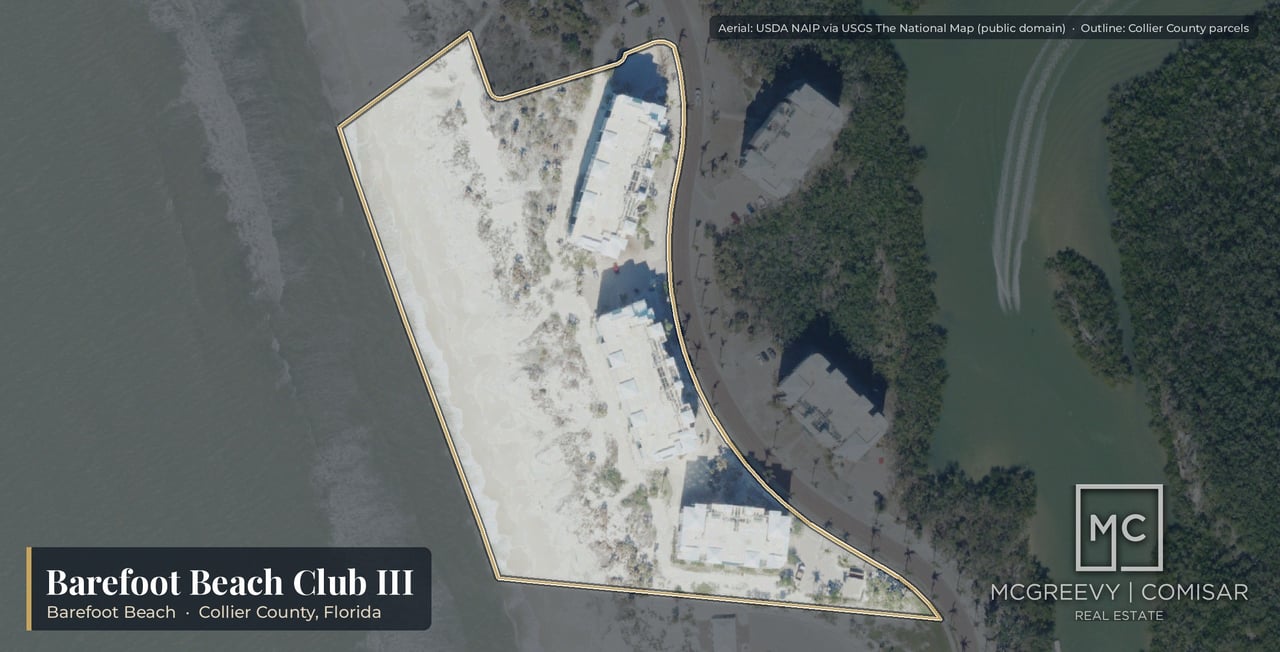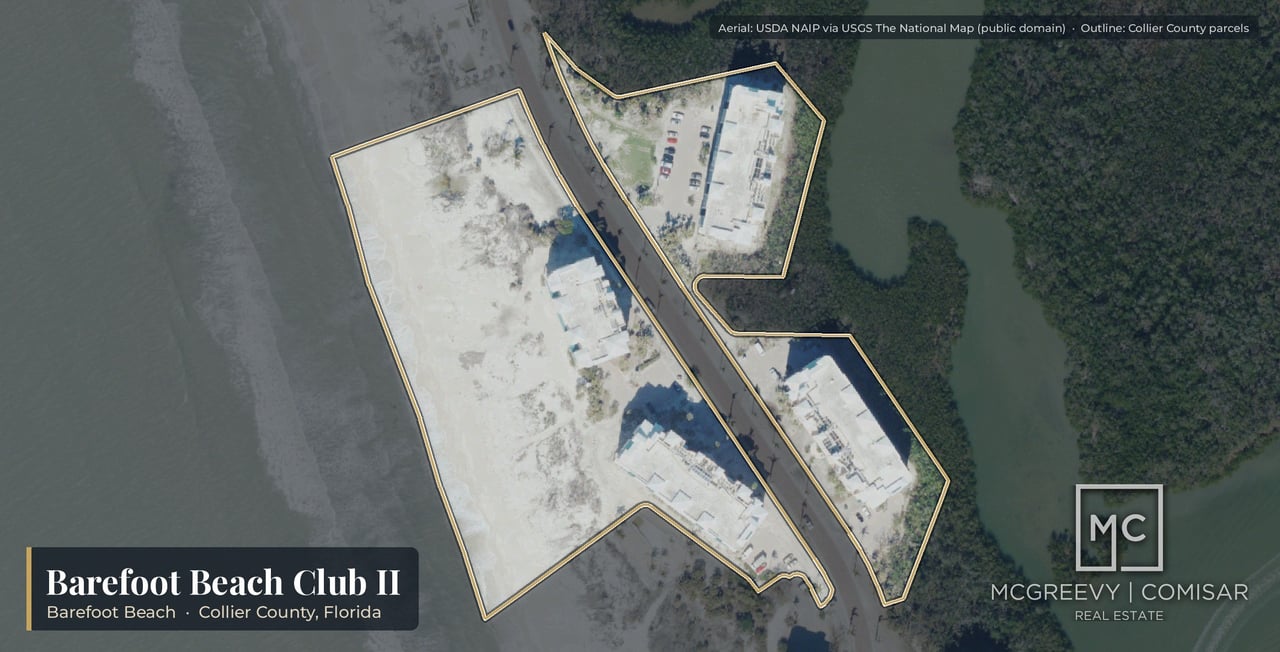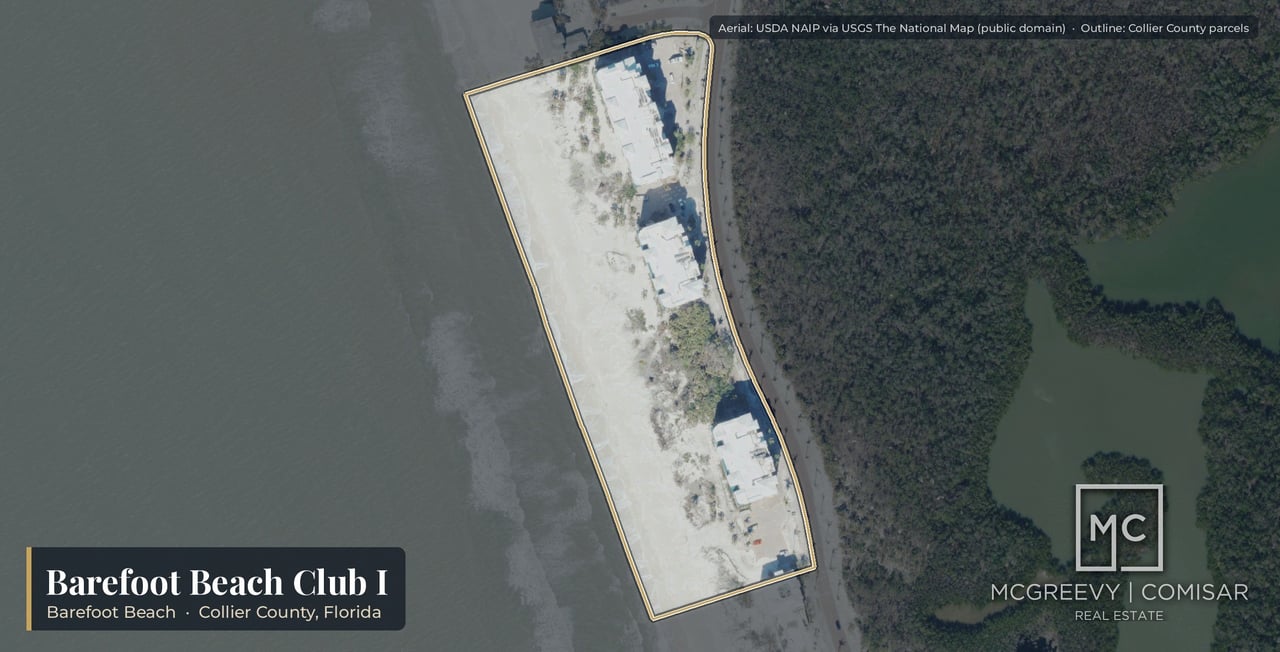
Coquina Sands
Gulf-front Naples neighborhood in ZIP 34102 with no mandatory HOA, twelve condominiums and five cooperatives. Sell or buy with McGreevy and Comisar.
Gulf-front Naples neighborhood in ZIP 34102 with no mandatory HOA, twelve condominiums and five cooperatives. Sell or buy with McGreevy and Comisar.
If you own a home in Coquina Sands, the most valuable thing you can know before you list is that no two parcels here trade on the same set of rules. Coquina Sands is the City of Naples neighborhood that runs from the Gulf of Mexico east to US 41, and from South Golf Drive north to the Orchid Drive properties, inside the city limits of Naples in Collier County, Florida. It is two markets sharing one name. One is a platted grid of 278 parcels with no mandatory homeowners association of any kind. The other is a corridor of seventeen condominium and cooperative associations, most of them along Gulf Shore Boulevard North, whose recent resale medians span a factor of nearly sixteen, from $350,000 to $5,550,000.
That split is why a single Coquina Sands average is worthless to a seller. In 2025 the whole neighborhood’s median recorded qualified sale was $3,962,500 across twenty sales, while single-family homes alone ran a median of $8,925,000 across ten. Price a listing off the wrong half of that and you either leave seven figures behind or you sit while the Naples Beach reporting area’s 136 days on market until sale for single-family homes grinds past you. This page is the fact base we use when we sit down at a Coquina Sands kitchen table, published in full, with every number labelled by its geography and its reporting period.
Updated September 2026 · Jesse McGreevy and Marc Comisar, Domain Realty
McGreevy and Comisar are the best realtor for Coquina Sands because this neighborhood is decided by details most agents never open: a voluntary association rather than an HOA, its own two-story zoning district, five cooperatives that finance nothing like a condominium, and three separate FEMA flood regimes inside one small grid. We price and negotiate off those facts. If you are comparing agents, we lay out the public record for every major team in our guide to the best real estate agents in Naples.
Jesse McGreevy and Marc Comisar have led the top-producing team in this market for well over a decade, and as the leaders of Domain Realty Group our team has closed over $2.5 billion in real estate across more than 4,000 transactions. Between them personally, McGreevy and Comisar alone have over $900 million in Sales. Over the years we’ve represented buyers and sellers across Lee and Collier County, from first-time purchases to eight-figure Gulf-front estates, and the discipline is the same at every price point: know the parcel, know the rule that governs it, and never guess.
The honest market read for this address matters more than a listing presentation. In July 2026 the Naples Beach reporting area, which the Naples Area Board of REALTORS defines as ZIP codes 34102, 34103 and 34108, carried 8.2 months of single-family supply against 5.6 months of single-family supply for the overall Naples market, and 136 days on market until sale for single-family homes. Both supply figures are NABOR’s single-family months-supply metric for the same month, which is the only way to compare them honestly. Sellers received 91.6 percent of list price in that reporting area in July 2026. The beach market is looser than Naples as a whole right now, not tighter. Any agent telling a Coquina Sands owner otherwise has not read the report. We will show you the report, then build the pricing strategy around what it actually says. Source: NABOR July 2026 Market Report.
A buyer here is underwriting a fee stack, a flood regime and a rebuild constraint, not just a house. We will pull the structure-only assessed value before you scope a renovation, tell you whether the parcel sits inside the Moorings Bay Special Taxing District, ask the association for its milestone report and Structural Integrity Reserve Study before you spend money on inspection, and answer the cooperative financing question before you write an offer rather than after.
Talk to us. Sellers, start with a real valuation: our Coquina Sands home valuation request goes straight to Jesse, or call Jesse McGreevy direct at (239) 898-6072 or email [email protected]. Buyers, start with the Naples buyer representation page or call Marc Comisar at (239) 287-5873. Office: 24031 S Tamiami Trl #101, Bonita Springs, FL 34134. Team profile: Domain Realty Group.
Coquina Sands rewards precision. These are the eight facts that decide most deals here, each of them traceable to a recorded instrument, a statute, a federal dataset or the Collier County Property Appraiser certified tax roll, published bulk data files, roll dated 29 August 2026.
Start here Why McGreevy and Comisar Are the Best Realtor for Coquina Sands · Key Takeaways · Living in Coquina Sands · Coquina Sands Market Snapshot
History, land and rules How Coquina Sands Came to Be · The Plat and the Lot · Governance · The Fee Stack · Taxes, Homestead and the Reset on Resale
The buildings on Gulf Shore Boulevard North The Buildings of Coquina Sands · Condominium Versus Cooperative · SB-4D, Milestone Inspections and SIRS
Lifestyle, water and risk Amenities, Honestly · Beach Access and Lowdermilk Park · Boating and Moorings Bay · Flood Zones, Elevation and the 50 Percent Rule · Storm History · Insurance in 2026
What is changing The Naples Beach Club and the Four Seasons · What Is Coming
Daily life and services Schools · Healthcare · Daily Drive Times · Who Actually Lives in Coquina Sands
Deciding, buying and selling Comparable Neighborhoods to Consider · Why Buy in Coquina Sands · Thinking of Selling Your Coquina Sands Home · Your Local Real Estate Experts
Questions and sources Frequently Asked Questions Buyer Edition · Frequently Asked Questions Seller Edition · Sources and Authoritative References · Downloadable Documents
Living in Coquina Sands means living inside the City of Naples on wide curving boulevards a short walk from the Gulf. Coquina Sands is one of thirteen official City planning neighborhoods, covers roughly 385 acres, carries ZIP code 34102 on all 278 platted parcels, and is bounded by the Gulf, US 41, South Golf Drive and Orchid Drive.
Everything on this page follows from a single structural fact: Coquina Sands is two different real estate propositions that happen to share a boundary.
The platted grid. Coquina Sands Unit 1, recorded in 1954, and Coquina Sands Unit 2, recorded in 1956, together carry 278 parcels on the Collier County roll. Of those, 246 are coded single family residential and 14 are vacant residential lots. The median lot is 0.420 acres, or 18,295 square feet. There is no mandatory association, no club, no gate, no master pool, no golf inside the neighborhood and no marina. What governs a lot here is the City of Naples zoning code and the federal flood map, and nothing else. That makes the lot itself, and what the code will let you build on it, the spine of every single-family transaction in Coquina Sands.
The Gulf Shore Boulevard corridor. Along the beach and the bay, and on a few interior blocks off Banyan Boulevard and Crayton Road, sit seventeen condominium and cooperative associations totalling 461 parcels, built between 1959 and 2011. Each has its own fee stack, its own milestone inspection and reserve study obligations, and its own governing statute depending on whether it is organised as a condominium under Chapter 718 or a cooperative under Chapter 719 of the Florida Statutes. Here the spine of the transaction is the fee stack and who governs what, not the lot.
The 1954 replat by engineer W. Robert Wilson replaced the original 1887 Naples grid with long gentle arcs. The metes and bounds in a 1968 City alley-vacation ordinance show platted lot lines following circular curves with radii of roughly 3,424 to 3,464 feet. That geometry, more than any architectural style, is what visually separates Coquina Sands from Old Naples one block south. Banyan Boulevard runs east and west from the beach to US 41 as the neighborhood’s spine and carries 115 of the City’s 449 address points inside the neighborhood polygon. Gulf Shore Boulevard North runs the beachfront. Crayton Road runs north and south and continues into The Moorings.
Street names follow two families. Shells gave the neighborhood Murex Drive, Murex Lane, Nautilus Road, Pectin Road and Coral Drive. Plants gave it Orchid Drive, Ixora Drive, Oleander Drive, Yucca Road, Mandarin Road, Banyan Boulevard and Pine Court. The Coquina Sands Association attributes the subdivision’s name to the coquina, a small mollusk that buries itself in the sand at the Gulf’s edge. Source: Coquina Sands Association history.
The beachfront sequence running north from downtown Naples is Old Naples, then Coquina Sands, then The Moorings, then Park Shore. Coquina Sands directly abuts Old Naples on the south, Lake Park on the east across US 41, The Moorings on the north, and Sun Terrace on the northeast. The Moorings sits between Coquina Sands and Park Shore, which is roughly 1.44 miles north. Those adjacencies were measured against the City of Naples planning neighborhood polygons published through the City of Naples GIS services.
One disambiguation is worth stating plainly, because search engines get it wrong. This is the Coquina Sands in the City of Naples, Collier County, Florida. It is not the Coquina Sands on Anna Maria Island. Every parcel in the two recorded plats carries site city NAPLES and ZIP 34102, and buildings on Gulf Shore Boulevard North that carry ZIP 34103, including Coquina Club at 3200 Gulf Shore Boulevard North, sit north of the neighborhood boundary.
The City of Naples’ own planning neighborhood polygon places both the former hotel site and the golf course inside Coquina Sands, and a platted Coquina Sands Unit 1 lot forms part of the resort’s beach frontage. The most precise published statement is that Naples Beach Club, A Four Seasons Resort straddles the southern edge of Coquina Sands, and its Planned Development covers roughly 30 percent of the neighborhood by land area. That relationship is the single largest external factor in Coquina Sands values, and it is covered in full in The Naples Beach Club and the Four Seasons.
No MLS board publishes a statistic specific to Coquina Sands. The finest geography the Naples Area Board of REALTORS reports is the ZIP code, and Coquina Sands is smaller than a ZIP. What follows is therefore assembled from three sources: our own filtered pull of the Southwest Florida MLS, recorded qualified arms-length sales from the county roll, and NABOR’s published reports for the geographies that contain the neighborhood.
Coquina Sands in the Southwest Florida MLS (Matrix, pulled 26 September 2026): Filtering the MLS to the Coquina Sands development gives the neighborhood its own closing record. In the 12 months to 26 September 2026 it shows 30 closings at a median of $1,542,500 and a median $854.78 per square foot of living area, with a median 68 days on market and a median 93.22% of list price, for $94,603,500 in volume. Eight of the 30 were single-family homes, at a median of $9,250,000 and a high of $17,060,000 in April 2026. Over 60 months the count is 123 closings at a median of $2,565,000, 53 of them homes at a median of $4,700,000. On the pull date 30 residences were listed for sale and three were pending; the listings included 12 single-family homes and nine new-construction residences at Olana Naples and Rosewood Residences Naples.
These figures come from the Collier County Property Appraiser certified tax roll, published bulk data files, roll dated 29 August 2026, filtered to qualified arms-length sales inside the recorded Coquina Sands Unit 1 and Unit 2 plats. Recorded sales lag, and 2026 is a partial year through 29 August. Qualified-sale counts also run lower than MLS closing counts because the qualified flag excludes transfers that are not arms-length.
Year | All Coquina Sands, n | Median | Single-family only, n | Median |
|---|---|---|---|---|
2021 | 61 | $2,050,000 | 34 | $2,700,000 |
2022 | 17 | $6,495,000 | 16 | $6,497,500 |
2023 | 19 | $2,640,000 | 10 | $4,200,000 |
2024 | 23 | $2,600,000 | 7 | $3,325,000 |
2025 | 20 | $3,962,500 | 10 | $8,925,000 |
2026, partial year through 29 August | 20 | see note | 4 | $2,875,000 |
Two warnings belong beside that table. The 2022 figure sits on seventeen sales in a neighborhood where a single beachfront transfer moves the median by millions, so it is a composition artifact rather than a trend point. And the 2026 whole-neighborhood median is a partial-year number drawn from an incomplete recording window, which makes it useless as a market signal. We publish the count next to every median for exactly that reason.
Address | Recorded price | Recorded date | Official Records book and page |
|---|---|---|---|
584 Banyan Blvd | $17,060,000 | 10 April 2026 | 6574/2400 |
1699 Ixora Dr | $12,995,000 | 23 August 2022 | 6168/1416 |
644 Coral Dr | $11,550,000 | 16 October 2024 | 6407/93 |
1555 Nautilus Rd | $10,300,000 | 11 November 2025 | 6526/809 |
600 Coral Dr | $10,250,000 | 23 May 2024 | 6365/1811 |
1325 Murex Dr | $9,625,000 | 14 July 2023 | 6274/1898 |
375 Yucca Rd | $9,450,000 | 9 March 2022 | 6098/2423 |
470 Banyan Blvd | $9,300,000 | 19 June 2025 | 6483/1488 |
1779 Crayton Rd | $9,250,000 | 25 November 2025 | 6531/3867 |
1405 Mandarin Rd | $9,250,000 | 19 November 2025 | 6529/3036 |
584 Banyan Boulevard is the Coquina Sands record: a 6,909 square foot, six-bedroom, eight-bath new-construction estate by Parker Hudson Homes sitting directly across from the Naples Beach Club golf course, recorded at $17,060,000 on 10 April 2026. It was reported by Gulfshore Business as a new high-water mark for the neighborhood.
This is the table that makes the case against any single Coquina Sands number. Counts are small and several are a single transaction, so read the n column as carefully as the median.
Association | Median resale, 2024 to 2026 | n |
|---|---|---|
Naples Casamore | $5,550,000 | 2 |
Via Delfino | $5,212,500 | 4 |
The Whitehall | $3,912,500 | 4 |
Charleston Square | $2,675,000 | 2 |
Embassy Club | $2,125,000 | 1 |
Surfside Club | $1,987,500 | 2 |
Colonial Club | $1,600,000 | 3 |
The Parador | $1,150,000 | 1 |
Banyan Club | $600,000 | 6 |
Eleven Hundred Gulf Shore | $560,000 | 7 |
Del Mar Club | $518,750 | 6 |
Coquina Cove | $499,000 | 1 |
Lago Mar | $350,000 | 3 |
From $350,000 to $5,550,000 is a factor of nearly sixteen, inside one neighborhood, on one boulevard. The building matters more than the neighborhood name.
NABOR’s “Naples Beach” reporting area covers ZIP codes 34102, 34103 and 34108, so it includes Coquina Sands along with Park Shore, The Moorings, Pelican Bay and Vanderbilt Beach. NABOR also publishes a standalone ZIP 34102 row. Neither is a Coquina Sands figure, and both are useful.
Metric | Value | Period | Geography |
|---|---|---|---|
Median closed price, single-family | $2,500,000 | July 2026 | Naples Beach, ZIPs 34102, 34103, 34108 |
Days on market until sale, single-family | 136 | July 2026 | Naples Beach |
Percent of list price received, single-family | 91.6% | July 2026 | Naples Beach |
Months supply of inventory, single-family | 8.2, down from 13.2 | July 2026 | Naples Beach |
Inventory of homes for sale, single-family | 405, down 24.2% | July 2026 | Naples Beach |
Median closed price, single-family, year to date | $2,975,000, down 7.8% | January to July 2026 | Naples Beach |
Median closed price, all property types | $2,475,000, up 23.8% | July 2026 | ZIP 34102 |
Total sales, all property types | 37 | July 2026 | ZIP 34102 |
Average days on market | 141 | July 2026 | ZIP 34102 |
Months supply, all property types | 14.4, the highest of any NABOR area | Year-end 2025 | ZIP 34102 |
Median closed price, five-year change | up 71.2% since 2021, to $2,350,000 | Full-year 2025 | ZIP 34102 |
Against that, the overall Naples market, which NABOR defines as Collier County excluding Marco Island, recorded 733 closed sales, a $590,000 median closed price, 108 average days on market, 4,415 active listings and 5.8 months of supply across all property types in July 2026. NABOR also publishes that months-supply figure by type for the same month: single-family 5.6 months and condominium 6.0 months. The single-family figure is the one that compares to a single-family reporting-area number, and average days on market is a different metric from the days-on-market-until-sale figure the reporting-area tables carry. Sources: NABOR July 2026 Market Report and the NABOR July 2026 statistics book. County-level context from the Florida Realtors July 2026 MSA summary puts the Naples-Immokalee-Marco Island MSA single-family median at $800,000 for July 2026.
The beach market is looser than Naples overall, not tighter. 8.2 months of single-family supply in the Naples Beach area against 5.6 months of single-family supply for the overall Naples market, and 136 days on market until sale for Naples Beach single-family. Absorption improved sharply year over year, and inventory fell 24.2 percent, so the direction is right. But an owner who prices a Coquina Sands listing as though the beach were the tightest segment in Collier County will discover otherwise over a long summer. Pricing to the segment, and to the specific building or block, is the whole job here.
Measure | Value |
|---|---|
Median total just value, Coquina Sands Unit 1 | $2,886,778 |
Median total just value, Coquina Sands Unit 2 | $2,938,851 |
Median land just value | $2,170,516, about $119 per square foot of land |
Median lot size | 0.420 acres, 18,295 square feet |
Twenty-fifth and seventy-fifth percentile lot | 0.380 acres and 0.500 acres |
Parcels homesteaded | 161 of 278, 58 percent |
Owner mailing states outside Florida | Ontario 8, Illinois 5, New York 4, Michigan 3, Ohio 3, Missouri 3 |
Just value is an assessment concept and not a market price. It is useful for two things in Coquina Sands: understanding how much of the price is land, and running the 50 percent rule calculation described later on this page.
Coquina Sands was platted in two units by The Naples Company, the Watkins family firm that owned roughly 2,200 acres of Naples after 1946. Coquina Sands Unit 1 was approved by Naples City Council in April 1954 and recorded at Plat Book 3, Pages 21 and 22. Unit 2 followed in 1956 and included the dredging of Hurricane Harbor.
The land that became Coquina Sands is the northernmost section of the original 1887 plat of Naples, filed while this was still Lee County. Collier County was created out of Lee on 8 May 1923. Before the Tamiami Trail arrived in the 1920s, the old road to Bonita crossed diagonally through what is now The Moorings, Coquina Sands and the Beach Club golf course. In 1987 a Coquina Sands homeowner building on his lot uncovered the crushed-shell roadbed of that trace.
The golf came first. Allen Joslin of Cincinnati established the Naples Golf and Beach Club in 1929 and 1930, building the course before the clubhouse and replacing a crude course along Fifth Avenue South that doubled as an airplane landing field.
In 1946, title to the northern portion of the Town of Naples passed to The Naples Company, formed by Henry Broadwell Watkins Sr., a retired Kilgore Manufacturing executive from Westerville, Ohio, and his partners. They bought the Naples Hotel, the Naples Golf and Beach Club and its 18-hole course, and roughly 2,200 acres, about 90 percent of the land in Naples.
In June 1948 the first apartment building went up on the beach. In approving it, City Council established that only single-family homes could be built on the beach south of South Golf Drive. That one decision set the development pattern that still holds today, and it is why the beachfront multifamily corridor begins where it does. In 1949 a bar and restaurant opened at the Golf and Beach Club, and the Naples Beach Hotel took shape out of the combination. The Watkins family ran it for three generations until it closed on 23 May 2021.
Plat | Approval | Recording | Plat Book and pages | Parcels on the 2026 roll |
|---|---|---|---|---|
Coquina Sands Unit No. 1 | Naples City Council, April 1954 | 1954 | Plat Book 3, Pages 21 and 22 | 82 |
Coquina Sands Unit No. 2 | Zoning Board 13 August 1956; City Council 29 October 1956 | 7 November 1956 | Plat Book 3, Pages 53 and 54 | 196 |
Unit 1 replatted an earlier layout: the predecessor “Gulf-Naples-Development Plat No. 2,” Town of Naples, Plat Book 2 Page 29, dated 19 July 1948, carries a note on its face reading that the plat was resubdivided into Coquina Sands Unit 1. The City hosts that plat sheet at naplesgov.com. Unit 2’s dedicator was The Naples Company with H. B. Watkins as president, and the engineer was Wilson and Hampton, Inc., under W. R. Wilson, Florida Certificate 1613. The plat citations are recited verbatim in City instruments, including a February 1962 ordinance vacating a Unit 1 drainage easement at Plat Book 3, pages 21 and 22, a 1968 alley relocation ordinance citing the same pages, and City Ordinance 03-9966 citing Unit 2 at Plat Book 3, Pages 53 and 54.
The engineer and surveyor W. Robert Wilson deserves the credit for how the neighborhood reads today. He threw out the 1887 grid and laid the streets on wide, gracefully curving boulevards.
On 22 October 1958, City of Naples Ordinance No. 715 renamed Coquina Boulevard to Gulf Shore Boulevard, from the intersection of Golf Drive northward to where it joins Gulf Shore Boulevard in The Moorings, as the name appeared on the plats of Coquina Sands Units 1 and 2. Jasmine Road became Crayton Road and Hibiscus Road became Murex Drive in a related set of renames. The enabling ordinances for those two were not located, so we publish the renames without a year. There is no street carrying the word Coquina anywhere in the City of Naples street centerline layer today.
The original 1887 plat showed beach access points on every block, the pattern still visible in Old Naples and Aqualane Shores. The Naples Company gave the City the beachfront land for a park in lieu of those per-block access points. That is the structural reason Coquina Sands has one flagship park instead of many street ends, and it is why Lowdermilk’s parking, hours and rebuild schedule matter more here than they would three neighborhoods south. The park is named for Fred Lowdermilk, the City’s first City Manager. Benefactor Lester Norris donated the pavilion, grills and picnic tables.
The Watkins civic footprint runs wider than Coquina Sands. The Naples Company donated roughly 11 acres that became Cambier Park, gave two lots that became Naples Memorial Hospital, swapped land with the town to start Lowdermilk Park, and helped develop Coquina Sands, River Park and several churches. Watkins commissioned a planning document called the “Naples Image” that forbade high-rises or other hotels on the beach on company land.
Coquina Sands carries no National Register of Historic Places listing, individual or district, and no City of Naples locally designated historic building. All 61 buildings in the City’s historic layer sit outside the neighborhood, and the City of Naples Historic District is a single 48.4-acre polygon entirely within Old Naples with zero overlap. What is historically notable in Coquina Sands is planning rather than landmark architecture: the 1954 curvilinear replat, the 1948 single-family rule for the beach, Lowdermilk’s origin, the dredging of Hurricane Harbor, and the 2022 conservation easement on the golf course. Verified against the National Park Service National Register spatial dataset and the City’s own historic layers.
Coquina Sands is a neighborhood where the median land just value alone is $2,170,516, about $119 per square foot of land, which means the land usually carries the price and the house is the variable. That is exactly the kind of parcel a generic online estimate gets wrong, in both directions. If you own here and want a defensible number built from recorded sales, the roll, and the constraints that govern your specific lot, request a Coquina Sands home valuation from McGreevy and Comisar or call Jesse McGreevy direct at (239) 898-6072 or email [email protected]. If you are buying rather than selling, start with buyer representation in Naples or call Marc Comisar at (239) 287-5873, and we will pull the flood determination, the zoning district and the fee stack for the specific address before you write anything. Our office is at 24031 S Tamiami Trl #101, Bonita Springs, FL 34134. McGreevy and Comisar are Top 1% Real Estate Agents Nationally Since 2008.
In Coquina Sands the lot decides the deal, because there is no architectural review board and no association design covenant standing between an owner and the City. What constrains a Coquina Sands house is the zoning district’s setbacks, a sliding maximum building area table, a 30-foot height limit measured from a flood-driven datum, and the federal 50 percent rule.
Roughly 45 percent of Coquina Sands by land area sits in single-family districts. The rest is Planned Development, multifamily and public service. These shares are area-weighted clips of the City’s zoning layer against the neighborhood polygon and are published rounded, because two independent derivations differ slightly by clipping method.
District | Approximate share | Approximate acres |
|---|---|---|
R1-15 Single-Family Residence | about 37% | about 142 |
Planned Development, Naples Beach Club | about 30% | about 117 |
R1-10 Single-Family Residence | about 8% | about 30 |
R3-18 Multifamily | about 7% | about 28 |
PS Public Service, including Lowdermilk | about 5% | about 19 |
R3T-18 Multifamily | about 5% | about 19 |
R3-15-CS Multifamily, Coquina Sands | about 2% | about 8 |
R3-15, R3-12, Charleston Square PD and slivers | the remainder | small |
Most of the platted grid sits in R1-15, at Chapter 58, Article II, Division 5 of the Naples Code of Ordinances.
Standard | Requirement |
|---|---|
Minimum lot area | 15,000 square feet |
Minimum lot width | 100 feet |
Front yard | 40 feet |
Side yard | 10 feet for the first 15 feet of vertical height, then within a 12:12 slope |
Rear yard | 30 feet, reducible to 15 feet where the lot abuts a public alley for alley-access garages or a utility shed of 100 square feet or less |
Pools | Unroofed or mesh-screened pools may sit in the rear setback but no closer than 15 feet to the rear lot line, and never in a utility or drainage easement |
Minimum floor area | 1,400 square feet one story, 2,000 square feet two story |
Maximum height | 30 feet |
Off-street parking | 2 spaces |
R1-10, at Division 6, applies to a smaller share of the neighborhood and reads: minimum lot 10,000 square feet, lot width 87.5 feet on a corner and 75 feet interior, front 30 feet, side 7.5 feet for the first 15 feet of height then 12:12, rear 25 feet, minimum floor area 1,200 square feet one story and 1,600 two story, maximum height 30 feet, one parking space.
This is the point most buyers get wrong when they underwrite a Coquina Sands teardown. Naples does not use FAR. It uses a regressive sliding table applied to each increment of lot size, identical in R1-15 at section 58-150 and in R1-10 at section 58-180.
Increment of lot size | Maximum building area allowed on that increment |
|---|---|
First 5,000 square feet | 48% |
Next 5,000 square feet | 35% |
Next 10,000 square feet | 24% |
Next 30,000 square feet | 20% |
Next 50,000 square feet | 15% |
Thereafter | 10% |
Building area is defined in the code as the portion of lot coverage that is roofed and enclosed by walls or another enclosure system, measured to the outermost perimeter of the enclosing walls. The code states expressly that mesh screening is not a wall or an enclosure system.
Worked examples. A 15,000 square foot R1-15 lot yields 2,400 plus 1,750 plus 1,200, which is 5,350 square feet of maximum enclosed roofed building area. A 20,000 square foot lot yields 6,550 square feet. A 30,000 square foot lot yields 8,550 square feet. Doubling the lot from 15,000 to 30,000 square feet buys only about 60 percent more house. That is deliberate anti-mansionization design, and it means a buyer who prices a Coquina Sands teardown off lot size alone has the pro forma wrong before they start. The design leverage sits in what the table excludes: screen enclosures and unenclosed lanais.
Section 58-148 does not measure 30 feet from the dirt. It measures from the greater of four things: the lowest floor elevation required by the Florida Building Code for the first habitable floor; 18 inches above the Florida Department of Environmental Protection requirement for first habitable floor structural support; 18 inches above the average crown of the adjacent roads; or the average natural grade.
Then it adds a provision that is genuinely valuable on a low-lying Coquina Sands lot. Where the lowest floor elevation under the 16 May 2012 flood insurance rate map is higher than under the current map, the applicant may elect the 2012 elevation and measure maximum building height from it. On the wrong lot that election is worth real ceiling height, and it should be modeled before a design is committed rather than after.
Under section 56-39, chimneys, elevator overruns, stair tower roofs, rooftop mechanical equipment, ornamental screening, solar panels and architectural embellishments may extend seven feet above the roof peak, but in single-family districts that exception is capped at five feet, and rooftop HVAC and its screening are not exempt at all. The aggregate base area of embellishments and ornamental screening cannot exceed 10 percent of the roof area. And flat roof areas at or above maximum height may not be made accessible by fixed ladder, stairway or elevator, with hatches permitted for maintenance only. That is the anti-rooftop-deck rule, and it surprises buyers arriving from markets where a roof deck is standard.
The line no competitor page writes is this: in Coquina Sands the constraint on a rebuild is not an architectural review board and it is not an HOA. It is the City’s own sliding maximum building area table, a 30-foot height limit measured from a flood-driven datum, and the FEMA 50 percent rule.
Fourteen parcels in the two plats carry a vacant residential use code, and their assessed values are a clean read on what land costs here. The nine largest by just value are shown below.
Address | Just value |
|---|---|
430 Yucca Rd | $2,977,680 |
480 Yucca Rd | $2,948,891 |
725 Pectin Rd | $2,559,922 |
560 Yucca Rd | $2,472,553 |
1101 Crayton Rd | $2,436,010 |
745 Pectin Rd | $2,396,250 |
1120 Oleander Dr | $2,363,001 |
1507 Murex Dr | $2,354,481 |
444 Orchid Dr | $2,312,777 |
Source for all of the above: Collier County Property Appraiser certified tax roll, published bulk data files, roll dated 29 August 2026.
Governance in Coquina Sands is unusually light. There is no mandatory homeowners association, no community development district, and no architectural covenant regime. The Coquina Sands Association is a voluntary civic and advocacy association charging $90 a year per household. Almost everything that governs a Coquina Sands parcel is City of Naples zoning and the federal flood map.
The Coquina Sands Association is a Florida Not For Profit Corporation, Sunbiz document 745253, filed 14 December 1978, status active, with its most recent annual report filed 2 April 2026 and continuous annual filings since 1995. Its principal address is 1650 Crayton Road, Naples FL 34102, and its mailing address is PO Box 423, Naples FL 34106. Membership costs $90.00 per year per household, covering two residents, and the association’s own website invites residents to join. Registration is on the association’s join page, and the entity record is searchable at Sunbiz.
It fails both statutory tests in Florida Statute 720.301(9). Membership is not a condition of parcel ownership, and no lien-backed assessment authority is published or evidenced. Section 720.301(4) requires a recorded declaration of covenants to create a Chapter 720 homeowners association, and no such declaration for Coquina Sands was located in any allowed public source.
In the single-family core of Coquina Sands, the total mandatory association fee stack is $0.00.
The City of Naples publishes an ArcGIS layer named “Home Owner Associations,” and Coquina Sands appears on it as a polygon. So do Old Naples, Moorings, Park Shore, River Park and Sun Terrace. That layer is a mapping convenience for named neighborhoods, not a legal register of mandatory associations. Reasoning from a cartographic label to a legal conclusion is how the error propagates. The layer itself is published at layer 8 of the City’s CityView property and zoning service.
The honest caveat, and it belongs here. For any specific parcel, a title search plus a name search for “Coquina Sands” in the Collier County Clerk’s Official Records is the only authoritative answer on whether a declaration of covenants encumbers that particular lot. Nobody should buy on the strength of a neighborhood-level statement, including this one.
Community meetings with City leaders. Email notification on neighborhood issues. Social events plus a complimentary annual meeting and party. Purchase, upkeep and maintenance of the Coquina Sands entrance signage, with year-round lighting and holiday decorations on the signs at Orchid Drive and US 41 and at Banyan Boulevard and US 41. Optional RCC discount cards run $12 each, up to four per membership, against a $35 retail price.
The association’s civic reach is broader than its budget. It runs the Naples Miracle Mile Committee, the resident-led committee representing the neighborhood in the planning and rebuild of the residential developments on Gulf Shore Boulevard North from the Naples Beach Club to Mooring Line Drive, which is deliberately a wider interest area than the neighborhood boundary. It sits on the Naples City Manager’s Presidents Council. It coordinates median and street-tree landscaping with the City and liaises with Naples Police and Fire. Its officers and directors are drawn from both the single-family streets and the Gulf Shore Boulevard North buildings, which tells you exactly what kind of body it is: a civic association spanning the whole neighborhood, not a covenants-enforcement machine.
Coquina Sands is one of only two City of Naples neighborhoods with both its own named Comprehensive Plan land use category and its own named zoning district. The Future Land Use Element category reads “High Density Residential Low Rise, Coquina Sands, 0 to 15 dwelling units per acre.” The zoning district is the R3-15 Multifamily District, Coquina Sands (CS), at Chapter 58, Article II, Division 13, sections 58-381 to 58-392, created by Ordinance 98-8166 on 21 January 1998 and mapped under Ordinance 98-8325.
R3-15-CS standard | Requirement |
|---|---|
Purpose | A mid-rise apartment district |
Permitted uses | Single-family residences, multifamily residences, customary accessory structures |
Minimum lot area | 15,000 square feet |
Minimum lot width | 100 feet |
Front yard | 25 feet, plus 1 foot for every foot of building height over 30 feet, with six feet landscaped |
Side yard | 15 feet, plus 1 foot per foot over 30 feet |
Rear yard | 25 feet, plus 1 foot per foot over 30 feet |
Maximum height | Two habitable stories, maximum 35 feet, plus six feet from the ceiling of the highest story to a flat roof or parapet, or to the mean between eaves and ridge on a pitched roof |
Maximum density | 15 dwelling units per net acre |
The district exists for one reason: to hold Coquina Sands multifamily development to two habitable stories where the base R3-15 district would allow more. It is a durable, code-level down-zoning written into Chapter 58, and it is why the R3-15-CS redevelopments on this street are low-rise. Harbour House is approved at two stories over garages. The proposal at 1500 Gulf Shore Boulevard North is two stories over parking. The full district text sits at Municode Division 13.
The trap that follows from it. The six and seven story projects on the same boulevard sit in different districts. 1121 Gulf Shore Boulevard North is zoned R3T-18, which permits a maximum height of 75 feet plus an additional 12 feet where at least 75 percent of the ground floor is parking, and allows transient lodging only as a conditional use requiring City Council approval. A buyer should never assume that a Gulf Shore Boulevard North parcel carries tower rights because a neighbor does.
Section 58-390 currently carries a sliding lot-coverage scale in the codified text, imposed by Ordinance 2023-15082 at second reading on 3 May 2023. The City Attorney has opined that the 2023 ordinance is void from inception under Florida SB 250 of 2023, which bars Hurricane Ian and Nicole counties and their municipalities from adopting more restrictive land-use regulations retroactive to 28 September 2022. The repeal of that ordinance failed 3 to 4 on 5 February 2025. And SB 180 (2025), chapter 2025-190, goes further, imposing a blanket freeze on more burdensome or restrictive land-use measures retroactively from 1 August 2024 through 1 October 2027, with stricter regulations adopted in that window void from the start and no repeal required.
So the honest statement is this: the sliding scale appears in the codified text of section 58-390, the City Attorney has opined that the ordinance creating it is void from inception, the repeal failed, and the City is not enforcing it. Do not assume it applies and do not assume it was repealed. Consult the City and land-use counsel for a specific parcel. Critically, this limbo applies to section 58-390 only. The R1-15 and R1-10 sliding tables in sections 58-150 and 58-180 predate 2023 and are operative.
A small set of Coquina Sands parcels sit inside a dependent special district of the City of Naples. The Moorings Bay Special Taxing District was created on 5 August 1987 by City Ordinance 87-5328 under Florida Statute 189.02. It is active, dependent, has no bonding authority, is funded by ad valorem revenue, and levies 0.0125 mills, which is $12.50 per $1,000,000 of taxable value. Its purpose is improving water quality and navigability and funding maintenance dredging in the canals and waterways within the district, including Doctors Pass.
Inside Coquina Sands the district covers exactly three groups of parcels and only those: Coquina Sands Unit 2, Block I Lots 1 through 16, Block I Lots 25 through 30, and Block J Lots 1 through 10. Those are the bay-front parcels. Financially the levy is trivial. Informationally it is decisive, because it tells a bay-front buyer that the parcel sits inside a funded dredge-maintenance district with an advisory board and a published budget. Buyer action: read the TRIM notice for the folio. If a “Moorings Bay System” line appears, the parcel is in. The City’s district page is at naplesgov.com, and it publishes a Seawall Owners Manual for district property owners.
Coquina Sands has no CDD, and neither does anywhere else inside the City of Naples. The City’s four dependent special districts are the Community Redevelopment Agency, East Naples Bay, Moorings Bay and the Naples Airport Authority, listed on the City’s special districts page. Collier County’s roughly three dozen CDDs are all in unincorporated Collier. For a buyer comparing Coquina Sands against a newer Collier community, that is a real annual difference, and it should be quantified rather than assumed.
The City of Naples does not run a short-term-rental permit program. It enforces through the zoning definition of a transient lodging facility. The City’s published rule is a 30-day minimum, with an exception allowing a property to be rented for less than 30 days no more than three times per calendar year, and with a prohibition on advertising the property as available for under 30 days. Transient lodging is neither a permitted nor a conditional use in R1-15, R1-10, R3-12, R3-15, R3-18 or R3-15-CS. It is a conditional use, up to 16 units per net acre and only with City Council approval, in R3T-18, and it is governed by the applicable ordinance inside the Planned Developments. City of Naples properties are exempt from Collier County’s short-term rental registration under County Ordinance 2021-45, so a Coquina Sands owner does not register with the county. Tourist development tax still applies to rentals of six months or less. The City’s guidance is published at naplesgov.com.
The Coquina Sands fee stack is short in the single-family core and unpublished in the corridor. A single-family owner pays ad valorem taxes of roughly 9.05 mills, a bi-monthly City utility bill, and nothing else that is mandatory. A condominium or cooperative owner pays all of that plus a maintenance fee that no association in Coquina Sands publishes.
Layer | Single-family core | Gulf Shore Boulevard corridor |
|---|---|---|
Mandatory association assessment | $0.00 | Applies, and is not published by any association |
Coquina Sands Association dues | $90.00 per year, per household, voluntary | $90.00 per year, per household, voluntary |
Ad valorem, non-school | 4.8024 mills, tax year 2025 | 4.8024 mills, tax year 2025 |
Ad valorem, school | 4.2490 mills, tax year 2025 | 4.2490 mills, tax year 2025 |
Moorings Bay Special Taxing District | +0.0125 mills, bay-front Unit 2 Block I and J parcels only | Only where the parcel falls inside the district |
Community development district | $0.00, none exists inside the City of Naples | $0.00 |
Collier unincorporated area MSTU | $0.00, does not apply inside the City | $0.00 |
Independent fire district millage | $0.00, the City runs its own Fire-Rescue | $0.00 |
City water, sewer, solid waste and stormwater | Bi-monthly utility bill | Often billed to the association, structure varies |
Reserve contributions for structural components | Not applicable | Required, and not published |
Flood, windstorm and property insurance | Parcel-specific | Unit policy plus the association’s master policy |
No Coquina Sands condominium or cooperative association publishes its maintenance fees, its reserve contributions or its assessment history in any source we are permitted to cite. Neither does any association publish its special assessment history. We say that in those words because the alternative, quoting a number from a listing aggregator, is how buyers end up underwriting the wrong building.
Here is what closes the gap, and every one of these is a statutory right rather than a favor:
The City of Naples publishes its assessment areas, and they are Bembury Sewer, Port Royal Dredging, Gulf Acres and Rosemary Heights Sewer, Seagate Powerline Undergrounding, and the Aqualane Shores Utility Line Extension. None of them is in Coquina Sands, and there is no undergrounding district here. The City’s special assessments page also lays out the mechanism if one were ever pursued: a property owners association applies under City Code Chapter 2-761, a straw poll must clear 50 percent, and multiple Council actions follow. The City warns that the process “can take several years.” Seagate, the only active undergrounding effort in the city, received preliminary approval by resolution in 2018 and has been awaiting an updated cost analysis since December 2018, which is a fair indicator of pace.
Item | Rate |
|---|---|
Solid waste, single-family | $77.08 bi-monthly, made up of garbage $39.14, horticultural $12.68, recycling $8.96 and Collier County disposal $16.30 |
Stormwater, single-family residential | $49.56 bi-monthly |
Water base charge, 5/8 inch to 3/4 inch meter | $21.48 bi-monthly |
Sewer residential base | $53.76 bi-monthly at every meter size |
Sewer usage | $5.21 per 1,000 gallons, with a 20,000 gallon bi-monthly cap on single-family unless an irrigation, sub-meter or reclaimed meter serves the property |
Reclaimed water availability fee | $20.02 bi-monthly where reclaimed is available in the area, whether or not the meter is connected |
Rate change | Water, reclaimed, sewer, garbage and stormwater rates rose 2.2 percent effective 1 October 2025 |
Two details matter more than their size. First, the 20,000 gallon bi-monthly sewer cap on a single-family home does not apply if an irrigation, sub- or reclaimed meter serves the property, which is a genuine cost consideration on a large irrigated Coquina Sands lot. Second, customers outside the city limits pay a 25 percent surcharge, and Coquina Sands is inside the city, so it does not apply here. Rates are published at naplesgov.com.
Council approved, at first reading on 19 November 2025, a 25 percent stormwater rate increase phased over four years to fund $280 million in projects over 20 years, following a 40 percent increase approved in June 2024 for the beach outfall project. The published trajectory for the average residential monthly bill runs from $24.78 before the increase to $30.98 in October 2026, $38.72 in October 2027, $48.40 in October 2028 and $60.50 in October 2029. Reported by Gulfshore Business. For a buyer running a 10-year hold, that is a real and knowable escalation, and it is not in anyone’s listing remarks.
Item | Amount |
|---|---|
Deed documentary stamp tax | $0.70 per $100 of consideration, Collier County, no discretionary surtax |
Cooperative transfer documentary stamp | $0.70 per $100, paid by the purchaser under Florida Statute 201.02(3) |
Estoppel certificate | $250 base, $100 expedited, $150 if delinquent, refundable if the sale does not close |
Association transfer or approval fee, condominium | Maximum $150 per applicant |
Association transfer or approval fee, cooperative | Maximum $100 per applicant |
Lease security deposit held by the association | Up to one month’s rent in association escrow |
City lien and outstanding-debt search | $12.50 per request through FRS Data, LLC |
On who pays the deed stamps, there is no authoritative published Collier County custom. Florida Statute 201.02 imposes the tax on the document without allocating it between the parties. Treat the allocation as a negotiated line in the purchase contract, read the allocation paragraph, and confirm with the closing agent.
A Coquina Sands parcel carries roughly 9.05 mills of total ad valorem tax, about 0.905 percent of taxable value, on tax year 2025 adopted rates. The number that decides whether a deal works is not the seller’s current bill. It is what the bill becomes on the January 1 after closing, once the property is reassessed.
Do not use a 2026 total. As of 2 September 2026 every 2026 component is proposed or tentative, final hearings run from 3 to 22 September, and Collier Mosquito Control has published nothing for 2026 at all. Tax year 2025 is the most recent fully adopted year.
Non-school levy | Mills |
|---|---|
Collier County Board of County Commissioners General Fund | 3.0107 |
Collier County Water Pollution Control | 0.0246 |
Conservation Collier | 0.2096 |
City of Naples general operating | 1.2300 |
South Florida Water Management District, district-wide | 0.0948 |
South Florida Water Management District, Big Cypress Basin | 0.0978 |
Collier Mosquito Control District | 0.1349 |
Non-school subtotal | 4.8024 |
School levy | Mills |
|---|---|
Required Local Effort including prior-period adjustment | 2.0010 |
Basic Discretionary Operating | 0.7480 |
Local Capital Improvement | 1.1500 |
Voter-approved additional operating | 0.3500 |
Total school millage | 4.2490 |
Built line by line from each authority’s own adopted instrument, the stack totals 9.0514 mills. The City of Naples publishes a total of 8.9566 mills in its FY2025-26 adopted budget, in the “Distribution of Tax Levy” table, because that table carries a single water management line rather than the two millages the South Florida Water Management District actually levies on every Collier parcel. Both figures are defensible if you say which you are using. We publish the City’s number as the City’s published total, at naplesgov.com, and the line-by-line build at approximately 9.05 mills, and we tell buyers which is which.
The City of Naples rate is 1.2300 mills, adopted by Resolution 2025-15700 on 22 September 2025 by a 7 to 0 vote, and the same rate applied in 2024 under Resolution 2024-15462. Naples’ own millage page links those resolutions.
Levy a Coquina Sands parcel does not pay | Mills | Why |
|---|---|---|
Collier Unincorporated Area General Fund MSTU | 0.6844 | Levied only on unincorporated Collier |
Independent fire district millage | varies | The City runs its own Fire-Rescue department |
SFWMD Okeechobee Basin and Everglades Construction | 0.1026 and 0.0327 | Collier sits in the Big Cypress Basin |
Any CDD assessment | varies | No CDD exists inside the City of Naples |
Frame it honestly. The City’s 1.2300 mills is not an extra tax layered on top of the county. It replaces the 0.6844 mill unincorporated MSTU and a separate independent fire district millage, and it buys City of Naples Police and City of Naples Fire-Rescue. Inside the city the county-plus-city non-school core is 4.4749 mills. Unincorporated Collier is 3.9293 mills plus a fire district.
Item | 2026 value |
|---|---|
Homestead exemption, first band | $25,000 against all levies including school |
Additional homestead exemption | $26,411, CPI-indexed, against non-school levies only, on assessed value above $50,000 |
Total homestead exemption, non-school | $51,411 |
Save Our Homes assessment cap | 2.7 percent, being the lower of 3 percent or CPI |
Non-homestead assessment cap | 10 percent per year, and it does not cover school levies |
Portability cap | $500,000, three tax year window, filed on Form DR-501T with the homestead application by 1 March |
Sources: the Florida Department of Revenue’s published CPI adjustment to the additional homestead exemption and its Save Our Homes table, both revised January 2026. Ownership and permanent residency must exist as of 1 January, and the filing deadline is 1 March.
Portability downsizing is proportional, not dollar for dollar. An owner leaving a home with a $2,000,000 just value and a $1,200,000 assessed value carries a 60 percent ratio. Moving to a $1,000,000 just value home produces roughly a $600,000 assessed value, transferring a $400,000 benefit rather than the full $800,000 differential. That arithmetic changes retirement moves inside Naples, and it catches people.
The hole in the non-homestead cap matters on this corridor. Florida Statutes 193.1554 and 193.1555 cap annual assessed growth on non-homestead property at 10 percent, but neither covers school district levies. School millage is 4.2490 of the roughly 9.05 mill stack, 47 percent of the total, assessed against uncapped just value. Nearly half a second-home owner’s bill sits entirely outside the cap, and most of the Gulf Shore Boulevard corridor is second homes.
Under Florida Statute 193.155(3), when homestead property changes ownership it is reassessed at just value as of the January 1 following the change. The prior owner’s Save Our Homes benefit is extinguished. It does not run with the land. The same reset applies to non-homestead property.
Why it bites hardest in Coquina Sands: three consecutive years, 2022, 2023 and 2024, in which market inflation ran roughly double the allowed assessed growth, compounding on every prior year. A Coquina Sands home held since the early 2010s can easily carry an assessed value under half its current market value, and all of that gap disappears on the January 1 after closing.
The underwriting rule to put in your spreadsheet. First stabilized-year tax estimate equals purchase price multiplied by 0.0090514, plus any non-ad-valorem assessments on the parcel, plus 0.0000125 times the price if the parcel sits inside the Moorings Bay district, less the homestead exemptions if you will homestead. A $4,000,000 purchase runs roughly $36,206 a year. An $8,000,000 purchase runs roughly $72,411 a year. If the seller’s current bill reads $14,000, that is not a fact about your cost. It is a fact about how long the seller has owned the house.
Florida also provides a local-option senior low-income exemption of up to $50,000, a senior low-income exemption of 100 percent of assessed value for a 25-year resident whose home has a just value under $250,000, $5,000 exemptions for widows, widowers, the blind and the totally and permanently disabled, a total exemption for a veteran with a service-connected total and permanent disability, a $5,000 exemption for a veteran disabled 10 percent or more, and a percentage discount equal to the VA disability percentage for a veteran aged 65 or older with a combat-related disability. Those last three are routinely conflated and they are three different benefits under three different statutes: 196.081, 196.24 and 196.082. Senior income limits for 2026 are $42,758 single and $48,003 for couples. Whether Collier County and the City of Naples have each adopted the senior exemptions by ordinance is something to confirm with the county before relying on it.
Amendment 3 is on the 3 November 2026 Florida ballot and would increase the homestead exemption effective from 1 January 2027. Reported provisions include a phased increase in the non-school exemption, the school exemption staying where it is, later indexing, and a residency requirement that would limit the larger exemption for anyone without a Florida permanent residence established by the end of 2026. That last provision, if it holds as reported, is directly material in Naples, where a large share of buyers are out-of-state relocations. Read the enrolled joint resolution at flsenate.gov before relying on any specific figure, and talk to your tax advisor about the timing of establishing residency.
Coquina Sands contains seventeen condominium and cooperative associations totalling 461 parcels: twelve condominiums with 324 parcels and five cooperatives with 137 parcels. They were built between 1959 and 2011, they carry their own subdivision codes on the county roll, and they are a separate population from the 278 parcels in the two platted single-family subdivisions.
Every figure below comes from the Collier County Property Appraiser certified tax roll, published bulk data files, roll dated 29 August 2026. The area column is total adjusted building area, which includes garages and lanais, and is not living area and not square footage under air.
Association | Form | Parcels | Median just value | Median tax | Homesteaded | Built | Median total adjusted building area | Primary site address |
|---|---|---|---|---|---|---|---|---|
Banyan Club | Condominium | 24 | $488,800 | $4,349 | 17% | 1970 | 1,064 sq ft | 252 Banyan Blvd |
Calusa Club | Cooperative | 19 | $454,600 | $3,970 | 5% | 1969 | 988 sq ft | 212 Banyan Blvd |
Charleston Square | Condominium | 24 | $1,896,512 | $15,038 | 50% | 2004 | 2,728 sq ft | 1400 Gulf Shore Blvd N |
Colonial Club | Condominium | 17 | $1,369,650 | $12,202 | 24% | 1967 | 1,642 sq ft | 1275 Gulf Shore Blvd N |
Coquina Cove | Condominium | 18 | $407,440 | $3,675 | 6% | 1973 | 864 sq ft | 261 Banyan Blvd |
Del Mar Club | Cooperative | 82 | $422,500 | $3,617 | 9% | 1966 | 850 sq ft | 1300 Gulf Shore Blvd N |
Eleven Hundred Gulf Shore | Condominium | 39 | $413,000 | $3,720 | 10% | 1972 | 940 sq ft | 1100 Gulf Shore Blvd N |
Embassy Club | Condominium | 36 | $1,660,000 | $14,087 | 22% | 1970 | 1,715 sq ft | 1717 Gulf Shore Blvd N |
Kona Kai | Cooperative | 6 | $421,500 | $3,646 | 17% | 1960 | 1,100 sq ft | 1334 Crayton Rd |
Lago Mar | Cooperative | 16 | $304,610 | $2,432 | 12% | 1963 | 817 sq ft | 1550 Gulf Shore Blvd N |
The Laurentians | Condominium | 32 | $2,830,000 | $24,996 | 50% | 1975 | 3,000 sq ft | 1285 Gulf Shore Blvd N |
Naples Casamore | Condominium | 12 | $4,663,998 | $41,053 | 33% | 2011 | 3,940 sq ft | 1764 Gulf Shore Blvd N |
The Parador | Condominium | 18 | $948,825 | $6,798 | 39% | 1981 | 1,773 sq ft | 1200 Gulf Shore Blvd N |
Reef Club | Cooperative | 14 | $504,520 | $4,280 | 21% | 1959 | 1,106 sq ft | 1568 Gulf Shore Blvd N |
Surfside Club | Condominium | 64 | $792,000 | $6,231 | 9% | 1963 | 1,015 sq ft | 1065 Gulf Shore Blvd N |
Via Delfino | Condominium | 24 | $4,216,800 | $32,816 | 46% | 1989 to 1990 | 3,788 sq ft | 1221 Gulf Shore Blvd N |
The Whitehall | Condominium | 16 | $3,165,000 | $27,930 | 25% | 1974 | 3,000 sq ft | 1255 Gulf Shore Blvd N |
One association sits outside that table and outside the count of seventeen. Banyan Corners, a five-unit condominium declared on 16 January 2018 at 345 Banyan Boulevard, is the neighborhood’s newest small association. It does not appear in the county roll’s condominium and cooperative extract that the seventeen and the 461 parcels are drawn from, so we name it separately rather than fold it into a total it was not measured in.
On Gulf Shore Boulevard North through Coquina Sands, odd house numbers sit on the west, beachfront side and even numbers sit on the east side across the street. Two even-numbered buildings are often described as beachfront and are not: 1100 Eleven Hundred Gulf Shore and 1300 Del Mar Club both sit on the east side. Del Mar Club faces Lowdermilk Park (1301 Gulf Shore Boulevard North) across the street, which is how its owners reach the sand. We re-checked both against the City of Naples address points and building footprints and the FEMA flood map in September 2026. The City’s 2024 milestone list that names Del Mar Club is a citywide list, not a Gulf-front one. Check any address individually rather than trusting a description.
Gulf front, west side: 1065 Surfside Club, 1221 Via Delfino, 1255 The Whitehall, 1275 Colonial Club, 1285 The Laurentians, 1717 Embassy Club, plus the cleared redevelopment sites at 1121, 1601 and 1785.
East side, several with Hurricane Harbor or Moorings Bay frontage and boat docks: 1100 Eleven Hundred Gulf Shore, 1200 The Parador, 1300 Del Mar Club (across from Lowdermilk Park), 1400 Charleston Square, 1500 (the former Ocean Terrace, now a single parcel under a City review petition for four residences), 1550 Lago Mar, 1568 Reef Club, the Harbour House site at 1624 to 1672, and 1720 to 1764 Naples Casamore. The Parador and Reef Club are both on the east side. A buyer paying a beachfront premium at either address is paying for something the parcel does not have.
Interior, away from Gulf Shore Boulevard North: Banyan Club at 252 to 298 Banyan, Coquina Cove at 261 Banyan, Calusa Club spanning roughly 212 to 250 Banyan, Banyan Corners at 345 Banyan, and Kona Kai at 1334 Crayton Road.
Three of the largest parcels in the two Coquina Sands plats carry an eight or nine figure just value and no building record at all on the county roll, which is the roll’s way of saying the site has been cleared.
Address | Acres | Just value | Owner of record | What is coming | Status |
|---|---|---|---|---|---|
1601 Gulf Shore Blvd N | 5.25 | $160,083,000 | WSR-NB LLC | Rosewood Residences Naples, 42 residences in two buildings | UNDER CONSTRUCTION, topped off 1 August 2025 |
1121 Gulf Shore Blvd N | 2.47 | $76,961,500 | KT Naples Owner LLC | Olana Naples Residences, 12 residences, six stories | APPROVED AND SELLING, pre-construction |
1785 Gulf Shore Blvd N | 2.10 | $64,413,300 | YB Gulf Shore 2 LLC | Entitled for 24 units in an eight-story building | ENTITLED SITE, listed for sale |
1785 Gulf Shore Boulevard North is the northernmost Coquina Sands parcel. The boundary between Coquina Sands and The Moorings on this boulevard falls between 1785 and 1801, confirmed both by the folio schedule in City Resolution 06-11272 and by the county roll, which carries 1785 inside the Coquina Sands plats.
The corridor has been recycling itself for fifteen years, and several familiar names are now sites rather than buildings. Naples Casamore, completed in 2011 at 1720 to 1764 Gulf Shore Boulevard North, stands where the Shoreline Club and Canterbury Court once did, a fact BCB Homes stated in its own release of 28 December 2009. Banyan Corners at 345 Banyan Boulevard replaced The Carlyle. And three cooperatives on the beach, at 1121, 1601 and 1785, have been cleared for the projects in the table above. When a search result or an older article describes any of those as a place to buy into today, it is describing something that is not there.
Two name collisions are worth stating so nobody buys the wrong building. There is a separate Charleston Square condominium in North Naples ZIP 34110, roughly seven miles away, which is not a phase of the Coquina Sands building at 1400 Gulf Shore Boulevard North. And there is a Via Delfino condominium in Singer Island, Palm Beach County, which has nothing to do with the Naples building at 1221 Gulf Shore Boulevard North.
No government source carries amenity data, and the broadly available amenity data lives on sources we will not cite. What is independently verifiable:
Building | Verified amenity | Source |
|---|---|---|
Embassy Club | Beachfront pool, covered carports rather than enclosed garages, Gulf views from every unit, two elevators with ten stops each | Association website and the Florida DBPR Bureau of Elevator Safety |
Del Mar Club | Pool, inspected Satisfactory 29 May 2026; two elevators serving seven floors each | Florida Department of Health public pool program and Florida DBPR |
Eleven Hundred Gulf Shore | Pool, inspected Satisfactory 15 May 2026; one elevator on file (three landings, DBPR elevator license 10489) | Florida Department of Health and Florida DBPR |
Naples Casamore | Per villa: private pool, four-car attached garage, private elevator, private boat slip and private beach access; the association maintains exterior, landscaping, pool and dock | Developer release |
For every other building, pool, garage, elevator and deeded beach access should be confirmed from the association or from the current listing data before an offer. We will pull it for you.
We publish a dedicated guide to each of these Coquina Sands buildings, with its recorded sales, county values and taxes, milestone and Structural Integrity Reserve Study position, flood zone and the documents that govern it. On the Gulf side of Gulf Shore Boulevard North: Surfside Club at 1065, Via Delfino at 1221, The Whitehall at 1255, Colonial Club at 1275, The Laurentians at 1285 and Embassy Club of Naples at 1717. On the east side: Eleven Hundred Gulfshore Club at 1100, The Parador at 1200, Del Mar Club at 1300 as the neighborhood’s largest cooperative, Charleston Square at 1400, the cooperatives Lago Mar at 1550 and The Reef Club at 1568, and Naples Casamore at 1720 to 1764. On Banyan Boulevard: Banyan Club, Coquina Cove and the cooperative Calusa Club. If you want the underwriting on any other building, call Marc Comisar at (239) 287-5873 and we will pull it.
Five of the seventeen associations in Coquina Sands are cooperatives: Calusa Club, Del Mar Club, Kona Kai, Lago Mar and Reef Club, 137 parcels in total. A cooperative purchase in Coquina Sands is not a deed and a mortgage. It is a transfer of shares plus a proprietary lease, and it decides which lenders will touch the file.
In a condominium under Chapter 718 you own a condominium parcel: fee simple title to your unit plus an undivided share of the common elements. You receive a deed, recorded in the Collier County Official Records, and you can mortgage it like any other real property.
In a cooperative under Chapter 719, the corporation owns all the real estate. You own shares in the corporation plus a lease or other muniment of title granting possession of your unit.
Neither is a homeowners association, and neither should be called one.
Florida does not treat a cooperative interest as pure personal property. Florida Statute 719.103(26) states that an interest in a unit is an interest in real property. That single sentence is why Florida cooperatives behave far more like real estate than cooperatives elsewhere.
Florida Statute 719.114(1) goes further: each cooperative parcel is separately assessed for ad valorem taxes and special assessments as a single parcel, the property appraiser must be given the documents needed for assessment and homestead tax exemption purposes, and the tax lien attaches only to that parcel and to no other portion of the cooperative property. So a Coquina Sands cooperative owner gets their own tax bill, can claim homestead, gets Save Our Homes, and pays the same roughly 9.05 mill stack as a condominium owner. The county roll confirms it directly: all five Coquina Sands cooperatives carry per-parcel median taxes and per-parcel homestead percentages, shown in the table above.
Documentary stamps work the same way too. Florida Statute 201.02(2) reaches cooperative occupancy documents by name and 201.02(3) puts the tax on the purchaser, at $0.70 per $100 in Collier County with no discretionary surtax.
Fannie Mae buys Florida cooperative share loans. Florida appears by name in its Co-op Share Loan Documentation Requirements. Two gates stand in front of the loan:
Fannie Mae’s ineligible characteristics include leasing cooperatives where land and improvements are leased to the corporation, projects where a developer or sponsor retains an ownership interest beyond unsold units, continuing-care facilities, and projects where a single entity holds more than 20 percent of the stock and the related occupancy rights. The current rules sit in the Fannie Mae Selling Guide, co-op project eligibility and loan eligibility for co-op share loans.
What the lender needs on a Florida cooperative is a file-stamped UCC-1 financing statement, the stock or membership certificate, the original Recognition Agreement and any assignment, an executed blank stock power, the security agreement, the original proprietary lease or occupancy agreement, and any continuation statements. Notice what is absent from that list: a mortgage and a deed. The lien is a security interest in personal-property collateral, and that drives title work, closing mechanics and which title company will take the file at all.
HUD’s Section 203(n) cooperative program description has been archived since 2013, so nobody should tell a Coquina Sands buyer that FHA cooperative financing is available. VA eligibility for a Florida cooperative was not researched here and we assert nothing about it either way.
Practical framing, and it is honest. A Coquina Sands cooperative is frequently a cash or portfolio-lender purchase. Financing exists, but the lender pool is small. Get the lender question answered before the offer, not after inspection. Call Marc Comisar at (239) 287-5873 and we will make the calls with you, or start at our Naples buyer representation page.
Both chapters cap what an association may charge to approve a transfer, at $150 per applicant for a condominium and $100 per applicant for a cooperative, which tells you the approval right is presumed to exist. But the useful part is the statutory estoppel certificate itself. Its mandatory content under both chapters requires the association to answer, in writing, whether board approval is required for the transfer of the unit, whether the board has approved it, whether a right of first refusal exists for the members or the association, and whether that right has been exercised. The statutory form language sits at Florida Statute 719.108(6) and identically at 718.116(8).
You never have to guess whether a Coquina Sands building screens buyers or holds a right of first refusal. The estoppel certificate must tell you, in writing, on a statutory form, within ten business days. Almost nobody explains this to buyers.
In a condominium the association’s screening right is a contractual overlay on a fee simple transfer that is going to happen anyway. In a cooperative the association is the owner of the real estate and the buyer is being admitted as a shareholder of the corporation. The board’s leverage is structurally greater. Expect a fuller application, financial disclosure and an interview. The statute caps the fee at $100. It does not cap the scrutiny.
Florida Statute 718.111(11) requires a condominium association’s property policy to cover all portions of the condominium property as originally installed, or replacement of like kind and quality. Everything a unit owner or a prior owner added or upgraded is the owner’s responsibility under an HO-6 policy. Cooperatives are governed more loosely: Florida Statute 719.104(3) requires only that the association use its best efforts to obtain and maintain adequate insurance, and cooperatives may self-insure. A cooperative buyer in Coquina Sands must read the actual policy, because the statute will not do the work.
And the loss assessment trap. Florida Statute 627.714 requires every residential condominium unit-owner policy issued or renewed on or after 1 July 2010 to include at least $2,000 of property loss assessment coverage per direct loss, with a deductible no greater than $250. $2,000 is a floor, not an adequate limit. Post-storm special assessments on coastal Florida buildings routinely run into tens or hundreds of thousands of dollars per unit, and industry practice on a building like these is to endorse $25,000 to $100,000 or more. On this corridor that endorsement is one of the cheapest pieces of protection a buyer can buy.
How a special assessment actually reaches an owner is worth walking through once. A storm damages common elements. The master policy pays, less its hurricane deductible, which on a commercial-residential master policy is typically a percentage of the dwelling limit rather than a flat dollar amount and can run into six figures on a large building. Limits and deductible leave a shortfall. The board levies a special assessment apportioned under the declaration. If the owner carries adequate loss assessment coverage and the assessment arises from a peril covered by the master policy, the HO-6 reimburses up to its limit. If the assessment is for deferred maintenance, a reserve shortfall or a structural repair identified by a reserve study, the owner pays it in full, personally.
Every Coquina Sands condominium and cooperative building of three or more habitable stories carries a milestone inspection duty and a structural reserve study duty. The deadlines are behind us. For any such building on this corridor, a milestone report and a Structural Integrity Reserve Study should already exist, and if an association cannot produce them, that is itself the finding.
“SB-4D” and “SB 154” are popular shorthand. The operative law is Florida Statute 553.899 for the milestone inspection, 718.112(2)(g) and (2)(h) for condominium reserve studies, and 719.106(1)(k) for cooperatives, as amended by chapter 2024-244 and chapter 2025-175, better known as HB 913 of 2025.
The milestone inspection applies to a building of three habitable stories or more that is subject in whole or in part to the condominium or cooperative form of ownership, at 30 years of age based on the certificate of occupancy date, then every ten years. Section 553.899(3)(b) is permissive: a local enforcement agency may determine that local circumstances, including proximity to salt water, require a 25-year trigger. Whether the City of Naples has formally adopted the 25-year trigger is not verified here, although the City’s own published lists are consistent with it, since Charleston Square, built in 2004, appears on the 2029 list. Phase one is a visual examination completed within 180 days of the local agency’s written notice, and phase two follows only where substantial structural deterioration is found. Within 45 days the association must distribute the inspector-prepared summary to every unit owner regardless of findings.
The City of Naples Building Department publishes Milestone Inspections by Year, and it is the authoritative source for stories and year built on every Naples condominium and cooperative building of three or more stories. Never infer a story count from a unit number, an elevator certificate or a GIS height field.
Building | Address | Stories | Year built | Milestone list |
|---|---|---|---|---|
Eleven Hundred Gulf Shore | 1100 Gulf Shore Blvd N | 3 | 1972 | 2024 |
The Parador | 1200 Gulf Shore Blvd N | 6 | 1981 | 2024 |
Via Delfino | 1221 Gulf Shore Blvd N | 9 | 1990 | 2024 |
The Whitehall | 1255 Gulf Shore Blvd N | 9 | 1974 | 2024 |
Colonial Club | 1275 Gulf Shore Blvd N | 5 | 1967 | 2024 |
The Laurentians I and II | 1285 Gulf Shore Blvd N | 9 each | 1975 | 2024 |
Del Mar Club, buildings 1 and 2 | 1300 Gulf Shore Blvd N | 7 each | 1966 | 2024 |
Embassy Club of Naples | 1717 Gulf Shore Blvd N | 10 | 1970 | 2024 |
Calusa Club | Banyan Blvd | 3 | 1969 | 2024 |
Charleston Square | 1400 Gulf Shore Blvd N | 3 | 2004 | 2029 |
Naples Casamore, built in 2011, has nothing due yet. Under three stories and therefore not subject: Surfside Club, Banyan Club, Coquina Cove, Kona Kai, Lago Mar, Reef Club and Banyan Corners. The lists are published at naplesgov.com, with the 2024 list and the 2029 list as separate documents.
A Structural Integrity Reserve Study is required at least every ten years for each building of three habitable stories or higher. Its mandatory scope covers eight components: roof; structure including load-bearing walls and primary structural members and systems; fireproofing and fire protection systems; plumbing; electrical systems; waterproofing and exterior painting; windows and exterior doors; and any other item with a deferred maintenance or replacement cost exceeding $25,000, a threshold now indexed for inflation and posted annually by the Department of Business and Professional Regulation.
Associations existing on or before 1 July 2022 and controlled by unit owners had to complete a study by 31 December 2025, extendable only where a milestone inspection was due by 31 December 2026, and in no event later than that date. For budgets adopted on or after 31 December 2024, members may no longer vote to fund no reserves or reduced reserves for those eight components.
HB 913 then added real flexibility for older buildings. Reserves for structural components may be funded by regular assessments, special assessments, lines of credit or loans, and a unit-owner-controlled association may secure a line of credit or loan to fund capital expenses required by a milestone inspection or reserve study, immediately available to the board without further member approval, provided the instrument appears in the annual financial statement and is provided to prospective purchasers. For budgets adopted on or before 31 December 2028, an association that completed a milestone inspection within the previous two calendar years may temporarily pause reserve contributions for no more than two consecutive annual budgets to fund milestone-recommended repairs. And a milestone inspection performed within the past five years may substitute for the visual inspection portion of the reserve study.
The buyer’s script. Ask the association for the phase one milestone report and the inspector’s summary; the phase two report if one was triggered; the Structural Integrity Reserve Study; the current budget showing reserve funding for each structural component; whether the association has approved a special assessment, line of credit or loan; and whether it has paused reserve contributions or delayed the study. Cooperatives must keep a reserve study in the official records for at least 15 years after completion and milestone reports for 15 years after receipt, and even a renter of a cooperative unit has a statutory right to inspect and copy those inspection reports.
Coquina Sands has no gate, no clubhouse, no community pool, no tennis courts of its own, no marina and no golf course inside the neighborhood. What Coquina Sands has instead is a location: a walk to the Gulf, a City beachfront park at its center, and a Four Seasons resort on its southern edge.
And the honest correction on walkability: Fifth Avenue South is 1.9 to 2.3 miles from Coquina Sands depending on where in the neighborhood you start. That is a bike ride or a five-minute drive. The beach is the walk here, not downtown.
Beach access in Coquina Sands runs through Lowdermilk Park, the 6.89-acre City of Naples beachfront park at 1301 Gulf Shore Boulevard North. It sits inside the neighborhood and is the largest single parcel in the two Coquina Sands plats, at a just value of $210,275,321. Coquina Sands has one flagship park rather than many street ends.
The original 1887 plat of Naples showed beach access points on every block, the pattern still visible in Old Naples and Aqualane Shores. The Naples Company gave the City the beachfront land for a park in lieu of those per-block access points. That is a structural fact about how this neighborhood works, and it is why Lowdermilk’s parking rules, hours and rebuild schedule matter more to a Coquina Sands owner than they would to an owner three neighborhoods south.
Hours are 5:00 a.m. to 11:00 p.m., with gate arms raised and green when open and lowered and red at closing. The City lists sand volleyball courts, one children’s playground, picnic tables and benches, restroom and shower facilities, two gazebos available for rent, ADA beach access mats and a beach mat for handicapped access on the sand, beach wheelchairs and other items for rent at the concession stand, and the Flip Flop Beach Grill. Lowdermilk and the Naples Pier are the only two City beach locations with full restrooms. Two gazebos are available to rent through the River Park Community Center at (239) 213-3034.
Parking requires a beach permit or pay-by-space and is enforced year-round at $5.00 per hour with a $2.50 minimum. Vehicles with a valid City or County beach parking permit park free. Lowdermilk sits on the City’s visitor and metered beach access list, so non-residents may legally park there, unlike the 24 resident-permit-only beach ends. Expect in-season crowding and expect the lot to fill.
Beach parking permits are the answer most buyers are looking for. All Collier County property taxpayers and full-time residents are eligible for an annual permit to park free at all City of Naples and County beaches. City residents obtain it at City Hall, 735 8th Street South, presenting a driver’s licence and an original vehicle registration in the same name at a city-limits address, with no copies accepted. The permit is not transferable between vehicles and is valid one year. Details are published at naplesgov.com.
Four beach ends between Coquina Sands and downtown are currently closed for the Stormwater Beach Outfall Project: 8th Avenue North, 4th Avenue North, 3rd Avenue North and 2nd Avenue North. The Naples Pier is closed for its rebuild, along with the pier stairs, restrooms and showers, with the City operating pedestrian bypasses with restrooms at the Broad Avenue South and 13th Avenue South beach ends. Lowdermilk Park is open, as are Horizon Way, Vedado Way, Via Miramar, 7th Avenue North, North Lake Drive, 6th Avenue North, 1st Avenue North and Central Avenue. The practical effect is that closures concentrate beachgoers on the accesses that remain, and Lowdermilk carries the load.
The playground on Lowdermilk’s north side has been gone since Hurricane Ian in 2022. City Council approved a $699,787 agreement with Playmore West for a new playground and covered shelter in mid-2026, funded partly by a $250,000 donation from the Nommensen family and a $250,000 supplemental appropriation from the Beach Fund. The City’s live park page still describes one children’s playground, so the new one is approved rather than built. Separately the adopted capital program carries $1,545,000 for Lowdermilk Park Improvements across FY2026 to FY2030, which is the genuinely neighborhood-specific capital commitment in the City’s plan.
The Naples Pier reconstruction is a $23.5 million construction contract inside a project of roughly $26 million. Demolition of the old pier completed 13 April 2026, trestle assembly began 17 June 2026, and reopening is targeted for July 2027. The new pier raises deck elevation by at least three feet, reduces the number of piles and increases pile spacing. Project updates are at naplesgov.com.
Boating in Coquina Sands is a private-dock proposition, not a trailer proposition. Hurricane Harbor, the basin dredged under the Coquina Sands Unit 2 plat, reaches the Gulf through Moorings Bay and Doctors Pass. Moorings Bay has no public boat access ramps at all, and Doctors Pass is the only inlet connecting the bay to the Gulf of Mexico.
The City of Naples confirms that Doctors Pass, which has a boulder jetty on either side, is the only inlet connecting Moorings Bay to the Gulf. The bay’s northern connection to Clam Pass runs through culverts, which is not a navigable channel, so there is no second way out for a boat. Hurricane Harbor sits south of the Mooring Line Drive crossing while Doctors Pass sits north of it, so a vessel leaving Hurricane Harbor runs north up Moorings Bay and passes under the Mooring Line Drive bridge before reaching the pass. The City maintains that bridge.
We will not publish a clearance figure, because no authoritative source, whether the City, the Coast Guard, a NOAA chart or the National Bridge Inventory, publishes one that we could verify. Verify the exact clearance and your air draft before you buy for a specific boat. Doctors Pass is also narrow and shallow relative to Gordon Pass and it shifts, which is precisely why the county dredges it on a maintenance cycle. For anything with meaningful draft, that is a real consideration rather than a technicality.
The nearest public ramp is Naples Landing Park and Public Boat Launch, about 1.8 miles away, with meters at $5.00 per hour from 8 a.m. to 6 p.m. and an annual trailer parking permit at $120 a year, purchased at City Hall. Bayview Park, a Collier County facility at the end of Danford Street, is the other nearby ramp. Neither launches you into Moorings Bay. A trailer boat launched at either is in Naples Bay, which exits at Gordon Pass rather than Doctors Pass.
Naples City Dock at 880 12th Avenue South in Crayton Cove offers a public fuel dock, a free self-serve pump-out and transient dockage at $3.25 per foot per night, with annual dockage currently carrying a waiting list. Park Shore Marina at 4310 Gulf Shore Boulevard North sits inside the same Doctors Pass watershed and offers rentals, fuel, bait and transient slips for boaters dining or shopping at The Village Shops on Venetian Bay.
Inside Coquina Sands itself, private slips exist at Naples Casamore, where each villa has a private dock, at Charleston Square, and are approved as eleven optional 38-foot Gulf-access slips at Harbour House, with boat docks on Hurricane Harbor proposed at 1500 Gulf Shore Boulevard North. Moorings Bay is a City-monitored waterbody, sampled monthly for water quality with quarterly fish and invertebrate trawling, and it has its own funded taxing district covering navigability and maintenance dredging including Doctors Pass. The City publishes a Seawall Owners Manual for district property owners, and City Code section 52-34 caps new and replacement seawall cap elevation at 4.8 feet NAVD88, with taller pre-existing walls maintainable, repairable and replaceable to their current height.
Coquina Sands contains three distinct FEMA flood regimes side by side: VE with base flood elevations of 11 to 13 feet NAVD88 on the Gulf front, AE at 8 to 10 feet across most of the neighborhood, and shaded Zone X, outside the special flood hazard area entirely, along an interior ridge. The effective panels took effect 8 February 2024.
Gulf Shore Blvd N frontage, VE | Inland streets toward US 41, AE | Interior ridge, shaded X | |
|---|---|---|---|
Base flood elevation | 11.0 to 13.0 ft | 8.0 to 10.0 ft | none assigned |
In the special flood hazard area | Yes | Yes | No |
Mandatory purchase with a federally backed loan | Yes | Yes | No, though strongly recommended |
Foundation | Open pile or column only; fill for structural support is prohibited | Conventional stem wall or slab elevated to design flood elevation | Standard construction |
Enclosure below lowest floor | Breakaway only, for parking, access and storage | Flood openings required, parking, access and storage only | No restriction |
Detached garages and accessory buildings | Prohibited | Permitted subject to flood provisions | Permitted |
CRS discount | 25% | 25% | 10% |
Across roughly 40 metres of horizontal distance, about one lot width, the regulatory picture on the Gulf side of the neighborhood moves from VE with an 11-foot base flood elevation to AE with a 10-foot base flood elevation. That single step changes the foundation system, the insurance rating and the lender’s requirements. The zone and elevation data here were queried directly from the FEMA National Flood Hazard Layer, and the City’s own standing caveat applies: flood information should always be confirmed with an official flood zone determination through a Florida licensed engineer, architect or surveyor, per parcel and per structure.
The Coastal A Zone detail most agents miss. The Limit of Moderate Wave Action is mapped through Coquina Sands, and Naples Code section 16-144 defines the Coastal A Zone as the area within the special flood hazard area landward of the V Zone, with its inland limit set by that line. The strip of AE lying between the VE line and the Limit of Moderate Wave Action is a Coastal A Zone. It is mapped AE and it prices as AE for insurance, but the Florida Building Code and ASCE 24 impose V-zone-style construction requirements on it. A buyer told “you are only in AE” may still face near-VE construction cost on a rebuild. Confirm the position for a specific address with the City Floodplain Coordinator at 239-213-5039.
The elevation story runs north and south, not east and west. USGS 3DEP lidar sampling shows the beach face near 1 foot NAVD88, the Gulf Shore Boulevard North corridor at roughly 5.7 to 7.3 feet, an interior dune ridge inland of the boulevard peaking near 10 feet, mid-neighborhood ground at about 7.4 feet, and the eastern streets toward US 41 at roughly 6.7 to 7.8 feet. Every one of those figures is approximate. The ridge is exactly where FEMA maps shaded Zone X, so the elevation model and the flood map independently agree. These are single interpolated point samples from a national model rather than a certified survey, the direction they point is reliable and any individual number is not, and they should be treated that way.
Set against base flood elevations of 8 to 10 feet in AE and 11 to 13 feet in VE, the consequence is one sentence long: much of the existing ground surface in Coquina Sands sits at or below the base flood elevation that governs new construction. That explains everything else in this section. FEMA has issued 18 Letter of Map Amendment determinations inside the neighborhood and no Letters of Map Revision. Fifteen were granted and three were denied. Twelve of the fifteen read “structure removed, property partially inundated.” The house clears the base flood elevation; the yard does not.
The City of Naples is CRS Class 5, NFIP community 125130, effective 1 April 2025, which is a 25 percent discount inside the special flood hazard area and 10 percent in Zone X. Unincorporated Collier County is also Class 5, so there is no CRS penalty or advantage to being inside the city limits.
Naples Code Chapter 16, Article IV defines substantial improvement as any repair, reconstruction, rehabilitation, alteration, addition or other improvement whose cost equals or exceeds 50 percent of the current market value of the structure before the work starts, and includes structures that have incurred substantial damage regardless of the repair actually performed. Crossing the threshold means the building must be brought into compliance with the City’s flood damage prevention regulations, including elevating the building to or above the base flood elevation.
The numerator is a detailed and complete cost estimate prepared and signed by a licensed contractor, with a contractor affidavit confirming it covers all damages or all improvements and not just structural work. Maintenance counts if it requires a permit. Owner labor and donated materials count at market rates. Plans, specifications, surveys and permit fees do not count, and neither do improvements to the land such as driveways, pools and seawalls.
The denominator is the market value of the structure only, excluding land, pool and anything not a permanent part of the structure. Two methods are accepted: the Property Appraiser’s assessed value of the structure, or an independent Florida-licensed appraiser’s depreciated replacement cost, dated no more than six months before permit submittal. An insurance appraisal may not be valid if it does not include depreciation. The City’s current guidance sits on its development in the floodplain page, and confirming which method applies to your file with the Floodplain Coordinator before you commit is worth the phone call.
Is it cumulative? Yes, on a rolling 12-month basis, per the City’s published practice. The City’s own FAQ states that structures inside the special flood hazard area can be improved up to 50 percent every 12 months, calculated from the time the prior permit was issued and closed out. Being precise about this matters: a full-text search of Chapter 16, Article IV finds no cumulative or look-back language in the ordinance itself, which states a single-event test. The 12-month cumulative rule is administrative practice published by the City, not codified text. Both are true and a buyer should know both.
Why it bites so hard here, in four steps. The roughly 40 percent of the single-family stock built before 1980, measured on the two plats from the county roll, is largely single story and slab on grade, with finished floors below today’s base flood elevations. That is the cohort this section is about; the other half of the stock, built in 2000 or later, was built to a later flood standard and does not carry the same problem. Structure-only assessed values on such homes are a small fraction of the lot value, because the land carries the price here at a median land just value of $2,170,516 and about $119 per square foot of land. That makes the 50 percent threshold a low absolute dollar number. A renovation that sounds cosmetic, kitchen and baths and impact windows and a new roof and HVAC, can blow past 50 percent of the structure’s value at a fraction of the purchase price. And crossing it means elevating the entire building.
That is why this neighborhood exhibits a teardown-and-rebuild-elevated pattern rather than a deep-remodel pattern, and the county roll measures the result: 91 of 260 built parcels, 35 percent, carry a primary structure built in 2010 or later, and 37 were built in the 2020s alone. That is a year-built distribution and not a demolition-permit count, because no government publishes a permit count at neighborhood level.
Buyer diligence checklist. Pull the structure-only assessed value, not the total assessed value and not the purchase price, before scoping any renovation. Get an Elevation Certificate, and ask the City Scanning Department at 239-213-5058 or the Floodplain Coordinator at 239-213-5039 whether one is already on file before paying a surveyor. Ask whether the property has open or recently closed permits that started the 12-month clock. And get the 50 percent determination in writing from the City before closing, not after.
FEMA project 16-04-1501S issued a preliminary flood insurance rate map for Collier County and the City of Naples on 20 March 2025. Proposed flood hazard determinations published in the Federal Register on 18 December 2025 with a comment deadline of 18 March 2026, and Collier County opened a 90-day appeal period on 19 August 2026, with a target effective date of Summer 2027 subject to appeal review. Appeals require technical and scientific information showing that better methodologies, assumptions or data exist; a non-technical error is submitted as a comment rather than an appeal. We will not characterise what the preliminary maps show for Coquina Sands, because FEMA’s public preliminary service returns no features for Collier County, and that is a retrieval failure rather than a finding. The County’s notice is published at collier.gov, and the local contact is Christopher Mason, Collier County Community Planning and Resiliency, at (239) 252-2932.
Coquina Sands sits on the open Gulf inside the City of Naples, and the governing record is the NOAA tide gauge at the Naples Pier. Hurricane Ian, on 28 September 2022, produced 6.18 feet above mean higher high water there, the highest level ever recorded at Naples, and the gauge was destroyed at that reading, so the true peak was higher.
Storm | Date | Category at nearest landfall | Peak water level at Naples | Documented City of Naples damage |
|---|---|---|---|---|
Hurricane Ian | 28 September 2022 | Category 4 at Cayo Costa | 6.18 ft above MHHW, gauge destroyed at that reading; National Hurricane Center reports 6 to 9 ft of inundation above ground level in Naples | 708 buildings major damage, 22 destroyed, 1,937 minor damage, 518 affected, 16,260 undamaged, citywide. All 40 public beach accesses destroyed |
Hurricane Milton | 9 to 10 October 2024 | Category 3 at Siesta Key | Storm surge 5.78 ft, inundation 5.08 ft above ground | Flooding across many areas of the city, depths from inches to near four feet |
Hurricane Irma | 10 September 2017 | Category 3 at Marco Island | 4.25 ft above MHHW, with a 142 mph gust at Naples Municipal Airport | Collier County: 88 or more buildings destroyed, 1,500 badly damaged |
Hurricane Helene | 26 to 27 September 2024 | Category 4 at Perry, passing offshore | 4.02 ft above MHHW | Flooding in portions of the city, some areas receiving 30 or more inches of flood depth |
Hurricane Wilma | 24 October 2005 | Category 3 at Cape Romano | No Naples gauge value; instrument failure | High-rise window damage reported |
Hurricane Donna | 10 September 1960 | Category 4 near Naples | Tides estimated 4 to 7 feet above normal, pushed inland to the center of the city | The 900-foot fishing pier wrecked; a $1.1 million restoration of the Naples Beach Hotel followed |
The 2025 season produced no impact here, as no hurricane made continental United States landfall that year, and the 2026 season through early September has produced two named storms and no hurricanes.
Ian’s 6.18 feet is 46 percent higher than the previous record, and the gauge failed at that reading. Any planning that treats the historical record as a ceiling is planning against a number that was itself truncated by equipment failure.
Four of NOAA’s all-time top ten water levels at Naples are not tropical systems. Third on the list is the 3 January 1999 event at 4.11 feet, an extratropical cold front. Fourth is the 17 January 2016 event at 3.44 feet, an extratropical coastal low. Sixth is the 17 December 2023 event at 3.20 feet, a December East Coast storm. Tenth is the 22 December 1972 event at 2.44 feet, another extratropical low. Coastal flooding here is not a hurricane-only phenomenon, which matters for how an owner thinks about insurance in a quiet season. The gauge record is published at NOAA Tides and Currents.
Nearby measured values bracket the neighborhood during Ian: storm tide of 10.24 feet at North Naples and Delnor-Wiggins, 7.10 feet NAVD88 at Naples Bay by the Gordon River Bridge, and 6.99 feet at Marco Island. Collier County recorded 33 buildings destroyed and more than 3,500 with major damage. Statewide, Ian caused $109.5 billion in damage, the costliest hurricane in Florida history. There is no Coquina Sands-level breakdown of any of this in any public source, and anyone offering one is estimating.
Sea level rise, measured locally rather than projected, runs 3.35 millimetres per year plus or minus 0.42 millimetres over 1965 to 2023, which is 1.10 feet per century at this gauge. That is sixty years of instrument record with a stated confidence interval, and we prefer it to any projection.
After Ian the City issued a Mayor’s Emergency Repair Permitting Order and categorised properties, including a “major, substantially damaged” category. Any such structure inside the special flood hazard area must be brought into full compliance including elevation to or above base flood elevation, and in VE that means an open pile foundation because fill for structural support is prohibited. The count of substantial damage determinations issued specifically inside Coquina Sands is not published, and we will not invent one.
Insuring a Coquina Sands home in 2026 means the admitted and surplus lines market. Citizens Property Insurance may not insure a single-family home with a dwelling replacement cost of $700,000 or more, and the $1 million exception applies only in Miami-Dade and Monroe. Most single-family homes in Coquina Sands sit well above that cap.
The defensible published anchor is the Florida Office of Insurance Regulation’s county averages as of 31 March 2025.
Coverage | Collier County average annual premium |
|---|---|
Homeowners, including wind | $5,524 |
Homeowners, excluding wind | $2,248 |
Condominium unit owner, including wind | $3,545 |
Condominium unit owner, excluding wind | $1,858 |
For context, Lee County runs $3,631 including wind and Monroe $7,621. These are countywide averages across all Collier housing stock, from Golden Gate to the beach. A Coquina Sands beachfront home in a VE zone, with a high replacement cost and a large dwelling limit, will price materially above them. We say that plainly rather than publishing a made-up neighborhood range, and we send clients to a local agent for a real quote. Source: the FLOIR Property Insurance Stability Report.
The wider market is improving. Seventeen new insurance companies have entered the Florida residential property market since the 2022 and 2023 litigation reforms. For policies effective 2024 or later, 27 companies requested a rate decrease and 41 requested no change. Citizens’ policy count fell from a peak of 1.42 million in October 2023 to roughly 385,000 at the end of 2025, and its 2026 filing is a statewide average decrease of 2.6 percent, the first average decrease since 2015.
The National Flood Insurance Program caps a single-family building at $250,000 of building coverage and $100,000 of contents, and a residential condominium building association policy at the lesser of 100 percent of replacement cost or $250,000 multiplied by the number of units. A Coquina Sands rebuild costs a multiple of that, and a 40-unit beachfront building tops out around $10 million of NFIP building coverage, frequently far short of replacement cost. That shortfall is exactly what generates a special assessment after a storm. Excess flood written above the NFIP layer, from carriers FLOIR lists as excess-of-NFIP and surplus lines flood writers, is standard practice on this corridor rather than a luxury.
Two mechanical points a buyer must plan around. Risk Rating 2.0 prices off distance to water, elevation, replacement cost and multiple flood types rather than the legacy zone-and-elevation approach. And the annual increase cap is 18 percent for most policies but 25 percent for commercial properties, second homes and repetitive-loss properties. A large share of the Gulf Shore Boulevard corridor is second homes, which means those owners ride the 25 percent escalator rather than the 18 percent one. There is also a 30-day waiting period on a new NFIP policy, which has to be built into the closing calendar. FEMA’s program pages are at fema.gov.
Florida Statute 627.0629 requires the Office of Insurance Regulation to review recognised wind mitigation features at least every five years, and Rule 69O-170.017 requires all residential property insurers to give enhanced premium credits and to disclose the dollar savings. The inspection form is OIR-B1-1802, valid up to five years, with a revised version effective for inspections performed on or after 1 April 2026.
What earns credit: roof covering and permit date, roof deck attachment measured by sheathing thickness and nailing pattern, roof-to-wall connection whether toe-nailed or clipped or single or double wrapped, roof geometry, where a hip roof earns more than a gable, secondary water resistance in the form of a sealed roof deck, and opening protection through impact-rated glazing or code-compliant shutters rated for cyclic pressure and large-missile impact. Undocumented shutter systems earn little or nothing.
We will not publish a discount percentage, because the figures circulating come from agency marketing rather than the Office of Insurance Regulation’s own windstorm loss reduction credit filings. What we will say is this: a meaningful share of the Coquina Sands housing stock predates the 2002 Florida Building Code, and a wind mitigation inspection on a renovated Coquina Sands home with impact glass and a hip roof is cheap, fast and frequently the single highest-return diligence item a buyer can order. FLOIR’s consumer guidance is at floir.gov.
The 125-acre property forming the southern edge of Coquina Sands is now Naples Beach Club, A Four Seasons Resort. The hotel opened on 17 November 2025 with 220 guest accommodations including 57 suites. The residential product is The Residences at Naples Beach Club, 153 homes, 58 beachside and 95 golfside. Verified 2 September 2026.
On 29 June 2022, Mayor Teresa Heitmann and Jay Newman of Naples Beach Club Holdings executed a conservation easement preserving 104.6 acres of recreation and open space in perpetuity at the former golf course. The North American Land Trust holds the easement and the City of Naples holds rights of enforcement as successor holder. Seventy contiguous acres of open space are fixed in place along the northern, eastern and southern boundaries of the golf course, which are precisely the boundaries facing the single-family streets of Coquina Sands. In Newman’s own words, the easement ensures that 84 percent of the property can never be developed for residential or other commercial use. The City’s own release notes the easement is unusual precisely because the easement area sits inside a residential neighborhood. Published at naplesgov.com.
Why it exists is worth quoting. Newman said competing bidders viewed the golf course as incredible real estate and thought, in his account, “I can put up 150 houses and it will be another great neighborhood.” Athens took the opposite view and treated the course as an asset rather than a development site, which is what led the Watkins family to work with them.
The homeowners on Crayton Road, Oleander Drive, South Golf Drive and Banyan Boulevard permanently avoided roughly 150 houses and instead face a Tom Fazio golf course. That is the single most durable protection of value in Coquina Sands, and it belongs at the front of any conversation about what the resort means for the neighborhood.
The seller was the Watkins family. The buyer was Naples Beach Club Holdings, a joint venture of The Athens Group and MSD Partners, L.P., announced and closed 18 October 2021 at a Collier County recorded price of $362,289,599. Four Seasons is the hotel operator and brand. Discovery Land Company is the residential club partner. The site is now separately platted as The Naples Beach Club at Collier County Plat Book 68, pages 52 to 56, which is why the resort does not appear inside the 278 parcels of the two Coquina Sands plats.
The approvals were 2019, not 2021, and that is a common error worth getting right. Design Review Board approval of the comprehensive redevelopment came under Petition 18-DRB52 on 28 November 2018. A small scale comprehensive plan amendment followed under Ordinance 2019-14328. Rezone Petition 19-R1 for about 6.6 acres to R3T-18 came under Ordinance 2019-14329, passed 7 to 0. Rezone Petition 19-R2 for about 109.3 acres, adopting the Planned Development Document, is carried in the City’s zoning GIS under both Ordinances 2019-14330 and 2019-14420, with a development agreement under Resolution 2019-14331 and a site plan under Resolution 2019-14421 on 4 December 2019. Phase II Golfside Residences were approved under Resolution 2024-15519 and DRB Petition 25-DRB12, and the golf course and racquet facilities under Resolution 2025-15597 and DRB Petition 25-DRB25. The Planning Advisory Board recommended approval 7 to 0 on 13 March 2019. Filings are hosted at naplesgov.com.
What | Status as of 2 September 2026 |
|---|---|
The hotel, 220 accommodations including 57 suites | OPEN since 17 November 2025 |
58 Beachside Residences | BUILT AND CLOSING, first individual closing recorded 5 May 2026 |
95 Golfside Residences | UNDER CONSTRUCTION AND IN APPROVALS, with the brand’s own residences page listing 2029 |
The Gardens, the 18-hole Tom Fazio course | NOT OPEN. Four Seasons’ own site, read 1 September 2026, says “coming in 2027” |
104.6 acres of conservation easement | EXECUTED AND PERPETUAL since 29 June 2022 |
The golf date has moved once already, so treat it as a dated fact rather than a fixed one. Source: fourseasons.com/naplesbeachclub and the Four Seasons opening release.
The detail residents care about is what the golfside buildings do at the property line, and the City’s own Phase II filing answers it for 83 dwelling units on 6.286 acres.
Building | Approved height | Units | Position relative to Coquina Sands |
|---|---|---|---|
Residence H | 4 stories over structured parking, the lowest | 17 | Closest to the single-family homes across Crayton Road, deliberately held to four stories |
Residence G | 5 stories over structured parking | 18 | Between single-family homes on Crayton Road and multifamily on Oleander Drive |
Residence D | 5 stories over structured parking | 22 | At the golf course edge, fronting Market Square and the Conference Center |
Residence F | 7 stories over structured parking, the tallest | 26 | Set away from the adjoining neighborhood, angled away from Gulf Shore Boulevard North |
The application states repeatedly that the buildings are not taller than originally approved and sit within the approved building envelopes without any increase in height, with each top floor stepping back from the public rights-of-way in what the filing calls wedding-cake massing. Council attached a Crayton Road stacking condition to Resolution 2024-15519 requiring that if vehicle stacking encroaches onto Crayton Road or the public sidewalk, the Crayton Road access gate must be eliminated entirely or relocated. Flood engineering is instructive too: parking slabs at plus 4 feet NAVD with one podium facade left exposed so the garage is not classified a basement under the flood program, and living levels elevated to design flood elevation at or above plus 12 feet NAVD.
Open now: five dining venues including HB’s on the Gulf, the returning local favorite, the Sunset Bar, and The Merchant Room led by two-time James Beard Award-winning chef Gavin Kaysen, which took a Wine Spectator Award of Excellence announced 16 July 2026. The Sanctuary spa across two levels and 30,000 square feet with 13 treatment rooms and a 75-foot rooftop lap pool. The Racquet Club with six Har-Tru courts, carrying forward the Mary C. Watkins Tennis Center legacy. Market Square, more than 32,000 square feet of event space, two pools with cabanas, and public access restored to more than 1,000 feet of Gulf shoreline.
Still to come: The Gardens golf course and The Shed clubhouse in 2027, The Wager sports gastropub with a four-lane bowling alley, The Picture House cinema, and the FINS Kids Club.
On the residences, what is verified is that beachside units average about 5,000 square feet, that beachside pricing was described by the developer’s own chief operating officer as “by and large in the $20 million price range,” that 95 percent of the 58 beachside units sold before opening, and that the first individual closing recorded on 5 May 2026 at a price exceeding $20 million. Golfside residence pricing, unit size ranges by type, association dues, club dues and any Discovery Land initiation fee are not published in any source we will cite, so we do not publish them. The live neighbor issue at the resort in 2026 is amplified outdoor live entertainment, addressed by Council in Resolution 2026-15837 on 1 April 2026 with annual reviews of all four landward outdoor locations until the golf course and Phase Two residential are complete.
Coquina Sands is in the middle of the largest redevelopment cycle in its history. Five sites on Gulf Shore Boulevard North sit at five different stages, the largest capital project in City of Naples history has its northern terminus on a Coquina Sands street, and the City’s Comprehensive Plan rewrite is open for comment until 23 October 2026.
Project | Address | What it is | Status |
|---|---|---|---|
Rosewood Residences Naples | 1601 Gulf Shore Blvd N | 42 residences in two buildings of six residential floors over parking, 4,226 to 9,673 sq ft, five penthouses, $12.75M to $45M. Developer The Ronto Group with Wheelock Street Capital and Rosewood Hotels and Resorts; MHK Architecture | UNDER CONSTRUCTION. Topped off 1 August 2025, completion targeted late 2026 |
Olana Naples Residences | 1121 Gulf Shore Blvd N | 12 estate residences over six stories, more than 10,000 sq ft each, from $30 million, plus two half-floor beachfront villas at $35M each. Kolter Urban with BH Group; zoned R3T-18 | APPROVED AND SELLING, pre-construction. Final Design Review Board approval reported 22 January 2026. No groundbreaking is confirmed |
Harbour House | 1624 to 1672 Gulf Shore Blvd N | 14 residences in three separate buildings, two stories over garages, 2,174 to 2,777 sq ft, each with private garage, elevator and pool, plus a bayfront pool, dock lounge and 11 optional 38-foot Gulf-access boat slips, $6.5M to $10M | APPROVED. Unanimous Design Review Board approval 25 March 2026, construction slated for summer 2026 |
1500 Gulf Shore Blvd N | 1500 Gulf Shore Blvd N | 4 residences, two stories over parking, pool and boat docks on Hurricane Harbor. Owner 1500 GSB LLC; MHK Architecture; zoned R3-15-CS | PROPOSED, in City review. Design Review Board petition signed 9 December 2024 |
1785 Gulf Shore Blvd N | 1785 Gulf Shore Blvd N | Entitled for 24 units averaging over 4,600 sq ft in an eight-story building, 2.10 acres, owner YB Gulf Shore 2 LLC | ENTITLED SITE, LISTED FOR SALE. Listing last updated 3 May 2026; confirm current availability directly |
Note the pattern in the heights, because it is the zoning at work. Harbour House and 1500 Gulf Shore Boulevard North sit in R3-15-CS and are two stories. Olana sits in R3T-18 and is six. Rosewood at 1601 was permitted to a zoned height of 75 feet. The district, not the street address, decides.
Why this corridor is redeveloping and most Florida beachfronts are not. The Gulf Shore Boulevard deals did not use the condominium termination statute. Bahama Club, Mansion House, Harbour Club and Gulf Shore Colony Club were all cooperatives, Chapter 719 entities. In a cooperative the corporation already holds fee title and members hold shares plus proprietary leases, which removes the five percent blocking minority, the 24-month bar and the statutory homestead fair-market-value and relocation entitlements that make a condominium termination hard. This stretch was platted and built between 1958 and 1969, before the Condominium Act took hold, so it is unusually cooperative-heavy, and cooperatives are the easiest older beachfront product in Florida to assemble. Add the economics: JLL reported in June 2025 that Gulf Shore Boulevard carries more than $1 billion in luxury and ultra-luxury development achieving sellout pricing above $4,000 per square foot, with land values reaching $20 million to $40 million or more per acre. Absence of evidence is not evidence of absence, though. Roughly twenty other buildings on this corridor returned no evidence of a sale or an assemblage, and quiet assemblages do not make the news.
The $86,224,216 Naples Beach Restoration and Water Quality Improvements Project is the largest capital project in City of Naples history, and its declared project area is the Gulf Shore Boulevard right-of-way between Oleander Drive and just south of 2nd Avenue South. Oleander Drive is a Coquina Sands street.
The project removes all eight remaining City stormwater outfall pipes discharging into the intertidal swash zone, builds a treatment train, raises the level of service from a 5-year to a 25-year storm event, and adds pump stations at 3rd Avenue North and 8th Avenue North. It broke ground 15 October 2024 with contractual completion 4 June 2027, built by Kiewit Infrastructure South with design by Graef USA, and funded by a $40 million State appropriation, a $10 million Collier Tourist Development Tax grant and $29 million in City utility revenue bonds, repaid through utility fees rather than taxes. What touches Coquina Sands is the 8th Avenue North pump station at the neighborhood’s south beach end, about 75 percent complete, with that beach access closed. As of August 2026 the active work front is south of the neighborhood. Owners should note one published construction impact: personal property inside the right-of-way, including trees, bushes, monument mailboxes and decorative items, will be removed and will not be reinstalled. Project information is at naplesbeachimprovements.com.
Collier County published on 7 April 2026 that Naples Beach is scheduled for critical beach renourishment in November 2026 to restore shoreline stability and enhance storm protection. To place new sand the County needs Temporary Beach Renourishment Easements from beachfront property owners and communities, which also allow daily debris removal, emergency shoreline cleanups during red tide fish kills, and dune maintenance. Owners are directed to contact [email protected].
This matters commercially. A beachfront owner in Coquina Sands who declines the easement can block sand placement behind their own parcel. If you are buying a beachfront condominium or cooperative unit here, the association is dealing with this request now, and it is worth asking how they have handled it. The County’s notice is at collier.gov. Funding comes from the Tourist Development Tax with state cost-share where eligible.
The City is rewriting its Comprehensive Plan. The extended public comment window is open until 23 October 2026, with a Council transmittal hearing in Fall 2026 and adoption targeted for November or December 2026. The Planning Advisory Board voted to disapprove transmittal on 13 May 2026 and asked Council to reopen public comment, and Council deferred consideration on 3 June 2026 and extended the timeline.
The most Coquina-Sands-relevant proposed change is new Objective FLU-7, Neighborhood Planning, and Policy FLU-7.1, under which the City would create and maintain a neighborhood planning process with defined neighborhood boundaries, a framework for neighborhood planning activities, plan contents and planning timeframes. That would create a formal per-neighborhood planning track for the first time. The draft also retains ten elements and adds a standalone Resiliency Element, and introduces future land use “Building Blocks” with character descriptions and figure-ground diagrams.
Coquina Sands is a named neighborhood on the official Naples 2045 comment form. An owner here can file a comment right now, directly, at naples2045.com, or by emailing the Director of Planning. Very few owners know that.
Two statewide laws will shape what gets built here next. SB 180 of 2025 freezes more burdensome or restrictive local land-use measures retroactively from 1 August 2024 through 1 October 2027, with a private right of action and up to $250,000 in legal fees against a local government that loses. And HB 399, most of which takes effect 1 January 2027, requires every local government to adopt objective, measurable compatibility criteria and provides that catchall objections such as community character or neighborhood feel are no longer sufficient, standing alone, to support a denial. That collides directly with the central organising idea of the Naples 2045 rewrite, and how it resolves will matter to every future Gulf Shore Boulevard petition.
If any of this changes what your Coquina Sands property is worth, and it will, get an updated valuation before you plan around an old number. Request a Coquina Sands home valuation or call Jesse McGreevy at (239) 898-6072. Buyers tracking these projects can start at our Naples buyer representation page or call Marc Comisar at (239) 287-5873. Our office is at 24031 S Tamiami Trl #101, Bonita Springs, FL 34134, and you can reach Jesse at [email protected].
Coquina Sands is a neighborhood where the difference between a cooperative and a condominium, or between a VE lot and an AE lot forty metres away, moves the number by six figures. That is the level we work at, and it is why owners on Banyan, Crayton, Murex and Gulf Shore Boulevard North call us first.
Jesse McGreevy, (239) 898-6072, [email protected]. Marc Comisar, (239) 287-5873. Office: 24031 S Tamiami Trl #101, Bonita Springs, FL 34134. Sellers, request a Coquina Sands home valuation. Buyers, start with buyer representation in Naples.
Coquina Sands is zoned to three Collier County public schools: Lake Park Elementary, Gulfview Middle and Naples High School. All three carry an FLDOE grade of A for 2025-26, and all three sit within two driving miles of the neighborhood. No part of Coquina Sands is split into a different attendance zone, verified against the district’s own 2026-27 tool.
The assignment was verified live against Collier County Public Schools’ own 2026-27 attendance-zone application using a Coquina Sands address on Banyan Boulevard. The Lake Park Elementary polygon runs continuously down the Gulf-front corridor from The Moorings south past Coquina Sands, and the neighboring Sea Gate Elementary zone does not begin until Park Shore, well north of the neighborhood.
Lake Park Elementary | Gulfview Middle | Naples High School | |
|---|---|---|---|
Address | 1295 14th Ave N | 255 6th St S | 1100 Golden Eagle Cir |
Phone | (239) 377-7200 | (239) 377-4000 | (239) 377-2200 |
Principal | Kathryn Maya | Ryan Nemeth | Kristina Lee |
Grades | PK to 5 | 6 to 8 | 9 to 12 |
Enrollment, NCES Common Core of Data 2024-25 | 475 | 556 | 1,535 |
FLDOE school grade, 2025-26 | A | A | A |
FLDOE grade history, 2021-22 through 2025-26 | A, A, A, A, A | A, A, A, A, A | B, B, B, A, A |
Bell times, 2026-27 | 8:25 a.m. to 2:55 p.m. | 9:05 a.m. to 3:50 p.m. | 7:10 a.m. to 2:05 p.m. |
Routed drive from the neighborhood | 1.25 mi, 3.7 min | 1.92 mi, 4.7 min | 1.36 mi, 4.8 min |
Two caveats belong beside that table rather than buried under it. First, the district publishes its own disclaimer, and it is worth reading before you rely on any map: “These maps are intended to provide general information as to schools of assignment for addresses within the school district. The completeness or accuracy of the mapping is not guaranteed nor should the user assume the results as a guarantee of student placement at any school.” Second, the district’s address autocomplete is incomplete, and several Coquina Sands streets returned no data when tested, so run your own exact address through the tool and confirm with the Department of Student Assignment at (239) 377-0540 before you make an offer that depends on the answer.
One more thing a family relocating in the middle of a school year should know: Lake Park, Gulfview and Naples High are not among the Collier schools with posted proposed boundary modifications for the coming cycle. The schools currently carrying proposed changes are Estates, Pinecrest, Naples Park and Pelican Marsh Elementary, plus a proposed middle-school map.
Collier County Public Schools earned an A district grade for 2025-26, the ninth consecutive year. The district posted the sixth-highest point total of Florida’s 67 districts, 872 points, or 73 percent of the points possible, up 24 points year over year, improving on eight of the twelve graded components. Fifty-one of the district’s 52 traditional public schools, 98 percent, earned an A or a B, and none earned a D or an F. The High School Graduation Rate component rose to 94, High School Acceleration to 78, and Middle School Acceleration to 87.
Naples High School carries the deepest program set of the three. It runs Cambridge AICE at both AS and A level leading to the AICE Diploma, with the requirement that all diploma components fall within three consecutive school years, or 25 calendar months from first exam to last. The school states that an AICE Diploma, combined with 100 hours of approved community service and Level 2 of a world language, yields the 100 percent Florida Academic Scholars award under Bright Futures. For a family relocating into Coquina Sands with a rising ninth grader, that is a material financial fact and not a brochure line.
Naples High also offers 17 Advanced Placement courses plus the AP Capstone Diploma, which requires AP Seminar and AP Research plus scores of 3 or higher on at least four additional AP exams. Dual enrollment runs through Florida SouthWestern State College and through FGCU’s Accelerated Collegiate Experience. There is no International Baccalaureate program at Naples High and no magnet designation, so if IB is a requirement for your family, this is not the zoned school that provides it.
Gulfview Middle offers the district’s Middle School Advanced Courses in mathematics, science, language arts and social studies. Lake Park Elementary offers Advanced Sections in grades 3 through 5 for English language arts and mathematics, taught by gifted-endorsed teachers. Neither campus publishes a signature academy or named program beyond those, and we are not going to invent one.
Collier County runs controlled open enrollment, branded Parental Choice, under Board Policy 5120 and Florida House Bill 7029. It comes in two forms: Out-of-Zone, which requires a documented need or hardship, and School Choice, which requires no reason at all. Capacity governs both. Priority goes to active-duty military families relocating on orders, foster-care placements, court-ordered custody changes, and students residing inside the district. The district strongly encourages applicants to rank three schools rather than one.
Two mechanics catch families out. An approval sticks only until the student changes level, so a fresh application is required moving from elementary to middle and again from middle to high, and the district states plainly that no expectations should be made for acceptance into feeder-pattern schools. And the practical dealbreaker: no transportation is provided by the district to choice students.
For Coquina Sands specifically, school choice is a nice-to-have rather than a need-to-have. All three assigned schools carry an FLDOE A for 2025-26, and Lake Park and Gulfview have held an A for five straight years. The usual motive for using choice, which is escaping a weaker zoned school, does not apply on these streets.
School | Address | Grades | 2026-27 tuition | Affiliation | Routed drive |
|---|---|---|---|---|---|
St. Ann Catholic School | 542 Eighth Ave S | PK to 8 | not published | Roman Catholic parish school, Diocese of Venice | 2.34 mi, 6.0 min, the closest |
The Village School of Naples | 6000 Goodlette-Frank Rd N | PreK3 to 12 | $19,345 to $27,365, plus $1,000 matriculation | Christian, non-denominational; FCIS, SAIS, NAIS | 4.35 mi, 9.3 min |
Seacrest Country Day School | 7100 Davis Blvd | PS to 12 | $18,304 to $32,552, plus $875 campus fee and $1,000 new-student fee | Secular independent; FCIS, NAIS; accepts Step Up For Students | 5.92 mi, 11.8 min |
First Baptist Academy | 3000 Orange Blossom Dr | PK3 to 12 | $10,000 to $18,675 | Baptist and Christian; ACSI, Cognia; accepts FTC and FES-EO only | 7.03 mi, 13.9 min |
Community School of Naples | 13275 Livingston Rd | PreK3 to 12 | $22,300 to $36,460, plus a Legacy Fee of $1,150 to $2,150 | Secular independent; FCIS, NAIS; accepts no government funding, so no FES or Step Up | 7.58 mi, 15.3 min |
Royal Palm Academy | 16100 Livingston Rd | PreK to 8 | $13,600 to $21,100 | Roman Catholic, independent | 13.46 mi, 24.0 min |
St. Ann Catholic School is the closest private school to Coquina Sands at 2.34 miles, and it is also the most consequential blank on this page: the school does not publish tuition or enrollment on its own site, so we do not publish a number for it. Call the admissions office rather than trusting a figure you found in an aggregator.
Also within roughly six miles: Mason Classical Academy, a tuition-free public charter with an FLDOE A in every year from 2021-22 through 2025-26, at 3.79 miles; Naples Christian Academy, private, PreK to 8, at 4.19 miles; and St. John Neumann Catholic High School, private, grades 9 to 12, at 6.22 miles.
Naples Classical Academy deserves a specific correction, because it is regularly presented to relocating families as a nearby private option and it is neither. It is a tuition-free public charter school with a Hillsdale classical affiliation, located at 10270 Immokalee Road, 17.94 driving miles and 28.8 minutes from Coquina Sands. It is the farthest school on any list we have built for this neighborhood.
Coquina Sands sits 1.38 driving miles, roughly 3.9 minutes, from NCH Baker Hospital, a 391-bed facility with a 24-hour emergency department and a Joint Commission-certified Comprehensive Stroke Center. That is closer than any urgent care in Collier County. Major multi-system trauma, however, travels 27.38 miles to Fort Myers, and buyers deserve both halves of that sentence.
NCH Baker Hospital sits at 350 7th Street North, Naples, Florida 34102. Main line (239) 624-5000; the emergency department direct line is (239) 624-2700. It carries 391 licensed beds and the D. Graham Copeland Emergency Center runs 24 hours.
The clinical depth is real and it is documented. NCH Baker is a Joint Commission-certified Comprehensive Stroke Center, and NCH describes it as the region’s only Joint Commission-certified Comprehensive Stroke Center through its Wingard Stroke Institute. It holds ACEP Geriatric Emergency Department Accreditation at Level II Silver, awarded 10 November 2025 and described as one of only three in Florida, which matters in a neighborhood whose inland census tract has a median age of 58.3 and whose Gulf Shore corridor tract has a median age of 66.6. The Rooney Heart Institute ran the first open-heart surgery program in Collier County and has been operating for roughly 25 years with sustained door-to-balloon times under 90 minutes. The cancer service line operates under Director Javier Munoz, MD, with a Women’s Cancer Program built alongside Northwestern Medicine. Orthopedics runs as HSS at NCH, built with Hospital for Special Surgery. NCH has been a Mayo Clinic Care Network member since August 2016, and holds ANCC Pathway to Excellence recognition and the AACN Beacon Award.
Two accuracy points that competing copy routinely gets wrong, stated positively. NCH describes its sites as trauma receiving facilities for Collier County. And NCH’s ANCC recognition is Pathway to Excellence, which is a distinct program with its own criteria.
The nearest state-designated Level II trauma center to Coquina Sands is Gulf Coast Medical Center, part of Lee Health, at 13685 Doctors Way in Fort Myers, 27.38 routed miles and 44.1 minutes away. Lee Health describes it as the only trauma center between Sarasota and Miami.
Say the whole thing rather than glossing it: routine and emergent care from Coquina Sands is a four-minute drive, and major multi-system trauma is a 45-minute ground transport or an air transport to Fort Myers. For most buyers on these streets the first fact dominates. For a buyer weighing a full-time move at an advanced age, or one with a specific trauma-relevant condition, the second one deserves a conversation.
NCH North Naples Hospital at 11190 Health Park Boulevard is 8.71 miles and 16.7 minutes out, with 322 licensed beds and three separate emergency departments: a general adult ED, the Robert, Mariann and Megan McDonald Pediatric Emergency Department, which NCH describes as the only 24-hour pediatric emergency department in Collier County, and an OB Emergency Department. NCH states it operates the only pediatric and obstetrical receiving facility in Collier County. Maternity care runs through the Van Domelen Institute for Women and Children. Across both campuses the NCH system carries 713 combined licensed beds, five emergency departments, five immediate and urgent care locations, more than 200 employed physicians and an alliance of over 1,100 community physicians.
Physicians Regional Healthcare System adds 357 licensed beds across three Naples facilities. Pine Ridge, at 6101 Pine Ridge Road, carries 177 beds with a 24-hour emergency department, a Comprehensive Stroke Center, an ACC-accredited Chest Pain Center with primary PCI, a Heart Center opened in July 2020 and robotic surgery, 7.93 miles and 16.8 minutes out. Collier Boulevard, at 8300 Collier Boulevard, carries 130 beds with a 24-hour emergency department that includes an Older Adult ER, a Total Joint Center and an ACC-accredited Chest Pain Center, 10.11 miles and 21.2 minutes out. Physicians Regional North at Creekside, 1285 Creekside Boulevard East, carries 50 beds, 20 orthopedic, musculoskeletal and spine surgical plus 30 inpatient rehabilitation, and it has no 24-hour emergency department; it is a specialty surgical and inpatient rehabilitation hospital, 8.22 miles and 16.5 minutes out.
East Naples Urgent Care, operated by Physicians Regional at 4525 Thomasson Drive, runs seven days a week from 7 a.m. to 7 p.m., 5.67 miles and 11.8 minutes out. NCH Medical Group Immediate Care at Vanderbilt, 801 Vanderbilt Beach Road, runs Monday through Saturday 9 to 7 and Sunday 9 to 4, 6.62 miles and 12.5 minutes out. Pine Ridge Urgent Care at 6376 Pine Ridge Road runs seven days a week from 7 to 7, roughly 7.9 miles out. HSS at NCH runs an Orthopedics Now walk-in for orthopedic injuries only at 1285 Creekside Boulevard East, Suite 102, Monday through Friday 9 to 5, roughly 8.2 miles out.
The practical point is counterintuitive and worth stating plainly. For a Coquina Sands resident, the nearest emergency department at NCH Baker, 3.9 minutes away, is closer than any urgent care in Collier County. The urgent-care decision from this neighborhood is a cost-and-wait question, not a distance question.
Concierge practice is common in Naples and almost none of it publishes a price. The only annual fee we located anywhere in the Naples concierge market is Diamond Cove Concierge Medicine, Michelle Becker, MD, at 1890 SW Health Parkway Suite 100, at $5,700 per adult per year with a panel capped at roughly 150 patients. NCH Concierge Medicine operates nine NCH-branded locations, of which the two Moorings Park locations are nearest to Coquina Sands, and publishes no fee. Cohen Concierge and the four MDVIP-affiliated Naples physicians publish no fee either. We are not going to estimate one for you; ask the practice directly.
Coquina Sands puts Lowdermilk Park within a genuine six to eight minute walk, NCH Baker Hospital within four minutes by car, and Fifth Avenue South within roughly two miles. Southwest Florida International Airport is 31.68 miles out. Every figure below was routed over the road network rather than measured in a straight line, and every time is a free-flow time.
These are routed measurements over the OpenStreetMap road network using the OSRM driving profile, with addresses geocoded through the United States Census Bureau Geocoder. Two anchors were used inside the neighborhood, one at Crayton Road and one at Banyan Boulevard, which is why short in-town figures vary by a few tenths of a mile depending on which corner of Coquina Sands you start from.
Here is the honest caveat, and it is the reason most published drive-time tables for Naples are useless from January to April. These are free-flow travel times derived from posted speed limits. They carry no live traffic model, no time-of-day adjustment and no seasonal adjustment. In season, roughly January through April, Naples traffic makes the longer routes materially slower, and the figures below understate reality on anything that touches US 41, Pine Ridge Road or the airport corridor. Treat the distances as firm and the times as off-season.
Destination | Distance | Time, off-season |
|---|---|---|
Lowdermilk Park | 0.3 mi | about 2 min by car, roughly 6 to 8 min on foot |
NCH Baker Hospital | 1.38 mi | 3.9 min |
Lake Park Elementary, zoned | 1.25 mi | 3.7 min |
Naples High School, zoned | 1.36 mi | 4.8 min |
Gulfview Middle, zoned | 1.92 mi | 4.7 min |
Fire Station 2, 977 26th Ave N | 1.3 mi | about 3 min |
Fleischmann Park | 1.1 mi | about 3 min |
Naples Preserve and the Hedges Family Eco-Center | 1.1 mi | about 3 min |
Naples Zoo at Caribbean Gardens | 1.4 mi | about 5 min |
Naples Landing public boat ramp | 1.8 mi | about 5 min |
Naples Police Department, 355 Riverside Circle | 1.9 mi | about 5 min |
Fifth Avenue South | 1.9 to 2.3 mi | 4.6 to 6 min |
Baker Park | 2.1 mi | about 6 min |
Naples Pier, currently closed for its rebuild | 2.4 mi | about 7 min |
Cambier Park and the Norris Center | 2.4 mi | about 6 min |
Third Street South | 2.7 mi | about 8 min |
The Village Shops on Venetian Bay | 2.7 mi | about 7 min |
Waterside Shops | 4.1 mi | about 9.5 min |
Naples Municipal Airport, APF | 4.18 mi | 10.0 min |
Clam Pass Park | 4.5 mi | about 10 min |
Naples Botanical Garden | 5.6 mi | about 13 min |
Mercato | 6.6 mi | about 12.7 min |
Bonita Springs | 12.63 mi | 21.6 min |
Marco Island | 19.15 mi | 34.6 min |
Estero | 19.54 mi | 32.2 min |
Gulf Coast Medical Center, nearest Level II trauma center | 27.38 mi | 44.1 min |
Southwest Florida International Airport, RSW | 31.68 mi | 42.9 min |
Downtown Fort Myers | 42.09 mi | 55.5 min |
Downtown Miami | 124.24 mi | 146.8 min, about 2 hours 27 minutes |
Lowdermilk Park is a genuine walk from Coquina Sands, not a marketing walk: about 0.3 miles from the middle of the neighborhood, roughly six to eight minutes on foot. Fifth Avenue South, at 1.9 to 2.3 miles, is a bike ride or a five-minute drive.
That is the honest positioning, and it is the one that survives scrutiny. Coquina Sands is walkable to the beach and it is a short drive to downtown. A page that tells you otherwise is selling you the version of the neighborhood it wishes existed rather than the one you would live in.
Naples Municipal Airport is 4.18 routed miles from Coquina Sands and 2.37 miles in a straight line, which makes noise a recurring and legitimate buyer question. The Naples Airport Authority’s own 14 CFR Part 150 Noise Exposure Map reports zero housing units and zero population inside the 65 DNL contour, in both the 2021 analysis and the 2026 forecast. The entire 60 DNL residential exposure, 62 units and 97 people, sits southwest of the airport off Runway 5, on the opposite side of the field from Coquina Sands. Neither the 2021 Noise Exposure Map report nor the 2024 Final Noise Compatibility Program mentions Coquina Sands anywhere.
State the limit of that finding as clearly as the finding itself. The contour maps are graphic figures that did not survive text extraction, so the conclusion rests on the reports’ quantified tables and their repeated directional language rather than on a GIS overlay. Precisely stated: the Authority’s own studies never place Coquina Sands inside any DNL contour and never name it as noise-impacted, but no document affirmatively states the neighborhood’s distance from the contour edge. The counterweight is worth carrying too: the field handled roughly 126,000 annual operations in FY25, it is near capacity, and relocation has been formally off the table since 19 June 2025.
Coquina Sands is two populations sharing one name. In the platted single-family core, 161 of 278 parcels, 58 percent, are homesteaded primary residences. On the Gulf Shore Boulevard North condominium and cooperative corridor the pattern inverts, with several buildings under 10 percent homesteaded. Which half you buy into changes everything.
The county tax roll settles a question that census data alone cannot. Across the two platted subdivisions, Coquina Sands Unit 1 and Unit 2, 161 of 278 parcels carry a homestead exemption. That is 58 percent of the platted core in primary-residence use, which is a very different neighborhood from the one implied by the phrase “snowbird enclave.”
On Gulf Shore Boulevard North the arithmetic runs the other way, building by building. Coquina Cove is 6 percent homesteaded. Calusa Club is 5 percent. Del Mar Club is 9 percent. Surfside Club is 9 percent. Eleven Hundred Gulf Shore is 10 percent. Lago Mar is 12 percent. Against those, Charleston Square is 50 percent, The Laurentians is 50 percent, Via Delfino is 46 percent and The Parador is 39 percent.
Read that spread as the practical guidance it is. If you want neighbors who are there in August, the inland blocks and a specific subset of the corridor buildings deliver it, and the rest genuinely do not.
Coquina Sands spans two census tracts, and the split is functional rather than arbitrary. Tract 3.02 is the inland single-family body, where 676 of 945 housing units are one-unit detached. Tract 4.02 is the Gulf Shore Boulevard North corridor, where 1,887 of 2,707 units sit in structures of 20 or more units. Any single “Coquina Sands demographic” that ignores that split is misleading by construction. All figures below are American Community Survey 2020-2024 five-year estimates, released December 2025.
Metric | Tract 3.02, inland | Tract 4.02, Gulf Shore corridor | City of Naples | Collier County |
|---|---|---|---|---|
Total population | 1,442, margin of error plus or minus 429 | 1,888, plus or minus 528 | 19,704 | 398,291 |
Median age | 58.3, plus or minus 11.8 | 66.6, plus or minus 9.1 | 67.3 | 53.3 |
Population 65 and over | 564, 39.1 percent | 976, 51.7 percent | 11,004, 55.8 percent | 134,721, 33.8 percent |
Median household income | $115,781 | $183,085 | $153,182 | $90,045 |
Mean household income | $271,882 | $277,256 | $301,200 | $145,201 |
Per capita income | $105,539 | $168,371 | $152,378 | $62,079 |
Total housing units | 945, plus or minus 108 | 2,707, plus or minus 402 | 18,902 | 239,406 |
Seasonal, recreational or occasional use | 353 units, 37.4 percent of all units | 1,326 units, 49.0 percent | 40.8 percent | 24.9 percent |
Seasonal use as a share of vacant units | 89.6 percent | 84.1 percent | 85.0 percent | 80.9 percent |
Owner-occupied | 482, 87.5 percent | 839, 74.2 percent | 8,077, 82.1 percent | 127,058, 76.6 percent |
Homeowner vacancy rate | 0.0 percent | 2.8 percent | 3.1 percent | 1.5 percent |
Rental vacancy rate | 0.0 percent | 0.0 percent | 7.9 percent | 10.0 percent |
Two disciplines apply to that table. Tract 3.02’s population estimate carries a margin of error of plus or minus 429, roughly 30 percent, and its median age plus or minus 11.8 years, so treat these as approximations with directional meaning rather than as counts. And the ACS median home value for Tract 3.02 is the Census Bureau’s top-code rather than a computed median, which is why this page reports the county roll’s assessment medians instead and labels them as assessment figures.
The headline vacancy figures for both tracts look high until you read what fills them. Seasonal, recreational and occasional use accounts for 89.6 percent of all vacant units in the inland tract and 84.1 percent in the Gulf Shore corridor tract. Homeowner vacancy is 0.0 percent inland and 2.8 percent on the corridor. Rental vacancy is 0.0 percent in both tracts.
That is not a distressed market signature. It is a seasonal-ownership signature, and the difference matters when you are trying to read the neighborhood from a spreadsheet. Nothing is sitting empty because it cannot find an owner or a tenant. It is sitting empty because the owner is in Ohio until Thanksgiving.
Owner mailing addresses on the two platted subdivisions break down as 232 in Florida, 8 in Ontario, Canada, 5 in Illinois, 4 in New York, 3 in Michigan, 3 in Ohio and 3 in Missouri. The Florida-majority mailing pattern is a second, independent confirmation of the homestead finding: most of the platted core is owned by people whose primary address is here.
Streets are quiet from roughly May through October and busy from January through April. Association participation skews toward seasonal owners, which is worth knowing if you plan to be involved in the voluntary civic association’s work. Contractor and service availability tightens in season, which changes renovation scheduling more than most buyers expect. And a buyer looking for a year-round-neighbors feel will find measurably more of it on the inland blocks than on the Gulf Shore Boulevard North high-rise corridor.
If you want help mapping that split against specific streets and specific buildings before you tour, start with buyer representation in Naples from McGreevy and Comisar or call Marc Comisar at (239) 287-5873.
Coquina Sands competes for buyers with Olde Naples, The Moorings, Park Shore, Aqualane Shores and Royal Harbor. The honest differentiators are mandatory association status, height regime, water access type and walkability to downtown. Four of the five share Coquina Sands’ ZIP code, which is exactly why ZIP-level market statistics cannot tell them apart.
Coquina Sands | Olde Naples | The Moorings | Park Shore | Aqualane Shores | Royal Harbor | |
|---|---|---|---|---|---|---|
City of Naples planning neighborhood | Yes, one of thirteen | Yes | Yes | Yes | Yes | Yes |
Mandatory neighborhood HOA | No. The Coquina Sands Association is voluntary, $90 per household per year, no lien authority | The City’s neighborhood mapping layer carries a polygon; that layer is not a legal register, so a title search per parcel is the only authoritative answer | Same: mapping polygon, not a legal register | Same: mapping polygon, not a legal register | Same: mapping polygon, not a legal register | Same: mapping polygon, not a legal register |
Its own named zoning district | Yes. R3-15 Multifamily District, Coquina Sands, capping multifamily at two habitable stories and 35 feet | No named district of its own | Yes. R3-15 Multifamily District, Moorings. Coquina Sands and The Moorings are the only two | No named district of its own | No named district of its own | No named district of its own |
Height outcome on the Gulf Shore corridor | Low-rise in the R3-15-CS parcels; taller projects on the same street sit in different districts | Not on the Gulf Shore Boulevard North corridor | Corridor buildings continue north of the Coquina Sands line | High-rise buildings on the Gulf Shore Boulevard North corridor | Not on the Gulf Shore Boulevard North corridor | Not on the Gulf |
Flood regime | Three regimes side by side: VE on the Gulf front, AE across most of the neighborhood, and shaded Zone X on an interior ridge | Determined per parcel; all are inside NFIP community 125130 | Determined per parcel | Determined per parcel | Determined per parcel | Determined per parcel |
CRS discount | Class 5: 25 percent inside the SFHA, 10 percent in Zone X | Class 5 | Class 5 | Class 5 | Class 5 | Class 5 |
Published City special assessment area | None | None published for the neighborhood as such | None | None | Yes, Aqualane Shores Utility Line Extension | None |
Water access character | Gulf beach plus the Hurricane Harbor and Moorings Bay basin, reaching the Gulf through Doctors Pass | Gulf beach, with the 1887 grid’s per-block beach ends | Gulf beach plus Moorings Bay | Gulf beach plus Venetian Bay | Bay and canal | Bay and canal |
Walk to Fifth Avenue South | No. 1.9 to 2.3 miles | Yes for much of it | No | No | Yes for parts of it | No |
Published market geography | ZIP 34102 | ZIP 34102 | ZIP 34103 | ZIP 34103 | ZIP 34102 | ZIP 34102 |
This is the single most useful line in that table and it is the one nobody publishes. Coquina Sands, Olde Naples, Aqualane Shores and Royal Harbor all sit inside ZIP 34102. The Moorings and Park Shore sit inside 34103. NABOR, the Naples Area Board of REALTORS, publishes no geography finer than the ZIP code, which means no published market statistic distinguishes Coquina Sands from Olde Naples, and none distinguishes The Moorings from Park Shore.
For reference, in July 2026 ZIP 34102 across all property types posted a median closed price of $2,475,000 on 37 sales, 380 active listings and 141 average days on market. ZIP 34103 across all property types posted $935,000 on 34 sales, 295 active listings and 158 average days on market. Those are ZIP figures, not neighborhood figures, and the gap between them says more about the mix of housing inside each ZIP than about the neighborhoods themselves.
Anyone quoting you a “Coquina Sands median” pulled from a portal is quoting you a modeled number from a geography that was never measured. The alternative this page uses is the county’s own recorded qualified arms-length sales, published with the sale count beside every median so you can see how thin the samples are.
If your priority is walking to Fifth Avenue South and Third Street South, Olde Naples does that and Coquina Sands does not. If your priority is a Gulf-front high-rise with resort-scale amenity, Park Shore’s corridor carries buildings that Coquina Sands’ own zoning district was written to prevent. If your priority is a boat on a private dock reached through Doctors Pass, Coquina Sands’ Hurricane Harbor frontage and The Moorings both put you on that system, and Aqualane Shores and Royal Harbor put you on the Naples Bay system, which reaches the Gulf through Gordon Pass instead.
And if your priority is a large lot with no mandatory association, a code-level two-story cap on the multifamily next door, and a permanent conservation easement on 104.6 acres at the south end, Coquina Sands is the specific answer to that specific brief. That is not a claim that it is the best neighborhood in Naples. It is a claim about what it is built to be.
Every one of these neighborhoods is a genuinely good place to own, and the right one depends on which of those trade-offs you actually care about. We will run the comparison against your own criteria on a call rather than telling you which one to want.
Coquina Sands offers a $0.00 mandatory association fee in its single-family core, a permanent conservation easement on 84 percent of the Four Seasons site, and three A-rated assigned schools within two miles. It also has no gate, no club, a beach that bans dogs, a closed Naples Pier, and an insurance market where Citizens is largely unavailable.
The mandatory fee stack in the platted single-family core is $0.00. The Coquina Sands Association is a voluntary civic and advocacy association, a Florida Not For Profit Corporation, Sunbiz document 745253, filed 14 December 1978 and currently active. Membership costs $90 a year per household and is optional. It fails both statutory tests in Florida Statute 720.301(9): membership is not a condition of parcel ownership, and no lien-backed assessment authority is published or evidenced. There is no mandatory assessment and no published lien authority. For a specific parcel, a title search of the Collier County Official Records remains the only authoritative answer on whether any recorded declaration of covenants encumbers it, and we order one on every purchase.
104.6 acres at the south end can never be developed. A perpetual conservation easement executed 29 June 2022, held by the North American Land Trust with the City of Naples holding enforcement rights as successor, covers 104.6 acres, 84 percent of the 125-acre Naples Beach Club site. Seventy contiguous acres of that open space are fixed along the northern, eastern and southern boundaries of the golf course, which are precisely the boundaries facing Coquina Sands’ single-family streets. Competing bidders for the property wanted roughly 150 houses on that land. It is now permanently off the table, and that is a recorded, enforceable fact about your view and about the density ceiling next door.
The neighborhood has its own zoning district, and it caps height. R3-15 Multifamily District, Coquina Sands, at Naples Code section 58-388, limits multifamily to two habitable stories and a maximum of 35 feet, plus six feet from the ceiling of the highest story to the peak. It was created by Ordinance 98-8166 on 21 January 1998. Coquina Sands is one of only two City of Naples neighborhoods carrying both its own named Comprehensive Plan land use category and its own named zoning district.
Half the single-family stock is new. Measured from the county roll on the two Coquina Sands plats rather than from census tract medians: 50 percent of the single-family stock was built in 2000 or later, 35 percent in 2010 or later, and 14 percent in the 2020s. Only 40 percent predates 1980. On a subdivision platted in 1954 and 1956, that is a direct measurement of the rebuild cycle.
Lowdermilk Park is a real walk. The park is 6.89 acres of City-owned land at 1301 Gulf Shore Boulevard North, carrying a just value of $210,275,321, the largest single parcel inside the two Coquina Sands plats. It is roughly 0.3 miles from the middle of the neighborhood, six to eight minutes on foot. Lowdermilk and the Naples Pier are the only two City beach locations with full restroom facilities, and Lowdermilk sits on the City’s visitor and metered access list, so guests can legally park there.
Being inside the city limits is a tax advantage, not a tax penalty. City of Naples parcels do not pay the Collier unincorporated-area general fund MSTU of 0.6844 mills, and they do not pay an independent fire-district millage, because the City runs its own Fire-Rescue department. There is no Community Development District anywhere inside the City of Naples, so the CDD line on your tax bill is $0. Inside the City, the county-plus-city non-school core is 4.4749 mills against 3.9293 mills in unincorporated Collier plus a separate fire district.
Three assigned schools, all graded A. Lake Park Elementary, Gulfview Middle and Naples High all carry an FLDOE A for 2025-26, all within two routed miles.
An emergency department four minutes away. NCH Baker Hospital, 391 licensed beds, 24-hour emergency department and a Joint Commission-certified Comprehensive Stroke Center, at 1.38 miles and 3.9 minutes.
Part of the neighborhood is outside the Special Flood Hazard Area entirely. An interior north-south ridge inland of Gulf Shore Boulevard North is mapped shaded Zone X, outside the SFHA, with no mandatory flood insurance purchase requirement. That ridge is exactly where USGS elevation sampling shows ground peaking near 10 feet NAVD88, so two independent federal datasets agree with each other about where the high ground is.
It is a real neighborhood, measurably. Fifty-eight percent of the platted core is homesteaded, homeowner vacancy inland is 0.0 percent, and rental vacancy is 0.0 percent in both census tracts.
Dogs are prohibited on City of Naples beaches. The City’s beach rules bar animals on the beach, the Naples Police Beach Patrol page lists pets on the beach as an enumerated prohibition, Clam Pass Park permits no dogs, and the Naples Preserve boardwalk is service dogs only. Dogs are welcome at the Naples Dog Park at 99 Riverside Circle, on the Baker Park Loop on a leash, and at Gordon River Greenway on a leash, all roughly a two-mile drive east rather than a walk. If your mental picture of beachfront living includes a dog on the sand, this neighborhood does not deliver it and neither does any other City of Naples beach.
The Naples Pier is closed. Construction on the rebuild began 6 January 2026 under a $23.5 million construction contract inside a project of roughly $26 million, and reopening is targeted for July 2027. The closure covers the pier, the stairs, the restrooms, the showers and 12th Avenue South west of Gulf Shore Boulevard South. The City has established pedestrian bypasses with restrooms at the Broad Avenue South and 13th Avenue South beach ends.
Four beach ends between Coquina Sands and downtown are closed. The 8th Avenue North, 4th Avenue North, 3rd Avenue North and 2nd Avenue North accesses are all closed for the stormwater beach outfall project. That concentrates beachgoers on the accesses that remain, and Lowdermilk carries the load.
The beach market is looser than Naples overall, not tighter. In July 2026 the NABOR Naples Beach reporting area, which is ZIPs 34102, 34103 and 34108, posted 8.2 months of single-family inventory against 5.6 months of single-family inventory for the overall Naples market, and 136 days on market until sale for single-family homes. Sellers received 91.6 percent of list price. That is a real absorption gap, and any page that tells you the beach is the tightest part of this market is not reading the same report we are.
Citizens Property Insurance is largely unavailable here. Citizens may not insure a single-family home with a dwelling replacement cost of $700,000 or more. The $1 million exception applies only in Miami-Dade and Monroe counties, and Collier is not exempted. Most single-family homes in Coquina Sands carry a replacement cost well above that cap, which makes them ineligible for Citizens entirely. The market on these streets is admitted carriers and surplus lines, and you should confirm insurability before your inspection period expires rather than after.
There is no gate, no club, no golf inside the neighborhood, no marina and no master pool. Coquina Sands has no security gate at any entrance. There is no neighborhood clubhouse, no master amenity, no community pool and no fitness center held in common, because there is no mandatory association to own or fund one. The golf course at the south end belongs to the Naples Beach Club, not to the neighborhood. Moorings Bay has no public boat ramp at all, so water access here is a private-dock proposition rather than a trailer proposition.
Cooperative financing has real friction. Five of the seventeen associations in and along the neighborhood are cooperatives, not condominiums: Calusa Club with 19 parcels, Del Mar Club with 82, Kona Kai with 6, Lago Mar with 16 and Reef Club with 14. Fannie Mae does buy Florida cooperative share loans, but only from lenders holding a special addendum to the Mortgage Selling and Servicing Contract, and only where the project qualifies under Internal Revenue Code section 216. Most retail lenders in Southwest Florida do not carry that addendum. HUD’s own Section 203(n) program description is archived and the program is dormant, so do not assume FHA cooperative financing. In practice a Coquina Sands cooperative is often a cash or portfolio-lender purchase. The lender question gets answered before the offer, not after inspection.
The 50 percent rule bites hard on older homes. The City of Naples counts substantial improvement cumulatively on a rolling 12-month basis, measured from closeout of the prior permit. That is administrative practice published by the City rather than codified ordinance text, and you should treat it as the operative practice while knowing it is not in the code. Maintenance counts if it requires a permit. Owner labor and donated materials count at market rates. Pools, driveways and seawalls do not count. The denominator is the structure only. Cross the threshold and the entire building must be elevated to or above base flood elevation. It bites here because the land carries the price: median land just value is $2,170,516, roughly $119 per square foot of land, against a structure-only denominator. Get the 50 percent determination in writing from the City before closing.
You cannot walk to Fifth Avenue South. It is 1.9 to 2.3 miles depending where you start.
Stormwater rates are rising sharply. City Council approved, on first reading 19 November 2025, a 25 percent stormwater rate increase phased over four years to fund $280 million in projects over 20 years, following a 40 percent increase approved in June 2024 for the beach outfall project. The average residential monthly bill moves from $24.78 before the increase to $30.98 in October 2026, $38.72 in October 2027, $48.40 in October 2028 and $60.50 in October 2029.
There is active construction and it touches this neighborhood. The $86,224,216 Naples Beach Restoration and Water Quality Improvements project, the largest capital project in City of Naples history, declares its project area as the Gulf Shore Boulevard right-of-way between Oleander Drive and just south of 2nd Avenue South. Oleander Drive is a Coquina Sands street. The City publishes that personal property inside the right-of-way, including trees, bushes, monument mailboxes and decorative items, will be removed and will not be reinstalled. Contractual completion is 4 June 2027. Separately, Collier County has scheduled critical beach renourishment for Naples Beach in November 2026 and is soliciting Temporary Beach Renourishment Easements from beachfront owners and associations now. And several corridor sites are in active redevelopment.
The tax bill resets on resale, and nearly half of it is uncapped for a second home. Under Florida Statute 193.155(3), homestead property is reassessed at just value on the January 1 following a change of ownership, and the prior owner’s Save Our Homes benefit is extinguished. It does not run with the land. For a second home, the 10 percent non-homestead cap under Florida Statutes 193.1554 and 193.1555 does not cover school district levies, and school millage is 4.2490 of the roughly 9.05-mill stack, about 47 percent of the bill, assessed against uncapped just value.
If you own in Coquina Sands and you are weighing a sale, the number that decides your outcome is not a portal estimate. It is what your specific lot can be built to, what flood regime it sits in, and how your building’s milestone and reserve status reads to a buyer’s lender.
We price against the county’s recorded sales and the current absorption data, and we tell you what we actually see. Coquina Sands is not a subdivision where three comparable sales settle the question. Condominium and cooperative resale medians inside this one neighborhood ran from $350,000 at Lago Mar to $5,550,000 at Naples Casamore over 2024 to 2026, a spread of nearly sixteen times. Single-family qualified sales posted a 2025 median of $8,925,000 on ten transactions, against a whole-neighborhood median of $3,962,500 on twenty. The neighborhood record is 584 Banyan Boulevard at $17,060,000, recorded 10 April 2026 at Official Records book 6574, page 2400.
Publish those numbers with their sale counts attached, as we just did, and the conclusion is unavoidable: any single “Coquina Sands median” is meaningless. A pricing opinion built on one is a guess wearing a suit.
Add the two structural facts that decide a Coquina Sands valuation and that no automated model can see. First, the median land just value in the two platted subdivisions is $2,170,516, roughly $119 per square foot of land, against a median lot of 0.420 acres. On most of these parcels the land carries the price and the house is the variable, which means the right listing strategy depends entirely on whether your improvement adds value or subtracts it. Second, what a buyer may build here is capped by a sliding maximum building area table rather than by a floor area ratio, because Naples does not use FAR. A 15,000 square foot R1-15 lot yields 5,350 square feet of enclosed roofed building area. A 30,000 square foot lot yields 8,550. Doubling the lot buys only about 60 percent more house. A builder buyer knows that table cold. Your listing needs to know it too.
Here is the honest headline, and we would rather you hear it from us before you hear it from thirty days of silence. The beach market is looser than Naples overall, not tighter.
In July 2026, the NABOR Naples Beach reporting area, ZIPs 34102, 34103 and 34108, recorded 8.2 months of single-family inventory, down sharply from 13.2 a year earlier but still well above the 5.6 months of single-family inventory the overall Naples market posted in the same month. Days on market until sale sat at 136 for Naples Beach single-family in July and 130 year to date. Sellers received 91.6 percent of list price in July and 92.3 percent year to date. Year-to-date median closed price for Naples Beach single-family was $2,975,000, down 7.8 percent. Naples Beach single-family inventory stood at 405 active listings, down 24.2 percent from 534.
At the tighter geography, ZIP 34102 across all property types posted a July 2026 median of $2,475,000 on 37 sales, with 380 active listings and 141 average days on market. For full-year 2025, ZIP 34102 recorded 14.4 months of supply, the highest of any NABOR reporting area, alongside a five-year median price gain of 71.2 percent since 2021.
Read those together and the strategy writes itself. Inventory is falling fast and prices have held over five years, but absorption on the beach is still slower than the county, and a listing that is priced off a 2022 comparable will sit. In the last 12 months we have watched Naples Beach single-family months supply fall from 13.2 to 8.2 while days on market until sale held near 136, and we price Coquina Sands listings against that reality rather than against a countywide headline that describes a different market.
One caution on the sales series above, because we would rather over-disclose than mislead. Recorded county sales lag, and 2026 figures run only through 29 August. Qualified-sale counts also run lower than MLS closings because the county’s qualified flag excludes non-arms-length transfers. Every figure on this page carries its geography and its period for exactly that reason.
As the leaders of Domain Realty Group our team has closed over $2.5 billion in real estate across more than 4,000 transactions, and Jesse McGreevy and Marc Comisar personally account for over $900 million in sales.
A Coquina Sands listing is a luxury listing, and luxury listings fail for different reasons than ordinary ones. They fail because the pricing anchored on the wrong comparable set. They fail because the buyer’s lender could not get comfortable with a cooperative share loan and nobody solved it before the contract. They fail because the association could not produce a milestone report and a Structural Integrity Reserve Study on demand, and the buyer walked during due diligence. They fail because a substantial-improvement question surfaced in week three that should have been answered in week zero.
What we do about each of those is specific. We build the comparable set from the county’s recorded qualified arms-length sales rather than from a portal model, and we segment it: single-family separately from condominium, cooperative separately from condominium, Gulf-front separately from east side. We pull the flood determination and the FIRM panel for your folio before the photos are shot, because a shaded Zone X parcel and a VE parcel are two different products with two different buyer pools. We confirm which zoning district your parcel sits in, because the six- and seven-story projects on Gulf Shore Boulevard North are in different districts than the two-story R3-15-CS parcels and a buyer should never assume tower rights. And for a corridor listing we assemble the association’s document package up front, because those compliance deadlines are behind us and any building of three or more habitable stories should already have a milestone report and a SIRS on file.
The marketing side is the part that is easy to promise and hard to do. Our team has closed listings across the full Southwest Florida price spectrum, and the reach that generates is what puts a Coquina Sands home in front of the buyer who was already looking at Port Royal, Aqualane Shores and Park Shore rather than only in front of the buyer who typed the neighborhood name into a search bar.
Before you interview anyone, get a valuation built from the recorded sale record, your parcel’s actual zoning and flood status, and the current absorption data rather than from a model that has never seen your lot. Request a free Coquina Sands home valuation from McGreevy and Comisar, and we will send back the comparable set with the sale counts and the dates attached so you can check our work.
If you would rather skip the form, call Jesse McGreevy direct at (239) 898-6072 or email [email protected]. Jesse handles the pricing conversation personally on Coquina Sands listings, and that call is a conversation about your specific parcel, not a pitch.
A dedicated seller page for this neighborhood is in production. It will carry the full net-sheet worksheet, the recorded sale ladder by street, the association document checklist for each corridor building, and a listing-preparation sequence built for a market running 136 days on market until sale. We will link it here when it goes live.
No MLS board publishes a days-on-market figure at the Coquina Sands level, but our own filtered pull of the Southwest Florida MLS measured it: the 29 Coquina Sands closings of the last 12 months that were marketed through the MLS took a median 68 days, and the eight single-family homes a median 209.5 days (Southwest Florida MLS Matrix, pulled 26 September 2026). For the wider picture, the closest published geography is NABOR’s Naples Beach reporting area, ZIPs 34102, 34103 and 34108. Its single-family days on market until sale was 136 in July 2026 and 130 year to date through July, with sellers receiving 91.6 percent of list price in July and 92.3 percent year to date. Treat that as the shape of the market rather than a forecast for your address: within the same reporting area a correctly priced house and an aspirationally priced one produce completely different timelines, and pricing is the variable you actually control.
Run the 50 percent test before you spend anything. The City of Naples counts substantial improvement cumulatively on a rolling 12-month basis measured from closeout of the prior permit, and the denominator is the structure only, not the land. On a Coquina Sands parcel where the land carries most of the value, that structure-only denominator is low, and a renovation that felt modest can trip the threshold and require the whole building to be elevated to or above base flood elevation. Get the determination in writing from the City before you commit. Where the answer is that a meaningful renovation triggers elevation, selling as-is to a buyer who intends to rebuild is frequently the better economic outcome.
The honest answer is that the recorded numbers swing on composition rather than on a trend, so a single year-over-year read here is close to meaningless. Recorded qualified sales inside the two plats produced a whole-neighborhood median of $6,495,000 on 17 sales in 2022, $2,640,000 on 19 sales in 2023 and $3,962,500 on 20 sales in 2025. Those are not price movements, they are different mixes of parcels. At a geography large enough to mean something, ZIP 34102’s median closed price moved from $1,372,500 in 2021 to $2,350,000 in 2025, a 71.2 percent five-year gain and the largest of any NABOR reporting area. Nearer term, Naples Beach single-family posted a July 2026 median of $2,500,000, up 31.6 percent on the month a year earlier, against a year-to-date median of $2,975,000, down 7.8 percent. Both are true, and neither one on its own is a market call.
Four things, in the order they cost people money here. Do not start a renovation before you have the City’s 50 percent determination in writing, because the denominator is your structure only and on these lots that number is low. Do not go to market with an open permit, because it can start the 12-month clock the City measures cumulative improvement against and a buyer’s diligence will find it. Do not price to the last headline sale on your street when it was new construction and yours is not. And if you own in a corridor building, do not list before the association’s document package is assembled, because a buyer asking for a milestone report you cannot produce is how a deal dies in week three.
You should want one. An elevation certificate documents your finished-floor elevation against the base flood elevation that governs your parcel, and on these streets that single relationship drives a buyer’s flood quote and, in the older stock, their rebuild math. Before you pay a surveyor, ask the City Scanning Department at 239-213-5058 or the Floodplain Coordinator at 239-213-5039 whether one is already on file for your address. Having it in hand before you list removes a variable from a buyer’s underwriting instead of surfacing it in week two, and the City’s own standing caveat applies either way: flood information should be confirmed through a Florida licensed engineer, architect or surveyor, per parcel and per structure.
Nobody has measured that, and we are not going to hand you a number for it. What is documented is the substance behind the question. Naples Beach Club, A Four Seasons Resort opened on 17 November 2025 at the neighborhood’s southern edge with 220 guest accommodations and 153 residences, and the golf course is coming in 2027. More durably, a perpetual conservation easement executed 29 June 2022 covers 104.6 acres, 84 percent of the 125-acre site, with 70 contiguous acres fixed along the boundaries that face Coquina Sands’ single-family streets. That is a permanent open-space guarantee next to the neighborhood rather than a marketing claim. What it is worth in dollars on your specific parcel is a question for a comparable set, not for a page.
More than most sellers expect, and disclosing early is almost always cheaper than disclosing late. Florida law obliges a seller to disclose known facts materially affecting value that are not readily observable. On these streets that commonly means prior flood or storm damage and how it was repaired, whether any permit was pulled and closed out and how it affects the 50 percent calculation, any open permit, and, for a corridor unit, anything you know about assessments or building condition. We would rather put a documented repair history in front of a buyer on day one than have their inspector find an undocumented one on day fourteen.
Coquina Sands sellers and buyers work with Jesse McGreevy and Marc Comisar of Domain Realty, a Southwest Florida team operating since 2008 and the #1 Team in Southwest Florida since 2012. The team covers Naples, Estero, Bonita Springs and Fort Myers, and specializes in the luxury coastal segment that Coquina Sands sits in. Jesse McGreevy and Marc Comisar are Top 1% Real Estate Agents Nationally Since 2008, and you can read more about how the team works on the McGreevy and Comisar about page.
Jesse McGreevy: (239) 898-6072 · [email protected] Marc Comisar: (239) 287-5873 Office: 24031 S Tamiami Trl #101, Bonita Springs, FL 34134
Jesse McGreevy (Sales Associate) and Marc Comisar (Broker Associate) are licensed Florida REALTORS® with Domain Realty; Florida real estate licensure is regulated by the Florida Real Estate Commission (FREC).
McGreevy and Comisar lead Domain Realty Group, a full-service Southwest Florida real estate team. Learn more about our team at DomainRealtyGroup.com.
Jesse handles pricing, listing strategy, marketing and the technology side of the business. Marc handles buyer representation and the field work. On a Coquina Sands transaction that division matters, because the seller-side questions here are analytical, about zoning tables, flood determinations and recorded sale ladders, while the buyer-side questions are about walking specific parcels and reading specific buildings. You get both, and you get them from the person who does that work every day rather than from whoever answered the phone.
Jesse McGreevy is a top-reviewed Naples realtor. These are unedited five-star reviews from the team’s Google Business Profile.
★★★★★ “If you’re looking for a Realtor in Naples (or nearby areas), Jesse is your guy. I referred a friend to him for a winter home search. He has great connections, sharp negotiating, and he found them an off-market brand new build. Highly recommend!” Verified Google review Ali Poklepovic
★★★★★ “I have had 13 real estate transactions and this is the most professional and helpful agency that I have ever worked with. Marc actually called me with a response to my questions and concerns on a Sunday evening. The resources that this agency has access to goes above and beyond any other I have ever worked with. The professional process that they use to present your home for sale goes beyond anything I have ever experienced. If any one is thinking about selling, Domain Realty should be the only agency that you should use to represent you and your home. You will not be disappointed.” Verified Google review Candy Gody
★★★★★ “No one knows real estate, especially Florida real estate like Marc and Jesse. Smart and savvy. They also have a great team that is knowledgeable and professional.” Verified Google review Christian Schnabel
If you are selling in Coquina Sands, request a free Coquina Sands home valuation or call Jesse McGreevy direct at (239) 898-6072. If you are buying, start with buyer representation in Naples or call Marc Comisar at (239) 287-5873. Either way you will get a real answer about a real parcel, with the sources attached.
Buyers researching Coquina Sands ask the same fifteen questions in forty different ways, and the answers below are the ones we give on the phone. Every figure carries its geography and its period. Where a fact is not published by any authoritative source, this page says so rather than filling the gap with a guess.
Coquina Sands is one of thirteen official planning neighborhoods of the City of Naples, Collier County, Florida, covering roughly 385 acres, or 0.60 square miles, in ZIP code 34102. It comprises two recorded plats, Coquina Sands Unit 1, approved by City Council in April 1954, and Coquina Sands Unit 2, approved 29 October 1956 and recorded 7 November 1956, together carrying 278 parcels. Alongside those plats sit seventeen condominium and cooperative associations totaling 461 parcels, most of them on Gulf Shore Boulevard North. It is a beachfront neighborhood with no mandatory homeowners association.
The Coquina Sands Association describes the boundaries in its own words as the Gulf of Mexico to the west, US 41 to the east, South Golf Drive to the south, and all properties on Orchid Drive to the north. The City of Naples planning-neighborhood polygon agrees on all four sides. On Gulf Shore Boulevard North the northern line falls between 1785 and 1801, with 1785 the last Coquina Sands parcel. Directly adjacent are Old Naples to the south, Lake Park to the east across US 41, The Moorings to the north and Sun Terrace to the northeast.
No. This is the Coquina Sands in the City of Naples, Collier County, on Florida’s Gulf Coast, platted in 1954 and 1956. Search results for the bare phrase are contaminated by Coquina Beach on Anna Maria Island in Manatee County, by a Holmes Beach vacation rental, and even by a residential street in Pennsylvania. If a listing, a rental page or a market statistic you are reading mentions Anna Maria Island, Holmes Beach or Bradenton, it is describing a different place roughly 150 miles up the coast.
All 278 parcels in the two Coquina Sands plats carry site ZIP 34102 with a site city of Naples. Buildings on Gulf Shore Boulevard North carrying a 34103 address sit north of the neighborhood boundary. That distinction has practical consequences, because ZIP 34102 and ZIP 34103 are reported as separate rows in NABOR’s monthly statistics and they behave very differently.
The Coquina Sands Association attributes the name to the mollusk, describing it as a creature that buries itself in the sand at the Gulf’s edge. Coquina is Spanish for tiny shell, and the coquina rock familiar from Florida’s east coast is a porous limestone formed from the cemented shells of the coquina clam Donax variabilis, best known from the Anastasia Formation quarried to build the Castillo de San Marcos. The association also records that the streets were named for shells and flowers, which is why the neighborhood carries Murex, Nautilus, Pectin and Coral on one hand and Orchid, Ixora, Oleander, Yucca, Mandarin and Banyan on the other.
Because the 1954 replat deliberately abandoned the 1887 grid. Engineer and surveyor W. Robert Wilson laid Coquina Sands Unit 1 out on wide, gently curving boulevards, and the metes and bounds in a 1968 City alley-vacation ordinance show platted lot lines following circular curves with radii of roughly 3,424 to 3,464 feet. That layout, rather than any single architectural style, is what visually distinguishes Coquina Sands from Old Naples one block south.
No. The Coquina Sands Association is a voluntary civic and advocacy association, not a mandatory homeowners association. It is a Florida Not For Profit Corporation, Sunbiz document 745253, filed 14 December 1978 and currently active, and it invites residents to join. Membership costs $90 a year per household. It fails both statutory tests under Florida Statute 720.301(9): membership is not a condition of parcel ownership, and no lien-backed assessment authority is published or evidenced. In the platted single-family core the total mandatory association fee stack is $0.00. For any specific parcel, a title search of the Collier County Official Records remains the only authoritative answer on whether a recorded declaration encumbers it.
Because of a mapping artifact that is easy to misread. The City of Naples publishes an ArcGIS layer literally named “Home Owner Associations,” and Coquina Sands appears on it as a polygon. So do Old Naples, Moorings, Park Shore, River Park and Sun Terrace. It is a cartographic convenience for labeling named neighborhoods, not a legal register of mandatory associations. Reasoning from a map label to a legal conclusion is exactly how this error propagates, and once it is on one page it gets copied onto the next twenty.
Community meetings with City leaders, email notification on neighborhood issues, social events including a complimentary annual meeting and party, and the purchase, upkeep and maintenance of the Coquina Sands entrance signage, including year-round lighting and holiday decorations on the signs at Orchid and US 41 and at Banyan and US 41. Members may also buy optional RCC discount cards at $12 each, up to four per membership, against a $35 retail price. The association also represents the neighborhood on the Naples Miracle Mile Committee, sits on the Naples City Manager’s Presidents Council, coordinates median and street-tree landscaping with the City, and liaises with Naples Police and Fire.
No lien-backed assessment authority is published or evidenced for the Coquina Sands Association, and Florida Statute 720.301(4) requires a recorded declaration of covenants to create a Chapter 720 homeowners association in the first place. No such declaration for Coquina Sands was located in any public source we could search. Property standards on these streets are enforced by the City of Naples through its zoning code and code compliance process rather than by a neighborhood board. That said, for your specific parcel the authoritative answer comes from a title search, and we order one on every purchase.
Yes, for a small and specific set of parcels. The Moorings Bay Special Taxing District, created 5 August 1987 by City Ordinance 87-5328 under Florida Statute 189.02, levies 0.0125 mills and covers exactly Coquina Sands Unit 2, Block I, Lots 1 through 16 and Lots 25 through 30, and Block J, Lots 1 through 10. Those are the bay-front parcels only. At $12.50 per $1,000,000 of taxable value the money is trivial, but the information is not: it tells a bay-front buyer that the parcel sits inside a funded dredge-maintenance district covering the canals and waterways of Moorings Bay including Doctors Pass. Read the TRIM notice for the folio, and if a Moorings Bay System line appears, the parcel is in.
No. There is no Community Development District in Coquina Sands and none anywhere inside the City of Naples. The City’s four dependent special districts are the Community Redevelopment Agency, East Naples Bay, Moorings Bay and the Naples Airport Authority. Collier County’s roughly three dozen CDDs all sit in unincorporated Collier. A Coquina Sands tax bill carries no CDD assessment at all, which is a real difference from most newer Collier communities where a CDD line can run into the thousands annually.
No. The City of Naples publishes its assessment areas, and they are Bembury Sewer, Port Royal Dredging, Gulf Acres and Rosemary Heights Sewer, Seagate Powerline Undergrounding, and Aqualane Shores Utility Line Extension. None is in Coquina Sands, and there is no Coquina Sands undergrounding district. Order the City lien search anyway before you close; it costs $12.50 per request through FRS Data, LLC, and outstanding City assessment balances are administered by NBS Inc. at (800) 676-7516.
Five surviving cooperatives account for 137 parcels: Calusa Club with 19, Del Mar Club with 82, Kona Kai with 6, Lago Mar with 16 and Reef Club with 14. Twelve condominiums account for 324 parcels: Banyan Club, Charleston Square, Colonial Club, Coquina Cove, Eleven Hundred Gulf Shore, Embassy Club, The Laurentians, Naples Casamore, The Parador, Surfside Club, Via Delfino and The Whitehall. Banyan Corners, a five-unit condominium at 345 Banyan Boulevard declared in 2018, sits outside that roll extract and outside the count of seventeen, so we name it separately. That distinction is not a technicality. It changes how you finance, how you are approved and what you actually own.
In a condominium under Florida Chapter 718 you own a condominium parcel, which is fee simple title to your unit plus an undivided share of the common elements. You get a deed recorded in the Collier County Official Records and you can mortgage it like any other real property. In a cooperative under Chapter 719 the corporation owns all the real estate and you own shares in the corporation plus a proprietary lease or other muniment of title granting possession. The two are never interchangeable, and neither is an HOA.
No, and this is the reassuring half of the cooperative story. Florida Statute 719.103(26) provides that an interest in a unit is an interest in real property. Florida Statute 719.114(1) requires each cooperative parcel to be separately assessed for ad valorem taxes and special assessments as a single parcel, makes it eligible for homestead, and provides that the tax lien attaches only to that parcel and to no other portion of the cooperative property. So a Coquina Sands cooperative owner receives their own tax bill, can claim homestead, gets Save Our Homes protection, and pays the same roughly 9.05-mill stack as a condominium owner. The county roll confirms it directly, carrying per-parcel taxes and homestead percentages for all five cooperatives.
Yes, but the lender pool is small and you should solve it before you write. Fannie Mae does buy Florida cooperative share loans, and Florida appears by name in its Co-op Share Loan Documentation Requirements. Two gates stand in front. The lender must be specially approved to sell cooperative share loans to Fannie Mae, documented by an addendum to the Mortgage Selling and Servicing Contract, and most retail lenders in Southwest Florida do not hold it. The project must also qualify as a cooperative housing corporation under Internal Revenue Code section 216. That is why cooperative buyers here so often hear “we don’t do co-ops,” and it is a lender-inventory problem rather than a legal bar. Get the lender question answered before the offer, not after inspection.
Not a mortgage. The lender’s file on a Florida cooperative contains a file-stamped UCC-1 financing statement, the stock, share or membership certificate, the original Recognition Agreement and any assignment, an executed blank stock power, the security agreement, the original proprietary lease or occupancy agreement, and any continuation statements. Notice what is absent: there is no recorded mortgage and no deed. The lien is a UCC security interest in personal-property collateral, and that difference drives title work, closing mechanics and which title company will take the file at all.
Do not assume FHA. HUD’s own Section 203(n) program description is archived, last modified 5 December 2000 with the content archived 7 March 2013, and the program is dormant in practice. On VA we researched nothing and will assert nothing in either direction; ask a VA-experienced lender directly. The practical framing for most Coquina Sands cooperative purchases is that they are cash or portfolio-lender transactions.
Yes, exactly as a deed buyer does. Florida Statute 201.02(2) reaches cooperative occupancy documents by name, and 201.02(3) places the tax on the purchaser and requires the document to be recorded with the clerk as evidence of ownership. The rate in Collier County is $0.70 per $100 of consideration with no discretionary surtax, so a $2,000,000 purchase carries $14,000 and a $6,000,000 purchase carries $42,000. Who actually pays is a negotiated line in the purchase contract, not a fixed local custom, so read the allocation paragraph and confirm with your closing agent.
Assume yes on the interview and yes on the right to approve. Both statutes cap what an association may charge to approve a transfer, $150 per applicant for a condominium under Florida Statute 718.112(2)(k) and $100 per applicant for a cooperative under 719.106(1)(i), which tells you the approval right is presumed to exist. In a cooperative the board’s leverage is structurally greater, because the association is the owner of the real estate and you are being admitted as a shareholder rather than taking a fee-simple transfer the association merely screens. Expect a fuller application, financial disclosure and an interview. The statute caps the fee. It does not cap the scrutiny.
You never have to guess, and almost nobody tells buyers this. The statutory estoppel certificate form itself, mandatory content under both chapters at Florida Statute 719.108(6)(a) and identically at 718.116(8), requires the association to state in writing whether board approval is required for the transfer and whether it has been given, and whether a right of first refusal exists and whether it has been exercised. The association must deliver the estoppel within 10 business days. Base fee $250, plus $100 for expedited delivery in 3 business days, plus $150 if a delinquency exists, with aggregate caps for multiple units, and the fee is refundable if the sale does not close, a right that cannot be waived or modified by contract.
Some do, and the City publishes the answer rather than leaving it to inference. Under Florida Statute 553.899 a milestone inspection applies to a building of three habitable stories or more that is subject in whole or in part to condominium or cooperative ownership, at 30 years of age based on the certificate of occupancy date, then every 10 years, with subsection (3)(b) giving a local enforcement agency permissive authority to require 25 years where proximity to salt water warrants it. On the City of Naples 2024 milestone list, due 31 December 2024: Eleven Hundred Gulf Shore, The Parador, Via Delfino, The Whitehall, Colonial Club, The Laurentians I and II, both Del Mar Club buildings, Embassy Club and Calusa Club. Charleston Square appears on the 2029 list. Buildings under three stories are not subject, which covers Surfside Club, Banyan Club, Coquina Cove, Kona Kai, Lago Mar, Reef Club and Banyan Corners.
A Structural Integrity Reserve Study is required at least every ten years for each condominium building of three habitable stories or higher under Florida Statute 718.112(2)(g), and in parallel for cooperatives under 719.106(1)(k). It must cover eight components: roof, structure including load-bearing walls and primary structural members and systems, fireproofing and fire protection systems, plumbing, electrical, waterproofing and exterior painting, windows and exterior doors, plus any other item with deferred maintenance or replacement cost exceeding $25,000, a threshold the state adjusts for inflation. It matters to your offer because reserves for those eight components can no longer be waived for budgets adopted on or after 31 December 2024, which means the underfunded-reserve problem now converts directly into future assessments rather than staying hidden.
It means the documents should already exist, and their absence is itself information. Associations existing on or before 1 July 2022 and controlled by unit owners had to complete a SIRS by 31 December 2025, extendable only where a milestone inspection was due by 31 December 2026, and the statute states that in no event may the study be completed after that date. So for any Coquina Sands building of three or more habitable stories, a milestone report and a SIRS should be on hand. If an association cannot produce them, that is the finding. Ask also whether the board has approved a special assessment, line of credit or loan, because a 2025 amendment permits those to fund reserves and any such instrument must be disclosed to prospective purchasers.
Six things, and get all of them. The phase one milestone inspection report and the inspector-prepared summary. The phase two report if one was triggered. The Structural Integrity Reserve Study. The current adopted budget showing reserve funding for each SIRS component. Whether the association has approved a special assessment, a line of credit or a loan. And whether the association has paused reserve contributions or delayed the SIRS, both of which a 2025 amendment permits under conditions. A paused reserve is not a red flag by itself. An undisclosed paused reserve is.
Not published, and we are not going to invent a range. No Coquina Sands condominium or cooperative publishes its dues, fees, reserve contributions or assessment history in any source we are willing to cite, and no government dataset carries them. The way to get real numbers is the estoppel certificate plus the association’s current adopted budget, both of which you are entitled to request in the course of a transaction. Ask us and we will pull them for the specific building before you write.
We could not confirm one way or the other, and saying so is more useful than guessing. No special assessment activity was found in the public record for any Coquina Sands building, but that is absence of evidence rather than evidence of absence, and confirming it requires Collier County Clerk lien and official-record searches that belong to the transaction rather than to a web page. Order the searches, demand the association documents listed above, and read the loss assessment coverage on your own policy.
Florida Statute 627.714 requires every residential condominium unit-owner policy issued or renewed on or after 1 July 2010 to include at least $2,000 in property loss assessment coverage per direct loss, with a deductible no greater than $250. Treat $2,000 as a floor and not as an adequate limit. Post-storm special assessments on coastal Florida buildings routinely run into tens or hundreds of thousands of dollars per unit, and industry practice on this coast is to endorse considerably higher. Note the limit of the coverage too: it responds where the assessment arises from a peril covered by the master policy. An assessment for deferred maintenance, a reserve shortfall or a SIRS-driven repair is paid by the owner personally.
Three of them, side by side, which is unusual and consequential. FEMA’s National Flood Hazard Layer maps Zone VE with base flood elevations of 11 to 13 feet NAVD88 on the Gulf front, Zone AE with base flood elevations of 8 to 10 feet across most of the neighborhood, and shaded Zone X, outside the Special Flood Hazard Area entirely with no mandatory purchase requirement, along an interior north-south ridge. The governing panels are 12021C0391J and 12021C0393J, both effective 8 February 2024. Zone and base flood elevation are determined per parcel and per structure, so nothing on this page substitutes for an address-specific determination and an Elevation Certificate.
Close enough that the street you choose matters more than the neighborhood you choose. Between longitude minus 81.8080 and minus 81.8076, roughly 40 metres or about one lot width, the regulatory picture changes from Zone VE with an 11-foot base flood elevation to Zone AE with a 10-foot base flood elevation. That is a different foundation system, a different insurance rating and a different set of lender requirements, across a single property line.
The opposite of what most people assume. USGS 3DEP sampling puts the beach face near 1 foot NAVD88, while a dune ridge inland of Gulf Shore Boulevard North peaks near 10 feet, which is exactly where FEMA maps shaded Zone X. Gulf Shore Boulevard North itself samples lower, around 5.7 to 7.3 feet, and the eastern streets toward US 41 sample around 6.7 to 7.8 feet. The meaningful elevation story here runs north to south along an interior ridge, not east to west from the beach. Those are single interpolated samples from a national elevation model, not a survey, but the flood map and the elevation model agree with each other independently, which is a strong signal.
Much of the existing ground surface sits at or below the base flood elevation that governs new construction. Typical upland ground samples 5.7 to 10.0 feet NAVD88 against AE base flood elevations of 8 to 10 feet and VE base flood elevations of 11 to 13. That single relationship explains most of the neighborhood’s construction economics: why the 50 percent rule bites, why elevation certificates matter so much, and why so many older homes here get replaced rather than remodeled.
The Limit of Moderate Wave Action is the line delineated on the Flood Insurance Rate Map that fixes the inland limit of the Coastal A Zone. Naples Code section 16-144 defines the Coastal A Zone as the area within the special flood hazard area landward of the V Zone, with that line as its inland edge. The strip of Zone AE between the VE line and the LiMWA is a Coastal A Zone, and it is the trap in the middle of the map: it is rated and priced as AE, but the construction requirements that a careful engineer will apply approach those of VE. A buyer comparing two AE parcels, one inside the Coastal A strip and one well inland, is comparing two different building problems that carry the same zone letter.
Yes. The City of Naples is a Community Rating System Class 5 community, NFIP community number 125130, with a current CRS effective date of 1 April 2025. That produces a 25 percent premium discount inside the Special Flood Hazard Area and 10 percent in Zone X. Here is the clean answer to a question buyers ask constantly: unincorporated Collier County is also Class 5, so there is no CRS penalty or advantage to being inside the city limits.
Ian, on 28 September 2022, produced the highest water level ever recorded at Naples: 6.18 feet above mean higher high water at NOAA gauge 8725110 on the Naples Pier, which was the last value transmitted before the gauge was destroyed. The National Hurricane Center reports maximum inundation of 6 to 9 feet above ground level in Naples. Two honest observations belong with that number. It is 46 percent higher than the previous record, and the gauge failed at that reading, so the true peak was higher than 6.18 feet. City-wide, drive-by assessment counted 708 buildings with major damage, 22 destroyed, 1,937 with minor damage, 518 affected and 16,260 undamaged. There is no Coquina Sands-level breakdown in any public source.
No, and that surprises most buyers. Four of NOAA’s all-time top ten water levels at the Naples gauge are not tropical systems at all. Third on the list is 3 January 1999 at 4.11 feet, an extratropical cold front. Fourth is 17 January 2016 at 3.44 feet, an extratropical coastal low. Sixth is 17 December 2023 at 3.20 feet, a December East Coast storm. Tenth is 22 December 1972 at 2.44 feet, another extratropical low. Winter frontal systems put water on this coast, and a flood policy that is priced only against hurricane season is priced against half the risk.
The defensible anchor is the Florida Office of Insurance Regulation’s Collier County averages as of 31 March 2025: $5,524 a year for homeowners including wind, $2,248 excluding wind, $3,545 for a condominium unit owner including wind and $1,858 excluding wind. Now the critical framing. Those are countywide averages across all Collier housing stock from Golden Gate to the beach. A Coquina Sands beachfront home in a VE zone with a high replacement cost and a large dwelling limit will price materially above them. We are not going to publish an invented Coquina Sands range; get a real quote from a local agent on the specific address before your inspection period expires.
Usually not, on a single-family home here. Citizens may not insure a single-family home with a dwelling replacement cost of $700,000 or more, and the $1 million exception applies only in Miami-Dade and Monroe counties. Collier is not exempted. Most single-family homes in Coquina Sands carry a replacement cost well above that cap, which makes them ineligible outright. The market here is admitted carriers and surplus lines. It is also worth knowing that a Citizens policyholder carries assessment exposure of up to 25 percent of premium in a single year, combining a policyholder surcharge of up to 15 percent, a regular assessment up to 2 percent and an emergency assessment up to 10 percent.
Almost certainly not, and excess flood is not optional here in practice. The NFIP caps a single-family building at $250,000 with $100,000 of contents. A Residential Condominium Building Association Policy caps a building at the lesser of 100 percent of replacement cost or $250,000 multiplied by the number of units, so a 40-unit beachfront building maxes out around $10 million of NFIP building coverage, frequently far short of replacement cost. That shortfall is precisely what generates special assessments after a storm. The Florida Office of Insurance Regulation publishes lists of primary flood writers, excess-of-NFIP flood writers and surplus lines flood writers active in the state, and several private writers focus specifically on high-value homes.
Under Risk Rating 2.0, fully implemented on 1 April 2023, NFIP premiums are capped at an 18 percent annual increase for most properties, and 25 percent for commercial properties, second homes and repetitive-loss properties. A large share of Coquina Sands homes are second homes, which means they ride the 25 percent escalator rather than the 18 percent one. Build the 30-day NFIP waiting period on a new policy into your closing calendar as well; it catches cash buyers out routinely.
The timeline, and only the timeline. FEMA issued a preliminary Flood Insurance Rate Map for Collier County and the City of Naples, project 16-04-1501S, on 20 March 2025. Proposed flood hazard determinations published in the Federal Register on 18 December 2025 with a comment deadline of 18 March 2026, and Collier opened a 90-day appeal period on 19 August 2026. The target effective date is summer 2027. We are deliberately not telling you what the preliminary maps show for Coquina Sands, because FEMA’s public preliminary map service returned no features for Collier County when queried, and that is a retrieval failure rather than a finding. Pull the preliminary panel for your folio through the City or a surveyor.
Use the locally measured trend rather than any projection. NOAA gauge 8725110 at Naples records 3.35 millimetres per year plus or minus 0.42 over the period 1965 to 2023, which is 1.10 feet per century. That is sixty years of local record with a stated confidence interval, and it is a better number to plan against than a modeled regional figure. Note that NOAA’s Sea Level Trends tool retires after 30 September 2026, so archive the page if you want to keep the citation.
Mixed, and the mix is the story. Roughly 37 percent of the neighborhood by area is R1-15 single-family, roughly 30 percent is the Naples Beach Club Planned Development, roughly 8 percent is R1-10 single-family, roughly 7 percent is R3-18 multifamily, roughly 5 percent is Public Service covering Lowdermilk and the City Hall area, roughly 5 percent is R3T-18, and roughly 2 percent is the neighborhood’s own R3-15-CS district. Single-family districts total roughly 45 percent of the neighborhood.
R3-15 Multifamily District, Coquina Sands, sits at Chapter 58, Article II, Division 13, sections 58-381 to 58-392 of the Naples Code, created by Ordinance 98-8166 on 21 January 1998. It exists for one purpose: to hold Coquina Sands multifamily development to two habitable stories where the base R3-15 district would allow more. Section 58-388 caps height at two habitable stories and 35 feet measured from average grade to the ceiling of the highest story, plus six feet from that ceiling to the highest point of a flat roof or parapet, or to the mean between eaves and ridge on a pitched roof. Maximum density is 15 dwelling units per net acre. Transient lodging is neither a permitted nor a conditional use.
That is not what the district says, and the distinction is important enough to get right before you buy. The two-story cap applies to parcels zoned R3-15-CS, which is roughly 2 percent of the neighborhood. Other parcels on the same street sit in different districts with different rights: R3T-18 permits a maximum height of 75 feet, or up to 87 feet where at least 75 percent of the ground floor is automobile parking with no ground-floor dwelling units except a manager’s apartment. Never assume a Gulf Shore Boulevard North parcel carries tower rights, and never assume it does not. Pull the zoning designation for the specific folio.
Naples does not use floor area ratio. It uses a sliding maximum building area table applied to each increment of lot size: 48 percent of the first 5,000 square feet, 35 percent of the next 5,000, 24 percent of the next 10,000, 20 percent of the next 30,000, 15 percent of the next 50,000 and 10 percent thereafter. A 15,000 square foot R1-15 lot therefore yields 5,350 square feet of enclosed roofed building area. A 20,000 square foot lot yields 6,550 and a 30,000 square foot lot yields 8,550. Doubling the lot from 15,000 to 30,000 buys only about 60 percent more house. Building area is measured to the outermost perimeter of enclosing walls, and mesh screening is expressly not a wall or enclosure system, so screen enclosures and unenclosed lanais are excluded. That exclusion is where the design leverage lives.
In R1-15, minimum lot area is 15,000 square feet with a minimum width of 100 feet, front yard 40 feet, side yard 10 feet for the first 15 feet of vertical height with additional height staying within a 12:12 slope, and rear yard 30 feet, reducible to 15 feet where the lot abuts a public alley for alley-access garages or small utility sheds. Minimum floor area is 1,400 square feet for a one-story home and 2,000 for a two-story. In R1-10, minimum lot area is 10,000 square feet, lot width 87.5 feet on a corner and 75 feet interior, front 30 feet, side 7.5 feet on the same slope rule, rear 25 feet, with minimum floor areas of 1,200 and 1,600 square feet. Maximum height in both is 30 feet.
This is the sleeper detail on a beachfront rebuild. Section 58-148 measures the 30 feet from the greater of four datums: the lowest floor elevation required by the Florida Building Code for the first habitable floor; 18 inches above the Florida Department of Environmental Protection requirement for the first habitable floor structural support; 18 inches above the average crown of the adjacent roads; or the average natural grade. There is also a provision that rewards owners of older flood maps: where the lowest floor elevation under the 16 May 2012 FIRM is higher than under the current FIRM, the applicant may elect the 2012 elevation and measure maximum building height from it. On a low-lying lot that election is worth real ceiling height, and it should be modeled before a design is committed.
Substantial improvement means any reconstruction, rehabilitation, addition or other improvement whose cost equals or exceeds 50 percent of the market value of the structure before the improvement starts. Cross it and the entire structure must be brought into current floodplain compliance, which in an AE or VE zone means elevating the lowest floor to or above base flood elevation. The City of Naples states in its own published guidance that it counts this cumulatively, allowing improvement up to 50 percent every 12 months, calculated from the time the prior permit was issued and closed out. Note honestly that the cumulative rule is administrative practice published by the City rather than codified ordinance text, which contains no cumulative or look-back language.
Maintenance counts if it requires a permit. Owner labor and donated materials count at market rates rather than at what you paid. Pools, driveways and seawalls do not count, because they are land improvements. The denominator is the structure only, not the land, which is what makes the threshold so low in a neighborhood where median land just value is $2,170,516. On market value, the City’s current Development in the Floodplain page describes using the Property Appraiser’s assessed value of the structure only, or a Florida-licensed appraiser’s depreciated replacement cost dated no more than six months before permit submittal. An older City FAQ describes a third method; confirm the current method with the Floodplain Coordinator at (239) 213-5039 before you rely on any of them.
Four things, in order. Pull the structure-only assessed value for the folio so you know the denominator. Get the Elevation Certificate, and ask the City first whether one is already on file. Ask about open permits, because an open permit affects when the 12-month clock started and whether it has closed. And get the 50 percent determination in writing from the City before closing. That last one is the whole ballgame on an older Coquina Sands house, and it costs a phone call.
Full compliance with current zoning, because a replacement structure is new construction with no grandfathering of footprint, setbacks or height. The conformity requirement at section 58-3(1). The FEMA 50 percent substantial improvement rule. The 2012 FIRM election under sections 58-148 and 58-178 if it helps you. The Coastal Construction Control Line, because parcels seaward of the Florida DEP line require a separate state permit and lose the ground-floor parking exclusion under section 56-40(b); which specific Coquina Sands parcels sit seaward of the CCCL is not something we could verify from public data, so check yours. Design review, tree and vegetation removal and Chapter 50 landscaping. Then a demolition permit through the City Building Department.
This is genuinely unsettled and you should not assume either answer. A sliding lot coverage table appears in the codified text of section 58-390, imposed by Ordinance 2023-15082 adopted 3 May 2023. The City Attorney has opined that ordinance is void from inception under Florida SB 250, which bars Ian and Nicole counties and their municipalities from adopting more restrictive land-use regulations retroactive to 28 September 2022. A repeal failed on a 3 to 4 vote on 5 February 2025. SB 180, chapter 2025-190, extends a blanket freeze on more burdensome land-use measures retroactively from 1 August 2024 through 1 October 2027. So the cap appears in the code, is opined void, was not repealed, and is not being enforced. Do not assume it applies and do not assume it was repealed. Consult the City and land-use counsel. Critically, this limbo applies to section 58-390 only; the R1-15 and R1-10 sliding tables long predate 2023 and are operative.
Not at or above maximum height. Section 56-39 permits chimneys, elevator overruns, stair tower roofs, rooftop HVAC, ornamental screening, solar panels, wind turbines and architectural embellishments to extend 7 feet above the roof peak, but in single-family districts that exception is capped at 5 feet, and rooftop HVAC and its screening are not exempt at all. The anti-rooftop-deck rule is explicit: flat roof areas at or above maximum height may not be made accessible by fixed ladder, stairway or elevator, and hatches are permitted for maintenance only.
Not on a short-term basis in the ordinary sense. The City’s rule is a 30-day minimum, with an exception permitting a property to be rented for less than 30 days no more than three times per calendar year, and it may not be advertised as available for under 30 days. The mechanism is a zoning prohibition on transient lodging facilities rather than a rental ordinance. Transient lodging is not a permitted or conditional use in R1-15, R1-10, R3-12, R3-15, R3-18 or R3-15-CS. It is a conditional use in R3T-18 at up to 16 units per net acre, requiring City Council approval, and it is governed by the individual Planned Development document inside the PDs. Individual condominium and cooperative documents can be stricter than the City, and frequently are.
No. City of Naples properties are exempt from Collier County’s short-term rental registration under County Ordinance 2021-45, so a Coquina Sands owner does not register with the county. Tourist development tax still applies to rentals of six months or less.
If your parcel or your building has a dock, yes, and the water access is genuine but it is not unbridged. Doctors Pass is the only inlet connecting Moorings Bay to the Gulf; the Clam Pass connection is through culverts rather than a navigable channel. Hurricane Harbor, the dredged basin created under the Coquina Sands Unit 2 plat, sits south of the Mooring Line Drive crossing while Doctors Pass sits north of it, so a vessel leaving Hurricane Harbor runs north up Moorings Bay and passes under the Mooring Line Drive bridge, which the City maintains. Verify the exact clearance and your air draft before you buy for a specific boat; we could not locate an authoritative published clearance figure and we will not repeat an unsourced one. Doctors Pass is also narrow and shallow relative to Gordon Pass and it shifts, which is why the County dredges it on a maintenance cycle.
You can trailer and launch, but not into Moorings Bay. Moorings Bay has no public boat access ramps at all. The nearest public ramp is Naples Landing Park at 1.8 miles, with meters at $5.00 per hour from 8 a.m. to 6 p.m. and an annual trailer parking permit at $120 a year, purchased at City Hall. Bayview Park, a Collier County facility at the end of Danford Street off Thomasson Drive, is the other nearby option. Both put you in Naples Bay, which exits at Gordon Pass rather than Doctors Pass. Water access from Hurricane Harbor is a private-dock proposition, not a trailer proposition.
Naples Casamore includes a private boat dock per villa. Harbour House, approved by the Design Review Board in March 2026, includes 11 optional 38-foot Gulf-access slips. Charleston Square carries dock frontage. The proposed redevelopment at 1500 Gulf Shore Boulevard North includes boat docks on Hurricane Harbor. For any other building, verify with the association rather than with a listing description.
No. Dogs are prohibited on City of Naples beaches under the City’s published beach rules, which bar glass, animals and fires on the sand, and pets on the beach appear as an enumerated prohibition on the Naples Police Beach Patrol page. Clam Pass Park permits no dogs. The Naples Preserve boardwalk is service dogs only. Where dogs are welcome: the Naples Dog Park at 99 Riverside Circle, the Baker Park Loop on a leash, and Gordon River Greenway on a leash, all roughly a two-mile drive east.
Yes on both counts, and this is one of the more useful facts about the neighborhood. Lowdermilk Park is 6.89 acres of City-owned land at 1301 Gulf Shore Boulevard North, open 5:00 a.m. to 11:00 p.m., and it sits on the City’s visitor and metered beach access list, so non-residents may legally park there, unlike the 24 resident-permit-only beach ends. Parking is $5.00 per hour with a $2.50 minimum, and vehicles carrying a valid City or County beach parking permit park free. Expect in-season crowding and expect the lot to fill, particularly now that four beach ends between Coquina Sands and downtown are closed for the outfall project.
The City lists parking, sand volleyball courts, one children’s playground, picnic tables and benches, restroom and shower facilities, two rentable gazebos, ADA beach access mats plus a beach mat for handicapped access on the sand, beach wheelchairs and other rentals at the concession, a freshwater shower, and the Flip Flop Beach Grill concession. Lowdermilk and the Naples Pier are the only two City beach locations with full restrooms. The north-side playground has been gone since Hurricane Ian in 2022. City Council approved a $699,787 agreement with Playmore West for a new playground and covered shelter in mid-2026, funded partly by a $250,000 family donation and a $250,000 supplemental appropriation from the Beach Fund. The City’s live park page still describes one playground, so treat the new one as approved rather than built.
The City states that all Collier County property taxpayers and full-time residents are eligible for an annual permit to park at all City of Naples and County beaches for free, and City and County rules are the same by interlocal agreement. City residents obtain it at City Hall, 735 8th Street South, presenting a driver’s licence and the original vehicle registration in the same name at a city-limits address, with no copies accepted of any paperwork. Non-city residents who own property inside the city limits present an official copy of the Collier tax statement plus licence and original registration in the owner’s name. The permit must be affixed inside the windshield at the lower driver’s-side corner, is not transferable between vehicles, and lasts one year. Collier residents can also obtain it at fourteen County locations, the nearest being the Naples Regional Library at 650 Central Avenue.
Household trash is collected twice a week by the City of Naples Solid Waste Division in house rather than by a contractor, with containers out by 7:00 a.m. and in by 7:00 p.m., containers limited to 30 gallons with a tight-fitting solid lid, and side-door collection available on request. Water, sewer, reclaimed water and stormwater arrive on a City utility bill rather than on the tax roll. Current single-family rates run $77.08 bi-monthly for solid waste, $49.56 bi-monthly for stormwater, a $21.48 water base charge at a five-eighths to three-quarter-inch meter, and a $53.76 residential sewer base at every meter size with usage at $5.21 per 1,000 gallons and a 20,000-gallon bi-monthly cap on single-family unless an irrigation, sub or reclaimed meter serves the property. Rates rose 2.2 percent effective 1 October 2025.
We could not verify natural gas service at the address level in Coquina Sands, and we are not going to claim it. The City utility bill covers water, sewer and solid waste only, the City names only FPL for electric service, and no City source names a natural gas provider for the neighborhood. If gas matters to your kitchen plans, confirm availability for the specific address with the utility before you close.
No, and this is a place where the marketing language and the record diverge. There is no National Register listing, individual or district, inside Coquina Sands, and no City of Naples locally designated historic building; all 61 in the City’s layer fall outside the neighborhood. The City of Naples Historic District is a single 48.4-acre polygon entirely within Old Naples with zero overlap. What is genuinely notable here is planning history rather than landmark architecture: the 1954 curvilinear replat, the 1948 City Council decision limiting the beach south of South Golf Drive to single-family homes, the origin of Lowdermilk Park, the dredging of Hurricane Harbor, and the 2022 conservation easement.
Live and relevant to you if you are buying beachfront. Collier County published on 7 April 2026 that Naples Beach is scheduled for critical beach renourishment in November 2026 to restore shoreline stability and enhance storm protection. To place new sand the County needs Temporary Beach Renourishment Easements from beachfront property owners and communities, which also permit daily debris removal, emergency shoreline cleanups during red tide fish kills and dune maintenance. Owners contact [email protected]. This matters commercially: a beachfront owner who declines the easement can block sand placement behind their own parcel, so if you are buying a beachfront condominium, the association will be dealing with this request. Get ahead of it.
Coquina Sands sellers face a different set of questions than sellers anywhere else in Naples, because there is no association to price against, the land usually carries the value, and the corridor buildings each carry their own document burden. These are the questions we actually get, answered with the current data.
There is no honest single answer, and any page giving you one is guessing. The county’s recorded qualified arms-length sales show a whole-neighborhood median of $3,962,500 on 20 sales in 2025 and a single-family median of $8,925,000 on 10 sales in the same year. Condominium and cooperative resale medians over 2024 to 2026 ran from $350,000 at Lago Mar to $5,550,000 at Naples Casamore. The variable that decides your number is your parcel: its lot size against a median of 0.420 acres, its flood zone, its zoning district, and whether the improvement adds value against a median land just value of $2,170,516. Request a free Coquina Sands home valuation and we will build it from your folio rather than from an average.
Because no MLS board publishes any statistic at the Coquina Sands level at all. NABOR’s finest published geography is the ZIP code, and ZIP 34102 contains Old Naples, Port Royal, Aqualane Shores, Royal Harbor, Lake Park and more alongside Coquina Sands. Any “Coquina Sands median” you find on a portal is a model output for a geography that was never measured. Our own filtered MLS pull measures it directly, and shows why one number misleads: 30 closings in the 12 months to 26 September 2026 at a median of $1,542,500 across condominiums and homes together, while the eight homes in that window had a median of $9,250,000 (Southwest Florida MLS Matrix, pulled 26 September 2026). And even the county’s own recorded medians swing wildly on thin counts, which is why this page publishes the sale count beside every one: 17 sales in 2022 produced a median of $6,495,000 while 19 sales in 2023 produced $2,640,000, and the difference is composition, not a crash.
As of the NABOR July 2026 report, released 21 August 2026 with data current to 10 August 2026, the overall Naples market recorded 733 closed sales, up 14.5 percent, a median closed price of $590,000, up 2.6 percent, 108 average days on market, 4,415 active listings, down 21.0 percent, and 5.8 months of supply across all property types, of which single-family was 5.6 months. In the Naples Beach reporting area covering ZIPs 34102, 34103 and 34108, single-family posted 136 days on market until sale, 91.6 percent of list price received, 405 active listings and 8.2 months of supply, down from 13.2. Inventory is tightening fast. Absorption on the beach still lags the county.
Looser, and we would rather tell you that than let you find out over ninety days. Naples Beach single-family carried 8.2 months of supply in July 2026 against 5.6 months of single-family supply for the overall Naples market, and days on market until sale ran 136 in the reporting area. Year to date, Naples Beach single-family sellers received 92.3 percent of list price with a median of $2,975,000, down 7.8 percent. ZIP 34102 finished full-year 2025 at 14.4 months of supply, the highest of any NABOR reporting area, against 8.5 months for Collier County. A seller who prices as though the beach is the hottest corner of this market will spend a season learning otherwise.
Yes, and by a wide margin. NABOR’s 2025 year-end report shows the ZIP 34102 median closed price moving from $1,372,500 in 2021 to $1,575,500 in 2022, $1,912,500 in 2023, $1,972,500 in 2024 and $2,350,000 in 2025. That is a 71.2 percent gain over five years, and the largest five-year gain of any NABOR reporting area. The same report shows a 27.9 percent increase in average closed price versus 2024, second highest of any area, on 420 total sales, up 15.4 percent.
Season, roughly January through April, brings the most buyers and also the most competing inventory. Naples Beach single-family active inventory ran 583 in January 2026, rose to 594 in February and peaked at 602 in March, then fell month by month to 405 by July. So listing into January puts you in front of more buyers and against far more competition. There is no universal right answer, and the honest one depends on your product: a $9 million estate and a $500,000 cooperative unit have different buyer flows and different seasonal shapes. Call Jesse McGreevy at (239) 898-6072 and we will look at yours specifically.
Almost never, and this is where Coquina Sands sellers most often go wrong. The neighborhood record is 584 Banyan Boulevard at $17,060,000, recorded 10 April 2026, a 6,909 square foot, six-bedroom, eight-bath new-construction estate directly across from the Naples Beach Club golf course. That price describes brand-new construction on a golf-frontage parcel. It does not describe a 1968 house on an interior lot two streets east. Pricing off a headline sale rather than off a matched comparable set is the single most common cause of a Coquina Sands listing sitting through a season.
Usually most of it. Median land just value in the two Coquina Sands plats is $2,170,516, roughly $119 per square foot of land, against a median lot of 0.420 acres, with a 25th percentile of 0.380 acres and a 75th percentile of 0.500 acres. Median total just value is $2,886,778 in Unit 1 and $2,938,851 in Unit 2. Just value is an assessment concept rather than a market price, and we label it as such, but the ratio it reveals is the important part: on most parcels the land is the asset and the house is the variable.
That is a pricing question rather than an insult, and the market answers it clearly here. Thirty-five percent of built parcels in Coquina Sands carry a primary structure built in 2010 or later, and 37 were built in the 2020s alone, on plats recorded in 1954 and 1956. Where the improvement is original and the 50 percent rule blocks a meaningful renovation, the buyer pool is builders and end users planning a rebuild, and the pricing is residual land value less demolition and carry. Where the improvement is post-2000 and well maintained, you are selling a finished product. We run the 50 percent numbers before we recommend a strategy.
Run both. A builder buyer offers speed and certainty and prices strictly off residual land value, and builder demand in this neighborhood is demonstrably live. The open market pays for a finished product, takes longer, and has been running 136 days on market until sale in the Naples Beach reporting area. Our default on an older Coquina Sands house is to run both tracks in parallel for the first three weeks and let the response decide, rather than committing on day one to whichever conversation happened first.
The one item that is fixed by statute is documentary stamp tax on the deed at $0.70 per $100 of consideration, with no discretionary surtax in Collier County. That is $14,000 on $2,000,000, $28,000 on $4,000,000, $42,000 on $6,000,000 and $70,000 on $10,000,000. Everything else, including who pays doc stamps and who pays for title insurance, is a negotiated line in the purchase contract rather than a fixed local custom, and we could find no authoritative non-brokerage source establishing a Collier convention either way. Read the allocation paragraph and confirm with your closing agent. If you own a cooperative unit, the same $0.70 per $100 applies and the statute places it on the purchaser.
Commission is negotiable by law and always has been, and following the 2024 industry settlement, buyer-side compensation is negotiated separately and documented in a written buyer agreement rather than published in the MLS. What we will tell you honestly is that a Coquina Sands listing is not a discount-brokerage product. The work that moves these properties, which is comparable-set construction from the recorded roll, flood and zoning verification per folio, association document assembly for a corridor unit, and a marketing reach that pulls buyers who were shopping Port Royal and Park Shore, is the work that produces the price. We will walk through exactly what we do and what it costs on a call.
If you own in Calusa Club, Del Mar Club, Kona Kai, Lago Mar or Reef Club, yes, and it is not a preference. A cooperative sale is financed by a share loan secured by a UCC-1 filing rather than a recorded mortgage, the lender must hold a special addendum to the Fannie Mae Mortgage Selling and Servicing Contract, the project must qualify under Internal Revenue Code section 216, and the board’s approval leverage is structurally greater than a condominium board’s because the association owns the real estate. An agent who has never closed one will discover each of those in sequence, on your timeline.
Carefully, and with the counts visible. The county’s recorded qualified sales for the cooperatives over 2024 to 2026 show Del Mar Club at a median of $518,750 on 6 sales and Lago Mar at $350,000 on 3 sales, while several buildings recorded one or two sales in the entire window. A median on n equals 1 is not a median, it is a single transaction. We price these against a blended set: the building’s own recorded sales where they exist, the nearest comparable buildings of similar vintage and location, and the assessment ladder from the roll, and we show you the whole set rather than the conclusion.
Frequently, and you should build that into your expectations rather than into your disappointment. The two additions to the timeline are lender qualification, because the share-loan lender pool is small and finding one can take longer than underwriting, and board approval, which typically involves a fuller application, financial disclosure and an interview. The statutory estoppel turnaround is 10 business days, expedited to 3 for an extra $100. The way we shorten it is to qualify the buyer’s lender before we accept the offer rather than after.
Assemble them before you list. The governing documents, articles and bylaws. The current adopted budget with reserve funding shown for each SIRS component. The most recent financial statements. The phase one milestone inspection report and inspector-prepared summary, plus the phase two report if triggered. The Structural Integrity Reserve Study. Any approved special assessment, line of credit or loan, which must be disclosed to prospective purchasers under Florida Statute 718.503 where one exists. And any notice of a paused reserve contribution or a delayed SIRS. Having all of that in a data room on day one is worth more than any staging decision you will make.
Then that is the finding, and it needs to be managed rather than hidden. The compliance deadlines are behind us: a SIRS was due by 31 December 2025 for associations existing on or before 1 July 2022 and controlled by unit owners, extendable only where a milestone inspection was due by 31 December 2026, and the statute forecloses completion after that date. For a building of three or more habitable stories, the documents should exist. Where they do not, the practical move is to raise it with the board, document what has been requested, and price the uncertainty into the listing rather than letting a buyer discover it in week three and renegotiate from a position of leverage.
Not necessarily, and an undisclosed one is far more damaging than a disclosed one. Since 2025, associations may fund reserves for SIRS components through regular assessments, special assessments, lines of credit or loans, and a unit-owner-controlled association may secure a line of credit or loan to fund milestone or SIRS capital work sized to cover previously waived reserves. Any such instrument must appear in the annual financial statement and be provided to prospective purchasers. A financed, disclosed, scheduled repair program reads very differently to a buyer than a surprise. Get it on the table early and price accordingly.
Florida law obliges a seller to disclose known facts materially affecting the value of the property that are not readily observable by the buyer, and prior flood or storm damage on a coastal parcel is squarely within that. Beyond the legal duty there is a practical one: your repair history interacts with the 50 percent rule, because permits pulled and closed out start and stop the City’s rolling 12-month clock, and a buyer planning a renovation needs that history to model what they can do. Disclose it with the permit record attached. It converts a liability into evidence that the work was done properly.
It matters because it is one of the most common late-stage deal killers on this street, and because your current bill will mislead your buyer if nobody explains it. Under Florida Statute 193.155(3), homestead property is reassessed at just value on the January 1 following a change of ownership and the prior owner’s Save Our Homes benefit is extinguished. It does not run with the land. A Coquina Sands home held since the early 2010s can easily carry an assessed value under half its market value, and all of that gap disappears the January after closing. The underwriting rule we give buyers is first stabilized-year tax roughly equal to purchase price times 0.0090514, so $4,000,000 implies about $36,206 a year and $8,000,000 implies about $72,411. If your current bill reads $14,000, that is a fact about how long you have owned the house, not a fact about your buyer’s cost.
For tax year 2025, the most recent fully adopted year, the City of Naples publishes a total of 8.9566 mills, built from the City’s own 1.2300 mills adopted by Resolution 2025-15700 on 22 September 2025, the Collier County countywide subtotal of 3.2449, the District School Board’s 4.2490, the Collier Mosquito Control District’s 0.1349 and a South Florida Water Management District line of 0.0978. Building the stack line by line from each authority’s own resolution, including SFWMD’s district-at-large levy of 0.0948 alongside the Big Cypress Basin’s 0.0978, produces approximately 9.05 mills. We publish tax year 2025 because every 2026 component was still proposed or tentative as of 2 September 2026, with final hearings running through late September.
This is the buried advantage and it is worth putting in front of a buyer. City parcels do not pay the Collier unincorporated-area general fund MSTU of 0.6844 mills, and they do not pay an independent fire-district millage, because the City operates its own Fire-Rescue department. There is no CDD assessment anywhere in the City. Inside the City the county-plus-city non-school core is 4.4749 mills; unincorporated Collier is 3.9293 mills plus a separate fire district. The City’s 1.2300 mills is not an extra tax layered on top, it replaces two others and buys City of Naples Police and City of Naples Fire-Rescue.
For 2026 the homestead exemption is $25,000 against all levies including school, plus $26,411, the CPI-indexed additional exemption applying to non-school levies on assessed value over $50,000, for a total of $51,411 against non-school levies. The band between $25,000 and $50,000 remains fully taxable. The filing deadline is March 1, and ownership plus permanent residency must exist as of January 1. The Save Our Homes cap for 2026 is 2.7 percent, which is the lower of 3 percent or CPI, and it caps assessed value rather than market value or the bill itself, since millage can still rise.
Portability transfers your accrued Save Our Homes differential to a new Florida homestead, capped at $500,000, within a window of three tax years, filed on Form DR-501T together with the homestead application by March 1. Upsizing transfers the full differential up to the cap. Downsizing is where sellers get surprised, because the transfer is proportional rather than dollar for dollar: a prior home with a just value of $2,000,000 and an assessed value of $1,200,000, a 60 percent ratio, moving to a new home with a just value of $1,000,000, produces a new assessed value of roughly $600,000 and a transferred benefit of $400,000 rather than $800,000.
Yes, and a 2026 seller should know it exists without being told an unverified detail. Amendment 3 is on the 3 November 2026 ballot and would substantially increase Florida’s homestead exemption from 1 January 2027. The Collier Clerk cites Florida Association of Counties estimates of Collier revenue loss in FY2028 and FY2029 running into the tens of millions. Reported provisions include a rising non-school exemption, a school exemption held at $25,000, later indexing, and a residency requirement that would limit anyone without a Florida permanent residence as of the end of 2026 to a smaller exemption. We have not verified those provisions line by line against the enrolled text, so read it yourself or ask your tax advisor before you plan around it. If the residency provision holds, it is directly material in a market with this many out-of-state relocations.
Materially, and it is one of the reasons a street-level pricing approach beats a neighborhood-level one here. Three flood regimes run through Coquina Sands, VE on the Gulf front, AE across most of the neighborhood and shaded Zone X on an interior ridge outside the Special Flood Hazard Area entirely. A shaded Zone X parcel carries no mandatory flood insurance purchase requirement, which widens the buyer pool and changes the carrying-cost math. Pull the determination for your folio before you price, because it is a selling point on one side of a property line and a diligence item on the other.
A great deal, and it cuts both ways. Six named buildings in and around this neighborhood no longer exist, replaced by projects at far higher price points, and the county roll proves three of them independently: 1601, 1121 and 1785 Gulf Shore Boulevard North each carry an eight or nine-figure just value with no building record at all. Rosewood Residences is under construction at 1601, having topped off on 1 August 2025. Olana Naples is approved and selling at 1121. Harbour House received unanimous Design Review Board approval in March 2026 at 1624. The entitled site at 1785 was listed for sale as of May 2026. New product at those price points resets the top of the market. It also brings construction traffic and noise, and a listing timed against a neighboring demolition needs a plan.
Possibly, and the mechanism is worth understanding before someone knocks. The Gulf Shore Boulevard assemblages did not use Florida Statute 718.117 condominium termination. They were cooperatives, Chapter 719 entities, where the association corporation already holds fee title and members hold shares plus proprietary leases. That structure removes the 5 percent blocking minority, the 24-month bar on a second attempt and the statutory homestead fair-market-value and relocation entitlements that apply to condominium terminations. This corridor was built largely between 1958 and 1969, before the Condominium Act took hold, which is why it is unusually cooperative-heavy and why it has redeveloped faster than comparable condominium stock. Land values on this street have reached the $20 million to $40 million per acre range in recorded transactions.
Sometimes, and the honest answer depends on what you are optimizing for. An off-market sale buys privacy and speed and typically costs you the competitive tension that produces the top of the range, which matters more in a market running 136 days on market and 91.6 percent of list price than it would in a bidding-war market. Where off market genuinely works here is on a builder-target parcel with a known buyer set, or where a seller’s circumstances make a public listing undesirable. We will tell you which of those you are in rather than defaulting to whichever one is easier for us.
You should, and the window is open right now. Naples 2045 is the City’s Comprehensive Plan rewrite. The Planning Advisory Board voted to disapprove transmittal on 13 May 2026 and asked Council to reopen public comment; City Council deferred consideration on 3 June 2026 and extended the timeline; an Extended Public Review Draft was prepared in July 2026; and the extended public comment window is open to 23 October 2026, with comments going to the Director of Planning or through the City’s online form. The most Coquina-Sands-relevant proposal is a new Objective FLU-7 creating a formal neighborhood planning process with defined neighborhood boundaries. Coquina Sands is a named neighborhood on the City’s own comment form dropdown, which means an owner here can file a comment today.
One of them. The City labels a 2026 resurfacing segment covering the Moorings and Coquina Sands areas, but reading the actual segment list, Mandarin Road from Banyan Boulevard to Alamanda Drive is the only Coquina Sands street on it. Gulf Shore Boulevard North, Crayton Road, Orchid Drive, South Golf Drive, Oleander Drive and Murex Drive do not appear. If a buyer asks whether the neighborhood’s roads are being redone, the accurate answer is Mandarin Road.
Know the facts and get ahead of them. The $86,224,216 Naples Beach Restoration and Water Quality Improvements project, the largest capital project in City of Naples history, declares its project area as the Gulf Shore Boulevard right-of-way between Oleander Drive, a Coquina Sands street, and just south of 2nd Avenue South. Groundbreaking was 15 October 2024 and contractual completion is 4 June 2027, funded by a $40 million state appropriation, a $10 million Collier tourist development tax grant and $29 million in City utility revenue bonds, repaid through utility fees rather than taxes. The 8th Avenue North pump station at the neighborhood’s south beach end is roughly 75 percent complete and that beach access is closed. The City publishes that personal property in the right-of-way, including trees, bushes, monument mailboxes and decorative items, will be removed and will not be reinstalled.
Call Jesse McGreevy direct at (239) 898-6072 or email [email protected] for a listing or pricing conversation, or request a free Coquina Sands home valuation. If you are buying rather than selling, call Marc Comisar at (239) 287-5873 or start with buyer representation in Naples. The office is at 24031 S Tamiami Trl #101, Bonita Springs, FL 34134.
Coquina Sands is seventeen associations plus a platted single-family core, and each building deserves more depth than a neighborhood page can carry.
A dedicated Via Delfino page is coming with the full fee schedule, milestone and SIRS status, and recent sale comps. We will link it here when it goes live.
A dedicated The Whitehall page is coming with the full fee schedule, milestone and SIRS status, and recent sale comps. We will link it here when it goes live.
A dedicated Embassy Club of Naples page is coming with the full fee schedule, milestone and SIRS status, and recent sale comps. We will link it here when it goes live.
A dedicated Charleston Square page is coming with the full fee schedule, milestone and SIRS status, and recent sale comps. We will link it here when it goes live.
A dedicated Del Mar Club page is coming with the full fee schedule, milestone and SIRS status, and recent sale comps. We will link it here when it goes live.
A dedicated Surfside Club page is coming with the full fee schedule, milestone and SIRS status, and recent sale comps. We will link it here when it goes live.
A dedicated Naples Casamore page is coming with the full fee schedule, milestone and SIRS status, and recent sale comps. We will link it here when it goes live.
Every factual claim on this Coquina Sands page traces to a primary or official source, grouped below by type so you can check any of them. County assessment figures come from the Collier County Property Appraiser certified tax roll, published bulk data files, roll dated 29 August 2026. No competitor brokerage or portal is cited anywhere.
Every document below is linked to its official primary-source authority, not to a copy hosted anywhere else. These are the records a Coquina Sands buyer or seller should read directly rather than take secondhand, and several of them answer questions that no listing description ever will.
Document | What it tells you |
|---|---|
The ordinance that renamed Coquina Boulevard to Gulf Shore Boulevard from Golf Drive north to The Moorings, as the street name appeared on the plats of Coquina Sands Unit 1 and Unit 2. This is why no street in Naples carries the Coquina name today. | |
The ordinance that created the R3-15 Multifamily District, Coquina Sands, the neighborhood’s own zoning district. It is the legal origin of the two-habitable-story, 35-foot height cap on multifamily development here. | |
Naples Code of Ordinances, Chapter 58 Article II Division 13, R3-15-CS | The current codified text of the district, sections 58-381 through 58-392, covering permitted uses, setbacks, the height limit and the 15 dwelling units per net acre density cap. |
Naples Code of Ordinances, section 58-150, maximum building area | The sliding maximum building area table for R1-15 lots, which is what governs how much house a Coquina Sands single-family lot can carry, since Naples uses no floor area ratio. |
Naples Code of Ordinances, Chapter 16 Article IV, Floodplain Management | The City’s floodplain ordinance, including the substantial improvement definition that drives the 50 percent rule on every older home in the neighborhood. |
City of Naples 50 percent rule and FEMA frequently asked questions | The City’s own published guidance on how substantial improvement is calculated, what counts toward the threshold and what does not, and the cumulative 12-month practice. |
City of Naples Ordinance 87-5328, Moorings Bay Special Taxing District | The 1987 ordinance creating the district that levies 0.0125 mills on the bay-front Coquina Sands Unit 2 parcels in Block I and Block J, funding dredge maintenance including Doctors Pass. |
City of Naples 2019 City Council Voting Record, Naples Beach Club rezone | The Clerk’s record of the ordinances and resolution that rezoned the Naples Beach Club property to Planned Development in 2019, which is the entitlement chain behind the resort and its residences. |
Look up the effective Flood Insurance Rate Map panel and flood zone for a specific Coquina Sands address. The governing panels here are 12021C0391J and 12021C0393J, effective 8 February 2024. | |
The City’s authoritative list of which Naples condominium and cooperative buildings of three or more stories are due for a milestone inspection in which year, with verified story counts and years built. | |
Florida Statute 718.112, condominium bylaws and reserve requirements | The statute governing condominium budgets, the Structural Integrity Reserve Study requirement and the prohibition on waiving reserves for SIRS components. |
Florida Statute 719.106, cooperative bylaws and reserve requirements | The parallel cooperative statute, which matters at Calusa Club, Del Mar Club, Kona Kai, Lago Mar and Reef Club. |
The statute setting the 30-year milestone trigger for buildings of three habitable stories or more, with a permissive local 25-year option based on proximity to salt water. | |
The two-part statutory test that the Coquina Sands Association fails, which is the legal basis for the conclusion that this neighborhood has no mandatory homeowners association. | |
Search the Coquina Sands Association’s corporate record, document 745253, along with the corporate records of every condominium and cooperative association in the neighborhood. | |
Look up the current tax bill, payment status and non-ad-valorem lines for a specific Coquina Sands folio. | |
Florida Department of Revenue, Save Our Homes assessment limitation | The state’s published table of annual Save Our Homes caps, showing 2.7 percent for 2026 and 2.9 percent for 2025. |
Florida Department of Revenue, CPI adjustment to the additional homestead exemption | The indexed second homestead band, $26,411 for 2026, which combines with the base $25,000 for a total of $51,411 against non-school levies. |
The monthly and year-end statistics books for the Naples Area Board of REALTORS, including the Naples Beach reporting area and the standalone ZIP 34102 row this page cites. | |
The City’s Comprehensive Plan rewrite, with the extended public comment window open to 23 October 2026 and Coquina Sands a named neighborhood on the City’s own comment form. |
Updated September 2026 · Jesse McGreevy and Marc Comisar, Domain Realty
1,607 people live in Coquina Sands, where the median age is 66 and the average individual income is $135,056. Data provided by the U.S. Census Bureau.
Total Population
Median Age
Population Density Population Density This is the number of people per square mile in a neighborhood.
Average individual Income
There's plenty to do around Coquina Sands, including shopping, dining, nightlife, parks, and more. Data provided by Walk Score and Yelp.
Explore popular things to do in the area, including Harbour Club, and Square 1 Salon & Day Spa.
| Name | Category | Distance | Reviews |
Ratings by
Yelp
|
|---|---|---|---|---|
| Nightlife | 0.32 miles | 0 reviews | 0/5 stars | |
| Beauty | 0.21 miles | 2 reviews | 5/5 stars | |
|
|
||||
|
|
||||
|
|
||||
|
|
||||
|
|
||||
|
|
Coquina Sands has 866 households, with an average household size of 2. Data provided by the U.S. Census Bureau. Here’s what the people living in Coquina Sands do for work — and how long it takes them to get there. Data provided by the U.S. Census Bureau. 1,607 people call Coquina Sands home. The population density is 5,000 and the largest age group is Data provided by the U.S. Census Bureau.
Total Population
Population Density Population Density This is the number of people per square mile in a neighborhood.
Median Age
Men vs Women
Population by Age Group
0-9 Years
10-17 Years
18-24 Years
25-64 Years
65-74 Years
75+ Years
Education Level
Total Households
Average Household Size
Average individual Income
Households with Children
With Children:
Without Children:
Marital Status
Blue vs White Collar Workers
Blue Collar:
White Collar:
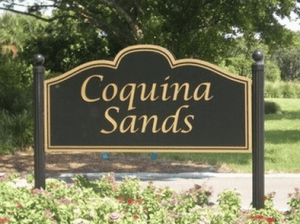
Thinking about buying or selling in Southwest Florida? Tell us what you are trying to do and we will tell you honestly what it will take. McGreevy and Comisar, Domain Realty Group.