By Jesse McGreevy and Marc Comisar, McGreevy and Comisar, Domain Realty Group. Updated October 2026.
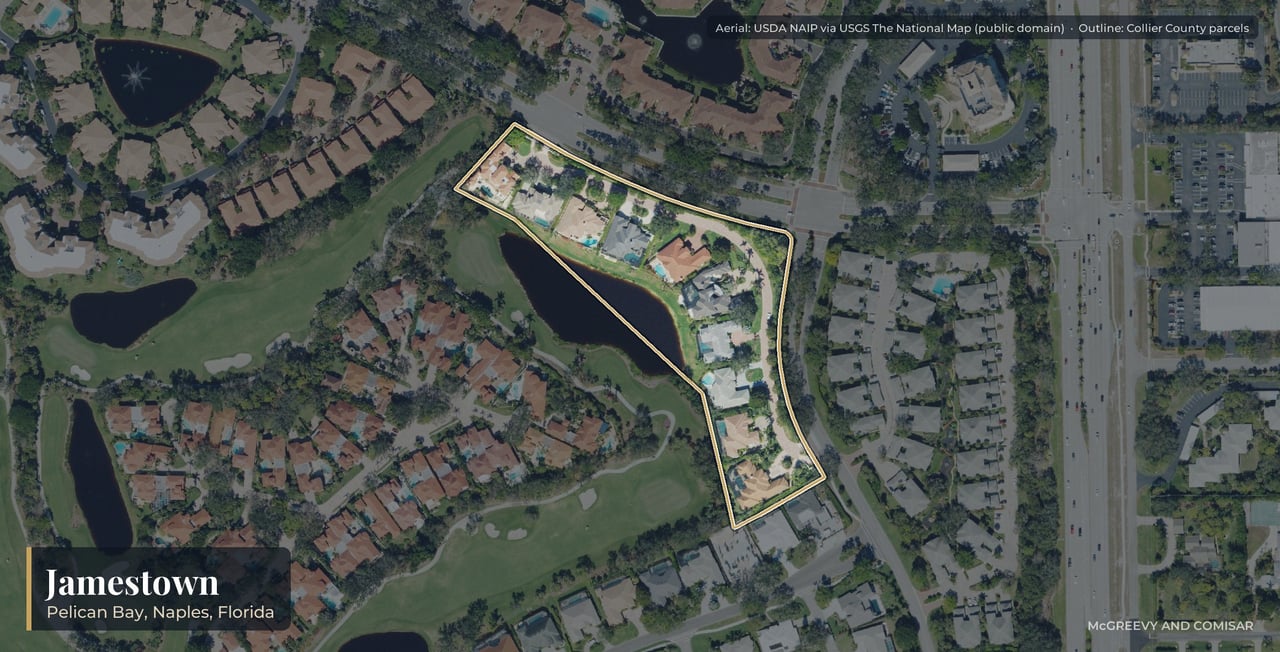
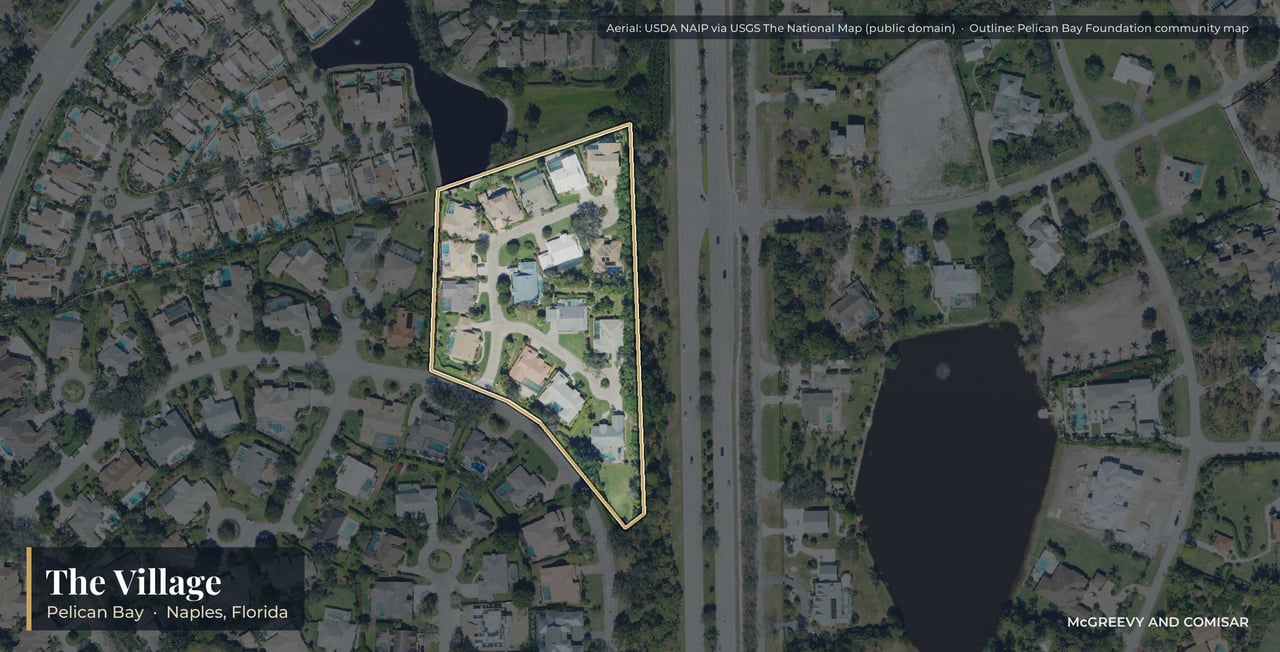
Jamestown is a single-family neighborhood inside the master-planned community of Pelican Bay in Naples, Florida. It is a gated enclave of ten detached homes on one street, Jamestown Lane, with addresses running from 677 to 749 Jamestown Lane in ZIP 34108. The Pelican Bay Foundation’s community map describes it as a gated, single-family home subdivision “consisting of only 10 homes” with views of The Club Pelican Bay. We found no separate Jamestown association registered with the State of Florida, so the rules a buyer meets come from the Foundation’s recorded Declaration unless a recorded Jamestown instrument says more.
Jamestown at Pelican Bay is not the historic Jamestown in Virginia, and it is not Jamestown Association, Inc., an unrelated Florida nonprofit corporation that appears in the state’s name search under document number 724903 and that we could not connect to this neighborhood. The street this page covers is Jamestown Lane, addresses 677 to 749, and the Pelican Bay enclave it is most often compared with on our roster is Pointe Verde, another small single-family neighborhood.
Jesse McGreevy and Marc Comisar lead Domain Realty Group, the #1 real estate team in Southwest Florida since 2012 and, in the team’s own credential, Top 1% Real Estate Agents Nationally Since 2008. This guide is built from the Foundation’s recorded Declaration, its bylaws and rules, the FY2027 budget package and estoppel form, FEMA’s flood map queried at five Jamestown Lane addresses, Collier County’s 2026 tax roll and recorded sales through June 30, 2026, and the Southwest Florida MLS pulled October 7, 2026. Where the public record stops, we say so. If you own in Jamestown and are weighing a sale, start with the market snapshot and the seller section, then call Jesse. If you are buying, the sections on what ten homes have sold for, what the gate and the golf-course view do and do not include, and what the Foundation charges show whether Jamestown fits before you tour.
Why McGreevy and Comisar Are the Best Realtor for Jamestown
McGreevy and Comisar are the best realtor for Jamestown because the case is on the record: the #1 team in Southwest Florida since 2012, Top 1% Real Estate Agents Nationally Since 2008, and a Jamestown market read built from every recorded sale back to 1991, the Foundation’s own documents and a flood-map query at the street’s own addresses.
Data updated: October 2026 (Southwest Florida MLS, pulled October 7, 2026; Collier County Property Appraiser recorded sales through June 30, 2026)
If you’re searching for the best realtor for Jamestown in Pelican Bay, Naples, whether you’re ready to sell your Jamestown home or buy your next one, McGreevy and Comisar is the team that delivers. We lead Domain Realty Group, the #1 real estate team in Southwest Florida since 2012, Top 1% Real Estate Agents Nationally Since 2008, with over $2.5 billion sold as a team and $900 million in personal sales between Jesse and Marc.
That matters in Jamestown for a specific reason: the neighborhood is too small for a median to price it. Ten homes share one lane, and the Southwest Florida MLS recorded four Jamestown closings in the last 60 months and none in the last 12. A listing agent who prices a Jamestown home off Pelican Bay’s blended numbers, or off a larger neighborhood’s average, misses what a buyer’s agent will actually bring: the four recorded Jamestown sales, the county’s deed record back to 1991, a $15,000 Foundation resale fee for deeds recorded on or after October 1, 2026, and the question of who runs the gate.
Recent Jamestown track record (last 12 months): In the last 12 months Jamestown has seen 0 resales in the Southwest Florida MLS (pulled October 7, 2026, closings dated October 7, 2025 to October 7, 2026), and no Jamestown home was listed for sale or pending on that date. Over the last 60 months Jamestown has seen 4 resales, at a median sold price of $5,325,000 (the mean of $4,850,000 and $5,800,000), a range of $4,680,000 to $6,600,000 and $21,930,000 in volume. The highest-priced Jamestown sale of that window was $6,600,000, in March 2024, and the median sale-to-list ratio was 99.9% (4 sales). Domain Realty, our brokerage, closed 658 transaction sides in Naples in the 60 months to October 5, 2026, $521.5 million in volume counted by side, per the Southwest Florida MLS pulled that day. McGreevy and Comisar are the #5 real estate team in Florida in the 2026 RealTrends rankings. We tracked all four of those closings against the county’s recorded-sales file and against the Foundation’s FY2027 fee schedule before this guide was written.
For Jamestown sellers: premium marketing, including cinematic video, drone, professional photography, a qualified-buyer database, and discretion with off-market capability when a sale needs to stay quiet. In a ten-home enclave discretion matters, because a Jamestown listing is visible to the whole neighborhood. We also build the paperwork file before the first showing, because Florida law requires the Foundation’s disclosure summary to reach a buyer before the contract is signed and lets the buyer cancel within three days if it does not. We order the Foundation estoppel early, plan the resale capital assessment into the buyer’s cash to close, and keep the Foundation’s sign and open-house rules in the listing plan from day one.
For Jamestown buyers: the first question is price evidence, because only four homes have traded in five years and they ranged from 4,138 to 6,690 square feet. The second is the gate and the lane: what the neighborhood’s entries cost to run and who pays, which the public record does not answer. The third is the stack of charges, which runs through the Foundation, the Pelican Bay Services Division and the county tax bill. Sellers and buyers comparing the best real estate agents in Naples should ask each one to answer those three questions for Jamestown specifically; we answer them below.
Honors and recognition:
- Top 1% Real Estate Agents Nationally Since 2008
- 5 Star Award for Customer Satisfaction for 21 Straight Years. Only 5 out of 21k+ Licensees (Gulfshore Life Magazine)
- #1 Team in Southwest Florida since 2012
- McGreevy and Comisar and their Domain Realty Group team have sold over $2.5 Billion in Real Estate
- McGreevy and Comisar alone have over $900 million in Sales
- Nationally Recognized Top Producing Realtors
- Platinum Sales Production Award Winners
Selling your Jamestown home? Get a free home valuation → https://mcgreevyandcomisar.com/home-valuation OR call Jesse direct at (239) 898-6072.
Buying a home in Jamestown? Call Marc at (239) 287-5873 for a personalized buyer consultation, or read how we represent buyers in Southwest Florida.
Living in Jamestown as a Homebuyer
Living in Jamestown means a detached single-family home on a lot of roughly a third to nearly half an acre, behind a gate, on the only street of a ten-home enclave in Pelican Bay, with views of The Club Pelican Bay, mandatory Foundation membership and no separate neighborhood association that we could find.
Most of Pelican Bay is condominium. Jamestown is the other kind of Pelican Bay ownership, and the smallest kind: land and house in fee simple, billed directly by the Foundation, with the roof, lawn and pool the owner’s own to maintain and the Foundation’s design review standing over exterior changes. What follows is drawn from the recorded documents, the county’s records and the Foundation’s own pages.
What Is Jamestown?
Jamestown is one of Pelican Bay’s single-family neighborhoods, and the Foundation’s community map gives it one of the shortest descriptions on the map: “Jamestown is a gated, single-family home subdivision consisting of only 10 homes. Jamestown offers views of The Club Pelican Bay. The timeline of the construction of homes ranges from 1991 to 2000. Renovations to both entries were completed in 2007.” The Collier County Property Appraiser’s 2026 tax roll agrees on the count: ten residential parcels, all single-family, in the platted subdivision the county calls Jamestown at Pelican Bay. The Southwest Florida MLS files Jamestown resales under its own Jamestown sub-area, which is how we count sales.
The Street Address: 677 to 749 Jamestown Lane
Every Jamestown home sits on Jamestown Lane, with addresses from 677 to 749 in ZIP 34108, which is how buyers search for it (“677 Jamestown Lane Naples” and its neighbors). The county’s records list one street and ten homes, and the Census Bureau’s geocoder places the street at about 26.245 north latitude and 81.804 west longitude. A buyer touring Jamestown is touring one lane, and the county’s records show no second street in the subdivision.
Street | Jamestown Lane, 677 to 749 | Collier County Property Appraiser, 2026 tax roll; roster |
Homes | 10, all single-family | 2026 tax roll; Foundation community map |
ZIP code | 34108 | Census Bureau geocoder |
Plat | Jamestown at Pelican Bay, Plat Book 18, page 15 | Recorded Collier County instrument citing the plat |
Gate | Gated, entries renovated in 2007 | Foundation community map |
Association | None registered with the State of Florida that we could find | Sunbiz name search, October 7, 2026 |
A Gated Enclave of Only Ten Homes
Ten homes is small even for Pelican Bay, which the Foundation’s realtor page describes as roughly 6,500 residences in 95 associations. Among the eight single-family neighborhoods in the benchmark table later in this guide, Jamestown’s ten homes are the second-smallest group, ahead of only Cambridge at six, and close in size to Pointe Verde at thirteen. The Foundation’s map says “both entries” were renovated in 2007, which tells a buyer there are two ways in, and it says nothing about hours, guards or access control. We do not describe how the gate operates because no public document we found does.
Views of The Club Pelican Bay
The Foundation’s map credits Jamestown with views of The Club Pelican Bay, the golf club inside Pelican Bay. A view of the course is not membership in the club or a right to play it. Section 6.02 of the Declaration says the golf course and clubhouse provide green space and an aesthetic benefit to all owners, and that no annual, special or resale capital assessment is levied in respect of or arising out of the golf course. Club membership is a separate arrangement with the club, explained in the golf-course section below.
Homes From 1991 to 2000, With Later Additions
The Foundation dates Jamestown’s construction to 1991 through 2000, and the county’s building records agree: the ten original structures are dated 1991 (one home), 1992 (two), 1993 (two), 1995 (one), 1996 (two), 1997 (one) and 2000 (one). Later additions are recorded from 2010 through 2022 on some parcels. A Jamestown home is therefore a house of the 1990s that has often been enlarged or renovated since, so the year built alone does not describe what a buyer is touring.
A Day at Jamestown
A typical Jamestown day runs on short drives and the Foundation’s amenities. The Pelican Bay Community Center is 1.3 to 1.5 minutes away by car and the Publix at the Marketplace at Pelican Bay 2.0 to 2.2 minutes, in off-peak routing-engine estimates from the two ends of the lane. The Foundation’s beaches, Marker 36 on the north beach and the Sandbar on the south beach, are reached by the Foundation’s tram and berm. Amenities, drive times and rules each have their own section below.
What Jamestown Does Not Have
Jamestown has no condominium association, no association-maintained exteriors and no elevator buildings, so Florida’s milestone-inspection and structural-reserve-study laws for condominiums do not apply to it. It has no golf course of its own and no clubhouse, and Club Pelican Bay membership is a separate decision from buying the house. We found no age restriction in the Declaration, bylaws or rules we read, and we found no neighborhood-level association, budget or dues in the public record, which is a question to put to the seller before an offer.
Jamestown Market Snapshot: What Ten Homes Have Sold For
In the last 12 months Jamestown recorded no closings in the Southwest Florida MLS, so no window of 12, 24, 36 or 60 months reaches the ten sales a stable median needs. We list all four sales of the last 60 months, from $4,680,000 to $6,600,000, and read them against the county’s deed record.
Data updated: October 2026 (Southwest Florida MLS, pulled October 7, 2026; Collier County Property Appraiser recorded sales through June 30, 2026)
Jamestown Closings by Window: 12, 24, 36 and 60 Months
Four windows ending October 7, 2026 show how thin the record is. The 12-month window holds no closings. The 24-month window holds one, the 36-month window two and the 60-month window four, so every figure below is a small sample (n under 10) and a median of one, two or four sales is a data point, not a price level. None of the four sales was entered after closing, so every sale counts in every column.
12 months | 0 | none | none | $0 | none | none | none |
24 months | 1 | $5,800,000 | $5,800,000 | $5,800,000 | $867 | 27 (1) | 92.1% (1) |
36 months | 2 | $6,200,000 (mean of $5,800,000 and $6,600,000) | $5,800,000 to $6,600,000 | $12,400,000 | $1,231 | 18 (2) | 94.9% (2) |
60 months | 4 | $5,325,000 (mean of $4,850,000 and $5,800,000) | $4,680,000 to $6,600,000 | $21,930,000 | $1,116 | 15 (4) | 99.9% (4) |
Why No Window Reaches Ten Sales
Jamestown has ten homes, so a window of ten sales would require every home to change hands inside it. Four sales in 60 months is 40 percent of the neighborhood (4 divided by 10), one sale about every 15 months (60 divided by 4), and a pace at which the average Jamestown home trades once in 12.5 years (10 homes divided by 0.8 sales a year). The last of the four closed in February 2025, about 20 months before the October 7, 2026 pull. That is the market’s rhythm in a ten-home enclave, not a sign of weakness: few homes trade, and each trade is its own comparable.
Every Jamestown MLS Closing in 60 Months
Here is the full list, newest first, four closings from February 2022 to February 2025. They are listed by month and street, never by house number. The median is $5,325,000 (n=4), the mean of the two middle prices when the four are sorted.
February 2025 | Jamestown Lane | 4 bed + den, 6 full + 1 half | 6,690 | $5,800,000 | $6,299,000 | $867 | 27 |
March 2024 | Jamestown Lane | 4 bed + den, 4 full + 1 half | 4,138 | $6,600,000 | $6,750,000 | $1,595 | 8 |
March 2022 | Jamestown Lane | 4 bed + den, 4 full + 1 half | 4,344 | $4,680,000 | $4,500,000 | $1,077 | 3 |
February 2022 | Jamestown Lane | 3 bed + den, 3 full + 1 half | 4,201 | $4,850,000 | $4,750,000 | $1,154 | 22 |
What the Four Sales Tell a Buyer
The February 2025 sale was the largest home at 6,690 square feet and closed at $5,800,000, which is $867 a square foot, the lowest of the four. The March 2024 sale was a 4,138-square-foot home that closed at $6,600,000, the highest price and the highest rate at $1,595 a square foot. The two 2022 sales were 4,344 and 4,201 square feet, closed within a month of each other at $4,680,000 and $4,850,000, and both closed above their final list prices. All four are single-family detached homes with a den, and all four have at least three bedrooms. Size explains little of the price: the smallest sale of the four brought $6,600,000 in 2024 and the largest brought $5,800,000 in 2025, which is why we price a Jamestown home against the specific lot, finish and condition and not against a square-foot figure.
How Fast Jamestown Homes Sell
Every one of the four sold quickly once listed. The median is 15 days on market over 60 months (n=4), the middle of the sorted values 3, 8, 22 and 27, and no sale took longer than 27 days. In a neighborhood where a home may trade once in a decade, a well-priced Jamestown listing has historically drawn a buyer inside a month, and the one sale priced above the market’s pace, the 2025 sale, still closed in 27 days after a final list of $6,299,000.
Asking Price Versus Sold Price
The median sale closed at 99.9 percent of the final list price over 60 months (n=4), but the number hides a turn. The two 2022 sales closed above final list, at 104.0 percent ($4,680,000 against $4,500,000) and 102.1 percent ($4,850,000 against $4,750,000). The two since closed below it: 97.8 percent in March 2024 ($6,600,000 against $6,750,000) and 92.1 percent in February 2025 ($5,800,000 against $6,299,000, a $499,000 or 7.9 percent reduction from the last asking price). For a seller, the practical reading is that the newest sale is the one that tested the upper range, and it closed about eight percent under its last ask.
The median Jamestown sale of the last 60 months closed at $1,116 per square foot of MLS living area (n=4), the mean of $1,077 and $1,154. Over 36 months the median is $1,231 (n=2) and over 24 months $867 (n=1). Per-sale values run from $867 to $1,595 because the homes differ in size, lot, pool, finish level and age. We use the MLS living area for each sale here, not the county’s, and we never compare the two.
Sales Entered After Closing
None of the four Jamestown sales was entered in the MLS after closing. Every sale was marketed through the MLS, so days on market and sale-to-list ratios rest on all four sales, and the closing counts, medians, ranges, volume and per-square-foot figures rest on the same four.
Active and Pending Jamestown Listings Today
On October 7, 2026 no Jamestown home was active or pending in the Southwest Florida MLS. With zero listings and zero closings in 12 months, the neighborhood has no current listing for a buyer to tour and no current competing listing for a seller to price against. A seller who lists now would be the only Jamestown listing, and buyers who want the street have to wait for a listing or make a private approach through a buyer’s agent.
Reading Four Sales Honestly
Four sales are a record, not a statistic. We do not average the 2022 and 2024 prices into a single trend, because the homes differ and the market moved between the dates. We do not extend the 12-month window to find a median that is not there. What we do is show each sale, say which ones sold above and below their asking prices, set them beside the county’s deed record back to 1991, and price a Jamestown home against the closest comparable by size, age, pool, lot position and finish.
Selling in Jamestown? Get a free home valuation or call Jesse direct at (239) 898-6072. Buying in Jamestown? Call Marc at (239) 287-5873 or read how we represent buyers.
Jamestown Sales Since 1991: The Long View
Collier County’s recorded sales file shows 22 qualified Jamestown sales between 1991 and 2024, from $385,000 in 1994 to $6,600,000 in 2024, with none recorded in 2012 through 2021. The long view shows a neighborhood that sold in a burst in the 1990s and now trades about once every 15 months.
Data updated: October 2026 (Southwest Florida MLS, pulled October 7, 2026; Collier County Property Appraiser recorded sales through June 30, 2026)
Jamestown Sales by Year, 1991 to 2024
The table lists the county’s qualified sales of improved property at $100,000 and over, by calendar year, from the Collier County Property Appraiser’s recorded-sales file through June 30, 2026. The county records the deed consideration, and the MLS records the reported closing price. For the four sales in both sources the figures agree to the dollar for 2022 and 2024. The February 2025 MLS sale, $5,800,000, does not appear in the county’s qualified file, which may reflect the file’s qualification screen or recording lag; we cannot tell which from the public file, so the 2025 sale is cited from the MLS with its date.
1991 | 1 | $505,000 | $505,000 | $505,000 |
1992 | 2 | $427,500 | $425,000 | $430,000 |
1993 | 3 | $440,000 | $435,000 | $445,000 |
1994 | 2 | $792,500 | $385,000 | $1,200,000 |
1996 | 3 | $1,115,000 | $400,000 | $1,600,000 |
1997 | 1 | $460,000 | $460,000 | $460,000 |
1998 | 2 | $837,800 | $490,000 | $1,185,600 |
2004 | 2 | $1,875,000 | $1,800,000 | $1,950,000 |
2009 | 1 | $3,050,000 | $3,050,000 | $3,050,000 |
2010 | 1 | $2,400,000 | $2,400,000 | $2,400,000 |
2011 | 1 | $3,200,000 | $3,200,000 | $3,200,000 |
2022 | 2 | $4,765,000 | $4,680,000 | $4,850,000 |
2024 | 1 | $6,600,000 | $6,600,000 | $6,600,000 |
1991 to 1998: The Building and First-Sale Years
The county records 14 qualified sales in 1991 through 1998 (1, 2, 3, 2, 3, 1 and 2 by year), at prices from $385,000 in 1994 to $1,600,000 in 1996. That is 14 of the 22 sales in the file, 64 percent (14 divided by 22), and it lines up with the Foundation’s date for construction of 1991 to 2000, when the homes were being built and sold. We cannot tell from the file which of those sales were first sales from a builder, so we do not split them.
2004 to 2011: Five Sales in Eight Years
Between 2004 and 2011 the file shows five sales: two in 2004 at $1,800,000 and $1,950,000, and one each in 2009, 2010 and 2011 at $3,050,000, $2,400,000 and $3,200,000. The 2011 sale, $3,200,000, is more than double the 2004 median of $1,875,000 (3,200,000 divided by 1,875,000 is 1.71), and the 2010 sale shows the market’s dip against 2009 ($2,400,000 against $3,050,000). Each is a single transaction, not a trend.
2012 to 2021: A Decade With No Qualified Sale
The county’s qualified file shows no Jamestown sale in the ten calendar years from 2012 through 2021. That does not prove that no home changed hands, because the file leaves out transfers that do not meet the state’s qualification tests, such as some family and trust transfers. It does show how rarely an arm’s-length Jamestown sale reached the market, and it is the reason a buyer who wants this street may wait years for a listing.
2022 to 2025: The Step Up
Four sales from February 2022 to February 2025 reset the record: $4,850,000 and $4,680,000 in early 2022 (the county median for 2022 is $4,765,000), $6,600,000 in March 2024 and $5,800,000 in February 2025. The 2024 deed price is 38.5 percent above the 2022 county median (6,600,000 divided by 4,765,000, less 1), and the 2025 price is 21.7 percent above it (5,800,000 divided by 4,765,000, less 1). Those are comparisons of different homes, not appreciation of one house.
What the Long View Means for a Seller
A Jamestown seller is selling a scarce product to a thin buyer pool, and the record rewards patience and precision. The pool is thin because few homes trade; the precision comes from pricing against the right comparable. Because only four sales are recent, a buyer’s agent will pull the 2022 pair, the 2024 sale and the 2025 sale, and a seller’s price will be judged against the one most like the home, adjusted for size, lot, pool and updates. The most recent sale closed 7.9 percent under its last asking price, so a list price above the recorded range invites the same discount.
What the Long View Means for a Buyer
A Jamestown buyer is buying in a neighborhood where opportunities are rare, which can mean competition when a home lists and a premium for the lot. The 2022 sales show that homes can close above ask when the buyer pool is deep, and the 2024 and 2025 sales show buyers negotiating below ask when it is not. A buyer who has done the Foundation, flood and neighborhood homework before the home lists is the buyer who can move in the first month.
How Did Jamestown Come to Be?
Jamestown’s land is part of the 2,330 acres that Coral Ridge Properties, a Westinghouse division, and the Collier family set out to develop in 1972, the Pelican Bay Foundation was formed in 1979, the county’s first recorded Jamestown sale dates from 1991, and the Foundation’s Declaration governs the neighborhood today.
The 1972 Plan
The Foundation’s own history says Pelican Bay began in 1972 when Coral Ridge Properties, a division of Westinghouse, entered a partnership with the Collier family to develop 2,330 acres of beachfront seven miles north of downtown Naples. Conventional dredge-and-fill development was considered first, and the creation of the EPA in 1970 and Florida’s Environmental Land and Water Management Act in 1972 pushed the plan toward preservation.
A Single-Family Pocket in a Plan Built Around Habitat
According to the Foundation, Pelican Bay was plotted with single-family homes and low-rise villas that blend with the habitat, high-rise condominiums set back from the beach, and a berm and boardwalk system that gives Gulf access without crossing the mangrove forest. Jamestown is one of the single-family pieces of that plan, a ten-lot street laid out beside the golf club, which is why its lot owners answer to the Foundation’s landscape standards and design review.
1979 and the Foundation
In 1979 Westinghouse bought out the Collier family’s interest, the first demonstration home and sales center were built, and the Pelican Bay Foundation was formed. The Declaration that governs Jamestown today is the Second Amended and Restated Declaration, recorded in the Collier County official records in 2009 at Official Records Book 4442, page 3381, and linked in the Downloadable Documents below.
The Plat: Plat Book 18, Page 15
A recorded Collier County instrument from 2019, a berm easement in Official Records Book 5642 at page 2906, labels the subdivision “Jamestown at Pelican Bay, P.B. 18, Pg. 15” and places it in Section 33, Township 48 South, Range 25 East. That is the platted name the county uses on its tax roll, and it is the name a title company will search. The county’s roll counts 13 parcels under it: the ten homes and three small non-residential parcels described in the next section.
Building Out From 1991 to 2000
The Foundation dates construction of Jamestown’s homes to 1991 through 2000, and the county’s earliest qualified Jamestown sale in its recorded-sales file is from 1991. The Foundation adds that renovations to both entries were completed in 2007. Together those two facts give a buyer the neighborhood’s outline: a street built and sold in the 1990s, a gate refreshed in 2007, and a market that has traded a few homes at a time since.
What the Origins Mean for a Buyer Today
The history matters to a Jamestown buyer for three practical reasons. The homes were built in the 1990s, so roof, window, electrical and plumbing systems are either original or have been replaced under the permits of a later decade. The land sits inside a Planned Unit Development whose standards the Foundation enforces. And the neighborhood’s own arrangements, the two entries renovated in 2007, were set in a period for which we found no recorded Jamestown instrument.
Because the Foundation formed in 1979 and the Declaration was restated in 2009, a Jamestown owner lives under rules that predate the homes in some respects and postdate them in others. The 2009 restatement and the 2019 leasing amendment are two of the instruments this page relies on most, and both are linked in the Downloadable Documents below, so a buyer can read the text instead of relying on a summary.
Thinking of Selling or Buying in Jamestown, Pelican Bay? Start With Four Closings in 60 Months and the $15,000 Foundation Resale Fee
If you own in Jamestown, the four closings of the last 60 months, from $4,680,000 to $6,600,000, are the comparables a buyer’s agent will bring, and the $15,000 Foundation resale capital assessment is part of every buyer’s cash to close. Start with a free Jamestown home valuation or call Jesse direct at (239) 898-6072. If you are thinking of buying in Jamestown, call Marc at (239) 287-5873 or read how we represent buyers.
The Homes of Jamestown: Lots, Sizes and Values
Jamestown’s ten homes are detached single-family houses on lots of 0.34 to 0.44 acre, with roll living areas from 3,449 to 7,501 square feet and a 2026 certified county just value from $3,744,743 to $5,857,728, built between 1991 and 2000 and in several cases enlarged since.
Data updated: October 2026 (Southwest Florida MLS, pulled October 7, 2026; Collier County Property Appraiser recorded sales through June 30, 2026)
The figures in this section come from the Collier County Property Appraiser’s 2026 certified tax roll, and the just values match the preliminary file dated late August 2026 on all ten homes. The county’s parcel page for a specific address is the authority. We give ranges and medians for the ten homes, never an owner’s name, a parcel number or a house number.
Lots of a Third to Nearly Half an Acre
The ten lots, sorted by size, are 0.34, 0.35, 0.36, 0.36, 0.37, 0.38, 0.39, 0.39, 0.43 and 0.44 acre. The median is 0.375 acre (the mean of the fifth and sixth lots, 0.37 and 0.38) and the total is 3.81 acres. Those are lots large enough for a pool and a lanai, which fits the county’s building records: 8 of the 10 homes carry a pool line and all 10 carry a spa line. We read those feature lines cautiously, because they record what an appraiser coded and not what a buyer will find, and a tour confirms the pool.
Living Area: 3,449 to 7,501 Square Feet
The county’s heated-area field runs from 3,449 to 7,501 square feet across the ten homes, with a median of 4,181.5. The base area of the original structures runs from 3,449 to 4,762 square feet, and the county’s adjusted area field runs from 4,052 to 6,382. The gap between a base of 4,762 and a roll heated area of 7,501 is the sign of an enlarged house: additions are recorded on some parcels from 2010 through 2022. The four MLS sales of the last 60 months list living areas of 4,138, 4,201, 4,344 and 6,690 square feet, and the MLS figure for each sale is what we use for price per square foot.
Year Built: Seven Different Years in One Decade
The county dates the ten original structures as shown below. They match the Foundation’s 1991 to 2000 range exactly, and the county’s later dates, 2010 through 2022, are additions to those original structures, not new houses.
1991 | 1 |
1992 | 2 |
1993 | 2 |
1995 | 1 |
1996 | 2 |
1997 | 1 |
2000 | 1 |
All Jamestown homes | 10 |
A buyer should treat the year built as a clue to which building codes, window and roof systems and floor elevations a house was designed under, and read each house’s permit history. A 1992 house with 2018 windows and a 2021 roof is a different purchase from a 1992 house with its original systems.
The Land Is Worth More Than the House
On the 2026 certified roll, the land value of every Jamestown home exceeds its improvement value. Land just value runs from $2,758,515 to $3,510,364, and improvement just value from $896,486 to $2,653,660, so even the smallest land value is above the largest improvement value. That is the arithmetic of an enclave of 0.34 to 0.44 acre lots beside a golf club, and it is the reason a Jamestown buyer may consider a renovation or a rebuild: the lot carries most of the county’s value. Any rebuild goes through the Foundation’s design review, described below.
2026 Values and Tax Bills
The county’s total just value for the ten homes runs from $3,744,743 to $5,857,728, with a median of $4,544,316 (the mean of the fifth and sixth sorted values, $4,513,923 and $4,574,709) and a sum of $46,173,972. All ten sit in the county’s millage area 79, unincorporated, with a total of 9.4553 mills (3.9826 county, 4.1470 school and 1.3257 other taxing authorities) and no municipal levy. The certified roll shows total ad valorem taxes from $16,088 to $55,387, with a median of $31,721 (n=10), and a $1,519.77 non-ad valorem line on each of the ten homes.
Why the Tax Bill Is Below the Value
The median just value times the millage gives a rough uncapped bill: $4,544,316 divided by 1,000, times 9.4553, is about $42,968, against the $31,721 median actual bill. The difference comes from the homestead exemption, which the county’s roll shows on 7 of the 10 homes, and from Save Our Homes, which holds a homesteaded owner’s assessed value below just value. A buyer’s first bill is calculated on the new owner’s assessment, so a buyer should expect a bill nearer the uncapped figure than the seller’s. This is an illustration with a median, not a quote for any house.
Three Non-Residential Parcels
The county counts three more parcels under the Jamestown name besides the ten homes: two coded as outdoor recreation or parkland, of 0.18 and 1.37 acre, and one coded as rivers, lakes or submerged land, of 0.89 acre. Each carries a just value of $100 on the certified roll. They are not houses and they are not for sale as home sites on the evidence we have, and we mention them because a buyer reading the county’s parcel list will see 13 parcels, not 10.
Single-Family, Detached, Fee Simple
Every Jamestown home is single-family use on the roll. There is no shared wall, no common roof and no condominium declaration, so the usual condominium questions about reserves, building special assessments and approval of buyers do not arise at the neighborhood level. The questions that do arise are the Foundation’s, described below: design review, leasing, signs and vehicles.
What Amenities Come With a Jamestown Home?
Owning a Jamestown home means mandatory membership in the Pelican Bay Foundation, whose common areas include almost three miles of Gulf beach with the Sandbar and Marker 36, the Commons and the Community Center, 18 Har-Tru tennis courts and a racquets complex with pickleball, eight tram stations, the berm and boardwalks, and 88 acres of parks and recreation.
Beaches and Beach Dining
The Foundation says its private beaches run almost three miles and are open daily from 9 a.m. to sunset. The South Beach has the Sandbar, which the Foundation’s page describes as newly renovated, and the North Beach has Marker 36 for beachfront dining. The Foundation’s pages list beach attendants, loungers and umbrellas, showers and restrooms, and accessible ramps, and the hours and menus change, so a buyer should confirm them on the Foundation’s own pages before relying on them.
The Commons and the Community Center
The Community Center at 6251 Pelican Bay Boulevard houses social space, an art studio, card rooms and meeting spaces, and hosts groups such as Bridge and Mahjong, according to the Foundation’s community center page. The Commons building at the same address is where the Foundation’s lease checklist says renter-card photos are taken and where a one-day Realtor Guest Card is picked up. The county’s Pelican Bay Services Division page uses a different address, 8960 Hammock Oak Drive, for the building it calls the Community Center at Pelican Bay, so confirm the address with the Foundation before you drive.
Tennis, Pickleball and Racquets
The Foundation counts 18 Har-Tru tennis courts at two locations and says about 4,500 members are active tennis players. Its racquets program describes the Racquets Center in the adjacent Pelican Bay Community Park, a shared-use complex opened with Collier County that holds 8 Har-Tru tennis courts and 20 pickleball courts, of which 3 tennis courts and 10 pickleball courts are available to Foundation members and guests. The complex is open. Court reservations, attire and etiquette are set by the Foundation’s rules, not by any Jamestown association.
Trams, the Berm and the Boardwalks
The berm and boardwalks are Foundation common areas, and the Foundation’s open-air trams serve eight stations along the berm, with more than 900,000 trips a year to the beach and back, according to its tram page. Pets may walk the berm on a leash of six feet or less, retractable leashes are not allowed there, and the rules prohibit personal golf carts, motorized bikes and e-bikes on the berms, boardwalks and decks.
Parks, Fitness and Boating
The Foundation’s realtor page counts 88 acres of parks and recreation, and its rules set the conduct and hours for the parks. The Foundation also runs a fitness center and offers sailing, canoeing and kayaking under its own rules for equipment, courses and conduct, with Scenic Clam Bay on the community’s coast for paddling.
Guests: The Realtor Guest Card
A prospective buyer who is not yet a member can tour with a one-day Realtor Guest Card, which the Foundation’s realtor page says is pre-ordered and picked up in the Commons lobby, Monday to Friday from 8:30 a.m. to 5:00 p.m., with weekend passes to be requested by 3 p.m. on Friday. If you plan to see the beach with your agent, ask us to order the card ahead.
The Foundation’s realtor page lists the Marketplace at Pelican Bay (Publix, CVS, banks and restaurants), Waterside Shops and Artis-Naples, home of the Naples Philharmonic and The Baker Museum, as the neighbors. Routing-engine estimates from the two ends of Jamestown Lane put the Mercato and Whole Foods at 2.2 to 2.4 minutes and the Publix at the Marketplace at 2.0 to 2.2 minutes in off-peak driving.
What Membership Does Not Cover
Foundation membership is not membership in The Club Pelican Bay. Section 6.02 of the Declaration keeps the golf course and clubhouse separate from the Foundation’s assessments, and the club publishes its own membership terms. A buyer who wants golf should ask the club, not the Foundation, what it takes.
A Home With a View of The Club Pelican Bay: What the View Does and Does Not Include
The Foundation’s community map says Jamestown offers views of The Club Pelican Bay, and Section 6.02 of the Declaration sets what that view means in law: the golf course and clubhouse provide green space and an aesthetic benefit to all owners, no assessment arises out of them, and club membership is a separate matter.
What the Declaration Says in Section 6.02
Section 6.02 of the Second Amended and Restated Declaration provides that no annual, special or resale capital assessment is levied in respect of or arising out of the golf course, and that assessments related to the clubhouse are set at half the usual rate. For a Jamestown owner the result is that the Foundation’s $3,435 assessment is the same for a home with a course view as for one without it, and that the view brings no golf fee with it.
A View Is Not a Membership
Seeing the course from a lanai is not a right to play it. The Club Pelican Bay sets its own membership categories, initiation terms and dues, and a buyer who wants to play should ask the club in writing before an offer. We do not state club prices, because they are the club’s to publish and they change.
What a Buyer Should Check About the View
The view depends on the lot and the landscaping, and the Foundation’s rules govern tree removal and landscape changes through design review. A buyer who is paying for a course view should look at the sight line in the morning and the evening, ask the seller whether any landscape changes were approved or are pending, and confirm that nothing in the Foundation’s records limits the view. We cannot tell from public records which Jamestown lots have the best sight lines, so we do not rank them.
What Are the HOA Fees at Jamestown?
Jamestown owners pay one annual Foundation assessment, $3,435 for fiscal year 2027 (October 1, 2026 through September 30, 2027), billed directly to the owner in the fourth quarter: $2,180 operating, $497 replacement reserve and $758 for the bulk media agreement, or $858.75 a quarter. We found no separate Jamestown association fee.
What the $3,435 Is Made Of
The Foundation’s FY2027 estoppel form breaks the annual assessment into three lines and a quarterly equivalent. The three add to $3,435 (2,180 plus 497 plus 758), and a quarter is $858.75 (3,435 divided by 4).
Operating assessment | $2,180.00 | $545.00 |
Replacement reserve fund | $497.00 | $124.25 |
Bulk media agreement | $758.00 | $189.50 |
Total | $3,435.00 | $858.75 |
Five Years of the Foundation Assessment
The Foundation’s FY2027 budget package shows the annual assessment at $2,944 for fiscal 2024, $2,675 for 2025, $3,295 for 2026 and $3,435 for 2027. The 2027 figure is $140 higher than 2026, an increase of 4.2 percent (140 divided by 3,295). The reserve line rose from $384 to $497 for 2027, while the bulk media line fell from $828 to $758.
The $758 line is the Foundation’s bulk media assessment per billable unit for FY2027, calculated in the budget package on 6,474 billable units against $828 on 6,473 units in FY2026. The budget package also adds a $50 reconnection fee for bulk media service suspended for non-payment of the annual assessment.
How and When Jamestown Owners Are Billed
The estoppel form says that when a unit is single-family the Foundation bills the owner directly, billing happens in the fourth quarter of each year, and the Foundation’s fiscal year begins October 1, when payments are due. A condominium owner’s assessment is paid through the condominium association, which is why a Jamestown owner sees the Foundation’s bill as a personal one. The Foundation’s rules charge 18 percent interest on assessments unpaid after 30 days and allow suspension of privileges after 90 days.
What the Assessment Does Not Cover
The Foundation assessment funds the Foundation’s own operations and reserves, listed in its budget. It does not maintain or insure a Jamestown owner’s house, roof, lawn or pool, and it does not pay for the gate on Jamestown Lane, which the public record does not tie to any association. A Jamestown owner carries a homeowner’s policy and, where a lender or the owner chooses, flood coverage.
Is There a Jamestown Association? What We Could and Could Not Find
Jamestown has no association that we could find: the State of Florida’s corporation search on October 7, 2026 returned no entity named for Jamestown at Pelican Bay, and we found no recorded Jamestown covenants, dues schedule or gate agreement. A buyer should ask the seller who maintains and pays for the two entries before making an offer.
What the State Search Shows
We searched the State of Florida’s corporation database by name. The only close match is Jamestown Association, Inc., document number 724903, an unrelated nonprofit that the state lists as active and that is not connected to this neighborhood by anything we found. Other Pelican Bay neighborhoods do show their own registered associations, which is why the absence here is worth stating. It is not proof that no unincorporated arrangement exists.
Who Runs the Gate?
The Foundation’s map says Jamestown is gated and that both entries were renovated in 2007. It does not say who owns the gate, who pays for its maintenance and electricity, whether it is staffed, or how guests are admitted. Ask the seller for the gate’s operating arrangement and the cost, in writing, and ask whether the cost is shared by the ten owners by agreement or by a recorded instrument.
What Section 3.26 Says About Neighborhood Covenants
Section 3.26 of the Declaration, on leasing, applies “unless the Neighborhood Covenants provide otherwise.” That phrase tells a reader that individual Pelican Bay neighborhoods may have their own recorded covenants layered over the Declaration. We did not find recorded covenants for Jamestown in the public sources we searched, and the Foundation documents we read name none. A title commitment is where a recorded neighborhood instrument would show up, so ask for the commitment and the exception documents before the inspection period ends.
Documents to Request Before an Offer
A careful Jamestown buyer asks the seller for these in writing:
- Any recorded or unrecorded agreement among the ten owners about the gate, entry landscaping, lighting or the lane.
- The most recent invoices for the gate’s maintenance, power and any landscaping of the entries.
- Any special assessment, loan or fund the owners share.
- The Foundation estoppel certificate, with its statement of open violations and fines.
- Design Review Committee approvals and county permits for the house’s exterior work.
Why a Gap Matters at This Price
At the 60-month median of $5,325,000 in the MLS, an unanswered question about a shared gate is small in dollars and large in uncertainty. The cost of asking is one email. We include the question in every Jamestown buyer file we prepare, and in every seller file we prepare we ask the owner the same question first, so the answer is in hand before a buyer’s agent asks.
What Does a Buyer Pay at Closing in Jamestown?
At closing a Jamestown buyer pays the Foundation’s $15,000 resale capital assessment for deeds recorded on or after October 1, 2026, by separate check with a copy of the deed and settlement statement, unless the buyer qualifies for the Bylaws’ one-time exemption, which carries a $1,000 processing fee. The seller pays Florida’s documentary stamps.
The $15,000 Resale Capital Assessment
The Foundation’s FY2027 estoppel form states that the resale fee is $15,000, is a buyer cost due at closing, and applies when a deed is recorded in the official records of Collier County on or after October 1, 2026. At the 60-month MLS median of $5,325,000 the fee is about 0.28 percent of the price (15,000 divided by 5,325,000). The Foundation’s realtors page states that the assessment rises 3.5 percent a year from October 1, 2027, which takes the fee to $15,525 (15,000 times 1.035), and the recording date, not the contract date, controls which amount applies.
The Exemptions in Bylaws Section 7.04
The Bylaws exempt transfers by trust, gift or inheritance, and the Foundation offers a one-time exemption for a current owner moving from one Pelican Bay property to another. The estoppel form and the Foundation’s exemption form set the $1,000 processing fee, due at closing with a copy of the deed, and an owner who used the exemption before is not eligible again.
What the Seller Pays the Foundation
The estoppel form lists a $250 estoppel processing fee, an optional $100 expedite fee for completion within three business days, and a $500 fee for Foundation ID cards not returned, each a seller cost due at closing by separate check. Foundation member cards are the seller’s to turn in at closing, so a listing plan includes collecting every card.
No Transfer Approval and No Right of First Refusal
Section E of the FY2027 estoppel form states that the Foundation does not require approval for transfer of a unit and does not hold a right of first refusal. For a Jamestown sale that means no buyer interview and no Foundation board approval step. The estoppel form notes that a condominium building’s own association may require approval, which does not apply to a single-family neighborhood with no sub-association.
Florida’s Transfer Statutes
Three Florida statutes shape the paperwork. Section 720.30851 requires an estoppel certificate within 10 business days of a request and caps the fees at $299, plus $119 if expedited and $179 more if the account is delinquent, as adjusted for inflation by the Department of Business and Professional Regulation from the statute's base amounts of $250, $100 and $150. Section 720.401 requires the seller to give the buyer the association’s disclosure summary before the contract is signed, and lets the buyer void the contract within three days if it was not. Section 720.3085 makes the buyer jointly and severally liable with the seller for assessments due before the sale.
Doc Stamps and the Title Policy in Collier County
The seller pays documentary stamp tax on the deed at $0.70 per $100 of consideration under section 201.02. On a sale at the 60-month median of $5,325,000 that is $37,275 (5,325,000 divided by 100, times 0.70). In Collier County the buyer customarily pays for the owner’s title policy and chooses the closing agent, and the contract controls, so we never list the owner’s title policy as a seller cost.
The table shows only the amounts that are set by statute or by the Foundation’s own forms, applied to the 60-month MLS median price, because no 12-month median exists. It is not a closing statement: commissions, the buyer’s title policy, lender charges, prorations and the buyer’s insurance are negotiated or quoted separately.
Documentary stamp tax on the deed | Seller | $37,275 | $0.70 per $100, Fla. Stat. 201.02 |
Foundation resale capital assessment | Buyer | $15,000 | FY2027 estoppel form, Section B; Bylaws section 7.04 |
Resale exemption processing fee, if the buyer qualifies | Buyer | $1,000 | FY2027 estoppel form and exemption form |
Foundation estoppel processing fee | Seller | $250 | FY2027 estoppel form, Section D |
Optional expedite, completion within 3 business days | Seller | $100 | FY2027 estoppel form, Section D |
Foundation ID cards not returned | Seller | $500 | FY2027 estoppel form, Section C |
Selling in Jamestown? Get a free home valuation or call Jesse direct at (239) 898-6072. Buying in Jamestown? Call Marc at (239) 287-5873 or read how we represent buyers.
Jamestown’s Layered Charges: Foundation, Pelican Bay Services Division and County Taxes
A Jamestown owner receives charges from the Foundation, from the Pelican Bay Services Division through the county, and from the county for property taxes, with no neighborhood association fee that we found. The FY2027 Foundation figure is $3,435, and the services division’s FY 2027 Assessment published by the county is $1,250.00.
Data updated: October 2026 (Southwest Florida MLS, pulled October 7, 2026; Collier County Property Appraiser recorded sales through June 30, 2026)
The Foundation Assessment
The Foundation’s $3,435 for FY2027 is the largest single recurring charge that does not depend on the house. It is an assessment under Chapter 720 of the Florida Statutes: the Foundation’s own estoppel form calls the Foundation “a homeowner’s association,” and Florida’s new-owner liability statute makes a buyer jointly liable with the seller for unpaid assessments, which is why the estoppel is requested before closing.
Pelican Bay Services Division
The Pelican Bay Services Division is a Collier County municipal service taxing and benefit unit, not a community development district. The county’s Pelican Bay Services Division page publishes its FY 2027 Assessment: $789.07 for operations and maintenance plus $460.93 for capital and projects, $1,250.00 in all, or $104.17 a month (1,250 divided by 12). We do not state how the charge is applied to a single-family parcel, because the county page does not. The county’s 2026 certified roll carries $1,519.77 on each of the ten homes, which equals that $1,250.00 plus the flat $269.77 charge the roll carries across much of the county. The roll does not name the levies, so a buyer should ask the seller for the actual tax bill and read the line items.
County Property Taxes and Save Our Homes
Jamestown owners pay Collier County property taxes at a total of 9.4553 mills in unincorporated millage area 79. Florida’s Save Our Homes cap, section 193.155, limits the yearly rise in a homestead’s assessed value to the lesser of 3 percent or the change in the Consumer Price Index, and the cap resets when ownership changes, so a buyer’s first tax bill can be well above the seller’s. Section 197.162 gives a discount of 4 percent for paying in November, 3 percent in December, 2 percent in January and 1 percent in February.
The Hurricane Ian Special Assessment
After Hurricane Ian in September 2022 the Foundation levied a one-time special assessment of $2,195 per residential unit, approved in August 2023, and its audited FY2023 financial statements put the storm cost at about $16.4 million. A Jamestown buyer today asks whether any special assessment is open, and the estoppel’s Section A is where the Foundation answers it.
What We Do Not Total
We do not print a single monthly cost for Jamestown, because three of the charges depend on the address: the tax bill, the insurance quote and the unknown cost of the gate. The two fixed Foundation numbers, $3,435 a year and the $15,000 resale assessment on a purchase, are on this page with their sources, and so is the services division’s published $1,250.00.
The Pelican Bay Declaration, Bylaws and Rules, Section by Section
Jamestown is governed by the Second Amended and Restated Declaration and General Protective Covenants of Pelican Bay, the Foundation’s bylaws and its rules and regulations, with Florida’s Chapter 720 over all three. The table maps each rule a Jamestown owner meets to the document that states it, so a buyer can read the source.
Membership | Every owner in Pelican Bay is a Foundation member | Declaration; FY2027 estoppel form |
Annual assessment | $3,435 for FY2027, billed to single-family owners in the fourth quarter | FY2027 budget package; estoppel form |
Resale capital assessment | $15,000, a buyer cost, for deeds recorded on or after October 1, 2026 | Estoppel form Section B; Bylaws section 7.04 |
Transfer approval | None, and no right of first refusal | Estoppel form Section E |
Prior approval of exterior work | Structures, grading and landscaping, including tree removal, need approval | Declaration section 3.03 |
Leasing | No more than two leases in a calendar year; no time-share use | Declaration section 3.26; leasing amendment recorded May 28, 2019 |
Lease application | At least 30 days ahead, $500, copy of the lease for a single-family home, two renter cards | Lease Application Checklist and Packet, 2027 |
Real estate signs | Foundation approval; one 20 by 30 inch wooden sign, 25 feet from the road; no SOLD signs | Sign Regulations under Declaration section 3.14 |
Vehicles | No truck, commercial vehicle, motorcycle or recreation vehicle overnight unless enclosed; no more than three cars, vans, SUVs or light trucks outside overnight, on the driveway | Declaration section 3.18 |
Pets | Household pets in reasonable numbers, kept on the owner’s lot and leashed | Declaration section 3.19 |
Fences | Maximum height 6 feet | Declaration section 3.15 |
Home-based business | Allowed if not visible, audible or smelled from outside and with no non-resident visitors | Declaration section 3.27 |
Golf course | No assessment arises out of the golf course | Declaration section 6.02 |
Exterior changes | Design Review Committee approval, with application fees | Design Guidelines; FY2027 fee schedule |
Work hours | 7:00 a.m. to 5:00 p.m., Monday through Saturday; none on Sundays or federal holidays | Construction Guidelines |
Berm and boardwalks | No personal golf carts, motorized bikes, e-bikes, Segways or powered scooters, even with power assist off | Rules and Regulations, berm and boardwalk rules |
Mandatory Membership
The Foundation’s estoppel form states that membership is required of all property owners in Pelican Bay and becomes the named owners’ membership upon submittal of an application, transfer of the property and payment of the resale capital assessment. For a Jamestown buyer that means the Foundation relationship begins at closing, with the deed and settlement statement mailed to the Foundation alongside the fee.
Fines, Hearings and Suspension
The Foundation may levy fines and suspend a member’s rights for violations of its governing documents, according to its rules. Florida’s section 720.305 sets the default limits: fines of up to $100 per violation with an aggregate cap of $1,000 unless the governing documents provide otherwise, at least 14 days’ written notice of the right to a hearing, a hearing within 90 days before a committee of at least three members who are not officers, directors or employees, and a rule that a suspension may not block an owner’s vehicular and pedestrian access to the parcel, including parking. The estoppel form asks the Foundation to state any open violation and any current or future fines on the parcel, so the answer arrives in writing before closing.
Flags, Solar Panels and Florida-Friendly Landscaping
Florida’s statutes limit what an association may prohibit. Section 720.3075 bars governing documents from precluding the display of up to two portable, removable flags as described in section 720.304 and protects Florida-friendly landscaping. Section 163.04 bars a declaration from prohibiting solar collectors or other renewable energy devices on a residence, while letting the approving entity set the roof location within an orientation to the south. Those protections sit above the Foundation’s design review and the Declaration’s own covenants.
Home-Based Business
The Declaration’s section 3.27 lets an owner or occupant of a residential unit conduct a business activity from the home so long as the business is not visible by sight, sound or smell from outside the residence, conforms to zoning, does not bring non-resident visitors onto the lot and does not become a nuisance. A seller marketing a Jamestown home to a work-from-home buyer should point to that section rather than assume a restriction either way.
Design Review at Jamestown: What You Can Change on Your Home
Any exterior change to a Jamestown home goes through the Pelican Bay Foundation’s Design Review Committee and Covenants Department: new construction, major and minor projects, landscape work and demolition each have an application and a fee, and the Foundation’s construction guidelines set working hours, safety fences and debris rules for the job site.
The Applications and the FY2027 Fees
The Foundation publishes separate applications for a major project or teardown of a single-family home, a minor project, a landscape project and a demolition. The FY2027 list of fees and rates sets the single-family charges shown below. A monitoring fee is charged annually while a major project or new construction is open.
Landscape project | $500 | None listed |
Major project under 500 square feet | $1,500 per project | $500 |
Major project over 500 square feet | $3,500 per project | $750 |
New construction | $5,000 per project | $1,000 |
Minor project, any property type | $100 application fee | None listed |
How a Major Project Moves
The Rules and Regulations adopted December 12, 2024 describe a major project as a four-step review that starts with a required pre-application meeting, with submissions to the committee by the 15th of the month. Construction must begin within six months of approval and finish within 18 months, and an owner may appeal a decision within 30 days to the Foundation’s oversight panel. The same rules give a 14 working day review period for minor projects. Because the lots in Jamestown are valued mostly for their land, a buyer who plans to enlarge or rebuild should read these steps before pricing the house.
Construction Hours and Site Rules
The Foundation’s Construction Guidelines set working hours of 7:00 a.m. to 5:00 p.m., Monday through Saturday, with no work on Sundays or federal holidays, and they make the owner responsible for the contractor’s compliance. Debris must be controlled, the Foundation may remove debris and charge the owner if a notice is not answered, and a fence is required around exposed pool areas and demolition sites. Before a predicted tropical storm or hurricane landfall, materials at the site must be secured at least 48 hours ahead.
Teardowns and Demolition
No demolition is permitted in Pelican Bay without Design Review Committee approval, and no demolition or lot clearing may start until final construction plans have been reviewed and approved. The owner submits a demolition plan showing existing conditions, the limits of demolition, dumpster locations, access, protection for neighboring properties and a timeline, with copies of the demolition permits, and a pre-demolition meeting is held with the Covenants Department. On a ten-home lane, a teardown is visible to every neighbor, and the rules require a project to finish within 18 months of its start.
Landscaping and Trees
Landscape changes need a landscape project application and its $500 FY2027 fee, and Section 3.03 of the Declaration requires prior approval for landscaping, including tree removal. Florida’s Florida-friendly landscaping protection, section 720.3075, limits what the Foundation can prohibit; confirm a plan with the Covenants Department before any tree removal, particularly on a lot valued for its view of the course.
Fences, Colors and Equipment
The Declaration limits fences to 6 feet, requires screening of mechanical equipment and bars storing hurricane shutters outside. Section 3.04 requires approval of exterior colors. A buyer who plans a pool enclosure, an outdoor kitchen or a generator should ask for the Design Review Committee’s written approval before the purchase closes, not after.
No. Jamestown is not a 55-plus community: we found no age restriction in the Second Amended and Restated Declaration, the Bylaws or the Rules and Regulations, and the Foundation’s estoppel form lists no age-approval step, so owning or living in a Jamestown home is not conditioned on anyone’s age.
What the Documents Say
The Declaration covers use of the land, design standards, leasing, vehicles and pets, the bylaws cover governance and the resale capital assessment, and the rules cover amenities and conduct. None of the three sets a minimum age for an owner or a resident. The Foundation’s estoppel form states that the Foundation requires no approval for transfer of a unit.
What Florida’s Fair Housing Act Allows
Florida’s Fair Housing Act, section 760.23, prohibits discrimination in the sale or rental of housing on the basis of familial status and other protected classes, with a narrow exception for housing that qualifies as housing for older persons. A neighborhood becomes age-restricted only by meeting that exception in its recorded documents and operations. The Jamestown documents we read do not do that, and we describe the property, not who lives in it.
Can You Rent Out a Jamestown Home?
Yes, within limits: the Declaration allows a Jamestown home to be leased no more than twice in a calendar year and bars time-share use, the Foundation wants the lease application at least 30 days before the lease period with a $500 fee and a copy of the lease, and each rental receives at most two renter cards.
Two Leases in a Calendar Year
Section 3.26 of the Second Amended and Restated Declaration, as amended by the leasing amendment approved March 25, 2019 and recorded May 28, 2019 in Official Records Book 5634 at page 1101, provides that unless the neighborhood covenants say otherwise, no single-family dwelling shall be leased more than two times in a calendar year, and none shall be used or sold on a time-share basis. The amendment also restricts advertising of rentals and, by its terms, reaches Airbnb and VRBO style arrangements. A lease that renews or extends is a question for the Foundation before signing, not after.
The Application: 30 Days, $500 and the Lease Copy
The Foundation’s Lease Application Checklist for 2027 asks the owner to submit a completed lease application, the $500 non-refundable processing fee and, for a single-family home, a copy of the lease in place of a condominium or homeowners’ association approval form, at least 30 days before the lease period. The checklist applies the same 30-day requirement to any extension beyond two weeks.
Renter Cards and Owner Cards
Membership privileges transfer from the owner to the renter for the duration of the lease, the checklist says, and a rental receives a maximum of two cards. Member ID cards are deactivated on the lease start date and reactivated the day after the lease ends. Photos for renter cards are taken in person at the Commons, and renter cards are picked up only by the renters themselves.
Why a Short-Term Rental Pattern Does Not Fit
Two leases a calendar year, 30 days of lead time and a lease copy rule out a pattern of weekly or nightly rentals. An investor looking at Jamestown should model a seasonal or annual lease and a vacancy gap, with the $500 fee per lease, and should confirm the plan with the Foundation’s Member Services Department before offering.
Selling in Jamestown? Get a free home valuation or call Jesse direct at (239) 898-6072. Buying in Jamestown? Call Marc at (239) 287-5873 or read how we represent buyers.
Pets, Vehicles, Signs and Everyday Rules at Jamestown
Jamestown owners may keep commonly accepted household pets in reasonable numbers if contained on the lot, may park up to three cars, vans, SUVs or light trucks outside overnight on the driveway, and may post one 20 by 30 inch real estate sign at least 25 feet from the road with Foundation approval; SOLD signs are not permitted.
Pets
Declaration section 3.19 allows commonly accepted household pets such as dogs, cats and pet birds in reasonable numbers, requires animals to be contained on the owner’s lot, and requires pets to be leashed or held when off it. On Foundation property the Rules and Regulations require pets to be harnessed, leashed, caged or tethered at all times, with leashes no longer than six feet, no retractable leashes on the berm, and pets kept out of the areas the rules list.
Vehicles, Boats and Trailers
Declaration section 3.18 bars trucks and commercial vehicles from parking more than four hours except for construction or grounds work, bars trucks, commercial vehicles, motorcycles and recreation vehicles from overnight parking unless fully enclosed, and bars boats, boat trailers, trailers of any kind, campers and disabled or unlicensed vehicles unless enclosed. In single-family neighborhoods no more than three cars, trucks of limited weight, vans, mini-vans and SUVs may be parked outside overnight, on the driveway and not on the lawn or street.
Real Estate Signs and Open Houses
All signs in Pelican Bay need the Foundation’s prior written approval. For a single-family home the Foundation allows one 20 by 30 inch wooden sign on a single or double post, set on the property for sale and at least 25 feet from the road, plus one temporary open house sign, a metal step-type sign between 16 by 22 and 18 by 24 inches that must come down by sunset. The copy may carry a logo, company name, agent name and no more than two phone numbers, no ribbons or balloons may be attached, and SOLD signs are not permitted. The Sign Regulations were adopted May 20, 2002.
The Berm, Boardwalks and Mobility Devices
Only pedestrians, bicycles, strollers, wheelchairs, tricycles and trams may use the berms, and only pedestrians, strollers, wheelchairs and trams may use the boardwalks and decks. Personal golf carts, motorized bikes, e-bikes, Segways, powered scooters and hoverboards are prohibited from the berms, boardwalks and decks, even with power assist switched off. Buyers who ride an e-bike should read that rule before they tour.
Florida Condo Safety Laws and Jamestown: Why Milestone Inspections and SIRS Do Not Apply
Florida’s milestone inspection law, section 553.899, applies to condominium and cooperative buildings of three habitable stories or more, and its structural integrity reserve study law, section 718.112, applies to condominium buildings of that height, so neither applies to Jamestown’s detached single-family homes. Jamestown owners rely on their own inspections, permits and insurance instead.
What Section 553.899 Requires
Section 553.899, adopted after the 2021 Surfside collapse, requires a milestone inspection of a condominium or cooperative building three habitable stories or more in height when it reaches a set age, with a structural report to the local building official. It speaks of buildings that a condominium or cooperative association operates. A Jamestown house is neither.
What Section 718.112 Requires
Section 718.112 requires condominium associations that operate buildings three habitable stories or higher to complete a structural integrity reserve study and to fund the reserves it identifies, and its study requirement excludes single-family dwellings and any portion not submitted to the condominium form. It is part of the Condominium Act, Chapter 718, which governs condominium associations and has no application to a Chapter 720 homeowners’ association such as the Pelican Bay Foundation.
What Applies to a Jamestown Home Instead
A buyer of a Jamestown home commissions a home inspection, reads the permit history for the roof, windows and electrical work, and asks for the wind-mitigation and four-point information an insurer will want. The estoppel form and rules we read set no inspection requirement for a single-family house, and we do not state what anyone’s private records contain beyond the public ones named on this page.
Why It Still Matters Next Door
Many of Pelican Bay’s associations are condominiums, and a buyer comparing a Jamestown house with a condominium in a building three habitable stories or more should price in the milestone and reserve-study obligations that attach to those buildings, because those costs reach condominium owners through assessments that a Jamestown owner does not pay.
Hurricanes, Flood Zone and Insurance at Jamestown
FEMA’s flood map, queried at five points along Jamestown Lane on October 7, 2026, places every point outside the Special Flood Hazard Area, in the minimal-hazard Zone X with no base flood elevation, on a countywide map effective February 8, 2024; FEMA’s preliminary map, released March 20, 2025, also shows Zone X at the points we queried.
Flood Zone Along Jamestown Lane
The table shows the result of each query. A point on a street is not every house on it, and a lender’s flood determination for the specific parcel controls.
Point 1, west end | X, area of minimal flood hazard | No | None | 12021C0381J, February 8, 2024 |
Point 2 | X, area of minimal flood hazard | No | None | 12021C0381J, February 8, 2024 |
Point 3, middle | X, area of minimal flood hazard | No | None | 12021C0381J, February 8, 2024 |
Point 4 | X, area of minimal flood hazard | No | None | 12021C0381J, February 8, 2024 |
Point 5, east end | X, area of minimal flood hazard | No | None | 12021C0381J, February 8, 2024 |
How We Queried the Map
We geocoded five Jamestown Lane addresses with the Census Bureau’s geocoder and queried FEMA’s National Flood Hazard Layer service at each point for the flood zone, the map panel and any base flood elevation line, then recorded each request and its result in the build’s fetch log. We withhold the house numbers here because a lender’s flood determination for a specific parcel, not a point on a street, controls.
The Preliminary Map
FEMA released a preliminary countywide flood map for Collier County on March 20, 2025, and Collier County’s August 19, 2026 news release says a 90-day appeal period began that day, with a target effective date in summer 2027 that is subject to change. We queried FEMA’s preliminary layer at three Jamestown Lane points: all three return Zone X, area of minimal flood hazard, on preliminary panel 12021C0381K dated March 20, 2025. A preliminary map is not in force, and a buyer should ask a lender or insurance agent how a map change would apply to a loan that closes before the new map takes effect.
What Zone X Means for a Mortgage
Zone X lies outside the Special Flood Hazard Area, where federally regulated lenders must require flood insurance on a mortgaged building. A buyer in Zone X may still be asked for flood coverage by a lender or may choose it, and FEMA’s FloodSmart site states that 29 percent of National Flood Insurance Program claims, almost one-third, come from outside high-risk flood areas. Ask for a quote before you write the offer, not after. Florida’s section 689.302 requires a seller to give the buyer a flood disclosure at or before the time the sales contract is executed, and we prepare that form with the listing.
Collier County participates in FEMA’s Community Rating System, and the county’s 2026 Flood Protection Newsletter reports a Class 5 rating that gives eligible National Flood Insurance Program policies a 25 percent discount in the mapped high-risk areas. The Jamestown points we sampled are outside those areas, so the discount that applies to a Jamestown policy is a question for the insurance agent, not a figure we can state.
Hurricane Ian and the Foundation’s Recovery
Hurricane Ian made landfall on the Southwest Florida coast on September 28, 2022 as a Category 4 hurricane, according to the National Hurricane Center’s Tropical Cyclone Report. The Foundation’s own recovery is documented in its audited FY2023 financial statements, which put the cost at about $16.4 million, and in the $2,195 per residential unit special assessment approved in August 2023. We do not state damage to any Jamestown house, because the public documents we read do not break it out by neighborhood.
Helene and Milton in 2024
The Florida Department of Environmental Protection’s March 2025 impact report on Hurricanes Helene and Milton in Southwest Florida covers the effects of the two 2024 storms on Southwest Florida’s coast, and the Foundation’s beaches are part of that shoreline. A buyer who wants Jamestown for beach access should read the current beach conditions pages and the Foundation’s notices, not a neighborhood page.
Wind Mitigation and the Insurance Quote
Florida’s section 627.0629 requires insurers to offer discounts for windstorm mitigation features, and the Florida Office of Insurance Regulation’s wind-mitigation page explains the inspection form. For a Jamestown home built in 1991 and one built in 2000 and enlarged in 2018, the roof shape, opening protection and roof-to-wall connections differ, and so does the premium. Citizens Property Insurance publishes its policies-in-force data for readers who want the market context.
Selling in Jamestown? Get a free home valuation or call Jesse direct at (239) 898-6072. Buying in Jamestown? Call Marc at (239) 287-5873 or read how we represent buyers.
Which Schools Serve Jamestown?
Collier County Public Schools’ zone map places all five Jamestown Lane points we tested in the Sea Gate Elementary, Pine Ridge Middle and Barron Collier High attendance zones for 2026-2027, and the state’s school grades show an A for each of the three schools in every year from 2021 to 2025, the five years in the district’s 2025 accountability brief.
Attendance Zones by Address
We ran a point-in-polygon test of five geocoded points along Jamestown Lane against the zone map the district publishes for the 2026-2027 school year, and every point returned the same three zones. Zones can change, and the district’s locator for a specific address is the authority. A seller should verify the zone for the specific address before quoting a school in a listing.
School Grades From 2021 to 2025
The district’s 2025 accountability brief lists each school’s grade by year. The three schools below show an A in each of the five years from school year 2021 to school year 2025. The drive times are from the two ends of Jamestown Lane in off-peak routing-engine estimates and are not walking or bus times.
Elementary | Sea Gate Elementary | A, A, A, A, A | 5.6 to 5.8 minutes, 3.0 to 3.1 miles |
Middle | Pine Ridge Middle | A, A, A, A, A | 6.4 to 6.6 minutes, 3.5 to 3.6 miles |
High | Barron Collier High | A, A, A, A, A | 10.1 to 10.3 minutes, 5.2 miles |
What a Grade Does Not Tell a Buyer
A letter grade is the state’s formula for achievement and learning gains, and it says nothing about a particular classroom, program or commute. A buyer’s plans may involve choice programs, private schools or the district’s magnet options. We describe the property and its attendance zones, not the people who buy it.
Permits, Contractors and Recorded Work at Jamestown
A Jamestown house change needs two approvals: the Foundation’s design review and a Collier County building permit. The Foundation’s approval does not replace the county’s permit, and a county permit does not replace the Foundation’s approval, so a buyer reads both histories before relying on a recent renovation.
Two Approvals, Two Records
The Foundation reviews applications through its Design Review Committee and Covenants Department, and Collier County issues the building permits and publishes the permit history by address. A seller who has recently replaced a roof, windows or an air conditioner can usually produce both, and the absence of either is a negotiating point, not a verdict.
Reading a House’s Permit History
Ask for the permit number or the county’s permit search result for the roof, windows and doors, electrical panel, pool and any addition, and ask whether the work was closed out with a final inspection. Because the county’s building records show additions on some Jamestown parcels from 2010 through 2022, the permit history is where a buyer confirms that the extra square footage was permitted. Collier County Clerk’s official records also show notices of commencement recorded for larger jobs. We do not state any Jamestown house’s permit history, because none is a matter of neighborhood record.
Contractors on Foundation Property
The Construction Guidelines require contractors to follow the Foundation’s working hours and site rules, and a project owner remains responsible for compliance. The owner must give the Design Review Committee an after-hours contact for the project, the guidelines set debris, safety-fence and hurricane-preparation rules, and the Foundation may remove debris and charge the owner if a notice is not answered.
What Is Being Built Near Jamestown?
The land-use question near Jamestown that has been most closely watched in 2026 is a proposed water park at the Naples Grande Beach Resort, which the Pelican Bay Foundation appealed on April 17, 2026, while Waterside Shops continues adding stores and restaurants. A buyer should check the county’s current files before relying on any report.
The Proposed Water Park at Naples Grande
The Gulf Shore Association of Condominiums reported on April 22, 2026 that the Pelican Bay Foundation filed an administrative appeal on April 17 of Collier County’s official interpretation allowing the proposed waterpark to proceed without a Planned Unit Development amendment, and that the Bay Villas Association also filed appeals. The Park Shore Association reported on May 30, 2026 that county staff said the resort had withdrawn its site development plan amendment and was tabling the water park while the appeals continue. Both reports come from community associations, not the county, and the status can change.
Waterside Shops
Waterside Shops’ own redevelopment page lists new stores and restaurants, with Vuori, Dior and Eddie V’s marked now open. Waterside Shops is the retail center the Foundation’s realtor page names among Pelican Bay’s neighbors, 4.8 to 5.0 minutes from the two ends of Jamestown Lane in off-peak routing-engine estimates.
Zoning Around Jamestown
Pelican Bay is a Planned Unit Development, and the Foundation publishes the Pelican Bay PUD with its ordinances. A buyer who worries about what could be built on a neighboring parcel should read the PUD and the county’s zoning for that parcel, because Jamestown’s own lots are platted residential lots governed by the Declaration. We do not state the zoning of any specific lot.
Daily Logistics at Jamestown
From Jamestown, the Mercato and Whole Foods are 2.2 to 2.4 minutes away by car, the Publix at the Marketplace 2.0 to 2.2, Waterside Shops 4.8 to 5.0 and Vanderbilt Beach 4.3 to 4.5, depending on the end of the lane, in off-peak routing-engine estimates, while Southwest Florida International Airport is about 35 minutes away.
Drive Times From the Two Ends of Jamestown Lane
The times below come from the OpenStreetMap-based routing service and describe off-peak driving from one geocoded address at the west end of Jamestown Lane and one at the east end. They are estimates, not traffic forecasts, and a trip in February at 5 p.m. is slower. Distances are road miles.
Pelican Bay Community Center | 1.3 minutes, 0.4 miles | 1.5 minutes, 0.5 miles |
Publix at the Marketplace at Pelican Bay | 2.0 minutes, 0.8 miles | 2.2 minutes, 0.9 miles |
Mercato and Whole Foods | 2.2 minutes, 0.9 miles | 2.4 minutes, 1.0 miles |
The Club Pelican Bay | 3.2 minutes, 1.6 miles | 3.4 minutes, 1.7 miles |
Trader Joe’s | 3.5 minutes, 1.9 miles | 3.7 minutes, 1.9 miles |
Artis-Naples | 4.5 minutes, 2.5 miles | 4.7 minutes, 2.5 miles |
Waterside Shops | 4.8 minutes, 2.6 miles | 5.0 minutes, 2.6 miles |
Vanderbilt Beach | 4.3 minutes, 1.6 miles | 4.5 minutes, 1.7 miles |
NCH North Naples Hospital | 6.6 minutes, 3.1 miles | 6.8 minutes, 3.1 miles |
NCH Baker Hospital, downtown Naples | 13.4 minutes, 7.0 miles | 13.7 minutes, 7.1 miles |
Olde Naples, Fifth Avenue South | 14.2 minutes, 7.6 miles | 14.4 minutes, 7.7 miles |
Naples Municipal Airport | 15.4 minutes, 8.6 miles | 15.6 minutes, 8.7 miles |
Southwest Florida International Airport | 35.0 minutes, 25.5 miles | 35.2 minutes, 25.6 miles |
One Short Lane, Two Almost Identical Ends
Jamestown Lane is short, so the two ends differ by only 0.2 to 0.3 minutes to every destination in the table. A buyer does not choose a lane end for its commute, and should drive the specific route at the hour they would drive it. The Pelican Bay Community Center is the closest destination of all, at 1.3 to 1.5 minutes, and the routing engine places it 0.4 to 0.5 miles away.
Getting to the Beach
Beach access runs through the Foundation’s tram and the berm. The Foundation says eight tram stations are spaced along the berm, connecting to boardwalks through the mangroves, with more than 900,000 trips a year to the beach and back, and its beaches are open daily from 9 a.m. to sunset. Vanderbilt Beach, the public beach, is 4.3 to 4.5 minutes away by car.
Hospitals and Daily Services
NCH North Naples Hospital is 6.6 to 6.8 minutes from Jamestown and the NCH Baker Hospital downtown 13.4 to 13.7 minutes in off-peak routing estimates. Trader Joe’s is 3.5 to 3.7 minutes away. For trash and recycling service at a specific address, ask the seller which hauler serves it and check Collier County’s Residential Collection Services page.
How Does Jamestown Compare to Pelican Bay’s Other Single-Family Neighborhoods?
Jamestown is the second-smallest of the eight single-family neighborhoods in the table below, with 10 homes, and the only one of the eight with no closing in the last 12 months: against it, Pointe Verde, Cambridge and The Village each recorded 1 sale, Georgetown 2, Pelican Bay Woods 3, Isle Verde 3 and Oakmont 11.
Data updated: October 2026 (Southwest Florida MLS, pulled October 7, 2026; Collier County Property Appraiser recorded sales through June 30, 2026)
The table compares eight single-family neighborhoods on the same yardsticks, taken from our Pelican Bay roster. Counts below ten closings are small samples, and a median of one or two sales is a data point, not a price level. Home counts marked with an asterisk are inferred from county parcels by street.
Jamestown | single-family (gated) | 10 | 1991 to 2000 | 0 | none |
Pointe Verde | single-family | 13 | 1995 to 2025 | 1 | $6,300,000 (small sample) |
Cambridge | single-family | 6* | 1990 to 1995 | 1 | $2,100,000 (small sample) |
The Village | single-family (detached, common landscape) | 16* | 1987 to 1996 | 1 | $2,675,000 (small sample) |
Georgetown | single-family (gated, acre sites) | 35 | 1987 to 2025 | 2 | $6,675,000 (small sample) |
Isle Verde | single-family | 36 | 1993 to 1997 | 3 | $3,350,000 (small sample) |
Oakmont | single-family | 118* | 1987 to 2025 | 11 | $2,350,000 |
Pelican Bay Woods | single-family | 125* | 1980 to 2024 | 3 | $6,000,000 (small sample) |
*Closings are from the Southwest Florida MLS pulled October 7, 2026. The Jamestown year-built range is the Foundation’s and the county’s.
Pointe Verde and Cambridge
Pointe Verde has 13 single-family homes and one closing in the last 12 months, at $6,300,000. Cambridge has 6 single-family homes and one closing at $2,100,000, which makes it the only neighborhood in the table smaller than Jamestown. A median of one sale is not a price level, and we do not compare the two on it.
The Village and Georgetown
The Village has 16 detached homes with common landscaping, by our inference from county parcels, and one 12-month closing at $2,675,000. Georgetown has 35 gated acre sites and 2 closings in 12 months, a $6,675,000 median that is the mean of the two (n=2). Georgetown is the other neighborhood in the table that the roster describes as gated, and at two sales its median is a data point, not a comparison.
Isle Verde, Oakmont and Pelican Bay Woods
Isle Verde has 36 homes and 3 closings at a $3,350,000 median (small sample). Oakmont has 118 homes, inferred from county parcels, and is the only neighborhood in the table whose 12-month window reaches ten closings: 11 sales at a $2,350,000 median. Pelican Bay Woods has 125 homes, also inferred, and 3 closings at $6,000,000 (small sample).
What the Comparison Means
Jamestown has no 12-month price evidence of its own, so a Jamestown price rests on its four sales in 60 months, on the long county record and on the most comparable neighbors. For a seller, that means the case for a price has to be made home by home. For a Pelican Bay-wide view of what to do next, see our guides to selling a home in Pelican Bay, valuing a home in Pelican Bay and buying a home in Pelican Bay.
Jamestown vs Pointe Verde: Which Pelican Bay Neighborhood Fits You?
Jamestown and Pointe Verde are both small Pelican Bay single-family neighborhoods billed directly by the Foundation, but Jamestown has 10 homes from 1991 to 2000 and four sales in 60 months at a $5,325,000 median, while Pointe Verde has 13 homes from 1995 to 2025 and four sales at a $11,650,000 median.
Data updated: October 2026 (Southwest Florida MLS, pulled October 7, 2026; Collier County Property Appraiser recorded sales through June 30, 2026)
Pointe Verde is Jamestown’s closest rival on our roster because the two share a product, a Foundation and a size. The table sets them side by side from the county roll, the Southwest Florida MLS pulled October 7, 2026 and the Foundation’s published documents. Both samples are small (n under 10), and an even-n median is the mean of the middle pair.
Homes on the 2026 tax roll | 10 | 13 |
Street | Jamestown Lane | Verde Way |
Years built on the roll | 1991 to 2000 | 1995 to 2025 |
Living area on the roll, median and range | 4,181.5 sq ft; 3,449 to 7,501 | 6,337 sq ft; 5,637 to 10,651 |
Registered neighborhood association | None found | Pointe Verde at Pelican Bay Neighborhood Association |
MLS closings and median, 12 months | 0; none | 1; $6,300,000 (small sample) |
MLS closings and median, 24 months | 1; $5,800,000 | 3; $8,300,000 |
MLS closings and median, 60 months | 4; $5,325,000 (mean of $4,850,000 and $5,800,000) | 4; $11,650,000 (mean of $8,300,000 and $15,000,000) |
Low to high, 60 months | $4,680,000 to $6,600,000 | $6,300,000 to $19,600,000 |
Volume, 60 months | $21,930,000 | $49,200,000 |
Median per sq ft, 60 months | $1,116 (n=4) | $1,585 (n=4) |
Median days on market, 60 months | 15 (4) | 124 (4) |
Median sale-to-list, 60 months | 99.9% (4) | 95.4% (4) |
On the market October 7, 2026 | None | None |
Foundation assessment, FY2027 | $3,435 | $3,435 |
Resale capital assessment, buyer | $15,000 | $15,000 |
Leasing | Two leases a calendar year | Two leases a calendar year |
Where Jamestown Fits Better
Jamestown has the lower price level, with a 60-month MLS range of $4,680,000 to $6,600,000 against Pointe Verde’s $6,300,000 to $19,600,000, and the faster record, with a 15-day median on market against Pointe Verde’s 124. Its homes are older and smaller on the roll, with a median of 4,181.5 square feet against 6,337, and its 10 homes make it the more compact of the two enclaves.
Where Pointe Verde Fits Better
Pointe Verde’s homes are larger on the roll, with living areas from 5,637 to 10,651 square feet, and its newest homes are far newer, with the roll dating them as late as 2025. It has a registered neighborhood association with the State of Florida, which Jamestown does not appear to have. A buyer who wants a larger, newer house and a registered association, and who accepts a thinner and higher-priced record, should read Pointe Verde’s own guide.
The Same Foundation, the Same Rules
Both neighborhoods sit under the same Declaration, bylaws and rules, so the $3,435 FY2027 assessment, the $15,000 resale capital assessment, the two-leases-a-calendar-year limit, the sign rules and the design-review process are identical. What differs is the market, the age of the houses and the neighborhood’s own arrangements, not the Foundation’s governance.
A Note on the Sales Data
The two samples are four sales each over 60 months, so every ratio in the table is a small-sample figure. Pointe Verde’s four sales range from $719 to $2,371 per square foot and Jamestown’s from $867 to $1,595, which is why we price each house against its closest comparable and not against a neighborhood number.
Which One Should You Choose?
Choose Jamestown if you want a smaller, older house on a lot of a third to nearly half an acre with a view of the course and a lower price level. Choose Pointe Verde if you want a larger, newer house and are comfortable at a higher price. Either way, call Jesse at (239) 898-6072 for a seller conversation or Marc at (239) 287-5873 for a buyer one, and we will run the specific house against both neighborhoods.
Selling in Jamestown? Get a free home valuation or call Jesse direct at (239) 898-6072. Buying in Jamestown? Call Marc at (239) 287-5873 or read how we represent buyers.
Honest Pros and Cons of Owning in Jamestown
Owning in Jamestown gives you a detached home on a third to nearly half an acre, a gate, a view of The Club Pelican Bay, Foundation amenities and no transfer approval, and it costs a $3,435 annual assessment, a $15,000 resale assessment, design review on exterior changes and a market of one sale every 15 months.
What Owners Gain
The Foundation’s documents and the county’s records support these advantages:
- A detached, fee-simple home on a lot of 0.34 to 0.44 acre, with no condominium association.
- A gated street of only ten homes with a view of The Club Pelican Bay, according to the Foundation’s map.
- Foundation membership with almost three miles of beach, 18 Har-Tru tennis courts and a racquets complex, trams and the berm.
- No transfer approval and no right of first refusal, per the FY2027 estoppel form.
- A shopping and dining cluster 2.0 to 2.4 minutes away by car, and zoned schools that each show an A for 2021 through 2025.
- Zone X, minimal flood hazard, at all five points we queried, on both the effective and the preliminary FEMA map.
- Fast sales when a home lists: a 15-day median on market across four sales.
What Owners Give Up
The same documents show the costs:
- A $3,435 FY2027 Foundation assessment, a Pelican Bay Services Division line and county taxes, billed separately.
- A $15,000 resale capital assessment, paid by the buyer on deeds recorded on or after October 1, 2026, rising 3.5 percent a year from October 1, 2027.
- Design review fees and monitoring fees on exterior work, and Foundation approval for signs, landscaping and demolition.
- A cap of two leases a calendar year, which limits rental income plans.
- Golf sits outside the Foundation assessment and is a separate decision with The Club Pelican Bay.
- A thin market: no sale in 12 months, four in 60, and no listing today, so there is little price evidence and a long wait for a listing.
- An open question about the gate: no public document says who operates it or what it costs.
Who Jamestown Suits and Who It Does Not
Jamestown suits a buyer who wants a house, a lot and the Foundation’s amenities without a condominium association, who accepts design review as the price of a protected streetscape and who can wait for a listing. It does not suit a buyer who needs unrestricted rental use, golf privileges that come with the deed or a market deep enough to price from a long list of comparable sales.
Selling in Jamestown? Get a free home valuation or call Jesse direct at (239) 898-6072. Buying in Jamestown? Call Marc at (239) 287-5873 or read how we represent buyers.
Thinking of Selling Your Jamestown Home? List With the #1 Team in Southwest Florida Since 2012
If you’re searching for a Jamestown listing agent, or thinking, ‘I need someone to sell my Jamestown home…’ you are selling into a gated enclave of ten homes with four closings in 60 months, none in the last 12, and a $15,000 buyer-paid Foundation fee. McGreevy and Comisar sell Jamestown on its recorded facts.
Data updated: October 2026 (Southwest Florida MLS, pulled October 7, 2026; Collier County Property Appraiser recorded sales through June 30, 2026)
As the leaders of Domain Realty Group our team has closed over $2.5 billion in real estate, and Jesse McGreevy and Marc Comisar account for over $900 million in personal sales inside that number. We bring that reach to a Jamestown listing along with the Foundation paperwork a buyer’s lender, insurer and attorney ask for in week one. Jamestown sellers deal with a team that holds the Top 1% Real Estate Agents Nationally Since 2008 recognition.
Honors and recognition:
- Top 1% Real Estate Agents Nationally Since 2008
- 5 Star Award for Customer Satisfaction for 21 Straight Years. Only 5 out of 21k+ Licensees (Gulfshore Life Magazine)
- #1 Team in Southwest Florida since 2012
- McGreevy and Comisar and their Domain Realty Group team have sold over $2.5 Billion in Real Estate
- McGreevy and Comisar alone have over $900 million in Sales
- Nationally Recognized Top Producing Realtors
- Platinum Sales Production Award Winners
McGreevy and Comisar lead Domain Realty Group, a full-service Southwest Florida real estate team. Learn more about our team at DomainRealtyGroup.com.
What Jamestown Homes Sold For
In the last 12 months Jamestown has seen 0 resales in the Southwest Florida MLS (pulled October 7, 2026).
- Closings, last 12 months (MLS): 0. No window of 12, 24, 36 or 60 months reaches ten closings, and every figure below is a small sample (n under 10).
- Widened window, last 60 months (MLS): 4 sales, median $5,325,000 (the mean of $4,850,000 and $5,800,000), range $4,680,000 to $6,600,000.
- Dollar volume, last 60 months: $21,930,000, the total of the four MLS closing prices.
- Days on market, last 60 months: a median of 15 days (n=4), with sales at 3, 8, 22 and 27 days.
- Sale-to-list ratio: a median of 99.9 percent over 60 months (n=4), with the two newest sales closing at 97.8 and 92.1 percent.
- Today: no Jamestown home was active or pending on October 7, 2026, so a new listing would be the only one on the lane.
Pricing a Jamestown Home by Comparable
A neighborhood median does not price a Jamestown home, because four sales in five years differ by 2,500 square feet, by a million dollars and by condition. We price a Jamestown home against the closest of the four recorded sales and the county’s deed history, adjusted for living area, lot, pool, age, updates and view of the course, and then test the price against the next-nearest comparable in Pelican Bay. Because the newest sale closed 7.9 percent under its last asking price, we set the list price to win the first 30 days and not to test the ceiling.
The Foundation Paperwork a Buyer Will Ask For
Have these ready before the first showing:
- The Foundation estoppel certificate, requested at $250, or $350 with the optional three-business-day expedite, due from the seller at closing.
- The HOA disclosure summary that Florida’s section 720.401 requires the buyer to receive before signing the contract.
- The Foundation member ID cards, all of them, since a $500 seller fee applies for cards not returned.
- Design Review Committee approvals and county permits for any recent exterior work, including every addition recorded since 2010.
- The gate arrangement, in writing: who operates the entries, what they cost and who pays.
- Lease records, where the home was leased, with the dates and the Foundation’s lease approvals.
The Resale Capital Assessment and Your Price
The $15,000 resale capital assessment is a buyer cost, about 0.28 percent of the 60-month median price, and a buyer will include it in what they can pay. Some will ask for a price adjustment, and the contract decides who bears it. We plan for it in the pricing conversation, not in the negotiation, and we confirm the deed’s recording date, since a deed recorded on or after October 1, 2027 carries $15,525.
Discretion in a Ten-Home Enclave
On a lane of ten homes, a listing is visible to every neighbor. Some Jamestown owners will want a quiet sale, and our premium marketing includes private outreach to our qualified-buyer database and off-market capability, so the right buyer can see the home before it is public. Whether to list publicly or privately is the first decision we help a Jamestown seller make.
Signs, Open Houses and Showings Under Foundation Rules
Pelican Bay’s sign rules shape a Jamestown marketing plan. A single-family listing may have one 20 by 30 inch semi-permanent wooden sign, approved in advance and set at least 25 feet from the road, in the Foundation’s approved colors, plus a temporary open house sign that comes down by sunset. SOLD signs are not permitted. Most of a Jamestown listing’s reach therefore comes from photography, video, the MLS and scheduled showings.
Original Homes and Enlarged Homes
Every Jamestown home was built between 1991 and 2000, and the county records additions on some parcels from 2010 through 2022. A buyer’s agent will compare a home that has its 1990s systems with one that has been enlarged and renovated, and the four recorded sales span $867 to $1,595 per square foot. We present each home against the closest comparable and document roof, windows, electrical and permits so a buyer’s inspection holds no surprises.
What Is Your Jamestown Home Worth? Get a Free Valuation in 60 Seconds.
Start with a free home valuation. It takes about a minute, and Jesse follows up with the Jamestown sales that fit your home: similar living area, similar age and similar lot, adjusted for finish and view. An automated estimate cannot tell a 4,138 square foot home from a 6,690 square foot one on the same lane; the county’s roll runs from 3,449 to 7,501 square feet. We price to the difference.
(239) 898-6072, text or call. Confidential conversations welcome. For the full seller plan, a dedicated seller page, Sell My Home in Jamestown at Pelican Bay, is on the way.
Is now a good time to sell a Jamestown home?
For a home priced to the recorded sales, the conditions are unusual: no Jamestown home is listed, so a new listing faces no on-lane competition. The newest sale, in February 2025, closed 7.9 percent under its last ask, so a price far above the recorded range is the main risk.
How do I price a Jamestown home that has been enlarged?
Against the closest comparable by finished area and condition. The four recorded sales run from 4,138 to 6,690 square feet, and the county’s roll shows living areas up to 7,501, so some homes have no direct comparable on the lane and need a careful adjustment.
Do I need the Foundation’s approval to sell my Jamestown home?
No. The Foundation’s estoppel form states that it does not require approval for transfer of a unit and holds no right of first refusal. You do need the estoppel certificate, and the buyer pays the resale capital assessment at closing.
What will a Jamestown buyer ask about first?
The gate, the lot and the view, the flood zone, the Foundation assessment and resale fee, and the permit history for any addition. Have the estoppel, the disclosure summary and the permits ready before the first showing.
Can I sell my Jamestown home with a tenant in it?
Yes, subject to the lease and the Foundation’s leasing rules, and the buyer’s lease must be consistent with the two-leases-a-calendar-year limit. Tell the buyer’s agent the lease terms at the first showing.
Who pays the resale capital assessment when I sell?
The buyer, according to the FY2027 estoppel form, as a separate check at closing with a copy of the deed. The contract can allocate it differently, and most do not.
Your Local Real Estate Experts
Jamestown owners and buyers work directly with Jesse McGreevy and Marc Comisar, not with a call center. The two have sold Southwest Florida real estate for more than twenty years and read Jamestown’s recorded Declaration, the Foundation’s bylaws, rules, FY2027 budget package and estoppel form, and every recorded Jamestown sale before writing this guide.
McGreevy and Comisar are the Domain Realty team behind this Jamestown guide: Jesse McGreevy, Sales Associate, and Marc Comisar, Broker Associate. Jesse has been in the business since October 2004, the team launched in October 2008, and both work the Pelican Bay and North Naples market that Jamestown sits in.
Between them that is more than twenty years of Southwest Florida transactions. You can read the longer version of how the team was built on our about the McGreevy and Comisar team page.
McGreevy and Comisar lead Domain Realty Group, a full-service Southwest Florida real estate team. Learn more about our team at DomainRealtyGroup.com.
McGreevy and Comisar are Top 1% Real Estate Agents Nationally Since 2008. On a Jamestown page the credential that matters more is narrower than any award: we tracked every qualified Jamestown sale in the county’s file back to 1991, and in the last 12 months we tracked every Jamestown listing and closing in the Southwest Florida MLS, which came to none, against the county’s deed record before this guide was written.
What Our Clients Say
McGreevy and Comisar is a top-reviewed Jamestown realtor on Google, and the quotes below are genuine five star client reviews reproduced in the reviewer’s own words. We publish no aggregate score and no star rating widget. Read the full set on the McGreevy and Comisar Google Business Profile.
★★★★★ “We had been on the market for several months with no offers. When we signed with Marc our house was sold in 2 weeks. He has a unique system for selling homes.” Sandra Decker, verified Google review
★★★★★ “Jesse was very professional, helpful and kept in touch with ideas and suggestions which developed into a sale. Highly recommend his company for their excellent follow through.” Donald Vogler, verified Google review
★★★★★ “He knew the area and therefore knew exactly where to take us to find the exact kind of neighborhood we were looking for and he was right on the money.” Carol Doumlele, verified Google review
★★★★★ “Working with Jesse and his team was truly an amazing experience. From the very beginning, they were professional, attentive, and incredibly knowledgeable. They guided us through every step of the process with patience and clarity, always making sure we felt comfortable and informed with every decision.” Leonardo Silva, verified Google review
- Jesse McGreevy: (239) 898-6072 · [email protected]
- Marc Comisar: (239) 287-5873
- Office: 24031 S Tamiami Trl #101, Bonita Springs, FL 34134
Selling a Jamestown home? Get a free home valuation, or call Jesse direct at (239) 898-6072.
Buying in Jamestown? Call Marc at (239) 287-5873, or read how we represent buyers in Southwest Florida.
Licensure, and the Office of Record
Jesse McGreevy (Sales Associate) and Marc Comisar (Broker Associate) are licensed Florida REALTORS® with Domain Realty; Florida real estate licensure is regulated by the Florida Real Estate Commission (FREC).
- Jesse McGreevy, Florida license SL3101296
- Marc Comisar, Florida license BK3060671
- Brokerage office: 24031 S Tamiami Trl #101, Bonita Springs, FL 34134
License status for either name can be verified directly through the Florida Department of Business and Professional Regulation’s public licensee search, which is the authority of record for Florida real estate licensure.
Where Else to Find the Team
Video walkthroughs, market updates and community tours are published on the team’s own channel at McGreevy and Comisar on YouTube. The team also keeps a company page at McGreevy and Comisar on LinkedIn. For the wider market around Jamestown, see our guide to Pelican Bay, our guide to Pointe Verde, the small single-family neighborhood Jamestown is most often compared with, our guide to Oakmont, our guide to Isle Verde and our Naples guide.
Frequently Asked Questions: Jamestown Buyer Edition
These are the questions buyers ask most about Jamestown, the gated single-family neighborhood inside Pelican Bay in Naples, answered from the Foundation’s recorded documents, Collier County’s records, FEMA’s map and the Southwest Florida MLS, with the date and source of each figure.
What is Jamestown at Pelican Bay?
Jamestown is a gated single-family neighborhood of ten detached homes on Jamestown Lane inside Pelican Bay, a master-planned community in Naples, Florida. The Foundation’s map dates its homes to 1991 through 2000. Owners belong to the Pelican Bay Foundation, and we found no separate Jamestown association registered with the State of Florida.
What are the street addresses in Jamestown?
Every Jamestown home is on Jamestown Lane, with addresses running from 677 to 749 in ZIP 34108, so a search for a Jamestown Lane address in Naples, Florida finds the neighborhood. The county’s roll lists one street and ten homes. Buyers searching for a specific address should ask us to check it against the Foundation’s records.
How many homes are in Jamestown?
Ten. The Foundation’s map says Jamestown consists of “only 10 homes,” and the Collier County Property Appraiser’s 2026 roll agrees with ten single-family parcels. The county lists three more parcels under the subdivision name, two of outdoor recreation use and one of submerged land, each valued at $100 on the certified roll.
Is Jamestown a condominium?
No. Jamestown homes are detached single-family houses owned fee simple, with no shared walls and no condominium declaration. Owners hold the land and the house, and the Foundation’s design review and rules apply. Florida’s condominium laws, including the milestone inspection and structural reserve study requirements, do not apply to them.
Is Jamestown gated?
Yes. The Foundation’s community map calls Jamestown a gated, single-family home subdivision and says renovations to both entries were completed in 2007. No public document we found says who operates the gate, how guests are admitted or what the gate costs, so ask the seller for the arrangement in writing before an offer.
What do Jamestown homes cost?
The four Jamestown MLS sales of the last 60 months ranged from $4,680,000 to $6,600,000, with a median of $5,325,000 (n=4, the mean of $4,850,000 and $5,800,000). The county’s 2026 certified just values run from $3,744,743 to $5,857,728. Just value is the county’s estimate and is not a sale price.
What did Jamestown homes sell for in the last 12 months?
Nothing sold. The Southwest Florida MLS recorded no Jamestown closings from October 7, 2025 to October 7, 2026. The most recent sale closed in February 2025 at $5,800,000, and the one before it in March 2024 at $6,600,000. Both are listed with the other two sales in the market section above.
How many Jamestown homes are for sale right now?
None. On October 7, 2026 the MLS showed no active or pending Jamestown listing. With ten homes and one sale about every 15 months, a Jamestown listing is rare. Ask Marc at (239) 287-5873 to set up an alert, and to approach owners privately through a buyer’s agent.
How fast do Jamestown homes sell?
Fast, once listed. The four sales of the last 60 months took 3, 8, 22 and 27 days on market, a median of 15 (n=4). The median sale closed at 99.9 percent of the final list price, though the newest two closed at 97.8 and 92.1 percent. Four sales is a small sample.
How often does a Jamestown home come up for sale?
About once every 15 months in the MLS over the last five years: four sales in 60 months. The county’s file shows a long gap before that, with no qualified sale in 2012 through 2021. A buyer who wants Jamestown should be ready to move when a home lists.
What is the Jamestown HOA fee?
Jamestown owners pay the Pelican Bay Foundation’s annual assessment, $3,435 for fiscal year 2027, billed directly to the owner in the fourth quarter: $2,180 operating, $497 reserve and $758 bulk media, or $858.75 a quarter. We found no separate Jamestown association fee in the public record.
Does Jamestown have its own HOA?
Not that we could find. The State of Florida’s corporation search on October 7, 2026 shows no entity for Jamestown at Pelican Bay, and the Foundation documents we read name no Jamestown covenants. The Declaration refers to “Neighborhood Covenants” in general, so ask for the title commitment and its exception documents.
Who operates the Jamestown gate?
The public record does not say. The Foundation’s map confirms the neighborhood is gated and that both entries were renovated in 2007, and nothing we found names the operator, the cost or the owners’ obligation to pay it. Ask the seller for the agreement, the most recent invoices and the names of any shared accounts.
What is the Pelican Bay resale capital assessment?
A $15,000 buyer cost, due at closing by separate check with a copy of the deed and settlement statement, for deeds recorded on or after October 1, 2026. The Foundation’s realtor page says it rises 3.5 percent a year from October 1, 2027, to $15,525. At the 60-month median of $5,325,000 it is about 0.28 percent of the price.
Can a buyer avoid the $15,000 resale assessment?
Only through the Bylaws’ exemptions: transfers by trust, gift or inheritance, and the Foundation’s one-time exemption for a current owner moving from one Pelican Bay property to another, which carries a $1,000 processing fee and is not available twice. An ordinary purchaser pays the full amount.
Does the Foundation approve Jamestown buyers?
No. Section E of the FY2027 estoppel form states that the Foundation does not require approval for transfer of a unit and holds no right of first refusal. There is no buyer interview. The buyer submits a membership application with the resale fee, and membership begins at closing.
What is an estoppel certificate?
A written statement from the Foundation of the amounts owed on the parcel, any open violations and fines and any special assessments. Florida’s section 720.30851 requires it within 10 business days of a request and caps the fee at $299, plus $119 if expedited, as adjusted for inflation by the Department of Business and Professional Regulation. The seller orders and pays for it.
What is the Pelican Bay Services Division charge?
The county’s Pelican Bay Services Division page publishes a FY 2027 Assessment of $789.07 for operations and maintenance plus $460.93 for capital and projects, $1,250.00 in all, or $104.17 a month. The county page does not say how it applies to a single-family parcel, so check the line item on the actual tax bill.
How do Save Our Homes and property taxes affect a Jamestown buyer?
Florida’s Save Our Homes cap limits the yearly rise in a homestead’s assessed value, and it resets when ownership changes. A buyer’s first bill is therefore usually higher than the seller’s. At the median just value of $4,544,316 and 9.4553 mills, an uncapped bill is about $42,968, against a $31,721 median actual bill.
What are property taxes on a Jamestown home?
On the county’s 2026 certified roll, total ad valorem taxes ran from $16,088 to $55,387 across the ten homes, with a median of $31,721. Millage area 79 totals 9.4553 mills. These are the current owners’ bills, which include homestead exemptions on 7 of the 10 homes, and a buyer’s bill depends on the new assessment.
Which flood zone is Jamestown in?
FEMA’s National Flood Hazard Layer, queried at five points on Jamestown Lane on October 7, 2026, returned Zone X, area of minimal flood hazard, at every point, outside the Special Flood Hazard Area, on map panel 12021C0381J effective February 8, 2024. A lender’s determination for the specific parcel controls.
Is Jamestown on FEMA’s new flood map?
FEMA’s preliminary map, dated March 20, 2025, also shows Zone X at the three Jamestown Lane points we checked, on panel 12021C0381K. Collier County says a 90-day appeal period began August 19, 2026, with a target effective date in summer 2027, subject to change. A preliminary map is not in force.
Do I need flood insurance in Jamestown?
A federally regulated lender does not require it in Zone X, but a lender may ask for it, and FEMA’s FloodSmart site says about 29 percent of claims come from outside high-risk areas. Ask an insurance agent for a quote before you write an offer, and read Florida’s section 689.302 flood disclosure.
Which schools serve Jamestown?
The district’s 2026-2027 zone map places the Jamestown Lane points we tested in Sea Gate Elementary, Pine Ridge Middle and Barron Collier High. The state’s grade for each of the three was an A in every school year from 2021 to 2025. Verify the zone for a specific address with the district before relying on it.
Can I rent out a Jamestown home?
Within limits. Declaration section 3.26, as amended in 2019, bars leasing a single-family dwelling more than twice in a calendar year and bars time-share use. The Foundation wants the lease application 30 days ahead with a $500 fee and a copy of the lease, and each rental gets at most two renter cards.
No. We found no age restriction in the Declaration, the Bylaws or the Rules and Regulations, and the estoppel form lists no age-approval step. Florida’s Fair Housing Act, section 760.23, governs housing for older persons, and Jamestown’s recorded documents we read do not invoke that exception.
Can I change the outside of a Jamestown home?
With approval. Any exterior change, including landscaping and tree removal, goes through the Foundation’s Design Review Committee and Covenants Department, with an application and a fee, and a county building permit is separate. Teardowns need a demolition plan and a pre-demolition meeting before any work starts.
What does Foundation design review cost?
For FY2027 the single-family fees are $500 for a landscape project, $1,500 plus a $500 annual monitoring fee for a major project under 500 square feet, $3,500 plus $750 over 500 square feet, $5,000 plus $1,000 for new construction, and $100 for a minor project.
What are the parking and vehicle rules in Jamestown?
Declaration section 3.18 bars trucks, commercial vehicles, motorcycles and recreation vehicles from overnight parking unless enclosed, and bars boats, trailers and campers unless enclosed. In single-family neighborhoods no more than three cars, vans, SUVs or light trucks may be outside overnight, on the driveway and not on the lawn or street.
Are pets allowed in Jamestown?
Yes. Declaration section 3.19 allows commonly accepted household pets such as dogs, cats and pet birds in reasonable numbers, contained on the owner’s lot and leashed off it. On Foundation property pets must be on a leash of no more than six feet, and retractable leashes are not allowed on the berm.
Does Jamestown come with golf?
No. The Foundation’s map says Jamestown has views of The Club Pelican Bay, but Section 6.02 of the Declaration keeps the golf course and clubhouse separate from the Foundation’s assessments. The Club Pelican Bay sets its own membership terms, so ask the club in writing before an offer.
What amenities do Jamestown owners use?
Foundation membership covers almost three miles of Gulf beach with the Sandbar and Marker 36, eight tram stations, the berm and boardwalks, the Commons and Community Center, 18 Har-Tru tennis courts, a racquets complex with pickleball, a fitness center and the Foundation’s parks. The Foundation’s pages list the current hours and rules.
How far is Jamestown from the beach?
The Foundation’s beaches are reached by tram and berm, and the Foundation does not publish a travel time from Jamestown. By car, Vanderbilt Beach is 4.3 to 4.5 minutes from the lane in off-peak routing estimates. The Foundation’s beaches are open 9 a.m. to sunset.
The Mercato and Whole Foods are 2.2 to 2.4 minutes away, the Publix at the Marketplace at Pelican Bay 2.0 to 2.2, Waterside Shops 4.8 to 5.0, Fifth Avenue South 14.2 to 14.4 and Southwest Florida International Airport 35.0 to 35.2 minutes, in off-peak routing estimates from the two ends of Jamestown Lane.
Do milestone inspection and SIRS rules apply to Jamestown?
No. Section 553.899 applies to condominium and cooperative buildings of three habitable stories or more, and section 718.112’s reserve-study requirement applies to condominium associations and excludes single-family dwellings. A Jamestown buyer relies on a home inspection, the permit history and an insurance quote instead.
How does Jamestown compare with Pointe Verde?
Both are small Foundation-billed single-family neighborhoods. Jamestown has 10 homes from 1991 to 2000 and four sales in 60 months at a $5,325,000 median; Pointe Verde has 13 homes from 1995 to 2025 and four sales at an $11,650,000 median. The comparison table above shows the rest.
Is Jamestown the same as Jamestown Association or Jamestown, Virginia?
No. Jamestown at Pelican Bay is a ten-home neighborhood in Naples, Florida. Jamestown Association, Inc. is an unrelated Florida nonprofit that the state lists under document number 724903, and the historic Jamestown is in Virginia. Neither has any connection to this neighborhood that we found.
Who is the best realtor for buying in Jamestown?
For a buyer, the best realtor for Jamestown is the one who can find the next listing before it is public, read the Foundation’s paperwork and price a home from four sales. Call Marc at (239) 287-5873 or read how we represent buyers.
Frequently Asked Questions: Jamestown Seller Edition
These are the questions Jamestown owners ask most when they are thinking of selling, answered from the Foundation’s recorded documents, Collier County’s records and the Southwest Florida MLS, with the date and source of each figure. For a personal answer, call Jesse direct at (239) 898-6072.
How much is my Jamestown home worth?
It depends on living area, lot, pool, age, updates and view of the course. The four MLS sales of the last 60 months ranged from $4,680,000 to $6,600,000, and the county’s 2026 certified just values run from $3,744,743 to $5,857,728. Get a free home valuation and Jesse will walk through the comparables.
When is the best time to sell a Jamestown home?
When your home is ready and the paperwork is in hand. No Jamestown home is listed, so a new listing faces no on-lane competition, and the four recent sales sold in 3 to 27 days.
How long will it take to sell my Jamestown home?
The four sales of the last 60 months took 3, 8, 22 and 27 days on market, a median of 15 (n=4). Four is a small sample, and each home is its own comparable. A closing then adds the contract, financing and recording period, which depends on the buyer.
What percent of list price do Jamestown homes sell for?
The median over 60 months is 99.9 percent of the final list price (n=4). The two 2022 sales closed above list, at 104.0 and 102.1 percent, and the two newest closed below it, at 97.8 percent in March 2024 and 92.1 percent in February 2025. The trend is toward a discount.
What does a Jamestown seller pay at closing?
The seller pays documentary stamp tax on the deed, $0.70 per $100 of price, plus the Foundation’s $250 estoppel fee, an optional $100 expedite fee and $500 for any ID cards not returned, and the agreed commission and any payoff. At a $5,325,000 price, doc stamps are $37,275. The contract controls the rest.
How much are documentary stamps on a Jamestown sale?
Section 201.02 sets the rate at $0.70 per $100 of consideration. At the 60-month median of $5,325,000 that is $37,275 (5,325,000 divided by 100, times 0.70). At the March 2024 sale price of $6,600,000 it would have been $46,200, and at $4,680,000 it would have been $32,760.
Who pays for the owner’s title policy in Collier County?
In Collier County the buyer customarily pays for the owner’s title policy and chooses the closing agent, and the contract controls. We never list the owner’s title policy as a seller cost. Your listing contract and the purchase contract will state who pays for what.
What does the Foundation estoppel cost a seller?
The FY2027 estoppel form lists a $250 processing fee and an optional $100 expedite fee for completion within three business days. Florida’s section 720.30851 caps the fee at $299, plus $119 if expedited and $179 more if the account is delinquent, as adjusted for inflation by the Department of Business and Professional Regulation. We order it early so it is in hand before the first offer.
What happens if I do not return my Foundation ID cards?
The estoppel form lists a $500 fee, due from the seller at closing, for Foundation ID cards that are not returned. We list every card in the closing checklist and collect them before the closing date, because a missing card turns a routine closing into a $500 deduction.
Who pays the $15,000 resale capital assessment?
The buyer, according to the FY2027 estoppel form, as a separate check at closing with a copy of the deed, for deeds recorded on or after October 1, 2026. The purchase contract can allocate it differently, and a buyer may ask for a price adjustment, so we plan for it in the pricing conversation.
Do I owe unpaid Foundation assessments when I sell?
Yes. Unpaid assessments are paid at or before closing, and Florida’s section 720.3085 makes a buyer jointly and severally liable with the seller for them, which is why the estoppel certificate states the balance. The Foundation’s rules charge 18 percent interest on assessments unpaid after 30 days.
What must I give a Jamestown buyer before the contract?
Florida’s section 720.401 requires the seller to give the buyer the association’s disclosure summary before the contract is signed, and lets the buyer void the contract within three days if it was not. Section 689.302 also requires a flood disclosure at or before the time the sales contract is executed.
Can I put a For Sale sign in my yard?
Yes, with the Foundation’s prior written approval: one 20 by 30 inch wooden sign, set at least 25 feet from the road, in the approved colors, with no SOLD sign allowed. We handle the approval as part of the listing, since most of a listing’s reach comes from the MLS and the photography.
Can I hold an open house?
Yes, under the Foundation’s Sign Regulations: one temporary open house sign, a metal step-type sign between 16 by 22 and 18 by 24 inches, that must come down by sunset. Because Jamestown is gated, access for an open house depends on how the gate is operated, which is why we ask the owner about it first.
What are the open house sign rules?
The sign must be a metal step-type sign of the permitted size, in the Foundation’s colors, with no ribbons or balloons, and it must be removed by sunset. The copy may carry a logo, company name, agent name and no more than two phone numbers. The Sign Regulations were adopted May 20, 2002.
Should I renovate before selling my Jamestown home?
Only where it pays. The four recorded sales run from $867 to $1,595 per square foot, and the spread reflects size, lot, finish and condition. We look at the closest comparable and tell you whether a roof, kitchen or pool update is likely to return its cost. Any exterior change needs Foundation approval and a county permit.
Do I need Foundation design approval for work before a sale?
For any exterior change, yes: the Design Review Committee must approve structures, grading and landscaping, including tree removal, before work begins, and the FY2027 fees run from $100 for a minor project to $5,000 for new construction. Work in progress at closing complicates a sale, so plan the timing.
Should I sell my Jamestown home as it is or rebuild?
The county values Jamestown land above the improvements on every home, so a rebuild case exists, but it carries the Foundation’s design review, fees and an 18-month construction window under its rules. We give owners both numbers: what the house sells for now, and what a rebuild would need to return.
How many Jamestown homes are competing with mine?
None today. The MLS showed no active or pending Jamestown listing on October 7, 2026. A buyer’s agent will compare your home with the four sales since 2022 and, if the buyer is open to it, with homes in Pointe Verde, Georgetown and other small Pelican Bay neighborhoods.
How many Jamestown homes sold in 2025 and 2026?
One in 2025 and none in 2026 through October 7. The 2025 sale closed in February 2025 at $5,800,000, after 27 days on market and a final list of $6,299,000. The county’s qualified file, which runs through June 30, 2026, does not show it, so we cite the MLS.
Can I sell my Jamestown home with a tenant in it?
Yes, subject to the lease and the Foundation’s leasing rules, and the buyer’s lease must be consistent with the two-leases-a-calendar-year limit in Declaration section 3.26. Tell the buyer’s agent the lease terms at the first showing and give the buyer the Foundation’s lease approval records.
What if my buyer plans to rent the home?
The buyer must follow Declaration section 3.26: no more than two leases in a calendar year, no time-share use, an application at least 30 days ahead with a $500 fee and a copy of the lease. A buyer planning short-term rentals will find that the rule does not permit them.
How does Save Our Homes affect my buyer?
Your Save Our Homes cap resets when ownership changes, so the buyer’s first tax bill is based on a new assessment and is usually higher than yours. At the median just value and 9.4553 mills the uncapped bill is about $42,968 against a $31,721 median actual bill. Tell buyers to budget for it.
Will the flood zone affect my sale?
Probably not as an obstacle. FEMA’s maps place all five Jamestown Lane points we queried in Zone X, area of minimal flood hazard, on both the effective and the preliminary map. Buyers will still ask for an insurance quote, and Florida’s section 689.302 requires you to give the flood disclosure at or before the contract is executed.
Do buyers need flood insurance on a Jamestown home?
A lender does not require it in Zone X, but some buyers choose it, and FEMA’s FloodSmart site says about 29 percent of claims come from outside high-risk areas. A seller who has a recent wind-mitigation report and an insurance quote in hand makes a buyer’s decision faster.
Not by itself. The $5,325,000 median is the mean of $4,850,000 and $5,800,000 from four sales, and the 12-month window has no sales at all. We price from the closest comparable, the county’s deed history and the active market in neighboring enclaves, and we show you each step.
What documents should I gather before listing?
The survey, the permit records for every addition and major system, the Foundation’s design approvals, lease records if any, the gate and entry arrangement, your latest tax bill and a wind-mitigation report if you have one. We order the Foundation estoppel early and prepare the HOA disclosure summary and flood disclosure.
How do I get a free Jamestown valuation?
Use the free home valuation, which takes about 60 seconds, or call Jesse direct at (239) 898-6072. He will follow up with the Jamestown sales that fit your home and a plan for the paperwork. Confidential conversations are welcome.
Does McGreevy and Comisar have Jamestown sales you can show me?
We can show you our team’s recent Pelican Bay results and walk you through each of the four Jamestown sales and what they mean for your home.
How is a Jamestown home marketed under the sign rules?
Mostly through photography, video, drone, the MLS, our qualified-buyer database and scheduled showings, because the Foundation limits signs to one approved 20 by 30 inch sign and a temporary open house sign. In a ten-home gated enclave, private outreach is often as effective as public marketing.
Who are the best real estate agents to sell my Jamestown home?
The best agent for a Jamestown sale knows the four recorded sales, the Foundation paperwork and the gate question, and can reach both the Naples buyer pool and discreet buyers. Compare agents on that, and on results: our page on the best real estate agents in Naples explains how we measure it.
What about taxes when I sell a Jamestown home?
Federal and Florida tax questions depend on your situation, so talk to a tax advisor. Florida has no state income tax on individuals, the seller pays documentary stamps, and a foreign seller may face FIRPTA withholding under IRS rules. Section 689.261 requires a property tax disclosure in the contract.
Should I disclose the gate arrangement to buyers?
Yes, in writing and early. No public document says who operates the Jamestown gate or what it costs, and a buyer’s agent will ask in the first week. A short statement of who maintains the entries, the annual cost and any agreement among the owners prevents a late surprise.
Why did the February 2025 sale close below its asking price?
The home was the largest of the four sales at 6,690 square feet and closed at $5,800,000, which is $867 per square foot and 92.1 percent of a final list of $6,299,000, after 27 days on market. The public record does not give the reasons for a negotiation, so we state only the numbers.
Can I sell my Jamestown home off-market?
Yes. A private sale lets a buyer see the home before it is public, and in a ten-home enclave where a listing is visible to every neighbor, some owners prefer it. Our premium marketing includes off-market capability and a qualified-buyer database, and we will tell you honestly whether a public listing would draw a higher price.
Sources and Authoritative References
Every Jamestown fact on this page comes from a recorded instrument, a state, county or federal record, the Pelican Bay Foundation’s own published documents, the Collier County Property Appraiser’s 2026 tax roll or the Southwest Florida MLS. The sources are grouped below by who issued them and numbered continuously.
Pelican Bay Foundation: recorded and published governing documents
- Second Amended and Restated Declaration and General Protective Covenants of Pelican Bay
- Certificate of Amendment to the Second Amended and Restated Declaration
- Amendment to the Declaration of Protective Covenants and Restrictions
- Declaration amendment on leasing, May 28, 2019
- Amended and Restated Bylaws, current redline
- Amended and Restated Bylaws, January 2009
- Amendment to Bylaws, February 2010
- Articles of Incorporation of the Pelican Bay Foundation
- Rules and Regulations, adopted December 12, 2024
- Pelican Bay PUD with ordinances
- FY2027 Approved Budget Package, including the assessment, fee schedule and bulk media calculation
- FY2026 Budget
- FY2025 Budget
- FY2024 Audited Financials
- FY2023 Audited Financial Statements
- Estoppel Certificate, fiscal year 2027
- Estoppel Certificate, fiscal year 2026, revised August 31, 2026
- Resale Capital Assessment Exemption Form 2026-2027
- Lease Application Packet, 2027
- Lease Application Packet, 2026
Pelican Bay Foundation: design review, construction and signs
- Construction Guidelines, November 9, 2023
- Major project or teardown application, single-family home
- Minor project application
- Landscape project application
- Demolition application
- Design review and covenants application page
- Sign Regulations for open houses
- Pelican Bay for-sale signage design standards
- Realtor signage colors
- Foundation community map
- Foundation realtors page
- Where it all started
- Our beaches
- Tram service
- Community center
- Fitness center
- Racquets program
- Sailing, canoeing and kayaking
- Marker 36
- The Sandbar
- Foundation community map data, Jamestown entry
Florida Statutes and state agencies
- Section 720.305, obligations of members, fines and suspensions
- Section 720.3075, prohibited clauses and protected displays
- Section 720.3085, payment for assessments and liability of new owners
- Section 720.301, definitions
- Section 720.401, prospective purchasers, disclosure
- Section 720.30851, estoppel certificates
- Section 718.112, condominium bylaws and structural integrity reserve studies
- Section 553.899, milestone inspections
- Section 201.02, documentary stamp tax on deeds
- Section 163.04, energy devices based on renewable resources
- Section 193.155, homestead assessments
- Section 197.162, discounts for early payment of taxes
- Section 689.302, flood disclosure
- Section 689.261, property tax disclosure
- Section 760.23, discrimination in the sale or rental of housing
- Section 627.0629, residential windstorm rate filings and discounts
- Florida Department of Revenue, documentary stamp tax
- Florida Department of Revenue, property tax information for taxpayers
- Florida Office of Insurance Regulation, wind mitigation resources
- Florida Department of Financial Services, title insurance overview
- Florida DBPR licensee search
- Florida Department of Environmental Protection, Hurricanes Helene and Milton impact report
- Section 720.304, right of owners to peaceably assemble and display flags
- Florida Division of Corporations, entity name search
Collier County, FEMA, schools and federal sources
- Collier County, 2024 Coastal Flood Map adopted February 8, 2024
- Collier County, 2026 Flood Protection Newsletter
- Collier County Pelican Bay Services Division board agenda packet, June 10, 2026
- Collier County Pelican Bay Services Division page
- Collier County permit history search
- Collier County Residential Collection Services
- Collier County Clerk official records
- Collier County Tax Collector, property taxes
- FEMA National Flood Hazard Layer service
- FEMA Flood Map Service Center
- FEMA FloodSmart
- U.S. Census Bureau geocoder
- Collier County Public Schools attendance zone locator
- Collier County Public Schools, 2025 accountability brief and school grades
- Sea Gate Elementary School
- Pine Ridge Middle School
- Barron Collier High School
- NCH North Naples Hospital
- National Hurricane Center, Hurricane Ian tropical cyclone report
- Citizens Property Insurance, policies in force
- IRS, FIRPTA withholding
- HUD, Fair Housing Act overview
- Collier County news release, Proposed Flood Insurance Rate Map Reflects Changes to Local Flood Risk (August 19, 2026)
- FEMA preliminary National Flood Hazard Layer service
- Collier County Property Appraiser
- Project OSRM, open source routing machine
Neighborhood and local organizations
- Club Pelican Bay, membership
- Club Pelican Bay, golf
- Artis-Naples history
- Waterside Shops redevelopment
- Gulf Shore Association of Condominiums, Pelican Bay Foundation joins battle against waterpark (April 22, 2026)
- Park Shore Association, Naples Grande water park update (May 30, 2026)
- Domain Realty Group
- McGreevy and Comisar Google Business Profile
Data files and recorded instruments cited as plain text
- Collier County Property Appraiser, 2026 certified tax roll and recorded-sales file (bulk data files), newest recorded sale June 30, 2026
- Southwest Florida MLS, Residential closed sales and active and pending listings for the Jamestown sub-area, pulled October 7, 2026
- Collier County Official Records: Second Amended and Restated Declaration, Official Records Book 4442, page 3381 (2009); Declaration leasing amendment, Official Records Book 5634, page 1101 (recorded May 28, 2019); berm easement citing the Jamestown at Pelican Bay plat, Plat Book 18, page 15, Official Records Book 5642, page 2906 (2019)
- McGreevy and Comisar Pelican Bay neighborhood roster, October 2026 (home counts, product classes and 12-month MLS figures for the neighborhoods in the benchmark table)
Downloadable Documents
The Jamestown documents below are official records, linked at the issuing authority so you always open the current, unaltered copy: the Pelican Bay Foundation’s Declaration, bylaws, rules, FY2027 budget package and estoppel form, its leasing and design-review forms, and the Florida statutes that govern Jamestown closings.
Second Amended and Restated Declaration and General Protective Covenants of Pelican Bay | Pelican Bay Foundation | Open the Declaration |
Declaration amendment on leasing, May 28, 2019 | Pelican Bay Foundation | Open the leasing amendment |
Amended and Restated Bylaws | Pelican Bay Foundation | Open the Bylaws |
Rules and Regulations, December 12, 2024 | Pelican Bay Foundation | Open the Rules and Regulations |
FY2027 Approved Budget Package | Pelican Bay Foundation | Open the FY2027 budget package |
Estoppel Certificate, fiscal year 2027 | Pelican Bay Foundation | Open the FY2027 estoppel form |
Resale Capital Assessment Exemption Form 2026-2027 | Pelican Bay Foundation | Open the exemption form |
Lease Application Packet, 2027 | Pelican Bay Foundation | Open the 2027 lease packet |
Construction Guidelines, November 9, 2023 | Pelican Bay Foundation | Open the Construction Guidelines |
Sign Regulations for open houses | Pelican Bay Foundation | Open the sign regulations |
Major project or teardown application, single-family home | Pelican Bay Foundation | Open the major project application |
Pelican Bay PUD with ordinances | Pelican Bay Foundation | Open the Pelican Bay PUD |
Section 720.30851, estoppel certificates | Florida Legislature | Open section 720.30851 |
Section 720.401, disclosure to prospective purchasers | Florida Legislature | Open section 720.401 |
Market data from Southwest Florida MLS, pulled October 2026.
McGreevy and Comisar, Best Realtor for Jamestown. Brokered by Domain Realty. Jesse McGreevy, FL Lic. SL3101296 · Marc Comisar, FL Lic. BK3060671.