By Jesse McGreevy and Marc Comisar, McGreevy and Comisar, Domain Realty Group. Updated October 2026.
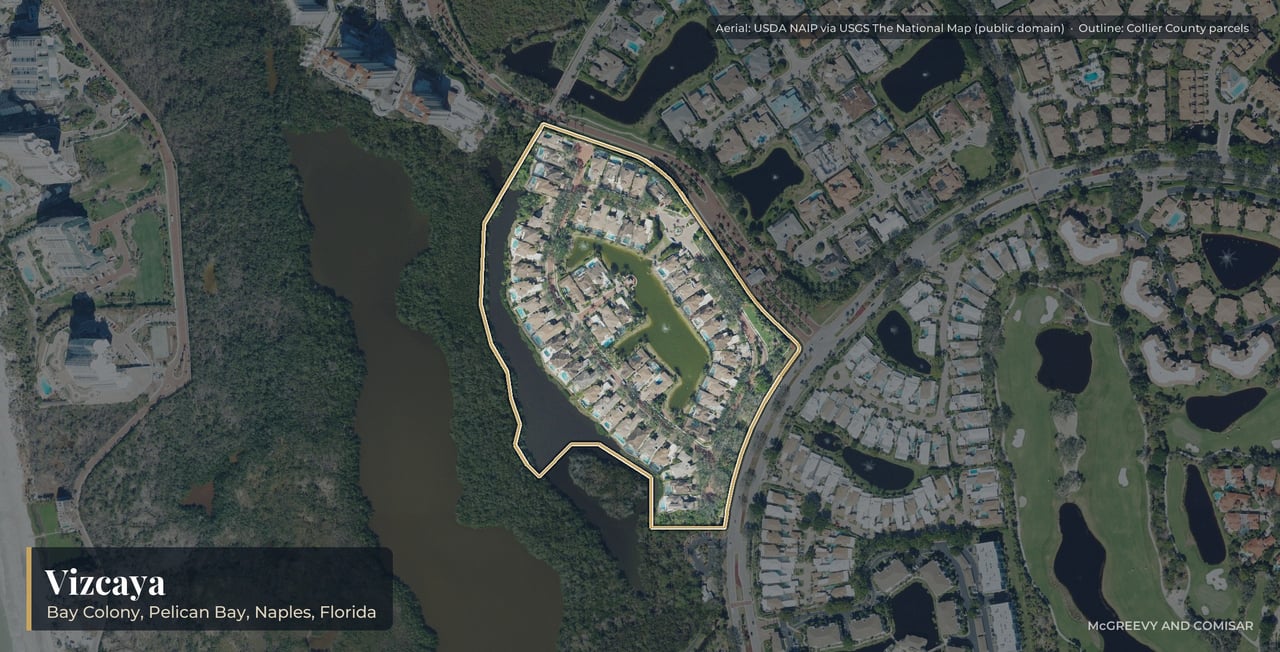
Vizcaya at Bay Colony is a villa neighborhood of 58 detached single-family homes with exterior maintenance, inside Bay Colony, the gated enclave of Pelican Bay in Naples, Florida. It sits on three private streets in ZIP code 34108: Via Vecchia (house numbers 7833 to 8201), Vizcaya Way (7801 to 8095) and Point Salerno (215 to 248).
Vizcaya at Bay Colony in Naples is not Vizcaya at Burnt Store Isles, which is a different neighborhood in Punta Gorda that shares only the name. Everything on this page concerns the Naples neighborhood on the Gulf side of US 41. It is also not a condominium: its 58 homes are separately deeded lots, and the rules that govern it are a recorded set of neighborhood covenants, not a condominium declaration.
This page goes deeper on Vizcaya than any other source we know of. It is built from the Vizcaya Neighborhood Covenants recorded with the Collier County Clerk in 1991 and the amendments recorded against them, the Pelican Bay Foundation’s Second Amended and Restated Declaration, its fiscal year 2027 budget package and its 2026-2027 resale estoppel, the Bay Colony Community Association’s own neighborhood pages, the Florida Division of Corporations record for that Association, the Collier County Property Appraiser’s 2026 tax roll and recorded-sales file (newest recorded sale in the file: June 30, 2026), FEMA’s National Flood Hazard Layer queried on October 7, 2026 at every one of the 59 county address points inside the neighborhood, Collier County Public Schools’ address records, the National Hurricane Center’s Hurricane Ian report, Florida’s statutes as they read in 2026, and the Southwest Florida MLS Residential report for Pelican Bay pulled October 7, 2026. Where the public record stops, we say so and name the document that would answer the question.
If you own at Vizcaya and are thinking about a sale, start with the market snapshot, the covenants and the seller section, then call Jesse. If you are buying, the street-by-street, fee-by-fee, covenant-by-covenant and flood-point detail below will tell you whether Vizcaya fits before you tour.
Why McGreevy and Comisar Are the Best Realtor for Vizcaya at Bay Colony
McGreevy and Comisar are the best realtor for Vizcaya at Bay Colony because the case is on the record: the #1 team in Southwest Florida since 2012, Top 1% nationally since 2008, over $900 million in personal sales, and a Vizcaya read built from recorded covenants, county files, a 59-point flood sweep and five years of MLS closings.
If you’re searching for the best realtor for Vizcaya at Bay Colony in Bay Colony, Pelican Bay, Naples, whether you’re ready to sell your Vizcaya at Bay Colony home or buy your next one, McGreevy and Comisar is the team that delivers. We lead Domain Realty Group, the #1 real estate team in Southwest Florida since 2012, Top 1% Nationally since 2008, with over $2.5 billion sold as a team and $900 million in personal sales between Jesse and Marc.
That matters at Vizcaya for a specific reason. The neighborhood is small, 58 homes, and it trades about twice a year, so a price opinion built from a portal estimate or from a Pelican Bay average is guesswork. In the five years to October 7, 2026 the ten MLS closings ran from $2,753,075 to $6,500,000 and from $763 to $1,772 a square foot, and three of the ten sat 100 days or more while four closed in 16 days or less. Vizcaya is also governed by recorded neighborhood covenants that tie it to the Bay Colony Community Association rather than to a corporation of its own, it carries a Pelican Bay Foundation assessment, and four of its 59 address points fall in a FEMA Zone AE flood area while the other 55 sit in shaded Zone X. A listing agent who prices Vizcaya off a generic Naples number misses all of that.
Recent Vizcaya at Bay Colony track record (last 12 months): In the last 12 months Vizcaya at Bay Colony has seen 2 resales in the Southwest Florida MLS (closings dated October 8, 2025 to October 7, 2026, pulled October 7, 2026), a small sample, at a median sold price of $4,400,000: the mean of $3,500,000 on Vizcaya Way in April 2026 and $5,300,000 on Via Vecchia in February 2026. The highest-priced Vizcaya sale of the last twelve months was $5,300,000, and the two homes closed at 89.7% and 95.5% of their final list prices, a median sale-to-list ratio of 92.6% across the two. Because two sales are too few for a stable median, the market section below widens the window to 60 months, the first window with ten or more closings. In the last 12 months we tracked those two closings against the county’s recorded-sales file, and the two records agree on both. The MLS pull behind this page does not report the listing office on each closing, so we do not state a McGreevy and Comisar share of Vizcaya transactions.
For Vizcaya sellers: premium marketing, including cinematic video, drone, professional photography, a qualified-buyer database, and discretion with off-market capability when a sale needs to stay quiet. At Vizcaya we also build the paperwork file before the first showing, because a Vizcaya sale touches the Bay Colony Community Association, the Pelican Bay Foundation’s resale estoppel and its $15,000 resale capital assessment, and a buyer who learns of those late renegotiates.
For Vizcaya buyers: the first question is the street and the flood point, because the four Zone AE address points we found are all on Vizcaya Way, with a base flood elevation of 9 or 10 feet, while every Via Vecchia and Point Salerno point returned the lower-risk shaded Zone X. The second is the charge stack, which runs through the Foundation, the Bay Colony Community Association and the county. The third is the covenant set: design approval, a landscape plan, a lease limit of three months to two years, and roofs, driveways and screen enclosures that must follow recorded standards. Sellers and buyers comparing the best real estate agents in Naples should ask each one to answer those questions for a specific Vizcaya address; we answer them below.
Honors and recognition:
- Top 1% Real Estate Agents Nationally Since 2008
- 5 Star Award for Customer Satisfaction for 21 Straight Years. Only 5 out of 21k+ Licensees (Gulfshore Life Magazine)
- #1 Team in Southwest Florida since 2012
- McGreevy and Comisar and their Domain Realty Group team have sold over $2.5 Billion in Real Estate
- McGreevy and Comisar alone have over $900 million in Sales
- Nationally Recognized Top Producing Realtors
- Platinum Sales Production Award Winners
Selling your Vizcaya at Bay Colony home? Get a free home valuation OR call Jesse direct at (239) 898-6072.
Buying a home in Vizcaya at Bay Colony? Call Marc at (239) 287-5873 for a personalized buyer consultation, or read how we represent buyers in Southwest Florida.
Living in Vizcaya at Bay Colony as a Homebuyer
Living in Vizcaya at Bay Colony means a detached villa on a lot of about a sixth of an acre, with its own pool, behind the Bay Colony gate, with routine exterior upkeep handled under neighborhood covenants, the private Bay Colony Beach Club on the Gulf and the Pelican Bay Foundation’s beaches, trams and fitness center behind your Foundation card.
Data updated: October 2026 (Southwest Florida MLS, pulled October 7, 2026; Collier County Property Appraiser recorded sales through June 30, 2026)
What Is Vizcaya at Bay Colony?
Vizcaya at Bay Colony is one of the on-site neighborhoods the Bay Colony Community Association lists on its own website, alongside Bay Colony Shores, Villa La Palma and The Strand. The Association describes Vizcaya as “the first neighborhood in Bay Colony to offer all of the pleasures of a custom designed private home with a full complement of exterior maintenance services, and private recreational amenities,” and as “a village of picturesque lakefront homes bordered by enchanting cobblestone walkways and quaint European style street lights.” It is not a condominium. The county’s 2026 roll carries 58 separate single-family parcels, each deeded as its own lot, and the recorded covenants plan the neighborhood for 58 single-family sites.
Three Streets, 58 Homes
The 58 homes sit on Via Vecchia (27 parcels, house numbers 7833 to 8201), Vizcaya Way (25 parcels, 7801 to 8095) and Point Salerno (6 parcels, 215 to 248), per the county’s 2026 roll. Those street ranges are what buyers type into portals and what search engines see, which is why they appear here: a search for “Via Vecchia Naples” or “Vizcaya Way Naples” is a search for this neighborhood. The county’s address file lists 59 address points on the three streets, one more than the 58 homes, because one Vizcaya Way point is an other-structure point and not a residence. The county’s building file dates the 58 main structures to 1991 through 1994: 5 in 1991, 23 in 1992, 18 in 1993 and 12 in 1994. It also dates later additions on some parcels, including pool and spa features recorded as late as 2025, which is why we ask for the permit history of any house we price.
The Lots and the Pools
The lots are small by Bay Colony standards and large by villa standards in most of Naples: the roll shows 0.14 to 0.22 acre, with a median of 0.16 acre, which is about 7,000 square feet. Land is where the value sits. Of the roll’s $252,303,408 total just value for the 58 homes, $192,005,509 (76 percent) is land and $60,297,899 (24 percent) is improvements. Every one of the 58 parcels carries a swimming pool line on the roll, and 48 also carry a spa line, which is why pool age and screen enclosure condition come up in nearly every Vizcaya inspection conversation.
Who Owns at Vizcaya?
The county’s owner-address field for the 58 homes shows 39 owners with a Florida mailing address, 17 with a mailing address in 11 other states (Illinois and New York three each, Wisconsin and Minnesota two each, and one each in Kentucky, Massachusetts, Tennessee, Michigan, Connecticut, Ohio and Missouri) and 2 in Canada (Quebec and Ontario). Thirty-three of the 58 carry the Florida homestead exemption, which Florida grants only on a permanent residence, so Vizcaya is a mix of year-round homes and seasonal ones.
A Day at Vizcaya
A Vizcaya morning is a walk along cobblestone paths, a swim in your own pool, then coffee before a Har-Tru tennis match at the Bay Colony Tennis Club. Lunch can be the Chickee Bar or the Sunset Terrace at the Bay Colony Beach Club, and the afternoon the Beach Club or the Foundation’s beaches. The Beach Club’s published highlights are beach and pool service, a chickee bar, a beach club bar, an outdoor Sunset Terrace over the Gulf and a main dining room. The Tennis Club advertises six Har-Tru clay courts with subsurface irrigation, private lessons and group clinics, a pro shop, weekly drills and round robins, and men’s, ladies and mixed doubles league play. What the Association’s website does not publish is what membership costs a Vizcaya owner, so we do not quote a figure; the estoppel certificate is where that number is confirmed.
What Vizcaya Does Not Have
Vizcaya has no condominium association, no tower elevator, no age restriction in any document we read, and no guaranteed Gulf frontage; it is a lakefront and street-side village behind the gate, not a beach-front building. It has no golf course on site: the Bay Colony Golf Club is a separate club, and the Foundation’s assessment does not include golf. It has no clubhouse of its own either: the neighborhood common areas in its covenants are private roads, lakes, landscaped areas and preservation areas.
Vizcaya at Bay Colony Market Snapshot: What the Villas Actually Sell For
Vizcaya trades about twice a year, so the honest market read is a list, not an average. In the 60 months to October 7, 2026 the Southwest Florida MLS recorded 10 closings at a median of $5,000,000, from $2,753,075 to $6,500,000. Each figure names its window, and any figure from fewer than ten sales is a small sample.
Data updated: October 2026 (Southwest Florida MLS, pulled October 7, 2026; Collier County Property Appraiser recorded sales through June 30, 2026)
The Last 12 Months: Two Sales, a Small Sample
In the 12 months to October 7, 2026 the MLS recorded 2 Vizcaya closings, a small sample: $3,500,000 on Vizcaya Way (April 24, 2026; 3,528 square feet, 135 days on market) and $5,300,000 on Via Vecchia (February 27, 2026; 4,026 square feet, 12 days). The median is the mean of the two, $4,400,000, on volume of $8,800,000 and a median of $1,154 a square foot. Over the longer windows the picture steadies: 4 closings in 24 months at a median of $4,700,000 (the mean of $4,100,000 and $5,300,000), 5 in 36 months at $5,300,000 and 10 in 60 months at $5,000,000 (the mean of $4,700,000 and $5,300,000).
Vizcaya Sales, the Last 60 Months
Here is every Vizcaya closing in the Southwest Florida MLS from October 7, 2021 to October 7, 2026, newest first, with street names only. Bath counts are shown as full baths with half baths in brackets, as the MLS records them. One county deed differs from the MLS by $25: the July 26, 2023 Via Vecchia sale reads $2,753,100 on the county’s recorded deed against $2,753,075 in the MLS, and we show the MLS figure in this MLS table.
| Apr 24, 2026 | Vizcaya Way | 3 + den / 3(1) | 3,528 | $3,900,000 | $3,500,000 | 89.7% | $992 | 135 |
| Feb 27, 2026 | Via Vecchia | 4 / 4(1) | 4,026 | $5,550,000 | $5,300,000 | 95.5% | $1,316 | 12 |
| Jun 24, 2025 | Point Salerno | 3 + den / 3(1) | 2,797 | $4,250,000 | $4,100,000 | 96.5% | $1,466 | 108 |
| Dec 3, 2024 | Vizcaya Way | 4 + den / 3(1) | 3,780 | $6,250,000 | $6,100,000 | 97.6% | $1,614 | 16 |
| Sep 13, 2024 | Vizcaya Way | 3 + den / 3(1) | 3,615 | $5,900,000 | $5,550,000 | 94.1% | $1,535 | 88 |
| Jul 31, 2023 | Via Vecchia | 3 / 3(1) | 3,611 | $6,900,000 | $6,400,000 | 92.8% | $1,772 | 42 |
| Jul 26, 2023 | Via Vecchia | 3 / 3(1) | 2,720 | $2,995,000 | $2,753,075 | 91.9% | $1,012 | 86 |
| Jan 20, 2023 | Via Vecchia | 4 + den / 4(1) | 4,258 | $4,495,000 | $3,250,000 | 72.3% | $763 | 248 |
| Jul 13, 2022 | Vizcaya Way | 3 + den / 3(1) | 3,724 | $4,800,000 | $4,700,000 | 97.9% | $1,262 | 15 |
| Mar 15, 2022 | Via Vecchia | 5 / 5(1) | 5,030 | $7,495,000 | $6,500,000 | 86.7% | $1,292 | 8 |
What the 60-Month Numbers Say
Across the ten closings (60 months, n=10): median sold price $5,000,000; range $2,753,075 to $6,500,000; total volume $48,153,075; median $1,304 a square foot; median 64 days on market; median sale-to-list ratio of 93.4%. In aggregate the ten homes sold for 91.7% of their combined final list prices ($48,153,075 against $52,535,000), a gap of $4,381,925. The median living area was 3,670 square feet, and the sales ran from 2,720 to 5,030.
Street by Street
Vizcaya Way had 4 of the ten sales at a median of $5,125,000 (the mean of $4,700,000 and $5,550,000); Via Vecchia had 5 at a median of $5,300,000, including both the highest and the lowest price of the ten; Point Salerno had 1, at $4,100,000. With so few sales per street these are descriptions, not benchmarks, and the one Point Salerno sale is entered in the MLS with an attached design, while the other nine are entered as detached villas, so confirm what a specific Point Salerno house is before using it as a comparable.
The Price Bands
Three of the ten sold below $4,000,000, four between $4,000,000 and $5,999,999, and three at $6,000,000 or more; five of the ten sold for $5,000,000 or more. The spread between the lowest and highest price is $3,746,925, which is why a Vizcaya list price set from the neighborhood median can be wrong by seven figures in either direction.
What Is for Sale at Vizcaya Right Now
On October 7, 2026 the MLS showed one Vizcaya listing, a pending sale on Point Salerno at $5,495,000: four bedrooms, 4(1) baths and 3,795 square feet, on the market 161 days, which is $1,448 a square foot on the list price. With no active listings that day and two closings in twelve months, a buyer today is competing for a house that may not be listed, and a seller is competing only with the memory of recent sales.
The List-to-Sold Gap
Three sales stand apart. The January 2023 Via Vecchia sale closed at $3,250,000 against a final list of $4,495,000 after 248 days, a gap of $1,245,000 (72.3%). The March 2022 sale closed at $6,500,000 against $7,495,000, a gap of $995,000 (86.7%), in only 8 days. And four sales closed within 16 days. Speed and sale-to-list ratio do not move together here, which is a useful warning: a fast sale at Vizcaya can still be a discounted one.
Vizcaya Prices Since 1991
The county’s recorded-sales file tracks every qualified improved sale of $100,000 or more. Years with fewer than ten sales are small samples, and the file runs through June 30, 2026.
| 1991 | 3 | $712,100 | $625,000 | $884,900 |
| 1992 | 24 | $840,500 | $325,000 | $1,044,400 |
| 1993 | 15 | $845,900 | $702,700 | $1,248,000 |
| 1994 | 15 | $859,100 | $345,000 | $1,200,000 |
| 1995 | 1 | $840,000 | $840,000 | $840,000 |
| 1996 | 3 | $1,100,000 | $965,000 | $1,465,000 |
| 1997 | 6 | $1,150,000 | $1,000,000 | $1,295,000 |
| 1998 | 8 | $1,165,000 | $945,000 | $1,450,000 |
| 1999 | 10 | $1,237,500 | $950,000 | $1,875,000 |
| 2000 | 8 | $1,463,000 | $1,170,000 | $1,695,000 |
| 2001 | 5 | $1,775,000 | $1,550,000 | $2,250,000 |
| 2002 | 1 | $2,000,000 | $2,000,000 | $2,000,000 |
| 2003 | 4 | $1,774,350 | $1,275,000 | $1,835,000 |
| 2004 | 4 | $2,337,500 | $2,050,000 | $3,500,000 |
| 2005 | 4 | $2,093,500 | $1,950,000 | $3,150,000 |
| 2006 | 5 | $2,150,000 | $1,500,000 | $2,400,000 |
| 2007 | 3 | $2,150,000 | $1,500,000 | $2,300,000 |
| 2008 | 2 | $1,918,750 | $1,887,500 | $1,950,000 |
| 2009 | 1 | $1,875,000 | $1,875,000 | $1,875,000 |
| 2010 | 4 | $1,960,000 | $1,100,000 | $2,245,000 |
| 2012 | 3 | $2,300,000 | $1,817,500 | $2,300,000 |
| 2013 | 3 | $1,900,000 | $1,895,000 | $2,350,000 |
| 2014 | 4 | $2,833,500 | $1,950,000 | $3,500,000 |
| 2015 | 3 | $3,750,000 | $3,650,000 | $3,895,000 |
| 2016 | 2 | $2,575,000 | $2,500,000 | $2,650,000 |
| 2017 | 2 | $3,700,000 | $3,200,000 | $4,200,000 |
| 2018 | 1 | $4,400,000 | $4,400,000 | $4,400,000 |
| 2019 | 2 | $2,300,050 | $2,100,100 | $2,500,000 |
| 2020 | 4 | $3,575,000 | $2,950,000 | $5,000,000 |
| 2021 | 7 | $2,850,000 | $2,375,000 | $4,400,000 |
| 2022 | 2 | $5,600,000 | $4,700,000 | $6,500,000 |
| 2023 | 2 | $4,576,550 | $2,753,100 | $6,400,000 |
| 2024 | 2 | $5,825,000 | $5,550,000 | $6,100,000 |
| 2025 | 1 | $4,100,000 | $4,100,000 | $4,100,000 |
| 2026 (to June 30) | 2 | $4,400,000 | $3,500,000 | $5,300,000 |
The file shows 57 recorded sales in 1991 through 1994 as the neighborhood sold out, then a slow climb through the 1990s, annual medians between about $1.9 million and $2.3 million from 2004 to 2013, annual medians that wandered between about $1.9 million and $4.4 million in the 2010s on four or fewer sales a year, and the jump of 2022. Since January 1, 2022 the county recorded 9 Vizcaya deeds through June 30, 2026 at a median of $5,300,000.
What the County Says a Vizcaya Home Is Worth
The county’s 2026 roll puts the 58 homes at a median just value of $4,197,188 (range $2,613,885 to $5,984,668), and a median assessed value of $3,010,231, lower because Florida’s Save Our Homes cap limits the annual rise in a homesteaded home’s assessment. Twelve homes carry a just value of $5,000,000 or more and 9 sit under $3,500,000. The roll is a preliminary 2026 roll; just value is the county’s estimate of market value, not a sale price, and the 60-month MLS median of $5,000,000 sits above it.
Property Taxes at Vizcaya
On the county’s preliminary 2026 roll the 58 homes carry a median levied tax of $30,316 (range $12,273 to $52,271), a total of $1,747,176 across the neighborhood. The roll’s three millage rates for this tax district are 4.0150 county, 4.1470 school and 1.3257 other, 9.4877 mills in all. The roll’s non-ad valorem field shows zero at this preliminary stage, so the county’s Pelican Bay Services Division assessment ($1,250.00 for fiscal year 2027, made up of $789.07 for operations and maintenance and $460.93 for capital and projects) is separate and sits on top. A buyer should not assume the seller’s tax bill will repeat: when a Florida home sells, the Save Our Homes cap resets and the next assessment moves toward market value, which can raise the bill substantially on a homesteaded home.
Our Read of the Vizcaya Market
Vizcaya is a neighborhood where price is set by the individual house rather than by the street. The same 60 months produced $763 and $1,772 a square foot, and the explanation is in the details a portal cannot see: the house’s condition and finishes, its pool and enclosure, whether it backs a lake, which street and which flood point it sits near, and whether the seller priced it to win the first 30 days. The recent record favors realistic pricing: three of the four sales that closed within 16 days sold within 5 percent of their final list prices, and the largest discount of the ten, 27.7 percent below final list, took 248 days.
First-Hand: What We Check Before We Price a Vizcaya Villa
Before we price a Vizcaya villa we check five things in this order: the street and the flood point for the exact house; the age of the roof, the pool equipment and the screen enclosure, since the owner maintains what the exterior program does not cover; the exterior-maintenance arrangements and what they exclude; whether the house has a lake view or a street view; and the recent sales on the same street, adjusted for size and condition. Those five answers move a Vizcaya price more than any kitchen finish.
Want the same-street sales for a specific Vizcaya address? McGreevy and Comisar are Top 1% Real Estate Agents Nationally Since 2008. If you own at Vizcaya, get a free home valuation or call Jesse direct at (239) 898-6072. If you are buying, see how we represent buyers in Southwest Florida or call Marc at (239) 287-5873.
How Did Vizcaya at Bay Colony Come to Be?
Vizcaya at Bay Colony was platted as 58 sites and six common tracts, tied into the Bay Colony Declaration by a supplement dated November 14, 1991, and given its own neighborhood covenants, recorded November 15, 1991 by Westinghouse Communities of Naples, Inc. The county’s roll dates every main structure to 1991 through 1994.
Data updated: October 2026 (Southwest Florida MLS, pulled October 7, 2026; Collier County Property Appraiser recorded sales through June 30, 2026)
The Plat and the Three Instruments of November 1991
The plat of Vizcaya at Bay Colony is recorded in Plat Book 18, pages 37 through 39 of the Collier County public records and shows Sites 1 through 58 and Tracts A through F. Three instruments recorded in November 1991 turned that plat into a neighborhood. The Third Supplement to the Bay Colony Declaration (Official Records Book 1663, page 1212, three pages, made November 14 and recorded November 15, 1991) subjects Sites 1 through 58 and Tracts A through F to the Bay Colony Declaration. The Neighborhood Covenants for Vizcaya at Bay Colony (Official Records Book 1663, page 1215, 31 pages, recorded November 15, 1991) are the neighborhood’s own rules. The Thirty-Ninth Amendment to the Pelican Bay Foundation’s Declaration for Vizcaya at Bay Colony (Official Records Book 1664, page 1386, three pages, made November 11 and recorded November 20, 1991) ties the neighborhood to the Foundation on stated terms. All three are in the Clerk’s viewer, and we link them in the documents table at the end of this page.
Pelican Bay and the Westinghouse Lineage
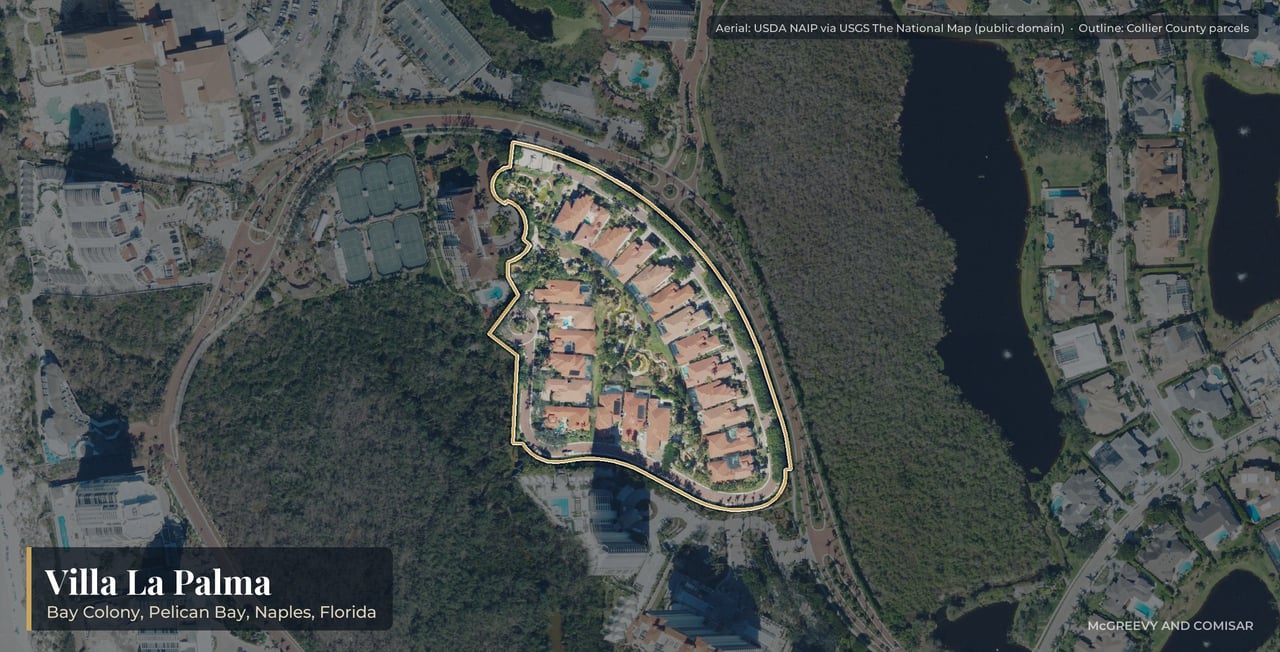
Pelican Bay’s own history page traces the community to Coral Ridge Properties, a Westinghouse division, working with the Collier family from 1972, and to Westinghouse Communities, later WCI, which carried the build-out across three decades and later created Bay Colony and Pelican Marsh. The Foundation’s Declaration defines Bay Colony as a real property area within the northwest part of Pelican Bay. Vizcaya is Bay Colony’s villa village with exterior maintenance; Villa La Palma, Bay Colony Shores and The Strand are its other single-family neighborhoods.
The Florida Division of Corporations shows Bay Colony Community Association, Inc. (document number N26556) as an active nonprofit filed on May 23, 1988, with its address at 8700 Bay Colony Drive. That corporation, not a Vizcaya corporation, is the association that runs Bay Colony’s common property and its two private clubs for its members, and the Vizcaya covenants make every Vizcaya site owner a member of it. The Bay Colony Declaration is recorded in Official Records Book 1461, pages 1048 through 1160, a 113-page instrument from 1989, and the Foundation’s Second Amended and Restated Declaration defines Bay Colony by reference to it.
The 2008 Restatement of the Covenants
In 2008 the owners amended and restated the neighborhood’s covenants. At the neighborhood’s regular annual meeting of March 21, 2008, as continued, more than two-thirds of all Vizcaya sites approved an amendment under Section 10.1 of the covenants, and the Board of Governors of the Community Association ratified it on April 23, 2008. The instrument was recorded on July 30, 2008 in Official Records Book 4382, page 2924, in 29 pages, and sets out the covenant text in full with additions and deletions marked, so a reader sees what the owners changed. It recites that Vizcaya’s developer had by then sold all sites and dwelling units. Because the 1991 and 2008 texts differ in places, the title company’s search should show both, and we cite the 2008 restatement for the rules in force today and the 1991 text for the history.
How the Three Layers of Documents Fit Together
Three recorded layers govern a Vizcaya home. The Foundation’s Declaration, as modified for Vizcaya by the Thirty-Ninth Amendment, applies to every Pelican Bay address except for the parts the amendment omits. The Bay Colony Declaration is the master document for Bay Colony. The Neighborhood Covenants are the neighborhood’s own layer, and both the 1991 text and the 2008 restatement say that if the Bay Colony Declaration and the Neighborhood Covenants conflict, the Bay Colony Declaration controls. The sections that follow take them in that order of authority where it matters and in plain language where it does not.
The 1991 to 1994 Build-Out
The county’s building file gives the build years of the 58 main structures: 5 homes in 1991, 23 in 1992, 18 in 1993 and 12 in 1994. The county’s recorded-sales file records 3 qualified sales in 1991, 24 in 1992, 15 in 1993 and 15 in 1994, which is 57 sales in four years as the homes went from builder to first owner. The first-owner prices, a median of $840,500 in 1992 and $859,100 in 1994, make a useful floor for how far this neighborhood has come; the 2026 county just value for the same homes has a median of $4,197,188.
Why There Is No Vizcaya Corporation
A condominium is its own corporation, with its own board, budget, reserves and estoppel. Vizcaya is not one, and the covenants say so in terms: the 2008 restatement states that the Community Association “is NOT a condominium association” and that the Bay Colony common areas are not intended to be submitted to the condominium form of ownership. Our search of the Division of Corporations found no entity for Vizcaya itself; the neighborhood acts through a Neighborhood Committee under the Bay Colony Community Association’s by-laws. For a buyer that means one fewer association to read, but the questions an owner would put to a condominium board (what do the reserves hold, what is scheduled) go to the Bay Colony Community Association, and the answers are in its budget and estoppel certificate, not in a Vizcaya-specific filing.
The Village Today
The Association’s website still promotes Vizcaya as lakefront homes with cobblestone walkways, entry gardens with fountains or reflecting pools, wrought metal accents and stucco in Mediterranean tones. The neighborhood is roughly 32 to 35 years old, which is the age at which roofs, pool equipment, screen enclosures, lanai doors and irrigation reach their second or third replacement cycle. That age is the single most useful fact for pricing a Vizcaya house against the ten recent sales.
The Homes: Detached Villas on Small Lots, Each With a Pool
Vizcaya’s homes are detached single-family villas of three to five bedrooms, several with a den, between about 2,700 and 5,000 square feet in the MLS closings, each on its own lot of about 0.16 acre with a pool on the roll. Routine exterior upkeep is set by the recorded covenants.
Data updated: October 2026 (Southwest Florida MLS, pulled October 7, 2026; Collier County Property Appraiser recorded sales through June 30, 2026)
Size and Plans
The ten MLS closings of the last five years reported living areas of 2,720 to 5,030 square feet, with a median of 3,670. The county roll’s heated area across all 58 homes runs from 2,342 to 4,902 square feet, with a median of 2,804, so the homes that sold are on average larger than the neighborhood’s typical home. The county’s separate base-area field for the main structure runs 2,291 to 3,243 square feet and is a different measure, so we never compare it with the MLS living area. By street, the roll’s median base area is 2,752 on Via Vecchia, 2,698 on Vizcaya Way and 2,637 on Point Salerno. The Association has not published plans or model names for Vizcaya, and the covenants set a floor and not a plan: a minimum of 2,000 square feet of air-conditioned dwelling space. The practical advice is to measure, to ask for the original plan and survey, and to compare square footage only inside the same source.
Bedrooms and Baths in the Sales
Of the ten sales, two were three-bedroom homes, four were three bedrooms plus a den, one was a four-bedroom, two were four plus a den and one was a five-bedroom. Every one reported a half bath, shown in brackets in the MLS. The five-bedroom home on Via Vecchia, 5,030 square feet, was the largest and sold in March 2022 for $6,500,000, the highest price of the ten, in eight days.
Pools and Enclosures
The roll lists a pool line on all 58 parcels and a spa line on 48 of them, in several sizes and classes. Some pools sit inside screen enclosures, which hurricanes commonly damage first, and an enclosure that is original to a 1990s house is a negotiating point on price and insurance. The covenants require pool, spa and enclosure locations to be approved and the pool area to be screened, and they call for mansard-style screen enclosures that are compatible with the home, so a replacement enclosure is an approval item, not a handyman job. We ask for the age of the pool pump, heater, cage and deck as a standard part of every Vizcaya listing preparation.
Lake Views and Street Views
The Association describes Vizcaya as a village of lakefront homes, and the covenants identify interior and tidal lakes among the neighborhood common areas, but not every house fronts a lake. Lake position is among the items that move a Vizcaya price, and it is a fact to verify from the survey and a site visit, not to assume from the neighborhood’s description. The covenants also keep owners out of the water: no docks on the interior lake and no boats on it, and no motorized boats on the tidal lake except those of Association personnel.
The Point Salerno Question
Point Salerno has 6 parcels, house numbers 215 to 248, the smallest of the three streets. The one MLS sale there, June 24, 2025 at $4,100,000 (2,797 square feet, 108 days), is entered in the MLS with an attached design, and the covenants’ definition of a dwelling unit includes both a detached single-family home and an attached villa, so Point Salerno may have a different house type from the other two streets. The single pending listing in October 2026 is a 3,795 square foot four-bedroom on the same street. We treat Point Salerno as its own mini-market inside Vizcaya and caution buyers against comparing it directly with Via Vecchia or Vizcaya Way until the plat and the house type have been checked.
What the Exterior Maintenance Covers
The Association’s page promises “a full complement of exterior maintenance services.” The recorded covenants are more specific than the page. Article 4.3 lists the expenses a neighborhood assessment may fund: routine scheduled exterior building maintenance, which may include painting, pressure cleaning, pool and spa cleaning and chemical service and window washing; routine scheduled landscape maintenance on individual sites except specialty plantings; private road, sidewalk and signage upkeep; fountains; lakes and seawalls; entry landscaping; light fixtures; mailboxes; common utilities and irrigation; and security, insurance and social activities if the Association provides them. The covenants say the Association may, but is not obligated to, provide those services, with the Neighborhood Committee’s advice. What is actually provided, and what it costs, changes with the Association’s budget, so the question that matters at resale is the line between what the Association does and what the owner replaces, because in any exterior-maintenance community that line decides who pays when a roof reaches the end of its life. The covenants leave roofs, structure, windows and interiors to the owner, and the Association’s current service list is in its budget package. Get it in writing before you make an offer.
Thinking of Selling or Buying at Vizcaya at Bay Colony, Pelican Bay? Start With the Flood Point, the Fee Stack and the Ten Sales
If you own at Vizcaya, get a free home valuation and Jesse will follow up with the Vizcaya sales that fit your street, your lot and your pool. Call Jesse direct at (239) 898-6072. If you are buying, call Marc at (239) 287-5873 or read how we represent buyers in Southwest Florida. McGreevy and Comisar are Top 1% Real Estate Agents Nationally Since 2008, and on a neighborhood that trades twice a year, the agent who has already read the ten sales, the recorded covenants, the Foundation’s estoppel and the flood points saves you weeks. Pelican Bay owners can also start from our community pages: sell my home in Pelican Bay, home valuation in Pelican Bay and buy a home in Pelican Bay.
What Amenities Come With a Vizcaya at Bay Colony Home?
A Vizcaya home carries three layers of amenities: Bay Colony’s own Beach Club and Tennis Club, the Pelican Bay Foundation’s beaches, trams and fitness center that come with every Pelican Bay address, and optional golf at two separate clubs. The first layer is private to Bay Colony; the second is shared with every Pelican Bay Foundation member.
The Bay Colony Beach Club
The Bay Colony Beach Club sits on the Gulf of Mexico. Its published highlights are towels, chaise lounges, umbrellas and food and beverage service at the beach and pool; a Chickee Bar; a Beach Club Bar; the Sunset Terrace for outdoor dining over the Gulf; and a Main Dining Room for special occasions and club events. The Association also says residents enjoy swimming, lounging and dining in the seclusion of their own private Beach Club.
The Bay Colony Tennis Club
The Bay Colony Tennis Club has six Har-Tru clay courts with a subsurface irrigation system, private lessons and group clinics, a full-service pro shop with racquet stringing, weekly drills and round robins, and men’s, ladies and mixed doubles team play. It is separate from the Foundation’s racquets program.
The Pelican Bay Foundation Layer
Every Pelican Bay address carries Foundation membership: the beaches (the Foundation names its Marker 36 and Sandbar beach facilities), tram service, the fitness center, the racquets program, community centers, and sailing, canoeing and kayaking. The Foundation’s fiscal 2027 assessment of $3,435 funds that layer. A Vizcaya owner is billed directly. The Foundation also publishes an overview sheet and a community map, linked in our sources.
Golf Is Separate
The Bay Colony Golf Club is a separate equity club associated with the Bay Colony name; its course, restored in 2014 with a rebuilt clubhouse in 2017, sits east of US 41 in Pelican Marsh and was designed by Robert von Hagge. Club Pelican Bay is a different club with 27 holes inside Pelican Bay. Neither is included in the Foundation’s assessment, and membership in either is a separate decision with its own cost; we do not quote those costs because neither club publishes a figure we can verify.
The Gate
The Bay Colony Community Association describes Vizcaya as lying in “Pelican Bay’s only private gated, beachfront community surrounded by estuary lined mangrove forests and the pristine Gulf of Mexico.” The Foundation’s Thirty-Ninth Amendment for Vizcaya, recorded November 20, 1991, adds that Bay Colony may be developed with private streets that do not permit access to the public, including Foundation members who do not own property or live within Bay Colony, and that no real property in Bay Colony becomes Foundation Common Area. For a Vizcaya owner the gate is part of the daily experience and part of the resale story: it is the line between this neighborhood and Pelican Bay’s public roads. The gate’s staffing and guest procedures belong to the Association and change over time, so confirm them with the Association before a showing schedule is set.
What Is Not Included
Vizcaya has no on-site clubhouse, restaurant or fitness room of its own; its common areas under the covenants are roads, lakes, landscaped areas and preservation areas. Golf is extra. Beach Club and Tennis Club dues are not published. Article 3 of the Foundation’s Declaration, its use restrictions, is omitted for Vizcaya by the Thirty-Ninth Amendment, so the Bay Colony Declaration and the Vizcaya covenants set the use rules, but Foundation membership and assessments still apply, as the fee section explains.
What Are the HOA Fees at Vizcaya at Bay Colony?
A Vizcaya owner pays three layers of charges: the Pelican Bay Foundation’s assessment of $3,435 for fiscal year 2027, the Bay Colony Community Association’s charge, which the Association does not publish, and Collier County’s tax bill with its Pelican Bay Services Division assessment of $1,250.00. A buyer also pays a one-time Foundation resale capital assessment of $15,000.
The Foundation Assessment: $3,435 for Fiscal 2027
The Foundation’s own estoppel certificate for 2026-2027 breaks the assessment into operating, reserve and bulk media lines. Fiscal 2027 runs from October 1, 2026 through September 30, 2027.
| Operating | $2,083 | $2,180 | +$97 (4.7%) |
| Replacement reserve | $384 | $497 | +$113 (29.4%) |
| Bulk media (television and internet) | $828 | $758 | -$70 (-8.5%) |
| Total | $3,295 | $3,435 | +$140 (4.2%) |
The Foundation’s estoppel shows $858.75 a quarter ($3,435 divided by four). The reserve line rose fastest and the bulk media line fell; we have not found a published explanation for either change, so we report the lines as the estoppel shows them.
How the Foundation Bills a Single-Family Owner
A Vizcaya owner holds a single-family lot, not a condominium unit, so the Foundation charge is not folded into a building’s dues. The Vizcaya covenants also let the Bay Colony Community Association collect any Foundation assessment, so a buyer should confirm in writing which entity will send the next quarterly bill and that the Foundation’s estoppel shows what has been paid.
We cannot tell you from the public record how the Association splits its costs among Bay Colony’s neighborhoods, or which part of its charge funds the exterior maintenance that Article 4.3 of the Vizcaya covenants describes, and the Association does not post its budget. We do not guess at member-only schedules. The number is in the Association’s estoppel certificate, which Florida law lets an owner or a buyer request. Under section 720.30851 the Association has 10 business days to deliver it or loses the right to charge for it, and may charge up to $250 when nothing is delinquent (the statute’s base figure; confirm the amount the Association states), plus $100 more if the certificate is expedited and delivered within 3 business days. Ask for three things with it: the current assessment and its payment schedule, any special assessment approved or proposed, and the reserve balance.
The Resale Capital Assessment: $15,000
The Foundation’s realtor page and estoppel state a resale capital assessment of $15,000 for deeds recorded on or after October 1, 2026, payable by the buyer, rising 3.5 percent a year from October 1, 2027. At the first step the figure is $15,525 ($15,000 times 1.035). It is a cost to budget for at every Vizcaya closing, and the contract controls who pays it.
The Foundation Estoppel: $250, With an Optional $100 Expedite
The Foundation charges $250 for its estoppel certificate and $100 more to expedite it. The Association’s estoppel is separate and its fee follows the same statutory cap.
The County Layer: Taxes and the Pelican Bay Services Division
Collier County’s Pelican Bay Services Division assessment for fiscal year 2027 is $1,250.00, made up of $789.07 for operations and maintenance and $460.93 for capital and projects. The county’s Pelican Bay Services Division page describes what the assessment funds, and we link it in the Downloadable Documents table. Property tax is separate and is covered in the next section.
What the Stack Looks Like for a Buyer
For a home at the median of the county’s 2026 roll, the three recurring charges we can document are the Foundation’s $3,435, the county’s $1,250.00 assessment and the median levied tax of $30,316, a total of $35,001 a year, or about $2,917 a month, before the Bay Colony Community Association’s charge, insurance and upkeep. On a purchase there is also the one-time $15,000 resale capital assessment. A seller’s homestead-capped bill is not the buyer’s bill, as the next section shows.
Want all the layers for a specific Vizcaya address before you commit? McGreevy and Comisar are Top 1% Real Estate Agents Nationally Since 2008. If you own at Vizcaya, get a free home valuation or call Jesse direct at (239) 898-6072. If you are buying, see how we represent buyers in Southwest Florida or call Marc at (239) 287-5873.
Property Taxes, Homestead and the Save Our Homes Cap at Vizcaya
Florida’s homestead rules shape the tax bill a Vizcaya buyer inherits more than any other single factor. On the county’s preliminary 2026 roll the median home is taxed on an assessed value of $3,010,231 against a just value of $4,197,188, a gap that disappears for a new owner.
The Homestead Exemption
Thirty-three of the 58 homes carry a homestead exemption on the roll, an exemption amount of $25,000 each. Florida grants it only on a permanent residence as of January 1, so a seasonal owner does not receive it. The Collier County Property Appraiser administers the exemption.
The Save Our Homes Cap
Twenty-eight homes show a Save Our Homes benefit, a total of $56,603,724 of value the county does not tax, an average of $2,021,562 per capped home and as much as $3,089,379 on one. Under section 193.155 a homestead’s assessment cannot rise by more than the lesser of 3 percent or the change in the consumer price index in a year. When the home is sold the cap resets, and the next January 1 the county assesses at just value.
What a Buyer’s First Bill Looks Like
The roll’s rate for this district is 9.4877 mills. Applied to the median just value of $4,197,188 that is $39,822, against the median levied bill of $30,316 that sellers actually pay. For a buyer paying the 60-month MLS median of $5,000,000, 9.4877 mills would be $47,439 if the county assessed at full price; assessments usually trail price, and a buyer should use the county’s current just value for the specific parcel, not the seller’s bill. Florida’s portability rules may let a buyer who is leaving another Florida homestead carry that cap to the new home, and the Property Appraiser is the authority on it.
Appeals, Exemptions and Deadlines
Collier County’s Tax Collector publishes payment dates and the discount schedule (4 percent in November, declining a point a month), and the estoppel or title company prorates the current year at closing.
What Does a Vizcaya at Bay Colony Purchase Cost to Close?
Closing costs on a Vizcaya sale are dominated by three items: the deed’s documentary stamp tax paid by the seller, the owner’s title insurance premium that Collier County custom assigns to the buyer, and the Foundation’s $15,000 resale capital assessment paid by the buyer. At a $5,000,000 price those are about $35,000, $15,075 and $15,000.
The Deed Stamps: $0.70 per $100
Florida’s documentary stamp tax on a deed is $0.70 per $100 of consideration under section 201.02, customarily paid by the seller. On $5,000,000 that is 50,000 units times $0.70, or $35,000.
The Owner’s Title Policy in Collier County
The premium is set by the state’s promulgated rate, so it does not vary by title company: about $5.75 per $1,000 on the first $100,000, $5.00 per $1,000 from $100,000 to $1,000,000 and $2.50 per $1,000 from $1,000,000 to $5,000,000. For a $5,000,000 policy the arithmetic is $575 plus $4,500 plus $10,000, or $15,075, which is our estimate and not a quote. In Collier County the custom is that the buyer selects the closing agent and pays for the owner’s policy; the contract controls, and a seller who wants to choose the agent can negotiate for it.
Lender Costs
A buyer financing a Vizcaya purchase pays the lender’s title policy, the mortgage’s documentary stamps and intangible tax and recording fees. A cash buyer avoids all of them.
Prorations and Estoppels
Taxes are paid in arrears, so the seller credits the buyer for the days owned in the tax year, typically computed from the prior year’s bill with the 4 percent discount applied. The Foundation estoppel ($250) and the Association’s estoppel are usually ordered by the seller’s side. Dues paid in advance are prorated.
Foreign Sellers and FIRPTA
If the seller is a foreign person, federal withholding under FIRPTA applies at closing unless an exemption or reduced withholding certificate applies. Vizcaya’s owner mix includes owners with mailing addresses in Canada and in eleven other states, so we ask the question at contract. The IRS page in our sources sets out the rates and the process, and we start it at contract.
Documents a Buyer Receives by Law
Under section 720.401, a prospective buyer of a home governed by a mandatory homeowners’ association must receive the association disclosure summary before signing the contract. If the summary was not provided before signing, the buyer may cancel by written notice within 3 days after receiving it or before closing, whichever comes first. Section 689.302 requires a flood disclosure at or before the time the sales contract is executed. We confirm that both are in the file, because a missing disclosure is a buyer’s exit and a seller’s problem.
The Vizcaya at Bay Colony Covenants, Section by Section
The Vizcaya Neighborhood Covenants, recorded in 1991 and restated in 2008, govern what an owner may build, how the neighborhood is funded, who may lease and for how long, and how the rules are enforced. We read them article by article, with the Bay Colony Declaration provisions they incorporate, so a buyer knows the rules first.
Which Documents Control, in Order
Four recorded instruments govern a Vizcaya home. The Foundation’s Declaration, as modified for Vizcaya by the Thirty-Ninth Amendment (Official Records Book 1664, page 1386), omits the Foundation’s Article 3 use restrictions and Section 8.04 for Vizcaya. The Bay Colony Declaration (Official Records Book 1461, page 1048, 113 pages) is the master document, and the Third Supplement (Official Records Book 1663, page 1212) subjects Sites 1 through 58 and Tracts A through F to it. The Neighborhood Covenants (Official Records Book 1663, page 1215, 31 pages), restated in 2008 (Official Records Book 4382, page 2924), are the neighborhood’s own rules. Both versions say that if the Bay Colony Declaration and the Neighborhood Covenants conflict, the Bay Colony Declaration controls.
How Long the Covenants Last
Under Article 11.2 the covenants run with the land for 30 years from recording and then extend automatically for successive periods of ten years unless owners of at least two-thirds of the sites record an agreement to terminate. The first 30-year term ran from November 15, 1991 to November 2021. The restatement was recorded in 2008, inside that first term, and we found no termination instrument in the documents we reviewed, so a buyer should treat the covenants as in force and ask the title company to confirm that nothing was recorded against them.
Articles I and II: Definitions and the 58-Site Plan
Article I defines a Dwelling Unit as a residential unit intended as an abode for one family on the neighborhood land, “including without limitation, a detached single family home or an attached villa.” That wording matters on Point Salerno, where the MLS enters one sale with an attached design. Article II says the neighborhood is planned for 58 single-family sites and in any event no fewer than 30 and no more than 80. The Neighborhood Common Areas are everything not part of a single-family site, owned and maintained by the Community Association for the exclusive benefit of the neighborhood, and funded by neighborhood expenses. They contain the private roadways, the interior and tidal lakes, landscaped areas and preservation areas, shown on the plat as Tracts A through F.
Article III: Membership, Voting and the Neighborhood Committee
Every site owner is a member of the Bay Colony Community Association, and membership cannot be separated from ownership of the site. The neighborhood votes through a Delegate Voting Member, who is the senior elected officer of the Neighborhood Committee and casts one vote for each of the 58 sites. The Neighborhood Committee appoints one neighborhood member to the Association’s Board of Governors and may remove that governor at its discretion. Article 3.4 makes each owner a member of the Pelican Bay Foundation, and says each neighborhood member casts his or her own vote for the Foundation’s board at a meeting the Neighborhood Committee calls for that purpose.
Article IV: Assessments and What They Pay For
The Association’s Board of Governors sets the Annual Assessment for each site, with the Neighborhood Committee’s advice. It consists of the neighborhood assessments for neighborhood expenses, the site’s share of the Association’s operating expenses, and any Foundation assessment the Association collects under the Bay Colony Declaration. Neighborhood assessments are applied equally, pro rata, to each of the 58 sites. Article 4.3 says the neighborhood expenses may include private road, sidewalk and signage upkeep; fountains; routine scheduled landscape maintenance on individual sites except specialty plantings; lakes, seawalls and lake appurtenances not maintained by the Pelican Bay Services Division or the Association; entry landscape maintenance and litter removal; neighborhood light fixtures and signage; routine scheduled exterior building maintenance, which may include painting, pressure cleaning, pool and spa cleaning and chemical treatment and window washing; security-type services unique to the neighborhood, if any; common utilities and irrigation; neighborhood insurance, if any; social activities, if any; administrative expenses; mailboxes; and neighborhood common-area property taxes and the Pelican Bay Services Division’s water management taxes, if any. The list says “may include”, which is why the current service level is a question for the Association’s budget.
Reserves and Special Assessments Under Article IV
Article 4.4 requires an adequate reserve fund for replacement and capital refurbishment of the neighborhood common areas, in amounts the Association sets with the Neighborhood Committee’s advice. Owners acknowledge that the reserves are the Association’s exclusive property and that no owner has a claim to them. Article 4.5 obliges owners to pay special assessments levied against individual sites, a group of sites or all sites. The restatement deleted the former Article 4.2 on operating shortfalls. In practice a buyer should ask the Association whether any special assessment is approved or proposed and whether the reserve fund is funded to the level its own budget sets.
Article V: Protective Covenants and the Common Architectural Theme
Article V incorporates the protective covenants of Article III of the Bay Colony Declaration, except as it provides otherwise. Article 5.2 bars any new structure, landscaping, grading, excavation, tree removal or change of exterior color, or any other work that alters the exterior appearance, without approval under Article 3.02 of the Bay Colony Declaration, and tells the Neighborhood Committee to consult the Design Review Modifications Committee on those actions. Article 5.3 says design is guided by a Common Architectural Theme that the developer established and the Association maintains, which may cover exterior building style, colors and materials, streetscaping and landscaping. Article 5.4 prohibits subdividing a site unless Collier County permits it and the approval is in writing.
Article V: Setbacks, Size and Use
Article 5.5 sets minimum distances: 16 feet from the back of the curb to the front of a dwelling, except Sites 6, 7, 30 and 31, which have a five-foot setback; 10 feet from another dwelling; and 15 feet from the rear site line, except that pool enclosures, decking and privacy walls may go to zero. The text says the front lines of the sites are not immediately adjacent to the street pavement, and that setbacks do not authorize any encroachment into common areas. Article 5.6 sets a minimum of 2,000 square feet of air-conditioned enclosed living area, measured at the outer boundaries of the walls on each floor and excluding open porches, atriums, screened patios, courtyards and garages. Article 5.7 restricts each site to a single-family detached or attached residence for one family, one dwelling per site, and, as restated in 2008, no dwelling may exceed two stories without approval under Article 3.02; the 1991 text said three. Article 5.8 bars any trade, business or professional office in a dwelling, while allowing an owner to keep a personal professional library, records or accounts and to handle personal, business or professional calls and correspondence from home.
Article V: Landscaping, Drainage and the Building Pad
Under Article 5.9 each owner submits a landscape and irrigation plan for approval, must get approval before changing it, and must keep all landscaping not maintained in common in good and living condition, including trees the developer planted before the site was conveyed. If an owner’s action or inaction requires a tree to be replaced, the cost is a special assessment on the owner. The owner maintains the site’s irrigation system. If unsightly growth is left uncorrected after five days’ notice from the Association, the Association may enter, correct it and charge the owner as a special assessment. Wetland and conservation areas must stay natural. The drainage rules require surface water to be controlled so it does not pond or erode neighboring sites, require a drainage and grading plan to be approved, and set the minimum and maximum building pad elevation at the finished grade, stated as 11 feet above sea level, within parameters approved under Article 3.02.
Article V: Construction Rules
The construction rules require a neat, orderly site, bar temporary trailers without approval, and require construction vehicles to be parked so they do not block the neighborhood roadway. A building not completed within 18 months of the start of construction can be corrected by the Association after ten days’ notice, with the cost a lien on the site. An owner is liable for damage to common areas during construction, assessed as a special assessment. As restated in 2008, construction activity is allowed only from 7:30 a.m. to 5:30 p.m., Monday through Friday, unless the Association approves otherwise or applicable law is more restrictive; the 1991 text allowed 7:00 a.m. to 7:00 p.m., Monday through Saturday.
Article V: Roofs, Driveways, Garages, Pools and Walls
Article 5.12 says roofs are generally Mediterranean in style, of flat or barrel tile, slate or copper, unless approved. Article 5.13 requires driveways of brick pavers, stamped concrete or a similar approved alternative, kept clean and neat. Article 5.14 requires a garage for no fewer than two automobiles with working automatic door openers, doors closed except in use, no detached garage without approval, no carports and no unenclosed storage. Article 5.15 requires approval of the location of every pool, spa and hot tub and its enclosure, requires pools and spas to be screened from adjoining sites and streets by walls, fences or landscaping, and requires screen enclosures to be compatible with the house in design, color and materials, with no flat screen enclosures except as part of an approved mansard enclosure and with a pitch compatible with the roof. Article 5.16 keeps walls and fences from unreasonably blocking neighbors’ views, allows none forward of the dwelling in the front yard without approval, requires approved materials, and bars chain link unless specifically approved with landscape screening.
Article V: Mailboxes, Lights, Shutters and Equipment
Article 5.17 has the Association select, install, maintain, repair and replace mailboxes in harmony with the theme as a neighborhood expense. Exterior lights not installed by the developer must follow uniform standards of design, material and location. No awnings, canopies, shutters or similar additions may be attached without approval, and the text adds that storm shutters are acceptable in concept provided their design and color are approved. Roof stacks and vents must be placed so they are not readily visible from streets or neighboring properties and painted to match the roof. Solar collectors need approval and must be located so they are not readily visible. Decorative objects such as weathervanes, sculptures, birdbaths and fountains need approval.
Article V: Trash, Antennas, Signs, Docks and Lakes
Article 5.21 allows trash removal from the front yard if side or rear service is unavailable, with containers out no sooner than the night before pickup and in by the night of pickup day, and requires a fully enclosed storage facility for garbage containers at each dwelling. Satellite dishes and similar devices need written approval, and ham radio or radio transmission equipment needs the Association’s prior written consent. Article 5.23 requires all signs to be approved under Articles 3.02 and 3.14 of the Bay Colony Declaration and the Association’s rules. Article 5.24 bars docks and waterfront structures on the interior lake and, on the tidal lake, requires the Association’s written approval and government approvals. Article 5.25 bars boats on the interior lake and motorized boats on the tidal lake except by Association personnel, and allows rules and user fees for fishing or placing boats on the tidal lake. Article 5.26 lets the Board regulate lakeside activities that risk pollution, including fertilization and car washing, and Article 5.27 bars the use of lake or pond water for irrigation or household use.
Article V: Parking, Security Disclaimers and Preservation Areas
Article 5.33 restricts parking on sites and common areas to private automobiles, passenger vans and sport utility vehicles in designated parking areas, and bars commercial vehicles, motor homes, recreational vehicles, campers, motorcycles, pick-up trucks, boats and trailers, and disabled vehicles, from being parked overnight or stored unless fully enclosed in a structure. The Board decides in its sole discretion whether a vehicle is commercial, temporary construction and delivery parking is excepted, and parking on lawns is prohibited. Article 5.31 lets an owner install a monitored security system at the owner’s expense and has the Association, the developer and the neighborhood disclaim liability for security. Article 5.32 designates wetland and wooded preservation areas that stay in their natural state. Article 5.30 lets the Association, with the Neighborhood Committee’s advice, adopt additional rules.
Article VI: Leasing and Enforcement
Article VI applies the covenants to lessees and tenants, requires written notice to the Association and the Neighborhood Committee each time an owner leases, bars leases of less than three months or more than two years, and allows one lease in any twelve-month period, with the Board able to permit a second lease within the period if a tenant defaults and the lease ends early. Article 6.4 lets the Association enforce against owners, lessees, tenants, invitees and guests, including by eviction under Florida law, and suspends the owner’s use of recreational facilities, which may include the Beach Club, while the home is leased unless the Association authorizes otherwise. The leasing section below takes this in full.
Articles VII and VIII: Maintenance, Repairs and Casualty
Article VII makes each owner responsible for maintaining, repairing and replacing at his own expense all portions of his site and dwelling, except what the neighborhood or Association is responsible for, and for any damage from failing to do so. The owner pays separately metered utilities and maintains trees on the site that the developer planted, unless the Association maintains them. No owner may alter the neighborhood common areas or the portions of a site the Association maintains. The Association’s officers and agents have an irrevocable right of access to any site and dwelling at reasonable hours for emergency repairs to prevent damage to common areas or to another site. The Association repairs and maintains the neighborhood common areas, may but need not provide maintenance services listed in Article 4.3, and keeps the drainage facilities that the Pelican Bay Services Division does not. For structural changes to the common areas costing more than $10,000, other than in an emergency, the restated text requires an owner vote in addition to Board approval. Article VIII requires an owner whose structure is damaged by casualty to begin rebuilding or repair within a reasonable time, as the Association determines, or properly clear the structure and restore the site, and to rebuild with identical structures or ones approved under the governing documents. Article 8.2 requires a special assessment within 90 days for uninsured damage to neighborhood common areas.
Article IX: Easements
Article IX makes the walks and private street in the neighborhood subject to a perpetual nonexclusive easement for access to the public ways in favor of the Association, the neighborhood members and their families, guests, invitees and lessees. It lets the Association impose utility and service easements, reserves encroachment easements for minor settlement and construction inaccuracies, and grants a maintenance easement of up to ten feet over the abutting site on a zero lot line side so an owner can maintain a wall on the boundary, with reasonable notice, at the owner’s cost for any damage, and a similar easement for roof overhangs of up to ten feet. Every owner has a nonexclusive easement of enjoyment in the neighborhood common areas, which passes with title, and the Pelican Bay Services Division and the Association have access easements for the parts of Bay Colony they maintain.
Articles X to XII: Amendment, General Provisions, Fines and Meetings
Article 10.1 lets owners amend the covenants with the consent of two-thirds of the sites, as the marked text reads by a vote at a meeting where at least 75 percent of owners vote, together with a majority of the Board of Governors, and the 2008 restatement was approved on that path. The Article XI provisions give each site one Property Unit under the Bay Colony Declaration, 58 in all, and make the covenants run with the land. Article 11.10 lets the Association enforce, with an owner able to enforce after 30 days’ written notice if the Association does not, and gives the prevailing party attorneys’ fees. Article 11.11 lets the Association fine an owner for violations by the owner’s family, guests, invitees, tenants and licensees, with reasonable notice and an opportunity to be heard, and treats fines as special assessments against the site; Florida’s section 720.305 separately caps fines at $100 per violation, with a $1,000 aggregate for a continuing violation, unless the governing documents provide otherwise, and requires 14 days’ written notice and a hearing before a committee of members. The neighborhood members meet annually in March.
What the Neighborhood Covenants Do Not Say
The covenants contain no clause requiring the Association’s approval of a buyer, no right of first refusal, no age restriction, no limit on children and no pet clause of their own, which sends a reader to the Bay Colony Declaration. They contain no rule limiting the number of people who may live in a home beyond the one-family use restriction, and no short-term rental rule beyond the lease limits of Article VI. We say what we read: a clause in a document we did not read, or in a rule the Association has adopted under Article 5.30 and has not recorded, could change the answer, and the Association’s estoppel and rules package is where a buyer confirms it.
The Bay Colony Declaration Provisions That Reach Vizcaya
Four parts of the Bay Colony Declaration reach a Vizcaya owner every day. Article 3.02 sets the design review process, with a New Construction Committee for original construction and a Modifications Committee for changes to existing dwellings, a 31-day deemed-rejection clock, and a requirement that every structure be designed by a licensed architect. Article 3.14 governs signs: one sign per plot, no sales price displayed, and no for-rent or for-sale sign on any structure including in a window. Article 3.19 governs pets, and Article 3.18 governs trucks, vans, boats and recreational vehicles. Article 3.24 bars any time-share plan, and Article 3.22 bars nuisances. Articles 6 and 10 create the base assessment, the Beach Club operating costs and the lien rights. The next sections take them where they bear on a sale, a lease, a pet, a renovation and a storm.
Selling or buying at Vizcaya and want the covenants read against a specific house? McGreevy and Comisar are Top 1% Real Estate Agents Nationally Since 2008. If you own at Vizcaya, get a free home valuation or call Jesse direct at (239) 898-6072. If you are buying, see how we represent buyers in Southwest Florida or call Marc at (239) 287-5873.
How Does a Sale in Vizcaya at Bay Colony Get Done?
A sale in Vizcaya at Bay Colony is a sale between buyer and seller with a disclosure summary, two estoppel certificates and a title search, not a board approval. The neighborhood covenants contain no sale-approval clause and no right of first refusal, and the Foundation’s 2026-2027 estoppel form says it requires no approval of a transfer.
No Association Approval and No Right of First Refusal
We read the 1991 Neighborhood Covenants, the 2008 restatement and the Bay Colony Declaration provisions they incorporate, and found no clause requiring the Association’s approval of a buyer, no screening interview and no right of first refusal. The Foundation’s 2026-2027 estoppel form states that it does not require approval of a transfer and has no right of first refusal. That differs from a condominium, where a board approval can take weeks. A Vizcaya buyer is approved by the lender and the closing agent, and a seller does not wait on a committee.
The Disclosure Summary Under Section 720.401
Section 720.401 requires that a prospective buyer in a community governed by a mandatory homeowners’ association be presented a disclosure summary before executing the contract, and that the owner supply it when the owner is not the developer. If it was not provided before signing, the contract is voidable by the buyer by written notice within 3 days after receiving the summary or before closing, whichever occurs first. We put the summary in the contract package with the first offer, so the right never arises.
Two Estoppel Certificates
A Vizcaya closing needs two estoppel certificates. The Bay Colony Community Association’s is governed by section 720.30851: the Association must issue it within 10 business days of a written request, may charge up to $250 when nothing is delinquent, an additional $100 if it is expedited and delivered within three business days, and up to $150 more if amounts are delinquent, and loses the right to charge if it is late. Those are the statute’s base figures, and as we read the state’s current adjusted caps they run somewhat higher, so confirm the fee the Association states. A buyer or lender who relies in good faith on the certificate is protected against any moneys owed beyond the amounts stated. The Foundation’s estoppel is separate, and its 2026-2027 form lists a $250 seller fee and an optional $100 expedite.
What the Foundation Charges a Seller
The Foundation’s 2026-2027 estoppel form lists the $250 estoppel fee with an optional $100 expedite, a $500 seller charge for ID cards that are not returned, and a $1,000 exemption processing fee in specific situations the form describes. We read the form, not a rate card, so the safest way to know what applies to a specific sale is to order the estoppel on day one and read it with the closing agent.
The $15,000 Resale Capital Assessment
The Foundation’s 2026-2027 estoppel form states a $15,000 resale capital assessment for deeds recorded on or after October 1, 2026, paid by the buyer, and the Foundation’s realtor page says it rises 3.5 percent a year from October 1, 2027, to $15,525 at the first step. A closing that records on October 1 or later is under the $15,000 figure. Because a contract can allocate it, we state it in the listing documents so a buyer never meets it late.
Assessment Liens and Who Is Liable
The Bay Colony Declaration makes assessments a charge and continuing lien on the plot, effective only from the time the Association records a written, acknowledged claim of lien. It also provides that a first-mortgage lender that takes title by foreclosure or deed in lieu is not liable for assessments that fell due before it acquired title unless a claim of lien was recorded before its mortgage. A buyer gets the benefit of the estoppel certificate: under section 720.30851 the Association waives the right to collect more than the certificate states from a person who relies on it in good faith, and the title search shows any recorded claim of lien.
The Beach Club Fee and the Initial Capital Payment on a Resale
The Bay Colony Declaration provides for a Beach Club Fee between $2,000 and $5,000, paid on the conveyance of a plot from the developer to its first owner, and says that after the release date the developer does not return a fee a grantor owner has paid. It also provides that an Initial Capital Payment is paid only once for each dwelling unit, at the first conveyance. As we read the Initial Capital Payment provisions of Article 8 and Article 10.4, neither is charged again on a resale. The Vizcaya covenants define the Beach Club Fee in slightly different words, and the Bay Colony Declaration controls in a conflict, so we ask the Association’s estoppel to state whether it claims any such fee on a transfer.
The Flood Disclosure Under Section 689.302
Section 689.302 requires a seller of residential property to give the buyer a flood disclosure at or before the time the sales contract is executed. For Vizcaya that disclosure should be read against the flood-point record in the storm section: 55 of the 59 county address points in the neighborhood are in shaded Zone X and four, all on Vizcaya Way, are in Zone AE. The seller knows whether the house has flooded, and the form asks.
Title, Survey and Recorded Documents
The closing agent’s title search will show the plat in Plat Book 18, the Third Supplement, the 1991 covenants and the 2008 restatement, the Thirty-Ninth Amendment, the Bay Colony Declaration, the Foundation’s declaration, and any easement or lien on the specific site. In Collier County the buyer customarily pays for the owner’s title policy and chooses the closing agent, the seller pays documentary stamp tax on the deed at $0.70 per $100, and the contract controls. We cover the cost side in the closing-cost section.
A Vizcaya Sale Timeline
Day 1: order both estoppel certificates, pull the permit history, and assemble the covenants, rules and insurance declarations. Before the first showing: confirm the gate procedure for showings with the Association. At contract: deliver the disclosure summary and the flood disclosure, and confirm the buyer’s lender has the estoppels. Inspection period: the buyer’s inspector reviews the roof, pool and enclosure and the buyer’s insurer quotes wind and flood. Before closing: confirm the recording date against the $15,000 resale capital assessment’s October 1 threshold, return any ID cards and confirm the assessment proration. With the file ready, a Vizcaya sale rarely waits on anything but the lender.
Selling at Vizcaya? Request a free home valuation or call Jesse direct at (239) 898-6072. Buying at Vizcaya? Call Marc at (239) 287-5873, or see how we represent buyers. Both of us are Top 1% Real Estate Agents Nationally Since 2008.
Vizcaya at Bay Colony is not a 55+ community in any document we read. The neighborhood covenants restrict each site to a single-family detached or attached residence for one family, which is a use rule, and contain no minimum age for residents and no limit on children. The Foundation’s documents we read add none.
What the Covenants Say About Age
The covenants restrict each site to a single-family detached or attached residence designed for and occupied by only one family. We read the 1991 covenants, the 2008 restatement and the Bay Colony Declaration provisions on use, leasing, pets and signs, and found no age-restricted housing clause. Federal law lets a community qualify as housing for older persons only if it meets the tests in 42 U.S.C. 3607(b), including a published policy and verified occupancy by residents 55 or older, and nothing in the documents we read adopts that framework. We state this as a fact about the documents, not a description of anyone who lives here.
A Seasonal Neighborhood Is Not an Age-Restricted One
Vizcaya’s owner records show 39 Florida mailing addresses, 17 in other states and 2 in Canada, and 33 of the 58 homes carry the Florida homestead exemption, so some homes are lived in all year and some are used in season. That mix describes how the homes are used, not who may buy them. A buyer who wants to know how many neighbors are in residence year-round should walk the streets in August and again in February.
Why the Question Matters for a Sale
Because there is no age restriction, a Vizcaya seller’s buyer pool is every qualified buyer, and a seller does not need to verify a buyer’s age or household. The questions that do narrow the pool are the ones a buyer can check in the documents: the design review process, the two-story limit, the lease limits and the flood point of the house.
Verification Steps
To confirm, a buyer or the buyer’s attorney can request the Association’s estoppel and its current rules, and read the recorded instruments linked at the end of this page. If the Association has adopted any rule under Article 5.30 of the covenants that bears on occupancy, the rules package will show it. We found none.
Can You Rent Out a Vizcaya at Bay Colony Home? Leasing Rules
Yes, within limits. Article VI of the Vizcaya covenants allows leases of three months to two years, allows one lease in any twelve-month period, requires written notice to the Association and the Neighborhood Committee each time, and suspends the owner’s use of the Beach Club during the lease. Rentals shorter than three months are not allowed.
The Three-Month Minimum and the Two-Year Maximum
Article 6.2, unchanged in the 2008 restatement, says no owner may lease a dwelling unit for a term of less than three months or for a term of more than two years. That rule rules out nightly and weekly rentals. The Bay Colony Declaration separately bars any time-share plan, interval ownership or similar arrangement in Article 3.24. A buyer who plans to rent in short stretches should read the three-month floor as a hard limit.
One Lease in Any Twelve Months
An owner may lease only once in any twelve-month period. If a tenant defaults and the lease ends early, the Board of Governors may, in its sole discretion, permit a second lease within the twelve months. That is stricter in practice than a rule of two leases a year, and it affects how an investor plans: one lease of three to twelve months or longer, then a gap, not a series of short seasonal leases.
Notice to the Association
Each time an owner leases, the owner must give written notice to the Community Association and to the Neighborhood Committee with the lessee’s name and address and any other information the Association reasonably requires on its forms. Article 6.3 says that failing to tell the tenant about the governing documents does not limit the Association’s right to enforce them against the tenant.
The Foundation’s Leasing Rule
The Pelican Bay Foundation recorded a leasing amendment on May 28, 2019, adding Section 3.26 to its declaration. It defines leasing broadly, to include any occupancy by a non-owner for consideration and platform bookings such as Airbnb and VRBO, and says that unless neighborhood covenants provide otherwise no single-family dwelling may be leased more than two times per calendar year, and none used or sold on a time-share basis. The Thirty-Ninth Amendment omits Article 3 of the Foundation’s declaration for Vizcaya, and Section 3.26 sits in that article, so as we read the documents the Foundation’s cap does not apply here and the neighborhood covenants set the rule. In either reading the stricter neighborhood limit of one lease in twelve months is the one that bites. The documents control, and the Association’s estoppel is where a buyer confirms the position.
What a Tenant Is Bound By
Article 6.1 applies the covenants and the governing documents to any lessee, tenant or other occupant, and Article 6.4 lets the Association enforce against them and evict under Florida law if they violate the rules, with the owner’s attorney’s fees and costs recoverable. The Bay Colony Declaration adds that an owner is responsible for violations by tenants, licensees, invitees and guests. An owner’s lease should say so, and should pass on the gate, parking, pet and sign rules.
The Beach Club During a Lease
Under Article 6.4 the owner’s right to use the recreational facilities, which may include the Beach Club, is suspended while the home is leased unless the Association authorizes otherwise. The Bay Colony Declaration says the lessee and the lessee’s family and guests then hold the owner’s Beach Club use rights for the term of the lease, and that the plot stays subject to liens for any Beach Club charges. A buyer who is buying partly for beach access should know that a leased year is a year without owner use.
Financing and Insurance on a Rental
Lenders and insurers treat an investor-owned home differently from a primary or second home. Ask the lender about occupancy rules and the insurer about a landlord policy before offering, and ask the Association whether the lease form and any application fee have changed. We do not quote a rental yield, because the three-month floor, the one-lease rule and Vizcaya’s price point make each house a separate calculation.
Considering a lease, or selling a house with a tenant in it? Request a free home valuation or call Jesse direct at (239) 898-6072. Buying to rent? Call Marc at (239) 287-5873, or see how we represent buyers. We are Top 1% Real Estate Agents Nationally Since 2008.
Pet Rules at Vizcaya at Bay Colony
Vizcaya’s neighborhood covenants contain no pet clause of their own, so the pet rule comes from the Bay Colony Declaration, Article 3.19: commonly accepted household pets such as dogs and cats may be kept in reasonable numbers, contained on the owner’s plot and not allowed to roam. Obnoxious animals, fowl or reptiles are not permitted.
What Article 3.19 Says
Article 3.19 says commonly accepted household pets, such as dogs and cats, may be kept in reasonable numbers, all as determined by the developer in its sole discretion, that all animals must be contained on the owner’s plot and not permitted to roam free or otherwise disturb the peace of other owners, and that obnoxious animals, fowl or reptiles may not be kept on any plot. The Declaration lets the developer assign its rights and powers to any person in writing, and the Association’s by-laws and rules fill in how the clause is applied today.
No Numeric Limit in the Documents We Read
Neither the Bay Colony Declaration nor the Vizcaya covenants, as we read them, sets a number of pets, a weight limit or a breed list. “Reasonable numbers” is a judgment, and the Association applies it. A buyer with more than two pets, or with a pet that is not a dog or cat, should ask the Association in writing before making an offer.
Nuisance and Noise
Article 3.22 bars anything that is or may become an annoyance or nuisance to any person or neighborhood, and Article 5.31 and the other Article V provisions do not carve out pets. Barking, waste on a neighbor’s site and animals off the owner’s plot are the usual complaints. The Association can fine under Article 11.11 after notice and an opportunity to be heard.
Leashes, the Neighborhood Common Areas and the Foundation’s Facilities
Because Article 3.19 requires animals to be contained on the owner’s plot, a pet is leashed or controlled on the neighborhood’s roads and paths. The Pelican Bay Foundation’s beaches and facilities carry their own rules, which the Foundation publishes in its rules and regulations, and the Bay Colony Beach Club has its own, so check each before bringing a pet.
Pets and Leases
An owner who leases is responsible for the tenant’s compliance, so a lease should state the pet rule. The Association’s lease form and rules show whether it asks for pet information.
What We Tell Pet Owners Buying at Vizcaya
Fenced yards need approval under Article 5.16 and a wall or fence cannot go forward of the dwelling in the front yard without approval, so a buyer who counts on a fenced yard should read that article and ask what has been approved on the street. Pool enclosures and screened areas do much of the containing in practice.
Signs, Parking, Trash and Daily Rules in Vizcaya at Bay Colony
Vizcaya’s daily rules are specific: one sign per plot and never a sales price, no for-sale or for-rent sign on a structure or in a window, no trucks, boats or recreational vehicles overnight unless enclosed, trash containers out only the night before, and mandatory enclosed storage for them. They come from Article V and the Bay Colony Declaration.
Signs
Article 3.14 of the Bay Colony Declaration, incorporated by Article 5.23, allows not more than one sign per plot, requires the placement, character, size, lighting and timing of any sign to be approved under Article 3.02, and says in capital letters that no sales price may be displayed on any sign and no for-rent or for-sale sign may be pasted, posted or displayed on any structure, including in the window of a dwelling unit. The developer may remove unauthorized signs. For a seller that means a listing needs the Association’s approval of any yard sign, and the MLS and online marketing carry the price.
Parking
Article 5.33 restricts parking on sites, Bay Colony common areas and neighborhood common areas to private automobiles, passenger vans and sport utility vehicles in designated parking areas. Commercial vehicles, motor homes, recreational vehicles, campers, motorcycles, pick-up trucks, boats, trailers and disabled vehicles may not be parked overnight or stored unless fully enclosed in a structure. Vehicles must display current tags, parking on lawns is prohibited, and the Association can add rules for street parking. Temporary construction, delivery and landscape vehicles are excepted. Bay Colony Declaration Article 3.18 adds that a commercial vehicle may not park on a plot for more than four hours and that no vehicle may be used as a residence.
Trash and Recycling
Article 5.21 allows front-yard pickup if side or rear service is unavailable, with containers out no sooner than the night before and removed by the night of the pickup day, and requires fully enclosed storage for garbage containers at each dwelling. Collier County Solid Waste publishes the residential collection schedule for unincorporated Collier County, which includes Pelican Bay.
Garage Doors, Outdoor Equipment and Air Conditioners
Article 5.14 requires garage doors to stay closed except when in use, and bars carports and unenclosed storage. Bay Colony Declaration Article 3.11 requires trash containers, tanks, pool equipment and sprinkler pumps to be underground or in screened, walled areas not readily visible from a street or adjoining plot, and Article 3.12 requires air conditioning units to be shielded and hidden and bars window units.
Walls, Fences, Lighting and Decorations
Walls and fences need approval of height, length, type, design, material and location, with a six-foot height ceiling in the Bay Colony Declaration, and chain link needs specific approval. Exterior lights not installed by the developer follow uniform standards, and decorative objects such as weathervanes, birdbaths and fountains need approval.
Satellite Dishes, Antennas and Ham Radio
Article 5.22 requires written approval for outside satellite dishes and any electronic devices used to send or receive signals, and ham radio equipment needs the Association’s prior written consent.
Noise, Nuisance and Business Use
Article 3.22 of the Bay Colony Declaration bars any annoyance or nuisance, and Article 5.8 bars any business, trade or professional office conducted on a site, while allowing an owner to keep a personal professional library and to handle calls and correspondence from home.
Fines and Enforcement
The Association can fine an owner for violations by the owner’s family, guests, invitees, tenants or licensees under Article 11.11 after reasonable notice and an opportunity to be heard, and fines are treated as special assessments against the site. Section 720.305 caps a fine at $100 per violation unless the governing documents provide otherwise.
Building, Renovating or Rebuilding a Vizcaya Home: Approvals and Process
Any exterior work on a Vizcaya home needs approval under Article 3.02 of the Bay Colony Declaration before it starts: the Modifications Committee reviews changes, plans are deemed rejected if unanswered in 31 days, and unapproved work can be ordered torn down. The neighborhood covenants add setbacks, a two-story limit, a 2,000 square foot minimum and design standards.
Which Committee Reviews What
Article 3.02 of the Bay Colony Declaration says no construction, exterior alteration or modification of existing improvements, and no planting or removal of plants, trees or shrubs, may take place except in strict compliance with the article. The New Construction Committee has exclusive jurisdiction over original construction. The Board of Governors may establish a Modifications Committee of three to five members, who may include architects or similar professionals who are not members of the Association, with exclusive jurisdiction over modifications, additions or alterations to existing dwelling units and the open space appurtenant to them. If the Board does not establish it, the New Construction Committee or the Board performs its functions. Vizcaya’s covenants add that the Neighborhood Committee consults the Design Review Modifications Committee on every Article 3.02 action in the neighborhood.
The 31-Day Clock
If the New Construction Committee or the Modifications Committee fails to approve or disapprove plans, or to request additional information reasonably required, within 31 days after submission, the plans are deemed rejected. A homeowner should treat silence as a no, and build the 31 days into a renovation schedule.
What to Submit
Before construction an owner submits, in sequence, a preliminary concept plan and design proposals, including schematic site plans, floor plans, exterior elevations and materials, and then construction plans and specifications, including a sealed site plan to scale. After approval, any change in location, site plan, exterior colors or exterior materials must be resubmitted. The committee may require additional information, and the Board may set reasonable review fees and require them to be paid before review.
A Licensed Architect and the Aesthetics-Only Approval
Article 3.02 says structures built in the committed property must be designed by and built to the plans and specifications of a licensed architect. It also says the committee’s approval relates only to the aesthetics of the improvements, not to their sufficiency, and is not a determination that building, plumbing or electrical codes are met. The owner must obtain all technical data and the approval of the appropriate government agencies, including Collier County permits.
Assurance Deposits, Contractors and Enforcement
The developer may impose an assurance requirement, such as a cash deposit or performance bond, on an owner or builder to ensure completion in accordance with approved plans and to repair any damage to common areas. A contractor who does not comply with the guidelines can be excluded from the property by the Board, and fines or damage caused by a contractor are the owner’s responsibility and a special assessment. Failure to obtain approval before construction is a material breach, and the Association may seek a mandatory injunction requiring unapproved construction to be torn down.
What Vizcaya’s Covenants Add
For Vizcaya, the covenants set a minimum of 2,000 square feet of air-conditioned living area, a 16-foot front setback measured from the back of the curb (five feet for Sites 6, 7, 30 and 31), 10 feet between dwellings and 15 feet at the rear, one dwelling per site, a limit of two stories without approval, a Mediterranean roof style of flat or barrel tile, slate or copper, driveways of brick pavers or stamped concrete, a garage for at least two cars, mansard-style screen enclosures and an approved landscape and drainage plan. A building pad is set at the finished grade stated as 11 feet above sea level.
Construction Hours and Site Rules
Construction is allowed only from 7:30 a.m. to 5:30 p.m., Monday through Friday, under the 2008 restatement, unless the Association approves otherwise. The site must be kept neat, construction vehicles may not block the roadway, there are no temporary trailers without approval, an owner pays for any damage to common areas, and a building not completed within 18 months can be corrected by the Association at the owner’s cost.
Collier County Permits Still Apply
Association approval is not a county permit. Roofs, windows and doors, air conditioning, electrical work, pool and enclosure work, and structural changes need Collier County permits, and the county’s permit history by address shows what was done. A buyer who finds work without a permit or without an Association approval inherits the problem.
Planning a Renovation Before a Sale
A seller who is thinking of repainting, replacing a roof, adding a pool enclosure or changing a driveway should submit the plan to the committee first, build in 31 days, and keep the approval letter and final inspection in the sale file. A buyer’s lender and insurer will ask for them.
Planning a renovation before you sell, or buying a house that needs work? Request a free home valuation or call Jesse direct at (239) 898-6072. Buying? Call Marc at (239) 287-5873, or see how we represent buyers. We are Top 1% Real Estate Agents Nationally Since 2008.
Hurricanes, Flood Zones and Insurance at Vizcaya at Bay Colony
Vizcaya at Bay Colony lies on FEMA flood map panel 12021C0377J, effective February 8, 2024. Our October 7, 2026 query of all 59 county address points on its three streets returned shaded Zone X at 55 and Zone AE at 4, every AE point on Vizcaya Way. A house-level elevation certificate settles the rest.
What Does the FEMA Map Say About Vizcaya’s Three Streets?
We queried FEMA’s National Flood Hazard Layer at every one of the 59 address points the county lists on Via Vecchia, Vizcaya Way and Point Salerno. All 27 Via Vecchia points and all 6 Point Salerno points returned shaded Zone X. Vizcaya Way has 26 points: 22 in shaded Zone X and 4 in Zone AE, three single-family points with a base flood elevation of 9, 9 and 10 feet and one other-structure point at 9 feet. The map is a point-in-polygon lookup, so a house near a zone line needs its own certificate.
| Via Vecchia | 27 | 27 | 0 |
| Vizcaya Way | 26 | 22 | 4 (9 to 10 feet) |
| Point Salerno | 6 | 6 | 0 |
| Total | 59 | 55 | 4 |
What Does Zone AE Mean for a Vizcaya Buyer?
Zone AE is a mapped special flood hazard area with a published base flood elevation. A federally regulated lender requires flood insurance on a mortgaged house in that zone, and a cash buyer should price the same coverage as a budget line. Shaded Zone X is a moderate-hazard area where insurance is optional under federal rules, though a lender, an insurer or the buyer may still want it. Ask for the seller’s flood policy declarations and any claims history.
Why an Elevation Certificate Matters More Than the Zone
An elevation certificate records a house’s measured elevations against the base flood elevation, and insurers use it to price a flood policy. The Vizcaya covenants state a building pad at a finished grade of 11 feet “above sea level,” but that figure is not stated on the same vertical datum as FEMA’s base flood elevation, so the two cannot be compared by subtraction. Only a surveyor’s certificate for the specific house puts them on one scale. We ask Vizcaya sellers to order one before listing.
Evacuation Zone A and the North Collier Fire District
At the street midpoints, Collier County’s evacuation lookup places Vizcaya in Evacuation Zone A, the first zone ordered out when a storm threatens. The neighborhood is served by the North Collier fire district. Evacuation zone and flood zone are different maps: a Zone X house can still sit in an evacuation zone.
What Hurricane Ian Measured Near Vizcaya
The National Hurricane Center’s report on Hurricane Ian, September 2022, gives a maximum storm-surge inundation of 6 to 9 feet above ground level in Naples and 8 to 12 feet in Estero, Bonita Beach, Bonita Springs and North Naples. The Naples Pier gauge read 6.18 feet above mean higher high water before the gauge was destroyed, and the report cites U.S. Geological Survey high-water marks more than 9 feet above mean higher high water from San Carlos Island south through Delnor-Wiggins State Park, which is about 2 miles north of Vizcaya. Those are regional figures. They do not measure a Vizcaya street, and we do not state how any Vizcaya house fared; the seller’s disclosure and claims history do.
The Preliminary FEMA Map Collier County Announced in August 2026
Collier County’s news release of August 19, 2026 announced new preliminary flood maps with a 90-day appeal period and a target effective date in summer 2027. We have not matched Vizcaya’s address points against the preliminary panels, and we do not claim a new zone for any house. Preliminary maps can change before they take effect, so a buyer closing in 2026 should ask the insurer how a map change could affect the premium and should read the county’s release linked in our documents table.
Storm Shutters, Screen Enclosures and the Design Approval Rule
Article 5.17 of the Vizcaya covenants bars shutters and similar additions without approval but adds that storm shutters are acceptable in concept provided their design and color are approved. Screen enclosures must be mansard style and compatible with the house, and hurricanes commonly damage them first. A buyer who wants impact glass, accordion shutters or a replacement enclosure should treat the Neighborhood Committee’s approval as part of the project schedule, as the design review section above explains.
Wind Mitigation, Roof Age and Insurance Quotes
Section 627.0629 of the Florida Statutes requires residential property insurers to offer discounts for qualifying wind-resistance features. A wind-mitigation inspection documents roof shape, roof-to-wall connections, opening protection and the secondary water barrier, and an insurer may ask for it with a roof age and a four-point inspection on a house built in 1991 to 1994. We recommend getting an insurance quote on the specific house during the inspection period, before the deposit is at risk.
What the Seller Must Disclose About Flooding
Section 689.302 of the Florida Statutes requires a seller of residential property to give the buyer a flood disclosure at or before the time the sales contract is executed. We confirm it is in the contract file, and we read it alongside the elevation certificate and the insurance declarations.
Does a Vizcaya Buyer Need Flood Insurance?
A buyer using a mortgage on a Zone AE house is required to carry it. A buyer on Via Vecchia or Point Salerno, where every address point returned shaded Zone X, is not required by federal rules to carry it, though the lender, the insurer and the buyer’s own tolerance for risk may still point that way. A quote costs little and is the fastest way to see what the market thinks of a given house.
Want the flood file for a specific Vizcaya house before you decide? McGreevy and Comisar are Top 1% Real Estate Agents Nationally Since 2008. If you own at Vizcaya, get a free home valuation or call Jesse direct at (239) 898-6072. If you are buying, see how we represent buyers in Southwest Florida or call Marc at (239) 287-5873.
Why Milestone Inspections and Reserve Studies Do Not Apply to Vizcaya at Bay Colony
Florida’s milestone inspection and structural integrity reserve study rules do not apply to Vizcaya at Bay Colony, because they govern condominium and cooperative buildings of three or more stories and Vizcaya is 58 separately deeded single-family lots governed by recorded covenants. Its 1991 to 1994 houses are inspected by their owners, lenders and insurers, not by a statutory program.
What Section 553.899 Covers
Florida’s mandatory milestone inspection statute, section 553.899, is titled “Mandatory structural inspections for condominium and cooperative buildings.” As the 2026 text reads, it applies to a building of three habitable stories or more that is subject, in whole or in part, to the condominium or cooperative form of ownership under chapter 718 or chapter 719, and it requires an inspection by December 31 of the year the building reaches 30 years of age, and every 10 years after. Vizcaya’s houses are not condominium or cooperative buildings, so the statute’s trigger is not met, and a Vizcaya house built in 1991 does not carry a milestone due date.
Why Vizcaya Is Not a Condominium
Section 718.103 defines a condominium as a form of ownership of real property created under chapter 718, where each unit owner owns a unit and an undivided share of common elements. Vizcaya’s owners each own a lot and the house on it, and the neighborhood common areas, tracts A through F on the plat, are held through the Association. The 2008 restatement of the covenants says in terms that the Bay Colony Community Association is not a condominium association and that the Bay Colony common areas are not intended to be submitted to the condominium form of ownership. The Collier County Property Appraiser’s 2026 roll carries 58 single-family parcels, and the county’s milestone-inspection program is a program for condominium and cooperative buildings.
What Replaces the Statutory Program at Vizcaya
At Vizcaya the checks that a condominium’s statute forces are done by market participants and by the covenants. A lender’s appraiser and an insurer’s underwriter look at the roof, the electrical panel, the plumbing and the age of the house. A buyer’s inspector looks at the structure, the pool and the screen enclosure. The covenants require each owner to maintain the site and the dwelling in good condition and to repair or rebuild after a casualty, and they let the Association’s officers enter a site for emergency repairs that prevent damage to common areas or another site. For a 1991 to 1994 house that means the inspection period in the contract is the real structural review, and the permit history at Collier County is its record.
Reserves at Vizcaya
A Chapter 720 homeowners’ association is not subject to the condominium reserve and structural integrity reserve study rules either. The covenants say that reserve funds belong to the Association and fund neighborhood common-area replacement, and that special assessments can be levied against individual sites, a group of sites or all sites when funds run short. The amount of any reserve is in the Association’s budget and estoppel certificate, which a buyer is entitled to request, and we do not state a figure the Association has not published.
What a Vizcaya Buyer Should Ask For Instead
Ask for the roof’s age and permit, the date the air conditioning and water heater were replaced, the age of the pool equipment and screen enclosure, any plumbing repipe, the electrical panel, the window and door permits, and any open permit. Ask the Association for its current budget, any approved or proposed special assessment, and its estoppel certificate. Those answers do the work a milestone report does in a condominium, and a seller who has them ready sells faster.
Selling at Vizcaya? Request a free home valuation or call Jesse direct at (239) 898-6072. Buying at Vizcaya? Call Marc at (239) 287-5873 or see how we represent buyers. We are Top 1% Real Estate Agents Nationally Since 2008.
Which Schools Serve Vizcaya at Bay Colony?
Collier County Public Schools’ address lookup assigns all 59 Vizcaya at Bay Colony address records to Sea Gate Elementary, Pine Ridge Middle and Barron Collier High for 2026-2027, with no rezone flag on any of them. The district’s school grade table shows an A for each of the three schools in every year from 2021 through 2025.
What the District’s Address Lookup Returned
On October 7, 2026 we ran the district’s address-search service for the three Vizcaya streets and read every record it returned: 27 on Via Vecchia, 26 on Vizcaya Way and 6 on Point Salerno, 59 in all (the county’s address file lists one non-residence structure on Vizcaya Way beside the 58 homes). Every record returned the same assignment: Sea Gate Elementary at 650 Seagate Drive, Pine Ridge Middle at 1515 Pine Ridge Road and Barron Collier High at 5600 Cougar Drive, and the rezone fields for all three levels were empty. The district sets attendance zones and can change them, so confirm the exact address on the district’s own finder before you rely on it.
The School Grades, 2021 Through 2025
The district’s 2024-2025 accountability brief lists the three zoned schools with the same grade in each of the five school years it shows:
| Sea Gate Elementary | A | A | A | A | A |
| Pine Ridge Middle | A | A | A | A | A |
| Barron Collier High | A | A | A | A | A |
A grade is the state’s measure of a school, not a promise about a child’s experience, and the Florida Department of Education publishes each school’s detail. A family choosing Vizcaya for a school should read that school’s own report.
The District Context
The same brief reports that Collier County Public Schools earned an A rating from the Florida Department of Education for 2024-2025, is the only Southwest Florida district rated A, is one of only 28 A-rated districts in Florida, moved up to sixth of 67 districts from seventh the year before, and had 50 of its 51 traditional schools graded A or B with none graded D or F. Those are district figures.
The Pelican Bay Zone in Context
The district’s attendance-boundary materials place the Pelican Bay planned development inside one contiguous Sea Gate Elementary zone, with Naples Park Elementary north of Vanderbilt Beach Road and Pelican Marsh Elementary east of US 41.
Private Options
Community School of Naples, First Baptist Academy, Seacrest Country Day, St. Ann Catholic School and Royal Palm Academy are the private schools Pelican Bay families most often name, all within about 25 minutes of Bay Colony. Tuition and admission change every year, and we do not quote them.
Drive Times to the Zoned Schools
Off-peak drive times from central Pelican Bay are 1 to 7 minutes to Sea Gate Elementary, 4 to 9 minutes to Pine Ridge Middle and 6 to 11 minutes to Barron Collier High, as we computed them in July 2026. Vizcaya sits at the community’s northern end, so the Bay Colony gate is part of the trip.
County Permits and Recorded Work at Vizcaya at Bay Colony
Vizcaya has no condominium milestone file, so the record of what has been done to a Vizcaya house lives in Collier County’s permit system, in notices of commencement recorded with the Clerk, and in the seller’s own records. Pulling the permit history for a specific address is a short search and belongs in every Vizcaya contract’s inspection period.
What the County Roll Shows
The county’s roll gives each Vizcaya parcel a main structure dated 1991 to 1994 and lists the pool and its features. It does not list roofs, windows or air conditioning replacements, because the roll records improvements as built, not as maintained. A 1992 house with a pool line and no other changes on the roll can still have a 2019 roof, 2021 impact windows and a 2023 air conditioner, all of which will be in the permit file and none in the roll.
How to Pull the Permit History
Collier County publishes a permit-history search by address. For a Vizcaya house, search the street number and street name and look for: roof replacements (Florida’s wind-mitigation credits depend on roof age and attachment), window and door replacements (impact glass), air conditioning and electrical panel changes, pool and screen enclosure work, and any open or expired permit. An expired permit that never received final inspection can follow the property to a new owner.
Notices of Commencement
A notice of commencement is recorded with the Collier County Clerk before substantial work starts, and the Clerk’s Official Records search lets anyone find them by address or party name. For Vizcaya they are the second way to see work, particularly large renovations.
What Pull-Through Tells You
For a house that is 32 to 35 years old, an owner who can show permits for the roof, the air conditioning, the windows and the pool equipment is giving the buyer a cleaner inspection and a cleaner insurance quote. We ask sellers to assemble that stack before the first showing.
What Is Being Built Near Vizcaya at Bay Colony?
Several projects around Pelican Bay matter to a Vizcaya buyer, but none changes the neighborhood itself: Vanderbilt Beach Road is being widened on the community’s northern edge, Waterside Shops is re-anchoring at a higher tier, the Ritz-Carlton Residences are delivering next door, and a proposed waterpark at Naples Grande remains contested.
Vanderbilt Beach Road Widening
Collier County is widening Vanderbilt Beach Road from four to six lanes for about 1.8 miles east of US 41, with construction starting in summer 2026 according to the county’s project materials. It is Pelican Bay’s northern boundary road and the way many Bay Colony residents reach shopping and the airport, so expect friction for a couple of seasons and better capacity afterward.
Waterside Shops and the Retail Corridor
Waterside Shops, the open-air center on Pelican Bay’s own property, is re-tenanting: Eddie V’s Prime Seafood and a standalone Dior boutique opened in June 2026, with an RH gallery and further openings announced through 2027. For Vizcaya owners it is the nearest luxury retail and dining, and its health supports the area’s resale values.
The Ritz-Carlton Residences, Naples
Just north of Pelican Bay at Vanderbilt Beach Road and Gulf Shore Drive, the former One Naples site is delivering 128 residences across five buildings with a marina, with reported starting prices from $5.2 million. Its pricing is a reference point for Gulf-side buyers shopping Bay Colony.
The Clam Pass Cove Waterpark Dispute
Naples Grande Beach Resort’s owners proposed a waterpark-style amenity on the resort’s eastern edge. The Pelican Bay Foundation filed an administrative appeal on April 17, 2026, and in late May the site development plan amendment was reported withdrawn while appeals of the county’s interpretation continue. It is inside the Pelican Bay PUD and worth tracking, though it is some distance from the Bay Colony gate.
Healthcare Next Door
NCH North Hospital is six to nine minutes from Pelican Bay, and NCH announced in January 2026 a $350 million women’s and children’s pavilion with Nicklaus Children’s Hospital on that campus.
Daily Logistics at Vizcaya at Bay Colony
A Vizcaya at Bay Colony address means entry through Bay Colony’s private gate, county trash collection, the Foundation’s television and internet service, and a short drive to groceries, the beach and the hospital. The gate’s procedures belong to the Bay Colony Community Association, so ask it for the current guest and contractor rules.
Getting In: the Bay Colony Gate
The Bay Colony Community Association describes Bay Colony as Pelican Bay’s only private gated, beachfront community. Guests, delivery services, contractors and showings all route through it, which has a practical consequence for a seller: showings need gate access arranged, and a listing agent who has the Association’s current procedure ready saves a buyer’s agent a phone call.
Internet and Television
The Foundation’s assessment includes a bulk media line ($758 for fiscal 2027), the Foundation’s community-wide television and internet service. Hotwire Communications is the fiber provider featured in the Foundation’s member materials.
Trash and Recycling
Collier County Solid Waste publishes the residential collection schedules and rules for unincorporated Collier County, which includes Pelican Bay. Confirm pickup days and whether Vizcaya’s streets are collected curbside or by another arrangement with the Association.
Moving In and Contractors
Gate access for movers and contractors, working hours and parking on Vizcaya’s narrow streets are Association rules. We recommend scheduling movers and contractors through the Association before the closing date.
Drive Times
These are typical off-peak drive times from central Pelican Bay, computed in July 2026. Bay Colony sits at the community’s north end, so the north-end destinations are shorter and the south-end ones longer. In season (December through April), US 41 and I-75 runs commonly add 5 to 15 minutes.
| Waterside Shops | 2 to 6 minutes |
| Publix, Marketplace at Pelican Bay | about 4 minutes |
| Mercato and Whole Foods Market | 2 to 5 minutes |
| Vanderbilt Beach (public beach) | 5 to 8 minutes |
| NCH North Hospital | 6 to 9 minutes |
| Sea Gate Elementary, Pine Ridge Middle, Barron Collier High | 1 to 7, 4 to 9, and 6 to 11 minutes |
| NCH Baker Hospital, downtown | 11 to 16 minutes |
| Olde Naples and Fifth Avenue South | 13 to 17 minutes |
| Naples Airport (private aviation) | 14 to 19 minutes |
| Southwest Florida International Airport | 40 to 43 minutes |
How Does Vizcaya at Bay Colony Compare to Villa La Palma and the Rest of Bay Colony?
Vizcaya is the second-largest of Bay Colony’s single-family neighborhoods by home count, 58 homes against Bay Colony Shores’ 65, Villa La Palma’s 22 and The Strand’s 10, and its nearest comparison is Villa La Palma, a 22-villa neighborhood inside the same gate. Two tables below put the comparison on one footing.
Data updated: October 2026 (Southwest Florida MLS, pulled October 7, 2026; Collier County Property Appraiser recorded sales through June 30, 2026)
Eight Comparable Pelican Bay Neighborhoods, Last 12 Months
The first table uses our Pelican Bay roster and the last 12 months of Southwest Florida MLS closings (closed October 8, 2025 to October 7, 2026). Every 12-month sample here is under ten sales, so each is a small sample and the medians describe a handful of houses, not a market.
| Vizcaya | Villa, single-family form, exterior maintenance | 58 | 1991 to 1994 (main structures) | 2 | $4,400,000 |
| Villa La Palma | Villa, single-family form | 22 | 1996 to 2024 | 1 | $4,600,000 |
| Bay Colony Shores | Single-family estate (75 homesites) | 65 | 1991 to 2025 | 6 | $7,950,000 |
| The Strand | Single-family estate (second gate) | 10 | 1996 to 2025 | 1 | $21,000,000 |
| Biltmore | High-rise (22 stories), Gulf-front | 75 | 1997 | 6 | $5,050,000 |
| Georgetown | Single-family (gated, acre sites) | 35 | 1987 to 2025 | 2 | $6,675,000 |
| Coco Bay | Detached villa (gated) | 33 | 1994 to 1996 | 3 | $2,500,000 |
| Mansion La Palma | Mid-rise (7 stories) | 26 | 1996 | 1 | $1,900,000 |
Vizcaya’s 12-month median is the mean of $3,500,000 and $5,300,000, and Georgetown’s is the mean of $4,750,000 and $8,600,000. Each other median is the one sale or the middle sale in the roster’s pull.
Vizcaya, Villa La Palma and Their Neighbors Over 60 Months
The second table widens every neighborhood to the same 60-month window, October 7, 2021 to October 7, 2026, pulled October 7, 2026. Samples below ten are small samples and are marked. Days on market and sale-to-list exclude any sale entered after closing.
| Vizcaya | Villa with exterior maintenance | 10 | $5,000,000 | $1,304 | 64 | 93.4% |
| Villa La Palma | Villa | 6 (small sample) | $4,116,000 | $1,264 | 120 | 91.7% |
| Bay Colony Shores | Single-family estate | 14 | $8,500,000 | $1,243 | 99 | 92.9% |
| The Strand | Single-family estate | 2 (small sample) | $16,750,000 | $1,530 | 213 (one sale) | 89.3% (one sale) |
| Biltmore | High-rise, Gulf-front | 17 | $5,600,000 | $1,750 | 103 | 92.8% |
| Georgetown | Single-family, acre sites | 4 (small sample) | $6,675,000 | $1,408 | 138 | 96.8% |
The Strand’s median is the mean of $12,500,000 and $21,000,000, and one of its two sales was entered on the MLS after closing and was not marketed through it, so only one sale feeds its days and sale-to-list columns. Villa La Palma’s median is the mean of $3,632,000 and $4,600,000, Bay Colony Shores’ is the mean of $7,500,000 and $9,500,000, and Georgetown’s is the mean of $4,750,000 and $8,600,000.
Vizcaya and Villa La Palma
Vizcaya outsold Villa La Palma ten sales to six over 60 months, at a higher median ($5,000,000 against $4,116,000) and a faster median pace (64 days against 120). The two are closer on price per square foot, $1,304 against $1,264. Because Villa La Palma is a small sample, the honest summary is that the two trade in overlapping ranges and the individual house decides. The next section sets them side by side, and the Villa La Palma guide reads that neighborhood’s own covenants.
Vizcaya and Bay Colony Shores
Bay Colony Shores’ 60-month median of $8,500,000 is 70 percent above Vizcaya’s $5,000,000, and its roll shows larger homes. A buyer between the two is choosing between a villa with exterior maintenance and an estate, not between two similar houses.
Vizcaya and the Bay Colony Towers
The Biltmore, Bay Colony’s Gulf-front high-rise, trades at a higher price per square foot, $1,750 against $1,304 at Vizcaya, because the Gulf is the product. A Vizcaya buyer gives up the Gulf view and the building services and gets a detached house, a private pool and a yard.
Vizcaya and Georgetown
Georgetown is a gated single-family neighborhood outside Bay Colony. Its four sales in 60 months ran $4,200,000 to $8,962,000. Georgetown is described in the roster as acre sites, and the Vizcaya roll shows lots of 0.14 to 0.22 acre; the Vizcaya buyer is paying for the Bay Colony gate, the Beach Club and a maintained exterior rather than for land.
Want the comparable sales for your house or the one you are considering? McGreevy and Comisar are Top 1% Real Estate Agents Nationally Since 2008. If you own at Vizcaya, get a free home valuation or call Jesse direct at (239) 898-6072. If you are buying, see how we represent buyers in Southwest Florida or call Marc at (239) 287-5873.
Vizcaya vs Villa La Palma: Which Pelican Bay Neighborhood Fits You?
Choose Vizcaya if you want the larger neighborhood with the longer sales record, a detached villa with a private pool and exterior maintenance, and a choice of three streets; choose Villa La Palma if you want a quieter 22-home lane on a single street. Both sit inside the Bay Colony gate, and the table sets them side by side.
Data updated: October 2026 (Southwest Florida MLS, pulled October 7, 2026; Collier County Property Appraiser recorded sales through June 30, 2026)
Vizcaya vs Villa La Palma Decision Table
| Homes | 58 | 22 |
| Streets | Via Vecchia, Vizcaya Way, Point Salerno | La Palma Ln |
| Built (county roll) | 1991 to 1994 (main structures) | 1996 to 2024 |
| Heated area on the roll | 2,342 to 4,902 sq ft (median 2,804) | 2,604 to 4,279 sq ft (median 2,908) |
| MLS closings, last 12 months | 2 (small sample) | 1 (small sample) |
| MLS closings, 24 months | 4 (small sample) | 5 (small sample) |
| MLS closings, 60 months | 10 | 6 (small sample) |
| Median sold, 60 months | $5,000,000 | $4,116,000 |
| Sold range, 60 months | $2,753,075 to $6,500,000 | $2,750,000 to $5,250,000 |
| Median per sq ft, 60 months | $1,304 | $1,264 |
| Median days on market, 60 months | 64 | 120 |
| Median sale-to-list, 60 months | 93.4% | 91.7% |
| Living area in the MLS sales | 2,720 to 5,030 sq ft (median 3,670) | 2,870 to 3,853 sq ft (median 3,299) |
| Governing structure | Recorded neighborhood covenants under the Bay Colony Declaration | Recorded neighborhood covenants under the Bay Colony Declaration |
| Foundation resale capital assessment | $15,000, buyer, deeds recorded on or after 10/1/2026 | $15,000, buyer, deeds recorded on or after 10/1/2026 |
Vizcaya’s medians for 60 months are the means of the middle pair: $4,700,000 and $5,300,000 for price. Villa La Palma’s is the mean of $3,632,000 and $4,600,000.
Who Should Choose Vizcaya, and Who Should Choose Villa La Palma?
Vizcaya suits the buyer who wants a choice of streets and sizes, expects to resell into a market that records about two sales a year rather than one, and values the neighborhood’s exterior-maintenance program. Its covenants allow leases of three months to two years once in any twelve months, require approval for exterior changes through the Bay Colony design review process, and set a minimum of 2,000 square feet of air-conditioned space. Villa La Palma suits the buyer who wants a smaller lane built mostly from the late 1990s on, with a thinner record. For its own rules, flood points and sales, read the Villa La Palma guide. In both neighborhoods the flood point and the governing documents decide more than the marketing does, and a buyer should ask for the recorded documents of the specific house before pricing it.
Honest Pros and Cons of Owning at Vizcaya at Bay Colony
Vizcaya’s strengths are its gate, its Beach Club and Tennis Club, its small lots with exterior maintenance, a flat covenant stack with no sale approval, and a record of sales above $5 million; its drawbacks are a thin sales record, aging 1990s systems, a Zone AE pocket on Vizcaya Way and a charge stack that is only partly published.
Data updated: October 2026 (Southwest Florida MLS, pulled October 7, 2026; Collier County Property Appraiser recorded sales through June 30, 2026)
The Pros
- A gated, Gulf-side address with the private Bay Colony Beach Club and Tennis Club, plus Pelican Bay Foundation membership.
- A detached villa with its own pool, without a condominium board’s special assessments or milestone rules.
- Exterior maintenance that the covenants let the Association fund through a neighborhood assessment, advertised as a full complement of services.
- No sale approval and no right of first refusal in the covenants we read, and none in the Foundation’s estoppel form.
- A sales record that has reached $6,500,000, with five of the last ten sales at $5,000,000 or more.
- Fast sales for the right house: four of ten closed in 16 days or less.
- A published flood record: 55 of 59 address points sit in shaded Zone X, with every Via Vecchia and Point Salerno point included.
The Cons
- A thin market: two sales in the last 12 months, ten in five years, with prices from $2,753,075 to $6,500,000.
- Aging systems: homes built 1991 to 1994 are on their second or third cycle of roofs, air conditioners and pool equipment.
- Four address points on Vizcaya Way sit in FEMA Zone AE, which makes flood insurance a requirement for federally backed mortgages on those houses and a budget line for others.
- A partly unpublished stack: the Bay Colony Community Association’s charge and the clubs’ dues are not public.
- A $15,000 resale capital assessment that the buyer pays at closing, rising 3.5 percent a year from October 1, 2027.
- A design review process for exterior changes, a landscape plan, a two-story limit without approval and a lease limit of three months to two years once in 12 months.
- A large spread in price per square foot, $763 to $1,772, which makes a casual price opinion unreliable.
Thinking of Selling Your Vizcaya at Bay Colony Home? List With the #1 Team in Southwest Florida Since 2012
If you’re searching for a Vizcaya at Bay Colony listing agent, you are selling into a market of about two MLS sales a year, a buyer who will read the flood point, the Foundation’s estoppel and a $15,000 resale capital assessment before touring, and prices of $2,753,075 to $6,500,000 over five years. We sell Vizcaya on its recorded facts.
Data updated: October 2026 (Southwest Florida MLS, pulled October 7, 2026; Collier County Property Appraiser recorded sales through June 30, 2026)
Vizcaya’s mix of small lots, exterior maintenance and wide price dispersion makes it a neighborhood where presentation, street and paperwork decide the price. As the leaders of Domain Realty Group our team has closed over $2.5 billion in real estate, and Jesse McGreevy and Marc Comisar account for over $900 million in personal sales inside that number. We bring that reach to a Vizcaya listing along with the document file a Vizcaya buyer’s lender, insurer and attorney ask for in week one.
Honors and recognition:
- Top 1% Real Estate Agents Nationally Since 2008
- 5 Star Award for Customer Satisfaction for 21 Straight Years. Only 5 out of 21k+ Licensees (Gulfshore Life Magazine)
- #1 Team in Southwest Florida since 2012
- McGreevy and Comisar and their Domain Realty Group team have sold over $2.5 Billion in Real Estate
- McGreevy and Comisar alone have over $900 million in Sales
- Nationally Recognized Top Producing Realtors
- Platinum Sales Production Award Winners
McGreevy and Comisar lead Domain Realty Group, a full-service Southwest Florida real estate team. Learn more about our team at DomainRealtyGroup.com.
What Vizcaya Homes Sold For
In the last 12 months Vizcaya at Bay Colony has seen 2 resales in the Southwest Florida MLS (pulled October 7, 2026), a small sample. Domain Realty, our brokerage, closed 658 transaction sides in Naples in the 60 months to October 5, 2026, $521.5 million in volume counted by side, per the Southwest Florida MLS pulled that day. McGreevy and Comisar are the #5 real estate team in Florida in the 2026 RealTrends rankings.
- Closings, last 12 months (MLS): 2, median $4,400,000 (the mean of $3,500,000 and $5,300,000).
- Dollar volume, last 12 months: $8,800,000.
- Days on market and sale-to-list, last 12 months (2 sales): a median of 74 days and 92.6 percent of final list.
- Widened window, last 60 months (MLS): 10 sales, median $5,000,000, range $2,753,075 to $6,500,000, total $48,153,075, median 64 days on market and median sale-to-list of 93.4 percent.
- Today: one pending sale on October 7, 2026, at $5,495,000.
Selling Into a Market of Two Sales a Year
With about two Vizcaya closings a year and often no active listing, a buyer compares your house with the last few recorded sales and with whatever else is available at the time. The recorded sales split into three bands: three below $4,000,000, four from $4,000,000 to $5,999,999 and three at $6,000,000 or more. We price a Vizcaya house against the sales on its own street, adjusted for size, condition, pool, enclosure and lake position, and we set the list price to win the first thirty days, because the January 2023 Via Vecchia sale, 248 days on the market and 27.7 percent below its final list price, is what the alternative looks like.
The Documents a Vizcaya Buyer Will Ask For
- The Association’s disclosure summary under section 720.401, which the buyer must receive before signing the contract.
- Two estoppel certificates: the Pelican Bay Foundation’s ($250, plus $100 if expedited) and the Bay Colony Community Association’s, each with the statutory 10 business days to deliver.
- The flood disclosure required by section 689.302 at or before the time the sales contract is executed.
- The house’s own permits: roof, windows and doors, air conditioning, pool equipment and screen enclosure.
- Flood and wind documents: any elevation certificate, a wind-mitigation inspection and the current insurance declarations.
- The Association’s exterior-maintenance scope, so the buyer knows who replaces what.
What a Buyer Pays at Closing, and What a Seller Pays
The buyer pays the Foundation’s $15,000 resale capital assessment, the owner’s title policy under Collier County custom and any lender charges; the seller pays the deed’s documentary stamp tax ($0.70 per $100, or $35,000 on a $5,000,000 sale) and the estoppel fees. Disclosing the $15,000 early, in the listing’s documents, saves a late renegotiation.
Is Now a Good Time to Sell a Vizcaya at Bay Colony Home?
Vizcaya’s last 12 months were thin: 2 closings, a median of $4,400,000 and a median of 74 days on the market. One house on Point Salerno is pending at $5,495,000 after 161 days on the market. Over five years the median is $5,000,000, so a seller who prices to the recent sales and has the Foundation and flood paperwork ready is competing against very little.
How Do I Price a Vizcaya Home With Only Ten Sales in Five Years?
We start with the sales on your own street, adjust for living area, pool, enclosure, lake position and the age of the roof and air conditioning, and cross-check against the county’s just value for the parcel. The county’s median just value is $4,197,188, and the five-year median sale is $5,000,000, so the county’s number alone understates what buyers have paid.
Do I Need Association Approval to Sell?
We found no approval requirement and no right of first refusal in the Foundation’s materials or in the Vizcaya covenants we read. A seller still owes the buyer the disclosure summary and the estoppel certificates, and the contract controls who pays what.
What Will a Vizcaya Buyer Ask First?
Three things: the flood point (4 of the county’s 59 address points on these streets, all on Vizcaya Way, sit in a FEMA Zone AE, and the other 55 are in shaded Zone X), the total of the Foundation and Association charges, and the $15,000 resale capital assessment. Having the answers in the listing documents shortens the first conversation.
Can I Sell a Vizcaya Home With a Tenant in Place?
Yes, if the lease runs to closing or ends before it, and the buyer accepts the tenant. The restated covenants allow leases of at least three months and no more than two years, so a short seasonal lease is permitted and an indefinite one is not. Ask for the lease and any deposit early.
Who Pays the $15,000 Resale Capital Assessment?
The Foundation states that the buyer pays it for deeds recorded on or after October 1, 2026. The contract controls, and we show the figure in the listing’s documents so no one meets it for the first time at closing.
What Is Your Vizcaya at Bay Colony Home Worth? Get a Free Valuation in 60 Seconds.
Start with a free home valuation, or call Jesse direct at (239) 898-6072. The valuation takes about a minute, and Jesse follows up with the Vizcaya sales that fit your house: the same street, a comparable size, adjusted for pool, enclosure, lake position and the age of the roof and air conditioning. An automated estimate cannot tell one Vizcaya villa from another; recorded sales span $763 to $1,772 a square foot. We price to the difference.
A dedicated Vizcaya at Bay Colony seller page is planned for this neighborhood; until it is published, the free valuation is the fastest way to start.
(239) 898-6072, text or call. Confidential conversations welcome.
Your Local Real Estate Experts
Vizcaya at Bay Colony owners and buyers work directly with Jesse McGreevy and Marc Comisar, not with a call center. The two read Vizcaya’s recorded neighborhood covenants, the county’s address, flood and school files and every MLS closing in five years before writing this guide, and we list below what we could not source.
McGreevy and Comisar are the Domain Realty team behind this Vizcaya guide: Jesse McGreevy, Sales Associate, and Marc Comisar, Broker Associate. Jesse has been in the business since October 2004, the team launched in October 2008, and both work the Pelican Bay and Bay Colony market that Vizcaya sits in.
Between them that is more than twenty years of Southwest Florida transactions, and it is local in the literal sense: the team keeps offices from Naples to Fort Myers, and Jesse has lived in Estero since 2003. You can read the longer version of how the team was built on our about the McGreevy and Comisar team page.
McGreevy and Comisar lead Domain Realty Group, a full-service Southwest Florida real estate team. Learn more about our team at DomainRealtyGroup.com.
McGreevy and Comisar are Top 1% Real Estate Agents Nationally Since 2008. On a Vizcaya page the credential that matters more is narrower than any award: in the last 12 months we tracked every Vizcaya closing in the Southwest Florida MLS against the county’s recorded-sales file before this guide was written, and we read the neighborhood’s recorded covenants in full.
What Our Clients Say
McGreevy and Comisar is a top-reviewed Vizcaya realtor on Google, and the quotes below are genuine five star client reviews reproduced in the reviewer’s own words. We publish no aggregate score and no star rating widget. Read the full set on the McGreevy and Comisar Google Business Profile.
★★★★★ “Their recommendation on pricing my unit was sound and proved prescient. I never questioned their integrity and found it easy to rely on their recommendations. I would work with them again in a heartbeat.” Charlie Carroll, verified Google review
★★★★★ “Marc and Jesse were amazing to work with AGAIN! We just sold our 3rd home with them and couldn’t have been happier! If we ever move again we’ll always call Jesse and Marc!” Katharine Shea, verified Google review
★★★★★ “Marc is extremely knowledgeable, professional and a true pleasure to work with. He kept us informed throughout the process and went over and beyond our expectations to ensure an extremely smooth process.” Lori Crosby, verified Google review
★★★★★ “We love working with Marc and Jesse at Domain. The entire team is professional and top notch. They go above and beyond for their clients. Highly recommend” Rochelle Joslin, verified Google review
- Jesse McGreevy: (239) 898-6072 · [email protected]
- Marc Comisar: (239) 287-5873
- Office: 24031 S Tamiami Trl #101, Bonita Springs, FL 34134
Selling a Vizcaya home? Get a free Vizcaya at Bay Colony home valuation, or call Jesse direct at (239) 898-6072.
Buying in Vizcaya? Call Marc at (239) 287-5873, or read how we represent buyers in Southwest Florida.
Licensure, and the Office of Record
Jesse McGreevy (Sales Associate) and Marc Comisar (Broker Associate) are licensed Florida REALTORS® with Domain Realty; Florida real estate licensure is regulated by the Florida Real Estate Commission (FREC).
- Jesse McGreevy, Florida license SL3101296
- Marc Comisar, Florida license BK3060671
- Brokerage office: 24031 S Tamiami Trl #101, Bonita Springs, FL 34134
License status for either name can be verified directly through the Florida Department of Business and Professional Regulation’s public licensee search, which is the authority of record for Florida real estate licensure.
Where Else to Find the Team
Video walkthroughs, market updates and community tours are published on the team’s own channel at McGreevy and Comisar on YouTube. The team also keeps a company page at McGreevy and Comisar on LinkedIn. For the wider market, see our Naples guide.
Frequently Asked Questions: Vizcaya Buyer Edition
These are the questions buyers ask us before they tour Vizcaya at Bay Colony, answered from the neighborhood’s recorded covenants, Florida’s homeowners’ association statutes, Collier County’s files and the Southwest Florida MLS, so a buyer knows what to ask for and what the record shows before an offer.
What is Vizcaya at Bay Colony?
Vizcaya is a neighborhood of 58 detached single-family villas inside Bay Colony, the gated enclave of Pelican Bay in Naples. The Bay Colony Community Association governs it together with recorded covenants from 1991, restated in 2008.
Where is Vizcaya, and what are its streets?
Vizcaya is in ZIP code 34108 on three streets: Via Vecchia (27 parcels, numbered 7833 to 8201), Vizcaya Way (25 parcels, 7801 to 8095) and Point Salerno (6 parcels, 215 to 248), per the county’s 2026 roll.
Is Vizcaya at Bay Colony the same as Vizcaya at Burnt Store Isles?
No. Vizcaya at Burnt Store Isles is in Punta Gorda and shares only the name. Everything on this page concerns the Naples neighborhood on the Gulf side of US 41.
Is Vizcaya a condominium or a homeowners’ association?
It is a homeowners’ association neighborhood. The Bay Colony Community Association is not a condominium association, so Chapter 720 of the Florida Statutes applies and the condominium milestone and structural reserve study rules do not.
How many homes are in Vizcaya?
The county’s 2026 roll lists 58 single-family parcels, each deeded as its own lot. The county’s address file lists 59 address points because one point on Vizcaya Way is an other-structure point, not a residence.
When were the Vizcaya homes built?
The roll dates the 58 main structures to 1991 through 1994: 5 in 1991, 23 in 1992, 18 in 1993 and 12 in 1994 (5 plus 23 plus 18 plus 12 is 58). Later years on the roll mark added features, not new houses.
How big are the homes and lots?
Heated area on the roll runs from 2,342 to 4,902 square feet with a median of 2,804, and lots run from 0.14 to 0.22 acre with a median of 0.16. The covenants require at least 2,000 square feet of air-conditioned living area.
Does every Vizcaya home have a pool?
Yes, on the county roll. All 58 parcels carry a swimming pool line and 48 also carry a spa line. Pool equipment and screen enclosure age are standard inspection topics.
What did Vizcaya homes sell for in the last 12 months?
The Southwest Florida MLS shows 2 closings in the last 12 months, with a median of $4,400,000 (the mean of $3,500,000 and $5,300,000) and total volume of $8,800,000. That is a small sample.
What is the five-year price record?
Ten closings in 60 months, from $2,753,075 to $6,500,000, with a median of $5,000,000 (the mean of $4,700,000 and $5,300,000), a median price per square foot of $1,304 and total volume of $48,153,075.
How long do Vizcaya homes take to sell?
The 60-month median is 64 days on the market and the 12-month median is 74 days. Four of the ten sales closed in 16 days or less, and one Via Vecchia sale in January 2023 took 248 days.
Is anything for sale or pending now?
On October 7, 2026 the MLS showed one pending sale, on Point Salerno, listed at $5,495,000 with 161 days on the market. There was no active listing in our pull.
Which street is most expensive?
By the county’s 2026 just value, Via Vecchia has the highest median at $4,719,109, against $3,939,136 on Vizcaya Way and $3,974,262 on Point Salerno. Sales are too few to rank streets reliably.
What are the HOA fees at Vizcaya?
The Pelican Bay Foundation assesses $3,435 for fiscal year 2027 ($858.75 a quarter). The Bay Colony Community Association also charges its members, but it does not publish the amount, so ask for its estoppel certificate.
What is the $15,000 resale capital assessment?
It is a one-time Foundation charge on deeds recorded on or after October 1, 2026, stated as payable by the buyer. It rises 3.5 percent a year from October 1, 2027, to $15,525 at the first step. The contract controls who pays.
What does the Pelican Bay Services Division charge?
Collier County’s fiscal year 2027 assessment is $1,250.00, which is $789.07 plus $460.93, or $104.17 a month. It appears on the county tax bill.
What are the property taxes?
The roll’s levied tax has a median of $30,316 and a range of $12,273 to $52,271 on a combined rate of 9.4877 mills. A buyer’s bill resets to just value, so use the county’s current number for the parcel, not the seller’s capped bill.
Do Vizcaya owners get the homestead exemption?
Thirty-three of the 58 homes carry it, at $25,000 each. Florida grants it only on a permanent residence as of January 1, so seasonal owners do not receive it.
What amenities does a Vizcaya address include?
The Association lists the private Bay Colony Beach Club and Tennis Club as neighborhood amenities, and the Foundation card gives access to its beaches, trams and fitness center. We could not find the clubs’ dues in any public document.
Is golf included?
No. The Bay Colony Golf Club is a separate club, and the Foundation’s assessment does not include golf. Ask the club about membership terms.
Is Vizcaya gated?
The Association describes Bay Colony as Pelican Bay’s only private gated, beachfront community, and Vizcaya sits inside it. Guest, contractor and delivery procedures belong to the Association.
No document we read sets an age restriction. The covenants restrict use to one family per residence and say nothing about residents’ age.
Can I rent my Vizcaya home?
Yes, within limits. Leases must run at least three months and no more than two years, only one lease is allowed in any twelve months, and the Association must be notified in writing. Nightly and weekly rentals are not allowed.
What are the pet rules?
Bay Colony Declaration Article 3.19 allows commonly accepted household pets in reasonable numbers, contained on the owner’s plot. We found no numeric limit or breed list; ask the Association in writing if you have more than two pets.
Do I need approval to buy?
No. We found no sale-approval clause and no right of first refusal in the covenants, and the Foundation’s 2026-2027 estoppel form says it requires no approval of a transfer. A buyer is approved by the lender and the closing agent.
Do I need approval for changes to the house?
Yes. Exterior work needs approval under Article 3.02 of the Bay Colony Declaration, and plans are deemed rejected if the committee has not answered within 31 days. Build that clock into any renovation schedule.
What is the flood zone?
FEMA’s map put 55 of the county’s 59 address points in shaded Zone X and 4, all on Vizcaya Way, in Zone AE with a base flood elevation of 9 or 10 feet. Every Via Vecchia and Point Salerno point returned Zone X.
Do I need flood insurance?
A lender requires it on a mortgaged house in Zone AE. For Zone X houses it is not required by federal rules, but the lender, the insurer or you may want it. Get a quote on the specific house during the inspection period.
Which evacuation zone is Vizcaya in?
Collier County’s lookup placed the street midpoints in Evacuation Zone A, the first zone ordered out in a storm. Evacuation zone and flood zone are separate maps.
Which schools serve Vizcaya?
The district’s address lookup assigned all 59 address records to Sea Gate Elementary, Pine Ridge Middle and Barron Collier High, with no rezone flags. All three earned an A in each of the 2020-21 through 2024-25 school years.
Do milestone inspections or reserve studies apply?
No. Florida’s milestone inspection and structural integrity reserve study rules govern condominium and cooperative buildings of three or more stories. Vizcaya is 58 separately deeded single-family lots.
What disclosures does a buyer receive?
The association disclosure summary under section 720.401 before signing, the seller’s flood disclosure under section 689.302 at or before the time the sales contract is executed, and the Foundation and Association estoppel certificates.
Who pays for the owner’s title policy?
In Collier County the custom is that the buyer pays for the owner’s policy and chooses the closing agent. At $5,000,000 we estimate about $15,075 for the premium. The contract controls, and the estimate is not a quote.
How does Vizcaya compare with Villa La Palma?
Villa La Palma is a 22-home lane of villas in the same Bay Colony; its six MLS sales in 60 months had a median of $4,116,000, against Vizcaya’s ten at $5,000,000. See our Villa La Palma at Bay Colony guide and the comparison section above.
What should I ask before I make an offer?
Ask for the elevation certificate, the permit history for the roof, air conditioning, windows and pool, both estoppel certificates, the Association’s exterior-maintenance scope and the insurance declarations. We assemble that list for every Vizcaya buyer.
How do I start a Vizcaya search with McGreevy and Comisar?
Call Marc at (239) 287-5873 or read how we represent buyers in Southwest Florida. McGreevy and Comisar are Top 1% Real Estate Agents Nationally Since 2008; if you also own a home to sell, get a free home valuation or call Jesse direct at (239) 898-6072.
Frequently Asked Questions: Vizcaya Seller Edition
These are the questions Vizcaya at Bay Colony owners ask us before they list, answered from the neighborhood’s recorded covenants, Florida’s statutes, Collier County’s files and the Southwest Florida MLS, so a seller knows what the record shows, what a buyer will ask for and what a sale costs before signing a listing agreement.
What is my Vizcaya at Bay Colony home worth?
The county’s 2026 median just value is $4,197,188, and the five-year median sale is $5,000,000. Your house sits somewhere in the $2,753,075 to $6,500,000 range of recorded sales, depending on street, size, pool, enclosure and condition. A free home valuation starts the comparison.
How many Vizcaya homes sold in the last 12 months?
Two, according to the Southwest Florida MLS pulled October 7, 2026, with a median of $4,400,000. Over 60 months there were ten sales, and one pending sale on Point Salerno at $5,495,000.
$5,000,000, the mean of the middle pair $4,700,000 and $5,300,000. The median price per square foot is $1,304 and the total volume is $48,153,075.
How long does a Vizcaya home take to sell?
The 60-month median is 64 days on the market and the 12-month median is 74 days. The range is wide: 8 days to 248 days across the ten sales, which is why pricing to the first thirty days matters.
How much of the list price do Vizcaya sellers get?
The 60-month median sale-to-final-list ratio is 93.4 percent, and the 12-month median is 92.6 percent. The January 2023 Via Vecchia sale closed 27.7 percent below its final list price after 248 days.
What were the highest and lowest recent sales?
Over the last five years the highest closed at $6,500,000 on Via Vecchia in March 2022 and the lowest at $2,753,075 on Via Vecchia in July 2023. Neither is a ceiling or a floor for your house; they show the spread.
Which Vizcaya street sells for the most?
By the county’s 2026 just value the median is highest on Via Vecchia at $4,719,109, against $3,939,136 on Vizcaya Way and $3,974,262 on Point Salerno. With ten sales in five years we price your house against the sales on its own street first.
Is there a best month to list?
Not that ten sales can show. The ten closings landed in eight different calendar months, so condition, price and paperwork matter more than timing.
Do I need Association approval to sell?
No. We found no sale-approval clause and no right of first refusal in the covenants, and the Foundation’s 2026-2027 estoppel form says it requires no approval of a transfer.
What documents do I owe a buyer?
The association disclosure summary under section 720.401 before the buyer signs, the flood disclosure under section 689.302 at or before the time the sales contract is executed, and the two estoppel certificates, one from the Foundation and one from the Bay Colony Community Association.
What do the estoppel certificates cost?
The Foundation charges $250, plus $100 if expedited. The Association’s certificate follows section 720.30851: up to $250 when nothing is delinquent and $100 more if expedited, and the Association loses the right to charge if it is late. Confirm the figure the Association states.
How long do the estoppels take?
The Association has 10 business days from a written request to deliver its certificate. We order both on day one so neither delays a contract.
Who pays the $15,000 resale capital assessment?
The Foundation states that the buyer pays it for deeds recorded on or after October 1, 2026. The contract controls, and we disclose it in the listing documents so it is never a surprise at closing.
What do I pay in documentary stamp tax?
Florida charges $0.70 per $100 on a deed under section 201.02, customarily paid by the seller. On a $5,000,000 sale that is 50,000 units times $0.70, or $35,000, and on the 12-month median of $4,400,000 it is 44,000 units times $0.70, or $30,800.
Do I pay for the buyer’s title insurance?
No. In Collier County the buyer customarily pays the owner’s title policy and chooses the closing agent. The contract controls, and a seller who wants to choose the agent can negotiate for it.
Can I choose the closing agent?
Collier County custom gives that choice to the buyer, so a seller who wants a particular agent should say so in the listing terms and expect to negotiate for it.
How do showings work through the gate?
The gate and its guest procedures belong to the Bay Colony Community Association. We confirm the current showing procedure before the first showing so a buyer’s agent is not stuck at the entrance.
Can I put a for-sale sign in my yard?
Article 3.14 of the Bay Colony Declaration allows one sign per plot, requires approval of its placement and size, and bars any price on a sign and any for-sale sign on a structure or in a window. The MLS and online marketing carry the price.
What does a buyer ask about first?
The flood point, the charge stack and the $15,000. Four of the county’s 59 address points, all on Vizcaya Way, sit in Zone AE with a base flood elevation of 9 or 10 feet, and the other 55 are in shaded Zone X.
My house is on Vizcaya Way. Should I worry about Zone AE?
Not worry, but prepare. Only 4 of the 26 Vizcaya Way points are in Zone AE, and a point lookup is not a house-level answer. An elevation certificate, a current flood quote and a clear claims history are what a buyer’s lender will ask for.
Should I order an elevation certificate before listing?
We recommend it for any Vizcaya Way house and any house near a zone line. A surveyor’s certificate is the one document that puts the house’s elevation on the same scale as FEMA’s base flood elevation, and insurers use it to price a flood policy.
Will the new FEMA map change my value?
We cannot say. Collier County announced preliminary flood maps on August 19, 2026, with a 90-day appeal period and a target effective date in summer 2027. We have not claimed a new zone for any house, and the maps can change before they take effect.
Can I sell with a tenant in place?
Yes, if the lease ends at or before closing or the buyer accepts it. Leases here run three months to two years with one lease in any twelve months, so we check the lease term and the buyer’s timeline together.
What if my house has unpermitted work?
Pull the permit history before listing. An open or expired permit can follow the property to the buyer and slow the lender and insurer, so we ask sellers to close or document it first.
Which permits does a buyer expect to see?
Roof, windows and doors, air conditioning, electrical panel, pool equipment and screen enclosure. The county’s roll lists a house as built and not as maintained, so the permit file is the only record of those replacements.
What does the Association’s exterior maintenance cover?
Article 4.3 of the Vizcaya covenants lists the exterior maintenance the Association may perform. The Association does not publish its current scope or charge, so we ask for both in the estoppel and put the answer in the listing documents.
Will my property tax bill carry over to the buyer?
No. If you hold a Save Our Homes cap, it resets at sale and the county assesses the next owner at just value on the following January 1. At the median just value of $4,197,188 and 9.4877 mills the tax is $39,822, against the $30,316 median levied today.
How are property taxes prorated at closing?
Taxes are paid in arrears, so the seller credits the buyer for the days owned in the tax year, typically computed from the prior year’s bill with the 4 percent November discount applied. The closing agent prepares the figures.
Do I owe capital gains tax on a Vizcaya sale?
That depends on your basis, your residency and how long you lived in the house. Federal law excludes up to $250,000 of gain, or $500,000 for a married couple filing jointly, on a qualifying primary residence, as the IRS explains in Publication 523. Ask your tax adviser.
What if I am a foreign seller?
Federal withholding under FIRPTA applies at closing unless an exemption or a reduced-withholding certificate applies. Two of the 58 Vizcaya owner records show Canadian mailing addresses, so we raise the question at contract and start the process then.
Are Vizcaya buyers restricted by age?
No. We found no age restriction in any document we read, so every qualified buyer is in your pool. The questions that narrow it are the design review process, the lease limits and the flood point.
How does Vizcaya price against Villa La Palma?
Villa La Palma’s six MLS sales in 60 months had a median of $4,116,000, against Vizcaya’s ten at $5,000,000. We use the comparison to explain differences in lot, age and price to a buyer, not to price your house. See our Villa La Palma at Bay Colony guide.
How do you market a Vizcaya home?
We list the sales, the flood file, the fee stack and the covenant summary in the listing documents so a buyer’s lender, insurer and attorney have their first-week questions answered. McGreevy and Comisar are Top 1% Real Estate Agents Nationally Since 2008.
What is the first step to sell with McGreevy and Comisar?
Request a free home valuation or call Jesse direct at (239) 898-6072, text or call. Jesse follows up with the Vizcaya sales that fit your street, your lot and your pool. If you are also buying, call Marc at (239) 287-5873 or see how we represent buyers.
Sources and Authoritative References
Every Vizcaya at Bay Colony fact on this page comes from the neighborhood’s recorded documents, the Bay Colony Community Association’s published pages, a state, county or federal record, the Collier County Property Appraiser, 2026 tax roll and recorded-sales file through June 30, 2026, or the Southwest Florida MLS pulled October 7, 2026. Sources are grouped by issuer.
Recorded Instruments and Corporate Records
- Collier County Clerk, Amended and Restated Declaration and General Protective Covenants for Bay Colony (1989), OR 1461, Page 1048
- Collier County Clerk, Third Supplement to the Bay Colony Declaration (1991), OR 1663, Page 1212
- Collier County Clerk, Neighborhood Covenants for Vizcaya at Bay Colony (1991), OR 1663, Page 1215
- Collier County Clerk, Thirty-Ninth Amendment to the Pelican Bay Declaration (1991), OR 1664, Page 1386
- Collier County Clerk, Amended and Restated Neighborhood Covenants for Vizcaya at Bay Colony (2008), OR 4382, Page 2924
- Collier County Clerk, Official Records search
- Collier County Clerk, which documents are recordable
- Florida Division of Corporations, Bay Colony Community Association, Inc. (N26556)
Pelican Bay Foundation
- Pelican Bay Foundation, Second Amended and Restated Declaration
- Pelican Bay Foundation, 2026-2027 estoppel certificate
- Pelican Bay Foundation, fiscal 2027 approved budget package
- Pelican Bay Foundation, information for realtors (resale capital assessment)
- Pelican Bay Foundation, rules and regulations (December 12, 2024)
- Pelican Bay Foundation, leasing amendment to the Declaration (May 28, 2019)
- Pelican Bay Foundation, lease application packet for 2027
- Pelican Bay Foundation, amended and restated bylaws (redline)
- Pelican Bay Foundation, community overview sheet
- Pelican Bay Foundation, fiscal 2024 audited financials
- Pelican Bay Foundation, fiscal 2023 audited financial statements
- Pelican Bay Foundation, community map
- Pelican Bay Foundation, our beaches
- Pelican Bay Foundation, Marker 36 beach
- Pelican Bay Foundation, Sandbar beach
- Pelican Bay Foundation, tram service
- Pelican Bay Foundation, fitness center
- Pelican Bay Foundation, racquets program
- Pelican Bay Foundation, sailing, canoeing and kayaking
- Pelican Bay Foundation, community center
- Pelican Bay Foundation, design review and covenants application
- Pelican Bay Foundation, where it all started
- Pelican Bay Foundation, home page
Bay Colony Community Association and Bay Colony Clubs
- Bay Colony Community Association, home page
- Bay Colony Community Association, Vizcaya
- Bay Colony Community Association, Villa La Palma
- Bay Colony Community Association, neighborhoods
- Bay Colony Community Association, condominiums
- Bay Colony Community Association, lifestyle
- Bay Colony Beach Club
- Bay Colony Tennis Club
- Bay Colony Golf Club, from the Association
- Bay Colony Golf Club, our story
Collier County
- Collier County, proposed Flood Insurance Rate Map news release, August 19, 2026
- Collier County, floodplain management
- Collier County, beach renourishment project update, December 2025
- Collier County, 2026 flood protection newsletter
- Collier County, permit history search
- Collier County, milestone inspections
- Collier County, residential solid waste collection
- Collier County, Pelican Bay Services Division
- Pelican Bay Services Division, community page
- Collier County Sheriff’s Office, patrol districts
- Collier County Tax Collector, property taxes
- Collier County flood information (311 knowledge base)
- Collier County flood map experience (ArcGIS)
- Southwest Florida roads, Vanderbilt Beach Road project
Florida Statutes and State Agencies
- Florida Statutes 2026, s. 720.401, disclosure to prospective purchasers
- Florida Statutes 2026, s. 720.30851, estoppel certificates
- Florida Statutes 2026, s. 689.302, flood disclosure
- Florida Statutes 2026, s. 689.261, property tax disclosure
- Florida Statutes 2026, s. 720.303, association powers and official records
- Florida Statutes 2026, s. 720.305, obligations of members and fines
- Florida Statutes 2026, s. 720.3085, assessments and liens
- Florida Statutes 2026, s. 720.301, homeowners’ association definitions
- Florida Statutes 2026, s. 193.155, homestead assessments
- Florida Statutes 2026, s. 201.02, tax on deeds
- Florida Statutes 2026, s. 553.899, milestone inspections
- Florida Statutes 2026, s. 718.103, condominium definitions
- Florida Statutes 2026, s. 627.0629, windstorm rate filings and mitigation credits
- Florida Statutes 2026, s. 627.351, Citizens Property Insurance
- Florida Statutes 2026, s. 553.73, Florida Building Code
- Florida Department of Revenue, documentary stamp tax
- Florida Administrative Code Rule 69O-186.003, title insurance rates
- Florida Department of Financial Services, title insurance overview
- Florida Office of Insurance Regulation, wind mitigation resources
- Florida Office of Insurance Regulation
- Citizens Property Insurance, depopulation
- Florida Department of Business and Professional Regulation, license search
- Florida Department of Environmental Protection, Hurricanes Helene and Milton impact report
Federal Sources
- FEMA National Flood Hazard Layer map service
- FEMA National Flood Hazard Layer, flood hazard zones layer
- FEMA National Flood Hazard Layer
- FEMA Community Rating System
- FloodSmart, the National Flood Insurance Program
- NOAA National Hurricane Center, Hurricane Ian report
- NOAA National Hurricane Center, Hurricane Helene report
- NOAA National Hurricane Center, Hurricane Milton report
- U.S. Code, 42 U.S.C. 3607, housing for older persons
- Internal Revenue Service, FIRPTA withholding
- Internal Revenue Service, Publication 523, selling your home
- Internal Revenue Service, Topic 701, sale of your home
Schools, Health Care and Local Amenities
- Collier County Public Schools, attendance boundaries
- Collier County Public Schools, attendance zone finder
- Collier County Public Schools, 2025 accountability brief (school and district grades)
- NCH Healthcare System, NCH North Hospital
- NCH Healthcare System, about us
- NCH Healthcare System, $350 million project with Nicklaus Children’s Hospital
- Waterside Shops
- Artis-Naples
- Naples Grande Beach Resort
- The Ritz-Carlton, Naples
- Publix, Marketplace at Pelican Bay
- Hotwire Communications, Southwest Florida
Market Data
- Southwest Florida MLS, Residential report for Pelican Bay, closed October 7, 2021 to October 7, 2026 and active and pending on October 7, 2026, pulled October 7, 2026 (subscriber system; cited, not linked)
- Collier County Property Appraiser, 2026 tax roll (preliminary) and recorded-sales file through June 30, 2026 (bulk files; cited, not linked)
Downloadable Documents
The Vizcaya at Bay Colony documents below are official public records and published association documents, linked at the issuing authority so you always open the current, unaltered copy. Recorded instruments open at the Collier County Clerk, statutes at the Florida Senate, and county records at Collier County.
| Neighborhood Covenants for Vizcaya at Bay Colony (1991), OR 1663, Page 1215 | Collier County Clerk of Courts | Open the 1991 covenants |
| Third Supplement to the Bay Colony Declaration (1991), OR 1663, Page 1212 | Collier County Clerk of Courts | Open the Third Supplement |
| Thirty-Ninth Amendment to the Pelican Bay Declaration (1991), OR 1664, Page 1386 | Collier County Clerk of Courts | Open the Thirty-Ninth Amendment |
| Amended and Restated Neighborhood Covenants for Vizcaya at Bay Colony (2008), OR 4382, Page 2924 | Collier County Clerk of Courts | Open the 2008 restatement |
| Bay Colony Declaration (1989), OR 1461, Page 1048 | Collier County Clerk of Courts | Open the Bay Colony Declaration |
| Vizcaya neighborhood page | Bay Colony Community Association | Open the association page |
| Second Amended and Restated Declaration | Pelican Bay Foundation | Open the Foundation declaration |
| Estoppel certificate form, fiscal year 2026-2027 | Pelican Bay Foundation | Open the Foundation estoppel form |
| FY2027 Approved Budget Package | Pelican Bay Foundation | Open the Foundation budget |
| Declaration amendment on leasing (May 28, 2019) | Pelican Bay Foundation | Open the Foundation leasing amendment |
| Rules and Regulations (December 12, 2024) | Pelican Bay Foundation | Open the Foundation rules |
| Information for realtors, resale capital assessment | Pelican Bay Foundation | Open the realtor page |
| Pelican Bay Services Division page with the FY 2027 assessment | Collier County | Open the county page |
| Proposed Flood Insurance Rate Map release (August 19, 2026) | Collier County | Open the county release |
| 2024-2025 school and district grades | Collier County Public Schools | Open the school grades brief |
| Tropical Cyclone Report, Hurricane Ian | National Hurricane Center | Open the Ian report |
| Section 720.401, prospective purchasers’ disclosure | Florida Senate | Open Section 720.401 |
| Section 720.30851, estoppel certificates | Florida Senate | Open Section 720.30851 |
| Section 689.302, flood disclosure to a purchaser | Florida Senate | Open Section 689.302 |
| Section 553.899, milestone inspections | Florida Senate | Open Section 553.899 |
| Florida Division of Corporations record, Bay Colony Community Association, Inc. | Florida Division of Corporations | Open the corporate record |
Market data from Southwest Florida MLS, pulled October 2026.
McGreevy and Comisar, Best Realtor for Vizcaya. Brokered by Domain Realty. Jesse McGreevy, FL Lic. SL3101296 · Marc Comisar, FL Lic. BK3060671.