By Jesse McGreevy and Marc Comisar, McGreevy and Comisar, Domain Realty Group. Updated October 2026.
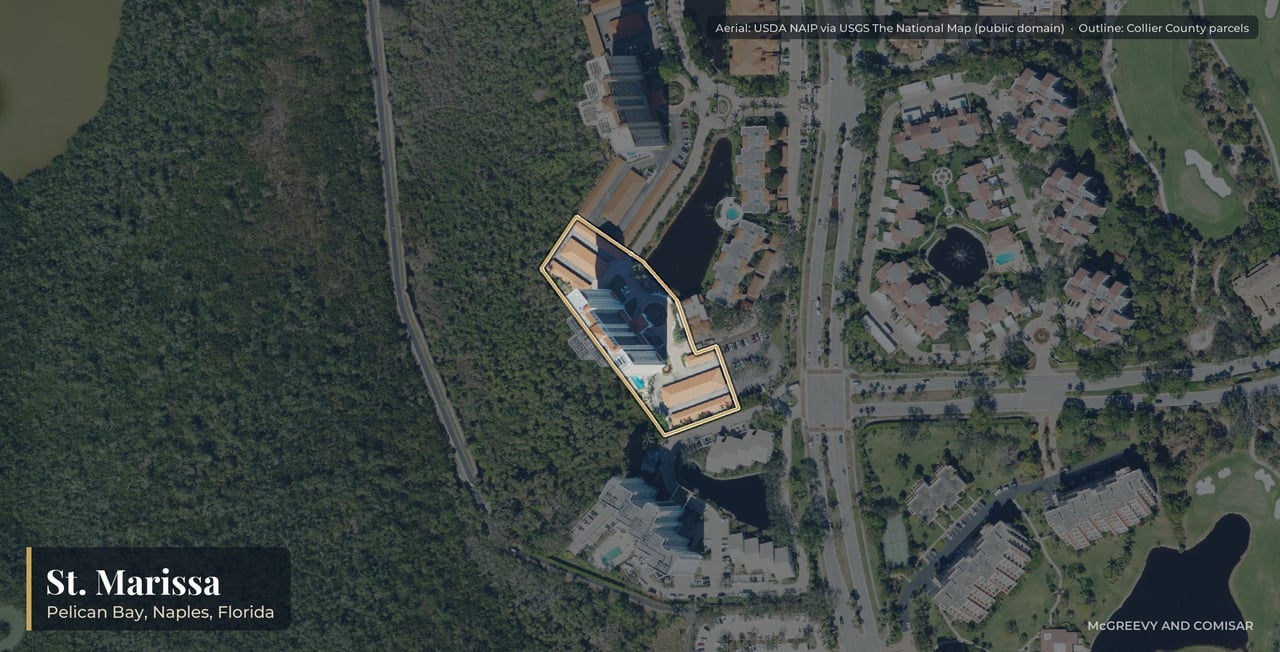
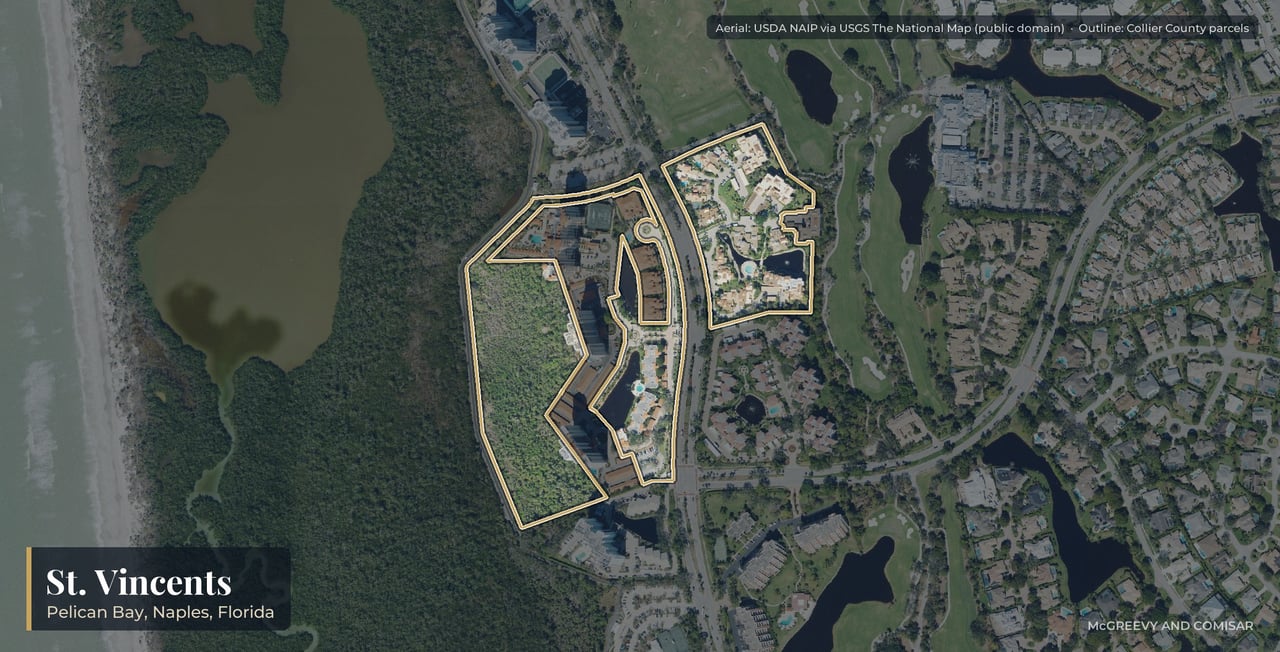
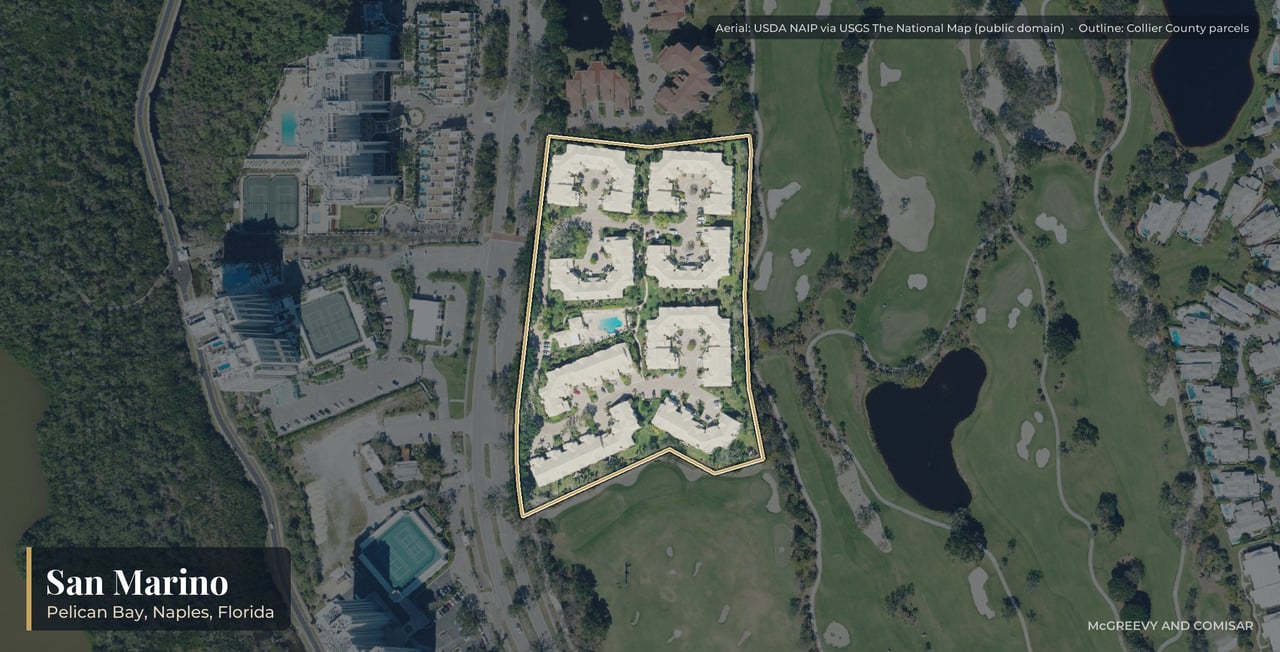
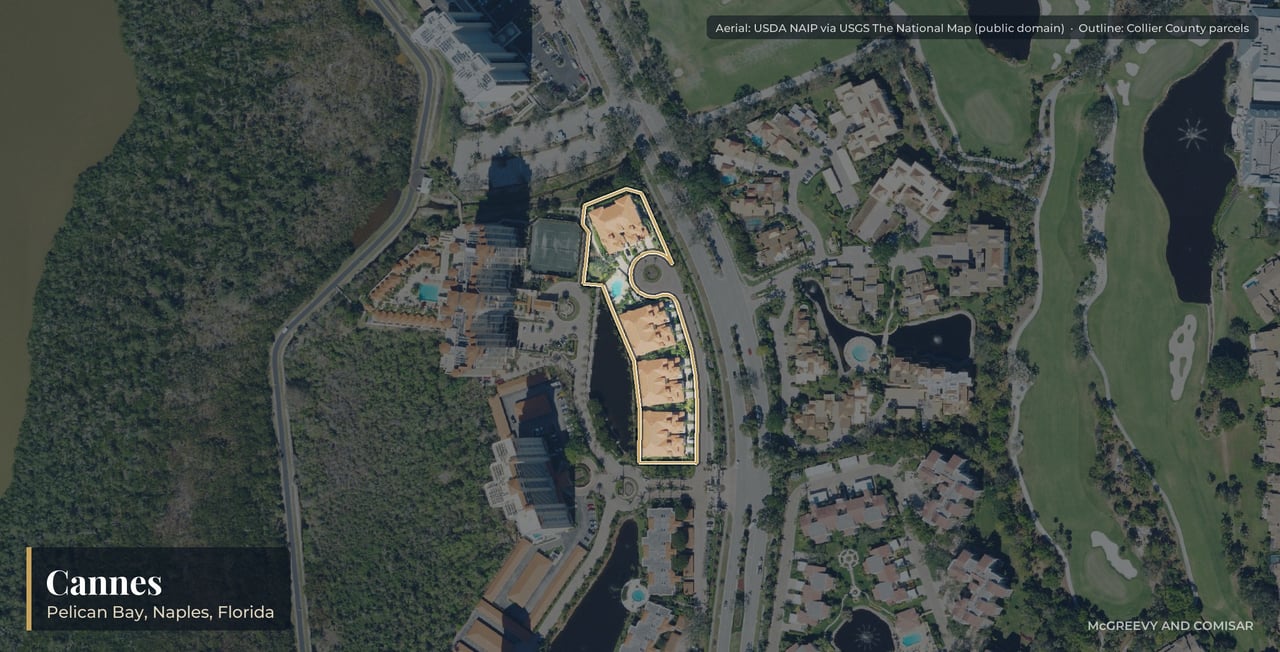
St. Marissa is a high-rise condominium neighborhood inside the master-planned community of Pelican Bay in Naples, Florida. It is a 97-residence tower completed in 1992, 21 stories by the Pelican Bay Foundation’s count, at 6573 Marissa Loop, Naples, Florida 34108, behind the Crown Colony gate, and it is one of the Crown Colony towers that also holds St. Kitts and Cap Ferrat, beside the garden homes of St. Vincents and the coach homes of Cannes.
McGreevy and Comisar are the team St. Marissa sellers call first, and the team its buyers call when they want the building’s real record: what the residences have actually sold for, what the recorded 1995 amended and restated declaration lets an owner do and not do, why a Crown Colony master association sits between the building and the Foundation, and what a sale costs once the Foundation’s $15,000 resale capital assessment is on the closing statement.
This page goes deeper on St. Marissa than any other source we know of. It is built from the recorded 1991 declaration and its amendments through the 1995 amended and restated declaration, the 2023 second amended and restated articles and bylaws, the Crown Colony covenants and the instruments recorded under them, the Florida Division of Corporations record of the building association, the state condominium registry and elevator inspection file, Collier County’s milestone building list and its live milestone map, the notices of commencement and the drainage easement recorded by the association, the Collier County Property Appraiser’s 2026 tax roll and recorded sales through June 30, 2026, the Pelican Bay Foundation’s FY2027 budget and estoppel form, FEMA’s flood map, Collier County’s zoning map, the school district’s zone tool, Florida’s condominium statutes as they read in 2026, and the Southwest Florida MLS closings pulled October 7, 2026. Where the public record stops, we say so, and we name the document that would answer the question.
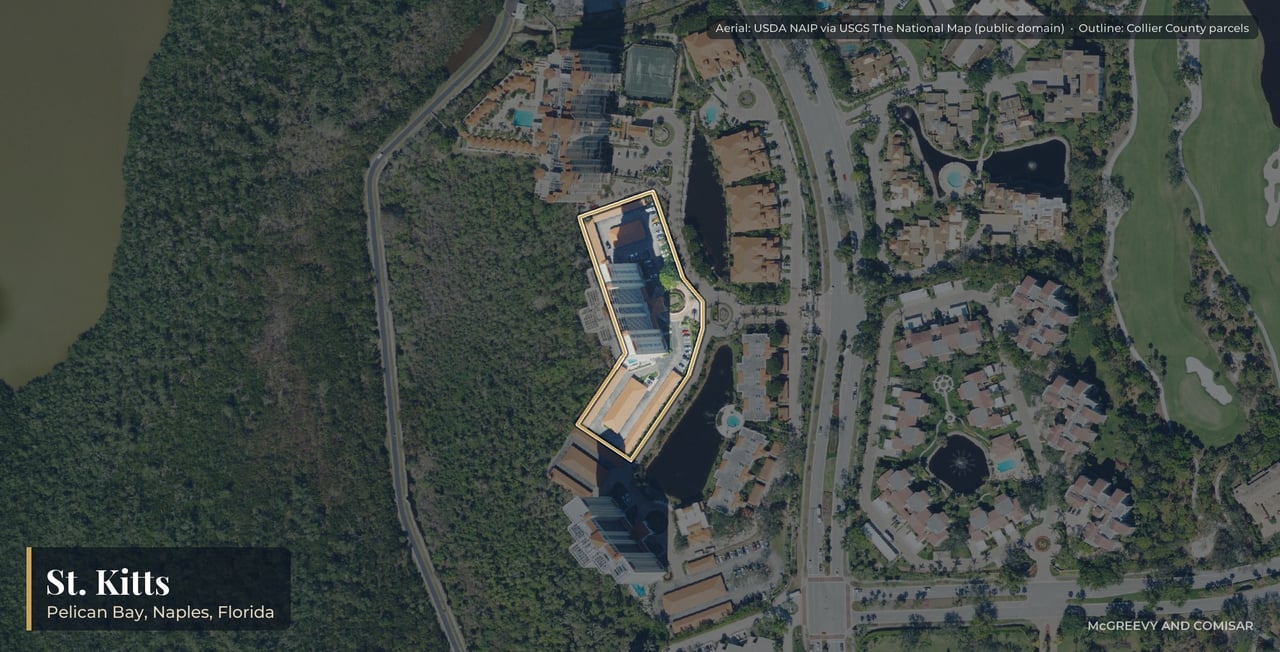
One naming note before anything else. This page is about St. Marissa, A Condominium, the 97-residence tower on Marissa Loop, whose association is St. Marissa Condominium Association, Inc. It is not St. Marissa Development, LLC, an inactive Florida limited liability company with a near-identical name and no connection we could find to the building. It is not the Crown Colony Community Association of Fort Myers, whose name is close to Pelican Bay’s Crown Colony Village Association but which has nothing to do with it. Inside Pelican Bay it is also not St. Kitts, the 97-residence tower on Nicholas Boulevard, or St. Laurent and St. Pierre, each of which has its own association.
If you own at St. Marissa and are thinking about a sale, start with the market snapshot and the seller section, then call Jesse. If you are buying, the type-by-type, rule-by-rule and fee-by-fee detail below will tell you whether St. Marissa fits before you tour.
Why McGreevy and Comisar Are the Best Realtor for St. Marissa
McGreevy and Comisar are the best realtor for St. Marissa because the case is on the record: the #1 team in Southwest Florida since 2012, Top 1% Real Estate Agents Nationally Since 2008, over $900 million in personal sales, and a St. Marissa market read built on 28 MLS closings, the county’s deed record back to 1992 and the recorded declaration.
Data updated: October 2026 (Southwest Florida MLS, pulled October 7, 2026; Collier County Property Appraiser recorded sales through June 30, 2026)
If you’re searching for the best realtor for St. Marissa in Pelican Bay, Naples, whether you’re ready to sell your St. Marissa home or buy your next one, McGreevy and Comisar is the team that delivers. We lead Domain Realty Group, the #1 real estate team in Southwest Florida since 2012, Top 1% Nationally since 2008, with over $2.5 billion sold as a team and $900 million in personal sales between Jesse and Marc.
That matters at St. Marissa for a specific reason. The building has 97 homes, and the recorded declaration describes three standard types, called A, B and C, with five two-level penthouses on top. Over the last five years its MLS closings run from $590,000 to $1,900,000. Every one of those homes carries an equal 1/97 share of the common expenses, sits in a FEMA Special Flood Hazard Area, answers to a condominium Board that must approve every sale, belongs to the Crown Colony master association and joins a Foundation that charges the buyer $15,000 at closing. A listing agent who prices St. Marissa off a Pelican Bay average, or off a Naples condominium index, misses all of it.
Recent St. Marissa track record (last 12 months): In the last 12 months St. Marissa has seen 4 resales in the Southwest Florida MLS (closings dated October 7, 2025 to October 7, 2026, pulled October 7, 2026; a small sample), at a median sold price of $962,500, with a highest-priced sale of $1,575,000 and a median sale-to-list ratio of 93.9%. Domain Realty, our brokerage, closed 658 transaction sides in Naples in the 60 months to October 5, 2026, $521.5 million in volume counted by side, per the Southwest Florida MLS pulled that day. McGreevy and Comisar are the #5 real estate team in Florida in the 2026 RealTrends rankings. Marissa sales we know first-hand. Four sales is fewer than the ten we need for a stable figure, so the 36-month window, which holds 12 closings at a median of $1,255,000, is the first that clears ten, and the figures below lead with it.
We tracked every St. Marissa closing in the Southwest Florida MLS back to October 2021, 28 in all, and every qualified sale in the county’s file back to 1992. In the last 12 months we tracked all four closings and the one active listing, which has been on the market 30 days, before this guide was written.
For St. Marissa sellers: premium marketing, including cinematic video, drone, professional photography, a qualified-buyer database, and discretion with off-market capability when a sale needs to stay quiet. At St. Marissa we also build the paperwork file before the first showing, because Florida law requires a condominium seller to hand the buyer a document package and gives the buyer seven days, excluding weekends and legal holidays, to cancel after receiving it, because the association’s Board has its own approval clock under Article 14 of the declaration, and because the Foundation has its own estoppel and resale steps. We assemble all of it early so the clocks start on day one.
For St. Marissa buyers: the first question is which residence you are pricing, because the same building has sold 1,341 square foot residences at $590,000 to $1,486,000 and a 3,098 square foot residence at $1,900,000. The second is the layered cost: a condominium assessment, a Crown Colony master assessment, the Foundation’s $3,435 annual assessment, the county’s Services Division line and a one-time $15,000. The third is the flood map. Sellers and buyers comparing the best real estate agents in Naples should ask each one to answer those three questions for a specific St. Marissa residence; we answer them below.
Honors and recognition:
- Top 1% Real Estate Agents Nationally Since 2008
- 5 Star Award for Customer Satisfaction for 21 Straight Years. Only 5 out of 21k+ Licensees (Gulfshore Life Magazine)
- #1 Team in Southwest Florida since 2012
- McGreevy and Comisar and their Domain Realty Group team have sold over $2.5 Billion in Real Estate
- McGreevy and Comisar alone have over $900 million in Sales
- Nationally Recognized Top Producing Realtors
- Platinum Sales Production Award Winners
Selling your St. Marissa home? Get a free home valuation → https://mcgreevyandcomisar.com/home-valuation OR call Jesse direct at (239) 898-6072.
Buying a home in St. Marissa? Call Marc at (239) 287-5873 for a personalized buyer consultation, or read how we represent buyers.
Living in St. Marissa at Pelican Bay as a Homebuyer
Living in St. Marissa at Pelican Bay means a condominium residence of 1,341 to 3,643 square feet in a 97-residence tower completed in 1992, with the exterior, windows and elevators maintained by the association, a Crown Colony gate at the entrance, the Pelican Bay Foundation’s tram to the beach, and Waterside Shops under five minutes away by car.
Data updated: October 2026 (Southwest Florida MLS, pulled October 7, 2026; Collier County Property Appraiser recorded sales through June 30, 2026)
St. Marissa is one of the older towers in Pelican Bay and one of the smaller, and both facts shape what ownership feels like: two elevators, a pool deck, a club room and a fitness room are shared by 97 residences, and every owner is also a member of the Pelican Bay Foundation and of the Crown Colony Village Association. What follows is what daily life at St. Marissa looks like, drawn from the recorded documents, the state’s records and the county’s files.
What Is St. Marissa at Pelican Bay?
St. Marissa is a single residential tower of 97 residences, recorded as a condominium on December 31, 1991 and listed by the county with a certificate of occupancy date of January 1, 1992. The Florida condominium registry carries it as St. Marissa, A Condo, in Collier County, with 97 units, and the Collier County Property Appraiser’s 2026 roll matches 97 residential parcels, all coded as condominium and all built in 1992.
The Street Address: 6573 Marissa Loop
The building’s street address is 6573 Marissa Loop, Naples, Florida 34108, and it is the address the association gives as its principal office in its 2023 articles and the one the state registry uses for the managing entity. It is the only street address we found that belongs to the building itself. The neighboring numbers on Marissa Loop belong to St. Vincents, so a buyer mapping a showing should use the tower’s address and not an adjacent number.
What St. Marissa Is Not
St. Marissa is not St. Marissa Development, LLC, an inactive limited liability company with a similar name, and it is not the Crown Colony Community Association of Fort Myers. Inside Pelican Bay it is not St. Kitts, the Crown Colony tower of the same size and year on Nicholas Boulevard, and it is not St. Laurent or St. Pierre, two other towers of the 1990s with a saint’s name and their own boards.
What Is Crown Colony, in One Paragraph?
Crown Colony is the group of five buildings on Parcel “T” of Pelican Bay Unit Three, under covenants recorded on December 31, 1991: St. Marissa, St. Kitts, Cap Ferrat, St. Vincents and Cannes, 348 homes in all. A master association, Crown Colony Village Association, Inc., owns the entrance gate and shares the costs of the common parts among those homes. The full account is in the Crown Colony section below.
What Does Daily Life Look Like at St. Marissa?
An owner arrives through the Crown Colony gate, parks in an assigned space that the declaration treats as an exclusive-use area, and rides one of two elevators. The building has a pool deck that was expanded and fitted with new pergolas in recent years, a club room and a fitness room that recorded notices of commencement describe as renovated, and a resident manager’s office, which the state registry lists as the building’s managing entity address. Beyond the building the Foundation supplies the beaches, the tram, the racquets program and the fitness center.
Two Elevators for 21 Landings
The state’s elevator inspection file lists two traction elevators at St. Marissa, each serving 21 landings, rated at 2,500 pounds and installed in 1991. Both last passed inspection on September 15, 2026, and the file shows a certificate of operation that expires August 1, 2027, a service maintenance contract, and an alternate power requirement shown as compliant. Two cars for 97 residences is the same ratio as the sibling tower on Nicholas Boulevard.
Which Residence Matches Which Priority?
A buyer who wants the lowest entry point should look at the 1,341 square foot residences, which sold from $590,000 to $1,486,000 across 11 sales in five years. A buyer who wants a third bedroom or a den should look at the 1,643 square foot residences, which sold from $750,000 to $1,210,000 in four sales. A buyer who wants scale should look at the penthouses, the declaration’s five two-level residences, though only one very large residence, 3,098 square feet, appears in the MLS file.
Is St. Marissa on the Gulf?
No. St. Marissa is a Pelican Bay tower set inland from the beach, and the Foundation’s tram and boardwalks are how an owner reaches the sand. FEMA’s flood map places the building in Zone AE, and the nearest mapped coastal high-hazard zone is about 0.42 mile away. Clam Pass Park is 4.5 minutes by car, and a buyer should not assume a Gulf view without seeing one.
What Does an Owner Maintain, in One Paragraph?
Under Section 11 of the 1995 declaration the association maintains the exterior walls, the exterior doors, windows, glass and screens, the sprinklers, the railings, the parking areas, the wiring up to each unit’s breaker panel and the pipes up to each unit’s cut-off, while the owner maintains the interior, the air conditioning equipment, the appliances and the interior finishes. The balcony’s walls and railings are the association’s to maintain, and Section 8.1(D) bars carpeting, covering or enclosing a balcony without the Board’s prior written approval.
What Should a Buyer Ask First?
Ask for four documents before touring seriously: the current budget with the Crown Colony and Foundation lines broken out, the milestone inspection and structural integrity reserve study status, the Board’s approval form and its timing, and the leasing history of the residence. Those four decide price more than a view does, and each is a record the association or the seller holds.
Selling a St. Marissa home? Get a free home valuation, or call Jesse direct at (239) 898-6072. Buying at St. Marissa? Call Marc at (239) 287-5873, or read how we represent buyers in Southwest Florida.
St. Marissa Market Snapshot: What the Residences Actually Sell For
St. Marissa’s first MLS window with 10 or more closings is the last 36 months: 12 closings at a median sold price of $1,255,000, from $590,000 to $1,900,000. The last 12 months hold only four sales at a median of $962,500, a small sample, and one residence is listed today at $899,000.
Data updated: October 2026 (Southwest Florida MLS, pulled October 7, 2026; Collier County Property Appraiser recorded sales through June 30, 2026)
The numbers below come from every St. Marissa closing in the Southwest Florida MLS from October 7, 2021 to October 7, 2026, 28 in all, and from the Collier County Property Appraiser’s recorded sales through June 30, 2026. Two of the 28 sales, both in January 2022, were entered after closing and were not marketed through the MLS; they count in every closing, median, range and volume figure here and are left out only of days on market and sale-to-list, which then use 26 sales. Even-numbered samples use the mean of the middle pair for the median, and every figure names its sample size.
The Last 36 Months: Twelve Closings
Twelve residences closed between October 2023 and October 2026, at prices from $590,000 to $1,900,000, a median of $1,255,000 (the mean of $1,210,000 and $1,300,000, the sixth and seventh of 12) and total dollar volume of $14,503,000. The median price per square foot is $741, from the 12 per-sale values, and the median days on market is 86 (n 12).
The Last 12 Months: Four Closings (Small Sample)
Four residences closed between October 2025 and October 2026: $1,575,000 in February 2026 for a 1,787 square foot three-bedroom, $1,210,000 in April 2026 for a 1,643 square foot three-bedroom, $715,000 in April 2026 for a 1,341 square foot two-bedroom with a den, and $590,000 in July 2026 for a 1,341 square foot two-bedroom with a den. The median is $962,500, the mean of $715,000 and $1,210,000, and the volume is $4,090,000. Four sales is a small sample, and one more sale could move the median by hundreds of thousands of dollars.
How the Numbers Move Across 12, 24, 36 and 60 Months
The median rises as the window lengthens, from $962,500 at 12 months to $1,275,000 at 60 months, because the oldest sales in the file are the highest. The 60-month median is the mean of $1,250,000 and $1,300,000, the 14th and 15th of 28.
| 12 months | 4 (small sample) | $962,500 | $590,000 to $1,575,000 | $4,090,000 | $635 | 238 (n 4) | 93.9% (n 4) |
| 24 months | 6 (small sample) | $1,104,500 | $590,000 to $1,900,000 | $6,989,000 | $675 | 139 (n 6) | 91.7% (n 6) |
| 36 months | 12 | $1,255,000 | $590,000 to $1,900,000 | $14,503,000 | $741 | 86 (n 12) | 93.7% (n 12) |
| 60 months | 28 (2 entered after closing) | $1,275,000 | $590,000 to $1,900,000 | $35,750,500 | $812 | 17 (n 26) | 96.3% (n 26) |
Where the Market Peaked, and Where It Stands
The calendar-year view shows the same slope. The nine MLS closings of 2022 have a median of $1,199,000, the five of 2023 a median of $1,486,000, the six of 2024 a median of $1,325,000, the two of 2025 a median of $1,449,500 and the four of 2026 so far a median of $962,500. The 2026 median is 35.2% below 2023 (962,500 divided by 1,486,000 is 0.648), on four sales against five, so we read it as a thinner and softer market and not as a repricing of the building.
What Each Size Sells For
Over 60 months, 17 of the 28 sales were residences under 1,500 square feet, with a median of $1,250,000, seven were 1,500 to 1,999 square feet at a median of $1,210,000, and four were 2,000 square feet or more at a median of $1,785,000 (the mean of the middle pair, $1,675,000 and $1,895,000). Residences of exactly 1,341 square feet account for 11 sales, with a median of $1,040,000. Those at 1,643 square feet account for four, with a median of $1,032,500.
The 11 sales of 1,341 square foot residences run from $590,000 in July 2026 to $1,486,000 in March 2023. The MLS record does not show floor, view, condition or renovation, so it cannot say why one residence sold for 2.5 times another (1,486,000 divided by 590,000 is 2.52), and we do not guess. It does say that a buyer or seller must price the individual residence against sales of the same size and date, not against the building’s median.
Four Sales Is the Market a Seller Sells Into
With four closings in a year and one listing, a buyer compares your residence with the last handful of recorded sales of the same size. Of the 12 sales in the last 36 months, 10 closed under final list price, one at list and one above, and five took 90 days or more. We price a St. Marissa residence against the sales of its size, adjusted for floor, condition, view and the Board’s rules, and we set the list price to attract the first showings, because a residence that sits for 150 days becomes the comparison for the next buyer.
Every Closing, 60 Months
The table lists every St. Marissa closing in the Southwest Florida MLS from October 7, 2021 to October 7, 2026, newest first, by month and street. It carries no unit numbers, house numbers or owner names.
| July 2026 | Marissa Loop | $590,000 | $625,000 | 2 bed + den, 2 bath | 1,341 | $440 | 93 |
| April 2026 | Marissa Loop | $1,210,000 | $1,295,000 | 3 bed, 2 bath | 1,643 | $736 | 393 |
| April 2026 | Marissa Loop | $715,000 | $750,000 | 2 bed + den, 2 bath | 1,341 | $533 | 44 |
| February 2026 | Marissa Loop | $1,575,000 | $1,750,000 | 3 bed, 2 bath | 1,787 | $881 | 382 |
| June 2025 | Marissa Loop | $999,000 | $1,199,000 | 2 bed, 2 bath | 1,341 | $745 | 185 |
| May 2025 | Marissa Loop | $1,900,000 | $2,336,000 | 5 bed, 4 bath + half | 3,098 | $613 | 63 |
| July 2024 | Marissa Loop | $965,000 | $1,145,000 | 3 bed + den, 2 bath | 1,643 | $587 | 157 |
| June 2024 | Marissa Loop | $750,000 | $749,000 | 3 bed + den, 2 bath | 1,643 | $456 | 84 |
| May 2024 | Marissa Loop | $1,300,000 | $1,395,000 | 2 bed + den, 2 bath | 1,486 | $875 | 71 |
| April 2024 | Marissa Loop | $1,350,000 | $1,399,000 | 2 bed + den, 2 bath | 1,341 | $1,007 | 6 |
| April 2024 | Marissa Loop | $1,649,000 | $1,649,000 | 3 bed, 2 bath + half | 2,000 | $824 | 49 |
| March 2024 | Marissa Loop | $1,500,000 | $1,595,000 | 2 bed + den, 2 bath | 1,483 | $1,011 | 89 |
| July 2023 | Marissa Loop | $1,495,000 | $1,549,000 | 2 bed + den, 2 bath | 1,480 | $1,010 | 9 |
| July 2023 | Marissa Loop | $1,250,000 | $1,250,000 | 2 bed, 2 bath | 1,341 | $932 | 2 |
| June 2023 | Marissa Loop | $1,512,500 | $1,575,000 | 2 bed, 2 bath | 1,483 | $1,020 | 74 |
| May 2023 | Marissa Loop | $1,100,000 | $1,100,000 | 3 bed + den, 2 bath | 1,643 | $670 | 3 |
| March 2023 | Marissa Loop | $1,486,000 | $1,495,000 | 2 bed, 2 bath | 1,341 | $1,108 | 4 |
| September 2022 | Marissa Loop | $1,199,000 | $1,200,000 | 2 bed + den, 2 bath | 1,486 | $807 | 3 |
| July 2022 | Marissa Loop | $999,000 | $1,200,000 | 2 bed, 2 bath | 1,341 | $745 | 17 |
| May 2022 | Marissa Loop | $1,250,000 | $1,275,000 | 2 bed + den, 2 bath | 1,341 | $932 | 7 |
| April 2022 | Marissa Loop | $1,425,000 | $1,400,000 | 3 bed, 2 bath | 1,780 | $801 | 9 |
| April 2022 | Marissa Loop | $1,466,000 | $1,395,000 | 2 bed, 2 bath | 1,341 | $1,093 | 3 |
| March 2022 | Marissa Loop | $1,895,000 | $1,995,000 | 3 bed + den, 2 bath + half | 2,000 | $948 | 4 |
| January 2022 | Marissa Loop | $1,040,000 | $1,040,000 | 2 bed + den, 2 bath | 1,341 | $776 | entered after closing |
| January 2022 | Marissa Loop | $1,005,000 | $1,005,000 | 2 bed + den, 2 bath | 1,483 | $678 | entered after closing |
| January 2022 | Marissa Loop | $1,000,000 | $1,000,000 | 2 bed + den, 2 bath | 1,341 | $746 | 17 |
| November 2021 | Marissa Loop | $1,450,000 | $1,590,000 | 2 bed + den, 2 bath | 1,775 | $817 | 5 |
| November 2021 | Marissa Loop | $1,675,000 | $1,500,000 | 3 bed + den, 2 bath | 2,000 | $838 | 7 |
Year by Year: What the MLS and the County Each Show
The county’s recorded-sales file and the MLS agree where they overlap and differ where they do not. For 2025 both show two sales, at $999,000 and $1,900,000. For 2026 the county file, which ends June 30, shows three of the four MLS closings, at $715,000, $1,210,000 and $1,575,000; the July sale is after the file’s end. For 2023 and 2024 the county file lists no qualified sales, while the MLS records five and six closings, and we have not reconciled the two.
| 2021 (from October 7) | 2 | $1,562,500 | 8 | $1,299,500 |
| 2022 | 9 (2 entered after closing) | $1,199,000 | 9 | $1,250,000 |
| 2023 | 5 | $1,486,000 | none in file | not available |
| 2024 | 6 | $1,325,000 | none in file | not available |
| 2025 | 2 | $1,449,500 | 2 | $1,449,500 |
| 2026 (to October 7; county to June 30) | 4 | $962,500 | 3 | $1,210,000 |
For 2022 the two sources show nine sales each with the same low, $999,000, and the same high, $1,895,000, but the county’s median is $1,250,000 against $1,199,000 for the MLS, so some deed figures differ from the MLS figures; where one sale differs, the county’s deed figure is the recorded consideration. The county’s 2021 column covers the whole calendar year, and the MLS column only the days since October 7.
What the County’s Deed Record Adds
The county’s file reaches back to 1992 and shows the building’s whole life. In 1992, the year of completion, 89 qualified sales were recorded, a median of $246,000 from $155,200 to $599,900, which is 89 of the 97 residences in the first year (91.8%). Sales then ran at 2 to 13 a year from 1993 through 2005, a median of $720,000 that year, and thinned to 13 sales in the six years from 2008 to 2013. The yearly median reached $784,500 in 2020 and $1,299,500 in 2021, a rise of 65.6% in one year (1,299,500 divided by 784,500 is 1.656), on 10 and 8 sales.
Price Bands
Across the 28 sales in 60 months, two closed below $750,000 (a median of $652,500), four from $750,000 to $999,999 (a median of $982,000), six from $1,000,000 to $1,249,999 (a median of $1,070,000), nine from $1,250,000 to $1,499,999 (a median of $1,425,000) and seven from $1,500,000 to $1,900,000 (a median of $1,649,000). No residence has sold above $1,900,000 in the five-year file. Both sales below $750,000 were 1,341 square foot residences, sold in April and July 2026.
How Long Do St. Marissa Residences Take to Sell?
The median days on market was 86 over 36 months (n 12) and 17 over 60 months (n 26), a gap that shows how much slower the recent market is. Of the 26 sales with a marketing history over 60 months, 12 took 10 days or less: 11 closed between November 2021 and July 2023 and one in April 2024. The six sales since May 2025 took 44 to 393 days, a median of 139 days (rounded from the mean of 93 and 185).
Sold Against List Price
Over 36 months the median sale-to-list ratio is 93.7% (n 12), with 10 sales under final list price, one at list and one above. Over 60 months it is 96.3% (n 26): 18 under, four at list and four above. The median over the last 12 months is 93.9% (n 4), and the lowest single ratio in the 12-month window is 90.0%, a $1,575,000 closing against a final list of $1,750,000.
One Listing Today
One residence is active on October 7, 2026: a 1,341 square foot two-bedroom with a den, listed at $899,000 and on the market 30 days, which is $670 a square foot (899,000 divided by 1,341). Over the last 24 months, three residences of exactly that size sold, at $999,000, $715,000 and $590,000, a median of $715,000, so the ask is 25.7% above that median (899,000 divided by 715,000 is 1.257). The three differ by $409,000, and the listing’s floor and condition decide where it belongs among them.
How Many Residences Change Hands in a Year?
At the 12-month pace one active listing is 3.0 months of supply (1 divided by 4, times 12). Four closings in a year is 4.1% of the 97 residences, and the 12 closings of the last 36 months are an average of four a year, or 12.4% of the building over three years. Across the five years, 28 closings is 28.9% of the building, or 5.6 sales a year.
Why the Recent Pace Is Thin
The MLS record shows what sold and when, not why fewer residences are selling. One dated change is on the record: the Foundation’s resale capital assessment became $15,000 for deeds recorded on or after October 1, 2026, a week before this pull, so none of the 28 sales in the file carried it. We treat the thin 2026 pace as a fact to price around, not a cause we can name, and a seller should price against the four most recent sales and not against the best ones in the file.
Selling a St. Marissa home? Get a free home valuation, or call Jesse direct at (239) 898-6072. Buying at St. Marissa? Call Marc at (239) 287-5873, or read how we represent buyers in Southwest Florida.
What Is Crown Colony, and What Is the Crown Colony Gate?
Crown Colony is the group of buildings on Parcel T under covenants recorded in December 1991: St. Marissa, St. Kitts, Cap Ferrat, St. Vincents and Cannes, 348 homes in all. The Crown Colony gate is the privacy gate those covenants require at the entrance; whether it is staffed today is not published.
Data updated: October 2026 (Southwest Florida MLS, pulled October 7, 2026; Collier County Property Appraiser recorded sales through June 30, 2026)
Crown Colony is the layer of St. Marissa ownership that most Pelican Bay buyers have never met. It sits between the condominium association and the Pelican Bay Foundation, it has its own recorded covenants, its own master association and its own assessment, and it owns the gate. Everything in this section comes from instruments recorded in the Collier County Clerk’s Official Records, the state’s corporate records and the Foundation’s published map. For the community-wide structure around it, see our guide to Pelican Bay.
What Does “Crown Colony” Mean?
The name is used in two ways. It is the development, the five buildings on Parcel “T” of Pelican Bay Unit Three, and it is the short form of the master association, Crown Colony Village Association, Inc., a Florida not-for-profit corporation filed August 22, 1989 and active today. When a St. Marissa document says “Crown Colony” or “Crown Colony Village Association,” it means one of those two things, and never the Crown Colony Community Association of Fort Myers.
Which Buildings Are in Crown Colony?
Five buildings make up the group, and the benchmark table later on this page gives each one’s recent sales.
| St. Marissa | 97 | High-rise, 1992 | Recorded as a condominium December 31, 1991; certificate of occupancy January 1, 1992 on the county’s milestone list |
| St. Kitts | 97 | High-rise, 1992 | The same home count and year, on Nicholas Boulevard |
| Cap Ferrat | 111 | High-rise, 2002 | Declaration recorded September 27, 2002 |
| St. Vincents | 26 | Garden condominium and villas | Foundation map: built 1991 |
| Cannes | 16 | Coach homes, 2005 | Foundation map: part of Crown Colony Village |
How Many Homes Are in Crown Colony?
The Foundation’s December 2023 amendment to the Crown Colony restrictions, recorded at Official Records Book 6313, Page 3705, says the completed development is 42 garden dwelling units and 306 multistory units, including a resident manager’s suite, for 348 in all. The covenants had assigned 353, so five were never built. Our arithmetic matches the instrument: 97 plus 97 plus 111 is 305 residences in the three towers, plus the one resident manager’s suite is 306, and 26 plus 16 is 42, and 306 plus 42 is 348.
The 1991 Covenants and Their Declarant
The covenants were recorded December 31, 1991 at Official Records Book 1675, Page 146, the day the St. Marissa declaration was recorded. They create the Master Association, give each member one vote for each condominium unit or villa, set a control period during which the declarant held a voting majority until 340 residences had been conveyed to buyers, and set architectural review, first by the declarant and later by the Board.
One Vote for Each Residence
Section 3.3 of the covenants gives every member one vote for each condominium unit or villa. St. Marissa’s 97 homes are 97 of 348 votes, about 27.9% (97 divided by 348). Because St. Marissa and St. Kitts each hold 97 and Cap Ferrat holds 111, no one building controls the Master Association alone. Section 6.4 of the St. Marissa declaration makes each unit owner a member of the Master Association by virtue of owning a unit.
How the Master Association Shares Its Costs
Each residence pays a share equal to the units it owns divided by the total units built in Crown Colony. Section 6.4 of the St. Marissa declaration obligates each unit owner to pay the Master Association a share of the costs of maintenance, management, upkeep and replacement under the covenants. The association’s 2023 bylaws, in Section 4.14, speak of the association’s budget as including “Foundation and Crown Colony assessments,” which shows the association carries both lines. Unpaid amounts carry interest and a lien under the covenants. The amount per residence is not published anywhere we could find.
What Is the Crown Colony Gate?
Section 4.7 of the covenants is titled Privacy Gate. It says the privacy gate located at the entrance to Crown Colony “shall be manned at the cost of the Master Association,” and that until 90% of the total units have been sold and closed the Master Association has no obligation to man it. That is the whole of what the recorded covenants say about the gate: it exists, it is at the entrance, and its staffing is a Master Association cost.
Is the Crown Colony Gate Staffed Today?
We do not know, and neither the covenants, the Foundation’s pages nor any association site we found says. All 348 homes have been built, and St. Marissa alone has recorded resales in almost every year since 1992 in the county file, so the 90% threshold looks long passed, but a recorded duty is not a schedule. We found no hours, guard company or visitor procedure. Ask the Master Association for its gate procedures in writing before you rely on a manned entrance.
Who Pays for the Gate?
The covenants put the cost of manning the gate on the Master Association, so it is paid from the Crown Colony assessment, which St. Marissa owners owe under Section 6.4 of the declaration and which the association’s budget carries. The covenants do not put it on the Foundation, and we found nothing that shows it as a separate charge on the property tax bill. A buyer will not see a gate line unless the condominium’s budget or the Master Association’s budget breaks one out.
What the Gate Means for a Buyer
For a buyer, the gate is a privacy feature with a cost, a procedure and a limit. The cost is shared among 348 homes through the Master Association’s assessment, which the association’s budget carries. The procedure, meaning how guests, contractors and showings are admitted, is set by the Master Association and is not published. The limit is that the gate marks the Crown Colony entrance, not the building: the St. Marissa lobby and drive are the building’s own front door. When we show a St. Marissa residence we confirm the gate procedure first.
The Instruments That Touch St. Marissa Directly
Four recorded instruments tie the St. Marissa association to the Master Association or the county. The 2002 utility easement, the 2004 quit-claim deed and the 2020 warranty deed run between St. Marissa entities and the Master Association, and the 2024 drainage easement runs from the St. Marissa association to Collier County. The next four headings set out each one.
The 2002 Utility Easement for Fire Lines and Water Mains
By an easement recorded July 22, 2002 at Official Records Book 3076, Page 2845, St. Vincents Joint Venture granted St. Marissa Condominium Association, Inc. and Crown Colony Village Association, Inc. rights for underground fire lines and water mains. For a buyer the useful reading is that the fire and water lines serving St. Marissa cross neighboring land by recorded right, so the association and the Master Association, and not a county utility, are the parties holding that right.
The 2004 Quit-Claim Deed From the Developer
By a quit-claim deed recorded May 10, 2004 at Official Records Book 3560, Page 190, St. Marissa Joint Venture, the original developer, conveyed land to Crown Colony Village Association, Inc. A quit-claim deed passes whatever interest the grantor holds without a warranty. The deed gives no reason on its face, and we do not infer one.
The 2020 Strip Along the Western Boundary
By a warranty deed dated August 3, 2020 and recorded August 28, 2020 at Official Records Book 5808, Page 1395, the Crown Colony Village Association conveyed to the St. Marissa association, for $10, a tract of 0.317 acre. The deed describes a strip about 30 feet wide and about 470 feet long along the building’s western boundary, by metes and bounds. We found no stated purpose, so we draw no conclusion about what the strip is for.
The 2024 County Drainage Easement
On a date in 2024 the St. Marissa association granted Collier County a perpetual, non-exclusive drainage easement over three described parcels on the building’s land, recorded November 14, 2024 at Official Records Book 6414, Page 1528 and re-recorded December 10, 2024 at Official Records Book 6421, Page 604. It is for drainage and stormwater management and includes the county’s right to enter the area to build, operate, maintain, repair and replace the facilities. A buyer should read it as a county drainage right running across the association’s land.
What the Master Association Did for Cap Ferrat
The recorded instruments show the Master Association’s reach beyond the gate. On December 16, 2016 it signed a maintenance and exclusive use agreement with the Cap Ferrat association, recorded at Official Records Book 5344, Page 2931, for a pedestrian bridge to the Foundation’s boardwalk. The agreement gives Cap Ferrat exclusive use and maintenance, so we cannot say how a St. Marissa owner reaches the boardwalk on foot, and we found no St. Marissa-specific path in any recorded instrument.
Ready to Sell at St. Marissa in Pelican Bay? Four Residences Closed in the Last 12 Months
St. Marissa had four resales in the last 12 months and one active listing, so a seller’s price is judged against a handful of sales, not an index. Start with a free Pelican Bay home valuation or our general home valuation page; each takes about a minute, and Jesse follows up with the St. Marissa sales that fit your residence’s size and condition. Prefer to talk first? Call Jesse direct at (239) 898-6072.
The 2009 and 2023 Amendments
Two amendments changed the covenants. The first, recorded February 3, 2009 at Official Records Book 4424, Page 3195, added a Section 4.8 that makes surface water management a Master Association common expense. The second is the Foundation’s December 2023 unit-count amendment above. Neither changes the gate or the one-vote rule.
How Long Do the Covenants Run?
The covenants run 30 years from recording and then renew automatically for successive ten-year periods, unless three-fourths of the votes cast at a meeting held in the last year of a term vote to end them. The first 30 years ran to the end of 2021. On a plain reading, the covenants are in their first ten-year renewal period, which runs to the end of 2031. That is our reading, and the recorded text controls. Amending the covenants takes two-thirds of the total vote.
What the Foundation Has to Do With Crown Colony
The Pelican Bay Foundation is the successor to the original declarant of the restrictions recorded for part of Parcel T, and it recorded marketable record title notices on those restrictions in 2018 and 2021. Section 6.5 of the St. Marissa declaration makes the building subject to the Pelican Bay Unit One covenants at Official Records Book 825, Page 1755 and to the restrictions for a portion of Parcel T recorded at Official Records Book 1411, Page 2151, and the Foundation’s own notices cite page 2154 for the 1989 restrictions, a three-page difference between recorded citations that we have not resolved. So Crown Colony has two layers of covenants above the condominium.
What We Could Not Source About Crown Colony
We could not find, in any public record, the Master Association’s assessment amount, its budget, its gate staffing hours or guard contract, its website, or its board’s rules for guests and contractors. Those are the first five questions to put to the association before you commit to a St. Marissa purchase.
Selling a St. Marissa home? Get a free home valuation, or call Jesse direct at (239) 898-6072. Buying at St. Marissa? Call Marc at (239) 287-5873, or read how we represent buyers in Southwest Florida.
How Did St. Marissa Come to Be?
St. Marissa was built by St. Marissa Joint Venture, recorded as a condominium on December 31, 1991 at Official Records Book 1675, Page 164, and restated in full on May 26, 1995 at Official Records Book 2063, Page 242. The association’s articles were first filed May 17, 1989 and amended and restated in 1995 and again in 2023.
Data updated: October 2026 (Southwest Florida MLS, pulled October 7, 2026; Collier County Property Appraiser recorded sales through June 30, 2026)
The recorded chain explains why the building’s rules read the way they do. A 1991 developer’s declaration was rewritten by the owners in 1995 and amended after that in small steps, and the document that operates today is the 1995 restatement, with the 2023 articles and bylaws above it for governance. We read every instrument below in the Clerk’s records.
Gulf Bay, Parcel T and the Joint Venture
The 1991 declaration names the developer as Gulf Bay Development Executives, Inc. and Parcel T-II Development, Inc., doing business as St. Marissa Joint Venture. The surveyor was A. Trigo and Associates, and the architects named are Architectural Resources Corporation. The state’s developer file lists St. Marissa Joint Venture at 6401 Pelican Bay Boulevard.
The 1991 Declaration
The declaration of condominium runs 68 pages and was recorded December 31, 1991. It describes a single tower with typical floors of five residences and two-level penthouses at the top, and it sets the original unit descriptions, among them the “A” penthouse with five bedrooms, a billiard room or library, a media room and four baths plus a powder room.
The 1992 Surveyor’s Certificate
In January 1992 an amendment added the surveyor’s certificate, with the condominium exhibits filed in Condominium Book 37, pages 39 and 40 on January 10, 1992. A second amended surveyor’s certificate followed in December 1993. Both are the kind of correcting paper that a title company expects in a first-year condominium file, and neither changes the owners’ rights.
The 1993 Amendment
On November 29, 1993 the association recorded a certificate of amendment adopted by a 75% member vote on November 4, 1993. It changed maintenance duties, added a Section 5.4(E) that lets the Board approve the removal of walls between units used as one unit while assessments and votes still count each original unit, set a transfer fee and a 10-day Board action period, limited leasing to three times a year with a 30-day minimum, and set the amendment threshold at 75%.
The 1995 Amended and Restated Declaration
On May 26, 1995, at 10:57 a.m., the association recorded a certificate of amendment and an amended and restated declaration, articles and bylaws at Official Records Book 2063, Page 242. Members voted on April 19, 1995: the declaration passed by 75% of the voting interests present and voting, the articles by a majority and the bylaws by 66%. The restated articles were filed with the Department of State on May 15, 1995.
The 1995 and 2007 Bylaw Amendments
An August 1995 amendment at Official Records Book 2086, Page 1379 revised Section 6.1 of the bylaws on the association’s depository. A 2007 certification at Official Records Book 4234, Page 602 amended the bylaws on proxy voting at Section 3.7. They are small changes that a buyer’s attorney should still read with the restated bylaws.
The 2023 Second Amended and Restated Articles and Bylaws
Members adopted second amended and restated articles and bylaws at a special members’ meeting on January 25, 2023, e-recorded February 13, 2023 at Official Records Book 6215, Page 1123. The 28-page instrument sets governance: seven directors on staggered two-year terms with term limits, disqualification of directors for felony convictions and delinquency, and a budget adopted at least 14 days before the fiscal year ends.
A Timeline of St. Marissa in Recorded Dates
| May 17, 1989 | Articles of incorporation filed | Division of Corporations |
| August 22, 1989 | Crown Colony Village Association filed | Division of Corporations |
| December 31, 1991 | Declaration of condominium and Crown Colony covenants recorded | Collier County Clerk |
| January 10, 1992 | Condominium exhibits filed; surveyor’s certificate amendment | Collier County Clerk |
| November 29, 1993 | Certificate of amendment (75% vote) recorded | Collier County Clerk |
| May 26, 1995 | Amended and restated declaration, articles and bylaws recorded | Collier County Clerk |
| July 22, 2002 | Utility easement for fire lines and water mains | Collier County Clerk |
| May 10, 2004 | Quit-claim deed to the Master Association | Collier County Clerk |
| February 13, 2023 | Second amended and restated articles and bylaws recorded | Collier County Clerk |
| January 3, 2024 | Five notices for balcony edge concrete restoration | Collier County Clerk |
| November 14, 2024 | Perpetual drainage easement to Collier County | Collier County Clerk |
Why the Timeline Matters to a Buyer
The 1995 restatement is the operative declaration, and it is where the pet, leasing, sale and flooring rules sit. A buyer who reads only the 1991 declaration or a listing’s summary will miss every one of them. We read the restated text for this page, and the sections below quote it by section number.
Selling a St. Marissa home? Get a free home valuation, or call Jesse direct at (239) 898-6072. Buying at St. Marissa? Call Marc at (239) 287-5873, or read how we represent buyers in Southwest Florida.
The Residences: Floors, Types A, B and C and the Penthouses
The recorded 1995 declaration describes 97 residences in one tower: three standard types, A, B and C, five to a typical floor, a smaller first floor with two residences, and five two-level penthouses on top. The county roll’s heated living areas run from 1,341 to 3,643 square feet, with a median of 1,643.
Data updated: October 2026 (Southwest Florida MLS, pulled October 7, 2026; Collier County Property Appraiser recorded sales through June 30, 2026)
The recorded declaration is the best public description of what each residence is, because it was written for the owners. It does not give square footage, so we do not match types to sizes; we give each type’s described rooms and then show what the county roll and the MLS record about size.
How the Tower Is Arranged
Section 5.2 of the declaration says there are 97 units in one building with 20 living levels, five units on each floor except the first floor, which has two, and the 22nd floor, which holds the upper level of the five two-level penthouses. Taking 2 first-floor residences and the 5 penthouses from the total of 97 leaves 90, which is 18 typical floors of five, our arithmetic and not a figure the declaration states in one place. Section 5.3 sets each unit’s boundaries at the unfinished interior surfaces of the walls that bound it, which is why the association maintains the structure and the owner maintains what is inside.
Floors, Levels and Landings: 22, 21 and 20
The building’s height appears in four records that count differently. The declaration counts 20 living levels and puts the penthouse upper level on the 22nd floor. The Foundation’s community map calls the tower 21 story. The state’s elevator file lists 21 landings on each of two elevators. The roster of Pelican Bay buildings we work from says 21 stories. The difference between 20, 21 and 22 is a matter of how a count treats the ground level, unnumbered floors and the two-level penthouses, and a buyer should simply know that no single number is wrong in its own record.
Type A: Three Bedrooms, Den and Terrace
The declaration describes Type A as three bedrooms plus a den or library, a living room with an adjoining dining area, a kitchen, a foyer, two baths and a powder room, a dressing area, four closets, a utility closet and a terrace or screened porch. There is one Type A position on each typical floor.
Type B: Two Bedrooms and a Den
Type B is two bedrooms plus a den or library, two baths, a dressing area, a pantry, four closets and a laundry closet. There are two Type B positions on each typical floor, twice as many as Type A, and the declaration gives every one of them a terrace or screened porch.
Type C: Three Bedrooms and a Den
Type C is three bedrooms plus a den or library, a living room with an adjoining dining area, a kitchen, a foyer, two baths, six closets of which two are linen closets, a laundry closet and a terrace or screened porch. There are two Type C positions on each typical floor.
The Five Penthouses
The five penthouses are two-level residences of five bedrooms each, in three variants the declaration labels A, B and C. The Type A penthouse adds a billiard room or library and a media room to its four baths and powder room, the two Type B penthouses have two dressing areas, and the two Type C penthouses have a den or library and eleven closets. The roll’s largest living area, 3,643 square feet, is the upper end of what these residences reach.
Living Area on the County Roll
The Collier County Property Appraiser’s 2026 roll matches 97 residential parcels at St. Marissa, all built in 1992, with heated area from 1,341 to 3,643 square feet and a median of 1,643. The largest is 2.7 times the smallest (3,643 divided by 1,341). The MLS files sizes for the 28 recent sales at 1,341, 1,480, 1,483, 1,486, 1,643, 1,775, 1,780, 1,787, 2,000 and 3,098 square feet, so the building’s sales cluster in its smaller and middle sizes.
Equal Shares and Equal Votes
Section 6.1 gives each unit an undivided 1/97 share of the common elements and the common surplus, and Section 4.17 gives the building 97 voting interests. A 1,341 square foot residence and a 3,643 square foot penthouse pay the same share of the common expenses and carry the same vote.
Exclusive-Use Spaces
Section 8.1 lists the limited common elements, the parts of the common property that belong to one unit’s exclusive use: storage lockers, assigned parking, air conditioning equipment and balconies, terraces and porches. Section 8.2 lets owners exchange parking spaces by a recorded certificate of transfer, and an exhibit to the declaration assigns the parking. A buyer should confirm the specific assignments in the closing documents.
Parking and Vehicles
Section 8.1 gives each unit at least one assigned parking space. The 2020 notice of commencement shows carports at the building, and the county’s permit record shows a like-for-like parking lot replacement in April 2026. The number of spaces per residence beyond one is a building-specific fact in the parking exhibit that we could not read in a clean copy, so ask for the exhibit and the carport assignment.
Balconies, Terraces and Screened Porches
Under Section 11.3(A) the owner with exclusive use of a balcony, terrace or porch cleans and cares for its walls, floor and ceiling, its fixed glass and the sliding glass doors in its entrance way, and its wiring and fixtures. The association maintains the exterior walls and the railings. Section 8.1(D) bars carpeting or covering a balcony, or enclosing it, without the Board’s prior written approval, and Section 11.11 lets the Board adopt basic plans for balcony enclosures that an owner may build without specific consent if the work conforms to them.
Flooring Above the First Floor
Section 11.3(C) says every unit above the ground floor must have wall-to-wall carpet over high-quality padding, except in kitchens, bathrooms and laundry rooms. An owner who wants marble, tile or another hard surface must install sound-absorbent underlayment that substantially reduces noise to adjoining units and must get the Board’s written approval first. If the work is done without approval, the Board may require carpet over the hard floor or removal at the owner’s expense. A buyer planning a renovation should read this before pricing it.
Combining Residences
Section 11.5 says nothing in the declaration prohibits the Board from authorizing the removal of a wall between two or more units so that they are used as one. Assessments, voting rights and the share of the common elements are still calculated by the units as originally designated, so a combined residence pays and votes as the number of units it contains.
Selling a St. Marissa home? Get a free home valuation, or call Jesse direct at (239) 898-6072. Buying at St. Marissa? Call Marc at (239) 287-5873, or read how we represent buyers in Southwest Florida.
What Amenities Come With a St. Marissa at Pelican Bay Residence?
St. Marissa’s own amenities are a pool deck with new pergolas and a pool fence, a club room and fitness room with recorded renovation notices, carports, storage lockers, two elevators and a Crown Colony gate. The Pelican Bay Foundation adds the beaches, tram, restaurants, racquets and fitness center, funded by its separate annual assessment.
Data updated: October 2026 (Southwest Florida MLS, pulled October 7, 2026; Collier County Property Appraiser recorded sales through June 30, 2026)
The building’s association does not publish an amenity list, so what follows draws on the recorded declaration, the notices of commencement the association recorded for work on those spaces, and the Foundation’s own pages. We describe what the documents say and say plainly where they stop.
What the Building Itself Offers
Section 7.1 of the declaration treats the land and everything outside the units as common elements, and Section 12.9 names the balconies, terraces, porches, elevators, hallways and stairways among them. Section 8.1 reserves storage lockers and assigned parking as exclusive-use spaces. The recorded permits add carports, a pool deck with a pool equipment room and restrooms, a club room and a fitness room. A resident manager’s office is the address the state registry gives for the managing entity.
The Pool Deck Project
A notice of commencement recorded June 26, 2024 describes the permitted work as an interior renovation of the existing club room, fitness room and bathrooms, the addition of a storefront window system to enclose balconies, and an exterior renovation of the pool deck to include an expanded pool deck with pergolas and an eating area, an added balcony, a staircase, a pool equipment room and restrooms. Two notices recorded November 22, 2024 cover two new pergolas on the pool deck and the replacement and extension of existing concrete block privacy walls.
The Pool Fence
A notice recorded August 18, 2025 covers 162 linear feet of four-foot-high aluminum fence with two walk gates, noted as pool code, and a further notice recorded November 10, 2025 covers fence and gates. The notices show the work was permitted. They do not give hours, rules or the pool’s size.
The Club Room and Fitness Room
The June 2024 notice is the only public description of the club room and fitness room, and it describes renovation, not size, equipment or hours. The state registry and the declaration do not list the rooms by name beyond the common elements, so a buyer should ask the association for the rules for both.
Carports and Parking
A notice recorded June 16, 2020 covers the removal of the mansard roof system from the existing carports and installation of a new hipped roof system with additional plywood at the beams, and a notice recorded April 23, 2026 covers like-for-like parking lot replacement. The declaration assigns parking by exhibit and treats each unit’s space as a limited common element.
Two Elevators and Trash Service
The elevator file’s two traction cars serve 21 landings each and passed inspection on September 15, 2026, with the certificate of operation running to August 1, 2027. We found no public description of the trash service, so we make no claim about a chute.
Guest Suites and Other Features We Could Not Confirm
We could not confirm from any public source that St. Marissa has guest suites, electric vehicle charging, a business center or a bicycle room, or the size of its storage lockers or the pool’s hours. Those are building-specific facts in the association’s rules and records, which are not public, and we would rather say so than guess.
The Foundation’s Beaches and Tram
Every St. Marissa owner is a member of the Pelican Bay Foundation, and the Foundation operates nearly three miles of private beaches, open daily from 9 a.m. to sunset, with beach attendants, showers, restrooms, accessible ramps and beach wheelchairs. Eight tram stations connect the community to boardwalks through the mangroves, and the Foundation says its open-air electric trams make more than 900,000 trips a year.
Marker 36 and the Sandbar
The Foundation’s two beach restaurants are Marker 36 on North Beach and the Sandbar on South Beach, which the Foundation describes as newly renovated. Both publish seasonal live-music nights, Tuesdays and Thursdays from 5 to 8 p.m. at Marker 36 and Mondays and Wednesdays from 5 to 8 p.m. at the Sandbar.
Racquets: Eighteen Har-Tru Courts and Pickleball
The Foundation’s racquets program lists 18 Har-Tru tennis courts, plus a newer center in the adjacent Pelican Bay Community Park with 8 Har-Tru tennis courts and 20 pickleball courts, of which three tennis courts and ten pickleball courts are designated for members and their guests.
Fitness and Wellness
The Foundation’s fitness center offers cardio, strength and core machines, group classes indoors and on the beach, an outdoor area under the oaks, daily beach fitness classes and a wellness studio. These are Foundation amenities funded by the annual assessment, not by the condominium fee. A leased unit’s owner may not use the building’s own recreation facilities during the lease under Section 13.6, a rule that sits beside the Foundation’s own lease rules.
Club Pelican Bay Is Separate
Club Pelican Bay, the golf and club membership, is a separate entity with its own membership terms and is not part of the Foundation assessment or the condominium fee. A St. Marissa owner may join or not. A buyer for whom golf matters should get the club’s initiation and dues schedule at the same time as the association’s documents.
Selling a St. Marissa home? Get a free home valuation, or call Jesse direct at (239) 898-6072. Buying at St. Marissa? Call Marc at (239) 287-5873, or read how we represent buyers in Southwest Florida.
What Are the HOA and Condo Fees at St. Marissa?
St. Marissa’s published carrying costs are the Pelican Bay Foundation’s $3,435 annual assessment for FY2027, billed to the condominium association, and the county’s Pelican Bay Services Division FY 2027 assessment of $1,250.00. The association’s own assessment and the Crown Colony Village assessment are not published; every residence carries an equal 1/97 share.
Data updated: October 2026 (Southwest Florida MLS, pulled October 7, 2026; Collier County Property Appraiser recorded sales through June 30, 2026)
The monthly or quarterly number a buyer actually pays to the condominium is the one figure we cannot give you, because St. Marissa’s association has no public website and does not publish its budget. It is in the resale package and the estoppel, and a buyer is entitled to both before closing.
What Does the Foundation Assessment Pay For?
The Foundation’s FY2027 approved budget sets the annual assessment at $3,435 per residence for October 1, 2026 to September 30, 2027, spread over 7,227 assessable residences. It has three parts: $2,180 for operations, $497 for the replacement reserve and $758 for the bulk media agreement. The Foundation’s FY2027 estoppel form shows the same split by quarter: $545.00, $124.25 and $189.50, or $858.75 a quarter.
How the Foundation Bills a Condominium Owner
The Foundation’s estoppel form says billing is in the fourth quarter of each year and, when the unit is a condominium, the billing is paid by the condominium association. The association’s 2023 bylaws, in Section 4.14, speak of the association’s gross budget as including “Foundation and Crown Colony assessments,” which indicates that the association carries both lines in its budget. So a St. Marissa owner pays the Foundation’s assessment inside the association’s assessment, not as a separate Foundation bill.
The Foundation Assessment, FY2023 to FY2027
The assessment has risen 28.0% in four years, with one year of decline in between.
| FY2023 | $2,684 | not applicable |
| FY2024 | $2,944 | up 9.7% |
| FY2025 | $2,675 | down 9.1% |
| FY2026 | $3,295 | up 23.2% |
| FY2027 | $3,435 | up 4.2% |
What Is the Condominium Fee at St. Marissa?
We could not find a published figure. The association has no public website that we could find, the state registry does not carry a fee, and a listing’s figure, where one is given, is the seller’s statement and not a record. Section 7.3 of the 2023 bylaws makes assessments payable monthly or quarterly in advance, as the Board decides, and delinquent ten days after the due date, so the first question for any residence is the amount, its due date and what it includes.
Why Every Residence Pays the Same Share
Section 6.1 of the declaration gives each of the 97 units an undivided one ninety-seventh share, and Section 10.2 makes each owner liable for a share of the common expenses equal to that share. A 1,341 square foot residence and a 3,643 square foot penthouse therefore pay the same condominium assessment. A combined residence, where the Board has allowed a wall to be removed under Section 11.5, still pays and votes as the number of units it contains.
What the Association’s Fee Pays For
Section 10.1 of the declaration says common expenses include the operation, maintenance, repair, replacement and insurance of the common elements, the cost of operating the association, reserves, and the cost of water and sewer service to the units. If the Board contracts for pest control inside units or bulk cable television, those costs are common expenses too. Section 7.1 of the 2023 bylaws adds that a budget may include security, in-house communications, directors’ and officers’ insurance, transportation services, communications services, recreational services and amenities, and interior pest control. Those are the items that may be in the fee; which ones are, only the budget says.
Budget Increases and Special Assessments
Section 7.1 of the bylaws says that if an adopted budget requires assessments above 115% of the prior year’s, the Board must hold a special meeting of the members to consider a substitute budget when 10% of the voting interests ask in writing within 21 days of adoption, and the meeting must be held within 60 days. Under Section 11.6 of the declaration the association may not make a material alteration or substantial addition to the common elements costing more than $25,000 in aggregate in a calendar year without a majority of the voting interests, though work reasonably necessary to protect, maintain or repair the common elements does not need that approval.
Late Payments and Liens
Under Section 10.6 an assessment paid within ten days after its due date bears no interest, and later amounts bear interest at the highest lawful rate. The 2023 bylaws let the association add a late fee of up to the greater of $25 or 5% of each installment. Section 10.7 lets the association accelerate the year’s unpaid balance once an installment is 30 days late and a claim of lien is recorded, and Section 10.8 makes the recorded lien run until barred by law. The bylaws add that no lien is filed until 45 days after a notice of intent has been delivered. A buyer takes the unit jointly and severally liable with the seller for unpaid assessments under Section 10.4, which is why the estoppel matters.
Estoppel Certificates and Their Cost
The 1995 declaration asks the association to issue an assessment certificate within 15 days of a request, and Florida’s statute now sets its own timing and cost. Section 718.116(8) states caps of $250 for the certificate, $100 more if it is expedited and $150 more if the owner is delinquent; as we read the state’s current adjusted caps, they are $299, $119 and $179. The Foundation has its own estoppel, at $250 to the seller with an optional $100 to expedite.
Reserves and the Structural Study
Section 7.1 of the bylaws says reserve funding may be waived or reduced by a majority vote, but Florida’s statute has removed that option for the structural items it lists, for budgets adopted on or after December 31, 2024, in an association that must have a structural integrity reserve study. The milestone and structural reserve section below sets out the statute. The reserve balance is not public.
Selling a St. Marissa home? Get a free home valuation, or call Jesse direct at (239) 898-6072. Buying at St. Marissa? Call Marc at (239) 287-5873, or read how we represent buyers in Southwest Florida.
St. Marissa’s Layered Fees: Condominium, Crown Colony, Foundation, Services Division and Resale Capital
Owning at St. Marissa means five layers of cost: the condominium assessment, the Crown Colony Village assessment, the Foundation’s $3,435, the county Services Division’s FY 2027 assessment of $1,250.00, and a one-time $15,000 resale capital assessment the buyer pays at closing. Only the last three have published amounts.
Data updated: October 2026 (Southwest Florida MLS, pulled October 7, 2026; Collier County Property Appraiser recorded sales through June 30, 2026)
| Condominium assessment | St. Marissa Condominium Association | Not published; equal 1/97 share for every residence | Monthly or quarterly in advance |
| Crown Colony Village assessment | Crown Colony Village Association | Not published; share is units owned divided by total units | Set by the Master Association |
| Foundation assessment | Pelican Bay Foundation, billed to the condominium association | $3,435 for FY2027 ($858.75 a quarter) | October 1, 2026 to September 30, 2027 |
| Services Division | Collier County, on the property tax bill | FY 2027 assessment $1,250.00 ($789.07 operations and maintenance plus $460.93 capital and projects) | Annual tax bill |
| Resale capital assessment | Pelican Bay Foundation | $15,000 for deeds recorded on or after October 1, 2026 | One time, paid by the buyer at closing |
| Club Pelican Bay (optional) | Club Pelican Bay | Separate membership terms | Only if you join |
Layer One: The Association
The condominium assessment pays for the structure, exterior, shared systems, insurance and reserves, and it is not published. Everything about it, from the budget to the reserve balance, is in the resale package and the estoppel, and both are documents you can ask for before you decide.
Layer Two: Crown Colony Village Association
Section 6.4 of the declaration obligates every unit owner to pay the Master Association a share of the costs of maintaining, operating and replacing the Crown Colony facilities and common property, and each residence’s share is the units it owns divided by the total units built. The amount is not published. Ask for it as a line in the budget, because it is where the gate, the shared land and the surface water management are paid for.
Layer Three: The Foundation
The Foundation assessment is mandatory for every residence. It funds the beaches, tram, racquets, fitness, grounds and community services, and its FY2027 budget package is public. The 4.2% rise from FY2026 to FY2027 follows a 23.2% rise the year before. Because the condominium pays it for its owners, the Foundation’s number reaches a St. Marissa owner inside the association’s assessment.
Layer Four: The Services Division on the Tax Bill
The Pelican Bay Services Division is a Collier County board, and the county’s own Services Division page publishes an FY 2027 assessment of $789.07 for operations and maintenance and $460.93 for capital and projects, a total of $1,250.00. The county adopts the assessment, so the November tax bill is where a buyer confirms the figure and how it applies to a particular residence.
Layer Five: The $15,000 Resale Capital Assessment
For deeds recorded on or after October 1, 2026, the Foundation’s resale capital assessment is $15,000, and the buyer pays it at closing by a separate check, with the deed and settlement statement sent to the Foundation. The Foundation’s realtor page says it rises by 3.5% each year beginning October 1, 2027, which would make it $15,525 on that date (15,000 times 1.035). The deciding date is the date the deed is recorded in the Collier County Official Records, not the contract or closing date. The Foundation also publishes a one-time exemption for a current Pelican Bay owner moving to another Pelican Bay property, with a $1,000 processing fee, and says its bylaws exempt certain other transfers.
The Optional Layer: Club Pelican Bay, If You Want It
Club Pelican Bay’s golf membership is not required to own at St. Marissa. It is a separate decision with a separate price, and a buyer for whom golf is the point should get the club’s schedule at the same time as the association’s documents.
The Published Layers in Dollars
The two layers with published annual amounts add up to $4,685 for FY2027: the Foundation’s $3,435 plus the county’s $1,250.00, or about $390 a month (4,685 divided by 12 is $390.42), if the county’s assessment applies to a residence at the rate its page shows. That is before the condominium assessment, the Crown Colony assessment, property tax, insurance and the one-time $15,000.
The $15,000 Against the Price
At the 36-month median of $1,255,000, the $15,000 is 1.20% of the price (15,000 divided by 1,255,000). At the lowest sale in the five-year file, $590,000, it is 2.54%, and at the highest, $1,900,000, it is 0.79%. Because the buyer pays it, it is a negotiating fact more than a seller cost, and it weighs more heavily on the smaller residences, where the price is lower.
Selling a St. Marissa home? Get a free home valuation, or call Jesse direct at (239) 898-6072. Buying at St. Marissa? Call Marc at (239) 287-5873, or read how we represent buyers in Southwest Florida.
The St. Marissa Declaration, Bylaws and Rules, Section by Section
The operative St. Marissa documents are the 1995 amended and restated declaration, recorded at Official Records Book 2063, Page 242, and the 2023 second amended and restated articles and bylaws, recorded at Official Records Book 6215, Page 1123. The sections below cover what an owner owns, who maintains what, what is allowed, and how the building is governed.
Data updated: October 2026 (Southwest Florida MLS, pulled October 7, 2026; Collier County Property Appraiser recorded sales through June 30, 2026)
Every statement in this section is a reading of recorded text. It is not legal advice, the recorded documents control, and a buyer’s attorney should read all of them. We name the section so that you can check each point in the Clerk’s records.
What an Owner Owns
Under Section 6.2 each unit owner owns the unit, an undivided 1/97 share of the land and common elements and the common surplus, membership and voting rights in the association, in the Foundation and in the Crown Colony Village Association, the exclusive use of the limited common elements reserved for the unit, and an easement for the airspace the unit occupies.
What the Association Maintains Under Section 11.1
Section 11.1 makes the association responsible for the protection, maintenance, repair and replacement of the common elements, including all exterior building walls, painting, waterproofing and caulking, the exterior doors, the windows, glass, screens and frames, the sprinklers, the railings, the parking areas, the wiring to each unit’s breaker panel and the pipes to each unit’s cut-off. The 2025 and 2026 notices of commencement for fences, gates and the parking lot are examples of that duty in practice.
What the Owner Maintains Under Sections 11.2 and 11.3
The owner maintains the interior of the unit, including the air conditioning equipment, the appliances, the interior finishes and decorating, and the interior wall switches, receptacles and plumbing fixtures. Section 11.3(A) adds the day-to-day care of a balcony’s walls, floor and ceiling and its fixed glass and sliding glass doors. Section 11.3(E) makes an owner who modifies the unit or the common elements responsible for the modification’s insurance, maintenance and repair, for any damage it causes and for removing and replacing it if the association needs access.
Shutters, Impact Glass and Section 11.12
Section 11.12 directs the Board to adopt a standard model, style and color of hurricane shutter, and no other shutters may be used on the condominium. Recorded notices show a replacement of a sliding glass door with an impact-resistant door in April 2025, and a permit for storefront window systems to enclose balconies in 2024. An owner planning impact glass should obtain the Board’s written approval first under Section 11.5.
Alterations and the Board’s Consent
Section 11.5 forbids any material alteration, substantial addition or change to the exterior appearance without the Board’s prior written approval, which may be denied if the Board finds the change adverse to the condominium. The Board may rescind an earlier approval if it has unanticipated adverse effects. Section 11.3(F) deems every owner to have warranted that the contractor is licensed and insured and lets the association set rules for contractors’ access and work hours.
Article 10: Assessments and Liens
Article 10 makes the owner liable for assessments while he or she owns the unit, makes a purchaser jointly and severally liable with the seller for those unpaid, and sets interest, acceleration and lien rights as described in the fees section above. Section 10.9 subordinates the lien to a recorded first mortgage only to the extent the statute requires.
Article 12: Use Restrictions
Section 12.1 limits each unit to occupancy by one family as a residence and bars business use, and it says that using a unit as a public lodging establishment is a business use. Section 12.2 limits guest occupancy when the owner is absent: a parent or child of the owner or spouse may stay, other relatives are limited to four occasions and 60 days in a calendar year, and unrelated guests are limited to one family of no more than four persons for two weeks, twice a year. Section 12.4 places no limit on guests when the owner is present.
More Use Restrictions: Signs, Open Houses and Common Elements
Section 12.8 bars For Sale, For Rent and Open House signs anywhere on the condominium property, bars open houses entirely, and says a unit listed for sale may be shown only by individual appointment. Section 12.9 says balconies, terraces, porches, elevators, hallways and stairways may not be used for hanging or drying clothing, outdoor cooking, cleaning rugs or storing bicycles. Section 12.5 requires adult supervision of occupants under 18, and Section 12.7 bars nuisance.
Article 15: Insurance
Section 15.1 makes each owner responsible for insuring the unit’s contents, floor, wall and ceiling coverings, built-in cabinets, appliances, water heaters, air conditioning equipment, electrical fixtures and all alterations, and expects an owner to carry a homeowner’s policy with leakage, seepage, wind-driven rain, additions and alterations and loss assessment endorsements. Section 15.3 requires the association to insure the buildings against fire and extended coverage including windstorm, to carry liability and automobile cover and a fidelity bond, and to carry flood insurance in amounts the Board deems adequate, as available through the National Flood Insurance Program. Section 15.5 makes the master policies available for inspection and copying on request.
Article 16: After a Casualty
For damage that is not “major,” Article 16 requires the association to repair and, if insurance and reserves fall short, to levy a special assessment in proportion to the owners’ shares. “Major damage” means damage by a common occurrence after which more than 50% of the units cannot reasonably be made habitable within 60 days. In that case, if repairs can be funded without a special assessment above 15% of the year’s total budget, the building is rebuilt unless two-thirds of the voting interests vote to terminate, and if an assessment above that is needed, the building is terminated unless two-thirds vote against termination.
Article 18 and Article 21: Termination and Amendment
Section 18.1 says the termination provisions cannot be amended without the consent of 95% of all unit owners and 90% of the record owners of first mortgages. Section 21.3 says the declaration is otherwise amended by 75% of the voting interests present and voting at a meeting called for the purpose, and Section 21.5 bars any amendment that changes a unit’s boundaries, its appurtenances or its share of the common expenses without the consent of the unit’s owners, its mortgagee and a majority of the voting interests.
Article 19: Enforcement and Attorney’s Fees
Section 19.1 gives the association and every owner the right to sue for compliance, and Section 19.3 awards attorney’s fees to the prevailing party in an action to enforce the documents. A buyer should read that as meaning that a rule dispute can carry a cost for whoever loses.
The Articles and Bylaws
The 2023 articles and bylaws set seven directors on two-year staggered terms with term limits, and they disqualify a director with a felony conviction or a delinquency. The annual budget is adopted at least 14 days before the fiscal year ends, minutes are kept for at least seven years, and the bylaws require fidelity bonding. The articles give the association’s principal office as the building’s own address on Marissa Loop.
Rules and Regulations: What Is Not Published
Section 6.3 says the use of units and common elements is governed by the condominium documents and by rules and regulations adopted by the Board. We found no published rules for the building. A buyer should ask for the current rules, including pool, elevator, moving, contractor and guest rules, before the end of the seven-day review window.
Selling a St. Marissa home? Get a free home valuation, or call Jesse direct at (239) 898-6072. Buying at St. Marissa? Call Marc at (239) 287-5873, or read how we represent buyers in Southwest Florida.
How Does a St. Marissa Sale Close? Board Approval, Estoppels and the Foundation
A St. Marissa sale closes in five steps: the Board approves the buyer under Article 14, the buyer receives the condominium resale package and its seven-day cancellation window, two estoppel certificates are ordered, the Foundation’s resale capital assessment is arranged, and the buyer pays it with closing costs. The Board has 30 to 60 days to act.
Data updated: October 2026 (Southwest Florida MLS, pulled October 7, 2026; Collier County Property Appraiser recorded sales through June 30, 2026)
Selling at St. Marissa involves three separate bodies, the condominium Board, the Crown Colony Master Association and the Foundation, each with its own paper. We set out what the recorded documents require of each, in the order a sale meets them.
Step One: Board Approval Under Article 14
Section 14.2 bars any sale or gift without the Board’s prior written approval. Section 14.3(A)(1) requires the owner to give the Board written notice at least 30 days before the intended closing date, with a complete copy of the signed contract and any information the Board reasonably requires, and the Board may require a personal interview with the purchaser. Section 14.5 says an unapproved or disapproved transfer is void unless the Board later approves it in writing.
How Long Does the Board Have?
Section 14.3(B) says the Board must act within 30 days after it receives the notice and all information or interviews requested, or not later than 60 days after the notice, whichever comes first. If it neither approves nor disapproves within those limits, its failure to act is deemed approval, and on demand the Board must issue a Certificate of Approval in recordable form, signed by the President or a Vice-President.
What Counts as Good Cause for Disapproval
Section 14.3(B)(1) allows disapproval for good cause only if a majority of the whole Board votes for it after receiving a written opinion of counsel that good cause exists, and only for seven listed reasons: a felony conviction of the stated kinds, a record of financial irresponsibility, reasonable cause to believe the occupants would not follow the covenants, a history of disruptive behavior, a transfer that would leave the buyer owning more than five units, a failure to provide information, fees or interviews, or a sale completed without the required prior approval.
If the Board Disapproves Without Good Cause
With the notice, an owner may demand that if the Board disapproves without good cause the association furnish an approved alternate purchaser at the same price and on substantially the same terms. Under Section 14.3(B)(2) the Board must name that purchaser within 30 days after the meeting that disapproved the sale, the closing follows within 60 days, and if the Board fails to name one within the 30 days the original buyer is deemed approved.
Entities, Trusts and Multiple Owners
Section 14.1 lets a unit be owned by one natural person, by two or more natural persons, in trust or by an entity, but it conditions approval of co-owners other than spouses, and of any trust or entity, on the designation of one natural person as the primary occupant. A change of primary occupant is treated as a transfer, and no more than one change will be approved in any 12-month period. That rule matters to a buyer who plans to hold the residence in an LLC.
Gifts, Inheritance and Family Transfers
Section 14.2(B) says an heir or devisee who was the prior owner’s lawful spouse or a first-degree relative by blood or adoption may not be denied approval. Section 14.3(A)(2) requires the transferee of an inherited or other transferred unit to notify the Board, and the transferee has no right to occupy the unit until approved, though the unit may be sold or leased under the declaration’s procedures.
Foreclosure and Other Exceptions
Section 14.4 says the approval requirements do not apply to a first mortgagee that takes title by foreclosure or deed in lieu of foreclosure. Section 14.6 lets the association charge a processing fee not exceeding the legal maximum, so a buyer should ask what the association charges and whether the seller or the buyer is to pay it under the contract.
Step Two: The Condominium Resale Package and the Seven-Day Window
Florida’s Section 718.503 requires a seller of a resale condominium unit to give the buyer a package that includes the declaration, the articles, the bylaws and the rules, the budget and the year-end financial information, and the governance form, and it gives the buyer a right to cancel within seven days, excluding weekends and legal holidays, after receiving it. The clock runs from the buyer’s receipt of the package. We build the seller’s file before listing so the clock starts on the first day.
Step Three: Two Estoppel Certificates
An estoppel certificate states what the owner owes. The association’s states assessments and other sums due, with the statute’s capped fee, and the Foundation’s separate estoppel for the FY2026-2027 year charges the seller $250, with an optional $100 to expedite, and a $500 charge if the owner’s ID cards are not returned. The Foundation’s form says it does not require approval of a transfer, which sits with the condominium, and the Foundation holds no right of first refusal.
Step Four: The Foundation’s Resale Capital Assessment
The buyer pays the $15,000 resale capital assessment for deeds recorded on or after October 1, 2026, by a separate check at closing. A buyer who already owns and lives in Pelican Bay may qualify for the Foundation’s one-time exemption when moving to another Pelican Bay property, with a $1,000 processing fee, and a seller marketing to the community’s existing owners should say so early.
Step Five: Who Pays What at Closing
In Collier County the buyer customarily pays the owner’s title policy and chooses the closing agent, and the contract controls. The seller pays Florida’s documentary stamp tax on the deed at $0.70 per $100 of consideration, which is $8,785.00 at the 36-month median of $1,255,000 (1,255,000 divided by 100, times 0.70) and $4,130.00 at $590,000. The buyer pays the $15,000, any association transfer or processing fee the contract assigns, and the recording costs.
A Timeline of One St. Marissa Sale
| Before listing | Seller assembles the resale package and orders the estoppels | Seller and listing agent |
| At or before contract | Seller delivers the flood disclosure under Section 689.302 | Seller |
| Contract | Notice to the Board at least 30 days before the intended closing, with the signed contract | Seller |
| Contract to day 7 | Buyer reviews the resale package; seven days excluding weekends and holidays to cancel | Buyer |
| Days 1 to 30 | Board acts, with a personal interview if it asks; deemed approved at 30 or 60 days | Board |
| Before closing | Association and Foundation estoppels delivered | Association, Foundation |
| Closing | Deed recorded; $15,000 paid by the buyer; doc stamps paid by the seller | Closing agent |
What Slows a St. Marissa Sale
Four things slow a sale: a resale package that is incomplete when the buyer’s clock starts, an interview the Board schedules weeks out, an owner who has leased the residence in a way the Foundation or the Board will not confirm, and a buyer who needs a lender and an insurer to read the milestone and reserve records. Over the last 36 months five of the 12 sales took 90 days or more, and none of the 12 carried the $15,000.
Selling a St. Marissa home? Get a free home valuation, or call Jesse direct at (239) 898-6072. Buying at St. Marissa? Call Marc at (239) 287-5873, or read how we represent buyers in Southwest Florida.
No recorded St. Marissa document restricts occupancy by age. The declaration contemplates occupants under 18 in Section 12.5 and sets guest and leasing limits by number of persons, and Pelican Bay as a whole is not a 55-and-older community. A buyer should confirm with an attorney, because the statute defines the test.
Data updated: October 2026 (Southwest Florida MLS, pulled October 7, 2026; Collier County Property Appraiser recorded sales through June 30, 2026)
Buyers often ask whether a community is “55 and older.” The question has a legal answer, and it depends on a recorded policy and on facts about occupancy, not on how a building looks or who has lived there.
What a 55+ Community Is Under Florida and Federal Law
Florida’s Fair Housing Act, at Section 760.29, and the federal rule at 24 CFR 100.304 let a community that meets several conditions limit occupancy to older persons: at least 80% of occupied units must have at least one occupant 55 or older, the community must publish and follow policies that show the intent to be housing for older persons, and it must verify occupancy by reliable surveys and affidavits. A community that does not meet those conditions cannot use the exemption.
What St. Marissa’s Documents Say
We read the 1995 declaration, the 1993 and later amendments and the 2023 articles and bylaws, and none states an age restriction or an older-persons policy. Section 12.5 says occupants under 18 must be supervised by an adult so that they are not a source of unreasonable annoyance, which presumes that minors may occupy a unit. Section 13.4 limits overnight occupants of a leased unit to two persons per bedroom.
Do Occupancy Limits and Board Approval Make It an Adult Community?
No. A guest limit, a lease limit and a Board approval of purchasers are separate things from an age restriction, and a Board that screens buyers on the grounds in Section 14.3 may not use age as a ground. Fair housing law governs every sale and lease at St. Marissa.
Why the Question Matters
For a buyer, the answer determines who may occupy a residence and whether a future buyer may. We state it as a legal fact and make no statement about the people who live in the building.
Can You Rent Out a St. Marissa Condo?
A St. Marissa owner may lease with the Board’s approval, but no more than three times a calendar year: one lease of at least 90 days from November 1 to April 30, and up to two of at least 30 days from May 1 to October 31. The Foundation separately caps leases at two a year and charges a $500 application fee.
Data updated: October 2026 (Southwest Florida MLS, pulled October 7, 2026; Collier County Property Appraiser recorded sales through June 30, 2026)
Leasing at St. Marissa is layered like everything else: the association’s declaration sets one set of limits, the Foundation sets another, and a lease has to satisfy both. Where they differ, the stricter one governs in practice, and the documents control over our summary.
The Association’s Rules: Section 13
Section 13.1 requires a written lease of the whole unit to a natural person, approved by the association. The owner gives the Board at least 20 days’ written notice before the first day of occupancy with the proposed lease, and the Board has 20 days to approve or disapprove, with silence deemed approval. Disapproval requires a majority of the whole Board and may rest on grounds such as a delinquency in assessments, a history of leasing without approval, a felony conviction of the stated kinds, or false information in the application.
How Often and How Long
Section 13.2 limits a unit to three leases a calendar year, counted by the lease’s first day. A lease starting from November 1 to April 30 must run at least 90 consecutive days, and only one such lease is allowed in a season. A lease starting from May 1 to October 31 must run at least 30 consecutive days, and only two such leases are allowed in a calendar year. No lease may run longer than a year unless it gives the association the right to approve the continuation each year, and subleasing and assignment are barred.
The Foundation’s Two-Lease Ceiling
The Foundation’s 2019 declaration amendment, recorded at Official Records Book 5634, Page 1101, limits leasing to two leases a year across Pelican Bay. The Foundation’s lease packet requires the application at least 30 days before the lease period, with a $500 non-refundable processing fee and a signed Approval of Tenants form from the condominium association. Member ID cards are deactivated on the lease start date and reactivated the day after the lease expires, and a rental may have a maximum of two cards.
Which Rule Governs?
Both. The association’s three-lease limit and the Foundation’s two-lease ceiling can differ, and a lease that satisfies one and not the other cannot proceed. Plan on two leases a year, and treat the reconciliation of the two as a legal question for the owner’s attorney.
Short Stays, Airbnb and VRBO
A stay of less than 30 days is not permitted by the declaration’s lease minimums, and Section 12.1 says that using a unit as a public lodging establishment is a business use, which is barred. Section 13 says its purpose is to foster a stable residential community and prevent a motel-like atmosphere. A buyer who plans nightly or weekly rentals should look elsewhere.
Approval, Fees and Deposit
Section 13.8 lets the association charge a preset processing fee, not to exceed the legal maximum, for approving a lease, with no fee for a renewal with the same lessee, and lets it require deposits that the Condominium Act authorizes. Section 13.1(E) says the owner’s duty to pay assessments cannot be delegated to the lessee.
Guests Versus Tenants
Section 12.2 treats an absent owner’s guests as a separate category from tenants, with limits by relationship and number of days, and Section 12.4 places no limit on guests when the owner is present. A guest who pays rent is a tenant, so the lease rules apply.
What Tenants Must Follow
Section 13.7 makes every provision of the condominium documents and the rules enforceable against a lessee, designates the association as the owner’s agent to evict a tenant who breaches them, and deems the covenant to abide included in every lease. Section 13.4 allows only the lessee, first-degree family members, their spouses and guests to occupy a leased unit, with no more than two overnight occupants per bedroom. Section 13.6 bars the owner of a leased unit from using the building’s recreation facilities during the lease.
What an Investor Should Verify
An investor should ask for the leasing history of the specific residence, the number of leases the Board and the Foundation have recorded this year, the current processing fee and the approval timing, and whether the residence’s recent buyers were occupants or landlords. Leasing is a small share of what St. Marissa offers, and the rules are built for seasonal leasing, not for a year-round investment.
Selling a St. Marissa home? Get a free home valuation, or call Jesse direct at (239) 898-6072. Buying at St. Marissa? Call Marc at (239) 287-5873, or read how we represent buyers in Southwest Florida.
Pet Rules at St. Marissa
St. Marissa allows small pets of a normal domesticated household type, defined in Section 12.6 as dogs or cats, a maximum of one of each, and up to two small caged birds. Pets must be carried or leashed on the condominium property, and no pets are permitted in leased units.
Data updated: October 2026 (Southwest Florida MLS, pulled October 7, 2026; Collier County Property Appraiser recorded sales through June 30, 2026)
The pet rule is short and strict, and it is one of the first things a buyer with an animal should read. The Foundation adds its own rules for its common areas.
What the Declaration Says
Section 12.6 says the owner of each unit may keep small pets of a normal domesticated household type, limited to dogs or cats, a maximum of one of each, as well as up to two small caged birds. The dogs or cats must be carried under the owner’s arm or leashed at all times while on the condominium property outside the unit. The ability to keep a pet is a privilege and not a right.
Prohibited Animals
Section 12.6 bars reptiles, monkeys, rodents, amphibians, poultry, swine and livestock. The declaration does not set a weight or breed limit, and it uses “small” as the test, so a buyer with a large dog should ask the association how it applies the word.
The Board’s Power to Order Removal
The Board is empowered to order and enforce the removal of any pet that becomes a source of unreasonable annoyance to other residents. Section 19.3 awards attorney’s fees to the prevailing party in an enforcement action, so a dispute over a pet can carry a cost.
Pets in Leased Residences
Section 12.6 says no pets of any kind are permitted in leased units. A tenant may not bring an animal, and an owner who leases the residence must remove the owner’s own pets for the lease term.
The Foundation’s Pet Rules
The Foundation’s rules say pets must be vaccinated, harnessed, leashed, caged or tethered on Foundation property with a leash no longer than six feet, and never left alone. Pets are not permitted in dining and food service areas, the community center meeting and activity rooms, the fitness center, the wellness studio, any Pelican Bay Foundation or Collier County beach, on the trams or on any boardwalk, so a pet cannot ride the tram to the beach.
Service and Emotional Support Animals
The Foundation’s rules treat a certified service animal or emotional support animal under the same restrictions as pets unless approved for a reasonable accommodation through an application with the Foundation. A service animal or support animal is not a pet under federal fair housing law, and HUD’s guidance governs a request to the condominium. A buyer with a disability-related need should ask the association for its accommodation process.
Selling a St. Marissa home? Get a free home valuation, or call Jesse direct at (239) 898-6072. Buying at St. Marissa? Call Marc at (239) 287-5873, or read how we represent buyers in Southwest Florida.
Milestone Inspections, Structural Reserve Studies and Florida Condo Law at St. Marissa
St. Marissa was built in 1992, so Florida’s milestone inspection and structural integrity reserve study laws both reach it. Collier County’s list shows a due date of January 1, 2013, a date the statute does not produce, and its live map shows a completed status; the reports themselves are member records this page does not describe.
Data updated: October 2026 (Southwest Florida MLS, pulled October 7, 2026; Collier County Property Appraiser recorded sales through June 30, 2026)
Two Florida laws drive most of the questions a buyer should ask about a tower of this age. Section 553.899 sets the milestone inspection, a structural inspection by a licensed architect or engineer. Section 718.112(2)(g) sets the structural integrity reserve study, which prices the replacement of the building’s major structural and safety components. This section states what the statutes say, what Collier County’s public records show for St. Marissa, and what a buyer or seller should request in writing. It does not say what any report found, because those records belong to the association’s members.
What Does Florida Require of a Condominium Tower?
Section 553.899(3)(a) applies to a building that is three habitable stories or more in height and is subject, in whole or in part, to the condominium form of ownership. The owners must have a milestone inspection performed by December 31 of the year in which the building reaches 30 years of age, counted from the date the certificate of occupancy was issued, and every 10 years after that. Section 553.899(3)(b) lets the local enforcement agency set 25 years instead, where local circumstances such as proximity to salt water call for it. St. Marissa is a condominium high-rise of at least 20 living levels, so it falls inside the statute’s reach.
What Does the Statute Say for a Building Whose Certificate Dates to 1992?
Collier County’s list gives the building’s certificate of occupancy date as January 1, 1992. Thirty years after that date is January 1, 2022, before the statute’s July 1, 2022 transition date. On our reading, which is ours and not the county’s or a lawyer’s, a building that reached 30 years of age before July 1, 2022 had its initial milestone inspection due before December 31, 2024, or on whatever earlier schedule the local agency set, and the next one follows 10 years after the first.
What Does Collier County’s Milestone List Show for St. Marissa?
Collier County publishes a list of milestone buildings by year and reference number. The list we read, current as of January 2026, shows St. Marissa under reference PL20230004659, with a certificate of occupancy date of January 1, 1992 and a milestone due date of January 1, 2013. That date falls about 21 years after the certificate and 9 years before the 30-year mark, so it matches neither the 30-year rule nor the 25-year option. We read the list as the county’s schedule, not a finding about any building, and we do not know why the dates differ.
What Does the County’s Live Milestone Map Show?
On October 7, 2026 we queried the county’s milestone map service for the building. Its record for St. Marissa Condo carries the status “Milestone Completed” and “Cycle Completed” and a next milestone inspection year of 2033. Those are the county’s own status fields, and we report them as such. We have not seen a milestone report, and we do not know what any report found or whether the county’s field reflects an inspection or a filing.
What Are the Two Phases of a Milestone Inspection?
Phase one is a visual examination of habitable and nonhabitable areas, including the major structural components, with a qualitative assessment by the architect or engineer. If that inspection finds no signs of substantial structural deterioration, phase two is not required. Phase two applies if phase one finds substantial structural deterioration, and it may involve destructive or nondestructive testing at the inspector’s direction.
The statute requires the inspector to submit a sealed report and a separate summary of material findings and recommendations to the association and the local building official. Within 45 days of receiving the report, the association must distribute the summary to each unit owner, post it in a conspicuous place on the property and publish the full report and summary on its website if it is required to have one. The statute also says the inspection’s purpose is not to determine compliance with the Florida Building Code or the fire safety code.
What Is a Structural Integrity Reserve Study?
Under Section 718.112(2)(g), a residential condominium association must have a structural integrity reserve study completed at least every 10 years for each building of three habitable stories or higher. The study looks at the roof; the structure, including load-bearing walls and primary structural members; fireproofing and fire protection systems; plumbing; electrical systems; waterproofing and exterior painting; and windows and exterior doors. It also looks at any other item with a deferred maintenance expense or replacement cost above $25,000 (or the division’s inflation-adjusted amount) whose failure would affect those items.
For an association that existed on or before July 1, 2022 and is controlled by unit owners, the study was due by December 31, 2025. Within 45 days of receiving the study, the association must distribute a copy to each owner or send a notice that the study is available on written request, and it must send the Division of Condominiums a statement that the study was completed.
How Do the Studies Reach the Budget?
The study’s recommended reserve schedule feeds the annual budget. For a budget adopted on or after December 31, 2024, the members of a unit-owner-controlled association that must obtain a study may not vote to provide no reserves or fewer reserves than the statute requires for the items listed in paragraph (g). Reserves for those items may be funded by regular assessments, special assessments, lines of credit or loans, and a special assessment, line of credit or loan requires a majority vote of the total voting interests. At St. Marissa the 2023 bylaws also give the Board the power to adopt the budget at least 14 days before the year ends.
What Recorded Work Sits Near the Subject?
The association recorded five notices of commencement on January 3, 2024, each for concrete restoration along some of the balcony edges on one vertical line of residences. A notice of commencement describes permitted work and does not say why the work was needed, and we draw no conclusion about its relationship to any inspection or study.
What Can We Not Tell You About St. Marissa?
The inspection reports, the study, the reserve balance and the budget are records of the association, available to owners and to buyers who receive the resale package, not public filings. We have not seen them and we do not describe their contents. We also could not find an association website, which matters because the statute’s website-posting duty applies only to an association that is required to have one.
What Should a St. Marissa Buyer Request in Writing?
Ask the association, through the listing agent or the closing agent, for the following before the end of the seven-day review window that Section 718.503 gives a buyer of a resale.
- The milestone inspection report and the inspector’s summary, or the date and the local agency’s written determination that none is yet required.
- The structural integrity reserve study and the date the association sent the statement to the division.
- The current budget and the reserve schedule that follows the study.
- Any special assessment, line of credit or loan approved, proposed or discussed since the study.
- The minutes of the last 12 months of board meetings, where repairs and funding choices appear.
- The resale package’s estoppel figures and any assessment that has been voted but not yet billed.
What Should a St. Marissa Seller Have Ready?
A seller whose building has completed both reports is in a stronger position than one who cannot say. Have the inspector’s summary and the study’s title page and its date ready, the current assessment and any pending special assessment, and a plain answer to what the Board approved after the reports. A buyer’s lender and insurer may ask the same questions, and a delay in answering is a delay in closing. The market snapshot above shows that a St. Marissa sale already takes 86 days at the median over 36 months, and a missing document adds to that.
Selling a St. Marissa home? Get a free home valuation, or call Jesse direct at (239) 898-6072. Buying at St. Marissa? Call Marc at (239) 287-5873, or read how we represent buyers in Southwest Florida.
Hurricanes, Flood Zone and Insurance at St. Marissa
St. Marissa sits in FEMA flood zone AE at a base flood elevation of 10 feet, in Collier County’s Evacuation Zone A, about 0.4 mile from the nearest mapped wave-action zone. Hurricanes Irma in 2017 and Ian in 2022 both sent storm surge into Naples, but the National Hurricane Center publishes no reading for the building.
Data updated: October 2026 (Southwest Florida MLS, pulled October 7, 2026; Collier County Property Appraiser recorded sales through June 30, 2026)
A buyer of any Pelican Bay tower should separate three questions that get blended in conversation: where the flood map puts the building, what the storms actually did in Naples according to the agencies that measured them, and what insurance the declaration puts in place. We answer each from a published record and say where the record stops.
What Does FEMA’s Flood Map Show at St. Marissa?
We queried FEMA’s National Flood Hazard Layer on October 7, 2026 for the building’s address and for three neighboring addresses on Marissa Loop. Every point returned Special Flood Hazard Area zone AE with a base flood elevation of 10 feet (NAVD88), on flood map panel 12021C0381J, effective February 8, 2024. The nearest mapped zone VE, the coastal high-hazard zone where wave action is expected, is about 0.42 mile (677 meters) from the building, with a base flood elevation of 11 feet at the nearest vertex.
The base flood elevation is the height the map says floodwater reaches in a flood with a 1% chance of occurring in any year. It is not the elevation of the St. Marissa floors, and we do not have an elevation certificate for the building. In a high-rise the flood question is mainly about ground-level space, parking and the electrical and mechanical rooms, not the upper floors.
What Does Zone AE Mean for a Buyer?
Zone AE is a Special Flood Hazard Area. A federally regulated or insured lender generally requires flood insurance on a mortgage for a building in such an area, and the lender, not the seller, decides what it requires. A cash buyer is free to carry less, and a buyer should still price flood coverage before the offer.
Florida’s flood disclosure statute, Section 689.302, requires a seller to complete and deliver a flood disclosure to the purchaser of residential real property at or before the time the contract is signed. The form states that homeowners’ insurance policies do not pay for flood damage and asks three things: whether the seller knows of flooding that damaged the property during the seller’s ownership, whether the seller has filed a flood claim, including with the National Flood Insurance Program, and whether the seller has received assistance for flood damage, including from FEMA.
The Preliminary FEMA Map Under County Review
Collier County’s August 19, 2026 news release says FEMA has issued a preliminary Flood Insurance Rate Map, that the 90-day appeal period began that day and that the target effective date is summer 2027, subject to change. We have not compared the preliminary map to the building and we state no new zone for it. Until FEMA makes a new map effective, the 2024 panel above is the one a lender uses, and a buyer should ask an insurance agent how a change would affect the quote.
What Is the Evacuation Zone?
Collier County’s hurricane evacuation zone layer, queried October 7, 2026, places the building and four points within about 40 meters of it in Zone A. Evacuation zones are drawn for storm surge and can be redrawn, so a buyer should check the state’s Know Your Zone lookup and the county’s guidance each season rather than rely on our reading of one layer on one day.
What Did Hurricane Irma Do in Naples?
The National Hurricane Center’s report on Irma says the storm made its final landfall near Marco Island at 1930 UTC on September 10, 2017. For the coast from Marco Island to Fort Myers, the report says: “Maximum inundation levels of 3 to 5 ft above ground level occurred along the remainder of the southwestern coast of Florida from Marco Island northward through Naples to Ft. Myers.” The National Ocean Service tide gauge at Naples measured a water level of 4.25 feet above mean higher high water, and the level rose 9 feet in 3 hours once the winds shifted onshore. The report is about the coast. It does not give a reading for Pelican Bay’s inland towers.
What Did Hurricane Ian Do in Naples?
Ian made landfall in southwestern Florida at category 4 intensity on September 28, 2022. The National Hurricane Center’s report says: “Maximum inundation levels of 8 to 12 ft AGL occurred in Estero, Bonita Beach, Bonita Springs, and North Naples,” and: “Maximum inundation of 6 to 9 ft AGL occurred in Naples.” AGL means above ground level. The Naples Pier gauge measured 6.18 feet above mean higher high water before the station was destroyed, so it did not record a peak.
What Do the Agencies Not Say About St. Marissa?
Neither report publishes a measurement at the building, and neither says whether water reached St. Marissa. We therefore make no claim about water at the property in either storm. What a buyer can do is ask the seller, under the Section 689.302 form, and ask the association for its insurance claim history and its repair record.
What Does the Declaration Say About Insurance?
Under Article 15 of the 1995 declaration, the association insures the buildings for fire and extended coverage including windstorm, vandalism and malicious mischief and other all-risk hazards, in amounts and with deductibles the Board sets in its good business judgment, and the deductible is paid by the party who would be liable for the loss in the absence of insurance. The policy does not insure an owner’s personal property, floor, wall and ceiling coverings, cabinets, appliances, water heaters, air conditioning equipment or fixtures, which is why an owner needs a condominium unit policy. For flood, Section 15.3(B) requires coverage in amounts the Board deems adequate, as available through the National Flood Insurance Program, and Section 15.4 lists additional flood coverage as an option.
A buyer should ask for the master policy’s declarations page, the deductible figure and whether the flood policy is federal or private. Section 15.5 makes the master policies available for inspection and copying on request.
What Hurricane Protection Do the Recorded Documents Describe?
Section 11.12 of the declaration directs the Board to adopt a standard model, style and color of hurricane shutter, and it bars any other shutter on the condominium. Recorded notices show an impact-resistant sliding glass door replacement in April 2025, a permit that includes storefront window systems to enclose balconies in 2024, and a new hipped roof system on the carports in 2020. They show that work was permitted, not how it performed in a storm.
Selling a St. Marissa home? Get a free home valuation, or call Jesse direct at (239) 898-6072. Buying at St. Marissa? Call Marc at (239) 287-5873, or read how we represent buyers in Southwest Florida.
Which Schools Serve St. Marissa at Pelican Bay?
The Collier County school district’s address search places St. Marissa in the Sea Gate Elementary, Pine Ridge Middle and Barron Collier High zones for 2027. The district’s grade report shows an A for each school in every column from 2021 to 2025, and drive times from the building run from 4.6 to 10.3 minutes.
Data updated: October 2026 (Southwest Florida MLS, pulled October 7, 2026; Collier County Property Appraiser recorded sales through June 30, 2026)
School zones follow the address, and the district, not a realtor, decides them. We went to the district’s own address lookup and recorded what it returned, instead of repeating a zone from memory or from a listing.
How Did We Check the Attendance Zones?
On October 7, 2026 we ran the district’s address search for the building’s address on Marissa Loop with the 2027 school year selected. The search returned 100 records, which is its cap, and every one of the 100 listed the same three schools: Sea Gate Elementary, Pine Ridge Middle and Barron Collier High. The records carried no rezoning fields. A zone can change, so a buyer who is deciding on a school should run the search again on the day of the offer.
What Are the Three Schools and How Far Are They?
Drive times are free-flow estimates from the building to each school, from the OSRM routing service using the building’s Census geocode, and they are not a school-day commute.
| Sea Gate Elementary | Elementary | 4.6 minutes | 1.7 miles |
| Pine Ridge Middle | Middle | 6.6 minutes | 2.6 miles |
| Barron Collier High | High | 10.3 minutes | 4.3 miles |
What Grades Did the District Report?
The district’s 2024-25 School and District Grades report lists the Florida school grade for each school by year. Sea Gate Elementary, Pine Ridge Middle and Barron Collier High each show an A in the columns for 2021, 2022, 2023, 2024 and 2025. The grades are the state’s, and they measure a school on the state’s formula, not on any one student’s experience. A school visit and a conversation with the school are the better test, and they are free.
What Does an Attendance Zone Not Settle?
The zone tells you the school the district assigns to the address. It does not tell you whether a child can attend another school through a choice or magnet program, which have their own applications and deadlines, and we have not verified them for this page. It does not describe the households in a building, and we make no claims about who lives at St. Marissa.
How Should a Buyer Verify a School Assignment?
Use three steps. Run the district’s address search for the specific residence. Open the district’s attendance boundaries page to see whether any rezoning is under discussion for the coming year. Ask the school office for its enrollment process, because the zone is the starting point for a registration and not the registration itself.
Selling a St. Marissa home? Get a free home valuation, or call Jesse direct at (239) 898-6072. Buying at St. Marissa? Call Marc at (239) 287-5873, or read how we represent buyers in Southwest Florida.
County Permits and Recorded Work at St. Marissa
The Collier County Clerk’s records show 13 notices of commencement under the St. Marissa name from 2020 to 2026, 12 of them since January 2024, for balcony concrete restoration, a pool deck and club room project, privacy walls, pergolas, pool fencing, a door replacement and a parking lot, plus a 2024 drainage easement to the county.
Data updated: October 2026 (Southwest Florida MLS, pulled October 7, 2026; Collier County Property Appraiser recorded sales through June 30, 2026)
A notice of commencement is the form Florida’s Section 713.13 requires an owner to record before a permitted improvement begins. It names the owner, the work, the contractor and the property, and it expires one year after recording unless it says otherwise. It is the closest public window into what an association is spending money on, and it tells a buyer what the building has recently done and what it may do next.
What Is a Notice of Commencement?
The notice is a recorded form, not a permit, and not a report of cost. It tells lienors where to send notices and starts the clock on construction lien rights under Chapter 713. We read each notice in the Clerk’s records and list them below by the date they were recorded.
What Work Did the Association Record, From 2020 to 2026?
| June 16, 2020 | Removal of the mansard roof system from the existing carports, installation of a new hipped roof system and additional plywood at the beams | Open the notice |
| January 3, 2024 | Concrete restoration along some of the balcony edges on the first vertical line of residences | Open the notice |
| January 3, 2024 | The same work on the second vertical line | Open the notice |
| January 3, 2024 | The same work on the third vertical line | Open the notice |
| January 3, 2024 | The same work on the fourth vertical line | Open the notice |
| January 3, 2024 | The same work on the fifth vertical line | Open the notice |
| June 26, 2024 | Interior renovation of the club room, fitness room and bathrooms, storefront window systems to enclose balconies, and an expanded pool deck with pergolas, an eating area, an added balcony, a staircase, a pool equipment room and restrooms | Open the notice |
| November 22, 2024 | Replacement and extension of existing concrete block privacy walls | Open the notice |
| November 22, 2024 | Two new pergolas on the pool deck | Open the notice |
| April 3, 2025 | Replacement of an existing sliding glass door with an impact-resistant sliding glass door, like for like | Open the notice |
| August 18, 2025 | 162 linear feet of four-foot-high aluminum fence with two walk gates, noted as pool code | Open the notice |
| November 10, 2025 | Fence and gates | Open the notice |
| April 23, 2026 | Like-for-like parking lot replacement | Open the notice |
What Pattern Do the Notices Show?
Twelve of the 13 notices are dated January 2024 or later, and eight of those fall in 2024. The work moves from the building’s structure (balcony edges) to its amenity spaces (club room, fitness room, pool deck, pergolas, walls and fencing) to its paving. For a buyer the pattern reads as an association in an active capital cycle, and the budget and the reserve schedule are where the cost shows.
What Do the Notices Not Tell You?
A notice does not state a price, a cause, a funding source or a completion date. It does not say whether the work was paid from reserves, an assessment or a loan, and it does not say that the work is finished. A buyer should ask for the capital project list in the resale package and the minutes that approved each project, and should ask whether any assessment has been voted that has not been billed.
What Else Does the Clerk Hold for St. Marissa?
The Clerk also holds the recorded declaration chain described above, the 2002 utility easement, the 2004 quit-claim deed, the 2020 warranty deed from the Master Association and the 2024 drainage easement to Collier County. The easement is perpetual and non-exclusive, covers three parcels and was re-recorded on December 10, 2024.
What Should an Owner Who Plans a Renovation Know?
An owner planning a renovation needs the Board’s written approval under Section 11.5 before any alteration, must follow the flooring rule in Section 11.3(C) above the ground floor, must use a licensed and insured contractor under Section 11.3(F), and may be asked to follow the association’s rules on work hours and building access. A notice of commencement is required for a permitted improvement above the statutory threshold, and the county’s permit record, not the association, shows whether a permit was issued.
Selling a St. Marissa home? Get a free home valuation, or call Jesse direct at (239) 898-6072. Buying at St. Marissa? Call Marc at (239) 287-5873, or read how we represent buyers in Southwest Florida.
What Are the Zoning, Land Use and Surroundings at St. Marissa?
St. Marissa sits in Collier County’s Planned Unit Development zoning, the Pelican Bay PUD, with a future land use of Urban Residential Subdistrict. The same designations hold 400 meters north, south and east and 200 meters west; a conservation designation begins about 400 meters west.
Data updated: October 2026 (Southwest Florida MLS, pulled October 7, 2026; Collier County Property Appraiser recorded sales through June 30, 2026)
Zoning and future land use are public layers that Collier County maintains, and they tell a buyer what can be built around a building. We queried both layers at the building and at points around it on October 7, 2026.
What Is the Zoning at St. Marissa?
The county’s zoning layer returns Planned Unit Development at the building and at each point we tested: 400 meters north, south and east, 800 meters east and 200 and 400 meters west. The zone note cites the ordinances that approved and amended the Pelican Bay PUD, including Ordinance 90-66 of August 21, 1990, Ordinance 93-63 of September 14, 1993, and Ordinances 04-59 and 04-286 of September 21, 2004. A PUD is governed by its own master plan and ordinances, which the Foundation publishes on its website.
What Is the Future Land Use Designation?
The county’s future land use layer returns the Urban Residential Subdistrict at the building and at the north, south and east points and at 200 meters west. At 400 meters west it returns a Conservation Designation, while the zoning layer there still reads PUD. That pattern fits a preserved natural area inside a planned community, and we make no claim about a specific parcel.
What Lies to the West?
A conservation designation west of the building fits the mangrove preserve that the Foundation says its tram stations and boardwalks cross on the way to the beach. We read the layer, not the ground, so we say nothing about views from a particular floor.
What Should a Buyer Check Before Relying on the Surroundings?
A zoning layer is a snapshot and a PUD can be amended. Before relying on a view or an open space, a buyer should ask the county’s Growth Management staff about any pending PUD amendment near the building, read the Pelican Bay PUD, and ask the Foundation about its own approvals. The layers do not carry pending applications, so we cannot say whether any is on file.
What Are the Daily Drive Times From St. Marissa?
From 6573 Marissa Loop, Waterside Shops is 4.3 minutes by car, Artis-Naples 3.3 minutes, Clam Pass Park 4.5 minutes, Mercato 5.8 minutes and Vanderbilt Beach 7.0 minutes. NCH North Naples Hospital is 10.1 minutes away, and Southwest Florida International Airport is 38.6 minutes away in free-flow conditions.
Data updated: October 2026 (Southwest Florida MLS, pulled October 7, 2026; Collier County Property Appraiser recorded sales through June 30, 2026)
Drive times are the routing service’s free-flow estimates and are not season or rush-hour times. In Naples the winter months and weekday afternoons add real minutes, and a buyer should drive each route at the hour that matters.
Where Is St. Marissa, and Where Do the Times Start?
The times start at the building’s Census geocode for 6573 Marissa Loop, Naples, Florida 34108, which is the tower’s own address. We routed from that point with the OSRM open-source routing engine over the open street network and took the shortest free-flow time.
| Waterside Shops | 4.3 minutes | 1.5 miles |
| Publix at Pelican Marketplace | 5.1 minutes | 2.5 miles |
| Mercato | 5.8 minutes | 2.8 miles |
| Artis-Naples | 3.3 minutes | 1.3 miles |
How Far Are the Beaches?
Clam Pass Park, the county’s beach park, is 4.5 minutes and 1.7 miles by car. Vanderbilt Beach is 7.0 minutes and 2.7 miles. The Foundation’s own beaches are reached by tram and boardwalk.
How Far Are the Hospitals?
NCH North Naples Hospital is 10.1 minutes and 5.0 miles away, and NCH Baker Hospital is 13.7 minutes and 6.3 miles away. The times are the shortest routes in free-flow conditions and are not emergency response times.
How Far Are Downtown Naples and the Airports?
Fifth Avenue South is 14.4 minutes and 6.9 miles from the building. Naples Airport is 15.7 minutes and 7.7 miles away, and Southwest Florida International Airport is 38.6 minutes and 27.4 miles away.
What Do the Times Mean for Daily Life?
An owner can reach groceries, a major shopping center, the performing arts hall and a county beach in less than eight minutes, and a hospital in about 10. The Crown Colony gate and the building’s own parking add a few minutes at each end, and the Foundation’s tram replaces the drive for the Foundation’s beaches. The 38.6-minute airport time is the longest trip most owners take regularly.
Selling a St. Marissa home? Get a free home valuation, or call Jesse direct at (239) 898-6072. Buying at St. Marissa? Call Marc at (239) 287-5873, or read how we represent buyers in Southwest Florida.
How Does St. Marissa Compare to St. Kitts, Cap Ferrat and Pelican Bay’s Other Towers?
St. Marissa’s 12-month median of $962,500 is the second lowest of eight Pelican Bay high-rises compared here, above St. Tropez at $877,500, below St. Kitts at $1,092,000 and St. Laurent at $1,100,000, and far below Cap Ferrat at $2,487,500. Every building in the table has fewer than 10 sales in the window, so each median is a marker, not a price list.
Data updated: October 2026 (Southwest Florida MLS, pulled October 7, 2026; Collier County Property Appraiser recorded sales through June 30, 2026)
The table sets St. Marissa beside seven other Pelican Bay towers on the same 12-month window, to October 7, 2026, sorted by median. St. Marissa, St. Tropez and St. Kitts figures come from their own sales files; the other five come from our Pelican Bay roster for the same window. Units and year built come from each building’s recorded declaration or county roll.
How Do the Eight Towers Compare?
| St. Tropez | High-rise | 52 | 1988 | 2 (small sample) | $877,500 |
| St. Marissa | High-rise | 97 | 1992 | 4 (small sample) | $962,500 |
| St. Kitts | High-rise | 97 | 1992 | 6 (small sample) | $1,092,000 |
| St. Laurent | High-rise | 107 | 1997 | 5 (small sample) | $1,100,000 |
| St. Pierre | High-rise | 105 | 1994 | 4 (small sample) | $1,187,500 |
| Grosvenor | High-rise | 101 | 1983 | 6 (small sample) | $1,625,000 |
| Coronado | High-rise | 99 | 1999 | 4 (small sample) | $1,737,500 |
| Cap Ferrat | High-rise | 111 | 2002 | 4 (small sample) | $2,487,500 |
What Does the Table Show About St. Marissa?
The five towers built from 1988 to 1997, St. Tropez, St. Marissa, St. Kitts, St. Laurent and St. Pierre, have 12-month medians between $877,500 and $1,187,500. The other three, built in 1983, 1999 and 2002, have medians between $1,625,000 and $2,487,500. St. Marissa’s median is 38.7% of Cap Ferrat’s (962,500 divided by 2,487,500) and 59.2% of Grosvenor’s (962,500 divided by 1,625,000), and St. Tropez’s is 91.2% of St. Marissa’s (877,500 divided by 962,500). Age is one difference and not the only one, since these towers also differ in size, plans, views and location within Pelican Bay.
How Does St. Marissa Compare With Its Crown Colony Neighbors?
St. Marissa and St. Kitts share a year, a home count and a voting weight in the Crown Colony master association, 97 each. St. Marissa’s 12-month median is $129,500 below St. Kitts’s, from four sales against six, and both are small samples. Cap Ferrat is the third Crown Colony tower, with 111 homes recorded in 2002, and its 12-month median of $2,487,500 is more than two and a half times St. Marissa’s (2,487,500 divided by 962,500 is 2.58), on four sales.
Why Do We Not Rank the Towers?
We do not call any tower the best, because eight medians from the same year cannot rank buildings that differ in age, size, plan, floor and view. A median from four sales can move by hundreds of thousands of dollars with one closing. What the table can do is show a buyer which towers to price against each other, and it can show a seller which neighbors a buyer will compare with St. Marissa.
Selling a St. Marissa home? Get a free home valuation, or call Jesse direct at (239) 898-6072. Buying at St. Marissa? Call Marc at (239) 287-5873, or read how we represent buyers in Southwest Florida.
St. Marissa vs St. Tropez: Which Pelican Bay Condominium Fits You?
St. Marissa and St. Tropez are both Pelican Bay condominium towers, but St. Marissa has 97 residences built in 1992 behind the Crown Colony gate, and St. Tropez has 52 built in 1988 on Heron Point Drive. Over 36 months St. Marissa’s median is $1,255,000 on 12 sales, against $940,000 on four.
Data updated: October 2026 (Southwest Florida MLS, pulled October 7, 2026; Collier County Property Appraiser recorded sales through June 30, 2026)
St. Marissa is nearly twice the size of St. Tropez (97 residences against 52), and its recorded sales reach higher. The table puts the two on the same windows from the same MLS pull. Each is its own condominium with its own association, declaration and board, and a buyer who likes one should see the other. Every St. Tropez figure below comes from the MLS pull and the county roll for that building, and its height comes from our Pelican Bay roster.
What Does the Decision Table Show?
| Homes | 97 | 52 |
| Built | 1992 | 1988 |
| Height | 21 stories per the Foundation; 20 living levels in the declaration | 15 stories per our Pelican Bay roster |
| Street | Marissa Loop | Heron Point Drive |
| 12-month sales and median | 4 (small sample), $962,500 | 2 (small sample), $877,500 |
| 24-month sales and median | 6 (small sample), $1,104,500 | 3 (small sample), $940,000 |
| 36-month sales and median | 12, $1,255,000 | 4 (small sample), $940,000 |
| 60-month sales and median | 28, $1,275,000 | 6 (small sample), $967,500 |
| Lowest and highest sale, 60 months | $590,000 and $1,900,000 | $815,000 and $1,050,000 |
| Median price per square foot, 36 months | $741 | $734 |
| Median days on market, 12 months | 238 (n 4) | 18 (n 2) |
| Median days on market, 36 months | 87 (n 12) | 5 (n 4) |
| Median sold to list, 36 months | 93.7% (n 12) | 90.8% (n 4) |
| 2026 sales of the smallest sizes | 1,341 square feet at $590,000 and $715,000 | 1,275 and 1,289 square feet at $815,000 and $940,000 |
| Active listings on October 7, 2026 | 1 at $899,000, 1,341 sq ft, 30 days | None |
| Months of supply at the 12-month pace | 3.0 | No active listing to measure |
| Living area on the county roll | 1,341 to 3,643 sq ft, median 1,643 | 1,155 to 2,128 sq ft, median 1,230 |
Where Are They Alike?
Both are condominium towers with a thin recent market: St. Marissa closed 4 sales in the last 12 months and St. Tropez 2, and St. Tropez has only 6 in five years. Both are in the Pelican Bay Foundation, whose beaches, tram and racquets the St. Marissa sections above describe. The median price per square foot over 36 months is almost the same, $741 against $734.
Where Do They Differ on Price?
St. Tropez’s median is lower in every window. The gap is $85,000 at 12 months (8.8% of St. Marissa’s $962,500), $164,500 at 24 months (14.9%), $315,000 at 36 months (25.1%, from 1,255,000 minus 940,000) and $307,500 at 60 months (24.1%). The gap is narrowest in the most recent window. St. Marissa’s highest sale in five years, $1,900,000, is $850,000 above St. Tropez’s highest, $1,050,000, and its penthouse-size residences, which the county roll shows up to 3,643 square feet, have no counterpart in a building whose largest roll living area is 2,128 square feet.
What Do the Smallest Residences Show?
The closest like-for-like pair in the 2026 files is the smallest size in each building. St. Marissa sold 1,341 square foot residences at $590,000 and $715,000, and St. Tropez sold 1,275 and 1,289 square foot residences at $815,000 and $940,000. The St. Marissa residences are 4.0% to 5.2% larger and sold for less: $590,000 against $815,000 is 27.6% lower, and $715,000 against $940,000 is 23.9% lower (1 minus 590,000/815,000, and 1 minus 715,000/940,000). On price per square foot the St. Marissa sales were about $440 and $533 against $639 and $729 at St. Tropez. Floor, view, condition and the association’s budget are not in those numbers.
Which Sold Faster?
St. Tropez sold faster on every window. Its median days on market is 18 over 12 months (n 2) and 5 over 36 months (n 4), against 238 (n 4) and 86 (n 12) at St. Marissa. St. Tropez’s median sold-to-list ratio over 36 months is lower, 90.8% against 93.7%, so its sellers conceded more of the final list price while selling faster. Each sale is its own negotiation, and a median of two or four does not predict the next one.
Which Layers Does Each Building Add?
The layers set out in the St. Marissa fee section above come from St. Marissa’s own recorded documents: the condominium assessment, the Crown Colony Village assessment under its covenants, the Foundation’s $3,435, the county Services Division’s FY 2027 assessment of $1,250.00 and the buyer’s one-time $15,000. We have not read St. Tropez’s declaration or budget for this page, so a buyer comparing the two should ask each association for its estoppel and resale package and compare the full monthly total from each, not a headline number.
Which Should You Choose?
Choose St. Marissa if you want a larger tower with a wider range of plans, from 1,341 to 3,643 square feet on the roll, more sales to price against (28 in five years) and a lower entry point, with 1,341 square foot residences at $590,000 and $715,000 in 2026. Choose St. Tropez if you want a smaller 52-residence building whose five-year sales all fall between $815,000 and $1,050,000 and which has sold quickly, though on six sales. Neither is better in the abstract. The specific residence, its floor, its condition and each association’s current budget decide it, and a showing of each on the same day is the cleanest comparison.
Selling a St. Marissa home? Get a free home valuation, or call Jesse direct at (239) 898-6072. Buying at St. Marissa? Call Marc at (239) 287-5873, or read how we represent buyers in Southwest Florida.
What Are the Honest Pros and Cons of Owning at St. Marissa?
St. Marissa’s strengths are its Crown Colony gate, a location minutes from Waterside Shops and Artis-Naples, a smaller 97-residence building, recorded investment in its pool deck and club spaces, and the second lowest 12-month median of eight comparable towers. Its limits are thin sales, strict pet and leasing rules, unpublished fees and a $15,000 charge at closing.
Data updated: October 2026 (Southwest Florida MLS, pulled October 7, 2026; Collier County Property Appraiser recorded sales through June 30, 2026)
A fair list names both columns, and it names what we could not see. Every item below comes from a record cited on this page.
What Are the Strengths of St. Marissa?
- Location inside Pelican Bay: Waterside Shops is 4.3 minutes and Artis-Naples 3.3 minutes from the building, and Clam Pass Park is 4.5 minutes away.
- A smaller building: 97 residences share two elevators, and each has an equal 1/97 share and a vote.
- Recorded investment in the amenity spaces: the association recorded notices for an expanded pool deck with pergolas, a renovated club room and fitness room, new fencing and a parking lot replacement between 2024 and 2026.
- Foundation amenities: nearly three miles of private beaches, eight tram stations, 18 Har-Tru courts and pickleball, and a fitness center, all within the $3,435 annual assessment.
- Lower entry points: $590,000 and $715,000 for 1,341 square foot residences in 2026, below every sale in the St. Kitts five-year file, whose lowest price is $845,000, and in the St. Tropez file, whose lowest is $815,000.
- School zones with A grades: Sea Gate Elementary, Pine Ridge Middle and Barron Collier High each show an A from 2021 to 2025.
What Are the Costs and Limits of St. Marissa?
- A thin market: four closings in 12 months and a median of 238 days on market in that window.
- A strict pet rule: one dog and one cat at most, plus up to two small caged birds, carried or leashed, and none in leased units.
- Tight leasing: three leases a year under the declaration and two under the Foundation’s ceiling, with 90-day minimums in season.
- Board approval of every sale: 30 days’ notice before closing and a Board with 30 to 60 days to act.
- No open houses: Section 12.8 allows showings by individual appointment only.
- Unpublished fees: the condominium assessment, the Crown Colony assessment, the budget and the reserve balance are not public.
- A one-time $15,000: paid by the buyer, equal to 2.5% of a $590,000 price.
- Flood zone AE and Evacuation Zone A, with a preliminary FEMA map under county review.
- A carpet-or-sound-underlayment rule for hard flooring above the ground floor.
What Would Change Our View?
We would read St. Marissa more favorably with a published budget showing healthy reserves, a completed structural integrity reserve study with funded items, and a clear gate procedure. We would read it less favorably with a pending special assessment, a deferred structural item or a reserve balance that does not match the study.
Who Should Look Elsewhere?
A buyer who wants nightly rentals, more than one dog, a large dog, or a building with a published rules page and a public budget should look at other Pelican Bay buildings. A buyer who wants a beachfront view should look at a different part of the Gulf coast, because St. Marissa is inland.
What Is Our Overall Read?
St. Marissa is a mid-priced tower inside Pelican Bay with a clear set of recorded rules and a thin sales record. It rewards the buyer who reads the documents, asks for the budget and prices the specific residence against the last few recorded sales. It does not reward a buyer who pays a building-wide average for a single residence.
Selling a St. Marissa home? Get a free home valuation, or call Jesse direct at (239) 898-6072. Buying at St. Marissa? Call Marc at (239) 287-5873, or read how we represent buyers in Southwest Florida.
Thinking of Selling Your St. Marissa Home? List With the #1 Team in Southwest Florida Since 2012
If you’re searching for a St. Marissa listing agent, or thinking, ‘I need someone to sell my St. Marissa home…’ you are selling into four resales a year, one active listing and a buyer who reads the fee stack, the milestone file and the flood map first. McGreevy and Comisar sell St. Marissa on its recorded facts.
Data updated: October 2026 (Southwest Florida MLS, pulled October 7, 2026; Collier County Property Appraiser recorded sales through June 30, 2026)
As the leaders of Domain Realty Group our team has closed over $2.5 billion in real estate, and Jesse McGreevy and Marc Comisar account for over $900 million in personal sales inside that number. We bring that reach to a St. Marissa listing, along with the document file a St. Marissa buyer’s lender, insurer and attorney ask for in week one. Both agents are Top 1% Real Estate Agents Nationally Since 2008, and that standing goes with every St. Marissa listing we take.
Honors and recognition:
- Top 1% Real Estate Agents Nationally Since 2008
- 5 Star Award for Customer Satisfaction for 21 Straight Years. Only 5 out of 21k+ Licensees (Gulfshore Life Magazine)
- #1 Team in Southwest Florida since 2012
- McGreevy and Comisar and their Domain Realty Group team have sold over $2.5 Billion in Real Estate
- McGreevy and Comisar alone have over $900 million in Sales
- Nationally Recognized Top Producing Realtors
- Platinum Sales Production Award Winners
McGreevy and Comisar lead Domain Realty Group, a full-service Southwest Florida real estate team. Learn more about our team at DomainRealtyGroup.com.
What St. Marissa Homes Sold For
In the last 12 months St. Marissa has seen 4 resales in the Southwest Florida MLS (pulled October 7, 2026).
- Closings, last 12 months (MLS): 4 (a small sample), median $962,500, from $590,000 to $1,575,000.
- Dollar volume, last 12 months: $4,090,000.
- Days on market, last 12 months: a median of 238 days (n 4). Sale-to-list: a median of 93.9% of final list price (n 4).
- First window with ten or more closings, last 36 months: 12 closings, median $1,255,000, $14,503,000 in volume.
- Widened window, last 60 months: 28 closings, median $1,275,000, $35,750,500 in volume; two of the 28 were entered after closing and were not marketed through the MLS, so days on market and sale-to-list use the other 26, with a median of 17 days and 96.3%.
- Today: one active listing at $899,000, a 1,341 square foot residence on the market 30 days.
Selling Into a Market of Four Sales a Year
With about four closings a year and one listing, a buyer compares your residence with the last few recorded sales of the same size. Of the 12 sales in the last 36 months, 10 closed under final list price, one at list and one above, and five took 90 days or more. We price a St. Marissa residence against the sales of its size and date, adjusted for floor, condition, view and the Board’s rules, and we set the list price to attract the first showings.
Pricing by Size and Date
Size sets the first number and date the second. Over 60 months the 1,341 square foot residence has 11 sales at a median of $1,040,000, and by year that median runs from $1,040,000 on five sales in 2022 to $1,368,000 on two in 2023, $1,350,000 on one in 2024, $999,000 on one in 2025 and $652,500 on two in 2026. An asking price set above the sales of the same size is the usual trap: the three 1,341 square foot sales of the last 24 months have a median of $715,000, and the current ask of $899,000 is 25.7% above it.
The Documents a St. Marissa Buyer Will Ask For
- The statutory package: declaration, articles, bylaws and rules, the budget and year-end financial statement, the governance form, the milestone inspection summary where one applies, and the structural integrity reserve study or a statement that none is complete. The buyer’s seven-day cancellation window starts when they receive it.
- Two estoppel certificates: the association’s and the Foundation’s, the second at $250 to the seller.
- The Board’s approval: notice of the sale to the Board with the purchaser’s information, at least 30 days before closing, with up to 60 days for the Board to act under Article 14.
- The Crown Colony assessment: the current charge and any amount unpaid, because the association carries it in its budget.
- Flood: the flood disclosure under Section 689.302 and any elevation certificate.
The $15,000, and the Buyer Who Is Already in Pelican Bay
The buyer pays the Foundation’s $15,000 resale capital assessment, so it is a negotiating fact, not a seller cost. A buyer who already owns and lives in Pelican Bay may qualify for the Foundation’s one-time exemption, which carries a $1,000 processing fee, so tell Pelican Bay buyers about it early. For the community-wide plan, see our Pelican Bay seller page.
Four Causes of a Slow St. Marissa Listing
The data points to four causes: pricing off the building average rather than the size and date, since the 60-month median of $1,275,000 sits $312,500 above the 12-month median of $962,500; an incomplete paperwork file, which delays the seven-day clock and the Board’s 30 to 60 days; a leasing history that buyers cannot confirm against the Foundation’s two-lease ceiling; and an asking price set by a higher past sale, such as the $1,486,000 paid for a 1,341 square foot residence in March 2023, rather than by the $715,000 and $590,000 paid in 2026.
What Is Your St. Marissa Home Worth? Get a Free Valuation in 60 Seconds.
Start with a free home valuation. It takes about a minute, and Jesse follows up with the St. Marissa sales that fit your residence: the same size, the same era and the same condition, adjusted for the Foundation’s resale charge and the building’s rules. An automated estimate cannot tell one 1,341 square foot residence from another; recorded sales of that one size span $590,000 to $1,486,000. We price to the difference.
Talk to Jesse Direct
(239) 898-6072, text or call. Confidential conversations welcome. Call Jesse direct at (239) 898-6072 before you list, and we will build the file first.
The Dedicated St. Marissa Seller Page
A dedicated St. Marissa at Pelican Bay seller page for this building is planned, and until it is live the community-wide plan above addresses the same steps.
Your Local Real Estate Experts
St. Marissa owners and buyers work directly with Jesse McGreevy and Marc Comisar, not with a call center. The two have sold Southwest Florida real estate for more than twenty years and read St. Marissa’s recorded declarations, the state’s files, the Clerk’s recorded work and every MLS closing of five years before writing this guide.
Jesse and Marc carry the Top 1% Real Estate Agents Nationally Since 2008 recognition into every St. Marissa conversation, whether you are selling or buying.
Data updated: October 2026 (Southwest Florida MLS, pulled October 7, 2026; Collier County Property Appraiser recorded sales through June 30, 2026)
McGreevy and Comisar are the Domain Realty team behind this St. Marissa guide: Jesse McGreevy, Sales Associate, and Marc Comisar, Broker Associate. Jesse has been in the business since October 2004, the team launched in October 2008, and both work the North Naples market that St. Marissa sits in.
Between them that is more than twenty years of Southwest Florida transactions, and it is local in the literal sense: the team keeps offices from Naples to Fort Myers, and Jesse has lived in Estero since 2003. You can read the longer version of how the team was built on our about the McGreevy and Comisar team page.
McGreevy and Comisar lead Domain Realty Group, a full-service Southwest Florida real estate team. Learn more about our team at DomainRealtyGroup.com.
McGreevy and Comisar are Top 1% Real Estate Agents Nationally Since 2008. On a St. Marissa page the credential that matters more is narrower than any award: we tracked every St. Marissa closing in the Southwest Florida MLS back to October 2021, 28 in all, and every qualified sale in the county’s file back to 1992, and in the last 12 months we tracked all 4 closings and compared the 2026 sales with the deeds the county recorded, before this guide was written.
What Our Clients Say
McGreevy and Comisar is a top-reviewed St. Marissa realtor on Google, and the quotes below are genuine five star client reviews reproduced in the reviewer’s own words. We publish no aggregate score and no star rating widget. Read the full set on the McGreevy and Comisar Google Business Profile.
★★★★★ “Marc was extremely helpful in the sale of our old home and getting our new home to the condition that we wanted it to make it ours. He has been available to us for every step of our journey, even after the transaction closed.” Leslie Foster, verified Google review
★★★★★ “Jesse was very professional, helpful and kept in touch with ideas and suggestions which developed into a sale. Highly recommend his company for their excellent follow through.” Donald Vogler, verified Google review
★★★★★ “Marc and Jesse are truly great people and they care about the people that they work with. Marc made our house purchase seamless and we closed within 30 days. If you want someone that’s gonna treat you like family, well you found them.” stephen joslin, verified Google review
★★★★★ “After working with Jesse and his team at Domain, my wife and I would never use another realtor for any buying or selling here in Florida! We used Jesse to represent us on purchasing a property in Naples, and he worked our deal like it was for him! 100% satisfied and couldn’t recommend more.” Phil, verified Google review
McGreevy and Comisar are Top 1% Real Estate Agents Nationally Since 2008, and every St. Marissa inquiry goes to Jesse or Marc directly.
- Jesse McGreevy: (239) 898-6072 · [email protected]
- Marc Comisar: (239) 287-5873
- Office: 24031 S Tamiami Trl #101, Bonita Springs, FL 34134
Selling a St. Marissa home? Get a free St. Marissa home valuation, or call Jesse direct at (239) 898-6072.
Buying at St. Marissa? Call Marc at (239) 287-5873, or read how we represent buyers in Southwest Florida.
Licensure, and the Office of Record
Jesse McGreevy (Sales Associate) and Marc Comisar (Broker Associate) are licensed Florida REALTORS® with Domain Realty; Florida real estate licensure is regulated by the Florida Real Estate Commission (FREC).
- Jesse McGreevy, Florida license SL3101296
- Marc Comisar, Florida license BK3060671
- Brokerage office: 24031 S Tamiami Trl #101, Bonita Springs, FL 34134
License status for either name can be verified directly through the Florida Department of Business and Professional Regulation’s public licensee search, which is the authority of record for Florida real estate licensure.
Where Else to Find the Team
Video walkthroughs, market updates and community tours are published on the team’s own channel at McGreevy and Comisar on YouTube. The team also keeps a company page at McGreevy and Comisar on LinkedIn. If you are buying in Pelican Bay more broadly, read how we help buyers in Pelican Bay, and for the community itself see our guide to Pelican Bay.
Frequently Asked Questions: St. Marissa Buyer Edition
These are the questions St. Marissa buyers ask us most, answered from the recorded declaration, the state and county records and the Southwest Florida MLS pulled October 7, 2026. Each answer names its source so you can check it. If your question is not here, call Marc at (239) 287-5873.
What is the address of St. Marissa at Pelican Bay?
St. Marissa is at 6573 Marissa Loop, Naples, Florida 34108, in Pelican Bay behind the Crown Colony gate. It is the only street address we found that belongs to the building itself.
How many residences are in St. Marissa?
97, in one tower, per Section 5.2 of the 1995 declaration: two on the first floor, five on each typical floor and five two-level penthouses. The county’s 2026 roll lists 97 condominium parcels, and the state registry lists 97 units.
When was St. Marissa built?
- The declaration was recorded December 31, 1991, Collier County’s milestone list gives a certificate of occupancy date of January 1, 1992, and the county roll shows 1992 as the year built for all 97 parcels.
How tall is the St. Marissa tower?
The Foundation’s map says 21 stories, the declaration counts 20 living levels with the penthouse upper level on the 22nd floor, and the state’s elevator file lists 21 landings. Each record counts differently, and none is wrong in its own terms.
Is St. Marissa the same as St. Marissa Development, LLC?
No. St. Marissa Development, LLC is an inactive Florida limited liability company with a similar name. The building’s association is St. Marissa Condominium Association, Inc., a Florida not-for-profit corporation filed May 17, 1989 and active, per the Division of Corporations.
Is St. Marissa on the Gulf?
No. It is an inland Pelican Bay tower. FEMA maps it in Zone AE, with the nearest coastal high-hazard zone about 0.42 mile away, and an owner reaches the Foundation’s beaches by tram and boardwalk.
How do I get to the beach from St. Marissa?
By the Foundation’s tram, which serves eight stations and boardwalks to nearly three miles of private beaches, open daily from 9 a.m. to sunset. By car, Clam Pass Park is 4.5 minutes away and Vanderbilt Beach is 7.0 minutes.
What is the Crown Colony gate?
The privacy gate at the entrance to Crown Colony, required by Section 4.7 of the 1991 covenants, which say it shall be manned at the cost of the Master Association. It marks the Crown Colony entrance, not the building’s own front door.
Is the Crown Colony gate staffed today?
We could not confirm it. The covenants require manning once 90% of the units are sold, and the buildings are complete, but no published source gives hours, a guard company or a visitor procedure. Ask the Master Association in writing.
What is Crown Colony?
Five buildings on Parcel T of Pelican Bay Unit Three, St. Marissa, St. Kitts, Cap Ferrat, St. Vincents and Cannes, 348 homes in all, under covenants recorded December 31, 1991, with a master association, Crown Colony Village Association, Inc.
What does a St. Marissa condo cost?
Over the last 36 months, 12 residences sold at a median of $1,255,000, from $590,000 to $1,900,000. Over the last 12 months, four sold at a median of $962,500, a small sample. One residence is listed at $899,000 (Southwest Florida MLS, to October 7, 2026).
What is the lowest price a St. Marissa home has sold for in five years?
$590,000, a 1,341 square foot two-bedroom with a den, in July 2026, against a final list price of $625,000 and after 93 days on the market (Southwest Florida MLS).
What is the highest price?
$1,900,000, a 3,098 square foot five-bedroom residence, in May 2025, against a final list price of $2,336,000 and after 63 days on the market. The next highest was $1,895,000 for a 2,000 square foot residence in March 2022.
How large are the residences?
The county’s 2026 roll shows heated living areas from 1,341 to 3,643 square feet, with a median of 1,643. The declaration describes the rooms of each type but does not give square footage.
How many bedrooms do St. Marissa homes have?
Type A has three bedrooms plus a den, Type B two bedrooms plus a den, Type C three bedrooms plus a den, and the five two-level penthouses five bedrooms each, per Section 5.2 of the declaration.
What are the HOA fees at St. Marissa?
The condominium assessment is not published. The published layers are the Foundation’s $3,435 for FY2027, billed to the association, and the county’s Services Division FY 2027 assessment of $1,250.00. Ask for the budget in the resale package.
What does the Foundation assessment pay for?
Operations, $2,180; the replacement reserve, $497; and the bulk media agreement, $758, which add to $3,435 for FY2027, or $858.75 a quarter (Foundation FY2027 budget and estoppel form).
What is the $15,000 charge at closing?
The Foundation’s resale capital assessment, paid by the buyer for deeds recorded on or after October 1, 2026, by a separate check at closing. The Foundation’s realtor page says it rises 3.5% each year from October 1, 2027.
Who pays for title insurance in Collier County?
By custom the buyer pays the owner’s title policy and chooses the closing agent, and the contract controls. The seller pays Florida’s documentary stamp tax on the deed at $0.70 per $100.
Do I need the Board’s approval to buy?
Yes. Section 14.2 of the declaration requires the Board’s prior written approval of a sale, on 30 days’ notice before closing, and the Board acts within 30 days of a complete package or 60 days of notice, whichever comes first. Silence is deemed approval.
What happens if the Board disapproves a buyer?
Only for good cause, by a majority of the whole Board after a written opinion of counsel. If the Board disapproves without good cause and the seller made the demand, it must name an approved alternate purchaser at the same price within 30 days.
No recorded document we read restricts occupancy by age. Florida’s Section 760.29 and the federal rule at 24 CFR 100.304 set the test for a 55-and-older community, and St. Marissa’s documents state no such policy.
Can I rent my St. Marissa condo?
Yes, with Board approval and the Foundation’s: up to three leases a calendar year under Section 13.2, with 90-day minimum in-season leases and 30-day minimum off-season leases, and the Foundation’s own cap of two leases a year. Plan on two.
Can I use a St. Marissa residence for short-term rentals?
No. Leases must run at least 30 days off-season and 90 days in season, and Section 12.1 treats use as a public lodging establishment as a business use, which is barred.
Are pets allowed at St. Marissa?
Yes, within Section 12.6: dogs or cats, a maximum of one of each, plus up to two small caged birds, carried or leashed outside the unit. No pets are permitted in leased units, and reptiles, monkeys, rodents, amphibians, poultry, swine and livestock are barred.
Is St. Marissa in a flood zone?
Yes. FEMA’s National Flood Hazard Layer, queried October 7, 2026, places the building in Zone AE with a base flood elevation of 10 feet NAVD88, on panel 12021C0381J, effective February 8, 2024. The county places it in Evacuation Zone A.
Do I need flood insurance at St. Marissa?
A lender generally requires it in a Special Flood Hazard Area, and the lender decides. A cash buyer can choose. The association carries flood coverage in amounts the Board deems adequate under Section 15.3(B), and an owner’s own policy covers the interior.
Is there a new FEMA flood map coming?
Collier County’s August 19, 2026 release says FEMA issued a preliminary map, a 90-day appeal period began that day and the target effective date is summer 2027, subject to change. We state no new zone for the building.
What does the association’s master policy insure?
Under Article 15 it insures the buildings against fire and extended coverage including windstorm, with liability, automobile and fidelity coverage. It does not insure an owner’s contents, floor, wall and ceiling coverings, cabinets, appliances or fixtures. Ask for the declarations page.
Has St. Marissa had its milestone inspection?
Collier County’s live milestone map shows the building’s status as “Milestone Completed” and “Cycle Completed,” with a next inspection year of 2033, as the county’s own fields. We have not seen a report, and the report is a member record.
What is a structural integrity reserve study?
A study of the roof, structure, fire protection, plumbing, electrical, waterproofing and windows and doors, required at least every 10 years for buildings of three habitable stories or more under Section 718.112(2)(g). Ask for it in the resale package.
What are the property taxes at St. Marissa?
The Collier County Tax Collector’s bill for a residence sets them, and we do not state a figure for the building. Look up the specific residence on the Tax Collector’s property tax search, and ask whether the seller has a homestead exemption that would end at sale.
What is the Pelican Bay Services Division charge?
The county’s Pelican Bay Services Division page publishes an FY 2027 assessment of $789.07 for operations and maintenance and $460.93 for capital and projects, a total of $1,250.00. Confirm how it applies to a residence on the November tax bill.
Which schools serve St. Marissa?
The district’s 2027 address search returns Sea Gate Elementary, Pine Ridge Middle and Barron Collier High, each with an A in the district’s 2021 to 2025 grade report. Run the search again for any specific address on the day you make an offer.
How far is St. Marissa from the airport?
Naples Airport is 15.7 minutes and 7.7 miles by free-flow car route, and Southwest Florida International Airport is 38.6 minutes and 27.4 miles, from 6573 Marissa Loop.
How far is the nearest hospital?
NCH North Naples Hospital is 10.1 minutes and 5.0 miles away, and NCH Baker Hospital is 13.7 minutes and 6.3 miles away, by free-flow car route. They are not emergency response times.
Is Club Pelican Bay golf part of the assessment?
No. Club Pelican Bay is a separate club with its own membership terms, and it is not part of the Foundation assessment or the condominium fee.
Does St. Marissa have guest suites?
We could not confirm it. We found no public source that lists guest suites, electric vehicle charging or a business center for the building. Ask the association for its amenity and rules list.
How many elevators does St. Marissa have?
Two traction elevators, each serving 21 landings, rated at 2,500 pounds and installed in 1991. Both last passed inspection on September 15, 2026, per the state’s elevator file.
Does St. Marissa have parking and storage?
Yes. Section 8.1 of the declaration assigns each unit at least one parking space and designates storage lockers as limited common elements, and the notices of commencement describe carports. Ask for the parking exhibit for the specific residence.
How long do St. Marissa homes take to sell?
The median days on market is 86 over the last 36 months (n 12) and 238 over the last 12 months (n 4). Those are medians, and a residence priced to the last sale of its size sells faster than one priced above it.
Do St. Marissa homes sell for the asking price?
Usually below it. The median sold-to-list ratio is 93.7% over 36 months (n 12) and 96.3% over 60 months (n 26): 10 of 12 sales in the last 36 months closed under final list price.
How does St. Marissa compare with St. Tropez?
St. Marissa has 97 residences built in 1992 and St. Tropez has 52 built in 1988. Over 36 months St. Marissa’s median is $1,255,000 on 12 sales and St. Tropez’s is $940,000 on four, and St. Tropez’s file tops out at $1,050,000. See the decision table above and our St. Tropez page.
What is the evacuation zone at St. Marissa?
Collier County’s evacuation layer returns Zone A at the building, per our October 7, 2026 query. Evacuation zones can change, so check the state’s Know Your Zone lookup each season.
Who should I call to buy at St. Marissa?
Call Marc Comisar at (239) 287-5873 for a personalized buyer consultation, or read how we represent buyers. Marc will walk you through the documents, the Board approval and the Foundation’s steps before you make an offer.
Frequently Asked Questions: St. Marissa Seller Edition
These are the questions St. Marissa sellers ask us most, answered from the recorded declaration, the Foundation’s published fees, the state and county records and the Southwest Florida MLS pulled October 7, 2026. If you own at St. Marissa and want a number for your residence, call Jesse direct at (239) 898-6072.
What is my St. Marissa home worth?
It depends on the size, the floor, the view and the condition. The 1,341 square foot residence has sold from $590,000 to $1,486,000 over five years, and the 1,643 square foot residence from $750,000 to $1,210,000. Start with a free home valuation.
What did St. Marissa homes sell for in the last 12 months?
Four closed at a median of $962,500, from $590,000 to $1,575,000, for $4,090,000 in volume, a small sample (Southwest Florida MLS, to October 7, 2026).
How long will it take to sell my St. Marissa home?
The median is 86 days on market over the last 36 months (n 12) and 238 over the last 12 months (n 4). Add the Board’s 30 to 60 days and the seven-day buyer review window to the contract-to-closing time.
Will I get my asking price?
Usually less. The median sold-to-list ratio is 93.7% over 36 months (n 12), with 10 of 12 sales under final list price, one at list and one above.
Has the market gone up or down?
Down from 2023. The calendar-year medians are $1,486,000 on five sales in 2023, $1,325,000 on six in 2024, $1,449,500 on two in 2025 and $962,500 on four in 2026 to date. The 2026 median sits 35.2% below 2023, on thin samples.
Is it a good time to sell?
That depends on your plans and your residence, not on a median. Four sales in 12 months and 3.0 months of supply mean a well-priced residence can attract buyers, and an overpriced one sits, as the 393-day and 382-day sales of 2026 show.
What does it cost to sell a St. Marissa home?
The main published costs are Florida’s documentary stamp tax on the deed, $0.70 per $100, the association’s and the Foundation’s estoppel fees, any association processing fee the contract assigns to you, your agent’s commission as set in the listing agreement, and the payoff of any mortgage. The contract controls.
How much is the documentary stamp tax on a sale?
$0.70 per $100 of the deed’s consideration under Section 201.02: $8,785.00 at the 36-month median of $1,255,000, $6,737.50 at the 12-month median of $962,500 and $4,130.00 at $590,000. The seller customarily pays it.
Who pays the $15,000 resale capital assessment?
The buyer, by a separate check at closing, for deeds recorded on or after October 1, 2026 (Foundation 2026-2027 estoppel). A current Pelican Bay owner moving within Pelican Bay may qualify for the Foundation’s one-time exemption.
Do I need the Board’s approval to sell?
Yes. Section 14.2 requires the Board’s prior written approval of the sale, and Section 14.5 says an unapproved transfer is void unless later approved in writing. Give the Board written notice at least 30 days before the intended closing.
How long does Board approval take?
The Board must act within 30 days after it has the notice and all requested information or interviews, or not later than 60 days after the notice, whichever comes first. If it does not act, approval is deemed given and a Certificate of Approval follows on demand.
What if the Board disapproves my buyer?
Only a majority of the whole Board, after a written opinion of counsel that good cause exists, can disapprove, and only for the listed grounds. If you made the demand and the disapproval lacks good cause, the Board must name an approved alternate purchaser within 30 days.
What documents must I give the buyer?
The declaration, articles, bylaws and rules, the budget and year-end financial information, the governance form, the milestone inspection summary where one applies and the structural integrity reserve study or a statement that none is complete (Section 718.503). Order the estoppels early.
What is the buyer’s seven-day right?
Under Section 718.503 a buyer of a resale condominium unit may cancel within seven days, excluding weekends and legal holidays, after receiving the required documents. The days run from the buyer’s receipt, so a complete file on day one starts the clock.
What are the estoppel fees?
The statute states caps of $250, $100 more to expedite and $150 more if the owner is delinquent; as we read the state’s current adjusted caps they are $299, $119 and $179 (Section 718.116(8)). The Foundation’s estoppel charges the seller $250, with an optional $100 to expedite.
What does the Foundation charge if I do not return my ID cards?
The Foundation’s 2026-2027 estoppel form lists a $500 charge when the owner’s ID cards are not returned, so return them before closing.
Can I hold an open house at St. Marissa?
No. Section 12.8 bars open houses and For Sale signs on the condominium property, and says a residence listed for sale may be shown only on an individual appointment basis.
Can I sell my St. Marissa residence with a tenant in it?
A lease is governed by Section 13, and a buyer still needs the Board’s approval of the purchase. Pets are barred in leased units, and the Foundation deactivates ID cards during a lease. Tell the buyer the lease terms early, and ask us about the timing.
How do I show my residence?
By individual appointment under Section 12.8, through the Crown Colony gate. We confirm the gate procedure with the Master Association first, since the covenants do not publish a visitor process, and we book showings in sequence to protect the building’s rules.
Should I replace the flooring before selling?
Only with the Board’s written approval. Section 11.3(C) requires carpet over padding above the ground floor unless the Board approves hard-surface flooring with sound-absorbent underlayment, and an unapproved installation can be ordered covered or removed at the owner’s cost.
Can I sell a residence I combined with another?
Section 11.5 lets the Board allow walls between units to be removed, and the combined unit still pays and votes as the original units. A buyer’s attorney will want the Board’s approval and the permit record, so assemble both.
What do St. Marissa buyers ask first?
The budget and reserves, the milestone and reserve study status, the Crown Colony and Foundation charges, the Board approval timing, the flood map and the pet and leasing rules. We prepare a file that answers all six before the first showing.
What if my building has a special assessment pending?
Disclose it. The estoppel states sums due, and a buyer’s lender and attorney will ask. The association’s budget cannot exceed 115% of the prior year’s assessments without a special meeting on a 10% member request, and recorded capital work from 2024 to 2026 means buyers will ask.
Does the milestone inspection affect my sale?
It affects what a buyer asks for. Collier County’s list shows a due date of January 1, 2013, a date the statute does not produce, and its live map shows “Milestone Completed.” Have the inspector’s summary and the reserve study status ready.
Do I have to give a flood disclosure?
Yes. Section 689.302 requires the seller to deliver the flood disclosure to a purchaser of residential property at or before the time the sales contract is signed.
How does a foreign seller handle tax withholding?
A non-U.S. seller may face FIRPTA withholding on the sale, which the closing agent handles under the Internal Revenue Service’s rules. Ask your tax adviser and closing agent early, before the contract, because withholding affects your net.
Can an LLC or trust sell a St. Marissa residence?
Yes, but the Board approves the buyer, and for an entity or trust owner Section 14.1 requires a designated primary occupant. A change of primary occupant counts as a transfer, so ask the Board how it treats a transfer by the entity.
Can I sell an inherited St. Marissa residence?
Yes. Section 14.3(A)(2) requires the heir to notify the Board, and the heir may sell or lease the unit under the declaration’s procedures even before the Board approves the heir’s own occupancy. A first-degree heir or the owner’s lawful spouse may not be denied approval.
Will my buyer’s lender ask for anything unusual?
Often. Lenders and insurers ask for the milestone and reserve study status, the master insurance declarations, the budget and any litigation. The association’s records are the source, and a delay in answering is a delay in closing.
What is the Pelican Bay Services Division charge I should disclose?
The county’s page publishes an FY 2027 assessment of $1,250.00, made of $789.07 for operations and maintenance and $460.93 for capital and projects. The tax bill shows how it applies to your residence, and buyers ask about it.
How do I price against St. Tropez?
Buyers who start below $1,000,000 often see both towers. Over 36 months St. Marissa’s median is $1,255,000 on 12 sales and St. Tropez’s $940,000 on four, but in 2026 St. Marissa’s 1,341 square foot residences sold at $590,000 and $715,000 against $815,000 and $940,000 for St. Tropez’s 1,275 and 1,289 square foot residences. Price your size and date.
How do you market a St. Marissa home?
With cinematic video, drone and professional photography, a qualified-buyer database, and discretion with off-market capability when a sale needs to stay quiet. We also build the paperwork file before the first showing so the buyer’s clocks start on day one.
How do I start?
Request a free home valuation, or call Jesse direct at (239) 898-6072. Jesse follows up with the St. Marissa sales that fit your residence and walks you through the Board, estoppel and Foundation steps.
Sources and Authoritative References
Every St. Marissa fact on this page comes from a recorded instrument, a state, county or federal record, the Pelican Bay Foundation’s own published pages and forms, the Collier County Property Appraiser’s 2026 tax roll and recorded sales through June 30, 2026, or the Southwest Florida MLS closings pulled October 7, 2026. Where a figure is our arithmetic on those records, the text shows the sum.
The 95 primary sources are grouped below by who issued them, numbered continuously. The county roll and the MLS are named in the text and carry no link, because neither publishes a stable page for this building. Three lookups, the school district’s address search, the zoning layers and the evacuation layer, are queries we ran on October 7, 2026, and the links point to the services we queried, not to a stored result. The Sunbiz, Collier County and federal eCFR pages return an access error to automated requests, so we read them through a web reader and list them here for you to open in a browser.
Recorded St. Marissa Instruments, Collier County Clerk Official Records
- Declaration of Condominium of St. Marissa, OR 1675, Page 164 (recorded December 31, 1991)
- Amendment adding the surveyor’s certificate (January 1992)
- Certificate of Amendment (recorded November 29, 1993)
- Amended surveyor’s certificate (December 1993)
- Certificate of Amendment and Amended and Restated Declaration, Articles and Bylaws, OR 2063, Page 242 (May 26, 1995)
- Bylaw amendment, OR 2086, Page 1379 (August 1995)
- Certification of bylaw amendment on proxy voting, OR 4234, Page 602 (2007)
- Second Amended and Restated Articles and Bylaws, OR 6215, Page 1123 (February 13, 2023)
- Perpetual drainage easement to Collier County, OR 6414, Page 1528 (November 14, 2024)
- Drainage easement as re-recorded, OR 6421, Page 604 (December 10, 2024)
- Notice of commencement, carport roof system (June 16, 2020)
- Notice of commencement, balcony edge concrete restoration, first of five (January 3, 2024)
- Notice of commencement, balcony edge concrete restoration, second of five (January 3, 2024)
- Notice of commencement, balcony edge concrete restoration, third of five (January 3, 2024)
- Notice of commencement, balcony edge concrete restoration, fourth of five (January 3, 2024)
- Notice of commencement, balcony edge concrete restoration, fifth of five (January 3, 2024)
- Notice of commencement, club room, fitness room and pool deck project (June 26, 2024)
- Notice of commencement, concrete block privacy walls (November 22, 2024)
- Notice of commencement, two pool deck pergolas (November 22, 2024)
- Notice of commencement, impact-resistant sliding glass door (April 3, 2025)
- Notice of commencement, pool fence and walk gates (August 18, 2025)
- Notice of commencement, fence and gates (November 10, 2025)
- Notice of commencement, parking lot replacement (April 23, 2026)
Recorded Crown Colony Instruments, Collier County Clerk Official Records
- Declaration of Covenants, Conditions and Restrictions of Crown Colony, OR 1675, Page 146 (recorded December 31, 1991)
- Utility easement, St. Vincents Joint Venture to St. Marissa and Crown Colony Village Association, OR 3076, Page 2845 (2002)
- Quit-claim deed, St. Marissa Joint Venture to Crown Colony Village Association, OR 3560, Page 190 (2004)
- Amendment adding Section 4.8, surface water management, OR 4424, Page 3195 (2009)
- Maintenance and Exclusive Use Agreement, Crown Colony Village Association and Cap Ferrat, OR 5344, Page 2931 (December 16, 2016)
- Foundation notice under the Marketable Record Title Act, OR 5565, Page 1953 (2018)
- Warranty deed, Crown Colony Village Association to the St. Marissa association, OR 5808, Page 1395 (2020)
- Foundation notice under the Marketable Record Title Act, OR 5993, Page 876 (2021)
- Foundation amendment to the Crown Colony restrictions, OR 6313, Page 3705 (December 15, 2023)
Pelican Bay Foundation Documents and Pages
- Second Amended and Restated Declaration and General Protective Covenants of Pelican Bay
- Certificate of Amendment to the Foundation declaration, Section 3.26 leasing, OR 5634, Page 1101 (May 28, 2019)
- Amended and Restated Bylaws, accepted redline
- FY2027 Approved Budget Package
- Estoppel certificate form, fiscal year 2026-2027
- Resale Capital Assessment Exemption form
- Lease Application Packet, 2027
- Rules and Regulations, December 12, 2024
- Pelican Bay PUD with ordinances
- Information for realtors, fees and notices
- Tram service
- Our beaches
- Marker 36
- Sandbar
- Racquets program
- Fitness center
- Community map
- Club Pelican Bay, membership
State of Florida Records
- Division of Corporations, St. Marissa Condominium Association, Inc., entity detail (N32357)
- Division of Corporations, starts-with search for St. Marissa
- DBPR condominium registry extract
- DBPR elevator inspection extract
- DBPR developer summary extract
- DBPR condominium structural integrity reserve study reporting
- DBPR condominium search
- Florida Division of Emergency Management, Know Your Zone
- Florida Department of Revenue, documentary stamp tax
- Florida Chief Financial Officer, title insurance overview
Florida Statutes
- Section 201.02, tax on deeds
- Section 553.899, mandatory structural inspections for condominium and cooperative buildings
- Section 689.302, disclosure of flood risks to prospective purchaser
- Section 713.13, notice of commencement
- Section 718.111, the association and official records
- Section 718.112, bylaws and structural integrity reserve studies
- Section 718.116, assessments and estoppel certificates
- Section 718.303, obligations of owners and enforcement
- Section 718.503, disclosure on resale and the buyer’s cancellation right
- Section 720.30851, estoppel certificates, homeowners associations
- Section 760.29, exemptions from the Florida Fair Housing Act, including housing for older persons
Collier County Records
- Collier County milestone buildings by year and reference number (as of January 2026)
- Collier County GIS, milestone map service, association layer
- Collier County, Pelican Bay Services Division page (FY 2027 assessment)
- Collier County, proposed Flood Insurance Rate Map reflects changes to local flood risk (August 19, 2026)
- Collier County GIS, zoning layer
- Collier County GIS, future land use layer
- Collier County GIS, hurricane evacuation zone layer (queried October 7, 2026)
- Collier County Clerk, Official Records public access
- Collier County Tax Collector, property tax search
Federal Records
- FEMA National Flood Hazard Layer, flood hazard zones
- FEMA National Flood Hazard Layer, flood map panels
- FEMA Map Service Center
- National Hurricane Center, Tropical Cyclone Report, Hurricane Irma (AL112017)
- National Hurricane Center, Tropical Cyclone Report, Hurricane Ian (AL092022)
- U.S. Census Bureau geocoder
- 24 CFR 100.304, housing for persons who are 55 years of age or older
- 42 U.S.C. 3607, religious organization or private club exemption and housing for older persons
- HUD, assistance animals and fair housing
- Internal Revenue Service, FIRPTA withholding
Schools, Healthcare and Routing
- Collier County Public Schools, attendance boundaries
- Collier County Public Schools, attendance zones map, 2027
- Collier County Public Schools, 2024-25 school and district grades
- NCH North Naples Hospital location page
- OSRM open-source routing engine
Downloadable Documents
The St. Marissa documents below are official public records, linked at the issuing authority so you always open the current, unaltered copy. Recorded condominium instruments open in the Collier County Clerk’s official records viewer; Foundation forms open at the Pelican Bay Foundation; county, hurricane and school records open at the agency that issued them.
| Declaration of Condominium, St. Marissa (1991), OR 1675, Page 164 | Collier County Clerk | Open the 1991 St. Marissa declaration |
| Amended and Restated Declaration, Articles and Bylaws (1995), OR 2063, Page 242 | Collier County Clerk | Open the 1995 St. Marissa declaration |
| Second Amended and Restated Articles and Bylaws (2023), OR 6215, Page 1123 | Collier County Clerk | Open the 2023 St. Marissa articles and bylaws |
| Declaration of Covenants, Conditions and Restrictions of Crown Colony (1991), OR 1675, Page 146 | Collier County Clerk | Open the Crown Colony covenants |
| Foundation amendment to the Crown Colony restrictions (2023), OR 6313, Page 3705 | Collier County Clerk | Open the 2023 Crown Colony amendment |
| Warranty deed for the strip along the western boundary (2020), OR 5808, Page 1395 | Collier County Clerk | Open the 2020 Crown Colony deed |
| Perpetual drainage easement to Collier County (2024), OR 6414, Page 1528 | Collier County Clerk | Open the 2024 drainage easement |
| Notice of commencement, club room, fitness room and pool deck project (2024) | Collier County Clerk | Open the 2024 pool deck notice |
| Notice of commencement, parking lot replacement (2026) | Collier County Clerk | Open the 2026 parking lot notice |
| Foundation leasing amendment, Section 3.26 (2019), OR 5634, Page 1101 | Pelican Bay Foundation | Open the Foundation leasing amendment |
| FY2027 Approved Budget Package | Pelican Bay Foundation | Open the FY2027 budget |
| Estoppel certificate form, fiscal year 2026-2027 | Pelican Bay Foundation | Open the Foundation estoppel form |
| Resale Capital Assessment Exemption form | Pelican Bay Foundation | Open the resale capital exemption form |
| Lease Application Packet, 2027 | Pelican Bay Foundation | Open the Foundation lease packet |
| Rules and Regulations, December 12, 2024 | Pelican Bay Foundation | Open the Foundation rules |
| Milestone buildings by year and reference number | Collier County | Open Collier’s milestone building list |
| Pelican Bay Services Division page, FY 2027 assessment | Collier County | Open the Services Division page |
| Tropical Cyclone Report, Hurricane Irma (2017) | National Hurricane Center | Open the Irma report |
| Tropical Cyclone Report, Hurricane Ian (2022) | National Hurricane Center | Open the Ian report |
| 2024-25 School and District Grades | Collier County Public Schools | Open the school grades report |
Market data from Southwest Florida MLS, pulled October 2026.
McGreevy and Comisar, Best Realtor for St. Marissa. Brokered by Domain Realty. Jesse McGreevy, FL Lic. SL3101296 · Marc Comisar, FL Lic. BK3060671.