Updated September 2026 · Jesse McGreevy and Marc Comisar, Domain Realty
Terreno is a 686 homesite DiVosta community on Oil Well Road in unincorporated Collier County, about 1.3 miles east of Immokalee Road, inside the Naples market and still under construction. If you own a home here, one number decides your list price: 55 Terreno homes closed in the Southwest Florida MLS in the twelve months to 17 September 2026 at a median sale price of $640,000, a median 95.86 percent of list price, and a median 42 days on market. Jesse McGreevy and Marc Comisar are the team to take a Terreno listing to market, because selling a resale in this community means selling against a national builder that is still delivering new inventory on your own street, with a price list, a design studio and a preferred lender behind it. Start with a free Terreno home valuation, or call Jesse McGreevy directly at (239) 898-6072.
If you are buying in Terreno, the number that decides your monthly payment is not the HOA fee, it is the Community Development District assessment: $2,254.12 to $2,467.20 per unit per year for fiscal year 2026/2027, adopted by the Terreno Community Development District board on 2026-08-10, billed as one line in the non-ad-valorem section of the Collier County property tax bill, and running to fiscal year 2053 or 2055 depending on which of the district’s two bond assessment areas your lot sits in. It appears in no millage table, it is inside your escrow if your taxes are escrowed, and the community immediately next door carries none of it. Marc Comisar will tell you which assessment area a specific address falls in and what the lot actually backs onto before you write an offer. Start with our Naples buyer guide, or call Marc Comisar directly at (239) 287-5873.
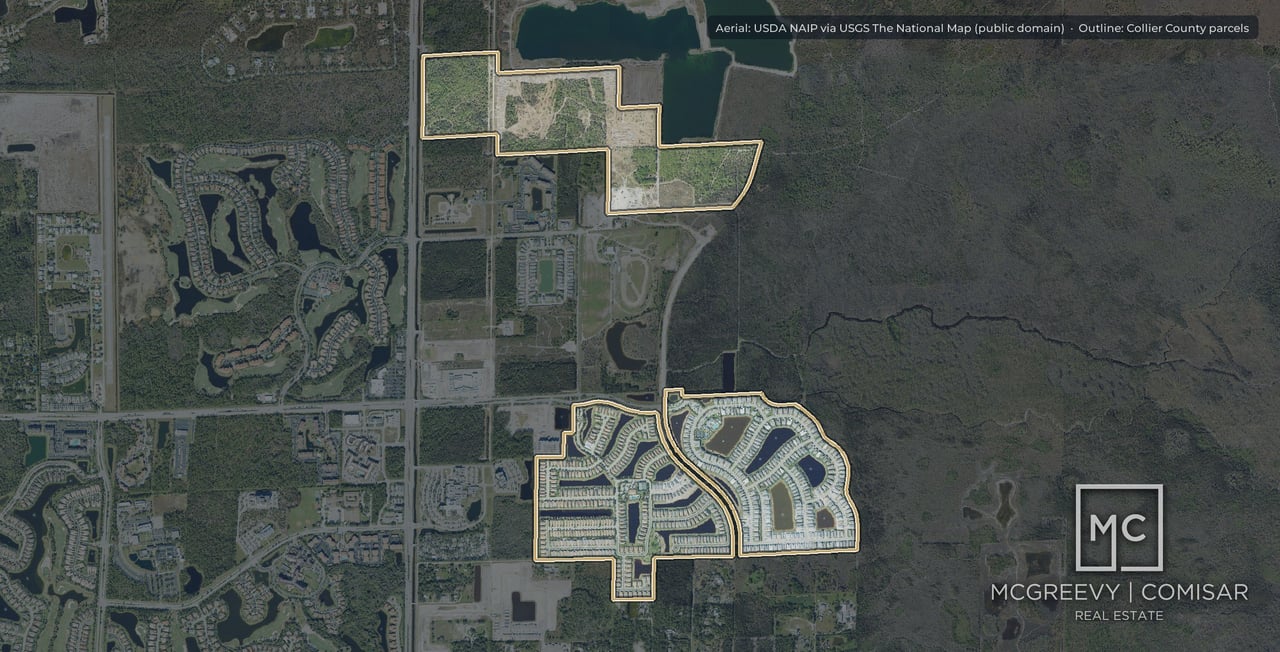
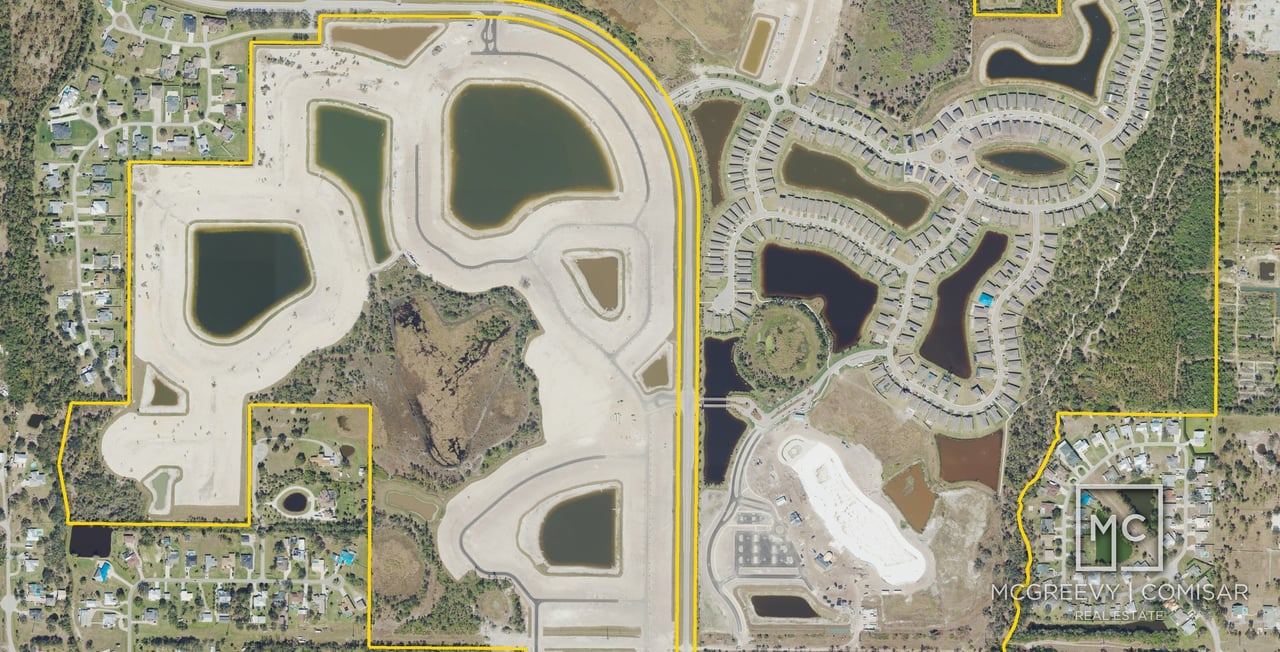
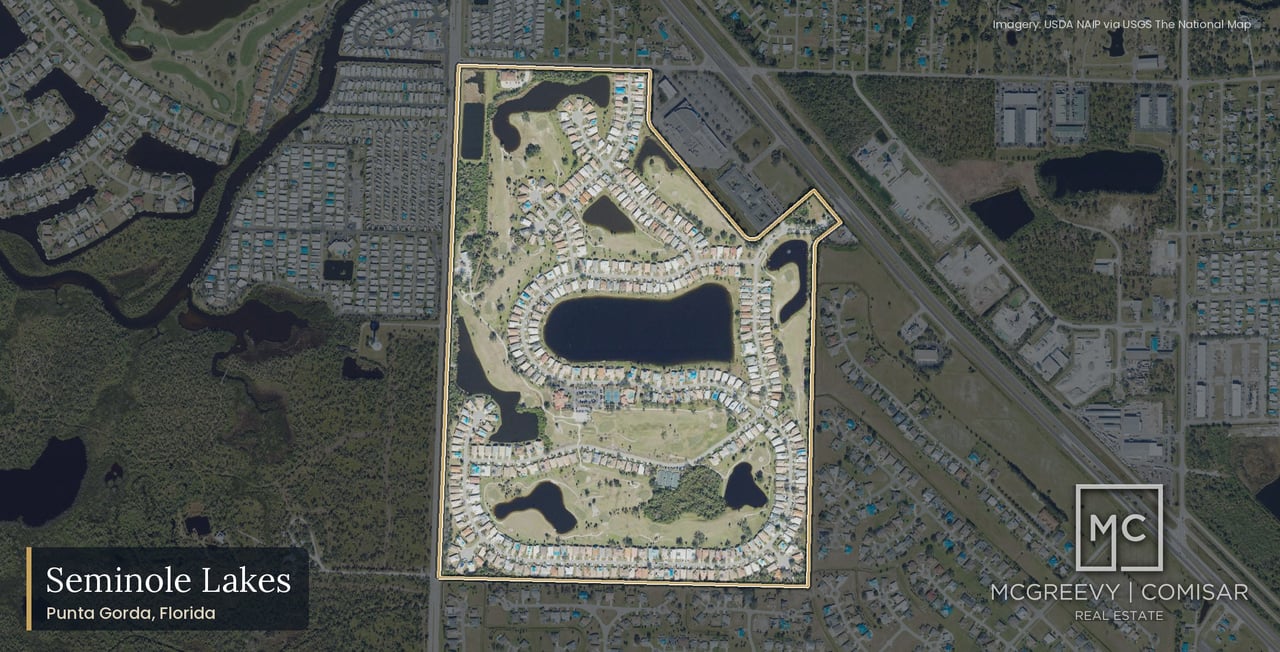
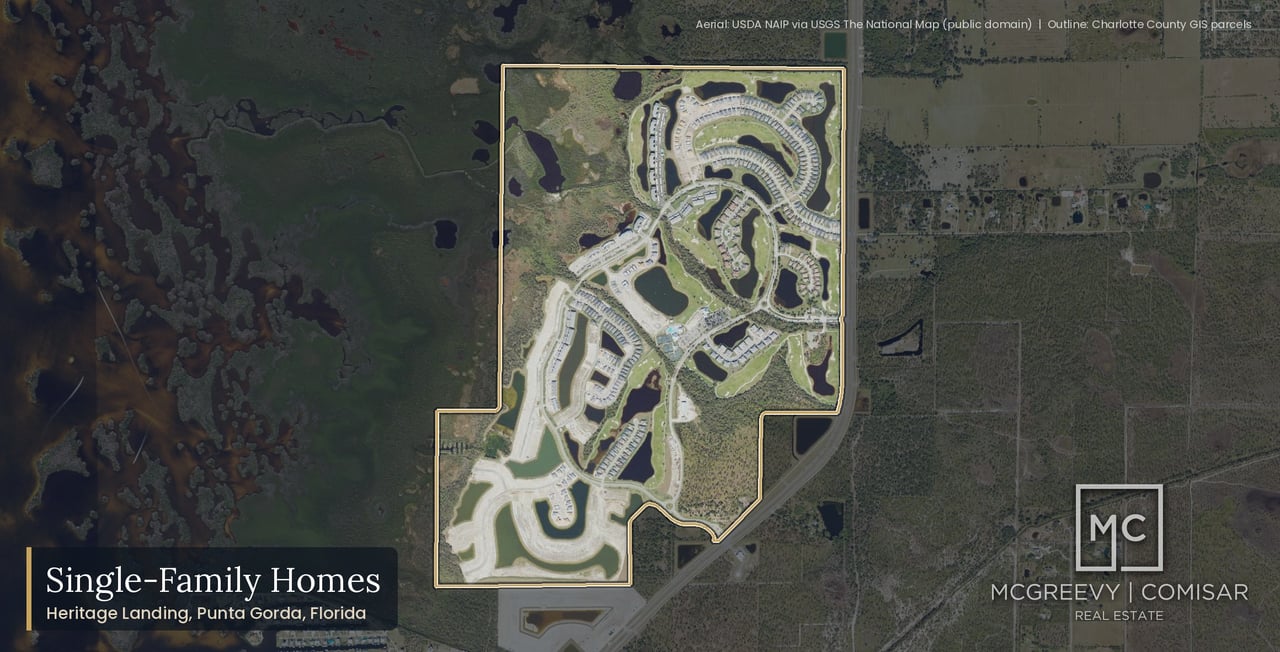
Terreno at a glance. 686 platted single-family homesites on 325.767 acres across four recorded plat phases in unincorporated Collier County, Naples FL 34120, developed by Pulte Home Company, LLC and marketed under the DiVosta brand, with one homeowners association, one community development district, one gated entry of record and one amenity campus, per the Terreno CDD First Supplemental Engineer’s Report (J.R. Evans Engineering, P.A., presented to the district board 2025-01-31) and the adopted Terreno CDD Final Budget FY2026/2027 (adopted 2026-08-10), against a median build year of 2024 and 350 of 686 homes complete on the 2026 preliminary Collier County tax roll (files dated 2026-08-29 and 2026-08-31).
McGreevy and Comisar, Domain Realty. Jesse McGreevy and Marc Comisar sell homes across Naples and Collier County, Florida, and lead Domain Realty Group, the #1 real estate team in Southwest Florida since 2012 and Top 1% Nationally since 2008: sellers, call Jesse at (239) 898-6072 or start with a free Terreno home valuation; buyers, call Marc at (239) 287-5873 or start with our Naples buyer guide.
What should you know about Terreno before you buy or sell?
Terreno is a 686 homesite DiVosta community on 325.767 acres in unincorporated Collier County, Naples 34120, platted in four phases and still building. Terreno carries a Community Development District assessment, sits outside the Valencia golf club next door with no golf rights of any kind, and recorded 55 closings in the year to 17 September 2026.
- 686 platted single-family homesites, and the count reconciles across three independent records. The Terreno CDD First Supplemental Engineer’s Report (J.R. Evans Engineering, P.A., presented to the district board 2025-01-31) and the adopted Terreno CDD Final Budget FY2026/2027 (adopted 2026-08-10) both carry 686, as 179 plus 186 plus 140 plus 181 across the four plat phases. Collier County’s live address-point layer types 400 single family plus 286 vacant land, which is 686. The 2026 preliminary Collier County tax roll (files dated 2026-08-29 and 2026-08-31) gives 350 built plus 150 vacant residential plus 186 unclassified acreage, which is 686 again, and the 724 parcel figure is parcels rather than homes: 686 residential lots plus 17 lake, 16 recreation, 4 right-of-way and 1 amenity tract. The 685 in the Master Special Assessment Methodology Report dated 2022-07-11 is the July 2022 plan, and the change was one lot added to the 52 foot line.
- The CDD costs $2,254.12 to $2,467.20 per unit per year in fiscal year 2026/2027, adopted 2026-08-10, as one line in the non-ad-valorem section of the Collier County tax bill. The amount is set by homesite width (42, 52 or 66 feet) and by assessment area: Series 2023 lots (Phase 1, 328 units) amortise through FY2053, Series 2025 lots (Phases 2 to 4, 358 units) through FY2055. The total has moved by about a dollar across four consecutive adopted budgets, from $2,255.04 in FY2023/24 to $2,254.12 in FY2026/27 on a 42 foot lot in the 2023 area. No competing page mentions that a second assessment area exists, and a seller quoting the wrong figure has created a contract problem.
- Terreno owners have no golf rights at the course next door, and a view is not access and access is not membership. The Golf Course Operations Easement Agreement, Instrument 6170303, OR 6052/2150, recorded 2021-12-07, at paragraph 19, denies rights of membership, right of access, and even a visual or sight easement, in capitals in the original. Terreno’s own Declaration, OR 6098/2178, recorded 2022-03-17, section 2.3, calls the neighbour the owner of the Valencia Golf Course, which is not part of the Community. All five easements in that agreement run from Terreno to the course and never the reverse, and a Clerk index sweep across five party names and six document types, 2000 to 2026, returned no instrument creating any Terreno golf right. Four Valencia holes touch Terreno, holes 11, 13, 14 and 18, named on the four recorded Play Easement Area sheets at Exhibit D to OR 6052/2150, pages 2176 to 2179, prepared by J.R. Evans Engineering and dated 2021-01-08; hole 14 is a 10.56 acre enclave carved out of the middle of the Phase 1 plat and labelled NOT PART OF THIS PLAT on Plat Book 71, Page 70, Sheet 28 of 28, and roughly 30 to 37 lots of 686, about 5 percent, back onto it. Phase 1 lots 151 to 161 do not: Tract L-4, a lake tract, sits wholly between them and the enclave, so those homes look at water, and no golf view claim survives for them.
- Not one of Terreno’s 686 residential and vacant-residential address points sits in a Special Flood Hazard Area on the currently effective federal map. FEMA Letter of Map Revision Case No. 25-04-3166P, issued 2026-01-30, became effective 2026-06-18; 678 of the 686 points are Zone X, area of minimal flood hazard, and the remaining 8 are shaded Zone X, tested point by point against FEMA’s National Flood Hazard Layer on 2026-09-15. Before that revision, 161 points sat in Zone AH. The same revision added Zone AE with published base flood elevations of 13.7 to 15.0 feet NAVD88 over the new lakes and water management tracts, so the homes came out of the hazard area and the stormwater tracts went in. A printed FIRMette pulled off the older panel still shows the pre-revision picture.
- 2.62 months of supply, as of 17 September 2026. Twelve active listings against 55 closings in the trailing twelve months, with four more pending, per the Southwest Florida MLS (Matrix), pulled 2026-09-17. Active listings sit at a median list price of $610,350 and a median 86.5 days on market against 42 days for the closings, which is what a market looks like when the builder’s finished inventory and the resale inventory are competing for the same buyer.
- Median build year 2024, and Terreno is roughly half built. The first 64 homes reached year built 2023; 350 of 686 homes were complete on the 2026 preliminary Collier County tax roll (files dated 2026-08-29 and 2026-08-31); the Phase 4 plat was recorded 2025-07-28 at Plat Book 76, Pages 79 to 87; and every structure on the amenity campus parcel, folio 76715004927, carries year built 2025. The community has not turned over: the campus and fifteen of sixteen recreation tracts are still titled to Pulte Home Company, LLC, and all five CDD supervisors and all three HOA officers publish developer addresses, per the HOA’s 2026 annual report filed 2026-03-06.
- All 517 Terreno addresses in the district’s own address-level record return the same three schools, and one of them graded B. Corkscrew Elementary, Corkscrew Middle and Palmetto Ridge High, uniform north end to south end, queried against the Collier County Public Schools address-search record for boundary year 2027 (school year 2026-2027) on 2026-09-17, with the locator’s boundary-modification flag reading no proposal pending. Grades in SY 2025-2026, per the CCPS 2026 Accountability Brief, Table 4: Corkscrew Elementary A, Corkscrew Middle A, Palmetto Ridge High B, down from A. Homes a few hundred feet south across Randall Boulevard are zoned to Bear Creek Elementary, Cypress Palm Middle and Gulf Coast High, and Gulf Coast has graded A every year from SY22 to SY26. A buyer who wants the A high school does not get it by buying in Terreno.
- Both of Terreno’s frontage roads are already at level of service F in Collier County’s adopted 2025 AUIR. Oil Well Road (CR 858) from Immokalee Road to Everglades Boulevard, the link Terreno’s main gate opens onto, runs at 110.1 percent of adopted capacity on a four-lane divided section, and the AUIR’s own remedy note records that this segment is designated as constrained by policy, which means the adopted answer is monitoring and relief elsewhere rather than more lanes. Randall Boulevard on the same span, facing Terreno’s south frontage, runs at 128.6 percent on a two-lane undivided road carrying roughly 16,500 vehicles a day (Collier County Transportation Operations counts, 16,676 in Q1 2025 and 16,238 in Q3 2025). The congestion is directional: Oil Well Road east of Ave Maria Boulevard runs at 47.0 percent and level of service B.
Why McGreevy and Comisar Are the Best Realtor for Terreno
If you are searching for the best realtor for Terreno, whether you are ready to sell your Terreno home or buy your next one, McGreevy and Comisar is the team that delivers. We lead Domain Realty Group, the #1 real estate team in Southwest Florida since 2012, Top 1% Nationally since 2008, with over $2.5 billion sold as a team and $900 million in personal sales between Jesse and Marc. Since 2008, our team has closed sales across every price band in Naples and Collier County, from first purchases in the Estates corridor to waterfront estates on the coast, and the discipline is the same in all of them: read the record before you price the house. For how we measure up against other agents in the market, see our guide to the best real estate agents in Naples.
Recent Terreno track record (last 12 months): 55 closed homes, $36,836,385 in closed volume, median days on market 42, median sale-to-list 95.86 percent, highest sold $1,140,000 at 2031 Don Benito Way on 2026-01-30, fastest sold 3 days at 1821 Verada Court on 2025-09-30. Source: Southwest Florida MLS (Matrix), development TERRENO AT VALENCIA, code 14404, closed 09/17/2025 to 09/17/2026, pulled 2026-09-17. These are the community’s numbers, every closing in Terreno, not a selected sample, and in the last 12 months we have read all 55 of those rows one at a time, which is how we know that the spread from $420,000 to $1,140,000 is a homesite-width ladder and an options list rather than a volatile market.
That row-by-row reading is the whole marketing argument for a luxury Terreno seller. A Layton or a Layton Grande on Don Benito Way, Verada Court or Palomar Terrace is a different asset from a Contour on Sierra Court, and it is not sold with the same photographs, the same pricing logic or the same buyer pool. At the top of the community the competition is not another resale, it is the builder’s own finished inventory carrying options and lot premiums that do not survive to the closing figure, which is exactly why list prices in the closed rows sit so far above sold prices. We price a Terreno listing against the builder’s current price list and quick-move-in sheet, not against a brochure range, we document the option spend, the mature landscape and the ARC-approved pool and screen enclosure that a spec home does not have, we order the estoppel certificate at listing rather than at closing, and we open the resale approval clock early, because Declaration section 12.3 requires twenty business days of written notice to the Board before closing. We also tell a buyer’s agent which CDD assessment area the home sits in, to the cent, and what the lot actually backs onto, because we will not sell a golf view to a lake lot.
For sellers, call Jesse McGreevy at (239) 898-6072 or start with a free Terreno home valuation. For buyers, call Marc Comisar at (239) 287-5873 or start with our Naples buyer guide.
What this Terreno guide covers
This Terreno guide documents the community’s platted unit count, its Community Development District assessments, its recorded golf position, its current flood mapping, its schools, its roads and its live market. Every figure on this page carries its source and its date, and where a number is unpublished, this page says so plainly and names the document that holds it.
What is it actually like to live in Terreno?
Terreno is a gated, still building DiVosta community of 686 single family homesites in unincorporated Collier County, where 350 houses stood completed on the 2026 preliminary Collier County tax roll and the median build year is 2024. Daily life here runs on a new amenity campus with a restaurant, eight pickleball courts and a resort pool, against the background noise of a community that is not finished yet.
A brand new community that is still a construction site in places
Terreno’s median build year is 2024. The first 64 homes reached year built 2023, and 350 of the 686 platted homesites carried a completed house on the 2026 preliminary Collier County tax roll (files dated 2026-08-29 and 2026-08-31). The Phase 4 plat was not recorded until 2025-07-28 (Plat Book 76, Pages 79 to 87), and the district’s own board minutes of 2026-04-13 record that thirteen homesites were being replatted. That is the honest texture of daily life here: everything is new, nothing needs a roof or a water heater yet, and there are still builder trucks, model traffic and unfinished lots on the newer streets.
It also means the community has not turned over. The amenity campus parcel, folio 76715004927, and fifteen of the sixteen recreation tracts are still titled to Pulte Home Company, LLC; all five Terreno CDD supervisors and all three HOA officers publish developer addresses, per the association’s 2026 annual report filed 2026-03-06. Architectural review is still the Declarant’s. Under the Architectural Policies and Design Review Guidelines, the Declarant is the conclusive interpreter of the guidelines and retains the right to veto an ARC decision in its sole discretion for as long as it owns any portion of the properties. Practically, the three rules that generate the most violation letters are the requirement that all screen enclosure and front entry aluminium framing be bronze, the prohibition on constructing any wall on a parcel, and the $100 per day fine that runs from the date work commenced if a construction application is filed after work started. Deposits are real money: $500 from the owner, or $1,000 if a pool or spa is going in, plus $500 from the contractor, or $5,000 for a pool or spa, plus a $1,000 non-refundable concrete washout and post-construction inspection deposit.
The amenity campus, and Olive and Thyme on site
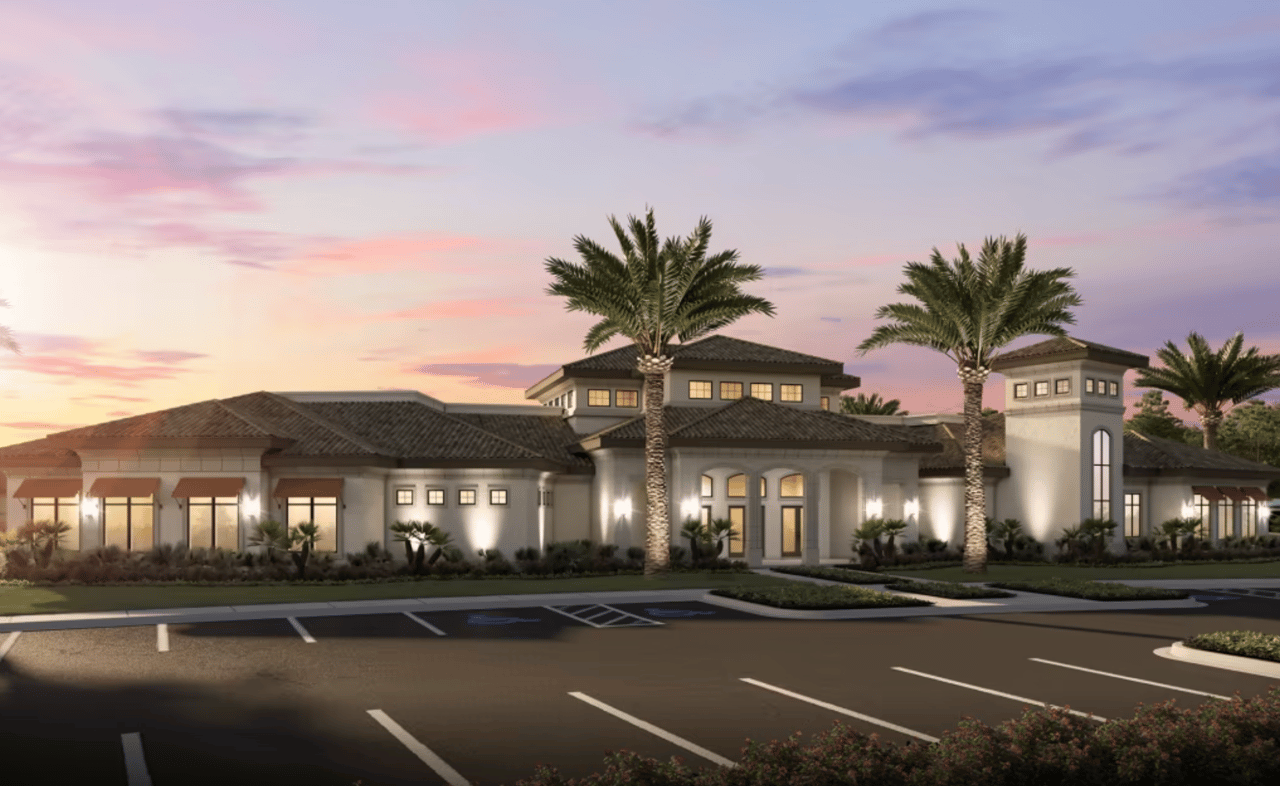
The campus sits at 1934 Don Benito Way on a 5.90 acre parcel, folio 76715004927, and every structure on it carries year built 2025 on the 2026 preliminary Collier County tax roll. The county’s own building record measures the clubhouse at 12,646 square feet of base area, 13,494 adjusted, a 4,938 square foot resort and lap pool, a 113 square foot spa, 11,649 square feet of pool deck, 14,400 square feet of tennis court surfacing and 18,200 square feet of pickleball court surfacing, plus roughly 60,000 square feet of asphalt parking and a 3,445 square foot turf lawn. Those are measurements rather than adjectives, and the court surfacing reconciles exactly with the published counts: 14,400 square feet is precisely two 60 by 120 foot tennis enclosures.
The association’s own Amenity Center Rules and Regulations give the authoritative inventory: resort and lap pool, spa, covered verandah, Olive and Thyme restaurant, outdoor fire pit, 8 pickleball courts, 2 Har-Tru tennis courts, fitness centre, movement studio, grand foyer, gathering room, activity and multi-purpose rooms, HOA office, community room, catering kitchen and a mail pavilion kiosk. Mail is centralised at that kiosk rather than delivered to kerbside boxes. Har-Tru is a crushed stone clay surface, not hard court, which plays slower and is easier on joints, and the builder’s own page says only “2 tennis courts.” Both tennis and pickleball are lit, with timers outside each court gate and all overhead lighting shutting off automatically at 10 p.m. The pool is saltwater and heated to roughly 85 degrees from mid-October to mid-April, the spa is kept near 102 degrees, and there is no lifeguard on duty. Published hours, seven days a week: fitness centre 5 a.m. to 11 p.m., amenity centre 6 a.m. to 10 p.m., pools and spa dawn to dusk, courts sunrise to 10 p.m.
Olive and Thyme is real and it is on site. Three independent official records establish it: the association’s own amenity rules list it, DiVosta describes it as a full service outdoor bar and restaurant, and Collier County’s Notice of Public Hearing for Petition PDI-PL20250006371, heard by the Hearing Examiner at 1:00 p.m. on 2026-05-28, names the “Terreno at Valencia Golf and Country Club Master Amenity Pool Café (folio 76715004927)” in a request to allow one illuminated exterior sign no less than 100 feet from facing residential uses. The written decision on that petition has not been retrieved, so this page does not state it was approved. What is not published anywhere: Olive and Thyme’s hours, its menu, its season, and whether it serves non-residents. It is a private residents’ facility inside a gated amenity campus, and it is not a restaurant a buyer can go and try before buying. Residents live with one rule worth knowing in advance: no alcoholic beverages may be brought in while the restaurant is open.
Two honest gaps on the campus. DiVosta markets two dog parks in the present tense, but the only recorded instrument that mentions them, OR 6250/956 Recital C, recorded 2023-05-23, says Pulte “reserves the right to construct” them, and the association’s amenity rules, which regulate down to pool float dimensions, contain no dog park rules at all. Pets are also banned from the entire amenity campus and not merely its buildings, service animals excepted. Combined, the honest current answer to where you walk the dog is the community’s sidewalks. And the 2021 launch announcement promised bocce; the delivered inventory has none, the builder’s current page has dropped it, and the county’s building record shows tennis and pickleball surfacing and nothing else of that class.
The campus is a club-style operation rather than a bare HOA. It is managed by Hampton Golf, there is a resident-authenticated ClubhouseOnline amenity portal, a catering kitchen, a restaurant and a named on-site Lifestyle Director with a direct dial, and a resident waiver dated 2023-09-29 covers classes and programmes inside the community. None of that confers any golf right at the course next door. Access runs on key fobs: two are issued by management at purchase, additional fobs are $25.00 each, purchasable by the property owner only, maximum four per household, and homeowners who loan a fob out may have privileges suspended. Guests must be accompanied by a resident from a household in good standing, wear wristbands, and sign a fitness waiver if they are 18 or over. Age rules matter to a buyer with a teenager: children 12 and under are not permitted in the fitness centre at all, 13 to 17 not without a resident, 12 and under are not allowed in the spa, and children 15 and under are not permitted in the pools without an adult resident.
The gate arrangement, and it is more than a gatehouse
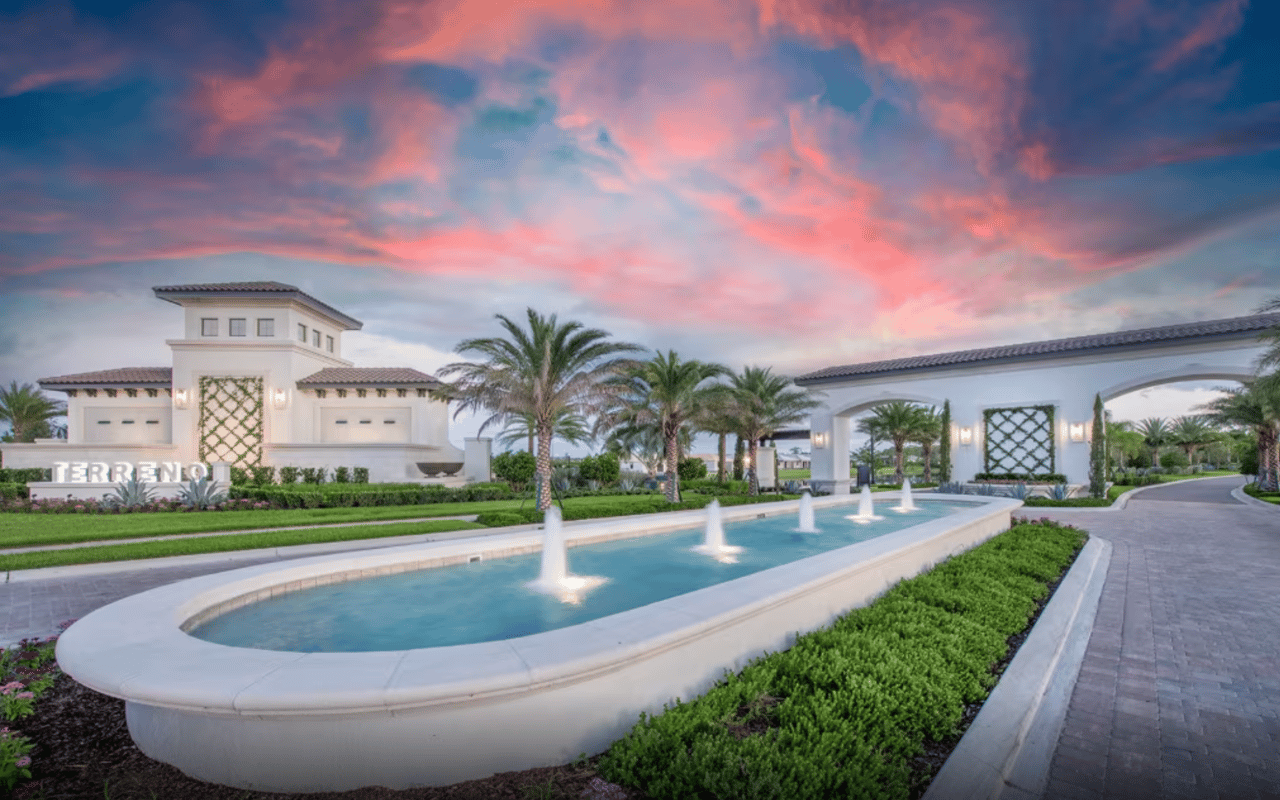
Terreno’s main entry is on Oil Well Road (CR 858), about 1.3 miles east of Immokalee Road, with a second vehicular access point on Randall Boulevard. A 417 square foot gatehouse structure built in 2023 stands at the Oil Well Road end, on parcel 76715001043, the 36.81 acre right-of-way tract at 1690 Terreno Blvd. Residents enter through a dedicated lane read by an RFID windshield sticker that works, in the association’s own words, similar to SunPass; the sticker is non-transferrable and deactivates if bent or removed. Visitors are pre-authorised by the resident through MyEnvera, by web or app, as Permanent, Temporary or One Time, with expected and expiration dates, allowed time windows and per-weekday exclusions, and where veraCode is enabled the visitor receives a QR code by email or phone. Access-control credentials must be submitted by an Authorized Community Contact rather than by the resident, and take up to 48 hours. Envera is the vendor named on the association’s own forms; this page does not assert a staffing model beyond the recorded gatehouse structure.
For a seller, that is an operational fact with money attached. A showing that has not been pre-authorised does not happen, and 48 hours is the published turnaround on credentials. It is a listing-stage task, not a closing-week scramble.
One more thing a Terreno buyer inherits at the entry: Valencia Golf and Country Club traffic drives through Terreno’s Oil Well Road entry and down Terreno Boulevard by perpetual recorded easement over Tract “R”, with the Terreno HOA carrying the maintenance and insurance and Valencia reimbursing its recorded 41.80 percent share under OR 6250/956, recorded 2023-05-23.
The rhythm of the week
Trash and recycling are collected Tuesday and trash only on Friday, per the association’s own General Contact Information sheet, under the Collier County Solid Waste MSBU at $261.91 per residential unit for FY2026 (adopted by the Board of County Commissioners 2025-09-09). Landscaping is contracted to Sunny Grove Landscape, with a resident work-order portal and a separate emergency irrigation line, and the association also posts a 2026 Hurricane Storm Pricing sheet from that contractor, so a storm response schedule is pre-arranged. Electric is Florida Power and Light. Terreno is unincorporated, so law enforcement is the Collier County Sheriff’s Office rather than a city police department, and the municipal millage on these parcels is 0.0000.
Covenants are moderate rather than strict in some places and unusually specific in others. Three pets are allowed with no weight limit and no breed list, only a behaviour standard plus a wolf hybrid exclusion, under Declaration section 9.6, which is comparatively pet-friendly for this market. Leasing is entire units only, minimum thirty consecutive days after the 2022-07-21 amendment at OR 6155/1398 cut it from ninety, maximum three leases in any calendar year. The association cannot block a sale: Declaration section 12.3 says in terms that the Association shall not have the authority to disapprove a proposed conveyance or other transfer. It can disapprove a lease, for enumerated cause. Vehicle rules were amended as recently as 2026-07-29 at OR 6614/2830: overnight street parking is prohibited midnight to 6 a.m. without prior written permission, garage doors must be kept closed and expressly may not be left open for a party or while playing a television or radio, motorcycles must be muffled and garaged when not in use, and RVs, boats, trailers and commercial vehicles must be inside a garage. Golf carts are permitted, with registration, proof of insurance carrying at least $300,000 of liability, annual renewal and overnight garaging required; where they may lawfully be driven beyond the internal streets is not established, and this page will not guess.
The rural fringe setting, and what is durable about it
Terreno sits at the built edge of Golden Gate Estates. The land immediately west, south and much of the east is Estates-zoned at an average of 2.25 acres per lot, and the county’s own Growth Management Plan says expansion of the Estates designation shall be discouraged. That collar is genuinely durable, because it is a platted 1960s subdivision with thousands of separate owners, which is the hardest kind of land on earth to assemble. Three Conservation Collier preserves nearby are permanent: Camp Keais Strand at 32.50 acres, Brewer’s Landing at 14.78 and Hendrix House at 17.66, per the 2025 AUIR.
What is changing is the corridor, not the collar. The land immediately north across Oil Well Road is not farmland and has not been for twenty years: it is the 616 acre Orange Blossom Ranch MPUD, entitled for 2,350 dwelling units and 200,000 square feet of commercial, currently adding 400 apartments and a Publix-anchored centre. Roughly 12,900 further dwelling units are already approved by county resolution east and north along Oil Well Road and Immokalee Road, including Rivergrass Village at 2,500 units (Resolution 2020-24), Bellmar Village at 2,750 (Resolution 2021-120), Brightshore Village at 2,000 (Resolution 2022-209), Longwater Village at 2,427 (Resolution 2023-127) and Horse Trials Village at 3,205 (Resolution 25-287). Petition PL20240004018, advertised in 2024 and heard for adoption 2025-01-16, would eliminate the cap on the size of a Town in the Rural Lands Stewardship Area east of here; the adopted ordinance number has not been retrieved, so the finding currently rests on the advertised text. The county is building a 5 MGD regional water plant on Oil Well Road expandable to 15 MGD, sized for all of it. A buyer who wants the country to stay country should understand they are buying the last built edge of it, not the middle.
The practical day to day is mixed. A 48,387 square foot Publix with a pharmacy and a liquor store opened directly across Oil Well Road on 2025-11-20, 1.1 road miles by the gate, and Big Corkscrew Island Regional Park is 2.6 road miles away. Downtown Naples, by contrast, is 24.3 road miles and about 38 free-flow modelled minutes from the Terreno Boulevard gate at Oil Well Road, measured by OSRM over OpenStreetMap on 2026-09-17, and every minute figure on this page is a free-flow floor rather than a typical drive. The Gulf is 16.6 to 17.7 road miles. The nearest sit-down dinner is Ave Maria, 12.6 road miles and about 21 free-flow minutes east, which is the uncongested direction.
Who Terreno suits, and who it does not
It suits a buyer who wants a 2023 to 2025 house rather than a 2007 one, with whole-house impact-rated glass, a tile roof and steel-reinforced concrete block on the builder’s included list rather than an upgrade sheet; a buyer who will actually use eight pickleball courts, two Har-Tru tennis courts, a 4,938 square foot saltwater resort pool and a lifestyle calendar; a family that wants all three assigned schools within about a mile on one road; a dog owner who wants three pets with no weight limit; and anyone whose commute and errands run east toward Ave Maria rather than west toward Immokalee Road.
It does not suit a buyer who wants golf, because there is none here and none next door for Terreno owners. It does not suit a buyer who drives west into Naples twice a day, because both frontage roads are already at level of service F and the Oil Well Road link is designated as constrained by policy. It does not suit a buyer who needs walkability, because whether a continuous sidewalk connects Terreno to the school strip or the bus stops is not established, and this page says short drive rather than walk. It does not suit a buyer shopping on HOA dues alone, because the CDD adds $2,254.12 to $2,467.20 per unit per year that appears in no millage table and the community next door carries none. It does not suit a buyer who wants an established, resident-controlled association today, because Pulte still controls the HOA, the CDD and architectural review, five recorded amendments were each executed by the Developer alone, and one of them at OR 6324/365 has not been published by the association and its subject is unknown. And it does not suit anyone who needs proof of hurricane performance at this address, because no completed Terreno home has yet experienced anything stronger than tropical storm force conditions, and that cannot be fixed by a brochure.
What do homes sell for in Terreno right now?
The Southwest Florida MLS (Matrix) records 55 closed sales in Terreno in the twelve months to 17 September 2026, at a median sale price of $640,000 and a mean of $669,752, ranging from $420,000 to $1,140,000. Median living area on those closings was 2,088 square feet, giving a median of $311.91 per square foot of living area, which is the MLS measure. The median sale-to-list ratio was 95.86 percent, and the median days on market was 42, computed across the 49 of 55 rows that carry a days-on-market value; six rows carry no value at all, which is the shape a builder closing takes.
Data updated: September 2026 Days on market on those 49 rows ranged from 3 to 211. Against that, 12 active listings at a median list price of $610,350, and 4 pending. Twelve active listings against 55 closings in twelve months is 2.62 months of supply. The query was development TERRENO AT VALENCIA, the only Terreno entry in the MLS dictionary, closed window 09/17/2025 to 09/17/2026, pulled 2026-09-17.
A share of those 55 closings are builder transactions, so this is an absorption market as well as a resale market, and the two must not be read as one thing. DiVosta was still delivering new homes here through 2025 and is still building on the newer phases. The builder closings are visible in the raw rows in two ways: six rows carry no days-on-market value at all, and many rows show a list price well above the sold price, because the builder’s list carries options and lot premiums that do not survive to the closing figure. That is a price list meeting a contract, not a volatile market, and it is the single most common way a Terreno seller or a Terreno appraisal gets misread. Two of the 55 rows carry a blank city field, MLS 2026026744 at 2147 Freemont Way (sold 2026-06-17) and MLS 226004639 at 1908 Sierra Ct (sold 2026-01-28); both sit on Terreno streets and both carry the same development and area codes, so they are kept. Excluding them moves the median by $5,000, to $645,000, which changes no claim on this page.
Closings were spread evenly rather than clustered: September 2025 four, October four, November two, December nine, January 2026 five, February nine, March three, April three, May seven, June five, July two, August two.
Separately, and on a different record with a different denominator: Collier County recorded deeds, gated to qualified improved single-family transfers, show 57 transfers in Terreno in the twelve months to 31 August 2026 at a median of $665,000, or $257.12 per square foot of total adjusted area, which is the county’s area-under-roof measure, with a median total adjusted area of 2,585 square feet across the 350 built homes (offline copy of the Collier County tax roll, 2026 preliminary, files dated 2026-08-29 and 2026-08-31).
Why those two per-square-foot figures are not comparable, and why this page never restates one against the other. They are computed on different denominators by different record keepers for different purposes. The MLS measures living area, which is conditioned space. The county measures total adjusted area, which is area under roof and includes garage, lanai and covered entry at adjusted rates, and on the same houses it runs roughly 19 to 24 percent larger. The county also counts only qualified improved transfers over a window ending 31 August 2026, while the MLS counts every closing reported by a member through 17 September 2026, which is why the counts differ by two. Each figure is internally consistent on its own record. Setting them side by side as rival estimates of the same thing produces a false conclusion, and any page that does it is telling you it did not read either record.
The price ladder by collection
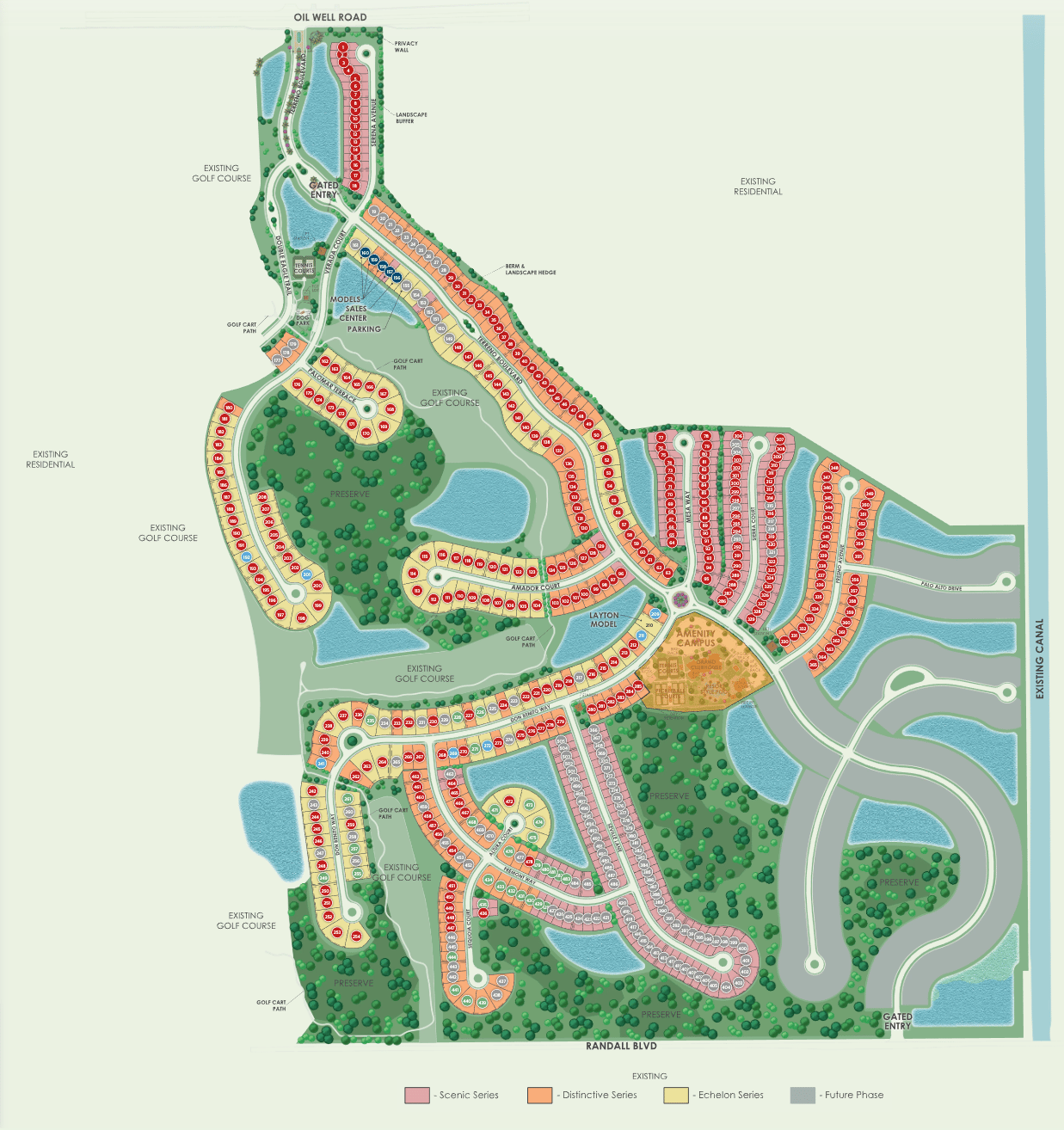
Terreno has no sub-villages, no enclaves and no separately branded neighbourhoods. What it has instead is a homesite-width product ladder, and it is laid out street by street, which is the structure a buyer actually navigates. The Terreno CDD’s assessment methodology independently names exactly three product widths, SF 42 foot, SF 52 foot and SF 66 foot, and assesses them at three different rates, and DiVosta describes three series of homesite sizes. The pairing of a named series to a specific width is an inference drawn from those two facts plus the measured lot and house sizes by street; no single document states it in those words, and the plat lot-dimension tables would settle it.
Scenic | 42 feet (inferred) | 227 | Contour $400,990 · Flagstone $420,990 · Hallmark $420,990 · Trailside $501,990 | Sierra Court, Mesa Lane, Serena Avenue | The bottom of the closed range. Sierra Court and Mesa Lane rows run $420,000 to $580,000 on 1,391 to 1,655 square feet |
Distinctive | 52 feet (inferred) | 261 | Mystique $516,990 · Prestige $521,990 · Concord $579,990 · Whitestone $603,990 | Fresno Avenue, Freemont Way, the Phase 1 stretch of Terreno Boulevard, Sequoia Court | The middle. Freemont Way and Terreno Boulevard rows cluster $540,000 to $755,000 on roughly 1,889 to 2,139 square feet |
Echelon | 66 feet (inferred) | 198 | Stardom $620,990 · Stellar $665,990 · Renown $696,990 · Layton $785,990 · Layton Grande $985,990 | Palomar Terrace, Verada Court, Don Benito Way, Amador Court | The top. Don Benito Way, Verada Court and Palomar Terrace carry every closing above $800,000, up to $1,140,000 on 4,046 square feet |
Community total | | 686 | 13 plans, published range 1,405 to 3,970 square feet | 18 streets, four plat phases | $420,000 to $1,140,000 |
Sources: plan names, series and base prices from DiVosta’s own community pages, read 2026-09-15, and prices on a builder’s site move, so date any quote you take from them. Unit counts by width from the Terreno CDD’s Master and Supplemental Assessment Methodology Reports. Street clustering from the 55 closed MLS rows pulled 2026-09-17, corroborated by the built-plan match across 350 built homes on the 2026 preliminary Collier County tax roll.
Base price is not asking price, and that gap is the most useful thing a Terreno seller can be shown. From DiVosta’s own quick-move-in sheet read 2026-09-15: a Contour with a base price of $400,990 was listed at $530,000 on Seville Lane, a Whitestone with a $603,990 base was listed at $715,990, and a Layton with a $785,990 base was listed at $1,143,500 and $1,159,750 on Don Benito Way. A buyer comparing a Terreno resale to a “from the $400s” headline is comparing it to a number no finished house in this community has ever sold for.
The county’s own land assessments corroborate the ladder from a completely different direction. Median land just value by street on built single-family parcels runs from $131,434 on Palomar Terrace and $124,044 on Amador Court down to $92,272 on Sierra Court, a gap of $39,162 between the top and bottom medians, with 52 distinct land values across the 59 built lots on the Phase 1 stretch of Terreno Boulevard alone, a spread of $55,929 inside one street (2026 preliminary Collier County tax roll, files dated 2026-08-29 and 2026-08-31). Land just value is an assessment rather than a paid lot premium, so treat it as the best available public proxy for the premium structure and not as the premium itself.
One more thing that moves price and is visible only in the geometry: 299 of 686 lots, 44 percent, sit within 30 feet of a platted lake tract, and 328, 48 percent, within 60 feet, measured from the county parcel polygons dated 2026-08-29. Palo Alto Drive, Rosello Way, Serena Avenue and Altura Court are 100 percent lake-adjacent; Palomar Terrace, Sequoia Court and the Phase 1 stretch of Verada Court have no lake adjacency at all. That is a proximity measurement rather than a marketing water-view claim, and the two are not the same thing.
Selling in Terreno this year? Call Jesse McGreevy at (239) 898-6072 or start with a free Terreno home valuation. Buying? Call Marc Comisar at (239) 287-5873 or start with our Naples buyer guide.
Who built Terreno, and when?
Terreno was built by Pulte Home Company, LLC, a Michigan limited liability company selling under the DiVosta brand, on land Pulte acquired in December 2021. Terreno launched on 8 December 2021, recorded its first plat in Plat Book 71, and has 350 of 686 homesites finished, with a median build year of 2024.
The title holder of record is Pulte, not DiVosta
DiVosta is a marketing brand. It is not the contracting entity, it is not the entity that signed the plats, and it is not the name a buyer or seller will find on a Terreno title commitment.
The entity of record is Pulte Home Company, LLC, a Michigan limited liability company, Florida document M17000000044, FEI 38-1545089, a foreign LLC filed in Florida on 2017-01-03 and ACTIVE, last event an LC amendment on 2017-11-09. Its principal and mailing address is 3350 Peachtree Road Northeast, Suite 1500, Atlanta, Georgia 30326, changed 2025-03-21. Its registered agent is Corporation Service Company, 1201 Hays Street, Tallahassee. Its manager and president is Todd N. Sheldon, and its assistant secretaries sit at 24311 Walden Center Drive, Suite 300, Bonita Springs, Florida 34134, the Southwest Florida division office. All of this is from the Florida Division of Corporations record, verified for this page.
Two recorded instruments executed by the entity itself corroborate it. The Phase 4 plat dedication reads “PULTE HOME COMPANY, LLC, A MICHIGAN LIMITED LIABILITY COMPANY, THE OWNER OF THE LAND HEREIN DESCRIBED”, and the December 2022 amendment to the declaration describes the same entity “as successor by conversion of PULTE HOME CORPORATION, a Michigan corporation.”
By contrast, DIVOSTA HOMES, L.P. is a separate, still-active Delaware limited partnership, Florida document B03000000419, whose general partner is DiVosta Homes Holdings, LLC, document M03000004091. It does not appear on the Terreno plat dedication. Every instrument in this community, the district petition, the plat dedications, the acquisition agreements, the South Florida Water Management District permit and the common-area title on the county roll, names Pulte Home Company, LLC.
One caution worth stating because it will confuse anyone reading the entitlement file: Collier County Ordinance 2022-22, adopted 2022-06-14, recites “a Florida limited liability company.” That single recital is the outlier against the Florida corporate record and two recorded instruments. Treat it as a drafting error in the ordinance, not as a statement of corporate fact.
The plats were signed by Michael Hueniken, Vice-President of Land Planning and Development, the same person named as one of the five initial Terreno Community Development District supervisors in Ordinance 2022-22 and as the applicant contact on South Florida Water Management District environmental resource permit 11-105861-P.
The developer chain, and the one link that is not yet provable
Recital A of the Golf Course Operations Easement Agreement, Instrument 6170303, OR Book 6052, Page 2150, e-recorded 2021-12-07, records that the Bollt land trust conveyed the Terreno land to Pulte “immediately prior hereto”, that is, on or about 2021-12-07.
Roberto Bollt is the applicant of record on the parent Orangetree water management permit family 11-00418-S, covering Valencia Lakes Phase 6-A and 7-B in 2004, Valencia at Orangetree Sub-Basin 4 in 2013, Valencia Golf and Country Club Phase 3 in 2014 and Publix Orangetree in 2015, and the Roberto Bollt Land Trust still holds three of the four golf-course parcels next door, 61.96 of 62.92 acres, on the 2026 preliminary Collier County tax roll.
That is as far as the record goes, and this page will not go further. The purchase price, the exact selling entity and the number of dwelling units assigned to Terreno out of the parent PUD are not established and are not asserted here. The instruments that would settle the last of those three are named in the title review on the Phase 4 plat: an Assignment of Density Rights at OR 6052/2209 and an Assignment of Benefits and Entitlements at OR 6052/2235. Neither has been read for this page. Both are public records at the Collier County Clerk of the Circuit Court, retrievable by book and page.
The launch, dated
DiVosta publicly announced Terreno on 2021-12-08, describing 685 homes on about 320 acres priced from the upper $300,000s to $1 million, with Richard McCormick, area president for PulteGroup’s Florida divisions, on the announcement. The 685 and the 320 are both launch-era figures. The community as platted is 686 homesites on 325.767 acres, and the reconciliation of those numbers is set out in the next section.
The sales office and model are at 1729 Terreno Boulevard, Naples, Florida 34120, open Monday to Saturday 10:00 to 18:00 and Sunday 12:00 to 18:00 as published on the builder’s own site, read 2026-09-15.
The build years, from the county roll
Across the 350 completed homes on an offline copy of the Collier County 2026 preliminary tax roll, files dated 2026-08-29 and 2026-08-31, the year-built distribution is:
2023 | 64 |
2024 | 147 |
2025 | 139 |
Median year built | 2024 |
2023 is the earliest year built anywhere on the roll inside Terreno. There is no older housing stock here, no infill, and no pre-existing subdivision folded into the community. Every roof in Terreno was built to the Florida Building Code edition in force from 2023 onward.
The amenity campus follows the same pattern: every structure on folio 76715004927 carries a year built of 2025, so the clubhouse, pools and courts were finished after roughly two-thirds of the homes were already occupied. The only earlier non-residential structure of record is the 417 square foot gatehouse built in 2023 on parcel 76715001043 at 1690 Terreno Boulevard.
The phases as they were actually built
Terreno was designed as three phases and built as four. The First Supplemental Engineer’s Report says so in its own words: “When the Master Engineers Report was created, the Terreno development was initially expected to be completed in three phases. However, it is now planned to be developed in four phases.”
Phase 1 | 179 (Lots 1 to 179) | Plat Book 71, Pages 43 to 70 | not in hand | 2022 era |
Phase 2 | 186 (Lots 180 to 365) | Plat Book 74, Pages 1 to 10 | 6475366 | 2023-11-09 |
Phase 3 | 140 (Lots 366 to 505) | Plat Book 75, Pages 65 to 71 | 6611446 | 2024-11-13 |
Phase 4 | 181 (Lots 506 to 686) | Plat Book 76, Pages 79 to 87 | 6711006 | 2025-07-28 |
| 686 | | | |
Phases 2, 3 and 4 are replats of the large “F” future-development tracts laid out on the Phase 1 plat, which is why Phase 1 carries 225 of the community’s 325 acres and 212 of its 724 roll parcels while containing only 179 of the homesites.
A warning that saves a contract. Four different phase-numbering systems are in use at Terreno at once, and confusing them is a silent, expensive error. There are the plat phases 1 to 4 above. There are the Master Engineer’s Report construction phases I to III, at 208, 216 and 261 lots. There are the bond assessment areas, where “Phase 1” means the 328-lot Series 2023 area and “Phase 2” means the 358-lot Series 2025 area. And there are the utility construction sub-phases the district’s minutes use, such as “Phase 3A”. A buyer who hears “Phase 1” from the district and “Phase 1” from the plat is hearing two different footprints.
What is still selling
Terreno is an active absorption market, not a resale market, and the record shows it plainly.
- 350 homes are built. The roll also carries 150 vacant residential parcels and 186 parcels coded acreage not classified, which are platted homesites that have not yet been recoded to a residential use class. That is 336 lots between the builder and buildout, on the 2026 preliminary roll.
- Thirteen homesites were being replatted as of the district board minutes of 2026-04-13, with budget adjustments and assessment true-ups to follow.
- Buildout is targeted for 2026. The First Supplemental Engineer’s Report anticipates buildout “finalized in 2026.”
- The builder’s menu is still open. DiVosta publishes thirteen floor plans across three series, nine of them single storey and four two storey, from 1,405 to 3,970 square feet, with base prices from $400,990 to $985,990, read 2026-09-15. Prices move, so treat that as a dated snapshot and not as a standing quote.
- Infrastructure is still being handed over. Phase 3A water and sewer was conveyed from the developer to the district in October 2025 under Requisition No. 4 at $1,496,482.02, queued for ultimate conveyance to Collier County. Requisition No. 5, $1,201,687.18, was approved 2025-07-14 for Phase 3 utilities and stormwater and expressly “exceeds the bond funds available and will preserve the right to future reimbursement.” The preserve conveyance was approved in substantial form on 2025-08-11.
Both governing bodies are still developer-controlled, and here is the record that proves it
This is the single most important governance fact for anyone buying or selling in Terreno in 2026, and it is dated from two independent filings.
The association. Terreno Homeowners Association, Inc. filed its 2026 annual report on 2026-03-06. The three officers listed are President Scott Brooks, Vice-President Kimberly Morton and Secretary/Treasurer Luisa Bratcher, all at 24311 Walden Center Drive, Suite 300, Bonita Springs, which is Pulte’s Southwest Florida division office. There are no resident directors on that filing.
The district. The audited financial statements of the Terreno Community Development District for the fiscal year ended 2025-09-30, report dated 2026-05-26, state it flatly: “At September 30, 2025, all of the Board members are affiliated with Pulte Home Company, LLC (‘Developer’).” Four of the five supervisors publish a pultegroup.com or pulte.com correspondence address on the district’s own Contact Us page, updated 2026-04-07. Seats 1, 2 and 5 are up at the landowner election scheduled for 2026-11-09.
The title record agrees. On the 2026 preliminary Collier County tax roll, the amenity campus at folio 76715004927 and fifteen of the sixteen recreation and parkland tracts are still titled to PULTE HOME COMPANY LLC.
The arithmetic of turnover. Under Declaration section 15, owners other than the developer elect a majority of the board three months after 90% of all parcels have been conveyed to owners other than the developer, and the declaration expressly excludes builders from that count. On a 686 denominator, 90% is 617 conveyances. With 350 homes built and 150 vacant residential parcels still on the roll, turnover is plausibly several years out. The developer may also appoint at least one director for as long as it holds for sale at least 5% of the parcels in all phases, and may hand over control early on thirty days’ notice.
One person sits at the top of both bodies. Scott Brooks is president of the association, chairs the district board, and personally executed every located amendment to the declaration. That is normal five years into a build-out, and a buyer should still know it before they sign.
How is Terreno laid out inside the Orange Tree PUD?
Terreno is one gated community of 686 platted single-family homesites on 325.767 acres inside the Orange Tree PUD, recorded in four plat phases, governed by a 1986 settlement-vested land use district, Collier County Ordinance 12-09, and Ordinance 2022-22, which created the Terreno Community Development District in June 2022.
The entitlement runs four layers deep, and each layer is a different document. Most pages about this community describe one of them. Here are all four.
Layer 1: a 1986 lawsuit settlement vested the land
The Collier County Future Land Use Element, as amended by Ordinance No. 2024-46, adopted 2024-11-12, describes the Rural Settlement Area District:
“This District consists of Sections 13, 14, 23, 24, and a portion of 22, Township 48 South, Range 27 East (the former North Golden Gate Subdivision), which was zoned and platted between 1967 and 1970. In settlement of a lawsuit pertaining to the permitted uses of this property, this property has been ‘vested’ for the types of land uses specified in that certain ‘PUD by Settlement’ zoning granted by the County as referenced in that certain SETTLEMENT AND ZONING AGREEMENT dated the 27th day of January, 1986. This Settlement Area is encompassed by the Orangetree PUD and Orange Blossom Ranch PUD.”
The Rural Golden Gate Estates Sub-Element, as amended by Ordinance No. 2024-37, adopted 2024-09-24, section 2.A, adds the numbers and the exclusivity: 2,100 dwelling units and 22 acres of neighbourhood commercial and hotel use are vested, the permitted uses of the district expressly include golf course, and the county states that “The Settlement Area Land Use District is limited to the area described above and shall not be available as a land use district for any other property in the County.”
What that means in plain language. The ground under Terreno is not ordinary Golden Gate Estates zoning. It is a one-of-a-kind land use district that Collier County says outright will never be available anywhere else in the county, created in 1986 to settle a lawsuit. Golf course is a listed permitted use of that district, which is exactly why Valencia’s course sits next door. It is still not a Terreno amenity, and nothing in the district’s language makes it one.
Two honest qualifications. The 2,100 is the 1986 vested baseline, not today’s cap; the growth management plan itself allows units to be added by rezone, and they were, so the two PUDs inside the district now carry 3,150 and 2,350 units. And an open question no competing page has noticed: the Phase 1 plat lies in Sections 24 and 25 of Township 48 South, Range 27 East, and Section 19 of Township 48 South, Range 28 East, while Sections 25-48-27 and 19-48-28 are outside the listed Settlement Area. The Future Land Use designation of those portions is not established from the published record. That is a question, not a defect, and it is stated rather than smoothed over.
Layer 2: the Orangetree PUD ordinance chain
Collier County’s Land Development Code Appendix F, List of PUD Ordinances, July 2021 edition, prints the chain as: ORANGETREE, 87-13 repealed; 91-43 (was Golden Gate City); 04-30 repealed; 04-73 partially repealed; 05-42; 12-09. The companion row reads ORANGE BLOSSOM RANCH, 04-74 (was part of Orangetree); 05-42 with a two-year extension by Resolution 07-352; 16-31; 20-46. Ordinance 04-74 is the instrument that split Orange Blossom Ranch out of Orangetree.
The chain ends at Ordinance 12-09, and that is the operative PUD today.
Layer 3: Ordinance 12-09, the operative PUD
Ordinance 12-09 carries 3,150 dwelling units on approximately 2,138.76 acres. Three independent sources agree: the Collier County PUD Master List, PDF generated 2026-06-11; the Terreno district’s Master Engineer’s Report of 2022-07-11 (“The number of dwelling units proposed to be constructed within the PUD is 3,150 units”); and the Hearing Examiner notice for PDI-PL20220008752 (“THE SUBJECT PUD CONSISTS OF ±2138.76 ACRES AND IS LOCATED AT THE NORTHEAST CORNER OF THE INTERSECTION OF IMMOKALEE ROAD AND RANDALL BOULEVARD”).
The master list’s ORANGE TREE row, as the county prints it: ACTIVE, Ordinance 12-09, date approved 07/26/05, estimated buildout 2019, planning community Rural Estates, Sections 13, 14, 23 and 24 of 48-27, total size 2,136.87 acres, commercial 33.30 acres, commercial 332,000 square feet approved and 73,062 developed, 3,150 total residential units, golf 200.00 acres and 18 holes, conservation 149.80 acres.
A finding worth a sentence of its own: the county’s own master list gives the Orange Tree PUD an estimated buildout of 2019, while the builder was still closing homes inside it in 2025 and replatting homesites in April 2026. The parent PUD is running years past its own estimated buildout date.
Two insubstantial-change petitions on the parent PUD are live or recently decided, and one of them matters to a Terreno sightline. PDI-PL20220008752 would except ground-mounted communication towers from the maximum height of structures and allow them up to 185 feet, heard at the Hearing Examiner on 2024-06-27. PDI-PL20250006371 concerns an illuminated sign at the amenity pool cafe, heard 2026-05-28. Neither written decision has been retrieved for this page, so neither is stated here as approved. Both are public records at the county.
One more thing the record shows: Collier County held an Orange Tree PUD neighbourhood information meeting inside Terreno’s own amenity centre, Monday 2026-02-09 at 5:30 p.m., at “the Terreno at Valencia Golf & Country Club Master Amenity Center, 1934 Don Benito Way.”
Collier County Ordinance No. 2022-22, titled in part “ESTABLISHING THE TERRENO COMMUNITY DEVELOPMENT DISTRICT LOCATED IN UNINCORPORATED COLLIER COUNTY AND CONTAINING APPROXIMATELY 325.767 +/- ACRES,” was passed and duly adopted on 2022-06-14 and became effective 2022-06-17 on filing with the Department of State. The petitioner was Alyssa C. Willson, Esq., of Kutak Rock LLP, on behalf of Pulte Home Company, LLC. The Notice of Establishment is recorded at OR 6145/3536.
The acreage is arithmetically self-checking. Exhibit A to the ordinance describes 336.324 acres more or less, less an excepted parcel of 10.557 acres more or less, and 336.324 less 10.557 is 325.767 exactly. The water management district’s permit-acres field on ERP 11-105861-P reads 325.7, agreeing to within 0.06 of an acre, which is itself the cross-check that the permit belongs to this community. The tax roll’s 324.94 acres across 724 parcels is the sum of platted parcel acreage, which excludes the right-of-way strips withdrawn from the declaration and conveyed to the county in December 2022. Three figures in circulation should not be used: 325.07 is a transposition, 336.324 is the gross before the excepted parcel, and 320 is a press rounding.
The district was consented to two special powers under sections 190.012(2)(a) and (2)(d), Florida Statutes: parks and recreational, cultural and educational facilities, and security including guardhouses, fences, gates, electronic intrusion-detection systems and patrol cars, “provided, however that the District may not exercise any police power.” That consent is why the district could one day own or fund amenities and gate infrastructure. As of the adopted FY2026/2027 budget it does not. The district’s entire maintenance budget is preserves, lake banks, pipes and engineering. The clubhouse, pool, courts and the gate system sit on the association’s side of the ledger.
Section 7 of the ordinance records the petitioner’s commitments: Pulte and its successors shall elect one resident of the district to the five-member board of supervisors at such time as residents begin occupying homes in the district, and shall record a Notice of Assessments immediately after any bond issuance. Residents have occupied homes since 2023, and the FY2025 audit dated 2026-05-26 states that all board members are affiliated with the developer. Whether a resident seat has been seated is not resolvable from the published record. The commitment, the audit sentence and the gap are all stated here together.
The four recorded plats
All four are recorded and all four references are in hand.
Phase 1 | 179 | Lots 1 to 179 | Plat Book 71, Pages 43 to 70 | not in hand | 2022 era | 212 | 225.06 |
Phase 2 | 186 | Lots 180 to 365 | Plat Book 74, Pages 1 to 10 | 6475366 | 2023-11-09 | 191 | 42.80 |
Phase 3 | 140 | Lots 366 to 505 | Plat Book 75, Pages 65 to 71 | 6611446 | 2024-11-13 | 140 | 22.44 |
Phase 4 | 181 | Lots 506 to 686 | Plat Book 76, Pages 79 to 87 | 6711006 | 2025-07-28 | 181 | 34.64 |
Total | 686 | | | | | 724 | 324.94 |
The full legal description on the Phase 1 plat, published here in full because the shorthand is incomplete, reads: “Terreno at Valencia Golf and Country Club, Phase 1, a Subdivision Lying in Sections 24 and 25, Township 48 South, Range 27 East, and Section 19, Township 48 South, Range 28 East, Collier County, Florida.” Terreno crosses a range line. The county roll codes the community to Section 24 only, which is an assessment convention rather than a contradiction.
Phase 4 is a replat, and that explains the parcel arithmetic. Its caption reads “A REPLAT OF ALL OF TRACTS ‘F-6’, ‘F-7’, ‘F-9’, ‘F-10’, ‘F-11’, ‘F-12’, ‘F-13’, ‘F-14’, ‘F-15’ AND A PART OF TRACT ‘T-1’, TERRENO AT VALENCIA GOLF AND COUNTRY CLUB, PHASE 1, PLAT BOOK 71, PAGES 43 THROUGH 70.” Phase 2 likewise replats Tracts F-1 to F-5, F-8, F-16 to F-20, F-30, F-31, T-9, T-6 and part of Tract R. Phase 3 replats Tracts F-21 to F-29.
The unit-count reconciliation no competing page makes
Terreno has 686 residential lots, not 685, not 680, and not 724. Here is the whole reconciliation in one place, from the 2026 preliminary Collier County tax roll.
Single-family homes built | 350 |
Vacant residential lots | 150 |
Platted lots coded acreage not classified, not yet recoded | 186 |
Residential lots | 686 |
Lake tracts (L-1 to L-17), 42.28 acres, titled to the district | 17 |
Recreation and parkland tracts, 110.81 acres | 16 |
Right-of-way tracts, 38.61 acres | 4 |
Amenity campus, 5.90 acres, folio 76715004927 | 1 |
Non-residential tracts | 38 |
Total parcels on the roll | 724 |
The acreage falls out of the same arithmetic. The 38 non-residential tracts account for 197.60 acres of the roll’s 324.94, which leaves roughly 127 acres of residential ground, about 127.34 acres, carrying 686 homesites. That is the number a buyer should hold in their head when they are told this is a 325-acre community: more than half of it is lakes, preserve, recreation tracts and road.
686 is not an inference. It is stated in four independent district documents: the First Supplemental Engineer’s Report by J.R. Evans Engineering, P.A., presented to the district board 2025-01-31, which gives 179 plus 186 plus 140 plus 181; the adopted Final Budget FY2025/2026; the adopted Final Budget FY2026/2027, adopted 2026-08-10; and the Second Supplemental Assessment Methodology Report dated 2025-01-09, which says outright: “When fully developed, it is expected that the District will contain a total of 686 dwelling units.”
Two independent county datasets agree. Collier County’s live Site_Address_Points_b layer, queried 2026-09-15, returns 400 Single Family plus 286 Vacant Land, which is 686. The tax roll returns 350 plus 150 plus 186, which is 686. Different departments, different purposes, same answer.
Why 685 also appears in the record, and why it stays. 685 is the July 2022 plan. It is the figure in the Master Special Assessment Methodology Report dated 2022-07-11 at Table 2, in the Master Engineer’s Report of the same date, in water management permit 11-105861-P, and in the recorded recreation declaration’s 685/1177 cost share. The community moved from 685 to 686 by adding one lot in the 52-foot product line, from 260 to 261. Where a recorded instrument says 685, this page quotes 685 and does not correct the quotation. The 58.20% recreation share is quoted as recorded, for the same reason.
Why 680 appears. It is DiVosta’s own marketing rounding, “over 680 new luxury homes”, read 2026-09-15.
And why one other figure in circulation is struck from this page entirely. A lower count, 51 units below the July 2022 plan, appears in exactly one place in the whole record: the district minutes of 2022-08-29 at page 9, taken at the same meeting that adopted a master assessment methodology stating 685. A number contradicted by the methodology adopted in the same room on the same day is not a unit count, and it is not repeated here.
The roads are private, and the county accepted maintenance of nothing
The Phase 4 plat dedication contains no dedication of streets or rights of way to the public and no maintenance obligation accepted by Collier County for anything. This is what it actually does:
- To Terreno Homeowners Association, Inc.: all drainage easements, with responsibility for maintenance.
- To the Collier County Water-Sewer District: all county utility easements for potable water, non-potable irrigation water and wastewater, expressly “with no responsibility for maintenance of the surface easement area”, with the water and sewer systems themselves to be conveyed to the Board as ex-officio governing board under Ordinance 2004-31, as amended.
- To Collier County: all drainage easements “without responsibility for maintenance.”
- To all licensed or franchised public utilities: a non-exclusive public utility easement, with the note that “ALL PLATTED PUBLIC UTILITY EASEMENTS (P.U.E.) SHALL ALSO BE EASEMENTS FOR THE CONSTRUCTION, INSTALLATION, MAINTENANCE, AND OPERATION OF CABLE TELEVISION SERVICES”, plus a non-exclusive public utilities access easement.
County signature blocks on the plat: Jack McKenna, P.E., County Engineer; Derek D. Perry, Assistant County Attorney; Marcus L. Berman, P.S.M., County Surveyor; Chris Hall, Chairman of the Board of County Commissioners; attest Crystal K. Kinzel, Clerk.
The honest qualification. That dedication block was read directly off the Phase 4 plat sheet. The Phase 1 to 3 dedication blocks were read through secondary recitals in district packets, not off the plat sheets themselves. The Phase 4 evidence is direct and unambiguous, and the structure of the community is consistent with it throughout, but the phrase “all streets are private” is not stated here as verified for all four phases until all four dedication blocks are compared side by side. Those plats are public records at the Clerk.
Who maintains what
Terreno splits maintenance across four bodies, and a buyer calling the wrong one loses a week.
Stormwater management system, pipes, structures | Terreno Community Development District | the district |
The 17 lake tracts, 42.28 acres | the district | the district, with an Agreement for Maintenance of Lakes with the association dated 2023-07-11 |
Preserve | the district | the district, funded at $150,000 a year in the FY2026/2027 budget |
Curb and gutter in Tract “R” | the district area | the association, under the First Amendment to the Agreement for Maintenance of Lakes, February 2025 |
Potable water and sanitary sewer mains | Collier County Water-Sewer District | Collier County Utilities |
Drainage easements on the plat | dedicated | Terreno Homeowners Association, Inc. |
The Shared Roadway, Terreno Boulevard from Oil Well Road to the Double Eagle Trail intersection inside Terreno, part of Tract “R” | Tract “R” of the Phase 1 plat | Terreno Homeowners Association, Inc., with Valencia’s association reimbursing 41.80% under OR 6250/956 |
Tract “T-3”, two tennis courts and a tot lot | Terreno/Valencia Recreation Association, Inc. | the Recreation Association, cost split 685/1177 Terreno to 492/1177 Valencia |
Clubhouse, pools, spa, fitness centre, courts, gate system | developer-titled today, association-operated | Terreno Homeowners Association, Inc. |
The district did not build the amenity campus and does not maintain it. The Master Engineer’s Report is explicit: “The District will not finance the Community Amenity Center.” That matters when a buyer asks what their district assessment actually bought. What it bought is in the same report’s Table 1: gutters and curbing $901,582, drainage $3,335,273, potable water $1,337,669, sanitary sewer $5,321,206 and earthwork and excavation $7,179,632, a total opinion of probable construction cost of $18,075,362 in 2022 dollars, with conservation areas funded by the developer at zero district cost. Spread over 686 homesites that is $26,349 per lot of district-funded public infrastructure, a straight division shown here so it can be checked.
Who governs Terreno, and what are the rules?
Terreno is governed by three layers that all bind a single lot: Terreno Homeowners Association, Inc. under its declaration recorded 17 March 2022, the Terreno Community Development District created in June 2022, and Orange Tree Homeowner’s Association, Inc., the master association whose covenants expressly outrank Terreno’s own.
A fourth body, the Terreno/Valencia Recreation Association, Inc., sits alongside them and owns the shared recreation tract, though its members are the two associations rather than the lot owners.
Read the amendments before you read the declaration
This is the rule that governs everything below. The base declaration at OR 6098/2178 is 130 pages recorded 2022-03-17, and parts of it have been superseded. Anyone quoting the base text without checking the chain is quoting a dead provision.
A1 | INSTR 6286007 | OR 6155/1398 | 2022-07-21 | Adds section 2.8, the Collier County Developer Agreement; rewrites section 12.4 Leasing, cutting the minimum lease from 90 days to 30 days | yes |
A2 | no recording stamp on the published copy | OR 6203/3484, attribution inferred from the plat title review | executed December 2022 | Withdraws Tracts W-1, W-2, Tract V and a 17.00-foot strip off the south right of way of Oil Well Road from the declaration, for conveyance to Collier County as public right of way | yes, as “Amendment - 12-21-22” |
A3 | not published | OR 6324/365 | between December 2022 and October 2024 | Text not obtained. Subject unknown. | no |
A4 | INSTR 6598573 | OR 6403/468 | 2024-10-01 | Rewrites section 9.19, Pools | yes |
A5 | INSTR 6856643 | OR 6614/2830 | 2026-07-29 | Rewrites section 9.7(A) and adds section 9.7(B), Vehicles | yes |
The most recent amendment is A5, recorded 2026-07-29, and it rewrote the vehicle, parking and garage rules. It is roughly six weeks old as of this writing and it post-dates every title review and every resale packet currently in circulation. What it changed is set out under vehicles below.
Two things must be said about this chain rather than glossed.
First, every located amendment was executed by the developer alone under section 14.6, which lets Pulte “in its sole discretion, by an instrument filed of record, unilaterally modify, enlarge, amend, waive or add to the provisions of this Declaration” and provides that “Any amendment made pursuant to this paragraph may be made without notice to the Members.” Not one was adopted by a vote of the members. All five were executed by Scott Brooks and acknowledged in Lee County.
Second, the chain is not closed. The amendment at OR 6324/365 is named in the title review notes on the Phase 4 plat, is of record at the Collier County Clerk, is not published by the association, and its text was not obtained for this page. Its subject matter is unknown. Because of that, this page does not describe Terreno’s covenant set as complete, and any statement about what the amendments did not touch is bounded by an instrument nobody has read. It is retrievable by book and page from the Clerk’s official records, and we will pull it for a client on request.
Layer 1: Orange Tree, the master association that outranks Terreno
Every Terreno owner is automatically a member of Orange Tree Homeowner’s Association, Inc. Declaration section 2.1 provides that each owner becomes a member of the master association and that the membership is “appurtenant to and inseparable from ownership”, and further that “in the event of conflict … the latter shall be superior.” The Orange Tree documents outrank Terreno’s own.
The master instruments are the Declaration of General Protective Covenants and Restrictions of Orange Tree, OR 1310/1536, as amended at OR 4867/2848 and OR 5318/2482, with a Notice of Marketable Title Action at OR 5204/1491, recorded 2015-10-14.
Whether Orange Tree levies a separate master assessment on Terreno lots, and in what amount, is not on the published record. It is not estimated here. The documents that would answer it are the master declaration and its amendments, the Orange Tree association’s own adopted budget, and, for a specific lot, the estoppel certificate, which will also disclose any master-association balance.
Layer 2: Terreno Homeowners Association, Inc.
Terreno Homeowners Association, Inc. is a Florida not-for-profit corporation, document N21000010702, FEI 88-1628644, filed 2021-09-08, ACTIVE. Its principal address is 1975 Terreno Blvd, Naples FL 34120, changed 2026-03-06. Its registered agent has been Hampton Golf, Inc. since 2025-04-24. Annual reports were filed 2022-04-06, 2023-04-10, 2024-01-23, 2025-04-24 and 2026-03-06, with no events and no name history.
Two of those changes read as milestones. The association handed its statutory agency to its management company in April 2025, and in March 2026 its corporate home moved to the finished amenity centre rather than the developer’s office.
The association is managed by Hampton Golf, Inc., with a community manager, a lifestyle director and an administrative assistant on site, an HOA office at 1729 Terreno Blvd, (239) 677-1141, landscaping by Sunnygrove, access control by Envera Systems, and banking through Alliance Association Bank. Roles are published here rather than staff names, because staff change.
Its governing instrument is the declaration at OR 6098/2178, recorded 2022-03-17, 130 pages, plus the five amendments above, plus the recorded articles and bylaws that sit inside that same 130-page instrument.
The district is an independent special district under Chapter 190, Florida Statutes, created by Ordinance 2022-22, effective 2022-06-17, covering approximately 325.767 acres. It owns the 17 lake tracts and the preserve, and it levies non-ad-valorem operations and maintenance and debt assessments collected on the Collier County property tax bill. It levies no ad valorem tax.
Five seats, all currently developer-affiliated, with Seats 1, 2 and 5 up at the landowner election on 2026-11-09. The district manager is Special District Services, Inc., with its statutory records office at 2501A Burns Road, Palm Beach Gardens, Florida 33410, (561) 630-4922, toll-free 877-737-4922, which is the number the Collier County Tax Collector publishes for this district. District counsel is Kutak Rock LLP, the district engineer is J.R. Evans Engineering, the auditor is Grau & Associates, and the district has zero employees. Its fiscal year runs October 1 to September 30.
The district meets inside Terreno’s own amenity centre, second Monday of the month, 9:00 a.m. That is unusually accessible for a Collier County district; many meet in Palm Beach Gardens or Fort Myers. A Terreno owner can walk to their own district’s board meeting, and the August meeting is the budget public hearing.
Layer 4: the shared recreation declaration, and the road easement inside it
The Declaration of Covenants for Terreno/Valencia Recreation Association, Inc. and for Shared Roadway, Instrument 6406840, OR 6250/956, e-recorded 2023-05-23, 23 pages, creates two distinct arrangements with two different obligors, and conflating them is the easiest mistake to make here.
What | Tract “T-3”, Plat Book 71, Page 43 | Terreno Boulevard from Oil Well Road to the Double Eagle Trail intersection inside Terreno, part of Tract “R” |
Owned by | the Recreation Association | Tract “R” of the Phase 1 plat |
Maintained, repaired, replaced, operated and insured by | the Recreation Association | Terreno HOA |
Improvements | “Pulte has constructed two tennis courts and a tot lot. Pulte reserves the right to construct two dog parks and related improvements” | roadway only; recital H excludes landscaping costs |
Cost split | Terreno HOA 685/1177, 58.20%; Valencia HOA 492/1177, 41.80% | Valencia HOA pays Terreno HOA 492/1177 |
Billed | quarterly to the two associations, due January 1, April 1, July 1, October 1 | quarterly to Valencia HOA, same dates |
Recital F is the keystone paragraph: “Terreno HOA and Valencia HOA shall be the Members of the Recreation Association. The owners of lots in Terreno and Valencia Golf and Country Club shall not be Members of the Recreation Association, but shall have use rights to Recreation Area #1.”
The board is four directors, two appointed by each association, one vote each. Terreno pays 58% of the bill and holds 50% of the votes.
Nothing in this instrument is lien-secured against a Terreno lot, and it says so twice. Section 4 provides that Terreno’s share of the Recreation Area #1 costs and any special charges “are not secured by a lien against the real property subjected to the Terreno Declaration”, and section 5 says the same for Valencia’s shared-roadway share. The obligation runs association to association. A Terreno owner’s exposure is indirect: it arrives inside the Terreno HOA assessment, which is lien-secured. Enforcement between the associations is by suspension of use rights, not by lien.
The practical fact no other page carries. Section 7 grants Valencia’s association, its owners, occupants, guests and invitees a perpetual non-exclusive easement for pedestrian and vehicular ingress and egress over the Shared Roadway and the Terreno portion of Double Eagle Trail. Valencia traffic drives through Terreno’s Oil Well Road entry and down Terreno Boulevard by recorded easement. Terreno’s association carries the maintenance and insurance of that road, and Valencia reimburses 41.80%. The instrument is careful that this “shall be deemed to create an easement only and not a conveyance of fee simple title” and is not a dedication to the general public. State it, weigh it, do not spin it.
The instrument runs to its thirtieth anniversary, 2053-05-23, then renews automatically in unlimited ten-year terms. Amending it requires a written agreement executed by all four of Pulte, the Recreation Association, Terreno HOA and Valencia HOA, recorded with deed formalities. Four-party unanimity including the developer makes it far harder to change than the Terreno declaration, which the developer can amend alone.
Architectural control
This is where owners get violation letters. Authority is Article V of the declaration plus the published Architectural Policies and Design Review Guidelines.
During the Declarant Review Period, which runs for as long as the declarant owns any portion of the properties, the declarant has exclusive jurisdiction, is “the conclusive interpreter of these Design Guidelines,” and retains the right to revoke any delegation and to veto any decision in its sole discretion. The architectural review committee is declarant-appointed, three to five persons, and the guidelines provide that “There shall be no surrender of this right prior to the initial construction of the last Unit to be constructed within Terreno” except by a recorded instrument.
The process. A plain Design Review Application with no concrete work and no ground excavation carries no fee. A Construction Application, required for an after-market pool, spa, patio, extended patio, screened enclosure, fencing or major landscaping, requires a signed After-Market Construction Addendum from both owner and contractor, plus deposits by check only: $500 from the owner ($1,000 if installing a pool or spa), $500 from the contractor ($5,000 if installing a pool or spa), and a $1,000 non-refundable concrete washout and post-construction inspection deposit from the contractor before work begins. The association has 60 days to review, plans must be submitted at least seven days before a committee meeting, and approved work must begin within 60 days.
An application filed after work has already started draws a $100-per-day fine, running from the date work commenced to the date of approval.
Standing design rules that catch people out. All screen-enclosure and front-entry aluminium framing, doors and hardware must be bronze. No walls shall be constructed on any parcel. Reflective window coverings are prohibited, with tint capped at 66% solar rejection and a minimum 24% visible light transmission. Fences are bronze aluminium, maximum 48 inches, 60-inch maintenance gate, 4-inch ground clearance, mulch bed each side. Invisible fencing is rear-lot only. Grade must be restored to the surveyed condition. No work on Sundays and holidays.
The bronze-framing rule, the no-walls rule and the retroactive $100-a-day fine are the three most common ways a Terreno owner ends up with a violation letter after hiring a contractor who has never worked in this community.
Rentals
Entire units only. Minimum thirty consecutive days. Maximum three leases in any one calendar year.
The thirty-day minimum comes from amendment A1, OR 6155/1398, recorded 2022-07-21, which struck the ninety days in the base declaration. Anyone quoting “90 days” from the base declaration is quoting a superseded provision. The three-leases-per-year cap is what actually limits short-term use here, not the term length.
Under section 12.3, which no located amendment has touched, written notice goes to the board at least twenty business days before occupancy, with a copy of the lease, and the board must act within twenty business days. Failure to act is deemed approval. The board may disapprove a lease only on a majority vote of the whole board for enumerated good cause: a felony involving violence, dishonesty or moral turpitude; a record of financial irresponsibility including prior bankruptcies, foreclosures or bad debts; an application showing intent to conduct oneself inconsistently with the governing documents; a history of disruptive behaviour; failure to provide information timely; or the owner being delinquent on assessments.
Occupancy is limited to one family, no more than two persons per bedroom, including children. The lease application fee is $100, non-refundable, payable to Hampton Golf, on the form updated 2026-07-01.
Pets
Declaration section 9.6, unamended: “dogs, cats and other usual and non-exotic household pets (not to exceed a total of three (3) pets, excluding tropical fish) may be kept (except for ‘wolf hybrids’, or other dogs prone to or exhibiting aggressive behavior).”
Animals must be contained on the owner’s parcel, carried or on a hand-held leash outside, with the walker in physical control of the leash at all times, and the owner must pick up all solid waste. A Pet Registration and Liability Waiver Form requires name, type, breed, age, colour and markings and a microchip or identification number, with proof of vaccination on request.
Three pets, no weight limit, no breed list, only a behaviour standard plus the wolf-hybrid exclusion. That is more permissive than most Naples communities in this price band. The offsetting rule is that pets are banned from the entire amenity campus, not merely its buildings: “No pets allowed in the Clubhouse, Courts, Restaurant, or within the gates of the amenity campus (except for service animals with the proper documentation).”
Vehicles and garages, as amended 2026-07-29
Amendment A5, OR 6614/2830, recorded 2026-07-29, rewrote section 9.7(A) and added section 9.7(B). These are the current rules and they post-date every resale packet in circulation.
What changed:
Overnight parking on roads | flat ban: “Overnight parking in the roads or other Common Areas is prohibited.” | “Overnight parking in the roads from midnight to 6:00 a.m. is prohibited without prior written permission from the Association.” A defined window and a permission mechanism |
Common-area parking lots | folded into the flat ban | same midnight to 6:00 a.m. window and permission requirement, stated separately |
Sidewalks | a vehicle in a driveway may not block a sidewalk | extended: “Vehicles parked in a driveway or a road shall not block any sidewalk that crosses over such driveway.” |
Emergency access | not addressed | new: “In no event shall a vehicle block ingress/egress by emergency vehicles.” |
Bicycle racks | not addressed | new permission: “Bicycle racks are permitted on non-commercial vehicles.” |
Garage doors | not addressed | new: “Garage doors must be kept closed except when a vehicle must enter or exit the garage or for reasonable periods of time while the Unit’s occupant(s) use the garage for typical uses associated with a residential dwelling … Garage doors shall not be kept open when occupants or guests use the garage for a party, consumption of alcohol or are listening to a television, radio, computer or other such device.” |
Motorcycles | not addressed | new: muffled, garaged when not in use, and used only for ingress and egress |
Carried forward unchanged: cars, vans, pick-ups and SUVs used primarily to carry passengers may be parked on driveways overnight; a vehicle used primarily to carry goods is a commercial vehicle; golf carts may be parked on driveways but must be kept in a garage overnight; and everything else, meaning inoperable cars, commercial vehicles, RVs, ATVs, motorcycles, bicycles, watercraft, trailers, vehicles with commercial markings or tools in the bed, and tractors, must be kept in an enclosed garage.
New section 9.7(B) caps commercial vendor vehicles at “more than twelve (12) daylight hours” on a residential parcel or in a road unless actually in use for construction, repair or grounds maintenance, and prohibits them from the common area overnight altogether.
Golf carts are permitted and the registration terms are unusually specific: manufacturer, model, year and serial number; proof of insurance attached to the form; liability limits of at least $300,000, renewed annually; three named certificate holders; and every additional authorised operator listed with driver’s licence number, issuing state and expiry. Where a golf cart may lawfully be driven, internal streets only or also the shared roadway and Randall Boulevard, is not established from the published documents and is not asserted here.
The gate and the visitor system
A 417 square foot gatehouse structure, built 2023, stands on parcel 76715001043 at 1690 Terreno Blvd, the Oil Well Road end of the community.
Residents enter through a dedicated resident lane read by an RFID windshield sticker that the association’s own material describes as working “similar to SunPass.” The sticker is non-transferrable and deactivates if bent or removed.
Visitors are pre-authorised by the resident through MyEnvera, on the web or the iOS and Android app, as Permanent, Temporary or One Time, with expected and expiration dates, allowed time windows and per-weekday exclusions. Where veraCode is enabled, an email address or phone number sends the visitor a QR code. Access-control credentials, whether fob, sticker or card, are submitted by an Authorized Community Contact rather than by the resident directly, and take up to 48 hours. Tenant credentials are issued against the lease term and expire with it.
The vendor is Envera Systems, Florida licences EG13000626 and B2700191, with an emergency line at (941) 952-3719. The RFID lane, the MyEnvera system and the gatehouse structure are all documented. Whether the gate is staffed, and on what schedule, is not established on the published record, so “virtual gate guard” appears here only as the vendor’s product name that the association’s forms reference, never as a confirmed staffing model.
Amenity access is separate from gate access. Two key fobs are issued by management at purchase. Additional fobs are $25.00 each, purchasable by the property owner only, maximum four per household. “Homeowners found loaning out their key fobs may have their privileges suspended.” “Residents may NOT give their key fobs to guests.” What happens to fobs and gate registration at a resale is handled in the association’s rules, board minutes and the resale packet the management company issues, and is not published publicly.
The resale process the association actually runs
This is the part sellers get wrong, and it costs closings.
Board approval is required before closing, and the window is twenty business days. Under section 12.3, which no located amendment has touched, written notice must go to the board at least twenty business days before closing, with a copy of the purchase and sale agreement, on the association’s Application for Approval of Resale, form updated 2026-07-01. The board must act within twenty business days, and failure to act is deemed approval.
The association cannot block your sale. The declaration says so in terms: “The Association shall not have the authority to disapprove a proposed conveyance or other transfer.” Its disapproval power runs to leases only. What the twenty-business-day window can do is delay a closing, which is why it is submitted early rather than a week out.
The application fee is $100, non-refundable, payable to Terreno Homeowners’ Association, Inc. Note that the lease application fee, also $100, is payable to Hampton Golf instead. The two fees go to two different payees. Read the payee off the current form rather than off memory.
Then there are the charges whose amounts are not published. The declaration creates several money-at-closing obligations and publishes none of their dollar figures:
- Section 4.10, the Resale Assessment. “The Resale Assessment will be collected at closing.” “Payment of the Resale Assessment shall be the legal obligation of the transferee of the Parcel.” It is the buyer’s obligation, its amount is set by the developer today and by the board after turnover with a cap of plus 10% per calendar year, and it is due on every future resale of the lot. Exemptions cover conveyances to an existing co-owner, to an estate, surviving spouse or heirs on death, to a trustee or current spouse for bona fide estate planning or tax reasons, to an institutional mortgagee or the association by foreclosure or deed in lieu, and to the developer, a builder or their affiliates. But “upon a conveyance that occurs following the exempt transfers described in (a) through (e) above, the Resale Assessment shall be due and payable.” For a corporate, LLC or partnership owner, a sale or transfer of a controlling interest is deemed a conveyance.
- Section 4.9, the Initial Contribution, “a non-refundable contribution in an amount determined by the Developer” on the initial conveyance from the developer or a builder.
- Section 4.11, the One-Time Payment, amount set by the developer, which “may be used by the Developer for any purpose in its sole discretion” and is expressly not an assessment, capital contribution or reserve.
- Section 12.3(A)(1), a transfer fee, separate from the $100 application fee.
- Section 4.12, a Food and Beverage Minimum Assessment, which is reserved and not currently imposed on the published record. The developer and the association reserve the right to impose an annual minimum on all owners as a common expense, due in full with the first instalment.
None of those amounts is published anywhere, and none is estimated on this page. The document that carries them for a specific lot is the estoppel certificate under section 720.30851, Florida Statutes, whose own fee is capped by that statute. For a first purchase from the builder, the developer’s section 720.401, Florida Statutes disclosure summary inside the new-construction contract is the other place the numbers appear.
The practical instruction for a seller: order the estoppel early. It is the only document that produces the Resale Assessment figure, the current assessment balance, any master-association balance and the transfer mechanics in one place, and it is the difference between a clean closing statement and a surprise at the table.
Which documents are public record, and which are not
Declaration OR 6098/2178 and all recorded amendments, including the unpublished OR 6324/365 | Public record at the Collier County Clerk of the Circuit Court, retrievable by book and page |
The four plats, Plat Books 71, 74, 75 and 76 | Public record |
Recreation declaration OR 6250/956; Notice of Establishment OR 6145/3536; the district’s assessment notices at OR 6192/3707, OR 6195/2221 and OR 6216/475; the public-finance disclosures at OR 6227/1001 and OR 6227/1022 | Public record |
Orange Tree master declaration OR 1310/1536 and amendments OR 4867/2848 and OR 5318/2482 | Public record |
Collier County Ordinance 2022-22 and the Orange Tree PUD ordinance chain ending at 12-09 | Public record |
District budgets, audited financial statements, meeting agendas, minutes and engineer’s reports | Public record under Florida’s public-records and special-district laws, published by the district |
Terreno HOA’s adopted annual budget and reserve schedule | Not public. They are association official records available to members under sections 720.303(4) to (6), Florida Statutes, on written request under the association’s own published rules governing inspection and copying |
The Recreation Association’s adopted budget, and therefore the dollar value of Terreno’s 58.20% share | Not public. Adopted by 15 December each year under OR 6250/956 section 4, held in Terreno HOA’s official records as a member of that association |
The estoppel certificate for a specific lot | Not public. Released to a party to the transaction under section 720.30851, Florida Statutes |
The district’s assessment roll and Improvement Lien Book, which hold the exact debt payoff for a specific lot | Held by the district manager, obtained by records request rather than by phone |
The club roster, class schedule and social calendar | Not public. They live on the resident-authenticated management portal, and no public record holds them |
One statutory point that saves a buyer an unnecessary worry. Senate Bill 4-D milestone inspections and structural integrity reserve studies do not apply to Terreno, for two independent reasons. Section 553.899, Florida Statutes, applies to buildings of three or more storeys under condominium or cooperative ownership and states that “This section does not apply to a single-family, two-family, three-family, or four-family dwelling with three or fewer habitable stories above ground.” Section 718.112(2)(g) requires a structural integrity reserve study only for condominium buildings three storeys or higher. Terreno is 100% fee-simple detached single-family under a Chapter 720 homeowners’ association, nine of thirteen plans are single storey, the four two-storey plans are the tallest product in the community, and the clubhouse is single storey. What does apply under Chapter 720 is the budget and reserve regime of section 720.303(6), the official-records access rules of section 720.303(4) and (5), the turnover rules of section 720.307, the estoppel rules of section 720.30851, and the developer disclosure obligations of section 720.401.
Selling here? The association’s pre-closing approval window and the estoppel timeline decide your closing date, not your contract, so they get built into the calendar before the listing goes live. Start with a valuation built on these documents or call Jesse direct at (239) 898-6072. Buying here? Read the declaration and its recorded amendments before you write, because the rules on vehicles, rentals and architectural change are the ones people discover afterwards. Start with the buyer guide or call Marc at (239) 287-5873.
What does it actually cost to own a home in Terreno?
Owning in Terreno costs a documented $2,254.12 to $2,467.20 a year in Community Development District assessments plus $261.91 in solid waste, both on the Collier County tax bill, ad valorem tax at 12.1520 mills, and quarterly Terreno HOA dues whose dollar amount no public document publishes.
Here is the whole stack, layer by layer, with the document behind every figure.
The fee stack
1 | Terreno CDD, operations and maintenance | $659.12 (FY2026/2027); $659.13 (FY2025/2026). The same for every lot width | annual, on the tax bill, does not end | District administration plus maintenance: preserve $150,000, lake bank $50,000, pipe inspection and cleaning $25,000, engineering and inspections $25,000, special projects $46,641, miscellaneous $2,000 | Terreno CDD adopted Final Budgets FY2025/2026 and FY2026/2027, Assessment Comparison page |
2a | Terreno CDD, debt service, Series 2023 area (Phase 1, 328 lots) | 42-foot $1,595.00, 52-foot $1,701.00, 66-foot $1,808.00 | annual, on the tax bill, through FY2053 | principal and interest on the $8,060,000 Series 2023 bonds | Adopted budgets; First Supplemental Assessment Methodology Report, 2023-01-19, Table F |
2b | Terreno CDD, debt service, Series 2025 area (Phases 2 to 4, 358 lots) | 42-foot $1,595.36, 52-foot $1,701.72, 66-foot $1,808.08 | annual, on the tax bill, through FY2055 | principal and interest on the $8,250,000 Series 2025 bonds | Adopted budgets; Second Supplemental Assessment Methodology Report, 2025-01-09, Table F |
3 | CDD combined | $2,254.12 to $2,467.20 per unit per year (FY2026/2027) | annual, one line in the non-ad-valorem section | the two rows above | Adopted budgets, cross-checked against the FY2025 audit’s section 218.39(3)(c) data element, “$2,254.14, $2,467.14 per unit” |
4 | Collier County Solid Waste MSBU | $261.91 per residential unit (FY2026) | annual, on the tax bill | mandatory curbside collection and disposal; trash and recycling Tuesday, trash only Friday | Collier County Board of County Commissioners notice of public hearing, adopted 2025-09-09, under Ordinance 2005-54 as amended. Both service districts carry the identical rate |
5 | Ad valorem property tax | 12.1520 mills, millage area 290, tax year 2026. Municipal millage 0.0000 | annual, on the tax bill | county, school, fire, mosquito control and water management levies, itemised below | Collier County 2026 millage record for millage area 290 |
6 | Terreno HOA assessment | NOT PUBLISHED, and it varies by lot size, because the landscaping component under section 4.1(G) is sized by parcel | quarterly, due the 1st day of the billing quarter | common expenses; lawn and landscape maintenance including irrigation equipment; all irrigation water costs; the amenity centre, resort and lap pools, spa, fitness centre, tennis and pickleball; gate access; Shared Roadway maintenance; the association’s share of the Orange Tree and Valencia obligations | Declaration section 4.1; Terreno HOA Payment Options sheet dated 2023-09-12. The dollar figure lives in the association’s adopted annual budget under section 720.303(6), F.S., or, for a specific lot, the estoppel certificate |
7 | Terreno/Valencia Recreation Association share | NOT PUBLISHED as a dollar figure. The fraction is recorded: 685/1177, 58.20% | annual to the owner; the association pays the Recreation Association quarterly | maintenance, repair, replacement, operation and insurance of Tract T-3, two tennis courts and a tot lot | OR 6250/956 sections 3 and 4; the Payment Options sheet, which bills it as a separate annual line. The dollar figure lives in the Recreation Association’s adopted budget, due each 15 December |
8 | Orange Tree Homeowner’s Association, Inc., master | NOT PUBLISHED. Membership is mandatory and appurtenant; whether a separate assessment is billed is not on the record | unknown | master covenants over the Orangetree PUD | Declaration section 2.1; master declaration OR 1310/1536. The estoppel certificate will disclose any master-association balance |
9 | Collier County Water-Sewer District, water and sewer | usage-based utility bill, not a fixed assessment | monthly or bimonthly | potable water and wastewater. The county took over the Orange Tree service area effective 2017-03-01 | Plat dedications; Orange Tree Utility public notice |
10 | Irrigation water | $0 separately. Included in the HOA assessment | n/a | non-potable reuse water under the Community Resource Services, Inc. irrigation agreement | Declaration section 2.4 |
11 | Electric | usage-based | monthly | Florida Power and Light; easement of record at OR 2231/1838 | HOA general contact sheet; plat title review note 3 |
12 | HOA resale application fee | $100, non-refundable, payable to Terreno Homeowners’ Association, Inc. | per transaction, buyer or applicant | resale approval processing | Application for Approval of Resale, updated 2026-07-01 |
13 | HOA lease application fee | $100, non-refundable, payable to Hampton Golf | per lease, applicant | lease approval processing | Application for Approval of Leasing Transfer, updated 2026-07-01 |
14 | Section 4.10 Resale Assessment | NOT PUBLISHED. Set by the developer today; by the board after turnover, capped at plus 10% per calendar year | collected at closing, on every resale | a capital-style charge, the buyer’s legal obligation | Declaration section 4.10. Amount only from the estoppel certificate under section 720.30851, F.S. |
15 | Section 4.9 Initial Contribution and section 4.11 One-Time Payment | NOT PUBLISHED | at the first conveyance from the developer or a builder | a non-refundable contribution, and a payment the developer may use for any purpose in its sole discretion | Declaration sections 4.9 and 4.11. Amounts from the estoppel certificate and the section 720.401, F.S. developer disclosure summary |
16 | Section 12.3 transfer fee | NOT PUBLISHED separately from the $100 application fee | per transfer | transfer processing | Declaration section 12.3(A)(1). Amount from the estoppel certificate |
17 | Estoppel certificate fee | statutory cap under section 720.30851, F.S. | per transaction, typically seller by contract | the certificate itself | Florida Statutes |
18 | Architectural review, Design Review Application | no fee where there is no concrete work and no ground excavation | per application | plan review | ARC Guidelines section I.F |
19 | Architectural review, Construction Application | owner deposit $500 ($1,000 with a pool or spa), contractor deposit $500 ($5,000 with a pool or spa), plus a $1,000 non-refundable concrete washout and post-construction inspection deposit from the contractor. $100 per day if work starts before approval | per project | after-market pools, spas, patios, screen enclosures, fencing, major landscaping | ARC Guidelines and the ARC application form |
20 | Additional amenity key fobs | $25.00 each, owner only, maximum four per household | as purchased | amenity campus access beyond the two issued at purchase | Amenity Center Rules |
21 | Section 4.12 Food and Beverage Minimum Assessment | RESERVED, not currently imposed on the published record | annual if imposed | a minimum food and beverage charge as a common expense | Declaration section 4.12 |
22 | CDD debt prepayment or payoff | optional, see below | at the owner’s election | retiring the debt lien on the lot | Assessment resolution section 7(a); methodology reports Table D |
The documented, fixed, per-unit total on the tax bill is $2,516.03 to $2,729.11 a year, being the district’s $2,254.12 to $2,467.20 plus the solid waste unit at $261.91, before ad valorem tax and before the association layers. Everything marked NOT PUBLISHED above is genuinely unpublished, and this page names the document class that holds it rather than guessing at a number.
The CDD numbers, in detail, because this is the headline
Operations and maintenance is $659.12 per unit per year in FY2026/2027, identical for every lot width. It funds district administration and the maintenance programme set out in row 1 above, and it does not end when the bonds mature.
Debt service varies by homesite width, not by house size, and it also varies by assessment area. Here is the FY2026/2027 bill, adopted 2026-08-10, which appears on the November 2026 tax notice:
Series 2023 area (Phase 1, 328 units) | 42 feet | $659.12 | $1,595.00 | $2,254.12 |
| 52 feet | $659.12 | $1,701.00 | $2,360.12 |
| 66 feet | $659.12 | $1,808.00 | $2,467.20 |
Series 2025 area (Phases 2 to 4, 358 units) | 42 feet | $659.12 | $1,595.36 | $2,254.48 |
| 52 feet | $659.12 | $1,701.72 | $2,360.84 |
| 66 feet | $659.12 | $1,808.08 | $2,467.20 |
All of those figures are already grossed up to include the 4% early-payment discount, the Tax Collector fee and the Property Appraiser fee. The budget states the method: operations assessments are “Expenditures Less Interest / .94” and debt assessments are “Bond Payments / .94”, with the 0.94 divisor absorbing the 1% Tax Collector fee, the 1% Property Appraiser service fee and the 4% discount.
Why the two assessment areas differ. They are two separate bond issues with two separate amortisations, sold two years apart at different coupons, against two different lot counts. The Series 2023 bonds carry 328 lots, the Series 2025 bonds carry 358 lots, and each series’ debt assessment is that series’ own annual debt service divided across its own ERU count. The differences are small in this case, 36 cents to 8 cents a year at the three widths, because the two issues happened to size out closely. The original per-unit par debt differs much more visibly, because the 2025 area spread a similar borrowing over more homesites:
42 feet | 0.9375 | $22,863 (96 units) | $21,867.82 (131 units) |
52 feet | 1.0000 | $24,387 (96 units) | $23,325.68 (165 units) |
66 feet | 1.0625 | $25,911 (136 units) | $24,783.53 (62 units) |
| | 328 units, $8,060,000 | 358 units, $8,250,000 |
A 42-foot homesite pays $213 a year less in district debt than a 66-foot homesite, every year, on a difference in lot frontage rather than house size. And two homes on the same street, same plan, same width, can sit in different assessment areas. No competing page mentions that a second assessment area exists. A seller quoting the wrong figure on a disclosure has created a contract problem.
Four years of stability, from the adopted budgets:
O&M, every width | $660.04 | $659.14 | $659.13 | $659.12 |
Total, 42-foot, 2023 area | $2,255.04 | $2,254.14 | $2,254.13 | $2,254.12 |
Total, 52-foot, 2023 area | $2,361.04 | $2,360.14 | $2,360.13 | $2,360.12 |
Total, 66-foot, 2023 area | $2,468.04 | $2,467.14 | $2,467.13 | $2,467.20 |
Four consecutive years within about a dollar. The debt component is fixed by the bond amortisation and cannot rise. The operations component is the only part that can move, and the board has held it.
The bonds behind the debt line
Assessment area | Phase 1 area, 328 lots (96 at 42 feet, 96 at 52 feet, 136 at 66 feet) | 2025 area, 358 lots (131 at 42 feet, 165 at 52 feet, 62 at 66 feet) |
Issued | 2023-02-15 | 2025-02-06, priced 2025-01-09 |
Original par | $8,060,000 | $8,250,000 |
Coupons | 4.25% to 5.25%, arbitrage yield 5.20% | 4.55% to 5.65%, average coupon 5.55% |
Final maturity | 2053-05-01 | 2055-05-01 |
Principal and interest | principal each May 1 from 2024; interest May 1 and November 1 | principal each May 1 from 2026; interest May 1 and November 1 |
Par outstanding at 2025-09-30 | $7,805,000 | $8,250,000, no principal yet paid |
Construction funds delivered | $7,279,273 | $7,495,053 |
Combined at 2025-09-30: total par outstanding $16,055,000, carrying value $15,992,413 after unamortised original issue discount, with $255,000 due within one year. Remaining total debt service to FY2055 is $32,069,730, being principal of $16,055,000 plus interest of $16,014,730. Neither series is insured and neither is rated. Bond counsel is Kutak Rock LLP, and the bonds were validated by final judgment of the Twentieth Judicial Circuit on 2022-10-11 up to a ceiling of $25,000,000.
Anyone quoting $25,000,000, or the master report’s maximum per-unit figures of $2,511, $2,679 and $2,846, is quoting a ceiling rather than a bill. Actual issuance was $16,310,000, and the actual per-unit assessments are materially below those maxima. The master report said so itself: “The District may decide in the future not issue the total Par Debt of $25,000,000 referenced in this Master Report.”
One accounting note, because a competitor’s automated summary will flag it. The district’s audited net position at 2025-09-30 is negative $3,427,927, a swing of $4,015,484 from the prior year, on a clean audit opinion with no material weaknesses and no reported noncompliance. The audit explains it in one sentence: “Due to the conveyance of infrastructure improvements, the liabilities of the District exceeded its assets.” During that year the district acquired $6,832,521 of infrastructure from the developer and conveyed $3,297,188 of completed infrastructure to other governmental entities, the water and sewer mains to the utility and the right of way to the county, and expensed $366,075 of Series 2025 issuance costs. A district that builds utilities and hands them to the county books a large expense and keeps the debt. A negative net position is the normal accounting signature of a district mid-build-out, not a sign of distress.
The district’s assessments are collected on the Collier County property tax bill as one line in the non-ad-valorem section. Four independent confirmations:
- The Collier County Tax Collector publishes “Terreno Community Development District, 877-737-4922” on its non-ad-valorem contact list of levying authorities.
- The district’s own site: “The CDD may utilize the Collier County Tax Collector to collect these assessments each year. The annual assessments appear as one line in the non-ad valorem section of the property tax bill.”
- The assessment resolution adopted 2022-08-29 elects the uniform method of sections 197.3632 and 197.3635, Florida Statutes.
- The adopted budgets book a Property Appraiser fee, a Tax Collector fee and a 4% early-payment discount, costs that only exist on a uniform-method tax roll.
The bill is levied each November 1 on property of record as of the previous January, discounts run through February 28, and it is delinquent April 1.
If your taxes are escrowed, the district assessment is inside the escrow and inside the monthly mortgage payment. The district says so on its own FAQ page. This is the single most common misunderstanding among Terreno buyers: the CDD is not a separate bill that arrives in the mail.
Independent proof that the line lands on the roll: the Tax Collector’s annual reports show a TERRENO COMMUNITY DEVELOPMENT DISTRICT line item with a 2024 tax roll adjusted levy of $778,502 and $734,776 net distributed, against $423,429 levied and $399,373 net distributed the prior year. The levy roughly doubled as Phase 1 platted out and the 2025 area came on.
Is the debt prepayable? Yes, and here are the exact terms
Yes. From section 7(a) of the assessment resolution adopted 2022-08-29:
- The special assessments “may be paid in not more than thirty (30) substantially equal consecutive annual installments of principal and interest.”, They “may be paid in full without interest at any time within thirty (30) days after the completion of the Project and the adoption by the Board of a resolution accepting the Project.”, After that window, “the Special Assessments may be prepaid in full including interest amounts to the next succeeding interest payment date, or to the second succeeding interest payment date if such a prepayment is made within forty-five (45) calendar days before an interest payment date.”
- Partial prepayment is expressly allowed: an owner “may prepay the entire remaining balance … or a portion of the remaining balance … at any time if there is also paid … an amount equal to the interest that would otherwise be due on such prepaid amount on the next succeeding interest payment date.”, And the sting in the tail: “Prepayment of Special Assessments does not entitle the property owner to any discounts for early payment.”
Interest payment dates are May 1 and November 1, so the forty-five-day trap windows run roughly 17 March to 1 May and 17 September to 1 November. Prepay inside one of those windows and you pay interest through the following payment date, not the next one. That is a concrete, checkable, dollars-and-dates decision, and it is worth a phone call before you wire.
What prepaying buys. The FY2025 audit: “For debt service assessments, amounts collected as advance payments are used to prepay a portion of the Bonds outstanding.” Prepay and the lot’s annual tax-bill line drops to the operations component only, about $659 a year, for as long as you own it, and the payoff obligation is extinguished rather than transferred to your buyer.
The exact current payoff for a specific lot must come from the district manager, out of the district’s assessment roll and Improvement Lien Book kept by Special District Services, Inc. No computed number is quoted here as a payoff, and none should be quoted in a listing.
One structural protection almost nobody explains. Both methodology reports and section 8 of the assessment resolution impose a true-up at each plat and replat: if the planned ERU count falls short, the landowner, meaning Pulte and not an end-user, must remit enough for the district to retire bonds plus accrued interest so that no unit’s assessment exceeds what it would otherwise have been. The resolution puts it in terms, making true-up “the responsibility of the landowner of record (other than end-users unaffiliated with the Landowner)”, and the district will not release liens until a due true-up is satisfied. The per-unit district debt assessment cannot be raised by the developer building fewer homes than planned. The developer has to buy down the bonds instead.
The association layers
The Terreno HOA assessment is billed quarterly, due the first day of each billing quarter, and its dollar amount is not published anywhere. It varies by lot size, because the landscaping component under section 4.1(G) is sized by parcel. It covers common expenses, lawn and landscape maintenance including irrigation equipment, all irrigation water costs, the amenity campus, gate access, Shared Roadway maintenance and the association’s share of the Orange Tree and Valencia obligations. The document that holds the number is the association’s adopted annual budget under section 720.303(6), Florida Statutes, produced on a member’s written request under its own published rules governing inspection and copying, or, for a specific lot, the estoppel certificate.
The Recreation Association share is billed to owners annually, as a separate line, and its dollar amount is not published either. What is recorded is the fraction: Terreno 685/1177, or 58.20%, Valencia 492/1177, or 41.80%, from OR 6250/956 section 3. The recorded instrument also carries a power to adjust that fraction “from time to time based upon the total number of platted lots in each community at build out … not … more frequently than on an annual basis.” Whether the Recreation Association board has ever exercised that power is not on the published record, so no adjusted fraction is published here. An unexercised power is not a fact. The dollar figure lives in the Recreation Association’s adopted budget, due each 15 December.
The Orange Tree master layer is mandatory and its amount is unknown. Membership is appurtenant and inseparable from ownership under declaration section 2.1. Whether a separate master assessment is billed, and in what amount, is not on the published record. The documents that would answer it are master declaration OR 1310/1536 with its amendments, the Orange Tree association’s adopted budget, and the estoppel certificate.
A calendar detail worth knowing: Terreno HOA runs on the calendar year, while the district’s fiscal year runs October 1 to September 30. That is why the district number changes in November and the association number changes in January.
And one forward-looking caution for buyers reading today’s dues. Under declaration section 4.3, before turnover the developer may elect each year either to pay assessments on its own parcels like any owner or to fund the deficit between association revenue and expenses, in cash or in kind. Expressly excluded from any such deficit funding: “ANY CAPITAL IMPROVEMENT COSTS; CONTRIBUTIONS TO RESERVE ACCOUNTS FOR CAPITAL EXPENDITURES AND DEFERRED MAINTENANCE.” Any surplus at turnover is paid to the developer on demand. If the developer is deficit-funding rather than paying per-lot assessments, and reserves are excluded from what it funds, the budget members inherit at turnover can be materially heavier than the one they pay into today. Terreno HOA’s own reserve schedule, and whether reserves are funded or waived under section 720.303(6), is not published. The document class is the association’s adopted annual budget and the members’ reserve-funding vote.
The ad valorem layer: 12.1520 mills
Terreno sits in millage area 290, unincorporated Collier County. Municipal millage is 0.0000, because Terreno is not in the City of Naples. For tax year 2026 the component lines are:
Collier County General Fund | 3.0107 |
Unincorporated Area MSTD General | 0.6844 |
Collier County Water Pollution Control Program | 0.0246 |
Conservation Collier | 0.2096 |
School Board, State Law | 1.8990 |
School Board, Local Board | 2.2480 |
North Collier Fire Control and Rescue District | 3.7500 |
Collier Mosquito Control District | 0.1331 |
South Florida Water Management District | 0.0948 |
Big Cypress Basin | 0.0978 |
TOTAL | 12.1520 |
County 3.9293 plus School 4.1470 plus Other 4.0757 equals 12.1520. North Collier Fire at 3.7500 mills is the largest single line on a Terreno tax bill after the two school lines, larger than the county general fund itself. The dollar amount depends on the taxable value of the individual parcel after exemptions, so no figure is quoted here for a hypothetical house.
A millage table cannot answer the CDD question. District assessments are non-ad-valorem and appear nowhere in the 12.1520 mills. That is exactly why every page that “compares taxes” between Terreno and its neighbours gets Terreno wrong.
Terreno carries a Community Development District. Valencia Golf and Country Club, immediately adjacent and sharing a road and a recreation tract with it, does not.
Community Development District | Terreno CDD, Collier Ordinance 2022-22 | none |
CDD operations and maintenance, per unit per year | $659.12 to $659.13 | $0 |
CDD debt service, per unit per year | $1,595.00 to $1,808.08 | $0 |
CDD total, per unit per year | $2,254.12 to $2,467.20 | $0 |
Ends | Series 2023 area FY2053, Series 2025 area FY2055 | not applicable |
Prepayable | yes, terms above | not applicable |
Ad valorem millage | identical, both in millage area 290, unincorporated Collier, 12.1520 mills | identical |
Recreation Area #1 share | 685/1177, 58.20% | 492/1177, 41.80% |
Stated plainly and in dollars: a Terreno owner pays roughly $2,254 to $2,467 a year that a Valencia owner does not. Anyone who tells you otherwise has not read the adopted budget.
And here is the honest other half, which is what makes that number a financing structure rather than a defect:
- About $1,595 to $1,808 of it is debt service that bought something concrete, the roads, drainage, water mains, sewer mains and stormwater system, which a Valencia buyer paid for inside the purchase price of a 2007 house. The district moved that cost out of the sale price and onto a 30-year amortisation. The district’s own FAQ puts it this way: “Special districts allow the costs of the improvements to be spread over the life of the bonds rather than included in the price of the initial home sale. Therefore, residents will only pay for the district improvements while they own the property.”
- It is prepayable, and Terreno is one of the few Naples district communities where a buyer can be told exactly how to retire the debt line and drop the annual assessment to about $659.
- It has been flat for four consecutive years, within about a dollar.
- It cannot be raised by the developer under-building, because the true-up runs against the developer, not against you.
- The two communities are seventeen years apart in median build year, Terreno 2024 against Valencia 2007, which accounts for far more of the price difference than the assessment does.
Talk to us before you price it, or before you write the offer
Selling in Terreno? The assessment area your lot sits in, the homesite width on your plat, the Resale Assessment on your estoppel and the twenty-business-day board window all belong in the listing file before day one, not in a last-minute addendum. Get a valuation that accounts for all of them at https://mcgreevyandcomisar.com/home-valuation, or call Jesse at (239) 898-6072.
Buying in Terreno? We will pull the estoppel early, read the amendment chain including the instrument the association does not publish, tell you which assessment area and which homesite width the specific lot carries, and show you what prepaying the district debt would and would not do for you. Start at https://mcgreevyandcomisar.com/buying, or call Marc at (239) 287-5873.
McGreevy and Comisar are agents with Domain Realty and lead the Domain Realty Group team.
Jesse McGreevy and Marc Comisar of Domain Realty are Top 1% Real Estate Agents Nationally Since 2008 and the #1 Team in Southwest Florida since 2012. Seller line (239) 898-6072, buyer line (239) 287-5873.
What are the Terreno home collections, and which streets are which?
Terreno has thirteen DiVosta floor plans in three collections: Scenic on 42 foot homesites, Distinctive on 52 foot, Echelon on 66 foot. Base prices ran $400,990 to $985,990 on DiVosta’s own site, read 15 September 2026. The collections sort by street, with Echelon on Palomar Terrace and Don Benito Way and Scenic on Sierra Court and Mesa Lane.
The thirteen plans, with the builder’s own base prices
Every figure in this table comes from divosta.com, community Terreno (210744), plan pages read 15 September 2026. Prices move, so treat the date as part of the number.
Contour | Scenic | $400,990 | 1,405+ | 2 | 2 | 2 | 1 |
Flagstone | Scenic | $420,990 | 1,518+ | 2 to 3 | 2 | 2 | 1 |
Hallmark | Scenic | $420,990 | 1,655+ | 2 to 3 | 2 | 2 | 1 |
Trailside | Scenic | $501,990 | 2,615 | 5 | 3 | 2 | 2 |
Mystique | Distinctive | $516,990 | 1,889+ | 2 to 4 | 2 to 3 | 2 | 1 |
Prestige | Distinctive | $521,990 | 2,080+ | 2 to 3 | 2 to 2.5 | 2 | 1 |
Concord | Distinctive | $579,990 | 2,397 | 4 | 3 | 2 | 2 |
Whitestone | Distinctive | $603,990 | 2,894 | 4 to 5 | 2.5 to 4.5 | 2 | 2 |
Stardom | Echelon | $620,990 | 2,269+ | 2 to 3 | 2 to 3 | 2 to 3 | 1 |
Stellar | Echelon | $665,990 | 2,483+ | 3 | 3 to 4 | 2 to 3 | 1 |
Renown | Echelon | $696,990 | 2,808+ | 3 | 3 to 4 | 3 | 1 |
Layton | Echelon | $785,990 | 2,970 | 3 to 4 | 3 | 3 | 1 |
Layton Grande | Echelon | $985,990 | 3,970+ | 4 to 5 | 4 | 3 | 2 |
Three things in that table are worth pulling out. DiVosta publishes the community range as 1,405 to 3,970 square feet and its entry pricing as “Upper $400’s.” A plus sign on a square footage is DiVosta’s minimum for that plan, and structural options add area. And nine of the thirteen plans are single storey: the only two storey plans are Trailside, Concord, Whitestone and Layton Grande, so nothing in Terreno stands taller than two storeys.
The collection is the homesite width, not a neighbourhood
Scenic, Distinctive and Echelon are product series, not sub villages. Terreno has one gate, one homeowners association, one amenity campus and four recorded construction phases, and the recorded plats carry four subdivision names, all of them numbered phases of the same community.
What the three names actually describe is lot width. DiVosta’s launch release describes “a variety of one- and two-story home designs across three different series of homesite sizes,” and the Terreno Community Development District’s assessment methodology independently names exactly three product types and assesses them at three different rates: SF 42 foot, SF 52 foot and SF 66 foot. Two independent sources, three widths, three series.
Scenic | 42 feet | 227 | Contour, Flagstone, Hallmark, Trailside | about 0.13 to 0.14 acre |
Distinctive | 52 feet | 261 | Mystique, Prestige, Concord, Whitestone | about 0.16 to 0.19 acre |
Echelon | 66 feet | 198 | Stardom, Stellar, Renown, Layton, Layton Grande | about 0.20 to 0.24 acre |
Total | | 686 | 13 plans | |
The 227 plus 261 plus 198 split is carried on the District’s adopted FY2025/2026 and FY2026/2027 budgets and its First Supplemental Engineer’s Report presented to the board on 31 January 2025.
One honest caveat, because we would rather label an inference than sell it as a fact. No single document we have read says “Scenic equals 42 foot” in those words. The pairing is our reading of four things that all point the same way: DiVosta’s own “three series of homesite sizes” language, the District’s three and only three product widths, the fact that both lists order by size, and the measured lot and house sizes street by street below. The Phase 1 to Phase 4 plat lot dimension tables would state it outright, and we will pull them for a specific address on request.
Which collection is on which street, from what has actually been built
This is the part no competing page carries. We took the primary building base area on each of the 350 completed single family parcels from our offline copy of the Collier County tax roll, 2026 preliminary (files dated 29 August 2026 and 31 August 2026), and matched each one to the nearest published plan square footage within 6 percent. The method is stated so it can be checked, and the county’s measurement and DiVosta’s published plan sizes agree to roughly 1 to 3 percent across the menu.
Phase 1 Palomar Terrace | 0 | 0 | 15 | 0 | Echelon, pure |
Phase 2 Verada Court | 0 | 3 | 26 | 0 | Echelon |
Phase 2 Don Benito Way | 3 | 26 | 32 | 0 | Echelon led |
Phase 1 Amador Court | 8 | 12 | 14 | 0 | Mixed, Echelon led |
Phase 1 Terreno Boulevard | 10 | 28 | 20 | 1 | Distinctive led, mixed |
Phase 2 Fresno Avenue | 3 | 31 | 2 | 0 | Distinctive |
Phase 3 Freemont Way | 3 | 13 | 0 | 0 | Distinctive |
Phase 3 Sequoia Court | 5 | 4 | 0 | 0 | Mixed |
Phase 1 Mesa Lane | 27 | 1 | 0 | 4 | Scenic |
Phase 1 Serena Avenue | 15 | 1 | 0 | 2 | Scenic |
Phase 2 Sierra Court | 36 | 0 | 0 | 5 | Scenic |
The closed sale record says the same thing from a completely different direction. In the Southwest Florida MLS (Matrix), development TERRENO AT VALENCIA, 55 closings in the twelve months to 17 September 2026, the large sales cluster on Don Benito Way, Verada Court and Palomar Terrace and the small ones cluster on Sierra Court, Mesa Lane and Freemont Way. The seven highest closings on that list are all on Don Benito Way, Verada Court or Palomar Terrace, from $1,140,000 at 2031 Don Benito Way on 30 January 2026 down to $920,000 at 1821 Verada Court on 30 September 2025. The lowest closings on the list are on Sierra Court and Mesa Lane, including $420,000 at 1899 Sierra Court on 26 January 2026 and $435,000 at 1871 Sierra Court on 27 February 2026.
Sequoia Court is the one street that looks like an exception and is not. Its 2,894 square foot closings at 2117 Sequoia Court, $780,000 on 19 September 2025, and 2145 Sequoia Court, $735,000 on 30 December 2025, match the Whitestone plan, which is a two storey Distinctive house. A tall plan on a mid width homesite buys square footage, not lot width. That is a plan choice, not a collection upgrade.
The county’s own read on the lot premium
The county assesses land lot by lot, and the pattern tracks the collections exactly. These are Land Just Values on built single family parcels from our offline copy of the Collier County tax roll, 2026 preliminary.
Phase 1 Palomar Terrace | 15 | $131,434 | $118,849 to $159,558 |
Phase 1 Amador Court | 34 | $124,044 | $107,257 to $148,312 |
Phase 1 Terreno Boulevard | 59 | $121,683 | $100,922 to $156,851 |
Phase 2 Verada Court | 29 | $121,018 | $100,342 to $129,698 |
Phase 2 Don Benito Way | 61 | $118,055 | $96,093 to $141,272 |
Phase 3 Freemont Way | 16 | $111,348 | $98,299 to $118,756 |
Phase 3 Sequoia Court | 9 | $107,700 | $90,428 to $116,999 |
Phase 2 Fresno Avenue | 36 | $107,407 | $96,100 to $133,684 |
Phase 1 Serena Avenue | 18 | $100,920 | $98,468 to $117,849 |
Phase 1 Mesa Lane | 32 | $98,468 | $92,132 to $128,158 |
Phase 2 Sierra Court | 41 | $92,272 | $86,429 to $115,055 |
The Echelon streets carry the top land values and the Scenic streets the bottom, and the gap between the top median and the bottom median is $39,162. Inside Terreno Boulevard alone the spread is $55,929, which is 55 percent, across 52 distinct values on 59 lots. That is the premium structure showing up in a government record. Land Just Value is an assessment, not a lot premium anyone actually paid, so read it as the best public proxy and nothing more.
What is standard, not optional
DiVosta publishes an included features list for its Terreno plans, read 15 September 2026, and two lines on it matter more than the rest in this price band.
- Whole house impact resistant windows, High Velocity Hurricane Zone rated. Impact glass is included, whole house. No shutters, no fabric panels, no upgrade line.
- Tile roof. Tile is standard here, not an upgrade., Structural steel reinforced concrete block construction, with professionally engineered roof trusses and hurricane tie downs., Decorative brick paver driveway, decorative stucco, ventilated aluminium soffits, whole house gutters., Energy efficient tankless gas water heater, wifi enabled programmable thermostat, R-30 ceiling insulation, LED downlighting., Smart home prewire with CAT 6 wiring, wireless access point and camera doorbell, plus an electric car outlet in the garage., Tubes in the Wall pest defence system and a Sentricon termite bait system., A ten year limited structural new home warranty, in DiVosta’s own words “industry leading.”
One qualification we will not paper over. Steel reinforced concrete block is the wall system as DiVosta lists it, and on a two storey plan the second storey is very commonly framed over a block first storey. DiVosta’s list does not distinguish, so this page says block construction and does not claim all block two storeys. The Collier County building permit and approved plan set for a specific two storey address settles it, and we will pull that for you.
DiVosta also cites Florida Green Building Coalition 2023 Builder of the Year. No HERS score is published for Terreno, so none appears here.
Quick move in inventory, and why a base price is not a sale price
A base price is not a sale price. It is the starting point for a bare plan on an unpremiumed homesite before a single structural option, and no finished house in Terreno has ever sold for one. The builder’s own inventory sheet proves it.
DiVosta’s quick move in inventory, read 15 September 2026 and advertised as “Save Up To $57,000” on select move in ready homes between 8 and 28 September 2026:
Contour | 2094 Seville Lane | $530,000 | 1,405 | 2 / 2 | Available now, screened pool, extended covered lanai |
Whitestone | 2084 Freemont Way | $715,990 | 2,894 | 4 / 3.5 | Available now, screened pool, pocket slider |
Flagstone | 2127 Freemont Way | $501,900 | 1,577 | 3 / 2 | Estimated completion September 2026, Super Owner’s Suite, lanai extension |
Flagstone | 2121 Seville Lane | $571,000 | 1,577 | 3 / 2 | Estimated completion September to October 2026 |
Layton | 1999 Don Benito Way | $1,143,500 | 2,981 | not published | Estimated completion September to October 2026 |
Layton | 2004 Don Benito Way | $1,159,750 | 2,981 | not published | Estimated completion September to October 2026 |
Set those asking prices against the same plans’ base prices on the same day, from the same builder’s website:
Contour | $400,990 | $530,000 | $129,010 | 32% |
Flagstone | $420,990 | $501,900 and $571,000 | $80,910 and $150,010 | 19% and 36% |
Whitestone | $603,990 | $715,990 | $112,000 | 19% |
Layton | $785,990 | $1,143,500 and $1,159,750 | $357,510 and $373,760 | 45% and 48% |
A $785,990 Layton leaves the sales office at more than $1.14 million. That is options, structural changes and lot premium, all on the builder’s own published numbers, and it is the single most useful thing to understand before you compare any Terreno resale to a “from the $400s” headline.
Buying? The collection decides the homesite width, and the homesite width decides the street, so choosing a plan is really choosing a block. Start with the buyer guide or call Marc at (239) 287-5873 and he will tell you which streets carry the plan you want. Selling? Your competition is the builder’s live inventory in your own collection, which is a pricing problem before it is a marketing one. Get a valuation against the current inventory or call Jesse direct at (239) 898-6072.
What is the Terreno amenity center, and what is in it?
Terreno’s amenity center sits at 1934 Don Benito Way on its own 5.90 acre parcel, built 2025. The Collier County tax roll measures the clubhouse at 12,646 square feet of base area. The campus holds a 4,938 square foot saltwater resort and lap pool, a spa, a fitness center, a movement studio and Olive and Thyme, the on site restaurant.
The clubhouse is 12,646 square feet on the county building record
The measured figure is 12,646 square feet of base area, 13,494 square feet adjusted, all improvements built 2025, on folio 76715004927 at 1934 Don Benito Way, a 5.90 acre parcel carried on our offline copy of the Collier County tax roll, 2026 preliminary (files dated 29 August 2026 and 31 August 2026). That is the number this page publishes, because it is the only one that is a measurement.
You will also see 15,000 square feet in DiVosta’s marketing, and it is worth explaining rather than ignoring. It is a marketing round up of a gross under roof number. The county records the clubhouse at 13,494 adjusted square feet and then separately records a 1,784 square foot covered structure on the same parcel, and 13,494 plus 1,784 is 15,278. Neither side is lying. Only one side is a measurement, and it is the county’s.
The rest of the county’s building record for the campus, same source and date:
Clubhouse | 12,646 |
Covered structure | 1,784 |
Resort and lap pool | 4,938 |
Spa | 113 |
Pool deck, two sections | 8,919 and 2,730 |
Tennis court surfacing | 14,400 |
Pickleball court surfacing | 18,200 |
Turf lawn | 3,445 |
Asphalt parking | about 60,000 |
The court surfacing reconciles with the published court counts almost exactly. 14,400 square feet is precisely two 60 foot by 120 foot tennis enclosures. 18,200 square feet across eight pickleball courts is 2,275 square feet each, which is a 30 foot by 60 foot playing area plus surround. That arithmetic is ours, against standard court dimensions, and it is exact for tennis and consistent for pickleball.
The full inventory, from the association’s own rules
The association’s “Terreno at Valencia Amenity Center Rules and Regulations” opens with the authoritative list, and it is not marketing copy:
“The Terreno Amenity Center consists of the following: Resort and Lap Pool · Spa · Covered Verandah · Olive & Thyme Restaurant · Outdoor Fire Pit · 8 Pickleball Courts · 2 Har-Tru Tennis Courts · Fitness Center · Movement Studio · Grand Foyer · Gathering Room / Reception Area · Activity & multi-Purpose Rooms · HOA Office · Community Room · Catering Kitchen · Mail Pavilion Kiosk”
Two Har-Tru tennis courts is a detail worth stopping on. Har-Tru is a crushed stone clay surface, not hard court. It plays slower, it is easier on joints, and it needs watering and rolling, which is a real recurring line in an amenity budget. The builder’s page says only “2 tennis courts.” The association’s own rules say Har-Tru, and residents are told to use the shoe cleaners on the way out.
The pool, the spa and the heated season
The resort and lap pool is 4,938 square feet of water with lap lanes, on 11,649 square feet of pool deck, with a separate 113 square foot spa, all built 2025 and all measured on the county building record described above. For a 686 home community that is a genuinely large pool, and the figure is a measurement rather than a brochure adjective.
From the association’s own Amenity Center rules: the pool is saltwater and “is heated to a temperature of approximate +/- 85 degrees mid-October through mid-April.” The spa is kept at approximately 102 degrees. There is no lifeguard, and the rules say so plainly: “There is No Lifeguard on Duty. Homeowners and Guests assume all risk.” Children 15 and under are not permitted without an adult resident, the spa excludes children 12 and under entirely, and the pool deck may not be reserved for private events.
Fitness, the movement studio and the indoor rooms
The fitness center is inside the clubhouse and runs 5:00 a.m. to 11:00 p.m., seven days a week, the longest hours of anything on the campus. A fitness waiver must be completed before working out, and guests aged 18 and over must sign one too. There is a 30 minute cap per person per day on treadmills and ellipticals, children 12 and under are not permitted, and 13 to 17 year olds need a resident with them.
The movement studio is described in the same rules as a room “used for fitness classes, dance classes, personal use for stretching and designated hand weights.” Alongside it the campus carries a grand foyer, a gathering room and reception area, activity and multi purpose rooms, a community room, the HOA office and a catering kitchen. The catering kitchen is available to residents by day, with the refrigerator cleared every Friday, alcohol required to be stored locked, and the ice machine available but not for filling personal coolers.
There is no separate day spa at Terreno. The word “spa” in the inventory means the 113 square foot heated spa beside the resort pool, and this page will not let it imply a treatment facility.
Olive and Thyme, the restaurant on site
There is a restaurant on the campus, and three independent official sources establish it. The association’s Amenity Center Rules list “Olive & Thyme Restaurant” as a component of the amenity center. DiVosta describes it as “a full service outdoor bar and restaurant.” And Collier County’s own Notice of Public Hearing for Petition PDI-PL20250006371, set for 1:00 p.m. on 28 May 2026 before the Hearing Examiner, describes Pulte’s request “TO ALLOW FOR ONE ILLUMINATED SIGN LOCATED ON THE EXTERIOR OF THE TERRENO AT VALENCIA GOLF AND COUNTRY CLUB MASTER AMENITY POOL CAFÉ (FOLIO 76715004927) PROVIDED THE SIGN IS LOCATED NO LESS THAN 100 FEET AWAY FROM FACING RESIDENTIAL USES THAT ARE NOT SEPARATED BY AN ARTERIAL OR COLLECTOR ROAD.”
That county notice is the strongest citation on the page for the restaurant, because it is a government record naming the building, the folio and the applicant. The written Hearing Examiner decision has not been retrieved, so this page does not say the sign was approved.
One rule residents live with: “No alcoholic beverages allowed to be brought while the restaurant is open.” You may not bring your own to the pool deck during restaurant hours.
Honestly reported, because it is the question people actually search: Olive and Thyme publishes no hours, no menu and no public web presence, and there is no evidence it serves non residents. It is a private residents’ facility inside a gated amenity campus, and it is not somewhere you can go and try before you buy. The hours and menu live on the resident authenticated amenity portal, and the public fallback is the Florida DBPR Division of Hotels and Restaurants licence record.
Outdoors on the campus
The covered verandah and the outdoor fire pit are both on the association’s own inventory. The turf lawn is on DiVosta’s list, marketed as a “Turf lawn area, perfect for lawn games or early morning yoga,” and it is independently corroborated by the county’s 3,445 square foot turf line. The mail pavilion kiosk is on the association’s inventory too, so the mail run is a walk to the campus rather than a box at the kerb.
DiVosta also publishes a “Food truck and pavilion area.” That one is the builder’s claim alone, and it does not appear in the association’s own rules, so take it as marketed and not yet corroborated.
Published hours
The association publishes this table under the heading “Current Hours of Operation: 7 Days a Week”:
Fitness Center | 5:00 a.m. to 11:00 p.m. |
Resort and lap pools | Dawn to dusk, subject to change |
Spa | Dawn to dusk, subject to change |
Amenity Center | 6:00 a.m. to 10:00 p.m., subject to change |
Tennis courts | Sunrise to 10:00 p.m. |
Pickleball courts | Sunrise to 10:00 p.m. |
HOA office hours are 9:00 a.m. to 5:00 p.m., Monday to Friday, and the association states that “The HOA Offices are in the Clubhouse.” Both the tennis and pickleball courts are lit: “All overhead lighting on the courts will automatically turn off at 10:00 pm. Timers for the lights are found outside the gate for each court.” Court reservation for pickleball is, in the association’s own words, “in design and will be modified as necessary,” so booking is not yet a finished system.
Staffing and management
Terreno is run as a club style operation rather than a bare homeowners association, and that is a sourced claim rather than an adjective. The association’s own documents name an on site Lifestyle Director with a direct dial, a community manager and an administrative assistant, and the management company is Hampton Golf, Inc., a club operations company, with the HOA office in the clubhouse. Residents use a ClubhouseOnline amenity portal and a Hampton Golf resident portal. This page publishes the roles rather than the individuals, because staff change and a page that names them goes stale.
Two further pieces of evidence that the programming is real. A resident waiver titled “Waiver & Release of Liability (Residents),” final dated 29 September 2023, is executed by residents taking part in “classes and programs within the residential community of Terreno.” Nobody drafts and posts a classes and programs waiver for a calendar that does not exist. And DiVosta markets a Lifestyle Director “who plans monthly social and fitness events.” The club roster, class schedule and social calendar themselves live behind the resident portal, and no public record holds them, so this page does not invent one.
The campus is monitored by video surveillance, is smoke free, and allows no firearms or weapons. Two AEDs are on site, one just outside the rear gym door near the pool and one near the sports courts. No pets are allowed in the clubhouse, on the courts, in the restaurant or anywhere inside the amenity gates, other than service animals with documentation provided to the association.
What is built, and what is only a reserved right
This is where most pages about Terreno stop being careful, so here is the line drawn hard.
Built and recorded. The clubhouse, the resort and lap pool, the spa, the pool deck, the eight pickleball courts, the two Har-Tru tennis courts, the turf lawn and the parking are all on the county’s 2025 building record for folio 76715004927, and the restaurant, verandah, fire pit, fitness center, movement studio, activity rooms, catering kitchen and mail pavilion are all on the association’s own inventory.
A reserved right, not a recorded fact: the dog parks. The only recorded instrument that mentions them is the shared recreation declaration at OR 6250/956, recorded 23 May 2023, and its Recital C is precise about tense: Pulte “has constructed two tennis courts and a tot lot,” and Pulte “reserves the right to construct two dog parks and related improvements in Recreation Area #1.” A reserved right is permission to build, not a built amenity, and the developer may or may not exercise it. The association’s Amenity Center Rules contain no dog park rules at all, in a document that writes rules down to ice scoop placement and pool float dimensions, so the silence is meaningful. DiVosta markets “2 dog parks” in the present tense. This page publishes the reserved right and the current pet rule instead, and the honest present answer to where you walk the dog is the community’s sidewalks.
The tot lot, and where it actually is. The tot lot exists, and it is not inside Terreno’s key fob amenity gates. It stands on Recreation Area #1, Tract “T-3” of the Phase 1 plat, Plat Book 71, Page 43, owned by Terreno/Valencia Recreation Association, Inc., and owners, lessees and resident family members of both Terreno and Valencia Golf and Country Club share its use under the same 2023 declaration. Two more tennis courts stand on that shared tract. This page does not add them to Terreno’s count, does not publish a headline court total, and publishes no dimension, surface or condition for them, because none is on the record we have read.
No bocce. The 2021 launch announcement promised “courts for pickleball, tennis and bocce ball.” The association’s own rules list eight pickleball and two Har-Tru tennis and no bocce, DiVosta’s current page has dropped it, and the county building record shows court surfacing of 14,400 and 18,200 square feet and nothing else of that class. A delivered inventory beats an earlier announcement of intent.
Sidewalks. DiVosta advertises “over 10 miles of sidewalks,” and that figure is the builder’s. Whether a continuous sidewalk or shared use path connects Terreno to the Oil Well Road school campus strip or to the county bus stops is not established, and both stops sit on a four lane divided arterial, so this page says short drive and never says walk to school.
The gate and the visitor system, honestly
There is a gatehouse structure, and there is no evidence of anyone sitting in it. The county’s building record carries a 417 square foot structure built 2023 on parcel 76715001043 at 1690 Terreno Boulevard, on the right of way tract at the Oil Well Road entry. What the published record establishes about how you actually get in is credential based, not staffed.
Residents enter through a dedicated resident lane read by an RFID windshield sticker that the vendor’s own material describes as working “similar to SunPass.” The sticker is non transferrable and deactivates if bent or removed. Visitors are pre authorised by the resident through MyEnvera, on the web or the iOS and Android app, as Permanent, Temporary or One Time, with expected and expiration dates, allowed time windows and per weekday exclusions. Where veraCode is enabled, an email address or phone number sends the visitor a QR code. Credential requests, whether fob, sticker or card, are submitted by an Authorized Community Contact rather than by the resident directly, and take up to 48 hours. Tenant credentials are issued against the lease term and expire with it.
The access control vendor is Envera Systems, and the emergency line the association publishes for gate access is (941) 952-3719. “Virtual gate guard” is the vendor’s product name, and it appears on the association’s forms. Whether Terreno buys that service, as opposed to unattended credential only access, is not on the published record. What is on the record is a gatehouse structure and a credentialed entry system, so this page will not tell you there is a manned gatehouse, because nothing published says there is one. The association’s adopted budget, where a virtual gate guard contract would be a named line item, or the board minutes approving the Envera contract, would settle it, and we will read either one with you.
Getting into the amenity campus itself is separate. Two key fobs are issued by management at purchase, additional fobs are $25.00 each, purchasable by the property owner only, maximum four per household, and the rules are blunt about sharing: “Residents may NOT give their key fobs to guests,” and “Homeowners found loaning out their key fobs may have their privileges suspended.” What happens to fobs and Envera registration at a resale is not covered in the rules we have read. That answer lives in the association’s full rules, the board minutes and the resale packet the management company issues.
Jesse McGreevy and Marc Comisar of Domain Realty are Top 1% Real Estate Agents Nationally Since 2008 and the #1 Team in Southwest Florida since 2012. Seller line (239) 898-6072, buyer line (239) 287-5873.
Does living in Terreno give you anything at the golf course next door?
No. Living in Terreno gives you no golf rights at all: no membership, no access, not even a visual easement. The Valencia golf course belongs to a private land trust in the community next door, and the recorded easement agreement that created Terreno says so in capital letters at paragraph 19.
That is the answer, and the rest of this section is the proof, followed by the more useful question of what a Terreno owner can actually do about golf.
The course belongs to the community next door, and to a private land trust
Valencia Golf and Country Club is a separate community with its own homeowners association and its own recorded declaration. Terreno Homeowners Association, Inc. was filed with the Florida Division of Corporations on 8 September 2021 under number N21000010702, and its declaration is recorded at OR 6098/2178 on 17 March 2022. Valencia Golf and Country Club Homeowners’ Association, Inc. was filed in 2004 under number N04000007225, and its declaration is recorded at OR 3649/3385. Two communities, two associations, two declarations, one shared plat name.
Terreno’s own declaration says it outright. Section 2.3 describes the neighbour as “the owner of the Valencia Golf Course, which is not part of the Community.”
The course is an 18 hole public daily fee course. Its operator publishes it as an “18 Hole Public Golf Course, Naples, FL,” it has been operating since 1997, it was redesigned in collaboration with Drew Rogers and renovated in 2018, and it plays on Celebration Bermuda fairways and TifEagle greens.
And the ownership is private, in a form that has nothing to do with either homeowners association. The Collier County roll carries four golf use code parcels totalling 62.92 acres, and three of them, 61.96 acres, are titled to ROBERTO BOLLT LAND TRUST, per our offline copy of the Collier County tax roll, 2026 preliminary (files dated 29 August 2026 and 31 August 2026). The fourth parcel, 0.96 acres at 1711 Double Eagle Trail, is titled to Valencia Golf & Country Club and is very probably the Valencia association’s own clubhouse tract rather than a golf parcel, since 1711 is that association’s mailing address of record in three recorded instruments while the golf clubhouse is at 1725 Double Eagle Trail on the operator’s own site. A 2026 memorandum of lease complicates even that by describing the land trust as landlord of property at 1711, most likely because more than one parcel shares the address, so this page does not publish a clean resolution of 1711 until the deed chain is read.
The recorded instrument also names a second owner side party, Cypress Associates LLC, described at paragraphs 11, 13, 14 and 17 as “beneficial owner of the Valencia Golf Course.” Florida’s Division of Corporations carries an active CYPRESS ASSOCIATES, LLC at document number L10000111599. The instrument gives no document number, so the match to that specific company is our inference and is labelled as one.
No Terreno instrument grants membership, access or even a view
The controlling document is the Golf Course Operations Easement Agreement, Instrument 6170303, OR 6052/2150, e-recorded 7 December 2021, 35 pages, from Pulte Home Company, LLC as grantor to Roberto Bollt, as Successor Trustee of the Land Trust dated 27 January 1986, as grantee and owner of the Valencia Golf Course. Paragraph 19, in capitals in the original:
“NO OWNER OF ANY PORTION OF THE GRANTOR’S PROPERTY OR ANY LOT SUBDIVIDED THEREFROM SHALL HAVE ANY RIGHTS IN OR TO THE GOLF COURSE OR OTHER AMENITIES OR FACILITIES LOCATED ON THE GOLF COURSE PROPERTY OR ANY RECREATIONAL ACTIVITIES OCCURRING THEREON, INCLUDING, BUT NOT LIMITED TO, A VISUAL OR SIGHT EASEMENT OVER OR ACROSS ANY PORTION OF THE GOLF COURSE PROPERTY, RIGHTS OF MEMBERSHIP IN OR TO THE GOLF COURSE, OR RIGHT OF ACCESS TO OR ACROSS THE GOLF COURSE PROPERTY, UNLESS SUCH RIGHT OR RIGHTS HAVE BEEN GRANTED OR CONVEYED IN WRITING BY THE GOLF COURSE OWNER AND/OR OPERATOR OR ITS SUCCESSORS OR ASSIGNS.”
Read the three things that clause denies, in order: a visual or sight easement, membership, and access. A view is not access, access is not membership, and Terreno owners have none of the three by right.
Every easement runs the other way
All five easements in OR 6052/2150 run from Terreno to the golf course, and there is no reciprocal grant anywhere in the instrument.
Cart path easement, paragraphs 1 to 3 | Pedestrian, golf cart and equipment access, course and cart path signage, drainage and utility facilities, and maintenance of cart paths and other golf course improvements |
Golf course play easement, paragraphs 4 to 7 | Play and retrieval of golf balls, flight of golf balls, noise from mowing and spraying equipment, and “overspray of herbicides, fungicides, pesticides, fertilizers and irrigation water” |
Golf course utility easement, paragraphs 8 to 10 | Locate, relocate, operate and maintain stormwater, water, sewer, electric, telecommunications and irrigation facilities, and “clear and keep clear all trees, undergrowth and other obstructions” |
Golf course roads easement, paragraphs 11 to 13 | Perpetual ingress and egress for the course owner and Cypress Associates LLC over Terreno’s private roads, expressly including roadway Tract “R” of the Phase 1 plat |
Lakes and wetlands management easement, paragraphs 14 to 16 | Manage and maintain wetlands, ponds, lakes and drainage facilities for which the grantee retains permit responsibility within the Orangetree PUD |
On the plat, the physical expression of that is a 40 foot cart path easement crossing Tract “T-3,” Verada Court and Tract “T-5,” adjacent to Phase 1 lots 162, 178 and 179, shown in the cart path easement detail on Plat Book 71, Page 70, Sheet 28 of 28. The only recorded golf related access at Terreno is the golf course’s access across Terreno.
Four holes, not six, and about 5 percent of lots
The recorded play easement exhibits name four holes: 11, 13, 14 and 18. They are drawn on four Play Easement Area sheets at Exhibit “D” to OR 6052/2150, pages 2176 to 2179, prepared by J.R. Evans Engineering and dated 8 January 2021. The 2021 launch press release claimed six holes. The recorded exhibit is four, and the exhibit supersedes the press release.
Hole 14 is the one that sits inside the community, a 10.56 acre enclave carved out of the middle of the Phase 1 plat and labelled “LESS AND EXCEPT PARCEL, AREA = 10.56 ACRES,” “NOT PART OF THIS PLAT” and “UNPLATTED” on Plat Book 71, Page 70, Sheet 28 of 28. Holes 11, 13 and 18 run along the western property line on the Double Eagle Trail side.
Roughly 30 to 37 lots of 686, about 5 percent, back directly onto that enclave: Terreno Boulevard lots 130 to 150, Palomar Terrace lots 162 to 168, Amador Court lots 115 to 123, separated by the platted play easement and utility easement strip, and the Verada Court lots near 177 to 179 and 162.
Two corrections that matter to a specific buyer looking at a specific lot. Phase 1 lots 151 to 161 do not have a golf view at all, because lake Tract “L-4” sits wholly between them and the enclave. Those lots look at water, and nobody should sell them as golf frontage. And on the hole 11 frontage the recorded exhibit shows preserve labelled on both sides of the fairway, so those back yards see trees first.
The community wide phrase “stunning golf course views” does not survive contact with the plat. About 5 percent of lots have any course frontage, and this page publishes the share and the streets instead of the adjective.
What a golf frontage lot actually buys you, and what it costs you
If you do buy one of those lots, two recorded paragraphs travel with it, and almost no listing mentions either.
Paragraph 6, damage by errant golf balls, binds every owner and every subsequent owner. Each owner “hereby acknowledges and agrees that the existence of a golf course on the Golf Course Property is beneficial and highly desirable, and that portions of the Grantor’s Property adjacent to the golf course are subject to the risk of damage or injury due to errant golf balls,” and each owner “hereby assume[s] the risk of damage and injury and hereby releases the Grantee, as owner of golf course, its lessees, operators, successors and assigns from any and all liability.”
Paragraph 7 prohibits fencing. Neither the developer nor any owner “shall construct or permit to be constructed a fence or other boundary enclosure in any portion of the Play Easement Areas,” and a violation “shall be deemed a nuisance and may be enjoined or abated.”
So on a play easement lot you take the ball risk, you release the course owner, and you may not fence that part of your own back yard. Whether the Play Easement Areas were separately re dedicated on the Phase 2, 3 and 4 plats, or whether the Phase 1 dedication plus OR 6052/2150 carries them forward, is not established, and we say so rather than guess, because the release and the fencing ban attach to those areas.
The two termination triggers nobody discloses
Paragraph 18 makes each easement perpetual, “but each of the Easements other than the Lakes and Wetlands Easement shall automatically terminate in the event: (i) the Golf Course Property is re-zoned to a use other than golf course use; or (ii) permanently ceases to contain an operating golf course.”
Put that next to paragraph 19 and you have the complete position of a Terreno owner. While the course operates, the owner has a view of it and no right to it. If the course closes or is rezoned, the play, cart path, utility and roads easements die, and the Terreno owner, who never held a right in the first place, gets no vote, no notice and no compensation. Terreno’s own declaration already warned about exactly this at section 2.6, Surrounding Areas, in capitals: “THE DEVELOPER MAKES NO REPRESENTATIONS, WHATSOEVER, WITH REGARD TO THE CURRENT OR FUTURE DEVELOPMENT OR USE OF ANY OF THE SURROUNDING PROPERTIES … THE BUYER SHOULD PERFORM AN INDEPENDENT INVESTIGATION.”
We went looking for a golf right and there is not one
Searches of the Collier County Clerk’s Official Records document search, run 15 September 2026:
Business name TERRENO, easements and agreements | 1 January 2000 to 15 September 2026 | 4 results, none granting golf rights |
Business name PULTE, easements | 1 January 2021 to 15 September 2026 | 35 results; the only Terreno and golf course instrument is OR 6052/2150 |
Business name ORANGETREE, easements, agreements, deeds, restrictions, notices | 1 January 2015 to 15 September 2026 | 13 results, none involving Terreno |
Business name VALENCIA GOLF, easements, agreements, restrictions, notices, deeds | 1 January 2021 to 15 September 2026 | 37 results; the only instrument naming both communities is OR 6250/956, the shared recreation and roadway declaration |
Last name BOLLT, all document types | 1 January 2018 to 15 September 2026 | 68 results, none creating any Terreno golf right |
The negatives inside Terreno’s own paperwork point the same way. Every occurrence of the word “golf” in the 130 page declaration falls into four buckets: the neighbour’s corporate name and the plat name, section 2.3’s “which is not part of the Community,” section 9.7’s rule about where golf carts may be parked, and the exhibits describing the physical course as an adjoining land use. In the 23 page shared recreation declaration the word “golf” appears nine times and every occurrence is part of a corporate name or the plat name. The Amenity Center Rules contain zero occurrences of “golf.” And the association’s own website lists its amenities with no golf of any kind.
Three things that look like evidence and are not. The .golf contact domain on the association’s contact sheet belongs to the amenity management company, Hampton Golf, and is not a golf right. Declaration section 9.7, which permits golf carts to be parked on driveways, is a vehicle parking rule. And the architectural guidelines’ phrase about a lot that “backs up to a pond or golf course” is builder boilerplate carried across communities and grants nothing.
Then why is the plat named TERRENO AT VALENCIA G&CC?
Because the land came out of the golf course owner’s hands, and a subdivision name is a label the developer chooses, not a grant of anything.
Recital A of OR 6052/2150 records that the Terreno land was conveyed to Pulte by the same land trust that owns the course, “which Grantee has conveyed to Grantor immediately prior hereto.” Recital B records that the trust “is the owner of that certain real property located in Collier County, Florida and known as the ‘Valencia Golf Course’.” In plain terms, the Bollt land trust sold Pulte the dirt Terreno is built on, kept the golf course, and in the same breath reserved a package of easements over what it had just sold. Both communities sit inside the Orange Tree PUD, and the plats were named accordingly: Terreno at Valencia Golf and Country Club, Phases 1 through 4, recorded at Plat Book 71 pages 43 to 70, Plat Book 74 pages 1 to 10, Plat Book 75 pages 65 to 71 and Plat Book 76 pages 79 to 87.
The name misleads because a reasonable buyer hears “at Valencia Golf and Country Club” the way they would hear the name of a bundled golf community, where the membership arrives with the house. Here the same words are a geographic label on a plat sheet, and the easement agreement recorded on 7 December 2021, before Terreno’s own declaration was recorded on 17 March 2022, says in capitals that no owner has any right in the course. DiVosta’s own page gets this right: “Next door to Valencia Golf & Country Club, an 18 hole public golf course.” Next door, and public. Those are the two words that make the claim honest, and a page that drops them is selling something the record does not contain.
So what can a Terreno owner actually do about golf?
Play it, easily and cheaply. Just not by right, and not for a different price than anyone else.
Valencia Golf and Country Club, 1725 Double Eagle Trail, Naples FL 34120, (239) 352-0777, is a public daily fee course directly across from Terreno’s western boundary, and anyone may pay and play. From the operator’s own site, captured 15 September 2026: tee times bookable online up to 30 days ahead through ClubCaddie, or by phone up to 2 days ahead, in rate blocks of AM 7:00 to 12:00, PM 12:00 to 2:30, twilight 2:30 to close and couples 2:30 to close. The off season rate at that capture was $30 AM, $30 PM and $30 twilight, with couples twilight at $60. Juniors 15 and under play free with a paid adult, club rentals are $50 per set, and there is a 10 percent military discount at check in. The dress code is collared shirts for men, no denim anywhere at the club, shorts mid thigh or longer, and no tee shirts or tank tops. That capture was taken in the off season, so re check the in season card after 1 November 2026.
Here is the single most useful honest sentence on the subject. The published discount that exists is a 10 percent Florida resident discount, taken at check in on Saturdays and Sundays before noon with a Florida ID. A Terreno owner gets it because they live in Florida, not because they live in Terreno.
Memberships at Valencia are non equity and open to the public, with no Terreno category, no Terreno rate, no Terreno initiation waiver and no Terreno priority anywhere on the page. The club’s own memberships and leagues page, last modified 2 June 2026, serves several blocks that do not carry the same numbers, so both are reproduced here rather than picking one: individual annual $3,500 plus $500 initiation, with one block reading $2,900 plus $500; family annual $4,500 plus $500, with one block reading $4,000 plus $500; a cart fee of $24 per player, with one block reading $20; and 14 day advance tee times, with one block reading a 7 day call ahead. Seasonal and summer memberships are published too, from $300 for a summer single, May to October, up to $1,500 a month for a seasonal husband and wife in January to April.
Two other public courses a Terreno buyer can reach, each from the club’s own official site:
- ArrowHead Golf Club, 2205 Heritage Greens Drive, Naples FL 34119. Public daily fee, dynamic pricing. September 2026 rates $79 for 7:00 to 10:59 a.m., $59 for 11:00 a.m. to 2:59 p.m. and $55 for 3:00 to 5:59 p.m., cart and green fee included, 6 percent tax extra, with reduced junior rates for 17 and under after 1:00 p.m.
- Panther Run Golf Club, 6005 Anthem Parkway, Ave Maria FL 34142. Public, 18 holes, par 72, managed by Hampton Golf, with reciprocal play through Hampton Golf and Links2Golf at more than 200 properties. Membership pricing is not published, and the club says it “encourages a direct conversation.”
One coincidence worth defusing before somebody sells it to you. Hampton Golf manages Terreno’s amenity center and separately operates Panther Run. Those are two management contracts, not a membership bridge. Hampton Golf’s own Terreno property page claims no golf at Terreno, and nothing published ties Terreno residency to any golf benefit anywhere.
Valencia Golf and Country Club, next door | Public daily fee, with optional non equity membership | About $30 a round at the off season capture, or roughly $3,500 to $4,500 a year plus a $500 initiation, and you can stop any season |
The TwinEagles Club, 11725 TwinEagles Boulevard, Naples FL 34120 | Member owned equity private, two championship courses | “Homeownership within TwinEagles is required to have a Membership,” mandatory for all 717 homeowners, and “Non-Resident Memberships are not available.” Published initiation: golf $150,000, capped at 614, sports $60,000, social $45,000 |
Heritage Bay Golf and Country Club, 10154 Heritage Bay Blvd, Naples FL 34120 | Bundled | “When you purchase your home in Heritage Bay, you are automatically a member.” No equity and no deposit, but the membership comes with the house and only with the house |
That is the real choice, and framed that way the Terreno answer stops being a disappointment. In Terreno you buy a house, and then you decide separately whether to buy golf, at about $30 a round at the public course across the street. In TwinEagles you buy a house and a $150,000 golf initiation you cannot decline. In Heritage Bay the golf comes with the house whether you play or not.
Get a straight answer on a specific Terreno lot
If you are looking at a particular address and want to know exactly what it backs onto, whether it sits inside a Play Easement Area with the fencing prohibition and the errant ball release attached, and what that means for your fencing, screening and insurance plans, we will read the plat sheet and the recorded exhibit for that lot before you write an offer. Start with our Naples buyer’s guide and buying process, or call Marc at (239) 287-5873.
Is there a marina or boat access at Terreno?
No. Terreno has no marina, no boat ramp, no dock and no boat storage, and no recorded instrument could create one. Terreno sits roughly 16 to 20 road miles inland from the Gulf, and its seventeen lakes are engineered stormwater tracts owned by the Terreno Community Development District, not navigable water.
A stated absence is a real answer, and it is a more useful one than silence, because “Terreno” and “Naples” together make people picture boats.
Why there is none, and could not be
Terreno lies in Sections 24 and 25, Township 48 South, Range 27 East, and Section 19, Township 48 South, Range 28 East, per the legal description on the Phase 1 plat at Plat Book 71, pages 43 to 70. That is inland east Collier County, on the Golden Gate Canal drainage system, roughly 16 to 20 road miles from the Gulf. There is no navigable water on or adjacent to the community to connect a dock to.
What the lakes are
Terreno’s water is seventeen man made lake tracts, L-1 through L-17, totalling 42.28 platted acres, engineered under South Florida Water Management District Environmental Resource Permit 11-105861-P as a stormwater management system: sixteen new wet detention lakes plus one existing lake, discharging through a control structure. Every one of the seventeen is titled to the TERRENO COMMUNITY DEVELOPMENT DISTRICT, not to the homeowners association and not to any lot owner, per our offline copy of the Collier County tax roll, 2026 preliminary (files dated 29 August 2026 and 31 August 2026).
That conveyance was itself the result of a documented cleanup. The District’s board minutes of 13 March 2023 record that “The way the District was platted indicates the HOA owning the lakes. Mr. Hueniken will get with Steve Falk to have those deeded to the District,” and the 2026 roll shows the conveyance completed. Maintenance is split in writing: the association carries water quality, weed control and related items on Tracts L-1 to L-17, and the District keeps lake bank and erosion repairs, with both lines carried in the District’s adopted FY2026/2027 budget.
Is any watercraft use permitted?
Nothing in Terreno’s own recorded documents treats the lakes as recreational, and one clause treats boats the way it treats trailers. Declaration section 9.7(A) requires watercraft, like trailers and all terrain vehicles, to be “kept within an enclosed garage.” That is the opposite of a boating community’s language. The words “marina,” “boat slip” and “dock” appear zero times in the 130 page declaration, and the words “boat” and “marina” appear zero times in the Amenity Center Rules.
One gap, stated rather than filled. Terreno’s own written rule on lake and waterway use, meaning an explicit no swimming, no boating, no fishing rule, was not located in the documents we have read. The immediately neighbouring community’s recorded rules state that lakes in this PUD are “permitted through South Florida Water Management District for water management purposes only,” and that quotation is Valencia’s, not Terreno’s. The document class that would close this is the association’s rules in full, held in its official records under section 720.303(4) and (5), Florida Statutes, and we will request it for you rather than guess.
The practical translation for a buyer: a lake lot at Terreno is a view lot. Phase 4 is where the water is, with Palo Alto Drive and Rosello Way both at 100 percent lake adjacency, but adjacency is a measured distance to a platted lake tract, not a right to put anything on the water.
The nearest real boat access
These come from Collier County Parks and Recreation’s own boat park inventory, and from Florida State Parks. Distances are flagged for what they are, because a straight line figure and a road figure are not the same thing.
- Delnor-Wiggins Pass State Park, 11135 Gulfshore Drive, Naples FL 34108, (239) 409-0637. 16.6 road miles from the Terreno Boulevard gate at Oil Well Road, about 28 minutes at free flow. The park has a boat ramp and a canoe and kayak launch giving access to Water Turkey Bay and the Cocohatchee River estuary, and it is part of the Florida Circumnavigational Saltwater Paddling Trail. Open 8 a.m. to sunset, 365 days a year, $6 per vehicle. As of the state’s posted notice, restrooms are temporary and drinking water is unavailable.
- Cocohatchee River Park, North Naples. The nearest practical Gulf launch, which the county describes as providing “access to the Gulf of Mexico through Wiggins Pass” with “more capacity than other boat launches.” We have not measured a gate anchored road distance to it, so none is published here.
- Ann Olesky Park on Lake Trafford near Immokalee, the nearest freshwater launch, which the county describes as “known for fantastic fishing opportunities.” Roughly 11.5 miles in a straight line, which is a straight line and not a drive.
- Golden Gate Boat Ramp, behind Golden Gate Community Park, for inland canal access.
Further out, the county also operates Collier Boulevard Boating Park, Bayview Park, Caxambas Park, Goodland Boating Park, Isles of Capri Paddlecraft Park, which is non motorised only, Margood Harbor Park and Port of the Islands Marina.
Every road distance above is measured from the Terreno Boulevard gate at Oil Well Road, 26.29310, -81.57370, using OSRM over OpenStreetMap, queried 17 September 2026. Every minute figure is a free flow modelled floor, not a typical drive time. In season, on these corridors, it takes longer.
How far is Terreno from the beach?
Terreno sits inland in east Collier County, and the Gulf is a real drive. The nearest public Gulf access, Delnor-Wiggins Pass State Park, is 16.6 road miles from the Terreno Boulevard gate, roughly 28 free-flow minutes. Vanderbilt Beach Park is 17.7 miles, roughly 30 minutes. In season, both take meaningfully longer.
That is the honest answer, and no amount of careful wording changes it. Terreno is not a coastal community, is not a walk-to-the-water community, and is not a fifteen-minute-to-the-sand community. Terreno is an inland east-Collier community whose residents drive west across the Immokalee Road corridor to reach the Gulf. What follows is the measurement, the method, the beach-by-beach reality, and then the trade a buyer is actually making.
How these distances were measured, and on what date
Every mile and every minute in this section was measured for this page on 17 September 2026, and here is exactly how.
- Origin: the Terreno Boulevard gate at Oil Well Road, coordinates 26.29310, -81.57370. Not a community centroid, not a ZIP code centroid, not a sales-office pin.
- Engine: OSRM, the Open Source Routing Machine, car profile, routed over OpenStreetMap, queried 17 September 2026.
- Destination coordinates: taken from the operator’s own published facility record or from the U.S. Census Bureau geocoder.
- What the minutes are: OSRM routes on posted and inferred free-flow speeds. The engine does not model traffic signals, queueing, incidents, school-bell traffic or seasonal demand.
Therefore every minute figure below is a free-flow modelled FLOOR, not an observed time and not a typical time. Road distances are reliable to a tenth of a mile. Minutes are the best case, at an empty hour, in a low season, with no incident on Immokalee Road. Nothing here was taken from a consumer mapping product’s “typical traffic” estimate, because that estimate is not reproducible and not auditable.
The four beaches that matter, measured from the gate
Delnor-Wiggins Pass State Park, the nearest public Gulf beach access by road | 11135 Gulfshore Drive, Naples FL 34108 | 16.6 | ~28 |
Vanderbilt Beach Park, the nearest county beach park with structured parking | 280 Vanderbilt Beach Road, Naples FL 34108 | 17.7 | ~30 |
Lowdermilk Park, “Naples Beach” as buyers usually picture it | 1301 Gulf Shore Blvd N, Naples FL 34102 | 23.4 | ~37 |
Naples Pier | 25 12th Avenue S, Naples FL 34102 | 25.4 | ~41 |
All values measured 17 September 2026 by the method stated above.
Delnor-Wiggins Pass State Park, the nearest public Gulf access
Delnor-Wiggins Pass State Park, 11135 Gulfshore Drive, Naples FL 34108, (239) 409-0637, is the closest place a Terreno resident can legally and publicly stand on the Gulf, at 16.6 road miles and about 28 free-flow minutes. The route runs Immokalee Road west, then Vanderbilt Drive.
From Florida State Parks’ own record for the park, read for this page during the research window that closed 17 September 2026:
- One mile of barrier island.
- Open 8 a.m. to sunset, 365 days a year.
- $6 per vehicle., Boat ramp, canoe and kayak launch, parking, restrooms, fishing dock.
- Beach wheelchairs, first come first served.
- Pet-friendly areas, which matters here, because the next park on this list does not allow dogs at all., Access to Water Turkey Bay and the Cocohatchee River estuary, and a link in the Florida Circumnavigational Saltwater Paddling Trail.
Current advisory, from the state’s own posted notice: restrooms at the park are temporary and drinking water is unavailable. That is a live condition as published, and a buyer touring in a different season should re-check it before assuming otherwise.
Vanderbilt Beach Park, the one with the parking garage
Vanderbilt Beach Park, 280 Vanderbilt Beach Road, is 17.7 road miles and about 30 free-flow minutes from the gate. It is the beach the builder’s marketing points at, and the parking story is the reason.
From Collier County Parks and Recreation’s own park record:
- A 5-acre county beach park with a dedicated parking garage plus solar street meters.
- Parking payment is credit card only.
- $10 beach parking, waived for Collier County residents holding a beach parking permit. A Terreno owner is a Collier County resident, so this is the practical free-parking beach for this community.
- 8 a.m. to sunset daily., Foot showers, bike racks, restrooms, a life-jacket loaner programme, and a beach wheelchair.
- Dogs are not permitted.
The park is under a multi-million-dollar post-Hurricane-Ian restoration of the beach access drive, the boardwalks and the bathroom building. The elevator restoration was separated out of that contract so it could finish sooner. Conditions on the ground are changing, and any buyer should look at the county’s current notice rather than a photograph.
The single most useful parking fact, and Collier County publishes it itself: arrive before 10 a.m. from January through March. That is the county’s own guidance, not our guess. Free-with-permit parking at Vanderbilt fills by mid-morning in high season.
Lowdermilk Park and Naples Pier, when you want Naples proper
Lowdermilk Park, 1301 Gulf Shore Boulevard North, is 23.4 road miles and about 37 free-flow minutes. Naples Pier, 25 12th Avenue South, is 25.4 miles and about 41 free-flow minutes. Both measured 17 September 2026.
This is the distinction that gets blurred in most marketing, so state it plainly. The beach a Terreno resident can reach in about half an hour is Vanderbilt and Wiggins Pass, in North Naples. The beach most out-of-state buyers picture when they say “Naples beach,” the one a short walk from Fifth Avenue South, is another twenty minutes past that. Downtown Naples and Fifth Avenue South themselves are 24.3 road miles and about 38 free-flow minutes from the gate, routed out to Immokalee Road, south on I-75 and back in through Golden Gate Parkway.
In season versus out of it, quantified rather than asserted
The beach drive from Terreno crosses the Immokalee Road corridor, and that corridor is where the season shows up. These are Collier County’s own counters, from Collier County Transportation Operations, “Collier County ADT by Quarter for 1/1/2025 to 12/31/2025”, cited by the report’s own location descriptions:
“Oil Well Rd (CR 858) EAST OF Palmetto Ridge HS”, the segment fronting Terreno | 27,935 | 25,885 | +7.9% |
“Immokalee Rd (CR 846) WEST OF I-75 (SR 93)”, the segment you cross to reach the beach | 69,590 | 50,900 | +36.7% |
“Immokalee Rd (CR 846) WEST OF Collier Blvd (CR 951)” | 55,976 | 44,821 | +24.9% |
The seasonal story in one sentence a buyer will remember: in season the road at Terreno’s front door carries about 8% more traffic, while Immokalee Road at I-75, the segment you cross to get to the water, carries about 37% more. The local road barely notices the season. The corridor west does.
Two honesty notes travel with those numbers, and both come from the county’s adopted documents.
- Volume is not delay. Collier County’s 2025 Annual Update and Inventory Report grades the relevant Immokalee Road links at 118.2%, 117.4% and 103.4% of adopted capacity, all at level of service F. A 37% volume increase on a link already over adopted capacity produces a non-linear and much larger increase in travel time.
- And by how much, these documents cannot say. We are not going to invent an in-season minute figure, because no published source supports one. The free-flow minutes are a floor. The in-season westbound reality is meaningfully worse. What we publish is the volume data and the capacity percentages, dated, and not a made-up multiplier.
The builder’s beach claim, and the correction
DiVosta’s own Terreno community page, read 15 September 2026, advertises “30 minutes to Vanderbilt Beach, Wiggins Pass Beach and Delnor-Wiggins Pass State Park.”
That number is not fabricated. It is the free-flow floor, and our own independent measurement on 17 September 2026 lands in the same place, at about 30 minutes to Vanderbilt and about 28 to Delnor-Wiggins. What the builder’s page does not say is that thirty minutes is the best case, on the empty version of a corridor the county itself grades at level of service F, and that the same drive in February is longer. The figure survives. The impression it creates does not.
So what does a Terreno buyer get in exchange for the drive?
This is the part worth saying out loud, because the beach distance is the single biggest objection to this location and the trade is real and measurable.
- A seventeen-year-newer house. Every home at Terreno is 2023 build or later, on a master plan of 686 platted single-family homesites.
- Whole-house impact glass and a tile roof as standard, which is a wind-mitigation and insurance story a 2006 coastal home usually cannot tell.
- A 12,646 square foot clubhouse by Collier County’s own measured base area, 13,494 adjusted, built 2025, from our own offline copy of the Collier County tax roll, 2026 preliminary, files dated 29 August 2026 and 31 August 2026.
- Eight pickleball courts and two Har-Tru clay tennis courts on a private campus, which the next section covers in full.
- Flood posture. Terreno sits 16 to 20 road miles inland on the Golden Gate Canal drainage system, not on a barrier island.
- Price. The coastal version of this house, at this size and this build year, is not a comparison a buyer at this price band gets to make.
And the thing that is not on the list: the Gulf is not a short drive from Terreno, and this page will never call Terreno a coastal community. If a fifteen-minute beach run is the requirement, this is the wrong community and Domain Realty Group will say so before you write an offer, not after.
Are there tennis and pickleball courts at Terreno?
Yes. Terreno’s own amenity campus carries eight pickleball courts and two Har-Tru clay tennis courts, all lit, all open sunrise to 10:00 p.m., with resident-operated light timers outside each court gate. Two further tennis courts sit on a separate shared recreation tract that owners of the neighbouring community may also use under a recorded declaration.
The detail in this section is a genuine differentiator, and almost none of it appears on any competing page. It comes from two places: the association’s own “Terreno at Valencia Amenity Center Rules and Regulations”, read in full for this build during the research window that closed 17 September 2026, and Collier County’s building record for the amenity parcel, read from our own offline copy of the Collier County tax roll, 2026 preliminary, files dated 29 August 2026 and 31 August 2026.
Eight pickleball courts, and the county’s own record backs the count
Eight pickleball courts. The association’s Amenity Center Rules open with the authoritative inventory of the Terreno Amenity Center and list “8 Pickleball Courts” in so many words. That is the association’s document, not a brochure.
The county corroborates the count by measurement. The building record for parcel 76715004927, 1934 Don Benito Way, 5.90 acres, all improvements year built 2025, carries two separate court-surfacing lines: 14,400 square feet and 18,200 square feet. The 18,200 square foot line divided across eight courts is 2,275 square feet each, which is a 30 foot by 60 foot playing area plus surround. The arithmetic and the published count agree.
Eight pickleball courts is a real differentiator in this price band in Collier County. Most communities in this corridor built two, or four, or carved a shared surface. Terreno built eight, and the county measured them.
Two Har-Tru clay tennis courts, and why the surface matters
Two Har-Tru tennis courts, clay, not hard court. The association’s own inventory says “2 Har-Tru Tennis Courts.” The builder’s page says only “2 tennis courts.” The surface is the detail no competing page carries, and it is the detail a tennis player actually wants.
The county’s measurement reconciles exactly: the 14,400 square foot court-surfacing line is precisely two 60 foot by 120 foot tennis enclosures.
Har-Tru is a crushed-stone clay surface. It plays slower than hard court, it is easier on knees, hips and ankles, and it needs watering and rolling, which is a real recurring line in an amenity budget and a real reason an older player chooses one community over another. Total recorded court surfacing across both classes is 32,600 square feet.
One rule follows directly from the surface, and it is in the association’s rules: shoe cleaners must be used when exiting the tennis courts. That is a Har-Tru clay requirement, not housekeeping fussiness.
Lights, timers and the published cut-off
Both surfaces are lit, and the association publishes the hours and the mechanism.
Tennis courts | Sunrise to 10:00 p.m. |
Pickleball courts | Sunrise to 10:00 p.m. |
From the association’s Amenity Center Rules, verbatim: “All overhead lighting on the courts will automatically turn off at 10:00 pm. Timers for the lights are found outside the gate for each court.”
Lit courts on resident-operated timers with an automatic, published cut-off is a specific, checkable fact, and it answers the question a serious player actually asks: can I play after work in January, when the sun is down at 6 p.m.? Yes, until ten.
Age and supervision rules on the courts
From the same document:
- Tennis: children 12 and under must be accompanied by a resident homeowner.
- Pickleball: children 12 and under must be accompanied by an adult resident homeowner.
Two sets of courts, two different places, and only one of them is Terreno’s alone
This is the finding the conflict register settled, and getting it wrong is the single easiest mistake to make about this community. There are courts in two places, on two different tracts, under two different ownerships, with two different sets of people entitled to use them.
Place one, the Terreno amenity campus at 1934 Don Benito Way. Eight pickleball courts and two Har-Tru tennis courts, inside the key-fob gates, on a Phase 2 parcel where every structure on the county’s building record is year built 2025. The association’s Amenity Center Rules state that the Amenity Center is exclusive to Terreno homeowners and their guests. These courts are Terreno’s alone.
Place two, Tract “T-3” in Phase 1, near the Double Eagle Trail connection. Two more tennis courts and a tot lot, on ground owned by the Terreno/Valencia Recreation Association, Inc., which owners, lessees and resident family members of BOTH Terreno and the neighbouring Valencia Golf and Country Club may use. These courts are not inside Terreno’s key-fob amenity gates and they are shared by recorded covenant.
The instrument, and what it actually says
The controlling document is the DECLARATION OF COVENANTS FOR TERRENO/VALENCIA RECREATION ASSOCIATION, INC. AND FOR SHARED ROADWAY, Instrument 6406840, Official Records Book 6250, Page 956, e-recorded 23 May 2023, 23 pages. Declarant Pulte Home Company, LLC.
What the instrument establishes, and every line of this is on the recorded page:
- Recreation Area #1 is Tract “T-3”, Terreno at Valencia Golf and Country Club Phase 1, Plat Book 71, Page 43, owned by the Recreation Association.
- Recital C, on what is built and what is not: “upon which Pulte has constructed two tennis courts and a tot lot. Pulte reserves the right to construct two dog parks and related improvements in Recreation Area #1.” Perfect tense for the courts and the tot lot. A reserved right for the dog parks.
- Recital F, the keystone paragraph: “Terreno HOA and Valencia HOA shall be the Members of the Recreation Association. The owners of lots in Terreno and Valencia Golf and Country Club shall not be Members of the Recreation Association, but shall have use rights to Recreation Area #1.”
- The cost split, from §3, quoted as recorded: Terreno HOA 685/1177, or 58.20%, and Valencia HOA 492/1177, or 41.80%, billed quarterly to the two associations and due 1 January, 1 April, 1 July and 1 October. The instrument also carries a power to adjust that fraction based on platted lot counts at build out, not more often than annually. Whether the Recreation Association’s board has ever exercised it is not on the published record, so no adjusted fraction appears here.
- The board is four directors, two appointed by each association, one vote each. Terreno pays 58% of the bill and holds 50% of the votes.
- Neither share is lien-secured against any individual lot. §4 states that Terreno’s share of the Recreation Area #1 costs “are not secured by a lien against the real property subjected to the Terreno Declaration.” The obligation runs association to association. A Terreno owner’s exposure arrives indirectly, inside the Terreno HOA assessment, which is lien-secured. Enforcement of the shared obligation is by suspension of use rights, not by lien.
- The covenant runs to the 30th anniversary of recordation, 23 May 2053, then renews automatically in successive ten-year terms unless both associations consent in writing to terminate and record the consents. Amendment requires a written, recorded agreement executed by all four of Pulte, the Recreation Association, Terreno HOA and Valencia HOA.
How we know the T-3 courts are not the campus courts, rather than assuming it. The discriminator was the plat, and the plat was read. Plat Book 71, Page 70, Sheet 28 of 28 carries a “CART PATH EASEMENT DETAIL” showing a 40-foot cart-path easement crossing Tract “T-3”, Verada Court (Tract “R”) and Tract “T-5”, adjacent to Phase 1 lots 162, 178 and 179, in the north-west corner of the community. Tract T-3 is a Phase 1 tract. The amenity campus is a Phase 2 parcel at 1934 Don Benito Way. Three further facts point the same way: the 2023 recital says Pulte “has constructed” those courts two years before the amenity campus existed, since every structure on the campus folio is year built 2025; the instrument names the tract “Recreation Area #1”, a numbering convention that presupposes another; and the Recreation Association is recited as owner of T-3 while the county roll shows the amenity campus titled to Pulte Home Company, LLC.
So the headline you will not read on this page is “Terreno has four tennis courts.” Two courts are Terreno’s, inside the gates, Har-Tru, lit, measured by the county. Two more are on a shared tract under a recorded covenant, open to the neighbouring community as well, and we publish no dimension, no surface and no condition for the T-3 courts, because no record we have read establishes any of the three.
⬜ Stated gap: the deed from Pulte conveying Tract T-3 to Terreno/Valencia Recreation Association, Inc., and the T-3 sheet dimensions, were not located on the published record. If you want them for a specific purchase, McGreevy and Comisar will pull the plat sheet and the conveyance.
Reservations, leagues, clinics and social play, answered honestly
Court booking is not a finished system. The association’s own Amenity Center Rules say, of the courts: “Court reservation is in design and will be modified as necessary.” That is the association’s wording, as published, and it means a buyer who plays four mornings a week should ask the management office what the current practice is rather than assume an app.
On leagues, clinics and organised social play, here is the honest position. Terreno has the apparatus of a programmed community, and the apparatus is documented:
- A Lifestyle Director. DiVosta’s community page, read 15 September 2026, advertises a “Lifestyle Director who plans monthly social and fitness events,” and the association’s own Amenity Center Rules carry a direct dial for the role, referenced twice.
- A room purpose-built for clubs, and a stated booking mechanism. From the rules, on the Activity and Multi-Purpose Rooms: “Community parties, card/game room, clubs, luncheons, meetings, etc. The room is certainly large enough to have more than one activity in it at a time, so if you have a card game or something along those lines that you wish to use this room, please see the HOA office to get this on the calendar.” That last clause is the mechanism by which resident-run groups actually form here: you go to the HOA office and get on the calendar.
- A liability waiver drafted for programming. A “Waiver and Release of Liability (Residents),” marked FINAL and dated 29 September 2023, is executed by residents participating in “classes and programs within the residential community of Terreno.” You do not draft and post a classes-and-programs waiver for a calendar that does not exist.
⬜ And what is not published, stated as a gap rather than filled with a guess: there is no published pickleball league, no published clinic schedule, no published round-robin or social-play calendar, and no published club roster on any public source. The association’s Lifestyles and Announcements pages are live but carry a photo gallery and the words “Coming Soon.” The calendar itself sits behind the resident-authenticated management portals. No public record holds it. So this page names no leagues and no clinics. If court programming is the reason you are buying, that is a question for the management office or for us to ask on your behalf, and the answer will come from the resident portal, not from a marketing page.
Six more pickleball courts, 2.6 miles away, and they are public
Big Corkscrew Island Regional Park, 810 39th Avenue NE, Naples FL 34120, (239) 252-4900, is 2.6 road miles and about 6 free-flow minutes from the Terreno gate, measured 17 September 2026, reached from Oil Well Road via Big Corkscrew Drive. The 150-acre county park carries, in its built Phase I: six pickleball courts, two tennis courts and two basketball courts, plus four multipurpose athletic fields, two softball fields, sixteen picnic pavilions and the county’s largest playground. Park hours are 8 a.m. to 10 p.m. daily.
It is a public county park, not an extension of Terreno’s private amenity, and this page will never blur the two. But for a household that plays a lot of pickleball, the practical count within three road miles of the front gate is eight private courts plus six public ones, and that is a genuinely unusual position for a community at this price in Collier County.
One thing the 2021 announcement promised that was not built
There is no bocce at Terreno. The 2021 launch announcement promised “courts for pickleball, tennis and bocce ball.” The association’s own current rules list eight pickleball and two Har-Tru tennis and no bocce; the builder’s current page has dropped it; and the county’s building record shows court surfacing of 14,400 and 18,200 square feet and nothing else of that class. A later, delivered inventory beats an earlier announcement of intent. If a page tells you Terreno has bocce, that page is quoting a five-year-old press release.
What pool, spa and fitness facilities does Terreno have?
Terreno’s amenity campus at 1934 Don Benito Way carries a 4,938 square foot saltwater resort and lap pool, a separate 113 square foot spa held near 102 degrees, 11,649 square feet of pool deck, a fitness center open 5:00 a.m. to 11:00 p.m. seven days a week, and a movement studio used for fitness and dance classes.
Two sources carry this section, and both are named at every fact. The measurements come from Collier County’s building record for parcel 76715004927, read from our own offline copy of the Collier County tax roll, 2026 preliminary, files dated 29 August 2026 and 31 August 2026. The hours, temperatures and rules come from the association’s own “Terreno at Valencia Amenity Center Rules and Regulations”, read in full during the research window that closed 17 September 2026. No adjective in this section stands in for a measurement.
The resort and lap pool, measured
4,938 square feet of water. That is the county’s recorded POOL27 structure on the amenity folio, year built 2025. It is a combined resort and lap pool: the association’s inventory lists it as the “Resort and Lap Pool,” and the builder’s page describes lap lanes within it.
11,649 square feet of pool deck, recorded by the county as two deck structures of 8,919 and 2,730 square feet, both built 2025.
The pool is saltwater, and the heating season is published. From the association’s rules, verbatim: “Our saltwater resort pool is heated to a temperature of approximate +/- 85 degrees mid-October through mid-April.” That is a stated window, mid-October to mid-April, at approximately 85 degrees, and it is worth knowing that the pool is not represented as heated in July and August, when in this climate it does not need to be.
4,938 square feet of water for 686 homes is a genuinely large resort pool at this community size, and that figure is a county measurement rather than a brochure adjective.
The spa
A separate 113 square foot spa, recorded by the county as SPA-7, year built 2025. The association keeps it at approximately 102 degrees.
Spa hours are dawn to dusk, subject to change, the same published window as the pool.
The fitness center, and the longest hours on the campus
The Fitness Center, inside the clubhouse, is open 5:00 a.m. to 11:00 p.m., seven days a week, which is the longest published window of any facility on the campus. From the association’s own hours table.
The operating rules, all from the same document:
- A Fitness Waiver must be completed before working out, and guests 18 and over must sign one too.
- Children 12 and under are not permitted in the fitness center at all. Ages 13 to 17 are not permitted without a resident.
- Residents may bring two guests at a time to the fitness center, and must always accompany them.
- A 30-minute maximum per person per day on treadmills and ellipticals.
- No portable electronics without headphones.
- An AED is mounted just outside the rear gym door, near the pool on the patio closest to the clubhouse restroom back doors. A second AED is in the vicinity of the sports courts.
The movement studio
From the association’s rules, verbatim: “This room is used for fitness classes, dance classes, personal use for stretching and designated hand weights… Children 17 and under are not permitted without adult resident supervision.”
The movement studio does not carry its own published hours line. It sits inside the Amenity Center, whose published hours are 6:00 a.m. to 10:00 p.m., subject to change. ⬜ A class schedule is not published on any public source. It lives in the resident-authenticated management portal, and this page will not invent one.
The rest of what the county measured on the campus
Clubhouse | 12,646 (13,494 adjusted) |
Resort and lap pool | 4,938 |
Spa | 113 |
Pool deck, two structures | 8,919 and 2,730 |
Tennis court surfacing | 14,400 |
Pickleball court surfacing | 18,200 |
Turf lawn | 3,445 |
Covered structure | 1,784 (2,776 adjusted) |
Parking, asphalt | ~60,000 |
Parcel 76715004927, 1934 Don Benito Way, 5.90 acres, all improvements year built 2025, owner of record Pulte Home Company, LLC. Read from our own offline copy of the Collier County tax roll, 2026 preliminary, files dated 29 August 2026 and 31 August 2026.
The turf lawn is 3,445 square feet, and DiVosta markets it, on the page read 15 September 2026, as a “Turf lawn area, perfect for lawn games or early morning yoga.” The county measured it. Both are true.
The clubhouse is 12,646 square feet of county-measured base area, 13,494 adjusted, built 2025. The association’s inventory also lists a Covered Verandah, an Outdoor Fire Pit, a Grand Foyer, a Gathering Room and Reception Area, Activity and Multi-Purpose Rooms, an HOA Office, a Community Room, a Catering Kitchen and a Mail Pavilion Kiosk.
The published hours, in one table
From the association’s own “Current Hours of Operation: 7 Days a Week” table:
Fitness Center | 5:00 a.m. to 11:00 p.m. |
Resort and Lap Pools | Dawn to dusk, subject to change |
Spa | Dawn to dusk, subject to change |
Amenity Center | 6:00 a.m. to 10:00 p.m., subject to change |
Tennis Courts | Sunrise to 10:00 p.m. |
Pickleball Courts | Sunrise to 10:00 p.m. |
HOA office hours are 9:00 a.m. to 5:00 p.m., Monday to Friday, and the HOA offices are in the clubhouse.
The pool rules that actually shape daily life
These are the rules a resident lives with, all from the association’s own published Amenity Center Rules, and most competing pages carry none of them.
- There is no lifeguard. In the association’s own words: “There is No Lifeguard on Duty, Homeowners and Guests assume all risk.”
- Children 15 and under are not permitted at the pool without an adult resident.
- The spa excludes children 12 and under entirely. Ages 13 to 15 may use it only under adult resident supervision.
- No diapers in the pool. Swim pants only.
- No thong-style bikini bottoms.
- Single-person lounge floats only, not exceeding 36 inches by 60 inches, resort pool only, untethered, and no food or drink on them.
- Pool furniture may not be reserved or removed.
- The pool deck may not be reserved for private events, which is the answer to a question a lot of buyers ask before they ask it.
- No alcoholic beverages may be brought to the deck while the restaurant is open. That rule is quoted in full in the dining section below.
Guests, pets, fobs and who may actually walk through the gate
The Amenity Center is exclusive to Terreno homeowners and their guests. That is the association’s own sentence, and it is the load-bearing one.
Pets, and this is the rule most buyers are surprised by: “No pets allowed in the Clubhouse, Courts, Restaurant, or within the gates of the amenity campus (except for service animals with the proper documentation provided to the HOA for verification).” Dogs are not permitted anywhere on the amenity campus. And since the two dog parks that DiVosta markets are, on the only recorded instrument that mentions them, a reserved right to construct rather than a completed improvement, the honest current answer to “where do I walk the dog” at Terreno is the community’s sidewalks.
Guests, in the association’s own words:
- “All guests must be accompanied by a resident from a household in good standing.”
- “Residents are not allowed to sponsor another resident’s guest unless prior approval is given by management.”
- “All guests 18 years of age and older must sign a fitness waiver release form.”
- “All guests will be required to wear a wristband.”
- House guests, which the rules define to include “(including in-laws) mother, father, son, daughter, brother, sister or grandchildren,” wear bracelets, are limited to 5 unless management grants permission, and must be registered with management to use amenities unaccompanied.
- “There is no limit to how many immediate family member guests a resident may bring to the Amenity Center at one time.”
Access, and it is fob-controlled: two key fobs are issued by management at purchase. Additional fobs are $25.00 each, purchasable by the property owner only, maximum four per household. “Homeowners found loaning out their key fobs may have their privileges suspended.” “Residents may NOT give their key fobs to guests.”
Campus-wide: the Amenity Center is monitored by video surveillance, is smoke-free, and no firearms or weapons are allowed on the campus or in its buildings.
There is no day spa at Terreno, and the word should not imply one
The “spa” in Terreno’s amenity inventory is the 113 square foot heated spa beside the resort pool. There is no treatment facility, no massage room, no salon and no day spa on the campus, and no source we read establishes one. If a page uses the word “spa” here in a way that suggests otherwise, it is trading on the ambiguity.
The public alternative, 2.6 road miles from the gate
For a household that wants a lap-swim programme, a diving board or a children’s water park, the county built one three road miles away.
Big Corkscrew Island Regional Park, 810 39th Avenue NE, 2.6 road miles and about 6 free-flow minutes from the gate, measured 17 September 2026, carries an 8,686 square foot aquatic complex:
- A 25-yard by 25-metre heated competition pool with 1-metre and 3-metre springboards, A family pool, a children’s activity pool and a toddler and wading pool, A 177-foot open waterslide and a 122-foot closed waterslide
Aquatic hours: Monday to Friday 10 a.m. to 6 p.m., Saturday and Sunday 10 a.m. to 5 p.m.
Pool entry: under 3 free, youth 3 to 17 $1.50, adults 18 and over $2.00, seniors 60 and over $1.50, veterans $1.00. Annual pool pass: youth $55, adult $80, senior $55, family $135.
The county posts temporary maintenance closures for the pool and has closed the playground for maintenance, so check the current notice rather than the brochure. And again: this is a public county park, not an extension of Terreno’s private amenity.
What is not published, stated rather than guessed
⬜ The association’s class schedule, club roster and social calendar are not published on any public source. They sit behind the Hampton Golf resident portal and the ClubhouseOnline amenity portal. The publishable statement is that a Lifestyle Director plans monthly social and fitness events and the calendar lives in the resident portal.
⬜ What happens to amenity key fobs and gate registration at a resale is not addressed in the published rules. The rules cover issuance and lending and are silent on transfer. That answer lives in the association’s rules in full, the board minutes, and the resale packet the management company issues, and McGreevy and Comisar will request it as part of a transaction rather than guess at it here.
Where do Terreno residents eat and shop?
Terreno has a restaurant inside the amenity center, Olive and Thyme, reserved to Terreno owners and their guests. Off site, a 48,387 square foot Publix sits 1.1 road miles from the gate on Oil Well Road, open since 20 November 2025. For a sit-down dinner, most Terreno households drive east to Ave Maria, 12.6 road miles away.
Olive and Thyme, the restaurant inside the amenity center
There is an on-site restaurant at Terreno, and three independent official sources establish it.
- The association’s own “Terreno at Valencia Amenity Center Rules and Regulations” lists the restaurant by name as a component of the Terreno Amenity Center, alongside the Resort and Lap Pool, the Spa, the Covered Verandah, the Outdoor Fire Pit, the 8 Pickleball Courts, the 2 Har-Tru Tennis Courts, the Fitness Center, the Movement Studio, the Grand Foyer, the Gathering Room and Reception Area, the Activity and Multi-Purpose Rooms, the HOA Office, the Community Room, the Catering Kitchen and the Mail Pavilion Kiosk. Read in full during the research window that closed 17 September 2026.
- DiVosta’s own Terreno community page, read 15 September 2026: “Enjoy Olive and Thyme, a full service outdoor bar and restaurant.”
- Collier County’s own Notice of Public Hearing, and this is the citation that matters most.
The county record that corroborates it, and the detail nobody else has
Collier County published a Notice of Public Hearing for Petition No. PDI-PL20250006371, before the Hearing Examiner, at 1:00 p.m. on 28 May 2026. The notice describes Pulte’s request:
“TO ALLOW FOR ONE ILLUMINATED SIGN LOCATED ON THE EXTERIOR OF THE TERRENO AT VALENCIA GOLF AND COUNTRY CLUB MASTER AMENITY POOL CAFÉ (FOLIO 76715004927) PROVIDED THE SIGN IS LOCATED NO LESS THAN 100 FEET AWAY FROM FACING RESIDENTIAL USES THAT ARE NOT SEPARATED BY AN ARTERIAL OR COLLECTOR ROAD.”
That is a government record naming the building, the folio and the applicant, and it tells a buyer something no marketing page will: the developer went before a county Hearing Examiner in May 2026 seeking an exception to the sign code so the café could carry an illuminated exterior sign, subject to a 100-foot setback from facing homes. The folio in the notice, 76715004927, is the same 5.90-acre amenity parcel at 1934 Don Benito Way whose pool, spa, clubhouse and courts the county measured, all year built 2025.
The written Hearing Examiner decision has not been retrieved, and this page does not state that the petition was approved. The petition exists, it was noticed for 28 May 2026, and that is what we publish.
What is not published about Olive and Thyme, said plainly
⬜ Olive and Thyme publishes no hours, no menu and no public web presence, and there is no evidence that it serves non-residents. The association’s rules state that the Amenity Center is exclusive to Terreno homeowners and their guests, and the campus is behind a key-fob gate with a wristband policy for visitors.
So this is not a restaurant a buyer can go and try before buying. Anyone telling you otherwise has not read the rules. It is a private residents’ facility inside a gated amenity campus.
Where the missing facts actually live, named so you can ask for them: the hours, the menu, the operating season and any non-resident policy would appear in the resident-authenticated ClubhouseOnline amenity portal and the Hampton Golf resident portal, with a public fallback in the Florida DBPR Division of Hotels and Restaurants licence record. McGreevy and Comisar will pull what is pullable for a client under contract rather than publish a guess here.
The rules that come with an on-site restaurant
Two of them change how a resident uses the pool deck, and both are quoted from the association’s own rules.
- “No alcoholic beverages allowed to be brought while the restaurant is open.” You may not bring your own to the pool deck during restaurant hours.
- “No pets allowed in the Clubhouse, Courts, Restaurant, or within the gates of the amenity campus (except for service animals with the proper documentation provided to the HOA for verification).”
The catering kitchen, and the food truck pavilion
A separate catering kitchen is available to residents by day, under published rules: the refrigerator is cleared every Friday, alcohol must be stored locked, and the ice machine is available but not for filling personal coolers.
DiVosta also publishes a “Food truck and pavilion area,” a designated place for rotating food trucks, on the page read 15 September 2026. That is a builder claim, and it is not corroborated in the association’s own rules, which list the campus inventory in detail and do not mention it. Treat it as advertised, not as established.
Groceries: the Publix that changed this corridor
This is the most important everyday-life fact on the page, and it is newer than most of the content published about this community.
Publix store 2018, at The Shoppes at Orange Blossom, 1715 Oil Well Road, Naples FL 34120, opened on 20 November 2025 at 48,387 square feet, per Publix’s own corporate newsroom.
- 1.1 road miles and about 4 free-flow minutes from the Terreno gate, measured 17 September 2026.
- Straight-line, it is 0.15 mile. The store is directly across Oil Well Road from the community. The mile you drive is median and access geometry, not distance., Reached through a new signalised intersection at Oil Well Road and Big Corkscrew Drive.
- Store hours 7:00 a.m. to 10:00 p.m. daily.
- Publix Pharmacy on site, (239) 397-6690, Monday to Friday 9 to 9, Saturday 9 to 7, Sunday 11 to 6.
- Publix Liquors at 1721 Oil Well Road, Unit 2, 2,128 square feet, 9:00 a.m. to 10:00 p.m. daily.
Until November 2025, a Terreno grocery run meant driving out to Immokalee Road. That is the single biggest lifestyle change in this corridor in a decade, and it happened after most of the pages competing for this search were written. Local trade press, including Gulfshore Business and Naples Press, covered the centre through its construction and described the corridor as badly underserved. Publix’s own newsroom dated the opening.
The second Publix, 2.5 miles away and on a different route
Publix store 1527, Neighborhood Shoppes at Orangetree, 13550 Immokalee Road, (239) 455-1654, pharmacy (239) 455-1684, 7:00 a.m. to 10:00 p.m. daily, with Publix Liquors at (239) 455-1716. 2.5 road miles and about 5 free-flow minutes from the gate, measured 17 September 2026.
The two stores are close in miles but not in route. The Oil Well Road Publix is reached from Terreno’s northern gate. The Immokalee Road Publix is reached from the Randall Boulevard side of the community. Which one is your store depends on which gate you use.
The rest of The Shoppes at Orange Blossom, open versus proposed
This is the part of a community page that ages badly, so here is the status of each tenant, labelled.
Publix store 2018, 48,387 square feet | OPEN, opened 20 November 2025 per Publix’s own corporate newsroom |
Publix Liquors, 2,128 square feet, 1721 Oil Well Road Unit 2 | OPEN, 9 a.m. to 10 p.m. daily |
Tropical Smoothie Cafe, Great Clips, Encore Nail Bar | Reported in-line tenants |
Two further in-line units leased to restaurants | Tenants not announced |
Fifth Third Bank, freestanding 1,900 square foot branch with dual drive-thru lanes | Reported |
Chipotle Mexican Grill, Starbucks, Circle K, Mavis Tires and Brakes, Heartland Dental | Reported as PROPOSED outparcels. None is open. |
Do not let anyone tell you Terreno has a Starbucks or a Chipotle across the road. Those are reported proposed outparcels, and this page will not state a proposal as an opening.
One planning detail worth knowing, from the county’s own record: Hearing Examiner petition PDI-PL20250001275, heard 11 December 2025, sought two deviations for this centre, including a 4-foot wall with enhanced plantings instead of an 8-foot wall “where facilities with fuel pumps are within 250 feet of residential property.” The written decision has not been retrieved. But the phrase “facilities with fuel pumps” is the tell: a fuel station is part of this centre’s plan.
The Randall corridor, about 2.6 miles west, and what is only planned
At Randall Boulevard and Immokalee Road, about 2.6 to 2.7 road miles west of Terreno’s Randall Boulevard frontage, nearly 70 acres across two adjoining PUDs, Winchester Center (21 acres, north) and The Randall at Orangetree (nearly 50 acres, south), carry the corridor’s commercial pipeline.
Aldi | 19,432 square feet, discount grocery | Planned |
Sunshine Ace Hardware | 20,470 square feet | Target June 2025 |
McDonald’s | 4,480 square feet, 61 seats | Targeted end of 2023 |
7-Eleven | 4,825 square feet, 14 fuel positions, 980 square foot car wash | Planned spring |
AutoZone | 7,574 square feet | Planned |
Brickyard Car Wash | Not stated | Groundbreaking planned |
Healthcare Network comprehensive health centre | 18,780 square feet | Construction expected winter 2024 |
NCH medical offices | Two-storey complex | Planned |
Davis Development apartments | 400 units | Planned |
Every one of those is a reported plan or target from trade press, not a verified opening, and several carry dates that are now in the past. Nothing on that list is stated here as open.
What can honestly be said: a second grocery, a hardware store, a fuel station, a car wash, an auto-parts store and two healthcare providers are all approved or reported for the Randall and Immokalee corner about 2.6 miles from Terreno’s Randall Boulevard frontage, and the status of each, as of this writing on 17 September 2026, is in the table above.
Ave Maria, 12.6 miles east, and the nearest sit-down dinner
Here is the counter-intuitive fact that makes this section useful: the best everyday destination from Terreno is east, not west.
Ave Maria is 12.6 road miles and about 21 free-flow minutes east on Oil Well Road, measured 17 September 2026. It is the opposite direction from the congested corridor, on links that Collier County’s 2025 Annual Update and Inventory Report grades at 46.7% and 47.0% of capacity, level of service B. West of Terreno, the same report grades Oil Well Road at 110.1% and Randall Boulevard at 128.6%, both level of service F. You drive east on an uncongested road, or west on a failing one. That is the daily geometry of living here.
From the town’s own published business directory: Avecado’s and The Bean, Blue Agave Mexican Restaurant, Cold Stone Creamery, Dunkin’, Ledo Pizza, Meltz Ice Cream, OASIS The Kitchen Lounge, Pub and Grill at Ave Maria, The Rusty Putter, Tropical Smoothie, Umami Ave for Vietnamese, Thai, Cambodian and Japanese, Vicky Bakery, Waterside Chill and Grill, and Oil Well Craft Beer. The town also runs a Saturday farmers market open to the public and publishes free public summer merchant events.
Ave Maria also carries a Publix Supermarket, Sunshine Ace Hardware, a Mobil station, Ave Pack and Ship, StorQuest Express self-storage, NCH Immediate Care and a long list of dental, optical, audiology, dialysis, chiropractic and veterinary providers.
Ave Maria is the nearest place a Terreno resident can get a sit-down dinner, a hearing aid, an urgent-care visit and a farmers market on the same trip, and it is reached on the uncongested half of the corridor.
The honest gap between this and the Naples dining scene people picture
Say it plainly, because the gap is real. When a buyer from out of state says “Naples,” they usually mean Fifth Avenue South and Third Street South: the courtyards, the wine lists, the thirty-restaurant walk. Fifth Avenue South is 24.3 road miles and about 38 free-flow minutes from Terreno’s gate, routed out to Immokalee Road, south on I-75 and back in through Golden Gate Parkway, measured 17 September 2026. In season, on a corridor the county grades at level of service F, that drive is longer, and we will not publish an invented in-season number for it.
So the honest summary of dining at Terreno, in one paragraph. A restaurant on the amenity campus for residents and their guests. A large Publix, a pharmacy and a liquor store 1.1 miles away, open since November 2025. A second Publix 2.5 miles away. A short in-line row of fast-casual and service tenants at the same centre, with two more restaurant units leased and unannounced. A full small-town roster of casual restaurants 12.6 miles east at Ave Maria, on the easy half of the road. And the Naples dining scene people picture, roughly forty minutes west at the best of times. Terreno is a place you drive to dinner from. Anyone who tells you otherwise is selling.
Two builder proximity claims, corrected
Where a builder claim is optimistic, this page corrects it rather than repeating it.
- “10 minutes to Audubon Corkscrew Swamp Sanctuary,” from DiVosta’s community page read 15 September 2026, is struck. Corkscrew Swamp Sanctuary, 375 Sanctuary Road West, is roughly 6.6 miles straight-line but 18 to 25 minutes by road, because the only route from Terreno is west out to Immokalee Road and back up Sanctuary Road. The crow-flies figure is not the drive. The real figure is roughly double to triple the claim. For the record, the sanctuary itself is worth the drive: the largest remaining old-growth bald cypress forest, a 2.25-mile accessible boardwalk, admission $17 general, $14 military and National Audubon members, $10 college students with ID, $6 children 6 to 14, free under 6, open 8 a.m. to 1 p.m. from 1 May to 15 December and 8 a.m. to 3 p.m. from 16 December to 30 April.
- “30 minutes to Vanderbilt Beach, Wiggins Pass Beach and Delnor-Wiggins Pass State Park” survives, but only as a floor. Our own measurement on 17 September 2026 puts Vanderbilt Beach Park at 17.7 miles and about 30 free-flow minutes and Delnor-Wiggins at 16.6 miles and about 28. Thirty minutes is the best case, and the beach section above explains why the season makes it worse.
One thing that is not a dining option, and the instrument says so
The 18-hole golf course next door is a separate property under separate ownership. The recorded Golf Course Operations Easement Agreement, Instrument 6170303, Official Records Book 6052, Page 2150, e-recorded 7 December 2021, states at paragraph 19, in capitals in the original, that no owner of any lot subdivided from the Terreno land shall have any rights in or to the golf course or other amenities or facilities located on the golf course property, or any right of access to or across it, unless granted in writing by the golf course owner. Terreno’s own Declaration, Official Records Book 6098, Page 2178, recorded 17 March 2022, §2.3, calls the neighbour “the owner of the Valencia Golf Course, which is not part of the Community.”
So do not count anything on the course property as a Terreno amenity, a Terreno dining option or a Terreno anything. A view is not access, and access is not membership.
How has Terreno fared in hurricanes?
Terreno has no meaningful hurricane performance record, and that is the honest answer. The earliest year built anywhere on the Collier County tax roll is 2023, so no completed Terreno home stood when Hurricane Irma crossed Collier County in 2017, or when Hurricane Ian passed north of Naples in 2022.
The build timeline against the storm timeline
Every home in Terreno is new. Our offline copy of the Collier County tax roll, 2026 PRELIMINARY (files dated 2026-08-29 and 2026-08-31), records 350 completed homes with year built 2023 for 64 of them, 2024 for 147 and 2025 for 139. There is no home on the roll with a year built before 2023.
Set that against the storms buyers actually ask about.
- Hurricane Irma, 10 September 2017. The land was undeveloped. No Terreno home existed.
- Hurricane Ian, 28 September 2022. The earliest year built on the roll is 2023, so no completed Terreno home existed. Homes carrying a 2023 year built may have been under construction, and a house under construction is not a finished house. Ian’s performance record for this community is essentially empty.
- Hurricane Helene, 26 September 2024, and Hurricane Milton, 9 October 2024. By these dates the 64 homes built in 2023 plus a share of the 147 built in 2024 were standing. Both storms delivered tropical storm conditions at best to inland Collier County, which is documented below.
So when a marketing page tells you a community “came through Ian,” Terreno cannot honestly make that claim. Terreno was not there.
Terreno is inland east Collier County, not coastal Naples, and the National Weather Service treats it that way.
NWS forecast zone | FLZ070, Inland Collier County, not FLZ069 Coastal Collier County |
NWS Weather Forecast Office | Miami, county zone FLC021 |
NWS relative location returned for the community centroid | “Orangetree, FL, distance 0 metres” |
Straight line to the Gulf at Vanderbilt Beach | about 15.7 miles |
Straight line to Naples Pier | about 18.3 miles |
Straight line to the US-41 and Collier Boulevard surge corridor | about 17.0 miles |
Coastal High Hazard Area | Outside. Collier County’s own Coastal_High_Hazard_Area_view layer returns no feature at the centroid |
Source: an api.weather.gov point query on 26.2855, minus 81.5686, and Collier County GIS, queried for this page in September 2026.
That matters for every storm number you will read elsewhere. Naples Pier, Naples Municipal Airport, Marco Island and Everglades City readings are 15 to 18 miles away and on the other side of the surge line. They are not Terreno’s numbers.
What the National Weather Service actually recorded at this inland zone
These are measured conditions for NWS zone FLZ070, Inland Collier County, taken from NOAA and NCEI Storm Events records.
Hurricane Irma, 10 September 2017. This is the closest thing to a direct hit this ground has seen. The NWS storm survey entry for zone Inland Collier County reads: “Hurricane Irma produced maximum sustained winds near 115 mph at landfall in Marco Island and 70-100 mph across most of Inland Collier County. Wind gusts were in excess of 100 mph over most areas, particularly in the western half of the county near the eye wall. Heavy tree and power pole damage, along with minor structural damage, was observed in areas affected by the eye wall. Post-storm survey revealed the likelihood of mini-vortices in the eastern eye wall causing enhanced tree and structural damage in the Orangetree and Corkscrew Swamp area.”
Read that last sentence again. The federal storm survey names Orangetree, the parent PUD that contains Terreno, as one of two places where mini-vortices in Irma’s eastern eyewall produced enhanced damage. That is as location specific as a hurricane record gets, and it is the honest counterweight to the flood story further down this page. This ground is well out of the surge zone. It is not out of the wind.
Countywide Irma figures, which the NWS notes cover all of Collier County: a peak gust of 142 mph near Naples Regional Airport at 4:35 p.m. in the eastern eyewall, at least 88 buildings destroyed, more than 1,500 with major damage, 197,630 customers without power and $222.5 million in property damage. Irma’s surge did not reach this ground. The NWS survey records 4 to 8 feet of surge, highest at Chokoloskee and Everglades City, with USGS high water marks showing “1-2 feet of inundation as far inland as Tamiami Trail”, roughly 17 miles south west of Terreno.
Hurricane Ian, 28 September 2022. NCEI Storm Events, zone Inland Collier County, source Mesonet: “Measured wind gusts over interior sections of Collier County were around 70 mph in the Immokalee area, but it is likely that higher winds up to 90 mph occurred as the center of Ian passed just north of the area. Maximum sustained winds were probably right at the threshold of hurricane force (74 mph). Lower wind speeds occurred farther south and east in the county. Wind damage was mainly confined to trees/fences/screens, with minor wind damage to vulnerable structures.” Immokalee, about 14.5 miles north east, is the nearest instrumented inland site. Ian’s surge did not reach here either: the same record notes that “Significant to major storm surge flooding covered almost all of Collier County south and west of Tamiami Trail,” and Terreno sits roughly 17 miles north east of that boundary. Ian’s countywide damage totalled $2.2 billion including surge, $1.7 billion residential and $492 million commercial, with 33 buildings destroyed, 3,515 with major damage, $948 million of it in unincorporated Collier County, and a peak of 201,095 customers without power.
Hurricane Helene, 26 September 2024. NCEI records the event type for inland Collier County as Tropical Depression, not Hurricane: “Maximum sustained winds were in the 30 to 35 mph range across inland Collier County… a highest wind gust of 51 kts / 59 mph was recorded at Immokalee Airport at 2:15 PM on September 26th. Wind damage was primarily to trees, although some weaker structures suffered minor roof and lanai/porch damage. An estimated 25,000 customers lost electricity.” Two Helene band tornadoes touched down within a few miles, and one was on Terreno’s own frontage road. The 26 September 2024 public report records “trees down on Randall Boulevard two blocks east of 16th Street NE. A tornadic cell likely moved over this area based on radar data,” roughly three to four miles east of the Terreno entry, and a 25 September 2024 report records “outdoor items laying across DeSoto Blvd and 16th Avenue SE.”
Hurricane Milton, 9 October 2024. NCEI records the inland Collier County event type as Tropical Storm: “Maximum sustained winds were in the 35 to 40 mph range… The highest sustained wind of 40 mph was recorded in East Naples… with a peak gust of 58 mph recorded at Immokalee Airport at 11:15 PM on October 9th… Across Collier County as a whole, Hurricane Milton led to property damage estimated at $280 million with a total of 88 structures incurring major damage and 224 with minor damage. An estimated 85% of customers in the county lost power.”
That last figure is the most useful Milton fact for a Terreno buyer. Terreno’s exposure to Milton was not structural wind damage. It was sitting without power in a county where five homes in six lost it, from a storm whose sustained winds here never reached hurricane force.
Irma | 2017-09-10 | Sustained 70-100 mph, gusts over 100 mph, mini-vortex damage named at Orangetree | No, it stopped at Tamiami Trail, about 17 miles away | None |
Ian | 2022-09-28 | Measured gusts about 70 mph at Immokalee, likely up to 90 mph, sustained near the 74 mph threshold | No, it was confined south and west of Tamiami Trail | None completed |
Helene | 2024-09-26 | Sustained 30-35 mph, peak gust 59 mph, tornado on Randall Boulevard | No | Some |
Milton | 2024-10-09 | Sustained 35-40 mph, peak gust 58 mph, about 85% countywide power loss | No | Some |
What that record does, and does not, tell a buyer
What it tells you is where the water goes and where the wind goes. In four named storms across nine years, storm surge never reached this ground, and in the worst of them the surge boundary stopped roughly 17 miles away at Tamiami Trail. That is a genuine, repeatable characteristic of the location, not a lucky run, because it follows from being 15 to 18 miles inland and outside the Coastal High Hazard Area.
What it does not tell you is how a Terreno house performs in a major hurricane. Nobody knows, because no Terreno house has been in one. The strongest true claim is a code claim rather than a performance claim: these homes were permitted to recent editions of the Florida Building Code, on filled and engineered ground with a designed stormwater system, and they have not yet been tested by a hurricane bringing hurricane force wind to this zone. The first storm that does will produce the record that does not exist today.
And if you want the sober half of the code claim, keep Irma in view. Sustained 70 to 100 mph with gusts above 100 mph, with an eyewall mini-vortex note naming Orangetree by name, is what this exact ground has already proved it can receive.
Evacuation zone, and the two ways out
Terreno sits in Collier County Evacuation Zone E. That comes from Collier County’s own Hurricane_Evacuation_Zone feature service, queried for this page in September 2026 at ten separate coordinates spread across the community and then tested point in polygon against all 698 Terreno address points. 697 of 698 return Zone E, and the single Zone F result is a polygon edge artefact. All ten hand picked sample coordinates returned Zone E.
The county’s layer contains six zones, A through F, so Terreno is the fifth of six, among the last ground in Collier County that would be ordered to evacuate for surge. Consistent with that, Terreno returns no feature at all from the county’s Coastal High Hazard Area layer.
One caution, and it is the reason this page will not give you a tidier sentence. Collier County has not published, at any URL reached for this research in September 2026, a written definition tying its zone letters to storm categories or surge heights. Its 311 article links only to an interactive lookup map, and the 2017 All Hazards Guide says only that “When a storm threatens, evacuation areas will be defined by known landmarks, e.g., roads or communities.” So anyone who translates a zone letter into a storm category for you is filling in a blank the county itself has left open. What is sourced is what is written above: fifth of six, and outside the Coastal High Hazard Area.
Terreno also has two gates on two different arterials. Terreno Boulevard runs from Randall Boulevard at latitude 26.2778 north to Oil Well Road at latitude 26.2930, and Collier County held its own South Florida Water Management District permit 11-107260-P, “Oil Well Road Turn Lanes for Terreno,” issued 1 July 2022. For hurricane season logistics, a second point of ingress and egress on a different arterial is a real advantage over a single entry community.
It is not, however, two independent escape routes. Both frontage arterials are already failing in Collier County’s own Annual Update and Inventory Report as read for this page in September 2026: Oil Well Road, link 119.0, runs at 110.1% of capacity at level of service F, and Randall Boulevard, link 132.0, runs at 128.6% at level of service F. Two gates onto two congested roads is better than one gate, and it is not the same as two clear roads.
Shelters, and what the county’s own inventory does and does not include
This page names no hurricane shelter, and the reason is worth stating plainly, because a shelter designation that a family relies on and that turns out to be wrong is the worst error a community page could make.
The state’s inventory is the 2024 Statewide Emergency Shelter Plan, published by the Florida Division of Emergency Management. For Collier County general population it lists exactly six facilities, and all six are in Immokalee, roughly 14.5 miles north east of Terreno. None of the six is pet friendly. The plan records “Collier General Population Demand: Deficit 4,953”, and for special needs it records “Collier Special Needs Demand: Deficit 0 0” with no special needs shelter facilities inventoried in Collier County at all, with Appendix G showing Collier County as “No Form.”
That is the state’s inventory, and it is not the county’s operating list. Collier County opens shelters storm by storm from its own, larger Potential Shelter List, states that “Only a portion of all potential shelters may be open based on their risk profile,” and states that “Pets permitted in only designated shelters” while registered service animals are permitted at all of them. The county’s current Potential Shelter List could not be retrieved for this research in September 2026, because every candidate URL returned a 404 and the county blocks automated retrieval.
So the accurate, useful instruction for a Terreno household is this. Terreno is in Collier County Evacuation Zone E, the fifth of six, outside the Coastal High Hazard Area. When a storm threatens, get the list of which shelters are open, and which of those accept pets, from Collier311 or Collier County Emergency Management at (239) 252-3600. Registered service animals are permitted at all of them. Named shelters will appear on this page when the county’s own Potential Shelter List has been read, and not before.
Terreno’s association publishes a 2026 Hurricane Storm Pricing sheet from its landscape contractor, which means there is a defined pre storm and post storm service and cost structure already in place. That is more than most communities publish.
Storm cleanup responsibility here splits three ways, and it is worth knowing before a storm rather than after.
- The owner handles the house, the lanai, the screens, the roof and anything on the lot.
- The HOA handles the common landscape under the contractor’s storm pricing structure, physically maintains the lakes under the 2023 Agreement for Maintenance of Lakes, and, from February 2025, maintains the curb and gutter in Tract “R.”
- The Community Development District owns the lakes and the preserve, and budgets lake bank and pipe maintenance.
Jesse McGreevy and Marc Comisar of Domain Realty are Top 1% Real Estate Agents Nationally Since 2008 and the #1 Team in Southwest Florida since 2012. Seller line (239) 898-6072, buyer line (239) 287-5873.
Is Terreno in a flood zone?
No. Not one of Terreno’s 686 residential and vacant residential address points sits in a Special Flood Hazard Area on the currently effective FEMA map, read point by point on 15 September 2026. Terreno is 678 points Zone X minimal and 8 points shaded Zone X.
The short answer was read at every address, not at one pin in the middle
Most pages answer this question by dropping a single pin on a community and reporting whatever zone comes back. That method would have been wrong here as recently as June 2026, and it is still wrong today for eight specific homes. So the answer below was produced by testing every one of Collier County’s 698 Terreno site address points, and all 686 residential and vacant residential points among them, individually against FEMA’s National Flood Hazard Layer, on 15 September 2026. Nothing in this section generalises one point’s reading to the community.
The headline is three months old at the time of writing and it changed the answer completely. FEMA formally revised the flood map over Terreno. Letter of Map Revision Case No. 25-04-3166P, titled “Terreno at Valencia Golf and County Club LOMR,” was issued 30 January 2026 and became effective 18 June 2026, per FEMA’s own five page determination document plus two annotated panels retrieved from FEMA’s Map Service Center.
Before that revision, 161 of the 686 residential and vacant residential address points inside Terreno sat in Zone AH, a Special Flood Hazard Area. After it, zero do.
The multi-point reading, eight named streets and twenty-five separate points
Every row below is a distinct Collier County address point, tested on its own. “Zone before the LOMR” is that same point tested against Collier County’s own copy of the 2012 effective FIRM.
1 | Terreno Blvd | 26.278439, -81.564267 | 2225 Terreno Blvd | X (minimal) | 12021C0240H | 2012-05-16 | X (minimal) |
2 | Terreno Blvd | 26.281728, -81.564296 | 2073 Terreno Blvd | X (minimal) | 12021C0240H | 2012-05-16 | X (minimal) |
3 | Terreno Blvd | 26.286643, -81.568946 | 1836 Terreno Blvd | X (minimal) | 12021C0240H | 2012-05-16 | AH (SFHA) |
4 | Terreno Blvd | 26.289896, -81.572439 | 1714 Terreno Blvd | X (minimal) | 12021C0240H | 2012-05-16 | X (shaded) |
5 | Don Benito Way | 26.279381, -81.572903 | 2115 Don Benito Way | X (minimal) | 12021C0240H | 2012-05-16 | AH (SFHA) |
6 | Don Benito Way | 26.282511, -81.570036 | 1984 Don Benito Way | X (minimal) | 12021C0240H | 2012-05-16 | AH (SFHA) |
7 | Don Benito Way | 26.284181, -81.567967 | 1925 Don Benito Way | X (minimal) | 12021C0240H | 2012-05-16 | X (minimal) |
8 | Seville Ln | 26.278780, -81.566833 | 2161 Seville Ln | X (minimal) | 12021C0240H | 2012-05-16 | X (minimal) |
9 | Seville Ln | 26.280359, -81.568608 | 2081 Seville Ln | X (minimal) | 12021C0240H | 2012-05-16 | X (minimal) |
10 | Seville Ln | 26.282433, -81.569104 | 2010 Seville Ln | X (minimal) | 12021C0240H | 2012-05-16 | X (minimal) |
11 | Sierra Ct | 26.284128, -81.566444 | 1956 Sierra Ct | X (minimal) | 12021C0240H | 2012-05-16 | X (minimal) |
12 | Sierra Ct | 26.285533, -81.566665 | 1907 Sierra Ct | X (minimal) | 12021C0240H | 2012-05-16 | X (minimal) |
13 | Sierra Ct | 26.286788, -81.565972 | 1868 Sierra Ct | X (minimal) | 12021C0240H | 2012-05-16 | X (minimal) |
14 | Freemont Way | 26.279755, -81.569119 | 2143 Freemont Way | X (minimal) | 12021C0240H | 2012-05-16 | AH (SFHA) |
15 | Freemont Way | 26.280434, -81.570118 | 2108 Freemont Way | X (minimal) | 12021C0240H | 2012-05-16 | X (minimal) |
16 | Freemont Way | 26.281797, -81.571447 | 2044 Freemont Way | X (minimal) | 12021C0240H | 2012-05-16 | AH (SFHA) |
17 | Palo Alto Dr | 26.284380, -81.562614 | 1980 Palo Alto Dr | X (minimal) | 12021C0240H | 2012-05-16 | X (minimal) |
18 | Palo Alto Dr | 26.284653, -81.564369 | 1928 Palo Alto Dr | X (minimal) | 12021C0240H | 2012-05-16 | X (minimal) |
19 | Palo Alto Dr | 26.284969, -81.564230 | 1927 Palo Alto Dr | X (minimal) | 12021C0240H | 2012-05-16 | X (minimal) |
20 | Zamora Dr | 26.278751, -81.565354 | 2128 Zamora Dr | X (minimal) | 12021C0240H | 2012-05-16 | X (minimal) |
21 | Zamora Dr | 26.280148, -81.565285 | 2096 Zamora Dr | X (minimal) | 12021C0240H | 2012-05-16 | X (minimal) |
22 | Zamora Dr | 26.281724, -81.565337 | 2059 Zamora Dr | X (minimal) | 12021C0240H | 2012-05-16 | X (minimal) |
23 | Mesa Ln | 26.284712, -81.567224 | 1918 Mesa Ln | X (minimal) | 12021C0240H | 2012-05-16 | X (minimal) |
24 | Mesa Ln | 26.285866, -81.567254 | 1882 Mesa Ln | X (minimal) | 12021C0240H | 2012-05-16 | X (minimal) |
25 | Mesa Ln | 26.286839, -81.567258 | 1850 Mesa Ln | X (minimal) | 12021C0240H | 2012-05-16 | X (minimal) |
The full census, all sixteen streets, all 686 points
Terreno Blvd | 162 | X minimal 161, X shaded 1 | X minimal 147, X shaded 7, AH 8 |
Don Benito Way | 77 | X minimal 77 | X minimal 24, X shaded 3, AH 50 |
Seville Ln | 75 | X minimal 75 | X minimal 56, X shaded 4, AH 15 |
Sierra Ct | 44 | X minimal 44 | X minimal 44 |
Freemont Way | 43 | X minimal 43 | X minimal 12, AH 31 |
Fresno Ave | 36 | X minimal 36 | X minimal 32, AH 4 |
Palo Alto Dr | 36 | X minimal 36 | X minimal 36 |
Amador Ct | 34 | X minimal 34 | X minimal 12, X shaded 4, AH 18 |
Verada Ct | 33 | X minimal 33 | X minimal 18, AH 15 |
Zamora Dr | 33 | X minimal 26, X shaded 7 | X minimal 33 |
Mesa Ln | 32 | X minimal 32 | X minimal 32 |
Rosello Way | 26 | X minimal 26 | X minimal 26 |
Serena Ave | 18 | X minimal 18 | X minimal 5, X shaded 13 |
Sequoia Ct | 17 | X minimal 17 | X minimal 9, X shaded 2, AH 6 |
Palomar Ter | 15 | X minimal 15 | X minimal 1, AH 14 |
Altura Ct | 5 | X minimal 5 | X minimal 5 |
Total | 686 | X minimal 678, X shaded 8, SFHA 0 | X minimal 492, X shaded 33, AH 161 |
All figures from the point in polygon run of 15 September 2026 against FEMA’s National Flood Hazard Layer, and against Collier County’s copy of the 2012 effective FIRM for the “before” column.
No, the answer is not perfectly uniform, and this page will not pretend otherwise.
- 678 of 686 points, 98.8%, are Zone X minimal, an area of minimal flood hazard.
- 8 of 686 points, 1.2%, are shaded Zone X, the 0.2% annual chance band. Shaded X is not a Special Flood Hazard Area and carries no federal purchase requirement.
- 0 of 686 are in a Special Flood Hazard Area.
All eight shaded X points sit on one short reach along the lake that Zamora Drive wraps: 2060, 2068, 2072, 2087, 2095, 2099 and 2103 Zamora Drive, plus 2061 Terreno Boulevard, and nowhere else in the community. If you are buying one of those eight houses, your answer is shaded Zone X, not Zone X minimal, and the practical consequence is still no mandatory purchase requirement.
There are four points inside the community that do fall in Zone AE, and not one of them is a house: 1690 Terreno Boulevard (other structure, base flood elevation 14.9 feet NAVD88), 1721 Verada Court (utility asset, temporary, 14.9), 2064 Don Benito Way (utility asset, 14.9) and 2236 Terreno Boulevard (commercial, temporary, 14.5). Two lift station or utility assets, one other structure, and one temporary commercial point near the Randall Boulevard entry. Zero single family and zero vacant land points are in a Special Flood Hazard Area.
Terreno straddles a panel seam that runs down longitude minus 81.5625.
- Panel 12021C0240H, effective 16 May 2012, covers 662 of the 686 points.
- Panel 12021C0245H, same effective date of 16 May 2012, covers the far eastern 24 points: 12 on Terreno Boulevard (2122 through 2166), 8 on Palo Alto Drive (1983 through 1996) and 4 on Rosello Way (2094 through 2099). Every one of those 24 is Zone X minimal.
A seller on the east end of Palo Alto Drive and a seller on Mesa Lane are therefore quoting different FIRM panel numbers on the same disclosure form. Both panels carry the same effective date, and today both give the same answer.
The revision itself, and the trap it sets for anyone pulling a FIRMette
Project title on the determination | “Terreno at Valencia Golf and County Club LOMR” |
Case number | 25-04-3166P |
Community | Collier County, Florida, unincorporated areas, Community No. 120067 |
Issue date | 2026-01-30 |
Effective date | 2026-06-18 |
Basis of request | Detention basin, fill, 1D hydraulic analysis, hydrologic analysis, updated topographic data |
Annotated enclosures | FIRM panels 12021C0240H and 12021C0245H, both dated 2012-05-16, both stamped “REVISED TO REFLECT LOMR EFFECTIVE: June 18, 2026” |
Flood Insurance Study report | “NO REVISION TO THE FLOOD INSURANCE STUDY REPORT” |
Flooding sources revised | “Unnamed Wetland Areas” and “Unnamed Ponding Areas,” centred approximately 3,300 and 2,400 feet south east of the intersection of Double Eagle Trail and Vardin Place |
Signed | David N. Bascom, Acting Director, Engineering and Modeling Division, NFIP |
Local newspaper notice | Naples Daily News, 2026-02-11 and 2026-02-18 |
Federal Register | 91 FR 35507, 2026-06-11, and again at 91 FR 54345, 2026-08-21 |
Say the other half of this, because it is true and most pages will not. The revision did not make flooding go away. FEMA re-mapped Terreno after the fill and the lake and detention system went in, and in the same action it added Zone AE with published base flood elevations of 13.7 to 15.0 feet NAVD88 over the new lakes and water management tracts, where the effective map had previously shown Zone X. The houses came out of the Special Flood Hazard Area and the stormwater tracts went into it. Both halves are in FEMA’s own summary of revisions.
Two sentences from page 3 of the determination are worth quoting in full:
“This revision has met our criteria for removing an area from the base floodplain to reflect the placement of fill. However, we encourage you to require that the lowest adjacent grade and lowest floor (including basement) of any structure placed within the subject area be elevated to or above the Base (1-percent-annual-chance) Flood Elevation.”
“We will not physically revise and republish the FIRM for your community to reflect the modifications made by this LOMR at this time. When changes to the previously cited FIRM panels warrant physical revision and republication in the future, we will incorporate the modifications made by this LOMR at that time.”
That second sentence creates a real trap, and it is worth understanding before someone hands you a printout. A FIRMette pulled off FEMA’s Map Service Center for panel 12021C0240H still prints the 2012 zones. The governing map is the 2012 FIRM as revised by LOMR 25-04-3166P, and FEMA’s National Flood Hazard Layer already reflects that revision. Anyone handed a raw FIRMette and told “you are in Zone AH” is looking at a superseded picture.
The same trap runs through the county’s own viewer. Collier County’s published FEMA24_FloodZones layer, which the county describes as derived from FEMA’s 2011 DFIRM, still renders Zone AH and X500 over large parts of Terreno. Both layers are correct for what each one is: the county layer is a snapshot of the 2012 effective FIRM, and FEMA’s National Flood Hazard Layer has the June 2026 revision applied. A Letter of Map Revision is the legally effective map from its effective date, whatever a county viewer still draws.
Five earlier lot-level revisions, filed before the county map caught up
Pulte did not wait for the community wide revision. It filed lot by lot Letters of Map Revision based on Fill from March 2023 onward, and kept filing as phases finished. All five name FIRM panel 12021C0240H dated 16 May 2012, and all five cite flooding source “PONDING/OVERLAND FLOW.” The determination letters were retrieved from FEMA.
23-04-2193A | 2023-03-10 | Lots 51, 52, 96, 104, 110-113, 116-121, 123-125, 127, 128, 130, 131, 133-139, 162-172, 174-179, Phase 1 | Property removed | X (shaded) | Lowest lot elevation 15.6 ft NAVD88, Lot 104, Amador Court |
23-04-3081X | 2023-03-16 | Same lot list, “CORRECTED COPY,” “SUPERSEDES PREVIOUS DETERMINATION” | Property removed | X (shaded) | 15.6 ft NAVD88 |
23-04-2505A | 2023-03-23 | Lots 49, 50, 53, 54, 97-103, 105-109, 114, 115, 122, 126, 129, 132, 173, Phase 1 | Property removed | X (shaded) | Lowest lot elevation 15.7 ft NAVD88, Lots 105-109, Amador Court |
24-04-0448A | 2023-11-22 | Lots 57-61, Phase 1, 1868 Terreno Boulevard | Structure removed, property partially inundated, flags “PORTIONS REMAIN IN THE SFHA” | X (shaded) | Lowest adjacent grade 15.6 ft NAVD88 |
25-04-5711A | 2025-08-20 | Lot 252, Phase 2, 2107 Don Benito Way | Structure removed, property partially inundated, flags “PORTIONS REMAIN IN THE SFHA” | X (shaded) | Lowest adjacent grade 15.9 ft NAVD88 |
Those cited elevations of 15.6, 15.7 and 15.9 feet NAVD88 sit roughly 0.6 to 2.2 feet above the base flood elevations FEMA published inside the community. That gap is measured, it is printed on a federal determination letter, and it is the fill and drainage design doing its job.
What this means for a mortgage flood-insurance requirement
No Terreno home on the currently effective map is subject to the federal mandatory purchase requirement. All 686 residential and vacant residential address points are outside the Special Flood Hazard Area, per the 15 September 2026 census above. Collier County’s own floodplain FAQ states the rule plainly: “Structures located in a non-SFHA do not have a flood insurance requirement.”
FEMA’s own removal language on each of the five lot level letters says the same thing, and adds the qualifier every buyer should read: “This document revises the effective NFIP map to remove the subject property from the SFHA located on the effective NFIP map; therefore, the Federal mandatory flood insurance requirement does not apply. However, the lender has the option to continue the flood insurance requirement to protect its financial risk on the loan.”
So the accurate sentence is: no federal requirement, lender discretion retained. And “not required” is not the same as “not worth carrying.” Collier County’s own FAQ notes that “over 25% of flood insurance claims nationwide come from structures in X and X500 flood zones.” The cost side of that decision is covered in the insurance section below.
Base flood elevations, and what actually set the finished floors
The distinct published base flood elevations inside the community footprint, NAVD 88 throughout, are 13.7, 13.8, 14.3, 14.5, 14.6, 14.8, 14.9 and 15.0 feet. The 14.9 and 15.0 polygons are the largest and cover the central and northern lake chain, while 13.7 and 13.8 appear on the southern and south eastern basins. The annotated FIRM panel carries a “SFHA PONDING KEY” legend numbering these as Zone AE elevation 13.8 through Zone AE elevation 15.0.
Read the next sentence carefully, because it is where most write ups go wrong. Those base flood elevations apply to the lakes and water management tracts, not to the house pads. No residential address point in Terreno sits in an AE zone, so no Terreno home has a base flood elevation applied to it on the current effective map.
What set the finished floors here was a stricter instrument than the FEMA map. Collier County Code, Chapter 62, Article II, Floodplain Management, adopted as Ordinance 2019-01 and amended by 2021-29 and 2022-07, at section 62-80.H(1): “Residential buildings subject to South Florida Water Management District Permit requirements or were previously approved to a 100-year, three-day, zero-discharge stormwater plan standard, shall have the lowest floor elevated at or above the elevation required by the District Permit, Florida Building Code, or Section 12, I of this ordinance, as applicable.” Terreno is squarely inside that provision, because it is a residential subdivision built under a District individual permit. Its finished floor elevations were driven by the District permit and the 100-year, three-day, zero-discharge standard, not merely by the FEMA map, and that is a materially higher bar than “not in a flood zone.”
Section 62-80.I applies here precisely because of the map revisions: “Buildings and structures removed from the special flood hazard area shall be elevated so that the lowest slab, such as a garage, lanai, enclosure, etc., is above the lowest lot elevation (GROUND) as identified on the Letter of Map Change provided by FEMA. Further, the lowest adjacent grade of a building or structure must be at or above the base flood elevation as established on the Digital Flood Insurance Rate Map.” The same county chapter requires new machinery elevated to base flood elevation plus one foot, requires permanently mounted air conditioners, generators and exterior mechanical equipment to be elevated per FBC-R R322.1.6 and FBC-B 1612 (ASCE 24) or to the base flood elevation or lowest floor elevation, whichever is lower, under section 62-80.E, and requires flood damage resistant materials below base flood elevation plus one foot. County flood questions go to [email protected] or (239) 252-2942.
Terreno’s own drainage and lake system, and the permit behind it
Terreno’s stormwater system is engineered detention, and FEMA’s own revision confirms what the lakes are for. The basis of the June 2026 revision is listed as “DETENTION BASIN, FILL, 1D HYDRAULIC ANALYSIS, HYDROLOGIC ANALYSIS, UPDATED TOPOGRAPHIC DATA,” and the revised Zone AE polygons trace the lake outlines. The flooding sources FEMA revised are “Unnamed Wetland Areas” and “Unnamed Ponding Areas,” which tells you what this ground historically was: sheet flow and ponding land, not a riverine floodplain. There is no floodway, no profile baseline and no stream crossing inside the community.
The governing permit is South Florida Water Management District Individual Environmental Resource Permit 11-105861-P, project name “Terreno At Valencia Golf & Country Club,” applicant Pulte Home Company LLC. It was originally issued 23 November 2021, and recorded verbatim as Exhibit “D” to Terreno’s Declaration at Official Records Book 6098, Page 2178. A major modification, application 231013-40809, was received 13 October 2023 and issued 9 February 2024, and runs to 9 February 2029, covering 325.7 permit acres. That 2024 modification is the current permit status, and 2021 is the original issuance. The 325.7 permitted acres against 325.767 district acres is the cross check confirming this permit belongs to this community.
There is a second permit in the chain, and naming only one would be incomplete. 11-00418-S is the parent “Orangetree” master permit, covering a 2,752 acre basin with modifications running from 1991 to 2018. It is named by the Master Engineer’s Report as the governing master permit, and the District’s FY2025 audit records it as the permit under which the District maintains conservation areas in easements outside district boundaries. So: Terreno’s stormwater system runs under its own permit 11-105861-P, inside the older Orangetree master permit 11-00418-S that still governs the basin wide conservation easements the district maintains.
Ownership of the water follows the same split noted in the storm section. The Community Development District owns the lakes and the preserve and budgets lake bank and pipe maintenance, while the HOA physically maintains the lakes under the 2023 Agreement for Maintenance of Lakes.
One more map revision is on its way
- A preliminary FIRM was issued 20 March 2025 for Collier County. Collier County’s own Floodplain Management page states that “A 2026 Physical Map Revision remains preliminary pending FEMA final determination,” and separately that “The county’s DFIRM became effective on 02/08/2024.” That February 2024 effective revision was the coastal map and did not touch panels 0240H or 0245H, both of which still carry their 16 May 2012 effective date.
- What the preliminary does to Terreno: it re-panels only the far eastern sliver, putting new panels 12021C0241J and 12021C0243J over the ground east of longitude minus 81.5625. The main body of the community stays on 12021C0240H, carried forward unrevised. Preliminary zone polygons over the eastern sliver read Zone X minimal, carrying the 2012 study values forward unchanged.
- The sequencing detail to watch: the March 2025 preliminary predates the January 2026 revision and does not yet reflect it. FEMA has said it will fold the revision in “when changes to the previously cited FIRM panels warrant physical revision and republication.” The moment to re-check is the preliminary to effective step, which is when the printed panel finally catches up to the map that is already legally in force., A query of FEMA’s National Flood Hazard Layer revision records across the whole community envelope, run 15 September 2026, returns exactly one revision affecting Terreno: case 25-04-3166P.
Buying? The flood answer changes what you pay every year, so price it on the specific address rather than on the community. Start with the buyer guide or call Marc at (239) 287-5873. Selling? This is one of the first three questions a buyer asks in east Collier, and having the panel number and the effective date ready is worth real money at the negotiating table. Get a valuation that accounts for it or call Jesse direct at (239) 898-6072.
What does insurance cost at Terreno, and what actually drives it?
No premium figure for Terreno could be sourced to a primary document, so this page prices nothing and explains the drivers instead. At Terreno the drivers are wind rather than flood, a 2023 to 2025 build date under recent Florida Building Code editions, impact glazing, replacement cost, and whether a wind mitigation form was ever filed.
Every dollar amount in this section is a statutory cap, a published discount percentage, or a figure taken from Citizens Property Insurance Corporation’s own reports. There is no premium quote here, because a premium at Terreno depends on the individual house, the carrier, the deductible, the replacement cost, the claims history of the owner and the mitigation credits actually filed. An estimate presented as a measurement would be worse than saying nothing.
What this section can do is tell you exactly which levers move the number, with the sources and dates, so that when you do get a quote you can tell whether it is a good one. Price it on your own house, with your own carrier, using the specifics below.
Wind is the peril here, not flood
Rank the drivers by what the sourced record actually supports for a 2023 to 2025 Terreno home, and wind comes first by a distance.
- Wind. This is a wind-borne debris region location with a Risk Category II ultimate design wind speed of 156 mph, in a county where Irma delivered sustained 70-100 mph winds and gusts over 100 mph to this exact inland zone, and where Ian and Milton together produced roughly $2.48 billion of countywide damage.
- Age and code edition of the dwelling. This is the one factor in the list that cuts hard in Terreno’s favour, and it is covered below.
- Replacement cost of the dwelling. Our offline copy of the Collier County tax roll, 2026 PRELIMINARY (files dated 2026-08-29 and 2026-08-31), gives a median total just value of $569,157 and a median total adjusted area of 2,585 square feet, the county’s area under roof measure. DiVosta’s own published base pricing at 15 September 2026 ran from $400,990 to $985,990, with individual inventory homes listed to $1,159,750.
- Flood, as an optional line, priced under FEMA’s Risk Rating 2.0 with the county’s Class 5 Community Rating System discount applied.
- Fire protection class. The parcels are served by the North Collier Fire Control and Rescue District, in the Big Corkscrew service area, per Collier County’s own fire district GIS layer, at 3.7500 mills. The district’s published station list shows Station 10 at 13240 Immokalee Road, described as located near the intersection of Immokalee Road and Randall Boulevard, about 2.6 road miles away and the nearest station, and Station 12 at 21520 Immokalee Road about 5.6 miles north. There is no station on Oil Well Road or on Randall Boulevard east of Immokalee Road, and no announced new station serving this corridor. Open gap, stated at the point of use: the ISO Public Protection Classification for this service area is not established on the public record, and it is a direct rating factor. It would be settled by the ISO and Verisk grading letter or Florida State Fire Marshal data.
The Florida Building Code edition these homes were permitted under
The Florida Building Code editions and their effective dates are: 6th Edition (2017) effective 31 December 2017, 7th Edition (2020) effective 31 December 2020, and 8th Edition (2023) effective 31 December 2023.
- Homes completed in 2023 and most of 2024 were permitted under the 7th Edition (2020), which references ASCE 7-16., Homes permitted on or after 31 December 2023, which covers much of the 2025 delivery and everything still selling, fall under the 8th Edition (2023), which references ASCE 7-22.
That mapping is an inference from the roll’s year built distribution against the published code effective dates, and it is labelled as such. Permit level confirmation for a specific address is an open gap that the Collier County building permit file for that address would close.
State it as a code fact rather than a performance claim. The Florida Building Commission’s own ASCE 7-16 fact sheet records that the 7th Edition “has been updated to reference ASCE 7-16 Minimum Design Loads,” and that there are “significant increases in design wind pressures on roofs” for buildings with mean roof heights of 60 feet or less, compared with the previous standard. Every Terreno home was designed to roof pressures that homes built in this county before December 2020 were not.
Design wind speed and the wind-borne debris region
Collier County’s own Florida Building Code wind load GIS layers, queried at three separate points inside Terreno for this research in September 2026, at the centroid, at the north end near Oil Well Road and at the south east corner near Randall Boulevard, returned identical values at all three:
I | 146 mph |
II, ordinary buildings including single-family homes | 156 mph |
III | 168 mph |
IV | 176 mph |
One provenance caveat, stated so nobody over claims: the layer names carry an “FBC8” prefix, but the descriptions attached to the Category 1 through 3 layers reference a digitisation of the 2010 code map lines, while the Category 4 layer explicitly cites NIST ASCE 7-16 maps. So the right way to present 156 mph is as Collier County’s published design wind speed for this location, and it is worth confirming against the county’s permit desk reference for a specific permit.
Terreno is in the wind-borne debris region, and the arithmetic is simple. The Florida Building Commission’s Hurricane Research Advisory Committee interim report quotes the Florida Building Code Residential 8th Edition (2023) definition: a wind-borne debris region is an area within a hurricane prone region located in accordance with one of, first, “Within 1 mile of the mean high water line where an Exposure D condition exists upwind at the waterline and Vult is 130 mph or greater”, or second, “In areas where the ultimate design wind speed, Vult, is 140 mph or greater; or Hawaii.” Terreno’s Risk Category II ultimate design wind speed of 156 mph is greater than 140 mph, so the second criterion is satisfied and the community is in the wind-borne debris region regardless of how far it sits from the coast. That conclusion is arithmetic on two verified inputs, and it is labelled as an inference rather than a quoted finding.
Terreno is not in the High-Velocity Hurricane Zone. That zone is Miami-Dade and Broward counties only, so Miami-Dade notice of acceptance and TAS language does not belong on a Terreno house.
Impact glazing and roof requirements
Because Terreno sits in the wind-borne debris region, opening protection is not an upgrade here, it is a code requirement, and DiVosta satisfies it with impact glass rather than removable panels or shutters. For an owner that means two practical things: there are no panels to hang before a storm, and the opening protection line on the wind mitigation form is satisfied permanently, which is the single largest wind mitigation credit available.
Two honest qualifiers belong with that. The builder states that impact glass is included, which is a builder statement and is dated to its reading on 15 September 2026. The Florida Product Approval numbers, the missile test level under ASTM E1996 for large missile within 30 feet of grade, and whether the garage doors meet ANSI/DASMA 115 are not in hand for any Terreno address. Each would be settled by the permit set’s window and door schedule and the corresponding Florida Product Approval entries. So do not accept, and this page will not write, a blanket “all windows and doors are impact rated” without those approvals.
On roofs, for new construction anywhere in Florida the Florida Building Code Residential 8th Edition, Section R905.1.1.1, requires that “The entire roof deck shall be covered with an approved self-adhering polymer-modified bitumen underlayment complying with ASTM D1970” or one of the prescribed alternatives. That is the sealed roof deck, and in Florida it is a new construction baseline rather than an option. Metal cap nails are required where the ultimate design wind speed is 170 mph or greater, which is above Terreno’s 156 mph value, so plastic caps of the specified thickness are permitted here. The code text above was read through a secondary mirror, and the authoritative sources are ICC Digital Codes and floridabuilding.org.
One more qualifier, because it is misread often. Section R908.7, covering re-roof re-nailing and secondary water barrier requirements, carries the exception “Structures permitted subject to the Florida Building Code are not required to comply with this section.” That exception is about which code chapter governs a re-roof. It is not a statement that Terreno roofs lack a secondary water barrier, because these roofs have one by virtue of R905.1.1.1 at original construction.
Open gap, and it matters for pricing: roof covering type, the roof deck attachment schedule, the roof-to-wall connection type (clips versus single wraps versus double wraps) and roof geometry (hip versus gable) per plan are not established on the public record. Each is a separate line on the wind mitigation form and each carries a distinct credit. The engineered plan sets in the Collier County permit file, or a completed inspection form on the individual house, would settle all four.
Why a house of this age and specification prices differently from an older one
Put the pieces together and the reason a 2023 to 2025 Terreno home should quote differently from a 1990s or 2000s Collier County house is not marketing, it is a list of code facts.
- It was permitted under the 7th or 8th Edition of the Florida Building Code, designed to roof pressures that pre-December-2020 homes were not., It sits in a wind-borne debris region, so opening protection is built in rather than retrofitted, and impact glass rather than panels means the protection is always deployed., It has a sealed roof deck required by R905.1.1.1 at original construction., It sits on filled, engineered ground under a District permit, with finished floors set by the 100-year, three-day, zero-discharge standard rather than merely by the FEMA map., It is outside the Special Flood Hazard Area on the currently effective map, in a county with a Class 5 Community Rating System rating.
Older houses have to buy each of those features one at a time. Terreno houses came with them.
The flood insurance question that follows from the zone
Because no Terreno home is in a Special Flood Hazard Area on the currently effective map, there is no federal mandatory purchase requirement on any of the 686 residential and vacant residential points, per the 15 September 2026 census in the flood section above. The lender retains the option to require a policy anyway, in FEMA’s own words on the lot level determination letters.
If you do buy a flood policy, the county’s rating works in your favour. The 2026 Collier County Flood Protection Newsletter states: “Collier County has participated in the program since October 1992 and maintains a Class 5 CRS rating. With this rating, eligible NFIP policies receive a 25% discount to the flood insurance premium.” The county’s Floodplain Management page puts the community wide annual saving from the Class 5 rating at $9.6 million.
And under Risk Rating 2.0 that discount reaches Terreno even in Zone X. FEMA’s Risk Rating 2.0 FAQ states: “Under the new methodology, the same CRS discounts will apply to all eligible properties in the community, regardless of flood zone.” Under the pre-2021 methodology a Zone X policy would have received only a flat minimum credit. Today a Terreno policy gets the full Class 5 25%. Note also that under Risk Rating 2.0 the Preferred Risk Policy no longer exists as a distinct product, which FEMA discontinued because “each policyholder will be affected differently based on their property’s unique flood risk.” If a quote or an article is still using Preferred Risk Policy language, it is out of date.
There is a live, concrete conversation buried in those dates, and it is worth having if you already own here. Any Terreno owner who closed with a mortgage before 18 June 2026 on a lot that the 2012 FIRM mapped as Zone AH may still be paying for lender required flood insurance that the revision has since made unnecessary, unless that lot was already covered by one of the five earlier lot level determinations. Those 161 points were concentrated on Don Benito Way (50), Freemont Way (31), Amador Court (18), Seville Lane (15), Verada Court (15), Palomar Terrace (14), Terreno Boulevard (8), Sequoia Court (6) and Fresno Avenue (4). That is an inference drawn from the verified zone census and the verified federal rule, not a promise about any particular loan, and your lender and carrier decide it. It is still a phone call worth making.
Citizens versus the private market for new construction in Collier County
Citizens Property Insurance Corporation’s own Policies in Force report, as of 31 August 2026, puts the statewide book at 266,231 policies across all lines, including Personal Residential Multiperil at 206,464 policies, $374,216,310 of premium and $35,567,565,032 of exposure, and Personal Residential Wind-Only at 55,542 policies, $222,787,363 of premium and $26,783,887,099 of exposure.
Citizens’ Detail by County report, same date, gives Collier County:
Personal Residential Multiperil | 1,839 | $3,925,641 | $306,541,197 |
Personal Residential Wind-Only | 964 | $3,770,669 | $445,156,038 |
Commercial Residential Multiperil | 34 | $886,893 | $154,778,800 |
Commercial Residential Wind-Only | 33 | $2,135,651 | $329,661,338 |
Commercial Non-Residential Wind-Only | 7 | $55,918 | $7,460,100 |
Commercial Non-Residential Multiperil | 27 | $333,772 | $24,402,031 |
Personal residential total, Collier County | 2,803 | | |
The reading a buyer actually wants: 2,803 personal residential Citizens policies in a county of Collier’s size, against a statewide book that has fallen to 266,231, is the signature of a private market that has come back. A new construction, impact glazed, code current home 16 miles inland in Zone X is the profile private carriers compete for, and it is not the profile that ends up at Citizens. That is a reading of market structure as of 31 August 2026, and it is not a statement that any particular Terreno home is or is not insurable in the private market.
Two limits on that, stated rather than glossed. Citizens wind-only coverage, written through the high risk account, is almost certainly unavailable at Terreno, because eligibility is geographically restricted to the historic Florida Windstorm Underwriting Association territory, which in Collier County is the coastal strip, and Terreno is 15 to 18 miles inland and outside the Coastal High Hazard Area. That is an inference; the authoritative eligible territory boundary was not reached in this research. And Citizens’ statutory eligibility rules, meaning the comparable private offer percentage threshold, the dwelling replacement cost maximum and the Citizens flood insurance purchase condition, were not verified from a Citizens or Florida Statutes primary source, so no number for any of them appears here. Citizens’ current personal lines underwriting manual and eligibility page, and section 627.351(6), Florida Statutes, are the documents that settle them.
Florida law requires the discounts. Section 627.0629, Florida Statutes, on residential property insurance rate filings, provides that “A rate filing for residential property insurance must include actuarially reasonable discounts, credits, or other rate differentials … for properties on which fixtures or construction techniques demonstrated to reduce the amount of loss in a windstorm have been installed or implemented,” and that provisions requiring rate adjustments “for fixtures and construction techniques that meet the minimum requirements of the Florida Building Code must be included in the rate filing.” The statute names the features the discounts must address: wind uplift prevention, roof strength, roof covering performance, roof-to-wall connections, wall-to-foundation strength, opening protection, and window, door and skylight strength.
Section 627.711, Florida Statutes, requires insurers to notify applicants and policyholders, at issuance and at each renewal, of “the availability and the range of each premium discount, credit, other rate differential, or reduction in deductibles,” and provides that insurers “shall accept as valid a uniform mitigation verification form signed by” licensed home inspectors with at least three hours of hurricane mitigation training, building code inspectors, general, building and residential contractors, professional engineers, professional architects, and others recognised by the insurer.
The instrument itself is the Uniform Mitigation Verification Inspection Form, OIR-B1-1802. It “is valid for up to five (5) years provided no material changes are made to the structure or inaccuracies are found on the form”; consumers should verify their inspector is “authorized under Section 627.711(2)(a), Florida Statutes”; and a new version of the form became effective 1 April 2026. The underlying credit tables live in forms OIR-B1-1699 for single family and OIR-B1-1700, and the Florida Office of Insurance Regulation references a 2024 Applied Research Associates study of wind resistive building features.
Here is why that matters more at Terreno than almost anywhere else. Every line on the 1802 form that a homeowner elsewhere has to retrofit and pay for, meaning building code compliance year, roof covering, roof deck attachment, roof-to-wall attachment, roof geometry, secondary water resistance and opening protection, is a line these homes were built to satisfy out of the box: permitted under the 7th or 8th Edition code, in a wind-borne debris region, with a sealed roof deck required by R905.1.1.1 and impact glass the builder states is included. A 2024 Terreno home should present an unusually strong 1802. That is an inference from verified code requirements, verified wind-borne debris region status and the builder’s stated specification, not a guarantee about a specific address.
But the credit is only earned when the form is filed. A brand new home does not automatically receive its mitigation credits. Somebody has to order the wind mitigation inspection and get the completed 1802 to the carrier. If you own in Terreno and have never done it, that is the single highest value hour available to you on your insurance line. What the saving amounts to in dollars or percent depends entirely on your carrier’s filed credit tables, so ask your carrier for its filing rather than accepting anyone’s round number, including ours.
My Safe Florida Home, and the honest answer
The My Safe Florida Home programme is administered by the Florida Department of Financial Services, is operating and taking accounts through its official portal, and advertises up to $10,000 in grant funding for roof improvements including attachments, connections and secondary water barriers, impact windows and doors, garage door reinforcement, and secondary water barrier installation.
The statutory eligibility rules are in section 215.5586, Florida Statutes: insured value of $700,000 or less, with low income homeowners exempt; the homeowner must hold a homestead exemption under chapter 196; grants are matched $1 from the applicant to $2 from the state with a maximum state contribution of $10,000, and low income homeowners may receive up to $10,000 with no match and priority review. And then the criterion that decides the question here: “The building permit application for initial construction of the home must have been made before January 1, 2008.”
No Terreno home qualifies. The earliest year built anywhere on the roll is 2023, so no Terreno home can meet a pre-2008 permit application date. That follows directly from the verified statute and the verified year built distribution.
The right way to read that is not as a loss. The grant exists to pay older Florida homes to acquire the features a Terreno home already has. A Terreno buyer does not need a state grant to get impact glass, a sealed roof deck and code current roof-to-wall connections, because those came with the house.
SB-4D milestone inspections and SIRS do not apply at Terreno
You will see milestone inspection and structural integrity reserve study warnings on a great many Southwest Florida community pages. They do not apply here, and the reason is worth stating because it is a finding rather than an omission.
There are two independent statutory reasons.
- Section 553.899, Florida Statutes, the milestone inspection statute, applies to buildings three or more stories in height subject to condominium ownership under chapter 718 or cooperative ownership under chapter 719, and states expressly: “This section does not apply to a single-family, two-family, three-family, or four-family dwelling with three or fewer habitable stories above ground.”
- Section 718.112(2)(g), Florida Statutes, requires a structural integrity reserve study for “each building on the condominium property that is three stories or higher in height,” and excludes buildings under three stories.
Terreno is 100% fee simple detached single family under a Chapter 720 homeowners’ association, and its tallest product is two storeys. Nine of the thirteen DiVosta plans are single storey, the four two storey plans are Trailside, Concord, Whitestone and Layton Grande, and the clubhouse is single storey, per the builder’s published plan menu read 15 September 2026 and the county building record. There is no three storey building in Terreno, no condominium and no cooperative, so neither statute reaches it.
What does apply, under Chapter 720, is the reserve and budget framework of section 720.303(6), the official records access rules of section 720.303(4) and (5), the turnover rules of section 720.307, the estoppel rules of section 720.30851, and the developer disclosure obligations of section 720.401.
Thinking about selling in Terreno?
If you own in Terreno, two things in this section are worth acting on before you list. A completed wind mitigation form on your house is a credit your buyer’s lender and insurer will both want to see, and if you closed before 18 June 2026 on a lot the old map showed as Zone AH, the flood policy your lender required may no longer be necessary. Both are documentable, both change the carrying cost a buyer underwrites, and both are easier to settle before a listing than during one.
Our guide to selling a home in Terreno covers pricing, marketing and the costs of a sale.
Start with what the house is worth in today’s Terreno market, where you are competing against a builder’s price list as well as against your neighbours. Request a free home valuation for your Terreno property, or call Jesse McGreevy at (239) 898-6072 to talk it through. Jesse and the Domain Realty Group team at Domain Realty know this community street by street, including which eight addresses read shaded Zone X and which FIRM panel your disclosure should name.
Jesse McGreevy and Marc Comisar of Domain Realty are Top 1% Real Estate Agents Nationally Since 2008 and the #1 Team in Southwest Florida since 2012. Seller line (239) 898-6072, buyer line (239) 287-5873.
What schools are zoned for Terreno?
Terreno is zoned to Corkscrew Elementary, Corkscrew Middle and Palmetto Ridge High School for the 2026-2027 school year, confirmed address by address in Collier County Public Schools’ own attendance-zone record. All three sit on Oil Well Road within one road mile of the Terreno gate, west of the community entrance.
The assignment, read out of the district’s own address-level record
Collier County Public Schools publishes its attendance zones as an interactive locator backed by an address-search record that returns the assigned elementary, middle and high school for each individual street address and for a chosen boundary year. That is the district’s own record rather than an inference drawn off a map image, and it is the record this section uses.
Queried against every Terreno street name for boundary year 2027, which is school year 2026-2027, 517 of 517 Terreno addresses return the same three schools: Corkscrew Elementary, Corkscrew Middle and Palmetto Ridge High. There is no split zone inside Terreno from the north end to the south end. The southern-most addresses tested, on Sequoia Court, Altura Court and Freemont Way, return the same assignment as the northern-most addresses on Serena Avenue and Terreno Boulevard. The same addresses return the same three schools for boundary years 2025, 2026 and 2027 alike, and the locator’s own boundary-modification flag reads proposal = 'N', meaning the map being served is the adopted 2026-2027 set and not a proposal. Boundary year 2028 returns null across all three fields, which is normal for September: the district has not yet loaded a 2027-2028 boundary set.
Three Terreno street names, Palo Alto Drive, Zamora Drive and Rosello Way, covering roughly 95 lots, currently return zero addresses in the district file. Re-tested on 17 September 2026 against boundary year 2027. The honest reading is that the district’s address file has not yet been loaded with the newest phases’ streets, not that those lots are unzoned, and the uniform result across the other 517 addresses supports that reading.
The district attaches its own disclaimer to the locator, and it belongs here verbatim: “IMPORTANT NOTE: These maps are intended to provide general information as to schools of assignment for addresses within the school district. The completeness or accuracy of the mapping is not guaranteed nor should the user assume the results as a guarantee of student placement at any school. For further information or questions, please contact the Department of Student Assignment at (239) 377-0540.”
Corkscrew Elementary School, PK to 5
1065 Oil Well Road (CR 858), Naples FL 34120, (239) 377-6500. Principal Dr. Kelly L. Zwack. Hours 8:20 a.m. to 2:50 p.m. Uniform policy. Mascot Bear Cub. School Board member Timothy D. Moshier, District 5. Campus opened 1992 on 22.0 acres, 161,053 net square feet.
- State grade, most recent release (school year 2025-2026): A. Grade history from SY22 to SY26: A, A, A, A, A, five consecutive A grades. Source: Collier County Public Schools’ 2026 Accountability Brief, School and District Grades 2025-2026, dated 1 July 2026.
- Enrolment, Month #1 of school year 2026-2027: 799 students. By grade: PK 44, K 109, first 104, second 126, third 139, fourth 121, fifth 156. Prior-year Month #1 was 756, so enrolment is up 43 students, or 5.69%, year over year. Source: CCPS Monthly Membership Report, Month #1, published 8 September 2026, covering 11 August to 8 September 2026.
- Permanent stations and permanent capacity: 836. Source: Collier County’s School Impact Fee Update Study Final Report dated 8 October 2025, prepared by Benesch, Appendix A, Table A-1, whose inventory reflects school year 2023-24.
- Utilisation, our arithmetic: 799 of 836, about 95.6%. See the vintage note below.
- 1.0 road mile, roughly 3 free-flow minutes from the Terreno gate, entirely on Oil Well Road.
The Corkscrew Elementary enrolment story has three parts and all three belong on the page. The school shed roughly a seventh of its students when Bear Creek Elementary opened for school year 2025-2026. It has since resumed growing, up 5.69% year over year to 799. And it now sits at roughly 96% of its permanent capacity while Terreno is still selling homes.
Corkscrew Middle School, 6 to 8
1165 Oil Well Road (CR 858), Naples FL 34120, (239) 377-3400. Principal Rania B. Pierre-Peacock. Hours 9:05 a.m. to 3:50 p.m. Uniform policy. Mascot Hawk. Campus opened 1992 on 32.0 acres, 175,407 net square feet.
- State grade, SY 2025-2026: A. History SY22 to SY26: A, B, B, A, A. Source: CCPS 2026 Accountability Brief, dated 1 July 2026.
- Enrolment, Month #1 SY 2026-2027: 985 students. Sixth 331, seventh 332, eighth 322. Prior year 1,012, so down 27 students, or 2.67%. Source: CCPS Monthly Membership Report, Month #1, published 8 September 2026.
- Permanent stations 1,118, permanent capacity 1,006. Source: School Impact Fee Update Study Final Report, 8 October 2025, Appendix A, Table A-1, inventory vintage SY 2023-24.
- Utilisation, our arithmetic: 985 of 1,006, about 97.9%.
- 0.5 road miles, roughly 1 free-flow minute from the Terreno gate.
Palmetto Ridge High School, 9 to 12
1655 Victory Lane, Naples FL 34120, with the driveway running north off Oil Well Road, (239) 377-2400. Principal Dr. Tobin R. Walcott. Hours 7:10 a.m. to 2:05 p.m. District dress code. Mascot Bear, colours green and black. Campus opened 2001 on 135.0 acres, 356,874 net square feet.
- State grade, SY 2025-2026: B. History SY22 to SY26: B, B, A, A, B. Palmetto Ridge slipped from an A to a B in 2025-2026, and this page states that plainly rather than presenting it as an A school. Source: CCPS 2026 Accountability Brief, dated 1 July 2026.
- Enrolment, Month #1 SY 2026-2027: 1,998 students. PK 16, ninth 539, tenth 506, eleventh 492, twelfth 445. Prior year 1,994, so up 4 students, or 0.20%. Source: CCPS Monthly Membership Report, Month #1, published 8 September 2026.
- Permanent stations 2,039, permanent capacity 1,937. Source: School Impact Fee Update Study Final Report, 8 October 2025, Appendix A, Table A-1, inventory vintage SY 2023-24.
- Utilisation, our arithmetic: 1,998 of 1,937, about 103.1%, which is above permanent capacity.
- 0.3 to 0.4 road miles, roughly 1 to 2 free-flow minutes from the Terreno gate.
Palmetto Ridge High School is running above its permanent capacity on the two documents in hand, and a buyer should hear that rather than a rounded reassurance. Florida districts routinely house students above permanent capacity in relocatable classrooms, and doing so is not by itself a compliance failure, but it does describe a campus that is full.
The vintage caveat, and it travels with every percentage above
Neither source document computes a utilisation ratio. We did. The enrolment figures are from September 2026. The permanent-capacity figures are from a facilities inventory reflecting school year 2023-24. A capacity figure can move in two years through a classroom addition or a re-rating. So the three utilisation percentages in this section, 95.6%, 97.9% and 103.1%, are the writer’s arithmetic across two documents of different vintages, not a published ratio from either one. The raw dated pairs are published above so a reader can check the arithmetic and update it when a newer inventory is released.
All three schools sit in one campus strip inside one road mile
Ordered west to east along Oil Well Road: Corkscrew Elementary at 1065 Oil Well Road, 1.0 mile from the gate, then Corkscrew Middle at 1165 Oil Well Road, 0.5 miles, then Palmetto Ridge High at 1655 Victory Lane, 0.3 to 0.4 miles, then the Terreno Boulevard gate. A Terreno family’s entire kindergarten-to-graduation run is one turn and one road, with no arterial crossing, no interstate and no trip toward Naples. The county’s own traffic-count programme corroborates the geography, running a permanent station described as “Oil Well Rd (CR 858) EAST OF Palmetto Ridge HS.”
One honest limit on that convenience: whether a continuous sidewalk or shared-use path connects Terreno’s frontage to that campus strip is not established in any document read for this page. Until it is, this is a short drive, not a walk to school.
The boundary line runs at Terreno’s own southern frontage
Run the same district address record against Randall Boulevard addresses and the assignment changes at the road:
1720 to 1780 Randall Blvd, directly across Randall from Terreno’s south frontage | Bear Creek Elementary | Cypress Palm Middle | Gulf Coast High |
1490 Randall Blvd | Bear Creek Elementary | Cypress Palm Middle | Gulf Coast High |
920 to 960 Randall Blvd | Bear Creek Elementary | Corkscrew Middle | Gulf Coast High |
4111 to 4585 Randall Blvd, further east | Sabal Palm Elementary | Cypress Palm Middle | Palmetto Ridge High |
A home a few hundred feet south of Terreno’s Randall Boulevard frontage is zoned to a different elementary school, a different middle school and a different high school. That is why assignment is worth stating by address rather than by area. “Schools in east Naples” is not an answer, because the line runs through the block.
And it cuts both ways, which this page will not soften. Gulf Coast High School, 7878 Shark Way, has earned an A every year from SY22 to SY26. Palmetto Ridge High earned a B in SY26. A buyer who specifically wants the A-rated high school does not get it by buying in Terreno. Gulf Coast High is 9.6 road miles and roughly 16 free-flow minutes from the Terreno gate, on the far side of the corridor described further down this page. Both grade histories are from the CCPS 2026 Accountability Brief, Table 4, dated 1 July 2026.
District context, and the live boundary risk
Collier County Public Schools earned an A district grade for 2025-2026, its ninth consecutive year, one of only five Florida districts rated A for nine straight years. The district ranked sixth of Florida’s 67 districts on total points, at 872 points, or 73%, across 12 components, up 24 points year over year, and 51 of its 52 traditional schools earned an A or B with none earning a D or F. Source: CCPS 2026 Accountability Brief, School and District Grades 2025-2026, dated 1 July 2026. The Florida Department of Education is the issuing authority for the 2026 grade release; the five-year per-school histories quoted above are read from the district’s own reproduction of that release.
East Collier attendance boundaries have moved in each of the last two school years:
- Bear Creek Elementary opened for SY 2025-2026 at 2400 Cub Court, Naples FL 34120. Month #1 enrolment SY26 was 597 and SY27 is 571, down 4.36%. First state grade, SY26: A.
- Ave Maria Elementary opened for SY 2026-2027 at 4050 Anthem Parkway North, Ave Maria FL 34142, (239) 377-9400, principal Bev Budzynski, hours 8:25 a.m. to 2:55 p.m. The membership report shows 0 students in SY 2025-26 and 426 students in SY 2026-27 across PK to 5., In the same report, Estates Elementary fell from 849 students to 485, down 42.87%, in the single year Ave Maria Elementary opened with 426. Both enrolment figures are verified; the causal link is our reading, because the district has published no donor table.
What has not changed for Terreno is the assignment itself: Corkscrew Elementary, Corkscrew Middle and Palmetto Ridge High for boundary years 2025, 2026 and 2027 alike, with no re-zone flag on the current year. The honest statement is this. Collier County Public Schools shows no boundary-modification proposal for Terreno at present, but two new elementary schools have opened within a few miles in two consecutive years, Corkscrew Elementary lost roughly a seventh of its students to the first of them, and it is now back to about 96% of its permanent capacity while Terreno is still selling homes. An elementary boundary change is a live possibility. A buyer with young children should verify the assignment for the specific address at contract using the district’s own locator, not at listing.
Charter, private and parochial options, and the county’s school-choice process
The strongest nearby alternative is Naples Classical Academy, a K to 12 charter at 10270 Immokalee Road, Naples FL 34120, graded A in SY 2025-2026 with a history of C, B, B, A, A, 5.7 road miles and roughly 9 free-flow minutes from the Terreno gate on the same Immokalee Road corridor a Terreno family already drives. Its Month #1 SY 2026-2027 enrolment is 657, down 15.77% from 780, so seats there are not uniformly oversubscribed. Countywide, charter enrolment rose from 5,542 to 6,078, up 9.67%, while total district enrolment fell 1.29% from 47,460 to 46,849, but that growth is concentrated in Optima Classical Academy and Mason Classical Academy, both roughly twenty miles from Terreno. Other graded options, all well west or south: Mason Classical Academy, K to 12, A every year, about 22 miles; Innovation Preparatory Academy of Naples, K to 8, A, about 18 miles; BridgePrep Academy of Collier, K to 8, B, about 20 miles; Gulf Coast Charter Academy South, K to 8, C, about 23 miles; Optima Classical Academy, K to 12, graded I for incomplete, about 17 miles. On the private and parochial side, the nearest school to Terreno is not in Naples at all: Ave Maria Catholic Academy, formerly Rhodora J. Donahue Academy, a Roman Catholic classical PK to 12 school of the Diocese of Venice at 4955 Seton Way, Ave Maria FL 34142, (239) 842-3241, is 13.1 road miles and about 23 free-flow minutes east on Oil Well Road, closer than every Naples private school and reached in the opposite direction from the congested corridor. Federal Private School Universe Survey records, NCES ID A0900796, give it 413 students, 24.0 full-time-equivalent teachers, a 16.5 ratio and a 180-day year. The Naples options run further: Royal Palm Academy, Catholic PK to 8, 16100 Livingston Road, 14.7 miles; St. Elizabeth Seton Catholic School, 2730 53rd Terrace SW, 15.9 miles; Community School of Naples, independent PK to 12, 13275 Livingston Road, 16.1 miles; St. John Neumann Catholic High School, 3000 53rd Street SW, 16.2 miles; First Baptist Academy, Christian PK to 12, 3000 Orange Blossom Drive, about 16.3 miles, an address we have not been able to confirm cleanly off the school’s own site and which a family should verify; Seacrest Country Day School, independent PK to 12, 7100 Davis Boulevard, 19.4 miles; and St. Ann Catholic School, 542 Eighth Avenue, 24.6 miles. As for leaving your zoned school inside the public system, Collier County Public Schools runs two separate doors and they are not the same thing: Out-of-Zone is the hardship door and requires documentation such as military orders, foster-care placement verification, a court order on custody, parent work schedules plus a childcare provider’s letter on letterhead, an executed purchase, lease or construction contract with a completion date, or a physician-signed medical packet, while School Choice is the discretionary door and needs no stated reason. Both run under School Board Policy 5120, both are bounded by capacity and class-size restrictions, and the district does not provide transportation, so an approved out-of-zone family drives both ways every day, and from Terreno that means driving away from the one-mile campus strip and into the corridor described below. The district advises applicants to list three schools; under House Bill 7029 preferential consideration goes to active-duty military families with orders, children in foster-care placements across zones, court-ordered custody changes and current district residents; approval carries through the highest grade at that level, but a new application is required at every level change, elementary to middle and middle to high, with no guaranteed feeder continuity. The priority window for 2026-2027 has closed and applications are accepted through 30 June. For Terreno the choice process matters less than it does in most Collier communities, because the zoned elementary and middle schools are both A-rated and both inside one mile of the gate, which makes choice a fallback here rather than a necessity. The exception is the high school: a family that wants an A-rated high school has to go through this door, and the capacity picture above suggests that door may be narrow.
How close is healthcare to Terreno?
Terreno’s nearest emergency care is NCH Emergency Department Northeast, a 24-hour freestanding ER 8.2 road miles from the gate. The nearest inpatient hospital is NCH North Naples at 14.4 miles, the nearest urgent care is 8.1 miles, and the nearest verified trauma centre sits in Lee County, 34.8 miles away.
The short answer, measured from the gate
All distances below are gate-anchored road miles from the Terreno Boulevard gate at Oil Well Road, and all minute figures are free-flow modelled floors, routed on 17 September 2026. See the method note in the drive-times section.
Freestanding emergency room | NCH Emergency Department Northeast | 15420 Collier Blvd, Naples FL 34120, (239) 624-8700 | 8.2 | ~14 | 24 hours, 7 days |
Urgent care, nearest | Collier Urgent Care, Founders Square | 8845 Founders Square Dr Unit #100, Naples FL 34120, (239) 593-3232 | 8.1 | ~14 | daily 8:00 a.m. to 6:30 p.m. |
Urgent care, newer and to the east | NCH Medical Group Immediate Care, Ave Maria | 5360 Ave Maria Blvd Unit 120, Ave Maria FL 34142, (239) 624-0460 | 12.1 | ~20 | Mon to Sat 9:00 a.m. to 7:00 p.m., Sun 9:00 a.m. to 4:00 p.m. |
Retail walk-in clinic | MinuteClinic at CVS | 8831 Immokalee Rd, Naples FL 34120 | 8.3 | ~14 | varies |
Hospital, nearest inpatient | NCH North Naples Hospital | 11190 Health Park Blvd, Naples FL 34110, ED (239) 624-9210 | 14.4 | ~24 | 24/7 |
Hospital, second nearest | Physicians Regional Medical Center North | 1285 Creekside Blvd, Naples FL 34109, (239) 260-6631 | 14.5 | ~24 | 24/7 ED |
Paediatric emergency department | NCH North Naples, the only 24-hour paediatric ED in Collier County | 11190 Health Park Blvd | 14.4 | ~24 | 24/7 |
Comprehensive stroke centre | NCH Baker Hospital, Collier County’s only one | 350 7th Street North, Naples FL 34102, (239) 624-5000 | 23.7 | ~38 | 24/7 |
Trauma centre, nearest verified | Gulf Coast Medical Center, Level II, Lee County | 13681 Doctors Way, Fort Myers FL 33912 | 34.8 | ~47 | 24/7 |
The NCH North Naples street address published here, 11190 Health Park Boulevard, is read from NCH’s own facility directory.
The freestanding emergency room, and why it matters here
NCH Emergency Department Northeast, 15420 Collier Boulevard, Naples FL 34120, (239) 624-8700, is 8.2 road miles and roughly 14 free-flow minutes from the Terreno gate, open 24 hours a day, seven days a week. NCH describes it in its own words as “Collier County’s ONLY freestanding emergency department.” Co-located on that campus are the emergency department, emergency imaging, outpatient imaging, cardiology, paediatrics, primary care family medicine, primary care internal medicine and sleep medicine. Source: NCH’s own emergency-services and facility pages, read September 2026.
NCH runs five emergency departments across Collier and Lee and reports serving over 118,000 emergency patients a year. It states that all its sites are primary stroke centres, that cardiac door-to-balloon times run under 90 minutes, and that average stroke medication treatment times run under 45 minutes. NCH also publishes a live emergency-department crowding status per site, refreshed every 15 minutes, which is a genuinely useful thing for a resident to check before driving.
The nearest hospital
NCH North Naples Hospital, 11190 Health Park Boulevard, Naples FL 34110, emergency department (239) 624-9210, is 14.4 road miles and roughly 24 free-flow minutes from the Terreno gate. It is home to the Robert, Mariann and Megan McDonald Pediatric Emergency Department, which NCH states is the only 24-hour paediatric emergency department in Collier County, and to an obstetric emergency department. NCH states North Naples is the only paediatric and obstetrical receiving facility in Collier County.
The nearest alternative system campus is Physicians Regional Medical Center North, 1285 Creekside Boulevard, Naples FL 34109, (239) 260-6631, at 14.5 road miles and roughly 24 free-flow minutes. Physicians Regional’s other campuses are Pine Ridge at 6101 Pine Ridge Road, 15.1 miles, and Collier Boulevard at 8300 Collier Boulevard, 19.6 miles. Physicians Regional publishes average emergency-room wait times on its own site. Its urgent-care network is at East Naples, Marco Island and Pine Ridge, roughly 25, 40 and 15 miles from Terreno respectively, so none of it is near east Collier.
NCH Baker Hospital at 350 7th Street North in downtown Naples, 23.7 miles and roughly 38 free-flow minutes, is Collier County’s only comprehensive stroke centre.
The urgent care that opened to the east, and why direction matters
Neither hospital system operates an urgent care on the Oil Well Road or Randall Boulevard corridor itself. But NCH does operate one in east Collier, and it closes later than the nearest option to the west.
NCH Medical Group Immediate Care, Ave Maria, 5360 Ave Maria Boulevard Unit 120, Ave Maria FL 34142, (239) 624-0460, opened in spring 2025 per NCH’s own news post, sits 12.1 road miles and roughly 20 free-flow minutes east of the Terreno gate. It is open Monday to Saturday 9:00 a.m. to 7:00 p.m. and Sunday 9:00 a.m. to 4:00 p.m., seven days a week, and half an hour later on weeknights than the nearest option to the west. NCH Medical Group Family Medicine operates from the same unit.
The practical consequence is worth stating plainly. From Terreno the nearest urgent care and the nearest 24-hour emergency room are the same eight-mile drive to the same intersection at Immokalee Road and Collier Boulevard. After 6:30 p.m. that urgent care is closed and the freestanding emergency department is the only door, unless you drive east instead, where NCH’s Ave Maria immediate care is open until 7:00 p.m. six days a week. Terreno is one of the few east-Collier communities with a real option in both directions. NCH’s other immediate-care sites are Vanderbilt, at 801 Vanderbilt Beach Road, 16.8 miles and roughly 28 free-flow minutes, and Southeast.
The trauma answer, stated honestly
There is no trauma centre in Collier County. The Florida Department of Health’s verified trauma-centre list, posted August 2025, names 34 trauma centres statewide and not one of them is in Collier County. The nearest is Gulf Coast Medical Center, a Level II trauma centre in Lee County at 13681 Doctors Way, Fort Myers FL 33912, 34.8 road miles and roughly 47 free-flow minutes from the Terreno gate, up the I-75 corridor.
Three corollaries a buyer should hear once:
- NCH’s own emergency-services page describes its sites as “Trauma receiving facilities for Collier County.” A trauma receiving facility stabilises and transfers. It is not a verified trauma centre, and this page will not blur the two., The state list shows only one Florida facility carrying a Level II Pediatric designation, and it is in Hillsborough County. There is no verified paediatric trauma centre within reach of Collier. Golisano Children’s Hospital of Southwest Florida, 9981 South HealthPark Drive, Fort Myers, is 36.9 road miles and roughly 54 free-flow minutes from Terreno and is the regional children’s hospital, but it is not on the Department of Health’s verified trauma-centre list., For a genuine trauma case the practical answer in east Collier is air transport rather than a car. That is our reading of the distances and the state list, and it is a fact to state rather than hide.
What is announced, and is not yet a fact
NCH has announced a 150-bed hospital in Ave Maria to serve eastern Collier County. Per NCH’s own news post dated 14 October 2025: 18 acres donated by Barron Collier Companies and Ave Maria Development, a multi-phase build starting with a 24/7 emergency department, then operating rooms, then inpatient bed towers, 150 beds at full build, up to 750 healthcare jobs, and construction expected to begin within two years of the announcement. Named in the post are Jonathan Kling, NCH Chief Operations Officer, Cee Cee Marinelli, Barron Collier Companies Vice President, and Collier County Commissioner Bill McDaniel.
Treat that as a plan, not a fact. NCH’s own page is a re-report of a trade-press article rather than a primary announcement, and no Certificate of Need filing has been read for this page. What makes it worth mentioning at all is that the same post confirms the Ave Maria immediate care centre opened in spring 2025, which is a delivered step rather than a cold-start announcement. If the Ave Maria hospital is built as described, east Collier’s nearest hospital moves from west of Terreno to east of Terreno, and the direction an owner drives for an emergency department flips off the constrained corridor and onto the uncongested one.
How far is Terreno from I-75, downtown Naples and the airport?
Terreno sits 11.3 road miles from Interstate 75 at Exit 111, 24.3 miles from downtown Naples and 5th Avenue South, 21.6 miles from Naples Airport and 30.9 miles from Southwest Florida International Airport. Every minute figure below is a free-flow modelled floor measured from the community gate on 17 September 2026.
- Origin: the Terreno Boulevard gate at Oil Well Road, latitude 26.29310, longitude -81.57370. Not a community centroid, not a ZIP centroid.
- Engine: OSRM, the Open Source Routing Machine, car profile, over OpenStreetMap, queried 17 September 2026. It routes on posted and inferred free-flow speeds. It does not model signals, queueing, incidents, school-bell traffic or seasonal demand.
- Therefore every minute figure below is a free-flow modelled time. It is not an observed time and it is not a typical time. It is a floor. Road distances are reliable to a tenth of a mile., Destination coordinates came from, in order of preference, Collier County Public Schools’ own address file, the U.S. Census Bureau geocoder, the operator’s own published facility record, or OpenStreetMap., Nothing here was taken from a consumer mapping product’s typical-traffic estimate, because that estimate is not reproducible, not citable and not auditable.
The table, all values measured 17 September 2026
Palmetto Ridge High School | 1655 Victory Ln, Naples 34120 | 0.3 to 0.4 | ~1 to 2 | Oil Well Rd west, Victory Ln |
Corkscrew Middle School | 1165 Oil Well Rd | 0.5 | ~1 | Oil Well Rd west |
Corkscrew Elementary School | 1065 Oil Well Rd | 1.0 | ~3 | Oil Well Rd west |
Publix, The Shoppes at Orange Blossom | 1715 Oil Well Rd, Naples FL 34120 | 1.1 | ~4 | Directly across Oil Well Road, 0.15 miles straight-line. The road mile is median and access geometry, not distance |
Publix, Neighborhood Shoppes at Orangetree | 13550 Immokalee Rd | 2.5 | ~5 | Oil Well Rd west, Immokalee Rd |
Big Corkscrew Island Regional Park | 810 39th Ave NE, Naples FL 34120 | 2.6 | ~6 | Oil Well Rd west, 39th Ave NE |
Naples Classical Academy (charter) | 10270 Immokalee Rd | 5.7 | ~9 | Oil Well Rd, Immokalee Rd |
Bear Creek Elementary | 2400 Cub Ct | 5.8 | ~12 | |
Sabal Palm Elementary and Cypress Palm Middle | 4095 and 4255 18th Ave NE | 5.9 | ~11 | |
Collier Urgent Care, Founders Square | 8845 Founders Square Dr #100 | 8.1 | ~14 | Oil Well, Immokalee, Collier Blvd |
Founders Square (Immokalee Rd and Collier Blvd) | SEQ Immokalee Rd and Collier Blvd | 8.1 | ~14 | |
NCH Emergency Department Northeast | 15420 Collier Blvd | 8.2 | ~14 | |
Gulf Coast High School | 7878 Shark Way, Naples 34119 | 9.6 | ~16 | |
Interstate 75, Exit 111, Immokalee Road (CR 846) | approx. 26.2729, -81.7427 | 11.3 | ~18 | Oil Well Rd west, Immokalee Rd west, I-75 Exit 111 |
NCH Medical Group Immediate Care, Ave Maria | 5360 Ave Maria Blvd Unit 120 | 12.1 | ~20 | Oil Well Road east |
Ave Maria (La Piazza Publix Center, 4975 Avila Ave) | Ave Maria FL 34142 | 12.6 | ~21 | Oil Well Road east |
Ave Maria Catholic Academy | 4955 Seton Way | 13.1 | ~23 | Oil Well Rd east |
Ave Maria Elementary | 4050 Anthem Pkwy N | 13.6 | ~24 | Oil Well Rd east |
NCH North Naples Hospital | 11190 Health Park Blvd | 14.4 | ~24 | Oil Well, Immokalee Rd west |
Creekside and Physicians Regional North | 1285 Creekside Blvd | 14.5 | ~24 | |
Physicians Regional, Pine Ridge | 6101 Pine Ridge Rd | 15.1 | ~25 | |
Community School of Naples | 13275 Livingston Rd | 16.1 | ~26 | |
Delnor-Wiggins Pass State Park, nearest public Gulf beach | 11135 Gulfshore Dr | 16.6 | ~28 | Immokalee Rd west, Vanderbilt Dr |
NCH Immediate Care, Vanderbilt | 801 Vanderbilt Beach Rd | 16.8 | ~28 | |
Vanderbilt Beach Park | 280 Vanderbilt Beach Rd | 17.7 | ~30 | Immokalee Rd west, Vanderbilt Beach Rd west |
Physicians Regional, Collier Blvd | 8300 Collier Blvd | 19.6 | ~32 | |
Naples Airport (APF) | 160 Aviation Dr N | 21.6 | ~33 | Immokalee Rd, Airport-Pulling Rd south |
Lowdermilk Park, Naples Beach proper | 1301 Gulf Shore Blvd N | 23.4 | ~37 | |
NCH Baker Hospital, downtown | 350 7th St N | 23.7 | ~38 | |
Downtown Naples, 5th Avenue South | 5th Ave S, Naples 34102 | 24.3 | ~38 | Oil Well, Immokalee, I-75 south, Golden Gate Pkwy, Goodlette-Frank Rd |
Naples Pier | 25 12th Ave S | 25.4 | ~41 | |
Southwest Florida International Airport (RSW) | 11000 Terminal Access Rd, Fort Myers | 30.9 | ~42 | Oil Well, Immokalee, I-75 north, Exit 128 Alico Rd or Exit 131 Daniels Pkwy |
Gulf Coast Medical Center, Level II trauma centre | 13681 Doctors Way, Fort Myers | 34.8 | ~47 | I-75 north |
Golisano Children’s Hospital of SWFL | 9981 S. HealthPark Dr, Fort Myers | 36.9 | ~54 | I-75 north |
The interchange, the airports and downtown
The nearest interstate access from Terreno is Interstate 75 at Exit 111, Immokalee Road (CR 846), 11.3 road miles and roughly 18 free-flow minutes, reached by running Oil Well Road west to Immokalee Road and Immokalee Road west to the ramps. The next interchanges north are Exit 116 at Bonita Beach Road and Exit 123 at Corkscrew Road in Estero; the next south is Exit 107 at Pine Ridge Road.
Naples Airport (APF) at 160 Aviation Drive North is 21.6 miles and roughly 33 free-flow minutes, reached without the interstate by way of Immokalee Road and Airport-Pulling Road south. Southwest Florida International Airport (RSW) at 11000 Terminal Access Road in Fort Myers is 30.9 miles and roughly 42 free-flow minutes, and it is reached northbound on I-75 to Exit 128 at Alico Road or Exit 131 at Daniels Parkway. RSW is nine miles further than Naples Airport but only about nine minutes longer on the modelled floor, because almost all of the extra distance is interstate.
Downtown Naples and 5th Avenue South are 24.3 road miles and roughly 38 free-flow minutes, routed Oil Well Road to Immokalee Road, south on I-75, then Golden Gate Parkway and Goodlette-Frank Road. The Naples Pier is 25.4 miles and roughly 41 minutes.
The nearest public Gulf beach is Delnor-Wiggins Pass State Park, 11135 Gulfshore Drive, at 16.6 miles and roughly 28 free-flow minutes. Vanderbilt Beach Park, 280 Vanderbilt Beach Road, is 17.7 miles and roughly 30 minutes, and Lowdermilk Park at 1301 Gulf Shore Boulevard North, which is Naples Beach proper, is 23.4 miles and roughly 37 minutes. The honest way to say this is that the Gulf is a half-hour drive at best from Terreno, and in season it is longer.
For everyday shopping, the closest anchor is Publix at The Shoppes at Orange Blossom, 1715 Oil Well Road, which is directly across Oil Well Road from the community, 0.15 miles straight-line but 1.1 road miles and roughly 4 minutes because of median and access geometry. It is reached through a new signalised intersection at Oil Well Road and Big Corkscrew Drive. Publix store #2018 opened on 20 November 2025 at 48,387 square feet per Publix’s own corporate newsroom, with Publix Pharmacy on site, (239) 397-6690, and Publix Liquors at 1721 Oil Well Road Unit 2. Store hours are 7:00 a.m. to 10:00 p.m. daily; pharmacy Monday to Friday 9 to 9, Saturday 9 to 7, Sunday 11 to 6; liquors 9:00 a.m. to 10:00 p.m. daily. Until November 2025 a Terreno grocery run meant driving out to Immokalee Road, so this is the single biggest day-to-day change in this corridor in a decade.
A second Publix, at the Neighborhood Shoppes at Orangetree, 13550 Immokalee Road, store 1527, (239) 455-1654, pharmacy (239) 455-1684, 7:00 a.m. to 10:00 p.m. daily, is 2.5 road miles and roughly 5 minutes. The two are close in miles but not in route: the Oil Well Road Publix is reached from Terreno’s northern gate, and the Immokalee Road Publix from the Randall Boulevard side.
Founders Square, at the south-east quadrant of Immokalee Road and Collier Boulevard, is the nearest larger retail, dining and medical cluster at 8.1 miles and roughly 14 free-flow minutes.
Ave Maria and the regional park
Ave Maria is 12.6 road miles and roughly 21 free-flow minutes east on Oil Well Road, anchored at the La Piazza Publix Center, 4975 Avila Avenue. It is the nearest full small town to Terreno and, as the corridor section below shows, it is reached on the uncongested half of the road network.
Big Corkscrew Island Regional Park, 810 39th Avenue NE, Naples FL 34120, (239) 252-4900, is 2.6 road miles and roughly 6 free-flow minutes from the gate, reached from Oil Well Road via Big Corkscrew Drive.
The corridor reality, and it is directional
Source: Collier County’s adopted 2025 Annual Update and Inventory Report and Capital Improvement Element, adopted by the Board of County Commissioners by Resolution 2026-36 on 27 January 2026. Attachment G and the roadway-inventory table were downloaded in full, 182 pages, and read row by row against the printed column headers.
Both of Terreno’s frontage roads are already operating at level of service F.
119.0 | Oil Well Road (CR 858) | Immokalee Rd | Everglades Blvd | 4D | 2,200 | 2,421 | (221) | 110.1% | F |
132.0 | Randall Boulevard | Immokalee Rd | Everglades Blvd | 2U | 900 | 1,157 | (257) | 128.6% | F |
45.0 | Immokalee Road | Wilson Blvd | Oil Well Rd | 6D | 3,300 | 3,900 | (600) | 118.2% | F |
44.0 | Immokalee Road | Collier Blvd | Wilson Blvd | 6D | 3,300 | 3,873 | (573) | 117.4% | F |
43.2 | Immokalee Road | Logan Blvd | Collier Blvd | | | | (110) | 103.4% | F |
120.0 | Oil Well Road | Everglades Blvd | DeSoto Blvd | 2U | | | | 126.2% | F |
136.0 | Everglades Boulevard | Oil Well Rd | Immokalee Rd | 2U | | | | 118.4% | F |
121.2 | Oil Well Road | Oil Well Grade | Ave Maria Blvd | | | | | 46.7% | B |
122.0 | Oil Well Road | Ave Maria Blvd | SR 29 | | | | | 47.0% | B |
133.0 | Randall Boulevard | Everglades Blvd | DeSoto Blvd | | | | | 27.7% | B |
Terreno’s main gate opens onto link 119.0, which the county grades at 110.1% of capacity, level of service F. The 2024 volume on that link was 1,630, up 15.95% from 1,370 in 2023, plus a trip bank of 791 approved but unbuilt trips. Terreno’s southern frontage faces link 132.0, Randall Boulevard, a two-lane undivided road graded at 128.6% of capacity, also level of service F, with a trip bank of 287.
The line nobody else prints. The AUIR’s own remedy note for link 119.0, the segment Terreno’s gate opens onto, reads verbatim: “Continue to Monitor & Pursue Detailed Capacity/Operational Analysis as warranted. Anticipate Future VBR Extension construction to redistribute traffic volumes on the area network. It is noted that this segment is designated as constrained by policy.”
“Constrained by policy” is Collier County saying, in its own adopted document, that this segment is not going to be widened. The county’s stated relief for it is redistribution of traffic onto a parallel facility, not additional capacity on Oil Well Road itself. A buyer is entitled to know that the road at the front gate is at level of service F and that the adopted plan for it is monitoring plus relief somewhere else. The Immokalee Road links carry the same note.
And here is the counterweight, which is the more useful half of the finding. The congestion is directional. Oil Well Road east of Ave Maria Boulevard runs at 47.0% of capacity, level of service B. Oil Well Grade Road to Ave Maria Boulevard runs at 46.7%, level of service B. Randall Boulevard east of Everglades Boulevard runs at 27.7%, level of service B. Terreno’s problem is the trip west. Everything east of Terreno, meaning Ave Maria, the NCH immediate care centre, the nearest Catholic school, the farmers market and, if it is built, the nearest future hospital, is reached on roads operating at under half of their capacity. That is the reverse of the lazy line that traffic is bad out east, and it is the single most practical thing on this page for someone weighing a daily routine.
Two frontages, but one funnel
To I-75 Exit 111 | 11.3 miles, ~18 minutes | 10.9 miles, ~19 minutes |
To 5th Avenue South | 24.3 miles, ~38 minutes | 23.8 miles, ~39 minutes |
To Founders Square and NCH Northeast | 8.1 to 8.2 miles, ~14 minutes | 7.6 miles, ~14 minutes |
Terreno’s two frontages are not two independent escape routes. Randall Boulevard is a two-lane undivided road that runs west into the same Immokalee Road node Oil Well Road feeds. Using it saves at most half a mile and costs a minute. Everything west of Terreno funnels through the same connection, and the county’s own capacity documents grade both approaches as already over capacity.
Seasonality, quantified from the county’s own counters
Source: Collier County Transportation Operations, “Collier County ADT by Quarter for 1/1/2025 to 12/31/2025.” Stations are cited by the report’s own location description.
“Oil Well Rd (CR 858) EAST OF Palmetto Ridge HS”, the segment fronting Terreno | 27,935 | 25,885 | +7.9% |
“Oil Well Rd (CR 858) EAST OF Immokalee Rd (CR 846)” | 31,688 | 28,864 | +9.8% |
“Randall Blvd EAST OF Immokalee Rd (CR 846)” | 16,676 | 16,238 | +2.7% |
“Immokalee Rd (CR 846) EAST OF Wilson Blvd” | 52,297 | 49,159 | +6.4% |
“Immokalee Rd (CR 846) WEST OF Collier Blvd (CR 951)” | 55,976 | 44,821 | +24.9% |
“Immokalee Rd (CR 846) WEST OF I-75 (SR 93)” | 69,590 | 50,900 | +36.7% |
The seasonal story in one line: in season the road at Terreno’s front door carries about 8% more traffic, while Immokalee Road at I-75, the segment you cross to reach anywhere in Naples, carries about 37% more. The local road barely notices the season. The corridor west does.
Two honesty notes travel with those numbers. First, Randall Boulevard in front of Terreno carries roughly 16,500 vehicles a day on a two-lane undivided road, per the county counter east of Immokalee Road, and that is the same segment the AUIR grades at 128.6% of capacity. The county’s Randall counter has a data hole, with a short partial count in Q2 and no data in Q4, so only the Q1 and Q3 readings are used here. The much lower figure of 3,501 vehicles a day belongs to Randall Boulevard east of Everglades Boulevard, past the community, where the quiet stretch of Randall begins. Second, volume is not delay. A 37% volume increase on a link already over adopted capacity produces a non-linear and much larger increase in travel time, but by how much these documents cannot say, and this page will not invent a typical or in-season minute figure. The free-flow minutes above are a floor, the in-season westbound reality is meaningfully worse, and the honest thing to publish is the volume data and the AUIR percentages rather than a made-up multiplier. A daily traffic count and an AUIR peak-hour service volume are also never set beside each other as a ratio on this page, because 27,935 is average daily traffic in both directions across all hours while 2,200 is a peak-hour peak-direction service volume, and pairing them produces a nonsense number.
What the county itself has said about the school run
At the December 2022 hearing for the 400 apartments approved north of Terreno, Collier County’s Interim Manager of Transportation Planning, Lorraine Lantz, said: “What we’re having a problem with is Oil Well right at the school. It’s kind of constrained. So that’s why we have to look at the entire network and looking at other relievers.” Planning and Zoning Director Mike Bosi added: “At this time, there are no identified solutions to deal with that morning commute time.” School-run congestion on Oil Well Road at Palmetto Ridge High School, roughly 1.7 miles west of Terreno’s entry, is a known, county-acknowledged and unsolved problem as of that hearing. Whether any resident-facing mitigation has been identified since December 2022 is not established in the documents read for this page.
Transit, which exists but is not a commute
Collier Area Transit Route 19, “Golden Gate Estates to Immokalee,” runs directly past Terreno on Oil Well Road. CAT’s own stop inventory places fifteen Route 19 stops inside a two-mile box around the community, including stop 580 at Palmetto Ridge High School, 0.33 miles straight-line west of the gate, and stop 579 at Hawthorn Road, 0.36 miles east. Route 19 is the only CAT route within seven miles of Terreno; the next nearest is Route 27 at 7.33 miles. Four facts define what that service actually is. It runs six round trips a weekday, first departure 4:25 a.m., last Government Center arrival 8:29 p.m., with a reduced Sunday pattern. The Oil Well Road stops are not published timepoints, so a rider cannot read a departure time for them off the printed timetable. The route runs between the Naples Government Center and Immokalee, so it does not serve Founders Square, Creekside, the hospitals, RSW or downtown Naples without a transfer. And the walk to the stop is unestablished, because a third of a mile along a four-lane divided arterial at level of service F is not a walk anyone should be told to make until a sidewalk or shared-use path is confirmed. CATConnect paratransit operates countywide for eligible riders. Treat Route 19 as a lifeline connector, not a commute.
What is being built and funded around Terreno?
Around Terreno the county’s record shows one open Publix-anchored centre, 400 apartments under construction about 1.2 miles north, a $17.5 million Randall Boulevard widening funded for FY2027 that stops 1.7 miles short of Terreno, and a regional water plant on Oil Well Road due online in 2027.
Nothing in this section is a commitment. A county work programme is a plan the Board re-adopts every year and can change every year. Where a contract has actually been awarded, this page says so and names the contractor and the dollar figure. Where a petition has only been filed or heard, this page says that instead.
Where Terreno sits, because it decides what reaches it
Terreno is a through-block community. Its establishing legal description runs “ALONG SAID NORTH RIGHT-OF-WAY LINE OF RANDALL BOULEVARD, A DISTANCE OF 3,156.89 FEET” plus a further 663.61 feet, which is about 3,820 feet, or 0.72 mile, of Randall Boulevard frontage, while the north edge calls to the south right-of-way line of County Road 858, Oil Well Road. Terreno’s Randall Boulevard frontage sits in the segment between 8th Street NE and Everglades Boulevard, roughly 1.7 miles east of 8th Street NE, with its east edge reaching Everglades Boulevard. That single fact decides the road section below.
Terreno also has no PUD of its own. It is a subdivision inside the Orange Tree PUD, and its unit count comes from an assignment of density rights recorded at Official Records Book 6052, Page 2209, not from a rezone.
Approved and building within about one mile
Orange Blossom Ranch MPUD, immediately north across Oil Well Road | Ordinance 04-74, amended by 05-42, 16-31, 20-46 and 2023-11 | 616.00 acres | 2,350 dwelling units approved; 200,000 sq ft commercial approved, 64,043 developed; 44.00 commercial acres | Base ordinance adopted 16 November 2004; active and still building out, estimated buildout 2028 |
The Ranch at Orange Blossom, 400 rental apartments | Ordinance 2023-11, parcel 00209961102, 1938 Hawthorn Road | 44-acre parcel, residential on 17 acres | 400 multifamily units, three storeys, 40 units (10%) income-restricted; the remaining 100,000 sq ft stays commercial | Planning Commission recommended approval 1 December 2022; “Approved-Under Construction” on the county’s affordable-housing inventory updated 14 January 2026. About 1.2 miles |
The Shoppes at Orange Blossom, Publix-anchored centre | Within the Orange Blossom Ranch MPUD, 1715 to 1733 Oil Well Road | 7.55 acres at the north-west quadrant of Oil Well Road and Hawthorn Road | Publix store #2018, 48,387 sq ft as opened and 52,249 sq ft as permitted, Publix Pharmacy, Publix Liquors 2,128 sq ft, inline retail | OPEN. Publix opened 20 November 2025. About 1.1 road miles |
PDI-PL20250001275, Shoppes at Orange Blossom deviations | Applicant SHOPPES AT ORANGE BLOSSOM, LLC | 7.55 acres | Two deviations, including a 4-foot wall with enhanced plantings instead of an 8-foot wall where facilities with fuel pumps are within 250 feet of residential property | Heard by the Hearing Examiner 11 December 2025. The written decision has not been retrieved. The fuel-pump language indicates a fuel station is part of this centre |
Orange Blossom Ranch Outparcels, final plat | PL20220004173 | Outparcels | Final acceptance of private roadway and drainage improvements and the plat dedications, releasing $1,238,425.20 in maintenance securities | Board of County Commissioners, 28 April 2026, agenda item 2026-749 |
Emmanuel Evangelical Lutheran Church PUD | Ordinance 11-23 | 35.92 acres | 90,000 sq ft | Approved 28 June 2011; carried as active on the June 2026 PUD Master List. In Section 19-48-28, the same section Terreno’s Phase 1 reaches into. The parcel’s exact position relative to Terreno is not confirmed |
CU-PL20220003008, “Palmetto Ridge II” wireless communications facility | Applicant Bridger Tower Corporation | 0.39 acres of a 5.15-acre tract, 3147 31st Avenue NE, parcel 40171120002 | Conditional use for a wireless communications tower on Estates-zoned land | Planning Commission 1 August 2024; Board of Zoning Appeals 24 September 2024. Adopted resolution number not retrieved. About 1.5 to 2 miles north-east |
Northeast Hawthorn Wellfield, 11 perimeter wells | Collier County Bid 24-8272 | | Construction of 11 perimeter production wells | Advertised 3 September 2024, bids due 21 October 2024. Award and completion not retrieved. Hawthorn Road corridor, roughly 1 to 1.5 miles north |
The petition nobody selling here mentions
PDI-PL20220008752, heard at the Collier County Hearing Examiner on 27 June 2024, sought to except ground-mounted communication towers from the Orange Tree PUD’s maximum height of structures and to allow them up to 185 feet. The Orange Tree PUD is the parent PUD Terreno sits inside, so the change would apply across it.
The written decision has not been retrieved for this page, so we do not state that it was approved. What we do state is that the petition exists, what it asked for, and that a 185-foot ground-mounted tower is the kind of thing that changes a sightline. A buyer who cares about the view should ask for the Hearing Examiner’s written decision on this petition number before closing.
The second ring, about 2.6 to 2.7 miles west at Randall Boulevard and Immokalee Road
Randall Curve MPUD, “Randall at Orangetree” | Ordinance 21-42, adopted 26 October 2021 | 50.00 acres | 150,000 sq ft commercial approved, 35,013 developed; 400 multifamily units | Active, estimated buildout 2026. Randall Curve Apartments, 13669 Immokalee Road, 40 of 400 units income-restricted, “Approved-Under Construction” on the 14 January 2026 inventory |
SV-PL20260001095, Chase Bank sign variance | Single parcel, 13655 Immokalee Road | | A third wall sign, north elevation, up to 37 sq ft | Hearing Examiner 23 July 2026. Decision not retrieved |
BCHD I CPUD and the Immokalee Road Estates Commercial Subdistrict | GMPA PL20230018187 and PUDA PL20230017803, amending Ordinance 2021-20 | 21.82 acres | Commercial floor area increased, indoor self-storage retained, indoor golf-cart retail sales added | Board of County Commissioners 24 September 2024; active. No square-footage figure is published here, because the county’s own advertised ordinance text and the county’s June 2026 PUD Master List disagree, and the adopted ordinance has not been read. It is an approved but still largely unbuilt commercial entitlement about 2.6 miles west |
GMA CPUD and the GMA Commercial Subdistrict | GMPA PL20230002460, PUDZ PL20230002458, adopted as Ordinance 24-15 | 9.84 acres | Rezone from Estates to CPUD inside Wellfield Risk Management Special Treatment Overlay Zones W-3 and W-4, allowing 125,000 sq ft of C-3 commercial and up to 80,000 sq ft of indoor air-conditioned self-storage | Board of County Commissioners 26 March 2024; active, estimated buildout 2029 |
Randall Blvd Center PUD | Ordinance 86-25 | 5.15 acres | 21,000 sq ft commercial approved, 3,350 developed | Approved 17 June 1986 and still active, a 40-year-old entitlement still largely unbuilt |
Orangetree Bible Subdistrict and conditional use | GMPA PL20240013798, CU PL20240012938 | 4.20 acres | Redesignation allowing a church up to 12,000 sq ft | Planning Commission 20 November 2025, Board 27 January 2026. Adopted ordinance number not retrieved. At Shady Hollow Boulevard East and Immokalee Road, roughly 4 miles north-west, named only so its “Orangetree” title is not mistaken for something adjacent |
The retail pipeline, separated into what is open and what is only proposed
At The Shoppes at Orange Blossom, 1715 Oil Well Road:
Publix store #2018, 48,387 sq ft | OPEN, opened 20 November 2025 per Publix’s own corporate newsroom, 7 a.m. to 10 p.m. daily, pharmacy on site |
Publix Liquors, 2,128 sq ft, 1721 Oil Well Rd Unit 2 | OPEN, 9 a.m. to 10 p.m. daily |
Tropical Smoothie Cafe, Great Clips, Encore Nail Bar | Reported inline tenants |
Two further inline units leased to restaurants | Tenants not announced |
Fifth Third Bank, freestanding 1,900 sq ft branch with dual drive-thru lanes | Reported |
Chipotle Mexican Grill, Starbucks, Circle K, Mavis Tires & Brakes, Heartland Dental | Reported as proposed outparcels. None of them is open |
At the Randall Curve, roughly 70 acres across Winchester Center and The Randall at Orangetree, about 2.6 miles west: Aldi at 19,432 square feet, Sunshine Ace Hardware at 20,470 square feet, McDonald’s at 4,480 square feet and 61 seats, a 7-Eleven at 4,825 square feet with 14 fuel positions and a 980 square foot car wash, AutoZone at 7,574 square feet, a Brickyard Car Wash, an 18,780 square foot Healthcare Network comprehensive health centre, a two-storey NCH medical office complex, and 400 Davis Development apartments. Every one of those is a reported plan or target from trade press rather than a verified opening, and several carry target dates that have already passed. What this page will say is that a second grocery, a hardware store, a fuel station, a car wash, an auto-parts store and two healthcare providers are all approved or reported for that corner, with the status of each shown and dated. None of them is stated as open.
Roads: the one project with real money, and where it actually ends
Randall Boulevard and Immokalee Road intersection improvements.
Limits | About three-quarters of a mile of Randall Boulevard, from Immokalee Road east to 8th Street NE, plus about half a mile of Immokalee Road |
Scope | Upgrade the existing two-lane undivided Randall Boulevard to a four-lane divided road with a 44-foot median; three left-turn lanes from westbound Randall onto westbound Immokalee; 11-foot travel lanes and 5 to 7-foot bike lanes; the existing 5-foot sidewalk kept on the north side and a 10-foot shared-use path on the south side; a 139-foot right-of-way; signal upgrades at Immokalee and Randall; the interim signal at Randall and 8th Street NE replaced with a mast-arm assembly; and a new 11-foot continuous-flow right-turn lane from eastbound Immokalee to eastbound Randall |
Designed for later expansion | The county’s own handout: “This layout will also allow for possible expansion to six lanes for Randall Blvd in the future” |
Project manager | Dennis McCoy, P.E., Collier County Transportation Engineering |
Cost estimate | $19 million, per the 30% design handout dated 6 November 2024 |
Money in the adopted programme | $17,522,000 in FY2027, coded “C” for construction, the only Randall Boulevard line item in the entire FY2026 to FY2030 programme |
Published milestones | Design 19 months, summer 2022 to spring 2026; permitting 8 months, spring 2025 to early 2026; right of way 18 months, spring 2025 to summer 2026; construction 18 months, fall 2026 to fall 2028 |
Most recent restatement | “Construction is anticipated to begin in the third quarter of 2026”, Gulfshore Business, 25 June 2026 |
Contract award | No construction contract award for the Randall Boulevard four-laning was found. What the Board awarded on 23 June 2026 was a separate, smaller $807,029.10 contract to Quality Enterprises USA for a second northbound right-turn lane on Immokalee Road at Oil Well Road, plus milling and resurfacing, drainage, signal and street-lighting work, and relocation of a bus stop |
This project ends at 8th Street NE. Terreno’s Randall Boulevard frontage begins roughly 1.7 miles further east. The four lanes, the 44-foot median and the shared-use path do not reach Terreno. What a Terreno resident gets from this $19 million project is a better run at the Immokalee Road light, and an 18-month construction zone between the community and Immokalee Road, starting as early as the third quarter of 2026.
The segment Terreno actually fronts, Randall Boulevard east of 8th Street NE:
- In the county’s FY2026 to FY2030 work programme? No. The only Randall entry is the Immokalee-to-8th-Street project.
- In the Collier MPO 2050 Long Range Transportation Plan’s Existing and Committed list? Only the Immokalee-to-8th-Street widening, Map ID 26, and the Immokalee and Randall intersection improvements, Map ID 27.
- In the 2050 Needs Plan? Yes, as Map ID 58, “Randall Boulevard, 8th St NE to Everglades Blvd,” revised ranking 39. That is a need, not a funded project. Further east, Map ID 59, ranked 57, covers Everglades Boulevard to Big Cypress Parkway.
- 2050 congestion forecast: the Needs Plan lists Randall Boulevard from 8th Street NE to west of 16th among 2050 facilities with a high degree of congestion, a volume-to-capacity ratio of 1.15 to 1.5.
The 2050 Long Range Transportation Plan was approved by the Collier MPO Board on 11 December 2025. As of today the county has funded no widening of Randall Boulevard in front of Terreno. It is in the long-range needs list, ranked 39th, with no programmed design, right-of-way or construction dollars. A buyer can legitimately read that either way: a quiet road stays quiet, or a road forecast to be over capacity by 2050 has nothing funded. Both readings are honest.
Oil Well Road, Terreno’s front door, is likewise not in the five-year programme in front of the community. Oil Well Road appears in FY2026 to FY2030 only east of Terreno: Everglades Boulevard to Oil Well Grade Road at $1,882,000 in FY2026 coded “AD” and $67,756,000 in FY2028 coded “CM”; and Oil Well Grade Road to SR 29 at roughly $1.0 million in FY2026, $1.1 million in FY2027 and $1.2 million in FY2028, all coded “C”. An Oil Well Road Shoulder Improvement, Segments 3 and 4, went out as Collier County Bid 25-8425, advertised 10 December 2025 with bids due 27 January 2026, described in a companion notice as grant funded; the award is not confirmed. The lane count in front of Terreno is four-lane divided per the AUIR roadway inventory.
The relief network being built around Terreno, all of it in the adopted programme rather than in front of the community:
Vanderbilt Beach Road Extension, Phase I | Collier Boulevard to 16th Street NE, County Project No. 60168 | Under construction |
Vanderbilt Beach Road Extension, Phase II | 16th Street NE to Everglades Boulevard, about 2 miles, initially two lanes inside a four-lane divided right-of-way footprint, project manager Robert White, P.E. | 60% design public meeting 2 October 2024; $26,552,000 in FY2026 coded “C” |
16th Street NE Bridge | Golden Gate Boulevard to Randall Boulevard, new bridge over the Golden Gate Main Canal and a new signal at 16th Street NE and Randall Boulevard, project manager Dennis McCoy, P.E. | 60% design public meeting 15 June 2023 |
Everglades Boulevard widening | Golden Gate Boulevard to Oil Well Road | $11,400,000 FY2026 (R), $8,600,000 FY2027 (R), $144,482,000 FY2028 (CM) |
47th Avenue NE Bridge and Corridor | Immokalee Road to Everglades Boulevard, about 3.06 miles, new bridge over the Golden Gate Main Canal and a new signal at Immokalee Road | 30% design review 18 March 2026; $2,570,000 FY2026 (DR), $9,765,000 FY2027 (R), $33,264,000 FY2028 (C) |
Wilson Boulevard | Golden Gate Boulevard to Immokalee Road | $7,593,000 FY2027 (R), $7,594,000 FY2028 (R), right-of-way only |
Bridge rehabilitation | Randall Boulevard over the Golden Gate Main Canal, Immokalee Road over the North Naples Canal | Collier County Bid 24-8213 |
And the overpass that gets talked about is not funded. The Transportation Element of the Growth Management Plan, as amended by Ordinance 2023-61, says in its own words that the MPO’s adopted long range plan “has identified a number of potential, critical need intersections, including an interchange in the vicinity of I-75/Everglades Boulevard; a US 41/SR-CR 951 grade separated overpass; and, a Randall Boulevard/Immokalee Road grade separated overpass. The County shall pursue such projects in a manner consistent with the findings of the AUIR and through the development of the FDOT 5-year Work Program, as appropriate.” That is an identified potential critical need in a comprehensive-plan policy. It is not a designed project, it is not in the county’s five-year work programme, and it has no money. Anyone telling a buyer an overpass is coming to Randall and Immokalee is over-reading a planning policy. The 2050 Needs Plan separately carries Map ID 29, ranked 27, for a new partial interchange at I-75 near Everglades Boulevard, also a need and also unfunded.
Public facilities in the county’s adopted programme
Parks. Big Corkscrew Island Regional Park’s Phase 2A access road, a two-mile new roadway called Big Corkscrew Drive built off Oil Well Road just east of Palmetto Ridge High School, was built by Quality Enterprises with completion in 2025. The Phase 2A signalised intersection at Oil Well Road and Big Corkscrew Drive went out as Collier County Bid 24-8314, advertised 28 October 2024 with bids due 12 December 2024; the award is not confirmed. Phase 2 facility development remains in the adopted plan: the 2025 AUIR’s Planned Recreation Facilities table for FY2025/26 to FY2029/30 carries “Big Corkscrew Island RP-Facility Dev PH 2” with 10,000 square feet of indoor recreation facility, and the parks capital table shows $8,868,800, $9,070,700 and $3,927,600 across the near years. One caution: the AUIR’s countywide parks five-year schedule shows only debt-service lines, Fund 346, totalling $20,107,100 over FY2026 to FY2030, with $0 for acquisitions, and notes that park-land transactions are being handled through interdepartmental transfers or other methods not involving capital expenditure. The county is not buying more park land near Terreno in the adopted schedule.
Fire. Terreno is served by the North Collier Fire Control and Rescue District, levying 3.7500 mills. The nearest station is Station 10, 13240 Immokalee Road, described as near the intersection of Immokalee Road and Randall Boulevard, roughly 2.6 miles away. Station 12 at 21520 Immokalee Road is roughly 5.6 miles north. There is no station on Oil Well Road or on Randall Boulevard east of Immokalee Road, and no announced new station serving this corridor. The district’s public-facing office at 13487 Winchester Trail, Unit 150, in the Orangetree area, open 6 a.m. to 9 p.m. weekdays and 7 a.m. to 10 p.m. weekends, is an office, not a staffed fire station, and the two should never be conflated.
EMS. From the 2025 AUIR’s existing EMS stations table, the nearest unit to Terreno is MEDIC 10 at Station 10, 14756 Immokalee Road, Naples 34120, county-owned. Others in the wider area are MEDIC 42 at 7010 Immokalee Road, MEDIC 32 at 5368 Usseppa Drive in Ave Maria, leased, and MEDIC 71 at 95 13th Street SW. Proposed units through FY22-27 are MEDIC 74 at Golden Gate Boulevard and DeSoto Boulevard, RESCUE 63 at I-75 mile marker 63, RESCUE 30 in Immokalee, MEDIC 49 at Kalea Bay and MEDIC 72 at City Gate, with one further unit at Horse Trials proposed through FY28-32. The AUIR carries 7.0 proposed units at $1,408,070 for FY2025/26 to FY2029/30 and costs an owned station at $10,700,000. No proposed EMS station is sited on Oil Well Road or Randall Boulevard in the adopted five-year plan.
Library. Collier County Public Library operates three regional and seven branch libraries totalling 174,082 square feet. The nearest to Terreno is the Estates Branch, 1266 Golden Gate Boulevard West, 11,182 square feet, roughly 6 miles straight-line to the south-west. The 2025 AUIR sets a library building level of service of 0.33 square feet per capita, and the Library Division’s own AUIR narrative says it “will need to identify geographic areas within the County to expand library service access to address the future shortfall… as new developments in the eastern part of the County are brought online.” There is no new library branch programmed for this corridor.
What is not there, and saying so is a finding. There is no PUD, rezone, conditional use or subdistrict of record in Sections 24 or 25-48-27 other than the Orange Tree PUD itself, on the Collier County PUD Master List generated 11 June 2026. And no new Collier County EMS station, library branch or fire station is programmed for the Oil Well Road or Randall Boulevard corridor in the county’s adopted five-year plans. One bounded limitation on that enumeration: it is built from the PUD Master List, the Clerk’s legal-notice archive and Board agendas. The Clerk’s notice archive is searchable only a limited number of years back, and the county’s planning portal refused automated requests, so a petition noticed before that window or one still at staff-review stage would not appear here. That is a stated limitation, not a claim of completeness.
The money line, and it is the most honest thing on this page about driving here
From Resolution 2026-36, Exhibit A: the FY2026 to FY2030 potable water programme is $739,957,100 and the wastewater programme is $1,132,685,700, and both balance to zero, fully funded in the adopted schedule. By contrast the FY2026 to FY2030 arterial and collector road programme totals $806,235,000, of which $407,605,000 is booked as “Unfunded Needs.”
More than half of the county’s five-year road programme has no identified revenue source, while its water and sewer programmes balance to zero. Pipes are paid for. Pavement is not.
Does “next to farmland” stay true?
What is durable: the land immediately west, south and much of the east of Terreno is Estates-zoned, averaging 2.25-acre lots, and the Growth Management Plan says expansion of the Estates designation “shall be discouraged.” That collar is a platted 1960s subdivision with thousands of separate owners, which is the hardest kind of land to assemble and redevelop. Nearby Conservation Collier preserves are permanent: Camp Keais Strand at 32.50 acres, Brewer’s Landing at 14.78 acres and Hendrix House at 17.66 acres, per the 2025 AUIR. And the Rural Lands Stewardship Area does not touch Terreno, because Future Land Use Element Policy 1.3 places the RLSA’s roughly 185,935 acres north and east of Golden Gate Estates, and Terreno sits inside the Estates footprint.
What is not true, or will not stay true: the land immediately north across Oil Well Road is not farmland and has not been for twenty years, because it is the 616-acre Orange Blossom Ranch MPUD entitled for 2,350 dwelling units and 200,000 square feet of commercial, now adding 400 apartments and a Publix-anchored centre with fuel pumps. And roughly 12,900 more dwelling units are already approved by county resolution east and north along Oil Well Road and Immokalee Road:
Rivergrass Village SRA | Resolution 2020-24 | 5010 Oil Well Rd | 2,500 | 0, payment in lieu |
Bellmar Village SRA | Resolution 2021-120 | 5050 Aspire Way | 2,750 | 413 |
Brightshore Village SRA | Resolution 2022-209 | 21005 Immokalee Rd | 2,000 | 170 |
Longwater Village SRA, Town of Big Cypress | Resolution 2023-127 | | 2,427 | 882 |
Horse Trials Village SRA | Resolution 25-287 | | 3,205 | 305 |
| | Running total | about 12,882 | |
The rules governing what comes next were also loosened. Petition PL20240004018 was advertised as amending the Rural Lands Stewardship Area overlay “TO ELIMINATE THE CAP ON THE SIZE OF A TOWN AND INCLUDE QUALIFIED TARGET INDUSTRIES AS A GOODS AND SERVICES USE,” with a Planning Commission transmittal hearing on 20 September 2024 and an adoption hearing on 16 January 2025. The adopted ordinance number was not retrieved, so that finding currently rests on the advertised text and this page says so. The direction of travel is clear enough: the county removed the maximum size of a Town in the stewardship area east of Terreno.
The defensible summary: Terreno’s immediate collar is durable, thousands of separately owned two-acre Estates lots the county’s own plan discourages expanding. What is changing is the corridor, not the collar. Roughly 12,900 dwelling units are already approved by county resolution east and north along Oil Well Road and Immokalee Road, and the county is building a regional water plant on Oil Well Road sized for them. A buyer who wants the country to stay country should understand they are buying the last built edge of it, not the middle.
Is Terreno on county water and sewer, and what internet is actually available?
Terreno is on Collier County Water-Sewer District water and sewer, confirmed in the District Engineer’s Report and in the recorded plat dedications. Electric service comes from Florida Power and Light under a recorded easement. Internet is the one utility where the marketing claim runs ahead of the documented record, and this section says so.
Water and sewer: county, and documented
Potable water is Collier County Water-Sewer District, operated by Collier County Utilities. The District Engineer’s Report states: “The Project is located within the Collier County Water and Sewer service area, and availability of service has been confirmed. The Project will connect to a 12” water main along the north side of Oil Well Road which will provide service of potable water … for domestic use, fire protection, and irrigation." The infrastructure was funded by the Terreno Community Development District and is owned and operated by Collier County Utilities, and the recorded plat dedicates all County Utility Easements to the Collier County Water-Sewer District.
Sanitary sewer is the same district. Per the engineer’s report, wastewater flows are collected and transmitted via gravity sewers to two lift stations, and the force main leaving both lift stations connects to an 8-inch force main running through the project to the existing 12-inch force main along the north side of Oil Well Road. The build was phased: Phase I with roughly 9,587 feet of gravity sewer, 4,167 feet of force main, 8,920 feet of water main and 2 sewer pump stations; Phase II with roughly 7,162 feet of gravity sewer, 744 feet of force main and 8,614 feet of water main; Phase III with roughly 7,539 feet of gravity sewer and 8,920 feet of water main. Total potable-water capital cost was $1,337,669 and sanitary sewer $5,321,206.
Irrigation is separate and non-potable. It is supplied by Community Resource Services, Inc., may include IQ reuse effluent from Collier County wastewater facilities, and carries no separate bill, because the cost sits inside the HOA assessment under Declaration section 2.4. All underground irrigation must connect to the non-potable line and never to potable under section 9, and non-potable irrigation water is a dedicated County Utility Easement category on the recorded plat.
The county’s capital programme is also building for this corridor. The Orange Tree Utility Company was taken over by the Collier County Water-Sewer District on 1 March 2017, and the Orange Tree Water Treatment Plant is online at 0.75 MGD design treatment capacity drawing on the Lower Tamiami aquifer. The Northeast Regional Water Treatment Plant on Oil Well Road is the larger story: per the county’s own programme, “The first phase of the plant is currently scheduled to come online in 2027 and will have a capacity of 5 MGD. The plant will be capable of expansion to an ultimate capacity of 15 MGD.” Phase 1 combines 1.25 MGD of low-pressure reverse osmosis on brackish Lower Hawthorn water with 3.75 MGD of ion exchange on Lower Tamiami and Hawthorn Zone 1 water, funded by impact fees, with permitting from 2023 to 2025 and construction from 2025 to 2027. The Northeast Hawthorn Wellfield is planned at 23 wells in the AUIR’s Area 3 with 0 currently active, and construction of 11 perimeter wells was advertised as Bid 24-8272 on 3 September 2024. Until the Northeast interim wastewater plant is online, Northeast Service Area flow is diverted to the North County Water Reclamation Facility via the Orange Tree pump station and the Oil Well Road force main.
Electric, and the other providers of record
Electric service is Florida Power and Light Company, (239) 262-1322, and this is not an assumption drawn from a territory map. The recorded plat’s schedule of encumbrances names it directly: “EASEMENT IN FAVOR OF FLORIDA POWER & LIGHT COMPANY RECORDED IN OFFICIAL RECORDS BOOK 2231, PAGE 1838.” The plat also dedicates a non-exclusive Public Utility and Access Easement requiring compliance with the National Electrical Safety Code as adopted by the Florida Public Service Commission.
The rest of the utility and service stack at Terreno, all from the county’s own records:
Solid waste | Collier County Solid Waste MSBU, Ordinance 2005-54 as amended | $261.91 per residential unit for FY2026, billed as a non-ad-valorem line on the county tax bill. Trash and recycling Tuesday, trash only Friday. 24-hour line (239) 252-5888 |
Mosquito control | Collier Mosquito Control District | 0.1331 mills |
Regional and basin water management | South Florida Water Management District and Big Cypress Basin | 0.0948 mills and 0.0978 mills |
Law enforcement | Collier County Sheriff’s Office, non-emergency (239) 252-9300 | County general fund. Terreno is unincorporated, so there is no city police department |
Fire and rescue | North Collier Fire Control and Rescue District | 3.7500 mills, the largest single non-school levy on a Terreno tax bill |
Municipality | None. Terreno is unincorporated Collier County | Municipal millage 0.0000, with an unincorporated general MSTD levy of 0.6844 mills on every parcel |
Internet: what is documented, and what is not
This is the one place on this page where a widely repeated claim has no instrument behind it, so here is the full picture.
What is sourced. DiVosta’s official Terreno community page lists “Fiber network deliver Gigabit Internet speed” among the community features, beside “Gated community” and “Impact Glass Included,” read on 15 September 2026. The amenity operator’s own Terreno property page also references the fibre network. So it is verified that the builder makes the claim.
What is not sourced: the provider, the contract, whether service is bulk-billed, the contracted speed tier, and whether fibre runs to the home or only to the node. The recorded chain of title for Terreno names exactly two telecom and utility easements, and neither of them is a fibre provider: Florida Power and Light at Official Records Book 2231, Page 1838, and Time Warner Cable at Official Records Book 2357, Page 3160, the latter a cable-television easement, with plat dedication D making every platted Public Utility Easement a cable-television easement as well. Time Warner Cable’s Florida systems passed to Charter Communications, trading as Spectrum, by corporate succession in 2016; that succession is general industry knowledge rather than something verified here against a Collier franchise transfer document.
The Declaration at Official Records Book 6098, Page 2178 names no provider at all. Its only references are generic perpetual easements for “water, sewer, power, telephone, internet, and other utility” purposes. The Golf Course Operations Easement Agreement names none. All twelve retrieved Terreno Community Development District board packets from 2023 to 2026 name none. A search of the regional bulk-fibre operator’s published community list returns no Terreno entry, but that operator publishes no community directory at all, so that absence carries no evidentiary weight and is not offered as a finding. The FCC National Broadband Map refused automated retrieval from three network paths.
So here is the honest statement, and it is the one this page publishes. DiVosta advertises a community fibre network delivering gigabit internet speeds. The recorded plat carries a cable-television easement in favour of Time Warner Cable at Official Records Book 2357, Page 3160, whose Florida systems are now Spectrum. No recorded instrument in the Terreno chain names a fibre provider or a bulk-services agreement. A buyer should confirm availability, provider, tier and terms for the specific address directly with the provider before closing, and should ask whether any bulk-services charge is included in the association’s assessment.
What this page will not say is that every home in Terreno is served by a fibre network delivering gigabit speeds, or that gigabit fibre from a named provider is included in the dues. Neither sentence has a source behind it.
Who fixes what, the three-way split
Potable water and wastewater mains | Collier County Water-Sewer District after conveyance | Collier County Utilities |
Stormwater system, lakes, control structures and pipes | Terreno Community Development District | The District, but by contract the HOA physically operates, maintains and repairs the lakes under the Agreement for Maintenance of Lakes dated 11 July 2023, and from February 2025 also the curb and gutter in Tract “R” of Phase 1 |
Preserve and conservation areas | Terreno CDD | The District, whose FY2026/27 budget carries $150,000 for preserve maintenance |
Drainage easements on the plat | Dedicated to Terreno HOA with maintenance, and to Collier County without maintenance | The HOA |
Streets, gates and sidewalks | Private, with no public street dedication on the Phase 4 plat | The HOA |
Amenity centre | The HOA, and expressly not CDD-financed | The HOA |
Shared recreation tract with Valencia | The joint recreation association | The recreation association |
One boundary is genuinely not drawn by any published document: where the HOA’s perpetual stormwater operations and maintenance obligation under Declaration section 2.8 ends and the District’s budgeted lake-bank, pipe and preserve maintenance begins. Both layers fund stormwater work at Terreno. That overlap is worth a question to the management company before closing.
What is the social life like at Terreno?
Terreno runs a club-style social operation with a named on-site Lifestyle Director who plans monthly social and fitness events, a purpose-built activity and multi-purpose room where resident clubs form, a movement studio for classes, and a builder-advertised food truck and pavilion area. The published calendar sits behind the resident portal.
The Lifestyle Director, and the room where clubs actually start
DiVosta describes a “Lifestyle Director who plans monthly social and fitness events,” and the association’s own Amenity Center Rules and Regulations carry a direct dial for that role, referenced twice, including in the private-rental section. This is a staffed position on the association’s own document, not a marketing flourish.
The mechanism by which a club actually forms at Terreno is spelled out in those same rules, describing the Activity and Multi-Purpose Rooms: “This room is our all-purpose room. Community parties, card/game room, clubs, luncheons, meetings, etc. The room is certainly large enough to have more than one activity in it at a time, so if you have a card game or something along those lines that you wish to use this room, please see the HOA office to get this on the calendar.”
That last clause is the whole answer to how residents start things here. You go to the HOA office, in the clubhouse, and get on the calendar. HOA office hours are 9:00 a.m. to 5:00 p.m., Monday to Friday.
Alongside it the campus carries a Movement Room, described in the rules as used for “fitness classes, dance classes, personal use for stretching and designated hand weights.” Terreno is also managed by a club-operations company rather than a generic HOA administrator, with an amenity portal, a catering kitchen, an on-site restaurant and the Lifestyle Director together describing a club-style operation.
And the programming is real enough to need paperwork. A “Waiver & Release of Liability (Residents),” dated FINAL 29 September 2023, is executed by residents participating in “classes and programs within the residential community of Terreno.” A separate Fitness Waiver must be completed before using the gym, and guests over 18 sign one as well. Nobody drafts and posts a classes-and-programs waiver for a calendar that does not exist.
Hosting a private event in the clubhouse, with the actual rules
From the Private Rentals section of the association’s Amenity Center Rules, all verbatim:
- The Activity and Multi-Purpose Rooms are rentable for private parties; contact the management office for fees.
- “A minimum number of 4 weeks is required to approve space rental.”
- “private events cannot exceed 4-hour time frame” unless preapproved.
- “All reserved space events must conclude at 10:00 pm.”, Alcohol served may require an insurance binder, a final head count is due three days prior, a cleaning fee is required, and vendors must carry liability and workers’ compensation certificates naming the association and the management company as additional insureds.
- “The pool deck may not be reserved for private events.”
So the answer to whether you can host a family celebration at the clubhouse is yes, in the multi-purpose rooms, with four weeks’ notice, in a four-hour window, finished by ten, with a cleaning fee and insured vendors, and not on the pool deck.
The food truck pavilion, and the dining on site
DiVosta publishes a “Food truck and pavilion area” among Terreno’s amenities, a designated place for rotating food trucks. That is a genuine lifestyle feature in a community whose nearest off-site restaurants are a drive away, and it is a builder claim: it does not appear in the association’s own amenity inventory, which is the document that lists the campus component by component.
What the association’s own rules do list is Olive and Thyme Restaurant as a component of the Terreno Amenity Center, and DiVosta describes it as “a full service outdoor bar and restaurant.” Beyond that, Olive and Thyme publishes no hours, no menu and no public web presence, and there is no evidence it serves non-residents. It is a private residents’ facility inside a gated amenity campus, and this page will not present it as somewhere a buyer can go and try before buying.
Where the wider social life actually happens
Three things sit close enough to be part of the weekly rhythm, and none of them is Terreno’s private amenity.
Big Corkscrew Island Regional Park, 810 39th Avenue NE, Naples FL 34120, (239) 252-4900, is a 150-acre county park 2.6 road miles and roughly 6 free-flow minutes from the gate. Phase I is built and open: a 22,641 square foot community centre with ballroom, community room, kitchen and youth-camp space; an 8,686 square foot aquatic complex with a 25-yard by 25-metre heated competition pool with 1-metre and 3-metre springboards, a family pool, a children’s activity pool, a toddler pool, a 177-foot open waterslide and a 122-foot closed waterslide; an event lawn with a stage; four multipurpose athletic fields; two softball fields, two basketball courts, two tennis courts and six pickleball courts; 16 picnic pavilions and two concession pavilions; a National Fitness Campaign court; the county’s largest playground, with zip lines, cable bridges and therapeutic swings; walking paths and solar charging stations. Park hours are 8 a.m. to 10 p.m. daily and the aquatic facility runs Monday to Friday 10 to 6 and weekends 10 to 5. Pool entry is free under 3, $1.50 youth and seniors, $2.00 adults, $1.00 veterans, with annual passes at $55 youth, $80 adult, $55 senior and $135 family. Phase II is planned and not built: four baseball fields, a fitness centre and gymnasium, a kayak and canoe launch, a further concession pavilion and more walking paths. This is a public county park, not an extension of Terreno’s private amenity, and the two should never be blurred.
Ave Maria, 12.6 road miles and roughly 21 free-flow minutes east on Oil Well Road, is the nearest full small town and the nearest place to get a sit-down dinner. From the town’s own published directory: a Publix supermarket, Sunshine Ace Hardware, a Mobil station, Ave Pack and Ship, StorQuest Express self-storage, NCH Immediate Care, Cadenza Medical Clinic, Little Flower Pediatrics, Ave Maria Dentistry, Ave Smiles Pediatric Dentistry, Ave Maria Optical, an Audiology and Hearing Center, a DaVita Dialysis Center, Family Chiropractic and Sports Rehab, Faithful Friends Animal Hospital, Salon D’ Maria, AM Nails, First Foundation Bank, Edward Jones, Farley and Upham CPAs, the Fire Control District Headquarters and Station 32, and a Saturday farmers market open to the public plus free public summer merchant events.
The outdoors. Audubon Corkscrew Swamp Sanctuary, 375 Sanctuary Road West, Naples FL 34120, (239) 348-9151, described by Audubon as “The largest remaining old-growth bald cypress forest,” carries a 2.25-mile accessible boardwalk. Hours are 8 a.m. to 1 p.m. from 1 May to 15 December and 8 a.m. to 3 p.m. from 16 December to 30 April, open on holidays. Admission is $17 general, $14 military and National Audubon members, $10 college students with ID, $6 children 6 to 14, free under 6 and free for members, with the Cypress Cafe seasonal from 16 December to 30 April. No pets except ADA service animals, and no drones. It is about 6.6 miles straight-line from Terreno but 18 to 25 minutes by road, because the only route runs west to Immokalee Road and back up Sanctuary Road. CREW Bird Rookery Swamp Trail, 1295 Shady Hollow Boulevard, offers 12 miles of hiking and biking trails including a 1,500-foot wheelchair-accessible boardwalk, open one hour before sunrise to one hour after sunset, free with donations accepted, and CREW notes that walking dogs along the trail is not recommended.
Terreno is not a finished community, and the social life reflects that.
The association’s own Lifestyles page and Announcements page are both live but carry only a photo gallery and the words “Coming Soon.” There is no published club roster, no event calendar, no class schedule and no programme listing on the public site. All of it sits behind the resident portals. So this page publishes what the association’s own documents establish, a Lifestyle Director who plans monthly social and fitness events and a calendar published in the resident portal, and it invents no club names, no event names and no calendar detail. A buyer who wants to know what is actually running this month should ask a resident or the management company for the current calendar, and any seller’s agent who tells you the club list without showing you the portal is guessing.
Terreno is also still developer-controlled. Under Declaration section 15 and section 720.307, Florida Statutes, members other than the Developer may elect one director when 50% of all parcels have been conveyed, and a majority of the board three months after 90% have been conveyed, with builders expressly excluded from the definition of members other than the Developer. On a 686-unit denominator, 90% is 617 conveyances. The county tax roll carries 350 built homes and 150 vacant residential parcels, so turnover is plausibly several years out on that arithmetic. The cleanest single proof that control has not passed is title itself: the amenity campus and fifteen of the sixteen recreation and parkland tracts are still titled to PULTE HOME COMPANY LLC on the 2026 preliminary roll, per our offline copy of the Collier County tax roll, 2026 PRELIMINARY, files dated 29 August 2026 and 31 August 2026. The Declaration also reserves the Developer’s right to add land or increase the parcel count, and states that doing so extends the turnover date.
What that means socially is straightforward and worth saying out loud. The amenity campus is finished and open, the staff are in place, and the calendar is running. But the neighbours are still arriving, some streets are still construction routes, the clubs are forming rather than established, and the decisions about programming and budget still sit with a developer-appointed board. For some buyers that is the appeal, because you help set the culture rather than inherit it. For others it is a reason to wait until turnover. Both are reasonable, and a buyer should decide which one they are before they write an offer.
Jesse McGreevy and Marc Comisar of Domain Realty are Top 1% Real Estate Agents Nationally Since 2008 and the #1 Team in Southwest Florida since 2012. Seller line (239) 898-6072, buyer line (239) 287-5873.
How does Terreno compare to its neighbors?
Terreno is a 686-homesite DiVosta community in unincorporated Collier County whose closest benchmark is Valencia Golf and Country Club, the separate community sharing Terreno’s entry road. Terreno is seventeen years newer by median build year, carries a Community Development District assessment the neighbouring community does not, and holds no golf rights at all. A buyer who wants golf included with the house should also look at Heritage Bay, a gated 1,250-home community on Immokalee Road in the same 34120 ZIP where every home carries a bundled, non-equity golf membership.
Why Valencia Golf and Country Club is the benchmark, and not a marketing choice
The two communities share a plat name, a township, a range, a ZIP code, a millage area, a recreation tract and an entry road, and they are measurably different on almost every axis a buyer cares about. Terreno’s four plats are recorded as TERRENO AT VALENCIA G and CC, Phases 1 through 4, which is why the comparison has to be made explicitly rather than assumed away. Terreno’s own Declaration, OR 6098/2178, recorded 2022-03-17, section 2.3, calls the neighbour “the owner of the Valencia Golf Course, which is not part of the Community.”
The shared ground is real and recorded. Under the Declaration of Covenants for Terreno/Valencia Recreation Association, Inc. and for Shared Roadway, Instrument 6406840, OR 6250/956, e-recorded 2023-05-23, the two homeowners associations, not the individual lot owners, are the members of a joint recreation association that owns Tract T-3, and Valencia’s owners, occupants, guests and invitees hold a perpetual easement to drive through Terreno’s Oil Well Road entry and down Terreno Boulevard. Terreno Homeowners Association maintains and insures that road and Valencia’s association reimburses 41.80 percent of it.
The benchmark table, Terreno against Valencia Golf and Country Club
Every cell below names the record it comes from, because the two communities are measured by four different record-keepers and the records do not share denominators, windows or filters.
Median build year, primary building | 2024. 350 completed homes: 64 in 2023, 147 in 2024, 139 in 2025. Record: our offline copy of the Collier County tax roll, 2026 PRELIMINARY, files dated 2026-08-29 and 2026-08-31 | 2007. 450 completed homes built 2004 to 2023, with 305 of the 450, or 67.8 percent, completed in 2005 to 2007, effectively nothing built 2013 to 2015, then 69 homes in 2021 to 2023. Record: the same county tax roll copy |
Association structure | Terreno Homeowners Association, Inc., Florida Division of Corporations N21000010702, filed 2021-09-08, a Chapter 720 homeowners association under Declaration OR 6098/2178, recorded 2022-03-17. Still developer-controlled. Also a member of Terreno/Valencia Recreation Association, Inc., N23000006266, at 685/1177, 58.20 percent. Record: recorded instruments and Sunbiz | Valencia Golf and Country Club Homeowners’ Association, Inc., N04000007225, incorporated 2004, Declaration OR 3649/3385. Also a member of the same Recreation Association at 492/1177, 41.80 percent. Record: Instrument 6406840, OR 6250/956, e-recorded 2023-05-23, section 3 |
Community Development District, and what it costs a year | Yes. Terreno Community Development District, Collier County Ordinance 2022-22. FY2026/2027 adopted budget: operations and maintenance $659.12 per unit, debt service $1,595.00 to $1,808.08 per unit by lot width, total $2,254.12 to $2,467.20 per unit per year, collected on the tax bill as a non-ad-valorem assessment. Debt runs to FY2053 in the Series 2023 assessment area and FY2055 in the Series 2025 area. Record: the District’s adopted FY2026/2027 budget, adopted 2026-08-10, and the FY2025 audit | None. $0. Collier County’s own district-boundary GIS layer returns no district at any of this community’s eight streets, checked 2026-09-15. Record: the county GIS layer. A millage table cannot answer this question either way, because CDD assessments are non-ad-valorem and never appear in one |
Ad valorem millage | 12.1520 mills, millage area 290, tax year 2026. County 3.9293 plus School 4.1470 plus Other 4.0757. Record: the county roll copy | 12.1520 mills, millage area 290. Identical. All 800 single-family parcels across both communities sit in the same millage area. Record: the same roll copy |
Amenity square footage | 12,646 sq ft clubhouse base area, 13,494 sq ft adjusted, built 2025, on the 5.90-acre campus at 1934 Don Benito Way, plus 4,938 sq ft of resort and lap pool, a 113 sq ft spa and 32,600 sq ft of court surfacing. Eight pickleball courts, two Har-Tru tennis courts, a fitness centre, a movement studio and the Olive and Thyme restaurant on site. Record: the county roll building file for folio 76715004927, and the association’s own Terreno at Valencia Amenity Center Rules and Regulations | Approximately 6,300 sq ft of clubhouse and a pool, on the association’s own tract at 1711 Double Eagle Trail. Record: the county roll copy. The title chain at that address is not cleanly resolved in this build, because a 2026 Memorandum of Lease describes a private land trust as landlord of property at the same address, so the figure ships with that caveat attached rather than smoothed over |
Golf access | None. No membership right, no access right, no visual easement. The Golf Course Operations Easement Agreement, Instrument 6170303, OR 6052/2150, e-recorded 2021-12-07, paragraph 19, states in capitals that no owner of any lot subdivided from the Terreno land shall have any rights in or to the golf course, its amenities, a visual easement, membership, or access, unless separately granted in writing by the course owner. All five easements in that instrument run from Terreno to the course, never the reverse. A Clerk index sweep across five party names and six document types, 2000 to 2026, returned no instrument creating any Terreno golf right | The 18-hole course sits inside this community, operating since 1997 and self-described by its operator as an 18 Hole Public Golf Course. Three of its four parcels, 61.96 of 62.92 acres, are titled to the ROBERTO BOLLT LAND TRUST, a private owner, not to the association. It runs as a public daily-fee course with optional non-equity memberships: off-season rate at capture 2026-09-15 was $30, and annual memberships were published at $3,500 to $4,500 plus a $500 initiation. Record: the county roll copy and the operator’s own published rate and membership pages |
Flood answer | Zero of 686 residential address points sit in a Special Flood Hazard Area on the currently effective federal map: 678 in Zone X minimal and 8 in shaded Zone X, following Letter of Map Revision Case 25-04-3166P, issued 2026-01-30 and effective 2026-06-18, over FIRM panels 12021C0240H and 12021C0245H, community number 120067. Collier County holds a Class 5 CRS rating, a 25 percent NFIP discount that under Risk Rating 2.0 reaches every eligible property regardless of zone. Record: the FEMA determination document and the effective FIRM panels | Not measured in this build. No point-level flood census was run against this community’s address set, and the 2026 Letter of Map Revision above is titled to and drawn over the Terreno land, so nothing in it can be read across. The document class that answers it: the effective FEMA FIRM panels for Collier County community 120067 at FEMA’s Map Service Center, read address by address. The page states the gap rather than estimating |
School assignment | Corkscrew Elementary, Corkscrew Middle and Palmetto Ridge High, uniform across all 517 Terreno addresses in the district’s address file for boundary year 2027, that is school year 2026-2027, with the same answer returned for boundary years 2025 and 2026 and no boundary-modification flag set. Grades in SY 2025-2026: elementary A, middle A, high school B. Record: Collier County Public Schools’ own address-level assignment endpoint, queried 2026-09-17, and the CCPS 2026 Accountability Brief | Not run in this build. This page does not assert a school assignment for a community whose addresses it did not query, and assignment here changes at the road: Randall Boulevard addresses a few hundred feet from Terreno’s south frontage return a different elementary, a different middle and a different high school. The document class that answers it: the same CCPS address-level locator, or the CCPS Department of Student Assignment at (239) 377-0540 |
Median sold price, county recorded-deed record | $665,000 across n = 57 qualified improved single-family transfers, window 2025-09-01 to 2026-08-31, mean $695,887, range $435,000 to $1,140,000. Record: our offline copy of the Collier County tax roll, 2026 PRELIMINARY | $495,500 across n = 12 qualified improved single-family transfers, same window, mean $513,883, range $349,000 to $785,000. Record: the same roll copy |
Median sold price, MLS record | $640,000 across 55 closings, Development TERRENO AT VALENCIA, window 2025-09-17 to 2026-09-17, pulled 2026-09-17, median sold-to-list 95.86 percent, median days on market 42. Record: Southwest Florida MLS (Matrix) | $575,000 across 21 distinct transactions, Development VALENCIA COUNTRY CLUB, dictionary value 11890, trailing 365 days to 2026-09-15, median sold-to-list 99.39 percent, median days on market 53. Record: Southwest Florida MLS (Matrix) |
Median price per square foot, COUNTY record, on TOTAL ADJUSTED AREA | $257.12 per square foot of total adjusted area, the county’s area-under-roof measure, over the 57 transfers above. Median total adjusted area 2,585 sq ft. Record: the roll copy | $189.59 per square foot of total adjusted area, over the 12 transfers above. Median total adjusted area 2,775 sq ft. Record: the roll copy |
Median price per square foot, MLS record, on LIVING AREA | $311.91 per square foot of living area, the MLS measure, over the 55 closings above. Median living area 2,088 sq ft. Record: Southwest Florida MLS (Matrix) | $215.91 per square foot of living area, over the 21 transactions above. Median living area 2,448 sq ft. Record: Southwest Florida MLS (Matrix) |
Months of supply | 2.62 months. 12 active listings divided by 55 closings over 12 months. Record: Southwest Florida MLS (Matrix), pulled 2026-09-17 | 13.1 months. 23 active listings divided by 1.75 sales a month. Record: Southwest Florida MLS (Matrix), pulled 2026-09-15 |
Distance to the same set of destinations | Measured from the Terreno Boulevard gate at Oil Well Road, 26.29310, -81.57370, by OSRM car profile over OpenStreetMap, queried 2026-09-17: Publix 1.1 road miles, Corkscrew Middle 0.5, Corkscrew Elementary 1.0, Palmetto Ridge High 0.3 to 0.4, Big Corkscrew Island Regional Park 2.6, the nearest 24-hour emergency department 8.2, Interstate 75 Exit 111 11.3, Ave Maria 12.6, Delnor-Wiggins Pass State Park 16.6, Vanderbilt Beach Park 17.7, Naples Airport 21.6, 5th Avenue South 24.3, RSW 30.9, the nearest Level II trauma centre 34.8. Minutes are modelled free-flow floors, not typical times | Not separately gate-anchored in this build. The two communities share the Oil Well Road entry by the perpetual easement at OR 6250/956, section 7, so the road network is the same one, but no measurement was run from this community’s own gate and no distinct figure is published. The method that would close it: the same OSRM run from this community’s own gate coordinate |
What the market actually is | Absorption, predominantly builder closings. 350 homes built, 150 vacant residential parcels remaining, 186 unclassified acreage parcels, and the common-area tracts still titled to PULTE HOME COMPANY LLC. Record: the roll copy | An established resale market. 450 homes built, 42 vacant residential parcels remaining. Record: the roll copy |
Read that table down the columns, never across the price per square foot rows. The county’s figure is computed on total adjusted area, the appraiser’s area-under-roof measure, and the MLS figure is computed on living area, which is the smaller measure. On the same houses the county’s denominator runs roughly 19 to 24 percent larger, so the county’s dollars per square foot land roughly 21 percent lower for no market reason at all. Terreno’s $257.12 is comparable to Valencia’s $189.59, because both are county figures on total adjusted area. Terreno’s $311.91 is comparable to Valencia’s $215.91, because both are MLS figures on living area. Terreno’s $257.12 is not comparable to Valencia’s $215.91, and no figure in this section should ever be subtracted from, divided by or blended with a figure from the other record.
The count gap works the same way. The county counts only transfers its appraiser grades as qualified arm’s-length improved sales, which drops builder closings and non-market transfers that the MLS records as ordinary sales. That is why the county sees 57 Terreno transfers where the MLS sees 55 closings, and 12 in the neighbouring community where the MLS sees 21. The price gap follows from the count gap and the denominators, in that order, and neither record is a correction of the other.
The other named east-Collier new-construction options
These are structural comparisons drawn from each operator’s or the county’s own published record. No pricing is carried across communities in this table, deliberately, because no like-for-like price pull was run on any of them and an estimate would be worse than the gap.
Ave Maria | Panther Run Golf Club, public, 18 holes, par 72, managed by Hampton Golf, with reciprocals at 200-plus Hampton Golf and Links2Golf properties. Membership pricing is not published | A genuine small town, 12.6 road miles and about 21 free-flow minutes east of Terreno’s gate on roads running at 46.7 to 47.0 percent of capacity, level of service B, per Collier County’s adopted 2025 AUIR. Its own schools, including Ave Maria Elementary, which opened for SY 2026-2027 with 426 students, and Ave Maria Catholic Academy, PK-12, 413 students. An NCH immediate care open seven days, a Publix, hardware, dialysis, dentistry, a fire station and a Saturday farmers market |
The TwinEagles Club, 11725 TwinEagles Boulevard, Naples 34120 | Member-owned equity private, two championship courses | The club publishes that “Homeownership within TwinEagles is required to have a Membership,” that membership is mandatory for all 717 homeowners, and that “Non-Resident Memberships are not available.” Published initiation fees: Golf $150,000, capped at 614 memberships, Sports $60,000, Social $45,000 |
Heritage Bay Golf and Country Club, 10154 Heritage Bay Blvd, Naples 34120 | Bundled | The club publishes that “When you purchase your home in Heritage Bay, you are automatically a member.” No equity and no deposit, but the membership comes with the house, and only with the house |
Orange Blossom Ranch, immediately north across Oil Well Road | None | A 616-acre MPUD entitled for 2,350 dwelling units and 200,000 sq ft of commercial, estimated buildout 2028, currently adding 400 rental apartments and the Publix-anchored Shoppes at Orange Blossom |
The east-Collier stewardship villages: Rivergrass (2,500 units), Bellmar (2,750), Brightshore (2,000), Longwater and the Town of Big Cypress (2,427), Horse Trials (3,205) | Various | Approximately 12,882 dwelling units already approved by county resolution, east and north along Oil Well Road and Immokalee Road, with the Town size cap removed by the 2024 to 2025 Rural Lands Stewardship Area amendment |
A buyer choosing between Terreno and a bundled-golf community is choosing between two different products, not two versions of one. In Terreno you buy a house, and separately and optionally you buy golf, at about $30 a round at the public course across the street or $3,500 to $4,500 a year plus a $500 initiation, and you can stop any season. At TwinEagles you buy a house and a $150,000 golf initiation you cannot decline. At Heritage Bay the golf arrives with the house whether you play or not.
The three comparisons that actually decide the purchase
One community carries a CDD and the other does not
A Terreno buyer pays roughly $2,254 to $2,467 a year that a Valencia Golf and Country Club buyer does not, on identical ad valorem millage of 12.1520 mills in the same millage area 290. That is the honest headline, and it deserves the honest second half. About $1,595 to $1,808 of the Terreno figure is debt service that bought the roads, drainage, water mains, sewer mains and stormwater system, infrastructure a 2007 buyer next door paid for inside the purchase price of the house. The District’s own published explanation is that special districts “allow the costs of the improvements to be spread over the life of the bonds rather than included in the price of the initial home sale,” so “residents will only pay for the district improvements while they own the property.” The Terreno assessment is prepayable, which drops the annual line to the roughly $659 operations and maintenance component. It has been flat within about a dollar for four consecutive years, from $660.04 in FY2023/2024 to $659.12 in FY2026/2027. And it cannot be raised by the developer building fewer homes than planned, because the true-up obligation in both methodology reports and section 8 of the assessment resolution runs against the landowner of record, Pulte, expressly not against “end-users unaffiliated with the Landowner.”
One community is 2023 to 2025 and the other is largely 2005 to 2007
Median build year 2024 against median build year 2007, on the same tax roll, in the same millage area. That seventeen-year gap is the larger part of the price difference between the two communities, and it is the part a buyer can see and touch: code edition, roof, glass, mechanical age, and the maintenance calendar that follows from all three. The neighbouring community’s own build history is two eras rather than one, 305 of its 450 homes completed in 2005 to 2007 and another 69 in 2021 to 2023, which means a shopper there is choosing between two quite different vintages inside one gate. Terreno, for now, has only one vintage, because the earliest year built anywhere on its roll is 2023.
If the older community is the one you want to weigh properly, we maintain a full deep-dive on Valencia Golf and Country Club, the community on the other side of the shared entry road, built from the same recorded instruments, the same county roll copy and the same MLS discipline as this page.
One community wraps a golf course, and neither one is a golf community in the usual sense
Valencia Golf and Country Club has the 18 holes inside its gates, and the course is not the association’s. Three of its four parcels, 61.96 of 62.92 acres, are titled to a private land trust, and it operates as a public daily-fee course with optional non-equity memberships, so a resident there is not signing up for a bundled club with the house. This build did not re-read that community’s Declaration at OR 3649/3385 to confirm the absence of any membership obligation, and the page says so rather than asserting more than the record in hand supports.
Terreno’s position is settled and much starker. Terreno has no golf rights of any kind, and the recorded instrument says so in capitals. Four Valencia holes, 11, 13, 14 and 18, touch Terreno’s boundary, named on the four Play Easement Area sheets at Exhibit D to OR 6052/2150, pages 2176 to 2179, dated 2021-01-08. Hole 14 is a 10.56-acre enclave carved out of the middle of the Phase 1 plat and labelled “NOT PART OF THIS PLAT” and “UNPLATTED” on Plat Book 71, Page 70, Sheet 28 of 28. Roughly 30 to 37 lots of 686, about 5 percent, back directly onto that enclave, on Terreno Boulevard lots 130 to 150, Palomar Terrace lots 162 to 168, Amador Court lots 115 to 123 and the Verada Court lots near 177 to 179. Phase 1 lots 151 to 161 do not have a golf view, because Tract L-4, a lake, sits wholly between them and the enclave. The practical effect is that a Terreno owner plays that course exactly the way a visitor from Fort Myers does, by paying the public green fee or buying a membership at the counter, at the same price. The 10 percent discount that exists is a Florida resident discount, available with a Florida ID on weekend mornings, which a Terreno owner gets for living in Florida, not for living in Terreno.
Buying? The comparison that decides most purchases here is the assessment, not the finish level, because one community carries a district and the other does not. Start with the buyer guide or call Marc at (239) 287-5873. Selling? Your buyer is running this same comparison, and a listing that answers it first controls the conversation. Get a valuation that puts your home in this table or call Jesse direct at (239) 898-6072.
What are the real trade-offs of buying in Terreno?
Terreno trades a Community Development District assessment of roughly $2,254 to $2,467 a year, two frontage roads at level of service F, and a golf name that grants nothing, for 2023 to 2025 construction, an amenity campus with a restaurant on site, no home in a Special Flood Hazard Area, and a county-recorded median of $665,000.
The costs of admission, in the order they will affect you
The CDD assessment, on top of the tax bill, until FY2053 or FY2055
The Terreno Community Development District was established by Collier County Ordinance 2022-22, and its assessment is a non-ad-valorem line on the tax bill, separate from and additional to the 12.1520 mills of ad valorem millage in millage area 290. On the District’s adopted FY2026/2027 budget the operations and maintenance component is $659.12 per unit and the debt service component is $1,595.00 to $1,808.08 per unit depending on lot width, for a total of $2,254.12 to $2,467.20 per unit per year.
The debt has a defined end and it is a long way off. Series 2023 is $8,060,000 par at 4.25 to 5.25 percent, issued 2023-02-15, final maturity 2053-05-01. Series 2025 is $8,250,000 par at 4.55 to 5.65 percent, issued 2025-02-06, final maturity 2055-05-01. Combined par outstanding is $16,055,000, and remaining total debt service to FY2055 is $32,069,730, principal $16,055,000 plus interest $16,014,730. A buyer should read that as a roughly thirty-year obligation attached to the lot, prepayable at the owner’s option, and a buyer should also read the neighbouring community’s $0 in the same breath.
One number this page will not give you is the exact payoff for a specific lot. That figure lives in the District’s assessment roll and Improvement Lien Book, kept by the District Manager, and it is obtained by a records request against a specific folio, not by an estimate.
Both frontage roads are at level of service F, and one of them will not be widened
Collier County’s own adopted 2025 Annual Update and Inventory Report grades Oil Well Road, AUIR link 119.0, at 110.1 percent of capacity, level of service F, and Randall Boulevard, link 132.0, at 128.6 percent, level of service F on a two-lane undivided road. Those are Terreno’s two frontages. Three consecutive Immokalee Road links to the west run at 118.2, 117.4 and 103.4 percent, all level of service F, and that is the direction of the beach, the airport, downtown Naples and Interstate 75.
The part that matters most is the part that is easiest to miss. The Oil Well Road link at Terreno’s gate is designated as constrained by policy in the county’s own AUIR, which means the adopted answer for that link is monitoring plus relief elsewhere in the network, not additional lanes. A buyer who expects the frontage road to be widened out of its deficiency should not expect it on that link. Seasonality is real too: Immokalee Road west of Interstate 75 counted 69,590 vehicles a day in the first quarter against 50,900 in the third, a 36.7 percent seasonal swing, and Oil Well Road east of Palmetto Ridge High counted 27,935 against 25,885, a 7.9 percent swing. This page does not convert any of that into a minute figure, because a daily count against a service volume is not a travel time and any in-season minute we published would be invented.
The congestion is also directional, which is the one genuinely good part of the picture. East of the community, Oil Well Road runs at 47.0 percent and Randall Boulevard at 27.7 percent, both level of service B, and Ave Maria’s town services, the seven-day NCH immediate care and the nearest Catholic school are all in that direction.
The Gulf is a half-hour away at best, and downtown Naples is further
Measured from the Terreno Boulevard gate at Oil Well Road by OSRM over OpenStreetMap on 2026-09-17, Delnor-Wiggins Pass State Park is 16.6 road miles and about 28 free-flow minutes, Vanderbilt Beach Park is 17.7 miles and about 30 minutes, Lowdermilk Park is 23.4 miles and about 37 minutes, and 5th Avenue South in downtown Naples is 24.3 miles and about 38 minutes. Every minute figure on this page is a modelled free-flow floor, not a typical time and not an observed one, and the real drive will exceed it whenever the Immokalee Road links above are doing what the AUIR says they do. Parking is the second half of the beach answer: Vanderbilt Beach’s free-with-permit parking fills by mid-morning from January through March. If a ten-minute beach run is the requirement, this is the wrong ZIP code, and no amount of amenity square footage changes that.
The assigned high school is running above permanent capacity, and it graded B
All three assigned schools are at or above permanent capacity on the pairing this page publishes: Corkscrew Elementary 799 students against 836 permanent stations, 95.6 percent; Corkscrew Middle 985 against 1,006, 97.9 percent; Palmetto Ridge High 1,998 against 1,937, 103.1 percent. Enrolment is the CCPS Monthly Membership Report, Month 1, published 2026-09-08 for school year 2026-2027. Capacity is Collier County’s School Impact Fee Update Study Final Report dated 2025-10-08, whose inventory reflects SY 2023-2024, so these are dated pairs of two different vintages and the ratio carries that caveat.
On grades, the honest version cuts against the sales pitch. Palmetto Ridge High graded B in SY 2025-2026, down from A, with a five-year run of B, B, A, A, B. The homes a few hundred feet south across Randall Boulevard are zoned to Gulf Coast High, which has graded A every year from SY 2022 to SY 2026. A buyer who wants the A high school does not get it by buying in Terreno. The elementary and middle schools are the other way around: Corkscrew Elementary has five consecutive A grades and Corkscrew Middle graded A in SY 2025-2026. And an elementary boundary change is a live possibility rather than a scare story, because Corkscrew Elementary shed roughly a seventh of its students when Bear Creek Elementary opened for SY 2025-2026, has since resumed growing at 5.69 percent year over year, and sits at about 96 percent of permanent capacity while Terreno is still selling homes.
The developer still controls the community, and turnover is not close
Pulte controls the homeowners association, the District and architectural review. All five District supervisors and all three association officers publish developer addresses. Under Declaration section 15 and section 720.307, Florida Statutes, the turnover trigger runs on conveyances, and on a 686 denominator 90 percent is 617 conveyances. The roll carries 350 built homes and 150 vacant residential parcels, so turnover is plausibly several years out, and the Declaration’s own recitals reserve the Developer’s right to extend the turnover date if it adds land or increases the maximum number of parcels.
Two consequences follow that a buyer should price in. First, today’s association dues are a poor predictor of tomorrow’s, because Declaration section 4.3 lets the Developer fund the association’s deficit pre-turnover in cash or in kind, and expressly excludes “ANY CAPITAL IMPROVEMENT COSTS; CONTRIBUTIONS TO RESERVE ACCOUNTS FOR CAPITAL EXPENDITURES AND DEFERRED MAINTENANCE” from what it funds. The budget the members inherit can be materially heavier than the one they are paying into now. Second, the covenant set is not closed: five recorded amendments, every one executed by the Developer alone under a clause permitting amendment without notice to the members, and one of them, at OR 6324/365, is not published by the association and its subject is unknown. This page will not describe Terreno’s covenants as complete, because one instrument in the chain has not been read.
There is a related fee a buyer will meet at the closing table and will not find in any listing. Declaration section 4.10 creates a Resale Assessment that is the buyer’s legal obligation, collected at closing, set by Pulte today, recurring on every future resale and capped post-turnover at 10 percent a year. Its dollar amount is published nowhere. Neither is the association’s dues figure, which varies by lot size because the landscaping component under section 4.1(G) is sized by parcel, nor the section 12.3 transfer fee, nor the dollar value of Terreno’s 58.20 percent share of the Recreation Association budget. All of them are obtained the same way, through the estoppel certificate under section 720.30851, Florida Statutes, and the association’s adopted annual budget under section 720.303(6). We will pull those for you before you write an offer. We will not guess at them on a web page.
Construction is still going on around you
350 homes are complete out of 686 platted homesites. 150 vacant residential parcels and 186 unclassified acreage parcels remain, the common-area tracts are still titled to PULTE HOME COMPANY LLC, and the builder is actively selling and building through the current inventory. That means construction traffic, dust, staging and the ordinary noise of a working subdivision for some time yet. It also means the builder is your direct competitor if you decide to sell, with a price list, a design studio, a preferred lender and finished spec inventory, which is a genuinely different selling environment from an established resale market.
One more thing follows from that and it is worth stating plainly, because it is the single most common misreading of this community. The county’s 57 transfers with a median of $665,000 and a range of $435,000 to $1,140,000 is not a volatile market. It is a price list plus options plus lot premium. DiVosta’s own quick-move-in sheet read 2026-09-15 proves the mechanism: a Contour with a $400,990 base price was advertised at $530,000, and a Layton with a $785,990 base was advertised at $1,143,500. A shopper comparing a Terreno resale to a “from the $400s” headline is comparing to a number no finished house in this community has ever sold for.
A plat name that promises something the instruments do not grant
Terreno’s recorded plats read TERRENO AT VALENCIA GOLF AND COUNTRY CLUB, the community sits beside an 18-hole course, and none of that conveys a single golf right. The Golf Course Operations Easement Agreement at OR 6052/2150, paragraph 19, says in capitals that no owner of any lot subdivided from this land has any right in or to the golf course, its amenities, a visual easement, membership or access. Terreno’s own Declaration at OR 6098/2178, section 2.3, calls the course’s owner a party “which is not part of the Community.” The golf management company that runs Terreno’s amenity centre publishes a Terreno property page claiming no golf at Terreno, and DiVosta’s own page says the community is “Next door to Valencia Golf and Country Club, an 18 hole public golf course.” The two words that make the builder’s sentence honest are next door and public, and any page that deletes them is selling you something the recorded record does not contain.
There is one further exposure inside the same instrument that nobody else will tell you about. Paragraph 18 of OR 6052/2150 terminates every easement other than the lakes and wetlands management easement if the course is rezoned to a non-golf use or permanently ceases to operate, with no vote, no notice and no compensation to any Terreno owner. If the view matters to you, the view is not yours.
What you get in exchange, and it is substantial
A house built 2023 to 2025 under a current code
Every completed home in Terreno was built in 2023, 2024 or 2025, median 2024, on the county roll. Whole-house HVHZ-rated impact glass, a tile roof and structural steel-reinforced concrete block are included rather than optional, per DiVosta’s own published feature list read 2026-09-15, in a location whose Risk Category II ultimate design wind speed is 156 mph, which puts it inside the wind-borne debris region. Nine of the thirteen plans are single-storey and nothing here exceeds two storeys, which is one of the two independent reasons the milestone-inspection and structural-integrity-reserve-study regime does not apply to this community at all.
The practical payoff is on the insurance side. A 2024 Terreno home should present an unusually strong OIR-B1-1802 wind mitigation form, because code compliance year, roof covering, deck attachment, roof-to-wall attachment, roof geometry, secondary water resistance and opening protection all arrived with the house rather than as retrofits. The credit is only earned when the form is actually filed, so file it. And the honest limit on all of it: no completed Terreno home has experienced anything stronger than tropical-storm-force conditions, so there is no major-hurricane performance record at this location and there cannot be one yet.
An amenity campus that is finished, with a restaurant in it
The campus at 1934 Don Benito Way is built, not promised. The county roll records a 12,646 sq ft clubhouse base area, 13,494 sq ft adjusted, built 2025, on 5.90 acres, with a 4,938 sq ft saltwater resort and lap pool, a 113 sq ft spa, 11,649 sq ft of pool deck and 32,600 sq ft of court surfacing. The association’s own Amenity Center Rules and Regulations carry the inventory: eight pickleball courts and two Har-Tru tennis courts, a fitness centre, a movement studio, a catering kitchen, a named on-site Lifestyle Director, and Olive and Thyme, a restaurant on the campus. The neighbouring community’s clubhouse is approximately 6,300 sq ft.
Two caveats belong beside that. Pets are banned from the entire amenity campus, and the two dog parks are a reserved right rather than a built fact. And the restaurant’s hours, menu, season and whether it serves non-residents are not on any public record we could reach; those live in the resident-authenticated amenity portal, with the Florida DBPR Division of Hotels and Restaurants licence record as the public fallback.
No home in a Special Flood Hazard Area
Zero of 686 residential address points sit in a Special Flood Hazard Area on the currently effective map: 678 in Zone X minimal and 8 in shaded Zone X. That is a recent and documented change rather than a marketing claim. On the 2012 effective FIRM the same points split 492 Zone X minimal, 33 shaded X and 161 in Zone AH, which is a Special Flood Hazard Area, and Letter of Map Revision Case 25-04-3166P, issued 2026-01-30 and effective 2026-06-18, revised the map over this community. Five earlier Letters of Map Revision based on Fill ran from 2023-03-10 to 2025-08-20. Collier County has held a Class 5 CRS rating since October 1992, a 25 percent NFIP discount that under Risk Rating 2.0 reaches every eligible property regardless of zone. The community sits outside the Coastal High Hazard Area, in evacuation Zone E, the fifth of six.
Flood maps move, so date that answer when you use it: it is true of the map effective 2026-06-18 and should be re-checked against the effective panels at the time of any contract.
Schools, the good half
Corkscrew Elementary graded A in SY 2025-2026 with five consecutive A grades, and Corkscrew Middle graded A. All three assigned schools sit inside one road mile of the gate on one road, with no arterial crossing: the high school 0.3 to 0.4 miles, the middle school 0.5 miles, the elementary 1.0 miles. The district itself graded A for the ninth consecutive year, ranking 6th of 67 Florida districts, with 51 of its 52 traditional schools at A or B.
Price per square foot, and the comparison this page will not fake
Terreno’s published cost per square foot is $257.12 on total adjusted area on the county’s recorded-deed record and $311.91 on living area on the MLS record, both for the trailing twelve months described above. Those are materially below what a buyer pays on coastal Naples parcels, and this page is not going to put a coastal figure beside them, because no coastal or ZIP-level baseline was pulled on either denominator in this build and an estimate dressed up as a benchmark is the exact error this page exists to avoid. If you want that comparison made properly, on matched denominators and matched windows, ask us and we will run it against the specific coastal communities you are weighing.
How we would weigh it
If the decision is between Terreno and the established community next door, the question is narrow and answerable: are a seventeen-year-newer house, a 12,646 sq ft amenity campus with eight pickleball courts and a restaurant, and zero homes in a Special Flood Hazard Area worth $2,254 to $2,467 a year until FY2053 or FY2055, prepayable at any time? For a buyer who plans to stay long enough to use the amenities and who values current-code construction and its insurance consequences, that trade often works. For a buyer whose priority is the lowest carrying cost, the shortest run to the Gulf, or the A-graded high school, it frequently does not, and we would rather tell you that before you write an offer than after.
Thinking about selling in Terreno?
Selling here means competing with the builder next door to you, which is a different job from listing into an established resale market. It means ordering the estoppel certificate early, because it is the only document that carries the Resale Assessment, the section 12.3 transfer fee and the actual dues for your lot. It means disclosing the CDD properly, because that is a statutory obligation rather than a marketing choice, and never advertising low association dues when a district assessment also sits on the tax bill. Jesse McGreevy of the Domain Realty Group team at Domain Realty will price your home against both records, the county deed layer and the MLS layer, on their own denominators. Start with a no-obligation home valuation for your Terreno address, or call Jesse directly at (239) 898-6072.
Thinking about buying in Terreno?
Before you write an offer, you want the estoppel certificate, the District’s assessment roll entry and Improvement Lien Book figure for the specific folio, the association’s adopted budget and reserve position, the amendment at OR 6324/365, and a flood determination dated to the panels effective on your contract date. You also want to know which street carries which product line, because Terreno’s price tiers run street by street across three homesite widths. Marc Comisar of the Domain Realty Group team at Domain Realty will pull all of it and walk the lots with you. Start with the buyer’s guide to Terreno and east Collier County, or call Marc directly at (239) 287-5873.
Thinking of Selling Your Terreno Home? List With the #1 Team in Southwest Florida Since 2012
If you’re searching for the best Terreno listing agent, or thinking, ‘I need to sell my house in Terreno,’ the team to call is McGreevy and Comisar of Domain Realty. Selling in Terreno means selling against a national builder that is still delivering finished homes on your own street, and the record shows exactly what that market paid.
Here is the record behind that claim, and every line of it is independently verifiable:
- Top 1% Real Estate Agents Nationally Since 2008
- 5 Star Award for Customer Satisfaction for 21 Straight Years. Only 5 out of 21k+ Licensees (Gulfshore Life Magazine)
- #1 Team in Southwest Florida since 2012
- McGreevy and Comisar and their Domain Realty Group team have sold over $2.5 Billion in Real Estate
- McGreevy and Comisar alone have over $900 million in Sales
- Nationally Recognized Top Producing Realtors
- Platinum Sales Production Award Winners
What Terreno actually sold for in the last twelve months.
Source: Southwest Florida MLS (Matrix), development TERRENO AT VALENCIA, closed 09/17/2025 to 09/17/2026, pulled 2026-09-17. These are every Terreno closing in the window, not a selected sample.
- 55 closed sales
- Median sold price $640,000
- Mean sold price $669,752
- Range $420,000 to $1,140,000
- Median living area 2,088 square feet
- Median $311.91 per square foot, computed on living area, the MLS measure
- Median sale-to-list ratio 95.86 percent
- Median days on market 42
- 12 active listings and 4 pending
- 2.62 months of supply
Those ten numbers are the floor of a Terreno pricing conversation, not the whole of one, because three things about this community change what a seller should do with them. No competing page in this result set carries a single seller-side heading, let alone these three.
One. Your competition is the builder, and the builder has a price list, a design studio, a preferred lender and finished inventory. DiVosta is still building in Terreno and still selling quick-move-in homes here. Builder incentives are the part that catches sellers out, because a rate buydown or a closing-cost credit moves the buyer’s monthly payment without moving the headline price, so a resale asking the same number loses on payment while looking identical on paper. What a seller does about it: counter with the same lever rather than a price cut, because a seller-paid concession is negotiable, appraisable and reversible in a way a reduced list price is not. Then price against the builder’s current quick-move-in sheet rather than the brochure range, because base price is not asking price in this community: DiVosta’s own inventory sheet read 2026-09-15 shows a Contour with a $400,990 base listed at $530,000 and a Layton with a $785,990 base listed at $1,143,500. A buyer comparing your home to “from the $400s” is comparing to a number no finished house in Terreno has ever sold for, and showing them the builder’s own sheet ends that conversation in one minute. Finally, lead with what a spec home cannot hand anyone on move-in day: a completed and ARC-approved pool and screen enclosure, mature landscape, installed window treatments, an extended lanai, appliances, documented option spend from the original purchase agreement, immediate occupancy against an estimated completion date, and four years of assessment history a buyer can check against the tax bill.
Two. A number of those 55 closings are builder transactions rather than resales, and the raw rows show which. The tell is a list price sitting well above the sold price, because the builder’s list carries options and lot premiums that do not survive to the closing figure, plus six rows that carry no days-on-market figure at all, which is the builder-closing shape. That means the 95.86 percent median sale-to-list ratio is not a picture of resale sellers discounting; a large part of it is a price list falling back to a contract number. Terreno is an absorption market, not a mature resale market. What a seller does about it: have your agent read the closings one row at a time and separate the builder transactions from the resales before a list price is set, then hand that same separation to the appraiser and to the buyer’s agent in writing, because an unadjusted builder closing used as a comparable will cost you real money at the appraisal. It is also why a community median is a starting point rather than a valuation: the price ladder here runs street by street, following DiVosta’s three homesite widths, with the largest closings clustering on Don Benito Way, Verada Court, Palomar Terrace and Sequoia Court and the smallest on Sierra Court, Mesa Lane and Freemont Way.
Three. The CDD assessment is a line every serious buyer will ask about, and a wrong answer is a contract problem. Terreno carries a Community Development District assessment of $2,254.12 to $2,467.20 per unit per year, billed as one line in the non-ad-valorem section of the Collier County property tax bill, where no millage table will ever show it. The amount is set by homesite width, 42, 52 or 66 feet, and by which of the district’s two assessment areas the lot sits in: Series 2023 lots in Phase 1 amortise through fiscal year 2053, Series 2025 lots in Phases 2 through 4 through fiscal year 2055. What a seller does about it: know your width and your assessment area and quote the exact figure, because the Series 2023 and Series 2025 numbers are different and almost nobody outside this page knows a second area exists. Treat the CDD as the statutory disclosure obligation it is rather than as a marketing choice, never advertise “low HOA” in a community that also carries a CDD, and get the total cost of ownership in front of the buyer at the start. Two reassurances go with it, and both are document-backed: the total has moved by about one dollar across four consecutive adopted budgets, and if the buyer escrows their taxes the assessment sits inside the monthly mortgage payment rather than arriving as a separate bill.
Start with a number.
What Is Your Terreno Home Worth? Get a Free Valuation in 60 Seconds.
(239) 898-6072, text or call. Confidential conversations welcome.
A dedicated Terreno seller guide is in production and will publish here soon. Until then, this section is the seller resource for the community, and the valuation link above is the fastest route to a real number on a specific address.
Common questions from Terreno sellers.
What is my Terreno home worth?
Terreno’s trailing twelve months closed at a median of $640,000 on a median 2,088 square feet, which works out to a median $311.91 per square foot of living area, the MLS measure, across a range of $420,000 to $1,140,000. A community median cannot price a specific house here, because Terreno’s price tiers are laid out street by street on DiVosta’s three homesite widths, and a 66 foot Layton on Don Benito Way is a different asset from a 42 foot Contour on Sierra Court, sold to a different buyer with different photographs and different pricing logic. Pricing a Terreno home means pricing it against the builder’s current quick-move-in sheet and against the resale closings on its own street width, in that order. The valuation link above starts that in sixty seconds, and a call finishes it.
How does a Terreno resale compete with the builder’s new inventory?
On payment, on delivery date and on what is already finished, rather than on headline price. The builder’s advantage is the incentive stack, chiefly rate buydowns and closing-cost credits, which lower a buyer’s monthly payment while the advertised price stays put. The seller’s answer is a seller-paid concession structured to do the same thing, not a price reduction that permanently resets the comparable set. The resale’s advantages are concrete and worth documenting in the listing itself: a completed pool and screen enclosure that already survived architectural review, mature landscape, window treatments, an extended lanai, appliances, immediate occupancy, a known assessment history four years deep, and a filed wind mitigation form where the owner has ordered one. A spec buyer has to clear the architectural review process themselves, and in this community that means a $500 to $1,000 owner deposit, a $500 to $5,000 contractor deposit, a $1,000 concrete washout deposit, a sixty day review and a $100 per day fine for starting work early.
Should I pay off the CDD bond before selling my Terreno home?
Two questions, and the second is the one that matters. Can you? Yes. Section 7(a) of the district’s assessment resolution adopted 2022-08-29 allows prepayment in full or in part at any time, with interest paid to the next succeeding interest payment date, or to the second succeeding date if the prepayment falls within forty-five calendar days before an interest payment date. Interest payment dates are May 1 and November 1, so the trap windows run roughly March 17 to May 1 and September 17 to November 1, and prepaying inside one of them costs interest through the following payment date rather than the next one. Prepayment also does not entitle the owner to any early-payment discount. Should you? Not automatically, and anyone who answers that as a flat yes is not doing the arithmetic. Prepaying retires the debt line and drops the lot’s annual tax-bill assessment to the operations and maintenance component only, about $659 a year, but whether the sale price recovers the payoff is a completely separate question, and very often the answer is no. An owner who prepays without asking first has written a cheque to the next buyer. One more thing has to be said plainly: paying off the bond does not eliminate the CDD. The operations and maintenance component does not end and is not a bond, so advertising a prepaid lot as “no CDD” is a misrepresentation. The exact payoff for a specific lot lives in the District’s assessment roll and Improvement Lien Book, kept by Special District Services, Inc., and is obtained as a records request. We pull that figure and run the arithmetic for your address before you decide.
What does the Terreno association require before my closing?
Board approval, and it needs twenty business days. The Application for Approval of Resale, updated 2026-07-01, requires Board action and states that “Approval must be received prior to Closing.” Declaration section 12.3 requires written notice at least twenty business days before the closing date, with a copy of the fully executed purchase and sale agreement attached, and the Board must act within twenty business days, with failure to act deemed approval and a Certificate of Approval issued on demand. A twenty-one day contract-to-close is therefore at risk from the day it is signed, which makes this a listing-stage task rather than a closing-week scramble. The reassuring half is in the same section: section 12.3 expressly strips the Association of any authority to disapprove a conveyance. The Association can disapprove a lease, for cause. Three other closing-table items belong on the same checklist. The resale application fee is $100, non-refundable, payable to Terreno Homeowners’ Association, Inc. The estoppel certificate under section 720.30851, Florida Statutes, should be ordered at listing rather than at closing, because it is the only document that carries the actual dues for the specific lot, the section 12.3 transfer fee and the section 4.10 Resale Assessment, which is a capital-style charge collected at closing, is the buyer’s legal obligation, and recurs on every future resale. And the proration is not symmetrical, because the CDD runs October 1 to September 30 and is collected on the November tax bill while the association runs on the calendar year and bills quarterly, with the recreation share billed annually.
How long are Terreno homes taking to sell?
The 55 closings carried a median of 42 days on market, measured across the 49 rows that report one, with a range of 3 to 211 days. The six rows with no days-on-market figure are the builder-closing shape. The 12 active listings are sitting longer, at a median 86.5 days and a range of 26 to 209, which is what happens when the builder’s finished inventory and the resale inventory are chasing the same buyer. Months of supply stands at 2.62. Two operational clocks run alongside the marketing time and should be started at listing, not at contract: the association’s twenty business day resale approval, and the community’s credentialed gate access, where access-control credential requests must be submitted by an Authorized Community Contact and take up to 48 hours. A showing that was never pre-authorised does not happen, and in a gated community that is a real cost measured in lost appointments.
Which upgrades hold their value in a Terreno resale?
The ones a builder spec cannot deliver on day one, and the ones with paper behind them. A completed pool and screen enclosure that already cleared architectural review is the strongest, because the buyer of a spec home inherits that whole process instead, under the recorded pool amendment at OR 6403/468. Mature landscape, installed window treatments, an extended lanai, appliances and documented option spend from the original purchase agreement all read as value a buyer can see and a builder would charge for at the design studio. A completed OIR-B1-1802 wind mitigation form is the quietest win on the list, because these homes were built with the code advantages already in place and the form is what converts them into a filed insurance credit. What destroys value is work that skipped a layer. County permitting and architectural review are two separate approvals, not one, and a pool, fence, lanai extension or landscape change that missed either is a live title and contract problem at closing. An above-ground spa outside a screened lanai has been a covenant violation since 2024-10-01, an above-ground pool or swim spa never was permitted, and the architectural committee’s $100 per day retroactive fine runs from the date work commenced to the date of approval.
Who are the Terreno real estate experts?
The Terreno real estate experts are Jesse McGreevy and Marc Comisar of Domain Realty. Jesse McGreevy and Marc Comisar lead Domain Realty Group, work the Naples and Collier County market daily, and read Terreno’s recorded instruments, plats and district budgets before pricing a home or writing an offer on one.
More about the team is at about McGreevy and Comisar.
Jesse McGreevy and Marc Comisar built Domain Realty Group into the #1 team in Southwest Florida, working Naples and Collier County alongside Bonita Springs, Estero and the wider coast from the office at 24031 S Tamiami Trl #101. Since 2008, our team has closed sales across every price band in this market, from first purchases in the Estates corridor to waterfront on the coast, and the method has never changed: read the record before you price the house.
For Terreno specifically, in the last 12 months we have read all 55 of the community’s closings one row at a time, which is how we know the $420,000 to $1,140,000 spread is a homesite-width ladder and an options list rather than a volatile market, and which streets carry which DiVosta series. We also read the documents a Terreno transaction actually turns on: the Declaration at OR 6098/2178 and every recorded amendment to it, the Golf Course Operations Easement Agreement at OR 6052/2150, all four recorded plats, the Terreno Community Development District’s establishing ordinance, its bond methodology reports, its adopted budgets and its audited financials. That reading is why we can tell you which of the district’s two assessment areas a specific address falls in and what that costs to the cent, why we open the twenty business day resale approval at listing instead of at closing, why we pull the estoppel certificate and the district payoff figure before a client signs anything, and why we can read a plat for an address and tell you what that lot genuinely backs onto. We will not sell a golf view to a lake lot, and we will not let a buyer discover the CDD from their lender.
For a seller, that is the difference between a listing priced off a brochure range and a listing priced off the builder’s live inventory sheet and the closings on your own street width. For a buyer, it is the difference between a monthly payment you modelled and a monthly payment that surprised you in the third week of underwriting.
- Jesse McGreevy: (239) 898-6072 · [email protected]
- Marc Comisar: (239) 287-5873
- Office: 24031 S Tamiami Trl #101, Bonita Springs, FL 34134
Jesse McGreevy (Sales Associate) and Marc Comisar (Broker Associate) are licensed Florida REALTORS® with Domain Realty; Florida real estate licensure is regulated by the Florida Real Estate Commission (FREC).
McGreevy and Comisar lead Domain Realty Group, a full-service Southwest Florida real estate team. Learn more about our team at DomainRealtyGroup.com.
What clients say.
Jesse McGreevy is a top-reviewed Naples and Collier County realtor, and the reviews below are public on the McGreevy and Comisar Google Business Profile.
★★★★★ “Jesse did a great job as Realtor and his assistant, Beth, didn’t miss a thing throughout the process!” Verified Google review
★★★★★ “Marc Comisar did an excellent job working with a very difficult client (me) selling our condo in a tough condo market. He went above and beyond.” Verified Google review
★★★★★ “Marc made an extremely stressful time of selling my parents’ house easier because of his expertise, compassion, and diligence. I cannot thank him enough and I would recommend him without reservation.” Verified Google review
★★★★★ “So knowledgeable! You can tell they truly have a high level of expertise and were incredibly professional from start to finish.” Verified Google review
★★★★★ “Their attention to detail communication and dedication was known the moment we spoke. Would highly recommend.” Verified Google review
Follow the team’s Terreno and Naples market work on Facebook, Instagram and YouTube.
Selling a Terreno home? Get a free valuation in 60 seconds or call Jesse direct at (239) 898-6072. Buying in Terreno? Start with the buyer guide or call Marc at (239) 287-5873.
Terreno: buyer questions answered
Terreno is a 686 homesite DiVosta community on Oil Well Road in unincorporated Collier County, Naples, Florida, still selling new construction. These are the questions buyers actually type, answered from the recorded instruments, the district’s adopted budgets and the county’s own records, with the source and the date on every number.
Where is Terreno in Naples, Florida?
Terreno sits in Sections 24 and 25, Township 48 South, Range 27 East, and Section 19, Township 48 South, Range 28 East, which is the plat’s own caption, and it crosses a range line. ZIP code 34120, unincorporated Collier County. The main entry is Terreno Boulevard at Oil Well Road (CR 858), about 1.3 miles east of Immokalee Road, with 0.72 mile of Randall Boulevard frontage along the south side. Gate anchored road distances, measured from the Terreno Boulevard gate at Oil Well Road on 17 September 2026: I-75 Exit 111 is 11.3 miles and about 18 minutes, Delnor-Wiggins Pass State Park 16.6 miles and about 28 minutes, 5th Avenue South 24.3 miles and about 38 minutes, Southwest Florida International Airport 30.9 miles and about 42 minutes. Every minute figure here is a free flow modelled floor, not a typical drive.
Is Terreno actually in the City of Naples?
No. Terreno is in unincorporated Collier County with a Naples mailing address. The proof is on the tax roll itself: municipal millage is 0.0000 on every Terreno parcel, and an UNINCORP GEN, MSTD line at 0.6844 mills appears on every parcel instead, per our offline copy of the Collier County tax roll, 2026 preliminary, files dated 29 August 2026 and 31 August 2026. What that means in practice: your taxes are county taxes, your law enforcement is the Collier County Sheriff’s Office, and your code enforcement and zoning run through the county’s Land Development Code, not a city hall. It also means downtown Naples is a drive, not a neighbourhood. Fifth Avenue South is 24.3 road miles from the gate.
Is Terreno in Golden Gate Estates?
Partly false, and the answer has two halves. Trade press headlined the launch as “680 new homes in Golden Gate Estates,” and the Estates lots that surround Terreno really are Estates zoned. Terreno itself is not. Its entitlement parent is the Orange Tree PUD, Collier County Ordinance 12-09, about 2,138.76 acres and 3,150 units, sitting inside the Rural Settlement Area District, vested by a Settlement and Zoning Agreement dated 27 January 1986. The county’s own comprehensive plan says that district “shall not be available as a land use district for any other property in the County.” So the neighbourhood around you is Golden Gate Estates. The community you are buying into is not.
Is Terreno part of Valencia Golf and Country Club?
No. This is the single most common mistake made about Terreno, and the plat name “TERRENO AT VALENCIA G&CC” is the entire cause of it. They are two separate communities with two separate everything.
Two associations: Terreno Homeowners Association, Inc., Florida document N21000010702, filed 8 September 2021, and Valencia Golf and Country Club Homeowners’ Association, Inc., N04000007225, filed 2004. Two declarations: Terreno’s at Official Records Book 6098, Page 2178, and Valencia’s at Book 3649, Page 3385. Two builders: Pulte Home Company, LLC under the DiVosta brand at Terreno, D.R. Horton and then Lennar at Valencia. Two MLS development codes that never mix, TERRENO AT VALENCIA, code 14404, and VALENCIA COUNTRY CLUB. A seventeen year gap in median build year, 2024 against 2007, per our offline copy of the Collier County tax roll, 2026 preliminary. And a Community Development District on Terreno’s side of the line with none on Valencia’s.
The recorded instrument settles the governance question outright. Official Records Book 6250, Page 956, Recital F reads: “Terreno HOA and Valencia HOA shall be the Members of the Recreation Association. The owners of lots in Terreno and Valencia Golf and Country Club shall not be Members of the Recreation Association, but shall have use rights to Recreation Area #1.”
What the two communities actually share is exhaustively listed in that one recorded declaration, e-recorded 23 May 2023: one recreation tract, Tract “T-3”, carrying two tennis courts and a tot lot, and one road, the Shared Roadway portion of Tract “R”, cost split Terreno 685/1177 and Valencia 492/1177. That is the whole of it. A plat name is a label a developer chose. Membership, governance and assessment are created by instruments, and every instrument here runs the same way.
Do Terreno residents get golf at the course next door?
No. No membership, no access, and not even a visual easement. The controlling instrument is the Golf Course Operations Easement Agreement, Instrument 6170303, Official Records Book 6052, Page 2150, e-recorded 7 December 2021, 35 pages, from Pulte Home Company, LLC to Roberto Bollt as Successor Trustee, the owner of the Valencia golf course. Paragraph 19, in capitals in the original, reads:
“NO OWNER OF ANY PORTION OF THE GRANTOR’S PROPERTY OR ANY LOT SUBDIVIDED THEREFROM SHALL HAVE ANY RIGHTS IN OR TO THE GOLF COURSE OR OTHER AMENITIES OR FACILITIES LOCATED ON THE GOLF COURSE PROPERTY OR ANY RECREATIONAL ACTIVITIES OCCURRING THEREON, INCLUDING, BUT NOT LIMITED TO, A VISUAL OR SIGHT EASEMENT OVER OR ACROSS ANY PORTION OF THE GOLF COURSE PROPERTY, RIGHTS OF MEMBERSHIP IN OR TO THE GOLF COURSE, OR RIGHT OF ACCESS TO OR ACROSS THE GOLF COURSE PROPERTY, UNLESS SUCH RIGHT OR RIGHTS HAVE BEEN GRANTED OR CONVEYED IN WRITING BY THE GOLF COURSE OWNER AND/OR OPERATOR OR ITS SUCCESSORS OR ASSIGNS.”
Everything else runs the same direction. Terreno’s own Declaration at Book 6098, Page 2178, section 2.3 describes the neighbour as “the owner of the Valencia Golf Course, which is not part of the Community.” All five easements recorded at Book 6052, Page 2150 run from Terreno to the course, never the reverse: cart path, play, utility, roads over Tract “R”, and lakes and wetlands management. A Clerk index sweep across five party names and six document types from 2000 to 2026 returned no instrument creating any Terreno golf right. In the 130 page Declaration, every occurrence of the word golf falls into four buckets and none of them is a grant, and the words “equity club,” “club membership,” “membership plan” and “initiation fee” appear zero times. The 23 page recreation declaration’s nine occurrences are all corporate or plat names. The Amenity Center Rules contain the word golf zero times.
Three independent official negatives agree. The course publishes itself as an “18 Hole Public Golf Course” with no Terreno rate, category or priority. DiVosta’s own page says “Next door to Valencia Golf & Country Club, an 18 hole public golf course.” And Hampton Golf, the golf management company that runs Terreno’s amenity centre, publishes a Terreno property page that claims no golf at Terreno. Three of the course’s four parcels, 61.96 of 62.92 acres, are titled to ROBERTO BOLLT LAND TRUST, a private owner, per our offline copy of the Collier County tax roll, 2026 preliminary.
Two things that look like evidence and are not: Declaration section 9.7, “golf carts may be parked on driveways,” is a vehicle parking rule, and the ARC Guidelines’ rear lot phrase “backs up to a pond or golf course” is Pulte boilerplate carried across communities and is the only appearance of the word in the entire architectural document. The association’s contact address on a .golf domain belongs to the amenity management company.
The useful half of the answer: because the course is public, a Terreno owner can play it like anyone else. Green fees were $30 a round at capture on 15 September 2026, off season, morning, afternoon or twilight, with $60 couples twilight, and a non-equity membership runs about $3,500 to $4,500 a year plus a $500 initiation, with the club publishing conflicting rate blocks, so treat those as ranges and confirm the current card. The only discount that exists is a 10 percent Florida resident discount on weekend mornings with Florida ID, plus a 10 percent military discount, available to any member of the public. A view is not access, and access is not membership.
No. Terreno is a gated single family community next door to a public golf course. Four of the neighbouring course’s holes touch Terreno, holes 11, 13, 14 and 18, named on the four recorded Play Easement Area sheets at Exhibit “D” to Book 6052, Page 2150, dated 8 January 2021. Hole 14 is a 10.56 acre enclave carved out of the middle of the Phase 1 plat and labelled “NOT PART OF THIS PLAT” and “UNPLATTED” on Plat Book 71, Page 70. Roughly 30 to 37 lots of 686, about 5 percent, back onto it. Phase 1 lots 151 through 161 do not have a golf view at all, because Tract “L-4”, a lake, sits wholly between them and the enclave. Community wide “golf course views” copy does not survive the plat.
Why does the plat say Terreno at Valencia if they are separate communities?
Because a developer chose the name. The Terreno land came out of the same Bollt land trust that still owns the golf course, conveyed “immediately prior hereto” on or about 7 December 2021 per Recital A of Book 6052, Page 2150, and Pulte named the subdivision for the country club next door. Membership, governance and assessment are created by recorded instruments, not by a plat caption, and what the two communities share is enumerated in one place, Book 6250, Page 956: Tract “T-3” and the Shared Roadway.
What do Terreno and Valencia actually share?
Exactly two things, both from Book 6250, Page 956, e-recorded 23 May 2023.
First, Recreation Area #1, which is Tract “T-3” in Phase 1, Plat Book 71, Page 43, owned by the Terreno/Valencia Recreation Association, Inc., Florida document N23000006266, carrying two tennis courts and a tot lot, with Pulte holding a reserved right to add two dog parks. The two dog parks are a reserved right, not a built fact.
Second, the Shared Roadway, which is Terreno Boulevard from Oil Well Road to the Double Eagle Trail intersection, part of Tract “R”. The cost split is Terreno 685/1177, or 58.20 percent, and Valencia 492/1177, or 41.80 percent, quoted from section 3 of the instrument as recorded. The Recreation Association board is four members, two appointed by each HOA. The two HOAs are the members. Individual lot owners of both communities are not.
Two consequences buyers miss. Section 7 grants Valencia’s owners, occupants, guests and invitees a perpetual easement over the Shared Roadway, so Valencia traffic drives through Terreno’s Oil Well Road entry by recorded covenant. And neither shared obligation is lien secured against any individual lot.
Who is the builder at Terreno, DiVosta or Pulte?
Both names describe the same builder. DiVosta is a PulteGroup marketing brand. The legal entity is Pulte Home Company, LLC, a Michigan limited liability company, Florida document M17000000044, FEI 38-1545089. DIVOSTA HOMES, L.P., document B03000000419, is a separate Delaware limited partnership and it does not appear on the Terreno plat dedication. Every instrument, the CDD petition, the plat dedication, the acquisition agreements, the South Florida Water Management District permit and the common area title, names Pulte Home Company, LLC. The plat was signed by Michael Hueniken, Vice President of Land Planning and Development. A buyer reading a Terreno title commitment should expect to see Pulte Home Company, LLC, not a DiVosta entity.
Yes, and the mechanism is worth knowing before you buy. There is a 417 square foot gatehouse structure, county use class RC-5, built 2023, at the Oil Well Road entry, parcel 76715001043, 1690 Terreno Boulevard, per our offline copy of the Collier County tax roll, 2026 preliminary. Residents use a dedicated lane read by an RFID windshield sticker the association’s own materials describe as “similar to SunPass,” non transferrable, which deactivates if bent or removed. Visitors are pre-authorised by the resident through the MyEnvera system as Permanent, Temporary or One Time, with expected and expiration dates, allowed time windows and per weekday exclusions, and veraCode QR codes where enabled. Credentials are submitted by an Authorized Community Contact and can take up to 48 hours to process. Tenant credentials expire with the lease. Envera virtual gate guard is the vendor’s product name that the association’s own forms reference, and it is not a confirmed statement of how the gate is staffed.
How many homes are in Terreno?
686 platted single family homesites, which is 179 plus 186 plus 140 plus 181 across the four phases, from the District’s First Supplemental Engineer’s Report presented to the Terreno CDD board on 31 January 2025 and carried unchanged on the adopted budgets for fiscal years 2025/2026 and 2026/2027. Three other numbers circulate and each has an explanation. 685 was the July 2022 plan, from the Master Special Assessment Methodology Report dated 11 July 2022, and it is still the number inside the recorded 685/1177 cost share. 724 is a parcel count, not a home count, and it reconciles exactly: 350 built single family plus 150 vacant residential plus 186 unclassified acreage equals 686 residential lots, plus 38 non residential tracts, which is 724. 680 is DiVosta’s own rounding, “over 680 new luxury homes,” read 15 September 2026. The corroboration worth having: Collier County’s live address point layer types 400 Single Family plus 286 Vacant Land, which is 686 as well. Two county datasets built by different departments land on the same number.
Is Terreno still being built?
Yes. Terreno is an active selling community, and that shapes everything about how a buyer should negotiate here. 350 homes were complete on the 2026 preliminary roll: 64 finished in 2023, 147 in 2024 and 139 in 2025, median build year 2024. Roughly 336 homesites carried no 2023 to 2025 completed house on that roll. The First Supplemental Engineer’s Report anticipates buildout “finalized in 2026,” but 13 homesites were still being replatted as of the CDD board minutes of 13 April 2026, and infrastructure was still being conveyed in October 2025. For a buyer, still building means construction traffic, unfinished phases, and a builder sitting across the table as a competing seller with a price list, incentives and inventory homes.
What are the street names inside Terreno?
Sixteen residential streets inside the gates, each belonging to a plat phase, and in most cases you can identify your phase from your street name alone, with two exceptions. Randall Boulevard and Approach Boulevard are boundary roads, not addresses inside the gates. If you are looking at one specific address and want to know its phase, its assessment area, its lot width and what it backs onto, that is a plat sheet and a roll record we can pull for you before you write an offer.
Does Terreno have a CDD?
Yes. The Terreno Community Development District is an independent special district under Chapter 190, Florida Statutes, established by Collier County Ordinance No. 2022-22, adopted 14 June 2022 and effective 17 June 2022, covering about 325.767 acres. The petitioner was Pulte Home Company, LLC, through Alyssa C. Willson, Esq., of Kutak Rock LLP. It is governed by a five member Board of Supervisors, elected at this stage by landowner election, and its Notice of Establishment is recorded at Official Records Book 6145, Page 3536.
What is a CDD fee, in plain language?
A Community Development District is a unit of local government that borrowed money to build a community’s infrastructure, then bills the homeowners who benefit from it. The assessment has two components, and the district itself names them: operations and maintenance, and debt service. Debt service repays the bonds that paid for the roads, drainage, water and sewer mains. Operations and maintenance funds the district’s ongoing work. In Terreno, both arrive as one line in the non ad valorem section of the Collier County property tax bill.
How much are the CDD fees in Terreno?
$2,254.12 to $2,467.20 per unit per year for fiscal year 2026/2027, depending on which assessment area the lot is in and how wide the homesite is. Those figures are already grossed up for the 4 percent early payment discount and the two county collection fees. Source: the Terreno Community Development District adopted Final Budget for fiscal year 2026/2027, Assessment Comparison page, adopted 10 August 2026, cross checked against the fiscal year 2025 audit’s section 218.39(3)(c) reported range.
The six cell table, fiscal year 2026/2027, per unit per year:
Series 2023 area | 42 foot | $659.12 | $1,595.00 | $2,254.12 |
Series 2023 area | 52 foot | $659.12 | $1,701.00 | $2,360.12 |
Series 2023 area | 66 foot | $659.12 | $1,808.00 | $2,467.20 |
Series 2025 area | 42 foot | $659.12 | $1,595.36 | $2,254.48 |
Series 2025 area | 52 foot | $659.12 | $1,701.72 | $2,360.84 |
Series 2025 area | 66 foot | $659.12 | $1,808.08 | $2,467.20 |
A single community wide “the CDD is $X” number is wrong on its face for some Terreno homes. Ask which area and which width before you budget.
Do all Terreno homes pay the same CDD assessment?
No. There are two bond series and two assessment areas, and this is the fact no competing page mentions. Special Assessment Bonds, Series 2023, were $8,060,000 across 328 lots with final maturity 1 May 2053. Special Assessment Bonds, Series 2025, were $8,250,000 across 358 lots with final maturity 1 May 2055.
The per unit debt figure differs by area and by lot width. In the Series 2023 area, fiscal year 2026/2027: 42 foot $1,595.00, 52 foot $1,701.00, 66 foot $1,808.00. In the Series 2025 area: 42 foot $1,595.36, 52 foot $1,701.72, 66 foot $1,808.08. All six from the adopted Final Budget for fiscal year 2026/2027, adopted 10 August 2026.
Two traps sit inside this. First, the district’s “Phase 1” and “Phase 2” are assessment areas, not plat phases. The Series 2023 area is described as “the entirety of phase 1 and a portion of phase 2.” The Series 2025 area is “the remaining lots in phase 2, as well as the entirety of phases 3 and 4.” A buyer who hears Phase 1 from the district and Phase 1 from the plat is hearing two different footprints. Second, the debt varies by lot frontage, not by house size. A 42 foot homesite owner pays $213 a year less than a 66 foot homesite owner in the same area, on lot width alone, for the life of the bonds.
Why do two Terreno homes pay different CDD amounts?
Because they sit in different assessment areas, or on different homesite widths, or both. Map the assessment areas onto the plat: the Series 2023 area is the entirety of plat Phase 1 plus part of Phase 2, 328 lots. The Series 2025 area is the remaining Phase 2 lots plus all of Phases 3 and 4, 358 lots. Then apply the width. The six figures are in the table above, all from the district’s adopted Final Budget for fiscal year 2026/2027, adopted 10 August 2026. Two identical floor plans on two different streets can carry different annual district bills, permanently.
Is the CDD on my tax bill or billed separately?
On the tax bill, as one line in the non ad valorem section, confirmed four independent ways in the district’s own records. The district’s fiscal year runs 1 October to 30 September. The assessment is levied each 1 November against the property of record as of the previous 1 January, with early payment discounts through 28 February and delinquency on 1 April.
Two things follow. If your taxes are escrowed, the CDD is inside the escrow and therefore inside your monthly mortgage payment, which the district says on its own FAQ, and this is the single most common Terreno buyer misunderstanding. And because the assessment is non ad valorem, it appears in no millage table anywhere, which is exactly why a millage comparison cannot answer the Terreno cost question.
Do the CDD fees ever go away, and are they part of the HOA dues?
Three separate misunderstandings live in that one question, and the honest answer takes all three apart.
The debt service component does end. It matures with the bonds, fiscal year 2053 for the Series 2023 area and fiscal year 2055 for the Series 2025 area.
The operations and maintenance component does not end, ever. It is not a bond and there is nothing to retire. It is $659.12 per unit per year in fiscal year 2026/2027, the same for every lot width, from the adopted Final Budget adopted 10 August 2026. Paying off the bond does not eliminate the CDD line on your tax bill, it reduces it.
And the CDD is not part of the HOA fee. Two separate bodies, two separate bills, two separate legal regimes, two separate enforcement paths and two different fiscal calendars. The district’s year runs 1 October to 30 September and is collected on the November tax bill. The association’s year is the calendar year and it bills quarterly, with the Recreation Association share billed annually. A seller who advertises “CDD paid off” as “no CDD” has made a misrepresentation, and a buyer who budgets the HOA and not the district is under by $2,254.12 to $2,467.20 a year.
The reassurance worth pairing with the correction: the total has moved by less than a dollar in four years on a 42 foot lot in the Series 2023 area, $2,255.04, then $2,254.14, then $2,254.13, then $2,254.12 for fiscal year 2026/2027.
How long do CDD fees last in Florida, and in Terreno?
Split the answer. Debt service ends at final maturity, 1 May 2053 for the Series 2023 bonds and 1 May 2055 for the Series 2025 bonds. Operations and maintenance continues after that, because it funds the district’s ongoing work rather than repaying a loan. It is $659.12 per unit per year in fiscal year 2026/2027, adopted 10 August 2026.
Can you pay off the Terreno CDD bond?
Yes, and the mechanics are set out in section 7(a) of the assessment resolution adopted 29 August 2022. The assessment is payable in up to 30 substantially equal annual instalments. It may be paid in full without interest within 30 days of project completion and the Board’s acceptance resolution. After that it is prepayable in full including interest to the next succeeding interest payment date, or to the second succeeding date if the payment is made within 45 calendar days before an interest payment date. Partial prepayment is expressly allowed. And the resolution states plainly that “Prepayment of Special Assessments does not entitle the property owner to any discounts for early payment.”
Interest payment dates are 1 May and 1 November, so the windows where you pay an extra six months of interest run roughly 17 March to 1 May and 17 September to 1 November. One hard rule: the exact payoff for a specific lot must come from the District Manager through the district’s assessment roll and Improvement Lien Book. Do not rely on a computed number as a payoff figure.
Are CDD fees tax deductible?
This is a question for your own tax advisor, and we do not give tax advice. What we can state is the structure: the Terreno assessment is a non ad valorem assessment rather than an ad valorem property tax, and its two components, operations and maintenance and debt service, are accounted for differently. Take the adopted budget and the assessment breakdown to your preparer and let them apply it to your return.
Can the Terreno CDD assessment increase?
The debt service component cannot rise. It is fixed by the bond amortisation schedule. The operations and maintenance component is adopted annually at a noticed public hearing. The fiscal year 2026/2027 hearing was held 10 August 2026, noticed by District Manager Michelle Krizen and published on the county site between 21 July and 28 July 2026. The budget method is stated in the district’s own documents: operations and maintenance assessments equal expenditures less interest, divided by .94. There is also a protection buyers rarely hear about. If the developer builds fewer homes than planned, the true up obligation runs against Pulte, not against the homeowners, so the per unit debt assessment cannot be raised on you by under building.
What is the difference between the CDD and the HOA in Terreno?
They are different governments, in effect. The Terreno Community Development District is a unit of local government under Chapter 190, Florida Statutes, with a five member elected Board of Supervisors, a 1 October to 30 September fiscal year, and an assessment collected once a year on the November property tax bill. The Terreno Homeowners Association, Inc. is a Chapter 720 not for profit corporation governed by a recorded declaration, operating on a calendar year and billing quarterly, due the first day of each billing quarter, with the Recreation Association share billed annually. Two bodies, two bills, two legal regimes, two enforcement paths.
And Terreno actually has four governing layers, not two. Add the Terreno/Valencia Recreation Association, Inc., which owns the shared tract, and Orange Tree Homeowner’s Association, Inc., whose master declaration is mandatory, appurtenant and superior to Terreno’s own documents.
What does the Terreno CDD actually own and maintain?
The District owns the stormwater system and the preserve. All 17 lake tracts, L-1 through L-17, 42.28 platted acres, are titled to the TERRENO COMMUNITY DEVELOPMENT DISTRICT, a conveyance its own board minutes of 13 March 2023 record it pursuing. Its fiscal year 2026/2027 maintenance budget lines are preserve $150,000, lake bank $50,000, pipe inspection $25,000, engineering $25,000 and special projects $46,641.
Two boundaries matter. The HOA, not the district, physically maintains the lakes by contract for water quality and weed control, and from February 2025 also maintains the curb and gutter in Tract “R”, while the district keeps lake bank and erosion repairs. And the amenity centre is not district infrastructure: the district’s own documents state “The District will not finance the Community Amenity Center.” Water and sewer mains pass to Collier County Utilities after conveyance.
Does Valencia next door have a CDD?
No, and that is the comparison nobody else makes. A Terreno buyer pays roughly $2,254 to $2,467 a year, fiscal year 2026/2027, that a Valencia buyer does not, on identical ad valorem millage, since both communities sit in millage area 290 at 12.1520 mills for 2026.
Now the honest other half. About $1,595 to $1,808 of that Terreno figure is debt service, and it bought roads, drainage, water mains and sewer mains that a Valencia buyer paid for inside the 2007 purchase price of the house instead. It is prepayable. It has moved by less than a dollar in four years. It cannot be raised by under building. And the two communities are seventeen years apart in median build year, 2024 against 2007, which accounts for far more of the price difference than the district line does.
Is a CDD a bad thing?
It is a real cost and it bought real things, and the honest answer says both. The district’s own FAQ puts the case for it: “Special districts allow the costs of the improvements to be spread over the life of the bonds rather than included in the price of the initial home sale. Therefore, residents will only pay for the district improvements while they own the property.” The case against it is equally simple. It is $2,254.12 to $2,467.20 a year in fiscal year 2026/2027 that the community next door does not pay, and it is collected whether or not you use the roads and lakes it built.
One thing that looks alarming and is not: the fiscal year 2025 audit shows a net position of negative $3,427,927. The audit explains it in its own words, “Due to the conveyance of infrastructure improvements, the liabilities of the District exceeded its assets.” That is the normal accounting signature of a district in the middle of build out, not distress. The audit opinion was clean, with no material weaknesses and no findings of noncompliance.
Buying in Terreno? Before you write an offer, we will tell you which assessment area the specific lot sits in, which homesite width it carries, and what the district line will actually be on your November tax bill. Start at our buyer page or call Marc Comisar at (239) 287-5873.
How much are the HOA fees at Terreno in Naples?
No dollar figure for Terreno’s HOA assessment is published anywhere, and any number you find circulating on a listing page is unsourced. We are not going to repeat it.
What is documented: the assessment is billed quarterly, due the first day of each billing quarter. The Terreno/Valencia Recreation Association share is billed annually. And the amount varies by lot size, because the Landscaping Assessment component under Declaration section 4.1(G) is sized by parcel, so two neighbours on different homesite widths do not pay the same. The association’s own Announcements page reads, in full, “Coming Soon.”
The number lives in two documents. The first is the association’s adopted annual budget under section 720.303(6), Florida Statutes, produced on a member’s written request under the association’s own published Rules Governing Inspection and Copying of Official Records. The second is the estoppel certificate under section 720.30851, Florida Statutes, which gives the figure for one specific lot, including any arrears, and which is ordered as part of a transaction. If you are looking at a particular home in Terreno, that estoppel is the document with your answer on it, and pulling it early is part of our job.
What do the Terreno HOA fees include?
From Declaration section 4.1 and the operating record: Common Expenses; lawn and landscaping maintenance including the irrigation equipment under sections 4.1(G) and 7.1; all irrigation water costs under the CRS Irrigation Agreement at section 2.4, so there is no separate irrigation bill; the amenity centre with its resort and lap pools, spa, fitness centre, tennis and pickleball; Envera gate access; Shared Roadway maintenance and insurance; and the Association’s share of the Orange Tree and Valencia obligations.
Four things in the declaration are not part of the annual assessment and a buyer should not confuse them with it: the Initial Contribution at section 4.9, which the declaration expressly states is “not Assessments”; the Resale Assessment at section 4.10, which is the buyer’s obligation and is collected at closing on every future resale; Neighborhood Assessments at section 4.8; and Villa and Quad Assessments, which are dormant boilerplate, because Terreno is 100 percent detached single family. None of those dollar amounts is published. They come from the estoppel certificate under section 720.30851, Florida Statutes, and, for a first purchase from the builder, from the developer’s disclosure summary under section 720.401, Florida Statutes.
Does the Terreno HOA fee include the CDD?
No. They are two separate obligations with two separate payees, two separate bills and two different fiscal calendars. The HOA bills quarterly on a calendar year. The district’s assessment arrives once a year as a line on your Collier County property tax bill, $2,254.12 to $2,467.20 per unit for fiscal year 2026/2027. A buyer who budgets one and not the other is under by that amount every year.
What amenities does Terreno have?
The association’s own inventory: resort pool and lap pool, spa, covered verandah, Olive & Thyme restaurant, outdoor fire pit, 8 pickleball courts, 2 Har-Tru tennis courts, fitness centre, movement studio, grand foyer, gathering room and reception, activity and multi purpose rooms, HOA office, community room, catering kitchen, and a mail pavilion kiosk.
County measurements, from our offline copy of the Collier County tax roll, 2026 preliminary: clubhouse 12,646 square feet of base area, 13,494 adjusted, built 2025; pool 4,938 square feet; spa 113 square feet; pool deck 11,649 square feet; court surfacing 32,600 square feet; turf 3,445 square feet; parking about 60,000 square feet.
Is there a restaurant in Terreno, and can the public eat there?
Olive & Thyme exists, and it is for residents and their guests. Three independent sources confirm the restaurant, including Collier County’s own hearing notice naming the “TERRENO AT VALENCIA GOLF AND COUNTRY CLUB MASTER AMENITY POOL CAFÉ (FOLIO 76715004927).” The Amenity Center Rules state that “The Amenity Center is exclusive to Terreno Homeowners and their guests,” and the campus is gated by key fob.
What is not published: Olive & Thyme publishes no hours, no menu, no season and no public web presence, and there is no evidence that it serves non residents. Those facts live in the resident authenticated amenity portal and the management company’s resident portal, with the Florida Department of Business and Professional Regulation, Division of Hotels and Restaurants licence record as the only public fallback. So no, this is not somewhere you can go and try before you buy, and we will not pretend otherwise.
One detail nobody else has: Pulte went to the county’s Hearing Examiner in May 2026 for an exception to the sign code so the café could carry an illuminated exterior sign, subject to a 100 foot setback from facing homes.
Can a neighbour from Valencia use the Terreno clubhouse?
No. The Terreno Amenity Center Rules are explicit that “The Amenity Center is exclusive to Terreno Homeowners and their guests.” Access is by key fob, two issued per household at purchase, maximum four, $25 each for extras, purchasable by the property owner only. The rules state that “Residents may NOT give their key fobs to guests” and that “Homeowners found loaning out their key fobs may have their privileges suspended.” All guests must be accompanied by a resident and wear a wristband.
The shared recreation tract is a different and much smaller thing. Book 6250, Page 956 makes the two homeowners associations the members of the Terreno/Valencia Recreation Association and states that “The owners of lots in Terreno and Valencia Golf and Country Club shall not be Members of the Recreation Association, but shall have use rights to Recreation Area #1.” Recreation Area #1 is Tract “T-3”, a Phase 1 tract read off Plat Book 71, Page 70, carrying two tennis courts and a tot lot. The amenity campus is a different place entirely, a Phase 2 parcel at 1934 Don Benito Way where every structure carries a year built of 2025, two years after the 2023 recital said Pulte “has constructed” the T-3 courts. The clubhouse, the pools, the restaurant, the fitness centre and the tennis and pickleball at the amenity campus are Terreno’s alone.
How many pickleball courts does Terreno have?
Eight, lit, available sunrise to 10 p.m., with the lights on automatic timers found outside the gate of each court. County recorded surfacing is 18,200 square feet, which is 2,275 square feet per court, a 30 foot by 60 foot playing area plus surround, from our offline copy of the Collier County tax roll, 2026 preliminary. Children 12 and under must be accompanied by an adult resident homeowner. Court reservation is described in the association’s own rules as “in design,” so there is no published reservation system yet. There are also six more public pickleball courts at Big Corkscrew Island Regional Park, 2.6 road miles away.
What are the pool hours and rules at Terreno?
Dawn to dusk, subject to change, with no lifeguard, and the rules state that “Homeowners and Guests assume all risk.” The saltwater resort pool is heated to approximately 85 degrees Fahrenheit from mid October through mid April, and the spa to approximately 102 degrees. Children 15 and under are not permitted without an adult resident. The spa excludes children 12 and under entirely, with 13 to 15 year olds allowed under adult resident supervision.
The rest of the rule set is unusually specific: no diapers, swim pants only; no thong style bikini bottoms; single person lounge floats not exceeding 36 inches by 60 inches, resort pool only, untethered, with no food or drink on them; pool furniture may not be reserved or removed; the pool deck may not be reserved for private events; no portable electronics without headphones; and no alcohol may be brought to the deck while the restaurant is open.
How many guests can I bring to the Terreno clubhouse?
All guests must be accompanied by a resident from a household in good standing, and residents may not sponsor another resident’s guest without management approval. Every guest wears a wristband, and all guests aged 18 and over must sign a fitness waiver. House guests, which the rules define to include in-laws, mother, father, son, daughter, brother, sister and grandchildren, wear bracelets, are limited to 5 unless management grants permission, and must be registered with management before they can use amenities unaccompanied. The rules also state that “There is no limit to how many immediate family member guests a resident may bring to the Amenity Center at one time.” In the fitness centre the limit is two guests at a time, always accompanied.
How do I get a key fob for the Terreno amenity center?
Two fobs are issued by management at purchase. Additional fobs are $25.00 each, purchasable by the property owner only, with a maximum of four per household. The rules state that “Residents may NOT give their key fobs to guests” and that “Homeowners found loaning out their key fobs may have their privileges suspended.” What happens to existing fobs and Envera gate registrations at a resale is not addressed in any published document. That answer lives in the association’s rules in full, the board minutes and the resale packet the management company issues, and it is worth asking for before closing rather than after.
Can I have a golf cart in Terreno?
Yes, and the registration terms are unusually specific. You register the manufacturer, model, year and serial number, and you must attach proof of insurance to the form. Liability coverage of at least $300,000 is required and must be renewed annually, with three certificate holders named: Hampton Lifestyles Management Group, DiVosta Homes LP and the Terreno Homeowners Association. Every additional authorised operator is listed with driver’s licence number, issuing state and expiry, and operation must comply with the Florida Statutes on electric golf carts. The form says “personal electric Golf Cart” throughout. Declaration section 9.7(A) allows golf carts to be parked on driveways but requires that they be kept in a garage overnight.
One thing is not established in any document read for this page: where a Terreno golf cart may lawfully be driven, whether internal streets only, or also on the Shared Roadway and Randall Boulevard. Ask the association in writing before you buy a cart for road use.
What are the pet rules at Terreno?
Declaration section 9.6, unamended, allows up to three pets excluding tropical fish: dogs, cats and other usual non exotic household pets, except “wolf hybrids, or other dogs prone to or exhibiting aggressive behavior.” Pets are contained on the owner’s parcel, and outside it they must be carried or on a hand held leash with the walker in physical control at all times, and the owner must pick up all solid waste. A Pet Registration and Liability Waiver Form is required, listing name, type, breed, age, colour and markings and microchip or identification number, with proof of vaccination on request.
Three pets, no weight limit and no breed list, only a behaviour standard plus the wolf hybrid exclusion, makes Terreno comparatively pet friendly by Naples covenant standards. The other half of the honest answer: pets are banned from the entire amenity campus, not just its buildings, except documented service animals, and the two dog parks at the shared tract are a reserved right held by the builder, not a built fact. Today the answer to “where do I walk the dog” is the community’s own sidewalks.
Can I rent out a home in Terreno, and what is the minimum lease term?
Thirty consecutive days, not the ninety days in the original 2022 declaration. The amendment recorded at Official Records Book 6155, Page 1398 on 21 July 2022 struck the ninety day term. Entire units only.
The real limit is not the term, it is the cap: a maximum of three leases in any one calendar year, with the first day of occupancy determining the year. Board approval is required with at least twenty business days’ notice, a copy of the executed lease, a $100 non refundable fee payable to HAMPTON GOLF rather than to the Association, and full tenant disclosure. The Board must act within twenty business days and failure to act is deemed approval. An unapproved lease is void unless later approved in writing. The Board may disapprove a lease only on a majority vote of the whole Board and only for enumerated good cause. If your plan is short term rental income, Terreno is not the community for it.
How many people can live in a Terreno home?
Both the resale application and the lease application state that occupancy is restricted to one family, no more than two persons per bedroom, including children.
What floor plans does DiVosta build at Terreno?
Thirteen plans across three series, read from the builder’s own site on 15 September 2026, with base prices, square footages, bedrooms, bathrooms, garage and storeys published per plan. Nine of the thirteen are single storey. The four two storey plans are Trailside, Concord, Whitestone and Layton Grande, and nothing in the community exceeds two storeys. A plus sign on a published square footage is the builder’s stated minimum for that plan, not the finished size of any particular house. And a base price is not an asking price: options, structural selections and the lot premium sit on top of it.
What is the price range at Terreno?
Three different layers, and they answer three different questions. Builder base pricing ran $400,990 to $985,990, published as “Upper $400’s,” read 15 September 2026. County deed records show 57 qualified improved single family transfers in the twelve months to 31 August 2026, at a median of $665,000 with a range of $435,000 to $1,140,000. The Southwest Florida MLS shows 55 closings in the twelve months to 17 September 2026, at a median of $640,000.
Read the second and third layers carefully. Terreno is an active absorption market and those closings are predominantly builder closings, not a resale market. A wide spread here is a price list plus options plus lot premium, not volatility.
There are two figures and they are computed on two different denominators, so they are never interchangeable. County deed records give $257.12 per square foot of total adjusted area, which is the county’s area under roof measure, against a median total adjusted area of 2,585 square feet, for the twelve months to 31 August 2026. The Southwest Florida MLS gives $311.91 per square foot of living area, which is the MLS measure, against a median living area of 2,088 square feet, for the twelve months to 17 September 2026.
The county’s area runs roughly 19 to 24 percent larger than MLS living area on the same houses, and that difference is the whole of the gap between the two figures. Anyone quoting one number without saying which record and which denominator it came from is quoting a number they do not understand.
How big are the homes in Terreno?
Median total adjusted area is 2,585 square feet across 350 built homes, on the county denominator, from our offline copy of the Collier County tax roll, 2026 preliminary. Median living area is 2,088 square feet across 55 closings, on the MLS denominator, twelve months to 17 September 2026. The builder’s published plan range is 1,405 to 3,970 square feet, read 15 September 2026. Each of those three is measured differently, so compare like with like.
How big are the lots in Terreno?
Three homesite widths, 42 feet, 52 feet and 66 feet, which are also the district’s three product classes and, inferentially, the three builder series, and that inference is ours rather than a published mapping. Typical roll lot sizes run about 0.13 to 0.14 acres on the Scenic series, about 0.16 to 0.19 acres on the Distinctive series and about 0.20 to 0.24 acres on the Echelon series. The unit split is 227 homesites at 42 feet, 261 at 52 feet and 198 at 66 feet, which is 686. The community’s 724 parcels cover 324.94 acres in total, of which roughly 127.3 acres is residential lot acreage and 197.60 acres sits in the 38 non residential tracts.
Which lots in Terreno have lake views?
299 of the 686 lots, about 44 percent, sit within 30 feet of a platted lake tract. There are 17 lake tracts covering 42.28 platted acres. Palo Alto Drive, Rosello Way, Serena Avenue and Altura Court are entirely lakefront adjacent. Palomar Terrace, the Phase 1 stretch of Verada Court and Sequoia Court have none.
On preserve views, we publish nothing, and the reason is straightforward: the roll class cannot separate preserve from landscape buffer and lake maintenance strips, and the permit’s own components do not sum. Anyone selling you a “preserve lot” should show you the plat sheet.
Do lake lots in Terreno cost more?
Yes, but the premium is a builder price list item rather than a market signal, and the best public proxy is the county’s Land Just Value by street. Inside Terreno Boulevard alone the spread is $55,929, about 55 percent, across 52 distinct values on 59 lots, from our offline copy of the Collier County tax roll, 2026 preliminary. That is an assessor’s valuation of the land, not a record of what any buyer paid as a premium.
Do all Terreno homes have a pool?
No, and if you plan to add one you need the recorded amendment before you write an offer. Declaration section 9.19, as amended at Official Records Book 6403, Page 468, recorded 1 October 2024, reads: “Above ground pools (including above ground ‘swim spas’) are prohibited. Above ground spas are prohibited, unless located within a screened lanai.”
An in ground pool runs through the Architectural Review Committee: an ARC Pool Application, an After-Market Construction Addendum, an owner deposit of $1,000, a contractor deposit of $5,000 and a $1,000 concrete washout deposit, a 60 day review period, a requirement to begin work within 60 days of approval, and a $100 a day fine for starting early.
What upgrades can I make at Terreno, and do I need approval?
Everything exterior goes through the Architectural Review Committee, and during the Declarant Review Period the Declarant holds exclusive jurisdiction, is “the conclusive interpreter of these Design Guidelines,” and retains the right to veto any decision in its sole discretion.
The standing rules that catch owners out: all screen enclosure and front entry aluminium framing, doors and hardware must be bronze; no walls may be constructed on any parcel; reflective window coverings are prohibited, with tint capped at 66 percent solar rejection and a minimum 24 percent visible light transmission; fences must be bronze aluminium, maximum 48 inches, with a 60 inch maintenance gate, 4 inch ground clearance and a mulch bed on each side; invisible fencing is rear lot only; and no work is permitted on Sundays or holidays. The bronze framing rule, the no walls rule and the $100 a day retroactive fine are the three most common ways an owner gets a violation letter after hiring a contractor who has never worked in Terreno.
Are Terreno homes concrete block, and do they have impact windows?
The builder’s own included features list reads: “Structural Steel-reinforced concrete block construction,” “Tile roof,” “Whole house impact-resistant windows, High Velocity Hurricane Zone Rated,” and “Professionally engineered roof trusses with hurricane tie-downs,” read 15 September 2026. Impact glass and a tile roof are included rather than optional.
The code context explains why. Terreno sits in the wind borne debris region, with a Risk Category II design wind speed of 156 mph against the 140 mph criterion, so opening protection is a code requirement, not an upgrade, and the builder satisfies it with impact glass rather than removable panels. Two cautions. Say block construction rather than all block two storeys, because the second storey of a two storey plan is commonly frame over block and the builder’s list does not distinguish. And no one should tell you every window and door in a specific house is impact rated without the Florida Product Approval numbers for that house.
How much are property taxes in Terreno?
Terreno sits in millage area 290, and the total 2026 millage is 12.1520 mills, made up of county lines at 3.9293, school lines at 4.1470 and four other lines at 4.0757. North Collier Fire Control at 3.7500 mills is the largest single line on a Terreno tax bill after the two school lines, larger than the county general fund. Municipal millage is 0.0000, because Terreno is not in the City of Naples.
Then the part a millage table cannot show you. The Community Development District assessment is non ad valorem and sits on top of the millage at $2,254.12 to $2,467.20 per unit for fiscal year 2026/2027, adopted 10 August 2026, and the Collier County Solid Waste MSBU adds $261.91 per residential unit for fiscal year 2026. A Terreno cost answer that gives you only the millage is wrong by omission, by more than $2,500 a year.
Is Terreno in a flood zone?
No. Zero of Terreno’s 686 residential and vacant residential address points sit in a Special Flood Hazard Area on the currently effective federal map: 678 are Zone X minimal risk and 8 are shaded Zone X. The change is recent and it is documented. FEMA Letter of Map Revision Case No. 25-04-3166P, the “Terreno at Valencia Golf and County Club LOMR,” was issued 30 January 2026 and became effective 18 June 2026. Before it, 161 address points were mapped Zone AH. The eight shaded Zone X points are seven on Zamora Drive and one at 2061 Terreno Boulevard.
Two things must be said with it. The same Letter of Map Revision added Zone AE with base flood elevations of 13.7 to 15.0 feet NAVD88 over the lakes and water management tracts. And there is a stale layer trap: a FIRMette printed for panel 12021C0240H still prints the 2012 zones, and a county flood zone viewer may still return the pre 2026 Zone AH answer for a Terreno address. For any one house, the binding answers are the lender’s flood determination and a surveyor’s elevation certificate.
Do I need flood insurance in Terreno?
Not federally. No Terreno home on the currently effective map, effective 18 June 2026, is subject to the mandatory purchase requirement, and Collier County’s own FAQ states that “Structures located in a non-SFHA do not have a flood insurance requirement.” FEMA’s own letters add the caveat that “However, the lender has the option to continue the flood insurance requirement to protect its financial risk on the loan,” so your lender can still require it.
The county’s own warning is worth carrying, because it is true: over 25 percent of flood insurance claims nationwide come from structures in X and X500 zones. Not required is not the same as not worth carrying. One local advantage: Collier County holds a Class 5 Community Rating System classification, a 25 percent National Flood Insurance Program discount, and under Risk Rating 2.0 that discount applies to all eligible properties regardless of flood zone.
How much is homeowners insurance in Naples, and what drives it at Terreno?
We could not source a credible premium figure for Terreno homes, so we are not going to publish one. What we can give you is what actually drives the number here, ranked.
First, wind. Terreno is in the wind borne debris region at a Risk Category II design wind speed of 156 mph, in a county where Hurricane Irma delivered sustained winds of 70 to 100 mph and gusts over 100 mph to this exact inland zone. Second, age and code edition, which is the factor that cuts hard in Terreno’s favour, with a median build year of 2024. Third, replacement cost. Fourth, flood as an optional line, with the Class 5 Community Rating System discount of 25 percent. Fifth, fire protection class.
The wind mitigation story is the one buyers should act on. Every line on the Florida OIR-B1-1802 wind mitigation form, code compliance year, roof covering, roof deck attachment, roof to wall attachment, roof geometry, secondary water resistance and opening protection, is a line a house permitted here under the 7th or 8th Edition code, in a wind borne debris region, with a sealed roof deck and the builder’s stated impact glass, should be well placed to satisfy. That is an inference from the code requirements and the builder’s published specification rather than a guarantee about any specific address, because roof covering type, the roof deck attachment schedule, the roof to wall connection type and roof geometry are not established plan by plan on the public record, and the document class that would settle them is the engineered plan set in the Collier County building permit file for that house. But the credit is only earned when the form is filed. A brand new home does not automatically receive its mitigation credits. Somebody has to order the inspection and get the completed 1802 to the carrier, and that somebody is often nobody. We are not going to quantify the saving, because the amount depends on the carrier’s own filed credit table.
Does Terreno flood during hurricanes?
Separate two different things, because the answer is different for each. Coastal storm surge has never reached here. In Hurricane Ian the mapped and surveyed surge stopped south and west of Tamiami Trail, roughly 17 miles away. In Hurricane Irma, USGS high water marks showed 1 to 2 feet of water as far inland as Tamiami Trail. Terreno is outside the Coastal High Hazard Area and sits 15 to 18 miles inland.
The historical risk here was inland rainfall, sheet flow and ponding, not a river. FEMA’s own revised flooding sources for this area are “Unnamed Wetland Areas” and “Unnamed Ponding Areas.” There is no floodway and no stream crossing inside the community. And the engineered answer is stronger than the map answer: 17 detention lakes, imported fill, and finished floor elevations set by the South Florida Water Management District permit against the 100 year, three day, zero discharge standard under Collier County Code section 62-80.H(1). That is a materially higher bar than simply not being in a flood zone.
Is Terreno in a storm surge evacuation zone?
Terreno is in Collier County Evacuation Zone E, the fifth of the county’s six zones, A through F, which puts it among the last ground in Collier County that would be ordered to evacuate for surge. 697 of 698 address points tested return Zone E, and Terreno returns no feature at all from the county’s Coastal High Hazard Area layer. One caution: the county has not published a written definition tying its zone letters to storm categories or surge heights, so nobody should tell you Zone E means a specific hurricane category.
What happens in Terreno during a hurricane?
Three different bodies own three different parts of the answer, and that matters when something breaks. The HOA physically maintains the lakes and the Tract “R” curb and gutter. The Community Development District owns the stormwater system and the preserve and budgets for lake bank and pipe maintenance. Collier County Utilities owns the water and sewer mains after conveyance. The association also posts a 2026 Hurricane Storm Pricing sheet from its landscape contractor, so there is a defined pre storm and post storm service and cost structure rather than an improvised one.
The reality to plan for is power rather than water. In Hurricane Milton, a storm whose sustained winds here never reached hurricane force, an estimated 85 percent of customers countywide lost power. On the other side of the ledger, two exits onto two different arterials is a real evacuation advantage over a single entrance community. We do not name a shelter, because the assignment is the county’s to make and publish.
Can I get the homestead exemption in Terreno?
Yes, on a primary residence, under the ordinary Florida rules, with the application deadline of 1 March under Florida law. It is worth knowing how common that is here: 202 of 350 built homes, 57.7 percent, are homesteaded, from our offline copy of the Collier County tax roll, 2026 preliminary. This is a primary residence community rather than a rental block. Next door at Valencia the figure is 69.8 percent, on houses that are seventeen years older. File with the Collier County Property Appraiser’s exemptions office, and ask us for the current filing instructions if you want them in hand before closing.
Can I bring my homestead savings with me to Terreno?
Florida’s homestead portability lets you transfer your accumulated Save Our Homes assessment difference from a prior Florida homestead to a new one, subject to the statutory cap and the statutory filing window, and it is claimed by filing the portability form together with the homestead application by the 1 March deadline. This is the single most valuable thing an in county move up buyer can get wrong, because the transfer is not automatic and the window is tied to when the previous homestead was last granted.
If the move up into Terreno means selling a Collier County home you already own, sequence matters, and so does the timing of your two filings. Start with what your current home is worth in today’s market, at our home valuation page, or call Jesse McGreevy at (239) 898-6072.
What schools serve Terreno?
Corkscrew Elementary at 1065 Oil Well Road, Corkscrew Middle at 1165 Oil Well Road and Palmetto Ridge High at 1655 Victory Lane. That assignment is uniform across 517 Terreno addresses in Collier County Public Schools’ own address level record, for boundary years 2025, 2026 and 2027 alike, with no re-zone flag, queried 17 September 2026. All three sit in one continuous campus strip on Oil Well Road within one road mile west of the Terreno gate: elementary 1.0 mile, middle 0.5 mile, high 0.3 to 0.4 mile.
Two honest caveats. Three Terreno street names, Palo Alto Drive, Zamora Drive and Rosello Way, covering about 95 lots, currently return zero addresses in the district file, and the honest reading is that the newest phases have not been loaded rather than that those lots are unzoned. And one road mile is a short drive, not a walk to school. School assignment changes, so confirm for a specific address with the district’s Department of Student Assignment at (239) 377-0540.
Are the schools near Terreno any good?
Mostly yes, with one thing a buyer should hear out loud. State grades, most recent release for school year 2025-2026, with five years of history: Corkscrew Elementary A, with A, A, A, A, A; Corkscrew Middle A, with A, B, B, A, A; Palmetto Ridge High B, with B, B, A, A, B.
Palmetto Ridge slipped from an A to a B in school year 2025-2026. The homes across Randall Boulevard are zoned to Gulf Coast High, which has been an A every year since school year 2021-2022. A buyer who wants the A rated high school does not get it by buying in Terreno, and that is worth knowing before rather than after. The district context is strong: Collier County Public Schools earned an A district grade for the ninth consecutive year, ranked 6th of 67 Florida districts, with 51 of 52 traditional schools graded A or B. Enrolment against permanent capacity runs 799 against 836 at the elementary, 985 against 1,006 at the middle school and 1,998 against 1,937 at the high school, with the enrolment figures from September 2026 and the capacity figures from a facilities inventory reflecting school year 2023-24, so treat the pairing as indicative rather than exact.
Is Randall Boulevard being widened in front of Terreno?
No. The widening is real, and it stops well short of Terreno. The funded project runs from Immokalee Road east to 8th Street NE only, about three quarters of a mile, taking two lanes to four with a 44 foot median, 139 foot right of way and a 10 foot shared use path on the south side, estimated at $19 million with $17,522,000 programmed for construction in fiscal year 2027 and an 18 month build anticipated to begin in the third quarter of 2026. Terreno’s Randall Boulevard frontage begins roughly 1.7 miles further east. The four lanes do not reach it.
East of 8th Street NE, the widening is a 2050 need, Map ID 58, ranked 39, with no programmed design, right of way or construction dollars. No construction contract has been awarded for the four laning itself. The only awarded contract nearby is an $807,029.10 right turn lane job at Immokalee Road and Oil Well Road, awarded to Quality Enterprises USA on 23 June 2026. One recorded detail buyers should know: the covenant at section 2.8(B) records that the county will not compensate for the widening and will not build or fund a sound wall.
When will Oil Well Road be widened in front of Terreno?
It is not programmed, and the county has explained why in its own document. The 2025 Annual Update and Inventory Report’s note on link 119.0 reads: “It is noted that this segment is designated as constrained by policy.” Constrained by policy is Collier County saying, in an adopted document, that this segment is not going to be widened, and the stated relief is redistribution of traffic onto the Vanderbilt Beach Road Extension rather than more lanes here. Oil Well Road appears in the fiscal year 2026 to 2030 programme only east of Terreno, at $1,882,000 in fiscal year 2026 and $67,756,000 in fiscal year 2028, for the Everglades Boulevard to Oil Well Grade Road segment.
How bad is the traffic getting out of Terreno?
Bad in one direction and fine in the other, and both halves are in the county’s own numbers. Both frontage roads are already at level of service F in the adopted 2025 Annual Update and Inventory Report: Oil Well Road at 110.1 percent and Randall Boulevard at 128.6 percent, the latter on a two lane undivided road. Three consecutive Immokalee Road links to the west run at 118.2, 117.4 and 103.4 percent. Randall Boulevard in front of Terreno carries roughly 16,500 vehicles a day and Oil Well Road at the front door 27,935 a day on the county’s first quarter 2025 count east of Palmetto Ridge High, against 25,885 in the third quarter. Seasonally, the road at the gate gains about 8 percent in season, while Immokalee Road at I-75 gains about 37 percent.
The counterweight is real and it is directional. East of Ave Maria Boulevard, Oil Well Road runs at 47.0 percent, and Randall Boulevard east of Everglades Boulevard at 27.7 percent, both level of service B. Heading west toward I-75 in season is the hard trip. Heading east is not.
What is near Terreno, for groceries, restaurants and medical?
The biggest change in this corridor in a decade happened recently enough that most published pages about Terreno predate it. A 48,387 square foot Publix with a pharmacy and a liquor store opened directly across Oil Well Road on 20 November 2025, 0.15 mile straight line and 1.1 road miles from the gate. Before that, a grocery run from Terreno meant driving out to Immokalee Road.
Beyond that: a second Publix at 2.5 miles, Big Corkscrew Island Regional Park at 2.6 miles, and the nearest urgent care and nearest 24 hour emergency room both 8.1 to 8.2 miles away at the same intersection. NCH’s Ave Maria immediate care is 12.1 miles east, open seven days until 7 p.m. The retail outparcels announced for the Randall Curve and the Shoppes are reported plans rather than open businesses, so do not buy on the assumption that any specific named chain has opened.
How far is Terreno from the beach and from downtown Naples?
Gate anchored road distances, measured 17 September 2026: Delnor-Wiggins Pass State Park 16.6 miles and about 28 minutes, Vanderbilt Beach Park 17.7 miles and about 30 minutes, Lowdermilk Park 23.4 miles and about 37 minutes, Naples Pier 25.4 miles and about 41 minutes, 5th Avenue South 24.3 miles and about 38 minutes.
Every minute figure is a free flow modelled floor, not a typical drive, and the same trip crosses the Immokalee Road corridor, which gains about 37 percent more traffic in season. The honest framing: about a thirty minute drive to the Gulf at best, and the beach you reach in thirty minutes is Vanderbilt or Wiggins Pass rather than the Naples Pier, where the free with permit parking at Vanderbilt fills by mid morning from January through March by the county’s own account. Terreno is an inland community 15 to 18 miles from the water.
Does Terreno have milestone inspection or structural reserve study obligations?
No, and the reason is worth knowing because the question comes from condominium headlines. Section 553.899, Florida Statutes, applies to buildings three or more storeys under condominium or cooperative ownership and states that it “does not apply to a single-family, two-family, three-family, or four-family dwelling with three or fewer habitable stories above ground.” Section 718.112(2)(g) requires a structural integrity reserve study only for condominium buildings three storeys or higher. Terreno is 100 percent fee simple detached single family under a Chapter 720 homeowners association, and its tallest product is two storeys. What does apply here is Chapter 720: the reserve and budget rules of section 720.303(6), the official records access rules of sections 720.303(4) and (5), the turnover rules of section 720.307, the estoppel rules of section 720.30851 and the developer disclosure obligations of section 720.401.
Is Terreno a good place to live?
That depends on which trade offs you are buying, and the record supports an honest list on both sides rather than a brochure paragraph. On the strong side: a house with a median build year of 2024, whole house impact glass and a tile roof included, a 12,646 square foot clubhouse built in 2025, eight pickleball courts, three schools inside one road mile, a new Publix across the road as of November 2025, no home in a Special Flood Hazard Area on the currently effective map, Evacuation Zone E, and two exits onto two different arterials.
On the cost of admission side: a Community Development District assessment of $2,254.12 to $2,467.20 a year for fiscal year 2026/2027 that the community next door does not pay, an HOA assessment whose amount is not published anywhere and varies by lot size, both frontage roads already at level of service F heading west, a B rated zoned high school, a thirty minute drive to the Gulf at best, no golf rights of any kind at the course next door, a lease cap of three per calendar year, and an active builder competing with every resale in the community.
Who should I talk to before buying in Terreno?
Before you write an offer here, four documents decide what you are actually agreeing to: the district’s assessment figure for that exact lot, the estoppel certificate under section 720.30851, Florida Statutes, which carries the HOA assessment and the Resale Assessment the buyer owes at closing, the recorded amendment chain including the instrument the association does not publish, and the plat sheet for the lot itself. We pull all four, and we read them before you sign rather than during the inspection period.
Buying in Terreno? Start at our buyer page or call Marc Comisar at (239) 287-5873. McGreevy and Comisar, Domain Realty.
What Does a Seller in Terreno Actually Need to Know? The Seller Edition FAQ
Terreno, the DiVosta community on Oil Well Road in Naples, is still being built and sold by its own builder, which changes almost everything about selling a home here. This block answers the questions a Terreno owner actually asks, from the association’s documents, the district’s adopted budgets and the county record, with every figure dated.
What is my Terreno home worth?
No honest answer to that question starts with a number, and any page that hands you one without knowing your lot is guessing. Value in Terreno is set by seven things that are specific to this community. Which of DiVosta’s thirteen plans you own, from the Contour at a published minimum of 1,405 square feet to the Layton Grande at 3,970, where the builder’s plus sign is its stated minimum for the plan rather than the finished size of any particular house, base prices read off the builder’s own plan pages on 15 September 2026. Which of the three homesite widths you sit on, 42, 52 or 66 feet, which this page reads as DiVosta’s Scenic, Distinctive and Echelon series in that order, an inference of ours rather than a published mapping, because the widths are laid out street by street. Which CDD assessment area the lot falls in, because that changes the annual assessment a buyer inherits. Which street, because the county’s own land value inside Terreno Boulevard alone spreads $55,929, a 55 percent range across 59 lots, per our offline copy of the Collier County tax roll, 2026 PRELIMINARY, files dated 29 August 2026 and 31 August 2026. What the lot backs onto, since 299 of 686 lots, 44 percent, sit within 30 feet of a platted lake tract and roughly 5 percent back the carved-out golf enclave. What option and lot premium spend your original purchase agreement documents. And what ARC-approved improvements exist on the property today. Then, and only then, the two measured market layers below, each read against homes that actually resemble yours.
How much have Terreno homes sold for recently?
There are two separate records here, they count different events, and they are read one at a time rather than against each other.
The county layer. Collier County deed records show 57 qualified improved single-family transfers in Terreno in the twelve months to 31 August 2026, at a median of $665,000, a mean of $695,887, a low of $435,000 and a high of $1,140,000, or $257.12 per square foot of total adjusted area, which is the county’s own area-under-roof measure. Source: our offline copy of the Collier County tax roll, 2026 PRELIMINARY, files dated 29 August 2026 and 31 August 2026.
The MLS layer. The Southwest Florida MLS shows 55 closings in the twelve months to 17 September 2026, at a median of $640,000, or $311.91 per square foot of living area, which is the MLS measure. Source: Southwest Florida MLS, pulled 17 September 2026.
Two cautions travel with both. Neither is “the” number of sales, and the two per-square-foot figures are computed on different measurements of the same houses, so they are never restated against one another. And both sets are predominantly builder closings, a price list plus options plus lot premiums rather than a resale comparable set. That single distinction is the whole seller argument on this page.
Why is the spread of sale prices in Terreno so wide?
Because a $435,000 to $1,140,000 range in an active builder community is plan mix, homesite width and option spend, not volatility, and DiVosta’s own quick move-in sheet read on 15 September 2026 proves the mechanism. A Contour with a published base of $400,990 was listed at $530,000, 32 percent over base. A Whitestone with a $603,990 base was listed at $715,990, 19 percent over. Two Laytons with a $785,990 base were listed at $1,143,500 and $1,159,750, 45 to 48 percent over. A Flagstone with a $420,990 base appeared at $501,900 and $571,000. The range you see in the record is the same house menu with different lots, different elevations and different design studio selections attached to it. An owner who reads that spread as an unstable market will price badly in both directions, and a buyer who compares your home to “from the upper $400s” is comparing it to a number no finished house in Terreno has ever sold for.
How long is it taking to sell a home in Terreno?
Use the distribution, not the average. In the Southwest Florida MLS, across 55 closings in the twelve months to 17 September 2026, the median days on market was 42, measured on the 49 rows that carry a days-on-market value, with a range of 3 to 211. The six rows that carry no value at all are the builder-closing shape. Active listings tell a different story: 12 actives at a median 86.5 days, range 26 to 209, as of 17 September 2026. Read together, those two numbers say that homes priced to the market are moving inside about six weeks while the current standing inventory has been sitting more than twice that long. One honest limit: a Terreno resale days-on-market figure, separated from builder closings, is not in hand, because public records do not distinguish a builder closing from a resale on the face of the deed. The route to it is a Southwest Florida MLS pull filtered to resale transactions only, and we run that for the specific plan and street before pricing anything.
Is now a good time to sell in Terreno?
Answer it from supply and the calendar rather than from optimism. Supply first: 12 active listings against 55 closings in twelve months is 2.62 months of supply, per the Southwest Florida MLS as of 17 September 2026, which is a tight number by any standard. Now the calendar. Terreno’s closings by month over that window ran 4 in September 2025, 4 in October, 2 in November, 9 in December, 5 in January 2026, 9 in February, 3 in March, 3 in April, 7 in May, 5 in June, 2 in July and 2 in August. That is a pronounced December to February peak and a genuine summer trough, which means listing preparation in the autumn and exposure through the season is where the demand actually sits. Set against that is the one variable no generic market answer captures: the builder. Roughly 336 homesites still lack a completed 2023 to 2025 house, the roll carries 150 vacant residential parcels plus 186 unclassified acreage parcels, 13 homesites were being replatted as of the district’s board meeting of 13 April 2026, and the district’s engineer anticipated buildout “finalized in 2026.” Your competition is a sales office, and the timing question is really a question about how long that sales office stays open.
Is the Naples market crashing?
We will not forecast, so here is what is measured. In Terreno itself, the Southwest Florida MLS shows a median sold-to-list ratio of 95.86 percent across 55 closings in the twelve months to 17 September 2026, with 12 actives, 4 pending and 2.62 months of supply. The county deed record for the twelve months to 31 August 2026 carries 57 qualified improved transfers at a median of $665,000. The structural point matters more than the sentiment: most of the volume in Terreno is absorption, meaning a builder delivering new houses, not owners trading an existing stock. A community in absorption produces a price record that looks different from a mature resale market and will keep doing so until the builder is finished here. If you want a read on your own equity rather than a headline, the honest instrument is the recorded original deed on your lot measured against the current layers, which is the next question.
Am I going to lose money if I sell now?
It depends entirely on which cohort you bought in, and the three cohorts are in materially different positions. Of the 350 built homes on the roll, 64 carry a year built of 2023, 147 carry 2024 and 139 carry 2025, median build year 2024, per our offline copy of the Collier County tax roll, 2026 PRELIMINARY. The way to answer this for an individual lot is to pull the recorded original deed and read the actual consideration, then measure it against the current market layers for that plan and homesite width, then treat option and lot premium spend as a separate line that may or may not have carried into today’s value. That last line is where owners get surprised, and it is not a reason to panic, it is a reason to price from the record instead of from the design studio invoice. We run that arithmetic lot by lot before anyone lists.
How do Terreno resales compare to nearby communities?
The comparison that matters most is the one immediately next door, because the two communities share a plat name and are measurably different on every axis. Terreno carries a Community Development District assessment of $2,254.12 to $2,467.20 per unit per year depending on homesite width and assessment area, per the district’s adopted final budget for fiscal 2026/2027, adopted 10 August 2026. Valencia Golf and Country Club carries none. Both sit in the same millage area 290 at an identical 12.1520 mills for tax year 2026. What a Terreno buyer gets for that assessment line is a house with a median build year of 2024 against the neighbouring community’s 2007, a seventeen year gap, whole-house impact-resistant windows and a tile roof as included features per DiVosta’s own specification list read 15 September 2026, a 12,646 square foot clubhouse by the county’s building record against roughly 6,300 square feet next door, and eight pickleball courts. That is the honest side by side, and a seller who can state it in dollars does not have to flinch when the objection arrives.
Should I sell now or wait until the builder finishes?
This is the strategic question of this community, and it deserves the real arithmetic rather than a reassurance. Terreno is platted for 686 homesites across four plats, Plat Book 71 pages 43 to 70, Plat Book 74 pages 1 to 10 recorded 9 November 2023, Plat Book 75 pages 65 to 71 recorded 13 November 2024 and Plat Book 76 pages 79 to 87 recorded 28 July 2025. The roll carries 350 built homes, 150 vacant residential parcels and 186 unclassified acreage parcels. So a substantial share of the community is still to be delivered, and the district’s engineer anticipated buildout “finalized in 2026,” with 13 homesites under replat as of 13 April 2026. What changes for a reseller when the sales trailer closes is concrete: you stop competing with a published price list, a design studio, a preferred lender and finished spec inventory, and your home stops being measured against an estimated completion date. The honest limit is that a Terreno resale price band distinct from the builder’s list does not exist yet, and realistically it emerges as the 2023 and 2024 cohorts reach years three and four. Waiting has a real argument behind it. So does selling into 2.62 months of supply. Which one wins depends on your lot, your plan and your timeline, not on a slogan.
What is my home worth compared to what I paid the builder?
Answer it with two documents and one caution. Document one is the recorded original deed for your lot, which carries what was actually paid. Document two is the original purchase agreement, which is the only place the option and lot premium spend is itemised. The caution is that builder design studio spend and resale value are different numbers, and they are frequently very different numbers. Some of it carries fully, some carries partially, and some, particularly finish selections that reflect one household’s taste, carries very little. Set against those two documents are the current market layers for your plan and homesite width, read as of the county window ending 31 August 2026 and the MLS window ending 17 September 2026. Cohort matters too: a 2023 buyer, a 2024 buyer and a 2025 buyer are standing in three different places.
Do people want to buy in Terreno right now?
The counts say yes, and they are worth quoting rather than characterising. In the twelve months to 17 September 2026 the Southwest Florida MLS recorded 55 closings, with 4 pending and 12 active at the pull date, a median sold-to-list ratio of 95.86 percent and a median 42 days on market. That is 2.62 months of supply. The buyer profile that is actually transacting is owner-occupant rather than investor: 202 of the 350 built homes, 57.7 percent, carry a homestead exemption on the 2026 preliminary roll. Search demand backs it up. The term “terreno naples” carried roughly 480 searches a month at a keyword difficulty of 7 in the September 2026 measurement, and the live top twenty results for it contain a builder page, an association site, several portals and brokerages, two videos and a map listing, and not one deep read of the county and district record. Demand is here. Authored answers are not.
How do I compete with DiVosta’s own inventory?
You compete on the things a price list cannot deliver, and at Terreno that list is unusually concrete. A completed, ARC-approved pool and screen enclosure, with the recorded pool amendment at Official Records Book 6403, Page 468, effective 1 October 2024, already navigated and the architectural process already survived, including a $1,000 owner deposit and a $5,000 contractor deposit for pool or spa work, a $1,000 non-refundable concrete washout deposit, a 60 day association review window and a $100 per day fine for starting before approval. Mature landscape, installed window treatments and appliances, and an extended lanai if you have one. Immediate occupancy against an estimated completion date, which for the builder’s own inventory in September 2026 ran to September and October delivery. A known assessment history, four consecutive years of CDD totals within about a dollar, that a buyer can verify line by line against the tax bill. A known neighbour and a finished street. And a filed wind mitigation form, OIR-B1-1802, if you order one, which converts this home’s built-in code advantages into a credit the buyer’s carrier will actually price. None of that is on the builder’s sheet, and all of it is checkable.
Do builder incentives hurt my resale price?
Yes, and the mechanism is specific enough to counter. Rate buydowns and closing cost credits move the buyer’s monthly payment without moving the headline price, so a resale priced at the same number as a builder spec loses on payment while appearing to match on price. DiVosta was advertising “Save Up To $57,000” on select move-in-ready homes in Terreno from 8 to 28 September 2026, which is the scale of what you are up against. The seller’s counter is the same lever, not a price cut: a seller-paid concession applied to the buyer’s rate or closing costs attacks the payment directly, which is where the buyer is actually comparing. Which instrument fits your situation, and how it is documented in the contract so it survives underwriting, is a conversation to have before the listing goes live rather than after the first offer.
Can I match the builder’s rate buydown?
In substance, often yes, through a seller-paid concession, and it is worth understanding how that differs from simply reducing the price. A price reduction lowers the loan amount and the appraised value comparison. A concession leaves the contract price intact and applies seller funds to the buyer’s costs or to buying down the rate, which is where a builder incentive does its work. Two practical constraints apply. Lenders cap the concession a buyer may receive, and the cap varies by loan type and by down payment. And the concession has to be disclosed in the contract and will appear on the closing statement, so it enters the appraisal conversation. The arithmetic of which one nets you more is specific to the offer in front of you and to the buyer’s loan, and it is a calculation, not a rule of thumb.
Will the builder’s spec homes appraise against my resale?
Builder closings can mislead an appraisal in both directions, and the Terreno record shows why. In the Southwest Florida MLS rows for the twelve months to 17 September 2026, list prices sit well above sold prices on a whole cluster of transactions, because the builder’s list price carries options and lot premiums that do not all survive to the closing figure, and six rows carry no days-on-market value at all, which is the builder-closing shape. An appraiser using those closings as comparables should be adjusting for sales concessions and for the option content in the price. If the adjustment is not made, a builder comp can drag your value down, or in the case of a heavily optioned spec, hold it up in a way that will not repeat. The practical step is to give the appraiser the documentation up front: your option list from the original purchase agreement, your ARC-approved improvements, the assessment history, and the resale-only comparable set rather than the raw development pull.
Builders manage close-out with incentives more often than with published price cuts, because a published cut reprices the remaining inventory and every home already under contract. What is on the record here is that DiVosta advertised “Save Up To $57,000” on select move-in-ready homes in Terreno between 8 and 28 September 2026, which is incentive behaviour on standing inventory rather than a base price reduction. For listing timing, that means the risk is not a sudden price drop next door, it is a persistent payment advantage attached to a finished spec home two streets away. The corollary is also true: when the standing inventory clears and the sales office closes, that lever disappears from your market entirely.
Should I list before or after the builder releases the next phase?
Answer it from what has already been platted, because at Terreno the release sequence is on the public record and it is nearly complete. All four plats are recorded, Phase 1 at Plat Book 71 pages 43 to 70, Phase 2 at Plat Book 74 pages 1 to 10 on 9 November 2023, Phase 3 at Plat Book 75 pages 65 to 71 on 13 November 2024 and Phase 4 at Plat Book 76 pages 79 to 87 on 28 July 2025. All 686 lots sit inside a bond assessment area, with no unassessed residual and no unplatted residential acreage left inside the district. So there is no large unreleased phase waiting to flood the market. What is still moving is smaller and dated: 13 homesites were being replatted as of the district board meeting of 13 April 2026, with budget adjustments and assessment true-ups to follow. The more useful timing question is which homesite width and which street the builder is currently delivering on, because that is what your listing will be shopped against.
How do I price against a brand-new home with a full warranty?
Start by establishing what the warranty actually is and what transfers. DiVosta publishes an “industry leading 10-year limited structural new home warranty” on its included features list, read 15 September 2026. The warranty-gap conversation with a buyer is about which components are still covered on a two to four year old house, for how long, and on what terms a transfer occurs, and the answer to that lives in your own warranty booklet and the builder’s transfer procedure rather than in any marketing page, including this one. Get the document and read it before you list. Then argue the other half, which is genuinely strong: a 2023 to 2025 Terreno home has already been through its settlement period, its first-year punch list and its ARC-approved improvements. The buyer of a spec home has all three ahead of them, plus an estimated completion date, plus the architectural review process for anything they want to add.
Are buyers choosing new construction over resale in Terreno?
State it as counts rather than opinion. In the twelve months ending 17 September 2026 the Southwest Florida MLS recorded 55 closings in Terreno, and in the twelve months ending 31 August 2026 the county recorded 57 qualified improved transfers. Both sets are predominantly builder transactions. Against that, 12 homes were listed as active at the MLS pull date. And the structural context is 350 built homes of 686 platted homesites. So the honest answer is that new construction has been most of this market so far because most of this market has been new construction. The exact resale versus builder mix is not in hand, because the deed record does not identify a builder closing on its face, and the route to it is an MLS pull filtered to resale transactions only. That filter is the first thing we run for a Terreno seller.
What does my home have that a builder spec does not?
Lead with the pool, if you have one, because at Terreno an installed and approved pool is not merely an amenity, it is a cleared regulatory hurdle. The recorded amendment to Declaration section 9.19 at Official Records Book 6403, Page 468, effective 1 October 2024, prohibits above-ground pools and above-ground swim spas outright and permits above-ground spas only inside a screened lanai. The ARC process for after-market pool work requires a signed After-Market Construction Addendum from owner and contractor, a $1,000 owner deposit and a $5,000 contractor deposit where a pool or spa is involved, a $1,000 non-refundable concrete washout and post-construction inspection deposit from the contractor, plans submitted at least seven days before an ARC meeting, a 60 day association review window, a requirement that approved work begin within 60 days, and a $100 per day fine running from the date work commenced if the application is filed late. A buyer of a spec home faces all of it. A buyer of your home faces none of it. After the pool, the list runs: mature landscape, window treatments, appliances, an extended lanai, screen enclosure framing already in the required bronze finish, immediate occupancy, a four-year assessment history, and a filed wind mitigation form.
Does the CDD hurt my resale value?
It is a real cost and it belongs in the conversation, so here is the two-sided version. The cost, from the district’s adopted final budget for fiscal 2026/2027, adopted 10 August 2026, is $2,254.12 to $2,467.20 per unit per year depending on homesite width and assessment area, collected as one line in the non-ad-valorem section of the Collier County property tax bill. Spread across twelve months that is roughly $188 to $206 on a buyer’s monthly housing cost, and if the buyer escrows taxes it is already inside the payment they are being quoted. What it bought is concrete and quantifiable: the master engineer’s opinion of probable construction cost totals $18,075,362 for gutters and curbing, drainage, potable water, sanitary sewer and earthwork across the community, which is $26,349 per homesite of infrastructure that a buyer in a community without a district paid for inside the purchase price of the house instead. Add three more facts that help rather than hurt: the total has been flat within about a dollar for four consecutive fiscal years, the debt portion is prepayable, and the per-unit debt cannot be raised by the developer building fewer homes than planned, because the true-up obligation runs against Pulte rather than against homeowners. Presented as a financing structure with numbers attached, it sells. Presented as a surprise at the inspection period, it costs you the deal.
Do I have to disclose the CDD when I sell?
Yes. Florida law imposes a specific disclosure obligation on the sale of a home inside a community development district, separate from and in addition to your general disclosure duties, and it has its own required form of words, its own timing in the transaction and its own consequences if it is missed. This page is not legal advice and will not pretend to be: the exact statutory language, the point at which it must be delivered and the remedies for failure are questions for your closing attorney or your broker’s compliance guidance, and you should take that advice before the contract is signed rather than after. What this page can do is tell you which recorded instruments your file should contain, because they are the proof behind the disclosure. They are the Notice of Establishment of the Terreno Community Development District at Official Records Book 6145, Page 3536; the Notice of Special Assessments and Governmental Lien of Record at Book 6192, Page 3707; the Declaration of Consent to Jurisdiction at Book 6195, Page 2221; the Notice of Series 2023 Special Assessments at Book 6216, Page 475; and the Master Disclosure of Public Finance at Book 6227, Page 1001 with its First Supplemental at Book 6227, Page 1022. All five appear in the title review notes on the Phase 4 plat. This is the single most valuable answer in this block, because it is a liability question rather than a marketing one.
Can I pay off the CDD bond before I sell, and should I?
Those are two questions and the second one is the one that matters. On whether you can: yes, and the terms are in section 7(a) of the district’s assessment resolution adopted 29 August 2022. The assessments may be paid in full without interest within thirty days after completion of the project and the board’s acceptance resolution. After that window they may be prepaid in full including interest to the next succeeding interest payment date, or to the second succeeding interest payment date if the prepayment is made within forty-five calendar days before an interest payment date. Interest payment dates are 1 May and 1 November, so the trap windows run roughly 17 March to 1 May and 17 September to 1 November, and prepaying inside one of them costs you interest through the following payment date rather than the next one. Partial prepayment is expressly allowed. And the sting: prepayment does not entitle the owner to any early-payment discount. On whether you should: do not treat that as a yes. Prepaying retires the debt portion only. Whether the price recovers what you paid to retire it is a separate question, and it very often does not, because a buyer who is qualifying on payment values a lower assessment at the margin while you have written a lump-sum cheque at par. The owner who prepays without running the arithmetic first is frequently writing a cheque to the next buyer. The payoff figure itself is not published and must come from the district’s assessment roll and Improvement Lien Book, kept by Special District Services, Inc., through a records request. We will pull it for your lot and run the recovery arithmetic before you decide.
If I pay off the bond, do my CDD assessments stop?
No, and this is the misrepresentation that gets Terreno sellers into trouble. The annual assessment has two components. The debt service component is bond principal and interest and it does end, at final maturity in fiscal 2053 for the Series 2023 assessment area and fiscal 2055 for the Series 2025 area, and it can be retired early by prepayment. The operations and maintenance component is not a bond, is not tied to either maturity, and does not end. It is $659.12 per unit for fiscal 2026/2027, the same for every homesite width, per the district’s adopted final budget of 10 August 2026, and it funds district administration plus preserve maintenance, lake bank maintenance, pipe inspection and cleaning, engineering and inspections. Pay off the bond and your tax bill still carries a district line of about $659 a year, for as long as the district exists. A seller who advertises “CDD paid off” as “no CDD” has misrepresented the property, and a buyer who discovers it after closing has a real grievance and a paper trail.
How do I tell a buyer what the CDD actually costs?
Give them the two components for your specific homesite width in your specific assessment area, and then give them the document that proves it. For fiscal 2026/2027, adopted 10 August 2026, the operations and maintenance component is $659.12 per unit for every width. The debt service component in the Series 2023 assessment area is $1,595.00 on a 42 foot homesite, $1,701.00 on a 52 foot homesite and $1,808.00 on a 66 foot homesite. In the Series 2025 assessment area it is $1,595.36, $1,701.72 and $1,808.08 respectively. Totals therefore run $2,254.12 to $2,467.20. Then hand the buyer your own property tax bill, because the district line prints in the non-ad-valorem section and it is the document that proves the number rather than asserting it. A seller who leads with the tax bill rather than with a verbal estimate almost never has an argument about this later.
Which CDD assessment area is my home in?
This is the question nobody else on this search even acknowledges exists, and getting it wrong creates a contract problem. Terreno has two bond series, not one. The Special Assessment Bonds, Series 2023 are $8,060,000 across 328 lots with final maturity 1 May 2053. The Series 2025 bonds are $8,250,000 across 358 lots with final maturity 1 May 2055. Different areas carry different per-unit debt figures and different end dates, so a single community-wide “the CDD here is X” statement is wrong on its face for some homes. Be careful about the labels too: the district’s “Phase 1” and “Phase 2” are assessment areas rather than plat phases. The Series 2023 area covers the entirety of plat phase 1 and a portion of phase 2; the Series 2025 area covers the remainder of phase 2 plus the entirety of phases 3 and 4. An owner who hears “Phase 1” from the district and “Phase 1” from the plat is hearing two different footprints. The route to your lot’s answer is the district’s assessment roll by parcel, plus the lot schedules in the supplemental assessment methodology reports, where the Series 2023 Omnibus Addendum Exhibit A lists phase 1 lot numbers against Plat Book 71 pages 43 to 70 and phase 2 lot numbers against Plat Book 74 pages 1 to 10, and the Second Supplemental Disclosure Exhibit A lists the phase 2 remainder, phase 3 lots 366 to 505 against Plat Book 75 pages 65 to 71, and phase 4.
Will the CDD assessment go up after I sell?
Split it by component, and say only what the documents support. The debt service component cannot rise, because it is fixed by the bond amortisation schedule, and it also cannot be raised by the developer under-building, because the true-up obligation at each plat or replat falls on the landowner of record other than unaffiliated end users, which is Pulte rather than a homeowner. The operations and maintenance component is adopted annually by the district board at a noticed public hearing, so it can move. What it has actually done is this: $660.04 in fiscal 2023/24, $659.14 in 2024/25, $659.13 in 2025/26 and $659.12 in 2026/27, four consecutive years within about a dollar. As a seller you can state the adopted figures and the history, both of which are documented. You cannot represent what a future board will adopt, and you should not try.
What do buyers ask about the bond?
The objection script is predictable, which means you can pre-empt all of it in the listing rather than absorb it in the inspection period. Buyers ask whether the district fee is included in the HOA dues, and it is not, they are two separate bodies with two separate bills and two different fiscal calendars. They ask whether it is part of the millage, and it is not, it is non-ad-valorem and appears nowhere in the 12.1520 mills that apply in millage area 290 for tax year 2026. They ask whether it ever goes away, and the debt half does, at fiscal 2053 or fiscal 2055 depending on the area, while the operations and maintenance half does not. They ask whether it arrives as a separate bill, and it does not, it is one line on the county property tax bill and, if taxes are escrowed, already inside the monthly mortgage payment. They ask whether it can go up, answered above. And they ask what it bought, which is $18,075,362 of roads, drainage, water and sewer infrastructure, $26,349 per homesite. Answer all six in the listing materials and the bond stops being an objection.
Is the CDD included in my property tax bill, and how do I show that to a buyer?
Yes, as one line in the non-ad-valorem section, and there are four independent confirmations you can put in front of a buyer. The Collier County Tax Collector publishes “Terreno Community Development District, 877-737-4922” on its non-ad-valorem contact list of levying authorities. The district’s own site states that the annual assessments appear as one line in the non-ad valorem section of the property tax bill. The district’s assessment resolution adopted 29 August 2022 elects the uniform method of collection under sections 197.3632 and 197.3635, Florida Statutes. And the adopted budgets book a county assessment-administration fee, a tax collector fee and a four percent early-payment discount, which are costs that exist only on the uniform-method tax roll. The proof document for a specific home, though, is simply your own most recent tax bill. Levy date is 1 November, discounts run through 28 February and delinquency is 1 April.
Should I advertise “low HOA” when there is also a CDD?
No, and the reason is blunt. A buyer who is sold on a low association fee and then discovers a $2,254 to $2,467 annual district assessment when their lender itemises the tax bill does not conclude that they misunderstood. They conclude that they were handled, and that is where deals blow up in the middle of the financing contingency rather than at the offer stage. Total cost of ownership disclosed up front sells faster and survives underwriting, because the buyer who writes the offer has already priced it. There is a further practical problem with the phrase at Terreno specifically: the association’s dollar assessment is not published anywhere, and it varies by lot because the landscaping component under Declaration section 4.1(G) is sized by parcel. The only document that states the actual figure for a specific lot is the estoppel certificate under section 720.30851, Florida Statutes. So “low HOA” is not just risky, at Terreno it is a claim the seller usually cannot document.
Does the CDD make my home harder to finance?
It changes the arithmetic rather than blocking it. A non-ad-valorem assessment collected on the tax bill flows into the lender’s escrow calculation and therefore into the buyer’s monthly housing expense and debt-to-income ratio, which at $2,254.12 to $2,467.20 a year is roughly $188 to $206 a month of qualifying capacity. That is the honest cost. Two things soften it. First, if the buyer escrows taxes, the assessment is already inside the payment they are being quoted, which the district states plainly on its own FAQ page, so it is not an extra bill arriving later. Second, the figure is documented and stable, four fiscal years within about a dollar, so an underwriter is pricing a known quantity rather than an estimate. Give the buyer’s loan officer the adopted budget figure for the correct homesite width and assessment area at the pre-approval stage, not at the appraisal, and this stops being a problem.
Do it in dollars and include both halves, because the seller who can say the number out loud wins the conversation. Terreno carries a district assessment of $2,254.12 to $2,467.20 per unit per year for fiscal 2026/2027. Valencia Golf and Country Club, immediately adjacent, carries none. Ad valorem millage is identical, 12.1520 mills in millage area 290 for tax year 2026, so the assessment is the whole of the recurring cost difference in the tax bill. Now the offsets, each documented. About $1,595 to $1,808 of your figure is debt service that financed roads, drainage, water mains, sewer mains and stormwater, infrastructure that a buyer next door paid for inside a 2007 purchase price. It is prepayable. It has been flat for four consecutive years. It cannot be raised by the developer under-building. And the median build year difference between the two communities is seventeen years, 2024 against 2007, which accounts for more of the price gap than the assessment does. That is a comparison a seller can hold up rather than deflect.
Does the Terreno HOA have to approve my buyer?
Yes, and most Terreno owners do not learn this until it threatens a closing date. The association’s Application for Approval of Resale, the version updated 1 July 2026, requires action by the Board of Directors and states that “Approval must be received prior to Closing.” That is a real step with a real lead time, and it belongs in your listing conversation rather than your closing week. Here is the reassuring half, and it is equally documented: Declaration section 12.3 states that “The Association shall not have the authority to disapprove a proposed conveyance or other transfer.” The association cannot block your sale. It can disapprove a lease, on a majority vote of the whole board and only for enumerated cause, but not a sale. So this is a scheduling obligation, not a veto.
How long does the Terreno resale approval take?
Plan for twenty business days, which is about a month of calendar time. The association’s resale application directs submission at least twenty days prior to closing. Declaration section 12.3 is stricter and more precise: written notice at least twenty business days before the closing date, accompanied by a copy of the fully executed purchase and sale agreement, and the board must act within twenty business days, with failure to act deemed approval and a Certificate of Approval issued on demand. The practical consequence is worth stating flatly. A twenty-one day contract-to-close, which is common on a cash offer, is at risk from the day it is signed unless the application goes in immediately. The fix is free: assemble the application package at listing, not at contract, so the only missing piece on the day you accept an offer is the executed contract itself.
What does the Terreno resale application cost?
The application fee is $100, non-refundable, payable to Terreno Homeowners’ Association, Inc., per the Application for Approval of Resale updated 1 July 2026. One trap worth naming: the association’s lease application also carries a $100 fee, but it is payable to Hampton Golf rather than to the association, so the payee differs by form. Read the payee off the current form rather than off memory or off an old resale packet. And note that this $100 is not the only transaction-time charge in this community. The separate Resale Assessment under Declaration section 4.10 is a different and much larger item, and its amount is not published anywhere. See the estoppel questions below.
What does the HOA need from me and from my buyer at closing?
The resale application asks for a fully completed form, a copy of the fully executed sales contract, the $100 fee, buyer and occupant names and dates of birth, the intended use of the home whether full-time, part-time or leased, vehicles by make, model, colour, year, tag and state, pets by type, name, licence number, breed, weight and rabies vaccination date, an emergency contact, and the closing agent’s details. Occupancy under the governing documents is restricted to one family with no more than two persons per bedroom, including children. Most of that list is information your buyer has to supply, which is exactly why the package stalls: the seller cannot complete it alone. Hand your buyer the form on the day the contract is executed, with the submission deadline written on it.
What is an estoppel certificate and who pays for it?
An estoppel certificate is the association’s written statement of what is owed on a specific parcel as of a specific date, issued under section 720.30851, Florida Statutes, which sets what it must contain, the deadline for the association to respond, and a statutory cap on the fee that may be charged for it. Who pays is a contract term and is negotiated in the purchase agreement rather than fixed by law, so read the paragraph rather than assuming the custom. Here is why it matters more at Terreno than at most communities: the estoppel is the only document that will state the actual current association assessment for your lot, the actual section 4.10 Resale Assessment, the section 12.3 transfer fee, and any Terreno and Valencia Recreation Association or Orange Tree master association balance. None of those amounts is published anywhere, by anyone. The estoppel is not a formality here. It is the only source.
How long does it take to get an estoppel from the Terreno HOA?
Section 720.30851, Florida Statutes sets the response deadline, and the practical reality is that Terreno’s association is professionally managed by Hampton Golf, Inc., so the estoppel is ordered through management rather than through the board. The advice that actually saves deals is about timing rather than speed: order it at listing, not at contract. It is the only route to numbers that are published nowhere, and knowing the Resale Assessment figure before you price the home means you can tell a buyer what they will owe at the closing table instead of discovering it alongside them a week before closing.
Is there a capital contribution or transfer fee when my home sells?
Yes, and it is the charge that surprises everyone in this community. Declaration section 4.10 creates a Resale Assessment. The Declaration states that “The Resale Assessment will be collected at closing” and that “Payment of the Resale Assessment shall be the legal obligation of the transferee of the Parcel,” so it is the buyer’s obligation rather than the seller’s, though it will certainly be negotiated. Pre-turnover, and Terreno has not turned over, the Developer sets the amount. Post-turnover the board sets it annually and may increase it, but “the amount shall not increase by more than ten percent (10%) over the previous calendar year.” It is due on every resale, not just the first. The exemptions, for a co-owner, for death and estate transfers, for bona fide estate planning transfers to a trustee or spouse, for an institutional mortgagee on foreclosure or deed in lieu, and for the Developer or a Builder, only defer it: the Declaration states that upon a conveyance following an exempt transfer, the Resale Assessment is due and payable. Entity-level transfers count too, since a sale of a controlling interest in a corporate, limited liability company or partnership owner is deemed a conveyance. The dollar amount is not published anywhere and the estoppel certificate is the only route to it. Also on the list, and also unpublished: the section 4.9 Initial Contribution and section 4.11 One-Time Payment, which apply to a first purchase from Pulte or a Builder and which the Developer may use “for any purpose in its sole discretion,” the section 12.3 transfer fee, and the section 4.12 Food and Beverage Minimum Assessment, which is reserved in the Declaration but is not currently imposed on the published record.
Do the amenity key fobs transfer to my buyer?
The published documents do not say, and that is the honest answer. What the Amenity Center Rules do establish is that two key fobs are issued by management at purchase, additional fobs are $25.00 each and may be purchased by the property owner only, the maximum is four per household, and fobs may not be lent, with the rules warning that homeowners found loaning out key fobs may have their privileges suspended. What happens to existing fobs at a resale, whether they are deactivated, reassigned or surrendered, is not addressed in any published document we have located. The record class that would settle it is the association’s rules in full, the board minutes, and the resale packet the management company issues on request. That is a document request in writing, not a phone call, and it is one of the items we put on the listing checklist precisely because nobody else does.
Do I need to transfer the Envera gate registration to the buyer?
Gate credentials at Terreno are issued through Envera, and the document set is specific: a Resident Registration form, an Access Control Registration form and windshield stickers. Two mechanics matter to a seller. Credentials are submitted by an Authorized Community Contact rather than by the resident directly, and they take up to forty-eight hours to be issued. And the windshield sticker, which reads the resident lane in a manner the vendor describes as similar to a toll transponder, is non-transferrable and deactivates if it is bent or removed, so it does not pass to the buyer with the car or the house. The registration form also captures lease start and end dates and asks whether prior occupants should be deactivated on a given date, which is the mechanism by which a departing owner’s access is closed out. Build the forty-eight hour lead time into your closing timeline so your buyer is not sitting at the gate on move-in day.
How do I get my listing agent and buyers through the gate for showings?
This is a real operational obstacle at an Envera-controlled community and it quietly costs sellers showings, so set it up before the first appointment rather than after the first missed one. The resident pre-authorises visitors through MyEnvera, on the web or through the mobile app, as Permanent, Temporary or One Time, with an expected date and an expiration date, allowed time windows and per-weekday exclusions. Where veraCode is enabled, a visitor’s email address or mobile number receives a QR code. Access control credentials of any kind, fob, sticker or card, must be requested through an Authorized Community Contact and take up to forty-eight hours. For a listing, the practical setup is a standing pre-authorisation covering the showing window with the time restrictions you are comfortable with, arranged at listing, so that a buyer’s agent calling at short notice is not turned around at the gatehouse. Terreno’s gatehouse structure sits at the Oil Well Road entrance on the right-of-way tract at 1690 Terreno Boulevard.
Do I have to be current on my HOA and CDD before closing?
Arrears do not stop a closing, they get paid out of it, and the order of operations is worth knowing. The estoppel certificate is what discloses any association arrears, which is another reason to order it at listing. The association’s assessment obligations are lien-secured under the Terreno Declaration. The district’s assessments are secured differently, as a governmental lien of record recorded at Official Records Book 6192, Page 3707, and collected on the tax bill, so unpaid district assessments follow the tax collection process rather than the association’s. One distinction a reader would otherwise get backwards: the Terreno and Valencia Recreation Association share is not lien-secured against any individual lot, and the recreation declaration at Official Records Book 6250, Page 956 says so twice, in sections 4 and 5. That obligation runs from association to association. Your exposure to it arrives inside the Terreno association assessment, which is lien-secured. The closing agent will collect and prorate all of it, but only if the correct figures have been requested from the correct bodies.
What do I legally have to disclose when selling a home in Florida?
There are three separate obligations here and they are three, not one. First, Florida’s known material defect standard, which governs conditions affecting the value of the property that are not readily observable and are known to the seller. Second, the statutory community development district disclosure, which is specific to homes inside a district and has its own required form and timing. Third, the association disclosure package required on the sale of a home in a mandatory homeowners’ association. They come from different sources, they are satisfied by different documents, and satisfying one does not satisfy the others. This page states the facts and the document set; it is not legal advice, and the wording, timing and delivery of each disclosure is a question for your closing attorney or your broker’s compliance guidance. Get that advice before the contract is signed, because two of the three attach at or before contract rather than at closing.
Do I have to disclose that my home is in a flood zone?
Take the disclosure question to your attorney, and take the Terreno-specific facts to the transaction, because here they cut in the seller’s favour and almost nobody knows them. FEMA issued Letter of Map Revision case number 25-04-3166P, titled “Terreno at Valencia Golf and County Club LOMR,” on 30 January 2026, and it became effective on 18 June 2026. Before that revision, 161 of Terreno’s 686 residential and vacant-residential address points sat in Zone AH, a Special Flood Hazard Area. After it, none do. Today 678 of 686 points are Zone X, an area of minimal flood hazard, and the remaining 8 are shaded Zone X, tested point by point against FEMA’s National Flood Hazard Layer on 15 September 2026. The trap is that a FIRMette pulled for panel 12021C0240H still prints the 2012 zones, because FEMA has not physically republished the panel, and the county’s own published flood layer, derived from the 2011 map, still renders Zone AH over parts of Terreno. Both are correct for what they are. The legally effective map from 18 June 2026 is the 2012 panel as revised by that LOMR. A seller who can explain this in one paragraph is ahead of the buyer’s lender, and any Terreno owner who has been paying lender-required flood insurance on a lot the old map showed as Zone AH should be asking their lender to re-examine the requirement.
Do I have to disclose an insurance claim on the house?
Prior claims and prior damage are exactly the territory the known material defect standard is concerned with, and the practical reality is that the buyer’s carrier will surface the claim history during underwriting regardless of what the contract says, because loss history follows the property through industry reporting. The productive posture is to get ahead of it: pull your own claim history and your repair documentation before listing, so that when the buyer’s carrier raises it you are answering with invoices and permits rather than with recollection. Whether and how a specific claim must be disclosed is a legal question and this page will not answer it for you, but a seller who has the paperwork ready almost never has a problem with it either way.
Do I have to disclose unpermitted work or an unapproved improvement?
At Terreno this is a two-layer question and both layers are live. County permitting and architectural review are separate approvals, and a pool, fence, lanai extension, screen enclosure or major landscape change that skipped either one is a title and contract problem, not a cosmetic one. The specific trap is the recorded amendment to Declaration section 9.19 at Official Records Book 6403, Page 468, effective 1 October 2024, which prohibits above-ground pools and above-ground swim spas outright and permits above-ground spas only inside a screened lanai. An above-ground spa sitting on a patio is a covenant violation as of that date, and a listing photograph showing one is evidence of it. The other exposure is the ARC’s late-application fine of $100 per day, which runs from the date work commenced to the date of approval. If something on your property went in without approval, the time to resolve it is before listing, when it is a 60 day review, rather than during an inspection period, when it is a negotiation.
What documents do I need to give a buyer at Terreno?
Lead with the Declaration, recorded at Official Records Book 6098, Page 2178 on 17 March 2022, and every recorded amendment to it. Those are the amendment at Book 6155, Page 1398 recorded 21 July 2022, which rewrote the leasing section from ninety days to thirty; the December 2022 right-of-way withdrawal attributed to Book 6203, Page 3484; the amendment at Book 6324, Page 365, which exists and which the association does not publish, a fact you should disclose rather than hide; the pool amendment at Book 6403, Page 468 recorded 1 October 2024; and the vehicles amendment at Book 6614, Page 2830 recorded 29 July 2026, which is recent enough that it post-dates most resale packets in circulation. Then the Articles, the Bylaws, the rules and regulations, the Amenity Center Rules, the Architectural Policies and Design Review Guidelines, the recreation declaration at Book 6250, Page 956, the district disclosure documents listed earlier, and the current budgets. One open item worth naming: the association’s 2026 forms ask applicants to agree to abide by “the Amended and Restated” Declaration, Articles and Bylaws, but no amended and restated instrument has been located and the state corporate record shows no Articles amendment between 2021 and 2026. Either the forms carry boilerplate from another community managed by the same company, or a restatement exists that is not published. Ask the question in writing rather than assuming.
Does SB-4D, the milestone inspection or a structural reserve study apply to my home?
No, and there are two independent statutory reasons. Section 553.899, Florida Statutes, which creates the milestone inspection requirement, applies to buildings three or more stories in height under condominium or cooperative ownership and states that it “does not apply to a single-family, two-family, three-family, or four-family dwelling with three or fewer habitable stories above ground.” Section 718.112(2)(g), Florida Statutes, which creates the structural integrity reserve study requirement, applies to each building on condominium property that is three stories or higher. Terreno is entirely fee-simple detached single-family housing under a chapter 720 homeowners’ association, and its tallest product is two storeys, with nine of DiVosta’s thirteen plans single-storey and the four two-storey plans being Trailside, Concord, Whitestone and Layton Grande. Many Florida sellers have been frightened by headlines about this, and the correct answer is reassurance with a citation. What does apply under chapter 720 is a different list: the budget and reserve rules of section 720.303(6), the official records access rules of section 720.303(4) and (5), the turnover rules of section 720.307, the estoppel rules of section 720.30851 and the developer disclosure obligations of section 720.401.
Do I need a survey, and is my old builder survey good enough?
Whether a new survey is required is a function of what the buyer’s title underwriter and lender ask for on the specific transaction, and the original construction survey from your build sometimes satisfies it and sometimes does not, particularly if anything has been added since. Ask the closing agent early rather than three days before closing, because a rush survey is an expensive way to discover a fence is over a line. There is also a Terreno-specific reason a survey is worth having regardless, if your lot sits on the golf enclave frontage. The recorded Play Easement Areas shown on the four exhibit sheets to Official Records Book 6052, Page 2150, prepared 8 January 2021, carry two burdens that run with the land: an assumption of risk and release for damage or injury from errant golf balls, and an outright prohibition on constructing a fence or other boundary enclosure within any portion of the Play Easement Areas. A buyer who plans to fence the back yard needs to know where that line falls, and a survey is where it falls.
What happens to my homestead exemption when I sell?
Your homestead exemption ends with your ownership of the home, and the accumulated Save Our Homes assessment difference does not simply evaporate: Florida allows it to be ported to a new Florida homestead, subject to statutory limits, a filing requirement and a timing window. That mechanism matters to a lot of owners here, since 202 of Terreno’s 350 built homes, 57.7 percent, carry a homestead exemption on the 2026 preliminary roll. This is a tax question and this page is not tax advice. The correct move is to confirm the current portability rules, the application form and the filing deadline with the county’s exemption office and with your tax adviser before you close on either end of the move, because the window is tied to the tax years involved and missing it is not curable by explanation afterwards.
Will selling trigger a big property tax jump for my buyer?
Very likely yes on the ad valorem portion, and a seller who cannot explain why loses credibility at exactly the wrong moment. The Save Our Homes assessment cap resets on transfer, so your buyer’s assessed value is set from the sale rather than inherited from your history. That means the tax figure on your current bill is not the tax figure they will pay, and comparing the two is comparing two different numbers. Be ready to say so plainly, and to point the buyer at a current-year estimate built from the sale price rather than at a copy of your own bill. One component does not reset: the district assessment is a fixed non-ad-valorem charge determined by homesite width and assessment area, $2,254.12 to $2,467.20 per unit for fiscal 2026/2027, and the sale does not change it. Millage in area 290 was 12.1520 mills for tax year 2026. How the numbers land for a specific buyer is a question for their own tax adviser.
What upgrades actually hold value in Terreno?
Judge each one against what the local buyer pool will actually pay for, not against what it cost in the design studio, because those are different numbers and sometimes very different ones. A pool with a screen enclosure is the strongest item on the list here, for reasons specific to this community set out in the next answer. An extended lanai and a pocket slider read well against the builder’s own inventory, which advertises both as features. A whole-house generator, a summer kitchen, epoxy garage flooring and upgraded flooring all have a real but partial recovery. Impact glass is the one to be honest about: whole-house impact-resistant windows are an included feature at Terreno per DiVosta’s published specification read 15 September 2026, so in this community they are table stakes rather than a differentiator, however much they are worth against 2005 to 2010 stock elsewhere. Lot premium is the quiet one. The county’s own land values inside Terreno vary by $55,929 along Terreno Boulevard alone, and the Echelon streets, Palomar Terrace, Amador Court, Verada Court and Don Benito Way, carry the top land values while the Scenic streets, Sierra Court, Mesa Lane and Serena Avenue, carry the bottom. That difference is in the record, it is not an upgrade anyone can install, and it should be in your pricing.
Does a pool add value to a Terreno home?
More than the usual answer, because in Terreno an installed pool is also a cleared approval. The recorded pool amendment at Official Records Book 6403, Page 468, effective 1 October 2024, plus the ARC pool application process, mean a buyer who wants to add one must sign an After-Market Construction Addendum with their contractor, post a $1,000 owner deposit and a $5,000 contractor deposit, post a further $1,000 non-refundable concrete washout and post-construction inspection deposit, submit plans at least seven days before an ARC meeting, wait out a 60 day association review, begin work within 60 days of approval, and accept a $100 per day fine if anything starts early. Your already-approved pool means none of that. The advantage is nameable, documented and checkable, which is what makes it persuasive rather than generic. A word of care in the listing photographs: the same amendment prohibits above-ground pools and swim spas entirely and permits above-ground spas only inside a screened lanai.
Should I put in a pool before I sell?
Usually the constraint is the calendar, not the money. The association has 60 days to review a construction application, plans must be submitted at least seven days before an ARC meeting, and approved work must begin within 60 days of approval, before the county permitting and the contractor’s own schedule are even counted. Realistically that is a multi-month project on a community where the median days on market for closed sales in the twelve months to 17 September 2026 was 42. For most sellers the arithmetic does not work, and the better plan is to price the property honestly as a non-pool home and let a buyer make their own choice. Where it can work is a seller with a longer runway who is already planning the improvement for their own use. What recovery to expect on the spend is a question for a specific lot and plan, and it is one we will model before you write a cheque rather than after.
What should I fix before listing?
Two categories, and both are specific to a two to four year old Florida house in this community. First, anything still open with the builder. DiVosta publishes an “industry leading 10-year limited structural new home warranty,” so roof and stucco items, settlement cracking and similar structural questions may still be warranty conversations rather than repair invoices, and it costs nothing to open the file before a buyer’s inspector opens it for you. Then the ordinary Florida list: irrigation, where the community’s landscape contractor runs an emergency irrigation line on (239) 218-5528, paver settlement, and a documented air conditioning service history, which buyers and their inspectors ask for and which is easy to assemble in advance. Second, ARC compliance items, because these turn into violation letters and then into contract problems. Screen enclosure and front-entry aluminium framing, doors and hardware must be bronze. No walls may be constructed on any parcel. Reflective window coverings are prohibited, with tint limited to a maximum 66 percent solar rejection and a minimum 24 percent visible light transmission. Fences must be bronze aluminium, maximum 48 inches, with a 60 inch maintenance gate, four inch ground clearance and a mulch bed on each side. If a previous contractor got any of that wrong, fix it while it is a repair rather than a disclosure.
Should I use the builder’s design upgrades as a selling point?
Yes, but document them rather than describing them, because a buyer cannot see what is inside a wall or price what they cannot itemise. The document is your original purchase agreement, which lists the options and the lot premium as separate lines. Turn it into a one-page schedule for the listing file. The evidence that it is real money is on the builder’s own sheet: a Contour with a published base of $400,990 was listed at $530,000, a Whitestone with a $603,990 base at $715,990, and a Layton with a $785,990 base at $1,143,500 and $1,159,750, all read 15 September 2026. That is the difference between a base plan and a finished house, stated by the builder. The caution is the same one as before: documented option spend supports the price, it does not set it, and design studio cost and resale value remain two different numbers.
What are my closing costs as a seller in Florida?
The itemised list for a Terreno sale runs: documentary stamp tax on the deed, which is a statutory charge under chapter 201, Florida Statutes, computed by the closing agent on the sale price; title charges, allocated by the contract; the estoppel certificate fee, capped by section 720.30851, Florida Statutes; the $100 association resale application fee payable to Terreno Homeowners’ Association, Inc.; prorated assessments, and here there are two of them, the association assessment and the district assessment, which do not prorate the same way; and commission as agreed in the listing agreement. Which party pays which line is a contract term in Florida, not a legal rule, so read the paragraph rather than assume the custom. The one that gets missed is the district proration, which is the next answer. We will produce a line-by-line net sheet for a specific lot before listing, from the actual estoppel figures rather than from averages.
Who pays for title insurance in Collier County?
This is allocated by the purchase contract, and in Florida it genuinely varies from county to county, which is why it costs sellers money when it is assumed rather than read. Our own sourced record for this build does not establish a documented Collier County custom, and this page does not invent one. The correct route is the executed contract paragraph, which states who selects the closing agent and who pays the owner’s policy premium, together with your closing agent’s own estimate. Ask for that allocation in writing at the point the offer is negotiated, not at the settlement statement, because by then it is not a negotiation.
How are the HOA and CDD prorated at closing?
Two different bodies on two different fiscal calendars, and closing agents get this wrong. The Terreno Community Development District runs an October 1 to September 30 fiscal year, its assessments are levied on 1 November on the property of record as of the previous 1 January and collected on the county tax bill, with discounts available through 28 February and delinquency on 1 April. The Terreno Homeowners Association runs on the calendar year and bills quarterly, due on the first day of each billing quarter, and the Terreno and Valencia Recreation Association share is billed annually as a separate line, per the association’s own payment options sheet dated 12 September 2023. So the association proration, the recreation association proration and the district proration all start from different periods and different payment dates. The proration is not symmetrical, and the district line is the one that gets left off the settlement statement entirely. Check it before signing, not afterwards.
Can I sell my Terreno home myself?
You can, and Terreno owners are already searching for how, since “terreno by divosta by owner” and “terreno naples homes for sale by owner” are both live search strings captured on 17 September 2026. Here is the honest list of what you will be handling yourself. The association’s resale approval, with its twenty business day lead time and its board action requirement, assembled at listing rather than at contract. The statutory district disclosure, which is a liability question. Identifying which of the two bond assessment areas your lot sits in, since quoting the wrong figure to a buyer creates a contract problem. Gate access for every showing, pre-authorised through MyEnvera with credential requests taking up to forty-eight hours. Ordering the estoppel certificate, which is the only route to the Resale Assessment figure, the transfer fee and your actual association dues. Pricing against a national builder with a published price list, a design studio, a preferred lender, finished spec inventory and a “Save Up To $57,000” incentive campaign running in September 2026. And separating builder closings from resales in the comparable set, which the public record does not do for you. None of that is impossible. All of it is the work.
Should I rent it out instead of selling?
The leasing rules here are tighter than most owners expect, so price the option against the actual restrictions. Leases are of entire units only, with a minimum term of thirty consecutive days and a maximum of three leases in any one calendar year. Board approval is required, on the same twenty business day notice as a sale, with the board required to act within twenty business days and failure to act deemed approval. The lease application fee is $100, and unlike the resale fee it is payable to Hampton Golf rather than to the association. Full tenant disclosure is required, including vehicles by make, model, colour, year, tag and state and pets by type, name, licence number, breed, weight and rabies vaccination date. Occupancy is limited to one family with no more than two persons per bedroom including children. Gate credentials are issued against the lease term and expire with it. And an unapproved lease is void unless later approved in writing. Unlike a sale, a lease can be disapproved, on a majority vote of the whole board and for enumerated cause including the owner being delinquent on assessments. There is also a tax consequence to converting a homesteaded property to a rental, which matters to the 57.7 percent of built homes here that are homesteaded, and that is a question for your tax adviser before the first tenant moves in, not after.
How soon can I sell after buying from the builder?
There is no association veto and no association waiting period on a conveyance. Declaration section 12.3 expressly states that “The Association shall not have the authority to disapprove a proposed conveyance or other transfer,” and no located amendment has touched that section. What does apply is the resale approval process, which is a notice and board-action requirement with a twenty business day lead time, not a restriction on when you may sell. Beyond the governing documents, two other constraints can exist and neither is on the public record: any resale or right of first refusal provision in your own builder purchase contract, which you should read rather than assume, and the practical financing consideration that a buyer’s lender and appraiser will be looking at a short ownership period. This question is live for a lot of owners here, because the 2024 and 2025 cohorts together are 286 of Terreno’s 350 built homes.
If you own in Terreno and want these numbers run for your own lot, the plan, the homesite width, the assessment area, the estoppel figures and the resale-only comparable set, start with a confidential Terreno home valuation from Domain Realty Group. McGreevy and Comisar of Domain Realty will pull the record, run the arithmetic and tell you what it says, including when the answer is wait. (239) 898-6072, text or call. Confidential conversations welcome.
Sources for this Terreno guide
Terreno is a 686-home DiVosta community in northeast Naples, and every fact on this page traces to a source listed below. This is the catalogue: recorded instruments, district filings, county and state records, federal determinations, school-district data, and the builder’s and the association’s own publications, each with its identifier, its date and the authority’s own link.
Recorded instruments and the plats
Collier County Clerk of the Circuit Court and Comptroller, Official Records. Every instrument is cited by book and page, and by instrument number and recording date where the record carries one.
- Declaration of Covenants, Conditions and Restrictions for Terreno. Instrument 6220753, Official Records Book 6098, Page 2178. Recorded 17 March 2022, 130 pages. Association’s published copy
- First amendment to the Declaration, adding Section 2.8 Developer Agreement and cutting the minimum lease term from 90 days to 30. Instrument 6286007, OR 6155/1398. E-recorded 21 July 2022, 2 pages. Association’s published copy
- Amendment withdrawing Tracts W-1 and W-2, Tract V and a 17-foot strip off Oil Well Road from the Declaration for conveyance to Collier County as public right of way. Attributed OR 6203/3484, executed December 2022. The published copy carries no Clerk recording stamp, so the book and page attribution comes from the Phase 4 plat’s title review. Association’s published copy
- Amendment at Official Records Book 6324, Page 365. Recorded between December 2022 and October 2024. Not published by the association, named only at note 9 of the Phase 4 plat’s Title Review Notes, text and subject unknown. Retrieve by book and page at Collier Clerk COR Access
- Amendment to Section 9.19, pools, prohibiting above-ground pools and swim spas and permitting above-ground spas inside a screened lanai. Instrument 6598573, OR 6403/468. E-recorded 1 October 2024. Association’s published copy
- Amendment to Section 9.7, vehicles, parking and garage doors. Instrument 6856643, OR 6614/2830. E-recorded 29 July 2026. Association’s published copy
- Declaration of Covenants for Terreno/Valencia Recreation Association, Inc. and for Shared Roadway, carrying the 685/1177 and 492/1177 cost shares and the Articles and Bylaws as Exhibits B and C. Instrument 6406840, OR 6250/956. E-recorded 23 May 2023, 23 pages. Association’s published copy
- Golf Course Operations Easement Agreement, Pulte Home Company, LLC to Roberto Bollt as Successor Trustee, carrying the cart path, play, utility, roads and lakes easements and the capitalised denial of membership, access and any visual or sight easement at paragraph 19. Instrument 6170303, OR 6052/2150. E-recorded 7 December 2021, 35 pages. Retrieve at Collier Clerk COR Access
- Exhibit C to OR 6052/2150, the cart path easement area and the Cart Path Relocation Exhibit. OR 6052/2171 to 2174, detail dated 30 November 2021.
- Exhibit D to OR 6052/2150, the four Play Easement Area sheets naming Valencia holes 11, 13, 14 and 18. OR 6052/2175 to 2179, prepared by J.R. Evans Engineering, dated 8 January 2021.
- Exhibit E to OR 6052/2150, the golf course utility easement area. OR 6052/2180 to 2182.
- Plat, Terreno at Valencia Golf and Country Club, Phase 1, 179 lots, 28 sheets, surveyed by Dagostino Geospatial, Inc., David S. Dagostino P.S.M. 5762. Plat Book 71, Pages 43 to 70. Sheet 28 carries the 10.56-acre hole-14 enclave labelled as not part of the plat. Collier Clerk plat (Map) search
- Plat, Phase 2, 186 lots (180 to 365), a replat of Tracts F-1 to F-5, F-8, F-16 to F-20, F-30, F-31, T-9, T-6 and part of Tract R. Plat Book 74, Pages 1 to 10, Instrument 6475366, recorded 9 November 2023. Collier Clerk plat (Map) search
- Plat, Phase 3, 140 lots (366 to 505), a replat of Tracts F-21 to F-29. Plat Book 75, Pages 65 to 71, Instrument 6611446, recorded 13 November 2024. Collier Clerk plat (Map) search
- Plat, Phase 4, 181 lots, a replat of Tracts F-6, F-7, F-9 to F-15 and part of Tract T-1 of Phase 1, with the full dedication block and the 16-item Title Review Notes. Plat Book 76, Pages 79 to 87, Instrument 6711006, recorded 28 July 2025. Surveyor’s certificate Peninsula Engineering, John P. Maloney P.S.M. LS4493, dated 25 January 2024. Collier Clerk plat (Map) search
- Plat Property Information Report, Fidelity National Title Insurance Company, revised 18 October 2024, reproduced on the Phase 4 plat sheet. The 16-item encumbrance schedule, whose note 9 names the full Declaration amendment chain.
- Assignment of Density Rights. OR 6052/2209. Named in the title review, not retrieved in this build.
- Assignment of Benefits and Entitlements. OR 6052/2235. Named in the title review, not retrieved in this build.
- Declaration of General Protective Covenants and Restrictions of Orange Tree, the master declaration that outranks Terreno’s own under Declaration Section 2.1. OR 1310/1536.
- Orange Tree master declaration amendments. OR 4867/2848, recorded 20 December 2012, and OR 5318/2482, recorded 29 September 2016.
- Notice of Marketable Title Action, Orange Tree Homeowner’s Association, Inc., the MRTA preservation filing. OR 5204/1491, recorded 14 October 2015.
- Easement in favour of Florida Power and Light Company. OR 2231/1838. The recorded instrument naming the electric utility.
- Easement in favour of Time Warner Cable. OR 2357/3160. The only named telecom instrument in the Terreno chain.
- Easement in favour of Orangetree Homeowners Association. OR 2330/2356, as affected by OR 5272/2338, with partial drainage-easement releases at OR 6223/2117 and OR 6223/2121.
- Reservation of oil, gas and mineral rights. Deed Book 30, Page 86. Item 1 of the plat title review.
- Notice of Establishment of the Terreno Community Development District. OR 6145/3536.
- Terreno CDD Notice of Special Assessments and Governmental Lien of Record. OR 6192/3707.
- Declaration of Consent to Jurisdiction of the Terreno CDD and to Imposition of Debt Special Assessments. Instrument 6336444, OR 6195/2221, recorded 5 December 2022, 15 pages.
- Terreno CDD Notice of Series 2023 Special Assessments. Instrument 6364071, OR 6216/475.
- Master Disclosure of Public Finance and Maintenance of Improvements Undertaken by the Terreno CDD. OR 6227/1001, as affected by the First Supplemental Disclosure, Instrument 6378058, OR 6227/1022.
- Developer Agreement between Pulte and Collier County. OR 5846/2669. Recited by the first amendment, the instrument itself not read in this build.
- Hearing Examiner Decision No. 2024-35. OR 6385/2242, re-recorded at OR 6389/1739. Listed on the Phase 4 plat’s title review, content unknown.
- Declaration of Public Utility Easement, Terreno at Valencia Golf and Country Club. Instrument 6293857, OR 6161/2997, recorded 9 August 2022, 5 pages. Checked and excluded from the golf question, it is a standard public utility easement.
- Agreements from Pulte to the Terreno HOA covering Tract 5 and Tracts W1 and W2. Instrument 6313/2504, 14 December 2023, and OR 6207/1840, Instrument 6352215, 19 January 2023.
- Memorandum of Lease, parking lot, Bollt Trust to Valencia Golf and Country Club HOA, non-exclusive, 1711 Double Eagle Trail, 55-year term. Instrument 6829899, OR 6591/2989, recorded 27 May 2026, 5 pages.
- Memorandum of Lease, guardhouse, same parties, 2705 Approach Boulevard, 55-year term. Instrument 6829900, OR 6591/2994, recorded 27 May 2026, 4 pages.
- Quit Claim Deed, Bollt as Successor Trustee to the Valencia HOA, conveying fee title to the dedicated common area roads of Valencia Golf and Country Club. Instrument 5319491, OR 5320/1706, recorded 5 October 2016, 3 pages.
- Mediated Settlement Agreement, Case No. 17-CA-2168, Twentieth Judicial Circuit, dated 1 April 2019, reproduced in full as Exhibit E to the Declaration at OR 6098/2290 to 2299.
- Letter Agreement dated 26 January 2012, attached to the Mediated Settlement Agreement at OR 6098/2295 to 2299.
- Orangetree Land Trust Agreement dated 27 January 1986 and its amendment of 26 June 1996. OR 1347/2331 and OR 2250/1827. Referenced in two later instruments, not retrieved.
- Ground Lease dated 15 October 2008, Bollt and the Valencia HOA. Referenced in the 2019 Mediated Settlement Agreement, not located in the Official Records index.
- Warranty Deed tying Phase 2 Lot 252 at 2107 Don Benito Way to its federal flood determination. Instrument 6676699, OR 6464/1907 to 1908.
- Valencia Golf and Country Club Declaration, the neighbouring community’s governing instrument. OR 3649/3385.
- Valencia Golf and Country Club clubhouse plat, Tract A. Plat Book 48, Page 82. The tract the district’s boundary description ties its point of beginning to.
- North Golden Gate Unit No. 4 plat. Plat Book 9. Named in the district boundary description as the westerly line of the North Golden Gate Canal.
- Collier Clerk COR Access, the Official Records application, the route for every uncollected instrument named on this page. cor.collierclerk.com
- Collier Clerk Official Records Document Search and plat (Map) Search, used for five exhaustive index sweeps across Terreno, Pulte, Orangetree, Valencia Golf and Bollt from 2000 to 15 September 2026. Document search and Map search
- Collier County Ordinance No. 2022-22, the ordinance establishing the district over 325.767 acres, with the initial board, the special powers under Sections 190.012(2)(a) and (2)(d) of the Florida Statutes, the Petitioner’s Commitments and the Exhibit A metes and bounds. Adopted 14 June 2022, effective 17 June 2022. District’s published copy
- Terreno CDD home page, carrying the establishment date, the independent status, the Chapter 190 authority and the statement that the annual assessments appear as one line in the non-ad-valorem section of the tax bill. terrenocdd.org
- Terreno CDD Contact page, updated 7 April 2026. All five board seats with offices and term expirations, District Manager Michelle Krizen, registered agent Todd Wodraska, District Attorney Kutak Rock LLP and District Engineer J.R. Evans Engineering. Published at terrenocdd.org
- Terreno CDD Documents page, carrying the adopted FY2025/2026 meeting schedule and the full board-book library from 2022 to 2026. terrenocdd.org/documents
- Terreno CDD Financials page, indexing every adopted budget from FY2021/22 to FY2026/27 and every audit from FY2022 to FY2025. terrenocdd.org/financials
- Terreno CDD FAQ page, the district’s own explanation of escrow, the two-component assessment structure and the board-election mechanics. Published at terrenocdd.org
- Board book, 11 July 2022 initial landowners’ organizational meeting, carrying the Master Engineer’s Report dated 11 July 2022 and Resolution 2022-23 authorising up to $25,000,000. District’s published copy
- Board book, 29 August 2022 assessment public hearing, carrying the assessment resolution with its prepayment and true-up terms and the Master Special Assessment Methodology Report with Tables 1, 2 and A to F. District’s published copy
- Board book, 13 February 2023, carrying the First Supplemental Special Assessment Methodology Report dated 19 January 2023, Resolution 2023-01 and the delegated award resolution. District’s published copy
- Board book, 13 March 2023, carrying the recorded-form Master Disclosure of Public Financing and the minutes recording the lake-ownership question. Indexed at terrenocdd.org/documents
- Board book, 10 July 2023, carrying the Agreement for Maintenance of Lakes dated 11 July 2023 covering Tracts L-1 to L-17 with the Plat Book 71 citation. Indexed at terrenocdd.org/documents
- Board book, 31 January 2025, carrying the First Supplemental Engineer’s Report (686 units, 179/186/140/181), the Second Supplemental Assessment Methodology Report dated 9 January 2025, the Omnibus Addendum lot schedules, the Supplemental Acquisition Agreement and the full Phase 4 plat sheet 1 of 9. District’s published copy
- Board book, 10 March 2025, carrying the First Amendment to the Agreement for Maintenance of Lakes and the lake bank inspection exhibit. Indexed at terrenocdd.org/documents
- Board book, 14 July 2025, carrying Requisition No. 5 at $1,201,687.18 and Resolution 2025-07. Indexed at terrenocdd.org/documents
- Board book, 11 August 2025, carrying the preserve conveyance and letter agreement approved in substantial form. Indexed at terrenocdd.org/documents
- Board book, 13 October 2025, carrying Requisition No. 4 at $1,496,482.02 for Phase 3A potable and wastewater conveyance. Indexed at terrenocdd.org/documents
- Board book, 9 February 2026. Indexed at terrenocdd.org/documents
- Board book, 13 April 2026, carrying Resolution 2026-01, the proposed FY2026/27 budget and the Seats 1, 2 and 5 landowner election. Indexed at terrenocdd.org/documents
- Board book, 10 August 2026, carrying the 13 April 2026 minutes and the 13-homesite replat note. District’s published copy
- Terreno CDD Final Budget, FY2026/2027, adopted 10 August 2026. Total revenues $1,617,778, total operations and maintenance $404,064, both bond series, and the 686-unit community information block. District’s published copy
- Terreno CDD Final Budget, FY2025/2026. Total revenues $1,617,489, total operations and maintenance $403,775. District’s published copy
- Terreno CDD adopted budgets, FY2021/22 through FY2024/25, giving the four-year operations and maintenance history of $660.04, $659.14, $659.13 and $659.12. Indexed at terrenocdd.org/financials
- Florida Auditor General, Terreno CDD audited financial statements for the fiscal year ended 30 September 2025, auditor Grau and Associates, report dated 26 May 2026. A clean opinion, the full debt service schedule to FY2055 and the Section 218.39(3)(c) data elements. flauditor.gov
- Florida Auditor General, Terreno CDD filed-audit index, FY2021-22 through FY2024-25. flauditor.gov
- Twentieth Judicial Circuit Court, Final Judgment of 11 October 2022 validating not to exceed $25,000,000 of special assessment bonds.
- Collier County Tax Collector, Non Ad Valorem Contact list, carrying Terreno Community Development District on the official list of levying authorities. colliertaxcollector.com
- Collier County Tax Collector Annual Report, 2024-2025, carrying the Terreno CDD line item and its 2024 adjusted levy of $778,502. colliertaxcollector.com
- Special District Services, Inc. district list, confirming the Terreno CDD and its website of record. sdsinc.org/districts
- Florida Retirement System special-district appendix K, independently corroborating the district’s independent status and Collier County as its local governing authority.
- Collier County Clerk legal notices, carrying the Terreno CDD budget public hearing notice for 10 August 2026 and the district’s board meeting notice series. notices.collierclerk.com
- EMMA, the Municipal Securities Rulemaking Board disclosure service, issuer Terreno Community Development District, CUSIPs 88145KAA4 and 88145KAC0, base 88145K. Attempted and not cleared in this build, so every fact an official statement would have supplied was taken instead from the district’s own adopted documents and its audited financials.
Collier County government
- Collier County 2025 Annual Update and Inventory Report and Capital Improvement Element, 182 pages, adopted 27 January 2026. Attachment G road deficiencies, the roadway inventory, and the EMS, library and parks inventories. collier.gov
- Resolution 2026-36, adopting the 2025 AUIR and CIE, 27 January 2026, with the FY2026 to FY2030 cost and revenue summary. collier.gov
- Collier County PUD Master List, generated 11 June 2026, carrying the Orange Tree row (Ordinance 12-09, 2,136.87 acres, 3,150 total residential units). collier.gov
- Future Land Use Element, as amended by Ordinance 2024-46, adopted 12 November 2024, carrying the Rural Settlement Area District text. collier.gov
- Rural Golden Gate Estates Sub-Element, as amended by Ordinance 2024-37, adopted 24 September 2024, carrying the 2,100 vested dwelling units and the permitted-use list. collier.gov
- Transportation Element, as amended by Ordinance 2023-61, carrying the potential critical need intersections policy that names the Randall Boulevard and Immokalee Road grade-separated overpass as a policy rather than a funded project. collier.gov
- Future Land Use Element Policy 1.3, Rural Lands Stewardship Area Overlay, establishing that the overlay lies north and east of Golden Gate Estates and does not reach Terreno.
- Collier County Land Development Code Appendix F, List of PUD Ordinances, July 2021 edition, carrying the Orangetree ordinance chain 87-13, 91-43, 04-30, 04-73, 05-42 and 12-09. Municode
- Collier County Code, Chapter 62, Article II, Floodplain Management, Ordinances 2019-01, 2021-29 and 2022-07, carrying the finished-floor standard at Section 62-80.H that governs Terreno. Municode
- Collier County Approved Affordable Housing Commitment and Inventory List, updated 14 January 2026, carrying the Orange Blossom Ranch, Randall Curve and five SRA village commitments. collier.gov
- Collier County Growth Management Community Development calendar, recording the Orangetree PUD planned development insubstantial change neighborhood information meeting held at 1934 Don Benito Way on 9 February 2026.
- Collier County Growth Management, Existing Schools and Ancillary Facilities map, showing Corkscrew Middle, Corkscrew Elementary and Palmetto Ridge High as the cluster serving this area.
- Collier County Average Daily Traffic by Quarter, 1 January to 31 December 2025, carrying the Oil Well Road station that fronts Terreno and both Randall Boulevard stations. collier.gov
- Collier County traffic counts, 2025 first and second quarters, a second published extract corroborating station-level counts.
- Randall Boulevard and Immokalee Road 30% design public information meeting handout, 6 November 2024, carrying the project limits, the typical section, the $19 million estimate and the milestone schedule.
- Collier County Transportation Engineering project list, giving scopes and project managers for the Randall and Immokalee intersection, the Vanderbilt Beach Road Extension Phase II, the 16th Street NE bridge and 47th Avenue NE.
- Collier County Project No. 60168 roadway plans cover sheet, Vanderbilt Beach Road Extension, Collier Boulevard to 16th Street NE.
- Collier County Transportation Planning Studies, carrying the Randall Boulevard and Oil Well Road corridor study, its status and its study area.
- Collier County road-centerline layer Road_Centerlines_A, county ArcGIS Online, queried 15 September 2026, establishing that Terreno Boulevard runs continuously between two county arterials.
- Collier County Site_Address_Points_b layer 3, county ArcGIS Online, queried 15 September 2026, returning 698 Terreno address points typed 400 single family and 286 vacant land.
- Collier County FEMA24_FloodZones and FEMA24_Panels layers, county ArcGIS Online, the county’s snapshot of the 2012 effective FIRM, used deliberately as the pre-revision picture.
- Collier County Hurricane_Evacuation_Zone layer, county ArcGIS Online, placing 697 of 698 Terreno address points in Zone E.
- Collier County Coastal_High_Hazard_Area_view layer, county ArcGIS Online, returning no feature at the Terreno centroid.
- Collier County FBC8_Wind_Load_Cat_1 through FBC8_Wind_Load_Cat_4 layers, county ArcGIS Online, queried at three points, returning Risk Category I 146, II 156, III 168 and IV 176 miles per hour.
- Collier County Fire District GIS layer, placing Terreno in the North Collier Fire Control and Rescue District, Big Corkscrew service area.
- Collier County Floodplain Management FAQ, carrying the non-special-flood-hazard-area insurance statement and the Community Rating System Class 5 discount. collier.gov
- 2026 Collier County Flood Protection Newsletter, carrying CRS participation since October 1992, Class 5, the 25% discount and the DFIRM effective 8 February 2024. collier.gov
- Collier County Floodplain Management page, carrying the $9.6 million annual community savings figure and the note that a 2026 physical map revision remains preliminary pending FEMA final determination.
- Collier County Building Plan Review floodplain breakout form, requiring flood zone, base flood elevation and proposed finished floor elevation in the NAVD datum on construction plans.
- Collier County Emergency Management, Emergency Assistance page, carrying the shelter risk-profile statement and the county’s pet and service-animal rules.
- Collier County Emergency Management, Planning page, indexing the 2025 Comprehensive Emergency Management Plan, the 2025 Local Mitigation Strategy and the All Hazards Guide.
- Collier and Lee All Hazards Guide, 2017, whose own wording explains why this page does not translate Zone E into storm categories.
- Collier County Clerk legal-notice portal, the index behind the county hearing and assessment notices cited here. notices.collierclerk.com
- Solid Waste Collection Assessment notice, Districts I and II, Board of County Commissioners 9 September 2025, setting $261.91 per residential unit for FY2026 under Ordinance 2005-54 as amended.
- Ad request and notice of public hearing, Orangetree PUD PDI-PL20250006371, Hearing Examiner 28 May 2026, naming the Terreno master amenity pool café at folio 76715004927.
- Notice of public hearing, PDI-PL20220008752, Hearing Examiner 27 June 2024, citing Ordinance 12-09 as the Orange Tree PUD at approximately 2,138.76 acres.
- Notice, PDI-PL20250001275, Shoppes at Orange Blossom deviations, Hearing Examiner 11 December 2025.
- Notice, SV-PL20260001095, Chase Bank sign variance at 13655 Immokalee Road, Hearing Examiner 23 July 2026.
- Notices, PL20230018187 and PL20230017803, Immokalee Road and Estates Commercial Subdistrict growth management plan amendment and BCHD I CPUD amendment, Board of County Commissioners 24 September 2024.
- Notices, PL20230002460 and PL20230002458, GMA Commercial Subdistrict and GMA CPUD, Board of County Commissioners 26 March 2024, Ordinance 24-15.
- Notices, PL20240013798 and PL20240012938, Orangetree Bible Subdistrict and conditional use, Board of County Commissioners 27 January 2026.
- Notice, CU-PL20220003008, Palmetto Ridge II wireless communications facility, Board of Zoning Appeals 24 September 2024.
- Notice, PL20240004018, Rural Lands Stewardship Area Overlay large-scale growth management plan amendment, adoption hearing 16 January 2025.
- Notice, PDI-PL20240013377, Estates Shopping Center CPUD sign deviation, Hearing Examiner 26 March 2026. Context only, roughly five miles south-west.
- Collier County Bid 25-8425, Oil Well Road shoulder improvement, segments 3 and 4, advertised 10 December 2025, bids due 27 January 2026.
- Collier County Bid 24-8314, Big Corkscrew Island Regional Park Phase 2A signalized intersection at Oil Well Road and Big Corkscrew Drive, bids due 12 December 2024.
- Collier County Bid 24-8272, Northeast Hawthorn Wellfield, eleven perimeter wells, bids due 21 October 2024.
- Collier County Bid 24-8213, bridge rehabilitation including Randall Boulevard over the Golden Gate Main Canal.
- Board of County Commissioners agenda item 2026-749, 28 April 2026, Orange Blossom Ranch Outparcels final plat and the release of $1,238,425.20 in maintenance securities.
- Collier County School Impact Fee Update Study Final Report, prepared by Benesch, dated 8 October 2025, Appendix A Table A-1, giving permanent stations and permanent capacity for the three assigned schools. collier.gov
- Collier County Parks and Recreation, Big Corkscrew Island Regional Park, giving the address, the 150 acres, the complete Phase I facility list, the hours and every fee. collierparks.com
- Collier County Parks, Vanderbilt Beach Park, giving the acreage, the parking garage, the resident permit rule, the hours and the county’s own in-season arrival advice.
- Collier County Parks, boat parks inventory, giving Ann Olesky Park on Lake Trafford and Cocohatchee River Park as the nearest launches.
- Collier County news releases, October 2025 and January 2026, confirming the Big Corkscrew Island Regional Park pool inventory and a playground maintenance closure.
- Collier County 10-Year Water Supply Facilities Work Plan Update, carrying the Orange Tree Utility Company takeover effective 1 March 2017 and the Northeast Regional Water Treatment Plant schedule.
- VAC-PL20250006144 and Resolution 2025-245, the Oil Well Park Road vacation. Checked and excluded, it sits in Section 20-48-30, roughly fifteen miles east of Terreno.
The State of Florida
- Florida Auditor General special-district electronic filing index, where the existence of a Series 2025 bond issue distinct from Series 2023 was first confirmed. flauditor.gov
- Florida Division of Corporations, Pulte Home Company, LLC, document M17000000044, a Michigan foreign limited liability company filed in Florida 3 January 2017, active. search.sunbiz.org
- Florida Division of Corporations, Terreno Homeowners Association, Inc., document N21000010702, filed 8 September 2021, active, principal address changed to 1975 Terreno Boulevard on 6 March 2026, registered agent Hampton Golf, Inc. from 24 April 2025. search.sunbiz.org
- Florida Division of Corporations, Terreno/Valencia Recreation Association, Inc., document N23000006266, active. search.sunbiz.org
- Florida Division of Corporations, Valencia Golf and Country Club Homeowners Association, Inc., document N04000007225, filed 2004. search.sunbiz.org
- Florida Division of Corporations, Cypress Associates, LLC, document L10000111599, active, named in OR 6052/2150 as beneficial owner of the Valencia Golf Course. search.sunbiz.org
- Florida Division of Corporations, the DiVosta entity family, including DiVosta Homes, L.P. B03000000419 and DiVosta Homes Holdings, LLC M03000004091. None appears on the Terreno plat dedication. search.sunbiz.org
- Florida Division of Corporations, the Terreno corporate-name index, used to rule out roughly twenty unrelated entities carrying the same word. search.sunbiz.org
- Florida Department of Health, verified trauma-centre list, posted August 2025, establishing that Collier County has no trauma centre. floridahealth.gov
- Florida Statutes Section 553.899, milestone inspections, and its exclusion of single-family dwellings with three or fewer habitable stories. flsenate.gov
- Florida Statutes Section 718.112, structural integrity reserve studies, applying only to condominium buildings three stories or higher. flsenate.gov
- Florida Statutes Section 627.0629, residential property insurance rate filings and the mandatory wind-mitigation discounts. flsenate.gov
- Florida Statutes Section 627.711, notice of premium discounts and the uniform mitigation verification form. flsenate.gov
- Florida Statutes Section 215.5586, My Safe Florida Home, including the pre-2008 building-permit criterion. flsenate.gov
- Florida Statutes Section 720.30851, homeowners’ association estoppel certificates, the statutory form, content, deadline and fee cap. flsenate.gov
- Florida Statutes Sections 720.303, 720.307 and 720.401, official-records access, reserve and budget rules, turnover and developer disclosure. flsenate.gov
- Florida Statutes Chapter 190, the Uniform Community Development District Act of 1980, including the Uniform Method at Sections 197.3632 and 197.3635. flsenate.gov
- Florida Office of Insurance Regulation, wind mitigation resources, carrying form OIR-B1-1802, its five-year validity and the version effective 1 April 2026. floir.gov
- Citizens Property Insurance Corporation, Policies in Force, as of 31 August 2026. citizensfla.com
- Citizens Property Insurance Corporation, Detail by County, as of 31 August 2026, giving the Collier County personal residential totals. citizensfla.com
- Florida Division of Emergency Management, 2024 Statewide Emergency Shelter Plan, giving the six Collier general-population shelter facilities and the county’s stated deficits. floridadisaster.org
- Florida Division of Emergency Management, disaster preparedness maps, Know Your Zone and storm-surge zone maps.
- Florida Building Commission, 2023 effective dates, giving the 6th, 7th and 8th edition effective dates. floridabuilding.org
- Florida Building Commission, Hurricane Research Advisory Committee interim report on the wind-borne debris region, carrying the 8th Edition definition verbatim. floridabuilding.org
- Florida Department of Financial Services, My Safe Florida Home programme portal, giving programme status and eligible improvement categories.
- Florida State Parks, Delnor-Wiggins Pass State Park, giving the address, hours, entry fee, boat ramp and current advisories.
- Florida Retirement System special-district appendix, corroborating the Terreno CDD’s independent status.
- Twentieth Judicial Circuit Court, the bond validation judgment of 11 October 2022 and Case No. 17-CA-2168.
- South Florida Water Management District, Approved Environmental Resource Permits feature service, carrying ERP 11-105861-P for Terreno at Valencia Golf and Country Club, issued 9 February 2024 and expiring 9 February 2029, and ERP 11-107260-P for the Oil Well Road turn lanes, issued 1 July 2022. SFWMD open data
- South Florida Water Management District, Pending Environmental Resource Applications feature service. Confirmed negative as of 15 September 2026, no pending application for any project named Terreno or Orangetree.
- South Florida Water Management District, Environmental Resource Permit programme page, giving the permit framework.
- SFWMD Individual Environmental Resource Permit 11-105861-P as recorded, Exhibit D to the Declaration at OR 6098/2178, 25 pages, carrying the 685-unit figure, the hole-14 statement and Special Condition No. 4.
- Florida Department of Education school-grades release page, confirming that the 2026 release for school year 2025-2026 is current, both files updated 8 September 2026.
Federal
- FEMA Letter of Map Revision, Case No. 25-04-3166P, titled Terreno at Valencia Golf and County Club LOMR, community 120067, issued 30 January 2026 and effective 18 June 2026, with the full summary of revisions and both annotated panels. map1.msc.fema.gov
- FEMA Letter of Map Revision based on Fill, 23-04-2193A, dated 10 March 2023, removing named Phase 1 lots, lowest lot elevation 15.6 feet NAVD88. map1.msc.fema.gov
- FEMA LOMR-F 23-04-3081X, dated 16 March 2023, a corrected copy superseding the previous determination. map1.msc.fema.gov
- FEMA LOMR-F 23-04-2505A, dated 23 March 2023, removing further Phase 1 lots, lowest lot elevation 15.7 feet NAVD88. map1.msc.fema.gov
- FEMA LOMR-F 24-04-0448A, dated 22 November 2023, lots 57 to 61 at 1868 Terreno Boulevard, structure removed with portions of the property remaining in the special flood hazard area. map1.msc.fema.gov
- FEMA LOMR-F 25-04-5711A, dated 20 August 2025, Phase 2 Lot 252 at 2107 Don Benito Way, lowest adjacent grade 15.9 feet NAVD88. map1.msc.fema.gov
- FEMA National Flood Hazard Layer, queried 15 September 2026, layers 28, 3, 1 and 34, the source of the 686-point flood census in both the pre-revision and post-revision columns. hazards.fema.gov
- FEMA Preliminary and Pending National Flood Hazard Layer, carrying the preliminary FIRM issued 20 March 2025 and confirming that the preliminary predates the Letter of Map Revision. hazards.fema.gov
- Federal Register, 91 FR 35507, 11 June 2026, the Changes in Flood Hazard Determinations notice carrying case 25-04-3166P. federalregister.gov
- Federal Register, 91 FR 54345, 21 August 2026, the second notice on the same case. federalregister.gov
- FEMA Risk Rating 2.0 frequently asked questions, establishing that the same Community Rating System discounts apply to all eligible properties regardless of flood zone.
- NOAA National Centers for Environmental Information, Storm Events Database, detail files d2017_c20260519, d2022_c20260625 and d2024_c20260728, carrying every storm narrative for inland and coastal Collier County.
- National Weather Service API point query at 26.2855, minus 81.5686, returning forecast zone FLZ070, county zone FLC021 and Weather Forecast Office Miami.
- National Weather Service API zone query, FLZ070, returning the zone name Inland Collier County.
- National Weather Service Miami, Hurricane Ian summary, giving the Immokalee observed wind and the Naples Pier tide gauge reading.
- United States Census Bureau geocoder, Public_AR_Current benchmark, used for every off-site destination measured in this build, and confirming that Terreno’s own streets are not yet in the federal address file.
- National Center for Education Statistics, Common Core of Data, school detail records for 2024-25: Corkscrew Elementary 120033003551, Corkscrew Middle 120033004329 and Palmetto Ridge High 120033003960.
- National Center for Education Statistics, Private School Universe Survey, record A0900796, Ave Maria Catholic Academy, formerly Rhodora J. Donahue Academy.
- FCC National Broadband Map. Attempted and not retrieved, HTTP 403 from three network paths, so the fibre-provider question could not be closed from the federal record.
The school district
- Collier County Public Schools attendance-zone locator, serving the 2026-2027 zones with the boundary-modification flag reading no proposal, read 17 September 2026. zones.collierschools.com
- CCPS address-level assignment record, the district’s own per-address endpoint, queried 17 September 2026, returning 517 Terreno addresses across 13 streets with a uniform Corkscrew Elementary, Corkscrew Middle and Palmetto Ridge High assignment for boundary years 2025, 2026 and 2027.
- CCPS district attendance-boundaries landing page, giving the locator, the boundary map PDFs, the rising eleventh and twelfth grade rezone rule and the two-mile transportation eligibility note.
- CCPS 2026 Accountability Brief, School and District Grades 2025-2026, dated 1 July 2026, giving the five-year grade history for every Collier school. collierschools.com
- CCPS Monthly Membership Report, Month 1, school year 2026-2027, published 8 September 2026, covering 11 August to 8 September 2026, the source of every enrolment figure on this page. collierschools.com
- CCPS Monthly Membership Report, Month 9, 29 May 2026, the prior-year series.
- CCPS student-membership report index, the route to the current monthly report.
- CCPS school-profile pages for Corkscrew Elementary, Corkscrew Middle, Palmetto Ridge High and the charter schools, giving addresses, phones, principals, grade spans, student hours, uniform policies and board member.
- The assigned schools’ own sites, ces.collierschools.com, cms.collierschools.com and prh.collierschools.com, plus bcr.collierschools.com.
- CCPS full school roster, giving Bear Creek Elementary and Ave Maria Elementary School with their addresses.
- CCPS school and district grades page, the district’s grades landing page.
- CCPS Parental Choice page, giving the out-of-zone versus school choice distinction, the documentation requirements, the transportation disclaimer, the capacity and class-size limits and the 30 June cut-off. collierschools.com
- CCPS Choice application portal, the application route. origin.collierschools.com
- School Board Policy 5120, the governing policy for both choice doors. Neola
- CCPS charter and district school records, giving Naples Classical Academy and Collier Charter Academy addresses and grade spans.
- CCPS 2025-2026 Work Plan, carrying the new Ave Maria Elementary School in the Corkscrew planning community.
- Collier County School Impact Fee Update Study Final Report, Benesch, 8 October 2025, Appendix A Table A-1, giving permanent stations and permanent capacity. collier.gov
- Diocese of Venice official school directory, giving verified addresses, phones and principals for the four Catholic schools named on this page. dioceseofvenice.org
- Ave Maria Catholic Academy, the school’s own site, carrying the rename from Donahue Academy. avemariacatholicacademy.org
- Community School of Naples, the school’s own site, giving 13275 Livingston Road. communityschoolnaples.org
- Seacrest Country Day School, the school’s own site, giving 7100 Davis Boulevard. seacrest.org
- Royal Palm Academy, St. John Neumann Catholic High School, Naples Classical Academy and Mason Classical Academy, each school’s own site, confirming addresses and grade spans.
- First Baptist Academy, the school’s own site. Domain verified live, but the street address did not read cleanly and is not published on this page.
- Florida Department of Education school-grades release page, confirming that the 2026 release is current. School-level grades on this page are cited to the CCPS accountability brief rather than to the state file, which returned HTTP 403 on repeated attempts.
The builder and the association
- DiVosta official Terreno community page, community ID 210744, 1729 Terreno Boulevard, read 15 September 2026, carrying the amenity list, the over 680 homes figure and the line describing Valencia Golf and Country Club as next door and as an 18 hole public golf course. divosta.com
- DiVosta Terreno floor-plans page and the thirteen individual plan pages, carrying the complete plan menu with series, base price, square footage, beds, baths, garage and stories, and the full included-features and construction specification list. divosta.com
- DiVosta Terreno quick-move-in inventory page, read 15 September 2026, giving six move-in-ready homes with plan, address, price, square footage and status, and the promotion running 8 to 28 September 2026.
- DiVosta quick-move-in detail page, 2127 Freemont Way, giving a specific inventory home with its options.
- Terreno Homeowners Association home and contact pages, giving management by Hampton Golf, the phone number and the 1975 and 1729 Terreno Boulevard addresses. terrenohoa.com
- Terreno HOA document library index, 27 documents and forms. terrenohoa.com
- Amenity Center Rules and Regulations, the complete amenity inventory, the hours table, the pool and spa rules, the guest, house-guest, wristband and key-fob policies, the court rules and the private-rental rules. Association’s published copy
- Architectural Policies and Design Review Guidelines, the Declarant Review Period, the architectural review committee’s composition, the fee and deposit schedule, the review timing and the standing construction and landscape rules. Association’s published copy
- Application for Approval of Resale, updated 1 July 2026, requiring board approval before closing with a 20-day submission lead and a $100 fee. Association’s published copy
- Application for Approval of Leasing Transfer, updated 1 July 2026, with its own 20-day lead and a $100 fee payable to Hampton Golf. Association’s published copy
- Payment Options sheet, dated 12 September 2023, the only published source distinguishing the quarterly association line from the annual Recreation Association line. Association’s published copy
- General Contact Information sheet, giving trash and recycling days, the utility, landscape, gate-access, sheriff and wildlife numbers. Association’s published copy
- Golf Cart Use and Registration Form, requiring proof of insurance at a $300,000 liability minimum renewed annually and naming the three certificate holders. Association’s published copy
- Pet Registration and Liability Waiver Form, citing Declaration Article 9, Section 9.6. Association’s published copy
- Envera Windshield Stickers sheet, describing the RFID resident entry lane and its limitations. Association’s published copy
- MyEnvera Details Presentation, describing permanent, temporary and one-time visitor types and the QR code system. Association’s published copy
- Envera Access Control Registration Form, describing credential types, access levels, tenant lease start and end capture and 48-hour processing. Association’s published copy
- Envera Resident Registration Form, the document that references virtual gate guard and guard module software conditionally, which is why this page does not state which one Terreno runs. Association’s published copy
- Waiver and Release of Liability, Residents, final 29 September 2023, covering classes and programs within the community. Association’s published copy
- 2026 Hurricane Storm Pricing sheet from the landscape contractor, confirming that a pre-arranged storm-response pricing schedule is in place.
- Terreno HOA amenities, lifestyles and announcements pages. Confirmed negative: photo galleries and coming-soon placeholders only, with no published club list, event calendar or class schedule, and no golf of any kind on the association’s own site.
- Hampton Golf’s own Terreno property page, a golf management company publishing a property page for the community it manages and claiming no golf there. hampton.golf
- Valencia Golf and Country Club official site, publishing itself as an 18 hole public golf course, with the rate blocks, the booking windows and the resident and military discounts as captured. valenciagolfandcountryclub.com
- Valencia Golf and Country Club memberships and leagues page, last modified 2 June 2026, which serves two conflicting price blocks on the same live page and carries no Terreno rate, category, waiver or priority.
- Valencia Golf and Country Club general information page, giving the golf clubhouse address at 1725 Double Eagle Trail, the staff emails on the Orangetree Associates domain, the dress code and the parking policy.
- Valencia Golf and Country Club amenities and driving range pages, describing the practice facility as public.
- Panther Run Golf Club, Ave Maria, public, 18 holes, managed by Hampton Golf, membership pricing not published. pantherrungolfclub.com
- ArrowHead Golf Club rates page, 2205 Heritage Greens Drive, with September rates and dynamic pricing. arrowheadgolfnaples.com
- The TwinEagles Club membership page, establishing mandatory membership for all 717 homeowners and the published initiation levels. thetwineaglesclub.com
- Heritage Bay Golf and Country Club membership page, establishing bundled membership with no equity or deposit requirement.
- Envera Systems, virtual gate guard and MyEnvera product pages, the vendor’s own description of the products the association’s forms reference.
- Publix store record, The Shoppes at Orange Blossom, store 2018, 1715 Oil Well Road, with hours and pharmacy detail. publix.com
- Publix corporate newsroom, 20 November 2025, Publix’s own confirmation that the Shoppes at Orange Blossom store opened that day at 48,387 square feet.
- Publix store record, Neighborhood Shoppes at Orangetree, store 1527, 13550 Immokalee Road.
- Publix store record, La Piazza Publix Center, Ave Maria, 4975 Avila Avenue.
- WMG Development announcement, the developer’s own confirmation that the Shoppes at Orange Blossom was under construction.
- Ave Maria town business directory, giving the dining, grocery, hardware, medical and services roster and the Saturday farmers market. avemaria.com
- North Collier Fire Control and Rescue District station list, the district’s own descriptions placing Station 10 at 13240 Immokalee Road as the nearest, with no station on Oil Well Road. northcollierfire.com
- Orange Tree Utility public notice, confirming that the Collier County Water and Sewer District took over operations of the Orange Tree service area effective 1 March 2017. orangetreeutility.com
News, trade press and other published sources
News media is used for what it reports, and never as a substitute for a record.
- Southwest Florida Business Today, DiVosta’s Terreno launch announcement, 8 December 2021, giving 685 homes on a 320-acre parcel, the two entrances and the launch-era amenity list, and the six-holes figure this page supersedes with the four recorded play easement sheets.
- Southwest Florida Business Today, second Terreno feature, giving the launch-era amenity campus description.
- Gulfshore Business, “PulteGroup’s DiVosta plans 680 new homes in Golden Gate Estates,” the origin of the 680 rounding.
- Gulfshore Business, 2 December 2022, carrying the two on-the-record county quotations about the Oil Well Road morning commute.
- Gulfshore Business, 25 June 2026, “County commission moves forward with Immokalee Road upgrades,” reporting the 23 June 2026 unanimous award of an $807,029.10 contract for a second northbound right-turn lane at Immokalee and Oil Well.
- Gulfshore Business, November 2023, Big Corkscrew Island Regional Park Phase 2 scope and the Big Corkscrew Drive access road.
- Gulfshore Business, “Tim Aten Knows: watch out for the new Publix on Oil Well,” the tenant roster and the signalised entrance.
- Naples Press, “Publix to open this fall on Oil Well,” the same centre with tenant detail.
- Naples Press, “Bunches of businesses coming to Randall Curve in Estates,” the Randall Curve roster with sizes. Every item is a reported plan or target.
- Naples Press, “Collier details road projects in Estates.”
- Gulf Coast News, Randall and Orangetree development underway.
- Naples Daily News, the newspaper of record in which FEMA’s Letter of Map Revision determination was published on 11 and 18 February 2026.
- Naples News archive, “In the Know: when will Oil Well Road be widened?”
- NCH news release, 14 October 2025, the planned 150-bed Ave Maria hospital on 18 donated acres. Reported, not a filed certificate of need.
- Collier Metropolitan Planning Organization 2050 Long Range Transportation Plan, approved 11 December 2025, carrying the existing and committed list and the needs plan rankings. colliermpo.org
- Collier MPO 2050 LRTP approved appendices, 11 December 2025, the project scoring tables.
- Collier MPO LRTP amendment adoption report, 2018, directing the Randall and Oil Well corridor study.
- Collier Area Transit route and stop data, parsed 17 September 2026, 991 stop records with coordinates and route identifiers. ridecat.com
- Collier Area Transit Route 19 timetable, Golden Gate Estates to Immokalee, six weekday round trips. ridecat.com
- Collier Area Transit system map, 2024, and the Route 27 map, the system inventory and the next-nearest route.
- NCH Healthcare System emergency services page, giving the five-emergency-department inventory and the trauma receiving facility wording this page is careful not to overstate. nchmd.org
- NCH facility directory and location records, giving the Northeast emergency department at 15420 Collier Boulevard and the Ave Maria immediate care.
- Physicians Regional Healthcare System hospital and urgent care pages, the three campuses and the urgent-care network.
- Collier Urgent Care locations page and the MinuteClinic at CVS record, giving the Founders Square and Immokalee Road locations.
- Audubon Corkscrew Swamp Sanctuary, giving the address, the 2.25-mile boardwalk, the seasonal hours and the fee schedule. audubon.org
- CREW Land and Water Trust, Bird Rookery Swamp Trail, giving the address, the 12 miles of trail and the accessible boardwalk. crewtrust.org
- OSRM public routing service, car profile over OpenStreetMap, queried 17 September 2026, the engine behind every road distance and free-flow modelled drive time on this page, anchored at the Terreno Boulevard gate at Oil Well Road.
- OpenStreetMap and Nominatim, the Terreno community landuse polygon, the Oil Well Road and Randall Boulevard alignments and the I-75 junction nodes.
- Collier County government official social posts, the Randall Boulevard and Oil Well Road corridor study kickoff and the Randall and Immokalee project.
- Google autocomplete suggest endpoint, swept 17 September 2026 across roughly 120 prefix queries, used to shape the question set on this page.
- Reddit community threads and the City-Data Naples forum, used only for the shape of owner questions about community development district assessments, association fees and national-builder quality. Thread titles and result-level excerpts only.
Two further sources sit outside those classes and are named here for completeness. Southwest Florida MLS (Matrix) supplied the 55 closings, the median price, the days on market and the active list used in the market sections. It sits behind a member login, so it is cited as plain text and is never linked. And our offline copy of the Collier County tax roll, 2026 PRELIMINARY (files dated 29 August 2026 and 31 August 2026) supplied every parcel, value, acreage, year-built, building-area, homestead, ownership, millage and recorded-sale figure on this page. It was extracted and queried offline.
Where a fact on this page came from a source we do not cite, we went and found the primary record behind it and cited that instead. Where no public record holds a figure, this page says so and names the document class that does.
Terreno documents you can download
These are the primary-source documents behind the Terreno guide, in the form a buyer or a seller actually needs them: the recorded covenants and plats, the district’s establishing ordinance, budget and audit, the assessment methodology reports, the federal flood determinations and the water-management permit. Every link goes to the issuing authority’s own copy.
Downloadable Documents. Every row below links the issuing authority’s own copy of the document, never a copy stored by us.
Declaration of Covenants, Conditions and Restrictions for Terreno | The governing instrument: assessments, architectural control, pets, vehicles, leasing, the developer’s unilateral amendment power and turnover at 50% and 90% | Instrument 6220753, Official Records Book 6098, Page 2178, 130 pages | Recorded 17 March 2022 | Terreno Homeowners Association |
First amendment to the Declaration | Adds the Developer Agreement section and cuts the minimum lease term from 90 days to 30, and commits the association to perpetual stormwater maintenance | Instrument 6286007, OR 6155/1398 | E-recorded 21 July 2022 | Terreno Homeowners Association |
Amendment withdrawing the right-of-way tracts | Removes Tracts W-1 and W-2, Tract V and a 17-foot strip off Oil Well Road from the Declaration for conveyance to Collier County | Attributed OR 6203/3484. The published copy carries no Clerk recording stamp | Executed December 2022 | Terreno Homeowners Association |
Amendment to Section 9.19, pools | Prohibits above-ground pools and swim spas, and permits an above-ground spa only inside a screened lanai | Instrument 6598573, OR 6403/468 | E-recorded 1 October 2024 | Terreno Homeowners Association |
Amendment to Section 9.7, vehicles | The overnight street parking window, the garage-door rule, motorcycle and commercial-vehicle limits. Six weeks old at the time of writing, so it post-dates most resale packets in circulation | Instrument 6856643, OR 6614/2830 | E-recorded 29 July 2026 | Terreno Homeowners Association |
The fifth amendment, subject unknown | Named at note 9 of the Phase 4 plat’s title review. Its text and subject are unknown, which is why nobody should call Terreno’s covenant set complete | OR Book 6324, Page 365 | Recorded between December 2022 and October 2024 | No public copy could be reached. It is filed with the Collier County Clerk of the Circuit Court and Comptroller, Official Records, and is retrievable by book and page at COR Access |
Recreation Association Declaration and Shared Roadway | The shared tennis, tot lot and roadway regime with Valencia, the 685/1177 and 492/1177 cost shares, the 15 December budget date and the four-party amendment rule | Instrument 6406840, OR 6250/956, 23 pages | E-recorded 23 May 2023 | Terreno Homeowners Association |
Golf Course Operations Easement Agreement | The instrument that settles the golf question: five easements running from Terreno to the course, and a capitalised denial of membership, access and any visual or sight easement at paragraph 19 | Instrument 6170303, OR 6052/2150, 35 pages | E-recorded 7 December 2021 | No public PDF is published. Filed with the Collier County Clerk, Official Records, retrievable at COR Access |
Recorded plat, Phase 1 | 179 lots, the 336.324-acre legal description, and sheet 28 showing the 10.56-acre hole-14 enclave labelled not part of this plat | Plat Book 71, Pages 43 to 70, 28 sheets | Recording date not captured in this build. The plat is indexed at the Clerk | Collier Clerk plat (Map) search |
Recorded plat, Phase 2 | 186 lots, numbered 180 to 365, a replat of thirteen Phase 1 tracts | Plat Book 74, Pages 1 to 10, Instrument 6475366 | Recorded 9 November 2023 | Collier Clerk plat (Map) search |
Recorded plat, Phase 3 | 140 lots, numbered 366 to 505, a replat of Tracts F-21 to F-29 | Plat Book 75, Pages 65 to 71, Instrument 6611446 | Recorded 13 November 2024 | Collier Clerk plat (Map) search |
Recorded plat, Phase 4 | 181 lots, the full dedication block showing no street dedication to the public, and the 16-item title review notes | Plat Book 76, Pages 79 to 87, Instrument 6711006 | Recorded 28 July 2025 | Collier Clerk plat (Map) search. Sheet 1 of 9 is also reproduced in the 31 January 2025 district board book |
Collier County Ordinance No. 2022-22 | The ordinance that created the Terreno Community Development District over 325.767 acres, with its special powers, the express bar on police power and the Exhibit A legal description | Ordinance No. 2022-22 | Adopted 14 June 2022, effective 17 June 2022 | Terreno Community Development District |
Terreno CDD adopted Final Budget, FY2026/2027 | Total revenues, every operations and maintenance line, both bond series with par and maturities, and the per-unit assessment table by product width and bond series for 686 units | Adopted at the 10 August 2026 public hearing | Adopted 10 August 2026 | Terreno Community Development District |
Terreno CDD adopted Final Budget, FY2025/2026 | The prior year in the same structure, which is what makes the year-over-year comparison honest | Adopted FY2025/2026 budget | Adopted 2025 | Terreno Community Development District |
Terreno CDD audited financial statements, FY2025 | A clean opinion from Grau and Associates, both bond series, the debt service schedule to FY2055, the developer concentration note and the statutory per-unit assessment range | Fiscal year ended 30 September 2025, report dated 26 May 2026 | Report dated 26 May 2026 | Florida Auditor General |
Terreno CDD filed-audit index | Every filed audit from FY2021-22 through FY2024-25, so you can read the trend rather than one year | Special district e-file index | Current | Florida Auditor General |
Master Special Assessment Methodology Report | How the original debt was allocated across the community, with the prepayment terms and the true-up mechanism, inside the assessment public hearing book | Dated 11 July 2022, in the 29 August 2022 board book | Hearing held 29 August 2022 | Terreno Community Development District |
Master Engineer’s Report | The original infrastructure programme, the phase plan, roughly 51 acres of stormwater lakes, and the statement that the district would not finance the amenity centre | Dated 11 July 2022, in the initial landowners’ organizational meeting book | Meeting held 11 July 2022 | Terreno Community Development District |
First Supplemental Assessment Methodology Report | The Series 2023 sizing and the 328-lot allocation with per-unit par debt and maximum annual debt by product width | Dated 19 January 2023, in the 13 February 2023 board book | Board meeting 13 February 2023 | Terreno Community Development District |
First Supplemental Engineer’s Report and Second Supplemental Assessment Methodology Report | The 686-unit figure and the 179/186/140/181 phase counts, the move from three phases to four, and the 358-lot Series 2025 allocation. This is the book that tells a buyer which bond series their lot sits in | Reports dated 9 January 2025, in the 31 January 2025 board book | Board meeting 31 January 2025 | Terreno Community Development District |
Terreno CDD board book, 10 August 2026 | The current packet, carrying the 13 April 2026 minutes and the note that 13 homesites are being replatted with budget and true-up adjustments to follow | 10 August 2026 public hearing book | 10 August 2026 | Terreno Community Development District |
Amenity Center Rules and Regulations | The complete amenity inventory, the hours table, the pool and spa rules, guest and key-fob policy, court rules and the private-rental rules. The single most useful document for anyone deciding whether the campus fits how they live | Association rules, current issue | Current issue | Terreno Homeowners Association |
Architectural Policies and Design Review Guidelines | What you may and may not change on the outside of the house, the review fees and deposits, the review timing and the retroactive fine | Association guidelines, current issue | Current issue | Terreno Homeowners Association |
Application for Approval of Resale | Board approval must be received before closing, with a 20-day submission lead and a $100 non-refundable fee. The document most likely to move a seller’s closing date | Resale application, updated version | Updated 1 July 2026 | Terreno Homeowners Association |
FEMA Letter of Map Revision, Terreno | The headline flood document: Zone AH to Zone AE and Zone X to Zone AE over the water-management tracts, with the note that FEMA will not physically revise and republish the FIRM at this time | Case No. 25-04-3166P, community 120067 | Issued 30 January 2026, effective 18 June 2026 | FEMA Map Service Center |
FEMA Letter of Map Revision based on Fill, Phase 1 lots | Removes a named list of Phase 1 lots from the special flood hazard area, lowest lot elevation 15.6 feet NAVD88 | Case No. 23-04-2193A | 10 March 2023 | FEMA Map Service Center |
FEMA LOMR-F, corrected copy | Supersedes the previous determination over the same lot list | Case No. 23-04-3081X | 16 March 2023 | FEMA Map Service Center |
FEMA LOMR-F, further Phase 1 lots | Removes a second named list of Phase 1 lots, lowest lot elevation 15.7 feet NAVD88 | Case No. 23-04-2505A | 23 March 2023 | FEMA Map Service Center |
FEMA LOMR-F, 1868 Terreno Boulevard | Structure removed but portions of the property remain in the special flood hazard area, with a study underway note | Case No. 24-04-0448A, lots 57 to 61 | 22 November 2023 | FEMA Map Service Center |
FEMA LOMR-F, 2107 Don Benito Way | Phase 2 Lot 252, structure removed, lowest adjacent grade 15.9 feet NAVD88, tied to its recorded warranty deed | Case No. 25-04-5711A, Warranty Deed Instrument 6676699, OR 6464/1907 to 1908 | 20 August 2025 | FEMA Map Service Center |
FEMA FIRM panels for Terreno | The currently effective flood map with the June 2026 revision applied. Pull the panel here rather than from a county GIS layer, which can still be serving the pre-revision picture | Panels 12021C0240 and 12021C0245, community 120067 | Effective 8 February 2024, as revised effective 18 June 2026 | FEMA National Flood Hazard Layer |
Federal Register, Changes in Flood Hazard Determinations | The federal notice carrying the Terreno case and naming the county map repository | 91 FR 35507, document 2026-11670 | 11 June 2026 | Federal Register |
SFWMD Environmental Resource Permit for Terreno | The water-management permit governing the stormwater system, the conservation areas and the cart-path relocation, with Special Condition No. 4 | ERP 11-105861-P, application 231013-40809, 325.7 permit acres | Issued 9 February 2024, expires 9 February 2029 | South Florida Water Management District. The permit is also recorded as Exhibit D to the Declaration at OR 6098/2178 |
SFWMD permit, Oil Well Road turn lanes for Terreno | The county’s own permit for the turn lanes serving the main entrance | ERP 11-107260-P, application 211104-32075 | Issued 1 July 2022, expires 1 July 2027 | South Florida Water Management District |
Orange Tree PUD, the parent zoning ordinance | The entitlement Terreno sits inside, carrying 3,150 total residential units across roughly 2,137 acres | Ordinance 12-09, with the chain 87-13, 91-43, 04-30, 04-73 and 05-42 | Ordinance 12-09, 2012 | The adopted ordinance text was not reachable as a public PDF. It is filed in the Collier County ordinance series with the Clerk, and the county’s own summary row is published in the Collier County PUD Master List |
Orange Tree Master Declaration | The master covenant regime that outranks Terreno’s own under Declaration Section 2.1, with its two amendments and its marketable title preservation filing | OR 1310/1536, amended at OR 4867/2848 and OR 5318/2482, preserved at OR 5204/1491 | 2012 and 2016 amendments, preservation filed 14 October 2015 | No public copy is published. Filed with the Collier County Clerk, Official Records, retrievable at COR Access |
Assignment of Density Rights | Should name how many of the Orange Tree PUD’s 3,150 units were assigned to the Terreno land. Not retrieved in this build, and the highest-value remaining pull | OR 6052/2209 | 2021 | No public copy is published. Filed with the Collier County Clerk, Official Records, retrievable at COR Access |
Collier County 2025 AUIR and Capital Improvement Element | The county’s own road deficiency and capacity tables for every link around Terreno, plus the EMS, library and parks inventories | 2025 AUIR, 182 pages, adopted by Resolution 2026-36 | Adopted 27 January 2026 | Collier County |
Collier County Tax Collector Annual Report, 2024-2025 | The Terreno CDD line item as actually levied and distributed, which is the check on any assessment figure quoted to you | 2024-2025 annual report | Fiscal year 2024-2025 | Collier County Tax Collector |
CCPS 2026 Accountability Brief | The five-year state grade history for Corkscrew Elementary, Corkscrew Middle and Palmetto Ridge High, rather than a single year read in isolation | School and District Grades 2025-2026 | Dated 1 July 2026 | Collier County Public Schools |
Four documents a buyer or a seller will want are not on this list, because no public record holds them: the association’s adopted annual budget with its dollar assessment, the estoppel certificate for a specific lot, the Recreation Association’s adopted budget, and the district’s assessment roll entry showing a specific lot’s bond payoff. Each is obtainable, and each has a defined route under Florida law. Ask McGreevy and Comisar of Domain Realty Group and we will tell you exactly which one to request, and from whom.