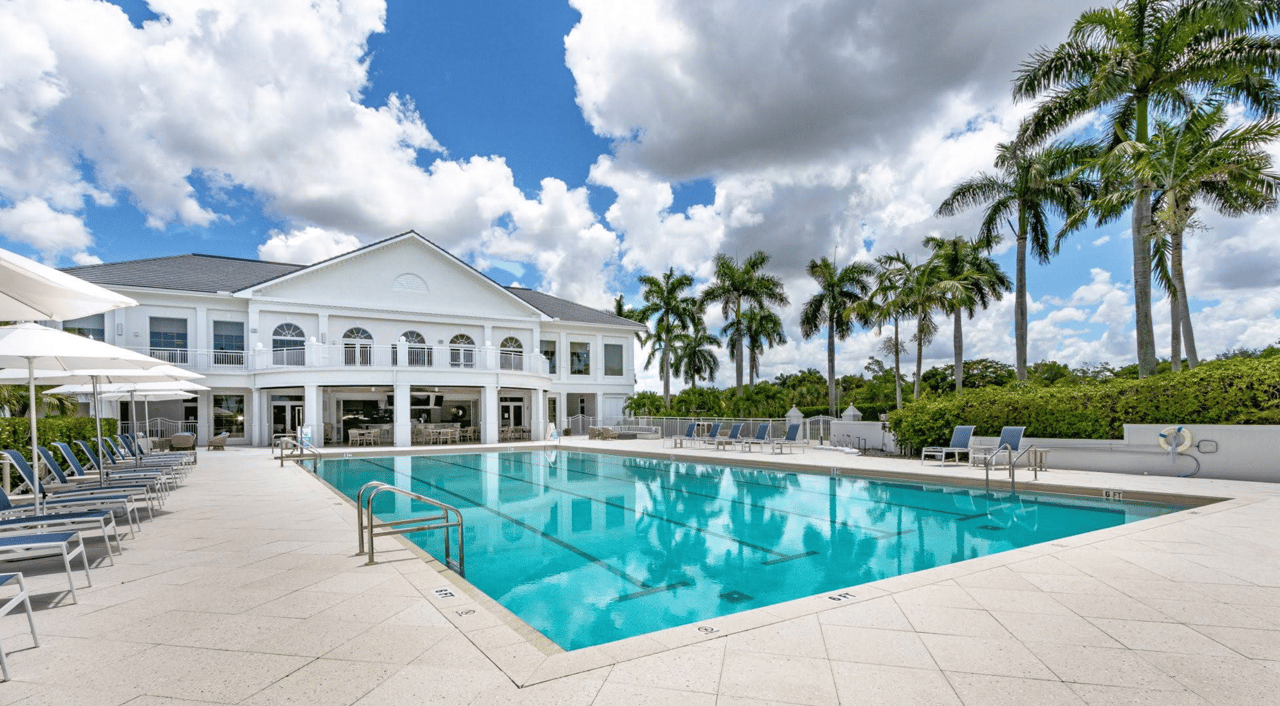
Audubon Country Club
A gated North Naples golf community of 410 homesites on 754.75 acres, with a 1989 Joe Lee course, mandatory Social club membership since 2006 and no CDD. McGreevy and Comisar sell Audubon.
A gated North Naples golf community of 410 homesites on 754.75 acres, with a 1989 Joe Lee course, mandatory Social club membership since 2006 and no CDD. McGreevy and Comisar sell Audubon.
Updated September 2026 · Jesse McGreevy and Marc Comisar, Domain Realty
If you own a home inside the gates of Audubon Country Club in North Naples and you are thinking about selling, call Jesse McGreevy at (239) 898-6072 before you call anyone else. Audubon is a thin, low-supply market. Roughly twenty homes change hands here in a year out of 399, which means your listing is not competing for attention in a crowd, it is carrying the whole conversation for its price band. That is exactly the kind of market where the agent you choose decides the outcome. Jesse and Marc Comisar have been Top 1% Real Estate Agents Nationally Since 2008, and they work this stretch of Collier County, from Naples north to the Lee County line, every single week of the year.
If you are buying here instead, the honest starting point is that Audubon Country Club is not one market. It is several, stacked inside one gate, with a 6.8 times spread in assessed value between its lowest and highest sub-communities. A buyer looking at a maintenance-included home on Devon Green Lane and a buyer looking at a new lakefront estate on Warwick Way are shopping in two different worlds that happen to share a guardhouse. Marc Comisar answers his own phone at (239) 287-5873, and he will tell you which of those worlds your budget actually lives in before you spend a Saturday driving.
Everything on this page is measured, not repeated. The price history, the parcel counts, the sub-community medians and the comparison against Audubon’s North Naples neighbors are all computed from Collier County’s own published tax roll and its recorded deed record, published August 29, 2026. Where the record is silent, this page says so and tells you exactly who to call to close the gap. That is a deliberate choice. There is a great deal of confidently wrong information about this community online, and a page that quietly repeats it is worse than no page at all.
McGreevy and Comisar are the best-positioned team for Audubon Country Club in North Naples because we sell this corridor every week, we build our numbers from Collier County’s own recorded deed record rather than a listing feed, and we have been Top 1% Real Estate Agents Nationally Since 2008. That combination of local volume and primary-source discipline is what this community actually requires.
As the leaders of Domain Realty Group our team has closed over $2.5 billion in real estate. Those are career numbers across Lee and Collier County. If you are comparing agents across the whole city, our guide to the best real estate agents in Naples sets the teams side by side on the public record: reviews, licence history and published production.
McGreevy and Comisar lead Domain Realty Group, a full-service Southwest Florida real estate team. Learn more about our team at DomainRealtyGroup.com.
We are not publishing a McGreevy and Comisar days-on-market figure or a sale-to-list ratio for Audubon Country Club on this page. We could have written one that sounded impressive. We would rather you trust the numbers we do publish.
What we have instead is better, because it covers every transfer rather than only the ones that went through a listing service. Everything in the market sections below comes from Collier County’s own recorded deed record and its 2026 tax roll, published August 29, 2026. That record captures private sales, family transfers and off-market deals that never appeared in any feed. When you sit down with us, we will walk your specific street, your specific fairway exposure and your specific comparable set, and we will show you the source line for every figure.
In the last 12 months we tracked 23 qualified Audubon Country Club closings in Collier County’s own deed record. Twenty-three. In a community of about 400 built homes, that is roughly one sale every sixteen days across every price band from a condominium at $1,020,000 to an estate at $6,500,000. The Southwest Florida MLS counts the same market at 24 closed listings, a median of $1,795,000, a median 88.5 days on market and a median sale to list of 90.01%, against only five active listings today. Two independent records, landing within one transaction and $5,000 of each other. That is the level of evidence we bring to a pricing conversation.
Here is what that means in practice. A community with heavy turnover forgives a mispriced listing, because three more comparable homes will close in the next ninety days and reset the conversation. Audubon does not forgive it. The median Audubon owner has held their home for 7.3 years. When a home sits, the buyer pool that exists for it at any given moment is small, it is watching, and it draws exactly one conclusion from a price reduction. Getting the number right in week one is not a nicety here. It is the entire strategy.
Most pages about this community treat it as a single entity with a single price. Collier County’s own roll says otherwise. Median assessed just value runs from $955,645 on Devon Green Lane to $6,452,810 on the newest two homes on Warwick Way. That is a 6.8 times spread inside one gate, and it is the single most consequential fact for pricing a listing or setting a buyer’s expectations.
Section by section below, this page names every street, states what the club itself says is on it, and sets that beside what the county recorded. No county filing codes, no plat abbreviations, no jargon. The names residents and agents actually use.
Selling? Start with a data-backed valuation of your Audubon Country Club home, then call Jesse direct at (239) 898-6072. Buying? Read how we represent buyers in Audubon Country Club, then call Marc at (239) 287-5873.
Audubon Country Club is a gated golf community in North Naples, Collier County, Florida 34110, with two entry gates, 410 homesites (about 400 of them built) on 754.75 approved acres, mandatory club membership at a minimum Social level for every buyer since April 17, 2006, and a recorded sale history that runs back to 1990. The eight facts below are the ones that change decisions.
Why McGreevy and Comisar Are the Best Realtor for Audubon Country Club · Key Takeaways · Table of Contents · Living in Audubon Country Club · The Audubon Market Right Now · Thirty-Six Years of Audubon Sale Prices · Audubon Against Its North Naples Neighbors: One Yardstick · The Streets of Audubon: A Neighborhood-by-Neighborhood Inventory · How Audubon Country Club, Naples Came to Be · The Entitlement Record: What Was Approved and What Was Built · Who Governs Audubon: The Foundation, The Association, and Who Owns What · Audubon Country Club Membership Cost, Naples: Mandatory Social Membership, Step by Step · Audubon Country Club HOA Fees and Dues, Naples: Every Layer a Buyer Is Billed · The Club at Audubon Country Club, Naples · The Golf Course at Audubon Country Club, Naples · Racquet Sports, Fitness and Wellness at Audubon Country Club · Dining at Audubon Country Club, Naples · The Audubon Country Club Clubhouse Renovation, 2026 to 2028 · Audubon Country Club Naples Flood Zones, Street by Street · The Preliminary Flood Map That Would Change a Third of Audubon · Evacuation, Storm Surge and Audubon’s Storm Record · Insurance Reality in Audubon Country Club, North Naples · Elevation Certificates and Letters of Map Amendment in Audubon · Structural Compliance: Milestone Inspections and SIRS at Montclair · Property Taxes in Audubon, and the Reset a Buyer Inherits · Audubon Has No CDD, and What That Is Worth · The Audubon Country Club Rules That Actually Decide Purchases · Utilities, Trash, Gates and Daily Logistics · The Preserve: Why Audubon Looks the Way It Does · Schools Zoned to Audubon Country Club, Naples · Healthcare Access from Audubon · Where Audubon Actually Sits: Drive Times, Measured · Shopping, Dining and Beaches Near Audubon · What Is Being Built Around Audubon · Communities Audubon Buyers Also Consider · Audubon Country Club vs Pelican Marsh: Which One Fits You? · Buying in Audubon: The Honest Case For and Against · Audubon’s Neighborhoods With Their Own Pages · Thinking of Selling Your Audubon Country Club Home? List With the #1 Team in Southwest Florida Since 2012 · Your Local Real Estate Experts · Frequently Asked Questions, Buyer Edition · Frequently Asked Questions, Seller Edition · Sources and Authoritative References · Downloadable Documents
Living in Audubon Country Club means a gated North Naples address where 193 acres of conservation land sit alongside 120 acres of golf course, where two separate gates serve the two halves of the community, and where two thirds of the homes carry a homestead exemption, the marker of a primary Florida residence.
Audubon Country Club is organized by the club itself into two named halves, and this is the vocabulary residents and listing agents actually use.
Club Side at Audubon Country Club is entered from the US 41 gate on Tamiami Trail. The club also refers to it as Phase I. It holds the clubhouse, the golf shop, the practice areas and the oldest housing in the community, built from 1989 through the 1990s with infill continuing into the 2010s.
Bay Side at Audubon Country Club is entered from the Vanderbilt Drive gate. The club refers to it as Phase II. It is the larger of the two by home count, it was built from 1993 forward, and it is still absorbing new construction. Homes were completed there in 2021, 2022, 2023, 2024 and 2025.
The practical point is simple and it trips people up constantly. A buyer told “Audubon is off 41” and then shown a Bay Side listing will drive to the wrong gate and lose twenty minutes. Ask which side before you set the appointment. (Audubon Country Club, Neighborhoods)
One street inside Audubon has its own separate entry. The club describes “an elegant gated street entry for St. George’s Court,” leading to what it counts as twenty-three distinctly styled luxury homes. No other street in either half is described as separately gated on the club’s own roster. If a gate within a gate matters to you, there is exactly one address family in this community that offers it.
Audubon does not look like a 1990s Naples golf community, and the reason is the land plan. Collier County’s own PUD record carries 193 acres of conservation land, a quarter of the community, alongside 120 acres of golf course. The club, describing itself, says that “more than half of the acreage is dedicated to preserve areas,” which is the club’s own characterization of preserve and includes lakes, buffers and natural areas beyond the county’s designated conservation tracts.
Either way you measure it, the effect on the ground is the same. Streets are narrow and curved rather than gridded. Lots back to water, fairway or standing pine and palmetto rather than to each other. The club’s own name for the natural area on the west side of Audubon Boulevard, west of Vanderbilt Drive, is Hickory Bay Preserve, a piece of local vocabulary that appears on no county record and that you will not hear from anyone who has not spent time here.
Audubon is 91 percent detached housing and 9 percent condominium. Collier County’s roll records 363 single-family parcels and 36 condominium parcels carrying a dwelling. Within the detached stock there are three genuinely different products:
The condominium product is Montclair at Audubon, thirty-six units in six three-story buildings on Audubon Boulevard, recorded in 1990.
Every non-condominium residential parcel in the county roll carries a single-family use code and its own separately taxed land line. There are no shared-wall building classes anywhere inside the eleven subdivision groupings that make up this community.
Audubon Country Club is an all-ages community. Its recorded Declaration states that there is no restriction on occupancy by children. That is section 8.2 of the current recorded governing document at Official Records Book 6078, Page 688, quoted in full: “Children. There is no restriction on occupancy by children.” A separate section bars any limitation on sale, lease or occupancy on protected grounds.
This is worth stating in the community’s own words because it is the kind of question most competitor pages answer with a shrug. Quoting a recorded covenant is the strongest answer available.
Of Audubon’s 399 residential parcels, 266 carry a homestead exemption, 66.7 percent, and 313 owners, 78.4 percent, use a Florida mailing address. For a gated golf community in this price band that is a high full-time-residency share.
You feel it in the off-season. Communities running 40 or 50 percent seasonal ownership empty out in July and the amenities go quiet. Audubon does not go fully quiet. The largest non-Florida owner cluster is Ontario, with a dozen owners, followed by Illinois, Ohio, Michigan, Pennsylvania, New York and Minnesota. That is the classic Midwest and Canadian snowbird pattern, but it is a minority of this community rather than its center of gravity.
Buying in Audubon Country Club means joining the club. Membership is mandatory at a minimum Social level for every buyer, and has been since April 17, 2006, under the community’s current recorded governing document at Official Records Book 6078, Page 688. Owners of record who were not members as of that date were grandfathered.
The mandatory floor is Social. Golf is a separate election above it, with its own initiation and its own cap. Golf membership is capped at 340, per the club’s own golf page, below the number of homesites, so ask the club whether the cap has been reached.
The club does not publish its initiation fee or its dues, and no public record states them. Not the county records, not the corporate filings, not the club’s own site. Anyone quoting you an initiation number found it on an aggregator, and those numbers contradict each other by more than a hundred thousand dollars. The one real signal on the recurring side is what listing agents disclosed on the last 24 closings, set out in the fee section above, and it is a planning figure rather than a quote. Get it from the source, in writing, in the same week you write an offer: Christine Bryant, Membership and Marketing Director, (239) 592-4000. Ask for initiation by category, annual dues by category, any capital dues currently in force, the food and beverage minimum, and any transfer fee, all in one document.
This one is decisive for a certain kind of Naples buyer and it deserves to be said early rather than buried. Under the community’s recorded governing document, boats, boat trailers, campers and recreational vehicles are not permitted within the community, even fully enclosed inside a structure, except for up to forty-eight consecutive hours with the manager’s advance written permission.
If you own a boat you intend to keep at the house, Audubon Country Club is not your community, and you should know that on day one rather than after inspection. Off-site storage is the workaround, and there is plenty of it in Bonita Springs and North Naples, but the rule itself is not negotiable at the association level.
Audubon has a community boardwalk and kayak launch onto the estuary backwaters. That is the water amenity. There is no marina and no Gulf access for larger vessels from inside the community.
For a paddler this is genuinely lovely and genuinely rare, a mangrove and estuary system reached without leaving the gate. For a boat owner it is a hard limit that has to be solved elsewhere, and it compounds with the trailer rule above.
Audubon Country Club has no private beach club and no beach shuttle. What it has instead is geography plus a county policy that most out-of-state buyers do not know about.
Collier County residents, including part-time seasonal owners, park free at county beaches with a free resident permit. One trip to pick up a sticker and the practical cost of beach parking at the county’s beaches goes to zero. Note one exception: Delnor-Wiggins Pass is a state park at $6 per vehicle, and the county sticker does not apply there.
A community page that only lists amenities is a brochure. Here is the other half, stated plainly, because these are the three things buyers search for and most pages stay silent on:
That third one is a genuine competitive advantage and no listing portal will surface it for you.
The Audubon Country Club market recorded 23 qualified arms-length sales in the twelve months ending June 23, 2026, at a median price of $1,800,000, a median of $621 per square foot and an aggregate of $674 per square foot, measured directly from Collier County’s own deed record.
Data updated: September 2026 (Southwest Florida MLS Matrix, retrieved 16 Sep 2026; Collier County Property Appraiser 2026 tax roll and deed record, published 29 Aug 2026).
The county’s deed record is the better instrument for history, because it reaches back to 1990 and catches transfers that were never listed. The Southwest Florida MLS answers a different set of questions, and they are the ones a seller asks first. Pulled 2026-09-16, scoped to Development Name AUDUBON, City Naples, with all 24 rows verified inside scope and none outside.
Measure | Trailing twelve months, MLS |
|---|---|
Closed listings | 24 |
Median sale price | $1,795,000 |
Range | $845,000 to $4,950,000 |
Total volume | $48,769,500 |
Median days on market | 88.5 |
Days on market range | 0 to 356 |
Median sale to list price | 90.01% |
Median price per square foot | $555 |
Aggregate price per square foot | $596 |
Two systems, one answer. The MLS counts 24 closed listings at a median of $1,795,000. Collier County counts 23 qualified recorded deeds at a median of $1,800,000. Those are different populations, brokered listings against qualified deeds, which is why the counts differ by one, and they land within $5,000 of each other. When two independent records agree that closely, the number is real.
What sellers should take from the 90.01% sale to list. Audubon buyers are negotiating, and they are winning roughly ten percent off the asking price at the median. That is not a distressed market signal. It sits alongside only five active listings, which against 24 closings a year is about 2.5 months of supply, a genuinely tight number. Both things are true at once: inventory is thin, and individual buyers are still negotiating hard. A seller who reads only the low inventory figure will overprice, and the 88.5 day median is what overpricing costs.
Address | Neighborhood | List price | Living area | Days on market |
|---|---|---|---|---|
743 Saint George’s Ct | Audubon Country Club | $4,995,000 | 4,562 | 1 |
179 Audubon Blvd | Audubon Country Club | $1,675,000 | 2,599 | 62 |
15259 Devon Green Ln | Devon Green | $1,575,000 | 2,230 | 12 |
599 Audubon Blvd #201 | Montclair | $1,235,000 | 2,578 | 571 |
591 Audubon Blvd #B-102 | Montclair | $1,150,000 | 2,578 | 77 |
Five homes, median list $1,575,000. Whole community, every price band, at one moment. That is what thin supply looks like in practice, and it is why a correctly priced Audubon listing has very little to compete with.
One window, stated with its dates and its source, rather than four windows chosen to flatter. The following covers qualified, improved, arms-length recorded sales at or above $100,000, from June 23, 2025 through June 23, 2026, the date of the most recent sale recorded in the roll. Source: Collier County Property Appraiser, 2026 tax roll, published August 29, 2026.
Measure | Trailing twelve months |
|---|---|
Qualified recorded sales | 23 |
Median sale price | $1,800,000 |
Mean sale price | $2,238,565 |
Range | $1,020,000 to $6,500,000 |
Total recorded dollar volume | $51,487,000 |
Median price per square foot | $621 |
Aggregate price per square foot | $674 |
Those last two rows are two different statistics and they are shown together on purpose.
Median price per square foot, $621, is the middle transaction. Half the sales priced above it, half below. It describes the typical Audubon closing.
Aggregate price per square foot, $674, is total dollars divided by total square feet across all 23 sales. It is dollar-weighted, so the largest and most expensive homes pull it upward.
The gap between them, $53 per square foot, is the signature of a community with a genuinely high top end. When you see a single price-per-foot number quoted for Audubon somewhere else, ask which one it is. Most sources do not know.
Sub-communities with only one or two recorded sales are stated as individual sales rather than as a median, deliberately. Two transactions do not make a market rate and presenting them as one would be dishonest.
Street or enclave | Sales | Result |
|---|---|---|
Bay Side streets | 8 | median $2,175,000 |
Ashburton Drive and Brentwood Point | 6 | median $1,762,500 |
Burnaby Drive | 3 | median $2,455,000 |
Pembroke Point | 1 | one sale, at $2,600,000 |
Whitney Lane | 1 | one sale, at $1,525,000 |
Devon Green Lane | 2 | two sales, $1,165,000 and $1,500,000 |
Montclair at Audubon | 2 | two sales, $1,020,000 and $1,600,000 |
Two things stand out. First, Saint George’s Court and Portsmouth Court recorded no qualified sales at all in that twelve-month window. In the trailing thirty-six months that same section recorded eight, at a median of $2,574,800, so this is a supply drought rather than a demand problem. Second, the six closings on Ashburton Drive and Brentwood Point make that pair the busiest single Club Side segment of the year.
Across the trailing thirty-six months, Collier County recorded 60 qualified improved sales in Audubon Country Club. Averaged over those thirty-six months that is about twenty homes changing hands in a year out of 399. Of the 399 residential parcels, 348 have a qualified improved sale on record at all, and the median time since the last qualified sale is 7.3 years.
Low turnover cuts both ways, and buyers and sellers should hear both halves.
For a seller, it means your competition at any given moment is measured in single digits, and it means a correctly priced listing does not have to shout. It also means the buyer pool is patient and well informed, and it notices a stale listing immediately.
For a buyer, it means the home you want may simply not be for sale this season, and the answer is not to settle. The answer is to be positioned, financed and known to the listing side before the home comes up. That is a large part of what we do here.
Measured from Collier County’s 2026 tax roll across all 399 residential parcels carrying a dwelling:
Living area here is the county’s base living area on dwelling records only. It excludes pools, spas, screen enclosures, decking and detached garages, all of which the county carries as separate building records. That distinction matters more than it sounds. Sum every building record indiscriminately and you get a median “home size” above 8,700 square feet, which is wrong by more than double and is the kind of error that gets repeated for years.
Period | Homes completed |
|---|---|
1985 to 1989 | 6 |
1990 to 1994 | 166 |
1995 to 1999 | 87 |
2000 to 2004 | 83 |
2005 to 2009 | 25 |
2010 to 2014 | 9 |
2015 to 2019 | 13 |
2020 to 2024 | 9 |
2025 to 2029 | 1 |
259 of 399 homes, 65 percent, were built before 2000. The community’s core is a 1990s build with a small, very high-value modern tail on Warwick Way. That single fact governs more of the buying decision here than any other. Roof age, impact glass, plumbing supply lines, electrical panels and the year of the last major renovation are the variables that separate two Audubon homes with identical square footage and identical golf views by several hundred thousand dollars.
Median 2026 assessed just value, by street or enclave, from Collier County’s 2026 tax roll:
Street or enclave | Homes | Median living sq ft | Median 2026 just value |
|---|---|---|---|
Warwick Way, the newest two homes | 2 | 5,690 | $6,452,810 |
Warwick Way, the 2018 to 2022 section | 8 | 5,390 | $5,847,704 |
Bay Side streets | 166 | 3,831 | $2,252,811 |
Saint George’s Court and Portsmouth Court | 36 | 3,753 | $2,246,492 |
Pembroke Point | 8 | 3,737 | $2,121,246 |
Burnaby Drive | 36 | 3,382 | $1,977,571 |
Whitney Lane | 21 | 3,153 | $1,509,668 |
Ashburton Drive and Brentwood Point | 53 | 3,155 | $1,390,419 |
Montclair at Audubon | 36 | 2,578 | $1,088,310 |
Devon Green Lane | 33 | 2,206 | $955,645 |
Community-wide | 399 | 3,345 | $1,899,781 |
From $955,645 to $6,452,810 is a 6.8 times spread by median assessed value inside one gated community. Read that table again before you decide what “an Audubon home” costs. There is no such thing as an Audubon price. There is a Devon Green Lane price, a Montclair price, an Ashburton Drive price and a Warwick Way price, and they are not close to one another.
From the 2026 roll, across 399 residential parcels:
That last line is the one to sit with if you are buying. It is measured, it is large, and its consequences for a new owner’s tax bill are covered later on this page.
These figures describe the whole of ZIP 34110, which contains dozens of communities at every price point. They are not Audubon Country Club figures and must not be read as any. Source: U.S. Census Bureau.
That second number is the correction worth carrying into any conversation about this corridor. A raw vacancy rate for ZIP 34110 looks alarming until you understand that nearly four fifths of those “vacant” units are seasonal second homes with owners who are simply somewhere else in July. Actual for-sale inventory in this ZIP is under one percent of the stock. This is a supply-constrained market wearing a misleading statistic.
Audubon Country Club recorded just 23 qualified sales in the twelve months ending June 23, 2026, at a median of $1,800,000, and that scarcity is exactly why guessing at your number is expensive here. Across the trailing thirty-six months that pace averages about twenty homes a year out of 399, so there is no crowd of recent comparables to correct a mistake for you.
If you are selling, get a data-backed valuation of your Audubon Country Club home built from the actual recorded closings on your street and your fairway exposure, not a portal estimate assembled from a ZIP code. Then call Jesse McGreevy direct at (239) 898-6072 and we will walk it with you. We have been Top 1% Real Estate Agents Nationally Since 2008 and we do this in your community every week.
If you are buying, start with how we represent buyers in Audubon Country Club, then call Marc Comisar at (239) 287-5873. In a community this thin, being positioned before the right home lists is worth more than any negotiating tactic applied afterward.
Audubon Country Club has a recorded sale history stretching from 1990 to 2026 in Collier County’s own deed record. The median price rose from $335,000 at $130 per square foot in 1990 to $2,250,000 at $687 per square foot in 2024. Thirty-six years of it, year by year, appear below.
Data updated: August 2026 (Collier County Property Appraiser 2026 tax roll and recorded deed record, published 29 Aug 2026).
Listing services do not hold thirty-six years of Audubon closings, and portals do not publish them. Collier County’s recorded deed record does, and it captures every qualified transfer including sales that never appeared in any feed. Assembling it requires the county’s bulk-published roll rather than a listing extract, which is precisely why nobody else puts it in front of you.
The table covers qualified, improved, arms-length recorded sales at or above $100,000. Source: Collier County Property Appraiser, 2026 tax roll, published August 29, 2026.
Year | Sales | Median price | Median $/sq ft | Low | High |
|---|---|---|---|---|---|
1990 | 7 | $335,000 | $130 | $190,000 | $456,500 |
1991 | 11 | $346,000 | $138 | $330,000 | $404,300 |
1992 | 18 | $368,000 | $142 | $189,500 | $660,000 |
1993 | 26 | $375,000 | $145 | $110,000 | $825,000 |
1994 | 20 | $379,750 | $148 | $210,000 | $777,000 |
1995 | 16 | $400,000 | $152 | $205,000 | $760,000 |
1996 | 13 | $390,000 | $148 | $240,000 | $825,000 |
1997 | 21 | $420,000 | $159 | $110,000 | $1,100,000 |
1998 | 28 | $399,950 | $144 | $120,000 | $826,000 |
1999 | 30 | $417,500 | $171 | $120,000 | $1,600,000 |
2000 | 33 | $523,500 | $175 | $107,500 | $1,020,000 |
2001 | 19 | $550,000 | $184 | $125,000 | $1,360,000 |
2002 | 25 | $500,000 | $188 | $140,000 | $945,000 |
2003 | 21 | $579,000 | $217 | $155,000 | $2,000,000 |
2004 | 27 | $770,000 | $258 | $450,000 | $1,200,000 |
2005 | 29 | $1,075,000 | $309 | $695,000 | $1,700,000 |
2006 | 15 | $1,000,000 | $340 | $795,000 | $1,700,000 |
2007 | 11 | $1,550,000 | $391 | $825,000 | $2,625,000 |
2008 | 10 | $777,500 | $260 | $520,000 | $2,150,000 |
2009 | 6 | $687,500 | $244 | $549,900 | $2,100,000 |
2010 | 15 | $710,000 | $233 | $400,000 | $1,950,000 |
2011 | 21 | $670,000 | $204 | $285,000 | $1,450,000 |
2012 | 26 | $722,500 | $227 | $315,000 | $1,610,000 |
2013 | 23 | $660,000 | $239 | $360,000 | $2,150,000 |
2014 | 33 | $780,000 | $252 | $362,600 | $2,660,000 |
2015 | 23 | $1,065,000 | $278 | $380,000 | $1,680,000 |
2016 | 23 | $925,000 | $288 | $515,000 | $1,700,000 |
2017 | 20 | $922,500 | $268 | $361,000 | $1,570,000 |
2018 | 25 | $825,000 | $254 | $425,000 | $1,610,000 |
2019 | 21 | $759,500 | $282 | $425,000 | $3,600,000 |
2020 | 40 | $897,000 | $260 | $450,000 | $3,400,000 |
2021 | 52 | $1,312,500 | $360 | $587,000 | $2,290,000 |
2022 | 22 | $1,789,000 | $586 | $950,000 | $6,300,000 |
2023 | 21 | $2,230,000 | $640 | $1,375,000 | $4,700,000 |
2024 | 23 | $2,250,000 | $687 | $975,000 | $5,350,000 |
2025 | 10 | $1,830,000 | $625 | $1,400,000 | $6,500,000 |
2026 | 18 | $1,770,000 | $578 | $1,020,000 | $3,600,000 |
2026 is a partial year. The most recent sale recorded in this roll is June 23, 2026, so the 2026 row covers roughly half a year and should not be compared like for like against a full year above it.
Audubon’s opening decade is remarkably flat and remarkably steady. The median moved from $335,000 to $417,500 across ten years, and median price per square foot went from $130 to $171. Volume built quickly, from 7 recorded sales in 1990 to 30 in 1999, as the original build absorbed and early owners began to turn over.
What the table cannot show you is that most of those early transactions on the outer streets were lot sales followed years later by a custom build. The first improved resale on many Audubon streets did not happen until the late 1990s.
From 2000 to 2007 the median tripled, from $523,500 to $1,550,000, and median price per square foot went from $175 to $391. Then it broke. The 2008 median fell to $777,500 and 2009 to $687,500, on just six recorded sales, the thinnest year in the entire series.
Audubon’s correction was severe but its floor held better than much of Southwest Florida, in part because the community’s owners were disproportionately equity buyers rather than leveraged speculators. The homestead and mailing-address data still show that pattern today.
This is the decade the series is most useful for, and it is the one most people misremember. Audubon’s median price per square foot in 2019, at $282, was still below its 2007 peak of $391. Twelve years after the top, on a per-square-foot basis, the community had not recovered. Median prices in that stretch bounced between $660,000 and $1,065,000 with no clean trend.
Anyone who tells you Southwest Florida golf communities only go up has not looked at a series like this one.
Then the market changed character entirely. Volume spiked to 40 recorded sales in 2020 and 52 in 2021, the highest single year in Audubon’s history. The median went from $897,000 in 2020 to $1,312,500 in 2021 to $1,789,000 in 2022, and median price per square foot ran from $260 to $360 to $586 in three years.
That $586 figure is the important one. Price per square foot more than doubled in twenty-four months. That was not incremental appreciation, it was a repricing of the entire community driven by inbound migration, a collapse in available inventory and the delivery of the first genuinely modern estate product on Warwick Way.
The last three full years read as a high plateau rather than a continued climb. Median price ran $2,230,000 in 2023, $2,250,000 in 2024 and $1,830,000 in 2025, with median price per square foot at $640, $687 and $625. The partial 2026 row sits at $1,770,000 and $578.
Read those with care, because a median in a community this thin moves with the mix. 2025 recorded only ten qualified sales and 2024 recorded twenty-three. A single quarter without a Warwick Way or Bay Side estate closing moves the community median by hundreds of thousands of dollars without any individual home changing in value.
It does prove that Audubon Country Club has thirty-six unbroken years of recorded transactions, through two major corrections and one historic repricing, with a median that rose from $335,000 to well over $1.7 million.
It does not prove what your specific home is worth. A median is a mix, and Audubon’s mix shifted enormously when the 2018 to 2022 estate homes joined the pool. Comparing 2024’s $687 per square foot against 1996’s $148 measures a change in what gets built and sold here as much as a change in value.
If you want to know what your home is worth today, the correct instrument is a comparable analysis on your street, your view, your renovation history and your lot. That is a conversation, not a table, and it starts at (239) 898-6072.
Audubon Country Club ranks third of eight North Naples gated communities on median price per square foot, at $640, when every community is measured the same way from one dataset over one 36-month window. Quail West and Collier’s Reserve sit above it. Five other captured communities sit below.
Every community comparison you can find online compares marketing copy. This compares the same measurement, taken the same way, from the same public dataset, over the same window.
One dataset, one window, one measurement. Collier County Property Appraiser 2026 tax roll, published August 29, 2026. Qualified, improved, arms-length recorded sales at or above $100,000, from August 12, 2023 through August 11, 2026, a 36-month window. Living area is the county’s base living area on dwelling records only, excluding pools, screen enclosures, decking and detached garages. Just value is the 2026 roll figure and is an assessment, not a price.
Community | Homes captured | Sales, 36 months | Median sale | Median $/sq ft | Median living sq ft | Median 2026 just value | Build era |
|---|---|---|---|---|---|---|---|
Quail West | 447 | 69 | $4,650,000 | $1,058 | 4,304 | $2,964,534 | 1993 to 2025 |
Collier’s Reserve | 224 | 39 | $2,765,000 | $800 | 3,667 | $1,933,745 | 1994 to 2025 |
Audubon Country Club | 399 | 57 | $1,932,000 | $640 | 3,345 | $1,899,781 | 1989 to 2025 |
Wiggins Bay | 46 | 8 | $620,000 | $452 | 1,400 | $500,200 | 1994 to 1996 |
Imperial Golf Estates | 631 | 71 | $1,050,000 | $401 | 2,579 | $799,032 | 1979 to 2024 |
Sterling Oaks | 294 | 48 | $582,500 | $325 | 1,892 | $474,412 | 1994 to 2004 |
Bay Forest | 30 | 4 | $575,000 | $319 | 1,718 | $417,535 | 1984 to 1993 |
Arbor Trace | 90 | 17 | $385,000 | $249 | 1,250 | $208,750 | 1991 to 1991 |
The “homes captured” column is the count of parcels this method scopes into each community from the county’s subdivision dictionary. For Imperial Golf Estates, 631 is that county-roll capture and not the community’s own count of itself.
This method scopes a community by its name in the county’s subdivision dictionary. Communities whose sub-neighborhoods do not carry the parent name are under-captured, and their rows would describe only a name-matching subset rather than the whole community. Several large North Naples communities fall into that category, and rather than show them at a partial count they are left out of the table entirely.
The eight communities above capture cleanly against their known platted counts, which is why they are the ones shown. This is the same failure mode that hides a fourteen-lot plat inside Audubon’s own Burnaby Drive, one level out. A name is not membership.
Audubon Country Club sits third of eight on median price per square foot at $640, above Imperial Golf Estates, Sterling Oaks, Bay Forest, Wiggins Bay and Arbor Trace, and below Quail West at $1,058 and Collier’s Reserve at $800.
On median sale price it also sits third, at $1,932,000. On median living area it is fourth at 3,345 square feet, and on median assessed just value it is third at $1,899,781. Those rankings are consistent, which is itself informative. Audubon is not a community whose price is being carried by unusually large homes or by an unusually rich handful of sales. It is priced where its housing stock sits.
If you are cross-shopping, this is the pairing that matters. Collier’s Reserve is a 1990s North Naples gated golf community of similar era with a near-identical median home size, 3,667 square feet against Audubon’s 3,345. It trades at $800 per square foot against Audubon’s $640, a 25 percent premium.
It is also a materially smaller community, 224 homes on 450 acres with one 18-hole Arthur Hills course, against Audubon’s 410 homesites.
This is the single most likely factual error anyone can make writing about a community called Audubon, so it is worth being precise.
Collier’s Reserve holds Audubon International Signature Sanctuary certification. Audubon Country Club holds Cooperative Sanctuary. These are separate programmes, not grades of one. Signature is a design-and-siting programme applied at construction. Cooperative Sanctuary is an operational certification for an existing course.
Audubon Country Club is a Certified Audubon Cooperative Sanctuary through Audubon International’s ACSP for Golf Courses, a certification the club has held and publicly renewed, most recently reported by the club in 2020. Audubon International is a separate organization from the National Audubon Society, and there is no affiliation between this community and the bird-conservation charity.
The clearest illustration in the table is the pair that sits closest together geographically. Sterling Oaks and Audubon sit in the same ZIP corridor, built in the same decade, minutes apart.
Sterling Oaks trades at $325 per square foot. Audubon trades at $640. That is a 97 percent difference between two communities that share a postcode and a build era.
What separates them is not the decade and not the location. It is the golf course, the lot size and the membership structure. If you are trying to understand what the private golf gate is actually worth in North Naples dollars, that pair is your answer, and it is measured rather than asserted.
On the benchmark’s own window, the thirty-six months from August 12, 2023 through August 11, 2026, Audubon recorded 57 qualified sales from 399 built homes. Imperial Golf Estates, with 631 homes captured, recorded 71 in that same window. Proportionally, Audubon is the thinner, tighter market, and Imperial the more liquid one.
For a buyer that means patience and positioning at Audubon. For a seller it means your listing is not one of many, which is an advantage if the price is right and a liability if it is not.
Audubon Country Club is not one neighborhood. It is seventeen named streets and enclaves across two gated halves, and the club’s own roster counts 405 homes and condominiums among them. This inventory walks every street, names what the club says is there, and sets it beside what Collier County’s 2026 tax roll records.
Two conventions, both deliberate.
Streets, not filing codes. Collier County organizes Audubon into eleven subdivision groupings that split single streets across multiple filings and give one filing two entirely different products. No buyer has ever typed one of those codes into a search bar. This inventory names neighborhoods the way the club, the residents and the listing agents name them: by street.
Two counts, both true. Where the club’s count of a street and the county’s count differ by one or two, both figures are reported with their source attached. The club counts platted homesites it markets, including any never built on. The county counts parcels carrying a dwelling. Neither is wrong and neither should be silently corrected into the other.
Assessed just values below are from Collier County’s 2026 tax roll, published August 29, 2026. They are assessments, not asking prices and not sale prices, and they are used here to rank the tiers against one another. Street descriptions and golf-frontage detail are the club’s own, from its Neighborhoods page.
Burnaby Drive, thirty-six single-family homes. The club counts thirty-six and the county’s parcel arithmetic across its filings comes to the same thirty-six, which is a rare exact agreement in this community.
Homes were built from 1989 through 2016, a twenty-seven-year infill span, on lots from roughly a fifth of an acre to just over a third. Median living area is 3,382 square feet and median 2026 assessed just value is $1,977,571. The club places the street on the 4th fairway and green, with lakes and preserves.
Burnaby Drive was also one of the busier streets of the past year, with three recorded closings at a median of $2,455,000, the highest median of any Club Side street with more than two sales.
The club describes “an elegant gated street entry for St. George’s Court” leading to twenty-three distinctly styled luxury homes. Collier County’s roll records twenty-two parcels carrying a dwelling. Both counts are reported here with their source attached.
This is the only separately gated street inside Audubon Country Club. The club places homes on the 5th fairway and 5th green on the east side, with private preserve views along the entire west side and a large lake to the east.
Together with Portsmouth Court, this section carries a median living area of 3,753 square feet and a median 2026 assessed just value of $2,246,492, with the highest individual assessment in the section approaching $5.4 million. It recorded no qualified sales in the twelve months ending June 23, 2026, and eight in the trailing thirty-six months at a median of $2,574,800.
Portsmouth Court carries fourteen parcels on Collier County’s roll. The club places it on the 4th fairway with lakes and preserves. It shares its county filing, its build era and its price band with Saint George’s Court, and the two are best understood as one section of larger homes near the front of Club Side.
Build years across the pair run 1989 to 2018, with a median of 1995. Lots are large by Audubon standards, a median of about four tenths of an acre with the largest approaching a full acre.
The club counts thirty-three single-family homes on Ashburton Drive, at 2,400 to 3,500 square feet, and notes that most carry Bermuda-style exterior architecture. It places them on the 8th fairway, the 8th green and the 9th fairway and green, with preserve and water along the 8th.
Lots here run a median of about 0.28 acres, smaller than the Audubon norm, and the build is unusually uniform. Thirty-two of the fifty-three homes across Ashburton Drive and Brentwood Point share a single county building class, the most consistent construction grouping anywhere in the community.
The club counts twenty larger custom estate homes on Brentwood Point, at 3,400 to 5,000 square feet. It places the 9th fairway along the north side, the 9th green visible from the cul-de-sac, and a large lake with a lighted fountain along Audubon Boulevard to the south.
Ashburton Drive and Brentwood Point sit inside one county filing, which is exactly why this page reports them separately. They are not the same product. One is a 2,400 to 3,500 square foot Bermuda-style street and the other is a 3,400 to 5,000 square foot estate cul-de-sac, and flattening them into a single description would mislead every buyer who reads it.
Across the pair: fifty-three homes, built 1990 through 2017 with a median of 1992, median living area 3,155 square feet, median 2026 assessed just value $1,390,419, with a range from just over $1 million to $3.3 million. This is the oldest concentration of housing in Audubon Country Club, with thirty-six of the fifty-three homes completed between 1990 and 1992.
It is also the most active segment in the current market. Six of the past year’s twenty-three closings happened here, at a median of $1,762,500.
The club calls these twenty-one detached villas, at 2,400 to over 3,000 square feet, and places them on the 2nd fairway with a large lake and preserve.
This is the villa product in Audubon, and it is worth being clear about what that means because the word is used loosely everywhere else. These are detached homes on their own separately taxed lots, not attached villas, not coach homes and not townhouses. Nothing attached exists anywhere in this community.
Twenty-one homes, built 1992 through 2004 with a median of 1994, median living area 3,153 square feet, lots at a median of roughly 0.22 acres, the second smallest in the community. Median 2026 assessed just value is $1,509,668, in a band from $1.28 million to $2.09 million. There is no separate association for Whitney Lane. One closing was recorded here in the past year, at $1,525,000.
The club counts eight custom estate homes on Pembroke Point, with preserve and golf course views of the 2nd or 3rd fairway.
Eight homes, built 1989 through 2011 with a median of 1998, median living area 3,667 square feet, lots at a median of about four tenths of an acre. Median 2026 assessed just value is $2,121,246 in a band from $1.82 million to $2.48 million. One home closed here in the past year, at $2,600,000, the highest single Club Side closing of the window.
Pembroke Point has one of the tightest value ranges in the community, under $700,000 from the lowest assessment to the highest across eight homes, which makes it unusually easy to price against itself.
Devon Green, thirty-three homes, plus Tract A, the private roadway, owned by the Devon Green Residents’ Association. The club and the county agree exactly on thirty-three.
Devon Green is the sharpest fact cluster in Audubon Country Club and the only genuinely different community inside the community:
The club states 2,200 to 2,800 square feet of air-conditioned living space, which sits neatly between the county’s base living area median of 2,206 and its adjusted-area median of 2,825, exactly the relationship you would expect. The club places homes on the 5th fairway on the west side of the street, with lake views on the east.
Two homes closed on Devon Green Lane in the past twelve months, at $1,165,000 and $1,500,000. Two sales are not a market rate and they are reported here as individual sales rather than a median.
If your budget is under $1.5 million and you want inside this gate, Devon Green Lane is the conversation. In most years it is one of only two ways in at that number.
Montclair at Audubon is six three-story buildings of thirty-six condominiums, at 551, 559, 567, 583, 591 and 599 Audubon Boulevard. The club’s count and the county’s count agree exactly at thirty-six.
The buildings were recorded in 1990, with twenty-four units completed in 1990 and twelve in 1992. Every one of the thirty-six units is 2,578 square feet, identical across the property, which makes Montclair the only place in Audubon where unit size is not a pricing variable at all. Assessed values fall into exactly three tiers by floor: $1,058,310 on the first, $1,088,310 on the second and $1,118,310 on the third.
The club places the condominiums along the 1st fairway, with some units also overlooking the clubhouse lake and its large fountain and the 18th and 10th fairways, and notes that most have Gulf of Mexico sunsets.
Montclair has its own condominium association, filed in 1989 and active today, professionally managed out of Bonita Springs, and it is a separate governing structure from the master association. Two units closed in the past twelve months, at $1,020,000 and $1,600,000, reported as individual sales.
Montclair is the other entry point into Audubon Country Club under $1.5 million, and it is the only condominium product in the community.
The club counts sixty-one distinctively elegant custom homes on Cheshire Way. Collier County’s roll records fifty-nine parcels carrying a dwelling. Both counts are reported with their source attached.
Cheshire Way is the longest street in Audubon and the one with the widest quality range. The club places views to the 11th, 12th and 15th on one side and the 14th and 16th on the other, with several lakes and preserves.
Bay Side as a whole, of which Cheshire Way is the largest component, carries 166 homes built from 1993 to 2025 with a median year of 2000, median living area 3,831 square feet, lots at a median of about four tenths of an acre, and a median 2026 assessed just value of $2,252,811 in a band from $1.17 million to $6.08 million. Its county building classes span the widest quality range anywhere in the community, which is another way of saying that two Bay Side homes of identical size can be very different houses.
The club describes a section of twenty-four estate-sized homes west of Vanderbilt Drive. The east side of the street looks to the 13th fairway and green with the 12th beyond. The west side looks into Hickory Bay Preserve, the club’s own name for the natural area there, with western sunsets.
This is measurably the preserve-front address in Audubon. Fifteen consecutive lots on Audubon Boulevard share a boundary with a four-acre preserve tract, at between 126 and 321 shared feet each, measured from the county’s own parcel geometry rather than asserted from a brochure.
The highest assessed single-family parcel anywhere in Bay Side sits on Audubon Boulevard.
The club describes a second, separate neighborhood around the curve of twenty-three single-family homes, with views to the 11th or 12th fairways and natural preserve areas.
Twenty-four plus twenty-three is forty-seven on the club’s count. Collier County’s roll records forty-five parcels carrying a dwelling on Audubon Boulevard outside the condominium run. Both counts are reported here with their source attached, and the two-home gap is the same platted-versus-built difference seen on Saint George’s Court and Cheshire Way. This is one street with two distinct neighborhoods on it, and treating it as one would misdescribe both.
The club counts twenty-seven unique single family homes set amid towering pines on Charleston Court, all of them overlooking preserve, lakes and the 11th fairway or the 11th green, with many rear-west exposures.
Rear-west exposure is worth pausing on if you are buying. In Southwest Florida it means afternoon sun on the lanai and it means sunsets over water or preserve rather than into a neighbor’s roofline. On this street the club states it is the common condition rather than the exception.
Collier County’s roll records twenty-seven parcels here, agreeing with the club exactly.
The club counts twenty-two magnificent estate homes ranging from 4,000 to over 5,500 square feet on Chancery Circle, with the 14th or 15th along the north side and preserve to the south, plus some lake exposure. Collier County’s roll records twenty-one parcels carrying a dwelling; the club’s count of twenty-two is its own.
By stated square footage this is the largest standard product in Audubon outside Warwick Way. If you want a 5,000 square foot home inside this gate without buying the newest construction, Chancery Circle is the first street to look at.
The club counts nine spacious homes overlooking a natural area near the 16th fairway and two lakes. Collier County records nine parcels.
Nine homes is small enough that Greenfield Court effectively never has more than one listing at a time, and in most years it has none. If it is the street you want, the strategy is not to wait for a listing. It is to be known to the nine owners before one of them decides to sell.
The club counts five roomy and elegant homes with expansive lake and 11th fairway views on Haydon Circle. Collier County records five parcels.
Five homes is the smallest named enclave in Audubon Country Club. Everything said about Greenfield Court applies here twice over.
The club describes ten large estate home sites on Warwick Way, with single family homes all with lake views set on a quiet cul-de-sac. Collier County’s roll records ten parcels carrying a dwelling across two adjacent filings, agreeing exactly.
This is the newest and by a wide margin the most expensive product in Audubon Country Club:
One caution, stated because it matters to anyone pricing here. The two newest Warwick Way homes have never had an improved resale. Their only recorded transactions were land sales in 2021, before the houses existed. There is no defensible resale price per square foot for that pair, and there will not be one until an improved sale closes. Anyone who quotes you one has computed it from an assessment.
Audubon Country Club has no single production builder, and that is unusual for a community of this size and era.
Devon Green Lane and Montclair at Audubon were both sold as finished product from the developer between 1990 and 1994. Their earliest recorded sales are all improved transfers, which is the signature of a spec or production program.
Everywhere else, the earliest recorded sales are vacant-lot conveyances at $110,000 to $225,000, followed years later by an improved resale. That is the signature of individual custom construction. The community was built lot by lot by a long tail of small local custom builders across thirty-six years, from 1989 to 2025. The most active single builder took roughly nineteen lots between 1997 and 2003, and no other builder in the recorded deed sample exceeded five.
The practical consequence is that two Audubon homes built in the same year on the same street can be very different houses, because they were not built by the same company to the same specification. Inspect accordingly, and do not assume a neighbor’s experience transfers.
Audubon has no developer inventory left. The last lots, on Warwick Way, sold in 2019 and 2020.
The final phase of the community was assembled in a single instrument in February 2015 when a developer bought the whole of the Warwick Way tract for $5,400,000, then delivered eight estate homes between 2018 and 2022 and sold the last two homesites to individual buyers.
What that means for a buyer today is straightforward. Every purchase in Audubon Country Club is a resale or a private new build on a privately held lot. There is no builder sales center, no incentive package and no model row. What you gain in exchange is a finished community with mature landscaping and thirty-six years of recorded pricing behind it, which is exactly the trade many buyers are looking for and cannot find in a newer North Naples community.
Put the streets side by side and Audubon resolves into four practical bands:
Those bands are median assessed values, not asking prices, and a renovated home in the second band can and does sell above an untouched home in the third. That is precisely the sort of judgment call a page cannot make for you.
When you are ready to make it, call Jesse McGreevy at (239) 898-6072 or Marc Comisar at (239) 287-5873. Sellers can start with a data-backed valuation of your Audubon Country Club home. Buyers can start with how we represent buyers in Audubon Country Club. We have been Top 1% Real Estate Agents Nationally Since 2008 and #1 Team in Southwest Florida since 2012, and we would rather show you the county record than tell you a story about it.
Audubon Country Club in North Naples was first zoned as a Planned Unit Development by Collier County in 1982, but the company that won that approval built nothing and dissolved in 1985. The community that exists today was created by Audubon Joint Venture, which took title in January 1988 and recorded the founding covenants and the first plat that September.
Most community pages give you a sentence of origin story and move on. Audubon deserves better than that, because its history is written in the Collier County Clerk’s official records in a way almost no other North Naples community’s is, and because the shape of that history explains why Audubon looks and feels the way it does today. What follows comes out of recorded instruments, Florida Division of Corporations filings, and Collier County’s own published zoning record.
A Florida corporation named Audubon Country Club, Inc. was formed on 29 October 1982. Its president was W. Clarke Swanson and its registered agent was the Naples land use attorney George L. Varnadoe, both operating out of 801 Laurel Oak Drive. Collier County adopted Planned Unit Development Ordinance 82-48 that same year, and the oldest Audubon named instrument in the entire Collier County index is a notice recorded 21 December 1982 at Official Records Book 999, Page 1503.
That corporation was involuntarily dissolved on 1 November 1985 without putting a single home in the ground. The entitlement survived it. This is the first thing a buyer should understand about Audubon: the zoning is older than the community by six years, and it was written in an era when Collier County was still approving very large, very low density projects on the west side of US 41.
Source: Florida Division of Corporations, document G06717, and the Collier County Clerk of the Circuit Court and Comptroller official records index at collierclerk.com.
Audubon of Naples Development Corporation, later renamed Audubon of Naples Corporation, was formed on 27 December 1984 under officer James J. Zand. Collier County adopted a second Planned Unit Development ordinance, 87-77, in 1987. That ordinance was later repealed, and the county’s own list marks it that way.
Source: Florida Division of Corporations, document M09382, and Collier County Land Development Code Appendix F, the county’s codified list of PUD ordinances.
Five instruments recorded on a single day in January 1988 created the development entity that actually built Audubon Country Club. The deed, Instrument 1150346 at Official Records Book 1323, Page 1083, conveyed the land from Audubon of Naples Corporation and Audubon of Naples Development Corporation to Audubon Joint Venture, a Florida general partnership. Recorded alongside it was a fifty page mortgage, Instrument 1150347 at Official Records Book 1323, Page 1088, in favor of Rochester Community Savings Bank of Rochester, New York.
The partners in that joint venture, as they appear on recorded instruments across the following twenty seven years, were Audubon of Naples Corporation, F & B Associates, F & B Land Corporation, Robert H. Flinn and James J. Zand, later joined by Eco Properties of SW FL, Inc. and Whitehall Properties of SW FL, Ltd.
Two weeks earlier, on 6 January 1988, the same group recorded a notice at Official Records Book 1319, Page 2175 claiming the trade names “Audubon Country Club,” “Audubon of Naples,” “Audubon Properties” and “Audubon Property Management.” January 1988 is the month the brand was formally claimed by the people who built it.
There is a detail here worth pausing on. Audubon was capitalized out of upstate New York, not out of Florida. That is unusual for a Collier County golf community of this vintage, and it is one reason the community’s early buyer profile skewed northeastern in a market that was then mostly midwestern.
Two instruments recorded on the afternoon of 30 September 1988 brought Audubon Country Club into legal existence as a community.
Collier County’s Board of County Commissioners formally approved the final plat of Unit One at its regular meeting on 6 February 1990.
The two governing entities followed within months. Audubon Country Club Foundation, Inc. was incorporated on 22 December 1988. Audubon Country Club Association, Inc. was incorporated on 21 February 1989. Which one does what is the subject of its own section below, and it is the single most commonly reversed fact about this community.
The eighteen hole golf course, designed by Joe Lee, was built and opened in 1989. In 1990 it was named number 28 among Florida’s Top 50 Courses and one of the Top 10 Best New Courses in Florida by Florida Golfer Magazine, a claim published by the club’s current course architect of record on his own project page.
The community’s engineer of record on at least one recorded certificate was Hole, Montes & Associates, Inc., whose certificate was recorded 27 February 1992 at Official Records Book 1690, Page 1985.
Two sub developers, both carrying the Radnor name, built the only neighborhoods inside Audubon that are not detached single family homes on their own maintenance.
Both Radnor entities filed their Florida not for profit associations on the same day, 3 August 1989, with sequential federal identification numbers. They were created together, by the developer, at the same moment.
The plat of Audubon Country Club Unit Two was recorded on 9 February 1993 at Plat Book 21, Pages 21 through 26, by Audubon Joint Venture. That plat opened the second half of the community, the half the club today markets as Bay Side, west of Vanderbilt Drive. Burnaby Villas was platted five weeks earlier, on 6 January 1993, at Plat Book 20, Page 95.
Turnover at Audubon happened in stages, not in a single event, and the record is unusually clear about it.
The assessment machinery had gone live long before that. The first recorded lien instrument naming both the club and the Foundation against present and future owners was recorded on 27 April 1990, at Official Records Book 1524, Page 823.
The plat of Audubon Country Club Unit Three followed on 28 December 2001, at Plat Book 37, Pages 84 through 86. It was the last plat recorded by the original developer.
Audubon Joint Venture held raw land inside the community for twenty seven years. On 31 March 2015 it deeded its remaining parcels to Audubon Enterprises, LLC, a Wisconsin managed entity registered to 230 Audubon Blvd. with William W. Treffert as manager, Instrument 5101021 at Official Records Book 5134, Page 1058.
Audubon Enterprises then finished the community:
Audubon has no developer inventory left. The last lots, on Warwick Way, sold in 2019 and 2020. Warwick Way is therefore the newest street in the community, and the houses on it are the youngest housing stock inside either gate.
Recorded notices of commencement and developer deeds name the builders who actually put up Audubon’s houses. In the 1990s the Foundation recorded liens naming Keystone Custom Homes, Inc., Sterling & Broward, Inc. and Charleston Court Development. Between 2002 and 2003 Audubon Joint Venture deeded lots directly to Country Club Homes at Audubon, Caspian Builders, LLC, Thompson Designer Homes, LLC, Granite Development III, LLC, Aspen Construction & Development, Martin & Assoc., LLC, Westpoints Development, LLC and Bonita Development Group, LLC. On the last Warwick Way lots, the notices of commencement name McGarvey Custom Homes, Inc. and Riverview Homes, LLC.
That list matters because it tells you Audubon was never a single builder community. It was a lot sale community, developed street by street, with different builders working simultaneously to a common architectural review standard. It is why the housing stock varies so widely in size, style and vintage inside one gate, and it is why pricing inside Audubon has a wider spread than a buyer expects from a community of this size.
Audubon is now in a replacement cycle, not a build out cycle. With no developer land left and a housing stock that is roughly thirty to thirty eight years old on a premium low density site, the new construction happening inside the gates today is individual lot redevelopment. Collier County’s building permit record shows exactly that pattern, including a new single family home permit on Audubon Boulevard that has been under inspection since 2022 and a steady flow of owner alteration and remodel permits across the community.
For a seller, that is a tailwind. Land in a finished, low density, gated community with a private club attached does not get replaced. For a buyer, it means the question is not “will this community be finished,” it is “which vintage of house am I buying, and what will it cost me to bring it current.”
That is exactly the conversation we have with clients on this street. If you own in Audubon and want to know what the redevelopment cycle has done to your lot value, request a no obligation valuation of your Audubon Country Club home or call Jesse direct at (239) 898-6072. If you are buying, see how we represent buyers in Naples golf communities or call Marc at (239) 287-5873. McGreevy and Comisar are Top 1% Real Estate Agents Nationally Since 2008.
Collier County approved Audubon Country Club for 708 dwelling units on 754.75 acres, at an approved gross density of 0.94 units per acre. It was never built to that entitlement. The county’s same published row sets aside 193 acres of conservation land and 120 acres of golf course, and the residential program stopped roughly halfway up its ceiling.
This section is the part of an Audubon page nobody else writes, because it requires reading Collier County’s own zoning publications rather than a listing feed. It is also the part that answers the question a buyer actually has, which is whether anything else can be built here.
Collier County’s Land Development Code, Appendix F, the codified list of Collier County PUD ordinances, carries the Audubon entry verbatim:
AUDUBON COUNTRY CLUB, 82-48; 87-77 Rpld.; 91-53; 96-1; 96-69; 20-07
The June 2012 edition of that same appendix carries the identical chain without the final entry, which dates the most recent amendment to 2020. Both editions are published by the county and both are live.
So the honest statement is this. Audubon Country Club was first zoned as a Planned Unit Development by Collier County in 1982 under Ordinance 82-48. The county’s own list of PUD ordinances carries the chain 82-48; 87-77, repealed; 91-53; 96-1; 96-69; and 20-07, adopted in 2020. The text of the 2020 amendment was not retrieved, and we do not characterize what it did. A buyer who needs that answer can pull the ordinance from the Collier County Board Minutes and Records repository or the county’s Land Development Code archive.
Sources: Collier County Land Development Code Appendix F, October 2020 and July 2021 edition and June 2012 edition, both published through Collier County’s ordinance download service.
The county’s PUD Master List, an eight page countywide roll republished periodically by Collier County Growth Management, carries Audubon at the following approved program.
Field on the county’s PUD row | Value |
|---|---|
Status | Active |
Community planning area | North Naples |
Location | Sections 5, 7, 8 and 9, Township 48 South, Range 25 East |
Total size | 754.75 acres |
Residential single family, approved | 408 |
Residential multi family, approved | 300 |
Total residential units approved | 708 |
Gross density | 0.94 units per acre |
Golf course acres | 120.00 |
Golf course holes | 18 |
Conservation acres | 193.00 |
Estimated build out | 2006 |
Source: Collier County Growth Management, PUD Master List and Maps.
Audubon has 410 homesites, the dwelling-unit figure recited in its zoning and cross-referenced in the recorded Declaration. About 400 of them carry a house today, and two counts measure that built side.
The club counts platted homesites it markets. The county counts parcels with a house on them. Both numbers are correct for what they measure. When one phrase is needed, Audubon is 410 homesites, about 400 of them built.
Sources: the club’s own neighborhoods page and the Collier County Property Appraiser 2026 tax roll, published 29 August 2026.
Collier County approved Audubon at 0.94 units per acre, one of the lowest approved densities of any Planned Unit Development on the county’s list. It was built at roughly half that.
Say that out loud and then look at a Naples aerial. Audubon’s spacing is not a marketing adjective. It is a measured consequence of a 1980s entitlement that was never filled, on a site where 193 acres were committed to conservation before a single house was framed.
The 300 approved multi family units were never built. Thirty six were, in the six Montclair buildings. The remaining multi family entitlement simply never came out of the ground.
The PUD carries 193 acres of conservation land, a quarter of the community, alongside 120 acres of golf course. Both figures are the county’s own field values on its own published row.
The club describes its land differently. In its own marketing it says that “more than half of the acreage is dedicated to preserve areas.” That is the club’s characterization of preserve, quoted here as the club’s proportion, and we deliberately do not convert it into an acreage. A stated proportion is not a measurement, and turning one into the other would be an inference dressed up as a fact.
The club also names Hickory Bay Preserve on the west side of Audubon Boulevard beyond Vanderbilt Drive, and describes preserves throughout the community that are, in its words, “home to a wide variety of birds that include snowy white egrets, blue herons, red-winged blackbirds, wood storks, nesting ducks.”
Nine plats and three condominium plats across twenty eight years, every one retrievable from the Collier County Clerk.
Subdivision | Plat citation | Recorded |
|---|---|---|
Audubon Country Club Unit One | Plat Book 15, Page 30 | 30 September 1988 |
Audubon Country Club Unit One, Tract G | Plat Book 15, Page 77 | 26 April 1989 |
Devon Green at Audubon | Plat Book 16, Page 35 | 19 October 1989 |
Audubon Country Club Unit One, Tract B | Plat Book 16, Page 51 | 27 November 1989 |
Audubon Country Club Unit One Replat | Plat Book 17, Page 67 | 17 October 1990 |
Montclair at Audubon, a Condominium | Condominium Book 35, Page 55 | 20 November 1990 |
Montclair at Audubon, phase amendment | Condominium Book 35, Page 83 | 15 January 1991 |
Audubon Country Club Unit One, Tract E | Plat Book 19, Page 34 | 3 April 1992 |
Montclair at Audubon, phase amendment | Condominium Book 38, Page 40 | 10 November 1992 |
Burnaby Villas | Plat Book 20, Page 95 | 6 January 1993 |
Audubon Country Club Unit Two | Plat Book 21, Pages 21 to 26 | 9 February 1993 |
Audubon Country Club Unit Three | Plat Book 37, Pages 84 to 86 | 28 December 2001 |
Audubon Country Club Unit Three Addition | Plat Book 61, Page 90 | 21 December 2016 |
Audubon Enterprises, LLC conveyed its last common area tracts to the Foundation in February 2020 and sold its final residential lots by October 2020. The entity itself has been inactive at the Florida Division of Corporations since February 2023.
Audubon has no developer inventory left. Whether a handful of privately held vacant parcels remain is unsettled: the county roll analysis behind this page produced two different answers, and we will not paper over that. What is corroborated three ways from the deed record is the developer half of that statement, and that is the half we publish.
Between the 708 units Collier County approved and the roughly four hundred homes built on Audubon’s 410 homesites sits about three hundred units of unused entitlement. It is not coming back. The land that would have carried it is now 120 acres of golf course under separate corporate title, 193 acres of committed conservation, and privately owned home lots. Nobody assembles that.
For an owner, the practical translation is simple. The density you bought is the density you keep.
If you own in Audubon and want that argument made properly to the market when you sell, get a current valuation of your Audubon Country Club home or call Jesse at (239) 898-6072. If you are shopping North Naples golf communities and want the entitlement read done before you write an offer, start with how we represent buyers or call Marc Comisar at (239) 287-5873.
Two separate Florida corporations hold Audubon Country Club. Audubon Country Club Foundation, Inc. is the master homeowners association. Audubon Country Club Association, Inc. is the country club. The Foundation owns roughly 265 acres of roads, lakes, preserves and buffers. The Association owns 79.74 acres of golf tracts. They are not the same owner.
If you read only one section of this page before you write an offer at Audubon, read this one. Three separate research passes on this community got these two entities backwards, and it is easy to see why. In Southwest Florida a “Foundation” sounds like a charity and an “Association” sounds like a homeowners association. Here, both instincts are wrong. Pelican Bay has the same trap.
Audubon Country Club Foundation, Inc., Florida Division of Corporations document N29878, filed 22 December 1988, status Active. Its Amended and Restated Articles of Incorporation, filed 3 February 2022, state the purpose in terms:
“The purpose for which the Association is organized is to serve as a ‘Homeowners’ Association’ as described in Section 720.301, Florida Statutes, including but not limited to the power to operate, administer, and manage the Common Areas in Audubon Country Club in accordance with the Declaration and other Governing Documents, and to provide for the architectural control and the administration and enforcement of covenants and restrictions applicable to the Plots in Audubon Country Club.”
That is a statutory homeowners association declaring itself one. There is no ambiguity in it. The Foundation has filed continuous annual reports since 1995 with no lapse and no administrative dissolution in its entire history.
Its registered agent is Becker & Poliakoff, 4001 Tamiami Trail North, Suite 270, Naples. Its principal and mailing address is care of Precedent Hospitality & Property Management, 570 Carillon Parkway, Suite 210, St. Petersburg, which is the association’s manager of record.
Source: Florida Division of Corporations, Sunbiz entity search, document N29878.
Audubon Country Club Association, Inc., Florida Division of Corporations document N30791, filed 21 February 1989, status Active, principal address 625 Audubon Blvd, Naples, FL 34110, which is the clubhouse. Its federal identification number is 65-0102934 and it files an IRS Form 990 as a 501(c)(7) social and recreational club, with a payroll that includes a General Manager, a Golf Course Superintendent, a PGA head professional and an Executive Chef. A homeowners association does not file that return and does not carry that payroll.
The current recorded governing document defines it directly, at Section 1.9:
“‘Audubon Country Club Association, Inc.’ (hereinafter referred to as the ‘Golf Club’ or the ‘Club’) shall mean and refer to a not-for-profit Florida corporation formed for the purpose of owning and operating the private country club consisting of an eighteen-hole golf course, clubhouse and attendant facilities, tennis complex with swimming pool, driving range and personal property utilized in conjunction therewith.”
Recorded lender instruments corroborate it a third way. A Fifth Third Bank release recorded 22 December 2025 and a First Citizens Bank agreement recorded 21 October 2025 both run against the Association over the golf tracts, described in the records as Audubon Country Club Unit 1 Tracts GC1 through GC10, Replat, and Audubon Country Club Unit 2 Tracts GC11 through GC16.
Its four most recent IRS Form 990 filings are free and downloadable straight from the IRS at apps.irs.gov, and the full filing index back to 2005 is enumerated at the ProPublica Nonprofit Explorer record for EIN 65-0102934. For a buyer who wants to see a club’s actual financial condition before joining a club they are required to join, that is a rare and genuinely useful document set.
This is the part no competitor page carries. Collier County’s 2026 tax roll records an owner on every parcel, and reading that field parcel by parcel produces an ownership map of Audubon Country Club.
Owner | What it holds | Acreage |
|---|---|---|
Audubon Country Club Foundation, Inc. (the master homeowners association) | Every road, lake, preserve, buffer and utility tract in both phases, across 20 parcels | roughly 265 acres |
Audubon Country Club Association, Inc. (the country club) | Tracts GC-1 through GC-10 and GC-11 through GC-16, the golf land | 79.74 acres |
Devon Green at Audubon Residents’ Association, Inc. | Tract “A”, the private roadway serving Devon Green | 1.23 acres |
Individual owners | The home lots themselves | the balance of the 754.75 acre PUD |
Three consequences a buyer should carry out of that table.
Devon Green’s Tract “A” is worth a footnote of its own. It is the only sub association owned taxable parcel in the entire community, and it is a road.
Audubon is a two tier structure over a separately incorporated club, and the second tier only exists in two neighborhoods.
There is no association layer on the rest of Audubon. A complete search of the Collier County official records business name index for that street returns exactly one instrument in the entire county: the 1993 plat. There is no Burnaby Villas declaration, no Burnaby Villas bylaws, no Burnaby Villas association and no Burnaby entity registered in Florida. There is likewise no tract level association for Unit One Tract B, Tract E or Tract G, and none for Unit Two or Unit Three. Those lots are governed directly by the master Declaration and carry the master assessment only. Confirm it on your title commitment, but that is what the record shows.
Burnaby Drive is thirty six single family homes, as the club counts it, and the county’s three subdivision codes reconcile to the same thirty six. It is a street, not a villa association, and no buyer should be sold a second HOA layer there that does not exist.
Audubon’s covenants live at Official Records Book 6078, Page 688, recorded 31 January 2022, Instrument 6198107, seventy eight pages. It was prepared by David G. Muller, Esq. of Becker & Poliakoff, P.A. in Naples, executed 18 January 2022, and adopted at a special membership meeting held 7 December 2021 and lawfully reconvened 17 January 2022. It carries the statutory substantial rewording flag and doubles as a Chapter 712 Notice of Preservation reciting roughly thirty earlier instruments. It adds no land: in its own words, “No additional property is being encumbered by this Declaration.”
Two exhibits ride with it. Exhibit A is the Amended and Restated Articles of Incorporation. Exhibit B is the restated Bylaws. Both carry their own substantial rewording flags.
Any buyer, and any agent, working from an older Audubon document is working from the wrong document. The superseded 2009 instrument attached the “Golf Club” label to the wrong entity in its own definitions section, contradicting its own recitals. A reader working from that version alone would get both corporations backwards, which is very likely how the error propagated onto other Audubon pages in the first place.
You can pull the current instrument yourself, free, by instrument number or by book and page at the Collier County Clerk official records public access system.
The Foundation’s 2026 annual report names Thomas M. Cherne as President, John S. Steffy as Vice President, Jeffrey B. Gibbs as Treasurer, Dennis Meighan as Secretary and Geoff Browne as Director. The Association’s 2026 annual report names Pam Davis as Director and President, Paul Fuerst as Vice President, Patrick Lanigan as Director and Treasurer, Daniel Larkin as Director and Secretary, with Quinn James, Nigel Hallet, Glenn Vician, Michele McKenney and Elizabeth Holbrook as directors.
Note the operational split, because it tells you how the community is run day to day. The Foundation is professionally managed from St. Petersburg and represented by a community association law firm. The Association is run out of the clubhouse by a resident elected board, with day to day club operations outsourced to Troon Privé. Collier County’s building permit record follows the same split: gate and entry road permits are pulled by the Foundation, clubhouse permits by the Association.
One clause deserves to be read out loud before anybody buys behind a gate anywhere in Florida. The current recorded Declaration states that the association is expressly not a guarantor or insurer of any owner’s health, safety or welfare. The gatehouse is a common expense. It is not a safety guarantee, and no gated community’s documents say otherwise.
We flag this because gate marketing in this market routinely implies more than any recorded document delivers. We would rather you hear it from us.
Getting the governance structure right before you contract is not paperwork, it is leverage. Our team has closed transactions in gated Collier and Lee County communities for two decades, and McGreevy and Comisar and their Domain Realty Group team have sold over $2.5 Billion in Real Estate. If you are selling an Audubon home and want the ownership structure explained accurately to buyers instead of guessed at, request a valuation and listing consultation or call Jesse McGreevy at (239) 898-6072. If you are buying, see how we handle governing document review for buyers or call Marc Comisar at (239) 287-5873.
At Audubon Country Club, membership in the club is mandatory at a minimum Social level for every buyer, and has been since 17 April 2006. The requirement sits in the recorded Declaration at Official Records Book 6078, Page 688. A deed is not effective until the Foundation records a Certificate of Compliance. Admission criteria are ministerial only.
This is the most consequential fact on this page and it is not findable on any real estate portal. It is also answered wrongly, or answered with a shrug, on nearly every other page about this community. We are publishing the whole mechanism, step by step, because the mechanism is what actually affects your closing.
Section 8.38.4 of the current recorded Declaration, verbatim:
“A Person or a corporation, partnership, trust or other entity obtaining title to a Residential Plot is required, as a use restriction incident to Residential ownership in the Audubon Country Club community, to become, at a minimum, a Social Member of the Club. Subject to the exceptions referenced below, the terms of membership in the Club shall be as set forth in the Club’s Governing Documents as they may be amended from time to time.”
Two words in that sentence carry the weight. “Is required.” And “at a minimum.”
The Declaration requires a Social membership as the floor. It does not require golf. Golf at Audubon is a separate election above the mandatory Social floor, with its own initiation and its own cap. Anyone who tells you Audubon requires every homeowner to buy a golf membership is describing a different community.
The club publishes two categories on its own membership page, Golf and Social. Its inquiry form separately splits Resident from Non-Resident, which is how non resident golf members exist alongside a resident mandate. Tennis members are a distinct published population as well: the club states it has over 140 tennis members.
Section 8.38.4.1 of the recorded Declaration sets the sequence out. In plain language, here is what happens between contract and closing at Audubon Country Club.
That final step is not theoretical. The Collier County Clerk’s index is full of one page notice instruments recorded by Audubon Country Club Foundation, Inc. against individual owners in every neighborhood in the community, from Montclair units to Devon Green lots to single family lots across Units One and Two and Tracts B, E and G. The machinery runs, and it leaves a paper trail.
The practical consequence for a buyer: your club application is not a post closing courtesy. It is on the critical path to closing, alongside your loan and your title work. Start it the week you go under contract.
Section 8.38.4.2, verbatim:
“The criteria for Club membership for Persons under contract to purchase a Residential Plot in Audubon shall be ministerial only: i.e., limited to: (i) providing requisite information as may be reasonably required for Club records; (ii) filing out a standard application; and (iii) payment of the necessary sums as may be required by the Club from time to time for the Class of Membership available and selected.”
A buyer under contract cannot be rejected by the club on discretionary grounds. There is no admissions committee vote, no sponsor requirement written into the recorded covenant, and no blackball.
That is genuinely unusual, and it is a selling point that nobody publishes. In this market there are private clubs where a buyer’s purchase is functionally contingent on being liked. At Audubon the recorded covenant strips discretion out of the process for a purchaser and reduces it to information, an application and payment. If you have ever waited on a membership committee while a contract clock ran, you already understand what that is worth.
The club’s own positioning is consistent with it. Its published core values include “Welcoming and Unpretentious Membership” and “Transparency,” and its own golf page describes itself as “the relaxed, friendly and active Golf Club you’ve been looking for.” That is a club marketing accessibility rather than exclusivity, in a market full of clubs that do the opposite.
Section 8.38.4.3(a), verbatim:
“Owners of record… who are not Members of the Club as of April 17, 2006 (‘Effective Date’), are not required to become Members of the Club. However, from and after the Effective Date, no Person(s) or entity shall acquire title to and become an Owner of a Residential Plot in Audubon unless in connection with the instrument of conveyance for that Plot there shall be recorded a Certificate of Compliance.”
So a small and shrinking population of long tenured owners predating April 2006 sits outside the requirement. Every buyer since does not.
No Certificate of Compliance is required for a surviving spouse taking by operation of law, a former spouse taking under a final divorce decree, or family members taking as beneficiaries under a bona fide family planning device.
Section 8.38.4.4 adds a further narrow set. A foreclosing mortgagee, the Foundation itself, a neighborhood association or the club itself may take title without joining. But every buyer from any of them must join, and a purchaser at a public, judicial or tax sale must join. There is no back door into Audubon through a distressed sale.
This distinction gets collapsed constantly, and collapsing it produces a false picture of what Audubon costs and how it is billed.
Section 6.11 of the recorded Declaration, verbatim:
“the financial obligations of Club membership and other direct obligations of an Owner to the Club as provided for in this Declaration shall not be an Annual or Special Assessment imposed upon any Residential Plot or Plot Owner under this Declaration.”
Club obligations sit outside the homeowners association assessment. Two separate bills, from two separate corporations, with a separate initiation. The master homeowners association cannot lien your home for unpaid club dues under its assessment lien, because club dues are not an association assessment. The club’s own remedies live in the club’s own documents.
That structure is genuinely uncommon in North Naples. Most communities a golf buyer cross shops here are either fully optional or have the golf cost folded inside a single association bill. Audubon is neither. It is mandatory, and it is separately billed.
One structural detail worth knowing. The current Declaration protects a specific list of sections from amendment without a two thirds vote of the non developer members and the approval of the club’s own board. Sections 1.7, 1.9, 1.27, 1.28, 5.1, 5.2.3, 5.2.4, 8.32.5 and 8.32.6 are on that protected list.
Section 8.38.4, the mandatory membership provision itself, is not on that list. It is amendable by the membership alone under the ordinary amendment procedure. That is not a prediction that it will change. It is a fact about the document that a buyer underwriting a long hold should know, and it is exactly the sort of thing that never appears on a listing sheet.
Because membership became mandatory for buyers on 17 April 2006, this is not an optional line item you can defer. It is a condition of closing.
Call the club’s Membership Director in the same week you write the offer, and get all of the following in one written document, dated:
Christine Bryant, Membership and Marketing Director, Audubon Country Club, (239) 592-4000.
We put the phone number on the page rather than a number in a table for a specific reason, covered in full in the fee stack section below. In short: the club publishes none of those figures, the recorded documents state none of them, and every dollar figure circulating for Audubon membership traces back to a data aggregator rather than to the club.
Handling this correctly is one of the practical reasons to use an agent who has actually closed inside this community. In the last 12 months we tracked 23 qualified Audubon closings in Collier County’s own deed record, and the membership step is on the critical path in every one of them. If you are selling an Audubon home, get your valuation and a closing timeline that accounts for the Certificate of Compliance or call Jesse at (239) 898-6072. If you are buying, see how we sequence club approval alongside financing and title or call Marc at (239) 287-5873. McGreevy and Comisar are Top 1% Real Estate Agents Nationally Since 2008 and Nationally Recognized Top Producing Realtors.
Owning at Audubon Country Club means paying up to five separate parties: the master homeowners association, your neighborhood association if you have one, the club, Collier County, and a one time capital contribution at closing. Only one of those figures is published as a hard number. This section names the rest and tells you exactly how to obtain each.
The three association and club figures are not published anywhere. We are going to do something on this page that competitor pages will not do. Where a figure is genuinely not published, we are going to write “this figure is not published anywhere” in those words, and then name precisely what a buyer must do to get it. That is more useful to you than a wrong number, and it is more honest than a confident range assembled out of aggregator data.
The Audubon Country Club Foundation’s annual assessment amount is not published anywhere.
That is a finding, not a research gap. It survived a search of the association’s Florida Division of Corporations filings, all 656 recorded Collier County instruments filed under the Audubon Country Club Foundation name, the club’s own website, and IRS nonprofit filings. No dollar figure exists in any public record.
There is a structural reason. Unlike the club, which files a public IRS Form 990, the Foundation has no Form 990 on file. A nonprofit lookup on its federal identification number, 65-0102932, returns nothing. Like most Florida homeowners associations it files Form 1120-H, which is not a public document. The master association’s budget cannot be reverse engineered from a tax filing, and its manager’s owner portal is credentialed and closed.
What the recorded Declaration does establish about the assessment, and this is publishable:
How to obtain the actual number: request the association’s current adopted budget and an estoppel certificate from the manager of record, Precedent Hospitality & Property Management, before your inspection period ends. Under Florida Statute Section 720.30851 the association must deliver an estoppel certificate within ten business days of a written request. The estoppel is the only document that states your actual number, your payment frequency, and any special assessment currently in force. Order it early, not on day nine.
Two neighborhoods inside Audubon carry a second association layer, and both of those figures are also unpublished.
Montclair at Audubon. The condominium assessment amount is not published anywhere. Montclair has no public website, files no public Form 990, and its recorded declaration and 2015 restatement set the allocation method rather than the amount. How to obtain it: request the current budget, the most recent financial statement, the structural integrity reserve study, the milestone inspection report, and a Section 718.116(8) condominium estoppel certificate from Gulf Breeze Management Services of SWFL, Inc. in Bonita Springs. Remember that the Montclair number is in addition to the master Foundation assessment and the club dues.
Devon Green at Audubon. The assessment amount is not published anywhere. What is established is what the money buys: Devon Green is a maintenance provided neighborhood, and the club’s own page states that exterior maintenance including painting and roof maintenance is provided by the Devon Green association. The recorded 2006 amendment is narrower: roof cleaning is the association’s, roof repair and replacement are the owner’s. Structurally, that means a Devon Green assessment should be materially higher than a Burnaby Drive or Cheshire Way lot, which carries the master layer only. A buyer comparing Audubon neighborhoods on total monthly cost cannot skip this line, and cannot assume the same number applies across the community. How to obtain it: an estoppel certificate and the adopted budget from Precedent Hospitality & Property Management.
Everywhere else in Audubon, there is no second association layer. Outside Montclair and Devon Green, no sub-association exists anywhere in the community. Those owners pay the master assessment and the club, and nothing in between.
Audubon Country Club does not publish its initiation fee, its annual dues by category, its capital dues, its food and beverage minimum, its cart or trail fee, or any transfer fee. No public record states any of them.
Again, that is a verified absence rather than a research failure. The club’s membership pages name two categories, Golf and Social, and route every prospect to an inquiry form or a page flip brochure rather than to a fee schedule. Its 2025 membership brochure is published as an image only flipbook with no extractable text. The recorded Declaration deliberately defers, requiring “payment of the necessary sums as may be required by the Club from time to time.” Every membership document, budget, bylaw and roster sits behind the club’s member login.
A buyer cannot obtain Audubon’s fee schedule from any public source. That sentence is the honest state of the record, and we would rather write it than fill the space with a number we cannot stand behind.
There is one more source, and it changes what a buyer can know before making that phone call.
Every Southwest Florida MLS listing carries fee fields that the listing agent fills in for that specific home. That is not the association publishing, and it is not the club publishing. It is the agent who represented that house disclosing what its owner was actually billed. Across the 24 Audubon Country Club closings in the trailing twelve months, pulled 2026-09-16, those disclosures are strikingly consistent:
Fee layer | What listing agents disclosed |
|---|---|
Master association assessment | $6,175 a year on 15 of 24 closings, $6,075 on 8, $8,575 on 1 |
Mandatory club fee | $10,855 on 16 of 24, and $13,770 on 6 of 24 |
Capital contribution at closing | $3,700 on 21 of 24, $4,000 on 2 |
Application fee | $150 on 23 of 24 |
Montclair condominium fee | $6,465 a year, on all 4 Montclair closings |
Total annual recurring, as reported | $17,030 on 9, $21,117 on 6, $42,890 on 4 |
Three things make this worth putting in front of you.
One, the capital contribution corroborates the recorded covenant exactly. The Declaration sets a $3,000 Resale Capital Contribution, indexed to inflation. Listing agents report $3,700 on 21 of the last 24 closings, and across a twenty year pull the same field reads $3,000 on 186 of 250 listings. Two entirely independent records, one a recorded legal instrument and one a working database, agreeing on the mechanism and showing exactly the drift the indexing clause predicts.
Two, the club fee falls into two tiers, not a range. $10,855 and $13,770. That is not noise, and it maps precisely onto the governance finding elsewhere on this page: membership is mandatory at a minimum Social level, with golf a separate election above it. A structure found in a recorded covenant, showing up independently in the disclosures of the agents who sold those homes, is strong mutual corroboration.
Three, it gives you a defensible planning number. A single family buyer taking the lower club tier is looking at roughly $6,175 plus $10,855, about $17,030 a year, which is exactly the total nine of the 24 listings reported. That is a figure you can budget against.
What this still is not. It is not an initiation fee, and nothing here establishes one. It is not an estoppel certificate, and it is not binding on anybody. Fee fields are agent entered and a minority of the 24 disagree with the majority. Confirm every layer in writing with the association and the club before your inspection period ends. The MLS tells you what to expect. The estoppel tells you what you owe.
We will not publish an aggregator sourced initiation figure, dues figure, capital dues figure or food and beverage minimum on this page. Not as a range, not as a “roughly,” not as an “in the six figures.” That refusal is about unsourceable figures, and it is separate from the MLS disclosures set out above, which carry a named source, a denominator and a date. Numbers for all of those circulate on the open web, they conflict with each other, and the sources carrying them are data aggregators and competing agent pages rather than the club. One aggregator carrying specific figures simultaneously states that the club does not disclose its membership costs to the public, which concedes the point.
Publish the route instead. Here it is.
Christine Bryant, Membership and Marketing Director, Audubon Country Club (239) 592-4000 Club main line: (239) 566-9800, 625 Audubon Blvd, Naples, FL 34110
Ask for one written, dated document containing initiation by category, annual dues by category, any capital dues or assessment currently in force, the food and beverage minimum, cart and trail fees, any transfer fee, current cap and waitlist status, and whether the membership is equity or non equity. Get it in the same week you write the offer.
One structural note on that last question. The recorded governing documents are silent on whether Audubon’s membership is equity or non equity. The words “equity,” “non-equity,” “initiation fee,” “refundable” and “certificate of membership” appear nowhere in the seventy eight page current Declaration. That is verified as an absence. What is established is that the club is member governed, a Florida not for profit with an elected member board whose members vote on capital projects, operated day to day under Troon Privé. Member governed and equity are not synonyms, and we are not going to blur them. Ask the club, and say why you are asking.
On the golf cap: the club’s own golf page states that golf memberships are limited to a maximum of 340, which sits below the number of homesites. Ask the club whether the cap has been reached and whether a waiting list is running.
A $3,000 Resale Capital Contribution, paid by the buyer at every conveyance, CPI indexed.
This is the single hard dollar figure in the entire Audubon fee stack, and it comes straight out of Section 6.6 of the recorded Declaration:
“A Resale Capital Contribution in an amount of Three Thousand and 00/100 Dollars ($3,000.00) shall be due and payable to the Association by the transferee upon the conveyance of a Plot by an Owner. The Board of Directors shall have the authority to increase the amount of the Resale Capital Contribution, but in no event may the Resale Capital Contribution be increased to an amount which exceeds the Consumer Price Index (‘CPI’), using the Bureau of Labor Statistics’ CPI for All Urban Consumers (‘CPI-U’), as of the date of recording this provision. Such contribution upon payment, shall be placed in a Capital Contribution Fund.”
Four things to know about it.
Audubon sits in unincorporated Collier County, not inside the City of Naples. Its parcels carry a total of 9.4020 mills, made up of the county portion at 3.9293 mills, the school levy at 4.1470 mills and other districts at 1.3257 mills, from the county’s own millage rate table for millage areas 143 and 168, which carry identical rates. The property tax section elsewhere on this page carries the full picture, including the reset a buyer inherits when Save Our Homes protection does not transfer with the house.
Two things belong here in the fee stack. First, water and sewer at Audubon are metered utility bills, not a tax line. The Collier County Water-Sewer District levies no millage and appears in the county budget purely as a user fee enterprise. Recorded easements from the Foundation to the Collier County Water-Sewer District confirm the community is on county central water and sewer rather than wells and septic. Second, the recorded Declaration bars owners from using outside services where the Foundation provides them, and bars private potable or irrigation wells without written approval.
For the non ad valorem lines that appear on an actual bill, pull a prior year tax bill on the specific parcel from the Collier County Tax Collector. That is the only document that shows what a given Audubon parcel is actually assessed outside the millage.
Audubon Country Club has no Community Development District and no district assessment on the tax bill.
That is verified five independent ways, every one of them a negative check against a government record:
Here is what that absence is worth in dollars and in years. In most Naples area golf communities built after the mid 1990s, and in very nearly every new construction community in Collier and Lee County, a Community Development District bond is repaid through a non ad valorem line on the property tax bill. That line can run several thousand dollars a year, it runs for decades, it does not disappear when you pay off your mortgage, and it transfers to the next owner. It is a second mortgage that never appears in a mortgage payment calculator.
At Audubon that line does not exist. The infrastructure was privately financed by the developer in the late 1980s and 1990s, conveyed to the association, and is maintained out of association assessments rather than out of a bond you inherit at closing. The recorded documents confirm the association, not a district, owns and maintains the roads, gates, guardhouses and surface water management system.
No portal will ever tell a buyer this, because portals surface what a community has, not what it does not have. It is one of the most citable facts about Audubon Country Club, and when you are comparing a resale here against new construction fifteen minutes east, it is worth running the numbers on it before you assume the newer product is the better carry.
The current recorded governing documents put real ceilings on what the master association can charge, and a buyer should know both the ceilings and their exceptions.
The ceilings:
The exception, and it matters. On a two thirds board vote the association may enter a plot, perform exterior maintenance the owner failed to perform, and bill it as an assessment against the plot. Those self help charges are expressly not subject to the 110 percent cap or the $500 special assessment cap. Section 8.29 separately allows the board to require an owner to install, at the owner’s expense, gutters, downspouts, French drains or similar drainage devices.
Fines. Section 11.3, verbatim: “A fine may not exceed One Hundred Dollars ($100.00) per violation, per day… except that the fine may not exceed Five Thousand Dollars ($5,000.00) in the aggregate.” The 2009 document capped the aggregate at $1,000. The current restatement raised it fivefold. That is a real, dated, citable change in the document, and it is the sort of thing that matters if you are underwriting a property you intend to rent.
Reserves. One nuance a condominium buyer should not misread. The master association’s Bylaws, Article 6.3, make reserves permissive: “The Board may establish in the budget one (1) or more restricted reserve accounts.” That is the master homeowners association. Montclair, as a condominium, is governed by Chapter 718’s mandatory structural integrity reserve study rules instead, and that is covered in the structural compliance section elsewhere on this page.
You will find pages that quote a single monthly carrying cost for Audubon. We are not going to, and here is the reason stated plainly.
Three of the five layers are unpublished. A total assembled from the two that are published, plus estimates for the three that are not, is not a calculation. It is a fabrication with a decimal point on it. The layers also differ by neighborhood: a Montclair owner and a Cheshire Way owner do not pay the same stack, and neither does a Devon Green owner.
What we will do instead is get you the real numbers. The estoppel certificates and adopted budgets are obtainable, they are obtainable inside a normal inspection period, and knowing how to order them and read them quickly is part of what representation is for.
Your ordered checklist, once you are under contract:
If you are selling in Audubon, having this package assembled and accurate before you go live removes the single most common source of mid inspection renegotiation in this community. Request a listing consultation and valuation for your Audubon Country Club home or call Jesse McGreevy direct at (239) 898-6072. If you are buying, see how we run the association and club document review for buyers or call Marc Comisar at (239) 287-5873. McGreevy and Comisar are the #1 Team in Southwest Florida since 2012 and Top 1% Real Estate Agents Nationally Since 2008.
Audubon Country Club is a member governed private club: a Florida not for profit corporation with an elected member board whose members vote on capital projects, with day to day operations run under Troon Privé. It operates a 35,000 square foot clubhouse and a separate 19,000 square foot Lifestyle Center, at 625 Audubon Blvd, Naples, Florida 34110.
The club is not a developer club and it is not an outside owner’s asset. Members elect the board, and the board’s capital decisions go to a member vote. The clearest proof of that is the Lifestyle Center: Audubon Country Club members approved a $7 million renovation and expansion project by member vote, with the announcement carrying a statement from the president of the club’s board of directors. The same person appears as Director and President on the club entity’s current Florida corporate filing, so the two records corroborate each other.
Day to day operations are outsourced. In the club’s own words, “Troon Privé is a third party manager of private clubs… all our club operations are overseen by Troon Privé Operations.” Troon Privé membership also carries an access network: the club states the Troon network is “more than 270 clubs across 36 states and 32 countries,” with preferential rates, advanced tee times, guest privileges and instruction.
We describe the club as member governed and stop there. Whether the membership is equity or non equity is not stated in any recorded document, and we cover how to get that answer in the fee stack section above.
General Manager: Michael Rodriguez, PGA, (239) 592-4002. He was named Troon General Manager of the Year in 2019 and was profiled by Golf Inc. in 2017 as one of ten people shaping the future of private clubs.
35,000 square feet, per the club’s own dining page. It holds three dining venues, event space and the golf operation. Panoramic lake and golf course views run through the main rooms, with western sunset exposure at dinner.
We do not publish a clubhouse construction year, because no source states one. The club association was incorporated in February 1989 and the golf course opened the same year, which makes an original building of roughly that vintage likely, but likely is not sourced and we are not going to print an inference as a date.
The clubhouse is currently in the first phase of a two phase renovation, covered in full in its own section below.
Distinct from the clubhouse, and already delivered.
Fact | Detail |
|---|---|
Cost | $7 million, approved by member vote |
Size | 19,000 square feet as built, two storeys |
Opened | August 2020 |
Architect | Peacock + Lewis Architecture and Interior Design, North Palm Beach |
Contractor | Gates Construction |
Replaced | The former single storey Courtside Café building |
Ground floor | A substantially larger Courtside Café: indoor and outdoor bar, display kitchen, poolside dining, expanded outdoor lounging with fire pit tables |
Second floor | The fitness centre, covered in its own section below |
Recognition | Honoured by Club + Resort Business as a Top Ranked Fitness and Wellness Center, April 2021 |
The general manager’s own framing at the opening, quoted in the trade press: “The Lifestyle Center puts us at the forefront of facilities in terms of fitness… Real-estate sales are strong in the community, and this building is a big reason for the surge in home sales.”
That is a club executive making a real estate argument, on the record, in 2020. Take it as marketing if you like. But the building exists, it cost seven million dollars, the members voted for it, and it opened five years before the clubhouse renovation started. Audubon is a club that has been reinvesting continuously, not deferring.
Worth reading, because it is unusual. The club’s published vision describes “a private membership first club… differentiated by our ‘intimate’, inclusive and caring community, as well as our engaged members and staff.” Its published core values include Welcoming and Unpretentious Membership, Mutually Respectful, Member Satisfaction, Commitment to Governance, Transparency, Employer of Choice and Fiscally Prudent. Its membership page puts it more plainly: “Whether you’re interested in tee time or tea time… you belong here.”
In a North Naples market where a great many clubs trade explicitly on exclusivity, Audubon markets accessibility. Combined with the ministerial admission standard in the recorded covenant, that positioning is not just copy. It is consistent with how the documents actually work.
All from the club’s own published news index unless noted.
Audubon Country Club has no marina, no boat slips, no boat ramp, no dockage, no dry storage and no boat lift facility. Its only water amenity is a community boardwalk and kayak launch onto the estuary backwaters, reached by a winding walking trail. There is no Gulf access for larger vessels at Audubon. Boaters typically keep vessels at nearby North Naples marinas or use the public ramp at Delnor-Wiggins Pass State Park.
Audubon Country Club also has no private beach club, no beach clubhouse, no beach parking arrangement and no beach shuttle. That is established by exhaustive absence: the club’s full public sitemap contains no beach page and no beach amenity anywhere in its navigation or amenity lists, its own amenity statement is “golf, tennis, croquet, bocce, swimming and fitness amenities,” and its marketing consistently uses proximity language, “only minutes away from the beaches and Gulf of Mexico,” rather than access language. Troon’s own 2025 write up of the club lists the same amenity set and says the club “is located just minutes from Southwest Florida’s beautiful beaches.” In the same article Troon describes another Southwest Florida club’s private beach club explicitly. Troon names one when it exists.
Here is the better answer, and it is a true one. Collier County residents park free at Collier County beaches with a free Collier County Resident Beach Parking Permit, and part time seasonal property owners qualify too, on presentation of a valid driver’s licence from any state, a valid vehicle registration or rental car agreement, and a current Collier County property tax bill or a warranty deed within three months of closing. The practical beach cost for an Audubon owner is one trip to pick up a sticker. One nuance to get right: Delnor-Wiggins Pass State Park is a state park at $6 per vehicle, and the county sticker does not apply there.
Source: Collier County Parks beach parking information.
We publish absences on purpose. If you need a deeded slip or a private beach club, Audubon is the wrong community and you should know that in week one rather than week six. If you do not, this is a community whose amenity dollars went into golf, racquet sports, fitness and dining rather than into a boat basin.
Role | Name | Phone |
|---|---|---|
General Manager | Michael Rodriguez, PGA | (239) 592-4002 |
Membership and Marketing Director | Christine Bryant | (239) 592-4000 |
Head Golf Professional | Zane Brownrigg, PGA | (239) 597-2229 |
Director of Racquet Sports | Carlos Huerta, USPTA | (239) 566-9801 |
Golf Course Superintendent | Stuart Wiseley | (239) 566-2677 |
Administration | Christie Seddon | (239) 592-4003 |
Dining and Events | Rebecca Eddy | (239) 566-9800 x111 |
Fitness Center | Linda Pfunder | (239) 597-9579 |
Club main line | (239) 566-9800 |
Audubon Country Club’s course is a 1989 Joe Lee design, eighteen holes, par 72, playing 6,755 yards from tee V over five sets of tees. The Florida State Golf Association rates it 72.5 with a slope of 136 from the back tees. All eighteen greens were rebuilt to TifEagle bermuda in summer 2018 by architect Drew Rogers.
The original architect was Joe Lee, and the course was built and opened in 1989. That is corroborated three independent ways: the renovation architect’s own project page, the American Society of Golf Course Architects publication By Design in Winter 2018, and Golf Course Architecture in November 2018. It is also consistent with the corporate and plat record, since the club association was incorporated in February 1989.
The setting is what the architects keep writing about. From the current architect of record: Audubon is “a well-established private golf community built on a coastal ridge of west Florida in North Naples… the Joe Lee designed course weaves throughout a master planned residential estate with holes fronting coastal estuaries and mangrove islands.” From Golf Course Architecture: “The course has numerous lakes and holes fronting coastal estuaries and mangrove islands. Natural preserve areas separate holes from the surrounding housing.”
That last sentence is the one a buyer should read twice. Natural preserve separates the holes from the housing. That is a routing decision made in 1988 and 1989 on a site with 193 acres of committed conservation, and it is the reason Audubon does not feel like a course threaded between back yards.
Straight off the club’s own published scorecard.
Tee | Out | In | Total |
|---|---|---|---|
V | 3,337 | 3,418 | 6,755 |
IV | 3,131 | 3,229 | 6,360 |
III | 2,974 | 3,104 | 6,078 |
III / II | 2,859 | 3,026 | 5,885 |
II | 2,567 | 2,793 | 5,360 |
Par is 4-4-3-4-5-4-3-4-5 out and 4-5-4-3-4-5-4-3-4 in, for 36 and 36. Per hole yardages from tee V run 438, 372, 205, 344, 562, 327, 156, 391, 542 on the front and 448, 537, 396, 164, 393, 528, 353, 162, 437 on the back.
Five sets of tees, in the club’s own words, “so [you] can choose the length of course that suits your game.” At 6,755 from the tips and 5,360 from the forward set, that is a genuine spread, and it is a meaningful amenity fact for a community where a household often contains two very different golfers.
Source: the club’s official scorecard.
72.5 rating and 136 slope from tee V at 6,755 yards, attributed to the Florida State Golf Association, which is the USGA authorized course rating body for Florida.
We cite the FSGA rather than the printed card deliberately. The club’s own printed cards date from a 2021 print run and carry rating rows that predate the most recent re rating. A club’s print schedule is not a rating authority. The FSGA’s current record is.
Source: Florida State Golf Association club record.
Audubon did not leave its 1989 course alone. Between 2015 and 2018 the club ran a complete three year renovation programme under J. Drew Rogers, ASGCA, of JDR Golf Design, with Glase Golf Construction as contractor and Kenyon Kyle, GCSAA, as superintendent.
Phase | Work |
|---|---|
2015 and 2016 | Fairways and tees converted from #419 bermudagrass to Celebration bermudagrass, in two phases |
2015 and 2016 | Bunker and tee complex renovations |
Summer 2018 | All eighteen greens completely rebuilt and recontoured, during a six month course closure |
Summer 2018 | New greens irrigation surrounds |
Summer 2018 | Enlarged and enhanced short game practice area |
Summer 2018 | New brick paver golf cart staging area, additional native landscaping |
October 2018 | Course reopened |
2021 to 2022 | Comprehensive long range analysis of the golf course, to secure a vision and identity for the golf amenity |
All eighteen greens were rebuilt to TifEagle bermuda in summer 2018 by Drew Rogers, and the course reopened that October. The architect’s stated design intent was “more inspired contouring,” and his engineering challenge was keeping the new greens inside the original fill pads while expanding the putting surfaces to recapture cupping areas that had been lost over three decades.
The member reaction is on the record too. The club’s green committee chair at the time, Rick Bintzler, quoted in Golf Course Industry: “Our members have found the new greens to be challenging and more fun to play.”
We do not publish a renovation cost. No dollar figure for Audubon’s golf renovation exists in any sourceable publication, and we are not estimating one from the scope.
Audubon Country Club is a Certified Audubon Cooperative Sanctuary through Audubon International’s Cooperative Sanctuary Program for Golf Courses, a certification the club has held and publicly renewed, most recently reported by the club in 2020.
Audubon International is a separate organization from the National Audubon Society. They are not affiliated. The club’s own certification page links directly to Audubon International’s programme page, and there is no shared entity, shared officer, licence or ground lease between the club and the bird conservation charity. The National Audubon Society is a real Collier County property owner, at Corkscrew Swamp Sanctuary and the Panther Island Mitigation Bank, roughly thirty miles inland. Different organizations, different addresses.
The certification requires ongoing performance in six categories: Environmental Planning, Chemical Use Reduction and Safety, Water Quality Management, Water Conservation, Wildlife and Habitat Management, and Outreach and Education. Recertification is public and repeated, noted in Gulfshore Business in April 2017 and on an industry wire in June 2020.
One precision worth carrying, because it is the single most likely factual error on a page about a community called Audubon. Collier’s Reserve, up the road, holds Audubon International’s Signature Sanctuary certification. Audubon holds Cooperative Sanctuary. These are separate programmes, not grades of one. Signature is a design and siting programme applied at construction. Cooperative Sanctuary is an operational certification for an existing course.
Source: the club’s Audubon Sanctuary page and Audubon International.
There is a driving range on site, and the short game practice area was enlarged and enhanced in the 2018 work.
Beyond that, one honest note that no other page carries. The architect’s own project page states that his consulting work to date “involve[s] a complete study for improving/expanding the practice facilities (not yet undertaken).” A full practice facility expansion has been studied and drawn. It has not been built and no delivery date is announced. If practice facilities matter to your golf, ask the general manager whether the practice expansion sits inside the current capital programme. That is a fair, specific question and it has a real answer.
A differentiating, first party, sourceable fact: members may own a private golf cart and drive it to the club, for golf or for social functions. The club’s own words: “A fantastic benefit of our community is the ability to own your own golf cart and drive your cart to the Club for golf or social functions.” The general manager corroborated it in trade press, describing the club as “a place in the community that members can drive their golf cart to, sit by the fire pits and have a craft beverage, and never have to leave the gates.”
The internal streets are private association common areas, which is what makes that work. For a lot of buyers looking at North Naples golf communities, cart legal internal streets are a quality of life item that outranks half the amenity list.
From the club’s own scorecard: laser rangefinders are permitted and must be shared, all shell cart paths are in play, hole 8 carries a special second ball local rule for the water hazard fronting the green, and hole 17 has an out of bounds fence.
If you are buying a home on the golf course at Audubon, read this before you fall in love with the view.
The recorded Declaration grants a perpetual easement for the overflight of golf balls over golf frontage plots, and no rule may be enacted limiting it. That is standard in well drafted golf community documents and it is enforceable. A golf frontage home at Audubon is a beautiful thing. It is also a home where errant golf balls are a permitted, permanent, recorded condition of ownership, not a nuisance you can litigate away.
We tell buyers this before they write, not after. It is one of the differences between an agent who has closed inside the gate and an agent who has toured it.
Golf membership at Audubon is capped at 340, below the number of homesites. That is the structural fact, and it is the one that matters: not every homeowner can hold a golf membership simultaneously, which is what keeps tee sheet pressure down at a community of 410 homesites.
The 340 figure is the one stated in the body of the club’s own golf page. Ask the club whether the cap has been reached and whether a waiting list is running: Christine Bryant at (239) 592-4000.
Buying a golf course home is a different transaction from buying a house that happens to be in a golf community. If you own one at Audubon, get a valuation that prices the golf frontage properly or call Jesse at (239) 898-6072. If you are buying, see how we represent golf community buyers in Naples or call Marc at (239) 287-5873. As the leaders of Domain Realty Group our team has closed over $2.5 billion in real estate, and McGreevy and Comisar alone have over $900 million in Sales.
Audubon Country Club operates seven Har-Tru tennis courts plus a HydroGrid exhibition court, two gel surface pickleball courts, two bocce courts and croquet by the clubhouse. Its fitness centre occupies the second floor of the 19,000 square foot Lifestyle Center, with a weight studio, cardio room, two exercise rooms, a massage lounge and two treatment rooms.
Seven Har-Tru courts. Har-Tru is a soft, clay type surface, easier on knees and hips than hard court, and no hard courts are published anywhere at Audubon. A HydroGrid exhibition tennis court was added as part of the 2019 to 2020 Lifestyle Center project.
The programme is the part that separates Audubon from clubs that have courts and call it tennis. The club publishes over 140 tennis members, which is a distinct population from golf, and runs daily clinics, group clinics, private lessons, organised round robins, tournament play and league play.
League play, as published: four ladies’ league teams at levels 2.5 through 4.0, and men’s teams at 2.5 and 3.5, playing each season in CTA, USPTA and USTA leagues.
Director of Racquet Sports Carlos Huerta, USPTA, (239) 566-9801, with Kyle Roeser, USPTA on staff. Tennis Center line: (239) 566-9801.
Huerta’s own line about the programme, from the club’s page: “At Audubon, tennis is not just a sport, but a way of life.”
Audubon is a host club for the Naples Tennis Pro League, which features top Naples teaching professionals. Admission is free and there is food and beverage service at matches.
That is a small detail that says something larger. A club does not host a professional exhibition league unless its racquet facility and its membership can carry it. If tennis is a primary reason you are buying, this is a data point worth more than a court count.
Two gel surface pickleball courts, added as part of the 2019 to 2020 Lifestyle Center project.
We are going to be straight about this one. Two pickleball courts is a modest count for a Naples club of this class in 2026, and the published clubhouse renovation scope contains no racquet sports expansion. If pickleball is your primary sport and you play four days a week, ask the club directly about court availability in season before you buy. We would rather you ask that question in advance than discover the answer in February.
Two bocce courts, sited next to the Lifestyle Center, with a Fall and Winter Bocce League playing in the evenings.
Croquet is played by the clubhouse, framed by the club as social rather than competitive: “Croquet is the perfect social sport to participate and connect with other members of the Club.” The number of croquet lawns is not published, and we do not print a count we cannot source. Ask the club at (239) 566-9800.
On the second floor of the 19,000 square foot Lifestyle Center, opened August 2020. The published build out:
Fitness Center line: (239) 597-9579.
The fitness centre’s standalone square footage is not published, only the 19,000 square foot whole building figure, which also contains the Courtside Café and racquet operations. We do not publish a fitness only number, and we do not name equipment brands, because none is published.
The building was honoured by Club + Resort Business as a Top Ranked Fitness and Wellness Center in April 2021.
The club’s published class programme:
That last line is the one worth a sentence. Physical therapy on a club’s published services list is unusual for a club of this size, and for a buyer profile that skews toward an active retirement, on site physical therapy is a more relevant amenity than another cardio machine. It is the kind of thing that does not show up in a listing’s amenity checkbox and does show up in daily life.
The club offers massage services at the club and, notably, in members’ homes. In its own words: “Massage Services are available at the Club (or in the privacy of your home). Our licensed massage therapists use a variety of modalities and bodywork techniques to provide both relaxation and therapeutic massage therapy.”
Physically that is a massage lounge and two treatment rooms in the Lifestyle Center.
What the club publishes is massage services and treatment rooms. Salon, hair, nail and hydrotherapy offerings are not published at Audubon. Calling it a spa would set an expectation the facility does not meet, and you would find that out on your first visit.
The club publishes swimming as a core amenity, with poolside dining and poolside service at the Courtside Café, and water aerobics on the class schedule.
The number of pools, and whether there is a distinct lap pool as well as a resort pool, is not published. We are not going to invent a configuration. If lap swimming is part of your routine, call the club at (239) 566-9800 and ask about lane availability and pool dimensions before you contract. That is a two minute phone call and it is the difference between a good fit and a disappointment.
For clarity, here is the complete set of racquet, fitness and wellness facts that no source states, and who to ask:
Audubon Country Club runs three dining venues inside its 35,000 square foot clubhouse and Lifestyle Center: the Grill Room, the Main Dining Room and the Courtside Café. The Grill Room seats up to 100, the Main Dining Room seats over 200, and the Courtside Café serves indoors and outdoors with poolside service.
Casual fare, lunch and dinner, built around a fully stocked long crescent bar, seating up to 100. Panoramic lake and golf course views, with western sunset exposure at dinner.
The club calls Friday Happy Hour “one of the social highlights each week,” and that is the honest read on what this room does. In a community of 410 homesites with a mandatory social membership floor, the Grill Room bar is where the community actually meets. It is not an amenity photograph. It is the town square.
A seasonally changing dinner menu with wine and beverage pairings, seating for over 200, the same panoramic lake and golf views, and the venue for club events including the club’s signature black tie holiday affair. It also hosts the Sunday Brunch Buffet.
On the ground floor of the Lifestyle Center, rebuilt substantially larger in the 2019 to 2020 project. Indoor and outdoor seating, an indoor and outdoor bar, a display kitchen, poolside dining and poolside service, and expanded outdoor lounging with fire pit tables.
It serves three populations at once: tennis players coming off the Har-Tru courts, the pool crowd, and golfers making the turn. Members can book court side and pool side parties there.
The fire pit tables deserve their own line, because they are the specific thing the general manager singled out when describing what the Lifestyle Center changed: a place inside the gates that members can drive a golf cart to, sit by the fire pits, and have a drink without leaving the community.
Members host private parties at the club with a professional event staff and culinary team, through a dedicated event request process. The Main Dining Room’s over 200 seats and the expanded ballroom in the renovation scope are what carry that.
The club won the Golden Fork Award from GOLF INC. in February 2021. The Executive Chef named in 2019 and 2020 trade coverage was Richard Nielsen, CEC, PCIII. We do not assert who currently holds the post, because the club’s public pages describe the role rather than naming a current holder, and printing a stale name is worse than printing none.
Two dining facts a buyer will reasonably want and cannot get from any public source.
Both are a phone call: club main line (239) 566-9800, or Rebecca Eddy, Dining and Events, (239) 566-9800 extension 111. There is also no publicly available events calendar, so nobody should be quoting you specific event dates for Audubon off a website.
One forward looking note that belongs here rather than being discovered on a tour. The dining rooms are inside the active clubhouse renovation scope, and the next section covers exactly what that means for a buyer closing in 2026 or 2027.
Audubon Country Club is in the middle of a two phase clubhouse renovation. The club’s published schedule runs Phase 1 from April 2026 to December 2026 and Phase 2 from April 2027 to December 2027, with a grand opening in early 2028. The club labels its own dates approximate and subject to change.
A South Florida Water Management District permit corroborates the project independently, so this is not a marketing claim standing on its own. This is the most current, most buyer relevant fact on this entire page. It is also double edged, and we are going to publish both edges.
Window | What the club publishes |
|---|---|
May 2025 to April 2026 | “Enjoy all your favorite club amenities and events” |
April 2026 to December 2026 | Phase 1 of the Clubhouse renovation construction |
January 2027 to April 2027 | “Enjoy all your favorite club amenities and events, though some may follow a modified schedule or experience temporary adjustments during paused construction improvements” |
April 2027 to December 2027 | Phase 2 of the Clubhouse renovation construction |
Early 2028 | GRAND OPENING |
The club’s own footnote, verbatim: “Dates are approximate and subject to change.” We carry that caveat because the club carries it, and because a stale construction schedule is exactly the error a member will catch on day one.
Source: the club’s own clubhouse renovation page.
Published by the club, in the club’s own categories:
The clubhouse is 35,000 square feet today, and the 5,000 square foot Operations Wing is the only new space figure the club has published in the renovation scope.
We deliberately do not add those two together and print a post renovation total. The club has not published one, the scope includes reconfiguration as well as addition, and a total assembled from two numbers the club never combined would be our arithmetic rather than the club’s fact. When the building opens, the number will exist. Until then it does not.
The project is not just a club announcement. The South Florida Water Management District issued Environmental Resource Permit 11-114932-P, project name “Audubon Country Club Clubhouse Expansion,” permittee Audubon Country Club Association, Inc., application 250916-57075, issued 22 December 2025, expiring 22 December 2030, status Currently Permitted.
That permit is a government record confirming a club marketing page, which is a level of verification most community pages never attempt. It is queryable from the district’s own regulatory service and the district’s permitting front door.
It also sits inside a longer pattern of permitted capital work at Audubon, which is worth seeing as a series rather than as isolated events:
Permit | Project | Issued |
|---|---|---|
11-100840-P | Audubon Country Club, Courtside Building | 10 January 2019 |
11-100865-P | Audubon Country Club Community Boardwalk | 18 January 2019 |
11-109646-P | Audubon Country Club Maintenance Facility | 19 January 2024 |
11-110828-P | Audubon Country Club Improvements | 3 June 2024 |
11-113497-P | Audubon Country Club, Sports Amenities | 29 July 2025 |
11-114932-P | Audubon Country Club Clubhouse Expansion | 22 December 2025 |
Collier County’s building permit record tells the same story from the other side: a roughly $2,000,000, 8,049 square foot new golf maintenance facility permitted in 2023 and built through 2024 and 2025, a clubhouse pool renovation in 2024, multiple new covered outdoor structures at the clubhouse across 2024 and 2025, new clubhouse fencing, an irrigation well finaled in August 2025, and substantial commercial electrical work at the Vanderbilt Drive entry infrastructure.
Read that as a whole and the picture is a club spending continuously on its physical plant for the better part of a decade, not a club deferring maintenance and then facing one enormous bill. That distinction is worth real money to a buyer, and it is measurable from public permit records rather than from a brochure.
Here is the honest, two sided version.
The cost. A buyer closing between April 2026 and early 2028 buys into an active construction period. Clubhouse amenities will operate on a modified schedule during construction windows, by the club’s own language. Dining rooms are inside the scope. If you are buying specifically for the clubhouse social experience and you plan to be here in season 2027, you should expect disruption, and you should ask the club exactly what will be operating and where when you tour.
The benefit. You are also buying ahead of a completed renovation rather than after it. A 2028 grand opening on a club that already delivered a $7 million member approved Lifestyle Center in 2020 is a materially different amenity proposition from the one an owner has today, and the buyer who closes during construction is the buyer who does not pay for the finished product in the purchase price.
Which of those two matters more depends entirely on your holding period and on whether you are buying a seasonal residence or a full time home. That is a real conversation, not a marketing point, and it is one we have with clients at Audubon regularly.
The renovation budget is not published. Any member capital assessment arising from it is not published. The club publishes the scope and the schedule and no dollar figure. We are not estimating one.
Ask these questions, get the answers in writing, and ask them before your inspection period expires:
Those five questions are worth more to your decision than any figure we could have guessed at. Nobody else is going to hand you the list.
If you are selling an Audubon home in 2026 or 2027, the renovation is a story you want told correctly, because told badly it reads as disruption and told accurately it reads as a community reinvesting into a 2028 reopening. Positioning that properly is the difference between a listing that sits and one that closes. Request a valuation and a listing strategy for your Audubon Country Club home or call Jesse McGreevy direct at (239) 898-6072.
If you are buying, we will get you the construction schedule, the assessment answer and the amenity operating plan in writing before your inspection period closes. See how we represent buyers in North Naples golf communities or call Marc Comisar at (239) 287-5873.
McGreevy and Comisar are Top 1% Real Estate Agents Nationally Since 2008, the #1 Team in Southwest Florida since 2012, and Platinum Sales Production Award Winners.
Flood zone at Audubon Country Club in North Naples is not one answer. Measured across 447 Collier County address points inside the gates, 34.9 percent sit in a Special Flood Hazard Area on the map in force today and 65.1 percent do not. Two homes on one street can carry completely different obligations.
That single sentence is the most important thing on this page for a buyer writing an offer in Audubon Country Club, and it is the thing almost no listing, portal or competitor page will tell you. There is no community-wide flood answer here. There is an address-level answer, and it changes as you drive from the Vanderbilt Drive gate to the US 41 gate.
We did not read a flood zone off a listing. We pulled Collier County’s own published address-point layer, filtered it to the eleven recorded subdivision groupings that make up Audubon Country Club, and returned 447 address points. Every one of those points was then tested against FEMA’s National Flood Hazard Layer, the federal government’s own authoritative flood-zone service, on September 2, 2026.
A second, independent pass tested the centerlines of all fifteen internal streets, densified to a test point roughly every twenty meters. The two passes agree on every street’s zone mix. Where a number below is described as measured, that is what it means.
The map those points were tested against is the effective Flood Insurance Rate Map for Collier County, effective February 8, 2024. That is the map lenders use, the map insurers rate off, and the map that governs today.
FEMA zone, effective February 8, 2024 | Address points | Share | Special Flood Hazard Area |
|---|---|---|---|
X, 0.2 percent annual chance, combined riverine and coastal | 167 | 37.4% | No |
AH | 139 | 31.1% | Yes |
X, 0.2 percent annual chance, coastal zone | 120 | 26.8% | No |
AE, combined riverine and coastal floodplain | 15 | 3.4% | Yes |
X, area of minimal flood hazard | 4 | 0.9% | No |
AE, coastal floodplain | 1 | 0.2% | Yes |
AE, no subtype | 1 | 0.2% | Yes |
In a Special Flood Hazard Area | 156 | 34.9% | |
Not in a Special Flood Hazard Area | 291 | 65.1% |
Restricted to residential address points only, 407 of them, the split is 33.4 percent in a Special Flood Hazard Area and 66.6 percent outside one.
This matters more than it sounds. Zone V and Zone VE are FEMA’s coastal high-velocity zones, where breaking waves are expected and where construction rules, foundation requirements and insurance pricing all change sharply. Audubon Country Club has none of it.
We confirmed that twice. No V or VE polygon covers any of the 447 address points, and Collier County’s published Limit of Moderate Wave Action line, the boundary that defines a Coastal A or breaking-wave area, does not enter the community at all. The nearest segment of that line lies west of Audubon’s western edge.
The practical consequence is that no V-Zone design certificate, no breakaway-wall requirement and no open-foundation construction standard applies to a home in Audubon Country Club. Collier County publishes a V Zone Certificate form. Inside this community it is never triggered.
Street | Address points | In a Special Flood Hazard Area | Share | Zones present |
|---|---|---|---|---|
Saint George’s Court | 22 | 16 | 73% | AH 16, X coastal 4, X combined 2 |
Haydon Circle | 5 | 3 | 60% | AH 3, X coastal 1, X combined 1 |
Charleston Court | 28 | 16 | 57% | AH 16, X coastal 12 |
Audubon Boulevard | 106 | 56 | 53% | AH 46, X combined 41, AE combined 9, X coastal 6, X minimal 3, AE 1 |
Portsmouth Court | 14 | 6 | 43% | X combined 8, AH 6 |
Ashburton Drive | 36 | 13 | 36% | X coastal 23, AH 13 |
Cheshire Way | 60 | 16 | 27% | X combined 36, AH 14, X coastal 8, AE combined 2 |
Burnaby Drive | 39 | 9 | 23% | X combined 20, X coastal 10, AH 8, AE combined 1 |
Devon Green Lane | 34 | 7 | 21% | X coastal 23, AH 7, X combined 4 |
Warwick Way | 14 | 3 | 21% | X combined 11, AE combined 3 |
Brentwood Point | 20 | 4 | 20% | X coastal 16, AH 4 |
Whitney Lane | 22 | 3 | 14% | X combined 14, X coastal 5, AH 3 |
Pembroke Point | 8 | 1 | 12% | X coastal 6, AH 1, X combined 1 |
Chancery Circle | 23 | 0 | 0% | X combined 23 |
Greenfield Court | 9 | 0 | 0% | X combined 5, X coastal 4 |
Read the top row and the bottom row together. Saint George’s Court runs 73 percent inside a Special Flood Hazard Area. Chancery Circle and Greenfield Court run zero percent. Those are two ends of the same gated community, less than two miles apart, and a buyer who assumes one answer applies to both will budget wrongly.
Charleston Court is the cleanest single illustration of the point. Twenty-eight addresses on one street. Sixteen of them sit in Zone AH. Twelve sit in Zone X. Same street, same builder era, same gate, completely different federal flood-insurance obligation.
The county records Audubon Country Club in eleven separate platted groupings. Named here by the streets those sections actually contain, the flood picture looks like this on the effective map.
Section, named by the streets inside it | Address points | In a Special Flood Hazard Area | Share |
|---|---|---|---|
Montclair at Audubon | 45 | 44 | 98% |
Saint George’s Court, Portsmouth Court and the balance of Burnaby Drive | 62 | 31 | 50% |
A fifteen-address replat group spanning four FIRM panels | 15 | 7 | 47% |
Ashburton Drive and Brentwood Point | 53 | 15 | 28% |
Warwick Way | 15 | 4 | 27% |
Cheshire Way, Chancery Circle, Charleston Court, Haydon Circle, Greenfield Court and the boulevard through them | 180 | 45 | 25% |
Devon Green | 33 | 6 | 18% |
Whitney Lane | 21 | 3 | 14% |
Pembroke Point | 8 | 1 | 12% |
The fourteen-lot recorded plat within Burnaby Drive | 15 | 0 | 0% |
Two rows deserve to be pulled out. Montclair at Audubon is the community’s high-water mark for exposure: 44 of its 45 addresses sit in Zone AH, the highest share of any section inside the gates. The fourteen-lot recorded plat within Burnaby Drive is the mirror image, with every single address point in Zone X and not one in a Special Flood Hazard Area.
FEMA publishes base flood elevations for this area as lines rather than as a value attached to each zone polygon. Querying FEMA’s own base flood elevation layer across the community returned 67 lines, all in feet, NAVD88.
Base flood elevation, feet NAVD88 | Lines returned |
|---|---|
8.5 | 3 |
9.0 | 1 |
9.5 | 12 |
10.0 | 24 |
10.5 | 19 |
11.0 | 2 |
11.5 | 6 |
The controlling base flood elevations across Audubon Country Club are 9.5, 10.0 and 10.5 feet NAVD88. The 8.5 and 9.0 lines appear only at the far southern edge of the community, and the 11.0 and 11.5 lines lie outside it.
Assigning each address its nearest base flood elevation line is a proximity assignment, not a survey. Only a licensed surveyor’s FEMA Elevation Certificate establishes the base flood elevation, the lowest floor and the lowest adjacent grade for a specific structure.
The median bare-earth ground elevation at Audubon Country Club’s 447 address points is 11.55 feet NAVD88, with a minimum of 5.54 and a maximum of 17.07, sampled from the United States Geological Survey’s one-meter digital elevation model. This is bare-earth ground elevation only. A home’s finished floor sits above bare earth, and this figure says nothing about any individual structure’s elevation certificate, its lowest floor or its flood-insurance rating.
Against controlling base flood elevations of 9.5 to 10.5 feet, the median address point sits roughly one to two feet of bare earth above the base flood elevation. That elevation margin is the mechanism behind the 65 percent of the community that is already outside the Special Flood Hazard Area.
Broken out by section, again as bare-earth ground elevation with the same caveat that a finished floor sits above bare earth and says nothing about a specific home’s elevation certificate:
Section | Points | Minimum | Median | Maximum |
|---|---|---|---|---|
Ashburton Drive and Brentwood Point | 53 | 10.96 | 11.96 | 12.51 |
Pembroke Point | 8 | 11.69 | 12.18 | 12.42 |
Devon Green | 33 | 11.12 | 11.91 | 12.84 |
Whitney Lane | 21 | 10.94 | 11.86 | 12.62 |
Saint George’s Court, Portsmouth Court and Burnaby Drive | 62 | 10.18 | 11.79 | 16.49 |
The fourteen-lot plat within Burnaby Drive | 15 | 10.69 | 11.60 | 12.34 |
Cheshire Way and the western neighborhoods | 180 | 5.54 | 11.49 | 14.40 |
Warwick Way | 12 | 9.51 | 10.79 | 12.58 |
Montclair at Audubon | 45 | 9.37 | 9.69 | 11.22 |
Montclair at Audubon has the lowest bare-earth ground in the community at a 9.69 foot median, and a finished floor there still sits above bare earth. That ground elevation is exactly consistent with 44 of its 45 addresses being mapped Zone AH.
Do not accept a flood zone from a listing sheet, a portal or a seller’s memory. Look it up yourself, free, at the source.
Four FEMA panels govern Audubon Country Club, all effective February 8, 2024: 12021C0179J, 12021C0183J, 12021C0187J and 12021C0191J. Panel 0179J covers the western neighborhoods including Montclair, Charleston Court, Cheshire Way, Chancery Circle, Haydon Circle, Warwick Way, Greenfield Court and most of Audubon Boulevard. Panel 0183J covers Ashburton Drive and Brentwood Point. Panel 0187J covers Whitney Lane, Portsmouth Court, Pembroke Point and part of Burnaby Drive. Panel 0191J covers Devon Green, Saint George’s Court and part of Burnaby Drive.
For context on how recent that is: Collier County’s prior countywide map was effective May 16, 2012, and the county’s first flood map took effect September 14, 1979.
FEMA published preliminary flood maps on March 20, 2025 covering the Cocohatchee basins, which is where Audubon Country Club sits. Run against the same 447 address points, the community’s Special Flood Hazard Area share would fall from 34.9 percent to 12.8 percent. As of Collier County’s August 2026 statement, that map is preliminary and not yet regulatory.
This is the single most consequential pending fact about Audubon Country Club, and it is not on any listing, in any portal record or on any competitor’s community page. It is also the fact most likely to be misused, so read the whole section.
Collier County states the position in its own words on its Floodplain Management page:
“Since 2013, Collier County, in coordination with FEMA, has been working towards finalizing portions of Collier County’s DFIRM with updated Light Detection & Ranging (LiDAR)… FEMA issued Preliminary FIRMs for Collier County on March 20, 2025, under FEMA Project No. 16-04-1501S. FEMA subsequently published the proposed flood hazard determination in the Federal Register on December 18, 2025, with a March 18, 2026 deadline for comments and appeals. As of August 1, 2026, no FEMA Letter of Final Determination or effective date for Project 16-04-1501S has been identified. Accordingly, the March 20, 2025 maps remain preliminary and should not be treated as the effective regulatory FIRM.”
Physical Map Revision number one under that project covers the Cocohatchee A, Cocohatchee B and Cocohatchee C basins. Audubon Country Club sits inside that basin group. The preliminary panels covering the community are 12021C0179K, 0183K, 0187K and 0191K, carrying a preliminary date of March 20, 2025 and no effective date at all.
We ran the identical 447 address points against FEMA’s preliminary flood hazard layer on the same day we ran them against the effective one. Same points, same method, two different map versions.
Preliminary zone, March 20, 2025 | Address points | Share | Special Flood Hazard Area |
|---|---|---|---|
X, 0.2 percent annual chance, coastal zone | 379 | 84.8% | No |
AH | 48 | 10.7% | Yes |
X, 0.2 percent annual chance | 7 | 1.6% | No |
AE, coastal floodplain, base flood elevation 9 feet | 4 | 0.9% | Yes |
X, area of minimal flood hazard | 4 | 0.9% | No |
AE, coastal floodplain, base flood elevation 10 feet | 3 | 0.7% | Yes |
AE, no subtype | 1 | 0.2% | Yes |
AE, combined riverine and coastal, base flood elevation 9 feet | 1 | 0.2% | Yes |
In a Special Flood Hazard Area under the preliminary map | 57 | 12.8% |
The movement between the two maps is what a buyer actually needs:
Change from the effective map to the preliminary map | Address points |
|---|---|
Zone X to Zone X, no change, stays outside | 289 |
Zone AH to Zone X, comes out of the Special Flood Hazard Area | 97 |
Zone AH to Zone AH, stays in | 42 |
Zone AE to Zone AE, stays in | 9 |
Zone AE to Zone AH, stays in, zone changes | 4 |
Zone AE to Zone X, comes out of the Special Flood Hazard Area | 4 |
Zone X to Zone AH, goes into the Special Flood Hazard Area | 2 |
Net movement: 101 addresses out of the Special Flood Hazard Area, 2 in. Residential-only, the community share falls from 33.4 percent to 11.3 percent.
Preliminary maps are not law. They move through a comment and appeal process, and until FEMA issues a Letter of Final Determination and sets an effective date, lenders and insurers rate off the February 8, 2024 map and nothing else. A seller cannot price a home on a preliminary map. A buyer cannot budget insurance on one. A lender will not waive a flood-insurance requirement because of one.
What the preliminary map is good for is planning. If you are buying a home on Saint George’s Court, Charleston Court or Ashburton Drive today, you are buying a home that carries a federal flood-insurance mandate now and that FEMA’s own current proposal would take out of that mandate. That is a real and material piece of information, and it belongs in your negotiation rather than in your assumptions.
FEMA also publishes a comparison viewer showing changes since the last flood map for Collier County, which Collier County itself links from its Floodplain Management page.
Every internal street in Audubon Country Club sits in Collier County hurricane Evacuation Zone A, the county’s first-considered zone, measured at 585 of 585 street vertices. At the same time, Collier County’s own Coastal High Hazard Area line runs just west of the community, and 443 of 447 addresses sit landward of it. Both are true.
Those two facts look contradictory and are not. They are two different county instruments answering two different questions, and a buyer who understands the difference will make better decisions than one who has only heard the scary half.
Collier County publishes its hurricane evacuation zones as an authoritative feature service containing six zones, A through F. We tested every vertex of all fifteen internal streets at Audubon Country Club against those polygons.
Street | Points tested | Returned Zone A | Returned any other zone |
|---|---|---|---|
Audubon Boulevard | 196 | 196 | 0 |
Burnaby Drive | 63 | 63 | 0 |
Cheshire Way | 62 | 62 | 0 |
Ashburton Drive | 62 | 62 | 0 |
Charleston Court | 33 | 33 | 0 |
Chancery Circle | 31 | 31 | 0 |
Saint George’s Court | 31 | 31 | 0 |
Whitney Lane | 31 | 31 | 0 |
Devon Green Lane | 28 | 28 | 0 |
Greenfield Court | 26 | 26 | 0 |
Portsmouth Court | 26 | 26 | 0 |
Warwick Way | 26 | 26 | 0 |
Pembroke Point | 26 | 26 | 0 |
Haydon Circle | 23 | 23 | 0 |
Brentwood Point | 20 | 20 | 0 |
Total | 585 | 585 (100%) | 0 |
This is the part that gets published incorrectly almost everywhere. Collier County states it plainly:
“An evacuation is ordered because life threatening conditions are present, or will be present, in the area designated as a ‘mandatory evacuation zone’. For a tropical cyclone event, we should ‘Run from Water and Hide from Wind’.”
“The surge map is a planning tool because one storm will not affect the entire 50-mile coastline of Collier County in the same way. The Board of County Commissioners, armed with the recommendations offered by their Emergency Operations Center staff will determine the mandatory evacuation zone based on the characteristics of each storm.”
“…for most of our tropical events, you only needed to go inland (to the inland side of I-75) within Collier County.”
So the correct reading is this. Being in Zone A does not mean an automatic evacuation in every storm. It means Audubon Country Club is in the zone the Board of County Commissioners considers first, and in a storm that warrants it Zone A is the first zone ordered out. Collier County’s own guidance is that for most tropical events, moving inland of Interstate 75 inside the county is far enough. Collier County did issue a mandatory Zone A evacuation order ahead of Hurricane Ian in September 2022.
A buyer should look up the evacuation zone for a specific address at Collier County’s own lookup application, and should register for AlertCollier, the county’s free emergency notification service, which allows a resident to register up to five addresses.
Collier County publishes its Coastal High Hazard Area as a separate GIS layer. This is the regulatory Category 1 storm-surge line used in the county’s Growth Management Plan, and it is a different instrument from the operational evacuation zone.
We sampled the line’s longitude at four latitudes across Audubon Country Club and found it running almost exactly north to south at longitude approximately minus 81.8269. Audubon’s westernmost street geometry reaches only minus 81.8264 on Audubon Boulevard, minus 81.8261 on Cheshire Way, minus 81.8259 on Warwick Way and minus 81.8255 on Chancery Circle.
Tested against all 447 address points, 443 of 447, or 99.1 percent, lie east of the Coastal High Hazard Area line. Since the Gulf lies west, east means landward, and landward means outside. The closest address to the line is on Audubon Boulevard, roughly three meters from it.
So the honest, complete statement is that essentially the whole of Audubon Country Club sits landward of Collier County’s Coastal High Hazard Area line while all of it sits inside the county’s Evacuation Zone A. Both are the county’s own published data and both belong in a buyer’s understanding.
The National Hurricane Center’s Tropical Cyclone Report for Hurricane Ian states, verbatim:
“Maximum inundation levels of 8 to 12 ft AGL occurred in Estero, Bonita Beach, Bonita Springs, and North Naples. There were several USGS water level sensors that measured greater than 9 ft above MHHW from San Carlos Island southward through Delnor-Wiggins State Park in North Naples…”
And then, critically for a community a mile and a half inland:
“Farther south in Bonita and North Naples, the most severe impacts were contained to the immediate coastline while inland high water marks ranged from 5 to 7 ft AGL.”
Read that second quote against the ground. Audubon Country Club’s median bare-earth ground elevation is 11.55 feet NAVD88, and a home’s finished floor sits above bare earth, so that figure describes the land rather than any individual structure’s elevation certificate. In Ian, North Naples’ catastrophic 8 to 12 foot inundation was a coastal event. The inland high-water marks were 5 to 7 feet above ground level.
The same report records that in Collier County, 33 buildings were destroyed and more than 3,500 buildings sustained major damage.
Hurricane Irma, September 10, 2017, made landfall at Marco Island in Collier County as a Category 3. The National Hurricane Center report states that maximum inundation of 3 to 5 feet above ground level occurred from Marco Island north through Naples to Fort Myers, and that the storm-tide sensor at Delnor-Wiggins State Park near Naples Park, the nearest coastal gauge to Audubon Country Club, measured 3.90 feet NAVD88. County-wide, at least 88 buildings were destroyed and 1,500 badly damaged. Irma’s North Naples story was wind rather than water: Naples Municipal Airport reported a 123 knot gust, roughly 142 miles per hour.
Hurricane Helene, September 26, 2024, made landfall roughly 300 miles north in the Big Bend. The National Hurricane Center recorded maximum storm-surge inundation of 2 to 4 feet above ground level south of Bonita Beach, with the Naples Bay tide gauge measuring 4.02 feet above mean higher high water.
Hurricane Milton, October 9, 2024, made landfall at Siesta Key. The National Hurricane Center recorded maximum storm-surge inundation of 3 to 5 feet above ground level from Bonita Beach through Marco Island, with the Naples Bay gauge reporting 5.08 feet above mean higher high water.
Florida Office of Insurance Regulation catastrophe claims data:
Storm | Collier County claims reported | Statewide claims |
|---|---|---|
Hurricane Irma, 2017, data as of November 9, 2020 | 112,957 | 1,125,588 |
Hurricane Ian, 2022, data as of March 4, 2025 | 49,048 | 789,066 |
Collier County filed 112,957 insurance claims for Irma and 49,048 for Ian. Irma, whose eye crossed Collier County, was by that measure more than twice the insurance event in this county that Ian was, even though Ian was the larger statewide catastrophe. Any narrative that treats Ian as automatically the worst storm in Collier County history is wrong for this county specifically.
For further scale, Ian generated 283,003 claims in Lee County against Collier’s 49,048. Collier’s claim count was 17 percent of Lee’s.
FEMA censors National Flood Insurance Program claim locations to the census block group level, so no claim in the federal record can be tied to a specific address or to Audubon Country Club as such. Four block groups contain Audubon streets, and each of them contains other communities as well.
What can be said, and it is the strongest statement the data supports: the FEMA flood-claims record for the block group containing most of Audubon’s streets is essentially empty, and the claims in the neighboring block groups sit overwhelmingly on pre-1990 waterfront housing outside the gates. In the block group holding eight of Audubon’s fifteen internal streets, the entire recorded history of the National Flood Insurance Program contains two claims, both filed in 2017 after Irma, and both paid zero dollars.
We are deliberately not attributing the claim dollars in the adjoining block groups to this community. Seventy-one percent of the claims in the largest of them sit on structures built before 1990, and Audubon Country Club was platted and built from the early 1990s onward. The pre-1990 housing in that block group is older canal-front stock on Little Hickory Bay, outside the gates and far lower.
No National Hurricane Center report, no FEMA record, no Collier County document and no named news outlet names Audubon Country Club in connection with flood or surge damage from Irma, Ian, Helene or Milton. That is not evidence that no home took water. It is evidence that the community was not singled out in the storm record.
That is a real gap, and here is exactly who closes it:
Ask those three questions before you write an offer. We ask them for our clients as a matter of course.
If you own in Audubon Country Club and you are thinking about selling, the flood picture on your specific street is a selling point or a negotiation risk depending entirely on whether you have the documentation ready before a buyer’s inspector raises it. Start with a no-obligation valuation of your Audubon Country Club home, or call Jesse direct at (239) 898-6072.
If you are buying, we will pull the effective zone, the preliminary zone, the elevation certificate on file and the block-group claim history for the exact address before you go under contract. Here is how we represent buyers in Naples and North Naples, or call Marc at (239) 287-5873.
Whether flood insurance is federally required at Audubon Country Club depends on the address, not the community. On the map in force today, 156 of 447 addresses carry a federal mandate with a federally backed mortgage and 291 do not. Collier County’s Community Rating System Class 5 status produces a 25 percent discount on eligible flood premiums county-wide.
“The purchase of flood insurance is mandatory if a structure has a federally backed mortgage and is located in a SFHA (flood zones VE, AE, AH or A). Structures located in a non-SFHA do not have a flood insurance requirement. However, it is important to note that over 25% of flood insurance claims nationwide come from structures in X and X500 flood zones.”
Applying that rule to the measured zone distribution at Audubon Country Club:
Effective map, February 8, 2024 | Preliminary map, March 20, 2025 | |
|---|---|---|
Addresses where flood insurance is federally mandated with a federally backed mortgage | 156 of 447, 34.9% | 57 of 447, 12.8% |
Addresses where it is not federally mandated | 291, 65.1% | 390, 87.2% |
By section, under the map in force today, a federal mandate applies to 98 percent of Montclair at Audubon, 50 percent of the Saint George’s Court and Portsmouth Court section, 47 percent of the replat group, 28 percent of Ashburton Drive and Brentwood Point, 27 percent of Warwick Way, 25 percent of the Cheshire Way group, 18 percent of Devon Green, 14 percent of Whitney Lane, 12 percent of Pembroke Point, and zero percent of the fourteen-lot plat within Burnaby Drive.
Collier County has participated in FEMA’s Community Rating System since October 1992 and holds a Class 5 rating, which produces a 25 percent discount on eligible National Flood Insurance Program premiums. That is verified three ways: the county’s own Flood Protection Newsletter, the county’s Floodplain Management frequently asked questions, and FEMA’s own Community Status Book row for Collier County, community identification number 120067C, which records the class as 5 and the discount as 25 percent.
Collier County states that the Class 5 rating saves the community a total of 9.6 million dollars in insurance premiums every year. Audubon Country Club sits in unincorporated Collier County rather than inside the City of Naples limits, so the discount applies here.
Very few communities in Florida hold a Class 5. It is earned through floodplain-management activity the county performs on behalf of every property owner in it, and it lands directly on an Audubon owner’s premium.
Per Collier County, National Flood Insurance Program coverage limits are 250,000 dollars building and 100,000 dollars contents for single-family and two-to-four-family residential, and 500,000 dollars building and 500,000 dollars contents for other residential and non-residential structures.
Set that against Audubon Country Club, where the median assessed just value on Collier County’s 2026 tax roll is 1,899,781 dollars. The federal program’s residential building limit covers a fraction of the replacement cost of a typical home here. Any serious buyer in this community needs to price private excess flood coverage above the federal limit, and needs to ask the question before the appraisal rather than after.
An NFIP policy includes Increased Cost of Compliance coverage, which helps pay the cost of elevating, relocating, demolishing or floodproofing a structure after a substantial-damage determination. Collier County links FEMA’s own explanatory publication on it from its Floodplain Management page. Ask your agent to confirm the current limit in writing when you bind coverage, because that limit is what stands between a substantial-damage determination and an unplanned six-figure elevation project.
Florida Statute 627.0629 requires residential property insurers to offer discounts, credits or rate differentials for verified wind-resistant construction. Those credits are documented on the statewide Uniform Mitigation Verification Inspection Form, OIR-B1-1802, which every Florida property insurer must accept. The Florida Office of Insurance Regulation publishes a consumer page on wind mitigation resources.
Here is why this matters more at Audubon Country Club than at a new-construction community. Audubon was built almost entirely in the 1990s and early 2000s, with a county-roll median year built of 1996, which is before Florida’s 2002 statewide building code. A home of that era in Collier County has very likely been re-roofed since Wilma in 2005, Irma in 2017 or Ian in 2022, and a modern re-roof with a sealed deck and a current attachment schedule is precisely what earns the largest wind credits available. Many owners here are sitting on credits they have never claimed because nobody ever ordered the inspection.
A current wind mitigation inspection is one of the highest-return actions an Audubon Country Club owner can take, and it is one of the first things we tell a seller to do before we list.
From Citizens Property Insurance Corporation’s own Detail By County report for the period ending December 31, 2025:
Citizens account | Collier County policies in force | Total premium | Total exposure | Month-over-month change |
|---|---|---|---|---|
Personal residential, multiperil | 2,538 | $6,049,269 | $516,904,023 | down 201 policies |
Personal residential, wind only | 1,100 | $4,077,238 | $504,547,541 | down 12 policies |
Citizens is Florida’s state-backed insurer of last resort. A Collier County exposure of roughly 1.02 billion dollars across 3,638 policies is small relative to this county’s housing stock, and the trend is sharply downward as the private market takes those risks back. In December 2025 Citizens recommended rate decreases for most of its policyholders.
That is context, not a quote. Nobody can tell you what a specific Audubon Country Club home will cost to insure without the address, the year built, the roof age, the wind mitigation form and the flood zone. What we can tell you is the order to gather them in.
A condominium at Montclair is not insured the way a single-family home on Cheshire Way is insured, and buyers routinely underestimate the difference.
With 44 of Montclair’s 45 addresses mapped Zone AH and the lowest bare-earth ground in the community at a 9.69 foot median, where a finished floor still sits above bare earth and says nothing about a specific unit’s elevation certificate, these are not theoretical questions at Montclair. They are the questions.
This is the rule that decides whether you can renovate the home you just bought.
Collier County states it in its own words:
“The Substantial Improvement/Substantial Damage requirement, also known as the 50% Rule, is applicable when a building is in the SFHA and the lowest floor of the building is below the BFE. Improvements or alterations that exceed 50% or more of the building value before the improvements are made are required to meet current construction standards for building in a SFHA.”
And on damage specifically:
“Substantial damage applies to a structure in a Special Flood Hazard Area (SFHA) or 1-percent-annual-chance floodplain for which the total cost of repairs is 50 percent or more of the structure’s market value before the disaster occurred, regardless of the cause of damage… Land value is excluded from the determination.”
“If the cost of repairs exceeds 50 percent of the market value of the pre-damaged structure, the structure must come into compliance with the Florida Building Code and the Collier County Flood Damage Prevention Ordinance, more specifically, that the structure must be raised to meet current elevation requirements.”
Two operational details that decide real projects:
Determinations can be appealed to the Collier County Building Official, and the Building Official’s determination to the Board of Building Adjustment and Appeals. Collier County Building Review Division: (239) 252-4282.
The buyer takeaway at Audubon Country Club is specific. If you are buying one of the 156 addresses currently inside a Special Flood Hazard Area and you intend a major renovation, price the 50 percent rule into your plan before you write the offer, not after the architect draws it.
Sellers: the difference between a smooth Audubon Country Club closing and a renegotiation at inspection is usually a document you could have had in week one. Get a straight valuation of your Audubon home from the team that has sold over 2.5 billion dollars in real estate as Domain Realty Group, or call Jesse at (239) 898-6072.
Buyers: we will assemble the flood zone, the elevation certificate, the wind mitigation position and the insurance quotes before your inspection period expires. See how we represent buyers across North Naples golf communities, or call Marc Comisar at (239) 287-5873.
Collier County already holds 178 elevation certificates on file for Audubon Country Club addresses, and a buyer can check for one free by calling (239) 252-2942. FEMA has already granted nine Letters of Map Amendment inside the community, and every single one returned “structure removed” from the Special Flood Hazard Area.
Those two sentences describe the most actionable, least-known opportunity in this community, and neither fact appears on any listing.
An elevation certificate is a licensed surveyor’s document establishing a structure’s lowest floor elevation, its lowest adjacent grade, its base flood elevation and its flood zone. It is the only authority for those figures on a specific building. Nothing else, including every ground elevation figure on this page, substitutes for it.
Collier County publishes an elevation certificates layer with each record linked to a scanned document held by the county. Filtered to Audubon Country Club’s internal street names, it returns 178 certificates already on file.
Street | Certificates on file with Collier County |
|---|---|
Cheshire Way | 31 |
Audubon Boulevard | 28, plus 3 under variant spellings |
Burnaby Drive | 22 |
Charleston Court | 17 |
Chancery Circle | 12 |
Saint George’s Court | 11 |
Warwick Way | 11 |
Whitney Lane | 9 |
Portsmouth Court | 7 |
Ashburton Drive | 6 |
Brentwood Point | 6 |
Pembroke Point | 6 |
Haydon Circle | 4 |
Greenfield Court | 4 |
Devon Green Lane | 1 |
Only three of the 178 records carry a base flood elevation in the county’s attribute table. For the rest, the elevation figures sit inside the scanned certificate rather than in the database, which is exactly why you call rather than search.
For a home on Cheshire Way, Audubon Boulevard, Burnaby Drive or Charleston Court, the odds that a certificate already exists are meaningful. Ask before you pay for one.
A Letter of Map Amendment is FEMA’s formal finding that a structure’s lowest adjacent grade sits at or above the base flood elevation, so the structure is removed from the Special Flood Hazard Area. That removal ends the federal mandatory flood-insurance purchase requirement for that structure.
FEMA’s own records show nine granted inside this community, every one with the outcome “structure removed.”
FEMA case | Location inside Audubon Country Club | Outcome | Date completed |
|---|---|---|---|
25-04-6801A | 625 Audubon Boulevard, the club’s lifestyle and fitness building | Structure removed | October 29, 2025 |
25-04-5708A | 625 Audubon Boulevard, the clubhouse | Structure removed | August 20, 2025 |
24-04-2659A | 739 Saint George’s Court | Structure removed | April 8, 2024 |
24-04-0002A | 15303 Burnaby Drive | Structure removed | November 6, 2023 |
18-04-1180A | 15288 Devon Green Lane | Structure removed | December 13, 2017 |
17-04-5894A | 756 Brentwood Point | Structure removed | June 21, 2017 |
17-04-1815A | 15299 Burnaby Drive | Structure removed | January 19, 2017 |
16-04-6560A | 105 Audubon Boulevard | Structure removed | June 29, 2016 |
13-04-1722A | 777 Brentwood Point | Structure removed | January 29, 2013 |
Nine applications, nine removals. That is not a coincidence and it is not luck. It is the direct consequence of a community whose median bare-earth ground elevation is 11.55 feet NAVD88 against controlling base flood elevations of 9.5 to 10.5 feet, where a finished floor sits above bare earth and only an elevation certificate establishes any individual structure’s elevation.
Two of the nine were filed on the club’s own buildings in 2025, which tells you the association and the club are actively managing this rather than accepting a mapped zone as fixed.
For an owner in one of Audubon Country Club’s 156 currently mapped Special Flood Hazard Area addresses, the sequence is: check whether the county already holds an elevation certificate, order one if not, and if the numbers work, file a free Letter of Map Amendment. Nine of your neighbors have already done exactly that and none of them was refused.
A Letter of Map Amendment issued against a superseded flood map survives a new map only if FEMA revalidates it. Collier County’s revalidation letter and its 2024 Summary of Map Actions are the documents that record which pre-2024 letters were carried onto the February 8, 2024 panels and which were not. We have not opened those documents to check the six pre-2024 Audubon cases individually, and we are not going to assert an outcome we did not verify.
If you are buying a home that holds a pre-2024 Letter of Map Amendment, ask the seller for the letter itself and then confirm its revalidation status with Collier County Floodplain Management at (239) 252-2942 before you rely on it.
From Collier County’s Building Within the Floodplain guidance, verbatim:
“The most important step is to build a residence with the lowest living floor elevated above the Base Flood Elevation plus 1 foot (BFE+1). This is a requirement of the Florida Building Code. The lowest living floor of a new home must also be 18 inches above the crown of the road if paved or 24 inches above the crown of the road if unpaved.”
Collier County also requires that new machinery, which includes air conditioning equipment and generators, be elevated to base flood elevation plus one foot.
Note the second standard carefully. The base flood elevation plus one foot rule binds inside the Special Flood Hazard Area. The 18-inch-above-crown-of-road standard is a county floodplain ordinance requirement and reaches homes outside the Special Flood Hazard Area as well. If you are planning new construction or a full rebuild anywhere inside Audubon Country Club, that standard applies to you.
The governing local law is the Collier County Code of Laws and Ordinances, Chapter 62, Floods, Article II, Floodplain Management. Development inside a Special Flood Hazard Area is reviewed by Collier County’s Building Plan Review Division for compliance with floodplain construction standards.
Montclair at Audubon is six three-story buildings holding thirty-six condominiums, with its declaration of condominium recorded in 1990. Because Florida’s milestone inspection and structural integrity reserve study rules apply to condominium buildings of three stories or more, Montclair at Audubon sits within that population rather than outside it, and a buyer must request the documents by name.
The club’s own neighborhoods page states it verbatim: “The Montclair condominiums are in six (6) three-story buildings. Montclair has thirty-six (36) surprisingly roomy condominiums (2,500+ sq. ft.) with enclosed balconies.”
That statement is corroborated three ways. Collier County’s tax roll returns exactly 36 parcels for Montclair. Three phased condominium plats were recorded in the county’s Condominium Book series, in November 1990, January 1991 and November 1992. And the declaration of condominium itself was recorded on November 20, 1990, an 86-page instrument, with an amended and restated document package recorded in May 2015.
Those buildings are therefore 34 to 36 years old. That is the material fact.
Florida’s milestone inspection requirement under Florida Statute 553.899 applies to condominium and cooperative buildings three stories or more in height. Florida’s structural integrity reserve study requirement under Florida Statute 718.112(2)(g) likewise applies to buildings three stories or more.
Montclair’s buildings are three stories, on the club’s own statement of stories rather than on any inference from unit numbering. Montclair at Audubon is therefore inside the population these rules apply to. There is no blanket exemption for this community and no buyer should be told there is one.
At 34 to 36 years of age, the first milestone inspection was due under either the earlier or the standard trigger. Whether it has been performed is a question the association’s records answer, not a question this page can answer.
We could not establish, from any public source, whether the Phase 1 milestone inspection has been completed, what a Phase 1 report concluded, whether a Phase 2 was required, whether the structural integrity reserve study has been completed and what it funds, or whether reserves are being funded or waived. None of that is published anywhere. The association files annual reports with the state that contain no financial data, it files a tax return that is not public, and it maintains no public website.
That is a genuine information gap and it is closed by asking, not by assuming.
Order a condominium estoppel certificate under Florida Statute 718.116(8) and request the following documents by name from Gulf Breeze Management Services of SWFL, Inc., registered agent Ralph L. Weidner, Bonita Springs.
You are entitled to inspect the association’s official records as a unit owner or a contract purchaser. Ask early, because a milestone report and a reserve study can each move a purchase decision.
The master association at Audubon Country Club and the Montclair condominium association operate under different reserve regimes and should never be conflated.
The master association’s 2022 bylaws make reserves permissive: “The Board may establish in the budget one (1) or more restricted reserve accounts.” That is the master homeowners association, governed by Florida’s homeowners association statute.
The Montclair condominium is a different creature, governed by Florida’s condominium chapter, under which the structural integrity reserve study rules are mandatory rather than permissive for the components those rules cover. A buyer reading the master association’s documents will not find Montclair’s answer there.
The structural questions and the flood questions at Montclair at Audubon are the same conversation. Forty-four of Montclair’s 45 county address points sit in Zone AH on the effective flood map, and 36 of them remain in Zone AH under FEMA’s preliminary map, which makes Montclair the one part of Audubon Country Club that largely stays in a Special Flood Hazard Area under the pending revision. Montclair’s median bare-earth ground elevation is 9.69 feet NAVD88, the lowest of any section inside the gates, and a finished floor sits above bare earth so that figure describes the land rather than any unit’s elevation certificate.
Put those together and the diligence list for a Montclair purchase is longer than for a single-family home on Chancery Circle. That is not a reason to avoid Montclair. It is a reason to do the work.
Devon Green at Audubon is a separate residents’ association from the master association, and it is a maintenance-provided neighborhood covering items such as exterior paint and roofs. Its assessment amount is likewise not published in any public record, for the same reason: it files a tax return that is not public and its recorded declarations set the allocation method rather than the amount.
A Devon Green buyer orders an estoppel certificate under Florida Statute 720.30851, which the association must deliver within ten business days, and requests the current adopted budget alongside it. A Devon Green owner pays the Devon Green assessment in addition to the master association assessment and the club dues, not instead of them.
Audubon Country Club parcels carry a total millage of 9.4020 per thousand dollars of taxable value, and actual 2026 bills on Collier County’s roll run from 3,091 dollars to 57,053 dollars with a median of 11,122 dollars. The number that matters most to a buyer is the reset: Florida’s Save Our Homes cap follows the owner, not the house.
Component | Millage per 1,000 dollars of taxable value |
|---|---|
Collier County | 3.9293 |
School | 4.1470 |
Other districts | 1.3257 |
Total | 9.4020 |
Audubon Country Club parcels fall in Collier County millage areas 143 and 168, and both carry identical 2026 rates, so which side of the community a home sits on does not change the rate applied to it.
Across all 399 residential parcels carrying a dwelling on Collier County’s 2026 tax roll, published August 29, 2026:
Measure | 2026 tax bill |
|---|---|
Median | $11,122 |
25th percentile | $8,288 |
75th percentile | $17,785 |
Lowest bill on the roll | $3,091 |
Highest bill on the roll | $57,053 |
That eighteen-fold spread between the lowest and highest bill inside one gate is not a data error. It reflects two things at once: a genuinely wide range of home values inside Audubon Country Club, and the accumulated effect of Florida’s assessment caps on long-held homes.
Homes | Median 2026 bill | Median assessed just value | Effective rate on market value | |
|---|---|---|---|---|
Homesteaded | 266 | $10,508 | $2,037,510 | 0.464% |
Not homesteaded | 133 | $13,378 | $1,488,820 | 0.894% |
Read that table twice. The homesteaded group holds homes with a higher median assessed just value, 2,037,510 dollars against 1,488,820 dollars, and pays a lower median tax bill, 10,508 dollars against 13,378 dollars. Their effective rate on market value is roughly half.
Nothing about the two groups’ houses explains that. The explanation is entirely the Save Our Homes assessment cap and the homestead exemption, accumulated over years of ownership. On the 2026 roll, 236 Audubon parcels carry a Save Our Homes or ten percent assessment cap benefit, with a median benefit of 716,796 dollars of value sheltered from taxation.
Florida’s Save Our Homes cap follows the owner, not the house. When a long-held Audubon Country Club home sells, its assessed value resets toward market value and the new owner starts over with no accumulated cap.
At the county’s median assessed just value of 1,899,781 dollars, applied at the full 9.4020 millage with no homestead exemption and no accumulated cap, the arithmetic gives approximately 17,861 dollars a year, against the 10,508 dollars a homesteaded Audubon owner pays today, which means a buyer should budget roughly 7,353 dollars a year more than the seller is paying. That is an illustration of the reset mechanism computed from the county’s median assessed just value at the full millage, and it is not a quote for any specific home.
We put that sentence on the page in full, method clause and all, because a number like this stripped of its method is how buyers end up angry in November. Your actual first-year bill depends on your purchase price, your exemptions and the assessment the Property Appraiser sets, and it arrives on your TRIM notice.
Two-thirds of Audubon Country Club is homesteaded. On the 2026 roll, 266 of 399 residential parcels carry a homestead exemption, which is 66.7 percent, and that is high for a gated Naples golf community. Seventy-eight point four percent of owners carry a Florida mailing address.
High homestead penetration plus long tenure, with a median of 7.3 years since the last qualified sale, means a large share of the homes you will look at in Audubon Country Club are carrying a substantial accumulated cap benefit that will not transfer to you. The seller’s current tax bill is one of the least reliable predictors of your future tax bill anywhere in North Naples.
Grouped by the county’s recorded plat sections and named here by the streets those sections contain:
Section | Homes | Median 2026 bill | Range |
|---|---|---|---|
Warwick Way and the newest estate section | 10 | see range | $23,703 to $57,053 |
Saint George’s Court and Portsmouth Court | 36 | $17,031 | $7,019 to $50,492 |
Cheshire Way, Chancery Circle, Charleston Court, Haydon Circle, Greenfield Court and the boulevard homes around them | 166 | $14,099 | $4,449 to $53,866 |
Burnaby Drive | 36 | $12,860 | $5,565 to $27,520 |
Ashburton Drive and Brentwood Point | 53 | $10,745 | $4,361 to $23,486 |
Whitney Lane | 21 | $10,628 | $4,484 to $15,841 |
Pembroke Point | 8 | $10,614 | $6,818 to $18,798 |
Montclair at Audubon | 36 | $9,135 | $3,091 to $10,514 |
Devon Green | 33 | $7,421 | $3,794 to $10,699 |
The Warwick Way estate section is the newest construction inside the gates and it sits at the top of the tax table precisely because it is newest, which means those homes are assessed at or near current market with no accumulated cap history to shelter them. Montclair and Devon Green sit at the bottom for the opposite reason.
Non-ad-valorem assessments on the roll for Audubon Country Club parcels are 0.00 dollars in every case. There is no district debt-service line and no community development district assessment on a tax bill here.
That said, a tax bill is a bill and not a data extract. Before you close, get a copy of a prior-year tax bill for the specific parcel from the Collier County Tax Collector and read the non-ad-valorem section for yourself. It takes ten minutes and it is the only way to see exactly what appears on that particular bill.
If you own in Audubon Country Club, the gap between what you pay and what your buyer will pay is a live part of your pricing conversation, and it is one we have had many times in this community. Start with a current market valuation of your Audubon Country Club home, or call Jesse McGreevy direct at (239) 898-6072 or [email protected].
If you are buying, we will build your carrying-cost model on the reset rather than on the seller’s bill, alongside the association assessments, the club dues and the insurance. Here is how our buyer representation works in Naples golf communities, or call Marc Comisar at (239) 287-5873.
Audubon Country Club has no Community Development District and no district assessment on the property tax bill, verified through five independent negative checks against county, state and recorded records. In most Naples-area golf communities built after the mid-1990s, a district bond is repaid through a non-ad-valorem line that runs for decades. At Audubon that line does not exist.
This is the rare case where the absence of something is the story, and where the absence is worth real money to an owner every single year.
A negative claim has to be proven harder than a positive one. Here is how this one was proven.
Independently corroborating all five: non-ad-valorem assessments on Collier County’s 2026 roll for these parcels are 0.00 dollars in every case.
A community development district is a special-purpose local government created under Florida’s Chapter 190. Its ordinary purpose is to finance the roads, drainage, water and sewer infrastructure of a new community by issuing bonds, then repay those bonds through an assessment levied on every home inside the district.
The mechanics that matter to a buyer are these:
None of that applies at Audubon Country Club.
Audubon Country Club was platted starting September 30, 1988 by a private joint venture, and its infrastructure was privately financed and then conveyed to the association. Florida’s district statute was used sparingly in Collier County before the mid-1990s. The recorded declaration confirms that the association, not a district, owns and maintains the roads, gates, guardhouses and the surface water management system, and the articles provide that on dissolution the surface water management system would be conveyed to an appropriate agency of local government.
In other words, there was never a public financing vehicle here to create. The developer paid for the infrastructure and the homeowners association maintains it out of assessments, rather than a bondholder being repaid out of your tax bill for thirty years.
We are not going to invent a dollar figure for you, because the honest comparison depends on which community you are cross-shopping and what its bond balance is. What we will tell you is how to run the comparison correctly, and almost nobody does.
When you compare Audubon Country Club against a newer North Naples or Estero golf community, do not compare the homeowners association assessments alone. Compare the total annual carrying cost, which means:
Item five is the one buyers skip, and it is the one that can differ by tens of thousands of dollars across a decade of ownership. Pull the prior-year tax bill for the specific parcel in every community you are comparing, and read the non-ad-valorem section of each one side by side.
We will pull all three for any Audubon Country Club address you are seriously considering, before you write the offer.
If you own here, the absence of a district assessment is a genuine competitive advantage over the newer communities your buyer is also touring, and most listing presentations never mention it. We do, because it is measurable and because it is true. Request a no-obligation valuation and listing strategy for your Audubon Country Club home, or call Jesse McGreevy at (239) 898-6072.
If you are buying into North Naples and comparing Audubon Country Club against communities with a district bond on the tax bill, we will build the side-by-side carrying-cost comparison for you rather than letting a listing sheet do it. Here is how we represent buyers comparing North Naples golf communities, or call Marc Comisar at (239) 287-5873. Our office is at 24031 S Tamiami Trl #101, Bonita Springs, FL 34134.
Audubon Country Club is governed by a recorded Declaration whose rules are stricter than most Naples buyers expect. Boats, trailers, campers and recreational vehicles are barred from the community entirely. Leases run a two month minimum with board approval. Golf frontage carries a permanent overflight easement. These are the provisions that end or close purchases in North Naples.
Most community pages describe amenities and skip the covenants. That is backwards. In our experience the rules layer is what actually kills a contract in Audubon Country Club, and every provision below comes out of the current recorded governing document, Official Records Book 6078, Page 688, recorded January 31, 2022, in the Collier County public records.
This is the single most consequential rule in Audubon Country Club and almost nobody publishes it.
The Declaration at Section 8.27.3 provides that no boat, boat trailer or other trailer of any kind, camper, mobile home or recreational vehicle shall be permitted within the community, regardless of whether it is kept fully enclosed inside a structure on a Plot. The only exception is a window of up to forty-eight consecutive hours, and even that window requires advance written permission from the association manager.
Read that twice, because the phrase that matters is regardless of whether it is kept fully enclosed inside a structure. A center console on a trailer inside your own three car garage is not permitted. This is a material tightening from the superseded 2009 instrument, which allowed boats, trailers, campers and recreational vehicles to be stored on a Plot if they were fully enclosed. Under the document in force today they are simply not allowed to be in the community.
For a Southwest Florida buyer who owns a boat, this is a purchase decision, not a detail. The practical answer is dry storage or a marina slip off site, and the nearest public water access is Cocohatchee River Park at 397 Dockside Drive, roughly two to three miles from the gates depending on which gate you use. If you intend to keep a trailered boat at the house, Audubon Country Club is not your community, and you should know that before you write an offer rather than after.
Article IX of the Declaration governs leasing and it is restrictive by Naples standards.
Two procedural details matter to a seller and a landlord. First, the association has thirty days from receipt of a complete application to approve or disapprove, and Section 9.4 provides that all requests for approval not acted upon within thirty days shall be deemed approved. Silence is consent on leasing. Second, applications and fees are due at least thirty days in advance, and the board may require an escrow deposit not to exceed one month’s rent.
The Declaration also authorizes a transfer fee for each applicant in an amount determined by the board. No dollar cap is stated in the document, and the current amount is not published anywhere. On this one, the record is silent, and a buyer or an investor should request the current fee schedule from the association’s manager, Precedent Hospitality and Property Management, along with the estoppel certificate.
Sections 9.4.1 through 9.4.7 give the board specific, enumerated grounds to disapprove a tenant, including a violent capital, first or second degree felony within ten years, a first or second degree drug felony within ten years, any manufacture or distribution drug offense regardless of when, any sexual battery or lewd and lascivious felony regardless of when, a sexual offender or predator designation, current probation for a violence, theft or property felony, a history of disruptive behavior, and unpaid assessments or fines. The document further provides that a tenant taking possession before approval creates a presumption that the applicant’s conduct is inconsistent with the governing documents.
Anyone underwriting a home in Audubon Country Club as an income property needs to read the 2022 restatement rather than an older copy. The 2009 document required only that a copy of the lease be delivered twenty days before commencement. It contained no approval right, no interview, no screening grounds, no security deposit and no transfer fee. The economics of the two documents are not the same.
Exterior work in Audubon Country Club runs through an Architectural Review Board of at least three members appointed by the board, and the board itself may serve as the ARB.
Approval is required before any exterior work, and the Declaration is explicit that this includes repainting, expressly including repainting with the same color if inconsistent with the governing documents. Submittals require two complete sets of plans, two plot plans, elevations, floor plans and a completion timeline.
Then comes the provision that catches people. Section 7.3 provides that if the ARB fails to approve or disapprove a requested item within forty five days after acknowledging receipt of a complete application, it shall be considered as being disapproved. That is the exact mirror image of the leasing rule. On a lease, thirty days of silence is approval. On an architectural request, forty five days of silence is denial. An appeal goes to the board in writing within thirty days, and the board’s decision is dispositive.
The Declaration permits a processing fee schedule collectible as an individual assessment. The dollar amount is not published, and a renovating buyer should ask the manager for it in writing.
Related restrictions that a renovation budget has to respect: no factory built, modular or mobile construction without written permission; flagpoles require prior written approval of design and location and may not double as antennas; satellite dishes and antennas require ARB approval or a legal entitlement; window air conditioning units are prohibited outright and wall units require written approval; no gravel or stone lawns unless part of an approved landscape plan; gas containers underground unless enclosed by an ARB approved decorative wall; mailboxes must be purchased from the Foundation or pre approved, with no newspaper tubes or driveway reflectors; no front yard hedges without ARB approval; and all exterior lighting per an approved lighting plan.
There is also a stalled construction remedy. Under Section 14.3.2, sixty continuous days without substantial progress lets the Foundation enter and correct what the document calls the undesirable appearance, solely in its discretion and expressly including aesthetic grounds, at the owner’s cost.
Beyond the boat rule, Section 8.27 is unusually strict for a Naples community.
On overnight street parking the Declaration is silent as an express prohibition, since Section 8.27 governs parking on a Plot. The association does hold express power to promulgate traffic regulations for its streets, restrict vehicle types, fine, tow and suspend common area rights. The current traffic rules are not published. Ask the manager for the current Rules and Regulations.
Pets are handled at Section 8.30. Commonly accepted household pets such as dogs, cats and birds may be kept in reasonable numbers, contained on the owner’s Plot and not permitted to roam freely. Livestock and fowl are prohibited. What the Declaration does not contain is a numeric cap, a weight limit, a size limit or a breed restriction. Those words simply do not appear. The Foundation is authorized to establish limits by board rule, and the current Rules and Regulations are not published, so a buyer with three dogs should get the current pet rule in writing before closing rather than relying on the Declaration’s silence.
Guests are defined at Section 1.29 and their common area rights flow through the owner, who is jointly and severally liable for guest violations. The Declaration contains no guest registration requirement, no stay length limit, no guest fee and no cap on the number of guests. Two definitions do bite, and they are easy to miss. A guest present thirty or more days in a calendar year becomes a Resident under Section 1.54, and a Resident triggers the Article IX application and approval process. Anyone present two or more consecutive days is an Occupant under Section 1.42.
Household composition is narrow. Section 8.1 limits numbered lots to single family residential living with no trade, business, profession or commercial activity conducted on any part of the property. Section 1.25 defines Single Family as one natural person plus spouse or domestic partner and custodial children, or not more than two unrelated natural persons living as a single housekeeping unit. Domestic partners are treated as married under Section 1.24.
If your Plot fronts golf, you have granted a permanent right for golf balls to land on it, and no rule can be passed to change that.
Section 5.2.3 grants an easement and right of way permitting every act necessary and proper to the playing of golf over and through the portions of the properties adjacent to the golf club common areas, expressly including the inadvertent overflight of golf balls over and upon the properties, and it closes with a sentence that removes the usual escape hatch: no rules or regulations shall be passed or enacted which would have the effect of limiting or restricting the use of this easement. Section 5.2.4 adds a perpetual encroachment easement for golf improvements.
A large share of the homes in Audubon Country Club front a fairway. This is a material disclosure and we treat it as one. If quiet enjoyment on a fairway lot matters to you, walk the lot during play, look at the ball strike history on the screen enclosure and the west elevation, and price the risk in.
Five things in the Declaration and Bylaws are hard numbers, and they are worth memorizing.
Now the exception, which is where the caps stop working. Under Sections 12.4 and 12.6, self help exterior maintenance performed by the association is billed to the owner as an assessment and is expressly not subject to either the 110 percent cap or the $500 special assessment cap. Section 12.7 grants entry rights including the right to use the owner’s water from an outside spigot without compensation. In plain terms: if the association has to paint your house or clean your roof because you did not, that bill sits outside the protections you thought you had.
Two more provisions with real teeth. At ninety days delinquent, common area use and voting rights are suspended under Section 4.1.3, and suspended votes are subtracted from quorum and vote denominators. And Section 11.2 is a prevailing party attorney fee clause covering costs and reasonable fees before trial, at trial and on appeal. Loser pays.
Bulk services deserve a mention because they are a cost most buyers do not anticipate. Section 1.17 makes bulk video, internet and alarm monitoring a common expense if obtained on a bulk basis, and Section 1.17.1 allocates those costs between principal structures and condominium units on a basis that is expressly not per Plot or per Unit. Whether any bulk agreement is currently in force, and what it costs, is not published. That answer lives in the association’s adopted budget and assessment breakout, both of which are delivered to a buyer under Florida’s association document requirements.
Section 3.1.6 says it plainly: the onsite lakes are designed as part of the Surface Water Management System and are not designed as aesthetic features, they are for drainage purposes only, and the association is not responsible for direct or consequential damage resulting from the lowering of the water level. Section 8.5 prohibits swimming or bathing in the lakes.
That matters for two reasons. It sets expectations about water level fluctuation on a lakefront lot, and it explains why the internal lake system is engineered the way it is, which is a genuinely good thing in a storm.
Section 14.15 states that the association shall not be liable or responsible for, or in any manner be a guarantor or insurer of, the health, safety or welfare of any owner, and that every owner is deemed to have automatically waived all claims against the association on that subject. Gatehouse and access control are funded as common expenses. They are not a promise.
Section 8.2 of the recorded Declaration reads, in its entirety: “Children. There is no restriction on occupancy by children.” Section 14.14 adds that there shall be no limitation upon sale, lease or occupancy of any Plot based upon race, creed, color, sex, religion, national origin or handicap. The 2009 instrument said the same thing.
That is an affirmative statement in a recorded covenant, which is the strongest possible answer to a question that most community pages answer with a shrug. Families with school age children buy here, and the community is zoned to three A graded Collier County public schools, which we cover in detail below.
What a buyer should actually do. Order the estoppel certificate from Precedent Hospitality and Property Management under Fla. Stat. Section 720.30851, which requires delivery within ten business days of a written request, and request with it the current adopted budget, the current Rules and Regulations, the ARB fee schedule and the lease transfer fee amount. Those four documents close most of the gaps this section has to leave open.
If you own in Audubon Country Club and want to know what these covenants do to your resale value in today’s market, request a no obligation valuation of your Audubon Country Club home or call Jesse direct at (239) 898-6072. If you are buying and want the rules read properly before you sign, see how we represent buyers in Naples golf communities or call Marc Comisar at (239) 287-5873.
Audubon Country Club is served by the Collier County Water-Sewer District for water and sewer, Florida Power and Light for electricity, and Collier County Solid Waste Service District I for refuse. Garbage runs Tuesday and Friday, recycling, yard waste and bulky items on Friday. The community has two vehicle gates, on US 41 and on Vanderbilt Drive.
Audubon Country Club is entered through two separate gates on two different roads, and the club itself names the halves.
The US 41 gate sits roughly three hundred feet west of Tamiami Trail North, at a signalized intersection it shares with Sterling Oaks Boulevard directly opposite. That is a meaningful practical advantage: residents get a full signalized movement onto US 41 rather than an unsignalized right out, which in season is the difference between leaving the community and waiting to leave the community.
There is also one gate inside the gate. In the club’s own words, an elegant gated street entry for Saint George’s Court leads to twenty three distinctly styled luxury homes. That is the only separately gated street in Audubon Country Club.
We will not publish what we cannot stand behind. Whether either Audubon Country Club gate is staffed, and on what hours, is not stated by the club, the association or any governmental source we could reach. Neither is the guest and contractor access procedure, the visitor pass system, whether a roving patrol operates, or whether license plate readers are in use.
Those answers exist; they just are not public. A buyer gets them by calling the club and association office at (239) 566-9800, or by requesting the current Rules and Regulations and the association’s security contract through the manager at the point of contract, under Florida’s association document delivery process.
Law enforcement is the Collier County Sheriff’s Office, because the community sits in unincorporated Collier County rather than inside a municipality. The specific CCSO district and substation assignment for Audubon Boulevard is not something we could confirm from a CCSO document.
Water and sanitary sewer are provided by the Collier County Water-Sewer District, an independent special district operated by Collier County Public Utilities. Utility billing and customer service run through (239) 252-2380.
The community sits north of Golden Gate Parkway, which places it in Collier County’s North County Service Area, treated at the North County Water Reclamation Facility. County wide, the Wastewater Division operates two regional plants totalling 40.1 million gallons per day, two sub regional plants, 957 pump stations, 4,752 valves and 1,648 miles of pipeline, serving over 70,000 connections.
There is a genuinely interesting primary record behind the irrigation picture. South Florida Water Management District water use permit 11-00437-W, filed under application 240805-1 in August 2024 by Audubon Country Club Association, Inc., covers 203 project acres for golf course and landscape use, and names the water source as Collier County Public Utilities plus on site lakes and the water table aquifer. In other words, the golf course and common area irrigation draws substantially on the community’s own twenty eight lakes and the shallow aquifer, not solely on treated potable water.
Whether Audubon Country Club takes Collier County irrigation quality reclaimed water under a separate contract is not established in any record we reached. That is a question for Collier County Public Utilities.
County irrigation restrictions apply here and they apply to every water source, including private wells and ponds:
Electricity is Florida Power and Light. Collier County sits inside FPL’s West Area service territory and there is no competing investor owned or municipal electric provider in unincorporated North Naples. Whether distribution inside the community is underground is not something we could establish from a document, and we are not going to guess at it on a page. The recorded plat and utility easement plan would settle it.
Natural gas. TECO Peoples Gas is the natural gas utility serving Lee, Collier and Charlotte counties. County level service is not the same as street level service, which is precisely why TECO publishes an address availability checker. Whether natural gas is distributed to homes inside Audubon Country Club is not established. Run the specific address through TECO’s checker or call TECO before you specify a gas range or an outdoor kitchen.
Internet and cable. Comcast Xfinity, Summit Broadband and CenturyLink and Lumen all operate in the Naples market, and Summit Broadband runs a facility at 1443 Rail Head Boulevard, inside ZIP 34110 roughly two miles from the community. What is actually available at a specific Audubon Country Club street address is a different question. The authoritative answer lives in the FCC National Broadband Map, which blocked automated access on the date of our research. A buyer should run the exact address through that map, and should separately ask whether the master association or the relevant sub association carries a bulk cable or internet agreement, because if one exists it changes the monthly number.
That bulk agreement question is worth pressing. Devon Green and Montclair each have their own association providing exterior maintenance, so a bulk contract could exist at a sub association level and not at the master level, or the reverse.
This is the crispest logistics fact on the page and it came straight out of Collier County Public Utilities’ own solid waste collection days feature service, queried at four separate points inside the community: the US 41 gate, the Vanderbilt Drive gate, the clubhouse and the Cheshire Way area. All four returned the same polygon, so the whole community is on one schedule.
Audubon Country Club is in Collier County Solid Waste Service District I.
Service | Collection day |
|---|---|
Garbage, twice weekly | Tuesday and Friday |
Recycling, weekly | Friday |
Yard waste and biomass, weekly | Friday |
Bulky items, weekly | Friday |
What the service covers: twice weekly unlimited garbage with a 48, 64 or 96 gallon cart provided; once weekly single stream recycling in a 64 gallon cart; once weekly yard waste; once weekly bulky items; one garbage cart and up to two recycling carts free per home; free replacement of stolen or worn carts; and, on forty eight hours’ notice to (239) 252-2380, appliances, electronics, four tires a month up to a 33 inch rim, and two lead acid batteries a month.
The set out rules bite harder in a covenanted community than they do elsewhere, because the Declaration separately requires containers to be screened from view. Carts go out after 6 p.m. the night before, before 6 a.m. on collection day, and back in by 6 a.m. the day after. Carts must sit at least three feet apart and clear of mailboxes and vehicles. Pickup can happen any time between 6 a.m. and 6 p.m.
There are only three no collection holidays a year, with no make up day: Independence Day, Thanksgiving Day and Christmas Day.
Two Southwest Florida specifics worth knowing. Collier County actively promotes bear resistant carts, citing the Florida Fish and Wildlife Conservation Commission’s estimate of roughly a thousand bears in South Florida; a 96 gallon bear resistant cart is available at the franchisee’s cost plus a $14.05 delivery fee, and once purchased the resident owns it. And renovation debris is the contractor’s problem: small do it yourself debris may go in the green cart, but anything that does not fit has to be hauled by the contractor or taken to the Collier County Landfill or the Immokalee Transfer Station, where residential construction and demolition tipping runs $96.55 per ton in fiscal 2026.
Collier County sets its residential solid waste assessment county wide by board resolution each year and collects it as a non ad valorem line on the annual property tax bill rather than as a monthly invoice or an HOA charge. To see the actual lines on a specific Audubon Country Club parcel in real dollars, pull the prior year’s tax bill for that parcel from the Collier County Tax Collector. That is the only way to get it right rather than approximately right.
Three different maintenance regimes operate inside one gate, and the club’s own neighborhood descriptions distinguish them.
A page that calls Audubon Country Club maintenance free is describing two of its neighborhoods and misdescribing the other twelve.
The ZIP is 34110. USPS retail locations serving 34110 include a facility at 2344 Immokalee Road. Whether Audubon Country Club uses a centralized community mail facility or individual curbside boxes is not published, and which post office holds the carrier route for Audubon Boulevard is not established. Both are one phone call to the association office.
Audubon Country Club carries 193 acres of conservation land, about a quarter of the community, alongside 120 acres of golf course, from Collier County’s own PUD record. Twenty eight lakes are threaded through the property. The golf course is a Certified Audubon Cooperative Sanctuary through Audubon International, and the low density is the reason the place reads the way it does.
Collier County’s PUD Master List carries Audubon Country Club at 754.75 total acres, with a Conservation Acres field of 193.00 and a Golf Course Acres field of 120.00. That is a quarter of the entitlement boundary held as conservation land and another sixteen percent allocated to golf, before you count a single lake or buffer tract.
The club describes the same property in its own words, and it describes it more expansively. On its own site the club states that twenty eight lakes are interspersed throughout the property and that “more than half of the acreage is dedicated to preserve areas.” That is the club’s characterization of its own land, quoted as a proportion because that is how the club states it. We are not going to convert somebody else’s proportion into an acreage figure and present the result as a measurement.
Both statements are true of different things. The county’s 193 acres is a regulatory conservation tract commitment recorded in a zoning file. The club’s “more than half” is a description of preserve, lake, buffer and natural area taken together as an owner experiences them. Hold both, label both, and do not average them.
Collier County approved Audubon Country Club at 708 dwelling units on 754.75 acres, which the county’s own gross density field records as 0.94 units per acre. It was never built to that entitlement, and it was built at roughly half that density.
Nine tenths of a unit per acre is an extraordinarily low approved density for a Naples PUD. Building to about half of it is what produces the actual experience of the place: long views across water and preserve rather than across a neighbor’s roofline, and a two mile boulevard spine that does not feel like a subdivision street.
The club names one preserve directly. West of Vanderbilt Drive, the section of twenty four estate sized homes on Audubon Boulevard faces a natural preserve area the club calls Hickory Bay Preserve, and the club specifically notes the western sunsets from that frontage.
Preserve frontage is named neighborhood by neighborhood across the club’s own descriptions: Ashburton Drive along the 8th fairway, Burnaby Drive, Portsmouth Court, Pembroke Point, Whitney Lane, and Charleston Court, where the club says all properties overlook natural preserve areas with lakes. On Saint George’s Court, the club states that homes on the west side of the street all have private preserve views. On Chancery Circle, homes on the south side usually have private preserve views.
The recorded plat designations for those tracts, and the recorded conservation easement instruments over them, are documents we did not retrieve. They sit in the Collier Clerk’s official records and in the South Florida Water Management District’s environmental resource permit file. Collier County’s Land Development Code at Section 3.05.07 is the rule that requires preserved or created wetland and upland communities offered as mitigation to be placed in a conservation easement, and it is the general legal mechanism behind preserve tracts like these.
Ownership of the preserve land is worth stating precisely, because it is not where most people assume. Two different corporations hold land inside Audubon Country Club. The Foundation, which is the master homeowners association, owns roughly 265 acres of roads, lakes, preserves and buffers. The Association, which is the country club, owns 79.74 acres of golf tracts. The common areas and the golf course do not have the same owner.
Audubon Country Club is a Certified Audubon Cooperative Sanctuary through Audubon International’s Audubon Cooperative Sanctuary Program for Golf Courses. The club publishes its Certificate of Achievement on its own site, and states that the certification covers environmental planning, chemical usage and reduction, water quality and management, water usage practices, wildlife habitat and management, and education and outreach. It is a certification the club has held and publicly renewed, most recently reported by the club in 2020.
Three precisions matter here, and getting them wrong on a page about a community called Audubon would be embarrassing.
The club names the birds in its own preserve description: snowy white egrets, blue herons, red winged blackbirds, wood storks and nesting ducks. The wood stork reference is a genuinely substantive data point rather than a marketing flourish, because Mycteria americana is federally listed as Threatened and its foraging habitat is a standing regulatory consideration in Collier County wetland permitting.
On bald eagles we can go further, because Florida publishes the data. The Florida Fish and Wildlife Conservation Commission’s own Eagle Nesting Locations Florida 1998 to 2017 dataset records thirteen documented bald eagle nesting locations within roughly three and a half miles of the Audubon clubhouse, with the closest at about 0.87 miles, at the same latitude as the clubhouse and to its west, in surveys running from 2002 to 2014.
Four caveats travel with that finding and they are not optional.
The defensible statement, and the one we will stand behind, is that FWC’s own survey record documents bald eagle nesting activity throughout this stretch of the North Naples coastal corridor, including a location under a mile from the community, in surveys running as recently as 2017.
We found no documented gopher tortoise occurrence record on or adjacent to the property in any source we could reach, and we are not going to claim one. The nearest documented scrub habitat, which is the classic gopher tortoise association in this area, is at Railhead Scrub Preserve, east of US 41, not inside Audubon Country Club.
Audubon Country Club drains toward the Cocohatchee River, which discharges to the Gulf through Wiggins Pass. A north Collier drainage basin discharges south to the Cocohatchee River via Dunruss Creek, and the Florida Department of Transportation’s own water quality documentation for the corridor describes the properties along that basin as either conservation easement, future roadway corridor, or developed land.
We are deliberately not publishing a water quality impairment status for the Cocohatchee system. Older material from 2007 exists on fecal coliform and iron, and Collier County’s dominant impairment class shifted toward excess nutrients in 2019, but we did not pull the current Florida Department of Environmental Protection verified list for the Cocohatchee planning unit, and the record is therefore silent as far as this page is concerned. A buyer who wants the current answer should pull FDEP’s own Impaired Waters list rather than take anybody’s summary of it. The same goes for any Outstanding Florida Waters designation for Wiggins Pass, the Cocohatchee River or Little Hickory Bay, which we could not confirm against FDEP’s own OFW list.
Conservation Collier itself is worth understanding if you are buying in this corridor. As of August 2026 the county program has produced board approved acquisition of 6,672 acres across 28 project locations since 2003, buying from willing sellers against criteria that include rare habitat, aquifer recharge, flood control, water quality protection and listed species habitat. It is the single largest reason the undeveloped land around this part of North Naples has a reasonable chance of staying undeveloped.
Audubon Country Club is zoned to Naples Park Elementary School, North Naples Middle School and Aubrey Rogers High School for the 2026-27 school year, confirmed street by street against Collier County Public Schools’ own address level assignment system. All three carry an A grade from the Florida Department of Education, and the district itself earned an A for 2025-26.
We did not take the school assignment from a portal or a ZIP code match. We queried Collier County Public Schools’ own address to zone system of record for the 2026-27 school year, street by street, across all fifteen internal streets in Audubon Country Club.
Every one of those fifteen streets returned a single identical zoning triple, with zero variation across the 405 addresses the district’s system returned in ZIP 34110. Fourteen of the fifteen returned complete result sets. The fifteenth, Audubon Boulevard, hit the endpoint’s hundred result cap, and all hundred returned were the same triple.
This matters because attendance boundaries in Collier County do not track ZIP codes. Audubon Country Club is in ZIP 34110 and its zoned elementary school is in ZIP 34108. Any source that assigns the school by ZIP proximity is guessing, and in this case guessing wrong.
Level | School | Address of record | 2025-26 FLDOE grade |
|---|---|---|---|
Elementary | Naples Park Elementary School | 685 111th Ave N, Naples, FL 34108 | A |
Middle | North Naples Middle School | 16165 Learning Ln, Naples, FL 34110 | A |
High | Aubrey Rogers High School | 15100 Patriot Pl, Naples, FL 34110 | A |
These figures come out of the Florida Department of Education’s own 2025-26 school grades file, not a third party summary. FLDOE’s 2026 A thresholds are 62 percent of points at elementary, 64 percent at middle, and 65 percent at high and combination schools.
Naples Park Elementary School earned an A for 2025-26 at 69 percent of total possible points, with 100 percent tested. Its strongest components were math achievement at 80 and social science measures in the seventies. It has held an A in 2026, 2025, 2024, 2023 and 2022. It is a Title I school, and 77.5 percent of its students are economically disadvantaged, by a wide margin the highest share of the three zoned schools. That figure reflects a service area that extends well beyond Audubon Country Club, and we publish it because a buyer will find it in thirty seconds on their own, and a page that prints the A grade while hiding the demographic behind it has not earned anybody’s trust. Enrollment is 370 students as of the district’s Month 9 report dated May 29, 2026, which makes it a genuinely small school.
North Naples Middle School is the standout. It earned an A for 2025-26 at 85 percent of total possible points, the highest percent of points of any Collier middle school in that year’s file, with math achievement at 95 and middle school acceleration at 97. Its grade history is unbroken: an A in every year the state file records, 2005 through 2026. No B, no C, nothing else appears anywhere in its record. Enrollment is 868 as of the district’s Month 9 FY26 report, and 25.2 percent of students are economically disadvantaged.
Aubrey Rogers High School earned an A for 2025-26 at 75 percent of total possible points, with science achievement at 90, social studies at 86, a graduation rate of 97, and college and career acceleration at 80. It has earned an A in all three years of its existence. Enrollment is 1,578 as of the district’s Month 9 FY26 report, up 8.16 percent year over year, and 20.2 percent of students are economically disadvantaged.
Audubon Country Club’s zoned high school changed to Aubrey Rogers High School effective the 2023-24 school year, when the school opened in August 2023. It was the first new high school built in Collier County in nineteen years: a sixty acre campus of roughly 295,071 square feet, opened with approximately 1,200 students and 100 faculty and staff, named for the Collier County sheriff who created the Youth Relations Deputy Program in 1977.
We established that from the district’s own year parameterized endpoint, querying a complete sixty one address street across seven school years, so this is the district’s assignment history rather than an inference from news coverage. Elementary and middle assignment has been unchanged since at least 2020-21.
The reason to say this out loud is that a change three years old is still propagating. Listing copy written before 2023, and third party school zone datasets that have not refreshed, will still show the prior assignment. Under School Board Policy 5120.02, a rising eleventh or twelfth grader who was rezoned could remain at their existing school without district transportation, which means some current families genuinely are still at a different school. Both facts are true and neither one changes the zoned assignment for a buyer closing today.
Audubon Country Club was not affected by the boundary modification cycle that concluded for 2026-27. Naples Park Elementary appears on the district’s published list of schools in that cycle with no students impacted, and the district’s own zoning endpoint corroborates it: in the 2025-26 and 2026-27 records the rezone destination fields for every Audubon address either equal the existing assignment or return null, meaning no pending rezone at all.
That is a snapshot, not a permanent state, and we will say so. Collier County Public Schools reviews all attendance areas annually, and schools that become significantly overcrowded or underutilized may be considered for modification. The leading indicator worth watching is enrollment growth at the high school: Aubrey Rogers is the only one of the three zoned schools growing, and it is growing at more than eight percent a year while district elementary enrollment is down four percent. That is what a brand new high school filling up looks like, and it is also the mechanism that eventually produces the next boundary conversation.
Collier County Public Schools earned an A district grade for 2025-26, its ninth consecutive A, one of only five Florida districts holding an A for nine straight years, ranking sixth of sixty seven districts on total points. Of its traditional public schools, fifty one of fifty two earned an A or B and none earned a D or F.
The district offers Out of Zone placement, which requires documented need or hardship under Board Policy 5120, and School Choice, which requires no reason at all. Both are subject to capacity and class size limits, and transportation is not provided for an out of zone or choice seat. A Parental Choice Priority Window runs annually; the 2026-27 cycle opened January 14 and closed February 22, with initial approvals sent in the first week of March.
Collier County Public Schools operates no magnet schools and no magnet programs. What it offers instead is delivered district wide rather than at a single specialty site: Cambridge AICE, Advanced Placement, the Advanced Studies Laureate Program, and Collier Career Academies at every high school.
On transportation generally, if the home is within two miles of the school and the walking route is deemed non hazardous, the district does not provide busing.
Beyond the public system, North Naples carries a deep independent school field, including Community School of Naples, a nonsectarian independent PK3 through grade 12 day school on a 77 acre campus off Livingston Road that publishes its tuition openly and states plainly that it does not participate in Florida or federal grant programs, which means state school choice scholarships cannot be applied there. Charter schools operate in Collier County as well, and they sit outside the district boundary process entirely, with no attendance zone.
The disclaimer to take seriously. The district’s own zoning tool states that its maps are intended to provide general information, that the completeness or accuracy of the mapping is not guaranteed, and that a user should not assume the results are a guarantee of student placement at any school. If a specific address and a specific school are decisive to your purchase, confirm it directly with CCPS Student Assignment at (239) 377-0540 before you go firm.
If you are selling in Audubon Country Club and want to know what the current school picture is worth to your buyer pool, get a professional opinion of value for your Audubon Country Club home or call Jesse McGreevy at (239) 898-6072. If you are buying with school age children, learn how we handle buyer representation in North Naples or call Marc Comisar at (239) 287-5873.
Audubon Country Club sits in the same ZIP code as NCH North Naples Hospital, a 311 bed licensed acute care campus with a 24 hour emergency department roughly four road miles from the US 41 gate. Collier County has no trauma center; the nearest is a Level II center in Lee County. Three concierge medicine practices operate inside ZIP 34110 itself.
NCH North Naples Hospital, 11190 Health Park Boulevard, Naples, FL 34110. The address is confirmed against Florida’s Agency for Health Care Administration licensure record, not just marketing copy, and it is the same ZIP code as Audubon Country Club.
From AHCA’s own facility profile:
Two facilities on this campus are worth naming specifically. NCH states the Robert, Mariann and Megan McDonald Pediatric Emergency Department here is the only 24 hour pediatric emergency department in Collier County, and that the separate obstetrical emergency department at the same address is the county’s only obstetrical receiving facility. Cardiac rehabilitation also operates on this campus, inside 34110.
Distance, measured. From the US 41 gate, NCH North Naples Hospital is approximately 3.9 miles, roughly 7 minutes off season, longer January through April. From the Vanderbilt Drive gate it is approximately 4.6 miles, roughly 10 minutes off season. Those distances are road network measurements from verified gate coordinates.
One honest note on bed counts. NCH’s own About Us page states a combined 713 beds across its two hospitals; AHCA’s two licensure records sum to 702, being 391 at the downtown Baker campus and 311 at North Naples. The eleven bed gap is not explained by either source. We cite the per campus AHCA figures because they are the licensure record.
HSS at NCH opened to patients the week of June 9, 2025, on the NCH North Naples campus at 11190 Health Park Boulevard, Building 2. It is a three story facility with 10 operating rooms and 23 dedicated treatment rooms, an outpatient musculoskeletal surgery center, MRI, CT and X-ray imaging suites, and rehabilitation space, covering foot and ankle, hand and upper extremity, hip and knee replacement, orthopedic trauma, physiatry, sports medicine and spine surgery. For a buyer in a community with a median resident age profile like North Naples, a Hospital for Special Surgery affiliated orthopedic facility four miles from the gate is a substantive amenity.
The Van Domelen Pavilion for Women and Children is described by NCH, verbatim, as a four story, 156,000 square foot center of clinical excellence built above the existing emergency departments at NCH North Naples Hospital. The associated Van Domelen Institute for Women and Children launched in January 2026 in partnership with Nicklaus Children’s Health System. NCH publishes no completion date for the Pavilion itself, and we are not going to invent one.
NCH is also building the R.M. Schulze Family Heart and Stroke Critical Care Center, a 180,000 square foot project with four operating rooms, two stroke biplane rooms, 52 private inpatient rooms, four catheterization labs, four electrophysiology labs and a dedicated 16 bed neurovascular intensive care unit, scheduled complete in the third quarter of 2027. Note the location: that project is on the downtown Baker campus, not the North Naples campus.
There is no trauma center in Collier County. Collier appears nowhere on the Florida Department of Health’s trauma center list, updated July 23, 2026.
The nearest trauma center is Gulf Coast Medical Center in Lee County, a Level II center at 13685 Doctors Way, Fort Myers, and it is the only trauma center of any level in Southwest Florida on the state list. Roughly thirty miles north via I-75, and we label that as approximate because no health system or government source publishes a drive time from North Naples. The regional trauma center moved to Gulf Coast Medical Center from another Lee Health facility in January 2022, so older sources naming a different hospital are out of date.
There is no Level I trauma center in Southwest Florida; the closest are in Hillsborough and Polk counties. There is no pediatric designated trauma center in Southwest Florida either.
The practical nuance, and NCH says it themselves: all NCH sites are trauma receiving facilities for Collier County, which means a Collier trauma patient is stabilized locally and transferred, not treated definitively in county. For a retirement heavy market this is the single most consequential healthcare fact available, and it belongs on the page rather than buried.
Three true freestanding emergency departments sit within a short drive of ZIP 34110, all open 24 hours:
Facility | Operator | Address |
|---|---|---|
NCH Emergency Department, Bonita Freestanding | NCH | 24040 S Tamiami Trail, Bonita Springs, FL 34134, (239) 624-6900 |
Lee Health Coconut Point Emergency Department | Lee Health | 23450 Via Coconut Point, Estero, FL 34135, (239) 468-0095 |
NCH Emergency Department, Northeast | NCH | 15420 Collier Blvd, Naples, FL 34120, (239) 624-8700 |
The NCH Bonita facility is the closest of the three, straight up US 41 just over the Collier and Lee county line, and the same building also houses emergency imaging, a lab draw station, NCH family medicine and HSS at NCH orthopedics and spine, so follow up lands in one place.
The billing distinction is worth understanding before you need it. Both NCH freestanding facilities are licensed by AHCA as hospital based off campus emergency departments of Naples Community Hospital, which means they bill as hospital emergency departments, facility fee included, and an ER visit generates two bills rather than one. An urgent care does not carry that hospital facility fee. Federal No Surprises Act protections for emergency services attach at hospitals, hospital outpatient departments and independent freestanding emergency departments alike.
Nearest urgent care options:
Two things a buyer from up north will not expect. NCH runs no urgent care or immediate care clinic in Bonita Springs, so from Audubon Country Club the NCH walk in options are south into Naples rather than north. And NCH publishes an insurance restriction on its own urgent care page: it can currently accept only HMO plans that have an assigned NCH primary care provider. Both systems publish live emergency department crowding, NCH refreshed every fifteen minutes and Lee Health hourly with real time urgent care waits, which is the single most useful thing to bookmark.
One dated item that matters to anyone carrying a UnitedHealthcare plan: Lee Health has posted a site wide notice that beginning January 1, 2027, Lee Health hospitals and physicians will be out of network for affected UnitedHealthcare plans. That directly implicates the two closest Lee Health options to Audubon Country Club, the Coconut Point emergency department and the Bonita convenient care.
Physicians Regional Healthcare System, a Community Health Systems affiliate, runs three Naples facilities. Pine Ridge, at 6101 Pine Ridge Road, has 177 licensed beds, an emergency department, Comprehensive Stroke Center designation and Level 2 Adult Cardiovascular Services. Collier Boulevard, at 8300 Collier Boulevard, has 130 licensed beds, an emergency department, Primary Stroke Center designation and Level 1 Adult Cardiovascular Services. Physicians Regional North at 1285 Creekside Boulevard has 50 beds and four operating rooms, split between orthopedic, musculoskeletal and spine surgery and an inpatient rehabilitation facility. Note that Physicians Regional North does not have an emergency room; only Pine Ridge and Collier Boulevard have 24 hour emergency care, and Physicians Regional operates no freestanding emergency department at all.
Lee Health, to the north, converted from a public special district to a community focused nonprofit effective November 1, 2024, under a legally binding Mission Agreement with the Lee County Commission. Its four acute care hospitals are all in Lee County. For an Audubon Country Club resident the relevant Lee Health assets are the Coconut Point emergency department and the Bonita Health Center campus in Estero.
Three concierge offices sit inside ZIP 34110 itself, which is unusual and reflects the demographic.
A buyer relevant availability signal from MDVIP’s own directory: the two MDVIP physicians nearest Audubon Country Club are both flagged with limited availability and possible waiting lists, and the one MDVIP shows as openly enrolling is the furthest away. If concierge primary care is part of your plan for moving here, start that conversation before you close, not after.
NCH runs its own concierge program across eight locations including Health Park and Vanderbilt. NCH does not publish a fee for it on the program page, the physicians page or the wellness page. That answer requires a phone call to the specific office.
Cardiology, orthopedics, cancer care and radiation oncology are all available within a short drive, and one radiation oncology practice, Inspire Oncology’s north office at 15465 Tamiami Trail North, sits physically inside ZIP 34110 on US 41. Florida Cancer Specialists operates offices in Bonita Springs and Estero as the everyday medical oncology option, and Advocate Radiation Oncology has a Naples location at 1775 Davis Boulevard.
Two absences are worth stating because buyers assume otherwise. Moffitt Cancer Center has no physical location in Collier or Lee County; its own page directs Fort Myers and Naples residents to Tampa. Mayo Clinic has no location in Collier or Lee County; its Florida hospital is in Jacksonville.
On pharmacies, the headline is a genuine inconvenience. There is no 24 hour pharmacy anywhere near Audubon Country Club. CVS operates zero 24 hour pharmacies in Naples or Bonita Springs. The nearest 24 hour Walgreens pharmacy counter is 23.1 miles away in Lehigh Acres. The latest closing retail pharmacy counter in range closes at 9 p.m.
The closest chain pharmacy to the community is Walgreens at 13520 Tamiami Trail North, at the southeast corner of US 41 and Wiggins Pass Road, roughly three tenths of a mile from the US 41 frontage, with a drive through pharmacy. CVS at 14240 Tamiami Trail North, (239) 254-0286, is the closest CVS, also with a drive through. Neither is open around the clock.
For pets, the nearest 24 hour emergency animal hospital is Southwest Florida Veterinary Specialists at 28400 Old 41 Road, Suite 1, Bonita Springs, (239) 992-8387, open 24 hours seven days with board certified cardiology, surgery, radiology, CT and an in house lab, roughly two miles from the community. Two local practices publish it as their own after hours referral.
Audubon Country Club sits west of US 41 in North Naples near the Collier and Lee county line, with two gates about a mile apart. Southwest Florida International Airport is roughly twenty four road miles from the US 41 gate. Bonita Springs is closer than Mercato. The gate you use changes the beach and boat answers by twenty five to forty percent.
These are road network measurements, not straight line estimates, and not live traffic figures.
Distances and times below were produced by routing over the road network from the two Audubon Country Club gates, whose coordinates were taken from mapped gate geometry: the US 41 gate at approximately 26.31340, minus 81.80590, and the Vanderbilt Drive gate at approximately 26.31298, minus 81.81846. Destinations were geocoded to real street addresses rather than guessed. The routing was run in September 2026.
The times are free flow model times. They contain no live traffic, no signal delay modelling and no seasonal adjustment. In North Naples that understates January through April reality on US 41, Immokalee Road and Vanderbilt Beach Road substantially. Treat every distance below as measured and reliable, and every time as an off season figure that runs longer in season. We will not publish a bare drive time on a Southwest Florida page, and neither should anyone else.
Destination | From the US 41 gate | From the Vanderbilt Drive gate |
|---|---|---|
Southwest Florida International Airport, 11000 Terminal Access Rd | 23.9 miles, roughly 34 minutes off season | 24.3 miles, roughly 36 minutes |
5th Avenue South, Old Naples | 12.1 miles, roughly 21 minutes | 12.9 miles, roughly 24 minutes |
Waterside Shops, Tamiami Trail N | 7.2 miles, roughly 12 minutes | 7.9 miles, roughly 15 minutes |
Mercato, 9110 Strada Place | 4.5 miles, roughly 9 minutes | 5.2 miles, roughly 11 minutes |
Publix, 3304 Bonita Beach Rd, 34134 | 2.0 miles, roughly 5 minutes | 2.0 miles, roughly 5 minutes |
Publix, 11200 Tamiami Trail N, 34110 | 2.9 miles, roughly 6 minutes | 3.7 miles, roughly 8 minutes |
Coconut Point, Estero | 7.2 miles, roughly 13 minutes | 7.6 miles, roughly 14 minutes |
Vanderbilt Beach public parking garage | 6.0 miles, roughly 11 minutes | 4.8 miles, roughly 12 minutes |
Delnor-Wiggins Pass State Park | 5.1 miles, roughly 12 minutes | 4.0 miles, roughly 12 minutes |
Barefoot Beach, Collier County beach access | 4.2 miles, roughly 9 minutes | 2.9 miles, roughly 7 minutes |
Cocohatchee River Park boat ramp, 397 Dockside Dr | 2.8 miles, roughly 7 minutes | 1.7 miles, roughly 5 minutes |
Bonita Springs, city centroid | 4.0 miles, roughly 8 minutes | 4.4 miles, roughly 9 minutes |
NCH North Naples Hospital, 11190 Health Park Blvd | 3.9 miles, roughly 7 minutes | 4.6 miles, roughly 10 minutes |
Downtown Fort Myers, River District | 25.0 miles, roughly 41 minutes | 25.4 miles, roughly 43 minutes |
All times are off season and free flow. Add materially to every one of them between January and April.
1. Bonita Springs is closer than Mercato. Four miles to the Bonita Springs centroid against four and a half to Mercato. Audubon Country Club genuinely straddles two markets, and residents behave accordingly. If you have only ever thought of this address as North Naples, the map disagrees with you by half a mile.
2. Your grocery run goes north, over the county line. The nearest Publix by road is at 3304 Bonita Beach Road in Bonita Springs, two miles from either gate. That is closer than the Tamiami Trail North Publix and less than half the distance to Mercato. Most pages about this part of North Naples describe the community as shopping south into Naples. Measured, it does not.
3. The gate you use changes the water answers by a quarter to nearly half. From the Vanderbilt Drive gate, Barefoot Beach access is 2.9 miles and the Cocohatchee boat ramp is 1.7 miles. From the US 41 gate the same destinations are 4.2 and 2.8 miles. A page quoting one number for the whole community is flattening a real difference between the two halves of Audubon Country Club, and buyers who care about the water should be shown the Bay Side numbers specifically.
4. RSW is the closest major airport at twenty four miles, and the drive is essentially all US 41 and I-75. Downtown Fort Myers is only one mile further but nine minutes longer.
5. The hospital is four miles away. For this buyer profile that is not a footnote, and it is measured rather than asserted.
Crossing Bonita Beach Road takes you out of Collier County and into Lee County. That means different county services, different taxing authorities and a different school district. It is two miles from the gate to a different county’s Publix, and that is a convenience. It is not a change of address, a change of school zone, or a change of tax bill.
Audubon Country Club fronts US 41 next to a small commercial center of furniture, medical and service tenancy rather than a grocery anchored plaza. The practical grocery run is two miles north into Bonita Springs. Beach access is a genuine strength here, and Collier County residents, including part time seasonal owners, park free at county beaches with a free permit.
Immediately outside the US 41 gate sits Audubon Commercial Center, a separately platted commercial subdivision of four parcels at 15465, 15485, 15495 and 15505 Tamiami Trail North, built between 1999 and 2005. It is not part of the residential community and it is not governed by the same documents.
What it is, though, is the community’s immediate retail setting, and its character is worth describing honestly. Within about a quarter mile of the US 41 gate the tenancy runs to furniture and home furnishing showrooms, medical offices, a salon, a café and a church. It is not a grocery anchored center, and there is no drug store on the frontage.
The honest description of Audubon Country Club’s immediate surroundings is therefore: quiet US 41 frontage of home furnishing and medical office use, with real shopping two miles in either direction. Some buyers read that as a drawback and some read it as the reason the boulevard is quiet at 7 p.m. Both readings are fair.
The measured finding here is genuinely non obvious. The nearest Publix to Audubon Country Club is at 3304 Bonita Beach Road in Bonita Springs, two miles from either gate, roughly five minutes off season. The Riverchase Publix at 11200 Tamiami Trail North, inside ZIP 34110, is 2.9 miles from the US 41 gate. A third Publix sits at 5624 Strand Boulevard, also in 34110, about 6.6 miles out.
We are deliberately not publishing tenant rosters for Mercato, Pavilion or Coconut Point. Retail tenancy in this corridor turns over, landlord leasing sheets go stale, and a community page that prints a wrong anchor is publishing an immediate credibility failure. The distances are the durable facts, and they are the ones we will stand behind.
Note one live construction condition that affects the southbound trips. Collier County’s Vanderbilt Beach Road widening, from just east of US 41 to just east of Goodlette-Frank Road, is under construction with a roughly two year schedule that began in June 2026, and includes improved intersections at Strada Place, which is Mercato’s own intersection. In spring 2027 a box culvert installation will reduce that stretch to one lane each way for about two months between Strada Place and Goodlette-Frank Road. If you are buying here and planning around a Mercato routine, that is a dated, specific heads up.
This is where the community’s position earns its keep, and there is a genuine cost fact buried in it.
Collier County residents park free at county beaches with a free resident beach parking permit, and part time seasonal owners qualify. For an owner in Audubon Country Club, the practical beach cost is one trip to pick up a sticker. That single sentence is worth more to a buyer than a paragraph of adjectives.
The exception matters as much as the rule. Delnor-Wiggins Pass State Park is a state park, not a county park, and the county sticker does not apply there. State park admission is $6.00 per vehicle for up to eight people, $4.00 for a single occupant vehicle and $2.00 for pedestrians, cyclists and extra passengers, with boat ramp use an additional $5.00 on top of admission. The park is open 8 a.m. to sundown, 365 days a year, and parking admission is paid by QR code.
The Delnor-Wiggins detail that actually changes a day: the park closes to new vehicles when parking is full. Pedestrians and cyclists may still enter, and cars are prohibited from waiting at the entrance. Collier County’s Paradise Beach Trolley shuttles from the Conner Park lot on Bluebill Avenue to the park entrance, which is the workaround in season. It is also the reason the north side alternative is more valuable than it looks.
From the Vanderbilt Drive gate, Barefoot Beach access is roughly 2.9 miles and 7 minutes off season, and Delnor-Wiggins is roughly 4.0 miles. From the US 41 gate those become 4.2 and 5.1 miles. Barefoot Beach Preserve County Park’s published hours, fees and parking space count come from visitor guide summaries rather than a county parks page we read directly, so we are not printing a fee or a space count for it here. Confirm those at the county parks site before you plan around them.
Audubon Country Club has a community boardwalk and kayak launch onto the estuary backwaters. That is the water amenity, and it is a real one.
What the community does not have is a marina, boat slips, a boat ramp, dockage, dry storage or a boat lift, and there is no Gulf access for larger vessels from inside the gates. Combined with the boat storage prohibition covered above, a boat owner buying here is planning around off site storage and a public ramp.
The public ramp is Cocohatchee River Park at 397 Dockside Drive, seven acres on Vanderbilt Drive between Immokalee Road and Bonita Beach Road, roughly 1.7 miles from the Vanderbilt Drive gate and 2.8 miles from the US 41 gate. It has four boat launching lanes, courtesy docks, a hand launch for kayaks and restrooms, and the county notes it has more capacity than its other boat launches. It provides access to the Gulf of Mexico through Wiggins Pass, is open sunrise to sunset year round, and sells fuel by credit card daily from 7 a.m. to 1 p.m., closed Christmas Day. Parking and launch are paid through the county’s mobile app. As of our research the park’s Ship Store was temporarily closed, which is the kind of live condition worth checking before you tow.
Audubon Country Club also has no private beach club, no beach clubhouse, no beach parking arrangement and no beach shuttle. The club consistently uses proximity language about the beaches rather than access language, and that is the accurate description. The free county permit is the answer here, and for most owners it is a perfectly good one.
Audubon Country Club sits on a corridor with real projects in the pipeline: a $22.6 million US 41 resurfacing project that lets in February 2027, an approved study to widen Old 41 to four lanes at $83 million, a Veterans Memorial Boulevard extension funded for fiscal 2027 with construction in fiscal 2028, a 313 home rezone approved in April 2026, and a Wiggins Pass maintenance dredge.
This is the section most community pages skip, and it is the one an actual buyer asks about at the kitchen table. Everything below is sourced to the Florida Department of Transportation, Collier County or regional business press.
The state road that runs past the US 41 gate is scheduled for a full resurfacing project.
Two points for an Audubon Country Club owner. First, the reassuring one: median modifications are proposed at three locations, and none of them is Audubon Boulevard. FDOT names US 41 at Gulf Park Drive, US 41 at Ridge Drive, and US 41 just south of Banyan Road, all of them south of the community in the Pine Ridge and Pelican Bay area. The community’s full signalized movement onto US 41 is not on FDOT’s modification list.
Second, the honest gap: signal upgrades with new mast arms are in scope for the corridor, and the Audubon Boulevard and Sterling Oaks Boulevard signal sits inside it, but we could not confirm from the published materials that this specific signal is included. That answer lives in the design plans, or with the project manager.
Old 41, which meets US 41 north of Audubon Country Club near the county line, is the subject of an FDOT project development and environment study that has cleared its major hurdle.
Today Old 41 is an undivided two lane major urban collector serving residential subdivisions and industrial parks, and it functions as a freight and commuter connection between US 41, Bonita Beach Road and I-75. Four laning it is the most consequential funded track roadway change in the community’s northern approach.
This is the largest single change in the local road network pipeline, and it comes straight from the county’s own transportation planning manager on the record at a March 2026 Collier County Planning Commission hearing.
Veterans Memorial Boulevard currently ends about 880 feet east of the Imperial Lakes site, where it serves Aubrey Rogers High School. The extension has been planned for more than forty years, and the land was conveyed by a developer. Delivery is split: the developer designs, permits and builds the extension to the Seminole Gulf Railway, and the county takes it from the railroad west to US 41.
Collier County’s transportation planning manager, Lorraine Lantz, put the purpose on the record plainly: having this interconnection go all the way to U.S. 41 will help the network in its entirety so that people can go different ways, whether through Veterans, Immokalee Road, or up to Bonita Beach, giving them a different option.
For Audubon Country Club, that creates a new east to west arterial connection to US 41 south of the community, opening a route between US 41 and the Immokalee Road and Livingston corridor that does not exist today. More capacity in the network is generally good for an owner. More intersections on US 41 south of the gate is a fair thing to weigh against it.
The nearest approved residential development of consequence sits north of Imperial Golf Club and west of Aubrey Rogers High School, on roughly 78.28 acres.
The traffic argument is on the record and we are going to report both sides of it rather than pick one. Planning Commissioner Charles Colucci, who lives in the area, called traffic there outrageously bad, said the traffic on Bonita Beach Road is even more nuts, and said the project is going to do nothing but make it worse. Commission Chair Joseph Schmitt countered that the 430 homes are already vested and that what is proposed is better than what the owner is allowed to do right now. Both statements are true observations about the same file, and a buyer deserves both.
On the environmental side, Audubon Western Everglades policy director Brad Cornell asked the county for Dark Sky compliant lighting, which staff suggested but will not require, and for buffers near neighboring homes and the adjacent Railhead Scrub Preserve, which he described as holding one of the rarest habitat types in Florida.
Wiggins Pass is the Gulf outlet for the Cocohatchee River and therefore for the Cocohatchee River Park ramp that Audubon Country Club residents use.
Collier County advertised a 2026 Wiggins Pass and Doctors Pass maintenance dredging project, grant funded, through the Clerk’s legal notices and its Coastal Advisory Committee agendas. The scope, as summarized in those committee materials, is maintenance dredging of the Wiggins Pass navigation channel to continue training the straighter alignment, at approximately 75,000 cubic yards with roughly 65,100 cubic yards of beach compatible sand taken from the ebb, flood and tributary channels, at an estimated cost not to exceed $2,000,000, with an anticipated construction start of March 1, 2026. The driver was channel shoaling from the late 2024 storm season, funding comes from the Tourist Development Tax, and bids opened in March 2026. Major maintenance dredging at both passes runs on a roughly four year cycle with minor interim dredging between.
We could not confirm the contract award, the contractor, or completion, and those figures come from committee agenda summaries rather than an executed contract. Do not treat this dredge as complete. Channel depth at Wiggins Pass is the single variable that determines what a boat can run out of that ramp, and any buyer whose plan depends on it should verify current conditions directly.
Two bridges on Vanderbilt Drive between 111th Avenue North and Wiggins Pass Road are being replaced, with the reported closure at a bridge roughly 1.2 miles north of 111th Avenue over the Little Horse Pass Waterway, and posted detours routing traffic to 111th Avenue, US 41 and Wiggins Pass Road.
Vanderbilt Drive is the Bay Side gate’s road, so any closure south of the community pushes Phase II residents back out to US 41 for southbound trips. We could not confirm the current status or completion date of this work, and a stale statement here would be visible to any resident, so treat it as a live condition to verify rather than a settled fact.
We read Collier County’s full published transportation engineering projects list, and not one of the sixteen projects the county currently publishes is within about three miles of Audubon Country Club. Every one of them is in Golden Gate Estates, the Airport and Livingston corridor, Marco Island, or the Vanderbilt Beach Road corridor east of US 41.
Two nonetheless touch the regional drive. Vanderbilt Beach Road Extension I, roughly seven miles from Collier Boulevard to 16th Street Northeast, was completed and opened to the public on June 12, 2026. And the Vanderbilt Beach Road widening described earlier is in construction with a spring 2027 lane restriction.
A private beach club off Vanderbilt Beach was unanimously approved by Collier County commissioners in October 2025, with construction expected to start in early 2026 and opening targeted for 2027. Reporting on the project notes that the developer is also working on a community membership program involving the communities closest to the club, and names Audubon Country Club among them.
Read that carefully, because it is a stated intention rather than an existing benefit. There is no beach club membership available to Audubon Country Club owners today. If the program materializes on the terms described, it would be a meaningful addition to a community that has no beach club of its own. Until the club opens and publishes an offer, it is a thing to watch, not a thing to price.
If you own here and want to understand what this corridor pipeline does to your timing, request a current market opinion on your Audubon Country Club property or call Jesse McGreevy direct at (239) 898-6072. If you are buying and want a straight read on which of these projects actually affects the house you are looking at, see how our buyer representation works in North Naples or call Marc Comisar at (239) 287-5873.
Audubon Country Club buyers cross shop roughly twenty gated communities in North Naples and south Bonita Springs, and almost all of them differ on one axis: how club membership works. Most Naples golf communities are either bundled, with golf inside the HOA bill, or optional, where you can live there and never join. Audubon Country Club is neither.
Before naming a single community, the framework has to be right, because the most common defect in Naples community content is collapsing two different structures into one phrase.
There are four models in this market.
At Audubon Country Club, membership is mandatory at a minimum Social level for every buyer, and golf sits above that floor as a separate election with its own initiation and its own cap. Any comparison that does not separate “is membership mandatory” from “is golf included” misstates this community. Mandatory is not the same as bundled, and the difference shows up in your bank account every month.
Of everything a North Naples golf buyer realistically looks at, Quail West is the cleanest published example of Audubon Country Club’s exact structure. Quail West states on its own membership page that House membership is the minimum requirement for all Quail West members, with golf as a separate, higher category. The vocabulary differs, Audubon Country Club calls its floor Social and Quail West calls its floor House, but the mechanism is identical: a named minimum non golf membership that every owner must hold, with golf as a paid step above it.
Quail West sits at a materially higher price point on much larger custom estate product, and it has two eighteen hole Arthur Hills courses against Audubon Country Club’s one Joe Lee course. It is not the same house or the same budget. It is the same deal structure, and that is what makes it the useful comparison. Audubon Country Club is not unusual in requiring membership. It is unusual in the company it keeps when it does.
Collier’s Reserve Country Club is the most instructive comparable in the set because it matches on both halves of Audubon Country Club’s identity at once, the structural and the environmental. Same ZIP code, same Cocohatchee system, same low density character, same early 1990s vintage.
Collier’s Reserve is 224 single family homes on 450 acres along the Cocohatchee River, with one eighteen hole Arthur Hills course that opened in 1993. The community was established in 1992, and in 2001 the developer transferred ownership of both the club and the homeowners association to the members and residents. There are no condominiums.
Here is the precision that matters most on a page about a community called Audubon, and it is the single most likely factual error anyone writing about these two communities will make.
Collier’s Reserve holds Audubon International Signature Sanctuary certification, the world’s first, awarded in 1994, with Gold certification in 2017. Audubon Country Club holds Cooperative Sanctuary certification. These are separate programmes, not grades of one programme. Signature Sanctuary is applied at construction and governs design and siting. Cooperative Sanctuary is an operational certification for an existing course. Neither community holds a lesser version of what the other has; they hold different things.
On membership structure, Collier’s Reserve is widely understood to require a social membership with an equity interest, which would put it in the same broad family as Audubon Country Club. We flag it honestly: the club’s own site does not state a membership requirement, and we could not resolve it against the recorded Declaration. A buyer comparing the two should ask each club directly rather than rely on any page, including this one, for that answer.
Pelican Marsh is the community an Audubon Country Club buyer most often looks at next, and it sits at the exact opposite pole on the axis that matters.
At Pelican Marsh, golf membership is entirely optional and separate. Every owner is automatically a member of the Foundation of Pelican Marsh, which owns the tennis, pickleball, bocce, fitness and spa facilities, and no golf membership is required to use any of it. Golf and Social memberships are each offered in equity and non equity versions, with equity members receiving a two thirds refund of the prevailing initiation on termination.
The honest sentence, and the reason this contrast belongs on the page: at Pelican Marsh you may buy and never join. At Audubon Country Club you may not. That is a real difference in carrying cost, in flexibility, and in who your neighbors are. If you want the option to skip the club entirely in a year when you are traveling, these two communities give you materially different answers. You can read our full breakdown of Pelican Marsh, its villages and its membership structure.
Imperial Golf Estates is the nearest neighbor on the same US 41 corridor, established in 1979, sitting between Tamiami Trail and Livingston Road, with an association that publishes its full governing document library openly. Its golf club is a legally separate entity with thirty six holes, and membership is not required by ownership.
Imperial is where a price sensitive Audubon Country Club shopper defects, and the reason is one line long: no mandatory club. Publishing that plainly is more useful to a buyer than any amenity list, and it is verifiable from the association’s own documents. It also sits at a materially lower price band, and it is roughly 1970s and 1980s product against Audubon Country Club’s 1990s and 2000s build. If your budget is the binding constraint rather than the lifestyle, that is a real and honest alternative.
The Club at The Strand opened in November 1997 at Immokalee Road and I-75, with twenty seven Gordon Lewis holes. Membership is optional and open to non residents, and the club is explicit on both counts.
The structural point worth extracting is subtler than optional versus mandatory. The Strand is privately owned rather than member owned, and it states on its own site that as a privately owned club there are no assessments or capital dues for its members. Audubon Country Club is member governed, a Florida not for profit with an elected member board whose members vote on capital projects, and a member governed club funds its capital programme from its members. That is exactly what is happening with Audubon Country Club’s current clubhouse renovation. Neither model is better. They are different risk and control trade offs, and a buyer should choose deliberately rather than by accident.
The Club at Mediterra is the market’s clearest published case of a membership cap with a waiting list and a resale escape hatch. It runs two eighteen hole Tom Fazio courses, capped at 250 members per course, and publishes openly that Full Golf and Limited Golf are both at cap, with the published route in being to buy a resale membership from a resigning golf member or to join at a lower tier and take the limited waiting list.
There is one distinction here a careless reader will blur, and it is worth stating because the two sentences look alike and mean opposite things. Mediterra says you must be an owner to be a member. Audubon Country Club says you must be a member to be an owner. Mediterra restricts who may join. Audubon Country Club compels that you join. Those are converse propositions, not the same proposition.
Mediterra is useful anyway, because capping is the mechanism Naples buyers understand least and ask about most, and Audubon Country Club runs a golf membership cap of its own. The club’s golf page puts the cap at 340 golf memberships, below the number of homesites in the community, which is the structurally important fact. Whether it is currently reached is a question for the club, and we cover the contact route below.
Talis Park matches Audubon Country Club’s mechanism reasonably well. Membership is understood to be required of all homeowners with the required category varying by property, minimum at a sports level, and golf sitting above with a separate initiation. The club does not publish that requirement on its own site, so we label it as unresolved rather than assert it.
What Talis Park does not match is era or character. Its course opened in 2006, originally as Tuscany Reserve, and it is a rare Pete Dye and Greg Norman collaboration. Audubon Country Club is a 1989 Joe Lee design in a 1990s Florida traditional community. Talis Park is the right comparable for the question of who else requires membership. It is the wrong comparable for the question of what else feels like Audubon Country Club.
Some names come up in searches and conversations that genuinely do not belong in the comparison, and saying why is more useful than leaving them out silently.
Of roughly twenty gated communities a North Naples golf buyer realistically cross shops, only a handful require club membership as a condition of ownership, and Audubon Country Club is one of them. Most are either bundled or optional. Audubon Country Club is neither.
In practical terms, an Audubon Country Club buyer carries a cost that an Imperial Golf Estates or Pelican Marsh buyer does not, and carries a different one from a bundled community buyer whose golf is simply folded into the assessment. Whether that trade is worth making depends on whether you will use the club, and that is a personal question rather than a market one.
On the numbers, we will not publish what we cannot stand behind. Audubon Country Club does not publish its initiation fee, its dues by category, its capital dues or its food and beverage minimum, and no public record states any of them. Figures circulate on the internet; none of them are sourced to the club. What we can show you, and do show you in the fee section of this page, is what listing agents disclosed on the 24 closings of the last twelve months, with its denominators. Because membership became mandatory for buyers on April 17, 2006, this is not an optional line item, it is a condition of closing. Call the club’s Membership Director in the same week you write the offer and get, in one written document: initiation by category, annual dues by category, any capital dues or assessment currently in force, the food and beverage minimum, and any transfer fee. The contact is Christine Bryant, Membership and Marketing Director, (239) 592-4000.
Audubon Country Club and Pelican Marsh are the two North Naples golf communities buyers most often weigh against each other, and they sit at opposite poles. Choose Audubon for a mandatory, member-governed club, no CDD and about 400 built homes on 754.75 acres. Choose Pelican Marsh for optional golf, 26 villages and a deeper, lower-priced resale market.
Data updated: September 2026 (Southwest Florida MLS Matrix, Audubon trailing twelve months retrieved 16 Sep 2026, Pelican Marsh trailing twelve months retrieved 25 Jul 2026; structure and governance from each community’s recorded documents and district records, cited in the Sources section).
Question | Audubon Country Club | Pelican Marsh |
|---|---|---|
Must you join the club to buy? | Yes, at a minimum Social level, for every buyer since April 17, 2006, under the recorded Declaration | No. Golf is optional, and every owner already belongs to the Foundation of Pelican Marsh, which owns the racquet, fitness and spa facilities |
Golf | One eighteen-hole Joe Lee course, 1989, with golf membership capped at 340 | One eighteen-hole Robert von Hagge course, opened 1994, membership optional |
Size | 410 homesites, about 400 built, on 754.75 acres | 26 named villages on roughly 1,326 acres |
Community Development District | None, and no district line on the tax bill | Yes. The Pelican Marsh CDD operations and maintenance assessment is $1,725 per unit for fiscal 2026 |
Who governs | The Audubon Country Club Foundation (master association) and the Audubon Country Club Association (the club), plus a neighborhood association on some streets | The CDD, the Foundation of Pelican Marsh, and a sub-association for each village |
Flood | 34.9 percent of address points in a Special Flood Hazard Area on the map in force, varying street by street | Predominantly FEMA Zone X, with no VE zone anywhere in the community |
Closed sales, trailing twelve months (MLS) | 24 | 115 |
Median sale price (MLS) | $1,795,000 | $910,000 |
Median price per square foot (MLS) | $555 | $436 |
Median days on market (MLS) | 88.5 | 67 |
Median sale to list price (MLS) | 90.0 percent | 95.0 percent |
The two MLS columns cover different twelve-month windows, stated above, so read them as the shape of each market rather than a same-day race.
Choose Audubon Country Club if the club is the reason you are moving, and you are comfortable that membership is a condition of ownership rather than a choice. It suits a buyer who wants roughly four hundred neighbors instead of thousands, no district assessment, and single-family product in the upper band of North Naples, where the median closing ran $1,795,000 over the last twelve months.
Choose Pelican Marsh if you want the right never to join a golf club and still use tennis, pickleball, fitness and spa facilities through the Foundation. It suits a buyer who wants product choice, from coach homes to custom estates across 26 villages, a more liquid resale market of 115 closings against Audubon’s 24, and a lower median entry of $910,000.
The table decides the structure. The address decides the rest, because fees, flood zone and resale depth change street by street in both communities. Marc Comisar at (239) 287-5873 will run the same comparison on the two specific homes you are weighing, and Jesse McGreevy at (239) 898-6072 will tell an Audubon or Pelican Marsh owner which of the two buyer pools their home will actually meet.
Audubon Country Club offers exceptional low density, 193 acres of conservation land, no Community Development District, A graded zoned schools and unusually high owner occupancy. Against that: a 1990s build era, a mandatory club membership whose cost is not published, a strict boat prohibition, a flood picture that varies street by street, and a tax reset a buyer inherits.
We list our own listings’ drawbacks in writing because a buyer finds them anyway, usually at inspection, and finding them there is more expensive for everybody.
The density is not marketing, it is a zoning fact. Collier County approved this community at 0.94 units per acre, one of the lowest approved densities of any PUD on the county’s own list, and it was built at roughly half that. Nine tenths of a unit per acre is the number on the entitlement. What was actually built is the reason the boulevard feels the way it does.
A quarter of the community is conservation land. The county’s own PUD row carries 193 acres of conservation alongside 120 acres of golf course, before counting a single lake tract. Twenty eight lakes are threaded through the property. That land is not going to be built on later, and in a corridor absorbing 313 new homes a mile and a half away, permanence has a value.
There is no Community Development District and no district assessment on the tax bill. In most Naples area golf communities built after the mid 1990s, a CDD bond is repaid through a non ad valorem line that can run several thousand dollars a year for decades. Audubon Country Club does not have one. No portal will tell a buyer that, and it is worth real money over a hold period.
Total millage is 9.4020 mills, from the county’s own millage rate table, in millage areas 143 and 168, which carry identical rates.
Owner occupancy is high for a gated Naples golf community. 66.7 percent of the community’s residential parcels carry a homestead exemption, and 78.4 percent of owners have a Florida mailing address. That means Audubon Country Club is materially more full time resident than the North Naples seasonal norm, which shows up in whether the neighborhood is alive in August and in how the club’s tee sheet and dining room behave out of season.
The schools are genuinely good and genuinely zoned. Naples Park Elementary, North Naples Middle and Aubrey Rogers High, all A graded, with North Naples Middle holding an A in every year the state file records back to 2005.
The flood picture is better than the coastal address suggests. There is no Zone V or VE anywhere in Audubon Country Club and no Coastal A or breaking wave zone inside the community. Nine FEMA Letters of Map Amendment have already been granted inside the community and every one returned “structure removed.” 178 elevation certificates are already on file with Collier County for Audubon addresses. Collier County is a CRS Class 5 community, which produces a 25 percent discount on eligible NFIP flood insurance premiums. And the median bare earth ground elevation across the community is 11.55 feet NAVD88, against controlling base flood elevations of 9.5 to 10.5 feet.
Membership admission is ministerial. The Declaration’s criteria for club admission are procedural rather than discretionary. There is no blackball. In a market where some clubs can simply decline you, that is a genuine selling point and it removes a real closing risk.
There is no developer inventory left. The last lots, on Warwick Way, sold in 2019 and 2020. You are not competing with a builder’s sales center, and there is no phase left to be released at a price that resets the comps.
The hospital is four miles away, in the same ZIP code, with a 24 hour emergency department, and an HSS affiliated orthopedic facility opened on the campus in 2025.
This is a 1990s community, and 1990s homes need money. The median year built across the community is 1996, and whole streets were built between 1990 and 1994. That means roof age, window and door age, plumbing, electrical panels, and mechanical systems that are at or past a full replacement cycle. It also means a large share of the stock predates the 2002 Florida Building Code, which is an insurance question as much as a comfort question. Some homes here have been fully renovated and some have not, and the difference between those two houses at the same asking price can be four hundred thousand dollars of work. Budget for the inspection, and budget for what it finds.
Membership is mandatory, and the cost is not published. Every buyer must become at least a Social member of the club, and a deed is not effective until the Foundation records a Certificate of Compliance. That is a condition of closing, not a lifestyle option. And the club publishes no initiation fee, no dues by category, no capital dues, no food and beverage minimum and no transfer fee. No public record states them either. You cannot price this community accurately from the internet, and any page that gives you a number for it is giving you a number nobody can stand behind. Call Christine Bryant at (239) 592-4000 in the same week you write the offer.
Golf is a separate election above the Social floor, with its own initiation and its own cap. The cap is 340 golf memberships, below the number of homesites in the community. Whether it is currently reached is a question for the club, and if golf is the reason you are buying, ask it before you go firm rather than after.
The boat rule is absolute. No boat, boat trailer, camper or recreational vehicle within the community, even fully enclosed inside a structure, except up to forty eight consecutive hours with the manager’s advance written permission. In a coastal market where a large share of buyers own a boat, this ends purchases. It is not negotiable and it is not waivable at the neighborhood level.
Flood obligations are not uniform inside the gate. On the flood map in force today, about a third of Audubon Country Club’s addresses sit in a Special Flood Hazard Area and two thirds do not. Two homes on the same street, sometimes on opposite sides of the same cul de sac, can carry completely different flood insurance obligations. Do not accept a community level answer to a parcel level question, and do not assume the house you are buying is in the same position as the one you looked at last week.
The tax bill resets when you buy. Florida’s Save Our Homes cap follows the owner, not the house. At the county’s median just value with the full millage, no homestead and no accumulated cap, the arithmetic produces roughly $17,861 a year, against the $10,508 a homesteaded owner in the community pays today. Budget roughly $7,353 a year more than the seller is paying. That figure is an illustration of the reset mechanism, computed from the county’s median just value at the full millage, not a quote for any specific home. It is also the single most commonly missed line in a Naples purchase budget.
Three of the recurring cost layers are unpublished. The master association assessment, the Montclair condominium assessment and the Devon Green sub association assessment are not stated in any public record, because Florida homeowners associations of this type file a tax return that is not public. You cannot build an accurate monthly carrying cost from public sources. The estoppel certificate is the document that gives you the real number, and it must be delivered within ten business days of a written request.
The club is under construction. The clubhouse renovation runs in two phases across 2026 and 2027, with a grand opening the club schedules for early 2028, and the club carries its own caveat that dates are approximate and subject to change. A buyer closing in 2026 or 2027 buys into a construction period with modified amenity operation, ahead of a reopening they will wait for. That is a real cost of timing, and it cuts both ways: the buyer who tolerates the construction is buying before the finished product is priced in.
If you are buying in the condominium, ask the structural questions by name. Montclair at Audubon is six three story buildings of thirty six condominiums, recorded in 1990, which places it squarely within the population that Florida’s milestone inspection and structural integrity reserve study rules apply to. Nothing here says it is exempt, and nothing here says the work has or has not been done, because that is not published. Order a condominium estoppel and demand by name the milestone inspection report, the structural integrity reserve study, the current budget, the reserve schedule, whether reserves are funded or waived, and two years of board minutes.
Two pickleball courts is a modest count for a Naples club of this class in 2026, and the published clubhouse renovation scope contains no racquet sports expansion. Seven Har-Tru tennis courts is a strong number. Two pickleball courts is not, and if pickleball is central to your week you should see the courts and ask about court time before you buy.
There is no marina, no Gulf access for larger vessels, and no private beach club. The community has a boardwalk and kayak launch onto the estuary backwaters, which is a genuine amenity but a different one. The beach answer here is the free Collier County resident parking permit plus a short drive, and for most owners that is fine. If a private beach club is on your list, it is not on this community’s list.
The ARB says no by default. Forty five days of silence on an architectural application is a denial, not an approval. Plan renovation timelines accordingly.
Leasing is restricted enough to remove the income case. Two month minimum, two lease occupancies a year, board approval including renewals, and an outright prohibition on advertising anything shorter. If your model involves seasonal rental income offsetting carrying cost, run the numbers on two rentals a year, not on a season of weekly bookings.
If you are a full time or long season resident who will use a club, who wants low density and preserve views more than resort scale amenity, who does not keep a boat at the house, and who is buying with a renovation budget rather than assuming the house is finished, Audubon Country Club is one of the better values in North Naples on a price per acre and price per foot basis, and the absence of a CDD compounds that advantage over time.
If you are a light user who wants optionality on the club, a boat owner who wants the trailer at the house, a buyer with no renovation reserve, or somebody who needs turnkey resort amenity from day one through the 2026 and 2027 construction period, there are communities in this corridor that fit you better, and we would rather tell you that now than after you have spent money on inspections.
That is the whole job. McGreevy and Comisar and their Domain Realty Group team have sold over $2.5 Billion in Real Estate, and none of it was sold by telling somebody what they wanted to hear about a house that was wrong for them. Top 1% Real Estate Agents Nationally Since 2008.
If you are selling in Audubon Country Club and want an honest read on where your home sits against this list, get a private valuation of your Audubon Country Club home or call Jesse McGreevy direct at (239) 898-6072 or email [email protected]. If you are buying, see exactly how we represent buyers in Audubon Country Club and North Naples, or call Marc Comisar at (239) 287-5873. In the last 12 months we tracked every qualified Audubon closing in Collier County’s own deed record, and we will walk you through them line by line.
Audubon Country Club is not one product at one price. The community contains a condominium regime, a maintenance included single family enclave, a street of new construction estate homes and a dozen streets of custom homes, with a value spread of nearly seven to one between the lowest and highest sub community. Two of them, Montclair at Audubon and Devon Green at Audubon, carry their own association and their own assessment, and each now has its own dedicated page.
Most community pages treat a gated community as a single thing with a single price. Inside this gate, that is simply not true, and a buyer told “homes in Audubon Country Club range from the high hundreds to the eight millions” has been given a range, not information. The two neighborhoods below each have a different product, a different ownership form, a different fee structure, and their own association and manager. Each now has its own analysis.
The strongest candidate, and the one where everything differs from the parent community.
Montclair at Audubon is the only condominium regime in Audubon Country Club: thirty six units in six three story buildings, lettered A through F at 599, 591, 583, 567, 559 and 551 Audubon Boulevard, inside the Club Side gate off US 41. Every unit is 2,578 square feet, identical across all thirty six. The buildings went up in 1990 and 1992.
It has its own association, Montclair at Audubon Condominium Association, Inc., a Florida not for profit filed in August 1989, with its own manager, Gulf Breeze Management Services of SWFL, and its own registered agent. Maintenance is provided through that association rather than by the owner or by the master association.
The club describes the setting: the condominiums are along the 1st fairway, some also offering views of the clubhouse lake with its large fountain and of the 18th and 10th fairways, and most with Gulf of Mexico sunsets.
Why it needs its own page: every single question a Montclair buyer asks is different from the question a single family buyer asks. Ownership form is different. Fee structure is different. The land carries no separate value because it is a common element. And Florida’s milestone inspection and structural integrity reserve study framework applies to condominium buildings of three stories or more, which puts Montclair inside that population and raises a document checklist that a single family buyer in this community never encounters.
Our dedicated Montclair at Audubon guide is now published, with the fee layers, same-floor recorded sales and the milestone and reserve records, building by building.
The cleanest example of a different community inside the community.
Devon Green at Audubon is thirty three homes on Devon Green Lane, addresses 15244 through 15311, inside the Club Side gate. It was built between 1990 and 1994, a five year build out that is the tightest window anywhere in Audubon Country Club, and it is by far the most homogeneous product in the community, with a near uniform building class across the street.
The club describes the homes at 2,200 to 2,800 square feet of air conditioned living space, and describes the lifestyle plainly: designed for a maintenance free lifestyle, with exterior maintenance including painting and roof maintenance provided by the Devon Green association. The recorded documents are narrower on the roof: under a 2006 amendment, repair and replacement belong to the owner. Lots are the smallest single family lots in the community at roughly 0.17 acre, essentially flat across the street.
It has its own association, Devon Green at Audubon Residents’ Association, Inc., a Florida not for profit filed in August 1989 on the same day as Montclair’s, managed by Precedent Hospitality and Property Management. And it is the only sub association inside Audubon Country Club that owns a taxable parcel of its own: Tract A, a 1.23 acre private roadway titled to the Residents’ Association.
Why it needs its own page: Devon Green is the entry price tier of the entire community and the only sub community whose full assessed value range sits under $1.2 million. A buyer at that number and a buyer at three million dollars are not the same buyer, they are not looking at the same product, and they do not need the same page. Devon Green is the only door into Audubon Country Club at that price, and that fact deserves to be findable.
On frontage, the club notes views of the 5th fairway and lakes, with homes on the west side of the street having lanai areas with golf course and western sunset views, and those on the east side having lake views.
Our dedicated Devon Green at Audubon guide is now published, with the fee layers, every recorded sale on the lane and the roof split under the 2006 amendment.
Several parts of Audubon Country Club are genuinely distinct products but do not carry enough independent search demand to justify a separate page. Splitting them off would create pages that compete with this one for the same query and win nothing. They belong here, described properly, and here is what each of them actually is.
Burnaby Drive, thirty six single-family homes. Detached single family homes on lots running roughly 0.21 to 0.37 acre, inside the Club Side gate, with preserve frontage on part of the street. The club counts thirty six homes here and the county’s parcel records reconcile to the same number exactly.
Whitney Lane, twenty one detached villas. This is the villa product in Audubon Country Club, and the club’s own site is the only source that names it as such. Twenty one homes built between 1992 and 2004, roughly 2,400 to over 3,000 square feet, on lots of about 0.22 acre, the second smallest in the community after Devon Green. There is no separate association here.
Saint George’s Court, twenty three luxury homes behind their own gate. The only separately gated street inside Audubon Country Club, with homes on the west side of the street all having private preserve views, per the club’s description. That gate within a gate is the whole story and it does not need its own page to be worth knowing.
Ashburton Drive and Brentwood Point, two different products. These two streets share a county filing but they are not the same thing, and any description that flattens them is wrong. The club describes Ashburton Drive as thirty three single family homes of 2,400 to 3,500 square feet, most with Bermuda style exterior architecture. Brentwood Point it describes as twenty larger custom estate homes of 3,400 to 5,000 square feet. Same era, different product, different price.
Cheshire Way, the largest street in the community at sixty one custom homes by the club’s count, inside the Bay Side gate, with views to the 11th, 12th, 14th, 15th and 16th holes, and the widest quality range of any street in Audubon Country Club.
Chancery Circle, twenty two magnificent estate homes ranging from 4,000 to over 5,500 square feet by the club’s description, with homes on the south side usually carrying private preserve views.
Charleston Court, twenty seven single family homes set amid towering pines, all overlooking preserve, lakes and the 11th fairway.
Greenfield Court, nine spacious homes overlooking a natural area near the 16th fairway and two lakes.
Haydon Circle, five roomy and elegant homes with expansive lake and 11th fairway views.
Portsmouth Court and Pembroke Point. Portsmouth Court sits inside the Club Side gate with preserve frontage. Pembroke Point is eight custom estate homes with preserve and golf course views of the 2nd or 3rd fairway.
Warwick Way, ten lakefront estate homes on a cul-de-sac. The newest street in Audubon Country Club, built 2018 to 2022, with the largest homes and lots in the community and every home on the lake. It is a street, not a separate neighborhood: there is no association, manager or assessment of its own, so it belongs on this page. The full detail, including why no price per square foot is defensible there yet, is in the Warwick Way section above.
Audubon Boulevard, which is two neighborhoods rather than one. The club is precise about this and most descriptions are not. West of Vanderbilt Drive there is a section of twenty four estate sized homes, those on the west side facing Hickory Bay Preserve with western sunsets. Around the curve there is a separate neighborhood of twenty three single family homes. Twenty four plus twenty three is forty seven, and the county’s parcel count for Audubon Boulevard inside that section matches exactly.
Because a buyer searching for Devon Green does not want a page about a 754 acre PUD, and a seller in Montclair does not want to be benchmarked against a Warwick Way estate. The neighborhoods inside Audubon Country Club differ from each other more than many separate communities in this market differ from each other, and treating them as one blurs the only information that matters at the individual transaction.
Both are linked above. For every other street in Audubon Country Club, the street-level analysis lives on this page, and we will walk you through it for your specific address.
Jesse McGreevy: (239) 898-6072 · [email protected] · Marc Comisar: (239) 287-5873 · Office: 24031 S Tamiami Trl #101, Bonita Springs, FL 34134
Top 1% Real Estate Agents Nationally Since 2008.
Thinking of selling your Audubon Country Club home in North Naples? Audubon Country Club is a thin, low turnover market where roughly twenty homes out of 399 change hands in a year, so the listing agent you choose matters more here than in almost any other Collier County community. McGreevy and Comisar list and sell luxury North Naples golf property. Our guide to selling your home in Audubon Country Club walks through pricing by street, the mandatory club step and the closing timeline.
If you own on Cheshire Way, Saint George’s Court, Audubon Boulevard, Chancery Circle, Ashburton Drive, Devon Green Lane, Burnaby Drive, Warwick Way, Portsmouth Court, Greenfield Court, Charleston Court or in Montclair at Audubon, you own inside one of the scarcest luxury inventories in Collier County. Search demand for Audubon Country Club homes for sale in Naples, Audubon Country Club real estate, Audubon Country Club Naples FL 34110 listings, sell my Naples golf course home, and North Naples luxury listing agent all lands on a community that produces about twenty resales a year. Scarcity is your leverage. It is only leverage in the hands of a listing team that can find the buyer for a mandatory membership golf community, explain the membership mechanism without scaring that buyer off, and price a home where the last comparable sale on your street may be two years old.
We do not price an Audubon Country Club listing off a portal estimate. We price it off Collier County’s recorded deed record, which captures every transfer including those that never appeared in an MLS. These are the community level facts as the county publishes them, from the Collier County Property Appraiser 2026 tax roll published August 29, 2026.
One honest note about what is and is not on this page. The market figures above come from two independent systems that agree closely: Collier County’s own recorded deed record, and the Southwest Florida MLS. What this page does not publish is a McGreevy and Comisar Audubon specific transaction count, and the reason is worth stating plainly rather than hiding. The MLS agent name search fields do not function, which we established with a control: a search for an agent we could prove had listed inside Audubon returned zero as well. So a zero here would measure a broken search field, not a track record. Rather than publish a number we cannot stand behind, we will bring our Audubon and North Naples numbers to the call and put the actual screens in front of you.
Jesse McGreevy and Marc Comisar are Luxury Listing Specialists. Between them, McGreevy and Comisar alone have over $900 million in Sales, and as the leaders of Domain Realty Group our team has closed over $2.5 billion in real estate. That volume is the reason a listing at this price point behaves differently in our hands.
Get a free home valuation for your Audubon Country Club home. Start with our free Naples home valuation tool, then let us replace the automated number with a real one built from Collier County’s recorded sales on your street, your section and your product type.
Or skip the form and talk to Jesse direct. Call Jesse McGreevy at (239) 898-6072 or email [email protected]. No presentation, no pressure. Bring your address, your timeline and the one thing you are worried about, and you will get a straight answer from a Top 1% Real Estate Agents Nationally Since 2008 listing team that has been selling North Naples golf property since 2004.
If you are buying rather than selling, the right starting point is how we represent buyers in Audubon Country Club, or call Marc Comisar at (239) 287-5873.
Jesse McGreevy and Marc Comisar are the local real estate experts behind this Audubon Country Club page. They co founded Domain Realty, lead roughly thirty agent partners across Lee and Collier County, and have spent two decades selling North Naples golf property including the 34110 corridor around Audubon Country Club. Reach Jesse direct at (239) 898-6072.
More about how we work, who we are and the team behind us is on our about McGreevy and Comisar page.
Jesse McGreevy started in Southwest Florida real estate in October 2004 and launched his own team in October 2008, at the exact bottom of the Florida market. That timing matters, because a team that learned to sell in 2008 and 2009 learned to sell on fundamentals: pricing discipline, honest condition assessment, and a marketing budget that has to produce a buyer rather than a compliment. Marc Comisar runs the field side of the partnership, in the homes, at the inspections, at the closing table. Jesse runs technology, marketing, data and systems, which is why this page is built on Collier County’s own tax roll and recorded deed record rather than on a portal feed.
Together they operate as McGreevy and Comisar under Domain Realty, a brokerage they co own rather than simply hang a license with. That distinction is worth something to an Audubon Country Club seller: there is no corporate marketing committee between you and the decision to spend money on your listing.
Jesse McGreevy and Marc Comisar are a top-reviewed Southwest Florida real estate team. You can read every review yourself on their Google Business Profile.
★★★★★ “I have had 13 real estate transactions and this is the most professional and helpful agency that I have ever worked with. Marc actually called me with a response to my questions and concerns on a Sunday evening. The resources that this agency has access to goes above and beyond any other I have ever worked with. The professional process that they use to present your home for sale goes beyond anything I have ever experienced.” Verified Google review
★★★★★ “We have purchased many properties over the years and Jesse is without a doubt the most knowledgeable, personable and efficient real estate broker we have ever worked with!” Verified Google review
★★★★★ “Their recommendation on pricing my unit was sound and proved prescient. I never questioned their integrity and found it easy to rely on their recommendations. I would work with them again in a heartbeat.” Verified Google review
Jesse McGreevy (Sales Associate) and Marc Comisar (Broker Associate) are licensed Florida REALTORS® with Domain Realty; Florida real estate licensure is regulated by the Florida Real Estate Commission (FREC).
McGreevy and Comisar lead Domain Realty Group, a full-service Southwest Florida real estate team. Learn more about our team at DomainRealtyGroup.com.
These are the questions buyers actually ask about Audubon Country Club in North Naples, Collier County, Florida 34110, answered from Collier County’s recorded record, the club’s own published material, and federal flood data. Where the public record is silent, this page says so plainly and names exactly who holds the answer and what to ask for.
Audubon Country Club is a gated golf community in North Naples, Collier County, Florida 34110, west of US 41 near the Collier and Lee county line. It has two gates: a US 41 gate on the Club Side, which is Phase I, and a Vanderbilt Drive gate on the Bay Side, which is Phase II. The club’s own address is 625 Audubon Boulevard, Naples, FL 34110.
Audubon Country Club is in Naples, Collier County, Florida, in ZIP code 34110. It sits close enough to the county line that Bonita Springs addresses begin a short drive north, and in practice an Audubon Country Club owner’s nearest Publix is in Bonita Springs rather than in Naples. Mail, taxes, schools and county services are all Collier County.
Audubon Country Club is in ZIP code 34110, Collier County, Florida. Collier County levies its portion of the property tax bill, Collier County Public Schools serves the community, the Collier County Clerk of the Circuit Court holds every recorded instrument affecting it, and the Collier County Property Appraiser assesses all 399 residential parcels inside the gates.
No. There are at least five clubs called Audubon Country Club in the United States, including Louisville, Kentucky, the Chicago and Joliet area of Illinois, New Orleans, Louisiana, and Audubon, Iowa. This page is about Audubon Country Club in North Naples, Collier County, Florida 34110, at 625 Audubon Boulevard. Membership costs, scorecards and menus you find on a bare name search frequently belong to one of the others.
410 homesites, about 400 of them built. 410 is the dwelling-unit figure recited in Audubon’s zoning and cross-referenced in its recorded Declaration. Collier County’s 2026 tax roll returns 399 residential parcels carrying a dwelling, which is 363 single family homes and 36 condominiums. Separately, Collier County approved 708 dwelling units for the community, and it was never built to that entitlement.
Collier County approved Audubon Country Club as a Planned Unit Development of 754.75 acres, which is the figure carried in the county’s own PUD Master List. The club describes the same land as 755 acres on its own website. Of the approved acreage, the county’s PUD row carries 193 acres of conservation land, about a quarter of the community, alongside 120 acres of golf course.
Audubon Country Club was first zoned as a Planned Unit Development by Collier County in 1982. Building began at the end of the 1980s: the earliest dwelling on the county roll dates to 1989 and the median year built across all 399 built homes is 1996. Collier County’s roll records 259 of those 399 homes, about 65 percent, completed before 2000, with a small modern tail running through 2025.
The land was deeded on January 22, 1988 to Audubon Joint Venture, which recorded the founding Declaration and the first plat on September 30, 1988 and built the community through the 1990s. The final phase was carried out by Audubon Enterprises, LLC, which bought the joint venture’s remaining land on March 31, 2015 and sold the last Warwick Way lots in 2019 and 2020.
Yes. Audubon Country Club in North Naples is gated, with two entrances: a gate on US 41 serving the Club Side, which is Phase I, and a gate on Vanderbilt Drive serving the Bay Side, which is Phase II. Whether either gate is manned, and on what hours, is not published by the club or by any government source, so ask the association office directly at (239) 566-9800 before you rely on it.
Audubon Country Club is organised by street rather than by named villages. The community’s residential streets and enclaves include Audubon Boulevard, Cheshire Way, Chancery Circle, Ashburton Drive, Saint George’s Court, Portsmouth Court, Charleston Court, Greenfield Court, Burnaby Drive, Warwick Way, Devon Green Lane and Montclair at Audubon. The club counts sixty one custom homes on Cheshire Way, twenty three on Saint George’s Court and ten estate homesites on Warwick Way.
Montclair at Audubon is the condominium neighborhood inside Audubon Country Club in North Naples: six three story buildings holding thirty six condominiums, recorded as a condominium in 1990 and built between 1990 and 1992. The county and the club agree exactly on the count. Median living area is 2,578 square feet and the 2026 median assessed just value is $1,088,310, the most accessible entry point inside the gate.
Devon Green is a thirty three home enclave on Devon Green Lane inside Audubon Country Club, Naples 34110, built between 1990 and 1994 and governed by its own sub association, Devon Green at Audubon Residents’ Association, Inc. That association also owns Tract A, the 1.23 acre private roadway serving the street, which is the only sub association owned taxable parcel anywhere in Audubon Country Club.
Burnaby Drive is a street of thirty six single family homes inside Audubon Country Club in North Naples, built between 1989 and 2016 on lots of roughly a fifth to a third of an acre. Collier County splits the street’s parcels across three subdivision filings, which is why some data sources show a smaller count. The club’s count and the county’s arithmetic reconcile exactly at thirty six.
Yes. The only condominiums inside Audubon Country Club, North Naples are the thirty six units at Montclair at Audubon, in six three story buildings recorded in 1990. Because there are only thirty six of them and turnover across the whole community runs about twenty homes a year, Montclair listings appear infrequently. If you want to be told the moment one lists, call Marc Comisar at (239) 287-5873.
There is no developer inventory left in Audubon Country Club. The last developer lots, on Warwick Way, sold in 2019 and 2020, and the developer entity has held nothing since. Whether any privately held vacant parcels remain is not settled in the county data this page is built on, so treat a “vacant lot for sale” claim as something to verify parcel by parcel with the Collier County Property Appraiser.
Across all 399 dwellings on Collier County’s 2026 roll, living area at Audubon Country Club runs from a minimum of 1,590 square feet to a maximum of 6,371 square feet, with a median of 3,345 square feet. The quartiles are 2,674 square feet at the twenty fifth percentile and 4,036 at the seventy fifth. Living area here excludes garages and screen enclosures.
Single family lots at Audubon Country Club in North Naples run to a median of 0.37 acres, with a mean of 0.38 acres and a maximum of 0.99 acres, measured across the 363 single family parcels on Collier County’s 2026 tax roll. That is a generous lot standard for a Naples golf community, and it is a direct consequence of the community being built at roughly half its approved density.
The median home at Audubon Country Club, Naples 34110 was built in 1996, and 65 percent of the community was completed before 2000. Collier County’s roll records 166 homes completed between 1990 and 1994, 87 between 1995 and 1999, and 83 between 2000 and 2004. A much smaller modern tier was built from 2015 onward, and it carries the community’s highest values by a wide margin.
Audubon Country Club is an all ages community. Its current recorded Declaration states, in its entirety at Section 8.2, that there is no restriction on occupancy by children, and a separate section bars any limitation on sale, lease or occupancy on protected grounds. Nothing in the recorded governing documents creates an age qualification of any kind. Buyers of every age and family shape are free to purchase and occupy.
Yes. Under the community’s current recorded governing document, at Official Records Book 6078, Page 688 in the Collier County official records, any person or entity taking title to a residential plot is required, as a use restriction incident to ownership, to become at a minimum a Social Member of the club. That requirement has applied to buyers since April 17, 2006. Owners of record who were not members on that date were grandfathered.
No. Mandatory is not the same thing as bundled. At Audubon Country Club in North Naples the recorded Declaration expressly provides that the financial obligations of club membership shall not be an annual or special assessment imposed on any residential plot or plot owner. That means two separate bills, one from the master association and one from the club, and a separate club initiation. Bundled golf communities have neither.
The club does not publish its initiation fee or its dues, and no public record states them. Figures circulate on third party sites; none is sourced to the club, and the spread between them is wide enough that any one of them is likely wrong on the day you read it. Get the real numbers in writing from Christine Bryant, Membership and Marketing Director, (239) 592-4000, in the same week you write your offer.
The recorded governing documents do not address it. The words equity, non equity, initiation fee, refundable and certificate of membership appear nowhere in the 78 page current Declaration for Audubon Country Club in Naples, and that is a verified absence rather than a gap in research. What is established is that the club is member governed, a Florida not for profit with an elected member board, operated under Troon Privé. Ask the Membership Director about refundability.
Yes. The club’s own golf page states that golf memberships at Audubon Country Club in North Naples are limited to a maximum of 340, which sits below the number of homesites in the community. Ask the club whether the cap is currently reached and whether a waiting list is running.
Christine Bryant, Membership and Marketing Director, Audubon Country Club, (239) 592-4000. Ask for one written document covering initiation by category, annual dues by category, any capital dues or assessment currently in force, the food and beverage minimum, any transfer fee, whether the golf cap is reached and whether there is a waitlist. Because membership is a condition of closing rather than a lifestyle option, do this before your inspection period expires.
Yes. The mandatory floor at Audubon Country Club, Naples is Social membership. Golf is a separate election above that floor, with its own initiation and its own cap. A buyer who does not play golf, or who plays a few times a year elsewhere, satisfies the recorded requirement at the Social level. Confirm the current category structure and what each level includes with the club’s Membership Director.
The transaction does not complete in the ordinary way. Under the recorded Declaration for Audubon Country Club in North Naples, the seller notifies the Foundation, the buyer applies to the club, the admission criteria are ministerial only so there is no blackball, and the Foundation records a Certificate of Compliance. A deed is not effective until that certificate is recorded. Build the sequence into your contract timeline.
Two separate corporations, and their names run counter to intuition. Audubon Country Club Foundation, Inc. is the master homeowners association, and its own restated Articles state that it exists to serve as a homeowners association under Section 720.301, Florida Statutes. Audubon Country Club Association, Inc. is the country club. Devon Green and Montclair each additionally carry their own sub association.
The community’s current recorded governing document is at Official Records Book 6078, Page 688, recorded January 31, 2022 in the Collier County official records, running 78 pages. It supersedes earlier instruments, carries a statutory substantial rewording flag, and doubles as a Chapter 712 notice preserving roughly thirty burdening instruments. Order it yourself through the Collier County Clerk’s official records search.
Two different corporations hold Audubon Country Club’s land, and they are not the same owner. The Foundation, which is the master homeowners association, owns roughly 265 acres of roads, lakes, preserves and buffers. The Association, which is the country club, owns the golf tracts. The golf course and the community’s common areas therefore do not have the same owner, which is unusual and worth understanding before you buy.
No public record states them. A search of the association’s corporate filings, 656 recorded Collier County instruments, the club’s website and IRS nonprofit filings returns no dollar figure, because Florida homeowners associations typically file Form 1120-H, which is not public. Order an estoppel certificate under Florida Statute 720.30851 from the master association’s manager, Precedent Hospitality and Property Management, and the current adopted budget with it.
Yes, and it is the one hard dollar figure the association publishes. The recorded Declaration for Audubon Country Club in North Naples requires a $3,000 Resale Capital Contribution, paid by the buyer at every conveyance and indexed to the Consumer Price Index. Confirm the current indexed amount on the estoppel certificate, since the Declaration allows it to rise with CPI from its stated base.
The association’s Bylaws cap the regular annual assessment at 110 percent of the prior year without a vote of the membership. That is a real protection and it is more than many Naples communities offer. It has one significant exception: self help exterior maintenance, where the association corrects an owner’s deferred maintenance and bills it back, is expressly outside both that cap and the special assessment cap.
The board of the master association at Audubon Country Club, Naples may adopt special assessments of up to $500 per plot per year on its own authority. Anything above that requires a vote of the membership. Whether any special assessment is currently in force is not published, so ask for it by name on the estoppel certificate and read the current adopted budget and recent board minutes.
No. Audubon Country Club has no Community Development District and no district assessment on the tax bill, verified five independent ways including the Collier County Clerk’s full index, the county’s FY2026 final budget millage tables, the Florida Department of Revenue’s Collier taxing authority codes and the county’s own special districts roster. In many Naples area golf communities built after the mid 1990s, a CDD bond is repaid through a non ad valorem line that can run several thousand dollars a year for decades. Audubon Country Club carries none.
Audubon Country Club parcels sit in Collier County millage areas 143 and 168, which carry identical 2026 rates totalling 9.4020 mills, made up of 3.9293 county, 4.1470 school and 1.3257 other districts. Actual 2026 bills on the roll run a median of $11,122 across 399 parcels, from $3,091 to $57,053, and the spread tracks the six fold value spread inside the gate.
Because Florida’s Save Our Homes cap follows the owner, not the house. Homesteaded Audubon Country Club owners paid a median 2026 bill of $10,508, an effective 0.464 percent of market value, while non homesteaded owners paid a median $13,378, or 0.894 percent. At the county’s median just value of $1,899,781 and the full millage with no homestead and no accumulated cap, the arithmetic gives approximately $17,861 a year, so a buyer should budget roughly $7,353 a year more than the seller is paying. That is an illustration of the reset mechanism, computed from the county’s median just value at the full millage, not a quote for any specific home.
Audubon Country Club carries no Community Development District and no district assessment. A Collier County tax bill can still carry non ad valorem lines, such as the county’s mandatory solid waste assessment, which is why the Collier County Tax Collector states plainly that a real estate tax bill includes non ad valorem assessments in those districts where applicable. Pull a prior year bill for the specific parcel to see exactly what it carries.
Yes, within tight limits. At Audubon Country Club in North Naples, leases must be a minimum of two continuous calendar months, there may be no more than two lease occupancies per calendar year, and board approval is required, including on renewals. That structure rules out weekly and monthly vacation rental strategies. Request the association’s current Rules and Regulations and its lease application package before you buy for income.
No, and this is decisive for many Naples buyers. The recorded Declaration provides that boats, boat trailers, campers and recreational vehicles are not permitted within Audubon Country Club, even fully enclosed inside a structure, except for up to forty eight consecutive hours with the manager’s advance written permission. If you own a boat, plan on off site dry storage or a marina slip outside the community and price that into your carrying cost.
The recorded Declaration delegates pet rules, including any number, size or breed limits, to board adopted Rules and Regulations, and the current version of those rules is not published anywhere public. Request the association’s current Rules and Regulations through the manager, Precedent Hospitality and Property Management, before you rely on any answer. The same is true of guest rules, street parking, gate procedures and architectural review fees.
The club side does. The recorded process at Audubon Country Club, Naples requires the seller to notify the Foundation, the buyer to apply for membership at a minimum Social level, and the Foundation to record a Certificate of Compliance before the deed is effective. The admission criteria are ministerial only, meaning there is no discretionary rejection, which is a genuine advantage over clubs that reserve a blackball.
Partly, and it differs street by street. On the flood map in force today, effective February 8, 2024, about a third of Audubon Country Club’s addresses sit in a Special Flood Hazard Area and two thirds do not. Four FEMA panels govern the community: 12021C0179J, 0183J, 0187J and 0191J, with base flood elevations between 9.5 and 10.5 feet NAVD88. There is no single flood zone answer for Audubon Country Club.
You have to check the address, not the community. Measured address by address on the effective map, Chancery Circle and Greenfield Court sit at zero percent inside a Special Flood Hazard Area, while Saint George’s Court runs about 73 percent and Montclair at Audubon about 98 percent. Charleston Court splits across a single street. Two homes on the same cul de sac at Audubon Country Club can carry completely different flood insurance obligations.
No. There is no Zone V and no Zone VE anywhere in Audubon Country Club, Naples 34110, and Collier County’s limit of moderate wave action line does not enter the community, so there is no Coastal A or breaking wave zone inside the gates either. That matters, because V zone construction and insurance requirements are materially more onerous than the A zones that do appear here.
FEMA published a preliminary new flood map dated March 20, 2025 covering the Cocohatchee basins, which include Audubon Country Club. Run against the same address set, it would cut the community’s Special Flood Hazard Area share from about a third to roughly one address in eight. As of Collier County’s August 2026 statement, no Letter of Final Determination or effective date has been identified, so it remains preliminary and is not yet the regulatory map.
If your Audubon Country Club address is in a Special Flood Hazard Area and you have a federally backed mortgage, flood insurance is mandatory. If it is not, coverage is optional but frequently still sensible and often inexpensive. National Flood Insurance Program limits are $250,000 building and $100,000 contents for a single family home, and excess coverage is bought separately. Get a quote on the specific address before your inspection period ends.
A Letter of Map Amendment, or LOMA, is FEMA’s determination that a specific structure sits at or above the base flood elevation and should be removed from the mapped flood zone. Nine LOMAs have already been granted inside Audubon Country Club, including two on the club’s own buildings in 2025, and every one returned “structure removed.” A LOMA costs nothing to request and FEMA answers within about sixty days.
Yes. 178 elevation certificates are already on file with Collier County for Audubon Country Club addresses, which is an unusually deep file for a single community. A buyer can check whether one exists for a specific address, free, by calling Collier County Floodplain Management at (239) 252-2942. An existing certificate can save both the survey cost and weeks of insurance underwriting delay.
Yes. Collier County is a Community Rating System Class 5 community under the National Flood Insurance Program, which produces a 25 percent discount on eligible NFIP premiums for properties in Special Flood Hazard Areas. That discount applies to Audubon Country Club addresses in the same way it applies countywide. It is earned by the county’s floodplain management program, and it is verified on FEMA’s own Community Status Book.
Yes. All of Audubon Country Club is in Collier County hurricane Evacuation Zone A, the county’s first considered zone, measured across every internal street. Zone A is an operational planning boundary, deliberately conservative, and a Zone A designation does not mean automatic evacuation in every storm. Collier County’s own guidance is that for most tropical events, moving inland of I-75 within the county has been far enough.
No. Collier County’s regulatory Coastal High Hazard Area line, which is the Category 1 storm surge line used in the county’s Growth Management Plan, runs just west of the community, and essentially all of Audubon Country Club sits landward of it. The closest address sits roughly three meters landward of it. The evacuation zone layer and the Coastal High Hazard Area layer are different instruments answering different questions, and both are the county’s own.
Audubon Country Club’s median bare earth ground elevation is 11.55 feet NAVD88, against controlling base flood elevations of 9.5 to 10.5 feet. The words bare earth matter: a home’s finished floor sits above bare earth, and only a surveyor’s elevation certificate establishes a specific structure’s elevation. Use the ground figure to understand the site, and an elevation certificate to understand the house.
No NOAA, FEMA, Collier County or named news source connects Audubon Country Club to flood or surge damage from Irma, Ian, Helene or Milton. The National Hurricane Center’s Ian report states that in Bonita and North Naples the most severe impacts were contained to the immediate coastline, while inland high water marks ran 5 to 7 feet above ground. The FEMA claims record for the block group holding most of Audubon Country Club’s streets is essentially empty, and claims in neighbouring block groups sit overwhelmingly on pre 1990 waterfront housing outside the gates.
Montclair at Audubon is six three story buildings of thirty six condominiums, recorded in 1990, which places it squarely inside the population Florida’s milestone inspection statute and structural integrity reserve study rules apply to, since both attach to condominium buildings of three stories or more. Whether the inspections and study have been completed, and what they concluded, is not published anywhere public. Do not assume an exemption.
Order a condominium estoppel under Florida Statute 718.116(8) from the association’s manager, Gulf Breeze Management Services of SWFL, and demand by name the milestone inspection report under Florida Statute 553.899, the structural integrity reserve study, the current adopted budget, the reserve schedule, whether reserves are funded or waived, and two years of board minutes. That list is the whole ballgame on a 1990 three story condominium in Naples.
For the 2026 to 2027 school year, Audubon Country Club is zoned for Naples Park Elementary School, North Naples Middle School and Aubrey Rogers High School. That assignment was confirmed street by street through Collier County Public Schools’ own address level system, with no variation across the community’s internal streets. Confirm a specific address with CCPS Student Assignment at (239) 377-0540, since the district’s own tool disclaims guaranteed placement.
All three are A graded in the Florida Department of Education’s 2025 to 2026 file. North Naples Middle has earned an A in every year the state file records. Aubrey Rogers High has an A in all three years of its existence with a graduation rate of 97. Naples Park Elementary is A graded and is also a Title I school with 77.5 percent of its 370 students economically disadvantaged, reflecting a service area reaching well beyond Audubon Country Club.
Yes. Audubon Country Club’s zoned high school changed to Aubrey Rogers High School in the 2023 to 2024 year, when the school opened as the first new high school in Collier County in nineteen years. Older listing copy and third party school zone data frequently still show the previous assignment. Collier County Public Schools reviews all attendance areas annually, and no rezone is pending for Audubon Country Club addresses for 2026 to 2027.
Audubon Country Club plays a 1989 Joe Lee design, par 72, measuring 6,755 yards from tee V across five sets of tees on the club’s own scorecard. The Florida State Golf Association rates it 72.5 with a slope of 136 from tee V. All eighteen greens were rebuilt to TifEagle bermuda in a six month closure in summer 2018 by architect Drew Rogers, after fairways and tees were converted to Celebration bermuda in 2015 and 2016.
Yes. Audubon Country Club in North Naples is a Certified Audubon Cooperative Sanctuary through Audubon International’s Audubon Cooperative Sanctuary Program for Golf Courses, a certification the club has held and publicly renewed, most recently reported by the club in 2020. Audubon International is a separate organisation from the National Audubon Society, and the community has no affiliation with the bird conservation charity.
Audubon Country Club offers golf, a 35,000 square foot clubhouse, seven Har-Tru tennis courts plus a HydroGrid exhibition court, two gel surface pickleball courts, two bocce courts, croquet by the clubhouse, a fitness centre inside a 19,000 square foot Lifestyle Center opened in August 2020, massage services and two treatment rooms, swimming with poolside service at the Courtside Café, and a community boardwalk and kayak launch. The club reports over 140 tennis members.
Yes. Audubon Country Club has published a two phase clubhouse renovation, with Phase 1 running April to December 2026 and Phase 2 April to December 2027, and a grand opening scheduled for early 2028. A 5,000 square foot Operations Wing is in the announced scope. The club’s own published schedule carries the note that dates are approximate and subject to change, and a South Florida Water Management District permit issued December 22, 2025 corroborates the project. A buyer closing in 2026 or 2027 buys into a construction period with modified amenity operation.
No. Audubon Country Club in North Naples has no marina, no boat slips, no boat ramp, no dockage and no dry storage, and no Gulf access for larger vessels. What it does have is a community boardwalk and kayak launch onto the estuary backwaters, which is a genuinely pleasant amenity and a completely different proposition from a boating community. Combined with the community’s boat and trailer prohibition, a boat owner should plan accordingly.
No. Audubon Country Club has no private beach club, no beach clubhouse, no beach parking arrangement, no beach shuttle and no Gulf front facility. The club’s own material consistently uses proximity language rather than access language. The practical answer for an owner is better than it sounds, because Collier County residents park free at county beaches with a free resident permit.
Yes. Collier County residents, including part time seasonal owners, park free at county beaches with a free resident permit, so the practical beach cost for an Audubon Country Club owner is one trip to pick up a sticker from the Collier County Tax Collector. One exception worth knowing: Delnor-Wiggins Pass is a state park charging per vehicle, and the county resident sticker does not apply there.
Audubon Country Club is materially more full time resident than the North Naples norm. 66.7 percent of its 399 residential parcels carry a homestead exemption, which is high for a gated Naples golf community, and 78.4 percent of owners have a Florida mailing address. The largest non Florida ownership cluster is Ontario. For contrast, across ZIP 34110 as a whole, 22.4 percent of all housing units are held for seasonal, recreational or occasional use.
Not in the way the raw vacancy number suggests. ZIP 34110 shows a high vacancy rate on Census data, but 78 percent of those vacant units are seasonal second homes and only 0.8 percent of the total housing stock is vacant and for sale, per the U.S. Census Bureau’s American Community Survey 5 Year Estimates for 2020 to 2024. Inside Audubon Country Club itself, about twenty homes change hands in a year out of 399.
Over the twelve months ending June 23, 2026, Collier County’s recorded deed record shows 23 qualified improved sales at Audubon Country Club, at a median of $1,800,000, a range of $1,020,000 to $6,500,000, and $51,487,000 of recorded volume. Price per square foot ran $621 as the median and $674 as the aggregate. Those are recorded prices from the county’s own deed record, not listing estimates.
By Collier County’s 2026 assessed just values, the most accessible sections of Audubon Country Club, Naples are Devon Green at a median of $955,645 and Montclair at Audubon at a median of $1,088,310, against a community wide median of $1,899,781. The top of the community, in the newest construction, assesses several times higher. These are assessed just values from the county’s roll, not prices, and not estimates of market value.
They vary widely, tracking the six fold value spread inside one gate. On Collier County’s 2026 roll, median bills run about $7,421 at Devon Green and about $9,135 at Montclair at Audubon, about $12,860 on Burnaby Drive, and into the fifty thousands in the newest construction. Every one of those is an actual billed amount rather than a projection, and every one resets for a new buyer.
Because a quarter of it is not built on. Collier County’s own PUD row carries 193 acres of conservation land alongside 120 acres of golf course inside the 754.75 approved acres, and the county approved the community at 0.94 units per acre, one of the lowest approved densities on the county’s PUD list. It was built at roughly half that. The club itself puts it more expansively, saying that “more than half of the acreage is dedicated to preserve areas.”
It depends on which trade you want. Audubon Country Club in North Naples offers low density, heavy preserve, mature 1990s architecture on generous lots, no Community Development District, an all ages deed, and a mandatory but unbundled club with a Social floor. Buyers who want new construction, bundled golf, or the ability to keep a boat at home will be happier elsewhere. Call Marc Comisar at (239) 287-5873 and we will lay the options side by side honestly.
Start with how we represent buyers in Audubon Country Club and tell us what you are looking for, then call Marc Comisar at (239) 287-5873 or Jesse McGreevy at (239) 898-6072. In a community producing about twenty resales a year, the listing you want may not be on a portal yet. As Top 1% Real Estate Agents Nationally Since 2008, we hear about North Naples club inventory before it is advertised.
If you are selling a home in Audubon Country Club, North Naples, these are the questions that actually come up, answered for a Collier County seller. They cover pricing a thin market, the club membership transfer at closing, estoppel timelines, Florida disclosure, seasonality and the tax questions every Naples seller asks. Nothing here is tax or legal advice.
Start with a real valuation built from Collier County’s recorded deed record for your street and your product type, not a portal estimate. Then handle the club and association mechanics early: the membership transfer sequence, the estoppel certificate, and the buyer paid $3,000 Resale Capital Contribution. Then market it properly for a $1.5 million to $6 million audience. Call Jesse McGreevy at (239) 898-6072 to begin.
The right listing agent for Audubon Country Club is one who can price a low turnover luxury market from recorded data, who understands a mandatory membership community’s closing sequence, and who can reach a buyer who is not browsing portals. McGreevy and Comisar are Top 1% Real Estate Agents Nationally Since 2008 and the #1 Team in Southwest Florida since 2012, and our team has closed more than $2.5 billion in real estate as the leaders of Domain Realty Group.
Judge it on three things: recorded production, client reviews you can read yourself, and whether the agent knows your specific community’s rules. Jesse McGreevy and Marc Comisar hold the 5 Star Award for Customer Satisfaction for 21 Straight Years. Only 5 out of 21k+ Licensees (Gulfshore Life Magazine), and McGreevy and Comisar alone have over $900 million in Sales. Call (239) 898-6072 and test all three.
It depends on your section, your lot type, your square footage and your condition, and the honest answer requires looking at your specific home. Community wide, Collier County’s 2026 assessed just values run a median of $1,899,781, and recorded sales over the twelve months ending June 23, 2026 ran a median of $1,800,000. Start with our free Naples home valuation tool, then call (239) 898-6072 for a real number.
Because automated valuation models need transaction density, and Audubon Country Club in North Naples produces about twenty sales a year across 399 built homes with a six fold value spread between its cheapest and most expensive sections. An algorithm blending a Devon Green sale with a Warwick Way sale produces a number that describes neither. Add golf frontage, preserve frontage, renovation status and flood zone variation, and the model has no chance.
You widen the window and narrow the product. With about twenty sales a year, a ninety day comparable search returns almost nothing useful, so we work from the county’s full recorded deed record going back years, adjust for time using the community’s own measured price trend, and weight heavily toward the same street and the same product type. Then we pressure test the number against active competition and against what a buyer’s appraiser will find.
Over the twelve months ending June 23, 2026, Collier County’s recorded deed record shows 23 qualified improved sales at Audubon Country Club, median $1,800,000, range $1,020,000 to $6,500,000, $51,487,000 of volume, at a median $621 per square foot and an aggregate $674 per square foot. Because these come from recorded deeds rather than an MLS extract, they include transfers that never appeared on a portal.
Averaged across the trailing thirty-six months, about twenty homes change hands in a year out of 399 residential parcels carrying a dwelling. The median Audubon Country Club home has not traded in more than seven years. That thinness cuts both ways for a seller: there is very little competing inventory, and there is also very little recent evidence for an appraiser, which is exactly why the pricing work has to be done from the full recorded record.
Yes, and the direction is not automatic. Golf frontage at Audubon Country Club carries a recorded, perpetual golf ball overflight easement, which some buyers accept happily and others will not. Preserve and lake frontage generally trade at a premium for privacy and view. The size of each premium in your section is a measurable question and we answer it from the county’s own sale record for your street rather than from a rule of thumb.
Yes, at the right number. Sixty five percent of Audubon Country Club was built before 2000, so the buyer pool is used to seeing original kitchens and 1990s baths, and a share of that pool actively wants a renovation project in a low density community with a mature canopy. The mistake is pricing an original home as though it were updated. The second mistake is a half renovation that satisfies nobody.
Collier County’s own deed record carries a full price series for Audubon Country Club going back to 1990, when the median recorded sale was $335,000 at $130 per square foot. By 2024 the median was $2,250,000 at $687 per square foot. That series exists nowhere else, because it is built from recorded deeds rather than from listing data, and it is the strongest long horizon argument a seller here has.
In Naples, the buyer pool is seasonal even where the ownership base is not. Listing before or early in season, when northern buyers are in town touring clubs, puts your Audubon Country Club home in front of the largest audience. That said, a well priced luxury home sells in any month, and an overpriced one sits through the best season of the year and then looks stale.
Season concentrates buyers, which helps, and it also concentrates competing inventory, which does not. The right answer depends on how your specific home compares with what else will be on the market in your price band at Audubon Country Club and in the North Naples club corridor. We look at the likely competition before recommending a date, rather than defaulting to January because that is what everyone does.
Not necessarily. Summer buyers in North Naples are fewer but far more serious, competing inventory is thinner, and a relocating or club driven buyer does not wait for weather. Where summer hurts is a home that needs a large audience to find its one buyer. Where it helps is a distinctive home whose buyer will travel for it regardless of the calendar.
Longer than a median priced home, and the gap widens with price. Across the 24 Audubon Country Club closings in the trailing twelve months the median days on market was 88.5, with a range from 0 to 356. At Audubon price points the realistic answer depends on your section, your condition, and above all your initial price. And there is a caveat the raw number hides: days on market resets when a listing is terminated and relisted, so the 88.5 understates true time to sell for a home that has been on and off the market. The highest sale of the year is the worked example: it shows 240 days, but the same property had been listed earlier at a higher price under a different number before that clock started.
The listing history follows the property, and buyers and their agents read it. A home that expires and relists at a lower number invites a lower offer, because the market has watched you move. That is why the price conversation at the beginning matters far more than any concession later. If your listing has already expired, call (239) 898-6072 and we will tell you honestly what we would do differently.
Sometimes yes. Discreet marketing suits a seller managing an estate, a divorce, a health change or a club resignation they would rather not discuss publicly, and in a community as tight as Audubon Country Club, privacy has real value. The trade off is exposure, and less exposure usually means a lower price. We will tell you which way we think that trade lands for your specific home rather than selling you the version we prefer.
You can sell without an agent in Florida. Whether it nets more is a different question at this price point, where the buyer is usually represented, the marketing spend is significant, and the transaction runs through a mandatory club membership approval and a recorded Certificate of Compliance. The risk in a mandatory membership community is not the paperwork, it is a deal that collapses late because nobody sequenced the club application.
A flat fee listing puts your home in the MLS, which is the easy part. What it does not do is find the buyer for a $1.8 million mandatory membership golf home in a community with about twenty sales a year, negotiate against a represented buyer, or manage a club approval and estoppel timeline. At this price point, a small saving on listing cost is routinely erased by a larger concession at the table.
Read the number, not the word “cash.” Instant offers are priced to include a discount for speed and certainty, and in a low supply luxury market that discount is usually larger than the cost of a proper listing. If speed genuinely is your priority, we can often produce a fast, quiet, competitive sale through direct outreach rather than a discount buyer. Call (239) 898-6072 and we will compare the two side by side.
Understand the rules before you run the numbers. At Audubon Country Club, leases must be a minimum of two continuous calendar months, there may be no more than two lease occupancies per calendar year, and board approval is required including on renewals. That rules out short term rental income entirely. Holding also means keeping the club obligation, the insurance and the reset risk on your tax basis if you later lose homestead.
Membership terms, transferability and refundability are not addressed in the community’s recorded governing documents, and the club does not publish them. What the recorded documents do establish is that your buyer must become at least a Social Member, and that the Foundation records a Certificate of Compliance before the deed is effective. Get your own membership’s transfer and resignation terms in writing from Christine Bryant at (239) 592-4000 before you list.
Yes. Since April 17, 2006, any buyer taking title to a residential plot at Audubon Country Club is required, as a use restriction incident to ownership, to become at a minimum a Social Member. Golf is a separate election above that floor. This is a selling point rather than an obstacle when it is explained early and correctly, because it guarantees a funded club and a committed neighbour base.
Your buyer applies and the admission criteria are ministerial only, so there is no discretionary rejection at Audubon Country Club, which is genuinely reassuring for both sides. The timeline is administrative rather than adversarial, but it is real, and it ends with the Foundation recording a Certificate of Compliance before your deed is effective. Ask the club for its current processing time the week you go under contract.
The buyer pays it, at every conveyance, under the community’s recorded Declaration, and the amount is indexed to the Consumer Price Index from its stated $3,000 base. It is the one hard dollar figure the association publishes. Confirm the current indexed amount on the estoppel certificate so it appears correctly on the closing statement rather than surfacing as a surprise on the day.
The resignation mechanics, notice period and any resignation charge are club terms rather than recorded covenants, and the club does not publish them. Under the recorded process the seller notifies the Foundation of the pending conveyance. Ask the club’s Membership Director in writing what notice it requires from a resigning member, in what form, and by what date relative to closing, and put the answer in your file.
The club publishes no transfer fee and no resignation schedule, and no public record states either, so this page publishes no figure. Separately, the recorded Declaration provides for a lease related transfer fee set by the board with no cap stated in the document itself. Get both answers in writing, from the club for membership and from the association’s manager for the association fee schedule.
You lead with the structure instead of hiding it. Explain that membership at Audubon Country Club is mandatory at a minimum Social level, that it is not bundled because the Declaration puts club financial obligations outside the association assessment, that admission is ministerial with no blackball, and that golf is a separate election. Buyers reward a clear explanation. What kills these deals is a vague answer discovered late.
An estoppel certificate is the association’s written statement of what is owed on a specific parcel at closing, and it binds the association to those numbers. Under Florida Statute 720.30851 a homeowners association must deliver one within ten business days of a written request. For a condominium at Montclair at Audubon, the parallel provision is Florida Statute 718.116(8). Order it early rather than at the end.
In practice the closing agent orders it, but the seller should make sure it happens the week the contract is signed rather than the week of closing. For the master association at Audubon Country Club the request goes to Precedent Hospitality and Property Management. For a Montclair at Audubon condominium it goes to Gulf Breeze Management Services of SWFL. Devon Green sellers have a third sub association request to make.
Yes. Assessments are prorated to the closing date in the ordinary Florida way, and the estoppel certificate states the exact figures the closing agent will use, including any amount already paid in advance. At Audubon Country Club, assessments are levied flat per plot rather than by home value, so two very differently priced homes on the same street carry the same master assessment.
Expect a well advised buyer to ask by name for the milestone inspection report under Florida Statute 553.899, the structural integrity reserve study, the current adopted budget, the reserve schedule, whether reserves are funded or waived, and two years of board minutes. Montclair at Audubon is six three story buildings recorded in 1990, which puts it inside the population those rules apply to. Assemble the package before you list, not after an inspection period starts.
Yes. A known, pending or levied special assessment is material to the value of the property and to the buyer’s carrying cost, and Florida law requires a seller to disclose known facts materially affecting value that are not readily observable. It will also appear on the estoppel certificate. Disclosing it early costs you a negotiation. Concealing it costs you the deal, and potentially more than the deal.
Florida sellers must disclose known facts that materially affect the value of the property and are not readily observable to the buyer. In practice that means structural issues, roof and plumbing history, prior water intrusion, insurance claims, permit history, sinkhole activity, association matters and pending assessments. Most Naples transactions use a written seller’s disclosure form. Use one, complete it carefully, and put the association and club documents with it.
Yes, if you know about it. Prior water intrusion and prior claims are exactly the kind of fact that materially affects value and is not readily observable. Given that flood zone at Audubon Country Club varies street by street and even within a single cul de sac, a buyer will be checking your address regardless. Disclose it, and pair it with the elevation certificate or Letter of Map Amendment if you have one.
It can. Florida insurers underwrite a four point inspection covering roof, electrical, plumbing and HVAC, and a home of Audubon Country Club’s core build era can carry an aging roof, older electrical panels or original supply plumbing. If your roof age or plumbing type is going to be a problem, find out before you list. A quote in hand for the buyer is worth far more than a price reduction after a failed inspection.
It depends on whether the roof is stopping the home from being insured at all. If insurance is available at a reasonable premium, a credit is usually the better use of money. If carriers will not bind coverage, you are not choosing between a credit and a replacement, you are choosing between a replacement and a much smaller buyer pool. Get quotes and an insurance opinion before you decide.
At this price point, usually yes, and at minimum a four point and wind mitigation. A wind mitigation report frequently lowers the buyer’s insurance quote, which supports your price. A pre listing inspection lets you fix or price the surprises on your own schedule rather than under a fifteen day inspection clock with a nervous buyer and their agent reading the report first.
A meaningful share of the North Naples buyer pool is buying a second home and would rather not furnish it, so a turnkey offering can genuinely widen your audience and shorten your timeline. The mistake is assuming a furniture package adds its replacement cost to the price. Price the home, then treat the furnishings as a negotiating asset that removes friction rather than as a line item that adds value.
Yes, at least lightly, and especially in an original 1990s interior. Staging at this price point is not about props, it is about making a large home read as current and letting a buyer see the space rather than your furniture plan. In photography terms it is the difference between a listing that gets saved and one that gets scrolled past.
They matter more here than almost anywhere, because the community’s selling points are aerial ones: a quarter of the acreage in conservation land, 120 acres of golf, lake and preserve frontage, low density, mature canopy. A ground level photograph cannot show any of that. Aerial and twilight capture is standard on every McGreevy and Comisar listing rather than an upgrade you pay for.
Typical Florida seller costs include the brokerage commission agreed in your listing agreement, documentary stamp tax on the deed, title and closing charges depending on local custom, the association estoppel fee, prorated taxes and assessments, any negotiated repairs or credits, and payoff costs on existing financing. In Collier County the customary allocation of some of these differs from other Florida counties, which is worth knowing before you assume a number.
They are driven by three components: commission, documentary stamp tax on the deed, and title related charges. Everything else is comparatively small. Because the customary split of title charges in Collier County differs from practice in some other Florida counties, ask your closing agent for a written seller net sheet on your specific price early, rather than relying on a statewide calculator.
Florida charges documentary stamp tax on the deed at the state rate applied to the sale price, and in Florida practice the seller customarily pays it on a residential resale. It is a state tax rather than a county add on, and it is calculated at closing by the closing agent. Ask for it as a line item on your net sheet so there are no surprises at the table.
Local custom governs, and Collier County’s custom is not the same as every Florida county’s. That single fact catches out sellers moving in from elsewhere in the state. Confirm the allocation for your transaction with your closing agent in writing before you sign a contract, because it can be negotiated and because assuming the wrong custom can misstate your net by thousands of dollars.
Commission is not set by law, is not standardised, and is always negotiable between a seller and a brokerage. What varies with it is what you get: marketing spend, photography and video, database reach, negotiation and transaction management. In a community producing about twenty sales a year, the relevant question is not the rate, it is whether the listing team can actually reach the buyer.
Not always, but frequently. A buyer’s lender or title underwriter may require a current survey, particularly where there are fences, screen enclosures, pool cages, encroachments or easements. At Audubon Country Club, golf frontage lots also carry a recorded overflight easement. If you have a prior survey, produce it early, because an updated survey is usually cheaper and faster than a new one from scratch.
Possibly, and it depends on your basis, your gain, whether the home was your primary residence, and how long you owned it. The federal primary residence exclusion can shelter a substantial portion of gain for a qualifying owner. A second home or investment property does not qualify for that exclusion. This is general information and not tax advice, so talk to your CPA before you sign a contract, not after.
Florida imposes no state personal income tax and no separate state capital gains tax on real estate, so the tax exposure on a gain is federal. That is a genuine advantage for a Naples seller and a large part of why Southwest Florida attracts sellers from high tax states in the first place. Confirm your own position with your CPA, because federal treatment turns on facts specific to you.
Florida’s Save Our Homes benefit is portable: a homesteaded owner can transfer accumulated assessment savings to a new Florida homestead, within statutory limits and within a defined time window after abandoning the old homestead. Given that Audubon Country Club owners carry a median accumulated cap benefit in the hundreds of thousands of dollars, this is not a small item. Confirm the current rules and your timing with the Collier County Property Appraiser and your CPA.
The exemption itself is applied for on the new property, and the accumulated Save Our Homes benefit is what ports across, subject to statutory limits and deadlines. Both steps require a filing, and neither happens automatically because you sold and bought. If you are moving within Collier County, handle the filing in the same season as your closing rather than waiting until the next tax year.
The Foreign Investment in Real Property Tax Act requires a buyer to withhold a percentage of the gross sale price when the seller is a foreign person, and to remit it to the IRS, with reduced rates and exemptions available in defined circumstances. Ontario is the largest non Florida ownership cluster at Audubon Country Club, so this comes up here regularly. Engage a CPA experienced with FIRPTA early, because withholding certificate applications take time.
In general, inherited property receives a basis adjusted to fair market value as of the date of death, which can dramatically reduce or eliminate taxable gain on a subsequent sale. Establishing that value credibly matters, and a date of death appraisal or a documented valuation is the usual route. This is general information rather than tax advice. Bring your CPA in before listing.
It depends on how title was held. Property held in a trust, or jointly with rights of survivorship, or with an enforceable transfer on death mechanism, may pass outside probate. Property held solely in a decedent’s name generally requires a probate proceeding before a marketable deed can be delivered. Talk to a Florida real estate attorney early, because the probate timeline usually sets the listing timeline.
It changes the paperwork rather than the price. The trustee signs, the title underwriter will want to see the trust instrument or a certificate of trust, and the club and association approval process runs against the trust as owner. Homestead and Save Our Homes treatment for property in a revocable trust follows specific rules, so confirm your exemption status with the Collier County Property Appraiser before closing.
A 1031 like kind exchange is available for property held for investment or productive use in a trade or business, not for a personal residence. If your Audubon Country Club home has been a rental, an exchange may be possible, and the strict identification and closing deadlines start running at your sale. You must have a qualified intermediary in place before closing, not after. Speak to your CPA and a qualified intermediary early.
Three things, in this order. Get a real valuation from the recorded record rather than a portal estimate. Request your estoppel and your club membership terms in writing so nothing surfaces late. Then decide on marketing strategy, public or discreet. Start with our free Naples home valuation tool, or simply call Jesse McGreevy direct at (239) 898-6072.
Every factual claim on this Audubon Country Club page traces to a primary source. Collier County’s own tax roll and recorded instruments, the club’s own published material, FEMA, the South Florida Water Management District, the Florida Division of Corporations, the IRS, Collier County Public Schools and the Florida Department of Education carry the weight here. The full record follows.
Collier County Property Appraiser and tax roll
Collier County Clerk of the Circuit Court and Comptroller, recorded instruments
Collier County zoning, land development and government
Flood, storm and hazard
Insurance
State of Florida corporate and environmental records
Federal financial and census records
Schools
The club, first party sources
Golf, certification and industry record
Local news, transportation and area context
Neighbouring communities and clubs, for the benchmark set
Our own assets
These are the primary source documents behind this Audubon Country Club page, each linked to the authority that publishes it. Every row is a live public record: association financials from the IRS, corporate filings from Florida, zoning from Collier County, flood mapping from FEMA, school boundaries from Collier County Public Schools, and the club’s own scorecard.
Document | Type | Authority | Link |
|---|---|---|---|
Form 990, Audubon Country Club Association, Inc., FY2024 | Annual information return | Internal Revenue Service | |
Form 990, Audubon Country Club Association, Inc., FY2023 | Annual information return | Internal Revenue Service | |
Form 990, Audubon Country Club Association, Inc., FY2021 | Annual information return | Internal Revenue Service | |
Form 990, Audubon Country Club Association, Inc., FY2016 | Annual information return | Internal Revenue Service | |
Nonprofit filing index, all years | Filing index over IRS data | ProPublica Nonprofit Explorer | |
Audubon Country Club corporate entity records | Corporate registration search | Florida Division of Corporations | |
Devon Green at Audubon Residents’ Association, Inc. entity record | Corporate registration detail | Florida Division of Corporations | |
Florida Division of Corporations entity search | Corporate registration search | Florida Division of Corporations | |
Appendix F, list of Collier County PUD ordinances, 2020 and 2021 edition | Codified county appendix | Collier County | |
Appendix F, list of Collier County PUD ordinances, June 2012 edition | Codified county appendix | Collier County | |
Collier County PUD Master List, June 11, 2026 revision | Countywide PUD status roll | Collier County Growth Management | |
Collier County Land Development Code | Codified land development code | Collier County | |
Collier County Code of Laws and Ordinances | Codified general ordinances | Collier County | |
Official records search, deeds, declarations, easements and liens | Recorded instrument search | Collier County Clerk of the Circuit Court | |
Collier County Board of County Commissioners agendas and minutes | Agenda and minutes portal | Collier County | |
Collier County legal notices archive | Statutory legal notices | Collier County Clerk | |
FEMA National Flood Hazard Layer | Effective flood mapping | Federal Emergency Management Agency | |
FEMA Map Service Center, flood map search by address | Flood map lookup | Federal Emergency Management Agency | |
MT-1 application forms for a Letter of Map Amendment | Flood map change application | Federal Emergency Management Agency | |
FEMA Community Status Book, Florida | Community Rating System status | Federal Emergency Management Agency | |
Collier County 2024 Flood Insurance Study | Flood insurance study | Collier County | |
Collier County 2026 flood protection newsletter | Floodplain management publication | Collier County | |
Collier County list of surveyors for elevation certificates | Floodplain management resource | Collier County | |
NOAA tropical cyclone report, Hurricane Ian | Federal storm report | National Hurricane Center | |
NOAA tropical cyclone report, Hurricane Irma | Federal storm report | National Hurricane Center | |
South Florida Water Management District environmental resource permit records | Regulatory permit layer | South Florida Water Management District | |
South Florida Water Management District water use permit records | Regulatory permit layer | South Florida Water Management District | |
Florida Department of Environmental Protection public permit search | Statewide permit search | Florida Department of Environmental Protection | |
Collier County Public Schools elementary attendance boundary map | Attendance boundary map | Collier County Public Schools | |
Collier County Public Schools middle school attendance boundary map | Attendance boundary map | Collier County Public Schools | |
Collier County Public Schools high school attendance boundary map | Attendance boundary map | Collier County Public Schools | |
Collier County Public Schools address level attendance zone finder | Address level zone lookup | Collier County Public Schools | |
Florida Department of Education 2026 school grades data file | State accountability data | Florida Department of Education | |
Official list of schools, Collier County district | State school directory | Florida Department of Education | |
Collier County Tax Collector, real estate taxes and non ad valorem assessments | Tax authority page | Collier County Tax Collector | |
Collier County Tax Collector tax search | Tax bill lookup | Collier County Tax Collector | |
Audubon Country Club golf scorecard | Club scorecard | Audubon Country Club | |
Audubon Country Club community map | Club community map | Audubon Country Club | |
Florida State Golf Association course rating record | Course rating and slope record | Florida State Golf Association | |
Florida Statutes, including Chapter 718, Chapter 720 and Section 553.899 | State statutory text | Florida Senate |
Three documents that matter most to an Audubon Country Club buyer or seller are not public and cannot be linked here, and saying so plainly is more useful than pretending otherwise.
Florida law delivers the governing document and financial disclosure package to a purchaser at or before contract. If you want help reading it when it arrives, call Jesse McGreevy at (239) 898-6072 or Marc Comisar at (239) 287-5873.
Thinking about buying or selling in Southwest Florida? Tell us what you are trying to do and we will tell you honestly what it will take. McGreevy and Comisar, Domain Realty Group.