Cypress Chase
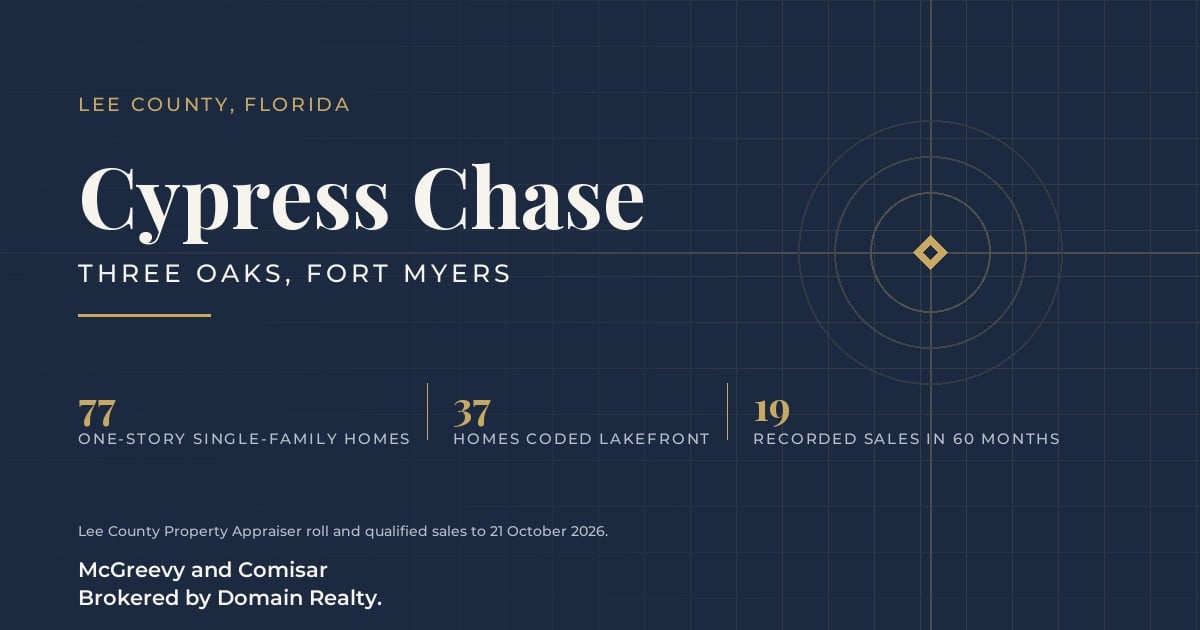
Cypress Chase is a 77-home neighborhood of one-story single-family homes on two lakes off Three Oaks Parkway in Fort Myers. County-recorded sales, association fees, flood zone and selling advice.
Cypress Chase is a 77-home neighborhood of one-story single-family homes on two lakes off Three Oaks Parkway in Fort Myers. County-recorded sales, association fees, flood zone and selling advice.
By Jesse McGreevy and Marc Comisar, McGreevy and Comisar, Domain Realty Group. Updated November 2026.
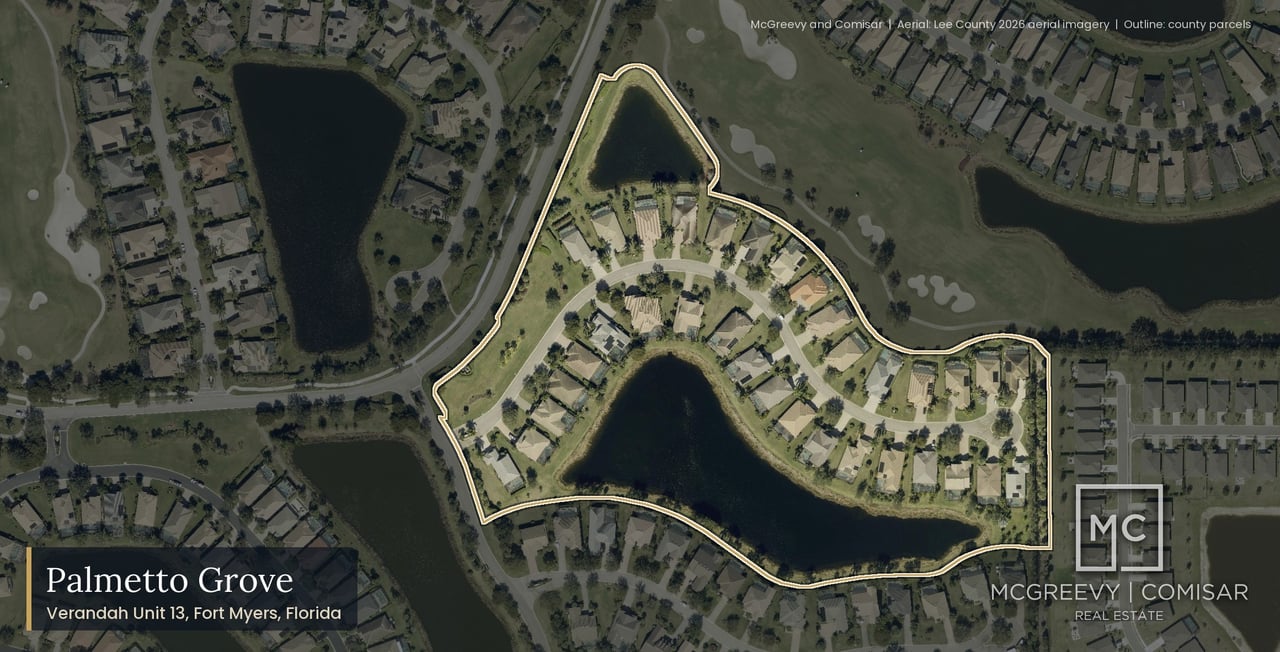
Cypress Chase is a 77-home neighborhood of one-story single-family homes on two lakes off Three Oaks Parkway in the Three Oaks area of south Fort Myers, Florida 33967. The Lee County Property Appraiser roll counts 77 detached homes built from 1988 to 1994 on Cypress View Drive, Cypress Vista Circle and Cypress Chase Court, every one with a garage and two baths, with 1,243 to 2,206 square feet of heated living area, 30 pools and 37 homes on a lake setting.
McGreevy and Comisar are the team Cypress Chase sellers call first: Top 1% Real Estate Agents Nationally Since 2008 and the #1 Team in Southwest Florida since 2012, with over $900 million in personal sales between Jesse and Marc, and the Domain Realty Group team is the #5 real estate team in Florida (RealTrends 2026). This guide walks through where Cypress Chase sits in the Three Oaks area, how it fits under two association layers, how its two plats were laid out and built from 1988 to 1994, its homes, sizes and lots, the two lakes and the recreation tract, daily life, recorded sales and why they spread so widely, the associations' fees and rules, costs and taxes, the flood map and the evacuation zone, what to check on a home of this age, Florida law, schools, what is nearby and how it compares with Pine Run, Pine Glen and other Three Oaks neighborhoods. Our guide to the best real estate agents in Fort Myers explains how we work across the city, and you can read more about the team.
This page is about Cypress Chase at Three Oaks, the recorded plat name for two units of 38 and 39 homes in unincorporated Lee County, not inside the City of Fort Myers and not inside the Village of Estero, with Fort Myers 33967 mailing addresses. Two association layers touch the neighborhood: Cypress Chase Homeowners Association, Inc., the neighborhood association, and Three Oaks I Master Association, Inc., which holds the Unit 2 lake and buffer tracts on the county record. There is no gate, no golf course and no club membership. It is not the Cypress Chase profiled near Miromar Lakes in Fort Myers 33913, and not the Cypress Chase communities in Lauderdale Lakes or Orlando.
Cypress Chase is a non-gated Three Oaks neighborhood of 77 one-story homes built from 1988 to 1994, and the right agent prices each home on its living area and bedrooms, its lake setting and pool, its roof, wind mitigation report and permits, the documents of both associations and the qualified sales Lee County has recorded inside Cypress Chase.
Data updated: November 2026 (the Lee County Property Appraiser roll, 2026 just values; Lee County recorded sales, qualified sales over $100,000, sale data through October 21, 2026; Lee County's copy of the effective FEMA flood map and Lee County's evacuation map, read November 21, 2026; our analysis).
If you're searching for the best realtor for Cypress Chase in Fort Myers, whether you're ready to sell your home in Cypress Chase or buy your next one, McGreevy and Comisar is the team that delivers. We lead Domain Realty Group, the #1 real estate team in Southwest Florida since 2012, Top 1% Nationally since 2008, with over $2.5 billion sold as a team and $900 million in personal sales between Jesse and Marc. Our Domain Realty Group team is also the #5 real estate team in Florida (RealTrends 2026).
Cypress Chase market (Lee County recorded sales, qualified sales over $100,000, sale data through October 21, 2026): 3 qualified sales in 12 months, $313,000 to $540,000 · 6 in 24 months, $313,000 to $540,000 · 8 in 36 months, $313,000 to $540,000 · 19 in 60 months, $313,000 to $545,000, median $410,000 · a median is printed only for the 60-month window, the only one with 10 or more sales · 77 homes on the county roll
We tracked every qualified sale Lee County has recorded on the 77 Cypress Chase homes since the first sales in 1989, 156 qualified sales over $100,000 in the county index; we tracked the 19 qualified sales in the 60 months to October 21, 2026 and matched each to the home's living area and bedrooms on the roll; we read the Lee County Property Appraiser roll for all 77 homes, including year built, size, pool, lake code, just value and homestead status; we read the FEMA flood zone, FIRM panel, elevation certificate layer and Lee County evacuation zone at Cypress Chase on Lee County's map service; and we compared Cypress Chase with Pine Run, Pine Glen, Islands at Three Oaks, Oakmont at the Lakes and Timberwalk on the same 24-month county window.
Honors and recognition:
Selling your home in Cypress Chase? Get a free home valuation at mcgreevyandcomisar.com/home-valuation, or read our guide to selling a home in Fort Myers. Call Jesse direct at (239) 898-6072.
Buying a home in Cypress Chase? Call Marc at (239) 457-1610 for a personalized buyer consultation, and see how we represent buyers. Our guide to buying a home in Fort Myers walks through offers, inspections, insurance and closing costs. You can also contact us with any question about a Cypress Chase home.
Cypress Chase homes are priced from the papers a buyer's lender, insurer and appraiser will read: the Lee County Property Appraiser roll for year built, living area, bedrooms, pool and lake code, the permit history for the roof and systems, the wind mitigation report, the flood zone for the exact address and the documents of both association layers.
The Lee County Property Appraiser roll gives a year built for every one of the 77 homes, from 1988 to 1994, along with heated living area, bedrooms, baths, a pool flag and a land code that marks the 37 homes on a lake setting. It does not tell a buyer the age of the roof, whether the windows or shutters have been replaced, when the air conditioner went in or what the kitchen and baths look like today, so we gather those answers from the seller's permits, invoices and inspection reports before a price is set.
The insurance papers come next. A wind mitigation report shows the roof shape, the roof-to-wall connections and the opening protection an insurer reads, and a 4-point inspection is commonly asked for by insurers on homes of this age. Lee County's elevation certificate layer shows no certificate on file for any Cypress Chase address, so a seller who has one in a drawer should hand it over early. Our Fort Myers home valuation page sets out the steps we follow, and we walk a seller through every one of these papers before a price goes on the market.
Cypress Chase recorded 19 qualified sales in the 60 months to October 21, 2026, from $313,000 to $545,000, with a median of $410,000 and a median of about $266 per heated square foot (Lee County recorded sales, qualified sales over $100,000). Shorter windows hold fewer than 10 sales, so we list their ranges and print no median.
These are Lee County recorded sales on the 77 Cypress Chase homes (qualified sales over $100,000 flagged by the county, sale data through October 21, 2026, the latest sale in the county file used). The county flags sales a few weeks after they record, so the newest deeds may not be counted yet. The MLS (Matrix) was not pulled for this edition, so active listings, list-to-sale ratios and days on market are not shown.
The short windows are small: 3 qualified sales in the 12 months, 6 in the 24 months and 8 in the 36 months, each from $313,000 to $540,000. The county index shows no recorded Cypress Chase sale between August 21 and October 21, 2026. By plat, Unit 2 recorded 10 sales in the 60 months, from $313,000 to $545,000 with a median of $405,000, and Unit 1 recorded 9, from $385,000 to $486,000, too few for a median. A median is a fair picture of the middle of a group; it is not the price of any one house. We set a seller's home against the sales that match its size, bedrooms, setting and condition, read one by one.
Cypress Chase homes of similar size can differ in what surrounds the living area: 37 of the 77 sit on a lake setting, 30 have a pool and 12 have both on the Lee County Property Appraiser roll. Condition, updates, roof age, pool and lake setting are the usual drivers of price among homes of similar size.
The roll gives the setting and the pool flag, but not the state of either. A pool built in 1990 and one rebuilt recently show the same flag; a lake lot with a firm, mowed bank and one with erosion show the same land code. We read the pool permit, any screen enclosure records and the survey for the lake line, and we ask which association holds the lake behind the house, because Unit 1's lake and Unit 2's lake have different owners of record.
The roof date matters for a different reason: it sits at the top of every insurer's list for a home built from 1988 to 1994. A recent roof with a permit and a wind mitigation report can change the insurance conversation a buyer has before writing an offer. We never claim that one feature caused one sale's price; we show a seller how each of these usual drivers lines up against the recorded sales, and we let the documents carry the argument.
Cypress Chase holds 64 three-bedroom homes, 7 two-bedroom homes and 6 four-bedroom homes on the Lee County Property Appraiser roll, all with two baths. A home's bedroom count and living area set the first comparison, but recorded sales show that size alone does not set a Cypress Chase price.
A two-bedroom home in Cypress Chase can carry as much living area as a three-bedroom home, because a plan can use the space for larger rooms rather than a third bedroom, and an owner can open walls later. The roll records the bedroom count, not the layout. We read the floor plan, the permits for any wall or room change and the listing history before we compare a two-bedroom home with three-bedroom sales.
A four-bedroom home raises the opposite question: is the fourth room a true bedroom with a closet and a window, or a den the roll counts as a bedroom? The answer shapes which sales fit. In every case we start with homes of similar living area and bedroom count, then adjust for the usual drivers (condition, updates, roof age, pool and lake setting), and we tell the seller which comparisons are close and which are a stretch.
Cypress Chase buyers search on facts, so we market each home on them: the living area and bedrooms, the build year, the roof and wind mitigation papers, the lake setting and pool, the flood zone for the exact address, both association layers, and the Cypress Chase name beside the Fort Myers 33967 address and the Three Oaks area.
Most buyers who reach a Cypress Chase listing have filtered for a one-story single-family home in south Fort Myers, and their first questions are about the roof, insurance, the flood zone, the association dues and the lake. We answer those up front with the papers: the roof permit and age, the wind mitigation report, the 4-point inspection if the seller has one, the association documents and an estoppel request started early.
We also make sure every listing names Cypress Chase plainly and names Three Oaks too. The county writes Unit 2 as "Cypress Chase at 3 Oaks U-2" on the roll, so a search on "Three Oaks" alone can miss half the neighborhood, and the Cypress Chase name repeats elsewhere in Florida and elsewhere in Fort Myers. A buyer who sees Cypress Chase, Three Oaks and 33967 in the first line stays on the listing. We describe the house, the lot and the papers, never who a buyer should be.
Cypress Chase is a non-gated Three Oaks neighborhood of 77 one-story single-family homes on two lakes, built from 1988 to 1994, and these are the facts a buyer or seller checks first: location, identity, the homes, recorded sales, the two association layers, flood and evacuation zones, schools and taxes.
Data updated: November 2026 (the Lee County Property Appraiser roll, 2026 just values; Lee County recorded sales, sale data through October 21, 2026; Lee County's copy of the effective FEMA flood map and Lee County's evacuation map, read November 21, 2026; the School District of Lee County's enrollment plan).
Cypress Chase is a neighborhood of 77 detached one-story homes at the south end of the Three Oaks area of south Fort Myers, on the east side of Three Oaks Parkway. Its homes sit on three streets, Cypress View Drive, Cypress Vista Circle and Cypress Chase Court, and every parcel carries a Fort Myers 33967 mailing address.
Data updated: November 2026 (the Lee County Property Appraiser roll, 2026 just values; Lee County's subdivision map, read November 21, 2026; the School District of Lee County).
Cypress Chase sits at the south end of the Three Oaks area, on the east side of Three Oaks Parkway, beside Pine Run at Three Oaks and Pine Glen at Three Oaks. The Three Oaks area lies west of I-75 between Alico Road and the Village of Estero, and Cypress Chase is among its southernmost plats.
Three Oaks Parkway is the road that ties Cypress Chase to everything else. To the north it runs toward Alico Road and the I-75 interchange there, Exit 128; to the south it runs toward Corkscrew Road, Exit 123, and the Village of Estero. The neighborhood's 77 homes sit on Cypress View Drive, Cypress Vista Circle and Cypress Chase Court.
The neighbors on either side are separate plats with their own documents and their own sales. Pine Run at Three Oaks is the only Three Oaks plat older than Cypress Chase, and Pine Glen at Three Oaks shares Cypress View Drive. For a first showing we give buyers the route rather than a map pin alone, so the drive in matches the house on the listing, and we point out where Cypress Chase ends and Pine Glen begins.
Cypress Chase homes sit on three streets on the Lee County Property Appraiser roll: Cypress View Drive with 60 Cypress Chase homes, Cypress Vista Circle with 11 and Cypress Chase Court with 6. Cypress Vista Circle and Cypress Chase Court sit wholly inside Cypress Chase; Cypress View Drive is shared.
Street | Cypress Chase homes on the roll | House number range |
|---|---|---|
Cypress View Drive | 60 | 18858 to 19353 |
Cypress Vista Circle | 11 | 19195 to 19275 |
Cypress Chase Court | 6 | 9530 to 9551 |
Total | 77 |
The street table helps a buyer place a home fast. A Cypress Vista Circle or Cypress Chase Court address is a Cypress Chase address. A Cypress View Drive address needs one more check, because the street also carries Pine Glen at Three Oaks homes and Three Oaks Elementary.
The street is a starting point, though, not proof. The legal description on the deed, the recorded plat and the title commitment settle whether a home is inside Cypress Chase at Three Oaks and which unit it belongs to. We read those papers for every home we price or show.
Cypress Chase shares Cypress View Drive with Pine Glen at Three Oaks and with Three Oaks Elementary, which sits at 19600 Cypress View Drive. The 60 Cypress Chase homes on the street are numbered 18858 to 19353 on the Lee County Property Appraiser roll; addresses beyond that range belong to other parcels.
That sharing is the most common source of mix-ups on a Cypress Chase search. A buyer who types "Cypress View Drive" into a search box sees Pine Glen homes too, which are a separate plat with a different span of build years, a different size range and separate documents. A Pine Glen sale is not a Cypress Chase sale, and we never count one as the other.
The school on the street is a fact a buyer can read on the district's own pages, not a promise about placement. Lee County uses a proximity-based zone plan with placement by capacity, so a buyer confirms each address in the district's School Site Locator. For pricing and for paperwork, the test is the legal description: a Cypress Chase home's deed names Cypress Chase at Three Oaks, Unit 1 or Unit 2.
Cypress Chase is in neither. It lies in unincorporated Lee County, outside the City of Fort Myers and outside the Village of Estero, even though every home carries a Fort Myers mailing address and ZIP 33967. Lee County, not a city or village, handles zoning, permits and the county services that reach these homes.
The mailing city confuses many buyers. "Fort Myers" on an envelope is a postal name, and large parts of south Lee County use it without being inside the city. The Lee County Property Appraiser roll records Cypress Chase in the unincorporated zoning area, with zoning RPD, and the area falls inside the Three Oaks census-designated place, a statistical area rather than a town.
For a buyer, the point is practical. Building permits for a roof, a pool or an addition come from Lee County. The tax bill comes through the Lee County Tax Collector, with no city millage line, and the Village of Estero's rules do not reach Cypress Chase even though the village line sits to the south. An insurance quote, a permit search and a tax bill should all name unincorporated Lee County.
Cypress Chase homes are valued on the Lee County Property Appraiser roll, billed by the Lee County Tax Collector and permitted by Lee County. All 77 sit in the San Carlos Fire district, district 071 on the roll, and the roll shows no community development district for Cypress Chase.
Knowing which office holds which paper saves time during the inspection period. The roll and the just value come from the Lee County Property Appraiser, the tax bill from the Lee County Tax Collector, permits and inspections from Lee County, and plat and deed records from the Lee County Clerk of Court. We do not estimate tax bills, and we point buyers to the bill itself for every line, including any non-ad valorem charges.
Utilities are a separate check. Lee County Utilities and Florida Power and Light are the providers usually named for the Three Oaks area; confirm providers for the address before closing. In an emergency, call 911. Storm preparation runs through Lee County Emergency Management, which publishes the evacuation zones a buyer should read for any address.
Cypress Chase homes use Fort Myers, Florida 33967 as their mailing address, and all 85 Cypress Chase parcels on the Lee County Property Appraiser roll, the 77 homes and the 8 common tracts, sit in that ZIP with the mailing city Fort Myers. A buyer who searches by 33967 and the Cypress Chase name reaches the right homes.
ZIP 33967 covers a broad stretch of south Lee County, with many neighborhoods of different ages and types, so the ZIP alone does not narrow a search to Cypress Chase. The neighborhood name does, and so do the street, the plat name and the legal description. A buyer setting up a saved search uses all of them, and adds "3 Oaks" as well as "Three Oaks", because the county writes Unit 2 with the numeral.
When we market a Cypress Chase home, we check that the subdivision name, the ZIP, the property type and the Three Oaks area are all set in the listing. A missing subdivision name means a buyer searching for Cypress Chase never sees the home; a wrong one can put it among Pine Glen or Pine Run homes, which answer different questions.
Cypress Chase is one of the nine plats of the Three Oaks area, at its south end on the east side of Three Oaks Parkway, and it sits under two association layers: Cypress Chase Homeowners Association, Inc., the neighborhood association, and Three Oaks I Master Association, Inc., which holds the Unit 2 lake and buffer tracts on the county record.
Data updated: November 2026 (the Lee County Property Appraiser roll, 2026 just values; Lee County's subdivision map, read November 21, 2026; Florida Statutes, Chapter 720; listings read 2024 to 2026).
Cypress Chase is one of the nine plats of the Three Oaks area and one of its oldest, second only to Pine Run. It sits at the south end, on the east side of Three Oaks Parkway, beside Pine Run at Three Oaks and Pine Glen at Three Oaks, and our Three Oaks guide covers the wider area.
Three Oaks is an area name, not a single association or a single development with one set of rules. Each of its plats has its own recorded documents, its own homes and its own sales, and some share a master association. Cypress Chase's place in that group matters most when a buyer compares it with its neighbors: Pine Run is a little older, and Pine Glen was built over a longer span.
For a buyer, the practical point is that "Three Oaks" on a listing tells you the area, while "Cypress Chase at Three Oaks" on the deed tells you which rules apply. We read the plat name on the legal description first, then the association documents that go with it, and only then do we compare a home with sales elsewhere in Three Oaks.
Cypress Chase Homeowners Association, Inc. is the neighborhood association, and on the Lee County record it owns the recreation tract at 19151 Cypress View Drive, Unit 1 Tract E, a 0.33-acre parcel with a 600 square foot building and a pool flag. The Unit 1 lake, Tract D, about 4.09 acres, is held by the neighborhood.
The neighborhood association is the body a Cypress Chase owner deals with most: it holds the recreation facilities, sets the neighborhood rules under the declaration and collects the neighborhood dues. Listings describe a heated community pool and clubhouse on the recreation tract, and the association's documents set who may use them and when.
Florida's homeowners' association law, Chapter 720, governs how the association keeps records, levies assessments and runs meetings. A buyer is entitled to a disclosure summary before signing under section 720.401, and an owner may inspect the association's official records under section 720.303. We ask the neighborhood association early for its declaration, rules, budget and an estoppel certificate, because each one shapes what a buyer is agreeing to.
Cypress Chase sits partly under Three Oaks I Master Association, Inc., which owns the Unit 2 lake, Tract C, about 5.79 acres, along with a small Unit 2 lake tract and a buffer tract on the Lee County record. Whether the master association bills Cypress Chase owners separately or through the neighborhood association is not published; ask.
That open question is the one a buyer should settle in writing before the inspection period ends. Some Three Oaks plats see a master item in their listing fee fields and some do not, and a listing is not the place to settle it for Cypress Chase. The neighborhood association's budget, the master association's budget and an estoppel certificate from each answer it.
The county record also carries a separate entity, Three Oaks Master Association, Inc., which is a different name from Three Oaks I Master Association, Inc. The two names are easy to confuse on a document request. We check that every request, every estoppel and every budget names the right entity, and that the lake behind a Unit 2 home is matched to the master association that holds it.
Cypress Chase is not gated: Lee County's subdivision map records the Three Oaks area as not gated (read November 21, 2026), and listings describe Cypress Chase as non-gated. There is no golf course, no marina and no master club; the neighborhood association holds the recreation tract and its pool.
A buyer coming from a golf and country club community expects a gatehouse, an equity or membership fee and a club dues schedule, and finds none of those here. What Cypress Chase offers is the home, the lot, the two lakes and the neighborhood's recreation tract, with the neighborhood dues and any master charge confirmed on the estoppel certificates.
A buyer confirms access with the association rather than relying on a listing or a map read. The same goes for any plan to add a gate or a new amenity, which would show up in the minutes, the budget and any special assessment. We ask for the most recent minutes and the current budget for exactly that reason.
Cypress Chase in the Three Oaks area is not the Cypress Chase profiled near Miromar Lakes in Fort Myers 33913, and not the Cypress Chase communities in Lauderdale Lakes or Orlando. The shared name is a coincidence, not a shared developer, plat or association, and facts about those places do not apply here.
The mix-up matters because search results, portals and aggregators sometimes blend records from places with the same name. A buyer who sees a 33913 ZIP, a gated entry, condominium units or a different street name is looking at a different place. Cypress Chase in the Three Oaks area has 77 single-family homes on Cypress View Drive, Cypress Vista Circle and Cypress Chase Court, ZIP 33967.
For a buyer, the fix is the same as with every name mix-up: read the street, the ZIP and the legal description. An insurer, a lender or an inspector who receives "Cypress Chase" without the full address can pull the wrong file, so we send the exact address, the plat name and the 33967 ZIP together on every request.
Cypress Chase at Three Oaks is written two ways on the Lee County Property Appraiser roll: Unit 1 as "Cypress Chase at Three Oaks" and Unit 2 as "Cypress Chase at 3 Oaks U-2". A search on the words "Three Oaks" alone can miss the 39 Unit 2 homes, so every search uses both forms.
The difference looks small, but it changes counts, sales lists and title searches. A sales pull that matches only "Three Oaks" sees Unit 1 and misses Unit 2; a pull that matches only "Cypress Chase" catches both but can also catch the same name elsewhere in Lee County. We matched both units by their recorded legal descriptions and left look-alikes out.
A buyer who reviews a title commitment, a survey or an insurance quote should expect to see either form and should not be alarmed by the numeral. What matters is the unit number, the block and the plat reference matching the deed. A seller who lists a Unit 2 home should make sure the listing carries the Cypress Chase name in full, so the home reaches buyers who search either way.
Cypress Chase buyers read the two association layers on four papers: the title commitment, the recorded declaration, the disclosure summary Florida requires before signing and an estoppel certificate from each association. Together they show which bodies govern the lot, what each charges and whether anything is owed.
The title commitment lists the recorded documents that affect the lot, including the declaration and any master documents, and it shows which associations have a lien right. The disclosure summary under section 720.401 tells a buyer that membership is mandatory and that assessments can change. An estoppel certificate under section 720.30851 states what the seller owes the association as of a date.
For Cypress Chase, that means two estoppel requests when two associations are involved: one to Cypress Chase Homeowners Association, Inc. and one to the master association, unless the master association confirms in writing that it bills through the neighborhood. The declaration and rules govern; read the current versions before you sign.
Cypress Chase at Three Oaks was recorded in two plats, Unit 1 and Unit 2, and its 77 homes were built from 1988 to 1994, with 53 of them in 1989 and 1990. Vacant lots sold first and homes followed, a pattern that fits a lot-sale subdivision with one or more builders.
Data updated: November 2026 (the Lee County Property Appraiser roll, 2026 just values; Lee County recorded sales, sale data through October 21, 2026; published histories of Three Oaks Parkway).
Cypress Chase at Three Oaks was recorded in two plats: Unit 1, Plat Book 41, Pages 29 to 30, with 38 homes in blocks 10 to 13, and Unit 2, written "Cypress Chase at 3 Oaks U-2" on the roll, Plat Book 43, Pages 49 to 50, with 39 homes in blocks 8 and 9.
The Lee County Property Appraiser roll shows 1989 as the year created for Unit 1 parcels and 1990 for Unit 2 parcels, which matches the order in which the homes went up. Unit 1 holds the north part of Cypress View Drive and Cypress Vista Circle; Unit 2 holds the south part of Cypress View Drive and Cypress Chase Court.
Each plat also set aside common tracts. Unit 1 carries a right of way tract, two buffer and conservation tracts, the 4.09-acre lake (Tract D) and the recreation tract (Tract E). Unit 2 carries a buffer tract and two lake tracts, the larger being the 5.79-acre lake (Tract C). A buyer reads the recorded plat for the lot's lines, the easements and the tract beside it; the Lee County Clerk of Court holds the plats in its official records.
Cypress Chase building ran from 1988 to 1994 on the Lee County Property Appraiser roll, with most homes finished in 1989 and 1990: 4 homes in 1988, 31 in 1989, 22 in 1990, 7 in 1991, 8 in 1992, 4 in 1993 and 1 in 1994. No home has been added since.
Year built (Lee County Property Appraiser roll) | Homes |
|---|---|
1988 | 4 |
1989 | 31 |
1990 | 22 |
1991 | 7 |
1992 | 8 |
1993 | 4 |
1994 | 1 |
Total | 77 |
Unit 1 homes are mostly from 1989, 22 of its 38, and Unit 2 homes mostly from 1990, 16 of its 39, which follows the order of the plats. The later homes, from 1991 to 1994, fill lots that sold as vacant land in the first years and were built on afterward.
For a buyer, the year built for the exact house is what the insurer and the inspector read, not the neighborhood's span. A 1989 home and a 1993 home were built under codes and with materials of their own years, and each has had its own history of roofs, windows and systems since. Every Cypress Chase sale today is a resale, so the papers for that history carry the weight.
Cypress Chase's builder and original developer are not named in any public source we found. About 37 vacant-lot deeds recorded from 1988 to 1993 at $25,000 to $43,000, followed by the first improved sales, fit a lot-sale subdivision with one or more builders. The Lee County Clerk plat and early deeds hold the names.
That pattern means the homes were not all built to one builder's plan list. Lots sold to builders or to buyers who then contracted for a home, so floor plans, rooflines and finishes can vary from house to house. The roll's living areas, which run from 1,243 to 2,206 square feet, are consistent with that.
For a buyer, the builder question becomes a document question. The permit history for the roof, the windows and the systems, the wind mitigation report and any record of later additions are the facts that matter on a home of this age. The recorded plat and the earliest deeds at the Lee County Clerk of Court can name the parties who sold the lots, and a buyer who wants that history can ask the title agent to pull them.
Cypress Chase's first improved sales recorded from 1989 to 1994 at about $113,500 to $168,000 in the Lee County sales file, after vacant-lot deeds at $25,000 to $43,000. Since then, Lee County has recorded 156 qualified sales over $100,000 on the 77 homes, a long resale record for a neighborhood of its size.
Those early figures are history, not a guide to today's prices; the market moved through several cycles in the decades since, and the recorded sales by year show it. What the early sales do show is the order of building: lots first, homes after, and resales starting while the last lots were still being built on.
The long sales record is useful for a different reason. With 156 qualified sales on 77 homes, many houses have changed hands more than once, so their deeds, permits and past listings leave a paper trail a buyer can read. We tracked every one of those qualified sales and matched each to the home's living area and bedrooms on the roll, so a seller sees the history of comparable homes, not just the latest handful.
Cypress Chase homes date from the same years Three Oaks Parkway opened. According to published histories of the parkway, its first two-lane segment, from Alico Road to Corkscrew Road, opened in April 1988, built by the developers of the Three Oaks residential community. The first Cypress Chase homes date from 1988.
The parkway gave the Three Oaks plats their main road. In the decades since, the parkway has been widened and extended, and a new segment opened in November 2026 that links it with routes to the south; that change shapes driving patterns more than it changes anything inside the neighborhood.
For a buyer, the history explains why the Three Oaks plats sit along one road, with Pine Run and Cypress Chase among the first. It also explains why the area's plats and its master associations share the Three Oaks name without sharing one set of documents.
Cypress Chase's recreation building, a 600 square foot structure on the 0.33-acre recreation tract at 19151 Cypress View Drive, is first on the Lee County Property Appraiser roll in 2001, about a decade after most homes were finished. The tract is owned by Cypress Chase Homeowners Association, Inc. and carries a pool flag on the roll.
The gap between the homes and the building tells a buyer that the recreation facilities grew after the neighborhood filled in, which is common in lot-sale subdivisions. Listings describe a heated community pool and clubhouse there today. The association's budget and minutes show how the building and pool are maintained, and whether any repair or replacement is planned.
A buyer asks the association for the current rules on the pool and clubhouse, the hours, any key or fob system and any rental of the building for gatherings. A buyer also asks whether the budget carries a reserve for the pool, the building roof and the equipment, because those are the items that most often lead to a special assessment in a small association.
Cypress Chase's recorded declaration, its book and page, and the date control passed from the developer to the owners were not found online. The Lee County Clerk of Court's official records hold them, and a title agent pulls the declaration and any amendments for the title commitment on every sale.
For a buyer, the declaration is the most important paper in the association file, because it sets the use rules, the leasing terms, the assessment powers and the architectural rules that apply to the lot. Listing records disagree on some of those terms, such as the minimum lease term, so the recorded declaration and the association's current rules are what govern.
We ask the seller and the association for the declaration, every recorded amendment, the bylaws, the articles and the current rules at the start of a listing, and we check them against what the title commitment lists. A buyer should read the full set before the inspection period ends. The declaration and rules govern; read the current versions before you sign.
Cypress Chase homes are detached, one story and single-family, every one with a garage and two baths on the Lee County Property Appraiser roll, built from 1988 to 1994. Heated living area runs from 1,243 to 2,206 square feet, 30 homes have a pool, and 37 sit on a lake setting.
Data updated: November 2026 (the Lee County Property Appraiser roll, 2026 just values; listings read 2024 to 2026).
Cypress Chase's 77 homes share four facts on the Lee County Property Appraiser roll: each is a detached single-family home, Florida DOR use 01, each is one story, each has a garage and each has two baths. None is a condominium or a villa, and none is attached to a neighbor.
That sameness makes Cypress Chase easier to compare than a neighborhood with mixed home types. A buyer does not have to sort stairs from no stairs, attached walls from detached or a condominium association from a homeowners' association. Every comparison starts from the same base: a one-story house with a garage on its own lot.
The differences lie elsewhere: living area, bedrooms, lot size, the lake setting, the pool and, most of all, what each owner has changed since the home was built. Zoning on the roll is RPD in unincorporated Lee County, and the recorded declaration adds its own rules on what an owner may build or change. We read both before we tell a seller what a buyer will see as the home's strengths and weak points.
Cypress Chase homes carry total building area under roof of 1,959 to 3,849 square feet on the Lee County Property Appraiser roll, with a median of 2,712, counting the garage and lanai with the heated living area of 1,243 to 2,206 square feet, median 1,616. Under-roof area is not living area.
The two figures answer different questions. Heated living area is what an appraiser and a buyer compare, and it sets the price per square foot. Total area under roof is what a roofer measures, what an insurer prices for replacement and what shows the size of the garage and lanai. A home with a large lanai or a two-car garage can carry much more under roof than a home of the same living area.
A buyer reads both figures and does not mix them. A listing that quotes the larger number as if it were living area overstates the house, and a price per square foot built on it will not match the sales. We quote heated living area from the roll and confirm it with a measured floor plan or the appraisal, and we give the under-roof figure to the insurer.
Cypress Chase has 30 homes with a pool on the Lee County Property Appraiser roll, out of 77, and 12 of those also sit on a lake setting. The recreation tract carries a pool flag too, and listings describe a heated community pool there; the association rules set who may use it.
A home pool is a document and inspection item as much as a feature. A buyer asks for the pool permit, any screen enclosure permit, the age of the pump, heater and any resurfacing, and whether the pool barrier meets the rules in force when it was built. A pool built in 1990 and one rebuilt recently show the same flag on the roll.
Insurers and inspectors look at pools on older homes with care. A screen enclosure is part of the wind and storm picture, and an insurer may ask about it. We gather the pool and enclosure papers with the roof and wind mitigation papers, so a buyer sees the whole outdoor picture before making an offer.
Cypress Chase just values on the 2026 Lee County Property Appraiser roll run from $296,758 to $427,328, with a median of $354,257. Lake homes carry a median just value of $358,689 and off-lake homes $350,902. Just value is not market value: the county sets it for taxes.
Just value is the county's mass-appraisal estimate, set as of January 1. It does not see the finish inside a house, a recent roof, new windows or the state of a pool, and it moves on a schedule of its own. The qualified sales Lee County has recorded in Cypress Chase over the 60 months ran from $313,000 to $545,000, which shows how far a sale can sit from the county figure.
The taxable value on a bill can differ again, because exemptions and assessment limits apply to some homes, and the assessed value resets after a purchase. We do not estimate tax bills. We look at the just value for one reason: it shows how the county sees a house beside its neighbors on the same roll. The price itself comes from the recorded sales, read one by one, and the seller's documents.
Cypress Chase buyers looking at a home built from 1988 to 1994 ask for six papers: the roof permit and its date, the window and shutter records, the air conditioner's age, the plumbing and electrical history, a wind mitigation report and a 4-point inspection, which is commonly asked for by insurers on older homes.
The roof permit shows when the roof was last replaced and what covering went on, and the insurer reads its age first. Roof age and wind mitigation drive premiums for homes built in these years. Window and shutter records show whether the openings are impact rated or protected by shutters, and which product approvals apply.
A wind mitigation report records the roof shape, the roof-to-wall connections and the opening protection, and Florida law ties insurance discounts to those features. A 4-point inspection looks at the roof, electrical, plumbing and heating and air conditioning. A buyer also checks the permit history with Lee County for open or expired permits, because an open permit can stall a closing. A seller who orders these papers before listing answers the insurer's questions before a buyer has to ask them.
Cypress Chase buyers find the year built, living area, bedrooms, baths, pool flag, lake code and lot size on the Lee County Property Appraiser roll, but not the facts that drive much of a price: the roof's age, the window type, the systems, the kitchen and baths, the floor plan or the state of the lake bank behind the lot.
Those come from the seller's documents and the inspection. The roll records the bedroom count but not whether a wall has moved; it records a pool but not its condition; it records a lake code but not whether the view is open water or a corner of a lake behind other homes. The roll's lake code itself is a land classification, not a promise of frontage, so a buyer reads the survey.
That is why we gather papers before we price: the permits, the inspection, the wind mitigation report, the survey and the association documents tell the rest of the story. Two Cypress Chase homes with the same line on the roll can be very different houses inside, and the recorded sales show it.
Cypress Chase homes of the same living area can differ widely inside because each lot was built on separately from 1988 to 1994 and each home has had more than three decades of owners since. Floor plans, rooflines, kitchens, baths, flooring and outdoor space vary from house to house.
Some homes keep much of their original layout and finishes; others have had new kitchens, opened walls, new roofs, impact windows, new pools or enlarged lanais. The roll does not record most of that work, and listing photos show only part of it. The permit history with Lee County shows the work that was permitted, and the inspection shows the rest.
For a buyer, the lesson is to compare two Cypress Chase homes on their documents and a walk-through, never on a shared description or a square footage figure. For a seller, it is to gather the papers for every improvement, because a buyer and an appraiser can only credit what they can see or read. We read each listing description against the permit history before we say anything about a house.
Cypress Chase sellers in Fort Myers are pricing one of 77 one-story homes on two lakes, built 1988 to 1994. We price each home on its living area and bedrooms, its lake setting and pool, its roof, wind mitigation report and permits, both association layers and the qualified sales Lee County has recorded inside Cypress Chase.
Selling your home in Cypress Chase? Get a free home valuation. Call Jesse direct at (239) 898-6072.
Buying a home in Cypress Chase? Call Marc at (239) 457-1610 and see how we represent buyers.
Cypress Chase homes run from 1,243 to 2,206 square feet of heated living area on the Lee County Property Appraiser roll, with a median of 1,616. Most have three bedrooms, all have two baths, and lots run from 0.17 to 0.36 acre, with a median of 0.194 acre.
Data updated: November 2026 (the Lee County Property Appraiser roll, 2026 just values).
Cypress Chase's 77 homes fall into four size bands on the Lee County Property Appraiser roll: 26 homes under 1,500 square feet, 29 from 1,500 to 1,749, 17 from 1,750 to 1,999 and 5 of 2,000 square feet or more. The median is 1,616 square feet.
Heated living area (Lee County Property Appraiser roll) | Homes |
|---|---|
Under 1,500 sq ft | 26 |
1,500 to 1,749 sq ft | 29 |
1,750 to 1,999 sq ft | 17 |
2,000 sq ft or more | 5 |
Total | 77 |
Most homes sit in the two middle bands, and only five reach 2,000 square feet. A buyer who needs more room than that will find few choices inside Cypress Chase, and a seller of one of the larger homes has few direct comparisons in the neighborhood's own sales.
We tracked the 19 qualified sales of the 60 months to October 21, 2026 against the living area and bedrooms on the roll for each home, so we can show a seller which sales came from the same band. Even then, size is a starting point rather than the answer: among homes of similar size, condition, updates, roof age, pool and lake setting are the usual drivers of price.
Cypress Chase's Lee County Property Appraiser roll shows 64 three-bedroom homes, 7 two-bedroom homes and 6 four-bedroom homes, all with two baths. The three-bedroom, two-bath one-story home with a garage is the typical Cypress Chase house, and most comparisons start there.
Bedrooms (Lee County Property Appraiser roll) | Homes |
|---|---|
Two bedrooms | 7 |
Three bedrooms | 64 |
Four bedrooms | 6 |
Total | 77 |
The two-bedroom and four-bedroom homes are few, so their sales are few too. A buyer looking for four bedrooms watches for one of six homes; a seller of a two-bedroom home is pricing one of seven, and the nearest sales are often three-bedroom homes of similar living area. We say so plainly when the comparison is not like for like.
Every home has two baths on the roll, which means a four-bedroom home and a two-bedroom home share the same bath count. A buyer who needs a third bath checks whether any owner has added one with a permit, and reads the declaration for any limit on additions.
Cypress Chase lots run from 0.17 to 0.36 acre on the Lee County Property Appraiser roll, with a median of 0.194 acre. The exact usable area of any lot is set by its survey, its easements, the setbacks in the county rules and the recorded declaration, not by the acreage on the roll.
Parcel acreage on the roll comes from the county's mapped lot lines, so it is close to, but not the same as, a surveyed figure. A buyer who needs the exact area, frontage and depth orders a boundary survey, which also shows easements, the rear line and where any lake tract, buffer tract or right of way tract begins.
Lot size can matter to a price. Where a lot differs from its neighbors, we show the county acreage and the survey together in the listing file, so a buyer sees where the figure came from. A lot's shape and what sits behind it, open water, a buffer or another home, can matter as much as its acreage.
Cypress Chase holds 38 homes in Unit 1, blocks 10 to 13, and 39 homes in Unit 2, blocks 8 and 9, on the Lee County Property Appraiser roll. Unit 1 homes are mostly from 1989 and Unit 2 homes mostly from 1990, and each unit has its own lake.
The two units share one neighborhood association, the same street pattern and the same home type, but they differ in which body holds the lake. The Unit 1 lake, about 4.09 acres, is held by the neighborhood, and the Unit 2 lake, about 5.79 acres, by Three Oaks I Master Association, Inc. That difference matters to a buyer of a lake lot, because it decides which association a lake bank question goes to.
The units also differ in how the county writes them, "Cypress Chase at Three Oaks" for Unit 1 and "Cypress Chase at 3 Oaks U-2" for Unit 2. In the 60 months to October 21, 2026, Lee County recorded 10 qualified sales in Unit 2 and 9 in Unit 1. We read each sale with its unit and its lake, so a seller sees how close each comparison really is.
Cypress Chase buyers should read the living area on a listing against the heated living area on the Lee County Property Appraiser roll, which runs from 1,243 to 2,206 square feet. A listing figure that is much larger may count the garage, the lanai or an unpermitted room, and a price per square foot built on it will mislead.
The roll's total building area under roof, 1,959 to 3,849 square feet with a median of 2,712, counts the garage and lanai, so it is always larger than the living area. A buyer who sees a figure near that range on a listing should ask what it measures. An enclosed lanai or a converted garage may feel like living space, but an appraiser counts it only if it is heated, finished and permitted.
The best check is a measured floor plan or the appraisal, read with the permit history. If an owner added a room, the permit shows whether Lee County approved it, and the association file shows whether the association approved the exterior change. We quote the roll figure in a listing and explain any difference, so a buyer is never surprised at the appraisal.
Cypress Chase owners who want to add a pool, a screen enclosure, a room, a fence or a larger driveway need a Lee County permit and whatever approval the recorded declaration and the association's rules require. The survey's easements and setbacks also limit where an addition may go on a lot of 0.17 to 0.36 acre.
Before buying with an addition in mind, a buyer reads three papers: the declaration and any architectural rules for what the association allows and how it approves exterior changes, the survey for easements and setbacks, and the county's zoning rules for the lot. The zoning on the roll is RPD, which sets its own limits within the planned development.
A buyer of a home that already has an addition asks for the permit and the association's approval. Missing either can surface during the inspection, the appraisal or the title review, and both are easier to settle before closing. The declaration and rules govern; read the current versions before you sign.
Cypress Chase has two lakes inside its plats, about 4.09 acres in Unit 1 and about 5.79 acres in Unit 2, about 9.98 acres of lake water in all, plus a 0.33-acre recreation tract at 19151 Cypress View Drive with a 600 square foot building and a community pool.
Data updated: November 2026 (the Lee County Property Appraiser roll, 2026 just values; listings read 2024 to 2026).
Cypress Chase's two lakes sit inside its plats: about 4.09 acres in Unit 1, Tract D, held by the neighborhood, and about 5.79 acres in Unit 2, Tract C, held by Three Oaks I Master Association, Inc. Together with a small Unit 2 lake tract, lake water inside the plats comes to about 9.98 acres.
The lakes are part of the area's stormwater system as much as a view, and the body that holds each one sets its rules and maintains its banks. A buyer of a Unit 1 lake lot asks Cypress Chase Homeowners Association, Inc. about the lake; a buyer of a Unit 2 lake lot asks Three Oaks I Master Association, Inc. Each association's documents set the rules on docks, boats, fishing, swimming and what may be placed at the water's edge.
No published source names those lake rules for Cypress Chase, so a buyer reads the declaration and the rules of the association that holds the lake rather than assuming. A seller gathers the same papers, because a buyer who imagines a dock or a small boat behind a house wants the answer before making an offer.
Cypress Chase has 37 homes with a lake land code on the Lee County Property Appraiser roll, out of 77, and 12 of those also have a pool. Lake homes carry a median 2026 just value of $358,689 against $350,902 for off-lake homes, an assessment figure, not a sale price.
A lake code on the roll tells a buyer the county classes the lot as lakefront, but not what the view looks like or how much shoreline the lot has. Some lake lots face open water across the full width of the lake; others meet a corner or a narrow arm. The survey shows the line between the lot and the lake tract, and a site visit shows the rest.
In recorded sales, the lake setting is one of the usual drivers of price, along with condition, updates, roof age and the pool. We never claim a lake caused a particular sale price, but we read each sale with its setting, and we show a seller the lake and off-lake sales side by side when there are enough of each.
Cypress Chase's recreation tract is Unit 1 Tract E, a 0.33-acre parcel at 19151 Cypress View Drive owned by Cypress Chase Homeowners Association, Inc. It holds a 600 square foot building, first on the Lee County Property Appraiser roll in 2001, and the parcel carries a pool flag. Listings describe a heated community pool and clubhouse.
The tract is the neighborhood's only shared amenity, and its upkeep is part of what the neighborhood dues pay for. A buyer asks the association for the pool and clubhouse rules, the hours, how access works and whether the building can be booked. A buyer also asks about the age of the pool equipment, the building roof and any planned repairs.
Because the association is small, a large repair to the pool or the building can show up as a special assessment. The budget, any reserve schedule and the most recent minutes tell a buyer whether one is planned. We ask for all three at the start of a listing, so a buyer sees the answer before an offer rather than in the estoppel certificate.
Cypress Chase's Lee County Property Appraiser roll carries 8 common tracts alongside its 77 homes, 85 parcels in all: in Unit 1, a right of way tract, two buffer and conservation tracts, the lake and the recreation tract; in Unit 2, a buffer tract and two lake tracts, all held by the master association.
Those tracts are the roads, the buffers, the lakes and the shared land the associations hold and maintain. They do not count as homes, and they never enter a sales figure. A buyer who sees a tract parcel on a county map next to a home is seeing association land, not a buildable lot.
For an owner, the tracts matter because their upkeep is part of what the associations spend, and because a lot that meets a tract has a line a survey must show. A buyer of a lot that backs onto a buffer or conservation tract reads the survey and the plat for what may and may not be done along that edge, and asks which association maintains it.
Cypress Chase buyers looking at one of the 37 lake lots check four things: the survey line between the lot and the lake tract, the condition of the lake bank, which association holds and maintains that lake, and any drainage or maintenance easement along the shoreline. Each one is a document or a site question.
The survey shows where the lot ends and the lake tract begins, which can be closer to the house than the lawn suggests. The bank itself is a site question: erosion, a steep drop or a washed-out edge can lead to repair costs, and the association documents say who pays. A buyer asks the association that holds the lake, the neighborhood for Unit 1 and the master association for Unit 2, for its rules and any bank repair plans.
A buyer also asks whether a fence, a dock, a seawall or landscaping at the water's edge is allowed, because the declaration and the lake owner's rules govern each. A lake lot with a pool, one of 12 in Cypress Chase, raises the pool and screen enclosure questions as well. We gather the survey and the association answers before a buyer writes an offer.
Cypress Chase buyers read three papers for a lot's lines, easements and drainage: a current boundary survey, the recorded plat and the title commitment. The survey shows the lot lines, any lake, buffer or road tract beside the lot and where the house sits; the title commitment lists every recorded document that affects the lot.
An easement for utilities or drainage can run along a lot's front, side or rear line, and the survey and the plat show where. A pool, fence or addition must stay clear of those easements, and the declaration can add its own limits on changes to grading and drainage. The plats for Unit 1 and Unit 2 set out the lot lines and tracts as recorded, and the Lee County Clerk of Court holds them.
A buyer reads all three papers before the inspection period ends, because an easement can limit where a pool, a fence or an addition may go. A seller who orders a current survey before listing answers the question early and avoids a delay when the buyer's title agent reaches it. Any lot question the papers leave open goes to the association that holds the neighboring tract.
Selling your home in Cypress Chase? Get a free home valuation at mcgreevyandcomisar.com/home-valuation, and read our guide to selling a home in Fort Myers. Call Jesse direct at (239) 898-6072.
Buying a home in Cypress Chase? Call Marc at (239) 457-1610 and see how we represent buyers, or read our guide to buying a home in Fort Myers.
Cypress Chase daily life runs along three streets off Three Oaks Parkway, Cypress View Drive, Cypress Vista Circle and Cypress Chase Court, past two lakes and a 0.33-acre recreation tract with a community pool and clubhouse, with no gate, no golf course and no master club attached to the 77 one-story homes.
Data updated: November 2026 (the Lee County Property Appraiser roll; Lee County's subdivision map layer, read November 21, 2026; listing records read 2024 to 2026).
Cypress Chase is a neighborhood of 77 one-story single-family homes, every one with a garage and two baths on the Lee County Property Appraiser roll, built from 1988 to 1994 on lots of about 0.17 to 0.36 acre. Every home carries a Fort Myers mailing address in ZIP 33967, but the streets sit in unincorporated Lee County, so county services, not City of Fort Myers services, reach them. The roll places all 77 homes in the San Carlos Fire district and zones the land RPD.
Day to day, the neighborhood is shaped by its plat more than by any club. Two lakes sit inside the two plats, about 4.09 acres in Unit 1 and about 5.79 acres in Unit 2, and 37 of the 77 homes carry a lake land code on the roll. A recreation tract at 19151 Cypress View Drive, owned by Cypress Chase Homeowners Association, Inc., holds a 600 sq ft building first on the roll in 2001, and the parcel carries a pool flag on the roll. Listings describe a heated community pool and clubhouse there.
There is no gate, no golf course, no marina and no master club membership attached to a Cypress Chase home. Lee County's subdivision layer records the Three Oaks area as not gated (read November 21, 2026), and listings describe Cypress Chase as non-gated. Listings also describe sidewalks, street lights and tree-lined, deed-restricted streets. The declaration and rules govern; read the current versions before you sign.
Cypress Chase owners share a 0.33-acre recreation tract at 19151 Cypress View Drive, Unit 1 Tract E on the plat, owned by Cypress Chase Homeowners Association, Inc. The Lee County Property Appraiser roll shows a 600 sq ft building first on the roll in 2001 and a pool flag on the parcel; listings describe a heated community pool and clubhouse.
The building arrived about a decade after the homes. The homes on the roll date from 1988 to 1994, and the recreation building first appears on the roll in 2001, so the clubhouse and pool are an association project added after the streets filled in, not a builder's model center. That history matters for upkeep: a building and pool of that age carry their own repair and replacement questions, and the neighborhood association pays for them through its budget.
A listing describes a pool and clubhouse on the day it was written. Heaters are replaced, hours change, rooms are repurposed and guest rules are rewritten by the board. A buyer walks the recreation tract during a showing, reads the posted pool rules, and asks the association for its current budget to see which line items pay for the pool, the building and the grounds. The declaration and rules govern; read the current versions before you sign.
Cypress Chase has two lakes inside its plats: about 4.09 acres in Unit 1, Tract D, held by the neighborhood association, and about 5.79 acres in Unit 2, Tract C, held by Three Oaks I Master Association, Inc. Together they hold about 9.98 acres of water, and 37 of the 77 homes carry a lake land code.
The two lakes belong to two different associations. That split shapes who answers a question about a lake bank, a fountain, an aquatic weed treatment or a drainage pipe. A home on the Unit 1 lake looks across water owned by Cypress Chase Homeowners Association, Inc.; a home on the Unit 2 lake looks across water owned by the master association. A buyer asks the association that owns the lake behind the home who maintains the bank and the outfall, and reads that association's budget for lake work.
For daily routines, the lakes are a view and part of the drainage system. Any rule on fishing, boats, docks, swimming or bank landscaping comes from the recorded documents of the association that owns the water, not from a listing. Twelve of the 77 homes have both a pool and a lake setting on the roll, and a buyer looking at one of those homes reads the lake rules and the pool permit together. The declaration and rules govern; read the current versions before you sign.
Cypress Chase homes sit on three streets: Cypress View Drive with 60 homes, Cypress Vista Circle with 11 and Cypress Chase Court with 6. Cypress View Drive is shared with Pine Glen at Three Oaks and with Three Oaks Elementary at 19600 Cypress View Drive, so school-day traffic uses the same street.
Cypress Vista Circle and Cypress Chase Court sit wholly inside Cypress Chase, so most traffic on them belongs to the homes on them. Cypress View Drive is different: it carries Cypress Chase homes, Pine Glen at Three Oaks homes and the elementary school, so arrival and dismissal times bring buses and drop-off traffic past the Cypress Chase homes on that street.
How that feels depends on where a home sits on the street and on the hour. A buyer drives Cypress View Drive at school arrival and dismissal times, on a weekday and on a weekend, before deciding how the week would run. School assignment is a separate question from the street a school sits on: students at Cypress Chase addresses are placed under the district's zone plan, so a buyer confirms the assigned schools for the address with the School District of Lee County.
Cypress Chase has no gate, no golf course and no master club, so there is no gate transponder to order, no club membership to transfer and no golf dues on a closing statement. Lee County's subdivision layer records the Three Oaks area as not gated, and listings describe Cypress Chase as non-gated.
Without a gate, guests, contractors and delivery drivers reach a Cypress Chase home without a call box or a visitor list. That changes the paperwork more than the routine: there is no gate access agreement to read and no gate budget line, and a buyer does not need to register a vehicle with a gate staff.
Without golf or a master club, the shared amenities are the neighborhood association's recreation tract, its pool and clubhouse, and the two lakes. A buyer who wants tennis courts or a larger park uses public facilities nearby. Because the documents, not the street, decide what an owner may do, a buyer still reads the recorded declaration for rules on parking, vehicles, signs and exterior changes. The declaration and rules govern; read the current versions before you sign.
Cypress Chase sits near Lee County's Three Oaks Park at 18251 Three Oaks Parkway, which has lighted tennis courts, and near Three Oaks Town Center and Three Oaks Marketplace on Three Oaks Parkway. Gulf Coast Town Center lies to the north and Coconut Point in Estero to the south, with Lee Health Coconut Point nearby.
None of these places belongs to either association, and none is part of a Cypress Chase home's title. Three Oaks Park is a county park, so its hours, court rules and any reservations come from Lee County Parks and Recreation. The shopping centers on Three Oaks Parkway handle most daily errands, and the larger centers at Gulf Coast Town Center and Coconut Point handle the rest.
Three Oaks Parkway is the spine for every trip. Its first two-lane segment, from Alico Road to Corkscrew Road, opened in April 1988, and an extension opened on November 2, 2026, completing a longer north-south route through the area. Interstate 75 is reached at Exit 128 at Alico Road to the north or at Corkscrew Road, Exit 123, to the south. A buyer drives the routes that matter at the hours that matter before deciding how a week would run.
Cypress Chase recorded 19 qualified home sales in the 60 months to October 21, 2026, from $313,000 to $545,000 with a median of $410,000, according to Lee County recorded sales over $100,000. Shorter windows hold fewer than 10 sales: 3 in the 12 months and 6 in the 24 months, so they print counts and ranges only.
Data updated: November 2026 (Lee County recorded sales, qualified sales over $100,000, sale data through October 21, 2026; the Lee County Property Appraiser roll).
We tracked every qualified sale Lee County has recorded on the 77 Cypress Chase homes since the first sales in 1989, 156 qualified sales over $100,000, and we tracked the 19 qualified sales in the 60 months to October 21, 2026 and matched each to the home's living area and bedrooms on the roll. We read the Lee County Property Appraiser roll for all 77 homes, including year built, size, pool, lake code and just value. A median prints only for a window with 10 or more qualified sales, and only the 60-month window reaches that count.
Qualified sales over $100,000 recorded by Lee County, window end October 21, 2026; median printed only at 10 or more sales:
Window (to October 21, 2026) | Qualified sales | Range | Median |
|---|---|---|---|
12 months | 3 | $313,000 to $540,000 | not printed (under 10 sales) |
24 months | 6 | $313,000 to $540,000 | not printed (under 10 sales) |
36 months | 8 | $313,000 to $540,000 | not printed (under 10 sales) |
60 months | 19 | $313,000 to $545,000 | $410,000 |
Across the 60 months, the median price came to about $266 per heated sq ft. The county index shows no recorded Cypress Chase sale between August 21 and October 21, 2026.
These are Lee County recorded sales on the 77 Cypress Chase homes (qualified sales over $100,000 flagged by the county, sale data through October 21, 2026, the latest sale in the county file used). The county flags sales a few weeks after they record, so the newest deeds may not be counted yet. The MLS (Matrix) was not pulled for this edition, so active listings, list-to-sale ratios and days on market are not shown.
To see homes listed in Three Oaks right now, Domain Realty Group keeps Three Oaks homes on the market.
Selling your home in Cypress Chase? Get a free home valuation. Call Jesse direct at (239) 898-6072.
Buying a home in Cypress Chase? Call Marc at (239) 457-1610 and see how we work with buyers.
Cypress Chase sale windows of 12, 24, 36 and 60 months, all ending October 21, 2026, hold 3, 6, 8 and 19 qualified sales in Lee County recorded sales over $100,000. The first three read as counts and ranges; the 60-month window, with 19 sales, is the only one long enough to print a median of $410,000.
The windows overlap: each longer window holds every sale of the shorter ones. All three shorter windows share the same range, $313,000 to $540,000, because the low and the high both recorded inside the latest 12 months. The 60-month window reaches back to late 2021 and carries sales from a different stretch of the market, including the top of the 60-month range at $545,000.
A reader uses the windows to see how often Cypress Chase homes change hands and how far apart recorded prices sit, then turns to the individual sales. With 77 homes and only a handful of qualified sales in a typical recent year, every sale in the list carries weight, and a buyer or seller compares a home with the sales that match it in size, bedrooms, condition, roof, pool and lake setting.
Cypress Chase prints a median only where a window holds 10 or more qualified sales, and only the 60-month window, with 19 sales, reaches that count. The 12, 24 and 36-month windows hold 3, 6 and 8 sales, so a median there would describe too few deeds to say much about the other homes.
In a short list, one unusual sale moves a median by tens of thousands of dollars. A home with a new roof, a remodeled kitchen and a pool on the lake can sit next to a home that needs everything, and the middle of three or six sales may simply be whichever one happened to land between them. A range keeps both ends in view and tells a reader how wide the spread is.
The 60-month median of $410,000 is context, not a price for any one home. It mixes homes of 1,243 to 2,206 sq ft, two, three and four bedrooms, pool and no pool, lake and no lake, original and updated. It answers the question "where has the middle of the recorded market sat over five years," not "what is this house worth."
Cypress Chase Unit 2 recorded 10 qualified sales in the 60 months to October 21, 2026, from $313,000 to $545,000 with a median of $405,000. Unit 1 recorded 9 sales from $385,000 to $486,000, too few for a median, according to Lee County recorded sales over $100,000.
Qualified sales over $100,000 recorded by Lee County, 60 months to October 21, 2026, by plat; median printed only at 10 or more sales:
Plat | Homes | Qualified sales | Range | Median |
|---|---|---|---|---|
Unit 2 (blocks 8 and 9) | 39 | 10 | $313,000 to $545,000 | $405,000 |
Unit 1 (blocks 10 to 13) | 38 | 9 | $385,000 to $486,000 | not printed (under 10 sales) |
The two plats are close to the same size, 38 homes in Unit 1 and 39 in Unit 2. Unit 1 parcels show 1989 as the roll's year created and Unit 2 parcels 1990. The Unit 2 lake is held by Three Oaks I Master Association, Inc., and the Unit 1 lake by the neighborhood association.
The plat split is a way to read the record, not a ranking. Both ends of the 60-month range recorded in Unit 2, which widens its range; Unit 1's narrower range comes from fewer sales and says nothing on its own about a home there. A buyer or seller reads the plat a home sits in as one fact among many, alongside size, bedrooms, condition, roof, pool and lake setting.
Cypress Chase shows no recorded qualified sale in the county index between August 21 and October 21, 2026, the end of the window used. With only a handful of qualified sales a year, gaps between recorded sales are part of the record, and the latest recorded sale, in August 2026, is the newest county price point.
The county record runs behind the market. A sale that closed in October may record and be flagged as qualified weeks later, and a contract signed in the fall closes later still. For a home pricing in November 2026, the recorded sales tell a seller what closed, while pending and active homes, which the county file does not show, tell a seller what buyers face now.
A gap also says nothing about demand by itself. With 3 qualified sales in the latest 12 months, Cypress Chase often goes weeks between recorded sales. A buyer or seller who wants the current picture asks for the active and pending homes in Cypress Chase and nearby Three Oaks plats, then reads them against the recorded sales.
Cypress Chase figures in this guide come from Lee County recorded sales and the Lee County Property Appraiser roll, which record closed deeds and assessments, not asking prices, offers or time on market. The MLS (Matrix) was not pulled for this edition, so active listings, list-to-sale ratios and days on market are not shown.
Recorded sales are the firmest public evidence of what a Cypress Chase home brought, because each is a deed with a price. They cannot say how long a home sat, how many offers it drew or what it was first asked at. Those details live in the MLS record of each sale, which an agent reads home by home when pricing.
A buyer looking at a home on the market asks the listing agent for the listing history: the first asking price, any reductions and the days on market. A seller asks for the same history on recent Cypress Chase sales and on comparable homes nearby, so that a list price rests on what buyers actually paid and how quickly.
Cypress Chase recorded 6 qualified sales in the 24 months to October 21, 2026, from $313,000 to $540,000, and the spread was wide for homes of similar size: a two-bedroom of about 1,760 sq ft at $313,000 against a three-bedroom of about 1,440 sq ft at $540,000. Size alone did not set price.
Data updated: November 2026 (Lee County recorded sales, qualified sales over $100,000, sale data through October 21, 2026; the Lee County Property Appraiser roll).
In the 24 months to October 21, 2026, the spread was wide, from $313,000 to $540,000 for homes of similar size, a two-bedroom of about 1,760 sq ft at $313,000 against a three-bedroom of about 1,440 sq ft at $540,000; size alone did not set price. Condition, updates, roof age, pool and lake setting are the usual drivers of a spread like that in a neighborhood where every home is one story, every home has two baths and most date from 1989 and 1990. Price per heated sq ft in those 24 months ran from about $178 to about $375.
These are Lee County recorded sales on the 77 Cypress Chase homes (qualified sales over $100,000 flagged by the county, sale data through October 21, 2026, the latest sale in the county file used). The county flags sales a few weeks after they record, so the newest deeds may not be counted yet. The MLS (Matrix) was not pulled for this edition, so active listings, list-to-sale ratios and days on market are not shown.
Cypress Chase recorded 6 qualified sales in the 24 months to October 21, 2026, from $313,000 to $540,000, according to Lee County recorded sales over $100,000. We matched each to the home's living area and bedrooms on the Lee County Property Appraiser roll; the list gives month, size, bedrooms and price only.
Month recorded | Heated area (about) | Bedrooms | Price |
|---|---|---|---|
January 2025 | 1,480 sq ft | 3 | $486,000 |
September 2025 | 1,440 sq ft | 2 | $410,000 |
October 2025 | 1,880 sq ft | 3 | $500,000 |
April 2026 | 1,440 sq ft | 3 | $540,000 |
June 2026 | 1,420 sq ft | 3 | $385,000 |
August 2026 | 1,760 sq ft | 2 | $313,000 |
Four of the six homes sit between about 1,420 and about 1,480 sq ft, inside the under-1,500 sq ft band that holds 26 of the 77 homes, yet their prices run from $385,000 to $540,000. The largest home in the list, at about 1,880 sq ft, recorded $500,000, and the second largest, at about 1,760 sq ft, recorded the low of the window. The list is short, and no single sale explains another.
These are Lee County recorded sales on the 77 Cypress Chase homes (qualified sales over $100,000 flagged by the county, sale data through October 21, 2026, the latest sale in the county file used). The county flags sales a few weeks after they record, so the newest deeds may not be counted yet. The MLS (Matrix) was not pulled for this edition, so active listings, list-to-sale ratios and days on market are not shown.
Cypress Chase homes share one story, two baths, a garage and an age of 1988 to 1994, so the differences that set price sit inside and around each house. Condition, updates, roof age, pool and lake setting are the usual drivers; the county record shows the price and the size, not the reason for any one sale.
A 1989 house can carry its original roof covering or one replaced last year, its original windows or impact glass, an air conditioner near the end of its life or a new one, a kitchen and baths from the year it was built or fully redone. Each of those changes the buyer's next five years of spending and the insurance quote, and buyers price that in. Two homes of about the same size can therefore record very different prices without either being out of line.
Bedroom count matters too. A two-bedroom plan of about 1,760 sq ft and a three-bedroom plan of about 1,440 sq ft serve different buyers, and the county record does not show how each home was finished, whether a den was added or whether a lanai was enclosed. The right comparison for any Cypress Chase home is the recorded sale that matches it on these points, read with the listing record and photos of that sale.
Cypress Chase price per heated sq ft ran from about $178 to about $375 in the 24 months to October 21, 2026, and the 60-month median came to about $266 per heated sq ft, according to Lee County recorded sales over $100,000 and the living area on the Lee County Property Appraiser roll.
A range that wide in one neighborhood is a warning against pricing by the square foot alone. The roll's heated area is the air-conditioned living space; it leaves out the garage and lanai, which the roll counts in total building area under roof, from 1,959 to 3,849 sq ft. A home with a large screened lanai and a pool can look expensive per heated sq ft and still be priced in line with what buyers pay for the whole property.
Price per square foot is a check, not a method. It helps a seller spot a comparable that does not fit, and it helps a buyer see whether an asking price sits inside the recorded spread. It cannot account for a new roof, an updated kitchen, a pool or a lake setting, which is why we read each recorded sale on its own before using it to price a Cypress Chase home.
Cypress Chase yearly qualified sales since 2005 have run from 2 to 8 a year, according to Lee County recorded sales over $100,000. No year reaches 10 sales, so the table prints counts and low-to-high ranges only, with no median column, and it skips a year the county file does not report.
Qualified sales over $100,000 recorded by Lee County, by calendar year; counts and ranges only:
Year | Qualified sales | Low to high |
|---|---|---|
2005 | 6 | $296,500 to $355,900 |
2006 | 5 | $265,000 to $335,000 |
2007 | 2 | $260,000 to $325,000 |
2008 | 3 | $179,000 to $270,000 |
2009 | 2 | $138,000 to $161,200 |
2010 | 2 | $127,000 to $181,000 |
2011 | 4 | $142,500 to $178,000 |
2012 | 3 | $145,000 to $178,000 |
2014 | 5 | $190,000 to $221,251 |
2015 | 8 | $157,900 to $249,000 |
2016 | 4 | $199,900 to $249,000 |
2017 | 5 | $215,000 to $285,000 |
2018 | 4 | $229,000 to $275,500 |
2019 | 5 | $210,000 to $300,000 |
2020 | 5 | $230,000 to $328,000 |
2021 | 3 | $340,000 to $392,500 |
2022 | 5 | $400,000 to $490,000 |
2023 | 5 | $392,000 to $545,000 |
2024 | 2 | $375,000 to $410,000 |
2025 | 3 | $410,000 to $500,000 |
2026 (to October 21) | 3 | $313,000 to $540,000 |
The table traces the full cycle on the same 77 homes: the 2005 and 2006 ranges, the drop through 2009 to 2012, a slow climb from 2014 to 2020, and the step up from 2021 to 2023. The ranges since 2022 overlap year to year, and each year's list is short, so a single sale can set a year's low or high.
Cypress Chase's first improved sales, recorded from 1989 to 1994 as the homes were finished, ran at about $113,500 to $168,000, according to Lee County recorded sales. Since 1989 the county index holds 156 qualified sales over $100,000 on the 77 homes, a long record for a neighborhood this size.
The early record also shows how the neighborhood was built. Vacant-lot deeds from 1988 to 1993, about 37 of them at $25,000 to $43,000, came before most improved sales, which fits a lot-sale subdivision with one or more builders. No builder or original developer is named in any public source found; the Lee Clerk plat and early deeds hold the names.
For a buyer or seller today, the early prices are history rather than a pricing tool. Their value is in the record they start: 156 qualified sales across more than three decades on the same 77 one-story homes let a reader see each home's own sale history at the Lee County Property Appraiser, and see how many times a home has changed hands and when it last did.
Cypress Chase homes are valued one by one: the house first, its size, bedrooms, roof, windows, systems and updates, then the pool and lake setting, the lot, the flood zone and the documents of two associations, and finally the qualified sales Lee County has recorded on the 77 homes, read sale by sale.
Data updated: November 2026 (Lee County recorded sales, qualified sales over $100,000, sale data through October 21, 2026; the Lee County Property Appraiser roll; Lee County's copy of the effective FEMA flood map).
McGreevy and Comisar have been Top 1% Real Estate Agents Nationally Since 2008, and in Cypress Chase we price each home from its own papers rather than from a neighborhood average. We read the Lee County Property Appraiser roll for all 77 homes, including year built, size, pool, lake code and just value, and we tracked the 19 qualified sales in the 60 months to October 21, 2026 before we price one home.
These are Lee County recorded sales on the 77 Cypress Chase homes (qualified sales over $100,000 flagged by the county, sale data through October 21, 2026, the latest sale in the county file used). The county flags sales a few weeks after they record, so the newest deeds may not be counted yet. The MLS (Matrix) was not pulled for this edition, so active listings, list-to-sale ratios and days on market are not shown.
Selling your home in Cypress Chase? Get a free home valuation. Call Jesse direct at (239) 898-6072.
Buying a home in Cypress Chase? Call Marc at (239) 457-1610 and see how we work with buyers.
Cypress Chase homes are close cousins on paper: one story, two baths, a garage, built 1988 to 1994, with heated area from 1,243 to 2,206 sq ft and a median of 1,616. When the plans are that similar, condition and updates separate one home from the next more than a few hundred square feet do.
The 24-month record makes the point: a three-bedroom of about 1,440 sq ft recorded $540,000 while a two-bedroom of about 1,760 sq ft recorded $313,000. We do not claim to know why either sale landed where it did, but in homes of this age the usual drivers are the kitchen and baths, flooring, the roof, the air conditioner, the windows and the pool equipment.
So a Cypress Chase valuation starts with a walk-through and a list. We note what has been replaced and when, with permits where they exist, and what is original. A seller who can show a permitted roof, a recent air conditioner and updated baths has evidence a buyer and an appraiser can read; a seller whose home is original prices for that honestly and lets buyers see the opportunity.
Cypress Chase homes date from 1988 to 1994, so roof age, window type and the age of the air conditioner and water heater weigh heavily in price. They drive the buyer's insurance quote and near-term spending, and buyers read the roof permit, wind mitigation report and a 4-point inspection before committing.
Insurers commonly ask for a 4-point inspection on older homes, covering the roof, electrical, plumbing and air conditioning, and a wind mitigation report under Florida's wind mitigation statute records the roof covering, roof-to-wall connections and opening protection that can lower a premium. A home that arrives with both documents current gives a buyer a quote before the inspection period runs down.
We ask a Cypress Chase seller for the roof permit and its final inspection, any window or shutter permits, the air conditioner's install date, the water heater's date and any plumbing or electrical permits. Each document turns a claim into evidence. Where a system is original, we price with that in view rather than leaving the buyer's inspector to raise it after an offer.
Cypress Chase has 30 homes with a pool and 37 with a lake land code on the Lee County Property Appraiser roll, and 12 homes have both. A pool and a lake setting are among the usual drivers of price here, but we read each one through its permits, condition and documents rather than adding a set amount.
A pool adds value only as far as it is sound and documented. We ask for the pool permit, the screen enclosure permit and its age, and the age of the pump, heater and surface. A cage nearing the end of its life or a pool that needs resurfacing is a cost a buyer will price in, and a buyer's inspector will find it.
A lake setting depends on the lake. A home on the Unit 1 lake looks over water held by Cypress Chase Homeowners Association, Inc., and a home on the Unit 2 lake over water held by Three Oaks I Master Association, Inc. Bank condition, the view from the lanai and the association rules for the bank are all part of how a buyer reads that setting.
Cypress Chase homes carry 2026 just values on the Lee County Property Appraiser roll from $296,758 to $427,328, with a median of $354,257; lake homes show a median of $358,689 and off-lake homes $350,902. Just value is the appraiser's assessment figure, not market value, and it is not a price.
The just value comes from a mass appraisal that the Lee County Property Appraiser builds for the tax roll. It reads the home's size, age, features and land, but it does not walk through the house, see a remodeled kitchen or a tired roof, or watch buyers compete for one home. The 24-month recorded sales, from $313,000 to $540,000, run past the top of the just value range, one reason the two figures are read separately.
We use the just value for what it is: a check that the roll's record of size, pool and lake code matches the house, and a starting point for the tax questions a buyer will ask. A seller who prices from the just value alone risks leaving money on the table or missing the market; a buyer who reads it as a fair price risks the opposite.
Cypress Chase's 60-month median of $410,000, on 19 qualified sales to October 21, 2026, frames where the middle of the recorded market has sat over five years, with a median of about $266 per heated sq ft. It frames a value; it does not set one, because no Cypress Chase home is the median home.
The 19 sales mix sizes, bedrooms, plats, pools, lakes and conditions across late 2021 to August 2026. A home that is larger, updated and on a lake with a pool will sit well away from the middle, and so will an original two-bedroom. The median tells a seller and a buyer where the center of that mix lies and helps flag a comparable that does not fit.
We read the 60-month median alongside the 24-month sales, the active and pending homes at the time of pricing, and comparable sales in nearby Three Oaks plats when Cypress Chase itself has too few. The result is a price range for one home, with the evidence for each end of it, rather than a single number taken from an average.
Cypress Chase owners can request a valuation that starts with the home's own papers: the roof permit, the wind mitigation report, any 4-point inspection, the pool and screen enclosure permits, the insurance declarations page and estoppel status from both associations. Our Fort Myers home valuation page starts the request.
We answer with the recorded Cypress Chase sales read sale by sale and a price range for the home, not a figure taken from a neighborhood average. Our guide to selling a home in Fort Myers lists the documents we gather first, including the recorded declaration, the association rules and the budgets a buyer will ask for.
A seller who prefers to talk first can call Jesse direct at (239) 898-6072. Two associations may each issue an estoppel certificate for a Cypress Chase sale, so a seller who starts that paperwork early keeps the closing date in reach.
Cypress Chase sellers get the most precise valuation when the home's records are on the table at the first visit: permits for the roof, windows, air conditioner, pool and screen enclosure, a current wind mitigation report, the insurance declarations page, the survey and the latest statements from both associations.
Permits matter most on a home built from 1988 to 1994, because they date the work that buyers and insurers care about. If a permit is missing, the Fort Myers home valuation request can still go ahead, and we note which records to pull from Lee County before the home goes on the market.
The association papers matter as much as the house. The latest dues statement, any notice of a special assessment, the association rules a buyer will ask about and the name of the office that issues estoppel certificates all shorten the time between contract and closing. A seller who gathers them before the valuation gives us a full picture and gives a buyer fewer reasons to pause.
Cypress Chase buyers deal with two association layers: Cypress Chase Homeowners Association, Inc., the neighborhood association that owns the recreation tract, and Three Oaks I Master Association, Inc., which owns the Unit 2 lake and buffer tracts. Florida's homeowners' association law, Chapter 720, governs both, and neither publishes its budget openly.
Data updated: November 2026 (the Lee County Property Appraiser roll; listing records read 2024 to 2026; Florida Statutes, Chapter 720).
The county record names the owners of the common tracts. In Unit 1, Cypress Chase Homeowners Association, Inc. holds the recreation tract and the Unit 1 lake; in Unit 2, Three Oaks I Master Association, Inc. holds the lake and the buffer tracts. Whether the master association bills Cypress Chase owners separately or through the neighborhood association is not published, so a buyer asks both associations before signing.
The rules come from recorded documents. Listings describe the neighborhood as deed restricted. The declaration's book and page and the date control passed from the developer to the owners were not found online; the Lee Clerk's official records hold them. A buyer asks for the declaration, articles, bylaws, rules, the current budget of each association and an estoppel certificate from each before the inspection period ends. The declaration and rules govern; read the current versions before you sign.
Our guide to buying a home in Fort Myers sets out how we read association documents during the inspection period.
Cypress Chase Homeowners Association, Inc. is on the county record as owner of the recreation tract, with its pool and clubhouse building, and of the Unit 1 lake. Three Oaks I Master Association, Inc. is on the county record as owner of the Unit 2 lake and buffer tracts. Questions follow ownership.
A question about pool hours, the clubhouse, neighborhood dues, architectural approval for a new roof color or fence, or the Unit 1 lake goes to the neighborhood association. A question about the Unit 2 lake, its banks or the buffer tracts in Unit 2 goes to the master association. A separate entity, Three Oaks Master Association, Inc., also appears on the public record under the Three Oaks name, so a buyer confirms by the documents which master association, if any, levies on the home being bought.
That split is the reason a buyer reads two sets of papers. Each association has its own governing documents, its own board and its own budget. A buyer who asks both, in writing, which documents bind the home and which association bills it, avoids a surprise at closing. The declaration and rules govern; read the current versions before you sign.
Cypress Chase sits under a neighborhood association and a master association, so a buyer asks for an estoppel certificate from each. Under Florida's estoppel statute for homeowners' associations, the certificate states what the owner owes and whether any assessment is unpaid, and the association is bound by it.
The estoppel certificate is how the closing agent confirms that the seller's account is current with each association: regular assessments, any special assessment, late charges and any fines. If the master association bills Cypress Chase owners through the neighborhood association, a single certificate may cover both; if it bills separately, two certificates are needed. The answer is not published, so the title company asks both associations.
The certificate also carries a fee, set by statute limits, and who pays it is a contract term. A seller who orders the certificates early avoids a closing delay, and a buyer who reads them before closing knows the exact dues, the billing cycle and whether anything is past due. The declaration and rules govern; read the current versions before you sign.
Cypress Chase buyers receive a disclosure summary under Florida's homeowners' association disclosure statute, which tells a buyer that the home sits in a mandatory association, that assessments apply and that the governing documents bind the owner. The summary belongs with the sale contract.
The disclosure summary is a short form, not the documents themselves. It tells the buyer that membership is required, that assessments can change, that failure to pay can lead to a lien, and that the buyer should read the declaration and rules. In Cypress Chase the summary may name one association or both, depending on how the master association bills owners, and a buyer who sees only one asks about the other.
The form is a starting point. The buyer's real reading is the recorded declaration, the articles, the bylaws, the rules and the budgets of each association. Those documents set the dues, the use rules, the leasing rules and the architectural standards that apply from the day of closing. The declaration and rules govern; read the current versions before you sign.
Cypress Chase owners, once they close, can inspect the official records of each association under Florida's homeowners' association records statute: the governing documents, budgets, financial reports, minutes and contracts. Before closing, a buyer asks the seller to request copies of the same records.
The records answer the questions listings cannot. Minutes show what the board has discussed, including any planned special assessment, a pool or clubhouse repair, or lake bank work. The budget shows what dues pay for and whether reserves are set aside. The financial report shows whether the association has been meeting its budget.
Because Cypress Chase has two association layers, the records of both matter. The neighborhood association's records cover the recreation tract and the Unit 1 lake; the master association's records cover the Unit 2 lake and buffers. A buyer who reads both sets of minutes for the last year or two knows what each board has been dealing with. The declaration and rules govern; read the current versions before you sign.
Cypress Chase owners pay assessments set by each association's budget, and under Florida's assessments and liens statute an unpaid assessment can become a lien on the home. Each association can also enforce its rules, and the fines and suspensions statute sets the notice and hearing steps.
For a buyer, the lien rule is why the estoppel certificate matters: a lien for unpaid assessments can follow the home, so the closing agent clears it at closing using the certificate. The statute also makes a new owner jointly liable with the seller for assessments that were due at the time of transfer, which is another reason to read the certificate closely.
The rules side covers what an owner may do with the home and lot. Fines and suspension of amenity use follow the statute's notice and hearing process. A buyer reads the rules on parking, vehicles, signs, exterior paint, fences, landscaping and pool enclosures before closing, and asks whether any open violation or fine sits on the home. The declaration and rules govern; read the current versions before you sign.
Cypress Chase listing records disagree on the minimum lease term; the recorded declaration and HOA rules govern. Pets are listed as allowed, and assistance animals are handled under fair housing law; ask the association. Listings describe the neighborhood as deed restricted, so the recorded declaration sets what an owner may do.
One listing record shows a 30-day minimum lease and another shows 365 days. Both cannot be right for the same documents, and neither is the source. A buyer who intends to lease the home reads the leasing article of the recorded declaration and any leasing rule the board has adopted, and asks whether the association requires an application, approval or registration of a tenant.
Pet rules work the same way: a listing field is a hint, and the declaration and rules decide the number, kind and size of pets and any leash or waste rules on common areas. The deed restrictions also reach exterior changes, so a buyer planning a new roof, a fence or a pool asks how the association approves changes. The declaration and rules govern; read the current versions before you sign.
Cypress Chase owners vote in the associations that govern their home, and Florida's homeowners' association meetings statute sets the rules for annual meetings, notice, quorum, elections and amendments. Each association's bylaws add the details, including the board size and how votes are cast.
Meetings are where budgets are adopted, special assessments are decided and rules change. Board meetings are generally open to members under Florida law, with notice posted in advance, and owners may speak on agenda items. A buyer who wants to know how the board works reads recent minutes and the notice of the next annual meeting.
Amendments matter to a buyer because they can change the leasing, pet or architectural rules after closing. The bylaws and declaration set how many votes an amendment needs. A buyer who reads the amendment article knows how the rules can change, and a buyer who reads recent minutes knows whether any change is under discussion. The declaration and rules govern; read the current versions before you sign.
Cypress Chase ownership costs start with neighborhood dues, a possible master association fee that is not published, the Lee County tax bill with its San Carlos Fire district line, homeowners insurance driven by roof age and wind mitigation, and flood insurance where a lender requires it. No community development district appears on the roll.
Data updated: November 2026 (listing records read 2024 to 2026; the Lee County Property Appraiser roll; Lee County's copy of the effective FEMA flood map; Florida Statutes, Chapter 720).
Listing figures we read from 2024 and 2025 showed neighborhood dues of about $280 to $300 a quarter, covering the recreation facilities including the community pool; treat them as hints, not figures. Neither association publishes its budget openly, so the current HOA budget and an estoppel certificate decide what a buyer will actually pay. Whether a separate master association fee applies is not published; ask.
Ask for the current budgets of both associations, the reserve schedule if any, and an estoppel certificate from each before the inspection period ends. The budgets show what dues pay for and whether anything is set aside for the pool, the clubhouse building or lake work; the estoppel certificates show the exact amounts owed on the home and the billing cycle.
The roll shows no community development district for Cypress Chase, and all 77 homes sit in the San Carlos Fire district (district 071). We do not estimate tax bills. A buyer confirms the non-ad valorem lines on the home's own tax bill at the Lee County Tax Collector. Transfer fees and any capital contribution are not published; ask both associations.
Selling your home in Cypress Chase? Get a free home valuation. Call Jesse direct at (239) 898-6072.
Buying a home in Cypress Chase? Call Marc at (239) 457-1610 and see how we work with buyers.
Cypress Chase neighborhood dues pay for what Cypress Chase Homeowners Association, Inc. owns and runs, which on the county record includes the recreation tract with its pool and clubhouse building and the Unit 1 lake. The association's current budget names every line item, and the estoppel certificate confirms the amount.
A budget for a neighborhood like this usually carries pool upkeep and chemicals, utilities for the recreation building, insurance on common property, lake and landscape work, management or bookkeeping and any reserve for future repairs. Which of those apply in Cypress Chase, and at what amount, only the budget can say. A buyer reads the budget line by line rather than treating the dues as one number.
The reserve schedule, if there is one, answers the next question: when the pool resurfacing, the clubhouse roof or the pool heater comes due, is money set aside or will a special assessment pay for it? A building first on the roll in 2001 is old enough that those questions are practical. A buyer asks for the reserve schedule and the most recent minutes along with the budget.
Cypress Chase sits under Three Oaks I Master Association, Inc., which owns the Unit 2 lake and buffer tracts on the county record, but whether the master association bills Cypress Chase owners separately or through the neighborhood association is not published. A buyer asks both associations and reads the answer in writing.
There are three possible answers, and each changes the cost picture. The master association may bill each owner directly, in which case its fee sits on top of the neighborhood dues. It may bill the neighborhood association, which passes the cost through in its own dues. Or the master's costs may be covered another way the documents describe. Only the recorded declarations and the budgets settle it.
The practical step is the estoppel request. When the title company orders estoppel certificates, it asks each association what the home owes. If the master association issues its own certificate with its own amount, that is a separate fee; if it says the neighborhood association collects for it, that is a pass-through. A buyer reads both answers before the inspection period ends.
Cypress Chase buyers may meet one-time association charges at closing, such as a transfer fee, a capital contribution or estoppel fees, but none is published for either association. Title and closing costs are negotiable in Florida; ask your agent and title company what is customary in Lee County.
A transfer fee or capital contribution, where an association charges one, is set by its recorded documents or a board resolution, and the estoppel certificate usually states it. Estoppel certificate fees follow the limits in Florida law, and the sale contract says who pays them. With two association layers, a buyer may see two sets of these charges or one, depending on how the master association works.
The settlement statement is where every charge appears together. A buyer reads it a few days before closing and asks the title company about any association line not already on an estoppel certificate. A seller reads the same statement for the charges the contract assigns to the seller, so that neither side is surprised at the closing table.
Cypress Chase property tax bills carry Lee County ad valorem taxes for the unincorporated county, the school district and other taxing authorities, plus non-ad valorem lines. All 77 homes sit in the San Carlos Fire district (district 071), and the roll shows no community development district. We do not estimate tax bills.
The roll places the homes in a residential garbage district, and the tax bill lists any non-ad valorem charges that go with it. The roll itself does not list every non-ad valorem charge, so a buyer reads the latest bill for the home at the Lee County Tax Collector and confirms each line.
The seller's tax bill is not the buyer's tax bill. A seller's bill reflects that owner's exemptions and assessment history, and a purchase resets the assessed value for the new owner. Florida law requires a disclosure on that point in the sale contract under Florida's property tax disclosure statute. A buyer asks the Lee County Property Appraiser how a sale and any new exemption would affect the home.
Cypress Chase homes were built from 1988 to 1994, so roof age and wind mitigation features drive homeowners insurance premiums more than anything a buyer can change after closing. A 4-point inspection is commonly asked for by insurers on older homes, and a current wind mitigation report can earn credits.
The wind mitigation statute requires insurers to offer discounts for features that reduce wind loss, and an inspector records those features on the state form: roof covering and its permit date, roof deck attachment, roof-to-wall connections, roof shape and opening protection such as shutters or impact glass. A buyer asks the seller for the latest report and orders a new one if it is old.
The 4-point inspection looks at the roof, electrical panel and wiring, plumbing and air conditioning, and an insurer can decline or surcharge a home with an old roof or an outdated panel. A buyer gets insurance quotes early in the inspection period, using the roof permit, the wind mitigation report and the 4-point, so that the premium is known before the deposit becomes harder to recover. Florida's hurricane deductible statute explains how a separate hurricane deductible works on a policy.
Cypress Chase sits in Zone X on the effective FEMA flood map, which carries no federal flood insurance mandate, but a lender may still require flood insurance by its own rule, and Zone X is not "no flood risk." A buyer gets a lender flood determination and a quote for the address.
Whether flood insurance is a required cost depends on the lender, not on the zone alone. A buyer with a mortgage asks the lender early whether its rules require a policy. A buyer paying cash decides whether to carry coverage, knowing that flooding can happen outside the mapped high-risk areas.
The National Flood Insurance Program explains its policies and how premiums are rated at FloodSmart, and other carriers also write flood coverage. A buyer asks the seller whether the home has a flood policy now, since some policies can be assumed by a new owner, and reads the declarations page for the coverage and premium.
Cypress Chase homes with a pool of their own, 30 of the 77 on the roll, carry the owner's own pool upkeep, equipment and screen enclosure costs, apart from the dues that pay for the community pool. Lake upkeep sits with the association that owns each lake, and a buyer reads that association's budget for it.
A home's own pool brings recurring costs, chemicals, cleaning and electricity, and periodic ones, a pump, a heater, resurfacing and eventually a new screen enclosure. A buyer asks the seller for the ages of the pump, heater and surface and the enclosure permit, and has a pool inspector look at the equipment during the inspection period.
Lakes are a common cost. The Unit 1 lake is held by Cypress Chase Homeowners Association, Inc. and the Unit 2 lake by Three Oaks I Master Association, Inc., so lake treatment, bank repair and outfall work run through those associations' budgets. A lake-setting buyer asks the owning association whether bank work is planned and how it is funded. The declaration and rules govern; read the current versions before you sign.
Cypress Chase sits entirely in Zone X on the effective FEMA flood map that Lee County republishes, an area of minimal flood hazard outside the special flood hazard area. Zone X carries no federal flood insurance mandate, but it is not "no flood risk," and a lender flood determination decides the insurance question for each address.
Data updated: November 2026 (Lee County's copy of the effective FEMA flood map and FIRM panel index, read November 21, 2026; Lee County's elevation certificate layer, read November 21, 2026; Lee County, FEMA map changes 2026).
Lee County's copy of the effective FEMA flood map places all of Cypress Chase in Zone X, an area of minimal flood hazard outside the special flood hazard area, on FIRM panel 12071C0583G, effective November 17, 2022 (map read November 21, 2026).
Zone X carries no federal flood insurance mandate, but a lender may still require it and Zone X is not "no flood risk." No elevation certificate is on file in the county's elevation certificate layer for any Cypress Chase address. New unincorporated Lee County flood maps are scheduled to take effect March 2, 2027, so a reader checks the address on the new map. A lender flood determination and the address check at the FEMA Flood Map Service Center decide.
Cypress Chase homes in Zone X sit outside the special flood hazard area, so federal rules do not require flood insurance for a federally backed mortgage. A lender may still require a policy by its own rule, and a buyer asks early, because the answer changes the monthly cost.
Lee County's page on special flood hazard areas explains the difference between the high-risk zones, such as A and AE, where federal rules require flood insurance on a backed mortgage, and Zone X, where they do not. FEMA's flood zones and maps guide sets out the same definitions for owners.
The lender orders its own flood zone determination for the address, and that determination is what the loan file uses. A buyer asks for it during the inspection period rather than at closing. If the lender requires a policy, the buyer gets a quote before the deposit becomes harder to recover; if not, the buyer still decides whether to carry one.
Cypress Chase's Zone X designation means minimal flood hazard on the effective map, not no flood risk. Heavy rain can pond on streets and yards outside mapped hazard areas, and maps change. A buyer reads Zone X as one fact and asks the seller and the associations about each home's own history.
FEMA maps model the chance of a large flood from rivers, rain and storm surge; they do not map every low spot in a yard or every drainage problem in a street. FEMA's flood insurance program notes that floods also reach homes outside the high-risk zones, which is why it encourages owners in Zone X to consider coverage.
For a Cypress Chase home, the useful questions are local and specific. Has water ever entered the home or the garage? Has the yard or street ponded in heavy rain? Has any flood insurance claim been paid on the home? The seller's disclosure, the insurance claim history and the association's minutes on drainage or lake bank work answer them better than the zone letter alone.
Cypress Chase has no elevation certificate on file in the county's elevation certificate layer for any address, read November 21, 2026. In Zone X, elevation certificates are not required to build or insure, so homes from 1988 to 1994 often have none. A buyer who wants one hires a licensed surveyor.
An elevation certificate records the elevation of a home's lowest floor and nearby ground against the flood elevations on the map. In high-risk zones it is part of building and rating; in Zone X it is optional. Its absence from the county layer means only that none was filed with the county, not that the home sits low.
A certificate can still be useful in Cypress Chase. Under the new maps scheduled for March 2, 2027, a home's zone could change, and a certificate shows exactly how the home sits. Some flood carriers also use it to rate a policy. A buyer asks the seller whether a certificate from a past survey exists and, if not, weighs the cost of a survey against the questions it answers.
Cypress Chase addresses will be read against new unincorporated Lee County flood maps scheduled to take effect March 2, 2027. Lee County's FEMA map changes page explains the change, and a buyer checks the address on the new map before closing on a purchase.
Lee County's letter of final determination notice sets the effective date for the new flood insurance study and rate maps. Whether the panel that covers Cypress Chase changes, and whether any part of it changes zone, is a question for the new map, read address by address.
A change in zone matters most to the lender and the insurer. If a home's zone stays Zone X, the mortgage rules stay as they are; if a zone changes, the lender's determination and the flood insurance quote change with it. A buyer closing near or after March 2, 2027 asks the lender which map it will use and reads the new panel at the FEMA Flood Map Service Center.
Cypress Chase falls on a preliminary panel, 12071C0583H, issued July 25, 2024, part of the map update that leads to the new maps scheduled for March 2, 2027. The preliminary panel was a draft for review; the effective panel, 12071C0583G, is what lenders use until the new maps take effect.
Preliminary panels are published so that owners and communities can see proposed changes and appeal them before the maps become final. A preliminary map is not used to rate insurance or set lender rules. Once the final maps take effect, the new panel replaces the old one, and the lender's determination follows the new map.
For a buyer, the practical step is the same either way: look up the address at the FEMA Flood Map Service Center, where both effective and pending map products appear, and ask the lender which map governs the loan. For a seller, a clear answer on the effective zone, with the panel number and date, helps a buyer move through the inspection period.
Cypress Chase buyers confirm the flood zone for one address in three steps: look up the address at the FEMA Flood Map Service Center, ask the lender for its flood zone determination, and check Lee County's flood information. The lender's determination decides the mortgage requirement.
The FEMA Flood Map Service Center shows the effective panel and zone for the address and any pending map. Lee County's flood information page gathers the county's flood resources for owners. The Census geocoder can confirm that an address sits where a buyer expects it to.
The lender's determination is a separate document from a buyer's own lookup, ordered for the loan file. A buyer asks for it early and compares it with the FEMA lookup. If the two disagree, the lender's determination controls the loan, and the buyer asks the lender how to resolve the difference before closing.
Cypress Chase sits in Lee County Evacuation Zone C, storm surge zone 3, at the middle of the neighborhood, read November 21, 2026. Lee County ordered Zones A, B and parts of C for Hurricane Ian in 2022 and Zones A and B for Milton in 2024. A buyer confirms the zone for the address.
Data updated: November 2026 (Lee County's evacuation map, read November 21, 2026; Lee County Emergency Management; National Hurricane Center tropical cyclone reports for Ian, Helene and Milton).
Lee County's evacuation map places the middle of Cypress Chase in Evacuation Zone C, storm surge zone 3 (map read November 21, 2026).
For Hurricane Ian in 2022, Lee County ordered evacuation of Zones A, B and parts of C; for Milton in 2024, it ordered Zones A and B. No public report of Ian, Helene or Milton damage in Cypress Chase was found; that is an absence of reports, not proof that no home was affected. A buyer reads the seller's disclosure, the insurance claim history and the permits on the home to see what each storm left behind.
Selling your home in Cypress Chase? Get a free home valuation. Call Jesse direct at (239) 898-6072.
Buying a home in Cypress Chase? Call Marc at (239) 457-1610 and see how we work with buyers.
Cypress Chase's Evacuation Zone C, storm surge zone 3 reading tells an owner which evacuation order applies to the home when Lee County calls one. Zone letters are about storm surge and evacuation planning, not flood insurance; the flood zone and the evacuation zone are separate maps that answer separate questions.
Lee County orders evacuations by zone, starting with the zones most exposed to storm surge, and a storm's track and strength decide how far the order reaches. An owner who knows the home is in Zone C watches for orders naming Zone C, and plans where to go and how before a storm is on the way.
The zone reading was taken at the middle of Cypress Chase. A buyer confirms the zone for the specific address with Lee County's Know Your Zone lookup, because zone lines follow geography, not subdivision names. The National Hurricane Center's national storm surge risk maps show surge exposure across the coast for context.
Cypress Chase, in Evacuation Zone C, sat inside the reach of Lee County's Hurricane Ian order in 2022, which covered Zones A, B and parts of C, and outside the Milton order in 2024, which covered Zones A and B. Each storm's order followed its own forecast surge.
The two orders show how evacuation calls work in practice. The same home can be under an order for one storm and outside it for another, because the county sets each order from the forecast for that storm. "Parts of C" in the Ian order means the county named specific areas inside Zone C; an owner reads the order text and the map for each storm rather than assuming a zone letter settles it.
The National Hurricane Center's tropical cyclone reports for Hurricane Ian and Hurricane Milton record each storm's track, strength and surge after the fact. A buyer who wants the storm history of the wider area reads those reports alongside the Lee County orders.
Cypress Chase owners find evacuation orders, shelter openings and storm updates from Lee County Emergency Management, which issues orders by zone. The county's Know Your Zone page confirms the zone for an address, and the National Hurricane Center posts forecasts for each storm.
Before a storm, the owner's list is practical: know the zone, know where to go if an order names it, keep insurance papers and the home's documents together, and know how the home's shutters or impact openings work. The county's emergency management pages publish its preparation guidance and its notices during a storm.
After a storm, the same sources post re-entry notices and recovery information. An owner who files an insurance claim keeps photos, receipts and the adjuster's report, and pulls permits for repairs. Those papers later answer a buyer's questions about what the storm did to the home and how it was fixed.
Cypress Chase had no public report of damage from Hurricanes Ian, Helene or Milton in a targeted search; that is an absence of reports, not proof that no home was affected. The National Hurricane Center's reports describe each storm across the region, and each home's own records show what happened there.
The National Hurricane Center's reports on Hurricane Ian, Hurricane Helene and Hurricane Milton are the official after-action records of each storm. They describe tracks, winds, rain and surge across Florida, not individual neighborhoods, so they are context for a home's history rather than a report on it.
For a specific Cypress Chase home, a buyer reads three sources: the seller's disclosure, any insurance claims paid on the home, and the permits pulled after each storm for a roof, a screen enclosure, fencing or interior work. A permitted roof replacement after a storm, with a final inspection, is evidence a buyer and an insurer can both read.
Cypress Chase buyers ask the seller for the roof permit and final inspection, the latest wind mitigation report, any shutter or impact window permits, the insurance claim history for the home, permits for storm repairs, and the flood policy declarations page if the home carries flood coverage.
Each document answers a storm question. The roof permit and wind mitigation report show how the roof and openings would stand up to wind and how an insurer will rate them. Shutter and window permits show what protection the openings have. The claim history shows whether a storm has already cost the home something, and repair permits show whether that work was done with inspections.
The associations hold their own storm records. A buyer asks the neighborhood association whether the recreation building, the pool or the Unit 1 lake bank needed storm repair, and asks the master association the same about the Unit 2 lake and buffers. Minutes and budgets show whether any repair is still unpaid. The declaration and rules govern; read the current versions before you sign.
Cypress Chase homes were all built between 1988 and 1994, so a buyer checks the roof, the wind mitigation report, the main systems, any pool and the lake bank before the inspection period ends. Roof age and wind mitigation drive insurance premiums on homes of this age, and insurers commonly ask for a 4-point inspection.
Data updated: November 2026 (the Lee County Property Appraiser roll for all 77 Cypress Chase homes: year built, size, pool and lake codes; Florida Statutes s. 553.844, s. 627.4025 and s. 627.711; Lee County's copy of the effective FEMA flood map, read November 21, 2026).
We read the Lee County Property Appraiser roll for all 77 Cypress Chase homes, with year built, living area, pool and lake codes for each. The roll dates 4 homes to 1988, 31 to 1989, 22 to 1990, 7 to 1991, 8 to 1992, 4 to 1993 and 1 to 1994. Every home is one story, every home has a garage and every home has 2 baths. Total building area under roof, with the garage and lanai counted, runs from 1,959 to 3,849 sq ft, with a median of 2,712.
That age profile is what an inspector and an insurer read first. On a house of this era, the roof, the windows, the air conditioning, the water heater, the plumbing and the electrical panel may be original or may have been replaced once or more, and only the paperwork shows which. We quote no insurance price and no repair cost for any house. The useful work happens before the offer: gather the documents an insurer will ask for, book the inspections early, and ask for quotes while the inspection period is still open.
Cypress Chase roofs sit on homes built from 1988 to 1994, so a roof can be original, replaced once or replaced more than once. Insurers price on the roof's age and type, so the permit for the last roof replacement, with its final inspection, is the first paper a Cypress Chase buyer asks the seller to produce.
A permitted roof with a closed final inspection gives the insurer a date it can rely on. A roof with no permit on file gives it a question, and a question late in a contract can move a closing date. Ask for the roofing contractor's invoice and any warranty along with the permit, and match the dates to the wind mitigation report so the two documents tell the same story.
Florida's building rules for re-roofing are set out in s. 553.844, the windstorm loss mitigation section that directs the Florida Building Code's requirements for roofs and opening protection. A roofer pulling a permit on a Cypress Chase home works to the code in force at the time of the permit, which is one more reason the permit date matters to the next owner.
Because every Cypress Chase home is one story, the roof covers the whole of the living area plus the garage and the lanai. The total area under roof on the roll, 1,959 to 3,849 sq ft, is a reminder that a roof replacement is priced on the house in front of the roofer, not on the living area in a listing.
Cypress Chase owners use a wind mitigation report to show an insurer the roof shape, the roof deck attachment, the roof-to-wall connection and the protection on windows and doors. A licensed inspector completes the state's uniform form, and the insurer reads each line against its own rating plan for that one house.
Florida's s. 627.711 sets out the uniform mitigation verification inspection form and requires insurers to give notice of the premium discounts available for hurricane loss mitigation. Each insurer sets its own credits, so we print none. What matters for a buyer is that the report on file describes the house as it stands today.
Check the report's date. An old report may not show later work such as a new roof deck, impact windows or new shutters. When a seller has added protection since the last report, a fresh inspection can put that work in front of the insurer. Florida's s. 627.4025 defines residential coverage and hurricane coverage, the terms a buyer meets when reading a quote's hurricane deductible.
Cypress Chase homes date from 1988 to 1994, and a 4-point inspection is commonly asked for by insurers on older homes. The inspector reports on the roof, the electrical system, the plumbing and the heating and air conditioning, so the insurer can see the age and condition of each before it writes a policy.
The 4-point report is not a full home inspection. It is a short document for the insurer, and it can turn up an item the insurer wants addressed before it binds coverage: an older electrical panel, an aging water heater or a roof near the end of its life. A buyer who orders the 4-point inspection early in the inspection period has time to ask for quotes, to negotiate a repair or credit, or to walk away under the contract's terms.
A full home inspection still matters. It reads the whole house, from the attic and the garage to the lanai and the drainage around the slab. On a one-story Cypress Chase home, the inspector can usually reach every part of the roof line and the exterior walls, which makes a thorough report easier to produce.
Cypress Chase buyers ask the seller which windows and exterior doors are original and which were replaced, whether any are impact rated, and what shutters or panels the house has. The permits, the product approvals and the wind mitigation report are the documents that show an insurer what protects the openings.
Replacement windows and doors on a Florida home normally need a permit. Ask for the permit and the final inspection for each job, and check that the openings named on the wind mitigation report match the house. If the seller stores removable panels in the garage, ask for an inventory and confirm the panels fit the openings they were made for.
Exterior changes in a homeowners' association are often subject to architectural approval under the declaration. A buyer who finds new shutters, windows or doors asks for any association approval as well as the building permit. The declaration and rules govern; read the current versions before you sign.
Cypress Chase homes are old enough that the main systems may have been replaced, possibly more than once. A buyer asks for the install dates and permits for the air conditioning system and the water heater, the type of supply and drain piping, and the make and age of the electrical panel, then has the inspector confirm each.
The 4-point inspection reports on these systems for the insurer, and a full inspection reads them for the buyer. Ask for service records on the air conditioning, any leak or repair history on the plumbing, and any electrical work done since the house was built. A permit with a final inspection is the best record of a replacement; a receipt alone tells less.
If the inspector flags an item, the contract's inspection terms decide what happens next. A repair, a credit or a price change is a negotiation, and the documents are what make it concrete.
Cypress Chase has 30 of its 77 homes carrying a pool on the Lee County Property Appraiser roll, and 12 homes have both a pool and a lake setting. A buyer of a pool home asks for the pool's permit, the screen enclosure's permit, the age of the pump and heater, and any resurfacing or repair records.
A pool inspection reads the shell, the surface, the equipment, the electrical bonding and the barrier around the pool. Ask the inspector to report on the pool barrier and alarms the house has, and ask the insurer what it will want to see. The screen enclosure deserves its own look: frame condition, screen panels and any storm repairs.
A home without a pool is not a lesser home on paper; it is a different home with a different inspection. Ask the association whether the declaration or rules govern adding a pool or enclosure before you plan one, and read the current versions before you sign.
Cypress Chase has 37 of its 77 homes carrying a LAKE land code on the roll, on two lakes inside the plats: about 4.09 acres in Unit 1, held by the neighborhood association, and about 5.79 acres in Unit 2, held by Three Oaks I Master Association, Inc. Which association holds the lake matters for a buyer's questions.
On a lake lot, a buyer asks who maintains the lake and its banks, what the declaration and the plat say about the lake tract and any easement along the rear of the lot, and whether the association has any bank work planned or recently done. Ask Cypress Chase Homeowners Association, Inc. about the Unit 1 lake and Three Oaks I Master Association, Inc. about the Unit 2 lake, because the county record shows each as the owner of its tract.
The survey shows where the lot line meets the lake tract and what easements cross the rear yard. The title commitment lists recorded easements and restrictions. Read both before you plan a dock, a fence or any landscaping near the water, and ask the association what its rules allow along the bank.
Cypress Chase buyers check Lee County's permit records for open or expired permits on the house before closing, because an unclosed permit can follow the property to the new owner. The roof, windows, doors, pool, screen enclosure, air conditioning and water heater are the usual items to match against permits.
Ask the title company or the closing agent whether an open permit search is part of the closing package, and ask the seller for copies of every permit and final inspection the seller holds. Where an addition, a lanai enclosure or a garage conversion shows on the house but not in the permit records, ask before the inspection period ends.
Past approvals from the association matter too. If the declaration requires approval for exterior changes, ask the seller for any approval letters and ask the association whether any change on the lot is unapproved. An estoppel certificate states amounts owed; a direct question to the association covers architectural matters.
Cypress Chase sits in Zone X on the effective FEMA flood map, and no elevation certificate is on file in the county's elevation certificate layer for any Cypress Chase address. A buyer still asks the seller for any elevation certificate, any flood policy history and any record of water intrusion, and asks the lender for its flood determination.
Zone X carries no federal flood insurance mandate, but a lender may still require flood insurance, and Zone X is not "no flood risk". The FEMA Flood Map Service Center is where a buyer checks the exact address, and FloodSmart explains how flood insurance works for a house outside the special flood hazard area.
New unincorporated Lee County flood maps are scheduled to take effect March 2, 2027, and Lee County posts its FEMA map changes page for the update. A buyer closing near that date checks the address on the new map as well as the current one. A lender flood determination and the address check at the FEMA Map Service Center decide.
Cypress Chase homes are one-story detached homes on a recorded plat, governed by Florida's homeowners' association law, Chapter 720, through Cypress Chase Homeowners Association, Inc. and Three Oaks I Master Association, Inc. Chapter 718 condominium rules, structural integrity reserve studies (SIRS) and milestone inspections do not apply, because Cypress Chase is not a condominium.
Data updated: November 2026 (Florida Statutes, Chapter 720, 2025 edition, sections as linked; Florida Statutes s. 475.278; the Lee County Property Appraiser roll for the common tracts and their owners of record).
Chapter 720 sets the ground rules for how a homeowners' association runs: its records, budgets, meetings, elections, fines, liens and estoppel certificates, and what a seller must give a buyer before a contract. The recorded declaration and the association's own documents fill in the details for Cypress Chase. Where the statute and the documents both speak, the statute sets the floor and the documents govern within it.
Cypress Chase has two association layers on the county record. Cypress Chase Homeowners Association, Inc. owns the recreation tract and the Unit 1 lake; Three Oaks I Master Association, Inc. owns the Unit 2 lake and buffer tracts. Whether the master association bills Cypress Chase owners separately or through the neighborhood association is not published, so a buyer asks both. We name no manager and no officer of either association.
Cypress Chase homes are 77 detached single-family homes on two recorded plats, Florida DOR use 01 on the roll, with each owner holding a lot rather than a condominium unit. That puts the associations under Chapter 720, the homeowners' association law, and outside Chapter 718, which governs condominiums only.
The practical result for a buyer is that the condominium rules that dominate Florida news, the structural integrity reserve study and the milestone inspection, are not part of a Cypress Chase purchase. The owner insures and maintains the house; the associations hold and maintain the common tracts under their documents. The definitions that set those terms, including association, declaration, governing documents and parcel, are in s. 720.301.
Reserves still matter in a homeowners' association, because the recreation building, the community pool and the lake tracts all need upkeep. Ask each association for its current budget and any reserve schedule, and read them as the working plan for the common property.
Cypress Chase sellers must give a buyer the homeowners' association disclosure summary that s. 720.401 requires for property in a community with a mandatory association. The summary tells the buyer that membership is mandatory, that assessments apply and can change, and that unpaid assessments can become a lien.
The statute sets the form of the summary and what happens if a buyer receives it late: it gives the buyer a right to void the contract for a short period after receipt, before closing. Read the statute for the exact terms, and ask the agent writing the contract to attach the summary at signing so the question never arises.
With two association layers on the county record, a buyer asks whether the summary names both Cypress Chase Homeowners Association, Inc. and any assessment from Three Oaks I Master Association, Inc. The summary is a starting point; the budgets, the declaration and the estoppel certificates carry the detail.
Cypress Chase closings call for an estoppel certificate from Cypress Chase Homeowners Association, Inc. and, if it assesses Cypress Chase owners, from Three Oaks I Master Association, Inc. Each certificate states the assessments due, any amounts owed on the lot and other charges, and the closing agent relies on it to settle the account.
Section 720.30851 sets the content of an estoppel certificate, the time an association has to issue it and the fees it may charge. The title company normally orders the certificates; a seller can speed things up by giving the title company both associations' contact details at listing.
Because whether the master association bills separately is not published, a careful closing file asks both associations directly whether an assessment is owed to each. A transfer or capital contribution charge is not published either; the estoppel certificate is where any such charge shows.
Cypress Chase owners can ask each association to inspect its official records under s. 720.303, which covers association powers and duties, board meetings, official records, budgets and financial reporting. The records include the recorded declaration, bylaws, rules, minutes, budgets and financial reports.
A buyer is not yet an owner, so the documents usually come through the seller. Ask the seller to request the current declaration, bylaws, rules, budget, most recent financial report and recent board minutes from Cypress Chase Homeowners Association, Inc. and the matching papers from Three Oaks I Master Association, Inc. Minutes are where planned work on the pool, the recreation building or a lake bank first appears.
Section 720.3086 adds a financial report rule for subdivisions where owners pay mandatory fees to a developer or to the owner of common facilities. Ask the associations which reporting rules they follow and for the latest report.
Cypress Chase owners pay the assessments their associations levy under the declaration, and s. 720.3085 gives an association a lien for unpaid assessments and sets out how it can be enforced. A new owner can be liable, with the previous owner, for unpaid assessments that came due before the transfer.
That last point is why the estoppel certificate matters. It fixes what is owed at closing so the title company can pay it from the seller's side of the settlement. A buyer who skips it inherits the risk of an old balance.
The budget sets the regular assessment; a special assessment is a separate charge the board levies under the declaration. Ask each association whether any special assessment is approved, proposed or under discussion, and read the minutes for any vote. No 2025 or 2026 special assessment for Cypress Chase was found in public sources, which is absence of reports, not proof.
Cypress Chase associations can fine an owner or suspend use rights for a rule violation only as their documents and s. 720.305 allow, and the statute requires notice and a chance for a hearing before a committee of members. Unpaid assessments can lead to suspension of use of common areas, as the statute sets out.
For a buyer, the question is whether any violation is open on the lot at closing. Ask the seller in writing and ask the association directly. An estoppel certificate shows amounts owed; a pending violation that has not yet produced a fine may not show, so a direct question is worth asking.
Tenants, guests and household members are bound by the rules too, and the owner answers to the association for them. The declaration and rules govern; read the current versions before you sign.
Cypress Chase owners vote at member meetings on board elections and, where the declaration allows, amendments to the governing documents, under s. 720.306. The statute sets out annual meetings, notice, quorum, voting and election procedures; the bylaws fill in the details for each association.
Amendments are worth watching. A leasing or pet rule can change by amendment, and a buyer who plans to lease the home or keep a particular animal reads the current declaration and asks whether an amendment is pending. The minutes of the last few meetings show what the board and members have been discussing.
Section 720.3033 sets duties for officers and directors, and s. 720.311 sets out dispute resolution, including mediation for certain disputes between an owner and the association. Both are worth a read before a buyer joins two associations at once.
Cypress Chase owners who plan exterior changes read the declaration's architectural rules and Florida's s. 720.3035, which limits an association's architectural review to the authority its recorded documents give it and addresses owner improvements on a parcel. The declaration sets what needs approval in Cypress Chase.
Section 720.3045 covers installing, displaying and storing items on a parcel, and s. 720.304 covers owners' right to assemble and to display certain flags. These sections set statewide limits; the declaration and rules set the local detail inside them.
A buyer planning a new roof color, a pool enclosure, a fence, shutters or landscaping near a lake bank asks the association for its approval process and any written standards before closing. The declaration and rules govern; read the current versions before you sign.
Cypress Chase buyers meet a few more Florida rules: s. 720.307 on the transition of association control from a developer, s. 720.3075 on clauses that association documents may not contain, and s. 475.278 on brokerage relationships. Each one shapes a different part of the purchase, from the recorded history to the contract.
The transition section matters mostly for history in Cypress Chase, whose homes all date from 1988 to 1994. The turnover date and the declaration's book and page were not found online; the Lee County Clerk of Court's official records hold them, and a title company can pull the recorded declaration and any amendments for the buyer.
The brokerage relationship section sets out how an agent represents a buyer or seller, as a single agent or a transaction broker, and the disclosures that go with each. Read the disclosure you are given and ask what it means for your side of the contract.
Cypress Chase homes are taxed by Lee County and the other taxing authorities on each parcel's bill, with no city millage because Cypress Chase sits in unincorporated Lee County, in the San Carlos Fire district. We do not estimate tax bills. On the 2026 roll, 68 of the 77 Cypress Chase homes carry a homestead exemption.
Data updated: November 2026 (the Lee County Property Appraiser roll for all 77 Cypress Chase homes, 2026 just values, taxable values, taxing district and homestead status; Florida Statutes s. 193.155, s. 196.011, s. 196.031, s. 197.122 and s. 689.261).
We read the Lee County Property Appraiser roll for all 77 Cypress Chase homes. Each home is its own parcel, with its own just value, assessed value, exemptions, taxable value and tax bill. A buyer's tax question is always about one home, never the neighborhood as a whole.
The mailing city is Fort Myers and the ZIP is 33967, but Cypress Chase sits outside the City of Fort Myers and outside the Village of Estero, so county services apply and the bill carries no city millage. Cypress Chase is one of the unincorporated neighborhoods across Lee County. The roll places all 77 homes in San Carlos Fire, district 071, and no community development district was found on the roll; confirm both on the tax bill's lines.
Cypress Chase tax bills carry ad valorem taxes, set by each taxing authority's millage on the home's taxable value, plus non-ad valorem lines for services. Every Cypress Chase home sits in the San Carlos Fire district with no city millage. We do not estimate tax bills; read the seller's most recent bill for the exact parcel.
The ad valorem part of the bill starts from the taxable value on the roll after any exemption, multiplied by the millage of each authority on the parcel. The non-ad valorem lines are flat charges, listed separately. We print no millage, no line amount and no total.
The Lee County Tax Collector publishes each parcel's bill, and the Lee County Property Appraiser shows the values behind it. Unpaid taxes become a lien on the parcel under s. 197.122, so the closing agent checks the bill and prorates the year's taxes at closing. Florida sale contracts also carry a property tax disclosure under s. 689.261, which warns a buyer not to rely on the seller's current taxes.
Cypress Chase just values on the 2026 Lee County Property Appraiser roll run from $296,758 to $427,328, with a median of $354,257; lake homes show a median of $358,689 and off-lake homes $350,902. Just value is not market value; it is the Property Appraiser's starting figure, before any assessment limit or exemption.
The Property Appraiser sets just value each year from a mass appraisal of the county. Recorded sales are a different measure: Lee County recorded 19 qualified sales in Cypress Chase in the 60 months to October 21, 2026, from $313,000 to $545,000, with a median of $410,000, and a just value can sit well apart from what a home sells for.
A buyer uses the just value for one purpose: reading the tax bill. The price of a Cypress Chase home comes from its condition, its updates, its roof, its pool and lake setting, its documents and the recorded sales of matching homes, not from the roll.
Cypress Chase owners who make the home their permanent residence can apply for Florida's homestead exemption, which lowers the taxable value and brings in the Save Our Homes limit on yearly increases in assessed value. On the 2026 roll, 68 of the 77 Cypress Chase homes carry a homestead exemption, and taxable values have a median of $182,674.
That count is a fact about the parcels' filings, not about the people in them. It matters to a buyer because a home with a long-held exemption can carry a bill well apart from what a new owner will pay. The exemption line on the seller's bill shows which case applies.
The exemption is set out in s. 196.031, the application rules in s. 196.011, and the Save Our Homes limit in s. 193.155. We print no exemption amount and no cap figure. A buyer who will live in the home files a new application with the Lee County Property Appraiser after closing, by the county's deadline.
Cypress Chase buyers should expect the assessed value to reset after the purchase. Under Florida's Save Our Homes rules, the assessment limit a seller built up belongs to that seller, so the home is assessed fresh for the buyer, and the next bill can differ from the seller's, sometimes by a wide margin.
Because the reset follows the sale, the seller's bill is a guide to the lines on the bill, not a forecast of the buyer's. The property tax disclosure in a Florida sale contract says the same thing in its own words, and it is worth reading slowly.
A buyer moving from another Florida homestead asks about the state's portability rules in s. 193.155 and files the paperwork with the Property Appraiser. We do not estimate tax bills, and we do not estimate any portability benefit.
Cypress Chase bills can carry non-ad valorem lines for services such as solid waste, and the roll does not list those charges. No community development district was found on the roll for any Cypress Chase home. Confirm every line on the exact home's bill with the Lee County Tax Collector before closing.
A non-ad valorem line is a flat charge for a service, not a tax on value, so it does not change with the home's assessment. If a line appears that the buyer does not recognise, ask the Tax Collector which authority levies it.
The San Carlos Fire district appears among the taxing authorities for every Cypress Chase home on the roll, and its rate is the district's to set each year. Read the current bill rather than an older one, because district rates and service charges can change from year to year.
Cypress Chase owners pay recurring charges outside the county tax bill: the assessment of Cypress Chase Homeowners Association, Inc., any assessment from Three Oaks I Master Association, Inc., the homeowner's insurance premium and any flood premium a lender requires or the owner chooses. Each association bills its own assessment.
Neither association publishes its budget openly, so the assessment side of the picture comes from documents: the current budget of each association, the reserve schedule if any, and an estoppel certificate from each, which states the current assessment, its due dates and anything owed on the lot at closing. Whether a separate master fee applies is not published; ask.
The insurance premiums come from quotes, not from the associations. Ask for quotes early, with the roof permit, the wind mitigation report and the 4-point inspection in hand. Together with the county bill, those documents show every recurring cost on a Cypress Chase home without any estimate from us.
Cypress Chase shares Cypress View Drive with Three Oaks Elementary, at 19600 Cypress View Drive, and Three Oaks Middle sits at 18500 Three Oaks Parkway. The School District of Lee County's 2026-2027 enrollment plan lists Estero High in the South Zone. Placement follows proximity zones and capacity, so confirm each address in the district's School Site Locator.
Data updated: November 2026 (School District of Lee County, 2026-2027 enrollment plan and school zones; Three Oaks Elementary's own site; Lee County Property Appraiser roll for street numbering).
Lee County assigns students by proximity zone under a plan approved December 1, 2025 for the 2026-2027 school year. Each zone lists schools, and the district places students at Cypress Chase addresses among them according to the choices made and each school's capacity. A street name on a listing is not an assignment.
The district publishes its school zones page, where the School Site Locator is reached. We print no grade, rating, enrollment count or ranking for any school, and we do not use schools to describe the neighborhood or the people in it.
Selling your home in Cypress Chase? Get a free home valuation. Call Jesse direct at (239) 898-6072.
Buying a home in Cypress Chase? Call Marc at (239) 457-1610 and see how we represent you when buying.
Cypress Chase homes share Cypress View Drive with Three Oaks Elementary, at 19600 Cypress View Drive, (239) 267-8020. The school's own site calls it "The Nation's First Core Knowledge School". Sitting on the same street is a location fact, not an assignment; the district's locator decides placement for each address.
The school publishes its calendar, programs and contacts on Three Oaks Elementary's site. Questions about a program, a start date or registration go to the school or the district directly.
Because Cypress View Drive also carries Pine Glen at Three Oaks homes and the school itself, the street sees school-day traffic at the school's end. A buyer looking at a home on the street can drive it at the start and end of a school day before making an offer.
Cypress Chase sits off Three Oaks Parkway, and Three Oaks Middle is at 18500 Three Oaks Parkway in the same Three Oaks area. Students at Cypress Chase addresses are placed under the district's 2026-2027 proximity zone plan, so a buyer confirms which middle schools the plan lists for the exact address.
Under a proximity plan, a zone can list more than one middle school, and the district places each student by choice and capacity. Run the exact address in the School Site Locator and save the result with its date.
A listing description or a sales sheet is the wrong place to settle a school question. The district's answer for the exact Cypress Chase address is the one to keep.
Cypress Chase falls in the part of Lee County that the district's 2026-2027 enrollment plan covers with its South Zone, which lists Estero High. Placement follows the plan's choice process and each school's capacity, so a buyer confirms the zone and the school list for the exact address in the School Site Locator.
Busing, programs and enrollment rules can change from one school year to the next. Read the current year's plan rather than an older copy, and ask the district directly about any program a student needs.
Estero High is named here as a place in the plan, not as an assignment. The district's locator result for the exact address is the document to rely on.
Cypress Chase addresses fall under the School District of Lee County's proximity-based zone plan, approved December 1, 2025 for 2026-2027. The plan sets a list of schools for each zone, and the district places students at Cypress Chase addresses among them by the choices made and each school's capacity.
That is different from a one-school boundary. Two students at the same address can be placed at different schools in the same zone, depending on their choices, the timing of their applications and the space at each school.
The district posts its news releases, including its July 2026 release on 2025-2026 school grades, alongside its enrollment materials. We print no grade from it. A buyer who needs a particular school for a particular year asks the district about capacity and the application window before fixing a closing date.
Cypress Chase buyers confirm schools by entering the exact address, on Cypress View Drive, Cypress Vista Circle or Cypress Chase Court, in the School District of Lee County's School Site Locator, reached from the district's school zones page. Save the result with its date and keep it with the property file.
The 77 Cypress Chase homes sit close together, but the district's result for the exact address is the one to rely on. Zones are the district's to set and can change from one plan year to the next.
If a buyer is comparing a Cypress Chase home with a home elsewhere in the Three Oaks area, run both addresses, because two places a short drive apart can sit in different zones.
Cypress Chase is near Athenian Academy, a charter school serving kindergarten to grade 8, at 18851 Oak Center Drive. Charter schools in Lee County run their own enrollment process separate from the district's proximity zones, so a buyer asks the school directly about applications, capacity and timing.
A charter seat is not tied to a home address the way a zone is. Ask about the application calendar well before a move, and keep the school's written answer with the property file.
We print no rating, ranking or enrollment figure for Athenian Academy or any other school.
Cypress Chase Homeowners Association, Inc. and Three Oaks I Master Association, Inc. have no say in school placement; the School District of Lee County sets proximity zones and places students by choice and capacity. The district's answer for the exact Cypress Chase address is the one to rely on.
The declaration, rules and budgets cover the common tracts, the lakes, the recreation tract, leasing, pets and assessments. They say nothing about schools, and no association can promise a placement.
An owner who plans to lease a home around a school year reads the leasing rules first, because the declaration and rules, not the school district, decide when a lease can start. The declaration and rules govern; read the current versions before you sign.
Cypress Chase sits off Three Oaks Parkway at the south end of the Three Oaks area, with Three Oaks Elementary on the same street, Three Oaks Park and Three Oaks Town Center nearby, Gulf Coast Town Center and FGCU a short way north, I-75 at Alico Road and Corkscrew Road, and Coconut Point in Estero to the south.
Data updated: November 2026 (straight-line distances from the middle of the Three Oaks area; WGCU, October 29 and November 2, 2026; US Census Bureau American Community Survey 2024 5-year estimates via Census Reporter).
No measured drive times were available for this edition, so the table gives straight-line distances from the middle of the Three Oaks area. That point sits about 1.3 miles north of Cypress Chase, so distances from a Cypress Chase home differ, and real trips by road run longer.
Straight-line miles from the middle of the Three Oaks area, not driving times:
Destination | Straight-line miles |
|---|---|
Gulf Coast Town Center | 0.9 |
FGCU | 2.0 |
Gulf Coast Medical Center | 3.7 |
Southwest Florida International Airport terminal | 4.6 |
HealthPark Medical Center | 6.3 |
Fort Myers Beach (Times Square) | 9.9 |
Downtown Fort Myers | 12.2 |
Cypress Chase owners reach I-75 at Exit 128, Alico Road, at the northeast corner of the Three Oaks area, or at Corkscrew Road, Exit 123, to the south. Three Oaks Parkway runs north and south past the Cypress Chase entrance and connects to both roads.
Which exit is quicker depends on the trip's direction and the time of day. A buyer who will drive the route often can run it at the hours that matter before making an offer.
The Three Oaks Parkway route also links north and south without the interstate, which the 2026 extension changed.
Cypress Chase sits on Three Oaks Parkway, and the parkway's extension opened November 2, 2026 with a ribbon cutting at Three Oaks Parkway and Fiddlesticks Boulevard. It completed a route from Radio Road in Collier County to Daniels Parkway in Lee County via Livingston Road, Imperial Parkway and Three Oaks Parkway.
WGCU reported that Phase One cost about $26.8 million, built by Wright Construction Group, and Phase Two about $39.7 million, built by ECH Construction; both are four lanes with bike lanes. County commissioners said the project began in 1998 and that construction finished about 18 months ahead of schedule, with final completion in early 2027. Read WGCU's reports on the ribbon cutting and the project nearing completion and on the new north-south route opening.
For a Cypress Chase owner, the change is a second north-south road choice beside I-75. Traffic patterns on Three Oaks Parkway may shift as drivers learn the route; a buyer can drive it at the hours that matter.
Cypress Chase owners shop at Three Oaks Town Center and Three Oaks Marketplace on Three Oaks Parkway, at Gulf Coast Town Center, 0.9 straight-line miles from the middle of the Three Oaks area, and at Coconut Point to the south. Store lists change, so check each center's current tenants.
Coconut Point sits in Estero, south along Three Oaks Parkway. Cypress Chase itself is not inside the Village of Estero; it is in unincorporated Lee County with a Fort Myers mailing address.
Gulf Coast Town Center sits by I-75 at Alico Road, near the Three Oaks area's northeast corner, so errands there and an interstate trip often share a route.
Cypress Chase is near Gulf Coast Medical Center, 3.7 straight-line miles from the middle of the Three Oaks area, HealthPark Medical Center at 6.3, and Lee Health Coconut Point at 23450 Via Coconut Point in Estero. Distances on a map are not response times.
A buyer who needs regular care at a particular facility can drive the route at the hours that matter. Straight-line miles understate the road distance, sometimes by a lot.
Questions about which emergency department serves an address, or about ambulance service, go to Lee County, not to the associations.
Cypress Chase is near Three Oaks Park, a Lee County park at 18251 Three Oaks Parkway with lighted tennis courts. Inside Cypress Chase, the recreation tract at 19151 Cypress View Drive, owned by Cypress Chase Homeowners Association, Inc., holds the neighborhood's community pool and clubhouse, as listings describe.
Lee County Parks and Recreation sets the park's hours, programs and court rules; check the county's current schedule. The neighborhood pool and clubhouse follow the association's rules, so ask Cypress Chase Homeowners Association, Inc. for hours and guest rules.
The two lakes inside the plats, about 4.09 and 5.79 acres, are association tracts, not public parks. Ask each association what its rules allow on and around the water.
Cypress Chase is in the Three Oaks area, whose middle sits 4.6 straight-line miles from the Southwest Florida International Airport terminal, 2.0 from FGCU, 9.9 from Fort Myers Beach at Times Square and 12.2 from downtown Fort Myers. These are straight-line miles, not driving times.
Road trips run longer than the straight line, and the middle of the Three Oaks area is about 1.3 miles north of Cypress Chase. Map the route from the exact address for a working figure.
Fort Myers Beach traffic in particular depends on the season and the hour. A buyer can drive the beach route at a weekend midday before relying on it.
Cypress Chase sits inside the Three Oaks census-designated place, which the US Census Bureau's American Community Survey 2024 5-year estimates show with a population of 6,144, a median household income of $107,417, a median owner-occupied home value of $479,500 and a mean commute of 25.9 minutes.
These are area-wide estimates for the whole Three Oaks place, not figures for Cypress Chase's 77 homes, and they carry the survey's margins of error. Read the full table on Census Reporter's Three Oaks profile.
The census median owner-occupied value is a survey answer, not a sale price. For Cypress Chase prices, the Lee County recorded sales are the measure.
Cypress Chase homes are in the Lee County Utilities and Florida Power and Light service area for the Three Oaks area; confirm providers for the address before closing. Water, sewer and electric accounts are set up by the buyer, and the seller's final readings close out the old accounts.
Ask the seller for recent utility bills to see which providers serve the house, and call each provider to start service in the buyer's name. A home with a pool may show different usage from one without.
Solid waste service appears on the county tax bill as a non-ad valorem line where it applies, not as a separate utility account; check the bill.
Cypress Chase is one of several Three Oaks plats a buyer may weigh, alongside Pine Run, Pine Glen, Islands at Three Oaks, Oakmont at the Lakes and Timberwalk. We compared them on the same 24-month Lee County window, by legal description, so each row counts the same kind of recorded sale. The table shows spread, not rank.
Data updated: November 2026 (Lee County recorded sales, qualified sales over $100,000, sale data through October 21, 2026, by legal description; the Lee County Property Appraiser roll for home counts, years built and heated area).
We compared Cypress Chase with Pine Run, Pine Glen, Islands at Three Oaks, Oakmont at the Lakes and Timberwalk on the same 24-month county window. We tracked the 19 qualified Cypress Chase sales in the 60 months to October 21, 2026 and matched each to the home's living area and bedrooms on the roll, and the 24-month rows use the same matching. Every row uses the same window end and the same rule: a median prints only where a row has at least 10 qualified sales.
Qualified sales over $100,000 recorded by Lee County, 24 months to October 21, 2026, by legal description; median printed only at 10 or more sales
Community | Homes on the roll | Built | Heated sq ft | Qualified sales, 24 months | Range | Median |
|---|---|---|---|---|---|---|
Cypress Chase | 77 | 1988 to 1994 | 1,243 to 2,206 | 6 | $313,000 to $540,000 | not printed (under 10) |
Pine Run at Three Oaks | 77 | 1987 to 1993 | 1,333 to 2,406 | 10 | $360,000 to $484,000 | $455,000 |
Pine Glen at Three Oaks | 116 | 1989 to 2006 | 1,582 to 3,009 | 9 | $163,000 to $592,000 | not printed (under 10) |
Islands at Three Oaks | 142 | 1994 to 2000 | 1,200 to 2,532 | 12 | $379,000 to $529,000 | $400,000 |
Oakmont at the Lakes at Three Oaks | 85 | 1998 to 2000 | 1,444 to 2,706 | 9 | $370,000 to $444,900 | not printed (under 10) |
Timberwalk at Three Oaks | 302 | 2005 to 2006 | 1,371 to 1,980 | 39 | $195,000 to $380,000 | $306,000 |
The six rows differ in age, size range, home style, pools, lakes and gate status, so the table shows the spread of recorded prices in each, not a ranking.
These are Lee County recorded sales by legal description (qualified sales over $100,000 flagged by the county, sale data through October 21, 2026, the latest sale in the county index used). The county flags sales a few weeks after they record, so the newest deeds may not be counted yet. The MLS (Matrix) was not pulled for this edition, so active listings, list-to-sale ratios and days on market are not shown.
Selling your home in Cypress Chase? Get a free home valuation. Call Jesse direct at (239) 898-6072.
Buying a home in Cypress Chase? Call Marc at (239) 457-1610 and see how we represent you when buying.
Cypress Chase recorded 6 qualified sales in the 24 months to October 21, 2026, from $313,000 to $540,000, Lee County recorded sales. Six is under our floor of 10, so no median prints. The range spans a two-bedroom of about 1,760 sq ft and a three-bedroom of about 1,440 sq ft.
The 60-month window is the one long enough for a median: 19 qualified sales from $313,000 to $545,000, with a median of $410,000 and a median of about $266 per heated sq ft. Price per heated sq ft in the 24 months ran from about $178 to about $375, a wide spread for homes of similar size.
Size alone did not set price in that window. Condition, updates, roof age, pool and lake setting are the usual drivers; the documents for each home are what show which applied.
Pine Run at Three Oaks has 77 homes on the roll, built 1987 to 1993, with heated areas of 1,333 to 2,406 sq ft, and recorded 10 qualified sales in the 24 months, $360,000 to $484,000, median $455,000. Pine Run is the one Three Oaks plat older than Cypress Chase, and its homes date from the same era.
The two plats sit side by side at the south end of the Three Oaks area on the east side of Three Oaks Parkway. Same-era homes raise the same questions: roof permits, wind mitigation reports, 4-point inspections and system ages.
Pine Run's row reached 10 sales, so a median prints; Cypress Chase's 6 sales did not. That is a difference in sample size, not a verdict on either plat. Pine Run has its own association documents; ask its association for them.
Pine Glen at Three Oaks has 116 homes on the roll, built 1989 to 2006, with heated areas of 1,582 to 3,009 sq ft, and recorded 9 qualified sales in the 24 months, $163,000 to $592,000, with no median printed. Pine Glen shares Cypress View Drive with Cypress Chase and Three Oaks Elementary.
Pine Glen's build years run later and its size range runs larger than Cypress Chase's, so a buyer comparing the two compares home by home: year built, living area, roof, pool and lot. Its wide recorded range in the window is a reminder that a single low or high sale can stretch a small sample.
A shared street does not mean shared documents. Pine Glen homes answer to their own association and declaration; confirm which association a Cypress View Drive address belongs to on the deed and the title commitment.
Islands at Three Oaks has 142 homes on the roll, built 1994 to 2000, with heated areas of 1,200 to 2,532 sq ft, and recorded 12 qualified sales in the 24 months, $379,000 to $529,000, median $400,000. Islands at Three Oaks is listed as gated; Cypress Chase is not gated.
The gate is the clearest difference in the row. Gated access brings its own costs, rules and upkeep, which show in that association's budget; a non-gated plat like Cypress Chase carries none of those lines.
Islands at Three Oaks homes are newer, from 1994 to 2000, so the roof and system questions start from a later date. Ask its association for its own documents and budget before comparing costs.
Oakmont at the Lakes at Three Oaks has 85 homes on the roll, built 1998 to 2000, with heated areas of 1,444 to 2,706 sq ft, and recorded 9 qualified sales in the 24 months, $370,000 to $444,900, with no median printed. Its homes are newer than Cypress Chase's and reach larger sizes.
With 9 sales against Cypress Chase's 6, neither row reaches a median, so the ranges are the only fair comparison. Oakmont's range in the window is narrower than Cypress Chase's.
Gate status, pools and lakes for Oakmont come from its own association and documents; ask its association, and read its declaration before an offer.
Timberwalk at Three Oaks has 302 homes on the roll, built 2005 to 2006, with heated areas of 1,371 to 1,980 sq ft, and recorded 39 qualified sales in the 24 months, $195,000 to $380,000, median $306,000. Timberwalk is attached-style two-story housing with no pools, unlike Cypress Chase's detached one-story homes.
The home style is the main difference. A detached one-story house on its own lot, with its own roof, is a different purchase from an attached two-story home, with different insurance, maintenance and association questions.
Timberwalk's larger size and sales count give it a steady median; Cypress Chase's 77 homes produce fewer sales. Compare the documents and the house type before comparing prices.
Cypress Chase buyers comparing it with another Three Oaks plat line up the same papers for each: the recorded declaration and rules, the current budget of every association that assesses the home, estoppel certificates, the roof permit, the wind mitigation report, the 4-point inspection, the flood zone by address and the tax bill.
With the same papers on each side, the comparison becomes concrete: what the associations charge and hold, what the house needs, what the insurer will ask and what the tax bill will reset to after purchase. A sale price alone cannot show any of that.
Cypress Chase has two association layers on the county record, so the budget and estoppel lines double. Ask each comparison plat how many associations assess its homes, so the cost comparison counts every layer.
Cypress Chase and its Three Oaks neighbors differ in age, size range, home style, pools, lakes and gate status, so a single ranking would mislead. The table shows the spread of recorded prices in each plat on the same window and rule, and leaves the judgment to the house and the documents.
Small samples make medians unstable, which is why a median prints only at 10 or more sales. A row with 6 or 9 sales can swing on one unusual sale.
None of these neighbors has a guide of its own on our site, so the table carries only facts this guide could confirm from the county roll and recorded sales.
Cypress Chase leasing, pet and property rules come from the recorded declaration and the rules of Cypress Chase Homeowners Association, Inc., with Three Oaks I Master Association, Inc. documents on top. Listing records disagree on the minimum lease term; the recorded declaration and HOA rules govern. Pets are listed as allowed, and listings describe Cypress Chase as deed restricted.
Data updated: November 2026 (listing records read 2024 to 2026; Florida Statutes, Chapter 720; the Lee County Property Appraiser roll for the common tracts and their owners of record).
The declaration's book and page and the association's turnover date were not found online; the Lee County Clerk of Court's official records hold them, and a title company can pull the recorded declaration and every amendment. Until a buyer reads those, every rule in listing records is a lead, not a rule.
The declaration and rules govern; read the current versions before you sign.
Cypress Chase listing records disagree on the minimum lease term: one shows a 30-day minimum and another 365 days. The recorded declaration and HOA rules govern, so a buyer who plans to lease the home reads them, and any amendment, before the contract's inspection period ends.
Leasing happens in practice: one home was leased in September 2026 at about $3,425 a month, per a listing record. That is one lease, not a market rate, and it says nothing about what a particular home would lease for.
Ask the association whether it requires lease registration, an application or approval, and whether any leasing amendment is pending. The answers decide whether a lease can start when a buyer wants it to. The declaration and rules govern; read the current versions before you sign.
Cypress Chase sellers with a tenant in place give the buyer a copy of the current lease, the deposit details, the rent payment history and any association approval or registration the lease needed. The buyer's contract states whether the home closes with the tenant in place or vacant.
A lease signed before the sale usually survives it, so a buyer who wants the home vacant needs the lease's end date to fall before closing. Florida's landlord and tenant rules govern how the deposit transfers; the closing agent handles it at settlement.
Showings with a tenant in place need notice and cooperation. A seller who sets showing terms with the tenant before listing avoids delays later.
Cypress Chase pets are listed as allowed in listing records; the declaration and rules govern the details, such as any limits on number, size or type, leash rules on the common tracts and rules around the community pool. Assistance animals are handled under fair housing law; ask the association.
A buyer with a particular animal asks the association in writing whether the current rules allow it, and whether any amendment is pending. The answer belongs in the property file.
Tenants are bound by the pet rules too. An owner who leases the home writes the association's rules into the lease. The declaration and rules govern; read the current versions before you sign.
Cypress Chase is described as deed restricted in listing records, meaning recorded covenants in the declaration limit how owners use and change their lots. The restrictions run with the land, so they bind every owner, and the title commitment lists the recorded documents a buyer takes title subject to.
Typical subjects are exterior changes, parking, signs, fences, landscaping, pools and leasing, but only the Cypress Chase declaration says which apply here. Read the declaration and its amendments as recorded, not a summary of them.
Section 720.3075 limits some clauses association documents may contain; the declaration's other terms govern. The declaration and rules govern; read the current versions before you sign.
Cypress Chase owners who plan a new roof, paint color, shutters, fence, pool, enclosure or landscaping near a lake bank ask the association first whether the declaration requires approval. Florida's architectural control section limits an association's review to what its recorded documents allow.
Ask for the approval process, any written standards and the time the association takes to answer. A permit from the county and an approval from the association are separate; most exterior work needs both.
For a buyer, past changes matter as much as future ones. Ask the seller for approval letters for any change made to the lot, and ask the association whether any change is unapproved.
Cypress Chase Homeowners Association, Inc. owns the 0.33-acre recreation tract at 19151 Cypress View Drive, with a 600 sq ft building first on the roll in 2001 and a pool flag on the roll. Listings describe a heated community pool and clubhouse. Hours, guest rules and booking rules come from the association.
Ask for the current pool and clubhouse rules in writing, and read the budget line that pays for the tract's upkeep. Planned work on the pool or the building shows first in the board minutes.
Tenants' use of the pool and clubhouse follows the rules too. An owner who leases the home asks the association how tenant access works.
Cypress Chase buyers ask the seller to request, from each association, the recorded declaration and amendments, the bylaws, the current rules, the budget, recent minutes and an estoppel certificate. The title company can pull the recorded declaration from the Lee County Clerk of Court's official records if the association's copy is slow.
Read the leasing, pet, parking, signage and architectural sections first, then the assessment and lien sections. Mark anything the plan for the home depends on, and ask the association to confirm it in writing.
With two association layers, ask Three Oaks I Master Association, Inc. for its documents as well, and ask whether it assesses Cypress Chase owners directly. The declaration and rules govern; read the current versions before you sign.
Cypress Chase offers 77 one-story single-family homes with garages on two lakes, a community pool on an association recreation tract, Zone X on the effective FEMA map and Evacuation Zone C. Cypress Chase also brings homes from 1988 to 1994, two association layers with unpublished budgets, conflicting lease records and too few recent sales for a median.
Data updated: November 2026 (the Lee County Property Appraiser roll for all 77 Cypress Chase homes; Lee County recorded sales, qualified sales over $100,000, sale data through October 21, 2026; Lee County's copy of the effective FEMA flood map, FIRM panel 12071C0583G; Lee County's evacuation map; listing records read 2024 to 2026).
Each point is a property fact from the Lee County Property Appraiser roll, Lee County recorded sales, Lee County's maps, Florida law or listing records as named. Which side of the ledger a fact sits on depends on the buyer's plans for the home.
Cypress Chase has these facts in its favour on paper: detached one-story homes, all with a garage and 2 baths, two lakes inside the plats, a community pool and clubhouse on an association tract as listings describe, no gate or golf, Zone X on the effective FEMA map and no community development district found on the roll.
The pros on paper:
Cypress Chase trade-offs are just as factual: every home dates from 1988 to 1994, so roofs, systems and insurance need checking; two association layers with budgets not published openly; listing records that conflict on lease terms; no elevation certificate on file; and only 6 qualified sales in 24 months, too few for a median.
The trade-offs on paper:
The declaration and rules govern; read the current versions before you sign.
Cypress Chase recorded sales show what homes sold for, not what a given home is worth today. Lee County recorded 19 qualified sales in Cypress Chase in the 60 months to October 21, 2026, from $313,000 to $545,000, median $410,000, and 3 in the latest 12 months, from $313,000 to $540,000.
We tracked every qualified sale Lee County has recorded on the 77 Cypress Chase homes since the first sales in 1989: 156 qualified sales over $100,000 in the index. In the 24 months, a two-bedroom of about 1,760 sq ft recorded $313,000 while a three-bedroom of about 1,440 sq ft recorded $540,000, so size alone did not set price. Condition, updates, roof age, pool and lake setting are the usual drivers.
These are Lee County recorded sales on the 77 Cypress Chase homes (qualified sales over $100,000 flagged by the county, sale data through October 21, 2026, the latest sale in the county index used). The county flags sales a few weeks after they record, so the newest deeds may not be counted yet. The MLS (Matrix) was not pulled for this edition, so active listings, list-to-sale ratios and days on market are not shown.
A buyer reads the sales by size, bedrooms, pool and lake setting, matching each to the home in question. A seller does the same, then adds the documents: the roof permit, the wind mitigation report, any pool permits and both associations' budgets. A Fort Myers home valuation puts those pieces together for one address.
Cypress Chase closings bring together documents from several sources: the title company's commitment and the recorded declaration, the budget and estoppel certificate of Cypress Chase Homeowners Association, Inc., the matching papers from Three Oaks I Master Association, Inc., the insurance quotes, the county tax bill, and the seller's permits, disclosures and inspection reports.
Read them in the order the money moves. The estoppel certificates state what is owed to each association at closing. The insurance declarations page shows the lender what protects the house. The tax bill and the closing agent's proration settle the county side. The declaration and rules set what the new owner may do with the home from the first day.
Jesse McGreevy and Marc Comisar, Top 1% Real Estate Agents Nationally Since 2008, walk buyers and sellers through these documents house by house in Cypress Chase. See how we help when you buy a home in Fort Myers, or start at sell my home in Fort Myers.
Selling your home in Cypress Chase? Get a free home valuation. Call Jesse direct at (239) 898-6072.
Buying a home in Cypress Chase? Call Marc at (239) 457-1610 and see how we represent you when buying.
Cypress Chase sellers need a team that prices from Lee County's recorded sales, not a portal estimate. If you're searching for a Cypress Chase listing agent, or thinking, 'I need someone to sell my Cypress Chase home...', McGreevy and Comisar prices each home on its size, bedrooms, condition, roof, pool, lake setting and both associations' documents.
Data updated: November 2026 (Lee County recorded sales, qualified sales over $100,000, sale data through October 21, 2026; the Lee County Property Appraiser roll; Lee County's map service reads of November 21, 2026; our analysis).
We read the Lee County Property Appraiser roll for all 77 Cypress Chase homes, with year built, size, pool, lake code, just value and homestead, and we tracked every qualified sale Lee County has recorded on them since the first sales in 1989: 156 qualified sales over $100,000 in the index. We tracked the 19 qualified sales in the 60 months to October 21, 2026 and matched each to the home's living area and bedrooms on the roll, so a two-bedroom home is never priced from a four-bedroom sale.
Lee County recorded 19 qualified home sales in Cypress Chase in the 60 months to October 21, 2026, from $313,000 to $545,000 with a median of $410,000, and 6 in the latest 24 months, from $313,000 to $540,000. No shorter window reaches 10 qualified sales, so those sales are shown as counts and ranges rather than reduced to a median.
These are Lee County recorded sales on the 77 Cypress Chase homes (qualified sales over $100,000 flagged by the county, sale data through October 21, 2026, the latest sale in the county index used). The county flags sales a few weeks after they record, so the newest deeds may not be counted yet. The MLS (Matrix) was not pulled for this edition, so active listings, list-to-sale ratios and days on market are not shown.
What sets a Cypress Chase sale apart is how much the price can move between homes that look alike on paper. Every one of the 77 homes is one story, with a garage and 2 baths, built from 1988 to 1994, with heated area from 1,243 to 2,206 sq ft and a median of 1,616. Yet in the 24 months to October 21, 2026 the recorded sales ran from $313,000 to $540,000: a two-bedroom of about 1,760 sq ft sold at $313,000, while a three-bedroom of about 1,440 sq ft sold at $540,000. Size alone did not set the price. Condition, updates, roof age, a pool and a lake setting are the usual drivers, so we price your home from the sales most like it and from its own file.
The house file is the next thing buyers read. On a home built between 1988 and 1994, a buyer's insurer looks first at the roof's age and permit, then at a wind mitigation report, and a 4-point inspection is commonly asked for by insurers on older homes. We ask you for the roof permit, any wind mitigation report on the uniform state form, permits for air conditioning, water heater, electrical or plumbing work, and pool permits if your home has one of the 30 pools on the roll. Having those papers ready before the first showing keeps a buyer's insurance quote from stalling the contract.
The association file comes with it. A Cypress Chase owner sits under two association layers: Cypress Chase Homeowners Association, Inc., which holds the recreation tract with the community pool and the Unit 1 lake, and Three Oaks I Master Association, Inc., which holds the Unit 2 lake and buffer tracts. Neither publishes its budget openly, so before the listing goes live we ask for the current budgets of both, any reserve schedule, the declaration and rules, and we plan for an estoppel certificate from each. Florida's homeowners' association law, Chapter 720, also calls for a disclosure summary with the contract. The declaration and rules govern; read the current versions before you sign.
The flood answer finishes the package. Lee County's copy of the effective FEMA flood map places Cypress Chase in Zone X, minimal flood hazard, and Lee County's evacuation map places the middle of the neighborhood in Evacuation Zone C. No elevation certificate is on file in the county's elevation certificate layer for any Cypress Chase address, so if you hold one, put it in the listing file. Title and closing costs are negotiable in Florida; ask your agent and title company what is customary in Lee County.
Selling your home in Cypress Chase? Start with our free home valuation, read how we sell a home in Fort Myers, or Call Jesse direct at (239) 898-6072. Buying a home in Cypress Chase? Call Marc at (239) 457-1610 and see how we represent buyers.
Cypress Chase owners can start with our free home valuation, and our Fort Myers home valuation page explains the method in depth. We then walk the home and refine the figure from its size, bedrooms, roof, pool, lake setting, condition, updates, association documents and Cypress Chase's recorded sales.
The online figure is a starting point. The Lee County Property Appraiser roll gives a second reference: 2026 just values run $296,758 to $427,328, with a median of $354,257, and the lake homes carry a median just value of $358,689 against $350,902 off the lake. Just value is an assessment figure, not market value, so we use it only as a cross-check beside the recorded sales.
Talk to Jesse direct: (239) 898-6072, text or call.
Cypress Chase sellers should gather the deed, the survey, the homeowner's insurance declarations page, the roof permit, any wind mitigation report and 4-point inspection, permits for systems and pool work, the tax bill, and both associations' declarations, rules and current budgets. Those papers answer the first questions a buyer, a lender and an insurer ask.
The title commitment will list the recorded plat and declaration that bind the lot, and the closing agent reads them beside the two estoppel certificates. A buyer's insurer reads the roof and wind mitigation papers before quoting, so have the current ones, not copies from an earlier closing.
Cypress Chase asking prices start from the sales most like your home, not from an average. In the 24 months to October 21, 2026, Lee County recorded 6 qualified sales from $313,000 to $540,000, about $178 to about $375 per heated sq ft, on homes of similar size and the same build era.
That spread means one recent sale can mislead. We read each recorded sale for size and bedrooms on the roll, then weigh what the county record cannot show: the roof's age, the kitchen and baths, the air conditioning, the pool and the lake view. We never claim why a particular home sold where it did; we price yours from its own condition.
Cypress Chase has 30 pool homes and 37 homes carrying a lake land code on the county roll, with 12 that have both. Those features enter the price beside condition and updates, so we compare your home with recorded sales that share its pool and lake setting before we read the rest of the market.
A buyer of a pool home asks for the pool permit, the age of the pump and heater, and the screen enclosure's condition. A buyer of a lake home asks which lake the lot faces, because the Unit 1 lake is held by the neighborhood association and the Unit 2 lake by the master association, so ask who maintains the bank; the declaration governs.
Cypress Chase sellers start with a free home valuation, and we build the price from Lee County's qualified recorded sales inside Cypress Chase, read by size and bedrooms, then from your roof, pool, lake setting, condition, updates, insurance papers and both associations' files, gathered before the first showing.
We gather the roof permit, the wind mitigation report, the insurance declarations page, the tax bill and both associations' declarations, rules and budgets first. Read how we sell a home in Fort Myers, then Call Jesse direct at (239) 898-6072. Buying instead? Call Marc at (239) 457-1610 and see how we represent buyers.
Cypress Chase buyers and sellers work directly with Jesse McGreevy and Marc Comisar, who have been Top 1% Real Estate Agents Nationally Since 2008 and lead the #1 team in Southwest Florida since 2012, pricing every home in Cypress Chase from Lee County's recorded sales and the home's own documents rather than a portal estimate.
Data updated: November 2026 (team honors as published by McGreevy and Comisar; Gulfshore Life Magazine; RealTrends 2026).
As the leaders of Domain Realty Group our team has closed over $2.5 billion in real estate, and McGreevy and Comisar alone have over $900 million in Sales. The Domain Realty Group team is the #5 real estate team in Florida (RealTrends 2026). Read more about our team. Meet Jesse McGreevy, who leads the team's listing and seller strategy, and Marc Comisar, who leads buyer representation and negotiation.
Selling in Cypress Chase? Get a free home valuation or Call Jesse direct at (239) 898-6072. Buying in Cypress Chase? Call Marc at (239) 457-1610, or read about buying a home in Fort Myers and how we represent buyers. You can also contact us any time, or meet us at our office on South Tamiami Trail in Bonita Springs.
Jesse McGreevy and Marc Comisar are top-reviewed realtors for Cypress Chase, and the reviews on the team's Google Business Profile describe what a seller or buyer in Cypress Chase needs most: honest advice, steady communication and a team that sells.
★★★★★ "Their knowledge of the Southwest Florida market really stood out, and you can tell they genuinely care about their clients and getting the best results possible. They were always available to answer questions, kept us informed every step of the way, and paid attention to every detail." Verified Google review
★★★★★ "Marc was great! He helped us find a place that matched our needs, without trying to upsell us into something too big. And he's helped us settle into the area. 100% recommendation!" Verified Google review
★★★★★ "No one knows real estate, especially Florida real estate like Marc and Jesse. Smart and savvy. They also have a great team that is knowledgeable and professional." Verified Google review
Jesse McGreevy (Sales Associate) and Marc Comisar (Broker Associate) are licensed Florida REALTORS® with Domain Realty; Florida real estate licensure is regulated by the Florida Real Estate Commission (FREC).
McGreevy and Comisar lead Domain Realty Group, a full-service Southwest Florida real estate team.
Cypress Chase buyers ask where the neighborhood sits, which associations govern it, whether it is gated, what the fees are, what homes have sold for and why prices vary, how the flood, evacuation and school answers read, and what to check on a home built from 1988 to 1994. Each answer rests on a public record.
Data updated: November 2026 (the Lee County Property Appraiser roll; Lee County recorded sales, sale data through October 21, 2026; Lee County's map service reads of November 21, 2026; the School District of Lee County's 2026-2027 enrollment plan; Florida Statutes, Chapter 720).
These are Lee County recorded sales on the 77 Cypress Chase homes (qualified sales over $100,000 flagged by the county, sale data through October 21, 2026, the latest sale in the county index used). The county flags sales a few weeks after they record, so the newest deeds may not be counted yet. The MLS (Matrix) was not pulled for this edition, so active listings, list-to-sale ratios and days on market are not shown.
Cypress Chase sits on Cypress View Drive, Cypress Vista Circle and Cypress Chase Court, off Three Oaks Parkway in the Three Oaks area of south Fort Myers, ZIP 33967. It lies at the south end of the Three Oaks plats on the east side of the parkway, beside Pine Run at Three Oaks and Pine Glen at Three Oaks.
Cypress View Drive is shared: 60 Cypress Chase homes are on it, and Pine Glen at Three Oaks and Three Oaks Elementary also use the street. Cypress Vista Circle and Cypress Chase Court sit wholly inside Cypress Chase.
Cypress Chase has 77 single-family homes on the Lee County Property Appraiser roll, plus 8 common tracts, all one story, all with a garage and all with 2 baths. Bedrooms run 64 three-bedroom, 7 two-bedroom and 6 four-bedroom homes, and heated area runs from 1,243 to 2,206 sq ft, with a median of 1,616.
The homes were built from 1988 to 1994, most in 1989 and 1990. Lots run 0.17 to 0.36 acre, with a median of 0.194, and total building area under roof, with garage and lanai, runs 1,959 to 3,849 sq ft.
Cypress Chase owners sit under two association layers. Cypress Chase Homeowners Association, Inc. is the neighborhood association and owns the recreation tract on the county record. Three Oaks I Master Association, Inc. owns the Unit 2 lake and buffer tracts. Whether the master association bills owners separately or through the neighborhood association is not published; ask.
Ask both for their declaration, bylaws, rules and current budget during your inspection period, and expect an estoppel certificate from each at closing. Chapter 720 of the Florida Statutes governs both as homeowners' associations.
Cypress Chase is not gated. Lee County's subdivision layer records the Three Oaks area as not gated (read November 21, 2026), and listings describe Cypress Chase as non-gated. Listings also describe sidewalks, street lights and tree-lined, deed-restricted streets; confirm what applies to the home you are buying.
Any change to access would come through the associations, so ask whether a gate or access change has been proposed when you request the budgets and minutes.
Cypress Chase has no golf, no marina and no master club. The neighborhood association owns a 0.33-acre recreation tract at 19151 Cypress View Drive with a 600 sq ft building first on the roll in 2001, and the parcel carries a pool flag; listings describe a heated community pool and clubhouse.
Two lakes sit inside the plats, about 4.09 acres and about 5.79 acres. Ask the association for the pool rules and hours, and read the declaration for what owners may and may not do at the lakes.
Cypress Chase fees are not published by either association: neither the neighborhood association nor the master association posts its budget openly, and whether a separate master fee applies is not published. Treat any figure you hear as a hint until the current budgets and estoppel certificates confirm it.
Ask for the current budgets of both associations, any reserve schedule and an estoppel certificate from each. No community development district is on the roll. A transfer fee or capital contribution is not published either, so ask and write any charge into the contract.
Lee County recorded 19 qualified Cypress Chase sales in the 60 months to October 21, 2026, from $313,000 to $545,000, with a median of $410,000, about $266 per heated sq ft. Shorter windows hold fewer than 10 sales: 3 in 12 months and 6 in 24 months, both $313,000 to $540,000.
The county index shows no recorded Cypress Chase sale between August 21 and October 21, 2026. These are Lee County recorded sales on the 77 Cypress Chase homes (qualified sales over $100,000 flagged by the county, sale data through October 21, 2026, the latest sale in the county index used). The county flags sales a few weeks after they record, so the newest deeds may not be counted yet. The MLS (Matrix) was not pulled for this edition, so active listings, list-to-sale ratios and days on market are not shown.
Cypress Chase sales in the 24 months to October 21, 2026 ran from $313,000 to $540,000 on homes of similar size: a two-bedroom of about 1,760 sq ft at $313,000 against a three-bedroom of about 1,440 sq ft at $540,000. Size alone did not set price.
Condition, updates, roof age, a pool and a lake setting are the usual drivers. Compare the homes you are considering on those points, and read the roof permit, the wind mitigation report and the inspection before you weigh one price against another. These are Lee County recorded sales on the 77 Cypress Chase homes (qualified sales over $100,000 flagged by the county, sale data through October 21, 2026, the latest sale in the county index used). The county flags sales a few weeks after they record, so the newest deeds may not be counted yet. The MLS (Matrix) was not pulled for this edition, so active listings, list-to-sale ratios and days on market are not shown.
Cypress Chase sits in Zone X, minimal flood hazard, on Lee County's copy of the effective FEMA flood map, FIRM panel 12071C0583G, effective November 17, 2022. Zone X carries no federal flood insurance mandate, but a lender may still require it, and Zone X is not "no flood risk".
No elevation certificate is on file in the county's elevation certificate layer for any Cypress Chase address. New unincorporated Lee County flood maps are scheduled to take effect March 2, 2027, so check the address on the new map at the FEMA Flood Map Service Center. A lender flood determination decides.
Cypress Chase's middle sits in Evacuation Zone C, storm surge zone 3, on Lee County's evacuation map (read November 21, 2026). For Hurricane Ian in 2022 Lee County ordered Zones A, B and parts of C; for Milton in 2024, Zones A and B. An evacuation zone is not a flood zone and does not set an insurance rate.
Check the address on Lee County's Know Your Zone page and see Lee County Emergency Management for shelters. No public report of Ian, Helene or Milton damage in Cypress Chase was found; that is an absence of reports, not proof.
Cypress Chase shares its street with Three Oaks Elementary at 19600 Cypress View Drive, which calls itself "The Nation's First Core Knowledge School". Three Oaks Middle is at 18500 Three Oaks Parkway, and the district's 2026-2027 enrollment plan lists Estero High in the South Zone. Placement is by capacity under a proximity-based zone plan.
Lee County approved that plan on December 1, 2025 for 2026-2027, so students at Cypress Chase addresses are confirmed in the district's School Site Locator. Read the district's school zones page. Athenian Academy, a K to 8 charter, is nearby at 18851 Oak Center Drive.
Cypress Chase's builder and original developer are not named in any public source found. About 37 vacant-lot deeds recorded from 1988 to 1993, at $25,000 to $43,000, and the first improved sales from 1989 to 1994, at about $113,500 to $168,000, fit a lot-sale subdivision with one or more builders.
The Lee Clerk plat and early deeds hold the names. For your purchase, the home's own permit history matters more than the original builder, so read it on the Lee County Property Appraiser record and ask the seller for permits on later work.
Cypress Chase homes date from 1988 to 1994, so start with the roof: its age, its permit and its attachment, which a wind mitigation report on the uniform state form documents. A 4-point inspection of roof, electrical, plumbing and air conditioning is commonly asked for by insurers on older homes.
On one of the 30 pool homes, read the pool permit and check the pump, heater and screen enclosure. On a lake lot, ask which association holds that lake and who maintains the bank. Read s. 627.711 on the wind mitigation form and s. 553.844 on roof mitigation.
Cypress Chase leasing is set by the recorded declaration and HOA rules, and listing records disagree on the minimum lease term, a 30-day minimum on one and 365 days on another. Read the declaration and the current rules before you rely on any lease plan.
Ask the association whether it requires a lease application or a copy of each lease. Chapter 720's s. 720.305 covers how an association enforces its rules. The declaration and rules govern; read the current versions before you sign.
Cypress Chase pets are listed as allowed. Assistance animals are handled under fair housing law; ask the association. Any limits on number, size or breed would sit in the declaration and rules, so ask for the current versions with the rest of the association file before your inspection period ends.
The declaration and rules govern; read the current versions before you sign.
Cypress Chase is governed by Chapter 720, Florida's homeowners' association law. Chapter 718 condominium rules, structural integrity reserve studies and milestone inspections do not apply, because these are one-story detached homes on a plat, not a condominium. The seller gives you a disclosure summary under s. 720.401.
The estoppel certificate rules sit in s. 720.30851, official records in s. 720.303, and assessments and liens in s. 720.3085.
Cypress Chase tax bills carry Lee County ad valorem lines plus any non-ad valorem lines. No community development district is on the roll, and all 77 homes sit in the San Carlos Fire district, taxing district 071. We do not estimate tax bills, so confirm the line items on the current bill.
Read the current bill at the Lee County Tax Collector. Association assessments are paid to the associations, not on the tax bill; confirm them with the estoppel certificates.
No. When a Cypress Chase home sells, the assessed value resets on purchase, so the seller's Save Our Homes capped assessment and homestead exemption do not pass to the buyer. If the home becomes your homestead, apply for your own exemption and read the seller's bill for its line items only.
Read s. 193.155 on the assessment limitation and s. 196.031 on the homestead exemption. We do not estimate tax bills.
Cypress Chase is near Gulf Coast Town Center, 0.9 mile; FGCU, 2.0 miles; Gulf Coast Medical Center, 3.7 miles; and the Southwest Florida International Airport terminal, 4.6 miles. Those are straight-line miles from the middle of the Three Oaks area, not driving times, and that point is about 1.3 miles north of Cypress Chase.
I-75 has Exit 128 at Alico Road and Exit 123 at Corkscrew Road. Lee County's Three Oaks Park at 18251 Three Oaks Parkway has lighted tennis courts. Lee County Utilities and Florida Power and Light serve the area; confirm providers for the address.
Cypress Chase sits on Three Oaks Parkway, and the parkway extension opened November 2, 2026, completing a route from Radio Road to Daniels Parkway via Livingston Road, Imperial Parkway and Three Oaks Parkway. Both phases are four lanes with bike lanes, and final completion is early 2027, per WGCU.
Read WGCU's report on the opening for the route and the schedule.
Cypress Chase buyers should ask for the seller's homeowner's insurance declarations page, the roof permit, any wind mitigation report and any recent 4-point inspection. Your own insurer quotes from its own inspection, but the seller's papers show what has been documented and when, so your quote does not stall the contract.
Read s. 627.4025 on hurricane deductibles and FloodSmart on flood policies, which a Zone X owner can still buy. We do not quote premiums.
Cypress Chase sellers ask how a home is priced from Lee County's recorded sales when prices spread so widely, which documents two associations must produce, what insurers ask about a home built from 1988 to 1994, and how to answer the flood, evacuation, school and fee questions buyers raise. Each answer rests on a public record.
Data updated: November 2026 (Lee County recorded sales, qualified sales over $100,000, sale data through October 21, 2026; the Lee County Property Appraiser roll; Lee County's map service reads of November 21, 2026; Florida Statutes, Chapter 720; our analysis).
Cypress Chase sellers start by pricing from the qualified sales Lee County has recorded inside Cypress Chase, read by size and bedrooms, then from their own roof, pool, lake setting, condition and updates. Gather the deed, the survey, the insurance declarations page, the roof permit, the tax bill and both associations' documents.
Start with our free home valuation, or Call Jesse direct at (239) 898-6072.
Cypress Chase homes are valued from the qualified sales Lee County has recorded inside Cypress Chase. The county recorded 19 qualified sales in the 60 months to October 21, 2026, from $313,000 to $545,000, with a median of $410,000. Shorter windows hold fewer than 10 sales, so they are shown as ranges.
We then match each sale to its living area and bedrooms on the roll and weigh condition against yours. These are Lee County recorded sales on the 77 Cypress Chase homes (qualified sales over $100,000 flagged by the county, sale data through October 21, 2026, the latest sale in the county index used). The county flags sales a few weeks after they record, so the newest deeds may not be counted yet. The MLS (Matrix) was not pulled for this edition, so active listings, list-to-sale ratios and days on market are not shown. Our Fort Myers home valuation page explains the method.
Cypress Chase's six 24-month sales: January 2025, about 1,480 sq ft, 3 bed, $486,000; September 2025, about 1,440 sq ft, 2 bed, $410,000; October 2025, about 1,880 sq ft, 3 bed, $500,000; April 2026, about 1,440 sq ft, 3 bed, $540,000; June 2026, about 1,420 sq ft, 3 bed, $385,000; August 2026, about 1,760 sq ft, 2 bed, $313,000.
Six sales cannot carry a median, so we read each one for size and bedrooms, then weigh condition, roof, pool and lake against your home. These are Lee County recorded sales on the 77 Cypress Chase homes (qualified sales over $100,000 flagged by the county, sale data through October 21, 2026, the latest sale in the county index used). The county flags sales a few weeks after they record, so the newest deeds may not be counted yet. The MLS (Matrix) was not pulled for this edition, so active listings, list-to-sale ratios and days on market are not shown.
Cypress Chase's recorded sales show it plainly: in the 24 months to October 21, 2026, a two-bedroom of about 1,760 sq ft sold at $313,000 and a three-bedroom of about 1,440 sq ft at $540,000. The county record does not give a cause, and we do not claim one for any single sale.
Condition, updates, roof age, a pool and a lake setting are the usual drivers. A seller of a larger home should not assume size earns a higher price, and a seller of a smaller, updated home should have the permits and invoices that show the work.
Cypress Chase price per square foot shows the spread, not what one home is worth. In the 24 months to October 21, 2026, sales ran about $178 to about $375 per heated sq ft on the county's living-area figures, and over 60 months the median was about $266 per heated sq ft.
Because the spread is so wide, a per-foot figure applied to your size can miss by a large amount. We use it only as context beside the sales most like your home, its condition and its file.
No. Just value is an assessment figure, not market value. On the 2026 Lee County Property Appraiser roll, Cypress Chase homes carry just values of $296,758 to $427,328, with a median of $354,257, while recorded sales in the 60 months to October 21, 2026 ran $313,000 to $545,000.
The roll values a home as of January 1 and does not see its kitchen, roof or view the way a buyer does, so we use just value only as a cross-check beside the recorded sales.
Cypress Chase has 37 homes with a lake land code on the roll, and the lake homes carry a median 2026 just value of $358,689 against $350,902 off the lake. Just value is an assessment, not a price, so we read the lake setting beside condition in the recorded sales rather than assume a premium.
Buyers of a lake home ask which lake the lot faces and who maintains the bank. The Unit 1 lake of about 4.09 acres is held by the neighborhood association and the Unit 2 lake of about 5.79 acres by Three Oaks I Master Association, Inc., so have the declaration ready.
Cypress Chase has 30 pool homes on the county roll, and 12 of them also carry a lake setting. Pool buyers ask for the pool permit, the age of the pump and any heater, the screen enclosure's condition and any repair invoices, so gather those before you list rather than after an inspection.
A buyer's insurer may ask about the enclosure and the pool barrier, and a buyer's inspector will run the equipment. Repair what you know is failing, or price it in and say so.
Cypress Chase has 64 three-bedroom homes, 7 two-bedroom homes and 6 four-bedroom homes on the roll, all with 2 baths. A two-bedroom or four-bedroom home has fewer direct comparisons inside Cypress Chase, so we read the recorded sales closest in size and bedrooms and explain the gap in plain terms.
If a room was converted or added, have the permit. A buyer's appraiser and insurer count bedrooms from the record and the permits, not from the listing description.
Cypress Chase's county index shows no recorded sale between August 21 and October 21, 2026. With 77 homes, months without a recorded sale happen, and the county flags new deeds a few weeks after they record, so a recent closing may not be counted yet.
The gap means the most recent recorded price is weeks old when you list, so we read current market activity beside the county record before we set a price. These are Lee County recorded sales on the 77 Cypress Chase homes (qualified sales over $100,000 flagged by the county, sale data through October 21, 2026, the latest sale in the county index used). The county flags sales a few weeks after they record, so the newest deeds may not be counted yet. The MLS (Matrix) was not pulled for this edition, so active listings, list-to-sale ratios and days on market are not shown.
Cypress Chase qualified sales by year, from Lee County's record: 2019 5 ($210,000 to $300,000), 2020 5 ($230,000 to $328,000), 2021 3 ($340,000 to $392,500), 2022 5 ($400,000 to $490,000), 2023 5 ($392,000 to $545,000), 2024 2 ($375,000 to $410,000), 2025 3 ($410,000 to $500,000) and 2026 to October 21, 3 ($313,000 to $540,000).
No year reaches 10 sales, so the yearly ranges show the spread, not a trend line. Earlier, 2005 recorded 6 sales from $296,500 to $355,900 and 2009 recorded 2 from $138,000 to $161,200.
Cypress Chase's county record runs back to the first sales: 156 qualified sales over $100,000 since 1989. The first improved sales, from 1989 to 1994, ran about $113,500 to $168,000, after about 37 vacant-lot deeds from 1988 to 1993 at $25,000 to $43,000.
Because every home shares the same build era, one story, a garage and 2 baths, a buyer compares homes on size, bedrooms, condition, roof, pool and lake setting rather than on age. We tracked that record so your price rests on more than one recent sale.
Cypress Chase homes were built from 1988 to 1994, so a buyer's insurer reads the roof's age, its permit and its condition before quoting, and roof age drives premiums on homes of that era. Gather the roof permit and the final inspection, with the roofer's invoice, so the date is on paper.
If the roof is older, price that in or get a roofer's opinion before listing. Read s. 553.844 on roof mitigation, and check the permit history on the Lee County Property Appraiser record.
Cypress Chase sellers often should, because roof age and wind mitigation drive premiums for homes built from 1988 to 1994. A wind mitigation report on the uniform state form documents roof covering, attachment, roof-to-wall connection and opening protection, which a buyer's insurer reads before quoting.
Read s. 627.711 on the uniform inspection form. Hand any current report, with shutter or impact window permits, to the buyer's agent with the first offer.
Cypress Chase homes date from 1988 to 1994, and a 4-point inspection of roof, electrical, plumbing and air conditioning is commonly asked for by insurers on older homes. If you have a recent one, put it in the listing file; if not, gather the permits for each system's last replacement.
An open item on the 4-point, such as an older electrical panel or water heater, can stall a buyer's quote. Knowing it before listing lets you repair it or price it in.
Cypress Chase sellers should hand buyers the homeowner's insurance declarations page, the roof permit, any wind mitigation report and any recent 4-point inspection. Those papers show what has been documented and when, and the buyer's insurer reads them before writing a policy.
If you carry a flood policy, add its declarations page; a Zone X owner can still buy flood cover. Read s. 627.4025 on hurricane deductibles. We do not quote premiums.
Cypress Chase has no elevation certificate on file in the county's elevation certificate layer for any address, so a buyer's lender and insurer will work from the Zone X map reading unless you supply one. If you hold a certificate, put it in the listing file.
If a buyer's insurer asks for one, a licensed surveyor can prepare it. A lender flood determination and the address check at the FEMA Flood Map Service Center decide; a map read alone does not.
Cypress Chase sits in Zone X, minimal flood hazard, outside the special flood hazard area, on Lee County's copy of the effective FEMA flood map, FIRM panel 12071C0583G, effective November 17, 2022. Zone X carries no federal flood insurance mandate, but a lender may still require it.
Never describe a home as out of a flood zone or free of flood risk; Zone X is not "no flood risk". Point buyers to FloodSmart's flood zones and maps page and Lee County's flood hazard areas page.
Cypress Chase buyers ask about the current and the coming flood map. New unincorporated Lee County flood maps are scheduled to take effect March 2, 2027, so check the address on the new map before you list and hand buyers both the effective zone and the new one.
Lee County's FEMA map changes page and its letter of final determination explain the change. A buyer's lender and insurer will read whichever map is effective at closing.
Cypress Chase's middle sits in Evacuation Zone C, storm surge zone 3, on Lee County's evacuation map. For Ian, Lee County ordered Zones A, B and parts of C; for Milton, A and B. An evacuation zone is not a flood zone and does not set an insurance rate, so answer with the map.
Point buyers to Lee County's Know Your Zone page. No public report of Ian, Helene or Milton damage in Cypress Chase was found; that is an absence of reports, not proof, so share your own claim history and repair records.
Cypress Chase sellers should check the home's permit history before listing, because a buyer's agent, lender and title company read an open permit as work that may not be finished. Roofs, air conditioning, water heaters, pools, screen enclosures, windows and remodels on homes built from 1988 to 1994 often carry permits.
Close any permit still open with its final inspection, and gather the invoices. Check the history on the Lee County Property Appraiser record and with the county's permitting office.
Cypress Chase's declaration and rules govern which exterior changes need association approval, which can include work such as a pool enclosure, paint colors, a fence or a driveway. A buyer's agent may ask whether past changes were approved, so find the approval letters before you list, or ask the association what its file holds.
Florida's s. 720.3035 covers architectural control in homeowners' associations. The declaration and rules govern; read the current versions before you sign.
Cypress Chase homes sit under two association layers, the neighborhood association and Three Oaks I Master Association, Inc., so the closing agent asks each for an estoppel certificate once a contract is signed. Each certificate states what is owed on the home, whether the account is current and any assessment due.
Whether the master association bills owners separately or through the neighborhood association is not published, so ask both early. Section 720.30851 sets the estoppel rules.
Cypress Chase sellers should produce the declaration of covenants and its amendments, the articles, bylaws and rules, the current budget, any reserve schedule, recent minutes and any special assessment notice from the neighborhood association, plus the master association's declaration, rules and budget. Request copies early; neither association publishes them openly.
The seller gives the buyer the disclosure summary under s. 720.401, and s. 720.303 sets owners' rights to association records. The declaration book and page are in the Lee Clerk's official records.
Cypress Chase fees are not published by either association, and whether a separate master fee applies is not published either. Buyers ask about both layers, so hand them the current budgets rather than a number from memory, and let the estoppel certificates state what is owed at closing.
Ask both associations for any reserve schedule too. No community development district is on the roll. The budget, not a listing remark, says what the assessment is and what it covers.
Cypress Chase's transfer fee or capital contribution is not published by either association, so ask both before you list. Whatever applies should appear in the governing documents and be confirmed on the estoppel certificates, and the purchase contract should name who pays it.
We put the answer in the listing file, so a buyer reads it with the first showing rather than at closing.
Cypress Chase sellers should ask both associations whether any special assessment is levied or proposed, how much is due on the home and when. A buyer's agent will ask, and the estoppel certificates state assessments owed, so the answer should be known before the contract is written.
The purchase contract sets whether the seller pays an assessment levied before closing. Read s. 720.3085 on assessments and liens.
Cypress Chase homes can sell with a tenant in place if the lease followed the recorded declaration and HOA rules and the buyer agrees to take it. Listing records disagree on the minimum lease term, a 30-day minimum on one and 365 days on another, so read the declaration before you rely on either.
Hand the buyer the lease, any association approval and the move-out terms. The declaration and rules govern; read the current versions before you sign.
Cypress Chase buyers ask about the minimum lease term, where listing records disagree, and about pets, which are listed as allowed. Assistance animals are handled under fair housing law; ask the association. Hand over the declaration and the current rules so the buyer reads the recorded terms, not a listing field.
Florida's s. 720.305 covers how an association enforces its rules and fines. The declaration and rules govern; read the current versions before you sign.
Cypress Chase's neighborhood association owns the 0.33-acre recreation tract at 19151 Cypress View Drive, with a 600 sq ft building first on the roll in 2001, and the parcel carries a pool flag; listings describe a heated community pool and clubhouse. Buyers ask how its costs are shared and what rules apply.
Those answers sit in the neighborhood association's budget and rules, so hand over the current versions. Do not promise pool hours or access terms the association has not put in writing.
Cypress Chase buyers ask about Three Oaks Elementary, on the same street at 19600 Cypress View Drive, Three Oaks Middle at 18500 Three Oaks Parkway and Estero High, which the district's 2026-2027 enrollment plan lists in the South Zone. Placement is by capacity under a proximity-based zone plan.
Tell buyers to confirm students at Cypress Chase addresses in the district's School Site Locator, and point them to the school zones page. Never promise a school assignment.
Cypress Chase buyers often compare its Three Oaks neighbors, and facts, not rankings, carry the comparison. Pine Run at Three Oaks has 77 homes built 1987 to 1993; Pine Glen at Three Oaks has 116 homes built 1989 to 2006, heated 1,582 to 3,009 sq ft. Cypress Chase has 77 homes built 1988 to 1994.
In the 24 months to October 21, 2026, the county recorded 10 Pine Run sales, $360,000 to $484,000, and 9 Pine Glen sales, $163,000 to $592,000, against 6 Cypress Chase sales, $313,000 to $540,000. Each neighborhood has its own documents and homes, so buyers compare home by home.
Cypress Chase sellers should name the place in full: Cypress Chase at Three Oaks, on Cypress View Drive, Cypress Vista Circle or Cypress Chase Court, in the Three Oaks area of south Fort Myers, ZIP 33967. That lets appraisers, closing agents and insurers land on the right plat and the right two associations.
Use the county living area with a note that the buyer confirms the measured size, and describe the pool, lake view and community pool only as the home and the association actually have them.
No. Cypress Chase homes are one-story detached homes on a plat, not a condominium, so Chapter 718 condominium rules, structural integrity reserve studies and milestone inspections do not apply. Chapter 720, Florida's homeowners' association law, governs both associations, and buyers sometimes ask because they hear about condominium rules.
Answer plainly and hand over the association documents. Florida's s. 720.301 sets the definitions that bring a homeowners' association under Chapter 720.
Cypress Chase sellers' homestead exemptions and Save Our Homes capped assessments do not pass to the buyer, because the assessed value resets on purchase. A buyer's first tax bill can therefore differ from yours. We do not estimate tax bills, so point buyers to the current bill and their own homestead application.
Read s. 689.261 on the property tax disclosure a seller gives and s. 196.011 on the annual application for exemptions.
Cypress Chase sellers should know that title and closing costs are negotiable in Florida; ask your agent and title company what is customary in Lee County. The purchase contract sets who pays the owner's title policy and who chooses the closing agent, so read those terms before you sign.
Ask the closing agent for a seller's net sheet that shows title charges, both estoppel charges and prorated assessments. Taxes are a first lien under s. 197.122, so the year's taxes are prorated at closing.
Cypress Chase sellers who list with us receive Florida's brokerage relationship disclosure at the start, which says how we represent you, whether as a single agent or a transaction broker, and what duties we owe. Read it before you sign the listing agreement and ask us about any line.
Section 475.278 sets the brokerage relationships Florida allows and the duties under each.
Cypress Chase sellers who live out of state should send the file before they leave: the deed, the survey, the insurance declarations page, the roof permit and wind mitigation report, permits for systems and pool work, the tax bill and both associations' documents. Ask the closing agent whether it offers a remote closing or documents by mail.
We walk the home, meet inspectors and handle showings while you are away.
Cypress Chase sellers should list when their documents are ready and the home shows well. With 3 qualified sales in the latest 12 months, we do not read a month-by-month pattern into the county's sales, and this edition prints no days on market. We time a listing around your plans and a complete file.
A complete file means the roof and insurance papers, the permits and both associations' documents, gathered before the first showing.
Cypress Chase pricing in this edition rests on Lee County recorded sales, which show the deed price but not active listings, list prices, list-to-sale ratios or days on market. Those come from the MLS, and we read current listings when we price your home, beside the qualified sales recorded inside Cypress Chase.
These are Lee County recorded sales on the 77 Cypress Chase homes (qualified sales over $100,000 flagged by the county, sale data through October 21, 2026, the latest sale in the county index used). The county flags sales a few weeks after they record, so the newest deeds may not be counted yet. The MLS (Matrix) was not pulled for this edition, so active listings, list-to-sale ratios and days on market are not shown.
Cypress Chase homes are marketed on the facts buyers ask about: size and bedrooms from the county roll, the pool and lake setting, the roof and wind mitigation papers, the condition and updates, the Zone X and Zone C answers and both associations' documents, with Cypress Chase at Three Oaks and Fort Myers named in every listing field.
We put the two estoppel requests, the budgets and the disclosure summary in the listing file, so a buyer reads the association answers at the first showing.
Jesse McGreevy and Marc Comisar are Top 1% Real Estate Agents Nationally Since 2008. We tracked every qualified sale Lee County has recorded on the 77 Cypress Chase homes since the first sales in 1989, 156 qualified sales over $100,000, and read the Lee County Property Appraiser roll for all 77 homes.
We also read the FEMA flood zone, FIRM panel, elevation certificate layer and Lee County evacuation zone at Cypress Chase on Lee County's map service, so we answer buyers' questions from the record. Call Jesse direct at (239) 898-6072, or start with our free home valuation.
Cypress Chase sellers and buyers work with McGreevy and Comisar because we price from Lee County's recorded sales by size and bedrooms and ask first for both associations' declarations, rules, budgets and estoppel certificates, plus the roof, wind mitigation and insurance papers and the tax bill. Jesse McGreevy leads listings and seller strategy; Marc Comisar leads buyer representation.
Data updated: November 2026 (Lee County recorded sales, sale data through October 21, 2026; the Lee County Property Appraiser roll; Lee County's map service reads of November 21, 2026; team honors as published by McGreevy and Comisar).
We tracked the 19 qualified sales in the 60 months to October 21, 2026 and matched each to the home's living area and bedrooms on the roll, we read the Lee County Property Appraiser roll for all 77 Cypress Chase homes, we read the FEMA flood zone, FIRM panel, elevation certificate layer and Lee County evacuation zone at Cypress Chase on Lee County's map service, and we compared Cypress Chase with Pine Run, Pine Glen, Islands at Three Oaks, Oakmont at the Lakes and Timberwalk on the same 24-month county window.
Selling in Cypress Chase? Get a free home valuation or Call Jesse direct at (239) 898-6072. Buying in Cypress Chase? Call Marc at (239) 457-1610, or read about how we represent buyers. Read how we sell a home in Fort Myers, see how we sell or buy a home in Fort Myers, see our Fort Myers guide, meet our Fort Myers real estate team, and contact us. Top 1% Real Estate Agents Nationally Since 2008.
Cypress Chase buyers work with Marc Comisar, who reads both associations' declarations, rules and budgets, the roof permit and wind mitigation report, the pool and lake setting, the Zone X and evacuation answers, the permit history and Lee County's recorded sales inside Cypress Chase before you offer. Call Marc at (239) 457-1610 to start.
Read about how we represent buyers and buying a home in Fort Myers, then call Marc at (239) 457-1610.
Cypress Chase owners and buyers can ask us through our contact page or request a free home valuation for a home on Cypress View Drive, Cypress Vista Circle or Cypress Chase Court. Call Jesse direct at (239) 898-6072 or Call Marc at (239) 457-1610, and we answer by phone or email.
Cypress Chase owners and buyers can open the public documents we cite: the Florida homeowners' association and insurance statutes, the FEMA map center, Lee County's flood map change letter, the hurricane reports, the school zones page and the county's property and tax records. The declaration, rules, budgets and estoppel certificates come from the associations, the seller and the title agent.
Data updated: November 2026 (documents as posted by the Florida Legislature, FEMA, Lee County, the National Hurricane Center, the School District of Lee County, the Lee County Property Appraiser and the Lee County Tax Collector, accessed November 2026 unless a publication date is given).
Document | Publisher | Link |
|---|---|---|
Property record search: home and tract records, values and permits | Lee County Property Appraiser | https://www.leepa.org |
Sale data files | Lee County Property Appraiser | https://www.leepa.org/TaxRoll/sdftxt/ |
Flood Map Service Center | FEMA | https://msc.fema.gov/portal/home |
Letter of final determination, new flood maps effective March 2, 2027 | Lee County | https://www.leegov.com/dcd/Documents/Flood/LFDLetterFMC2026.pdf |
FEMA map changes, 2026 | Lee County | https://leegov.com/dcd/flood/floodways/femamapchanges2026 |
Tropical Cyclone Report, Hurricane Ian | National Hurricane Center | https://www.nhc.noaa.gov/data/tcr/AL092022_Ian.pdf |
Tropical Cyclone Report, Hurricane Helene | National Hurricane Center | https://www.nhc.noaa.gov/data/tcr/AL092024_Helene.pdf |
Tropical Cyclone Report, Hurricane Milton | National Hurricane Center | https://www.nhc.noaa.gov/data/tcr/AL142024_Milton.pdf |
School zones, 2026-2027 | School District of Lee County | https://www.leeschools.net/our_district/departments/academic_services/student_enrollment/school_zones |
Property tax bill search | Lee County Tax Collector | https://www.leetc.com/ |
Section 720.401, disclosure summary for buyers | Florida Legislature | https://www.flsenate.gov/Laws/Statutes/2025/720.401 |
Section 720.30851, estoppel certificates | Florida Legislature | https://www.flsenate.gov/Laws/Statutes/2025/720.30851 |
Section 720.303, association records and budgets | Florida Legislature | https://www.flsenate.gov/Laws/Statutes/2025/720.303 |
Section 720.3085, assessments and liens | Florida Legislature | https://www.flsenate.gov/Laws/Statutes/2025/720.3085 |
Section 720.305, rules, fines and enforcement | Florida Legislature | https://www.flsenate.gov/Laws/Statutes/2025/720.305 |
Section 627.711, wind mitigation uniform inspection form | Florida Legislature | https://www.flsenate.gov/Laws/Statutes/2025/627.711 |
Section 689.261, property tax disclosure on sale | Florida Legislature | https://www.flsenate.gov/Laws/Statutes/2025/689.261 |
Declaration of covenants and amendments | Cypress Chase Homeowners Association, Inc. | Ask the association |
Articles, bylaws and rules | Cypress Chase Homeowners Association, Inc. | Ask the association |
Current budget and any reserve schedule | Cypress Chase Homeowners Association, Inc. | Ask the association; not published |
Community pool and recreation tract rules | Cypress Chase Homeowners Association, Inc. | Ask the association |
Estoppel certificate, neighborhood association | Cypress Chase Homeowners Association, Inc. | Ordered by the closing agent once a contract is signed |
Declaration, rules and current budget | Three Oaks I Master Association, Inc. | Ask the association; not published |
Estoppel certificate, master association | Three Oaks I Master Association, Inc. | Ordered by the closing agent once a contract is signed |
Cypress Chase figures and rules come from the Lee County Property Appraiser roll, Lee County recorded sales, Lee County's map service reads of the effective FEMA flood map and evacuation map, the school district, WGCU, Census Reporter, the Florida Statutes and listing records where named. Linked entries were accessed November 2026 unless a publication date is given.
Data updated: November 2026 (linked entries accessed November 2026 unless a publication date is given; Lee County recorded sales, qualified deeds through October 21, 2026).
Plain text (no URL):
# | Source |
|---|---|
1 | The Lee County Property Appraiser roll and sale data files, local index to October 21, 2026 (77 single-family homes, use 01, and 8 common tracts, use 09; built 1988 to 1994; heated 1,243 to 2,206 sq ft; 30 pools; 37 lake homes; 2026 just values; 156 qualified sales over $100,000 since 1989) |
2 | Lee County map service reads of November 21, 2026 (FEMA Zone X, minimal flood hazard; FIRM panel 12071C0583G, effective November 17, 2022; Evacuation Zone C, storm surge zone 3; subdivision gate flag, not gated; elevation certificate layer, none on file) |
3 | Listing records read 2024 to 2026 (community pool and clubhouse, non-gated, sidewalks and street lights, deed restricted, lease terms and pets; listing-reported and conflicting) |
Linked:
Market data from Lee County recorded sales, sale data through October 21, 2026; Southwest Florida MLS not pulled for this edition. McGreevy and Comisar, Best Realtor for Cypress Chase. Brokered by Domain Realty. Jesse McGreevy, FL Lic. SL3101296 · Marc Comisar, FL Lic. BK3060671.
Thinking about buying or selling in Southwest Florida? Tell us what you are trying to do and we will tell you honestly what it will take. McGreevy and Comisar, Domain Realty Group.