The Row at Royal Harbor, Naples Florida
A free, no-obligation valuation from McGreevy and Comisar. The Row at Royal Harbor is five condominium units with only a handful of recorded sales since 2019, so a neighborhood average of houses tells you very little. We price your unit from every recorded Row sale, the county record and the condominium file. The only number that matters is yours.
Updated September 2026 · By Jesse McGreevy and Marc Comisar, Domain Realty
If you own one of the five condominiums at The Row at Royal Harbor, the small 2018 building on Chesapeake Avenue inside the Royal Harbor neighborhood of Naples, the honest answer to “what is my Row at Royal Harbor condo worth?” starts with a short list of recorded sales, not with a median. Collier County’s deed record shows five first sales from the developer in 2019 and 2020 at $1,150,000 to $1,350,000, and two later recorded resales at $2,130,000 (January 2022) and $3,200,000 (December 2023), both coded by the county as unqualified, so they are reported prices, not market-tested medians. No Row unit closed on the Southwest Florida MLS in the twelve months to September 2026; the one listing in that time, 1559 at $2,495,000, was terminated in July 2026. This page shows how a Row unit is actually valued when the building trades this rarely, from the county’s recorded deeds and 2026 tax roll, the state’s condominium statutes, the City of Naples’ zoning and FEMA’s flood map, and it gives you two ways to get your own number. Use the Home Valuation form at the top of this page, or call Jesse McGreevy direct at (239) 898-6072.
A Row at Royal Harbor condo is worth what its size, finish, condition and the building’s own sale record support. The Row is a five-unit condominium built in 2018, and its recorded sales run from $1,150,000 to $1,350,000 for the developer closings of 2019 and 2020 to reported resales of $2,130,000 in 2022 and $3,200,000 in 2023.
Data updated: September 2026 (Collier County recorded sales, all history in the county extract; Collier County 2026 preliminary roll, data files dated 29 Aug 2026; Southwest Florida MLS, closings 25 Sep 2025 to 24 Sep 2026 and active and pending listings on 26 Sep 2026)
The Row at Royal Harbor, A Condominium, is five units at 1551, 1553, 1555, 1557 and 1559 Chesapeake Avenue, Naples FL 34102, all built in 2018 on the Collier County Property Appraiser 2026 preliminary roll, and it is the only condominium inside Royal Harbor’s recorded plats. The county records five first sales from the developer at $1,150,000 to $1,350,000 and two later resales at $2,130,000 and $3,200,000, which the county did not mark as qualified. The county’s 2026 preliminary values run from $1,430,200 to $1,798,600 a unit, and those values are assessments, not market value. With five units and seven priced transfers in seven years, there is no median to quote, so the value of your unit is built from the building’s own sales, adjusted for time, size and condition, and tested against the Royal Harbor house market around it.
A median needs a market. The Row has five units, and in the whole history of the building the county has recorded seven priced transfers: five first sales from the developer and two resales. A median of that list would blend 2019 developer pricing with a 2023 resale and describe nothing that a buyer in 2026 would actually pay. That is why this page lists the sales, one by one, with their dates and the county’s qualification code, and never reduces them to a single figure. It is also why an automated estimate that needs dozens of nearby condominium sales to work has almost nothing to read at The Row. The honest method for a building this small is the one an appraiser uses when comparables are scarce: start from the subject building’s own record, widen the search carefully, adjust every sale for time and difference, and say plainly where the evidence is thin.
We value a Row unit from five public records laid over one another. Collier County’s recorded deeds give us every transfer since the units were built, with the price and whether the county accepted it as a qualified, arm’s-length sale. The county’s 2026 preliminary roll gives us each unit’s year built, base area and just value history. The Southwest Florida MLS gives us the brokered market around The Row: the Royal Harbor houses that closed, the ones for sale and how long they took. The City of Naples’ zoning map and FEMA’s National Flood Hazard Layer give us the district the building sits in and the base flood elevation a buyer’s lender and insurer will read. The state’s condominium statute and the association’s own documents give us the rules and costs that come with the unit. Then we walk the unit, because finish, layout, views and condition are the variables no record captures.
The county records three unit sizes at The Row, measured as the county’s base area of each unit, which is not the same measurement as the living area an MLS listing reports. Two units carry 2,831 square feet of county base area, two carry 2,812 square feet and one carries 2,217 square feet; the median is 2,812. Every unit sits on the roll with a land just value of $0, because the land is held in the condominium rather than assessed unit by unit. Those sizes explain most of the spread in the county’s values, and they are the first adjustment we make when one unit’s sale is used to value another. We never set a county base-area figure beside an MLS living-area figure, and we never compare a county value per square foot with an MLS price per square foot, because the two measure different things.
The fastest start is the Home Valuation form at the top of this page, or our free home valuation request if you are reading this somewhere else. It takes about a minute: the address, a line about the unit and any work you have done since you bought it, and how to reach you. It is free and there is no obligation to list. What comes back is not an instant number on a screen. It is a written opinion of value built from The Row’s own recorded sales, adjusted for time and for your unit’s size and condition, tested against the Royal Harbor market around the building, with every source named. If you would rather talk first, call Jesse McGreevy direct at (239) 898-6072 or Marc Comisar at (239) 287-5873. McGreevy and Comisar are Top 1% Real Estate Agents Nationally Since 2008.
McGreevy and Comisar should value your Row at Royal Harbor condo because a five-unit building with no MLS sale in the last year cannot be priced by formula. We build the number from the county’s recorded deeds, the condominium’s own documents and the Royal Harbor market around it, and we have been Top 1% Real Estate Agents Nationally Since 2008.
Those are career numbers across Lee and Collier County. If you are comparing agents across the whole city before you choose who values your unit, our guide to the best real estate agents in Naples sets the teams side by side on the public record: reviews, licence history and published production.
McGreevy and Comisar lead Domain Realty Group, a full-service Southwest Florida real estate team. Learn more about our team at DomainRealtyGroup.com.
You get Jesse and Marc, not an assistant with a template. Jesse McGreevy builds the pricing analysis: he reads every recorded transfer at The Row on the county’s deed record, separates the qualified sales from the unqualified ones and the non-sale deeds, reads your unit’s just value history on the county roll, checks FEMA’s base flood elevation for the building, and assembles the condominium documents your buyer’s lender and insurer will ask for. Marc Comisar walks the unit, judges finish, layout, views and condition against what Naples buyers at this price are actually choosing between, and handles the field work, which is what lets a seasonal owner get a real opinion of value without flying down. Read more about how the team is built on the about McGreevy and Comisar page.
Domain Realty, our brokerage, closed 658 transaction sides in Naples in the 60 months to October 5, 2026, $521.5 million in volume counted by side, per the Southwest Florida MLS pulled that day. McGreevy and Comisar are the #5 real estate team in Florida in the 2026 RealTrends rankings. We also do not publish bedroom counts, bath counts, garages, elevators, pools, docks, boat slips or story counts for The Row, because none of them is in the public record we read; your listing and the condominium documents answer those questions for your unit. In the last 12 months we tracked 21 Royal Harbor single-family closings on the Southwest Florida MLS inside the three plats, and zero at The Row. What we bring to a Row valuation is the method on this page, the career record above and a working knowledge of how Naples condominium and waterfront sales clear inspection, insurance and appraisal. If an agent quotes you a Row sales record or a Row median, ask for the dates and the county’s qualification codes.
In a large condominium, a seller can look at last quarter’s sales of the same floor plan and get close. At The Row there is no last quarter. The most recent recorded transfer at a price was in December 2023, the county coded it as unqualified, and the developer closings are six and seven years old. Between those dates the market around the building moved sharply: Collier County’s median value for Royal Harbor’s 386 houses roughly doubled from 2021 to 2023 and then held level through the 2026 preliminary roll. A price picked from memory, or from a neighbor’s hopes, can miss by hundreds of thousands of dollars in either direction. A written valuation that names each sale, says how it was adjusted and says where the evidence is thin is the only defensible starting point, both for you and for the appraiser your buyer’s lender will send.
This page answers what your unit is worth. Our guide to The Row at Royal Harbor covers the building itself, its records and its place in the neighborhood. If you have decided to sell and want the full listing plan, read our guide to selling your home in The Row at Royal Harbor. If you are buying a unit, start with buying a home in The Row at Royal Harbor, and for buyers anywhere in Southwest Florida, read how we represent buyers in Southwest Florida. For the neighborhood around the building, our Royal Harbor neighborhood guide, our Royal Harbor home valuation guide, our plan for selling a home in Royal Harbor and our guide to buying a home in Royal Harbor cover the single-family market your buyer will also tour. For the wider city, our Naples real estate guide covers every major neighborhood.
Row at Royal Harbor condo values rest on a short, recorded history: five units built in 2018, five developer closings at $1,150,000 to $1,350,000, two unqualified resales at $2,130,000 and $3,200,000, 2026 county values of $1,430,200 to $1,798,600 and no MLS sale or listing in the last year. These points frame every valuation.
Data updated: September 2026 (Collier County recorded sales and 2026 preliminary roll, data files dated 29 Aug 2026; Southwest Florida MLS, pulled 24 and 26 Sep 2026; Sunbiz, read 28 Sep 2026; FEMA NFHL, effective 8 Feb 2024)
The Row at Royal Harbor is a five-unit condominium on Chesapeake Avenue in Royal Harbor, inside the City of Naples, built in 2018 and the only condominium inside the neighborhood’s recorded plats. It has its own condominium association, sits in the City’s R3-12 multifamily district and trades far less often than the houses around it.
Data updated: September 2026 (Collier County 2026 preliminary roll, data files dated 29 Aug 2026; City of Naples zoning map; Sunbiz, read 28 Sep 2026)
The county roll records The Row at Royal Harbor, A Condominium, as five units at 1551, 1553, 1555, 1557 and 1559 Chesapeake Avenue, Naples FL 34102, every one built in 2018. That makes The Row one of the newest buildings in a neighborhood whose houses date from 1957 to 2025, and it means every unit was built after the neighborhood’s great rebuilding had already begun: on the county’s 2026 preliminary roll, 117 of Royal Harbor’s 386 houses were built in 2015 or later. A 2018 building does not carry the questions an older condominium carries about original roofs, old windows or decades of deferred work. It carries a different question instead, the one this page is built around: with so few sales, what is a unit worth today?
Royal Harbor is three recorded plats, Royal Harbor Units 1, 2 and 3, plus a five-unit condominium, The Row at Royal Harbor. On Collier County’s 2026 preliminary tax roll the neighborhood holds 421 parcels: 386 single-family homes, 25 vacant homesites, 4 lots that carry only a dock, seawall or pool, one City of Naples parcel and the five condominium units. Every parcel is inside the City of Naples, ZIP 34102. The only condominium inside Royal Harbor’s plats is The Row at Royal Harbor, five units on Chesapeake Avenue built in 2018. For a valuation, that single fact matters twice. It means there is no other condominium in the neighborhood to borrow sales from, and it means a Row buyer is almost always comparing the unit with a Royal Harbor house, not with another Royal Harbor condominium.
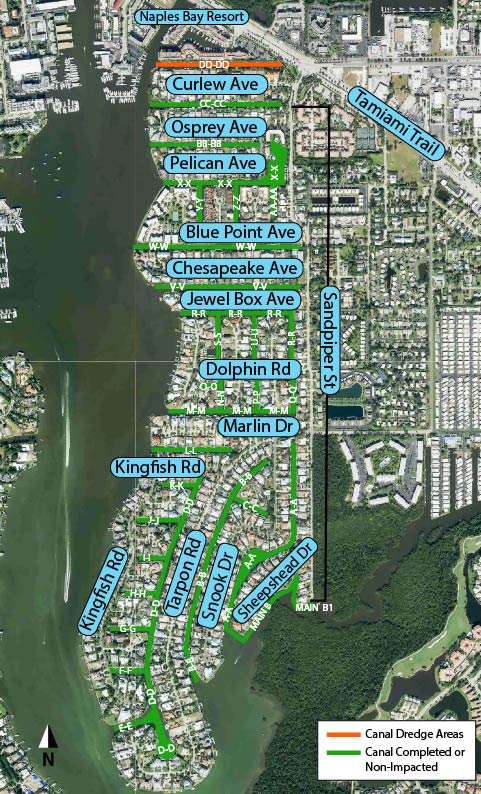
Royal Harbor sits on the east side of Naples Bay, south of US-41 (Tamiami Trail East). Naples Bay forms its west side and the mouth of Haldeman Creek its south end, with Windstar across the creek; Sandpiper Street, the neighborhood’s entrance road from US-41, runs along the east side, and the land east of Sandpiper Street is unincorporated Collier County. Oyster Bay and Golden Shores lie to the north. Chesapeake Avenue is one of Royal Harbor’s 20 streets, and The Row’s five units are the only Royal Harbor parcels the roll lists on it. The City’s dredging canal map dated December 12, 2025 names a Chesapeake reach among the Royal Harbor canal reaches shown as completed or not affected (City canal map). Whether a particular unit has water frontage, a view or any right to a dock is a question the public record does not answer for The Row: the county’s parcel map gives the five units no separate footprint, and our lot-by-lot water test of the neighborhood did not include them. The condominium documents and the unit itself answer it.
Royal Harbor’s single-family streets are zoned R1-10 by the City of Naples, with R1-15 at the south end of Tarpon Road, and both carry the City’s Recreational Vehicle Storage Overlay District. The Row at Royal Harbor sits in the R3-12 multifamily district, per the City’s zoning map. The City’s Design Review Board page states that “Single family zoning districts are not subject to design review” (City Design Review Board); The Row’s R3-12 site is a multifamily district and follows the City’s multifamily rules instead. For a valuation, the zoning matters less for what a unit owner can build, since the building is finished, than for what it signals to a buyer: The Row is a small multifamily island in a single-family neighborhood, and its value is set by the buyer who wants Royal Harbor without a house to maintain.
Royal Harbor has no mandatory homeowners association. The Royal Harbor Association, Inc. is a volunteer 501(c)(4) nonprofit, and its website invites every homeowner to join for $50 a year, as of September 2026 (Royal Harbor Association). The Row at Royal Harbor is the exception to the no-association rule. The state’s corporate registry lists THE ROW AT ROYAL HARBOR CONDOMINIUM ASSOCIATION, INC., a Florida not-for-profit corporation, document N18000013207, filed December 19, 2018, status ACTIVE, with its principal address on Chesapeake Avenue and annual reports filed for 2019 through 2026, the latest on January 10, 2026 (Sunbiz entity search, “Row at Royal Harbor”, read September 28, 2026). The state record lists owner-officers and no management company. The condominium association does not publish its assessments. MLS listings have reported a condominium fee of $971 a month on the 2018 to 2022 listings and $2,100 a month on the December 2025 listing; the estoppel certificate at resale states the current figure.
Several facts a buyer will ask about are not in any public record we read, and we say so rather than guess. The county roll does not record bedrooms, baths, garages, elevators, pools, docks, boat slips or the number of stories for The Row. The building’s MLS listings, ten since 2018, describe every unit as three bedrooms with three full and one half baths, a two-car garage, a private in-ground pool and a private boat dock with electric. The condominium’s declaration, budget and rules are not posted publicly. None of that is unusual for a five-unit, owner-run condominium, but it shapes the valuation: the features that separate one unit from another, and the rules and costs that come with all of them, come from the unit itself, your own records and the condominium documents. If a feature is unknown, it is not in the public record, and the listing or the condominium documents answer it.
The Southwest Florida MLS files some homes and condominiums north of the recorded plats under a ‘Royal Harbor’ development name, so MLS counts for Royal Harbor run higher than the neighborhood itself. In the twelve months to September 24, 2026, that label returned four condominium closings, all in other buildings north of the plats, and none of them was a Row unit. A search for “Royal Harbor condos” therefore returns units that have nothing to do with The Row, and any estimate built from that label is pricing the wrong building. This page counts only The Row’s own recorded sales as Row sales.
A Row at Royal Harbor condo is valued by starting from the building’s own recorded sales, separating qualified sales from reported ones, adjusting each for time and for the unit’s size and condition, reading the condominium’s costs and documents, and testing the result against the Royal Harbor houses a buyer tours the same week.
Data updated: September 2026 (Collier County recorded sales and 2026 preliminary roll; Southwest Florida MLS, pulled 24 and 26 Sep 2026; FEMA NFHL; Florida Statutes)
The first step is the whole deed history, not a search window. The county’s sales file for The Row holds nine recorded transfers since the units were built: five first sales from the developer, two later resales at a price and two transfers at $0. We list all of them in the sales section below, because a five-unit building’s history is short enough to read in full and too short to sample. A valuation that looks only at the last twelve months, as most automated tools do, finds nothing at The Row and falls back on some other building’s sales.
Collier County marks each recorded transfer as qualified or not. A qualified sale is one the county accepted as an arm’s-length market transaction. All five developer closings were coded qualified. Both resales, $2,130,000 in January 2022 and $3,200,000 in December 2023, were coded not qualified, so we treat them as reported prices rather than market-tested evidence. The two $0 transfers are non-sale deeds, the kind recorded when title moves without a sale, and they are never called sales. Each class carries a different weight in the valuation, and mixing them is how a small-building estimate goes wrong.
The Row’s qualified sales are from June 2019 to April 2020. Between then and now, the market around the building moved sharply. Collier County’s median value for the same 386 Royal Harbor houses roughly doubled from $1,794,274 in 2021 to $3,788,524 in 2023, then held within about 3 percent of that level through the 2026 preliminary roll at $3,673,316 (Collier County roll, county just value as of January 1, not a sale price). The Row’s own county values tell the same story at unit scale: the two largest units were valued at $1,150,625 in 2021 and $1,798,600 in 2024, 2025 and the 2026 preliminary roll. A 2019 developer price cannot be used without a time adjustment, and a 2023 resale needs much less of one. We adjust from the building’s own record and the neighborhood’s, never from a Naples-wide or statewide index that blends very different markets.
The county records three sizes: two units of 2,831 square feet of county base area, two of 2,812 and one of 2,217. The county’s own values rank them the same way, at $1,798,600, $1,590,360 and $1,430,200 on the 2026 preliminary roll. When a sale of one size is used to value another, we adjust for the difference, and we keep the adjustment inside the county’s base-area measure. We never convert a Row sale to a price per square foot and compare it with an MLS living-area figure from somewhere else, because the two measurements are not the same.
A 2018 unit’s finish can range from builder standard to fully customized, and owners who bought from the developer often chose their own. The layout, the light, any view, the outdoor space and the condition of every surface are what separate two units of the same size. None of them is in a public record. Marc walks the unit, lists what is there, and compares it with what buyers at this price are choosing between, including the newer Royal Harbor houses that set the local standard. We also ask what you have changed since you bought, with dates and permits, because documented improvements are worth more than described ones.
A buyer of a Row unit is buying into a condominium regime, with a declaration, a budget and assessments, which is a different transaction from buying any house around it. The condominium association does not publish its assessments; the estoppel certificate at resale states them. The level of the assessments, what the association’s budget covers, whether any special assessment is planned and what the rules say about rentals, pets and alterations all move what a buyer will pay. We read them before we set a number, not after a buyer’s attorney does.
The Row at Royal Harbor, five condominium units built in 2018, sits in Zone AE with a 9-foot base flood elevation, like most of the neighborhood, on FEMA’s map effective February 8, 2024 (FEMA National Flood Hazard Layer). The zone is the rule; the building’s elevation certificate shows how the building measures against it. A building permitted in a flood zone under modern rules normally has one in its permit file, and the City’s flood portal holds elevation certificates by address where the City has them. The certificate prices the flood coverage and answers the first question a buyer’s insurer will ask.
Your buyer does not inherit your tax bill. The Row’s 2026 preliminary total taxes run from $10,631.72 to $17,100.37 a unit, and the difference reflects homestead Save Our Homes caps on some units. Under s. 193.155, Florida Statutes, a capped assessment resets to just value on a change of ownership, so a buyer prices the tax at full value. Add the association’s assessments, the unit owner’s insurance and the flood coverage, and the buyer’s monthly number is set. A price that ignores that number is a price the buyer will renegotiate.
A Row buyer who can spend $2 million to $3 million in Royal Harbor can usually also buy a house. Inside the three plats, 21 single-family homes closed on the Southwest Florida MLS in the twelve months to September 24, 2026 at a median of $2,975,000, from $1,650,000 to $15,150,000, with the middle eleven between $2,503,500 and $5,100,000 (Southwest Florida MLS, pulled 24 Sep 2026). A Row unit is priced against that choice: a newer building, no lot or seawall to maintain and a condominium’s shared costs on one side; a detached house, a private lot and every obligation that comes with it on the other. We test the opinion of value against the houses a buyer at your price will tour the same week.
The last step is honesty. With no qualified resale in the building’s history and no MLS sale in the last year, every Row valuation carries more uncertainty than a valuation in a large building, and we write down how much. The written opinion names each sale, says how it was adjusted, and gives a range with the reasons for its width. That is also what protects your contract: an appraiser working for your buyer’s lender will face the same thin record, and a price backed by named sales and stated adjustments is a price the appraiser can follow.
The Row at Royal Harbor is five units with seven priced transfers in seven years, no MLS sale in the last year and a Royal Harbor house market next door that every buyer will also tour, so a valuation that starts from the building’s own record is worth an hour of your time now. Use the Home Valuation form at the top of this page or our free home valuation request, and if you have already decided to list, read our plan for selling your home in The Row at Royal Harbor. Call Jesse direct at (239) 898-6072. Buying as well as selling? Call Marc at (239) 287-5873, or read how we represent buyers in Southwest Florida.
Row at Royal Harbor condos have sold for $1,150,000 to $1,350,000 in five first sales from the developer in 2019 and 2020, and at reported prices of $2,130,000 in January 2022 and $3,200,000 in December 2023, both resales coded by Collier County as unqualified. No Row unit closed on the MLS in the last twelve months; the one listing in that time, 1559 at $2,495,000, was terminated in July 2026 without a sale.
Data updated: September 2026 (Collier County recorded sales, all history in the county extract, data files dated 29 Aug 2026; Southwest Florida MLS, closings 25 Sep 2025 to 24 Sep 2026, pulled 24 Sep 2026)
The Southwest Florida MLS carries ten Row listings since 2018. The developer listed the five units in 2018 and 2019 at $1,195,000 to $1,495,000, and all five closed in 2019 and 2020 at $1,150,000 to $1,350,000, after 107 to 494 days on market. Two resales followed: 1557 closed in January 2022 at $2,130,000 against a $2,300,000 list price, entered on the MLS at closing, and 1551, listed in March 2023 at $3,750,000 and taken off the MLS after 72 days, closed in December 2023 at $3,200,000 as an office-exclusive sale entered on the MLS after closing. 1559 has been offered twice since: at $2,995,000 from January to September 2025, and at $2,495,000 from December 6, 2025 until the listing was terminated on July 8, 2026 after 215 days. Neither sold. Every MLS record for the building lists three bedrooms, three full and one half baths, a two-car garage, a private in-ground pool and a private boat dock with electric on a canal with Gulf access and no bridges; MLS living area runs from 2,187 to 2,831 square feet, by each listing's stated source, and is not comparable with the county's base area (Southwest Florida MLS, Matrix, all statuses, pulled September 29, 2026).
We tracked every transfer Collier County has recorded at The Row since the units were built, nine in all; here is every one recorded at a price, listed by date. Units are identified by street number on Chesapeake Avenue only; the base area is the county’s measure of each unit.
Recorded | Unit (street number) | County base area | Recorded price | County code | What it was |
|---|---|---|---|---|---|
June 17, 2019 | 1555 | 2,217 sq ft | $1,150,000 | Qualified | First sale from the developer |
June 18, 2019 | 1559 | 2,831 sq ft | $1,350,000 | Qualified | First sale from the developer |
June 26, 2019 | 1551 | 2,831 sq ft | $1,300,000 | Qualified | First sale from the developer |
March 11, 2020 | 1553 | 2,812 sq ft | $1,150,000 | Qualified | First sale from the developer |
April 28, 2020 | 1557 | 2,812 sq ft | $1,175,000 | Qualified | First sale from the developer |
January 13, 2022 | 1557 | 2,812 sq ft | $2,130,000 | Not qualified | Resale, reported price |
December 4, 2023 | 1551 | 2,831 sq ft | $3,200,000 | Not qualified | Resale, reported price |
Collier County Property Appraiser recorded sales and 2026 preliminary roll, data files dated August 29, 2026, all history in the extract. Two further transfers were recorded at $0 (June 2019 and March 2022); they are non-sale deeds, not sales, and are not listed as sales. With seven priced transfers, the sales are listed rather than reduced to a median.
In one sentence: five first sales from the developer in 2019 and 2020 at $1,150,000 to $1,350,000; two later recorded resales at $2,130,000 (January 2022) and $3,200,000 (December 2023), both coded by the county as unqualified, so treat them as reported prices, not market-tested medians.
The five first sales ran from June 17, 2019 to April 28, 2020 and every one was coded qualified by the county. Three closed within ten days in June 2019, at $1,150,000, $1,350,000 and $1,300,000, and two followed in March and April 2020 at $1,150,000 and $1,175,000. Those are the only qualified, market-tested prices in the building’s history. They set the original price level of The Row, but they are developer prices from a market that no longer exists: they closed before Collier County’s median value for the surrounding 386 Royal Harbor houses roughly doubled between 2021 and 2023. We use them as the base of the building’s record, adjusted forward, never as a current price.
On January 13, 2022 the county recorded a resale of a 2,812-square-foot unit at $2,130,000, about 21 months after that unit’s first sale from the developer at $1,175,000. The county coded it not qualified. We treat it as a reported price: it shows what one buyer and one seller agreed in early 2022, a year of rapid price growth across Naples waterfront, but the county did not accept it as an arm’s-length market sale, and the public record does not say why. It is useful evidence of direction and scale, and it is weak evidence of level.
On December 4, 2023 the county recorded a resale of a 2,831-square-foot unit at $3,200,000. That unit’s first sale from the developer had been recorded at $1,300,000 in June 2019. The county coded the resale not qualified, so it too is a reported price. It is the highest price recorded at The Row, and it came after Hurricane Ian in September 2022 and after the county’s values across Royal Harbor had reached their 2023 level. For a seller it is the most recent priced evidence in the building. For an appraiser it is evidence that has to be explained before it is relied on, because the county did not treat it as a market sale.
The county’s file also records two transfers at $0: one in June 2019, on the same day as a developer sale of the same unit, and one in March 2022. Transfers at $0 are non-sale deeds, the kind recorded when title moves for reasons other than a sale, and they are never sales. They matter for a valuation only because an automated estimate or a careless summary can read them as sales and drag an average down. They are left out of every price on this page.
In a large building, one unqualified sale among dozens barely moves the evidence. At The Row, the two unqualified resales are the only resale prices there are. The county’s qualification code does not mean a price was false; it means the county did not accept the transfer as a clean, arm’s-length market sale for its own valuation purposes, and the public record does not give the reason. So the two resale prices are real recorded prices, and they are also untested ones. A buyer’s appraiser will see the same codes. That is why we treat the resales as reported prices, weigh them beside the qualified developer sales adjusted for time and beside the county’s values, and never present either resale as the building’s market value.
Read in order, the record shows a building that opened at $1,150,000 to $1,350,000 a unit in 2019 and 2020, then saw two reported resales at $2,130,000 in early 2022 and $3,200,000 at the end of 2023. The county’s own values moved in the same direction: the two largest units went from $1,150,625 in 2021 to $1,798,600 from 2024 on. The level of the building today is therefore well above its opening prices. How far above is the question each valuation answers for a specific unit, and with two unqualified resales as the only recent prices, it is a question answered with a range and a stated method, not a single number from a table.
A Row at Royal Harbor seller should read the two resales as real recorded prices that the county did not accept as market sales: strong evidence that the building’s value rose well above its 2019 and 2020 opening prices, and weak evidence of exactly what a unit is worth today.
Data updated: September 2026 (Collier County recorded sales, data files dated 29 Aug 2026; Collier County certified and preliminary rolls 2021 to 2026)
They prove that buyers have paid far more than the developer prices. The unit that first sold at $1,175,000 in April 2020 was recorded again at $2,130,000 in January 2022, and the unit that first sold at $1,300,000 in June 2019 was recorded again at $3,200,000 in December 2023. Whatever the reason the county did not qualify them, those are the prices on the deeds. Together with the county’s own value history, they show a building that shared fully in the rise of Naples waterfront prices from 2021 to 2023.
They do not prove a market level. Two transfers the county declined to treat as arm’s-length sales cannot establish what a willing buyer and a willing seller, both informed and neither under pressure, would agree on today. They also cannot establish a trend between them: the two resales are of different unit sizes, recorded almost two years apart, and one sits on each side of Hurricane Ian. A seller who lists at the higher resale price because “a unit sold for $3.2 million” is relying on the single weakest kind of evidence in the record.
It is tempting to draw a line from $2,130,000 in January 2022 to $3,200,000 in December 2023 and extend it to 2026. The record does not support that. The two sales are of units of 2,812 and 2,831 square feet of county base area, recorded 23 months apart, and neither was qualified. The county’s values for those two unit sizes were $1,434,418 and $1,606,905 in 2022 and $1,452,664 and $1,636,684 in 2023, a far smaller difference than the two resale prices. The county’s values have held level since 2024. What the gap most likely reflects is differences between the two transactions that the public record does not show, which is exactly why neither resale can be used alone.
We give each resale a place in the analysis and a stated weight. We set it beside the qualified developer sale of the same unit, beside the county’s value history for that size of unit, and beside the Royal Harbor house market in the same months. Where the resale and the other evidence agree, it strengthens the conclusion. Where it stands apart, we say so and explain how we weighed it. The written opinion names both resales, their dates, their county codes and how much each one moved the number.
An appraiser working for your buyer’s lender will pull the same county record and see the same two unqualified codes. In a building with no qualified resale and no recent MLS sale, the appraiser will widen the search to other small condominiums and to comparable Naples properties, and will adjust for time. A contract price that leans on one unqualified resale can come in short at appraisal. A contract price built from named sales, stated adjustments and the building’s own value history is the one an appraiser can follow, and that is the price we aim to set.
If you bought your unit from the developer in 2019 or 2020 or in one of the two resales, your own closing statement is part of the evidence, and it tells us things the county record cannot: what was included, what concessions were made and what condition the unit was in. If you have made improvements since, your permits and invoices tell us what the unit is now. We ask for both, in confidence, because in a five-unit building every owner’s history is part of the record the next buyer will be priced against.
Collier County’s 2026 preliminary roll values Row at Royal Harbor units at $1,798,600 for the two 2,831-square-foot units, $1,590,360 for the two 2,812-square-foot units and $1,430,200 for the 2,217-square-foot unit, measured on county base area. Just value is an assessment for taxes, not market value, and it lags sale prices.
Data updated: September 2026 (Collier County certified rolls 2021 to 2025 and 2026 preliminary roll, data files dated 29 Aug 2026)
Tax year | Two units of 2,831 sq ft base area (each) | Two units of 2,812 sq ft base area (each) | One unit of 2,217 sq ft base area | Roll |
|---|---|---|---|---|
2021 | $1,150,625 | $1,002,900 | $920,375 | certified |
2022 | $1,606,905 | $1,434,418 | $1,280,687 | certified |
2023 | $1,636,684 | $1,452,664 | $1,301,286 | certified |
2024 | $1,798,600 | $1,590,360 | $1,430,200 | certified |
2025 | $1,798,600 | $1,590,360 | $1,430,200 | certified |
2026 | $1,798,600 | $1,590,360 | $1,430,200 | preliminary |
Collier County Property Appraiser records, county just value as of January 1, not a sale price. Base area is the county’s measure of each unit, not MLS living area. Land just value is $0 on every unit because the land is held in the condominium.
The county’s just value is an assessment as of January 1 for tax purposes, not a sale price, and at The Row the gap between the two is plain on the record. In December 2023 a 2,831-square-foot unit was recorded at $3,200,000; the county’s value for that size of unit was $1,636,684 for 2023 and $1,798,600 for 2024. Even allowing for the county not qualifying the resale, the county’s number and the recorded price are far apart. Mass appraisal values thousands of parcels from general models; it is not built to price a five-unit building whose sales it has set aside as unqualified. We use the roll for what it does well, the size and the year built of each unit and the direction of value, and we price from sales.
It shows direction and timing. The county’s values for every Row unit jumped between 2021 and 2022, rose slightly in 2023, stepped up again in 2024, and have not moved since. The largest units went from $1,150,625 in 2021 to $1,606,905 in 2022 and $1,798,600 in 2024. That pattern tracks the wider Royal Harbor record, where the county’s median value for the 386 houses roughly doubled from 2021 to 2023 and then held level. For a seller, the county’s flat values from 2024 to the 2026 preliminary roll say that the assessor sees no further rise; they do not say the market has fallen.
Each Row unit carries a land just value of $0 on the roll, because the land is held in the condominium rather than assessed unit by unit. That is normal for a condominium and it matters for how the unit is valued. A Royal Harbor house on the same roll is mostly land: land is 62.4 percent of the median house’s county value. A Row unit’s value sits entirely in the unit and its share of the condominium, so the lot-by-lot land analysis that drives a Royal Harbor house valuation does not apply to it. What applies instead is the building’s own record and the condominium’s costs.
The county ranks the three sizes in the same order every year: the 2,831-square-foot units highest, the 2,812-square-foot units next and the 2,217-square-foot unit lowest. On the 2026 preliminary roll the difference between the largest and the smallest is $368,400, and between the two larger sizes $208,240, by our arithmetic on the county’s figures. Those differences are the county’s view of size and position inside the building, not a market adjustment, but they are a useful check on how we adjust one unit’s sale to value another.
County roll figures and MLS figures measure different things. The county values every parcel as of January 1, and its values are not sale prices; the MLS records only the homes that sold, at their contract price, and measures living area rather than the county’s base area. The two sets of numbers should never be compared directly. The county’s base areas for The Row, 2,831, 2,812 and 2,217 square feet, are the county’s measure; the living area a future listing reports may differ, and we never set one beside the other or divide a sale price by one and compare it with the other.
The county’s 2026 preliminary total taxes at The Row run from $10,631.72 to $17,100.37 a unit, and two units with identical just values can carry very different bills. The difference reflects homestead Save Our Homes caps on some units, which hold a homestead owner’s assessed value below just value. The highest bill on the roll, $17,100.37, matches, to within a cent, the full $1,798,600 just value taxed at the 9.5076-mill rate that applies inside the East Naples Bay district, by our arithmetic, which is roughly what an owner without a homestead exemption pays at that value. These are 2026 preliminary roll figures; the November 2026 tax bill is the final record.
No Row at Royal Harbor condo sold on the Southwest Florida MLS from September 25, 2025 to September 24, 2026. One owner tried: 1559 was listed at $2,995,000 from January to September 2025 and again at $2,495,000 from December 6, 2025 until the listing was terminated on July 8, 2026, after 215 days. None was listed or pending on September 26, 2026, and five owners in a small building rarely sell. The last recorded resale was in December 2023. Scarcity cuts both ways for a seller.
Data updated: September 2026 (Southwest Florida MLS, closings 25 Sep 2025 to 24 Sep 2026 pulled 24 Sep 2026, active and pending listings pulled 26 Sep 2026; Collier County recorded sales)
The Southwest Florida MLS showed zero Row closings in the twelve months to September 24, 2026, and zero Row listings active or pending on September 26, 2026. The county’s deed record agrees: no Row unit has recorded a qualified sale since April 2020, and the last transfer at a price was the December 2023 resale. In a building of five, that is not a sign of trouble. It is what happens when a handful of owners, most of whom bought new, keep their units.
When nothing is for sale, a buyer who wants The Row specifically has only one choice: the unit that comes up. That buyer cannot compare your unit with a neighbor’s listing in the same building, cannot wait for the next one with any confidence, and has to weigh your unit against Royal Harbor houses and other Naples condominiums instead. Scarcity also means the building has no recent low sale for a buyer to anchor on. For a well-prepared unit, priced from evidence, that is an advantage.
It also means there is no recent sale to support your price. A buyer’s lender will order an appraisal, and the appraiser will face the same thin record we do: developer closings from 2019 and 2020, two unqualified resales and no MLS sale in the last year. A price that the record cannot support will struggle at appraisal no matter how scarce the building is. Scarcity also makes the buyer pool small, because a five-unit condominium in a neighborhood of houses appeals to a specific buyer, and that buyer has to find the listing.
The Southwest Florida MLS files some homes and condominiums north of the recorded plats under a ‘Royal Harbor’ development name, so MLS counts for Royal Harbor run higher than the neighborhood itself. In the twelve months to September 24, 2026, that label returned four condominium closings in other buildings north of the plats; none was a Row unit, and none is a comparable for a 2018 building of Row-sized units. A buyer’s agent or an automated model that searches “Royal Harbor” condominiums will find those sales and not yours. This guide counts only sales inside the three plats and The Row.
With no Row sale on the MLS in the window, there is no current Row days-on-market figure; the building’s own record runs from 107 to 494 days for the developer sales, and the two recent listings of 1559 ran 256 and 215 days without a sale. The nearest measured pace is the Royal Harbor house market: the 21 in-plat single-family closings of the twelve months to September 24, 2026 took a median of 86 days on market, from 5 to 440 days (Southwest Florida MLS, pulled 24 Sep 2026). A Row unit is a different product, but it will meet many of the same buyers in the same season, and a seller should plan on months, not weeks, then the inspection, insurance, appraisal and condominium document period before closing.
Naples buyers tour in the winter, contract in late winter and spring and close in the spring and early summer, and The Row’s own short record fits that pattern: three of its five developer closings were recorded in June 2019, two in March and April 2020, and the two resales in January and December. For a Row seller, that points to a listing that is priced, documented and photographed by November or December, so that it is in front of buyers when they arrive.
The Royal Harbor house market frames a Row at Royal Harbor valuation because a buyer at The Row’s price can also buy a house nearby. Inside the three plats, 21 single-family homes closed on the MLS in the twelve months to September 24, 2026 at a $2,975,000 median, from $1,650,000 to $15,150,000.
Data updated: September 2026 (Southwest Florida MLS, single-family closings inside the three Royal Harbor plats, 25 Sep 2025 to 24 Sep 2026, pulled 24 Sep 2026; active and pending listings pulled 26 Sep 2026; Collier County 2026 preliminary roll and qualified sales)
Southwest Florida MLS, single-family closings inside the three Royal Harbor plats | Value |
|---|---|
Closings | 21 |
Median sold price | $2,975,000 |
Median days on market | 86 (range 5 to 440) |
Median sale-to-list ratio | 90.13% |
Closed at or above final list | 1 of 21 |
Price range | $1,650,000 to $15,150,000 |
Middle 11 of the 21 sales | $2,503,500 to $5,100,000 |
Homes for sale, September 26, 2026 | 20, plus 2 pending |
Months of supply | about 11.4 |
Southwest Florida MLS (Matrix), Development “Royal Harbor”, filtered to addresses inside the three recorded plats, closed September 25, 2025 to September 24, 2026, pulled September 24, 2026; active and pending listings pulled September 26, 2026. No Row unit closed in the window; one, 1559, was listed and did not sell. These are house figures, not condominium figures, and they are shown as context for a Row buyer’s alternatives, not as Row values.
The lower half of the Royal Harbor house market is where a Row buyer’s alternatives sit. The year’s in-plat closings started at $1,650,000, and the middle eleven ran from $2,503,500 to $5,100,000 (Southwest Florida MLS, pulled 24 Sep 2026). On the county’s 2026 preliminary roll, the 131 houses built before 1980 carry a median value of $2,055,236, of which the building is a median of only $208,982, about 9 percent (Collier County 2026 preliminary roll, county just value, not a sale price). Those buyers are really buying a canal lot with an older house on it, and many plan to rebuild. A Row buyer at a similar price is choosing a 2018 building with no lot, seawall or dock of their own to maintain, and that difference is what a Row valuation has to price.
Collier County recorded two Royal Harbor homesite sales in the 12 months to August 29, 2026, both in June 2026: $2,800,000 for a 0.25-acre lot and $3,900,000 for a 0.40-acre lot, and the 25 vacant homesites on the 2026 preliminary roll carry a median county value of $1,947,400 (Collier County Property Appraiser qualified sales). That land floor is why older Royal Harbor houses trade near $2 million and up however modest the house. A Row unit has no lot to anchor it, so its value rests on the unit itself, its finish and the condominium’s costs, and its price can sit below, at or above an older house depending on how buyers weigh a newer building against a private lot.
The December 2023 resale at $3,200,000 sits above the year’s $2,975,000 median in-plat house sale, and inside the band where the middle of the year’s house closings fell. A buyer who paid that price for a 2,831-square-foot unit was choosing The Row over a typical Royal Harbor house at similar money. Because the county did not qualify that resale, it cannot tell us what the market pays for a Row unit today; it does tell us that at least one buyer valued the building on a level with the neighborhood’s houses. Whether today’s buyer does the same is what the valuation tests.
On September 26, 2026 the Southwest Florida MLS showed 20 single-family homes for sale inside the three plats and 2 under contract; against 21 closings in the prior twelve months, that is about 11.4 months of supply. That is a buyer’s-market level of inventory by the usual reading. A Row unit priced in the $2 million to $3 million range competes with the lower half of that house market, around the year’s $2,975,000 median, which means your buyer will have houses to compare and time to compare them.
The 20 in-plat houses for sale on September 26, 2026 asked a median $5,697,500, against the year’s closed median of $2,975,000, and the year’s closings sold at a median 90.13 percent of their final list price, with only 1 of 21 at or above list (Southwest Florida MLS). A neighbor’s asking price is evidence of what the neighbor hopes for; only a closing is evidence of what a buyer pays. For a Row seller, the lesson is to price from recorded sales and to expect a negotiation.
A buyer choosing between The Row at Royal Harbor and a Royal Harbor house is choosing between a 2018 condominium unit with shared costs and no lot to maintain, and a detached house on a canal lot with a seawall, dock and flood decisions of its own. Your price has to win that comparison.
Data updated: September 2026 (Collier County 2026 preliminary roll and recorded sales; Southwest Florida MLS, pulled 24 and 26 Sep 2026; City of Naples zoning map and code; FEMA NFHL)
Royal Harbor has only one condominium, so a buyer who wants to live in Royal Harbor and can spend what a Row unit costs is almost always also looking at houses. The two products share the neighborhood, the City of Naples, the flood map and the East Naples Bay district, and they differ in almost everything else a buyer weighs. Every Row valuation we write includes this comparison, because it is the one your buyer will make.
Yardstick | The Row at Royal Harbor | A Royal Harbor house |
|---|---|---|
What you own | a condominium unit and a share of the common property | a house and its lot |
Units or homes | 5 units, all built 2018 | 386 houses built 1957 to 2025 |
Size measure on the roll | 2,217 to 2,831 sq ft of county base area | median lot 0.26 acre; median base area about 2,640 sq ft |
Land on the roll | $0 per unit, held in the condominium | land is 62.4 percent of the median house’s county value |
Zoning | R3-12 multifamily | R1-10/RVSOD (R1-15/RVSOD at the south end of Tarpon Road) |
Association | The Row’s own condominium association, owner-officers, no management company on the state record; assessments not published | none mandatory; voluntary Royal Harbor Association at $50 a year |
Flood zone | AE, base flood elevation 9 ft NAVD88 | all AE: 342 parcels AE 9, 76 AE 8, measured at the street side |
Water and dock | not established in the public record for the units; the condominium documents answer it | every platted lot touches water; dock paragraph in City code |
Seawall | not a unit owner’s separate item in the public record; the condominium documents answer it | each lot’s own seawall and permit file |
2026 county values | $1,430,200 to $1,798,600 per unit | median $3,673,316 across 386 houses |
2026 preliminary taxes | $10,631.72 to $17,100.37 per unit | median $26,620 across 386 houses |
Recent MLS closings | none in the 12 months to September 24, 2026 | 21 in-plat closings, median $2,975,000 |
Recorded price history | developer sales $1,150,000 to $1,350,000 (2019 to 2020); unqualified resales $2,130,000 (2022) and $3,200,000 (2023) | county qualified improved sales, median $3,700,000 in the 12 months to August 29, 2026 (13 sales) |
Sources: Collier County Property Appraiser 2026 preliminary roll and recorded sales, county just value, not a sale price; City of Naples zoning map; Sunbiz; Royal Harbor Association; FEMA National Flood Hazard Layer; City dock code, Sec. 56-93. Market rows: Southwest Florida MLS, in-plat, closed September 25, 2025 to September 24, 2026, pulled September 24, 2026.
The Row wins on age and upkeep. A 2018 building means a buyer is not inheriting a 1960s house at grade, the City’s 50 percent flood rule or the rebuild decision that shapes the price of so many older Royal Harbor houses. It wins on the tax line against a house at the neighborhood median: the highest Row bill on the 2026 preliminary roll, $17,100.37, is well under the median house bill of $26,620. And it wins for the buyer who wants Royal Harbor’s City of Naples address and bayside setting without a lot, a seawall and a dock to manage alone.
A house wins on land and control. Every platted lot in Royal Harbor touches water, by our reading of the county’s parcel map, and a house comes with its own dock rights under the City code, its own seawall and no condominium board. A house buyer answers to the City’s rules, not to a declaration. A house also has a deeper market: 21 in-plat closings in a year against none at The Row, which makes a house easier to price, finance and eventually resell. For a buyer who wants a boat at the back door, or who plans to rebuild, a house is the natural choice.
Choose The Row for a newer building in Royal Harbor, shared upkeep and a lower tax line than the neighborhood’s typical house. Choose a house for your own lot, your own water and dock, and no condominium association. For a Row seller, that means pricing for the first buyer, not the second: your buyer is the one who chose a finished 2018 unit over a lot and a project. Price the unit so that the choice is easy against the older houses in the same range, and show the condominium documents and costs early, because they are the part of your unit a house buyer never has to read.
The Row at Royal Harbor sits inside the lower-priced end of south Naples’ waterfront ladder. In the same twelve months Royal Harbor’s median single-family sale on the MLS was $3,000,000 by development name, against $9,075,000 in Aqualane Shores and $17,687,500 in Port Royal. A Row buyer is buying into the most affordable of the three.
Data updated: September 2026 (Southwest Florida MLS, single-family closings 25 Sep 2025 to 24 Sep 2026, each neighborhood by its own Development name, pulled 24 Sep 2026)
Neighborhood | Closings (n) | Median sale | Median $ per living sq ft | Median days on market | Median sale-to-list |
|---|---|---|---|---|---|
Royal Harbor (MLS development; one of the 22 sits outside the plats) | 22 | $3,000,000 | $1,149.51 | 77 | 90.21% |
Aqualane Shores | 26 | $9,075,000 | $1,772.02 | 204 | 91.21% |
Port Royal | 30 | $17,687,500 | $2,897.73 | 123 | 91.65% |
Olde Naples, single-family | 67 | $6,100,000 | $1,562.99 | 111 | 92.41% |
Southwest Florida MLS (Matrix), each neighborhood by its own Development name, single-family closings September 25, 2025 to September 24, 2026, pulled September 24, 2026. Even counts take the midpoint of the two middle sales. Inside the three Royal Harbor plats only, the same window gives 21 closings at a $2,975,000 median. These are house figures; no Row unit closed in the window, and no condominium figure is shown for any neighborhood.
A buyer who chooses Royal Harbor is choosing City of Naples water at well under half the per-foot price of Aqualane Shores and about 40 percent of Port Royal’s, on these MLS figures. The Row carries that position into a condominium: it is the one way into Royal Harbor that does not involve buying a house. That makes the neighborhood’s relative value part of your unit’s pitch, and it also sets the limit. A Row buyer who could afford Aqualane Shores or Port Royal usually wants a house there, so your buyer is the one who chose Royal Harbor for its value and setting.
Royal Harbor and Port Royal were both carved from Naples Bay’s mangrove shore in the 1950s and share the City of Naples and its schools, but not its prices. NOAA’s Coast Pilot describes them in one sentence: “Canals have been dredged and the former marshland backfilled to form waterfront homesites in the areas of Port Royal at the south end of the city, Royal Harbor on the east side of Naples Bay, and The Moorings at the north end of the city,” per the 2026 U.S. Coast Pilot 5. Port Royal’s 12-month MLS sales ran from $6,300,000 to $55,000,000, and Port Royal Club members get the club’s private beach, dining, spa, fitness and tennis facilities, open to owners of eligible Port Royal properties, per the club’s membership page. Royal Harbor is not part of Port Royal, and a Row deed carries no Port Royal Club right. Our Port Royal neighborhood guide sets that market out in full.
Aqualane Shores, the west-shore canal neighborhood directly across Naples Bay, is Royal Harbor’s closest analogue on the record: the 2006 Naples Bay study names the two together as the developments that replaced the bay’s mangrove shoreline, per the South Florida Water Management District’s copy of the report. Its MLS median of $9,075,000 is three times Royal Harbor’s. On Collier County’s 2026 preliminary roll the typical Royal Harbor house is valued at about half the typical Aqualane Shores house and pays about half the tax (county just value, not a sale price). Our guide to Aqualane Shores covers that market.
The Row’s closest neighbors on the map are the two other neighborhoods in its dredging district. Ordinance 87-5330, which created the East Naples Bay Special Taxing District, states that “The District includes all of the canals of Golden Shores, Oyster Bay, and Royal Harbor Subdivisions,” per the City’s copy of the ordinance. Oyster Bay and Golden Shores lie north of Royal Harbor along the same east shore of Naples Bay. Oyster Bay recorded one single-family sale in the 365 days to September 22, 2026 on the Southwest Florida MLS, too few to publish a range or a median. None of the three is a source of condominium comparables for The Row.
No condominium figure appears in the benchmark table, and that is deliberate. Condominium markets in Naples range from older mid-rise buildings to new luxury towers, and a neighborhood-level condominium median would mix buildings that have nothing in common with a five-unit 2018 building in a single-family neighborhood. When we value a Row unit and need comparables beyond the building, we choose specific small, recent condominium buildings in comparable Naples locations, name them in the written opinion and adjust each one, rather than quote a market-wide figure.
Unit size and features change a Row at Royal Harbor price because the building’s five units come in three county sizes, 2,831, 2,812 and 2,217 square feet of base area, and because finish, layout, views and outdoor space vary by owner. Size is on the record; the features come from the unit and the condominium documents.
Data updated: September 2026 (Collier County 2026 preliminary roll, data files dated 29 Aug 2026)
Two units carry 2,831 square feet of county base area, two carry 2,812 and one carries 2,217, a median of 2,812. The two largest sizes differ by only 19 square feet, and the county still values them $208,240 apart on the 2026 preliminary roll, by our arithmetic, which says the county sees more than size in the difference. The smallest unit is about 600 square feet smaller than the others and carries the lowest value. When one unit’s sale is used to value another, the size adjustment comes first.
In a small building, position counts: which units have the most light, the best outlook, the most private outdoor space and the easiest access. The public record does not describe any of that for The Row, and we do not guess. We see it on site and compare it with the other units’ known sales and values. We also note what a buyer at this price expects in a 2018 building, from impact-rated openings to the quality of kitchens and baths, because the Royal Harbor houses a Row buyer also tours set that standard.
We never assume bedrooms, baths, garages, elevators, pools, docks, boat slips or the number of stories at The Row. None of them is in the public record we read, and an estimate that fills them in from a template is pricing an imaginary unit. For your unit, the listing describes what is there, and the condominium documents say what belongs to the unit, what is a limited common element and what is shared. A buyer will read both, and a valuation that matches them avoids a renegotiation later.
Owners of a 2018 unit have often upgraded since, and those improvements are worth documenting. Flooring, kitchens, baths, lighting, window treatments and any work that needed a permit or association approval should be listed with dates and costs. Documented work moves a buyer and an appraiser; described work mostly does not. In a building where every unit started from the same shell, what you added is much of what separates your unit from the next one.
A 2018 building is still young, but it is no longer new. Mechanical systems, water heaters, appliances and finishes installed at construction are now eight years old, and a buyer’s inspector will note their ages. Some of that belongs to the unit owner and some to the association, depending on the declaration. A valuation accounts for what the buyer will need to replace in the next few years and who pays for it.
Because the resales were not qualified and the developer sales predate the market’s rise, there is no clean per-foot rate at The Row to multiply by your unit’s size. Size is an adjustment inside the building, not a pricing method. The number comes from the building’s own sales adjusted for time and difference, tested against the houses and condominiums a buyer will compare it with.
The condominium association means a Row at Royal Harbor buyer prices in assessments, the association’s budget, its rules and its documents, not just the unit. The Row’s association is an active Florida not-for-profit filed in December 2018, run by owner-officers with no management company on the state record, and its assessments are not published.
Data updated: September 2026 (Sunbiz, read 28 Sep 2026; Florida Statutes; DBPR estoppel fee schedule)
The state’s corporate registry lists THE ROW AT ROYAL HARBOR CONDOMINIUM ASSOCIATION, INC. as a Florida not-for-profit corporation, document N18000013207, filed December 19, 2018, status ACTIVE, principal address on Chesapeake Avenue, with annual reports filed for 2019 through 2026, the latest on January 10, 2026 (Sunbiz entity search, read September 28, 2026). A clean run of annual reports is a small point in the association’s favor: a buyer’s closing agent will check that the association is active, and it is.
The state record lists owner-officers and no management company. In a five-unit building that is common, and it has two sides for a valuation. On one side, owner-run associations often carry lower administrative costs than managed ones. On the other, a buyer’s lender, insurer and closing agent need documents on time, and in an owner-run association that depends on the owners who hold the offices. We line up the documents before listing so a buyer never waits on them.
The condominium association does not publish its assessments; the estoppel certificate at resale states them. That means no public figure exists for The Row’s monthly or quarterly costs, and a buyer will not know them until the seller or the association provides them. Because the assessment is part of every buyer’s monthly number, we ask for the current budget and assessment schedule at the start, so the valuation reflects the carrying cost a buyer will actually face.
The estoppel certificate is the association’s written statement of what a unit owes and whether any assessment is planned, and it is governed by s. 718.116, Florida Statutes. Estoppel fees are capped at $299 for a current account, plus $119 for expedited delivery and up to $179 more if the account is delinquent, under the Department of Business and Professional Regulation’s current estoppel certificate fee schedule. The closing agent requests it; we make sure it is requested early enough that it never delays a closing.
On a condominium resale, s. 718.503, Florida Statutes, requires the seller to give the buyer the governing documents and a current Frequently Asked Questions and Answers sheet, and gives the buyer a statutory cancellation window. The declaration, the bylaws, the rules, the current budget and the FAQ sheet are the documents a Row buyer reads before committing, and each can move the price: a rental restriction narrows the buyer pool, a healthy budget reassures it, a planned special assessment gets priced in. We read them before we set a number.
Florida’s condominium milestone inspection law, s. 553.899, Florida Statutes, applies to condominium buildings of three or more habitable stories. The Row’s condominium documents and building height decide whether Florida’s condominium milestone rules apply; ask for them at resale. We do not state whether any such rule applies to The Row, because the public record we read does not settle it, and a buyer’s attorney will read the documents.
In a large building, one owner’s unit rides on hundreds of others and the association’s decisions are diluted. At The Row, five owners carry the whole building. A well-kept building with clear documents, a sensible budget and no surprises supports a strong price. Unclear documents, an unfunded repair or a dispute among owners can cost more than any difference in finish. A buyer’s attorney reads the association as closely as the unit, and a valuation that ignores the association is only half a valuation.
A Row at Royal Harbor buyer prices in property tax at 9.5076 mills, reset to full value on purchase, the condominium association’s assessments, the unit owner’s insurance and flood coverage. There is no mandatory neighborhood association fee, no community development district and no club, so tax, assessments and insurance do the work.
Data updated: September 2026 (Collier County 2026 preliminary roll, data files dated 29 Aug 2026; City of Naples ordinances and budget reports; DBPR estoppel fee schedule)
Layer | Amount | Period | Source |
|---|---|---|---|
Property tax, all five Row units (inside the East Naples Bay district) | 9.5076 mills | Annual | |
East Naples Bay Special Taxing District (included above) | 0.5 mill | Annual | |
Non-ad-valorem assessments | $0 on every Royal Harbor parcel on the 2026 preliminary roll | n/a | same roll |
2026 preliminary total taxes, per Row unit | $10,631.72 to $17,100.37 | Annual | same roll |
The Row at Royal Harbor condominium association | Not published | Not published | Estoppel certificate at resale |
Estoppel certificate | $299 cap for a current account, plus $119 expedited, plus up to $179 if delinquent | Per request | |
Royal Harbor Association | $50 | Annual, voluntary | |
Undergrounding assessment | None adopted | n/a | |
Community development district, club dues | None | n/a | 2026 preliminary roll; no club on the plats |
Unit owner and flood insurance | Quoted unit by unit | Annual | See the flood section below |
These are 2026 preliminary roll figures; the November 2026 tax bill is the final record. On the 2026 preliminary roll, no Royal Harbor parcel carries a non-ad-valorem assessment; the November 2026 tax bill is the final record. The City of Naples raised its operating millage from 1.23 to 1.29 mills for fiscal 2026-27 at the final budget hearing on September 16, 2026, as Gulfshore Business reported, and the preliminary roll already carries 1.29.
Under s. 193.155, Florida Statutes, a homestead owner’s capped assessed value resets to just value on a change of ownership. At The Row, 2026 preliminary total taxes run from $10,631.72 to $17,100.37 a unit, and the difference reflects homestead Save Our Homes caps on some units. A buyer will not inherit a capped bill. By our arithmetic at the 9.5076-mill rate on the 2026 preliminary values, a new owner without a homestead exemption would pay close to the top of that range for a 2,831-square-foot unit; the $17,100.37 bill on the roll is that figure. Those are illustrations, not bills.
A buyer who plans from the seller’s bill can be surprised in the first November, and a buyer who is surprised after contract renegotiates. We give buyers the illustrative figure before the offer, so the tax line does not become a price objection later.
On the 2026 preliminary roll, 358 of Royal Harbor’s 421 parcels pay the East Naples Bay Special Taxing District’s 0.5 mill, and all five Row units are among them. The district’s 0.5 mill is $500 per $1 million of taxable value, which on the Row units’ 2026 preliminary values is about $715 to $899 a year before exemptions, by our arithmetic. City Council adopted a district budget of $400,015 for fiscal 2026-27, as adopted on September 16, 2026, per Gulfshore Business. The district pays for the canal dredging described below, and a buyer should see it as the cost of keeping Royal Harbor’s water open.
A statewide amendment on the November 2026 ballot “would increase nonschool property tax exemptions for primary homes from $25,000 to $150,000 in 2027 and $250,000 in 2028,” as reported by Gulfshore Business in September 2026; the same report says it would also cut the annual assessment cap on non-homestead property from 10 percent to 5 percent. The proposal goes to voters in November 2026. We do not predict the outcome. A buyer who plans to make a Row unit a primary home will model the tax both ways, and we can show that model with the listing.
Every other line in the buyer’s monthly number can be estimated from public records or quotes. The association’s assessment cannot, because it is not published. That makes it the single most useful figure a Row seller can hand a buyer early. A buyer who sees the assessment, the budget and the tax illustration on day one can decide quickly; a buyer who has to wait for the estoppel certificate to learn the number will hold back on price until they know it.
A valuation is a sale price, not a net. In Collier County the seller customarily pays the deed’s documentary stamp tax at $0.70 per $100 of price under s. 201.02, Florida Statutes, confirmed by the Florida Department of Revenue. On the building’s recorded prices that would be $8,050 at $1,150,000, $14,910 at $2,130,000 and $22,400 at $3,200,000, by our arithmetic. In Collier County the buyer customarily pays the owner’s title policy and chooses the closing agent, though the contract always governs. Commissions are negotiable and, since the NAR settlement took effect on August 17, 2024, any offer of buyer-broker compensation is made off the MLS (NAR, what the settlement means for sellers). Property taxes are prorated from January 1 to the day before closing and credited to the buyer, per the Collier County Tax Collector. We put all of that on a net sheet beside the valuation, so you see what you keep.
The flood map and insurance records change a Row at Royal Harbor price through the building’s elevation and the unit’s insurance cost. The Row sits in FEMA Zone AE with a 9-foot base flood elevation on the map effective February 8, 2024, and a buyer’s lender and insurer will read the building’s elevation certificate first.
Data updated: September 2026 (FEMA NFHL, effective FIRM 8 Feb 2024; Collier County evacuation and wind layers; Citizens county reports to 31 Aug 2026)
The Row at Royal Harbor, five condominium units built in 2018, sits in Zone AE with a 9-foot base flood elevation, like most of the neighborhood (FEMA National Flood Hazard Layer, flood zones; FEMA FIRM panels). Every Royal Harbor parcel is in FEMA flood Zone AE on the map effective February 8, 2024 (panels 12021C0393J and 12021C0581J). Measured at the street side of each lot, 342 of 418 parcels carry a base flood elevation of 9 feet NAVD88 and 76 carry 8 feet. The zone is shared with the houses around it; what separates one building from another is how its floors sit against that line.
The zone tells you the rule; the elevation certificate tells you how the building measures up to it. Flood insurance cost depends on each building’s elevation certificate; ask for it at listing, or look the address up on the City’s flood portal (City of Naples flood portal). A building permitted in a flood zone under modern rules normally has one in its permit file, and The Row was built in 2018. For a new house in the City, the City’s flood mitigation guidance sets the design flood elevation at the base flood elevation plus 1 foot; the certificate shows where The Row’s floors sit. We would rather you have it before listing than have a buyer order it after contract.
In a condominium, insurance is split between the association and the unit owner, and the declaration says where the line falls. A buyer’s lender and insurer will ask for the association’s current policies as well as a quote for the unit. Because The Row’s association does not publish its documents, we ask for the current declarations pages at the start. A building whose association can show its policies quickly is a building whose unit closes on time; one that cannot adds weeks and doubt.
Florida’s insurer of last resort, Citizens, cannot write a home whose dwelling replacement cost is $700,000 or more (Florida Statutes, s. 627.351). Citizens reported 11,507 policies in force in Collier County on December 31, 2022 and 2,904 on August 31, 2026 (Citizens Property Insurance, policies in force). Most Naples buyers at The Row’s price insure in the private market. Which market a particular unit or the association’s building policy uses is a matter for the documents and the agent quoting it, not a public figure, and we do not guess.
The City of Naples is a Class 5 community in FEMA’s Community Rating System, which the City says is worth up to a 25 percent discount on standard flood policies (City of Naples, flood insurance; FEMA, Community Rating System). That discount applies to standard federal flood policies in the City, including those written on Royal Harbor buildings, and it is one reason a City of Naples address carries value.
Collier County’s Florida Building Code wind map puts Royal Harbor’s design wind speed at 166 to 167 mph for homes, well inside the wind-borne debris region, so new or replaced windows and doors need impact-rated glass or approved shutters (Collier County wind load map). A City of Naples permit uses the City building department’s own wind map; confirm the exact figure with the permit. Florida insurers must offer premium discounts for documented wind-mitigation features under s. 627.0629, Florida Statutes, and the Office of Insurance Regulation lists what counts. For a condominium, the building’s mitigation features usually sit with the association’s policy; the documents say so.
In Hurricane Ian a USGS storm-tide sensor at the Gordon River bridge in Naples Bay read 7.10 feet NAVD88 (NHC Tropical Cyclone Report, Ian). Ian’s peak at the USGS sensor in Naples Bay, 7.10 feet NAVD88, was about 1.9 feet below the 9-foot base flood elevation that covers most Royal Harbor lots; still-water gauges do not include waves. That arithmetic describes the bay, not any building. No surveyed high-water mark inside Royal Harbor was located for this guide; the figures shown are from gauges in and near Naples Bay. The City has not published storm damage counts by neighborhood. How The Row came through Ian, and any claims or repairs since, belong in the seller’s disclosure and the listing file. Every Royal Harbor parcel is in Collier County hurricane evacuation Zone A (Collier County evacuation zones).
A Row at Royal Harbor seller owes the buyer the condominium resale disclosures of Florida’s chapter 718, the property tax disclosure summary and disclosure of known material defects. The homeowners’ association summary of section 720.401 does not apply to a condominium. This is information, not legal advice; your closing agent or attorney confirms it.
Data updated: September 2026 (Florida Statutes 2024 to 2026; DBPR estoppel fee schedule)
Florida’s homeowners’ association disclosure summary, s. 720.401, Florida Statutes, is a pre-contract duty in communities with a mandatory homeowners’ association, and it does not apply to associations under chapter 718. The Row at Royal Harbor is a chapter 718 condominium, and the condominium regime applies instead. Royal Harbor’s single-family houses sit on the other side of the same fork: Royal Harbor has no mandatory homeowners association, so the section 720.401 summary does not arise for a house resale either. Which regime applies to a particular sale, and what documents must change hands and when, is a question for your closing agent or attorney. This page is information, not legal advice.
On a condominium resale, s. 718.503, Florida Statutes, requires the seller to give the buyer the governing documents and a current Frequently Asked Questions and Answers sheet, and gives the buyer a statutory cancellation window. The earlier those documents reach the buyer, the earlier that window closes and the more certain your contract becomes. We collect them before listing, because in an owner-run association with no management company on the state record, gathering them can take time.
The association’s estoppel certificate under s. 718.116 states what the unit owes, and estoppel fees are capped at $299 for a current account, plus $119 for expedited delivery and up to $179 more if the account is delinquent, under the Department of Business and Professional Regulation’s current estoppel certificate fee schedule. A current account keeps the certificate simple and the fee at its lowest; a delinquent one adds cost and questions.
Every Florida residential seller’s contract carries the property tax disclosure summary required by s. 689.261, Florida Statutes, warning the buyer not to rely on the seller’s current property taxes, because a change of ownership or improvements triggers reassessment. At The Row, where identical units carry 2026 preliminary bills from $10,631.72 to $17,100.37 because of homestead caps, that warning describes a real difference. We explain it to buyers in writing before the offer.
Florida’s common-law disclosure duty comes from the Florida Supreme Court’s decision in Johnson v. Davis (1985): “Where the seller of a home knows of facts materially affecting the value of the property which are not readily observable and are not known to the buyer, the seller is under a duty to disclose them.” An “as is” contract does not remove that duty for a known latent defect. For a Row seller, the facts most likely to matter are water intrusion, any storm damage and repairs, any known building issue the association is addressing and any planned assessment. Disclosing early is also good pricing: a known issue priced into the list price costs less than one discovered at inspection.
A Row sale runs on documents: the declaration, bylaws, rules and current budget; the FAQ sheet; the estoppel certificate; the association’s insurance declarations pages; the building’s elevation certificate; your unit owner’s policy; permits and approvals for any improvements; and your own closing statement. We assemble that file before listing, because every one of those documents answers a question a Row buyer’s lender, insurer or attorney will ask, and a question answered in the listing does not become a renegotiation later.
Online estimates, including the big portals’ automated values, miss on Row at Royal Harbor condos because a five-unit building with no MLS sale in the last year gives them almost nothing to read. They can confuse other “Royal Harbor” condominiums with The Row, read unqualified resales or $0 deeds as sales, and cannot see finish, layout or the association’s costs.
Data updated: September 2026 (Southwest Florida MLS; Collier County recorded sales and 2026 preliminary roll)
An automated model needs recent sales of similar units nearby. At The Row there were none in the last twelve months on the MLS, and the county has recorded no qualified sale since April 2020. A model in that position either stretches back years without adjusting for the market’s rise, or reaches for other buildings that are not comparable. Either way, it is guessing, and its confidence score rarely says so.
The Southwest Florida MLS files some homes and condominiums north of the recorded plats under a ‘Royal Harbor’ development name, so MLS counts for Royal Harbor run higher than the neighborhood itself. In the twelve months to September 24, 2026, that label returned four condominium closings in other buildings north of the plats, none of them a Row unit. A model or a search fed that label is pricing somebody else’s building.
Automated tools often treat every recorded transfer as a sale. At The Row, that means reading two $0 non-sale deeds as sales, which drags an average toward zero, or reading the two unqualified resales as clean market evidence, which can push an estimate far too high. Neither mistake is visible in the estimate itself. A written valuation lists each transfer and says how it was weighed.
The county records base area; a listing reports living area. A model that divides a county-recorded price by one measure and applies a per-foot rate from the other gets a number that looks precise and means little. At The Row we keep the county’s base area inside county comparisons and never mix it with MLS living-area figures.
Finish, layout, views, outdoor space, upgrades and the condition of an eight-year-old unit are not in any record a model reads. Neither is the association’s budget, its assessments or its rules. In a small building, those are much of the difference between one unit’s value and another’s.
The county’s just value is an assessment as of January 1 for tax purposes, not a sale price. At The Row the county’s 2023 value for a 2,831-square-foot unit was $1,636,684, while a unit of that size was recorded at $3,200,000 in December 2023, even though the county did not qualify that sale. County roll figures and MLS figures measure different things. We use the roll for what it does well and price from sales.
Treat it as a starting point for a question, not an answer. Ask which sales it used, whether any of them were Row units, whether it counted the $0 deeds or the unqualified resales, and how it adjusted for time. If the estimate cannot answer, it cannot price your unit. A written valuation that names its sales can.
The location is worth a great deal to a Row at Royal Harbor buyer: a City of Naples address in a canal neighborhood on the east side of Naples Bay, zoned for public schools graded A, minutes by car from downtown, the Gulf beaches and NCH Baker Hospital, with no gate and City rules on every street.
Data updated: September 2026 (Collier County Public Schools lookup for 2026-27; FLDOE school grades; free-flow routing measured from the middle of Snook Drive and of Marlin Drive, 26 Sep 2026)
Every Royal Harbor parcel is inside the City of Naples, ZIP 34102, so City police, Naples Fire-Rescue and City utilities serve it, and City beach parking permits are free to City residents and Collier County property taxpayers (City of Naples, beach parking information). Royal Harbor is inside the City of Naples but outside both the City’s community redevelopment area and the County’s Bayshore Gateway Triangle CRA, whose projects sit across Haldeman Creek and along US-41 East. Buyers pay for that address, and a condominium that delivers it at The Row’s price is rare.
Every Royal Harbor address the school district’s lookup recognizes is zoned for Lake Park Elementary, Gulfview Middle and Naples High School for 2026-27 (Collier County Public Schools, address lookup); a few Royal Harbor addresses, including condominium units, had no address point in that lookup, so a Row buyer with children should confirm the unit’s address with the district. Lake Park and Gulfview earned A grades in 2024, 2025 and 2026; Naples High School was rated A in 2025 and 2026 and B in 2024 (FLDOE 2025-26 school grades file).
Measured without traffic from the middle of Snook Drive, Coastland Center is about 10 minutes by car, The Village Shops on Venetian Bay 15, Waterside Shops 16 and Mercato 20; the Naples Airport is about 8 minutes and Southwest Florida International Airport about 45. Drive times are free-flow estimates without traffic, measured from the middle of Snook Drive, not from Chesapeake Avenue; in-season traffic on US-41 is longer. Sandpiper Street is Royal Harbor’s only road to US-41, according to the City’s Royal Harbor neighborhood page.
The Gulf beach ends at the west end of Broad Avenue South and around 12th Avenue South are about 3.1 miles and 8 to 9 minutes by car, measured from the middle of Marlin Drive, and about 21 minutes by bike. NCH Baker Hospital, at 350 7th Street North, is about 2.9 miles and 9 minutes away; it is not a state-designated trauma center, and the nearest is Gulf Coast Medical Center in Fort Myers (NCH Baker Hospital; Florida Department of Health, trauma centers).
Royal Harbor’s canals open onto Naples Bay. NOAA’s Coast Pilot names only one bridge on Naples Bay: the fixed U.S. 41 span at the head of the bay, with 10 feet of clearance, north of Royal Harbor. Royal Harbor’s canals open onto the bay south of it, so the run south to Gordon Pass passes under no bridge the Coast Pilot lists (NOAA U.S. Coast Pilot 5, 2026). Canal widths and water depth at each dock, not bridge clearance, are the practical limits. Whether any Row unit carries a dock or slip right is not in the public record we read; the condominium documents answer it. For a buyer, the bay setting is part of the address even without a private dock.
Royal Harbor has no yacht club, clubhouse, park or dock that belongs to the neighborhood, and no gate. Royal Harbor has no golf course of its own. The rules on its streets are the City’s. For a Row buyer, that means the condominium documents are the only private rulebook they will read, and the rest is City code, which is published and the same for everyone.
What is changing around The Row at Royal Harbor is mostly infrastructure: completed canal dredging, an on-hold study of buried power lines, fiber installation, a US-41 resurfacing and projects across Haldeman Creek. None changes a rule on a Row unit, but buyers ask about each, and a listing that answers first earns trust.
Data updated: September 2026 (City of Naples project pages and voting records; Royal Harbor Association updates; Collier MPO FY2027 to 2031 TIP; Collier County news)
The City’s East Naples Bay Dredging and Rock Removal Project reached Royal Harbor after Hurricane Ian delayed it. The City’s canal map dated December 12, 2025 shows every Royal Harbor canal reach completed or not affected; the contractor was finishing the last reach, north of Royal Harbor, in early 2026 (City canal map, December 12, 2025; City project page). The City said Hurricane Ian added about $1 million to the dredging cost. The work in the canals is behind the neighborhood, not ahead of it, and it was paid for through the district levy on the tax bill.
Royal Harbor’s power lines are overhead. The City commissioned a feasibility study of burying them in Royal Harbor, Port Royal and Aqualane Shores in 2024; the Royal Harbor Association reported in November 2025 that the estimate came to about $30,000 per lot and that the project is on indefinite hold. No undergrounding assessment has been adopted for Royal Harbor (association infrastructure update). The Royal Harbor Association reported that Lumen was installing Quantum Fiber lines in the neighborhood, with completion expected in January 2026; check fiber service by address (association fiber page).
The Collier MPO’s program approved June 12, 2026 lists FDOT’s resurfacing of US-41 from 5th Avenue South to east of Davis Boulevard for construction in fiscal 2029, and a study of US-41 from 3rd Avenue to Davis Boulevard in fiscal 2027 (Collier MPO, FY2027-2031 TIP). Across Haldeman Creek in unincorporated Collier County, the County opened the Bayshore Boardwalk in February 2026 (Collier County), and a 331-room JW Marriott is under construction at 2096 Tamiami Trail East, with opening targeted for September 2027, as Gulfshore Business reported. Both are outside Royal Harbor.
City of Naples code caps new and replacement seawalls at 4.8 feet NAVD88, under Sec. 52-92. At a September 2025 workshop the City’s consultant recommended a 5.6-foot minimum instead, and as of July 2026 the City was still exploring that ordinance (AECOM presentation to City Council, September 22, 2025; Conservancy of Southwest Florida, Flood Resilience Blueprint). City Council also extended the Naples 2045 Comprehensive Plan schedule by eight months on June 15, 2026; the draft schedule shows adoption in August 2027 (City of Naples, 2026 voting record). Whether any seawall rule touches The Row’s property is a matter for the condominium documents and the City’s permit file, not a public figure.
Taken together, the changes around The Row are the kind buyers like to see settled: canals dredged, no undergrounding assessment adopted, faster internet arriving and hotel and boardwalk projects across the creek rather than inside the neighborhood. None of them is a reason to wait or to rush. Each is a question a buyer will ask, and a listing file that answers it plainly removes a reason to discount.
What moves a Row at Royal Harbor number before listing is evidence: the condominium documents and current budget, the assessment schedule, the association’s insurance pages, the building’s elevation certificate, permits for your improvements and a price set from the building’s own recorded sales. In a building this small, documents do more than decoration.
Data updated: September 2026 (Collier County recorded sales; Florida Statutes; City of Naples permit and flood records)
We assemble the declaration, bylaws, rules, current budget, FAQ sheet, the association’s insurance declarations pages, the building’s elevation certificate, your unit owner’s policy, permits and approvals for improvements and your own closing statement before the listing goes live. Every one of those documents answers a question a Row buyer’s lender, insurer or attorney will ask. The City’s flood portal holds elevation certificates by address where the City has them, and the City’s permit records hold the history of work done.
A Row buyer’s first question is what the unit costs to own each month. Put the assessment, the tax illustration at full value and the insurance picture on one page, with sources. A buyer who can see the full carrying cost on day one decides faster and argues less about price.
Upgraded kitchens and baths, new flooring, lighting, window treatments and any association-approved changes do not appear in any sale record, and each one changes what a buyer pays. List them with dates and permits or approvals. Documented work is worth more than described work, and in a building where every unit started from the same shell, it is how your unit stands apart.
The temptation at The Row is to price from the December 2023 resale at $3,200,000. Resist it. That resale was coded unqualified by the county, it was of a 2,831-square-foot unit, and it is almost three years old. Price from the whole record, adjusted for time and size, then position against the houses and condominiums a buyer will tour. A price the appraiser can follow is worth more than a higher price that cannot close.
Your buyer chose a finished 2018 unit over a Royal Harbor lot and a project. Show them what that choice buys: the condition, the light, the finish and the simplicity of shared upkeep. Photograph and describe the unit for that buyer, not for the house buyer who wants a dock, and let the condominium documents show the rest.
Naples buyers tour in the winter, contract in late winter and spring and close in the spring and early summer. For most Row sellers, that points to a listing that is priced, documented and photographed by November or December. A summer listing can work, but it should be priced for the smaller buyer pool it will meet.
Whether to sell a Row at Royal Harbor condo now, lease it or wait depends on your plans, your carrying costs and the evidence. The county’s values for Row units have been flat since 2024, the building has no recent qualified sale, and the Royal Harbor house market around it holds about 11.4 months of supply.
Data updated: September 2026 (Collier County rolls 2021 to 2026; Southwest Florida MLS, pulled 24 and 26 Sep 2026; City of Naples rental guidelines)
The county’s values for every Row unit have stood at the same figures on the 2024, 2025 and 2026 preliminary rolls, so the record shows a level assessment, not a rising one. Waiting carries the tax line, the assessments, insurance and maintenance. It can still be right, for tax, estate or personal reasons, and we will say so in writing if the evidence points that way.
Selling now offers what a five-unit building rarely offers a buyer: a choice. With zero Row listings on September 26, 2026, a buyer who wants The Row has only your unit to consider. That advantage lasts only until another owner lists. It also meets a house market where the typical buyer has plenty of houses to compare, so the advantage is real only if the price is right.
City of Naples rules allow rentals of less than 30 days only three times a year. The City’s short-term rental guidelines state: “Rental terms must be 30 days or longer; except that three times per year, a property may be rented for less than 30 days. A property may not be advertised as available for less than 30-day rentals.” A condominium’s own documents may be stricter, and a buyer at The Row should read that condominium’s own documents before signing a lease. A seasonal lease of a month or more can bridge a year or two, but a tenant in place can narrow the buyer pool when you do sell.
Four dated items could change the numbers: the November 2026 tax bills, which replace the preliminary roll figures; the November 2026 homestead ballot question; the City’s possible seawall minimum of 5.6 feet NAVD88, still being explored as of July 2026; and the Naples 2045 Comprehensive Plan, now scheduled for adoption in August 2027. None of them argues for a delay on its own; each belongs in the conversation.
We recommend the course the evidence supports for your unit, in writing. If your plans are flexible and the record says the unit would sell below what you need, we will say wait, and tell you what would change our view. If the record supports your number, we will say so, and show you the evidence a buyer’s appraiser will see.
A free in-person Row at Royal Harbor valuation from McGreevy and Comisar starts with the Home Valuation form at the top of this page or a call to Jesse McGreevy at (239) 898-6072. Marc walks the unit, Jesse builds the analysis from the building’s recorded sales, and you receive a written opinion of value with sources.
A written opinion of value for your unit, built from every recorded transfer at The Row, with each sale identified as qualified, reported or non-sale, adjusted for time using the building’s and the neighborhood’s own record, and adjusted for your unit’s size, finish and condition. Beside it, the cost picture your buyer will underwrite: the tax reset, the district line, the assessments and the insurance documents. Then a net sheet. And a plain recommendation on list price and timing, with a stated range and the reasons for its width, including the case for waiting if the evidence says wait.
Your closing statement from your purchase, the condominium documents and current budget if you have them, the latest assessment notice, your unit owner’s policy, any association insurance pages you hold, and a list of improvements with approximate dates and approvals. None of it is required to start; all of it makes the number sharper.
The first conversation takes minutes. The written valuation follows the walk-through, once we have read the building’s record and whatever documents you can share. For a seasonal owner, Marc can see the unit while you are away, and the whole process can run by phone and email.
Use the Home Valuation form at the top of this page, or our free home valuation request, or call Jesse McGreevy direct at (239) 898-6072. Marc Comisar is at (239) 287-5873. There is no charge and no obligation to list. McGreevy and Comisar are Top 1% Real Estate Agents Nationally Since 2008 and the #1 Team in Southwest Florida since 2012. If you have already decided to sell, our plan for selling your home in The Row at Royal Harbor covers pricing, marketing, negotiation and the documents a Row sale runs on.
McGreevy and Comisar are a top-reviewed real estate team on Google, and Row at Royal Harbor owners can read what past clients say before they choose who values their unit. The quotes below are genuine five-star reviews in each reviewer’s own words, with no aggregate score. Read the full set on the McGreevy and Comisar Google reviews profile.
★★★★★ “Their recommendation on pricing my unit was sound and proved prescient. I never questioned their integrity and found it easy to rely on their recommendations. I would work with them again in a heartbeat.” Verified Google review
In a building with no recent qualified sale, pricing advice is the whole job, which is why this review leads.
★★★★★ “Not living in the area, Jesse made life easy for me when we decided to sell our condo. His attention to detail, patience, understanding, and tenacity in dealing with all the moving parts was truly impressive.” Verified Google review
★★★★★ “Jesse was very professional, helpful and kept in touch with ideas and suggestions which developed into a sale. Highly recommend his company for their excellent follow through.” Verified Google review
★★★★★ “Working with Jesse was easy, I was kept up to date on all feedback from showings and the many open houses. Highly recommend!” Verified Google review
★★★★★ “Marc was extremely helpful in the sale of our old home and getting our new home to the condition that we wanted it to make it ours. He has been available to us for every step of our journey, even after the transaction closed.” Verified Google review
★★★★★ “We have used his services for 5 transactions and every one has gone smoothly. He is a fantastic communicator, offers great representation, and is extremely honest.” Verified Google review
Jesse McGreevy and Marc Comisar are the local real estate experts behind this Row at Royal Harbor valuation page. They co-founded Domain Realty, lead a team of agent partners across Lee and Collier County, and build every valuation from the county’s recorded sales, the MLS and the condominium’s own documents. Reach Jesse direct at (239) 898-6072.
Jesse McGreevy is a licensed Florida REALTOR and Sales Associate with Domain Realty, a co-founder of the brokerage, and one half of McGreevy and Comisar, Top 1% Real Estate Agents Nationally Since 2008. He runs the pricing analysis, the recorded-document work and the condominium, flood and tax paperwork on every valuation the team writes. Reach him at (239) 898-6072 or [email protected], and read his full profile on the Jesse McGreevy agent page.
Marc Comisar is a licensed Florida REALTOR and Broker Associate with Domain Realty and the other half of McGreevy and Comisar. He runs the field side of the partnership, in the homes, at the inspections and at the closing table, and he is the one who walks your Row unit before any number is written down. Reach him at (239) 287-5873, and read his full profile on the Marc Comisar agent page.
McGreevy and Comisar lead Domain Realty Group, a team of agent partners who share the work and the standards on every listing. Read how the partnership works on the about McGreevy and Comisar page.
If you are buying your next home as well as selling this one, we run both sides of that math in one conversation. Call Marc at (239) 287-5873, or start with how we represent buyers in Southwest Florida.
These are the valuation questions Row at Royal Harbor owners actually ask, answered from Collier County’s recorded sales and roll, the Southwest Florida MLS, Florida’s condominium statutes, the City of Naples’ records and FEMA’s flood map. Nothing here is tax, legal or insurance advice, and none of it replaces a written valuation of your unit.
It depends on your unit’s size, finish and condition, and on how the building’s short sale record is read today. The county has recorded five developer closings at $1,150,000 to $1,350,000 in 2019 and 2020 and two unqualified resales at $2,130,000 in January 2022 and $3,200,000 in December 2023. Use the Home Valuation form at the top of this page, or call Jesse McGreevy at (239) 898-6072, for a written number on your unit.
There is no meaningful median. The building has five units and seven priced transfers in its history, so we list the sales instead. A median of that list would blend 2019 developer prices with a 2023 resale and describe nothing a buyer would pay today.
Five first sales from the developer in 2019 and 2020 at $1,150,000 to $1,350,000; two later recorded resales at $2,130,000 (January 2022) and $3,200,000 (December 2023), both coded by the county as unqualified, so treat them as reported prices, not market-tested medians. Two further transfers at $0 were non-sale deeds, not sales.
The last transfer at a price the county recorded was a resale in December 2023, at $3,200,000, coded unqualified. The last qualified sale was the developer closing of April 2020. No Row unit closed on the Southwest Florida MLS in the twelve months to September 24, 2026.
None was active or pending on the Southwest Florida MLS on September 26, 2026. In a five-unit building, months or years can pass between listings, which is why the next seller meets a buyer with no other Row unit to compare.
The public record does not say. A county “not qualified” code means the county did not accept the transfer as an arm’s-length market sale for its own valuation purposes; it does not mean the price was false. We treat both resales as reported prices, real on the deed but untested as market evidence.
Not on its own. It was coded unqualified, it was a 2,831-square-foot unit, and it was recorded in December 2023. It is the highest recorded price at The Row and part of the evidence, but a list price that leans on it alone may not survive the buyer’s appraisal.
The 2026 preliminary roll values the two 2,831-square-foot units at $1,798,600 each, the two 2,812-square-foot units at $1,590,360 each and the 2,217-square-foot unit at $1,430,200, all on county base area. That is county just value as of January 1 for tax purposes, not a sale price.
No. The county’s just value is an assessment, not a market value, and at The Row it has sat well below the recorded resale prices. The county valued a 2,831-square-foot unit at $1,636,684 for 2023, the same year a unit of that size was recorded at $3,200,000. Use the roll for size, age and direction; price from sales.
Because the land is held in the condominium, not assessed unit by unit. Every Row unit carries a land just value of $0 on the roll. That is normal for a condominium, and it is why the lot-by-lot land analysis used for Royal Harbor houses does not apply to a Row unit.
The county records three sizes of base area: two units of 2,831 square feet, two of 2,812 and one of 2,217, a median of 2,812. County base area is not the living area a listing reports, and we never compare the two.
That is not in the public record we read. The county roll does not record bedrooms or baths for The Row, and the building has had no MLS listing in the last year to read them from. Your listing and the condominium documents answer it for your unit.
That is not established in the public record we read. The county’s parcel map gives the units no separate footprint, and our water test of Royal Harbor’s lots did not include them. Whether any unit carries a dock, slip or water right is a question the condominium documents answer.
We do not know from the public record, and we do not guess. The county roll does not record garages, elevators, pools or story counts for The Row. The unit itself, your listing and the condominium documents answer those questions.
None on its own. The building’s qualified sales are from 2019 and 2020 and its resales were not qualified, so there is no clean current per-foot rate, and county base area cannot be compared with MLS living area. Size is an adjustment inside the building, not a pricing method.
Because the building gives them almost nothing to read. They may use other condominiums filed under the MLS’s wider “Royal Harbor” label, count $0 deeds or unqualified resales as sales, mix county base area with living area, and miss finish, layout and the association’s costs.
No. The MLS files some condominiums north of the recorded plats under a “Royal Harbor” development name. Its four condominium closings in the twelve months to September 24, 2026 were in other buildings, and none was a Row unit. The only condominium inside Royal Harbor’s plats is The Row.
Inside the three plats, 21 houses closed on the MLS in the twelve months to September 24, 2026 at a median of $2,975,000, from $1,650,000 to $15,150,000. A Row buyer at $2 million to $3 million can also buy a house, often an older one on a canal lot, and your price has to win that comparison.
The county’s values for every Row unit have been unchanged on the 2024, 2025 and 2026 preliminary rolls, after rising sharply from 2021 to 2024. Across Royal Harbor’s 386 houses, the county’s median value has held within about 3 percent of $3.7 million since 2023. The record shows a level market, not a falling one.
There is no current Row days-on-market figure, because no unit closed on the MLS in the last year; the developer sales took 107 to 494 days, and 1559’s two recent listings ran 256 and 215 days without a sale. Royal Harbor houses took a median of 86 days on market in the twelve months to September 24, 2026. Plan on months, then the condominium document, inspection, insurance and appraisal period.
It is a good time for a well-priced, well-documented unit: with no other Row unit for sale, a buyer who wants the building has only yours. It is a hard time for an overpriced one, because the Royal Harbor house market around it holds about 11.4 months of supply and buyers have choices.
It will if the price is supported by evidence an appraiser can follow. With no qualified resale in the building’s history and no recent MLS sale, the appraiser will widen the search and adjust for time. A price built from named sales and stated adjustments protects the contract.
The state registry lists THE ROW AT ROYAL HARBOR CONDOMINIUM ASSOCIATION, INC. as an active Florida not-for-profit corporation, document N18000013207, filed December 19, 2018, with annual reports through 2026. The state record lists owner-officers and no management company. We do not publish the officers’ names.
The condominium association does not publish its assessments; the estoppel certificate at resale states them. Because the assessment is part of every buyer’s monthly cost, we ask the seller for the current budget and assessment schedule at the start of a valuation.
Estoppel fees are capped at $299 for a current account, plus $119 for expedited delivery and up to $179 more if the account is delinquent, under the Department of Business and Professional Regulation’s current fee schedule and s. 718.116, Florida Statutes. The closing agent requests the certificate.
Not the section 720.401 homeowners’ association summary: it does not apply to associations under chapter 718, and The Row is a chapter 718 condominium. The condominium regime applies instead, including s. 718.503. Confirm the requirements for your sale with your closing agent or attorney; this is information, not legal advice.
On a condominium resale, s. 718.503, Florida Statutes, requires the seller to give the buyer the governing documents and a current Frequently Asked Questions and Answers sheet, and gives the buyer a statutory cancellation window. Every contract also carries the property tax disclosure summary under s. 689.261. Your closing agent or attorney confirms the list for your sale.
Florida’s common-law rule from Johnson v. Davis requires a seller to disclose known facts that materially affect value and are not readily observable. For a Row unit, that usually means water intrusion, storm damage and repairs, known building issues and any planned assessment. Your closing agent or attorney can confirm what your contract requires.
Florida’s milestone inspection law, s. 553.899, applies to condominium buildings of three or more habitable stories. The Row’s condominium documents and building height decide whether Florida’s condominium milestone rules apply; ask for them at resale. We do not state an answer for The Row, because the public record we read does not settle it.
The Row at Royal Harbor, five condominium units built in 2018, sits in Zone AE with a 9-foot base flood elevation, like most of the neighborhood, on FEMA’s map effective February 8, 2024. The building’s elevation certificate shows how its floors sit against that line.
Yes, if you can. Flood insurance cost depends on each building’s elevation certificate; ask for it at listing, or look the address up on the City’s flood portal. A 2018 building permitted in a flood zone normally has one in its permit file, and having it ready answers the insurer’s first question.
The county’s values for Row units rose between the 2023 and 2024 rolls, after Ian struck in September 2022, and the December 2023 resale was recorded more than a year after the storm. How The Row came through Ian, and any claims or repairs, belong in the seller’s disclosure and the listing file.
The buyer’s assessed value resets to just value on purchase under s. 193.155, Florida Statutes, so the buyer does not inherit a homestead cap. Row units carry 2026 preliminary bills from $10,631.72 to $17,100.37; the top of that range is about what a buyer without a homestead exemption pays on a unit valued at $1,798,600, by our arithmetic. The November 2026 tax bill is the final record.
Because of homestead Save Our Homes caps on some units, which hold a homestead owner’s assessed value below just value. The 2026 preliminary bills run from $10,631.72 to $17,100.37 a unit. We do not publish which units are homesteaded.
Yes. All five Row units are among the 358 of Royal Harbor’s 421 parcels that pay the East Naples Bay Special Taxing District’s 0.5 mill, about $500 per $1 million of taxable value. The district funds the canal dredging that reached every Royal Harbor reach by December 2025.
Only if they choose to join. The Royal Harbor Association, Inc. is a volunteer 501(c)(4) nonprofit that invites every homeowner to join for $50 a year, as of September 2026. It is separate from The Row’s own condominium association.
The Row at Royal Harbor sits in the City of Naples’ R3-12 multifamily district, per the City’s zoning map. Royal Harbor’s single-family streets around it are zoned R1-10, with R1-15 at the south end of Tarpon Road.
Yes. Every Royal Harbor parcel, including the five Row units, is inside the City of Naples, ZIP 34102, so City police, Naples Fire-Rescue and City utilities serve it, and City beach parking permits are free to City residents and Collier County property taxpayers.
Royal Harbor addresses the district’s lookup recognizes are zoned for Lake Park Elementary, Gulfview Middle and Naples High School for 2026-27. A few condominium units had no address point in that lookup, so a buyer should confirm the unit’s address with the district.
On the City’s terms and the condominium’s: City rentals must be 30 days or longer, except that three times a year a property may be rented for less than 30 days, and a property may not be advertised for stays under 30 days. The condominium’s own documents may be stricter, so read them first.
Usually not a major renovation in an eight-year-old unit. Documented repairs and updates that remove inspection objections and show well usually pay; a large remodel rarely returns its cost before a sale. Any work may need association approval under the documents.
In Collier County the seller customarily pays the deed’s documentary stamp tax at $0.70 per $100, which is $22,400 on a $3,200,000 price, by our arithmetic, plus the listing commission, which is negotiable, and the prorated property tax credit to the buyer. The buyer customarily pays the owner’s title policy in Collier County, though the contract governs. We prepare a net sheet with the valuation.
A written valuation built from the building’s recorded sales is the right first step for setting a list price. In a building with no qualified resale, a pre-listing appraisal can help test the number, and we will tell you whether one is worth the cost for your unit.
Yes. Marc walks the unit and meets inspectors, Jesse assembles the condominium documents and the rest of the file, and the closing can be handled remotely with your closing agent. Seasonal owners do this every year.
Yes, when discretion matters more than exposure, and we talk through the trade-off first. In a five-unit building whose sales come years apart, exposure is often what finds the one buyer who wants The Row, so off-market is a choice we make with you, not a default.
Request a written valuation through the Home Valuation form at the top of this page or call Jesse McGreevy at (239) 898-6072, and start gathering your closing statement, the condominium documents, the current budget and your improvement records. If you have already decided to sell, read our plan for selling your home in The Row at Royal Harbor.
Sources retrieved September 2026. Every figure on this Row at Royal Harbor page traces to a primary source below: Collier County’s recorded sales and tax roll, the Southwest Florida MLS, the state’s corporate registry, City of Naples records, federal and state agencies, Florida Statutes, the Royal Harbor Association, or news reports labelled as reported.
Nothing is drawn from a listing aggregator or from another brokerage. County figures come from Collier County Property Appraiser records, 2026 preliminary roll and recorded sales, data files dated August 29, 2026, all history in the extract. Southwest Florida MLS figures were pulled from Matrix on September 24, 2026 (closings) and September 26, 2026 (active and pending listings) for the Royal Harbor development, filtered to addresses inside the three recorded plats and The Row, and are cited as that system rather than linked, because the MLS is a members-only database. The association’s state record was read on Sunbiz on September 28, 2026.
Collier County records
State corporate registry
City of Naples ordinances, code and records
Royal Harbor Association
Federal sources
State of Florida
Regional, industry and news sources
Every row below links the official custodian of the document, so you always see the authoritative version rather than a copy we made. We host none of these files ourselves. The Row’s own declaration, budget and rules are not posted publicly; they come from the association at resale.
Document | What it proves for a Row at Royal Harbor valuation | Official authority |
|---|---|---|
Florida Statutes section 718.503 | The condominium resale disclosure a Row seller delivers | |
Florida Statutes section 718.116 | The estoppel certificate and what a unit owes | |
DBPR estoppel certificate fee schedule | The $299 cap and the expedited and delinquent add-ons | |
Florida Statutes section 553.899 | The milestone inspection threshold of three habitable stories | |
Florida Statutes section 720.401 | The homeowners’ association summary and why it does not apply to a condominium | |
Florida Statutes section 689.261 | The property tax disclosure summary in every residential contract | |
Florida Statutes section 193.155 | Why the seller’s tax bill is not the buyer’s | |
Ordinance 87-5330 | The East Naples Bay Special Taxing District that all five Row units pay | |
Short-term rental guidelines | The City’s 30-day rental rule | |
East Naples Bay canal map, December 12, 2025 | Every Royal Harbor canal reach completed or not affected | |
U.S. Coast Pilot 5, 2026 | The Naples Bay route, the one bridge and the Royal Harbor sentence | |
Conservancy Flood Resilience Blueprint, July 2026 | The City’s seawall work and the bay’s wave exposure |
You reach the Row at Royal Harbor valuation team through the Home Valuation form at the top of this page, calling Jesse McGreevy direct at (239) 898-6072, or calling Marc Comisar at (239) 287-5873. The first conversation is free, and in a five-unit building where sales come years apart, it is the most valuable hour a seller spends.
Jesse McGreevy: (239) 898-6072, [email protected]. Marc Comisar: (239) 287-5873. Office: 24031 S Tamiami Trl #101, Bonita Springs, FL 34134.
Jesse McGreevy (Sales Associate, SL3101296) and Marc Comisar (Broker Associate, BK3060671) are licensed Florida REALTORS® with Domain Realty; Florida real estate licensure is regulated by the Florida Real Estate Commission (FREC).
McGreevy and Comisar lead Domain Realty Group, a full-service Southwest Florida real estate team; learn more at DomainRealtyGroup.com. Read more about the team on the about McGreevy and Comisar page, about the building on our Row at Royal Harbor guide, and about the neighborhood on our Royal Harbor neighborhood guide. Nothing on this page is legal, tax or insurance advice. Confirm anything that affects your transaction with your closing agent, attorney, accountant or insurance professional.
Recorded-sale and roll figures are from Collier County Property Appraiser records (recorded sales and the 2026 preliminary roll, data files dated August 29, 2026). Market data from Southwest Florida MLS, pulled September 2026.
Information is deemed reliable but not guaranteed. Brokered by Domain Realty.