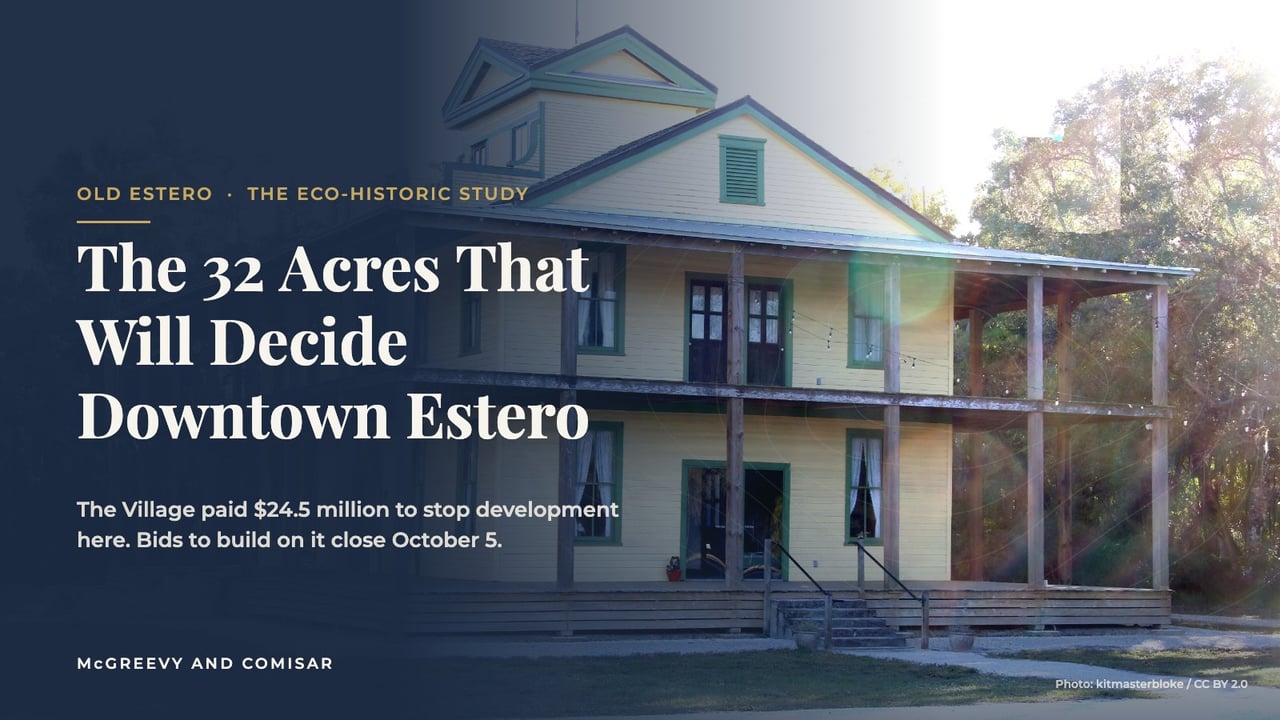
The 32 Acres That Will Decide Downtown Estero
Estero Jesse McGreevy September 5, 2026
Estero Jesse McGreevy September 5, 2026
In 2018, the Village of Estero agreed to pay $24,562,500 for 62.5 acres of riverfront land at Corkscrew Road and US 41. The purchase was roughly three times the Village's annual revenue at the time, and the reason it happened was specific: the land had already been approved for 530 housing units and 300,000 square feet of commercial space, and buying it was the only way to stop that from being built. Councilor Nick Batos, who said he received 430 emails in support, called it "our Central Park."
For the bigger picture, see our Estero area guide and our comparison of the best real estate agents in Estero. Related reading on our blog: The Estero Permit Problem: What FEMA's Audit Means for Homeowners and Why the Paddle From Cedar Creek to Estero Bay Takes Longer Than the Map Suggests.
Eight years later, the Village has an open solicitation asking private developers to submit proposals to build multifamily residential and retail on roughly 32 acres of that same land. Bids close October 5, 2026.
Both of those sentences are true, and the space between them is one of the more interesting land use questions in Southwest Florida right now. Here is what is actually happening.
The solicitation is titled "Public Private Partnerships Estero River North Opportunity," and it is on its second issue. The first went out May 8, 2026 and closed August 8 without an award. The Village reissued it on August 10, with a closing date of October 5, 2026.
It covers the roughly 32 acre publicly owned site north of the Estero River. The selected partner would be responsible for master planning, development, financing and long term operation, and the scope the Village describes includes:
In the Village's own description from a May 2026 Council workshop, the initiative "envisions the creation of a vertically integrated mixed use development anchored by multifamily residential and activated by complementary ground floor retail and neighborhood serving commercial space," and is "intended to leverage public land ownership to catalyze long term private investment."
The Village has also said the illustrated site uses remain preliminary and that it is open to alternative development proposals.
This is not a secret plan, and the reasoning is not hard to follow.
Estero operates on what Village Manager Steve Sarkozy calls a "government lite" model: 13 full time employees, the lowest municipal millage rate in the region at 0.7300 mills, and a capital program that consumes roughly 81% of the budget. The Village has committed to an enormous amount of construction. The adopted FY2026-27 capital program is $75,920,000. Estero's share of the Bonita Estero Rail Trail is $19.8 million. SportsPark Phase 2 alone is budgeted at $26.9 million.
Parks also cost money after they are built. In June 2026 Council approved $56,184 per year just for Kemper Sports Management to operate the RiverPark property.
A revenue generating development on a portion of the site is one way to fund the park on the rest of it without raising the millage rate. That is the argument, and it is a real one.
There is also genuine timing pressure. A statewide ballot measure in November 2026 would raise the non school homestead exemption to $150,000 in 2027 and $250,000 thereafter. Sarkozy has estimated the first year hit to Estero at about $2.5 million. Against an annual discretionary capital capacity of roughly $6.5 to $9 million, that is a substantial reduction in what the Village can self fund. If you want the detail on how Estero's tax structure actually works, we broke it down in our guide to property taxes in Estero.
Residents made the opposing argument twice in two days, on the record.
At the Planning, Zoning and Design Board meeting on June 16, 2026, four residents spoke, asking that the Happehatchee Center be highlighted in the study and that the north side of the Estero River property be preserved as part of the park rather than designated for development. The Board voted to recommend acceptance of the study, adding the Happehatchee Center point.
At the Village Council meeting on June 17, 2026, three residents spoke, recommending that Council postpone accepting the study to gather additional resident input, and making the same point about preserving the north side of the river. Council voted to accept the study. We covered that meeting in full in our June 17 Council recap.
The sequence is worth noting: the Village issued the first version of the development solicitation on May 8, roughly five weeks before Council accepted the study, and reissued it on August 10.
The Eco-Historic Planning Study cost $450,000, funded by a Community Development Block Grant Disaster Recovery award traceable to Hurricane Ian, with a $430,000 contract to LandDesign supported by Cooper Carry, Kittelson and Associates, Breedlove Dennis and Associates, and RCLCO. We walked through the study's contents and the six catalyst projects in an earlier post on the Capital Improvement Plan and the Eco-Historic Study.
Part of that budget bought a public survey. It ran in January 2026 and drew 1,736 responses. Ninety one percent of respondents live in Estero.
Asked to name the biggest challenges facing the area today:
Challenge | Share |
|---|---|
Traffic and congestion | 92% |
Development happening too fast or in the wrong areas | 67% |
Safety concerns | 25% |
Not enough nearby places to go | 24% |
Flooding or water issues | 17% |
Poor condition roads or utilities | 15% |
Asked what is missing from Estero today, the top answers were walking and biking trails (62%), parks and green space (54%), and riverfront access (46%).
Asked to name their top three priorities for Estero's future, respondents chose traffic and transportation improvements (82%), environmental protection and resilience (59%), and parks and recreation improvements (48%). Housing variety finished last at 8%.
And asked specifically what they would want if Estero had a downtown, respondents chose restaurants and cafes (70%), entertainment or events (51%), local shops (50%) and parks and green space (47%). Housing options came in at 3%.
One more finding worth sitting with: 49% of respondents said they have never spent time at the Estero River. For a village named after the river, that is a striking number, and it is arguably the strongest argument for building public access of some kind.
The resident comments collected in the report are blunt. Among them: "Now that we are a town, we don't have a town!" and "Buy land to keep green instead of more apartments and strip malls" and "A real downtown where people gather, not just another shopping center."
This is where precision matters, because the study is frequently described as though it were law.
Council accepted the study on June 17, 2026. Council has not adopted it. The report's own implementation section lists "adopt the plan formally" as its first foundational step, and that has not happened. Every land use recommendation in it is a recommendation.
For the record, the study's recommended development programs are modest and site specific rather than corridor wide. The Village Center concept calls for 80,000 to 100,000 square feet of commercial space with 32 cottage or single family homes and 36 townhomes. A Hertz Wellness District near Williams Road calls for 50,000 to 70,000 square feet with 26 to 52 residential units. A Trailside Drive main street concept calls for 40,000 to 50,000 square feet with 22 to 44 units.
The report contains no numeric building height limits and no proposed densities. It also explicitly states what it does not propose: broad residential expansion, intense development in environmentally sensitive lands, corridor wide strip development along US 41, and development disconnected from infrastructure capacity.
The 32 acre solicitation is a separate Village action running alongside the study, not a project the study approved.
The study area covers 1,078.57 acres along US 41 from Estero Parkway south to just below Williams Road. Two numbers from the environmental analysis explain why this land stayed undeveloped while the rest of Estero boomed:
The RiverPark site itself sits within the Special Flood Hazard Area and includes portions of the Estero River floodway. When the Village bought it, it amended its Comprehensive Plan to rezone approximately 35 acres as open space and permanent natural preserve, specifically to limit development in the floodway.
That floodplain overlap is not an abstraction for nearby owners. It is the same geography that drives Estero's flood insurance ratings and its post Hurricane Ian permitting rules, which we cover in the Estero permit problem.
There is also a wildlife constraint: a pair of bald eagles has nested on the property since 2022, and construction is restricted during nesting season, October 1 through May 15.
Whatever gets proposed on those 32 acres has to work around all of that.
The RiverPark is real and it is partially open. The parking portion completed construction in May 2026 and is open to the public.
Phase 1 includes the entry road and parking, a restroom facility, a pedestrian bridge over the Estero River, and walking paths, with a cost saving decision to use mulch rather than pavement. Phase 2 adds expanded paths on both sides of the river, fencing along the southern boundary, and a path along the north side of Corkscrew Road. Manhattan Construction is managing construction with oversight from CW3 Engineering.
The Eco-Historic study envisions it eventually as a "30 plus acre signature destination across the river from the Village Center," with elevated boardwalks, nature play, an amphitheater or event lawn, and a trailhead connecting to the rail trail.
The Bonita Estero Rail Trail is 11.4 miles of former Seminole Gulf Railway corridor running from Estero Parkway south through Estero and downtown Bonita Springs to Wiggins Pass Road in Collier County.
Estero's segment is 4.1 miles at a purchase price of $19,792,209. Council approved the purchase and sale agreement on March 4, 2026, with a due diligence period expiring September 29, 2026.
The gating event already happened: Bonita Springs voters approved a $35 million bond referendum on August 18, 2026, and it passed. The three party purchase totals $60 million against a corridor appraised at $75 million, with an extended closing deadline in October 2026.
Trail proximity is a documented factor in residential value, and the boardwalk connection to the trail is written into the 32 acre solicitation.
Honestly, for most of Estero, not much directly. If you are in Grandezza or Bella Terra or West Bay Club, this is civic news rather than a valuation input.
If you own in Old Estero, meaning the Broadway, Highlands, Sandy Lane and Trailside neighborhoods, it matters more, and it compounds with something else happening at the same time. Those same neighborhoods are the ones being converted from septic and well to municipal sewer and water, which we cover in our Estero septic to sewer update. Infrastructure investment and redevelopment study attention arriving in the same corridor at the same time is the whole story for that half of the Village, and it is worth understanding parcel by parcel.
If you are watching for what happens next, the dates are concrete:
Date | What happens |
|---|---|
September 9, 2026 | Council, first budget and millage hearing |
September 23, 2026 | Council, final budget hearing, including a proposed $69 million bond issuance |
September 29, 2026 | Bonita Estero Rail Trail due diligence period expires |
October 5, 2026 | The 32 acre development solicitation closes |
November 2026 | Statewide homestead exemption ballot measure |
The Village posts agendas, video and eComment cards at estero-fl.gov/meetings, and eComments must generally be submitted by noon the day before a meeting. The Village's own overview of the study is on its Eco-Historic Planning Study page, and the Estero RiverPark page carries the purchase and phasing history.
Not yet, and no proposal has been approved. The Village has an open solicitation asking private developers to propose a mixed use development anchored by multifamily residential on roughly 32 acres it owns north of the river. It closes October 5, 2026. Any resulting project would still go through the normal zoning and development order process.
Council voted to accept the study on June 17, 2026. It has not formally adopted it. Acceptance locks in the framework, which strengthens the Village's position for grant funding, but does not commit the Village to build any specific project or change any zoning.
The 62.5 acre site had been approved for 530 housing units and 300,000 square feet of commercial space. The Village purchased it for $24,562,500 on a unanimous Council vote in September 2018, closing in January 2019, and rezoned roughly 35 acres as permanent open space and preserve.
1,078.57 acres, along US 41 from Estero Parkway south to just below Williams Road, including both sides of the highway, Koreshan State Park and Village owned land along the Estero River. About 34% of it lies in the 100 year floodplain.
No opening date has been set. The corridor purchase is still in due diligence, with Estero's due diligence period expiring September 29, 2026 and an extended closing deadline in October 2026. Bonita Springs voters approved the funding referendum on August 18, 2026.
Partially. The parking portion completed construction in May 2026 and is open to the public. Remaining Phase 1 elements include a restroom facility, a pedestrian bridge over the river and walking paths.
If you own a home in Estero and want to understand how any of this affects your specific property, or you are looking at a purchase near the river corridor and want a straight read on what is actually approved versus what is merely proposed, that is a conversation worth having before you make a decision, not after. If you are considering selling, start with our guide to selling a home in Estero or request a current figure through our home valuation page.
Our team’s unprecedented professionalism, skill, and attention to detail has allowed us to set sales records for the past 20+ years. We will ensure your buying or selling experience exceeds your expectations.