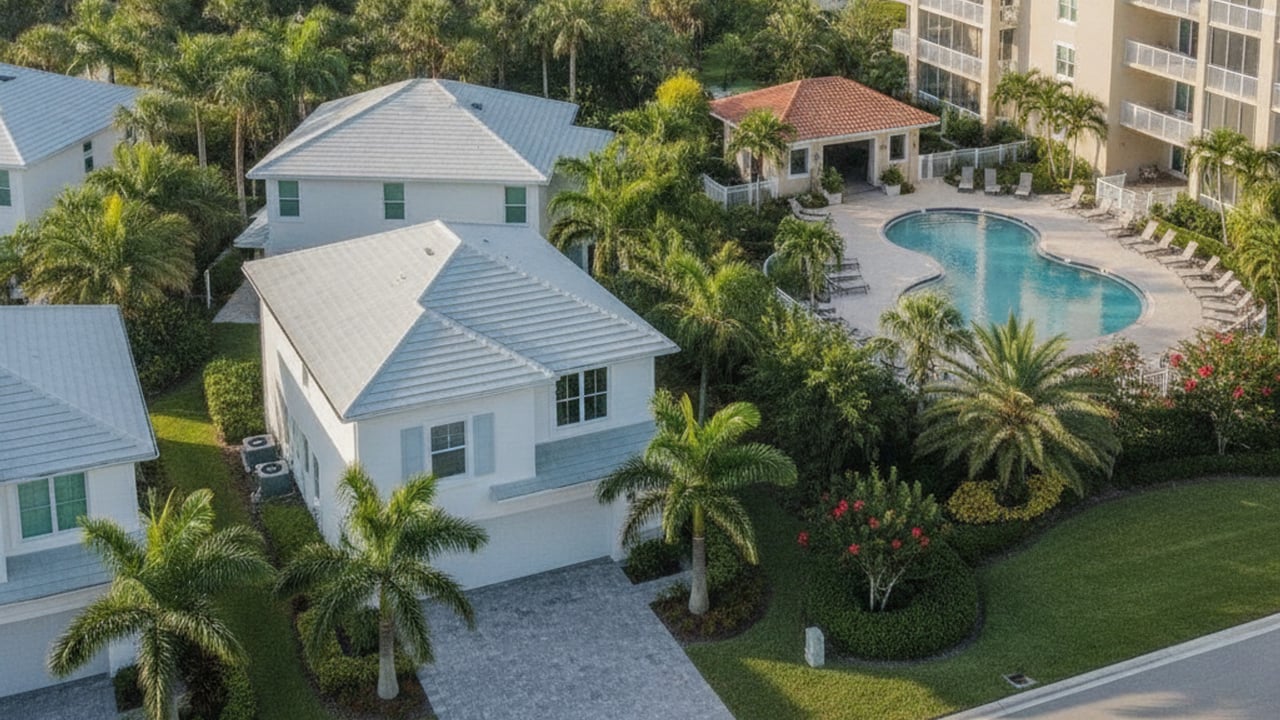
What to Expect from HOA Fees in Bonita Springs, FL in 2026
Bonita Springs JESSE MCGREEVY August 13, 2026
Bonita Springs JESSE MCGREEVY August 13, 2026
The median home sale price in the Bonita Springs, FL housing market sits around $570,000 as of mid-2026. If you're shopping among the roughly 738 homes currently on the market, you'll notice pretty quickly that a large portion of them sit inside managed communities - and that changes your monthly budget in ways the listing price alone won't tell you.
Buying in Lee County almost always means joining a homeowners association. The association maintains shared spaces, enforces neighborhood standards, and collects recurring dues to keep everything running. That recurring payment needs to be in your numbers before you write an offer, not after.
Monthly dues across the Cape Coral-Fort Myers Metropolitan Statistical Area can run anywhere from under $100 in a basic neighborhood to well over $1,000 in a luxury high-rise. The spread is wide because the range of communities is wide - what you're actually buying determines what you'll actually pay.
Single-family communities with minimal amenities sit at the low end. Those fees usually cover entrance landscaping, streetlights, and basic administrative costs. Not much else.
Condominium complexes and gated resort-style developments are a different story. They're managing larger shared infrastructure, and that costs real money to sustain.
Florida consistently ranks among the states with the highest average HOA dues - a direct result of insurance costs and the sheer concentration of resort-style developments. Bonita Springs follows that trend closely.
The city's density of coastal condominiums and amenity-heavy neighborhoods tends to push local averages above what you'd see in inland Lee County towns. If you're relocating from the Midwest or Northeast, the baseline dues here will likely run higher than anything you've budgeted for before.
Community age matters more than most buyers realize. Older developments carry aging infrastructure, and aging infrastructure costs more to maintain - which means annual budgets creep up and dues follow.
Location plays into it too. Properties near the coast or inside designated flood zones require the association to carry more expensive master insurance policies. Those premiums get passed straight to owners through the monthly dues.
The city covers four primary ZIP codes - 34133, 34134, 34135, and 34136 - and each one has a different housing mix that produces its own distinct fee patterns.
The 34134 ZIP code leans toward waterfront properties and high-rise condominiums. Associations there typically charge more to cover elevated insurance premiums, elevator maintenance, and private beach access. The 34135 ZIP code, further inland, runs more toward traditional single-family subdivisions and golf course communities, where dues vary considerably depending on whether a golf membership is mandatory or optional.
Condo owners almost always pay more in monthly dues than single-family homeowners. The reason is straightforward: a condo association has to insure the building's exterior, repair the roof, and maintain shared hallways. In a single-family community, those are your expenses, not the association's.
Age-restricted 55+ communities represent their own pricing tier. These neighborhoods tend to bundle lifestyle services, full-time activity directors, and extensive recreational facilities into the recurring monthly payment - so the fee is higher, but it's covering more.
Listings almost always express HOA costs as a monthly equivalent. Don't assume that means you're writing a check on the first of every month - the actual billing schedule depends entirely on the community.
Quarterly billing is the most common structure in Southwest Florida. If a listing shows $300 per month, you're likely paying $900 four times a year rather than $300 twelve times.
Some communities run a mixed billing approach, particularly when a neighborhood falls under both a master association and a smaller sub-association. You might pay the sub-association monthly while paying the master association in one annual lump sum.
Condominium associations tend to stick to monthly billing because their operating budgets require a steady income stream - landscaping crews, utility bills, and on-site management staff don't wait for quarterly checks to arrive.
Annual billing shows up mainly in neighborhoods with very low operational costs. If the association is essentially just maintaining a front entrance sign and a retention pond, collecting once a year keeps the administrative overhead down.
There's nothing arbitrary about an HOA fee. It's your fractional share of the community's operating budget, and state law limits what those funds can be used for.
The bulk of a standard budget goes toward daily maintenance and vendor contracts - lawn care for common areas, pool maintenance, trash collection, security services. Master insurance policies take another significant slice, particularly for attached housing like townhomes and condos, where the policy covers the physical structures against wind and fire damage.
A portion of every payment is supposed to flow into the association's reserve account - essentially a savings fund earmarked for long-term, predictable projects like repaving private roads or replacing a clubhouse roof.
Well-funded reserves protect you from sudden financial shocks. An association that has been skimping on reserve contributions for years won't have the cash on hand when major infrastructure fails, and the people who make up that shortfall are the current owners.
Dues don't cover everything - not even close. Single-family homeowners still carry their own exterior home insurance, handle interior maintenance, and pay their own utility bills.
Even in condo buildings where water and trash are folded into the dues, you still need an individual HO-6 policy. That covers the interior of your unit and your personal liability, neither of which the master policy touches.
The recurring dues are only part of the picture. Several one-time charges typically show up on your closing disclosure, and they can add up faster than buyers expect.
Management companies charge administrative fees to set up new accounts and process paperwork. These are separate from the dues themselves and go directly to the management firm. You'll want to review the association's financial documents during the inspection period - and with Bonita Springs homes currently sitting a median of 76 days on the market, you have time to actually read what you're given before you close.
A transfer fee covers the cost of updating ownership records from the seller to you. It typically runs between $100 and $300 and gets collected by the title company at closing.
Who pays it - buyer or seller - comes down to the purchase contract. In most local transactions, it ends up as a negotiating point alongside other closing costs.
Many Bonita Springs communities require a one-time capital contribution from new buyers. The money goes directly into the association's reserve fund to help build the neighborhood's financial cushion.
Capital contributions are often calculated as a multiple of the regular dues - two or three months' worth of assessments is common. Some high-end gated communities charge a flat initiation fee that can reach several thousand dollars.
A special assessment is an extra charge levied on homeowners when a project costs more than the reserve fund can cover. They tend to surface after severe weather events or when an association has been historically light on reserve contributions.
Ask specifically whether there are any pending or proposed special assessments before you make an offer. If an assessment has already been passed, you and the seller will need to negotiate who covers the remaining balance at closing.
High dues aren't automatically a problem, and low dues aren't automatically a deal. What matters is whether the cost lines up with the services provided and the financial health of the association behind them.
Artificially low dues usually mean deferred maintenance. A community that hasn't raised its fees in five years will face a reckoning eventually - most likely in the form of a large special assessment when the repairs that were ignored can't be ignored any longer. On the other side, paying $600 a month makes reasonable sense if the community is maintaining a guarded gate, a resort pool, tennis courts, and a fitness center.
The clearest red flag is high dues paired with a neighborhood that doesn't look like it costs that much to run. Dead landscaping and an outdated clubhouse alongside premium monthly fees points to board-level financial mismanagement.
A high delinquency rate is another one to watch. When a significant share of homeowners stops paying, the association eventually has to raise rates on everyone else to make up the gap.
Ask for the association's most recent reserve study. That document outlines the expected lifespan of the community's infrastructure and tells you whether the current dues are actually sufficient to cover future replacements - or whether a shortfall is quietly building.
Also ask about fee increases over the last five years. Steady, incremental increases that track inflation suggest responsible management. Sudden, dramatic spikes suggest the opposite.
It depends entirely on the property type. Basic single-family neighborhoods often charge a few hundred dollars a year, while luxury condominiums and gated communities can charge well over $1,000 per month.
These fees generally pay for common area landscaping, pool maintenance, security, and administrative costs. For condos, the dues also cover the master insurance policy and exterior building maintenance.
Yes. While many of the 738 homes currently on the market are located in managed communities, older subdivisions and non-deed-restricted areas in Lee County do not mandate association membership.
It depends on the specific development. Some newer master-planned communities in the Cape Coral-Fort Myers MSA carry Community Development District (CDD) fees to pay for initial infrastructure, which homeowners pay alongside their annual property taxes.
They happen occasionally, especially if an association fails to properly fund its reserves. Special assessments are also common after major weather events if the master insurance policy doesn't cover the full cost of repairs.
It depends on the community's governing documents. Many local associations do require a one-time capital contribution from the buyer at closing to bolster the neighborhood's reserve fund.
Stay up to date on the latest real estate trends.
Fort Myers
Fort Myers
Fort Myers
Fort Myers
Fort Myers
Fort Myers
Fort Myers
Estero
Our team’s unprecedented professionalism, skill, and attention to detail has allowed us to set sales records for the past 15 years. We will ensure your buying or selling experience exceeds your expectations.