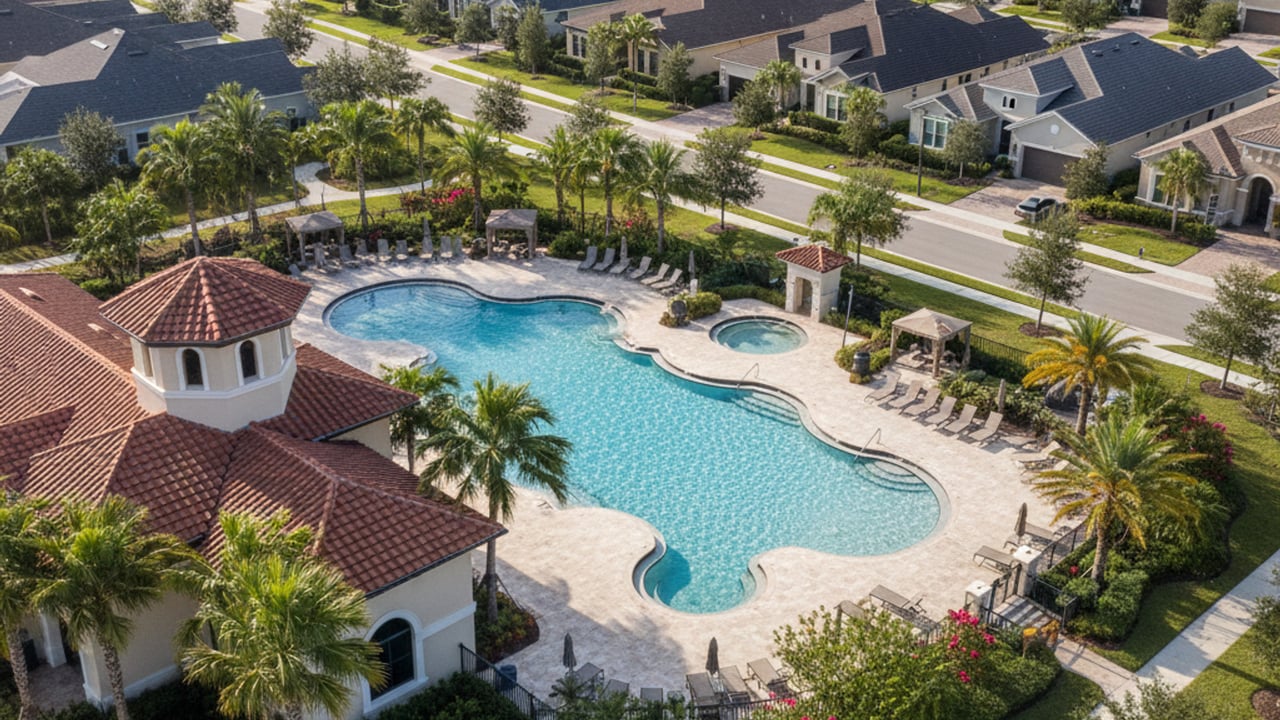
Aerial view of a community pool and spa surrounded by homes and landscaped grounds.

HOA Fees in Estero, FL: What Each Community Charges in 2026

Estero Jesse McGreevy November 2, 2026

Updated on: November 2, 2026

HOA fees in Estero, FL are the recurring dues a homeowners or condominium association charges to run a community's gates, grounds and amenities, and they differ more by community type than by home price.


Key Takeaway

An Estero home's true recurring cost is the sum of up to four charges: master association dues, any sub-association or condo dues, any mandatory club or bundled-golf fee, and any CDD assessment billed on the Lee County tax bill. Confirm each figure in the association's current budget and the estoppel before the contract's cancellation window closes.


Who This Guide Is For

Buyers comparing homes for sale in Estero across communities can use it to work out the full monthly and yearly carrying cost of a specific neighborhood before making an offer.


HOA Fees in Estero at a Glance

  • Gated, bundled-golf communities carry the highest dues; non-golf single-family the lowest.
  • CDD charges appear on the Lee County tax bill, separate from dues.
  • Bundled golf sits in required fees; optional clubs charge initiation.
  • HOA buyers who did not get the disclosure summary can cancel within 3 days of receiving it or before closing, whichever comes first.
  • Condos three habitable stories or more: milestone inspection at 30 years, SIRS every 10 years.

Average HOA Fees in Estero, FL by Community Type

Dues in Estero climb in a steady order by community type. Non-golf single-family neighborhoods sit at the low end, with the fee driven mostly by whether the community is gated and how large its shared amenities are. Condos and coach homes run higher because dues also pay for exterior maintenance, the master building insurance policy and shared structural upkeep. Bundled-golf communities and gated luxury communities with sub-associations sit at the top, especially once master and sub-association dues are combined. Associations reset dues with each annual budget, so a listing's figure may be out of date. Buyers evaluating these community types can also review the Estero, FL housing market.

In a master-planned community, a master association runs the gate, main roads, clubhouse and common grounds, while smaller neighborhood or condo associations inside it maintain their own buildings, pools or yards. A single listing can carry both bills, and each association adopts its own budget and can levy its own special assessments.

Dues may be billed monthly, quarterly or annually, and MLS listings sometimes misstate the frequency. A quarterly fee entered as an annual figure makes the yearly cost look like a quarter of what the owner will pay.

What Estero HOA Fees Typically Cover

Estero HOA dues commonly pay for:

  • Routine landscape maintenance, including mowing, trimming, and community-wide irrigation systems.
  • Shared amenities such as clubhouses, fitness centers, community pools, and pickleball courts.
  • Security features including guarded gates, roving patrols, and common area lighting.
  • In condos, exterior pest control and roof maintenance.


CDD Fees vs. HOA Fees in Estero

A Community Development District (CDD) is a local government entity under Florida Chapter 190 that finances and maintains public infrastructure such as major roads, water management systems and large parks. A management company bills HOA dues. A CDD charge appears on the annual Lee County property tax bill as a non-ad valorem assessment, on the same bill as county and village taxes.

The assessment has two parts:

  • Debt service: Repays the bonds that built the community's infrastructure and ends once those bonds are paid off.
  • Operations and maintenance: Pays for upkeep of district roads, ponds and common land, and continues for as long as the district exists.

A parcel with years left on its bonds therefore costs more each year than a similar parcel whose bonds are retired.

To check a specific home before making an offer:

  1. Tax bill: Pull the parcel's bill from the Lee County Tax Collector. The non-ad valorem section lists any CDD charge by district name and dollar amount.
  2. District contact: Find the district in Lee County's Special Districts directory. It lists each active CDD in the county, including Estero-area districts such as Habitat (Bella Terra), Stoneybrook, V-Dana and WildBlue, with a link to each district's website and management company.
  3. Bond payoff: Ask the district manager for the remaining bond balance and a payoff quote.

A CDD alone is no reason to rule out a home: it pays for infrastructure that would otherwise need funding another way.


HOA and Club Fees by Estero Community

Before writing an offer in any community, confirm four things with the association or its management company:

  • dues and billing frequency
  • CDD status
  • any golf or club requirement
  • the capital contribution due at closing

Buyers planning to lease a home should also read each declaration's leasing rules, since income from investment property near Southwest Florida International Airport depends on what the association allows.

  • Rapallo at Coconut Point: A condominium community. Ask for both the condo association dues and any Coconut Point master dues.
  • Mirasol at Coconut Point: Also a condo community at Coconut Point, so confirm both the condo dues and any master dues.
  • Genova: No CDD. The condominium association owns the common areas, so the tax bill carries no CDD assessment or lien. Amenities include:

    • a manned gated entry and private clubhouse
    • a resort pool and a lap pool
    • a fitness center, aerobics studio, and massage and sauna
    • bocce courts and stocked lakes

    There is no separate club membership beyond the association. Its published fees are small processing and security-check charges, not a capital contribution.

  • The Place at Corkscrew: Owners pay master HOA dues, an annual CDD assessment and a food and beverage minimum that supports the resort pools and dining.
  • Grandezza: Next to Miromar Outlets. Every owner must hold a social club membership on top of master and neighborhood dues, and neighborhood fees vary by property type. Ask whether dues include landscaping, irrigation, cable and internet.
  • Copper Oaks: Has its own CDD, established in 2004 by Lee County Ordinance No. 04-17. The community sits on the east side of Three Oaks Parkway between Koreshan Boulevard and Corkscrew Road. Expect a CDD line on the tax bill.
  • Rookery Pointe and Heatherstone: Heatherstone is a neighborhood within Rookery Pointe, so a home can carry master and sub-association dues. Confirm both.
  • Fountain Lakes: Ask for both master and sub-association dues.
  • West Bay Club: West of US-41. Owners pay a master fee, and high-rise condos add a sub-association fee, often billed quarterly.
  • Verdana Village: Carries a CDD assessment listed at about $1,670 a year on the tax bill. Verdana Village offers a resort pool, pickleball, tennis, basketball, a dog park and a fitness center.
  • The Villages at Country Creek: Dues differ by housing type, and the association publishes a yearly fee schedule. Request it and use the line that matches the type of home you are pricing.

For Estero Place, The Vines, Olympia Pointe, Villagio, Esplanade at Kingston, The Reserve at Estero and Cascades at Estero, request the current budget and fee schedule and confirm the same four items.


Bundled Golf vs. Optional Membership Communities in Estero

Golf in Estero communities follows one of three structures, and each lands differently on the owner's bill.

  • Bundled golf: Every owner is a golf member, and club dues are part of the required fees. The cost is paid whether or not the owner plays.
  • Mandatory social, optional golf: Every owner pays social club dues for dining, fitness and social facilities. Golf is an added membership with its own initiation fee and annual dues.
  • Optional or equity clubs: Membership is a choice and starts with an initiation fee or capital contribution. A refundable equity membership returns some or all of that payment on the terms in the club's bylaws, such as when the membership is resold. A non-refundable contribution is gone once paid.

Two Estero examples show why the structure matters:

  • Estero Country Club: The course sits within The Villages at Country Creek and is open to public play. Ask the club whether golf membership is bundled into Country Creek fees or optional, and request its current initiation and annual dues.
  • Grandezza: Golf is optional and separate from the required social membership. Ask for the current initiation fee, annual dues and whether membership is capped.

Before buying in any club community, ask:

  1. What is the initiation fee or capital contribution, and is any of it refundable?
  2. What are the annual dues?
  3. Is there a food and beverage minimum?
  4. Is there a waitlist or membership cap?
  5. Does the membership transfer with the home?


HOA Insurance in Estero: Master Policy vs. Your Own Coverage

Insurance is one of the largest lines in any association budget.

Who Insures What

Under Fla. Stat. 718.111(11), every residential condominium association must carry adequate property insurance, whatever its declaration says. The master policy covers the condominium property as originally installed, or replacement of like kind and quality, plus later alterations.

The master policy must exclude:

  • floor, wall and ceiling coverings
  • electrical fixtures
  • appliances, water heaters and filters
  • built-in cabinets and countertops
  • window treatments

Those items are the unit owner's responsibility, usually through an HO-6 policy. Master-policy deductibles and losses above the association's coverage are a common expense, shared by owners through assessments.

In a single-family HOA, the association typically insures only common areas and amenities, and the owner carries a full homeowner policy. Confirm the split in the declaration.

A lender or insurer will ask for the association's insurance declarations page. When requesting an HO-6 or homeowner quote, share that page so the policy covers what the master policy leaves out. Also ask whether the policy pays an assessment for your share of a master deductible. Check flood coverage on a master policy rather than assuming it.

How Insurance and Roofs Feed Dues

Rising master-policy premiums pass straight through to dues. A roof replacement is paid from reserves or, if reserves fall short, a special assessment. For villas and coach homes, who pays to re-roof depends on the maintenance responsibility chart in the declaration, so read it before buying.

Two Florida condo safety rules push reserves up:

  • Milestone inspection: Under Fla. Stat. 553.899, a condo or co-op building three habitable stories or taller must be inspected by December 31 of the year it reaches 30 years old, and every 10 years after. Local agencies may set a 25-year trigger near the coast.
  • Structural integrity reserve study: Under Fla. Stat. 718.112, condo buildings of that height need a study at least every 10 years. It covers roof, structure, foundation, fireproofing, plumbing, electrical, waterproofing and exterior painting. The initial deadline was December 31, 2025. For budgets adopted on or after December 31, 2024, owners can no longer vote to waive or reduce reserves for those components.


How to Check an Estero Community's HOA Fees Before You Buy

Run these checks before writing an offer.

  1. Budget and fee schedule: Get the current budget and fee schedule from the association or its management company. Many communities publish this as a yearly fee document. The seller or listing agent can name the management company.
  2. Total yearly cost: Add the parcel's ad valorem property taxes from the Lee County tax bill to the dues, club and CDD charges to get the full cost of ownership.
  3. Reserves: Read the reserve study, the current reserve balance, the latest milestone report and the association's insurance declarations page.
  4. Board minutes: Read the last 12 months of minutes for planned special assessments or dues increases.
  5. Closing charges: Ask about any transfer fee due at closing in addition to the capital contribution.
  6. Rules and approval: Check pet and vehicle rules and the architectural rules for exterior changes, along with the leasing rules above. Also confirm whether the association must approve the purchase.
  7. Disclosure and cancellation: Under Fla. Stat. 720.401, an HOA buyer must receive a disclosure summary before signing the contract. If it was not provided, the buyer can void the contract within 3 days after receiving it or before closing, whichever comes first, and that right cannot be waived. Condominium resales follow separate disclosure rules under Chapter 718, so confirm the documents and cancellation period your contract provides.

The title company orders the estoppel certificate, which confirms the seller's unpaid balance and the association fees due at closing.


Frequently Asked Questions

What Is the 5-Year Rule for HOAs in Florida?

It is the 5-year statute of limitations in Fla. Stat. 95.11 for claims based on a written contract. Courts apply it to suits enforcing HOA covenants and to foreclosing an assessment lien under Fla. Stat. 720.3085, starting from the violation or default, though it limits only court actions, not fines or recording a lien. Condo assessment liens have a shorter window: suit must be filed within 1 year after the lien is recorded, under Fla. Stat. 718.116(5)(b).

Are HOA Fees of $500 per Month Considered High in Estero?

For a condo whose dues cover exterior insurance, or for an amenity-rich community, $500 is normal. For a basic single-family neighborhood without a clubhouse or CDD infrastructure it would be high.

What's the Average HOA Fee in Florida, and How Does Estero Compare?

Statewide averages blend older neighborhoods, small associations with few amenities and condos of every age, so they understate what Estero's gated and bundled-golf communities charge. Compare a listing against its own community type instead.

How Much Does an Estero Country Club Membership Cost, and Is It Included in HOA Fees?

The club sets its own initiation fee and annual dues. Those dues count toward your required fees only if golf is bundled into The Villages at Country Creek fees.

Are There Neighborhoods in Estero With No HOA Fees?

Lee County and the Village of Estero do not certify any neighborhood as free of deed restrictions, so check each home. A buyer or title agent can search the Lee County Clerk of Court's Official Records for a recorded Declaration of Covenants, Conditions and Restrictions covering the lot and review the recorded subdivision plat for restrictive covenants. The Property Appraiser's parcel record links to the deed but does not prove whether restrictions apply.

Are HOA Dues Tax-Deductible?

On a primary residence, no: IRS Publication 530 lists homeowners and condo association fees as nondeductible because an association, rather than a state or local government, imposes them. On a rental property, IRS Publication 527 treats dues and assessments paid for maintenance as a deductible rental expense.


Sources

Work With Us

Our team’s unprecedented professionalism, skill, and attention to detail has allowed us to set sales records for the past 20+ years. We will ensure your buying or selling experience exceeds your expectations.