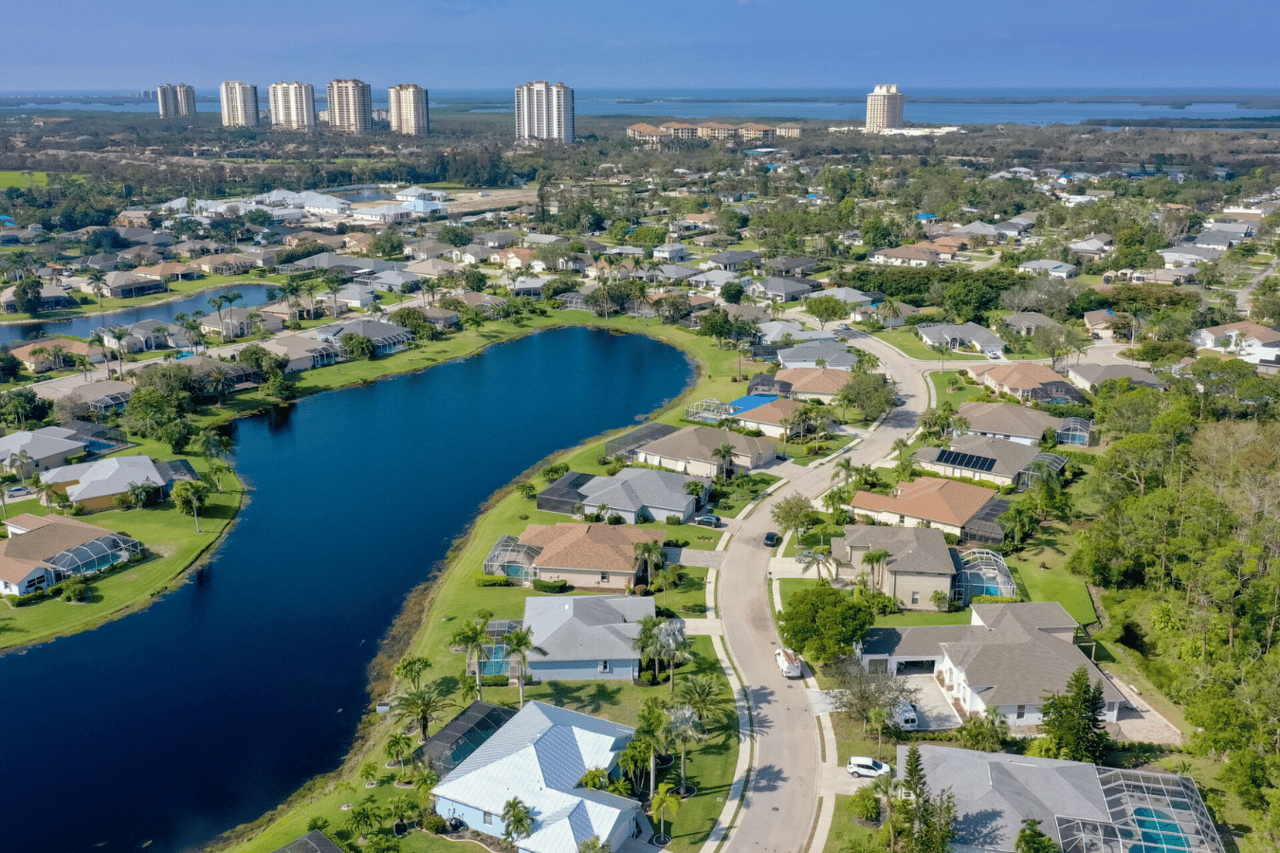
Estero is a Village of roughly 35,000 residents in Lee County, Florida, sitting between Bonita Springs to the south and Fort Myers to the north, fifteen miles up the coast from Naples. It is the youngest incorporated municipality in Southwest Florida — its residents voted to become a Village on December 31, 2014 — and over the eleven years since incorporation it has grown into one of the most consequential real estate markets on the west coast of Florida. The center of gravity for new luxury development in the region has shifted east of Interstate 75, and Estero sits at the heart of that shift.
If you are reading this page, you are almost certainly weighing one of four things — buying a primary home here, buying a second or seasonal home, buying in one of the major new-construction communities going up along Corkscrew Road, or selling a home you already own here. The honest answer to “is now a good time?” depends on which of those you are doing, what part of Estero you are looking at, and how you want to think about a market that is simultaneously the most active it has been in years and the most fundamentally reshaped by new development since the early 2000s. This page is long and detailed on purpose. We will walk you through what the market actually looks like in April 2026, what is being built and why it matters, the regulatory and environmental context that quietly governs what your home and your neighbors’ homes can become, the schools, the lifestyle anchors, the insurance reality, the Village government’s plans for the next twenty years, and the deep history that explains why this place is called Estero in the first place. Buyers and sellers deserve more than a one-paragraph community pitch, and our team is built to deliver it.
Living in Estero as a Homebuyer
The Village of Estero was officially incorporated on December 31, 2014, after a multi-year campaign led by the Estero Council of Community Leaders (ECCL) to give the area home rule over its own land use decisions. Before incorporation, all of Estero was governed by Lee County. After incorporation, the Village adopted its own Land Development Code and assumed control of zoning, planning, and most development approvals inside its municipal boundaries — though Lee County still controls regional roads, building permits in some unincorporated pockets adjacent to the Village, school assignment, and the Estero Bay watershed.
For orientation, it helps to think of Estero in four loose zones, each with its own personality:
- The US-41 / Coconut Point Corridor (West). The shopping, dining, and lifestyle spine of the community. Coconut Point — a 1.2 million-square-foot outdoor lifestyle center — anchors the corridor, with condo and coach home communities like Rapallo and The Residences at Coconut Point nearby. This is the most walkable part of Estero, popular with buyers who want everything within ten minutes of home.
- Between I-75 and Three Oaks Parkway (Central). A mix of established gated golf communities — Grandezza, Stoneybrook, Belle Lago, The Vines at Estero Country Club — that built out in the late 1990s and early 2000s. Single-family homes on lots oriented around golf courses, lakes, or preserve frontage. This is “core mature Estero.”
- The Corkscrew Road Corridor (East of I-75). Where every new master-planned community is being built — Verdana Village, Corkscrew Shores, The Place at Corkscrew, WildBlue, Bella Terra, and (just beyond, in unincorporated Lee County) the massive Kingston development. This is the growth axis of the entire community.
- The Brooks (Southeast). An umbrella development containing several distinct villages — Shadow Wood, Spring Run, Lighthouse Bay, Copperleaf — sharing the Commons Club beach club on the Gulf as a member amenity. The Brooks is one of the most coveted golf-community clusters in all of Southwest Florida.
The Village’s geographic center is roughly the intersection of Corkscrew Road and US-41, near Coconut Point. From that center, Southwest Florida International Airport (RSW) is a ten-minute drive north on I-75, downtown Naples is a thirty-minute drive south on US-41, downtown Fort Myers is a twenty-five-minute drive north on US-41, and the beaches at Lovers Key State Park and Bonita Beach are about a twenty-minute drive west. That central location is part of why the area has held its value through every market cycle of the past two decades: it is genuinely equidistant from the things buyers move here for.
A note on personality. Estero is not Naples and it is not Fort Myers Beach. The Village is younger, less waterfront-driven, more golf-and-master-planned-community oriented, and noticeably more family- and second-home-balanced than Naples (which tilts heavily seasonal and luxury) or Fort Myers Beach (which is still rebuilding from Hurricane Ian). The median age in Estero is 66, and roughly half the housing stock turns over to part-time / snowbird residency during summer months — but the year-round community is real, the schools are full, and the everyday infrastructure (healthcare, shopping, public safety) is built around full-time residents, not just seasonal tourists.
Market Snapshot (April 2026)
Here is what the Estero market looks like as of the most recent month of complete data. These are ZIP-level numbers for ZIP 33928 (the primary Estero ZIP), all property types — single-family, condos, coach homes, villas, and townhomes combined. Specific neighborhoods, club communities, and price tiers move differently; we are happy to pull a tailored report for any community you are considering.
| Median sale price |
$535,000 |
↓ 0.9% (essentially flat from $540,000) |
| Average sale price |
$638,626 |
↑ 9.1% (from $585,249) |
| Closed sales |
135 |
↑ 28.6% (from 105) |
| Cash sales |
84 of 135 (62.2%) |
↑ 47.4% (from 57 of 105) |
| Sale-to-original-list-price ratio |
93.6% |
≈ flat (from 93.7%) |
| Median time to contract |
55 days |
flat (from 55) |
| Median time to sale (contract through close) |
97 days |
↑ 3.2% (from 94) |
| New listings |
119 |
↓ 4.8% (from 125) |
| Active inventory |
480 listings |
↓ 29.5% (from 681) |
| Pending inventory |
165 |
↑ 47.3% (from 112) |
| Months supply of inventory |
5.3 months |
↓ 40.4% (from 8.9) |
| Total dollar volume |
$86.2 Million |
↑ 40.3% (from $61.5M) |
Source: Florida Realtors SunStats, ZIP 33928, All Property Types, April 2026.
What the Market Numbers Mean for You
The headline story is normalization. Volume returned — closed sales jumped 28.6% year over year, cash sales jumped 47.4%, dollar volume jumped 40.3%. At the same time, prices held essentially flat (the median is down less than a percent) and sellers are getting 93.6% of original list price, almost identical to a year ago. The market did not have to crash for the volume to come back, and it did not have to overheat for prices to hold. That kind of balanced movement is rare.
The supply story is the most important number on the table. Months Supply of Inventory dropped from 8.9 to 5.3 in twelve months. Anything over 6 months is technically a buyer’s market; anything under 4 months is a seller’s market; 4-6 months is balanced. A year ago Estero was firmly buyer territory. Today it is at the balanced-market line, and the trend is pointing toward seller’s territory. Active inventory is down 29.5% year over year (681 → 480 listings) and pending inventory is up 47.3% (112 → 165). The market is tightening fast.
Cash buyers dominate. 62.2% of all closed sales in Estero in April 2026 were cash transactions — up from 54.3% a year ago. Cash dominance is a signature of mature SWFL luxury and retiree-led markets, and it has two real implications. For sellers, closings are cleaner — no financing fall-through risk, no appraisal contingency drama. For financed buyers, you are competing against cash on essentially every property worth bidding on. The list-price strategy that worked in a buyer’s market does not work here. We will walk you through how to compete — earnest money structure, inspection terms, closing timeline, and when to escalate — when we sit down.
Three things the headline numbers do not tell you:
- One month is one month. April 2026 alone — a single month in a mid-sized market (135 closed sales) can swing on a few outlier transactions. A high-end Shadow Wood estate close or a Verdana Village builder closeout can move the average. A serious buyer or seller should look at a 3-6 month rolling view of their specific property class.
- “Estero” is at least four distinct markets. Condos at Coconut Point, equity-membership golf homes in The Brooks and Grandezza, new-construction single-family along Corkscrew Road, and the boating community at WildBlue all move on their own clocks. The aggregate hides the segment story.
- The cash-buyer reality changes the playbook. If you are financed and planning to buy in Estero, you need a Realtor who understands how to win against cash. The 62.2% cash share is not an aggregate detail — it is the competitive context for every offer you write.
A Realtor who reads one ZIP-level median and writes a generic recommendation is doing you a disservice. That is where depth in Lee County real estate — and weekly access to LeePA, Village permit data, and MLS-level segment reports — earns the commission.
If you want a tailored snapshot for a specific neighborhood or building, call or text Jesse at (239) 898-6072 or Marc at (239) 287-5873.
Kingston — The Cameratta Megaproject on Corkscrew Road
If you are buying or selling in Estero in 2026, Kingston is the single most important real estate story in your market — and most Realtor pages either ignore it or have one outdated paragraph. We will not.
Kingston is a 6,676-acre mixed-use planned community being developed by Cameratta Companies along Corkscrew Road, east of Verdana Village in unincorporated Lee County. At buildout, Kingston is planned for approximately 10,000 dwelling units at a density of 1.5 units per acre, 700,000 square feet of commercial space, a 240-room hotel, a K-8 school with land reserved for a future high school, and 3,287 acres of dedicated preserve — roughly half the project’s footprint. The development broke ground on November 13, 2025, with first move-ins expected in early 2027. Phase 1 builders include Lennar, Pulte, Neal Communities, and Taylor Morrison (whose Esplanade-branded portion is luxury resort-style golf). Phase 2 is Kolter Homes. Pulte’s price points are floated at $300,000 to $700,000; Taylor Morrison’s Esplanade product starts in the low $400,000s.
The approval story is unusual and worth understanding. Kingston did not go through a standard Comprehensive Plan amendment or Development of Regional Impact process. The project was approved via a June 2022 settlement between Cameratta and the Lee County Board of County Commissioners, which closed a 2011 lime-rock-mining lawsuit (referred to as Corkscrew Grove) that could have cost the County a $63 million payout. The settlement avoided that payout and authorized the development — at a density approximately 15 times the underlying Density Reduction / Groundwater Resource (DR/GR) overlay baseline. The Community Development District ordinance (Lee County Ordinance 23-26) was approved in October 2023.
There is active federal litigation. Because of the wetland impacts and the panther primary-zone overlap, the U.S. Fish and Wildlife Service biological opinion estimated 4 to 23 panther deaths attributable to Kingston in year one alone — and, combined with the adjacent Bellmar project, up to 24 per year against a wild population estimated at 120 to 230. In February 2024, Federal Judge Randolph Moss invalidated Florida’s entire state 404 program in a ruling specifically citing Kingston and Bellmar as the triggering cases. The State of Florida appealed; the D.C. Circuit heard oral arguments on May 5, 2025, and the ruling is pending as of this writing.
What this means for you as a buyer or seller. Kingston is going to add an estimated 25,000+ new residents to a Corkscrew Road that is currently a two-lane corridor over much of its length. Phased widening of Corkscrew is underway, but the segment reaching Kingston is not scheduled for completion until 2031-2035. Traffic, school enrollment, and infrastructure load will all be reshaped over the next decade. For sellers in established communities, Kingston pulls new buyers into the eastern corridor — directly competing with resale inventory. For buyers, Kingston offers brand-new product at price points that compete with resale, but with longer commute times and the uncertainty of a community still under construction.
A dedicated /estero/kingston guide is coming with the full Cameratta history, every builder’s price sheet, the full timeline, the federal litigation status, and a buyer’s framework for deciding Kingston versus Verdana Village versus Corkscrew Shores. We will link it here when it goes live.
Estero’s Luxury Golf Communities — Grandezza, Shadow Wood, West Bay Club
Estero’s golf-community inventory is among the deepest in Southwest Florida. Three communities sit at the top of the luxury tier, and each one has a fundamentally different personality.
Grandezza is a 979-home gated community east of I-75, designed around a Darwin Sharp III-designed eighteen-hole championship course with an equity-membership country club. Single-family estate homes, coach homes, and a handful of villa product. Home prices range broadly from the mid-$300,000s for coach homes to over $1.8 million for the largest estate homes. The community’s appeal is the combination of golf, social club, and proximity to Coconut Point and US-41 — you get the gated golf life without being far from everyday infrastructure.
Shadow Wood at The Brooks is widely considered one of the top-three luxury golf communities in all of Southwest Florida. 1,481 homes, 54 holes of golf across three courses, and equity membership in both the Shadow Wood Country Club and The Commons Club — a separate beach, dining, and fitness club on the Gulf of Mexico. The Commons Club access is the differentiator: Brooks-village residents have private beach amenities most other Estero golf communities cannot offer. Home prices range from approximately $700,000 for the smaller villa product up to several million for the larger estate homes on premier lots. Shadow Wood’s full guide gets its own dedicated sub-page.
West Bay Club is the smallest of the three but arguably the most luxurious per square foot. Equity membership in West Bay Club is required for residency, the community has a private Gulf-of-Mexico beach club (one of very few off-island communities to offer one), a Pete Dye-designed golf course, and a clubhouse and amenity package that competes with Naples private clubs. Most West Bay Club homes are priced above $1.5 million, with waterfront product reaching well into the multi-million-dollar tier.
These three are not exhaustive — Estero’s golf-community inventory also includes Stoneybrook, Wildcat Run, Pelican Sound, Copperleaf at The Brooks, Spring Run at The Brooks, Lighthouse Bay at The Brooks, Belle Lago, and several others — but they represent the top of the market and the communities where the most luxury volume happens.
Each community is getting its own dedicated /estero/grandezza, /estero/shadow-wood, and /estero/west-bay-club sub-page with HOA fee schedules, club membership details, equity-versus-non-equity breakdowns, recent sale comps, and amenity comparison. We will link each one here when it goes live.
Estero’s New-Construction Communities — Verdana Village, WildBlue, The Place at Corkscrew
If you want new construction in Estero — never-lived-in, builder-warranty product — three communities dominate the inventory.
Verdana Village is Cameratta Companies’ most recent master-planned community along Corkscrew Road, with approximately 2,400 dwellings planned at buildout. Pulte, Lennar, and other major national builders are active here. Single-family homes, twin villas, and townhomes from the mid-$400,000s into the high $700,000s for the larger product. The amenity package is comprehensive — resort-style pools, a sports complex with pickleball and tennis, a fitness center, walking trails, restaurants, and even a Publix grocery store at the community entrance. Verdana Village is the most active new-construction story in Estero in 2026.
WildBlue (also referenced as Vista WildBlue) is the boating community of Estero. Two interconnected freshwater lakes — Vista Lake and WildBlue Lake — span over 820 acres of water, and many homes have private boat lifts and direct lake-to-Gulf access via a sheltered channel system. Stock Development, Lennar, Pulte, and WCI are the primary builders. Pricing is luxury-tier — single-family homes start in the high $800,000s and reach $3M+ for the largest waterfront estate homes. The clubhouse and beach club are extensive. WildBlue is the answer to “I want new construction with water access I can boat from.”
The Place at Corkscrew is Cameratta’s earlier master-planned community along Corkscrew Road, with approximately 1,325 homes and arguably the most extensive amenity package in any mid-tier Estero community: multiple resort pools, a poolside restaurant, a marketplace with a Starbucks-style coffee shop, a craft beer lounge, a state-of-the-art fitness center, a tennis and pickleball complex, and an event lawn. Pricing runs from the mid-$500,000s to the high $700,000s. The Place is the move-up product for buyers who want amenity richness without country-club commitment.
Each gets a dedicated sub-page coming at /estero/verdana-village, /estero/wildblue, and /estero/the-place-at-corkscrew with full builder inventory, fee schedules, recent sale comps, and lot/lake/preserve premium analysis.
The Village of Estero Government and the 2045 Comprehensive Plan
Estero is the youngest incorporated municipality in Southwest Florida. The Village’s first Council was seated in March 2015, and the Village has since adopted its own Land Development Code, its own Comprehensive Plan, and a robust Capital Improvement Plan (CIP) that has funded major infrastructure investments — including the Corkscrew Road widening, Williams Road widening, the planned Performing Arts Center, a new Village Hall, the Estero on the River mixed-use redevelopment along the Estero River corridor, and the Driving Range Property redevelopment site.
The 2045 Comprehensive Plan is the document that sets the Village’s twenty-year development trajectory — what can be built where, density allowances, height limits, redevelopment priorities, transportation, environment, and housing — through 2045. The current draft (the “Goals, Objectives, and Policies” document) is available directly from the Village at estero-fl.gov. The Plan focuses on coastal and aquifer resilience, the Corkscrew Road corridor as the principal growth axis, redevelopment of the Estero River area (including the active Eco-Historic Planning Study funded by a 2025 CDBG-DR grant agreement), housing diversity for year-round residents, environmental protection (especially for the Estero Bay watershed and panther primary zone), and hurricane resilience standards built into new construction.
The Village Council meets twice monthly, the Planning, Zoning & Design (PZD) Board reviews most development applications before they reach Council, and agenda packets are published in advance via the Village’s ChampDS system — including the full attached staff reports, applicant exhibits, and traffic studies. Most other Realtor pages do not reference these documents. We do, because they are where the actual development pipeline decisions get made.
A dedicated /estero/village-government sub-page is coming with a plain-language summary of the Comp Plan, the LDC zoning districts, current Council members and Board appointees, and the active development applications under review.
Estero Building Permits, Zoning, and What You Can Build
If you are buying a property to renovate, expand, or rebuild in Estero, the question of “what can I do with this lot?” is governed by the Village’s Land Development Code (LDC) — adopted progressively after incorporation in 2014 — and by Lee County for parcels in unincorporated pockets adjacent to the Village.
Zoning districts in Estero range from low-density single-family residential (RS) through medium and high-density residential, mixed-use, and commercial. Setbacks, height limits, lot coverage maximums, and impervious-surface percentages vary by district and are codified in the LDC. For most buyers, the relevant questions are: How big can a primary structure be on my lot? Can I add a casita or pool house? What is the maximum building height? Are there architectural review requirements? And how does the underlying flood zone affect what I can build at grade?
The Village’s permit-issuance data is public. The Village publishes monthly permit reports, and Lee County publishes building permit data for the unincorporated pockets. Both data streams help you understand what is actually being built around a property you are considering — whether new homes are going up next door, whether neighbors are doing major renovations, and whether the area is in active redevelopment.
For a specific property you are considering, we will pull the zoning data, setback requirements, and recent permit activity for a 500-foot radius around the parcel before you write an offer. That is part of what the McGreevy and Comisar team’s depth in Lee County data delivers — most teams do not do this because they do not have the systems built for it.
A dedicated /estero/permits-and-zoning sub-page is coming with district-by-district maximums, the architectural review process for each major HOA-governed community, and a step-by-step on how to verify zoning and permit history before you buy.
FEMA’s 50% Rule and Flood Zones in Estero
If you are looking at an older home in Estero — particularly anything west of I-75 that took damage from Hurricane Ian (September 2022), Hurricane Helene (September 2024), or Hurricane Milton (October 2024) — you need to understand the 50% Rule before you write an offer.
Here is the rule, plain language:
If, in any rolling cumulative period, the cost to repair damage to a property plus the cost of any improvements you want to make exceeds 50% of the structure’s market value (land value excluded), FEMA’s National Flood Insurance Program requires that the entire structure be brought up to current floodplain management regulations — including elevation to the current Base Flood Elevation (BFE) for the property’s flood zone.
In Estero, this matters most for properties in AE flood zones (the FEMA Special Flood Hazard Area west of US-41 along the Estero Bay watershed) and in the Coastal A zones that border the Estero River and Spring Creek drainages. Properties east of I-75 are mostly in Zone X (minimal flood hazard) — though portions of the eastern half of the Village adjacent to drainage corridors are AE or Shaded X. Every property has its own flood zone, and the answer is parcel-specific.
The 50% Rule has three practical implications for buyers:
- An older AE-zone home with cumulative damage near 50% of value is effectively forced into a substantial improvement classification if you do anything material to it — meaning the structure must be elevated and brought to code, which can cost $100,000-$300,000+ on top of whatever you were planning to spend.
- Insurance follows the 50% Rule. A property that has crossed the cumulative threshold must be elevated to be insurable at standard NFIP rates. Non-elevated post-FIRM properties pay materially higher premiums.
- The damage history of an Estero home matters. Storms since 2022 have stacked, and the Village’s FEMA Operational Audit (June 2024) documented hundreds of properties whose cumulative damage triggered Substantial Improvement determinations. Before you offer on any AE-zone property, we pull the damage history.
The Village’s FEMA Operational Audit page and its Substantial Improvement / Damage Review Handout are the definitive Estero-specific resource on the rule. Most Realtor pages on Estero do not mention the 50% Rule at all. That is a disservice to buyers writing offers on older waterfront and west-of-I-75 properties.
The DR/GR Overlay and the Florida Panther Primary Zone
A small but important section, because it shapes what gets built in eastern Estero — and therefore what your neighbors and the surrounding landscape will look like over the next twenty years.
The Density Reduction / Groundwater Resource (DR/GR) overlay is a Lee County zoning overlay covering large portions of unincorporated land east of I-75, including most of the corridor where Kingston, Bellmar, and other emerging developments are located. The DR/GR was originally adopted to protect the regional aquifer that feeds Estero Bay and Southwest Florida’s drinking water supply, and the baseline residential density under the overlay is approximately one dwelling per ten acres.
Major developments in the DR/GR — including Kingston (1.5 dwellings per acre, fifteen times the baseline) — have been approved by Lee County via Comprehensive Plan amendments, settlement agreements, and other mechanisms. The DR/GR is not the regulatory wall it once was, but understanding the overlay helps you read what is happening in eastern Estero.
The Florida Panther Primary Zone is the U.S. Fish and Wildlife Service-mapped core habitat for the federally endangered Florida panther. Significant portions of eastern Estero — including land within and adjacent to the Kingston development footprint — fall within the Primary Zone. Federal Endangered Species Act protections apply to construction activity, and Section 7 consultations with USFWS are required for most major projects. The 2024 federal ruling that invalidated Florida’s state 404 program — triggered specifically by Kingston and Bellmar — was driven by panther-habitat impacts.
As a buyer, the panther primary zone is rarely a parcel-level constraint (most residential lots in Estero are not directly mapped in Primary Zone), but it shapes the regional development pipeline and explains some of the opposition to large new master-planned communities east of I-75.
Schools — Pinewoods, Three Oaks, Estero High, FGCU
Estero is served by the School District of Lee County. Most Estero neighborhoods feed into a small set of public schools:
- Pinewoods Elementary School — primary elementary feeder for most Estero neighborhoods
- Three Oaks Elementary School — secondary feeder, particularly for southern and central neighborhoods
- Three Oaks Middle School — primary middle school for nearly all of Estero
- Estero High School — the Village’s only public high school, located on Three Oaks Parkway
Exact school assignments vary by address and are subject to boundary adjustments — the Lee County School District periodically rezones to balance enrollment as new construction comes online. Verify the school zone for any specific property directly with the District before you offer. This is especially important in Verdana Village, WildBlue, and other Corkscrew Road communities where school assignments have shifted as enrollment has grown.
Private and parochial options include Saint John XXIII Catholic School (a large K-8 school in Estero), and several private and charter schools in adjacent Bonita Springs and Fort Myers. Lee Virtual School is available for families pursuing online or hybrid models.
Florida Gulf Coast University (FGCU) is the four-year public university directly north of Estero. FGCU enrolls approximately 16,000 students, has a growing footprint in marine science (through its Vester Marine Field Station on Estero Bay), and offers programs in business, engineering, education, and the arts. FGCU’s proximity is a real asset to Estero homeowners: it brings cultural programming, sports, lifelong-learning audit programs (the Adult Learner program lets residents over 60 audit university courses tuition-free), and a steady young adult population that keeps the area economically dynamic.
The Lee County School District’s 10-Year Capital Plan (September 2025) outlines a $2.92 billion capital budget including 10 new schools and 14,188 new student stations to be built between FY 2025-26 and FY 2034-35, plus $1.76 billion in modernization of existing facilities. Several of those new schools are in the Estero / Corkscrew Road corridor to absorb Kingston, Verdana Village, and WildBlue enrollment growth.
A dedicated /estero/schools sub-page is coming with each public school’s enrollment, grade, programs, and current attendance zone boundaries.
Koreshan Unity and Mound Key — Why Estero Is Called Estero
This is the section that competitor pages either skip entirely or get wrong. Both halves of Estero’s name history are worth knowing.
The name “Estero” replaced “Mosquito Creek.” Before the late nineteenth century, the area was known to its English-speaking settlers as Mosquito Creek — not a name that helped anyone sell real estate. In the 1890s, the area was renamed Estero, the Spanish word for “estuary,” reflecting the rich tidal river ecosystem the Estero River creates as it empties into Estero Bay.
The Koreshan Unity arrived in 1894. A utopian religious commune led by Dr. Cyrus R. Teed — who took the name “Koresh,” the Hebrew form of Cyrus — established its colony along the Estero River in 1894. Teed’s followers believed in Cellular Cosmogony, an inverted cosmology holding that the Earth is hollow and humanity lives on the inside surface of a concave sphere. They built a self-sustaining community with workshops, a printing press, a sawmill, an orchestra, a bakery, gardens, and even a generator — at one point they powered Estero with their own electricity before the broader area was grid-connected. At its peak the Koreshan Unity numbered around 250 members.
After Teed’s death in 1908 the community gradually declined, but the last four surviving Koreshan members deeded the entire 305-acre Koreshan settlement to the State of Florida in 1961. The site is now Koreshan State Park, one of the most distinctive state parks in Florida — preserved buildings, original Koreshan furnishings, walking trails along the Estero River, and a small museum. The park is a fifteen-minute walk from the heart of the Village.
Mound Key is the other half of Estero’s deep history. Mound Key is a 125-acre island in Estero Bay, accessible only by boat, that served as the ceremonial capital of the Calusa people — the dominant indigenous civilization of Southwest Florida — for over a thousand years. The Calusa built massive shell mounds on the key (some over thirty feet high), and in 1566 the Spanish established Fort San Antón de Carlos on Mound Key — the first Jesuit mission in the Spanish New World. The fort was occupied for only a few years before being abandoned, but archaeological work led by the University of Florida confirmed the fort’s location in 2020 and continues today. Mound Key is now Mound Key Archaeological State Park — boat-in only, no facilities, just preserved Calusa history.
If you live in Estero and you have never visited Koreshan State Park or kayaked to Mound Key, those are two of the best afternoons available to you in this region. A future /estero/koreshan-history sub-page will go deep on both.
Coconut Point, Miromar Outlets, and Hertz Arena — Estero’s Lifestyle Anchors
Estero punches above its weight on shopping, dining, and entertainment density.
Coconut Point is a 1.2 million-square-foot outdoor lifestyle center at the heart of Estero, along US-41. Anchored by Dillard’s, Target, Best Buy, Trader Joe’s, Whole Foods, and a Cinemark movie theater, Coconut Point also houses dozens of restaurants ranging from casual (Tommy Bahama Restaurant & Bar, Yard House, P.F. Chang’s) to fine dining, plus a long lineup of national specialty retail. The center is walkable, has its own residential component (The Residences at Coconut Point), and hosts seasonal events, farmers’ markets, and a holiday lighting display. It is the everyday lifestyle anchor for most Estero residents.
Miromar Outlets is the 140-store outlet shopping center just north of Estero in San Carlos Park (technically in Lee County’s unincorporated zone but functionally part of Estero’s retail ecosystem). The center has been a destination retail anchor for over twenty years — major luxury brands at outlet pricing — and pulls visitors from across the state.
Hertz Arena is the 8,200-seat indoor arena that anchors the entertainment and sports calendar in Lee County. It is the home ice of the Florida Everblades (ECHL hockey, three-time Kelly Cup champions), hosts major touring concerts, college basketball, and civic events, and is one of the busiest indoor venues on the west coast of Florida. Hertz Arena is a five-minute drive from most Estero neighborhoods.
Add Gulf Coast Town Center (just north in San Carlos Park) and the Promenade at Bonita Bay (just south in Bonita Springs) and Estero residents have arguably the deepest retail and dining ecosystem of any non-Naples Southwest Florida community. You can spend a weekend within ten miles of home and never repeat a restaurant.
Lee Health Coconut Point and Gulf Coast Medical Center
Healthcare is one of the quiet competitive advantages of buying in Estero, particularly for retirees and families with elderly parents.
Lee Health Coconut Point is a Lee Health outpatient and emergency facility located along US-41 in the heart of Estero. The facility offers a 24/7 emergency department, ambulatory surgery, imaging, outpatient specialty care, and primary care. It is the closest emergency care for most Estero residents and a five-to-ten-minute drive from nearly every Estero neighborhood.
Gulf Coast Medical Center is the 699-bed Level II Trauma Center ten minutes north of Estero. It is the primary trauma destination for Lee County and the only Level II trauma center between Naples and Sarasota. For anyone moving from a market without nearby trauma capability, this is a meaningful upgrade in healthcare access — and one of the underrated reasons Estero has held its value as a primary-residence market for retirees.
Major physician groups, urgent care centers (including the Lee Convenient Care chain), dental and vision practices, and specialty clinics fill out the everyday healthcare ecosystem. Naples Community Hospital (NCH) is twenty-five minutes south for buyers who prefer the Naples healthcare network.
Estero Parks and Preserves — Koreshan, Estero Bay, CREW, Lovers Key
Estero is one of the most park-rich communities in Southwest Florida.
- Koreshan State Park — 305-acre historic park at the heart of the Village, preserving the 1894 Koreshan Unity settlement plus walking trails along the Estero River. Camping, kayaking, biking, and historical exhibits.
- Mound Key Archaeological State Park — 125-acre island in Estero Bay accessible only by boat. Calusa shell mounds, Spanish fort site, kayak landing only.
- Estero Bay Preserve State Park — nearly 11,000 acres of pine flatwoods, mangrove forest, salt marsh, and oak hammock along the Estero Bay watershed. Hiking, paddling, and one of the best wildlife-watching destinations in Lee County.
- CREW (Corkscrew Regional Ecosystem Watershed) — over 60,000 acres of preserve land east of Estero. Three major trail systems (CREW Marsh Trails, CREW Cypress Dome Trails, Bird Rookery Swamp) all open to the public for hiking, birding, and seasonal wildflower walks.
- Lovers Key State Park — just south on the Bonita Springs / Fort Myers Beach line. One of the best beach state parks in Florida. Twenty minutes from most Estero neighborhoods.
- Estero Community Park and Recreation Center — the Village’s own park, with sports fields, a recreation center, a pool, and event programming.
Add Audubon’s Corkscrew Swamp Sanctuary (just over the Collier County line) and Estero residents have something approaching a quarter-million acres of public preserve within a thirty-minute drive. For buyers who value access to nature, this is one of the strongest park inventories of any community in Florida.
Estero Fire Rescue ISO Class 3 — The Insurance Angle Most Pages Miss
The Estero Fire Rescue District is an independent special-purpose district that provides fire suppression, emergency medical response, and rescue services to the Village and adjacent unincorporated areas. The District operates five fire stations across Estero.
The District holds an ISO Public Protection Classification rating of Class 3, which places it in the top 5% of fire departments nationally for fire-protection capability. ISO ratings run from Class 1 (best) to Class 10 (no recognized protection), and most communities fall in the 5-9 range. A Class 3 rating reflects strong water supply (hydrant coverage, water flow), staffing levels, response time, and dispatch capability.
Why this matters for your money: ISO rating is one of the inputs major homeowners insurance carriers use to price fire-related coverage. A Class 3 rating typically saves homeowners 5-15% on the fire-related portion of their premium compared to a property in a Class 7 or 8 zone. On a $4,000-$8,000 annual SWFL homeowners premium, that is $200-$1,200 per year in savings that simply does not appear in the property listing — but does appear in your insurance binder.
Most Realtor pages on Estero never mention the ISO rating. We do, because it is real money.
The Corkscrew Road Corridor — Traffic, Widening, and Kingston’s Impact
Corkscrew Road is the single most important transportation corridor in Estero’s future, and the construction story is worth understanding before you buy along it.
Corkscrew Road runs east from the I-75 interchange (Exit 123) through Estero, past Verdana Village, The Place at Corkscrew, Corkscrew Shores, and WildBlue, and continues east into Lee County’s DR/GR overlay where Kingston and Bellmar are under development. Over much of its eastern length, Corkscrew is still a two-lane road — built for the 1990s rural land it served, not the 25,000+ new residents expected by 2030.
Lee County Department of Transportation has phased widening underway. Phase 1 (closer to I-75) is complete; Phase 2 is in active construction. Phase 4 (the segment that reaches Kingston) is not scheduled for completion until 2031-2035, and Kingston’s contribution to road improvements has been criticized as comparatively modest (~$20 million from a project that will add roughly 25,000+ residents). The mismatch between road capacity and planned residential buildout is one of the central tensions in eastern Estero’s growth story.
The Village of Estero Area-Wide Traffic Study (Final, September 2017) — a document most Realtor pages have never read — identifies corridor-by-corridor Level of Service projections through 2027, with every road segment in Estero classified by capacity status. Several segments (particularly Corkscrew east of I-75 and Three Oaks Parkway near Estero High School) are projected to fall below acceptable LOS thresholds during peak season. The Village has been pressing Lee County and FDOT for accelerated improvements.
For buyers, this matters for commute planning, school-zone travel times, and resale. Properties closer to I-75 along Corkscrew are less affected by the long-term capacity tightening; properties further east along Corkscrew face longer drive times until widening is complete. The McGreevy and Comisar team factors corridor-level traffic projections into every recommendation we make.
New Construction in Estero — The Builder-by-Builder Pipeline
A short summary of who is building what in Estero in 2026:
- Pulte Homes — active in Verdana Village, Corkscrew Shores, and multiple Kingston phases. Pulte’s price points across Estero run from the mid-$400,000s through the $700,000s.
- Lennar — active in Verdana Village, WildBlue, and Kingston Phase 1. Lennar’s “Everything’s Included” packaging is the model.
- Taylor Morrison — Esplanade-branded golf-resort community within Kingston, priced from the low $400,000s and stretching higher for premium lots and floor plans.
- Neal Communities — regional builder with Kingston Phase 1 product.
- Kolter Homes — Kingston Phase 2.
- Stock Development — luxury custom builder; significant presence in WildBlue and Miromar Lakes.
- WCI Communities — legacy presence in The Brooks, Pelican Sound, and WildBlue (now part of Lennar).
- Toll Brothers — limited current presence in Estero proper, with townhome product (the upcoming Summercrest community at the perimeter of the Village) in the planning pipeline.
- GL Homes, DR Horton, KB Home — selective presence in adjacent Bonita Springs / Three Oaks corridors that show up in Estero searches.
If you are a new-construction-only buyer, the practical workflow we use with clients is: define the must-have amenity package (golf vs. boating vs. resort pool vs. lifestyle), define the price range, define the geographic zone (west of I-75 vs. east), and we walk the active builder inventory matching that profile in one afternoon.
A dedicated /estero/new-construction sub-page is coming with builder-by-builder inventory updated monthly, model home tours, and a buyer’s framework for negotiating with builders (yes — builder list prices are negotiable in 2026; not all buyers realize this).
Your Local Real Estate Experts
McGreevy and Comisar are not new to this market. Jesse McGreevy started in real estate in October 2004 and launched the team in October 2008. Marc Comisar is the team’s field and client-facing partner. Together, they lead a thirty-agent team at Domain Realty — a brokerage Jesse co-founded — and they have built their careers on Estero, Bonita Springs, Naples, and Fort Myers.
Honors and Recognition
- Top 1% Real Estate Agents Nationally Since 2008
- 5 Star Award for Customer Satisfaction for 20 Straight Years. Only 5 out of 21k+ Licensees (Gulfshore Life Magazine)
- #1 Team in Southwest Florida since 2012
- McGreevy and Comisar and Team have sold over 2.5 Billion in Real Estate
- McGreevy and Comisar alone have over 850 million in Sales
- Nationally Recognized Top Producing Realtors
- Platinum Sales Production Award Winners
- Jesse McGreevy: (239) 898-6072 · [email protected]
- Marc Comisar: (239) 287-5873
- Office: 24031 S. Tamiami Trail, Suite 101, Bonita Springs, FL 34135
When you are ready to look at homes, talk through the market, or get a tailored snapshot for a specific neighborhood or building — call or text us directly.
Frequently Asked Questions About Estero Real Estate
1. Is Estero, FL a good place to live?
For most buyers asking the question, the honest answer is yes — but it depends on what you are optimizing for. Estero is excellent if you want gated golf communities, master-planned new construction, deep retail and dining density at Coconut Point, strong public-safety infrastructure (ISO Class 3 fire rating, Level II Trauma Center within ten minutes), genuine state-park access, and an everyday lifestyle that is mature and family- and retirement-balanced. Estero is less of a fit if you want Gulf-front waterfront living (which is more of a Naples, Fort Myers Beach, or Sanibel proposition) or a small-town walkable downtown (which is more of a Bonita Springs Old 41 or Naples Fifth Avenue proposition). The median age is 66, the schools are well-regarded, and the community has held its value through every market cycle since incorporation.
2. Is Estero better than Bonita Springs?
Neither is “better” — they serve different buyer profiles. Estero is more master-planned, more new-construction-oriented, more golf-and-club-heavy, and built around an outdoor lifestyle center (Coconut Point) and Corkscrew Road growth. Bonita Springs is older, more diverse in housing stock (from beachfront condos to mainland gated communities to non-gated single-family neighborhoods), has a true historic downtown (Old 41), and offers direct beach access through Bonita Beach. Both share the same school district, the same I-75 corridor, and overlapping luxury inventory. If you want new construction with a master-planned amenity package, Estero is usually the better answer. If you want established mature neighborhoods with more variety in price point and direct beach proximity, Bonita Springs is usually the better answer. The Realtor’s job is helping you sort that decision — we do that work daily.
3. What is the Kingston development in Estero?
Kingston is a 6,676-acre planned community being developed by Cameratta Companies along Corkscrew Road east of Verdana Village. At buildout, Kingston is planned for approximately 10,000 dwellings, 700,000 square feet of commercial, a 240-room hotel, a K-8 school, and over 3,200 acres of preserve. Groundbreaking was November 13, 2025; first move-ins are expected in early 2027. Phase 1 builders include Lennar, Pulte, Neal Communities, and Taylor Morrison; Phase 2 is Kolter. Pricing runs from approximately $300,000 to over $700,000 depending on builder and floor plan. Kingston was approved via a 2022 settlement that resolved a $63 million lime-rock-mining lawsuit, and the project is subject to ongoing federal litigation over wetland and Florida panther impacts.
4. Is Estero in a flood zone?
Parts of Estero are; parts are not. Properties west of US-41 along Estero Bay and the Estero River drainage are largely in FEMA AE flood zones (the Special Flood Hazard Area) or Coastal A zones. Properties between US-41 and I-75 are a mix of AE, Shaded X, and Zone X depending on proximity to creeks and the Estero River. Properties east of I-75 are mostly in Zone X (minimal flood hazard). Flood zones are parcel-specific, and the right answer for any home you are considering is always to pull the FEMA Flood Insurance Rate Map for that exact address. We do this as part of every offer prep.
As of April 2026, the median sale price for all property types in ZIP 33928 (Estero) is $535,000, essentially flat year over year (-0.9%). Average sale price is $638,626 (+9.1% YoY). These are aggregate numbers across condos, coach homes, villas, and single-family homes — actual price tiers vary widely by community. Coconut Point area condos start in the low-$300,000s; established golf-community single-family homes range from $500,000 into the millions; luxury communities like West Bay Club and Shadow Wood routinely close above $1.5 million. Source: Florida Realtors SunStats, April 2026.
6. Is Estero a buyer’s market or seller’s market in 2026?
In April 2026, Estero is at the balanced-market line with 5.3 months supply of inventory (anything over 6 months is buyer’s, under 4 months is seller’s). A year ago it was firmly buyer territory at 8.9 months supply. The trend is pointing toward a seller’s market: active inventory is down 29.5% year over year, pending inventory is up 47.3%, and closed-sales volume is up 28.6%. The market has tightened meaningfully over the past twelve months. Whether you are buying or selling, the conditions of April 2026 are different from those of mid-2025 — strategy needs to match the current state of the market.
7. Why is Estero called Estero?
“Estero” is the Spanish word for “estuary.” The area was renamed Estero in the late nineteenth century, replacing its earlier English-language name of Mosquito Creek (which, predictably, did not help anyone sell real estate). The name reflects the tidal river ecosystem the Estero River creates as it flows into Estero Bay. The Village was incorporated under the name Estero on December 31, 2014.
8. What is the Koreshan Unity and why does it matter to Estero?
The Koreshan Unity was a utopian religious commune led by Dr. Cyrus R. Teed (who took the name “Koresh”), which established its colony along the Estero River in 1894. The Koreshans believed in Cellular Cosmogony — an inverted cosmology holding that humanity lives on the inside surface of a hollow Earth. The colony was self-sustaining, with workshops, a printing press, a sawmill, a bakery, and even a generator that briefly powered Estero. The last four surviving members deeded the 305-acre colony to the State of Florida in 1961. Today the site is Koreshan State Park — preserved buildings, original Koreshan furnishings, walking trails, and a small museum. The Koreshan Unity is the founding story of Estero as a real place — not the marketing story, the actual one.
9. What is Mound Key and what happened there in 1566?
Mound Key is a 125-acre island in Estero Bay, accessible only by boat. The Calusa people built massive shell mounds on Mound Key — some over 30 feet tall — and the island served as the ceremonial capital of the Calusa civilization for over a thousand years. In 1566 the Spanish established Fort San Antón de Carlos on Mound Key — the first Jesuit mission in the Spanish New World. The fort was occupied only briefly before being abandoned, but University of Florida archaeologists confirmed the fort’s exact location in 2020 through systematic excavation and archival research. Mound Key is now Mound Key Archaeological State Park — boat-in access only, no facilities, just preserved Calusa and early Spanish history.
10. When did Estero become a village?
Estero was officially incorporated as the Village of Estero on December 31, 2014, after a multi-year campaign led by the Estero Council of Community Leaders (ECCL). It is the youngest incorporated municipality in Southwest Florida. The first Village Council was seated in March 2015. Before incorporation, the area was governed by Lee County.
11. What schools serve Estero?
Most Estero neighborhoods feed into Pinewoods Elementary, Three Oaks Elementary, Three Oaks Middle School, and Estero High School — all part of the School District of Lee County. Private and parochial options include Saint John XXIII Catholic School (K-8) and several private and charter schools in adjacent Bonita Springs. Florida Gulf Coast University (FGCU) is the four-year public university directly north of Estero. School assignment is parcel-specific and subject to periodic boundary changes — verify with the District for any specific address.
12. What is the DR/GR overlay and does it affect Estero buyers?
The Density Reduction / Groundwater Resource (DR/GR) overlay is a Lee County zoning overlay covering large portions of unincorporated land east of I-75, originally adopted to protect the regional aquifer feeding Estero Bay. The baseline residential density under DR/GR is roughly one dwelling per ten acres. Major developments — including Kingston (1.5 units per acre, fifteen times the baseline) — have been approved through Comprehensive Plan amendments and settlement agreements. For most Estero buyers, the DR/GR is rarely a parcel-level constraint, but it shapes the broader pattern of what gets built in eastern Estero over the next twenty years.
13. What is the ISO fire rating in Estero and does it lower insurance?
The Estero Fire Rescue District holds an ISO Class 3 rating — top 5% nationally for fire-protection capability. The District operates five fire stations across the Village. A Class 3 rating typically saves homeowners 5-15% on the fire-related portion of their premium compared to a Class 7 or 8 community. On a $4,000-$8,000 annual SWFL homeowners premium, that is real money — $200-$1,200 per year — that most buyers never see itemized.
14. Is Lee Health Coconut Point a trauma center?
Lee Health Coconut Point is an outpatient and 24/7 emergency department in the heart of Estero — not a trauma center itself. The Level II Trauma Center for the area is Gulf Coast Medical Center, a 699-bed Lee Health facility roughly ten minutes north of Estero on Bass Road. Gulf Coast is the only Level II Trauma Center between Naples and Sarasota. For trauma, you go to Gulf Coast; for routine emergency care, primary care, ambulatory surgery, and outpatient specialty, Coconut Point handles it.
The honest answer is that it depends on five factors: price tier (the spread is from condos in the $300,000s to estate homes above $5 million), lifestyle priority (golf, boating, resort-pool, social club, walkable), age preference (55+ vs. all-age), club fee tolerance (equity membership at West Bay Club is a different commitment than non-equity at Verdana Village), and geographic zone (Coconut Point walkable, Corkscrew new-construction, The Brooks luxury golf with beach access). The McGreevy and Comisar team works through that matrix in a 30-minute conversation and gives you a short list of 3-5 communities matched to your profile. No two clients should end up at the same community by default.
16. How much are HOA and CDD fees in Verdana Village?
Verdana Village HOA fees are in the $300-$500 per month range depending on product type (single-family vs. townhome), and the community also has Community Development District (CDD) fees that vary by lot — typically $1,500-$3,000 per year assessed on the tax bill. Together, total annual carrying costs for HOA + CDD at Verdana Village land in roughly the $6,000-$9,000 per year range — and that is before any club initiation or social membership decision. The exact number for any specific Verdana Village home depends on the lot and floor plan; we pull current published HOA and CDD documents for any property you write an offer on. Other communities have similar structures with different numbers — Corkscrew Shores, The Place at Corkscrew, and WildBlue each have their own HOA + CDD fee profiles.
17. Was Estero hit by Hurricane Ian?
Yes — Estero took meaningful damage from Hurricane Ian (September 28, 2022), but it was not the catastrophic, near-total destruction Fort Myers Beach experienced. Estero is inland enough that storm surge was minimal in most of the Village (the worst surge in the region happened on the barrier islands), but wind damage to roofs, screens, and pool cages was widespread. Recovery in Estero is largely complete as of 2026, though insurance markets remain reshaped by Ian (and by Helene and Milton in 2024). Buyers should expect to verify roof condition (most insurers will not bind without a recent roof inspection), and properties in AE flood zones should expect higher windstorm and flood insurance costs than properties east of I-75.
18. What is the FEMA 50% Rule and does it apply in Estero?
The FEMA 50% Rule prohibits repairs and improvements on a damaged property from exceeding 50% of the structure’s market value unless the entire residential structure is brought up to current floodplain management regulations — including elevation to the current Base Flood Elevation. In Estero, the rule matters most for older properties in AE flood zones (the Special Flood Hazard Area west of US-41 along the Estero Bay watershed) and Coastal A zones along the Estero River. Properties east of I-75 in Zone X are generally outside the rule’s practical application. Before you offer on an older AE-zone Estero property, we pull the cumulative damage history and the Village’s Substantial Improvement / Damage Review records to understand what improvements are or are not possible.
19. Are there short-term rental rules in Estero?
The short answer is: state law, Village ordinance, and your HOA’s covenants all govern this — and the binding constraint in most Estero communities is the HOA, not the Village. Florida state statute (F.S. 509.032(7)) reserves the regulation of the “duration or frequency” of short-term rentals to the state, meaning local governments cannot ban Airbnb-style rentals outright. However, most Estero communities — including Verdana Village, Corkscrew Shores, The Place at Corkscrew, WildBlue, Shadow Wood, Grandezza, and most other gated communities — have HOA covenants that restrict short-term rentals, often to a minimum lease period of 30, 60, or 90 days. Before you buy in any Estero community as an investment property, we pull the current HOA rental rules and the Village’s published licensing requirements. The Realtor who tells you “Estero is great for short-term rentals” without doing this work is not doing the work.
20. Why do cash buyers dominate the Estero market and what does that mean for me?
In April 2026, 62.2% of Estero closed sales were cash transactions — up from 54.3% a year ago. The dominance is driven by the Estero buyer mix: retirees relocating from higher-cost-of-living states (Northeast, Midwest, California) who are selling appreciated primary residences for cash, plus second-home buyers and investors using cash to avoid financing complexity in a higher-rate environment. For sellers, cash dominance means cleaner closings — no financing fall-through risk, fewer contingencies. For financed buyers, you are competing against cash on essentially every property worth bidding on. The playbook that works: strong earnest money, tight inspection windows, flexible closing timing, sometimes appraisal-gap coverage. We coach financed buyers through this work daily — it is the difference between writing offers that win and writing offers that lose.
Sources and Authoritative References
This page draws on government, news, and academic sources to ground every claim. The sources below are the primary references; the full deep-research file (with over 1,400 documents catalogued) is available on request.
- Village of Estero — Comprehensive Plan, Land Development Code, Capital Improvement Plan, FEMA Operational Audit (June 2024), Area-Wide Traffic Study (September 2017), Eco-Historic Planning Study (March 2026)
- Florida Realtors SunStats — ZIP 33928 market data, April 2026
- Lee County Government — Lee Plan, Lee County Ordinance 14-16 (Estero Community Plan Update, August 2014), 2024 Concurrency Report, Department of Transportation projects
- Lee County School District — 10-Year Capital Plan (September 2025), 5-Year Facility Capital Plan (March 2025)
- Lee Health — Coconut Point and Gulf Coast Medical Center service profiles
- Cameratta Companies — Kingston master plan
- Florida State Parks — Koreshan State Park, Mound Key Archaeological State Park, Estero Bay Preserve State Park
- Florida Gulf Coast University — Vester Marine Field Station, Adult Learner program
- Estero Council of Community Leaders — incorporation history, public policy positions
- U.S. Geological Survey SIR 2007-5217 — Hydrodynamic Characteristics and Salinity Patterns in Estero Bay
- Estero Fire Rescue District — ISO Public Protection Classification, station locations, response data
If you want the raw source documents on any specific claim in this page, call or email — we are happy to share.
Last updated 2026-05-15. McGreevy and Comisar. Domain Realty. (239) 898-6072 · [email protected].